Discussion: Chinese Working Class Rising Like Phoenix from the Ashes (Delhi University, Feb 23)

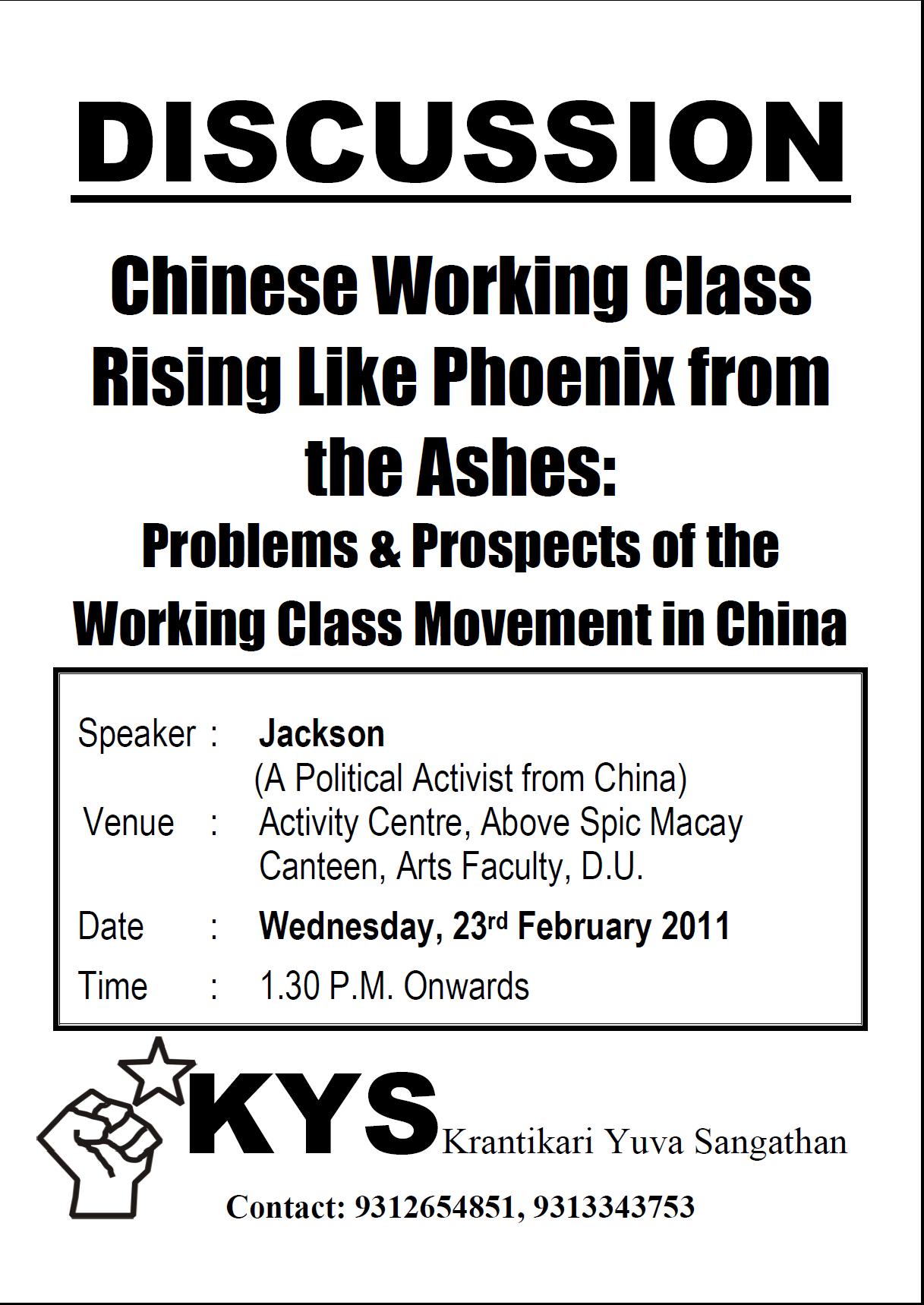
Chinese Working Class Rising Like Phoenix from the Ashes:
Problems & Prospects of the Working Class Movement in China

Speaker : Jackson
(A Political Activist from China)
Venue : Activity Centre, Above Spic Macay Canteen, Arts Faculty, D.U.
Date : Wednesday, 23rd February 2011
Time : 1.30 P.M. Onwards

KYSKrantikari Yuva Sangathan
Contact: 9312654851, 9313343753

Condolence meeting in Memory of K.G. Kannabiran (Jan 8)

Dear friends,

As you are aware Shri K.G. Kannabiran, former President PUCL, eminent lawyer, writer and the most active civil liberties activist, passed away on December 30, 2010. The PUCL is organizing a condolence meeting to pay our tributes to the doyen of civil liberties movement.

Day and Time: January 8, 2011 (Saturday) at 5:00 p.m.
Venue: Gandhi Peace Foundation,
223, Deen Dayal Upadhyay Marg
New Delhi – 110002

You are requested to join us in paying respects to him.

Sd./-
(Mahi Pal Singh)
Secretary, PUCL

Third Anuradha Ghandy Memorial Lecture

The Road to New Democracy in Nepal: Problems and Challenges

The Anuradha Ghandy Memorial Committee
cordially invites you to
3rd Anuradha Ghandy Memorial Lecture
Speaker: Baburam Bhattarai
(Senior Member of the Politburo, UCPN (Maoist)
and former Finance Minister of Nepal)
Friday, 14th January 2011
6.00 pm
Venue: Rama Watumull Auditorium (K. C. College)
Dinshaw Wacha Road, Churchgate, Mumbai, 400020

Baburam Bhattarai, one of the leading personalities of the Unified Communist Party of Nepal (Maoist) is, in his own words, “a typical representative of a Third World educated youth of peasant background, who finds the gross inequality, oppression, poverty, underdevelopment and exploitation of the overwhelming majority of the population in a class-divided and imperialism-dominated world just intolerable, …”. Along with Prachanda, since 1996 he has been at the helm of one of the world’s most significant mass movements for freedom and democracy. A “highly intellectual politician”, he is the author of a large number of books and articles, among which are The Nature of Underdevelopment and Regional Structure of Nepal: A Marxist Analysis (2003), and “Let’s Give No Legitimacy to the Beneficiaries of the New Kot Massacre” (Kantipur, the Nepali language daily, June 6, 2001) which immediately made historical waves.

Introduction to the Lecture Series: Anuradha Ghandy (1954-2008) was a leading organizer and thinker of the revolutionary movement in India. Early on, she developed a sense of commitment to the poor; she joined them in their struggle for bread and roses, the fight for a richer and a fuller life for all. Tragically, cerebral malaria took her away in April 2008. The memorial lecture is instituted in her memory to celebrate the spirit that made her selflessly adopt the cause of the damned of the Indian earth—the exploited, the oppressed, and the dominated—as her own. She was a role model in whatever she did, whether it was teaching sociology to post-graduate students at Nagpur University, or as a founder-member of the Committee for the Protection of Democratic Rights, Mumbai, or as head of the Central Mahila Sub-Committee and member of the CC of the CPI (Maoist) —bold, courageous and decisive, yet kind, gentle and considerate.

AFSPA 1958: Film Screening and Discussion (December 7)

Date: 7th December 2010, Tuesday
Venue: M.N. Sreenivas Hall, Delhi School of Economics,
Department of Sociology, University of Delhi

Documentary Film: “AFSPA-1958” is a documentary film Script and Directed by Haobam Pebam Kumar a well-known documentary film maker. AFSPA 1958 was awarded INTERNATIONAL FIPRESCI CRITICS JURY AWARD (MIFF2006);INTERNATIONAL JURY AWARD (MIFF 2006);THE JURY PRIZE (10th Ismailia International Film Festival 2006);A.C.T. Award to AFSPA 1958 for the Best Film that deals with women problems, subjects, concerns and rights in the official competition of the 10th Ismailia International Film Festival 2006;BEST DOCUMENTARY AWARD (SIGNS 2006, Kerala/India);BEST DOCUMENTARY AWARD (6th KARA International Film Festival, 2007, Pakistan) ; Awarded the Swarna Kamal for the Best Non-Feature Film in the 56th NATIONAL FILM AWARDS FOR THE YEAR 2008 It tries to capture the everyday life of the people in “disturbed area” in the case of Manipur who lives under one of the most draconian law enacted by the post- independent India. It shows some of the experiences, life, pain, helplessness, anger, resistance, rejection, and calls for support to the progressive peoples from the story of atrocities, humiliation, insecurity of life and dignity. It documented after 2004, July 10, Miss Manorama who was taken away by the Assam Rifles from her residence after giving an arrest memo to her family. She was raped and murdered. 11 women protested without any cloths, a student leader Mr. Chitarenjan performed self immolation; many students from Manipur University were badly beaten up in front of Governor’s house, people lived under curfew for months, a long mass protest by the people in Manipur and unending non violent protest (hunger strike till justice) by Irom Sharmila Chanu to repeal AFSPA. For the first time in the history of post independent India, national security legislation was forced to review under a commission appointed by Prime Minister and resulted no result.

Abstract: AFSPA is essentially one of the colonial acts like Indian Forest Act 1927, Indian Penal Code, Indian Land Acquisition Act, the Criminal Tribe Act 1871 etc. It is originated from Armed Forces (ordinance) 1942 and passed as Armed Forces (Manipur and Assam) Special Power Act in 1958 in parliament. After the implementation of this act in certain regions or people of the state, it can be stated that laws are made on the basis of race, religion and people. The idea of rule of law without any difference on the basis of sex, race, color, and people of a modern democratic state has been compromised by this very implementation of this act in the last 5 decades in some part of this country. Why such kind of law can exist so long? What is the politic of this act? How AFSPA can be understood in an academic and public discourse? How can we imagine the society under AFSPA-1958?

2.30 pm: Documentary Film: “AFSPA-1958”
Discussion:
3.40 pm: Indian State, AFSPA-1958 and Rule of Law
by
Dr. Sudha Vasan
Department of Sociology, Delhi School of Economics, DU

4.10pm: Human Rights and Security Law in India (AFSPA)
by
Colin Gonsalves
Supreme Court Lawyer and Human Right Activist

You are requested to kindly witness this documentary film and take part on the discussion.

On the Demolition of Babri Masjid and the Allahabad HC judgement (Dec 6)

Dear Friends,

6th December 1992 marked the demolition of the Babri Masjid situated at Ayodhya by Hindu communal hordes led by Hindutva leaders, while the central security forces looked on without intervening. The Central Govt. of Congress led by P.V. Narasimha Rao and the state BJP Govt. led by Kalyan Singh stood by and allowed the demolition. Narasimha Rao’s first public statement promised the country that the Govt. would rebuild the mosque; a sentence which the Central Govt. ceased to repeat in the space of just a few days. Anti-Muslim violence under the patronage of the police followed in Mumbai, where the Sri Krishna Commission report remains unimplemented till date.

Later the Supreme Court refused to answer a Presidential reference to ascertain whether any Hindu religious structure was demolished to build the Mosque. Criminal complaints filed against the Hindutva leaders for the demolition continue to lie pending before various special benches of the state High Court.

Now the Lucknow bench of the Allahabad High Court has passed a judgment which legalizes the illegal act of smuggling of idols under the central dome of the Babri Masjid which for centuries had been a functional mosque .It has condoned the act of physical demolition of the Mosque by holding that the area under the Central dome of the Mosque had all along been the birth place of Rama. Not only that the Lucknow Bench has even endorsed the VHP’s plan of a ‘grand temple’ at Ayodhya entertaining VHP functionaries as a Party and their design of ‘grand temple’ as a legally valid cause. While the religious demolition of the Babri Masjid took place in 1949, its physical demolition in 1992, this court judgment has effected its legal demolition. Worse, it has opened wide the doors to avenging missions of Hindu communalists to reverse perceived ‘wrongs’ of history targeting the minorities.

Not only this .The current High Court judgment has passed comments of far reaching significance on archeology and history with dangerous consequences regarding use of these disciplines.

The Babri Masjid demolition and the aftermath till date puts on agenda the entire question of Hindu communalism in India. Congress practices a ‘soft’ Hindu communalism while wearing the mask of secularism while the Hindutva organizations like BJP, VHP, and RSS take aggressive Hindu communal position. The communal conspiracies of the rulers divide the people’s movements and turn the focus away from the real issues before the people.

To discuss all these aspects, especially the Allahabad High Court judgment, Delhi Committee of CPI (ML) New Democracy is holding a meeting

on 6th December 2010
from 5.30 pm
at Gandhi Peace Foundation

where several distinguished speakers will place their views. We hope you will be able to spare your valuable time to attend the same.

Speakers:
Rajinder Sachar,
Prashant Bhushan, Senior Advocate, Supreme Court
Saeed Naqvi, Senior Journalist
D. Mandal, Archeologist
and others
Delhi Committee,
CPI (ML)-New Democracy

Naujawan Bharat Sabha (NBS)
Delhi Committee
Contact
Mrigank (09268708291)
Veerendra (09210186894)
Rajesh (09818834175, 09953960163)

Nisan Sammelan 2010, Bhubaneswar: A Report

Satyabrata

On the 21st of November, 2010, a meeting was organized in Bhubaneswar by the leading leftist cultural magazine in Oriya, Nisan. The meeting was supported by several other left, Lohiaite and Gandhian groups. It was held under the banner of Nisan Sammelan — 2010 with a discussion on “CULTURAL RESISTANCE: WAR ON PEOPLE IN CORPORATE INTEREST.” Twenty-six tribal organizations participated in the meeting with each of them discussing problems that they are facing in the ongoing struggles in their regions. Incidents of police atrocities, rape, false arrests were made public in the meeting. The police in their bid to stop the tribals from reaching Bhubaneswar harassed them at several railway stations. A group comprising of thirty members which was supposed to come from Kashipur was arrested.

The groups unanimously decried the attempts by the State and capitalists to displace or alienate them from their resources and they shared their experiences of struggle in front of a gathering of about 5000 people. The tribal organizations called for intensifying solidarity efforts and a close coordination among various organizations to confront the state which has instrumentalised itself as the blatant political wing of corporate capital, branding all struggles for popular self-determination as Maoist.

The invited speakers included writer-activist Arundhati Roy, revolutionary Telugu poet Varavara Rao, Oriya novelist and short story writer Bibhuti Pattnayak, veteran journalist Rabi Das, poet Kumar Hasan, poet Rajendra Panda, advocate and human rights activist Biswapriya Kanungo and noted Gandhian Prafulla Samantara .

Arundhati Roy while arriving at the venue was greeted by about 7-10 ABVP cadres with black flags protesting against her visit. Tribals, with their lathis chased them away. It is noteworthy that all prominent local and national bourgeois newspapers have presented this local communal hooliganism against the Kashmiri struggle as a major incident.


Arundhati Roy

In her speech Arundhati Roy, after facing the ABVP cadres outside, talked about patriotism nurtured in the struggles of indigenous peoples led by the anti-hegemonic forces of various ideological hues. Varavara Rao too spoke about the relevance of tribal struggles and drew an analogy between such struggles and anti-US imperialist struggles of the oil rich regions of the Middle East. He said that the tribal struggles were results of oppression of the state which wanted to take away whatever means of livelihood they had. He asked not to analyse these struggles just on the basis of their formal contours, rather they must be understood in terms of what provokes them. He spoke about the relevance of revolutionary violence which he interpreted to be a tool to fight structural violence of the system.


Varavara Rao

The speakers revealed the truth of peoples’ struggles and their spirit against the state’s insistence to “massacre every revolt that makes sense.”

Theorising Practice, Practising Theory: A Panel Discussion on “Insurgent Metaphors” (Nov 16)

Department of Political Science
University of Delhi

Invites you to

A Panel Discussion on Insurgent Metaphors: Essays in Culture and Class by Pothik Ghosh

Panelists:

1. Prashanta Chakravarty, Associate Professor, department of English literature, Delhi University

2. Saroj Giri, Assistant Professor, department of Political Science, Delhi University

3. Rajarshi Dasgupta, Assistant Professor, Centre for Political Studies, Jawahar Lal Nehru University

4. Alok Kumar, Krantikari Yuva Sangathan, Delhi

5. Paresh Chandra, Member of Correspondence editorial board, Delhi University

Date: Tuesday, 16th Nov 2010

Time: 2 pm

Venue: Lecture Hall,
2nd Floor, Faculty of Social Sciences Building ,
Delhi University (North Campus)
Opposite Daulat Ram College

A Conference on Rural Labourers in Neo-liberal India, Bhubaneswar (18-19 December 2010)

A second call for papers for

A Conference on
Rural Labourers in Neo-liberal India

18-19 December 2010

XIMB (Xavier Institute of Management – Bhubaneswar), Orissa, India

Supported by Social Sciences and Humanities Research Council (SSHRC) of Canada
and XIMB, Bhubaneswar, Orissa

Neoliberalism has affected India’s rural areas and the agrarian sector particularly harshly. Not only are peasants being dispossessed of their rights to land, water and forests, and of their meager entitlements from the state. But also rural labourers are being subjected to ruthless levels of exploitation on the farms and in agro-industrial units where they produce commodities for the rich domestic elite and for export to rich (and imperialist) countries. While the story of dispossession of peasants has (rightly) attracted much attention in recent times, what has often been neglected is the issue of the production of commodities, the associated process of exploitation, and therefore, the life of the labourers.

Without land or other forms of property and with dwindling welfare benefits from the neoliberal state, rural labourers find themselves in a precarious situation and form a major part of the ‘Republic of Hunger ’. They work as long as they live, and they live as long as they work. Many are footloose labourers constantly in search of work. In many places, employers even take away labourers’ freedom to sell their labour power, in order to cheapen the only commodity they possess and to discipline them. This is the case with bonded and child labourers. As well employers make use of gender and caste/tribality to lower wages of low-caste, women and tribal labourers and to pit one group of labourers against another. These social distinctions are no less used by political parties of the rich property-owning classes to divide and disarm the rural working class electorate. But at the same time, rural labourers (and poor peasants), in spite of them being geographically scattered, are engaged in an ‘uninterrupted, now hidden, now open fight’ against exploitation and oppression.

The topic of rural labour in imperialized, poorer countries such as India indeed cries out for serious critical scrutiny. This must place rural labour (including semi-proletarian labour) at the center of our attention in terms of primitive accumulation which produces it and the capitalist accumulation process which exploits it, and in terms of its democratically organized struggles against capital and the neo-liberal state.

Papers are invited which speak to one or more aspects of the situation described above in the specific context of India . Specific topics of interest include:

1. ‘Primitive accumulation’ in relation to labour
2. Rural migrant labourers (working in villages and/or in urban areas)
3. Labour process in export-oriented agricultural production sites
4. Labourers in floriculture and aquaculture
5. Contract farming and rural labour
6. Rural reserve army of labour and neo-liberal accumulation
7. Technological change, rural labour and politics of production
8. Ruralization of capital in the age of ‘new’ imperialism and its effect on labour
9. Environment (e.g. climate change issues, including heat wave) and rural labour
10. Life and livelihood of the unemployed in the villages
11. Poverty/hunger of rural labour households
12. Credit relations (formal and informal) and rural labourers
13. Female labourers, neoliberal state and neoliberal capital
14. Capital and dalit/adivasi labour
15. Rural labouring bodies in pain: capital’s corporeal effect on labour
16. Reduction in state welfare provision and its impact on labourers
17. Government rural wage-employment generation programmes (e.g. NREGS)
18. Development NGOs and rural labour
19. Representation of rural labour in media and popular culture
20. Struggles of rural labourers and poor peasants against capital, landowners, and neo-liberal state
21. Rural labourers in progressive art and media

The original deadline for the submission of abstracts has passed. Though 5th December remains our deadline for receipt of the completed-papers from the authors whose abstracts have been accepted, some slots are now available with us for considering directly-submitted completed-papers from those that did not submit abstracts or whose abstracts did not get accepted; the deadline for these is 15th November.

Website: http://sites.google.com/a/ximb.ac.in/rlni/
E-mail (for inquiries): conf-rural-labour@ximb.ac.in
Tel: +91-94370-75075

Leader of War Mongerers, Looters and Exploiters of world people, US President Obama Go Back!

JOIN A DEMONSTRATION ON NOVEMBER 8TH 2010 (MONDAY) AT JANTAR MANTAR (NEW DELHI) AT 2:00 PM

Dear Friends,

At a time when US imperialism has escalated the war against Afghanistan and is even extending this war by assaults by NATO forces led by it against northern districts of Pakistan, leader of warmongers, looters and exploiters of the world people, President of USA, Barack Obama, will visit India in early Nov. 2010. Since Obama came to power, US forces have increased their numbers several times over in Afghanistan. There are innumerable proven instance of deliberate targeting of innocent civilians by these forces in the name of “targeted” attacks on “enemy”. In essence, US imperialism under Obama administration is continuing the Bush era attempt of a permanent base in Afghanistan from where it will interfere in central Asia. India should be in the forefront of opposing the US move. Let us use the opportunity of Obama’s visit to strongly demand that US and NATO forces immediately withdrawn from Afghanistan.

It was 2001 that US imperialism under Bush had launched its current war, which the world people were told was against ‘terrorism’. War was launched first against Afghanistan and later against Iraq. In reality wars were launched to further the quest of US imperialism for hegemony over the world’s oil resources and also to establish military dominance over the world.

In essence, the Obama administration is continuing the aims of Bush era but it has changed rhetoric. US under Obama has made a mockery of his promises of withdrawal of forces from Iraq, keeping a huge army stationed there in the name of ‘aid’ to local troops. While Afghanistan is the main theatre of war, US continues a sharply aggressive stance on West Asia and Central Asia. On Palestine, Obama has no policy different from the earlier one and continues backing Israel against the just fight of the Palestinian people.

The current world economic crisis began in US and the US economy continues to be in the grip of severe unemployment. One of the chief ends of the Obama visit is to push further opening of the markets of our country. He is expected to give a massive push for opening of the retail sector to US MNCs like Wal-Mart, which will directly affect the livelihood of a large section of our people, and which step the Indian people have resisted all along. All this even as Obama administration seeks to protect US markets back home. Obama is championing opposition to outsourcing by US companies; those companies which outsource are to face stiffer taxes. It is also no secret that Obama is going to use the occasion of his visit to push for fresh defence deals with US, aiding the powerful weapon industry. Ahead of Obama visit Indian government has signed the international nuclear liability treaty to dilute the liability of suppliers as stated by Nuclear Liability Act 2010. This is in accordance with the demands of US companies. Let us not forget that Obama administration, like previous US govts, has refused to reconsider the issue of extradition of Warren Anderson, guilty of Bhopal Gas Tragedy, for trial in India.

Obama is coming at a time when ruling classes of India have hitched themselves firmly to the chariot wheel of US imperialism. They aspire to the junior hegemons under US in Central Asia. Ruling classes of India are committed to bowing to the diktats of US imperialism in the economic spaces too. As it is the people of India are reeling under the pro imperialist policies of India’s ruling classes especially the new economic policies being implemented since 1991. The result is visible in the severe price rise which is burdening the common people including the working class. Severe agricultural crisis has gripped the country. Land acquisition by the state for cooperates; MNCs and SEZs have devastated last sections of the peasantry and tribal. Privatization and liberalization are putting health and education further out of reach of common masses. People all over country are resisting these policies in various ways. The furtherance of pro imperialist policies, which is what the Obama visit will signify, will increase the burdens on the common people.

On the occasion of President Obama’s visit to India, let us unitedly demand

US imperialism, Get out of Afghanistan.
Send back Warren Anderson to face trial in India

CPI(M-L), CPI(M-L) New Democracy, CPI(M-L) New Proletariat, Democratic Students Union, Indian Council of Trade Unions, Indian Federation of Trade Unions, Inqlabi Majdoor Kendra, Krantikari Yuva Sangathan, Mool Pravah Akhil Bharatiya Nepali Ekata Samaj, Pragatisheel Mahila Sangathan, Progressive Democratic Students Union, Revolutionary Democratic Front, Trade Union Centre of India, CPDM, Bahujan Vam Manch

Jalandhar Convention on War against People and the Role of Democratic Forces

DEMOCRATIC FRONT AGAINST OPERATION GREEN HUNT, PUNJAB HOLDS A MASSIVE CONVENTION AT JALANDHAR!
BUILD A BROAD SPECTRUM OF RESISTANCE MOVEMENTS!
OPPOSE NEO-LIBERAL POLICIES AND SUPPRESSION OF PEOPLES’ MOVEMENTS THROUGH ARMED FORCES!

On 17th October, when people were celebrating Dussehra to mark the victory of Good over the Evil, the Democratic Front Against Operation Green Hunt, Punjab, held a massive Convention in Desh Bhagat Yadgar Hall, Jalandhar on “War against the people & Role of Democratic Forces.” It was addressed by noted pro-people thinker and Booker Award winner writer Arundhati Roy and Gandhian social activist Himanshu Kumar. Hundreds of people from all walks of life – University Professors, Research Scholars, Students, Artists, littérateur, cultural activists, press-persons, farmers, agricultural and industrial laborers, trade unionists, thinkers etc., participated from all across Punjab and Chandigarh. The Convention Hall having a seating capacity of 900 was overfilled and hundreds of people were left to hear the programme from outside the Convention Hall.

The Convention Hall was tastefully decorated with flex-hoardings having appropriate messages. The theme hoarding had the poem by Pastor Martin Niemoller – ‘FIRST THEY CAME FOR THE COMMUNISTS’, with a painting depicting peoples’ struggle in the background. Two others were having poems by two noted peoples’ poets of Punjab Sant Ram Udasi- MAGHDA RAHIN VE SURJA (Shine O Sun brightly) and Pash- ASIN LARANGE SATHI (Comrade! We will fight). There were quotations from Shaheed Bhagat Singh, ‘HAWA MEIN RAHENGI MERE KHIALON KI BIJLIAN’ (I may or may not live, but my ideas will remain galvanizing the air eternally)

The Convention was presided over by a presidium consisting of Dr. Parminder Singh (Professor Guru Nanak Dev University, Amritsar), Prof. A.K.Maleri (Ludhiana), Sh. Yash Pal (Retired Teacher and Editor VARG CHETNA), Prof. Ajmer Singh Aulakh (Noted pro-people Punjabi Dramatist), Com Gandharav Sen Kochhar and Sh. Naunihal Singh(both from Desh Bhagat Yadgar Committee, formed to honor the martyrs of Gadar Movement).

Arundhati Roy opened her speech with the remark that the Indian state has been waging a war against its own people in many parts of the country such as North East, Kashmir, Punjab and many other places for the last 60 years using military and the police to ruthlessly suppress them. She paid rich compliments to the poor people and tribals living in the forests of Chhattisgarh, Jharkhand, Orissa, Andhra, West Bengal and Maharashtra, who were fighting valiantly to save their lands, forests, water and mineral wealth from being plundered by the world’s richest companies. Preaching non-violence to the tribals of Chhattisgarh is immoral. To those, who accuse the tribals of being violent, she asked: ‘When people are forced to die of hunger, when they are uprooted after depriving them of their lands and livelihood, in the name of development, is it not violence?’ Is it not ironic to advise those, who have empty stomachs and empty pockets, to follow the Gandhian tools of Hunger strike and boycott of foreign goods?

She said that to oppose operation Green Hunt, one need not go and fight in the jungles of Dantewada. Fighting against injustice at our own place is also an important contribution to this cause. Struggles against SEZ and the exploitative Commission Agent (ARHTIYA) system in Punjab are part of the fight against operation Green Hunt. She called upon the intellectuals and toiling sections of the masses to build a broad spectrum of resistance movements against the neo-liberal policies of the State and its onslaught on the peoples’ movements in the form of armed operations such as Green Hunt.

Commenting on the ongoing events in the states under operation Green Hunt, she said that there is a strong link between development and genocide. There is genocide under the façade of development. When the people are uprooted from their lands, culture sources of livelihood, they are doomed to die. In India Crores of people suffer from the AIDS of malnutrition. Malnutrition not only leads its victim to death, but casts its agonizing shadow on the next generations also.

She said while the Naxals are fighting a protracted war against the capitalist system and big corporates, the Indian state was fighting war against its own people. She suggested having diverse methods of resistance in a wider struggle to challenge oppressive policies of the state.

She said the Green Hunt began in Punjab earlier than Chhattisgarh, with the advent of “Green Revolution”. Green Hunt is infact the phenomenon to deprive the people of their land and the resources attached to it such as water, forests, mines etc. Green Revolution and the farmers’ suicides in its aftermath is pointer to this. About 1,80,000 debt trapped farmers have committed suicides in the country. She deplored the Punjab Govt for having branded the 17 organization of farmers and agri-labourers as Naxalite front organizations. Those who raise their voice against injustice are branded as Naxalite. If the rulers continued to follow the policies of privatization and liberalization, then they shall have to deploy army in the whole country. In two decades of neo-liberal policies, the number of people below poverty line have increased manifold, while 100 people own 25 percent of national wealth.

She said the Indian democracy has become shallow. Democracy doesn’t mean mere periodic elections. Democratic rights of the people are being trampled under the foot. Indian Constitution has lost its meaning as the judiciary, media and Parliament have all been made to serve the corporates and monied people. Media is in the hands of corporates. Courts have gone beyond the reach of common man and have become a tool to endorse neo-liberal anti-people policies of the State.

There was a lively discussion on her speech and she answered most of the questions raised by the participants.

Noted Gandhian Himanshu Kumar, who had gone on a cycle-yatra of Rajasthan, Gujarat and Maharashtra, after addressing 16 conventions against Operation Green Hunt throughout Punjab on the invitation of the Democratic Front, shared his assessment of the situation prevailing in those states. He said the situation was explosive everywhere. There were many Dantewadas in the making due to anti-people policies of the rulers. He said in Gujrat, the Forest Rights Act envisages grant of land up to 10 acres on lease to tribals in the forest areas. But Modi Government has not granted even an inch of land to them. But the same Govt has gifted away 1,02,000 acres of land to 176 corporate houses. A functioning university has been closed to provide land to Tata’s Nano plant. A hundred people of this country control 25 percent of its wealth. Our Prime Minister says the people are becoming violent. But the question is why after six decades of independence, there is violence. Are only the Naxalite responsible for this violence? In fact the development model, being implemented by the rulers is resulting in the poor becoming poorer and the rich becoming richer. Development has become synonymous with depriving the poor of their livelihood resources, such as land, water, forests, mineral wealth etc., to fill the coffers of the rich. It will definitely breed violence. Instead of following the principles of social justice and equity, we are following the law of jungle, where might is right. This situation has to be changed. Quoting Gandhi and Vinoba Bhave, he said that if injustice and inequity persists in the society, violence is inevitable, because the victims of injustice and inequity cannot be expected to take the things lying down; they will definitely revolt to change the system, to assert their rights. He said injustice must not be tolerated. It should be resisted at all costs. Non-violence should never become an excuse to run away from the fight against injustice.

Both the speakers were presented with the portraits of Shaheed Bhagat Singh, a poster with Pastor Niemoller’s poem, and a set of three books- ‘History of Gadar Party’, ‘History of Naujwan Bharat Sabha’ and ‘Dialogue with the Revolutionaries’. Mrs. Veena wife of Himanshu Kumar, who spent 18 years with him at Dantewada, serving the tribals was also honored.

After the convention Arundhati Roy held an interaction with Research Scholars and students from three universities of Punjab and prominent historians in the Gadar Museum Hall. She along with Himanshu Kumar and his family and Sanjay Kak, went around the museum evincing keen interest in the revolutionary history of Punjab, particularly the Gadar movement.

At the end of the convention the participants passed resolutions with raised hands demanding an end to Operation Green Hunt; withdrawl of military and para-military forces from the tribal areas; disbanding Salwa Judum and such other fascist organizations; recognizing the rights of tribals over their forests, lands, water and natural resources; stopping SEZ and uprooting of tribals in the name of development; roll-back neo-liberal policies of privatization, globalization and liberalization; repeal black laws such as Armed Forces Special Power Act, Unlawful Activities Prevention Act etc.; stop false encounters and implication of innocent people in false criminal cases; revoke the ban imposed on CPI Maoist and its front organizations; allow the pro-people press-persons and democratic organizations to visit tribal areas; hold judicial inquiry in the killing of Maoist leader ‘Azad’ in a fake encounter; stop the conspiracies to foist false cases on Arundhati Roy, Himanshu Kumar, Nisha Biswas, and other noted intellectuals; punish the murderers of peasant leader Sadhu Singh Takhtupura and Pirthipal Singh Alisher and the killers of peasants at Khanna Chamiara in Punjab; Stop implicating leaders and activists of mass organizations of farmers, agri-labourers, employees, unemployed youth in Punjab and other states in false criminal cases and torturing them; Close all the interrogation centers such as the one at Amritsar known as Joint Interrogation Center.