Does globalisation impede labour mobility?

Pratyush Chandra

ET Debate

Anti-immigration laws are enforced not to stop but control new settlements and to legitimise the use-and-throw logic that characterises neo-liberalism. This increases labour vulnerability economically and politically — by differentially including the immigrants and ghettoising the local consciousness against them.

Throughout the world — in Maharashtra, in Assam, in the US, everywhere — the same ghettoised psyche comes coupled with the trans-politicisation of economy, which has relegated people to passive receptors of global mobility of capital.

Specific identitarian conflicts today are various realisations of the competitive ethic that underlies a market-oriented political economy. With the entrenching of this ethic in every corner of the society under globalisation, such conflicts are bound to multiply.

What the market does essentially is that it perpetuates fragmentation and individuation, thus posing every division in a horizontal competition. Even those conflicting interests, which could be resolved only by structural transformation, are preserved through their metamorphoses into competing groups and lobbies.

Arguably the greatest Indian philosopher, Muhammad Iqbal understood this when he said, “Fanaticism is nothing but the principle of individuation working in the case of group”. In other words, regional/national fanaticism that defines anti-immigration today is the product of individuation that competition necessarily poses.

Under neo-liberal globalisation, I agree, the “global village” has become a virtual reality. However, in this village citizens are reduced to “much as potatoes in a sack form a sack of potatoes”. They are thrown into a large “stagnant swamp”, where they desperately try to save themselves and stand up in whatever way they can — even if at the expense of others.

So anti-immigrant upsurge and its legitimacy are nothing but a vent to this desperation. It is a commodified deformation, in the socio-political market, of structural conflicts.

Hence, the question is not whether globalisation impedes labour mobility, but how through various means it impedes labour’s ability to challenge capital.

Courtesy: The Economic Times

Philippines: Free Labor Rights Lawyer

Continuing Harassment of Leftist Activists

(New York, October 29, 2008) – The Philippine authorities should immediately release Remigio Saladero, Jr., a labor lawyer who was arrested on charges that appeared to be politically motivated, Human Rights Watch said today.

Philippine police arrested Saladero on October 23, 2008, at his law office in Antipolo City, in Rizal province, his attorney said. The police showed a 2006 arrest warrant for a case of multiple murder and attempted murder in Oriental Mindoro province that bore the name – Remegio Saladero alias Ka Patrick – and a different address. They also confiscated Saladero’s computer hard drive, laptop and mobile phone.

“Suddenly arresting a well-established activist lawyer for a two-year-old multiple murder case in another province should set off alarm bells,” said Elaine Pearson, deputy Asia director at Human Rights Watch. “This smacks of harassment, pure and simple.”

Saladero’s lawyer told Human Rights Watch that he was allowed to meet with Saladero in jail only after Saladero had been interrogated for six hours, even though he was entitled to legal counsel from the start of the interrogation. He is currently being held in the Calapan City provincial jail.

Human Rights Watch is concerned that Saladero was arrested because of the groups and individuals he has represented. His clients include hundreds of workers who have brought wrongful dismissal cases and suspected members of the New People’s Army (NPA), the armed wing of the Communist Party of the Philippines. Saladero is the board chairperson of the Pro-Labor Legal Assistance Center (PLACE) and chief legal counsel for Kilusang Mayo Uno (KMU), an alliance of trade unions.

Human Rights Watch urged the United States and the European Union to monitor Saladero’s case closely and to call for his immediate release.

In recent years, the government of President Gloria Macapagal Arroyo has come under intense international and domestic criticism over hundreds of extrajudicial killings and enforced disappearances of leftist activists, journalists, lawyers and clergy by members of the Armed Forces of the Philippines and the Philippine National Police.

In response to the criticism, the number of such killings dropped sharply, but convictions of perpetrators for serious crimes of this type remain negligible. Local activists have also expressed concern that the continuing harassment and arrests of activists on trumped-up charges shows that the government is only changing its tactics.

Several other cases bear similarities to Saladero’s arrest, and courts have subsequently declared the arrests illegal. In August 2008, a judge in Tagaytay City found the arrest and detention of the so-called “Tagaytay Five,” who had been advocates for farmers’ concerns, unlawful, and ordered their release. Security forces had arrested and detained the five – Riel Custodio, Axel Pinpin, Aristides Sarmiento, Enrico Ybanez and Michael Masayes – in a joint military-police operation in April 2006 and forced them to admit they were members of the New People’s Army.

In May 2007 armed men abducted a church pastor, Berlin Guerrero, in Laguna province. Several days later, he resurfaced in police custody and he was charged with being an NPA leader. In September 2008, the Court of Appeals in Manila dismissed charges of sedition and murder against him, and ordered his immediate release.

The United Nations Declaration on Human Rights Defenders sets out a series of principles and rights, based on human rights standards enshrined in international instruments. The declaration states that everyone has the right to promote the protection and realization of human rights.

“Saladero’s arrest shows the Philippine government is not sincere in its pledges to stop harassing lawyers and activists,” Pearson said. “It’s not just Saladero’s rights that are undermined, but the rights of all Filipinos ever in need of a lawyer.”

Courtesy: Human Rights Watch

Class in Making?

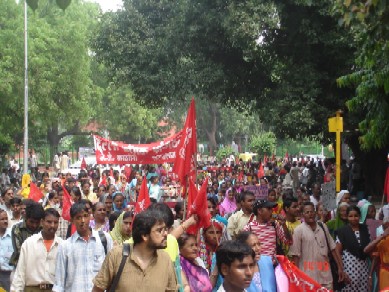
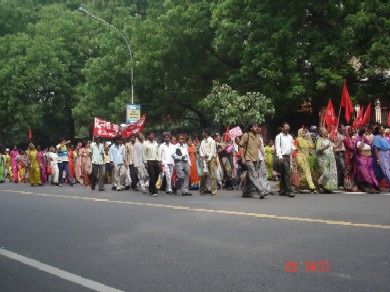
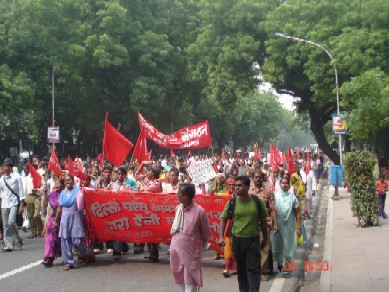
October 24, 2008. Around 150-200 teachers from various computer teaching institutions (especially Aptech) whose accreditation has been withdrawn by the Delhi Government demonstrated at Jantar Mantar, New Delhi. The event was organised by a local NGO. They were demanding the reopening of the closed institutions and the reinstatement of the teachers who are presently unemployed. Their demands also included the determination of the salaries and benefits for the teachers according to the minimum wages set by the government, as teachers were/are getting just Rs. 2500-2750 in these institutions (including in CompCom).


The first level of consciousness – “We are also Human!”


The second level of consciousness – “Down with the Delhi Government!”


The third level of counsciousness – “The nexus between the company and the government!”


And the Sectionalist Contradiction – “Illiterates are getting 4000 and the computer teachers just 2500!”


SLIDESHOW

A Report on the Workers’ Struggle in Graziano Trasmissioni

Rajesh Tyagi

This report is based upon an interview of two workers of Graziano Trasmissioni, namely Kapil Kumar and Ajay Dwivedi. Kapil belongs to Saharanpur, Uttar Pradesh (UP) and had joined in 2003 as apprentice, after completing his ITI. He worked 8/9 months under contractor, which was a sham and then was given permanent appointment in 2004. Ajay Dwivedi was employed in 2006.

Graziano Trasmissioni at Noida is a subsidiary of a multinational company based in Italy.

The company had started its operations in Noida, UP, in 2003 with a capital of less than 20 crore rupees, which grew over to more than 240 crores in 2008. This extraordinary accumulation of wealth is the result of the super exploitation of the workers employed at this establishment.

Lalit Kishore Chaudhary, its Chief Executive Officer (CEO) has been instrumental in the establishment and growth of the company.

Industrial activity in the establishment continued round the clock, initially in two shifts of 12 hours each, i.e. 6 am to 6 pm and then 6 pm to 6 am. Though working hours were limited to 8 hours and the workers were paid overtime for an additional 4 hours, but overtime was made compulsory for workers. No weekly off day was being given. Those refusing to comply were thrown out of employment.

Initially 350 permanent workers were employed as Operators cum settlers, with 80 Trainees/apprentices. About 500 persons work under the labour contractors mostly for the job of packaging.

The very first dispute arose as the employers used to make deductions from the wages on false pretexts.

On 233 December 2007 the first protest of workers started on the issue of demand for a rise in wages and against the deduction of wages by the employers on the ground that the entry card was not properly punched. Though it used to happen due to a technical fault in the punching system, while subsequent punchings in the day were duly recorded, yet the employers in order to harass the workmen used to deduct the wages, on this false pretext. The workers protested.

Getting wind of the workers being organised and striving to form a union, 3 workers were barred by the employers from entering the premises and one Manoj Kumar was terminated. The management refused to recognise the union, while the authorities at Kanpur kept the application of the workers pending in collusion with the employers.

4.12.2007. Protesting against the high handedness of employers, 100 more workers were locked out by pasting a notice of the lockout outside the gate.

7.12.2007. A settlement took place between the parties, only to be repudiated by the employers later on. The workers’ protest went on.

AITUC, the trade union front of the Communist Party of India, with whom the workers were affiliated, agreed with management to restore normalcy first and then negotiate, which the workers rejected. After this the AITUC abandoned the workers.

24.1.2008. In the face of the struggle of the workers, the employers were constrained to enter into a written settlement with them in the presence of the Deputy Labour Commissioner (DLC), Noida etc. On behalf of the workers 5 elected representatives participated, among them – Rajender, Kailash Joshi, Pankesh Sharma, Ram Charan and Mohinder. A homogenous wage revision was agreed upon with an increment of Rs. 1200/- in the current year, Rs. 1000/- in the second year and Rs. 800/- in the third year.

February 2008. However, immediately after this settlement, the employers brought in 400 workers under the local contractors namely Virendra Bhati, Manish and one Bhardwaj. These contractors with a force of 400 at their disposal, started to bully the workers. From 2008, these 400 workers began to reside inside the factory premises. The said contractors had also gathered iron rods, sticks and other weapons inside the premises, to terrorise the workers and obviously to deal with the agitating workers, if need be. Apart from this a whole battalion of armed goons in the name of ‘security’ was also employed under a contractor. It became clear, thus, that the employers were planning to throw out the permanent workers and to substitute them with these contract workers.

May 2008. To pick up a dispute and provoke the workers the employers refused to employ 5 worker Trainees/ apprentices and ousted them from the premises on the pretext that they had handled the job of ‘settling’ of the machine without instructions. It was pointed out that no such written instructions for ‘settling’ job were given to any of the workers. The same was part of the ordinary job duty. The workers then insisted that from then onwards instructions for ‘settling’ jobs were to be issued in writing. The workers also demanded that the 5 ousted workers be taken back.

Instead of taking the 5 workers back on the rolls, the employers suspended 27 more workers. The Production Manager Amar Singh Baghel was also ousted on the charge of being in collusion with workers.

The employers had intentionally switched off the reverse exhaust fans inside the workshop which resulted in an immense increase in the indoor temperature. To ensure that no workman even took a breath during duty hours, CCTV cameras were installed, and violators were immediately ousted.

The workers protested against the aforesaid unfair labour practices and made complaints to the concerned authorities but without any result. Authorities acted hand in glove with the employers. The workers also demanded 3 shifts of 8 hours instead of the two of 12 hours each. Everything fell on the deaf ears of the employers and the competent authorities.

30-31/5/2008. A disturbance started on the instigation by Virender Bhati, the local muscleman of the employers under cover of being a contractor. A totally false police complaint was made by the employers against the workers for affray, and 30 more of them were locked out. Workers could be released after depositing personal bonds of Rs.1,00,000/- (one lakh) each, with the Sub-Divisional Magistrate (SDM), NOIDA, which is very unusual and extremely excessive amount.

19.6.2008. Instead of paying any heed to the legitimate grievances of workers, and in order to harass and terrorise the workers, 35 more of them were locked out. With this a total 97 workers were ousted, while 192 continued inside out of the permanent workers. By this time the workers were affiliated to CITU, the trade union front of the CPI(M), which agreed to the proposal of the employers that first of all normalcy be restored and the protest outside the gate be ended, and then after a month the employers would think of reinstating the workers. The workers did not agree to this and then the CITU also abandoned the workers. However, the protest of the workers continued.

In the meanwhile workers affiliated to the HMS, the trade union front of the Rashtriya Lok Dal, with one Virender Sirohi as their leader.

1.7.2008. A meeting between the employers and HMS took place in the office of the DLC, in which Sirohi agreed to normal working on the 2nd, 3rd and 4th of July, 2008.

2.7.2008. The employers instead of complying with this locked out the remaining 192 workmen as well. The workers were constrained to resume their protest. A dharna took place at the DLC office for 7 days, then 3 days before the District Magistrate (DM) office, a march was undertaken from Surajpur Chowk to the DM office and finally a dharna at the Italian embassy was organised, but the entire machinery remained totally insensitive towards the cause of the workers.

Several times the dispute was negotiated at the DLC office or the police station, but only to be repudiated by the employers on one or the other pretext or intrigue.

11.7.2008. A settlement was arrived at the DLC, Noida Office, in the presence of the SDM and CO Dadri.

13.7.2008. The workers joined work at the factory pursuant to the settlement and to show their bonafides.

The next meeting was fixed at the DLC office on 16.7.2008.

16.7.2008. Out of the 27 suspended workers the employers reinstated only 12, while they terminated the services of 15 workers. This was apparently a device to divide and crush the workers, one by one.

55 more were notified to be reinstated, but were locked out the very next day on the pretext of their coming late at 9 am instead of 6 am.

The employers also obtained an injunction form the Court preventing the workers from agitating within 300 metres of the factory premises.

The Labour Commissioner came to Ghaziabad from Kanpur. The workers met him and complained about the partial and callous attitude of the DLC, Noida. The Commissioner entrusted the matter to the DLC, Ghaziabad.

4.9.2008. A meeting took place at the DLC office, Ghaziabad took.

16.9.2008. Another meeting took place in the office of the DLC, Ghaziabad between the employers and the HMS. None of the elected representatives of the workmen was present in the meeting. It was agreed that the workers would tender an apology. The DLC, Noida directed the workers to tender an apology on or before 22.9.2008.

18.9.2008. The workers went to tender an apology but the employers told them that they would call the workers on 22.9.2008. The DLC refused to take the apology in his office.

22.9.2008. As the workers gathered to tender apology, they were told that two workers at a time would go inside the ‘time office’ to tender apology. Inside the time office, armed security and local goons had already taken up their positions. The workers were told to specifically admit in their apology that they had indulged in sabotage and violence. Some workers wrote this down, but the others refused. Anil Sharma, a time officer slapped one of the workmen for refusing to write the apology in the desired format. A scuffle started and the workman was beaten up by the security personnel.

On hearing the commotion, the workmen present outside entered inside. Unable to prevent the workmen, one of the managers ordered the security and goons present inside to attack the workmen. They attacked and the securityman fired from his gun at the workmen. Several workmen, about 34, were injured in the scuffle.

Jagmohan Sharma, Station Officer, Bisrakh Police Station remained present with his force but did not intervene on the behest of the employers who had conspired to beat up the workmen. He has since been suspended for ‘dereliction of duty’.

People from both sides were then rounded up by the local police, but those on the side of employers were let off while the workers were kept in custody. Later, it transpired that the CEO of the company had also got one head injury, allegedly in the scuffle, which proved fatal. It is also stated that some of the goons engaged by the employers to deal with the workmen, had double crossed them and acting at the behest of some rival industrialists had killed the CEO, taking benefit of the chaos perpetuated by the employers.

However, the employers who were desperate to dismiss the regular workmen got an opportunity to implicate the workmen in the murder and thereby get rid of them. The local capitalists, corporate media, bureaucracy, all avowed enemies of working class, united to defame the workers and implicate them. 63 workers have been implicated for conspiring and participating in the killing of the CEO while 74 other have been implicated for rioting, affray etc.

2.10.2008. The workers staged a sit-in protest at Jantar Mantar against their victimisation.

16.10.2008. Another protest in support of workers was held at Jantar Mantar at the behest of labour organisations in Delhi and its environs.

Courtesy: Revolutionary Democracy

Delhi Domestic Workers Union

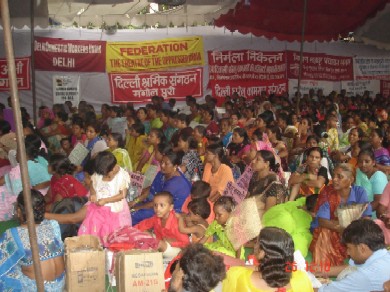
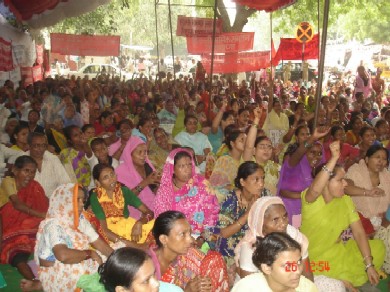
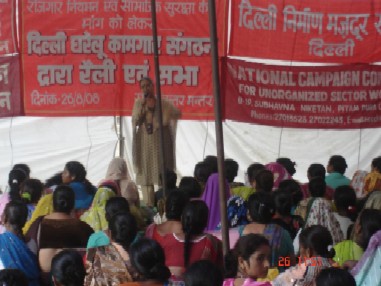
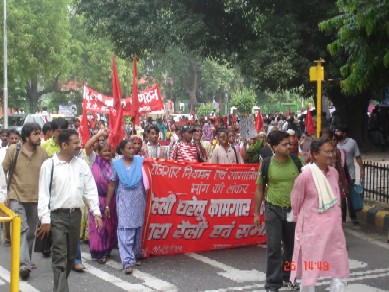
The Delhi Shramik Sangathan, a federation of Construction Workers Union & Car Cleaners Union along with its constituent organization Delhi Domestic Workers Union jointly organized a rally on Tuesday, 26th, Aug’08 at Jantar Mantar, New Delhi. Around 1500 domestic workers attended the rally and submitted a memorandum to Prime Minister, Labour Ministry and the Lok Sabha Speaker.

DSS Rally 1

DSS Rally 2

DSS Rally 3

The rally was addressed by several eminent political leaders, Union leaders, scholars and social activists.

DSS Rally 4

Anita Juneja, convener of Delhi Domestic workers unions welcome the participants at rally and urged the domestic workers of Delhi to increase the pace of the movement so that domestic workers could become a political forces to reckon with. She said that around seven-eight lakh strong workforce of domestic workers in the city is working at paltry sums of Rs 1200 – 1500 per month and live in semi-human conditions of bondage and starvation. They are victims of constant verbal and sexual abuse without any grievance redressal mechanism. Worsening their situation is the city administration’s brutal eviction drive – dislocating and destabilizing the lives of the very people without whom the city would come to a crippling halt. This disruption of people’s lives has led to children being the worst victims with an absolute denial of basic health care and education. Spending the meagre resources available to them to tackle continuous illness, the children by the age of ten are also forced to join as domestic help to contribute to the paltry income of the family. In the absence of any provision of maternity benefit, pension, ESI, PF, Gratuity, health facilities, crèche at work site etc these workers are forced to continue with no security of work.

DSS Rally 5
DSS Rally 6

The union along with Nirmala Niketan approached the National Commission of Women (NCW) to raise the issue at the national level. A subcommittee was formed by NCW to draft the bill on Regulation of Employment & Working Condition of Domestic Workers. The draft prepared was discussed during the National Consultation on Domestic workers organized by NCW on 14th-15th of March’08 at New Delhi. The recommendations of the consultation have been finalized. Now the recommendations need to be incorporated in the Bill drafted by the Sub-Committee of NCW and the final shape of the Bill need to be sent to the Central Government as recommendations of the NCW.

DSS Rally 7

Details of the NCW proposal

Under the proposed law a tripartite Board is to be formed by the State & Union Territories governments. This Board will register all employers, domestic workers and Placement Agencies. Board will collect its fund mainly from the registration of employers. Rs.1000 per year will be collected from the employer of live-in full time domestic Worker and Rs.200 per year from the employer of part time domestic Worker, which will add to about rupees one hundred crore rupees per annum in Delhi alone. In addition the Board will collect a nominal fee of Rs.100 per annum from the live-in full time domestic worker and Rs 20 per year from the part time domestic worker. Rs.100 per placement per year will be collected from the placement agencies besides a lump sum fees and security amount depending upon the number of annual placement done by an Agency.

DSS Rally 8

The Board will provide an identity Card, bank account, regular medical check up, shelter in crisis & sickness, provide working conditions, dispute regulation, regulation of placement agency, keep full record of domestic workers which will check and prevent child labor in domestic work and help in tracing trafficked girls to prevent trafficking for domestic work.

The demand of the Domestic workers is to accept Domestic Work as ‘Work’ and Domestic Worker as ‘Workers’ and lend it the dignity and reorganization of labor. Consequently all benefits and rights that accrue to workers must be extended to this huge workforce (of which no census statistics are available) so far unprotected by any labor legislation. Minimum labor standards should be applied to achieve decent conditions of work and a living wage by including domestic workers as unorganized sector worker as the Central Government representatives assured the Supreme Court of India in a PIL on behalf of Domestic Workers.

DSS Rally 9

The rally demanded that –

1. The legislation proposed by the National Commission for Women be called The Domestic Workers (Regulation and Conditions of Employment & Welfare) Act;

2. The Domestic Worker Act should provide for compulsory registration of Employers, Domestic Workers and all service providers, including placement agents/Agencies and contractors;

3. The Tripartite Boards of Domestic Workers should constitute State/District level Committees for complain against sexual harassment at work place which should also provide protection for women going about to work as Domestic Workers;

4. Domestic Workers should also be registered at the source area and regulation of employment along with ID cards be done, also at source;

5. Minimum age of employment should be 16 years;

6. Tripartite Boards of Domestic Worker to be set up to regulate employment conditions, social security and welfare measures. The board should be authorized to constitute dispute resolution councils and Appellate Authorities;

7. Tripartite Board of Domestic Worker should have 50% representative of Domestic Workers directly elected by the registered domestic workers and 25% representatives of related department of Central and States Governments such as Labor, Child and Women Welfare, SC/ST Welfare, Social Welfare etc. and 25% representatives of employers and Resident Welfare Associations;

8. Tripartite Boards of Domestic Workers should be authorized to formulate guidelines for regulating employment and working conditions for domestic workers going outside India as domestic workers and provide social security to them;

9. All Labor laws to apply including Minimum wages Act, Payment of wages Act, Workmen’s’ compensation act, Accidents benefit Act, etc. and any such legislations applicable to industrial workers;

10. Tripartite Boards of Domestic Workers will be authorized to file complains/FIR etc. on behalf of Domestic Workers where the Domestic Workers is not in a position to file a complain;

11. Rights to inspection of workplace and living space by individuals / groups / organizations as assigned by the Tripartite Board of Domestic Workers;

12. Tripartite Boards of Domestic Workers will primarily depend upon the registration fees collected from Employers, Domestic Worker and Placement Agencies but till enough fees is collected the government must make adequate budgetary provisions for implementing the Act either as grants or loan.

Contact Address: c/o- Flat No-231, Pocket-A, Sector-13, Ph-II, Dwarka, New Delhi-110075. Ph-011-28031792; email- delhidss@gmail.com

Stages of Revolution in the International Working Class Movement

Dipankar Basu, Sanhati

Abstract: This article attempts to throw some light on the following two questions: (1) How does the classical Marxist tradition conceptualize the relationship between the two stages of revolution: democratic and the socialist? (2) Does the democratic revolution lead to deepening and widening capitalism? Is capitalism necessary to develop the productive capacity of a society? The answer to the first question emerges from the idea of the “revolution of permanence” proposed by Marx in 1850, accepted, extended and enriched by Lenin as “uninterrupted revolution” and simultaneously developed by Trotsky as “permanent revolution”. This theoretical development was brilliantly put into practice by Lenin between the February and October revolutions in Russia in 1917. The answer to the second question emerges clearly from the debates on the national and colonial question in the Second Congress of the Third International in 1920. From this debate what emerges is the idea of the democratic revolution led by the proletariat as the start of the process of non-capitalist path of the development of the productive capacity of society, moving towards the future socialist revolution. Rather than deepening and widening capitalism, the democratic revolution under the proletariat leads society in the opposite direction, in a socialist, i.e., proletarian direction. Promoting capitalism is not necessary for the development of the productive capacity of a country.

This brief historical note has been occasioned by recent attempts to justify the championing of capitalism by a communist party – Communist Party of India (Marxist) – as the vehicle for its industrialization program in West Bengal, India. The justification, which argues for the necessity of capitalism by taking recourse to the distinction between the two stages of revolution, rests on an erroneous reading of international working class theory and practice. While it correctly posits the distinction between the two stages of social revolution, it does so mechanically, formally, and in a one-sided manner; the crucial and related question of the relationship between the two stages is not accorded the attention it deserves. That, in my opinion, is the primary source of error and leads to arguing for the necessity of “deepening and widening” capitalism as against initiating efforts to transcend it. Such a reformist position is of course not new within the international working class movement; in fact it is strikingly similar in several crucial respects to the Menshevik position in early twentieth century Russia as also to the stance of “social democracy” that developed from Bernstenian “revisionism” in late nineteenth century Germany. This position, moreover, is decidedly not part of the Leninist tradition – the Bolshevik tradition that developed in Russia – or any revolutionary tradition within Marxism; this should be immediately obvious from the enormous theoretical and political effort that Lenin put in combating its deleterious consequences for the historical project of the Russian proletariat.

The issue of the analytical distinction between the two stages of the world-historical revolution has been accepted within the international working class movement, at least of the Marxist variety, for about 150 years. With the publication of the Communist Manifesto, this issue was more or less settled among communists. In pre-revolutionary Russia, this distinction was accepted by all streams of Marxists: the Legal Marxists, the Economists and the Social-Democrats. This distinction was never the bone of contention in the fiery debates in pre-revolutionary Russia between the Bolsheviks and the Mensheviks. Neither was this distinction a major point of departure in pre-revolutionary China; nor is this distinction the point of debate within the Marxist left in India. Hence, merely positing this distinction anew, a century after it was accepted by the international working class movement, is hardly sufficient for the development of a Marxist theoretical position. Attention needs to be instead focused, in my opinion, on the more important issue of correctly conceptualizing the relationship between the two stages.

It is not merely a recognition of the distinction but the conceptualization of the relationship between the two that distinguishes the various streams of the Left; that is as much true today as it has been historically. I will demonstrate, by a careful reading of the historical development of Marxist theory and practice, that it is the conceptualization of this relationship that has distinguished the revolutionary from the reformist Marxist stream at crucial historical junctures: Marx and Engels from the other socialists during the middle of the 19th century; the Legal Marxists and the Economists from the early Social-Democrats (including the young Lenin) during the last decade of the 19th century in pre-revolutionary Russia; the Mensheviks from the Bolsheviks in later years leading up to and after the October revolution; Lenin (and Trotsky) from the other Bolsheviks between the February and October revolutions.

Before beginning the main story, two clarifications are in order. First, I would like to state more precisely the sense in which the word “revolution” is used, and second, I would like to indicate the two very different senses in which the phrase “social democrat” will be used throughout this paper. Revolution, in this paper, stands for social revolution, a phenomenon which has been defined by Theda Skocpol’s in the following way:

“Social revolutions are rapid, basic transformations of a society’s state and class structures; and they are accompanied and in part carried through by class-based revolts from below… What is unique to social revolution is that basic changes in social structure and in political structure occur together in a mutually reinforcing fashion. And these changes occur through intense socio-political conflicts in which class struggles play a key role.” (Skocpol, 1979)

As Foran (2005) has argued, there are three important characteristics of a social revolution (embedded in the above definition) that needs to be always kept in mind: rapid political change, deep and lasting structural transformation of the economy and active mass participation; whenever I refer to revolution, I will mean the explosive combination of these three elements.

The second point is a terminological clarification regarding the two diametrically opposed use of the phrase “social democrat” in this paper. Social-democrat, with the all important hyphen, will refer to the Marxist revolutionaries in Russia; that is precisely how they referred to themselves and I want to stick to that terminology as well. The hyphen between “social” and “democrat” denotes the indissoluble link between the dual historical tasks of the international proletariat, a theme we will return to constantly throughout this paper. Recall that the first Marxist political party in Russia was called the Russian Social-Democratic Workers Party (RSDWP); though Lenin’s April Theses in 1917 had ended with the proposal to change the name of the RSDWP, it was only in 1918 that the party formally started using the term that Marx had preferred: communist.

Social democrat, without the hyphen, on the other hand will refer to representatives of the reformist trend in the international working class movement: Bernstein and his followers, the later Kautsky, the later Plekhanov and the Mensheviks in Russia certainly but also later day reformist socialists in Europe and Asia. Note, in passing, that social democracy has a long history, especially in Western Europe, and is marked by certain unmistakable characteristics which we can easily discern in our midst even today: legal opposition within a bourgeois parliamentary framework, willingness to ally with sundry bourgeois parties, undue and an over emphasis on the need for reforms within the system, indefinite postponement of decisive struggles, the attempt to “manage” the contradiction between labour and capital rather than to resolve it in the favour of labour, etc. The reformist and the revolutionary streams also differ markedly in their understanding of social revolution: for the reformists, revolution will emerge ready made from the womb of history by its ineluctable laws; the role of human intervention, though formally accepted, is relegated to a secondary position. For revolutionaries like Lenin and the Bolsheviks and Trotsky, on the other hand, revolution has to be first and foremost made by human intervention, mass political action riding on the tide of history.

Marx: From the Manifesto to the Communist League

In the Communist Manifesto published on the eve of a revolutionary wave in Europe in 1848, Marx and Engels had summarized the materialist understanding of historical development. The struggle between social classes was identified as the motor force of historical change, with the victorious class rapidly reorganizing the whole structure of material production accompanied by changes in the political, cultural and ideological spheres of social life. Generalizing from English and French history, Marx and Engels identified two stages in this world-historical movement: the bourgeois-democratic revolution and the proletarian-socialist revolution. The bourgeois revolution, led by the revolutionary bourgeoisie, in alliance with the oppressed peasantry, would overthrow the feudal order and usher in bourgeois capitalism. The development of capitalism would go hand in and with the growth and development (political, social, ideological and technological) of the proletariat, the grave digger of capitalism; in due time, when the productive forces of society had developed to support a higher form of social organization and when the proletariat had become mature and strong politically, it would usher in the socialist revolution and begin the process of the transcendence of class society.

Quite early on Marx had started realizing the limitations of the strict schema of the two stages of revolution (the bourgeois-democratic to be followed by the proletarian-socialist) that he had generalized from English and French history and that he, along with Engels, had so eloquently summarized in the Communist Manifesto. There are two historical reasons which, to our mind, prompted Marx to question this schema. First, the whole generalization referred to a historical period where the proletariat had not yet entered into political stage; if the proletariat were to enter the historical stage even before the completion of the bourgeois-democratic revolution that would change the historical dynamics radically. Second, there might be historical reasons because of which the bourgeoisie of a particular country is “weak” and therefore incapable of and unwilling to lead the democratic revolution to completion; and so in this case, the strict schema presented in the Communist Manifesto would again need modification. With the advantage of hindsight we can see that the modifications that would need to be worked out would specifically relate to two issues: the relationship between the two revolutions and the class-leadership in the democratic stage of the revolution.

A close reading shows that even in the Communist Manifesto, Marx and Engels had taken care to allow possibilities of different trajectories, than the one they had sketched, in concrete circumstances. For instance, they had explicitly referred to the potential weakness of the German bourgeoisie and therefore hinted at the possibility of the proletariat having to take the responsibility of the democratic revolution. Once the German bourgeoisie had shown it’s true colors in 1848, whereby it regrouped with feudal elements to keep the proletariat in check and thereby aborted the democratic revolution, Marx had started his decisive move away from the schema of the Manifesto. While maintaining the analytical distinction between the two stages, he drew a much closer link between them. This more nuanced position was explicitly brought to the fore in his address to the Central Committee of the Communist League in London in 1850. Drawing lessons from the recent revolutionary upsurge in Europe and looking to the future, he drew attention of the international working class to the essential continuity between the two stages of the revolution, what Lenin would later characterize as the “indissoluble link” between the two revolutions.

“While the democratic petty bourgeois wish to bring the revolution to a conclusion as quickly as possible … it is our interest and task to make the revolution permanent, until all more or less possessing classes have been forced out of their position of dominance, until the proletariat has conquered state power and the association of proletarians, not only in one country but in all the dominant countries of the world, has advanced so far that competition among proletarians of these countries has ceased and that at least the decisive productive forces are concentrated in the hands of the proletarians. For us the issue cannot be the alteration of private property but only its annihilation, not the smoothing over of class antagonisms but the abolition of classes, not the improvement of existing society but the foundation of a new one.” (Marx, 1850)

The two most crucial, and intimately related, ideas that stand out in this speech are the utmost necessity of maintaining the independence of the proletariat vis-a-vis the liberal bourgeoisie and of realizing the continuity of the two revolutions in practice. Arguing for the creation, in all situations and at all costs, of an independent party of the proletariat, Marx had exhorted the proletariat at the same time to aim for the “revolution of permanence”.

“But they [i.e., the proletariat] must do the utmost for their final victory by clarifying their minds as to what their class interests are, by taking up their position as an independent party as soon as possible, and by not allowing themselves to be seduced for a single moment by the hypocritical phrases of the democratic petty bourgeois into refraining from the independent organization of the party of the proletariat. Their battle cry must be: The Revolution of Permanence.” (Marx, 1850)

This remarkable document, in essence, foreshadows much of what emerged as Bolshevism in late nineteenth century Russia. The tight and indissoluble link between the twin tasks of the proletariat (and hence the indissoluble link between the democratic and the socialist revolutions), the utmost importance of maintaining an independent political position of the proletariat, the utter necessity of avoiding tailism in practical politics, themes that were hammered out later by the Bolsheviks in the heat of the Russian revolution are already present in Marx’s speech to the Communist League. It is clear that Lenin’s idea of an “uninterrupted revolution”, a position he stressed in his debates with the reformists in Russia, and Trotsky’s idea of a “permanent revolution” are both derived from this speech of Marx.

Note however that the formulation of the necessity of the “leadership” of the proletariat in the bourgeois-democratic revolution is still not explicitly developed by Marx. Revolutionary social-democrats in Russia, reflecting on and reacting to the specific context of the Russian revolution extended the classical Marxist framework by taking the idea of the class-independence of the proletariat, which is already there in Marx, one step further by arguing for its leadership position in the bourgeois-democratic revolution.

Legal Marxists and Economists: Early Debates in Russia

The origin of the Russian Communist Party (Bolshevik) can be traced back to a relatively little known “conference” of nine men in Minsk in March 1898. Though none of the nine men played any leading role in the subsequent revolutionary history of Russia, the conference did come out with a “manifesto of the Russian Social-Democratic Workers’ Party” as a precursor of later-day party programmes. The manifesto unequivocally accepted Marx’s historical account of the two stages of the future social revolution (as worked out by Marx and Engels in the Communist Manifesto): bourgeois-democratic and the proletarian-socialist revolution. More important and interesting from our viewpoint, the Minsk conference manifesto went on to argue that the Russian bourgeoisie was incapable of carrying through the bourgeois-democratic revolution to the end and thus identified the young Russian proletariat as the historical agent on whose able shoulders fell the “dual task” of both revolutions: the democratic and the socialist.

When, therefore, the second Congress – the defining congress of the Russian revolution, the birthplace of Bolshevism as a political stream – of the Russian Social-Democratic Workers’ Party (RSDWP) met in 1903 to debate on the party programme, it worked within the framework inaugurated by the conference of 1898. It started with the dual tasks of the Russian proletariat, i.e., the twin tasks of the democratic and the socialist revolution, as an axiom, as a point of departure, as a self-evident historical and political truth; there was no disagreement or debate on this point with the RSDWP. The real debate was on how to define the content of these revolutions and on how to define the relationship between the two; it was the issue of the relationship that was to rend the RSDWP into two factions, the Mensheviks and the Bolsheviks. But before looking at that debate, we must spend some time studying the debates that preceded the second Congress, the debates of the young Lenin with the Legal Marxists and the Economists; a study of the early debates is interesting and useful because many of the positions of the Mensheviks were repetitions of either the Economists’ or the Legal Marxists’ discredited positions, positions against which the whole RSDWP had argued during these early years.

Before the RSDWP could consolidate the political-economic tasks of the proletariat concisely in a party programme, it had to successfully argue against three contemporary socialist trends within late-nineteenth century Russia: the Narodniks, the Legal Marxists and the Economists. The theoretical arguments against the Narodniks were largely, and successfully, carried home by Plekhanov, the Father of Russian Marxism; when Lenin did join the fray, he largely repeated Plekhanov’s arguments and marshaled empirical evidence in favour of the general Marxist point about the development of capitalism in Russia. From this he drew an important political conclusion that separated the Social-Democrats from the Narodniks forever: the proletariat and not the peasantry was to be the historical agent of social revolution in Russia. The development of capitalism in Russian agriculture was, according to Lenin, accelerating the class divisions among the peasantry; the peasantry, as a single, homogeneous social entity was rapidly disappearing and so basing a strategy of social revolution on this vanishing social entity was historic folly. The only stable social class that was emerging and strengthening itself with capitalism and whose interests were in contradiction to capitalism was the proletariat; hence, argued Lenin, the only feasible strategy of revolution could be one led by and in the long-term interests of the proletariat.

As to the other two trends, Legal Marxism and Economism, it was Lenin’s energetic intervention and crystal-clear prose that ripped apart their arguments and exposed their utter hollowness. As Lenin remarked several times later in his life, the debate with the Legal Marxists and the Economists foreshadowed the subsequent, fierce and often bitter, debates between the Bolsheviks and Mensheviks. In both debates, as also his debates with the Narodniks, what distinguished Lenin’s position from his opponents was his consistent, unwavering and uncompromising class viewpoint, the viewpoint of the emerging Russian proletariat.

Lenin’s debate with the Legal Marxists and the Economists (rather than with the Narodniks) is more relevant for our current discussion because this debate related directly to the issue of the correct understanding of the relationship between the dual tasks of the proletariat. The tidy schema of revolution worked out by Marx and Engels in the Communist manifesto was a generalization from English and French history, as we have already remarked. It distinguished analytically between the bourgeois and the socialist revolutions and stressed the historical precedence of the former to the latter. We have already seen how Marx himself modified this schema in the concrete context of nineteenth century Germany; the Legal Marxists, on the other hand, stuck to this schema in a most doctrinaire fashion (foreshadowing the whole history of social democracy and reformism) and with disastrous consequences.

Accepting the Marxist distinction between the two revolutions and the historical precedence of one over the other led the Legal Marxists to argue for the reformist path to the transcendence of capitalism. One of it’s leading proponents, Peter Struve, chastised Russian socialists for concerning themselves with fanciful and unrealizable projects of “heaven storming”; he, instead, wanted them to patiently “learn in the school of capitalism”. The echo of that Legal Marxist injunction can still be heard, via Bernstein’s “revisionism” in late-nineteenth Germany, in social democratic circles in India today! This was, of course, an abandonment of the proletarian viewpoint, as Lenin pointed out. The mistake of the Legal Marxists lay precisely in an incorrect understanding of the relationship between the dual tasks of the proletariat. The democratic revolution was not an end in itself, as the Legal Marxists tended to implicitly suggest, but was inseparably tied with it’s twin, the socialist revolution. It is not that the Legal Marxists did not accept the necessity of the socialist revolution; being Marxists, they had to accept it as later-day social democrats did. But this acceptance came with the caveat that the period separating the two revolutions was so large that in essence one could very well forget about the socialist revolution at the moment and instead engage in activities to “learn in the school of capitalism”.

Though the Economists took a different lesson from the neat schema of the Communist Manifesto as compared to the Legal Marxists, they arrived at the same practical conclusions. For the Economists, it was important to draw a sharp distinction between the economic and the political spheres. In their opinion, workers were only concerned with economic issues, issues of wage and work, that directly effected their daily lives; they were not concerned with political issues, issues of political freedom and governance and power. The political sphere, according to the Economists, was the sole preserve of intellectuals; since, moreover, the current conditions called for a bourgeois-democratic revolution, socialist struggles, i.e., struggles for the capture of state power by the proletariat, were pushed into the indefinite future. Juxtaposing a sharp distinction between the economic and the political with their reading of the schema of the Communist Manifesto led the Economists to suggest that socialists should restrict themselves “to support[ing] the economic struggle of the proletariat and to participat[ing] in liberal opposition activity”. What was ruled out was an independent political party of the working class, which axiomatically ruled out revolutionary political activity.

In an early piece on this issue in 1898, Lenin made clear the correct Marxist understanding of the matter and distinguished the social-democrats sharply from the Legal Marxists and the Economists:

“The object of the practical activities of the Social-Democrats is, as is well known, to lead the class struggle of the proletariat and to organize that struggle in both its manifestations: socialist (the fight against the capitalist class aimed at destroying the class system and organizing socialist society), and democratic (the fight against absolutism aimed at winning political liberty in Russia and democratizing the political and social system of Russia). We said as is well known. And indeed, from the very moment they appeared as a separate social-revolutionary trend, the Russian Social-Democrats have always quite definitely indicated this object of their activities, have always emphasized the dual manifestation and content of the class struggle of the proletariat and have always insisted on the inseparable connection between their socialist and democratic tasks — a connection clearly expressed in the name they have adopted.” (Lenin, Collected Works, vol. 2, p. 327)

The inseparability of the dual tasks of the proletariat derives, according to Lenin, from the following two facts: first, the proletariat can only emancipate itself fully, and thereby society, through political liberty. Hence, it supports the struggle for political liberty against absolutism and feudal oppression as its own struggle, as the political bed on which will grow the socialist struggle. This is the reason why the class conscious proletariat supports every revolutionary movement against the present social system, why it supports the struggle of progressive classes against reactionary classes and strata in general. Second, among all the classes and strata fighting for democracy, the proletariat is the only thoroughly consistent, unreserved, staunch and resolute supporter of democracy; it is the only class which is ready to take the fight for democracy to its end, to its natural culmination, to its full completion. Every other class, by its very position within the class structure of society, can only provide qualified support to the struggle for democracy; their democracy is half hearted, it always looks back, as Lenin put it. An understanding of the social-democratic party as “deriving its strength from the combination of socialist and democratic struggle into the single, indivisible class struggle of the … proletariat” remained the hallmark of Bolshevism right through the tumultuous days of the victorious October revolution.

It is this insistence on the uninterruptedness of the twin revolutions that found expression in the Bolshevik formulation of the proletariat as the leader of both the revolutions; and it is the recognition of this historical role of the proletariat that informed the refusal of the Bolsheviks to relinquish the leadership role to the bourgeoisie, to become its political “tail”. It is the same dogged insistence, so strikingly consistent, that led to the split with the Mensheviks in 1903.

Two interesting and important things emerge from these early debates. First, some of the ideas that were to dominate the subsequent debates of the Russian revolution, the ideas moreover that would separate the Bolsheviks from the Mensheviks (the revolutionaries from the reformists) and would separate Lenin (and Trotsky) from the rest of the Bolsheviks between the February and the October revolutions, were introduced within the Russian working-class movement at this juncture. It is these ideas, among others, that would be refined, deepened, enriched and applied with uncanny consistency in the subsequent history of the Russian revolution. Second, that an eclectic, half-hearted, formal and mechanical acceptance of Marxism can be combined with utterly reformist politics came to the fore with rare clarity in Russian history for the first time during these early debates. As later events demonstrated, and continues to demonstrate to this day, formal acceptance of Marxism can often be combined with reformist politics.

A closer reading of international working class history demonstrates that acceptance of Marxism alongside reformist practice is already hidden as a possibility in the formulation of the “dual tasks” of the proletariat. It must be recalled the formulation of the “dual tasks” found its way into the programme of the RSDWP in the distinction between the minimum and the maximum programmes. The minimum programme referred to the set of measures that could be implemented within, and without challenging, a bourgeois democratic setup. Following the Communist Manifesto, these included abolition of private property in land, a progressive income tax, abolition of inheritance, free education for all and other such concrete measures of bourgeois reform. The maximum programme, on the other hand, enshrined revolutionary aspirations, the overthrow of capitalism and the beginning of socialist construction. The distinction between the minimum and maximum programmes thus provided space for reformist politics by a gradual and subtle decoupling of the two programmes and shifting the emphasis on the former.

“One of the unforeseen effects of this division [between the minimum and and maximum programmes] was to attract into social-democratic parties a large body of members who by conviction or temperament were more interested in the minimum than in the maximum programme; and in countries where some of the minimum demands had in fact been realized, and others seemed likely to be realized in the future, through the process of bourgeois democracy, the parties tended more and more to relegate the demands of the maximum programme to the category of remote theoretical aims concentrate party activities on the realization of the minimum programme.” (Carr, 1952, p. 17-18, emphasis added).

Lessons of 1905: Bolsheviks and Mensheviks

Though the dispute between what later came to be known as the Bolsheviks (“the majority”) and the Mensheviks (“the minority”) during the second congress of the RSDWP in 1903 seemed to rest on an issue of party statute, i.e., what should be the qualification for party membership, later events made clear that deeper issues of theory and practice were involved. As the bitter debates following the split in the party were to make clear, the schism in the RSDWP really rested on different ways of understanding the relationship between the dual tasks of the proletariat in concrete, practical terms. This followed quite clearly from the diametrically opposite political lessons the two streams drew from the failed revolution of 1905. The difference can be most clearly seen if we organize the discussion around the following two questions: (1) relationship of the two revolutions, and (2) the role of the peasantry.

The Mensheviks adhered to the cut-and-dried formula about the strict sequence of the two revolutions that they picked up in a doctrinaire fashion from the Communist Manifesto. For the Mensheviks, the bourgeois revolution had to come first and so far the Bolsheviks were in agreement with them. The doctrinaire understanding of the Mensheviks, their intellectual sterility, came to the fore when they went on, from this correct premise, to insist that it was “only through the bourgeois revolution that capitalism could receive its full development in Russia, and, until that development occurred, the Russian proletariat could not become strong enough to initiate and carry out the socialist revolution” (Carr, 1950, p.39). In other words, the two revolutions must be separated by an indefinite period of time during which capitalism needs to develop, flourish, and display its bourgeois magic.

In effect, therefore, the Mensheviks never fully agreed with Lenin’s 1898 formulation of the “indissoluble link” between the two revolutions; in fact their position was a regression even from the position worked out by the first Congress in 1898 in Minsk. That is why they could insist on allowing capitalism in Russia to receive it’s “fullest development” and only then initiating the struggle of the proletariat for socialism. The immediate and practical implication of the Menshevik understanding was what Lenin termed political “tailism”, i.e., allowing the proletariat as-a-class to become an appendage to, a follower of, the bourgeoisie in the democratic revolutionary struggle instead of forcibly usurping the leadership position for itself.

The Menshevik position followed from an incorrect class analysis of Russian society; their chief error was to neglect the emergence of the proletariat on the historical scene and to take the cue from the Marx of the Communist League to re-work the schema of the Manifesto. Thus, on the eve of the revolution, one of their leading spokesmen could say:

“If we take a look at the arena of the struggle in Russia then what do we see? Only two forces: the tsarist autocracy and the liberal bourgeoisie, which is now organized and possesses a huge specific weight. The working mass, however, is atomized and can do nothing; as an independent force we do not exist; and thus our task consists in supporting the second force, the liberal bourgeoisie, and encouraging it and in no case intimidating it by presenting our own independent political demands.” (quoted in Zinoviev, 1923).

This is precisely where Lenin differed sharply from Menshevik class analysis and politics; Lenin’s analysis of the the 1905 revolution started in fact with the recognition of the entrance of the Russian proletariat on the historical scene. From this fact he drew the conclusion that Marx had hinted at in his speech to the Central Committee of the Communist League in 1850: the bourgeoisie was neither willing nor capable of completing the bourgeois-democratic revolution. This was both because it was weak (lacking in independent development) and because it realized that completion of the democratic revolution carried within it the danger of the proletariat’s political ascendancy. Thus, completion of the bourgeois-democratic revolution, as a prelude to the consummation of the socialist revolution, fell on the shoulders of the Russian proletariat. The tight link between the two revolutions, a position that Lenin had already worked out in 1898, was reiterated once again:

“From the democratic revolution we shall begin immediately and within the measure of our strength – the strength of the conscious and organized proletariat – to make the transition to the socialist revolution. We stand for uninterrupted revolution. We shall not stop half way” (Lenin, Collected Works, Vol. 9, p. 237)

According to Lenin’s analysis, two important conditions had to be satisfied for the Russian proletariat to complete its dual historical tasks: (1) successful alliance of the proletariat and the peasantry, and (2) victorious socialist revolutions in European countries. It was on the crucial question of the alliance with the peasantry that Lenin differed sharply not only from the Mensheviks but also from Trotsky (who had otherwise worked out a position very similar to Lenin’s). For both the Mensheviks and Trotsky, the peasantry was a repository of reaction; while Trotsky arrived at this incorrect conclusion on the basis of his experience of the 1905 revolution, the Mensheviks adhered to this position out of their doctrinaire understanding of Marxism. Lenin, on the other hand, realized that though the peasantry was not revolutionary in the Narodnik sense but it’s force could still be harnessed for the revolution because at that juncture it was less interested in protecting private property than in confiscating the land-owners’ land, the dominant form of rural private property (Carr, 1950).

Thus, Lenin arrived at an elegant formulation of the role of the peasantry in the revolution. The proletariat, in alliance with the whole peasantry would complete the bourgeois-democratic revolution and overthrow feudalism, absolutism and the monarchy despite the vacillation, or even opposition, of the bourgeoisie. This would immediately lead to the next stage of the revolution, where the proletariat would have to split the peasantry along class lines, ally with the landless labourers and the poor peasantry against the rich peasants and start the transition towards socialism.

This second point, where the urban proletariat had to ally with the rural proletariat was an immensely important practical point. Between the February and October revolutions, where Lenin discerned precisely this transition from the bourgeois-democratic to the socialist stage taking place, the utmost importance of an independent organization of the rural proletariat was repeatedly indicated. For instance in the third of the Letters From Afar written on March 11(24) 1917, which discusses the issue of the proletarian militia, he says:

“The prime and most important task, and one that brooks no delay, is to set up organizations of this kind [i.e., Soviets of Workers’ Deputies] in all parts of Russia without exception, for all trades and strata of the proletarian and semi-proletarian population without exception…for the entire mass of the peasantry our Party … should especially recommend Soviets of wage-workers and Soviets of small tillers who do not sell grain, to be formed separately from the well-to-do peasants. Without this, it will be impossible … to conduct a truly proletarian policy in general…” (Lenin, 1917, in Zizek, p. 41)

In a footnote, he adds: “In rural districts a struggle will now develop for the small and, partly middle peasants. The landlords, leaning on the well-to-do peasants, will try to lead them into subordination to the bourgeoisie. Leaning on the rural wage-workers and rural poor, we must lead them into the closest alliance with the urban proletariat.” Note that in Lenin’s formulation, the idea of an “agrarian revolution” as the axis of the bourgeois-democratic revolution is not explicitly there; the experience of the Chinese revolution would be required to extend the classical Marxist framework further by explicitly theorizing the nature and complexities of the agrarian revolution in a semi-feudal, semi-colonial social formation as part of what Mao called the new democratic revolution. This constant and critical engagement with received wisdom is the hallmark of a living revolutionary tradition.

Revolution at the Gates: Between February and October 1917, and Beyond

The February 1917 revolution in Russia caught all the socialists unawares; neither had they planned for it nor had they participated in it. This was true as much of the Mensheviks as of the Bolsheviks. The revolution had given rise to a situation of “dual power”: a Provisional Government of the bourgeoisie and the landlords and a revolutionary-democratic dictatorship of the workers and peasants (in the form of soldiers) in the form of the Soviets. The crucial question that again divided the revolutionaries from the reformists was a correct understanding of the relationship between the two.

For the Mensheviks, the problem was resolved in a rather straightforward manner. In keeping with their schematic reading of Marxism, they saw the task of the proletariat at the present moment to be one of supporting the bourgeoisie and helping it complete the democratic revolution; hence they argued for the Soviets supporting the Provisional Government, pushing for democratic reforms from behind rather than leading them, in short aiding in the “fullest development” of bourgeois capitalism till such time that it [capitalism] exhausted all it’s progressive possibilities and the proletariat became mature and strong enough to make the final bid for power. All the Bolshevik leaders, including Stalin, accepted the Menshevik position in essence. It was left to the political genius of Lenin to break through this reformist consensus.

Exiled in Switzerland and getting news about Russian development only through the bourgeois press, Lenin had already started developing the essentials of revolutionary understanding about the transition from the first to the second stage of the revolution; his Letters From Afar give indications of the direction of his thinking. To the complete astonishment of his followers, the first public statement that Lenin made immediately after his arrival in the Finland station in Petrograd in April 1917 was to hail the proletarian-socialist revolution and not to dish out homilies for the bourgeois-democratic revolution! When he presented his April Theses within party circles the next day, outlining a program for the transition to a socialist stage of the revolution, he was completely isolated. Bogdanov is said to have constantly interrupted his speech with shouts of “Delirium, the delirium of a madman,” and not one Bolshevik other than Kollantai spoke in favour of his plans. When it was published in the Pravda, the editorial team distanced itself from the argument by attributing it to an individual and not to the Party.

Between the February and the October revolution, Lenin applied with ferocious consistency the theory that he had developed so painstakingly in his debates with the reformist Mensheviks. Formulations of the indissoluble link between the two stages of the revolution and the associated idea of the leadership of the proletariat (in alliance with the peasantry) in the democratic revolution, which he had argued for tirelessly over the years were now about to be realized in practice. The fact that the proletariat and the peasantry (in the form of soldiers) had established an independent, revolutionary site of political power in the form of the Soviets was the crucial signal to Lenin that the bourgeois-democratic revolution had been completed and that the transition to the next stage was underway. Since there could not be two powers in the State, only one of the two – proletarian or bourgeois – would survive in the ensuing struggle that he could foresee. The task of the proletariat, therefore, was to start preparing for the overthrow of the Provisional Government and transferring all power to the Soviets, and not to stand up in support of the bourgeoisie, as the Mensheviks argued. Waiting for the “fullest development” of capitalism, as reformist doctrine suggested, was tantamount to ensuring that the Soviets got crushed by force like the Paris Commune in 1871.

Note that in Lenin’s insistence on the completion of the bourgeois-democratic stage of the revolution there is no place for the discourse of productive forces or the development of capitalism. It was not that capitalism had flourished and the productive forces had developed adequately in Russia between February and October 1917 to warrant the call for a socialist revolution; that was obviously not the case as the Bolsheviks were acutely aware. It was rather the case that the establishment of the revolutionary dictatorship of the proletariat and the peasantry was envisioned as an alternative path of development, a non-capitalist framework of social relations for the development of the productive forces. It is of course not true that the democratic revolution establishes socialism; its social and economic content remains bourgeois, but with the proletariat at the helm of affairs, a transition towards socialism is initiated, the movement is imparted an unmistakable socialist, i.e., proletarian orientation.

In the context of imperialism, questions about the character of the two revolutions, about the role of communists in them and about the question of the attitude towards capitalism in the colonial and semi-colonial countries had been discussed threadbare in the Second Congress of the Communist International in July 1920. Even though there were disagreements between Lenin, the official rapporteur on the “national and colonial question”, and M. N. Roy, who presented his own theses on the question, they came out with one striking agreement: where the working class was victorious and able to establish its political hegemony, it could lead the country (essentially the peasant masses) onto the path of socialism without the intervening capitalist stage of development. Presenting his report to the Congress on July 26, Lenin summarized this point of agreement as follows:

“… are we to consider as correct the assertion that the capitalist stage of economic development is inevitable for backward nations now on the road to emancipation and among whom a certain advance towards progress is to be seen since the war? We replied in the negative. If the victorious revolutionary proletariat conducts systematic propaganda among them, and the Soviet governments come to their aid with all the means at their disposal – in that event it will be mistaken to assume that the backward peoples must inevitably go through the capitalist stage of development… the Communist International should advance the proposition, with appropriate theoretical grounding, that with the aid of the proletariat of the advanced countries, backward countries can go over to the Soviet system and, through certain stages of development, to communism, without having to pass through the capitalist stage.” (Lenin, Collected Works, vol. 31, p. 244, emphasis added).

The essence of the democratic revolution under the leadership of the proletariat is the inauguration of a non-capitalist path of economic and social development. As Lenin points in the same report that we have just quoted from, forms of socialist organization, i.e. Soviets, can and should be formed not only in a proletarian context but also in a context marked by “peasant feudal and semi-feudal relations”. It is obvious that these institutions would impart the socialist orientation to the whole movement, would form the seeds of the future socialist society, seeds moreover nurtured, supported, defended and deepened in a still predominantly bourgeois society. To insist, as some have done recently, that the task of the proletariat during the democratic stage of the world historical revolution is to work for deepening capitalism, instead of forging a non-capitalist path of development through Soviet forms of organization, is to turn 150 years of international revolutionary working class theory and practice on its head.

Conclusion

The Menshevik position about the “fullest development” of capitalism being a necessary condition for the launching of the socialist struggle finds echoes in India today with the insistence on the development of the “most thorough-going and broad-based” capitalism being the precondition for initiating the socialist struggle. While it is hardly surprising that such a position finds political expression in inveterate “tailism”, what really is rather more difficult to believe is the accompanying ahistorical rhetoric of “different” capitalisms. It almost seems to have been asserted that we can choose among the different varieties of capitalisms being offered by history, limited only by our powers of imagination. Which one do you want comrade, history seems to have asked? Well, the social democrats answered, we want the one which is technologically progressive (leads to the fullest development of the productive forces) and also looks after the welfare of the workers and peasantry (through social reforms and huge expenditures in health and education and nutrition). Does the march of history and the development of the structural contradictions of global capitalism at the beginning of the twenty first century afford us the this luxury, this luxury to choose between capitalisms, between good and bad capitalisms? One is reminded of how Marx had chastised Proudhon in The Poverty of Philosophy for wanting capitalism without it’s socio-economic ills. The social democrats in India seem hell bent on committing the same mistake all over again.

References

Carr, E. H. The Bolshevik Revolution 1917-1923, Volume One. The Macmillan Company. 1950.

———— The Bolshevik Revolution 1917-1923, Volume Two. The Macmillan Company. 1952.

Foran, J. Taking Power: On the Origins of Third World Revolutions. Cambridge University Press. 2005

Lenin, V. I. Collected Works. Fourth Edition, Progress Publishers. 1965 (various volumes).

Marx, K. Address of the Central Committee to the Communist League. March 1850, in On Revolution, The Karl Marx Library, edited and translated by Saul K. Padover. McGraw-Hill Book Company. 1971.

Skocpol, T. States and Social Revolutions: A Comparative Analysis of France, Russia and China. Cambridge University Press. 1979.

Zinoviev, G. History of the Bolshevik Party. New Park Publications. 1974 [1923].

Zizek, S. (editor), Revolution at the Gates: A Selection of Writings from February to October 1917, V. I. Lenin. Verso. 2002.

Marx on unionism beyond economism

1.

These few hints will suffice to show that the very development of modern industry must progressively turn the scale in favour of the capitalist against the working man, and that consequently the general tendency of capitalistic production is not to raise, but to sink the average standard of wages, or to push the value of labour more or less to its minimum limit. Such being the tendency of things in this system, is this saying that the working class ought to renounce their resistance against the encroachments of capital, and abandon their attempts at making the best of the occasional chances for their temporary improvement? If they did, they would be degraded to one level mass of broken wretches past salvation. I think I have shown that their struggles for the standard of wages are incidents inseparable from the whole wages system, that in 99 cases out of 100 their efforts at raising wages are only efforts at maintaining the given value of labour, and that the necessity of debating their price with the capitalist is inherent to their condition of having to sell themselves as commodities. By cowardly giving way in their everyday conflict with capital, they would certainly disqualify themselves for the initiating of any larger movement.

At the same time, and quite apart form the general servitude involved in the wages system, the working class ought not to exaggerate to themselves the ultimate working of these everyday struggles. They ought not to forget that they are fighting with effects, but not with the causes of those effects; that they are retarding the downward movement, but not changing its direction; that they are applying palliatives, not curing the malady. They ought, therefore, not to be exclusively absorbed in these unavoidable guerilla fights incessantly springing up from the never ceasing encroachments of capital or changes of the market. They ought to understand that, with all the miseries it imposes upon them, the present system simultaneously engenders the material conditions and the social forms necessary for an economical reconstruction of society. Instead of the conservative motto, “A fair day’s wage for a fair day’s work!” they ought to inscribe on their banner the revolutionary watchword, “Abolition of the wages system!”

After this very long and, I fear, tedious exposition, which I was obliged to enter into to do some justice to the subject matter, I shall conclude by proposing the following resolutions:

Firstly. A general rise in the rate of wages would result in a fall of the general rate of profit, but, broadly speaking, not affect the prices of commodities.

Secondly. The general tendency of capitalist production is not to raise, but to sink the average standard of wages.

Thirdly. Trades Unions work well as centers of resistance against the encroachments of capital. They fail partially from an injudicious use of their power. They fail generally from limiting themselves to a guerilla war against the effects of the existing system, instead of simultaneously trying to change it, instead of using their organized forces as a lever for the final emancipation of the working class that is to say the ultimate abolition of the wages system.

VALUE, PRICE AND PROFIT, 1865

2.
Trades’ unions. Their past, present and future

(a) Their past.

Capital is concentrated social force, while the workman has only to dispose of his working force. The contract between capital and labour can therefore never be struck on equitable terms, equitable even in the sense of a society which places the ownership of the material means of life and labour on one side and the vital productive energies on the opposite side. The only social power of the workmen is their number. The force of numbers, however is broken by disunion. The disunion of the workmen is created and perpetuated by their unavoidable competition among themselves.

Trades’ Unions originally sprang up from the spontaneous attempts of workmen at removing or at least checking that competition, in order to conquer such terms of contract as might raise them at least above the condition of mere slaves. The immediate object of Trades’ Unions was therefore confined to everyday necessities, to expediences for the obstruction of the incessant encroachments of capital, in one word, to questions of wages and time of labour. This activity of the Trades’ Unions is not only legitimate, it is necessary. It cannot be dispensed with so long as the present system of production lasts. On the contrary, it must be generalised by the formation and the combination of Trades’ Unions throughout all countries. On the other hand, unconsciously to themselves, the Trades’ Unions were forming centres of organisation of the working class, as the mediaeval municipalities and communes did for the middle class. If the Trades’ Unions are required for the guerilla fights between capital and labour, they are still more important as organised agencies for superseding the very system of wages labour and capital rule.

(b) Their present.

Too exclusively bent upon the local and immediate struggles with capital, the Trades’ Unions have not yet fully understood their power of acting against the system of wages slavery itself. They therefore kept too much aloof from general social and political movements. Of late, however, they seem to awaken to some sense of their great historical mission, as appears, for instance, from their participation, in England, in the recent political movement, from the enlarged views taken of their function in the United States, and from the following resolution passed at the recent great conference of Trades’ delegates at Sheffield:

“That this Conference, fully appreciating the efforts made by the International Association to unite in one common bond of brotherhood the working men of all countries, most earnestly recommend to the various societies here represented, the advisability of becoming affiliated to that hody, believing that it is essential to the progress and prosperity of the entire working community.”

(c) Their future.

Apart from their original purposes, they must now learn to act deliberately as organising centres of the working class in the broad interest of its complete emancipation. They must aid every social and political movement tending in that direction. Considering themselves and acting as the champions and representatives of the whole working class, they cannot fail to enlist the non-society men into their ranks. They must look carefully after the interests of the worst paid trades, such as the agricultural labourers, rendered powerless [French text has: “incapable of organised resistance”] by exceptional circumstances. They must convince the world at large [French and German texts read: “convince the broad masses of workers”] that their efforts, far from being narrow — and selfish, aim at the emancipation of the downtrodden millions.

Instructions for the Delegates of the Provisional General Council, 1866

3.

The political movement of the working class has as its object, of course, the conquest of political power for the working class, and for this it is naturally necessary that a previous organisation of the working class, itself arising from their economic struggles, should have been developed up to a certain point.

On the other hand, however, every movement in which the working class comes out as a class against the ruling classes and attempts to force them by pressure from without is a political movement. For instance, the attempt in a particular factory or even a particular industry to force a shorter working day out of the capitalists by strikes, etc., is a purely economic movement. On the other hand the movement to force an eight-hour day, etc., law is a political movement. And in this way, out of the separate economic movements of the workers there grows up everywhere a political movement, that is to say a movement of the class, with the object of achieving its interests in a general form, in a form possessing a general social force of compulsion. If these movements presuppose a certain degree of previous organisation, they are themselves equally a means of the development of this organisation.

Where the working class is not yet far enough advanced in its organisation to undertake a decisive campaign against the collective power, i.e., the political power of the ruling classes, it must at any rate be trained for this by continual agitation against and a hostile attitude towards the policy of the ruling classes. Otherwise it will remain a plaything in their hands, as the September revolution in France showed, and as is also proved up to a certain point by the game Messrs. Gladstone & Co. are bringing off in England even up to the present time.

LETTER TO FRIEDRICH BOLTE, 1871

Some important trends in the Indian Economy

Deepankar Basu

In an article in the Business Standard a couple of months ago, economic commentator T N Ninan pointed to some of the important emerging trends in the Indian economy, what he called the “mega trends”. In his words, these trends deserve to be called “mega trends” because they “cannot easily be reversed, have large ripple effects, and … therefore will define the future”. While these “mega trends” are important for throwing up interesting empirical regularities, these can be equally well, if not better, understood within a Marxist paradigm, a paradigm built on looking at reality from the perspective of labour. Adopting the perspective of labour is important for another reason: it allows us to see the incompleteness, the one-sidedness of bourgeois economic analysis. It is only by complementing Ninan’s “mega trends” with some important but neglected trends that are often invisible to bourgeois economists (which I merely point to at the end) that we can get a better understanding of the evolution of Indian economy and society.

The first trend – “acquiring of scale” in Ninan’s words – refers to the growing “concentration and centralization” of Indian capital, a process that inevitably accompanies the development of capitalism. The growth of concentration and centralization is leading to the much talked about growth of “self-confidence” of Indian capital, buttressed no doubt with incursions into foreign territories. As Ninan points out, Indian capital was acquiring “three overseas companies a week, through 2006.”

The second trend – “spread of connectivity and awareness” according to Ninan – refers to the technological development accompanying the growth of capitalism; Ninan limits himself to the technological developments in the communications sector but it can easily be extended to other sectors of the economy too. But there are several important reasons to focus on the transportations and communications sector. First, an increasing efficiency of communications and transportations is essential for a smooth and efficient completion of the numerous “circuits of capital”; the increasing volume of surplus value being generated in the economy needs well functioning circuits of capital to be realized into profit. Second, technological development of the communications technology, especially information technology, is important for the establishment of the networks through which finance capital exerts its influence over the economy. Third, and related to the earlier, is the necessity of swift and reliable communications to support all the processes that facilitates the “concentration and centralization of capital”.

The third trend – “the growth of the middle class” in Ninan’s analysis – if put into proper perspective, refers to two things: (1) the increasing inequality that inevitably comes along with the growth of capitalism, and (2) the changing nature of the Indian working class. What Ninan refers to as the “middle class” is really the fraction of the Indian working class (though it does not want to see itself as part of the working class) that acquires high wage employment in the “leading” sectors of the economy by acquiring skills useful for capital.

The fourth trend – what Ninan calls the “growing problems of growth” – refers to the serious environmental problems created by a regime dominated by the logic of capital accumulation. As the problem of global warming caused by increasing concentrations of greenhouse gases in the Earth’s atmosphere has come into focus, it has become clear that cosmetic changes and technological solutions will not be enough to deal with the whole range of environmental problems under capitalism. What will be required is a wholesale, radical socio-economic transformation, in other words, a transition to socialism. It will become increasingly important for radical political forces representing the interests of capital to come to grips with this issue in India and other underdeveloped economies undergoing rapid (dependent) capitalist development.

The fifth trend – “India’s growing openness to the world” according to Ninan – refers to the growing penetration of the Indian economy by imperialist capital; being supplemented by the growing “export of capital” from India to foreign economies, the two together points to the growing “interpenetration” of imperialist and Indian capital and the incorporation of the Indian capitalist class into the global ruling bloc. The penetration of imperialist capital underlies the oft-forgotten “dependent” nature of the capitalist development in India, a capitalism which cannot, almost axiomatically, benefit the majority of the population.

The sixth trend – what Ninan sees as “the continuing dominance of youth” – refers to the demographic backdrop of capital accumulation in India. The fact that a large proportion of the population will be part of the workforce (if they manage to get employed at all!) will mean that huge reserves of labour will be readily available for capital to exploit and extract surplus value. It will be a long time before these reserves dry up and increasing wages start eating into the profit rates, a process that seems to have already started in China.

It is not, as Ninan asserts, that these “mega trends” will “define” the future in a mechanical sense; it is rather the case that these trends will define the framework within which the class struggle will unfold. For it is the class struggle which will ultimately “define” the future of India. But even in the sense of defining the framework of class struggle, Ninan’s characterization is inadequate because it leaves out labour from the picture, other than in a marginal sense. How will India’s working class evolve over the next few years or decades? What are the trends, working silently but decisively, that can be observed in the evolution of the Indian working class? To even attempt to pose this question adequately, one will have to look at the agricultural sector of the Indian economy and all the forms of labour associated (directly or indirectly) with it. Ninan, quite remarkably, has nothing to say about the sector of the economy which continues to employ (directly or indirectly) the majority of the working people in India!

The EFCA: What the Fuss is all about

Arindam Mandal

The proposed Employee Free Choice Act (EFCA) is considered as an important milestones for the trade union movement in the U.S. Though the bill has been passed in the U.S. House of Representatives with an overwhelming majority of 241 to 185 votes, its fate in the Senate is still uncertain. Even if it is passed in the Senate, it has been mentioned time and again that President George Bush will veto it.

If the EFCA becomes a law, it will be a landmark victory for the unionized labor in the U.S. because it will allow workers to form unions by simple card check rather than going through the time consuming electoral process. Under the current law, the process of unionization is rather cumbersome. The typical way in which workers show interest in unionization is by signing the union authorization cards; and these state that each worker authorizes the union to represent them for the purpose of collective bargaining. The union can petition the NLRB for an election once 30 percent of the members of a bargaining unit have signed the cards. The board notifies the employer. At this point, the employer is free to recognize the union or consent to an election. If employer consents to an election, then the board will set a date for election. In the meantime, the employer is free to try vigorously to get the workers to vote against the union. This whole process of going through election is a time consuming process and it gives ample time to the employers to go for union busting techniques which includes both semi-legal and illegal tactics.

According to the proposed EFCA, it would enable working people to bargain for better wages, benefits and working conditions by restoring workers’ freedom to choose for themselves whether to join a union. It would:

* Establish stronger penalties for violation of employee rights when workers seek to form a union and during first-contract negotiations.
* Provide mediation and arbitration for first-contract disputes.
* Allow employees to form unions by signing cards authorizing union representation.

Under the proposed EFCA bill, if it becomes law, the Act would require the NLRB to certify a union as the exclusive representative of employees without an election where “a majority of the employees in a unit appropriate for bargaining has signed valid authorizations.” This is where the major criticism against the bill has been lodged. According to the so-called neoliberal proponents of freedom and choice, getting away with secret ballot will mean taking away the voting rights of the workers. They argue that changing the current system of voting to card checking will mean possibilities of foul treatment of the workers who are not supportive of the union by the union. Definitely, lots of hypothetical situations can be created, but perhaps the proponents of this line of view are incompetent to grasp the fact that formation of unions is not an individual decision, rather it is a collective decision based upon a strong sense of solidarity. If this is the case, it is very unlikely that the union will threaten or coerce the anti-union employees. In reality facts are other way round. Often employers resort to anti-union practices to stop the process of unionization. These facts can be made clearer by the study carried out by Cornell University scholar Kate Bronfenbrenner. She found that

* Ninety-two percent of private-sector employers, when faced with employees who want to join together in a union, force employees to attend closed-door meetings to hear anti-union propaganda; 80 percent require supervisors to attend training sessions on attacking unions; and 78 percent require that supervisors deliver anti-union messages to workers they oversee.
* Seventy-five percent hire outside consultants to run anti-union campaigns, often based on mass psychology and distorting the law.
* Half of the employers threaten to shut down partially or totally if employees join together in a union.
* In 25 percent of organizing campaigns, private-sector employers illegally fire workers because they want to form a union.
* Even after workers successfully form a union, in one-third of the instances, employers do not negotiate a contract.

Source: http://www.aflcio.org/joinaunion/voiceatwork/efca/brokensystem.cfm

Given the above scenarios, it seems clear that the arguments for opposing the EFCA based upon delimiting freedom and choice are not only misplaced, but also mischievous. The Act will ensure that the workers can express their choice more easily under the protection of law. Not only this, the Act will also ensure proper penalties against any violation of the employee rights when workers seek to form a union and during first-contract negotiations. No doubt the EFCA will go a long way in ensuring these desirable changes.

SEZ: Sense [of belonging] Eroded Zilla: Colony-islands within a nation-state

Soumitra Bose

Prologue

SEZ. Special Economic Zone. There is a lot of speciality within this Zone -an area that is especially distinct and yes dis-entangled from the tentacles of the REST. The attitude is Seclusion. Secluded Expropriation Zoo – where human beings will be ushered in day in day out to get expropriated of all the juice and elixir and then let out at the end to get replenished from the Other that is the REST. That human body – the packet, will be filled- up to be juiced out again the next day. Quotidian extracting of human labour processed into Capital generation [do not read formation- it is far more technical and restrictive] SEZ- a perfected machine of Global colonization to churn out ready Capital only through Super-profit.

It is Marx and yet much Beyond Marx. The generation of Super-profit here does not precede any kind of Profit through normal market mechanism. It is simply an Enclosure where all kinds of non-market and non-exchange mechanisms will have full reign to bring out the wealth that will never bother, care or mind any market anywhere real or virtual and yet would generate profit- this kind of Super-profit is beyond Marx. Marx conceived of Super-profit as Rent. Marx did also conceive of absolute ground rent, even by stretching the connotation of “ground” to any labour producing space, we still cannot relate to Marx with the logic of our SEZ- here we have a space where the “owner” holds the nominal title of land, labour and yes many a times or, why not, most of the times Capital and still the rentee enjoys the occupation and very funnily extracts rent from the renter. Aha! This is colony-logic. You give, you pay, you own in paper and I own in real terms and I enjoy. The Master [read colony master] extracts labour power, transforms it into Capital, repatriates it, throws away the used parts to be replenished by the renter and then makes the renter pay for the whole transformation process. You own, you replenish, you provide, I take out the Capital, you get only one thing – a metric for your books called GDP. What will the renter do with it? None of rentee’s botheration. This is a Secluded Extraction Zone for him- the rentee. Rentee is the Master here- the owner is the slave. In old age colonies the Master invested the armed forces to subjugate and yes was responsible or (ir)responsible for the governance, administration and to a lot extent the up-keep [ or “up-unkeep”] of the space, here they don’t. They are (ir)responsible for nothing, and yet rewarded the profit- just because they chose to come here and increase the book value. Super-profit, Rent or Super-Rent, Marx or beyond Marx SEZ now is the Zeitgeist of what we all are elated to roll the read carpet for – DEVELOPMENT. A third world now is measured by a number and a volume- SEZ!.

How many SEZs will it take to call a nation-Developed?

The answer my friend is getting archived in the documents! The answer is touted in lectures!

Numbers: Arithmetic of SEZz

The government has now paved the way for immediate notification of formal approval for as many as 54 SEZs. Another 29 SEZs just await clearance from the Law Ministry, while 88 applications are now passing through the stage of verification. Then there are 162 SEZs that have already secured in-principle approval and only formalities remain to be completed. And then there are 350 new applications waiting for approval. Add up all these categories and the total is already close to seven hundred! If the average size of an SEZs is assumed to be 2000 hectares or 5000 acres,[Please note the highest stipulated limit for a single SEZ is 5000 acres and there is no bar if a space is subdivided and sub-divided into many named SEZs placed side by side] seven hundred SEZs would occupy around 1.4 million hectares or 14,000 square kilometres! And this is all prime land – agricultural or otherwise – in the vicinity of India’s major urban centres.

A Great Scheme indeed! Please note the (un)text between the lines:

· A SEZ need be as much contiguous as possible
o For the sake of ease and usability of course
· It needs to be near the metros, highways and beside the best navigable roads
· It needs to be prime agricultural spots as
o Previously used up [ or fouled-up-and-now-abandoned] barren spaces are too cumbersome to handle due to litigations and otherwise.

Well, here again the condition and definition includes an assumption and of course a provision- the best of the infrastructure the OTHER or the hapless provider [ read the native country] can provide. Add up the SEZ area and you will find a sixth of West Bengal, more than a third of the Kerala state- a small(!) price indeed to pay for India to scurry up the development ladder.

· Collateral damage (?) –
Another little price to be paid goes along.

· Loss of production (?) –
Oh yes, another minor one – to insignificant to note (sic!)

· Loss of environment and climate (?) –
Grow up! And let us lot spill good breath over serious money matters

· Loss of history, culture, neighbourhood (?) –
Oh! Development is serious and emotion does not have any scope here, let us keep those off for films and novels, that we would enjoy and sell again.

· Loss of livelihood of people (?) –
These poor lazy bums would have died anyway and anyhow, why pamper them and appease them- slaves and peasants are cankerous sores. Let us “civilize” them or “proletarianize” them and make them “responsible” wage earners.

The baggage: what comes along?

SEZs come along with a baggage, or rather packets to make the baggage, of different types, some of exclusions and others inclusions. The attitude of seclusion makes more of exclusions than of inclusions. The inclusions comprise

o Occasional housing for the leaders and officials who would run the show
o In some cases some provisions for these officials to take care of their familial chores like schools and crèches for the kids
o Power house to serve the enclosed zone
o Luxury facilities to be enjoyed by them
o And of course a system to preserve and thrive the corporate culture.

All these of course are only available to a selective few- exclusion here too! The principal Mantra is Exclusion! You exclusion more to thrive here! You reject more than you accept and that is how you belong to the “chosen few”.

Now let us peruse through the exclusions:

o Law of the land:
SEZ will be a space outside the realm of any kind of law of the land. The authority of the SEZ [read the rentee- the occupier] would decide which selected few laws of the land they will comply with and the host others they would not.

o Labour law:
Besides ordinary civil or criminal procedures, labour laws that affect any labour within the country will be summarily suspended. The authority of SEZ will have their own whims, they are even not obliged to lay down their own set of fixed rules or laws, they are free to do anything at any point of time with the labour.

o Labour provisions:
Remunerations and labour provisions and conditions of work do not apply within SEZ. The authorities are free to fix or unfix or even keep variable the minimum wage for the labour and any maximum time they deem fit for the labour to work.

o Labour arbitration:
The employees or the labourers will not necessarily be going through any kind of negotiation in legal formats as within the SEZ law of the land or law of any other country does not apply.
The employees may or may not have any negotiating right or mechanism to talk or deal with the authorities. The authorities will have full freedom in deciding the mores and modes of dealing with the labourers.
And therefore there is no question of a third party arbitration that will in any way be binding upon the authorities.

o Single authority:
While discussing these provisions we must not harbour any illusion that every single SEZ will necessarily have one single regulating or monitoring or managing authority. A SEZ can have multiple enterprises within and each enterprise is absolutely free to decide its mode of operation and modes of acts by themselves without the presence of any third party or intermediary.

The SEZs will as an empirical rule be provided with the maximum RESERVATION and SUBSIDY. The upcoming and “progressive entrepreneurs” will recruit working hands and labourers without any specific guideline to follow and are free to choose anyone they feel like from within the host country and the host society and yet are often very vocal about what they know term as “merit” and doing away with “reservation” but would enjoy all kinds of subsidies and reservations for themselves, let us go through those subsidies that they would enjoy to be provided by the native country:

· Tax Holiday:
The SEZ authorities will be given a long tax holiday, state taxes, state excise and even in some cases even central excise is exempted.

· Free electricity:
The state will provide free electricity or electricity in less than nominal rate for the production system.

· Free water supply:
The state shall provide free water and will allow the authorities to tap as much as free ground water as they feel and wish without any restriction to type or volume.

· Free road infrastructure:
The state or lay down proper road to the facility from the most important metro and other important facility points.

· Free of other regulatory payments:
The state will not impose any taxes that are generally levied on to the enterprises outside the SEZ area.

In addition to these the state or the province will ensure every kind of navigability and support structure so that the work within the SEZ can run with ease and at a growing pace.

The state will be bound to take care of any security concern of the people, mostly the officials of the SEZ, the general “smooth” running of the SEZ and the no disturbance or tough going within or outside the SEZ.

The banks. Financial institutions and service sector institutions nearby the SEZ will be providing service at the speed, time and other service requirements of the SEZ authorities – all these to ensure smooth extraction of profit and repatriation abroad or outside.

Who stands to gain?

The Stakeholders of the SEZ operation will be the owners of the means of production. They will produce and sell at their chosen market at their chosen price in their chosen time. These will then have the full freedom to stash the profits wherever and whenever they can. They will definitely be a chosen few to gain. Another big and privileged and yet subsidized and appeased class of billionaires or at least multi-millionaires will be created. Already India is a country with more than 100 top Asian billionaires where almost a billion or so are below the poverty line. We talk in billions now- both I terms of wealth amassed and in terms of numbers who slip down the wealth ladder – a little every minute.

There is another group of people who will never be within those enclosed spaces and yet will ever be benefited by those spaces. They are the realtors and the realty industry hommies. If there is one single boom in a industry it is the construction industry- the suppliers, the builders, the promoters, the middlemen, the musclemen, the mafias and of course the party apparatchiks who make people comply with the SEZ construction.

Marx talked about primitive accumulation of Enclosed spaces in eighteenth century England where Capitalism got its cheap fodders from for the sake of industrialization. Today the entire other-than-SEZ is such a space. The form is different rather just the opposite. The enclosed space is extracting out everything from the vast un-enclosed space for the present day neo-modern accumulation. The essence is the same the point of incidence has been swapped.

We will have enclosed spaces where production process would use the automation developed for a different nation and a different perspective copied and pasted out of context in this native time and space. The Mantra again is high productivity. But here the definition of productivity is very restrictive. Apparently it shows that output per unit of human labour is important but then it goes on to implement the maximum output with minimum factor input in terms of labour cost, this is buttressed and cheesed up by the minimum amount of variable capital input. These SEZs will deploy a very high and disproportionate organic composition of capital or fixed capital and there it will reap the benefit by fast depreciation of the values of the assets in the books and paying no Capital taxes. The factor investment per unit of variable capital, either in terms of increasing the skill of the labourer and/or the betterment of the working condition and of course connected with the no or minimal pay rise, will be put down to the bare minimum. The profit thus obtained is not the one realized from market restructuring or reorganization but simply by de-skilling of the labour power.

Who falls flat to lose?

All others! Yes that is exactly the description!

· The employees
o In terms of real wage and real negative growth
o In terms of de-skilling
o In terms of share of the production process and to the final product
o In terms of job guarantee and tenure
o In terms of loss of planning power for their future because they would not know what is coming next
o In terms of saving and investment plan anarchy increasing because of this uncertainty.
o In terms of social and cultural life
o In terms of leisure time for every worker

· The state:
o In terms of less and less earning as the years pass by
o In terms of providing real wealth and natural wealth
o In terms of decelerating rate of employment growth as these companies will either create job-less growth or job-loss growth
o In terms of a dwindling base of the consumer economy, as less and less people will have access to proper purchasing power.
o In terms of loss of agricultural produce
o In terms of loss of water resource and replenish-able natural storage resource
o In terms of increasing expenditure to employ more and more security personnel who do not add to any value.
o In terms of mal-distribution of the public utilities and distribution system.
o In terms of growing enmity and acrimony in the society between the miniscule beneficiaries and huge mass of deprived ones.
o In terms of less and less amount of amassing of small savings to provide for further investments.

· The common people:
o In terms of dwindling of available natural resources
o In terms of the real wealth getting siphoned to provide for the SEZ.
o In terms of increasing inflationary pressure in the quotidian prices of commodities.
o In terms of shooting up of prices of service products like medical, educational etc.
o In terms of their collective culture and life-style getting shattered through the demonstrative effect.

· The nation-state or the country:
o In terms of loosing sovereignty
o In terms of broken democracy or body politic
o In terms of social and political unity and cultural identity as these SEZs will be culturally, socially and psychologically islands of the metropolitan west inside the native land.

Infrastructure: To whom you belong?

Infrastructure is for all the people. For the whole nation! It is like the common pool from where different people take their need and use it differently. It is provided publicly, with public cost and maintained by the public authorities on behalf of the public. The income if any from any infrastructure facility is to be ploughed back for the public cause.

Even in terms of capital’s need public investment reduces unit level private investment. With highly developed infrastructure the private enterprises would rush anyway to invest. The huge cost of acquiring new business, that of communication, that of maintenance, that of travel, that of distribution, that of maintaining the supply chain and that of the ease and mobility of the work force are taken care by advanced infrastructure. This cost is huge and if the onus is taken away any investor would rush to reap the profits with only concentrating on the capital and variable cost.

The reason why SEZ needs prime motorable places near to metros is to avail of all the facilities a society can offer and thereby to mitigate the risk of production by fixing he uncertainties. Had the government invested in infrastructure development and subsidized their build up we would have seen a flood of private investors with their new concepts and they would not mind paying the work force a little extra something with a guaranteed job tenure with a steady increment to ward off the inflationary pressure. Our government is doing exactly the opposite. It is the tail that wags the dog here ! The government should have geared up the infrastructure and then let in the investors in the terms laid down by the government and now we see that the government is interested in preparing infrastructure to serve the capitalists by serving under the terms laid down by the capitalists. This is the destiny of mediocrity, of not comprehending the rules of society and even the market and that of economy and the algebra of Capital formation. When you fail to understand the science you drop out and become a mafia. The rule is true in individual real life and in the society or governance as well.

Development: thy name is Displacement: thy soul is eaten.

Every such development brings along Displacement. Displacement from the livelihood, from the history, from the surroundings, from the culture, from the human civilization! It creates a massive roving band of refugees- the people become a permanent refugee. A nation or society does not remain that of the domiciles but turn into one of refugees. They do not belong, they do not owe, they do not own, they drift! Drifting becomes the part and parcel of life in globalization. Oldies lament with “family values”, people lose their social values. Values are never created, as they do not stay to be registered or take root- they drift. Values drift because society drifts; society drifts because people drift collectively. One is not known, as one is never identified. One is not characterised; one is simply a number. A number is dispensable and therefore is not distinguished: a number is simply disposable. When a living and creating thing becomes a number, one becomes substitutable – a Robot. A number is the biggest anathema to creation and to life. A drifter is anti-artiste, he does not produce, if at all there is some thing there is anti-creation, anti-artefact, anti-product that actually annihilates previously produced artefacts. The basic piled up knowledge pool that accumulated to create are eaten up, diminished, and marginalized by anti-artefacts and anti-produces. One such anti-artefact is the weapons of mass destruction, that of mass-delusion, that of mass-deception, that of mass-depression and thereby mass-defection, mass-non-compliance leading to mass-anarchy. Drifters form the bedrock of mass-anarchy, not of any education, nor of any value, nor of any promise, nor of any plan.

Development mobilizes towards incessant mobility. People get mobile, they do not settle, not belong, not love, not share, not sacrifice for any cause or dream, they simply fight to survive, snatch to grow and kill to live for the next moment. It does not DEVELOP; Displacement inhibits Development! Civilization thrived on settlements, on taking roots and on creating histories and societies. Displacement nullifies, annihilates, and decimates all those. A roving band of charmers do charm the kids out of their abodes and invariably leads them to deep sea or hell fire… Our highly “mobile” value system does not promise or assure; it immobilizes any journey, any progress. The nomadic communities did not upgrade or change they remained nomadic, they actually remained in their un-remained state of no progress, no change, no development no paradigm shift. The fallacy of this drifting is the dialectic logic of immobility- the immobility of no change of nothing new- the same old.. same old.. drift and drift and drift your way along achieving nothing to show, to say, to boast, to be proud of, to be remembered. SEZ is the track of doom, of immobility, of dark unchanged hell! One gives birth to lifeless, value less disposable structures and bodies with no memory. Displacement is memocide in its finest and thus SEZ is civilization-cide. If there is any meaning of INQUILAB ZINDABAD, then after the physical demise and immortality of Neruda – it means now Change is the only changing thing, only certainty at the same time and only meaningful phenomenon. SEZ tries to halt this change through its facade of over-change – behind the facade is its nemesis – opposite called death— if INQUILAB ZINDABAD has to stay SEZ goes!…that is the mantra re-established in the centenary of the most famous war cry by Bhagat Singh!!!