Global Economic Crisis-IV

Deepankar Basu

Link to Global Economic Crisis-I
Link to Global Economic Crisis-II
Link to Global Economic Crisis-III

The Medium Term Story

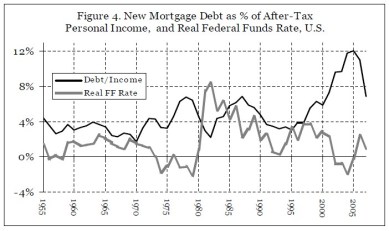
The medium term story of the evolving financial crisis begins at the end of the last century. With the bursting of the dot-com bubble at the end of the 1990s, possibilities of a long recession hovered on the horizon. The Federal Reserve, the Central Bank of the US, moved in with the tools of monetary policy to ease the slowdown. The target for the federal funds rate, the key short-term interest rate that the Fed monitors as part of it’s monetary policy tasks, was gradually lowered from over 6 percent per annum to a little below 2 percent within a span of about an year. Lowering interest rates to engineer a soft-landing for a slowing economy is a natural thing to do: reducing the cost of borrowing funds is a key way the Central Bank can affect the level of investment and consumption (especially of durable goods) expenditures and thereby boost the level of aggregate demand in a slowing capitalist economy. With finance in command, this normal and natural move had a perverse effect.

Fed Funds Rate

The effects of the falling federal funds rate gradually cascaded from the short-end to the longer end of the asset market, lowering interest rates on all kinds of contracts. One of the key long-term interest rates affected by this very sensible move of the Fed was the interest rate charged on various kinds of mortgage loans (loans to finance the purchase of homes). With mortgage interest rates falling, consumers not only started purchasing new homes with new mortgage loans but also refinancing their old mortgages. With the demand for mortgage loans increasing, and the increase sustained by a low-interest rate regime, house prices started picking up. Very soon, i.e., within a year or two, economists started noticing a bubble in house prices. There were several indicators of a house price bubble. For instance, the Case-Shiller house price index for 10 US cities – a commonly used price index for houses – increased rapidly since the early 2000s. Even more tellingly, the price-to-rental ratio of houses went through the roof. Between January 2000 and April 2006, the rental of an average house did not increase at all; during the same period, price of an average house increased by about 70 percent, sending the price-to-rental ratio on an upward spiral.
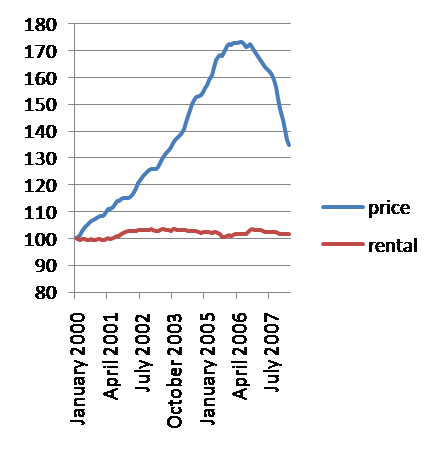
Price-Rental Ratio

The fact that the price-to-rental ratio increased rapidly gave a clear indication that a house price bubble was building up. People were, in other words, purchasing houses not because of the service provided by a house but because of speculative motives. A rough proxy for the value attributed by consumers to the service provided by a house is the rental rate; since this was not increasing, it meant that people were not valuing the real service provided by the house. But prices of houses were shooting up giving an indication of an increasing demand for houses (relative to supply). Most of this demand was clearly arising from speculative motives; many of the house purchases were for the purpose of selling them off at a later date to reap capital gains (i.e., the profit derived from the difference between the selling and the buying price of the asset). Thus, the rise in prices was not driven by “fundamentals” (i.e., increase in the intrinsic value of the service provided by houses) but largely by speculative motives of capital gains; that is precisely what leads to an asset price bubble and that is what happened.

Sub-prime Mortgage Market

A run of a couple of quarters of rising house prices was very soon incorporated into the expectation formation mechanisms of financial markets. As has been observed over and over again in history, rising asset prices very soon creates irrational expectations that prices will keep rising, rising certainly in the foreseeable future if not forever. Such periods of rapidly rising expectations, feeding primarily on itself, have been labelled as “manias” by economists studying periods of asset price boom-and-bust. Prominent examples of such economists are Charles P. Kindleberger and Hyman P. Minsky, coming, as they are, from very different political traditions. In the context of the early twenty-first century US economy, the unprecedented house price bubble created grounds for the emergence of predatory lending and the sub-prime mortgage market. The sub-prime mortgage market was the market for mortgage loans to less-than-creditworthy borrowers at very high interest rates that often came with hidden but onerous terms. (Useful material on predatory lending and the subprime mortgage market can be found here)

A financial innovation that indirectly helped the emerging sub-prime mortgage market and the practice of predatory lending was “securitization”. Securitization, in the context of the mortgage market, meant pooling together hundreds and thousands of mortgage loans together and then selling bonds on that pool of mortgages. Investors buying those bonds – the mortgage backed bonds – received the income stream, both the principal and the interest, entailed by the mortgages as the mortgage borrowers serviced their debt. Securitization required that the entities, usually investment banks like Bear Stearns or Merril Lynch, that were issuing (i.e., selling) mortgage backed securities (the mortgage backed bonds or other kinds of assets backed by the mortgage pool) needed ownership of the pool of mortgages against which those mortgage backed securities were being issued. Thus, the entities that issued the mortgage backed securities went out and bought mortgage loans from the originators of the mortgages, i.e., those who sold the mortgage loan to the borrower, like Country Wide Financial (the largest mortgage seller in the US prior to the financial collapse).

The fact that mortgage loan originators had a market where they could sell off the mortgage loans they had originated created perverse incentives for the originators. Typically mortgage loan originators do a thorough screening to assess the financial background of applicants before making loans. With the emerging market for selling off mortgages, the effort at screening was reduced to zero. Things actually went even further. Since mortgages could be sold off at good prices to the investment banks, the mortgage loan originators had a incentive to start engaging in predatory lending, i.e., push mortgage loans on persons who they knew would not be able to sustain the payments entailed by the loan. Since the originator did not have to bear the risk of failure associated with non-payment of mortgage loans, they had no incentive to make prudent loans. All they had to do was to force some gullible working class person to agree to the sub-prime loan and then turn around and sell it off to some investment bank in Wall Street. Thus, the market for sub-prime mortgages proliferated, driven by rising demand coming from the Wall Street investment banks. And why were investment banks so eager to buy these sub-prime mortgages? To answer this question, let us look a little more closely at the process and results of “securitization”.

Securitization

Securitization is the division, repackaging and dispersal of debt, earning huge fee income for the entity (usually an investment bank) that is undertaking this process. The process starts with some commercial or investment bank buying a swathe of mortgages, some prime, some sub-prime, from smaller financial institutions and pooling them together. Each mortgage, recall, entails a stream of future payments; so the pool of mortgages, entails some specific stream of future payments. Various categories or “tranches” of bonds, arranged according to their risk characteristics, are then issued against the pool of underlying mortgages, i.e., against the stream of future payments entailed by the pool of mortgages. Investors who buy these bonds (mortgage backed securities) then have the claims on the mortgage payments coming through month after month after month; if some mortgage fails i.e., payments stop the lowest category (i.e., most risky) bondholder loses first, the losses travelling up the tier of the bonds.

Let us look at a specific example: Bear Stearns Alt-A Mortgage Pass-Through Certificate. This is how this mortgage backed security worked. Bear Stearns bought 2871 mortgages from different mortgage originators for a total of $1.3 billion; this mortgage pool had mortgages that had been originated in different parts of the US, each worth on average for $ 450,000. Bear Stearns then pooled these diverse mortgages and issued 37 different bonds against that pool of mortgages; these bonds were called the Alt-A Mortgage Pass-Through Certificates. Alt-A stands for a very specific kind of mortgage: a mortgage where the originator does not ask any questions about the financial situation of the borrower before making the loan. It is not even ascertained whether the person taking the loan has a stable employment or not! Two additional players come into the picture: credit rating agencies and insurance companies.

Since many investors had an idea that the mortgage backed bonds were risky investments, they required some “independent” rating agency like Standard & Poor’s or Moody’s to ascertain the riskiness associated with investing in those bonds. This is one of the typical functions of credit rating agencies: to ascertain the riskiness (i.e., risk of default) of bonds and assign a credit rating to it; credit ratings run from AAA/Aaa (least risky) to C/D (in default). There were two problems with the involvement of credit rating agencies in the whole securitization process. First, there was an acute shortage of reliable information about the mortgages in the underlying pool; recall how the mortgages in the pool had originated in very different geographical locations, had been offered to very different income categories of people. Most importantly, very little information was collected about the financial standing of the borrowers (especially in Alt-A mortgages). So, despite their best efforts, the credit rating agencies could not come up with realistic risk assessment of the bonds issued against the pool of mortgages. The second problem was even more serious: a conflict of interest. Who paid the fees to the credit rating agencies? The same investment banks that issued the mortgage backed bonds; thus, there was a real incentive for the rating agencies to underplay the risk and certify most of the bonds as “investment grade”. That is more or less what happened, as we now know.

The other player in the securitization process was an insurance provider; since investment in mortgage backed securities (and other related assets) carried some risk investors wanted insurance against default. The instrument that was used to provide insurance for such transactions was the credit default swap (CDS), a derivative financial instrument. Suppose an investor bought bonds worth $1 million; then, to insure herself against the possibility of default she could buy CDS from some financial firm like AIG on those bonds. The insurance premium that she had to pay, called the CDS rate or spread, was typically in the range of 1-2 percent of the value of the bonds, $1 million in this case. She would thus pay $ 20,000 (if the CDS rate was 2 percent) and the CDS contract would protect her against default for the period of the validity of the contract (typically a few years). In the bonds were to go into default the firm that had issued the CDS would have to pay her the amount of her losses.

There were several problems with the CDS market. First, it was an over-the-counter (OTC) market and did not operate through an exchange; hence the possibility of monitoring or regulating this market were negligible. All the contracts were bilateral contracts and no one other than the two parties to the exchange could, in principle know the details of the contract. Second, unlike traditional insurance contracts, there were no reserve requirements. Thus, the financial entity selling the CDS was not required, by law, to hold any reserves against the CDS issued, unlike traditional insurance. So, if the CDS were to actually come due there was no guarantee that the firm that had issued the CDS would be in a situation to make good it’s side of the contract. Third, the most bizarre aspect of the CDS market was that the investor buying the CDS was not required to hold the underlying assets.

This third aspect is truly incredible and led to a veritable explosion of speculation. Let us think about this for a minute. It meant that if I believed GM would fail three years down the line, an investor could buy $10 million worth of CDS on GM bonds by paying a fee of $200,000 (assuming a CDS rate of 2 percent); and this the investor could do even though she did not hold any GM bonds. If GM actually failed and her bet was correct she could make $10 million on an investment of $200,000, a phenomenal 49 fold return! One could never expect to make such return by actually holding the bonds, and so investors started making huge bets using the credit default swaps instead of investing in bonds and stocks. By the end of 2007, the CDS market had grown to about $ 55 trillion (about 4 times US gross domestic product).

But who bought the asset backed securities? Who bought the CDS? International investors of all kinds. Around the late 1990s, there was an enormous pool of footloose, speculative capital in the global financial arena. The East Asian crisis, the Russian crisis and several other developing country crises freed up finance for investment in the US; and these investors wanted high returns even if that meant holding risky assets. That is precisely what the Wall Street investment banks were busy churning out: highly risky but high-return investments in the form of the asset backed securities and other more exotic assets. Hedge funds, pension funds, sovereign country funds and other large institutional investors lapped up the exotic assets which promised high returns.

But the whole edifice was built on very shaky foundations. This highly-leveraged investment game could remain profitable if either of two conditions were met: (a) mortgage payments kept coming in, and (b) house prices kept moving up. If mortgage payments stopped coming in, the property could be taken over and sold; hence sub-prime mortgages remained profitable investments even when the borrower was almost certain to default as long as house prices kept moving up. In the middle of 2006 house prices stopped rising and foreclosures started piling up; and then the whole process, the whole speculative game, started unravelling.

To the Short-term once again

With the medium term story more or less under our belts, let us return once more to the short term story and ask: why did Bear Stearns fail? Why did Lehman Brothers fail? Why was Fannie and and Freddie nationalized? What caused the near-collapse of AIG? Bear Stearns and Lehman Brothers went under for very similar reasons: they could not keep borrowing to finance their positions. Towards the end of it’s life, Lehman was rolling over close to $ 100 billion a month to finance it’s investments in real estate, stocks, asset-backed securities, bonds and other financial assets. When news of foreclosures started pouring in, investors became convinced that Lehman had big holes in it’s balance sheet because of it’s exposure to the sub-prime mortgage market. They refused to lend it money; thus it’s cost of borrowing went up, it’s stock prices plummeted and it’s credit rating was dropped. With no other option left, it had to file for bankruptcy on September 15, 2008.

Fannie Mae and Freddie Mac were government supported entities (GSEs) that were created to help low-income homeowners get easy access to the mortgage market. They were meant to guarantee mortgages and was supposed to finance this operation by issuing it’s own bonds which were implicitly backed by the US government. It is now clear that they did not stick to this mandate of theirs. Instead, they used the subsidized loans that they could get from the market (due to the implicit government guarantee) to invest in mortgage backed securities which were backed by pools of sub-prime mortgages. When the sub-prime mortgages started failing, these institutions started losing asset values and it became clear by mid-2007 that they could not sustain the mounting losses. At that point the government stepped in to explicitly guarantee their debt (because it was spread far and wide in the global financial system) which finally culminated in their nationalization.

AIG, the largest insurance company in the US, got into serious trouble because of the credit default swaps that it had written. Around mid-September, about $ 57 billion of insurance contracts that it had written, in the form of CDS, required it to raise serious money. The CDS were all written on bonds linked to pools of sub-prime mortgages and as the sub-prime market worsened, the possibilities of the CDS payouts coming due increased. Because of the possible losses that it could incur, credit rating agencies downgraded AIG. The way the CDS contracts were written, a credit downgrade required AIG to demonstrate that it was capable of making good on it’s contracts; this required it to immediately “post collateral” to the tune of $ 15 billion; if it failed to post collateral, it would be considered bankrupt. Since it did not have that amount of reserves and could not borrow from a tightening credit market, it had to approach the Fed for funds.

Bubble bursts: Delevarging and Deflation

An aspect of the whole build-up that made the unravelling especially painful was the stupendous amount of leverage in the financial system. When the bubble was inflating every investment was so hugely profitable that investors borrowed heavily for investing. This was especially true of the investment banks whose leverage (i.e., ratio of debt to equity) was about 30:1 by 2007; thus, for every dollar of equity these institutions had borrowed 30 dollars. And a large part of the borrowing was at the shortest end of the market. This meant that the investment banks had to continuously borrow from the market (usually roll over their debt) in order to keep financing their assets and investments. This made the system extremely fragile because any serious problem would lead to painful deleveraging (i.e., forcibly reducing debt by various means often involving serious financial loss) and possibly even asset price deflation.

As foreclosures picked up speed, house prices started moving down. Defaults on mortgage payments and falling house prices meant that the mortgage backed securities started losing value. Often this meant that when lenders came knocking on the doors for their funds, assets had to be sold at short notice and at low prices to cover debt payments coming due. A rush to sell assets often led to a further fall in the value of assets, even those not linked to mortgage backed securities, leading to worsening balance sheets in wider and wider circles. With bonds losing value and even facing default, the CDS contracts suddenly started coming into effect. Since CDS issuers like AIG had not held any reserves for such contingencies, they got into greater and greater difficulties as bonds insured by CDS contracts started failing.

Falling assets values meant that financial firms faced greater difficulty in borrowing from the market, partly because the value of assets that they could offer as collateral had already fallen. Falling collateral value often lead to increasing costs of borrowing in terms of higher interest rates. Difficulty is accessing funds gives another push to sell off assets to cover debt payments, taking the spiral one step down. Deleveraging and an asset price deflation and a string of failures and rescues really led the financial system, in mid-September 2008, to completely lose faith in itself; it is this severe loss of confidence that manifested itself in the credit freeze, the center piece of the short-term story.

(To be continued.)

Global Economic Crisis-III

Deepankar Basu

Link to Global Economic Crisis-I
Link to Global Economic Crisis-II

The Need for Aggressive Fiscal Intervention

Before we move on to looking at the global economic crisis from a medium term perspective, i.e., before we take a look at the phenomenon of the house price bubble and associated speculation that created the grounds for the current credit crisis, it might not be amiss to focus on what can be done in the short-run to deal with the real consequences of the economic crisis: the deep and prolonged recession that the US economy will undoubtedly be pushed into. Real GDP figures released by the US Bureau of Economic Analysis (BEA) on October 30 indicated that the US economy was in the midst of a slowdown even before the financial storm hit the world economy in the middle of September. Real GDP in the US contracted at an annual rate of 0.3 percent for the third quarter (i.e., for the months of July, August and September), led by a sharp fall in consumer spending; businesses cut 240,000 jobs in October alone, the highest figure in 14 years. The financial storm, comprising a severe credit crisis and even a possible banking crisis, worsened the slowdown further. In such a scenario, fixing the financial mess, dealing with the credit freeze, averting a possible run on the commercial banking system and restoring confidence in the financial system will not be enough to prevent a plunge into a deep, prolonged and painful recession; addressing the credit crisis is necessary but not sufficient to deal with the grave crisis in the real sector. A direct and aggressive boost to aggregate demand is the only way to prevent the current recession from becoming a depression. Why is that so?

In any capitalist economy, such as the US economy, the level of aggregate economic activity and employment is determined, in the short run, by the level of aggregate demand, and fluctuations in employment and output are accordingly determined by fluctuations of aggregate demand. Aggregate demand is defined as the sum total of all expenditures on goods and services produced in the economy. Macroeconomists divide total expenditure that make up aggregate demand into four categories: consumption expenditure, investment expenditure, government expenditure and net export expenditure. Consumption expenditure is the total spending by households on durable and non-durable goods, and also services; investment expenditure is the total spending by firms on plant, equipment, machinery and inventories, and the residential investment expenditures by households; government expenditure includes the total spending by local, state and federal government agencies on goods and services (excluding transfer payments); and net export expenditure is the net amount that foreigners spend on buying goods and services produced in the domestic economy.

BEA figures released for the third quarter show that every component of aggregate demand emanating from the private sector of the US (or foreign) economy either declined or slowed down when compared to the second quarter. In real terms, consumption expenditure decreased by 3.1 percent, the steepest decline since 1980 when the US economy was in the grip of a severe recession; during the previous recession in 2001, consumption expenditures had not even declined. Investment expenditures, other than those devoted to maintaining inventories, have also declined. Real nonresidential fixed investment expenditures decreased 1.0 percent in the third quarter, in contrast to an increase of 2.5 percent in the second. Expenditures on nonresidential structures increased by 7.9 percent, compared with a much higher increase of 18.5 percent in the last quarter; expenditures on equipment and software decreased 5.5 percent. Real residential fixed investment decreased 19.1 percent, compared with a decrease of 13.3 percent in the second quarter. Demand emanating from the external sector has a similar story to tell: even though exports registered a positive growth, the growth had slowed down considerably falling from 12.3 to 5.9 percent.

This is hardly surprising. With credit drying up, home equity vanishing and layoffs increasing, working-class households cannot be expected to increase their expenditures on the purchase of goods and services; a continued decline in the stock markets, coupled with increasing volatility will make matters worse. A recent survey in the US showed that consumer confidence was at it’s lowest value in 40 years, and so it is almost certain that consumption expenditure will not rise in the foreseeable future. Neither will export expenditures rise to shore up aggregate demand because most of the economies in the world are either already into a recession or are rapidly slowing down. Nor can firms be expected to increase their expenditures on plant and machinery and equipment. And the problem here is more than a credit freeze: even if the credit markets were to ease due to government intervention, which it is adamantly refusing to do, firms might not be willing to expand their operations because they face sagging demand. Capitalist firms produce to make profits; if they expect markets to be down and demand to fall, they will cut back and not increase their expenditures even if the cost of financing goes down.

That leaves us with government expenditure as the only source for increasing aggregate demand. In the midst of possibly the worst economic crisis since the Great Depression, the US government needs to aggressively step up it’s expenditure on goods and services; since private expenditures, either of firms or of households, cannot be expected to increase in the short-term, aggressive fiscal intervention seems to be the only way the US government can prevent the economy from sliding into a decade long L-shaped recession that was Japan’s fate in the 1990s. Moreover, such expenditures are warranted even from a long-term perspective of economic growth. Rebuilding the crumbling public infrastructure like roads and bridges, improving and widening the ambit of the public transport systems in US cities, jump-starting the movement towards green technologies, making health care available to all working-class Americans, increasing the unemployment benefit substantially, investing in the educational infrastructure makes both short-term and long-term sense. It will help boost aggregate demand in the short run and prevent a slide into a prolonged recession, and in the long run it will build the physical and human capital to help take the US economy into a higher growth trajectory.

Two alternatives to boost the economy, which are often brought up in this context, also seem to have lost their efficacy: tax breaks and monetary policy. Tax breaks have already been tried out and does not seem to have worked; reeling under mountains of debt, the tax break (or refund) cheque is often used by households not for making new purchases but for reducing the outstanding debt. The second alternative, monetary policy action, is also rapidly reaching the point where it will become totally ineffective. For it is almost certain now that the US economy is already stuck in what John Maynard Keynes long ago called a liquidity trap, a situation where the Central Bank can no longer boost aggregate demand by reducing interest rates. The Fed has already reduced the target federal funds rate to 1 percent and reducing it further to 0 percent, the lowest it can go, will possibly not help. Even if confidence in the financial system is restored and nominal interest rates lowered, this might not increase borrowing by firms because of their bleak forecast of falling demand for the goods they produce. Monetary policy has reached it’s limits; the only option to ward off a severe recession and decrease the pain on the working class seems to be aggressive fiscal intervention in terms of direct expenditure on goods and services by the US government.

(To be continued.)

Global Economic Crisis-II

Deepankar Basu

Link to “Global Economic Crisis-I”

Short-term: The Sequence of Events

Even though the credit crisis attained dangerous proportions only in mid-September, it had already announced itself in the early part of the year with the collapse of Bear Stearns, one of the five famed investment banks that defined Wall Street; today none of those five investment banks – Bear Stearns, Goldman Sachs, Lehmann Brothers, Merril Lynch and Morgan Stanley – exist, an indication of the depth of the crisis. Faced with a fierce run on it’s dwindling reserves and it’s stock plummeting, Bears Stearns was forced to sell itself off to J P Morgan Chase (one of the largest commercial banks in the US) on March 16, 2008. The next three months could be best described in terms that the police often use in India: tense but under control. On July 01, the next piece of bad news emerged and shattered the uneasy calm: Country Wide Financials, the largest mortgage seller in the US, collapsed and was acquired by Bank of America (one of the largest commercial banks in the US). Following closely on the heels of this event, IndyMac bank failed – the second largest bank failure in US history – and was taken over by the Federal Deposit Insurance Corporation (FDIC), one of the institutions responsible for monitoring the health of the banking system in the US. IndyMac was, unsurprisingly perhaps, part of the Country Wide financial family.

Things started speeding up in September. On September 08, Freddie Mac and Fannie Mae, the two government supported enterprises (GSE) operating in the mortgage market was nationalized, with assets of the two entities totalling to more than $ 5 trillion. On September 15 another of the five famed investment banks, Lehmann Brothers, filed for bankruptcy; Lehmann’s assets were a little over $ 600 billion and this made it’s bankruptcy filing the largest in US history. Next day, the Fed stepped in with a $ 85 billion loan to prevent American International Group (AIG), the largest insurance firm in the US from going under. These two events, Lehmann’s bankruptcy filing and AIG’s rescue, sent shock waves through the world financial system. The result was a rapid erosion of faith in the financial system leading to a veritable credit freeze: financial institutions stopped lending, to other financial institutions, to businesses and to consumers.

The next thirty six hours, from the morning of September 17 to the evening of September 18, accelerated the credit crisis to extremely dangerous proportions and convinced the US Treasury and the Federal Reserve that government intervention of unheard magnitudes (at least since the Great Depression) would be necessary to prevent total financial collapse. Ben Bernanke, the chairman of the Federal Reserve (the US Central Bank), was famously reported as saying, at one point during this 36 hours, that if the government did not save the (financial) markets now there might not be any financial markets in the future. So, what happened during those crucial 36 hours?

The crucial 36 hours

The first indication of a severe stress in the financial system was a shooting up of credit default swap (CDS) rates, especially on Morgan Stanley and Goldman Sachs (two of the famed five Wall Street investment banks) debt, during the early hours of September 17. Credit default swaps are insurance contracts that can protect bondholders against the possibility of default. For example if an investor has bought bonds worth $ 1 million issued by firm A, then the investor can also buy CDS – typically issued by financial institutions like large commercial banks, investment banks or insurance companies – to protect herself against a possible loss resulting from firm A defaulting on it’s bonds; the premium that the investor pays for the CDS is called the “rate” or “spread” and it is typically around 2% of the amount insured (the “notional value”). So, in the case of this example, the investor would pay $ 20,000 to buy CDS and if firm A were to go under, then the “counterparty” to the CDS contract (i.e., the financial institution that issued the CDS to the investor) would step in to pay the investor $ 1 million and the interest on that amount.

CDS rates (i.e., the premiums that are paid on the insurance contracts) are, thus, an indication of the market’s belief about the possibility of default of some institutions; CDS rates on bonds issued by firms are typically low when the market thinks the probability of default of those firms are low and high when the market thinks the probability of default are high. Thus, on the morning of September 17, when CDS rates went through the roof, this provided evidence of severe loss of faith in the financial system.

When investors lose faith in the financial instruments issued by private parties, they turn back to those issued by the government and that is what happened when CDS rates multiplied by close to a factor of five. Investors let go of private financial instruments like hot bricks and rushed into US government securities, a phenomenon often described as “flight to safety”. The US government, i.e., the US Treasury department, issues three primary kinds of securities: T-bills, T-notes and T-bonds (where the “T” stands for Treasury), where bills mature in less than a year, notes mature between one and ten years and bonds are of longer maturities than a decade. When investors lost faith in the private financial system, they rushed in to US T-bills, the short-run heavily-traded ultra-safe US government securities. This huge rush into T-bills pushed up the price of T-bills and drove the yield (i.e., interest rate) on T-bills down. At one point in time, during this 36 hour period, the yield on T-bills was pushed down all the way to zero (the lowest it can ever go to) implying that investors were willing to hold T-bills even though the nominal return was zero and real returns were negative (because the inflation rate was positive).

As private investors were madly rushing into the safety of US T-bills, another important event was unfolding in the mutual funds market. Money market mutual funds (MMMF) are financial institutions that have become popular over the last three decades, especially in the US. They typically work as follows: investors put their money in MMMF’s by purchasing shares in the MMMF’s stock; thus the MMMF becomes a mechanism for pooling huge amounts of money and then using those large sums for investing in a very diversified portfolio of financial assets, thereby making the investments extremely safe. Thus MMMF’s were, till September 17, thought to be as safe as a deposit account in a commercial bank, and the added advantage was that the money invested in MMMF shares would give a positive rate of return as opposed to a deposit account which is usually non-interest bearing. On September 17, one of the oldest and largest MMMF’s, Reserve Primary Fund, “broke the buck”, i.e., it made losses on it’s investments such that it could not guarantee a positive return to it’s shareholders. Every dollar invested in Reserve Primary was now, by it’s own admission, worth less than a dollar. This was an unheard of event and as news of Reserve Primary Fund’s losses spread, investors started pulling money out of MMMFs.

This had a very negative consequence for the real economy because of the serious involvement of MMMFs in the commercial paper (CP) market. Businesses typically need to constantly borrow short-term funds to keep their operations going; these borrowed funds go towards funding payroll, paying suppliers, maintaining inventory, etc. Firms, at least the big ones, usually borrow short-term funds in the US by issuing commercial paper (which is essentially a bond with a short maturity of about a week or a month). Who buys commercial papers? The most active institutional investors in the CP market are the MMMFs; some of the largest chunks of commercial papers are bought by the MMMFs. So when the MMMFs faced an increasing spate of withdrawal, in the wake of Reserve Primary Fund’s breaking the buck, they stopped buying commercial paper. This, essentially, meant that the CP market ground to a halt. Thus businesses were no longer able to borrow the short-term funds that they need to keep operating. The economy, by all means, shut down.

Adding to and going hand-in-hand with these processes were the growing problems in the interbank (lending) market. Commercial banks typically lend and borrow banking system reserves (roughly the sum of currency in the banks’ vaults and the amount they hold in their account with the Central Bank) among themselves for very short periods, usually overnight periods. The interbank lending market that is most closely watched is the London interbank market and the rate at which loans are made in this market is the London Inter Bank Offered Rate (LIBOR). The most important characteristic of loans in the interbank market is that they are unsecured, i.e., they are not backed by collateral. Thus, a bank can get a loan in the interbank market only if other banks consider it financially sound; thus when the LIBOR jumps up suddenly it provides evidence that the largest and the best banks in the world have lost faith on each other. On September 17, the LIBOR shot up giving indication of increasing strain in the interbank market.

It was these sets of events – CDS rates shooting up, closing down of the CP market, increasing strain in the interbank market – that spooked the US administration and convinced them of the necessity of the most extensive government intervention in the financial markets since the Great Depression. These crucial sets of events were precipitated by the string of big financial failures that the US economy had witnessed over the first two weeks of September: the failure of Fannie and Freddie, the bankruptcy of Lehmann and the near-collapse of AIG. It was these failures that led to a rapid loss of faith in the financial system and heralded a full-blown credit crisis. And why did Fannie and Freddie and Lehmann and AIG fail? All these financial institutions failed because at crucial points in time they could no longer raise money from the market to finance their assets, i.e., they could not borrow money or roll over their short-term debt; financing, for these institutions, had dried up. And why did financing dry up for these big and reputed financial institutions? Because each of these, in their own ways, were exposed to the subprime mortgage market and took huge losses when the subprime mortgage market started unravelling. As news of these failures spread, investors, fearing losses, became increasingly unwilling to lend money to these institutions.

(To be continued.)

Capitalism Hits the Fan: A Marxian View

Capitalism Hits the Fan: A Marxian View from UVC-TV 19 on Vimeo.

Lecture by Professor Rick Wolff, Department of Economics at the University of Massachusetts – Amherst on October 7, 2008.

Global Economic Crisis-I

Deepankar Basu

The global economic crisis currently underway is, by all accounts, the deepest economic crisis of world capitalism since the Great Depression. It is necessary for the international working class to understand various aspects of this crisis: how it developed, who were the players involved, what were the instruments used during the build-up and what are it’s consequences for the working people of the world. This understanding is necessary to formulate a socialist, i.e., working class, response to these earth shaking events. In a series of posts here on Radical Notes, I will share my understanding of the on-going crisis as part of the larger collective attempt to come to grips with the current conjuncture from a socialist perspective, to understand both the problems and the possibilities that it opens up.

The Big Story

The current crisis can possibly be fruitfully understood if measured against different time scales: the short-term, i.e., in terms of days and weeks; the medium-term, i.e., in terms of months and years; and the long-term, i.e., in terms of decades. This analytical compartmentalization into three different time periods is useful because it demonstrates how long-term trends silently but inexorably created the conditions for the medium-term problem to explode into the short-term problem that has buffeted the economy since mid-September, 2008.

In the short-term, the current financial meltdown is a severe credit crisis, a situation whereby financial institutions have become unwilling or unable to lend and borrow among themselves thereby freezing the flow of credit in the entire economic system; this credit freeze is largely fuelled by a serious loss of faith in financial institutions and in the financial system as such and came to the fore most forcefully in the middle of September, 2008. It is also possible that the credit freeze, and the underlying loss of faith, might explode into a full-blown banking crisis: banking panic leading to run on even healthy and solvent banks.

In the medium-term, the crisis is the unravelling of a stupendously leveraged speculative bubble on real estate that built itself up for about seven years from the beginning of this decade (and century); this speculative bubble was mediated by fancy financial instruments fashioned by Wall Street, running all the way from sub-prime mortgages, asset backed securities (ABS) and mortgage backed securities (MBS), collateralized debt obligations (CDO) to credit default swaps (CDS); this speculative bubble led up to and culminated, when it finally burst in the middle of 2007, in the credit crisis that the US, and gradually the global, economy finds itself in.

From a long-term perspective the present crisis is, of course, more than just about Wall Street and finance and banking; it is a full-blown crisis of the neoliberal turn in capitalism inaugurated the 1970s. Neoliberalism (or the neoliberal counterrevolution) was a response to the structural crisis of capitalism that emerged in the late 1960s. It was a response from the point of view of the upper fraction of the capitalist class, a fraction especially dominated by financial interests. The neoliberal counterrevolution ushered in a capitalism firmly under the sway of finance capital; the neoliberal policy turn was geared towards breaking the power of labour vis-a-vis capital that had gradually built up during the two decades after World War II. The result was stagnant real wages, slow but growing productivity, and hence growing profit incomes especially of the financial sector, increasing financialization and a deregulated economy for finance to operate in.

Stagnant wages created the demand for debt from a working class used to growing consumption spending; huge profit incomes and the shredding of all regulation on finance created the supply. The result was a growing role of debt in the lives of the working class which, over time, led to a huge debt overhang on the entire economy. As the ratio of outstanding debt to income rose, with stagnant incomes for the majority, the financial fragility of the entire system increased; and it is this systemically fragile financial architecture that finally cracked under the weight of the bursting housing bubble. Thus, the long-term build-up of debt in the US economy resulting from the neoliberal counterrevolution, which increased the financial fragility of the system, created the conditions in which the bursting of various asset price bubbles could lead to a severe credit crisis and loss of faith in the entire financial system.

Impact on the Real Economy

Real GDP figures released by the US Bureau of Economic Analysis (BEA) on October 30 indicated that the US economy was in the midst of a slowdown even before the financial storm hit the world economy in the middle of September. Real GDP in the US contracted at an annual rate of 0.3 percent for the third quarter (i.e., for the months of July, August and September), led by a sharp fall in consumer spending. The financial storm, comprising a severe credit crisis and even a possible banking crisis, will only deepen the slowdown and might even push the US and the rest of the world into a prolonged and painful recession, possibly even a decade long L-shaped recession like the one that Japan witnessed during the lost decade of the 1990s. In such a scenario, fixing the financial mess, dealing with the credit freeze, averting a possible run on the commercial banking system and restoring confidence in the financial system will not be enough to prevent a plunge into a deep, prolonged and painful recession; addressing the credit crisis is necessary but not sufficient to deal with the grave crisis in the real sector. An aggressive fiscal intervention by the US government and other governments around the world, in terms of direct expenditure on goods and services, will be necessary to prevent the slide into a prolonged recession. It is in the interests of the working class to push for such intervention even as it works towards re-building it’s political, social and economic institutions.

(To be continued.)

Some Comments on Partha Chatterjee’s theoretical framework

Political Economy of Contemporary India

Dipankar Basu and Debarshi Das

Sifting through the divergent viewpoints thrown up by attempts to make sense of the recent political history of West Bengal, one is led to the conclusion that the tumultuous events have taken many, if not most, by surprise. With the benefit of hindsight one can probably say this: a combination of an insensitive state power, an arrogant ruling party, lapping-it-up corporate interests, and cheerleaders-of-corporate-sector-doubling-up-as-media orchestrated a veritable assault – a perfect storm. Yet the peasantry, initially without the guiding hand of a political party – indeed at times against the writ of the party – fought on. Through this episode Indian political economy seems to have stumbled upon the peasantry while it was looking for a short-cut to economic growth through SEZs.

At the level of political practice this serendipity demonstrates lack of an organic link between the representatives of people and those they claim to represent. The Trinamul Congress, whose manoeuvrings range from rightist alliances at worst to unprincipled populism at best, was slow to react; but it learnt the ropes eventually. A nagging doubt remains though, as to whether it would not, at the end of the day, appropriate the movement and sell it off to the highest bidder. The charge is of course more serious against the communist parties. If confusion of politics was not bad enough, the largest party of the state failed to gauge the pulse of the people whose land it was taking. The Congress Party has perhaps been the most rudderless of the lot – veering towards resistance at one moment, getting pulled back by the central leadership at the very next.

At the level of theorisation too, things are in a flux. A case in point is noted political scientist Partha Chatterjee’s article in Economic and Political Weekly[1], which tries to present a novel reading of contemporary Indian reality and a new framework to comprehend it with. We shall present his position briefly and then examine it critically in our own attempt to throw some light on contemporary Indian reality.

Partha Chatterjee’s Analysis

Partha Chatterjee (PC henceforth), by his own admission, used to perceive the Indian peasantry as being endowed with a change-resisting character. External agencies such as the state or market forces were sought to be barricaded away, often successfully. But that has changed over the last twenty five years. Liberalisation of the economy, it’s incorporation into networks of the global flow of goods, services and capital, and more recently events like Singur, Nandigram, Kalinganagar, etc. have compelled PC, and Kalyan Sanyal, whose book he often refers to, to reconsider such a position.

Reconsideration of the earlier position leads him to discover that the state was not that external to rural society after all; that the rural economy has come fully under the sway of capital, and that the rural poor do leave villages for cities due to social, and economic compulsions [2]. These new trends, according to PC, have emerged and consolidated themselves over the last three decades. Another concomitant and noteworthy development is that market forces seem to have gained phenomenal power. The balance of state power between corporate capital and the landed elite has decidedly tilted in favour of the former. The managerial-bureaucratic class, i.e, the urban middle class, has also aligned itself with the interests of big capital. Straddling all these changes and in a sense providing an overarching theme of current economic reality in India is the process of primitive accumulation of capital.

Sanyal however avers, and PC concurs, that the primitive accumulation of capital that is underway in India today is very different from the classical variety of the same process. One of the major differences, according to PC, is that the dispossessed, separated from the means of production, can no longer find gainful employment in industry due to limitations of present day capital-intensive technology [3]. This is bad news for the ruling dispensation as social unrest may break out. Old tactics of armed repression is ruled out, because the globally accepted norm is to provide succor to the victims of primitive accumulation and not shoot them down. Compulsions of electoral democracy, which demands that even voters bereft of livelihood be heard, is an additional constraint. Thus, caught between the pressures of the global discourse on development and the demands of electoral democracy, the State adopts the role of transferring resources from the accumulating economy of corporate capital to the dispossessed masses, thereby reversing the effects of primitive accumulation.

We are therefore left with a curious situation. Corporate capital is dispossessing millions through primitive accumulation, but the dispossessed are neither getting absorbed into industry nor getting socially transformed, as they were supposed to, through proletarianisation. This floating mass of labour, this enormous but shifting population of potential workers have instead become a constituent of what PC calls “political society”. Owners of small capital – PC prefers the term non-corporate capital – along with small and marginal peasants, artisans, and small producers are important constituents of political society.

But political society, according to PC, is different from civil society; corporate capital hegemonises the urban middle class which forms civil society. Its support for pro-capital policies is unstinting. Demand for civil and democratic rights define its political agenda. Political society, on the other hand, is hardly a constitutionally valid entity. Its constituents do not enjoy the rights due to citizens; hence they do not qualify for membership of civil society. The economic precariousness of political society, accentuated by primitive accumulation, forces it to use various ploys to negotiate with the State. For the State, on the other hand, electoral compulsions of representative democracy is a binding constraint. Thus the State often looks the other way when negotiations with political society violates established civil society rules (urban squatters, and street vendors are a case in point, as PC mentions). But in the agrarian economy the degree of political consolidation is lower; therefore dependence on the hand-outs of the State is more pronounced. This does not however imply, PC mentions, that they are incapable of rallying on emotive issues and thereby nullifying the government’s machinations to divide and break. It is in the dynamic interaction between the civil and political society – which often coincide with corporate and non-corporate capital for PC – and in the success of the State in holding the two together through measures of “governmentality” that PC identifies the fate of the present political regime.

Some Comments

There are many points which are commendable about the article: acute observations, theoretical insights, incisive analysis and a crisp clear prose. For instance, some of the important observations worth highlighting and thinking about are: landed elite losing ground vis-à-vis the bourgeoisie, the breath-taking ease with which the urban middle class traded Nehruvian consensus for the Washington consensus, the accompanying depoliticization, and the rising friction between this class and the poor etc. These observations underline the sharp analytical prowess of one of the foremost social scientists of the country. But there are surprises and disappointments too and to these we now turn.

The biggest problem with PC’s analysis, we feel, is the questionable theoretical framework that he works in, a framework that he has borrowed from Kalyan Sanyal (KS henceforth). KS starts his analysis by pointing out that what is going on in contemporary India can be fruitfully understood as the primary (or primitive) accumulation of capital, in the sense in which Marx used that term in Volume 1 of Capital. We fully agree with him here; in fact one of us had argued along those lines some time ago [4]. The defining feature of the process of primary capital accumulation – forcible separation of primary producers from the means of production – is difficult to miss in developments in contemporary India. KS notes that all previous attempts at theorizing primary capital accumulation have been embedded in what he calls a narrative of transition. Thus, primary capital accumulation has always been seen, according to KS, as marking a transition, a transition from one mode of production to another, either a transition from feudalism to capitalism, or “from pre-capitalist backwardness to socialist modernity.” But “under present conditions of postcolonial development within a globalised economy, the narrative of transition is no longer valid”; that is “although capitalist growth in a postcolonial society such as India is inevitably accompanied by the primitive accumulation of capital, the social changes that are brought about cannot be understood as a transition.” And why is that so? This is because it is no longer acceptable, or so KS believes, that people dispossessed and displaced due to primitive accumulation should be left with no means of subsistence. And what makes the destitution and poverty of the people displaced by primary accumulation unacceptable? The current international context marked by the dominance of the discourse of development and human rights.

Alongside the process of primary accumulation, therefore, KS discovers a parallel and related process: intervention of the State to reverse the effects of primitive accumulation. Government agencies, in other words, step in to create conditions for ensuring the “basic means of livelihood” to those who have been dispossessed and displaced by the process of primary accumulation of capital. Thus there is, according to KS, two processes going on in parallel, “primitive accumulation” and a “process of the reversal of the effects of primitive accumulation.” It is the conjunction of these two parallel processes, according to KS, that invalidates the narrative of transition associated with the primary accumulation of capital.

The implication of this assertion, the assertion that the primary accumulation of capital can no longer be understood in terms of a narrative of transition, is stupendous. It means that current political economic processes underway in India will continue indefinitely; historical change, for KS, seems to have been stalled. Since current day reality cannot be understood as a process of transition, this would then seem to imply that Indian reality will remain unchanged in its essentials for a long time to come, if not forever. In more concrete terms, this will mean the presence of the huge mass of working people parked in the no man’s land between agriculture and industry for an indefinite amount of time, a population that has been simultaneously dispossessed by the primary accumulation of capital and provided an alternative “means of livelihood” by the postcolonial State.

As a description of contemporary Indian reality, this account probably has some intuitive appeal. After all it can hardly be denied that one of the most important characteristics of contemporary India is the huge population of what economists have called “surplus labour”: the huge population of working people who find stable, well-paying employment neither in agriculture nor in industry nor in services. Though KS’s analysis apparently attempts to understand this phenomenon of “surplus labour”, by all accounts the defining characteristic of contemporary Indian reality, it is, we believe, seriously flawed.

First: the Indian economy has been characterized by surplus labour for the past two centuries, it is not a new phenomenon; the primitive accumulation of capital was initiated under the long shadow of colonialism and ever since that time dispossession has been going on without commensurate absorption of the displaced labour in industry. In that sense the current scenario has a historical dimension that KS, and thereby PC, completely misses when he (a) locates the beginnings of this process somewhere in the recent past, and (b) identifies the supposed ameliorative interventions of the State in reversing the effects of primary accumulation in the current conjuncture as one of the crucial factors to reckon with.

To be sure, PC, identifies three factors that are different today from the time when Western Europe underwent primary accumulation of capital. First, there were opportunities for international migration of the surplus labour that are totally absent today; second, the technology of the early industrial period was far less capital intensive than current technology and hence had the capacity to absorb far more of the surplus agricultural labour than is possible today; third, the State did not intervene in Western Europe to reverse the effects of primary accumulation as it is doing today in India. Though the first two factors were present in Western Europe and contributed to mitigating the problem of surplus labour, they are not necessary. Japan and the Soviet Union had taken care of primary accumulation, and had industrialized, without having to export surplus labour to its colonies and using much more capital intensive technology that was used during the industrial revolution in Western Europe; South Korea had taken care of primary capital accumulation, and had industrialized, with much more capital intensive technology than Britain had used during its own industrialization and without the assistance of international outmigration of its surplus labour. Therefore, the absence of opportunities for international migration and the use of technologies with relatively higher capital intensity cannot explain the absence of industrialization and the continued existence of surplus labour in India. The answer lies somewhere else, in the domain of capital accumulation. In a dynamic context, the rate of absorption of labour, i.e., the growth rate of the demand for labour, depends on the rate of accumulation of industrial capital. Neither the lack of international migration, nor the increasing capital intensity of technology nor the ameliorative interventions of the State can explain the burgeoning ranks of surplus labour; it is the absence of a sufficiently rapid rate of growth of industrial capital in India that is responsible for the continued existence of surplus labour. This crucial factors is totally missing in KS’s and PC’s analysis

The primacy of capital accumulation becomes obvious once we look back at history and realize that dispossession without proletarianization is not a novel phenomenon. One just needs to recall that one of the principal issues raised by the Mode of Production Debate [5] was why India did not make the transition to capitalism despite being sucked into the global network of trade and commerce with the onset of colonialism. The answer, of course, is now well known. As colonial incursion willfully destroyed the socio-economic fabric of the country, peasants were evicted and deindustrialization, facilitated by the trade policy of the colonial State, exacerbated the pressure on land. But the economic surplus which was being generated in the process was largely siphoned off to the metropolis. Thus, in the colony, processes leading up to the formation of productive capital were conspicuous by their absence. Petty producers who were getting alienated from the means of production were joining the ranks of paupers, not those of the working class. Without a strong capital accumulation process, the excess labour could not be absorbed into profitable industrial activities; that is the historical basis of “surplus labour” in the Indian economy. One may refer to the mode of production in India using any term one wishes, as pre-capitalist, or semi-feudal, or semi-capitalist, or postcolonial, or something else, but the main point remains beyond dispute: absence of the growth of industrial capital and a concomitant growth of the industrial working class.

Somewhat related to this point about “dispossession without proletarianization” is the implicit assumption in PC’s analysis that peasant society had been stuck in splendid isolation till about the beginning of the era of liberalization; this is one of our major points of criticism of PC’s analysis that we wish our readers to ponder. The trend of viewing the peasantry in this manner, especially the middle peasants who are not very much dependent on the labour market for selling or buying labour, owes a great deal to the work of the Russian economist Chayanov [6]. But the putative efficiency of the peasantry sits oddly with the massive and recurrent famines India underwent as colonial rule tethered the country to global commodity markets. This position about the supposed insularity of the peasantry seems even more unconvincing when one recalls the state’s successful promotion of Green Revolution in north and northwest India starting in the mid-sixties. Nor does it seem consistent with Operation Barga in West Bengal, another orchestration of political parties and the state machinery, which was leaving a deep impact on rural Bengal right at the time when Subaltern Studies was undergoing its genesis.

To move on to another major problem in PC’s theoretical framework recall that one of the crucial links in PC’s chain of argument relates to the supposed interventions of the State in reversing the effects of primary accumulation; this, to our mind, is the weakest link in the whole chain of arguments that PC offers in his paper; there are both theoretical and empirical problems with this argument.

First:

PC, and many other scholars (including KS), we feel, seem to have misunderstood the notion of primary accumulation of capital. Primary accumulation of capital, as understood by Marx (in Volume 1 of Capital), is the forced separation of producers from the means of production. Whether this “free”, evicted (peasant) labour gets absorbed in industrial activity is a different question, it is not part of the process of primary accumulation. It depends on the pace of capital accumulation, as we have already pointed out. So, the assertion – implicit in PC’s analysis – that the “classical” pattern of primary accumulation led to industrial development is false. Primary accumulation led to the creation of a class of “free” labourers, period. What led to the industrial revolution and the rapid growth in the demand for labour and the strengthening of capitalism and thereby the absorption of surplus labour, was the rapid pace of capital accumulation and technical progress. Thus, distinguishing between the “classical” pattern of primary accumulation in Europe and the present pattern of primary accumulation in India does not seem be analytically useful.

Second:

PC’s whole analysis seems to be curiously oblivious of the neoliberal turn in the global economy, a fact that is amply reflected in policy changes in India too; we feel this is one of the biggest lacunae in PC’s analytical framework. The fact that radical scholars and activists have spent so much time and effort studying neoliberalism, understanding its genesis, structure and functioning must surely be known to a scholar of the stature of PC; the fact that he has ignored this vast scholarship, experience and political practice and has instead advanced the thesis of ameliorative state intervention is very significant and points towards a deep problem in his theoretical framework. After all, one of the defining characteristics of the State under neoliberalism is its gradual retreat from the provision of public goods and social services, especially those services that might benefit the poor and dispossessed. In the face of this well-known and well-documented fact, when PC asserts that the State has stepped in to do exactly the opposite, i.e., reverse the deleterious consequences of primary accumulation, one is more than surprised, one is appalled. Let us present some empirical evidence to dispel the illusion, if any, of the lately humane State, responsive to the needs of the poor, bowing before the pressure of the international discourse on poverty alleviation.

a. Distribution of subsidised food through ration shops is an old institution – not a device to make the pain of the poor bearable in the era of neoliberalism. During the last couple of decades, the decades of neoliberalism, the universal public distribution system (PDS) has been systematically dismantled; that is the hallmark of post-liberalisation India, not the strengthening of the PDS and increasing its reach. Priority sector lending, another device built by the Nehruvian state to help farming and related activities, is in a sorry state. In the last fifteen year 4,750 rural bank branches have been closed down: at the rate of one rural bank branch each day. During the year 2006 one branch was shutting down every six hours! [7]

b. The tale of microcredit institutions, an example of what PC considers the States intervention to reverse the effects of primitive accumulation, doing the job of offering palliatives has been questioned by many. The interest rates charged by micro credit institutions are often almost usurious. The motivation to harvest the middle ground between low interest rates of public sector banks (which are vanishing) and the exorbitantly high ones of village mahajans seems to be behind the coming together of corporate banks and NGOs in the micro credit venture. This serves two purposes. One, banks earn as much as 25% return, much higher than the organised sector return,[8] with an excellent repayment rate; a lucrative arbitrage channel thus opens up. Two, this credit model is then peddled as people-oriented, and opposed to a bureaucratic public sector model. This is then used to justify withdrawal of the state from its basic responsibilities towards socially and economically vulnerable sections of the population. That someone as perceptive as PC has fallen for the micro credit argument signals that the powers that be have been largely successful.

c. Contrary to the claim of the article, “social sector expenditure” has nosedived over the past few years. In 1996, rural development expenditure as a proportion of net domestic product was 2.6%. During the pre-liberalisation seventh plan (1985 to 1989) the figure was much higher at 4% [9]. From the mid 1980s to 2000-01 public development expenditure as a percentage of the GDP fell from 16% to 6%. The effects have of course been disastrous, especially in the farming sector where strong crowding-in effects of public investment is a well known fact. The growth rate of all crops fell from 3.8% in the 1980s to 1.8% in the 1990s, while total agricultural investment expenditure as percentage of the GDP fell from 1.6% to 1.3% [10]. Using a constant calorie norm of 2200 calorie per day, head count poverty ratio has risen from 56.4% to 69.5% between 1973-74 and 2004-05.

d. Guaranteed public work for the rural poor was attempted to be scuttled from the very top, i.e., by the officials of the State at the very highest levels. Social democratic proclivities of official communist parties, rather than the tactical calculations of the bourgeoisie, saw it through to some extent. To this day the corporate media loses no opportunity in tarnishing the National Rural Employment Guarantee Act [10] as useless, wasteful and distortionary.

In short, any substantial evidence of the State taking steps to make primitive accumulation bearable, to reverse its effects by providing alternative means of livelihood to the dispossessed population, seems to be totally missing. PC seems to be oblivious of the fact that the phase of neoliberalism is characterised precisely by the opposite: withdrawal of the state from the economy and social sectors, not its intervention in favour of the dispossessed.

Third:

The analytical handle of political society did not seem to have served any great purpose. What was meant by this term was essentially what has been called the unorganised sector, the sector of the economy comprising of petty agricultural producers, tenants, village artisans, street vendors, small scale manufacturers, etc. Admittedly they are less equal than the rest but that is a derivative of their economic position in the country rather than being a defining feature of its own. Since this “unorganized” sector employs nearly 92% of the Indian work force, a close scrutiny of its structure and dynamics is long overdue. But did coining a new term serve any goal? Not one that we can see. In the bargain PC, of course, seems to have missed two crucial points.

a. Labour has gone out of the discourse and PC’s analysis seems to endorse this trend. Recall that PC uses the term “non-corporate capital” for an economic representation of political society. Reading PC’s descriptions of it, one cannot help suggesting that “labour” rather than “capital” should have been emphasized. After all nearly 40% of the agrarian population are landless labourers [12]; of the landowners, about 86% come under the category of small and marginal farmers, and they supplement income from land with labour income. Simple back-of-the-envelope calculations tell us that at least 55% of the country’s population could be counted within political society – this is the contribution of agricultural sector alone. To get an idea of the size of political society one needs to add the fast increasing chunk of casual labourers in manufacturing and services, petty manufacturers, and self-employed groups of the service sector. Their income source, as we have noted, owes more to labour than to capital. Hence the term “non-corporate capital” seems inappropriate, both as a matter of description and analysis.

In this context one needs to understand what PC mentions about the resistance to forcible acquisition of land. When land was being taken away, some of the villagers did not participate in agitations while some of them resisted fiercely. But PC forgets to examine who did what. Closer examination of these struggles reveal that peasants with little or no land at all – sharecroppers, farm labourers – were the ones who fought on [13], [14]. This perhaps illustrates that using a class-neutral term may not be very illuminating for socio-political analysis.

b. While describing maneuvers of political society in negotiations with the neoliberal state PC uses illustrations of urban labour: squatters, hawkers, etc. This leads him to conclude that demands of political society mostly fall outside the domain of the legally permitted. But what about demands such as payment of minimum wage, subsidised inputs and credit, support price for crops, right to livelihood, right over resources like forest produce, water? Surely these demands, on which political society has plenty of stakes, are entirely legal. One suspects that the urban bias in PC’s analysis and illustrations has pushed the article to dubious conclusions.

Conclusion:

As landholdings have undergone fragmentation and aspirations for urban comforts have soared, agriculture has ceased to be the site of intense class conflict. For the foreseeable future the big question of political economy will be to understand how corporate capital, with hegemony over the state and civil society, negotiates with the clingers-on of a moribund peasant society. Aside from the shortcomings of PC’s analysis, which we have critically examined, resistance at Singur, Nandigram, Kalinganagar perhaps signals that all is not yet over with the agrarian question. Managing political society through governmentality is hardly an answer. Land remains a vital issue on which livelihoods, and therefore lives, are staked. There are no shortcuts – employments would have to be found for the evicted if corporate capital has to reproduce itself without hitch. Moreover, electoral compulsions of representative democracy need not be met through resource transfer as PC has suggested. In a polity where parties deliver anti-neoliberal rhetoric before elections and do precious little once in power [15], actual transfer of resources is neither necessary nor efficient.

Notes and references:

1. Partha Chatterjee (2008): “Democracy and Economic Transformation in India”, Economic and Political Weekly, Vol. 43 No. 16 April 19 – April 25.

2. PC also hypothesises that the rural poor do not face an exploiter in the village any longer; or that since taxes on land or produce are insignificant, the state is not an extracting agent of the peasantry. Both these claims are questionable, but we shall let them pass.

3. Kalyan Sanyal (2008) “Amader Gorib Oder Gorib” (Bengali), Anandabazar Patrika, May 20.

4. See http://radicalnotes.com/2007/02/07/neoliberalism-and-primitive-accumulation-in-india/

5. Utsa Patnaik (1990) Agrarian Relations and Accumulation: The ‘Mode of Production’ Debate in India, (edited) Sameeksha Trust and Oxford University Press, Bombay.

6. Utsa Patnaik (1979) “Neo-populism and Marxism: The Chayanovian View of the Agrarian Question and its Fundamental Fallacy”, Journal of Peasant Studies, Vol. 6, No. 4, reprinted in The Long Transition, Tulika, New Delhi, 1999 provides a detailed criticism.

7. Sainath (2008) “4,750 rural bank branches closed down in 15 years”, The Hindu, March 28.

8. Mritiunjoy Mohanty (2006) “Microcredit, NGOs and poverty alleviation”, The Hindu, Nov 15.

9. Utsa Patnaik (2008) “Neoliberal Roots”, Frontline, Vol. 25, Issue 06, March 15-28.

10. Utsa Patnaik (2003) “Food Stocks and Hunger: The Causes of Agrarian Distress”, Social Scientist, Vol. 31, No. 7/8, 15-41.

11. Jean Drèze (2008) “Employment guarantee: beyond propaganda”, The Hindu, Jan 11, 2008.

12. There is ambiguity whether PC categorises landless labourers under political society or ‘marginal groups’. He mentions marginal groups are low caste or tribal people. By this count the landless are mostly marginal. But then he mentions marginals do not participate in agriculture; they are dependent of forest produce or pastoral activities. Going by the second stronger criterion we shall include the landless in political society.

13. Parthasarathi Banerjee (2006) “West Bengal: Land Acquisition and Peasant Resistance at Singur”, Economic and Political Weekly, Vol. 41, No. 46, November 18 – November 24.

14. Tanika Sarkar (2007) “Celebrate the Resistance”, Hardnews, April.

15. K C Suri (2004) “Democracy, Economic Reforms and Election Results in India”, Economic and Political Weekly, Vol. 39, No. 51, December 18 – December 24.

Courtesy:Sanhati

Class in Making?

October 24, 2008. Around 150-200 teachers from various computer teaching institutions (especially Aptech) whose accreditation has been withdrawn by the Delhi Government demonstrated at Jantar Mantar, New Delhi. The event was organised by a local NGO. They were demanding the reopening of the closed institutions and the reinstatement of the teachers who are presently unemployed. Their demands also included the determination of the salaries and benefits for the teachers according to the minimum wages set by the government, as teachers were/are getting just Rs. 2500-2750 in these institutions (including in CompCom).


The first level of consciousness – “We are also Human!”


The second level of consciousness – “Down with the Delhi Government!”


The third level of counsciousness – “The nexus between the company and the government!”


And the Sectionalist Contradiction – “Illiterates are getting 4000 and the computer teachers just 2500!”


SLIDESHOW

Worse than They Want You to Think – A Marxist Analysis of the Economic Crisis

 Andrew Kliman

In the past few weeks, since we announced this talk, recognition has increased substantially that the United States, and now the world, are caught up in the most serious financial crisis since the Great Depression.  Because Marxists are famous for “predicting five out of the last three recessions”, I need to point that the term crisis does not mean collapse, nor does it mean slump(recession, depression, downturn).  While the US is probably in the midst of a recession, the downturn has been – thus far – a relatively mild one. For instance, payroll employment has fallen nine months in a row, but the total decline, 760,000, is well less than half of the decline that occurred during the first nine months of the last recession, in 2001, which itself was relatively mild.

In contrast to this, a crisis is a rupture or disruption in the network of relationships that keep the capitalist economy operating in the normal way.  The present crisis is characterized above all by an acute crisis of confidence that loans will be repaid, which has in turn caused an acute crisis of liquidity – an official at the Boston Fed recently termed it a “liquidity lock” – the inability of businesses to get cash for their short-term, day-to-day needs.  Some major credit markets have been essentially “frozen”; which means that lending has been dropping rapidly or even coming to a halt.  But the business sector depends crucially on credit, not only to finance new investments, but just to get from today to tomorrow.  General Electric, for instance, has to produce before it can sell, so in the meantime it regularly borrows heavily by issuing commercial paper in order to pay its suppliers and workers.  If it doesn’t obtain credit, the workers don’t get paid and the suppliers can’t pay off the debts they owe, and so on.  So the economy would be in danger of complete collapse if this situation were to persist for any length of time.

Now, many liberals and leftists have told us that the $700 billion-plus bailout was not needed, or that it is meant to provide windfall profits to the financial industry, or that the money could be spent differently, for instance to protect homeowners against foreclosure, or invest in infrastructure.  But the crisis is much worse than they want you to think, and that’s because they’ve been focusing on the wrong issues.  They’ve focused on the slump – which is not yet terribly severe and which can perhaps be dealt with in many different ways – and/or on the bank failures and bankruptcies in the financial sector.

The really acute, immediate crisis, however, the one that could lead to outright economic collapse, is the crisis of confidence that has caused the liquidity lock.  These liberals and leftists have proposed no alternative policies to deal with this crisis, and that’s because, if one wants to save the capitalist system, there basically aren’t any alternatives that differ, except in the details, from what the Treasury and the Fed and foreign governments are now doing – namely making the liquidity flow, the cash flow, especially by the Fed stepping in to become the lender of last resort in the commercial paper market and by the Treasury twisting the arms of the banks to take the bailout money and then turn around and lend it out.  There’s only one alternative to crisis of confidence and the liquidity lock that differs from this in more than details – a new, human, socio-economic system, socialism.

Fig 1

I want to illustrate some of what I’ve been talking about above by looking at a couple of graphs.  I haven’t found decent data on the decline in the volume of short-term lending, so I’m forced to try to illustrate the problem by looking at interest-rate figures.  Figure 1 is the so-called TED Spread, the difference between the rate of interest that a bank can get by lending to another bank for 3 months (the 3-month LIBOR in terms of US dollars) and the rate of interest it can get by lending to the U.S. Treasury for 3 months.  Lending to the Treasury is safer.  So the difference between these rates, the TED Spread, is essentially a measure of the willingness or unwillingness to take on risk – the extra interest a bank demands before it will take on the extra risk of lending to another bank instead of lending to the U.S. government.

Through the 1st third of last month, the TED Spread was slightly more than 1 percentage point, which is already about double its usual level.  But after the government had to take over Fannie Mae and Freddie Mac, and Lehman Bros. was allowed to collapse, and the government had to buy AIG, and so forth and so on … the spread rose and, after temporarily declining a bit, kept rising and rising, reaching over 4.5%, until last week, when the most recent of the bailout measures and other emergency measures were announced.  As of today, as a result of the bailout and related measures, it had fallen back down, to below 3%.

Fig 2

Figure 2 is the interest rate on 4-week Treasury bills.  Again, for financial institutions, lending to the U.S. government in this manner is safer than putting the money in the bank, because the bank might fail and, until very recently, big institutions’ deposits in the banks weren’t government-insured.  And it’s safer than buying short-term commercial paper.  So when they became afraid to lend to private entities, financial institutions became willing to obtain ridiculously little interest by lending to the U.S. government.  The greater the fear of private-sector lending, the lower the interest rate they were willing to accept.  And so the interest rate on 4-week T-bills has been, again and again, next to nothing for much of the past month.  For instance, much of last week, it was 5 hundredths of 1 percent, meaning that, if you bought a $10,000 T-bill, 4 weeks later, you’d earn 42 cents interest.  But this is what institutions have been willing to do with their cash, because they’ve been so afraid of the alternatives.  (The latest figure, not shown above, is that the interest rate has risen to 0.42%, as the bailout and related measures begin to restore confidence.)

Now let’s consider some of what’s been coming from the left.  In the Oct. 27, 2008 issue of The Nation (pp. 4 – 5), the historian Howard Zinn wrote,

“It is sad to see both major parties agree to spend $700 billion of taxpayer money to bail out huge financial institutions that are notable for two characteristics:  incompetence and greed. …

“A simple and powerful alternative would be to take that huge sum of money, $700 billion, and give it directly to the people who need it. Let the government declare a moratorium on foreclosures and help homeowners pay off their mortgages. Create a federal jobs program to guarantee work to people who want and need jobs”.

This is all well and good, and these are measures worth fighting for to help working people as the slump in the economy worsens.  But how do they address the crisis of confidence and the liquidity lock?   Of course, one could say, “forget trying to restore confidence,” but that is basically to say, “forget trying to save capitalism,” and Zinn didn’t say that.

Barbara Ehrenreich, the well-known writer and erstwhile revolutionary socialist, at least faced the fact that what is on the line is the capitalist system itself, not just incompetent and greedy and huge financial institutions.  She recently opined that there’s no alternative to capitalism “ready at hand,” so she hopes it survives the current crisis:  “I’m hoping that capitalism survives this one, if only because there’s no alternative ready at hand.  At the very least, we should get some regulation and serious oversight out of any bail-out deal ….” (Huffington Post, Oct. 1, 2008)

And then there’s the left-liberal economist Dean Baker, who was for the bailout before he was against it.  On Sept. 20, he wrote,

“There is a real risk that the banking system will freeze up, preventing ordinary business transactions, like meeting payrolls. This would quickly lead to an economic disaster with mass layoffs and plunging output.

“The Fed and Treasury are right to take steps to avert this disaster. … there is an urgency to put a bailout program in place ….” (“Progressive conditions for a bailout,” p. 243.  Real-world Economics Review, No. 47)

In this statement, Baker characterizes the liquidity lock and its implications much in the manner that I characterized it earlier.  But then, 9 days later, he reversed course:

“The bail-out is a big victory for those who want to redistribute income upward. It takes money from school teachers and cab drivers and gives it to incredibly rich Wall Street bankers. …

“This upward redistribution was done under the cover of crisis, just like the war in Iraq. But there is no serious crisis story. Yes the economy is in a recession that is getting worse, but the bail-out will not get us out of the recession, or even be much help in alleviating it.” (“Wall St held a gun to our heads”)

Portraying the bailout as a program to make the rich richer, Baker says correctly that it won’t do much to alleviate or end the recession.  But that doesn’t mean its purpose is to make the rich richer, either.  What about the system’s need to getting the liquidity flowing again – which he was acutely aware of 9 days before?

Well, Baker says, the government can just take over the banks:  “In the event the banking system really did freeze up, then the Federal Reserve would step in and take over the major banks.”  But the government must either take over the banks by buying them, which brings us back to a bailout costing hundreds of billions of dollars – or more, depending on how extensive the nationalization is.  Or the government can take over the banks without compensation.  That’s a lovely way of dealing with a lack of confidence on the capitalists’ part.  And it’s a lovely way of getting credit flowing again.  In order to lend, banks, even nationalized banks, need people and institutions to lend to them and/or invest in them.  But I know that I wouldn’t want to lend to or invest in any institution that has shown a willingness to expropriate without compensation.  Once again, of course, one can say, “forget trying to restore confidence and forget the sanctity of property rights” – in other words, “forget trying to save capitalism” – but Baker didn’t go there.

I want to turn now to the roots of this crisis.   My view is basically that the crisis has its roots in the economic slump of the 1970s, from which the global economy never fully recovered – not in the way in which the destruction of capital in and through the Great Depression and World War II led to a post-war boom.  Policymakers here and abroad have understandably been afraid of a repeat of the Great Depression. So they’ve continually taken measures to slow down and prevent the destruction of capital (a plummeting of the value of capital assets as well as physical destruction of capital).

But the destruction of capital is not only a consequence of an economic slump; it is also the mechanism leading to the next boom.(1)  For instance, if there’s a business that can generate $3 million in profit annually, but the value of the capital invested in the business is $100 million, the rate of profit is a measly 3%.  But if the destruction of capital values enables a new owner to acquire the business for only $10 million instead of $100 million, the new owner’s rate of profit is a more-than-respectable 30%.  That’s a tremendous spur to a new boom.

But such a massive destruction of capital as took place in the Depression and then in World War II hasn’t taken place, and so there’s been a partial recovery only, brought about largely through

(1) declining real wages for most workers and other austerity measures, as well as exporting the crisis into the 3d world, and

(2) a mountain of debt – mortgage, consumer, government, corporate – to paper over the sluggishness and mitigate the effects of the declining real wages.

Because of this excessive run-up of debt, there have been persistent debt crises.  These will continue until

(a) sufficient capital is destroyed to once again make investment truly profitable.  (The present crisis may well end up being this moment.).  Or

(b) there’s such a panic that lending stops and the economy crashes, ushering in chaos or fascism or warlordism or whatever, or

(c) capitalism is replaced by a new human, socialist society.

Bubbles are thus, according to the above, an inevitable result of efforts to “grow the economy,” by means of debt, faster than is warranted by the underlying flow of new value generated in production. The more sophisticated and widespread the credit markets, the greater is the degree to which “forced expansion” (Karl Marx, Capital, vol. 3, Chap. 30; p. 621 of Penguin ed.) can take place, but also the greater the degree of ultimate contraction when the law of value eventually makes its presence felt. So a bubble is kind of like a rubber band stretching and snapping back.

Figure 3 depicts what’s meant by a bubble.  Imagine that demand for assets such as homes or stock shares increases, without a corresponding increase in new value being produced.  This causes the prices of these assets to rise; and on paper, people’s and businesses’ wealth increases, so they now have the means to borrow more, and they may become “irrationally exuberant”; and all of this leads to a further increase in demand, and so forth and so on.

Fig 3

The debt-induced bubble that’s resulted in the present crisis is of course the housing sector bubble.  Paradoxically, it came about because of the weakness of the U.S. economy. First stock prices plunged sharply as the “dot.com” stock market bubble burst. Then the economy went into recession in 2001, and it was weakened further by the 9/11 attacks later that year. In order to allay the fears of financial collapse that followed the attacks, the Fed lowered short-term interest rates. Even after the recession ended a couple of months later, employment kept falling, through the middle of 2003, so the Fed kept lowering short-term lending rates. For three full years, starting in October of 2002, the real (ie inflation-adjusted) federal funds rate was actually negative (see figure 4). This allowed banks to borrow funds from other banks, lend them out, and then pay back less than they had borrowed once inflation was taken into account.

This “cheap money, easy credit” strategy created a new bubble. With stock prices having recently collapsed, this time the flood of money flowed at first largely into the housing market. Loan funds were so ready to hand that working class people whose applications for mortgage loans would normally have been rejected were now able to obtain them.

Fig 4

As Figure 4 shows, the trajectory of the mortgage borrowing to income ratio during the 2000-4 period is an almost perfect mirror image of the trajectory of the real federal funds rate. This is a clear indication of the close link between the explosion of mortgage borrowing and the easy credit conditions. And with new borrowing increasing so rapidly, the ratio of outstanding mortgage debt to after-tax income, which had risen only modestly during the 1990s, jumped from 71 percent in 2000 to 103 percent in 2005 (see figure 5).

Fig 5

The additional money flooding the housing market in turn caused home prices to skyrocket. Indeed, total mortgage debt and home prices (as measured by the Case-Shiller Home Price Index) rose at almost exactly the same rates between start of 2000 and the end of 2005 – 100 percent and 102 percent, respectively.

Those of us who attempt, following Marx, to understand capitalism’s economic crises as disturbances rooted in its system of production – value production – always face the problem that the market and production are not linked in a simple cause and effect manner. As a general rule, it is not the case that particular disturbance in the sphere of production causes an economic crisis. Instead, what occurs in the sphere of production conditions and sets limits to what occurs in the market. And it is indisputable that, in this sense, the US housing crisis has its roots in the system of production. The increases in home prices were far in excess of the flow of value from new production that alone could guarantee repayment of the mortgages in the long run. The new value created in production is ultimately the sole source of all income – including homeowners’ wages, salaries and other income – and therefore it is the sole basis upon which the repayment of mortgages ultimately rests.

But from 2000 to 2005, the rise in after-tax income was barely one third of the rise in home prices. This is precisely why the real-estate bubble proved to be a bubble. A rise in asset prices or expansion of credit is never excessive in itself. It is excessive only in relation to the underlying flow of value. Non-Marxist economists and financial analysts may use different language to describe these relationships, but they do not dispute them. Indeed, it is commonplace to assess whether homes are over or under-priced by looking at whether their prices are high or low in relation to the underlying flow of income.

Now, some players in the mortgage market did realise that something was amiss but nonetheless sought to quickly reap lush profits and then protect themselves before the day of reckoning arrived. But there was a good reason (or what seemed at the time to be a good reason) why others failed to perceive that the boom times were unsustainable: home prices in the US had never fallen on a national level, at least not since the Great Depression.

So it was “natural” to assume that home prices would keep rising. This assumption served to allay misgivings over the fact that a lot of money was being lent out to homeowners who were less than creditworthy, and in the form of risky subprime mortgages. Had home prices continued to go up, homeowners who had trouble making mortgage payments would have been able to get the additional funds they needed by borrowing against the increase in the value of their homes, and the crisis would have been averted.

Even if home prices had leveled off or fallen only slightly, there probably would have been no crisis. In the light of the historical record the bond-rating agencies assumed, as their worst case scenario, that home prices would dip by a few percent. It was because of this assumption that they gave high ratings to a huge amount of pooled and repackaged mortgage debt (mortgage backed securities) that included subprime mortgages and the like. Today these securities are called “toxic” – very few investors are willing to touch them. But if the bond-rating agencies had been right about the worst case scenario, the investors who thought that they were buying safe, investment grade securities would indeed have reaped a decent profit.

As we now know, however, the bond-raters were wrong, massively wrong, and thus there has been a massive mortgage market crisis.  According to the latest Case-Shiller Index figures, between the peak in July 2006 and July of this year, US home prices fell by 19.5 percent.  And because the mortgages were pooled and resold as mortgage-backed securities, the mortgage market crisis has spread throughout the financial system and become a generalized financial crisis.

I now want to say a bit about who or what is to blame.  We’re hearing a lot about greed, but capitalists are always greedy.  But we don’t always have massive crises.  So what explains the fact that we have one now?

There’s also a lot of talk about lax regulation and insufficient regulation.  I know of no better answer to this notion than the answer recently given by Joseph Stiglitz.  In a Sept. 17 article, “How to prevent the next Wall Street crisis” , Stiglitz, a Nobel Laureate and former World Bank chief economist, proposed a six-point program chock-full of regulations and laws.  But he then acknowledged:  “These reforms will not guarantee that we will not have another crisis.”  So why the title “How to prevent the next Wall Street crisis”?

Stiglitz went on explain why his proposed reforms are no guarantee:  “The ingenuity of those in the financial markets is impressive. Eventually, they will figure out how to circumvent whatever regulations are imposed.”  Yes.  So why the 6-point program?

He then wrote, “But these reforms will make another crisis of this kind less likely, and, should it occur, make it less severe than it otherwise would be.”  Hmm.  If the financial markets will eventually circumvent whatever regulations are imposed, then why isn’t another crisis equally likely with these regulations as without them? And why won’t it be as severe with them as without them?

Finally, I want to say a few words about the significance of the various government interventions we’ve seen this year – the government’s forced dismantling of Bear Stearns, the nationalization of Freddie Mac, Fannie Mae, and AIG, and the bailout money that’s being used to partially nationalize the banking system.  Some commentators portray this, as I noted earlier, as an effort to make the rich richer.  Others depict it as some sort of progressive turn, an ideological shift away from the “free market.”  I think both notions are seriously mistaken.

What we are witnessing is a new manifestation of state-capitalism. It isn’t the state-capitalism of the former USSR, characterized by central “planning” and the dominance of state property; it is state-capitalism in the sense in which Raya Dunayevskaya used the term  to refer to a new global stage of capitalism, characterized by permanent state intervention, that arose in the 1930s with the New Deal and similar policy regimes (Marxism and Freedom, Humanity Books, 2000, pp. 258ff.).  The purpose of the New Deal, just like the purpose of the latest government interventions, was to save the capitalist system from itself.

Because many liberal and left commentators choose to focus on the distributional implications of these interventions – who will the government rescue, rich investors and lenders or average homeowners facing foreclosure? – let me stress that I mean “save the capitalist system” in the literal sense. The purpose of these interventions is not to make the rich richer, or even to protect their wealth, but to save the system as such.

Consider the takeover of Bear Stearns.  It was in serious trouble but there were other ways of dealing with its troubles than by the government forcing it to be sold to JP MorganChase.   Had Bear Stearns been able to borrow from the Fed, it could have overcome the cash-flow problem it faced.  But the Fed waited until the following day to announce that it would now lend to Wall Street firms. Or, if Bear Stearns had been allowed to file for bankruptcy, it could have continued to operate, and its owners’ shares of stock would not have been acquired at a fraction of their market value. Instead the Fed forced it to be sold off.

Thus the takeover was definitely not a way of bailing out Bear Stearns’ owners. Nor was the Fed out to enrich the owners of JP Morgan Chase. (The Fed selected it as the new owner of Bear Stearns’ assets because it was the only financial firm big enough to buy them.) Instead the Fed acted as it did in order to send a clear signal to the financial world that the US government would do whatever it could to prevent the failure of any institution that is “too big to fail”, because such a failure could ultimately bring the financial system crashing down.

And consider the government’s rescue of Fannie Mae and Freddie Mac.  This came about because of a sharp decline in their share prices.  But the government didn’t rescue them in order to prop up the price of their share prices.  Their share prices continued to decline after the rescue plan was announced, precisely because the government’s motivation was not to bail out their shareholders. Indeed, the shareholders aren’t receiving any money from the government. Only those institutions and investors that lent to them are being compensated for their losses, and the government had been seriously considering not compensating some of these lenders (the holders of subordinated debt).  Just as in the Bear Stearns case, the point of the intervention was to restore confidence in the financial system by assuring lenders that, if all else fails, the US government will be there to pay back the monies that are owed to them.

The new manifestation of state-capitalism we are witnessing is essentially non-ideological in character.  Henry Paulson is certainly no champion of government regulation or nationalization.  But at this moment of acute systemic crisis, ideological scruples simply have to be set aside.  The be-all and end-all priority is to serve the interests of capitalism – capitalism itself, as distinct from capitalists.  As Marx noted, “The capitalist functions only as personified capital …. [T]he rule of the capitalist over the worker is [actually] the rule of things [capital] over man, … of the product [capital] over the producer” (Results of the Immediate Process of Production,” in Penguin ed. of Capital, vol. 1, pp. 989 – 90, emphasis in original).  The goal is the continued self-expansion of capital, of value that begets value to beget value, the accumulation of value for the sake of the accumulation of value – not for the sake of the consumption of the rich.

Of course, we are indeed witnessing a movement away from “free-market” capitalism, and back to more government control and even temporary ownership.  But this is a pragmatic matter rather than an ideological one.  There’s nothing inherently progressive about it.  The government is simply doing what it must, whatever it must, to prevent a collapse of the system.

The recent state capitalist interventions are perhaps best described as the latest phase of what Marx called “the abolition of the capitalist mode of production within the capitalist mode of production itself”. There is nothing private about the system any more except the titles to property. As I’ve been stressing here, the government is not even intervening on behalf of private interests: it is intervening on behalf of the system itself. Such total alienation of an economic system from human interests of any sort is a clear sign that it needs to perish and make way for a higher social order.

The current economic crisis is bringing misery to tens of millions of working people. But it is also bringing us a new opportunity to get rid of a system that is continually rocked by such crises. The financial crisis has caused so much panic in the financial world that the fundamental instability of capitalism is being acknowledged openly on the front pages and the op-ed columns of leading newspapers. Great numbers of people are already searching for an explanation of what has gone wrong.  Many of them may be ready to consider a whole different way of life, and many more will be ready to consider this as the recession in the real economy deepens.  Revolutionary socialists need to be prepared, not just prepared to organize, but prepared with a clear understanding of how capitalism works, and why it cannot be made to work for the vast majority. And we need to get serious about working out how an alternative to capitalism – one that is not just a different form of capitalism – might be a real possibility.

Andrew J Kliman is Professor of Economics at Pace University (US). This talk was delivered at The New SPACE (The New School for Pluralistic Anti-Capitalist Education), New York City, October 21, 2008. It is to be posted on the New SPACE website .  An audio recording which includes the discussion that followed will be made available soon.  The talk draws in part on Andrew Kliman, “Trying to Save Capitalism from Itself” (April 25)  which is also available at The Hobgoblin and Andrew Kliman, “A crisis for the centre of the system” (Aug. 23) published in International Socialism, No. 120 ).

Note:

(1) Addition, October 22:  In discussion following this talk, questions were raised about how my discussion of capital destruction is related to Marx’s “law of the tendential fall in the rate of profit.”  To address this, let me quote from pages 30-31 of my book Reclaiming Marx’s “Capital”:  A refutation of the myth of inconsistency (Lexington Books, 2007):

“what Marx meant by the “tendency” of the rate of profit to fall was not an empirical trend, but what would occur in the absence of the various “counteracting influences,” such as the tendency of the rate of surplus-value to rise.

“He singled out one of these counteracting influences, the recurrent devaluation of means of production, for special consideration. Like the tendential fall in the rate of profit itself, and the tendency of the rate of surplus-value to rise, the devaluation of means of production is a consequence of increasing productivity. Capitalists incur losses (including losses on financial investments) as a result of this devaluation; a portion of the capital value advanced in the past is wiped out. In this way (as well as by means of their tendency to cause the price of output to fall), increases in productivity tend eventually to produce economic crises. Yet since the advanced capital value is the denominator of the rate of profit, the annihilation of existing capital value acts to raise the rate of profit and thus  helps to bring the economy out of the crisis” (see Marx [Capital, vol. 3], chap. 15, esp. pp. 356-58, 362-63 [of the Penguin ed.]).

State under Neoliberalism

Chetna Andolan

Generally, market fundamentalism and reduction of the state are considered to be the chief characteristics of the totalitarian orthodoxy of neoliberalism, behind which the nation-states throughout the world today have lined themselves. However, we think this to be an exaggerated judgment. In fact targeting neoliberalism in this manner ultimately reduces the neoliberal regime of accumulation to a mere ideology, not recognising it as a concrete stage in the development of capitalism. In our opinion, neoliberalism should be taken more as a continuity, expansion and intensification of capitalist relations. “For bourgeois society, the commodity-form [market exchange] of the product of labour, or the value-form of the commodity, is the economic cell-form” or building block of capitalism.(1) The apologists of neoliberalism only assert this fact in the crudest manner.

Nevertheless, under the neoliberal regime this “cell-form” has realised its hitherto fullest potential. Capitalism under this regime is determined to cross all hurdles in its expansion that existed as pre-capitalist legacies or as non-capitalist spaces that were created during the course of class struggle and the successful labour’s resistance to ‘class’-ification. It is in this regard, David Harvey’s definition of neoliberalism as accumulation by dispossession through which class power of the capitalists is restored becomes relevant. He sees the “main substantive achievement of neoliberalization” in a redistribution rather than the generation of wealth and income. The primitive accumulation process which gave birth to capitalism is once again intensified in this postmodern stage of capitalism –

“the commodification and privatisation of land and the forceful expulsion of peasant populations…; conversion of various forms of property rights (common, collective, state, etc.) into exclusive private property rights…; suppression of rights to the commons; commodification of labour power and the suppression of alternative (indigenous) forms of production and consumption; colonial, neo-colonial, and imperial processes of appropriation of assets (including natural resources); monetization of exchange and taxation, particularly of land; the slave trade (which continues particularly in the sex industry); and usury, the national debt and, most devastating of all, the use of the credit system as a radical means of accumulation by dispossession.”(2)

And in this “the state, with its monopoly of violence and definitions of legality, plays a crucial role in both backing and promoting these processes.”(3) This brings us to the second aspect of the neoliberal orthodoxy – the reduction of the state. The neoliberal guru, Milton Friedman, himself said:

“The existence of a free market does not of course eliminate the need for government. On the contrary, government is essential both as a forum for determining the “rules of the game”” and “as an umpire to interpret and enforce the rules decided on”.”(4)

Further,

“These then are the basic roles of government in a free society: to provide a means whereby we can modify the rules, to mediate differences among us on the meaning of the rules, and to enforce compliance with the rules on the part of those few who would otherwise not play the game.”(5)

The role of government is definitely minimised under neoliberalism. However, it is minimised “to do something that the market cannot do for itself”.(6) This “something” is obviously determined by the needs of the market and capital. So the legal changes amenable to the neoliberal needs of capital are still needed, and we need the State to effect those changes. And most importantly, to regiment “those few who would otherwise not play the game”, the State with its coercive apparatus is evidently needed.

Economist Prabhat Patnaik rightly recognises that there is a mismatch in bargaining strength between the capitalists and the state organ engaged in negotiating with them, which intensifies “the competitive struggle among the aspirants for investment… This can have only one possible result, which is to raise the scale of social ‘bribes’ for capitalists’ investment. This increase in the scale of social “bribes” is an important feature of neo-liberalism.”(7) Even legal and institutional changes to attract investment need to be viewed as social bribery. Special Economic Zones are definitely so.

References:

(1) Karl Marx, “Preface to the First German Edition”, Capital Vol 1, Penguin (1990), pp. 90.

(2) David Harvey, A Brief History of Neoliberalism, Oxford (2005), pp. 159.

(3) Ibid.

(4) Milton Friedman, Capitalism and Freedom, The University of Chicago Press, Chicago (1962), pp. 15.

(5) Ibid, pp. 25.

(6) Ibid, pp. 27.

(7) Prabhat Patnaik, “An Aspect of Neoliberalism”, People’s Democracy (December 24, 2006).

Chetna Andolan is an autonomous people’s organisation working in the Tehri region of Uttarakhand on the issue of social control over resources.

Financial crisis: Public needs to know the truth

Arun Kumar

Foreboding headlines confront the middle and the rich classes, the primary savers in the economy. They are quaking at the rapid depreciation in their wealth. Stock markets, mutual funds, real estate, etc., are down. While the going was good, they dreamt of a life of luxury but now they don’t know where to duck.

The financial analysts and the reassuring noises by policy makers had lulled them into believing till early this year that the good days would last forever little realising that the story could go horribly wrong in six months. Such was the euphoria, that those cautioning prudence were seen to be Cassandras of doom.

Ben Benarnke, the Fed chief and Paulson, the US Treasury Secretary, the two people at the top of the heap of the global financial markets were assuring one and all in August 2007, at the start of the sub-prime crisis that matters were under control. Not till February 2008 did Benarnke suggest that something was remiss. It was on September 19, 2008 that both said that the USA faced a deep financial crisis and that the $700 billion bailout package was necessary to save the system from collapse. But with the system continuing to spin out of control, is there a con game all the way through?

The Finance Minister and the Deputy Chairperson, Planning Commission, the two worthies in charge of the country’s financial planning, followed a similar path, assuring the country that India is insulated and that growth would remain intact at around 8 per cent while it can slip to 5 per cent or less.

On October 8 with international markets tumbling, in spite of the coordinated intervention by the central banks (an unprecedented step), Indian markets also followed suit. They stabilised because of the old game of government-induced intervention by certain institutions. The Finance Minister came out of a Cabinet meeting to say, that there was nothing to fear and more liquidity would be infused into banks. He said that Indian banks have strong balance sheets and no one need worry about the safety of deposits. The FM, a lawyer-politician is no economist and maybe excused for not comprehending what is going on.

But the Deputy Chairperson is an economist. He is reported to have said, “ … when normalcy is restored (in global financial markets), normalcy would also be restored to stock markets”. He apparently added that stock values are not a measure of the country’s economy and that stock markets are always more volatile. What a turn around? The government was till recently suggesting that the stock market rise reflected the economy’s performance. However, it is the first statement that needs analysis since it is vacuous.

When would normalcy be restored in global markets? It does not appear to be in sight. In spite of the trillions of dollars being poured in by governments a collapse has set in. In February, a tax cut of $ 160 billion was said to be adequate and then a few hundred billion dollars to take over Fannie Mae and Freddie Mac and AIG was thought to be adequate. Next, $ 700 billion was thought to be adequate and then a coordinated rate cut but the markets continue to collapse. As mentioned in this author’s piece in these columns (February 6, 2008), this is a case of `too little, too late’.

The situation is a dynamic one with matters deteriorating rapidly and faster than anyone is able to anticipate. As argued by Kaldor, once expectations turn negative, nothing helps and that seems to be the current world situation. There is a complete lack of trust so that institutions are running scared, the financial markets are in a state of freeze and liquidity has dried up. Further, the real economy which was already slowing down in 2007 has rapidly gone further downhill. The US has lost close to a million jobs. Now even the IMF has woken up and predicted a slowdown/ recession. The implication is clear that with the real economy sliding, profits all across will tumble and businesses may go broke. Under the circumstances, all investments are uncertain and financial markets already in turmoil can hardly revive. Even companies and banks that today look safe may rapidly sink into losses.

The recent past is a good guide to all this. Even in June 2008, the demise of WaMu, Lehman Brothers, Merrill Lynch etc., the nationalisation of Fannie Mae, Freddie Mac, AIG etc., and the spread of the contagion to Europe could not have been imagined. The decline of Dow Jones to below 10,000 or that of Sensex to below 11,000 were in the realm of impossible. One of the big Indian private banks is 19th in a list of 36 risky banks in the world. Even tiny Iceland faced bank failure. Not only has all this happened, much more is feared in spite of the various packages.

A projection of all this into the future is frightening and a turnaround is not in sight. Hence when the Deputy Chairperson of Planning Commission said “when normalcy returns” he should honestly also add that there are few prospects of that in the near future and no one really knows when that may happen. Was the public being conned?

Analysis of the international financial markets over the last 20 years suggests that an unsuspecting public has been conned. Many were sucked in by greed and invested in unsafe instruments (even the Chinese Central Bank) due to the con job pulled off by the financial experts/advisors. The FBI is reportedly investigating Lehman, Merrill and AIG for possible fraud. While the markets rose, everything seemed to be as scripted but few asked what if the script went horribly wrong as it has done now. Even the most savvy financial experts have lost because they had also conned themselves and invested in the instruments that are now sinking. An NRI steel tycoon is reported to have lost over $16 billion in the last four months in spite of his battery of financial advisors.

The financial sector is not buying the turnaround story and continuing to collapse. It cannot trust others in this dynamic situation where what is apparently safe today can be risky tomorrow so that any investment can turn bad and they can themselves be the next victim. Hence, government bailouts are being treated as good to clean up one’s own balance sheet and improve one’s situation but not good enough to trust anyone else.

The nightmare of a bad script is with us but the con job continues. Rather than admit that the problem is systemic and needs an overhaul, policy makers the world over are busy fire fighting and not doing a basic reassessment which would require a change in priorities. They are attempting to shore up the collapsing financial structures which seem to be beyond repair and ignoring the real sectors of the economy which could react to stimuli much more quickly. A paradigm shift is called for but that requires a mind set change which the current breed of policy makers are proving to be incapable of because of their predisposition(s).

Arun Kumar is Professor of Economics at the Centre for Economic Studies and Planning in Jawaharlal Nehru University (New Delhi). Courtesy: Tribune