Organized by Coordination Committee for Oppressed Nationalities (CCON)
Speakers: Prof. Bimol akoijam, CSSS/ JNU, Satya Sivaraman, Journalist, Santhosh, Visiting Faculty, SAA/JNU, Someetharan, Jaffna Based Documentary Film Maker.
Followed by Documentary Screening on Mullaitivu Saga, 45 min , a English Documentary on the ‘final’ brutal military operation of the Srilankan army and A Book Release of In the Name Of Peace: The IPKF Massacre of Tamils in Srilanka
Place: Committee Room, SSS I, JNU
Date: 01-04-2011, 2.30 Pm Onwards
Tamil Eelam Movement: The Contemporary Crisis and Its Significance
When the Sri Lankan Government declared on May 19th 2009 that the war against the Tamil Tigers is over, thereby claiming that the Eelam struggle was finished, it received compliments from a curious combination of international forces. India and Pakistan welcomed Sri Lanka’s victory against ‘terrorism’. Israel and Iran congratulated Rajapaksa for upholding democracy. The Turkish government expressed opinions signaling that the PKK would meet a similar fate like the LTTE while quite a few military analysts in India and Colombia considered the possibility of finishing off the armed struggles waged by the Maoists and the FARC respectively in a ‘Sri Lanka style’ solution. The big powers, USA, France, Russia and China also expressed their solidarity with the victorious Lankan government. The pro-US Colombian government and the supposedly anti-imperialist Cuba and Venezuela conveyed their admiration for Rajapaksa’s firmness in dealing with ‘seditionists.’ Most of the above mentioned countries have also directly and indirectly provided material support to Sri Lanka.
INTELLECTUALS AND THE WAR: Indeed, some of the intellectuals who support these so-called anti-US countries, considering them to be truly ‘revolutionary’, have even characterized the Eelam struggle as being funded by imperialist powers. This despite the fact that the LTTE was banned and continues to faces a ban in the US, Canada and the European Union and that quite some Tamils who have been suspected of aiding the Tigers have been arrested by these governments. This despite the fact that the US, Israel and many countries of the West have supplied the Sri Lankan government with economic and military aid. This despite the fact that none of those countries that had no qualms in going to war with undemocratic regimes in Iraq earlier and now in Libya raised a finger while over 50000 civilians were butchered by the Sri Lankan Armed Forces between January and May 2009. Media houses like The Hindu and NDTV that put up a sham liberal facade propagated this blatant lie of ‘terrorism promoted by foreign powers’, besides even positively projecting Sinhalese chauvinist-triumphalism after the massacre of the Tamils. Recent cables released by Wikileaks shows how the Indian Government opposed foreign powers preventing the Sri Lankan state’s war against the Tamils and also how the Sri Lankan government was desperately trying to get greater aid from the US in their war on the Tamils.
While the silence in intellectual circles on the genocide in Sri Lanka is grossly disproportionate to its intensity, the talks and debates on Sri Lanka in the mainstream Indian media and academia focuses on either peace or reconciliation or both. What is conveniently forgotten is the struggle of a people for freedom and justice. The ‘left’ intellectuals affiliated with the CPM and few other parliamentary left parties, who have no qualms in shouting their support for the Palestinian liberation struggle, are happy to denounce the equally genuine demands of the Eelam Tamil people and to distort the truth of their oppression. That they hold similar positions on the other national-liberation struggles in the subcontinent is testimonial to their commitment to the oppressed peoples. Even those who recognize the war-crimes of the Sri Lankan government are rather silent on the political demand for self-determination of the Eelam Tamils and slip into a human-rights discourse instead. The tragedy that befell the Tamils then becomes a ‘soft-story’ discussion for the NGO’s and status quo intellectuals.
The truth is this. The war in Sri Lanka is not about human rights violations alone. It is primarily about political rights of the Tamils as a nation to secede and form an independent state. Unless that is recognized, all appeals for peace and co-existence are just mere shams to cover the naked racist oppression that exists in Sri Lanka, the brutal face of Sinhala majoritarian chauvinism. The Lankan emperor is wearing no clothes – but why do so few have the courage to point that out?
A BRIEF HISTORY OF BLOOD: As soon as Sri Lanka gained independence in 1948, it passed the Citizenship act, which in effect disenfranchised more than 10 lakh plantation Tamil workers in the island. Following the Sirimavo-Shastri pact of 1964, over 5 lakh of them were expatriated – the remaining were to get Sri Lankan citizenship only in 2003. In 1956, the notorious ‘Sinhala Only’ act, that made Sinhalese the sole official language was passed. Tamils staged peaceful protests and the response was state-sponsored riots which led to over a 150 deaths. Large scale riots against the Tamils occurred again in 1958, again as a response to non-violent protests of the Tamils. When the Federal Party declared civil disobedience, emergency was declared in many Tamil areas and the army was deployed to crush protests. Sinhalese academics in this period wrote ‘historical works’ that received official support which sought to obliterate the historical presence of the Tamils in the island. A sample – “The history of Sri Lanka is the history of the Sinhalese race… Buddhism is the golden thread running through the history of the Race and the Land…” (DC Wijewardena, The Revolt in the Temple)
Anti-Tamil riots occurred with varying frequencies in the 60’s and the 70’s. The Republican constitution of 1972, plucked away the few minority rights that the Tamils had. By officially privileging the faith of the majority, it made complete Sinhala-Buddhist supremacy a reality. The Tamils, deeply conscious of the oppression that they faced as a collective, realized that future in an united Sri Lanka would only spell doom for them. The Tamil United Liberation Front, which was formed on 1976, passed the Vaddukkodai resolution under the aegis of S.J.V. Chelvanayakam that year which stated that the struggle for “the Free, Sovereign, Secular, Socialist State of Tamil Eelam, based on the right of self determination inherent to every nation, has become inevitable in order to safeguard the very existence of the Tamil Nation in this Country.” The constitution promised a socialist-democratic state, committed to abolition of casteism and religious discrimination.
THE RISE OF ARMED STRUGGLE: The Tamil youth, who were the worst to be affected by the language policy of the government, and the rural populace who were under constant economic pressures, began losing faith in the peaceful methods of the TULF. The LTTE which was formed in 1976, gained popularity after the assassination of Jaffna mayor Alfred Duriappah. The burning of the Jaffna library, which contained numerous valuable historical manuscripts of the Tamils, by Sinhalese policemen in 1981 convinced the radical youth that the Sinhala chauvinist government was bent on erasing them totally and that armed struggle was the only way to secure justice. The horrible Black July riots of 1983 by Sinhalese mobs, policemen and the army, that was given a free hand by the state and which caused the deaths of over 4000 Tamils and the displacement of hundreds of thousands led to the intensification of Tamil armed resistance and its greater acceptance among the Tamil populace. The LTTE, with its programme for a Socialist Tamil Eelam, consciously promoted the involvement of women, dalits and backward castes in its ranks and reached out to a wider audience than the other parties.
INDIAN INVOLVEMENT: Other militant groups also emerged in this period. The TELO was openly favoured by the Indian government. After its decimation by the LTTE, the RAW chose the EPRLF, who were content to be happy stooges of India. Only the LTTE maintained its independent agenda and refused to be a junior partner of any power. Thus, when following the Indo-Sri Lanka accord the Indian Peace Keeping Force entered Sri Lanka, they launched their brutal assaults on the LTTE and the Tamil people. The IPKF also trained mercenary squads from the EPRLF in the name of ‘Tamil National Army’ to create terror among the local people. Yet, the Tigers were able to secure a decisive victory over the Indian army owing to their mass support and the usage of guerrilla warfare. After that defeat, India has supplied arms to Sri Lanka and also training to its armed forces, albeit covertly, mostly owing to fear of a backlash in Tamil Nadu.
CONSOLIDATION AND CRISIS: After a series of military successes, the LTTE consolidated its rule in the North and Eastern regions of Sri Lanka, having almost 15000 sq km under its control. When it entered into a Ceasefire agreement with Sri Lanka in 2002, it was functioning as a de facto state. It ran schools, hospitals, relief teams, judiciary and police. But by this time, various international powers starting stepping up their covert and overt support to Sri Lanka, especially after the media-generated paranoia on ‘terrorism’ after 9-11. The LTTE was banned in various countries and people suspected to be its members/sympathizers were arrested in India, the USA, France etc. While the movement of men and material for the LTTE was clamped down, the governments of China, Israel, Russia, Pakistan, Libya and Iran gave extensive military support to Sri Lanka.
The defection of Karuna, the Eastern Commander of the LTTE, in 2004 which was partly engineered by the Lankan government came as a major blow to the Tigers. The December 2004 Tsunami also greatly damaged human resources and infrastructure in Tiger controlled areas. With Rajapaksa’s election in 2005 the ceasefire began to deteriorate. On July 2006, the Sri Lankan military started its full scale offensive against the Tamils with blessings from various international powers. Numerous atrocious acts like the Chencholai orphanage bombing of August 2006 which killed 61 Tamil children were committed by the Lankan armed forces with impunity.
Towards the last stages of the military operations in Mullaitivu, the Lankan armed forces violated all established conventions of war. Chemical weapons and cluster bombs were used on civilian populations. Non-combatants were subject to tortures and sexual abuse. Media freedom was curtailed and vigilante groups were propped to violently snuff out any democratic voices. The murders of journalists Taraki Sivaram, Lasantha Wickramatunga and P. Devakumaran are ghastly examples. When the Lankan government declared on May 19th that the war was over and that peace was ahead, it failed to mention the bloody trail that it had left behind.
POST-WAR SRI LANKA: The Permanent People’s Tribunal in a hearing on January 2010 found the Sri Lankan government guilty of war crimes and crimes against humanity. Chomsky compared the Sri Lankan war on the Tamils to the atrocities in Rwanda. Despite claims to champion ‘peaceful co-existence’ the Sri Lankan government has been consistently pursuing militarization and colonization of Tamil areas since May 2009, especially in the absence of an organized resistance from the Tamils. Summary executions by mercenary gangs and the army, abductions, illegal detentions and rape are commonplace. Suicide rates among Tamils are one of the highest in the world and many suffer from psychological traumas.
Demographics of the region are changed by state supported Sinhalese settlements and establishment of army camps in Tamil areas. Many Tamil lands have now been used for foreign projects under the guise of government schemes. The assaults on the cultural level are also happening side by side. Besides wanton destruction of Tamil Churches and Temples, there are attempts to change the names of Tamil localities into Sinhala, thereby denying them their local history. Desecration of statues of Tamil martyrs has been accomplished with systematic efforts. In July 2010, the army demolished the Tamil war heroes cemetery in Thenmaradaachi, Jaffna, in order to build an army base over it. The purpose of this is two fold: one, to show the Tamils once and for all who their superiors are. Two, to erase all memories of resistance from the thoughts of the Tamils. Despite all this, dreams persist, words are spoken and stories are told.
CCON feels that at a stage where various national-liberation struggles are being brutally suppressed and are undergoing strategic and ideological changes, it is imperative for us to learn from various movements. And since the so-called ‘Sri Lanka solution is being upheld by various oppressor countries, we feel it is necessary to discuss how this ‘final solution’ turned out to be and what it signifies for the Tamils and other oppressed nationalities.
OPPRESSED NATIONALITIES OF THE WORLD UNITE!

 Radical Notes
A Review of “Finding Delhi: Loss and Renewal in a Mega City”
Ankit Sharma
Bharati Chaturvedi (ed.) Finding Delhi: Loss and Renewal in a Mega City, Penguin Books India, New Delhi, 2010
Delhi is often thought of as the culturally best endowed city in the country. It has had a rich heritage, from the Walled City of the Mughals (presently called Old Delhi) to the Lutyens’ capital of the British raj; now there are chains of multinational corporations working in the peripheral areas of the city, and the city has declared its “world-classiness”, reshaping its infrastructure to host the grand spectacle that was the Commonwealth Games. Hence, most writings on the city stick to celebrating the warm-heartedness of the “dilliwallas,” its ever increasing count of flyovers and shopping-malls. Weighed down by such images that flood the media Finding Delhi comes as a relief to its reader because it tries to engage with that part of Delhi that is left out in the sort of accounts mentioned above: the not too pretty underbelly of the Indian capital. The book offers an account of the city culled out of the experiences of fourteen different writers, ranging from urban planners to informal-sector workers, concentrating on diverse urgent issues like public transport, women in the city, housing rights of the poor, problems faced by street vendors, and the situation of the homeless ahead of the Commonwealth Games. The writers try to represent the city from an unconventional angle, where they concentrate on the living conditions of the poor living in the city, and the damage done to their lives due to the infrastructural developments that have taken Delhi way “ahead” of cities like Mumbai and Kolkata. It can, in fact, be argued that the book aims to confront the middle class, whose India is “shining”, with this “other angle” in an attempt to make them to realize that the actual cost of this accelerated drive toward “development” is being paid by the poor, in the form of ever deteriorating living conditions; presumably the monologues of a waste collector, a domestic worker, a dhobi and a fruit vendor are included in book to fulfill this end.
The book is divided into three parts: “Cityscape”, “Challenges” and “Experiences”. The first part explores how lines of class and gender demarcate the urban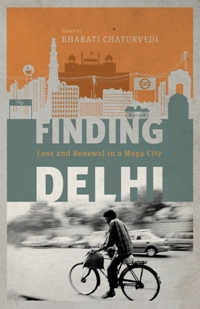 space. It begins with an article by Amita Baviskar that looks into how the newly reconfigured urban space of Delhi excludes the poor. She takes the example of the Vishwavidyalaya metro station, where an adjacent plot of land was allegedly allotted for a mall, when it could have been used as a park, or to house the poor. She elaborates her point by citing the example of the jhuggi-jhopdis near Majnu Ka Tila that were demolished in order to provide land for a private apartment builder. Our own experiences over the last few years offer us enough examples to buttress this point; for instance one can look at the manner in which the poor were not only neglected, but even hidden behind hoardings and posters during the CWG fiasco. This article is followed by a historical/analytical essay on Delhi from pre-colonial to post-liberalization times by Lalit Batra. Batra explores the history of the Delhi poor, and argues that the exclusion that, for instance, Baviskar speaks about is nothing new, and is an integral part of how the administration functions. For the state, land is capital, to be used optimally, and slums do not allow this optimum use, as a High Court ruling on land squatting proves.
The next article also works along similar lines, arguing that the work that the poor do is absolutely essential to the city’s functioning, though the rich do not acknowledge this. It describes the workers who work in scrap-yards where old, now-useless items are recycled; now with the government giving out tenders to private companies, to dispose of this scrap, the employment of these people is in danger.
The critique that these articles offer touch our “humane side” and force us to acknowledge that the poor are indeed hard done, and that something must be done for them, so as to ensure in Delhi, a perfect balance between “classiness” and humanity (presumably evidenced by improved life conditions of the poor); this is of course the balance wished for by all these writers. Herein, strangely, lies the problem with these critiques. The majority of these writers seem to call out to the middle-class to go beyond their “petty needs”, to feel for the condition of the poor and also that it is up to them to do “something” about it. They do not seem to understand that this compassion is itself premised upon the existence of these conditions. Capitalism creates inequality so that a small number of people can exploit and extract surplus value from a much larger number of poor people. The city, the ultimate symbol of modernity and of capitalism, is also the ultimate breeding ground for these social-relations. The editor of the present book claims that the main aim of the book is to provide a critique of the present developmental model adopted by the government; evidently the book offers not post-facto theorizations, but seeks to serve as a manifesto for concrete actions to be taken in the future, for the city’s benefit. Hence, the book has a special section called “Challenges”, in which authors highlight the issues which need to be addressed immediately. Sadly, though not surprisingly, this section of the book, that comes after the initial discussions of the pro-rich shaping of the city, moves straight to issues like cleaning of the Yamuna, and to the experience of a writer who spent an entire night roaming the streets of Delhi, looking after homeless people etc; despite the implicit insights provided by the earlier essays no mention is made of how capitalism and its state are responsible for these problems. Coming to think of it, even the earlier essays pose this question as one of reform; the incessant struggle between labor and capital that is reflected in the cityscape was un-mentioned and in essence it was argued that all problems could be solved if only the government were to look after the poor a little better. One writer, anxiously, even speaks of the possibility of the poor taking over Connaught Place, the India gate, and Gurgaon – what would happen then? The possibility of a revolution and a post-revolutionary state clearly make this writer uneasy. She is unable to appreciate the idea of a laborer controlling her/his labor – something which is common enough in NGO-type activism.
At present, in India, large companies (Tatas, Birlas, Ambanis etc) are monopolizing all industries, and are now making a move even into the informal sector. It’s common to come across supermarkets like Big Bazaar, Reliance Fresh, Big Apple etc, and clearly local fruit and vegetable sellers are unable to compete with them. The case of the waste-pickers is evidence of the same state affairs. However the book does not take the reader beyond this level of appearances; which is to say that it does not go into causes. The causes that underlie this state of affairs are too deep, too endemic to this system to be solved by human goodwill (the leitmotif of NGO-activism).
A couple of other articles, however, do seem to try go beyond the surface, and in that seem to be able to keep off turning these issues into questions of ethics and morality. For instance in an article titled “Delhi: Expanding Roads and Shrinking Democracy”, Rajinder Ravi tries to bring across to the reader the plight of workers who used to cycle everyday to their respective workplaces (anyone who travels from East to Central Delhi will be familiar with the sight of thousands of workers cycling to work through cycle-lanes). The changes that were brought in preparation of the Commonwealth Games destroyed the cycle lanes to expand roads. While to the “average” Delhiite (actually only the middle/upper class) the expansion of roads has come as a boon because they use cars and motorbikes to commute, for the lower class it has meant a move to the more expensive public transports of the city (not to mention the environmental cost involved in the move made from cycles to buses etc).
Similarly in “New Delhi Times: Creating a Myth for a City”, Somnath Batabyal, a former journalist takes on the ever so active torchbearer of our society – the “Media”. The writer presents to us quite an interesting take on the media and the type of work that they do. He shares with us two instances where media houses were campaigning actively, and were believed to be the face of the aam-janata, the “Campaign for Clean Air” in the 90’s and the recent anti-BRT campaign. The writer speaks of how media personalities work according to the interests of the middle class, for a city in which the poor have little for them. The media that had once campaigned for a clean, pollution free environment turns coat the moment this idea of a “clean environment” comes into conflict with the “shining India” of the middle class, and jumps into a drive against the BRT, a project which, if properly managed could help control pollution by limiting the use of private transportation. As is rightly pointed, a majority of the bourgeois environmentalists and journalists live around the corridor and use it to commute to their offices everyday. Due to the construction of separate lanes for buses and cars, these drivers have a hard time on the road; this did not go down well with these media persons and hence the anti-BRT media campaign.
The article mentioned above does try to look at least this one problem through the optics of class struggle; but because of the book’s attempt to present a “kaleidoscopic” view of perspectives coming from different ideological tendencies, its emphasis on solving the problems of the poor gets lost. Even the monologues from the informal sector workers get mixed up in this cacophony of perspectives and do not serve any purpose except giving an appearance of the editor’s “democratic” designs. Failing to connect apparent problems to the fundamental underpinnings of the system, such attempts fail to see how perspectives on these problems are also in some sense takes on the system. It is not enough to allow everybody to speak, since the interests of some, a priori are against the interests of the poor that they nonetheless may seem to defend. In the final analysis the sort of reformism that this attempt represents acts as a pressure release valve, to negate the possibility of genuinely transformative collective action. The book fails to rise above the philanthropy that is also called “social activism”, and in that fails to reach toward a useful plan of action. But to its credit, it does succeed in throwing a somewhat different light on the state of Delhi, in a situation where the state and its media are feeding us on a diet of neoliberal propaganda; for those used only to the “mainstream” it could offer a useful change.