Communalism, Business Houses, Citizenship and GUJURATE

Raju J Das

The reason for the power of saffron politics is only partly political. India’s business class is not unconnected to this. The power of saffron politics also raises troubling questions about the sense of citizenship.

Some commentators focus on the political factors behind the success of the saffron electoral-machine. One argument has been that Congress has played a ‘soft’ hindutva (for example, by giving tickets to some disgruntled members of hindutva forces as in Gujarat). Others say that Congress’ secularism has not cut much ice with the voters who fall for the communal propaganda. There is some truth in the political interpretations of electoral success of communal politics. What is neglected in these discussions – both on TV and in newspapers – is often what tends to be neglected in many discussions of India’s polity as such: the role of business. What is the possible connection between the business houses and communal politics? Are the business houses – the so-called corporate citizens – a secular force? This issue needs to be more thoroughly investigated. I can only indicate a few things.

At the national level and in the States, the business class, by ushering in the neoliberal regime, has cleared the ground for a specific kind of electoral politics. This is one which is not oriented towards development: here development is seen in the sense of development for/of the poor, a process which is not primarily based on the idea that development of the poor can happen only when the business class prospers, by the so-called trickle-down mechanism. By forcing all political parties to take the free-market approach, by forcing them to pursue neo-liberalism, India’s business class (in solidarity with its brothers/sisters in the advanced world) have contributed to the erasure of any substantive difference between them. In terms of economic policies there is practically little difference between Congress and BJP. Even, the Left parties are not further behind in terms of following neo-liberal policies. When economic policies stop being the differentiators of political parties, when all parties pursue more or less similar pro-business policies, they choose cheap identity politics to divide the electorate and win elections: hindutva, regionalism, linguistic identity, caste-ism, etc. By making jobs scarce, by making it difficult for ordinary toiling masses to earn a decent livelihood, neoliberalism creates the usual kind of jealousy and spirit of nasty competition among labouring people, which take religious (and other) form. The rise of the religious right in the last 15 years or so and the rise of corporate power under neoliberalism are not isolated from one another. Let’s now come to Gujarat more specifically, which combines religious politics and neoliberalism.

Modi & co. has used the veneer, the appearance, of a specific style of ‘development’ and has resorted tohindutva to sell his communalism agenda and to benefit his business-class mentors. The veneer of development is about, among other things, bijlisadak and pani. It is also about attracting industries and creating some jobs. It is about creating what can be called Guju-rate (the Gujurat-style rate of economic growth). Behind all this lies the fact that business houses remain attracted to Gujarat and invest there with huge subsidies from the government which increase their profit and competitive position vis a vis businesses located elsewhere. They have poured in millions of rupees in the last five years. They like Gujarat’s resources which are happily made available by its governing regime. They like Gujarat’s labour, made quiet by the decisive and strong regime – it is for nothing that Modi is seen as the CEO of Gujurat – a regime that boasts of the lowest person-days lost in labour conflict among all the States. The good business climate of Gujarat making Guju-rate possible is created by Modi’s ‘determined’ and ‘strong’ character. The business houses enjoy a cosy relation with the regime. And this happens, despite the fact that the regime is widely seen as one that was complicit in the 2002 carnage of a given section of Indian citizens on religious grounds. The idea of so-called corporate social responsibility does not worry the business houses at all. Their business is the business of doing business. If business requires doing business with a regime that is communal and fascistic, so be it. It does not matter. To the extent that the business houses have been heavily investing in the State in their own interest which the regime boasts of – whether this ‘development’ helps the rural and urban poor in any significant and economically and ecologically sustainable manner is another matter (just look at social-human indicators of development in this State) – and to the extent that the ‘development’ veneer as well as communal propaganda in the electoral campaign have helped the regime return to power, the business houses cannot be seen as unconnected to the political success of the regime.

In addition to this material ‘support’ – one must also know where Modi got the money to fight elections, who funded Modi’s communal agenda – there is also an ideological support for the man and his regime which came from business houses. Ratan Tata has said: Modi will not have to attract people to Gujarat, it will be stupid if you are not here. Anil Ambani was all praise for his Modi Bhai, whose various achievements he counts including the Narmada (as if all the fight against the Narmada by India’s civil society by Medha Patkar and others was non-sense). It is this sort of business-inspired ideological support for Modi – that is indeed used during electoral campaign – that has propped up Modi in ‘popular’ imagination. This requires a detailed analysis.

If the business forces are really for a country free from communalism, have they ever seriously considered an investment strike – at least a threat of it? A slight indication of the trouble of class politics in a State (look at what happened in West Bengal earlier) makes the business class look elsewhere. But communal politics? It can survive with it much better than class politics perhaps. In part because communal politics helps the business class divide any possible opposition to itself from the workers’ side, and because communal politics produces the sort of rightwing decisiveness that obliterates any possibility of anti-business opposition, business houses tend to enjoy a comradely relation with the communal regime.

Communalism thrives on a specific irrational politics of rejection: the idea that a person will reject his/her fellow citizens who are different from him/her in terms of religion. India’s business houses  – like global business houses that enjoyed doing business with South Africa’s erstwhile apartheid regime – do not mind doing business with a communal regime. How will the same business houses respond if the consumers start rejecting their products – a Reliance mobile or  a Tata car, for example – because they are associated with a regime which spreads hate and the politics of rejection of the religious other?

This then leads me to my second point. This is about us as ordinary citizens. What does the success of communal politics (including Modi’s electoral win) say about us as citizens? What does it say about our democracy and the institutions of the state that are supposed to protect the secular fabric of the constitution? How can a person kill someone next to her just because she may have different religious views? How can one believe in the lie created by a few people that one is worse off because of his/her religion? What has happened to our education system – indeed our whole ideological apparatus – that is no longer able to encourage citizens of different religious identities to live in peace? What is it that makes citizens believe Modi-type character when he treats every criticism of him as a criticism of an entire region/province (e.g. Gujarat)? What is it that makes one feel proud to be a citizen of a country when her fellow citizens are treated as second class citizens? What has happened to our sense of citizenship? The quality of one’s citizenship depends on how one’s fellow citizens are treated. If they are treated (and killed and tortured) as second class citizens by a state of whose citizen one is, then does one’s citizenship not stand devalued? And what can we say about the entire set of state apparatuses, including the judiciary, that has allowed the gradual process of capture of parts of the state and civil society by communal forces, the forces that live by spreading the idea of violence on religious grounds?

Let’s not be obsessed with explaining the rise of these communal forces by the failure of the Congress, the premier party of Indian business houses. Both are elements of a system, and both of them have to be explained by the dynamics of the political-economy system as such. The rise of the communal power is not merely an electoral rise. Therefore, to fight against them is not to be merely an electoral fight. The fact that the communal forces have carved out a space within our polity as such, within the state itself, and within civil society, has to be explained. In this explanation, the silent role of the business houses and changing ideological nature of the sense of our citizenship must be understood, and the business houses must be made to reconsider how they deal with communal regimes. They must be asked to take side: are they on the side of communal forces or secular forces?

Raju J Das is an Associate Professor at York University, Toronto, Canada.

A Review of “Social Movements I & II”

 Gilbert Sebastian  

T.K. Oommen (ed.) Social Movements I: Issues of Identity (pp.252+x, HB), & Social Movements II: Concerns of Equity and Security, (pp.352+xii, HB), Oxford University Press, New Delhi, 2010.

The volumes edited by T.K. Oommen constitute a sociological contribution to the study of social movements in India. The first volume deals with identitarian movements and the second, with movements for equity and security. For spatial constraints, we do not attempt a review and critique of individual articles but confine ourselves to the theoretical issues identified by the editor himself.

 I

The first volume on identitarian movements has two sections. The first section on Religious and Caste Movements has contributions from Kenneth W. Jones on Socio-religious movements, Christophe Jaffrelot on ethno-religious mobilisation, Walter Fernandes on conversion movements, Vivek Kumar on Dalit mobilization and Shail Mayaram on the emergence of Tablighi Jamaat as a transnational relgious movement. The second section on Regional, Linguistic and Tribal Movements has contributions from Robert L. Hardgrave on the dravidian movement, Dipankar Gupta on the Shiv Sena movement, Sanjib Baruah on the Assam movement, Surajit Sinha on tribal movements and Frederick S. Downs on Christian conversion movements in northeast India. Apparently, the contribution by Vivek Kumar was previously unpublished.

Speaking of identitarian movements, Oommen mentions four processes, namely, homogenisation, pluralisation, traditionalisation and hybridisation at work leading to persistence, eclipse and mutation of identities (I: 40).

Introducing the section on regional, linguistic and tribal movements, interestingly, he mentions the three Great Traditions of India with civilisational differences – Aryan-Hindu-Sanskritic, Dravidian-Hindu-Tamil and Islamic-Urdu (I: 160). Ethnicity, religion and language come into play here.

Social Movements IThe second volume has three sections. The first section on Peasant and Labour Movements has contributions on Indian peasant uprisings by Kathleen Gough, Naxalbari movement by Partha Mukherji, Bhoodan movement by T.K. Oommen, new farmers’ movement in Maharashtra by D.N. Dhanagare, Indian labour movement by S.M. Pandey, trends in industrial relations in India during 1950-2000 by Debashish Bhattacherjee, labour activism by women in the unorganized sector by Supriya RoyChowdhury. The second section on Women and Students’ Movements has papers from Indu Agnihotri and Vina Mazumdar on women’s movement in India during 1970s-1990s, from Rajni Palriwala on anti-dowry movement in Delhi, from Martha Alter Chen on the Self-Employed Women’s Association, from Philip G. Altbach and also from T.K. Oommen on the Indian student movement. The third section on Ecological and Environmental Movements has papers from Vandana Shiva on ecology movements in India, from Ranjit Dwivedi on the role of environmental groups in the making of Protected Areas, and finally from T.K. Oommen on protests against developmental displacement. The contributions by Rajni Palriwala, Martha Alter Chen and the one by T.K. Oommen on movements against displacement are, apparently, unpublished elsewhere.

Introducing the second volume on issues of equity and security, Oommen makes a pertinent point that “equity rather than equality is the motive force behind contemporary social movements” (II: 39). He says that even “radical groups are not arguing for equality of rewards these days” but are only demanding “equality of opportunity” or going a step further and demanding “equality of condition” through ensuring “distributive justice” (II: 39). His understanding of “comprehensive security” including the military, political, economic, socio-cultural and environmental dimensions (II: 40) is, indeed, a welcome concept in these days of extreme paranoia.

In the introduction to the volumes by T.K. Oommen, the theoretical contributions of the “founding fathers” are discussed: Durkheimian structural differentiation, Weberian rationality and Marxian class analysis. He rightly argues that Marx’s “basic argument” on social movements “stood the test of time” except for his overemphasis on collective rationality and lack of emphasis on non-class collectivities (5-6).  In defining social movements, Oommen counts in all mobilisations with ideology and organisational framework, irrespective of goals (change or stability) or means (violent or non-violent) (11). He says that one of the aspects – ideology, organisation, leadership – acquires primacy at different phases of all movements (13). He says that the classification of “old” and “new” social movements is inadmissible in the Indian context (14, 38). His classification of movements based on the type of collectivity as biological (women, youth, etc.), primordial (caste, religious, linguistic, tribal, etc.) and civil (workers, peasants, students, environmental movements, etc.) is useful. A better term than “biological” (15-17) should have been used since apparently, these are primarily socially constituted categories. He distinguishes between the instrumental and symbolic goals of movements. Instrumental goals seek reallocation of wealth and power and symbolic goals seek redefinition of status and privilege. The term, “instrumental”, however, sounds rather pejorative. ‘Re-distributive’ could have been a more appropriate term.

Oommen considers mobilisation and institutionalisation as a dialectical process and does not oppose the latter. Questionably, he simply brushes aside the perspective that movements do often go through a life-cycle (25) and may even turn into vestiges of the past weighing down upon the present. He says, “[N]one of the four processes – repression, discreditation, co-optation and institutionalization – will herald the death-knell of a movement. Movements will survive if they have the required legitimacy and appropriate resources” (28). Apparently, he is not sufficiently critical of the processes like co-optation and institutionalisation.

 II

Interestingly, right at the beginning of his introduction, Oommen briefly discusses how the disciplinary focuses – historical/political, psychological and sociological – in studying social movements, the object of inquiry, vary. Sociologists were late-comers into this field. Nevertheless, compartmentalisation of knowledge-fields as such could hamper the advancement of knowledge. Indeed, it is when history, sociology, economics and political studies are knit together in an interdisciplinary manner that we can have an enlightening study.

Oommen says, “There is no hierarchy of identities, but only contextuality of identities” (I: 40). One reason why Oommen has missed the punch is because the notion of primacy (not a hierarchy in an a priori sense) among social contradictions is missing. At any given point of social development, one or the other contradiction comes to the fore and assumes primacy and urgency over other contradictions which of course, are related to the former. Addressing this principal contradiction may lead to viewing social reality in an intersectional manner so that different kinds of oppressions can be interrelated. For instance, addressing the land question in contemporary India entails taking on the historically constituted property structure, addressing the interrelated issues of class, caste and gender.

Along with this, comes the question of the quality and extent of change. Oommen junks M S A Rao’s classification of movements as reformist, transformativeSocial Movements II and revolutionary, for shifting the defining criteria. But it would have been quite useful to retain this classification on the criterion of quality and extent of change. This would be clearer if one tries to substantively understand the social and political movements during their high point in the 20th century. We could classify them under four rubrics on grounds of the structural bases and the transformative agencies involved: (1) Class struggles; (2) Anti-colonial and national liberation movements; (3) Social liberation movements of women, Dalits, Adivasis, minorities, African-Americans and other ethnic minorities, etc., which are pitted against dominant sections within a society more than against a regressive State and global capitalism towards which they maintain a love-hate relationship; and (4) General democratic movements such as anti-globalisation movements, environmental movements, etc. The extent of social transformation achieved through radical class struggles and progressive national liberation movements are, apparently, of a qualitatively higher order than those achieved by social liberation movements and general democratic movements. This is because the former were able to take head on macro-structures of de-humanisation like State, semi-feudalism and global monopoly capitalism and therefore the consequences for the system were much more serious. The sociological classification of movements by Oommen looks more abstract than substantively historical. The latter approach would have entailed seeing the movements in a process of change or movement in time, assigning them importance according to their transformative potential.

On the Indian scenario, Oommen also makes a controversial remark: “[T]here was/is no archetype class movement in India; the equivalent of that was the anti-colonial movement (37).” Telangana, Tebhagha and Naxalbari movements and the class struggles led by the Naxalites/Maoists today, with a wide geographical spread, challenge this argument. That the Maoist movement interrelates class with other social categories such as nationality, caste and gender does not disqualify it from the status of a class-based movement. The anti-colonial movement had, most often, failed to address issues of class/social equity and as G. Haragopal says, bequeathed us the negative legacy of a false dichotomy between the ‘social’ and the ‘political’.

Oommen says that “the real threat to the state emanates from primordial collectivities”. The book “leaves out movements which are explicitly ‘political’ … such as anti-colonial or secessionist movements” (19; I: 160). This omission is serious if we consider the immense transformative potential of nationality movements. Considering the fact that Armed Forces (Special Powers) Act (AFSPA), 1958, the most draconian legislation in the country violating the very right to life in the narrow sense of the term, is operational in the intensely militarised frontier nationalities, the issue of the ongoing nationality movements merited treatment at least from a human rights angle.

Crucially, Oommen draws a distinction between “hegemonic” and “emancipatory” identitarian movements (I: 42). Anchoring this distinction in the contemporary rights discourse, we could, better term them as “privileges-based” and “rights-based” identitarian movements. The former are disempowering and the latter, empowering. Given this perspective, the Shiv Sena movement finding its place alongside the rights-based regional, linguistic and tribal movements is an anomaly in the book.

He argues that it is cumulative dominance and coercive equilibrium that becomes the context for social movements (I: 42). However, the cumulatively oppressed and coercively repressed may, often be too weak to initiate social/political movements on their own. Instead, it may be more useful to harp back on the Marxian notion of relative deprivation as the context for movements. Moreover, ‘humiliation’ rather than just exploitation may spur movements.

We could describe a movement as ‘an idea whose time has come’. There is, at times, a simultaneous upsurge of movements in an epoch of social transformation such as the colonial period in India. The making of an epoch of social transformation involves complex interactions of material conditions including the cultural context on the one hand with subjective forces on the other. Collective human agency may be held to be the crucial factor in this process.

Oommen notes the interesting difference between old class activism of the “union-mode” and the new community activism of the ‘campaign-mode’ (50). A separate section critically analysing the global civil society movements could have been usefully undertaken in the book.

If we agree with Manoranjan Mohanty that “rights are political affirmations in course of struggle” or movements, one cannot underestimate the importance of studies on social movements. Oommen needs to be commended for this collection of otherwise scattered across papers. Along with the volumes from Ghanashyam Shah, these volumes can be useful reference material on social movements in India. Oommen’s introduction to the volumes, “On the Analysis of Social Movements” carried in both volumes is a must-read for researchers on social and political movements in India. It is a valuable contribution to the typologies of movements, bringing up many subtle insights, besides sparking off little controversies.

Oommen rightly says that ongoing movements are rarely studied (II: 322) and [probably, for this reason,] what we have is more of a “sociology of movements” rather than a “sociology for movements” (II: 318). For all the crucial insights that they provide, regrettably, Oommen’s edited volumes, may qualify only as a “sociology of movements”.

Gilbert Sebastian is associated with Developing Countries Research Centre (DCRC), University of Delhi, New Delhi. He can be contacted at gilbertseb@gmail.com.

The 2010 British general elections: the lost meaning of ‘change’ and some progressive prospects

Spyros Themelis

In May 2010, something unusual happened in the UK: for the first time in many decades a hung parliament was pronounced and a coalition government was eventually formed between the Conservatives and the Liberal Democrats, the first (36% of the total vote) and third (23%) party respectively. But was this something momentous and, if so, why?

In terms of government formation and power sharing, this was indeed a relatively rare event in the British electoral history. The last time the party with the most votes could not form a majority government was in 1974. Thirty six years is a long time in the electorate’s memory. Hence, the result of 2010 was seen as something ‘historic’ and for many it signaled a ‘big change’ in British political affairs. To some, it even registered as a progressive turn that heralded the beginning of an era of consensus.

Given their positions on some key issues before the election, the two parties seemed to be very far apart from each other, on many things, from the economy to the war in Iraq and from welfare state provision to surveillance. For example, while the Conservatives voted together with New Labour for the war in Iraq, the Liberal Democrats were aligned with the majority of the public opinion and opposed the war. While the Conservatives promised big cuts on public spending, the Liberal Democrats prioritised the economic recovery and the return to economic growth before any cuts were implemented. So, is this unlikely alliance between the two parties a step forward for the majority of people living in the UK? Has real change occurred? And what could ‘real change’ mean?

The more things change…

To start with the last question, we could loosely define ‘real change’ as a move to a new form of governing that serves the interests of the majority and is based on principles such as fairness, equality, equity. Real change has to mark a move away from old-style democracy, where bourgeois parties compete for power and has to be founded on people’s active participation in decision making and power sharing processes. In order for such a progressive transformation to occur, a set of inter-related changes needs to take place in all spheres of activity, including political, economic, social and financial. Further, these changes need to be coherent and consistent, in other words the political has to be linked to the economic and so on, so that changes in one sphere are not undermined by those in another. For example, one cannot support the war in Iraq and at the same time the peace process in the Middle East; neither can one simultaneously support drastic spending cuts that will potentially burden the poorer the most and purport to be politically progressive. Accordingly, progressivism requires new and different kinds of power relations, where the current and recent political elite has no raison d’être and is not merely replaced by a new one. In short, this type of ‘real change’ that could serve the many, not the few.

So, how progressive is the new UK government? In terms of its socio-economic composition, it turns out that the majority of the new cabinet ministers are privately educated (which correlates strongly with parents’ social class). In fact, 14 out of 23 ministers have been educated in private schools, an indicator of middle (and in some cases, upper) class background as well as family privilege. Of course, this also correlates positively with elitist university education: 15 of the 23 are Oxbridge educated (www.bbc.co.uk). This is indeed a change towards a more elitist Cabinet than the previous one, but not as radical as one might think. One third of the previous government was privately schooled and Oxbridge educated but this did not stop them from introducing top up fees, which ensured that middle class background would be even more firmly corresponding to elite education than previously. But by turning education into an expensive commodity the political elite secures its own reproduction, given that any party that is able to gain power will have a great deal of its members among the elite (and the rest being in thoroughly aligned with the interests of the elite). In addition, 18 members of the new Cabinet are millionaires, with a £50 million estimated worth overall. But a look at the previous government reveals a similar picture: 10 millionaires and a Cabinet approximately worth £35 million under New Labour (The Sunday Times).

It is more than clear that the UK, not unlike the many other European countries, has only nominally had a democratic system of electoral representation. In practice, what prevails is the rule of the elite, which alternates power approximately every five years. But, if it took a coalition of two not-recently-in-power parties and several pledges for a new form of governing to create one of the most elitist Cabinets in the post-Second World War British history, then what kind of hope is left for the voters? More importantly, if this development for a new form of governing was praised as a ‘real change’, at least in political terms, and was received with enthusiasm in financial and economic circles in the UK and abroad, what is the real meaning of ‘change’ in these neoliberal times?

The answer seems to me pretty straightforward but adeptly concealed from those who have every interest to find out: the working people of Britain, the ordinary individuals who struggle to get by under dire circumstances.

One could argue that the only real change that occurred with the May 2010 general election was of an aesthetic kind, virtually a change of faces but not of policies or priorities, let alone principles. True as it might be that under New Labour spending cuts would have been less severe and implemented gradually, the overall outcome remains the same. The ruling political elite in the UK, as is the case in neoliberal capitalism generally, was replaced by another one and, more importantly, this development has not and will not cause a rupture in the foundations of the establishment; it will not undermine or overthrow the status quo. The latter, the status quo, favours continuity through ‘change’, that is, change of the type attested to every five years (in the UK, four in many other countries).

That means, change that is controlled, expected and, to an extent, desired, which takes the form of general elections. Preference for one party over another acts as a seemingly empowering mechanism in the hands of the electorate who are left to believe that they can punish the party they dislike and reward the one they favour The ingenuity of the system also gives them the option to cast a ‘protest vote’, usually by voting for a small party, or even to abstain from their ‘civic duty’, that is not to vote altogether. Much like the market, voters can choose what suits them best, though from within set options, which, when formed, never took into account the voters’ interests. As Badiou puts it (2008) ‘electoral democracy is only representative in so far as it is first of all the consensual representation of capitalism, or of what today has been renamed the “market economy”‘. Hence, the voters are ‘interpellated’, as Althusser would say, they are constructed as interlocutors of the mechanism of power and, thusly, made complicit in the legitimisation of the outcome of the election.

At large, their approval or disapproval of policies that affect them only occurs inside the political system that is created by and serves the interests of the elite. Each and every election creates the illusion that the voters can choose the best candidates for them; it is an illusion because, in reality, it is the candidates and their parties who choose their voters! With election turnout at its lowest levels since the Second World War, for example from 84% in 1950 to just 65% in 2010 (www.ukpolitical.info), a very large part of people are very disillusioned with the political situation and do not even turn up to vote, knowing that voting will not bring any change in their lives. Yet this does not merely leave the status quo unaltered, but it strengthens it. As Žižek (2009) lucidly argued: ‘[m]ulti-party liberal democracy ‘represents’ a precise vision of social life in which politics is organised so that parties compete in elections to exert control over the state legislative and executive apparatus’.

New government, same old tricks?

In UK terms, with the departure of the New Labour party from power and the formation of a coalition government, the continuity and longevity of the system was ensured and renewed. This is because the election result did not signal any significant change but it was the seal of continuity of the existing system, despite the different approaches of the previous and the current government with respect to tackling the budget deficit through the implementation of austerity measures.

For example, the previous government a bit less than two months before the general election announced cuts that for some only compare to those implemented by Thatcher in the 1980s. More specifically, the budget that was brought to parliament in March 2010, included a 6% decrease in public spending in four years, from 48% in 2010 to 42% in 2014. With the new government in place, an emergency budget was announced in June 2010, which proposed severe cuts across the public sector and other public money-saving measures that attack the foundations of the welfare state and hit hardest the poor (among other things, child tax credits will be cut, child benefits and public sector workers’ pay will be frozen, public sector jobs will be lost, the pension age will be increased and so on) (Institute for Fiscal Studies, 2010).

Coincidentally, both governments had a unique opportunity to discipline the banks for the damage they caused to the economy and the emiseration they brought to hundreds of thousands of households, but they chose to exempt them from any responsibility. The bank levy, which the coalition government will introduce in January 2011, is estimated to yield approximately £2bn annually, that is to say a mere drop in the ocean compared to the money the banks have been receiving in the last two years in the form of bail out packages, guarantees, loans and other types of funding. According to an estimate by the National Audit Office at the end of 2009, the support from the UK government to the banks cost the taxpayer £850bn. In other words, the banks that are largely responsible for the current crisis are heavily subsidised in order to continue their destructive job, while those who bear the brunt of their actions, the vast majority of British people, are paying for it! Indeed, the phrase ‘socialism for the rich, capitalism for the poor’ could not ring any more true.

Can anything new emerge?

Clearly, the parties alternating in power are bourgeois parties in that they have a commitment to protect the interests of the political and economic elites. As Marx and Engels suggested (1948/1977) ‘the executive of the modern state is but a committee for managing the common affairs of the whole bourgeoisie’. In other words, the elected governments in capitalism are nothing else but committees that represent the interests of the bourgeoisie. The elections then, as shown through the example of the most recent ones in the UK, are, practically, a process whereby the bourgeoisie renews the contract of the managing committee of its common affairs. Symbolically, though, the elections also act as a tranquiliser of radical transformations, by giving the impression of change as well as by offering the illusion that the voters’ choices matter.

Nowadays, people fully realise this, hence their disillusionment with the current system of political representation. However, and this is the biggest benefit that can be gained from the otherwise disheartening reality, for every hope lost in the current system, a hope for an alternative, truly democratic, progressive and representative of people’s needs system, might be generated. In France, Greece, Italy and other European countries anti-cuts protests have been increasingly gathering pace, with some of them ending tragically (in May 2010, 3 people were killed in Athens during several days of unrests that were organised against the severe austerity measures that the IMF, the European Union and the European Central Bank imposed to Greece). In the UK, rising mobilisation has also been taking place. Universities were occupied and online campaigns gathered international support when cuts threatened jobs, courses and academic freedom, redundancies mobilised workers and their unions, and various campaigns, rallies and coalitions sprung up. The ‘Stop the War’ coalition, the ‘Right to Work’ campaign, the ‘Can’t Pay, Won’t Pay’ rally, the ‘Coalition of Resistance Against Cuts and Privatisation’ are only some examples of the organised resistance people are showing to the rule of the elites and their supposedly democratically-elected governments. Who knows, this could be the beginning of the creation of the ‘conditions for the collective production of realistic utopias’ that Bourdieu (2003, p. 21) fervently advocated but failed to see while still alive. Realistic utopias entail the rejection of the neoliberal hegemony, the strive for the creation of conditions for true democratic representation and participation, and the abolition of the rule of the elites. In a nutshell, they are utopias (outopia means non-existing place) because nobody has ever been to these places before, at least not in recent British history, and realistic because their creation is possible, thus realistic to imagine and strive for as they can only be achieved by real people who are currently powerless and disillusioned by the current system.

References

Badiou, A. (2008) The Meaning of Sarkozy. London: Verso.

Bourdieu (2003) Firing Back: Against the Tyranny of the Market 2. London: The New Press.

Marx, K. and Engels, F. [1848] (1977) Manifesto of the Communist Party, in Karl Marx and Frederick Engels,Selected Works. London: Lawrence & Wishart.

Browne, J. and Levell, P. (2010) ‘The distributional effect of tax and benefit reforms to be introduced between June 2010 and April 2014: a revised assessment’. London: Institute for Fiscal Studies.

National Audit Office (2009) ‘What happened and why: Maintaining financial stability across the United Kingdom’s banking system’. London: National Audit Office.

Milland, G. and Warren, G.  (2010) ‘Austerity cabinet has 18 millionaires’. The Sunday Times.

UKpolitical.Info (2010) ‘General Election Turn Out 1945-2010’. www.ukpolitical.info

Žižek, S. (2009) ‘Berlusconi in Tehran’. London Review of Books, Vol. 31 No. 14.23, pp. 3-7.

Capitalism, Labour and Politics in Rural India

 Pratyush Chandra  

This paper was prepared for Odisha Shramjivi Union (a joint initiative of various local tribal organisations in Orissa) as a perspective note for building strategies for rural labour mobilisation. 

In recent years, rural Orissa has been the hub of rural struggles. While many of these struggles are explicitly linked with the displacement drive initiated by neoliberal competition for attracting corporate capital investment in which the political elite of various regions, including Orissa, has been engaged, their trajectory too – the forms and contents of rural mobilisations and organisations – is defined by the internal, but open-ended, political economic configuration of rural Orissa. We must try to develop an understanding of this configuration that can help in formulating a framework for comprehending the nature of these rural struggles. We cannot take these struggles at their face value, satisfying ourselves with the vocalisation of internal perceptions – of their leadership or any segment within; rather we must locate them in the larger political economy and its contradictions. It is not that these perceptions, motivations and ideologies do not matter, but they have to be understood in terms of the composition of these struggles and the context. In fact, we start with a brief critique of these perceptions, which will help us introduce our theme and initiate our discussion.

Here we have relied extensively on the NSSO (National Sample Survey Organisation) data to obtain an overview of rural differentiation in India in general and Orissa in particular. However, the focus is clearly to comprehend the conceptual and political implications of the evolving rural scenario in India.

1. Capitalist transformation in rural areas – What does it signify?

Generally, when we talk about capitalist development in a society, our focus is on industrial progress – on the growth of industries. Commercialisation and monetisation of the economy are definitely taken into account, but they are considered to be, and rightly so, tools of the expansion of capitalism, not the capitalist system itself. So for many, the recent reckless drive to sell off resources in Orissa to corporate capital seems to be heralding capitalism. It is forgotten that such formidable will to industrialise is dependent at least to some extent on the political economic interests organically grounded in the Oriya economy, which are now attracting global capital market.

Even when agriculture is discussed, measurements of capitalist penetration are essentially the extent of mechanisation, capitalisation and proletarianisation (number of landless wage workers, i.e., in absolute terms). A strong presence of petty tenant farmers, simple commodity producers, the exploitation of the unwaged (bonded or family) labour, extra-“economic” means of exploitation (labour extraction) and oppression are all considered, by a large section of experts, to be symptoms of lack of capitalism in Indian agriculture. These “non-capitalist” modes and relations of production demonstrate the inability of Indian capitalism in transforming the rural economy – testifying its “semi-feudal”, “comprador”, compromising attitude towards the non-capitalist political economic rural elite etc. On the other hand, there are many scholars and activists who foreground the articulation of “the other” in this lack – the resistance of Indian peasantry and subaltern to the processes of primitive accumulation and capitalist penetration. In regions like Orissa where we find a strong presence of tribal communities, this resistance is conceived not as derived from locally grounded contradictions in which these communities are themselves enmeshed, but as resilience derived from the incompatibility of their cultural economy with the “external” forces of capitalism.

The political-organisational leadership of rural struggles have largely been informed by these two approaches. So they have implied drastically different political economic programmes and intellectual outputs. However, there are subtle similarities too. Firstly, they adhere to a purist and a stagist conception of capitalism. Their concept of the non-capitalist nature of the rural economy (even if they themselves sometimes call it petty bourgeois) and its political economic persistence (in their view, resistance) poses a notion of “pure” capitalism. As an abstraction, the idea of non-capitalism can definitely help in modelling the internality of local structures; however to pose it as an autonomous concrete having an external-internal relationship with capitalism brings in the notion of pure capitalism from the backdoor. How even seemingly non-capitalist structures come to embody capitalist relations (which include their contradictory nature) is not a question that becomes their object of study. For them the persistence of non-capitalist structures is the effect of their ability to resist.

Secondly, both approaches put agriculture on the receiving end of capitalist development, and stress on the rural-urban divide; however, they obviously differ as regard to the moral of the capitalist teleology. A concomitant product of this stress is the perception of rural homogeneity. At this level, theoreticians and practitioners of the first approach will object, because they profess to question and fight semi-feudalism, thus recognising the reality of rural stratification. But since the “stage” of their struggle is purportedly anti-feudal, anti-comprador, anti-bureaucratic, for all practical purposes their analyses are lost in the task of identifying feudal elements and comprador agents, thus constructing a homogenised revolutionary other – the narod(people).

Let us confront these approaches a bit more in order to approach our primary task of understanding capitalism in Indian agriculture.

It is a truism that rural and urban are unequal spheres, both compositionally and relationally.  They have different internalities (formed around two very different kinds of production spheres – agriculture and industry), which make their exchange unequal. Relationships between different sectors within an economy can never be equal, since they are competitive. So the “divide” is definitely present – it is this divide which is termed as inter-sectoral competition in capitalism. Through competition, value is transferred from one sector to another, from one industry to another. This transfer is inevitable under commodity relations, but it cannot be called exploitative, unless the subordination of a sector entails an unmediated mobilisation of unpaid surplus labour (value) from direct producers (unwaged or waged). Hence exploitation has to be located intra-sectorally. The rural-urban divide and the transfer of value from agriculture to industry that it entails cannot be understood in terms of exploitation, as defined above. The divide and the transfer are competitive and competition redistributes value (and therefore, profit) across society.

One can object to this perception by posing the example of usury and mercantile capital, which have been the bulwarks of capitalist penetration in agriculture and rural economy. But their penetration becomes exploitation only when they are internalised by the agrarian structure. If they are financiers of the agrarian capitalists who are the main organisers of production, their relationship with the latter is redistributive. At the most it can be extractive, but not exploitative. However as part of “social” capital their relationship with labour, even if the latter directly works for an agrarian capitalist, is definitely exploitative. But the financiers’ relationship with petty or simple commodity producers who engage in family labour is a bit subtle. It can be both extractive and exploitative, depending on the former’s ability to influence or control the production process.

Understanding the internality or internal structure of the rural economy and the mode of its (re)production becomes very important in order to comprehend the terrain from which a rural struggle emerges, and which defines its character. In a class-divided rural society, posing the rural-urban divide as victimisation and talking about rural homogeneity is ideological, using the exploited ones, the labourers, as cannon-fodder in the competitive and concession fight of the rural elite. It is at this level that perceptions, motivations and ideologies find meaning.

As mentioned earlier the persistence of non/pre-capitalist “modes” of production in India has long mesmerised the progressive intellectuals and activists, a vast majority of whom consider its existence as a reminder of the amphibian (semi-feudal, semi-capitalist) nature of India’s political economy and its underdevelopment – overloaded with pre-capitalist “vestiges,” while others call them subsistence economies, challenging mainstream capitalism. We believe that the notion of “separate” non-capitalist modes of production is problematic if it is not predicated upon an understanding of a capitalist socio-economic formation that accommodates these modes as relative forms of accumulation and exploitation feeding the social reproduction of capitalism. This paper while discussing the specificities of rural economy will also demonstrate how vestigial forms acquire new meanings within larger political economic processes of capital accumulation and social reproduction. Only this will allow us to interpret rural struggles and recognise their potential strength in protecting the interests of labour against capital.

Passive Revolution and Agrarian Transformation

Unevenness is intrinsic to capitalist development. The unevenness of geographical developments in general reflects

…the different ways in which different social groups have materially embedded their modes of sociality into the web of life, understood as an evolving socio-ecological system…Capitalist activity is always grounded somewhere. Diverse material processes (physical, ecological as well as social) must be appropriated, used, bent and re-shaped to the purposes and paths of capital accumulation. (1)

In the grounding of capitalist activity this diversity materialises into geographical unevenness. David Harvey writes further in his Limits to Capital:

The upshot is that the development of the space economy of capitalism is beset by counterposed and contradictory tendencies. On the one hand spatial barriers and regional distinctions must be broken down. Yet the means to achieve that entail the production of new geographical differentiations which form new spatial barriers to be overcome. The geographical organization of capitalism internalizes the contradictions within the value form. This is what is meant by the concept of the inevitable uneven development of capitalism.(2)

The subcontinental nature of the Indian economy is bound to house various “geographical differentiations.” The unevenness of capitalist development in India is at least partly due to the diverse forms that the institutionalisation of economic relations took during colonial times. The plethora of land tenurial arrangements that the British effected in rural areas led to “the regionalization of class and factional struggle,” which essentially implied territorially based alliances and conflicts between various factions of capital, the local state, and social classes. During the struggle for Independence and after its attainment we find this regionalisation shaping the contours of political economic institutions. The highly differentiated social infrastructures that independent India inherited were largely kept as they were.

Orissa, which was constructed out of many princely states along with areas under the direct control of the British, is an uneven terrain of social relations. There were diverse forms of production relations that had to articulate with one another.

After independence, the political setup in India was constructed by accommodating various regional class configurations, without directly challenging the local hegemonies. The unitary tendency emanated from their articulation within the national economic development by market integration through an intensified monetisation and commercialisation of the local economies. This process was aided by the straitjacketing of regional hegemonies in the discursive milieu of anti-colonial nationalism and democratic political competition. Rajni Kothari has correctly pointed out:

The role of the centre and in particular of the Indian National Congress in mediating the various coalitional strains in the states has been profound in weaving together the heterogeneity of Indian society into a common national political framework. At the same time, the consolidation of state power in the framework of an increasing formalization of the federal constitution has made for typical patterns of institutional diffusion and decentralization. The result is a “mix” of centre peripheral relationships.(3)

Indian federalism was the result of the “coalition-making” at the time when India got its Independence. Autonomy in regional politics and mobilisation provided space and time to the regional class interests and hegemonies to adjust with the larger political economic processes in the country. The Indian state, as the embodiment of the generalised interests of the hegemonic forces in the country, relied on a gradual trickle-down, along with transitive Midas’ effects of socio-economic changes, to integrate the local and peripheral hegemonies.

Apparently, after Independence and especially from the 1970s, the Indian polity witnessed a tremendous upsurge in casteist and identitarian competition, which in our view, was not really a crisis; rather it represented the success of the Indian political economy in transforming the traditional caste hierarchy into a ground for waging a competitive struggle for the accumulation of economic and political power. This competition is representative of the inclusive nature of development in India – however, as competition is unequal, so is the inclusion. Underneath the surface structure of caste and identitarian conflicts (a competition for representation), there lay a deep structure of intra/inter-class conflicts that marked political economic transformation in the country.

Though the anti-zamindari laws against rentier landlordism (which was concentrated among the upper castes) were formulated, they were not implemented systematically. But the agencies of the market did breed the classes of rural bourgeoisie and petty bourgeoisie, who specialised in market-oriented production or distribution. They challenged the hegemony of upper caste landlords – including their control over state bureaucracy and politics.

On the other hand, there emerged an underclass majority under the effect of market-induced pauperisation and proletarianisation. Various sections of this class too have frequently associated themselves on identitarian and caste lines; however, it will need a vast historical analysis to assess the impact of class struggle on caste conflicts and vice versa, a task which we cannot undertake here. In the following section we discuss some statistics that help us in understanding class formation, especially the character of the ‘underclass’, in rural India.

2. Rural Differentiation – A Statistical Survey

Even before independence, nationalist leaders like Acharya Narendra Deva who were involved in the creation of a homogeneous peasant organisation to pose a united front against the British domination in rural India were aware that, “the peasantry is not a homogeneous class. It has many class divisions”.  Furthermore, “the number of landless peasants is ever on the increase and if today these internal conflicts have not come to the surface, in the coming days they are bound to accentuate. Class divisions within the peasantry will slowly mature…”(4)

Swami Sahajanand Saraswati who was one of the main proponents and organisers of a united Kisan movement in the country, was more blunt in regard to the problems of imposing homogeneity, when he noted in 1944:

They (middle and big cultivators) are using the Kisan Sabha for their benefit and gain, while we are using or rather trying to use them to strengthen the Sabha, till the lowest strata of the peasantry are awakened to their real economic and political interests and needs and have become class conscious… It is they, the semi-proletariat or the agricultural labourers who have very little land or no land at all, and the petty cultivators, who anyhow squeeze a most meagre living out of the land they cultivate and eke out their existence, who are the kisans of our thinking…and who make and must constitute the Kisan Sabha ultimately.(5)

Post-independence India shows three typical effects of development on the rural population – a gradual fragmentation of landholdings, increasing landlessness and the creation of footloose labour. Let us discuss the statistics regarding these phenomena, but keeping in mind the warning that Kautsky and Lenin voiced a century ago:

…if agricultural statistics are taken in general, and uncritically, it is quite easy to discover in the capitalist mode of production a tendency to transform modern nations into hunting tribes.(6)

Land Marginalisation

Throughout the so-called third world countries (which includes India), rural areas still accommodate the majority of their population. The obvious conclusion is that in these areas agriculture continues to be the major source of employment, income and livelihood. Furthermore, in this situation of rural overpopulation, land marginalisation and the consequent domination of small farms is bound to happen. Thus, the average farm size in Africa and Asia in the 1990s was 1.6 hectares. It is assumed that the increasing subdivision of land holdings indicates the absorption of the rising population into agriculture. Though apparently true, it also suggests that an ever-increasing portion of the agrarian population has to supplement their farm income by engaging in waged or other non-farm activities.

Operational Holdings

In India too, the average size of operational landholdings has been declining unabatedly, which, according to the National Sample Survey’s estimation, stood at 1.06 hectares in 2002-03 (however, the census figure in this regard, was 1.32 hectares in 2000-01). As evident from Table 1, the average size has fallen by around 60% from 1960-61. However, the rate of growth in the number of operational holdings has significantly slowed down in the recent years (it was 24.5% in 1981-82, 31.5% in 1991-92 and 8.4% in 2002-03).  Table 1 demonstrates that over the years the peasantry has been pauperised, with 63% of the operational holdings being of less than 1 hectare, and around 82% below 2 hectares. According to the Census, in 2000-01, the average farm size for the marginal category was 0.40, for the small category it was 1.41, for the semi-medium category 2.72, for the medium category 5.8 and for large farmers it was 17.18. (7)

Table1

Table2

However, in order to present a better picture of the rural scenario, one must include those rural households which do not operate any land in the distribution. In fact, such inclusion of the operationally landless drastically alters the picture of rural society as presented in Table 1. Table 2 shows that the only class of households that witnessed an increase in percentage distribution during 1991-2003 was the “nil” category, i.e. that the category containing those households which have zero operational land. The data records a drastic increase in the rate of growth of landlessness, which affects severely the percentage share of other categories in the distribution of household. While from 1971 onwards there had been a progressive decrease in the percentage share of the “nil” category, from 1991 onwards we find a 10% increase.

Even if we accept the apologia of the NSSO that the 2002-03 data might have been affected by the fact that it was collected only during the kharif season, the enormous size of the “nil” category cannot be accounted for fully by any correction (though it could have presented a better picture of the marginal category, which too declined like other higher categories in the following table). On the whole, 79% of rural households throughout India either does not operate any land or are of marginal farmers; the figure exceeds 90% if we include small farmers.

If we take absolute alienation from land as a measure of proletarianisation, it is now established that there is a continuous increase of rural landlessness in the country. In 1987-88 the proportion of the rural landless (who did not have any access to land) among the total number of rural households in India was 35.4%, which increased to 38.7% in 1993-94. In 1999-2000 the figure was 40.9.(8) The following data (Table 3) further corroborates the intensity of proletarianisation among total number of agricultural labour households (which includes the class of poor peasantry – i.e. those who have some land but have to rely on wage labour or “self-employment” for their subsistence):

Table3

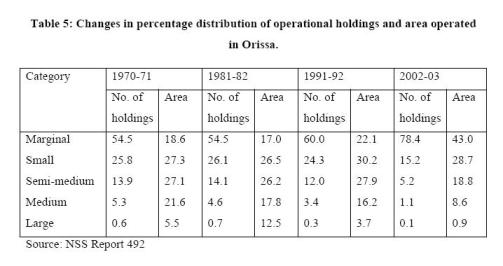
Let us now try to understand the scenario in Orissa. Table 5 shows a very high increase in the share of marginal farmers in the distribution of operational holdings in Orissa. If we reconstruct the data by including the landless and subdividing the category of marginal farmers, the picture is slightly different from the all India level. In Orissa, there was a marginal increase in the number of the landless, but the number of the poorest among marginal farmers saw a formidable growth (!). In Table 4 marginal farmers have been divided in two classes – the size class of 0.002-0.5 and of 0.5-1.0 ha. It is the first size-class that bulged the most from 1991-92 to 2002-03.

Table4

Table5

A cursory comparison of Table 1 and Table 5 shows that quite unlike the all India level, the concentration of operational holding is quite low in Orissa. In Table 6 we give a comparison of Gini’s coefficient of concentration at the national and Orissa levels. This is a comment on the state and function of the rural society in Orissa – the predominance of landholdings of unviable sizes.

Table6

Ownership Holdings

Let us now examine the land ownership data. At the all India level 10% of the rural households were landless (in terms of ownership). The average area owned per rural household is 0.725 hectare. If we exclude the landless households, then the average area owned is 0.806. On the other hand, in Orissa, landlessness is 9.56%, while the average area owned per rural household is considerably low in comparison to the national average. Including the landless, it is 0.483 ha, and excluding them, it amounts to 0.534 ha.

Table7

Table 7 shows the overall skewed nature of the size distribution of ownership holdings at the all India level. Around 50 % of the total households own just 2% of the total area, around 60% own less than 6 percent, and around 80% of the total households own only 23% of the total area. Further, around 9.5% of the rural households own 56% of the total land. This demonstrates a formidable concentration of ownership holdings, measured by Gini’s coefficient.

In Orissa, on the other hand, we find 85.50% of the owner households under the marginal category, and they own 41.52% of the total area (Table 8). If we break the marginal category in size classes, as in Table 10, we find that 71.5% of the households own less than 0.5 ha each. More than half of the households in this latter size class (0-0.5 ha) own a negligible amount of productive land. Their ownership is restricted mainly to homestead land. If we exclude homestead land from our calculation, ownership landlessness increases to 38.5% from the meagre figure of 5.65% when we include homestead land. As shown in Table 11, without the homestead, the size classes above the “nil” category and up to 0.40 ha are almost emptied.

Similar is the case at the all India level. Table 9 shows that around 67 percent of households own less than 0.5 ha. Furthermore, if we exclude homestead land from our calculation (Table 11), the percentage of the landless rises to 41.6.

Table8

Table9 

Table10 

Table11 

The Extent of Proletarianisation

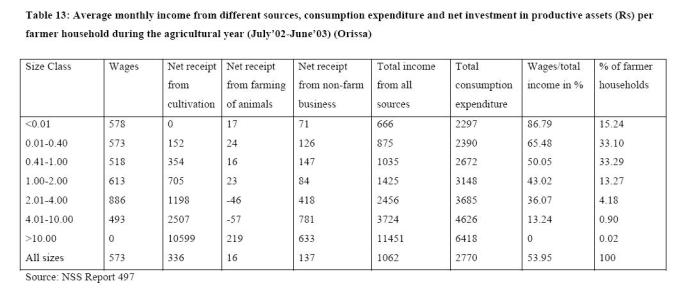
Now we come to the last part of our statistical study of the process of proletarianisation in Orissa and rural India in general. Today, even according to government data, wages have become an important source of income for farmer households, as shown by the tables 12, 13 and 14. For the landless and marginal farmer households (whose average land size is 0.40 ha.) it is the most significant source of income. At the all India level we find that for farmers in the size class <0.01, wages constitute around 78 percent of their income, and they constitute 11.62 percent of the total number of farmer households. For another 34 percent of the farmers (operating 0.01-0.40 ha of land per capita) 60 percent of their income comes from wages. But these figures include only farmer households, which are defined as households operating land. Thus, they exclude the landless (with zero operational land) whose inclusion in the data would conclusively demonstrate that in rural India a staggering majority is dependent on wage labour.

In the case of Orissa, the preponderance of wage labour is more evident. The most important source of income in the entire rural economy of the state is wages. As shown in Table 13, around 54 percent of the rural income comes from wages. The whole class of marginal farmer households, which accounts for around 82 percent of the total number in Orissa, depends mainly on wages. In fact, interestingly, possibly due to the dire state of agriculture in the region, even for a small farmer, wages constitute around 43 percent of his total income. Needless to reiterate, these figures do not speak for the totally landless wage labourers.

However, there are tremendous inter-state variations in the proportion of wage in the total income of farmer households (Table 14).

These data are definitely insufficient for explaining to us the true nature of class relations on the land, as “net receipts from cultivation” includes sharecropping income too. In recent times the nature of sharecropping arrangement has changed increasingly. The sharecroppers are being reduced, more and more, to the status of mere labourers on the land. It is the principal owner who provides capital (for buying inputs) and takes decision regarding what to produce and how to produce. The sharecropper is a labourer who indulges in self-exploitation and whose remuneration is subject to climatic and market fluctuations. Similar is the case of “receipts from non-farm business” which may include many piece rate jobs and so on. It requires detailed micro-level researches to understand the forms of labour relations in the countryside and in the areas where rural immigrants find work.

Table12 

Table13 

Table14 

3. On the impurity of rural labour

The centrality of wage-labour in defining capitalism has generally been accepted. And the above statistics show, in a definite manner, that in India (including in one of its most backward states, Orissa) too, wage labour has acquired a preponderant status. However, what has really confused scholars and activists is theimpure nature of labourers in India. Firstly, the majority of Indians are still rural. Secondly, most of them seem to be in possession of some or other kinds of means of production – land etc, which give them asemiproletarian character, instead of that of being real proletarians.

In mainstream sociological analyses, individuals are fitted into strict pigeonholes and then their numbers are counted to classify them. This is what can be termed as methodological individualism. Surely, in this regard, even in many advanced capitalist countries a large section of workers will fail the test of purity. Hence, proclamations like that of “the death of the working class” and the “rise of the middle class.”

However, what exactly is the nature of this impurity? It is generally found that the income that theseindividuals draw comes, at least in part, from non-wage sources. Furthermore, we find individuals, or their families, engaged in both waged and unwaged labour. Similar issues were raised during the debate in the feminist movement in Europe and the US over housework, in the 1960s-70s. The centrality of wage labour was now understood not in terms of how many wage-labourers were to be found in society, but to what extent it re-signified all kinds of labour relations and economic activities that constitute a given socio-economic formation. Proletarianisation was understood as a process – a process of subsumption of labour by capital. This subsumption can be purely formal or even invisible, not actual/real or visible like wage employment of labour. In fact, the uneven process of labour subsumption is the basis of the labour segmentation that we find in capitalism. Massimo de Angelis points out in his recent book, The Beginning of History: Value Struggle and Global Capital:

…the division between waged and unwaged activities, between public and private, between working for money and “in your own time,” between production and reproduction, between work and housework, between what is valued by capital through a corresponding price tag and what is not, is the true material basis upon which the realm of the invisible that is at the basis of capital’s exploitation is constructed. Because if…it is true that surplus value is the invisible value that is extracted from waged workers’ labour and appropriated in the form of profit, it is also true that waged workers need to reproduce themselves, and this implies that they as well need to access the products of others’ labour. Their dinner is prepared, their clothes washed, their health preserved thanks to invisible, objectified workers. (Emphasis original) (9)

Archaic forms of labour relations are subsumed for the benefit of capitalist accumulation. Who does not know that American slavery was the basis of the development of capitalism in the US? These forms are preserved till they become hindrances to further accumulation. The invisibility of these pre/non-capitalist forms is the basis on which visible forms are actually subsumed.

Even the impurity of individual labourers, whose labour process is divided between waged and unwaged phases, can be understood in this framework. As Angelis notes in the above quote, “waged workers need to reproduce themselves,” and unwaged labour contributes in this reproduction. But this reproduction implies access not only to the products of “others’ labour,” but one’s own labour too. To paraphrase, she needs to prepare her dinner, her clothes have to be washed and her health preserved; this is provided for “thanks to invisible, objectified labour” – but not just others’, but hers own too. This schizophrenic but real division of an individual worker is considered impurity.

Let’s take a typical case. A migrant worker, who stays in a town, while his family stays back in his village, toiling on a small piece of land, is considered an impure worker – a semi-proletarian. Why? His wages are not sufficient to sustain (or reproduce) him or his family throughout the year, and have to be compensated by the unwaged labour of his family or his own, toiling in their own field. Hence, the function of the unwaged component of his labour (along with that of his family members) is needed to reproduce him and his family.

Under neoliberalism – an ideology of policy design that the Indian state has adopted, casualisation and contractualisation of the work process are the major methods of arranging production (and even circulation). This has led to a rapid expansion of the informal sector, which was already quite big in the pre-neoliberal phase of development in India. This assumes a vast reserve army of proletarians or surplus population, which can be “casually” used and thrown away, without many social consequences. As the data above shows, as rural India is increasingly being integrated into the neoliberal expansion of Indian capitalism, much of it is being reduced to a deposit of surplus population. The rural population in this process emerges as a vast, latent and stagnant, surplus trying to subsist (or reproduce) in the face of neoliberal land acquisition, agrarian crisis and underemployment. Subsistence agriculture in this phase is nothing but a mechanism to stabilise this surplus population, which engages in cyclical and irregular employment that the informal sector creates.
As the above analysis shows, much of the peasant community is directly linked to capital as part-time or seasonal wage labour. Harry Cleaver says aptly in his Preface to the Mexican edition of his now classic work,Reading Capital Politically (1979):

It is clear that peasants are often linked to capital quite directly through part-time waged labour. This is the only role usually recognized…as a “working class function.” The problem with the usual analysis is partly methodological. There is an attempt to classify people into one category or another by their dominant role. If a worker works most of the year in a factory then that worker is classified as a member of the working class. If a person lives on the land most of the time, then that person is a peasant, not a worker. This is stupid. What we should see is that there are many roles or functions played by the working class in its relation to capital, and that individuals move from one function to another at different points in time. When a worker is in the factory, that worker is a productive worker. When that same worker is at home doing housework or working on the land in subsistence agriculture, the function has changed – now we are in the sphere of the reproduction of labour power – but the worker is still a worker, still part of the working class.

When a peasant takes a few days or weeks to look for waged work, that peasant passes from the latent to the floating reserve army. If there are no jobs, after a while the worker will pass back from the floating to the latent role. If there is a job, then for a while the worker will be part of the waged labour force instead of being unwaged. There is no change in class status here, only a change in the form of the relationship with capital! All persons who are forced to work for capital – either reproducing themselves as labour power in the latent or floating reserve army or actually producing a product – are part of that working class. The form of the imposition of work is secondary.

But what, some may ask, of the peasants who produce a surplus they sell on the  market? Are these not petty bourgeois producers and outside the working class?The answer is that they are still very much part of the working class if the result of their work is only self-reproduction. (Emphasis added)(10)

4. Political Implications

Identity and Class

If disparity among geographical locations or sectors or communities is the ground for rural mobilisation and struggle, then the political strategy that evolves will not be geared towards structural transformation, but towards creating parity. It will be restricted to fighting for social inclusion. Such struggles will tend to hide internal differentiation, and will depoliticise local conflicts, while stressing on homogeneity at the identitarian level – on the basis of locations, community or sector etc. On the other hand, the centrality of labour and class struggle allows us to radicalise popular mobilisation and struggle by making every conflict and contradiction into a node for politics. Classes are not internally homogeneous – however, class struggle unlike identity struggle does not require homogeneity. Even labour market segmentation can be a ground for class struggle, by which the internalised hegemony is questioned – a struggle against the whiteness of the white worker, waged by the black working class, is a fight for working class unity and against the internalisation of hegemonic structures by the working class. This perspective on class struggle gives us the opportunity to understand and engage with identitarian movements too.

Ambedkar’s understanding of the caste system is very relevant in this regard. He did not consider the struggle against caste a struggle for identity assertion, or for mutual toleration among diverse communities. It was not a struggle for mere representation. He called for the “annihilation of caste.” In fact, Ambedkar had a subtle conception of caste, which could help us transcend the dichotomy of caste and class. During his days in his Independent Labour Party (ILP) and in his piece “Who were the Shudras?” (1946), Ambedkar viewed caste not as a purely cultural edifice, but as the carrier of specific work functions. The caste system transformed “the scheme of division of work into a scheme of division of workers, into fixed and permanent occupational categories.” So the annihilation of the caste system will pave the way for the transcendence of the material and ideological division of workers. But it is important to reassert that the class or the “labour” perspective cannot remain blind to the internal configuration of the class. Class unity is posed not by wishing away the internal divisions within the working class; rather it is a product of class struggle, of struggle against the foundation of those divisions – of intra-class competition and hierarchisation.

The Land Question

As our statistical analysis, coupled with the conceptual issues that we discussed above, indicates, the majority of rural Indians are today proletarianised, in the sense that they toil for self-reproduction, alternating between wage employment and subsistence self-employment.  This fact can give a new insight into the nature of rural struggles today. It is definitely true that the National Rural Employment Guarantee Act (NREGA) that the Indian state has provided to the rural poor gives them a tremendous opportunity to come out of their invisibility. By a single act of legislation, a vast rural labour market has become visible, with millions constituting a surplus population which is emerging out of its latency. But the partial guarantee that this bestows on the rural poor has only marginally altered their invisible status – as the hidden underemployed, and the footloose labour alternating between wage employment and subsistence self-employment.

Another important implication of the above analysis is that it redefines the whole land question. The land issue has generally been associated with the peasant question – peasant hunger for land. But now, with the emergence of a new perspective, the land issue is increasingly been posed as a question of labour, associated with workers’ need to self-reproduce. A poor tribal who tills a small plot illegally in the forest area is doing so not to satisfy his hunger for land, but in order to survive.

Earlier the land question was posed as an issue which relates to the development of agriculture – would land redistribution increase productivity or would concentration work better?

…the many popular struggles over land today are driven by experiences of the fragmentation of labour (including losses of relatively stable wage employment in manufacturing and mining, as well as agriculture), by contestations of class inequality, and by collective demands and actions for better conditions of living (‘survival’, stability of livelihood, economic security), and of which the most dramatic instances are land invasions and occupations. There is now a revival and restatement of the significance of struggles over land to the social dynamics and class politics of the ‘South’ during the current period of globalization and neo-liberalism… Contemporary land struggles are significantly different from the (‘classic’) peasant movements of the past, and are much more rooted in the semi-proletarian condition: that of ‘a workforce in motion, within rural areas, across the rural-urban divide, and beyond international boundaries’. (emphases added)(11)

This is not to say that land is now exclusively a labour question. Far from it. The dominant discourse in movements against land acquisition, like the POSCO struggle in Orissa, still poses it as an issue of “agriculture” versus “industry”, “rural” versus “urban”. The only submission that we make here is that regions like coastal Orissa have high rural differentiation, and the homogeneity that we witness today might be temporary and even deceptive. Within these land movements, a working class viewpoint is emerging towards land and development in general, which is not vocalised by the leadership.

Notes:

(1) David Harvey (2005) Spaces of neoliberalization: towards a theory of uneven geographical development, Franz Steiner Verlag, p. 60.

(2) David Harvey (1982) Limits to Capital, Verso, p. 417.

(3) Rajni Kothari (1970) Politics in India. Originally published by Little Brown and Company, reprinted in The Writings of Rajni Kothari, Orient BlackSwan, 2009, p. 124.

(4) “Presidential Address at All India Kisan Conference (9 April 1939)”, Selected Works of Acharya Narendra Deva Volume 1, Nehru Memorial Museum & Library (1998)

(5) Quoted in Arvind N. Das (1982) “Peasants and peasant organisations: The Kisan Sabha in Bihar”, Journal of Peasant Studies, 9(3):40-87

(6) VI Lenin, “Capitalism in Agriculture”, in Utsa Patnaik (2007), The Agrarian Question in Marx and his Successors Volume 1, LeftWord, p. 299.

(7) Vijay Paul Sharma (2007) “India’s Agrarian Crisis and Smallholder Producers’ Participation in New Farm Supply Chain Initiatives: A Case Study of Contract Farming”, IIM Ahmadabad.

(8) CP Chandrashekhar and Jayati Ghosh (2004) “The Possibilities of Land Reform”, MacroScan.

(9) Massimo de Angelis (2007) The Beginning of History: Value Struggle and Global Capital, Pluto, p. 57.

(10) Harry Cleaver, Una Lectura Politica de El Capital, México: Fondo de Cultura Económica, 1985.

(11) Henry Bernstein (2004) “Changing Before Our Very Eyes’: Agrarian Questions and the Politics of Land in Capitalism Today’, Journal of Agrarian Change, Vol.4 Nos. 1&2.

Towards Communist Refoundation

 Radical Notes 

Sectarianism has, for quite some time now, been the greatest bane of militant revolutionary working-class struggle. That this global phenomenon has become especially pestilential for the Indian communist movement would hardly amount to an overstatement. The fragmentary and effete disarray with which labour has, since the severe repression of the various communist and Left-democratic movements through the sixties and the early seventies, been confronting late capitalism in this part of the world, unambiguously indicates the restorative upswing that capitalism has been on. Neo-liberalism is the embodiment of this restorative political project. Communists, particularly on the subcontinent, must, if they wish to effectively rise up to the rather confounding challenges being posed by late capitalism, revive the Marxist legacy of “refoundation”, the constant reclamation of the “hidden science” of working-class struggle from the ideological vagaries into which it inevitably and continually falls. If sectarianism is the inescapable evil necessity of revolutionary politics, refoundation is the equally indispensable dialectical antidote.

Sects, as far as the working-class movement is concerned, are nothing but ideological-organisational forms of particular experiences of that movement in its respective active struggles against capital at its diverse moments of contradiction. To that extent, these various experiences are crucial not merely because their forms serve to foreground their respective historical specificity in that eternal and fundamental antagonism between capital and labour, but, more importantly, because they also show how that essential and universalising battle of labour against capital to transcend the horizon of the latter to obtain to a new, counter-capitalist horizon of autonomous, unalienated, non-contradictory becoming is implicated in each of those ‘experiential’ forms.

Clearly then, the defence of such sects becomes necessary insofar as such defence is the insulation of the counter-capitalist, revolutionary horizon – which is constituted through the enactment of specific determinate struggles against the variously concomitant reigning subjectivities of capital at its diverse moments – from the invasive forces of capitalist restoration. But the paradox of such a political programme lies in the fact that the defence of the universal and universalising revolutionary logic of becoming is arrested by and congealed in the forms of one of its many particular moments. Such a defensive manoeuvre – “war of position” in Gramsci’s terms – while necessary is, in itself, not sufficient to bring about the unfolding of the revolutionary logic in its total universality. If anything, such hypostatisation of the revolution into a form or identity serves to brush it against its own grain, which ought to be the critical expression of the singular, unalienated process in inverse opposition to a static system of different(ial) and competing forms.

The revolution, in such circumstances, willy-nilly becomes another name for restoration. For, how else does one describe a political process that in the name of perpetuating the revolution ends up imposing the form through which the universal logic of the revolutionary process found itself expressed at one of its particular moments on all the other diverse historical moments of capital-labour contradiction?

The only way then in which communists can prevent this necessity of defending the revolutionary good, as it appears at a particular moment of capital-labour conflict, from turning into its evil counter-revolutionary opposite is by continuously re-enacting or refounding – Gramsci’s “war of movement” – the universalising logic of the revolutionary process at all the other historical moments of capitalist domination. The defence of the revolutionary horizon, as it is at a moment, should then be seen as the condition that makes possible the refounding of the revolutionary logic. Equally, refoundation is an impulse which alone can truly fulfil the act of defending the revolutionary horizon by ensuring that such a defence does not degenerate into a reactionary gesture of saving the momentary appearance of the revolutionary process, thus confining its infinite totality in the prison of that particular appearance.

The failure of the working-class movement, and its various ideological-organisational currents, to grasp this dialectical unity and express it in its multiple practices is responsible for the distortion of a complementary and composite politico-ideological ensemble – the defence of the revolution and the refoundation of the universal revolutionary logic – into a phenomenon of competitive struggle among various sects. Sectarianism is the name of this game. To speak in Jacobin tongues, critique without virtue leads to anarchic destructiveness, but virtue without critique becomes a shibboleth of counter-revolution. The trick of walking the tightrope of revolution successfully is to know where the stress should fall and when.

Given that the world revolutionary movement, particularly its South Asian segment, has been thoroughly hobbled by intense sectarianism, our stress should, without doubt, fall on the side of critique. This critique would be nothing but the first important step towards a refoundationist thrust that seeks to free up the possible debates, which ought to occur among Leftists of different hues, but have not as they lie concealed in and distorted as oh-so many sects. For far too long the advocates and proponents of these diverse Left streams have erred on the side of defending the revolutionary logic as it was expressed in the specificity of their experiences without making any attempt to figure out how that same logic could be – have often in fact been – expressed in other historical experiences framed by the concrete forms of political-economic contradictions. That burden, therefore, now falls on us.

To err on the side of refoundation would mean to take on the unenviable but unavoidable revolutionary task of explicating how the universal essence of the singular revolutionary process became constitutive of localised and momentary appearances of the historical experiences that form the various sects of the working-class movement, and how that universality could be discerned in and extracted from the specificity of forms of its localised experiences in order to yet again transform it into the formative basis of new social subjects of working-class politics in the varying forms of historical concreteness of political-economic contradictions. Refoundation is thus a two-pronged gambit – to see an essential unity among the various existing sects of working-class politics as well as zero in on hitherto uncharted moments of capital-labour contradiction so that they can be transformed into grounds or foundations for the universal revolutionary logic of singular and autonomous processuality to express itself anew.

The refoundation of communist praxis involves a much-needed re-reading of classics, both within and outside the communist-Marxist canon. These textual objects of re-reading could be crucial explicatory works in their entirety, exchanges that comprise important debates, movements, or vital concepts that have leapt out of texts to acquire an ideological life of their own. In this regard, the entire endeavour must be to engage with the texts in a spirit of critical assimilation, wherein experiences specific to certain locations are generalised for other essentially similar locations within capitalist historicality by extracting the universality of the critical-revolutionary essence constitutive of those local experiences, even as the forms of those experiences are as such discarded. In short, refoundation is an act of generalising the logic of revolution even as it struggles against the overgeneralisation of forms of that logic in the same movement. It is a struggle that must necessarily be waged on the terrain of ideas to constantly regain the revolutionary edge of theory, which in its absence vegetates as a sterile and abstract philosophised fetish.

Refoundation, however, has to be much more than the discernment of the singular-universal of the revolutionary subjectivity in its various multiple moments from the vantage point of hitherto unmapped locations or moments of capital-labour conflict. As communists we all know what revolutionary theory is in the abstract and how it can become truly revolutionary by becoming the motor of a revolutionary practice that is determinate to a concrete situation. For that alone, refoundation would be pretty much a pointless enterprise. It must, therefore, simultaneously also be an exercise to learn how exactly particular theoretical formulations, practices, movements or debates, which have emerged out of their respective local experiences of the working-class movement, went about their business of seeking to express the universality of class struggle and revolution in the specificity of their experiences in order to redefine the fetishes of their respective antithetical positions, which had been assigned to them by capital and its reigning  subjectivity, into potent forms of class struggle and revolutionary supersession of capitalism. By the same token, therefore, any half-way rigorous refoundationist exercise must run the historical risk of evaluating how successful its various textual objects have been on that score – that is, how much have those formulations or movements under study been able to steer clear of the contagious fetishism of capital at their respective foundational moments.

We must try, to the best of our abilities, not to flinch from carrying out such refoundationist evaluation, which is bound to carry a combative, even unpleasant, charge. We need not claim to speak from an Archimedian point. Yet, we ought not to be deterred from speaking the truth and turning quietist. The fear that our experience of truth would be falsified at another moment that would not be ours should not hold us back. As scientific socialists we know that the “truth is always partisan” and it is forged in the fire of struggle. That is precisely why refoundation is not merely a rarefied exegetical enterprise, but an endeavour of revolutionary hermeneutics where every word is sought to be returned, in an act of radical decisionism, to the materiality of its flesh. This refoundationist turn would eventually deliver unto the working-class movement the Young Marx’s “party of the concept”. A concept that is not merely an academic idea but something that emanates from the materiality of critique and resistance, wherein every falsification of a prior truth is its culmination and fulfillment. Clearly, refoundation is as refoundation does.

Liberal or Radical: A Dialectical Appraisal of Students’ Politics

 Paresh Chandra

Even though my participation in the current debate puts me incontrovertibly in the same “camp” as the KYS (Krantikari Yuva Sangathan), in fact precisely because this is so, it is important that I flesh out my differences with the way the KYS pamphlet formulates its critique of the UCD (University Community for Democracy). Without going into details, and without bothering to censure them for their aggressive style I will try to get at the definitive concept of their problematic and then proceed to show how I differ.

The KYS pamphlet clearly brings out the organisation’s commitment to a genuinely transformative politics that unequivocally upholds the position of the working class as the only possible agent of systemic change. In an identifiably Zizekian phraseology they have argued that the working class, instead of being one of many of identities, is the terrain which allows, or rather, determines, the way identities assert themselves. So far I have no disagreements with the pamphlet. My disagreement begins when the pamphlet fails to complete the dialectic hence begun. After having argued thus, the pamphlet goes on to say:

“It is a fact that students who join universities like Delhi University (DU), are from different classes. The trend in DU is that students from working class backgrounds generally join the peripheral and evening colleges of DU. They are mostly youth who: a) have studied in government schools, b) come from the Hindi medium background, c) who do not usually get admission to college hostels considering their 12th class schooling, d) are those who really struggle to cope with rising college fees and English medium teaching/coursework. Students from petty bourgeois backgrounds are quite the opposite—a significant number of them have studied in respectable public schools, get admission to the best north and south campus colleges of DU, and are generally the first to get admission to the limited college hostels of DU.”

Quite clearly there is a change in the manner in which class is being conceptualized. Clearly referring to class at a phenomenological plain, and hence deploying a sociological understanding of class, this paragraph reduces it to an identity. So then, there are two ways in which class is seen, first as a process and second as a sociological fixity. In itself, even this is not disturbing. But dialectical logic requires the explaining away of this duality, the exposition of the relationship between what one can call class-as-identity and class-as-class.

First of all I will assert that the KYS pamphlet fails to bring out this relationship (readers can take a look at the pamphlet for proof), and in failing to do so over-emphasizes one side of the duality. Despite arguing that class is not an identity, by and large, the pamphlet treats the working class as if it were an identity located in certain geo-political locations, and not in others (not in North Campus and in the peripheral colleges, for instance). Even when the pamphlet concedes that North Campus and places like it may have working class elements, it speaks in terms of clearly identifiable individuals and not tendencies that work in trans-individual ways. In other words, even here class remains an identity. This is not merely a misunderstanding; it is an over-emphasis borne of a certain sort of engagement with society and needs to be located in that experience. One can try and do just this after having explicated the nature of the relationship between class-as-identity and class-as-class.

*      *      *

The relationship between identities and the process called class is akin to that between particulars and the universal immanent in them, and constructed through continuous abstraction from them; the relationship is – to reassert what cannot be asserted too often – dialectical. An identity is valid at a particular spatio-temporal location, and rooted within it is the logic of truly transformative politics. But so long as an identity does not destroy itself, it continuously gets co-opted within the competitive system of capitalism. After a point an identity needs to transcend itself and move toward assimilation into the multitude of struggling identities. At the same time if one does not recognize the struggles of identities, one recognizes nothing, since struggle is necessarily posed in terms of identities. The class-for-itself is always in the process of being constructed, but is never out there, present a priori, to be recognized as somehow different from and superior to the multitude of identities. To explicate this understanding of class and to locate the student in this understanding I will quote at length from a pamphlet brought out by “Correspondence”.

“When Marx says ‘working class,’ does he mean only the ‘male, white, industrial proletariat?’ Maybe. But what was the logic behind designating somebody a worker? The working class is that section of the people on which work is imposed; the people who are alienated from their creativity, who are forced to create in circumstances that they do not want to create in, and who as a result will have to fight to be able to determine these circumstances. There was another concept, that Marx often made use of: the collective worker. The collective worker is this continuum, a continuum beyond localized time or space, of the working class subjectivity. The collective worker is a universal, common to all those on whom work is imposed. Work is imposed on the collective worker: the collective worker is made of various individuals on whom work is imposed in various ways; in a different way in the factory, in a different way in agriculture, in a different way in the university, in a different way in the household. So work is imposed on the professor in one way. It is imposed on the student in another. Studenthood is a phase in the life of this ‘collective worker.’ It doesn’t matter if some students come from rich households, if some will go on to become factory owners, or vice chancellors, at the moment of studenthood they are part of the collective worker. Professors and students are part of the same continuum. They together occupy the university, and in fighting for self-determination they are essentially on the same side. So in opposition to the student as a consumer, and the student as a product, is the student as worker.”

It should be evident that we are not speaking about individual students and the trajectories their lives may take. The student as a member of the working class experiences imposition of work insofar as s/he too has no control over the many hours s/he has to spend in the university, in attending class, courses studied, fees paid, exams written etc. Decisions are made at another level by administrators whose only considerations are the interests of the market, not what students, or for that matter, professors and karamcharis desire. Members of the administration are not elected representatives; they come in through mechanisms in which we have no say. Today we might be fighting the semester system, or the service regulations, or against the attendance rule, fee-hike or for timely payment of karamchari salaries, but we also need to fight the arbitrariness with which these problems impose themselves upon us. It is this arbitrariness of imposition that determines the students’ status as a member of the working class.

According to this view, it does not matter whether a student comes from a rich family or a poor family – because we talk in terms of the collective worker, we deal with tendencies and potential, not with determination and destiny (which we have to consider when speaking for individuals). At this level of abstraction any geo-political space bears within it the potential for positing a truly transformative form of politics, insofar as each localized moment of capitalism is constituted by the fundamental conflict between labour and capital. The idea that because a student comes from a (relatively) high-income group it makes her/him petty bourgeois has no validity; firstly because the parents belong to this group, and secondly, because income group is not what decides whether an individual is petty bourgeois or not, but the control s/he has over her/his labour power.

In fact, “petty-bourgeois” refers not so much to a fixed position as to a tendency. Each individual, living in the system of capitalism, is constituted by the struggle between this tendency and the tendency toward proletarianisation. The student is a part of the collective worker, but at the same time is also haunted by this specter of possible petty-bourgeoisfication. In some the petty-bourgeois tendency is stronger while in others it is weaker and this varies in proportion to the degree of control an individual has over her/his life. It is undeniable that the socio-economic security that certain parents are able to provide their children, who then become students, means that these students are not easily discontented, and when they are discontented their immediate impulse is to go back to the previous state of relative comfort. In these individuals the petty-bourgeois tendency is strong and hence they are more likely, at a moment of conflict, when they feel pressed, to go for a local resolution, which helps consolidate the status quo.

The KYS pamphlet claims that this is the position of the student studying in North Campus. If this is so, then undoubtedly it will be difficult to facilitate the emergence of a truly radical form of politics here; but even then it is not impossible. This is not the beginning of a lesson in the “optimism of spirit”; one is merely trying to point out that the difference between the North Campus or any other identifiable geo-political space with any other, is one of degree and not kind (“lesser or greater degree of petty-bourgeoisfication,” and not “working class and petty-bourgeois”). Perhaps comrades from the KYS think that they never contradicted this dictum. I will remind them that after a point quantity changes into quality – this seems to have happened in their pamphlet. A class-conscious student would see herself/himself as a member of the working class and in that will leave behind determinations like prehistory and family. All locations and identities are potentially arena for struggle, and this is what the KYS pamphlet fails to take cognizance of. However – and this is not to be denied – there is more to this story. I will come now to the experience that gives birth to a theorisation like the one offered by the said pamphlet.

*      *      *

When one is engaged in the pragmatics of political activity, it becomes necessary to function at a level of abstraction altogether different from the one that forms the core of the science of revolution making – this is the difference between tactic and strategy. Our experiences in “students’ politics” tells us that because of certain reasons, which are clearly linked to the petty-bourgeois tendency discussed earlier, it is harder to build a ground for a sustainable agitational politics in places like North Campus, as opposed to peripheral colleges of DU or polytechnics. So tactically, it might seem more fruitful for an organisation to focus on these other areas. One might even go as far as to say that the form of politics that a space like North Campus might throw up is much more likely to be ideologically compromised than the ones thrown by the so-called peripheral zones.

However, the North Campus continues to be a possible terrain for political engagement for those located here and willing to recognize it as a space, like any other, where individuals do not have control over their labour process. Of necessity, such individuals will be forced to ally with petty-bourgeois tendencies, which at certain moments show an anti-capitalistic tenor, during the course of their struggles – tendencies that in the final instance are constitutive of capitalism. How does one recognize these tendencies as they unfurl into political activity? To answer this question, which is really the most important one here, I will try to engage with the politics of the UCD (University Community for Demcracy) as it has unfolded so far. Below are two quotes from the UCD response to the KYS pamphlet.

“Mocking these attempts the way the KYS pamphlet does is precisely what discourages fellow “petty-Bourgeois” folk from making even that small effort, and makes politics into a club rather than a movement.”

“We have no claim to be any revolution’s vanguard, or harbingers of a future ideal society. However, each of us is actively engaging with how we want to visualize an ideal society. Ideologically some of us are committed Marxists, some are liberals, while most of us are still exploring our paths in the world of ideas and commitments. Some of us are members of other organizations. All we demand is that these not be reactionary, communal, sexist or casteist.”

Clearly, everybody is free to visualize the ideal society of the future – of the ones who do get involved in this task committed Marxists are only a section. Others are liberals. What is needed to be a member of the UCD is not a positive commitment to a politics, but characteristics that can comfortably be clubbed under “political correctness”. Apparently what keeps the petty bourgeoisie (keeping in mind that the ontology been accorded to this “class” is provisional) from political action is not their class position, not the fact that they have a stake in the system, that they like being petty bourgeois, but merely the fear that the KYS will come swooping down on them in a typically undemocratic manner. This complete willingness to accept anything, in what can only be called a liberal democratic spirit, is understandable when it comes from a loosely constituted group with no regulating epistemology, but it is disturbing that the “committed Marxists” in the group have nothing to add – the entire response, falls in line with these utterances and nothing disturbs its harmony. Hence, I, already engaged in this debate, am forced to state my case strongly.

*      *      *

There are two ways in which a vanguardist group (read: a group trying to intervene with an idea of transformation, not the “authentic” vanguard/party) could intervene in a situation. Either a conflict has taken place and the people affected have reacted – in which case the vanguard could enter the movement and try to “direct” its course (this is not necessarily as mechanical a process as it sounds – the final direction that a movement takes could be a compromise between the inertia of the movement and the intervention of the vanguard, or it could be a mutually redefining dialogue). The other alternative covers those situations where a vanguard perceives a moment of conflict gone unquestioned, and decides to “construct” a movement around it. In both cases the vanguard takes its “principles” with it, but in the second case the primacy of these principles is much more apparent. In a case of the first kind the vanguard enters the movement with, in fact because of, its principles, but also with the knowledge that the movement has a direction of its own – this is why it could decide not to enter a movement if it perceives that the inertia of the movement is taking it in an unwanted and unalterable direction. In the second case however the vanguard decides the direction of the movement. Of course once the movement becomes a “mass movement” the weight of the mass could change the direction but the initial impetus that the vanguard provides would be hard to shake off completely.

Despite possible claims to the contrary the inception of the UCD and the conception of the entire movement falls in the second of the two patterns charted above. Although the “Facebook Group” might have been joined by a number of students who were actually affected, the movement proper – if it ever was that – began as an initiative of a few who stood “outside” this conflict and had been drawn to it because of larger political/social commitments.  If this was the case then it was important that the aims of the campaign should have been defined early, and clearly, but this never happened. In fact it is not hard to perceive in the passages quoted earlier and in workings of the UCD overall, a reluctance to discuss these questions.

I will mention something that has emerged repeatedly in various responses to the KYS pamphlet; the UCD response too throws at us the same thing. They say, “Is it not enough that some people are trying to do something? Why do you attack us? Why don’t you too help us?” As if the moment one begins to do “something” what one does becomes irrelevant – it merely detracts from the task of doing “something.” Exploring what this “something” is leads us to the question of form. The way I see it, at the center of KYS’s attack lay a concern with form – the difference of form which decides what politics is merely transgressive and extralegal and what transcendental and illegal/metalegal. Two organisations/groups pick up the same issue and yet there is a difference. While one picks it up in a way that allows the system to deal with it without needing to burp, even though this organisation is able to mobilize “vast numbers”. The other organisation is able to mobilize only a few and yet it mobilizes them in a form that cannot be accommodated within the system. Which is to say, if one does not concern oneself with these abstract questions, which we have to admit have been brushed under the carpet throughout all UCD meetings, we could make all the noise in the world, mobilize millions and yet it would all come to nothing.

To get back, who says “atleast I am doing something?” S/he who does not care what s/he is doing. Hence s/he who does not, in the final instance, have a stake in what is being done. This is the position of that bunch of people who can afford to not care what they do. They are not out to change the world, to make it more equal and so on. They are out to satisfy their conscience – well meaning people, undoubtedly, they feel guilty for not being great sufferers, for being what they are. They need to feel that they too do something for the world. The moment they get this feeling they find felicity; this is the limit of their political project. So what has happened: a moment of conflict was thrown, a group of people got involved, tried to conjure a movement, not knowing where they want to go with it, not caring either; they do “something,” which is in effect nothing objectively, but everything for their subjectivity. Precisely because they do not have a theory of revolution (for they do not need a theory of revolution), the only measure they have to judge the success of their movement is subjective satisfaction. Since they find themselves satisfied, they conclude: “it was good.”

*      *      *

This is the petty-bourgeois-dom that the KYS has charged the UCD of, and it is the dangers of this tendency, as has been said before, that the KYS finds in locations like the North Campus. Certain concerns that the KYS expressed in their pamphlet, albeit in a polemical vein, and which were badly addressed by the UCD response demonstrate the problems of such politics. I will try and deconstruct some of the “concrete” steps that were involved in the form of politics that the UCD spawned, so as to be able to demonstrate exactly how it is a compromised form (emerging out of a petty-bourgeois tendency unchecked by the “committed Marxists” of the group):

1) Teachers taking classes outside/bringing their students to the protest-site: At least in the last few years, if not for longer, whenever we (of the Left) have had to mobilize students, this is a trick we have used. Certain professors, whom we know, and who are indubitably well-intentioned Leftists ask their students to join the protest/rally/whatever. Even if the question is not of internal assessment teachers do have some power over students, and at least some students will do what the teacher asks. This has been an efficient way of increasing numbers on the road. However the clearly pedagogic and top-down nature of this mobilisation implies that no politicisation happens – in fact there might actually be some resentment on part of students “mobilized” in this fashion. The larger point, however, is that this gives us a false sense of “having numbers” – something which is, to my mind, not very good.

2) On the commune:  In the first meeting (which I attended) there was no talk of a commune. After the meeting something happened, and in the evening I heard talk of this idea. In the next meeting it was brought up, supported by some, resisted by some, and if I remember correctly, it was left an open question. In the third meeting or maybe the one after that, the first draft of the pamphlet was discussed which made mention of this idea, without using the word “commune”. The idea was debated once again. Following were the objections made against the attempt to create such a space:

  • Is it in our capacity to arrange alternative accommodation?
  • Why are we doing this? Three reasons were offered by those in favor of this idea. The first was that those left ‘homeless’ (presumably girls from Miranda College, who because they had not been informed of the unavailability of the college hostel beforehand, would have no place to stay) need a place to stay. The second was that this space would serve as a retreat for the movement. The third was that this would be a place of politicisation, a space where an alternative form of “student self-organisation” would be posited etc. Opponents of this idea thought that we should not be wasting our energy on finding shelter – students can do it on their own. Another response to the first point, which also engages with the second, was that if we have to retreat we will occupy college buildings – a much more radical step. People nodded their heads but the plan concerning the commune went ahead, and this alternative idea was not mentioned. The final response, to all three reasons offered, was: who are we to decide the form of the movement already? Let there be a movement, let the “masses” come and then we can decide democratically. Heads nodded. At the end, we concluded that the mention of “envisaging such an alternative” should either be excluded or toned down in the first pamphlet. However in the next draft of the pamphlet the word “commune” came, the paragraph became stronger. (See the note below)

There is nothing wrong with communes, if they come up during the course of a movement. But to aim at “setting up” a commune, even before the movement has actually begun, before the first demonstration or protest, is a problem. Firstly, because claiming to be a platform, not an organisation, a platform which functions democratically, the UCD was showing the worst form of substitutionism – already deciding what was to be done later, without having consulted those who could become part of the movement. More importantly, if we have learnt from past experience we should know that such a space can only be a bubble, which precisely in seeming to be outside the control of commodification gets included in the market. Theoretically, a commune is no different from other market interests, unless it emerges directly from a movement. As a spatially localized zone it is forced into negotiations with the market, an administration is inevitable, the larger questions of class-struggle are, if anything, suspended inside this space of privilege. That such a form of politics was being pushed from the beginning, and most strongly by the “committed Marxists” present in the UCD is explained, in the final analysis by referring to the now notorious “petty-bourgeois tendency,” that they have been unable to transcend.

If the idea of a commune had cropped up during the movement, it could have been a different proposition altogether. Suppose the UCD had, after a series of protests, occupied a college building (even if having mobilized students only from Miranda College) and then under threat of forceful repression from the administration retreated to another area (say a “working class” area). There we could have tried to set up such a space, with the collabouration of those involved in struggles in that area. In this situation, instead of being a retreat, the commune would have actually comprised a move forward in the direction of the generalisation of the struggle against capital.

3) Because members of the UCD have been stressing the democratic manner in which the platform functions, it seems important that they explain why decisions taken in the meetings failed to reflect in the pamphlet brought out. Reactions of some members of the UCD to the “official UCD” response, also suggests problems in its internal functioning.

4) A compromised form is even now undermining the efforts of the UCD. The UCD is at this point trying to expand the campaign to politicize people by selling badges and t-shirts. Rumor has it that people who are buying these commodities (for these are commodities) are being politicized and the number of commodities sold is a measure of politicisation done. What is one to say to this? For one, only those who can afford to buy these will buy them. The bigger problem however is the complete lack of analysis that this attempt comes from – in a system dependent on commodity production we think selling a commodity can help the cause of transformation. People buy so many things! They will also buy these commodities. After buying them, they will feel better, conscience at ease, for they have now done there bit for the world. So then, we help the logic of the market along, and set at ease precisely those consciences, which we on other occasions try to hit at (not that this is particularly useful).

*      *      *

All these problems constitute the form of politics envisaged by the UCD – a limited political project that brackets out any attempt to generalize the struggle, which cannot, or will not, stay wary of the difference between surface reform and the asking of structural questions, which seeks after either localized resolution, or attempts to create a local alternative as an end in-itself. With its tendency to over-emphasize and to side-step dialectical reasoning, the KYS pamphlet tries to bring out these problems in the politics of the UCD, and its members. The said over-emphasis makes it seem as if these problems are inevitable for a form that emerges out of this location.  One will allow that the petty-bourgeois position too gains a provisional ontological mooring, but more than that, while trying to conceptualize the terrain and agency of political action, cannot be granted. One cannot deny the inevitability of the problems that the “natural” form of politics that this position throws up contains, but it has to be asserted that these can, nonetheless, be resolved with a proper amount of retrospection and with an engagement with other forms that arise out of other locations. Unfortunately the UCD response not only does not attempt this, but tries to evade its necessity by claiming that the issues raised by the KYS have no basis in reality and are founded in the “mal-intent” of KYS-members and in a series of “lies”.


Note:

The said paragraph in the initial draft of the first pamphlet:

“At the same time, we call upon students to envision another space, an imaginative and practical alternative that is self-governed by members of the university community, that meets its own needs and conducts itself in a responsible and democratic fashion.”

What it became in the final draft:

“On our part, let us work towards creating another space, a commune perhaps, an imaginative and practical alternative that is self-governed by members of the university community, a cooperative living space that meets its own needs and conducts itself in a responsible and democratic fashion.” [emphasis original]

United Front: Beyond the Politics of Liberal Consensus and Leftwing Infantilism

Pothik Ghosh

First, an axiomatic assertion: the communist conception of the United Front is by no means meant to enable the politics of liberal consensus to come into its own.  If anything, it is meant to extinguish the condition of possibility for such politics. The United Front – at least in the realm of revolutionary communist theory – has always been envisaged as a programmatic concept of advance-through-generalisation for the capital-unraveling politics of the proletariat, even as it steers clear of the trap of substituting overgeneralised sectarianism for real, essential unity among concretely varied working-class locations.

This essence of the communist concept and practice of the United Front is most at stake in the ongoing polemical exchanges between the New Socialist Initiative (NSI)-led University Community for Democracy (UCD) and the Krantikari Yuva Sangathan (KYS). Yet, unfortunately, it is precisely this politico-theoretical essence that has been lost in the fog of those polemics.  The NSI, which has to all intents and purposes been the key organising and driving force behind the UCD, clearly envisages socialist United Front politics, discernible in its defence of the current shape and directionality of the UCD, as one of consensus between various social blocs and classes in their ostensibly common struggle against the manoeuvres of dominant politico-economic and socio-political forms of capitalism in the specific location of the university and its neighbourhood. On the other hand, the KYS has, its intentions to the contrary notwithstanding, failed to free the revolutionary impulse – which underpins its otherwise absolutely valid criticism of the UCD as a material embodiment of the politics and ideology of liberal consensus (essentially integral to the hegemony of capitalism) – from the fetish of the historical specificity of its own experience. As a consequence, its otherwise legitimate polemic against the UCD and the NSI has failed to overcome its sectarian tenor and ignite a substantive debate.

At the heart of the NSI’s programmatic error on that score lies its unwillingness and/or inability to grasp the fact that a communist-led United Front cannot be distinguished from a liberal rainbow coalition at a phenomenological level, where they are similar, but that the fundamental distinction between them stems from the two completely different logics or trajectories of formation they are respectively products of. While a consensus-based rainbow coalition is expressly produced as an aggregative unity of various socio-economic and socio-occupational blocs or groups (really sociological entities), a communist group/party-led United Front is envisaged as a constellational, essential unity of multiple social subject positions embodying the universal proletarian tendency of decimation of value creation in their determinate specificity of those historically given diverse socio-economic and/or socio-occupational blocs.

Therefore, rainbow coalition is a body while a communist-led United Front is, as Antonio Gramsci correctly characterised it, an “agitational terrain”. It is, however, the similarity in appearance of both these entities that has often been the reason for the gap in the programmatic conception of the United Front and its actual, empirical practice, wherein the constitutive essence of the United Front has been conflated and confused with its appearance, which by itself is no different from that of a rainbow coalition. This grave error has been particularly unavoidable in moments of institutionalisation and fetishisation of communist groups and parties concomitant with the periodic, though inevitable, ebb in the proletarian movement, whose generalised advance those groups or parties have been constitutive of. That error of confusion and conflation has, needless to say, been the historical bane of communist formations that have been in a hurry to seize and control power without really bothering to make that desire of theirs an inextricable part of the larger communist strategy of changing the class basis and configuration of such power. The Eurocommunist drift of the Communist Party of Italy after World War II is, by far, the most ‘celebrated’ example of this communist propensity for historical blunder. The NSI is, to that extent, merely the latest entrant into this hall of liberal ‘communist’ infamy.

In such circumstances where utter confusion prevails, the least one can do is to attempt rescuing the politico-theoretical essence of the United Front from the cul de sac of counterproductive polemicising.

The communist conception of the United Front is, historically speaking, necessitated by two objective conditions:

1. The base of the communist party, in case there is only one such party, is not widely pervasive and is restricted to only a few localities or sections of the working class. Or, in case of there being more than one communist formation, the working-class base is heavily fragmented.

2. The institutional socio-political and politico-economic forms of big capital are striving hard and perhaps successfully to establish their dominance over the rest of social totality, which includes not merely the working class but also various sections of the petty-bourgeoisie and other intermediate classes, particularly the urban middle classes. In such a situation, the unity of the working masses qua the unity of the working class, petty commodity producers (artisans, small peasants, etc.) and other sociological groups constituting the intermediate-class strata becomes necessary and unavoidable to render the struggle against such domination effective.

However, by itself such a coalition is not really a United Front in the classical communist sense but is actually no more than an aggregative unity of various social blocs into a kind of rainbow coalition. Such an alliance, even as it poses an effective challenge to the growing domination and advance of the big bourgeoisie and its politico-economic and socio-political institutional forms, is not counter-hegemonic. In fact, the ideological orientation of such an entente, precisely because of its formational logic of unity of disparate social forces ranged in a competitive struggle against the advance and manoeuvres of the big bourgeoisie, only serves to reinforce the hegemony of capital, which is not to be mistaken for this or that entity or form but is a grammar or ensemble of competitive social relations.

Capitalism is inherently and constitutively contradictory. It, as a matter of fact, thrives on contradiction and competition. To that extent, struggles against dominant and dominating forms of capital are, by themselves, no more than competitive manoeuvres. They are either directed as resistance against dominant capitalist forms and entities by subordinate locations to maintain their concrete historical positions against the advancing encroachment of those big-capitalist forms and entities on certain materially mediate conditions that give those subordinate positions their historically concrete specificity by underpinning and constituting them; or they are battles by those subordinate locations to wrench more such materially embedded conditions from the dominant and dominating capitalist forms and entities to enhance their position in the systemic hierarchy called capitalism. To that extent, those competitive struggles are no more, or less, than petty bourgeois struggles against the marauding, monopolistic movement of big capital. To say that such struggles, thanks to their competitive impulse and orientation, are articulated by and within the hegemonic logic of capital would not amount to an overstatement. The practice of United Front, contrary to its continual abuse by various left and communist outfits, cannot be an endorsement of such struggles. And yet no communist formation can afford to ignore those struggles of petty-bourgeois anti-capitalism because they constitute for revolutionary proletarian politics the determinate ground for critique of political economy. Unless such politics is embedded or refounded in the determinate specificity of historically given contradictions it would be neither revolutionary nor proletarian.

Clearly, the ideological leadership and subjective orientation of a United Front of communist vintage must, as its sine qua non, be proletarian. Without such ideological orientation, which would actually derive from the logic of its constitutivity, it would amount to giving normative communist sanction to what is for all practical purposes a hegemonic politics of liberal consensus.

In any case, the petty bourgeois, not unlike the proletariat, is a tendency that manifests itself in, as and through various sociological entities in the process of struggle and contradiction with dominant and dominating social forms and identities of capital specific to those historically concrete junctures or moments of contradiction. These sociological entities, depending on whether they express the mutually antagonistic petty-bourgeois or proletarian tendencies, become social ontologies or subjectivities of the petty-bourgeoisie or the proletariat in the junctural and conjunctural specificity of contradictions. We would, however, do well to realise that while the two mutually antagonistic tendencies can be grasped only in and as sociological forms, which as social ontologies and agencies of critique and transformation respectively are provisional because they are determinate, the petty bourgeois and the proletariat cannot be sociologised.

And that is because the same socio-historical locus of antithesis against the dominant thetic form of capital in a juncture or moment of historically given contradiction or class struggle can and often is both the locus of petty-bourgeois and proletarian tendency. For the former the struggle is delimited by its will to resolve the questions posed by the contours of the specific, determinate form and the fulfillment of demands that underpin those questions as if they were immediate issues of their struggle. For the latter, on the other hand, the issues and demands constituted by the historical form specific to the contradiction mediate the question of the configuration of (capitalist) class power of differential distribution and hierarchy that it seeks to transform in struggling to fulfil the demands and resolve the issues constituted by the empirically concrete historical formation of the juncture of contradiction. So, while the petty bourgeois tendency of a socio-historical locus of antithesis would be content with the fulfillment of its immediate demands, the proletarian tendency would see in the fulfillment of those immediate demands, which for it actually mediate the question of changing the differential configuration of capitalist class power, the need to displace the struggle beyond that locality of contradiction that has been further actually subsumed within capital through a change in the regime of regulation/distribution in its favour.

In such circumstances, a communist-led United Front is meant to be a type of intervention in various historically concrete loci of antithetical struggle against dominant thetic forms or identities so that this polarisation between the localist petty-bourgeois and the local-becoming-universal proletarian tendencies can be successfully effected. Thus the antithesis is as such an identity discursively embedded within the logical horizon of capitalism, but it is also, by virtue of its antithetical position, the determinate terrain for discerning and expressing the counter-discursive and transvaluatory counter-capitalist synthesis. The United Front must, above all, be seen as a revolutionary gambit that seeks to constantly fracture identities, seemingly cohesive in the commonality of their struggles against dominant, big capitalist forms, into polarised terrains of struggles over how or why those first struggles are/were being waged.

As a result, the working class-as-proletariat becomes a horizon of perpetual formation constituted through the constant dialectic between petty embourgeoisement and proletarian revolutionisation generated in the struggles of concrete antithetical social locations against equally concrete thetic forms or identities. Clearly, the only communist task then is the location and expression of the capital-unravelling, proletarian tendency in the determinate, mediate specificity of diverse levels of concrete historical forms of the class struggle. This is what Marx called revolutionary generalisation. And this becomes necessary for the unfolding of the proletarian line because capital, which is inherently uneven due to its constitutively contradictory character, continuously produces and reproduces the working class as an intrinsically segmented and stratified space of heterogeneously concrete and mutually competitive labour-forms. In the absence of this programmatic vision of generalisation, communist parties and/or groups would be condemned to become the fetish of experiences of certain limited but not all sections of the working class. That, in turn, would mean communist politics becomes the competitive sectarianism and/or the overgeneralised imposition of certain localities and/or moments of experience of working-class struggle on its remaining localities or moments. That, as far as the advance of the revolutionary proletarian line is concerned, is neither feasible nor desirable. In a concrete situation of bourgeois hegemony, such overgeneralisation does not help constitute counter-hegemony as the fetishised and sectionalist experiences embodied by communist groups are either unacceptable to one another or to those sections or localities of the working class that lie beyond the politico-ideological purview of the communist parties and/or groups in question. Besides, such overgeneralised imposition of sectionalist experiences, even when it is possible, is from a revolutionary-proletarian perspective undesirable because it spells differential dualisation and alienation, which in turn are constitutive symptoms of the restoration of capitalism and its regime of exchange values and value creation.

This is perhaps not the place to run through the historical narrative of the communist idea of the United Front, in both its chequered theory and practice starting from the days of the Dimitrov Theses in the Comintern. What, however, might be germane to our immediate concerns, which has led us to try and grasp the communist conception of the United Front as a vehicle of revolutionary generalisation, is Gramsci’s reflections on the same as a committed Italian militant of the Third International. That is so because the PCd’I’s theorisation and practice of the United Front amid the ascendancy of Fascism and till the emergence of Eurocommunism – which was a complete bowdlerisation of the revolutionary idea of the United Front into a social democratic, class-collaborationist shibboleth by Togliatti – provides us with the most politically productive and relevant example of the same.

Gramsci, for starters, was clear about the pertinence and effectiveness of the United Front as a programme of determinate, as opposed to abstract, schematic, intervention. In 1924, when the PCd’I adopted the policy of the United Front in its Third Congress, he wrote: “In the peripheral countries (of Europe) there is posed the problem of what I have called the intermediate phase…. In the other countries, Czechoslovakia and France included, it seems to me that the problem is still one of political preparation. For all capitalist countries a fundamental problem is posed, that of the passage from the tactic of the united front, understood in a general sense, to a determinate tactic, which poses the concrete problems of national life and works on the base of popular forces as they are historically determined.” (Emphasis added) It was precisely such a conceptual understanding of the United Front on Gramsci’s part that doubtless propelled the PCd’I to modify the Comintern’s United Front scheme into what it called “United Front from below”. This theorisation, if it is read together with its historical context, clearly indicates the will of its PCd’I proponents to distinguish it from the dominant praxis of the United Front (from above) as, what one has characterised before, an aggregative unity of various socio-economic and socio-occupational blocs or groups (really sociological entities) against the monopolistic and dominant tendencies of capitalism embodied and expressed by the regime or regimes of fascism. The United Front from below, on the other hand, was envisaged as a constellational, essential unity of multiple social subject positions embodying the universal proletarian tendency in the determinate specificity of those historically given diverse socio-economic and/or socio-occupational blocs. That meant fracturing those social blocs, groups and/or identities, seemingly cohesive in the commonality of their antithetical struggles against dominant capitalist (fascist) forms, into polarised terrains of struggles between the petty bourgeois and the proletarian tendencies over how or why those antithetical struggles are being waged in the first place.

That this was, according to Gramsci, the key impulse behind the adoption of the United Front policy by the PCd’I at its Third Congress in Commo in 1924, is clear from a paper he presented to the executive of the party at its meeting of August 2-3, 1926. The first of the “three basic factors” in the contemporary Italian political situation which he highlighted was “The positive, revolutionary factor, i.e. the progress achieved by the united front tactic. The current situation in the organization of Committees of Proletarian Unity and the tasks of the communist factions in these committees”. His emphasis on Committees of Proletarian Unity and the necessary presence of communist factions in these committees was in opposition to the line of Tasca and others close to the trade unions that insisted on concentrating on protecting established labour organisations and working through them. This reveal that while Gramsci was not willing to reify the social democratic gains of a section of the working class into revolutionary proletarian politics, he was not content with forging merely a political unity of all anti-capitalist social forces either. His stress on building Committees of Proletarian Unity through the presence of “communist factions” in them prove that for him essential unity among various proletarian-working class locations was possible only through polarisation of petty bourgeois and proletarian tendencies on every determinate terrain of anti-capitalist struggle. The communist factions within those committees, which were really anti-capitalist or antithetical blocs, were meant to precisely embody and drive that polarisation in the determinateness of their respective localities from the proletarian side. Gramsci is quite accurate in showing how the United Front tactics of the PCd’I produced such antagonistic class polarisations:

“In practical terms, the question can be framed like this: in all parties, especially in democratic and social-democratic parties in which the organizational structure is very loose, there are three layers. The numerically very restricted upper layer, that is usually made up of parliamentary deputies and intellectuals, often closely linked to the ruling class. The bottom layer, made up of workers and peasants and members of the urban petite bourgeoisie, which provides the mass of Party members or the mass of those influenced by the Party. And an intermediate layer, which in the present situation is even more important than it is in normal circumstances, in that it often represents the only active and politically ‘live’ layer of these parties. It is this intermediate layer that maintains the link between the leading group at the top and the mass of members and sympathizers. It is on the solidity of this middle layer that the Party leaders are counting for a future renewal of the various parties and a reconstruction of these parties on a broad basis.

“Now, it is precisely on a significant section of these middle layers of the various popular parties that the influence of the movement in favour of a united front is making itself felt. It is within this middle layer that we are seeing this capillary phenomenon of disintegration of the old ideologies and political programmes and the first stirrings of a new political formation on the terrain of the united front…. These are the kind of elements over which our Party exercises an ever increasing influence and whose political spokesmen are a sure index of movements at a grass roots level that are often more radical than may appear from these individual shifts.” (Emphasis added)

Gramsci’s description of these middle layers of popular parties is a clear indication that they are subjective embodiments of social democracy and such other types of bourgeois and petty bourgeois democratic ideology in various historically diverse moments of the class struggle. That he should set such great store by their transformation is, therefore, hardly surprising. The “capillary phenomenon of disintegration of the old ideologies and political programmes and the first stirrings of a new political formation on the terrain of the united front” implies a transformation of those various bourgeois democratic ideological subjectivities, mired in sectionalist struggles to get their historically concrete and specific grievances redressed, into a counter-ideological subjectivity that grasps the objective essence of their respective historically constituted conditions as specific mediate forms of the dualising and differential configuration of capitalist class power. The recognition of this necessity transformed their struggles over their specific historical issues and demands into a determinate, and therefore transformative, critique of capitalism.

It is fairly clear that Gramsci, the Leninist, did not confuse the building of a logical or constellational unity among historically diverse social subject positions of the counter-hegemonic proletarian tendency to effect revolutionary generalization with the expansion of the Communist Party through its progressive massification into an aggregate of disparate, anti-Fascist social blocs and groups that were hubs of class collaboration. That it was the former and not the latter purpose the United Front tactics were meant to serve is evident from Gramsci’s elaboration on the United Front tactics: “It is obvious that the Party cannot go in for fusion with other political groups or for recruiting new members on the basis of the united front. The purpose of the united front is to foster unity of action on the part of the working class and the alliance between workers and peasants; it cannot be a basis for party formation.” The latter approach would have transformed the PCd’I’s contemporary politics of communist antagonism to capitalism as a systemic social whole into a benign liberal, rainbow coalition-type competitive opposition to the monopolistic tendency of capital that was then embodied by fascism.

In our day, this monopolistic tendency of big capital is represented by various governmental and non-governmental politico-economic forms of neoliberalism driven by their will to absolute domination of the social whole. Thus the indispensability of the United Front tactics in our struggle against them cannot be overstated. And that is precisely the reason we must be particularly attentive to the ethos and import of Gramsci’s theory and under him the PCd’I’s practice of the same. After all, we cannot afford to squander the opportunity, objectively present in this moment, to unravel and overcome capitalism by lapsing into some kind of liberal consensual politics of laissez-faire and anti-capitalism. That would merely serve to aesthetically enchant our radical souls even as we, under the spell of such ‘revolutionary’ enchantment, entrench our positions and politics ever more firmly within the logical horizon of capitalism and its hegemony. And such damnation one would not wish even for the comrades of NSI.

Is ‘It’ Over? A Look at the Current Economic Crisis

 Rohit

Hyman Minsky, an American Economist, had written a book titled ‘Can It Happen Again’ with ‘it’ standing for the Great Depression of the 1930s, the biggest and the longest economic crisis in the history of capitalism. The answer to this question today seems to be in the affirmative if one takes a deeper look at the events that have unfolded in the financial markets in the United States and the other advanced countries over more than two years. The extent of this crisis, in particular in the US, has led the economic pundits to describe the present financial crisis as something similar to what happened during the 1930s. Despite all the signs of recovery, we believe it is too early and erroneous to assume that the crisis is over and that the government should withdraw the stimulus package.

Theoretical Overview

To place the issues in perspective, it is important to reflect upon the economic ideas that developed regarding growth and crisis under capitalism since the 1930s. In the aftermath of the Great Depression, John Maynard Keynes, a British economist and Michal Kalecki, a Polish economist, had written extensively on its causes as well as its remedies. Though their political orientation was very different (Kalecki was a Marxist while Keynes was not), both argued that it was the absence of direct intervention of the government in the working of the economy and financial markets that led to the Great Depression. The remedy that Keynes suggested was a categorical rebuttal of the principles of Laissez faire since he asked not only for a regulation of the financial markets but for a direct government intervention to boost the demand in the economy through positive fiscal stimulus. The fiscal management (1) on the lines of the Keynes-Kalecki produced the Golden Age of capitalism in the 1950s and the 1960s in the advanced capitalist countries which saw the longest period of booms in these countries and distribution of income moving partially in favour of the working class.

In the early 1970s, this model broke down and there was a resurrection of the old ideology of free market and finance. It is interesting to note the complete reversal in economic ideas as well as policies despite having learnt the lesson the hard way in the 1930s. It seems almost as if the Keynes-Kalecki were erased from history. But the real answer to this reversal comes out quite clearly in Kalecki’s writings. Kalecki, unlike Keynes, looked at capitalism as fundamentally an antagonistic system. Kalecki (1943) argued that even though it is theoreticallypossible to attain high levels of employment and growth through government spending, it cannot go on in the long run. He argued that a prolonged period of low unemployment increases the bargaining power of the workers due to the declining reserve army of labour. Why this would lead to problems in maintaining such a growth process is for the following reason,

“[T]o maintain the high level of employment. . . in the subsequent boom, a strong opposition of ‘business leaders’ is likely to be encountered. . . lasting full employment is not at all to their liking. The workers would ‘get out of hand’ and the ‘captains of industry’ would be anxious ‘to teach them a lesson’.

[U]nder a regime of permanent full employment, ‘the sack’ would cease to play its role as a disciplinary measure. The social position of the boss would be undermined and the self assurance and class consciousness of the working class would grow. Strikes for wage increases and improvements in conditions of work would create political tension. . . ‘discipline in the factories’ and ‘political stability’ are more appreciated by business leaders than profits. Their class interest tells them that lasting full employment is unsound from their point of view and that unemployment is an integral part of the normal capitalist system.”

So, the reserve army of labour is a necessity under capitalism to maintain the correlation of class forces in favour of the capitalists and rentiers. Accordingly, one could argue that the so-called golden age of capitalism was more of an aberration than a rule under capitalism. Seen in light of this argument, the present crisis, its severity notwithstanding, is actually not an exception but a rule under capitalism. We would like to argue, therefore, that this crisis should not be seen only in the light of the failure of the financial system for it could actually be just a signal of deeper malaise in the real economy. This distinction between real and financial crisis is very important because a sizeable majority in the academia and policy circles are arguing that if only the financial markets could be controlled, such crises would not take place. In other words, capitalism otherwise is a stable system provided the financial markets are regulated. Our argument is that crises of this nature can and do take place under capitalism independent of whether the latter were regulated or not. Unregulated financial markets add to the severity of the crisis.

Let us concentrate on the sources of malaise in the real economy. Unfettered development of capitalism leads to greater monopolisation by big business. Greater monopolisation of the market ensures a downward rigidity in prices and, therefore, a guaranteed profit margin. On the other hand, there are continuous efforts to improve labour productivity so as to keep the wage costs low. Downward rigidity in prices and continuous increase in labour productivity results in a tendency towards increasing profit share in the total output. While this strategy sounds good for an individual capitalist, it has seeds of its own destruction inbuilt into it.

A higher profit share for the economy as a whole leads to a decline in the domestic market. This is so because workers consume a higher proportion of their income than the capitalists and any shift of total income away from workers would ipso facto lead to a decline in overall consumption demand in the economy (2). Since private investment is the main source of growth under capitalism, such a signal of declining consumption in the market exerts a downward pressure on the rate of growth. This is the typical realisation crisis in Marxian terminology. This is an imminent tendency under capitalism because there is no spontaneous mechanism of coordination of investment decisions of the capitalists to avert such a crisis. The reasons for why the system is not underperpetual crisis but faces it only intermittently have to be found elsewhere but this tendency exists all the time. The factors which counter this tendency could be state intervention, export-led growth, capitalists’ consumption led growth. Each of these factors has different consequences on the trajectory of the growth process, some of which we would focus on later in this article.

Just as the pre-Golden Age, the current period is also not fundamentally different. Inequalities in income and wealth have been rising dramatically since the late 1970s across the world, except for the possible exception of France and Japan, creating conditions for realisation crisis. The genesis of the present crisis lies precisely in the factors which had kept the growth going even when such a tendency existed. Therefore, to understand the present crisis, we need to analyse the economic booms that the US has witnessed in the present decade and the previous one.


Growing Inequality

There has been a dramatic increase in inequality in the US since the early 1980s. What the US is witnessing today in terms of inequality has only one parallel in its history i.e., the period during the Great Depression (see fig 1). The inequality is such that the top 10 % of the population earns close to 40% of the total income. The inequality has increased in the US since the early 1980s primarily because of two reasons. On the one hand, the income of the poor has got squeezed due to a decline in the legal minimum wages, unionisation rates and increased globalisation, all of which have decreased their bargaining strength. On the other hand, the payrolls of the top executives, especially CEOs, has increased manifold in the absence of either the wage controls of the World War II or the social norms of the Golden Age period which restricted the growth of high-end wages.

Figure 1

The increase in equality is not restricted to income alone but there is a growth in wealth inequality too as shown in Table 1. While the top 1% of the population owned 33.8% of the total wealth of the economy, the bottom 40% of the population owned less than 1% of the total wealth in 1983. The wealth inequality increased by 1995 to such an extent that the top 1% owned close to 40% of the wealth while the bottom 40% owned a mere 0.2%.

Table1

A major part of the increase in the wealth of the rich during this period has been through the increase in the stock market prices of the financial assets that they own. Since the ownership of stock market assets itself is extremely skewed in favour of the rich, an increase in the prices of the shares has an asymmetric effect in favour of the wealth of the rich.

 The Boom of the 1990s  

From the point of view of classical political economy, such a growth in inequality should have led to stagnation in the economy instead of a boom as witnessed both in the late 90s and the present decade (prior to the current crisis). If that is the case, then why did the growth of inequality lead to an increase in the growth rate in the US in the late 90s and 2000s?

As mentioned above, at least theoretically, there could be three ways which can help avert this tendency towards stagnation into becoming a reality. First, the government could prop up the domestic demand through fiscal management. But this route was practically unavailable given the right-wing dominance in the policy circles which wanted to restrict the role of the government in the real economy (3).

Second, the stress of growth could divert in favour of export-oriented strategy. Again to do that, one needs to be internationally competitive both in terms of technology as well as wage costs, neither of which was in favour of the US. The US had been left far behind in terms of technology by its European counterparts, especially Germany and Japan in Asia.

Third, consumption of the rich could more than compensate for the declining share of workers’ consumption through injection of consumption demand independent of the current stream of income, say through the wealth effect coming from the asset price markets. Furthermore, new methods of enticing even the workers to consume through credit financing could also act as a counter to this tendency. It is the third route which the US has adopted in the last two booms which we focus upon in the rest of the paper.

The way this third route worked is the following. Stock or housing market booms led to a growth in the ‘notional’ wealth of the rich which had a positive effect on the consumption of the rich, a phenomenon called the ‘wealth effect’. Increase in consumption due to wealth effect was an external injection of demand into the economy independent of the redistribution of income between the rich and the poor. Though the exact effect of an increase in wealth on consumption in the US has been estimated to be not more than 3 cents per dollar, i.e., out of every dollar increase in wealth only 3 cents are spent on consumption, the sheer magnitude of the wealth increase due to the stock market boom of the late 1990s was such that it had a huge impact on the overall consumption. The argument can be better understood if we look at the exact increase in the wealth of households which increased by 50 percent within a span of five years between 1995 and 2000. The increase in consumption as a proportion of GDP was close to 1.5 percent during these years. Therefore, this increase in wealth alone explains the increase in consumption of the household during this period.

A more interesting question, however, is not why the consumption increased but how was this consumptionfinanced? To understand that, we need to explain how the increase in the wealth was ‘notional’? It was purely ‘notional’ to the extent that its value had increased due to higher valuation in the stock market so that the increased wealth could not be realised from the stock market by all the stock holders at the same time. Any attempt to ‘realise’ the increased value of the wealth in the stock market by selling the stocks at their higher prices by all the investors at the same time would have meant a collapse in the stock market itself. Thus, the increase in wealth was merely notional. That being the case, any increase in expenditure on consumption based on this increase in wealth had to be financed by taking more debt based on the increased collateral in the form of enhanced value of wealth. It is here that the debt spiral began in the US. Therefore, the debt spiral became a necessity for the economy to compensate for the imbalances in the real economy.

During the 1990s, the household debt stood at 95.6 percent of the total disposable income of that sector (see table 2). In other words, the household debt was almost equivalent to the total income of the sector as a whole in the 1990s. Such high levels of debt-income ratio were ominous signs for the US but the Federal Reserve did not pay heed to the dangerous growth in the debt-income ratios, instead they were busy propagating the argument that the US economy had entered a new phase of ‘new economy’ where business cycles were a thing of past.

Table2

Such sleight of hand by the mainstream economics, however, had to face the reality when the economy witnessed the Dotcom bubble go burst in 2001. The business cycle was back as indeed it is a part of the working of any normal capitalist economy, contrary to the claims of the new economy enthusiasts. A decline in the stock market meant a decline in the wealth of the households too and the increased wealth effect was bound to reverse but the debt taken against the increased wealth earlier remained nonetheless.

 The Mortgage Boom of the 2000s and the seeds of destruction

In the event of the stock market meltdown in 2000, the financial speculators moved away from the stock market to some other avenues where they could make a quick buck and the best opportunity they found was in the housing market. Such a huge diversion of funds from the Dotcom bubble to the housing market had a positive effect on the housing prices just as it had on the stock prices of the IT sector during the late 90s.

An increase in the housing prices made housing into a profitable venture for the household sector because in common perception it was thought to be a safer asset that the stocks, little was it known that it was merely a shifting of one bubble to another. As happens in the stock market, the increase in buyers of houses led to a further increase in prices of housing much beyond its cost of manufacture.

The policy of the government in the post-2001 phase was multi–pronged to provide a boost to the household demand (either in consumer durables or expenditure on housing) which had been responsible for the growth in the 1990s. First, there was a major tax cut by George W. Bush announced on June 7, 2001. Bush, in his remarks in Tax Cut Bill Signing Ceremony, argued that the magnitude of the tax cut that his administration was announcing can only be comparable to the Reagan Tax cut of the 80s or the Kennedy Tax cut of the 60s. This tax cut had a definite impact on increasing the consumption of the rich because they were the biggest beneficiary of the Bush Tax Cut. That is why despite the meltdown in the stock market which had driven the consumption during the 90s, consumption of the household did not decline as would be expected based on the wealth effect (after increasing for over two decades, the consumption share after 2001 remained stagnant instead of declining despite the meltdown in the stock market). The declining wealth effect was compensated to an extent by the easing tax effect during this period.

Second, after the stock market crash of 2000, which had its repercussions well into 2002, the Fed was looking for other ways of stimulating consumption demand because that had been the bedrock of growth in the late 90s. In the absence of another equity price bubble, the housing market provided an opportunity of such an alternative. The prices in the real estate market had been increasing since the mid–90s but it was still a sideshow to the stock market boom of the 90s. It was only in the early years of the present decade that they started picking up. The reason for this housing market run was quite obvious. The stock market crash led the investors to look for alternative measures of keeping their money and real estate seemed a good opportunity because its demand was going high so there was always a potential of making capital gains (p.92, Pollin (2005)). A Special Report (2005) of The Economist had the following to say about the magnitude of the housing market boom in the US or perhaps the entire developed world,

“[T]he total value of residential property in developed economies rose by more than $30 trillion over the past five years, to over $70 trillion, an increase equivalent to 100% of those countries’ combined GDPs. Not only does this dwarf any previous house-price boom, it is larger than the global stock market bubble in the late 1990s (an increase over five years of 80% of GDP) or America’s stock market bubble in the late 1920s (55% of GDP). In other words, it looks like the biggest bubble in history.” [Emphasis added]

The extent of speculation in the housing market can be measured by the ratio of the housing prices to the rental applicable to the houses. This is similar to the Price-equity (P/E) ratio of stocks because the income that can be imputed from owning a house comes from the rental that it would fetch in future. Let us see what happened to this ratio. Weller (2006) presents the data comparing the Housing Price Index to Rental and the CPI (see fig. 2).

Fig2

While the ratio of HPI to rentals remained stable for more than two decades since 1975 (as shown by the dashed line in fig. 2), there was a sharp increase in it since 2000. This is further corroborated by the fact that in 2004, 23 percent of the homes bought were purely for investment purposes while 13 percent were bought as second homes. ‘Investors [were] prepared to buy houses they [would] rent out at a loss, just because they [thought] prices will keep rising–the very definition of a financial bubble.’ (Report (2005)). In Miami, nearly half of the original buyers resold their apartments in an attempt to make capital gains.

In such a situation of high speculation, the Fed pushed aggressively for an easy monetary policy which meant a drastic decline in the federal funds rate (short term interest rate set by the Fed) even below the rate of inflation resulting in negative real funds rate. The real federal funds rate remained negative from the mid-2002 to early 2006 which meant a real heavy dose of easy money for more than three years. This kind of monetary policy has not been seen in the recent past in the US. The household sector responded very positively to this easy credit policy because the mortgage rates also declined. They increased their expenditure on housing which further increased its prices and the spiral started building up. This was the other bubble building up as Pollin (2005) writes (p.92),

“As the upward price momentum continued through the middle of 2002, the Wall Street Journal, among other observers, began warning of the dangers of a housing “market bubble” in which “stretched buyers push mortgages to the limit.”

The “limits” to which the buyers were “pushed” can be estimated by the growth in the Financial Obligation Ratio (FOR) and the Debt Service Ratio (DSR) of the household sector during this period.  Debt Service Ratio (DSR) is the ratio of debt payments on outstanding mortgages and consumer debt to the disposable income of the household sector. We also present data of a more inclusive concept of the debt obligation that the household sector holds. This measure is called the Financial Obligation Ratio (FOR) which, apart from the repayment of interest charges on outstanding mortgage and consumer debt, includes the automobile lease payments, rental payments on tenant-occupied property, homeowners’ insurance, and property tax payments.

Fig3

Some important conclusions can be drawn about the financial condition of the household sector based on these two ratios. In panel (a) of fig. 3, it clearly shows that both DSR and FOR have been rising since the early to mid–1990s. If we differentiate between the debt payments on account of home mortgages and consumer durables, we get panel (b), which tells us another interesting story behind this debt growth. As expected, for the 1990s, which is characterized by stock market boom, it is the consumer durables debt payments that play a central role in driving the FOR up whereas the home mortgage debt payments were declining for that decade. After 2000, however, when the real estate boom replaced the stock market boom, it is the home mortgage payments which determine the FOR for the households.

The Federal Reserve during this period had its priorities chalked out pretty well which was to give a boost to the housing prices, just as in the 90s, it was most interested in maintaining the stock market boom. This can be seen from the minutes of the Federal Open market Committee (FOMC) meeting of this period. Minutes of the FOMC (2004) meeting held in June say,

“The members continued to report a high level of housing demand in numerous parts of the country, with housing construction described as a notably robust sector in many regional economies. The strong performance of the housing industry continued to be attributed in large measure to the lowest mortgage interest rates in several decades.” [Emphasis added]

Third, given that the growth of the economy now was driven by the growth in residential investment financed primarily by debt, there was an increasing tendency by the lenders to indulge in predatory lending practices. The norms of lending were broken at will to keep the real estate boom alive and the Fed, despite being aware of the precariousness of the situation, allowed it to happen under its nose just as it did not intervene during the speculative run in the stock market boom of the 90s.

Lending norms were twisted in myriad ways, especially in the Sub-prime mortgage market (4). First, the norm of mortgage was changed for rich borrowers who could use up to 50 percent of their income for their mortgage payment whereas earlier the norm was only 28–32 percent (p.92, Pollin (2005)). Second, new forms of loans were introduced which had no requirement for down payments. As high as 42 percent of the first time borrowers and 25 percent of all borrowers were exempted from making any down payment (Report (2005)). Third, a new form of financing was introduced which was the Adjustable Rate of Mortgage (ARMs), according to which the overall interest payment could be spread over years so that the initial interest payments might seem very low but the debt burden would increase as you go further into future. This was used to sell loans with ‘hidden costs’. Fourth, the borrowers could get up to 105 percent of the buying cost as loan and no documentation of borrower’s income or employment was required (Report (2005)). Fifth, the borrowers were allowed to pay only a part of the interest amount due while their unpaid interest amount and the principal get added as debt, a form of loan which has been termed as ‘negative amortization loans’. One third of the total loans in the US in 2002 were either interest–only loans or negative amortization loans (Report (2005)).

The housing market boom had a logic of its own which was in some ways similar to a stock market boom. Since the housing prices were increasing, it provided a good opportunity to make money at the margin by buying low and selling high, just as in the case of equities. Moreover, increasing prices of houses also increase the net worth of the owners of the houses which further increases their capacity to borrow and hence to speculate even more, which was reflected in people buying more than one house. But since all the buy is financed through debt, it puts the household sector on a knife–edge position. On the one hand, if the prices of the houses declined then the value of their collateral declines and further borrowing becomes less likely. In the worst situation, if the prices fell drastically, even the possibility of repaying the debt by selling the house might itself disappear leading to foreclosures. On the other hand, if the interest rates increase eventually, they would increase the debt burden in future, especially if the loans have been taken under the ARM scheme. In effect, it is the real mortgage rate that matters which is the difference between the nominal mortgage rate and the capital gain through a housing price rise (Weller (2006)).
Even though it was obvious that the housing prices were primarily speculative in nature, Alan Greenspan, the then Chairman of the Federal Reserve, while addressing the Joint Economic Committee on June 9, 2005, had rubbished all claims about the housing boom being a speculative bubble by arguing that,

“[T]here can be little doubt that exceptionally low interest rates on ten-year Treasury notes, and hence on home mortgages, have been a major factor in the recent surge of homebuilding and home turnover, and especially in the steep climb in home prices. Although a “bubble” in home prices for the nation as a whole doesnot appear likely, there do appear to be, at a minimum, signs of froth in some local markets where home prices seem to have risen to unsustainable levels…

Transactions in second homes … suggest that speculative activity may have had a greater role in generating the recent price increases than it has customarily had in the past.

The apparent froth in housing markets may have spilled over into mortgage markets. The dramatic increases in the prevalence of interest-only loans, as well as the introduction of other relatively exotic forms of adjustable-rate mortgages, are developments of particular concern. To be sure, these financing vehicles have their appropriate uses. But to the extent that some households may be employing these instruments to purchase a home that would otherwise be unaffordable, their use is beginning to add to the pressures in the marketplace.

The U.S. economy has weathered such episodes before without experiencing significant declines in the national average level of home prices. In part, this is explained by an underlying uptrend in home prices…

Although we certainly cannot rule out home price declines, especially in some local markets, these declines, were they to occur, likely would not have substantial macroeconomic implications.” [Emphasis added]

It would be really surprising to note that the same Greenspan had an altogether different take on the Depression of the 1930s. Greenspan (1966) wrote,

“When business in the United States underwent a mild contraction in 1927, the Federal Reserve created more paper reserves in the hope of forestalling any possible bank reserve shortage… The excess credit which the Fed pumped into the economy spilled over into the stock market-triggering a fantastic speculative boom. Belatedly, Federal Reserve officials attempted to sop up the excess reserves and finally succeeded in braking the boom. But it was too late: by 1929 the speculative imbalances had become so overwhelming that the attempt precipitated a sharp retrenching and a consequent demoralizing of business confidence. As a result, the American economy collapsed.” [Emphasis added]

If we say that ‘the excess credit which the Fed pumped into the economy spilled over into the housing market–triggering a fantastic speculative boom’, then how different would that be from what his argument is? If not, then it sounds puzzling as to why he did not apply his own argument about the Great Depression to the policy of the Fed under his chairmanship. Whitney (2005) writes the following about the policy of the Fed and its former chairman,

“Greenspan knows all about “irrational exuberance”; he’s its primary champion. The Fed seduces the public with cheap money, so that credit spending increases and, then, “presto”, millions of Americans slip inexorably into indentured servitude.”

Given the delicate balance that the household sector was maintaining vis-à-vis the housing market, it was obvious that any meltdown in these markets would be disastrous not only for the US economy but for the world economy as well. This possibility was further precipitated by the fact that dual pressure fell on the borrowers. On the one hand, the Fed decided to increase the federal fund rate, which increased the interest burdens especially for consumers who had opted for ARMs or negatively amortized loans. On the other hand, decline in housing prices decreased the value of their collateral and thus increased the possibility of bankruptcy which indeed were quite high in this period. This would especially have serious consequences for the US economy, as can be seen today, because 90 percent of the growth witnessed during 2001-05 was due to increased consumption and residential investment of the households.

Till now we have presented a macroeconomic picture of the housing market but it is obvious that such a market has the potential of having an asymmetric effect on households depending on their income category. For the poorer households, the effect of an increase in the real mortgage rate would be more severe than a richer household.

Some broad pattern can be drawn about the different categories of households (see table 3). First, the bottom quintile was not a part of the recent run in the housing market since 2001. The value of home as a proportion of income increases the most for the middle quintile. Second, contrary to the general perception, the main customers of ARMs appear to be the richest households and not the poorer ones. This could be because of the fact that the rich were buying the house only for the purposes of selling it later and were financing it through ARMs. A housing market meltdown would, thus, have an asymmetric effect on these categories depending on their relative exposure to the credit market.

Table3

The fact that the growth process in the last two decades was dependent on asset price markets can be substantiated if we plot the movements in economic activity with respect to these markets. We attempt to plot the business cycle of the 1990s and 2000s against the cycle in the stock market and the housing marker respectively in figure 4.

fig4

It can be seen that in both the cycles the movement of GDP is closely linked to the movement in these markets. In fact, the GDP cycle follows the asset price cycles. This gives us some empirical evidence on the theoretical proposition made above. In Keynes’ words, the growth processes had become ‘bubble in the whirlpool of speculation’.

 Is ‘it’ over?

A lot is being written about the end of the crisis or at least ‘the worst is over’. But we believe, given the magnitude of the crisis, it is premature to think so. When we say the crisis, we do not mean the subprime crisisper se. By end of the crisis, we mean the delinking of the growth process’ dependence on the speculative booms in the asset price markets. It is very possible that in the short term we have another asset price bubble which will provide some respite to the economy but only to aggravate the systemic problem in the long run.

Let us first examine the economic variables which can tell us about the present recovery process. To examine the extent of recovery, we have to first examine the components of the recovery. Since the US economy is facing a crisis of inadequate aggregate demand in the economy, the path of recovery has to somehow solve this problem. Its failure to do so would not only prolong the crisis but any premature withdrawal of the government stimulus would further aggravate the very problem it is seeking to address. Aggregate demand in any economy comprises of the consumption of the household sector, investment made by the household sector (residential investment), investment made by the corporations (non-residential investment), government expenditure and net exports (trade surplus).

Not only has the residential market plummeted seriously, there has been a decline in the share of consumption too in the present crisis for reasons well known. Together they form a deadly combination of declining investment and the income multiplier. Therefore, the path to recovery has to be dependent on the last three components of aggregate demand, i.e., non-residential investment, government expenditure and trade surplus. Let us look at what is happening to these three factors at present (see figure 5).

fig5

Non-residential investment or the corporate investment in ‘real’ capital continues to decline as a proportion of GDP, which itself is serious because it means a lower rate of growth in investment than the GDP. But this is a general trend during the periods of crisis. In any crisis, the first factor that is affected is the corporate investment precisely because of the crisis of confidence of the capitalists. So, this by itself is not novel to this crisis, especially if we see it in the light of the magnitude of the present crisis.

The stimulus package that Obama administration has injected into the economy has led to increase in the second factor mentioned above, i.e., government expenditure. This automatically has the effect of propping up demand and thus, the GDP. But its magnitude is crucial, especially in crises like these. First, it has to compensate for the decline both in residential and non-residential investment. Second, even if that is taken care of, the net effect of that increase would be dampened if the income multiplier is decreasing as a result of declining share of consumption (as explained above). Therefore, the increase in government expenditure has to take care of both these factors which demands far more than what President Obama has announced so far.

Finally, the third factor, i.e., the trade balance, can also play a role in the recovery. In fact, as we will see below, the most crucial factor contributing to whatever little recovery that the US is witnessing today is directly linked to what is happening in their current account. Though it might seem contrary to common perception that current account balance in the US, which has been running record deficits for the last two decades, could actually be a catalyst to recovery. But if one looks carefully, if the rate of increase of trade deficit is low compared to the rate of decline in growth of GDP, it could actually play a positive role in recovery. In other words, if the ‘leakage’ of income from the economy in the form of net imports declines during the crisis, it will put less downward pressure on the rate of growth. This is what seems to be happening in the US. The share of trade deficit in the GDP has declined during the period of the crisis giving a positive impetus to an otherwise declining rate of growth.

A decline in the trade deficits could happen if there is an increase in the share of exports in the GDP or a decline in the share of imports or both. Or, at least the decrease in the share of exports in the GDP is lower than that of imports if both are decreasing. Declining trade deficit has taken place during this period in the US due to a sharper rate of decline in imports than exports. Further categorization of imports reveals that two factors, namely, industrial supplies and materials (except petroleum and products) and automotive vehicles, engines, and parts together have accounted for more than half the decline in imports in these quarters. This nature of decline in the share of imports in the GDP seems more to be of a short term character than a policy response by the US to increasing trade deficits, which makes this component of recovery even for a medium term suspect.

After analysing various components of demand and their behaviour during the ‘recovery period’, we can say that the increased government expenditure in the US through the fiscal package has still not been able to stimulate the economy to the extent of alleviating the problem at hand. On the one hand, consumption has stagnated, thereby, terminating the route to recovery through an increase in the multiplier. On the other hand, neither the residential investment nor the non-residential investment is showing any sign of recovery, especially, since the level of confidence of the corporations to invest is still quite bleak. Therefore, to withdraw the stimulus package now would be far from prudent. The lessons of the Great Depression remind us that the decision to withdraw the stimulus, on the basis of initial signs of recovery, ended up prolonging the crisis to almost a decade.

 Conclusion

We have argued in this paper that growth in the US economy in the recent past has entirely been driven by either consumption spending or residential investment. Both of these were driven by asset price inflation of one kind or the other. While consumption was driven by the stock market boom of the 90s, residential investment was driven by the housing price boom. Such a growth path, however, has serious problems as already being witnessed in the US. First, it would require asset price inflation of one or the other kind to sustain the wealth driven growth. Second, it would be a highly volatile growth path because it would be dependent on the vagaries of these asset price markets. Third, it would invariably force the government to act in the interests of the finance capital because they hold the key to growth in the economy as happened in the bailout package endorsed by the US Congress earlier. The monetary as well as fiscal policy would have to be tethered to the developments in the asset price markets.

The current economic crisis that capitalism is faced with is of far greater magnitude than was envisaged even a few months back precisely because of the extent to which the machinations of the globalized finance capital has spread across the world. This is the time to categorically reject ‘there is no alternative’ (TINA) paradigm of the neo-liberalism and reassert alternative policy prescriptions which would be beneficial to common people.


Notes:

(1) It is another matter that the nature of state intervention was militarist in nature. Therefore, it would be simplistic to argue that the state intervention was primarily pro-people. In fact, the initial reversal in the economic activity after the prolonged period of Great Depression came after the World War II started. This led to increased fiscal expenditure on part of the government, which pushed the growth up. It is important to note that this growth was purely militaristic in nature. But post-1950s, there was an attempt to pop up the growth and employment by what was later came to be known as ‘welfare capitalism’. It is of course a contentious issue as to how much of the growth even in this period was welfare oriented.

(2) The argument underlying the negative linkage between growth and inequality can be found even in Marx when he talks about the underconsumption crisis. Josef Steindl, Baran and Sweezy and Kalecki revived this view in the field of Economics.

(3)This policy response was best exemplified by Ronald Reagan in the US and Margaret Thatcher in the UK where they proposed small governments to allow free markets to functions uninhibitedly. It should be kept in mind, however, that despite the opposition to government intervention in social sectors, they did not have any problems with burgeoning military expenditure. So, the argument effectively was to keep the ‘unnecessary’ government expenditure under check.

(4) With every passing day results of the investigations into the financial sector are getting murkier. A recent example of this is the recent case against the Golman Sachs (NY Times Editorial, 17 April 2010). Goldman Sachs Group Inc has been charged with fraud by the U.S. Securities and Exchange Commission over its marketing of a subprime mortgage product. It argued that Goldman Sachs was involved in malicious practice of creating and selling mortgage-backed investments and then placing financial bets that those investments would fail.

References

FOMC (2004): “Meeting of the Federal Open Market Committee,” Discussion paper, Board of the Governors of the Federal Reserve System.

Greenspan, A. (1966): “Gold and Economic Freedom,” The Objectivist.

Kalecki, M. (1943): “Political Aspects of Full Employment” in Selected Essays on the Dynamics of The Capitalist Economy, Cambridge University Press, 1971

New York Times Editorial: “Watch This Case”, April 16, 2010 available at http://www.nytimes.com/2010/04/17/opinion/17sat2.html?hp, accessed on April 17, 2010

Piketty, T., and E. Saez (2003): “Income Inequality in the United States, 1913-1998,” Quarterly Journal of Economics, 118, 1–39.

Pollin, Robert (2005): Contours of Descent: US Economic Fractures and the Landscape of Global Austerity. Verso.

Report (2005): “In Come the Waves: The Global Housing Boom,” The Economist.

Weller, C. E. (2006): “The End of the Great American Housing Boom: What it Means for You, Me and the U.S. Economy,” Discussion paper, Center for American Progress.

Whitney, M. (2005): “Pop Goes the Weasel: Greenspan and the Housing Bubble,” Monthly Review.

Toiling for the Commonwealth

Ankit Sharma and Paresh Chandra

In the 19th century, the one time British Prime Minister, and renowned novelist, Benjamin Disraeli, wrote a novel called Sybil: The Two Nations; this was one of the first explorations of the polarisation of wealth and power that capitalism breeds, how inside a single country, coexist the fabled halls of plenty and extreme hunger. Today, in India, one does not even need to compare the metropolis and the margin (the “Maoist afflicted territories”) to comprehend the existence of two such nations – it is to be seen in the Capital itself.


Commonwealth1


Commonwealth2


In the last decade the name of Delhi has become synonymous with “development”; fancy flyovers, expressways, wide roads, metro services, etc. symbolise the form of development that Delhi aspires toward – development that will make Delhi a “world class city” of the new millennium. And all this at the cost of neglecting completely, the fulfillment even of basic necessities of life for many living in and around Delhi. At present, it would seem on glancing at mainstream newspapers, that the development of a city is to be measured in terms of the number of shopping malls it has, or the number of millionaires, or the width of roads and so on – in short, everything which relates to the richer section of society. A supplement of one India’s leading dailies declares Delhi to be the city of the 21st century, moving ahead of other Indian cities like Mumbai and Kolkata. This declaration, ostensibly, is based on the one hand upon Delhi’s new born pride, the Metro, and on the other on the city’s status as the “melting-pot” of all Indian cultures (possibly because the industrial zones rising around Delhi attract workers from all over the country). Not a paragraph to bring out the conditions under which these workers live or labour.

With majority of the population, the labouring and languishing poor altogether out of contention, India indeed seems to be shining. Even if the class that actually reaps the benefits of such development comprises 10 per cent of the nation’s population, the number is still in excess of a 100 million. It is easy to stay within this constituency, represent and celebrate its interests, and still call oneself the representative (government, or daily) of a nation. Of course, there are times when even large sections of the richer nation inside India, the so-called middle classes are affected for the worse, by policy or development plans. But such is the inertia of their past comforts, and such is the influence of the state, that they are able to while away times of duress dreaming of riches to come. All their responses are programmed by the state, in forms the state can control, and in the final instance they are comfortable even in this relative discomfort, and they do not feel pressed to speak up.


Commonwealth3


Coming to the immediate, we find that all of Delhi’s resources are being invested to prepare for the staging of the Commonwealth Games; all of the city’s development plans are spread around this event. Several new roads are being built, new stadiums are coming up, a concrete “village” big enough to house the people of many slums has been constructed for the athletes.  A city facing one of the biggest water shortages in all its history is going to fill up massive swimming pools. For three years in a row college grounds have been made unavailable to students, putting an end to a lot of sports activity (evidently this is how the CWG is going to encourage sports). Thousands of students, who can barely afford the subsidised hostel rates, have been thrown out of their hostels, forced to find accommodation in expensive areas around the university. The Chief Minister has come out in the media declaring that the people of Delhi will have to pay for these Games in the form of increased taxes, rise in the prices of public transport, and so on (supposedly, all people in Delhi are rich enough to pay this tiny price for the sake of the nation’s and the city’s glory). However the main thrust of the current piece is to spare a glance at that side of Delhi which is altogether ignored by all, including the media.

Commonwealth4
Commonwealth5

Large numbers of migrant labourers have shifted base to Delhi because of the work become available due to the large scale infrastructural development leading up to the Games. This huge influx of migrant labourers , in addition to the ones already living in slums and worker localities around the city, has led to greater competition amongst them, on which private contractors hired by the government are thriving. These private contractors are able to control wages and working conditions, obviously to the disadvantage of workers. Workers at CWG sites earn anything from Rs.200 to Rs.700 for eight hours of work in a day depending upon level of skill, much more, it can be argued than the minimum wage fixed by the government. Using this data the mainstream media is often found trying to prove that the government is generating employment for these workers as well as helping them earn a livelihood. Often, it is added, that the workers are also being provided with a place to live, in temporary settlements near construction sites. But, as is always true in such cases, a different order of truth altogether ignored by the media exists behind this façade. These workers have no job security, hired on a day, fired on the other. In fact, most of them are hired on a daily or weekly basis. If hired for longer durations they face irregularities of payment. They do not have the freedom, as a result to work elsewhere during this period, or to leave this work, for the fear of having to forfeit wages earned.  Sometimes workers are paid not according to the duration of work, but quantity of it – this much pay for this much work (for instance, this is usually the case for road construction workers). In this case the work day extends upto ten hours or more; this, one can understand, is the cost of the alacrity needed to finish the project in time for the Games.


Commonwealth6
Commonwealth7


Commonwealth8

Owing to irregularities of the kind mentioned above, workers are forced to shift their families close to the work-site where their wives too enter the labour market, hoping to find greater financial security for the family. Female workers get paid amounts much lower than what men earn for the same work. Where the fixed minimum wage is Rs.203, female workers are usually paid as little as Rs.130 for eight hours of work. When the supply of workers increases this drops down to Rs100 or less.  Furthermore, mothers have no choice but to keep their children close by while they work; a more hazardous environment to bring up a child is hard to imagine, because immediate danger of hurt is compounded with assured health trouble in later life. Children already nearing adolescence actually work alongside their mothers; a little more in the family’s pocket.

Commonwealth9


Commonwealth10

Why should all the members of a family work when one member is already earning more than the fixed minimum wages? Clearly, the life that a single man’s wage affords is not quite so good. The minimum wage allows a worker to reproduce his labour power and is by no means suitable remuneration for the work he does; to be able to do even a little more than merely exist (even if that something is as seemingly inconsequential as owning a transistor) more than a single person’s wage is needed. So the whole family sets to work, at jobs that hardly pay anything even as they break their backs. Whether they work or not is not a choice, is clear enough to see, but even choosing the work they do is not an option – do what you get.

With increased migration and the fall in wages caused by the resultant increase in competition living condition of workers have also suffered. As the wages fall well below the minimum required for their subsistence the workers are forced to live in temporary settlements near work sites, settlements hardly suited to be inhabited by human beings. The differentiation between skilled and un-skilled labourers seems to continue in these settlements, where un-skilled workers are made to stay pretty much anywhere (tents beneath flyovers, or on the roadside, or next to metro-pillars and so on). Skilled workers are at least able to afford a place in some sort of slums or worker localities, or are provided with tin shelters near construction sites. Of course this relative privilege hardly amounts to anything; 4 to 5 skilled workers stay in tin rooms hardly 6 feet across. Often these temporary tents or rooms serve as living quarters for the entire family; proximity to the worksite definitely adds to health problems that workers and their families face.


Commonwealth11


Commonwealth12


Commonwealth13


Commonwealth14


There is no direct supply of water to these localities, forcing the workers to use water stored in unclean cans which used for construction purposes; the problem is even greater for the quarters which are not that close to any big site, as they are forced to buy water form tankers. Furthermore, these settlements are not legal and once the work is complete the workers are forced to evacuate.

Commonwealth15

Workers cannot afford to waste any part of their wages on daily commuting; another reason that forces them to leave close to worksites is their shift timings (for instance the workers constructing roads stay in tents near the site because they are required to work all through the night stopping in the early hours of the morning). These conditions negate the possibility of any “family life,” a middle-class term altogether alien to the lives of these workers. Even if the family stays together, everybody works: the man, the woman, and the children, giving them no chance to spend any time together, let alone “quality time.” A set of people involved in the construction of the structures that will allow India to “proclaim itself on the world-stage” as a rising “super-power” and a “quasi-developed-country” are reduced to a status little higher than the tools they use.

Photos by Ankit Sharma

Doing In-Against-and-Beyond Labour

John Holloway

(1)

At the heart of the social movements of recent years, at least in their more radical variants, is a drive against the logic of capitalist society. The so-called social movements are not organised as parties: their aim is not to take state power. The goal is rather to reverse the movement of a society gone mad, systematically mad. The movements say in effect “No, we refuse to go in that direction, we refuse to accept the mad logic of the capitalist system, we shall go in a different direction, or in different directions.”

The anti-capitalist movements of recent years give a new meaning to revolution. Revolution is no longer about taking power, but about breaking the insane dynamic that is embedded in the social cohesion of capitalism. The only way of thinking of this is as a movement from the particular, as the puncturing of that cohesion, as the creation of cracks in the texture of capitalist social relations, spaces or moments of refusal-and-creation. Revolution, then, becomes the creation, expansion, multiplication and confluence of these cracks.(1)

How do we conceptualise this sort of revolution? By going back to a category that was of central importance for Marx, but has been almost completely forgotten by his followers. This is the dual character of labour, the distinction between abstract and concrete labour.

The social cohesion of capitalism against which we revolt is constituted by abstract labour: not by money, not by value, but by the activity that generates the value and money forms, namely abstract labour. To crack the social cohesion of capitalism is to confront the cohesive force of abstract labour with a different sort of activity, an activity that does not fit in to abstract labour, that is not wholly contained within abstract labour.

 (2)

This is not a dry theoretical point, for the starting point for considering the relationship between abstract and concrete labour is and must be rage, the scream. This is empirically true: that is actually where we start from. And also, rage is key to theory. It is rage which turns complaint into critique because it reminds us all the time that we do not fit, that we are not exhausted in that which we criticise. Rage is the voice of non-identity, of that which does not fit. The criticism of capitalism is absolutely boring if it is not critique ad hominem: if we do not open the categories and try to understand them, not just as fetishised expressions of human creative power, but as categories into which we do not fit, categories from which we overflow. Our creativity is contained and not contained in the social forms that negate it. The form is never adequate to the content. The content misfits the form: that is our rage, and that is our hope. This is crucial theoretically and politically.

(3)

In recent years, it has become more common to cite Marx’s key statement in the opening pages of Capital. “this point [the two-fold nature of the labour contained in commodities] is the pivot on which a clear comprehension of Political Economy turns” (1867/1965:41). After the publication of the first volume, he wrote to Engels (Marx, 1867/1987:407): “The best points in my book are: 1) the two-fold character of labour, according to whether it is expressed as use value or exchange value. (All understanding of the facts depends upon this. It is emphasised immediately in the first chapter).”

It is important to emphasise this statement, against the Marxist tradition which buried it for so long, and with quite extraordinary success. It is important to emphasise it because it takes us to the core of Marx’s critiquead hominem, understanding the world in terms of human action and its contradictions. The two-fold nature of labour refers to abstract and concrete or useful labour. Concrete labour, according to Marx, is the activity that exists in any form of society, the activity that is necessary for human reproduction. Arguably, Marx was mistaken in referring to this as labour, since labour as an activity distinct from other activities is not common to all societies, so it seems more accurate to speak of concrete doing rather than concrete labour. In capitalist society, concrete doing (what Marx calls concrete labour) exists in the historically specific form of abstract labour. Concrete labours are brought into relation with other concrete labours through a process which abstracts from their concrete characteristics, a process of quantitative commensuration effected normally through the medium of money, and this process of abstraction rebounds upon the concrete labour transforming it into an activity abstracted from (or alienated from) the person performing the activity.

 (4)

It is thus the abstraction of our activity into abstract labour that constitutes the social cohesion of capitalist society. This is an important advance on the concept of alienated labour developed in the 1844 manuscripts: capitalist labour is not only an activity alienated from us, but it is this alienation or abstraction that constitutes the social nexus in capitalism. The key to understanding the cohesion (and functioning) of capitalist society is not money or value, but that which constitutes value and money, namely abstract labour. In other words we create the society that is destroying us, and that is what makes us think that we can stop making it.

Abstract labour as a form of activity did not always exist. It is a historically specific form of concrete doing that is established as the socially dominant form through the historical process generally referred to as primitive accumulation. The metamorphosis of human activity into abstract labour is not restricted to the workplace but involves the reorganisation of all aspects of human sociality: crucially, the objectification of nature, the homogenisation of time, the dimorphisation of sexuality, the separation of the political from the economic and the constitution of the state, and so on.

 (5)

If we say that revolution is the breaking of the social cohesion of capitalism and that that cohesion is constituted by abstract labour, the question then is how we understand the solidity of that cohesion. In other words, how opaque is the social form of abstract labour? Or, rephrasing the same question in other Holloway - Crack Capitalismwords, is primitive accumulation to be understood simply as a historical phase that preceded capitalism?  If we say (as Postone (1996) does) that labour is the central fetish of capitalist society, then how do we understand that fetish?

Marx, in the passage quoted above, refers to the dual character of labour as the key to an understanding of political economy. He does not refer just to abstract labour but to the dual character of labour as abstract and concrete labour, and yet the commentaries that focus on this point concentrate almost exclusively on abstract labour, assuming that concrete labour (concrete doing) is unproblematic since it is entirely subsumed within abstract labour, and can simply be discussed as productivity. This implies that primitive accumulation is to be understood as a historical phase that was completed in the past, effectively establishing abstract labour as the dominant form of concrete labour, thus separating the constitution of capitalism from its existence. It implies the understanding of form and content as a relation of identity in which content is completely subordinated to form until the moment of revolution. This establishes a clear separation between the past (in which concrete doing existed independent of its abstraction) and the present (in which doing is entirely subsumed within its form), effectively enclosing the analysis of the relation between concrete doing and abstract labour within the homogenous concept of time that is itself a moment of abstract labour. This takes us inevitably to a view of capital as a relation of domination (rather than a contested relation of struggle) and therefore to a view of revolution as something that would have to come from outside the capital relation (from the Party, for example).

However, it is not adequate to understand the relation between abstract labour and concrete doing as one of domination. Rather, abstract labour is a constant struggle to contain concrete doing, to subject our daily activity to the logic of capital. Concrete doing exists not just in but also against and beyond abstract labour, in constant revolt against abstract labour. This is not to say that there is some transhistorical entity called concrete doing, but that in capitalist society concrete doing is constituted by its misfitting, by its non-identity with abstract labour, by its opposition to and overflowing from abstract labour.

This means that there can be no clear separation between the constitution and the existence of the capitalist social relations. It is not the case that capitalist social relations were first constituted in the period of primitive accumulation or the transition from feudalism, and that then they simply exist as closed social relations. If concrete doing constantly rebels against and overflows beyond abstract labour, if (in other words) our attempt to live like humans constantly clashes with and ruptures the logic of capitalist cohesion, then this means that the existence of capitalist social relations depends on their constant reconstitution, and that therefore primitive accumulation is not just an episode in the past. If capitalism exists today, it is because we constitute it today, not because it was constituted two or three hundred years ago. If this is so, then the question of revolution is radically transformed. It is not: how do we abolish capitalism? But rather, how do we cease to reconstitute capitalism, how do we stop creating capitalism? The answer is clear (but not easy): by ceasing to allow the daily transformation of our doing, our concrete activity, into abstract labour, by developing an activity that does not recreate capitalist social relations, an activity that does not fit in with the logic of the social cohesion of capitalism.

 (6)

This might seem absurd, were it not for the fact that the revolt of concrete doing against abstract labour is all around us. Sometimes it takes dramatic proportions when a group like the Zapatistas says “no, we will not act according to the logic of capital, we shall do what we consider important at the rhythm that we consider appropriate.” But of course it does not have to be on such a large scale: the revolt of doing against abstract labour and the determinations and rhythms that it imposes upon us is deeply rooted in our everyday lives. Pannekoek said of the workplace that “every shop, every enterprise, even outside of times of sharp conflict, of strikes and wage reductions, is the scene of a constant silent war, of a perpetual struggle, of pressure and counter-pressure” (2005:5).(2) But it is not just in the workplace: life itself is a constant struggle to break through the connections forged by abstract labour to create other sorts of social relations: when we refuse to go to work so that we can stay and play with the children, when we read (or write) an article like this, when we choose to do something not because it will bring us money but just because we enjoy it or consider it important. All the time we oppose use value to value, concrete doing to abstract labour. It is from these revolts of everyday existence, and not from the struggles of activists or parties that we must pose the question of the possibility of ceasing to create capitalism and creating a different sort of society.

 (7)

Not only is there a constant revolt of concrete against abstract labour, but there is now a crisis of abstract labour. Abstract labour cannot be understood as something stable: its rhythms are shaped by socially necessary labour time. Since abstract labour is value-producing labour and value production is determined by socially necessary labour time, there is a constant redefinition of abstract labour: abstract labour is a constant compulsion to go faster, faster, faster. Abstract labour constantly undermines its own existence: an activity that produced value a hundred (or ten, or five) years ago no longer produces value today. Abstraction becomes a more and more exigent process, and it becomes harder and harder for people to keep pace with it: more and more of us misfit, and more and more of us consciously revolt against abstract labour. Abstraction becomes an ever greater pressure, but at the same time it becomes a more and more inadequate form of organising human activity: abstraction is not able to channel effectively the activities of a large part of humanity.

The dynamic of abstraction comes up increasingly against a resistance that splits open the apparently unitary concept of labour and poses the struggle against abstract labour at the centre of anti-capitalist struggle. Anti-capitalist struggle becomes the assertion of a different way of doing, a different way of living; or rather, the simple assertion of a different way of doing (I want to spend time with my friends, with my children, I want to be a good teacher, carpenter, doctor and work at a slower pace, I want to cultivate my garden) becomes converted into anti-capitalist struggle. The survival of capital depends on its ability to impose (and constantly redefine) abstract labour. The survival of humanity depends on our ability to stop performing abstract labour and do something sensible instead. Humanity is simply the struggle of doing against labour.

 (8)

It is in the context of the crisis of abstract labour that the discussion of abstract labour acquires importance. It is important, that is, if we focus not just on abstract labour, but on the dual character of labour, the antagonism between doing and labour. If we focus just on abstract labour and forget concrete doing, then we just develop a more sophisticated picture of capitalist domination, of how capitalism works. Our problem, however, is not to understand how capitalism works but to stop creating and recreating it. And that means strengthening doing in its struggle against labour.

It is not theory that brings about the splitting of the unitary concept of labour. The splitting of the unitary concept has been the result of struggle. It is a multitude of struggles, large and small, that have made it clear that it makes little sense to speak just of “labour”, that we have to open up “labour” and see that the category conceals the constant tension-antagonism between concrete doing (doing what we want, what we consider necessary or enjoyable) and abstract labour (value-producing, capital-producing labour). It is struggle that splits open the category, but theoretical reflection (understood as a moment of struggle) has an important role to play in keeping the distinction open.

This is important at the moment when there are so many pressures to close the category, to forget about the antagonism the category conceals, to dismiss the notion that there could be some form of activity other than abstract labour as silly, romantic, irresponsible. In capitalist society, access to the means of production and survival usually depends upon our converting our activity, our doing, into labour in the service of capital, abstract labour. We are now at a moment in all the world in which capital is unable to convert the activity of millions and millions of people (especially young people) into labour, other than on a very precarious basis. Given that exclusion from labour is generally associated with material poverty, do we now say to capital “please give us more employment, please convert our doing into labour, we will happily labour faster-faster-faster”?  This is the position of the trade unions and many left political parties, as it must be, for they are organisations based on abstract labour, on the suppression of the distinction between labour and doing. Or do we say “no, we cannot go that way (and we do not ask anything of capital). We know that the logic of faster-faster-faster will lead to ever bigger crises, and we know that, if it continues, it will probably destroy human existence altogether. For this reason we see crisis and unemployment and precariousness as a stimulus to strengthen other forms of doing, to strengthen the struggle of doing against labour.” There is no easy answer here, and no pure solution, because our material survival depends, for most of us, on subordinating our activity to some degree to the logic of abstraction. But it is essential to keep the distinction open and find ways forward, to strengthen the insubmission of doing to labour, to extend the rupture of labour by doing. That is the only way in which we can stop reproducing the system that is killing us.


John Holloway
 is a Professor in the Instituto de Ciencias Sociales y Humanidades of the Benemérita Universidad Autónoma de Puebla in Mexico. His publications include Crack Capitalism (Pluto, 2010),Change the World Without Taking Power (Pluto, 2005), Zapatista! Reinventing Revolution in Mexico (co-editor, Pluto, 1998) and Global Capital, National State and the Politics of Money (co-editor, Palgrave Macmillan, 1994).


Notes:

(1) For a development of this argument, see my forthcoming book, Crack Capitalism.

(2) I take the quote from Shukaitis (2009:15).


References:

Holloway, John (2010) Crack Capitalism (London: Pluto Press)

Marx, Karl (1867/1965), Capital, Vol. 1 (Moscow: Progress Publishers)

Marx, Karl (1867/1987), ‘Letter of Marx to Engels, 24.8.1867’, in Karl Marx & Friedrich Engels, Collected Works vol. 42 (London: Lawrence & Wishart), p. 407

Pannekoek, Anton (2005) Workers’ Councils (Oakland: AK Press)

Postone, Moishe (1996) Time, Labour, and Social Domination: A reinterpretation of Marx’s critical theory(Cambridge: Cambridge University Press)

Shukaitis, Stevphen (2009) Imaginal Machines: Autonomy and Self-Organisation in the Revolutions of Everyday Life (New York: Autonomedia)