Joint Statement from Delhi organisations on Nonadanga

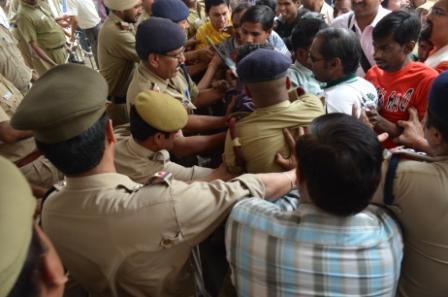
The Trinamool Congress-led Government of West Bengal is daily showing its anti-people character. Its Police and the bulldozers of the KMDA (Kolkata Metropolitan Development Authority) razed to the ground and burnt the slums and homes of more than 800 people in Nonadanga, Kolkata on 30th March 2012. These are the same people who were resettled after evictions from various canal banks across Kolkata, and from the dispossessed from the hurricane Aila in 2009. A protest march called against the forceful eviction by residents and progressive organisations and individuals on 4th April was also brutally lathicharged by the Police, critically injuring many. Yesterday on 8th April, a sit-in demonstration was violently broken and 67 people were arrested, with false cases pressed on seven activists of various democratic mass organisations supporting the struggle. They have been remanded in police custody till 12th April, and there is an attempt by the state to frame these democratic rights activists, falsely alleging that arms and ammunitions have been found on them. Also on 9th April, 114 demonstrators who were protesting against these moves by the government were arrested from College Street. On 10th April, a huge consignment of police has cordoned off the entire area and the threat of imminent demolition even of the temporary tents and community kitchen looms large, reminding us of the situation in Singur in 2006.

The government had earlier refused to provide even basic amenities like water, school, drainage system and proper housing in these resettlement colonies and pushed them into an `illegal’ existence, and made them dependent on the networks of local Trinamool and CPI(M) goons. And now in the name of beautification, this violent eviction drive is set on the roll on these supposed `illegal encroachers’ whose cheap labour is `legally exploited’ to run the city’s economy. Anyone opposing this kind of violent `development’ of the ruling classes, has been declared to be `Maoists’ and `inciting outsiders’ conveniently by the Chief Minister Mamata Banerjee again in her press statements to delegitimize the struggle, while the common lands of Kolkata are handed over to the corporate land sharks in the best traditions set up by the previous CPI(M)-led government.

We, the undersigned organisations, condemn the arrests made on 8th April of protestors sitting in a demonstration in Ruby Junction, and demand that the 7 activists of various mass organisations who continue to be arrested be released and the false charges against them be dropped immediately, as the government is acting against the democratic right to organize and dissent.

We condemn the action of the Trinamool-led West Bengal Government and the brutal lathicharge on 4th April, and continued harassment by the Kolkata Police on the residents of Nonadanga and those protesting against the ongoing eviction process in the name of `beautification’ of the city, and demand action against the police officers involved.

We stand with the struggle of the residents of Nonadanga and demand an immediate halt to the eviction drive in the city and the anti-people development, and proper compensation and rehabilitation for all the slum dwellers and hawkers in Nonadanga and in the evictions all over Kolkata.

AIFTU (New), AIRSO, AISA, Bigul Mazdoor Dasta, Delhi Metro Kamgar Union, Democratic Students Union, Disha Students Organisation, Inquilabi Mazdoor Kendra, Jamia Teachers Solidarity Forum, Krantikari Naujawan Sabha, Krantikari Yuva Sangathan, Pragatishil Mehnatkash Mazdoor Morcha, Mehnatkash Patrika, Mazdoor Patrika, Mehnatkash Mazdoor Morcha, New Socialist Initiative, Peoples Democratic Front of India, People’s Union for Democratic Rights, Posco Pratirodh Solidarity Delhi, Sanhati-Delhi, Students for Resistance, Vidyarthi Yuvajan Sabha

Nonadanga: Against Repression and Arrest

Parag,
Krantikari Naujawan Sabha

Condemn Repression in the name of ‘Development’ of the ‘Beautiful’ !
Demand Immediate Release of Arrested Dissenters !!

The ‘beautiful’ and the ‘developed’ entwined as it is with power, must make war on its underside, the ‘ugly’, the toiling, and demolish it, hide it under the shine of corporate towers and election promises. The brutal violence of the present process of ‘development’ in India comes buttressed with State Repression. This is exposed yet again when the Trinamool-led West Bengal government with its brute police force and Kolkata Municipal Development Corporation (KMDA) bulldozed and burnt the houses of 800 slum-dwellers in Nonadanga, South Kolkata on 30th March 2012 in the name of ‘beautification’. This is backed up with continuous state repression- residents who tried to resist their homes being demolished were beaten, picked up and put into police vans. Picking up pieces from their broken homes, setting up temporary shelters with vinyl sheets and a community kitchen, the residents organized a protest march the next day, and again on 4th April. This was met with brutal Police lathicharge and abuses, male plain-clothes personnel pounced on the women, kicked twenty-one year Rita Patra in her advanced pregnancy, split the head of two-and-a-half year old Joy Paswan. A sit-in demonstration was organized on 8th April- police forcefully arrested 67 people and again on 9th April, 114 student protestors were arrested from College Street. Seven activists of various mass organizations have been sent to police custody till 12th April with non-bailable warrants and allegations of ‘stockpiling of arms and ammunitions in Nonadanga’ doing the rounds in the Chief Minister’s press statements. Yesterday and again today 11th April, a huge consignment of police has cordoned off the entire area and the threat of imminent demolition even of the temporary tents and community kitchen looms large, reminding us of the situation in Singur of 2nd December 2006. A mass hunger strike has meanwhile started in the area by various progressive organizations, activists and intellectuals, which the state machinery is readying to crush.

The build-up to this has been the spate of eviction drives going on in the city under state supervision (read: repression) to hand over land to the corporate sharks at throw-away prices. All the roadside hawkers’s huts and shops and markets along an 8 km stretch have been demolished by the side of E.M. Bypass a few days ago. For Mamata’s ‘poriborton’, the working masses have to pay a price. The threat of an imminent eviction was looming large in Nonadanga days before the eviction drive. These are the people who have earlier been evicted from canal banks across Kolkata and have been resettled here and continue to be harassed by the networks of the local Trinamool and CPI(M) goons. Apprehending the worst, the residents met the Urban Development minister, Firhad Hakim who said that there will be eviction only for the ‘newcomers’. On the day before the scheduled date of eviction, the dwellers again went to meet the Chief Minister, but were stopped and arrested by the police just as they started their journey from Nonadanga. People of the locality then formed an independent forum named Uchhed Protirodh Committee (Eviction Protest Committee), with the help of several people and organisations who are supporting the movement who are now being accused of being close to Maoists.

The Question of “Legality” that Is Looming large in the Media and Civil Society

The police, administration and a section of media is playing on the hashed argument that the evicted people were ‘illegal’ dwellers and ‘encroachers’ in the area, that they do not possess any legal ownership documents etc. The history of colony movement in West Bengal was to resettle people who have come to Kolkata from elsewhere, and the vast majority of population in the areas like Jadavpur, Baghajatin, Garia etc were once refugees. These ‘encroachers’ have arrived in the city pushed by the crisis of agriculture in the rural areas, in search of any type of employment, some have been pushed here after being evicted from one place to another, and many have come from the Sundarbans after their homes and lands have been devastated by the cyclone Aila in 2009. If the people here are ‘illegal’, it is the State’s problem, which so-called constitutionally guarantees the ‘right of livelihood’, corollary of which is the right to land and habitation. Besides, their demand of an adequate rehabilitation is also perfectly within the ambit of law. So, where is the question of being ‘illegal’?

The obvious also does not point out that what is ‘legal’ may not be necessarily ethical. In fact, as history shows us, apart the regime of law set to protect the property rights of the rulers, the coming in of any new slightly progressive law or the amendment of an old one is almost always as a result of mass movements which were fought on the premise of such demands that were deemed as ‘illegal’ previously by the legal system. The ‘law and order problem’ approach of the State backfired when the struggles in Singur and Nandigram forced the government to consider changing the British era 1894 Land Acquisition Act. Every private land ownership in the world is basically a sort of forceful occupancy, some days earlier or some days later, and the modern state has come in between to stamp some of them legal and some illegal, according to its class interest.

Eviction: Not only a Question of Residence but of Political Economy

Brutal eviction drives have become normal in the ruling class agenda to pauperise the rural areas and move the thus insecure working masses to the cities, and restructure the cities themselves. Huge ‘industrial model towns’ and cities find no mention of workers housing even in the grand ‘master plans’. This is seen everywhere from Guwahati to Bhubaneshwar to Raipur to the resettlement colonies of Bawana and Bhalaswa in Delhi, and Kolkata is no exception. For one, in Kolkata the Land Revenue Department had acquired lands around the Nonadanga region about 25 years back to distribute them among the poor homeless people of the city. Since then, while a resettlement colony has been built up for the evicted people from other places, for the last few years, the wetlands and fisheries have been filled up and the land steadily sold in phases and parts to different companies and real estate developers who work in tandem with Trinamool and CPI(M) government officials and local goons. A section from among the settlers are also bought over given their precarious condition. Nonadanga is at just a stone’s throw from the eastern metropolitan bypass behind such glitzy corporate hospitals like Fortis, Ruby and Desunand and plans are on to transfer the land at throwaway prices to big real-estate projects by ‘Urbana’ and IT hubs. Obviously, in such a strategic location in a metropolis, they will not tolerate slums and ‘all these dirty people’.

While ‘restructuring’ of spaces to suit the needs of capital goes on, we need to remember that eviction is not only a question of residence of some people but a serious question of political economy, and that is how it relates itself to the other cross sections of society. To enter into the question we have to look at the means of livelihood of these residents here. People of Nonadanga are employed in various small scale industries, in petty production and many are unemployed workers. Some in the garment industry, some in the ‘Kasba Industrial Estate’ nearby, some in other small factories of the subcontractors of big industrial houses. A large number of people work as construction workers and contract workers in various places. Many are autodrivers, ricksaw-pullers, van-pullers, drivers of personal or official cars. Many people are self-employed in small roadside shops of food, tailoring, mobile-recharge, grocery and majority of women are employed as domestic-helps.

On their cheap labour, the social economy and architecture of the entire city stands. Especially the salaried masses and the lower middle classes are in a symbiotic relationship with them. The hawkers and roadside shops of “4 kachuri plus curry at Rs.10” evicted so that there is no other option than going to their Big Bazars, Walmarts and CCDs.; and so that this population already living below subsistence wages are further pauperised into selling their labour even cheaper. The domestic-helps for washing clothes, cleaning floors at Rs.300/month with 30 working days/month in morning and evening shifts will be dealt further blows. The formal sector anyway maintains its low real wage by virtue of the informal economy which creates a condition of lesser cost of regeneration of labour power. A vast section of middle class is convinced with the logic of capital propagated by the state, power-mongering political parties and omniscient media. There is a large section of the lower middle class in Kolkata who are the strata between slum dwellers and salaried masses who will be in serious crisis, because they are the consumers in relation to the people in Nonadanga and similar locations. For the ruling classes to have their beautification and accumulation growing, these are the people who have to pay a price.

Struggle against the evictions is ongoing in Kolkata, as in many other cities across the country. In Kolkata, slum-dwellers of different places are fighting against eviction and for housing, livelihood and the cost connected to their reproduction of their labour. These movements however have still not been able to build up solidarity among themselves and are still localised. The State and mainstream political parties are trying as always to create internal divisions among several sections of residents using their vulnerability and contradictions of their immediate interest. Advancement and generalisation of struggle can only throw out these problems from the arena of mass movements. We stand in solidarity with the struggle of people in Nonadanga for their right to housing and demand that the arrested activists be released and the false charges against them be immediately dropped.

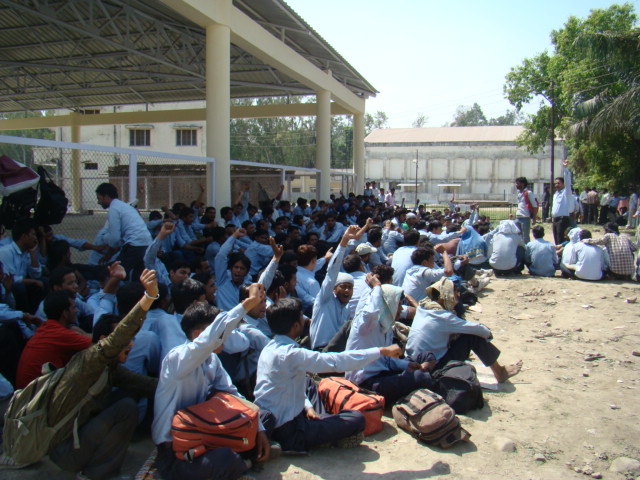
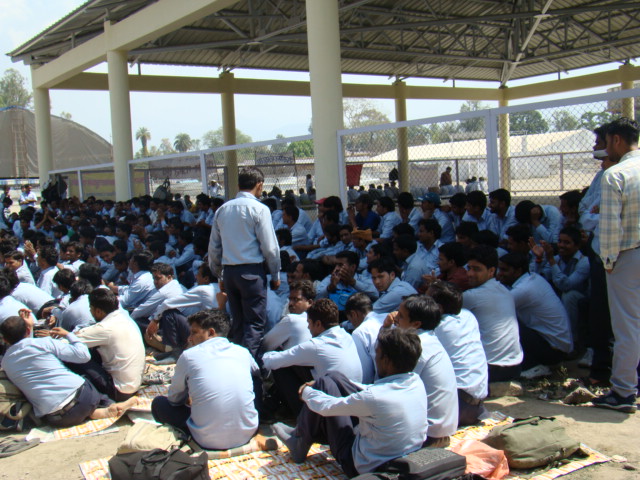
Haridwar Industrial Unrest “Manesar-like”

Inputs and Photos
by Trepan Singh Chauhan,
Uttarakhand Nav-Nirman Mazdoor Sangh

The 2011 Maruti Suzuki workers strike at Manesar (Gurgaon) has already become a metaphor for the new wave of industrial unrest in India, especially against the neoliberal industrial regime that makes the criminal violation of all kinds of regulation and labour laws by the corporate sector an imperative for growth and development. Manesar has come to signify the will of the workers to counter capital by spontaneous and solidaristic uprisings.

On April 4, Business Standard reported the strike in Haridwar in Satyam Auto and Rockman Industries, two leading auto parts suppliers to Hero MotoCorp, India’s largest two-wheeler company. This report was aptly captioned “Haridwar factories brew Manesar-like labour situation”. The strike, which has been going on for the last two weeks, has not been reported by any local or mainstream newspapers. According to the Business Standard report:

A two-week strike is unusual, but the managements of both companies have refused to agree to the workers’ demands. Unlike previous strikes here, this industrial action shows signs of disturbing the peace in the region, with support pouring in from workers at other companies. For the past one decade Haridwar and its neigbouring areas have seen investments from leading companies like Hindustan Unilever, luggage manufacturer VIP, battery manufacturer Eveready, and Hero MotoCorp. According to the BS report, “around 850 companies here employ over 70,000 people.”

So, as workers from the two strike-hit companies staged a protest here on Tuesday, outside the offices of the district administration, they were supported by workers from companies such as VIP, Eveready ITC and Bharat Heavy Electricals Ltd (BHEL). A similar march was taken out last Wednesday, too. Major trade unions such as the All India Trade Union Congress and Hind Mazdoor Sabha have supported the protesting workers. So are 13 workers’ unions at the public sector engineering major, BHEL. Workers at Eveready and VIP have presented their respective companies with charters of demands, including wage hike.

Since yesterday (April 4), workers of Rockman Industries and Satyam Auto have been occupying the Parade Ground, Dehradun (the capital city of Uttarakhand), and were on a day long fast today to press for their demands.

Blind Workers demonstrate for their rights (March 27)

Blind Workers’ Union
(A Unit of All India Federation of Blind Workers)
Affiliated to Workers Unity Center of India, WUCI
Contact: 9313730069 Email: blindworkersunion@gmail.com

Blind Workers’ Union all-up against violation of their labour rights and government inaction.
Blind Workers’ Union warns Social Justice Ministry of grave consequences if alternative jobs are not provided to retrenched blind workers.

Today (March 27), Blind Workers’ Union in mid of heavy deployment of police and barricades, staged a massive demonstration outside the Sarai Rohilla Railway Station in Delhi. Initially the unemployed blind workers tried to enter the railway station and block the rail traffic but the heavy contingents of police did not allow them to enter the railway track from any side. Thereafter these blind workers shouted anti-government slogans and held a protest meeting outside the station.

It is to be noted that the Blind Workers’ Union has been raising the issue of violation of blind workers basic labour rights since November, 2011. We have been raising our voice against violation of basic labour rights like minimum wage, PF, bonus, overtime payment etc. The workers were deeply agitated over the fact that despite several representations to the Ministry of Social Justice and Empowerment, there has been no concrete step taken either against the erring employers or to give these blind workers employment in public sector. These blind workers were thus forced to take up this drastic step so that general public becomes aware of their misery. These blind workers are demanding employment in public sector so that their rights are not violated by NGOs and private enterprises. In their most recent memorandum to Social Justice Ministry these blind workers demanded that the Ministry must make alternative provisions of jobs for these blind workers before 27th March or else they will be left with the alternative of either die of hunger or carry an all-out struggle against government.

In the protest meeting that was carried out outside the station it was resolved that this struggle of blind workers should be taken as an ultimatum by the government. They further warned the government and ministry that if they fail to provide employment immediately to these blind workers then from next month onwards they would be forced to carry out this Rail Roko in different parts of the country and next time they would even defy police.

Delhi University Women Students’ Struggle: An Appeal

Friends,

Since January of 2012, residents of Delhi University’s largest postgraduate women’s hostel, University Hostel for Women (UHW) have been waging a battle against outright suppression of their democratic rights by, both, their hostel authorities and the University’s Proctorial Committee. Since the hostel’s Chairperson is also the Proctor of the University, the Proctorial Committee has been intervening in the matter, not as a neutral party, but in complete connivance with the hostel authorities. There are two issues which are central to the ongoing struggle of the women students, namely, the imposition of a union constitution by the authorities, and the existence of archaic and conservative rules in the hostel. In the process of their struggle, the women hostellers have been individually victimized to a ridiculous extent by the hostel Provost, Professor Ashum Gupta and the Warden, Dr. Tanuja Agarwala. The Warden and Provost have been sending letters to departments, making misleading phone calls to parents, denying extension of stay to M.Phil researchers in the hostel, verbally threatening their MA students that they will be given less marks for projects and assignments if they continue to support the struggle, etc. As a result, the campaign of the women hostellers has also been geared towards fighting rampant victimization.

Our struggle began when on 22 January, 2012 a six page document was pasted on various notice boards inside the hostel. The document was a copy of the Hostel Union Constitution drafted by the authorities in consultation with the hostel’s Managing Committee. While such a crucial piece of document can only be put into force after being passed by a two third majority of the hostel residents, who are the actual constituents of the union, no such procedure was followed in our hostel. To make matters worse, the hostel authorities tried to hold this year’s hostel union election on the basis of this imposed Constitution. While the authorities claim that they are implementing procedures followed during other student elections of Delhi University (such as DUSU, etc.), the structure of the Hostel Union Constitution reveals something very different. For example, the Constitution drafted by the authorities allows for the outgoing union president to continue on the new hostel union as an ex-officio member! Similarly, before the residents began challenging the authorities, the newly announced election criteria consisted of stipulations which seriously prevented the formation of a strong, independent students’ union. The new election criteria were an unhealthy combination of the stringent Lyngdoh committee stipulations, as well as certain disqualification criteria formulated by the authorities themselves.

A “valid” candidature was, hence, ascertained according to the Lyngdoh recommendations on age and attendance to a course, as well as the system of memos (i.e. the issuing of warning letters for the smallest breach of hostel rules—most of these rules being highly unpopular and contested). The receipt of 5 such memos was arbitrarily made a criterion for disqualification. It is only because the women students united to fight this imposition of a hostel union constitution that certain non-Lyngdoh election stipulations (like disqualification on the basis of memos issued and number of years of residence in the hostel, etc.) were taken back by the authorities. Unsatisfied with this partial victory, the women students have pursued their struggle because apart from the arbitrary introduction of Lyngdoh recommendations, the Constitution imposed by the authorities allows for extensive control of the hostel authorities on the union. Since the attempts of the authorities has been to minimize the autonomy and strength of the students’ union, the hostel residents collectively decided to submit a signature petition to the hostel Warden and Chairperson.

The second issue on which UHW residents have been campaigning is existing hostel rules. Most of the rules in force are those formulated way back when the hostel was started in 1970. The current residents in the hostel are challenging rules such as ‘no exit after 8:00pm’, submission of leave applications approved by Head of Departments for more than one week’s absence from the hostel, the tedious procedure of gate pass and double-locking of rooms which does not exist in the men’s hostels, the limited number of late nights and nights out, closing off the canteen to visitors, etc. Many of these rules such as not being able to exit after 8pm are illogical, especially when we consider how the same authorities allow the residents entry up till 11:00pm under the late night provision. An archaic rule such as ‘no exit after 8pm’ prevents women students from stepping out for urgent work, or even something as simple as getting photocopies from the nearby market, Patel Chest.

However, apart from this, certain the rules (such as closing off the canteen to Miranda House and other college students and staff) have also worked towards making Chhatra Marg (where the hostel is situated) a more isolated place, and hence, unsafe. Certain other rules which are implemented solely in the women’s hostels, like the submission of leave applications approved by Head of Departments for more than one week’s absence from the hostel, are being misused to such an extent that the women hostellers and department heads are unnecessarily burdened with additional paperwork. It is, in fact, shameful that adult women are being made to seek approval from their departments even for personal matters such their travel/vacation plans.

Of course, under the pressure of the ongoing struggle, the University has decided to implement, from the new academic session, certain changes in the rules prevalent in women’s hostels. However, since these adjustments were discussed and formalized without any consultation with women students, they continue to create hassles for the women hostellers. Indeed, apart from a few proposed changes, most of the rules stand the same. In fact, not only will tedious procedures like gate-pass, double locking of rooms and issuing of memos for the smallest breach of hostel rules persist, the University’s new administrative order also proposes a hostel fee hike. Understandably, the women hostellers continue to agitate and raise their democratic concerns.

Typically, the collective struggle of the students has been trivialized and demeaned in several ways. Students’ democratic methods like calling meetings, circulating signature petitions, etc. are constantly projected by the authorities as “illegal” activities that spread “disturbance” and “disharmony”. Basically, when we take the initiative to raise our opinions and discontent, our authorities only see “untoward” activity…OUR VOICE IS NOISE FOR THEM!

Furthermore, ever since the women hostellers have been voicing their democratic aspirations, the authorities have viciously gone after individual students in the bid to transform UHW residents into a captive mass which has no democratic voice. The logic behind the multiple techniques of victimization is the need for the hostel authorities to break the collective will of the students and to project their collective struggle as that of a few individuals. In order to break the collective will and efforts of the residents, the authorities have been threatening individual students to withdraw from the struggle, and have tried to project the students’ legitimate struggle as a smear campaign pursued by one or two students who have some mysterious “agenda”. The techniques of victimization used unhesitatingly so far, include: (i) vicious character assassination, (ii) phone calls to parents and departments, (iii) accosting individuals on the stand they have taken and refusing to cooperate with them regarding the smallest of procedural work within the hostel, (iv) denying extension of stay to M.Phil researchers, (v) bombarding the more active students with show cause notices on every alternate day, etc.

For many of us these victimization techniques are equivalent to the techniques embraced by the management of private companies seeking to break the collective voice of their employees. Considering our hostel Warden is a faculty member of the Faculty of Management Studies (FMS), it comes as no surprise to us that typical labour management formulas are being applied on us students. Haranguing individuals, involving the families of the protesters, threatening individuals with a series of show cause notices, applying multiple pressure on individuals by involving a not-so-neutral third party (in our case, the Proctor’s office, and in the case of workers, the Labour Office), etc. are very similar to the methods used by factory managers who seek to crush the collective voice of their employees. Using such labour management methods, the hostel authorities went out of their way to expose their unethical and undemocratic nature on two particular occasions. One such occasion was on 14th February when a large number of women hostellers boycotted dinner in protest. Rather than being concerned about the condition of the residents boycotting dinner, the hostel authorities ‘rewarded’ those who refused to support the campaign with an extra lavish dinner, and spent the entire day calling individual students to the office in order to force them to withdraw their support for the boycott.

The second occasion on which typical labour management techniques were unleashed on the hostel residents was on the 13th of March. On this day, members of the hostel’s Managing Committee, two Deputy Proctors, the Warden, Provost and Resident Tutor huddled into office to hold a Managing Committee meeting, as promised in writing. Ironically, rather than allowing the students to select and send their representatives to the meeting, the hostel Warden handpicked two students to represent the students’ point of view in the meeting called to ‘resolve’ the issues raised by the residents. As expected these students’ ‘representatives’ were not the more vocal of students, and were forced to compromise as they were outnumbered in the Managing Committee meeting, and were, in fact, locked into the office area during the course of the meeting. Disrespect for amicable dialogue and the strong desire to create a docile mass of women students are clearly reflected in such cases.

As the situation stands, individual victimization continues on a daily basis. For example, despite verbal assurances given by the Dean of Colleges, Prof. Pachauri, on the 16th of March, the hostel Provost has continued to contact supervisors and Head of Departments. The hostel authorities also released a list on the 19th of March of M.Phil researchers who will not be provided an extension of stay, despite the precedent being that the hostel provides such extension in strongly recommended cases. The hostel authorities continue to run UHW as if it were their personal fiefdom. There really seems to be no way to check their authoritarian, undemocratic and unethical practices, unless the larger Delhi University community extends support to the women students.

WE, HENCE, APPEAL TO ALL CONCERNED UNIVERSITY MEMBERS AND ALUMNI OF UNIVERSITY HOSTEL FOR WOMEN (UHW) TO STAND WITH THE DEMOCRATIC ASPIRATIONS OF THE WOMEN STUDENTS, AND TO HELP PREVENT DELHI UNIVERSITY’S AUTHORITIES FROM REDUCING STUDENTS TO A VOICELESS, DOCILE MASS. In the larger context of the backlash against all democratic voices in this University, the ongoing struggle of women’s students emerges as a litmus test for democracy— do we as a University community want to create docile University youth, or right-bearing, politically conscious University youth?

Your contribution to this democratic struggle could consist of the following:
(i) Writing letters to the University’s Vice Chancellor that press for the prevention of individual victimization in its myriad forms, and for an amicable resolution to the issues raised by the students;
(ii) Writing letters to the University’s Vice Chancellor and Dean of Colleges that press for the removal of the hostel Provost and Warden since the two continue to derail a healthy dialogue process by victimizing individual students;
(iii) Writing letters to the media which highlight the sheer lack of tolerance for the democratic issues raised by the women students like the right to draft, amend and ratify their union constitution;
(iv) Discussion with colleagues and other faculty members so as to create a public opinion against how women’s hostels are being run according to the diktats of an authoritarian and conservative set of DU faculty members;
(v) Build students’ resistance against de-unionization and conservative rules, as in UHW, in other DU hostels as well.

Issued by Residents of University Hostel for Women (UHW)
COORDINATION COMMITTEE FOR WOMEN’S HOSTELS IN DELHI UNIVERSITY
Contact: 9350272637, 9818900179

Surprise yet uneven Human Rights Council conclusion: Sri Lanka-Tamils

Ron Ridenour

Human Rights Council voted today (March 22) to criticize the Sri Lankan government for “not adequately address[ing] serious allegations of violations of international law” when conducting its final phases of war against the liberation guerrilla army LTTE (Liberation Tigers for Tamil Eelam), which ended, May 18, 2009, with government-caused massive blood baths.

The resolution called upon Sri Lanka to implement its own findings and recommendations make in its report of the Lessons Learnt and Reconciliation Commission (LLRC), but extended that call to “initiate credible and independent actions to ensure justice, equity, accountability and reconciliation for all Sri Lankans.” (“Independent action” is not defined.)

Furthermore, the resolution with 24 in favor, 15 against and 8 abstentions, “encourages” the Office of the UN High Commissioner for Human Rights to offer the government “advice and technical assistance” in implementing the LLRC recommendations, and to make a report on the provision at the 22nd HRC session, a year from now.

In an earlier draft, Sri Lanka would have had to provide a time table to show implementation was underway. To acquire India’s vote, perhaps, the final resolution was watered down. No mention of war crimes or crimes against humanity is included; instead, Sri Lanka is asked to investigate “allegations of extra-judicial killings and enforced disappearances.” (See Tamilnet’s story with draft changes)

The resolution implies a lack of confidence in the Sri Lankan government to enact even its own mild investigation, while preventing any discussion of a more solid investigation into allegations of war crimes and crimes against humanity that the “Report of the Secretary-General’s Panel of Experts on Accountability in Sri Lanka” called for last year when it recommended an independent international investigation.

Comparison with May 2009 resolution

The resolution that US allies backed in May 2009 [the US was not on the Council then] also called upon Sri Lanka to investigate itself for possible human rights abuse, while condemning only the LTTE for terrorism and war crimes and other human rights abuses. Even though this resolution only asked the police to investigate themselves, many governments took this as an affront to sovereignty. 29 countries voted to applaud Sri Lanka and condemn only the LTTE. Nothing was stated about the suffering of hundreds of thousands of Tamil civilians. This resolution was opposed by12 votes and there were six abstentions. The pattern was clear then: nearly all the Non-Aligned Movement governments voted for Sri Lanka, and the West voted for a possible critique.

This time the geo-political voting pattern was broken, and, coincidently, disproved my prediction that Sri Lanka would come through without a slap on the face.

The changes in voting are interesting:

Latin American and Africa changed votes significantly.

In 2009, all of the African governments on the Council voted fully in favor of Sri Lanka with one abstention. This time the vote was split with five in favor of the possible criticism, three opposed and five abstentions.

In 2009, five of Latin American governments voted to fully support Sri Lanka, two voted for some critique (Chile and Mexico) and Argentine abstained. Today, six governments voted for the critique with only the two ALBA (Bolivarian Alliance for the Peoples of our America) governments voting against any critique (Cuba and Ecuador).

The Middle Eastern governments did not change. They all voted not to criticize with one abstention, the same pattern as in 2009.

Europe, west and east, voted the same way: slight critique.

Russia and China backed Sri Lanka fully.

The countries still on the Council since 2009, which changed their votes from support of Sri Lanka to critique are: Cameroon and Nigeria; India; Uruguay.

The most significant reversal is India, given its several decades’-long-relationship supporting the Island nation so close to it. Although India changed its vote it balanced the change with sovereign state solidarity with Sri Lanka.

“While we subscribe to the broader message of this resolution and the objectives it promotes, we also underline that any assistance from the Office of the High Commissioner on Human Rights or visits of UN Special Procedures should be in consultation with and with the concurrence of the Sri Lankan Government,” read the Indian statement, as reported by Tamilnet.com

“Observers in Tamil Nadu said that the Indian statement contradicted the demands put forward by Tamil Nadu Chief Minister Ms. J. Jayalalithaa, who had demanded India to declare SL President Mahinda Rajapaksa complicit in genocide and war-crimes and to call for economic sanctions against Sri Lanka till the country ensured equal status to Tamils,” the website reported.

Uruguay’s change is also important. Its new president, José Mujica, was a left-wing guerrilla who spent 15 years in prison, two of it at the bottom of a well. He has placed poverty as the first order of business.

Peru was not on the Council in 2009 but its new government with Ollanta Humala as president voted to criticize Sri Lanka. He has also vowed to tackle poverty as his first priority.

The fact that two African governments have reversed their vote may indicate that international agitation has had an effect. More NAM governments abstained this time as well.

Why the difference?

Although it was the greatest terrorist state in the world that introduced the critical resolution, the United States is still a partner in the war crimes and in genocide against Tamils. It always backed Sinhalese chauvinism, discrimination against Tamils, and offered no aid to Tamil civilians. But it sees an opportunity here to polish its image as a “human rights supporter” while maintaining systematic human rights abuse in its many invasions and military interventions in the world.

The current US president is at war in seven countries, all circumscribing United Nations laws against invading countries that have not invaded the propagator of war: Afghanistan, Iraq [tens of thousands of US war mercenaries still occupy Iraq], Pakistan, Somalia, Uganda, Sudan and Libya. Furthermore, without US backing the Palestinian people would have been liberated from Zionist Israel ages ago.

These are some factors in the change:

1. Indian Tamils in Tamil Nadu and Sri Lanka Tamils living in the Diaspora in many countries have, since the end of the war, conducted many protests and lobbied governments for justice. A few Tamils have even committed suicide in despair and in protest.

2. Channel 4 two-part “Killing Field” series. The second one was shown during these sessions and clearly pointed an accusing finger at the Rajapaksa family regime for standing behind horrendous murders, mutilations, rape; in short, war crimes and crimes against humanity.

3. Mainstream Tamil parties in parliament in Tamil Nadu, India, were a major influence in convincing the central government to change its vote from one of applauding Sri Lanka to this critical stance.

4. The US is making it clear to Sri Lanka’s government that it is dissatisfied with it even while approving a World Bank loan of $213 million for development in the capital city, Colombo, just a week ago. The US keeps its fingers in the economy while it shows its unhappiness because Rajapaksa is offering more economic concessions to China and Russia. The US has lost its long-hoped for port in Trincomalee harbor, which China will probably acquire.

It was China, as well as Russia, Israel and Iran and Pakistan (not exactly blood brothers) that gave and sold more military hardware to Sri Lanka in the last two-three years of war to annihilate the LTTE. The US-UK and NATO offered far less in the latter period given that they were bogged down in the Middle East.

Conclusion

Perhaps nothing substantial for Tamils in Sri Lanka will come out of this Human Rights Geo-Political game, not simply in and of itself. But the game’s rules are changed, at least in this area of the world, when so many NAM members have not sided with a fellow member. I believe that this is the case, in large part, because the evidence of gross atrocities has come to the surface. No doubt, US+ machinations have had some effect. But we should not be fooled that these governments are interested in the human rights of any people. The current president sees an opportunity to score points by pointing a finger at a real culprit, just as he sought to do in Libya under false pretenses and as he is trying in Syria. He, like all capitalist presidents, seeks oil, profits and domination. He can afford to point a finger at Sri Lanka’s government today, because he has lost influence there and because he wants re-election votes from human rights-concerned citizens, albeit beguiled ones.

Cuba, which started the ALBA coalition with Venezuela in 2004, needs to reflect upon its foreign policy stance and especially in regards to Sri Lanka. It has politically backed Sri Lanka, in part, because they are both members of NAM, and Cuba often acts in a knee jerk manner when the US points its finger at other nations, especially third world countries—understandably.

Yet Cuba goes overboard in backing this most ruthless Sri Lankan regime responsible for scores of thousands of civilian deaths, incarcerating hundreds of thousands without due process, continues militarizing traditional Tamil homeland in the North and East, taking over homes, businesses, places of worship and building hotels upon Tamil graveyards.

Cuba’s has acted immorally, and in contrast to its long-time solidarity with the oppressed and exploited peoples of the world.

The evidence of war crimes, crimes against human, and even genocide, is much too vivid due to testimonies of victims, satellite photos and the excellent Channel 4 documentaries with photos and videos taken either by UN aid workers, some by victims or by Sri Lankan murdering soldiers and then sold or otherwise released to the public.

If Tamils in India and in the Diaspora keep up the pressure, if left organizations, grass roots groups, representatives of other oppressed peoples seeking liberation (such as Palestinians, Kurds in Turkey, Basques, Irish…) would join in united fronts for liberation for one and all, then we might be able to bring some real hope for Tamils in Sri Lanka.

Be not fooled: The US does not want true accountability, or a Tamil Eelam homeland for the oppressed minority, but the spotlight is turned on and peoples’ power could stoke the light bringing, at least, relief to the down-trodden Tamil people.

Economy Democracy Manifesto

A new historical vista is opening before us in this time of change. Capitalism as a system has spawned deepening economic crisis alongside its bought-and-paid for political establishment. Neither serves the needs of our society. Whether it is secure, well-paid and meaningful jobs or a sustainable relationship with the natural environment that we depend on, our society is not delivering the results people need and deserve. We do not have the lives we want and our children’s future is threatened because of social conditions that can and should be changed. One key cause for this intolerable state of affairs is the lack of genuine democracy in our economy as well as in our politics. One key solution is thus the institution of genuine economic democracy as the basis for a genuine political democracy as well. That means transforming the workplace in our society as we propose in what follows.

We are encouraged by The Occupy Wall Street (OWS) movement spreading across the United States and beyond. Not only does OWS express a widespread popular rejection of our system’s social injustice and lack of democracy. OWS is also a movement for goals that include economic democracy. We welcome, support, and seek to build OWS as the urgently needed, broad movement to reorganize our society, to make our institutions accountable to the public will, and to establish both economic democracy and ecological sanity.

1) Capitalism and “delivering the goods”

Capitalism today abuses the people, environment, politics and culture in equal measures. It has fostered new extremes of wealth and poverty inside most countries, and such extremes always undermine or prevent democratic politics. Capitalist production for profit likewise endangers us by its global warming, widening pollution, and looming energy crisis. And now capitalism’s recurrent instability (what others call the “business cycle”) has plunged the world into the second massive global economic crisis in the last 75 years.

Yet both Republican and Democratic governments have failed to bring a recovery to the great mass of the American people. We continue to face high unemployment and home foreclosures alongside shrinking real wages, benefits and job security. Thus, increasing personal debt is required to secure basic needs. The government uses our taxes to bring recovery from the economic crisis to banks, stock markets, and major corporations. We have waited for bailouts of the corporate rich to trickle down to the rest of us; it never happened. To pay for their recovery we are told now to submit to cuts in public services, public employment, and even our social security and Medicare benefits. The budget deficits and national debts incurred to save capitalism from its own fundamental flaws are now used to justify shifting the cost of their recovery onto everyone else. We should not pay for capitalism’s crisis and for the government’s unjust and failed response to that crisis. It is time to take a different path, to make long-overdue economic, social and political changes.

We begin by drawing lessons from previous efforts to go beyond capitalism. Traditional socialism – as in the USSR – emphasized public instead of private ownership of means of production and government economic planning instead of markets. But that concentrated too much power in the government and thereby corrupted the socialist project. Yet the recent reversions back to capitalism neither overcame nor rectified the failures of Soviet-style socialism.

We have also learned from the last great capitalist crisis in the US during the1930s. Then an unprecedented upsurge of union organizing by the CIO and political mobilizations by Socialist and Communist parties won major reforms: establishing Social Security and unemployment insurance, creating and filling 11 million federal jobs. Very expensive reforms in the middle of a depression were paid for in part by heavily taxing corporations and the rich (who were also then heavily regulated). However, New Deal reforms were evaded, weakened or abolished in the decades after 1945. To increase their profits, major corporate shareholders and their boards of directors had every incentive to dismantle reforms. They used their profits to undo the New Deal. Reforms won will always remain insecure until workers who benefit from the reforms are in the position of receiving the profits of their enterprises and using them to extend, not undermine, those reforms.

The task facing us, therefore, goes well beyond choosing between private and public ownership and between markets and planning. Nor can we be content to re-enact reforms that capitalist enterprises can and will undermine. These are not our only alternatives. The strategy we propose is to establish a genuinely democratic basis – by means of reorganizing our productive enterprises – to support those reforms and that combination of property ownership and distribution of resources and products that best serve our social, cultural and ecological needs.

2) Economic Democracy at the Workplace and in Society

The change we propose – as a new and major addition to the agenda for social change – is to occur inside production: inside the enterprises and other institutions (households, the state, schools, and so on) that produce and distribute the goods and services upon which society depends. Wherever production occurs, the workers must become collectively their own bosses, their own board of directors. Everyone’s job description would change: in addition to your specific task, you would be required to participate fully in designing and running the enterprise. Decisions once made by private corporate boards of directors or state officials – what, how and where to produce and how to use the revenues received – would instead be made collectively and democratically by the workers themselves. Education would be redesigned to train all persons in the leadership and control functions now reserved for elites.

Such a reorganization of production would finally and genuinely subordinate the state to the people. The state’s revenues (taxes, etc.) would depend on what the workers gave the state out of the revenues of the workers’ enterprises. Instead of capitalists, a small minority, funding and thereby controlling the state, the majority – workers – would finally gain that crucial social position.

Of course, workplace democracy must intertwine with community democracy in the residential locations that are mutually interactive and interdependent with work locations. Economic and political democracy need and would reinforce one another. Self-directed workers and self-directed community residents must democratically share decision-making at both locations. Local, regional and national state institutions will henceforth incorporate shared democratic decision-making between workplace and residence based communities. Such institutions would draw upon the lessons of past capitalist and socialist experiences.

3) Benefits of Workplace Democracy

When workforce and residential communities decide together how the economy evolves, the results will differ sharply from the results of capitalism. Workplace democracy would not, for example, move production to other countries as capitalist corporations have done. Workers’ self-directed enterprises would not pay a few top managers huge salaries and bonuses while most workers’ paychecks and benefits stagnate. Worker-run enterprises sharing democratic decision-making with surrounding communities would not install toxic and dangerous technologies as capitalist enterprises often do to earn more profits. They would, however, be far more likely to provide daycare, elder care and other supportive services. For the first time in human history, societies could democratically rethink and re-organize the time they devote to work, play, relationships, and cultural activities. Instead of complaining that we lack time for the most meaningful parts of our lives, we could together decide to reduce labor time, to concentrate on the consumer goods we really need, and thereby to allow more time for the important relationships in our lives. We might thereby overcome the divisions and tensions (often defined in racial, gender, ethnic, religious, and other terms) that capitalism imposes on populations by splitting them into fully employed, partly employed, and contingent laborers, and those excluded from the labor market.

A new society can be built on the basis of democratically reorganizing our workplaces, where adults spend most of their lifetimes. Over recent centuries, the human community dispensed with kings, emperors, and czars in favor of representative (and partly democratic) parliaments and congresses. The fears and warnings of disaster by those opposed to that social change were proved wrong by history. The change we advocate today takes democracy another necessary and logical step: into the workplace. Those who fear (and threaten) that it will not work will likewise be proven wrong.

4) An Immediate and Realistic Project

There are practical and popular steps we can take now toward realizing economic democracy. Against massive, wasteful and cruel unemployment and poverty, we propose a new kind of public works program. It would differ from the federal employment programs of the New Deal (when FDR hired millions of the unemployed) in two ways. First, it would focus on a “green” and support service agenda. By “green” we mean massively improving the sustainability of workplace and residential communities by, for example, building energy-saving mass transportation systems, restoring waterways, forests, etc., weatherizing residential and workplace structures, and establishing systematic anti-pollution programs. By “support service” we mean new programs of children’s day-care and elder-care to help all families coping with the conditions of work and demographics in the US today.

However, the new kind of pubic works program we propose would differ even more dramatically from all past public works projects. Instead of paying a weekly dole to the unemployed, our public works program would emphasize providing the unemployed with the funds to begin and build their own cooperative, self-directed democratic enterprises.

The gains from this project are many. The ecological benefits alone would make this the most massive environmental program in US history. Economic benefits would be huge as millions of citizens restore self-esteem damaged by unemployment and earn incomes enabling them to keep their homes and, by their purchases, provide jobs to others. Public employment at decent pay for all would go a long way toward lessening the gender, racial, and other job discriminations now dividing our people.

A special benefit would be a new freedom of choice for Americans. As a people, we could see, examine and evaluate the benefits of working inside enterprises where every worker is both employee and employer, where decisions are debated and decided democratically. For the first time in US history, we will begin to enjoy this freedom of choice: working in a top-down, hierarchically organized capitalist corporation or working in a cooperative, democratic workplace. The future of our society will then depend on how Americans make that choice, and that is how the future of a democratic society should be determined.

5) The Rich Roots Sustaining this Project

Americans have been interested in and built various kinds of cooperative enterprises – more or less non-capitalist enterprises – throughout our history. The idea of building a “cooperative commonwealth” has repeatedly attracted many. Today, an estimated 13.7 million Americans work in 11,400 Employee Stock Ownership Plan companies (ESOPs), in which employees own part or all of those companies. So-called “not-for-profit” enterprises abound across the US in many different fields. Some alternative, non-capitalist enterprises are inspired by the example of Mondragon, a federation of over 250 democratically-run worker cooperatives employing 100,000 based in Spain’s Basque region. Since their wages are determined by the worker-owners themselves, the ratio between the wages of those with mostly executive functions and others average 5:1 as compared to the 475:1 in contemporary capitalist multinational corporations.

The US cooperative movement stretches today from the Arizmendi Association (San Francisco Bay) to the Vida Verde Cleaning Cooperative (Massachusetts) to Black Star Collective Pub and Brewery (Austin, Texas), to name just a few. The largest conglomerate of worker owned co-operatives in the U.S. is the “Evergreen Cooperative Model” (or “Cleveland Model”), consisting e.g. of the Evergreen Cooperative Laundry (ECL), the Ohio Cooperative Solar (OCS), and the Green City Growers. These cooperatives share a) common ownership and democracy at the workplace; b) ecological commitments to produce sustainable goods and services and create “green jobs”, and c) new kinds of communal economic planning, mediated by “anchor institutions” (e.g. universities, non-profit hospitals), community foundations, development funds, state-owned banks or employee ownership banks etc. Such cooperatives are generating new concepts and kinds of economic development.

These examples’ varying kinds and degrees of democracy in the workplace all attest to an immense social basis of interest in and commitment to non-capitalist forms of work. Contrary to much popular mythology, there is a solid popular base for a movement to expand and diversify the options for organizing production. Workplace democracy responds to deep needs and desires.

If you are interested in getting further information about this proposal, in joining the discussion it engages, or in participating in activities to achieve its realization, please find us on Facebook at Economic Democracy Manifesto or email manifesto@rdwolff.com

“Economic Democracy Manifesto” Group

David van Arsdale
Michael McCabe
Costas Panayotakis
Jan Rehmann
Sohnya Sayres
Billy Wharton
Richard D. Wolff

A Review of Henry Bernstein’s “Class Dynamics of Agrarian Change”

Bhumika Chauhan

Henry Bernstein, Class Dynamics of Agrarian Change, Fernwood Press & Kumarian Press, 2010

This book, written by Henry Bernstein, is the first in the Agrarian Change and Peasant Studies series published by ‘Initiatives in Critical Agrarian Studies’ (based at the International Institute of Social Studies, The Hague, Netherlands). Considering the size of the task it takes on in barely 125 pages – of providing an introduction to, an overview of, and a perspective on agrarian formations and transformations under capitalism – it would not have been possible, perhaps, for anybody else but Henry Bernstein to undertake it. His intimate and longstanding involvement in setting the agenda for the debates on the agrarian question allows him to paint the “big picture” of agrarian change in capitalism through generalisation and periodisation, yet remaining extremely sensitive to the specificities of its realisation in diverse spatial-temporal locations.

Marx derived the logic of capital and capitalist transformation by studying the industrial capitalism of northwest Europe – his account of agrarian change was also delimited by this concern. This leaves much space to be filled, as is one of Bernstein’s aims in this book, with an understanding of capitalism and agriculture before and since modern industrialisation. This is furthermore required in order to grasp the richness of Marx’s critique of political economy, and for its internal nurturing by exposing its conceptual and analytical tools to diverse empirical realities. As Bernstein himself states, the initial concerns of the book are “how capitalism developed in primarily agrarian societies before industrialization”, and “how agrarian change has been shaped by industrial capitalism once it was established and spread” (p.9). Of course, many have already made significant contributions in this direction. The importance of this slim volume lies in its attempt to consolidate them into a fairly coherent account of the complexity of agrarian change.

In attempts at understanding the development of capitalism, Bernstein distinguishes between two dominant approaches. The first focuses on understanding diverse national paths to agrarian capitalism. The classic case in this regard is of course the English path which Marx analysed – the crisis of feudalism in the 14th and 15th centuries leading to a change in class structure and the rise of the capitalist tenant farmer. In Prussia the feudal lords themselves became capitalist commodity producers and converted the peasants into wage labourers. In America, engagement in commodity relations led to the emergence of capitalist farming out of the independent small holding farmer, while in Japan and South Korea, the transition was a result of primitive accumulation for industrialisation through taxation of peasantry, without the development of agrarian capitalism (pp. 27-32).

The second perspective traces the “long march of commercial capitalism” since the 12th century towards agrarian capitalism. Bernstein finds elements of this perspective in the works of Giovanni Arrighi, Jairus Banaji and Jason Moore. They argue that if one were to look at international patterns of trade and finance it would be clear that capitalism was world-historic since its birth. In this line of thought, the English transition to agrarian capitalism occurred in the larger context of Dutch hegemony over world-capitalism, while England became hegemonic only after pioneering the Industrial Revolution. Rather disappointingly, this assertion which is apparently central to the theorisation of the development of capitalism is not sufficiently explained or substantiated.

However, despite lacking sufficient elaboration as far as the larger picture of the ‘long march’ is concerned, Bernstein’s exposition of the dynamics of labour and capital within commercial capitalism is nuanced and complex. The key classes in commercial capitalism, he writes, included aristocratic and colonial landlords who organised specialised commodity production, merchants who advanced credit and material to handicraftsmen and other producers of manufactured goods, capitalists in extractive sectors of mining and forestry, and financiers who funded this development. All of them were true capitalists according to Bernstein: they exploited labour for profit, invested to expand production, even through increased productivity, funded new sites for commodity production, and developed new markets for those commodities (p.33). Bernstein lays great stress on the fact that even before the emergence of industrial capital, and outside of the agrarian capital that developed in England, commercial capital in agriculture was already capitalist.

Commercial capitalism also utilised more flexible forms of labour than the ones Marx observed to be predominant in industrial capitalism. Bernstein endorses Banaji’s argument that capital is capable of exploiting labour in a variety of social arrangements and in varied historical circumstances, like in the form of slavery in specialised commodity production in plantations. The labourer may not be entirely dispossessed but loses the ability to reproduce himself outside commodity production. Here, Bernstein uses Robert Brenner’s concept of commodification of subsistence, which is shown to be central to the early trajectory of capitalism, along with the persistence of small farms, especially in the South.

Bernstein goes on to discuss the incorporation of the remaining world peasantry into the capitalist world through colonialism. The colonial state brought new agrarian production structures into the colonies: slave plantations in southern North America, haciendas in Latin America, zamindari and ryotwari in India, trade economies, labour reserves and concessionary companies in Africa. These did not only serve the budgets of the administration and the colonial state, but also led to “forced commercialization”. The peasants of the colonies were now the producers of cash crops for export, food crops for the domestic market as well as for export, and of labour power (workers, who also migrated from farms to plantations, railways construction etc.). The specialised industrial plantations of the nineteenth century experienced the classic type of capitalist commodity production although the majority of agricultural production in colonies witnessed petty commodity production. Undoubtedly, commodity production and commodification of subsistence had set in colonial peasantry in various forms and at various levels.

In this exploration of the relation between capitalism and colonialism, we encounter many debates surrounding colonialism, especially ones that centre on this question, and the connected one of how colonialism contributed to an incomplete capitalist transition in colonies. These discussions invariably keep coming to the issue of capitalist and pre-capitalist organisation of labour. Not all of the varied forms of labour regimes that colonialism instituted in the colonies – forced, semi-proletarian, family labour/petty commodity production and proletarianisation (p.54) – fit the classical model of capitalist production. Most of them were hybrids of ‘forced/unfree’ and ‘free’ wage labour. Those who understand the English path of transition to capitalism as the paradigm for this transition, think of all forms of labour except the ‘fully free’ one, to be ‘pre-capitalist’. Bernstein affirms Banaji’s contention that ‘free’ and ‘unfree’ labours are fluid and ambiguous in social reality, and like others who argue for the “long history of commercial capitalism”, identifies social relations characterising all regimes of labour, established in the South by European colonialism, as capitalist.

Bernstein’s account of agrarian change since the 1870s highlights the role played by upstream and downstream activities in agriculture; it is through such activities that capitalism has penetrated to the most independent of farms. Upstream activities concern the conditions of production such as the supply of inputs and instruments of labour. Downstream activities include marketing, distribution and processing of farm produce. The book shows how with industrialisation, these activities have risen to such great importance that even so-called self-sufficient farmers have come to depend on powerful agents like agri-input and agri-food capital. This dependence has made them ever more dependent on money income for the purchase of means of subsistence: what we have called commodification of subsistence.

With the rise of neoliberal globalisation in agriculture there is a further deepening of commodification. With substantial withdrawal of the State from agriculture (more in the South than the North), transnational agribusinesses have become major agents in organising and regulating conditions of production and consumption within the global food economy (p.81). Along with the commodification of subsistence, Bernstein notes, there has been a new wave of depeasantisation. Much like in other domains, neoliberalism in agriculture is propped upon “accumulation by dispossession,” or to put it in a more orthodox manner, primitive accumulation, which entails the divorcing of the farmer from the means to farm.

That capitalism is still dispossessing the peasantry forces us to take note of an interesting fact: that the dispossession of the peasantry has been a very slow process, that capitalism has for a very long time, allowed a large portion of the population some means of production (in this case, land). This persistence of peasants or the continuing survival of non-capitalist farms is of particular interest to Bernstein as are those movements that strive for their preservation and restoration, movements that neoliberalism has re-invigorated. The issue of the persistence of peasantry, significant for epistemological-methodological as well as political reasons, comes up frequently in the book but receives a detailed treatment in the last three chapters that deal directly with class dynamics in agriculture. It is a methodological issue insofar as the simplistic way of understanding small farmers that grasps class as a sociologically fixed category and makes use of crude binaries, prevalent in even Marxist circles, is undialectical, and is often guilty of shying away from engaging with concrete facts; it is political because only an accurate analysis of class dynamics makes visible the struggle that lies inside the apparently homogenous class of peasants.

Bernstein presents three sets of explanations for the slow pace of depeasantisation. One, peasants themselves have, in various ways and to varying degrees, resisted commodification, dispossession and proletarianisation. But Bernstein finds this explanation to be inadequate because it does not take into account the interests and power of capital; he points out that often indigenous peasants, of their own initiative, turn to commodity production, and eventually capitalist farming (p.97). Peasant response to commodification has not been one of simple acceptance or rejection. It is marked by a complicated process of negotiation. The second set of explanations is that farming consists of certain technical and social aspects that obstruct capitalist investment. Because of this, capital is more comfortable letting the farmer take all risks and burdens involved, preferring upstream to downstream businesses. This second explanation is closely related to the third.

The third set of explanations for peasants’ persistence is that they work to the benefit of capital. Bernstein argues that family farms are not merely to be seen as competing with or independent of capitalist corporations. Many of them are dependent on upstream or downstream corporations and banks via contracts or other arrangements. Following Kautsky, he explains that the peasantry persists, or rather, is allowed to exist by capital, only so long as it helps lower the cost of labour-power (p.94). That is to say, family-worked farms could produce cheaper food commodities and lower the cost of labour power, and hence wage. Furthermore, peasants and small farmers who sell a portion of their labour-power can make do with low wages, because a part of their reproduction is provided for by their farms.

In all such explanations, there is some notion that small farmers are exploited by capital. According to Bernstein there are several notions of exploitation by capital as far as family labour is concerned: “as labour force working with other people’s means of production or as self-exploiting in ways that represent indirect exploitation by capital or at least in ways that benefit capital” (p.101). For some, the agrarian populists particularly, the small-scale farm is to be treated as one class in relation to capital which exploits it. Such notions are further fuelled by the recent spree of peasant dispossession. However, Bernstein argues that the small-scale, family farms are themselves differentiating into classes with the increasing penetration of capital, and not all of them are at the losing end.

To explain this assertion, Bernstein explores the class dynamics of family farming. This requires us to first understand the process of commodification in family farming. He asserts that the tendency of capital towards generalised commodity production does not imply that “all elements of social existence are necessarily and comprehensively commodified. Rather it signifies the commodification of subsistence: that reproduction cannot take place outside commodity relations and the discipline they impose” (p.102; emphasis original). And as has been demonstrated already, commodification of subsistence is characteristic of small farmers. Small farmers are also (before further differentiation) petty commodity producers, and petty commodity production in capitalism combines the class “places” of capital, in the form of land, tools, seeds, fertilizers etc., and labour, in the form of families/households. There is then, in petty commodity production, a contradiction between these two class places, that is between the reproduction of capital and the reproduction of labour; money, on the one hand, has to be allocated for rent and replacement of other means of production, and on the other, for consumption.

This contradiction, Bernstein asserts, is the source of differentiation among small, ‘non-capitalist’ farmers. Rich peasants or emergent capitalist farmers expand themselves as capital and tend to employ wage labour. Those struggling to reproduce themselves as capital as well as labour are the poor farmers. The contradiction of the two class places in petty commodity production is most apparent in the poor farmers when they try to push down the scale of consumption of the family, the labour, in order to keep ownership of land, the capital. The middle farmers are those who can reproduce themselves as capital on the same scale of production, and as labour on the same scale of consumption. These relatively stable petty commodity producers are at the heart of agrarian populism and its notion of self-sufficient farmers. They are of special interest to Bernstein since even these seemingly self-sufficient farmers usually exploit wage labour.

After explaining the class position of small farmers, Bernstein goes on to explain how these farmers are integrated into capitalism even outside the farm. The emergent capitalist farmer invests in upstream and downstream businesses like crop trading and processing, rural retail trade, transport, advancing credit etc. Poor farmers, it has been seen, cannot survive without selling their labour power wherever possible. Even medium farmers engage in off-farm activities including labour migration. Such off-farm activity is necessary for many medium-farmer households if they are to avoid proletarianisation. The facts are that there are no self-sufficient family farms that neither hire nor sell wage labour, and that all three classes of farmers are engaged in the wider capitalist market. And these facts clearly go against the assertions of those who claim that (1) there are ‘non-capitalist’, self-sufficient ‘small family farm’, and (2) they need to be guarded against capitalist penetration. Bernstein effectively demonstrates that there is no self-sufficiency in family farms, and capital has already penetrated to the roots.

So, if one places the agricultural sector, as one should, within the larger context in which it is truly situated, that is, if one takes into account the determinations beyond farming and agriculture, then the diversity of class formations in the countryside of the global South (the very many in-betweens we encounter: semi-proletarians etc.) begins to become comprehensible. As such, Bernstein speaks of classes of labour: “[t]he social locations and identities the working poor inhabit, combine and move between make for ever more fluid boundaries and defy inherited assumptions of fixed and uniform notions of ‘worker,’ ‘famers,’ ‘petty trader,’ ‘urban,’ ‘rural,’ ’employed,’ and ‘self-employed'” (p.111). He also distinguishes between different “classes of capital” on the basis of different “interests and strategies of capital in particular activities and sectors like industry, finance or agriculture and on scales from local to regional, national and international” (p.112). By this logic, the corporate agribusinesses and the “rich peasants” are different, yet part of the same capitalist class.

In the final chapter, Bernstein arrives at the political aspects of class struggle. Class exploitation, he writes, is not experienced in any pure form, but is mediated through specific identities like “urban/rural dwellers, industrial workers/agricultural labourers, urban craftsmen and women peasants, men/women, mental/manual labour, young/old, black/white, regional, national and ethnic differences and so on” (Gibbon and Neocosmos 1985 cited on p.117). Differentiating between “struggle over class” and “struggle between classes” (p.117), Bernstein concludes that the former is a condition of the latter, that is, the struggles over class of the working poor are inflected and restricted by social divisions such as religion, caste, colour and gender. The struggle between classes can only be successful subsequent to the working class resolving the social divisions within. He asks us to appreciate the complexity of the experience of the circumstance of oppression.

Bernstein’s thrust in the book is on uncovering the class reality of the small-farmers, refuting positions that assert that a homogenous class of independent farmers exists, and exposing farmers’ movements that claim to represent all farmers but actually serve the interest of the rich peasants. While these are very relevant theoretical and political issues that need to be addressed, a greater attention could have been given to the task of providing a more thorough perspective on agriculture in general and its overall class structure. The book also lacks adequate empirical support for assertions regarding the contribution of off-farm activities to the household income of family-farmers. Furthermore, despite being so concerned with the South, there is not much said on the various positions articulated within the mode of production debate on Indian agriculture (excepting Banaji’s); another oversight for a book aiming to make new students of agrarian relations familiar with important works and debates. Additionally, a small issue with the style of the book is that its simplicity at times ends up giving a very simplistic sense of very complex processes and experiences to the unfamiliar reader.

However, for the not so unfamiliar reader, and for the activist, for people, that is, who are aware of the numerous compounded issues that the agrarian working class, and the working class in general, faces, Bernstein’s book provides a ‘big picture’. Instead of focusing on one or a few problems of the agrarian population, like so many works on agrarian change have already done, Bernstein attempts to create a broader perspective about capitalist transformation in agriculture.

Politically, the book makes several significant contributions, not perhaps in saying something very new, but certainly in reiterating some very important things. In focusing on the fact that capital may exploit labour in many ways, including, without completely divorcing it from the means of production, the book tells us, like a few have tried to in the past as well, that the working-class may be found in many locations. Bernstein understands class as a process, intersecting with other determinations like gender, age, caste, ethnicity etc. In recognising the fluid nature of identities in this world of complex experiences, denying the exclusivity of class and yet insisting on its universality, such an analysis can only bolster our understanding of working-class unity, and ways of its construction.

Delhi University Women Students’ Struggle: Open letter in response to the show-cause notice issued by hostel authorities

To,
The Warden
University Hostel for Women (UHW)
University of Delhi
15.03.2012

Dear Dr. Tanuja Agarwala,

I am in receipt of a number of letters in which I have been asked to explain/clarify my “conduct” over the past few weeks. Unfortunately, none of these letters issued by you reflect a willingness to understand the issues raised by the hostel residents, and to see them as a democratic expression of the residents’ collective will. Your last letter (dated 12.03.2012) has asked me to clarify why action should not be taken against me, based on the alleged complaint that a few students were “misled” and misinformed into signing the Memorandum calling for a boycott of dinner on 14.02.2012. Your letter categorically refuses to consider the 14th February Memorandum as an expression of the students’ collective will. The very evidence of this fact is that I have been identified as a “culprit” who needs to explain her position, lest action will be taken. I do not wish to be identified as a “hero” of the hostel campaign or a person who can be identified as the “potential victim”. It is high time the authorities of the hostel restrain themselves in identifying individual “culprits” and in scuttling the collective democratic voice of the residents.

The entire campaign and the number of memorandums submitted to the authorities are a collective endeavour where no individual can be identified as the person behind the campaign. Of course, in all campaigns and movements there are some people who take the initiative, and are assertive in expressing the collective will of the others concerned. However, such persons cannot be identified as “instigators” because they are merely expressing in a consistent manner what majority of the people think is right.

Of course, there is always a general possibility that in campaigns/movements there are some individuals who are inconsistent in their position on the issues raised, and therefore, change their position during the course of time. This may explain why some individual residents retracted from their position on the boycott of dinner. However, a change in the position such individuals hold does not mean their earlier position was wrong, or that they were misled into the earlier position they took.

Having said this, in the case of our hostel there is a specific possibility that the authorities resorted to individual intimidation to get some residents to change their position on issues raised. We have indeed come across versions of this intimidation wherein individual residents were called to the hostel office and categorically threatened to withdraw from the campaign otherwise they would not be given extension, their parents would be contacted, their departments intimated, etc. In fact, few parents were called and asked to restrain their daughters. Such draconian, coercive and high-handed practices of the authorities have led to widespread fear amongst a section of the students. It is under such conditions of fear and actual acts of victimization that individual residents were asked to give in writing that they consent to withdraw from the campaign. What else can explain the simple fact that few individual residents began to retract from the boycott call after a lengthy visit to the hostel office? It is another thing that despite all the efforts of the authorities, we are still confident of the support of the majority of students, and therefore, will continue to assert the democratic rights of the residents.

To your allegation that some residents were misinformed into signing the concerned Memorandum, I and several other residents who have studied your letter, have only one thing to say, which is that we find such views unacceptable. This is because residents of this hostel are educated adults who never go around signing documents and memorandums in a fit of absent-mindedness. The Memorandum explaining why a dinner boycott was being called, was properly attached to the signature petition. There were regular announcements made inside the hostel mess, as well as individual dissemination of the boycott’s details during breakfast on the 14th of February. Subsequently, postering on the boycott was also carried out in the hostel on the 14th, which shows that rather than being misinformed and misled into boycotting dinner, individual residents were coerced by you to give up their decision to boycott dinner.

Most importantly, it is wrong to claim that because some students changed their opinion due to victimization or due to certain personal calculations, I and other students are causing “disturbance” in the hostel, and should hence, be punished. It should be recalled that on the 20th of February when the authorities and a section of the students exchanged undertakings in writing, there was a tacit acceptance of the fact that there were two parties of opinion on the issues at stake. It goes against the notion of jurisprudence where a party in conflict of opinion bestows upon itself the power to punish the other party for raising their opinion. Such an approach is neither impartial nor democratic.

It is high time the authorities concede the point that genuine issues are at stake and that there is a collective of women residents who are raising these issues. Elections at the earliest, adoption of the Constitution submitted on 03.02.2012, and the change in hostel rules (such as no exit after 8pm, gate-pass system, issuing of memos, mess rebate, etc.) must be addressed, and should not be trivialized any further. We will not let the hostel authorities victimize individuals or sideline the issues raised by the residents. The authorities have already broken their promise of not indulging in such victimization, as well as their assurance of calling a Managing Committee meeting where a proper discussion can happen with the residents.

Of course, if the authorities still feel certain residents have been misinformed into taking a stand in support of the hostel campaign, then they should ascertain this by holding a secret ballot referendum on the issues raised by the campaign. Perhaps, this is the only way in which UHW residents can prove to all that they are indeed thinking individuals.

Lastly, I am directed by concerned residents to inform you that if any action is taken against me, your office must be prepared to see the struggle continue as well as escalate. This is because when the collective spirit and democratic aspirations have embodied themselves in all the residents, the physical removal of one person makes little difference to the struggle. The authorities should, hence, be under no illusion that by subduing one individual the quest of the residents on their democratic demands will terminate. At the most, it is only for some time that your office will be able to scuttle the democratic voice of the students. Your actions against individuals will always remain a moral defeat in permanence. Hope a better sense prevails.

Yours truly,

Maya John

Delhi University’s women students struggle for the democratisation of campus and self-determination

Concerned Residents of University Hostel of Women (UHW)

Since January of this year, students of Delhi University’s (DU) largest postgraduate women’s hostel, University Hostel of Women (UHW) have been involved in a militant struggle involving several fundamental democratic demands. One of their particular demands carries larger significance on the issue of democracy in the university campuses. This demand pertains to the right of the students to decide the contours of their student union constitution. As constituents of the union, the students have been contesting the fact that their hostel authorities have imposed a union constitution which the students’ have not ratified themselves. They have contested the union constitution on the grounds that it allows the authorities’ extensive control on the students’ union, thereby overriding the chances of a strong and independent students’ union coming into power.

In the process they have also questioned the enforcement of Lyngdoh recommendations in the hostel. After scrutinizing the Lyngdoh recommendations as well as Supreme Court judgments on the implementation of these recommendations, the students believe that they amount to a breach of the fundamental right to form an association [Article 19(1) a and c, Constitution of India]. According to the Constitution of India [Part III], the state can only infringe upon fundamental rights in certain exceptional and concrete conditions, none of which exist in the context of the hostel. Following from the specifications mentioned in the Constitution of India, the students have reached the conclusion that Supreme Court judgments are being unnecessarily taken out of context so as to curb democratic aspirations, independence of student unions as well as the power of resistance.

Apart from the issue of the union constitution, the women students have also been raising the demand to change age-old, conservative rules of the hostel. Currently, the residents cannot step out of the hostel after 8pm. Ironically, such a rule is enforced to ensure the safety of the women students. However, the same authorities persistently fail to curb the filthy and offensive rally taken out by men hostellers on the day of Holi. Under the University’s Ordinance XV-D, such an act by the men hostellers outside the women’s hostel amounts to sexual harassment.

As of now the students have been told that new rules are being brought into force across women’s hostels. However, in the high powered committee constituted by DU to formalize such common rules, no women students were called for discussion. One can only expect that in such an exclusive meeting, the DU authorities have come up with a series of rules which are not pro-students.

Lastly, in the bid to stem the tide of rampant victimization by the authorities, the women students have escalated their struggle, and taken their struggle outside the walls of their hostel. They have been protesting against the unwillingness of the authorities to see the campaign as a collective struggle, and, to subsequently, pick out individuals whom they can victimize. On the 16th of March, they also protested outside the Vice Chancellor’s office. Now they are in the process of involving and uniting students of other women’s hostels of DU.

TIMELINE

14th Jan: First Notification of the Hostel Union elections for 2011-12.

20th Jan: Clarification Notification put up by authorities specifying that residents with 5 memos or more cannot stand for elections.

20th Jan: First Meeting of residents on the issue of the election criteria specified by the authorities. Decision taken by residents to draft a memorandum & collect signatures in support of reverting back to the election criteria that prevailed earlier in UHW.

22nd Jan: Second Meeting of residents. Drafted memorandum is discussed, and additional points added in response to the Constitution put up by the authorities on 22nd Jan. Residents express concern on how: (i) this hostel union constitution was amended by the authorities without gathering the consent of the residents through a GBM; and (ii) that a change in the election criteria was arbitrarily introduced without ratifying it first in a GBM which had a proper quorum, i.e. a sizeable number of hostel residents present and voting.

23rd Jan: A delegation of 5 residents submits the memorandum to the hostel authorities. The memorandum carried 193 signatures of hostel residents. Authorities decide to go ahead with the election on a provisional basis, and give verbal assurance that the residents’ objections will be forwarded to DU’s legal advisor.

25th Jan: Third Meeting of students to discuss next course of action as well as other pressing concerns as strict implementation of hostel rules. More than half the residents attend the meeting and resolve to put up posters on Republic Day expressing their dissent, as well as sit on protest on 27th January, 2012. An organizing committee is constituted to manage the preparations for Saraswati Puja as the residents resolve not to involve the outgoing union members whose tenures have lapsed and who no longer reside in the hostel.

26th Jan: In response to the posters some of the hostel authorities make aggressive speeches after the flag hoisting. Angered residents assemble in the badminton court in large numbers, and decide to again approach the hostel authorities on the issue of hostel elections, the union constitution imposed by them, and the need for the authorities to attend a meeting addressing concerns of the residents with respect to hostel rules, etc. The authorities agree to: (i) postpone elections till the issue of the election criteria is resolved; (ii) forward the residents’ written objections as well as the constitution drafted by residents, to the Legal Advisor; and (iii) meet ALL the residents together via a meeting within a week.

27th Jan: Drafting Committee chosen by the residents starts drafting the hostel union constitution keeping the democratic interests of the residents in mind. The committee also drafts the constitution in a manner which allows for a strong and independent union to be elected into office.

31st Jan: The authorities put up a notice withdrawing certain elections criteria previously announced, but continue to uphold the Constitution that was introduced by them without gathering the consent of UHW residents.

1st Feb: Residents in large numbers attend the Meeting called to ratify the Constitution drafted by the Drafting Committee. In the Meeting residents also voice the need to amend certain hostel rules. In the process of this discussion it was decided that further suggestions and feedback should be collected.

3rd Feb: The Constitution drafted and ratified by residents is submitted to the hostel authorities. 221 signatures, which constitutes an Absolute Majority of the present hostel population, are collected in support of the Constitution. In the covering letter the residents request for a speedy response, i.e. a response within one week.

6th-10th Feb: A survey to collect the residents’ opinions on hostel rules is circulated in all the blocks. Nearly 160 residents fill out the survey. Almost all the residents opt for some kind of change in hostel rules.

13th Feb: Due to the delayed response of the authorities, and lack of any communication from them, another Meeting of the residents is called. All those present and voting agree to boycott dinner on 14th February.

14th Feb: After collecting more signatures of the residents in support of the boycott call, the memorandum intimating the authorities of the boycott is submitted to avoid wastage of food. Almost half of the hostel residents agree to boycott dinner on 14th. Rather than being concerned about the condition of the residents boycotting dinner, the authorities spent the whole day individually intimidating those who support the boycott call. The students were compelled to write application saying they withdraw from the boycott. Even after submitting such applications, many such students continued to boycott dinner. This clearly reflects the moral victory of the residents.

16th Feb: A secret poll is held during dinner time by the residents to ask the residents whether they want to carry on with the protest or not. Residents in full strength supported the continuance of the campaign. The polling is intervened by the Warden trying to take pictures and intimidate the girls. Then, around 9.30 pm Asst.Proctor Mr. Kasim walks in with the Warden and the Resident tutor. He invites the residents to talk. A discussion takes place where he is intimated of all the issues of the campaign and the individual victimization of the residents who had signed the memorandum for boycotting dinner on the 14th. He invites a few residents to the Proctor’s Office the next day, to talk to the Proctor, with their memorandums. The residents were unable to understand the reason for the intervention of Proctor’s Office as it was not a law and order situation, yet they agreed.

17th Feb: A delegation of residents goes to submit the memorandum at around 1.30 pm. They are called again by the Asst. Proctor at around 3.30 pm to talk. They talk to him in detail about the issues covered in the memorandum. The Proctor was not available and so the residents were not able to meet her then. At around 4.35 pm the Proctor herself called the residents to meet her at the Proctor’s Office. The residents went and started to brief her about the issues, but the Proctor was in a haste to leave for a meeting at 5.00 pm and left this meeting mid-way. Thus no conclusion was reached on this day. Bu the Proctor’s Office did assure that individual victimization of the resident will certainly stop.

18th Feb: Despite the given assurance that no victimization will take place, the Warden called up the parents of a number of students. In this conversation the picture painted was such that the residents were portrayed as ruckus makers. The residents of the hostel come from different sections of the society and such a false picture may be taken apprehensively by some households.

20th Feb: Since the authorities did not stand by their own words and the victimization continued, the residents agreed to hold a Mass Meeting outside the Vice-Chancellor’s office on the 21st February. In the evening of the 20th, the Provost comes to the hostel and called for a meeting with all the residents immediately. The only conclusion that could be reached was that the authorities gave it in writing that a managing committee Meeting will be held between 8th March and 15th March to resolve the issue. In return, the residents gave in writing that they will not hold the protest outside the VC’s office because they were assured that no victimization shall take place and that the meeting would be held within the given dates. The residents mentioned that they reserve the right to intimate the Vice Chancellor about the situation in the Hostel.

29th Feb to 12th March: Despite the assurance that no resident would be asked to explain her stand on the campaign, Maya John, a C-block resident is given letter after letter, asking her to explain her stand and to give clarifications for different allegations put on her.

13th March: Without informing the residents, the promised Managing Committee Meeting is held on this date in a very hushed up manner without any student’s representative, without the knowledge of the residents. This meeting continued for an hour and no notice was put up about the results of the meeting.

Contact: Maya John (91-9350272637)