Suzuki Powertrain Workers in solidarity with Maruti Suzuki workers. They see this struggle as not company-specific, rather it represents the pain and anger of general workers throughout the country. They find in this struggle a widespread industrial unrest in making.
October 15: Maruti Suzuki Employees Union’s Press Release
October 15, 2011 by Leave a Comment
WE, the workers of Maruti Suzuki India Ltd., IMT Manesar organized as Maruti Suzuki Employees Union (MSEU) have been on strike since 7th October 2011. Along with us, all the workers of Suzuki Powertrain India Ltd, Suzuki Castings and Suzuki Motorcycle India P. Ltd. have been on strike from the afternoon of 7th Oct. On that day itself, workers from Lumax Auto Technologies Ltd (165, Sector-5), Lumax DK, Satyam Auto Components Limited (26 C, Sector – 3), Endurance Technologies Ltd ( Plot No. 400, Sector 8), Hi-Lex India Pvt Ltd, (Plot No.55 Sector-3), Bajaj Motors and a few more companies had gone on a one day strike. The workers from the four plants of Suzuki group have continued their strike.
From 7th October when we were forced to go on strike, a lot of misinformation campaign has been undertaken by the company blaming us for ‘violence’ on fellow workers and of ‘seizing’ the factory, while the fact was that the management and its contractors have indulged in violence, and employees and company officials have been free to go in and out of the factory.We have been on strike because of our just demands and our struggle for work with dignity.
After the settlement on 30th September post the 33 day long agitation from August 29th, while we have acted in complete good faith, the management began violating the terms of the agreement from the very next day. Going back on its word of treating the workers with respect, it has on the contrary been acting with vengeance. On the workers reporting for duty the day after the strike, the management flatly refused to let the over 1,200 contract workers enter the factory, so as to break our spirit and divide the unity between permanent and contract workers. It shuffled permanent workers from their workstations so that allegations of ‘production sabotage’ and ‘go slow’ could again be put on us and show the workers of having violated the agreement. Such a shuffling of skilled workers, accustomed to and specialized at their specific tasks is far from being conducive to optimal production in the factory. Such a move therefore makes evident that full production targets are not a priority with the management at this point. The already inadequate bus service was also stopped to further harass us.
While ‘violence’ has been blamed on us, it is a fact that contractors on the behest of the management used bouncers who threatened and attacked us recently in front of the factory gate on the morning of 7th Oct, this incident took a more blatant aspect when some goons came and beat us up at the factory gate on the 8th and threatened us for our lives. They even attempted to actualise their threat by coming with guns inside the Suzuki Motorcycle plant on the 9th morning and firing three rounds on our fellow workers there. All legal and illegal means have been used by the management now as in June and then again in August-September to break the legitimate raising of our voices.
Violating the spirit of the agreement by acting with bad faith and vengeance, the over 1200 contract workers have not been allowed entry since the settlement on 30th September. Apart from the 44 suspended, a fresh list of 50 workers to be terminated and suspended has been put up in MSIL after 7th October. 18 workers from Suzuki Powertrain India Ltd have been dismissed yesterday. As of last night after High Court order, we the workers of MSIL are sitting outside the factory gate.
The government earlier gave us empty promises after the company broke the spirit of the settlement by acting in anti-worker bad faith. Ever since we have been on strike due to circumstances created by the management, it has been issuing us show-cause notices instead of acting against the company which is habitually reneging on its promises and violating all labour laws. Our fight is for a just cause but the administration instead sent a show cause notice to Suzuki Powertrain Employees Union which threats the cancellation of registration of this Union.
Since yesterday, the state administration has used intimidation when around 1500 police personnel, now increased to around 2500, have been posted in and around the factory. Yesterday the police arrested MSEU’s body member Sushil, and went to the houses of all the workers who have raised their voices. They entered the factory gate joined by police already occupying the canteen and dismantling our set-up to cook food outside for those inside the factories.
The management yesterday tried to push us into starvation by blocking the entry of food, water supply and locking up the toilets.
Given that it had no problem in arresting our leaders last month on false charges, and knowing the attacks on some of our fellow workers and the brutal lathicharge on the workers of Honda in 2005, and looking at the deployment of police, it has now become evident that the Haryana administration is preparing for taking brutal and violent steps to smash our movement and disperse us from here. Such an assault will not just be on us but the right of all working people.
WE are concerned that the factory runs quality production and we are given our rights. Our struggle is a struggle for our dignity and right to our own Union. We struggle also more importantly for the contract workers among us, whose insecurity and precarious condition of existence is a burning issue before all people of the country today. The struggle in Maruti Suzuki has emerged as the concrete struggle of the around 8000 workers of the four plants of Suzuki group- Maruti Suzuki India Ltd., Suzuki Powertrain India Ltd., Suzuki Castings, Suzuki Motorcycle India Ltd and we have also received support from workers of many other factories all who face similar situation today.
We reiterate our demands:
1. Unconditionally take back on duty all the terminated and suspended workers- permanent, trainee and contract.
2. Immediately revoke all the pending and ongoing charge-sheet imposed on the workers as they are false and only a means to harass us.
3. Recognize our right to form our own Union. The situation that had arisen on 3rd June 2011 due to the management’s refusal to recognise our Union should be resolved.
4. Immediately stop all repressive measures, and stop police action on workers, release our Union members arrested on the morning of 14th October and stop further arrests and detentions. Punish the perpetrators of the case of firing on 9th October morning.
5. Stop management’s ploy to blame ‘industrial sabotage’ and ‘indiscipline’ on us, by various harassment techniques, including changing workstations.
6. Resume the already inadequate bus service.
7. The termination of 18 workers of Suzuki Powertrain India Ltd must be revoked immediately. All the demands of the workers’ Unions of Suzuki Powertrain India Ltd, Suzuki Castings and Suzuki Motorcycle India Ltd. must be met, and the termination and suspension should be withdrawn unconditionally in these plants, and the respective managements’ vindictive attitude should stop immediately.
Shiv Kumar
General Secretary
Maruti Suzuki Employees Union
Strike in Maruti Suzuki and seven other factories in Manesar: The Struggle Continues
October 7, 2011 by 1 Comment
The struggle of the workers in Maruti Suzuki India Ltd, IMT Manesar refuses to die. Just when it was quietening under settlement truce, it stood up again, gathering political edge and crucial concrete support among workers in the area. In a significant development today, the 7th of October 2011, the workers in seven nearby factories along with workers of MARUTI SUZUKI INDIA LTD, IMT MANESAR have gone on strike. These are workers in the nearby plants of SUZUKI POWERTRAIN INDIA LTD. and SUZUKI CASTINGS (Plot 1, Phase 3A), and SUZUKI MOTORCYCLE INDIA PVT. LTD (in the Gurgaon-Manesar road), along with the workers of LUMAX AUTO TECHNOLOGIES LTD (165, Sector-5), SATYAM AUTO COMPONENTS LIMITED (26 C, Sector – 3), ENDURANCE TECHNOLOGIES LTD ( Plot no. 400, Sector 8), HI-LEX INDIA PVT LTD, (Plot No.55 Sector-3) completely halting production.
More than 10000 workers in these factories have stood in solidarity with the struggling comrades in Maruti Suzuki India Ltd (MSIL), cautioning the management against its refusal to refrain from unfair labour practices and vindictive attitude, even after the recent settlement on September 30. They ask the management to stop targeting contract workers in MSIL.
Suzuki Powertrain India Ltd., which manufactures diesel engines and transmissions for MSIL and has an annual production capacity of 3 lakh units, has around 1250 trainee and permanent workers, along with over 600 contract workers; Suzuki Castings, a part of Powertrain, has around 375-400 trainee and permanent workers, with over 500 contract workers, while Suzuki Motorcycle India Pvt. Ltd., has around 1200-1400 workers who relentlessly produce around 1,200 motorcycles and scooters a day. These around 4500 workers along with over 5000 workers in the nearby plants of Lumax Auto Tech Ltd, Satyam Auto Components Ltd, Endurance Technologies Ltd and Hi-Lex India (P) Ltd., have joined forces with around 1000 permanent workers sitting in and 1200-1300 workers demonstrating outside the gate of Maruti Suzuki India Ltd.
The build-up to this strike has of course been the long struggle of MSIL workers, organised under Maruti Suzuki Employees Union (MSEU) on the right to organize and unionise. They have resisted the vindictive attack by the management and its relentless efforts to divide them. Throughout the conflict, the state administration, police and even the media have shown their anti-worker character. The struggle which began this time on August 29th after the attack by the management – terminating and suspending 62 workers, came to a settlement on 30th September 2011. A crucial aspect of the settlement was that the permanent workers union fought for and secured the rights of the 18 terminated trainees who otherwise had insecure nature of jobs. This only confirms the solid unity among permanent, contract and casual workers that has been the hallmark of MSIL workers’ struggles.
Under the settlement, the management was to refrain from acting against the workers in ‘bad faith or with vengeance’, but this unity of the workers during the struggle and after the settlement was not acceptable to it. The management is hell bent on breaking the spirit of solidarity and struggle among the workforce. After partial production resumed this Monday, October 3, the management was more interested in furthering its agenda of attack on workers’ unity through various means rather than resuming production. A reshuffling on the assembly line was done to this effect, with workers who have worked for four years on a line, were shifted to some other area on the shop floor. More importantly, around 1000-1200 contract workers were not allowed to enter the factory premises and were turned back from the gate when they reported for duty on Monday. This was done, as is the management’s ploy in the area, to pit the contract workers against the permanent workforce and to break their spirit of unity and struggle.
When the leadership of Maruti Suzuki Employees Union (MSEU) met the DC, Labour Commissioner and other state authorities against this unfair labour practice of the management of MSIL, and against the spirit of the settlement of 30th September this week, they got empty assurances, and dismissive attitude. The management is however adamant that its project of teaching workers a lesson is not over and refuses to budge from its position. It in fact, used a contractor, Rakesh, who brought in 10-15 ‘bouncers’ to threaten and physically assault the workers when they gathered outside the gate today, to provoke the workers so that the police could be brought in again.
These conditions of a completely anti-worker attitude of the management of Maruti Suzuki India Ltd, its relentless vengeful attack on the solidarity of workers, its refusal of work to contract workers even after the settlement, its use of legal and illegal measures to crush the spirit of struggle of workers must stop immediately, and we appeal to all concerned to stand in solidarity with this continuing struggle of workers.
Evils of Casualisation: Airtel will not be allowed to enslave Nigerians
October 7, 2011 by Leave a Comment
Press Conference by Comrade Abdulwahed Omar, the President of Nigeria Labour Congress (NLC) held on Tuesday 4th October 2011, at Labour House, Abuja
Ladies and Gentlemen,
The Nigeria Labour Congress (NLC) welcomes you to this press conference which is primarily to expose the evils of casualising permanent work, and the decision by the Airtel Management to enslave Nigerians on the 51st independence anniversary of our country.
As you know, Airtel took over the GSM Service Provider Zain. The company employed a handful of workers and decided to turn almost all the permanent jobs in the company into casual work.
Rather than employ staff to work in the company, Airtel contracted out the permanent jobs to two Indian companies; Spanco Channel BPO Limited and Tech Mehindra. Since these two parasitic companies cannot do the job, they in turn hired three Nigerian companies; HR Index, C.C. SNL and Bezeleel to hire Nigerians for the Airtel jobs.
Airtel then seconded hundreds of its staff inherited from Zain to these third party companies. Some of these staff had worked for seven years! It is under this exploitative arrangement the Nigerian staff were made to work; some of them without letters of appointment and identity cards, and non with a Condition of Service. These categories of workers were also denied all rights they were entitled to as Airtel staff or are supposed to benefit as staff.
Under such unbearable working conditions, the workers went on strike in July 2011 to demand for basic rights including the right to unionise and payment of incentives paid by Airtel to staff.
The NLC and its affiliate union, the National Union of Posts and Telecommunication Employees (NUPTE) intervened to protect the workers against the power of the transnational Company, Airtel, and its quite powerful collaborators in government who were threatening the workers.
On Wednesday, 27th July. 2011 the Airtel Network signed a three-point agreement with the NLC and NUPTE which was witnessed by a mutually agreed mediator, Bamidele Aturu Esq. The agreement signed by Airtel Director, Paul Usoro, SAN, and Jubril Saba, its Human Resources Manager stated clearly that the “Outstanding Third Quarter, 2010 and First Quarter 2011 Incentive Scheme “…shall be paid across board to all call centre/shop employees on modalities to be worked out by the management of Airtel on or before the 31st day of August, 2011 in consultation with the workers representatives”.
The agreement also provided that no worker will be victimized as a result of the industrial action and that the Mediator will be allowed to “resolve all outstanding industrial relations issues among the stakeholders as soon as practicable”.
Unfortunately, the Airtel Management has not implemented this agreement despite spirited efforts by the NLC, and advice by the Mediator.
To circumvent implementing this agreement, to avoid paying the workers their entitlement and to punish them for joining a union, the Airtel Management in collaboration with its parasitic partners offered the workers impossible conditions if they are to retain their jobs. They asked the workers to accept :
1. 60 per cent pay cut
2. Reduction of leave from thirty-six (36) days to six (6) days
3. A working week of six days (8 hours/day shift = 48 hours/week)
When the workers refused, Airtel decided that its Call Centres and other places these staff work should be closed and new staff recruited. When on September 30, 2011, on the eve of our country’s independence anniversary, the staff reported for work, they were shocked to find their offices shut.
Since Airtel and its partners in the enslavement of Nigerians decided to close the offices, the NLC will ensure they remain shut. The Labour Movement will not allow Airtel to do business in Nigeria if it denies workers their fundamental human rights including that of unionization which is guaranteed under Section 40 of the Nigerian Constitution.
The NLC advises Airtel Network and its collaborators to return to the negotiation table and allow the Mediator it approved, to resolve all matters otherwise, it will face with industrial actions by the NLC and its affiliates.
It is inconceivable that a company like Airtel which made over 50 per cent of its first year $17billion revenue from Nigeria alone, will seek to place Nigerians on less than half salary and deny them basic rights. This advice to Airtel, also serves as notice to all other local and foreign companies that are enslaving Nigerians that the days of exploitation are at an end.
The NLC calls on the Federal Ministry of Labour and Productivity to wake up to its duties and defend Nigerians against naked exploitation and injustice by companies like Airtel. Congress also calls on the administration of President Goodluck Jonathan to protect, defend and advance the interests of the Nigerian working people rather than allow them to be enslaved in their country by unscrupulous employers and business interests.
While workers intend to resolve these matters through peaceful dialogue and collective bargaining, the acts and actions of the employers will determine Labour’s appropriate reaction.
Thank you.
MSEU: On the settlement between Maruti Suzuki management and workers representatives
October 3, 2011 by Leave a Comment
MARUTI SUZUKI EMPLOYEES UNION (MSEU)
release: 2nd October
After a long struggle since August 29th and many rounds of negotiations, a settlement has been inked between the management of Maruti Suzuki India Ltd., IMT Manesar, and the workers representatives on 30th September 2011. The important thing in the settlement is that of the 62 workers, the 18 trainee workers have been taken back on duty. Of the 44 permanent workers, the termination has been revoked for the 15 workers, and now all 44 are on suspension with a legal process of enquiry that will take it course. We on our part reiterate that the pending charge-sheet are false and shall be defeated. The settlement binds us to a salary deduction for the period of struggle with a no-work no-pay rule. However the most important thing in the entire phase of standoff is the strength of the workers as a united force, which still stands unfazed and we shall come back in struggle and on duty.
With this settlement, the management-worker disagreement ends for the interim. We shall carry forth our part of the duty of production, and also ask the management to keep its promise, as set in the settlement, that it shall not take any action on the workers with bad faith or with vengeance. We thank all the central and independent trade unions, the workers in the Gurgaon-Dharuhera-Manesar-Bawal belt, and from across the country and beyond, as well as individuals concerned with our struggle, who have stood by us and lend us support in various ways. It is this strength and our unity that stands unwavering with us which is the inspiration we hold on for the time to come.
Maruti Suzuki Employees Union
President: Sonu Kumar
General Secretary: Shiv Kumar
Wall Street Spring: Americans Demand Democracy
October 2, 2011 by Leave a Comment
Saswat Pattanayak
The homeless and the Hippies, the socialists and the students, the communists and the commoners – the Wall Street has been occupied for good by the countless human beings demanding dignity of life denied to them under American capitalism. Every disenfranchised minority is now decrying the citadel of private capital, greed and monstrosity. And contrary to White House assertions and corporate media verdicts, the defamed Wall Street has been denied a bail-out – by the people of the United States.

Braving the NYPD interventions and assaults, seeking solidarity with the otherwise indifferent bystanders, and hoping that the collective aspirations of the oppressed masses finally prevail, thousands of radicals are demanding the revolution – not in faraway Libya or Syria, but right here in the centerpiece of global imperialism, in the New York City. This is the Wall Street Spring – a significant demonstration of solidarity among anti-capitalists and class struggle prisoners!
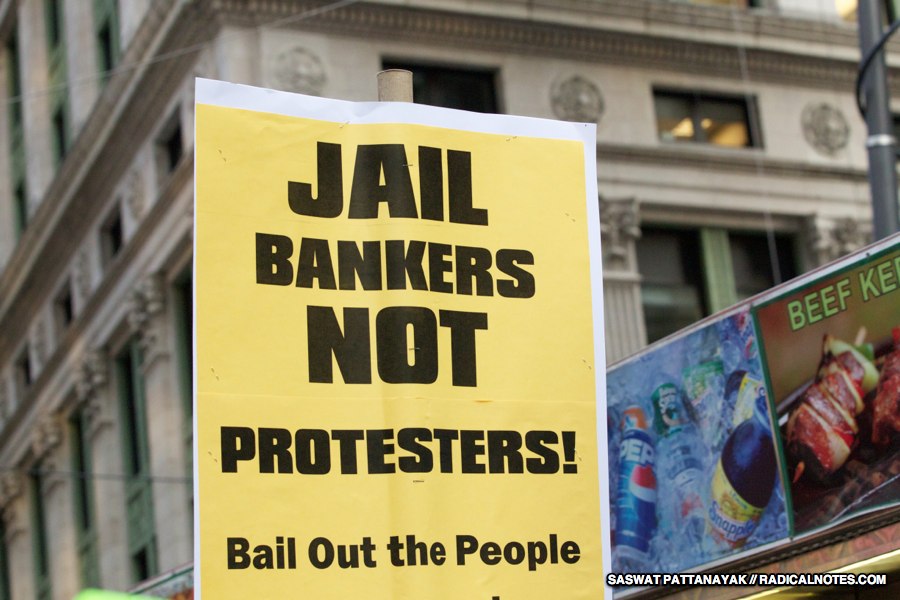
Wall Street Spring is radical in manners that have shaken the foundation of mainstream media in this country. Both liberal and conservative media have cautiously covered this uprising, essentially because unlike in the past, this gathering is truly diverse, and phenomenally radical. The revolutionaries are not endorsing any simplistic political ploy by a liberal party to garner support through expressions of politically correct rhetoric. In fact, quite the contrary. A placard prominently reads – mocking the Democrats – “Job Creators, my ass”.

In many ways, “Occupy Wall Street” is reminiscent of the several marches across the country over the past decades. People from various sections of society have gathered to march against police brutality and societal inequality. And yet in significant ways, it is rather different. The goal today is not to reconcile following legislative changes, but to revolt to ensure a peoples’ democracy. The march is not silent. The march is not harmoniously conducted hand in hand with musical backgrounds. The march today is disparate, heterogeneous, expressive of collective anger and resentment against the status quo. More of an extension of the Black Panthers taking over college campuses with loudspeakers and radical agendas; than a pacified demonstration of hopeful placards. It is not a congregation to reconstruct the capitalistic society, it is one that speaks through the voice of the latest victim Troy Davis: “Dismantle this unjust system”.
“You Must be Asleep to Experience American Dream”
Long ago, Malcolm X announced how he was experiencing American Nightmare, not American Dream. For several decades his call for the people to literally “wake up” were ridiculed, suppressed and relegated to dustbins of history by the private media enterprises. From Hollywood flicks to CNN headlines, frivolous entertainments were repackaged as news for popular consumption. Big businesses through advertisements and various forms of sponsorships pushed their agendas for a ferociously vital American economy – an economy where capital would be privately held, with solitary aim for unlimited profits, and where the capital would invariably triumph over the labor.
For decades, the American Dream – a fictitious and opportunistic claim that anyone can selfishly prosper through individual efforts – has been demonstrated as the encompassing ideology of global capitalism. The phrase has gained approvals because it has gone unquestioned. Much like the accompanying rhetoric: Democracy.

The dream and the democracy – both are at stake this time. In the past, the masses demanded to restore them. This time, they are demanding to dismantle them. No wonder, the New York Times failed to deconstruct what is happening at the Wall Street. “Gunning for Wall Street, With Faulty Aim” read the headline on the Times. For decades the mainstream corporate media defined for the people what their aims should be in order that the status quo is duly maintained. And usually in the western world, the protests have invariably taken a reformist shape, because the goals are precisely laid out, the conversations are articulately arranged, and the legislative conclusions draw the final lines.

However, this time, it is different, to say the least. It is not just the Wall Street. It is Occupation United States. Similar “occupation” movements are taking over various cities in the country, almost in a way, that it is difficult to fathom the direction they shall take. Many critics of the Occupation are arguing that this movement shall fail because it does not have specific goals. For instance, the otherwise liberal Colbert Report ridiculed the occupation as a mindless gibberish because the humorist found the lack of an articulated goal to be quite unacceptable.
Unacceptable, it sure is. Protests, demonstrations, and marches have traditionally been easy to contain because they tend to address specific issues and have extremely limited sphere of influence. They usually do not address the system as such because strictly from a pragmatic standpoint, it delays the process of redressal. And from a political standpoint, an attack on the system is a call for dismantling and possibly, overthrowing of an existing political economy – something which is outrightly rejected by not just the ruling class members of politics and businesses, but also by a great number of citizens who live in class denial.
War Has Been Brought Home
Occupation movement this time around offers no immediate solution – nor does it harbor much hopes either. If the collective demand is to have Obama administration dissociate itself and the United States from Wall Street money, the collective intelligence says it is probably not possible. Demanding a solution from the very system that needs to be dismantled is a worthless endeavor. And no one knows this better than the radicals themselves. And yet, what is much more important is the historical knowledge that revolutions take place not through pessimistic withdrawals, but through constant engagement with all available avenues of protests until the status quo is reversed.

In our fast-paced, solution-oriented, just-do-it society, it is quite predictable that many intellectuals and journalists, politicians and diplomats shall continue to question the viability of movements that offer no concrete alternatives. But a reflective and critical study of revolutionary theories and unique histories of various progressive movements shall demonstrate that all that the masses need are a few sparks, and there is no telling what turns the events will take!

Capitalistic America today appears to be insurmountable. It appears so, because it is depicted as thus through textbooks and newspapers, amidst televised programs and blockbusters. The deep vulnerabilities and classic contradictions of capitalism are deliberately omitted in an effort to celebrate the manufactured notions of freedom and democracy in the western world. But as humanity continues to evolve, and as consciousness of the masses across various oppressed social locations continues to be raised, the protocols are bound to shatter. The people will emerge as the leaders themselves. And their collective aspirations – to inhale the air that celebrates human dignity, free from greed of private accumulations – are bound to prevail. Its just a matter of time. And, that clock is ticking today at the Wall Street.
 Radical Notes
Corruption, Ethics and Politics: The Reproduction of Capitalism and a Ruse of History
Capitalism and Legality I: Corruption, Ethics and Reification
The notion of ‘corruption’ is an essentially ethical one; the terms in which the issue is judged are ‘good’ and ‘evil’. The problem with raising an ethical issue, as one can guess, is that it stays, as does its solution, within the system that defines ethical standards. Corruption is also, simultaneously, a legal issue. In fact, the legal question is in itself ethical, just as the ethical one is legal – the legal and the legitimate intertwine. In the final analysis, the legal structure of a society is defined in terms of what the socio-political order deems legitimate and what it does not. The obvious corollary being that a legal question, by definition, never goes into a questioning of the law itself. Anti-corruption crusaders are asking for more laws, stronger laws, or different laws. There is a difference between the old and the new law/setup, but they are also, to give the matter a Hegelian twist, identical. Fundamentally the system remains the same. In fact, these changes intend to make the system more entrenched and foolproof.
Such changes, and demands for such changes are not new. In fact we find that people out to change the world in capitalist times repeatedly make demands of precisely this sort: legal and ethical ones. Why is that? What follows is an attempted explanation.
Capitalism is a most confusing entity, so much so that one begins to doubt if it is an entity at all. Right from the beginning it has sent all sorts of well-intentioned reformers chasing after wild geese. Things have not changed much and trying to find a reason for the problems of our existence we still end up latching on to the first ‘big problem’ that appears. This first problem, it will be argued, is invariably an ethical one. The social order that we live in covers our eyes with blinders that ensure that we see only that which does not make our very existence within it difficult. Horses were made to wear blinders so that they did not get alarmed while they traveled on dangerously crowded roads. They only saw what they ‘needed to see’, ditches for instance, that need to be avoided, but never the carriage ahead that they could crash into. Similarly, we see ethical problems that need to be avoided, and can be avoided without upsetting the capitalist cart we pull. The archetypical ethical issue that gets in the way of a genuine questioning of the system has been that of money.
Money is, as Marx demonstrated in Capital, Volume I, the embodiment of the contradiction between use value and exchange value. When in a situation where an individual X has something that another, Y, wants and Y has something that X wants, and the two do not make an exchange, it is because although the two are not interested in the use-values of their respective commodities, they are interested in their exchange values. But a simpleton reformer, say Sir Thomas More, does not see this contradiction, and thinks the problem is that the two are interested in money. So blaming money for the corruption of communities he wants to abolish money.
Simpleton says money is evil. In other words, he makes an ethical judgment. What he does not see is that money is not the problem, not the producer of a contradiction, but merely the embodiment of one. Money is not a ‘singular, complete’ entity at all, but actually a duality in one body. The problem is the duality, the contradiction, not the embodiment. But it is always easier to be able to locate one entity, and try to destroy it. Money stares him in the face, and he is looking for something like money to attack. In other words money is not only a ‘medium of exchange, store of value etc’, but also ideology, a red herring to misdirect attempts that set out to solve the contradictions of capitalism. “The obsession with money as cause and disease alike condemns us to remain within the market system as such, the sphere of circulation, as the closed horizon of our knowledge and our scientific questions and explanations.” (Jameson 2011: 46)
The name Marxists have given to this problem of misidentification is ‘reification’, or alternatively ‘fetishism’. Something mediating between the subject and the object becomes ‘reified’ and begins to posit itself as the object itself.
As we saw in the earlier example, this is what happens in the case of Simpleton and money. The case of an ethical question like that of corruption, or for that matter of any ethical question can be understood in the same way; one can draw a structural correspondence, or a homology. An ethical problem is always the first appearance of a more fundamental contradiction (the duality implicit in the word ‘contradiction’ is important). To be unable to move beyond it is to reify it and remain at a distance from raising a truly political question. In capitalism this question can be understood in terms of the contradiction between use value and exchange value, or concrete and abstract labour, or simply, labour and capital.
Capitalism and Legality II: Corruption and ‘Monopoly’ Capital
Sometimes, in order to give ‘political economic’ explanations to ‘superstructural’ phenomena, there is an inclination to jump to quick conclusions that leave out too many levels of mediation. If the problem we explored in the previous section was the problem of being trapped by mediations, here we see the problems that emerge when we try to get to first causes without taking mediations into account. For instance: Anti-monopoly laws seem to be becoming stronger internationally, including in India, despite the fact that the neoliberal rhetoric of free market continues to dominate. But do these laws intend to counter the processes of concentration and centralisation of capital (or monopolisation) which are fundamental to capitalist accumulation?
Just because these laws are being strengthened we cannot say that the process of monopolisation has ceased to operate; in fact, growing instances of acquisitions and mergers are daily reported in financial publications. So what do these laws exactly do? Monopolisation is an inevitable effect of competition between diverse particular capitals, and competition is the life and blood of capitalism. But the strange thing about capitalism is that its own processes are fetters to its existence. Capital creates barriers to its own expansion. The intensity of immanent processes poses hurdles to capitalist accumulation. The collective will of the capitalist class is definitely produced through the dialectic of competition and monopolisation, but it needs an externalised State and its laws to represent it when anarchic competition and its implications seem to destroy the systemic coherence of capitalism.
Bourgeois economics itself recognises that monopolisation curbs the rate of accumulation, however without acknowledging it to be an inevitable tendency. Anti-monopoly laws are designed as a result, to regulate this inevitable concentration of capital, so as to keep the rate of accumulation from slowing down. This is one among many attempts of capitalism to reform itself, and circumvent its own fundamental contradictions. But this is also one among many such attempts that have failed and continue to fail.(1)
Now we come to a direct connection between the sort of corruption that we saw in the ‘2G Scam’ and monopoly. Essentially, what is this corruption but a sort of favouritism shown by the state and state officials (on being bribed of course)? Which among the various monopolies will grow, which will gain greater access to raw materials etc. is decided like this. So, by bribing state officials, large corporations can get out of problems that laws like the anti-monopoly law may put in their path, as well as gain an advantage over their competitors. In other words, bribes are a price that a corporation pays to grow.
A question that we must ask ourselves is that why is this issue of corruption being raised at such a large scale now? Is it only because the CWG scam and 2G scams were so big? Leaving aside the pointlessness of conspiracy theories (though they are not false) about who is funding Anna’s movement etc, we must nonetheless ask why large corporations are supporting the movement in such a big way.
Capitalism, it can be demonstrated, has a sort of homeostatic range within which it can handle issues like corruption and, say for instance, inflation (issues which it also incidentally produces). Once the upper limit is crossed problems arise. One cannot empirically prove when the limit is reached. The only way of it being reached is not rise in corruption. Another way is that the upper limit may come down. When regimes of accumulation change, state structures, the politico-legal ‘superstructure’ slowly tries to harmonise itself with the changed infrastructure. This may be why the said limit may have come down. The capitalist class, that was earlier bribing officials and parliamentarians left, right and centre, now does not want to throw its profit like this. This, as we shall see, is connected to the development of capitalism, and hence to the centralisation of capital, in India.
Capitalism and Legality III: Corruption and the Expanded Reproduction of Capital
Marx’s analysis of the ‘expanded reproduction of capital’ allows us to understand this phenomenon in a systematic manner. An initial sum M is invested into machinery, variable capital (labour power), raw materials etc., which together comprise C, and after the production process (P) one ends up with a commodity C’ which is sold for an amount M’.
M – C…P…C’ – M’
M’ is supposed to be greater than M, or one ends up with an overall loss.
M’ > M
M’ can now be further divided into the amount that was invested initially, M, and will need to be put in again to sustain production at this scale, and the surplus m.
M’ = M + m
The surplus (m) can be divided further into capitalist consumption (c) and investment (m’), which goes back to expand production.
m = c + m’
This is what the equation should ideally look like. But as we should know by experience these equations never exist without irregularities. The amount paid as bribes is basically money that comes out of m’. If this amount is c’ and what is left after bribes have been paid is m”, i.e. if,
m’ = m” + c’
then
m = c + c’ + m”
We know that m’ is the sum that is supposed to be reinvested to expand production. The money that is paid as bribes to private individuals basically falls into the category of consumption or unproductive use. Which is to say, that corruption, in the long run becomes a cost that siphons out money from m’ and does not allow it to re-enter capitalist investment. Till a point capitalists accept such siphoning, but after a point the homeostatic limit mentioned earlier is reached.
The obvious question then: at what point is this limit reached? To get into this part of the argument I will make use of an essay by MH Khan called “Corruption and Governance” that was published in 2006. In this essay Khan draws a connection between underdevelopment and corruption. He argues that in underdeveloped or developing countries, where accumulation is still ‘primitive’, or by extra-economic means, and resources are still being grabbed by brute force, corruption is inevitable. This corruption is not a result of the intention of corrupt officials. In these countries while pre-capitalist processes of production are no longer viable, production is still so low (and so is, as a result, surplus accumulated), that the capitalist class cannot pay to protect a new set of rights/laws that would legitimise all capitalist processes. The amount of revenue coming from tax on surplus, that can be redistributed transparently and legally to social groups and sections in order to maintain stability, is not sufficiently large.
In this situation any attempt to fight corruption, or taking any anti-corruption measures will be futile. In fact in nations where conditions are such, there is no will to fight corruption. Anti-corruption policies work in countries with stable capitalism and high production. In underdeveloped countries the apportionment of resources to capitalists happens through clandestine patron-client relations. As a result, certain sorts of individuals get involved in politics and hold power. In underdeveloped countries, as Khan points out,
As surplus increases, slowly the economy begins to stabilise and legal methods for this apportionment can be found. It is only after this point has been reached that corruption can be decisively tackled. But here too popular pressure would be needed to bring this about.
Because in under-developed countries fiscal transfers cannot happen, they are replaced by the exercise of brute power. But in advanced capitalist countries, the allotment of transfers and subsidies happens legitimately, like through legalised lobbying etc (as in the United States).
Because of such legalisation c’, which was till now part of consumption and was leaking out of the cycle, now gets re-injected, via the state into the economy. What in a developing nation goes to politicians and public officials in their capacity as private individuals now goes to the state in its capacity as an institution of bourgeois power. Overall, this transformation implies an increment in the profit being generated. The moment it is realised that an economy is becoming advanced and stable, capitalists prefer to move away from illegal means like corruption to legal means of getting hold of the same resources and services. We should not be surprised then, if the institution of strong anti-corruption measures, should this happen in India, is followed by an increasing amount of pressure on the state for it to legalise lobbying etc.
Anti-Corruption, Public Employees and the Left
It is hard to deny the absurdity of a situation in which alleged Leftists call a protest problematic because it is extra-constitutional. In effect then, they argue that Left politics at its social-democratic worst, when it tries to ensure the smoothing out of the contradictions of capitalism, is the only possible revolutionary alternative. A strike, or a protest, or a movement becomes unconstitutional the moment it enters into a fundamental questioning of the system. This is not to say that the Anna Movement entered into such a questioning at any point – far from it. Nonetheless, such statements from the Left only go to show the degree to which it has been accommodated within the system and its discursive milieu.
However, by this I do not mean to imply that all Left interventions that affirm the anti-corruption movement are more radical. To intervene is important, of course, but are these interventions touching the realm of the ‘political’, and raising the question from a ‘working class/revolutionary perspective’? Or are they still caught in the discourse of legality and ethics, which the bourgeois vision of the Anna movement cannot even think of going beyond?
Every social question can be raised in two ways. Till a question is raised in the realm of ethics or legality, or till a struggle remains ‘economic’ it is essentially bourgeois in tendency. But this does not mean that it cannot go beyond this embourgeoised status. Every economic struggle has immanent political content, and the task of a working class organisation is to facilitate the emergence of the immanent. But do the current Leftist interventions in this movement amount to this? Did campaigning against corruption in “working class areas” contribute to the radicalisation of the working class? Or did it merely convince more people to release their frustrations with the system making use of the giant pressure release valve that the anti-corruption movement is (in addition to being a need of capitalism at this point in India)? Absolutely nobody seems to have made an attempt to separate the ‘proletariat content’ in the question of corruption from the ‘bourgeois content’. In the light of this lacuna (or in its darkness), the conspiracy theory like attempts to understand corruption, that some organisations seem to have endorsed, point toward a more fundamental ideological lacuna. Do we have any idea why we are doing what we are doing?
In the previous sections I have already analysed corruption from two perspectives. From one we saw that corruption is the reification of an ethical/legal question that gets in the way of a proper questioning of the status quo. From the other we concluded that after using corruption for a period of time, there comes a point when capitalism begins to see it as a hurdle; and so ‘anti-corruption’ in this regard becomes an issue of the bourgeois class. Now we look at the issue from a third perspective. Till now we had analysed and tried to understand ‘corruption’ itself. Now we will try and understand the problems of the ‘anti-corruption movement’. Here it would be useful to be schematic.
At this point, when Leftist organisations should put their energies into countering such contractualisation, many, in trying to ride on Anna’s shoulders, are actually supporting a movement whose main interest coincides (if this can be called a coincidence) with the interests of capital, and which will build support for a move toward privatisation and contractualisation; they are being fooled, as it were, by a ruse of history.
At a time when proletarianisation of the masses is increasing at an unprecedented rate, in the form of unemployment, deskilling, lack of job security, eviction from land and so on, we need not, indeed we must not jump into the bourgeois bandwagon. This is what makes an uncritical intervention of Left forces in the anti-corruption movement so problematic. Not only are we not working in any of the areas that we should be working in, but in our lack of direction we are actively contributing to a reactionary project. After all the problems that I have already enumerated, and with the numerical handicap that Left forces suffer from, when compared to the strength of the right wing in such movements, it is hard to imagine any reasonable defense for such Leftist interventions.
Notes:
(1) However, from this we can make an interesting inference that allows us to connect this discussion to the previous section. Sometimes something that is a direct product of the system, may nonetheless not be deemed legal or legitimate by its law. Sometimes the law may gain a direction of its own, which may not always be in sink with that of the social relations of productions and the ways of that particular ‘regime of accumulation’. Anti-monopoly laws are becoming stronger even as the construction of trusts, cartels, and monopolies is only speeding up.
References:
Jameson, F. (2011). Representing Capital. Verso: New York.
Khan, M.H. (2006). ‘Corruption and Governance’, in Jomo KS and Ben Fine (Ed.) The New Development Economics: After the Washington Consensus. Tulika: New Delhi.