For some Gup-Shup in Faridabad (February 7)

Faridabad Majdoor Samachar

To contribute to radical social transformations that are mushrooming all over the world, feel free about : stammering, fragmentariness, incoherence, missing steps….. Social (and natural) reality are very complex and dynamic. Leaps in interactions amongst seven billion human beings are on our agenda.

It is only in the present that we can act/prepare to act. What to do and what not to do, how to do and how not to do are coloured by the different facets/ sectionalities in the present and also carry deep imprints of the past (not only near and distant past but also different pasts of different locations/groups). So a request: Try not to be polemical; try not to attempt to clinch arguments; try to respect your own selves (by implication you will respect those around you). Primarily it is to act, it is for better actions that this gup-shup is premised on. “Cataclysmic event” language and imagery seems problematic; languages and imageries that are premised on active participations of seven billion human beings are indispensable for radical social transformations.

A technical constraint in the gup-shup is that we will be using mostly English language.

Some Statements Etcetera

* Small groupings of human beings called birth a shaap (curse) or the fall. Half of their numbers, females were described as sin personified. What was tragic for small groupings is today a tragedy for all human beings, for all living species, for the earth.

* It does not seem that something had to happen, rather possibilities and probabilities seems to be the norm. But, once a possibility gets concretized, it has a dynamic and trajectory specific to it.

* Relationship between a part and the (immediate) whole. Harmony and conflict between parts and the whole seem to be the norm. Small groupings of human beings embarked on a trajectory wherein the part attempts to control, dominate, mould the whole. Other-ing unleashed – series of “the other – others.”.

* Domestication of animals led to the domestication of human beings, slave owners and slaves.

* Deformation of communities, emergence of “I” with men as its official bearers. Man woman relations become very problematic. Today, by and large, women and children are also bearers of “I”. “Who am I?” has become a universal question.

* Certainty of death after birth becomes unbearable for any “I”. Attempts at immortality. Search for amrit (the nectar of life). Philosophies of rebirth, heavan, hell. Theories of lineage. Tragedies of Alexanders – great thinkers, great warriors, great artists, great sportspersons, great performers, great leaders…..

* From “who am I?”, we have entered a phase where there are many an “I” in each “I”. In the process of transcending “I” we seem to have come to the era of ekmev (unique) and ekmaya (together).

* Discriminations became rampant amongst human beings. It was a corollary of othering and dominating – controlling – moulding. All discriminations must be opposed. The question is: How? Discriminations are a breeding ground for all sorts of identity politics. An exemplary end-result is the constitution of the state of Israel. This is how discriminations are not to be opposed. The ways of opposing discriminations should be such that discrimination as such comes into focus.

* From domestication of animals to agriculture, from slave-owners and slaves to feudal lords and serfs increased the groupings of human beings that led tragic lives. Trade, long distance trade further increased these numbers. But during all this time large groupings of human beings lived in natural surroundings. It is only during the last two hundred years, it is only after steam and coal power was harnessed by human beings that a leap change began. Internal combustion engine, electricity, atomic energy, electronics magnified the leaps in the changes and have brought us face to face with their dire consequences.

* It was production for the market that led the onslaught. Artisans and peasants producing for the market using their own and family labour became redundant. For two hundred years now they are face to face with social death and social murder. Peasants and artisans in their Luddite incarnation in England attacked factories at night. Some of them were gunned down and hanged, many became wage-workers or shopkeepers or social outcastes, beggars etc., and many were forced out to the Americas and Australia. The mass displacements from Europe further increased the genocides in Americas and Australia. A corollary of the inability to tame-domesticate people in America – Australia was the massive increase in slave-trade in Africa, indentured labour in India, for production for the market.

* Steam and coal driven machinery had made large numbers of people in Europe superfluous. The entry of electronics in the production processes has made still more people superfluous….. Its impact on hundreds of millions of peasants, artisans, shopkeepers in Asia, Africa, South America is devastating and at an electronic pace. They have nowhere to go. There are no “empty americas”. Desperation borne of social death and social murder of peasants, artisans, shopkeepers is the cause of hundreds of thousands committing suicides and similar numbers taking up arms in various garbs. Napoleon’s army is miniscule vis-a-vis the militarization in the world today but it is still too small for the desperate hundreds of millions. So, besides state armies there are mushrooming proto-state armies. Desperations of hundreds of millions of peasants, artisans, shopkeepers is increasing the fragility of state apparatuses. Outside of western Europe, Japan and North America this is a very important social setting for attempts at radical social transformations.

* In the initial stage of production for the market using wage-labour, factories were owned by individuals. The unfolding of the process led to factories being owned by groups of individuals, by a dozen or so stock holders. The requirements for establishing and running a factory soon started demanding the pooling of resources by thousands. Share holding of thousands became the “owner” of the factories. Needs of increasing size and resources made share holding inadequate and loans emerged as the major source of funds for establishment and functioning of factories. Pension funds, insurance funds, bank deposits, financial institutions became de-facto owners of production enterprises with 80-85% of the investment coming from them and about 15% from shares. (A significant portion of shares is also held by these institutions). “Capitalist – personified capital” has given way to boards of directors, chairmen, managing directors, CEO’s as “representatives of faceless capital”. Being a state enterprise or corporate, company enterprise is not a significant difference. These changes in material production enterprises have by and large been replicated in other spheres of social life, be they be trade, education, entertainment, medical treatment. Craft-artisanal mode gave way to industrial mode and then its dynamics has followed. Factory mode is moulding all spheres of life throughout the world. (In long distance trade, the institutional form of organization, company preceded its emergence in material production.)

* The process of institutionalization has not halted with the dismantling of large factories. Instead of a car factory, we have auto hubs today. What is called a car factory is mainly an assembly plant. A vehicle manufacture today needs production facilities spread over an area with fifty kilometer radius. It requires a hundred thousand plus workforce. And the rapid changes that the institutionalization of research is bringing about makes it increasingly unviable. Today it is only in China that there are a few factories with a hundred thousand plus workers. The entry of electronics in production process started the dismantling of twenty thousand plus workers factories, the “workers fortresses” in the 1980s. With all the confrontations that it engendered, it is more or less over.

* Roots in artisanal guilds provided initial factory workers with trade/craft organizational structures to confront the new situation they found themselves in. These defensive organs of wage-workers were initially illegal. Over time they obtained legal status. They had a leverage vis-a-vis individual owners regarding wages and conditions of work. Emergence of joint stock and then share holding decreased the leverage of trade-craft unions. Their defensive and conservative roles in the changing scenario brought them on the sides of their governments in the mass slaughter during 1914 – 1919. Craft based trade unions were denounced by some radicals in 1919 and instead of trade based unions, factory based unions were attempted as alternative form of workers organisations. We have had some experiences of factory based unions during 1980 – to date. We began looking at industrial unions as workers organisations with misleaders at their helm. In our experience we found factory unions functioning almost like another department of the factory. Managing workers was the job of the unions and good functioning of the factory was seen as good for the workers of that factory. With the introduction of electronics in the production process in factories, from the beginning of 1990s large scale restructuring took place in Faridabad. What was earlier seen largely during long term agreements between managements and unions became blatant in 1990-2000 period. In factories ninety percent plus workers had been permanent. Large scale retrenchment of permanent workers took place in many factories and in most of the cases unions were openly standing with the managements. Engineered strikes and lockouts were the means in these major attacks on factory workers. From these experiences when we look back at the 1982 Bombay textile strike in which 250,000 workers were involved, it seems to us that it was an engineered strike. The composite textile mills with their spinning, weaving, processing, dyeing and printing departments have vanished from Bombay-Mumbai. What would have taken decades if it were slow attrition was done in one blow. The composite textile mills of Indore, Gwalior, Faridabad, Delhi, Hissar, Kanpur, have also vanished. And cloth production in these twenty five years has grown exponentially. In this vein it seems to us that the coal-miners strike in England in 1984-85 was another engineered strike that saw the number of coal miners come down from 100,000 to 10,000. Another example could be the longshoremen strike in the US which resulted in drastic reduction in permanent workers and matched the needs of containerization. Today when we look back, 1980 – 2000 appears ancient to us. Factories in Gaziabad, NOIDA, Delhi, Gurgaon, Faridabad are largely run by temporary workers. In direct production process five to thirty per cent workers are permanent. In the national capital region in India (and things are not different in other parts) seventy-five to ninety-five percent factory workers are temporary workers. There are factories where not even one worker in 300 is permanent – only the staff has permanent status. And amongst these 80 percent temporary workers, three-fourths are “invisible” workers. Almost 75 percent workers in factories in the NCR do not exist in company and government records, be it garments or auto or pharmaceuticals or chemicals, things are the same. Factory unions, where they exist, have only permanent workers as their members. 90 percent factory workers in the NCR do not fit in the union structure. The increasing number of temporary workers is a global phenomenon.

* Given the changes in the ownership patterns of factories, given the breakup of a product in hundreds of factories, given the composition of factory workforce today, given the existence of industrial areas with thousands of factories, and given the linkages among factories across the globe, co-ordination among workers needs to expand across factories and industrial areas and span the world. New types of activities and new kinds of organisational practices are needed.

* A pointer is the recent occupations of Maruti-Suzuki car factory in Industrial Model Town, Manesar. Inaugurated in February 2007, all the workers in the factory are in their twenties. There are 950 permanent workers, 500 trainees, 200 apprentices, 1200 workers hired through contractors for work in direct production process and around 1500 workers hired through contractors for various auxiliary functions. The pace of work was such that a car was being assembled in 45 seconds. Some permanent workers attempted to organise against the existing union in the company. Strong-arm tactics of the management gave rise to a wildcat occupation of the factory on June 4, 2011. The company and the government were taken aback. The occupation continued for 13 days. During the occupation many bonds developed between the permanent workers, trainees, apprentices and workers hired through contractors. The company was forced to take a step backwards and revoke termination of 11 workers for production to restart. After the occupation there was a dramatic change in the atmosphere in the factory. The company was forced to plan and prepare to re-establish its control on the shop floor. On August 28, a Sunday and a weekly day off, 400 policemen came at night to the factory. Company staff had arrived earlier. With steel sheets, the factory was secured in military fashion. On 29th morning when workers arrived for their 7:00 AM shift, there were notices announcing dismissals, suspensions, and entry premised on signing of good conduct bonds. All the workers stayed out of the factory. This is the chess game well rehearsed by managements to soften workers and re-establish control. The company had gone to distant industrial training institutes and hired hundreds of young boys. Workers from the company’s main factory in Gurgaon were also taken to Manesar. Arrangements for their stay inside the factory were made. Already 400 policemen were staying in the factory and large number of guards were hired from Group 4 security company. Staff was made to work in 12 hour shifts with the new workers. Musclemen from surrounding areas were paid to bully workers. Attempts were made to instigate workers to violence. Central trade unions tried to take leadership of the workers. Workers’ representatives were called for negotiations and arrested…… The workers refused to be instigated. All kinds of supporters came to the factory gates where the 3000 workers did 12 hour, back to back sit-togethers. Many kinds of discussions took place. Bonding between different categories acquired new dimensions. The workers’ refusal to be instigated led the well-rehearsed chess game to a dead end. The company was forced to side-step and sign a new agreement. The permanent workers, trainees and apprentices entered the factory on October 3, but the 1200 workers hired through contractors were not taken back. The company’s attempt to divide the workers received a serious thrashing when, on the afternoon of October 7, workers of A and B shift, who were inside, occupied the factory. This time it was not just the occupation of Maruti-Suzuki factory, simultaneously 11 other factories in Industrial Model Town, Manesar, were occupied by workers. “Take back the 1200 workers hired through contractors and revoke the suspension of 44 permanent workers” echoed and re-echoed all around. Again the company and government were taken aback. Despite the presence of 400 policemen and hundreds of other guards, Maruti-Suzuki factory was occupied by workers. The simultaneous occupation of 11 other factories opened up new possibilities with thousands of factories all around. Pressure was applied and occupation of seven factories was called off, but it continued in Suzuki Powertrain, Suzuki Casting, Suzuki Motorcycle factories, besides Maruti-Suzuki. It was only on October 14, after the deployment of additional 4000 policemen, that workers vacated Maruti-Suzuki factory and Suzuki Powertrain was vacated by the 2000 workers when they were surrounded by a police force of 4000 inside the factory. For details, see July 2011 to January 2012 issues of Faridabad Majdoor Samachar (and also the forthcoming February issue).

* The company and the government have not been able to understand the activities of Maruti-Suzuki workers (and other factory workers). Ripples were widespread and the dangers were very visible to the government. A third agreement was forced by the government, with it also becoming a signatory. The 1200 workers hired through contractors were taken back. Not having understood anything of what happened, the company gave significant amount of money to 30 workers it considered troublemakers, for their resignation. (And later propagated the deal as bought-sold.) Production recommenced in the 4 factories on October 22. Afraid of any and everything, the company has been giving concessions to workers. Now instead of 45 seconds, the scheduled time for making a car is one minute.

* Important questions dealing with life, time, relations, representation, articulation, factory life under scrutiny that the occupation of October 7-14 brought to the fore, in the words of a Maruti-Suzuki factory worker, are: “The time in Maruti-Suzuki factory during October 7-14 was extremely good. There was no tension of work. There was no tension of coming to the factory and going back.There was no tension of catching the bus.There was no tension of cooking.There was no tension that food has to be eaten only at 7 o’clock or only at 9 o’clock.There was no tension as to what day or date was that day. Lots of personal conversations took place. We had never come so close to one another as we came in these seven days.” From October 7-14 there were 1600 workers inside the Maruti-Suzuki factory, and 1200 outside the factory. When the bought-sold issue of 30 workers made the rounds, a Maruti-Suzuki worker said, “Earlier we used to pass on the issues to the president, general secretary, department co-ordinator – they will tell. But now every worker himself answers. On every issue, everyone gives his opinion. The atmosphere has changed.”

* Increase in accumulated labour, exponential increase in accumulated labour has sidelined personified forms and brought the social relation in its faceless form to the fore with presidents, prime ministers, chairmen, managing directors, CEO’s as its representatives. In this scenario, person has become increasingly insignificant. Whether a person is or she/he is not has become almost the same. But at the same time, in contentions between accumulated labour (dead labour) and living labour, each person has become increasingly important. Active participation of 90 percent plus of those directly concerned has become indispensable. Representation and delegation have become redundant / counter-productive.Lagta hai ki ekmev aur ekmaya ka yug dastak de raha hai. (It seems that the era of unique and together is knocking at the door.) Radical transformations are demanding the active participation of seven billion people, both as each a unique being and all together.

Faridabad Majdoor Samachar is a monthly publication in Hindi language and at present 10,000 copies are distributed each month by and large amongst factory workers in Okhla (Delhi), Udyog Vihar (Gurgaon), Industrial Model Town Manesar and Faridabad. Some rough translations in English are available at . Texts in Hindi are also on the internet via Gurgaon Workers News. In English we have published : 1. An Abridged Version of Rosa Luxemberg’s “The Accumulation of Capital”; 2. A Ballad Against Work; 3. Reflections on Marx’s Critique of Political Economy; 4. Self-Activity of Wage-Workers: Towards A Critique of Representation & Delegation; 5. Questions for Alternatives.

Faridabad Majdoor Samachar
Majdoor Library
Autopin Jhuggi
N.I.T. Faridabad – 121001
India
Ph. – 0129-6567014

Discussion And Reading Team of Socialists, Bhubaneswar (Second meeting) – A report

Discussion and Reading Team of Socialists (DARTS)

On Commodity Fetishism

The second meeting of DARTS was held on 30-12-2011 from 5:00p.m to 7:00p.m. at XIMB, Bhubaneswar. Prof. Raju Das of York University began his talk with a Power Point Presentation on Marx’s theory of ‘fetishism of commodities.’ Fetishism of the commodity, according to Marx, means that ‘the relationships between producers, within which the social characteristics of their labourers are manifested, take on the form of a social relation between the products of [their] labour’. In his talk he explained this idea with a simple example using export-oriented shrimp production in Orissa. The conditions of the shrimp producers, as that of numerous other workers, in Orissa (as elsewhere), are simply bad. The work they perform in producing the shrimp as a global commodity not only fails to fetch them enough money for their daily maintenance. The production process oriented towards producing the maximum amount of exchange value (profit) for the shrimp producers/traders is inscribed on their labouring bodies: chemicals used in the process affect the (women) workers’ fingers so badly that they cannot even eat with their hands. When the shrimps are in the market, every buyer, including the buyer in advanced countries, wants to get the maximum counts of shrimps for every rupee/dollar she has in her pocket. Doing this is in her own material interest. The buyer (who is also a producer of other commodities, be it a service or a physical commodity) does not care about the conditions under which shrimp workers work. And the buyer does not care because her own conditions of work and wage-level, like those of the shrimp-worker, are beyond her own control. So, it is as if shrimps and other commodities start talking in the market. The actual people who produce those commodities are not directly and socially interacting. It is immaterial whether or not people know the conditions of shrimp producers because given their own position they have to command a maximum amount of the commodity (e.g. shrimp) they want for every unit of the commodity they own (or its money form). There exists, in the words of Marx, ‘the social relation between commodities’ and ‘material relation between men.’ In Prof. Das’s words: “commodities rule over us instead of ourselves ruling over articles of use to us.” Relations between commodities replace – or at least, become much more important than – relations between people, i.e. people-as-producers of things-for-use.

Then Prof. Das explained the aspects of Ideology using I.I.Rubin (author of Essays on Marx’s Theory of Value), Terry Eagleton (author of Ideology) and Slavoj Zizek (author of Sublime Object of Ideology). Marx’s ideas of fetishism are connected not only to his ideas about alienation (partly in the sense that fetishism – the rule of commodities over us — happens because of the absence of democratic social regulation over production) but also ideology: the objective reality is such that we think that things for use necessarily have a money-tag and have to be bought and sold (for a profit) and we behave accordingly. The reality – and not (just) our discursive inability to comprehend it – is such that it makes us think that our needs can only be satisfied through commodity exchanges. Commodity fetishism is not our failure of intelligence. It is an intelligent failure. The commodity form hides the real social relations from us. It acts as a veil. And, in the words of Marx: ‘The veil is not removed …. until [the production process] becomes production by associated [producers], and stands under their conscious and planned control’ (Marx). The question is what is to be done to make this happen. Marx, of course, ends Capital Vol 1 with his most definitive answer to the question. Marx’s discussion of the commodity (dealt with in the inaugural meeting of DARTS) and of fetishism clearly shows that if we want to understand the capital and the society it dominates we must understand Marx (and his Capital).

There was an audience from several disciplines – students and teachers of Technology, Literature, Economics, Business Studies, etc. A number of political and civil rights’ activists were also present. Interesting questions were raised and discussed in the meeting. The questions included: ‘What is the distinction between objective and intrinsic in the context of value?’; ‘In a particular village, where people know each other and produce agricultural products and consume them, how is the theory of ‘fetishism of commodities’ relevant?’. What is the distinction between concrete labour and abstract labour, and why is such a distinction important? One perceptive member of the audience and a senior scholar explicitly linked the idea of fetishism to alienation, building on early Marx’s writings.’

There was an active participation as each participant found Marx relevant in her/his field of work and/or area of interest. All the questions posed could not be addressed properly due to the lack of time, which meant that there was a great need for several rounds of discussion on such concepts as the commodity and fetishism.The discussion had to be limited to commodity fetishism; there was no time for a discussion of the other form of fetishism in Marx’s work: capital fetishism.

The DARTS provisional organizing committee has decided to meet on the 29-01-12. The topic to be discussed was proposed to be ‘Labour-power as commodity.’ The time and venue will be conveyed by e-mail.

We collectively hope that we will continue to discuss important ideas of Marx both from the standpoint of their theoretical value and from the standpoint of their ability to shed light on contemporary issues facing the humanity. We also hope that there will be reading teams such as ours in many other cities and towns of Orissa and India.

Migrant Workers Rally in Gurgaon, Haryana (Jan 8, 2012)

• Support the struggling workers’ demands for minimum monthly wages of Rs.11000 in the area of Gurgaon.
• Stop the practice of imposing overtime on single day wages.
• Stop the use of contractors.
• Change conditions inside the factory like the use of harsh words, unequal wages for women, an ever increasing target, delays in payment, misuse of ISIPF money, employment without contracts, ill-treatment of women, imposition of overtime.

These are the demands that the Gurgaon Pravasi Mazdoor Union have taken up at the rally organized on 8th January at Udyog Vihar in Gurgaon. The union hopes to change working conditions in the factory and organize workers of the industrial belt of Gurgaon to fight for a minimum daily wage of Rs. 425 (Rs.11000 per month) as the first step towards a larger struggle against the factory owning class and the state. Workers from all walks of life will be part of the union so that these demands and the struggle to achieve them shall spread to the various sectors of the industrial belt.

ANC Centenary: A Display of Elite Power

Ayanda Kota
Chairperson, Unemployed People’s Movement
Grahamstown,

The centenary celebrations of the African National Congress (ANC) are being used to persuade the people that a movement that has betrayed the people is our government, a government that obeys the people, instead of a government of the elites, for the elites and by the elites. It is a hugely expensive spectacular designed to drug us against our own oppression and disempowerment.

In his Communist Manifesto Karl Marx wrote that “Each step in the development of the bourgeoisie was accompanied by a corresponding political advance of that class…The executive of the modern state is but a committee for managing the affairs of the bourgeoisie”. Here Marx is referring to the ability of the bourgeois to translate economic power into state power, thus reducing our governments to mere managers acting in the interests of capital and not the people. This has happened to governments around the world. But here our politicians are not mere managers. They are, like in Russia or India, a predatory elite with their own class interests and they support capital and repress the people as long as they can get their own share.

Since 1994 there hasn’t been a reorganisation of the economy. The commanding heights of the economy continue to reside in the hands of a tiny elite, most of which is white. Unemployment is sky rocketing. Most young people have never worked. Anyone can see that there is an excessive amount of poverty in South Africa. There are shacks everywhere. In fact poverty reigns supreme in our country. Every year Jacob Zuma promises to create new jobs and every year unemployment grows.

If things were getting better, even if they were getting better slowly, people might be willing to be patient. But things are getting worse every year. Poverty and inequality are getting worse. The government is increasingly criminalising poverty instead of treating it as a political problem. When people try to organise they are always presented as a third force being used to undermine democracy and bring back racism. But it is the ANC that has failed to develop any plans to democratise the economy. It is the ANC that has failed to develop any plans to democratise the media. It is the ANC that disciplines the people for the bourgeoisie. – a role that they are very comfortable to play! It is the ANC that follows the line of the World Bank and the International Monetary Fund. It is our local leaders who taking the leap from their old bosses, stealing from us, treating is with contempt, acting like the former colonial government and oppressing us.

During the struggle our leaders embodied the aspirations of the people. But once they took state power they didn’t need us any more. We were sent home. We are only called out to vote or attend rallies. But all the time our people are evicted from farms, paving way for animals as farms are turned into game reserves under the pretext of tourism. Our people are evicted from cities. Our people are denied decent education. The party has become a mixture of what Marx would call an instrument of power in the hands of bourgeoisie and what Fanon would call a means of private advancement.

Biko wrote that:

“This is one country where it would be possible to create a capitalist black society, if whites were intelligent, if the nationalists were intelligent. And that capitalist black society, black middle class, would be very effective … South Africa could succeed in putting across to the world a pretty convincing, integrated picture, with still 70 % of the population being underdogs.”

We, as the unemployed, belong to the 70% that Biko was talking about. We were happy to see the end of apartheid and we will always fight racism where ever we see it. But we are not free. There has only been freedom for the 30%. How can a person be free with no work, no house and no hope for their life?

R100 million is being spent on the celebration – spent to entertain elites, through playing golf and drinking the most expensive whiskey. Golf players are even receiving massages from young women sponsored by SAB. This is not a people’s celebration. We are absent! How some of us wish that all that money could have been used to build houses, create employment, build sport facilities or schools for kids who continue to learn under trees! Biko was right. As the world celebrates with the ANC today they put across a pretty convincing picture of freedom while everywhere people are broken by the burdens of poverty.

In his Wretched of the Earth, in the chapter called “The Pitfalls of the National Consciousness”, Frantz Fanon wrote:

“The leader pacifies the people. For years on end after independence has been won, we see him, incapable of urging on the people to a concrete task, unable really to open the future to them or of flinging them into the path of national reconstruction, that is to say, of their own reconstruction; we see him reassessing the history of independence and recalling the sacred unity of the struggle for liberation. The leader, because he refuses to break up the national bourgeoisie, asks the people to fall back into the past and to become drunk on the remembrance of the epoch which led up to independence. The leader, seen objectively, brings the people to a halt and persists in either expelling them from history or preventing them from taking root in it. During the struggle for liberation the leader awakened the people and promised them a forward march, heroic and unmitigated. Today, he uses every means to put them to sleep, and three or four times a year asks them to remember the colonial period and to look back on the long way they have come since then.”

I am not opposed to the centenary celebration of the ANC. But if the ANC was a progressive movement they would have organised a celebration in a way that includes the people and supports us to build our power. They could have, for instance, asked people to meet all over the country, discuss how far we have come and far we still have to go, and draw up demands for a new freedom charter for the new era. But this celebration is just a spectacle that we are supposed to watch on TV. It is exactly what Fanon talks about. It is designed to keep us drunk on the memory of the past struggle, so that we must stop struggling and remain in the caves.

In a recent protest in Bloemfontein, police were there in numbers to flush the demonstrators. This has happened in many other demonstrations. The message is very clear: “Go back to your caves!” It is backed up state violence. As Fanon says a party that can’t marry national consciousness with social consciousness will disintegrated; nothing will be left but the shell of a party, the name, the emblem and the motto. He says that:

“The living party, which ought to make possible the free exchange of ideas which have been elaborated according to the real needs of the mass of the people, has been transformed into a trade union of individual interests.”

This is exactly what the party has become. Institution such as parliament and local municipalities have been severely compromised because of individual interests. Corruption is rampant. The Protection of Information Bill (Secrecy Bill), is another illustration of how the selfish interests of individuals ave taken over the party.

A true liberation movement would never have killed Andries Tatane, attacked and jailed activists of social movements. It would never send people to lull – it would encourage people to continue organising and mobilising against injustices and oppression. A progressive leader would know that he or she cannot substitute themselves for the will of the people. A progressive party would never help the government in holding the people down through fascist attacks on the media by the likes of Nceba Faku, Blade Nzimande and Julius Malema to mention but a few. A democratic party would never engage in attacks on protests as we saw most recently with the ANC and ANCYL fascism against the Democratic Left Front in Durban during COP17 Conference.

In the Congo, in Nigeria and across the Arab world people are deserting celebrations of the flag and political leaders as if they really do represent the nation. Some are turning to a politics of religious or ethnic chauvinism. Others are turning to the politics of mass democratic rebellion or a democracy that is truly owned by the people. This is a free exchange of ideas backed up with popular force. We are also seeing this in Europe and North America. Latin America has been in rebellion for many years. Across South Africa more and more people are deserting the party that spends so much money to keep them drunk on the memory of the past struggle, their own struggle, the same struggle that the ruling party has privatised and betrayed. There are occupations, road blockades and protests and the message is loud and clear: Sekwanele! Genoeg! Enough!

The only way to truly honour the struggles of the past is to stand up for what is right now. The struggle continues and will continue until we are all free.

Direct and Indirect Costs of the US Financial Crisis

Deepankar Basu

The global financial crisis that started with the bursting of the housing bubble in the U.S. in 2007 imposed both direct and indirect costs on the working and middle class populations. The direct costs are those associated with the bail-out of financial institutions, which will ultimately be borne by the taxpayers; the indirect costs are those associated with the ensuing economic crisis and the deep and prolonged recession that came in its wake, which, again, will be mostly borne by the working class population. While both costs lead to increasing deficits, and over time accumulating debt, of the federal government, they are of vastly unequal magnitudes. The direct cost (i.e., the costs associated with bailing out the financial institutions immediately after the crisis) is much smaller than the indirect cost (i.e., the cost, in terms of rising unemployment and government deficit if one considers the latter a cost, arising due to the recession); the contribution of the bail-out funds to the build-up of sovereign debt, in the US (and Europe), is minuscule compared to the contribution of the indirect cost (the widening gap between tax receipts and government outlays caused by the recession).

Many people on the left, by emphasizing the cost of bailing out financial institutions (and its contribution to sovereign debt build-up), target the wrong, and smaller, costs. There are two senses in which targeting the bail out funds is incorrect. First, the magnitude of those costs are small compared to the indirect costs. Second, if the direct costs had not been incurred, i.e., if the system continued to be organized around capitalist lines and the financial system had not been bailed out, the ensuing recession would have been deeper and hence the indirect costs, ultimately borne by the working and middle class people, even higher.

It is important to be clear that the workings of the financial sector under capitalism imposes enormous costs on the working and middle class people not only because it needs to be bailed out when the system hits the fan, as happened in 2008. The financial sector imposes much larger costs by the sheer magnitude of the externality of its actions on the working class, by the structural refusal to internalize the costs of its speculative activities, by increasing the financial fragility of the system when the bubble is inflating and ushering in the deep and prolonged recession that inevitably arrives when the bubble bursts. The direct cost of bailing out the financial system when the crisis breaks out is small compared to the indirect cost that comes from the externality of its casino-like activities. In fact, if the financial system had not been bailed out, the indirect costs would have been even higher because the recession would have almost certainly turned into a depression (of the magnitude that the world witnessed during the 1930s).

FIGURE 1: Time series plot of changes in the index of house prices in major US cities


(Source: http://www.project.org/info.php?recordID=445)

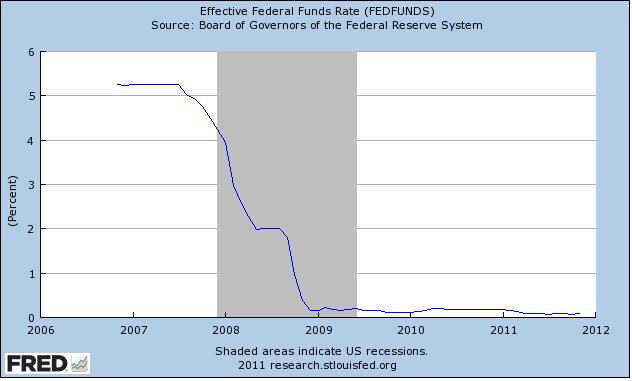
Let us study the US economy and try to understand the difference between the direct and indirect costs of the financial crisis of 2008-09. Recall that the the housing bubble in the US started deflating from around late 2006 (Figure 1). The securitization process that had built itself on the shaky foundations of the housing bubble started unraveling within a year, and the financial crisis broke out in real earnest in 2008. The financial system went into panic, credit markets froze (as banks stopped lending to each other and to nonfinancial firms) and this sent shock-waves through the US government and the Federal Reserve circles. Monetary policy had already kicked in at least an year ago, with the Fed slashing short term interest rates and making liquidity available to the financial system (see Figure 2). But this was clearly not enough.

FIGURE 2: Short term interest rates in the US


(Source: http://research.stlouisfed.org/fred2/graph/?id=FEDFUNDS)

To unfreeze credit markets and deal with the growing panic, the US Treasury department adopted the Troubled Assets Relief Program (TARP) in early October 2008. The conceptualization of the TARP went through two rounds. In the first round, the US Treasury argued that the TARP should buy out the toxic assets (i.e., assets that drew its value from the housing market like mortgage backed securities, the collateraized debt obligations, etc., and were now more or less worthless) from financial institutions to restore confidence in the financial markets and prevent widespread bankruptcies. Very soon it became clear that this strategy would not work because it was impossible to ascertain the “true” value of the toxic assets. In other words, it was not clear at what price the assets should be bought for by the US Treasury. Hence, this strategy was abandoned and in the second round of iteration, TARP was conceptualized as a recapitalization program. This entailed lending money (or other liquid assets like Treasury bills) to financial institutions but in return taking ownership shares of those institutions.

The bail out of the financial institutions that we now talk about is precisely TARP as a method to recapitalize financial institutions, in particular banks, credit market institutions, the automobile industry and the insurance giant AIG, by injecting fresh capital into their balance sheets in lieu of ownership shares. How much money was involved? Initially, TARP was thought to involve $700 billion. But, the Dodd-Frank Wall Street Reform and Consumer Protection Act reduced the maximum authorization for the TARP from $700 billion to $475 billion. The TARP ended on October 3, 2010 and had by then disbursed only a total of $411 billion. Of this, 77%, i.e., $318 billion, has already been recovered through repayments, dividends, interest and other income earnings of the US Treasury.

In fact, the part of TARP funds that was lent to banks has already been recovered with a profit: a total of $245 billion was invested in banks, and it has been recovered with a profit of about $20 billion. It is estimated that the overall cost of TARP, after all recoveries are taken into account, will amount to $70 billion, only about a tenth of the original amount of $700 billion. Hence, it is clear that the overall contribution of the TARP (the bailing-out of the financial system) to the deficit (and outstanding debt) of the US government is not large. The direct cost of the financial crisis, in terms of the funds required to bail out the financial system during the peak of the crisis, is not very large when compared to the indirect cost, to which we now turn.

FIGURE 3: Civilian Unemployment Rate in the US


(Source: Federal Reserve Bank of St Louis, http://research.stlouisfed.org/fred2/)

The indirect cost arose because of the magnification of the effects of a downturn into a deep and prolonged recession, the magnification being caused by the fragility of the financial system. Unemployment rates went through the roof and continues to be at historically high levels despite the official end of the recession in the second quarter of 2009; the labour force participation rates have fallen due to discouraged unemployed workers dropping out of the labour force; the median duration of unemployment has increased to extremely high levels; the share of long term unemployed workers has grown to postwar highs (see Figure 3 and 4 for some details).

FIGURE 4: Civilian Participation Rate in the US


(Source: Federal Reserve Bank of St Louis, http://research.stlouisfed.org/fred2/)

While it might be difficult to accurately quantify these losses, it seems clear that they are far higher than the $70 loss that the taxpayer will be saddled with due to the bail out of the financial sector. For instance, some studies suggest that about 7 million workers have been displaced from long-term employment during the Great Recession, only a subset of all workers who have been adversely hit by job losses. These 7 million workers will experience an income loss of about $774 billion over the next 25 years.

In a similar vein, the contribution of the direct investment from TARP to the growth of the fiscal deficit is small compared to the contribution due to the recession. Figure 5 plots the net outlays (i.e., net of interest payments of its debt) of the federal government, the receipts of the federal government and the difference between the two for the period 2006-2011. It can be seen from Figure 5 that the major jump in the deficit occurred between 2007 and 2009, a period during which it increased by about $1252 billion. This increase was the result of an increase in net outlays (i.e., expenditure) by about $788 billion and a fall in receipts of around $463 billion. Even assuming that the total $411 billion disbursed by the US Treasury for the TARP had occurred during that period (which it clearly did not), it is only about a third of the increase of the federal deficit during that period. Thus, close to (or more than) two-thirds of the increase in the federal government deficit was the result of non-bail out costs.

FIGURE 5: Deficit of the US Federal Government


(Source: Federal Reserve Bank of St Louis, http://research.stlouisfed.org/fred2/)

Looking at the plots of the outlays and receipts of the US federal government in Figure 5, we clearly see that the two series have diverged significantly since the start of the Great Recession. Even though net outlays (i.e., expenditures) have flattened out since 2010, receipts (i.e., tax revenues) have not picked up in any major way. Thus, the gap between the two continues to be big, in excess of $1000 billion every year. This huge gap is what lies behind the deficit and mounting debt of the US government, not the $70 billion that will be the net cost of the TARP. It is more or less certain that a similar account would be accurate for Europe also, i.e., the largest portion of the debt of Eurozone governments would be the result of indirect costs and not the direct cost of bailing out the financial sector during the crisis of 2008.

Conclusion

To conclude, let me summarize the argument. It is important to distinguish between the direct costs (i.e., bail out of the financial sector through the TARP) and indirect costs (rise in unemployment and the growth of the government debt due to the deep and prolonged recession) of the financial crisis and focus on the second rather than the first. This is because the second is much larger in magnitude than the first. In fact, it is not even clear that the first can be considered a cost because without bailing out the financial sector via recapitalization (or temporary and partial nationalization), the recession would certainly have been deeper, increasing the burden on the working people. In addition, concentrating on the second cost allows us to focus on the systemic aspect of the costs that the financial sector, in its speculative avatar, imposes on the working and middle class population of a country. This forces us to conceptualize an alternative that is likewise systemic in nature and goes beyond arguing against bail out of financial sector firms.

Deepankar Basu is an Assistant Professor in the Department of Economics, University of Massachusetts.

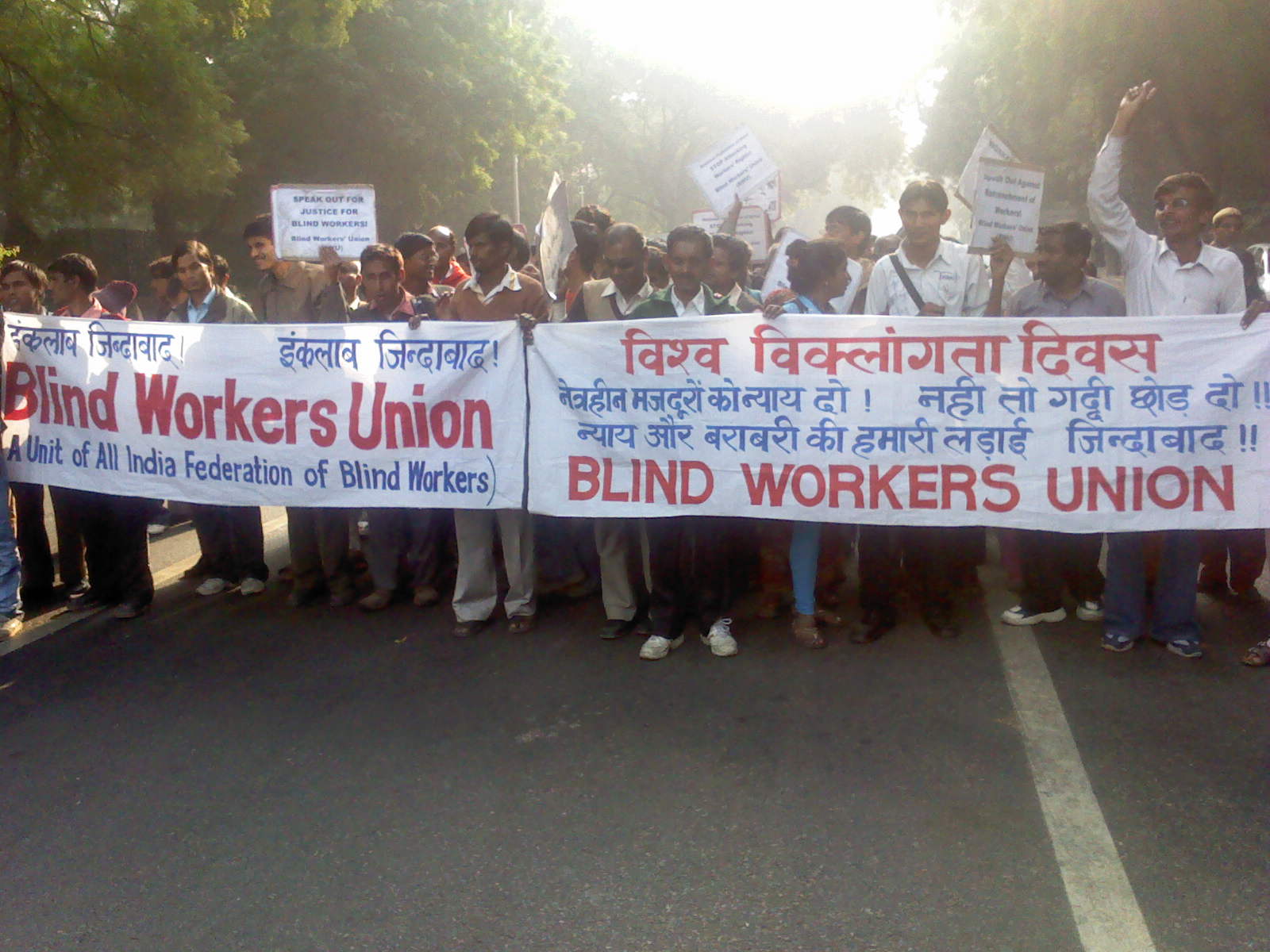
Blind Workers March in Delhi

Sunil Kumar, Blind Workers Union
(A Unit of All India Federation of Blind Workers)
Affiliated to Workers Unity Center of India, WUCI

Today, on December 3, 2011, more than a thousand visually challenged workers from Benaras, Nasik, Kanpur, Faridabad, Bahadurgadh and Delhi participated in a massive protest rally on Parliament Street. Their rally was taken out from Jantar Mantar to Parliament Street on the occasion of World Disability Day. It was a culmination of an earlier struggle these blind workers have carried out against a well-known NGO which employs and exploit them, i.e. the National Federation of the Blind (NFB). The rally was an extremely important moment for these workers since they were using World Disability Day to expose how they were still denied many fundamental rights at workplaces. Instead of celebrating this day in the usual festive manner, these blind workers celebrated World Disability Day as a black day, which marked unfulfilled promises of equality.

Initially, the Delhi Police refused to allow the rally to proceed to Parliament Street. However, the agitated workers refused to be held back and broke free of the barricades so as to march onto Parliament Street. Quite expectedly, their fiery spirit did not mellow down, despite being manhandled. Following their protest rally, a delegation of the workers submitted a memorandum to the Hon’ble Minister of the Ministry of Social Justice and Empowerment, Government of India. The delegation met the concerned minister, Shri Mukul Wasnik, and apprised him of plight of blind workers. They drew the minister’s attention to the fact that the government was doing little to prevent the rampant violation of its own laws pertaining to disability. In particular, the workers highlighted the violation of several provisions in the Persons with Disability (Equal Opportunity, Protection of rights and full participation) Act of 1995.

When discussing matters with the Minister, the workers highlighted how section 33 of this Act, which provides 3% reservation in identified posts (1% being earmarked for the blind and low vision persons), is unable to provide sufficient respite to the disabled because of inadequate job creation in the public sector itself. Another important provision in this 1995 Act which is far from being implemented is section 41. It provides incentives to disabled persons so as to ensure that at least 5% jobs of all workforces goes to them.

However, as highlighted by the protesting workers, both the older laws and policies as well as the newest government policies are failing miserably when it comes to ensuring a dignified and productive life to disabled people, in particular, disabled workers. For example, even the recently adopted National Policy for Persons with Disabilities (2006), which provides incentives, awards, tax exemption, etc. is redundant because the private sector which employs a large number of disabled workers, is least interested in implementing such policies, let alone statutory labour laws pertaining to minimum wages and parity at work. In fact, the promise of the National Policy for Persons with Disabilities (2006) to create one lakh jobs is still a mirage today. In this light, the recommendations of the Sudha Kaul Committee which was constituted to help frame a policy on disability, are also flawed. This Committee, for example, has made no recommendations with respect to labour rights relating to safety when assisting in the drafting of the Right of Persons with Disability Bill, 2011.

The gathering of workers on Parliament Street was addressed by aggrieved workers (those employed by National Federation of the Blind) as well as their leaders. Shri Alok Kumar from the All India Federation of the Blind addressed the gathering, and argued how shameful it was that National Federation of the Blind was also commemorating World Disability Day when this NGO itself exploited the impoverished blind workers. He went on to argue how necessary it was for the government to create more jobs opportunities for disabled workers, and how the government should ensure that all statutory labour laws are implemented in production centres run by “social service” organizations (like NFB) as well as other employers. Indeed, almost every blind worker who stood up to speak, emphasized that NGOs like NFB as well as other employers, act as if they are doing the blind workers a favour by employing them. In reality, as employers they earn huge profits from the labour of these workers. NGOs, in particular, also amass huge amounts of funds from the Government/foreign funding agencies by using the face of these poor blind workers.

It is with the express purpose of attaining greater job opportunities for disabled workers as well as parity in work conditions and wages between blind workers and sighted workers that the spirited rally of blind workers marched onto Parliament Street.

Contact: 9313730069
Email: blindworkersunion@gmail.com

Significance of a counter-hegemonic culture: : An Urgent Need for Marxist Reading Groups

Raju J Das

Capitalism creates poverty. It indeed requires poverty and thrives on it. It causes and requires massive social and geographical inequality. And capitalism is inherently crisis-prone. We have just witnessed a major global economic crisis. In part because of its crisis-proneness, modern world capitalism is necessarily imperialist: advanced capitalist countries try to shift the effects of the crises they experience to politically and economically weaker countries (often with the connivance of the state in these countries). Normal mechanisms of capitalism and the combination of economic crisis and imperialism have major adverse impacts on the living conditions of the working masses in general and workers and poor peasants in the less developed countries such as India in particular.

No system of injustice goes unchallenged, however. Away from the pre-occupations of the corporate-controlled mainstream media, people’s movements against the profit-driven system have been taking place. Consider, for example, the Arab Spring, various social justice movements in India and elsewhere, as well as the ‘occupy movements’ in the US and Europe, which are bound to leave an impression on the radical imagination of the masses, even if they are being repressed. Humans have an irrepressible quest for justice and have a desire for a humane world. These various movements have emerged in response to the heightened levels of exploitation of workers, massive amount of dispossession of peasants from their property, undemocratic control over socio-economic activity and the government by large companies, and the irreparable ecological devastation and cultural impoverishment.

Many activists and movements have been inspired in their thinking by the critique by Marx and other progressive scholars of capitalist commodification and development. Ideologically, these protests and the recent economic crises call into question the legitimacy not only of capitalism, including its neoliberal form, but also of capitalist nation-states and global ‘state’ apparatuses (e.g. World Bank; IMF). This happens in richer countries and in poorer countries such as India as well.

There has indeed been an extraordinary resurgence of interest in a Marxist worldview recently, which as Terry Eagleton put it, is the ‘most theoretically rich, politically uncompromising critique of [the capitalist] system’ (Why Marx was right?). The process of resurgence of this intellectually insurgent worldview (Marxism) has been helped by the fact that the social relations of authoritarian ‘communism’, and other related views, which had acted as a fetter on the development of productive powers of Marxist research, have been burst asunder. In this context, question of alternatives to capitalism (beyond Keynesianism, state-bureaucratism, and neo-populism) – and the role of (Marxist) intellectuals whether in academy, in the media or ‘civil society’ in radical social change – are being actively discussed the world over. This has led to a series of important interventions rethinking political parties, democracy and visions of viable socialisms. More and more people are reading Marx and Marxists, and reading them critically, for Marxism is a science which must be updated where necessary. There is an outpouring of Marxist discussions including in journals such as New York-based Science and Society, world’s longest continuously published Marxist journal, which celebrated its 75th anniversary in October 2011, Review of Radical Political Economics (from Cornell University), Historical Materialism (from SOAS, London), Capital and Class, and so on. Much of this resurgence is exhibited on- online, Radical Notes itself being a testimony to this as is, for example, Sanhati.

The remaking of socialist visions – which emphasize socialism as the flourishing of optimal level of democracy in all spheres of human life – has also meant extensive considerations of race, caste, tribality, gender, sexuality and disability. These issues of social oppression/discrimination are important in their own right. But they are important dominantly because of the ways in which capitalism subordinates them to its own logic. Capitalism furthers its accumulation projects by using these sources of oppression to define certain working subjects as less than average workers who can be paid lower compensations. Capital also politically dominates the suffering subjects (workers and peasants) by dividing them on the basis of these non-class identities. An aspect of the resurgence of Marxist research is the immense popularity of Marxist dialectics as a holistic way of looking at the capitalist world, in terms of its unity as well as difference, from the standpoint of radically changing it. Such a dialectical method allows us to reflect on various methods of exploitation and social oppression as interconnected and as forming a concrete whole.

Reading Marx and those who engage in what the American Marxist, Hal Draper called ‘Marx’s Marxism’ would be more than apt at a political moment when neoliberalism, in theory and practice, is in crisis, when the turbulence of capitalist economies is part of daily life. As David Harvey and others have argued, Marx is more relevant now than he was during his own time.

The problems caused by capitalism are everywhere. These problems are, however, particularly acute in less developed countries and in the most under-developed parts of these poor countries. In many under-developed regions of India (e.g. Odisha), capitalist market relations in land and labour coexist with remnants of coercive production relations in some localities and with highly undemocratic relations of casteism, patriarchy and tribalism more generally. The institutions of the state are more or less ‘instruments’ of property-owners, including those whose main object is to subject natural resources and working people to cruel forms of commodification and ruthless forms of exploitation, all in the name of development and dollars (export earnings). There is an inverse relation between democratic rhetoric and its actual content. There is an absence of democratic values both in the economy or polity: ordinary people have little real democratic control over the way our resources and abilities to work are used. The cult of violence is everywhere. There is systemic violence as that caused when people’s livelihood is snatched away from them or when people do not have the money to buy basic necessities because of which they starve to death or suffer from poverty-caused diseases. Related to this violence is ‘agentic violence’: in some places ordinary people, often out of sheer desperation, tend to resort to violence (which is unproductive in the long run), in response to which and often to preempt which the state resorts to massive and disproportionate violence.

The situation in more under-developed regions of India and in similar other countries raises several questions. Why are these regions so poor when they are so rich in terms of natural resources and labouring quality of their workers and peasants? How does capitalism make use of undemocratic social and economic relations? What explains the inability of the political and intellectual elite to help the suffering masses in any significant way? Just why it is that the majority of our people have no access to nutritious food, decent housing and clothing, quality education and health-care as well as other amenities including safe drinking water and electricity? These and many other questions can be fruitfully explored only if we have an adequate understanding of capitalism as such and the ways in which it works in concrete circumstances. Understanding Marx is essential therefore. A proper understanding of Marx and his legacy would also make clear to people that the Marxist vision is a vision of a society which is authentically democratic and that Marxism has little to do with any political activity which is aimed at hurting individuals. Individuals are bearers of social relations. What needs to be changed is the system of social relations, not occupiers of positions in the system.

To understand the world, it is not enough to have sense-data. We need theory, this is because important aspects of the world are not immediately accessible to mere empirical observation. To understand the world from the standpoint of the majority, the working masses, we need a theory from their standpoint. Radical transformation in the direction of social, economic and ecological democracy and justice is not possible without a radical theory. Marx and his legacy provide such a theory. It would be useful to set up Radical/progressive reading groups in different places to promote a counter-hegemonic culture, a tradition of radical imagination in theory. Consisting of interested academics, activists, workers-peasants, and indeed anyone who is interested in critically understanding the current situation with a view to radically transcend it and deepen the democratic content/spirit of our society to the highest extent possible, this group could meet regularly to read the Marxist and progressive literature on topics of classical and contemporary significance and discuss it in a comradely and non-sectarian manner. It will also connect the readings and the discussions to the world around us and draw theoretical implications for political practice. There are thousands of progressive people engaged in theoretical-political struggle for justice. Often in terms of theory, politics and method of struggles, there are ‘deep’ divisions among them (including, and interestingly, over the fact of whether poor countries such as India are dominantly capitalist or not). Perhaps an understanding of Marx and his legacy would show that the divisions are not as real as they appear to be, and that there is cause more for unity and less for division: at least the divisions should be discussed in the light of theoretical discussions the foundation for which was laid by Marx. These reading groups cannot only read radical academic literature but also encourage performance of radical art in its various forms and reflect on these theoretically.

A culture that accurately reflects the interest and ideas of the majority of the people is a most democratic process to promote. Setting up Marxist Readings Groups is an important need of the hour therefore.

Raju J Das is an Associate Professor at York University, Toronto, Canada. Email: rajudas@yorku.ca

Industrialisation and forms of struggle: Or, should industrialisation be opposed?

Raju J Das

Industrialisation is understood narrowly in the sense of manufacturing and broadly in the sense of the application of modern science and technology to the transformation of raw materials from nature. It is necessary for national development, as the economist Gavin Kitching and others argued decades ago. Industrialisation adds value to unprocessed goods extracted from nature and thus increases society’s income. Often owners of land – peasants – do not earn more – or do not earn much more — than those who work in industry as wage labourers. Industrialisation makes possible the production of a vast range of goods, which are directly used by people: clothes, materials required to build houses, traditional and western medicines, consumer durables, cultural items such as books and music instruments; the different types food that go through the manufacturing process, and so on. And, industry indeed produces the means of production necessary in both farming and industry itself. Industrialisation holds out the possibility of ending want and material suffering. It provides employment to the increasing population, including through forward and backward linkages. It makes it possible to reap scale economies and specialisation in ways not possible in agriculture. In part because of the above, industrialisation increases labour productivity, one of the fundamental indicators of progress, prosperity, and economic development in the society at large. Industrialisation breaks the mutual isolation of producers: this happens as they now work in great numbers in large cities and towns. Their geographical concentration will potentially allow them to fight for justice and equality in society, both on their behalf and on behalf of other oppressed groups. Industrialisation, connected as it is to science, promotes a culture of rational thinking and can potentially undermine the basis for superstitious and obscurantist ideas and practices. Given these and many other advantages of industrialisation, the Left – at least the Marxist left — cannot be opposed to industrialisation (although sections of the postmodern/populist Left are, as industrialisation is seen by them as a sign/carrier of modernity that supposedly destroys an authentic pre-modern culture). The question is: what form of industrialisation should the Left endorse in theory and practice? What happens when, for example, a proposed SEZ (special economic zone) displaces thousands of peasants? Should industrialisation be endorsed under this situation?

To answer this question, one may start with agriculture. Land is the most important means of production in agriculture, at least at the current stage when farming is relatively less capital-intensive. Fertility of land is a product of natural forces as well as human investments. It is normally the case that human investments in land to raise land fertility happen closer to existing centres of population and commerce than away from these. Fertile tracts of land therefore are generally located closer to existing centres of population and commerce. Now, owners of industry need also land. But their need for land is different. They need to locate their factories on: land is not used as an input in the way it is used in farming. And in a market economy, they need land in a specific location: industry tends to be located closer to existing centres of population and commerce for the reason that greater profits are made possible by greater geographical accessibility. Therefore, the fight over industrialisation often becomes a fight between owners of industry and owners of land (including peasants). This fight is over not just an absolute piece of land but over its location.

To be able to understand the on-going struggles over industrialisation, we have to carefully distinguish between industrialisation per se which is necessary in all modern societies from its various historically specific forms, and we need to also distinguish between various forms of struggle over industrialisation.
There is a strong logic to locating industry on the land which is not currently cultivated or irregularly cultivated, in relatively less accessible locations and away from the locations of fertile land on which peasants are currently dependent on or which may soon be used. Why? Firstly, as mentioned above, industry does not need fertile land as an input. Location of a factory on or close to a fertile land destroys natural fertility of soil which is almost impossible to manufacture in industry. It is indeed a great social cost to use a fertile land for industrialisation which does not need it. Secondly, forcing the industry to locate in these areas (e.g. relatively less accessible areas, away from fertile land) will result in the development of new means of transportation and communication (which will also create jobs). Industrialisation in these less accessible locations will also give an impetus to agriculture. It is unfortunate that when industries could be located in more remote locations on land that is relatively less fertile, they are being located on currently cultivated fertile land. This must be fought against. This is one form of struggle over industrialisation.

If, however, a fertile land currently being cultivated must absolutely be used for an SEZ — and whether this must be the case should be democratically decided and not decided by business — several conditions must be laid out. The value of the land as a compensation to the family must be determined in relation to what the value of the land would be after the industries have come up. Under no circumstances must the living standards of the families losing the land and the families losing access to employment on that land (farm labourers, tenants) be allowed to be worse than what they were before the change in the use of the land. Indeed, because industrialisation will make possible greater production of wealth and because this is possible only by displacing the people who currently occupy the land and depend on its use, it must be an absolute precondition of displacement that their material and cultural needs (adequate food, clothes, shelter, education, health care, etc.) are satisfied (including by giving employment to at least a single person from every affected family with a living wage in the industry) and that environmental sustainability of the place and nearby-places is maintained. Investment must be made in the lives of the people who are affected before the investment is made in the SEZ itself. This will not happen automatically. This requires democratically mobilised struggle. This is the second form of struggle over industrialisation.

Peasants as peasants have been involved in heroic battles over dispossession from their land – in Bengal, in northern Orissa, in Maharashtra, and so many other places. This is not the decisive battle against the industrialist class (domestic or foreign), however. The decisive battle against it cannot be, and will not be, fought by peasants as property owners against dispossession, although local and temporary success is possible. The battle against unjust dispossession can only be successfully fought by urban workers in an alliance with peasants and rural workers. Note also that the issue of peasants being separated from land is not a single separable visible act of a group of industrialists, backed by the state. Given, for example, the high costs of farm inputs which come from the industry and given the decreasing prices of farm products from which industry benefits, millions are going into debt, and to clear their debt, peasants are selling their land. Many are leasing their land to better-off farmers, including those who enter into contract with industrialists, domestic and foreign, to produce farm products for industrial processing. There is therefore a potential site of struggle against this insidious form of dispossession from land. The industrialists who set up an SEZ by displacing peasants from land and the industrialists who benefit from high prices of goods sold to peasants which contribute to their economic unviability and separation from land are both members of the same family. The fight against high prices of industrial goods used by peasants is therefore an important part of the fight for a particular form of industrialisation, one that would seek to remove the differences between peasants and industry and the relations of oppression between them.

There is still another form of struggle over industrialisation. Peasants turned into the proletariat in the SEZs, in newly industrialising areas – whether located on fertile land, displacing peasants or in remote locations — will and must fight against the monied class, initially for better wages and working conditions. One may respond by saying that the SEZ framework of industrialisation does not allow for the working class organisation. But then who said that the SEZ must be a necessary form of industrialisation? Or if it does, who said that an SEZ – understood as an industrial cluster — must be one where workers are to be alienated from their democratic right to organise? If business has the right to make money, then surely, and in the interest of democracy, workers have the right to organise to demand a decent life? This is the fourth form of struggle over industrialisation, the struggle that connects workers of different industrial clusters and cities politically and that demands that industrialisation must be of a particular form such that those who do the work must be fully able to meet their social and cultural needs. An SEZ, an industrial project is not based on a one-time act of separating people from their land and livelihood. Much rather, the particular form of industrialisation that is in question is based on a continuous separation: separation of people from the product of their labour, from their blood and sweat. It represents endless money-making at one pole and limitless misery at another. This form of industrialisation does not just produce things that are of potential use. It reproduces an invisible relation of separation of masses from their lives, a relation between them and those who control their lives at work (and outside). So because separation of people from their land creates a ground for the second form of separation, the struggle against the former must be connected to the struggle over the latter, and can only be fully successful if it is connected that way.

Protecting the peasants does not necessarily mean protecting the peasant property. If industrialisation can better the conditions of peasants (i.e. outside of farming), perhaps ‘sacrificing’ their property to make room for industrialisation can be favourably considered. Everyone must be provided with an opportunity to live a life with dignity. Whether it is in industry or farming should, ordinarily, be beside the matter. But there is an ‘if’, as in ‘If industrialisation can better conditions of life of peasants…’. Industrialisation, whether led by state-capital or private capital has not done much for millions of peasants. And it won’t unless it is a site of contestation.

The current struggles around SEZs and displacement appear to be a little narrow. They are often too defensive. The message of these struggles seems to be: ‘don’t take away our land, leave us alone (to our misery)’. The struggle against displacement should be a part of larger family of struggles, i.e. struggles over industrialisation as such. This is because the objects of struggle are objectively inter-connected. The fight against SEZs must be a fight against a particular existing form of industrialisation which leads to double dispossession: political acts of dispossession or primitive accumulation and dispossession through market mechanisms (rising prices of industrial goods leading to debt). A part of the fight should also be within SEZs (and other industrialised areas). Seen in another way, the fight against SEZs and displacement is a fight for a certain form of industrialisation, which, in turn, is a fight for (deepening) democracy and for the satisfaction of social, cultural and ecological needs of those who are displaced to make room for industries, those who lose land because of rising prices of industrial goods, and those who work inside the industrial areas.

Raju J Das is an Associate Professor at York University, Toronto, Canada. Email: rajudas@yorku.ca

Beverly Silver on “The End of the long 20th Century”

Courtesy: Labournet.tv

Working Conditions Maruti Suzuki English subtitles