Delhi: Protest Demonstration and Memorandum in solidarity with Haridwar workers (April 17)

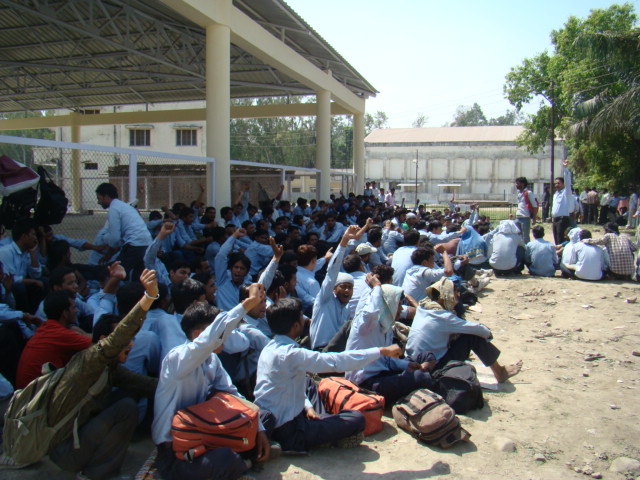
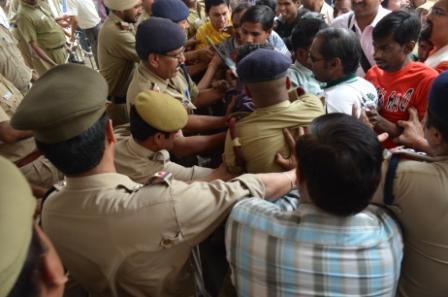
Today (April 17), a joint protest demonstration was organized in front of the Uttarakhand Niwas, Chnakyapuri. The protestors raised slogans against the management of Satyam Auto and Rockman Auto Pvt Ltd, and the anti-labour Uttarakhand government. They strongly condemned the brutal lathicharge on struggling workers, and their illegal detention in various jails acroos Dehradun. Members of the following organizations were present: Inqulabi Mazdoor Kendra, Mehnatkash Mazdoor Morcha, AIFTU(New), Mazdoor Ekta Kendra, Krantikari Lok Adhikar Sangathan, Uttarakhand Nav Nirman Mazdoor Sangh, Mazdoor Patrika, Krantikari Naujawan Sabha, PDFI, Pragatisheel Mahila Ekta Kendra, TUCI, Radical Notes

A five member delegation handed over the following memorandum to the Resident Commissioner of Uttarakhand.

Dated: 17.04.2012

To
The Residence commissioner
Uttarakhand Bhawan,
Govt. of Uttarakhand
New Delhi

Sub:- Memorandum on behalf of Mass organizations in solidarity with workers of Rockman Industries pvt. Ltd. & Satyam Auto component Ltd.

Sir,

We are in solidarity with the workers of Rockman Industries pvt. Ltd. & Satyam Auto component Ltd. of SIDCUL Haridwar who are on path of agitation for their trade union demands from management. Labor department and state government is well aware with the rampant violation of labor laws in these companies like other industries situated in SIDCUL, however they do not feel any necessity to intervene in the matter to check the super exploitation of workers by the management. Contrary to their administrative responsibility assigned under the law of the land, they are hobnobbing with the management and resorted to repress the workers movement.

On 15.04.2012 workers who were on Anshan w.e.f. 06.04.2012 in capital city of Dehradoon were lathicharged and detained under various penal provisions. 326 workers are in jail and 11 were forcibly hospitalized. Management who is responsible for industrial unrest is moving freely and hobnobbing with newly elected congress government which is determined to crush worker’s movement like Haryana and other states.
Uttarrakhand government claims that after formation of new state it has gone ahead with industrialization of the state and in order to do so, SIDCUL has been established in different parts of the state like, Haridwar, Rudrapur, Pantnagar etc. However we have found that these are hell for the workers. No Job security, no wage norm, no labor law and sheer exploitation of the workers are only norm in these industrial areas of Uttarkhand. It is tax heaven for the investors and corporate and hell for the workers. Casualization and contract system that too, illegal contract system is norm in the industrial belt of uttarakhand.

The above named industrial units are major vendor of Honda motor co. , which do not adhere to the labor norms. Illegal contract system is going on in these factories and workers are forced to work on lower wages upto 12 hours a day. Workers in these units of Haridwar are paid only Rs. 6000 P.M. by the co. for the similar work , which get Rs. 12000/ per month in gurgaon plant of the co. Workers are deprived of basic right to form union of their own choice. 5 leading workers were terminated since they had taken initiative to form union and put forward their wage related demands. Around 600 workers of Rockman industries are on strike 18th March 2012 however labor department and civil administration is unmoved by the agitation of the workers. Both regular and contract workers joined the strike for furtherance of their demand.

We condemn police atrocity on striking workers and demand that:-
1. Police officials responsible for lathicharge on workers and illegal detention of workers be reprimanded and charge sheeted.
2. Labor minister of Uttarakhand Government resolve the labor dispute by calling a meeting of agitating workers and management of Rockman Industries pvt. Ltd. & Satyam Auto component Ltd.
3. Restore labor laws in Rockman Industries pvt. Ltd. & Satyam Auto component Ltd as well as in other industries in Uttarakhand.
4. Terminated workers of Rockman Industries pvt. Ltd. be reinstated without any condition.
5. Illegal contract system be abolished.
6. Management of Rockman Industries pvt. Ltd. & Satyam Auto component Ltd. be punished for violation of labor laws.
7. Workers of Rockman Industries pvt. Ltd. & Satyam Auto component Ltd. be paid wages proportionate to the workload and they should be paid overtime as required under law.

• Inqulabi Mazdoor Kendra
• Mehnatkash Mazdoor Morcha
• Mazdoor Patrika
• Krantikari Lok Adhikar Sangathan
• Krantikari Naujawan Sabha
• PDFI
• Pragatisheel Mahila Ekta Kendra
• Radical Notes

Dehradun Update: 326 workers on hunger strike in jail

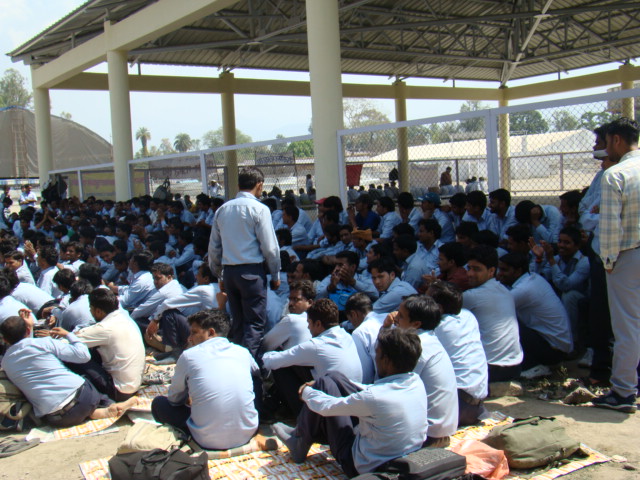
An update on the ongoing struggle by Rockman and Satyam Auto workers in Uttarakhand. As reported yesterday, 326 workers are in jail and 11 hunger striking workers are detained in hospital. As of yesterday evening, all 326 workers in jail have joined the hunger strike. The 11 hunger strikers already in hospital have resisted force feeding. They are weakening but still in good health.

It is understood that the SDM has directed their detention until April 20th, though the legal provisions under which this has been done are not clear. The government has also announced to TV channels that the Labour Commissioner will be asked to intervene. Protests are planned today and tomorrow in Dehradun.
Shankar Gopalakrishnan

Dehradun: Police Lathicharge Workers, 11 hunger strikers hospitalised for forcefeeding, 326 jailed

Shankar Gopalakrishnan

Between 12 and 1 today, the Uttarakhand police lathi charged more than 300 workers who have been sitting on a protest in Dehradun for the last ten days. 11 workers who have been on hunger strike (six from April 6th and five who joined them on April 9th) have been forcibly hospitalised in Doon Hospital, where they are resisting attempts to forcefeed them. 326 workers have been arrested and detained in various jails in the city.

The workers have been on strike for more than three weeks now. They are employees of the Rockman and Satyam Auto plants in Haridwar, both major suppliers of Hero Motors. As in Manesar, Haryana last year, these workers are being paid extremely low wages for more than 12 hours of work a day; when they sought to form a union to demand respect for labour laws, the five leaders of the union were illegally sacked immediately and the others threatened with punishment. On March 19th the majority of permanent workers at Rockman came out on strike in protest at this illegal brutality, and on March 22nd they were joined by all the permanent workers at Satyam. Their main demands are:

1. That they be allowed to form a union as per law, which both companies are trying to suppress;
2. That the five workers who were illegally terminated be reinstated;
3. That all labour laws be complied with within the factory;
4. That their wages be made proportionate to the workload and that they should be paid overtime as required by law.

In the first week of April, in an attempt to suppress their protest, the Uttarakhand government declared section 144 in force in Haridwar. On April 4th the workers sough to come to teh capital, Dehradun, to take out a peaceful march. This too was thwarted by the police, whereupon the workers sat down on dharna at the Parade Ground in the city. On the 6th, six Rockman workers went on hunger strike, and they were joined by five Satyam workers on the 9th. They have been fasting ever since, weakening every day.

No response has come from the government. When a delegation sought to meet the Chief Minister, he told them that these workers are overpaid, that the strike and protest is a conspiracy, and that they would be “dealt with.” The meaning of those words has been demonstrated today.

Workers in other factories in Haridwar, including in Eveready ITC, VIP, and the public sector company Bharat Heavy Electricals Ltd., have declared their support for the strike. A protest and delegation from other factories in Haridwar is planned tomorrow.

For more details please contact Trepan Singh Chauhan, Uttarakhand Nav Nirman Mazdoor Sangh (09411143539), and/or Amit, Inquilabi Mazdoor Kendra (09568216305).

Haridwar Industrial Unrest “Manesar-like”

Inputs and Photos
by Trepan Singh Chauhan,
Uttarakhand Nav-Nirman Mazdoor Sangh

The 2011 Maruti Suzuki workers strike at Manesar (Gurgaon) has already become a metaphor for the new wave of industrial unrest in India, especially against the neoliberal industrial regime that makes the criminal violation of all kinds of regulation and labour laws by the corporate sector an imperative for growth and development. Manesar has come to signify the will of the workers to counter capital by spontaneous and solidaristic uprisings.

On April 4, Business Standard reported the strike in Haridwar in Satyam Auto and Rockman Industries, two leading auto parts suppliers to Hero MotoCorp, India’s largest two-wheeler company. This report was aptly captioned “Haridwar factories brew Manesar-like labour situation”. The strike, which has been going on for the last two weeks, has not been reported by any local or mainstream newspapers. According to the Business Standard report:

A two-week strike is unusual, but the managements of both companies have refused to agree to the workers’ demands. Unlike previous strikes here, this industrial action shows signs of disturbing the peace in the region, with support pouring in from workers at other companies. For the past one decade Haridwar and its neigbouring areas have seen investments from leading companies like Hindustan Unilever, luggage manufacturer VIP, battery manufacturer Eveready, and Hero MotoCorp. According to the BS report, “around 850 companies here employ over 70,000 people.”

So, as workers from the two strike-hit companies staged a protest here on Tuesday, outside the offices of the district administration, they were supported by workers from companies such as VIP, Eveready ITC and Bharat Heavy Electricals Ltd (BHEL). A similar march was taken out last Wednesday, too. Major trade unions such as the All India Trade Union Congress and Hind Mazdoor Sabha have supported the protesting workers. So are 13 workers’ unions at the public sector engineering major, BHEL. Workers at Eveready and VIP have presented their respective companies with charters of demands, including wage hike.

Since yesterday (April 4), workers of Rockman Industries and Satyam Auto have been occupying the Parade Ground, Dehradun (the capital city of Uttarakhand), and were on a day long fast today to press for their demands.

Blind Workers demonstrate for their rights (March 27)

Blind Workers’ Union
(A Unit of All India Federation of Blind Workers)
Affiliated to Workers Unity Center of India, WUCI
Contact: 9313730069 Email: blindworkersunion@gmail.com

Blind Workers’ Union all-up against violation of their labour rights and government inaction.
Blind Workers’ Union warns Social Justice Ministry of grave consequences if alternative jobs are not provided to retrenched blind workers.

Today (March 27), Blind Workers’ Union in mid of heavy deployment of police and barricades, staged a massive demonstration outside the Sarai Rohilla Railway Station in Delhi. Initially the unemployed blind workers tried to enter the railway station and block the rail traffic but the heavy contingents of police did not allow them to enter the railway track from any side. Thereafter these blind workers shouted anti-government slogans and held a protest meeting outside the station.

It is to be noted that the Blind Workers’ Union has been raising the issue of violation of blind workers basic labour rights since November, 2011. We have been raising our voice against violation of basic labour rights like minimum wage, PF, bonus, overtime payment etc. The workers were deeply agitated over the fact that despite several representations to the Ministry of Social Justice and Empowerment, there has been no concrete step taken either against the erring employers or to give these blind workers employment in public sector. These blind workers were thus forced to take up this drastic step so that general public becomes aware of their misery. These blind workers are demanding employment in public sector so that their rights are not violated by NGOs and private enterprises. In their most recent memorandum to Social Justice Ministry these blind workers demanded that the Ministry must make alternative provisions of jobs for these blind workers before 27th March or else they will be left with the alternative of either die of hunger or carry an all-out struggle against government.

In the protest meeting that was carried out outside the station it was resolved that this struggle of blind workers should be taken as an ultimatum by the government. They further warned the government and ministry that if they fail to provide employment immediately to these blind workers then from next month onwards they would be forced to carry out this Rail Roko in different parts of the country and next time they would even defy police.

Economy Democracy Manifesto

A new historical vista is opening before us in this time of change. Capitalism as a system has spawned deepening economic crisis alongside its bought-and-paid for political establishment. Neither serves the needs of our society. Whether it is secure, well-paid and meaningful jobs or a sustainable relationship with the natural environment that we depend on, our society is not delivering the results people need and deserve. We do not have the lives we want and our children’s future is threatened because of social conditions that can and should be changed. One key cause for this intolerable state of affairs is the lack of genuine democracy in our economy as well as in our politics. One key solution is thus the institution of genuine economic democracy as the basis for a genuine political democracy as well. That means transforming the workplace in our society as we propose in what follows.

We are encouraged by The Occupy Wall Street (OWS) movement spreading across the United States and beyond. Not only does OWS express a widespread popular rejection of our system’s social injustice and lack of democracy. OWS is also a movement for goals that include economic democracy. We welcome, support, and seek to build OWS as the urgently needed, broad movement to reorganize our society, to make our institutions accountable to the public will, and to establish both economic democracy and ecological sanity.

1) Capitalism and “delivering the goods”

Capitalism today abuses the people, environment, politics and culture in equal measures. It has fostered new extremes of wealth and poverty inside most countries, and such extremes always undermine or prevent democratic politics. Capitalist production for profit likewise endangers us by its global warming, widening pollution, and looming energy crisis. And now capitalism’s recurrent instability (what others call the “business cycle”) has plunged the world into the second massive global economic crisis in the last 75 years.

Yet both Republican and Democratic governments have failed to bring a recovery to the great mass of the American people. We continue to face high unemployment and home foreclosures alongside shrinking real wages, benefits and job security. Thus, increasing personal debt is required to secure basic needs. The government uses our taxes to bring recovery from the economic crisis to banks, stock markets, and major corporations. We have waited for bailouts of the corporate rich to trickle down to the rest of us; it never happened. To pay for their recovery we are told now to submit to cuts in public services, public employment, and even our social security and Medicare benefits. The budget deficits and national debts incurred to save capitalism from its own fundamental flaws are now used to justify shifting the cost of their recovery onto everyone else. We should not pay for capitalism’s crisis and for the government’s unjust and failed response to that crisis. It is time to take a different path, to make long-overdue economic, social and political changes.

We begin by drawing lessons from previous efforts to go beyond capitalism. Traditional socialism – as in the USSR – emphasized public instead of private ownership of means of production and government economic planning instead of markets. But that concentrated too much power in the government and thereby corrupted the socialist project. Yet the recent reversions back to capitalism neither overcame nor rectified the failures of Soviet-style socialism.

We have also learned from the last great capitalist crisis in the US during the1930s. Then an unprecedented upsurge of union organizing by the CIO and political mobilizations by Socialist and Communist parties won major reforms: establishing Social Security and unemployment insurance, creating and filling 11 million federal jobs. Very expensive reforms in the middle of a depression were paid for in part by heavily taxing corporations and the rich (who were also then heavily regulated). However, New Deal reforms were evaded, weakened or abolished in the decades after 1945. To increase their profits, major corporate shareholders and their boards of directors had every incentive to dismantle reforms. They used their profits to undo the New Deal. Reforms won will always remain insecure until workers who benefit from the reforms are in the position of receiving the profits of their enterprises and using them to extend, not undermine, those reforms.

The task facing us, therefore, goes well beyond choosing between private and public ownership and between markets and planning. Nor can we be content to re-enact reforms that capitalist enterprises can and will undermine. These are not our only alternatives. The strategy we propose is to establish a genuinely democratic basis – by means of reorganizing our productive enterprises – to support those reforms and that combination of property ownership and distribution of resources and products that best serve our social, cultural and ecological needs.

2) Economic Democracy at the Workplace and in Society

The change we propose – as a new and major addition to the agenda for social change – is to occur inside production: inside the enterprises and other institutions (households, the state, schools, and so on) that produce and distribute the goods and services upon which society depends. Wherever production occurs, the workers must become collectively their own bosses, their own board of directors. Everyone’s job description would change: in addition to your specific task, you would be required to participate fully in designing and running the enterprise. Decisions once made by private corporate boards of directors or state officials – what, how and where to produce and how to use the revenues received – would instead be made collectively and democratically by the workers themselves. Education would be redesigned to train all persons in the leadership and control functions now reserved for elites.

Such a reorganization of production would finally and genuinely subordinate the state to the people. The state’s revenues (taxes, etc.) would depend on what the workers gave the state out of the revenues of the workers’ enterprises. Instead of capitalists, a small minority, funding and thereby controlling the state, the majority – workers – would finally gain that crucial social position.

Of course, workplace democracy must intertwine with community democracy in the residential locations that are mutually interactive and interdependent with work locations. Economic and political democracy need and would reinforce one another. Self-directed workers and self-directed community residents must democratically share decision-making at both locations. Local, regional and national state institutions will henceforth incorporate shared democratic decision-making between workplace and residence based communities. Such institutions would draw upon the lessons of past capitalist and socialist experiences.

3) Benefits of Workplace Democracy

When workforce and residential communities decide together how the economy evolves, the results will differ sharply from the results of capitalism. Workplace democracy would not, for example, move production to other countries as capitalist corporations have done. Workers’ self-directed enterprises would not pay a few top managers huge salaries and bonuses while most workers’ paychecks and benefits stagnate. Worker-run enterprises sharing democratic decision-making with surrounding communities would not install toxic and dangerous technologies as capitalist enterprises often do to earn more profits. They would, however, be far more likely to provide daycare, elder care and other supportive services. For the first time in human history, societies could democratically rethink and re-organize the time they devote to work, play, relationships, and cultural activities. Instead of complaining that we lack time for the most meaningful parts of our lives, we could together decide to reduce labor time, to concentrate on the consumer goods we really need, and thereby to allow more time for the important relationships in our lives. We might thereby overcome the divisions and tensions (often defined in racial, gender, ethnic, religious, and other terms) that capitalism imposes on populations by splitting them into fully employed, partly employed, and contingent laborers, and those excluded from the labor market.

A new society can be built on the basis of democratically reorganizing our workplaces, where adults spend most of their lifetimes. Over recent centuries, the human community dispensed with kings, emperors, and czars in favor of representative (and partly democratic) parliaments and congresses. The fears and warnings of disaster by those opposed to that social change were proved wrong by history. The change we advocate today takes democracy another necessary and logical step: into the workplace. Those who fear (and threaten) that it will not work will likewise be proven wrong.

4) An Immediate and Realistic Project

There are practical and popular steps we can take now toward realizing economic democracy. Against massive, wasteful and cruel unemployment and poverty, we propose a new kind of public works program. It would differ from the federal employment programs of the New Deal (when FDR hired millions of the unemployed) in two ways. First, it would focus on a “green” and support service agenda. By “green” we mean massively improving the sustainability of workplace and residential communities by, for example, building energy-saving mass transportation systems, restoring waterways, forests, etc., weatherizing residential and workplace structures, and establishing systematic anti-pollution programs. By “support service” we mean new programs of children’s day-care and elder-care to help all families coping with the conditions of work and demographics in the US today.

However, the new kind of pubic works program we propose would differ even more dramatically from all past public works projects. Instead of paying a weekly dole to the unemployed, our public works program would emphasize providing the unemployed with the funds to begin and build their own cooperative, self-directed democratic enterprises.

The gains from this project are many. The ecological benefits alone would make this the most massive environmental program in US history. Economic benefits would be huge as millions of citizens restore self-esteem damaged by unemployment and earn incomes enabling them to keep their homes and, by their purchases, provide jobs to others. Public employment at decent pay for all would go a long way toward lessening the gender, racial, and other job discriminations now dividing our people.

A special benefit would be a new freedom of choice for Americans. As a people, we could see, examine and evaluate the benefits of working inside enterprises where every worker is both employee and employer, where decisions are debated and decided democratically. For the first time in US history, we will begin to enjoy this freedom of choice: working in a top-down, hierarchically organized capitalist corporation or working in a cooperative, democratic workplace. The future of our society will then depend on how Americans make that choice, and that is how the future of a democratic society should be determined.

5) The Rich Roots Sustaining this Project

Americans have been interested in and built various kinds of cooperative enterprises – more or less non-capitalist enterprises – throughout our history. The idea of building a “cooperative commonwealth” has repeatedly attracted many. Today, an estimated 13.7 million Americans work in 11,400 Employee Stock Ownership Plan companies (ESOPs), in which employees own part or all of those companies. So-called “not-for-profit” enterprises abound across the US in many different fields. Some alternative, non-capitalist enterprises are inspired by the example of Mondragon, a federation of over 250 democratically-run worker cooperatives employing 100,000 based in Spain’s Basque region. Since their wages are determined by the worker-owners themselves, the ratio between the wages of those with mostly executive functions and others average 5:1 as compared to the 475:1 in contemporary capitalist multinational corporations.

The US cooperative movement stretches today from the Arizmendi Association (San Francisco Bay) to the Vida Verde Cleaning Cooperative (Massachusetts) to Black Star Collective Pub and Brewery (Austin, Texas), to name just a few. The largest conglomerate of worker owned co-operatives in the U.S. is the “Evergreen Cooperative Model” (or “Cleveland Model”), consisting e.g. of the Evergreen Cooperative Laundry (ECL), the Ohio Cooperative Solar (OCS), and the Green City Growers. These cooperatives share a) common ownership and democracy at the workplace; b) ecological commitments to produce sustainable goods and services and create “green jobs”, and c) new kinds of communal economic planning, mediated by “anchor institutions” (e.g. universities, non-profit hospitals), community foundations, development funds, state-owned banks or employee ownership banks etc. Such cooperatives are generating new concepts and kinds of economic development.

These examples’ varying kinds and degrees of democracy in the workplace all attest to an immense social basis of interest in and commitment to non-capitalist forms of work. Contrary to much popular mythology, there is a solid popular base for a movement to expand and diversify the options for organizing production. Workplace democracy responds to deep needs and desires.

If you are interested in getting further information about this proposal, in joining the discussion it engages, or in participating in activities to achieve its realization, please find us on Facebook at Economic Democracy Manifesto or email manifesto@rdwolff.com

“Economic Democracy Manifesto” Group

David van Arsdale
Michael McCabe
Costas Panayotakis
Jan Rehmann
Sohnya Sayres
Billy Wharton
Richard D. Wolff

Video: Werner Bonefeld on “The nature of the state”

Werner Bonefeld: The nature of the bourgeois state from Communist Party of Great Britain on Vimeo.

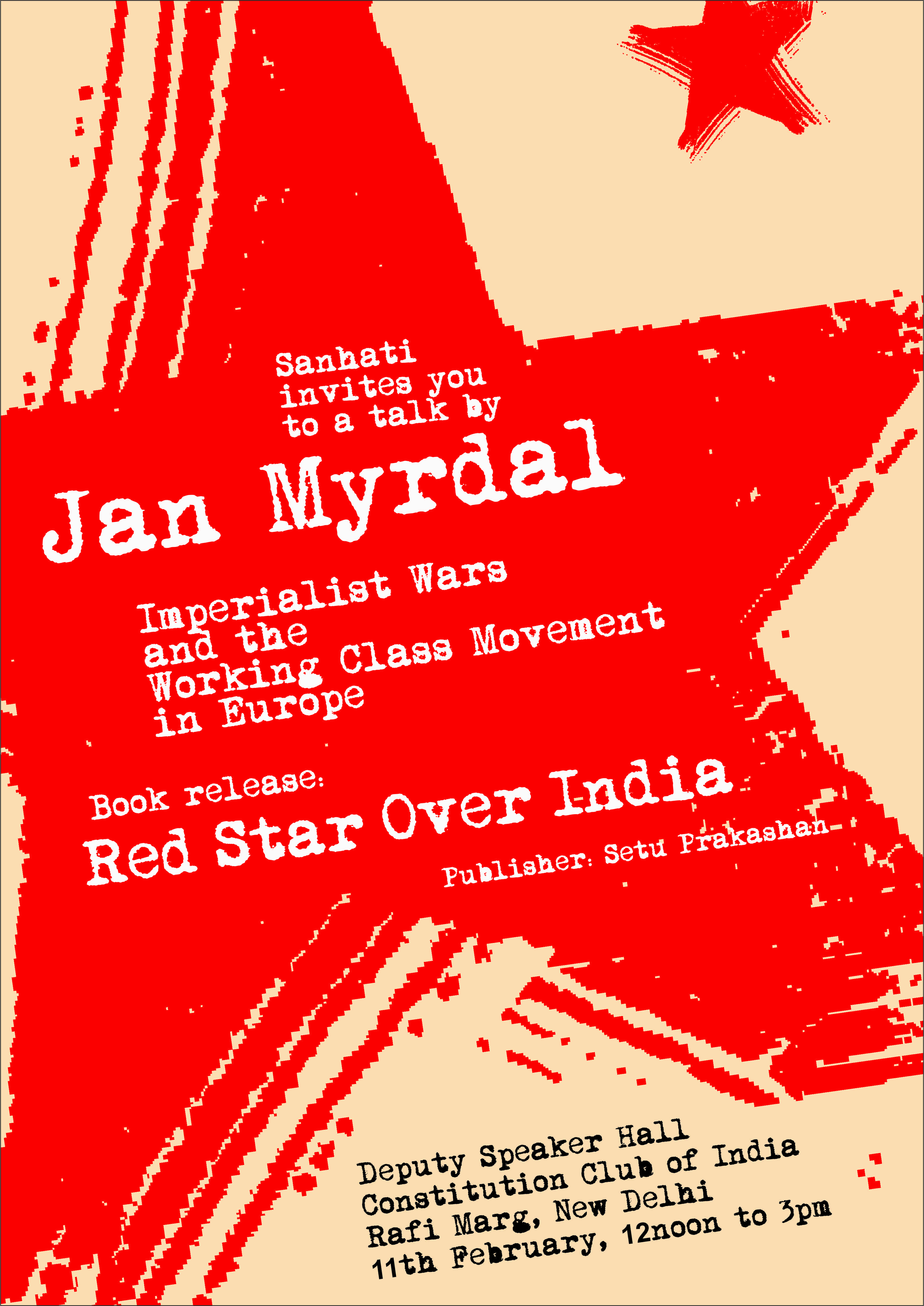
Book Release & Discussion: Jan Myrdal’s “Red Star Over India” (New Delhi, Feb 11)

Blind Workers’ Union’s Convention (New Delhi, Feb 11)

Workers’ Strike in Reliance Textile Industries, Naroda plant, Ahmedabad – A Report

Highly exploitative wage structure and abysmal working conditions have led the over 5000 workers to strike work in the primary manufacturing plant of Reliance Textile Industries in Naroda, Gujarat, which is at a halt since 2nd February 2012. While the company posted its highest ever turnover of over USD 44 billion and its net profit increased to USD 3.6 billion, workers in the factory (‘dressing up India’ with ‘fabrics which make you feel like a millionaire’ its website says) which started this empire’s journey find their lives getting cheaper by the day. Spread over 120 acres and with assets of over 300 crore, this plant in Naroda Industrial Estate, located in a GIDC (Gujarat Industrial Development Corporation) near Ahmedabad is India’s ‘most modern textile complex’ (according to the World Bank) and Reliance’s first manufacturing facility set up by Dhirubhai Ambani in 1966. Producing the ‘Only Vimal’ brand and housing sophisticated machinery, it says it is ushering in ‘a new era in fabrics, include suitings, shirtings, home textiles’.

Workers’ Demand List

But the skeletons in its closet are coming tumbling out, as the most of the around 1100 permanent and 4000 contract workers assert their rights and continue their strike which started from the second shift on 2nd February. The company meanwhile responds with police deployment, intimidation, arrest of workers’ leaders and a media campaign which says that the workers have only been miffed for not being allowed to carry mobile phones inside the factory. On the first day of the strike itself, Modi’s willing police forced the striking workers away from the factory gate, and when they assembled in the shamshanghat complex, around 20 minutes away, were forced out of there too. Declaring the strike to be illegal, and arresting the leaders, police has posted itself in the factory gate.

Workers’ Demand List Contd.

According to the workers, for last 20 years (when the company’s profits increased ten-fold), the wages for the workers and karigars has more or less been the same, whereas the salary of the staff increased many times. While the permanent workers earn a paltry Rs. 5000-6000 per month, the contract workers are paid Rs.85-100 per day. No legality of payment in terms of pay slips etc. is maintained, only a voucher is signed. Overtime is paid in single rate, while strict surveillance is maintained and late entry is severely punished. For the last 20-25 years, two anti-worker unions have been there in the plant. One is ‘Majdoor Mahajan’, the union that was originally established by M. K. Gandhi after the Bombay textile strike in the 1920s and has many unions across Gujarat, and the other is ‘Mill Mazdoor Sabha’, affiliated to the Hind Mazdoor Sabha. The workers, fed up of both these Unions’ corrupt practices, say how they act as “extended office of the management”. Every three years, a settlement is brokered between these two Unions’ officials and the management, but workers are kept out of it and do not even get to know of the deal brokered. No notice is put up. Four years back, both these Unions even agreed to accept that there will be no recess hour for the workers to have tea. So the workers were henceforth forced to have tea on the way to the bathroom, and in the location of work in an unhygienic and dirty atmosphere, so that work is not disturbed and time ‘better managed’.

Workers strongly emphasise that the reason for the strike is not as the popular media reporting and management statements on it goes, that of the prohibition of mobile phone inside the factory. It is only to delegitimize their struggle, that they are sought to being portrayed as flippant, lazy, like the recent struggle in Yanam was decried as being done by anarchist ‘killer workers’, or how the Maruti Suzuki struggle was sought to be portrayed as ‘innocent young workers under the sway of outside elements’.

The demands and the inhuman working conditions from which they have arisen are clear to the workers. Even as the company site says that it ‘endeavours to create a workplace where every person can realise his or her full potential’, the workers specifically stress on the abusive language of the management staff. Though they have raised their demands again and again earlier, the workers now organized as Reliance Employees Union submitted a 16-point demand list to the management again during the strike, which include a 60% hike in wages and regularization of contract workers, besides double rate overtime, a 20% increase in bonus, increase of daily wage of contract workers to Rs. 200 per day, renewal of fixed salary system, uniform rights for wage board, tea-snacks in the canteen, no fine for 10 minute late entry, to fill accident forms according to procedure, an end to harassment of workers, and an assurance that striking workers will not be fired and no deduction of wage for the strike period is made.

Disregarding all these demands, the management apart from the disinformation campaign, has resorted to police force, arrest and intimidation on the striking workers and their leaders, and are now bringing in temporary workers from outside, paying them Rs. 400-500 per day, to show that the plant is running, though at much below its capacity. Continuing with their anti-worker stance, both the pro-management Unions were against the strike, but the majority of the workers emphasized the strong unity among striking workforce. “We have formed a new union named ‘Reliance Employees Union. The strike will go on till our demands are met”, said Hasmukh Patel, President of the new Union. The workers’ complete disillusionment and anger against Narendra Modi and his ‘vibrant Gujarat development model’, and against the Reliance management is becoming more and more evident, from their own experiences. Sagar Patil, a striking worker, said, “With 9.5 crore, the money we produced, Nita Ambani bought an IPL team. They are making jalsa with our money, but it pains them to even part a few thousands to us who produce.” No trade union, or political group or even the huge number of ‘humanist’ organizations in Gujarat have even made a single statement in favour of the workers till now, but the striking workers continue with their struggle.