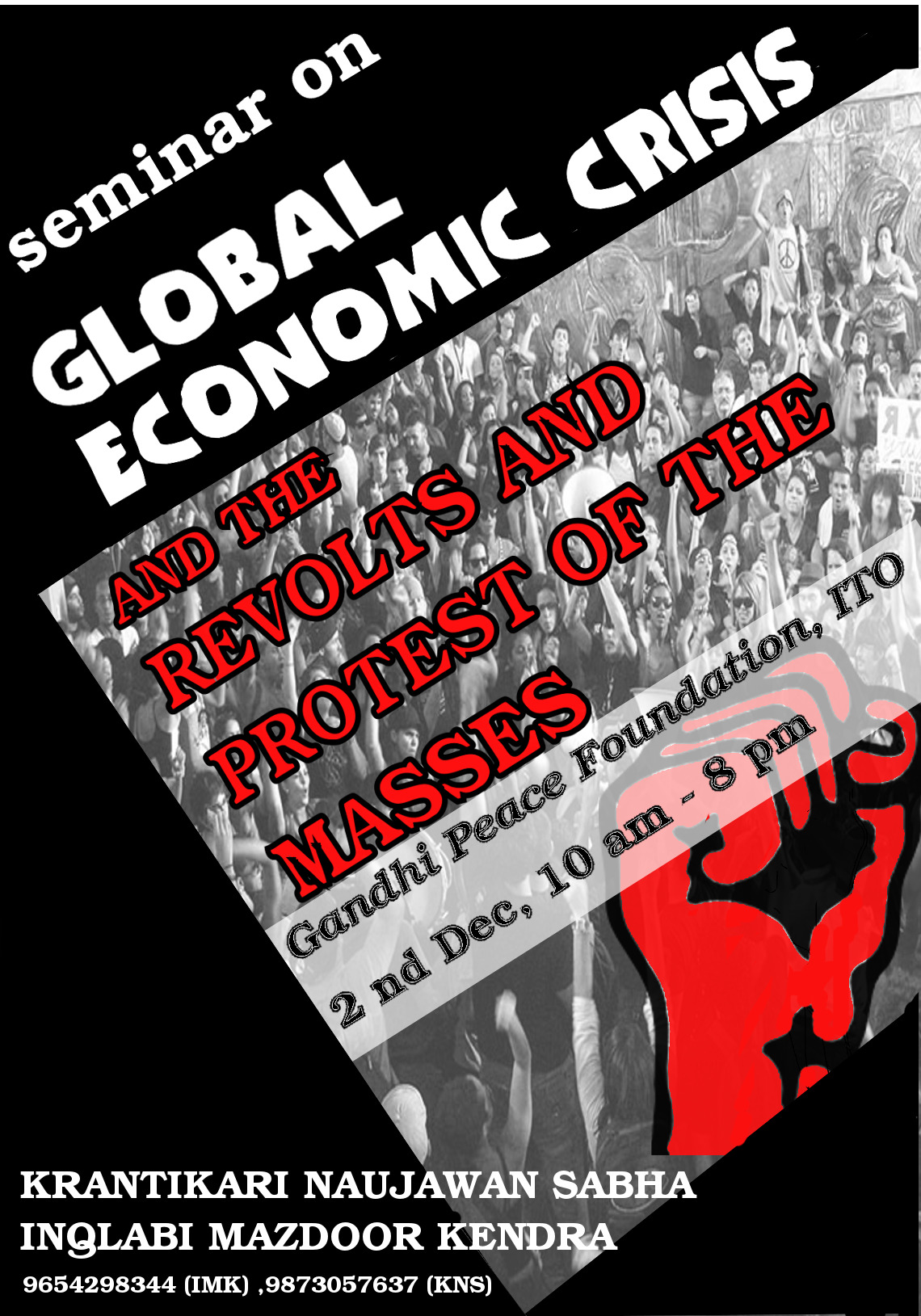
Seminar: Global Economic Crisis and Revolts and Protests of the Masses (Delhi, Dec 2)

on 2nd December 2012
Time : 10 AM to 8 PM

at Gandhi Peace Foundation, Deen Dayal Upadhya Marg, near ITO, New Delhi

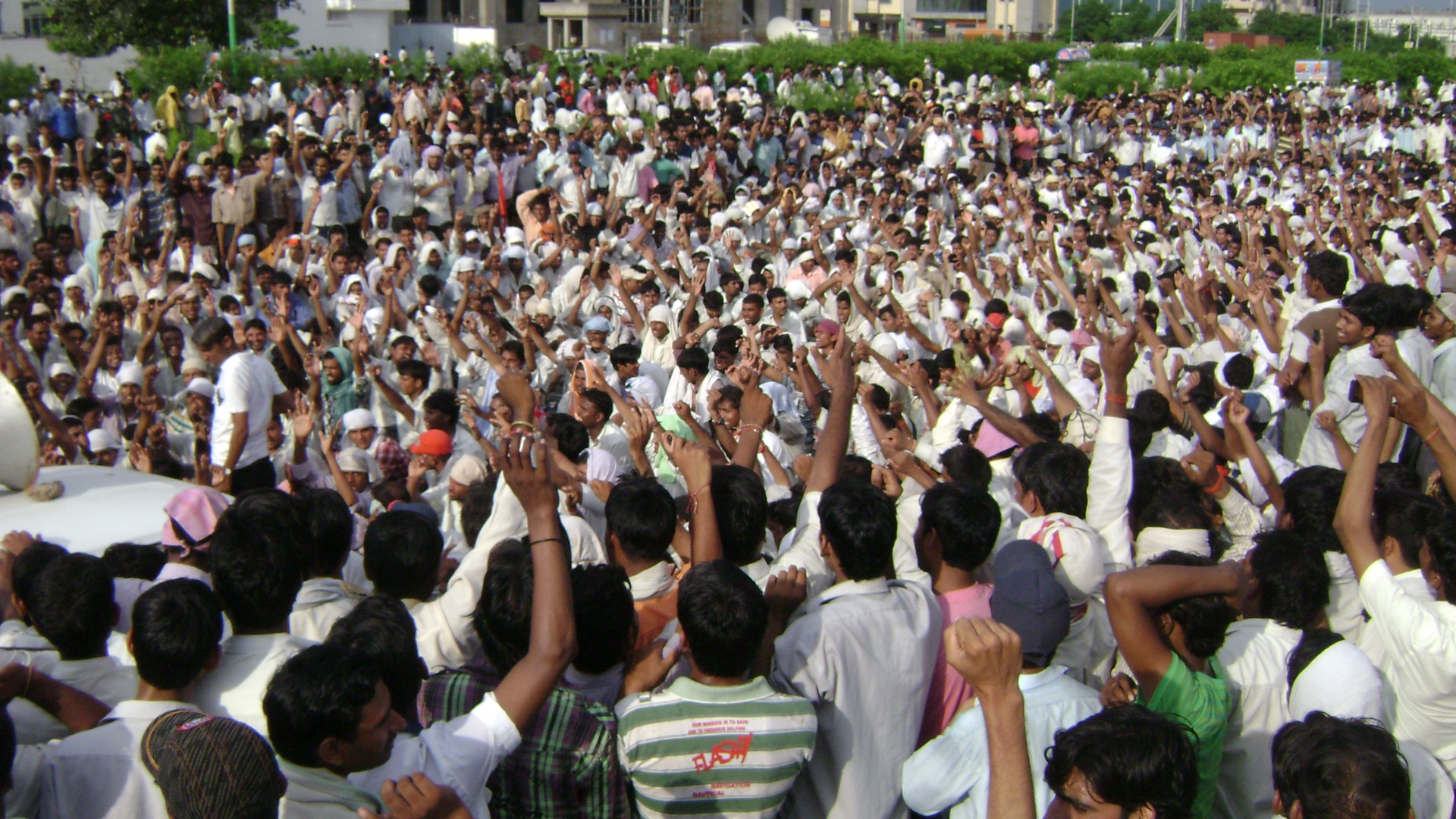
The last five years have seen a Global Economic Crisis which is most severe in its scope and depth since the Great Depression. While the United States’ economic situation enters this prolonged slump, the European Union project flounders on the shoals of debt and various kinds of ‘austerity measures’. The turmoil still goes on, notwithstanding the over thirty trillion dollars that have been spent on various recovery efforts. While the ruling class tries to pass the burden of the crisis on the working class, the toiling masses are rising in revolt. 2011 and 2012 have witnessed increasingly widespread eruption of mass rage, particularly across Europe, US and even toppling long standing dictatorial regimes in West Asia/North Africa.
It is of immense importance in this situation, especially for those placed in and concerned with the revolutionary transformation of society, to ponder over the emerging political economic scenario, so as to equip ourselves to face the challenges of these tumultuous insurgent times.

Towards this, Inqlabi Mazdoor Kendra and Krantikari Naujawan Sabha are jointly organizing a day-long seminar on the implications and import of the Global Economic Crisis and the nature, constraints and possibilities of these mass popular struggles. A number of political organisations and individuals reflecting different political tendencies in the left revolutionary camp in India will participate and discuss their points of view, to deepen the understanding of these recent mass popular movements across the world, and sharpening our own practices while we do so.

Download the Concept Note
On the Organisational Question of the Working Class

Arvind Ghosh

“I have tried to dispel the misunderstanding arising out of the impression that by ‘party’, I meant a ‘League’ that expired eight years ago, or an editorial board that was disbanded twelve years ago. By ‘party’, I mean party in the broad historical sense.” (Karl Marx, Letter to Ferdinand Freiligrath, February 29, 1860)

“All previous historical movements were movements of minorities, or in the interest of minorities. The proletarian movement is the self conscious, independent movement of the immense majority, in the interest of the immense majority. The proletariat, the lowest stratum of our present society, cannot stir, cannot raise itself up, without the whole superincumbent strata of official society being sprung into the air.” (Karl Marx & Friedrich Engels, The Manifesto of the Communist Party, 1848)

(1)          Within certain parameters, Marx was practical and impartial on the question of the form of organisation. Marx emphasised the concept of working class as an active, conscious SUBJECT, along with the forms, concepts and activities created by it. According to Marx, the organisational form is not pre-determined, but is created from within the real movement of the conscious and creative working class.

(2)          The most important historical process, for Marx, is the one through which the working class establishes itself as an independent, conscious revolutionary subject. It is this viewpoint of self-emancipation of the proletariat, which forms the content of the socialist revolution, and it is from this viewpoint that we ought to consider the question of organisational forms.

(3)          The positive aspect of this viewpoint is that it avoids fetishism of organisational forms as well as the tendency of these organisational forms to get ossified. It is open and flexible in accordance with the needs of the ever changing special conditions of the transforming agencies. Historically, it has been noted that the working class achieved maximum success when it succeeded in developing new forms of collective activity that challenged the established relations. Similarly, the working class experienced disastrous failures when in spite of the existing forms of collective activity getting degenerated and ossified, the working class continued to defend them instead of building new ones. In order to protect the forms of collective activity from degeneration, it is necessary that these organisations are developed continuously through a process of regeneration and reorganisation, and preserved in their changing forms.

(4)          Marx recognises the working class as the revolutionary agency. The basis for this recognition is that the working class is capable of independently determining its political-organisational forms. Although Marx’s theory of proletarian revolution is intimately connected with the organisational activity of the working class, Marx never attempted to theorise a proletarian organisation. In fact, any attempt to develop a theory of organisation from the point of view of the self-emancipation of the working class is contradictory, since such attempt would amount to declaring independence from the conscious activities of the working class and thus reject the creative powers of the working class.

(5)          For Marx, Subject plays the most important role in the process of revolution. Subject is the one responsible for both theory as well as practice, and also for uniting the two. Therefore, it is dialectically incorrect to say that the subject must unite with its theory, or there has to be a fusion of socialist theory with the advanced workers (for the birth of a communist organisation), as if socialist theory exists independently, outside the class struggle of the proletariat with which its advanced section must unite. “The long-prevalent conception of revolutionary theory – the science of society and revolution, as elaborated by specialists and introduced into the proletariat by the party is in direct contradiction to the very idea of a socialist revolution being the autonomous activity of the masses” (Cornelius Castoriadis, ‘The Proletariat and Organisation’, 1959). In fact, the working class while assimilating and developing socialist theory through its praxis moves towards its goal of destroying capitalist mode of production (CMP) and establishing  a new mode of production which Marx calls associated mode of production (AMP). This process is what constitutes working class self-emancipation.

(6)          From the dialectical viewpoint of Marx, means and aims are inextricably interconnected. From this viewpoint, means are the socialist end in the process of becoming. Means advancing towards communist revolution prefigures the communist society. Since organisation is the most important means to achieve a communist society, it is essential that its form is in complete accord with this objective and in no way does it contradict this objective. In other words, the journey of self-emancipation of the proletariat begins with self-activity and self-organisation capable of achieving the goal of a socialist society.

(7)          A socialist revolution can become a reality, according to Marx, only through conscious, active participation of the working class. A proletarian organisational form is a pre-condition for this revolution, which the working class itself creates through class struggle. This task cannot be done by representing class interests of the proletariat in an abstract manner. An organisational form established independently of this process of self-development of the working class forestalls this process midway, as a result of which the working class comes under the control of an agency outside or above it. Thus through a separation of the organisational form from the class, the division between leaders and the led existing within the bourgeois society is reinforced. Here the organisational form becomes an abstraction with an inherent possibility of incomplete development of the proletariat and its political alienation.

(8)          Marx had advocated a range of organisational forms suited to different politico-economic situations – from workers councils, workers clubs and committees to unions, general assemblies and even parties. But Marx’s argument that the working class needs to organise itself into a party did not amount to working-class party-building. For Marx, organising itself into a party meant getting organised as a revolutionary subject. By ‘party’ Marx had meant a party in an ‘eminently historical sense.’

In ‘The Fourth Annual Report of the General Council‘ (1868) of the International Working Men’s Association (IWMA), Marx had written: “That Association has not been hatched by a sect or a theory. It is the spontaneous growth of the proletarian movement, which itself is the offspring of the natural and irrepressible tendencies of modern society.”

(9)          To declare any specific form of organisation as the only appropriate form means that the working class is not the revolutionary subject, but rather this specific form of organisation is the subject. It means that the proletarian revolution can be determined beforehand and that the development of the working class is not a creative process but a pre-determined process. To come out of this illusion, it would be necessary to establish the creative aspects of socialist revolution and to clarify how the free and conscious activities of the working class (expressed in whatever form) can create new communist social relations.

(10)      The existing communist movement defines power as a thing which might be captured (seized), monopolised and made more powerful (knowingly or unknowingly), whereas, from Marx’s standpoint, power should be defined on the basis of social relations. Instead of concentrating our entire energy on the seizure of power as a thing, the communist movement ought to be directed towards the transformation of social relations. Thus we conceive revolution not as an event but as a process.

(11)      The most important reason for the crisis in which socialism finds itself today (which is also the real tragedy of established Marxism) is that it has abandoned the concept of proletarian self-emancipation, whereas this concept is the essence and specificity of Marx’s Marxism. As a result, the existing communist movement has been alienated from its class as well as social roots. The established communist movement considers socialism to be a product of organisational activities. From this standpoint, it is the Party and not the class which acts. From this perspective, organisational form has been considered to be of crucial importance, while the conscious role of the class is neglected and even negated.

(12)      From his early critique of Hegel’s political philosophy Marx had initiated a new type of political discourse which goes beyond the division between economy and politics existing in the bourgeois society towards transition to a non-ruling class and stateless society. According to Marx, political activities should be subordinated towards the goal of social revolution. This principle is clearly stated in the provisional rules of the International Working Men’s Association thus: “The economic emancipation of the working class is the great end to which every political movement ought to be subordinate as a means.”

(13)      As has been pointed out by Anton Pannekoek in his essay ‘Party and the Working-class’, “in relation to the proletarian revolution, a ‘revolutionary party’ is a contradiction in terms. This could also be expressed by saying that the term ‘revolutionary’ in the expression ‘revolutionary party’ necessarily designates a bourgeois revolution. On every occasion, indeed, that the masses have intervened to overthrow a government and have then handed power to a new party, it was a bourgeois revolution that took place — a substitution of a new dominant category for an old one. So it was in Paris when, in 1830, the commercial bourgeoisie took over from the big landed proprietors; and again, in 1848, when the industrial bourgeoisie succeeded the financial bourgeoisie; and again in 1871 when the whole body of the bourgeoisie came to power.” For Pannekoek, the Russian revolution of 1917 was no exception to this rule when party-bureaucracy monopolised over state power, and as we all know, what was established in Russia through this party-state was not socialism but state-capitalism.

Thus, we find that the party-form of organisation, although appropriate for a bourgeois revolution, is hardly adequate to the needs of a proletarian revolution. In a proletarian revolution, the working class has to seize power as a class. In this revolution, the proletarian class power is established through the destruction of the bourgeois state. But the workers’ state thus formed is not a ‘state’ in the conventional sense of the term since it is not an institution separated from the masses. Workers’ power is direct power of workers organised in the spheres of production. The specificity of the working class regime lies in the fact that in this regime the spheres of politics is not separated from the sphere of economics (i.e., production) but is integrated into one entity. In a workers’ regime, the working class takes control of the means of production, makes plans and executes them collectively. Thus a new mode of production is born designated by Marx as the ‘associated mode of production’ (AMP). In this new socialist society, time spent on ‘necessary labour’ (‘socially necessary labour time’) would be progressively reduced and humanity will have more ‘free time’ at its disposal geared to the development of creative powers of human beings.

However, the abstract representation of the working class through ‘Party Power’ contradicts the very concept of working class power. In spite of all the good intentions of the theoreticians in suggesting the new ‘revolutionary working class party’, party power can only be an elitist power, since this party will be an organisation of the so-called advanced sections of the working class frequented by the ‘socialist theoreticians’ from the bourgeois as well as middle class intelligentsia, presenting themselves as the ‘teachers’ of the working class. Marx’s philosophical dictum that ‘the educator must himself be educated’ is perfectly applicable in the context of these ‘teachers’. These elements from outside the working class naturally occupy the upper echelons – the “superincumbent strata” – of this hierarchical organisation. In its due course of development, this organisation begins to rule over the masses by bringing them under its control and trying to regulate their lives through the directives of their highest committees. Thus, the so-called ‘revolutionary party’, instead of helping the struggles of the working class, becomes an obstacle in the creative activities of the class. But, as we know through our experience of the failed revolutions of the 20th century, Socialism cannot be built through directives from above but is possible only through creative participation of the productive classes.

(14)      In order to grasp which form of organisation is most suitable for the working class, it is necessary to correctly define the aims and objectives of the working class movement, since organisation is only a means to achieve these aims and objectives.

The working class not only needs to destroy capitalism but simultaneously needs to create a new communist society which would be qualitatively different from capitalism. The task before this revolution is to go beyond capitalism by completely transforming this mode of production and establishing a new society based on this transformation.

The working class in accordance with its class objectives must create an organisational form and provide a political content adequate to these revolutionary socialist objectives. Historically, the Soviets and the Workers’ Councils – i.e., the organisations created and directed by the workers themselves during their attempts to act as a conscious, creative class – have proved themselves to be the most appropriate organisational forms to accomplish the socialist revolution and for the purpose of functioning of the socialist society. It is through these Workers’ Councils/Soviets that workers directly establish their political-economic power and organise a new socialist system of production. These organisations are inherently democratic, composed of delegates, not representatives, mandated by those who elect them and subject to recall at any time.

The basis of representation in Workers’ Councils is not abstract, since they represent workers engaged in revolutionary struggles. Based in the spheres of production and distribution, there is no place in them for either bourgeois interests or bourgeois representation. Thus, they represent exclusively the working class interests. During the revolution when the working class is faced with the responsibility of reorganising society economically, politically and socially, it becomes possible only through workers’ councils/ soviets and factory councils. In other words, these organisations are the instruments of proletarian dictatorship – the most complete democracy of the working class.

(15)      Socialism is not possible without the management of production, economy and the society by workers themselves. The experience of the Russian Revolution teaches us that the destruction of economic domination as well as of the state power of the bourgeoisie is not enough. The proletariat can achieve the objectives of its revolution only if it builds up its own power in every sphere. This implies that the power in post-revolutionary society has to be solely and directly in the hands of the organisations created by them, like the soviets, factory committees and councils. For a special organisation like the party to take on the function of governance or exercise power means perpetuating the existing separation between producers and the controllers of the conditions of production, the division between the rulers and the ruled.  However, this proposition necessitates a reconsideration of all the theoretical and practical problems facing the revolutionary movement today.

(16)      The question of organisation is not merely a technical question or a question of its form; rather, it is a philosophical question. Marx’s philosophy of revolution is not only about working class emancipation, but is primarily a philosophy of human liberation. According to Marx, working class cannot emancipate itself without simultaneously emancipating the entire oppressed humanity. The final goal of the proletarian revolution is to create a new human society free from all forms of exploitation and oppression. Thus the proletarian revolution is integrated with the women’s liberation movement (WLM), the movement of the oppressed castes, races and nationalities for Freedom. The proletarian revolution is also about redefining humanity’s relationship with Nature, the degradation of which has reached its limit today (to the point of a total extinction of the human as well as other species on the planet) due to the very existence of the capitalist mode of production.

Hence, while forming any proletarian organisation today it should be our endeavour to construct them in accordance with Marx’s vision of a new human society which takes care of all these concerns. This means first of all posing a direct challenge to the existing alienation between Organisation and Philosophy (which is also an expression of the separation between physical and mental labour existing in today’s bourgeois society), through the very functioning of the Organisation.

In other words, any proletarian organisation we build today ought to be free from Vanguardism, Hierarchy and separation of mental and physical labour. The organisation should operate on the principle of democracy from below. We may call it centralised democracy where the emphasis is more on democracy than on centralism to distinguish it from democratic centralism which amounts to control from above in practice.

Workshop on Organisation and the Self-Emancipation of the Working Class (Sewagram, Jan. 13-15, 2013)

A three day workshop is being organised with comrades from Mouvement Communiste, a communist organisation in France and Belgium belonging to the Autonomist Marxist tradition. The workshop will be held on 13th, 14th and 15th January 2013 at Sewagram Gandhi Ashram (Wardha, Maharashtra). Discussions would be held within the framework of the following topics.

1. Role of organisation in the self –emancipation of the working class
2. Necessity of an international working class organisation

The workshop would start on 13th January at 10 am with self- introduction of the participants followed by an introduction of the subject of discussion by any volunteer. On the first day the French comrades would be asked to present their political position followed by an open discussion. 14 January would be a day of paper presentations on the above topics by other participants followed by an open discussion. On 15th January discussions would be held on the second topic: Necessity of an international working class organisation. The workshop would conclude at 4.30 pm on 15th January. The medium of discussion would be Hindi as well as English. Comrades knowing French are requested to facilitate the discussion whenever required.

All participants will have to bear their own travelling expenses in addition to a contribution of Rs 1000 towards expenses for stay, food and other arrangements in the Ashram for three days. Those who wish to present papers on the above mentioned topics are requested to send their papers (or abstracts) by 15th December in order to facilitate translation in Hindi/English if necessary.

All participants are requested to book their tickets for Wardha/Sewagram at their earliest in order to reach either of these stations by 13th morning. Those who wish to travel by flight should book for Nagpur Airport accordingly.

Comrades willing to participate may contact the organisers.

CONTACTS

E-Mails: Arvind Ghosh <arvind_ghosh@ymail.com>, Dharmendra Kumar <monad96@gmail.com>, Radical Notes <radicalnotes@radicalnotes.com>

Telephones: Arvind Ghosh: 09921336289, Dharmendra Kumar: 09827609604, Prakash Raut ( All India Workers Council – AIWC)): 09096089231, Rajendra Singh (AIWC): 09271288269, Rahul Gaurkhede (AIWC): 09423603629, Nainatai Dhaval (AIWC): 09881713382, Chandrapal Singh (Revolutionary Proletarian Platform, RPP): 08928510997,  Ranjeet Singh (RPP): 07875858539

Postal Address:

1. Arvind Ghosh, 314 A, Sonegaon, Nagpur, 440025

2. Revolutionary Proletarian Platform office, 28, Kalmegh Nagar, Nagpur 440016

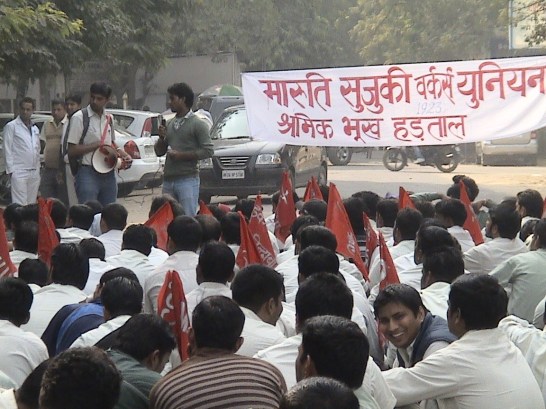
Maruti Suzuki Workers Union: The First Day of the Hunger Strike

The terminated workers of Maruti Suzuki, Manesar plant launched their mass hunger strike today in front of the District Magistrate Office, Gurgaon demanding an impartial inquiry into the incident of 18th July, immediate release of all arrested workers and the withdrawal of all the false charges put on them, immediate reinstatement of all terminated workers, including the contract workers.

The 149 workers in Bhondsi jail, arrested after the July 18 incident also embarked on a parallel hunger strike despite repeated threats of torture by the jail authorities since yesterday. They were threatened to be beaten up, separated and removed to different jails across the state, but have continued their hunger strike since early morning, even boycotting the early morning tea.

Majority of workers in the Manesar plant were also planning a solidarity action of lunch boycott. But just as they embarked on the solidarity action, immense pressure was put by the management and a heavy deployment of around 1000 police was brought in, in the already fortified company premises, to ‘dissuade’ them. The Union President and workers from Gurgaon plant also joined in solidarity with the workers in front of the DC Office, Gurgaon.

From the very beginning, the police and the administration vehemently displayed their anti-worker attitude. In gross violation of the democratic right to protest, the police dismantled the tent and other amenities (eg. Water tanker and sound system) that the workers had set up for the peaceful sit-in event in front of the mini-secretariat. The workers remained determined and vowed to continue the protest as planned in assertion of their rights. In response, the police continued its attack on the workers and detained about 40-50 workers who were packed off to Bhondsi thana. It is only after continued pressure from the workers and the unions present did the police release the detained workers. However, 2 members of the Provisional Working Committee, O.P.Jat and Ramnivas, have been illegally detained inside the police station for so-called further questioning and enquiry. We fear that, as the Haryana police on orders from the company has done, will again put false cases on the workers.

However, despite all these attempts at disruption and intimidation by the police, the first day of the dharna has proved a success and the hunger strike was continued at the decided venue. Representatives from different trade unions and other organizations across India came in solidarity to the protest and spoke at length about the immense injustice faced by terminated/jailed Maruti workers, the highly exploitative working conditions of workers across the country and committed themselves to taking this struggle forward. The speakers emphasized how the united struggle of the Maruti workers is very crucial and that it has served as an inspiration to workers across the country. The assembly was addressed by leaders of various factory unions in the Gurgaon-Dharuhera-Bawal industrial belt, including Rajkumar of RICO Employees Union (Dharuhera), Jaspal Rana of HMS, Anil of AITUC, Satbir of CITU, Animesh of IFTU and Shivmangal Sidhankar of ICTU. Workers’ Rpresentatives from Pragatisheel Cement Shramik Sangh, Chattisgarh (like Kaladas) and Sangrami Shramik Karmachari Union, Hindustan Motors, West Bengal (Amitava Bhattacharyya), as well workers from Ghaziabad, Noida, Delhi, and Uttarakhand also spoke in solidarity.

The hunger strike will continue throughout the night, and tomorrow. There is a massive rally planned for 4pm tomorrow that will culminate at the local minister’s house, which is expected to be attended in large numbers by students, teachers, other members of the civil society and workers from across the industrial belt.

Maruti Suzuki Workers’ Union: A two-day hunger strike (Nov 7-8)

The Maruti Suzuki Workers Union (MSWU: Reg. no. 1923) has decided to hold a protest dharna in the form of a two-day hunger strike on 7th and 8th November 2012. Our family members, relatives and well-wishers and organizations have staged regular protests across Haryana and given memorandum to all the ministers in the state but to no avail. We were not allowed to unite and express our side of the story and our indignation at being falsely implicated in the unfortunate incident of 18th July 2012.

So we are doing a united protest action of the 149 workers languishing in Gurgaon Central Jail for the last three-and-a-half months, and the 546 permanent workers who have been terminated from their jobs. We have all the solidarity of the around 2000 contract and casual workers who have also been unceremoniously thrown out of their jobs. All 149 workers will be on hunger strike inside the jail, and over 500 workers will sit in front of the Gurgaon Court/D.C. Office in Gurgaon from 10am on 7th November till 4pm on 8thNovember 2012, after which we will take out a rally to submit a memorandum to the local minister.

When this protest program was declared the day-before on 4th November, police intimidation, which we have already witnessed these three months, has increased manifold. The jail authorities of Gurgaon Central Jail have threatened to ‘beat up’ and increase the torture on our 149 fellow workers who go on hunger strike. All our elected Union representatives are lodged in jail – Among those in Gurgaon Central Jail include the entire leadership of our MARUTI SUZUKI WORKERS UNION bodywho are portrayed as ‘killers’ even without any due impartial investigation, and having a complete silence on the role played by the company management in the incident of violence on 18 July 2012.

The Maurti Suzuki company, IMT Manesar currently operates under police cover and the condition of the few workers who work there are fear and overwork. The Manesar police summoned each worker inside the company to the police station and has threatened all of them of ‘dire consequences’ and termination if found to be even remotely in touch with any of the terminated workers and having found to be attending any meeting or dharna. This is complete violation of all democratic norms in the country.

We will however go ahead with our scheduled program and call upon all sections of workers, unions and common people to come in our support and join us on 7th and 8th November in front of the D.C. Office, Gurgaon, to bring out our side of the story which has been buried in the heap of company-driven misinformation and pro-company government actions. We have and will stand for our legitimate rights, the unity of all the workers against the exploitation by the Maruti management and its continuous attempts to ‘divide and rule’ over us, by segmenting us into permanent and contract, and now into jailed, terminated and working in intimidation. We appeal to all to join us and strengthen our struggle!

We demand:

  1. Institute an independent impartial probe into the incident of 18th July 2012, and into the role of the management in it.
  2. Immediately release all the arrested workers. Stop all repressive measures by the police on workers-inside the jail, inside the company and outside- and on their family members and relatives.
  3. Immediately reinstate all the 546 terminated workers and also give priority to reinstate temporary workers as permanents.


Inquilab Zindabad!

Imaan Khan, Ram Niwas, O. P. Jat, Katar Singh, Yogesh, Raj Pal, Mahabir

Provisional Working Committee,

MARUTI SUZUKI WORKERS UNION (MSWU)

Why must social science be critical, and why must doing social science be difficult?

Raju J Das

Now-a-days, we hear the word ‘critical’ everywhere. It is there even in business schools: there is indeed such a thing as critical business or management studies. Conscious (=conscientious) capitalism, capitalism with a humane face, is presumably born out of such things as critical business studies. If business schools can be critical, can others be far behind? There is critical sociology. There is critical human geography? There is critical anthropology, and so on. Not to be critical almost means stupidity.

What does ‘critical’ really mean? It means being critical of the world, i.e. its social relations and inequalities. It means critical of ideas about the world, the ideas that sustain those inequalities and the ideas that do not conform to (conceptually-laden) empirical evidence. If one says that the place of women is in the kitchen or that people have a natural tendency to be only selfish and to buy and sell for a profit, there is clearly something here to be critical of, because these false ideas have an influence on people’s actual behavior. One must be critical because one cannot assume that what exists = what can exist. Uncritical work, as Alex Callinicos has said, equates what can exist with what does exist, and thus becomes status quo-ist. We must be critical because as Marx says, what appears to be true may not be true, so we need to dig underneath the surface appearances which represent inadequately partial truth and we must be critical of ideas which reflect the surface appearances.

Marx said that one should be ruthlessly critical of everything that exists, of the existing order, ruthless in that one will not be scared of the results of one’s research, nor of the powerful people.

Intellectually speaking, one can become critical of existing ideas about society by asking a series of questions of a piece of work. For example:

  1. Does a piece of work merely describe an event/process or does it explain it as necessarily caused by specific processes?
  2. Does a piece of work give more powers to things/processes than they can possibly bear/have?
  3. Does a piece of work naturalize a phenomenon by treating it as universal when it is in fact historically and geographically specific?
  4. Does a piece of work stress the cultural/ideational at the expense of the material/economic?
  5. Does a piece of work distinguish between necessary causes/conditions from contingent causes/conditions for something to happen?
  6. Does a piece of work treat an event/process as a mass of contingencies or does it treat it as a manifestation/expression/effect of a more general process?
  7. Does a piece of work conceptualize/treat/ analyze an event/process in terms of its necessary conditions and necessary effects (which may change over time)?
  8. Does a piece of work stress harmony and stability at the expense of tension and contradiction?
  9. Does a piece of work ignore connections between things and how their connections form a system which influence the parts or does it stress the difference and disconnection between things at the expense of the connections and similarities?
  10. Does a piece of work stress the individual thoughts and actions as being more important than structural conditions of individual actions/thoughts?

But what is the practical point of being critical? What happens if a professorial colleague makes criticisms of another colleague? One could say that by making (polite) criticisms of the existing ideas of scholars, we can change their viewpoints.  Many people hold the idea that: there are interstices of capitalism which can be used in the interest of ordinary people, and that is a way of fighting against the system and that, more particularly, things such as co-ops, labour unions, NGOs, identity politics, and social-democratic type parties can be used to significantly mitigate or eradicate humanity’s problems. Now: one can critique this idea hoping that the person in question will change her/his existing idea into a more radical idea, and that this will have an impact on radical social change in the world itself.

But this assumption is, more or less, wrong, for the idea underlying the assumption is that radical social change depends on merely change of ideas and that the change of ideas of the professoriate is crucial to radical social change (=transcendence of global capitalism and installment of global economic and political democracy = socialism).

My several years in academia now tell me that it is very difficult to radically change the ideas of colleagues (and most students), although one tries! It is very difficult to make them understand that, for example, the global capitalist class relation is at the root of major social-ecological problems in different localities and in the world at large, and it must therefore be gotten rid of.

A few of these individuals may change their ideas. However, the academic stratum as such will not. As the ideological representative of the petty bourgeois and bourgeois forces, this stratum cannot relinquish its job of defending and protecting the sanctity of private property and capitalist private property. The places the academia occupies within the bourgeois ideological system define their class-role. This or that capitalist can support the cause of socialism by changing her/his side. Engels did. But the capitalist class as a whole cannot commit mass suicide. This applies to the professoriate as well. Consciously or not, they stick to their roles. Their being critical stops at the door of capitalism. At best, they may be critical of the time- and place-specific excesses of the system, of its anti-democratic nature, but not the system as such. They are critical of e-m-c (everything minus capitalism). Besides, for a large part of the professorate (the movers and shakers of the academic world, who are also often the gatekeepers of knowledge), the ideas are material because they have gripped the minds of the professoriate masses: that is, they have invested in their ideas and have made a career out of their existing ideas (e.g. professor X says that ‘labourers – and not just businesses – have an agency in making changes happen in society’ and has a large following with which come many material-cultural benefits), so why will they so easily change their ideas?

And, even if one is able to change their views, the fate of radical social change does not critically depend on what views are held by professors, although their views are not entirely immaterial. The reason is that: they are not the revolutionary class. Only the working class is that class, given proper ideological and political preparation. This is the class which must sell its ability to work for some compensation and which has very little power to decide the conditions of work and how regularly it will be employed. This class produces the source of profit, rent and interest and this class can stop its production. Genuine Marxists critique the capitalist world and ideas about capitalism which the academia holds, from the standpoint of the material suffering and political power of this class, which is an international class. A more correct understanding of society than it has is in line with its class-instinct, its material life situation, both what it is and what it can be.

The main – rather ultimate – practical reason why Marxists should be critical of existing ideas is to contribute to the raising of consciousness of this class, and not the raising of consciousness of professors. The working class (I am including the semi-proletarians in this category) is constantly being ‘deceived’: its thinking is characterized by partial truths and sometimes complete falsehood. This is a most important reason – apart from blatant coercion – why capitalism still continues. The working class takes capitalism as a natural form in which life has to be lived. This class does suffer from false consciousness, bourgeois consciousness. This is why the working class remains politically weak and the capitalist class, strong.

False consciousness is constantly being produced. It is produced for many reasons. These have got to do with two aspects of one mechanism: ‘control’. It is produced because the objective reality of the capitalist society creates falsehood (as Marx indicates in chapter 1 of Capital vol 1). Let us call it the Capital 1 Model. Because of the absence of direct control by working-subjects, over the way in which useful things are produced, because people are having to exchange the things they need for what they have, because they are having to enter market relations to satisfy their need for food and other things, they therefore think that these things by nature have a price tag, that we must always buy the things that are produced for profit in order to satisfy their need. Every person needs food. That is a universal and natural fact. But that food has to be produced capitalistically, by agribusiness or capitalist farmers, is not natural. People think it is. This idea of naturalizing something that is not natural needs critique.

False consciousness is also produced because of the presence of control of the ruling class over the working subjects’ ideas (as Marx explains in German Ideology). Let us call it the German Ideology Model. The ruling class, directly or indirectly, through the state or through civil society agencies (which are the darling of ex-Marxists dressed up as post-Marxists), controls the ideas of ordinary people and makes them believe that, for example, austerity is good, user-fees increase the quality of service, and so on. That this mechanism of control does not always work is a different matter. It is a different matter that coercion is often used to put people in their place, if after having correctly understood the reality they take action to remedy it. Force was used against even mildly anti-capitalist Wall Street occupiers in New York.

False consciousness is also produced because all kinds of petty bourgeois forces and their academic spokespersons come up with strategies which bind the working class with the bourgeois and petty bourgeois forces (e.g. join bourgeois trade unions; vote for social-democratic and even liberal type parties). The working class thinks that following these forces will bring lasting benefits. Let us call this the Lenin model (which insists on the independent political mobilization of the working class).

Because false consciousness is constantly created, there is a need for critiquing the ways in which this is created, who furthers its creation, and who disseminates it. The professors, even when they espouse some critical thought, are, at best, speaking the language of the petty bourgeoisie and left factions of the bourgeoisie (e.g. the enlightened elite who can think about the long-term and are willing to make short-term or localized and reversible sacrifices). The petty bourgeoisie has some hatred for capitalism because large producers crush them but they do not like the property-less workers either. Ideas do not hang in the air. Ideas are ultimately, if not immediately, ideas of classes and class-fractions. Critique of ideas is ultimately a critique of class and class-fractional interests therefore. Since the academia have a class-role to play – defend capitalist property with or without some reforms—their ideas reflect that function and therefore the interests of the class which they defend.

When one critiques the ideas of the academia, one really critiques the class interests they defend. Since their role is to defend these interests, whether by choice or not (and usually a combination of choice and coercion), any amount of criticism of their ideas is not going to bear much fruit. Therefore, the aim of criticism is not to change these people. The aim should be to clarify to the working class the true nature of the society and of the forces that stop the society from being changed. The point is to remove the layers of misconception from the working class which reflect bourgeois and petty bourgeois (including union bureaucracy) interests, which are ideologically produced by the academia, and which are disseminated through media (new and old), and through family, friends, and sometimes even by professors themselves. Consider the professors selling micro-credit, co-ops, ethical trade, unions, democratic revolution, or even ‘socialism in one country’, as solutions to problems of the humanity; and some of them also win prizes and grant money for knowledge mobilization and community engagements. A genuine critique of the ideas held by the academia will therefore be – can only be – from the standpoint of the interests of the proletarians. Capitalism is critiqued by many people. A proletarian critique is a different critique. It is a ‘critique of everything that exists’ type that Marx had advocated. By critiquing the ideas of the academia, genuine Marxists create conditions for the self-realization of the working class as a class, the realization of its own power and of what needs to be changed and how.

If what is said above is true and to the extent that this is true, this has implications not only for what topic one researches but how one researches it. The implication is quite precisely this: research has to be difficult labor. This is so because research has to be critical. It has to be critical for the reasons discussed at the outset (namely: it must uncover things which are not easily seen or felt; it has to be critical of various forms of exploitation and inequality, which are causes of many events/processes we observe, and so on). And, to critique – the labour of critique – is not easy – this is indicated by the 10 questions earlier provided as a sample of questions one must ask in order to be critical.

There is another reason, which is related to what is just said, why research must be difficult. Consider the following five statements.

  1. We research existing conditions (generally speaking).
  2. Existing conditions are present because forces to fight these conditions are absent.
  3. These forces are absent because it is not easy for these forces (e.g. revolutionary leadership; revolutionary ideas, etc.) to be present.
  4. So: our research presupposes difficult conditions, the difficulty of conditions. Difficulty can be thought of as an ontological condition: x wants to be but x cannot be, because of barriers to x’s existence. The current conditions exist because the future conditions cannot exist. Researching the presence of the current conditions is indirectly researching the absence of the future conditions (= the opposite of the current conditions), the absence which is caused by difficult factors.
  5. Therefore: research must be difficult. Dialectics demands this.

The vast majority of the global population, the working men, women and children, live in conditions of barbarism, the barbarism, which is described by the massive un- and under-employment, peasant dispossession, food insecurity, ecological devastation, constant threat of war, aggression and violence, and so on.  If transcending the present conditions of barbarism is a difficult affair, if intellectual and political preparation for this transcendence is a difficult affair, then researching the current conditions need to be – must be – a difficult affair. After all ideas more or less reflect the conditions which ideas purport to describe. Research must ask: why are the current conditions present? What forces support these conditions? What forces are undermining – and can completely undermine – the current conditions? Clearly, the cause of the current conditions and of their reproduction has deep roots. Ideas have to help us grasp the matter (=barbarism) by its roots. And when these ideas catch the imagination of the masses, then these ideas act like a piece of iron. Ideas do indeed matter, if we want to replace barbarism with civilization and sanity. But the ideas, not of any group or class, but of the class which potentially has the power to transcend the present barbaric condition.

Raju J Das teaches at York University, Toronto.

Seminar: Challenges facing the labour movement in India (Oct 20, 2012)

Seminar organised by various workers organisations in New Delhi (Oct 20, 2012) to assess the challenge before the workers movement in India in the context of the Maruti Struggle.

The Practical and Impractical

Faridabad Majdoor Samachar, September 2012
(Translated from Hindi)


Practicality in these Times:

* Waking up a three/four/five-year-old at 5/6/7’o clock in the morning. Forcing the child to clear its bowels when neither body nor soul is willing. Forcing the child eat even if s/he is unwilling. Washing the sleepy child’s face. Forcing the unwilling child into a uniform. To be practical, parents suppress their own desires and their child’s childhood. In order to keep them practical, schools teach children how to sit still – they destroy childhood.

* To be practical in our times one has to accept a habitation made of cement, steel and paint. Practicality demands roads outside and electricity within. Children long for mud and sand. They long to run and jump around.  To bring up a child properly, 50 people of varying ages are required but only one or two or three or four are available. So practicality requires a child be checked at each step, at all times. Practicality is transforming each child into a bomb.

* For a bright future practicality requires the child be sent to school. A good school is one whose students fetch a good price on the market. A good school is an expensive school. Practicality compels us to choose between a good and a not-so-good school. Whether it be a better or a worse school, post-school tuitions are an accepted practice. The child is able to spend little time with grandparents. It is in the nature of schools to break down relations between generations. Practicality requires the mushrooming of old-age homes, and the elderly waiting to meet their death.

* A society characterised by hierarchy, market and money, and wage-slavery requires everybody to be both cunning and intelligent. Especially when one is young, practicality requires the ability to sell oneself –to hide anger behind an ever smiling face. The intense and turbulent reality of market and money shapes the practicality of everyday relations. To live up to our images, constantly trying to hide our reality produces shallow, superficial, temporary relationships.

Can there be a practice of life different from such a practical life of hierarchical, commericalised, monetised, wage-labour-based society?

# Straight-forward, simple, truthful behaviour is impractical in our times. Deep, long-term relationships are today impractical. What one does to become a wage-worker, to remain a wage-worker is practical; but not to have any wage-worker, i.e. end of wage-slavery is impractical. To challenge hierarchy, market-and-money, and wage-slavery is definitely impractical; however, it is an expression of the force, of life itself. The growing impracticalities throughout the world today are increasingly challenging the practicalities. As an example, let us take a look at a beautiful expression of impracticality in the activities of the Maruti Suzuki workers from June 2011 to July 18, 2012:

* On June 4, 2011, the workers of the A & B shifts got together to remove the company’s and the state’s control over the factory. Forming networks and chains the workers established their own control. Production stopped, and permanent workers, trainees, apprentices, contract workers associated among themselves with a new intensity. The company got cold feet and the government stood aghast at the workers’ impracticality. The practical people in support of the company and the state were joined by the pro-workers’ practical people to call for normalising the situation. The normal situation meant resuming production, making cars. To be practical means exchange, measurement and bargaining. The workers continued to remain impractical; they remained so for 13 days. The workers were treading an unfamiliar path. The practical side became dominant because this unfamiliar path could not acquire a definite form and production restarted in the factory after the negotiations.

* The management is very practical, while among workers the presence of impracticality is always felt. Standing up for contract workers, the permanent workers gave another proof of their impracticality in the month of July. The company made preparations and wove a net to force practicality down the workers’ throats. They surreptitiously brought new recruits. On the night of August 28, which was a Sunday, 400 policemen and management staff were sent in to fire the brahmastra of expulsion, suspension and signing of a good-conduct bond on the workers who would turn up the next morning. Workers were outside the factory. The police, management staff and new workers were inside. If, on the one hand, there were attempts to restart production in the factory, on the other, the association between permanent workers, contract workers, trainees and apprentices was strengthened. Three thousand workers organised themselves. Whenever the impracticality of workers manifests itself, pro-worker, yet practical, people and organisations become hyperactive, trying to teach workers practicality. The Company was overconfident because it was playing a tactic that has been tested many times in Mumbai, Faridabad, Gurgaon, etc. Remaining limited to the Maruti Suzuki factory in Manesar was weakening them, yet the young workers seemed capable of prolonging the conflict for quite some time – this once again brought in the practical people from both sides to exert their pressure. In order to make workers relearn the lessons of practicality, a new agreement was signed on September 30.

* The new workers recruited in the month of September continued to remain in the factory. After the agreement, all workers (permanent, trainee and apprentice), save the 44 expelled, re-entered the factory, but 1,200-1,500 contract workers were not allowed inside by the company. The management was ready to break the networks that had formed among workers and to replicate a strategy that had worked successfully in 2005 in the Honda Motorcycle and Scooters Company – the permanent, trainee and contract workers had waged a united struggle in Honda, yet the management took back the permanent workers, but retrenched all the existing contract workers, employing new ones in their place, and stopped keeping trainees altogether.

* The impracticality of the workers reasserted itself on October 7. Including the Maruti Suzuki plants, workers liberated 11 factories in the Industrial Model Town of Manesar from the control of the management and the state. The forces of practicality pushed themselves in through all kinds of measures and on October 8, workers loosened their control over seven factories, which the companies recaptured. October 8 onwards, with the struggle limited now to four factories of the Suzuki group, the workers’ control started acceding to practicality. Yet in the words of a worker: “The time we spent in the Maruti Suzuki factory between October 7 and 14 was very good. No stress regarding work or commuting to work. No anxiety to catch a bus. No worries about cooking. No more trouble about when to eat our meals. No need to count days in the week or to keep track of the date. There were many intimate conversations. We had never been as close to each other as we came in those seven days.”

* The practicality of the state and management took a step back and made concessions to the impracticality of the workers. A third agreement was signed on October 19. Contract workers returned to the factory. And also, the time for assembling a car was increased from 45 seconds to a minute.

* Practicality started designing a new ploy. Three workers of Suzuki Powertrain had played a key role in forming links with the workers of Maruti Suzuki Manesar in the month of October. Because these three workers had taken a strong stand against the state and the company, and the October 19 Maruti Suzuki agreements, they had to be sidelined to clinch the agreement in Powertrain on October 21. The three protesting workers were suspended, and in order to establish the ones who had put down their signatures, a three-year agreement was reached between the Powertrain management and the union. Regaining confidence in their control, the management finally fired these three workers on April 17, 2012, while those who were involved in the agreements maintained order among the workers. Then the bosses decided to merge Suzuki Powertrain and the Maruti Suzuki companies – this was done in order to weaken the rebellious workers. By keeping those who were brought into the factory in September 2011 and by starting a B-plant, the bosses had by now weakened the strength of these workers. By registering and recognising the union, the management had already made a solid arrangement to create a rift between the permanent and other workers. The bosses were on the way to re-establish practicality among workers by provoking and fomenting managed explosions.

* Of course, the concessions gave some reliefs too, but nothing much really changed in their lives; however, Maruti Suzuki Manesar workers had the determination to change their lives, make them better.   Despite concessions on the company’s part, lives of Maruti Suzuki Manesar workers remained lives of workers, unbearable as ever. And so on July 18, 2012, the workers targeted two symbols of the status quo – the factory and its management.

* The impracticality of past generations brought many significant junctures in the social process. If one were to speak of workers, then in 1871, in France, workers established the Paris Commune – the army, police and judiciary were dissolved, the jails were torn down, and the workers were up in arms. The supporters of hierarchy, market-and-money, and wage-slavery did destroy the Paris Commune by massacring thousands of workers, yet the Paris Commune continues to show the way today. In 1905, in Russia, impractical workers did step forward on the path shown by the Paris Commune by constituting the Soviets, and suffered much violence. The Soviets emerged once again in 1917. In October 1917, dissolving the army, the police, the courts and the jails, general workers took up arms and the Soviets became the harbingers of a new society. But due to adverse conditions, practicality reared its head once again and a standing army by the name of the “Red Army” was re-established in 1918. The establishment of an army and an increase in its strength implied a decline in the power of the workers’ soviets. Instead of being destroyed altogether, the Soviets were made powerless; they existed as a smokescreen that contributed to the maintenance of hierarchy, market-and-money and the system of wages.

We find ourselves increasingly being surrounded by circumstances similar to those of July 18 at Maruti Suzuki Manesar. Such a situation is increasingly being obtained to the world over. Can there be anything more satisfying for us in our struggle against hierarchy, market-and-money and wage-slavery, and for a new social order? We are face to face with destruction, the end, and a new beginning – can there be a better present, a better near future for humanity?

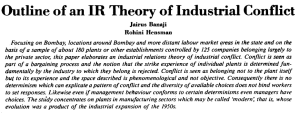
Banaji and Hensman on multinationals and industrial conflicts in Bombay (1956-84)

Courtesy: Economic & Political Weekly

Maruti: A moment in workers’ self-organisation in India

Pratyush Chandra

The Chairman of Maruti Suzuki, R.C. Bhargava, himself described the July 18 incident as a “class attack”. The management, which learnt from the Japanese how to instrumentalise unions as tools to educate and regulate workers in work discipline, are now learning a new lesson from their own Manesar workers – they want their own voice, which is in their control not in the control of the masters, whosoever they may be. They will tear away every interface if that obstructs their organic collectivity to emerge – then they will speak in their own voice, which will definitely be harsh and brutal, as it will be organic to the very core. They will speak in their own language, without any creative translation into a language that has systemic legitimacy.

The lesson that the Indian corporate sector learnt from the Japanese is graphically retold by Bhargava himself in his recent book, The Maruti Story. It is not just revolutionaries who called trade unions a school, even the Maruti management found them to be so – a necessary means for “continuous training of workers…if their attitude towards work, the company and its management was to be changed…. We understood the logic of their [the Japanese] system and so wanted to completely reverse the traditional culture and bring about a mutually beneficial relationship between workers, the union and the management.”(302) So the management “promoted a trade union at Maruti, before political parties and outsiders could establish”. The founder-Chairman of Maruti Udyog, V Krishnamurthy, “brought” even a union leader from BHEL. “The importance of the union was highlighted by ensuring that the president and general secretary of the union were seated on the dais at every Maruti function. They would, along with the top management of Maruti, receive all VVIP guests and garland them.”

Time and again, the Maruti workers have tried to build their unity beyond promoted, brought, bought unionism and its ritualism. Each time such unity has been institutionalised into a legal form, the management has either destroyed or bought it over, and promoted enterprise unionism. Since the last year, however, things have drastically changed. Maruti workers have understood the meaning of legitimacy, its functions and limits. This remarkable understanding is evident in what a Maruti worker expressed just after the worker-leaders were ‘bought’ and sidelined in 2011:

“Sahibs don’t understand the situation…. In these past few months, a handful of workers had risen to the position where they could control the workers…. By dismissing exactly those men, the management has thrown away a valuable tool.” (Aman Sethi, “Down and out on India’s shop floor”, The Hindu, July 29, 2012)

And again after the July 18 incident, in an interview recorded by a mainline news channel, a worker said:

“Our workers did not have faith in the union body. They were apprehensive about the union cheating them again…. [Yet they wanted that] the management should at least value and listen to the union body.” (NDTV, August 11, 2012)

They understood the limits and dangers of legality and representation, and the need to have extra-legal vigilance of their institutionalised body. Something the workers ensured by evolving shop-floor networks of line and departmental coordinators, and by frequent assertion of the general body. While the representative trade union, in accordance with the legal regulations and norms, included only the permanent workers, this organisational form was organic to the daily shop-floor coexistence of all segments of workers.

Defying every attempt to fragment and subalternise their collective consciousness, the Maruti workers forged a youthful (in a literal sense) unity among themselves beyond all kinds of regulatory and identitarian divides (including the caste and regional), demonstrating their uselessness, except for the purpose of regulating workers in favour of capital. This unity was remarkably visible during the 2011 strikes. They defied every agreement and manipulation from above that tried to break that unity, and they struck three times against them, and surprised the unions and their legitimate sense. Hence, even the need to form a sectionalist union (of permanent workers) – which the legalese and the prevailing industrial political culture compelled them to adopt for negotiations with the management – was continuously overwhelmed by the unity below that questioned the very basis for such unionist sectarianism and economism.

It was this collectivity that could not be destroyed by the management’s union busting, and it did form another union. But its easy registration and semi-recognition by the management made the workers evermore apprehensive, and they enforced constant vigilance on the representatives. However, the management misconstrued this collective apprehension as a distance between the general workers and the union, not understanding that its collective nature in fact tightens the workers’ grip over the union leadership. It is unlike the generalised yet fragmented weariness that leads to helplessness. The management miscalculated and thought its intransigence in dealing with the union will increase the distance and delegitimise the union in the eyes of the general workers. It could not anticipate that such an act was thinning the legal shield that protected it. And, so, what could have passed for the time being as another “class action” got transformed into a “class attack”, as Bhargava calls it. The management should not complain that it didn’t get the warning – workers themselves gave out sufficient signals.

However, one must grant that not just the Maruti management, the suddenness of the July 18 incident at Maruti astounded everybody – where was this anger among workers residing for the past one year? Nothing similar happened during the remarkable “non-violent” strikes in 2011. And prior to the incident nothing happened that could give a hint towards it. Therefore, a plethora of explanations and conspiracy theories has come up.

Interestingly, we can easily identify a basic logic behind the catalogue of ex-, post-facto explanations that various institutional and non-institutional bodies – the state, management, media, unions and radicals – are putting forward. A central thesis runs through all of them, which is that workers as a mass cannot have any coherent plan. Hence, those who see incoherence in the incident, either blame it on reactive spontaneity in the absence of (correct) leaders (radicals), or mob-like nature of the workers action (media elites). For many of these responses, there is some kind of pre-planning that must have come from outside (from Maoists/political unions, as the state and management maintain, or provocation from the side of management through their intransigence or by employing ‘bouncers’, as all the pro-workers institutions or groups opine). However, in the end no one is willing to concede general workers a coherent critical subjectivity that reasons them into taking things (read law) into their own hands, because for all the groups mentioned above, a rational subjectivity can emerge only through the repression of the inner nature (in the present case that of the mass).

All that even the pro-worker forces are willing to grant, and at most, is if the workers were accomplices in the July 18 incident, they were merely reacting to something the management wrongfully did that day (by calling the bouncers or by not resolving the issue of the suspension of a fellow worker) or have been doing lately (by not going for a speedy wage settlement or union recognition). All these self-actions by the workers are arrogantly clubbed together as spontaneity or spontaneous actions, which are generally considered to be reactive, and can have a political meaning only if harnessed by the organised political forces. It is interesting to note how these competitive forces, doing organisational shopkeeping, or at least advertising, among workers, have found workers’ direct actions erratic and even anarchic. They find the workers sensible and tractable only in those moments when they are led or when the consciousness of defeat and victimhood dawns over the workers – when “victim” workers are looking for respite and rights, and for experts who can represent them in the courts of law and negotiations.

These so-called political forces have a notion of politics that comes directly from the civics classes of the (post)modern schools that define politics in terms of institutions (or tangible forms of organisation) and their activities. Even the movements must be located among these activities, or else they are apolitical and even mere riots. Class struggle is reduced to the interplay of these institutions, ideologies and activities. They are unable to locate this representative interplay and their own activity as (re)originating in a continuous class struggle between capital and labour – in the daily imposition and subversion of the process by which capital acquires and incorporates living labour as merely an agency for its self-valorization. They are unable to see that recent unrests on the labour front in India have been largely political – i.e., they are related to a constant recomposition of class collectivity that short-circuits the re-segmentation of labour – the ever real-ising subsumption of labour by capital. In other words, this collective urge is not simply a wont to vocalise the aggregate demands of individual or sectional workers, as in a demand charter. Rather, it relates to their concern to transcend the segmentation on which the capitalist industrial polity thrives – the division between permanent, contractual, casual and interns. It is a marvelous experience to hear from general workers about these real divisions made on false premises. It is this open vocalisation that constitutes workers politics today. The Maruti workers’ struggle clearly is a finest example in this regard.

In one of the discussions that we had with workers in other industrial regions about the Maruti ‘violence’, a worker expressed how they work for the fear of the daily hunger and for feeding their family. Otherwise who would like to work under iron discipline and invisible eyes constantly watching over you, reprimanding you for every small mistake? Workers continuously look for every small opportunity that would enable them to dodge and abuse this system of surveillance.

The (more-or-less) open violence of primitive accumulation that joins the fate of labour to capital readies it for the inherent violence in the active imposition of work that capital as social power with its various apparatuses seeks to ensure. There is nothing reactive about workers’ actions to break out of this panoptic circuit which is now expanded throughout the society. The diverse immediate forms that these actions take are meant to surprise capital.

It is not the question of defeat or success of these forms or agitations that should concern us. In fact, our every success makes our actions predictable, increasing the reproductive resilience of the hegemonic system. Who knew this fact better than Karl Marx? He stressed on the need to watch out for opportunities to stage sudden radical leaps away from the guerrilla forms of daily resistance against the encroachments of capital, or else workers will be evermore entrenched within the system of wage slavery despite – and because of – frequent achievements in their everyday negotiations with capital. Those radicals suffer from the same Second International reformism and co-option politics, of which they accuse everybody, when they visualise class maturation as a linear succession of successes and achievements, not in the increased activity of the working class to catch capital off-guard by its volatile, yet collective thrust.

Today, the dynamism of this workers politics poses a crisis not just for capitalist strategies but also for itself as it constantly outmodes its own forms. The significance of the Maruti struggle and the July 18th incident lies in this process – they demonstrate the increasing inability of the legal regulatory mechanisms and existing political forms to ensure “industrial peace”. This means:

1) For capital, every crisis is an opportunity to restructure labour relations for its own advantage. Many times, it carefully shapes an industrial conflict to seek such restructuring. The recent conflicts have shown the limitation of the legal framework to generate industrial consent/peace, which has time and again forced capital to resort to coercion.

2) The automotive sector has been central to capitalist accumulation, so the needs of this sector have time and again restructured the industrial polity and economic regime globally. In India too, this sector has been in the leadership of pushing economic reforms in a pro-capitalist direction. The high-handedness and intransigence of the managements of Maruti and other automotive companies in recent conflicts is representative of the determination of Indian capitalists to force pro-capital labour reforms.

3) Legal unionism and existing organisational practices to compose and regulate working class assertion are becoming increasingly redundant. The labour movement must look out for new incipient forms in this self-assertion, as older forms are unable to lead working class consciousness, which is much more advanced than these forms, to its political end. The direct action of Maruti workers last year and this time cannot be simply explained by the crude notion of unorganised spontaneity, rather it shows their political will to transcend the segmentation perpetuated by the capitalist industrial polity.