Unrest becomes rage: Mobilizations against the crisis in Italy

Wildcat

Like many other countries in Europe and elsewhere (consider the recent confrontations in North Africa), Italy has for several months been the scene of social struggles qualitatively and quantitatively unlike any seen for some time.

Already two years ago the ‘Onda Anomala’ (‘anomalous wave’) student movement involved thousands of university students against the latest case of disinvestment in the public university (the notorious funding cuts in the summer budget plan). This was combined with wider mobilization in the world of education, in which middle-school students and primary and secondary school teachers opposed the school reform of education minister Mariastella Gelmini.

Yet this failed to intersect with wider social discontent (even the ‘legalist’ left opposition to the government, embodied in the daily La Repubblica, only followed the first stages of the movement), remaining substantially isolated until it waned inexorably with the regular post-autumn decline, winning little or nothing.

With the worsening of the economic crisis, however, 2010 has seen a succession of more or less silent struggles within or for jobs and for environmental protection (l’Aquila, Terzigno1), along with various outbreaks of anti-government discontent. An important moment was the brave attempt by workers at the Pomigliano (Naples) Fiat plant to resist the blackmail of CEO Sergio Marchionne, who used the threat of moving production to Poland to restrict union rights tightly and impose even harsher working conditions. Left isolated by the other confederated unions (FIM-CISL, UILM-UIL), the FIOM (mechanical engineering section of the CGIL) and the grassroots unions won wide support and agreement in the region.

At the same time a crisis developed within the country’s governing coalition, with the final break between parliamentary speaker Gianfranco Fini and prime minister Berlusconi. As sections of the bourgeoisie in Italy (primarily large industrial capital) and elsewhere (as in the repeated attacks of the Economist) gradually abandoned their support for the prime minister, the continual scandals around his private life and the personal use of public money and structures inexorably undermined his support.

In the midst of all this the agitation around the university resumed. Contestation of an imminent reform of tertiary education started with the protest of researchers penalised in economic and contractual terms; once classes began many university students were drawn into action against a law providing for a further authoritarian shift in university management structure (including, for the first time, the possibility of direct management by appointees from the economic or political rather than the academic world) and a nebulous restructuring of the ‘right to study’, which, accompanied by reduction of the dedicated resources, effectively amounted to its abolition.

When the FIOM called a day of protest for October 16, these various perspectives found their common ground and moment of convergence. A broad spectrum of subjects not always linked to the working class condition (students, knowledge workers, movements for public ownership of water, citizen associations for legality, ‘Popolo Viola’2 etc.) came together around the engineering union in a day of high participation.

This date, one day after a national assembly at Rome’s La Sapienza university, marked the first step towards an attempt at political recomposition which was perhaps less effective than promised. From that day onwards a series of assemblies, conventions, episodes of joint protest, etc represented the difficult, contradictory, often only symbolic attempt to build a process common of struggle between the fragmented world of work and a world of education which maintained a constant state of agitation in the battle against minister Gemini’s restructuring, albeit almost exclusively in the political practice of university students.

Meanwhile, in a climate of more or less manifest political upheaval, the internal crisis in the governing coalition continued, with the government forced to schedule a new confidence vote for December 14. The social movements took the opportunity to manifest their vote of no confidence, which had no need to pass through parliamentary balancing acts, but was built from below: they called a day of street protest for the same date.

‘Inside the palazzo’ that day the buying and selling3 of MPs narrowly guaranteed the survival of the Berlusconi government, while in the street young students, workers and the unemployed wrought havoc in the city. The street actions had the broad support of the students, who had withdrawn from the game of reformist politicians who sought to distinguish ‘good’ students from ‘bad’ ones. For all its contradictions and its largely incidental nature, this was a moment of meeting and consolidation between diverse subjects in the same practice of conflict.

Partial confirmation of this came shortly afterwards when Fiat CEO Marchionne turned his blackmail on the workers of the company’s Turin Mirafiori plant (Italy’s largest industrial complex), once again threatening closure unless a new agreement was accepted including the substantial elimination of significant union rights along with harsher working conditions. Although the other confederated unions sided with management again, FIOM and the grassroots unions were not alone in their contestation. Despite a narrow defeat in the plant ‘referendum’, which nonetheless showed workers’ determination not to give in to the blackmail4, many demonstrations of support and solidarity came from a large part of the student movement – which immediately joined in the January 28 strike – and beyond.

In relation to capital, the FIOM, the union of Italian mechanical engineering workers, has been and is a counterpower and a co-manager according to varying circumstances. Its base is classically working-class, although with a new composition today, incorporating young people, migrants and women. In contrast to other European countries, new forms of worker organization are not emerging alongside historic unions. Rather, over the last few months an alliance has developed under the slogan ‘United against the crisis’ between FIOM and other grassroots subjects (certain social centres associated with the so-called disobbedienti). Currently there is an attempt to hold together the most typically welfare-oriented demands (basic income) with the historic demands of the unions (working conditions). Significantly, the January 28 marches opened with the slogan: ‘labour is a common good’.

Struggles in the worlds of work and education continue to intersect, fluctuating between, on one hand, genuine moments of confrontation and conflict undertaken collectively and, on the other, tactical alliances, manoeuvres around institutional margins and more or less symbolic encounters.

The roots of the trouble

In the last two decades the Italian economy has seen the withdrawal of big business (which now seems to be reaching its final stage with the fate of Fiat), privatization transforming public goods into easy income for rent-seekers, the crisis of industrial districts and perpetual industrial dwarfism. At the same time it has seen the emergence of thriving small and medium businesses, the so-called pocket multinationals. What has been called Italy’s ‘fourth capitalism’ has therefore combined a labour market dominated by deregulation, fragmentation across large and small companies and ever more accelerated precarization with the capacity to become Europe’s second-largest manufacturing exporter, including significant niches and sectors. Thus Italy is a link between the high-technical composition production of the north, where high-end consumer goods are produced, and the high-exploitation production of eastern Europe and Asia, where conditions of low-cost, long-duration, high-intensity labour are accompanied – in contrast to the old underdevelopment – by the ability to enter non-mature sectors and relatively advanced production.

Entire sectors of Italian technological research, such as chemicals and electronics, have been broken up, even as economic miracle of the northeast is praised: a low-investment economy which has compensated for a low technological level and almost non-existent research with long working hours stretching through Saturday and Sunday, the atomization of the production process and the elimination of unions. Where investment and technology remain, the subordination of labour is maintained and aggravated, thanks in part to the network structure of the new capitalism, which has overcome the dichotomy between large companies (where unified working conditions and contracts applied under a single roof) and small ones. This centralization without concentration of capitals was certainly made possible by innovations in transport and communications, electronics and information, but it was above all the response to a high level of conflict which still leads the capitalist class to fear large concentrations of workers.

The individualization of labour contracts and dismemberment of collective labour have reached paroxysmal levels, sometimes counterproductive for the work itself. But in this situation the youth have found their own sea to swim in, refusing as far as possible to stay trapped for life in monotonous, repetitive or low-waged work. The youth live on benefits, parents’ savings and often in their parents’ houses, with restricted consumption and informal work. Almost a third of young Italians are unemployed, but among them are many fleeing a fate of precariousness and lowered expectations. What sociologists call a ‘mismatch’ in the labour market, i.e. the presence of the unemployed and of available jobs, is increasing. Young people with high educational credentials do not find corresponding jobs. These young people, together with those who are still in education and already recognize their miserable future prospects, form the hard core of the protest.

The recovery of a collective dimension

The struggles of the last year appeared against this background of economic and social dislocation, with the institutional and political crisis of the Berlusconi government superimposed. If in recent years precarization as a psychological and ideological means of governing labour power has pitted everyone against everyone else, these struggles seem slowly to be picking up the red thread of the collective dimension. If fear and resignation continue to prevail among many workers and students, many others sucked into the crisis respond, as we have seen, with practices of openness towards other social and working subjects.

In Rome as in Athens with the attempted assault on parliament and in London with the successful assault on the Tory headquarters, this has culminated in a tough response to the violent self-referentiality of a political class which has cut off every relation to so-called ‘civil society’. If the demonstrators have been violent, this has been in order to end the violence of European governments. This latter violence, manifest today in states-of-exception-become-the-norm and continuous emergency government, cannot be contained within the limits of the legal state [Stato di diritto]5, because it constitutes and expresses the nature of the state itself. Just as the police baton charges express the ‘democratic’ nature of the maintenance of public order in the name of the people. The undisguised violence of the state today is not the result of a ‘deficit of democracy’, to be corrected by a bit of democratic participation and ‘civil society’; it is the outcome of a process begun symbolically in 1987 with Margaret Thatcher’s words: there is no such thing as society. There are individual men and women, and there are families.

That phrase was not a beginning but already an epilogue to a series of struggles and conflicts. It initiated a new round of attack on every remaining echo of the ‘common’ and ‘collective’: rights, work contracts, health, services, housing. These rights and collective contracts did not grow through some natural maturing of legal civilization: they were won by the struggles of the labour movement, which defended them as far as it could. These collective rights are an anomaly in the normal course of the modern state, which whenever it is necessary or useful to do so redefines the relation between power on one hand and the mass of individuals on the other, hollowing from the root or abolishing the supposed guarantees or presumed rights regarded as the ‘normality’ of the legal state by politicians and unions of the ‘left’, whether moderate or radical. It is not a question of putting the state machinery back on the rails of juridical normality, but of restoring the anomaly.

The deception of the ’80s and ’90s is not a matter of a political class that failed to care for its children, but of the neutralization of politics through legal rights. The so-called left wanted to democratize the state through creation of new rights to be conceded to individuals and disadvantaged minorities. As this logic gradually acquired legitimacy even among the representatives of the labour movement, collective rights were undermined and the right of the working class to exercise violence in their defence was eroded. This perspective was generalized, at least until a few months ago.

The current mobilizations have cut across this perspective, revealing the deception of political representation and bearing witness to a conflict between struggle for rights and for common goods.

Capitalism, which develops the conditions of struggle for democracy, erodes them at the same time. Capital is fundamentally incompatible with democracy: rather, its nature is totalitarian in a strict sense. Democracy comes to it from ‘outside’, from that radical alterity which it must nonetheless always ‘incorporate’: that is, from ‘living labour’, from its dependence on the struggles of workers in flesh and bone, mind and body. Rights are either founded on a power that passes through places of work, or sooner or later they simply become an empty simulacrum. But this requires the construction of a different politics and practice of democracy: of another kind of democracy. One that moves with uncertain steps, prefigurations and anticipations every day, in concrete and material struggles.

In search of a common ground

But for as long as the unifying category for the various subjects involved in this political practice is identified in the common condition of ‘precarity’ – a descriptive and psychological category which cannot give a name to the rage expressed in the episodes of collective revolt – any prospect of real collectivity [comunanza] remains substantially vulnerable.

For as long as the student revolt remains the expression of the rage of a young generation that fears being left with ‘no future’, feels ‘predestined to live marginal or precarious lives’ and comes onto the streets to ‘force the older generation to accept responsibility’, this rage, as undefined as the expression ‘precariat’ (which follows the Italian fashion for turning adjectives in to nouns), remains the rage of someone betrayed, directed against another who should have protected him or her and failed to do so. It closely resembles adolescent rage against social maternalism, which first almost drowned its children in the warm honeyed milk of a social existence totally organized and protected by benevolent institutions and friendly parents, then betrayed the expectations of the same young people who claimed as an individual right a guaranteed job matching educational qualifications. For as long as the talk is still of ‘young people’ and ‘students’ and the latter continue to represent themselves this way, they can demand a ‘basic income’, which is no more than the perpetuation of pocket money from mom and dad, but the scenario has not changed by a millimetre from Thatcher’s: there are individual men and women, and there are families.

When, as is particularly clear in the claims of the engineering and natural sciences students, this rage seems exclusively directed against a political class guilty of failing to grasp the syllogism that research investment leads to innovation and innovation to competitiveness against ‘first division’ countries – in short, against a political class guilty of managing a ragged capitalism – it’s clear that this ground, rather than constituting the basis for a ‘recomposition’ of social movements, lends itself quickly to their ‘decomposition’, given that the burden of defending the ‘young’ and the ‘students’ from precarity could be transferred to their ‘sheltered’ elders, perhaps by cutting pensions or other parts of the welfare state, or by further squeezing workers within the productive cycle. Or by positioning Italy ‘better’ within the international division of labour, asking the public system (and the private) for more investment in research and development.

Whether a ‘living income’ is claimed based on the illusion that human beings produce value generically in their every activity (or inactivity), or whether a place in the sun is claimed only for the ‘men of science’ precious for economic growth, the political result is the same: instead of struggling for historical and social subsistence as part of a class, independently of any contribution to valorization of capital or use value determined in capitalistic terms, the claim is limited to elevation of one’s own status, improvement of the conditions of one’s own category even at the cost of exploiting someone else. (There is a distinction to be made between ‘guaranteed minimum income’ [reddito minimo garantito] and ‘basic income’ [in English in the original and in many Italian texts making this demand]. But the political question is that of overcoming the redistributive plane and connecting the wage struggle to what, how and how much is produced.)

The dynamic of capitalist development in Italy and elsewhere shows how fragile this prospect can be. The so-called ‘road to competitiveness’– invoked by those who call for more research investment and exalt an over-generic ‘knowledge economy’, counterposed to ‘material’ labour – produces surplus value only thanks to the convergence of higher labour productivity, higher intensity of labour and a longer working day. This simultaneous extraction of relative and absolute surplus value is present everywhere, throughout the transnational chains of valorization. Thus the combination recurs in various geographical areas (the western metropoli, eastern and southern Europe, etc) and in various sectors of production (units of ‘low’ and ‘high’-technology capital). As the case of Marchionne demonstrates, in supposedly high-relative surplus value production the violence with which capital imposes its autocracy in the factory is increasing vertiginously, showing ever more complete indifference to the physical and mental health of workers.

The reforms of the education cycle over the last 15 years – of which the ‘Gelmini reform’ is only the latest episode in a largely continuous series – are not just a mistake of foolish political bureaucrats, but an attempt to synchronize the education mechanism with the capitalist rationalization of knowledge. The reduction of knowledge to packets of information does not require large-scale investment, because these packets are socially available thanks to cheap technology and can be taught in secondary schools and universities by teachers as ‘precarious’ as the information they transmit. These packets are commodities like any other, they can be bought and sold on the market and their production in research laboratories offshored.

However education as a system of production has another function, that of producing workers. This production is as essential as that of commodities. For one part of ‘post-fordist’ production the workers produced by the education cycle need not have particular qualities, but they must learn a particular attitude, that of ‘learning to learn’, designated by the EU as a key skill. They must ‘learn’ the packets of ‘disposable’ information administered through the education process, thereby ‘learning’ that education now functions as ‘operating instructions’ for a new procedure that will quickly become obsolete, at which point new operating instructions will be required in the course of ‘continuous education’.

Meanwhile the other aspect of production really does entail a higher level of labour participation and qualification, requiring workers’ active engagement more than ever before, given the construction of apparently idiosyncratic and non-massified use values, the flexibility of a labour cycle subject to countless alterations and shocks, and the transfer of value from means of production at risk of ever-faster obsolescence. But the partial requalification of labour and the limited autonomy of men and women in production constitute an intolerable risk. Therefore they must be controlled, no longer directly or through an overly linear dequalification, but through the appearance of market domination over production (the stock market that sets the pace for valorization of capital, the spurious restrictions of foreign trade or public finances, but also the ‘make or buy’ system, decentralization, outsourcing, in-house-outsourcing). Through the pursuit of ‘education credits’, workers learn from their student experience onwards not only to regard the content of study with the utmost indifference, but to respect and adjust to the time-imperatives and the logic of the market. Confusedly present withinthe student struggles, therefore, are both the awareness that not everyone can reach this level of education – although it is supposedly open to all – and the disappointment or rage of unmet expectations.

The process of capitalist rationalization of knowledge has changed not only educational institutions but also the nature of knowledge itself. On one hand it is broken down into packets coded according to objective mechanical function, and on the other it must provide qualifications and specializations exceeding their given sense and context. The ‘how’ must be taught without the questions of ‘why’ and ‘for whom’ ever arising. The alternative is no longer between public and private schooling; the question is not even that of common appropriation of this intrinsically capitalistic and informationalized knowledge: these are dreams, yearnings of those educated in the school of Gentile and of young people in search of easy slogans.

Thus education, knowledge and labour must be discussed starting from our own needs, in order to determine what and how much is produced and how. Whether in a factory or call centre, where knowledge incorporated into means of production serves to squeeze labour, or in the places where knowledge is produced without regard for any real quality or significance other than market value, the purpose is perpetuation of a model of development whose dedication to profit is matched by its indifference to physical, moral and environmental devastation.

Until a few years ago these ideas would have been regarded as mere ideology; their reappearance now is imposed by the objective crisis of capital and by the struggles of subjects within and against this infernal mechanism. Today the common ground can be constructed on which workers and those in university struggles, researchers and students, are able to meet, as they have already met in the struggles of recent months.

Comrades from Italy, march 2011

footnotes

[1] Terzigno: town at the foot of Vesuvius with a huge toxic waste dump and abnormally high incidence of cancers and other lethal diseases. Locals have resisted plans for a second dump with physical force.
L’Aquila (Abruzzo): survivors of the 2008 earthquake were attacked by police in July 2010 when they protested in Rome against derisory ‘reconstruction’ and ongoing homelessness. Apparently they failed to appreciate the ‘solidarity’ (Reuters) shown by the government in moving a G8 meeting to the ruined city.

[2] The Popolo Viola (purple people) movement was formed through the internet. The name emphasises non-alignment to any political party. They are against Berlusconi and deeply attached to the legal state, demandng ‘legality’ and freedom of information. Through virtual ‘social networks’ the movement brings together petit-bourgeois who think the question lies in an awakening of democratic consciousness.

[3] Palazzo: literally, not a palace but a large, usually official, building. Since its use by Pasolini in a newspaper article of 1975, the phrase ‘inside/outside the palazzo’ has taken on the wider connotation of inclusion in/exclusion from the hermetic system of official business, politics and history.

‘Buying and selling’: at least according to the ‘legalist’ opposition press, this should be understood literally rather than figuratively.

[4] In the ‘referenda’ of workers at Pomigliano and Mirafiori the percentage of votes against compliance with the Marchionne blackmail significantly exceeded combined membership of the FIOM and the grassroots unions.

[5] Stato di diritto: sometimes also translated as ‘rights state’; no exact English equivalent exists for the convergence of ‘right’ and ‘law’ in diritto. Whenever either ‘law’ or ‘rights’ [diritti] appears in this text, the other is also strongly implied.
Falling Back or Falling Apart? – Impressions from a Visit in Babripur Village

Gurgaon Workers News

There are lot of ‘village case studies’ being published, contributing to the debate on ‘class stratification’ and general changes of the old village structure. There is less debate – and less empirical work – on the question of how urban wage work impacts on village conditions and vice versa. Based on his research in Gujarat, Breman states that ‘the landless lack resources in order to make the jump into urban wage work’, but this might not be the general case.

A classical position states that the ‘landed’ worker, who comes to the urban industrial landscape and shares the same experience of work with his landless co-worker, will mentally and materially relate to the wage as ‘future capital’. He acts in the hope that the urban wages will help him to secure his social position back in the village – as a peasant or petty bourgeois engaging in trade or other business. He will be less inclined to ‘act as a worker’, he has more to lose, he doesn’t depend solely on ‘better wages’ in order to survive.

This position – although sound from a materialistic point of view – seems to lack the ‘historic dynamic element’. It reduces the experience of factory work to the relation of the worker towards his monthly payment and it does not take into account the changes within the village and the changing aspirations of ‘peasant-workers’ after the urban experience.

With similar questions we went to visit our friends village in the North-East of Uttar Pradesh, Babripur near Kadipur, about 80km from Sultanpur. The following is a rather impressionistic account between ganna harvest and buffalo grazing, less of an empirical study.

There are about 5,000 people living in Babripur. Around half of the village population own around 0.5 hectar, there are few ‘landless’. Electricity and tube wells arrived around 20 years ago, there are only three to four tractors in Babripur. Most peasants engage in multiple agricultural production: sugar cane, pulses, wheat, potatoes, mustard, vegetables. Although Delhi is quite far away – around 800 km or 14 hours by train – labour migration from Babripur area towards Delhi and Faridabad started in the mid-1960s and has been passed on to the next generation. We met two old workers who both left Babripur area in order to work in Faridabad factories in the 1970s. One worker belongs to the Brahmin caste, the other to the ‘Scheduled Caste’ (Dalit).

“My grandfather – besides working as an artisan – had an additional income as an exorcist. This had been a family tradition for some 150 years or so. As a kid I would gather people around him, sometimes up to 100, and he would perform his miracles. On his deathbed he told us that we should not continue this family tradition, that it was useless work. My father had too little land to work on, he got engaged in leather contract work. I myself managed to get a government job, I would go around and collect certain kinds of taxes. I then worked as a bus conductor. There were problems – a lot of wheeling and dealing connected to this types of jobs – so I decided to go to Faridabad to work. Initially I was rather naive, I thought that I would not have to stick to one job too long, because there seemed to be many jobs on offer. I had a dozen different jobs during the first years. Then Emergency came, they erased the slum settlement where I used to live. We built a new place a bit further out. At that time it was not too expensive to ‘but some unauthorised land’ and to build a small house. I got a permanent job and stuck with it till the company closed in the 1990s. I am retired now, I still live in Faridabad, we have two small houses here. My children had a good education, they now all work, one is an engineer, the other runs a shop”.

“My grandfather performed religious ceremonies, he was also the head of the village council of Babripur after 1947. He implemented the land reform, some land was redistributed. Before the land reform hardly any of the Scheduled Caste members had land, after the reform around 60 per cent had at least some land. My father did farming. He built the house we now live in. He had three sons, there were about eight hectares of land. I decided to leave the village and work in Faridabad. I started working in a plastic factory. In the late 1980s I returned. My daughter got married, both sons live in Delhi. What is our situation now? We have four buffalos to take care of, they give us milk and we can sell some. We have four hectares of land, some potato, some rice, some sugar cane and so on. Most of our food comes from the fields – what we don’t consume, we sell. The money income from agriculture is unstable. Take the example of a 0.5 hectare potato field. A good harvest will provide you with 10 to 12 tons of potatoes. You might manage two harvests a year, depending on weather. Production costs are around 20,000 Rs, this includes the labour we hire, the seeds, the fertilizer, the petrol for the tube well and so on. You can imagine the market rate for a kilo of potato? It will hardly be more than 3 Rs. So this is our basic situation: there is little surplus, my wife and me still work either around the house or taking care of the machinery and organise the field-work. The actual field-work is done by wage workers. We pay them 100 Rs a day. We used to pay them 50 Rs, but when NREGA came in, they demanded 100 Rs and we paid them. They obviously live in worse conditions here in the village, in smaller huts – and they depend on wage work, having little land themselves. Our situation as small peasants depends on previous wage work: some of the machinery has been bought be wage savings. If prices change – either of produce or of wages of the rural labourers – we might be forced to either reduce hired labour or to compensate the loss by our own wage work. Our condition is the suicidal condition of millions”.

The routes of labour migration have been inherited by the next generation. By chance, during a stroll through the fields, we met several ‘(ex-)workers’ from Gurgaon and Delhi.

“I am from the same (Brahmin) family. I worked seven-eight years as a metal polisher in an export company based in Okhla. I came back to the village two years ago, I think I came back for good. I am 28 years old now and I run this mobile phone shop.”

“I belong to the same caste. I left Babripur in 2000 and started working as a supervisor at FCI. I came back last year, I bought some extra-land. I don’t think I will go back to Gurgaon.”

“I normally work at Orient Craft in Gurgaon. I am here for a short visit, my family has little land in Babripur, I help with the harvest, although it does not amount to much. I also do some extra-work repairing machines for other people in the village.”

“I worked as a temporary worker at Honda HMSI in Manesar. The company interrupted my employment two months ago – they enforced a break of one, two months in order not to have to grant permanent employment. I will stay here for another month or so and then go back to my uncle in Manesar. I might try to get a job at Honda again.”

While the old ‘peasant’ comrade says that the ‘progressive’ industrial workers’ consciousness is wiped out as soon as workers get back to their village and re-enter the old village hierarchies, we think it is quite astonishing how direct the exchange between the village and the industrial zones have become. We can also see that ‘the land question’ clutches the new generation of workers from two sides and defines the more precarious status compared to their fore-mothers-and-fathers: it is not only more difficult to survive as a small scale peasant, it is also near to impossible to buy land in Delhi-Faridabad-Gurgaon area in order to ‘settle down’ in a family home. Wages are relatively lower and land prices have gone up.

A week after the return from Babripur we distributed Faridabad Majdoor Samachar in Manesar and asked workers whether they have heard of the 24 hours wildcat strike at Honda HMSI in December. Most workers haven’t heard of the incident, even those workers who work in the main supplier just across the road from Honda factory. It seems that proletarian organisation will not only have to be based – and can be based! – on the urban and rural exchange, but that it sometimes will have to help crossing the street…

Tunis, Algiers, Cairo, …Shahajanpur? – The Social Significance of an ‘Accident’

Gurgaon Workers News

There is no lack of triggers, there is no lack of social explosives…

Rising ‘graduate unemployment’, massive hike in food prices, increasing signs of capitalist decadence in the form of rapidly aggravating ‘inequality’ and its symbolisation in a rich new oligarchy with strong links to the political class (corruption)… if these were the basic ingredients of the popular uprisings in North Africa, we find the same social explosives here in India. Both regions also share similar rhythms of debt crisis, (IMF) credit regimes and popular discontent: 1974 (“Bihar Movement”), 1981 (IMF loan and re-structuring), 1991 (external debt crisis). The rhythm becomes global. Desperation and anger of the youth spreads from the ‘illegal’ vegetable markets of Tunis, to the Parisian banlieus, to the textile industrial suburbs of Mahalla… across this world of widening contradictions between what is and what could be. The Shahajanpur accident – see below – could have been a sad trigger, there are hundreds of triggers every day. If we had to name the two main social aspects distinguishing the current social situation in India from the conditions in Egypt or Tunisia we would come up with:

a) a still more dynamic tri-angle relation between temporary village fall-back, rural industry / seasonal labour and scattered attracting/ejecting industrial boom regions; the rural-urban-rural migration, the back-and-forth between short stays in the village and another round of job hunts still expresses and diffuses the vast amount of social unrest – see report of village visit in this issue of GurgaonWorkersNews; the fact that labour migration from North Africa to the Euro-zone has become more difficult, crisis and all, has contributed to the explosion;

b) a still more dynamic economic and political middlemen culture; this culture reaches from modern ‘democratic’ and legal mediation of industrial disputes, to frequent usage of paid thugs to quell workers’ discontent; the local state in form of the modern ‘village council’ combined with ‘old’ forms of caste dominance and micro-credit liquidity; the state in form of middlemen in each slum and ‘state run ration shops’ (subsidised food shops); a vast ‘entrepreneurial’ and ‘empowering’ NGO sector and liberal ‘civil society’ sphere in combination with mass bases of paramilitary forces and ‘fake encounter culture’; a multi-layered ‘contract system’ which enables many permanent factory workers to become ‘small contractors’ themselves, or turns ‘local peasantry’ into landlords for migrant workers; a state-defined ‘reservation/promotion’ for middle(wo)men of all castes and gender; in summary: the ‘individualisation’ of misery here in India, e.g. in the form of mass suicides of small peasants, has little to do with the ‘cultural heritage of fate-obeying Hinduism’, but a lot to do with the brutal internalisation of ‘liberal democratic individual freedom’ in an ‘upwardly/downwardly mobile’ modern market society, which leaves us isolated when facing the systemic crisis;

In the following we summarise the news on the Shahajanpur ‘accident’:
“On 1st of February 2011 – while riots rocked the Kasbah and downtown Cairo – around 150,000 young people arrived in Bareilly, near Shahajanpur in Uttar Pradesh, India. They came in order to apply for 416 vacancies at the Indo-Tibetan Border Police (ITBP). Facing the enormous mass of applicants the local administration called off the hiring procedure. The angry youth started smashing the place up, burnt cars, government and media buildings. Around six state-owned buses and several other vehicles were set on fire and several shops were damaged and looted by them. The agitating youths also pelted stones at AIR and Doordarshan offices (public media). They then tried to return home. “The Railway staff were taken by surprise when they found the station swarmed by thousands of young men, who looked very agitated,” a senior Railway official said on condition of anonymity from Bareilly. “We promptly got the Railway police into action, but the station was jam-packed with these young men who went about damaging Railway property while raising anti-ITBP slogans,” he said. “No sooner did the Himgiri Express roll into the station than a large group climbed over it, clutching on to all sides of the train, including the rooftop and the engine. There was no way the youth could have been prevented from crowding the train and no one realised that barely 60 km ahead they would fatally encounter a low overbridge,” the official added. Many young people died when the train hit the bridge. The accident triggered violent protests as angry youths torched the train and attacked the station.”

Facing the Uprising, Facing the Daily Accident – What to be done?

The insurrection is permanent – from Argentina to Egypt we see that it does not take much to chase away the police or management, to take the things we need (homes, food, items), to break out of prisons or to fraternise with soldiers, in short, it does not take much to overthrow a government, but what comes next? The uprising asks the question whether we will we continue to live and work in a way, which leaves us having to buy the products we produce, which separates us from bread and roses by price; in a way, which puts a price tag on our time and energy itself and forces us to sell it on the market, competing with others; in a way, which leaves it to the development of prices whether a ‘we are pushed into a job’ or whether a factory is closed; in a way, which – in the end – will force us to call for the ‘good politicians’ to do something about the ‘bad market’: the very same politicians we have just chased away because they are useless – confronted with the global crisis of a system…

It is ironic to see how the regime – be it in Greece, the UK or in Egypt – uses the ‘democratic appeal’ in order to contain social discontent. While in Egypt the uprising is publicly reduced to ‘strife for democracy’ and rulers and twitter rulers to be call for a ‘return to work and return to the ballot box’… in Greece, in the UK or in other ‘democratic’ states the anti-government protests against the austerity measures are told that they will have to let the ‘elected parliament do their work, in the spirit of the democratic process’ – hinting at the fact that otherwise there are other forms of rule waiting in the back rooms…

The uprising, the strike waves have to become the process of discovery of our social cooperation; a cooperation, which so far has been organised as the fragmented ensemble of the ‘capitalist social production process’. The discovery will be both, appropriation for immediate needs and material transformation of production itself. Each struggle will meet the limits of imposed capitalist division of labour: in form of company walls, sector boundaries, ‘institutionalised’ knowledge separation, ‘political’ division between rural and urban. Each struggle will cause its unexpected chain-reactions, will cause shortages and ruptures of social life beyond their ‘capitalist’ boundaries, as proof of its previously hidden social dimension. The struggles will raise the question of direct, instead of mediated cooperation in order to overcome shortages and to make plans for the new day – the economic and political social separation dissolves. The extension of struggles along these lines of social cooperation might take violent forms, but given the historic degree of socialisation of labour (intertwinement of ‘science’ and industry, of ‘administration’ and production’, of agriculture and the industrial complex/market), ‘separate power’ has turned into a mere obstacle which has to be pushed aside; it has lost its productive function and is not worth fighting over.

The managers of capital can only succeed in ‘legitimating their power’ as long as they are able to make ‘capital’ appear as the pre-condition of social cooperation, as long as they are able to separate the social experience of over-productive labour from the poverty of un-/underemployment. Obviously this separation does not take a pure form of working-class on one side, proletariat on the other. This separation appears in its various shades of development and underdevelopment, of high-tech and labour intensity, of regional deprivation and boom centres, of respectable workmen and lumpen, of hire and fire. This separation will appear in all imaginable ethnic colours. With the disappearance of the old buffer-classes, with the social death of peasantry and artisans in the global South, the demise of the self-employed educated middle-classes and petty bourgeoisie, capital has to face up to it’s living self. While being in it’s essence the violent coordinator of social labour – globalisation, international supply-chains etc. – in this crisis more than ever capital has to hide and segment the global character of social cooperation from the emerging global working class. In the attempt to segment and re-combinate capital becomes a burden to social cooperation. It gets in its own way.

Therefore the challenge for working-class communists is to discover and point-out this ‘general global character’ of labour in the concrete local disputes, to discover and point-out the ‘political separation’ of development and underdevelopment, the potential of abundance in the face of stark misery. That means to argue not from the abstract level of ‘class consciousness’, but from the perspective of the collective worker. The challenge for ‘communists’ is not separate from what workers’ themselves are forced to do: As we can see in front of our eyes, most current workers’ struggles have to find answers to their own global dimensions – not to proclaim their communist demands – but to simply avoid being defeated.

Discussion: Chinese Working Class Rising Like Phoenix from the Ashes (Delhi University, Feb 23)

Chinese Working Class Rising Like Phoenix from the Ashes:
Problems & Prospects of the Working Class Movement in China

Speaker : Jackson
(A Political Activist from China)
Venue : Activity Centre, Above Spic Macay Canteen, Arts Faculty, D.U.
Date : Wednesday, 23rd February 2011
Time : 1.30 P.M. Onwards

KYSKrantikari Yuva Sangathan
Contact: 9312654851, 9313343753

On the question of alternatives

Werner Bonefeld
A Talk to the London Anarchist Bookfair, October 2010

I

I want to start with a quotation from a Socialist Workers Party poster that I saw on the way to the Anarchist Bookfair. It said: ‘Fight Back the Wrecking Tory Cuts’. There is no doubt that the cuts have to be rejected and will be opposed; society will try to protect itself from misery. ‘Fight Back the Wrecking Tory Cuts’ says something disarmingly obvious, and yet there is more to it than it seems. What does ‘fight back the cuts’ entail as a positive demand? It says no to cuts, and thus demands a capitalism not of cuts but of redistribution from capital to labour; it demands a capitalism that creates jobs not for capitalist profit but for gainful and purposeful employment, its premise is a capitalism that supports conditions not of exploitation but of well-being, and it projects a capitalism that offers fair wages ostensibly for a fair days work, grants equality of conditions, etc. What a wonderful capitalism that would be! One is reminded of Marx judgment when dealing with the socialist demand for a state that renders capital profitable without ostensibly exploiting the workers: poor dogs they want to treat you as humans!

This idea of a capitalism without cuts, a benevolent capitalism in short, is of course as old as capitalism itself. In our time, this idea is connected with the so-called global financial capitalism that came to the fore in the 1970s. At that time, Bill Warren, for example, argued that all that needed to be done was to change the balance of power, of class power, to achieve, as it were, a socialist hegemony within capitalism – a strangely comforting idea, which presupposes that the hegemony of capital within capitalism is contingent upon the balance of class forces and thus changeable – ostensibly in favour of a socialist capitalism achieved by socialist majorities in parliament making capitalism socialist through law and parliamentary decisions. What an easy thing socialism is! All one has to do is vote for the right party, shift the balance of forces in favour of socialism, and enact the right laws. With the left enjoying hegemony, the state becomes a means to govern over capital, or as Warren saw it, to make money work, not for profit but for jobs, for wages, for welfare. This argument makes it seem as if money only dissociated itself from productive engagement because of a certain change in the balance of class forces. And the crisis of accumulation that began in the late 1960s – what do we make of this?

In the 1980s Austin Mitchell demanded the same thing in his book Market Socialism. He says ‘we need a state who will make money its servant, so that it is put to work for growth and jobs, rather than the selfish purposes of the merchants of greed.’ Later this became a demand of the anti-globalisation movement, from economists such as Joseph Stiglitz to proponents of the Tobin Tax, from journalists such as Naomi Klein, who wanted no logo, to political economists such as Leo Panitch who wanted the state to de-commodify social relations by putting money to work on behalf of workers within protected national economies – protected from the world market.

In the last 20 years ‘fighting back finance capitalism’ was a rallying cry for those who declared to make money create jobs, conditions, employment, that is, to create – in other words – the capitalism of jobs, of employment, of conditions.

Within the critical Marxist tradition, this sort of position is associated with the social-democratic conception of the state. This conception focuses on the way in which social wealth is distributed. It has little to say about the production of that wealth, other than that the labourer should receive fair wages for a fair days work. The perspective does not take into account the way in which we as a society organize our social reproduction; the question of the economic form of our exchange with nature is seen as a matter of benevolent state intervention.

This separation between production and distribution presupposes something that is not taken into account: distribution presupposes production. Distribution presupposes a well-functioning, growing economy, that is, capitalist accumulation. So the social-democratic position, which I outlined earlier with Panitch, Bill Warren and others, including the SWP, in fact translates working-class demands – for conditions, for wages, for security, in some cases for life – into the demand for rapid capitalist accumulation, as the economic basis for job creation.

Let’s talk about the working-class, this class of ”hands’ that does the work. Does the critique of class society entail an affirmative conception of class, which says that the working class deserves a better deal – employment, wages, condition. Is class really an affirmative category? Or is it a critical category of a false society – a class society in which wealth is produced by a ‘class of hands’ that have nothing but their labour-power to sell? To be a productive labourer is not a piece of luck, it is a great misfortune. The critique of class does not find its resolution in a better paid and better employed working class. It finds its resolution only in a classless society.

Class analysis is not some sort of flag-waving on behalf of the working-class. Such analysis is premised on the perpetuation of the worker as seller of labour power, which is the very condition of the existence of capitalist social relations. Affirmative conceptions of class, however well-meaning and benevolent in their intentions, presuppose the working-class as a productive factor of production that deserves a better, a new deal.

As I stated right at the start, it is obviously the case that the more the working class gets the better. For it is the working class that produces the wealth of nations. It is the class that works. Yet; what is a fair wage?

In volume three of Capital Marx says something like this: ‘price of labour is just like a yellow logarithm’. Political economy in other words is indeed a very scholarly dispute about how the booty of labour may be divided, or distributed. Who gets what? Who bears the cuts? Who produces capitalist wealth, and what are the social presuppositions and consequences of the capitalist organization of the social relations of production, an organization that without fail accumulates great wealth for the class that hires workers to do the work.

II

I want to step back a bit to 1993, just after the deep recession of the early 1990s and the second of the two European currency crises. It was on 24 December 1993 that the Financial Times announced that globalisation – a term which hardly had any currency up until then – is the best wealth-creating system ever invented by mankind. And it said, unfortunately two thirds of the world’s population gained little or no substantial advantage from rapid economic growth.

In the developed world the lowest quarter of income earners had witnessed a trickle up rather than a trickle down. So since the mid 1970s, and Warren picks up on this, we have a system where money, the incarnation of wealth, is invested – incestuously as it were – into itself, opening a huge gap, a dissociation between an ever receding though in absolute terms growing productive base. This created something akin to an upside down pyramid where a great and ever increasing mortgage, an ever greater and ever increasing claim on future surplus value accumulated – mortgaging the future exploitation of labour. This mortgage tends to become fictitious at some point when investor confidence disappears – when, in other words, the exploitation of labour in the present does not keep up with the promise of future extraction of value.

It is against this background that Martin Wolf argued in 2001 ‘what is needed is honest and organised coercive force’. He said that in relationship to the developing world. And Martin Wolf is right – from his perspective. In order to guarantee debt, in order to guarantee money, coercion is the means to render austerity effective. Or as Soros said in 2003: ‘Terrorism provided not only the ideal legitimisation but also the ideal enemy for the unfettered coercive protection of a debt ridden free market society’, because, he says, ‘it is invisible and never disappears’.

So the premise of a politics of austerity is in fact the ongoing accumulation of humans on the pyramid of capitalist accumulation. Its blind eagerness for plunder requires organised coercive force in order to sustain this huge mortgage, this huge promise of future exploitation, here in the present.

Martin Wolf’s demand for the strong state does not belie neo-liberalism, which is wrongly caricatured as endorsing the weak and ineffectual state. Neo-liberalism does not demand weakness from the state. ‘Laissez faire’, said the late Sir Alan Peacock, formerly a Professor of Economics, ‘is no answer to riots’.

‘Law’, says Carl Schmitt, the legal philosopher of Nazism, ‘does not apply to chaos.’ For law to apply order must exist. Law presupposes order. Order is not the consequence of law. Law is effective only on the basis of order. And that is as Hayek put it in the Road to Serfdom: ‘Laissez faire is a highly ambiguous and misleading description of the principles on which a liberal policy is based.’ ‘The neo-liberal state’, he says, ‘is a planner too, it is a planner for competition’. Market freedom in other words requires the market police, that is the state, for its protection and maintenance.

Capitalist social relations, Schmitt claims, are protected by an enlightened state, and in times of crisis a more or less authoritarian direction becomes unavoidable. Chaos and disorder create the state of emergency which call for the establishment of a strong, market facilitating, order making state. The state is the political form of the force of law – of law making violence.

For the neo-liberals, disorder has nothing to do with markets. It is to do with what they perceive as irrational social action. That is, they see the democratisation or politicisation of social labour relations as a means of disorder, it undermines markets and renders state ungovernable. The state however, argue the neo-liberal authors, has to govern to maintain order, and with it, the rule of law, the relations of exchange, the law of contract. Free markets function on the basis of order; and order, they argue, entails an ordered society; and an ordered society is not a society that is politicised, but one which is in fact governed – by the democracy of demand and supply, which only the strong state is able to facilitate, maintain, and protect.

III

What is the alternative?

I think the difficulty of conceiving of human self-emancipation has to do with the very idea of human emancipation. This idea is distinct from the pursuit of profit, the seizure of the state, the pursuit and preservation of political power, economic value and economic resource. It follows a completely different idea of human development – and it is this, which makes it so very difficult to conceive, especially in a time of ‘cuts’. One cannot think, it seems, about anything else but ‘cuts, cuts, cuts’. Our language, which a few years ago spoke of the Paris Commune, the Zapatistas, Council Communism, and the project of self-emancipation that these terms summoned, has been replaced by the language of cuts, and fight back, and bonuses, and unfairness, etc.. And then suddenly, imperceptibly it seems, this idea of human emancipation -in opposition to a life compelled to be lived for the benefit of somebody’s profit, a life akin to an economic resource, – gives way to the very reality that it seeks to change and from which it cannot get away – a reality of government cuts and of opposition against cuts. Government governs those who oppose it. Human emancipation is however not a derivative of capitalist society – it is its alternative, yet, as such an alternative it is premised on what it seeks to transcend. The SWP poster, with which I started, focuses this premise as an all-embracing reality – cuts or no cuts, that is the question.

What is the alternative? Let us ask the question of capitalism differently, not as a question of cuts but as a question of labour-time. How much labour time was needed in 2010 to produce the same amount of commodities as was produced 1990? 50 percent? 30 percent? 20 per cent? Whatever the percentage might be, what is certain is that labour time has not decreased. It has increased. What is certain, too, is that despite this increase in wealth, the dependent masses are subjected to a politics of austerity as if famine, a universal war of devastation had cut off the supply of every means of subsistence. What a calamity: In the midst of ‘austerity’, this rational means to perpetuate an irrational mode of production, in which the reduction of the hours of labour needed for the production of the means of subsistence appears in reality as a crisis of finance, money and cash, the struggle over the appropriation of additional atoms of labour time pursues as if the reduction of the life-time of the worker to labour time is the resolution to the crisis of debt, finance, and cash flow. Indeed it is. Time is money. And if time really is money, than man is nothing – except a time’s carcass.

And here, in this calamity, there is hope. The hope is that the struggle against cuts, is also a struggle for something.

What does the fight against cuts entail? It is a struggle against the reduction of life time to labour time. The fight against cuts is in fact a fight for a life. For the dependent masses, wages and welfare benefits are the means with which to obtain the means of subsistence. The fight against the cuts is a fight for the provision of the means of subsistence. And that is, it is a conflict between antagonistic interests, one determining that time is money, the other demanding the means of subsistence. This demand, as I argued at the start, might well express itself uncritically as a demand for a politics of jobs and wages, affirming the need for rapid accumulation as the means of job-creation. It might not. It might in fact politicize the social labour relations, leading to the question why the development of the productive forces at the disposal of society have become too powerful for this society, bringing financial disorder and requiring austerity to maintain it. Such politicisation, if indeed it is to come about, might well express, in its own words, Jacques Roux’s dictum that

“freedom is a hollow delusion for as long as one class of humans can starve another with impunity. Equality is a hollow delusion for as long as the rich exercise the right to decide over the life and death of others.”

Editorial Note: The talk develops some insights from the Communist Manifesto, and is loosely based on the following publications by Bonefeld:

  • ‘Anti-Globalization and the Question of Socialism’, Critique: Journal of Socialist Thought, no. 38, 2006, pp. 39-59.
  • ‘Free Economy and the Strong State’, Capital and Class, vol. 34 no. 1, 2010, pp. 15-24.
  • ‘Global Capital, National State, and the International’, Critique: Journal of Socialist Thought, no. 44, 2008, pp. 63-72.
  • ‘History and Human Emancipation’, Critique: Journal of Socialist Thought, vol. 38, no. 1, 2010, pp. 61-73. A version of the article was initially published in Radical Notes.

Slum dwellers in Bhubaneswar fight the police – A Report

Satyabrata

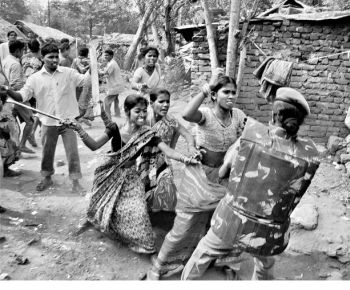
Two hundred and fifty-nine families (1195 people) resided in sixty year old Narayani Basti (slum near Unit 8 DAV School, Bhubaneswar) till the 29th of January 2011. On the 29th of January 2011, ten platoons of police with 9 platoons armed force and DCP and Commissioner of police went into the region and demolished the slums. Slum dwellers protested and many of them were seriously injured in their struggle against local goons and police who assaulted women. The police arrested hundred slum dwellers which included forty nine women. These women were kept locked in a van and were not allowed to leave the van for any reason. On the 30th of January local goons present did not allow either food or water to reach these people after they forcefully returned to their slums. Food prepared by the people from outside (Basti Suraksha Manch) was also not allowed to reach these people. The people organized themselves and started throwing stones at the local goons to get some time to collect and store food. Dodgers came again but this time failed to oust the organized masses. The people of the slums have now decided to take up arms (anything they have at their disposal, hammers, knives, etc) against anyone who tries to come to attack them.


Courtesy: The Hindu

These people living in the slums of Narayan Basti have been attacked by the police without Notice several times before. For the first time it happened in 16th of December, 2009 and since then there has been continuous opposition by slum dwellers against any attack by the forces of the Government. Through protests, they have been able to force dodgers back that had come to demolish the slums and this they have been able to do for about seven to eight times. The recent attacks before the demolition were made continuously from the 10th to 14th January, 2011.

There are several such slums in Bhubaneswar who fear demolition and the Basti Suraksha Manch of Bhubaneswar is playing a leading role in organizing these people. According to the Basti Suraksha Manch, the demolition of these slums is illegal. According to Orissa Municipal Corporation Act Chapter 21, slums are classified as Tenable (which can’t be moved to other places) and Untenable (which can be moved to other places). The Narayan Basti slum is declared Tenable according to this act with its code being 3301 (every slum has a code). In spite of their having tenable status, the Government doesn’t even give alternative accommodation, rather, has a ‘transit house’ (about three kilometers away in Niladri Vihar) where these people will be given accommodation for 15-30 days only and will be left to their own. One can judge how the Government sees its people when one finds that these transit houses have two toilets for two hundred families.

The following is a copy of the letter written to Chief Justice of Orissa High Court:

The Honourable Chief Justice
Odisha High Court, Cuttack
Sub: Pray for justice

Sir,

49 women of Narayani Basti (Khandagiri PS, Bhubaneswar) are illegally detained in the Khandagiri PS at night(after sunset) on dtd.29.01.2011. Who were forcibly evicted from their slum in spite of High court judgment in writ petition(C) No. 11667/2010 and writ petition(C) No. 12723/2010.

You are therefore, requested to kindly intervene the matter in the interest of justice.

Yours faithfully,

Pramila Behera
Plot No. 1819 (opp N6/10)
IRC Village, Bhubaneswar-15

A working class uprising – how far will it go?

Taken from an article published at LIBCOM

. For other articles on Tunisia uprising, visit

The fundamental class nature of the protests in North Africa is undeniable. In Tunisia, Algeria and Libya a generation of proletarianised youngsters have led mass protests, the immediate reason for which has been their desperate standard of living in countries which support a wealthy and transparently self-interested ruling class, less schooled in the modern techniques of bourgeois self-justification than their Western counterparts. The same issues are repeated in countries across the region. We will attempt a brief and preliminary survey of the class aspects of events here; again due to restrictions on information and rapidly developing events this survey is necessarily incomplete.

Expropriations

The uprisings in Tunisia and Algeria have involved the expropriation of goods from supermarkets, shops and warehouses during mass demonstrations. This is to be expected ; one of the immediate catalysts for the uprisings was the cost of essentials rising rapidly, with scarcity compounded by security forces shutting down the country. Moreover, during situations where working class people are becoming aware of their own power, respect for the nicities of commodity exchange evaporates, especially when money (or the lack of it) limits their access to the essentials of life. Such expropriations are a feature of all proletarian uprisings, as is the line on “violent looters” spun to justify brutal crackdowns.

Strikes – or the lack of them

Information on the extent to which strikes have formed part of the movement in North Africa is limited. We know of strikes by teachers in solidarity with protesting students. Likewise there have been calls for general strikes led by ‘professional’ workers such as lawyers, but it is unclear whether they were attended by workers more widely. We can say the same of the general strike called in Sfax – until more information is made available, it is hard to say to what extent it was observed. We know of strikes in the mining town of Gafsa, but again the scale of participation in these strikes is unclear. We do not know to what extent people have participated in organised strikes, or simply not gone to work due to the unrest on the streets. Lockouts after the state of emergency was declared would have precluded many strikes.

Obviously the unemployed and students who have formed the bulk of protesters on the streets do not have labour to withdraw in the same way as workers. Demonstrations, blockades and riots all can form part of class struggle, and can advance it by disrupting the economy and drawing lines of confrontation. Radicalisation by police truncheons can often push confrontation with the state further, and draw more people into events by making the role of the state in maintaining order through violence clear. However, all major uprisings have involved mass strike action, and the mass strike is a means by which the common interest of proletarians as working class and their power to cripple capital by expropriating the means of life from it can become clear. The direction and scale of the insurrection is likely to be determined by the extent to which strike action spreads through the economy.

Part of the explanation of our limited knowledge of strikes could be the focus of the media on street protests and the ‘political’ dimension presented by the calls to oust the current government. Strikes taking place in parallel may not be deemed newsworthy. On the other hand, it may be that there has not been generalised strike action. The role of tourism in Tunisia’s economy, employing significant numbers of workers (half of the workforce is employed in the service sector) is not enough to account for this – industry such as manufacturing, mining and the oil industry accounts for a third of the workforce. This is the classic terrain for mass strikes of the kind that has been a feature of all historic working class uprisings, and this would have a significant effect in a major oil and minerals exporter such as Tunisia.

On the other hand it is important to bear in mind the effect a drop in tourism revenues can have in a country like Tunisa – a few global headlines about rioting can lead to the paralysis of a major section of the economy. Ben Ali called on rioters to stop due to fears about the decline in tourism, and was clear and vocal about this. Nonetheless, a generalised strike movement would be vital in broadening a specifically class consciousness, widening the movement and radicalising the situation.

Not a revolution – yet.

The media has been quick to label events in Tunisia a ‘revolution’, and the name ‘ the Jasmine revolution’ has been rapidly applied to bring it in line with a range of other political revolutions which ushered in new governments (usually pro-US) in various countries. Such events are only ‘revolutions’ in a political sense, with one government replacing another. Tunisa has not yet seen a true revolution, as the rule of capital and the fundamental balance of power between classes in the country has not yet changed. Such a possibility would require the working class of the region to draw lessons from the radical display of their own power which has unfolded over the past weeks. Given that the fundamental issues – unemployment, high prices and poor housing cannot be solved by decree by governments even if they wanted to, it is unlikely that we will see the status quo return in North Africa any time soon.

Videos: Dismantling Democracy in the University (March 4, 2010)

Following is the video of a seminar organised by Correspondence and Kudos, the Literary Society of Hindu College (University of Delhi) on 4th March, 2010 with the aim of initiating a discussion on radical student and university politics.

View playlist on YouTube

On “The Crisis of Neoliberalism”

An interview with Gerard Dumenil on his new book (coauthored with Dominique Levy) The Crisis of Neoliberalism (Harvard University Press, 2011). Courtesy: The Real News

Part I

Part II

Migration: The Experience of a Mising youth

Manoranjan Pegu

Aipemenam,

It’s dark here and there is no electricity in my room and I am writing to you in the candle light. I miss you a lot but cannot afford to come home and see you, as I have to earn lots of money so that I can marry you and we can have a life together. I am safe and fine here and have joined my job as a security guard of this company. It is a very big building with big big machines and a very large garden. The manager told me that it is a pharmaceutical company and it manufactures medicines, tonics and tablets. He told me that these medicines save lives of people. I felt proud about that. Ramen is also with me and he comes in the night for his duty when I leave for home.

Savings are meagre but still I am trying my best to save a lot. Sometimes my boss gives me food and in those days I can skip the meal and save more.

Hope the roads in the village are better now. Manoranjankai was telling me that the floods have come again and have devastated the crops like always. I work ten hours a day and by the time I come back home I get very exhausted. Three of them come back after me and two other leave for their night duty as soon as we come back.

I am fine and you also take care. The thought of our future gives me hope and keeps me going. I love you……

Yours only

Lakheswar

I could see drops of tears rolling out of the eyes of Dhaneswari as I was reading out the letter to her. She was holding on to the letter for about half an hour without saying a single word but every minute of her silence spoke a thousand words to me. I could feel a deep sense of pain in her eyes which she has hold on to silently and hidden it from the world, for many months by now. I could feel the same love and pain even in Lakheswar’s eyes when he handed over the letter to me. The way he held on to the rugged passport size picture of Dhaneswari which always found a place in his wallet.

It has been only two months I have known Lakheswar. He is a young man in his early twenties who has left his village in lookout of work so that he could earn enough money to support his family. It was a co-incidental meeting as I met him when I had gone to meet my friend who is doing his MBA from Pune. Lakheswar had come to borrow money from him so that he could send money back home. It was a few days ago when I had again gone to attend one of my friends birthday party that I met him and had a long chat with him. He had volunteered to cook for the party in return of rupees two hundred for the night.

Lakheswar is not alone in the city. There are many like him who has come to the city with dreams of earning money and usually look out for odd jobs in the city. They work as security guards, cooks, salesman and many of them also engage in daily wage labour. I was shocked to see the number of Mising migrants in the city and Pune is not the only city where they have migrated to. We can also find many of them in considerable number in Delhi, Bangalore, Trivandrum, Mumbai and other cities of India.

Migration as a phenomenon though relatively new has considerably emerged among the Misings. The Misings, who purportedly till yet had a self-sustaining life have been forced to migrate to other places to earn their livelihood. Migration is an important phenomenon and has many dimensions to it. Migration on one hand helps people from underdeveloped areas to come to the developed areas and earn their livelihood, while on the other it also brings in extreme exploitation which shall be discussed later. People migrate primarily to earn a livelihood. The movement of the upper class is to improve their standard of living and earn more. On the other hand, poverty also forces people to migrate, albeit for survival. Migration is usually observed as movement from rural to urban centres. Agriculture, which depends largely on monsoon, does not provide for the cash requirements. Thus more often than not the men in the household migrate – either seasonally or permanently. In the former case, they return at the time of harvesting, carrying with them the money earned. In the latter case, the men return home in the light of any emergency or a festive occasion. For the rest of the year they keep sending the little money they manage to save back home, on which the family in the village sustains. Migration has today become a way of life for many people who travel from place to place in search of better wages.

There can be various classifications of migration. If classified under choice; there are two types of migration – voluntary when the migrant migrates to another place at his/her own wish and is generally done to fulfill educational and job commitments. The other type of migration is distress migration – when the means of sustaining oneself exhausts in a certain place, then an individual is forced to migrate to another place to earn a livelihood. In this case, the sudden upsurge of migration that has emerged among the Misings can be identified as forced. Constant floods have ravaged the areas where the Misings reside and agriculture has been destroyed and thus the Misings have been forced to migrate to other places in look out for work.

It is argued that if the process of migration stops then the development of the country shall also cease. Then what is it that makes migration as a phenomenon to be scared of? Why should migration not be encouraged? There might be various theories and answers to the above question. Many might argue for it and many against. But without doubt, it can be agreed that the migrant labourers are the most exploited lot.

Migrant labourers have always been a marginalised section – owing to the antagonism of the people of the state they migrate to. This has been very apparent in states like Maharashtra where a migrant labour (especially migrants from UP and Bihar) is looked at with hatred and equated as a person depriving the ‘sons of the soil’ with jobs in their own state. We have also witnessed the same in Assam in 2003 when various Bihari migrants were attacked because they were seen as a threat to the jobs of the Assamese people. What follows is that a migrant labour is generally treated with disrespect. Ethnic clashes and fight for survival soon follows where a lot of them also lose their lives.

Migration among the Misings (or for that matter any type of migration) is a multi-dimensional phenomenon with various socio-political implications. The migration is often driven by an intention to survive and thus there are various factors that influence the migratory process. The contractors (Thekedaar) play a major role in the migration process as he is the one who recruits the migrant worker or get him/her employment. He goes to the village or get in touch with a villager and influence them to come to the city to perform jobs. He assures them employment and place to stay in the city. People also migrate if he/she has a kin who is already working in the city as it eases the process of migration and also the migrant feels safe and secured in an unknown city. Sometimes the contractors also contact workers who have previously worked under him and directly hires from the village.

Migrant labourers are generally preferred over the local workers and it makes it very easy to get jobs for the migrant labourers. But the preference is done with an agenda. The migrant workers provide for cheap labour and also can be easily exploited. In fact such is the extent of the exploitation that the labourers who usually come in look out to better their standard of living is often pushed towards extreme poverty and deterioration. The exploitation takes various forms and shapes. The migrant workers are paid very low wages which again are paid in lump sum amount after months of work. Thus it becomes extremely difficult for the workers to sustain themselves in the city. Lakheswar informed me that he had not yet received his wages for two months. The migrants are also completely dependent on the contractor for their shelter and residence in the city. Most of the times the shelter provided by the contractors are in slums where existence becomes a nightmare. Infact when I visited Lakheswar, I was shocked and deeply pained to see six of them stuck to a room which would even be smaller than a kitchen of a middle class family in a city. There was not enough space to sleep or for the basic minimum needs. Dirty surroundings and a filthy smell filled my nose as soon as I entered the room. It also formed the kitchen during the day and after the cooking is done the utensils are cleaned and stocked up in a corner of the room and it forms the sleeping space. It left me wondering; how a mising youth who have, his entire life slept in open spaces forced to adjust such a surrounding.

The story of exploitation does not end here. Migrant labourers generally wait at Nakas for prospective employers/contractors to come and hire them for work. The traffic police harass them by beating them without any reason, shooing them away and at times even extort money from the poor labourers. They are treated with indignity at the workplace- by the contractor as well as the employer. And the migrant workers are not protected under the law especially the seasonal migrants. Thus the Misings who are essentially seasonal migrants are in extreme stage of vulnerability. In fact there have been a few cases in my village where quite a few of them returned empty handed where they have been cheated by the contractor. In such a situation what can be done? Should there be efforts to stop migration? But it shall demand developing more livelihood options in the villages. How will we generate more livelihood options in the villages? These are questions which need a lot of introspection.

Lakheswar mother’s asked me about his well being and his return. She said that it has been a year that she has not seen him and she was dying to see him again. I just thought to myself that there are many more mothers like her who are waiting for their sons to come back home…