Petition: Release Chhatradhar Mahato and resume talks

To
The Chief Minister
West Bengal
Writers’ Building
Kolkata-700001

Sir,

CHHATRADHAR MAHATO, spokesperson of the PULISHI SANTRAS BIRODHI JANASADHARANER COMMITTEE, has been arrested under the Unlawful Activities (Prevention) Act. This is in direct contravention of the previous stand of the West Bengal state government that the Act will apply only to members of the CPI(Maoist). While even this is a debatable policy, Chhatradhar Mahato can in no way fall within its ambit. Moreover, the modus operandi of his arrest was in complete disregard of law and proper procedure. There is no doubt that Chhatradhar Mahato should be released immediately.

In any case, he is the spokesperson of an organization with which the state government was in active dialogue before the government withdrew unilaterally and the joint armed forces were sent in. In this petition we urge you and your government to withdraw the joint armed forces, help create a climate conducive to dialogue, resume talks and sit across the table with Chhatradhar Mahato as a free man.

Please Sign

Mahasweta Devi, the petition sponsor, is a writer, activist and social critic. In this effort aimed at social and political justice for the struggling adivasi people of Lalgarh and adjoining areas in Pashchim Medinipur, West Bengal, she is joined by a large number of citizens deeply worried over the tragic events unfolding in the region.
Lalgarh: an analysis of the media’s war hysteria

Partho Sarathi Ray, Sanhati.

War-hysteria in media: cobras, shields, and sanitization

We have been witnessing what can only be described as “war hysteria” in the media coverage of the current situation in Lalgarh and adjoining areas. It appears as if the great protectors of the “rule of law”, the West Bengal state police, propped up by the CRPF and a plethora of other armed forces, with suitably scary acronyms like COBRA, are out to regain a chunk of Indian territory occupied by a hostile country. What is conveniently not being mentioned is that for ages the police itself has behaved like invaders in the area, willfully torturing and humiliating people, and that is why they had been boycotted in that area for the past six months. With blow-by-blow accounts of their progress, and description of how they are penetrating “human shields”, and “sanitizing” whole areas, it doesn’t seem that their adversaries are the poorest of the poor, the most marginalized sections of Indian society, the adivasis who are armed with traditional weapons like bows and arrows, and some Maoist cadre, who would be a few dozen at the most, and armed mostly with weapons looted from the police and improvised explosive devices.

The trigger in Dharampur: a popular response to rampaging harmad militias

More importantly, what is being represented as a war between the Maoists and the Indian state, conveniently glosses over some points that we need to pay our attention to. The rural area of Lalgarh has been out of bounds for the administrative machinery of the state since last November, since the uprising of the adivasi-moolvasi people of the area against police atrocities. With the setting up of the PCPA, the adivasis had been running their own affairs, and even taking up much-needed developmental work, a whiff of functioning democracy in the middle of the hoax that goes on by the name of democratic governance in large parts of India.

Then, what suddenly triggered this confrontation, and this cascade of events that is today witnessing police dragging out women from houses in the Lalgarh area and beating them blue and black and hundreds of people fleeing to relief camps?

It points to the incident which happened in Dharampur, near Lalgarh town, on June 14th. It was reported in the press on that day, but now has been conveniently forgotten as the press is busy to set up the Maoists, and the PCPA, which they repeatedly call Maoist-controlled contrary to all evidence and denials by the PCPA leadership, as the arch-villains in this episode.

Dharampur is near Lalgarh town, and it was a CPI(M) stronghold where the house of the zonal committee member, Anuj Pandey, was located. On 14th June, a PCPA rally was proceeding towards that place, called to protest against the arrest and reported rape of adivasi women who had gone to a meeting in Chakulia in Jharkhand. It was a usual PCPA rally, with traditional weapons and led by women as usual. When it neared Dharampur, it was attacked by CPI(M) harmads, targeting the women. The rallyists couldn’t resist this attack and dispersed, but then a Maoist squad arrived and started a gun battle with the CPI(M) cadres, which continued till late in the night.

With their superior firepower, the Maoists gunned down at least nine of the CPI(M) attackers. Thereafter, the next day there were multiple rallies called by the PCPA, and the people in these rallies, who were incensed by the CPI(M) attack of the previous day, decided to take over the CPI(M) strongholds of Dharampur, a major operating base for the CPI(M) harmads, and Lalgarh town which was still under the administrative control of the government. The Maoist squad accompanied them, to resist attacks by the CPI(M), and not allow a repetition of the past day’s incident.

20,000 Maoists and “frontal organisations”?

What followed has been widely reported, how CPI(M) party offices were burnt down, how the palatial house of Anuj Pandey, the widely hated CPI(M) leader, was broken down, and how some CPI(M) members were killed. It was a spontaneous outburst of pent up fury of the people, people who had been subjected to humiliation and exploitation by these same CPI(M) leaders on a daily basis. They acted out of a sense of deliverance from the hegemony and corruption of the CPI(M). The Maoists were definitely present, but the 10,000-20,000 people who participated in this uprising were definitely not Maoists, as has been represented by the press. They were common people, and their anger and frustration found expression in this outburst. Although a number of political leaders, including those from the Trinamool Congress and Congress, made statements to this effect, it has completely been glossed over by the mainstream press.

Human shields – a physical protection of liberty and development

In order to reinforce this idea, multiple press reports have tried to represent the human walls set up by the adivasis as “human shields” being used by the Maoists to protect themselves from the police and paramilitary. It is possibly incomprehensible to the corporate media that these people were standing there not to protect the Maoists, but to protect the freedom that they have enjoyed for the past six months, freedom from daily harassment and humiliation, and to preserve the gains that they had made during that time, like the building of a few roads and digging of a few ponds, meeting the immediate needs of the people, things that Indian state has not provided in the past sixty-two years.

Teaching adivasis a few lessons along the way

However, as expected, they could not resist the brute force unleashed by the same state that had failed them so miserably. The police and paramilitary dispersed them by teargas and lathicharging, and since then there has been innumerable reports of atrocities being committed by the police. Remarkably, much of these atrocities were committed in the villages on the way to Lalgarh town, which were not even within the zone that was under the control of the PCPA. It appears that the state is bent upon teaching the adivasis a lesson for standing up for their dignity, and the Maoists represented a suitable bogey for doing so. The Maoists, according to their stated policy of guerrilla warfare, would not engage in a frontal confrontation with the paramilitary forces. So what have effectively taken place are a few skirmishes between vastly assymetrical adversaries, and the brave saviours of “law and order” have vented their righteous ire on the unarmed adivasis.

Maoist presence: an old fact and a rehashed bogey

The Maoists have been active in the entire jangalmahal area for a long time, and have been fighting a running battle with the state. The adivasis in the area have long been victimized by the police for this, and it was the police brutalities in the wake of the landmine attack on the West Bengal CM’s convoy by the Maoists that triggered this uprising. The Maoists have been with the adivasis of Lalgarh in this uprising against the state, just as members of many other political parties including the Congress, have been with them. What we are witnessing today is that the Indian state is using this as an excuse to delegitimize the just demands and aspirations of the adivasis, which stemmed from a simple demand for the recognition of their dignity. Attacks on indigeneous people are taking place all over the world, whenever they are resisting the state and the corporations attempt to deprive them of their land, water, forests and dignity, as we recently saw in the attacks on the Peruvian indigeneous people in the Amazon area. All attempts to resist and retaliate are being represented as insurgency and a breakdown of “law and order”. The corporate press is playing along with this, as we see in the case of Lalgarh, and deliberately glossing over facts and issues, to represent the struggle of the indigeneous people, in which armed struggle is increasingly playing a part, as a loss of sovereign authority by the state, which has to be regained at any cost.

Ground dynamics and civil society

The “civil society” in West Bengal, and all over India, has rightly been very distressed over these incidents and condemned both the atrocities committed by the state and what many think to be the reckless behaviour of the Maoists. However, it is also to be expected that the civil society cannot decide, or dictate, what course a movement on the ground will take. A movement develops its own dynamics, based on the ground conditions, and always does not follow a linear path to the most desirable end. Therefore, it becomes the duty of civil society to stand up and be counted when common people are at the receiving end of oppression by the state. We should express our solidarity with the struggle of the adivasis for justice and development, deplore the atrocities being committed on them by the armed forces of the state and demand the immediate withdrawal of the latter from the area as a necessary condition for normalization of the situation and also condemn all the attempts by the state to use this excuse to impinge on the democratic rights of the people. The adivasis had risen up with the demand of a small apology from the police, if what is happening now does not stop, the Indian state will owe them a much bigger one.

Lalgarh beyond Maoism, Maoism beyond Lalgarh

Pothik Ghosh

A shorter version of this article was published in Hindustan Times

In politics, the truth is almost always counter-intuitive. In this realm – where the art of the possible intersects in strangely unexpected ways with the science of the impossible – ominous portents of anarchy often conceal messianic promises of deliverance. Lalgarh, today, is perhaps the starkest symbol of this confounding cocktail, which has come to characterise the polity of Left Front-ruled West Bengal. But the violent upheavals, which have been rocking this tribal-dominated village of West Midnapore over the past several months, are unlikely to yield any meaning as long as socio-political violence continues to be envisaged as a moral question. If anything, such a moral approach would only produce counter-productive programmes and practices that would inexorably push politics further down the hopeless pit of a degenerate status quo.

Whether the Lalgarh movement constitutes an unconscionable disruption of social peace, or is a legitimate popular upsurge cannot be conclusively determined unless the objective political condition and logic of that movement and its subjective ideological orientation, especially with regard to the adoption of violence as an instrumentality of politics, is accurately accounted for. What clearly distinguishes the Lalgarh uprising from other apparently similar violent incidents and agitations that have scarred West Bengal over the past few years, and which have registered a sudden spurt in the aftermath of the resounding victory of the Trinamool Congress-Congress alliance over the CPI(M)-led Left Front (LF) in the 15th Lok Sabha elections, is that the calculus of competitive electoral politics has had absolutely no bearing on the movement. The reason why electoral considerations have figured rather significantly in most other zones of unrest in the state is because the strife in those zones has been ignited mainly by the collapse of the CPI(M)-led LF’s well-oiled and calibrated network to differentially distribute political patronage by way of governance. This has particularly been the case in areas such as Nandigram and Singur where the main battle has been against acquisition of farmland for industrial development.

The struggle for patronage is essentially a competitive struggle that has no concern loftier than that of conserving and progressively concentrating positions constitutive of a structurally inequitable and undemocratic status quo. That does not, however, mean the distress and disaffection caused by the collapse of such patronage, which is all that is there by way of governance in LF-ruled West Bengal, is not real. The trouble is the political idiom in which such genuine anxieties are being articulated is, in being shaped by the all-pervasive regime of patronage politics, thoroughly competitive. That has inevitably rendered such mass movements susceptible to all sorts of cynical manoeuvres and manipulations.

The popular eruption in Lalgarh, on the other hand, has been driven by no such competitive consideration precisely because the remote tribal belt of which it is a part has had little or no patronage network to begin with.

The insurgency of the Lalgarh population has been shaped by its experience of a state that has registered its presence in the area through the brutal effectiveness of its repressive security apparatuses but has been absent as an organic expression of the will of the people and an efficient purveyor of emancipatory social development and vital public goods. Clearly, the problem there is not, as many seem to believe, the absence of the state but its existence as a completely alienated and foreign entity. Those being the objective conditions for the emergence and expansion of the Lalgarh movement, it is highly unlikely that it is capable of positing, or even articulating, anything other than a transformative critique of the alienated and repressive state, and the intrinsically competitive and hierarchical socio-economic order that engenders it.

And that is precisely why the temptation to classify the Lalgarh uprising as a tribal identity movement, driven by the ideology of some organic notion of autonomous communitarianism, should be resisted. The majority population of Lalgarh is doubtless tribal but the anti-competitive orientation of their struggle, thanks to the objective politico-economic conditions that have shaped them, serves to completely invert the competitive logic of identitarian movements, which always articulate their politics in supremacist terms of ethno-cultural pride and domination. Put simply, the Lalgarh movement clearly manifests characteristic features of a working-class struggle.

The People’s Committee against Police Atrocities-led revolt, which was sparked seven months ago by a repressive combing operation launched by the West Bengal police in Lalgarh and surrounding areas in response to a Maoist mine attack on the chief minister’s cavalcade, has steadily morphed into a more proactive and comprehensive struggle for a fundamental transformation of the socio-political structure. That has yielded a two-pronged movement of resistance and reconstruction. It is, therefore, no accident that the PCPA, which has been leading the militant mass movement against the West Bengal government in Lalgarh, is now also at the forefront of an incipient social reconstruction programme for the enforcement of a cooperative and democratic management of resources and rudimentary public services such as healthcare developed by the local community itself.

That the CPI(M)-led West Bengal government, infamous for its autocratic ways, was extremely cagey until a few weeks ago to crack down on the movement was largely due to its mass insurrectionary character. In Lalgarh, violence against state apparatuses has not been launched by a clearly identified group acting on behalf of an oppressed but largely passive population. Instead, it has been an expression of disaffection and opposition by a population entirely insurgent against a repressive state and the oppressive socio-economic order it protects and perpetuates. Even the guerrilla operations carried out by Maoists in the area and its neighbourhood have become a seamless extension of this insurrection, which inevitably enjoys wide-ranging local legitimacy and has some serious moral standing, vis-à-vis the rest of the state. It is this legitimacy, which derives from an assertion of popular sovereignty, that had kept West Bengal’s Stalinist dispensation away from open repressive manoeuvres for so long. That it had burnt its fingers in Nandigram, where its cadre together with the state police had attempted a scorched-earth operation a couple of years ago, has only compounded its diffidence on that score.

After all, a modern state formation, no matter how repressive, has to always act in the name of protecting popular sovereignty. But in an insurrectionary situation, like the one in Lalgarh, the sovereignty vested normatively in the state is clearly in conflict with actual sovereignty on the ground. In such circumstances, the state, if it cracks down on the movement, runs the grave risk of losing all formal legitimacy it enjoys as the keeper of people’s sovereignty. In fact, it is the state or the government that, in such a situation, comes to be seen as an external threat to the sovereignty of the people and the violent insurrection of the latter against the state pushes it and its laws into a state of crisis. That renders the legal-illegal dichotomy problematic and consequently makes it difficult for the state to legitimately monopolise violence to crush popular movements in the name of combating anti-sovereign lawlessness and insurgency. That is a risk the CPI(M)-led LF could ill-afford at a moment when the electoral drubbing it has received in West Bengal signals significant erosion of its moral-political standing.

The Lalgarh movement could, nevertheless, hardly have gone on for ever without inviting the wrath of the ruling classes of West Bengal and India. The only way a movement like that could possibly evade state repression and keep itself alive and kicking is through continuous political growth accomplished through a relentless process of engagement and integration with concerns, anxieties and disaffections in other areas and sectors of the state. Yet, an unpardonable tactical blunder on the part of the Maoists, who indisputably have a sizeable numerical presence in the PCPA, has cleared the way for the West Bengal government to unleash repression on the Lalgarh movement sooner rather than later. The recent claims by various senior Maoist leaders and activists that the PCPA was a front of the underground outfit, which was controlling and running the show in Lalgarh, has given the repressive arms of both the LF government of West Bengal and, to a lesser extent, the Centre the alibi they had been waiting for. The West Bengal government has, over the past few days, turned proactive and has been dispatching contingents of heavily armed police and central paramilitary forces to Lalgarh to crush the popular uprising. That the LF dispensation has suddenly regained its usual repressive element is because it knows the police operation in Lalgarh would now be widely perceived as a legitimate measure taken by the state to protect popular sovereignty from Maoists and some sections of the local community they have bamboozled.

The Maoists, thanks to their doctrinaire programmatic commitment to agrarian revolution and the concomitant tactical emphasis on guerilla struggles exclusively in tribal and rural areas of the country, have failed to focus on developing large-scale popular movements in the semi-urban and urban areas. Their time-worn approach of encirclement of cities by people’s army raised from the countryside has, willy-nilly, militarised their politics, what with their roving guerrilla squads carrying out dramatic raids on behalf of a rural population they have barely organised. That, among other things, has ensured their politics enjoys little concrete ideological-political support among working people in Indian cities. As a result, it has been rather easy for the state at all levels and the ruling classes it represents to paint the Maoist movement into an illegal corner and successfully delegitimise it as an external threat to popular sovereignty.

The Maoists doubtless have a significant numerical and ideological presence within the PCPA and the wider Lalgarh movement. But the committee, which is much more diverse in its broad Left ideological composition, is far from being a front of the Maoist group. And that, as far as the Maoist commitment to a militant working-class movement is concerned, would have spelt no harm. If anything, the Maoists and their sympathisers in Lalgarh ought to have envisaged such a situation as an opportunity for them to continue to work quietly within the PCPA and provide the insurrectionary movement with requisite logistical support and ideological orientation to expand politically to engage with and integrate a multitude of other disenfranchised and exploited sections of West Bengal’s society and economy such as the embattled peasants of Nandigram, Rajbongshi separatists of north Bengal plains, the Gorkhas of Darjeeling and the large masses of workers rendered unemployed by the sharp decline in the fortunes of the state’s tea and jute industries. This process of integration through continuous engagement would have had to address the specific concerns of each of those sections even as it transformed their mutually competitive idioms of political articulation into a coherent but multitudinous critique of the logic of the larger political economy responsible for all their various miseries. That would not only lead to an aggregative programme of social change but would also make Maoism into an ideological current that is always internal to an ever-growing variety of popular movements.

In such circumstances, the modality of political violence would always be that of popular insurrection. And even guerrilla tactics, as and when they are deployed, would necessarily be envisaged as an integral part of this insurrectionary paradigm. That would not only make it hard for the state to delegitimise such violence as illegal or the movements that generate them as anti-sovereign, it would also ensure that Maoism is rescued from the excesses of its current sectarian militarism that have, often enough, ended up replicating the same configurations of superordinate state power, which the movement has sought to unravel.

Clearly, the Maoists can avoid tactical blunders like the one they have committed in Lalgarh only when they re-frame their political-organisational vision. Their obsession with territorial expansion, which has spelt no real political-ideological breakthrough for Maoism, essentially stems from the Maoists’ insistence on envisaging the party as an a priori state-form, which seeks to subordinate the singularity of various experiences of disaffection and registers of struggle to its doctrinaire conception of politics, which is no more than the generalisation of one particular experience of social oppression and resistance. What they need to do, instead, is to imagine the organisation as a movement-form, wherein Maoism is a dynamic organisational impulse and the party is always in a state of bottom-up formation through a perpetual process of politicisation at the grassroots.

West Bengal, ironically enough, provides the most conducive political climate for the Maoists to effect such a reorientation. Their struggles against a repressive state, controlled for over three decades by a coalition of Left forces helmed by the largest Communist Party, ought to compel them to reflect on how communist-left forces, which were once the undisputed principal representatives of a genuine working-class movement, have come to distort it beyond recognition.

The degeneration of the CPI(M)-led LF, contrary to the popular belief shaped by the neo-liberal consensus, is not because of its failure to turn fully social democratic but precisely because it has abandoned the tortuous dirt-path of working-class struggle for the comfortable highway of social democracy. Social democracy, which envisages social progress and the well-being of the working people and the poor essentially as a question of distributive justice, is a form of governance that seeks to equitably distribute a given basket of socio-economic entitlements. In such a ‘Leftist’ scheme, there is no place for interventionist and transformative politics because the state, which for social democracy is an instrument of efficient regulation and equitable redistribution, is treated as a passive and neutral entity that must be captured and then merely controlled.

The state, however, is in reality constitutive of an exploitative, oppressive and hierarchical social order. To that extent, a radical socialist programme must actively articulate the tendency to erode, not capture, it. For, it is only through such erosion that the structural reinforcement of a stratified society can be undermined. The preposterous contradiction the CPI(M)-led LF has created between industrial development that is inescapable, and universal democracy that is indispensable, is a symptom of its social-democratic degeneration. Its failure to imagine more democratic and participatory configurations of socio-political power, which could drive truly cooperative consolidation of land and other resources, and posit an alternative model of development, is because of its social-democratic fixation on the state.

That the Maoists too should call themselves the CPI(M) – Communist Party of India (Maoist) – is uncanny. But more eerie perhaps is the fact that their conception of the party as a state-form predisposes them to a social democratic approach to politics that virtually makes them a mirror-image of the original CPI(M). It’s time the Maoists woke up and smelt the gunpowder.

Lalgarh: People’s Committee against Police Atrocities vows to fight until death

June 20, 2009. The Telegraph

FOR REGULARLY UPDATED NEWS AND VIEWS ON LALGARH, VISIT SANHATI.COM

The tribal body that started the seven-month- old Lalgarh agitation with Maoist backing today threatened a “fight to death” in the face of the government offensive.

“We were born here, we are agitating here and we will die here,” said Chhatradhar Mahato, chief of the People’s Committee against Police Atrocities [PCPA].

“The barricades will continue. The more they are forcibly removed, the deeper will be the (public) anger at the police and support for us.”

Mahato, speaking to The Telegraph at Barapelia, 5km north of Lalgarh town, said the movement had begun because of the “government’s long neglect of the tribal people, who have been surviving on ant eggs for far too long”.

“Our movement is for the development of the people. They (the government) cannot gain people’s confidence by using force,” Mahato, the secretary of the committee, added.

He expressed surprise that the state government had called in paramilitary and additional police forces in response to the destruction of a house being built by Anuj Pandey, the CPM’s Binpur zonal committee secretary.

“Yet no one is asking how this leader could build such a palatial mansion,” he said.

Mahato alleged that Pandey’s brother Dalim, Lalgarh CPM local committee leader, had amassed huge wealth. “Whenever any land transaction took place in the region, he would take a commission. Why were the police brought in to protect these tainted brothers?”

The committee [PCPA] secretary wondered why no action was taken when CPM offices were burnt in Khejuri and the police boycotted at the behest of Trinamul Congress MP Subhendu Adhikari. “The same government is now using central forces against us….”

Committee president Lalmohan Tudu, who too was at Barapelia, said everyone in the region supported the movement. “The battle has entered the heart of Lalgarh. The forces will now see what they are up against.”

Singrai Baskey, resident of Kantapahari, 7km north of Lalgarh town, said: “We are with the movement. We have realised how much this movement means to us now that the entire nation has its eyes fixed on Lalgarh.”

The Left and Electoral Politics in India

Deepankar Basu
Sanhati

In the recently concluded 2009 general elections to the lower house of the parliament, the Social Democratic Left (SDL henceforth) In India, composed of the Communist Party of India-Marxist (CPM), the Communist Party of India (CPI), and a bunch of smaller left-wing parties, has witnessed the severest electoral drubbing in a long time.  This year, the CPM won a total of 16 parliamentary seats; compared to its performance in the last general elections in 2004, this is a whopping decline of 27 seats.  The CPI, on the other hand, won 4 seats in 2009, suffering a net decline of 6 parliamentary seats from its position in 2004.  Does this mean that the Indian population has rejected even the mildly progressive and social democratic policies that the SDL tried to argue for at the Central level?  Is this a mandate for the Congress party and by extension a mandate for neoliberalism?  I think not. This is a mandate against the SDL but not against social democratic policies; this is a mandate against neoliberalism and for welfare-oriented policies.  To the extent that the Congress was pushed by the SDL to partially implement such pro-people policies, it can possibly be interpreted as an indirect endorsement of Congress’s late-in-the-day populism.  After making a few comments on the national mandate, in this article, I focus my attention on West Bengal, the bastion of the SDL in India.

Mandate versus Outcome

Let us begin by distinguishing between the mandate and the electoral outcomes.  The change in the number of seats won and lost (the electoral outcome) is only a partial, and imperfect, reflection of the change in the actual level of support parties enjoy among the people (the mandate); often the particular logic of electoral arithmetic draws a wedge between the mandate of the people and the electoral outcome in terms of seats won or lost.  For instance, it is possible for a party to increase its share of votes polled without this increase leading to any increase in the number of seats won; conversely, it is possible for a party to decrease its share of votes polled without losing in terms of seats.  An example of the former is BSP’s performance at the national level in 2009: it has emerged as the third largest national party, increasing its share of votes polled from 5.33 percent in 2004 to 6.17 percent in 2009, but this has not translated into any appreciable increase in terms of seats.  An example of the latter is CPM’s performance in Tripura: its share of the votes polled dropped from 68.8 percent in 2004 to 61.69 percent in 2009, but that did not affect its position in terms of seats.  Hence, to understand the structure of the "popular will," it is necessary to go beyond the position in terms of seats won and lost; one needs to study the changes in the shares of votes polled.

Focusing on the share of votes polled is also enough, among other things, to dispel certain misinterpretations of the mandate of the 2009 general elections that seem to have wide currency.  The first misinterpretation that is gaining ground is the alleged existence of a "wave" in favor of the Congress party which swept it to power overcoming the ubiquitous current of anti-incumbency.  Nothing could be farther from the truth.  Despite having won 206 parliamentary seats, the Congress merely won 28.55 percent of the votes polled in 2009; this is a little less than a 2 percentage point increase from 2004.  29 percent can hardly be interpreted as a "massive wave"; besides, this overall increase also hides substantial decreases in several important states such as Orissa, Jharkhand, Chhattisgarh, and Andhra Pradesh.  The second misinterpretation that is doing the rounds is that this general election saw the definite demise of regional parties and all federalist tendencies of the Indian populace; the people voted overwhelmingly for national parties, the argument goes, because they want stability.  Whether people desire stability is a questions that cannot be entered into at the moment, but the fact that the populace did not reject regional parties in favor of national parties can be seen by looking at the share of votes going to the Congress and the BJP together: according to provisional figures released by the Election Commission of India, the combined vote share of the Congress and BJP in fact declined from 48.69 percent in 2004 to 47.35 percent in 2009.  Thus, the share of votes going to the two main national parties has declined; so much for the ascendancy — what historian Ramachandra Guha called the "course correction" — of the tendency for centralization in the Indian polity.

Social Democratic Performance: National Level

How did the social democratic parties perform in terms of the share of votes polled?  At the national level, the CPM lost only marginally in terms of its share of votes polled, which declined from 5.66 percent in 2004 to 5.33 percent this year; the CPI, on the other hand, gained marginally at the national level, increasing its share of votes from 1.41 to 1.43 percent.  Thus, going by these national figures, there is no evidence of any nationwide "wave" against the social democrats’ opposition, however feeble, to the neoliberal policies of the Central government.  Those who want to interpret the current debacle of the social democrats as a national mandate against progressive economic and social policies need to rethink their arguments; the evidence does not support such an argument.  In fact, as I will argue below, if there can be discerned any "wave" in favor of the Congress in the mandate, it is largely a "wave" against neoliberal economic policies and not the other way round as many pro-establishment analysts are making it out to be.

But the national level figures hide many interesting state-level variations, so we must look at state-level data.  There is another reason why we need to supplement national level with state-level analysis: since the SDL is prominent only in the three states of Kerala, Tripura, and West Bengal, the national figures are not very relevant to assessing the electoral prospects of the social democrats.  Hence, we must look at state-level data for Kerala, Tripura, and West Bengal to understand the sharp change in the electoral performance of the social democratic Left in India and draw conclusions about its continued relevance in the Indian polity.

Social Democratic Performance: State Level

How did the social democrats perform in the different states?  First, the SDL managed to increase its vote share in a few states: Andhra Pradesh, Goa, Gujarat, Madhya Pradesh, Manipur, Rajasthan, Uttar Pradesh, Chhattisgarh, Uttaranchal, and Andaman & Nicobar Islands.  Apart from Manipur, of course, the total vote share of the SDL in these states remains insignificant; hence, the increase in the vote share did not even remotely translate into changes in seats.  Second, the SDL lost its share of votes polled in a large number of states: Assam, Bihar, Jammu & Kashmir, Kerala, Maharashtra, Punjab, Tamil Nadu, Tripura, West Bengal, and Jharkhand.  The percentage declines in Punjab and Jharkhand were very large, though that did not affect the reckoning in terms of seats because the SDL did not have seats to start with, i.e., in 2004.  Third, the states where the loss of vote share wreaked havoc for the SDL’s reckoning in terms of seats were Kerala and West Bengal: in Kerala, the share of votes going to the SDL declined from 39.41 percent in 2004 to 37.92 percent in 2009; in West Bengal, the share of votes garnered by the SDL declined from 50.72 percent in 2004 to  43.3 percent in 2009.

Let me summarize the evidence presented so far: the SDL’s marginal decrease in vote share at the national level was made possible by the offsetting of the decrease in vote share in several states by the increase in others.  The fact that this marginal decrease led to such a debacle in terms of seats is driven by the fact that the bulk of the decrease in vote share was concentrated in the electorally important states of Kerala and West Bengal whereas the increase in vote share was spread out electorally across states where the SDL is marginal.  Thus the state-level distribution of the increase and decrease of vote shares for the SDL turns out to have profound implications in terms of electoral outcomes at the national level.

Social Democrats Help the Congress

This, of course, brings us to this important question: why was the bulk of the decrease in vote share for the SDL concentrated in Kerala and West Bengal?  The clue to an answer is provided by the fact that both states, Kerala and West Bengal, currently have social democratic governments, led by the largest social democratic left party in the country, CPM.  In both states, the social democratic governments have, over the past few years, increasingly accepted, adopted, and pushed neoliberal economic policies, often in the name of development and industrialization.  Thus, we saw the emergence of a paradoxical situation: the SDL opposed, however feebly, the continued adoption of neoliberal polices at the level of the Central government, while the same set of policies was aggressively pursued in the states where they were in power.  The debacle of the SDL in the two most electorally important states of Kerala and West Bengal can, therefore, be understood as a strong rejection of this doublespeak and hypocrisy of the SDL.  The rejection of the SDL at the level of these two states, moreover, dovetails into the overall mandate in favor of progressive and social democratic policies, and against the neoliberal turn, at the national level.  Of course there were other local factors, both in West Bengal and in Kerala, that overlaid this broad rejection of the neoliberal turn and turned the mandate decisively against the SDL in both these states.  Before we look at some of these factors, especially for West Bengal where the debacle of the SDL was the most stunning, a comment about the so-called national "wave" in favor of the Congress is in order.

The so-called nationwide "wave" in favor of Congress, if there was one, resulted to a large extent from the slew of populist policies that it adopted, paradoxically pushed towards this by the SDL, over the last few years.  These include the National Rural Employment Guarantee Act (NREGA), the step-up in public investment in agriculture, the debt relief program for farmers, the Right to Information Act 2005, the Central Educational Institutions (Reservation in Admission) Act 2006, the Unorganized Workers’ Social Security Bill 2008, and the setting up of the Sacchar Committee to inquire into the continued marginalization of Muslims in the country.  The Congress cashed the benefits of this populist swing electorally claiming it to be its own policies whereas, in truth, the SDL was largely instrumental in pushing for these policies at the central level.  Other such social democratic policies pushed for by the SDL include: opposition to financial sector reforms (pensions, insurance), opposition to outright privatization of the public sector, opposition to privatization of health care and education.  These defensive actions by the SDL have partially limited the unbridled power of capital to exploit labor and have provided some relief to the mass of the working people in India.  It is, therefore, no surprise that corporate India is exultant at the social democrats’ drubbing at the hustings in 2009.  The stock market in Bombay went into a tizzy immediately after the results were out and trading had to be stopped for a while to deal with the unprecedented euphoria!  As many media reports show, the Confederation of Indian Industries (CII), the Federation of Indian Chambers of Commerce and Industry (FICCI), and other business groups have already started preparing their "wish-list" of reforms, by which they mean another round of neoliberal policy assault; quite unsurprisingly, land reforms does not figure in this wish-list of "reforms."

The SDL’s ability to counter the Congress claim that the populist thrust was a result of a progressive shift in the party, in reality fiercely opposed by entrenched interests within the Congress, was severely limited by the SDL’s de facto record in the states where it was in power: Kerala and West Bengal.  Thus, paradoxically, while the SDL was largely responsible for creating the populist shift in the Congress party and thereby creating a "wave" in its favor, it could not transform this effort into any substantial electoral advantage for itself; and this was largely because of its doublespeak and hypocrisy, saying one thing at the Central level and doing exactly the opposite at the State level.

Probably nothing brings out this doublespeak and hypocrisy of the SDL better than the National Rural Employment Guarantee Act (NREGA).  The NREGA, which provides a guarantee of a minimum of 100 days of work to the rural poor, came into effect on February 2, 2006 in 200 of India’s poorest districts.  This provision was originally brought by grassroots-level mass movements in Rajasthan and other states in India, and was later adopted and forcefully pushed by the SDL at the central level.  While the NREGA has been constantly attacked in the mainstream press as a waste of resources and a useless policy initiative, it has in fact created substantial benefits for the rural proletariat and poor peasants; even though there is still a lot of room for improvement, the NREGA has managed to improve the lives of the rural poor by putting a floor on agricultural wages and assuring some days of employment, both of which resulted in increased rural incomes.

West Bengal: A Closer Look

How did the NREGA fare in West Bengal and Kerala compared to other states?  In 2006-07, the person-days of NREGA employment generated per rural household was 6 in West Bengal and 3 in Kerala, with both states figuring in the list of the 3 worst performers.  Compared to this, the all-India average was 17 person-days, and Chhattisgarh generated 34, Madhya Pradesh 56, Assam 70, and Rajasthan 77 person-days.  A similar picture emerges for the next year, too: in 2007-08, West Bengal generated 8 person-days and Kerala 6 person-days, much below the all-India average of 16 person-days.  The dismal performance of the state government led the Paschim Banga Khet Majoor Samity (PBKMS), a non-party, registered trade union of agricultural workers, to file a public interest litigation in the Calcutta High Court on non-implementation of the 100-days work guarantee scheme in West Bengal.

Coming back to the factors specific to West Bengal that led to this stunning electoral defeat of the SDL, we must complement the story of the state government’s surrender to neoliberalism with its misguided arrogance.  The utter failure in the implementation of the NREGA went hand in hand with other overt neoliberal policy moves: privatization of health care, privatization of education, the full-scale assault on the public distribution system, and an aggressive State-sponsored attack on farmers to "acquire" their agricultural land for a neoliberal industrialization drive.  Singur and Nandigram stand as symbols, at the same time, of both this attack by the State on behalf of corporate capital and also of the fierce resistance to this brutality by the poor peasants and landless laborers.  The arrogance of the SDL-led state government was on gruesome display during the "re-capture" of Nandigram in March 2007, a violent attack on the people opposing forcible land acquisition, and also in the manner it dealt with the case of Rizwanur Rahman.  Coming as it does in the background of the dismal conditions of the Muslims in the state, the total insensitivity displayed in the Rizwanur Rahman case increased the ire of the common Muslim population against the SDL-led state government.  Taken together, all these factors created a massive wave of anger and resentment against the state government and resulted in the unprecedented electoral debacle of the SDL in West Bengal.

A Spurious Argument

At this point, we need to closely scrutinize an alternative argument that is doing the social democratic rounds.  This argument, which purports to provide an explanation of the electoral defeat of the SDL in West Bengal, runs something like this: the Left Front made a great tactical mistake in severing ties with the Congress-led United Progressive Alliance (UPA) at the Center on the issue of the 123 treaty (nuclear deal) with the USA; this severing of ties with the Congress allowed the Trinamool Congress (TMC) and the Congress (INC) to forge an alliance in West Bengal; this alliance managed to consolidate the anti-Left votes and directly resulted in the electoral drubbing of the SDL in West Bengal.

This argument, if true, would provide some solace to the SDL leadership in India.  By shifting the responsibility of the electoral debacle onto the logic of alliance arithmetic, the SDL would manage to skirt some difficult issues of policy and politics.  But, alas, the argument does not hold water when confronted with evidence.  There is a simple way to determine the validity or otherwise of this, to my mind, spurious argument.  If it were true that the SDL debacle was fueled mainly by the consolidation of anti-Left votes (because of the Congress-TMC alliance), it would mean the following: the SDL’s share of votes polled would remain relatively unchanged between 2004 and 2009.  This is a straightforward testable implication of the above argument.  What does the evidence say on this?

In Table 1 we have summarized data about the change in the vote share of the Left Front (CPM, CPI, AIFB, and RSP) at the level of the parliamentary constituencies between the general elections in 2004 and 2009; a negative number implies an increase in the vote share from 2004 to 2009, and a positive number implies a decline.  As can be seen from Table 1, out of the 42 parliamentary constituencies in West Bengal, the SDL’s vote share went down in 39, ranging from 0.49 percent in Balurghat to a whopping 34.8 percent in Hooghly!  The only 3 constituency where the SDL managed to increase their vote share is: Malda North, Murshidabad, and Ghatal; in all the other constituencies its vote share fell between 2004 and 2009.  There were 25 constituencies where the share of votes garnered by the SDL fell by more than 5 percentage points, there were 11 constituencies where the vote share fell by more than 10 percentage points, and there were 5 constituencies where the vote share declined by more than 15 percentage points.  Can we, in the face of this overwhelming evidence of a massive anti-SDL wave, still stick to the story of the supposed consolidation of anti-Left votes as the primary reason behind the SDL debacle?

Table 1: Constituency-Wise Decrease in Vote Share of the Left Front from General Election 2004 to 2009

Constituency Change Constituency Change
Malda North -5.71 Kanthi 7.67
Murshidabad -1.09 Malda South 7.68
Ghatal -0.66 Arambagh 7.74
Balurghat 0.49 Darjeeling 7.99
Uluberia 1.58 Mathurapur 8.06
Medinipur 1.70 Bishnupur 8.28
Jalpaiguri 2.11 Tamluk 8.50
Asansol 2.51 Bongaon 8.89
Kolkata South 2.80 Basirhat 9.05
Diamaond Harbor 2.98 Birbhum 9.65
Raigunj 3.13 Krishnanagar 12.53
Dum Dum 3.62 Barasat 12.54
Bardhaman Purba 3.69 Joynagar 12.91
Jangipur 3.80 Barrackpur 12.97
Ranaghat 3.88 Kolkata North 13.64
Bahrampur 3.99 Sreerampur 13.72
Alipurduars 4.48 Bolpur 15.65
Jadavpur 5.35 Purulia 15.94
Howrah 5.61 Bankura 16.62
Cooch Behar 6.88 Bardhaman-Durgapur 16.99
Jhargram 7.12 Hooghly 34.80

Beyond Elections

There is no denying the fact that the SDL played an important role in halting the juggernaut of neoliberalism in India through its intervention in the formation of the Common Minimum Programme of the UPA; and this was largely possible, given the political situation five years ago, because of the sizeable parliamentary presence of the SDL at the Central level.  If nothing else, the reaction of corporate India to the electoral debacle of the SDL is proof of the partial efficacy of the SDL’s past interventions.  But there are, I would submit, at least two serious problems of a strategy that focuses primarily on electoral politics as the SDL does.

First, most of its interventions, even though salutary, are at best defensive actions.  The ruling classes set the agenda and move forward with a concrete program of neoliberal reforms and the SDL reacts to that agenda: it tries to halt the speed of the reforms, tries to win a battle here or there, without in any real sense questioning the logic of the whole move.  The logic of the whole move can only be questioned when there is a positive agenda guiding political intervention.  In the absence of such a positive political program, it boils down to the following: the ruling class ushers in the policy triumvirate of liberalization, privatization, and globalization, and the SDL merely reacts to these.  In such a scenario, the best outcome can only be a return to the status quo, not a move forward towards a socialist future.

This brings me to the second, and related, problem of the SDL strategy.  The fact that the Communist parties, now part of what I have called the SDL, have lost the political offensive in the context of the class struggle in India also finds reflection in their over-emphasis on electoral politics, to the virtual exclusion of all non-electoral struggles.  Over the last two decades, there is not one significant non-electoral struggle that the SDL initiated or led; all its attention and energy has been fixed towards how to maintain its electoral position.  More often than not, the SDL has been willing to enter into opportunistic and unprincipled alliances to attain short-term electoral goals, little realizing that this opportunism leads to long-term political setbacks.  At times it has even gone with the BJP to keep Congress out of power, quickly reversing the logic at the next moment and aligning with the Congress to defend secularism.  Caught in these endless electoral antics and working within a framework whose rules have been set by the ruling classes, the SDL has gradually distanced itself from its programmatic concerns of a people’s democratic revolution.  To recover its potency and relevance, the SDL must refashion itself by forging links with the rising tide of mass movements in India against the neoliberal offensive and overcome its obsession with electoral politics.  If post-poll statements of the SDL bigwigs are anything to go by, however, they have decided to do exactly the opposite: blame the electoral debacle on external factors, avoid any serious rethinking, and continue with elections as the primary focus of SDL politics.

– – – – – – – – – – – – – – – – – – – –

Correction

While computing the numbers for Table 1, I had not fully taken account of the delimitation of parliamentary constituencies that took place in 2008.  Hence, some of the numbers in Table 1 are inaccurate because the parliamentary constituencies themselves have changed.  Thus, while it is difficult to accurately see how the 7 percent statewide decline in vote share of the Left Front is distributed across all the parliamentary constituencies (which is what Table 1 inaccurately reported) because of the 2008 delimitation of constituencies, we can nonetheless figure out the changes in vote shares in those that remained relatively unchanged by the delimitation process: Balurghat saw a marginal decline of 0.49 percent, Raigunj a decline of 3.13 percent, Alipurduars a decline of 4.48 percent, Cooch Behar a decline of 6.88 percent, Darjeeling a decline of 7.99 percent, Birbhum a decline of 9.65 percent and Bolpur witnessed a massive decline of 15.65 percent.  But the statewide decline in the vote share of the Left Front remains unchanged and thus my main argument remains unaffected; only the distribution of the change in vote share across parliamentary constituencies has changed.  Once the Election Commission of India comes out with data at the assembly segment level, one can recompute the numbers that make Table 1 to get a more accurate picture; the trend of declining vote share for the Left Front, though, will remain unchanged.

Singur – The Costs and Benefits of Neoliberal Industrialization

Deepankar Basu

Singur stands for many, often contradictory, things. It stands for the model of neoliberal industrialization that the Indian state is trying to push down the throats of its citizens at the behest of big capital. It stands for the unprincipled and populist politics of dormant right-wing forces. It stands for the abject surrender of an erstwhile communist party to the dictates of capital, the full flowering of a tendency that surfaced in the Indian political firmament circa 1967. But Singur also stands for the struggle of labour against capital, decidedly in confused and masked manners, but a struggle that has the potential to galvanize resistance against neoliberalism. When the Tata Group, forced by the long-standing struggle of the small farmers and landless labourers in Singur, was reported to be planning a move to Pantnagar in Uttarakhand, there were simultaneous reports of a possible Singur waiting for them in Pantnagar. A Singur in Pantnagar! That is the real significance of the struggle of the landless labourers and peasants of Singur.

Right from day one, the West Bengal government and the mainstream media has been building up the case for the manufacturing plant in Singur on the basis of half-truths and untruths. For a long time, the West Bengal government continued denying the fact that it had “acquired” a large tract of the proposed 1000 acres from unwilling farmers by using coercion, strong-arm tactics and certainly without their consent. Towards the later part of 2006, after considerable protests and a public hearing organized by intellectuals and activists, it had to finally accept its own earlier statements as false. Now it is known by all and sundry that 411.11 acres of the total 997.1 acres has been acquired without consent of the relevant farmers. For a long time, again, the West Bengal government continued denying the fact that most of the land that was sought to be “acquired” was fertile and multi-cropped agricultural land. It was only when earlier this year the Supreme Court pointed towards a possible violation of the Land Acquisition Act, responding to a petition filed for immediate halt of the Nano car project, that the West Bengal government finally accepted that it had been willfully misleading the public in this regard for so long; the SC had pointed out that acquiring and using fertile, multi-crop agricultural land for industrial purposes goes against even the Land Acquisition Act, which the West Bengal government was, paradoxically, trying to use to “acquire” that land. Now it has been established beyond any shadow of doubt that the land on which the proposed plant is to come up is, in the main, fertile, multi-cropped agricultural land. Another myth that had been in circulation for some time was the following: the land in Singur could not be used for agricultural purposes for most parts of the year because of water logging. This claim has also been contested and shown to be untrue. Now it is accepted by all serious commentators that the land had, before being fenced off by the West Bengal police, been in constant use throughout the year for growing various agricultural crops, and that it provided livelihood for more than 12,000 families. Even though these and other such claims of the West Bengal government and the mainstream media have been refuted point by point, over and over again, with facts and arguments and lot of patience and care, they keep turning up ever and ever again like bad coins. They will, as long as the social forces whose interest they represent continue their efforts to hegemonize society; and we will continue refuting them point by point, with patience and care and logic and facts.

But even when these particular canards are discounted, there seems to be a larger argument for industrialization that Singur purportedly represents. The West Bengal government and large sections of the mainstream media tend to equate Singur with industrialization and portray any and every opposition to Singur as opposition to industrialization. The apparent strength, or shall we say charm, of this argument becomes obvious when we see even an preeminent thinker like Amartya Sen falling for it. But this argument is deeply flawed. Opposition to Singur is not opposition to industrialization, it is opposition to neoliberal capitalist industrialization. Opposition to Singur is opposition to the conflation of industrialization with neoliberalism, a scenario where the State steps up its efforts to subsidize capital and shore up its profits while capital externalizes its costs onto labour and the environment with impunity. It is this model of industrialization that we oppose.

An alternative model of industrialization, as far as we can see, would operate in an exactly opposite fashion. It would tax capital and not subsidize it, prevent capital from externalizing its costs onto labour and the environment rather than facilitating it, intervene in decisions related to the choice of technique to be used in production, force private capital to do proper cost-benefit analysis before embarking on a (socially) costly industrial project, intervene through fiscal and monetary policy to maintain overall levels of aggregate demand and try to ensure full employment with living wages for workers. In the alternative vision, the State would use tax revenues to build infrastructure, provide social sector services and closely monitor and improve the well-being of the people. Singur, and the model of industrialization that it stands, takes us in the exact opposite direction; that is why it needs to be opposed. It destroys livelihoods tied to agriculture without creating compensating jobs in industry, it willfully snatches away fertile, multi-crop agricultural land for industrial purposes when so much fallow (and other unused and misused) land is there to be used, it externalizes the costs of production on the most vulnerable sections of the population and the environment, and all this while the State steps in to massively subsidize private capital even further. If, therefore, due to the struggle of the project affected people the Tata’s finally leave West Bengal, it should call for rejoicing not for middle-class chest-beating that is so much on display these days. For it would be one of the important victories in the emerging struggle against neoliberalism in India.

Cost and Benefits

In this article we will try to study details of the costs and benefits of the proposed manufacturing plant in Singur on the basis of information that is available in the public domain. But a caveat is necessary. This is not a full blown cost-benefit analysis because we shall not venture to quantify the indirect benefits of possible net employment generation and the income that might arise from there. At this point, it is not even clear whether there will be positive net employment generation; it is not at all obvious, in other words, that the employment destruction entailed by the project will be exceeded by the employment generated by it. Moreover, a full cost-benefit analysis would require much more information than has presently been made available by the West bengal government; on the basis of the available information, which pertains mostly to the benfits that the West Bengal government plans to make available to the Tata’s, we shall mainly try to approximately quantify the costs to the exchequer, and ultimately to the people of the state.

A careful study of the details relating to the proposed project in Singur, to the extent possible by the publicly available information, is important for two main reasons. First, it is important to do a dispassionate analysis of the costs and benefits of this project; since the West Bengal government has been continually making largely unsubstantiated claims about the putative benefits of this project, it is high time we carefully analyzed the foundations of this claim. Second, this project is very much in line with the current trend of neoliberal capitalist industrialization in India anchored tightly in the visions of the Special Economic Zones (SEZs); hence a study of this project will highlight, and help us evaluate, many of the important characteristics of neoliberal capitalist industrialization that has been envisioned and aggressively pushed by the Indian state since the early 1990s. Parenthetically, one should also note how acceptance of the logic this project signals the gradual dissolving of social democracy in India: from”managing” the conflict between labour and capital, social democrats are increasingly moving towards “managing” labour for capital.

The main document that we will use for the purposes of this study is the text of the recent “agreement” signed between the Government of West Bengal, the West Bengal Industrial Development Corporation (WBIDC) and the Tata Motor Ltd. (TML) pertaining to the proposed manufacturing plant in Singur. By a careful analysis of the information contained in this document, and complementing this with some more information from other sources we will, hopefully, be able to arrive at a true picture of the costs and benefits of this project. But before we get into the nitty-gritty of the agreement, let us remind ourselves about the severe difficulties that we have faced over the past few years in just trying to get hold of the information that is relevant to this project. Recall that the details of the “deal” wasn’t made public initially because the West Bengal government believed it was a “trade secret”. Once this argument was properly trashed, the government shifted gears. During this period, it wasn’t made public despite repeated Right To Information (RTI) applications because, according to the government, the Tatas didn’t want it to be made public! Finally what has been made public, mainly because of pressure from the standing committee on industry of the West Bengal state assembly, are only parts of the “deal”; this all we have for the purposes of study and analysis. The TML filed a case in the Calcutta High Court and got a stay against the rest of it being made public. What is there in the rest of it? We, and the more than 12000 project affected families in Singur, can only guess. The entire episode, to say the least, is patently undemocratic, and makes a mockery of the intent of the recently passed Right to Information Act. One does not, of course, discern even an iota of concern about this important matter displayed by the “peoples’ government” in West Bengal!

The Agreement

The “agreement” between the West Bengal government, WBIDC and TML is a remarkable document by all means. Starting from the premise that the state of West Bengal must match, rupee for rupee, every fiscal and financial incentive offered to TML by other states like Uttarakhand and Himachal Pradesh, it goes on to lay out the details of the same. This, the agreement states, should be read as the state government’s eagerness to “take appropriate steps for rapid industrialization in West Bengal”. This, to the best of our knowledge, is the clearest admission by the West Bengal government and the “communist” party standing behind it of the acceptance of neoliberalism. By accepting that the road to “rapid industrialization” winds its way through huge subsidization of private capital in the form of tax breaks and soft loans with the concomitant costs borne by labour and the environment, the West Bengal government has finally announced its participation in the Indian State’s neoliberal industrialization program. We will discuss this issue in greater detail below.

The text of the agreement is also remarkable in its enormous onesidedness. Every concrete detail in the agreement refers to what the West Bengal government will do for TML; there is no mention of what TML will do in return! It is as if by accepting to invest in the state, TML has bestowed an enormous favour on the people and its government. Overwhelmed by this boundless magnanimity of TML, the West Bengal government has decided to offer everything in its power to return that favour. The favours offered to TML come in four concrete forms: (a) subsidized land for setting up the manufacturing plant, (b) loans in the form of tax holidays, (c) soft loans to get started, and (d) subsidized electricity. There is no mention of anything that the state can expect in return from TML. Loans do not require collateral, failure to make timely payments do not require penalties, there is no mention of what employment generation TML’s investment will entail, there is no mention, in short, of anything at all that might inconvenience private capital or hold it accountable to the people. Below, we will look at the each of the components of the favours, what we will quite realistically refer to as costs, and also try to take seriously the claims of the government about the purported benefits of the project, but first, let us briefly remind ourselves about the land “acquisition” and its proposed use.

Land “Acquisition” and Use

The agreement – scroll down to read the text of the agreement – states that land “of approximately 1000 acres chosen [by TML] in P.S. Singur of District Hoogly” was finalized as the site for the construction of the proposed plant. Subsequently WBIDC “commenced the process of acquisition of this land”, an euphemism for the veritable terror unleashed on the farmers of Singur to give up their fertile, multi-cropped agricultural land for neoliberal industrial “development”. Using the colonial era Land Acquisition Act of 1894, the WBIDC coerced – with the support of the police and cadres of the ruling party, CPI(M) – several hundred families to give up their land, and according to the agreement, it is now “in possession of 997.1 acres of land”.

Out of this forcibly-acquired 997.1 acres of land, 647.5 acres will be leased to TML to set up its proposed plant, what the agreement calls the “Automobile Project”; another 290 acres will be leased to “the vendors to this Automobile Project approved by TML”, the vendors being the ancillary and component manufacturing units. An area of 14.33 acres will be given to the West Bengal State Electricity Board (WBSEB) for the construction of a 220/132/33 KV substation to provide and uninterrupted supply of subsidized electric power to the “Automobile Project”; and the remaining “47.11 acres will be used by WBIDC for rehabilitation activities for the needy families amongst the Project affected persons”. Note in passing that only 4.74% of the “acquired” land has been earmarked for purposes of rehabilitation of the project affected persons.

Total Cost of the Project

According to the details available in the agreement, the total cost to the people of West Bengal of the proposed project in Singur, as we have already pointed out, can be broken down into the following four categories: (a) subsidized land for setting up the manufacturing plant, (b) loans in the form of tax holidays, (c) soft loans to get started, and (d) subsidized electricity. Point 7 of the agreement provides details about each of these. Point 7(a) is about the tax holiday; point 7(b) is about the hidden subsidy in land; point 7(c) is about the soft loan, and point 7(d) is about the subsidized electricity. The sum of these “fiscal incentives”, excluding the subsidy in electricity, add up to what the Uttarakhand/Himachal Pradesh governments offered to TML. How do we know this? From point 7(a) of the agreement which states: “This benefit [i.e., the tax holiday] will continue till the balance amount of the Uttarakhand benefit (after deducting the amount as stated in para 7b and 7c below) is reached on net present value basis, after which it shall be discontinued.” In other words, the sum of the benefits offered by the West Bengal government in the form of (a) subsidized land, (b) tax holiday, and (c) soft loan will equal what the Uttarakhand/Himachal Pradesh governments were willing to offer; the subsidized electricity (and other real estate, as we will see below) are bonuses, which make the West Bengal government’s offer exceed the Uttarakhand/Himachal Pradesh. But this also means that we can indirectly arrive at the total cost of the project in Singur if we can somehow figure out the amount of the Uttarakhand/Himachal Pradesh package.

Point (1) of the agreement mentions that the “incentive package in Uttarakhand/Himachal Pradesh consists of:-

(a) 100% exemption from Excise Duty for 10 years.

(b) 100% exemption from Corporate Income Tax for first 5 years and 30% exemption from Corporate Income Tax for next 5 years.”

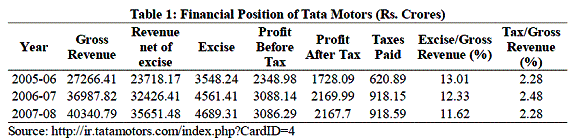
How much is this package worth? Let us try to think this through. We have collected some information from annual financial reports of TML in Table 1 that will help us get an approximate figure for the Uttarakhand/Himachal Pradesh package using points 1(a) and 1(b).

There are some remarkably stable patterns in the data. TML seems to be paying about 12% of its gross revenue as excise duty and 2.35% of its revenue as corporate income tax. If TML were to set up shop in Uttarakhand or Himachal Pradesh, it would be manufacturing about 250,000 small cars per annum. If each car were to sell for Rs. 1 lakh, TML’s gross annual revenue would be approximately Rs. 2500 crores. If the TML would have to pay excise duty, assuming the above ratios, it would pay about 300 crores (12% of Rs. 2500 crores) per annum; if it had to pay corporate income tax, it would have to pay about Rs. 58.75 (3.5% of Rs. 2500 crores) crores per annum. If TML set up shop in Uttarakhand/Himachal Pradesh, according to the agreement, it would not have to pay these taxes as stated in point 1(a) and 1(b).

Summary of the Uttarakhand/Himachal Pradesh package: for the first 5 years, TML gets Rs. 358.75 crores every year (100% excise duty exemption + 100% corporate income tax exemption); and for the next 5 years, it gets Rs. 317.63 crores every year (100% excise duty exemption + 30% corporate income tax exemption). The NPV of this benefit package is Rs. 2062.79 crores (using 11% for calculating NPV).

According to point 7(a) of the agreement, the West Bengal government’s “benefits package” will equal this sum if we compute the benefit coming from subsidized land, soft loans and tax holidays. Let us now look at the different components of the package promised by the West Bengal government.

Hidden Land Subsidy

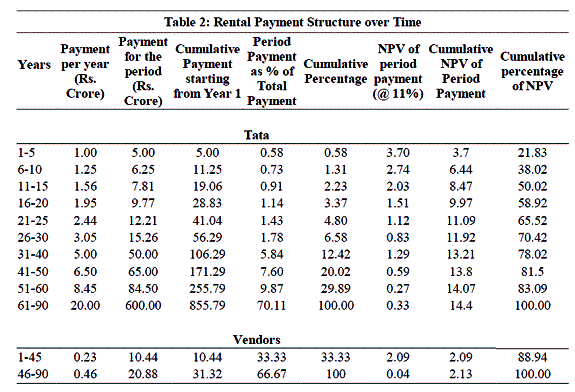
What are the terms of the rental structure on the land lease agreed upon by WBIDC and TML? Two different set of rules apply, one to the 647.5 acres leased to TML and another to the 290 acres that will be leased to the vendors approved by TML. Both leases, however, will come up for possible renewal 90 years down the line. For the 647.5 acres of land that is leased to TML, the annual rental will be Rs. 1 crore for the first five years, increasing by 25% every five years till 30 years. Thereafter, the annual rental will be fixed at Rs. 5 crore, to be increased by 30% every 10 years till the year 60; the rental from year 61 to 90 will be Rs. 20 crore per year. For th vendors, the rental structure is simpler: for the first 45 years, they will pay an annual rental of Rs. 8000 per acre, and for the next 45 years will pay an annual rental of Rs. 16000 per acre. Since the vendors are leasing 290 acres of land, this means that for the first 45 years, they pay a total of Rs. 0.232 crores per year and Rs. 0.464 crores per year for the rest of the time.

Details of the payment schedule, for both TML and the vendors, is summarized in Table 2. This is similar to, but more detailed than, a table used by Madhukar Shukla for commenting on the Nano project; the main difference is the inclusion of figures on net present values (NPV). What is net present value? It is a conceptual device used to compare sums of money at different points in time, which I explain in greater detail below. Why is NPV relevant here? Because an investment project like the proposed plant in Singur involve costs and benefits flowing in at different points in time. Columns (2) through (6) give the actual payments to be made at various points in time, while the last three columns give the net present value (NPV) of the payments, where NPV has been calculated using an interest rate of 11% per annum (exactly as done by the WBIDC in Annexure II of the agreement). Note in passing that the Annexure where all the computations relating to the project has supposedly bee done has not been made available to the public; all we know is that the NPV calculations used an interest rate of 11%.

To arrive at figures about the costs of “acquiring” the land and the revenue earned from leasing it to TML (and the vendors), we need to remind ourselves that the WBIDC spent anything between Rs. 150 crore and Rs. 200 crore to “acquire” the land from the unwilling farmers. How much will WBIDC get for letting TML use that piece of land? Columns (4) shows that the TML will pay a total amount of Rs. 855.79 crores over 90 years as rental fees for using the land. So the cost incurred by the WBIDC is Rs. 150-200 crore, while revenues will be 855.79 crore. Does this mean that the WBIDC made a good bargain with the TML on behalf of the people of the state? Does it men that the WBIDC is actually making a “profit” in leasing out the land to TML? Let us think about this a little more.

A rupee today is not equivalent to a rupee next year. Why? One can put the rupee that one has today in the bank and earn an interest income at the going interest rate to augment the original sum. If the current interest rate is 11%, then one would have Rs. 1.11 at the end of the year if the rupee were to be invested in an interest-bearing asset today. Put another way, Rs. 1.11 at the beginning of next year is equivalent to Rs. 1 today (at the beginning of this year). Let us go further, and suppose that we let our rupee lie in the bank for two years. How much do we have at the beginning of the third year? Rs. 1.21 (because at the beginning of the second year one has Rs 1.11, and then one earns 11% on that amount to arrive at Rs. 1.21 at the beginning of the third year). Inverting things, we see that Rs. 1.21 two years hence is equivalent to Rs 1 today when the market interest rate is 11%. This logic can be extended to any number of years and is the basis of computing net present values (NPVs). In the jargon of economics, if the market interest rate is 11%, Rs. 1.1 one year hence has a NPV of Rs. 1; and Rs. 1.21 two years hence has a NPV of Rs. 1. Thus, NPV is a device to make sums of money at different points in time comparable to each other. What does this mean for us?

It means that we cannot just add up all the rental payments that TML is supposed to make over the next 90 years (which is Rs. 855.79 crores) and compare it to the cost incurred by the WBIDC to “acquire” the land today (which is Rs. 150-200 crores). To make the stream of rental payments of the TML (over the next 90 years) comparable to the cost of “acquisition” today, we need to calculate the NPV of the rental payment stream. That is precisely what we have done in column (7) in Table 2. Column (8) gives the sum of the NPVs of the rental payments. On the basis of this calculation we arrive at a very striking fact at the end of column (8). The NPV of the rental payments that the TML will make over the next 90 years is Rs. 14.4 crores! The NPV of the rental payments that the vendors will make is Rs. 2.13 crores.

Summary: while the cost to the WBIDC for “acquiring” the land was anything between Rs. 150 crores to Rs. 200 crores, the NPV of the revenue from rental income that will accrue to the WBIDC is Rs. 16.53 crores, sagging the WBIDC with a loss of anything between Rs. 130 crores to Rs. 180 crores! Which is just another way of saying that taxpayers are subsidizing a big corporate entity like the TML to the tune of Rs. 150 crore just in terms of the land that the WBIDC “acquired” for it.

Cost of Circumventing the Law

A moment’s reflection on the time structure of rental payments for TML brings another characteristic of the transaction to the fore. The time structure of payments has been arranged in such a way that the bulk of the rental payments come in later years. From column (6) in Table 2 we see that the TML makes only 5% of its total payments in the first 25 years of the lease; in the first 50 years, it pays only 20 percent of its total payment commitments. The Comptroller and Auditor General of India (CAG) had pointed out in March 2008 that, according to Government of India laws, long-term leases of 99 years required that the lessee pay 95% of the market value of the land as a one-time premium at the beginning of the lease and pay annual rent at the rate of 0.3% of the market value of the land. The same report went on to note that the agreement between the TML and the WBIDC should have entailed an immediate payment of Rs. 91.88 crore and subsequent annual rents of Rs. 29 lakhs for the next 90 years. As opposed to this, the TML, according to the agreement, would pay nothing upfront and would only pay Rs.1 crore at the end of the first year!

Of course it would have been illegal if the lease was for 99 years. Hence, it seems, the WBIDC cleverly decreased the span of the lease by 9 years to circumvent the letter of the law. In spirit, though, this still amounts to a violation of the law. Why? Because the law states that for long-term leases the majority of the payments should be paid upfront by the lessee; and the WBIDC agreement with TML shows an exactly opposite time structure of payments, with most of the payments pushed off far into the future. Thus, even though in letter the agreement clears legal hurdles, it is obvious that it fails miserably in terms of the idea behind the law. No wonder the CAG faulted the WBIDC on several counts regarding its agreement with the TML. But let us pause for a moment and think why the CAG (or the laws) wanted the bulk of the payment upfront.

There are two basic reasons why the law might want to ensure bulk of the payments for a long-term lease upfront. One, large upfront payments for long-term leases increases the NPV of the rental payment stream. Since these long-term leases generally require the government to hand over public land for private use, it makes sense to structure rental payments in such a way that the government exchequer gets a good value in return; that is why a large upfront payment is usually written into lease contracts for long-term leases. The second reason for having a large upfront payment relates to considerations of risk. When a stream of payments has relatively large amounts pushed far away in the future, the NPV of that stream of payments is more liable to change when market interest rates change.

Let us take an example to understand both these points. Suppose, for simplicity, we want to compare two payment streams, A and B. A has Rs. 1 lakh today and Rs 9 lakhs in 10 years; B has Rs 9 lakhs today and Rs .1 lakh in 10 years; note that both entail a total payment of Rs. 10 lakhs over a period of 10 years and are similar in this respect. But they also are very dissimilar. To understand why suppose that the market interest is 10% at the moment. NPV of A is Rs. 4.47 lakhs, while the NPV of B is Rs. 9.39 lakhs. Thus, the NPV of B is much higher than that of B, which clarifies the first point. Now suppose that the market interest rate increase to 15%; this will obviously diminish the NPV of both A and B. But which will fall more? A’s NPV falls by about 39% while B’s NPV falls by only 1.5%! Thus, the risk of loss of revenue that comes from a payment stream (payment of rent for instance) is higher when most of the payments come in during relatively later periods. It is probably because of these two sound economic reasons, among others, that the CAG urged the West Bengal government to reconsider its lease agreement with the TML. By structuring the rental payments such that most of it come in during later years, the West Bengal government is not only losing revenue but is also bearing a higher risk of loss of even that minimal revenue.

So, how much is the WBIDC losing in real terms by using the rental payment structure that is summarized in Table 2 instead of the one recommended by the CAG? If TML were to pay Rs. 91.88 crores upfront and then subsequently pay a rental of Rs. 29 lakhs per annum for the next 90 years (as suggested by the CAG ), the NPV of this payment scheme would be Rs. 94.52 crores (using an interest rate of 11% per annum for calculating the NPV). The NPV of the currently agreed upon rental payment scheme (as per the agreement) is Rs. 16.53 crores (sum of entries in column (7) of table 2). Hence, the WBIDC is losing Rs. 77.99 crores due to the chosen rental payment structure.

Summary: the total financial loss to the WBIDC due to the agreed upon rental payment structure, as opposed the one suggested by the CAG, is Rs. 77.99 crores; the WBIDC, in addition, has to bear extra risk arising from possible fluctuations in the market interest rate.

Soft Loans and Tax Holidays

Point 7(c) of the agreement provides information about the soft loan: “The West Bengal Govt. will provide TML a loan of 200 crores @ 1% interest per year repayable in 5 equal annual installments starting from the 21st year from the date of the disbursement of the loan”. This loan, moreover, “will be disbursed within 60 days of this agreement”. Point 7(a) of the agreement refers to the loans that the WBIDC will give to the TML in the form of tax holidays. The tax holiday will continue, as we have already noted, till the sum of the land subsidy, tax holiday and the soft loan equals the Uttarakhand/Himachal Pradesh package.

So, what is the total loss to the exchequer due to the tax holidays and soft loans. There are two ways to arrive at approximate value of this loss. First, if we knew the exact amounts of the loans (in the form of tax holidays) and the exact repayment shedule and interest rates, we could calculate the net present value of the loss. But unfortunately, we do not have enough data in this regard, and so we will adopt an indirect method to arrive at the notional cost of the tax holiday and the soft loans. This second, indirect method, begins by recalling that, according to point 7(a) of the agreement, the total benefits from the land subsidy, taxt holidays and soft loans offered by the West Bengal government will equal the benefits that was offered by the Uttarakhand/Himachal Pradesh govenrment. We have seen above that the total value of the Uttarakhand/Himachal Pradesh package was approximately Rs. 2063 crores on a net present value basis. We have also seen that the cost to the exchequer of the subsidized land was about Rs. 228 crores (Rs. 150 crores for direct subsidy and Rs. 78 crores lost due to the time structure of the rental payment scheme). Thus, the total cost of the tax holiday and the soft loans will be Rs. 1835 crores (which is Rs. 2063 crores less Rs. 228 crores) on a net present value basis. Note that this is a notional cost.

The last part of 7(a) seems even better. It says: “WBIDC will ensure that the loan under this head is paid within 60 days of the close of the previous year (on 31st March) failing which WBIDC will be liable to compensate TML for the financial inconvenience caused @ 1.5 times the bank rate prevailing at the time on the amount due for the period of such delay”. What does this mean? It means that if the WBIDC is not able to make the loan to TML within 60 days of the close of the financial year, it will penalize itself by compensating TML at 1.5 times the prevailing bank rate. So, if the prevailing bank rate is 10%, which is close to what is the case right now, the WBIDC will penalize itself for any delay on its part by paying back the TML for the “financial inconvenience” at 15%.

Summary: the cost of the soft loans and tax holidays to the TML by the West Bengal government will be about Rs. 1835 crores on a net present value basis.

More Gifts from Santa: Real Estate and Subsidized Electricity

Industrial development requires infrastructural support from the government, as we all know. And so the West Bengal government displayed its commitment to “rapid industrialization” by offering a “virtual gift of 650 acres of prime land to Tata Housing Development Company (THDC) in Rajarhat New Town and in the adjoining Bhangar Rajarhat Area Development Authority for building an IT and residential township along with WBIDC as a partner“. What better way to provide “infrastructural assistance” for the industrialization effort that to hand over prime land for real estate speculation! Some reports suggest that this “gift” to TML will cost the exchequer about Rs. 160 crores.

The West Bengal government has also promised to supply electricity at Rs 3 per kilo watt hour (kwh), which is around half the price charged to high-tension industrial consumers in the West Bengal at the moment. It has also promised to absorb any increases in electricity costs to the TML in Singur. Point 7(d) of the agreement states: “In case of more than Rs. 0.25 per KWH increase in tariff in every block of five years, the Government will provide relief through additional compensation to neutralize such additional increase”. This will mean, at the least, shelling out Rs. 70 crores annually for subsidizing the electricity requirements of the whole project at Singur. The NPV of this subsidy for the 90 year period of the lease would be Rs. 706 crores.

Summary: the cost to the exchequer of the real estate gift and subsidized electricity will be about Rs. 865 crores.

Adding up the Costs

Let us now take a moment to put all this together. The subsidy that TML gets, according to the terms of the agreement, on the land in Singur is anywhere between Rs. 100 and Rs. 150 crore; the subsidy due to the rental payment structure is Rs. 78 crores; the implicit subsidy due to the tax holiday and the soft loan would be about Rs. 1835 crores; the real estate “gift”, also known in WBIDC terminology as “infrastructural assistance”, is worth Rs. 160 crores; and the subsidized electricity will cost another Rs. 706 crores. So, the Tata conglomerate, one of the largest corporate entities in the country, is awarded a “gift” of about Rs. 2928 crore by a “communist” government so that it can be induced to set up a car manufacturing plant in the state and lead it on to the path of neoliberal industrial development. To put this figure in perspective, let us refer to the 2008-09 budget speech of the Finance Minster of West Bengal. Pointing to the emergence of what he called the “industrial potential” of the state, he offered some concrete figures to bolster his argument. In 2005, the annual realized (industrial) investment in West Bengal was Rs. 2515.58 crores, which then jumped up to Rs. 5072.26 crores within the next two years. Thus, a sum close to 58 percent of the total realized industrial investment in the state in 2007 would be the cost borne by the people of the state if the Tata-Singur project too off.

Summary: the total cost of the Tata-Singur project incurred by the exchequer, and hence ultimately the tax payers, will be approximately be Rs. 3000 crores on a net present value basis when we add up the costs pertaining to the land subsidy, the tax holidays, the soft loan, the real estate gift and the subsidized electricity using an interest rate of 11%. This is about 58% of the total realized industrial investment in the state of West Bengal in 2007.

What are the Benefits?

What are the purported benefits of the Tata-Singur project? The West Bengal government has advanced two claims regarding the benefits: employment generation and improvement in the investment climate of the state. These two claims about possible employment generation and future investments need to be looked at closely, because the rationale offered by the West Bengal government for giving the stupendous bonanza to the Tatas rests precisely on these. Both these claims are dubious. Regarding the claims about employment generation, there have been figures ranging from a high of 12000 (2000 in the Nano plant proper, 10000 in ancillary and complementary units) to a low of 750 (some recent local newspapers have put the figure at 650). The upshot of all this is that there is no certainty about the employment generated. However, if we look at a recent BBC report on this matter it becomes clear that 62% of the projected employment in the automotive sector is going to be skilled labour, 28% is going to be management jobs, leaving only 10% jobs for unskilled labour. Now, the displaced population in Singur, if at all they get absorbed in the mother plant or in the ancillary units, would typically be offered employment as unskilled labour. So, the prospect of much employment being generated, especially for the people in Singur, is dim. Moreover, all these calculations ignore the employment destruction that the project will inevitably entail. If we were to properly take both possible employment generation and possible emplyment destruction into account, we could arrive at a figure for the net emplyment generated by the project. At the moment, it is not even clear that the net employment figure will be positive.

The other claim about the Singur project generating prospective investment in the future rests on equally shaky foundations. The question really boils down to whether the Tata plant can attract other major investments and lead to an industrial rejuvenation of Bengal. The example of Jamshedpur in neighbouring Jharkhand should be carefully looked at. Tata’s factories in Jamshedpur did nothing for the overall industrialization of the state of Bihar or now Jharkhand. It remained an enclave of industrial activity, without forging strong forward or backward linkages in neighbouring areas. The other issue to think about, in the context of the claim about TML drawing future investments, is whether other industrialists coming to invest in Bengal would also demand similar bonanzas from the government. Will the government refuse them the goodies that they have offered TML and let them turn away or will it repeat the Tata-like agreements and put further burdens on the exchequer. Either option does not seem to be beneficial from the perspective of the working people of the state.

Summary: while the costs of the proposed Singur-Tata project is obvious, tangible, immediate and large, the benefits seem to be uncertain, residing far away in the future and their magnitudes small.

Oh! So Poor Tata

A few months back, the finance minister of West Bengal presented a budget with a Rs. 2 crore deficit; a net subsidy of about Rs. 3000 crores would certainly be extremely costly for the people of the state; after all it is about 1500 times the budget deficit in fiscal year 2008-09. Given that a small, poor, fund-starved state like West Bengal is making such great efforts to subsidize the Tata’s, it must mean that they (the Tata’s) are in a dire financial situation. But is that true? If we merely cast a glance at the recent international buying spree that the Tata’s have been engaged in, we might be able to understand how far from the truth would be any assertion that the Tata’s require financial assistance from a poor state like West Bengal to start an industrial project.

The Tata Group of Companies, let us remind ourselves, is one of the largest business conglomerates in India with about 100 large companies in its fold. With the might of the Indian State firmly behind it, monopoly capital in India has started a move to aggressively acquire foreign assets, what it calls strategic corporate assets. In the last few years, the Tata Group has been leading this acquisition spree on behalf of Indian big capital, making forays not only in Asia and Africa but also in the heartland of world capitalism: USA and Europe. Let us briefly take a look at the record of the Tata Group with regard to foreign acquisitions.

In January 2007, the Tata Group pulled off India’s biggest ever takeover of a foreign company to buy Anglo-Dutch steel-maker Corus for $12 billion; this acquisition made the

combined entity (Tata-Corus) the world’s fifth largest producer of steel. In March 2004, the Tata Group acquired South Korea’s Daewoo Commercial Vehicle Company for $102 million; this was followed by the acquisition of a 21 percent stake in Spanish bus maker Hispano Carrocera for $18 million with an option to pick up the remaining stake at a later date. Around the same time, Tata Technologies, another company in the Tata fold, which provides automotive engineering and design services, bought Britain’s Incat International for $53 million.

Tata Consultancy Services, which was earlier a division of Tata Sons and a rising star in the Tata Group, has been among the most aggressive shoppers for foreign companies. It has acquired six companies in the past few, with the net value of the deals close to $100 million; these include FNS of Australia, which was acquired for $26 million and Chile’s outsourcing major Comicrom, which was bought for $23 million. When the Tat Group acquired the former state-run, international telecom carrier, VSNL, a few years ago, it was on its way to becoming a major telecom player in the global markets. To enhance its position, it acquired undersea cable company Tyco of the US for $130 million, Internet service provider Dishnet’s India division for $64.28 million and international telecom service provider Teleglobe of the US for $239 million.

Following its acquisition of Hindustan Lever Chemicals, Tata Chemicals was on the lookout for a steady supply of phosphoric acid for its newly acquired plant at Haldia, West Bengal. Accordingly, it took over two overseas companies for a total value of $215 million: Indo Maroc Phosphore of Morocco in March 2005 and Brunner Mond Group of Britain in December 2007. Morocco, by the way, produces over 50 percent of the world’s rock phosphate.

In 2000, Tata Tea bought British giant Tetley for a $407 million, and started looking for similar deals to strengthen its global position in the tea and related drinks business. This search led to acquisition of 33 percent stake in the South African company Joekels Tea Packers for an undisclosed amount and 30 percent stake in the US-based favoured water manufacturer Glaceau for $677 million, the acquisition of the US-based Good Earth Corp for $32 million and acquisition of the Czech Republic’s firm Jemca for an unknown amount.

India Hotels, the hotel branch of the Tata Group, acquired several hotels abroad for $121 million in the past few years. It is reported to have set aside $100 million for future acquisitions in Europe, the Middle East, Asia and the US. In December 2006, it had acquired W, a hotel at the Woolloomooloo Bay in Sydney; it was followed by the taking over of the management of The Pierre, a luxurious landmark hotel on New York’s Fifth Avenue. India Hotels, which runs the Taj Group of hotels, has 39 hotels in India and 18 worldwide. A recent acquisition of India Hotels was Campton Place Hotel in San Francisco.

If we add up the figures for the Tata Group’s overseas acquisitions, we arrive at a rough figure of $14,062 million, which converts to roughly Rs. 56,248 crore (using an exchange rate of Rs 40/$), and this is not even a complete list of Tata’s recent acquisitions. And, what does all this lead to? It inevitably leads us to the conclusion that a corporation which can invest more than Rs. 56,000 crores for acquisition of strategic foreign corporate assets requires the financial support of India’s impoverished taxpayers, to the tune of Rs. 1140 crores in real terms, to set up a small car manufacturing plant in India! That, in a nutshell, is what we would like to call neoliberal industrialization, pushing which down our throats has become the almost single-minded purpose of the West Bengal Government and the “communist party” that is at its helm of affairs.

TINA Logic

But even after all these facts and figures and arguments have been read, understood and absorbed, sympathizers of the West Bengal government will no doubt come up with a supposedly unbeatable argument: TINA. There is no alternative. This argument points to the magnanimous offers made by other states in India to attract private capital, and then goes on to plead the inability of the West Bengal government to follow any route other than to offer even more largesse. Recall that the text of the agreement starts precisely with this argument. It builds up its case for the huge hidden subsidies that is offered to TML, and which we have seen in great detail above and which add up to about Rs. 3000 crores on a net present value basis, by emphasizing the incentive package that the States of Uttarakhand and Himachal Pradesh has offered to the Tatas. That is why the West Bengal government must offer more than the value of the offers by the other states if it is to attract private capital, like the TML, to industrialize the state. Since, other states are offering huge tax breaks and soft loans, West Bengal must also do so, the argument goes. West Bengal cannot fight this trend, caught as it is in the competitive struggle between the states of India.

One must begin by acknowledging that there is some truth to this assertion. It is true, in other words, that in the neoliberal set-up private capital has managed to generate competition between political entities, both within nations and between nations, to ensure higher profits on its investments. But acknowledging this fact, the fact of the existence of this strong pressure for competition among states, does not mean accepting it as inevitable; it does not mean accepting the logic, championed by the proponents of neoliberalism, that there can be no alternative to the present framework. If the fight against neoliberalism has to be taken forward then this logic must be fought. One cannot succumb to this logic in practice and claim to be fighting against neoliberalism.

And to fight this logic, one must understand what it implies. The competition that capital manages to enforce on political entities (for instance states in India or countries in the global context), one must understand, is akin to a “race to the bottom”. As soon as one state lowers taxes, reduces social sector spending, loosens labour laws, cracks down on political dissent in order to make the atmosphere “conducive” for investments, another tries to outdo the first by reducing taxes even further, reducing social sector spendings even further, making labour even more “flexible” in order to “attract capital”. And thus, as the logic of this competition unfolds in all dimensions, people of all the states taken together lose. Lower tax revenues means lower resources for the State to invest in educations, health, nutrition, poverty alleviation; it means increased misery for the common people, with sub-optimal infrastructure and public amenities. And who benefits from this fierce competition? Capital. Thus accepting this as the only way to industrialize is to accept this “race to the bottom”, with all its deleterious consequences for the population, as the West Bengal government seems to have done.

So what can be done? One has to act on several fronts at the same time. First, it is undeniable that fighting the neoliberal logic will require concerted political action at the Central level to thwart moves to implement central-level neoliberal policies; the largest “communist” party standing behind the West Bengal government must shed its fears of radical mass political activism and launch, with other like minded political forces, a nationwide offensive against neoliberalism, instead of using all its energies in parliamentary antics. It will also mean not succumbing to the pressures of capital at the state level as the West Bengal government has pathetically done. If private capital wants to move out of the state because taxes are high and social sector spendings are growing and the labour laws are favourable for the workers, and the health and educational status of the people are improving, then so be it. The state need not hanker after such capital for, at the end of the day, massively state-subsidized investments of such capital is not beneficial for the people.

Second, one must understand that, if attracting capital is all one wants to achieve, capital can also be attracted in a very different fashion, by reversing the harmful, negative competition between states and instead initiating a “race to the top” to replace the “race to the bottom”. For it is a fact, recently noted by several observers of the Indian economy, that India is very rapidly moving into a regime marked by serious shortages of skilled labour. A state which wants to attract private capital can, therefore, invest massively in building up the education and health system for the workers; a healthy and skilled labour force can be a stronger incentive for capital to set up shop in a state than huge tax holidays. In fact, instead of giving tax breaks to capital, the state will need to tax them aggressively and use the tax revenue to further improve the conditions of the working people. Equally true is the abysmal conditions of physical infrastructure – transportation, housing, power, etc. – in most of the states of India. A state can, therefore, start investing in building up basic infrastructure for the people by taxing capital and citizens in the high-income brackets; solid infrastructure can be as strong an incentive for private capital as soft loans and hidden subsidies. The point of these interventions would be, in the medium and long urn, to initiate reversal of the “race to the bottom” that every state seems to be in the grip of. Unfortunately, the West Bengal government seems hell bent on going the opposite way.

Third, complementing these interventions have to be efforts to revitalize mass political activism at the grassroots level. Imagine, for a moment, a strong, countrywide mass movement against neoliberalism. If Singur in re-enacted in Uttarakhand and Himachal Pradesh and Karnataka, then where will the TML go? Wherever it sets up shop, it will have to do so without the luxury of externalizing the costs onto the working people and the environment. Simple economic logic suggests that forcing capital to internalize its costs by an active mass political movement would in fact ensure that the decisions taken by capital will be closer to what could be considered socially optimal. Mass participation in planning and implementation would, further, increase much-needed accountability of both the state and capital. Unfortunately again, the West Bengal government wants to go the other way.

Conclusion

This brief analysis of the details of the proposed Tata-Singur project in West Bengal offers us an unique opportunity to think about the industrialization strategy of the Indian state today. One of the major thrusts of this strategy is to build up so-called Special Economic Zones (SEZs) all over the country. As of August 11, 2008 there were 250 notified SEZs across the country. Since each of these SEZs more or less replicate the policy regime applicable to the proposed Tata-Singur project – with magnanimous tax holidays and soft loans and subsidized power and “flexible” labour laws and absence of all environmental regulations – it would probably not be far from the truth to suggest that each of these SEZs would entail at least the amount of loss that we have calculated above for the Tata-Singur project. This suggests that the total cost to the people of this country of the current neoliberal policy regime would be about Rs. 750,000 crores. How large is this figure? For comparison, consider the fact that the total expenditure of the Indian government was slated to be Rs. 750, 884 crores in budget 2008-09; thus, an amount which is roughly equal to the total expenditure of the Indian government in 2008-09 would be the loss to the nation for embracing neoliberalism. Isn’t it high time we sharpened our struggle against neoliberalism in earnest?

(Comments from Debarshi, Kuver and Partho have substantially improved the argument of this article).

ADDENDA

Benefits of Employment Generation

In my earlier portion of the article, I had stated that a full-blown cost-benefit analysis was not possible with the available information; that is primarily because information about net employment, and therefore the corresponding income, generated in the Tata-Singur project is lacking. There is lot of uncertainty about the possibilities of new employment flowing from the project, and figures for net employment generated varies from a high of 10,000 to a low of 500, the highest figure unsurprisingly coming from TML and the West Bengal government. Though it remains true that a full-blown cost-benefit analysis is not possible, what can certainly be done, as a complement to my previous analysis, is to find the benefits of the net employment generation for the best possible scenario and compare it to the costs entailed by the project. In carrying out such an exercise, we would be conducting a rough cost-benefit analysis with the most favourable assumptions for the West Bengal government and TML. Let us see what we the results are.

To proceed, let me state my assumptions clearly:

(1) There is a net employment generation of 10,000 this year in the Tata-Singur project.
(2) The average wage attached to this new employment is Rs. 60,000 per year.
(3) Due to the multiplier effect of this new income generated in the Tata-Singur project, i.e., due to the backward and forward linkages that it will supposedly establish, income will grow at the rate at which the Indian economy has been growing for the past few blazing years, i.e., at 9% per annum.

Thus, the net income generated during the current year will be Rs. 60 crores (which is 10,000 multiplied by Rs. 60,000); during the next year, the total income generated will be Rs. 65.4 crores; the year after that Rs. 71.29 crores, and so on…

Here is the question that I want to pose: how many years will it take for the net present value of the income stream generated due to the Tata-Singur project (and its multiplier effects) to equal the cost of the project? How many years, in other words, will it take for the total benefits, under these generous assumptions, to equal the total cost incurred due to the project? Recall that, as we have seen earlier, the total cost of the project is roughly Rs. 3000 crores on a net present value basis? So, how many years will it take for the benefits to equal Rs. 3000 crores?

And here is the answer: 127 years!

What does this imply? Let us think a little carefully. The net employment generation figure is by all accounts a gross exaggeration. As we have argued earlier, the component of employment that will go to unskilled labour is relatively small. Given the fact that the semi-agricultural labour population in Singur is most likely to be absorbed, if at all, as unskilled labour, the employment prospects of these people are extremely limited. Additionally there is the aspect of job destruction which we have so far ignored; it is most likely the case that the quantum of jobs destroyed due to the project is higher than the jobs that will be created. Hence, in all probability, the net employment generated by the project is negative. Thus, in assuming that the net employment generated by the project is 10,000 we are inflating the figure many times over. The fact that we have also assumed the wages to be Rs. 60,000 per annum only adds to the exaggeration. Since most of the employment for the people of Singur will be in the form of unskilled labour, a salary of Rs. 5,000 per month is a certainly high figure.

Similarly, the assumption that the total multiplier effect of the new employment will be a growth of 9% per annum year after year is also an exaggeration. If the multiplier effect of the new employment would generate 9% additional every year, it would mean generating about Rs. 5.4 crores of additional income in the second year, about Rs. 5.9 crores of additional income in the third years and so on… Even the Indian economy is expected to slow down, from its current 9% growth rate, due to the global financial crisis. Hence, an annual growth rate figure of 9% for income generated most certainly inflates the benefits accruing from the Tata-Singur project in terms of employment and income.

What all this means is that even under extremely favourable assumptions, the cost of the Tata-Singur takes 127 years to be recouped. A reasonable time frame to recoup the costs of the project would require an unrealistically high rate of income growth, something which is anyway unlikely given that the world economy seems headed towards a deep recession. Thus, it seems that the costs of the Tata-Singur project far outweighs the benefits that can reasonably be assumed to flow from undertaking it.

Agreement between Tata Motors Ltd., Government of West Bengal and WBIDC

1. Tata Motors Ltd. (TML) was intending to set up a manufacturing Plant for Automobile Products including “Tata Small Car” to manufacture 250,000 cars per annum on 2 shift basis which could be expanded to 350,000 on 3 shift basis. In addition, it would have several Vendors and act as a mother plant for many aggregates to tune of 500,000 cars. In this connection, TML was considering locating the plant in the States of Uttarakhand/ Himachal Pradesh in view of the fiscal incentive package for the rapid industrialization being made available by the Govt. of India to new Industries in these States which has been attracting a large number of industries to these States. The incentive package in Uttarakhand/Himachal Pradesh consists of:-
(a) 100% exemption from Excise Duty for 10 years.
(b) 100% exemption from Corporate Income Tax for first 5 years and 30% exemption from Corporate Income Tax for next 5 years.

2. The Government of West Bengal (GoWB) is keen to take appropriate steps for rapid industrialization in West Bengal and in this connection wanted to attract some major Automobile Projects to the State. The Government of West Bengal approached TML to persuade them to locate an Automobile Project including the project to manufacture “Tata Small Car” in West Bengal. TML showed interest in locating the plant in West Bengal, provided the State gave Fiscal incentive equivalent to the value of total incentives it would have received by locating the plant in Uttarakhand / Himachal Pradesh. GoWB offered to match the financial incentives in equivalent terms and invited TML to set up the Small Car plant in West Bengal entailing investment of over Rs. 1500 crores by TML. In addition, Vendors supporting the project are likely to make further investment of over Rs. 500 crores.

3. Since then numerous discussions have been held and based on this understanding, GoWB proceeded with identification of various lands for this mega project. Land of approximately 1000 acres chosen in P. S. Singur of District Hooghly was finalized with TML. West Bengal Industrial Development Corporation Ltd. (WBIDC) commenced the process of acquisition of this land. The process was completed with the Declaration of Award under Section 11 of the Land Acquisition Act, and thereafter WBIDC has obtained mutation of ownership in its name in the Record-of-Rights, and conversion of usage of the land from agriculture to factory.

4. WBIDC is in possession of 997.11 acres of land, which has been acquired under the Land Acquisition Act. Out of this, an area admeasuring 645.67 acres will be leased to TML for setting up the Automobile Project including the small car plant, while an area admeasuring 290 acres will be leased to the vendors to this Automobile Project approved by TML (ancillary and component manufacturing units), 14.33 acres will be handed over by WBIDC to WBSEB only for construction of 220/132/33 KV substation and the balance admeasuring 47.11 acres will be used by WBIDC for rehabilitation activities for the needy families amongst the Project affected persons.

5. The terms of lease to TML for the 645.67 acres of land for the mother plant are described below. In addition, WBIDC will provide on lease 290 acres of land to the Vendors selected and approved by TML on payment of Premium equal to the actual cost of acquisition plus incidentals, to be calculated on the basis of the total acquisition cost and other incidental expenses expended by WBIDC or any of its subsidiaries (duly certified by its auditor) averaged over the total land acquired. The lease rental payable per year per acre by the vendors will be Rs. 8000/- per acre for the first 45 (forty five) years and Rs. 16000/- per acre for the next 45 (forty five) years. The initial lease tenure will be 90 years. On expiry of 90 years, the lease terms will be fixed on mutually agreed terms at that point of time.

6. The parties also discussed mutually to finalise the package of incentives required in order to enable GoWB to fulfill its commitment to match in equivalent financial terms the fiscal incentive foregone by TML in Uttarakhand. The Net Present Value (NPV) computation of benefits that the project would have received in Uttarakhand is attached in Annexure I which is agreed to by all the parties. Sample computation of benefits in West Bengal with stated assumptions is given in Annexure II which is accepted by all parties as agreed basis of computation. The NPV is calculated @ 11%.

7. Accordingly, it is finally agreed, in supersession of all previous decisions and agreements in this regard, that for this mega project, the fiscal incentives under Industrial Promotion Assistance in terms of the West Bengal Incentive Scheme (WBIS 2004), assistance towards land cost and interest subsidy in the form of a loan against a quantum of the term loan to be taken by TML for this project will be offered by GoWB as follows:-

(a) WBIDC will provide Industrial Promotion Assistance in the form of a Loan to TML at 0.1% interest per annum for amounts equal to gross VAT and CST received by GoWB in each of the previous years ended 31st March on sale of “Tata Small Car” from the date of commencement of sales of the small car. This benefit will continue till the balance amount of the Uttarakhand benefit (after deducting the amount as stated in para 7b and 7c below) is reached on net present value basis, after which it shall be discontinued. The loan with interest will be repayable in annual installments starting from 31st year of commencement of sale from the plant. The loan availed in the first year will be repaid in the 31st year and the loan availed in the 2nd year will be repaid in the 32nd year and so on. WBIDC will ensure that the loan under this head is paid within 60 days of the close of the previous year (on 31st March) failing which WBIDC will be liable to compensate TML for the financial inconvenience caused @ 1.5 times the bank rate prevailing at the time on the amount due for the period of such delay. TML & GoWB will make best efforts to maximize sale of products from the “Small Car Plant” in the State of West Bengal.

(b) WBIDC will provide 645.67 acres of Land to Tata Motors Ltd on a 90 year lease, on an annual lease rental of Rs. 1 crore per year for first 5 years with an increase @ 25% after every 5 years till 30 years. On expiry of 30 years, the lease rental will be fixed at Rs. 5 crores per year, with an increase @ 30% after every 10 years till the 60th year. On the expiry of 60 years, the lease rental will be fixed at Rs. 20 crores per year, which will remain unchanged till the 90th year. On expiry of 90 years the lease terms will be fixed on mutually agreed terms at that point of time. The benefit on account of land would be calculated as the total land area leased out to TML multiplied by the cost of acquisition calculated in the manner as provided in para 5 less NPV of rent payable during 60 years.

(c) The West Bengal Govt. will provide to TML a loan of Rs. 200 crores bearing @ 1% interest per year repayable in 5 equal annual installments starting from the 21st year from the date of disbursement of loan. This loan will be disbursed within 60 days of signing of this Agreement.

(d) The West Bengal Government will provide Electricity for the project at Rs. 3/- per KWH. In case of more than Rs. 0.25 per KWH increase in tariff in every block of five years, the Government will provide relief through additional compensation to neutralize such additional increase.

8. It is also agreed that the computation of the comparison of benefits in Annexure I and II will be changed if there are any changes in the rates of excise duty and corporate income tax during the next 10 years.

Nandigram: Peasants Resistance against Land Grab

Ish Mishra

Machiavelli’s living role model for his Prince, Cardinal Caesar Borgias who subsequently manipulated his ascendance to the papacy of the Roman Church as Alexander VI, “did nothing but deceive the people and found enough opportunities to do so and did it magnificently”. If Machiavelli had to choose a model for his Prince in the contemporary Indian politics, where conquests are not decided by the war of sword but of numbers, he would face a great difficulty, due to abundance of modern Indian Borgias, nevertheless Buddhadeb Bhattacharjee would be a serious contender. The West Bengal Government declared that in the process of “developing the state, the interest of agriculture shall not be compromised and that no land acquisition shall be implemented without the consent of the peasants and the local communities” and next day the chief minister, Mr. Bhattacharjee unleashes the rein of terror on the peasants by ordering Police firing in collusion with the CPI(M) patronized goons, as has been purported by the preliminary CBI inquiry. The philosopher of the European Renaissance had advised the successful Prince to kill quickly and reward gradually. If the political economy of Left Front Government, particularly after the take over by the “Marxist” Nadir – Budhadeb Bhattacharjee is any indicator, the CPI(M) seems to have heeded Machiavellian advices more earnestly than the Renaissance absolutist monarchies did.

The heinous act of killing, wounding and maiming innocent farmers, artisans and agricultural laborers – a crime against humanity – reminds the stories of the gory acts of medieval sadist despots. The Nandigram, that has become a common noun from proper noun due to the brutal repression of the heroic resistance by the farmers of the area against the expropriation of their agricultural land for creating “foreign territories” – the SEZs. It once again witnessed death of 14, protesters and injury to hundreds in police firing aided and abetted by CPI(M)’s lumpen brigade on the14th March 2007 on the orders of the Marxist Chief Minister, Buddhadeb Bhattacharjee, committed to the “development of West Bengal at any cost”. However, the peasants’ resolve not to be displaced at any cost forced the postmodern Nadirs to step back from their declaration of creating the SEZ for Salim group at any cost. The CPI (M) supremo Prakash Karat has gone all the way out to defend Singur “take over” for the Tata’s “pro-people” car factory and Nandigram atrocities and killings in the name of establishing governance as they don’t want to allow West Bengal into becoming a “Chhattisgarh”! A party refusing to part away with the prefix-Communist from their name despite acting as agents of corporate houses is using the “law-and-order” argument more dubiously than any social democratic party. This is being met by pervasive protest and condemnation, even by its allies and sympathetic intellectuals including the veteran Economist Ashok Mitra. Now Prakash Karat had declared that there would be no land acquisition for SEZ in Nandigram area. This wisdom needed so much of bloodshed and terror. Apart from the loss of lives and causing irreversible harm to the interest of the working people politically and economically, its ideological bankruptcy has made the other imperialist parties and rightwing lumpen elements into heroes. Prakash Karat to counter Advani, reminded of the state engineered Gujarat pogrom by Narendra Modi government in order to defend the repression at Singur and Nandigram. Well Modi and Bhattacharjee, despite opposite ideological declarations and pretensions bear many similarities. Prakash Karat defends the West Bengal Chief Minister as “elected by the people” in the same language as the Hindutva lumpen brigade defends Modi. Both of them take pride in “developing” their respective states with the same formulae as the Corporate led imperialist globalizations seeks to develop the “under-developed” and “developing” countries of the world.

Buddhadeb Bhattacharjee announced that there would be no forced acquisition in Nandigram and sent the police to kill the people resisting the land grab. One stark similarity between Kalinganagar and Nandigram is that at both the places people are firmly refusing to be displaced and the agitators were shot dead in a targeted manner. The one difference, which has gone unnoticed, is that Naveen Patnaik shed crocodile tears by announcing a judicial enquiry where as the West Bengal’s self claimed leftist chief minister and the CPI(M)’s leaders went out of way to defend the Police action in the name of law and order. The CPI(M) led left front government, despite opposition by some of the constituent parties of the front, had expressed its determination to go ahead with the plan of creating the SEZs at any cost, and has been forced to make a hasty retreat.

CPI(M) ideologues aided and abetted by its propaganda brigade are justifying the governmental decision in the name of the law and order, using Marxist and Leninist jargons, creating the confusion of the contexts by juxtaposing of 19th century England and early 20th century Russia over 21st century India. Probably for such Marxists of his time Marx had pejoratively said that “thank God! I am not a Marxist”. History never repeats itself. As a philosopher of the Greek antiquity had rightly said that every thing in the world is in continuous state of change and flux and that the only constant is the change itself. History does not repeat itself, it only echoes. The creation of “foreign territories” within the country under the SEZ Act 2005 echoes the creation of fortified enclaves in the costal regions by various – French, Dutch and English East India Companies – in the costal regions of the country. It appears that history has taken a full circle. But much water has flown down the Bay of Bengal. Capitalism and innately linked imperialism has made multiple advances since then. Imperialism in its latest avatar of globalization has become so ubiquitous that now there is no need of any Lord Clive, all the Sujauddaulas have turned into Mir Zafars.

European Renaissance was not the “rebirth” of classical antiquity. “Rebirth” is a myth. It was not the rebirth but the reconstruction of the society with the nostalgic memory of the classical antiquity, according to the needs of the new social forces that had matured in the womb of decaying feudalism. It announced the emergence of a new era which witnessed the emergence of a new species of hero – the hero of finance struggling to get money making included in the circle of virtues, even if on the periphery. This new hero proved to be very smart. In less than 150 years time it became the hero and moved from periphery to centre. The17th century ideologue of this new hero, John Locke declared in unambiguous and categorical terms, “governance is a serious matter; it can be entrusted with only those who have already proved their worth by amassing sufficient wealth.” Their demand for freedom and equality was interpreted as universal equality and liberty and which eventually led to universal franchise and territorial-national universal citizenship and establishment of representative democracies, dictatorship of proletariat and their reversal into capitalism. There have been many insightful presentations and discussions and shall be more on the changing nature of citizenship and its theorization based on the changing nature of the economic base structure and its political superstructure. SEZ is the cheapest and sure-shot technique of the latest stage of the imperialist capitalism leading to the erosions of citizenship rights of people working in and outside these “foreign territories”, which in essence are “Special Exploitation Zone” and its long term possible implications. Also the details of fiscal and revenue implications are beyond the scope of this presentation and constitute the subject matter of separate discussions. The country-wide intensification and radicalization of the resistance against the land grab campaign by the state and corporate nexus for industrialization/SEZ/real estate provides a ray of hope for the anti-imperialist struggles all over the world over and Nandigram has created a precedent by forcing the government to rollback.

Indian parliamentary parties have gone many steps ahead of their colonial predecessors in using the draconian colonial Land Acquisition Act 1894, in the sense that even they did not acquire the agricultural land for private capitalists in the name of “public utility”. But preceded by Kamalnath and Chidambaram, Man Mohan Singh also reiterated his government’s firm determination to go ahead with the SEZ plans at any cost. Seeing his sense of history with gratitude to colonialism for “civilizing” India into a “nation” as revealed by him while being awarded with an honorary doctorate at Oxford University’s University and his World Bank affinity, it is not unexpected. This has provided an opportunity to CPI (M) leaders to shift the blames and devise new methods of the expropriation of agricultural land for national/transnational corporate houses. The Nandigram has taken an initiative and shown the way. There have been reports of peasants’ resistance against SEZ from all the corners. Only future will tell how long and to what extent the peasants struggling for the right to land and livelihood can hold against the formidable nexus of Indian state and the imperialist capital.

Heroic struggle of the peasants of Nandigram and Kalinganagar have challenged and foiled the neo-imperialist strategies of land expropriation by the state-corporate-judiciary nexus and forced a debate upon non-devastating models of development by laying their lives. “Their martyrdom shall not go in vain and let us salute the martyrs of Nandigram and Kalinganagar and resolve to condemn the brutalities of Budhadeb Bhattacharjee and Navin Patnaik governments in no uncertain terms”, said an activist of the Kalinganagar movement. “These local battles would strengthen the international forces seeking human emancipation and an end to exploitation of human by man”.

(A modified version of the article was published in Red Star April 2007)

Nandigram to Beijing via Moscow

Pothik Ghosh

There was a time when the spectre of communism haunted private property, but times have changed. The spectre of private property haunts communism now. Even as the ‘communist’ government of West Bengal resorted to state terrorism in Nandigram to acquire land from unwilling villagers to jump-start industrialisation for ‘development’, Communist China passed a law that would make right to private property legally enforceable for the first time since the 1949 revolution. The legislation, which is meant to give people a stake in their assets and protect them from a capricious party bureaucracy that has used the proxy of state ownership to dispossess many of them, seems to be a markedly different response to development than that of their CPI(M) comrades in Bengal.

There are, of course, obvious limits to how far the common citizens of China can go with the law. Given the infamous unaccountability of the Chinese state, it’s most likely to be used by its avaricious political elite to legalise its ownership over assets acquired, in the name of the state and public good, by expropriating individual citizens.

Therefore, in terms of the final solution, the responses of the communists of China and West Bengal to the question of ownership have turned out to be not so different after all. The two cases are, however, not strictly comparable. For one, while post-revolutionary China has always been a one-party state, the Left Front has come to power in West Bengal and held on to it by participating in the Indian system of multi-party electoral democracy.

For another, LF-ruled West Bengal has always recognised the legally established form of mixed ownership of property in India. Yet, the vengeance with which the Indian state has often used the principle of eminent domain to dispossess traditional socio-economic communities in order to acquire land for ‘development’ and ‘public good’ emphasises its institutional affinity for the ideology and rhetoric of state socialism. It would, therefore, make perfect sense to historically examine the ‘socialist’ discourse on ownership of property.

State ownership cannot truly socialise property because of the way the state structurally is: an alien authority dispensing governance to a passive population. Public ownership of property is thus the ownership of bureaucracies, and ensembles of vested interests. Such institutionalised diminution of public participation by the modern state holds true even in a representative electoral system like India’s.

On the other hand, legally enforceable right to private property, even if it were to exist as a fundamental right, would not lead to a participatory democracy. The dangers that the new Chinese law poses, bears that out. Even as the disintegration of stratified pre-capitalist communities has always led to legalised private property and capitalism, such breakdown has not always yielded by itself even functional democracy.

The link between private property and democracy is much more tenuous than commonly accepted. While the 19th century Prussian model of Junker capitalism – where landlords and companies expropriated the peasantry from above and legalised property so acquired as their own – will certainly not yield democracy; the 19th century US way, where private property was established through the emergence of small-to-medium independent farmers from below, is a case of capitalistic ownership coinciding with the formal democratic project.

It was not without reason that Russian social democrats Plekhanov and Lenin championed the latter, rejected the former (enforced by liberals like Stolypin in Russia), and yet managed to distinguish themselves from the Populists and Narodniks, who opposed Stolypin’s reforms because it destroyed the traditional peasant community. Clearly then, asset redistribution programme was not merely an end in itself for the social democrats. It was of even greater consequence to them precisely because it engendered the possibility of an alternative conception of political power than that embodied by the modern state.

Lenin and his fellow-travellers’ quest, at least till the October Revolution of 1917, was as much socialisation of economic assets as an alternative political structure that was more democratic than any. The reason they envisaged the two together was because they understood the individual’s freedom from the community both as his freedom from the oppressive bonds of the community and from its protection. Their vision was to reconcile the question of individual liberty (rights) with that of communitarian protection (social entitlements). The social democrats knew that only universal empowerment would arm people with the capacity to both facilitate and participate in modern development.

The unfortunate part of the story is that as the movement progressed, the search for an alternative political structure became subordinate to the nature of ownership of property. This was largely because the Bolshevik Revolution, just like other similar Left-led movements that occurred later elsewhere, was forced by the exigencies of modern politics to concentrate on dealing with the might of the pre-revolutionary state and emphasised the seizure of state power as its cardinal goal. As a result, it was rendered incapable of imagining configurations of power outside the framework of the modern state.

The horrors of collectivisation of agriculture in the erstwhile USSR of 1920s must be ascribed to this derailment of political imagination. The alternative cannot, however, be a utopian community of subsistence farmers. Land and capital will have to be consolidated to make both agriculture and the larger socio-economic order more productive and viable. Chinese historian Qin Hui’s is opposed to both the ‘Leftists’, who favour state ownership; and ‘liberalisers’, who are all for privatisation.

In an interview to the New Left Review, the communist dissident has accurately likened the former to Russian Populists and the latter to Stolypin-style liberals. The opposition between the two, as is evident in China and, to a lesser extent, India, is false. They actually complement and fulfil each other. The real issue then is that of finding an alternative political culture and institutional structure, which will drive development through democratic management of the commons.

A modified version of the article was published in The Economic Times

Clerics booed off by believers!

Soumitra Bose

What happened on June 12, 2007 was the most seminal event in the long drawn struggle of the producing forces against religious politics in India.

Shahi Imam of Delhi – the supreme Sunni cleric adjudged in the north of India and in almost all of India among the Sunni Muslims visited Nandigram. This man had maverick and chequered history of jumping boats and turning coats in politics, yet for some reason he is the most revered “institution” among the Muslims. When all faces of the ruling Left front was lost, the “champions of secularism and the poor people and the minorities” – CPM accosted the Imam to make an official visit in Nandigram. The Imam “carried” the “good will and wishes” of the Chief Minister – the infamous Buddha Bhattacharya. He came, were greeted by the local CPM, was chaperoned by the police and ventured into Nandigram to say that the protestors need to back off and the Left front is sincere and harbours all good wishes. He asked for the audience in the local mosque. The mosque was pre-occupied by the notorious Muslim sub-group of the local CPM leadership. The general people were few who frequent the said mosque almost everyday for Namaz/Salat. The moment Imam opened his mouth the local population protested his remarks. The CPM goons openly threatened the people in front of the police and the Imam looked away and kept on ranting his praises to the government. That was un-bearable. The Namazis boycotted the speech- they yelled, ‘if the Imam has to get into politics, why is he not coming as a political leader and why is he coming as an Imam?’ The local believers- the Momens shouted at him that the people of Nandigram has struck a wonderful relation with people of all religions and accused the Imam of trying to play communalism. They questioned the authority of the Imam to use religion for this purpose. Protests gathered storm and the police declined to take up the responsibility of security. The people swelled up and Lo and behold! The body language of the local Muslims and the leadership- the main trio Abu Sufian, Abu Taher, Abdus Samad of the Bhumi Ucched protirodh committee who till yesterday always donned the Islami cap even on battlefronts removed the cap from the head and challenged the Imam. The first sign of dis-illusion. The entire Muslim strong population rose with one voice against any usage of religion in politics.

For the first time the entire Muslim population collectively turned down the Imam’s authority. For the first time the Momens shooed and booed their Imam out! For the very first time the Muslim population shouted that the Imam is meddling communalism! For the very first time the Hindu right reactionary party said that “Imam is trying to divide the Hindu-Muslim unity”! For the very first time Jamiat e ulema e Hind – the Tablighi Jamat , run by the Ulemas rejected any intrusion by their Imam. For the very first time the most fundamentalist Jamat-e-Islam accused Imam of un-authorized activity. For the very first time the “smaller” Imams of entire West Bengal came out openly against the Shahi Imam! Nandigram teaches us people’s unity, people’s struggle. Nandigram teaches us that class struggle is far more strong than any religious underplay. Nandigram teaches us the way people will behave tomorrow. This is not a lesson for West Bengal, but for the whole of Indian sub-continent. Religious equations are always a part of the game plan of imperialists, but united and collective struggle effaces all these ploys. Nandigram teaches us how to be a Bengali, an Indian, an Asian, a citizen of the world.

States of Emergency

CG

The Late Indira Gandhi started the venerable tradition in Indian politics of pointing to the external forces that were trying to destabilize India. The only way to remain coherent as India, it was claimed was to vote for the gai bachhda (the Cow and Calf election symbol) and leave the rest to Mrs Gandhi’s wisdom. As the climax to the Singur controversy appears to be over, we can wait for the denouement, so we are beginning to hear voices now to wrap it all up. It appears that the CPIM is the only hope for the dalits and Muslims and anything that questions the manner in which the CPIM crafts its political and economic agendas and implements them is going to open the doors for the ‘right’ that is the BJP.

These arguments deserve to be considered in all seriousness. The trouble is not with the economic model, nor with human rights violations nor with plain old electoral and ideological rivalries. The trouble in very simple words is with the way the CPIM’s electoral base has changed. The party lost the votes of agricultural wage laborers and industrial working class and the Muslims in Bengal while gaining rural salaried and rural rich and urban middle class votes. This shift in its class base has serious implications for the party itself. The party more than anyone else knows what this means right down to the scale of the polling booth.

The question then is how is the party intending to recover these votes? It has several options to do this: as has been done in many states where aggressive reforms were pursued, these voters or at least their mobilizers in the form of party cadres can be bribed with various government schemes where everyone gets a small cut in the pie. This works very well in the short run. But beyond one or two elections the novelty wears off. It could look for newly mobilized social classes to join its support base, by mobilizing women, sections of Muslims, carve out new segments from old categories and provide them sops to switch their loyalties. If the party looks beyond the immediate electoral calculations, then the contours of the political and economic challenge ahead would look very different. But we can return to it later because for the moment, the main concern appears to be how to remain in power.

The trouble with framing the problem as one of how to keep the CPIM in power is that it simply jumps the gun by assuming that the only way to do politics is to get into the seat of power. So, we begin to assume from here on that the only way to keep the BJP in check is for the CPIM to get in power. But let us look at what the real dynamics of that would be. The only way for the CPIM to get into power was to cut into the BJP’s social base which is the middle class. But having done that, can the CPIM then speak to its middle class constituents about what is good economic policy? Or will it be driven by the desires and aspirations of that class?

Singur is an excellent example of those desires and aspirations. We have not seen such condensation of desire over any other object in public view since the Mandir. The Chief Minister says we cannot go back on this because “I persuaded Tata like anything and now I will not be able to raise my head again”. Tata says, “If someone holds a gun to my head he has to shoot or take away the gun, I am not going to move my head”. How did things come to such an emotional head? Is it that the deviant left is conspiring with right to derail legitimate and correct path to ‘socialism’ or is it that the opposition from multiple sources actually bring into sharper focus the nascent middle class desire for a better life at whatever cost?

Industrialization, economic growth, development, these are empty words. Their content is political, emotional and social and thus has to be struggled over. The CPIM in Bengal tried to take the short cut and run into rough weather. Whether the party has the capacity to learn from the experience and think over how to fight these battles in a progressive way is for history to decide. Personally I wouldn’t worry too much about whether fighting the CPIM on this issue is going to help the BJP. Because seriously communalism is not the only game in town. The majority of the massacres of Dalits in India happened under regimes to which the CPIM in no way provided any credible threat. Bihar under Laloo Prasad Yadav, Andhra under NTR and Chandrababu Naidu have been remarkably riot free. In fact it was the internal power struggles of the Congress that resulted in the most horrific riots in Hyderabad and that is the party which is in power at the center now thanks to the CPIM. The point I am making here is not that we are worse off under the Congress than under the BJP. But that the dynamics of communal violence is too complex to be reduced to party banners and rhetorics.

In my view, the big political challenge before the left in India today is that there are all sorts of crazy dynamics unfolding in places which are beyond the pale of the state to resolve. Thus one possibility is that progressive parliamentary political parties which are a product of that state have to work hard to stretch their imaginations to play a critical role in non-state domains. But that calls for a radical reengineering of the party organizational structures themselves. This has happened to a miniscule extent in Kerala although it ended up in intense power struggles within the party.

The other possibility is that the unrest and turmoil in the non-state domain will find its own leadership and goals and at least for the moment, it will appear to be completely incoherent. Now it will appear to bring together Medha and Mamata and Rajnath Singh and Dipankar Bhattacharya, and then again it could bring together a group of tribals and NGOs and a parochial movement for a smaller state in another region.

Mrs. Gandhi’s invoked the external foe, precisely at the moment when the first rumblings of the centrifugal forces from the regions began to be heard in Indian politics and responded to it by declaring external emergency and soon followed it up with declaration of the internal emergency. Now as these regional centrifugal forces get entangled in the global dynamics, there will be more such inventions of external and internal emergencies and the state responses will be much more complicated. History, it seems, has a way of repeating itself, but will the second time be a mere farce or a worse tragedy than the first time, depends entirely on us.