Photos by Bhumika Chauhan and Abhijeet Phartiyal
Click on the photo to watch the slideshow

Photos by Bhumika Chauhan and Abhijeet Phartiyal
Click on the photo to watch the slideshow
Satyabrata
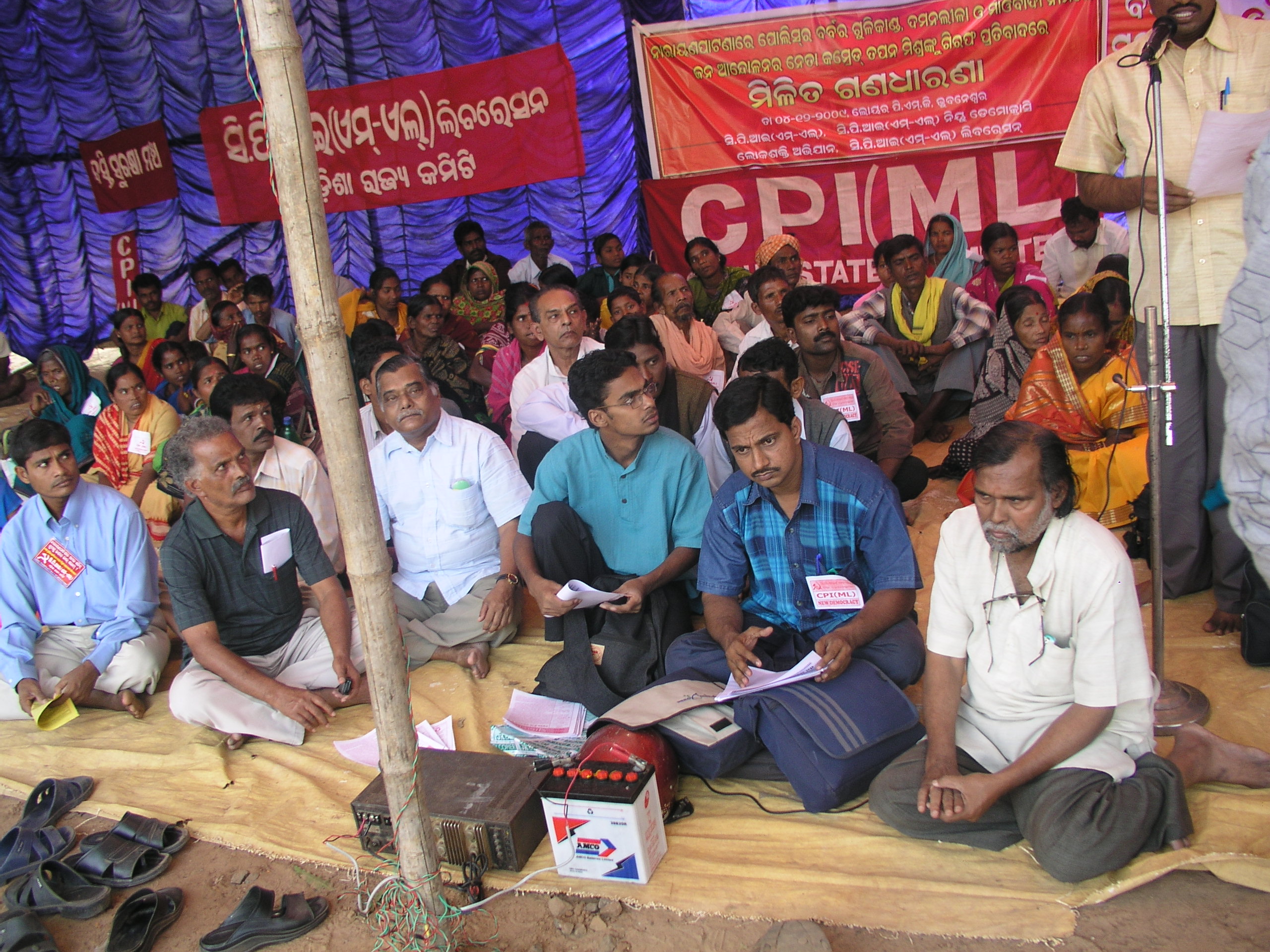
On the 3rd of December, 2009 there was a general closure of all shops and offices in Athamalik to protest against the arrest of Tapan Mishra. On the 4th of December, a public meeting was organized in Lower PMG Square, Bhubaneshwar by several left groups like CPI(ML)(Liberation), CPI(ML)New Democracy, CPI M-L, Gandhians of Lok Shakti Abijan, Lohia-socialists of Samajbadi Jan Parishad and liberals of Athamalic Sachetan Nagarik Mancha. Human rights activists like Biswapriya and other progressive individuals together with the above groups comprised about 200 protesters. Among the speakers were Com. Jayadev, Com. Sivaram, Com. Bhala Chandra, Prafulla Samantara and Lingaraj. Beginning from the communists and Gandhians to Lohia-socialists and liberals, all of them united in their struggle against the ongoing McCarthyist repression in Orissa in the name of hunting down the Maoists. People who had come from different regions of Orissa reported similar arrests of tribal and dalit leaders in their areas. The protesters unanimously raised their voices against the crushing down of democratic movements in general and that at Narayanpatna. The apathy of the media towards the democratic movements was also discussed.
With already five days past the arrest of Tapan Mishra and with no response from the government after protests against his arrest, a four member delegation, consisting of Saraju Singh Samanta, Pratap Nayak, Mahendra Parida and Pramila Behera submitted a memorandum to the Governor of Orissa which included an unconditional release of Tapan Mishra among other demands.
With the government having turned a deaf ear towards the voices of dissent and using its fully armed machinery to crush them down, it is only creating a passion for destruction, of its own destruction, in the sphere of radical democratic politics and as Bakunin would say, “the passion for destruction is a creative passion too.”
An Interview with Rana Bose, a writer based in Canada. He discusses about the current situation in India, specifically the rising popularity of the Maoists and the re-emergence of the Naxalite movement – followed by details of the Indian Government’s reaction. For the past 25 years, independent local struggles have found common interest and united under the banner of Maoism, which can be seen as a renaissance of the Naxalite movement that the Indian government thought it had wiped out in the early 70s. The Maoists today are much more then just a movement. They have become a parallel government.
Courtesy: Friday Morning After
Satyabrata
On November 23 a fact-finding team comprising intellectuals and activists from several organisations visited Narayanpatna to inquire about the killing of the adivasis. The team had to face difficulties in entering the region and members of the team were harassed and even beaten up by the police, as one of the team members reported in the press conference held today (November 25). The following is the report of the team released during the press conference.

REPORT OF THE FACT-FINDING TEAM
Salwa Judum in Narayanpatna when rest of Orissa sleeping
Planned murder of Singhana by police, land grabbers celebrating
Bauxite miners, landlords, mafia, police unleash reign of terror
Who is with the people when naveen is with miners, ask people?
A team consisting of representatives of peoples’ organizations that visited Narayanpatna on 23rd of November 2009 after the killing of two members of Chasi Mulia Adivasi Sangh spearheading the movement for restoration of tribal lands from non tribal land grabbers on 20th of November 2009 by paramilitary police of the state in pretext of self defence has come across shocking evidences which are unacceptable in a democracy guided by a constitution and established acts and laws. The team at the outset would like to state here categorically that
1. The killing of K. Singana a top ranking leader of Chasi Mulia Adivasi Sangh along with Andrew Nachika was a well thought out murder executed by the state police with the help of IRB and CRPF and it was not an act of self defence.
2. The killing of Singana was preceded by a series of house to house raids in the villages in Narayanpatna area in which the men had been tortured and the women humiliated and sexually abused.
3. The Chasi Mulia Adivasi Sangh had brought the matter to the notice of the OIC of Narayanpatna Police Station who had given them the assurance that the combing operation in search of Maoists was not targeted against them and he would personally supervise and ensure that no member of the Sangh is harassed.
4. Since the OIC did not keep his words and atrocities continued the Sangh leaders had gone to the PS with only one intention of asking the OIC why he breached the trust and to take the ‘foreign’ security forces back to the barrack.
5. The number of people assembled outside the PS was hardly one hundred and some of them carried their conventional weapons which is an accepted tribal habit in the region.
6. The firing started when K.Singana was inside the PS and discussing with the OIC and as soon as he came out of the PS he was targeted and killed. His dead body was then dragged into the PS.
7. More than 60 rounds of ammunitions fired killing K.Singana and Andrew Nachika and injuring 25 others some of them critically wounded.
8. Plain cloth policemen and local landlords were roaming around jointly and identifying tribal leaders who were tortured by them before they landed up in police custody.
9. Those sustained critical bullet injury don’t receive any medical attention as there is fear of arrest and torture by police.
10. Salwa Judum type squads formed and anyone visiting the region is tortured and humiliated with active patronage and support from the local OIC.
11. Budha Gamang, veteran tribal leader and President of Lok Sangram Manch, taking part in the funeral of Singana was beaten up by police. Com. Sivaram of CPI-ML and other leaders faced humiliation in the hands of police and ‘Salwa Judum’ team.
12. Most of local media persons are operating from Narayanpatna Police station. Fair reporting is a remote possibility as most reporters are also a part of the land grabbing communities.
13. Repression against the democratic mass movements is going to increase in coming days and there is no sane voice available to protest. The victimised tribals have been left out uncared and isolated.
14. The land grabbers are getting reorganised in the form of peace committees with active support of police and ruling party leaders.
15. The police was restless as Narayanpatna had become a litigation free police station with no cases registered by tribals against anyone which happened mostly because tribals had given up liquor and tribals were looking after their own welfare collectively.
16. The landlords and traders were restless because the organised tribals had taken back their land occupied by them.
17. The mining company and its potential beneficiaries were restless because the Chasi Mulia Adivasi Sangh had organised conventions declaring that no Mali (bauxite rich mountains) in the area shall be given for mining.
18. The nexus killed Singana by making the local police their instrument that in turn made use of the Green Hunt operation declared by the UPA government and now they want to kill the most successful and democratic land restoration movement in the history of Orissa by brute force.
19. Chasi Mulia Adivasi Sangh is a democratic mass organisation and existed much before Maoists became an issue in the region.
20. The CM Naveen Patnaik is shamelessly sleeping while the dignified opposition is yet to wake up to the call of the tribal peasants crying for justice.
BACKDROP:
Narayanpatna came to the news when on 8th of May 2009, the land grabbers 400 to 500 in number attacked tribal households in Narayanpatna with the support of local police which was challenged by members of Chasi Mulia Adivasi Sangh who instantly got organised after the alarm was raised. The police under pressure seized a house of the land grabbers in which they were making bombs. After that Narayanpatna has been constantly in news because the tribals had launched a very powerful and yet peaceful movement for restoration of their lands grabbed by outsiders. There have been very systematic attempts to divide them and brand a larger section of them as Maoists or Maoist sympathisers. Out of about 37000 people living in the region, 30000 are tribals who lived for last 40-50 years as bonded labourers at the disposal of outsiders who had gone and settled there primarily to capture their resources.
In the last two months the state has witnessed the formation of ‘peace’ committees by powerful vested interests with the support of the police and prospective mining companies. They have organised peace conventions demanding arrests of CMAS leaders and activists who have expressed their solidarity with the victimized tribals. The media has highlighted these events in Laxmipur (Birla’s Hindalco is there), Semiliguda, Koraput and Dushamantapur rich with bauxite deposits.
DEMANDS:
1. Immediate withdrawal of all armed and paramilitary police such as Cobra, IRB and CRPF from Narayanpatna and immediate stop of farce called combing operation.
2. Dismantling of the Salwa-Judum-operation happening in the name of peace committees in entire Koraput region and registering murder cases against local OIC and other culprits.
3. A compensation of Rs.10 lakhs to the next of the kin killed by the police and immediate medical treatment with proper financial compensation to the tribal peasants sustaining bullet injuries.
4. Immediate withdrawal of all cases against innocent peasants of CMAS and releasing them from jail.
5. State protection to tribals who have captured back their lost land which normally the state was expected to do but did not.
6. Investigation by serving judge of Orissa High Court into the killing of Singana and the land grabbing issue.
Prafulla Samantara, Lok Shakti Abhiyan
Radhakant Sethy, CPI(ML)(Liberation)
Budha Gamanga, Lok Sangram Manch
Sivaram,CPI-ML
Ron Ridenour
S Sivasegaram’s rejoinder to my series on the plight of Sri Lankan Tamils and the role of Cuba – ALBA in this tragedy is an excellent, well-thought and balanced piece. He, much more than I, knows the history and the peoples.
Without knowing anything about that part of the world until the end of the civil war, I was moved to conduct research because of the treatment the Sri Lankan government and military conducted against Tamils. I was also moved by what I believe essential for revolutionary morality: one does not side with a brutal government which practices discrimination (genocide even) against an entire people regardless of errors or incorrect attitudes by members of that people. I did not write to support elitism on any side, nor the Tigers, who, as I understand it, did act as Sivasegaram described they did. I wrote, in part, to admonish my comrades, the governments of ALBA countries whose resolution in the Human Rights Council is abhorrent in its applause for such a government and in its lack of solidarity for the interned Tamil people.
The fact that Sri Lanka has become a pawn in the hands of imperialism and authoritarian governments sometimes in opposition to US-led imperialism (China and Iran) in no way justifies an immoral stance by revolutionaries. The enemy of our enemy is not necessarily our friend. So, if ALBA must trade with the authoritarian-anti-democratic-anti-revolutionary governments of China and Iran that is for them to decide, but that must not make them dependent upon them politically. We certainly should have learned that, after all those years with the Soviet Union, which did not always conduct foreign policy in the interests of the people at hand.
We revolutionaries must not act cynically. Even if the Tamil nationalists should support other peoples and should have discussed matters with Latin Americans, this failure cannot justify abandoning a tortured people and applauding the torturers.
S Sivasegaram
For Ron Ridenour’s essay, First Article, Second Article, Third Article, Fourth Article, and Fifth Article
I fear that the attitude of supporters of the Tamil cause towards Latin America is rather subjective, and that their approach is still sentimental. I will come to that later in my response, but, before that, the Tamil nationalist, especially pro-LTTE, claims need to be studied with care.
Firstly, accepting the right of Tamils in Sri Lanka to self-determination is correct. But the national question is far more complex than supporters of the Tamil cause in Tamil Nadu and elsewhere in India are made to understand. I have elaborated on this in my long essay which Radical Notes published as a book. Secession is still not the answer and the call for secession in 1976 was thoroughly ill-considered.
Secondly, the history of Tamils in Sri Lanka is being wilfully distorted. A most objective version of ancient history exists in the recent work of Dr K Indrapala, a Tamil, now in Australia. The point that comes out is that there is evidence of Tamil settlements in the island much earlier than acknowledged in the past. But that does not mean that the present-day Tamils are their descendants. The Jaffna Kingdom on which Tamil nationalists lay their claim to Tamil statehood is something of the Second Millennium A.D. which ceased to be nearly 5 centuries ago. There were, however, Tamil chieftains and despotic rulers in the Vanni who survived until the British moved in early in the 19th Century. Part of the Vanni was under the ‘Sinhalese’ Kandyan Kingdom.
The Sinhalese have had a longer history in terms of kingdoms ruled by ‘Sinhalese’. (Not all rulers were really Sinhalese. At least one was from Kalinga. Several were Tamils or Telugus). But what does all of this prove? Not a lot.
The reality is that in the course of modern history, two Sinhala-speaking polities that had a separate existence for 450 years merged into one to serve certain class interests. Tamil-speaking polities ended up as three nationalities with distinctions in many ways and with problems for which Eelam was not an answer. The attitude of the Tamil elite in early 1900s alienated the fisherfolk of the west coast of the island and let them accept a Sinhala identity. In course of time the Tamil identity of the Colombo Chetties and the Paravar communities was lost. The main reason for these was that the Tamil leadership (of Jaffna mainly to which the Vanni and the East got added much later) was dominated by the Vellala Saivaites (equivalent of the Pillai/Mudaliyar etc. of Tamil Nadu, Nayar/Pillai/Menon of Kerala, Patels of Gujarat etc.)
To talk of a Tamil nation comprising 25% of the population is incorrect. The Tamil nationalists nominally represent about 10%, but they truly represent the interests of a fraction of it. When the armed conflict escalated in the 1980s, the elite fled and it was the oppressed who bore the brunt of intensifying chauvinist oppression and war. The elite are abroad, living in comfort, and want to prolong the conflict to pursue their pet project of ‘Tamil Eelam’. The vast majority of the Tamil diaspora have been misled by a few nationalists (pro-LTTE and now the vociferous pro-government groups). What I like to stress is that history has been successfully distorted on all sides to serve narrow interests and to divide the people.
Thirdly, the LTTE was on the one hand the only remaining armed resistance to state oppression. But on the other they systematically failed the people. Their dominance of Tamil politics came about mainly by brutal repression of all opposition, rivals and potential rivals. That continued until their ultimate fall. The genuine left still treated them with some deference for being the only defence that the Tamil people had against state repression; but the LTTE was undemocratic, acted to please imperialism (especially since antagonising India), never believed in people’s struggle, and relied on military victory led by their army. They recruited children by force especially as their fortunes faded. They let the rich get away by paying off while the poor had to send heir children to join the LTTE ranks. All these are factors that contributed to their defeat. But that does not in any way justify any of the cruel and at times barbaric acts of the state.
Yet, failure to criticise the LTTE for its attacks on civilians (not just Sinhalese) has done a lot of harm. Rivals of the LTTE with Indian and Sri Lankan state patrons have been just as guilty. A section of the genuine left criticised the LTTE’s faults while defending the struggle and denouncing state oppression.
Fourthly, leaving alone the anti-democratic and even terrorist acts against civilians, the LTTE and its supporters among the Diaspora have much to answer for the failure of the peace talks (although the government is the main culprit); its reliance on the US (which used the peace talks to get the better of India in Sri Lanka while undermining the LTTE in collaboration with the UNP leadership); and its failure to protect the people.
The LTTE cannot escape the charge that it led 30,000 to the slaughterhouse and 300,000 to what are open prison camps. That tragedy could have been averted had the LTTE let the people go after the fall of Kilinochchi in December 2008. If they did not drag along with them the 100,000 or so from the Kilinochchi District, the government forces could not have advanced fast without clearing the District, and that would have allowed the LTTE leadership to change their strategy. Also there would have been political issues that would have arisen preventing the government from taking people out of their homes. That was water under the bridge when the people were taken to Mullaitivu and compelled to live a life of misery, with the government curtailing if not blocking the supply of essentials. But what justification was there to forcibly prevent the people from leaving when they could not bear the agony anymore? I have heard from people who escaped before the fall of the LTTE about the anti-people methods used by the LTTE to keep the people with them?
Did they seriously think that they could reverse their military fortunes? Did they expect meaningful foreign intervention? If so, in what form? There is substantial circumstantial evidence that they were given false hopes by a section of the Tamil elite among the diaspora about some form US/UN led intervention (to save the LTTE leadership even if not to save the Tamils). Many such questions are being carefully avoided by the Tamil nationalists.
Thus the blame lies with firstly the Government, secondly with the Tamil nationalists as a whole and the LTTE in particular, and thirdly the forces of foreign intervention (the US and India especially) for the tragedy of 2009.
To turn to Latin America:
Objectively, Latin America is increasingly facing US-led threats (The Honduras coup and the Colombian bases are additions to an existing threat). Human rights have consistently been used by the West to undermine defiant states. The US, which uses one set of rules for the Palestinians, a different set of rules for the Kurds of Turkey, and a slightly different one for the Kurds of Iraq, also encourages secessionist forces in the wealthy parts of Bolivia and Venezuela). Latin America sees the issues in terms of a global reality that it faces.
The UNHRC resolution was a pre-emptive response to an anticipated resolution that the US, UK, Germany and Mexico (of all countries!) were planning. Why did Sri Lanka become an issue to them? It was to punish Sri Lanka, not for killing Tamils or denying Tamils their basic rights, but because the government was drifting out of US control. (Indo-US rivalry too has been a factor). USSR and China even during their socialist days had steered clear of UN intervention (and have hopefully learnt from their mistake of allowing meddling in Afghanistan and let the invasion of Iraq pass).
The basic guideline for countries confronting US imperialism is to do what is possible to prevent US meddling in any form. To imagine that a resolution denouncing the Sri Lankan government would have brought relief to the Tamils is fantasy.
Then there are subjective reasons, which cannot be ignored.
Leading Tamil nationalists of all shades have cared little for struggles for justice internationally. (Anton Balasingham, the LTTE ‘theoretician’ had even denounced the struggle in Kashmir as trouble making as he did the resistance in eastern India). The LTTE has not denounced the oppression of the Palestinians or US aggression anywhere, much in line with their political forebears in the Federal Party who denounced the Vietnam struggle as communist trouble making. The SLFP had an anti-imperialist past, but had been dodgy after the 1980s. Of late, the government has occasionally stood up for the Third World on important issues; the role of Dayan Jayatilleka (whose politics is not necessarily genuine) during his short spell as Sri Lanka’s UN ambassador has made an impression in Latin America. I do not think that the Tamil nationalists have had a moral right to ask for support from any country outside the imperialist world and India whom they loyally served. The tragedy is that they have left the Tamil people badly isolated.
By isolating themselves from the left governments, the Indian, especially Tamil, friends of Latin America will achieve nothing. They should have sought to discuss the matter with some of the Latin American embassies before jumping to conclusions. Taking decisions one-sidedly without reference to their friends is not healthy practice. It will be the progressive forces of India who will lose most by such kneejerk action.
Ron Ridenour
First Article
Second Article
Third Article
Fourth Article
“The impunity with which the Sri Lankan government is able to commit these crimes [referring to 2009 war atrocities, including brutal internment of 300,000 Tamils] actually unveils the deeply ingrained racist prejudice that is precisely what led to the marginalization and alienation of the Tamils of Sri Lanka in the first place. That racism has a long history – of social ostracism, economic blockades, pogroms and torture. The nature of the decades-long civil war, which started as a peaceful protest, has its roots in this,” wrote author Arundhati Roy.
“’This is something similar to what occurred in Gaza or worse, because neither observers nor journalists had access to the war zone,’ stated a UN source who asked for anonymity. The army acknowledges that 6,200 soldiers and 22,000 guerrillas died in the last three years of the longest civil war in Asia. The UN affirms that between 80,000 and 100,000 persons died in the conflict,” wrote Elisa Reche of Prensa Marea Socialista.
“During the war,” Reche continued, “the army had 200,000 troops. Now with peace, 100,000 are being incorporated… A strange peace it is that requires more troops than in actual combat.”
More troops are needed because systematic ethnic cleansing is now the order of the day for the Tamil people. Their Homeland will be obliterated by introducing more Sinhalese settlers. The same strategy, as John Pilger pointed out, that Israel uses against Palestinians.
This is what M.K. Bhadrakumar, an ambassador for India who served in Sri Lanka and other countries, wrote about the day after Sri Lanka declared victory.
See, they have already solved the Tamil problem in the eastern provinces… The Tamils are no more the majority community in these provinces. Similarly, from tomorrow, they will commence a concerted, steady colonization program of the Northern provinces where Prabhakaran reigned supreme for two decades. They will ensure incrementally that the northern regions no more remain as Tamil provinces… Give them a decade at the most. The Tamil problem will become a relic of the bloody history of the Indian sub-continent.
Ethnic cleansing goes hand-in-hand with the policy of imprisoning and mistreating hundreds of thousands of Tamils. For more than a year before its military victory, the Sri Lanka government enticed Tamils, wishing to flee the war zone, into so-called “welfare” centers or villages. Tens of thousands became “Internally Displaced Persons” (IDP), and are thus subject to United Nations regulations concerning decent living conditions, food and water, freedom of movement and the right to leave and rejoin families. All these rights and necessities have been denied them.
“Really if I starve the Tamils out, the Sinhala people will be happy,” President J.R. told the Daily Telegraph, (UK) on July 11, 1983.
A quarter-century later, the current president is striving to fulfill his predecessor’s genocidal intentions. Mahinda Rajapakse has claimed that no IDP is held against his/her will and all are treated well. However, the few United Nations visitors—there are no official investigators into abuses since the Human Rights Council majority blocked such a possibility—who come to observe have quite another picture.
When UN’s political chief, Lynn Pascoe, visited camps in September he said people were not free or well treated… “this kind of closed regime goes directly against the principles under which we work in assisting IDPs all around the world.”
Rajapakse told Pascoe another tale about “free movement”. He said that detention was necessary because the army was clearing the area for mines, and it was still looking for guerrillas hiding among civilians. However, as the UN resident coordinator reported, and Amnesty Internationalquoted: “Under international humanitarian law, captured combatants…may be held pending the cessation of hostilities. Once active hostilities have ceased, prisoners of war must be released ‘without delay.’”
At of July, there were 9,400 individuals with purported links to the LTTE held separately from the rest of the population. They have not been released nearly half-a-year after internment.
Amnesty International also reported that the camps are clearly militarized. The 19-member Presidential Task Force established in mid-May “to plan and coordinate resettlement, rehabilitation and development of the Northern Province” is headed Major General CA Chandrasiri, who was also appointed governor of the province. All inmates are enclosed by barbed-wire fences, guarded and brutalized by well-armed soldiers.
“Arrests have been reported from the camps and Sri Lankan human rights defenders have alleged that enforced disappearances have also occurred,” wrote Amnesty.
“Sri Lanka’s history of large-scale enforced disappearances dating back to the 1980s, and the lack of independent monitoring… raises grave concerns that enforced disappearances and other violations of human rights may be occurring… Previous research [shows] that [persons] suspected by the government of being members or supporters of LTTE are at grave risk of extrajudicial executions, enforced disappearance, and torture, cruel, inhumane and degrading treatment.”
“Although the government calls these facilities ‘welfare villages,’ they are effectively detention camps…” Amnesty International also reported that not only are people not free to move as they wish, women and girls are raped by soldiers, and people live in sewage, disease-infested conditions, with little food and water and medical attention. They die in droves because of these imposed conditions.
Women and children are especially mistreated, which was the subject that James Elder, spokesperson for UNICEF, complained about to Sri Lankan authorities, who then expelled him from the country. Elder described the “unimaginable suffering” of children caught in the fighting, including babies he had seen with shrapnel wounds.
United Nations Secretary General Ban Ki-moon had refrained from criticizing Sri Lanka’s government, leveling his critique only at LTTE for carrying out atrocities. But when he briefly visited one camp less than a week after the end of the war, he said:
“I have traveled around the world and visited similar places, but this is by far the most appalling scenes I have seen…I sympathize fully with all of the displaced persons,” UN Secretary-General Ban Ki-Moon told CNN after visiting Manik Farm, the most presentable of Sri Lanka’s squalid and dangerous internment camps for Tamils civilians. The UN Chief has also promised international action regarding the heavy shelling of civilian populations during the recent fighting.
Out of the 280,000 IDPs after the end of the war (there were nearly one-half million over a year’s period), only between 15,000 and 40,000 had been released by November 1. Half of them, perhaps, have been ransomed. The Sunday Times wrote about “human trafficking at the internment camps.” Relatives were made to pay camp authorities in order to secure their release.
Future
A week after the end of the war, the LTTE communicated that several of its leaders were killed, but the organization would continue struggling for an independent Tamil Eelam in peaceful ways. July 22, the LTTE announced that its chief of international relations, Selvarsa Pathmanathan—known as KP—was made the new leader, and that a new strategy for a “free Tamil Eelam” would occur. On August 8, England’s The Independent wrote that Pathmanathan was under arrest by Sri Lanka and held incommunicado.
For us solidarity activists, left-wing organizations, and governments considered to be progressive-socialist-communist-revolutionary, I believe that our task must be to press for the lives and rights of the Tamil people. Australia’s Democratic Socialist Perspective and Socialist Alliance said it well in its October 2009 international situation report:
Now the Tamil struggle has entered a new phase. The immediate campaign must focus on defence of basic human rights, release and resettlement of the Internally Displaced Persons currently held in SL government concentration camps, an end to murders, torture, rapes, and provision of basic housing, food and drinking water to the Tamil people under brutal occupation.
As a solidarity activist, who advocates the right to resist and the necessity to conduct armed struggle once peaceful means fail to induce oppressive and terrorist governments to engage in a process aimed at peace with justice, I condemn all perpetrators of terrorism and demand they change tactics to ones that are morally in accordance with our ideology for socialism, for justice with equality.
I find that most, if not all, armed movements commit acts of atrocities, even acts of terror in the long course of warfare. This has sometimes been the case with FARC and PFLP, for instance. But I support them in their righteous struggle. They are up against, as was the more brutal LTTE, much greater military and economic forces that practice state terror endemically. Remember the ANC in South Africa’s war for liberation. They committed much the same.
The main reason why I am on their side, why I have been a leftist solidarity activist and writer for nearly half-a-century is a matter of basic ethics. I define ethics in this way: Life shall not be abused or destroyed by our conscious hand—without being attacked, invaded, oppressed beyond bare. A moral person, organization, political party, government acts in daily life and in the struggle for justice with that ethic in mind. These are my thoughts on morality.
1. We act to so that no one person, race or ethnic group is either over or under another.
2. In combat against oppressors and invaders, we do not kill non-combatant civilians nor forcefully recruit them, or use them as hostages.
3. We struggle to create equality for all.
4. We abolish all profit-making based upon the exploitation of labor or the oppression of any person, group of people or class. Instead, we build an economy based upon principles of justice and equality, one in which no one goes hungry, sharing equitably our resources and production.
5. We struggle to create a political system based upon participation where all have a voice in decision-making of vital matters, in local, national and international policies.
6. We struggle to eliminate alienation in each of us.
After following liberated Cuba for half-a-century, having lived and worked there for eight years, I find that during its guerrilla struggle, which fortunately only lasted two years, it acted in a moral manner. Cuba’s revolutionary armed struggle was exceptional in this way. The Vietnamese struggle against the invaders of France and the USA was so conducted as well. There are a few other examples: the original Sandinistas is, perhaps, one.
I think that the key reason why so many millions of people the world love and respect Che Guevara is because of his moral stance, of his example as a just revolutionary leader. I conclude this all-too-long essay with these oft-quoted words from Che’s Socialism and Man.
At the risk of seeming ridiculous, let me say that the true revolutionary is guided by a great feeling of love… Our vanguard revolutionaries must idealize this love of the people, the most sacred cause, and make it one and indivisible… one must have a great deal of humanity and a strong sense of justice and truth in order not to fall into extreme dogmatism and cold scholasticism, into an isolation from the masses. We must strive every day so that this love of living humanity will be transformed into actual deeds, into acts that serve as examples, as a moving force.
Ron Ridenour
First Article
Second Article
Third Article
The Geneva Declaration on Terrorism, passed May 29, 1987 by the UN general assembly, points out that the main perpetrators of terrorism are governments striving to keep down parts of their populations or other peoples. In this document, at that time, the main culprits are the United States, Israel, South Africa and the many dictatorships in Latin America at that time.
State terrorism manifests itself in: 1) police state practices against its own people to dominate through fear by surveillance, disruption of group meetings, control of the news media, beatings, torture, false and mass arrests, false charges and rumors, show trials, killings, summary executions and capital punishments;
The terrorism of modern state power and its high technology weaponry exceeds qualitatively by many orders of magnitude the political violence relied upon by groups aspiring to undo oppression and achieve liberation.
…peoples who are fighting against colonial domination and alien occupation and against racist regimes in the exercise of their right of self-determination have the right to use force to accomplish their objectives within the framework of international humanitarian law.
This document applies to the situation of the Sri Lankan governments since 1983 as well as to the LTTE, and the proportions of the use of violence are as written by the general assembly. The LTTE did, however, after time, go beyond the framework of international humanitarian law.
One voice regarding terrorism and what lies behind these atrocities appears so credible to me, and so tragic in itself, that I quote him extensively to show that all warring parties in Sri Lanka acted as terrorists. Here are some of the last words of Sri Lankan journalist Manilal Wickrematunge Lasantha, a Sinhalese, who predicted his assassination shortly before it occurred, on January 8, 2009. His newspaper, The Sunday Leader, published his own “obituary” three days later.
Terror, whether perpetrated by terrorists or the state, has become the order of the day. Indeed, murder has become the primary tool whereby the state seeks to control the organs of liberty…
Our commitment is to see Sri Lanka as a transparent, secular, liberal democracy… Secular because in a multi-ethnic and multi-cultural society such as ours, secularism offers the only common ground by which we might all be united…
…we have consistently espoused the view that while separatist terrorism must be eradicated, it is more important to address the root causes of terrorism, and urged government to view Sri Lanka’s ethnic strife in the context of history and not through the telescope of terrorism. We have also agitated against state terrorism in the so-called war against terror, and made no secret of our horror that Sri Lanka is the only country in the world routinely to bomb its own citizens…
The LTTE are among the most ruthless and bloodthirsty organisations ever to have infested the planet. There is no gainsaying that it must be eradicated. But to do so by violating the rights of Tamil citizens, bombing and shooting them mercilessly, is not only wrong but shames the Sinhalese, whose claim to be custodians of the dhamma [the teachings of Buddha, which lead to enlightenment] is forever called into question by this savagery, much of which is unknown to the public because of censorship…
What is more, a military occupation of the country’s north and east will require the Tamil people of those regions to live eternally as second-class citizens, deprived of all self respect…
It is well known that I was on two occasions brutally assaulted, while on another my house was sprayed with machine-gun fire. Despite the government’s sanctimonious assurances, there was never a serious police inquiry into the perpetrators of these attacks, and the attackers were never apprehended. In all these cases, I have reason to believe the attacks were inspired by the government. When finally I am killed, it will be the government that kills me.
The irony in this is that, unknown to most of the public, Mahinda [Rajapakse, the president] and I have been friends for more than a quarter century… “Sadly, for all the dreams you had for our country in your younger days, in just three years you have reduced it to rubble. In the name of patriotism you have trampled on human rights, nurtured unbridled corruption and squandered public money like no other President before you…”
When Lasantha’s dramatic editorial appeared, he had already been murdered on his way to work by four men on motorcycles. The probable conspirator behind the execution was Lasantha’s “friend’s” brother, war secretary Gotabhaya Rajapakse, a naturalized citizen of the USA. In December 2008, he had censored the Sunday Leader from publishing any criticism of his actions. He had earlier threatened the careers and lives of other journalists.
A week before Lasanth’s murder, G. Rajapakse’s army captured the capital of the de facto Eelam state, Kilinochchi. LTTE guerrilla army fled but not all the civilians had evacuated before the government’s troops entered and butchered scores or hundreds. On August 25, 2009, England’s Channel 4 News broadcast footage showing Sri Lankan forces executing nine Tamils stripped naked. One of the military’s soldiers had filmed this atrocity on his mobile telephone. Journalists for Democracy in Sri Lanka (Sinhalese and Tamils) obtained the film and presented it to Channel 4, which showed it after verifying its authenticity.
The United States government praised Sri Lanka for its military offensive. The US embassy in Colombo issued this statement: “The United States does not advocate that the Government of Sri Lanka negotiate with the LTTE…”
Following this crushing defeat, the LTTE was reduced to an area of a few square kilometers. Many thousands of civilians had left their homes to reach so-called No Fire Zones, which the S.L. army began setting up on January 20th. Conditions were sub-human (and they continue to be so for over two-hundred and fifty thousand interned civilians in various camps as of this writing), and they were (are) forced to remain. Amnesty International—more often than not a reliable observer of international conflicts, one of the few NGO’s that does not take money from any government or political party—recently published a report about these camps. Sri Lanka is violating rules established by the United Nations, including the International Covenant on Civil and Political Rights, applying to displaced persons.
Here is an excerpt from a civilian inmate.
“Knowing that many civilians were not able to move, the government restarted shelling. They even hit the No Fire Zone so even that small area was not protected…When we heard the supersonic Kfirs [Israel jets] overhead we used to rush to the bunker and hide…That was our life for months just squatting in bunkers.”
Amnesty stated: “The Government of Sri Lanka exacerbated this isolation by restricting access by outsiders to the conflict area. In September 2008, Defense Secretary Gotabhaya Rajapaska issued a directive ordering all humanitarian and UN agencies to leave the Vanni and remove all equipment and vehicles.” This order also applied to journalists, opposition politicians and humanitarian organizations.
John Pilger described Sri Lanka’s isolation strategy this way:
The Sri Lankan government has learned an old lesson from, I suspect, a modern master: Israel. In order to conduct a slaughter, you ensure the pornography is unseen, illicit at best. You ban foreigners and their cameras from Tamil towns like Mulliavaikal, which was bombarded recently by the Sri Lankan army, and you lie that the 75 people killed in the hospital were blown up quite willfully by a Tamil suicide bomber.(John Pilger, “Distant Voices, Desperate Lives,” New Statesman, May 13, 2009.)
From 2006-7 onward President Rajapakse was spending nearly one-quarter ($1.5 billion) of Sri Lanka’s national budget of $7.5 billion (2008 figures) on war. By January 2009, the Sri Lankan military, refortified especially by Israel, Pakistan and China, had recaptured much of the Tamil Homeland. From the end of 2008 to Sri Lanka’s military victory over LTTE, it had indiscriminately bombed Tamil civilians even in the “safe zones” where the government had told them to flee. Many thousands were killed.
After the fall of Tamil Eelam’s de facto capital, it still took the far superiorly armed and manned army four and one-half months to defeat the guerrilla army. There were few close contact battles. The LTTE fighters and civilians in the remaining Homeland area were subject to shelling from the air and by long-distance artillery. Amnesty International reported:
Eyewitness accounts of the final months of the war painted a grim picture of deprivation of food, water and medical care; fear, injury and loss of life suffered by civilians trapped by the conflict… both the LTTE and Sri Lankan government forces committed violations of international humanitarian law… The LTTE forcibly recruited children as soldiers, used civilians as human shields against the Sri Lankan army’s offensive, and attacked civilians who tried to flee. The Sri Lankan armed forces launched indiscriminate attacks with artillery on areas densely populated by civilians. Hospitals were shelled, resulting in death and injuries among patients and staff.
Sri Lanka’s military achieved victory by murdering any Tamil “in its way”, and because of the extensive military force provided to it by many capitalist and so-called socialist states. Here are the major players:
1. India has provided weaponry, radar and training to Sri Lanka’s military since 1987. It often hides what aid it gives or sells since so many of its citizens are against S.L.’s brutality against Tamils. After a period of providing little military assistance, it increased its aid at the end of 2008 when the government launched its all-out offensive. As late as April 2009, India sent three fast attack boats and a missile corvette (INS Vinash), part of $500 million in total aid. It has also turned over LTTE fugitives to S.L. India sees its traditional role as the dominant nation in South Asia being replaced by China’s fast-growing presence, which is another reason for its support to Sri Lanka’s Buddhist government despite the fact that 80% of India’s 1.2 billion people practice Hinduism with less than 1% Buddhists. On the world plan, India hip hops from one antagonist force to another. There is no clear direction.
2. The United States of America has been arming and financing Sri Lanka for most of the civil war period. The Indian Ocean is a vital waterway in which half of the world’s containerized cargo passes through. Its waters carry heavy traffic of petroleum products. The US signed a ten year Acquisition and Cross-Servicing Agreement (ACSA) with Sri Lanka on 5 March 2007 which provides, along with other things, logistics supplies and refueling facilities. The US already has Voice of America installation at Tricomalee, which can be used for surveillance. From at least the 1990s, the US has provided military training, financing and weapons sales averaging $1.5 million annually. During the cease fire, in 2002, this sum went down to $259,999 for military training only. Bush was especially glad for Sri Lanka’s terrorism, and encouraged Colombo to resume the civil war, in 2006, which his government financed with $2.9 million. The Pentagon provided counter-insurgency training, maritime radar, patrols of US warships and aircraft. At the end of Bush’s second term, the US was forced to cut back on aid given that it was bogged down in Afghanistan and Iraq. That, coupled with critical public opinion, organized by the Diaspora, of state terrorism and systematic discrimination of Tamils, prompted congress to make noises about abuses of human rights by not only LTTE but also about the use of children in “paramilitary forces of the Sri Lankan government.” Nevertheless, in 2008, $1.45 million in military financing and training was granted the government out of a total of $7.4 million in total aid. The US made noises about killing a ‘humanitarian crisis’ when the Sri Lankan army was about to finish the war but it never took affirmative action to bring the war to an end. It’s howling about human rights is only a veiled threat to the Sri Lankan government, that it should not do anything prejudicial to its interests, that is, keep China at bay.
3. Israel was officially re-awarded diplomatic relations, in May 2000, after Sri Lanka had severed them, in 1970, in protest at Israel’s continued illegal expansion into Palestinian territory. Nevertheless, Israel continued to operate inside S.L. out of a special interests office set up in the US embassy. Under the table, however, Sri Lanka’s successive regimes embraced Israel’s military advisors, a special commando unit in the police, and Mossad counter-intelligence agents—who sought to drive a wedge between Muslims and Tamils. After S.L. military defeat at Elephant Pass, it appealed to Israel for military aid. Israel sent 16 of its supersonic Kfir fighter jets, some Dvora fast naval attack craft, and electronic and imagery surveillance equipment, plus advisors and technicians. Israel personnel took part in military attacks on Tamil units, and its pilots flew attack aircraft. Tigers shot down one Kfir. Just before the end of the war, Prime Minister Wickremanayake was in Israel to make bigger deals with Israeli arms supplies.
4. U.K./EU In 2005, British arms export rose by 60%, according to John Pilger (12). In 2008, £1.4 million in arms export was approved. France sent patrol boats, and other EU countries continued but reduced military aid. The EU had never been required to offer much aid given that its major allies were so much engaged.
5. Japan has long been Sri Lanka’s greatest economic donor until China overtook that position in 2008-9. Japan has sold technology and offered generous loans, but it has also outright donated millions more every year. In 1997, for instance, it granted $52 million outright but $26 in technical cooperation. In 2001, aid was at $310 million. It also paid for the government television station, Rupavahini. While Japan’s aid, sales and loans are not directed at defense, these huge sums allow the Sri Lanka governments to use more of its budget for war. This is the case as well with several other Asian countries.
6. Iran “We don’t need your money (with all those strings)”, a Sri Lanka treasury functionary purportedly told World Bank officials last year. “The international community” (US-EU governments) had begun to cut back on aid and even to ask questions about treatment of Tamil civilians, whose cries were being heard from the Diaspora. So, Sri Lanka played one power against another: India-Pakistan/China, US-China, Israel-Iran/Libya—the West-NAM. In 2008-9, Iran provided $1.9 billion in credit to build an oil refinery, in order to process S.L.’s crude oil, and it donated $450 million for a hydropower project. Iran is US’s most important inside ally with the Quisling Iraq government. And Libya has most recently been approached for a $500 million loan by Sri Lanka. Libya is with and against Iran.
7. Pakistan came into the Sri Lanka debacle, in 2008, at the encouragement of China. At the beginning of 2009, it provided $100 million in military assistance loans; it gave Chinese-origin small arms, and offered pilot training for S.L.’s new Chinese aircraft. Pakistan is also an ally of the US in its terror war “against” terror. Its governments are part of the war against Afghanistan, which has spread throughout most of Pakistan and split the population. Here have we a country allied with Cuba and ALBA et al. in NAM at the same time a partner with the world’s greatest terrorist state.
8. China entered the picture in 2005.China is the world’s no 2 oil consumer after the United States. China has stepped up efforts to secure sea lanes and transport routes that are vital for its oil supplies. In April 2007, just one month after the US’s ACSA deal with SL, China’s Poly Technologies supplied $36.5 million arms to Sri Lanka. A $150 million contract was given to China’s Huawei, which has close links with the Chinese intelligence wing MSS, to build a country-wide infrastructure for communications. In 2008, China invested five times over what it did in 2007. Its biggest investment is a vast construction project at Hambantota on the southern coast, which it will use as a re-fuelling and docking station for its navy. “Ever since Sri Lanka agreed to the plan, in March 2007, China has given it all the aid, arms and diplomatic support it needs to defeat the Tigers, without worrying about the West,” wrote The Times (London). China acts without asking questions about the treatment and conditions of workers and minorities. In April 2007, S.L. made a deal to buy Chinese ammunition and ordnance for is military. China gave it six F7 jet fighters after a Sky Tiger raid that destroyed ten military aircraft, in 2007. One Chinese fighter was soon shot down by Tigers. China has also given or sold on credit: an anti-submarine warfare vessel, gunboats and landing craft, battle tanks, anti-aircraft guns, and air surveillance radars. In June 2009, after the conclusion of the civil war, it signed an $891 million agreement for the Norochcholai Coal Power project. Chinese companies were granted an Economic Zone for 33 years. Huichen Investments Holdings Limited is to invest $28 million in next three years in the Mirigama Zone. For the first time a specific area was given to a foreign country. China is making major inroads into Sri Lanka, causing concern in the US-India Axis.
In the last few months of the war, Sri Lanka’s military used China’s weapons to systematically bombard what was left of the Tamil Eelam homeland. British media reported that 20,000 Tamil civilians were killed just in the last five days. Yet President Rajapakse claimed that “not one Tamil civilian was killed by military shelling.”
According to the pro-imperialist The Times (London), “aerial photographs, official documents, witness accounts and expert testimony” tell a story of the Sri Lankan’s “fierce barrage” of three weeks constant shelling in a five-kilometer area where 300,000 Tamil civilians were. The Times’ estimated that about 1,000 civilians were killed each day for three weeks until May 19. With most of the leadership dead, and tens of thousands civilians slaughtered, the LTTE surrendered.
One of The Times’ sources for these figures, and that responsibility lay with SL military, is the Catholic priest Amalraj, who was there until May 16. At the time of article, May 29, 2009, he was interned in the militarized Manik Farm camp along with 200,000 others.
Even the editor of the pro-imperialist Armed Forces of the UK magazine contended that it was not the Tigers who fired upon their own people but that is was the Sri Lankan government, which used imprecise air-burst and ground-impact mortars to annihilate anything alive.
The Times piece ended on this sad note: S.L “was cleared of any wrongdoing by the UN Human Rights Council after winning the backing of countries including China, Egypt, India and Cuba.”
For other articles by the author visit his website.
Ron Ridenour
“At independence, in 1948, the new political elite, in its rush for power, cultivated ethnic support in a society whose real imperative should have been the eradication of poverty. Language became the spark,” journalist-documentary filmmaker John Pilger recently wrote.(1)
The Tamil people in Sri Lanka had expectations that they would achieve equal rights and power with the Sinhalese once independence was won from the British colonialists. As the independence movement was winning over colonialization there was no talk of any Tamil separatism.
Even before the defeat of the Axis powers, Britain prepared to decolonize Ceylon. In 1943, the colonial secretary of state stated that a constitution would be drafted will all parties involved. A condition would be that “The Parliament of Ceylon shall not make any law rendering persons of any community or religion liable to disabilities or restrictions to which persons of other communities are not made liable …”(2)
Britain established the Soulbury Commission in 1944. The leading Sinhalese politician was D.S. Senanayake—a conservative, who founded, in 1946, the rightist pro-independence and pro-capitalist United National Party (UNP). Senanayake became known as the “Father of Sri Lanka.” He convinced a leading Tamil politician, G.G. Ponnamblam—who founded the All Ceylon Tamil Congress (ACTC), in 1944—to partake in independence negotiations.
Another provision of the Soulbury Commission (Constitution) was that any bill which evoked “serious opposition by any racial or religious community and which, in the opinion of the Governor-General is likely to involve oppression or serious injustice to any community must be reserved by the Governor-General.”
The vote on the third reading of the “Free Lanka” bill was supported by all the Muslim members and by most Tamil and Sinhalese groups. “Some of the other minority members who did not want to openly support the bill took care to be absent or abstain. Finally, the debate and the vote of acceptance on the eighth and ninth of September 1945 was the most significant indication of general reconciliation among the ethnic and regional groups. Far exceeding the 3/4 majority required by the Soulbury Commission, Senanayake had 51 votes in favor, and only three votes against the adoption of the constitution. The vote was ‘in many ways a vote of confidence by all communities…and the minorities were as anxious as the majority for self-government.’”
Senanayake’s speech in proposing the motion of acceptance made reference to the minorities and said … “throughout this period the Ministers had in view one objective only, the attainment of maximum freedom. Accusations of Sinhalese domination have been bandied about. We can afford to ignore them for it must be plain to every one that what we sought was not Sinhalese domination, but Ceylonese domination. We devised a scheme that gave heavy weightage to the minorities; we deliberately protected them against discriminatory legislation. We vested important powers in the Governor-General… We decided upon an Independent Public Service Commission so as to give assurance that there should be no communalism in the Public Service. I do not normally speak as a Sinhalese, and I do not think that the Leader of this Council ought to think of himself as a Sinhalese representative, but for once I should like to speak as a Sinhalese and assert with all the force at my command that the interests of one community are the interests of all. We are one of another, what ever race or creed.”
The first national election was held August 23-September 30, 1947. 1,887, 364 people voted for 95 MP (members of parliament). There were six parties and many independents. The results were:
UNP with 39.8% (42 MPs)
LSSP 10.8% (10)
BLPI 6% (5)
ACTC 4.4% (7)
CIC 3.8% (6)
CPC 3.7% (3)
Labor 1.4% (1)
Independents 29% (16) (3)
“We are one of another, whatever race or creed,” swore the “Father” of the new independent State. It looked good for all ethnic and religious groups, but then the deceit became evident with the new citizenship act.
On February 4, 1948, the new government introduced the Ceylon Citizenship Bill before Parliament. The outward purpose of the bill was to provide a means of obtaining citizenship, but I think its real purpose was to discriminate against the Indian Tamils by denying them citizenship. The Ceylon Citizenship Act no. 18, August 20, 1948 denied citizenship to 11% of the population.
Although the All Ceylon Tamil Congress opposed the bill, it had joined with the UNP. This provoked half of its members to form the Federal Party, led by SJV Chelvanayakam. Next year, the Indian and Pakistani Residents Act, no.3, disenfranchised nearly all Tamils, who were originally from India. Their seven MPs were kicked out of parliament and there were no Indian Tamils in the 1952 parliament elections. It wasn’t until 1988 that the Sri Lanka government granted citizenship to stateless persons, who hadn’t applied for Indian citizenship. In 2003, 168,141 descendants of Indian Tamils were allowed citizenship.
The new government allowed Sinhalese to appropriate land on the Tamil traditional homeland in the north and east. Entire villages were driven out—ethnic cleansing—which the Sinhalese settled, aiming to break a geographic continuity of the Tamil homeland.(4) Within time, Sinhalese settlers had taken over 30% of Tamil lands and homes—a la Israel in Palestine.
In 1956, The Sinhala Only Act became law. It mandated Sinhala as “the sole official language”, which, at that time was spoken by 70% of the population.
Supporters of the law saw it as an attempt by a community that had just gained independence to distance themselves from their colonial masters, while its opponents viewed it as an attempt by the linguistic majority to oppress and assert dominance on minorities. The Act symbolizes the post independent majority Sinhalese to assert its Sri Lanka’s identity as a nation state, and for Tamils, it became a symbol of minority oppression and a justification for them to demand a separate nation state, which resulted in decades of civil war.
Tamils protested the discriminatory law by using Gandhian tactics of non-violent sit-ins. Although stated advocates of non-violence, Buddhist monks led Sinhalese mobs against Tamils.
The Gal Oya riots… were the first ethnic riots that targeted the minority Sri Lankan Tamils… The riots took place from June 11, 1956 and occurred over the next five days. Local majority Sinhalese colonists and employees of the Gal Oya settlement board commandeered government vehicles, dynamite and weapons and massacred minority Tamils… It is estimated that over 150 people lost their lives due in the violence. Although initially inactive, the Police and the Army were eventually able to re-take control of the situation and brought the riots under control.
Tamil political leader SJV Chelvanayagam began to organize a massive Satyagraha (non-violent resistance). In order to avoid even more bloodshed, Prime Minister Solomon Bandaranayaka signed an agreement with Chelvanayagam promising to restore Tamil as the (or one of two) official language(s) in its minority areas. This infuriated many Sinhalese, especially monks, and they assaulted and sometimes killed Tamils in many areas. Buddhist monks even besieged the official residence of Bandaranayaka demanding that he abandoned the agreement, which he did. But, in 1958, the Sinhalese-led parliament, pressed by the violence and the pro-Moscow and Trotskyist Sinhalese parties, passed an amendment to the Sinhala Only Act (called “Sinhala Only, Tamil Also”) restoring Tamil as a co-official language in their areas of the North and East. Frustrated at the compromise, Sinhalese mobs murdered 200-300 Tamils, including some Sinhalese who gave Tamils refuge. Many Tamil women were raped and some Tamil boys were stripped, bound, and burned alive. This violent hatred evokes the lynching and burning alive of black people by whites in the southern USA.
Some Buddhists were angry that the Sinhalese Prime Minister Bandaranayaka had tried to compromise with Tamils. In 1959, a Buddhist monk assassinated him.
The language law had its intended effect. In 1955, the civil service had been largely made of Tamils, who had benefited more than Sinhalese from western style education provided by missionaries. This fact was used by populist Sinhalese politicians to come to power—or retain power—on the promise of providing more civil service jobs to Sinhalese by demanding that their language be the only one used in public service. By 1970, the civil service was almost entirely Sinhalese. Thousands of Tamil civil servants were forced to resign due to lack of fluency in Sinhala. In the1960s, government forms and services were virtually unavailable to Tamils.
Confrontation became the modus operandi; Sinhalese were the Zionists and Tamils the Palestinians!
It is important to stress, especially with progressive-revolutionary governments, such as the ALBA alliance in Latin America, and their supporters throughout the world, that the Tamils’ history in Sri Lanka is one of constant and widespread discrimination. They are also subjects to a policy of genocide as defined by the United Nations.(5)
Sri Lanka made world headlines in 1960 when a woman, Sirimavo RD Bandaranaike, was elected prime minister—the world’s first female leader. Being the widow of the martyr and founder of the Sri Lanka Freedom Party (SLFP) was an asset. She immediately brought Sri Lanka into the Non-Alignment Movement, founded in 1961. The originators—India’s Nehru, Egypt’s Nasser, Yugoslavia’s Tito and Ghana’s Nkrumah—sought support for each other’s sovereignty without aligning with either super-power bloc at that time.(6)
Nevertheless, Sri Lankan leaders of both predominantly Sinhala major parties continued to be dependent upon economic and military ties with India, the US, the UK, and Israel. Social welfare programs were carried out within a capitalist economic structure. This was a cause for radical opposition. In 1971, thousands of Sinhalese students, and Indian Tamil plantation workers, under the leadership of a new nationalistic and Marxist-oriented political party, Janatha Vimukthi Peramana (JVP), translated as Peoples Liberation Front, engaged in anti-government clashes. Fifteen thousand protestors were killed in the uprising.
Once in power, Bandaranaike’s widow did not alter the Sinhalese policy of genocide: “…an ingenious device was resorted to deprive the Tamils of the constitutional safeguards and the characteristics of the conditional polity. A coalition of three Sinhalese political parties, led by Mrs. Sirimavo R.D.Bandaranaike, called upon the people to give a mandate [in the 1970 General Elections, during her second term] for a new Constituent Assembly to scrap the 1948 dominion polity and create a new Republic of Sri Lanka. Whilst the voters in the seven Sinhalese provinces gave Mrs.Bandaranaike the mandate that she had requested, the Tamil voters in the Northern and Eastern Provinces summarily rejected her call. In the North and East, a mere 14% of the votes polled supported the call for a new constituent Assembly.”
Laws protecting rights of racial and religious minorities were abandoned and Buddhism was made the constitutional religion of Sri Lanka.
Sinhalese claimed 5000 acres in the Tamil farmland “Nochikulam” as theirs, renaming it “Nochiyagama.” Next year, 10,738 Sinhalese families settled in Trincomalee illegally.
“The sovereignty of the Tamil people (who were ethnically, geographically and linguistically separately identifiable and distinct) revived.”
With this setback, a reinvigorated ACTC joined with the Federal Party, in 1972, to form the Tamil United Front (TUF). Separatism or autonomy now became the cry for nearly all Tamils, who sought an Eelam part of Sri Lanka. Thirty Tamil militant groups emerged.
“The operative part is Thamil Eelam and it means the Tamil part of Eelam. The term Eelam is a synonym for Sri Lanka and has been in use in Tamil literature right from the Cankam Period dating as far back as 200 B.C. to circa 250 A.D.”
The second government of Sirimavo Bandaranaike enacted a discriminatory double standard law for admission grades to universities, requiring Tamil students to achieve higher grades than Sinhalese.
Throughout the 1970s, Sinhalese mobs clashed—with impunity—not only with Tamils but also Muslim Moors. In 1976, Sinhalese burned 271 houses and 44 shops, murdering a score of Muslims.
In 1976, the Tamil United Front Party changed its name to the Tamil United Liberation Front (TUFP) at the Vattukottai Conference, and adopted a demand for an independent sovereign state in traditional Tamil homeland in the north and east to be known as the “secular, socialist state of Tamil Eelam.”(7)
By 1975, Tamil militancy increased with the birth of the Liberation Tigers of Tamil Eelam (LTTE), led by Velupillai Prabhakaran, who considered himself a Marxist and follower of Che Guevara. The LTTE engaged in small armed clashes with the military.
The conservative UNP won a landslide victory in the July 1977 elections. But the pro-independence TULF won 6.4% of the popular vote, winning all 14 seats in the Tamil homeland area, and four more seats of the 168-member parliament. In response to Tamil’s peaceful struggle and its parliamentary victory, Sinhalese mobs, led by Buddhist monks, again destroyed many Tamil homes and shops and murdered up to 300 Tamils.
In July 1978, the UNP, led by Prime Minister Junius Richard Jayewardene, changed the constitution and renamed the country the Democratic Socialist Republic of Sri Lanka. An executive presidency was established, allowing the president greater powers than the prime minister, whom the president now appoints. The president is also the commander-in-chief and head of the cabinet. He can dissolve parliament and has judicial impunity.
Jayewardene became the first president and appointed Ramasinghe Premadosa (UNP) prime minister. Despite the new name, “democratic socialist republic,” the capitalist government began deregulating much of what had been government run enterprises. Private enterprise was priority.
On May 31, 1981, the TULF held a rally in Jaffna in the north. Police clashed with Tamils and two policemen were killed. For three days, Sinhalese mobs, policemen, and soldiers went on a rampage. Several Tamils were taken from their homes and killed. The TULF headquarters, a newspaper office, presses, and shops were destroyed. Worst of all was the total destruction of the Jaffna library and its 97,000 volumes of books and irreplaceable historical manuscripts, some made of palm leaves. It is now well known that the fire that destroyed this unique institution of the Tamils in their homeland was masterminded by a handful of ministers of the Sinhala Government in Colombo, who were present in Jaffna the night of the fire.
“The national newspapers did not carry information about the incident and in subsequent parliamentary debates some majority Sinhalese members reminded minority Tamil politicians that if Tamils were unhappy in Sri Lanka, they should leave for their homeland in India. This is a direct quotation from United National Party member MP WJM Lokubandara:
“If there is discrimination in this land which is not their (Tamil) homeland, then why try to stay here? Why not go back home (India) where there would be no discrimination?”
“Twenty years later, the mayor of Jaffna, Nadarajah Raviraj, still grieved at the recollection of the flames he saw as a University student. He was later killed by unknown gunmen in the capital Colombo, in 2006.”
Civil War and LTTE
By summer 1983, the then small guerrilla army of LTTE was well settled in most northern and eastern areas. Their first major assault against the state’s military took place at Jaffna peninsula, July 24. LTTE ambushed a convoy of soldiers passing through land mines and killed 15.
This could have been in response to many random attacks upon Tamils in various areas. One example is in Trincomalee where, on 10 April 1983, a young Tamil died in police custody after having been held without charge for two weeks. At the judicial inquest into his death, on May 31, the Jaffna Magistrate returned a verdict of homicide. Three days later, the government changed the rules permitting the police to bury or cremate bodies without a post mortem or an inquest.
Amnesty International cabled President Jayawardene expressing concern that such a regulation could give rise to grave human rights violations and appealed to him to rescind it. But he did not. On the contrary, on June 3, 1983, the day that the new Emergency Regulation was brought into effect, the attacks on the Tamils in Trincomalee commenced in earnest.
R. Sampanthan, M.P. for Trincomalee, described that mobs of Sinhalese went from village to village setting fire to Tamil houses and shops. A particular modus operandi was observed. Heavily armed service personnel would enter a Tamil area and carry out a search alleging that explosions and dangerous weapons were hidden in that area. Invariably nothing would be recovered other than implements that would normally be available in any house. Sometimes Tamil youths would be arrested on “suspicion” and taken for questioning. After a month of many pogrom raids, the LTTE struck the army convoy.
That night and for weeks Sinhalese rampaged against Tamils, especially in the Colombo area where some Tamils youths were stripped naked and burned alive in petrol. Black July ended with between 2000 and 3000 dead Tamils, among them 53 prisoners, including key political leaders, who were murdered by Sinhalese prisoners at Welikadai. One political prisoner, Kuttimani, had his eyes gouged out and stomped upon under a soldier’s boots.
One hundred thousand Tamils were rendered homeless and that many and more fled to India.
Even non-violent advocates of separatism or independence, such as the TULF, were pushed out of the democratic process. The Sixth Amendment to the Constitution, enacted in August 1983, classified all separatist movements as unconstitutional. That meant that all its members of parliament—16 then—lost their seats. Thousands of Tamil youth joined militant armed groups, especially the LTTE, which became the most disciplined and well organized.
Throughout the 1980s and 1990s, the LTTE established a de facto state, called Tamil Eelam, and managed a government, which provided a judicial court system, a police force, and social assistance in health and education and for the poorest. LTTE ran a bank, a radio station (Voice of Tigers), even a television station. Guerrilla leaders helped organize small cooperative farming units based on traditional methods. The LTTE dismantled the caste system and officially stopped discrimination against women. The LTTE organized a civilian administration under its command. There was order and peace in these areas, as long as everyone obeyed and when the Sri Lanka army did not bomb.
In the 1980s, there was much discontent in other parts of Sri Lanka. Radical Sinhalese youths, such as the JVP, demanded going further towards socialism. In 1987, JVP engaged in another armed uprising. But after 1989, it entered into parliamentary politics. It participated in the 1994 parliamentary general election and joined conservative and liberal party coalitions in opposing equal rights with Tamils.
Ranasinghe Premadasa was prime minister from February 1978 to January 1, 1989, under President Jayewardene, and then he became president until his assassination on Mayday 1993. Many Sinhalese elitists thought he was too common to be their leader and too compromising with Tamils. Controversial policies under his terms included the matter of language, ethnic cleansing, and the role of India in internal affairs. The first controversy was the constitutional amendment allowing “equality” of languages in the Tamil areas: “National languages shall be Sinhala and Tamil,” although, “The official language of Sri Lanka shall be Sinhala. Tamil shall also be an official language. English shall be a link language.”
This compromise spoke in double tongues. Why not just make Sinhala and Tamil equally official, as India has done with a score of languages?
Alienated Tamils
Even a U.S. Library of Congress study characterized Tamils as alienated. In 1988, it published, SriLanka: a Country Study. In the chapter entitled, “Tamil Alienation,” the authors wrote:
Moderate as well as militant Sri Lankan Tamils have regarded the policies of successive Sinhalese governments in Colombo with suspicion and resentment since at least the mid-1950s, when the “Sinhala Only” language policy was adopted…
Several issues provided the focus for Sri Lankan Tamil alienation and widespread support, particularly within the younger generation, for extremist movements…Sinhalese still remained the higher-status “official language,” and inductees into the civil service were expected to acquire proficiency in it. Other areas of disagreement concerned preference given to Sinhalese applicants for university admissions and public employment, and allegations of government encouragement of Sinhalese settlement in Tamil-majority areas.
“Government-sponsored settlement of Sinhalese in the northern or eastern parts of the island, traditionally considered to be Tamil regions, has been perhaps the most immediate cause of inter-communal violence. There was, for example, an official plan in the mid-1980s to settle 30,000 Sinhalese in the dry zone of Northern Province, giving each settler land and funds to build a house and each community armed protection in the form of rifles and machine guns. Tamil spokesmen accused the government of promoting a new form of ‘colonialism’,” but the Jayewardene government asserted that no part of the island could legitimately be considered an ethnic homeland and thus closed to settlement from outside. Settlement schemes were popular with the poorer and less fortunate classes of Sinhalese.”
Che Guevara made no bones about the significance of alienation: “…the ultimate and most important revolutionary aspiration (is) to see man liberated from his alienation.”(8)
India’s Vacillating Role
The role of India in Sri Lanka’s civil war was a major problem. India’s Prime Minister Rajiv Gandhi, son of assassinated Prime Minister Indira Gandhi, first supported the LTTE. His air force even dropped 25 tons of aid in their territory in Jaffna (Operation Poomalai). A month following this, the Indo-Sri Lanka Peace Accord was signed between Gandhi and the reluctant Prime Minister Ranasinghe Presmadasa, under pressure from his president, JR Jayewardene. The July 29, 1987 accord was expected to resolve the ongoing civil war. Colombo agreed to devolution of power to the Tamil provinces, and its military was to withdraw in exchange for the Tamil rebels’ disarmament. The LTTE had not been made party to the talks but reluctantly agreed to surrender arms to the Indian Peace Keeping Force. Within a few months, however, both sides flared into an active confrontation. Indian soldiers died in far greater numbers than Tamil rebels: 1,500 killed and 4,500 wounded.
In January 1989, Premadasa was elected President on a popular platform promising that the Indian Peace Keeping Force would leave within three months. The police action was unpopular in India as well, especially with some 50 million Tamil Nadu people. Gandhi refused to withdraw India’s troops, however, believing that the only way to end the civil war was to politically force Premadasa and to militarily force the LTTE to accept the accord. But, in December 1989, Vishwanath Pratap Singh was elected India’s Prime Minister and completed the pullout.
On May 21, 1991, in an act of revenge over India’s militarist actions, a female LTTE member blew up Rajiv Gandhi in a suicide bomb attack. In 1992, India became the first government, even before Sri Lanka, to declare the LTTE a terrorist group.
President Premadasa resumed the civil war, which became stalemated. Many forces were angry with him, including a rival Sinhalese leader Lalith Athulathmudali, who sought an impeachment motion against Premadasa, in 1991. Lalith was an adamant supporter of Zionism.
When Athulathmudali, a pro-Israeli power broker, challenged Premadasa two years ago with an impeachment motion in the parliament, Premadasa openly accused Mossad, the intelligence agency of Israel, of trying to topple him. In his address to the Sri Lankan parliament, Premadasa said,
“…I had Israeli interests section removed. In such a context there is nothing to be surprised about the Mossad rising up against me. Please remember that there are among us traitors who have gone to Israeli universities and lectured there and earned dirty money…”
cited Sachi Sri Kantha, quoting the prime minister in “The Puzzles in President Premadasa’s Assassination Revisited.”
In April 1993, Athulathmudali was murdered. Eight days later, on Mayday, Premadasa was murdered. The LTTE did not claim responsibility for these assassinations but were so blamed by Sinhalese and the mass media.
“When Athulathmudali was assassinated last April, the members of his party immediately accused Premadasa for ordering the killing. The murder of Premadasa could have been a return hit planned and executed by the Mossad which had lost its major card in Sri Lankan politics.”
The second Eelam war lasted from 1989 until November 1994 when the People’s Alliance (led by SLFP) candidate, Chandrika Bandaranaike Kumaratunga, won the presidency. But peace negotiations broke down and the war continued from 1995 until the end of 2001 when ceasefire negotiations made progress. But not before the LTTE proved to the Sri Lanka government and military, with 230,000 well armed troops, that it was its equal. With somewhere around 5000 guerrillas—along with a small Sea Tigers boat unit, which made some pirate hits for funding, and even a few light civilian aircraft, the Sky Tigers, which sometimes made damaging raids against the Air Force—the LTTE won many military victories.
The Sri Lankan military often bombed civilian Tamils in the LTTE-controlled zones. It claimed that they were legitimate “collateral damage” given that the guerrillas allegedly forced them to remain against their will. The civilian hostage charge was widely reported as truth by the west and its mass media, as was the allegation that the LTTE forces children into armed combat.
On January 31, 1996, the LTTE stunned the nation when it bombed the Central Bank in Colombo, which managed most financial business accounts. One suicide bomber with 200 kilos of explosions drove through the main gate and exploded, wiping out many bank floors and several other buildings. Behind him came a vehicle with two cadres firing rifles and launchers. They escaped but were later captured. Material damage was tremendous but more so was the loss of 53 lives and injuries to 1,400 people, most of them not military targets.
On July 24, 1996, LTTE forces bombed a commuter train killing 70 Sinhalese civilians. By the end of the 1990s, both sides had killed tens of thousands of people. Civilians were targeted by both sides. The Tigers claimed that civilians were targeted only when associated with military installations. But some attacks, such as the train, were unjustifiable. Furthermore, the LTTE has often murdered other Tamils who also seek autonomy but were not part of the LTTE or had made public critiques. It has, for example, killed several leaders of the TULF.
On April 22, 2000 LTTE forces surprisingly overran Sri Lanka’s Elephant Pass military base on Jaffna. Over 1,000 troops were killed and huge quantities of arms and ammunition were taken.
On July 24, 2001, the LTTE again stunned the nation and the world when it attacked the only international airport and the nearby military base.
Around 3:30 am on July 24, 14 members of the LTTE Black Tiger suicide squad infiltrated Katunayake air base… After destroying electricity transformers to plunge the base in darkness they cut through the barbed wire surrounding the base to begin their assault. Using rocket propelled grenades, anti-tank weapons and assault rifles, the militants attacked the air force planes. They were not able to attack the aircraft in the hangars but did destroy eight military aircraft on the tarmac: three Nanchange K-8 trainer aircraft, one Mil Mi-17 helicopter, one Mil Mi-24 helicopter, two LAI Kfir fighter jets, and a Mig-27. Five K-8s and one MiG-27 were also damaged. A total of 26 aircraft were either damaged or destroyed in the attack.
Eight Tigers and three air force officers died in the battle at the air base. The six remaining LTTE members then crossed the runway to nearby Bandaranaike Airport. Using their weapons, they began blowing up any civilian aircraft they could find, which were all empty. One Airbus340 was destroyed by an explosive charge; an A330 was destroyed by a rocket fired from the control tower. In addition, an A320-200 and an A340-300 were damaged in the assault.”
All 14 guerrillas were killed, along with six Sri Lankan air force personnel and one soldier killed by friendly fire; 12 soldiers were injured, along with three Sri Lankan civilians and a Russian engineer… The cost of replacing the civilian aircraft was estimated at $350 million USD. The attack caused a slowdown in the economy of Sri Lanka, to about -1.4%. Tourism also plummeted, dropping 15.5% at the end of the year.
Cease Fire
During two decades of civil war, the LTTE had several times offered a ceasefire on the condition of negotiations to establish peace and ethnic equality. With this military victory, the guerrilla army offered a unilateral ceasefire. Some national voices and many international ones were also pressing for a ceasefire. Norway took concrete steps, but it was this spectacular military victory and the loss to the economy that forced the government to the bargaining table.
The formal Ceasefire Agreement (CFA) was signed on February 22, 2002. Prime Minister Ranil Wickremasinghe and LTTE leader Velupillai Pirabakaran signed the agreement, alongside mediator Jan Petersen representing Norway’s foreign ministry.
Provisions provided for each side holding their ground positions. Neither side was to engage in any offensive military operation or move munitions into the area controlled by the other side.
The LTTE proposed an Interim Self-Government Authority (ISGA) to administer the Tamil homeland, pending final agreement and elections. The ceasefire was monitored by the Sri Lanka Monitoring Mission. It was staffed by designees from Norway, Sweden, Finland, Denmark and Iceland. The US, UK and other EU countries had observers. Headquarters were established in Colombo, and there were 60 monitors in six district teams and two naval ones. The SLMM monitored violations and mediated between the two parties but could not enforce sanctions. Many Sinhalese considered the Monitoring Mission, especially Norway, of being partial to the Tigers.
During the ceasefire, progress was made in agricultural development and general infrastructure in the Tamil Homeland. Many foreigners were invited to observe and participate in building Tamil Eelam. Impressive first-hand accounts have been written about the progress in many areas: administrative, economic and a social welfare network. While voices friendly to this process praised the advances made, many also questioned the lack of civilian input in the decision-making process.
The LTTE did not emphasize an international political solidarity movement. It did appeal for economic donations, which poured to it, especially from Tamils in the Diaspora. The LTTE stopped speaking of Marxism or building a socialist independent state. It emphasized winning militarily—if Sri Lanka continued preventing an autonomous Tamil homeland—and constructing a social welfare state with cooperative and private enterprises. The Tigers became so respectable they could openly purchase weaponry from some countries not directly under the thumb of US-EU-Israel or their partial antagonists: China, Iran and Pakistan. A May 29, 2009 Times Online piece quotes the editor of Jane’s Terrorism and Insurgency Centre, saying that the LTTE used 11 merchant ships to deliver weapons, many of which they got from Bulgaria, Ukraine, Cyprus, Thailand and Croatia. Even the World Bank recognized the LTTE as an unofficial State, according to its representative in Sri Lanka, Peter Harrold, in 2005.
The LTTE was even building a Tamil University where Tamils in the Diaspora would have taught. I spoke with one of them, a man who had earned a doctorate degree in environmental science and taught in European universities. He frequently visited the homeland he had left three decades previously. He hoped that he would return and teach once the university would be opened.
An activist in independence forces using peaceful methods, he wished to remain anonymous. His impressions were that the Tigers were the dominating factor in civilian administration but that as long as no one objected one felt safe in the Homeland areas whenever Colombo’s armed forces were not bombing. He was critical that the LTTE armed forces had resorted to terrorist methods in their history, such as assassinating political critics. The professor, however, did not think the LTTE forced children into combat or used civilians as human shields, generally.
“Tigers were good people, intelligent and sensitive to people and nature. But contradictions did exist. They were a strange animal.”
Cease Fire Ends
On December 26, 2004, the greatest earthquake-tsunami ever recorded (9.3) hit Southeast Asia. Eleven countries were deeply affected: 230,000 were killed or missing. Sri Lanka was one of the worst disasters. About 40,000 people were killed or missing; 1.5 million were displaced from their homes. International aid poured in but did not arrive in the North and East due to Sinhalese political party opposition. The LTTE organized all the aid it could muster for hundreds of thousands in the Tamil homeland. Foreign volunteers and emergency relief organizations praised the LTTE for its effective and caring work. There are many accounts of this.
Mahinda Rajapakse was appointed prime minister April 6, 2004, and then elected President on November 19, 2005 with just 50.3% of the vote. He was the pro-war candidate of a new coalition, the United People’s Freedom Alliance (UPFA). Tamil political parties and many foreign relief groups accused Rajapakse of diverting Tsunami relief funds designated for their homeland. In this complex reality, those parties most adamant about refusing aid to suffering Tamils and who demanded an end to the ceasefire with the objective of launching an all-out war were those claiming to be either hard-core Marxist-Communist-Trotskyists or self-proclaimed non-violent Buddhists.
“United People’s Freedom Alliance [is] undoubtedly the broadest coalition of progressive forces in the country. This coalition, which came into being in 2004 upon a platform of new liberal socio economic program and a resolve to defeat separatist terrorism, has since mobilized people around a social democratic agenda.”
This coalition is not just made up of alleged “progressives” but of “social” capitalists and self-styled “democratic socialists.” At the start, the coalition parties were: Sri Lanka Freedom Party, Janatha Vimukthi Peramuna, Sri Lanka Mahajana Pakshaya, Muslim National Unity Alliance, Mahajana Eksath Peramuna, Democratic United National Front, and Desha Vimukthi Janatha Party.
The Communist Party of Sri Lanka and the Lanka Sama Samaja Party signed a memorandum of understanding with the SLFP so their candidates would take part in parliamentary elections in the new coalition. They also joined the UPFA. On April 2, 2004, the alliance won 45.6% of the popular vote and took 105 out of 225 seats.
A Buddhist political party, the Jathika Hela Urumaya (JHU), was founded in February 2004 and participated in the 2004 parliamentary elections, winning 6% of the vote for nine seats. In 2007, it formally joined the hodge-podge UPFA coalition government and was given a ministry post.
On April 3, 2008, JHU’s leader gave his reasons for warring against Tamils to the United States government financed Voice of America radio station.
Athurliye Rathana, a Buddhist monk who heads the Jathika Hela Urumaya party in Sri Lanka’s parliament, wants to end the suffering by putting a quick end to the war. Speaking with VOA at a seaside hotel in this former tourist haven, Rathana says he supports the government’s latest military offensive to quash the rebel Liberation Tigers of Tamil Eelam.
“Anytime a militant group is harmful to peaceful people, then government should have the right to exercise constitutional law and order,” Rathana said. “And, LTTE is unlawful and so, under our constitutional law, anyone cannot exercise militancy. But [with] the LTTE separatist movement, the government has some duty to control their military activities. I say only one thing, ‘Please do your duty.’”
For comments like that, the Sri Lankan media has branded Rathana the “war monk,”… his sentiments are common in Sri Lanka’s majority ethnic Sinhala community.
Rathana is a celebrated figure in this predominantly Buddhist nation, where monks are cherished for their spiritual guidance. The pro-war activism of Rathana and others has spurred as many as 30,000 Sinhalese young men to join the army in the past few months.
The UPFA alliance of apparently conflicting ideologies and economic policies is so strange that one can easily be confused about who is who and why their politics are such that they are. After a month’s research, having begun as a total novice to this region, I am unclear about why various political forces take the position they do not only about the Tigers but about the entire Tamil ethnic group. For many Sinhalese, an engrained racism is clearly a major motivation. But how can one explain that a Tamil group, Eelam People’s Democratic Party, also takes part in this coalition of Sinhalese racists? The EPDP is a paramilitary group fighting against the LTTE alongside the government. It even has one member in parliament. EPDP also assassinates civilians, including BBC reporter Nimalarajan Mylvaganam.
The Cease Fire Agreement was a thorn in the side of the new ruling coalition. Although the government claimed that the Sri Lanka Monitoring Mission favored the Tiger guerrillas, its monitors had lodged 3006 violations committed by the LTTE and only 133 by the government, as of June 30, 2005. From May 2006 onward to its termination in January 2008, the Monitoring Mission was hampered by worsening hostilities, especially following a Sea Tiger boat attack on a navy convoy, May 11, 2006.
The European Union then placed the Tigers on its terrorist list, while appearing to be even-handed by calling upon the Sri Lankan government to end its “culture of impunity” and to “curb violence” in its areas of control.
Sweden, Finland and Denmark, as members of EU, also considered the Tigers to be terrorists, and the LTTE objected to their membership on the Monitoring Mission. They withdrew leaving only Norway and Iceland with 20 monitors. The reduced Sri Lanka Monitoring Mission disbanded in 2008. The path for a full war was clear.
Notes:
(1) John Pilger, “Distant Voices, Desperate Lives,” New Statesman, May 13, 2009.
(2) See Article 29 of Soulbury Commission.
(3) LSSP=Ceylon Equal Society Party comprised of Sinhalese Trotskyists; BLPI=Bolshevik-Leninist Party of India also Trotskyists; CIC=Ceylon Indian Congress, which soon changed its name to Ceylon Workers Congress, represented the Indian Tamils of the Estates Workers Trade Union; CPC, the Communist Party of Ceylon, with a pro-Moscow line; Labour was fashioned after Clement Attlee-led British Labour party. The Marxist parties later colluded with capitalist Sinhalese parties in opposing equality with Tamils. The CPC is now the Communist Party of Sri Lanka, which is part of the United People’s Freedom Alliance that includes the Sri Lanka Freedom Party-led government of Mahinda Rajapaksa.
(4) “The Unspeakable Truth,” British Tamil Forum, 2008, p.8.
(5) See part 1, “Justice for Sri Lanka Tamils.”
(6) In 1976, Colombo was the summit site. In 1979, the Havana Declaration ensured “the national independence, sovereignty, territorial integrity and security of non-aligned countries” in their struggle against “imperialism, colonialism, neo-colonialism and racism.” In 2006, there were 118 member nations, representing 55% of the world’s population. Many of these nations have been at war with one another, and many have aligned with one or other of the previous super-powers.
(7) My reading of Tamil history shows many discrepancies in dates and events. Different writings on the LTTE contend it was created at different times, either in 1972, 1975 or 1976.
(8) Che Guevara, Socialism and man, Marcha, Uruguay, March 12, 1965.
For other articles by the author visit his website.
Ron Ridenour
Click here for the first article in this series
Sri Lanka—formerly Ceylon, in English, and Serendib in Arabic (which gave rise to the word serendipity)—is commonly referred to as the “pearl of the orient” due to its beauty and wealth of natural resources, flora and fauna. Today, it is a land torn apart by hatred: racist government policies, ethnic cleansing, and terror war just ended albeit continuing in the form of incarceration of hundreds of thousands of Tamil people in the north. A key reason for this brutal hatred is the dispute over whether a minority of its people, the Tamils, should have: equal rights with the majority Sinhalese, and if this is denied (as will be shown it has), should they have the right to their own autonomous territory.
Sri Lanka’s first aborigines with continuous lineage are the Tamil people. It is not precisely known when they came to the island, but perhaps as many as 5000 years ago. Archaeologists date the first humans in Sri Lanka to some 34,000 years. Scientists call them Balangoda people, the name of the location where artifacts were found. These hunting-gathering cave dwellers have no current lineage.
Tamils were also known as proto-Elamites or Ela. These people in Sri Lanka call themselves Eelam Tamils, meaning “earthly people”. Tamils speak a Dravidian language, which has no ties to other language families. It was, perhaps, associated with Scythians and Urals. The Dravidian language and Tamils originated, perhaps, from Sumer and Ur: the “cradle of the first civilization”, now Iran. The Sumer and Tamils formed the first language of proto-grams on clay tablets. Tamil inscriptions and literature are at least 2500 years old. Today, 100 to 200 million people speak Tamil.(1)
The Christian Bible refers to Elam as “maritime nations in various lands, each with a separate language”.(Genesis 10) In the myth of Noahs Ark, Elam was thought to be a descendant of one of Noah’s three sons on the ark.(Genesis 5-9) Tamils were the first to use the wheel for transportation. They traveled to India and the island Sri Lanka, which had been connected to India. The first known manuscripts in India were written in Tamil. Other Tamils inscriptions have been found in Egypt and Thailand.
About 2500 years ago, the first Sinhalese came to Sri Lanka from India. This was hundreds of years after Tamils were settled in the kingdom in the north at Jaffna (Yazhpanam). Sinhalese is, perhaps, a term originating from King Vijayan, who was expelled from the kingdom of Sinhapura in India and arrived in Sri Lanka 543 BC. He and his people engaged in combat with the Tamil aborigines. They established the Kandi and Kottai kingdoms in the central and southern areas.
The Sinhalese are among many ethnic groups who speak an Indo-Aryan language, Pali, believed to have developed in Sindh, Gujarat and Bengal areas about 3000 years ago. They early became practitioners of Buddhism, an off-shot of Hinduism, which is the religion that most Tamils adopted. Buddhism was created by the prince, Siddhartha Gautama, in the 6th century BC. Most Sinhalese adopted Buddhism but some were converted to Christianity, which was first introduced by traders from Syria, in the 1st or 2nd century after Christ.
The Sinhalese and Tamils have distinct ethnic backgrounds, languages and religions. The vast majority of both peoples has always lived in separate regions of Sri Lanka and they have often been at war. The Sinhalese adopted the chauvinistic attitude that their language and religion were the only true ones and they must reign throughout Sri Lanka. All other religions were alien. This notion seems to have originated, or been fortified, by the historical poem Mahavamsa (“Great Chronicle”) written in Pali by the Buddhist monk Mahatera Mahanama. It covers nearly one thousand years of Sinhalese kingdom history in Sri Lanka.
Sinhalese maintain that Sri Lanka must be a Buddhist nation because, they claim, it has been so throughout history—although they count the beginning of national history with Mahanama’s account of the first Sinhalese kingdom of Vijaya, in 543 BC. The fact that Tamil Eelams had kingdoms in Sri Lanka for many hundreds of years is ignored.
When the first Europeans, Portuguese traders, landed in Sri Lanka, in 1505, they encountered three native kingdoms: two Sinhalese kingdoms at Kottai and Kandi, and the Tamils in Jaffna peninsula. Although the Portuguese were traders, they brought fire power and eventually seized power militarily from the Kottai kingdom. Despite their superior weaponry, it took them decades to defeat the kingdoms at Jaffna and Kandi, yet resistance remained throughout Portuguese occupation. The Portuguese named the island Ceilão, which the English later transliterated as Ceylon.
In 1658, Dutch invaders arrived. The Dutch United East India Company sided with the Kandi resistance to defeat the Portuguese. But when the natives realized the Dutch sought total control, the Kandians organized guerilla warfare. In 1766, the Dutch took sovereignty over the entire coastline but not the entire island where some Tamils and Sinhalese remained independent.
In 1795, the British landed and kicked out the Dutch within a year. They realized there were two separate nations of natives. In June 1796, the British Colonial Secretary, Sir Hugh Cleghorn wrote to his government:
“Two different nations, from a very ancient period, have divided between them the possession of the Island: the Sinhalese inhabiting the interior in its southern and western parts from the river Wallouwe to Chilaw, and the Malabars (Tamils) who possess the northern and eastern districts. These two nations differ entirely in their religion, language and manners.”
It took the Brits a generation to defeat resisting natives. In 1811, they defeated Bandara Vanniyan and his guerrilla resisters in the Tamil Vanni territory. In 1815, the British finally captured the last of the Kandyan kingdom.
The European invaders were only interested in the riches they could steal. They converted the peasant based agricultural economy into an export one. The island was rich in cinnamon and other spices, coconuts and graphite. English colonialists converted much of the land into tea, coffee and rubber plantations.
Religion was used by the colonialists to dominate and pacify the natives. The Portuguese spread Catholicism in an organized manner. Some Tamils and some Sinhalese converted or were forced to convert. Both the Dutch and English continued the process with their Protestant missionaries, yet most natives held onto their beliefs in either Buddhism or Hinduism. Islamism was also introduced by Arab traders.
“Sri Lanka as British-ruled Ceylon was subjected to a classic divide-and-rule.”, wrote John Pilger.
The English had to have their tea so they created tea plantations in the mountainous regions, especially in the center of the country where Sinhalese lived. But Sinhalese would not work them so the Brits “brought Tamils from India as virtual slave labor while building an educated Tamil middle-class to run the colony,” continued Pilger (2). Only a few indigenous Tamils, however, ran anything, but some educated ones took the opportunity to sit on top of the bottom castes.
A hierarchy of “races”, classes and castes was perpetrated among native ethnic groups and new arrivals. In the mid-1800s, English and German scholars adopted an ideology of superiority first based on language and then on race. The English viewed Sinhalese as cousins in the large Aryan family. Brits (and Germans) were the “superior” white Aryans; the Sinhalese lesser Indo-Aryans, and Tamils were the colonialized proletariat, the “black inferior race”. This fit in nicely with the Sinhalese elite notion of superiority, based on their precious book of mythology, Mahavamsa. In the 1870s, a German scholar, Max Muller, writing about language origins, especially Indo-Aryan, first coined the term “Aryan race”—something he later regretted.(3)
Europeans took it for granted that Greek and Latin were superior languages, and they saw affinities with Sanskrit, from which Sinhalese is derived. Given this identity, it was easier for the colonialists to drive a wedge deeper between the indigenous peoples, and all the more so by allowing Sinhalese to own land without having to work the British tea and rubber plantations in the center of the country. The Brits left the aborigine Tamils stay in their homeland in the north and east, but brought between 800,000 and 1.5 million Tamils from India to work the fields; nearly one-fourth died in route. It is estimated that 70,000 Tamil Nadu died on route in the 1840s. Their story parallels that of Africans forced into slavery and brought to the Americas.
Ironically, it was protestant missionaries who contributed greatly to the development of political awareness among Tamils in the north and east, and led to a revival of the Hindu faith as a reaction against Christian domination. We find many examples of this in modern history, such as the increasing interest among Arabs in practicing strict Islamic customs, including separate gender rules, as a reaction to the invasions and occupations of Western imperialism in the Middle-East. Something similar is occurring in Palestine in response to the apartheid enforced by Zionist Jews.
Led by revivalist Arumuga Navalar in the mid-1800s, Tamils in the north and east built their own schools, temples, associations and presses. Literacy was used to spread Hinduism and its principles. Tamils published their own literature and newspapers to counter the ideology-religion of the missionaries. Tamils thought confidently of themselves as a community, thus lending to the legitimacy of their later assertion of the necessity to be treated equally with the Sinhalese or be granted—or take—their own autonomy as Eelam Tamils.
For some of the time that Britain ruled the island different colonial governors recognized equality of the native peoples, yet played one against the other. In 1833, the British mandated the administrative unification of the country while incorporating the different native administrative structures that existed earlier. The new legislative council was composed of three Europeans and one representative from the Sinhalese, the Ceylon Tamils and the Burghers—a Euro-Asian minority, Creole descendants of European colonialists who spoke a mixture of Indo-Portuguese. They had been converted to Protestantism.
Tamil laborers brought from India had no say nor did the few Arab Muslims. Racist Sinhalese massacred many in 1915. In 1930, another hard-working minority, Malayali plantation workers, were attacked by Sinhalese and most fled back to Kerala.
In 1921, the colonialists altered the legislative council so that Sinhalese acquired 13 seats to three for the Tamils. From here on out, Tamils developed a communal consciousness as a minority. In 1931, the Brits changed the rules again by incorporating the notion of universal franchise—one man one vote including for castes. Most Sinhalese opposed this progressive measure, seeking to maintain classes and castes while agreeing to part of the rule allowing them, as the majority, to have a decisive say over the minority Tamils. The issue of representative power-sharing, and not the structure of government, was used by nationalists of both communities to create an escalating inter-ethnic rivalry, which has been the dominant trend since.
Britain’s vacillating ruling strategy throughout their 150 year domination led to sporadic episodes of violence between Sinhalese and Tamils, often expressed as religious conflicts between Buddhists, Hindus, Christians and Muslims. More often than not, it was Buddhists who first attacked other ethnic peoples who held other faiths. The Brits often held police on the sidelines.
In the 1930s, and especially during World War II, Sinhalese and Tamils spoke out for independence. Various left-wing parties and coalitions arose, and some conservative groupings as well. Many natives hoped for a German victory over the hated English colonialists.
Tamils struggled to have their language placed on equal terms with Sinhalese, and replace English as the official language. Some Sinhalese leaders agreed but many did not. In 1939, a Tamil leader, G.G. Ponnambalam, spoke against the common Sinhalese notion, taken from the Mahavamsa, that their language should be the only official language and Buddhism the only official religion. Angry at the speech, Sinhalese mobs bashed and killed many Tamils. This time the British stopped the riots, but the roots to the upcoming 26-year long civil war had been laid.
Once WW II ended, the British Empire realized it had to give in to so many native peoples struggling for sovereignty. India won dominion status in 1947, a slight reform until full independence in 1950. The civil disobedience movement led by Mahatma Gandhi had succeeded yet he was assassinated by a Hindu nationalist on January 30, 1948. Gandhi sought unity among all Indians, but most Muslims wanted their own State after colonialism. Many Muslims were killed in riots; many lost their homes. Gandhi believed it morally correct for India to compensate them with finances. Many Hindu nationalists opposed this, and it led to his murder.
Great numbers of Hindus in India discriminated against non-Hindus just as Buddhist Sinhalese discriminate against Hindus and Muslims. The percentage of Tamils in Sri Lanka has been reduced from 30% to 12.6%. Tens of thousands have been murdered before and during the recent war, and as many as one million have fled the country, part of a massive Diaspora, like the Jews.(4)
Notes:
(1) This condensed history is gleaned from many sources: author Maravanpulavu K. Sachithananthan; Latin American Friendship Association, Tamilnadu, India; Wikipedia; many articles about Tamil Eelam, Sri Lanka and their histories, religions and languages; www.tamilnation.org/heritage/index.htm and many other sections in this comprehensive Tamil self-determination website. I am uncertain about the exactitude of origins, who came first, specific dates, or how to determine linguistic lineages. The record is unclear. But what is clear is that Sinhalese have judged and treated Tamils as inferior beings.
(2) John Pilger, “Distant Voices, Desperate Lives”, New Statesman, May 13, 2009.
(3) See chapter, “Understanding the Aryan Theory,” by Marisa Angell, a Usamerican Jew. The chapter is part of Culture and Politics of Identity in Sri Lanka, edited by Mithran Tiruchelvam and Dattathreya C.S., published by International Center for Ethnic Studies, Colombo, Sri Lanka, 1998.
(4) Current population statistics of the Democratic Socialist Republic of Sri Lanka—so named since 1978—show a population of 21 million people. 74% (15 million) Sinhalese; 12.6% (2.5 million) Tamil; 7.4% (1.5 million) Moors; 5.2% (1 million) Indian Tamil. 93% of Sinhalese are Buddhists, and the remainder Christian. 60% Tamils are Hindus, 28% are Muslim and 12% Christian.
For other articles by the author visit his website.
 Radical Notes