Release of Report challenging claims about ‘benefits’ of POSCO Project (Oct 20, 2010)

Mining Zone Peoples’ Solidarity Group
PUBLIC RELEASE AND PRESS CONFERENCE ON
Report By International Group Challenging Government’s Claims About Purported Benefits of POSCO Project

Wednesday, October 20, 2010; 11 AM – 1 PM (lunch will be served)
Indian Women’s Press Corps, 5 Windsor Place, New Delhi

Pohang Iron and Steel Company (POSCO)’s proposed project in Orissa is the largest foreign direct investment project in India to date. It comprises a steel processing plant and a captive port in Jagatsinghpur district, and iron ore mining in Keonjhar and Sundergarh districts. The MoU for the project was signed in June 2005. The government of Orissa has pulled out all stops to get the project going and appears to have the support of the center, but the project has been stalled because of strong resistance from the local residents, a resistance that the government has tried to bypass and crush in myriad ways. The resistance has survived into its sixth year.

Based upon new research into livelihood, governance and environmental issues in Orissa’s Jagatsinghpur, Keonjhar, and Sundergarh districts, a US-based group of academics and professionals are poised to publish a startling new report that:

– challenges the purported benefits such as tax revenues and employment growth of the POSCO project,
– points to gross violations of the law by the State and Central governments, and
– raises troubling questions about the state of Democracy.

The report will be released at the press conference on Wednesday.

Speakers:

Girish Agrawal, California-based Lawyer and Civil Engineer, and one of the authors of the report
Shankar Gopalakrishnan, Campaign for Survival and Dignity
Professor Manoranjan Mohanty, Delhi Solidarity Group
Professor Amit Bhaduri

The Mining Zone People’s Solidarity Group is an international research group focused on India, with core interests in new economic policy. We have been following the development of several large projects in India. Between February and September 2010, MZPSG has investigated claims made by the Central and Orissa state governments, POSCO, and allegedly neutral research bodies such as NCAER about the benefits of the proposed POSCO integrated steel project and captive port in Orissa.
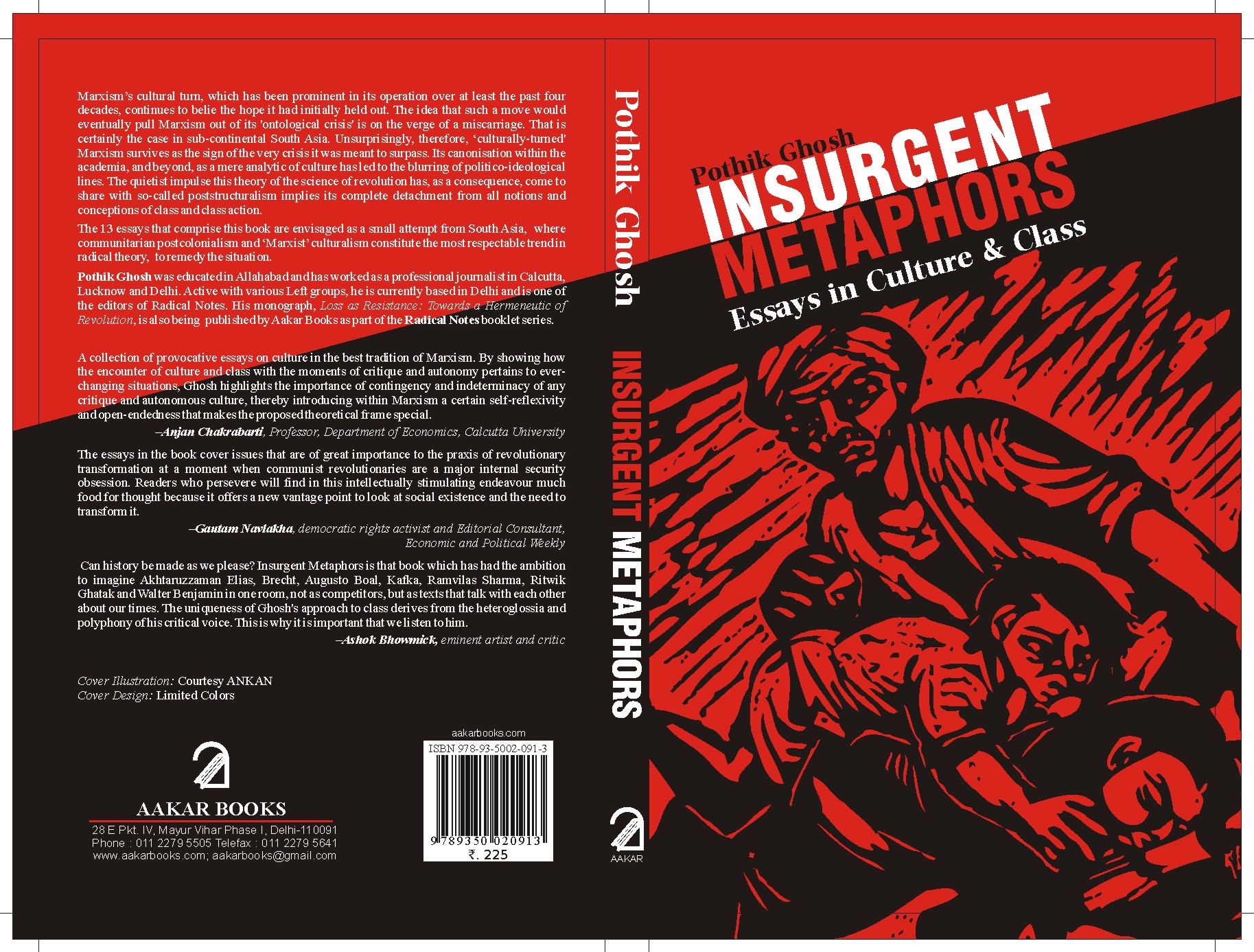
Book Launch: Pothik Ghosh’s “Insurgent Metaphors” (October 1, 2010)

INSURGENT METAPHORS by Pothik Ghosh
published by Aakar Books
to be launched on October 1, 2010
Time: 2.00-5.00 pm
Venue: Room No 308, Indian Social Institute (ISI),
10, Institutional Area, Lodi Road, New Delhi
(Near Jor Bagh Metro Station)


Marxism’s cultural turn, which has been prominent in its operation over at least the past four decades, continues to belie the hope it had initially held out. The idea that such a move would eventually pull Marxism out of its ‘ontological crisis’ is on the verge of a miscarriage. That is certainly the case in sub-continental South Asia. Unsurprisingly, therefore, ‘culturally-turned’ Marxism survives as the sign of the very crisis it was meant to surpass. Its canonisation within the academia, and beyond, as a mere analytic of culture has led to the blurring of politico-ideological lines. The quietist impulse that this theory of the science of revolution has, as a consequence, come to share with so-called poststructuralism implies its complete detachment from all notions and conceptions of class and class action.

The 13 essays that comprise this book are envisaged as a small attempt from South Asia – where communitarian postcolonialism and ‘Marxist’ culturalism constitute the most respectable trend in radical theory – to remedy the situation.


A collection of provocative essays on culture in the best tradition of Marxism. By showing how the encounter of culture and class with the moments of critique and autonomy pertains to ever-changing situations, Ghosh highlights the importance of contingency and indeterminacy of any critique and autonomous culture, thereby introducing within Marxism a certain self-reflexivity and open-endedness that makes the proposed theoretical frame special.

Anjan Chakrabarti, Professor, Department of Economics, Calcutta University

The essays in the book cover issues that are of great importance to the praxis of revolutionary transformation at a moment when communist revolutionaries are a major internal security obsession. Readers who persevere will find in this intellectually stimulating endeavour much food for thought because it offers a new vantage point to look at social existence and the need to transform it.

Gautam Navlakha, Democratic rights activist and Editorial Consultant, Economic and Political Weekly

Can history be made as we please? Insurgent Metaphors is that book which has had the ambition to imagine Akhtaruzzaman Elias, Brecht, Augusto Boal, Kafka, Ramvilas Sharma, Ritwik Ghatak and Walter Benjamin in one room, not as competitors, but as texts that talk with each other about our times. The uniqueness of Ghosh’s approach to class derives from the heteroglossia and polyphony of his critical voice. This is why it is important that we listen to him.

Ashok Bhowmick, eminent artist and critic


Pothik Ghosh was educated in Allahabad and has worked as a professional journalist in Calcutta, Lucknow and Delhi. Active with various Left groups, he is currently based in Delhi and is one of the editors of Radical Notes. His monograph, Loss as Resistance: Towards a Hermeneutic of Revolution, too has just been published by Aakar Books as part of the Radical Notes booklet series.

Seven Decades of Kashmir, 1940-2010

AN EXHIBITION on the HISTORY OF KASHMIR.
Venue: Delhi School of Economics, Delhi University
Date: 21 September 2010
Time: 11.00 AM to 3.00 PM

It has been more than three months since Kashmir has erupted to protest against the murder of civilians by the Indian army. The current phase of protests started on June 11th, when a teenager was killed by a smoke shell fired by Indian security forces. People of Kashmir came out on the streets, en-masse, to demonstrate against this killing. Instead of punishing the culprits who were responsible for this murder, protesters were met with live bullets, tear gas shells, batons, curfew and scores of arrests. According to the Government’s own estimate eighty one people have died since June 11. This includes a numbers of teenagers and even an eight year old child. However, vicious repression unleashed by Indian forces, under impunity granted by the infamous Armed Forces Special Powers Act, has failed to intimidate the Kashmiri people; in fact every act of brutality has brought increasing number protesters on the streets. The latest stage of this decades-old
conflict between the people of Kashmir and the Indian state has only been escalating, with civilian deaths at the hands of the armed forces being reported almost daily.

Today Kashmir has forced us to think critically about Indian democracy. The erosion of democratic space won’t stop at the border of Kashmir; it will engulf us – if it has not done so already. At this crucial juncture it has become imperative for the entire civil society; particularly students to engage themselves with the debate on Kashmir and its future. However, we must remember that the recent protest and repression in Kashmir is not an isolated event, it has a long history of seventy years. If we fail to contextualise the issue then a debate today will be rendered useless. This is particularly important because the mainstream media houses, as usual, are doing their best to trivialise the issue by dissociating it from the historical background.

To start an informed debate on Kashmir and Indian democracy, we invite you to an EXHIBITION on the HISTORY OF KASHMIR.

A Few facts about Kashmir:

700,000 Indian troops are posted in the valley

One soldier for every 14 Kashmiri, biggest militarized non-war zone of the world

80,000 people have been killed, 81 in last three months

International People’s Tribunal found 2700 mass graves where victims of fake encounter killings were buried

Kashmir University Students’ Association has been banned, 15 students were arrested under UAPA for protesting against the recent killings.

INTERNATIONAL CONFERENCE ON CRITICAL EDUCATION, 12-16 July 2011, Athens, Greece

Organized by the journals:

JOURNAL OF CRITICAL POLICY EDUCATIONAL STUDIES (UK)
CULTURAL LOGIC (USA/CANADA)
KRITIKI (GREECE)
RADICAL NOTES (INDIA)

The venue of the Conference will be the city of Athens and possibly the surrounding areas.

Conference and Local Organizing Committee Coordinators:
Dave Hill, (Middlesex University, UK)
Peter McLaren, (UCLA, USA)
Kostas Skordoulis, (University of Athens, Greece)

Keynote Speakers:
To be announced, to include Dave Hill, (Middlesex University, UK), Peter McLaren, (UCLA, USA), Ravi Kumar (Jamia Milia Islamia University, Delhi, India). There will also be keynote speakers from Greece. Key women Marxist writers are being invited as Plenary speakers.

Important Dates

Participants should submit an abstract of 300 words by: 15 December 2010.
Notification of acceptance of paper presentation by: 15 January 2011.
Full papers should be submitted by: 30 May 2011.

The papers will be peer reviewed and published in the Conference Proceedings.

Selected papers will be published in Special Issues of JCEPS, Cultural Logic and KRITIKI.

Presentations
There will be 6 plenary presentations (two per day), each plenary session lasting one hour. Other papers will have 30 minutes (inclusive of the paper presentation plus discussion)

Conference Fee

The Conference fee is 300 Euros. (approx $380, or £245). The fee covers participation in the conference, the book of abstracts, coffee/tea/refreshments during conference breaks and participation in the conference dinner in a traditional taverna.

Participation of unemployed, and of colleagues from the third world is free/ no fees.

Further Information about the Invited speakers will be announced in the second circular. As will the contact address and registration details for the conference. Though in the meantime it would be interesting to see who might intend to offer papers… send me a provisional (non-binding) indication of interest if you like? (dave.hill35@btopenworld.com and dave6@mdx.ac.uk ) (It’s not mandatory to let me know in advance… … paper abstracts can be submitted until 15 Dec 2010.

Many thanks

Dave Hill, Kostas Skordoulis and Peter McLaren

Protest Against Operation Green Hunt in New York, August 13 2010

Protest Against the Indian Government’s “Operation Green Hunt”

Where: At the Consulate in New York City (3 East 64th Street)

When: On August 13 at 11 a.m.

Contact: communications [at] sanhati [dot] com

NEW YORK CITY – Sanhati, and other organizations and individuals, are organizing a protest against the Indian government’s insidious war, named “Operation Green Hunt,” which has been unleashed on the inhabitants of the forested regions of East-Central India. The protest will approximately coincide with Indian Independence Day (August 15) to emphasize that the promises of independence have remain largely unfulfilled for a large section of the population, including the tribal peoples.

In its current phase, this war is concentrated primarily in the forested regions of East-Central India, stretching from the states of Chhattisgarh to Jharkhand and West Bengal. This region is home to significant amounts of natural resources.

Big corporations, both Indian and foreign, are plundering these natural resources for quick profits and plan to continue doing so while paying almost no attention to the enormous environmental and human costs inherent in their ventures. The state and central governments continue to welcome these big corporations with open arms by signing an unknown number of memoranda of understanding with them—whose details have been kept secret. A recent report by the Ministry of Rural Development, on the other hand, described these trends as one of the biggest land grabs since the time of Columbus.

Yet these forested areas house not only natural resources. This region is home to a large section of India’s roughly 100 million Adivasis (i.e., the tribal population). Using all means at their disposal, the Adivasis resisted the government’s efforts to forcibly drive them from their ancestral lands. Drawing on the Fifth Schedule of the Indian Constitution, which is devoted to Adivasi rights and provisions for their protection, Adivasi activists challenged the government’s expropriations.

Instead of addressing the genuine grievances of the Adivasis, the Indian government has cracked down on their legitimate protests in violation of the letter and intent of the Indian Constitution. Peaceful resistance movements across this region have been met with police brutality and military might; this forced the arming of a section of the resistance movement. State-assisted vigilante groups like the Salwa Judum in Chhattisgarh and Harmad Bahini in West Bengal were a response of the state to the armed resistance of the Adivasis.

When that failed, Operation Green Hunt—a further escalation and militarization of the State’s response—emerged. Such militarization is facilitated by the Indian government’s military cooperation with the United States and Israel.

Sections of civil society have been urging the central government to stop Operation Green Hunt and begin negotiations with the diverse people’s organizations opposing the looting of natural resources. The response of the government to the idea of dialogue has in general not been encouraging in view of the plans of increased militarization, human rights abuses committed by the security forces, suppression of dissenting voices, and abductions and killings of the leaders of people’s organizations.

In this context, Adivasis in India, and all the people who are with them in this struggle for freedom from exploitation and oppression, need your support. Join us to protest against Operation Green Hunt and the increasing violence of the Indian State on democratic movements on August 13, 2010 at 11 a.m. in front of the Indian Consulate in New York City.

Oppose the biggest land grab since Columbus!

Oppose Operation Green Hunt!

Oppose the war on people!

###

Sanhati (www.sanhati.com) is a forum of activists, professionals, workers, academics and intellectuals that stand in solidarity with peoples’ struggles against corporate capital and for the upholding of democratic rights in India. The group strives to be an integral part of the international search for alternatives to the capitalist social order.

Contact: communications [at] sanhati [dot] com

********************

Background Note

********************

India Shining, so claimed the BJP-led government. Today, the Congress-led regime might boast that it successfully increased annual economic growth from 5.6% to 8.3% in the last six years, while criticizing the previous BJP-led alliance.

Between the 5.6% and 8.3%, there lurk other stories. About three-quarters of India’s people live on less than Rs. 20 per day, while almost half of the women in India are still illiterate and about 80% of households do not have access to safe drinking water.

Between 1997 and 2006, there lurk other stories. Nearly 170,000 farmers committed suicide by drinking pesticide because they could not keep up with demands to repay their loans. In addition to the agrarian crisis, whatever little access the poor had to common property resources has come under increasing attack by the Indian government in the guise of Special Economic Zones (SEZs) and other “development” projects related to mining, industrial development, information technology parks, and so forth.

Immeasurable stories such as these are grafted onto the underbelly of neo-liberal economic “development” in India. A recent report, penned by the Indian Ministry of Rural Development, described these trends as the biggest land grab since Columbus. In truth, it wouldn’t be hard to keep citing official statistics revealing not only the shadows within the Shining India myth, but huge pockets of darkness. To be perfectly honest, none of this is new. If there is one image of India that has persisted in the Western media, it is the image of bone-thin, bare-bodied children with swollen bellies, scavenging for food-crumbs in trash-cans next to stray dogs and wild birds.

But something has changed in the last five years.

India, like many other parts of the world, has seen the emergence of a whole spectrum of mass movements challenging the global neo-liberal onslaught in many different ways. These movements are not attempts to “brainwash” the masses by English-spouting city-bred students or intellectuals with romantic dreams of social change. On the contrary, these movements are being led by the very people who have been persistently excluded from reaping the benefits of development and growth – in short, the people who live in the pockets of darkness within the so-called shining India.

The proverbial aam aadmi has spoken. The oppressed of India have shown an unwillingness to stay oppressed for eternity, despite the policy of the government to “kill the poor and not the poverty.” These struggles are primarily about defending their lands, rivers and homes from corrupt officials and swindlers. Moreover, these movements have demonstrated that not only has the government failed to deliver on the promises of the basic rights of the Indian constitution itself, the interests of the most economically disadvantageous people have seriously been compromised by its almost total and unconditional submission to the interests of corporations like Mittal, Vedanta, Tata, Essar, Salim, Jindal, and POSCO.

Instead of improving governance while addressing dissent and discontent in an inclusive way, as be-fitting any democratic government, the Indian government has unleashed severe state violence. The government of India has launched an insidious war nicknamed Operation Green Hunt. While the terror initiated by the government since 2009 is by no means unique in view of the history of the state repression across India (e.g., West Bengal, Orissa, Kashmir, the Northeasten states, Punjab, and Andhra Pradesh), Operation Green Hunt is unprecedented both for its array of military force and its media mobilization.

Since last year, more than 100,000 military and paramilitary troops have been sent into Adivasi (i.e., indigenous) areas. Moreover, it was recently announced that 36 battalions of Indian Reserve Forces will be added to the 105 already raised, along with 16,000 more “Special Police Officers” (civilians trained and armed by the government) bringing their total strength to 30,000. Through this new military campaign, which almost brings to mind histories of colonial occupation of land, the military “occupiers” are to gradually spread into one “sanitized” area after another.

Some additional relevant facts:

  • Twenty Warfare Training Schools are being built in India.
  • Prime Minister Manmohan Singh recently spent $18 billion in the US to buy huge amounts of military supplies and munitions. This included state-of-the-art global positioning systems and night-vision-capable automatic rifles.
  • Drones are being purchased from Israel and the Israeli Mossad is training Indian police as snipers. The aim of the training is to enable assassination of the leaders of diverse mass movements. The recent murder of the Communist Party of India (Maoist) spokesperson Azad, who was also the party’s emissary for negotiations on a ceasefire, clearly reflects one aspect of the government’s modus operandi (i.e., targeted killings).
  • According to numerous reports, dozens of indigenous people are being killed each week in the Adivasi regions.
  • The Communist Party of India (Maoist) has been declared India’s “gravest internal security” threat and has been banned. Bans have also been imposed on other democratic organizations on the claim that they are frontal” organizations of CPI (Maoist) and the witch hunt against these civil rights activists continues unabated.
  • The last few months have seen the arrests of increasing numbers of media personnel, journalists, writers, and intellectuals who have shown the slightest sympathy to people’s struggles in the Adivasi heartland. The discussions within the ranks of the police forces in the state of Chattisgarh as to whether the Booker Prize winning writer Arundhati Roy is to be charged under an “anti-terrorism” law following the publication of her essay Walking With the Comrades is a case in point.
  • The state of Gujarat has joined Operation Green Hunt by alleging that “Maoists” are attempting to expand their networks into Gujarat and in particular the tribal regions of South Gujarat. Several activists have been arrested. This witch-hunt of the Gujarat police amounts to a systematic effort by the state government to suppress all manner of dissension and opposition.
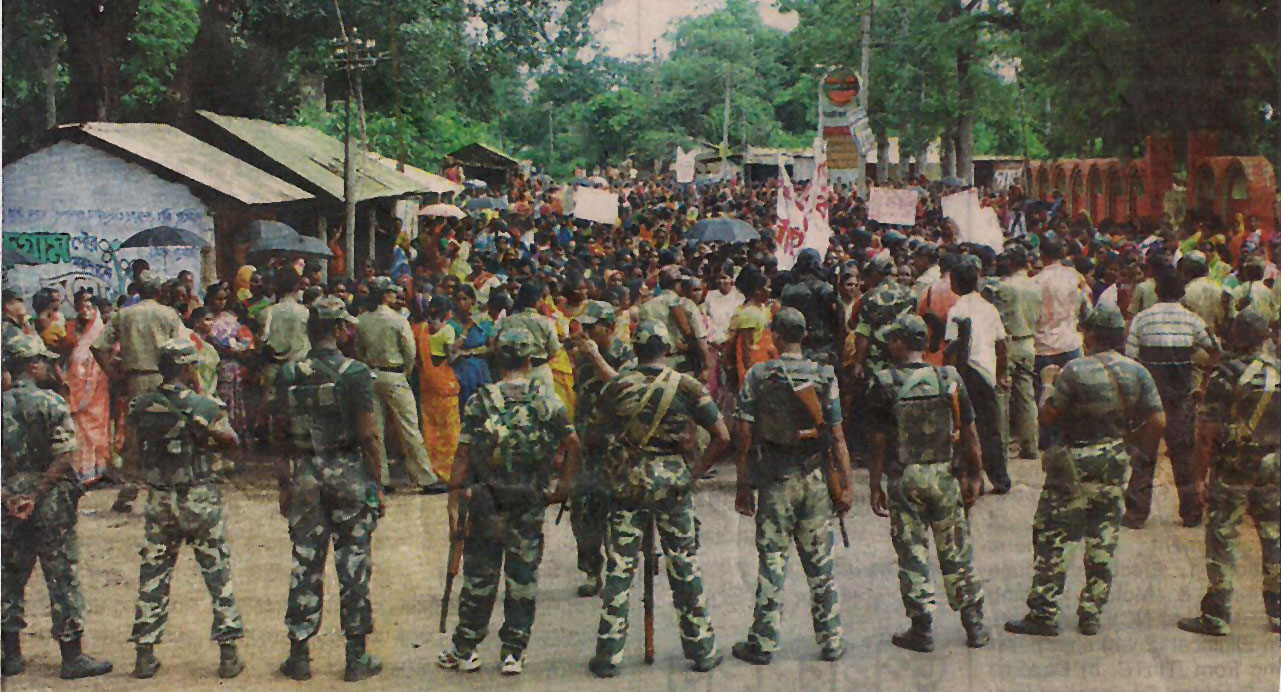
  • Operation Green Hunt includes widespread incidents of rape committed by the security forces. Recently, about 50,000 women tried to march into Jhargram town in West Bengal to protest against these rapes (see photograph above). The marchers included school students in uniform, teachers, housewives and even many elderly women. Widespread rape is a progeny of Operation Green Hunt.
  • The Armed Forces Special Powers Act (AFSPA), one of a number of anti-democratic Acts, continues to give Indian troops immunity from civil legal action and promotes human rights violations. The Naga People’s Movement for Human Rights has aptly observed that this Act is a systematic tool of the Indian government that contributes to terrorizing and dehumanizing civilian populations. This Act also protects security personnel in Kashmir guilty of killing and torturing the people of the valley.


The Indian state, in other words, has declared war on its own people. It has declared war precisely on those sections of the population who have always been at the receiving ends of multiple forms of systemic and institutional oppression. Instead of addressing the genuine grievances of Adivasis facing forcible displacement and dispossession, the Indian government has cracked down on their legitimate protests in flagrant violation of the letter and intent of the Indian Constitution.

Foreseeing the disastrous impact that Operation Green Hunt will have on the common people in those regions, different sections of civil society have called for a dialog between the state and various sections of the resistance, including the CPI (Maoist) and different people’s organizations, involved in struggles in the Adivasi regions. Several attempts to make progress in these efforts failed, with different politicians, bureaucrats and security officers continuously attempting to scuttle negotiations.

A glimmer of hope had risen due to the civil society initiative represented by Swami Agnivesh, with the Union Home Minister and Azad, as spokesperson of CPI(Maoist), responding to him in a letter detailing the suitable conditions under which a dialog might begin. It is reported that Azad was on his way to consult other members of CPI (Maoist) in order to decide future steps for proceeding with this initiative when he was allegedly abducted and killed, thus throwing the possibility of negotiations into disarray. The murder of a spokesperson of a political organization, with which dialog is supposedly being planned at this crucial juncture, raises serious doubts regarding the government commitment to such a dialog.

In this situation, the activists in India need your presence support. Join us to protest against Operation Green Hunt and the increasing violence of the Indian State on democratic movements on August 13, 2010 at 11 a.m. in front of the Indian Consulate in New York City. We have chosen August 13, as this date roughly coincides with Indian Independence Day, when the country became a sovereign nation-state following its colonial occupation by Great Britain. We would, therefore, like to record our protest and remind the public that the promises of the Indian independence have not only remain unfulfilled, but the current Indian government has resorted to military repression to quell democratic dissent in a way uncannily similar to the erstwhile British “overlords.” We invite all in diaspora, the international community of media activists, human rights workers, academics and intellectuals and artists to join us.

Peace March in Chhattisgarh from May 5

Azadi Bachao Andolan

The country is in the midst of a civil war. In the estern part, West Bangal, Odisha, Jharkhand and especially in Chhattisgarh, violence, both by Mioists and by the state, has erupted resulting in heavy loss of life of poor people, especially of adivasis.

People, who believe in peace and non-violence, are facing the question : what can be done right now? (At the present moment, we are not discussing the causes like exploitative, iniquitous model of development etc. which has led the country to the present crisis). Out of the meeting with Gandhians like Amarnath Bhai at Sevagram on April 9 and jurists like Justice PV Savant, scientists like Prof Yash Pal, Dr. P.M. Bhargava, Dr. Vandana Shiva, social activists like Swami Agnivesh during Independent People’s Tribunal in Delhi on April 10 and 11 and the senior journalist Kuldip Nayar, an idea has emerged: 50 persons, who are known in the country for their integrity and who believe in peace and non-violence, should take out a peace march in Chhattisgarh as early as possible. These 50 peace marchers will be joined by others also.

The Peace-March will start form Raipur (Capital of Chhattisgarh) on May 5, 2010.

Peace marchers are requested to reach Raipur by noon of May 5.

The details of Peace March, assembly point in Raipur etc will be communicated soon.

Those, who have already given their consent to participate in the Peace March, include Prof. Yash Pal (Former UGC Chairman), Dr. P.M. Bhargava (famous bioscientist), Narayan Desai (Veteran Gandhian and Chancellor of Gujrat Vidyapeeth), Kuldip Nayar (Senior Journalist), Justice Rajender Sachchar (former chief justice of Delhi High Court), Amarnath Bhai and Lavanam (Veteran Sarvodaya leaders), Ms. Radha Bhatt, President, Gandhi Peace Foundation, Prof Anil Sadgopal (Educationist and President of All India Forum for Right to Education), Arvind Kejariwal (Magsaysay Awardee), Prof. Jagmohan Singh (Historian and Nephew of Bhagat Singh).

Lovers of peace and non violence who want to end civil war in the country and , wish to join Peace March should contact Kuldip Nayar (Ph. 09818309444) e-mail kuldipnayar09@gmail.com) or Dr. Banwari Lal Sharma (0532-2466798, 09235406243) e-mail azadi.bachao.andolan@gmail.com)

Video: Abaixo o estado fascista e expansionista indiano – Brazilian protest against Operation Greenhunt

Public Meeting: Indian State’s War on People and the Assault on Democratic Voices (April 24)

FORUM AGAINST WAR ON PEOPLE

Public Meeting
Indian State’s War on People and the Assault on Democratic Voices

3PM-8PM, 24TH APRIL 2010
Gandhi Peace Foundation, Deen Dayal Upadhyay MARG, ITO, DELHI

SPEAKERS: Randhir Singh, Justice Rajender Sachar, PK Vijayan, Madan Kashyap, Sumit Chakravorty, Neelabh, B D Sharma, S A R Geelani, Aparna, Kabir Suman, Darshanpal, Arundhati Roy, Ravinder Goel, Karen Gabriel, N Venuh(NPMHR), S R Sankaran(to be confirmed), Kalpana Mehta, Rajkishore, Varavara Rao, G N Saibaba, Mrigank, Ish Mishra, Radhika Menon, Shivmangal Sidhantkar and others

Operation Green Hunt is an unprecedented military offensive on the people: Indian government has been at war with the people of Kashmir and the North East for decades. In the name of ‘national security and integrity’ and ‘national interest’, the government has been trying to crush the democratic aspirations of these oppressed nationalities with state terror. Through Operation Green Hunt, the government has brought its war on people to the heart of India. If the total number of government forces presently engaged in this Operation is taken in its entirety (including the paramilitary forces and the state police) it comes close to a quarter of a million (2.5 lakh). This is more than double the US forces presently deployed in the occupation of Iraq —approximately 1.2 lakh— and bigger than the armies of Australia, Netherlands and South Africa put together. The war preparations alone speak volumes about the real intentions of the government. Air Force helicopters equipped with guns are used against the adivasis, airstrips are constructed in Raipur and Jagdalpur, tens of Jungle-Warfare schools are established to train the forces in special operations, new barracks and bases to station armed forces are prepared all over the war zone, and public buildings such as schools, panchayat houses and health centres are converted to camps for the Security Forces and torture chambers. In the name of fighting Naxalites/Maoists, new armed forces such as the CoBRA, Jharkhand Jaguar, C-60, etc are raised with public money to unleash terror on the adivasis. With a heinous intent, special emphasis is given by the government to recruit adivasi youths into government forces and state-sponsored vigilante gangs to instigate a bloody internecine war. To top it all, army commanders are deputed to oversee the war operations while the US is providing ‘advisors’, military intelligence, satellite surveillance and overall ‘tactical guidance’.

The hidden objective behind this unprecedented military offensive is to crush all forms of people’s struggles and revolutionary movements so as to clear the way for the giant multinational companies, with whom hundreds of MoUs have been signed by the government. Till September 2009, MoUs worth of Rs.6,69,338 crores have been signed in the adivasi regions of these states (which is 14 percent of the total pledged private investment in the entire country). Arcelor Mittal alone is planning to invest $24 billion for the production of iron-ore in the mineral-rich regions of Jharkhand and Orissa. Likewise, the financial worth of the unexplored bauxite deposits of Orissa alone is estimated to exceed $4 trillion. The powerful foreign and Indian corporations are lying in wait for the government clears the land of the adivasis and smash their resistance, so that they can move into the land with earth-diggers and empty the land out of its minerals. The stage has been set to undertake what has been termed by a Government-appointed committee as the “biggest land-grab after Columbus”. The target this time is not the indigenous inhabitants of North America, but the adivasis of central and eastern India.

The ongoing War on People leaves a trail of devastation and death: In the wake of this war imposed by the government on our own people the death-count in mounting. In a region where 40 people are said to be killed every week on an average (Outlook, 22 February 2010), what the corporate media has missed or has deliberately overlooked is the sheer number of adivasis who died in the hand of the government’s armed forces. Whereas the government has claimed success in killing around 170 ‘Maoists’/‘Naxalites’ during the joint operations under Operation Green Hunt till now, whereas the media quoted the Maoists saying that none of the killed were the members of their organisation. There are reasons to believe that a great part of the dead were unarmed and defenceless villagers killed in cold blood by the joint forces in fake encounters. The killing of adivasis in Gompad, Singanmadugu, Tetemadugu, Dogpadu, Palachelim, Palad, Kachalaram and scores of other villages in Chhattisgarh seems to have followed such a pattern.

An attack on democratic voices: By these acts of fascist repression, the government has made it very clear that the Naxalite movement is not the only target of its war operations. Any movement, organisation or individual that fights for people’s demands and against government policies, is to be branded as a part of the Naxalite/Maoist movement and suppressed by the government through Operation Green Hunt. Swapan Dasgupta, the editor of the journal People’s March in Bengali and owner of Radical Publications was arrested. He died in police custody on 2nd February 2010 even before his trial began due to police torture. He has become the first martyr to fall under the draconian UAPA. Lalmohan Tudu, president of People’s Committee against Police Atrocities (PCAPA) in Lalgarh was picked up from his house and shot dead by the paramilitary forces on 23rd February, 2010. On 20th November 2009, Wadeka Singana, the president of the Chasi Mulia Adivasi Sangh (CMAS), Narayanpatna in Orissa along with another activist was shot dead by the police during a rally to protest against the atrocities committed on women by the government’s armed forces. Two of the CPI(ML) leaders Ganapati Patro and Tapan Malik have been arrested on numerous trumped up charges. In Kalinganagar 28 platoons of special police were used to attempt to forcibly acquire land for a road in service of Tatas. When the Bisthapan Birodhi Janmanch Sukinda led adivasis protested, police firing on 30th March 2010 led to bullet injuries to 16 tribal people. Repression is intensifying in the anti-land acquisition movements of Niyamgiri and Jagatsinghpur and against movements under Lok Sangram Manch in Rayagada of Orissa.

The Vanavasi Chetna Ashram of Himanshu Kumar, a Gandhian social activist working in Dantewada for the past 18 years among the adivasis and fighting against the atrocities of Salwa Judum, was razed to the ground on 17th May 2009. In three eastern districts of Uttar Pradesh no mass activity is allowed by declaring these districts as ‘Naxal-infested.’ Two PUCL activists, Sheema and Vishwa Vijay were arrested in Utter Pradesh. Hundreds of leaders of farmers’ organisations in Punjab were arrested to prevent their democratic right to protest against state killings of farmers and other leaders. Thousands have been imprisoned in jails all over the country and tortured for allegedly being Naxalite/Maoist ‘sympathizers’. People’s organisations like PUCL, IAPL, PUDR, RDF, PDFI, CRPP, APDR, DSU, etc. and their activists have been falsely implicated by the government. This is an attempt to unleash state terror in order to curtail our democratic rights and to silence all voices of dissent against this genocidal Hunt of the Adivasis. A climate of undeclared emergency now prevails in the country in the wake of this war on people and the assault on democratic space by the Indian State.

The Home Minister, who has been campaigning desperately to mobilise support for this US-dictated war on the poorest of the poor, has even gone to the extent of denying the existence of Operation Green Hunt! Similarly, he continues to utter the rhetoric of ‘Talks’ while refusing to take a single step towards creating a conducive atmosphere for any negotiation to take place. Such, lies, hypocrisy and double-talk by Chidambaram with the support of the Arnab Goswamis, Rajdeep Sardesais and his other wily allies in the corporate media, has not been able to hide the truth of this war. Even the Supreme Court of India, while hearing a petition on the ‘disappearance’ of 12 adivasis from Gompad village of Dantewada district during Green Hunt, castigated the government’s offensive. The court observed, “Some of the reports appearing in the media are disturbing. Over two lakh people have been displaced in this fight… Where will they go? What will they grow?” (IBN Live, 17 February 2010).

The resistance to the government’s war on people is growing: The millions of adivasis under direct attack from the state’s offensive are using all means to defend themselves and their jal-jangal-jameen. The democratic and progressive sections of the country have also come out against the government’s war on the people in the last few months. Individuals and organisations within India and abroad have in one voice condemned the government’s genocidal war. Hundreds of protest rallys, dharnas and demonstrations are being organised in different parts of the country and outside. Peasants, workers, employees, intellectuals, artists, writers, civil rights activists, students etc. have registered their strong protest against the government, and demanded an immediate halt to the Operation Green Hunt. The need of the hour therefore is to unite and build the broadest possible solidarity among the people against this war and intensify the resistance. Only an unceasing wave of mass resistance can stop government’s assault on struggles against sale of the country and plunder of resources and suppression of democratic struggles.

In memory of Pyla Vasudeva Rao, a leader of the Srikakulam Armed Struggle

Naujawan Bharat Sabha (NBS)
Delhi Committee

A memorial meeting for Com. Pyla Vasudeva Rao
Date: April 20 2010 (Tuesday), Time: 5:30 PM o
Venue: Gandhi Peace Foundation, Deen Dayal Upadhyay Marg (near ITO)

Veteran communist revolutionary of India and one of the foremost leaders of the glorious Srikakulam Armed Struggle Pyla Vasudeva Rao breathed his last at 10:00 AM on April 11, 2010 after fighting cancer. He was 78 years old at the time of his death; of these he had party life of 58 years of which the last 42 years were spent in underground.

Born in 1932 in Rittapadu village of Srikakulam dist, Com. Pyla joined the united Communist Party in 1953 when a party unit was formed in his village. Taking up a teacher’s job on the Party’s instruction, many of his students joined the revolutionary communist movement. He became a professional revolutionary in 1962 and also a member of the district committee of the party.

In response to the clarion call of the Great Naxalbari Peasant Armed Struggle, the Srikakulam Girijan Armed Peasant Struggle started on 25thNovember 1968 and on the decision of the party, Com. PV went underground. As a member of the Srikakulam leadership, Com. Pyla became part of the CPI(ML). He participated in the 1970 CPI(ML) Party Congress (first after Naxalbari). In Srikakulam movement he worked alongside Comrades Panchadi Krishnamurthy, Vempatapu Satyam, Adibhatta Kailasam, Subbarao Panigrahi and others.

Between 1969-70 many important leaders of Srikakulam leaders were martyred and the movement suffered huge losses and setbacks. CPI(ML) PC was reorganized of which Com. Pyla became the secretary. Opposing the line of individual annihilation, Com. Pyla resigned as PC secretary and joined with other Srikakulam comrades to revive CC led by S.N. Singh. Since then he was a member of the Central Committee of the Party. In 1974, APRCP led by Com. CP Reddy merged with the CPI(ML) led by Com. SN Singh and Srikakulam movement became part of the state movement. Com. Pyla was elected state committee secretary in 1976 when Com. P. Ramanarasaiah was killed in a fake encounter.

He was re-elected to the CC in the 1980 Special Congress. For long the Party in AP was identified with his name.

Com. Pyla consistently practiced and supported the revolutionary mass line and struggled against rightism and revisionism. He was an ardent votary of an armed agrarian revolution and of building areas of sustained resistance. His death comes at the time when the peasants of India are rising in many parts against the decadent rule of the ruling classes, against landlord oppression and forcible displacement. Srikakulam Armed Struggle continues to inspire the revolutionaries and struggling people of the country. Srikakulam Armed Struggle which reached the highest point in terms of resistance and people’s participation among all the struggles inspired by Naxalbari continues to serve as a beacon light for the present revolutionary movement. Com. Pyla as one of the leaders of that movement continues to live in the memory of the revolutionaries and the struggling people of the country.

Event: Occupied! Workers’ Factory Occupations North and South

Film Screening and Debate

Date: Saturday, April 17, 2010
Time: 1:30pm – 5:30pm
Location: Indian Social Institute (ISI) 10, Institutional Area, Lodi Road, New Delhi (India)

We will screen two short documentaries about workers’ occupation of Visteon car parts factory in London in April 2009 and the occupation of Hero Honda plant near Gurgaon in May 2008. Marco, who has been involved in the Visteon occupation, will share his experience. We want to debate about the potentials and difficulties of workers’ struggles in Delhi’s industrial belt and about what kind of practice a revolutionary left can develop in support.

Enfield, England
“Visteon Occupation – they fight for us all” (20min)

After the crisis blow of autumn 2008 the global car industry started an attack on its work-force. The Ford subsidiary Visteon decided to shut down three plants in the UK – the workers responded by spontaneous occupation. The documentary shows the self-activity of workers and the role of state and unions. We will have the possibility to discuss with a comrade who was actively involved in the occupation.

More about Visteon Struggle

Gurgaon, India

“Interview with Hero Honda Workers” (20min)

In the last years there have been several ‘wild’ occupations of factories in Gurgaon. The occupations were organised mainly by workers hired through contractors and they remained largely unknown to the wider public: five days occupation at Hero Honda and Delphi in Gurgaon in 2006, at Medikit and Honda HMSI in 2007, at Hero Honda in Dharuhera in 2008. These struggles ask us – a revolutionary left – about our potentials of practical support. Comrades of Faridabad Majdoor Talmel will present some ideas.

More about Hero Honda and other struggles in Gurgaon