Delhi: Protest Demonstration and Memorandum in solidarity with Haridwar workers (April 17)

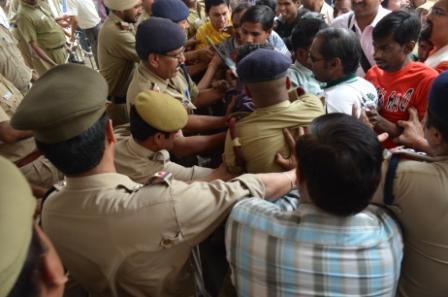
Today (April 17), a joint protest demonstration was organized in front of the Uttarakhand Niwas, Chnakyapuri. The protestors raised slogans against the management of Satyam Auto and Rockman Auto Pvt Ltd, and the anti-labour Uttarakhand government. They strongly condemned the brutal lathicharge on struggling workers, and their illegal detention in various jails acroos Dehradun. Members of the following organizations were present: Inqulabi Mazdoor Kendra, Mehnatkash Mazdoor Morcha, AIFTU(New), Mazdoor Ekta Kendra, Krantikari Lok Adhikar Sangathan, Uttarakhand Nav Nirman Mazdoor Sangh, Mazdoor Patrika, Krantikari Naujawan Sabha, PDFI, Pragatisheel Mahila Ekta Kendra, TUCI, Radical Notes

A five member delegation handed over the following memorandum to the Resident Commissioner of Uttarakhand.

Dated: 17.04.2012

To
The Residence commissioner
Uttarakhand Bhawan,
Govt. of Uttarakhand
New Delhi

Sub:- Memorandum on behalf of Mass organizations in solidarity with workers of Rockman Industries pvt. Ltd. & Satyam Auto component Ltd.

Sir,

We are in solidarity with the workers of Rockman Industries pvt. Ltd. & Satyam Auto component Ltd. of SIDCUL Haridwar who are on path of agitation for their trade union demands from management. Labor department and state government is well aware with the rampant violation of labor laws in these companies like other industries situated in SIDCUL, however they do not feel any necessity to intervene in the matter to check the super exploitation of workers by the management. Contrary to their administrative responsibility assigned under the law of the land, they are hobnobbing with the management and resorted to repress the workers movement.

On 15.04.2012 workers who were on Anshan w.e.f. 06.04.2012 in capital city of Dehradoon were lathicharged and detained under various penal provisions. 326 workers are in jail and 11 were forcibly hospitalized. Management who is responsible for industrial unrest is moving freely and hobnobbing with newly elected congress government which is determined to crush worker’s movement like Haryana and other states.
Uttarrakhand government claims that after formation of new state it has gone ahead with industrialization of the state and in order to do so, SIDCUL has been established in different parts of the state like, Haridwar, Rudrapur, Pantnagar etc. However we have found that these are hell for the workers. No Job security, no wage norm, no labor law and sheer exploitation of the workers are only norm in these industrial areas of Uttarkhand. It is tax heaven for the investors and corporate and hell for the workers. Casualization and contract system that too, illegal contract system is norm in the industrial belt of uttarakhand.

The above named industrial units are major vendor of Honda motor co. , which do not adhere to the labor norms. Illegal contract system is going on in these factories and workers are forced to work on lower wages upto 12 hours a day. Workers in these units of Haridwar are paid only Rs. 6000 P.M. by the co. for the similar work , which get Rs. 12000/ per month in gurgaon plant of the co. Workers are deprived of basic right to form union of their own choice. 5 leading workers were terminated since they had taken initiative to form union and put forward their wage related demands. Around 600 workers of Rockman industries are on strike 18th March 2012 however labor department and civil administration is unmoved by the agitation of the workers. Both regular and contract workers joined the strike for furtherance of their demand.

We condemn police atrocity on striking workers and demand that:-
1. Police officials responsible for lathicharge on workers and illegal detention of workers be reprimanded and charge sheeted.
2. Labor minister of Uttarakhand Government resolve the labor dispute by calling a meeting of agitating workers and management of Rockman Industries pvt. Ltd. & Satyam Auto component Ltd.
3. Restore labor laws in Rockman Industries pvt. Ltd. & Satyam Auto component Ltd as well as in other industries in Uttarakhand.
4. Terminated workers of Rockman Industries pvt. Ltd. be reinstated without any condition.
5. Illegal contract system be abolished.
6. Management of Rockman Industries pvt. Ltd. & Satyam Auto component Ltd. be punished for violation of labor laws.
7. Workers of Rockman Industries pvt. Ltd. & Satyam Auto component Ltd. be paid wages proportionate to the workload and they should be paid overtime as required under law.

• Inqulabi Mazdoor Kendra
• Mehnatkash Mazdoor Morcha
• Mazdoor Patrika
• Krantikari Lok Adhikar Sangathan
• Krantikari Naujawan Sabha
• PDFI
• Pragatisheel Mahila Ekta Kendra
• Radical Notes

Protest Demonstration in Delhi (April 12, 11:00 am)

12th April @11.30 am, in front of Banga Bhavan, Hailey Road
We will assemble at Mandi House Metro Station at 11a.m.

We find that the anti-people character of the West Bengal government is getting exposed daily. The police and bulldozers of Trinamool-led West Bengal government has not only evicted slum-dwellers of Nonadanga in South Kolkata, but lathicharged and then arrested residents in a continuous spate of its developmental terrorism. It has sent into police custody 7 activists of various mass and democratic rights organisations, who are kept in isolation, and allegations of ‘arms and ammunition found’ etc are doing the rounds.

We strongly condemn this anti-people development model and the eviction of slumdwellers and hawkers in Nonadanga and all over Kolkata, and demand that this be brought to a halt and the question of housing and rehabilitation of the residents be addressed. We also demand that the arrested activists be released and the the false charges dropped immediately.

AISA, AIRSO, Bigul Mazdoor Dasta, Disha Students Organisation, Inquilabi Mazdoor Kendra, Krantikari Naujawan Sabha, Krantikari Yuva Sangathan, Mehnatkash Mazdoor Morcha, Mazdoor Patrika, P.D.F.I., P.U.D.R., Students for Resistance, Vidyarthi Yuvajan Sabha and others.

Blind Workers demonstrate for their rights (March 27)

Blind Workers’ Union
(A Unit of All India Federation of Blind Workers)
Affiliated to Workers Unity Center of India, WUCI
Contact: 9313730069 Email: blindworkersunion@gmail.com

Blind Workers’ Union all-up against violation of their labour rights and government inaction.
Blind Workers’ Union warns Social Justice Ministry of grave consequences if alternative jobs are not provided to retrenched blind workers.

Today (March 27), Blind Workers’ Union in mid of heavy deployment of police and barricades, staged a massive demonstration outside the Sarai Rohilla Railway Station in Delhi. Initially the unemployed blind workers tried to enter the railway station and block the rail traffic but the heavy contingents of police did not allow them to enter the railway track from any side. Thereafter these blind workers shouted anti-government slogans and held a protest meeting outside the station.

It is to be noted that the Blind Workers’ Union has been raising the issue of violation of blind workers basic labour rights since November, 2011. We have been raising our voice against violation of basic labour rights like minimum wage, PF, bonus, overtime payment etc. The workers were deeply agitated over the fact that despite several representations to the Ministry of Social Justice and Empowerment, there has been no concrete step taken either against the erring employers or to give these blind workers employment in public sector. These blind workers were thus forced to take up this drastic step so that general public becomes aware of their misery. These blind workers are demanding employment in public sector so that their rights are not violated by NGOs and private enterprises. In their most recent memorandum to Social Justice Ministry these blind workers demanded that the Ministry must make alternative provisions of jobs for these blind workers before 27th March or else they will be left with the alternative of either die of hunger or carry an all-out struggle against government.

In the protest meeting that was carried out outside the station it was resolved that this struggle of blind workers should be taken as an ultimatum by the government. They further warned the government and ministry that if they fail to provide employment immediately to these blind workers then from next month onwards they would be forced to carry out this Rail Roko in different parts of the country and next time they would even defy police.

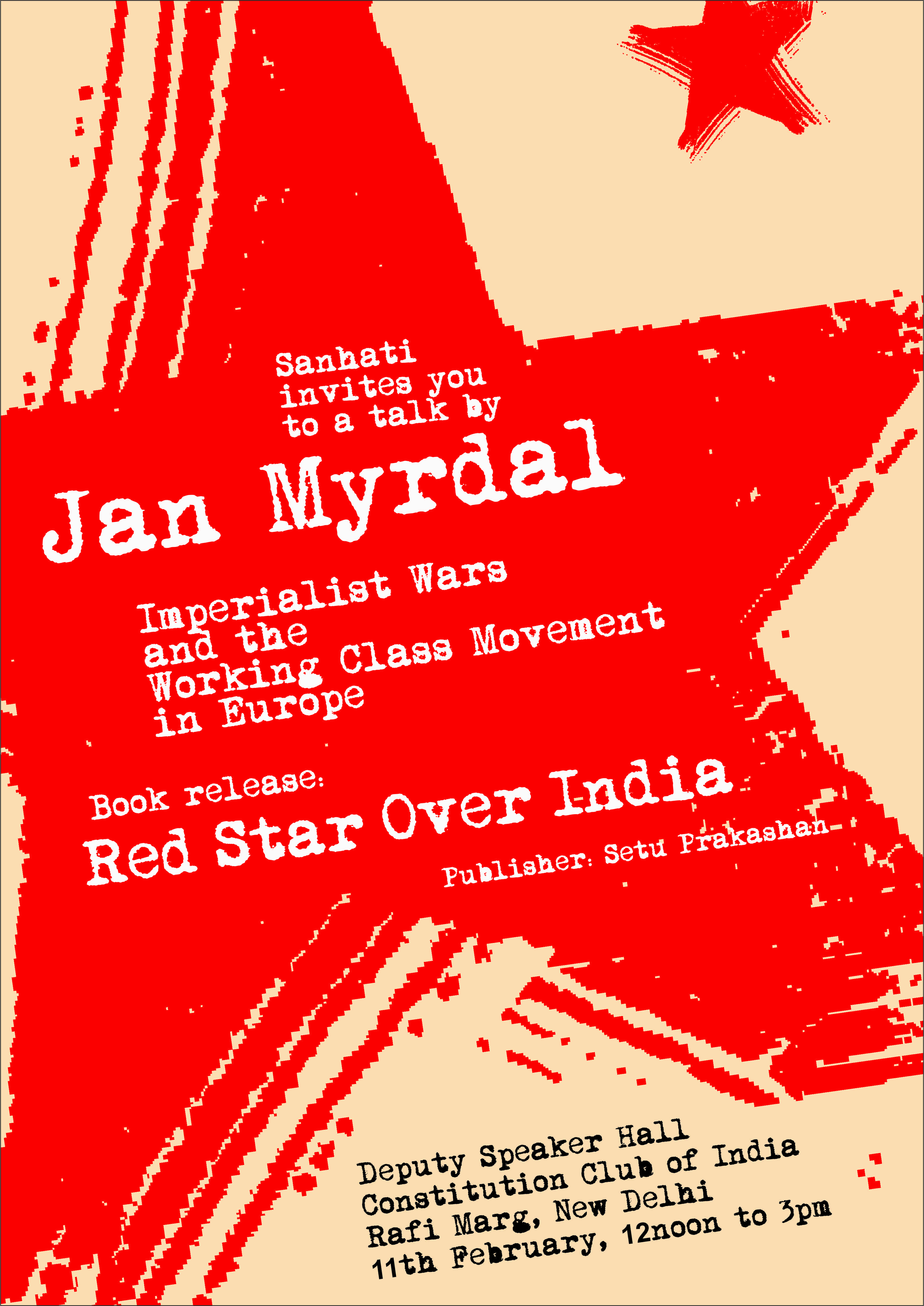
Book Release & Discussion: Jan Myrdal’s “Red Star Over India” (New Delhi, Feb 11)

Blind Workers’ Union’s Convention (New Delhi, Feb 11)

For some Gup-Shup in Faridabad (February 7)

Faridabad Majdoor Samachar

To contribute to radical social transformations that are mushrooming all over the world, feel free about : stammering, fragmentariness, incoherence, missing steps….. Social (and natural) reality are very complex and dynamic. Leaps in interactions amongst seven billion human beings are on our agenda.

It is only in the present that we can act/prepare to act. What to do and what not to do, how to do and how not to do are coloured by the different facets/ sectionalities in the present and also carry deep imprints of the past (not only near and distant past but also different pasts of different locations/groups). So a request: Try not to be polemical; try not to attempt to clinch arguments; try to respect your own selves (by implication you will respect those around you). Primarily it is to act, it is for better actions that this gup-shup is premised on. “Cataclysmic event” language and imagery seems problematic; languages and imageries that are premised on active participations of seven billion human beings are indispensable for radical social transformations.

A technical constraint in the gup-shup is that we will be using mostly English language.

Some Statements Etcetera

* Small groupings of human beings called birth a shaap (curse) or the fall. Half of their numbers, females were described as sin personified. What was tragic for small groupings is today a tragedy for all human beings, for all living species, for the earth.

* It does not seem that something had to happen, rather possibilities and probabilities seems to be the norm. But, once a possibility gets concretized, it has a dynamic and trajectory specific to it.

* Relationship between a part and the (immediate) whole. Harmony and conflict between parts and the whole seem to be the norm. Small groupings of human beings embarked on a trajectory wherein the part attempts to control, dominate, mould the whole. Other-ing unleashed – series of “the other – others.”.

* Domestication of animals led to the domestication of human beings, slave owners and slaves.

* Deformation of communities, emergence of “I” with men as its official bearers. Man woman relations become very problematic. Today, by and large, women and children are also bearers of “I”. “Who am I?” has become a universal question.

* Certainty of death after birth becomes unbearable for any “I”. Attempts at immortality. Search for amrit (the nectar of life). Philosophies of rebirth, heavan, hell. Theories of lineage. Tragedies of Alexanders – great thinkers, great warriors, great artists, great sportspersons, great performers, great leaders…..

* From “who am I?”, we have entered a phase where there are many an “I” in each “I”. In the process of transcending “I” we seem to have come to the era of ekmev (unique) and ekmaya (together).

* Discriminations became rampant amongst human beings. It was a corollary of othering and dominating – controlling – moulding. All discriminations must be opposed. The question is: How? Discriminations are a breeding ground for all sorts of identity politics. An exemplary end-result is the constitution of the state of Israel. This is how discriminations are not to be opposed. The ways of opposing discriminations should be such that discrimination as such comes into focus.

* From domestication of animals to agriculture, from slave-owners and slaves to feudal lords and serfs increased the groupings of human beings that led tragic lives. Trade, long distance trade further increased these numbers. But during all this time large groupings of human beings lived in natural surroundings. It is only during the last two hundred years, it is only after steam and coal power was harnessed by human beings that a leap change began. Internal combustion engine, electricity, atomic energy, electronics magnified the leaps in the changes and have brought us face to face with their dire consequences.

* It was production for the market that led the onslaught. Artisans and peasants producing for the market using their own and family labour became redundant. For two hundred years now they are face to face with social death and social murder. Peasants and artisans in their Luddite incarnation in England attacked factories at night. Some of them were gunned down and hanged, many became wage-workers or shopkeepers or social outcastes, beggars etc., and many were forced out to the Americas and Australia. The mass displacements from Europe further increased the genocides in Americas and Australia. A corollary of the inability to tame-domesticate people in America – Australia was the massive increase in slave-trade in Africa, indentured labour in India, for production for the market.

* Steam and coal driven machinery had made large numbers of people in Europe superfluous. The entry of electronics in the production processes has made still more people superfluous….. Its impact on hundreds of millions of peasants, artisans, shopkeepers in Asia, Africa, South America is devastating and at an electronic pace. They have nowhere to go. There are no “empty americas”. Desperation borne of social death and social murder of peasants, artisans, shopkeepers is the cause of hundreds of thousands committing suicides and similar numbers taking up arms in various garbs. Napoleon’s army is miniscule vis-a-vis the militarization in the world today but it is still too small for the desperate hundreds of millions. So, besides state armies there are mushrooming proto-state armies. Desperations of hundreds of millions of peasants, artisans, shopkeepers is increasing the fragility of state apparatuses. Outside of western Europe, Japan and North America this is a very important social setting for attempts at radical social transformations.

* In the initial stage of production for the market using wage-labour, factories were owned by individuals. The unfolding of the process led to factories being owned by groups of individuals, by a dozen or so stock holders. The requirements for establishing and running a factory soon started demanding the pooling of resources by thousands. Share holding of thousands became the “owner” of the factories. Needs of increasing size and resources made share holding inadequate and loans emerged as the major source of funds for establishment and functioning of factories. Pension funds, insurance funds, bank deposits, financial institutions became de-facto owners of production enterprises with 80-85% of the investment coming from them and about 15% from shares. (A significant portion of shares is also held by these institutions). “Capitalist – personified capital” has given way to boards of directors, chairmen, managing directors, CEO’s as “representatives of faceless capital”. Being a state enterprise or corporate, company enterprise is not a significant difference. These changes in material production enterprises have by and large been replicated in other spheres of social life, be they be trade, education, entertainment, medical treatment. Craft-artisanal mode gave way to industrial mode and then its dynamics has followed. Factory mode is moulding all spheres of life throughout the world. (In long distance trade, the institutional form of organization, company preceded its emergence in material production.)

* The process of institutionalization has not halted with the dismantling of large factories. Instead of a car factory, we have auto hubs today. What is called a car factory is mainly an assembly plant. A vehicle manufacture today needs production facilities spread over an area with fifty kilometer radius. It requires a hundred thousand plus workforce. And the rapid changes that the institutionalization of research is bringing about makes it increasingly unviable. Today it is only in China that there are a few factories with a hundred thousand plus workers. The entry of electronics in production process started the dismantling of twenty thousand plus workers factories, the “workers fortresses” in the 1980s. With all the confrontations that it engendered, it is more or less over.

* Roots in artisanal guilds provided initial factory workers with trade/craft organizational structures to confront the new situation they found themselves in. These defensive organs of wage-workers were initially illegal. Over time they obtained legal status. They had a leverage vis-a-vis individual owners regarding wages and conditions of work. Emergence of joint stock and then share holding decreased the leverage of trade-craft unions. Their defensive and conservative roles in the changing scenario brought them on the sides of their governments in the mass slaughter during 1914 – 1919. Craft based trade unions were denounced by some radicals in 1919 and instead of trade based unions, factory based unions were attempted as alternative form of workers organisations. We have had some experiences of factory based unions during 1980 – to date. We began looking at industrial unions as workers organisations with misleaders at their helm. In our experience we found factory unions functioning almost like another department of the factory. Managing workers was the job of the unions and good functioning of the factory was seen as good for the workers of that factory. With the introduction of electronics in the production process in factories, from the beginning of 1990s large scale restructuring took place in Faridabad. What was earlier seen largely during long term agreements between managements and unions became blatant in 1990-2000 period. In factories ninety percent plus workers had been permanent. Large scale retrenchment of permanent workers took place in many factories and in most of the cases unions were openly standing with the managements. Engineered strikes and lockouts were the means in these major attacks on factory workers. From these experiences when we look back at the 1982 Bombay textile strike in which 250,000 workers were involved, it seems to us that it was an engineered strike. The composite textile mills with their spinning, weaving, processing, dyeing and printing departments have vanished from Bombay-Mumbai. What would have taken decades if it were slow attrition was done in one blow. The composite textile mills of Indore, Gwalior, Faridabad, Delhi, Hissar, Kanpur, have also vanished. And cloth production in these twenty five years has grown exponentially. In this vein it seems to us that the coal-miners strike in England in 1984-85 was another engineered strike that saw the number of coal miners come down from 100,000 to 10,000. Another example could be the longshoremen strike in the US which resulted in drastic reduction in permanent workers and matched the needs of containerization. Today when we look back, 1980 – 2000 appears ancient to us. Factories in Gaziabad, NOIDA, Delhi, Gurgaon, Faridabad are largely run by temporary workers. In direct production process five to thirty per cent workers are permanent. In the national capital region in India (and things are not different in other parts) seventy-five to ninety-five percent factory workers are temporary workers. There are factories where not even one worker in 300 is permanent – only the staff has permanent status. And amongst these 80 percent temporary workers, three-fourths are “invisible” workers. Almost 75 percent workers in factories in the NCR do not exist in company and government records, be it garments or auto or pharmaceuticals or chemicals, things are the same. Factory unions, where they exist, have only permanent workers as their members. 90 percent factory workers in the NCR do not fit in the union structure. The increasing number of temporary workers is a global phenomenon.

* Given the changes in the ownership patterns of factories, given the breakup of a product in hundreds of factories, given the composition of factory workforce today, given the existence of industrial areas with thousands of factories, and given the linkages among factories across the globe, co-ordination among workers needs to expand across factories and industrial areas and span the world. New types of activities and new kinds of organisational practices are needed.

* A pointer is the recent occupations of Maruti-Suzuki car factory in Industrial Model Town, Manesar. Inaugurated in February 2007, all the workers in the factory are in their twenties. There are 950 permanent workers, 500 trainees, 200 apprentices, 1200 workers hired through contractors for work in direct production process and around 1500 workers hired through contractors for various auxiliary functions. The pace of work was such that a car was being assembled in 45 seconds. Some permanent workers attempted to organise against the existing union in the company. Strong-arm tactics of the management gave rise to a wildcat occupation of the factory on June 4, 2011. The company and the government were taken aback. The occupation continued for 13 days. During the occupation many bonds developed between the permanent workers, trainees, apprentices and workers hired through contractors. The company was forced to take a step backwards and revoke termination of 11 workers for production to restart. After the occupation there was a dramatic change in the atmosphere in the factory. The company was forced to plan and prepare to re-establish its control on the shop floor. On August 28, a Sunday and a weekly day off, 400 policemen came at night to the factory. Company staff had arrived earlier. With steel sheets, the factory was secured in military fashion. On 29th morning when workers arrived for their 7:00 AM shift, there were notices announcing dismissals, suspensions, and entry premised on signing of good conduct bonds. All the workers stayed out of the factory. This is the chess game well rehearsed by managements to soften workers and re-establish control. The company had gone to distant industrial training institutes and hired hundreds of young boys. Workers from the company’s main factory in Gurgaon were also taken to Manesar. Arrangements for their stay inside the factory were made. Already 400 policemen were staying in the factory and large number of guards were hired from Group 4 security company. Staff was made to work in 12 hour shifts with the new workers. Musclemen from surrounding areas were paid to bully workers. Attempts were made to instigate workers to violence. Central trade unions tried to take leadership of the workers. Workers’ representatives were called for negotiations and arrested…… The workers refused to be instigated. All kinds of supporters came to the factory gates where the 3000 workers did 12 hour, back to back sit-togethers. Many kinds of discussions took place. Bonding between different categories acquired new dimensions. The workers’ refusal to be instigated led the well-rehearsed chess game to a dead end. The company was forced to side-step and sign a new agreement. The permanent workers, trainees and apprentices entered the factory on October 3, but the 1200 workers hired through contractors were not taken back. The company’s attempt to divide the workers received a serious thrashing when, on the afternoon of October 7, workers of A and B shift, who were inside, occupied the factory. This time it was not just the occupation of Maruti-Suzuki factory, simultaneously 11 other factories in Industrial Model Town, Manesar, were occupied by workers. “Take back the 1200 workers hired through contractors and revoke the suspension of 44 permanent workers” echoed and re-echoed all around. Again the company and government were taken aback. Despite the presence of 400 policemen and hundreds of other guards, Maruti-Suzuki factory was occupied by workers. The simultaneous occupation of 11 other factories opened up new possibilities with thousands of factories all around. Pressure was applied and occupation of seven factories was called off, but it continued in Suzuki Powertrain, Suzuki Casting, Suzuki Motorcycle factories, besides Maruti-Suzuki. It was only on October 14, after the deployment of additional 4000 policemen, that workers vacated Maruti-Suzuki factory and Suzuki Powertrain was vacated by the 2000 workers when they were surrounded by a police force of 4000 inside the factory. For details, see July 2011 to January 2012 issues of Faridabad Majdoor Samachar (and also the forthcoming February issue).

* The company and the government have not been able to understand the activities of Maruti-Suzuki workers (and other factory workers). Ripples were widespread and the dangers were very visible to the government. A third agreement was forced by the government, with it also becoming a signatory. The 1200 workers hired through contractors were taken back. Not having understood anything of what happened, the company gave significant amount of money to 30 workers it considered troublemakers, for their resignation. (And later propagated the deal as bought-sold.) Production recommenced in the 4 factories on October 22. Afraid of any and everything, the company has been giving concessions to workers. Now instead of 45 seconds, the scheduled time for making a car is one minute.

* Important questions dealing with life, time, relations, representation, articulation, factory life under scrutiny that the occupation of October 7-14 brought to the fore, in the words of a Maruti-Suzuki factory worker, are: “The time in Maruti-Suzuki factory during October 7-14 was extremely good. There was no tension of work. There was no tension of coming to the factory and going back.There was no tension of catching the bus.There was no tension of cooking.There was no tension that food has to be eaten only at 7 o’clock or only at 9 o’clock.There was no tension as to what day or date was that day. Lots of personal conversations took place. We had never come so close to one another as we came in these seven days.” From October 7-14 there were 1600 workers inside the Maruti-Suzuki factory, and 1200 outside the factory. When the bought-sold issue of 30 workers made the rounds, a Maruti-Suzuki worker said, “Earlier we used to pass on the issues to the president, general secretary, department co-ordinator – they will tell. But now every worker himself answers. On every issue, everyone gives his opinion. The atmosphere has changed.”

* Increase in accumulated labour, exponential increase in accumulated labour has sidelined personified forms and brought the social relation in its faceless form to the fore with presidents, prime ministers, chairmen, managing directors, CEO’s as its representatives. In this scenario, person has become increasingly insignificant. Whether a person is or she/he is not has become almost the same. But at the same time, in contentions between accumulated labour (dead labour) and living labour, each person has become increasingly important. Active participation of 90 percent plus of those directly concerned has become indispensable. Representation and delegation have become redundant / counter-productive.Lagta hai ki ekmev aur ekmaya ka yug dastak de raha hai. (It seems that the era of unique and together is knocking at the door.) Radical transformations are demanding the active participation of seven billion people, both as each a unique being and all together.

Faridabad Majdoor Samachar is a monthly publication in Hindi language and at present 10,000 copies are distributed each month by and large amongst factory workers in Okhla (Delhi), Udyog Vihar (Gurgaon), Industrial Model Town Manesar and Faridabad. Some rough translations in English are available at . Texts in Hindi are also on the internet via Gurgaon Workers News. In English we have published : 1. An Abridged Version of Rosa Luxemberg’s “The Accumulation of Capital”; 2. A Ballad Against Work; 3. Reflections on Marx’s Critique of Political Economy; 4. Self-Activity of Wage-Workers: Towards A Critique of Representation & Delegation; 5. Questions for Alternatives.

Faridabad Majdoor Samachar
Majdoor Library
Autopin Jhuggi
N.I.T. Faridabad – 121001
India
Ph. – 0129-6567014

Discussion And Reading Team of Socialists, Bhubaneswar (Second meeting) – A report

Discussion and Reading Team of Socialists (DARTS)

On Commodity Fetishism

The second meeting of DARTS was held on 30-12-2011 from 5:00p.m to 7:00p.m. at XIMB, Bhubaneswar. Prof. Raju Das of York University began his talk with a Power Point Presentation on Marx’s theory of ‘fetishism of commodities.’ Fetishism of the commodity, according to Marx, means that ‘the relationships between producers, within which the social characteristics of their labourers are manifested, take on the form of a social relation between the products of [their] labour’. In his talk he explained this idea with a simple example using export-oriented shrimp production in Orissa. The conditions of the shrimp producers, as that of numerous other workers, in Orissa (as elsewhere), are simply bad. The work they perform in producing the shrimp as a global commodity not only fails to fetch them enough money for their daily maintenance. The production process oriented towards producing the maximum amount of exchange value (profit) for the shrimp producers/traders is inscribed on their labouring bodies: chemicals used in the process affect the (women) workers’ fingers so badly that they cannot even eat with their hands. When the shrimps are in the market, every buyer, including the buyer in advanced countries, wants to get the maximum counts of shrimps for every rupee/dollar she has in her pocket. Doing this is in her own material interest. The buyer (who is also a producer of other commodities, be it a service or a physical commodity) does not care about the conditions under which shrimp workers work. And the buyer does not care because her own conditions of work and wage-level, like those of the shrimp-worker, are beyond her own control. So, it is as if shrimps and other commodities start talking in the market. The actual people who produce those commodities are not directly and socially interacting. It is immaterial whether or not people know the conditions of shrimp producers because given their own position they have to command a maximum amount of the commodity (e.g. shrimp) they want for every unit of the commodity they own (or its money form). There exists, in the words of Marx, ‘the social relation between commodities’ and ‘material relation between men.’ In Prof. Das’s words: “commodities rule over us instead of ourselves ruling over articles of use to us.” Relations between commodities replace – or at least, become much more important than – relations between people, i.e. people-as-producers of things-for-use.

Then Prof. Das explained the aspects of Ideology using I.I.Rubin (author of Essays on Marx’s Theory of Value), Terry Eagleton (author of Ideology) and Slavoj Zizek (author of Sublime Object of Ideology). Marx’s ideas of fetishism are connected not only to his ideas about alienation (partly in the sense that fetishism – the rule of commodities over us — happens because of the absence of democratic social regulation over production) but also ideology: the objective reality is such that we think that things for use necessarily have a money-tag and have to be bought and sold (for a profit) and we behave accordingly. The reality – and not (just) our discursive inability to comprehend it – is such that it makes us think that our needs can only be satisfied through commodity exchanges. Commodity fetishism is not our failure of intelligence. It is an intelligent failure. The commodity form hides the real social relations from us. It acts as a veil. And, in the words of Marx: ‘The veil is not removed …. until [the production process] becomes production by associated [producers], and stands under their conscious and planned control’ (Marx). The question is what is to be done to make this happen. Marx, of course, ends Capital Vol 1 with his most definitive answer to the question. Marx’s discussion of the commodity (dealt with in the inaugural meeting of DARTS) and of fetishism clearly shows that if we want to understand the capital and the society it dominates we must understand Marx (and his Capital).

There was an audience from several disciplines – students and teachers of Technology, Literature, Economics, Business Studies, etc. A number of political and civil rights’ activists were also present. Interesting questions were raised and discussed in the meeting. The questions included: ‘What is the distinction between objective and intrinsic in the context of value?’; ‘In a particular village, where people know each other and produce agricultural products and consume them, how is the theory of ‘fetishism of commodities’ relevant?’. What is the distinction between concrete labour and abstract labour, and why is such a distinction important? One perceptive member of the audience and a senior scholar explicitly linked the idea of fetishism to alienation, building on early Marx’s writings.’

There was an active participation as each participant found Marx relevant in her/his field of work and/or area of interest. All the questions posed could not be addressed properly due to the lack of time, which meant that there was a great need for several rounds of discussion on such concepts as the commodity and fetishism.The discussion had to be limited to commodity fetishism; there was no time for a discussion of the other form of fetishism in Marx’s work: capital fetishism.

The DARTS provisional organizing committee has decided to meet on the 29-01-12. The topic to be discussed was proposed to be ‘Labour-power as commodity.’ The time and venue will be conveyed by e-mail.

We collectively hope that we will continue to discuss important ideas of Marx both from the standpoint of their theoretical value and from the standpoint of their ability to shed light on contemporary issues facing the humanity. We also hope that there will be reading teams such as ours in many other cities and towns of Orissa and India.

The Global Town Teach-In (April 25, 2012)

The Global Town Teach-In:
Building a New Economy and New Wealth through Democracy Networks,
Green Jobs and Planning and an Alternative Financial System
Time and Day: April 25, 2012, 12 Noon Eastern Standard
Webpage: www.globalteachin.com

Goals

The Global Teach-In is designed to address the general problems associated with the Triple Crisis and the need to address alternative security policies. The “triple crisis” can be defined by: economics (inequality, deindustrialization, mass unemployment, or the privatization and “de-democratization” of public goods), the environment (pollution, increased greenhouse gas emissions, and depletion of species) and reliance on unsustainable energy supplies (diminished stocks of cheap oil, use of oil in hard to get or insecure areas, and substitution of land used to grow food to supply alternative fuels). The need for alternative security policies involves the need to transcend costly “hard power” and traditional military strategies in an era in which growing debt, ecological threats, the opportunity costs of military spending and the rise of asymmetric warfare reveal the limits to the traditional national security model.

Policies and Alternative Institutions

The Global Teach-In will discuss policy and institutional solutions at the global, national and local levels. First, we will discuss how a Green New Deal would expand jobs, investments and research in alternative energy and mass transportation. These will provide a means for reducing carbon emissions, creating new sources of wealth and increasing living standards. Second, we will examine how Green planning can lead to the creation of metropolitan regions where residential and labor markets are more proximate, where housing is sustainable and affordable, where products are designed to be durable and recyclable, and where designs generally reflect user interests and needs. Third, we will examine a variety of ways in which alternative economic institutions have been developed that serve to promote locally anchored and sustainable communities (in terms of ecological impacts and the durability of employment). These ways include institutions and policies such as: cooperatives, community and socially minded banks, sustainable utilities, buy local and green procurement policies, electoral measures mandating clean energy, campaigns to patronize alternative economic institutions, green civilian conversion of defense and petroleum-dependent firms, and more equitable taxation and alternative budgetary policies.

Constituencies

The Global Teach-In has been supported by academic, professional, media, labor, peace and environmental organizations and individuals associated with these. We aim to promote a broad coalition among such groups and political leaders, entrepreneurs, trade unions and interest citizens to foster a dialogue about the need for a new, comprehensive global agenda that can be initiated through a series of related local actions. We will showcase “best practices” and barriers to extending alternative models.

Format and Ambitions

The Global Teach-In will promote local study and action circles prior to the broadcast to facilitate an agenda for questions to guide discussions.

The Event

The April 25th, 2012 broadcast will be followed by discussions within localities about how to address the agenda proposed by the teach-in. The Global Teach-In will promote links and synergies between diverse constituencies and projects to help each locality achieve its objectives. For example, money moved into community banks can fund cooperatives and green technology projects. Alternative utilities and energy can help power new mass transit systems. Electoral measures to mandate alternative or clean energy can build green markets.

The Global Teach-In will take place in multiple locations through face to face meetings linked to an electronic broadcast in the U.S. and Europe including: Ann Arbor, Belfast (UK), Boston, Los Angeles, Madison, New York, San Francisco, Stockholm (Sweden), Washington, D.C. We are also interested organizing other locations and we welcome your suggestions and ideas. Interested parties should contact us at: globalteachin@gmail.com. Thank you for your interest!

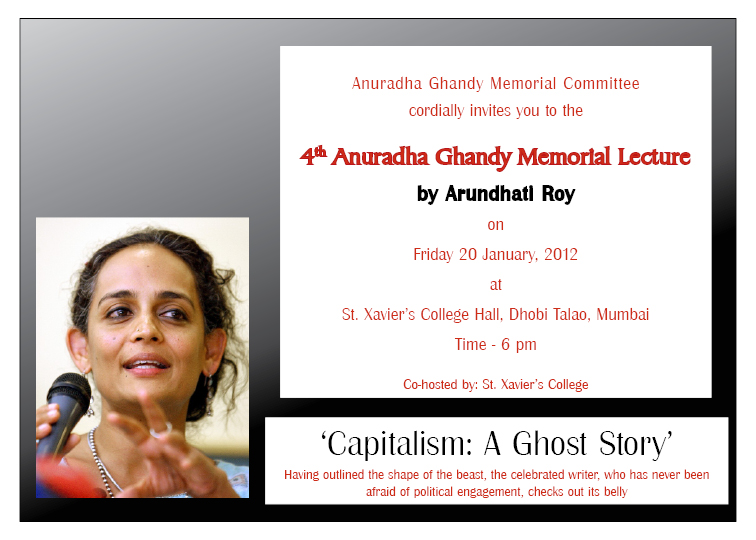
4th Anuradha Ghandy Memorial Lecture (Jan 20, Mumbai)


Anuradha Ghandy Memorial Committee

4th Anuradha Ghandy Memorial Lecture
by Arundhati Roy

“CAPITALISM: A GHOST STORY”

on January 20, 2012
at
St Xavier’s College Hall, Dhobi Talao, Mumbai
at 6.00 pm

Bhubaneswar: Discussion And Reading Team of Socialists (DARTS) – December 30

The second meet of ‘Discussion And Reading Team of Socialists'(DARTS) is to be held on the 30-12-2011 at Xavier Institute of Management (XIMB), Bhubaneswar Room No. 229 from 5p.m to 7p.m. In the first meet Prof. Raju Das from York University, Toronto delivered a short talk on the relevance of Marx’s Capital and on Marx’s Labour Theory of Value followed by discussion among the participants. Marx’s Capital is an essential read for activists and intellectuals alike. The analysis of the commodity in the first chapter ‘Commodities’ is, as Marx claims, the point from where he begins his analysis/critique of capitalism (see Marx’s Introduction to first edition of Capital). It requires more effort understanding this chapter than the rest of Capital. Prof. Das, in the second meet of DARTS will deliver a small talk on the last section of this chapter ‘the fetishism of commodities and the secret thereof’ after revisiting the initial section of the chapter. We request you to be present for discussion.

P.S: In the third meet the discussion team is supposed to meet after reading Chapter I (or a part of it — this shall be decided in the second meet). The date, time and venue will be let known via e-mail.

Please send your suggestions to darts.bhubaneswar@gmail.com