PUDR on the banning of the CPI (Maoist)

Peoples Union for Democratic Rights

In 2004, when the Congress led UPA government came to power it repealed the POTA, which it admitted had been grossly misused. It simultaneously amended an existing law, the Unlawful Activities Prevention Act 1967 (UAPA), siphoning into it some of extraordinary provisions of POTA, including those pertaining to banning of terrorist organizations. The conditions of banning under the amended Act no longer require a statement to explain the reasons of issuing a ban, a gazette notification merely adding an entry to the Schedule of the Act is sufficient, and there do not exist any provision for judicial redress.

On 22 June 2009, the CPI (Maoist) was added to the list of banned organizations in the Schedule of the UAPA. The Home Minister has claimed that the notification banning the organization was made necessary to remove ambivalences. Indeed, the CPI (M-L), PWG, and the MCC, which later merged to form the CPI (Maoist), were banned organizations since 5 December 2001. Apart from the futility of banning, the notification shows the total disregard the government continues to have towards people’s movements around issues of livelihood, dispossession and alienation that have accumulated and aggravated over the last several years of the unleashing of neo-liberal policies on unsuspecting tribal populations and the rural poor.

It is indeed ironical that a month back, this government had claimed to have returned to power on the weight of its social policy programmes. The politics of banning is indeed reflective of a regime which despite its electoral victory, has but a truncated social base. Banning the CPI (Maoist), is therefore, not just arbitrary, it shows that the UPA government has lost the political courage to address the substantive issues of land and livelihood that the adivasis have been raising across the country in Chhattisgarh, Orissa or West Bengal. While banning itself is undemocratic and constrains the ideological spaces of freedom, in this case, it seems to also send across the message that like the government of any authoritarian state, this government too would prefer to use the law to suppress dissent violently. Much has been made of Maoist violence in the press. Without condoning this violence, PUDR would ask the Home Minister to note the extremely debilitating socio-economic contexts which has precipitated the adivasi movements in the country, and use the electoral mandate it has received to direct attention where it is required most, and in a way which is conducive to democracy through long term social programmes addressing issues of economic disparity.

Moushumi Basu
Gautam Navlakha

Secretaries
PUDR
NDP (Sri Lanka) – May Day Declaration

The following is the text of the May Day declaration issued by the Central Committee of the New-Democratic Party.

The on-going cruel war in the North has plunged the Tamil people into an unprecedented human tragedy. With attacks continuing incessantly, tears and blood flow like rivers. The people who emerged from the besiegement of war have been herded into camps without even the basic facilities, in Vavuniya and the Jaffna peninsula. The scenes in the Vanni are much like those obtaining in countries such as Somalia and Sudan. At the same time, the financial and economic crisis that has developed in the South has severely affected the workers, peasants and other toiling masses and severely burdened their lives. India on the one hand and the US and the West on the other are seeking to use the war conditions and the economic crisis to strengthen their respective hegemonic holds on the country. Neither the ruling Mahinda Chinthanaya government nor the UNP, which is striving to come to power, have the ability to rescue the country and the people from this dangerous situation and solve the problems faced by them. Military victory and electoral success based on it will only help to strengthen state power but not serve to provide solutions for the political and economic problems heading towards an abyss. The reality is that there will be no change for the better until the entire workers, peasants and other toiling masses are ready for alternative political thinking and action.

The forthcoming May Day, the day of revolutionary struggle of the workers of the world, is to be celebrated in a new environment in which the workers and oppressed people of the world are launching fresh uprisings. Hence the New-Democratic Party calls upon the people to resolve to mobilise along the path of mass political struggle to urge a just political solution to the national question, which is identified as the main problem facing the country, and to win the rights of all workers including the plantation workers.

The Mahinda Chinthanaya government, since came to power, has not proposed a solution to the national question which has been transformed into war. At the same time, with Indian backing, it is intent on its pursuit of war. Even to this day the government has shown no interest in putting forward a political solution. Likewise, it is preserving indifferent silence on the question of wage increase for plantation workers and other matters affecting the livelihood of the people. Besides, a cabinet sub-committee has proposed a scheme just as disastrous as the Upper Kotmale Scheme, namely that of redistributing large plantations to private smallholders. Through this scheme, the Hill Country Tamils will face severe problems as a class and a nationality, and be forced into a dangerous situation in which they could lose their entire livelihood. Therefore, it is essential to introduce an alternative program and make the plantation workers part of the program.

Also, the climate persists in which democratic, trade union and human rights are being violated and the freedom of the media is being threatened under the State of Emergency. Besides the rejection of demands for wage increases by workers and other employees, security of employment too is being denied.

Although much is spoken about a national economy, liberalisation and privatisation are being carried out in the name of development under the agenda of Globalisation. The country will not see real development or prosperity through them. The war will not be brought to an end. Until a just political solution is put forward for the national question, it will be deception to talk of peace and development for the country.

Hence, on this May Day the New-Democratic Party emphasises that the oppressed working people of the country and the repressed nationalities should mobilise along the path of mass political struggle for the people.

Halt the mass murder of Sri Lankan Tamils in the Vanni Area

PRESS STATEMENT (10th April, 2009)

Contents of Appeal from concerned citizens of South Asia to halt the mass murder of Sri Lankan Tamils in the Vanni Area of North Sri Lanka.

Appeal is addressed to: Respected Mr. Ban Ki Moon, UN Secretary General; Respected Ms Navi Pillay, UN High Commissioner for Human Rights; Dr. Manmohan Singh, Prime Minister of India and Heads of Government of South Asian Countries
________________________________________________________________________________

We are appalled at reports of mass deaths of Sri Lankan Tamils trapped in a small area of the Vanni region in northern Sri Lanka. Both electronic and print media have reported the death of over 700 Tamils in the last couple of days, with only a section of them being identified as LTTE cadres, meaning thereby that a vast number of those killed are civilians trapped in the area. There are serious apprehensions that thermobaric bomb – a bomb that uses a fuel-air explosive capable of creating overpressures equal to an atomic bomb – has been used in this mass killing.

For the last several weeks, we have expressed our concerns about this imminent massacre. In fact we pointed out that the possibilities of almost close to 150,000 Tamilians getting affected was not just most probable but real. We also pointed out that the Sri Lankan Government had been dangling this as the fruit of its declared `war on terror’ as the `final victory’ – and that the Government was pushing for the ‘final solution’ before the soon-to-ensue Sinhala New year day falling on 14th April, 2009.

Our worst fears are turning true. The sheer scale of artillery and explosive attacks and the massive deaths of Tamils points out to the grave situation of the Vanni region becoming the graveyard for thousands of Tamil civilians. Now the perceived usage of thermobaric bomb by the mindless Sri Lankan Army and Government has taken the situation beyond limits. Sri Lanka President Rajapakse himself has threatened ‘complete rout and annihilation’ of Tamils.

Sri Lanka has turned a terror state though they keep blaming LTTE as a terrorist outfit. The brazen and insulting manner by which Sri Lankan authorities have attacked any person or agency seeking accountability of the Sri Lankan Government to human rights standards can be gauged by the fact that several British Parliamentarians were forced to take up the issue of being branded terrorists by the Sri Lankan officials in a debate in the UK House of Commons! Even Louise Arbor, the former UN High Commissioner for Human Rights and UN Special Rapporteur on Extra Judicial, Summary or Arbitrary Executions, Philip Alston were not spared.

The reality is that the Sri Lankan Government has utilised the so called `war on terror’ as a cover to systematically destroy all democratic processes and institutions in Sri Lanka. Government and its minions have turned the state into a terror apparatus, crushing not just the Tamils, but also others challenging its actions. As a result, numerous non-Tamil, Sinhalese citizens have also fallen prey to the Sri Lankan terror state. Journalists have been the major targets with 19 journalists, both Tamil and Sinhala being killed in the last 2 years, over 35 exiled, driven away from the country or silenced, and numerous publications closed down. The assassination of Lasantha Wickramathunge, Editor of Sunday Leader, a widely respected Sri Lankan weekly in January highlights the fate of anyone challenging the ruling dispensation.

Respected and expert UN bodies have investigated and brought out reports about different aspects of the breakdown of democratic and judicial systems. Recently, on 9th February, 2009, 10 top UN Experts issued a statement sharing the deep concern of the United Nations High Commissioner for Human Rights over the rapidly deteriorating conditions facing civilians in the Vanni region and the significant number of civilian casualties. They also deplored the restrictions on humanitarian access to conflict areas which heightens the ongoing serious violations of the most basic economic and social rights.

We are extremely concerned that in this racist genocide war Sri Lankan government is using banned and illegal weapons and ammunitions, including thermobaric bombs which kills vast numbers of people across a wide territory. Sri Lanka security forces have a long record of using cluster bombs and engaging in aerial targeted bombings of civilian areas which are banned under the Geneva Conventions. Sri Lankan Government has never denied the use of cluster bombs. Across the world there is a tremendous outpouring of anguish and agony at the prospects that surviving Tamil civilians will be mass annihilated through the use of weapons of mass destruction. It is therefore very critical that the UN urgently intervene and restrain the Sri Lankan Government from using banned bombs, explosives and weaponry.

It is very important that the truth about the actual use of these ‘weapons of mass destruction’ including thermobaric bombs be independently verified and its source of supply identified. If indeed these horrific weapons have been used, the international community should immediately initiate prosecution of the highest functionaries of the Sri Lankan state and the Government of the country that supplied these bombs for commission of war crimes and crimes against humanity.

We would also like to point out that the humanitarian crisis has been made worse because the Sri Lankan Government has banned independent observers of UN agencies, the ICRC and other independent institutions from operating in the war zone. It is of utmost importance that independent observers are sent both to monitor the situation as also to ensure humanitarian aid reaches the area.

The innocent Tamil civilians have been living a precarious life without food, water and health supplies for the last several weeks. Emaciated, starved, severely malnourished and seriously injured, the women, children, aged persons and remaining men are already dying. They deserve the protection that can be offered by concerned world citizens who by demanding an end to the war will also be asserting a chance for these innocent men, women and children to live.

As citizens of South Asia, we therefore demand that the UN and the International Community, effectively intervene to ensure immediate cessation of the brutal and savage war in Sri Lanka and ensure immediate humanitarian relief to the suffering thousands caught in the middle of the war. We also call upon the as also the Governments in the South Asian region, viz., the Government of India, Pakistan, Bangladesh, Nepal, Bhutan and Maldives to intervene forcefully to stop the genocidal war that threatens peace not just in Sri Lanka, but in all of South Asia.
________________________________________________________________________________
Appeal is jointly issued by:
K.G.. Kannabiran, National President, PUCL, Hyderabad; Justice Rajinder Sachar, former chief Justice, Delhi High Court, Arundhati Roy, New Delhi, Pushkar Raj, General Secretary, PUCL; Pamela Philipose, Women’s Feature Service; Swami Agnivesh, New Delhi, Prof. Amit Bhaduri, Professor Emeritus, Jawaharlal Nehru University, New Delhi, Rt Rev. P J Lawrence, Bishop of Church of South India, Diocese of Nandyal, Praful Bidwai, Columnist, New Delhi, Sumit Chakravorty, Editor, Mainstream Weekly, New Delhi; Tapan Bose, New Delhi; Rita Manchanda, South Asia Forum for Human Rights, Nepal; Prof Kamal Mitra Chenoy, School of International Studies and President, JNU Teachers Association, Jawaharlal Nehru University, New Delhi; Ernest Deenadayalan, Bangalore; Pradip Prabhu, Kashtakari Sanghatana, Dahanu/Mumbai; Prashant Bhushan, Advocate, Supreme Court, New Delhi, M.G. Devasahayam IAS (Retd), Chennai, Sukumar Murlidharan, Journalist, New Delhi, Rev. Dhyanchand Carr, Madurai, Henri Tiphagne, People’s Watch, Madurai, MSS Pandian, Chennai, Sushil Pyakurel, Former Commissioner, Human Rights Commission of Nepal, Kathmandu, Mubashir Hasan, Lahore, Pakistan and others
——————–
The Statement of Concerned South Asian Citizens is being released to the press in Chennai by
Dr. V. Suresh, President, People’s Union for Civil Liberties (PUCL) – Tamil Nadu/Puducherry,
Chennai Contact Details: +91-94442-31497; rightstn@yahoo.com
Delhi: Sahana Basavapatna (+91 9968296202); Bipin Kumar (+91 9868280198), The Other Media.

Seminar on Socialism For the Twenty First Century

New Socialist Initiative: a collective committed to the regeneration of revolutionary socialist politics invites you for a Seminar on Socialism For the Twenty First Century on Sunday 30th Nov at 4 P.M. Venue: Conference Hall, Rajendra Bhavan, 210 Deendayal Upadhyaya Marg, New Delhi – 110002

Humanity stands at the threshold of new crises and new possibilities. As global capitalism takes humanity through another round of economic crisis, increasing unemployment, and poverty, a simple and stark question raises its head. Is humanity condemned to live with exploitation, oppression, dehumanising working conditions, wars and a looming ecological catastrophe, or is it capable of building a society without class, caste, and gender injustices, a society where the path to growth is not paved with poverty, hunger and overworked human bodies, where competitive greed is not the most rewarded human emotion. Rulers of the world since times immemorial, form Egyptian Pharaohs to Greek slave owners to Chinese Emperors to the current capitalist breed have always believed that they rule over the best of the world. The question raised above would scare them. For the people on the other hand, this question offers a stark choice. Either they succumb to ruling class ideologies, their obfuscations, allurements and sedation, and remain blind to it. Or, they doubt, critique and ask questions; if humanity is to make a better world, how should it go about it? What lessons does history teach in this regard?

Ever since capitalism became the dominant social system, socialism has been integral to humanity’s endeavours to imagine and achieve a better social world. Against the private profit greed of capitalism, socialism pitted the ideal of collective well-being; against a discouraged and alienated mass of humans created by capitalist profit machines, socialism envisioned an active and organized humanity that is fully aware of historic capabilities and tasks; against the freedom to make profit by one that leads to the misery of many, socialism raised the banner of a society in which the ‘the free development of each is a condition for the free development of all.’ To imagine socialism will become irrelevant even while capitalist injustices continue, is to believe humanity to be a condemned species. On the other hand to imagine that specific answers to the above questions provided by socialist visionaries like Saint Simon, Fourier and Owen, or by Marx and Engels, who put socialist theory on a firm scientific basis, or by practitioners of socialism like Lenin and Mao, will be correct in every aspect in the context of current too will be incorrect. For, capitalism has changed. It has changed, through trial and errors while dealing with its own crises, and by its efforts to counter and deflect mass movements against its rule. The most significant changes have occurred in the political and ideological domain. Liberal bourgeois democracy has become the norm of state rule, not just in economically advanced countries, but in underdeveloped countries like India too. Feudal ideologies based on ideas of natural hierarchy and blind faith in the super natural have been replaced by individualism and consumerism of a mass society, which while freeing humans of hierarchical constraints also dis-empower them by obfuscating the social context of their life.

Revolutions of the twentieth century, the Russian, the Chinese, the Vietnamese, or the Cuban, managed to rid a segment of humanity from direct capitalism. History has shown that their success was only partial. While they succeeded in saving their societies from the crises they were in, they failed to put them irreversibly on the path to socialism. Our current context in the twenty first century demands a critical engagement with the history and legacy of these revolutions. Interestingly, it is also in the current context, at a stage of history already shaped by two centuries of capitalist rule and at a time when capitalism as a social system reigns unopposed for the first time globally, that one also hears renewed stirrings for socialism in settings as diverse as hills of Nepal in South Asia, and favelas of Venezuela in Latin America. What do experiences of these countries tell us about prospects of socialism?

We feel that it is time that we revisit these ongoing stirrings for socialism and also start the process of reenvisioning socialism for our times. To start a meaningful discussion New Socialist Initiative, which is a collective committed to the regeneration of revolutionary socialist politics has invited eminent journalist Anand Swaroop Verma, scholar-activist Achin Vanaik and thinker Ravi Sinha to share their ideas on the theme.

An Open letter to the Chief Election Commissioner

The Jamia Teachers’ Solidarity Group reacting sharply to the ongoing communal vitiation of the political environment by the Bharatiya Janata Party issued an open letter to the Chief Election Commissioner of India, Mr. N. Gopalaswami. The indiscriminate manner in which the Bharatiya Janata Party and its parent organizations had been targeting the minority communities in the country in Kandhamal, Dhule, Udulgudi creates an alarming situation that challenges the very moral fabric of a secular, democratic nation. Not only the credentials of a central university like Jamia Millia Islamia is being regularly brought into question, a sense of insecurity, fear and anxiety is created in the adjoining area of Batla House, Jamia Nagar, Abul Fazal Enclave, etc. where primarily the Muslim population resides. The hate campaign of the BJP has to be stopped at all cost and before the guilt of those who have been killed in the encounter, one of whom was a minor and the five who have been accused of being involved in seditious activities against the State is proved before a court of law, they cannot be referred to as terrorists

Subject: Demand to Restrain Bharatiya Janata Party targeting the Muslim community in Jamia and Batla House area in their election campaign.

Dear Sir,

Following the incident of encounter at L-18 in the Batla House area on September 19, 2008 where a MA Previous year student of Jamia Millia Islamia and a 17-year old boy were killed by the Special Cell on the ground of their involvement with the bomb blasts in Delhi and other cities of the country, Bharatiya Janata Party had been actively engaged in a virulent hate campaign fomenting communal sentiments in the country to garner votes in their favour. Two of the five young men who are in police custody for their alleged involvement in seditious activities are students of Jamia Millia Islamia, while the other three were young men seeking out a career in the city. The recent findings of the CBI regarding the activities of the Delhi Police Special Cell has cast a serious aspersion over the credibility of their findings and since the issue of Batla House ‘encounter’ is yet to be produced before the court of law, one cannot pronounce them as guilty. Thus, the constant reference by the BJP to the deceased (one of whom was a minor) and the five arrested as terrorists is not only malicious and politically motivated but also legally invalid.

We urge your office to immediately intervene in the matter and take necessary action against a political party like the Bharatiya Janata Party who have been campaigning for the forth-coming elections in a language that is contrary to the secular, democratic spirit of the Indian Constitution.

The letter was signed by several members of the teaching fraternity.

Thanking you,

Yours’ truly,

Manisha Sethi

Adil Mehdi

Anuradha Ghosh

Sreerekha

Verdict on Jamia ‘encounter’

Released by the Jamia Teachers’ Solidarity Group

Academics and activists seek Judicial probe into the 19th September encounter by a sitting Supreme Court judge; Demand that investigations be handed over to the Central Bureau of Investigations.

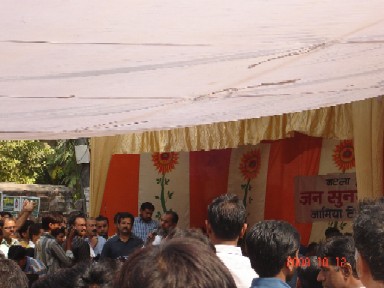
A Jan Sunwai on the Batla House ‘Encounter’ was organized by the Jamia Teachers’ Solidarity Group outside Khalilullah Masjid in Jamia Nagar on 12th October (Sunday). The following scholars and activists associated with civil rights movement constituted the jury:

Swami Agnivesh, Member, National Integration Council
John Dayal, Member, National Integration Council
Tanika Sarkar, Professor of History, JNU
Tripta Wahi, Professor of History, Delhi University
Vijay Singh, Professor of History, Delhi University
Nirmalangshu Mukherji, Professor of Philosophy, Delhi University
Harsh Mandar, Social Activist

The need to hold a Public Hearing in the neighbourhood became imperative to counter the increasing communalization of public discourse in relation to the issue of terrorism and its association with the Muslim community. The on-going targeting of the community by the media and the different institutions of the State as well as political parties has increased the sense of alienation and fear. To overcome this situation and to extend solidarity to the community residing in the Jamia Nagar area particularly by members of the liberal, secular, democratic intelligentsia belonging to different communities created a space of dialogue. This act of solidarity was welcomed by the people who attended in thousands to be part of the deliberations.

After hearing over a dozen testimonies given by local residents, the jury observed the following.

A) The people of Jamia Nagar participated overwhelmingly in the Jan Sunwai. The predominant sentiment among the local residents about the ‘encounter’ is one of anger and disbelief. This feeling was articulated by the participants and those who gave testimony. Local residents have taken strong exception to the stereotyping of young Muslim educated youth in this area and also in general as terrorists. The links that the media and the state is making between education, especially professional technical education among the Muslim youth and terrorism has fueled fears that it will inhibit the progress and social advancement of the community.

B) It is noted that prior to moving to L-18, the deceased had verifications proofs in place with the local police. Sajid had appeared for his 11th class examination at Jamia School and all address details were genuine. Atif had enrolled in Jamia Millia islamia. Till date, all identification records submitted by them have been found to be true. The verification details for obtaining their mobile connections are also genuine. These proofs establish the credibility of the boys killed in the encounter as students seeking opportunities and a career in the city.

C) The statement by people who bathed the bodies of the dead boys before their burial was striking: they testified that the skin on Atif’s back was sloughed off; there was smell in his body; there were multiple bullet injuries on Sajid’s head. These cast aspersions on the police version.

D) On the nature of firing, all residents uniformly testified that the firing happened in quick succession punctuated by short intervals for nearly an hour after Inspector Sharma was brought down. People testified that they had seen him coming down with injury – blood was oozing out from the wound. The members of the locality raised questions about the long duration of firing in L-18. The death of Inspector Sharma too is shrouded in mystery.

E) The witnesses also expressed their anguish about the way in which the police kept the community on tenterhooks about the burial of the bodies. The handing over of the bodies was delayed and the entire process was marked by complete lack of sensitivity in relation to the dead. The Jury feels that minimum human sensibilities must be respected regardless of the charges against the dead.

The jury strongly feels that there is ample ground to doubt the veracity of the police version of the sequence of events on 19th September. Following these observations in the jan sunwai, the Jury demands:

A) Judicial probe into the 19th September encounter by a sitting Supreme Court judge

B) The investigations must be handed over to the Central Bureau of Investigations.

The jury is of the view that the on-going targeting of the Muslim minority in the country has created an atmosphere of fear and anxiety. The complete disregard and violation of fundamental civil rights in the process of the State’s efforts to control ‘terrorist’ activities has raised questions regarding the secular character of the Indian democracy and the impartiality of its institutions. The widespread sense of alienation among the minorities can only be mitigated by ensuring justice.

Some Questions for the Delhi Police and Embedded ‘Journalists’

Manisha Sethi

Member, Jamia Teachers’ Solidarity Group

The last few days have seen the Delhi Police “returning fire” at the critics of the Jamia Nagar encounter. Pressured by the mounting skepticism about police claims, the Delhi Police have now responded with a new round of theories and stories, which nevertheless remain as riddled with holes, as their earlier version(s). Jamia Teachers’ Solidarity Group responds to the latest Police claims.

1) The police was caught by surprise. Or was it?

In its response to the questions being raised by the civil society, the police say, “the presence of armed terrorists took them by surprise.” “The police did not expect an encounter at L-18. (Indian Express October 9)

However, Praveen Swami in his “Alice in wonderland” article in The Hindu (October 10) writes that “the investigators learned that top commander ‘Bashir’ and his assault armed squad left Ahmedabad on July 26 for a safe house at Jamia Nagar.” Further he says, “the investigators came to believe that Atif Amin either provided Bashir shelter or the two were one and the same person.”

Surely, there can be only one truth:

a) The police knew that a “top commander” and his “armed assault team “was residing in L-18 (as claimed confidently by Swami). In which case, the Special Cell’s almost cavalier approach is inexplicable — unless we accept Swami’s contention that Inspector Sharma’s team did as well as it could “given their resources and training”.

While Swami and his ilk may rue the lack of “state of the art surveillance equipment” that can be found in United States or Europe, surely, even Third World police can use, upon knowledge that “dreaded terrorists” are holed up in a house, methods such as sealing the building, and making public announcements asking them to surrender.

b) The Police went to L-18 merely for investigation and was ambushed. In which case, isn’t it surprising that it took them only a few hours to crack nearly all cases of bomb blasts that have occurred across the country? It was of course inconvenient for UP, Gujarat, Rajasthan and Maharashtra state police, who had been claiming their own successes in uncovering their ‘masterminds’.

The Police commissioner Y.S. Dadwal announced at a news conference the same day that “Atif was the mastermind behind all the recent serial blasts,” and that he had plotted the Saturday blasts… was also involved in the Ahmedabad blasts on July 26, Jaipur blasts on May 13, and one of the August 25 blasts last year in Hyderabad. Sajid was described as bomb-maker. “Explosives made by him and his team bore their signature — two detonators, wooden frame, ammonium nitrate and analog quartz clocks,” Dadwal said {Hindustan limes, 20 September). The question is that, the Police which did not even expect an ‘encounter’ in the morning, was able to say with confidence that the bombs used in Delhi blasts bore the ‘signature’ of the slain Sajid by evening.

The Police must pick one of these ‘truths’. It cannot claim both to be true simultaneously.

2) The puzzle of the Bullet Proof Jacket

Again, the Delhi Police has not made up its mind on this one. JCP, Karnail Singh and Deputy Commissioner of Police (Special Cell) Alok Kumar have reiterated that the Special Cell team members were not wearing BPVs. [“Entering a crowded locality would alert the suspects and give them time to escape” {Indian Express Oct 9); “To maintain secrecy in a cramped area like Batla House.” Tehelka Oct 4)].

However, now we are also told that some police men were wearing Bullet proof vests.

This new version has appeared following the outcry after the publication of pictures of Sajid’s body, which clearly show that he had been shot repeatedly in the head. Such bullet injuries suggest that he could have been killed from extreme close range while he was crouching or kneeling. This it self raises a huge question mark over the ‘encounter’. “Senior police sources” now claim that Sajid was “lying on the floor when he opened fire at a cop. The cop, unlike Inspector Sharma, was wearing a bulletproof vest. He retaliated by firing a burst from his AK-47, which hit Sajid on his head.” (Times of India, Oct 8).

Neat. It explains why and how Sajid was killed. And also, why the cop in question was not as much as injured when Sajid was supposedly firing at him. But it doesn’t square with the line the Delhi Police have been pushing up till now, that Inspector Sharma’s men did not deliberately wear bullet proof vests. Nor with the claim that the Special team was “armed only with small arms”. (The Hindu, October 10)

Nonetheless, the Delhi Police must clearly make up its mind if the cops that day were wearing Bullet proof vests or not?

3) Corroborative evidence?

Believe it or not, the evidence in support of their claim that the boys living in L-18 were terrorists, the police presents a bucket, adhesive tape and a bag! (Indian Express, Oct 9). The bucket was used to keep bombs (but was presumably empty at the time of’ seizure’); the adhesive tape was used to seal the explosives (!!!); and finally the bag was used to carry the bombs (but again presumably empty when the police ‘recovered’ it).

Let it be noted that legal requirements were flouted with regard to seizures. The police is required to prepare a seizure list of all items recovered from the site and it should be attested by two public witnesses unconnected with the police. Given that a huge crowd had gathered at the site, surely, the police could have sought the assistance of members of the public. And why does L-18 continue to remain sealed?

4) Injuries and Bullets:

Photographs of the bodies of Atif and Sajid, taken during the ritual bathing before burial clearly indicate injury marks on the bodies. These marks could definitely not have been caused by bullets. The skin on Atif s back is ripped off. What caused these injury marks? Were they captured before they were eliminated? The Police is now citing the elusive post mortem report, saying that the two did not have any injuries on them apart from those caused by bullets, in order to buttress their claim of the “shootout being genuine”. (TOI, Oct 9). The documentary proof of the existence of such marks on the bodies however belies their claims.

Rattled by the photographs of an injured Inspector Sharma being escorted from the L-18 building, where no blood stain is visible on the front, the Police have stated that he was hit from the front as “one bullet hit him in the left shoulder and exited through the left arm; the other hit the right side of the abdomen, exiting through the hip.” (The Hindu, October 10) For this reason, they argue, the bleeding was from the back—the points of exit. However, according to a senior doctor who conducted the postmortem on Inspector MC Sharma at the All India Institute of Medical Sciences, “It was difficult to establish the entry and exit points of the bullet because conclusive evidence had been wiped out by the interventions of the doctors at Holy Family [where Sharma was rushed to].” (Tehelka, October 4).

But at least one enthusiastic journalist doesn’t stop here. He tells us that the “abdomen wound was inflicted with Amin’s weapon and the shoulder hit, by Mohammad Sajid”. And how does he know? “The investigators believe that.” (The Hindu, October 10)And he believes the investigators. Has he seen a copy of the post mortem? Or the videography of the post mortem? What bullets were fired upon Inspector Sharma? What was the weapon that killed Sajid and Atif?

Why are the post mortem reports of Inspector Sharma and Atif and Sajid not being made public?

5) “Over confident terrorists”:

In response to why these supposed ‘terrorists’ left a trail of identification marks which would have made them sitting ducks, the police have a simple answer. They were over confident. (Indian Express, October 9)

These boys (aged 17 years — 24 years) were so confident that they had their tenant verifications done in which they provided their genuine addresses; Atif had his driving license made by providing his genuine details; carried out blasts and returned home coolly to watch their exploits on television; felt no need to flee or change residences frequently; bought sim cards in their own names; registered as students in schools and institutions; sat for examinations midway through planning and executing blasts. And yet, these masterminds had no inkling of the special cell surveillance, and indeed helpfully stored material such as photographs of blast sites on their laptops and cell phones, so that their guilt could be proved promptly by the police whenever they were caught.

Mr. Praveen Swami writes that that “the allegations leveled over the encounter tell us more about the critics than the event itself.” Sure, we are skeptics, unwilling to lap up everything that comes forth from “police sources”, senior or otherwise; but what does taking dictations from the Special Cell tell us about you, Mr. ‘journalist’?

Our doubts remain. Our questions unanswered. Only a time bound, independent inquiry under the sitting judge of the Supreme Court can illumine the truth. What does the Delhi Police and the Government have to fear if the truth is on their side?

Public Hearing at Jamia

Anuradha Ghosh

Member, Jamia Teachers’ Solidarity Group

Jamia Teachers’ Solidarity Group organized a Jan Sunwai (Public Hearing) and Public Meeting on the Batla House ‘Encounter’ today in the ground opposite Khalilullah Masjid, Batla House, Jamia Nagar, New Delhi, from 10.00.a.m. to 1.00. p.m. The jury constituted of the following members:

Swami Agnivesh, John Dayal, Harsh Mander, Tripta Wahi, Tanika Sarkar, Vijay Singh and Nirmalangshu Mukherji.

Prominent members of the civil society, Arundhati Roy, Kavita Srivastava, Prashant Bhushan, Kavita Krishnan, members of Jamia Millia Islamia, Delhi University, JNU, teaching faculty, students and members of the media attended the programme to listen to the eye witness accounts of the ‘encounter’.

The shroud of silence in which the members of the Jamia Nagar community had been pushed into following the policed accounts of the ‘encounter’ that was coming through the media over the past week after the initial spate of protests seems to have been broken. People from all walks of life that form the teeming multitude of the citizens residing in Jamia Nagar area came out openly questioning the ‘encounter’. Twelve members spoke as neighbours, eye witnesses and relatives of either the deceased or the accused and said openly that although the problem of terrorism needs serious attention, one cannot subscribe to an alternate reign of terror perpetrated by certain sections of the authority.

Questions were raised regarding the condition in which the bodies of Atif Ameen and Mohd. Sajid was received by the family members and how they were not allowed to bury them in the Okhla graveyard. Several discrepancies in the police accounts were highlighted and Manisha Sethi from the Jamia Teachers’ Solidarity Group read out the Group’s study of the same. The Jury members would be meeting early next week and would finalize their verdict on the ‘encounter’. The Jamia Teachers’ Solidarity Group’s demand for a time bound, independent inquiry under the sitting judge of the Supreme Court has been reiterated and in the present situation of the on-going media trial of the accused, concerted action is required.

Delhi Domestic Workers Union

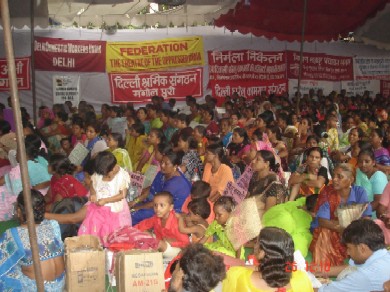
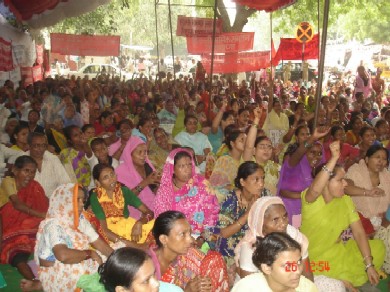
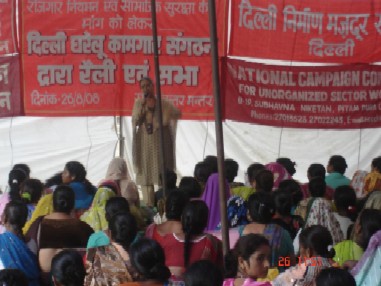
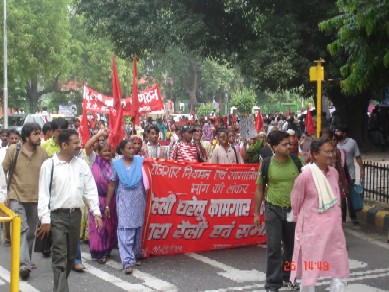
The Delhi Shramik Sangathan, a federation of Construction Workers Union & Car Cleaners Union along with its constituent organization Delhi Domestic Workers Union jointly organized a rally on Tuesday, 26th, Aug’08 at Jantar Mantar, New Delhi. Around 1500 domestic workers attended the rally and submitted a memorandum to Prime Minister, Labour Ministry and the Lok Sabha Speaker.

DSS Rally 1

DSS Rally 2

DSS Rally 3

The rally was addressed by several eminent political leaders, Union leaders, scholars and social activists.

DSS Rally 4

Anita Juneja, convener of Delhi Domestic workers unions welcome the participants at rally and urged the domestic workers of Delhi to increase the pace of the movement so that domestic workers could become a political forces to reckon with. She said that around seven-eight lakh strong workforce of domestic workers in the city is working at paltry sums of Rs 1200 – 1500 per month and live in semi-human conditions of bondage and starvation. They are victims of constant verbal and sexual abuse without any grievance redressal mechanism. Worsening their situation is the city administration’s brutal eviction drive – dislocating and destabilizing the lives of the very people without whom the city would come to a crippling halt. This disruption of people’s lives has led to children being the worst victims with an absolute denial of basic health care and education. Spending the meagre resources available to them to tackle continuous illness, the children by the age of ten are also forced to join as domestic help to contribute to the paltry income of the family. In the absence of any provision of maternity benefit, pension, ESI, PF, Gratuity, health facilities, crèche at work site etc these workers are forced to continue with no security of work.

DSS Rally 5
DSS Rally 6

The union along with Nirmala Niketan approached the National Commission of Women (NCW) to raise the issue at the national level. A subcommittee was formed by NCW to draft the bill on Regulation of Employment & Working Condition of Domestic Workers. The draft prepared was discussed during the National Consultation on Domestic workers organized by NCW on 14th-15th of March’08 at New Delhi. The recommendations of the consultation have been finalized. Now the recommendations need to be incorporated in the Bill drafted by the Sub-Committee of NCW and the final shape of the Bill need to be sent to the Central Government as recommendations of the NCW.

DSS Rally 7

Details of the NCW proposal

Under the proposed law a tripartite Board is to be formed by the State & Union Territories governments. This Board will register all employers, domestic workers and Placement Agencies. Board will collect its fund mainly from the registration of employers. Rs.1000 per year will be collected from the employer of live-in full time domestic Worker and Rs.200 per year from the employer of part time domestic Worker, which will add to about rupees one hundred crore rupees per annum in Delhi alone. In addition the Board will collect a nominal fee of Rs.100 per annum from the live-in full time domestic worker and Rs 20 per year from the part time domestic worker. Rs.100 per placement per year will be collected from the placement agencies besides a lump sum fees and security amount depending upon the number of annual placement done by an Agency.

DSS Rally 8

The Board will provide an identity Card, bank account, regular medical check up, shelter in crisis & sickness, provide working conditions, dispute regulation, regulation of placement agency, keep full record of domestic workers which will check and prevent child labor in domestic work and help in tracing trafficked girls to prevent trafficking for domestic work.

The demand of the Domestic workers is to accept Domestic Work as ‘Work’ and Domestic Worker as ‘Workers’ and lend it the dignity and reorganization of labor. Consequently all benefits and rights that accrue to workers must be extended to this huge workforce (of which no census statistics are available) so far unprotected by any labor legislation. Minimum labor standards should be applied to achieve decent conditions of work and a living wage by including domestic workers as unorganized sector worker as the Central Government representatives assured the Supreme Court of India in a PIL on behalf of Domestic Workers.

DSS Rally 9

The rally demanded that –

1. The legislation proposed by the National Commission for Women be called The Domestic Workers (Regulation and Conditions of Employment & Welfare) Act;

2. The Domestic Worker Act should provide for compulsory registration of Employers, Domestic Workers and all service providers, including placement agents/Agencies and contractors;

3. The Tripartite Boards of Domestic Workers should constitute State/District level Committees for complain against sexual harassment at work place which should also provide protection for women going about to work as Domestic Workers;

4. Domestic Workers should also be registered at the source area and regulation of employment along with ID cards be done, also at source;

5. Minimum age of employment should be 16 years;

6. Tripartite Boards of Domestic Worker to be set up to regulate employment conditions, social security and welfare measures. The board should be authorized to constitute dispute resolution councils and Appellate Authorities;

7. Tripartite Board of Domestic Worker should have 50% representative of Domestic Workers directly elected by the registered domestic workers and 25% representatives of related department of Central and States Governments such as Labor, Child and Women Welfare, SC/ST Welfare, Social Welfare etc. and 25% representatives of employers and Resident Welfare Associations;

8. Tripartite Boards of Domestic Workers should be authorized to formulate guidelines for regulating employment and working conditions for domestic workers going outside India as domestic workers and provide social security to them;

9. All Labor laws to apply including Minimum wages Act, Payment of wages Act, Workmen’s’ compensation act, Accidents benefit Act, etc. and any such legislations applicable to industrial workers;

10. Tripartite Boards of Domestic Workers will be authorized to file complains/FIR etc. on behalf of Domestic Workers where the Domestic Workers is not in a position to file a complain;

11. Rights to inspection of workplace and living space by individuals / groups / organizations as assigned by the Tripartite Board of Domestic Workers;

12. Tripartite Boards of Domestic Workers will primarily depend upon the registration fees collected from Employers, Domestic Worker and Placement Agencies but till enough fees is collected the government must make adequate budgetary provisions for implementing the Act either as grants or loan.

Contact Address: c/o- Flat No-231, Pocket-A, Sector-13, Ph-II, Dwarka, New Delhi-110075. Ph-011-28031792; email- delhidss@gmail.com

Condemn the Arrest of PUCL Activists in Chhattisgarh

Jan Hastakshep
May 25, 2007

Jan Hastakshep condemns the arrest of Rajinder Sail the President of the Chattisgarh PUCL. This arrest is allegedly made in connection with Shankar Guha Niyogi’s murder case, on grounds of contempt of court proceedings at Madhya Pradesh. Even though the case pertains to April 2005, the M.P. and Chhattisgarh governments have kept the warrant pending for years and suddenly pulled it out of their pockets to execute it. The fact is that the state was becoming increasingly uncomfortable with Rajender Sail’s activity in the matter of the arrest of Chhattisgarh PUCL General Secretary, Dr Binayak Sen. While it is true he will have to serve the sentence lawfully imposed, yet the abuse of powers is writ large. It is a clear case abuse of law when the police keep final orders pending without executing them and using them only at their convenience.

Dr. Binayak Sen was fighting against violations of human rights and he was very critical of the numerous “encounters” being done in Chhattisgarh, while demanding a proper enquiry into these so called encounters. At the time of issue of this statement to the press, Binayak Sen stands charged for Sedition, conspiracy to wage war and conspiracy to commit other offences. Such post arrest and post FIR confabulations are part of the impunity, governments have granted to the law-enforcing establishment..

It is indeed a lesson for civil liberty and democratic groups to watch the increasing depravity of state institutions and the manner of their functioning which holds all issues of democracy and accountability in utter contempt. This unrelenting attack on civil liberty groups and activists is unprecedented; except during the Emergency, it was never common place to arrest senior and well known civil rights activists.

Jan Hastakshep appeals to all concerned citizens and civil right groups to come out and protest these increasing attacks on Indian democracy and insist for a more accountable administrative functioning. These increasing attacks by the right wing BJP led governments and the creation of state sponsored vigilante groups such as the Salwa Judum are clear indicators of the growing dangerous fascist trends in India. What needs to be kept in mind is that these trends are not any different in Congress or other party ruled states.

Jan Hastakshep strongly condemns the arrest of both PUCL activists and demands:
1. Immediate release of Mr. Rajender Sail and Mr. Binayak Sen and dropping of all criminal charges against them
2. Strict and swift action be taken against the armed forces and police personnel involved in the brutal murders of innocent citizens in these so called encounters.