The Significance of the Vedanta Decision

Campaign for Survival and Dignity

The rejection of Vedanta’s application for permission to mine in Niyamgiri, Orissa, is being hailed as a step forward and a change in the country’s policy discourse. It is indeed all that; but it is crucial to understand why.

The project’s main problem was that it violated the Forest Rights Act’s provisions requiring “recognition of habitat and community forest rights” and the consent of the gram sabha prior to taking forest land. This sounds like technical legalisms. But the basic point is that, under the law, the Dongria Kondhs have the power to protect and manage their forests and lands. Simple, but unprecedented; it has never happened before.

Contrary to much of the media coverage, this is not a reflection of the Environment Ministry or the forest bureaucracy suddenly becoming “pro-tribal”. Even as Vedanta stands rejected, many other equally illegal projects are going ahead; most recently, the Polavaram dam, which will affect literally hundreds of times more people, was given final forest clearance in total violation of the Forest Rights Act. Polavaram will also affect members of the so-called “Primitive Tribal Groups”, who were the centrepiece of the Environment Minister’s statement on Vedanta. Meanwhile, more than 15,000 hectares of forest land have been illegally given in principle or final diversion clearance in MP and Chhattisgarh alone since 2006. Meanwhile, the Ministry is promoting programmes that themselves do not respect democratic control and involve large-scale land grabbing.

So, then, why did it happen? Electoral compulsions of the Congress party, say some. Targeting of opposition-ruled States, howls the BJD. The Sonia touch, says the business media. All of which are truisms, but they miss the real point. Every ingredient of the Vedanta decision – the public sympathy; the Forest Rights Act itself; the govenment’s sudden sensitivity to adivasi issues; and, most importantly, the resistance of the Dongaria Kondh people – was a reflection of people’s struggles, in the area and elsewhere. Vedanta was not rejected because Rahul Gandhi or Jairam Ramesh decided on a strategy in their head. It was rejected because, steeped in betrayal, illegality and mercenary brutality, the state machinery and the ruling party was forced by its own need for people’s support to, just once, comply with the mandate of democracy and justice.

And this is the real victory of this decision. On its own letterhead, in its own words, a Central government agency has come out and said: we should not take resources without the consent of the people. We should not grab lands and minerals without respecting people’s collective mandates. Of course they are continuing to do so, as rapaciously as before. But they have exposed themselves, and shown through their own words that they no longer have even the fig leaf of law to hide their robbery. And they have in the process opened a new space; for now their future robberies will be counterposed, in law as in reality, against the decisions of people’s assemblies, a small step towards a real democratic collectivity and real social control over resources. Thus does the battle for democracy grow.

When the Forest Rights Act was passed, we described it as “a victory and a betrayal.” So too is the Vedanta decision – a victory for the heroic struggle of the Dongaria Kondhs and for the spirit of democracy; and a betrayal, because the government will not comply with its own words. The struggle goes on.
No Room of One’s Own: The Housing Question in Delhi

CAMPAIGN FOR RENT REGULATION & MORE HOSTELS
A Joint Campaign of Centre For Struggling Women (CSW) and Krantikari Yuva Sangathan (KYS)

Over many years Delhi has become a city of migrants. Students in search of a decent education and unemployed people in the desperate search for work have poured into the city in large numbers. The Government conveniently attributes the city’s growing crime rate, stress on resources, its ‘landscape degradation’, etc. to this movement of people. It adamantly refuses to acknowledge the fact that the condition city-dwellers find themselves in today is actually the creation of its own anti-people policies and the protection it provides to the landlord/rentier class in the city. To elaborate, the Government’s account of the challenges before the city clearly conceals the fact that the major crisis for city-dwellers, i.e. lack of housing and the need to pay high rents, is the result of landlords owning properties in excess and overcharging those who cannot afford their own housing. Precious little is done by the Government to check the excesses of these property owners in the city. Initiatives to collect property taxes are taken back almost as soon as they are launched and, pro-tenant clauses in the Delhi Rent Act are openly flouted.

The state’s collusion with landlords and the builder mafia is apparent in many ways. This is best reflected in a policy approach supportive of slum demolition, the lack of rent regulation, selling of government land at throw away prices to builders, little or no investment in the building of students’ hostels, highly priced government housing schemes (such as those introduced by the Delhi Development Authority), and in fact, the sheer lack of sufficient housing projects being launched by the government. Due to this undeniable nexus between the interests of the state and that of landlords, it is students and workers who suffer. Migrant labourers who come to the city are forced to live in sub-human conditions in slums or, to crowd into small rented rooms, paying most of their earnings as rents. Students coming from afar are also compelled to live on rent since most colleges in the city provide little or no hostel facilities. They too cut rent costs by sharing small rooms with each other—an atmosphere hardly conducive for study. In other words, the majority of students’ and workers’ monetary subsistence (money received from home and wages, respectively) is appropriated by landlords in the city.

It is important to note that the number of workers and students living on rent is no small number and that, it in fact, constitutes the majority of city dwellers. The magnitude of exploitation in this regard is hence, far from insignificant, and is extremely disturbing. Is this really what a city should be like—a place where most are either homeless or, are slum dwellers living in the constant fear of being ‘relocated’ (displaced), or are those forced to reside in private lodgings for high rents? It is time we locate the root cause behind the pathetic living conditions of students and workers in the city. This piece aims at providing a perspective that shows how things are connected and work to exclude the majority of people from resources and opportunities, and the right to a good healthy life. It is being circulated in the context of our launching a city-wide campaign for rent regulation and the provision of more hostel facility for students who come to study in the city. This Campaign, in fact, is part of ongoing struggles that CSW and KYS have been organizing in the past. These struggles have focused on the concerns of tenants, and basically, the most oppressed section of people working and living in the city. As a youth organization Krantikari Yuva Sangathan (KYS) has extensive work in working class colonies across Delhi. It has collectivized women and youth of these working class areas on issues such as lack of water and electricity supply, the poor condition of government schools in these neighbourhoods, and the apathy of the local administration/police with respect to heinous crimes committed in such colonies. Similarly, Centre For Struggling Women (CSW) has been in the forefront in organizing militant struggles in the University of Delhi for basic infrastructure like hostels. Due to struggles launched by CSW in the recent past, prestigious colleges like St. Stephen’s have had to provide hostel facility to their women students. It is to be noted here that colleges like St. Stephen’s provided the hostel facility only to men students—something which encouraged many women students to give up taking admission in the college. Of course, with the extension of this facility to women students, the age-old chauvinistic culture that prevailed in the college was put to the challenge—in 2005 CSW’s member, Maya John, became the first woman President of the college. The current Campaign For Rent Regulation & More Hostels derives inspiration from CSW’s struggle to provide hostel for all and their earlier Campaign For More Girls’ Hostels, Safe Neighbourhoods And A Safe City.

We hope that what is argued below convinces all who read it, of the need for collective struggle. Indeed, it is only through collective struggle that we can actually expose and challenge the system in place.

WHY PEOPLE MIGRATE TO DELHI:

Why Students: The reason why students migrate to Delhi in large numbers is that there is an acute shortage of government funded universities in India. Those that exist are in a poor condition and fail to accommodate the ever growing number of students aspiring for higher education. The reason behind this shortage of government universities and the poor condition of those that do exist is the paucity of government funding. Investment in education is less than 3% of the GDP! Furthermore, educational policies of the Indian state have been geared towards commercialization and privatization of education. Successive central and state governments have, for example, unhesitatingly recognized private colleges/universities. As a result, private educational institutions have spread everywhere, outnumbering affordable government-run colleges/universities. By strengthening the presence of private colleges/universities vis-à-vis government ones, governments have made education so costly that it has become inaccessible to the majority of Indian people. As a result students flock to the handful of government colleges/universities located in cities like Delhi.

The poor investment in education by successive governments has also led to the deterioration of regional universities, and hence, encouraged the creation of centres of excellence like Delhi University, Jamia Milia Islamia and Jawaharlal Nehru University. It is only with balanced and inclusive development of different regions, that students will have well-established regional universities to study in. For this, of course, our governments need to spend more on education and the social sector as a whole.

A large number of educated youth also flock to Delhi in the hope of securing government jobs. The city is now “home” to many who crowd into small rooms just so that they can receive “coaching” for various competitive examinations. However, most of these youths are forced to go back empty handed after 5 to 6 years of such preparation, simply because there just aren’t enough government jobs to be had.

Why Workers: Unbalanced and non-inclusive development of different regions in the country has also affected employment opportunities of people drastically. In regions across India (Orissa, Jharkhand, Chattisgarh, Bihar, Bengal, Maharashtra, etc.) the Indian state rules in the interests of Indian and multinational companies that seek to plunder natural resources and to raise a cheap supply of labour from the ranks of displaced tribals, agrarian labourers and poor peasants. Government after government, in its collusion with private business interests has snatched agricultural land, forests and other resources from poor peasants and tribals. Half hearted attempts at land reform and the withdrawal of various agrarian subsidies have brought ruin upon poor peasants, pushing them to commit suicide or to join the ever increasing rank of agrarian labourers. Even in “well developed and rich” states like Gujarat, Delhi and Punjab, exploitation is rampant and, industrialization and corporate farming (the usual indices used to calculate such states’ development record) are based on the ruination of the most vulnerable sections of rural society.

On being denied their lands, rivers and forests, those displaced are compelled to turn to cities like Delhi where employment at construction sites, factories and sweatshops, restaurants/bars, etc. can be found. Needless to say, the wages earned are abominably low and are a cause of much distress.

HOW THE MAJORITY OF TENANTS LIVE IN THE CITY:

With their limited monetary resources, both students and workers compromise with their health and well being when taking up lodgings in Delhi. So as to pay the escalating rents students crowd into small rooms just so that they can share the rent with others. This uncomfortable living is complemented by poor fooding since most students try and survive the day on one or two meals alone. In such living conditions students find it difficult to concentrate and study properly—something which impacts their class performance greatly. One has only to visit places like Nehru Vihar, Gandhi Vihar, Christian Colony, Sangam Park, Gurmandi, Munirka, etc. to come face to face with students living like this. Of course, there are some students who take better places on rent but there too students face problems such as harassment by landlords/neighbours. Rents are arbitrarily increased and landlords get students to vacate suddenly on the pretext of something or the other.

For women students such private accommodations are even more precarious since landlords and male neighbours feel free to sexually harass them. This is why almost every woman student staying on rent has a horror story to narrate and feels vulnerable in such places. Some students, like those from the Northeast, are deliberately charged higher rents by landlords and, women northeast students are made victims of the worst incidents of sexual harassment. A very large number of students and youth in search of work come from places like the northeast. This migration clearly indicates the sheer lack of investment by the Indian state in these regions. Due to lopsided development in states like the Northeast, students are compelled to come to metropolitan cities like Delhi to study. Similarly, the paucity of jobs in these regions compels many to migrate in search of employment. For example, a large number of nurses who work in hospitals across Delhi come from the northeast states. Once here they earn a limited amount as salaries, most of which then goes to pay off rents.

The fact that a large number of students are compelled to live in off-campus housing is not only because a large number of them come to Delhi to study, but also because most colleges of Delhi University (D.U.) do not provide hostel facility. Shockingly, out of D.U.’s 76 colleges, only 11 provide hostels for outstation students! Considering this, most students who come to study in institutions like this can be found living in private accommodations. Affordable and comfortable hostel facility rather than being a fundamental right has become a privilege for which only a select few are eligible. It is worse for women students since they are denied hostel facility in many co-educational colleges which only provide this essential facility to their men students.

Just like students, workers who migrate to the city desperately search for affordable housing. Most end up living in slums where basic amenities like water and electricity are scarce. Safety and hygiene are a distant dream in such settlements since most of them have come up along the slopes of open drains and empty land beside the Municipality’s garbage dump-sites. These slums are either being pulled down by builders who want cheap land for their real estate business or, are burnt to ashes since fire fighting authorities take their own sweet time in reaching places where the poor reside.

Many workers also live in cramped accommodations in colonies near industrial belts of the city. Earning only between Rs. 2500 and Rs. 5000, they are forced to part with a large amount of their meager earnings as rent. What they pay for is a small room in which they and their five to six member family, resides. Needless to say, in these cramped conditions, discomfort breeds, tempers fly and unhappiness grows. Here too as tenants, workers and their families are devoid of basic facilities like water and electricity. It is a fact that in many such colonies, people are forced to queue up for water and the electricity supply is cut for nothing less than 6 to 10 hours a day. Undeniably, private power distributors in Delhi practice very selective load shedding, often choosing working class colonies over other posher areas. In working class colonies like Baljit Nagar where KYS has been extensively working, water reaches many houses every third day! In this regard KYS has spearheaded a militant struggle against the Delhi Jal Board Authorities as well as the water (tanker) mafia that operates in the locality. Similarly, in the same locality women’s lives were reduced to hell when rumour of a serial killer, i.e. Hammer-man, made its way into the public domain. Realizing the discontent and fear prevalent in the youth and women in the locality KYS carried out an investigative inquiry, following which it organized a huge protest outside the Delhi Police Headquarters. Through its inquiry the organization proved that rather than a serial killer on the loose, who attacked women and miraculously escaped the notice of other family members crowded into the small rooms/houses in Baljit Nagar, the assaults (and in two cases, murder) were actually incidents of domestic violence. As a result of the pressure applied on the Delhi Police, arrests of guilty family members began to be made shortly after.

Apart from high rents, workers and students’ problems are compounded by the poor condition in which the public transport system exists. With the acute shortage of Delhi Transport buses most of the time commuters are travelling in crowded buses, endlessly waiting for buses at stands/depots, etc. As a result, the travel to and fro from their workplaces/institutions to their homes is nothing short of a nightmare.

RECENT DEVELOPMENTS THAT HAVE MADE IT WORSE FOR TENANTS:

Recently, over the past two years as Delhi’s authorities have hurriedly prepared for the Commonwealth Games, conditions for tenants in the city have worsened. The preparation for the Games has, indeed, allowed the state to crack down on the most vulnerable sections of society. Construction workers, most of whom are migrants, are being overworked and underpaid at the various Commonwealth sites. The homeless, labourers, hawkers, and now students have had to pay the brunt for the massive construction work and subsequent redirecting of funds. Slums have been demolished and ‘relocated’ overnight, street vendors have been denied their rights, and now students too have been recently evicted from their college hostels in the wake of the Commonwealth Games!

The face of the Commonwealth Games is really less about the games, and more about the herding of poor people into ill-equipped resettlement colonies (in the hope of concealing the city’s poverty), cracking down on rickshaw-pullers and street vendors, evicting students from college hostels, and the brutal exploitation of cheap labour for the massive construction projects. It is time for introspection—when this country has little to boast of in terms of a mass sports culture, why should we sacrifice and celebrate these Games?! It is a fact that the same Indian state that is pouring funds into the Commonwealth Games’ fund, does little for its sporting community. So far governments have done little to build new stadiums and have invested precious little in the upkeep of existing sports infrastructure. New stadiums are built, old ones are renovated and Indian sportsmen are provided world class training only around certain “spectacular” events like the Asian Games some years ago and now on the occasion of the Commonwealth Games. In other words, a consistent and dedicated investment in sports is missing.

It is also a fact that till today sporting facilities are missing from the majority of government-run schools, killing the potential of so many young people to learn and specialize in sports. We find no sports centres in most colonies built by the government, especially JJ (Jhuggi-Jhopdi) colonies. The result of this is that only a select few (those who happen to study in good private schools or, live in posh localities that run sports clubs), indulge in sports. The majority of Indian youth learn to play in dry drains and the narrow streets of working class colonies. They cannot even dream of being professional sportsmen.

Of course, under the garb of the Commonwealth Games, landlords have hiked rents considerably. They had done so earlier too, when the Delhi Metro reached certain areas of the city. As expected, nothing was done then and nothing is being done now to control the fleecing of tenants. In its hurry to meet the deadlines of the Commonwealth Games, both the central and Delhi government have turned a blind eye to the growing problems of tenants. In fact, they have added massively themselves to the problems of workers and students by, consistently increasing the prices of essential commodities (pulses, vegetables, milk, petrol, diesel, electricity and even water) and taxes like V.A.T. By conveniently quoting the rising prices of water and electricity, landlords in the city have further dug into the pockets of workers and students living as tenants. They have also come up with disgusting practices like compelling their tenants to buy provisions from provision stores run by them in the locality!

On average rents have gone up two to three times this past few months. For students paying a rent of Rs. 3000, are now being charged an extra two to three thousand rupees. If they resist they are asked to vacate the accommodation. Realizing that students from colleges affiliated to D.U. have vacated their hostels temporarily, landlords have hiked rents, knowing there will be plenty of takers for their lodgings. Needless to say, these events are going to have long term repercussions for students even when the Commonwealth Games are over. The escalated rents are here to stay, as no PG is going to come down from a hiked rent of say Rs.8000 to Rs.5000, post the Games.

OUR APPEAL:

Since the problem of high rents, eviction, displacement etc. is a general one and affects not just one group of people in the city, it is important to address not a particular set of persons but the majority of city dwellers. Issues and demands should be raised in a way that they appeal to a larger section of people affected by the state’s inaction and its collusion with private business interests. In this way we connect concerns, struggles and militancy of different sections of people who are often segregated from each other due to the functioning of the system in place. For example, the student community and workers find themselves separated by work schedules, their class backgrounds, spatial settings/norms (in terms of workers being restricted to the space of factories and students to the space of their classrooms), etc. Of course, groups that can and should unite also find themselves segregated by wrong kinds of politics. By following initiatives that seek to particularize and defer the need to generalize issues of struggle, people come to raise struggles in isolation. Their militant campaigns lose steam, credibility and relevance since they did not tap on certain organic links between their concerns and those of other affected sections in society.

Hence, rather than particularizing the struggle against recent developments in the city, we must link up with connected concerns so as to expose how the “particular” (be it in terms of experiences, mobilization, etc.) is a false or exaggerated projection of the reality. The demand for rent regulation and affordable subsidized housing for all is a call that addresses all those living as tenants in the city. It is a potent cementing force in this regard. Of course, apart from raising common general demands, we must actively and consistently reach out to all those who are affected. Our action plans should include concrete mass mobilization of the different affected parties rather than mere information-gathering exercises, occasional meetings with them, etc. The latter is more patronizing in its approach to groups being reached out to. It cannot be our strategy to connect with the larger audience of people affected. Hence, the Campaign for Rent Regulation and More Hostels is working towards raising common concerns actively amongst different sections of people living as tenants in the city. We seek to encourage the student community in universities like D.U., not to raise the issue of rent, eviction, etc. within the limited sphere of the university alone, but also to become active participants in ongoing struggles raised by others faced with the same problem. We also aim at encouraging the student community to connect problems they face with larger questions of poor resource allocation, denial of opportunities by the system, etc. This is why we believe that demands such as provision of more hostels for students, housing for all, the removal of draconian economic policies like privatization of education and Special Economic Zones Act (2005), etc. are crucial for the Campaign. By raising these issues students are fighting the actual source of their exploitation and are strengthening the working class movement. Indeed, by supporting long standing demands/concerns arising from the working class movement, initiatives taken by students no longer remain sectarian (particularistic) in nature.

Friends, it is time we object and fight against people’s labour becoming someone else’s profit. By raising the issue of escalating rents we should realize that we are tapping on widespread social discontent. As tenants in the city, we, workers and students, cannot continue to watch our hard earned wages and limited monetary resources, line the pockets of greedy landlords in the city. It is time for collective struggle against landlords. We must realize that no longer can our individual battles with landlords bring us relief. We must step forward to give our individual struggles a collective form. It is only through collective struggle that we can pressurize the local government to administer its duties and regulate rents in the city as well as provide subsidized housing.

THE WAY AHEAD:

Indeed, our struggle against the rentier economy must not limit itself (in terms of ideas, visions and action) to certain immediate goals that are set. Our collective struggle must see this popular discontent and despair as stemming from the inequalities that capitalism breeds. Our fight is, hence, against a system that allows private business interests to control the economy and social life. The Campaign For Rent Regulation and More Hostels is just one of the forms our struggle against the system shall take. Through this particular struggle we must realize the significance and need for other larger struggles.

Of course, to fight a system we need a road map, and it is here we believe that the movement for socialism, both in the past and the present, will be our best guide and source of inspiration. This collective struggle by students and workers can draw much inspiration from socialist societies that built cities where homes were provided to all and where living spaces were redesigned so as to emancipate womankind from the burden of domestic chores (responsibilities that were earlier considered solely those of women). Socialist societies, despite several failures, have constantly endeavoured to provide the majority a home to live in and have developed community life in ways never imagined. In countries such as Cuba, the now dissolved USSR, etc. properties held in excess were confiscated and distributed to those who had lived as tenants for years as well as those who were homeless. Furthermore, socialist states invested heavily in construction of housing complexes, community/sporting/recreational centres, schools, colleges, hospitals, and entire cities—the driving force being the desire to accommodate the needs of all, as well as the desire to provide the majority the best of opportunities. It was in these very housing complexes built in socialist societies that individual kitchens (where women slaved away at back-breaking housework), were removed and community dining halls were created for each such housing complex. For certain segments of the society, such as students, endeavours were made to inculcate commune living and lifestyle.

We cannot create these progressive changes in our immediate social world but we can aspire for them and pave the way for their development and acceptance. For this we must begin to desire holistic and systemic change. We must realize that the actual resolution of the housing question lies within the struggle for and creation of a new socio-economic structure. In this light the Campaign For Rent Regulation and More Hostels is one step in that direction.

We Demand
• Rent Regulation by Delhi’s Rent Controller
• Provision of Hostel facility for students in every Delhi University college
• Funds allocated for renovation of existing hostels, be used for building larger capacity hostels.
• Construction of more working women’s hostels
• Provision of subsidized housing for all
• Institution of a judicial commission to inquire into the condition of tenants in Delhi
• Provision of more affordable public transport (U-specials, L-Specials, etc.)
• Public audit of the Commonwealth Games’ accounts

We Condemn
• Slum demolitions
• Hike in rents by landlords across the Delhi
• Eviction of current hostellers from college hostels
• Promotion of private accommodations
• The plunder of collective resources by private business houses.
• The anti-people policies of the Indian state

Support to Mamata Banerjee’s 9th Aug Rally: A Capitulation to the Rightist Forces

Amitava Bhattacharya
General Secretary
Mazdoor Kranti Parishad

Following the Singur-Nandigram movement, the most important movement in West Bengal is that of Jangalmahal including Lalgarh, where an unprecedented mass upsurge rocked the entire nation. The terrible mass-agitation of the tribal population against the police repression unfolded the history of the prolonged deprivation of these people. Not only the state of West Bengal, but the whole of the country solidly stood by this movement.

The most important feature of this movement was that it surged forward on its own, defying any interference by the established parliamentary parties. This movement was born as a continuity of the people’s protest against the SEZ project of the Jindals at Shalbani, a project nurtured by the support of CPI (M), Congress and Trinamool Congress. When the Left Front government led by CPI (M) came to power for the seventh consecutive term, it became all the more rabid to make West Bengal a hunting ground for the native and foreign big capital. It started the forcible land acquisition. To achieve this aim, notorious gangs of hoodlums were formed by CPI(M) everywhere. All this started happening during the rule of UPA-1 and the Congress shamelessly abetted these activities.

The other party of the ruling class, the Trinamool Congress fully utilized Singur-Nandigram movement for the purpose of its political upheaval. This party was absolutely in favour of the ‘SEZ Act, 2005’ while it was a partner of BJP led NDA alliance. During the rule of the UPA-2 also this party played the most ‘suitable’ role as the partner of the congress government. This party never opposed the nefarious “Operation Greenhunt”, nor did it play a proper role against unprecedented price rise that has been making the life of the common people unbearable. Opposing the forcible land acquisition in Singur for TATAs, Mamata Banerjee took the centre stage anew in 2006. She fully made use of this movement to promote her parliamentary gains only to betray it later on. She used the spontaneous movement of Nandigram in the same manner. With the help of the Congress, Ms Banerjee and her party TMC once again tasted the ministerial power during the rule of UPA-2.Now the aim is to capture power in West Bengal in 2011, when the State Assembly election will be due.

Against the unscrupulous scramble for power of the parliamentary political parties safeguarding the interest of the big capital, both Indian and foreign, the struggle of the Jangalmahal has instilled new life into the revolutionary movement. The revolutionary prospects of the left once again became an object of serious discussion. The CPI(Maoist),the main political force behind the movement on the other hand, took initiative to convert this mass upheaval into armed war against The State, which is, in fact, their declared political position. In course of time various guerrilla actions, small or big, became the principal form of this movement. By sending the joint forces on 18th june,2009, both Central and State government tried to suppress this people’s movement. The armed hoodlums of CPI(M) also joined hands in this campaign of torture and mayhem on the oppressed people.

The largest partner of UPA 2 government Trinamool Congress demanded that the entire area be declared a “disturbed area” and the Indian Army be deployed, in the pretext of the presence of the CPI(M) hoodlums. And now while taking the full protection of the Joint Forces to organize her meeting, she very hypocritically demands their withdrawal.

This movement has incurred heavy losses by the pincer attack of The Joint Forces and the CPI(M)’s own armed gangs. The CPI(Maoist) has been regularly carrying annihilation of persons suspected to be police spies. Under the circumstances, Ms Mamata Banerjee on 21st July has given the call “Lalgarh chalo”. At the outset it was decided that meeting of Lalgarh would be held in the name of TMC alone. Later on she declared that the meeting would be held in the name of “Santrasbirodhi Manch” (Anti Terror Platform).She invited The Congress Party to this congregation. She invited the intellectuals also who desire a “change” of power. A section of them declared their wish to join the meeting. To add to the significance of this meeting, the PCPA, opposing it at the outset, later on decided to join it. This organization subsequently went whole hog to make this meeting a success. To cap it all ,The top-ranking Maoist leader Kishenji gave statement to make “Didi’s rally” a success.

It is known to us that at times a movement has to temporarily retreat. But for a movement which is declared to be a decisive battle against the state, a movement which is considered a high level movement for the transformation of the society by its leaders, is it not a dangerous “tactics” for it? We do not think it proper for the highest leadership of The Maoist Party to support a section of the ruling parties of the state, against which the war has been already declared.

We think the role that the sham leftist CPI(M) has been playing as the representative of the ruling and exploiting classes is leading the countless toiling people to the loss of faith in the red flag. They are being compelled to have recourse to the rightist force. Such a juncture in our contemporary history is really very agonizing. At such a critical hour, to plunge into the lap of the rightist forces for a momentary gain is not only a mistake, but extremely harmful so far as the building of a revolutionary alternative is concerned. Taking historical lessons from the mass movements of Singur, Nandigram and Lalgarh , let us resurrect the revolutionary tradition of the left movement and forge ahead towards greater people’s movement.

Protest Against Operation Green Hunt in New York, August 13 2010

Protest Against the Indian Government’s “Operation Green Hunt”

Where: At the Consulate in New York City (3 East 64th Street)

When: On August 13 at 11 a.m.

Contact: communications [at] sanhati [dot] com

NEW YORK CITY – Sanhati, and other organizations and individuals, are organizing a protest against the Indian government’s insidious war, named “Operation Green Hunt,” which has been unleashed on the inhabitants of the forested regions of East-Central India. The protest will approximately coincide with Indian Independence Day (August 15) to emphasize that the promises of independence have remain largely unfulfilled for a large section of the population, including the tribal peoples.

In its current phase, this war is concentrated primarily in the forested regions of East-Central India, stretching from the states of Chhattisgarh to Jharkhand and West Bengal. This region is home to significant amounts of natural resources.

Big corporations, both Indian and foreign, are plundering these natural resources for quick profits and plan to continue doing so while paying almost no attention to the enormous environmental and human costs inherent in their ventures. The state and central governments continue to welcome these big corporations with open arms by signing an unknown number of memoranda of understanding with them—whose details have been kept secret. A recent report by the Ministry of Rural Development, on the other hand, described these trends as one of the biggest land grabs since the time of Columbus.

Yet these forested areas house not only natural resources. This region is home to a large section of India’s roughly 100 million Adivasis (i.e., the tribal population). Using all means at their disposal, the Adivasis resisted the government’s efforts to forcibly drive them from their ancestral lands. Drawing on the Fifth Schedule of the Indian Constitution, which is devoted to Adivasi rights and provisions for their protection, Adivasi activists challenged the government’s expropriations.

Instead of addressing the genuine grievances of the Adivasis, the Indian government has cracked down on their legitimate protests in violation of the letter and intent of the Indian Constitution. Peaceful resistance movements across this region have been met with police brutality and military might; this forced the arming of a section of the resistance movement. State-assisted vigilante groups like the Salwa Judum in Chhattisgarh and Harmad Bahini in West Bengal were a response of the state to the armed resistance of the Adivasis.

When that failed, Operation Green Hunt—a further escalation and militarization of the State’s response—emerged. Such militarization is facilitated by the Indian government’s military cooperation with the United States and Israel.

Sections of civil society have been urging the central government to stop Operation Green Hunt and begin negotiations with the diverse people’s organizations opposing the looting of natural resources. The response of the government to the idea of dialogue has in general not been encouraging in view of the plans of increased militarization, human rights abuses committed by the security forces, suppression of dissenting voices, and abductions and killings of the leaders of people’s organizations.

In this context, Adivasis in India, and all the people who are with them in this struggle for freedom from exploitation and oppression, need your support. Join us to protest against Operation Green Hunt and the increasing violence of the Indian State on democratic movements on August 13, 2010 at 11 a.m. in front of the Indian Consulate in New York City.

Oppose the biggest land grab since Columbus!

Oppose Operation Green Hunt!

Oppose the war on people!

###

Sanhati (www.sanhati.com) is a forum of activists, professionals, workers, academics and intellectuals that stand in solidarity with peoples’ struggles against corporate capital and for the upholding of democratic rights in India. The group strives to be an integral part of the international search for alternatives to the capitalist social order.

Contact: communications [at] sanhati [dot] com

********************

Background Note

********************

India Shining, so claimed the BJP-led government. Today, the Congress-led regime might boast that it successfully increased annual economic growth from 5.6% to 8.3% in the last six years, while criticizing the previous BJP-led alliance.

Between the 5.6% and 8.3%, there lurk other stories. About three-quarters of India’s people live on less than Rs. 20 per day, while almost half of the women in India are still illiterate and about 80% of households do not have access to safe drinking water.

Between 1997 and 2006, there lurk other stories. Nearly 170,000 farmers committed suicide by drinking pesticide because they could not keep up with demands to repay their loans. In addition to the agrarian crisis, whatever little access the poor had to common property resources has come under increasing attack by the Indian government in the guise of Special Economic Zones (SEZs) and other “development” projects related to mining, industrial development, information technology parks, and so forth.

Immeasurable stories such as these are grafted onto the underbelly of neo-liberal economic “development” in India. A recent report, penned by the Indian Ministry of Rural Development, described these trends as the biggest land grab since Columbus. In truth, it wouldn’t be hard to keep citing official statistics revealing not only the shadows within the Shining India myth, but huge pockets of darkness. To be perfectly honest, none of this is new. If there is one image of India that has persisted in the Western media, it is the image of bone-thin, bare-bodied children with swollen bellies, scavenging for food-crumbs in trash-cans next to stray dogs and wild birds.

But something has changed in the last five years.

India, like many other parts of the world, has seen the emergence of a whole spectrum of mass movements challenging the global neo-liberal onslaught in many different ways. These movements are not attempts to “brainwash” the masses by English-spouting city-bred students or intellectuals with romantic dreams of social change. On the contrary, these movements are being led by the very people who have been persistently excluded from reaping the benefits of development and growth – in short, the people who live in the pockets of darkness within the so-called shining India.

The proverbial aam aadmi has spoken. The oppressed of India have shown an unwillingness to stay oppressed for eternity, despite the policy of the government to “kill the poor and not the poverty.” These struggles are primarily about defending their lands, rivers and homes from corrupt officials and swindlers. Moreover, these movements have demonstrated that not only has the government failed to deliver on the promises of the basic rights of the Indian constitution itself, the interests of the most economically disadvantageous people have seriously been compromised by its almost total and unconditional submission to the interests of corporations like Mittal, Vedanta, Tata, Essar, Salim, Jindal, and POSCO.

Instead of improving governance while addressing dissent and discontent in an inclusive way, as be-fitting any democratic government, the Indian government has unleashed severe state violence. The government of India has launched an insidious war nicknamed Operation Green Hunt. While the terror initiated by the government since 2009 is by no means unique in view of the history of the state repression across India (e.g., West Bengal, Orissa, Kashmir, the Northeasten states, Punjab, and Andhra Pradesh), Operation Green Hunt is unprecedented both for its array of military force and its media mobilization.

Since last year, more than 100,000 military and paramilitary troops have been sent into Adivasi (i.e., indigenous) areas. Moreover, it was recently announced that 36 battalions of Indian Reserve Forces will be added to the 105 already raised, along with 16,000 more “Special Police Officers” (civilians trained and armed by the government) bringing their total strength to 30,000. Through this new military campaign, which almost brings to mind histories of colonial occupation of land, the military “occupiers” are to gradually spread into one “sanitized” area after another.

Some additional relevant facts:

  • Twenty Warfare Training Schools are being built in India.
  • Prime Minister Manmohan Singh recently spent $18 billion in the US to buy huge amounts of military supplies and munitions. This included state-of-the-art global positioning systems and night-vision-capable automatic rifles.
  • Drones are being purchased from Israel and the Israeli Mossad is training Indian police as snipers. The aim of the training is to enable assassination of the leaders of diverse mass movements. The recent murder of the Communist Party of India (Maoist) spokesperson Azad, who was also the party’s emissary for negotiations on a ceasefire, clearly reflects one aspect of the government’s modus operandi (i.e., targeted killings).
  • According to numerous reports, dozens of indigenous people are being killed each week in the Adivasi regions.
  • The Communist Party of India (Maoist) has been declared India’s “gravest internal security” threat and has been banned. Bans have also been imposed on other democratic organizations on the claim that they are frontal” organizations of CPI (Maoist) and the witch hunt against these civil rights activists continues unabated.
  • The last few months have seen the arrests of increasing numbers of media personnel, journalists, writers, and intellectuals who have shown the slightest sympathy to people’s struggles in the Adivasi heartland. The discussions within the ranks of the police forces in the state of Chattisgarh as to whether the Booker Prize winning writer Arundhati Roy is to be charged under an “anti-terrorism” law following the publication of her essay Walking With the Comrades is a case in point.
  • The state of Gujarat has joined Operation Green Hunt by alleging that “Maoists” are attempting to expand their networks into Gujarat and in particular the tribal regions of South Gujarat. Several activists have been arrested. This witch-hunt of the Gujarat police amounts to a systematic effort by the state government to suppress all manner of dissension and opposition.
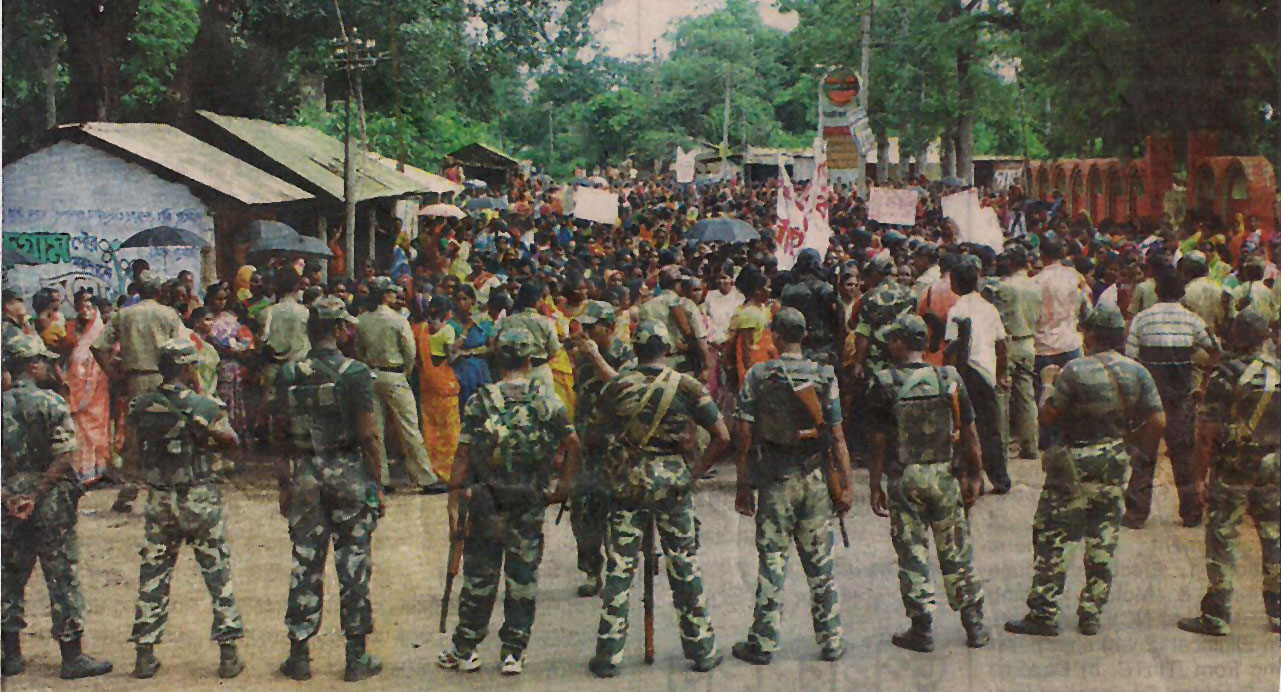
  • Operation Green Hunt includes widespread incidents of rape committed by the security forces. Recently, about 50,000 women tried to march into Jhargram town in West Bengal to protest against these rapes (see photograph above). The marchers included school students in uniform, teachers, housewives and even many elderly women. Widespread rape is a progeny of Operation Green Hunt.
  • The Armed Forces Special Powers Act (AFSPA), one of a number of anti-democratic Acts, continues to give Indian troops immunity from civil legal action and promotes human rights violations. The Naga People’s Movement for Human Rights has aptly observed that this Act is a systematic tool of the Indian government that contributes to terrorizing and dehumanizing civilian populations. This Act also protects security personnel in Kashmir guilty of killing and torturing the people of the valley.


The Indian state, in other words, has declared war on its own people. It has declared war precisely on those sections of the population who have always been at the receiving ends of multiple forms of systemic and institutional oppression. Instead of addressing the genuine grievances of Adivasis facing forcible displacement and dispossession, the Indian government has cracked down on their legitimate protests in flagrant violation of the letter and intent of the Indian Constitution.

Foreseeing the disastrous impact that Operation Green Hunt will have on the common people in those regions, different sections of civil society have called for a dialog between the state and various sections of the resistance, including the CPI (Maoist) and different people’s organizations, involved in struggles in the Adivasi regions. Several attempts to make progress in these efforts failed, with different politicians, bureaucrats and security officers continuously attempting to scuttle negotiations.

A glimmer of hope had risen due to the civil society initiative represented by Swami Agnivesh, with the Union Home Minister and Azad, as spokesperson of CPI(Maoist), responding to him in a letter detailing the suitable conditions under which a dialog might begin. It is reported that Azad was on his way to consult other members of CPI (Maoist) in order to decide future steps for proceeding with this initiative when he was allegedly abducted and killed, thus throwing the possibility of negotiations into disarray. The murder of a spokesperson of a political organization, with which dialog is supposedly being planned at this crucial juncture, raises serious doubts regarding the government commitment to such a dialog.

In this situation, the activists in India need your presence support. Join us to protest against Operation Green Hunt and the increasing violence of the Indian State on democratic movements on August 13, 2010 at 11 a.m. in front of the Indian Consulate in New York City. We have chosen August 13, as this date roughly coincides with Indian Independence Day, when the country became a sovereign nation-state following its colonial occupation by Great Britain. We would, therefore, like to record our protest and remind the public that the promises of the Indian independence have not only remain unfulfilled, but the current Indian government has resorted to military repression to quell democratic dissent in a way uncannily similar to the erstwhile British “overlords.” We invite all in diaspora, the international community of media activists, human rights workers, academics and intellectuals and artists to join us.

PUDR Statement on the killing of Azad, spokesperson of CPI(Maoist)

Peoples’ Union for Democratic Rights (PUDR) strongly condemns the killing of Cherukuri Rajkumar alias Azad and a free lance journalist Hemchandra Pandey at Adilabad District in Andhra Pradesh on 2nd July 2010. It has been claimed by the Andhra Pradesh police that Azad and one Sahadeva were killed in an encounter near Sarkepalli village in Jogapur forests in Wankhidi mandal, Adilabad, while some other Maoist members escaped. However, the police version is contradicted by media reports which claim that both Azad and Hemchandra Pandey (Sahadev) were picked up by the Andhra Pradesh police from Nagpur at 11 am of 1st July 2010 and brought to Adilabad and killed there. It has also been reported in the press that villagers deny having heard of any gun shots between 10pm to 2am in the night of the alleged encounter. Also it is strange that no policemen was injured in a 4 hrs long encounter. Thus, the police version of the incident is full of contradictions. And the killing could be a part of the official policy to use encounters as a means to eliminate unwanted voices through extra judicial killings.

In its directive of 1996, NHRC had clearly stated that all cases of encounters are cognizable offence until the police version is verified by an independent investigating agency and that ‘whenever information is received of encounter and death is ascertained as a result of firing by the police during the encounter, prima facie the ingredients of culpable homicide under appropriate sections of the IPC are satisfied and a magisterial inquiry shall be instituted against the encounter’. An Andhra Pradesh High Court’s ruling on encounter killings states that ‘the state is responsible to register an FIR against the encounter killing and the plea of self defence be proven before the court of law by the involved security personnel’.

In the light of all of this, PUDR demands registration of an FIR and initiation of investigation into the incident of killing of Azad and Hemchandra Pandey, without any delay. We also demand an independent magisterial inquiry as per the NHRC guidelines.

Moushumi Basu
Asish Gupta
Secretaries, PUDR
4th July, 2010

On arrest of Dr. Nisha Biswas and other civil rights activists in Lalgarh

We, the undersigned organizations and individuals, are shocked by the arrest on 14th June of Dr Nisha Biswas, Scientist – Central Glass & Ceramic Research Institute Kolkata, Manik Mandal, writer, Kanishka Choudhary, school teacher, and ten other persons by the W Bengal police from Lalgarh area, where they had gone at the request of the local people to investigate human rights violations by police and paramilitary. At the time of their arrest they were charged with violation of Sec 144 (anticipated major public nuisance or damage to public tranquility), a bailable offence. However, when produced in court on 16th June they were charged with several other false cases, such as waging war against the state, criminal conspiracy, and unlawful assembly, and remanded to 14 days jail custody. At a hearing on 25th June, a police application requesting her transfer to police custody- on the spurious charges based on a photograph in her camera- was rejected by the court and her bail hearing is due on 6th July.

We believe that this is not an isolated incident, but part of the repression and reign of terror let loose by the central and state governments over the past few years in the tribal parts of central India to crush dissent, and the accompanying attempts to delegitimize and criminalize all dissent and opposition to its policies.

On one hand, the state has launched an armed offensive in the forested tribal areas of Chhattisgarh, Orissa and West Bengal, in the name of countering the `Maoist menace’, to actually destroy the numerous resistance movements against forced acquisition of their land for mining and big industry, against displacement from their land and homes and loss of their livelihoods. This has been accompanied by the increasing use of extra-judicial killings and arbitrary arrests of villagers and leaders, and extra-legal measures that curb ordinary freedom of expression. Lalgarh area of W Bengal has been a site of intense police repression for more than a year now and under Section 144 for as much period. Civil society persons have not been allowed to visit the area and attempts to do so have been met with detentions and arrest. In Chhattisgarh there has been use of the draconian CSPSA to stifle opposition and of non-state actors like Salwa Judum that terrorises and kills villagers, destroys their homes, perpetrates sexual violence against women, and forces them into camps, or to desert their home and hearths and flee to neighbouring states.

On the other, the state has been suppressing in several ways efforts of civil liberties/democratic rights activists to expose the lawlessness and brutalities being committed in these areas by the security forces and to inquire into issues of violation of people’s rights in the process of `development’ of these areas. These tribal areas have been rendered out of bounds for people from outside the area, in violation of all Constitutional provisions regarding freedom of movement and of expression. Any person or group of persons visiting these areas, or talking about or writing about the situation there, or raising questions about the deployment of paramilitary forces in such large numbers is harassed, intimidated, or arrested and labeled as `Maoists’ or `Maoist sympathizers’, thus criminalizing all such democratic rights activities. Starting with Dr. Binayak Sen in Chhattisgarh, a large number of civil liberties activists across the country have been illegally arrested and implicated under false charges of `waging war against the state’ and accused as `Maoists’. Just over the past three months 14 people – trade unionists, forest rights activists and ordinary people – from Gujarat have been arrested under an omnibus FIR.

The recent arrest of Nisha Biswas and others, and the shrill tirade against writer Arundhati Roy, are part of this trend of targeting civil and political rights activists and urban intellectuals, and discrediting them for raising questions, for sincerely carrying out their democratic responsibility of drawing attention to violation of Constitutional and legal safeguards.

We are also deeply concerned by the extreme intolerance being displayed by the state and sections of urban society towards Arundhati Roy for her views on development, displacement, on the situation of the tribals, the violation of their Constitutional rights, and the military offensive of the state. Freedom of expression and vigorous discussion and debate are indispensable for a true democracy. Instead of carrying forward an informed debate on the issues raised by her, attempts are being made to stifle her voice by vicious abuse, public threats of arrest and much more. It is very disturbing that sections of the media too have been (ir)responsible and complicit in this matter, by false reporting of Ms Roy’s statements to suit their requirements. We also take this opportunity to condemn the statement reportedly made by a BJP leader of Chhattisgarh that Ms Roy ‘should be publicly shot down’. That such public incitements to kill a person are ignored by the state machinery exposes the extent of double standards and hypocrisy that characterize our political institutions and leaders. Such intolerance to Ms Roy’s writings and speeches not only makes a mockery of the claims of this country to being a `great democracy’ that grants immense freedom of expression to its citizens, it also poses a grave threat to the spirit of critical public discussion and debate warranted on crucial issues such as development and marginalization.

We are also extremely disturbed and anguished by the reports of rape and other forms of sexual violence by the security forces and Salwa Judum against innocent village women in Chhattisgarh as `punishment’ for alleged support to `maoists’. We ask of the political leadership – in this `war against the Maoists’, for that matter in any place whether it be in Kashmir or the north-east, why are women systematically targetted for sexual violence by the security forces? As already stated above, any attempts to bring this to light and extend assistance are also prevented by intimidation of the affected women. By not taking any action ever against the perpetrators the entire state machinery is accessory to these gruesome acts.

In this situation, we demand:
1. The immediate release of Dr. Nisha Biswas and others arrested along with her.
2. The witch-hunt against Ms Roy be ended.
3. Strict measures be taken against the security forces to put an end to the sexual violence being perpetrated by them against women.
4. We once again demand immediate withdrawal of the armed offensive against the tribal population. Instead, as expected of a democratic government, the government should move towards addressing politically the long-standing grievances of the tribal population, which have been explicitly pointed out and discussed by the government’s own report.

We strongly urge all other democratic minded women’s groups and organizations to join us in this urgent appeal to the Indian government and the respective state governments.

29 June 2010

Women Against Rape and Repression (WARR)

Women Against Rape and Repression (WARR) is a network of individuals and women’s and human rights organizations from across India. It is a non-funded effort initiated by women, and is concerned with atrocities and repression against women by state and non-state actors, especially in conflict zones.

Contact: women-against-sexual-violence@googlegroups.com

Endorsed by:

Organizations

1. AIPWA (Delhi)
2. Alternative Law Forum (Karnataka)
3. Anhad (Delhi)
4. Chhattisgarh Mahila Adhikar Manch
5. Committee Against Violence On Women -India
6. Committee for the Protection of Democratic Rights (Maharashtra)
7. Healthwatch Forum (Uttar Pradesh)
8. Jagrit Adivasi Dalit Sangathan (Madhya Pradesh)
9. Madhya Pradesh Mahila Manch
10. Manasa (Karnataka)
11. MARAA (Karnataka)
12. Narmada Bachao Andolan
13. National Alliance of People’s Movements
14. PUCL-India
15. SAHELI
16. Samanatha Mahila Vedike, Karnataka
17. SANHATI
18. Stree Jagruti Samiti (Karnataka)
19. Vidyarthi Yuvjan Sabha,
20. Women in Governance (WinG) -India
21. Women against Militarisation and State Violence Programme (The Other Media, Delhi)

Individuals

1. Ajay Kishore Shaw
2. Anand Bala
3. Anand Patwardhan
4. Anu Fern
5. Asha K.
6. Bishakha Datta
7. D.P.Duvvuri
8. Daniel Mazgaonkar
9. Dipak Ray Choudhary
10. Dipankar Basu
11. Helam Haokip
12. Dr Indira Chakravarthi
13. Dr Imrana Qadeer
14. Irfan Engineer
15. Dr Janaki Nair
16. Dr Jesse Ross Knutson
17. Jyoti Punwani
18. Kamayani Bali-Mahabal
19. Khadijah Faruqui
20. Dr K.J. Mukherjee
21. Dr Leena Ganesh
22. Dr Manali Chakrabarti
23. Manasi Pingle
24. Milind Champanerkar
25. Dr Mira Sadgopal
26. Dr Nandini Manjrekar
27. Dr N. Raghuram
28. N. Vasudevan
29. N. Venugopal Rao
30. Nandini Chandra
31. Niekesanue Sorhie
32. Piya Chatterjee
33. Prasad Chacko, Gujarat
34. Prarthana
35. Priti Turakhia
36. Priyanka Srivastava
37. Rahul Banerjee
38. Rahul Varman
39. Rajashri Dasgupta
40. Rakesh Ranjan, Delhi University
41. Ranjana Padhi
42. Renu Khanna
43. Ruchi Shroff
44. Sandy Singh
45. S Srinivasan
46. Sanober Keshwaar
47. Shripad Dharmadhikari
48. Snehal Singhvi
49. Dr Uma Chakravarti
50. Uma V. Chandru
51. Vivek Sundara
52. Dr Y. Madhavi

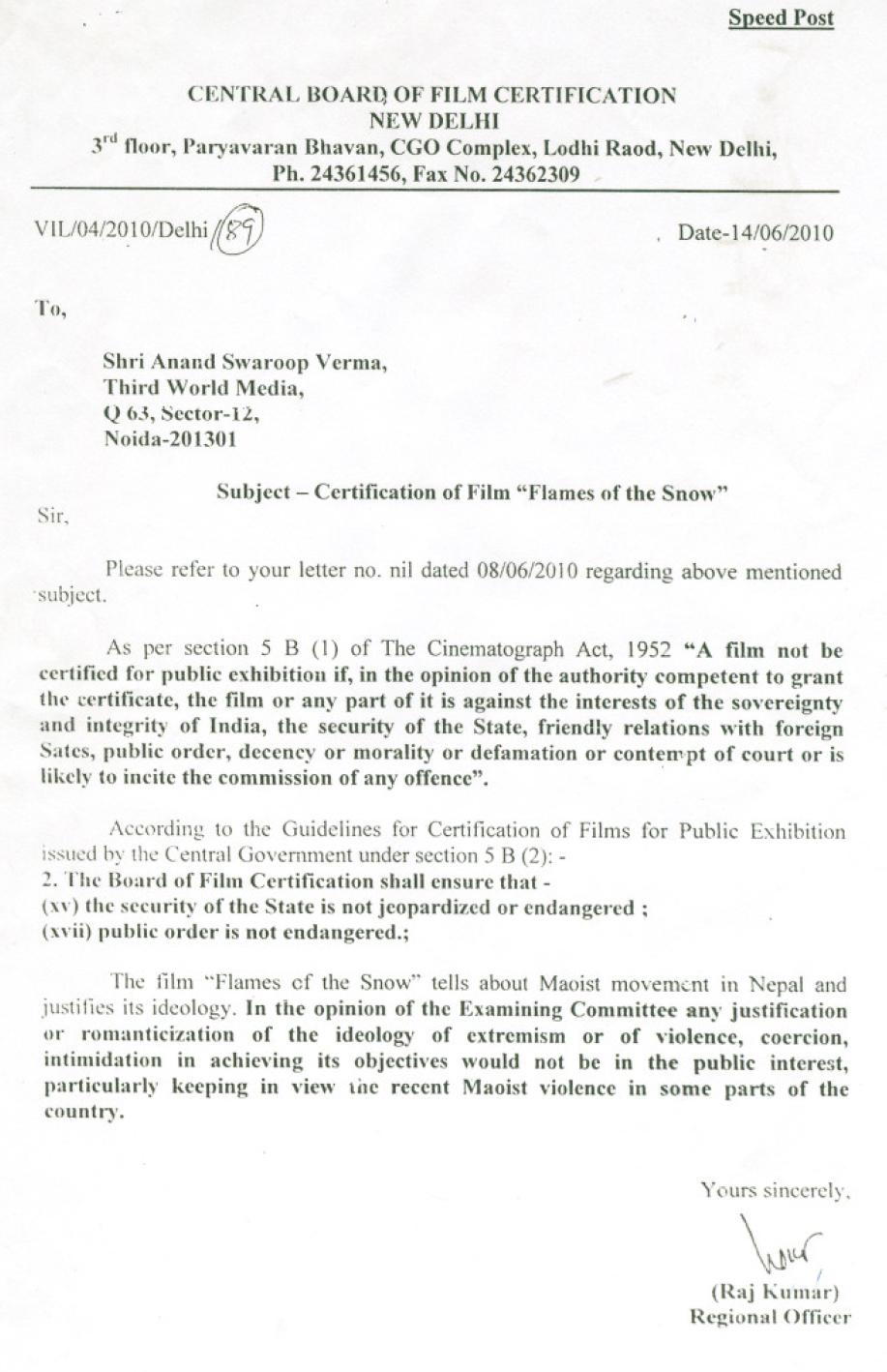
Censor Board denies certificate to “Flames of the Snow”

New Delhi, June 22: Indian Censor Board has refused to certify ‘Flames of the Snow’, a documentary on Nepal, for public screening. The Board feels that the film ‘tells about Maoist movement in Nepal and justifies its ideology.’ It feels that ‘keeping in view the recent Maoist violence in some parts of the country’, the permission of its public screening can not be given. Produced under the joint banner of ‘GRINSO’ and ‘Third World Media’, the 125 minute film has been produced by Anand Swaroop Verma, a senior journalist and expert on Nepalese affairs. He has also written the script for the film. The film has been directed by Ashish Srivastava.

Reacting to the decision of the Board, Mr. Verma said it is quite surprising as the film does not have any reference at all to the current Maoist movement in India. The film is only about the struggle of the people of Nepal against the despotic Monarchy and the anarchic reign of Ranas. With the formation of Nepal in the year 1770 by Prithvi Narayan Shah, the foundation was laid for Monarchy in Nepal which was finally given a burial in the year 2008 when Nepal was declared a Republic. Thus 238 years of Monarchy also included 105-year rule of Rana dynasty which is known as the black chapter in the history of Nepal.

Talking about the film, Mr. Verma further said that the film actually shows how in 1876 Lakhan Thapa, a young man from Gorkha district organized the peasants against the atrocities being unleashed by the rulers of Rana dynasty and was, later, put on gallows by these rulers. Even today, Lakhan Thapa is remembered as the first Nepali martyr. Exploring the movements led by ‘Praja Parishad’ and ‘Nepali Congress’ against the despotic system, the film focuses on the armed struggle carried on under the leadership of the Maoists for 10 years and unfolds the story of how the movement mobilized the Nepalese people by first attacking and dismantling the feudal system in the rural areas and subsequently taking the people’s movement to the urban areas bringing more urbanites into its fold.

The film begins with the establishment of monarchy in Nepal, further touching the developments like the elections for the constituent assembly, the emergence of Maoists as the largest party in the elections and finally ends by showing the decline and complete disappearance of Monarchy and Nepal being declared a Republic.

Taking note of the objections put forward by the Censor Board, it seems that the Board will never give its certification to any political film made on Nepal since no political film on Nepal can escape underlying the prominent role of Maoists. Maoist party was heading the government in Nepal till May 2009 and even today is the largest party in the Constituent Assembly and is the main opposition party. Moreover its president Pushp Kamal Dahal ‘Prachand’ as the Prime Minister of Nepal had visited India on the invitation of the Government of India.

Mr Verma is now submitting his film to Revising Committee of the Board.

Join the Resistance Week 15th -21st May 2010

APPEAL FROM Abhay Sahu, POSCO PRATIRODH SANGRAM SAMITI (PPSS)

Dear Friends,

Our sincere and heart-felt thanks to you all for your continuous supports and cooperations to the people in struggles for the protection of their lands and livelihoods from the clutches of the South Korean eagle POSCO. Now, on behalf of the POSCO Pratirodh Sangram Samiti (PPSS), I am writing this letter with a special request.

As you know, in protest of the joint conspiracy by the Manmohan Singh Government at Delhi, Naveen Government at Bhubaneswar and South Korean President, we, the people of Dhinkia Charidesh have been continuing our day-and- night peaceful Dharna (Sit-in) at Balitutha since last 107th days began from 26th January 2010 mid-night. Everyday thousands of women, men, children from families of peasants, fisher-folks, landless labourers, dalits are participating in the sit-in. Sadly enough, views of affected people did not create any sense of responsibility among the governments supposed to represent people of India. Moreover, they have been showing extra-ordinary favours to the corporates such as POSCO, Vedanta and TATA.

On the last Republic Day, both Manomohan Singh and Naveen Patnaik governments had assured to South Korean President Lee Myung-bak in a special meet at Delhi that the state government will expedite works ‘to hand over lands to POSCO’. Throwing behind all protocols related to Republic Day celebrations in Orissa, a frustrated CM rushed to Delhi to prove his allegiance to SK President. PM, CM along UPA Chairperson had a meeting with him. They did not hesitate to sell the ‘dignity’ of people’s India to a private company on the same day of India’s pride.

Utter failure to displace the people by any means has made the desperate Orissa Government blood-thirsty. On 12th May 2010, the Orissa Police killed a person at Kalinga Nagar, where they had massacred 14 persons on 2nd Jan 2006. They are going to use the same murderous tricks at Dhinkia Charidesh to dissuade people from their resistance. On 11th May they sent, twenty five platoons of heavily armed police force have arrived and have already taken position around Balitutha and Dhinkia Charidesh to attack, the unarmed peasants, fisher-folks, landless daily labourers, dalits, other backward classes, women, men, children those who continuing their peaceful resistance movements the lands and livelihoods. With a well-crafted evil design, they have also brought 3 Magistrates with the police and sent 5 ambulances to nearby Kujanga Hospital. Almost all the schools at nearby villages have been forcibly occupied by the Police force in spite of the opposition by the villagers.

At this decisive juncture, PPSS decides to face the reality and calls to observe Mass Resistance Week from 15-21 May 2010 at Balitutha and affected villages. People in thousand numbers will gather there to express their support and solidarity to the struggling villagers. In this context, we would like to call people’s movements, political parties, trade unions, human rights organizations, solidarity groups, activists, supporters, sympathizers from various corners of the country to participate in the Resistance.

We are glad enough to invite you to make it possible to join the Resistance Week. You may, please, come to Balitutha and Dhinkia Charidesh on or before 15th and leave after 21st May 2010. We would also request you to bring your own fooding, tents and banner with you. Those who cannot physically be present may organise protests or send letters, faxes or phone calls of protest to the addresses below. Your smallest support will be our greatest inspiration.

Waiting to see you,

With Revolutionary Greetings,

Abhay Sahu,
President, POSCO Pratirodh Sangram Samiti (PPSS)

Call/Fax/Email

Chief Minister of Orissa
Address: Naveen Nivas, Aerodrome Road, P.O.-Bhubaneswar, Dist.-Khurda
Pin -751001(Orissa)
Tel. No.(O) 0674- 2531100,2535100 (FAX)
Tel. No.(R) 0674- 2590299, 2591099,2590844,2591100,2590833
Email : cmo@ori.nic.in

Shri Manmohan Singh, Prime Minister of India, Prime Minister’s Office,
Room number 152, South Block, New Delhi, Fax: + 91 11 2301 6857

Shri Shivraj Patil, Union Minister of Home Affairs, Ministry of Home Affairs,
104-107 North Block, New Delhi 110 001 India, Fax: +91 11 2309 2979.

Chief Justice of India, Supreme Court,Tilak Marg, New Delhi -1,
Fax: +91 11 233 83792, Email: supremecourt@nic.in

Chairperson, National Human Rights Commission of India,
Faridkot House, Copernicus Marg, New Delhi 110 001, Tel: +91 11 230 74448,
Fax: +91 11 2334 0016, Email: chairnhrc@nic.in

Mr. T. Theethan, IAS, The Joint Secretary, National Commission for SC,
5th Floor, ‘B’ Wing, Lok Nayak Bhavan, Khan Market, New Delhi 110103,
India. Email: jointsecretary-ncsc@nic.in

Courtesy: http://orissaconcerns.net/2010/05/resistance-week/

Peace March in Chhattisgarh from May 5

Azadi Bachao Andolan

The country is in the midst of a civil war. In the estern part, West Bangal, Odisha, Jharkhand and especially in Chhattisgarh, violence, both by Mioists and by the state, has erupted resulting in heavy loss of life of poor people, especially of adivasis.

People, who believe in peace and non-violence, are facing the question : what can be done right now? (At the present moment, we are not discussing the causes like exploitative, iniquitous model of development etc. which has led the country to the present crisis). Out of the meeting with Gandhians like Amarnath Bhai at Sevagram on April 9 and jurists like Justice PV Savant, scientists like Prof Yash Pal, Dr. P.M. Bhargava, Dr. Vandana Shiva, social activists like Swami Agnivesh during Independent People’s Tribunal in Delhi on April 10 and 11 and the senior journalist Kuldip Nayar, an idea has emerged: 50 persons, who are known in the country for their integrity and who believe in peace and non-violence, should take out a peace march in Chhattisgarh as early as possible. These 50 peace marchers will be joined by others also.

The Peace-March will start form Raipur (Capital of Chhattisgarh) on May 5, 2010.

Peace marchers are requested to reach Raipur by noon of May 5.

The details of Peace March, assembly point in Raipur etc will be communicated soon.

Those, who have already given their consent to participate in the Peace March, include Prof. Yash Pal (Former UGC Chairman), Dr. P.M. Bhargava (famous bioscientist), Narayan Desai (Veteran Gandhian and Chancellor of Gujrat Vidyapeeth), Kuldip Nayar (Senior Journalist), Justice Rajender Sachchar (former chief justice of Delhi High Court), Amarnath Bhai and Lavanam (Veteran Sarvodaya leaders), Ms. Radha Bhatt, President, Gandhi Peace Foundation, Prof Anil Sadgopal (Educationist and President of All India Forum for Right to Education), Arvind Kejariwal (Magsaysay Awardee), Prof. Jagmohan Singh (Historian and Nephew of Bhagat Singh).

Lovers of peace and non violence who want to end civil war in the country and , wish to join Peace March should contact Kuldip Nayar (Ph. 09818309444) e-mail kuldipnayar09@gmail.com) or Dr. Banwari Lal Sharma (0532-2466798, 09235406243) e-mail azadi.bachao.andolan@gmail.com)

Condemn the use of Capital Punishment against 3 Kashmiris

COMMITTEE FOR THE RELEASE OF POLITICAL PRISONERS
185/3, Fourth Floor, Zakir Nagar, New Delhi—25

Giving Death Sentence to 3 Kashmiris and rigorous life imprisonment to another in the Lajpat Nagar Blast Case vindicates the observation that “being a Kashmiri itself is a crime to be punished in India!

Strongly Condemn the use of Capital Punishment by the Government of India!

Abolish Capital Punishment!

After 14 long years, a Delhi Court has finally given death sentence to three Kashmiris—Mohd Naushad, Mohd Ali Bhatt and Mirza Nissar Hussain—in the 1996 Lajpat Nagar blast case while putting Javed Ahmed Khan under rigorous life imprisonment. While two others—Farooq Ahmed Khan and Farida Dar—were released as the court observed that the 14 years that they had spent in the prison would be considered as their punishment. Here there is a catch. A week before the court had acquitted 4 others as it had found them innocent, that too after 14 long years! So the question that arises to any discerning mind is that if two have been released as their 14 year incarceration is being taken as punishment by the Hon’ble Court for them, then why is it that the court silent on the same quantum of years spent by the acquitted four. Can the court give back their 14 long years? Can it compensate for the physical and mental injury along with the social stigma that these four and their kith and kin have gone through? Who should be held accountable for such travesty of justice?

It should be noted that the Court has rapped the police for shoddy evidence and irresponsible conduct which it has termed as lack of seriousness. How can such criminal lapse on the side of the investigating agencies make life miserable for people who can only get justice that too to be declared innocent after almost spending a life sentence! So when one of the persons who have been on trial was on record saying that “being a Kashmiri itself is a crime to be punished in India” the court sentence proved to be a grim reminder, a tragic replay of the gross injustice meted out to the people of Kashmir by the Indian judiciary.

We at the CRPP reiterate that every democratic mind should raise this question about the authorities who have falsely implicated them and fed all kinds of insinuating and incriminating stories in the media on their so-called involvement. Will they ever stand for trial? Or raising a question against them would affect the morale of the investigating agencies? Once again what comes to sharp focus is a continuing story of calculated assault on the lives of particular people who have been targeted for their political convictions. More than a case of showing how fair the system is—as it has acquitted the genuinely innocent and tried the ones for their “various roles”—this once again brings forth the ugly face of blatant violation of procedures and rights of the accused, let alone their right to represent themselves without being prejudiced against.

Despite shoddy evidence and irresponsible conduct from the side of the police, it did not stop the court to give death sentence to 3 Kashmiris which is a punishment that has been long given up by many civilised countries. India is yet to sign this International treaty to which many of the democracies in the world are signatory against a worst form of barbaric punishment that can only further criminalise the people and the system. We demand unequivocally to abolish Capital Punishment and demand the Indian Government to immediately sign the International Treaty abandoning death penalty as a form of punishment.

Given the way things are unfolding for the people of Kashmir all claims of the Government of India about a bill against torture or allegedly safeguards against that sounds like a cruel joke as many of such detention centres in Kashmir are illegal and secret.

Ever since the news of the sentencing of six people along with the acquittal of four of the 1996 Lajpat Nagar blast case the valley of Kashmir has witnessed series of protest demonstrations, and complete shutdown. This reflects the general apathy of a people who have been subjected to the worst kinds of human rights violations.

Illegal detentions, trumped up cases and imprisonment being a common way of life for the average Kashmiri, the question of the political prisoner and his/her status and safeguards against all forms of torture and intimidation becomes paramount. While this is being written there are several people who have been kept behind bars including leaders for protesting against the gross violations of the civil and political rights of the people of Kashmir. In fact this anger is evident in the complete shutdown of the valley and when the people and their leaders say that they are being targeted for their demand for the Right to Self-Determination.

In Solidarity,

Gurusharan Singh (President), Amit Bhattacharyya (Secretary General), SAR Geelani (Working President), Rona Wilson (Secretary Public Relations)