No news from Narayanpatna

Satyabrata

“The fact is people have lost the fear of the law because they feel they can get away with anything. My job is to take hard police action against the Naxals. The fear of the law is to be ingrained in the people.”

This is how one of the leading police officers in Chhattisgarh defined his task. All of us understand what constitutes the mechanism of ingraining the fear so that it becomes part of the people’s collective unconscious for a long time to come. It has been practiced in Kashmir, in the Northeast, in Chhattisgarh among many other places, and now in Orissa.

The State has dealt with the Narayanpatna movement in Orissa too in a most brutal, yet tactful, manner so that the possibilities inherent in it are not realized, and its brutal suppression becomes a reminder lesson for others on what constitutes the legitimate within the evolving political economy in India.

As “a single spark can start a prairie fire”, the state apparatuses are not just busy beating the “spark” down, they are, in fact, trying to hide it or corrupt the vision of the beholders, so that the spark does not seem to be a spark. Even liberal fact finding teams are not allowed to enter the Narayanpatna block of Koraput. The bitter experience of the all-women fact finding team that consisted of prominent civil rights activists from all over India is only symbolic of how brutal the State can become when the question is of safeguarding the interests of capital and its agencies.

It would not be fallacious to say that the situation in Narayanpatna is a clear manifestation of the fascist conjuncture of capitalist development in India. We find a remarkable complementarity between the three wings of the Indian state and its coercive and consensual/ideological apparatuses in maintaining the rhyme and reason of political economic developments. The synergy among various levels of political and bureaucratic institutions and between the state’s repressive components (the local police, the cobra battalions, and civilian stormtroopers like salwa judum in Chhattisgarh) and the Fourth Estate of the hegemonic forces is unprecedented. Anybody who has attempted to organize press conferences in Raipur (the capital of Chhattisgarh) to highlight incidences of state repression is witness to mafia media men shouting at the organisers. All these form the fascio (a bundle of sticks or rods) by which the Indian state rules.

Today, we see entry into Narayanpatna virtually impossible. The police, local exploiters and the private militiamen whom the women’s fact finding team confronted on the 9th of December guard the very entrance of the area. To complement this, the local and to an extent the national media has been playing its role most sincerely projecting the movement as an expression of uncivilized violence, while remaining unabashedly antipathetic to the cause and scope of the movement. When fact finding teams have attempted to unravel the truth, what has happened is in front of our eyes. Hence, we have no news from inside Narayanpatna, except a few statements of the police present there – regarding how many are held or killed etc.

The height of brutality that must be going on in Narayanpatna can only be imagined from what treatment a women’s fact finding team received in the hands of ‘the armed bodies of men’ even after taking the requisite permission from the local authorities to enter the area. Abused and beaten came back a team of civil dignitaries with sincere intentions of finding the ‘neutral’ truth.

The media reports that Nachika Linga, leader of CMAS, who is now in the most wanted list of the government is under the shelter of the ‘Maoists’. It is necessary here to pontificate at the apathy of the media towards any move that has been taken in Bhubaneswar (the capital of Orissa) to empathise with the Narayanpatna movement. About 100 people from various organizations on the 10th of December silently demonstrated in the city’s Master Canteen Square against the issuing of the order to arrest Nachika Linga. This was something that could have been sublime to the media but what instead caught the media’s eyes is the probable alliance of Nachika with the ‘Maoists’. (However, if at all Nachika Linga is protected by the Maoists today, this is more a comment on India’s rule of law and those who see possibilities within it – it proves that the ‘democratic’ voices having faith in the present system are not able to protect people’s self-rule efforts).

Today, the State has militarized the democratic movement of the tribals and landless. To tackle the movement of the landless and the near-landless inside Narayanpatna, there is an already existing State sponsored militia. It is important to clarify that this is a well thought out strategy of the state, by which it demarcates the “limits of legitimation” for any popular collective action. And the state understands that the people have crossed those limits in Narayanpatna.

So war zones are being defined and the “national” media is fast becoming a “nationalist” media – a propaganda machinery to fight the influence of “aggressors”. However, this time, the aggression is from within – the “cattle class” which was bred to be slaughtered threatens the “nation” of the first class. The media in India today gives expressions to the anxieties of the first class, packaging its hallucinations as facts and news reports.
Narayanpatna: Crushing the People to Grab Land (Dec 15, 2009)

Janhastakshep-Campaign Against Fascist Designs
invites you
for a public meeting
on
“Narayanpatna: Crushing the People to Grab Land”

Struggles of tribals in Narayanpatna block of Koraput district is facing severe police repression. Chasi Mulya Adivasi Sangh (CMAS) which is spearheading the struggle of tribals primarily for repossession of their lands from non-tribal landlords, is the target of this repression. Two activists were killed in unprovoked brutal firing on tribal demonstrators on November 20, 2009. CMAS activists are being rounded up with more than 63 activists already in their custody, tribals are being brutally beaten up, tribal women are being assaulted, their houses and crops being damaged. Posters have been pasted in the block for capture of their leader, Nachika Linga. Platoons of CRPF, RPF and special police are being deployed to crush the tribals, their organization and struggle. On December 10, a team of nine women activists going to the area was attacked by landlord goons in presence of police with some of them sustaining injuries. There is war declared by Naveen Pattnaik Govt. against the tribals of Narayanpatna.

What is the crime of these tribals? Over the decades their lands and means of livelihood is being taken over by the non-tribal exploiters with active help of administration and police. Tribals have been facing ruthless exploitation and oppression in their own areas at the hands of police, forest officials and non-tribal landlords. Though there are laws in every state including Orissa against alienation of tribal lands, yet the same continues. Rather than preventing alienation of tribal lands, the state machinery connives in alienation of their lands with the result that vast lands of tribals stand alienated in almost all tribal areas of the country.

CMAS launched a struggle against this alienation and reclaiming of tribal lands from non-tribal landlords. Over 2,500 acres of tribal lands have been reclaimed. The fury of the Govt. is being let loose against the tribals. To suit their war effort the Govt. and the official media has launched a campaign of misinformation and utter falsehood obliterating the real identity of the leadership of this movement i.e. CMAS which is there being led by CPI(ML) organization led by Com. Gananath Patra.

Orissa is witnessing sharp struggles of tribals both to save their lands from MNCs and corporates (Kalinganagar, Niyamgiri, Kashipur, Keonjhar) as well as to save and reclaim their lands from non-tribal landlords. Orissa is also seeing struggles of non-tribal peasants against forcible displacement (Anti-PoSCo) and on utilization of water of Hirakud dam. Orissa has emerged as one of the states where people’s struggles have risen sharply to challenge the policy framework of present rulers. No wonder movements in Orissa, particularly those of tribals, are facing ruthless and brutal repression.

It is the duty of all patriotic, democratic and progressive intellectuals to stand with the movements of the people including those of Orissa. We are organizing a meeting on December 15, 2009 (Tuesday) at 5:00 PM at Gandhi Peace Foundation. We request you to positively participate in the meeting.

DATE : Tuesday 15th Dec 2009
TIME: 5 p.m.
VENUE : Gandhi Peace Foundation, Deen Dayal Upadhyaya Marg, near ITO Delhi.

Speakers:

Bhalachandra Sarangi, CPI-ML(New Democracy) Orissa
Abhay Sahu, (POSCO PRATIRODH SANGRAM SAMITI) Orissa
Sumit Chakraborty, Editor MAINSTREAM

“State violence against people’s movement in Orissa and West Bengal” (Dec 14, 2009)

Seminar on ‘State violence against people’s movement in Orissa and West Bengal’,
Speakers:
Parthasarathi Ray (from Sanhati) on Lalgarh
Bhalachandra Sarangi (Member of the fact-finding team to Narayanpatna and spokesperson for CPI-ML(New Democracy) in Orissa) on movements in Orissa including Narayanpatna

Date: 14th December (Monday)
Venue: Activity Centre (above the Arts Faculty Canteen, North Campus), Delhi University
Time: 10 am-1 pm

Video: Police-Mafia nexus in Narayanpatna

Courtesy: Samadrusti

Narayanpatna: Attack on an all-women fact-finding team

From the Press Conference: Update at 9 December, 2009, 2.45 p.m.

The 9 women fact-finding team just concluded a press conference at Parvathipuram, Vijayanagaram District, Andhra Pradesh.  Here’s the narrative of the day’s happenings as told by Shweta Narayan and Madhumita Dutta to Nityanand Jayaraman over phone:

At 10 a.m., the All India Women’s Fact Finding Team consisting of 9 women reached Narayanpatna Police Station and requested to meet the Station In-charge.

1. Sudha Bhardwaj, Advocate, Chhattisgarh
2. Mamata Dash, Delhi
3. Madhumita Dutta, Chennai
4. Shweta Narayan, Chennai
5. Rumita Kundu, Bhubaneswar
6. Pramila, Bhubaneswar
7. Kusum Karnik, Bhubaneswar
8. Ramani, New Democracy, Orissa
9. Durga, Chhattisgarh

We were told that the policeman was busy and were asked to come in the evening.  The person questioning us asked us for names and mobile phone numbers and names of organisations.  We gave all of that.  We noticed quite a number of uniformed policemen and many people in plainclothes.  None of the people in uniform (we assume they were policemen) had any name tags.  We asked one of them who the people in plainclothes were and were told that they were all policemen.  We asked the man how many police were there in this area, and he said more than 2000 police.  One striking thing is that none of the many people gathered there were adivasi.

About 20 adivasi men were huddled, squatting inside the police station premises.  We asked the policeman near us who they were and were told that the adivasis were former activists of the Chasi Mulia Adivasi Sangh, who had come to surrender.  This has been happening for a few days now, and many newspapers are reporting this.

By this time, the crowd of so-called plainclothes police were getting restless.  We heard people commenting, saying: "Ab aa rahen hain.  Jab hamarey gaon jal rahe the, tho kahaan the?" (When our farms were being burnt, where were you?  Now they show up).

Madhumita felt the situation was looking troublesome and suggested we leave.  As we were stepping out of the police station, our driver was cordoned off and was being questioned in a very hostile manner and being threatened.  We heard someone saying that he is a regular to these parts and they enquired as to his antecedents.

We somehow managed to extricate the driver.  One of the policemen in plainclothes, whom we saw inside the police station premises, was taking photographs, and he said "Maaro Inko." (Beat these people up).  That is when more than 200 people surged ahead.  The driver was being slapped repeatedly.  Madhu and 75-year old Kusum Karnik tried to intervene and that is when one man went for Madhu’s throat.  Kusum was hurt too.

Rumita Kundu was verbally abused inside the police station.  One man crudely said that all these women had come to sleep with the men there.  Mamta Dash was hit on her back and abused.  One man attempted to strangle Madhu.  When she moved to save herself, her jaw was injured.  All this happened inside the police station premises.

The driver was the one that was being assaulted most, and we did all we could to extricate him and board our vehicle.  By this time, the vehicle was being broken.  The rear windscreen was broken.  With great difficulty, we fled the area driving towards Bandhugaon.  We were followed by the plainclothesmen who claimed to be police on bikes.  Somewhere between Bandhugaon Police Station and the village itself, we were stopped by two men in plainclothes.  They said they were police, and they demanded to see the driver’s license.  As he was enquiring, about 20 people gathered there.  But nothing untoward happened here.  We were scared nevertheless.

From there, we proceeded to Kottulpetta.  Even before we got to this village, news seemed to have reached them about our visit.  A road blockade had been organised, with a bullock cart blocking the road.  There were no oxen.  The people there, again all non-tribals, pulled out the driver and started assaulting him.  They tried to pull down another male colleague of ours, Mr. Poru Chandra Sahu, and tried to beat them up.  We intervened, and that’s when Kusum didi, the 75-year old activist, was hurt on her head.  We were there for more than 15 minutes.  More violence.  More damage to the vehicle.  More slaps for the driver.  Our friends outside had been notified almost as soon as problems began, and phone calls must have been pouring into the Collector and SP’s office.

By this time, two bikes carrying one of the plainclothes "policemen" who had taken our names in Narayanpatna, and another plainclothes guy who was tall and burly, reached there and asked the youth to disperse.

We reached Bondapalli, the border village within Andhra Pradesh.  Almost in no time, a jeep load of Andhra Pradesh police along with plainclothes youth (young boys) armed with rifles and bullets arrived on the scene.  They demanded to know who we were.  We were treated more like criminals than victims, and our vehicle was searched.  Only after Madhu spoke to the SP of Vijayanagar and the DGP were we allowed to go.  The police who stopped us immediately changed the tune and offered to help us with medical assistance etc.

Our experience with armed youth and police has left us clearly terrified and convinced that the situation created by the police in Narayanpatna and this part of Orissa is extremely vitiated.  We have the following concerns and demands which we conveyed to the media at a press conference in Parvathipuram, Vijayanagarm District, Andhra Pradesh.

Concerns:

  1. The scenario of terror that we witnessed and were subject to shows the kind of tense situation prevailing in the Narayanpatna area post November 20, 2009’s police firings in Narayanpatna.
  2. There is no access for people to get in and out of the villages in Narayanpatna, with all routes blocked by armed goons.
  3. There is no way to get information about what is happening inside, and no means of verifying the very disturbing accounts we are getting about abuses, molestations and violence against adivasi people.
  4. The number of plainclothesmen who claimed they were police, and the comfort with which people outside the Narayanpatna police station were interacting with the police, and reacting to one policeman’s instruction to beat us up, suggests that there may be some truth to reports that there is a Salwa Judum style Shanthi Samiti in this area as well.  This may either be sponsored or working in close complicity with the police and state.
  5. If the Fact Finding team of prominent women has been treated with such violence, it is clear that there is absolutely no room for dissent inside the villages.
  6. All the people who attacked us were non-tribals.

Demands:

  1. The officers at the Police Station should be suspended to create an impartial situation and enable the carrying out of investigations into the firing of 20 November, 2009, and the subsequent reports of atrocities against tribal people.
  2. The SP Koraput should be suspended.
  3. The Government should constitute a high-level independent investigation team and not depend on the police, who are clearly biased, and are using the language of terror and violence to suppress dissent.

Please show your protest by calling the DM and SP of the district:

DM — Gadadhar Parida  0 94381 8184649

SP — Deepak Kumar Chauhan  0 94379 62200

For more information, contact:
Adv. Sudha Bharadwaj: 09926603877
Madhumita Dutta: 9444390240
Mamta Dash: 09868259836

This All India Women’s Fact-Finding Team was in Narayanpatna to enquire into the Police Firing that took place on 20 November, 2009.

Narayanpatna: Nachika Linga, the Most-Wanted

Satyabrata

On the 4th of December, 2009 an order was issued for the immediate arrest of Nachika Linga, leader of the Chasi Mulia Adivasi Sangha (CMAS). He is now in the “Most Wanted” list of the government of Orissa. Posters have been put up by the government throughout Koraput and other regions of southern Orissa displaying a photograph of Nachika Linga and the “crimes” he had committed written underneath. Cash awards have been announced for anyone who helps arrest him. There are about 46 cases in Nachika’s name which include murder, attempt to murder, dacoity etc. Section 302 (punishment for murder) of the Indian Penal Code among other sections has been lodged in his name.

On the 6th of December, the Superintendent of Police, Koraput publicly announced (which he has no legal authority over) that the CMAS should be banned. Here it is necessary to take a bird’s eye view of who Nachika Linga is and what the CMAS has been doing recently.

Nachika Linga is one of the many indigenous tribals who inhabit Narayanpatna. Lately he became the Nayak Sarpanch of his area. Nachika Linga joined the CMAS which was leading the movement for land redistribution. It is necessary here to mention that the movement was never illegal. Even the issues that it raised were broadly related to a proper implementation of the existing laws. To be specific, there is an act passed by the Orissa Legislative Assembly in 1952 (Act 2) which says that the non-tribals cannot keep the lands of tribals in that region, and the CMAS was simply trying to get this law implemented. The authorities of the region till recently were therefore in constant dialogue with the CMAS. In fact, a collector who facilitated this dialogue most sincerely too earned the name so many progressive people are earning now-a-days: Maoist. Due to this movement, the local tribals were able to acquire their lands and the process of collectivization of ownership of land too was started. There were social reform measures taken within the movement, like limiting the consumption of liquor by the tribals to festive occasions only.

Evidently, the landlords and liquor traders who were thriving on land-grabbing, commercialistion of local economy found their ‘businesses’ hampered. They were ‘forced’ to flee the region. In ‘fear’ they joined hands with dominant political forces, and found the police and their actions the only mechanisms to reenter Narayanpatna. Attempting to limit the movement territorially, and to create ‘a civilian’ support base for the state’s brutal measures to suppress the movement in Narayanpatna, they formed ‘salwa judum’ like groups in adjoining Laxmipur. As reported earlier, two leaders of CMAS were gunned down and today there is a warrant in the name of Nachika Linga.

The whole organization which was giving an organized and definite shape to the spontaneous resistance of the rural poor in the region stands accused of a conspiracy to wage war against the state. Does it not seem parallel to the draconian measures during the initial days of capitalism everywhere through which the states declared every association of workers and poor as conspiracies? What is happening in India today demonstrates that such measures are not simply historical, but rather constitutive of capitalism – capitalists and their states invoke them every time they find it opportune.

There are press reports that inform about the return of the landlords and traders in the region. How brutal the police force in the region has been and whom in the region it is nepotistic to is no secret. Several tribals in fear of arrest and at gun-point have reportedly ‘committed’ not to indulge in any ‘unlawful’ activities of the CMAS. The clean image of the government of Orissa is being projected by the media at a time when a fascist political economy is being nurtured with its very own hands. Under such conditions, as old Marx would have said, force alone can impregnate this old society with a new one. This force has to make its development and is making its development within and in spite of this authoritarian bourgeois rule in the form of territorially limited movements, which have already nurtured many Birsa Mundas who are daily confronting the brutalities of the state – and Nachika Linga is definitely among them. The final expression of this force shall be in bringing down the authority of this state but that is possible only by generalizing the spirit of struggle beyond localities.

Call to stop an anti-Maoist witch hunt in Orissa

Satyabrata

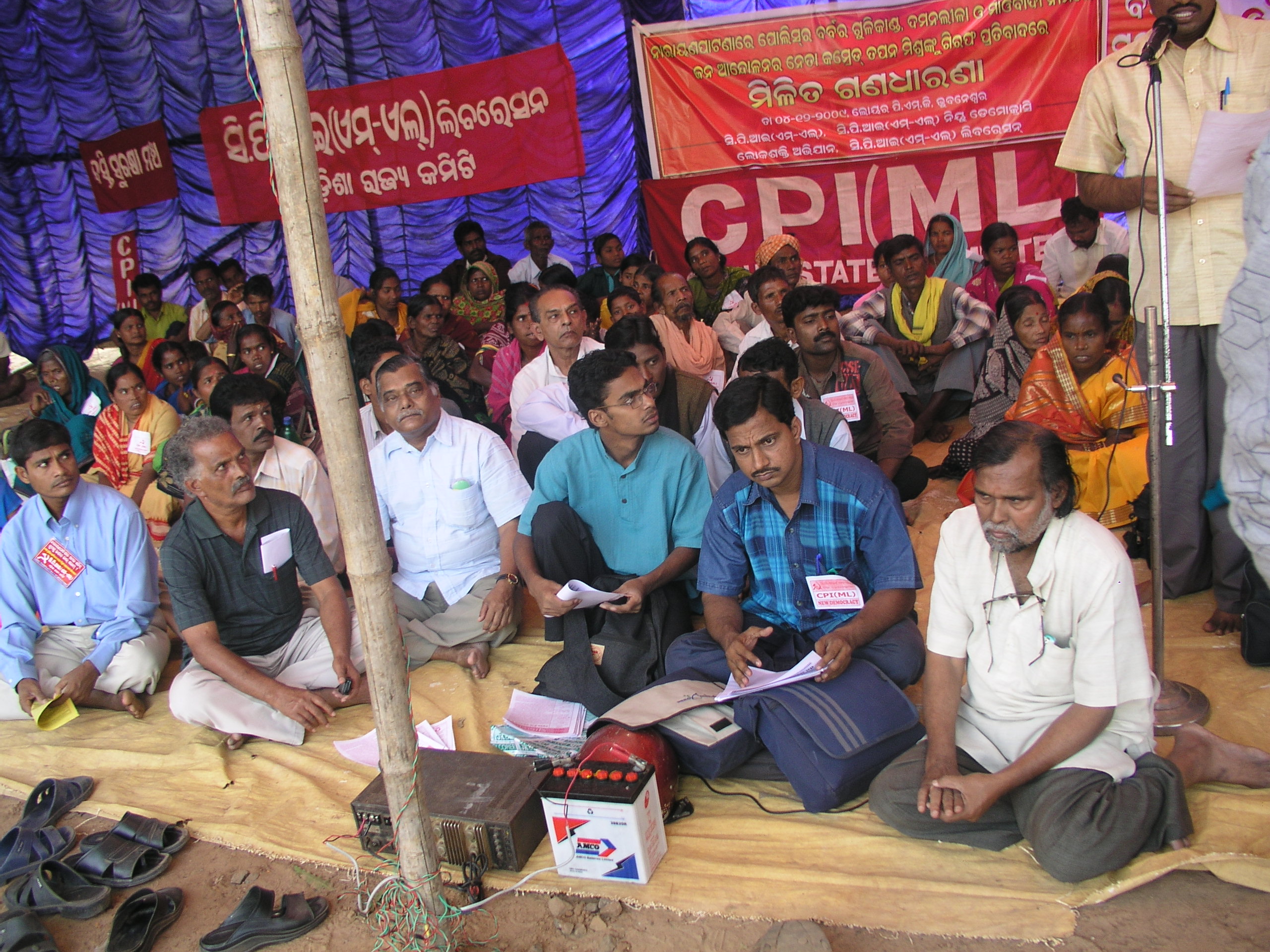
On the 3rd of December, 2009 there was a general closure of all shops and offices in Athamalik to protest against the arrest of Tapan Mishra. On the 4th of December, a public meeting was organized in Lower PMG Square, Bhubaneshwar by several left groups like CPI(ML)(Liberation), CPI(ML)New Democracy, CPI M-L, Gandhians of Lok Shakti Abijan, Lohia-socialists of Samajbadi Jan Parishad and liberals of Athamalic Sachetan Nagarik Mancha. Human rights activists like Biswapriya and other progressive individuals together with the above groups comprised about 200 protesters. Among the speakers were Com. Jayadev, Com. Sivaram, Com. Bhala Chandra, Prafulla Samantara and Lingaraj. Beginning from the communists and Gandhians to Lohia-socialists and liberals, all of them united in their struggle against the ongoing McCarthyist repression in Orissa in the name of hunting down the Maoists. People who had come from different regions of Orissa reported similar arrests of tribal and dalit leaders in their areas. The protesters unanimously raised their voices against the crushing down of democratic movements in general and that at Narayanpatna. The apathy of the media towards the democratic movements was also discussed.

With already five days past the arrest of Tapan Mishra and with no response from the government after protests against his arrest, a four member delegation, consisting of Saraju Singh Samanta, Pratap Nayak, Mahendra Parida and Pramila Behera submitted a memorandum to the Governor of Orissa which included an unconditional release of Tapan Mishra among other demands.

With the government having turned a deaf ear towards the voices of dissent and using its fully armed machinery to crush them down, it is only creating a passion for destruction, of its own destruction, in the sphere of radical democratic politics and as Bakunin would say, “the passion for destruction is a creative passion too.”

Narayanpatna: The Arrest of Tapan Mishra

Satyabrata

On the 29th of November, 2009, Tapan Mishra, a democratic political activist who was about to board his train to Narayanpatna from Parvatipuram railway station was arrested by police in civilian uniform. Throughout his life of 42 years Tapan Mishra has been linked to several left groups and has been part of popular dissent movements. He was once a member of AIDSO (All India Democratic Students Organisation), the student wing of the SUCI and the President of the Ravenshaw College Students’ Union. Later he joined the CPI(ML)(Liberation) and was an active participant in the then agrarian struggles and struggles of forest dwellers. Tapan Mishra was the councilor of Athamalic NAC and also contested the last Assembly elections from Athamalic: the later two facts show that he had no strategic ideological compatibility with the CPI(Maoist).

Before leaving for Parvatipuram, he met several press people in Bhubaneshwar and had assured them that he would provide reliable information on what was going on in Narayanpatna. It is also worth noting that Tapan Mishra was a potential leader of the Chasi Mulia Adivasi Sangh of Narayanpatna having experience in agrarian and forest dwellers movements. He is also a sympathizer of the Narayanpatna movement and is closely associated with its leadership.

Today, most of the leadership of the Narayanpatna movement is under arrest or is underground. This has been due to the brutal repressive measures that the state government has taken in the region using the police. Nachika Linga, leader of the CMAS, is underground. The police have destroyed his house. Two leaders have earlier been killed in police firing. Anyone like Tapan Mishra who knows the significance of the Narayanpatna movement would be a spontaneous positive contribution to the movement: this, probably, the State knew better than anyone. Tapan has been projected by the police as a ‘hardcore Maoist’ who is in charge of training cadres in military offensive. His arrest has already been linked to the police’s finding of ammunition elsewhere. The police in Narayanpatna are part of the larger nexus of landlords and liquor mafia – it is evident from the way the truth has been distorted by them in general and in Tapan’s case in particular. But what about the government of Orissa (or to be more appropriate the whole bourgeois Assembly as there has been no voice from the opposition also)? The government of Orissa is part of a larger nexus the scope of whose explication is beyond the limitations of this report. Suffice to say that the rulers of Orissa are one of the most authoritarian anti-people lot that gives no space to democratic voice which it apprehends shall, in the long run, bring an end to the brutalities of its nexus. This is precisely the reason why Tapan is being silenced.

Orissa Bandh – a report

Satyabrata

A state-wide 12-hour bandh was observed on the 28th of November (Saturday) in Orissa to protest against the police firing on tribals and to condemn the killing of two Chasi Mulia Adivasi Sangh (CMAS) leaders in Narayanpatna. The protest demanded an immediate withdrawal of CRPF, Cobra and other paramilitary forces from the region and to grant compensation of 10 lakhs to the family of those dead. Several organizations, including, CPI(ML) (Liberation), CPI(ML) New Democracy, Orissa Forest Mazdoor Sangh, Malkanagiri Adivasi Sangh, CPI M-L, CMAS, Lok Sangram Manch, and many progressive activists took the initiative after the fact finding team on the Narayanpatna incident submitted its report.

On the 28th, several demonstrations were organised in the state, especially in Southern Orissa. There were protest rallies in Koraput. In Rayagada, several people organized by CPI(ML) (Liberation) were arrested for protesting and blocking a road. In Muniguda block, a road block was organized by Lok Sangram Manch. A huge protest demonstration was staged in Matili block of Malkanagiri. Here thousands of tribals came out on streets armed with their traditional weaponry. Four trains, including Rajdhani Express, were stranded at Bhubaneswar railway station for three hours due to the dawn-to-dusk protests.

In spite of state-wide protests, combing operations still continue in Narayanpatna and adjoining regions. Cobra battalions have been sent to adjoining Bandhugaon where activities of Chasi Mulia Adivasi Sangh have throughout been peaceful. Media reports arrests of several ‘Naxals’. Police says ‘peace’ is being restored in the region and that people are no more sympathetic to the movement of CMAS. According to the police, several illiterate tribals have given in ‘writing’ that they won’t support the ‘Sangh activities’ any more. The government of Orissa has least regard for public opinion and the ‘opposition’ is also silent on this issue. They want to retain ‘order’ in the state of Orissa; but where order is injustice, disobedience will inevitably spring up to establish justice.

Video: Anger against Narayanpatna Killings

Courtesy: Samadrusti