Theses on the Mass Worker and Social Capital

Silvia Federici & Mario Montano

A text from the first wave of Italian ‘autonomist Marxist’ theory, first published under the name Guido Baldi in Radical America (Vol. 6, No. 3, May-June 1972).

1
The years from the beginning of the century up to the English general strike of 1926 witness this crucial new feature in class struggle: Whereas deep contradictions between developed and backward areas characterize capitalism at this stage and confine it to national levels of organization, the political autonomy and independence of the working class reach an international level: For the first time, capital is bypassed by the workers at an international level. The first international cycle, roughly 1904 to 1906, is a cycle of mass strikes which at times develops into violent actions and insurrections. In Russia, it starts with the Putilov strike and develops into the 1905 revolution. 1904 is the date of the first Italian general strike. In Germany, the spontaneous Ruhr miners’ strike of 1905 on the eight-hour issue and the Amburg general strike of 1906 lead a class wave that overflows into a large network of middle-sized firms. In the US, the miners’ strikes of 1901 and 1904 and the foundation of the 1WW in 1905 seem to be a premonition of the struggles to come.

2
The second cycle starts with 1911. We see the same class vanguards initiate the struggle: In the US the vanguards are the coal miners of West Virginia, the Harriman railroad workers, and the Lawrence textile workers; in Russia they are the Lena gold miners of 1912; in Germany they are the workers of the 1912 mass strike of the Ruhr. World War I represents the occasion for the widest development of class struggle in the US (1,204 strikes in 1914; 1,593 in 1915; 3,789 in 1916; and 4,450 in 1917 – and the National labour Board sanctions a number of victories: collective bargaining, equal pay for women, guaranteed minimum wage) while laying the groundwork for a third international cycle.

Since the War has produced a boom in precision manufacturing, electrical machinery, optics, and other fields, the class weight of the superskilled workers of these sectors is enormously increased in Germany and elsewhere. They are the workers who form the backbone of the councils in the German revolution, the Soviet Republic in Bavaria, and the Italian factory occupation of 1919. By 1919, the year of the Seattle General Strike, 4,160,000 workers in the US (20.2% of the entire labour force) are mobilized by the struggle. In the international circulation of struggles, Russia, the “weakest link”, breaks. The capitalist nightmare comes true : The initiative of the working class establishes a “workers’ state”. The class that first made its appearance in the political arena in 1848 and that learned the need for political organization from its defeat in the Paris Commune is now moving in an international way. The peculiar commodity, labour power, the passive, fragmented receptacle of factory exploitation, is now behaving as an international political actor, the political working class.

3
The specific political features of these three cycles of struggle lie in the dynamics of their circulation. The struggle starts with class vanguards, and only later does it circulate throughout the class and develop into mass actions. That is, the circulation of struggles follows the structure of the class composition that predominates in these years. That composition consists of a large network of sectors with diverse degrees of development, varying weight in the economy, and different levels of skill and experience. The large cleavages that characterize such a class composition (the dichotomy between a skilled “labour aristocracy” and the mass of the unskilled is one prominent example) necessitates the role of class vanguards as political and organizational pivots. It is through an alliance between the vanguards and the proletarian masses that class cleavages are progressively overcome and mass levels of struggles are reached. That is, the “political re-composition of the working class” is based on its industrial structure, the “material articulation of the labour force (labour power)”.

4
The organizational experiments of the working class in these years are by necessity geared to this specific class composition. Such is the case with the Bolshevik model, the Vanguard Party. Its politics of class consciousness “from the outside” must re-compose the entire working class around the demands of its advanced sectors; its “politics of alliances” must bridge the gap between advanced workers and the masses. But such is also the case with the Councils model, whose thrust toward the self-management of production is materially bound to the figure of the skilled worker (that is, the worker with a unique, fixed, subjective relationship to tools and machinery, and with a consequent self identification as “producer”). In Germany in particular, where the machine-tool industry developed exclusively on the basis of the exceptional skill of workers, the Councils express their “managerial” ideology most clearly. It is at such a relatively-high level of professionalization – with a worker/tools relationship characterized by precise skills, control over production techniques, direct involvement with the work plan, and co-operation between execution and planning functions – that workers can identify with their “useful labour” in a program for self-management of the factory. In the heat of the struggle, this program gains the support of productive engineers.

5
With the Councils, “class consciousness” is expressed most clearly as the consciousness of “producers”. The Councils do not organize the working class on the basis of a political program of struggles. The Council structure reproduces – by team, shop, and plant – the capitalist organization of labour, and “organizes” workers along their productive role, as labour power, producers. Since the Councils assume the existing organization for the production of capital (a given combination of variable and constant capital, of workers and machines) as the basis for their socialist project, their hypothesis of a workers’ democratic-self-management can only pre-figure the workers’ management of the production of capital, that is, the workers’ management of their very exploitation.

6
Yet, the revolutionary character of all workers’ struggles must always be measured in terms of their relationship to the capitalists’ project. From this viewpoint, it becomes clear that the organization of the Councils, by reproducing the material articulation of the labour force as it is. Also freezes development at a certain level of the organic composition of capital (the level of fixed, subjective relationship between workers and machines). Therefore, it challenges capital’s power to bring about whatever technological leap and re-organization of the labour force it may need. In this sense the Councils remain a revolutionary experience. As for the ideological aspect of the self-management project, the hypothesis of a workers’ management of the production of capital, it also becomes clear that “the pre-figuration of a more advanced level of capitalist development was the specific way in which workers refused to yield to the capitalist needs of the time, by trying to provoke the failure of capital’s plan and expressing the autonomous working-class need for conquering power”. (De Caro) It is in the workers’ refusal to be pushed back into a malleable labour force under capitalist rule, and in their demand for power over the productive process (whether in the form of the Councils’ “self-management” and freeze over development, or in the Bolsheviks’ plan for development under “workers’ control”) that the fundamental political novelty of these cycles of struggle lies: on an international level, the workers’ attempt to divert the direction of economic development, express autonomous goals, and assume political responsibility for managing the entire productive machine.

7
When the capitalists move to counter-attack, they are not prepared to grasp the two main givens of the cycles of struggle : the international dimension of class struggle, and the emergence of labour power as the political working class. Thus while the international unification of the working-class struggle raises the need for an international unification of capital’s response, the system of reparations imposed on Germany by the Versailles Treaty merely seals the inter-capitalist split. While confronted by the international working class, the capitalists can only perceive their national labour powers. The outcome is a strategic separation between their international and domestic responses. Internationally, world revolution appears to the capitalists as coming “from the outside”, from the exemplary leadership of the USSR: hence the politics of military isolation of the Revolution in Russia. Domestically, all the capitalists know is the traditional tools of their rule: (1) the violent annihilation of workers’ political organizations (the Palmer raids and the destruction of the IWW; Fascism in Italy; bloody suppression of the “Red Army” in the Ruhr, and so forth), which breaks the ground for (2) technological manipulation of the labour force (Taylorism, the “scientific organization of labour”) as a means of politically controlling class composition.

8
Taylorism, the “scientific organization of labour”, the technological leap of the Twenties serves but one purpose: to destroy the specific articulation of the labour force which was the basis for the political re-composition of the working class during the first two decades of the century (Thesis 3). The introduction of the assembly line cuts through traditional cleavages in the labour force, thus producing a veritable revolution in the composition of the entire working class. The emergence of the mass worker, the human appendage to the assembly line, is the overcoming of the vanguard/mass dichotomy upon which the Bolshevik Party is modeled. The very “aristocracy of labour” that capital created after 1870 in its attempt to control the international circulation of the Paris Commune (the very workers supposedly “bribed” by the eight-hour work day, Saturdays off, and a high level of wages) became one of the pivots of the circulation of struggles in the Teens. Through the assembly line capital launches a direct political attack, in the form of technology, on the skills and the factory model of the Councils’ professional workers. This attack brings about the material destruction of that level of organic composition which served as the basis of the self-management project. (The political unity between engineers and workers is also under attack. From Taylorism on, engineers will appear to the workers not as direct producers, but as mere functionaries of the scientific organization of exploitation; and the self-management project, devoid of its original class impact, will reappear as a caricature, the “managerial revolution” to come.)

9
Thus, capital’s response to the struggles follows the Nineteenth Century’s “technological path to repression”: It entails breaking whatever political unification the working class has achieved during a given cycle of struggles, by means of a technological revolution in class composition. Constant manipulation of class composition through continual technological innovations provides a tool for controlling the class “from within” through its existence as mere “labour power”. The re-organization of labour is a means to the end of the “political decomposition” of the working class. Since the working class has demanded leadership over the entire society, to push it back into the factory appears as an appropriate political move. Within this strategy, factory and society are to remain divided. The specific form of the labour process in the capitalist factory (that is, the plan) has yet to be imposed on the entire society. Social anarchy is counterposed to the factory plan. The social peace and the growing mass production of the Twenties seem to prove that traditional weapons have been successful again. It will take the Depression to dissipate this belief.

10
With 1929, all the tools of the technological attack on the working class turn against capital. The economic and technological measures for containing the working class in the Twenties (re-conversion of the war economy, continuous technological change, and high productivity of labour) have pushed supply tremendously upward, while demand lags hopelessly behind. Investments decline in a spiral toward the great crash. In a very real sense, 1929 is the workers’ revenge. Mass production and the assembly line, far from securing stability, have raised the old contradictions to a higher level. Capital is now paying a price for its faith in Say’s law (“supply creates its own demand”), with its separation of output and market, producers and consumers, factory and society, labour power and political class. As such it remains caught in a tragic impasse, between the inadequacy of the economic and technological tools of the past and the lack of new, political ones. It will take Roosevelt-Keynes to produce them.

11
While Hoover resumes the old search for external “international causes”, Roosevelt’s approach is entirely domestic: a re-distribution of income to sustain the internal demand. Keynesian strategy is already emerging – keeping up demand by allowing wages to rise and by reducing unemployment through public expenditure. The National Industrial Recovery Act (NRA) of 1933 raises wage rates, encourages unionization, and so forth at the same time that it authorizes both massive investment in public works through the PWA and large relief funds. The political break with the past is enormous. In the classical view, the flexibility of wages is the main assumption. Workers’ struggles are seen as an outside interference with a self-regulating economy: labour organizations belong with other “institutional factors” that maintain wages “artificially”, while it is the State’s role to preserve the economy against such artificial interference. In the Keynesian model, the downward rigidity of wages is the main assumption; wages are taken as independent variables. The State becomes the economic subject in charge of planning appropriate redistributions of income to support the “effective demand”.

12
Keynes’ assumption of the downward rigidity of wages is “the most important discovery of Western Marxism” (Tronti). As wages become an independent variable, the traditional law of the “value of labour” collapses. No “law” but only labour through its own struggles can determine the value of labour. Class antagonism is brought into the heart of production and is taken as the material given on which capital must rebuild its strategy. The NRA is precisely a political maneuver to transform class antagonism from an unpredictable element of risk and instability into a dynamic factor of development. Through its emphasis on the income effect of wages, as opposed to the mere cost effect, the New Deal chooses wages as the mainspring of growth, but within precise limits: Wages must rise harmoniously with profits. The necessary control over wage dynamics requires the institutionalization of class struggle. For workers’ struggles inside capital’s plan means working class inside capilal’s State. Hence the need for the emergence of two new political figures in the Thirties: capital as the new “State-as-Planner” and the working class as organized “labour”.

13
The turn toward State-as-Planner is a radical break with all previous policies of State intervention. The NRA regulates the whole of industrial production. The certainty of a capitalist future has been shaken to its roots by the crisis: The NRA “codes”, involving the totality of the capitalist class (95% of all industrial employers), guarantee that a future exists. As the depth of the crisis makes the State’s function of “correcting mistakes” obsolete, the State must assume the responsibility of direct investment, “net contribution” to purchasing power. The State must expose the myth of “sound finance” and impose budget deficits. It is no longer a juridical figure (the bourgeois government of law); it is an economic agent (the capitalist plan). (All this represents a historical watershed, the beginning of a long political process that will culminate in the “incomes policy”, the wage-price guideposts of the New Frontier.) Most important, as the representative of the collective capitalist, the State’s main function is the planning of the class struggle itself. Capital’s plan for development must establish an institutional hold on the working class.

14
Hence, the need for labour as the political representative of the working class in the capitalist State. But the technological leap of the Twenties has entirely undermined the trade unions, by making their professional structure obsolete: By 1929. the AFL controls only 7% of the industrial labour force. By cutting through the old class composition and producing a massification of the class, Taylorism has only provided the material basis for a political re-composition at a higher level. As long as the mass worker remains unorganized he/she is entirely unpredictable. Thus with “Section 7a” of the NRA and later with the Wagner Act the collective capitalist begins to accept the workers’ right to organize and bargain collectively. It will be no smooth process, for while capitalists as a class support the NRA, the individual capitalist will resist its consequences at the level of his own factory. The birth of the CIO will make the victory of a thirty-year-long struggle for mass-production unionism. Capital and the mass worker will now face each other as the State-as-Planner and organized labour.

15
Class struggle, once the mortal enemy of capitalism to be dealt with through bloodshed, now becomes the main-spring of planned economic development. The historical development of labour power as the political working class is acknowledged by capital’s plan in this major theoretical breakthrough. What was conceived of as a passive, fragmented object of exploitation and technological manipulation is now accepted as an active, unified political subject. Its needs can no longer be violently repressed; they must be satisfied, to ensure continued economic development. Previously, the working class was perceived as capitals immediate negation and the only way to extract profits was to decrease wages and increase exploitation. Now, the closed interdependence of working class and capital is made clear by the strategy of increasing wages to turn out a profit. Whereas the reduction of the working class to mere labour power was reflected in a strategic split between factory (exploitation) and society (repression) (Thesis 9), capital’s political acknowledgment of the working class requires the unifying of society and factory. Capital’s plan is outgrowing the factory to include society through a centralized State.

This involves the development of the historical processes leading to the stage of social capital: the subordination of the individual capitalist to the collective capitalist, the subordination of all social relations to production relations, and the reduction of all forms of work to wage labour.

16
The signing of the NRA by the President (June 1933) marks the beginning of a new cycle of struggle. The second half of 1933 witnesses as many strikes as the whole of 1932 with three and a half times as many workers. By June 1934, with sharply reduced unemployment and a 38% growth of the total industrial payroll, the strike wave gathers momentum: 7.2% of the entire labour force (a peak not to be matched until 1937) is mobilized by the struggle. The crucial sectors are being affected – among them steel and auto workers, the West Coast longshoremen, and almost all textile workers, united behind wage, hours, and union recognition demands. 1935 is the year of both the CIO and the Wagner Act. Between the summer of 1935 and the spring of 1937, employment surpasses the 1929 level, from an index of 89.2 to 112.3. In a context of relative price stability, industrial production moves from an index of 85 to 118, and wages move from 69.1 to 110.1. The massification of the working-class struggle and the economic development of capitalist recovery are two sides of the same process: The struggle circulates to small factories and marginal industries while the sit-downs begin at Fire stone, Goodyear. and Goodrich. 1937 is the year of 4,740 strikes, the peak year in the generalization of the mass worker’s struggle. In February GM capitulates; in March US Steel recognizes the Steel Workers Organizing Committee and accepts its basic demands: 10% wage increase for a 40-hour week.

17
The crucial aspect of the struggles throughout the New Deal is the general emergence of wages (wages, hours, unionization), the workers’ share of the value produced mutually acknowledged by both capitalists and workers as the battlefield for the new stage of class struggle. For capital, wages are a means of sustaining development, while for the workers they represent the weapon that re-launches class offensive. It is precisely this contradictory political nature of wages (the means of workers’ “integration” on one hand, and the basis for the class’s political re-composition and attack on profit on the other) that causes Roosevelt’s failure to ensure steady growth while at the same time maintaining control of the working class. To the threatening massification of struggles, big business responds with an economic recession, a refusal to invest, a “political strike of capital”. (B.Rauch: The History of the New Deal)

18
The economic recession of 1937-38 is the first example of capital’s use of the crisis as a means of regaining initiative in the class struggle. Inflation, unemployment, and wage cuts are weapons that break the workers’ offensive and are means for a new political de-composition of the working class. The political necessity of the economic crisis shows dramatically that the Keynesian model is not sufficient to guarantee stability; only through an act of open violence can capital re-establish its domination over workers. Yet, it is only with the introduction of crises as a means of controlling the class that the Keynesian model can show its true value. While in 1933 the use of class struggle as the propelling element of capitalist development was the only alternative to economic recession, five years later, with the “Roosevelt recession”, “crisis” is revealed as the alternative face of “development”. Development and crisis become the two poles of one cycle. The “State-as-Crisis” is thus simply a moment of the “State-as-Planner” – planner of crisis as a pre-condition for a new development. From now on, capital’s crises will no longer be “natural”, uncontrollable events, but the result of a political decision, essential moments of actual “political business cycles”. (Kalecki)

19
The political figure which dominates class struggle from the 1930s on is the mass worker. The technological leap of the Twenties has produced both the economic recession of 1929 and the political subject of class struggle in the Thirties (Thesis 8). The “scientific organization” of mass production necessitates a malleable, highly interchangeable labour force, easily movable from one productive sector to another and easily adjustable to each new level of capital’s organic composition. By 1926, 43% of the workers at Ford require only one day for their training, while 36% require less than a week. The fragmentation and simplification of the work process undermine the static relationship between worker and job, disconnecting wage labour from “useful labour” entirely. With the mass worker, “abstract labour” reaches its fullest historical development: The intellectual abstraction of Capital is revealed as worker’s sensuous activity.

20
From the plant to the university, society, becomes an immense assembly line, where the seeming variety of jobs disguises the actual generalization of the same abstract labour. This is neither the emergence of a “new working class” nor the massification of a classless “middle class”, but a new widening of the material articulation of the working class proper. (In this process, however, lies the basis for much ideology. Since all forms of work are subsumed under capital’s production, industrial production seems to play less and less of a role, and the factory seems to disappear. Thus, what is in fact an increasing process of proletarianization – the main accumulation of capital being the accumulation of labour power itself – is misrepresented as a process of tertiarization, in which the class dissolves into the abstract “people”. Hence the peculiar inversion whereby the notions of “class” and “proletariat” appear as “abstractions”, while “the people” becomes concrete.)

21
From the worker’s viewpoint, interchangeability, mobility, and massification turn into positive factors. They undermine all divisions by productive role and sector. They provide the material basis for the political re-composition of the entire working class. By destroying the individual worker’s pride in his or her skills, they liberate workers as a class from an identification with their role as producers. With the political demand of “more money and less work”, the increasing alienation of labour becomes a progressive disengagement of the political struggles of the working class from its economic existence as mere labour power. From the workers’ viewpoint, wages cannot be a reward for productivity and work, but are instead the fruits of their struggles. They cannot be a function of capital’s need for development, they must be an expression of the autonomous needs of the class. In the heat of the struggle, the true separation between labour power and working class reaches its most threatening revolutionary peak. “It is quite precisely the separation of the working class from itself, from itself as wage labour, and hence from capital. It is the separation of its political strength from its existence as an economic category.” (Tronti)
An Interview with Bernard D’Mello (Deputy Editor, EPW) III

Radical Notes’ Pothik Ghosh talks to the Deputy Editor of the Economic & Political Weekly (EPW) Bernard D’Mello about the current confrontation between the Indian State and the Maoists.

Notes on ‘Class’

Richard Gunn,
Common Sense, No. 2, 1987

1. It is much easier to say what, according to Marxism, class is not than to say what class is. A class is not a group of individuals, specified by what they have in common (their income-level or life-style, their 'source of revenue' [1], their relation to the means of production, etc.). The proletariat, for example, is not to be defined as a group 'as against capital'. [2] Nor is a class a structurally and relationally specified ”place” in the social landscape (a place which individual may ”occupy” or in which, as individuals, they may be 'interpolated', [3] etc.). The difference between ”empiricist” and ”structuralist” Marxisms, which respectively treat classes as groups of individuals or as ”places”, is in this regard a trivial one. For want of a more convenient term I shall refer to the view which treats classes either as groups or as places as the 'sociological' conception of class.

2. Marxism regards class as, like capital itself (Marx 1965 p. 766), a social relation. That which is a relation cannot be a group even a relationally specified group; nor can it be a place (relationally specified place) in which a group may be constituted, or may stand. Setting aside such views, we can say that class is the relation itself (for example, the capital-labour relation) and, more specifically, a relation of struggle. The terms 'class' and 'class-relation' are interchangeable, and 'a' class is a class relation of some particular kind.

3. In other words: it is not that classes, as socially pre-given entities, enter into struggle. Rather class struggle is the fundamental premise of class. Better still: class struggle is class itself. (This is how Marx introduces 'class' in the opening sentence of The Communist Manifesto.) That 'class struggle' is intrinsic to 'class' is Marx's point when he stresses that existence 'for itself' – i.e. the oppositional, struggling existence – is intrinsic to the existence of class (Marx 1969 p. 173).

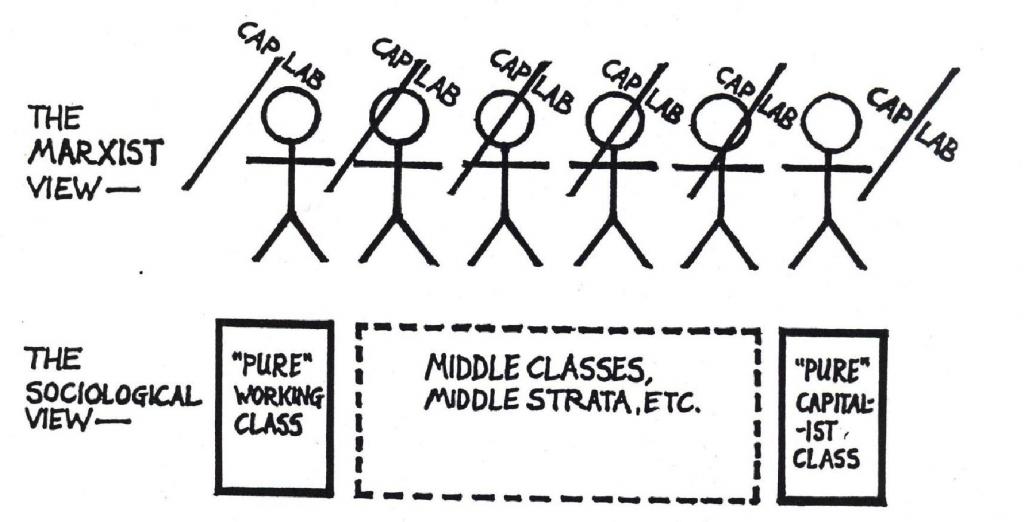
4. I shall refer to the conception of class as a relation (a relation of struggle) as the 'Marxist' conception of class: here, more than convenience dictates the terminological choice. Notoriously, the sociological conception of class faces the embarrasment that not all individuals in bourgeois society can be fitted, tidily, into the groups which it labels 'capitalists' and 'proletarians'. This embarrasment is produced by the conception of classes as groups or places, and to escape this embarrasment, sociological Marxism has recourse to categories like 'the middle classes', the 'middle strata', etc.: such categories are residual or catch-all groups and, in short, theoretical figments generated by an impoverished conceptual scheme. The Marxist conception class, on the contrary, faces no such difficulties: it regards the class-relation (say, the capital-labour relation) as structuring the lives of different individuals in different ways. The contrast in this regard between the Marxist and the sociological conceptions of class can be illustrated, very roughly, as follows:

Not least, this illustration is rough because the difference in the ways in which the capital-labour relation structures the lives of individuals in bourgeois society is as much qualitative as quantitative: a spatial diagram can only be ”undialectical”, abstracting not only from qualitative distinctions but also from the 'sheer unrest of life' (Hegel 1977 p. 27) – the unrest of struggle – which characterises a class-relation in any given case. (The model for such spatial diagrams is the Figurae of Joachim of Fiore, which become no longer necesary once the spiritual intelligence they summon has come into its own: cf. Reeves 1976 p. 13.)

5. What qualitative forms can the structuring of lives by the capital-labour (once again, a relation always of struggle) take? The form to which Marx especially attends is that of exploitation/expropriation. Other forms include inclusion/exclusion (Foucault), appropriation/expenditure and homogeneity/heterogeneity (Bataille) and incorporation/refusal (Marcuse, Tronti):[4] the list is phenomenologically rich, and open-ended.

6. One difference between the Marxist and the sociological views, as illustrated above, is that on the Marxist view the 'pure' worker (situated on the extreme left-hand side), whose social being is (unlike all the ”intermediate” figures) in no way divided in and against him or herself, is in no way methdolologically privileged. Neither is the 'pure' capitalist. Both, rather, are merely limiting cases and, as such, they are seen only as figures comingled with other in a diversely-structured crowd. The sociological view, on the other hand, treats the 'pure' worker and the 'pure' capitalist as methodological pillars between which the web of intermediate classes is slung.

7. The difference is important because, acoording to Marx, the 'pure' worker does not exist. This is not at all because of a relative decline in the numbers of the ”traditional working class” (however this theoretically suspect group be defined). On the contrary, it is because the wage relation itself is a bourgeois and mystifying form (Marx 1965 Part VI): whoever lives under its sign – even, and especially, the fully-employed producer of surplus-value -lives a life divided in and against itself. His or her feet remain mired in exploitation even while his or head (which is tempted to construe this exploitation in terms of ”low wages”, i.e., in terms which are mystified) breathes in bourgeois ideological clouds. [5] Accordingly, the line of class-struggle runs through the individual by whom surplus-value is produced (as with, say, the figure standing second-to-the-left in the diagram in para. 4, above). Here, again, there is no embarrasment for the Marxist conception of class which is interested in the specific ways in which the capital-labour relation structures, antagonistically, particular lives. But the non-existence of a proletariat in all its purity can only bring the sociological conception of class to the ground.

8. A further evident difference between the two schemes is that the Marxist one speaks of a single class-relation (namely, the capital-labour relation) as obtaining in existing society whereas the sociological scheme acknowledges as many such relations as there are possible link-ups between social places or groups. For this reason, the 'sociologists' accuse the 'Marxists' of reductionism. In fact, it is against the sociologists themselves that the charge of reductionism may properly be brought. The sociologists want to situate each individual, unequivocally and without remainder, in one or other of the specified groups or places: a ”cross categorial” individual cannot be allowed to appear in the picture which the sociologists draw. The point of the sociologists' proliferation of middle classes, middle strata, new petty bourgeoisies, etc., is to find some pigeon-hole to which each individual may be unequivocally assigned. Hence precisely the ways in which, in class terms, individuals are divided in and against themselves – the numerous and complex ways in which the geological fracture-line of class struggle lies through and not merely between individuals – enters theoretical eclipse. Hence sociologists' reductionism. The Marxist conception of class, by contrast, brings experiental richness of this (self-)contradictory life-texture into full theoretical and phenomenological light. The charge that Marxism reduces the lived experience of individual subjectivity to a play of impersonal and sheerly objective ”class forces” [6] is least of all applicable when 'class' is understood in its authentically Marxist sense.

9. A related point is that the Marxist conception, unlike that of the sociologists, does not construe class in terms of the bearing of this or that social role. From his early essay 'On the Jewish Question' onwards, Marx castigates, as alienated and unfree, any society wherein role-definitions (or a ”social division of labour”) obtain. Far from inscribing role-defintions as a methodological principle, the Marxian view of class depicts the individual as the site of a struggle – of his or her own struggle – which brings not only the ”universal” (role-bearing and socially homogenous) but also ”particular” (unique and socially heterogeneous) dimensions of individuality into play. Neither in theory nor in practice do role-definitions such as ”proletarian” or ”bourgeois” (or indeed ”man” or ”woman” or ”citizen”) represent Marx's solution; on the contrary they figure as one among the problems which 'class' in its Marxist designation is intended to resolve.

10. As between the Marxist and the sociological conceptions of class yet another area of difference is, of course, political. The sociological view advertises a politics of alliances between classes and class-fractions: moreover it ascribes to the 'pure' working class a privileged – a leading or hegemonic – political role. No question of such alliances arises on the Marxist view. Nor does the 'pure' working class (the employed as opposed to the unemployed, the direct producers of surplus-value as opposed to the ”indirect” producers, the proletariat as opposed to the lumpenproletariat, those whose labour does not) have a politically any more than a methodologically privileged place: for no such ”places” exist. Nor is there any question of ascribing to ”rising” as opposed to ”declining” classes a monopoly of revolutionary interest or force: such specifications only make sense when classes are seen as places or as groups. Finally, the whole notion of a vanguard party (plus its diluted variants) is overturned since the distinction between ”advanced” and ”backaward” class-elements disappears along with the sociological conception of class itself. In sum: what has traditionally passed as 'Marxist' politics is in fact sociological, and authentically Marxist politics amounts to politics in an anarchistic mode.

11. If classes are not groups or places but relations of struggle, then insofar as revolutionary conflict takes the form of a conflict between groups (but it always does this imperfectly and impurely) this has to be understood as the result of class struggle itself. It is not to be understood sociologically as, for example, an emergence of pregiven classes – at last! – into their no-less-pregiven theoretical and political 'truth'. The question before the individual is not on whose side, but rather on which side (which side of the class relation) he or she stands; and even this latter question is not to be understood as a choice between socially pre-existing places or roles. Not only quantitatively but also qualitatively, class struggle remains inherently unpredictable. The Marxian conception of class focuses sharply the issue of choice with which class struggle confronts us and in doing so it disallows appeal to any role or place or group in which (according to sociology) we already stand prior to whatever self-determining commitment we choose to make. It disallows this not least because it depicts us as torn by the force of the class struggle in which, in a class society, we are always-already consciously or unconsciously engaged.

12. Whoever wishes, can derive sociological wisdom from Marx's texts. Certainly, and especially in his political writings, Marx was not always a Marxist: for example the 'two great camps' conception of class espoused in the Communist Manifesto results from constructing the Marxist conception of class in an out-and-out sociological sense. Nonetheless, unless the Marxist conception of class were in fact Marx's the circumstance that Marx wrote Capital would be unintelligible. It was Marx himself who, long before his critics and revisionists, pointed out that as capitalism developed the numbers of the 'middle classes' could be expected to grow (Marx 1968 pp. 562, 573); and yet he writes a book, entitled Capital, in which a single class-relation (the capital-labour relation) is the theoretical 'object' addressed. This conundrum can be resolved only by taking his remark about the middle classes to be sociological, and by reading the main argument of Capital as Marxist in the above-specified sense.

13. The sociological conception of class, whenever it wishes to establish Marxist credentials, always becomes economic-determinist. This is so because the only ”indicator” of class-membership ('class', here, being seen as once again a place or group) which Marx's writings supply is that of a common relation to the means of production. Besides being related to the means of production, however, individuals are class-members (or who are class-interpolated) find themselves related to the state and to ”ideology” to say nothing about their local church or football team or pub. Hence, at once, the sociological conception of class generates a schema of discrete social 'levels' or 'practices' or 'instances' (Althusser) and must address the question of how these levels are related. The answer is well-known: in the last instance 'the economic movement…asserts itself as necessary'. [7] In the last instance, in other words, sociological Marxism amounts to an economic determinism with, to be sure, long and complex deterministic strings. To claim, as Althusser does, that such a theory (because of its complexity) is no longer economistic is like claiming that a machine is no longer a machine in virtue of the number of cogwheels its motor drives.

14. With the Marxist conception of class, everything is different. Marx's distinction between class 'in itself' and 'for itself' is to be taken as distinguishing, not between societal levels (cf. Footnote 5, above), but between the sociological and the Marxist conceptions of class itself: if a class only becomes such when it is 'for itself' then political struggle with all its unpredictable ramifications and developments and expenditures is already built into what sociological Marxism treats as the economic ”base”. Whereas sociological Marxism attempts to unite levels which it assumes to be discrete, and on the basis of this starting-point and problem can only fall back upon causalist and external relations of however 'structural' (Althusser) a kind, Marxist Marxism moves in the opposite direction and draws distinctions within a contradictory totality, i.e. within an internally and antagonistically related whole: 'The concrete is concrete because it is the concentration of many determinations, hence the unity of the diverse (Marx 1973 p. 101). As diagram in para. 4 makes clear, the totality of the class-relation which is specific to, for example, bourgeois society (the capital-labour relation) is present – wholly present, though in qualitatively different ways – in each of the individuals who form that society's moments or part. The essential thing was said long ago by the early Lukács: 'It is not the primacy of the economic motives in historical explanation that constitutes the decisive difference between Marxism and bourgeois thought, but the point of view of totality' (Lukács 1971 p. 27).

15. Along with 'the point of view of the totality', a wholly novel conception of class politics is brought into play. Once ”politics” is seen (as it is by the sociologists) as a discrete social level the litmus test of the existence of class 'for itself' becomes the formation of a political party of a more or less conventional – which means: a bourgeois – kind. Seen thus, even a vanguard party amount to a variation on a bourgeois theme. However it is not Marx, but rather bourgeois society, which distinguishes between the levels of political state and civil society – cf. 'On the Jewish Question' – and prescribes the former as the arena wherein social groupings in their maturity (which is to say their conformity) may compete. The Marxist conception of class, or in other words 'the point of view of totality', rejects precisely the narrowness of the conception of politics which the sociological conception of class entails. On the Marxist view, the category of politics becomes as wide as the forms which class struggle (and thereby class itself) unpredictably takes. Not merely is no issue excluded from the political agenda; the notion of political agendas is itself excluded since any such agenda excludes and marginalises whatever does not fall within some theoretically pre-established political domain.

16. The above notes claim neither to completeness nor to the provision of a defence at all points of the conception of class which they have attempted, schematically, to restate. Rather, their aim has been to make clear something of what a Marxist understanding of class entails. As regards evaluation of this understanding: the suggestion may be hazarded that the only possible line of critical questioning which seems fertile is that which asks whether the capital-labour relation is the sole such relation of struggle which, in all its richness, structures our lives. And here there can be no question of supplanting Marx: other such relations (sexual and racial relations, for example) are mediated through the capital relation just as, for its part, it exists as mediated through them. Inquiry as to which such relation is ”dominant” remains scholastic unless embarked on in concretely politcal (which is also to say phenomenological) terms. Both politically and methodologically, the great superiority of Marxist over the sociological is that it frees Marxism from every taint of the determinism which Marx castigated as amongst the most murderous features of capitalism – the tyranny of 'dead' labour over 'living' labour, or in other words of the past (as in all deterministic schemes) over the present and the future – and to which from start to finish his best thinkin stands implacably opposed. This is so because the single theme of Marxian ”class analysis” is the finely-textured and continually and uninterruptedly developing struggle which, for Marx, is the existence of class per se.

Acknowledgements

This paper owes much conversation with John Holloway. Filio Diamanti made me realise that my understanding of 'class' required clarification before discussion of it could even begin.

Notes

1. This much at least is clear from the final, fragmentary, chapter of Capital vol. III (Marx 1971 pp. 885-6).

2. Marx (1969) p. 173.

3. Cf. Althusser (1971) pp. 160-5.

4. See Foucault (1979) Part Four, ch. 2; Bataille (1985); Marcuse (1968); Tronti (1979).

5. The view that the ”ideological” mystification inherent in the wage-form leaves the class-purity of the worker uncontaminated depends on treating production and ideology as discrete social 'levels' or instances; so too does the reading of Marx's distinction between class 'in' and 'for' itself which is rejected in para. 14, below. On the notion of 'levels' see para. 13. In passing, it is worth noting that the conception of ideology as a discrete level (however specified) remains wholly mysterious, if only because social existence without remainder – for example gender distinctions, architecture, work-discipline and scientific knowledge – carries with it an ”ideological” charge.

6. For a discussion of this charge see Sartre (1963).

7. Engels to J Bloch September 21-22 1890 (Marx/Engels n.d. p. 498). Althusser's distinction between 'determining' and 'dominant' instances represents a permutation of the same theme.

References

Althusser L. (1971) Lenin and Philosophy and Other Essays (New Left Books)

Bataille G. (1985) Visions of Excess: Selected Writings 1927-1939 (Manchester University Press)

Foucault M. (1979) Discipline and Punish (Penguin Books)

Hegel G.W.F. (1977) Phenomenology of Spirit (Oxford University Press)

Lukacs G. (1971) History and Class Consciousness (Merlin Press)

Marcuse H. (1968) One-Dimensional Man (Sphere Books)

Marx K. (1965) Capital Vol. I (Progress Publishers)

Marx K. (1968) Theories of Surplus Value Part II (Lawrence and Wishart)

Marx K. (1969) The Poverty of Philosophy (International Publishers)

Marx K. (1971) Capital Vol. III (Progress Publishers)

Marx K. (1973) Grundrisse (Penguin Books)

Marx K./Engels F. (n.d.) Selected Correspondence (Lawrence and Wishart)

Reeves M. (1976) Joachim of Fiore and the Prophetic Future (SPCK)

Sartre J-P. (1963) The Problem of Method (Methuen)

Tronti M. (1979) 'The Strategy of Refusal' in Working Class Autonomy and the Crisis (CSE Books / Red Notes)

Courtesy: libcom.org

Bubbles, risk, crunch and war

This 2008 interview with Prof Cyrus Bina is published here for educational purposes only.

Click here to download the interview

Marta Harnecker’s `Ideas for the Struggle’

Links

This 12-part series of articles by Marta Harnecker (translated by Federico Fuentes) on ideas for how to organise for socialism in the 21st century first appeared in Links International Journal of Socialist Renewal. It is now available download free as a pamphlet in PDF format.

Marta Harnecker is originally from Chile where she participated in the revolutionary process of 1970-1973. She has written extensively on the Cuba Revolution, and on the nature of socialist democracy. She now lives in Caracas and is a participant in the Venezuelan revolution.

You can read Ideas for the Struggle on screen above or download it directly by clicking HERE.

Analysis of Classes in India: A Preliminary Note on the Industrial Bourgeoisie and Middle Class

Deepankar Basu, Sanhati.

In a previous paper [Basole and Basu (2009)] an attempt to begin an analysis of social classes in contemporary India organized around the idea of economic surplus was initiated, by revisiting the 1970s mode of production debate. The focus in Basole and Basu (2009) was on the rural classes and the unorganized industrial and service sector workers. In this paper, I extend that analysis by shifting attention to the classes that had been left out in Baole and Basu (2009): the industrial bourgeoisie and what might be called the middle class.

Introduction

In the Marxist tradition, the notion of class is intimately related to the idea of economic surplus. Thus, I would like to begin this paper with a few brief and introductory comments on the relationship between the two. Every society, if it is to reproduce itself over time, must organize social production in such a way that it manages to reproduce the material and non-material conditions of its existence. Production in excess of what is necessary to reproduce the material conditions of its existence is the production of what we can call economic surplus. Thus, a society produces economic surplus when it produces more than what is necessary to cover the costs of social production, i.e., when it produces more than is necessary to replace (or replenish) the labour and non-labour inputs used up in the production process. This allows us to divide the total labour time of society into two parts: necessary labour time, which corresponds to the labour time required to merely replace the labour and non-labour inputs to production; and, surplus labour time, which corresponds to the economic surplus.

It is the economic surplus, moreover, that allows any society to grow and develop, to not only increase the scale, scope and sophistication of material production and encourage and facilitate technological change but also to increase the scale and depth of its non-material products. Every viable, growing society, therefore, must produce an economic surplus to sustain its material and non-material growth.

Of course, reproduction of a society requires not only the continuous production of an economic surplus but also the reproduction of its social relations of production. While the problem of the reproduction of the social relations of production is an important one and deserves serious study, here I would like to draw attention to another, though related, issue: the relationship between economic surplus and class.

What is class? Here I can do no better than give a fairly comprehensive definition of class by Lenin:

“Classes are large groups of people differing from each other by the place they occupy in a historically determined system of social production, by their relation in most cases fixed and formulated in law to the means of production, by their role in the social organisation of labour, and, consequently, by the dimensions of the share of social wealth of which they dispose and the mode of acquiring it. Classes are groups of people, one of which can appropriate the labour of another owing to the different places they occupy in a definite system of social economy” (Lenin 1919 (1972), p.421).

Thus, classes, as understood in the Marxist tradition, are defined by the appropriation of the surplus labour time of the group of direct producers by the group of non-producers (or exploiters). This appropriation is made possible by the differential location of the classes in the process of social production and the differential ownership of the means of production. The appropriation is guaranteed by the existing legal system enforced through the power of the State.

But if classes are defined by the appropriation of surplus, then they can only come into existence when the productive capacity of society has progressed to the extent that it can produce a surplus over and above what is needed for bare subsistence. Thus, class-divided societies are made possible and materially supported by the existence of economic surplus, corresponding to the surplus labour time of direct producers.

Being defined by the relationship between exploiters (those who appropriate the surplus) and exploited (those who produce the surplus), class-divided societies have often been studied with two-class models: master and slave, serf and lord, worker and capitalist. It is of course clear that two-class models arise as abstractions from the more complex class structures of real societies; the presence of groups which lie in the “middle” of, or straddle, both class locations, i.e., exploited and exploiters, needs to be taken into account to arrive at a more realistic class analysis of real societies. Before proceeding to take account of the “middle” in Indian society, it needs to be reiterated that even though two-class models are simplified representations of reality, they are useful for understanding the basic dynamics of the societies they refer to at a high level of abstraction. For instance, Marx’s analysis of the dynamics of capital accumulation presented in Capital, Volume 1 (Marx, 1992), where he works primarily in terms of two fundamental social classes – the proletariat and the capitalists – is extremely useful in understanding the long term tendencies of capitalist societies.

With these preliminary comments in place, let me propose the following three-class typology as a first approximation to the class structure of contemporary India: the working classes, the ruling classes and the middle classes, the plural being used to draw attention towards the internal heterogeneity of each of these three classes.

Three Fold Classification for India

The working classes are the only productive classes in Indian society and are defined by the fact that they produce the economic surplus in the following specific sense: the income that accrues to this class, which is equal to the value of its labour-power, is lower than the value added by the use of that labour power during any period of time (say a year). Taking account of the internal heterogeneity of the working class in India, it can be broadly divided, with two important qualifications, into two large groups: (1) the unorganized workers (i.e., workers in the unorganized sector of the economy) as defined by the National Commission for Enterprise in the Unorganized Sector (NCEUS), and (2) productive workers in the organized sector of the economy. The first qualification relates to the fact that the NCEUS defines the unorganized workers to include almost all of the agricultural sector; hence we must exclude the following two rural classes from the NCEUS definition of the unorganized workers: (a) rich farmers and landlords, and (b) middle peasants. The second qualification relates to a tiny portion of the workers in the organized sector whom we will include in the middle class and not in the surplus-producing working class, viz., the highly skilled workers, the professionals, the managers, and all the employees of the State sector. Thus, in India, the working class consists of: (1) the landless labourers, (2) the marginal and poor peasants, (3) the workers in the unorganized industrial and service sectors, and (4) a large part of the workers in the organized private sector.

At the other pole of Indian society resides the dominant, or ruling, classes. These classes are defined by the fact that they not only appropriate the economic surplus (that has been produced by the working classes defined above) but also determine the direction and mode of its utilization. For historical and structural reasons, the ruling class combine in India has been, and still is, internally heterogeneous and consists of the following three elements: (1) the industrial bourgeoisie, (2) the rich farmers and landlords, and (3) the professionals (State-elite, i.e., the top-level managers of PSUs, the top-level officers of the bureaucracy, the police, the army and the judiciary, and the top-level managers and professionals in the private sector). The industrial bourgeoisie is the dominant element in the ruling class combine.

Lying between these two poles, the productive and the non-productive poles, is what we might call the “middle class” which is defined by the following two characteristics: (1) this class is the recipient of a part of the economic surplus, i.e., the total compensation earned by the middle-class is higher than the value of its labour power (i.e., the cost of producing and reproducing the labour power); and (2) the middle class is crucial for the reproduction of the existing social relations in India which is what fetches it the extra income, i.e., the income above the value of its labour power, in the form of rent from the ruling classes. There are two main segments of the middle class: (a) the petty bourgeoisie, who largely own their means of production: middle peasants in agriculture, the merchants, the traders, and the owner-operators of small enterprises, and (b) the professionals: the technical experts, the managers, and the skilled workers in large-scale private enterprises, and the large majority of the employees of the State sector.

Basole and Basu (2009), by revisiting the 1970s mode of production debate, attempted to begin an analysis of social classes in contemporary India organized around the idea of economic surplus. The focus in Basole and Basu (2009) was on the rural classes and the unorganized industrial and service sector workers. In this paper, I extend that analysis by shifting attention to the classes that had been left out in Baole and Basu (2009): the industrial bourgeoisie and what might be called the middle class. But before moving on to an analysis of the industrial bourgeoisie and the middle class, let me briefly summarize the findings of Basole and Basu (2009) about the rural classes and the unorganized workers.

The main input into agricultural production is land and so the analysis of property and power in the agricultural sector has to carefully look at the ownership distribution of land. While the aggregate distribution of land ownership remains as skewed today as it was five decades ago, interesting and important patterns are visible within this unchanging aggregate picture. The share of land owned by large (10 ha or more) and medium (4 ha to 10 ha) landholding families has steadily declined over the last few decades from around 60% to 34%; the share owned by small (1 ha to 2 ha) and marginal (less than 1 ha) landholding families has increased from around 21% to 43%, while the share of semi-medium (2 ha to 4 ha) families has remained unchanged at around 20%.

Going hand-in-hand with the decline in the share of land owned by large landowning families, is the steady decline of tenant cultivation and its gradual replacement by self cultivation in Indian agriculture. The share of operational holdings using tenant cultivation declined from about 24% in 1960-61 to about 10% in 2002-03. There are large geographical variations in the extent of tenancy, with the largest share of leased-in land as a share of total operated area occurring in Punjab and Haryana, two prominent examples of what Basole and Basu (2009) called large landholding states; Orissa has high prevalence of tenancy and is an example of a small landholding state. The proportion of area owned and the proportion of area operated by the different size-classes are almost equal; hence, there is no evidence of reverse tenancy on any substantial scale at the aggregate level, though this might hide reverse tenancy at state or regional levels.

Disaggregating total incomes of rural households engaged in agriculture according to types of income showed that wage income has become the main source of income for a large majority of the population. For about 60% of the rural households in 2003, the major share of income came from wage work, supplemented by income coming from petty commodity production, both in the agricultural and non-agricultural sector. Another 20% of rural households drew equal shares of their total income from wage work and cultivation, both at about 40%. The natural corollary to this is that “effective landlessness” is large and has steadily increased over the past few decades. The share of effectively landless households in total rural households has increased from about 44% in 1960-61 to 60% in 2002-03.

These, and other related, facts led Basole and Basu (2009) to conclude that: (a) the hold of semi-feudal landlords had declined significantly over the past few decades; thus, the primary element of the rural ruling class today seems to be the rich farmers; (b) there has been a significant growth of the rural proletariat, and (c) the prevalence of petty production, in agriculture, industry and services, remains undiminished; hence the petty bourgeoisie remains numerically and politically important; (d) the vast majority of the industrial proletariat is seen in India today as unorganized workers, who lack social security, work security and employment security (NCEUS, 2007). Let us now turn to a study of the industrial bourgeoisie and the middle classes.

The Industrial Bourgeoisie

The dominant element in the ruling class combine is the industrial bourgeoisie, which emerged and grew under the long shadow of British colonialism. Accumulating capital through merchant and trading activities related to the colonial economy, this class gradually diversified into industrial activities, beginning with the textile industry in an around colonial Bombay. Significant portions of the industrial bourgeoisie has been, and continues to be, organized along family lines, with the Tatas and the Birlas being the most prominent historical examples. Three characteristics of the Indian industrial bourgeoisie demand further analysis and comment: its attitude towards other elements, especially the semi-feudal landlords, of the ruling class combine; the evolution of its internal structure and its relationship with the State; and, its relationship with the center of the global capitalist system.

The Indian bourgeoisie has, because of its historical origins, always had an ambivalent attitude to the whole gambit of semi-feudal interests in the economy. Even though it hesitantly supported the nationalist leadership of the Indian National Congress, it was never strong enough to push for its hegemony either in the nationalist movement or in the post-colonial State. It never fought a frontal battle with feudal interests, the biggest indicator of which is the half-hearted nature of land reforms in independent India. As a result, it could neither fashion an independent capitalist development path for the country based on the home market nor consistently democratize the polity. If the nationalist struggle for independence is, therefore, understood as the beginning of the bourgeois democratic revolution in India, then it largely remains unfinished even 60 years after political independence from British colonialism.

Even though the Indian bourgeoisie has not initiated and led a broad-based capitalist development, which could have improved the material conditions of the vast masses of the country, it has nonetheless managed to significantly widen and deepen the industrial structure of India. Starting with consumer goods industries like textiles, it has diversified into the production of basic capital and intermediate goods, and consumer durables. This has been largely possible because of the protection and patronage of the State, with which this class has had a complex relationship. On the one hand, it has resisted all attempts at disciplining by the State for larger development programmes (Chibber, 2006); on the other, it has utilized industrial, tax, credit, export and import policies of the State to further its own narrow class interests.

At the time of political independence, the industrial structure in India was very concentrated at the top, with a few large monopoly business houses controlling large swathes of the market. Three trends have emerged, slowly at first, since then. The first trend has been the differentiation of the economy into an organized and an unorganized sector, roughly coterminous with large and small scale industries; policies of the Indian state helped in this differentiation. The second trend has been the relative growth and proliferation of the small scale sector, i.e., relative to the large-scale, organized sector. The third trend has been the slow but steady growth of a regional bourgeoisie, different from and often competing with the established large business houses. Thus, concentration and centralization of capital has proceeded in several branches of the organized sector; but this has also been accompanied by increased regional and sectoral competition and growth of the small scale sector.

To get a sense of the evolution of the concentration of Indian capital at the very top let us look at some data. In 1971, total sales of the top 20 industrial houses in India accounted for about 61 percent of the net domestic product of the private organized sector; the corresponding figure for 1981 was 87 percent (Bardhan, 1998). To come to the situation in the early part of this century, note the continued dominance of what the business press regularly calls the “big four” of Indian business: the Tatas, the Birlas, the Ambanis and the Mittals. In key industries like energy, telecom, steel, automobiles, IT and retail, these four business houses either continue to dominate or are poised to do so in the near future. Another measure of the concentration of Indian capital at the top can be seen from the following: according to data from the ET 500, in 2008 the top 20 private companies accounted for about 40 percent of the sales, 47 percent of after-tax profits and 45 percent of market capitalization of the top 500 private companies. Though not strictly comparable with the earlier data for the 1970s and 1980s, the data about 2008, when situated in a historical setting, suggests the following: the monopoly power of Indian big capital increased continuously after political independence till the mid-1980s, and has seen a relative decline since the inception of the process of economic liberalization.

While Indian capital continues to be highly concentrated at the top in many industries, we notice another trend too: regional capital has grown by leaps and bounds over the past two decades and has made serious forays into industries such as automobile ancillaries, capital goods, casting and forging, chemicals, construction, diamond and jewelery, entertainment and media, textiles and transportation and many others.

The relationship of Indian capital to the center of the global capitalist system has been the focus of much debate and discussion within left circles in India with one prominent strand characterizing the big bourgeoisie as comprador and the Indian state as semi-colonial, both these characterization meant to convey the continuing hold of foreign capital on the Indian economy and polity, especially since the beginnings of the 1990s. Concrete evidence regarding the presence of foreign capital in the Indian economy and the continuous overseas expansion of Indian capital seem to suggest a more complicated story.

Let us first look at the evidence on the presence of foreign capital in the Indian economy. In 1981-82, “only about 10 per cent of total value added in the factory of mining and manufacturing was accounted for by foreign firms.” (Bardhan, 1998); if only large firms are kept in the picture, foreign firms still account for only about 13 per cent of the value added. Of course, there were a small number of industries where foreign presence was substantial: industries producing cigarettes, soap and detergents, typewriters, electrodes, etc. To the extent that there was a rise of foreign collaboration during this time, “the overwhelming proportion of such agreements [did] not involve any foreign participation in equity capital.” (Bardhan, 1998). Similarly, there has been an increasing trend of outright purchase of technological imports thereby reducing the dependence of domestic capitalists on the foreign suppliers of technology. Of the top 25 industrial units in 1983, only 4 were foreign.

The contemporary picture is tilted even more towards the domestic bourgeoisie. Of the top 500 companies in 2008, only 2 were foreign: Larsen & Tubro and Maruti-Suzuki; if we restrict ourselves to only private companies, then the corresponding figure is 3 out of the top 25: Larsen & Tubro, ITC and Maruti-Suzuki. If we look at the same issue at a more disaggregated level, there are only three major industries which has substantial foreign capital: capital goods (Larsen & Tubro), fast moving consumer goods (ITC and Hindustan Lever), and retail (Pantaloon retail). Other than these three, all the major industries are controlled by Indian capital: automobiles, banks, chemicals, construction, consumer durables, entertainment, fertilisers, finance, metals & mining, oil and gas, pharmaceuticals, power, real estate, steel, textiles, transportation (ET 500, 2008).

The overseas expansion of Indian capital in recent years has been commented on a lot, especially in the ecstatic business press in India. Some of the prominent examples that have been splashed across the national media are: Videocon’s acquisition of South Korea’s debt-burdened Daewoo Electronics; Tata’s acquisition of Corus; ONGC Videsh’s acquisition of Exxon Mobil’s stake in the Campos Basin Oil Fields in Brazil; Suzlon Energy’s acquisition of Belgium’s Hansen Transmissions International NV; Ranbaxy’s acquisition of Terapia, the largest independent generic drug company in Romania; Wipro’s acquisition of United States-based Quantech Global Services; and the largest acquisition of all, Reliance’s reported move to acquire controlling stake in LyondellBasell, the world’s third largest chemical company. Going beyond such anecdotal evidence from the business press, there is substantial evidence based on detailed research that major fractions of Indian capital, with active assistance from the State, has successfully entered the global scene. Researchers have pointed out that Indian investments abroad has moved through two stages. During the first stage of the 1970s and 1980s, the quantity of investments was small, and the destination was primarily in the developing world, shifting from Africa to Southeast Asia. During the second phase, starting roughly from the mid 1990s, there has been a dramatic quantitative increase of outward flow of capital, accompanied by a widening breadth and depth of industries where investment has been directed to; interestingly, in this phase, an increasing share of the investment have found destinations in the imperialist core: USA and Europe. (Pedersen, 2008).

Thus, taking account of these recent trends, viz., growing concentration and centralization of capital in certain key sectors of the Indian economy, the rise and growth of the regional bourgeoisie, and the increasing overseas expansion, especially into the core of the global capitalist system, it seems that the characterization of the big bourgeoisie as “comprador” and the Indian state as semi-colonial needs to be seriously rethought. What this implies is not the absence of imperialism but a suggestion to carefully rethink how imperialism operates in the Indian context, i.e., to rethink how the Indian economy is articulated to the global capitalist system by imperialism. Two issues that might be helpful in this context, and needs to be explored further, are the following: (a) the role and effect of financial capital (i.e., flows of portfolio capital as opposed to direct foreign investment) on the Indian economy, and (b) the possible influence of imperialism operating through the channels of government policy rather through the channel direct investment, i.e., export of ideas replacing the primacy of the export of capital à la Lenin. Next, we look at the middle classes.

The Middle Class

What I have called the middle class, for lack of a better expression, is composed of two distinct segments in contemporary India, the petty bourgeoisie and the professionals (technical experts, managers, skilled workers scientific personnel and state sector employees). The first segment of this class owns its means of production and thus, does not produce, surplus value; the second segment, on the other hand, receives a small portion of the total surplus value due to their crucial position in the production process and their important role in the reproduction of the existing social relations.

The petty bourgeoisie owns its means of production and, therefore, does not need, in the main, to sell its labour power for ensuring its livelihood. In the agricultural sector, the petty bourgeoisie refers to the middle peasants, i.e., families whose main source of income is cultivation and who mainly rely on family labour for organizing cultivation. In the industrial and service sectors, the petty bourgeoisie refers to owner-operators of small enterprises operated mainly with family labour and the small traders and merchants. There is internal differentiation within the petty bourgeoisie, with one section managing to produce surplus and accumulating capital while the other part lives perpetually in poverty, barely managing to reproduce themselves at a constant level of operation.

The privileged position of the professionals in the production process can be better understood if we focus on two crucial dimensions of the production process: skill and expertise, and exercise of authority in the production process. The analysis of professionals in this paper draws heavily on the pioneering work of Marxist sociologist Erik Olin Wright (Wright, 1997).

Let us consider authority first by looking a little more carefully at the production process. Capitalists not only hire labour in the market, but also dominates labour in the production process relating, for instance, to the pace, intensity and other dimensions of work; this aspect of power and control of capital by labour is crucial. As the scale and scope of production increases it becomes increasing difficult for capitalists to carry out this function; hence, they delegate this function to the class of managers and supervisors: managers and supervisors exercise the authority of capital over labour in the production process on behalf of capital. Thus, this dimension of delegated authority is one crucial dimension along which working people are differentiated, creating a contradictory class position: managers and supervisors can be seen as belonging both to the capitalist class and the working class. To the extent that they exercise the delegated authority of capital in the process of production, they act as capitalists; to the extent they are themselves controlled by capitalists, they resemble workers. There is, of course, a whole range of such contradictory class positions with lower level supervisors strongly resembling workers and top level managers, like corporate directors and CEOs, identifying completely with capital.

How do capitalists, in turn, monitor and control the managers and supervisors? Thinking about this question gives us a way to explain the earnings differentials, compared to the working class, of managers and supervisors. For the smooth functioning of the production process and the continuous generation of surplus value, capital needs managers and supervisors to exercise the power and authority over workers in an effective manner. This cannot be ensured by surveillance and monitoring of managers, both because it is difficult to monitor managerial effort and because coercive methods hamper creative managerial intervention. The alternative is to pass off a part of the surplus value to the managers so as to build loyalty of the managers towards the organization, internalize the imperatives of capital and thereby do capital’s bidding effectively in the production process. This part of surplus that goes to the managers and supervisors, and explains the huge differentials in earning from the working class, can thus be understood as a “loyalty rent”that capital pays to maintain its power and control in the production process.

Let us now turn to the other dimension: skill and expertise. Much like the class of managers and supervisors, workers who manage to acquire skills and expertise relevant to the production process attain a privileged position. There are two aspects of this privileged position. First, not only are skills always in short supply but there are systematic obstacles to the acquiring of these skills by members of the working class which often operates through the monopoly of the middle class on the educational system and training programs. This allows skilled and technical workers and the so-called experts to derive a “skill rent” from capital, which partly explains the wage differential vis-a-vis the working class and is an indicator of their privileged position. Second, technical and skilled work often cannot be effectively monitored; hence, capitalists generate optimal effort from skilled and technical workers by building up their loyalty to the organization, again through a part of the surplus being passed off as a “loyalty rent” to the skilled workers.

Among what we have called professionals, there is a special category that deserves separate attention: state sector employees. There are two characteristics of this group that deserves mention. First, their income comes from the tax revenue of the State, and thus can be easily seen to be a part of economic surplus of society; their income is thus a deduction from the surplus, they do not produce surplus in the sense in which workers produce surplus value for the valorization of capital. But this also means that they are not dependent on capitalist profit making for their livelihood; this might have important implications in terms of class consciousness vis-a-vis capitalism. Second, following Wright (1997), the various institutions of the state can be broadly divided into two parts, the political superstructure and the decommodified state service sector. The political superstructure consists of all the institutions that work for the reproduction of the existing social relations: the police, the courts, the military, the legislature and other such institutions. The decommodified state service sector, on the other hand, produces use values, and not exchange values, directly beneficial to the people at large: health care, educational services, public infrastructure and utilities, public recreation and entertainment, etc. The rationale for separating the two sets of institutions is that the second, the decommodified state service sector, operates largely outside the logic of commodity production and capital accumulation. Production in this sector is not subordinated to the imperatives of profit maximization; hence, this sector can be viewed as part of the institutional set-up of a post-revolutionary State and hence would need to be preserved even when the current configuration of power is dismantled. The political consciousness and orientation of workers working in these two sectors of the State might be expected to be radically different, a point of particular relevance to radical mass movements.

It goes without saying that there is a gradation of the middle classes, and the upper sections merge into the ruling class while the lower sections are very close to the working classes. The upper sections of the middle class share in the decision-making process relating to the use of the economic surplus (CEOs, top managers, and directors of corporate sector firms, etc.), have significant control over a large part of the productive resources of society in the form of public sector units (top managers of the PSUs) and have a monopoly over the use of the ideological and repressive apparatus of the State (top level bureaucrats, army officers, members of the judiciary). They seamlessly merge into the ruling class.

Relative Population Shares, Income and Wealth: Initial Estimates

What are the numerical strength of the three broad classes – the ruling class, the middle class and the working class – in Indian society today? Some very interesting recent research (Jaydev, et al., 2009; Vakulabharanam, et al., 2009) can throw some light on this important question. In their comparative study of the changing nature of inequality in India and China, Vakulabharanam, et al. (2009) use data from two rounds of the National Sample Survey (NSS) to provide a detailed picture of class structure in India. They use the National Classification of Occupation (NCO 3-digit, 1968 scheme) to divide households into various occupational categories, which can used to roughly compute relative shares of what I have defined as the ruling, middle and working classes. Using data from Table 2 in Vakulabharanam, et al. (2009), I get the rough picture presented in Table 1.

Table 1: Class structure in India (Percentage share in population)
1993-94 2004-05
Ruling Class 11.89 11.71
Middle Class 24.26 21.08
Working Class 63.85 67.21

Though lot more work needs to be done to get a more accurate and refined picture, Table 1, nonetheless provides a rough estimate of the relative shares of the three social classes in contemporary India. Ruling classes, in Table 1, consist of the following: owners or managers of the formal and informal sector enterprises and the rich farmers; the middle class consists of the following: professionals and skilled workers in manufacturing and services, middle peasants, rural professionals and moneylenders; the working class is composed of the rest of the population: the unskilled workers in manufacturing and services, the small and marginal peasants and the landless labourers. An interesting, though expected, fact that emerges from Table 1 is the relative squeezing of the middle class and not their growth, as the mainstream media constantly suggests. Since the size of the ruling class has remained more or less constant over the decade, it must mean that sections of the middle class is getting pushed down into the working class.

The picture presented in Table 1 is only an approximate picture; hence some caveats are in order. First, the National Sample Survey Organization (NSSO) consumption expenditure surveys, which is used by most researchers including Vakulabharanam, et al. (2009), do not give a correct picture of the members of the big bourgeoisie (the super rich in terms of wealth and income); they need to be oversampled if they are to be truly representative of their population weight in the sample. Second, some of the owners and managers that are currently part of the ruling class would actually need to be included in the middle class; this is because many of the owners would be owner-operators of small scale enterprises and some of the managers would occupy lower levels in the firms’ hierarchy; but this adjustment could not be carried out because of lack of more disaggregated data at the moment. That is why the sample share of the ruling class in Table 1 seems to be an overestimate of their true population share. Both these facts, moreover, suggest that the figure for the ruling class in Table 1 needs some serious modification. Third, some of the skilled workers that are currently part of the middle class in Table 1 should be actually included in th working class; again, this could not be done because of lack of more disaggregated data. This is the reason why, just like in the case of the ruling class, the sample share of the middle class in Table 1 is an overestimate.

A more disaggregated analysis to arrive at a more accurate picture will be conducted in the future. My conjecture is that the disaggregated analysis will throw up a picture which will correspond closely to the distribution of households according to consumption expenditure that was reported in Table 1.2, NCEUS (2007): the ruling class would be roughly 4 percent of the population and their average consumption expenditure would be greater than 4 times the official poverty line, the middle class would be roughly the next 19 percent of the population with an average consumption expenditure between 2 and 4 times the poverty line, and the rest, about 77 percent, would be what I have called the working class and which corresponds to what the NCEUS called the poor and vulnerable section which, in 2004-05, spent less than Rs. 20 per day on consumption (Table 1.2, NCEUS, 2007).

Of course, the consumption expenditure distribution that is deduced from the NSSO surveys do not provide an accurate idea about the true income and wealth of the big bourgeoisie and the top professionals in India. There are two sources that provide a much more accurate picture of the income and wealth of this class: income tax data that has been used to estimate top Indian incomes from 1922 to 2000 (Banerjee and Piketty, 2005) and the World Wealth Report and the Forbes list of the richest persons in the world (which now, quite understandably, has a separate list for India).

To get an idea of the wealth of the big bourgeoisie, note that in 2009, India had 52 billionaires, which was close to twice the number in 2007; the wealthiest them of all, Mukesh Ambani, has a net worth of $ 32 billion (Times of India, Nov., 19, 2009). The combined net worth of the richest 100 Indians in 2009 was US$ 276 billion; their Chinese counterparts had a combined net worth of US$ 170 billion (Livemint, Nov., 20, 2009). To make the comparison fair recall that China’s GDP in 2008 was $ 7.992 trillion (PPP) while India’s GDP in 2008 was only $ 3.304 trillion (PPP): wealth is far more concentrated at the top in India than it is in China.

Moving on to incomes of the richest Indian, Banerjee and Piketty (2005) present some very interesting facts. First, the top 1 per cent of the population accounted for about 12-13 per cent of total income in the 1950s; the share fell to 4-5 per cent in the early 1980s, and then picked up again to reach 9-10 per cent in the late 1990s; whatever the problems of the Nehruvian policy frameowrk, it did manage to redistribute income away from the rich. This U-shaped pattern, which is very similar to patterns observed in the USA too, can be an entry point into understanding the sharp policy change from the mid-1980s onwards in India: the big bourgeoisie pushed for the change in policy direction to reverse the trend of income distribution. While the top 1 per cent have more or less gained back their pre-Nehruvian era share, there are interesting patterns if we look more closely at the various sections within the rich: there has been a rapid divergence in the income shares accruing to what can be termed the super rich (the top 0.01 per cent), the moderately rich (the top 0.1 per cent) and the rich (the top 1 per cent).

Conclusion

Mao’s analysis of the class structure of Chinese society in the 1920s was extremely influential in the Chinese communist movement and facilitated the formulation of the strategy and tactics of the Chinese revolution. Given the widespread use of Mao’s basic framework of class analysis in Third World settings, it would be useful to contrast the results of the analysis presented in this paper with Mao’s characterization of classes in pre-revolutionary China (Mao, 1926).

For Mao, the ruling class in pre-revolutionary China consisted of “the warlords, the bureaucrats, the comprador class, the big landlord class and the reactionary section of the intelligentsia attached to them.” In contemporary India, the ruling class consists of the big bourgeoisie, the rich farmers and the top sections of the professionals and bureaucrats; the crucial difference, to our mind, is the absence in contemporary India of what Mao called the comprador class (the class of merchants who acted as agents of foreign capital) and the big feudal landlords. The big bourgeoisie in India today seems to be less under the influence of foreign capital than their counterparts in pre-revolutionary China; similarly, the big feudal or semi-feudal landlords that held sway over the economy of rural China seem to have been largely replaced by the rich farmers as the key ruling class element in rural areas of contemporary India.

Mao’s analysis had identified a tiny proletariat in China, which, according to him, would be the leading force in the revolution. In contemporary India, in sharp contrast to China, the proletariat is significantly larger, not only in absolute terms but also in relative terms, i.e., relative to the other social classes. This is the direct result of the wider and deeper industrial development following political independence in India compared to pre-revolutionary China. The proletariat consists, in contemporary India, of the vast majority of workers in the unorganized industrial and service sectors, part of the lower level workers in the organized sector and the effectively landless laborer families in the agricultural sector, and thus partially includes what Mao had called the semi-proletariat.

In Mao’s analysis, the petty bourgeoisie was accorded “very close attention” both because of its size and because of its class character. He had concluded that this large and important group would be an ally of the revolutionary proletariat. In contemporary India too, the petty bourgeoisie – composed of the middle peasant and the owner-operators of small enterprises and small traders and merchants – is numerically very large and because of its objective economic position will play an important role in radical social change.

What Mao did not stress and what seems to have become important in contemporary India is the place occupied by the second segment of what I have called the middle class: the professionals. With the growing complexity of social organization and social production, this group will become even more important, not only in the present social order but also in any radically different society that might arise in the future. In both the Russian and the Chinese revolutions, the post-revolutionary regime had to rely very heavily on this class to ensure functioning of the economy. According more attention to this segment of the middle class, therefore, seems warranted.

REFERENCES

Banerjee, A. and T. Piketty. 2005. “Top Indian Incomes, 1922-2000,” The World Bank Economic Review, 19(1), pp. 1-20.

Bardhan, P. 1998. The Political Economy of Development in India (expanded edition with an epilogue on the Political Economy of Reforms in India). Oxford University Press: Delhi.

Basole, A. and D. Basu. 2009. “Relations of Production and Modes of Surplus Extraction in India: An Aggregate Study.” Working Paper, Department of Economics, University of Massachusetts, Amherst. Available at: http://www.umass.edu/economics/publications/2009-12.pdf and http://sanhati.com/non-excerpted/1506/

Chibber, V. 2006. Locked in Place: State-Building and Late Industrialization in India. Princeton University Press: Princeton, NJ.

ET 500: http://economictimes.indiatimes.com/Features/ET-500-companies/articleshow/3603974.cms

Jaydev, A., Motiram, S. and V. Vakulabhranam. 2009. “Patterns of Wealth Disparities in India during the Era of Liberalization,” in A Great Transformation? Understanding India’s Political Economy (forthcoming).

Lenin, V. I. 1919. “A Great Beginning: Heroism of the Workers in the Rear.” Collected Works, Volume 29, pp. 409-434. 4th English edition, Progress Publishers, Moscow, 1972. Available at: http://www.marxists.org/archive/lenin/works/1919/jun/28.htm

Marx, K. 1992. Capital: A Critique of Political Economy, Volume 1. Penguin Classics. (first published in 1887).

National Commission for Enterprise in the Unorganized Sector (NCEUS), 2007. “Report on the Conditions of Work and Promotion of Livelihoods in the Unorganized Sector.” Government of India.

Tse-tung, Mao. 1926. “Analysis of the Classes in Chinese Society.” available online at:http://www.marxists.org/reference/archive/mao/selected-works/volume-1/mswv1_1.htm

Pedersen, J. D. 2008. “The Second Wave of Indian Investments Abroad,” Journal of Contemporary Asia, 38(4), pp. 613-637.

Vakulabhranam, V., Zhong, W. and X. Jinjun. 2009. “Patterns of Wealth Disparities in India during the Era of Liberalization,” Working Paper, Graduate Economics Research Center, Nagoya University.

World Wealth Report, 2009. Available at: http://www.ml.com/media/113831.pdf

Wright, E. O. 1997. Class Counts: Comparative Studies in Class Analysis. Cambridge University Press: Cambridge, UK.

Deepankar Basu is Assistant Professor at the Department of Economics, University of Massachusetts.

Revolutionary movement and the “spirit of generalisation”

Pratyush Chandra

“There are no miracles in nature or history, but every abrupt turn in history, and this applies to every revolution, presents such a wealth of content, unfolds such unexpected and specific combinations of forms of struggle and alignment of forces of the contestants, that to the lay mind there is much that must appear miraculous”. V.I. Lenin

Can there be a Maoist movement or for that matter, a Marxist movement? We have been using the phrase “Communist Movement” for a long time, but what does it signify? What is the utility of these phrases in the context of today’s people’s and working class struggle? In my view, these terms at best can help us identify particular ideological streams in that struggle. But to present them as “movements” themselves demonstrate a “sectist” tendency to extol or deprecate particular ideological currents within the larger people’s movement, separating them from class practices in which they are grounded.

I

There can be a Maoist current that represents a particular tenor emerging from a particular location within the working class politics. So are many other kinds of isms and the so-called “movements” – they represent diverse levels of consciousness (which include its absence too) within the working class movement.

Until and unless we locate these “ideological” currents in larger class processes or struggle, their critique will falter into futile exegetics of particular historical events or documents related to them. For example, much has been talked about Maoism in terms of what Maoists have done, or what Mao said, or what happened to the Maoist “movements” in China, Cambodia and Peru. In this critique, what is missed out is the very ground that they hold – the working masses who identified with these practices and who gave new meaning to Mao’s words. By locating Maoisms in class struggle, we provide scope for their critique too – of their programmes and their particular practices.

II

Karl Marx, during the First International, talked about “the spirit of generalisation and revolutionary passion” that constituted revolutionary subjectivity which could actualise the possibilities inherent in the objective conditions. He visualised the role of a party or organisation, which was for Marx at that time the International Workingmen’s Association itself, in incubating this spirit. As Henri Lefebvre once said, the task of the revolutionary political party is to recognise the spontaneity and revolutionary instinct of the working masses and unite them with the theoretical knowledge of larger processes elaborated by intellectuals organically grounded in the working class praxis.(1) The spirit of generalisation is based on self-emancipatory practices of the working class (at all levels). It is nothing more, nor less, than recognising and vocalising the evolving revolutionary class logic through and within diverse practices grounded in various spatio-temporal locations.

The problem occurs when instead of parties being founded and refounded in this conscious process of generalisation, their institutional logic overpowers and stunts this spirit – i.e., the forms that the working class movement takes at particular space-times are frozen and “extrapolated”. Thus in place of generalisation, over-generalisation of a particular class practice takes place, leading to sectism.

However, the critique of this over-generalisation cannot be done by externalising and then rubbishing these particular class practices as simply ideological problems or deviations. In fact, this so-called ‘critical’ current too is nothing but a representation of sectarianism. By naming movements in terms of ideologies articulated in particular locations of class struggle, rather than visualising those ideologies as simply symptomatic of those locations, we homogenise and externalise those locations, thus once again distorting the spirit of generalisation. Interestingly, unlike what various brands of Marxists do nowadays (leave aside the upcoming breed of civil society intermediaries, forget them “for they know not what they do”), Marx’s assessment of the Paris Commune as a revolutionary working class upsurge was not based on the counting of number of Marxists in that struggle. Lenin notes that before the Paris uprising, Marx warned the French workers that “insurrection would be an act of desperate folly”, but when it was unavoidable,

“Did he use it …to “take a dig” at his enemies, the Proudhonists and Blanquists who were leading the Commune? Did he begin to scold like a school mistress, and say: “I told you so, I warned you; this is what comes of your romanticism, your revolutionary ravings?” Did he preach to the Communards… the sermon of the smug philistine: “You should not have taken up arms?” No… And he has words of the highest praise for the “heroic” Paris workers led by the Proudhonists and Blanquists.”

III

The ideological externalisation of various political experiences of the working class is one of the most detrimental tendencies in its movement that thwarts the possibility of the emergence of revolutionary subjectivity in India today. It is not that this externalisation is done only by the critics, but more so by the admirers of the tendencies that dominate particular political experiences. Both do that by reducing the experiences’ particularity to either locational or ideological exclusivity. By relegating solidarity efforts to symbolic association with and external troubleshooting for the struggle going on ‘elsewhere’, the sympathisers too shirk the responsibility of politicising their own everyday life, and thus of generalising the movement.

At a critical juncture like today’s, despite a dramatic rise in local unrests throughout India, the ruling classes and the Indian state seem to be overconfident and increasingly becoming unilateral and authoritarian. It is only by constantly stereotyping the unrest, that they can delegitimize and pre-empt the efforts of revolutionary generalisation, for which the sectarian externalising / competitive tendencies within the movement itself have provided readymade vocabularies and agencies.

Now, the sense of being dispossessed is rampant among the rural poor, those who are ready to take up arms. Whatever be their identity, they come mostly under the class of allotment-holding workers, a term that Kautsky and Lenin used to characterise the majority of the so-called “peasantry” – land in whose possession is just for reproduction of their own labour-power. Hence, rural struggles today, including against land acquisition and those led by the Maoists, are not merely against threats to their livelihood but to life itself – to the very sphere of their reproduction.

Today, rural and urban workers are increasingly getting organised, becoming conscious and militant. Under neoliberalism, their footlooseness (beyond the urban/rural divide and other identitarian boundaries) is progressively making them realise the socialised nature of their labour, while encountering capital as social power in every facet of their lives.

These are the “objective conditions” in which various “forms of struggle” are evolving. What we need today is the urge to move beyond existentialist boundaries, of local and particular experiences, relocating them as diverse moments in the same struggle against capital. There must be a conscious realisation of “the spirit of generalisation” that can recognise the underlying unity between these forms and moments, and strategise on its revolutionary potential.

Reference:
(1) Henri Lefebvre (1969), The Explosion: Marxism and the French Upheaval, Monthly Review Press (Reprinted by Aakar Books, 2009), p.38-39

The Ongoing Political Struggle in India

‘The Dangers Are Great, the Possibilities Immense’1

Saroj Giri , Monthly Review

"What made Spence dangerous to the bourgeoisie was not that he was a proletarian nor that he had ideas opposed to private property but that he was both." — Peter Linebaugh.2

‘Poorest of the Poor’ and Politics

It is always easy to criticize and dismiss an argument in its weakest formulation.  Attacking the policies of the security-centric Indian state establishment, particularly the Home Minister, today does not need much daring.  So let us instead take the benign, almost humanist utterance of the Prime Minister in his address to state police chiefs in September 2009: don’t forget, he said, that the Maoist movement has support among the poorest of the poor in the country.  Those on the left opposing the impending armed state offensive often invoke this quote from the PM to buttress their point about how these are really poor people, innocent civilians and ordinary villagers who will suffer if the offensive is undertaken.3

But when you look at the repressive face of the Indian state gearing up for the offensive, it is almost unbelievable that it is garnering all its strength to take on such poor suffering beings as constitute the adivasis of Central India!  Is it only because the state is repressive in nature that it finds the poorest of the poor so dangerous or is it that they are ‘actually’ dangerous?  Why does the same state, sometimes so benign with a progressive constitution, which also promotes NREGA (National Rural Employment Guarantee Act), which also provides, even if most grudgingly, different rights, want to put its foot down in this case to eliminate the ‘problem’?  Surely then the poorest of the poor must be dangerous people, there must be something about them, something fantastic, invisible to a flat, humanist, do-good perspective, which only sees them as ‘suffering’ and in need of ‘rights’!4  What is the power they have, which the mighty Indian state fears and wants to eliminate as soon as they can?  I mean, one has to understand the power they have as precisely the poorest of the poor, in fact, over and above being Maoists or supporting Maoists.

The state fears not their guns, not their violence, not their taxing the local population, not that they will be another parallel power structure.  What the state and Indian democracy fears is precisely that they are the poorest of the poor, that they have nothing to lose (and hence cannot be bought over or assimilated) and hence can launch and be the motive force for an unrelenting political transformation beyond their immediate grievances, the loss of their land or livelihood.  Indeed the Maoist movement, or any adivasi formation engaged in armed struggle, does not even have a list of demands that can possibly be fulfilled or addressed by the government.  A dynamic seems to be unfolding where they are not willing to settle down with even say ‘peace with justice’ but, like those who ‘have nothing to lose but their chains’, are aiming for ‘a world to win’.5  Surely if you are waging a war without any specific demands, you must be aiming for the world — a war waged by those who have no place in the world.6

Thus the Indian state does not fear this one Dantewada — in fact it has left Dantewada festering with the ‘Maoist virus’ for several years and only now is planning a decisive assault.  It does and can tolerate it; a lot of people in fact think of the Maoists as just another power structure which acts at the behest of this or that power group, or on their own, doing extortion and so on, which means that the Maoists as only an armed group could be tolerated and assimilated.

However, if the poorest of the poor, as Maoists, are aiming for a world to win, then, fair enough, the Indian state must fear not this one (isolated) Dantewada as a local event, but that there can be not just one but two, three, many Dantewadas.  Tebhaga, Telegana, Naxalbari, Srikakulam, Jharkhand, Dantewada, Lalgarh — aren’t these the many Dantewadas spread over India’s recent history?  What if they were to come up simultaneously in different parts of the country — all at the same time?  After all, these are people with ‘global ambitions’, present in neighbouring Nepal, who want to overthrow the Indian state  singing the Internationale, are not only talking about tribal identity or tribal rights, support the nationality struggles in the North-East and Kashmir and hence have a much larger agenda, if not vision.  If this ‘virus’ spreads this will not only weaken the Indian state politically, which it already has, but also militarily.  Naxalbari in 1967 inaugurated this emergence of the poorest of the poor as precisely such a political subject: this legacy continues today in so many different forms all across the country but it is as part of the Maoist movement that the struggle against the ruling order has come to a head.

Innocent Civilian or Political Subject?

Large sections of the left seem to understand the repressive nature of the state and capital but not the political subjectivity of the poorest of the poor.  A moral, almost subjectivist critique of the state as to its repressive ‘nature’ is however a bit too invested in presenting the poor as victims or innocent civilians — who then get preserved as that all along.  Most denunciations of the state’s impending armed offensive therefore derive their power and legitimacy in being able to present the poor as victims or at best only protecting his homestead against rapacious corporates backed by the state.  Or at best that they have been forced to take up guns since they had no other means, since they could not wait any longer for the state to deliver goods and services.  There is a refusal to accept that the poorest of the poor might have short-circuited themselves out of being either the beneficiaries of some benign, welfare state or being just victims or innocent civilians.

Against this humanitarianism of sections of the left, it is precisely the conjugation of poor and political which needs to be imagined and asserted, and which the ruling classes fear.7  Referring to the radicalism of Tommy Spence, a proletarian in 18th century England, scholar Peter Linebaugh states that "what made Spence dangerous to the bourgeoisie was not that he was a proletarian nor that he had ideas opposed to private property but that he was both".8  Here is the formula, if you like: you can be rich and radical but not poor and radical — the ideal combination allowed in today’s rights-based capitalism is poor and needy.

Is the refusal or inability to view the poorest of the poor as political subjects another instance of how we can all gleefully laugh at Fukuyama’s end of history thesis and yet it is bloody difficult to actually make history today?  Any attempt to make (universal?) history, we are sternly warned, will involve the use of force, violence, a party and will perhaps lead us to a totalitarian state. . . .  So, we are told, the poorest of the poor are not a problem as such, it is their articulation as political subjects, as Maoists or Naxals, which is the problem, carrying the seeds of totalitarianism.  And yet it is around the Maoist movement today that the political struggle of the poorest of the poor against the ruling order has sharpened and assumed new heights.

It is against the ‘repression’ of the political subjectivity of the poorest of the poor that we perhaps need to assert that they are not just fighting a battle to save their livelihood and resources and the armed offensive is not just going to kill and clear them from the way — rather the poorest of the poor in rising up are actually passing a verdict on the very political system and democracy in this country and the armed offensive is actually not just the voice of big capital but more fundamentally reveals the true nature of what passes for democracy in India.  It is clear how it is today misleading to attack only Chidambaram and the hawks in the Home Ministry, IB and the Jungle Warfare vultures.  It might be only the Chattisgarh DGP Vishwa Ranjan who openly calls for finishing the Maoists LTTE-style, but there seems to be a silent but wider consensus.  None of the major political parties have launched any agitation in support of the poorest of the poor.  Much like the Gujarat pogrom in 2002 or the numerous aerial bombings and killings in the North East, the present armed offensive can take place and Indian democracy will still go about its routinised, sterile normalcy.  Indian democracy itself stands exposed as so many times earlier: the question today is whether or not we are willing to go with the political struggle against it that is raging in front of us.

More symptomatic is the fact that the right-wing Hindu parties, apart from some media-savvy strident declarations to go trample the Maoists challenging the Indian state, have been unable to convert it into a political plank for populist political gimmicks.  When for example the Kashmiri movement gets active the BJP will publicly call upon the government to crush the movement there by sending the army, trying to mobilize support on this basis.  On the Dantewada issue even the right wing is not too invested in publicly declaring or inciting war — the Naxal or Maoist issue with its poorest of the poor base is a tricky one, and Indian democracy feels frail to the core here.  The best defense then is to present the militant adivasis and the Maoist movement  as only challenging the actions and omissions of the Indian state and not really questioning the very idea of India, going much beyond the pet Hindu-Muslim question, secularism, and other more familiar obsessions.

People have pointed out that the adivasis, due to the wrong policies of the state, have become Maoist by default.9  What is more revealing is however the assumption that the poorest of the poor must always (by default?) only be interested in livelihood issues, implicitly assuming that they cannot go beyond them and get political.  ‘Innocent trapped civilians’ soon enough feeds into a narrative where they are dependent on the support of the urban middle class left who can alone engage in politics by reaching out to them beyond its own interests.  The default assumption seems to be that the poorest of the poor can be fully deserving of ‘rights’ and access to resources but they cannot be political — as though they are put in place, this far and no more!

The problem for the state is not just that the poorest of the poor are sitting over rich resources and mining treasure which they refuse to give up but that they are political, that they are, if I dare conflate, ‘Maoist’.  Those on the left who are calling for peace, for ‘peace with justice’, find it extremely important to make the distinction between ordinary civilians or adivasis and Maoists.  This distinction is both important and real.  However, it looks like this distinction often derives from the refusal to accept that the poorest of the poor today carry the promise of a political revolution.  Dantewada, Lalgarh — aren’t the political struggle around them today in some ways decisive for the prospects of political change and social transformation?  Does one see only ‘violence’ and ‘armed conflict’, or only ‘livelihood issues’ and ‘resource grabbing by MNCs’, or ‘Maoist intolerance’ there, or a much larger political struggle which can inaugurate a wider mobilization of revolutionary forces across the country?  Do the Maoists on their part see only expansion of their control and more areas to rule over, or do they see the possibility of radical change?

If therefore the Lalgarhs and Dantewadas are arenas sharpening the political struggle in the country, and not just looming humanitarian disasters due to ‘armed conflict’, then different struggles and resistance movements taking place in the country must therefore coalesce around this central fault line weakening the ruling classes, daring them to come out with some of their last lines of self-preservation.  Pressure on the government to withdraw the armed offensive must be part of a larger, internal political solidarity with the ongoing movement, with the objective of taking it to a higher level.

Question of Violence and Political Struggle

What one should deeply ponder here is then why, particularly given that the Maoists do not have a base in urban areas, other left parties engaged in resistance refuse to align themselves with the resistance thrown down by the Maoists in different parts of the country.  Thus for example the use of violence by the Maoists becomes such an important problem that one refuses to accentuate the political crisis for the Indian political order inaugurated by Dantewada today and instead sees only an impending humanitarian disaster in Dantewada.  The poorest of the poor are seen only as in need for humanitarian help and goods and services: separating them from the ‘violent’, ‘intolerant’ Maoists only allows large sections of the left to overlook and indeed trash the political subjectivity of the poorest of the poor, or make it amenable to the given democratic order.10  But, in fact, the deep roots of the Maoists in the population are evidenced by the inability of the administration to recruit ‘informers’ from among the locals, say in Lalgarh.11

No wonder, in the case of Andhra Pradesh, it was only when the party leadership exposed themselves by coming overground during peace talks that the state was able to target and kill them.  Today, the biggest problem for the state derives from just an opposite reading of the mass base of the Maoists than what the democratic left argues.  One former Cabinet secretary suggesting ways of ‘dealing with the insurgency’ points out that "their (Maoists’) strong points are not their weaponry, but the support from large sections of the tribal community in whose midst and on whose behalf they operate".12  Further, unlike certain left commentators who argue that the Maoists like the LTTE are a mirror image of the present repressive state, a replicative state-in-the-making, the strategists of the Indian state hold that the Maoists are unlike the LTTE which "conducted itself like a state and paid a heavy price for it".13  Clearly, if, as the democratic left believes, it was so easy to separate the Maoists from the civilians, then the Indian state could have by now easily ‘drained the water and killed the fish’.

Overlooking the dynamic political revolutionary process which may have been inaugurated by the present crisis, where the Indian state and political order is forced to shed its democratic cloak and where the democratic legitimacy of the state is being exposed by the state’s own actions, leads directly to treating Dantewada and Lalgarh as just like some cesspools of violence and counter-violence, of some irrational forces working themselves out and hence needing the intervention of sane, democratic citizens of civil society.  While it is true that the masses in these areas are not already ‘making history’, it is as of today far more than a struggle over economic resources, livelihood issues, or jal, jangal, jamin (Water, Forest, Land).14

The Tatas and Essars are of course out there to grab resources from the adivasis and the armed offensive is related to the interests of big capital.  But this does not mean that the fight of the adivasis is only to protect ‘their’ resources, that they cannot go beyond ‘livelihood issues’ and the ‘struggle for survival’ and in fact inaugurate a larger political struggle in the country.15  Actually it is not they who cannot go beyond these issues, beyond livelihood issues, but it is large sections of the left and progressive persons who cannot.16  In reaching out (who are we to reach out, do we not have our own political struggle at hand?  An element of performance is unmistakable here) to the trapped innocent civilians in Dantewada, we are trying to block from view the fact that they are actually reaching out to us, calling on us to join their struggle, by going beyond the livelihood issues and jal jangal jamin that we are bent on offering them.  These sections of the left think that Dantewada and Lalgarh areas are or just waiting to become cesspools of violence and conflict; they do not see them as possible cauldrons of change that have dared and trashed Indian democracy and the existing political system — and proposed an alternative political system.

Ruling class strategists like KPS Gill seem aware of this when he states that the "Naxalites ideologue believe that they have an alternative political model to offer".17  Clearly, the poorest of the poor have thrown the ball in the court of the privileged democratic forces of the country, urging them to join a political struggle shorn of the political imbecility and juvenile belief in the nature and possibilities of the present democratic order.  Is the democratic left in the country willing to accept that the poorest of the poor can try to rewrite the history of the country?  Is that also considered too ambitious a project to be undertaken by the ‘masses’, in a country whose history has always been decided by the elite, by Nehru-Gandhi-Jinnah-Patel in round-table conferences?

And it is here that the otherwise legitimate question of use of violence seems like so much bickering to justify the refusal to accept the political content of the Maoist movement and the political challenge to the very nature of Indian democracy they put up today.  Otherwise, it is an absolutely legitimate question to talk about violence and killings, the idea of the absolute worth of human life, the dangerous idea of ‘the enemy of the people’ and so on.  Also the question of capital punishment itself must be debated thoroughly.  One cannot dismiss this as just a bourgeois deviation as some Maoist utterances tend to do.  However, it becomes ‘bourgeois’ precisely when these problems become a way to avoid the fundamental question of the political struggle, when it becomes the sole basis of judging the Maoist movement as a whole.  For, at the end of the day, it is only against the background of the advancing political struggle that such questions can be addressed and not merely by calls ‘to eschew violence’ or abstract talk of the dehumanizing effects of violence.

Thus it is that the problem posed by the Maoists or the impending armed state offensive must and perhaps can be addressed in the course of the intensification of the ongoing political struggle.  More Dantewadas, more Lalgarhs, more Naxalbaris — that is the solution.  This need not necessarily mean more of the Maoists, more of the Maoists in the present form — one cannot rule out the transformation of the existing political forces or of the Maoists themselves.  This cannot but involve more resistance at all levels, working class mobilization, middle class mobilization in the towns and cities, anti-caste struggles, gender struggles and so on.

Nietzschean Abyss

In pointing out how engaging in violence can suck Maoists into a vortex of violence, into a repressive movement, Sujato Bhadro quotes Nietzsche about how if you look into the abyss for too long the abyss starts staring back at you (‘Open Letter to the Maoists’).18  Bhadra is right so far as it goes; however, why does he assume that the only abyss is the one of the state?  Is there some other ‘abyss’ which we can gaze at apart from the state and which in staring back at us will mould or determine us, or at least show us the political way out?  That is, what if Dantewada or Lalgarh or the Maoist movement is not just a mirror image of the abyss of the state but is something in its own right as well, an alternative to the present political order?

Indeed I myself am waiting for that moment when the Nietschean wish will be fulfilled: if Dantewada and the areas of the impending offensive are like an abyss and we are looking at it, all our eyes are pinned on it, then when will the moment come when the abyss will start looking back at us, so that the broad left will then relate to the revolutionary struggle without the mediation of the existing state and its ‘progressive’ determinations?  We cannot really look at this abyss, we cannot go there or even visit ‘those areas’.  Reports say that security forces keep a strict check on entry and exit in those areas.  Chattisgarh DGP Vishwa Ranjan talks of ‘strategic hamletting’ in order to corner the rebels shorn of the support of the villagers: ‘drain the water to kill the fish’.  Nobody is allowed to enter those areas.  Even those fact-finding teams who visit seem to come with the all too familiar story of suffering, trapped civilians, but nothing really of these civilians as political agents imagining a different society.

Why can we not be allowed to go meet and be with the poorest of the poor?  What is it about them that, even when a Gandhian organization works with them, it creates problems?  Is the state stupid or is it just repressive in blocking off any contact with the ‘trapped masses’?  But it looks like that the state has a point and is being politically perceptive here, since its class interests are directly at stake.  Now it seems that, when a Gandhian goes and works with the adivasis in those areas, the Gandhian himself starts transforming!19  In fact some protagonists of non-violent struggles have severe problems with some of the Gandhians in Chattisgarh who go soft on Maoist violence!  Has the Gandhian Himanshu Kumar, working in Chattisgarh for a long time, gone soft on Maoist violence, it is asked.  Are the pro-Maoist poorest of the poor politically astute enough to morph the Gandhian into something like a Maoist Gandhian, if not a Gandhian Maoist?

I mean, what are we trying to do when we say that we must reach out to them?  Are we not trying to protect ourselves from what they can teach us?  We have a fear, and I wonder to what extent civil society activism in favour of doing something for the trapped civilians secretly derives its energy from blocking what they can offer us, how this activism sustains our unconscious refusal to join the ranks of the revolutionary forces.  We either look only at the state, albeit with stern accusing eyes, or we look at the revolutionary masses by sanitizing them into innocent, trapped civilians — we are avoiding something there, saving ourselves in our present existence and preempting the advance of the revolution if there is one.  We are scared that abyss will start staring back at us.

The state too does not want that we should be able to look at that abyss for too long — for the abyss starts staring back at us.  Thus all that we can possibly know today is that the people there are trapped, they are suffering and so on.  We heard the same thing about the civilians trapped in Darfur, in Sri Lanka, in Colombia.  Indeed the same thing was also told about even tsunami victims, that they need immediate goods and services, food, shelter and so on.  Thus the Dantewada adivasis as an undifferentiated, homogenized category of ‘trapped and suffering’ we already know: indeed that is part of the dominant humanitarian discourse.  But, what else about them?  This is where we cannot but acknowledge that the poorest of the poor in the Maoist movement have today thankfully lost their ‘innocence’, as they are on the cusp of transforming themselves into a political subject, placed as they are in the central vortex of the political, class struggle in the country.

K. Balagopal criticized the Maoists for being unable to make a dent in national politics, with a biting comment: "you can hold a gun to a landlord’s head but Special Economic Zones or the Indo-US Nuclear Deal have no head to put a gun to".20  Maoists of course are unable to do many things and have a very long way to go.  However, while the statement is true as far as it goes, but what if one is not really opposing this or that policy of the state like SEZ or the Deal but challenging social relations as such that support the existing state structure and political order?  (The CPI(Marxist) opposes the Deal, does it not?!)  Does Balagopal suggest that there is no relationship between transforming social relations at the ‘local’ (he lets out a dismissive attitude to the local as opposed to the national) level and fighting so-called national issues?  It is his inability to see the connection between the head of a landlord in some nondescript remote village and the more refined machinations of bourgeois democracy, between the landless labourer with a gun and a revolutionary political subjectivity, that led Balgopal to argue that Maoists are not interested in "defeating the state politically but (only) mobilizing against it militarily".

Balagopal was not just arguing, like the Nepali Maoist critique of the Indian Maoists, that the struggle was stagnating and not able to transform say from guerilla zone to base area with a strategic view of advancing the revolution.  In spite of his most brilliant insights into the inner dynamics of the Maoist movement, Balagopal never gave up the dichotomies he set between the local and the national, the military and the political, and the poor fighting for their rights and the poor as a political subject.  His work is thrillingly good since, even with his thorough knowledge of the flesh and nerves of the movement, he still upheld these dichotomies without ever tripping!  Here again we hit upon the problem of separating political subjectivity from the poorest of the poor and their struggles that are apparently only local and livelihood-based and not national and political, no matter whether they are carrying a gun or not.

Deep Roots in the Masses

The state would rather take the blame of having massacred innocent civilians, understood to start with as ‘collateral damage’ (yet further — this time verbal — ‘aid’ from the U.S. military), and lose some of its democratic legitimacy, than allow this virus to spread.  For this virus can potentially turn into a larger political crisis.  The emergence of one two many Dantewadas would involve transforming the present struggle in Dantewada into a political struggle, into a rallying point for the entire revolutionary forces in the country.  Not allowing us access into the political reality of the struggle, to contain the political struggle, is a foremost task for the Indian state.  The Indian state would rather go ahead with the armed offensive, killing whoever comes in its way, than allow this political struggle to intensify.  Now if the Maoists turn out to be no political threat, if they convert soon enough into another power structure negotiating and compromising, then it’s another matter.

But if at all Dantewada presents a real political challenge to the ruling order today, if the Maoists are the advanced detachment of the sharpest political struggle, then any state in its senses would go ahead with its armed offensive — or not go ahead, for reasons of effectivity, since it might miserably fail.  In which case, the only way out for a progressive outcome is to look for ways for the Dantewada stalemate to inaugurate a higher political crisis for the ruling order.  KPS Gill predicts that the Indian state will get stuck in a war against its own people, the way the United States got stuck in Afghanistan.  Progressive publications are highlighting it as a real possibility, thus further challenging the armed state offensive and calling for peace and negotiations.  What Gill does not realize is that while the Indian state might get stuck, Dantewada might not; it might replicate itself elsewhere, everywhere.  The Maoists are not the Indian security forces, the masses are not just ‘combatants’ — it is a political struggle.

Now in so many ways a discursive field is being created today which in an innocuous way seeks to define a political field that precludes the emergence of a higher political struggle and wants to isolate it into something akin to a humanitarian crisis.21  If the hawkish state wants to do a LTTE to the Maoists, the humanitarian discourse too already anticipates, in a hidebound manner, a similar humanitarian crisis as in Jaffna possibly unfolding here.  The possibility of a radical political situation emerging is not only not anticipated here but the humanitarians, in not anticipating it, seem invested in not allowing it to emerge in the first place.  Like a pseudo originary moment, the very coinage of an ‘armed offensive’ elicits this understanding of the Dantewada crisis as primarily military, draining the politics from it and thereby framing the Maoists too as more or less only an armed group.  Attempts to isolate the Maoists from the ordinary civilians and masses further fuel this narrative as an armed conflict between groups with civilians as collateral damage.  Human rights discourse of the ‘innocent civilian’ reinforces this idea since it treats them as collateral to the political struggle and only ‘suffering beings’ waiting for peace and a constant supply of goods and services.

One of the ways in which the emergence of the adivasi Maoist as a political subject is precluded is portrayals of ‘democratic struggles’ as political and the violent struggle as militaristic, ‘undemocratic’ and even less than political – totally missing the point about how a political struggle can and does assume violent forms.  Thus a ‘political solution’ to the crisis here need not be restricted to just attending to the humanitarian needs of the population.  Such an understanding of a ‘political solution’ obscures from view how the poorest of the poor are, perhaps even in their subjective understanding, a political subject willing to fight the political struggle, fight the political battle, indeed become the most advanced detachment today of revolutionary transformation in the country.  Far from being militaristic, when the poorest of the poor take up arms and fight a political battle, fight the combined and so long hidden fist of capital and state, it leads to an ultimate confrontation which does not displace the political question but actually takes it to its final resolution.  The question is: are broad sections of the left ready to tread this path?

One of the ways in which Maoists as a political force are blocked from view is through not allowing the gaze, so that we do not even know what the Maoists are thinking.  How are the Maoists viewing this armed state offensive?  For one, they do not view it as a misadventure that the state is about to launch and which will further erode the democratic basis of the state.  Instead, this is, CPI(Maoist) argues, "the planned State Onslaught on mass movements in general and in particular on the revolutionary masses, CPI(Maoist) Party and its armed detachment".22  The Maoists do not view the impending offensive in military terms alone and instead understand it politically.  Mass resistance against the offensive is upheld without however giving up the revolutionary political struggle.  They write, "while the PLGA forces are preparing to heroically resist the enemy, the Party and its mass organizations must seek to mobilise all possible forces to resist and fight back this impending attack.  The aim of the enemy is to isolate us from the masses to facilitate the attacks, with the least protest by the progressive and democratic forces in the country.  Our aim must be to prevent this enemy encirclement by building deep roots in the masses".23

Building deep roots in the masses is considered part of the same process as strengthening and preparing the PLGA.  That is why the state’s strategy is ‘draining the water to kill the fish’.  Maoist statements suggest that they do not view the armed offensive as only a military confrontation: and they know that getting isolated from the masses will only help the state eliminate them.  Further they seem keen to reach out to a wider section of mass movements and resistance.24

However, broad sections of left seem oblivious of the possibilities of integrating themselves with the political struggle unleashed by the Maoist movement.  Their gaze is obsessively fixed on the state, invested into exposing its militaristic designs but without seeking to mobilize the vast masses of people in the country in tune with the advanced detachment which is the revolutionary masses of Dantewada.  Thus either the democratic left looks towards the state, or, when it looks towards the revolutionary masses, it sees only innocent civilians, victims waiting for the intervention of middle class activists.  The present thrust of the peace initiatives today impedes the development of a revolutionary situation in the country, the sharpening of the political struggle through mobilization of different resistance movements in the country in support of the resistance in Dantewada.

Poor Home Minister?

Are we not putting too much pressure on the Home Minister in attacking him for concentrating on the military solution to the Maoist problem?  Are we not missing something vital — a kind of coded message which we need to unpack for the good of all, rather than the minister himself and the larger Indian state?  What if the minister is actually admitting that Indian democracy and its political system has run its full course and is teetering at its end, so that there is no democratic card in the arsenal now that can be equal to the task of keeping the Maoists at bay — so that the military solution is apt?  While those criticizing the minister for adopting security-centric and not development-centric solutions might still believe in Indian democracy and its potential to keep the Maoists at bay, he and those within the system know exactly how much worth ‘our democracy’, or the socio-economic approach, is.

It looks like even ‘our’ best democratic policies are no match for the Maoist strategy of revolutionary armed struggle which seems more endearing to vast masses of people than say the decentralization policy or empowerment of gram sabhas or social policies like NREGA.  Social movements with a clear non-Naxal, non-Maoist lineage today display serious exhaustion, if not failure.  Maoists teach the masses that it is right to rebel, that Indian independence is a blackmail, that the real independence is yet to come, that Gandhi was a reactionary, that, quoting Mao, ‘without a people’s army the people have nothing’.  Now what is a ‘democratic response’ to this which can be worked out by remaining within the Indian Constitution or channeled through social movements?  The Home Minister has a real problem at hand.  Between some rozgar yojana (employment rights) or ‘forest rights’ or getting 100 days of work, and being in the people’s army, the choice seems obvious for ‘the poorest of the poor’.

The Indian state can at best offer two square meals a day; the Maoists are offering a festival for the masses.  Recall the armed action of the masses led by the Maoists in Lalgarh on June 15, 2009, we saw pictures of women and ordinary villagers, in public, openly celebrating as the house of the CPIM leader was being violently demolished.  Didn’t the West Bengal government, after the ‘flushing out’ operation of the joint security forces, do all that a government can do in order to reach the tribals with welfare packages and deals?  Did that bring down the support for the Maoists?  Buddhadev Bhattacharya made it mandatory for all secretaries to go camp in god-forsaken Lalgarh to sincerely find out the problems of the people — and they most unwillingly did.  But that did not wean the masses away from the Maoists.

Thus the present Indian democracy has run its course and is tottering under the Maoist menace.  The present war need not necessarily lead merely to violence and counter-violence and the loss of the middle ground.  Bereft of its democratic trappings, the state is revealing itself as no more than repressive deadweight against any real political change and so is at its weakest, politically speaking.  A radical social and political transformation is therefore a real possibility today.

In other words, it might today actually be an option to push the tottering Indian democratic and state order, including our beautiful secular democracy, into the dustbin of history and initiate a revolutionary process of transformation and change.  In which case, of course, one is talking about a ‘moving’ middle ground and a moving Maoist movement which can then merge at some point — totally isolating the military, security and growth-centric state.  Given that the poor home minister is as much as admitting that the Indian political system is irredeemable and it can only respond with a military solution, is it not time for the real left to step in not to save the decaying system but to precipitate its collapse and the emergence of a better socio-economic dispensation?  A ‘higher’ middle ground will necessarily involve unshackling our attachment to the democracy within the bounds of the repressive state, and instead pitch in for a new political future against this state order.

Bhagat Singh and his comrades once thought of a social and economic revolution, and not merely political independence.  It is an unfulfilled task.  But while the Maoists are surely the torchbearers of change are they a credible political force to usher in a revolutionary transformation of Indian society and state?  One cannot dismiss the possibility that the Maoist movement can transform itself from being what looks like only a local political power struggle and come to articulate the search for a political alternative to the present socio-economic order and state system in the country today.

And it is here that the democratic and dissident left, including the very committed rights activists, will have a crucial role to play.  Unless a democratic rights perspective, calling for an end to the military option, is in so many visible and invisible ways woven around the willingness to look for a political alternative to the present Indian state order, including its sham democracy, the possibility of the present state-Maoist struggle leading to merely a violent outcome will remain.  The choice is clear: military option or political alternative?  That is, as a Maoist document points out, this is a time of both great dangers and immense possibilities.

Beyond Maoist?

In turning towards the state and primarily and sometimes solely invested in exposing the state (on its own grounds), what you obscure is the possibility of a wider consolidation of revolutionary democratic forces.  As a good instance of how you hear only what you want or like to hear, what today is not being heard and is totally obscured is that the Maoists, the poorest of the poor, are in fact calling upon all progressive democratic forces to unite to defeat the central government offensive: it is they who are trying to reach out to you even as you try to overlook it through your humanitarian concern for them.  Or else Ganapathy is merely being rhetorical when he openly calls upon all to unite: "By building the broadest fighting front, and by adopting appropriate tactics of combining the militant mass political movement with armed resistance of the people and our PLGA (People’s Liberation Guerilla Army), we will defeat the massive offensive by the Central-state forces".25

Here of course the crucial contention will be if the armed resistance and the PLGA can be accepted as legitimate political actors by other left and democratic forces.  But the fact of the matter is that for the Indian state and capital today, and not just its repressive armed wing, the armed resistance and the PLGA stand as a major stumbling block providing stiff resistance everywhere they exist.  It does not at all seem preposterous to suggest that the adivasis under the leadership of the Maoists today have precipitated a political struggle where capital and state are forced to come out in their true unholy nexus disregarding all supposed democratic credentials and rule of law.

Numerous activists and commentators have pointed out how the interests of big capital are what really drives the actions of the state, given that the entire region is resource rich and contains enormous mine deposits.  The convergence of capital and state is clearly visible in the political struggle today.  It is the achievement of the Maoist movement and its work for years in the area that state and capital are forced to give up all pretense of democracy, rule of law and business as usual.  State and capital today stand exposed in their bare exploitative, oppressive essence.

The point is that the oppressive nature of capital and the state do not reveal itself spontaneously, particularly to the vast masses of people.  It is in places like Dantewada and Lalgarh that people have not only understood this nature of the ruling order but actually are willing to fight against it without any recourse to the democratic pretensions of this order.  This makes the masses here and the Maoists an advanced detachment particularly now that such a sharp political struggle has created a crisis of national proportions.  It is for these reasons that the PLGA, locked in the thick of political struggle, cannot be rejected as just a structure of violence or merely replicating the state.

Further, this is where the Indian state is weakest today.  This is where large masses of the people have rejected the Indian state and its democracy, forcing it to come out to use armed force against its own civilian population, like a mafia state which everybody hates and hence must survive on the use of force and repression.  This means that we should not only rush to the defence of the one front, Dantewada or Lalgarh, in the political, class struggle today but also replicate similar and not so similar bases elsewhere in the country.  If not jettisoned, our humanist ‘concern’ (which somehow always readily gets pretentious) for the ‘trapped masses’ should be strategically used to democratically corner the state with a clear eye on converting the Dantewada experiment into a nationwide phenomenon.

Now the Maoists themselves have not been astute in expanding their struggle, in reaching out to urban masses, in overcoming their often sectarian attitudes and obsolete work methods and thinking.  They do not seem to know what they can do to broaden the struggle in urban areas, relate to other political forces, respond to the more sophisticated machinations of ‘democracy’ and so on.  Ideally, on a less rigorous note, one can say that the best for revolution in South Asia would be to combine the ‘flexibility’ of the Nepali Maoists with the ‘dogmatism’ of the Indian Maoists.  But the Maoists are willing to change, if not subjectively, but, as we saw in Lalgarh and elsewhere, at least through force of circumstances.  And change they must.  However, what is of crucial importance is the larger revolutionary process of which the Maoists themselves are no arbiters nor even masters but only the more advanced elements and that too, so far, in the present conjuncture.


1  ‘Build the Broadest Possible Front against the Planned State Onslaught’, SUCOMO, CPI(Maoist) Letter on Growing State Terror to Party Members, 10 September 2009.

2  Peter Linebaugh, ‘Jubilating, or How the Atlantic Working Class Used the Biblical Jubilee Against Capitalism, With Some Success’, The New Enclosures, 1990.

3  See Arundhati Roy, for example, who stated that "we should stop thinking about who is justified. . . . You have an army of very poor people being faced down by an army of rich that are corporate-backed.  I am sorry but it is like that.  So you can’t extract morality from the heinous act of violence that each commits against the other" (Times of India, New Delhi, 25 October 2009).

4  The humanitarian perspective which often goes under the name of being political and even left undervalues the poorest of the poor as agents of revolutionary change by framing them as deserving of rights that are no more than ‘animal rights’, rights for survival and to live.  However, as Badiou shows. "if ‘rights of man’ exist, they are surely not rights of life against death, or rights of survival against misery.  They are the rights of the Immortal, affirmed in their own right, or the rights of the Infinite, exercised over the contingency of suffering and death" (Alain Badiou, Ethics: An Essay on the Understanding of Evil, London: Verso, 2001, p. 12).  This in some ways opens the way to the idea of the proletariat, of being both poor and radical, class-for-itself.

5  Perhaps this is why they were not upholding the kind of democracy that Santosh Rana upholds when he points out how Maoists did not allow the functioning of democratic bodies and local self-government organs and instead replaced them with ‘people’s committees’.  Unlike for the Maoists, it was important for Rana "to activate Panchayats and to exercise control over them through Gram Sansads and to demand more financial and administrative power in the hands of the Panchayats" (Santosh Rana, ‘A People’s Uprising Destroyed by the Maoists’, Kafila, 11 July 2009.

6  Different groups and radical organizations have put forth demands like withdrawal of big companies, cancellations of land transfer MOUs and so on from the area, but the Maoists do not work by presenting any specific demands for the government to fulfill.

7  You can of course be rich and radical, but you must not then side with the poor and radical.  Isn’t that the reason why Kobad Ghandy, apparently from a well-off family, was indulged in by the media giving him massive coverage and yet consigned behind bars?

8  Linebaugh, op. cit.

9  Sudha Bharadwaj informs us of "200,000 by-default Naxalites" (‘The Situation in Dantewada, Chattisgarh Today‘, Sanhati, 21 September 2009.

10  Indeed just looking at the manner in which the Indian state intelligence has been unable to infiltrate the ranks of the Maoists by bribing local adivasis shows the deep roots they have with the civilian population.  Several officials have expressed their frustration over this lack of infiltration.  Part of the reason why the state is going for an all-out offensive in spite of all the dangers it involves for its own legitimacy is precisely the substantial mass base of the Maoists.

11  In Lalgarh a senior state officer was quoted as stating that "unless we have local sources, it is going to be extremely difficult to identify the Maoists, who have mingled with the villagers.  Although these (new) men are from Lalgarh, we haven’t got people from the core area.  Those villages are still out of bounds (for the state)" (Telegraph, 26 June 2009).

12  B. Raman, ‘Dealing with Maoist Insurgency’, Global Geopolitics Net, 28 October 2009.

13  Ibid.  For treatment of Maoists as mirror image of the present State, see for example Adita Nigam, ‘Mass Politics, Violence and the Radical Intellectual’, Kafila, 27 October 2009.

14  That is, they want to go beyond the progressive position of ‘peace with justice’.

15  That way the Maoist movement has no ‘demands’ listed for any government or power to fulfill, so that the problem can be solved.  It is interesting how other left or civil society groups tend to substitute for this by throwing their own demands almost on behalf of the adivasis or Maoists!  These are mostly calls for withdrawal of big capital mining and industrial projects, tribal rights over forests, ending Salwa Judum vigilante groups and so on.

16  This is the problem with say demands of ML groups like that of Santosh Rana who want to fight for tribal autonomy and identity, like their demand for an autonomous council in Lalgarh region.  These are demands that can be addressed by the state and hence to that extent potentially involves dilution of the level of political struggle existing today.  Rana seems to be missing the point when he criticizes the Maoists for not allowing identity demands to be taken up.  Indeed Kanu Sanyal went to the extent of calling the Lalgarh uprising as an ethnic, identity-based uprising.  There is an insistence on denying the political content of these movements and bringing them into some kind of a negotiable plane vis-à-vis the state and the present democratic order.  See Open Letters Between the PCC CPI(ML) and CPI(Maoist), Sanhati, April-May 2009.

17  Interview with KPS Gill, Tehelka, 24 October 2009.

18  Sujato Bhadra, ‘Open Letter to the Maoists’, Radical Notes, 26 September 2009.

19  Himanshu from the Vanvasi Chetana Ashram apparently has ‘changed’, become far less critical of Maoist violence and critiques only state violence!

20  K. Balagopal, ‘Reflections on Violence and Non-violence in Political Movements in India’, South Asia Citizens Web, January 2009.

21  K. Balagopal critiqued the Maoists for being unable to make a dent in politics, in national politics.

22  ‘Build Broadest Possible Front’ op. cit.

23  Ibid.

24  See the CPI(Maoists)’s various appeals to other revolutionary and democratic forces and parties.

25  Interview with Ganapathy, Supreme Commander, CPI(Maoist), ‘We Shall Certainly Defeat the Government’, Open Magazine, 17 October 2009.


Saroj Giri is Lecturer in Political Science, University of Delhi.

What is Maoism?

Bernard D’Mello, Monthly Review

The Maoist movement in India is a direct consequence of the tragedy of India ruled by her big bourgeoisie and governed by parties co-opted by that class-fraction.  The movement now threatens the accumulation of capital in its areas of influence, prompting the Indian state to intensify its barbaric counter-insurgency strategy to throttle it.  In trying to understand what is going on, and, in turn, to re-imagine what the practice of radical democratic politics could be, it might help if, for a moment, we step aside and reflect over the questions: What is Maoism?  What of its origins and development?  What went before its advent?  What are its flaws?  Where is it going?  Where should it be going, given its legacy?  As I write at this lovely time of the festival of lights — Diwali — in India, I hope to bring back into the glow this body of thought and practice that the stenographers of power have consciously, deliberately distorted.  I am fully aware that those whose job it is to transcribe the opinion of the dominant classes will — having already presupposed what Maoism is all about — accuse me of pushing an ideological agenda, and will dismiss what I have to say as illegitimate.  Nevertheless, let me persist.

. . . (A) Marxism stripped of its revolutionary essence is a contradiction in terms with no reason for being and no power to survive. — Paul M Sweezy (1983: 7)

Anuradha Ghandy (Anu as we knew her) was a member of the central committee of the Communist Party of India (Maoist) [CPI (Maoist)].  Early on, she developed a sense of obligation to the poor; she joined them in their struggle for bread and roses, the fight for a richer and a fuller life for all.  Tragically, cerebral malaria took her away in April last year.  What is this spirit that made her selflessly adopt the cause of the damned of the Indian earth — the exploited, the oppressed, and the dominated — as her own?  The risks of joining the Maoist long march seem far too dangerous to most people, but not for her — bold, courageous and decisive, yet kind, gentle and considerate.  Perhaps her days were numbered, marked as she was on the dossiers of the Indian state’s repressive apparatus as one of the most wanted "left-wing extremists".  That oppressive, brutal structure has been executing a barbaric counter-insurgency strategy — designed to maintain the status quo — against the Maoist movement in India.  What is it that is driving the Indian state, hell-bent as it is to cripple and maim the spirit that inspires persons like Anu?  Practically the whole Indian polity — from the semi-fascist Bharatiya Janata Party to the main affiliate of the parliamentary left, the Communist Party of India (Marxist) — have pitched in against the Maoists, backing a massive planned escalation of the deployment of paramilitary-cum-armed-police, this time with logistical support from the military, to crush the rebels.  It seems that sections of monopoly capital — including ArcelorMittal, the Essar Group, Vedanta Resources, Tata Steel, POSCO, and the Sajjan Jindal Group — have given an ultimatum to the state governments concerned and the union government that they will dump their proposed mining/industrial/SEZ projects if the local resistance to their business plans are not crippled once and for all.

Righteous indignation against "left-wing extremism" has reached a crescendo, buttressed as it is by sections of the commercial media, with images and profiles (dished out to the fourth estate by anti-terrorist squad officers) of apprehended revolutionists a source of excitement for TV audiences.  A year and a half ago, my son — lanky, unkempt, his hair dishevelled — came home from school one day to tell us that his teacher called him a Naxalite (what the Maoists are popularly called).  I asked him, "How did you react?"  He queried, "Daddy, who are these guys, these Naxalites?"  I answered, "Well, they are rebels who resent the deep injustice meted out to the poor."  He responded, "Well then, I feel proud to be called a Naxalite".  The boy is still very young, but he will soon approach that wonderful time of his life when his urge to understand what is going on in the country and the world will be unquenchable.  More recently, a malicious and vengeful advertisement by the home ministry in the newspapers painted the Maoists as "cold-blooded criminals".  Maybe it is time for me to consider how I will answer his question: What is Maoism?

An answer to such a query requires a stepwise approach to finding first answers to questions such as: What is Marxism?  What is Leninism?  What is Stalinism?  Only then, can one get to understand what Maoism is all about.  For, after all, Mao’s Marxism undoubtedly stemmed from the Leninist school; he applied Marxism, Leninism (the latter, a school of Marxism in the age of imperialism) and Stalinism (a decomposed form of Leninism which he also struggled to overcome and go beyond), as a method of analysis of the social reality of China.  But more, he intervened in that reality through conscious social political action guided by Marxist theory and from the late 1920s to the end of the 1960s continuously learnt from events, thus making possible an enrichment of the original.

What has come to be known as Maoism had its material roots in China’s underdevelopment, the failed practice of the Chinese Communist Party (CCP) in the urban areas in the 1920s, and its subsequent peasant-cum-guerrilla-based movement in the countryside.  Theoretically, and in practice, Mao’s Marxism was enriched by overcoming and going beyond Stalin’s mechanical interpretation of Marx’s theory of history.  And, Mao constantly applied Marx’s "materialist dialectics" in helping to understand and resolve multiple "contradictions" — internal conflicts tending to split what is functionally united — with the likely outcome following from the reciprocal actions of the opposing tendencies.  It is the fusion of all of this with the original Marxism and Leninism that constitutes Maoism.  Like Marxism, at its best, it is a comprehensive world view, a method of analysis and a guide to practice, not a set of dogmas.  What then is meant by the Maoist dictum "learn truth from practice"?

With this preview, we are now in a position to move on.  At the outset itself, let me say that while I speak solely for myself, I make no claim whatsoever to originality.  I wrote this piece as a self-clarifying exercise and submitted it for publication in the hope that it might help others like me, striving to be educated about matters that are not academic.

What Is Marxism?

In searching for an answer to this question, I can do no better than what the Monthly Review has taught me.  In one of the founder-editor’s words (Sweezy 1985: 2):

Marxism is above all, a comprehensive world view, what Germans call a Weltanschauung — a body of philosophical, economic, political, sociological, scientific . . . principles, all interrelated and together forming an independent and largely self-sufficient intellectual structure. . . .  It is a guide to life and social practice, and in the long run its validity can only be judged by its fruits.

In its view, prior to the development of capitalism, civilization had been impossible without exploitation; the social surplus appropriated was (1985: 3-4)

concentrated in the hands of a few, so that luxury, wealth, civilization at one pole was necessarily matched by poverty, misery, and degradation at the other.

It was into such a world that capitalism was born . . . incomparably the most productive and in that sense progressive society the world had ever seen.  . . . [I]ndeed, for the first time ever it made possible a society in which exploitation and the concentration of the surplus in the hands of a few was no longer the necessary condition for civilization.

Now humanity faced . . . a prospect without precedent.  Would it go forward to a new and higher, non-exploitative form of civilization . . . or would the exploitation of the many by the few continue to be the way of human life?

Marx believed that . . . capitalism . . . would never be able to make use of . . . [society’s productive forces] for the benefit of the workers who he thought were on their way to becoming the majority of the population. . . .  Sooner or later . . . the workers would become conscious of their real class interests, organize themselves into a powerful revolutionary force, seize power from the capitalists, and begin the transition to a communist society from which exploitation and classes would finally be abolished.

It hasn’t worked out that way.  Workers in the more developed capitalist countries were able to make enough gains by struggle within the system to forestall the emergence of a revolutionary consciousness.  A significant part of these gains came at the expense of dependent and exploited countries of the third world, which were thereby prevented from using their resources for their own independent development.  As a result, the centre of revolutionary struggle shifted from the advanced to the retarded parts of the capitalist world.

At this point, it must be said that while Marxists share a conception of reality, they differ in many respects in explaining the world and in assessing it.  Also, the intellectual structure created by the founders of Marxism — Marx and Engels — has been significantly modified and adapted, as it no doubt should, with advances in human knowledge and understanding, and with the development of capitalism into a global system.  But, and of course, its scientific validity should be judged in the first instance by its contributions to the ability to explain reality.

However, there’s something even more exacting — in the very long run, Marxism has to be judged by the fruits of its project of taking humanity along the road towards equality, cooperation, community, and solidarity.  We should have done this earlier, but it is now apt to bring into focus the most crucial character of Marxism, something, following Sweezy, we alluded to in the beginning of this article.  The whole purpose of constructing and re-constructing its distinctive intellectual structure to understand the world was and is so that this exercise may lay the basis of changing society for the better.  This is stated most succinctly in Marx’s 1845 Theses on Feuerbach: "The philosophers have only interpreted the world; the point however is to change it."  But integrating theory and practice (developing a strategy and a set of tactics for changing the world for the better and implementing them) is far more difficult and messy a project.

Marx and Engels wrote The Communist Manifesto in December 1847 and January 1848, but they never even attempted to define, let alone provide, any blueprint of the transitional society (their followers called it socialism) which would in time — that was the expectation — evolve asymptotically towards communism, never really reaching it.  As Sweezy has it, in Marx and Engels’ conception, the transitional society ("socialism")1 would begin its existence as "primarily a negation of capitalism which would develop its own positive identity (communism) through a revolutionary struggle in which the proletariat would remake society and in the process remake itself" (1983: 2-3).

But, frankly, the proletariat in the developed capitalist countries, for reasons already mentioned, was increasingly losing its quality as the source and carrier of revolutionary practice.  The development of the working class, the advance of human capability — always at the very centre of the forces of production — was not perceived by the workers as being hindered by the relations of production; the latter was not discerned as intolerable by the workers as long as they were able to extract better terms from capital through their struggles (strikes, etc) within the confines of the system.  Why should they then bear the risk of losing what they were gaining in the present when what they could gain by revolting against the system was highly uncertain and far away in the future?  In other words, Marx and Engels didn’t blame the workers for the lack of a revolutionary consciousness; the objective conditions weren’t there for its germination.

What then of early Marxism (it was not called Marxism is Marx’s time, but for convenience we are designating even that period within its scope) in its mistaken expectation, drawn mainly from its analysis of the living and working conditions of the working class (in Engels’ The Condition of the Working Class in England, written in late 1844, early 1845 when he was 24) and the logic of Marx’s the famous 1859 Preface to A Contribution to the Critique of Political Economy that that class in the advanced capitalist countries would eventually, sooner or later, revolt and emancipate itself?  The at first spontaneous, and later on organised, struggles of the workers, led by the parties of the left, were eventually able to force the ruling class and its political representatives to bring in the factory laws and various social legislations, and implement them, which convinced the workers that things could get better even within the confines of capitalism.  In this, no doubt the surplus from the toilers in the colonies/neo-colonies/semi-colonies/dependent countries (the "periphery"), shared not only between the local elites and the ruling classes in the "centre", but also to an extent, by the working classes there, helped provide part of the cushion.  As a result capital at the "centre" got richer and stronger too.

Marx and Engels didn’t take all of these developments into account and so proved wrong in their expectations of a socialist Europe.  But, to his great credit, Marx did brilliantly take account of — besides the massive expropriation in Britain through the enclosures — capitalism’s pillage, in its mercantilist phase, of what later came to be called the "periphery" or the third world, in Part VIII of Capital, Volume 1, entitled "The So-Called Primitive Accumulation".  He also did not ignore "unequal exchange" — through siphoning a part of the surplus created in production via funds used by a distinct class for trade in commodities (merchant capital) — with the periphery, in the competitive phase of capitalism.  Basically, merchant capital played a crucial role in the periphery, albeit as an appendage of industrial capital at the centre (Kay 1975).  Marx had not the opportunity to re-orient his theory of accumulation to take account of what had begun to happen at the end of his life, the emergence of capitalism as a global system with the ushering in of monopoly capitalism.  But, we have it from Sweezy (1967: 16) that he was fully aware of the causal relationship between the development of capitalism at the "centre", in his day, in Europe and the development of underdevelopment in the "periphery".  Early Marxism however proved inadequate in elaborating a theory of accumulation on a world scale that would explain the functioning of capitalism as a global system.  All the same, Marx suggested a way of analysing capitalism — how capital got its wealth from the pillage of the "periphery", from expropriation through the enclosures, from the surplus labour of workers in the past, and from the acquisition of smaller and weaker units of capital; how the superstructure (the state, the legal system, the dominant ideology and culture) was adapted and modified to facilitate all of this; and with what potentialities.  That method was "materialist dialectics", which was applied by the best of his followers — two of whom were Lenin and Mao — to understand the ever-changing world and to intervene to change it for the better.

Meanwhile, the parties leading the various working class movements in Europe, members of the Second International, continued to pay lip service to the cause of proletarian revolution.  But, soon they were exposed for what they really had become when in 1914 they supported their respective governments in the war, an act demonstrating nothing less than the self-destruction of internationalism, and the quashing of many a hope of proletarian revolution.  With the possibility of the workers making significant economic, social and political gains within the confines of capitalism at the "centre", Marxism was "revised", re-fashioned by Eduard Bernstein and others to empty it of its revolutionary content.  Of course, this was not Marxism anymore, but given the objective conditions in Europe, the "revisionist" doctrine took the place of the revolutionary one there.

What Is Leninism?  What Is Stalinism?

It was in these the worst of times that Lenin, a thoroughly orthodox Marxist, struck a momentous chord on the political stage with his pamphlet, Imperialism: The Highest Stage of Capitalism (1916), explaining the war then raging in terms of a division of the world into separate spheres of influence and the inter-capitalist struggles for its re-division.  Lenin’s purpose was limited mainly to explain the nature of the war then underway and what should be done by socialists leading the working class.  Lenin urged that rather than fighting and killing each other in this imperialist war, the workers must be convinced to convert the imperialist war into a civil war to overthrow their respective bourgeoisies.  The impact of accumulation on a world scale in shaping the nature of "underdevelopment" of the "periphery" and, in turn, the accumulation of capital at the "centre" — and the consciousness of the working class there — were not the focus.

Instead, in Lenin’s view, the super-profits of monopoly capital were, among other things, used to bribe an upper stratum of the working class — thereby creating an "aristocracy" of labour — and some leaders of the working class movements.  Lenin thus blamed the political leaderships of the social-democratic parties leading the movements of their respective working classes and their betrayal of the majority of their respective proletariats.  The fact that the objective conditions in Europe had changed, which thwarted the permeation of a revolutionary consciousness in the workers on the continent, eluded him.  But it may be said — on the whole — of Lenin and the Bolsheviks that in the course of their practice they rescued Marxism from those of its adherents who mistakenly and mechanically interpreted Marx as a "historical determinist".

But let me explain the Marxist position.  A "determinist" way of thinking argues that history and the given conditions existing on the ground uniquely determine what is likely to happen next.  In pure contrast, a "voluntarist" point of view holds that almost anything can happen subject to the will and positive resolve of effective leaders and the resolute support they get from their followers.  In my view, Marxism is neither "determinist" nor "voluntarist" — in its conception, at any given moment there are a range of possible outcomes, determined both by history and the existing conditions and context.  The actual outcome from among this set will depend on social action.  That is, which particular intermediate goal the leaders choose from the range of possibilities ("strategy"), and whether they and their supporters go about trying to achieve that result with appropriate tactics and respond "correctly" to the course of events that unfold.  Clearly, Lenin — and Stalin, and Trotsky, we might add — put great weight on patterns of leadership — centralized direction by a revolutionary elite.  Mao did not disagree with this, but from experience emphasized the necessity of honest and correct feedback from the party rank and file and the masses.

Stalin has called Leninism the Marxism of the era of "imperialism" and "proletarian dictatorship".  But he is one who evokes deep anguish among many socialists.  On the one hand, he was the only top leader among the Bolsheviks who came from the wretched of the earth (his father was a poor cobbler and his mother was of poor peasant-serf stock), fortunate to have been educated at a religious seminary; it was under his leadership that the Soviet Union and its Red Army vanquished the might of the German armed forces in the Second World War to safeguard humanity from fascism.  And as long as he lived it was possible to believe (mistakenly, in the view of some) in the existence of a global co-ordinated movement in active revolutionary conflict with capitalism and imperialism.  But, on the other hand, he consigned Leninism and socialism to the grave — that which is not democratic can never be socialist.  Indeed, as Harry Braverman (1969: 54) put it:

The destruction of the old Bolshevik Party closed innumerable possibilities to the Soviet Union, and it is hard to envision them all.  [And, in a footnote, he adds] Stalin did not stop with the annihilation of the left and the right oppositions, led respectively by Trotsky and Bukharin.  He turned on his own faction, and, as Khrushchev told the Twentieth Congress, executed 98 of 139 (70 percent) of the Central Committee selected at the Seventeenth Congress in 1934.

Paresh Chattopadhyay (2005) argues that the very notion of socialism in Lenin and the other early Bolsheviks’ (before Stalin’s consolidation of power) was completely at odds with that of Marx.  The suggestion seems to be that, given this original flaw, and economic and social backwardness, it was only a matter of time before the ruling elite in the Soviet Union metamorphosed into a ruling class, legitimizing its authoritarian (and, in this view, exploitative) rule in the name of Marxism.  Certainly, as a result, Marxism and Leninism have been discredited in the eyes of many.  After all, following the seizure of power in October 1917, didn’t the means begin to shape the very ends to eventually overwhelm the socialist aspiration?  However, I think one should take account of what has come to be called "Lenin’s last struggle" — warning of serious danger from the growth of a ruling bureaucracy and from the "crudity" of Stalin.  Beyond this, it seems to me, and I have come to believe this, that given the existence of class, patriarchy, racism (and caste, one might add) over millennia, power and compulsion are deeply rooted in social reality; indeed, they have almost become part of the basic inherited (but not unchangeable) human condition, which leads one to make a very strong case for civil and democratic rights and liberties (these have been gained through historic struggles waged by the underdogs) that should not be allowed to be abrogated come what may.

For our purpose over here, however, it would be pertinent to briefly mention the way Lenin conceived of the revolution in "backward" capitalist Russia where, in his analysis, the bourgeoisie and its political representatives were incapable of bringing about the "bourgeois-democratic revolution" — overthrowing czarism and seizing and dismantling the feudal estates — making it imperative that the working class in alliance with the peasants take over that task, only to quickly move on to the next stage, that of socialist revolution.  In all of this, the worker-peasant alliance was to be led by the vanguard party.  Lenin’s conception of such a party then becomes germane — its purpose was to politically organise and bring revolutionary ideas to the working class, more generally, the masses, and lead the revolution to establish a "dictatorship of the proletariat".  Marx had conceptualized the latter as a system in which, following the seizure of power, this would be the regime in which the proletariat would "not only exercise the sort of hegemony hitherto exercised by the bourgeoisie", but a "form of government, with the working class actually governing, and fulfilling many of the tasks hitherto performed by the state", and Lenin fully endorsed this view (Miliband 2000: 151).  Of course, in Lenin’s way of thinking, the dictatorship of the proletariat was to be exercised by the workers under the guidance of the vanguard party.

The latter evolved over time — in the conditions imposed by illegality, inner-party organisation was different in 1902 from that following 1905, and then February 1917, when a mass-based party adhering to "democratic centralism" was seen to fit the bill.  Democratic centralism was conceived as an inner-party organisational principle and practice where the various factions within the party strictly adhere to the guideline "freedom of discussion, unity of action" (Johnstone 2000: 135).  Of course, what happened in practice was the stamping out of the democratic component; in 1921, factions were virtually outlawed, something Stalin is said to have taken advantage of to ultimately secure his domination of the party (Johnstone 2000a: 408-409).  In parallel, the dictatorship of the proletariat — conceived as a dictatorship over the former ruling classes, but a democratic role model as far as the masses were concerned — came to be "widely associated with the dictatorship of the party and the state over the whole of society, including the proletariat" (Miliband 2000: 152), which came to be associated with Stalinism.

Stalinism — a decomposed version of Leninism closely associated with the regime in the Soviet Union from the late 1920s to the time of Stalin’s death in 1953 — has to be seen, as Ralph Miliband rightly emphasised, in the context of Russian history (2000a: 517).  However, given the constraint of brevity, we can, at most, only list its principal characteristics, drawing largely — but not uncritically — from Miliband (Ibid: 517-19):

  • the outlook that it is possible to build "socialism in one country";
  • the opinion that under socialism there must be a very strong state;
  • the view that class struggle intensifies with the advance of socialism;
  • the cult of personality, with an obsessive focus on the supreme leader’s will;
  • forced collectivisation and rapid industrialisation;
  • crude suppression of dissent, and of critical intelligence and free discussion within the party;
  • the "political" trials and the purges, and elimination of most of the major figures of the Bolshevik Revolution;
  • the forced-labour camps where thousands of ordinary people suffered complete ruin (recalling this makes me cry);
  • opposition to fascism and a decisive contribution to the Allied victory over it; and,
  • the discrediting of Marxism-Leninism because of a mechanical interpretation of it, and its stamping as official state ideology to legitimise elite/ruling-class power.

All the same, it seems that Lenin’s aspiration and vision of the socialist state — as expressed in State and Revolution, written in the summer of 1917 — after the seizure of power was inspired by Marx’s lauding of the 1871 Paris Commune and drawing lessons from it about the future socialist "state".  Marx was emphatic that the working class, after taking power, should not simply take control of the existing structure, institutions and machinery of the old state, all of which had to be "smashed" and replaced by a state of a radically new type.  As Ralph Miliband (2000b: 524) sets forth Marx’s depiction of the credo of the Commune, which Lenin seems to have accepted, and the role of the party envisaged by the latter in his tract, State and Revolution:

[All state officials] would be elected, be subject to recall at any time and their salary would be fixed at the level of workers’ wages.  Representative institutions would be retained, but the representatives would be closely and constantly controlled by their electors, and also subject to recall.  In effect, the proletarian majority was intended not only to rule but actually to govern in a regime which amounted to the exercise of semi-direct popular power.

A very remarkable feature of State and Revolution, given the importance Lenin always attributed to the role of the party, is the quite subsidiary role it is allotted in this instance.

But Lenin’s vision of the socialist state "did not survive the Bolshevik seizure of power".  Yet, he "never formally renounced the perspectives which had inspired State and Revolution".  Can we thus conclude that Lenin wanted "the creation of a society in which the state would be strictly subordinated to the rule and self-government of the people" (Miliband 2000b: 525)?  The contrast between theory and practice, in this respect, couldn’t have been starker.  Frankly, one has to clearly distinguish between what one says and what one does.  After all, what happened to the Congress of Soviets — soviets which had the potential to be self-governing organs of the workers and the peasants — that had arisen almost spontaneously from the movement of February 1917?  By the summer of 1918 the soviets had no more than a mere formal existence.  The main institution of the dictatorship of the proletariat, the Soviets of Workers’ and Soldiers’ Deputies (independent of any one party), took the back seat, with the party leadership at the steering (Miliband 1970).  Indeed, the dictatorship of the proletariat was deemed impossible except through the leadership of the single party; socialist pluralism too got precluded (Ibid).  But, to be fair, it is important though to note that Lenin, in his last writings, expressed the need to create the basis for popular self-governance, for which, he felt, there must be a genuine revolution, where culture flowers among the people.  Was he then calling for a "cultural revolution", something that Mao launched in China in 1966 with the aim of "preventing capitalist restoration" (Thomson 1970: 125)?

Maoism: Evolution and Development2

Millennia are too long: Let us dispute over mornings and evenings. — Mao Zedong (1963)

The conventional wisdom of the day presents Mao as some kind of a "monster", for instance, in Jung Chang and Jon Halliday’s 2005 book, Mao: The Unknown Story, which, in its obsessive intent to denigrate Mao, is least concerned with the known facts about the man (Gao 2008: chapters 4 and 5).  Indeed, in Li Zhisui’s The Private Life of Chairman Mao, he is made out to be a "monstrous lecher" by a doctor, bent on disparaging Mao, shabbily doctoring the facts (Gao 2008: chapter 6).  It is evident that a "battle for China’s past" is underway, with the elite intelligentsia leading the attack.  The latter are Chinese, who were the victims, real or imagined, direct or indirect, of the Cultural Revolution, and some leading lights in the "China Studies" field the world over, who have always been prone to somersaults depending on the direction of the political wind in Washington.  For instance, their positions have shifted from "disparaging" during the period of Cold War hostility to "grudgingly complementary" following Sino-US détente in the early 1970s, and then to "Mao-was-all-wrong; Mao-is-to-blame" with the great reversal in China in the post-Mao period when the official view turned anti-Maoist, and the ideology of neo-liberalism took hold.3

The credo of objectivity that is repeatedly claimed is a myth.  It is not surprising that in a world where "the ideas of the ruling class are in every epoch the ruling ideas", the views of the beneficiaries of the cultural revolution, the peasants and the workers, who gained in terms of education, healthcare and other aspects of social welfare, as well as the "voice" they got in the fields and the factories and in the political arena, are not being heard (Gao 2008).

With this necessary communication of the side I lean on, let me then get to the origins of Maoism, which got its lease on life in the immediate aftermath of the eventual rejection of the disastrous line of "united front from within" (leading to restraints on organisational independence), which was virtually forced on the CCP by the Third International (the Comintern) in 1923.  It was claimed by the latter that the Kuomintang (KMT), led by Chang Kai-shek (after Sun Yat-sen died in March 1925), represented the "revolutionary national bourgeoisie" of China.  This alliance was supposed to produce national liberation and the bourgeois-democratic revolution (revolution led by the bourgeoisie in alliance with the workers and peasants) but led only to the disastrous defeat of the communists at the hands of Chang’s counterrevolution in 1927, leading to the civil war (1928-35).

But even in defeat there was a silver lining: no doubt the Chang-led KMT controlled the bulk of the armed forces; but the Fourth Army deserted in August 1927 to join the communists, which led to the founding of the Red Army.  A new leadership of the CCP gradually began to coalesce around Mao; however, it was only by around 1932 that this budding "Maoist" authority gained legitimacy and the CCP could forge, and refine over time, its own strategy and path to achieve the goals of the "new democratic revolution" (NDR).

For our purpose over here, it must be mentioned that the Comintern had mechanically extended Marx’s historical analysis of the transition from feudalism to capitalism in Europe to the colonies/semi-colonies/neo-colonies, merely adding that imperialism had allied there with the feudalists to maintain and consolidate its power.  It was then assumed that the national bourgeoisie would take the lead in the struggle against imperialism and feudalism/semi-feudalism, and therefore it was the duty of the communists there to rally the masses in support of such a project, for it would lead to national independence and bourgeois democracy, without which the struggle for socialism would have had to be indefinitely postponed.  But, as we have seen, such a policy led to the disastrous defeat of the communists in China in 1927.  The so-called national bourgeoisie proved to be nothing but the ally of imperialism against the communists.

It was the CCP under Mao that most effectively challenged the Comintern line by refusing to surrender control and leadership to those who could not be relied upon to carry through to the very end the struggle for genuine national independence or the fight against feudalism/semi-feudalism.  The quality of the leadership was crucially important (Sweezy 1976: 10).  It adopted the strategy of protracted people’s war (PPW), which relied on the peasants, built rural base areas, carried out "land to the tiller" and other social policies (for instance, dealing with the gender question through the mobilization of women in the countryside) in these areas (run democratically as miniature, self-reliant states), thereby building up a political mass base in the countryside to finally encircle and "capture" the cities.

Here it needs to be emphasised that it was only during the anti-Japanese resistance (1937-45), when the contradiction between Japanese imperialism and national independence became the principal one (playing the leading role), relegating the fight between feudalism and the masses to a secondary and subordinate position, that the CCP managed to shift nationalist opinion progressively in its favour.  It was in this period that it overcame its confinement in the rural areas to move on to the national stage, extend the PPW and capture the popular imagination.  The CCP could not have successfully "captured" the cities, but for the massive nationalist upsurge in the course of the anti-Japanese resistance turning decisively in its favour due to its correct handling of the unity and struggle between nationalism and anti-imperialism, leading on to the successful completion of the NDR.4

At the core of the NDR was opposition to the transformation of the society under the leadership of the bourgeoisie and its political representatives.  The NDR — unambiguously led by the communist party — suppressed the big bourgeoisie because, even as it retained private capitalist enterprise, it was primarily meant to create the prerequisites for socialism.

At the heart of the course of the NDR, from 1927 to 1949, was the building of base areas, involving the following (Gurley1976: 70-71):

  • achieving victory in the political struggle, thereby establishing the basis for running a miniature state in the base area;
  • winning the economic struggle — land to the tiller, land investigation, promotion of mutual aid and cooperation, and achieving the development of the productive forces (the material means of production and human capabilities) in agriculture and small industry; and
  • carrying out the cultural and ideological struggle, with a great deal of overlapping among the three.

All of this — whether political, economic, or cultural and ideological — entailed following the "mass line", which is a distinctive feature of Maoism.  This is a method of involving the masses in how, for instance, each of the above is to be done and then implementing what had been decided upon with their participation.  The party leaders thereby correctly understand the opinions of the people and so fashion the required policies in a manner the masses will support and actively implement.  Mao summed this up pithily as: "from the masses, to the masses".  Indeed, in the process of participating in the "land to the tiller", land investigation, and in the ideological struggles, the people understood the local class structure and the ideas and institutions bolstering the status quo (Gurley 1976: 71-72).

This brings us to three crucial dimensions of Maoist theory and practice in trying to enrich the democratic process in the Leninist vanguard party, the mass organizations, and the society.  In the Maoist conception of the vanguard party, just like in Lenin’s, centralised guidance by a revolutionary elite is at the core, and this elite leadership is drawn from intellectuals, workers and peasants, with the difference that workers and peasants are sought to be represented, over time, in greater proportion.  What is however distinctive in Mao is the conscious effort to fuse the inner-party organisational principle of democratic centralism ("freedom of discussion, unity of action") with the mass line ("from the masses, to the masses"), the mass organisations under party leadership providing the crucial link between the two.  However, a word over here about the claim of the vanguard party being led by the proletariat might be in order.  Here, as Benjamin Schwartz (1977: 26) explains, in Maoism, the term "proletarian" refers to a set of moral qualities — "self-abnegation, limitless sacrifice to the needs of the collectivity, guerrilla-like self-reliance, unflagging energy . . . iron discipline, etc" — as the norm of true collectivist behaviour.  Proletarian leadership then comes to be constituted by a set of intellectuals, workers and peasants who excel in these moral requirements.

We are thus beginning to grasp some distinctive features of Maoism — the conception of NDR as opposed to that of bourgeois-democratic revolution; PPW; "base areas" and the way they are established; the principal contradiction (which may change over time) steering the course of the PPW; and, democratic centralism plus the mass line.  It is then time to introduce what may indeed be the differentia specifica of Maoism, best done by illustration from Maoist practice in China.  We have already alluded to the idea that the road to socialism was already entered upon and struggles to persist on that road were undertaken early on in the new democratic stage of the revolution itself.  We said that the big bourgeoisie is suppressed during the NDR itself in order to lay the ground — create the pre-conditions — for socialism.  Why?

Socialists, more than others, are well aware that there are definite limits to the compatibility of capitalism and democracy, that is, if the latter is understood as government in accordance with the will of the people (Sweezy 1980).  But from a capitalist point of view, such democracy is acceptable and considered viable only if the majority continues to believe that the capitalist system is the best for them, or that there is no alternative but to live with it.  The moment this belief erodes, democracy becomes a potential danger to capitalism, best illustrated by the case of Chile, where, following the coming into office in 1970 of a party pledged to begin the transition to socialism, the big bourgeoisie collaborated with Washington and the military took over to save capitalism there (Sweezy 1980).  To circumvent such a reaction, a new type of democracy ("new democracy") — a type of democracy that doesn’t preclude the transition to socialism if the majority want it — has to be created, for which, the big bourgeoisie has to be suppressed.  In effect, the NDR doesn’t do away with capitalism, but it confiscates the property of the imperialists and the big bourgeoisie — those at the apex of wealth, power and privilege — and hence stymies the anti-democratic opposition to socialism from their representatives and backers.

But let us elaborate upon the Maoist idea of steps within the new democratic stage, steps in the transition to socialism, and steps within the socialist stage itself, and the thought that the pre-conditions of a subsequent step/stage in the process of progressive change must be created within the step/stage that has to be transited from.  The land reform program leading in steps to communes can be used as an apt illustration.  It may be best to take William Hinton’s books, Fanshen: A Documentary of Revolution in a Chinese Village (1966) and Shenfan: The Continuing Revolution in a Chinese Village (1983), which together provide a rich documentary account of the land reform in Long Bow village of Shanxi province during 1946-48, onward to the formation of mutual aid teams, and from 1953, the merging of those teams into "elementary cooperatives", and from there to advanced cooperatives and further on into communes, and tracing developments up to 1971.  They tell a whole lot of facts, even those that contradict what the author is trying to argue; it is difficult to even propose a framework to look at this whole social canvas.  However, fortunately, subsequently Hinton has helped provide such an enabling structure (1994; 2002; 2004), though he also revised his assessment of the Cultural Revolution following the publication of Shenfan (Pugh 2005).

Perhaps it would be best to begin where Fanshen concludes (Hinton 1966: 603):

Land reform, by creating basic equality among rural producers, only presented the producers with a choice of roads: private enterprise on the land leading to capitalism, or collective enterprise on the land leading to socialism.

The book, however, does bring some thoughts to mind and I cannot resist expressing one or two.  As is well known, Hinton’s first story of Long Bow offers a "microcosm" of the upheavals in China that overthrew semi-feudalism in the countryside.  On the one hand, it throws light on what a poor peasant has to go through in a bad year and how he/she feels when there is no surplus to pay the rent, interest and amortization, and yet he/she then has to part with the grain that would have kept his/her family from hunger and starvation, and to know that that very landlord and/or moneylender-trader had collaborated with the Japanese during 1937-45.  On the other, one can understand why a close bond may develop between the poor peasant and the village-level party person when the former knows that latter considers himself/herself accountable to the poor peasants’ league and the village congress.

There is one more important insight that comes from Fanshen — that when one extracts rent and interest, and what is lost in "unequal exchange" from the net output of the poor peasant household, especially in a bad year, what remains is not even what wage labour would have got, that is, if one were to impute the respective wage rates for family labour.  This suggests exploitation of a greater order under semi-feudalism than under backward capitalism, if both are at the same technological level.  Marx had also referred to this, albeit, in a different context, when he discussed the plight of the Irish tenant farmer.  This leads one to a dispute with those scholars, including Benjamin Schwartz (1951: 4) who hold that the CCP, though successfully having come to power essentially on the strength of its organisation of the peasantry, and not that of the urban proletariat, had inaugurated in China the "decomposition" of Marxism that Lenin began in Russia, and thus, the opposite of the significant innovation that some have attributed to it.  Given Marx’s remarks on the Irish tenant farmer, I would doubt that he would have agreed with this view.

Let us then get to Shenfan.  In 1948 itself, the peasants had begun to form mutual aid teams where a small number of households pooled resources other than land (tools, implements, draft power, occasional labour) but still cultivated the land on an individual basis.  Then in 1953 the formation of elementary cooperatives got underway, in which land as well as other resources were pooled, but individual ownership rights were maintained.  Incomes were based partly on property ownership and partly on labour time committed to cooperative production in ratios set to garner majority local support.  Here dividends had to be paid on the assets, including land, made available, but the complaint of the middle and rich peasants was that this was not as much as they would otherwise have got, that is, if they had cultivated individually by hiring in labour.  But when crop yields began to increase because of more intensive use of labour in the cooperative mode, the conflict regarding how to divide the income as between the labour contributed and the assets pooled became sharper (Hinton 1983:142-43).  The resolution usually took the form of moving from something like a labour to capital share of 40:60 to 60:40, for, over time, it was living labour that had created the addition to assets.  A time would then come when the new assets created by labour overwhelm the original assets pooled at the time of the formation of the cooperative, when it then became appropriate to abolish the capital share of the net output, that is, move to "advanced cooperatives".

The latter entailed a definite socialist advance, involving all peasant households being incorporated in such producer cooperatives, with common ownership of all productive resources.  As Hinton (1994: 6-7) puts it:

When the new capital created by living labour surpasses and finally overwhelms the old capital with which the group started out, then rewarding old shareholders with disproportionate payments amounts to exploitation, a transfer of wealth from those who create it by hard labour to those who own the original shares and may, currently, not labour at all.

Of course, with one more step on the collective ladder, the advanced cooperatives were turned into larger units of collective economy and government — the communes.  The point however is that in each step of the ladder leading up to collectivization, the preconditions of the next step were introduced, which helped resolve the old contradictions and smoothed the transition to the next step/stage.

But, it is alleged that the strategy of the Great Leap Forward (GLF) (1958-61), the organisation of the people’s communes, and the left deviations of that period led to a massive famine in which up to 30 million people are said to have died.5  Then, there have been the excessive violence and the personal tragedies of the Cultural Revolution (CR).  For both, the excesses of the GLF and the CR, Mao and Maoism have been held entirely responsible.  Hinton however disagrees.  To get to the truth, he explains the context — that of "protracted political warfare" (Hinton 2004: 51).  The NDR was a revolution of a new type, new in that it was meant to create the preconditions for the socialist road, unlike bourgeois-democratic revolutions that open the road to capitalism.  Following 1949, however, the resolution of the contradictions with semi-feudalism and imperialism brought the contradiction between capitalism and the Chinese working people to the fore — the latter became the principal contradiction.

Right from the time of the launch of the NDR, the CCP had been divided into two major factions — a "proletarian" one, headed by Mao, and a "bourgeois" one, headed by Liu Shaoqi and Deng Xiaoping; pre-liberation, the former was based in the liberated areas, while the latter was in the KMT-dominated cities.  After liberation in 1949, the two factions "merged as one organisationally, but they never did merge ideologically" (Hinton 2004: 54).  This led to a fundamental split over development strategy and policy ever since Mao took China decisively on to the socialist road.  It was on the eve of the GLF that Mao declared on 27 February 1957 ("On the Correction Handling of Contradictions among the People"): ". . .the question of which will win out, socialism or capitalism, is still not settled".  As Hinton put it: "No policy, from either side, could be applied without contest", which meant extreme friction between the two factions (Ibid: 55).  He goes on (Ibid: 56-59):

To blame Mao, then, for the struggle that ensued and for its outcome is unwarranted, unrealistic, and unhistorical.  Mao did what needed to be done given his social base [the rural poor and the workers in the alliance he cultivated], while Liu did what he had to given his social base.  After a decade of conflict things came to a head in the Cultural Revolution.  . . . Mao had the upper hand politically.  He was able to speak directly and mobilise hundreds of millions of peasants and workers.  But Liu had the upper hand organisationally. . . .

. . . in 1958, . . . severe disruption . . . coupled with very bad weather in 1959, ’60, and ’61 . . . produce(d) a shortage of crops, hunger, and even starvation.  Mao’s initiatives failed temporarily but were well conceived. . . .

. . . During the Cultural Revolution similar extremes arose.  . . . However, the movement as a whole was a great creative departure in history.  It was not a plot, not a purge, but a mass mobilisation whereby people were inspired to intervene, to screen and supervise their cadres and form new popular committees to exercise control at the grassroots and higher.

. . . The principal contradiction of the times was the class struggle between the working class and the capitalist class expressed in the party centre . . . [U]nless it was resolved in the interest of the working class the socialist revolution would founder. . . . [T]he method must be to mobilize the common people to seize power from below in order to establish leading bodies, democratically elected6 organs of power was . . . summed up by the phrase "bombard the headquarters" . . . [T]he target of the Cultural Revolution [was] "party people in authority taking the capitalist road".

Basically, in order to resolve the contradiction between the "proletarian line" and the "bourgeois line" within the party in favour of the former, the Maoists, in the CR, tried to plant the seeds of a later stage of socialism in the earlier stage itself, thus doing away with a mechanical separation of the two stages and concentrating instead on their interrelations (Magdoff 1975: 53).  The two stages of socialism, supposed to follow chronologically, are the phase where distribution of the social product is according to the principle "from each according to her/his abilities, to each according to her/his work" followed by the phase where distribution is according to the norm "from each according to her/his abilities, to each according to her/his needs".  Magdoff (1975: 53-54) explains that Maoists focus on the interrelations between the two and therefore emphasise the need to create the preconditions for the transition within the earlier phase itself, the main prerequisites being the way the social product is distributed and a change in human relations.  If one doesn’t do this, the inequalities produced and reproduced by the current stage will lead to the emergence and consolidation of a new privileged elite that will gradually transform itself into a new ruling class.  And, they derive their justification of this with reference to Marx’s Critique of the Gotha Programme, with its forceful description of the necessary persistence of inequality in a socialist (but not communist) society.  One can thus understand why the major concerns during the CR were "measures that tend[ed] to reduce differences arising from the division of labour between city and country, manual and mental labour, and management and employees", knowing very well that their attainment was "in the far distant future and will involve many political struggles in the years ahead" (Ibid: 54).

It is then clear that Maoists reject Stalin’s mechanical interpretation of Marx’s 1859 Preface to A Contribution to the Critique of Political Economy as a deterministic theory of history.  Mao accused Stalin of emphasising only the forces of production (the means of production and human capability) to the neglect of the relations of production (relations at work, and ownership relations that bestow control over the forces of production and the product), and the superstructure (institutions such as the state, the family, religion, education, and the law, and culture and ideology).  Even among the productive forces, Stalin — Mao alleges — in a relative sense neglected the growth of human capability, which should have constituted the core of the forces of production.  Again, Stalin essentially viewed the direction of causation as a one-way route from change in the forces of production to alteration in the relations of production, and thereon to revamp of the superstructure (Mao 1977).

Mao instead argued that elements of the superstructure are transformed only with a considerable lag; the old culture hangs on long after the material base of the economy is radically altered.  But, if a conscious effort is made to change the elements of the superstructure, this, in turn, affects the economic base (the productive forces and the relations of production).  Hence, Mao was bent on ushering in the people’s communes even before the modernisation of agriculture, for, in his view, changing the relations of production and elements of the superstructure would, in turn, spur the productive forces.  Hence, also the stress upon the stifling economic effects of the prevailing class structure of the factories during the CR, or of the domination of landlords and "comprador-bureaucrat" capitalists in the pre-liberation period, or on the liberating effects of smashing the superstructure (for example, Confucian culture) (Howe and Walker 1977: pp 176-77; Gurley 1976: chapter 2).  How apparently open-ended the interrelations among and between the forces of production, the relations of production, and the superstructure are in Mao’s conception of Marx’s theory of history!

Marrying the Various Strands

We have seen in this essay that, at its best, Marxism leads one to expect a close interrelationship between theory and practice; where either is scarce the other will be acutely disadvantaged.  Maoism, by and large, has privileged practice over theory — it views practice as the foundation of theory.  But what does the Maoist dictum "seek truth from practice mean"?  At its best, and if one reads Mao’s July 1937 definitive On Practice: On the Relation between Knowledge and Practice, Between Knowing and Doing, he takes on both, the dogmatists and the empiricists, the "right opportunists" and the "leftists".  As he puts it: "Practice [‘class struggle, political life, scientific and artistic pursuits’], knowledge, again practice, and again knowledge.  This form repeats itself in endless cycles, and with each cycle the content of practice and knowledge rises to a higher level".  And, in his outstanding August 1937 essay On Contradiction he holds that contradictions — the struggle between functionally united opposites — cause continual change.  Development stems from the resolution of contradictions and strategy involves choice of the form of struggle most suited to resolve a contradiction.  But the desired qualitative alteration can be brought only through a series of stages, where the existing stage is impregnated with the hybrid seeds of the subsequent one, thereby dissolving the salient contradictions of the former and ushering in the latter.  Mao’s Marxism was of the Leninist school, albeit tending closer to its Stalinist version (which, as we have seen, is a decomposed version of Leninism), but struggling to overcome and go beyond Stalinism.

We have traversed a wide canvas with some wild strokes, covering the ground from Marxism to Leninism, and from there to its Stalinist revision, and then to Maoism in terms of its evolution and development in China from the late 1920s to the late 1960s, focussing on its differentiae specifica.  The latter, we have found, are:

  • the poor peasantry of the interior of a backward capitalist/semi-feudal society rather than the urban proletariat constitute the mass support base of the movement;
  • theory of revolution by stages as well as uninterrupted revolution, implying a close link between successive stages;
  • the stage of NDR, which makes capitalism much more compatible with democracy, thereby aiding the transition to socialism;
  • the path and strategy of PPW, which relies on the peasants, builds rural base areas, carries out "land to the tiller" and other social policies in these areas (run democratically as miniature, self-reliant states) thereby building up a political mass base in the countryside to finally encircle and capture the cities;
  • the conception of "base areas" and the way to establishing them;
  • "capturing" (winning mass support in) the cities by demonstrating a brand of nationalism that is genuinely anti-imperialist, thereby re-orienting an existing mass nationalist upsurge (as during the anti-Japanese resistance, 1937-45 in China) in favour of the completion of the NDR;
  • democratic centralism plus the "mass line", ensuring that "democracy" doesn’t take a backseat to "centralism" and making sure the people are involved in policy making and its implementation;
  • the central idea that contradictions — the struggle between functionally united opposites — at each stage drive the process of development on the way to socialism, which is sought to be brought about in a series of stages, where the existing stage, at the right time, is impregnated with the hybrid seeds of the subsequent one, thereby dissolving the salient contradictions of the former and ushering in the latter;
  • open-ended interrelations among and between the forces of production, the relations of production, and the superstructure; and
  • the idea that political, managerial, and bureaucratic power-holders entrench themselves as a ruling elite and, over a period of time, assume the position of a new exploiting class, and that the people have to be constantly mobilised to struggle against this tendency.

"Materialist dialectics" as a way of thinking and a guide to doing was a powerful tool in Mao’s hands, but its weaknesses were perhaps inherent in its very strengths; in the end, the very method led him to hugely overestimate the pace of change and vastly underestimate the obstacles to change.  Marx too fell into the same trap when his very method of analysis led him to believe that revolution was around the corner, immensely underrating the huge barriers to progressive change.  Does the very application of the method of materialist dialectics lead its practitioners to err on the side of "voluntarism" in their practice?

If one looks forward from the vantage point of 1969 — the year marks the beginning of the end of the Maoist era — the great reversal from "socialism" to capitalism (Sharma, ed. 2007) lay ahead.  But 1969 also affords a good look back in time.  It might help to begin from an incident from Mao’s childhood when he was in school, which he related to the American journalist Edgar Snow (1972).  One day he and his fellow students were witness to the decapitated heads of rebels strung to the city’s gates as a warning.  The insurrectionists had led starving peasants in an uprising to find food.  The savage repression of the rebellion was obvious, and the incident left a profound impression on the boy and he never forgot it, deeply resenting the treatment meted out to the rebels.  Clearly, from a very young age Mao came to view the prevailing social order as quite simply intolerable and to expect a revolutionary high tide sooner or later.  "A single spark can start a prairie fire", he told his close comrades in January 1930; twenty years later, he is said to have declared: "The Chinese people have stood up!"  There is a touching story of Mao’s triumphant entry into Beijing which is worth recounting:7

There were a million Chinese present to welcome him.  A large platform, fifteen feet high, had been built at the end of a vast square, and as he mounted the steps from the back, the top of his head appeared and a roar of welcome surged up from a million throats, increasing and increasing as the lone figure came fully into view.  And when Mao . . . saw the vast multitude, he stood for a moment, then suddenly covered his face with both hands and wept.

But in the years after 1949, even in the mid-1960s, as we have seen, the question of whether it will be capitalism or socialism in China was still unsettled.  At the age of 72, the guerrilla in Mao stirred again — better to burn out than to hit the skids.  As Jerome Ch’en (1968: 5), quoting Mao the poet put it:

The Chinese revolution was at a cross-road.  It could "look down the precipices" and beat a retreat or "reach the ninth heaven high. . ." and then "return to merriment and triumphant songs."  The choice, according to the poet, depended entirely upon one’s "will to ascend."

Four years later, all that remained were the embers — the time had come to just fade away.  Not much later, his closest comrades, Zhou Enlai and Zhu De passed away.  The Bard of Avon’s idea that "all the world’s a stage" has acquired the status of a cliché, but it must surely have been one of the great pleasures of Mao’s life to have been on the same stage with the two of them.  The time was now up for one of the greatest Marxist revolutionaries of all time to ascend to the stars to join them: Marx, Engels, Lenin, Trotsky, Stalin, the 20 million soldiers of the Red Army who had died in the war against fascism, the many ordinary peasant-guerrillas of the PLA who sacrificed their lives in the long march to a better world.

Maoism, however, needs to be taken to task; one cannot but ask: Why the peasants and workers didn’t resist the great reversals to capitalism in China and the Soviet Union — the counter-revolutions?  Were these regimes, as long as Mao and Stalin were around, really socialist, as has constantly been the claim of latter-day Maoists?  The truth could only be highly disappointing, that is, if one were to judge Maoism, as is only fair, by the fruits of its project of taking humanity along the road towards equality, cooperation, community, and solidarity.  In China itself, Maoism didn’t succeed on this score — all the united actions of the workers and the poor peasants, all the mass education of the Maoist period, didn’t seem to have brought about their intellectual development to a point where they could take on the "capitalist roaders" after 1978 to uphold the ideas of equality and cooperation as against hierarchy and competition.  Maoism failed to provide a successful working model of socialism in the 20th century.  What’s worse, even as Mao was in his last years, People’s China entered into an accommodation with US imperialism against the Soviet Union — Mao’s On Contradiction was misapplied to justify the arrangement.  In a blatant violation of an important Maoist tenet, nationalism got the better of anti-imperialism when in 1974 Deng Xiaoping used so-called "three worlds’ theory" to rationalise the "right-wing" turn in China’s foreign policy.

But despite all these shortcomings, there can be little doubt that over the longer period, from the late 1920s to the late 1960s, Maoism did something unprecedented in human history — it brought about a drastic redistribution of income and wealth in China; it radically reordered the way Chinese society’s economic surplus was generated and utilised, all for the better.

Mao’s Legacy and the Future of Maoism

It’s time then to talk of Mao’s legacy.  As we have seen, Maoism has a definite view about how to get to socialism, and about what needs to be done to meet the basic needs of everyone in a poor country.  Development is to be on an egalitarian basis — we are all in it together and everyone rises together.  What then of Mao’s legacy, Maoism?  Surely, this is open to all who share his Weltanschauung, his method of analysis — materialist dialectics — his values, his vision, and choose to embark together on the long march to socialism, knowing beforehand that the journey is fraught with considerable peril.  What then of Maoism in India (Ram 1971; Banerjee 1980; Mohanty 1977; Gupta 1993; 2006; Azad 2006), one might ask?  Maoist China did its best to feed, clothe and house everyone, keep them healthy, educate most of them.  Contrast this with the deplorable conditions in India at the end of the 1960s and even today — the tragedy of India ruled by her own big bourgeoisie — and one gets wind as to why there are some in India who look to the Maoist model of development as the way to a richer and fuller life for all.  Anu — whom we started this article with — was one of them.

However, while one may have deep respect for such people, one needs to ask the question: Are the basic path and strategy of revolution that were necessary in China in the 1930s and 1940s right for India in the 21st century?  Well, India differs very significantly from the China of those times, more so in its history, geography, class and social structure, traditions, and in the nature of its "semi-feudalism"/backward capitalism, the accommodation of the big bourgeoisie with imperialism,8 the strength of the repressive apparatus of the state, the nationalities question, and so on.  And, importantly, while Chinese history is replete with periodic widespread peasant uprisings, Indian history, in a comparative sense, is scarce of such rebellions, which perhaps can be explained in terms of caste (Moore 1966: chapters 4, 6, and 9) — it is fundamentally antithetical to any meaningful unity of the exploited and the oppressed.9  Recall that Mao adapted his Marxism-Leninism to the realities of China’s history, China’s potentialities; "learn truth from practice" was his message.  Surely a party like the CPI (Maoist) that stems from a political tendency that, over the last 40 years, has done its best to take the Indian revolution forward might like to take a hard re-look into the abyss that is India — its history, its potentialities.

The Maoists must keep in mind that the scientific validity of the Maoism they uphold will be judged in the first instance in India by its contributions to correctly explaining Indian social reality.  There is a lot they have had a hand in this respect, for instance, in emphasising the parasitical reliance of Indian capital on the state for its self-expansion, expressed in the notion of bureaucrat capital.  Or, in stressing the powerful role of the state in the very making of the Indian big bourgeoisie (of course, the "state’s" fostering of the ruling classes more than the other way round, going back to ancient times, is an insight from the eminent historian D D Kosambi).  The Maoists have also helped us to see the post-1956 official "land reforms" as having led to the partial amalgamation of the old rural landowning classes into a new, broader stratum of rich landowners, those not setting their hands to the plough, including an upper section of the former tenants, all of whom, despite the various markets, have yet to rid themselves of various "semi-feudal" practices and pre-capitalist elements of culture.  Also, it is the Maoists who, in their practice, correctly do not even try to differentiate the rural poor into "agrarian proletariat" or "landless peasantry", knowing very well that the same very poor household can be categorized in one or the other at various points in time.  And, in organising the "agrarian proletariat"/"landless peasantry" along with the poor and middle peasants, and a section of the rich peasants, they insist on factoring in the caste question, despite their knowing how highly problematic and painfully difficult such a getting together can be.  Also, it is the Maoists more than others who first grasped the brutal character of the dominant classes and the leaders of the political parties they have co-opted, the very same categories whose forebears had taken power in the name of Gandhian non-violence.  All this is knowledge essentially derived from their practice.

The CPI (Maoist) has come in for a lot of condemnation for its violent activities, including killings.  The violence however has to be viewed in the context of the undeclared civil war that is underway in the areas of its influence, for instance, in Dantewada in the state of Chhattisgarh (PUDR 2006).  The government is implementing a barbaric counter-insurgency policy, which includes the fostering of a network of informers and combatants among the civilian population, right from the village level upwards: a state-supported, state-sponsored, and even state-organised so-called people’s resistance — called Salwa Judum (SJ) — against the Maoists.  Entire villages have been evacuated and the villagers forcibly dumped into relief camps, and this, in the circumstances of large-scale acquisition of land by private corporations in what is a mineral-rich region.  The last four years have witnessed violent attacks, loot, destruction, intimidation, rape and killing on an unprecedented scale principally by the SJ; indeed, the latter has even forcibly mobilised the displaced into its ranks.  Undoubtedly, the killing is by both sides, but the big difference is that the Maoists, generally when they target specific state representatives, or even informers, they first warn them to desist from the anti-people activity they are undertaking.  Those guilty of rape, torture, deaths in custody, or responsible for "encounter" killings are singled out so that others may, out of fear of such reprisals, desist from acting thus.  As far as the SJ representatives are concerned, any person who joins them is targeted, not because of any personal enmity, but because of the role that the SJ has been playing in the undeclared civil war.

More generally, the violence also has to be seen in the context of the close de facto nexus between economic and political power at the local and regional levels; the dominant classes, through various means, exercise a degree of control over the police and the judiciary, which increases the chances of violent confrontation between the contending classes.10

Those who deliberately, falsely depict the Maoists as "devotees of violence" choose to suppress the fact that the violence of the oppressed (and the Maoists who now lead them) has been always preceded and provoked by the violence of the oppressors (and the state and private forces that back them).  To claim, as some liberals do, that the violence of the oppressed is "morally equivalent" to that of the oppressors is to endorse the reactionary state, which backs the oppressors.  And, in this age of the management of public opinion, the "programming" of what the public thinks, sees and reads, the "facts" that are disseminated are artificially separated from a whole host of other relevant facts, never allowing the public to discern the "real" present.

But, while acknowledging that antagonistic contradictions between hostile class-based organisations will lead to violence, it is a Maoist tenet that guerrilla actions ought to be subordinated to "mass-line" politics — the Maoist guerrillas should give precedence to winning over the mass of the people in their base areas and, in consequence, in the surrounding areas — and work towards a better balance ("proportionality") than ever before between means and ends.  Regarding the resort to violence in the revolution, to the extent that I have absorbed their writings, it would be fair to say that Marx and Engels might not have disagreed with the use of violent methods by the revolutionary forces in India today.  The dominant classes could never be expected to give up their control without employing all the repressive power at their command.  It is useful perhaps to recall that Marx’s response to the "crimes and cruelties alleged" against the "insurgent Hindus" of 1857 was to set out an account of the daily violence "in cold blood" of British rule in India (Marx 1857).

As to the false claim that the Maoists have no mass support in their areas of influence, one has only to listen to perceptive yet sensitive, independent observers who know the situation on the ground.  The state forces are much stronger (as far as armaments and numbers go) than the Maoist guerrillas, and yet the tribal peasants support the latter.  Why do these peasants take the risk of supporting the underdogs, even when they know that, when the guerrillas are vanquished, they, as their supporters, will be at the mercy of the state forces, and will most probably perish?  If, at the risk of death itself, the peasants choose the guerrillas, surely there must be something more significant going on over here.

Besides India, Maoism is a political force to reckon with in Nepal (Bhattarai 2005; 2009; Mage 2005 and 2007; Parvati 2005; Mage and D’Mello 2007; AMR 2008), the Philippines (Sison 1989; 2003), and Peru (Spalding 1992, 1993; Leupp 1993).  The Nepali Maoist leaders have been imaginative — their ideas of some combination of the "Chinese" (triumph in the countryside and spread to the cities) and the "Russian" (victory in the cities and spread to the countryside) models of revolution, and of "21st century democracy" (multi-party competition as long as all agree on the goals of "new democracy") are appealing.  The Unified Communist Party of Nepal (Maoist), given its relative strength vis-a-vis "the enemies" of democracy and their friends and masters outside the borders of that small country (above all in India), seeks to utilize the bourgeois republic as a stage in mustering the force of the impoverished masses and nationalist intermediate strata to proceed towards NDR (Bhattarai and WPRM-Britain 2009).  But these theories are being put to a severe test in practice.

What then of the future of Maoism and the renewal of socialism that it promises?  Frankly, "whatever chance there may have been that the revolutions of the 20th century could or would provide successful working models of socialism" has long since been extinguished; "socialism, we are told, has been tried and failed" (Sweezy 1993: 5).  But, as Marx was the first to show, the obstacles to a better future cannot be meaningfully addressed within the framework of capitalism.  The challenge then is to revive and renew the legacy of socialism.  In this, can Maoism illuminate the way?

Maoism has its roots in Marx who was, above all, a radical democrat — he demanded the reincarnation of community and mass solidarity; he dreamed of the communion of human beings with nature; he stressed the dialectic of liberation; he looked forward to a just society alongside "rich individuality"; and, as Paresh Chattopadhyay (2005) reminds us, he insisted on the removal of commodity exchange, the division of labour, the state. . . .  But, then, Lenin too, in his State and Revolution appeared as a thoroughgoing democrat, though he introduced into his conception of socialism elements that are antithetical to the "association of free individuals" — wage labour and state (Ibid).

Mao and the Chinese Maoists too gave the impression of being revolutionary democrats, that is, if one were to go by the 20 million people marching through the streets of various Chinese cities in the last week of May 1968, the demonstrators mainly chanting the slogan: "long live the revolutionary heritage of the great Paris Commune".  Indeed, Marx’s interpretation of the Commune was then deemed relevant to the revival of the revolution in China, something that found a place in the famous "Sixteen Points" of 8 August 1966 (Meisner 1971; Robinson 1969: 84-96).  "Let a hundred flowers blossom, let a hundred schools of thought contend" was not merely intended policy for the promotion of progress in the arts and sciences, but one of ushering in a flourishing socialist culture — at least that was the claim.

Thus, given the radical democratic streak running from Marx to Mao, the best thing that Maoism could do is to commit to the promise of radical democracy: just as there cannot be liberty in any meaningful sense without equality, for the rich will certainly be more "free" (have more options) than the poor, so there cannot be equality without liberty, for then some may have more political power than others.

So far, all revolutions inspired by Marx have only enjoyed the support or participation of a significant minority.  Can the commitment to radical democracy up the tide to get the help of the majority?  Will the means then be carefully chosen so that they never come to overwhelm the socialist aspiration?


Notes

1  Paresh Chattopadhyay, in personal correspondence, draws my attention to the view that Marx spoke of a "political transition period" (not of constituting a distinct "society") from capitalism to communism under the rule of the proletariat; socialism and communism, for him, were simply the alternative names for the same classless society he looked forward to, after capitalism.

2  We think it necessary to be more comprehensive on Maoism because even one of the best dictionaries of Marxist thought (Bottomore 2000), even in its second edition, didn’t have an entry on Maoism, although it, rightly and deservedly, had one on Trotskyism.

3  But even as I make such general remarks, I need to qualify them by stating that within the "China studies" field there have been and are a set of first-rate scholars, some of whom we have learnt a great deal from — Benjamin Schwartz, Stuart Schram, Maurice Meisner, Mark Selden, Carl Riskin, Manoranjan Mohanty, G P Deshpande, Chris Bramall come to mind.  However, as will soon be evident, herein I mainly rely on writers of the Monthly Review School — John Gurley, William Hinton, Harry Magdoff, and others.

4  To his credit, it was Benjamin Schwartz (1951) who first highlighted the shift in the CCP’s strategy (in response to what the party saw as a change in the "principal contradiction") during the course of the anti-Japanese resistance.

5  The figures have been disputed though, among others, by Utsa Patnaik (2004: 10-12) and Joseph Ball (2006).

6  I may be naïve, but given that Mao is said to have had overwhelmingly the people’s and the PLA’s support but the Liu-Deng faction had the upper hand organizationally within the party, Mao could have split the party and gone for a referendum to decide China’s future course — capitalism or socialism — and there would have been little doubt what the result of the plebiscite would have been, the outcome of which would have totally legitimized the socialist road.  Why didn’t he do this?

7  This episode was related by Chou En-lai [Zhou Enlai] to Charlie Chaplin in Geneva during the Korean crisis when the former had come to negotiate an end to the Korean War and the latter had made possible a showing of City Lights to the visiting dignitary (Chaplin 1966: 526, 530).

8  The country has recently witnessed the largest ever Indo-US military exercise on Indian soil.

9  Also, religion, ethnicity and nationality have been divisive cards played by the main political parties and their forebears to divide the toiling masses at the local level in the Indian sub-continent.  The utter criminality of communalist-religious mobilizations and the pogroms unleashed against the main religious minority in India have been the most tragic outcomes of this brand of semi-fascist politics in the recent past.

10  In 1994, I happened to go to the courts in Midnapore town (in Paschim Midnapore district of the Indian state of West Bengal) for some legal matter.  During the long lunch break I was resting in an empty courtroom when two desperately poor tribal men, who seemed to be in a bad condition as a result of torture, were brought by the police into this "court" — as I pretended to sleep, the court clerk, masquerading as the judicial authority (the real guy was probably enjoying his extended siesta at home) passed a summary order in a minute, remanding the accused to further police custody.  I mention this because Lalgarh, in the Jhargram sub-division of the district, and the contiguous Jangalmahal area, is presently one of the epicenters of Maoist revolt, and, if one wants to get to the roots of this local eruption since November last year, the criminal justice system’s deliberate, callous, and continuing discrimination against the poor, the tribal poor in particular, is not unimportant.  It is interesting that at the time of the Indian Rebellion of 1857 Marx, referring to "some of the antecedents which prepared the way for the violent outbreak", quoting from the report of the "Torture Commission at Madras" highlights "the difficulty of obtaining redress which confronts the injured parties".  Marx concludes (1857):

In view of such facts, dispassionate and thoughtful men may perhaps be led to ask whether a people are not justified in attempting to expel the foreign conquerors who have so abused their subjects.  And if the English could do these things in cold blood, is it surprising that the insurgent Hindoos should be guilty, in the fury of revolt and conflict, of crimes and cruelties alleged against them?

What is tragic is that, in a province of independent India governed by the "social-democratic" Communist Party of India (Marxist)-led Left Front government without a break since 1978, there are elements of an essential continuity (with respect to British India in 1857) in the manner in which the criminal justice system functions.


References

AMR (2008): "Nepal’s Revolution: Armed Struggle Made Free and Fair Elections Possible", Editorial, Analytical Monthly Review, April.

Azad (2006): "Maoists in India: A Rejoinder", Economic & Political Weekly, Vol 41, No 41, October 14, pp 4379-83.

Ball, Joseph (2006): "Did Mao Really Kill Millions in the Great Leap Forward?" Monthly Review, September.

Banerjee, Sumanta (1980): In the Wake of Naxalbari: A History of the Naxalite Movement in India (Calcutta: Subarnarekha).

Bhattarai, Baburam (2005): "The Royal Regression and the Question of the Democratic Republic", Monthly Review, March.

Bhattarai, Baburam and WPRM-Britain (2009): "Nepal: Interview with Baburam Bhattarai", 26 October, World People’s Resistance Movement (Britain).   

Bottomore, Tom (ed) (2000): A Dictionary of Marxist Thought (New Delhi: Maya Blackwell). 

Braverman, Harry (1969): "Lenin and Stalin", Monthly Review, June, pp 45-55.

Chaplin, Charles (1966): My Autobiography (New York: Pocket Books).

Chattopadhyay, Paresh (2005): "Worlds Apart: Socialism in Marx and in Early Bolshevism", Economic & Political Weekly, Vol 20, No 53, December 31, pp 5629-34.

Ch’en, Jerome and Mao Tse-tung (1968): "An Unpublished Poem by Mao Tse-tung", The China Quarterly, No. 34, April-June, pp 2-5.

Gao, Mobo (2008): The Battle for China’s Past: Mao and the Cultural Revolution (London: Pluto Press).

Gupta, Tilak D (1993): "Recent Developments in the Naxalite Movement", Monthly Review, Vol 45, No 4, September, pp 8-24.

Gupta, Tilak D (2006): "Maoism in India: Ideology, Programme and Armed Struggle", Economic & Political Weekly, Special Issue on the "Maoist Movement in India", Vol 41, No 29, July 22, pp 3172-76.

Gurley, John G (1976): China’s Economy and the Maoist Strategy (New York: Monthly Review Press).

Hinton, William (1966): Fanshen: A Documentary of Revolution in a Chinese Village (New York: Monthly Review Press).

Hinton, William (1983): Shenfan: The Continuing Revolution in a Chinese Village (New York: Vintage Books).

Hinton, William (1994): "Mao, Rural Development, and Two-Line Struggle", Monthly Review, Vol 45, No 9, February, pp 1-15.

Hinton, William (2002): China: An Unfinished Battle – Essays on Cultural Revolution and Further Developments in China (Kharagpur: Cornerstone Publications).

Hinton, William (2004): "On the Role of Mao Zedong", Monthly Review, Vol 56, No 4, September, 51-59.

Howe, Christopher and Kenneth R Walker (1977): "The Economist", in Dick Wilson (ed): Mao Tse-tung in the Scales of History: A Preliminary Assessment Organized by the China Quarterly (Cambridge: Cambridge University Press), pp 174-222.

Johnstone, Monty (2000): "Democratic Centralism", in Tom Bottomore (ed), pp 134-37.

Johnstone, Monty (2000a): "Party", in Tom Bottomore (ed), pp 408-11.

Kay, Geoffrey (1975): Development and Underdevelopment: A Marxist Analysis, (London: Macmillan).

Leupp, Gary P (1993): "Peru on the Threshold: A Reply to Hobart A Spalding", Monthly Review, Vol 44, No 10, pp 25-30.

Magdoff, Harry (1975): "China: Contrasts with the USSR", Monthly Review, Special Issue on "China’s Economic Strategy: Its Development and Some Resulting Contrasts with Capitalism and the USSR", Vol 27, No 3, July-August, pp 12-57.

Mage, John (2005): "Nepal – An Overview: Introduction to Parvati", Monthly Review, Vol 57, No 6, November, pp 13-18.

Mage, John (2007): "The Nepali Revolution and International Relations", Economic & Political Weekly, Vol 42, No 20, May 19, pp 1834-39.

Mage, John and Bernard D’Mello (2007): "The Beginnings of a New Democratic Nepal?" MRZine, 16 March.

Mao, Tse-tung (1977): A Critique of Soviet Economics (New York: Monthly Review Press).

Marx, Karl (1857): "Investigation of Tortures in India", New York Daily Tribune, 17 September.

Meisner, Maurice (1971): "Images of the Paris Commune in Contemporary Marxist Thought", The Massachusetts Review, Vol 12, No 3, Summer, pp 479-97.

Miliband, Ralph (1970): "The State and Revolution", in Paul M Sweezy and Harry Magdoff (ed): Lenin Today: Eight Essays on the Hundredth Anniversary of Lenin’s Birth (New York: Monthly Review Press), pp 77-90.

Miliband, Ralph (2000): "Dictatorship of the Proletariat", in Tom Bottomore (ed), pp 151-52.

Miliband, Ralph (2000a): "Stalinism", in Tom Bottomore (ed), pp 517-520.

Miliband, Ralph (2000b): "State and Revolution", in Tom Bottomore (ed), pp 524-25.

Mohanty, Manoranjan (1977): Revolutionary Violence: A Study of the Maoist Movement in India (New Delhi: Sterling Publishers).

Moore, Jr, Barrington (1967): Social Origins of Dictatorship and Democracy: Lord and Peasant in the Making of the Modern World (London: Penguin).

Parvati [Hisila Yami] (2005): "People’s Power in Nepal", Monthly Review, Vol 57, No 6, November, pp 19-33.

Patnaik, Utsa (2004): "The Republic of Hunger", Social Scientist, Vol 32, No 9/10, September-October, pp 9-35.

PUDR (2006): When the State Makes War On Its Own People: A Report on Violation of People’s Rights During the Salva Judum Campaign in Dantewada, Chhattisgarh" (Delhi: People’s Union for Democratic Rights), April.

Pugh, Dave (2005): "William Hinton on the Cultural Revolution", Monthly Review, Vol 56, No 10, March, 33-42.

Ram, Mohan (1971): Maoism in India (Delhi: Vikas Publications).

Robinson, Joan (1970): The Cultural Revolution in China (Harmondsworth: Penguin).

Schwartz, Benjamin (1951): Chinese Communism and the Rise of Mao (Cambridge, Mass: Harvard University Press).

Schwartz, Benjamin (1977): "The Philosopher", in Dick Wilson (ed): Mao Tse-tung in the Scales of History: A Preliminary Assessment Organized by the China Quarterly (Cambridge: Cambridge University Press), pp 9-34.

Sharma, Hari P (intro) (2007): Critical Perspectives on China’s Economic Transformation: A "Critical Asian Studies" Roundtable on the book China and Socialism by Martin Hart-Landsberg and Paul Burkett (Delhi: Critical Asian Studies and Daanish Books).

Sison, Jose Maria (1989): The Philippine Revolution: Leader’s View (New York: Crane Russak, Taylor & Francis Group).

Sison, Jose Maria (2003): "’The Guerrilla is Like a Poet. . . ‘ — Professor Jose Maria Sison in Conversation with Bernard D’Mello", Frontier, March 30-April5, pp 3-5.

Snow, Edgar (1972) Red Star over China (Harmondsworth: Penguin).

Spalding, Hobart A (1992): "Peru on the Brink", Monthly Review, Vol 43, No 8, January 1992, pp 29-43.

Spalding, Hobart A (1993): "Peru Today: Still on the Brink", Monthly Review, Vol 44, No 10, pp 31-39.

Sweezy, Paul M (1967): "Notes on the Centennial of Das Kapital", Monthly Review, Vol 19, No 7, December, pp 1-16.

Sweezy, Paul M (1976): "Socialism in Poor Countries", Monthly Review, Vol 28, No 5, October, pp 1-13.

Sweezy, Paul M (1980): "Capitalism and Democracy", Monthly Review, Vol 32, No 2, June, pp 27-32.

Sweezy, Paul M (1983): "Marxism and Revolution 100 Years after Marx", Monthly Review, Vol 34, No 10, March, pp 1-11.

Sweezy, Paul M (1985): "What Is Marxism?" Monthly Review, Vol 36, No 10, March, pp 1-6.

Sweezy, Paul M (1993): "Socialism: Legacy and Renewal" Monthly Review, Vol 44, No 8, January, pp 1-9.

Thomson, George (1970): "From Lenin to Mao Tse-tung", in Paul M Sweezy and Harry Magdoff (ed): Lenin Today: Eight Essays on the Hundredth Anniversary of Lenin’s Birth (New York: Monthly Review Press), pp 115-25.


Bernard D’Mello is deputy editor, Economic & Political Weekly, and is a member of the Committee for the Protection of Democratic Rights, Mumbai.  This essay is dedicated to the memory of my first editor, the late Samar Sen (Shômor babu, as we called him), founder-editor of the Kolkata-based weekly, Frontier.  It is also in appreciation of Subhas Aikat whose Kharagpur-based, hand-to-mouth existing Cornerstone Publications brings out an Indian edition of the Monthly Review and books that pose the kind of questions generally shunned by academia.  The essay is my small thanksgiving to all you MR people, past and present, on the occasion of your 60th anniversary.  I thank Paresh Chattopadhyay, N Krishnaji, John Mage, C Rammanohar Reddy, and P A Sebastian for their critical but helpful comments on an earlier draft; the usual disclaimers apply.

“Revolution never stops”: Baburam Bhattarai

World People’s Resistance Forum (Britain)

WPRM: Thank you for meeting with us today. In your article in The Worker #4 ‘The Political Economy of the People’s War’ you write that “the transformation of one social system into another, or the destruction of the old by the new, always involves force and a revolutionary leap. The People’s War is such a means of eliminating the old by a new force and of taking a leap towards a new and higher social system.” Why then did the Maoist party enter the peace process and attempt to change society through Constituent Assembly elections?

Baburam Bhattarai: This is a very important question related to the basic tenets of Marxism-Leninism-Maoism (MLM). The basic motive force of history is the contradiction between the existing level of productive forces and the production relations within society. At a certain stage this contradiction sharpens and there is a break with the old relationship and a leap to the new one. We call this social revolution. That leap necessarily confronts a certain force, because every set of productive relations is backed by a state, and the state means basically the organised force of the army. To break with the old mode of production and leap into a new one, you have to break all the relations within the state backed by the army. And that inevitably requires the use of force. This is a law of history and a basic principle of MLM which nobody can revise. If you revise or abandon it then you are no longer a Marxist. There is no question of our party ever ending this basic principle.

By adhering to this basic principle we waged armed Protracted People’s War (PPW) from 1996 to 2006. But after 2006 we made a certain departure in our tactical line. Some people are confused about this and think we have abandoned PPW forever and adopted a peaceful path of social development. This confusion needs to be cleared. What we are saying is that People’s War is a multifaceted war where both the armed and political form of struggle needs to be combined.

Protracted People’s War (PPW) is a military strategy to be adopted in a semi-feudal, semi-colonial context, and, in the different context of imperialism, could be applied in a modified form even in imperialist countries. But basically the theory of PPW as developed by Mao was to be applied in semi-feudal, semi-colonial countries. That’s why the military line adopted in the case of Nepal was basically a line of Protracted People’s War, which we developed through the course of our struggle, applying it very creatively in Nepal for ten years. And we were successful in developing this war from the stage of strategic defensive to the stage of strategic equilibrium and on to the stage of strategic offensive. We basically established the strategic offensive, which means the final stage of capturing state power and which must be meticulously calculated and applied. If you don’t take note of the existing balance of forces, both politically and militarily in the country and outside, firstly it will be difficult to capture state power and secondly even after capturing state power it will be difficult to sustain it. That’s why we introduced certain new features.

People know only the negative part, but what they forget, or what we have been unable to propagate well since the beginning of the PPW, is the new context of world imperialism and the specific geopolitical context of Nepal. In this context, our party decided that we need to adopt some of the features of general insurrection within the strategy of PPW. Therefore the basic strategy will be PPW, but some of the features of general insurrection, which relies on people’s movement in the urban areas and leads to the final insurrection in the city, the tactics of the general insurrection, should also be incorporated within that strategy. This has been the basic question within our party, the Unified Communist Party of Nepal (Maoist) [UCPN(M)]. This idea we first introduced in our national unity congress in 1991 and after that when we had our 2nd national conference in 2001. At that time we developed the theory of fusion of PPW and general insurrection to a new level, so that in the specific context of Nepal, while adhering to the basic path of PPW, the tactic of general insurrection should be fused within that strategy. That’s why at that conference we put emphasis on this aspect. But we thought that when we developed this new political line, developed through the course of the People’s War in Nepal, that it needed to be assessed more thoroughly in the international community of Maoists.

We called this one of the features of Prachanda Path, which we regarded as a new development in the theory of MLM. After 2001 we still adhered to the People’s War but we resorted to some of the tactics of general insurrection, that’s why when we were in the People’s War we always talked of political negotiations and we actually had two rounds of political negotiations. During that time we raised the issues of Constituent Assembly, abolition of the monarchy and establishment of a bourgeois democratic republic. These were the tactics we followed while we were in the PPW. Why we did that was because in the specific conditions of Nepal, though we are in the stage of transition from feudalism to capitalism, in our case the feudal system had been basically led by an autocratic monarchy for thousands of years. In most third world countries autocratic monarchy has already been abolished, and in those countries though the basic foundation of society is still semi-feudal, semi-colonial, the political superstructure was led by bourgeois democrats. But in our case even the political superstructure was dominated by the autocratic feudal monarchy, the national bourgeoisie was very weak and they could not carry forward the bourgeois democratic revolution. It was the proletarian party which had to take the lead to abolish the autocratic monarchy and introduce a bourgeois democracy, which could be again transformed through struggle into New Democracy, a proletarian democratic system.

Therefore we adopted these tactics, and after 2001 we followed these tactics and by 2005 we had reached the stage of strategic offensive in the PPW. Then we thought it was time to focus our activity, to shift our activities to the urban areas. By that time we had liberated most of the countryside, where the poor peasantry lives, and under 25% of our population lives in urban areas. There the petty bourgeoisie class and other classes needed to be mobilised if we were to complete the stage of strategic offensive and capture the state in a revolutionary manner. After 2005 we decided to shift our activity to the urban areas, because without mobilising the masses in urban areas we couldn’t complete our strategic offensive, capturing the state. With these tactics in mind we entered into the negotiation process with certain parliamentary parties who were all struggling with the monarchy but which were too weak, their class nature was too weak, they couldn’t struggle with the monarchy and complete the bourgeois democratic revolution. When the autocratic monarchy centralised all state power in a coup, it was easier for us to have an alliance with those bourgeois democratic parties and we made the 12-point understanding. On the basis of that 12-point understanding we launched a mass movement which we called the 2nd mass movement. After the 2nd mass movement there was a huge upsurge of the people and the autocratic monarchy was forced to accept the Constituent Assembly and to step down. After that we made the Comprehensive Peace Agreement, in which we had to make certain compromises. Those compromises were made to abolish the monarchy, hold the Constituent Assembly elections and then move ahead to complete the bourgeois democratic revolution in the country.

There are some ambiguous features in the Comprehensive Peace Agreement. Our understanding, the revolutionary party’s understanding, was that after abolishing the monarchy and establishing a bourgeois democratic republic, the proletarian party would take the initiative and launch forward the struggle towards New Democratic Revolution. We knew the bourgeois forces, after the abolition of the monarchy, would try to resist, and our main contradiction then would be with the bourgeois democratic parties. This we had foreseen. So we have not said that after the abolition of the monarchy we’ll stop there. We never said that. What we have said is that we would align with the bourgeois democratic parties to abolish the monarchy, and after the abolition of the monarchy then the contention would be between the bourgeois forces and the proletarian forces. A new field of struggle would start. That was clearly stated in the Comprehensive Peace Agreement, the subsequent interim constitution and other documents we passed.

After the Constituent Assembly elections, when our party emerged as the largest force and we abolished the monarchy, there was a lot of enthusiasm among the masses of the people. Our party’s tactical line had been correctly implemented. That gave a tremendous force to the basic masses of the people and our support greatly increased. For the time being we cooperated with the interim government also, because by participating in that coalition government we thought we could work within the bureaucracy, within the army, within the police and within the judiciary, in order to build our support base through those state structures, which would help us for future revolutionary activities. With that in mind we participated in the coalition government. After the abolition of the monarchy, when the main contradiction would start with the bourgeois democratic forces, then our struggle took a new turn.

After April 2009 [when Prachanda resigned from government], that phase of the Constituent Assembly and implementation of the bourgeois democratic republic was more or less complete. Our understanding is to now carry on the struggle forwards to complete the New Democratic Revolution. So again we made a tactical shift, showing that from now on our major fight would be with the bourgeois democrat parties who are backed by imperialism and the expansionist forces. With this thinking our party left the government and now we are focusing on the mass movement, so that now we could really practice what we have been preaching. That means the fusion of the strategy of PPW and the tactic of general insurrection. What we have been doing since 2005 is the path of preparation for general insurrection through our work in the urban areas and our participation in the coalition government.

But what one should not forget was that we had never ever surrendered the gains of the PPW, what we had gained during the ten years of struggle. We had formulated the People’s Liberation Army (PLA), we had our base areas, we had a lot of mass support, and all this we have been able to preserve. But we have not been able to convey to our comrades outside the country that the gains of the People’s War were never surrendered. The PLA is still with us, and the arms we collected during that war are still with us within the single-key system, monitored by the United Nations team, but basically the key is with us and the army is with us and we have never surrendered. This shows we have not abandoned the path of PPW. What we have done is suspended that part of the activity for some time and focused more on the urban activities so that we could make a correct balance between the military and political aspects of struggle. After some time we will be able to combine both aspects of PPW and general insurrection to mount a final insurrection to capture state power. We would like to stress that we are still continuing in the path of revolution, but the main features we tried to introduce were to make a fusion between the theory of PPW and the tactic of general insurrection. After coming to the peaceful phase I think whatever confusion there was has been mitigated and people realise we are still on the revolutionary path.

Now we are preparing for the final stage of the completion of the New Democratic Revolution. In a few months when the contradiction will sharpen between the proletarian and bourgeois forces, maybe there will be some intervention from the imperialist and expansionist forces. During that time we may again be forced to have another round of armed clashes. Our party is already aware of that and we have decided to again focus on the basic masses of the people both in urban and rural areas. To strengthen those mass bases we have formed the United National People’s Movement, which will be preparing for both struggle in the urban areas and to strengthen our mass base in the countryside. In the decisive stage of confrontation with the reactionary forces we could again combine our bases in the rural areas and our support in the urban areas for a final assault against the enemy to complete the revolution.

I would like to say we have never abandoned PPW, the only thing is that there has been a tactical shift within the strategy. This is one point. The other point is that being a Maoist we believe in continuous revolution. Revolution never stops. Even when one stage is completed, immediately the new stage should be continued. Only that way can we reach socialism and communism. That is a basic tenet of Maoism. Being a Maoist, this reasoning of continuous revolution can never be abandoned. We are still in the course of PPW, though the tactics have shifted according to the nature of the time. But there is a confusion in the international community of proletarian forces, and we would like to clarify this, but I think this thing can be better done in practice than in words. Anyhow we are confident we can convince our comrades who have some doubts about our activities that we are still pursuing the path of revolution. We will complete the revolution in a new way and we have to show that revolution is possible even in the 21st century. And Nepal can be a model of revolution in the 21st century.

WPRM: Can you explain how the UCPN(M) understands the nature of the state in this transitional period? Can the New Democratic Revolution be completed through the holding of an election?

Baburam Bhattarai: The key question in any revolution is the question of the state. The state is simply an instrument of dictatorship of a certain class. Right now in Nepal the existing state is a dictatorship of the feudal, comprador and bureaucratic capitalist classes. So the task of the revolution is to smash this state and replace it with a New Democratic one. This is the basic objective of the revolution. But in the special case of Nepal, the semi-feudal, semi-colonial state was presided over by an autocratic monarchy and it was being backed by foreign imperialist and expansionist forces. Our party, the UCPN(M), therefore thought it more prudent first to do away with the autocratic monarchy and establish a bourgeois democratic republic and then immediately go towards New Democratic Revolution. Those were the tactics adopted by us. We took the initiative to abolish the monarchy under the leadership of the proletariat which was a tremendous boost for the proletarian forces within our country. It also marginalised the bourgeois democratic forces because they had not taken the lead in that phase of the revolution. After the implementation of these tactics and the abolition of the monarchy, we have established a bourgeois democratic republic in this country, which basically still is a dictatorship of the feudal landlord, comprador and bureaucratic capitalist classes. But politically, since the proletarian forces took the initiative to establish this transitional state, there is contention between the reactionary classes and the progressive classes. A sort of flux has been created, it has not been stabilised. Within this nature of the state, which is in flux, we think it will be easier for the revolutionary forces to intervene and further destabilise the state, putting pressure on it from outside the state which can be smashed to make a New Democratic state.

The nature of the transitional state is, to put it very concisely, in principle a dictatorship of the reactionary forces. But in practice, since the proletarian forces played a leading and decisive role in dismantling the autocratic monarchy and creating this transitional state, the political authority of the progressive, patriotic and proletarian forces is high. So this interim state won’t be very stable and if we can correctly mobilise the masses of people it can easily be overthrown and replaced by a New Democratic state. We think this is a new experiment being carried out in Nepal, it has not happened like in China where they directly implemented the revolutionary policies of the party and overthrew the old state replacing it with a new one. But in our case it has meant cutting up the state part by part, in fact we are devouring it part by part. Ultimately we will be able to smash it and then replace it with a new state. This does not mean we are trying to reform the whole state, indeed the whole state has to be totally displaced by a new state. There is no confusion on our part on this question. But the method of destroying the whole state is partly new in our case because it was presided over by an autocratic monarchy not by bourgeois democratic parties as seen in other third world countries. Because of this specificity of Nepal, this transitional state has been a new thing not seen elsewhere. But our party is very clear on the question that the state needs to be totally destroyed and replaced by the new state. We are working on that line and our party feels that after the formulation of the strategy of People’s War and general insurrection we will be able to finally mobilise the masses of the people in a mass upsurge and insurrection to abolish this state and replace it with a New Democratic one.

WPRM: After the resignation of Chairman Prachanda from the government and the coup by President Yadav over the affair of General Katuwal, the main revisionist party, the CPN-UML, is now leading the government and you are heading the recently formed United National People’s Movement (UNPM). Can you tell us the plan of the party in leading People’s Movement-3 and carrying out insurrection in this situation?

Baburam Bhattarai: As I told you, the basic orientation of our party is to complete the New Democratic Revolution in a new way in Nepal. By firmly sticking to that line we are practicing different tactical shifts. Accordingly, after we completed this task of elections of the Constituent Assembly and the establishment of democratic republic, now our next task is to organise a people’s movement and develop it into an insurrectionary upsurge and complete the New Democratic Revolution. Now we have entered that phase. During this phase we will focus more on organising and mobilising the masses and leading them towards a revolutionary upsurge. That means certain changes in the policy as had been practiced during the People’s War. During that time our focus was on the peasant masses, which was slightly different than the struggle in the urban areas which consists of basically the working class.

To lead this phase of the movement we have set up the new UNPM, which is basically a revolutionary united front of the patriotic, democratic and left forces led by the Communist Party. We have put forward a list of 25 demands related to nationalism, democracy and people’s livelihood. With these demands we have mobilised the masses of people. At a certain stage the contradiction with the bourgeois democratic forces and the imperialist expansionist forces will reach a higher stage. At that time there will be a decisive clash between the reactionary and revolutionary forces. That will be the insurrectionary upsurge. This is the view of the people. So with this in mind we have been organising plans and struggles, mass struggles which we will be carrying out in subsequent months. As Marx and Lenin correctly pointed out, you must believe firmly in the tactics of insurrection. If you have to organise insurrection you have to make a decisive action and take it to the final conclusion. If you can’t do that you will be defeated. To prepare for that decisive struggle you have to move through different stages, that’s why after leaving the government we are now focusing more on the issue of civilian supremacy so we can isolate the militarist section of the reactionaries. Secondly we are focusing on the question of nationalism so we can organise the broad masses of patriotic forces against imperialist and expansionist intervention. Thirdly we are raising the issue of land reform and the basic question of livelihood among the general masses of the people, so that the poor masses of the people and the petty bourgeoisie classes can be organised.

With this in mind we are carrying on a plan in the coming few months, there will be a broad unity of patriotic, democratic and revolutionary forces, which can mount a final struggle against the reactionary forces, the bourgeois democratic forces backed by the foreign imperialist forces. We think this will lead to a proper movement and a final insurrectionary upsurge of the masses of the people. If we are able to play the contradiction between the reactionary forces within the country and the imperialist and expansionist forces outside, then at an opportune moment we can organise an insurrectionary upsurge and be victorious. Therefore we have established the UNPM and put forward protest programs. In the next few months when the contradiction will sharpen among the reactionary forces while making the new constitution, during that time this new movement will arise when the people will finally come to revolt and complete the New Democratic Revolution. This is all I want to say on this for now.

WPRM: In the past you have written of the need to confiscate the land of feudals and the capital of comprador and bureaucrat capitalists, and the party has carried this out to some extent. Is this still the plan of the UCPN(M)?

Baburam Bhattarai: To complete the New Democratic Revolution you have to smash the feudal production relations and culture, that means we have to confiscate the property of the feudal landlords and distribute it to the peasants on the principle of ‘land to the tiller’. This was the basic policy of our party during the People’s War, which we practiced in the rural areas. Nepal is geographically divided between the hilly regions and the plains areas and most of the land is in the plains. But in the plains it was difficult to carry out guerilla warfare, so we just entered there and implemented some land reform policies. Since the plains border India and there is a danger of foreign intervention there, we have never been able to completely practice land reform in those areas. This will only be implemented after the final victory of the revolution. During the People’s War this policy, the principle of ‘land to the tiller’, was practiced more clearly in the hilly areas and partly in the plains areas bordering India. But we subscribe to the policy of abolishing feudal landowners because without making the real tillers of the land, the peasants, the owners of the land, we can’t bring about the land revolution and can’t complete the New Democratic Revolution. So our basic policy remains abolishing the feudal property relations and introducing a socialist-oriented national bourgeois democratic revolution. That is our policy on the question of land.

On the question of capital, for countries like ours, a semi-feudal and semi-colonial country, capital is basically dominated by imperialist capital. In our case Indian expansionist capital in particular. The nature of capital in Nepal at the moment is comprador and bureaucratic. This means it is dependent, you cannot have national independence in the country. That’s why we want to do away with this bureaucratic and comprador capital and convert it into national industrial capital which can subsequently be organised in a socialistic manner. With this policy in mind, we intend after the completion of the revolution to confiscate all this bureaucratic and comprador capital and convert it into national capital which can be reorganised into a socialist mode of production. This is our policy to do away with all the remnants of feudal landlordism, abolition of bureaucratic and comprador capital, and reorganisation of the economy, firstly under a New Democratic line and then in transition towards socialism.

WPRM: The UCPN(M) has brought forward ideas around elections in a New Democratic and socialist state. In your article on ‘The Question of Building a New Type of State’ in The Worker #9, you particularly discuss the need for greater democracy among the people. How will the holding of elections solve the problems generated by the weaknesses of the experience of socialism in the 20th century?

Baburam Bhattarai: This question of democracy and dictatorship is also very important for the communist movement. In principle every state is a dictatorship of a certain class, so-called democracy is also a form of bourgeois dictatorship. This is a basic tenet of MLM and nobody can deny that. But what was practiced in the 20th century in different people’s democracies and socialist countries was, though in theory correct, in practice the real democratic institutions and processes were minimised. Democracy is a class concept, and bourgeois democracy has its own rules, but proletarian democracy also needs to be developed. What happened in the Soviet Union was that the Soviet, a democratic institution, and the working class became very functional, especially during Comrade Stalin’s time. In reality the Soviets couldn’t be very functional and they gradually turned into a bureaucratic state apparatus. After the counter-revolution in the Soviet Union, Comrade Mao Zedong drew certain lessons and he wanted to expand the scope of proletarian democracy. That’s what he practiced during the Great Proletarian Cultural Revolution. There were certain new institutions of people’s committees and Red Guards to expand people’s democracy. But this experience was very short and after Comrade Mao died, the counter-revolution in China took place.

Now it is up to the revolutionaries of the 21st century to learn from those lessons of the 20th century and develop a new concept of proletarian democracy. Our party discussed this thoroughly and made a review of the positive and negative aspects of revolution in the 20th century. We came to the conclusion that though the basic concept of MLM on state and democracy remains valid, because the Soviet apparatus was no longer functional, when the Soviet state turned into a bureaucratic state, and with the lesson of Mao’s experiment of Cultural Revolution against that negative experience of the Soviet Union, we have to develop the concept of proletarian democracy further. Our conclusion was that basically we need more room for the masses of the people to supervise and intervene in the state. If that will not happen then after the revolution the initiative of the masses will be diminished, and only the few of the bureaucratic elite will rule over the state in the name of the proletariat and the revolution would not be carried further.

To check this we have to create certain mechanisms whereby the constant mobilising of the masses and the constant vigilance and intervention of the masses is ensured so the state doesn’t turn into a bureaucratic state. To create such an institution one of the ideas is to provide democracy as was practiced during the Paris Commune days, or to again go towards the Soviet model of democracy, or draw lessons from the Cultural Revolution. We want to take lessons from all these three experiences, so our party’s conclusion was that within a socialist framework, within the framework of the dictatorship of the proletariat, competition should be organised among the masses of the people, so the masses will be constantly energised and it will prevent only a few people having a monopoly over the state.

This concept of competition within the framework of socialism, of proletarian dictatorship, we have developed this basic concept. But this is only a general concept, the actual mode of that competition we have still to work out. Our general feeling is still under discussion, we haven’t reached any final conclusion. But we have proposed multi-party competition within the socialist framework. Why do we need many parties? Though the proletarian class is one class, the proletarian consciousness is different, there is uneven consciousness. If there is competition among them then the most revolutionary section will be in a position to lead this process through democratic means. All the masses of the working class can be mobilised, and in such mode of constantly mobilising the masses of people we will limit the chance of degeneration of this democracy into a bureaucratic set-up. That’s why we are thinking one of the options is to allow multi-party competition among the proletarian and progressive classes within the framework of the leadership of the proletariat and a socialist constitutional framework.

This is one of the options that we have proposed but it just a proposal, we haven’t reached any conclusion. This is what I discussed in that article, it is a preliminary article, we have proposed this but I think it needs to be discussed in the international proletarian movement and developed further. Otherwise we will not be able to draw lessons from the failures of the teachings of socialism and proletarian revolution in the 20th century and lead revolution forward into the 21st century. The basic point of departure is still from the Cultural Revolution, where Mao went beyond the traditional framework of the state system and gave more power to the masses of the people to rebel against the bureaucratic system within the party and within the state. That is the general orientation. But the right institutions have not been developed yet. The job of the revolutionaries in the 21st century will be to develop that concept further and to develop certain institutions and procedures whereby the proletarian class gets mobilised to carry forward the revolution. With this is mind, we are putting forward this concept of competition within the New Democratic and socialist state framework.

WPRM: Elections in imperialist countries generally serve not as a way to mobilise the masses but as a formal ritual that people carry out in a very bureaucratic way. Only very seldom does the election actually mobilise people and that is in very specific circumstances, like to some extent the election of Obama in the USA, because people were so opposed to the crimes of the Bush regime. How can you make elections at all for mobilising people and helping people develop their understanding of the class nature of society and the need to push towards socialism when our general experience of elections in imperialist and oppressed countries is that they are a tool for deceiving the masses?

Baburam Bhattarai: The practice of democracy in imperialist counties is a form of bourgeois democracy, a ritual that deceives the masses of people and perpetuates the rule of their class state. But what we are talking about is not organising elections within the bourgeois state, we are talking about after the revolution in a New Democratic or socialistic framework, where there will be certain constitutional provisions whereby the reactionaries, imperialists and criminal forces will not be allowed to participate. Only the progressive forces, the democratic forces and people will be allowed to compete. That is the competition within the New Democratic or socialist framework we are talking about. This is a basic difference. After the revolution, the first thing we will do will be redistribution of property. There will no longer be rich and poor, a big gap between the haves and the have-nots. That way when we organise competition there will be an equal chance for people to compete. But in the given framework of the imperialist and bourgeois democratic system there is a huge gap between the propertied and property-less working class. The competition is so uneven that the property-less working class can never compete with the propertied, the bourgeois and imperialist class. That way, only after carrying out this redistribution of property in a socialistic and New Democratic manner can you organise political competition where there will be a fair chance of everyone to compete on an equal footing. Our idea of competition in a New Democratic and socialist framework is therefore fundamentally different from the formal competition and practice in a bourgeois democratic and imperialist state. The difference in the class nature of the state should be appreciated.

WPRM: You’ve already discussed some aspects of the Cultural Revolution but I would like to go into that in more detail. The Cultural Revolution was the pinnacle of revolution in the 20th century, so what lessons do you and the UCPN(M) take from this?

Baburam Bhattarai: Yes we think the Great Proletarian Cultural Revolution was the pinnacle of revolution not only in the 20th century but in the whole history of the liberation of mankind. It is the pinnacle of the development of revolutionary ideas. So all the revolutionaries must make the Cultural Revolution their point of departure and develop the revolutionary idea and plan further.

The basic question of the Cultural Revolution was to continue the revolution under the dictatorship of the proletariat. That was the basic idea. So first you need a dictatorship of the proletarian class, and for that you have to smash the whole state and complete the revolution, that is the first thing we have to do. After the establishment of the dictatorship of the proletariat, the working class needs to be constantly mobilised in a continuous revolution. Only then can we prevent the state degenerating into a bureaucratic apparatus. That is the basic idea. That’s why after the negative experiences of the Soviet Union and the initial negative experiences in China, Mao developed this concept of Cultural Revolution, giving the masses the right to rebel. He asked all the oppressed classes and people to rebel against the authority in power and he introduced Red Guards, people’s committees, all-round dictatorship of the proletariat in every field, in politics, economics and society, in cultural space, exercising all-round dictatorship over the bourgeoisie to continue the revolution. This is the fundamental aspect of the Cultural Revolution and this needs to be upheld and developed further.

But in our case since our class has not completed any revolution in the 21st century and there is no revolutionary socialist state in the world, we have to draw lessons from the Cultural Revolution and try to practice them within the revolutionary parties and within the mass organisations, and then after we complete the revolution then we can practice the basic tenets of the Cultural Revolution in the state. This is the basic lesson to be drawn. And what we would like to stress is that without taking the Cultural Revolution as the point of departure we cannot complete the revolution in any country in the present day world and we will not be able to reach socialism and communism if we don’t have this idea of continuous revolution under the dictatorship of the proletariat. This idea of continuous revolution needs to be grasped very firmly. People generally think that once state power has been captured, the revolution is complete. But thinking like this means the initiative of the revolutionary masses will be diminished. That has been a flaw of earlier revolutions. What we need to practice now is the idea that the revolution never stops until all the classes are abolished, the state is abolished, the property system is abolished and we enter a classless and stateless society, or a commune of the masses of people is created. Until that stage is reached revolution never stops. This idea of Cultural Revolution needs to be firmly grasped and we are very serious on this issue.

WPRM: How do you practice Cultural Revolution within the party now?

Baburam Bhattarai: Within the party we allow broad and great democracy. The principle of the Communist Party is democratic centralism. We need centralism to guide the revolution, we need strong leadership, but if that leadership and centralism is not created on the broad foundation of democracy, that is not acceptable. Otherwise that leadership could degenerate into bureaucratic centralism. Right now within our party there are broad divisions on any issue, but the central leadership will mobilise the cadres and masses of people to discuss these issues and only then will the decision be taken. Once the decision is taken it will have to be carried out. But before taking the decision any issue must be broadly discussed so that the great exercise of democracy should be done first and on the basis of that the centralism will be created. Only that kind of centralism will be truly democratic centralism. This is what our party is trying to practice.

WPRM: What about the practice of two-line struggle within the party?

Baburam Bhattarai: Two-line struggle is also related to this question. Two-line struggle is the life of any party because everything is a unity of opposites in this world. Even the party is a unity of opposites. The policy of ‘one divides into two’ also applies to the party. So although there is a contention between proletarian and non-proletarian tendencies within any communist party, so there has to be a proper mechanism to organise a struggle of different tendencies within the party. Therefore two-line struggle needs to be promoted. The only thing is we have to be very careful in handling the two-line struggle. On this issue there are different tendencies within the International Communist Movement. One is very sectarian, once you enter into two-line struggle you always end up with a split. This is a sectarian or ultra-left tendency. The other is a right-revisionist tendency, which is to struggle and always compromise so that the party gets turned into a reformist group.

The correct MLM formulation is unity-struggle-transformation. We should struggle with the aim of achieving a higher level of unity. That’s the aim of the correct handling of two-line struggle in a revolutionary party. And our party has been very successfully conducting this method of two-line struggle with the aim of unity-struggle-transformation. We are interested in mainly transformation. If the aim is not transformation then it is not reaching a higher level of unity and then the two-line struggle always leads to a split. And a split of the proletarian party weakens our class and our ability to carry forward revolution. This lesson needs to be firmly grasped, especially among Maoist revolutionaries in the world today. In the name of carrying out two-line struggle they forget the aspect of reaching a higher level of unity and transformation. In that way the revolutionary parties remain as very small groups and collections and are not able to carry out revolution. I think these lessons, especially from Lenin and Mao, need to be drawn and practiced.

WPRM: As a way of concluding this interview, in the situation of continued pressure and the possibility of intervention from US imperialism and Indian expansionism in particular, do you think that socialism in one country can be developed in Nepal?

Baburam Bhattarai: This question of socialism in one country is a theoretical question to be debated. This is the era of imperialism and proletarian revolution. Imperialism always consists of uneven and unequal development, so revolution within a country is not only a possibility, it is a must, because revolution won’t break out all over the world at the same time. That’s impossible as long as imperialism remains and uneven development is there. This is a basic tenet of Leninism which still holds true and we should grasp it. But in the specific case of a small country like Nepal, sandwiched between the big countries of India and China and being dictated over by US imperialism all over the world, if you don’t have support, international support, or there is no strong revolutionary movement, it will be very difficult to sustain the revolution. It may be possible to carry out the revolution to capture state power, but to sustain the state power and develop in the direction of socialism and communism we will need support from the international proletarian movement. That way the level of international support and international proletarian solidarity is important. After the growing influence of so-called globalisation, imperialist globalisation, the reaches of the imperialist power have gone to every corner of the world. If there is no strong international proletarian organisation to fight against imperialist intervention and domination, it will be difficult to sustain the revolution in one small country.

Keeping this in mind, we must however make revolution in our country, this is a must. But to sustain it and develop it further we need the backing of the international proletarian forces. For that we have to give more importance to internet work and the international community. This need is more important in the case of small countries like Nepal. In fact, in recent months we have been discussing this issue. To complete the revolution in Nepal and sustain it and develop it further, at least in the South Asian context, we need to have strong revolutionary solidarity and we need the backing from the international proletarian movement. We feel the events of the international proletarian movement worldwide and some of the institutions that are being developed are all important, like the Revolutionary Internationalist Movement (RIM), the Coordination Committee of Maoist Parties in South Asia (CCOMPOSA) and the World People’s Resistance Movement (WPRM). These type of organisations are very important for the success of the revolution and to gather support at the international level for the success of our revolution.

WPRM: Thank you for your time.

Baburam Bhattarai: Thank you and lal salam!