Blind Workers March in Delhi

Sunil Kumar, Blind Workers Union
(A Unit of All India Federation of Blind Workers)
Affiliated to Workers Unity Center of India, WUCI

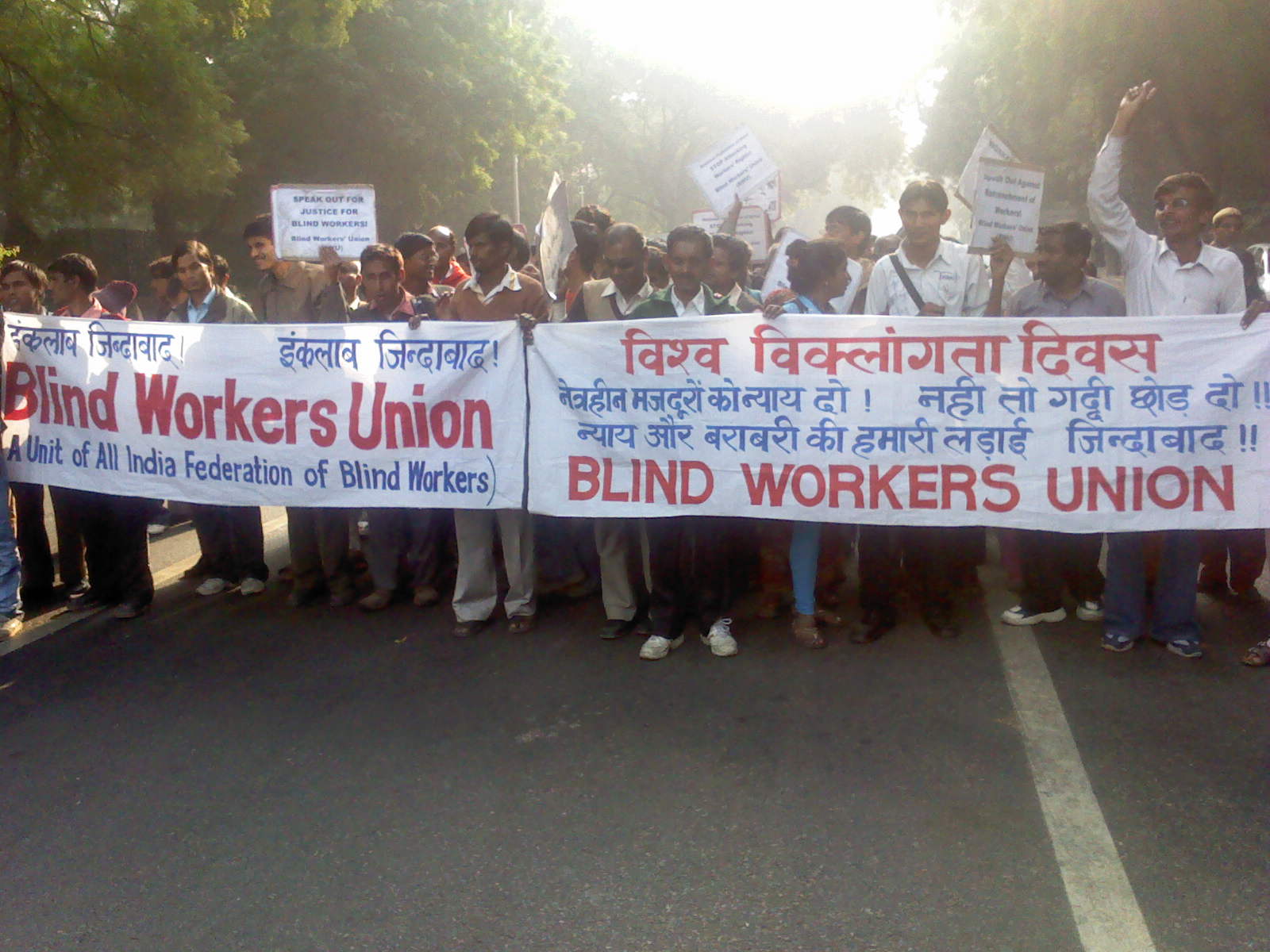
Today, on December 3, 2011, more than a thousand visually challenged workers from Benaras, Nasik, Kanpur, Faridabad, Bahadurgadh and Delhi participated in a massive protest rally on Parliament Street. Their rally was taken out from Jantar Mantar to Parliament Street on the occasion of World Disability Day. It was a culmination of an earlier struggle these blind workers have carried out against a well-known NGO which employs and exploit them, i.e. the National Federation of the Blind (NFB). The rally was an extremely important moment for these workers since they were using World Disability Day to expose how they were still denied many fundamental rights at workplaces. Instead of celebrating this day in the usual festive manner, these blind workers celebrated World Disability Day as a black day, which marked unfulfilled promises of equality.

Initially, the Delhi Police refused to allow the rally to proceed to Parliament Street. However, the agitated workers refused to be held back and broke free of the barricades so as to march onto Parliament Street. Quite expectedly, their fiery spirit did not mellow down, despite being manhandled. Following their protest rally, a delegation of the workers submitted a memorandum to the Hon’ble Minister of the Ministry of Social Justice and Empowerment, Government of India. The delegation met the concerned minister, Shri Mukul Wasnik, and apprised him of plight of blind workers. They drew the minister’s attention to the fact that the government was doing little to prevent the rampant violation of its own laws pertaining to disability. In particular, the workers highlighted the violation of several provisions in the Persons with Disability (Equal Opportunity, Protection of rights and full participation) Act of 1995.

When discussing matters with the Minister, the workers highlighted how section 33 of this Act, which provides 3% reservation in identified posts (1% being earmarked for the blind and low vision persons), is unable to provide sufficient respite to the disabled because of inadequate job creation in the public sector itself. Another important provision in this 1995 Act which is far from being implemented is section 41. It provides incentives to disabled persons so as to ensure that at least 5% jobs of all workforces goes to them.
However, as highlighted by the protesting workers, both the older laws and policies as well as the newest government policies are failing miserably when it comes to ensuring a dignified and productive life to disabled people, in particular, disabled workers. For example, even the recently adopted National Policy for Persons with Disabilities (2006), which provides incentives, awards, tax exemption, etc. is redundant because the private sector which employs a large number of disabled workers, is least interested in implementing such policies, let alone statutory labour laws pertaining to minimum wages and parity at work. In fact, the promise of the National Policy for Persons with Disabilities (2006) to create one lakh jobs is still a mirage today. In this light, the recommendations of the Sudha Kaul Committee which was constituted to help frame a policy on disability, are also flawed. This Committee, for example, has made no recommendations with respect to labour rights relating to safety when assisting in the drafting of the Right of Persons with Disability Bill, 2011.

The gathering of workers on Parliament Street was addressed by aggrieved workers (those employed by National Federation of the Blind) as well as their leaders. Shri Alok Kumar from the All India Federation of the Blind addressed the gathering, and argued how shameful it was that National Federation of the Blind was also commemorating World Disability Day when this NGO itself exploited the impoverished blind workers. He went on to argue how necessary it was for the government to create more jobs opportunities for disabled workers, and how the government should ensure that all statutory labour laws are implemented in production centres run by “social service” organizations (like NFB) as well as other employers. Indeed, almost every blind worker who stood up to speak, emphasized that NGOs like NFB as well as other employers, act as if they are doing the blind workers a favour by employing them. In reality, as employers they earn huge profits from the labour of these workers. NGOs, in particular, also amass huge amounts of funds from the Government/foreign funding agencies by using the face of these poor blind workers.

It is with the express purpose of attaining greater job opportunities for disabled workers as well as parity in work conditions and wages between blind workers and sighted workers that the spirited rally of blind workers marched onto Parliament Street.

Contact: 9313730069
Email: blindworkersunion@gmail.com
Significance of a counter-hegemonic culture: : An Urgent Need for Marxist Reading Groups

Raju J Das

Capitalism creates poverty. It indeed requires poverty and thrives on it. It causes and requires massive social and geographical inequality. And capitalism is inherently crisis-prone. We have just witnessed a major global economic crisis. In part because of its crisis-proneness, modern world capitalism is necessarily imperialist: advanced capitalist countries try to shift the effects of the crises they experience to politically and economically weaker countries (often with the connivance of the state in these countries). Normal mechanisms of capitalism and the combination of economic crisis and imperialism have major adverse impacts on the living conditions of the working masses in general and workers and poor peasants in the less developed countries such as India in particular.

No system of injustice goes unchallenged, however. Away from the pre-occupations of the corporate-controlled mainstream media, people’s movements against the profit-driven system have been taking place. Consider, for example, the Arab Spring, various social justice movements in India and elsewhere, as well as the ‘occupy movements’ in the US and Europe, which are bound to leave an impression on the radical imagination of the masses, even if they are being repressed. Humans have an irrepressible quest for justice and have a desire for a humane world. These various movements have emerged in response to the heightened levels of exploitation of workers, massive amount of dispossession of peasants from their property, undemocratic control over socio-economic activity and the government by large companies, and the irreparable ecological devastation and cultural impoverishment.

Many activists and movements have been inspired in their thinking by the critique by Marx and other progressive scholars of capitalist commodification and development. Ideologically, these protests and the recent economic crises call into question the legitimacy not only of capitalism, including its neoliberal form, but also of capitalist nation-states and global ‘state’ apparatuses (e.g. World Bank; IMF). This happens in richer countries and in poorer countries such as India as well.

There has indeed been an extraordinary resurgence of interest in a Marxist worldview recently, which as Terry Eagleton put it, is the ‘most theoretically rich, politically uncompromising critique of [the capitalist] system’ (Why Marx was right?). The process of resurgence of this intellectually insurgent worldview (Marxism) has been helped by the fact that the social relations of authoritarian ‘communism’, and other related views, which had acted as a fetter on the development of productive powers of Marxist research, have been burst asunder. In this context, question of alternatives to capitalism (beyond Keynesianism, state-bureaucratism, and neo-populism) – and the role of (Marxist) intellectuals whether in academy, in the media or ‘civil society’ in radical social change – are being actively discussed the world over. This has led to a series of important interventions rethinking political parties, democracy and visions of viable socialisms. More and more people are reading Marx and Marxists, and reading them critically, for Marxism is a science which must be updated where necessary. There is an outpouring of Marxist discussions including in journals such as New York-based Science and Society, world’s longest continuously published Marxist journal, which celebrated its 75th anniversary in October 2011, Review of Radical Political Economics (from Cornell University), Historical Materialism (from SOAS, London), Capital and Class, and so on. Much of this resurgence is exhibited on- online, Radical Notes itself being a testimony to this as is, for example, Sanhati.

The remaking of socialist visions – which emphasize socialism as the flourishing of optimal level of democracy in all spheres of human life – has also meant extensive considerations of race, caste, tribality, gender, sexuality and disability. These issues of social oppression/discrimination are important in their own right. But they are important dominantly because of the ways in which capitalism subordinates them to its own logic. Capitalism furthers its accumulation projects by using these sources of oppression to define certain working subjects as less than average workers who can be paid lower compensations. Capital also politically dominates the suffering subjects (workers and peasants) by dividing them on the basis of these non-class identities. An aspect of the resurgence of Marxist research is the immense popularity of Marxist dialectics as a holistic way of looking at the capitalist world, in terms of its unity as well as difference, from the standpoint of radically changing it. Such a dialectical method allows us to reflect on various methods of exploitation and social oppression as interconnected and as forming a concrete whole.

Reading Marx and those who engage in what the American Marxist, Hal Draper called ‘Marx’s Marxism’ would be more than apt at a political moment when neoliberalism, in theory and practice, is in crisis, when the turbulence of capitalist economies is part of daily life. As David Harvey and others have argued, Marx is more relevant now than he was during his own time.

The problems caused by capitalism are everywhere. These problems are, however, particularly acute in less developed countries and in the most under-developed parts of these poor countries. In many under-developed regions of India (e.g. Odisha), capitalist market relations in land and labour coexist with remnants of coercive production relations in some localities and with highly undemocratic relations of casteism, patriarchy and tribalism more generally. The institutions of the state are more or less ‘instruments’ of property-owners, including those whose main object is to subject natural resources and working people to cruel forms of commodification and ruthless forms of exploitation, all in the name of development and dollars (export earnings). There is an inverse relation between democratic rhetoric and its actual content. There is an absence of democratic values both in the economy or polity: ordinary people have little real democratic control over the way our resources and abilities to work are used. The cult of violence is everywhere. There is systemic violence as that caused when people’s livelihood is snatched away from them or when people do not have the money to buy basic necessities because of which they starve to death or suffer from poverty-caused diseases. Related to this violence is ‘agentic violence’: in some places ordinary people, often out of sheer desperation, tend to resort to violence (which is unproductive in the long run), in response to which and often to preempt which the state resorts to massive and disproportionate violence.

The situation in more under-developed regions of India and in similar other countries raises several questions. Why are these regions so poor when they are so rich in terms of natural resources and labouring quality of their workers and peasants? How does capitalism make use of undemocratic social and economic relations? What explains the inability of the political and intellectual elite to help the suffering masses in any significant way? Just why it is that the majority of our people have no access to nutritious food, decent housing and clothing, quality education and health-care as well as other amenities including safe drinking water and electricity? These and many other questions can be fruitfully explored only if we have an adequate understanding of capitalism as such and the ways in which it works in concrete circumstances. Understanding Marx is essential therefore. A proper understanding of Marx and his legacy would also make clear to people that the Marxist vision is a vision of a society which is authentically democratic and that Marxism has little to do with any political activity which is aimed at hurting individuals. Individuals are bearers of social relations. What needs to be changed is the system of social relations, not occupiers of positions in the system.

To understand the world, it is not enough to have sense-data. We need theory, this is because important aspects of the world are not immediately accessible to mere empirical observation. To understand the world from the standpoint of the majority, the working masses, we need a theory from their standpoint. Radical transformation in the direction of social, economic and ecological democracy and justice is not possible without a radical theory. Marx and his legacy provide such a theory. It would be useful to set up Radical/progressive reading groups in different places to promote a counter-hegemonic culture, a tradition of radical imagination in theory. Consisting of interested academics, activists, workers-peasants, and indeed anyone who is interested in critically understanding the current situation with a view to radically transcend it and deepen the democratic content/spirit of our society to the highest extent possible, this group could meet regularly to read the Marxist and progressive literature on topics of classical and contemporary significance and discuss it in a comradely and non-sectarian manner. It will also connect the readings and the discussions to the world around us and draw theoretical implications for political practice. There are thousands of progressive people engaged in theoretical-political struggle for justice. Often in terms of theory, politics and method of struggles, there are ‘deep’ divisions among them (including, and interestingly, over the fact of whether poor countries such as India are dominantly capitalist or not). Perhaps an understanding of Marx and his legacy would show that the divisions are not as real as they appear to be, and that there is cause more for unity and less for division: at least the divisions should be discussed in the light of theoretical discussions the foundation for which was laid by Marx. These reading groups cannot only read radical academic literature but also encourage performance of radical art in its various forms and reflect on these theoretically.

A culture that accurately reflects the interest and ideas of the majority of the people is a most democratic process to promote. Setting up Marxist Readings Groups is an important need of the hour therefore.

Raju J Das is an Associate Professor at York University, Toronto, Canada. Email: rajudas@yorku.ca

Industrialisation and forms of struggle: Or, should industrialisation be opposed?

Raju J Das

Industrialisation is understood narrowly in the sense of manufacturing and broadly in the sense of the application of modern science and technology to the transformation of raw materials from nature. It is necessary for national development, as the economist Gavin Kitching and others argued decades ago. Industrialisation adds value to unprocessed goods extracted from nature and thus increases society’s income. Often owners of land – peasants – do not earn more – or do not earn much more — than those who work in industry as wage labourers. Industrialisation makes possible the production of a vast range of goods, which are directly used by people: clothes, materials required to build houses, traditional and western medicines, consumer durables, cultural items such as books and music instruments; the different types food that go through the manufacturing process, and so on. And, industry indeed produces the means of production necessary in both farming and industry itself. Industrialisation holds out the possibility of ending want and material suffering. It provides employment to the increasing population, including through forward and backward linkages. It makes it possible to reap scale economies and specialisation in ways not possible in agriculture. In part because of the above, industrialisation increases labour productivity, one of the fundamental indicators of progress, prosperity, and economic development in the society at large. Industrialisation breaks the mutual isolation of producers: this happens as they now work in great numbers in large cities and towns. Their geographical concentration will potentially allow them to fight for justice and equality in society, both on their behalf and on behalf of other oppressed groups. Industrialisation, connected as it is to science, promotes a culture of rational thinking and can potentially undermine the basis for superstitious and obscurantist ideas and practices. Given these and many other advantages of industrialisation, the Left – at least the Marxist left — cannot be opposed to industrialisation (although sections of the postmodern/populist Left are, as industrialisation is seen by them as a sign/carrier of modernity that supposedly destroys an authentic pre-modern culture). The question is: what form of industrialisation should the Left endorse in theory and practice? What happens when, for example, a proposed SEZ (special economic zone) displaces thousands of peasants? Should industrialisation be endorsed under this situation?

To answer this question, one may start with agriculture. Land is the most important means of production in agriculture, at least at the current stage when farming is relatively less capital-intensive. Fertility of land is a product of natural forces as well as human investments. It is normally the case that human investments in land to raise land fertility happen closer to existing centres of population and commerce than away from these. Fertile tracts of land therefore are generally located closer to existing centres of population and commerce. Now, owners of industry need also land. But their need for land is different. They need to locate their factories on: land is not used as an input in the way it is used in farming. And in a market economy, they need land in a specific location: industry tends to be located closer to existing centres of population and commerce for the reason that greater profits are made possible by greater geographical accessibility. Therefore, the fight over industrialisation often becomes a fight between owners of industry and owners of land (including peasants). This fight is over not just an absolute piece of land but over its location.

To be able to understand the on-going struggles over industrialisation, we have to carefully distinguish between industrialisation per se which is necessary in all modern societies from its various historically specific forms, and we need to also distinguish between various forms of struggle over industrialisation.
There is a strong logic to locating industry on the land which is not currently cultivated or irregularly cultivated, in relatively less accessible locations and away from the locations of fertile land on which peasants are currently dependent on or which may soon be used. Why? Firstly, as mentioned above, industry does not need fertile land as an input. Location of a factory on or close to a fertile land destroys natural fertility of soil which is almost impossible to manufacture in industry. It is indeed a great social cost to use a fertile land for industrialisation which does not need it. Secondly, forcing the industry to locate in these areas (e.g. relatively less accessible areas, away from fertile land) will result in the development of new means of transportation and communication (which will also create jobs). Industrialisation in these less accessible locations will also give an impetus to agriculture. It is unfortunate that when industries could be located in more remote locations on land that is relatively less fertile, they are being located on currently cultivated fertile land. This must be fought against. This is one form of struggle over industrialisation.

If, however, a fertile land currently being cultivated must absolutely be used for an SEZ — and whether this must be the case should be democratically decided and not decided by business — several conditions must be laid out. The value of the land as a compensation to the family must be determined in relation to what the value of the land would be after the industries have come up. Under no circumstances must the living standards of the families losing the land and the families losing access to employment on that land (farm labourers, tenants) be allowed to be worse than what they were before the change in the use of the land. Indeed, because industrialisation will make possible greater production of wealth and because this is possible only by displacing the people who currently occupy the land and depend on its use, it must be an absolute precondition of displacement that their material and cultural needs (adequate food, clothes, shelter, education, health care, etc.) are satisfied (including by giving employment to at least a single person from every affected family with a living wage in the industry) and that environmental sustainability of the place and nearby-places is maintained. Investment must be made in the lives of the people who are affected before the investment is made in the SEZ itself. This will not happen automatically. This requires democratically mobilised struggle. This is the second form of struggle over industrialisation.

Peasants as peasants have been involved in heroic battles over dispossession from their land – in Bengal, in northern Orissa, in Maharashtra, and so many other places. This is not the decisive battle against the industrialist class (domestic or foreign), however. The decisive battle against it cannot be, and will not be, fought by peasants as property owners against dispossession, although local and temporary success is possible. The battle against unjust dispossession can only be successfully fought by urban workers in an alliance with peasants and rural workers. Note also that the issue of peasants being separated from land is not a single separable visible act of a group of industrialists, backed by the state. Given, for example, the high costs of farm inputs which come from the industry and given the decreasing prices of farm products from which industry benefits, millions are going into debt, and to clear their debt, peasants are selling their land. Many are leasing their land to better-off farmers, including those who enter into contract with industrialists, domestic and foreign, to produce farm products for industrial processing. There is therefore a potential site of struggle against this insidious form of dispossession from land. The industrialists who set up an SEZ by displacing peasants from land and the industrialists who benefit from high prices of goods sold to peasants which contribute to their economic unviability and separation from land are both members of the same family. The fight against high prices of industrial goods used by peasants is therefore an important part of the fight for a particular form of industrialisation, one that would seek to remove the differences between peasants and industry and the relations of oppression between them.

There is still another form of struggle over industrialisation. Peasants turned into the proletariat in the SEZs, in newly industrialising areas – whether located on fertile land, displacing peasants or in remote locations — will and must fight against the monied class, initially for better wages and working conditions. One may respond by saying that the SEZ framework of industrialisation does not allow for the working class organisation. But then who said that the SEZ must be a necessary form of industrialisation? Or if it does, who said that an SEZ – understood as an industrial cluster — must be one where workers are to be alienated from their democratic right to organise? If business has the right to make money, then surely, and in the interest of democracy, workers have the right to organise to demand a decent life? This is the fourth form of struggle over industrialisation, the struggle that connects workers of different industrial clusters and cities politically and that demands that industrialisation must be of a particular form such that those who do the work must be fully able to meet their social and cultural needs. An SEZ, an industrial project is not based on a one-time act of separating people from their land and livelihood. Much rather, the particular form of industrialisation that is in question is based on a continuous separation: separation of people from the product of their labour, from their blood and sweat. It represents endless money-making at one pole and limitless misery at another. This form of industrialisation does not just produce things that are of potential use. It reproduces an invisible relation of separation of masses from their lives, a relation between them and those who control their lives at work (and outside). So because separation of people from their land creates a ground for the second form of separation, the struggle against the former must be connected to the struggle over the latter, and can only be fully successful if it is connected that way.

Protecting the peasants does not necessarily mean protecting the peasant property. If industrialisation can better the conditions of peasants (i.e. outside of farming), perhaps ‘sacrificing’ their property to make room for industrialisation can be favourably considered. Everyone must be provided with an opportunity to live a life with dignity. Whether it is in industry or farming should, ordinarily, be beside the matter. But there is an ‘if’, as in ‘If industrialisation can better conditions of life of peasants…’. Industrialisation, whether led by state-capital or private capital has not done much for millions of peasants. And it won’t unless it is a site of contestation.

The current struggles around SEZs and displacement appear to be a little narrow. They are often too defensive. The message of these struggles seems to be: ‘don’t take away our land, leave us alone (to our misery)’. The struggle against displacement should be a part of larger family of struggles, i.e. struggles over industrialisation as such. This is because the objects of struggle are objectively inter-connected. The fight against SEZs must be a fight against a particular existing form of industrialisation which leads to double dispossession: political acts of dispossession or primitive accumulation and dispossession through market mechanisms (rising prices of industrial goods leading to debt). A part of the fight should also be within SEZs (and other industrialised areas). Seen in another way, the fight against SEZs and displacement is a fight for a certain form of industrialisation, which, in turn, is a fight for (deepening) democracy and for the satisfaction of social, cultural and ecological needs of those who are displaced to make room for industries, those who lose land because of rising prices of industrial goods, and those who work inside the industrial areas.

Raju J Das is an Associate Professor at York University, Toronto, Canada. Email: rajudas@yorku.ca

Beverly Silver on “The End of the long 20th Century”

Courtesy: Labournet.tv

Working Conditions Maruti Suzuki English subtitles

Video: Maruti Suzuki’s attempt to suppress workers’ struggle (Subtitled)

Video: On Maruti Workers’ Strike

Pradeep, a leader of Maruti Suzuki Employees Union, talks about the various aspects of Maruti Workers’ agitation. He also notes the designs of the capitalists to use Maruti issues to effect changes in the labour laws.

Video of the Gurgaon Rally (October 17 2011)

October 17: Gurgaon Rally in Support of Maruti Suzuki Workers

Rally in support of Maruti Suzuki Workers (Oct 17 2011) from Radical Notes on Vimeo.

Appeal from the Maruti Suzuki Employees Union

We, the Maruti Suzuki Employees Union (MSEU), Suzuki Powertrain India Employees Union (SPIEU) and Suzuki Motorcycle India Employees Union (SMIEU), have been on strike in our respective plants in Gurgaon-Manesar from the 7th of October, 2011, demanding our right to respectable and non-precarious employment and unionization. Our movement stands at a crucial juncture today, we therefore send this appeal to all the labouring people of the country and beyond, the trade unions and all other sections of society which have stood with us in solidarity to come forward with renewed vigour to take this movement forward. Our struggle is not a struggle for a mere wage-hike of any one section of workers, but is a struggle for our dignity and right to organise. We struggle also more importantly for the contract workers among us, whose insecurity and precarious condition of existence is a burning issue before the entire labouring people of the country today, which puts the very framing of the available labour laws into question.

We, permanent and contract workers, have and do stand united in this struggle.To break our unity and resolve, the management of Maruti Suzuki India Ltd, Manesar is continuing to indulge in anti-worker activities and increasingly harass us with the absolute complicity of the state administration. The management began violating the terms of the last agreement from the very next day of our calling off the 33day long agitation continuing from August 29th till a settlement was reached on the 30th September. Going back on its word of treating the workers with respect, it has on the contrary been acting with vengeance, trying to create divisions among us. On the workers reporting for duty the day after the strike, the management flatly refused to let the over 1,200 contract workers enter the factory, so as to divide the unity between permanent and contract workers that this movement has achieved. It shuffled permanent workers from their workstations so that allegations of ‘production sabotage’ could be put on us. Such a shuffling of skilled workers, accustomed to and specialized at their specific tasks is far from being conducive to optimal production in the factory. Such a move therefore makes evident that fulfilling production targets are not a priority with the management at this point. Rather the point is to break our unity and resolve to struggle. The already inadequate bus service was also stopped to further harass us.

Later contractors on the behest of the management used bouncers who threatened and attacked us recently in front of the factory gate on the morning of 7th Oct, this incident took a more blatant aspect when some goons came and beat us up at the factory gate on the 8th and threatened us for our lives. They even attempted to actualise their threat by coming with guns inside the Suzuki Motorcycle plant on the 9th morning and firing on our comrades there. All legal and illegal means have been used by the management to break our resolve and unity forged during the struggle in June and then again in August-September. The state and central government is acting hand-in-glove with the management. Earlier it merely gave us empty promises after the company broke the spirit of the settlement by acting in antiworker bad faith.

Ever since we have been on strike due to circumstances created by the management, it has been issuing us show-cause notices instead of acting against the company which is habitually reneging on its promises and violating all labour laws, having turned all their instrument to implement justice to break our fight for a just cause. The number of police personnel, stationed in and out of the factory increased first to 1,500 and soon to 2,500. Having tried to push us into starvation by occupying the canteen and dismantling our set-up to cook food for those inside the factories, yesterday 14th October the management blocked our food and water supply and locked up the toilets. Given that it had no problem in arresting our leaders last month on false charges, the attacks on some of our fellow workers and the brutal lathi-charge on the workers of Honda in 2005, we also think that brutal repressive force could be used any time on us. With the company and the state acting together to control and oppress us, we feel the need to make a renewed appeal to all to extend and be part of our collective struggle.

Since our struggle began, all workers, various Trade Unions and other sections of society have stood strongly by us. But now, the struggle in Maruti Suzuki has emerged as the concrete struggle of the around 8000 workers of the four plants of Suzuki group- Maruti Suzuki India Ltd., Suzuki Powertrain India Ltd., Suzuki Castings, Suzuki Motorcycle India Ltd. On 7th October, workers of another eight plants in IMT had also gone on a one day tool down strike in support. WE, Maruti Suzuki Employees Union (MSEU), Suzuki Powertrain India Employees Union(SPIEU) and Suzuki Motorcycle India Employees Union (SMIEU) continue to sit on strike at our factory gates. Our movement has been able to achieve an unprecedented unity among permanent and contract workers, local and migrant workers and workers of all our plants forged in course of struggle by the initiative of all struggling workers; this we consider to be our greatest strength and are resolved to take this strength forward. We shall not relent until our demands are met and all workers are taken back unconditionally. No degree of sacrifice can deter us from seeing this fight to the end.

We appeal to all the workers and Trade Unions to extend concrete support in our struggle with both solidarity actions in their own factories, areas and before their own state governments and by contacting us and fighting this struggle with us. Even if a single worker sticks one poster on the wall facing an oppressive management, we consider it a concrete act of solidarity. The possibility that this strike and these solidarity actions are throwing up can lay the foundation of a new and more advanced phase of workers movement in our country, such that can compel each and every government and arrogant management to think many times before taking any antiworker measure in the future. In face of the brutal hand twisting of the workers sitting-in on strike in the Maruti Suzuki plant, by holding food and water ransom, we are now continuing our struggle outside our respective factory gates. It has now become evident that the Haryana administration is preparing for taking brutal and violent steps to smash our movement and disperse us from here. Such an assault will not just be on us but the right of all working people and we expect that would become the beginning of unprecedented protests in all corners and among all progressive sections of the country.

United in Struggle.

Shiv Kumar
General Secretary, MSEU on behalf of MSEU, SPIEU and SMIEU