Dehradun: Police Lathicharge Workers, 11 hunger strikers hospitalised for forcefeeding, 326 jailed

Shankar Gopalakrishnan

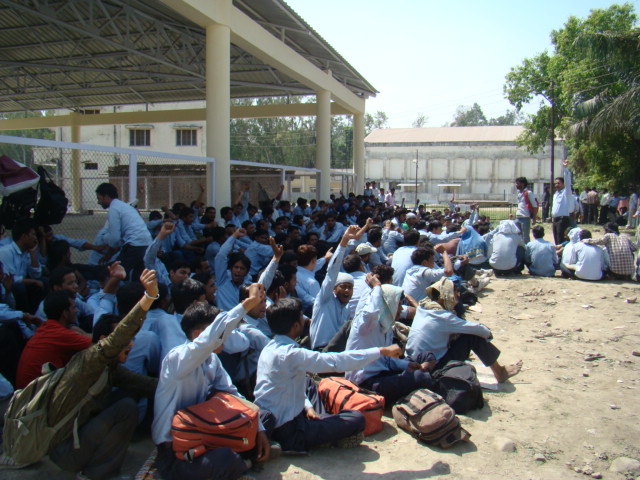
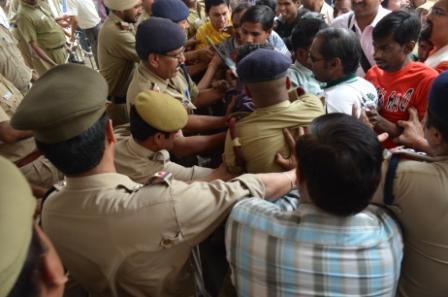
Between 12 and 1 today, the Uttarakhand police lathi charged more than 300 workers who have been sitting on a protest in Dehradun for the last ten days. 11 workers who have been on hunger strike (six from April 6th and five who joined them on April 9th) have been forcibly hospitalised in Doon Hospital, where they are resisting attempts to forcefeed them. 326 workers have been arrested and detained in various jails in the city.

The workers have been on strike for more than three weeks now. They are employees of the Rockman and Satyam Auto plants in Haridwar, both major suppliers of Hero Motors. As in Manesar, Haryana last year, these workers are being paid extremely low wages for more than 12 hours of work a day; when they sought to form a union to demand respect for labour laws, the five leaders of the union were illegally sacked immediately and the others threatened with punishment. On March 19th the majority of permanent workers at Rockman came out on strike in protest at this illegal brutality, and on March 22nd they were joined by all the permanent workers at Satyam. Their main demands are:

1. That they be allowed to form a union as per law, which both companies are trying to suppress;
2. That the five workers who were illegally terminated be reinstated;
3. That all labour laws be complied with within the factory;
4. That their wages be made proportionate to the workload and that they should be paid overtime as required by law.

In the first week of April, in an attempt to suppress their protest, the Uttarakhand government declared section 144 in force in Haridwar. On April 4th the workers sough to come to teh capital, Dehradun, to take out a peaceful march. This too was thwarted by the police, whereupon the workers sat down on dharna at the Parade Ground in the city. On the 6th, six Rockman workers went on hunger strike, and they were joined by five Satyam workers on the 9th. They have been fasting ever since, weakening every day.

No response has come from the government. When a delegation sought to meet the Chief Minister, he told them that these workers are overpaid, that the strike and protest is a conspiracy, and that they would be “dealt with.” The meaning of those words has been demonstrated today.

Workers in other factories in Haridwar, including in Eveready ITC, VIP, and the public sector company Bharat Heavy Electricals Ltd., have declared their support for the strike. A protest and delegation from other factories in Haridwar is planned tomorrow.

For more details please contact Trepan Singh Chauhan, Uttarakhand Nav Nirman Mazdoor Sangh (09411143539), and/or Amit, Inquilabi Mazdoor Kendra (09568216305).

Haridwar Industrial Unrest “Manesar-like”

Inputs and Photos
by Trepan Singh Chauhan,
Uttarakhand Nav-Nirman Mazdoor Sangh

The 2011 Maruti Suzuki workers strike at Manesar (Gurgaon) has already become a metaphor for the new wave of industrial unrest in India, especially against the neoliberal industrial regime that makes the criminal violation of all kinds of regulation and labour laws by the corporate sector an imperative for growth and development. Manesar has come to signify the will of the workers to counter capital by spontaneous and solidaristic uprisings.

On April 4, Business Standard reported the strike in Haridwar in Satyam Auto and Rockman Industries, two leading auto parts suppliers to Hero MotoCorp, India’s largest two-wheeler company. This report was aptly captioned “Haridwar factories brew Manesar-like labour situation”. The strike, which has been going on for the last two weeks, has not been reported by any local or mainstream newspapers. According to the Business Standard report:

A two-week strike is unusual, but the managements of both companies have refused to agree to the workers’ demands. Unlike previous strikes here, this industrial action shows signs of disturbing the peace in the region, with support pouring in from workers at other companies. For the past one decade Haridwar and its neigbouring areas have seen investments from leading companies like Hindustan Unilever, luggage manufacturer VIP, battery manufacturer Eveready, and Hero MotoCorp. According to the BS report, “around 850 companies here employ over 70,000 people.”

So, as workers from the two strike-hit companies staged a protest here on Tuesday, outside the offices of the district administration, they were supported by workers from companies such as VIP, Eveready ITC and Bharat Heavy Electricals Ltd (BHEL). A similar march was taken out last Wednesday, too. Major trade unions such as the All India Trade Union Congress and Hind Mazdoor Sabha have supported the protesting workers. So are 13 workers’ unions at the public sector engineering major, BHEL. Workers at Eveready and VIP have presented their respective companies with charters of demands, including wage hike.

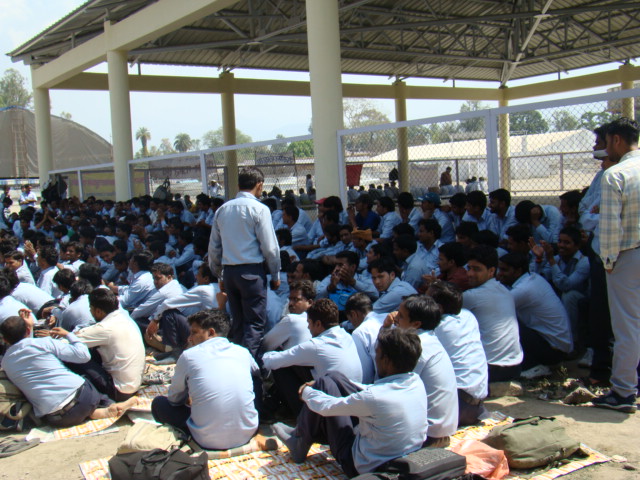
Since yesterday (April 4), workers of Rockman Industries and Satyam Auto have been occupying the Parade Ground, Dehradun (the capital city of Uttarakhand), and were on a day long fast today to press for their demands.

Blind Workers demonstrate for their rights (March 27)

Blind Workers’ Union
(A Unit of All India Federation of Blind Workers)
Affiliated to Workers Unity Center of India, WUCI
Contact: 9313730069 Email: blindworkersunion@gmail.com

Blind Workers’ Union all-up against violation of their labour rights and government inaction.
Blind Workers’ Union warns Social Justice Ministry of grave consequences if alternative jobs are not provided to retrenched blind workers.

Today (March 27), Blind Workers’ Union in mid of heavy deployment of police and barricades, staged a massive demonstration outside the Sarai Rohilla Railway Station in Delhi. Initially the unemployed blind workers tried to enter the railway station and block the rail traffic but the heavy contingents of police did not allow them to enter the railway track from any side. Thereafter these blind workers shouted anti-government slogans and held a protest meeting outside the station.

It is to be noted that the Blind Workers’ Union has been raising the issue of violation of blind workers basic labour rights since November, 2011. We have been raising our voice against violation of basic labour rights like minimum wage, PF, bonus, overtime payment etc. The workers were deeply agitated over the fact that despite several representations to the Ministry of Social Justice and Empowerment, there has been no concrete step taken either against the erring employers or to give these blind workers employment in public sector. These blind workers were thus forced to take up this drastic step so that general public becomes aware of their misery. These blind workers are demanding employment in public sector so that their rights are not violated by NGOs and private enterprises. In their most recent memorandum to Social Justice Ministry these blind workers demanded that the Ministry must make alternative provisions of jobs for these blind workers before 27th March or else they will be left with the alternative of either die of hunger or carry an all-out struggle against government.

In the protest meeting that was carried out outside the station it was resolved that this struggle of blind workers should be taken as an ultimatum by the government. They further warned the government and ministry that if they fail to provide employment immediately to these blind workers then from next month onwards they would be forced to carry out this Rail Roko in different parts of the country and next time they would even defy police.

Economy Democracy Manifesto

A new historical vista is opening before us in this time of change. Capitalism as a system has spawned deepening economic crisis alongside its bought-and-paid for political establishment. Neither serves the needs of our society. Whether it is secure, well-paid and meaningful jobs or a sustainable relationship with the natural environment that we depend on, our society is not delivering the results people need and deserve. We do not have the lives we want and our children’s future is threatened because of social conditions that can and should be changed. One key cause for this intolerable state of affairs is the lack of genuine democracy in our economy as well as in our politics. One key solution is thus the institution of genuine economic democracy as the basis for a genuine political democracy as well. That means transforming the workplace in our society as we propose in what follows.

We are encouraged by The Occupy Wall Street (OWS) movement spreading across the United States and beyond. Not only does OWS express a widespread popular rejection of our system’s social injustice and lack of democracy. OWS is also a movement for goals that include economic democracy. We welcome, support, and seek to build OWS as the urgently needed, broad movement to reorganize our society, to make our institutions accountable to the public will, and to establish both economic democracy and ecological sanity.

1) Capitalism and “delivering the goods”

Capitalism today abuses the people, environment, politics and culture in equal measures. It has fostered new extremes of wealth and poverty inside most countries, and such extremes always undermine or prevent democratic politics. Capitalist production for profit likewise endangers us by its global warming, widening pollution, and looming energy crisis. And now capitalism’s recurrent instability (what others call the “business cycle”) has plunged the world into the second massive global economic crisis in the last 75 years.

Yet both Republican and Democratic governments have failed to bring a recovery to the great mass of the American people. We continue to face high unemployment and home foreclosures alongside shrinking real wages, benefits and job security. Thus, increasing personal debt is required to secure basic needs. The government uses our taxes to bring recovery from the economic crisis to banks, stock markets, and major corporations. We have waited for bailouts of the corporate rich to trickle down to the rest of us; it never happened. To pay for their recovery we are told now to submit to cuts in public services, public employment, and even our social security and Medicare benefits. The budget deficits and national debts incurred to save capitalism from its own fundamental flaws are now used to justify shifting the cost of their recovery onto everyone else. We should not pay for capitalism’s crisis and for the government’s unjust and failed response to that crisis. It is time to take a different path, to make long-overdue economic, social and political changes.

We begin by drawing lessons from previous efforts to go beyond capitalism. Traditional socialism – as in the USSR – emphasized public instead of private ownership of means of production and government economic planning instead of markets. But that concentrated too much power in the government and thereby corrupted the socialist project. Yet the recent reversions back to capitalism neither overcame nor rectified the failures of Soviet-style socialism.

We have also learned from the last great capitalist crisis in the US during the1930s. Then an unprecedented upsurge of union organizing by the CIO and political mobilizations by Socialist and Communist parties won major reforms: establishing Social Security and unemployment insurance, creating and filling 11 million federal jobs. Very expensive reforms in the middle of a depression were paid for in part by heavily taxing corporations and the rich (who were also then heavily regulated). However, New Deal reforms were evaded, weakened or abolished in the decades after 1945. To increase their profits, major corporate shareholders and their boards of directors had every incentive to dismantle reforms. They used their profits to undo the New Deal. Reforms won will always remain insecure until workers who benefit from the reforms are in the position of receiving the profits of their enterprises and using them to extend, not undermine, those reforms.

The task facing us, therefore, goes well beyond choosing between private and public ownership and between markets and planning. Nor can we be content to re-enact reforms that capitalist enterprises can and will undermine. These are not our only alternatives. The strategy we propose is to establish a genuinely democratic basis – by means of reorganizing our productive enterprises – to support those reforms and that combination of property ownership and distribution of resources and products that best serve our social, cultural and ecological needs.

2) Economic Democracy at the Workplace and in Society

The change we propose – as a new and major addition to the agenda for social change – is to occur inside production: inside the enterprises and other institutions (households, the state, schools, and so on) that produce and distribute the goods and services upon which society depends. Wherever production occurs, the workers must become collectively their own bosses, their own board of directors. Everyone’s job description would change: in addition to your specific task, you would be required to participate fully in designing and running the enterprise. Decisions once made by private corporate boards of directors or state officials – what, how and where to produce and how to use the revenues received – would instead be made collectively and democratically by the workers themselves. Education would be redesigned to train all persons in the leadership and control functions now reserved for elites.

Such a reorganization of production would finally and genuinely subordinate the state to the people. The state’s revenues (taxes, etc.) would depend on what the workers gave the state out of the revenues of the workers’ enterprises. Instead of capitalists, a small minority, funding and thereby controlling the state, the majority – workers – would finally gain that crucial social position.

Of course, workplace democracy must intertwine with community democracy in the residential locations that are mutually interactive and interdependent with work locations. Economic and political democracy need and would reinforce one another. Self-directed workers and self-directed community residents must democratically share decision-making at both locations. Local, regional and national state institutions will henceforth incorporate shared democratic decision-making between workplace and residence based communities. Such institutions would draw upon the lessons of past capitalist and socialist experiences.

3) Benefits of Workplace Democracy

When workforce and residential communities decide together how the economy evolves, the results will differ sharply from the results of capitalism. Workplace democracy would not, for example, move production to other countries as capitalist corporations have done. Workers’ self-directed enterprises would not pay a few top managers huge salaries and bonuses while most workers’ paychecks and benefits stagnate. Worker-run enterprises sharing democratic decision-making with surrounding communities would not install toxic and dangerous technologies as capitalist enterprises often do to earn more profits. They would, however, be far more likely to provide daycare, elder care and other supportive services. For the first time in human history, societies could democratically rethink and re-organize the time they devote to work, play, relationships, and cultural activities. Instead of complaining that we lack time for the most meaningful parts of our lives, we could together decide to reduce labor time, to concentrate on the consumer goods we really need, and thereby to allow more time for the important relationships in our lives. We might thereby overcome the divisions and tensions (often defined in racial, gender, ethnic, religious, and other terms) that capitalism imposes on populations by splitting them into fully employed, partly employed, and contingent laborers, and those excluded from the labor market.

A new society can be built on the basis of democratically reorganizing our workplaces, where adults spend most of their lifetimes. Over recent centuries, the human community dispensed with kings, emperors, and czars in favor of representative (and partly democratic) parliaments and congresses. The fears and warnings of disaster by those opposed to that social change were proved wrong by history. The change we advocate today takes democracy another necessary and logical step: into the workplace. Those who fear (and threaten) that it will not work will likewise be proven wrong.

4) An Immediate and Realistic Project

There are practical and popular steps we can take now toward realizing economic democracy. Against massive, wasteful and cruel unemployment and poverty, we propose a new kind of public works program. It would differ from the federal employment programs of the New Deal (when FDR hired millions of the unemployed) in two ways. First, it would focus on a “green” and support service agenda. By “green” we mean massively improving the sustainability of workplace and residential communities by, for example, building energy-saving mass transportation systems, restoring waterways, forests, etc., weatherizing residential and workplace structures, and establishing systematic anti-pollution programs. By “support service” we mean new programs of children’s day-care and elder-care to help all families coping with the conditions of work and demographics in the US today.

However, the new kind of pubic works program we propose would differ even more dramatically from all past public works projects. Instead of paying a weekly dole to the unemployed, our public works program would emphasize providing the unemployed with the funds to begin and build their own cooperative, self-directed democratic enterprises.

The gains from this project are many. The ecological benefits alone would make this the most massive environmental program in US history. Economic benefits would be huge as millions of citizens restore self-esteem damaged by unemployment and earn incomes enabling them to keep their homes and, by their purchases, provide jobs to others. Public employment at decent pay for all would go a long way toward lessening the gender, racial, and other job discriminations now dividing our people.

A special benefit would be a new freedom of choice for Americans. As a people, we could see, examine and evaluate the benefits of working inside enterprises where every worker is both employee and employer, where decisions are debated and decided democratically. For the first time in US history, we will begin to enjoy this freedom of choice: working in a top-down, hierarchically organized capitalist corporation or working in a cooperative, democratic workplace. The future of our society will then depend on how Americans make that choice, and that is how the future of a democratic society should be determined.

5) The Rich Roots Sustaining this Project

Americans have been interested in and built various kinds of cooperative enterprises – more or less non-capitalist enterprises – throughout our history. The idea of building a “cooperative commonwealth” has repeatedly attracted many. Today, an estimated 13.7 million Americans work in 11,400 Employee Stock Ownership Plan companies (ESOPs), in which employees own part or all of those companies. So-called “not-for-profit” enterprises abound across the US in many different fields. Some alternative, non-capitalist enterprises are inspired by the example of Mondragon, a federation of over 250 democratically-run worker cooperatives employing 100,000 based in Spain’s Basque region. Since their wages are determined by the worker-owners themselves, the ratio between the wages of those with mostly executive functions and others average 5:1 as compared to the 475:1 in contemporary capitalist multinational corporations.

The US cooperative movement stretches today from the Arizmendi Association (San Francisco Bay) to the Vida Verde Cleaning Cooperative (Massachusetts) to Black Star Collective Pub and Brewery (Austin, Texas), to name just a few. The largest conglomerate of worker owned co-operatives in the U.S. is the “Evergreen Cooperative Model” (or “Cleveland Model”), consisting e.g. of the Evergreen Cooperative Laundry (ECL), the Ohio Cooperative Solar (OCS), and the Green City Growers. These cooperatives share a) common ownership and democracy at the workplace; b) ecological commitments to produce sustainable goods and services and create “green jobs”, and c) new kinds of communal economic planning, mediated by “anchor institutions” (e.g. universities, non-profit hospitals), community foundations, development funds, state-owned banks or employee ownership banks etc. Such cooperatives are generating new concepts and kinds of economic development.

These examples’ varying kinds and degrees of democracy in the workplace all attest to an immense social basis of interest in and commitment to non-capitalist forms of work. Contrary to much popular mythology, there is a solid popular base for a movement to expand and diversify the options for organizing production. Workplace democracy responds to deep needs and desires.

If you are interested in getting further information about this proposal, in joining the discussion it engages, or in participating in activities to achieve its realization, please find us on Facebook at Economic Democracy Manifesto or email manifesto@rdwolff.com

“Economic Democracy Manifesto” Group

David van Arsdale
Michael McCabe
Costas Panayotakis
Jan Rehmann
Sohnya Sayres
Billy Wharton
Richard D. Wolff

Blind Workers’ Union’s Convention (New Delhi, Feb 11)

Workers’ Strike in Reliance Textile Industries, Naroda plant, Ahmedabad – A Report

Highly exploitative wage structure and abysmal working conditions have led the over 5000 workers to strike work in the primary manufacturing plant of Reliance Textile Industries in Naroda, Gujarat, which is at a halt since 2nd February 2012. While the company posted its highest ever turnover of over USD 44 billion and its net profit increased to USD 3.6 billion, workers in the factory (‘dressing up India’ with ‘fabrics which make you feel like a millionaire’ its website says) which started this empire’s journey find their lives getting cheaper by the day. Spread over 120 acres and with assets of over 300 crore, this plant in Naroda Industrial Estate, located in a GIDC (Gujarat Industrial Development Corporation) near Ahmedabad is India’s ‘most modern textile complex’ (according to the World Bank) and Reliance’s first manufacturing facility set up by Dhirubhai Ambani in 1966. Producing the ‘Only Vimal’ brand and housing sophisticated machinery, it says it is ushering in ‘a new era in fabrics, include suitings, shirtings, home textiles’.

Workers’ Demand List

But the skeletons in its closet are coming tumbling out, as the most of the around 1100 permanent and 4000 contract workers assert their rights and continue their strike which started from the second shift on 2nd February. The company meanwhile responds with police deployment, intimidation, arrest of workers’ leaders and a media campaign which says that the workers have only been miffed for not being allowed to carry mobile phones inside the factory. On the first day of the strike itself, Modi’s willing police forced the striking workers away from the factory gate, and when they assembled in the shamshanghat complex, around 20 minutes away, were forced out of there too. Declaring the strike to be illegal, and arresting the leaders, police has posted itself in the factory gate.

Workers’ Demand List Contd.

According to the workers, for last 20 years (when the company’s profits increased ten-fold), the wages for the workers and karigars has more or less been the same, whereas the salary of the staff increased many times. While the permanent workers earn a paltry Rs. 5000-6000 per month, the contract workers are paid Rs.85-100 per day. No legality of payment in terms of pay slips etc. is maintained, only a voucher is signed. Overtime is paid in single rate, while strict surveillance is maintained and late entry is severely punished. For the last 20-25 years, two anti-worker unions have been there in the plant. One is ‘Majdoor Mahajan’, the union that was originally established by M. K. Gandhi after the Bombay textile strike in the 1920s and has many unions across Gujarat, and the other is ‘Mill Mazdoor Sabha’, affiliated to the Hind Mazdoor Sabha. The workers, fed up of both these Unions’ corrupt practices, say how they act as “extended office of the management”. Every three years, a settlement is brokered between these two Unions’ officials and the management, but workers are kept out of it and do not even get to know of the deal brokered. No notice is put up. Four years back, both these Unions even agreed to accept that there will be no recess hour for the workers to have tea. So the workers were henceforth forced to have tea on the way to the bathroom, and in the location of work in an unhygienic and dirty atmosphere, so that work is not disturbed and time ‘better managed’.

Workers strongly emphasise that the reason for the strike is not as the popular media reporting and management statements on it goes, that of the prohibition of mobile phone inside the factory. It is only to delegitimize their struggle, that they are sought to being portrayed as flippant, lazy, like the recent struggle in Yanam was decried as being done by anarchist ‘killer workers’, or how the Maruti Suzuki struggle was sought to be portrayed as ‘innocent young workers under the sway of outside elements’.

The demands and the inhuman working conditions from which they have arisen are clear to the workers. Even as the company site says that it ‘endeavours to create a workplace where every person can realise his or her full potential’, the workers specifically stress on the abusive language of the management staff. Though they have raised their demands again and again earlier, the workers now organized as Reliance Employees Union submitted a 16-point demand list to the management again during the strike, which include a 60% hike in wages and regularization of contract workers, besides double rate overtime, a 20% increase in bonus, increase of daily wage of contract workers to Rs. 200 per day, renewal of fixed salary system, uniform rights for wage board, tea-snacks in the canteen, no fine for 10 minute late entry, to fill accident forms according to procedure, an end to harassment of workers, and an assurance that striking workers will not be fired and no deduction of wage for the strike period is made.

Disregarding all these demands, the management apart from the disinformation campaign, has resorted to police force, arrest and intimidation on the striking workers and their leaders, and are now bringing in temporary workers from outside, paying them Rs. 400-500 per day, to show that the plant is running, though at much below its capacity. Continuing with their anti-worker stance, both the pro-management Unions were against the strike, but the majority of the workers emphasized the strong unity among striking workforce. “We have formed a new union named ‘Reliance Employees Union. The strike will go on till our demands are met”, said Hasmukh Patel, President of the new Union. The workers’ complete disillusionment and anger against Narendra Modi and his ‘vibrant Gujarat development model’, and against the Reliance management is becoming more and more evident, from their own experiences. Sagar Patil, a striking worker, said, “With 9.5 crore, the money we produced, Nita Ambani bought an IPL team. They are making jalsa with our money, but it pains them to even part a few thousands to us who produce.” No trade union, or political group or even the huge number of ‘humanist’ organizations in Gujarat have even made a single statement in favour of the workers till now, but the striking workers continue with their struggle.

For some Gup-Shup in Faridabad (February 7)

Faridabad Majdoor Samachar

To contribute to radical social transformations that are mushrooming all over the world, feel free about : stammering, fragmentariness, incoherence, missing steps….. Social (and natural) reality are very complex and dynamic. Leaps in interactions amongst seven billion human beings are on our agenda.

It is only in the present that we can act/prepare to act. What to do and what not to do, how to do and how not to do are coloured by the different facets/ sectionalities in the present and also carry deep imprints of the past (not only near and distant past but also different pasts of different locations/groups). So a request: Try not to be polemical; try not to attempt to clinch arguments; try to respect your own selves (by implication you will respect those around you). Primarily it is to act, it is for better actions that this gup-shup is premised on. “Cataclysmic event” language and imagery seems problematic; languages and imageries that are premised on active participations of seven billion human beings are indispensable for radical social transformations.

A technical constraint in the gup-shup is that we will be using mostly English language.

Some Statements Etcetera

* Small groupings of human beings called birth a shaap (curse) or the fall. Half of their numbers, females were described as sin personified. What was tragic for small groupings is today a tragedy for all human beings, for all living species, for the earth.

* It does not seem that something had to happen, rather possibilities and probabilities seems to be the norm. But, once a possibility gets concretized, it has a dynamic and trajectory specific to it.

* Relationship between a part and the (immediate) whole. Harmony and conflict between parts and the whole seem to be the norm. Small groupings of human beings embarked on a trajectory wherein the part attempts to control, dominate, mould the whole. Other-ing unleashed – series of “the other – others.”.

* Domestication of animals led to the domestication of human beings, slave owners and slaves.

* Deformation of communities, emergence of “I” with men as its official bearers. Man woman relations become very problematic. Today, by and large, women and children are also bearers of “I”. “Who am I?” has become a universal question.

* Certainty of death after birth becomes unbearable for any “I”. Attempts at immortality. Search for amrit (the nectar of life). Philosophies of rebirth, heavan, hell. Theories of lineage. Tragedies of Alexanders – great thinkers, great warriors, great artists, great sportspersons, great performers, great leaders…..

* From “who am I?”, we have entered a phase where there are many an “I” in each “I”. In the process of transcending “I” we seem to have come to the era of ekmev (unique) and ekmaya (together).

* Discriminations became rampant amongst human beings. It was a corollary of othering and dominating – controlling – moulding. All discriminations must be opposed. The question is: How? Discriminations are a breeding ground for all sorts of identity politics. An exemplary end-result is the constitution of the state of Israel. This is how discriminations are not to be opposed. The ways of opposing discriminations should be such that discrimination as such comes into focus.

* From domestication of animals to agriculture, from slave-owners and slaves to feudal lords and serfs increased the groupings of human beings that led tragic lives. Trade, long distance trade further increased these numbers. But during all this time large groupings of human beings lived in natural surroundings. It is only during the last two hundred years, it is only after steam and coal power was harnessed by human beings that a leap change began. Internal combustion engine, electricity, atomic energy, electronics magnified the leaps in the changes and have brought us face to face with their dire consequences.

* It was production for the market that led the onslaught. Artisans and peasants producing for the market using their own and family labour became redundant. For two hundred years now they are face to face with social death and social murder. Peasants and artisans in their Luddite incarnation in England attacked factories at night. Some of them were gunned down and hanged, many became wage-workers or shopkeepers or social outcastes, beggars etc., and many were forced out to the Americas and Australia. The mass displacements from Europe further increased the genocides in Americas and Australia. A corollary of the inability to tame-domesticate people in America – Australia was the massive increase in slave-trade in Africa, indentured labour in India, for production for the market.

* Steam and coal driven machinery had made large numbers of people in Europe superfluous. The entry of electronics in the production processes has made still more people superfluous….. Its impact on hundreds of millions of peasants, artisans, shopkeepers in Asia, Africa, South America is devastating and at an electronic pace. They have nowhere to go. There are no “empty americas”. Desperation borne of social death and social murder of peasants, artisans, shopkeepers is the cause of hundreds of thousands committing suicides and similar numbers taking up arms in various garbs. Napoleon’s army is miniscule vis-a-vis the militarization in the world today but it is still too small for the desperate hundreds of millions. So, besides state armies there are mushrooming proto-state armies. Desperations of hundreds of millions of peasants, artisans, shopkeepers is increasing the fragility of state apparatuses. Outside of western Europe, Japan and North America this is a very important social setting for attempts at radical social transformations.

* In the initial stage of production for the market using wage-labour, factories were owned by individuals. The unfolding of the process led to factories being owned by groups of individuals, by a dozen or so stock holders. The requirements for establishing and running a factory soon started demanding the pooling of resources by thousands. Share holding of thousands became the “owner” of the factories. Needs of increasing size and resources made share holding inadequate and loans emerged as the major source of funds for establishment and functioning of factories. Pension funds, insurance funds, bank deposits, financial institutions became de-facto owners of production enterprises with 80-85% of the investment coming from them and about 15% from shares. (A significant portion of shares is also held by these institutions). “Capitalist – personified capital” has given way to boards of directors, chairmen, managing directors, CEO’s as “representatives of faceless capital”. Being a state enterprise or corporate, company enterprise is not a significant difference. These changes in material production enterprises have by and large been replicated in other spheres of social life, be they be trade, education, entertainment, medical treatment. Craft-artisanal mode gave way to industrial mode and then its dynamics has followed. Factory mode is moulding all spheres of life throughout the world. (In long distance trade, the institutional form of organization, company preceded its emergence in material production.)

* The process of institutionalization has not halted with the dismantling of large factories. Instead of a car factory, we have auto hubs today. What is called a car factory is mainly an assembly plant. A vehicle manufacture today needs production facilities spread over an area with fifty kilometer radius. It requires a hundred thousand plus workforce. And the rapid changes that the institutionalization of research is bringing about makes it increasingly unviable. Today it is only in China that there are a few factories with a hundred thousand plus workers. The entry of electronics in production process started the dismantling of twenty thousand plus workers factories, the “workers fortresses” in the 1980s. With all the confrontations that it engendered, it is more or less over.

* Roots in artisanal guilds provided initial factory workers with trade/craft organizational structures to confront the new situation they found themselves in. These defensive organs of wage-workers were initially illegal. Over time they obtained legal status. They had a leverage vis-a-vis individual owners regarding wages and conditions of work. Emergence of joint stock and then share holding decreased the leverage of trade-craft unions. Their defensive and conservative roles in the changing scenario brought them on the sides of their governments in the mass slaughter during 1914 – 1919. Craft based trade unions were denounced by some radicals in 1919 and instead of trade based unions, factory based unions were attempted as alternative form of workers organisations. We have had some experiences of factory based unions during 1980 – to date. We began looking at industrial unions as workers organisations with misleaders at their helm. In our experience we found factory unions functioning almost like another department of the factory. Managing workers was the job of the unions and good functioning of the factory was seen as good for the workers of that factory. With the introduction of electronics in the production process in factories, from the beginning of 1990s large scale restructuring took place in Faridabad. What was earlier seen largely during long term agreements between managements and unions became blatant in 1990-2000 period. In factories ninety percent plus workers had been permanent. Large scale retrenchment of permanent workers took place in many factories and in most of the cases unions were openly standing with the managements. Engineered strikes and lockouts were the means in these major attacks on factory workers. From these experiences when we look back at the 1982 Bombay textile strike in which 250,000 workers were involved, it seems to us that it was an engineered strike. The composite textile mills with their spinning, weaving, processing, dyeing and printing departments have vanished from Bombay-Mumbai. What would have taken decades if it were slow attrition was done in one blow. The composite textile mills of Indore, Gwalior, Faridabad, Delhi, Hissar, Kanpur, have also vanished. And cloth production in these twenty five years has grown exponentially. In this vein it seems to us that the coal-miners strike in England in 1984-85 was another engineered strike that saw the number of coal miners come down from 100,000 to 10,000. Another example could be the longshoremen strike in the US which resulted in drastic reduction in permanent workers and matched the needs of containerization. Today when we look back, 1980 – 2000 appears ancient to us. Factories in Gaziabad, NOIDA, Delhi, Gurgaon, Faridabad are largely run by temporary workers. In direct production process five to thirty per cent workers are permanent. In the national capital region in India (and things are not different in other parts) seventy-five to ninety-five percent factory workers are temporary workers. There are factories where not even one worker in 300 is permanent – only the staff has permanent status. And amongst these 80 percent temporary workers, three-fourths are “invisible” workers. Almost 75 percent workers in factories in the NCR do not exist in company and government records, be it garments or auto or pharmaceuticals or chemicals, things are the same. Factory unions, where they exist, have only permanent workers as their members. 90 percent factory workers in the NCR do not fit in the union structure. The increasing number of temporary workers is a global phenomenon.

* Given the changes in the ownership patterns of factories, given the breakup of a product in hundreds of factories, given the composition of factory workforce today, given the existence of industrial areas with thousands of factories, and given the linkages among factories across the globe, co-ordination among workers needs to expand across factories and industrial areas and span the world. New types of activities and new kinds of organisational practices are needed.

* A pointer is the recent occupations of Maruti-Suzuki car factory in Industrial Model Town, Manesar. Inaugurated in February 2007, all the workers in the factory are in their twenties. There are 950 permanent workers, 500 trainees, 200 apprentices, 1200 workers hired through contractors for work in direct production process and around 1500 workers hired through contractors for various auxiliary functions. The pace of work was such that a car was being assembled in 45 seconds. Some permanent workers attempted to organise against the existing union in the company. Strong-arm tactics of the management gave rise to a wildcat occupation of the factory on June 4, 2011. The company and the government were taken aback. The occupation continued for 13 days. During the occupation many bonds developed between the permanent workers, trainees, apprentices and workers hired through contractors. The company was forced to take a step backwards and revoke termination of 11 workers for production to restart. After the occupation there was a dramatic change in the atmosphere in the factory. The company was forced to plan and prepare to re-establish its control on the shop floor. On August 28, a Sunday and a weekly day off, 400 policemen came at night to the factory. Company staff had arrived earlier. With steel sheets, the factory was secured in military fashion. On 29th morning when workers arrived for their 7:00 AM shift, there were notices announcing dismissals, suspensions, and entry premised on signing of good conduct bonds. All the workers stayed out of the factory. This is the chess game well rehearsed by managements to soften workers and re-establish control. The company had gone to distant industrial training institutes and hired hundreds of young boys. Workers from the company’s main factory in Gurgaon were also taken to Manesar. Arrangements for their stay inside the factory were made. Already 400 policemen were staying in the factory and large number of guards were hired from Group 4 security company. Staff was made to work in 12 hour shifts with the new workers. Musclemen from surrounding areas were paid to bully workers. Attempts were made to instigate workers to violence. Central trade unions tried to take leadership of the workers. Workers’ representatives were called for negotiations and arrested…… The workers refused to be instigated. All kinds of supporters came to the factory gates where the 3000 workers did 12 hour, back to back sit-togethers. Many kinds of discussions took place. Bonding between different categories acquired new dimensions. The workers’ refusal to be instigated led the well-rehearsed chess game to a dead end. The company was forced to side-step and sign a new agreement. The permanent workers, trainees and apprentices entered the factory on October 3, but the 1200 workers hired through contractors were not taken back. The company’s attempt to divide the workers received a serious thrashing when, on the afternoon of October 7, workers of A and B shift, who were inside, occupied the factory. This time it was not just the occupation of Maruti-Suzuki factory, simultaneously 11 other factories in Industrial Model Town, Manesar, were occupied by workers. “Take back the 1200 workers hired through contractors and revoke the suspension of 44 permanent workers” echoed and re-echoed all around. Again the company and government were taken aback. Despite the presence of 400 policemen and hundreds of other guards, Maruti-Suzuki factory was occupied by workers. The simultaneous occupation of 11 other factories opened up new possibilities with thousands of factories all around. Pressure was applied and occupation of seven factories was called off, but it continued in Suzuki Powertrain, Suzuki Casting, Suzuki Motorcycle factories, besides Maruti-Suzuki. It was only on October 14, after the deployment of additional 4000 policemen, that workers vacated Maruti-Suzuki factory and Suzuki Powertrain was vacated by the 2000 workers when they were surrounded by a police force of 4000 inside the factory. For details, see July 2011 to January 2012 issues of Faridabad Majdoor Samachar (and also the forthcoming February issue).

* The company and the government have not been able to understand the activities of Maruti-Suzuki workers (and other factory workers). Ripples were widespread and the dangers were very visible to the government. A third agreement was forced by the government, with it also becoming a signatory. The 1200 workers hired through contractors were taken back. Not having understood anything of what happened, the company gave significant amount of money to 30 workers it considered troublemakers, for their resignation. (And later propagated the deal as bought-sold.) Production recommenced in the 4 factories on October 22. Afraid of any and everything, the company has been giving concessions to workers. Now instead of 45 seconds, the scheduled time for making a car is one minute.

* Important questions dealing with life, time, relations, representation, articulation, factory life under scrutiny that the occupation of October 7-14 brought to the fore, in the words of a Maruti-Suzuki factory worker, are: “The time in Maruti-Suzuki factory during October 7-14 was extremely good. There was no tension of work. There was no tension of coming to the factory and going back.There was no tension of catching the bus.There was no tension of cooking.There was no tension that food has to be eaten only at 7 o’clock or only at 9 o’clock.There was no tension as to what day or date was that day. Lots of personal conversations took place. We had never come so close to one another as we came in these seven days.” From October 7-14 there were 1600 workers inside the Maruti-Suzuki factory, and 1200 outside the factory. When the bought-sold issue of 30 workers made the rounds, a Maruti-Suzuki worker said, “Earlier we used to pass on the issues to the president, general secretary, department co-ordinator – they will tell. But now every worker himself answers. On every issue, everyone gives his opinion. The atmosphere has changed.”

* Increase in accumulated labour, exponential increase in accumulated labour has sidelined personified forms and brought the social relation in its faceless form to the fore with presidents, prime ministers, chairmen, managing directors, CEO’s as its representatives. In this scenario, person has become increasingly insignificant. Whether a person is or she/he is not has become almost the same. But at the same time, in contentions between accumulated labour (dead labour) and living labour, each person has become increasingly important. Active participation of 90 percent plus of those directly concerned has become indispensable. Representation and delegation have become redundant / counter-productive.Lagta hai ki ekmev aur ekmaya ka yug dastak de raha hai. (It seems that the era of unique and together is knocking at the door.) Radical transformations are demanding the active participation of seven billion people, both as each a unique being and all together.

Faridabad Majdoor Samachar is a monthly publication in Hindi language and at present 10,000 copies are distributed each month by and large amongst factory workers in Okhla (Delhi), Udyog Vihar (Gurgaon), Industrial Model Town Manesar and Faridabad. Some rough translations in English are available at . Texts in Hindi are also on the internet via Gurgaon Workers News. In English we have published : 1. An Abridged Version of Rosa Luxemberg’s “The Accumulation of Capital”; 2. A Ballad Against Work; 3. Reflections on Marx’s Critique of Political Economy; 4. Self-Activity of Wage-Workers: Towards A Critique of Representation & Delegation; 5. Questions for Alternatives.

Faridabad Majdoor Samachar
Majdoor Library
Autopin Jhuggi
N.I.T. Faridabad – 121001
India
Ph. – 0129-6567014

Discussion And Reading Team of Socialists, Bhubaneswar (Second meeting) – A report

Discussion and Reading Team of Socialists (DARTS)

On Commodity Fetishism

The second meeting of DARTS was held on 30-12-2011 from 5:00p.m to 7:00p.m. at XIMB, Bhubaneswar. Prof. Raju Das of York University began his talk with a Power Point Presentation on Marx’s theory of ‘fetishism of commodities.’ Fetishism of the commodity, according to Marx, means that ‘the relationships between producers, within which the social characteristics of their labourers are manifested, take on the form of a social relation between the products of [their] labour’. In his talk he explained this idea with a simple example using export-oriented shrimp production in Orissa. The conditions of the shrimp producers, as that of numerous other workers, in Orissa (as elsewhere), are simply bad. The work they perform in producing the shrimp as a global commodity not only fails to fetch them enough money for their daily maintenance. The production process oriented towards producing the maximum amount of exchange value (profit) for the shrimp producers/traders is inscribed on their labouring bodies: chemicals used in the process affect the (women) workers’ fingers so badly that they cannot even eat with their hands. When the shrimps are in the market, every buyer, including the buyer in advanced countries, wants to get the maximum counts of shrimps for every rupee/dollar she has in her pocket. Doing this is in her own material interest. The buyer (who is also a producer of other commodities, be it a service or a physical commodity) does not care about the conditions under which shrimp workers work. And the buyer does not care because her own conditions of work and wage-level, like those of the shrimp-worker, are beyond her own control. So, it is as if shrimps and other commodities start talking in the market. The actual people who produce those commodities are not directly and socially interacting. It is immaterial whether or not people know the conditions of shrimp producers because given their own position they have to command a maximum amount of the commodity (e.g. shrimp) they want for every unit of the commodity they own (or its money form). There exists, in the words of Marx, ‘the social relation between commodities’ and ‘material relation between men.’ In Prof. Das’s words: “commodities rule over us instead of ourselves ruling over articles of use to us.” Relations between commodities replace – or at least, become much more important than – relations between people, i.e. people-as-producers of things-for-use.

Then Prof. Das explained the aspects of Ideology using I.I.Rubin (author of Essays on Marx’s Theory of Value), Terry Eagleton (author of Ideology) and Slavoj Zizek (author of Sublime Object of Ideology). Marx’s ideas of fetishism are connected not only to his ideas about alienation (partly in the sense that fetishism – the rule of commodities over us — happens because of the absence of democratic social regulation over production) but also ideology: the objective reality is such that we think that things for use necessarily have a money-tag and have to be bought and sold (for a profit) and we behave accordingly. The reality – and not (just) our discursive inability to comprehend it – is such that it makes us think that our needs can only be satisfied through commodity exchanges. Commodity fetishism is not our failure of intelligence. It is an intelligent failure. The commodity form hides the real social relations from us. It acts as a veil. And, in the words of Marx: ‘The veil is not removed …. until [the production process] becomes production by associated [producers], and stands under their conscious and planned control’ (Marx). The question is what is to be done to make this happen. Marx, of course, ends Capital Vol 1 with his most definitive answer to the question. Marx’s discussion of the commodity (dealt with in the inaugural meeting of DARTS) and of fetishism clearly shows that if we want to understand the capital and the society it dominates we must understand Marx (and his Capital).

There was an audience from several disciplines – students and teachers of Technology, Literature, Economics, Business Studies, etc. A number of political and civil rights’ activists were also present. Interesting questions were raised and discussed in the meeting. The questions included: ‘What is the distinction between objective and intrinsic in the context of value?’; ‘In a particular village, where people know each other and produce agricultural products and consume them, how is the theory of ‘fetishism of commodities’ relevant?’. What is the distinction between concrete labour and abstract labour, and why is such a distinction important? One perceptive member of the audience and a senior scholar explicitly linked the idea of fetishism to alienation, building on early Marx’s writings.’

There was an active participation as each participant found Marx relevant in her/his field of work and/or area of interest. All the questions posed could not be addressed properly due to the lack of time, which meant that there was a great need for several rounds of discussion on such concepts as the commodity and fetishism.The discussion had to be limited to commodity fetishism; there was no time for a discussion of the other form of fetishism in Marx’s work: capital fetishism.

The DARTS provisional organizing committee has decided to meet on the 29-01-12. The topic to be discussed was proposed to be ‘Labour-power as commodity.’ The time and venue will be conveyed by e-mail.

We collectively hope that we will continue to discuss important ideas of Marx both from the standpoint of their theoretical value and from the standpoint of their ability to shed light on contemporary issues facing the humanity. We also hope that there will be reading teams such as ours in many other cities and towns of Orissa and India.

Migrant Workers Rally in Gurgaon, Haryana (Jan 8, 2012)

• Support the struggling workers’ demands for minimum monthly wages of Rs.11000 in the area of Gurgaon.
• Stop the practice of imposing overtime on single day wages.
• Stop the use of contractors.
• Change conditions inside the factory like the use of harsh words, unequal wages for women, an ever increasing target, delays in payment, misuse of ISIPF money, employment without contracts, ill-treatment of women, imposition of overtime.

These are the demands that the Gurgaon Pravasi Mazdoor Union have taken up at the rally organized on 8th January at Udyog Vihar in Gurgaon. The union hopes to change working conditions in the factory and organize workers of the industrial belt of Gurgaon to fight for a minimum daily wage of Rs. 425 (Rs.11000 per month) as the first step towards a larger struggle against the factory owning class and the state. Workers from all walks of life will be part of the union so that these demands and the struggle to achieve them shall spread to the various sectors of the industrial belt.

ANC Centenary: A Display of Elite Power

Ayanda Kota
Chairperson, Unemployed People’s Movement
Grahamstown,

The centenary celebrations of the African National Congress (ANC) are being used to persuade the people that a movement that has betrayed the people is our government, a government that obeys the people, instead of a government of the elites, for the elites and by the elites. It is a hugely expensive spectacular designed to drug us against our own oppression and disempowerment.

In his Communist Manifesto Karl Marx wrote that “Each step in the development of the bourgeoisie was accompanied by a corresponding political advance of that class…The executive of the modern state is but a committee for managing the affairs of the bourgeoisie”. Here Marx is referring to the ability of the bourgeois to translate economic power into state power, thus reducing our governments to mere managers acting in the interests of capital and not the people. This has happened to governments around the world. But here our politicians are not mere managers. They are, like in Russia or India, a predatory elite with their own class interests and they support capital and repress the people as long as they can get their own share.

Since 1994 there hasn’t been a reorganisation of the economy. The commanding heights of the economy continue to reside in the hands of a tiny elite, most of which is white. Unemployment is sky rocketing. Most young people have never worked. Anyone can see that there is an excessive amount of poverty in South Africa. There are shacks everywhere. In fact poverty reigns supreme in our country. Every year Jacob Zuma promises to create new jobs and every year unemployment grows.

If things were getting better, even if they were getting better slowly, people might be willing to be patient. But things are getting worse every year. Poverty and inequality are getting worse. The government is increasingly criminalising poverty instead of treating it as a political problem. When people try to organise they are always presented as a third force being used to undermine democracy and bring back racism. But it is the ANC that has failed to develop any plans to democratise the economy. It is the ANC that has failed to develop any plans to democratise the media. It is the ANC that disciplines the people for the bourgeoisie. – a role that they are very comfortable to play! It is the ANC that follows the line of the World Bank and the International Monetary Fund. It is our local leaders who taking the leap from their old bosses, stealing from us, treating is with contempt, acting like the former colonial government and oppressing us.

During the struggle our leaders embodied the aspirations of the people. But once they took state power they didn’t need us any more. We were sent home. We are only called out to vote or attend rallies. But all the time our people are evicted from farms, paving way for animals as farms are turned into game reserves under the pretext of tourism. Our people are evicted from cities. Our people are denied decent education. The party has become a mixture of what Marx would call an instrument of power in the hands of bourgeoisie and what Fanon would call a means of private advancement.

Biko wrote that:

“This is one country where it would be possible to create a capitalist black society, if whites were intelligent, if the nationalists were intelligent. And that capitalist black society, black middle class, would be very effective … South Africa could succeed in putting across to the world a pretty convincing, integrated picture, with still 70 % of the population being underdogs.”

We, as the unemployed, belong to the 70% that Biko was talking about. We were happy to see the end of apartheid and we will always fight racism where ever we see it. But we are not free. There has only been freedom for the 30%. How can a person be free with no work, no house and no hope for their life?

R100 million is being spent on the celebration – spent to entertain elites, through playing golf and drinking the most expensive whiskey. Golf players are even receiving massages from young women sponsored by SAB. This is not a people’s celebration. We are absent! How some of us wish that all that money could have been used to build houses, create employment, build sport facilities or schools for kids who continue to learn under trees! Biko was right. As the world celebrates with the ANC today they put across a pretty convincing picture of freedom while everywhere people are broken by the burdens of poverty.

In his Wretched of the Earth, in the chapter called “The Pitfalls of the National Consciousness”, Frantz Fanon wrote:

“The leader pacifies the people. For years on end after independence has been won, we see him, incapable of urging on the people to a concrete task, unable really to open the future to them or of flinging them into the path of national reconstruction, that is to say, of their own reconstruction; we see him reassessing the history of independence and recalling the sacred unity of the struggle for liberation. The leader, because he refuses to break up the national bourgeoisie, asks the people to fall back into the past and to become drunk on the remembrance of the epoch which led up to independence. The leader, seen objectively, brings the people to a halt and persists in either expelling them from history or preventing them from taking root in it. During the struggle for liberation the leader awakened the people and promised them a forward march, heroic and unmitigated. Today, he uses every means to put them to sleep, and three or four times a year asks them to remember the colonial period and to look back on the long way they have come since then.”

I am not opposed to the centenary celebration of the ANC. But if the ANC was a progressive movement they would have organised a celebration in a way that includes the people and supports us to build our power. They could have, for instance, asked people to meet all over the country, discuss how far we have come and far we still have to go, and draw up demands for a new freedom charter for the new era. But this celebration is just a spectacle that we are supposed to watch on TV. It is exactly what Fanon talks about. It is designed to keep us drunk on the memory of the past struggle, so that we must stop struggling and remain in the caves.

In a recent protest in Bloemfontein, police were there in numbers to flush the demonstrators. This has happened in many other demonstrations. The message is very clear: “Go back to your caves!” It is backed up state violence. As Fanon says a party that can’t marry national consciousness with social consciousness will disintegrated; nothing will be left but the shell of a party, the name, the emblem and the motto. He says that:

“The living party, which ought to make possible the free exchange of ideas which have been elaborated according to the real needs of the mass of the people, has been transformed into a trade union of individual interests.”

This is exactly what the party has become. Institution such as parliament and local municipalities have been severely compromised because of individual interests. Corruption is rampant. The Protection of Information Bill (Secrecy Bill), is another illustration of how the selfish interests of individuals ave taken over the party.

A true liberation movement would never have killed Andries Tatane, attacked and jailed activists of social movements. It would never send people to lull – it would encourage people to continue organising and mobilising against injustices and oppression. A progressive leader would know that he or she cannot substitute themselves for the will of the people. A progressive party would never help the government in holding the people down through fascist attacks on the media by the likes of Nceba Faku, Blade Nzimande and Julius Malema to mention but a few. A democratic party would never engage in attacks on protests as we saw most recently with the ANC and ANCYL fascism against the Democratic Left Front in Durban during COP17 Conference.

In the Congo, in Nigeria and across the Arab world people are deserting celebrations of the flag and political leaders as if they really do represent the nation. Some are turning to a politics of religious or ethnic chauvinism. Others are turning to the politics of mass democratic rebellion or a democracy that is truly owned by the people. This is a free exchange of ideas backed up with popular force. We are also seeing this in Europe and North America. Latin America has been in rebellion for many years. Across South Africa more and more people are deserting the party that spends so much money to keep them drunk on the memory of the past struggle, their own struggle, the same struggle that the ruling party has privatised and betrayed. There are occupations, road blockades and protests and the message is loud and clear: Sekwanele! Genoeg! Enough!

The only way to truly honour the struggles of the past is to stand up for what is right now. The struggle continues and will continue until we are all free.