Bhumika Chauhan talks to Shyambir, an activist with Inquilabi Mazdoor Kendra, Gurgaon
On the Struggle at Maruti Suzuki and the 18th July event – A Conversation with Shyambir
July 22, 2012 by Leave a Comment
Press Statement: Maruti Suzuki Workers Union
July 19, 2012 by 6 Comments
The Maruti Suzuki Workers Union (MSWU) is anguished at the recent developments in Maruti Suzuki plant, IMT Manesar where the management has resorted to anti-worker and anti-Union activities in a pre-planned manner leading to violence and the closure of the factory yesterday.
We have had a long tough struggle with the strong unity of our permanent and contract workers to establish and register our Union last year, and had recently as of April 2012 submitted our Charter of Demands to the management of Maruti Suzuki, and the process of negotiation for wages and other demands was underway. However the management has done its utmost to derail the process since long and is trying to break the back of the spirit of unity of the workers and the legitimacy of the Union.
It is due to this, and continuing with this vindictive attitude and in a pre-planned manner, yesterday, the afternoon of 18th July, a supervisor in the shop floor abused and made casteist comments against a dalit worker of the permanent category, which was legitimately protested by the worker. Instead of taking action against the said supervisor, the management immediately suspended the worker concerned without any investigation as was demanded by the workers. When the workers along with Union representatives went to meet the HR to demand against the supervisor and revoke the unjust suspension of the worker, the HR officials flatly refused to hear our arguments, and it was in no mood to resolve the issue amicably.
When the negotiation was going on with the leaders of the Union inside the office, the management called in the entry of hundreds of bouncers on its payroll from outside the plant to attack the workers, and blocked the exit. This is completely an illegal vindictive action in the spirit of conspiracy to corner us into submission even as our demands and methods are legitimate and peaceful. The exit gates were closed by the security on behest of the management and the bouncers brutally attacked the workers with sharp weapons and arms. They, joined by some of the managerial staff and police later, beat up a number of workers who have had to be hospitalised with serious injuries. The bouncers, who are anti-social elements on hire, also destroyed company property and set fire to a portion of the factory. The gates were later opened to oust the workers and enforce a lockout by the company.
We have the workers and the company’s welfare in mind and have worked towards it after the resolution of the dispute last year, and to blame the current violence on us is unjust, which should be properly investigated. We are still keen to dialogue with the company and want to sit with the company management and the government labour department to amicably resolve the matter and restore industrial peace in the factory.
Ram Meher
President, Maruti Suzuki Workers Union (MSWU)
Faridabad Update: Striking nurses block roads as negotiations fail
May 15, 2012 by Leave a Comment
AS NEGOTIATIONS FAIL, STRIKING NURSES TAKE OUT MASSIVE PROTEST RALLY IN FARIDABAD & BLOCK B.K. CHOWK
HOSPITAL MANAGEMENT INSTALLS PHONE JAMMERS INSIDE THE HOSTEL TO INTIMIDATE STRIKING NURSES
PATIENTS HEALTH IN PERIL AS UNTRAINED NURING STAFF & NURSING STUDENTS ARE BROUGHT IN AS REPLACEMENTS

The nurses of Asian Institute of Medical Sciences (AIMS), Faridabad and QRG Central Hospital continue to sit on strike for the NINTH consecutive day. Since the management of AIMS hospital is determined not to increase the pay of the nurses, and not to reduce their work load by removing compulsory double duty, negotiations held with the AIMS management on 14.05.2012 failed. While the next round of negotiations is still pending in the case of QRG Central hospital, the chances of the QRG management conceding some of the main demands of the nurses’ is doubtful.
In order to build larger public pressure on the hospitals’ management as well as the district administration of Faridabad, the striking nurses of both hospitals took out a big rally from BT Chowk. There they blocked the roads surrounding the Chowk for nearly two hours till they were given the assurance that the District Commissioner will meet them in person on the 16th. The nurses’ rally was supported by trade unions in Faridabad, women’s organizations, welfare associations, several civil rights groups, and democratic and progressive individuals. Meanwhile, the two hospitals concerned kept up the façade of “normal” functioning by replacing the striking nurses with untrained nursing staff and nursing students—a measure which is putting patients at serious risk.
The striking nurses have continuously complained about the uncooperative approach of the district and labour administration. They argue that the district administration and labour office was intervening in a manner which reflects their connivance with the hospitals’ management. In the case of QRG Central, the civil court ordered that the peaceful demonstration of the striking nurses be shifted to a distance of 200 meters to an inconspicuous and distant location. Interestingly, the law allows for only 100 meters distance. In the case of both hospitals, the local officials are preventing the nurses from putting up a tent structure to protect themselves from the heat.
As expected, with each day the harassment by the hospitals’ management escalates. On the night of 14.05.2012 when AIMS nurses returned to their hostel after their ninth day of strike, they found jammers installed inside their hostel. Because of the device the nurses could not make or receive calls for several hours. Suspecting foul play they called the police and pushed for an inspection of a vacant, locked room where the felt the jammer was installed. Initially, the police was reluctant to remove the device due to pressure from the management, but then finally because all the nurses pressed for action, the jammer was finally removed at 10pm,” said an agitated nurse of AIMS hospital. Today (15.05.2012), the security staff of the hospital removed the water cooler installed in the hostel, hence, depriving the nurses of drinking water. Security personnel/bouncers hired by the hospitals are continuously entering the women’s hostels, and coercing individual nurses to join back. “A nurse who was recuperating from an attack of serious illness was continuously mentally pressurized by the hospital’s nursing supervisor who kept calling her on the phone—something which worsened her condition,” said another agitated nurse.
Considering the hostile atmosphere, the nurses of both AIMS and QRG Central hospitals have decided to form a Joint Action Committee (JAC) so as to unite nurses of all the different hospitals in Faridabad. Considering that conditions continue to be grave, the nurses resorted to a larger public campaign. During their rally they distributed pamphlets explaining to the general public how their strike was in favour of better patient care.
Thankamma Ravindran
Delhi Nurses Welfare AssociationAlok Kumar
Workers Unity CentreMaya John
Centre For Struggling Women
Ph: 9350272637
Faridabad Update: Impact of nurses’ strike spreads despite intimidation and threats
May 15, 2012 by Leave a Comment
DESPITE SEVERE HARASSMENT AND BEING MANHANDLED BY BOUNCERS, NURSES CONTINUE TO SIT ON STRIKE
WATER & ELECTRICITY SUPPLY CUT OFF IN THE NURSES’ HOSTEL ACCOMMODATION
IMPACT OF STRIKE SPREADS TO OTHER HOSPITALS
The nurses of Asian Institute of Medical Sciences (AIMS), Faridabad and QRG Central Hospital continue to sit on strike for the eighth consecutive day. With each day the harassment by the hospitals’ management escalates. Nevertheless, the nurses continue to sit on strike. Today, bouncers hired by the AIMS management manhandled nurses who were passing by the hospital on the way to their hostel accommodation. When activists from the women’s organization, Centre for Struggling Women (CSW) and Workers’ Unity Centre of India (WUCI) intervened, the bouncers tried to manhandle them too and used filthy, abusive language in order to intimidate the nurses. The local police initially intervened in favour of the bouncers but when accosted with the fact that the road outside the hospital is public property and cannot be regulated by the bouncers, the police accepted the bouncers were harassing the nurses.
Similar tactics of intimidation are being used in the hostels where the nurses reside. Water and electricity supply in the hostels are often cut off, and the nurses are threatened every day to vacate their rooms. Despite the fact that the management of both AIMS and QRG Central have called for negotiation today, intimidation and threats continue in order to force the striking nurses to settle fast. These acts are, hence, in complete violation of the spirit of amicable negotiation and the spirit of collective bargaining.
Unfortunately, even the district administration and labour office is intervening in a manner which reflects their connivance with the hospitals’ management. In the case of QRG Central, the civil court ordered that the peaceful demonstration of the striking nurses be shifted to a distance of 200 meters to an inconspicuous and distant location. Interestingly, the law allows for only 100 meters distance. And in the case of both hospitals, the local officials are preventing the nurses from putting up a tent structure to protect themselves from the heat.
Considering the hostile atmosphere, the nurses of both AIMS and QRG Central hospitals have decided to form a Joint Action Committee (JAC) so as to unite nurses of all the different hospitals in Faridabad. Considering that conditions continue to be grave, the nurses are also considering holding a JOINT PROTEST outside the office of the Deputy Labour Commissioner in Faridabad, and the Union Health Minister. “If the negotiations will not go in favour of the striking nurses then the nurses are thinking of taking out a big rally in Faridabad, and uniting nurses across the board. After all, negotiation doesn’t mean settle for less,” said CSW activist, Maya John. Interestingly, the nurses’ strikes in Faridabad are already impacting the functioning of other private hospitals in the NCR. For example, nurses of Sharda Hospital in Greater Noida have also gone on strike with respect to demands for pay hike, regulated work hours, etc.
Thankamma Ravindran
Delhi Nurses Welfare AssociationAlok Kumar
Workers Unity CentreMaya John
Centre For Struggling Women
Ph: 9350272637
Faridabad Update: Nurses on Hunger Strike on International Nurses’ Day
May 12, 2012 by 1 Comment
NURSES OF PRIVATE HOSPITALS IN FARIDABAD ON WAR PATH, & TAKE OUT A RALLY AROUND FARIDABAD
NURSES of ASIAN HOSPITAL SIT ON HUNGER STRIKE ON THE OCCASION OF INTERNATIONAL NURSES’ DAY

The nurses of Asian Institute of Medical Sciences (AIMS), Faridabad and QRG Central Hospital continue to sit on strike for the sixth consecutive day. Since 6 days have passed and no fruitful negotiation seems in sight, the nurses of Asian Institute of Medical Sciences (AIMS) decided to commemorate International Nurses’ Day by sitting on hunger strike, rather than celebrating the most important day of their profession with fanfare. The striking nurses of AIMS also took out a large rally from outside the hospital to Badhkal Chowk and HUDA Market. By going on hunger strike and taking out such a rally, the nurses’ have tried to expose how the nursing profession is treated in the medical community and society at large. On the hand, the management of both hospitals refuse to negotiate on the nurses’ just demands, although patients are vacating the hostel in panic, leading to huge financial loss. Following their meeting on Nurses’ Day, the nurses of both AIMS and QRG Central hospitals have decided to form a Joint Action Committee (JAC) so as to unite nurses of all the different hospitals in Faridabad. Considering that conditions continue to be grave, the nurses have also started to think along the lines of holding a JOINT PROTEST outside the office of the Deputy Labour Commissioner in Faridabad.
As of now the nurses of AIMS are paid a paltry sum of Rs. 11,000 from which the hospital management cuts PF, etc. Due to this the nurses get only some Rs. 9000 in hand—an amount which is way below the Rs. 42,000 earned by government hospital nurses. In the case of QRG Central hospital, many nurses are getting even less than their colleagues in AIMS (Faridabad). In both hospitals the nurses’ salaries are inflated on paper by including a vague category called Company Total Cost/CTC (which includes PF, gratuity, ESI health-card fee, etc.). The actual salary received in hand/basic salary is, of course, much lower than what is officially declared by the management on paper. In fact, the hospitals conveniently fool hapless nurses into work contracts by projecting higher salaries on paper. When asked to explain the exact functioning of the CTC, management of private hospitals across the board deny any proper explanation.
In Delhi and NCR region where rents are high, such salaries hardly enable the nurses to make ends meet. It is shocking that hospitals which earn huge profits on a yearly basis are unwilling to reward their nursing staff a fair wage and regular salary increments. While addressing the striking nurses, activists from the women’s organization, Centre For Struggling Women (CSW), Workers’ Unity Centre (WUCI), and Nurses Welfare Association encouraged the nurses to stand by their genuine demands like hiking the basic salary released, and paying the nurses salaries which hare in parity with those of government hospital nurses. CSW member also encouraged the nurses to unite the larger nursing community on the demand for a wage-board. The wage board would ensure some regulation of the salaries paid in private hospitals.
The other grave problem highlighted by the striking nurses is the manner in which they are assigned extra duties for which they are not paid adequately. For example, after performing eight hours of duty, the nurses are often forced to perform another 8 hours of duty. Furthermore, the aforementioned private hospitals exercise a skewed nurse-to-patient ratio. In violation of the World Health Organization’s norms, the nurses in Asian Hospital (AIMS) are assigned up to 3 to 4 ICU patients (the WHO recommended ratio being 1 nurse to 1 or 2 ICU patients). And after performing double duties back to back, the nurses do not receive compensation based on given rules on overtime payment. The nurses of QRG Central hospital explained how, in violation with laws pertaining to overtime payment, the management pays them even less than the normal duty’s rate for the additional 6-8 hours shift performed by them.
What is most disturbing is the way in which the issue of the striking nurses are being skirted continuously. For example, despite being intimated of the nurses’ issues, the Deputy Labour Commissioner and Labour Office have failed to intervene. Even after communicating their demands to the Chief Minister, no intervention or probe by the CM’s office has followed, thereby once again exposing the pro-management stance of the Haryana Government. As expected, the local thana has been actively involved in harassing the young nurses, and has forcefully pushed the strikers to from putting up a tent even at a distance of the stipulated 100 meters issued via a court order. Of course, seeing the nurses’ determination to continue their struggle, the Deputy Labour Commissioner’s (DL) office has suddenly swung into force. However, the nurses have complained that the DL has only been verbally threatening them than amicably trying to arbitrate between the two parties. The connivance between the Deputy Labour Commissioner and the management of QRG Central hospital has, in fact, ensured that the striking nurses are forced to sit far away (200 meters distance) from the hospital whereas the rule is generally 100 meters only. This reflects both the state administration and hospital management’s desire to conceal the genuine issues of the nurses from the patients and larger public.
Furthermore, the management of AIMS and QRG Hospital has resorted to several illegal practices like replacing the striking nurses with nursing students who are not qualified to practice, and by making ward attendants perform certain nursing duties like applying injections to sick patients. This measure is not only illegal but also detrimental to the interests of the admitted patients. In addition to this the hospital management of AIMS has also indulged in filthy practices like sending bouncers late at night to the nurses’ hostel on 8th May. Today on 11th morning, again certain senior hospital staff in AIMS forcefully dragged three nurses into the hospital. The three nurses, however, refused to stay and left the hospital shortly to join their striking colleagues. In the evening bouncers hired by the hospital kept encircling the striking nurses in their vehicle. Four of the bouncers again entered the nurses’ hostel on 11th evening and took photographs of the nurses inside the hostel. Worried about their safety and unsure of the extent to which the bouncers will go, the nurses submitted a written complaint at the local police station.
Standing up to the various intimidation tactics of the hospitals’ management, the nurses of both hospitals have decided to continue their strike till all the striking nurses are re-employed. With nothing to lose, the nurses are standing together in unity.
Thankamma Ravindran
Delhi Nurses Welfare AssociationLailamma Peter
Delhi Nurses Welfare AssociationAlok Kumar
Workers Unity CentreMaya John
Centre For Struggling Women
Ph: 9350272637
Note: This is an updated version of the release that was published earlier.
Nurses of Faridabad on War Path
May 11, 2012 by Leave a Comment
NURSES OF FARIDABAD ON WAR PATH
RAMPANT EXPOITATION OF MALYALI NURSES
PRIVATE HOSPITALS INDULGE IN A RANGE OF ILLEGAL PRACTICES

Following a 14 day strike notice, 300 nurses of Asian Institute of Medical Sciences (AIMS), Faridabad have been sitting on strike since 7th May. Down the road, 140 nurses of another private hospital, QRG Central Hospital are also on strike. The majority of these nurses are from far flung parts of Kerela, and have joined the super-speciality hospital in the hope of earning salaries which will help them survive in the city, and also assist them in paying back education loans they have taken to pursue their nursing degrees. Unfortunately, like other private hospitals, Asian Hospital and QRG Central are misusing the nurses’ compulsion to pay off student loans to employ them on the basis of extremely low wages.
As of now the nurses of AIMS are paid a paltry sum of Rs. 11,000 from which the hospital management cuts PF, etc. Due to this the nurses get only some Rs. 9000 in hand—an amount which is way below the Rs. 42,000 earned by government hospital nurses. Ironically, this salary package has been in force since the inception of the hospital, i.e. for two and a half years. The nurses, hence, complained that despite putting in loyal service from the time of the hospital’s inception, their experience and hard work has not led to any pay hike. In the case of QRG Central hospital, many nurses are getting even less than their colleagues in AIMS (Faridabad).
In Delhi and NCR region where rents are high, such salaries hardly enable the nurses to make ends meet. It is shocking that hospitals which earn huge profits on a yearly basis are unwilling to reward their nursing staff a fair wage and regular salary increments. In fact, several private hospitals like AIMS have gone to the extent of deliberately forcing a section of the nurses to join as trainees from the first date of their service. The trainees are then conveniently paid wages as low as Rs 5000, despite the fact that they are fully qualified nurses who do not need to undergo any sort of “apprenticeship/training”. While addressing the striking nurses, activists from the women’s organization, Centre For Struggling Women (CSW), Workers’ Unity Centre (WUCI), and Nurses Welfare Association congratulated the nurses for risking everything and coming out to fight on their demands. The CSW member argued that the nurses’ salaries should be increased regularly on the basis of the hospital’s profit margin, and that a wage-board should be constituted for the nursing occupation. The wage board would ensure some regulation of the salaries paid in private hospitals.
The other grave problem highlighted by the striking nurses is the manner in which they are assigned extra duties for which they are not paid adequately. For example, after performing eight hours of duty, the nurses are often forced to perform another 8 hours of duty. “Imagine what kind of patient-care we can do when we are on our feet for 16 hours straight”, explained one of the striking nurses (who requested anonymity). The management of private hospitals find it easy to arm-twist the nurses for double duties due to the simple fact that nurses are desperate to pay off student loans, and because of the sheer clout private capital exercises in the health sector. With private hospitals outnumbering government ones, the managements of private hospitals find it easy to keep wages low across the board, and to overwork the nurses in the absence of government regulation. With little difference in the wage scales prevalent in private hospitals, most nurses are unable to challenge the adverse conditions of their employment. Furthermore, the aforementioned private hospitals exercise a skewed nurse-to-patient ratio. In violation of the World Health Organization’s norms, the nurses in Asian Hospital (AIMS) are assigned up to 3 to 4 ICU patients (the WHO recommended ratio being 1 nurse to 1 or 2 ICU patients). “And even after performing double duties back to back, we don’t receive adequate compensation,” said another AIMS nurse.
What is most disturbing is the way in which the issue of the striking nurses are being skirted continuously. For example, despite being intimated of the nurses’ issues, the Deputy Labour Commissioner and Labour Office have failed to intervene. Even after communicating their demands to the Chief Minister, no intervention or probe by the CM’s office has followed, thereby once again exposing the pro-management stance of the Haryana Government. As expected, the local thana has been actively involved in harassing the young nurses, and has forcefully pushed the strikers to a distance beyond the stipulated 100 meters issued via a court order. As usual the state machinery is quick to respond to the calls and communiques of the hospitals’ management, and lethargic, if not, aggressively anti the worker when contacted by affected workers.
Furthermore, the management of AIMS has resorted to several illegal practices like replacing the striking nurses with nursing students who are not qualified to practice. This measure is not only illegal but also detrimental to the interests of the admitted patients. In addition to this the hospital management has also indulged in filthy practices like sending bouncers late at night to the nurses’ hostel on 8th May. The authorities have also put up notices with the names of some 70 nurses who are supposed to vacate the hostel with immediate effect. The management has so far suspended 16 nurses and terminated the services of 12. While the management has given a verbal assurance of reinstating the nurses who have been suspended and terminated, it has categorically refused to reemploy 5 nurses on whom they have slapped legal cases. These 5 nurses have been the more active and vocal participants of the struggle. Clearly then, rather than negotiating with the nurses, the Asian Hospital management seems adamant in crushing the legitimate voice of the young Malyali nurses. Meanwhile, the Director of the QRG Central Hospital continues to scoff at the demands for a pay hike by his nursing staff. He has gone on record stating that the nurses behave “like cattle and don’t use their brains” when deciding about whether to sit on strike! As usual he overplayed the role of “outsiders”, whom he claims “misguide the nurses to agitate”.
Standing up to the various intimidation tactics of the hospitals’ management, the nurses of both hospitals have decided to continue their strike till all the striking nurses are re-employed. With nothing to lose, the nurses are standing together in unity.
Thankamma Ravindran
Delhi Nurses Welfare AssociationLailamma Peter
Delhi Nurses Welfare AssociationAlok Kumar
Workers Unity CentreMaya John
Centre For Struggling Women
Ph: 9350272637
Eruption of a hundred, million Nonadangas is Dangerous for the Ruling Class!
May 9, 2012 by Leave a Comment
Krantikari Naujawan Sabha (KNS)
From the filth and dirt of the cities of the present, emerges a shriek of revolt. Liberal society based on inequality squirms, and tries desperately to take contain it and dole out relief. The people asserting their power and dignity of labour persist with the question—who controls access to urban resources and who dictates the quality and organization of daily life. Is it the financiers and developers, or the people?
Nonadanga, in the eastern fringes of Kolkata in West Bengal, has brought this question again starkly to the foreground which is being posed everywhere. In this area, lie several slums with thousands of households, housing a population of few belongings and only their capacity to labour and dignity in hand. The bulldozers of the Kolkata Metropolitan Development Authority (KMDA) with brute Police force burnt and razed the houses in Mazdoor Pally and Shramik Colony to the ground on 30 March 2012 in the name of ’emptying the land’. This prime land including water bodies in and around Nonadanga of 80 acres is to be handed over to developers of ‘star/budget hotels, shopping malls, multiplexes, restaurants, serviced apartments, recreational facilities’. If the 80 acre project materializes, another 1000 odd houses are in line to be demolished. The legal and parliamentary channels had already been close to exhausted before this round of evictions. Peaceful marches by residents under the banner of the local autonomous Ucched Pratirodh Committee (Resistance-to-Eviction Committee) on 1 and 4 April, sit-in demonstration on 8 April and many agitations were organized, appeals were made. The government responded with allusions of Nonadanga being a place where ‘outsiders are inciting’ and ‘stockpiling arms and ammunitions’. Kolkata Police resorted to brutal lathicharge on a protest rally on 4 April, and many suffered severe injuries including children and pregnant women. On 8 April the committe decided to go for a road-side sit-in-demonstration and police was intimated accordingly. But within an hour police force mobilised and picked up 69 residents and activists, later among them 62 were released but seven activists continue to languish under many charges ranging from ‘assaulting public servant in the execution of his duty’ to ‘anti-national activities’ (5 of them were released on bail after about two weeks imprisonment). Then continued series of mass protests and subsequent arrests, and alongwith we witnessed attack on APDR rally by TMC goons. On 28 April, after the confrontation of residents with police over the blocking of the entry-exit points with a boundary wall by the KMDA, 11 residents including 5 women were arrested and slapped with a host of cases, and were put into police custody. The threat of further repression through legal and illegal channels looms large.
Who are the residents of Nonadanga?
An area meant for rehabilitation for evictees from various canal banks and slums across Kolkata, Nonadanga is crowded with single roomed flats of 160 sq ft, which were distributed to these evictees with many anomalies. The ‘rehabilitation’ did not contain schools, health centers or markets. Later more and more evicted and forcedly migrated people from the crisis in the rural areas, majorly from Sunderbans after Aila, started to come here and build their homes as they thought that the land stipulated for rehabilitation would be the last one where jaws of eviction could reach. Having pushed here thus, the people of Nonadanga are employed in various small-scale industries, in petty production and many are unemployed workers. Some in the garment industry, some in the ‘Kasba Industrial Estate’ nearby, some in other small factories of the subcontractors of big industrial houses. A large number of people work as construction workers and contract workers in various places. Many are auto-drivers, rickshaw-pullers, van-pullers, drivers of personal or official cars. Many people are self-employed in small roadside shops of food, tailoring, mobile-recharge, grocery and majority of women are employed as domestic-helps. The question of living wages in such a situation is one of the most important. Linked to that, the quality of living condition is horrible to say the least and the struggle to reproduce everyday life is rife with insecurity. Struggle over shelter and rent, added with worries over water and sanitation constantly plague the people. These insecurities also play out into internal divisions over the struggle for scant resources.
As in each and every urban concentration across India, they bear with them the marks of the violent process of development both in the rural and urban areas. And this pain and their function in the chain of capitalist production is their strength and power. In the villages, they have seen their debts with the landed elite and prices of agricultural inputs soar, the pesticides ruin the nutrition of their soil, even caste related atrocities jump in number, and have been thrown out unceremoniously as companies pounce on their resources. They bear with them the crisis in the urban areas where huge ‘industrial model towns’ have no mention of workers housing even in the grand ‘master plans’, where workers are being pushed daily into selling the endless days and nights of labour even cheaper. With no proper housing, they are pushed into residing in rented dormitories and slums where the state has wilfully withdrawn from all its responsibilities. The working classes are thus ‘legally’ handed over to networks of the local elites and goons (who are hand in glove with the local police, the company owners in the nearby industrial estates, the political party in power or parliamentary opposition) who impose exorbitant rent and user charges on any service that is provided. All this comes under the rubric of ‘illegality’, and the pitching of the people as encroachers. To manage this, the system also has in place several welfare programs and NGOs who act as middlemen, ‘service providers’, ‘consultancy groups’ to delink the struggle in the rural and the urban, the factory/workplace and the household, and push the struggle only into litigation and as a question of lack of rule of law. Integrated in the global networks of capital, cheap labour has to be ensured for the ruling class by constant regulation—by the force of law, by the police and by the ameliorate benevolence of the NGOs.
Exposing the present model of ‘development’
There is nothing surprising about eviction and repression as everywhere in India, and across the world, cities are restructured to suit the needs of capital accumulation, as the attack of neoliberal capital intensifies. In the resistance in Nonadanga is seen an active process of exposing the linkage between exploitation and state repression—both of which defines the fabric of ‘normalcy’ and ‘development’. The residents of Nonadanga formed an independent organization without links to the Trinamool or CPI(M) or any of the standard vote-shops, and asserted their power without relying on the NGOs either. This has been possible, even in the face of their weak economic condition and other insecurities, because of their will and the presence of struggling left revolutionary forces from much before this present agitation started—who are working in coordination during the struggle. Even after all the houses were demolished, the residents refused to budge from the site, put up shelters, ran a community kitchen, and are confronting the might of the police everyday with their bare hands and indomitable will. Since 11 April, 10 comrades under this Ucched Pratirodh Committee persisted with a fast-unto-death in the site for 12 days with undeterred support of the entire slum, and beyond. Fighting the might of the developers and the state, they have reconstructed almost all the burnt and demolished houses, and are preparing to face further assaults from the government, like the boundary wall being constructed by the KMDA and constant threat of further violence by the police, and TMC goons. A local school here, during the present agitation, has been turned into a police camp. However, even in the face of this, some initiatives in education, ecology, health camps are stirring to imagine a different vision of development, even as the state is sought to be held responsible and answerable to their demands. The built makeshift houses stand for now, but so do the demands for proper housing.
The residents continue to demand unconditional dropping of charges against the arrested activists and residents. That without ‘organisational prejudice’, 7 activists of various mass organisations were arrested on 8 April, and then again 11 residents of the area have been arrested on 28 April, shows that whoever raises a voice against the developmental terrorism of capital, without exception, will be crushed. The illusions of justice by the government, police, administration, and judiciary are daily breaking, coming face to face with them in the arena of struggle. The TMC and CPI(M) of the Singurs and Rajarhats have been exposed as lapdogs of the land sharks and company mafia. The state has been forced into retreat after confrontation—the government has been forced to grant bail to the 7 arrested activists (though 2 of them are still in jail) and make promises (albeit temporary) not to go into further evictions. The solidarity campaign by revolutionary left forces and mass organizations in different places also got energized into thinking, debating and linking the ongoing struggles against similar processes in own specific locations. In cases of local resistance, not only did the general process of capitalist restructuring of cities and resistance as the only way to confront it come up again, but thinking around questions of forms of resistance and organization within the struggle are also showing itself.
Beyond anti-Mamata-ism, and the empty discourse of (il)legality
During the ongoing struggle, we have witnessed repeated attempts to not only repress the movement, but at the same time to depoliticize and divert it as an ideological offensive by the ruling class. Even the solidarity campaign when picked up by the civil society, the NGOs, the national media or a organization like SFI focused on (a) anti-Mamata Banerjeeism, (b) depoliticized appeal to push the release of the ‘eminent scientist, harmless national asset’, Partho Sarathi Ray, and (c) relief to the ‘helpless slumdwellers’, without challenging the discourse of (il)legality.
There is at present, a seemingly anti-Mamata Banerjee wave. From the huge uproar over the arrest of a JU professor over a anti-Mamata cartoon to the ‘don’t talk to CPI(M) members diktat’ around the same time, the corporate media is also ‘lovin it’. Nonadanga then becomes merely a question of ‘bad management’ by the Chief Minister. Whereas one opinion argues for an even more virulent form of corporate rule as the answer (it points to the earlier three decades of so-called ‘communist misrule’), the other opinion grants legitimacy to the CPI(M) as better political managers for the capitalist class. After all, the CPI(M) showed its capability to contain revolutionary and mass struggles for a long time, before it faltered over Singur and the Nandigram, and the building mass discontent and shifting class base. What these opinions fail to see is that these Nonadangas show again that whether it be a Mamata or a Buddhababu, they have to take credit for their shops from the same capitalist class. The handing over countless Singurs and Nonadangas to corporate at throwaway prices, the using of brute repression for it on the resisting population is to continue the normalcy of exploitation and accumulation by further demolishing the power of working class. Against this, what must be posited, in continuation from Singur, is that the revolutionary left forces organizing the working class and masses as a power will fight capital and its political executive of whichever variety, who seek to impose the fear over the people.
The hulaboo over Partho Sarathi Ray as the ‘eminent scientist’ divorced from his political positions against the depredations of global capital and state repression reminds us of the decoupling of ‘the good doctor’ Binayak Sen from his politics of demanding universal primary health (the declaration of Alma Ata, the work with Shaheed Hospital) and protest against the Operation Greenhunt. It reminds us of representing Irom Sharmila Chanu as the vaishnavite/Gandhian divorced from her struggle against the AFSPA and the Indian military’s occupation of the Northeast. The question is in this manner sought to be trivialized to mere condemnation of harassment of these ‘national assets’ ignoring their uncomfortable politics or just mentioning it in passing as merely incidental.
The last argument is a desperate attempt to confine the struggle. It raises the question of rehabilitation and livelihood from a NGOist perspective—not going into its causes, and forgetting that most rehabilitation packages are used by neo-liberalism, more often than not, to make yet another assault on the reproduction of labour-power. They thus see this as only a question of shelter for the marginalized, push the struggle into mere litigation and ask for stronger laws or better implementation of existing ones. However law itself and its enforcers create a false sense of equality even as it constitutes its ‘outside’ i.e. the slums as areas of ‘illegal encroachment’. The struggling people and the revolutionary left forces understand that what is law for one class is repression for others—and only a struggle that seeks to question ruling class law itself can shed light into how they came to be ‘illegal encroachers’ in the first place and overturn it; that it is not a question of mere ‘governance’ or more laws or protection from the state of ‘human right violations’. When here, the law of equal exchanges is pointed out, we reiterate Marx of Capital, “between equal rights, force decides”, as has been the history of capitalist production. The people assert—we are not helpless victims of atrocities but we raise the question of housing as a question of class struggle. We demand wages and housing both simultaneously, recognizing that the increase in distance between the place of residence and the source of livelihood that most resettlement and rehabilitation process imposes on the evicted slum-dwellers further devalues our labour-power by lengthening our average labour day. We link the spheres of reproduction and production, we bear the pain of your poriborton, ‘development’ and ‘aid’, and are a force who posits a different imagination. From the Paris Commune to Occupy Wall Street and the London Riots, imaginations of how cities might be reorganized in socially just and ecologically sane ways—and how they can become the focus for anti-capitalist resistance have been posited. Today in India, we find the urban space as increasingly turning into a site of such resistance even as these are still fragmented, localised and disorganized.
As the struggle in urban areas intensifies, the space of operation of NGOs and civil society organisations as only ‘mediators’ between ‘atrocities happening in some remote part’ and ‘corridors of power’ in the cities, is shrinking more and more each day. As class struggle and urban resistance sharpens, the limits of the framework of ‘legality’ and ‘civil liberties’ within which these forces work will become even starker. The shrinkage of democratic space—manifesting with even more brutal assaults by the police state and juridical machinery on the working class is inevitable. While being engaged in the struggle of Nonadanga, we learn from it and those like it that this presents a possibility, and we must seize this.
The Aspirations/Possibilities of Nonadanga
The movemental militancy here is bound not to be confined in the legal and rights discourses only; it asserts its right to the question of housing as a class question. Neo-liberal capital thrives on cheap labour and segmentation. The working class while asking whose city is it, whose space is it, militantly asserts its inalienable right to all resources and to the dignity of its labour. This possibility in Nonadanga is then the potential of the struggle of the working class in urban areas to fight for the cost of its reproduction i.e. of housing and rent, health, education, transportation. These are reflected in some of the present demands—the movement is now proceeding with the demand for proper rehabilitation which is a political demand for a dignified and free life, along with thinking of the practice of alternate forms (however transitory now) of development.
Linked to this, is the possibility of taking this struggle against exploitation to the site of production, to the connected workplaces—asking for higher wages and better working conditions. In attempting to organize domestic workers and the huge informal sector workers and unemployed in the area in these ways, we believe the struggle can take a crucial turn, and this presents a possibility of unearthing and positing through a period of struggle, a form of organized working class power. In organizational terms itself, a process of democratic churning among left revolutionary forces in tune with the movement also is at play, which is also noteworthy. Today, the future of the present struggle is still uncertain, but these possibilities show themselves as the political question that Nonadanga poses. The crisis of capitalism cannot always be managed by governance, more laws and NGOs which seek to isolate and contain these local struggles—this framework will be in danger, and thus the eruption of a hundred million Nonadangas can be a serious anti-capitalist threat in the heart of capitalism as the terrain of struggle is remapped. The state will increasingly act with the repressive and ideological apparatuses at its disposal and this clash can and will only intensify. What is required is to take the movemental militancy and democratic organizational forms in Nonadanga a step further, and in every space where capital thrusts its violent marks. Standing in solidarity with it can only mean intensifying the struggle in our own locations and furthering them to learn from and connect to each other for a proletarian upsurge.
Published by Parag (09804468173) on behalf of
KRANTIKARI NAUJAWAN SABHA (KNS)
Slum Dwellers protest outside Delhi Chief Minister’s Office
May 7, 2012 by Leave a Comment
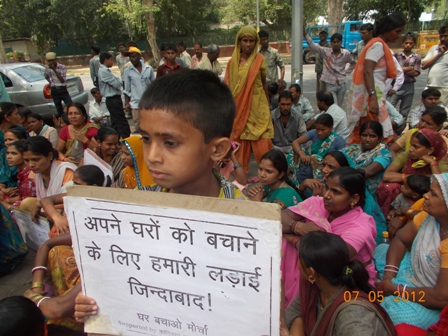
On 7th May 2012, following the renewed threat of massive slum demolition in Gayatri Colony (near Baljeet Nagar/Anand Parbat industrial area) by the Delhi Development Authority (DDA), hundreds of slum dwellers gathered outside the Chief Minister’s residence in protest. Seeing this as a problem that affects slum dwellers across the board, women and children from across different slum/JJ colonies (Pandav Nagar, Hem Nagar, Nehru Nagar, Punjabi Basti, Gayatri Colony, etc.) gathered outside Sheila Dixit’s residence. The agitated slum dwellers sought to bring to the CM’s immediate attention the plight of the thousands of impoverished workers and their families residing in slums. The agitation was carried out under the banner of the Ghar Bachao Morcha, a body formed by the slum dwellers last year itself.

After a day-long protest, the Chief Minister finally met a four member delegation. On hearing the arguments with respect to the arbitrary nature of the 1998 cut-off date, the CM assured that the slum demolition will stop, and that proper discussion on the issue will take place. She assured the slum dwellers’ representatives that her government will further look into the matter of the cut-off date.
Since the beginning of their agitation, the slum dwellers have highlighted how the slum settlements across Delhi house lakhs of poor, working class people. Most of the men in these slums work in factories/sweatshops or as rickshaw-pullers, contract workers in the MCD, vendors, etc. The women work as maid-servants in people’s homes or participate in the informal sector of the economy. However, despite their important role in the socio-economic fabric of this city, slum dwellers are treated with little respect and are made to feel as if their lives have no value. Indeed, rather than recognizing the value of their economic contribution to the city’s economy, the Government’s approach is characterized by slum demolition which is accompanied by minimal relocation and rehabilitation. Whenever slum demolitions take place, most of the families are identified as “ineligible” for rehabilitation due to the cut-off date of 1998. The few families that are considered “eligible” for rehabilitation are moved to underdeveloped settlements in far flung off and poorly connected parts the city, causing massive social and financial dislocation of affected families. Ironically, many a times the land from which slum settlements are razed is left vacant (often with the rubble of the erstwhile slum still lying around)—a fact which indicates that more than providing alternative housing for the poor, ‘hiding of the poor’ is what characterizes the DDA’s policy vis-à-vis squatter settlements.
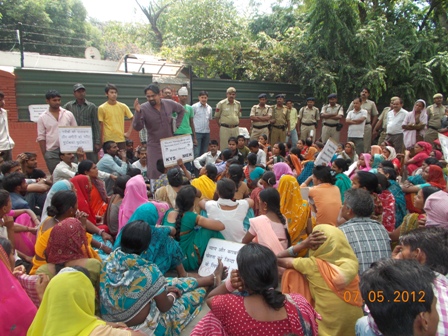
Activists of Ghar Bachao Morcha claim that the DDA’s own records reveal just how dismissive the urban authorities are with respect to the most vulnerable section of the city’ population. For example, in a study commissioned by the DDA to the Association of Urban Management and Development Authorities in 2003, what is clearly reported is the continuous unwillingness to meet estimated targets for low income housing—a troubling policy approach which has led to a situation where an estimated 3 million people (about 27% of the total urban population) is forced to occupy less than 3% of the residential area in the city! In fact, with the arbitrarily fixed cut-off date of 1998, the urban development authorities find it easy to demolish slums with minimal relocation and rehabilitation plans. On the one hand, the Government and urban development authorities refuse to implement land sealing under the Urban Land (Sealing & Regulation) Act, and on the other hand, they arbitrarily decide that people who come to the city after a certain date are “ineligible” to actually live in the city they work in.
The slum dwellers also pointed to the past record of DDA’s slum-clearance clearly shows that lands from which slum dwellers are evicted are mostly used for construction of malls or high-rise residential complexes which only the rich can afford. This, they argued was most unfortunate, considering that the DDA is supposed to cater to the needs of all strata of society. However, in reality very little of DDA’s finances are spent on housing projects for the poor. Quite expectedly then, the city’s slum dwellers are questioning the rationale of an urban development plan that excludes a very large portion of the city’s working population. The question is can urban authorities even claim that shopping malls and high-rise residential complexes are projects implemented for “larger public interest”, and are hence, projects that legitimately require urgent slum demolition.
It is in this spirit that the city’s slum dwellers are protesting , and have put forward the following set of demands:
-
1. Immediate steps should be taken to stop any further demolition and clearance of slums
2. In-situ development of slums
3. Abolition of the 1998 cut-off date;
4. Introduction of land sealing under the Urban Land (Sealing & Regulation) Act;
5. Immediate action to be taken against all callous officials involved in the arbitrary demolition of our slum
6. Immediate provision of temporary shelter, drinking water, sanitary facilities to all affected families
7. Release of compensation to those who have lost property in the process of demolition
8. Provision of health-care facilities to displaced families
9. That housing policies for the poor should be prioritized by the DDA, and that the DDA should recommend a feasible and affordable housing policy/plan for the urban poor to the Government of NCT of Delhi and the Central Urban Development Ministry
10. Before pursuing demolition the DDA should make use of proper consultation mechanisms, and should use all measures to take the slum dwellers into confidence.
Alok Kumar
Convenor, Ghar Bachao Morcha
May Day: Karawal Nagar Workers hold a Workers’ Rights Rally
May 3, 2012 by Leave a Comment
On May 1, the Karawal Nagar Mazdoor Union, Stree Mazdoor Sangathan and Bigul Mazdoor Dasta organised a ‘Mazdoor Adhikaar Rally’ (Workers’ Rights Rally). The struggle of the unorganised workers of Karawal Nagar Yamuna Pushta started 4 years ago in 2008, when a union of almond workers was formed. In 2009, the Almond Workers Union (Badaam Mazdoor Union) organised a big strike which continued for more than two weeks and compelled the almond factory owners to compromise. This was one of the largest strikes of unorganised workers that Delhi has seen in the recent past. This strike of almond workers saw participation of informal/unorganised workers toiling in diverse occupations, like rickshaw pullers, construction workers, street vendors, etc. Some of them were in fact family members of the women almond workers, while others lived in the same area and came in support of the almond workers strike as a symbol of solidarity. In the next two years, the Badaam Mazdoor Union fought on a number of issues, organised protests against police oppression, and organised movements against the oppression by petty contractors. Most of these issues did not belong particularly to the almond workers, rather they were issues of all the unorganised workers of the area, irrespective of their occupations. The leaders of the Badaam Mazdoor Union realised that de facto, the union has become a union of the informal/unorganised workers of the area. So in 2011, the Badaam Mazdoor Union was transformed into the Karawal Nagar Mazdoor Union (KMU). KMU was formed as the neighbourhood-based union of the workers of Karawal Nagar.

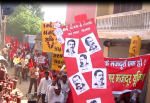

On the May Day 2011, around 2 thousand workers from the Karawal Nagar Yamuna Pushta area gathered on Jantar Mantar under the leadership of KMU, along with thousands of other workers from different parts of Delhi, as well as, UP and Punjab. This protest was organised by different unions and workers’ organisations under the banner of ‘Workers’ Charter Movement’, which is still going on. KMU has been doing an experiment in organising workers in the era of Globalisation, when working class is dispersed or scattered at the shop floor level, while at the same time, it is concentrated in terms of the neighbourhoods where workers live. KMU believes that along with factory-based unions, there is a need to organise workers on the neighbourhood basis. Without strong neighbourhood-based organisation, area-wide organisation across factories, occupations and sectors, even the strong factory-based movements cannot hope to win.
KMU is planning to hold a huge protest march against the non-implementation of government’s policies for unorganised sector workers and different labour laws pertaining to the informal sector workers, oppression by the police and goons of contractors and factory owners, and the non-regularisation of the industrial units functioning in the Karawal Nagar area. The May Day rally ended in a meeting at the office of KMU in Mukund Vihar, Karawal Nagar, in which the plan of this wider march was discussed.
 Radical Notes