“But a hungry man is dangerous”

During the Great Depression, the administrators of Pennsylvania learnt their lessons in managing the unemployed and impoverished workers:

the wisest strategy would be “to urge [them] to shun our large cities and towns, go into the country and work raking gardens, building fences or any other work which they are capable to do…. This may seem drastic, but a hungry man is dangerous.”

Growing militancy among workers in India is definitely a cause of concern for capitalists, who already seem to know that it is the same Hungry Man’s awakening (see the following report).

India Food Strike, Fatal Riots Hobble Push to Export Car-Parts

By Vipin V. Nair and Subramaniam Sharma

Nov. 13 (Bloomberg) — Prem Kumar’s demand for higher pay and better food at the cafeteria at the auto-parts factory where he works near New Delhi forced General Motors Co. and Ford Motor Co. to shut three plants on the other side of the world.

The strike Kumar led at Rico Auto Industries Ltd., coming after managers were beaten to death in labor disputes at two other partmakers, may derail an Indian government goal to boost components exports about sevenfold to $25 billion by 2015. One global automaker already is reviewing plans to source as much as $3 billion in parts from India and may instead buy half from China, said Vikas Sehgal, a Chicago-based partner at Booz & Co. He declined to name the company, which is his client.

“People are suddenly looking at India with an eye of suspicion and concern,” he said. “When a single company’s strike jeopardizes the global value chain, the country suffers in the long run.”

GM, Ford and other automakers have increased their parts procurement from India and other emerging markets to lower costs. India’s overseas sales of components grew 10-fold in the past decade to $3.6 billion in the year ended March 2008, according to the Automotive Component Manufacturers Association of India.

Labor costs in India are a tenth of what companies pay in the U.S., and raw material costs are lower by 11 percent, said Puneet Gupta, an analyst at CSM Worldwide Inc., an industry consultant. That’s prompted Hyundai Motor Co. and Suzuki Motor Corp. to open plants in India to export cars.

“India’s biggest advantage is cost, especially labor costs,” said Koji Endo, managing director of Advanced Research Japan, a Tokyo-based equity research company. “Good quality parts can be made cheaply.”

45-Day Strike

Labor unrest may undermine that advantage. The 45-day strike at Rico, which ended Nov. 6, caused GM to shutter a factory in Delta Township, Michigan. Ford closed plants in Chicago and in Oakville, Ontario, in Canada.

Each factory was idled for one week because the Rico strike disrupted supplies of transmission components to plants that build vehicles such as Ford Tauruses, Lincoln MKXs and Buick Enclaves.

“Such strikes put a question mark on India,” Gupta said. “If the government doesn’t act and the problems continue, in the long run, companies may shift their locations to elsewhere, like Thailand.”

Ford, GM

Ford continues to see India as a key part of the global supply chain, said Todd Nissen, a company spokesman in Dearborn, Michigan. GM also has no immediate plans to stop using Indian parts.

“As a global purchasing group, we need to manage through supply issues no matter where they occur to keep vehicle production as close to schedule as possible,” said Alan Adler, a GM spokesman in Detroit.

Rico Auto’s customers haven’t terminated contracts because of the strike, said Chief Executive Officer Arvind Kapur. The company is working on a plan to ensure that future incidents don’t affect operations, he said.

In September, a human resources official at Pricol Ltd., a supplier to Toyota Motor Corp. and Honda Motor Co., was killed by workers protesting against the management, said Chief Operating Officer K. Udhaya Kumar. He didn’t elaborate.

Last year, the managing director of Graziano Trasmissioni India Ltd. was beaten to death after a group of sacked employees turned violent, police said.

“The meltdown dynamics in a competitive environment not only create survival pressures on the managements but also induce an acute sense of insecurity and uncertainty in the minds of the wage-earning employed,” said Jerome Joseph, who teaches industrial relations at the Indian Institute of Management, Ahmedabad.

Rising Strikes

More than 1.5 million workers were involved in 250 strikes at Indian factories in 2008, compared with about 1 million workers involved in 255 strikes in 2003, according to Rajesh Thakur, a director at the government’s Labour Bureau.

Also, overall wages rose 0.8 percent, compared with 4.4 percent growth in productivity between 1990 and 2006, according to a 2008 report by the International Labour Organization. China’s wage growth in the same period was 9.9 percent, beating a productivity gain of 9 percent, it said.

Between 2006 and 2007, food prices rose by 9 percent in India, hurting purchasing power, according to ILO.

Rico’s CEO Kapur said a new hire costs the company about 6,000 rupees ($130) a month. Kumar, the union leader, said the company favors hiring temporary workers, who can be easily fired and take home about 4,000 rupees a month. That compares with full-time employees, who can earn about 11,000 rupees, he added.

“How can they secure themselves, educate their children and feed their families on such meager wages?” Kumar said. “It’s the rule of the jungle.”
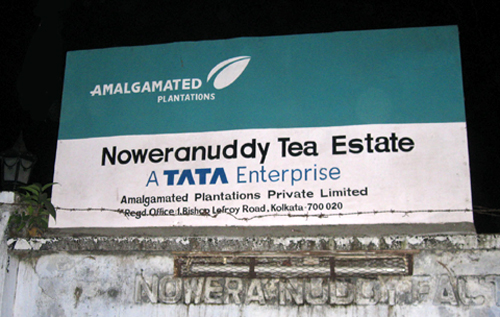
Tetley’s Tata Tea Starving Indian Tea Workers into Submission

Tata, the transnational Indian conglomerate whose Tetley Group makes the world famous Tetley teas, has taken 6,500 people hostage through hunger. The hostages are nearly 1,000 tea plantation workers and their families on the Nowera Nuddy Tea Estate in West Bengal, India. Permanently living on the edge of hunger, the workers and their dependants are being pushed to the edge of starvation through an extended lock out which has deprived them of wages for all but two days since the beginning of August. The goal of this collective punishment is to starve the workers into renouncing their elementary human rights, including the right to protest extreme abuse and exploitation.

The hostage-taking began with a first lockout on August 10, when workers protested the abusive treatment of a 22 year-old tea garden worker who was denied maternity leave and forced to continue work as a tea plucker despite being 8 months pregnant. On August 9, Mrs Arti Oraon collapsed in the field and was brought to the hospital, on a tractor normally used for garbage, after the medical officer refused to make an ambulance available (he had proposed she be brought by bicycle). She was initially refused treatment, and only after her co-workers protested did she receive minimal care. Her treatment was inadequate and she had to be taken, in the same garbage tractor, to the local government hospital one hour away.

As news of her treatment spread, some 500 mostly female estate workers gathered in protest at the medical facility, demanding sanctions against the medical officer. Local management promised to meet with the workers, but on August 11 the management, along with the medical officer, left the estate and declared a lockout.

On August 27 an agreement was signed with three trade unions, representing some workers on the estate but not a majority, on reopening the garden. In the agreement, all workers’ wages for the lockout period were withheld. The agreement included a clause that a “domestic inquiry” (an internal, company-controlled investigation) would be conducted. The agreement was written in English, a language few if any of the workers understand.

The garden was reopened the following day, although workers were not informed of the conditions of the reopening. On September 8, management issued letters of suspension and ordered a domestic inquiry against eight workers.

None of the eight workers received a letter of notification. None of the eight had committed any act of violence or were involved in any illegal practice. These eight workers have been targeted because they are active in the garden campaigning for workers’ rights.

At a September 10 meeting, management told the workers that suspension letters had been issued in accordance with the August 27 agreement and that opening the garden depended on compliance with that agreement. In other words: agree to the suspensions or you’ll be locked-out again. Workers requested six days to respond to this ultimatum.

The ultimatum was a powerful one: tea garden wages are just 62.50 Indian rupees per day – the equivalent of USD 1.35 daily. One kilogram of the cheapest, poorest quality rice in the local market costs 20% of a worker’s daily wage. Tea workers permanently live on the edge of hunger. The loss of wages for even a few weeks can tip them into starvation.

Although wielding the weapon of hunger – with workers’ lives in the balance and the deadline to respond not yet expired – management on September 14 again left the plantation and implemented a lockout. This was the day workers were meant to receive their annual festival bonus, amounting to roughly two months wages. No bonus payments were made. Prior to the lockout, since the beginning of August workers have only received a wage payment amounting to two days work.

Following the closure, workers have sought to communicate with the management, requesting it to reopen the garden. The company has insisted that the garden will not be reopened and wages paid unless all workers accept the September 10 ultimatum to effectively sign off their right to protest abuses.

Tata Tea is a powerful global company; it’s wholly owned Tetley Tea is one of the world’s biggest-selling tea brands. Nowera Nuddy Tea Estate is owned by Amalgamated Plantations Private Limited, a company 49.98% owned by Tata Tea. Tata and Amalgamated share the same office in Kolkata, the capital of West Bengal. According to the Tata Tea 2009 annual report, Tata Tea Managing Director Percy T. Siganporia earns in a single day roughly 1,000 times the daily wage of a Nowera Nuddy worker – assuming that worker is paid .

Tea from Amalgamated Plantations’ tea estates goes into the famous Tetley Tea bags.

Tetley Tea is a member of the Ethical Tea Partnership (ETP), whose standard commits member companies to, among other requirements, ensure that there is no “harsh or inhumane treatment” of plantation workers and that “Workers should be paid at least monthly and should receive their pay on time.” The actual conditions on the Nowera Nuddy estate, where workers are being subjected to brutal collective punishment, could not be more remote from this CSR wish list.

Workers at the Nowera Nuddy Tea Estate have formed an Action Committee which has called for the immediate reopening of the garden, the withdrawal of the suspension letters and no recriminations against workers, back payment of wages and rations since 14 September, immediate payment of the annual festival bonus and a management apology to Mrs Arti Oraon.

You can support their struggle – CLICK HERE to tell Tata and Tetley Tea to stop starving workers now! You can also use the features provided on the Tetley Tea website to send the company a message, or use the freephone number provided to give them a call!

Courtesy: IUF-Uniting Food, Farm and Hotel Workers World-Wide

How can the U.S. Unemployment be solved?

10.2% of Americans are unemployed. Another 5.3% are underemployed. Now President Obama faces criticism that he lost focus on creating and saving jobs.

Courtesy: newsy

How a hotel burnt its fingers

C. Gopinath

In an advertisement on its pages, the US business daily, The Wall Street Journal, proudly proclaimed ‘Hyatt has great news’. The paper was pleased to announce that copies of the paper would henceforth be available for our reading pleasure if we stayed at a Hyatt hotel.

Unfortunately, at about the same time last month, the news about Hyatt was anything but great. The international hotel chain was being accused of treating its cleaning staff unfairly, and the company was doing a poor job defending its actions.

ADDING TO JOBLESSNESS

It all began as a simple decision to outsource. The company decided that, as of end August, it would lay off about 100 of its housekeeping staff from three of its hotels in Boston and give the cleaning contract to a firm in Atlanta, called Hospitality Staffing Solutions. The objective, of course, was to cut costs. Hyatt’s corporate revenues had fallen by about 18 per cent during the first half of the year. Its Boston hotels had also experienced revenue shortfalls, with the recession forcing people to cut back on their travel. So the company, faced with “these unprecedented economic challenges” (in the words of its manager), took the efficient managerial decision of handing over the cleaning contract to an outside firm and laying off its employees.

Early September, the news started leaking out. It turns out that the employees who had been laid off were paid about $15 (Rs 705) an hour while the cleaning contractor’s employees were going to be paid $8 (Rs 376) an hour. That made sense, right? Cutting cleaning costs by almost 50 per cent!

But when you put paper and pencil together, knowing that an employee is expected to clean about 20 rooms in an eight-hour work day, you would quickly figure that Hyatt was looking to save about $3 (Rs 141) per day in cleaning costs for a room that it probably charges its guest about $175 (Rs 8,225) to sleep in. Well, any saving is a saving in these hard times, you would say.

But these were fairly low-level staff, some of whom had been working at the hotel for close to 20 years. At a time when the nation’s unemployment was touching 10 per cent it was not going to be easy for them to find another job. But that wasn’t all. The local paper also reported that these employees had been asked to train some other persons to do their job and were told that those being trained would fill in during vacations. Only later did they realise that they were training their replacement.

SYMPATHY FOR EMPLOYEES

That seemed to touch a raw nerve and the local reaction was swift and bitter. The Governor of the state said he planned to direct state employees to boycott the hotel unless it took the employees back.

A couple of professional groups which were planning to host seminars or conferences at the hotel cancelled plans. Although the laid-off employees were not members of a union, a local union that normally represents hotel workers announced that it would rally in their support and picketed the properties.

The hotel chain was clearly caught off-guard. It first announced that it would help the dismissed workers find other jobs, retrain them if necessary, and extended their health care for three months.

It vehemently denied that the training of the replacements was done secretly. But you must wonder about a company’s well-paid human resources personnel who would think of a scheme as this. Meanwhile, the public indignation spread and even the city taxi union announced a boycott and refused to service the chain’s locations.

Something else started happening. The company announced that the laid-off employees would be offered work with another Hyatt contractor, a Chicago-based firm called United Service Cos. And they will be paid the wage they received at Hyatt till the end of the year.

The contractor was confident that the employees would almost surely be able to find some other job after that. (In other words, quieten down and everything would be forgotten in a few months.)

MISJUDGING PUBLIC MOOD

Clearly, Hyatt was completely missing the point. The company believed that if it found work (at least temporarily) for those who had been laid off, everything would be back to normal.

On the other hand, the public reaction to the cleaning staff being replaced by contract labour at lower wages was only the event on which was riding a whole lot that was perceived as wrong with modern management. Any lay-off, and especially due to outsourcing, is a sore subject, especially at a time when unemployment is rising, even while everyone is claiming that recession is over.

A lot of mid-level management personnel, currently laid off and looking for work in corporate America see their work being given to cheaper personnel, within the company or outside, and can empathise with the Hyatt employees. Yet, corporations that are penny-pinching seem to be able to find enough money to continue to pay lavish top-management salaries and bonuses.

Newspapers crow that productivity is at an all-time high — what that essentially means is that fewer people are being used to produce the same or more output.

There must be something fundamentally wrong with a measure that undermines human capital. On top of it all, when Hyatt (allegedly) made those employees train their replacements, it just seemed morally wrong.

To compound its misfortune, Hyatt’s reluctance to meet with the press to present its side of the story, and its tendency to hide behind corporate press releases did not go down well. Even when the company sensed that its response to the situation was less than exemplary, it did not know how to say it.

Look at this: “Contrary to the way our actions have been characterised by many, we did attempt to implement this staffing change in a respectful manner and many of the assertions that have been made are false. We do, however, recognise and regret that we did not handle all parts of the transition in a way that reflects our organisation’s values.”

And the final irony: Business Week, a US business magazine recognised Hyatt as among “the best places to launch a career” about the same time as the layoffs. Of course, the magazine was referring to entry-level workers in the company’s corporate training programme, not entry level housekeepers.

Courtesy: Business Line

Automobile unrest in Gurgaon

Gurgaon Workers News

Three main disputes about recognition of unions (Auto Rico and Sunbeam) and a three-year wage agreement (Honda HMSI) expressed some of the unrest in Gurgaon, India’s main automobile cluster. The disputes lasted for more than a month between mid-September and end of October 2009. After a Rico worker was killed the CP affiliated AITUC union called for one-day-strike – allegedly 80,000 to 100,000 car workers did not work on 20th of October 2009. Last but not least, the dispute at Rico caused factory closures at GM and Ford in the US due to lack of parts.

The main political significance is the international character and set-up of the unrest in Gurgaon. Workers in India in a dispute for higher wages cause car plants in the US to come to a standstill. The workers at Ford and GM are currently under pressure to agree on wage cuts in return for dubious job guarantees. Their union UAW has already signed a deal, but the workers are unsure if to confirm it. In this moment a combative signal from the ‘low-wage-end’ of the global supply chain might help to reassure the US workers in their collectivity. That they cannot rely on their representatives in order to form a global proletarian alliance is demonstrated by the way in which the Rico dispute in India is presented by the UAW. “We are experiencing the effects of outsourced suppliers, and we hope they would be able to resume production as quickly as possible so we can in turn resume production”. Brian Fredline, president of the United Auto Union Local 602, representing 2,700 workers at General Motors plant in Delta Township, Michigan who were sent home due to lack of parts manufactured by Rico. We try to provide a short glimpse at the international context of the automobile industry in the part ‘What crisis?’ – see below.

We cannot say much about the internal dynamics of these disputes. There have been various conflicts at automobile companies in the last years – see summary below. In most cases a wider unrest amongst permanent and temp workers had simmered long before the official dispute started. The urge to establish a union or long-term wage agreements often resulted in: firstly, dividing the work force (mainly permanent workers, who represent only 20 per cent of the work-force, are attached to the union and long-term contract sphere); and secondly, to channel the conflict into open, legal and therefore controllable paths. There is also a long regional tradition of industrial disputes during which lock-outs / strikes are used to re-structure the work-force – given the current global ups and downs of the car industry this aspect of ‘engineered conflicts’ has to be taken into account when analysing the Rico dispute.

Two noteworthy details about the outcome of the current strikes: a public debate in the main stream media about the unstable situation due to such a large share of temp workers employed; and a rather empty threat of Honda HMSI management to shut-down the plant in Gurgaon and re-open it somewhere else if the political class should not be able to guarantee industrial peace in the region. The first point hints at a true core of unrest – at the same time the current disputes can be seen as a proof that the division in permanent (unionised) and temporary workers still works well. The second point is an arbitrary one. In summer 2005 Honda management issued a similar threat and the political class reacted by organising a police massacre on several hundred workers. In itself it is an empty threat to re-locate the factory from a global low-wage region like Gurgaon given that Honda HMSI relies on a huge web of suppliers and a scattered but regionally concentrated workforce. Such concentration of proletarians will always re-create the conditions of unrest. In Gurgaon four major assembly plants, churning out two thirds of India’s passenger cars and two-wheelers depend on more or less the same suppliers.

These contradictory tendencies – a work-force divided into permanents and temps on one side, but an intertwined supply net connecting work-shops with modern assembly plants on the other – is reflected in the statements of managers from various companies about the impact of the local general strike on 20th of October 2009. According to the media 80,000 to 100,000 were on strike: “Except for the two factories (RICO and Sunbeam which supplies to the Hero group) where there was a problem, I don’t think any other factory was closed. About 4,000 to 5,000 workers from various factories joined in the prayer meeting to show their sympathy for those who died,” says Surinder Kapur, chairman of the Sona group, which has many factories based in the belt. But factory managements admitted production was disrupted. “The assembly lines are not working,” a senior Honda Motorcycle and Scooter India (HMSI) official said to agencies. Others say that if the agitation is not resolved, the impact could be huge. “These are major component manufacturers, and we do not carry very much inventory,” says Chairman of Maruti Suzuki, which was not, however, impacted by the strike because of the high percentage of contract workers – some estimates put it at 80 per cent of the labour force – in the area. Many of them lost income during the dispute.”

For the current political background of the situation in Gurgaon it has to be said that in Haryana state elections took place in September / October period. Unions are closely linked to political parties and most of the company and contractor hierarchy is intertwined with the political class. Some of the dynamics of the dispute have to be understood as power plays between various political/representative factions.

We lack proper insight voices of workers who took part in or observed the unrest. In that regard the report published by CEC is probably the most accurate one.

In the following we first want lay-out a chronology of the current dispute, then summarise the dispute at Rico, Sunbeam and Honda HMSI in more detail and finally we give a short over-view on recent car workers’ conflicts in Gurgaon area.

Chronology of Unrest

4th of August 2009
Rico workers’ representatives start negotiating with management, seeking an annual salary increase of 10,000 Rs plus freedom to form a union with AITUC. The management is not heeding their demand saying the workers have had pay hikes and the unit is continuously seeing low productivity. The union submitted their application to the labour department, Chandigarh, for its formal recognition.

9th of September 2009
Rico Employees Union calls for an open meeting of its members at Kamala Nehru Park, Gurgaon. 3,000 workers attend.

20th of September 2009
Another Rico union meeting in Kamala Nehru Park.

21st of September 2009
Rico Auto Industries Ltd. declares a lockout. Security Guards, police and goons stop workers from entering the factory by force. Previously 16 workers were suspended for indiscipline.

22nd of September 2009
Sunbeam Ltd. locks out workers after dispute over union elections. Company goons or truck drivers attack them at night, workers have to flee, some get injured. Ten workers are submitted to hospitals. Other sources say that workers were attacked by 300 police.

23rd of September 2009
Union solidarity rally in Gurgaon for attacked Sunbeam workers. Some other component makers, including Hema Engineering, AG International, Microtek and even Sona Koyo Steering Systems, Endurance are said to be in current legal disputes between management and unions.

25th of September 2009
Around 15,000 workers gather in Kamala Nehru Park in Gurgaon during union rally. A memorandum is admitted to the DC Anurag Aggarwal, demanding his immediate intervention on the issues at 14 automobile factories in Gurgaon.

1st of October 2009
Police detains Gurudas Dasgupta, the general secretary of All India Trade Union Congress (AITUC) and the AITUC national secretary DL Sachdeva when coming to Gurgaon to address Rico workers. Union mobilise workers for protest march in response to arrests. Workers sit down at Rajiv Chowk, blocking the traffic for nearly three hours. Haryana Labour Court declares Rico strike illegal.

2nd of October 2009
Maruti Suzuki announces that production in Gurgaon plant is “marginally hurt” by the strike at Rico and Sunbeam. Unrest also has affected TI Metals, Microtech, FCC Rico and Satyam Auto.

4th of October 2009
Police arrives in buses at Rico and Sunbeam workers rally ground, pick up the workers, drive away, and drop them around 12 kilometres away. Tents and utensils are taken away by the police. Twenty-six Rico workers are arrested.

9th of October 2009
Honda HMSI publicly threatens to re-locate production to other country or region not being able to open third assembly line due to dispute with Honda union over wage revision. 17 workers have been suspended at HMSI

18th of October 2009
Ajit Yadav, Rico worker gets killed in clash, several more workers injured. Union officials state that they were attacked by a group armed with iron rods. Police fires shots, workers throw stones. Rico factory gates are blocked by workers in response.

19th of Otober 2009
200 workers sit-down in front of Rico factory in protest. Communist Party of India MP and All-India Trade Union Congress (AITUC) general secretary Gurudas Dasgupta has urged Prime Minister Manmohan Singh to intervene in the trouble. He also asked the Haryana government to disband “private armies” engaged by the management bodies in the industrial hub to take on the workers.

20th of October 2009
60,000 to 100,000 workers of 60 to 80 factories in Gurgaon on one day strike called for by AITUC. Workers from Sona Koyo Steering Systems, Hero Honda Motors, Bajaj Motors and Lumax Industries joined Rico workers in a sit-down protest outside Rico and demonstrations in the streets. Workers’ representatives reject a company offer to pay Yadav’s family compensation of 500,000 rupees and provide a job for Yadav’s wife. “It is illegal in all respects. It has also been declared illegal by the labor department,” said Jagdish Nagar, a deputy commissioner of police.

21st of October 2009
Talks between union, management and Haryana labour department.

22nd of October 2009
Rico management agrees to take back two or three suspended workers and announces that management will accept the formation of a union. Honda HMSI has made a “final” wage increase offer as part of a Long Term Settlement.

23rd of October 2009
Rico management states that 900 workers have turned up for shifts and that 2,000 more workers are expected during the next days.

26th of October 2009
Due to lacking transmission parts supplied by Rico in India Ford has to shut-down production in Oakville plant in Canada for a week, losing several thousand vehicles, sending home about 3,000 workers employed in the plant. The shutdown comes during conflict regarding contract changes to lower Ford’s Canadian labour costs.

27th of October 2009
Honda HMSI and union find three year agreement including productivity related bonus payments. Management hopes that third line will take up work. At Rico the lock-out continues.

28th of October 2009
AITUC calls for Gurgaon wide strike in solidarity with Rico workers. GM in the US announces that two plants (Delta Township and Warren, Michigan) are affected by lack of parts from Rico. Production at Delta Township plant is supposed to be resumed on 9th of November 2009 – 2,700 workers are sent home.

Summary of Unrest

We focus on the three main companies involved: Rico, Sunbeam and Honda HMSI – all situated in Gurgaon. In order to understand the wider background of the situation at Honda HMSI we suggest to re-read the text in GurgaonWorkersNews no.7. For a general summary of the company situation at Rico and Sunbeam we rely on information of CEC.

Dispute at Rico

CEC: “Rico Auto Limited started its Gurgaon branch in 1994. It is one of the largest ferrous and aluminium foundries supplying die-cast components to the automobile sector. The company makes auto parts for brands like Hero Honda, Honda, Suzuki, Bajaj, Maruti Suzuki, Ford, General Motors, Nissan, Volvo, Jaguar, Tata and Land Rover. In the case of Ford US Rico ships the brackets to a Ford transmission plant in Detroit, Michigan, from where they are sent to assembly plants across the region. In the disputed plant in Gurgaon Rico has 3,600 permanent workers and around 1,500 casual workers. There are 500 workers as management staff. Around 76 workers are women. The salary structure of the employees is very low. Permanent employees with 2-6 years’ experience are paid Rs 4,500 a month, whereas the casual workers with same experience are paid Rs 3,800-Rs 4,000 per month. The permanent workers with 6 to 9 years’ experience get Rs 6,500 monthly, and those with 9-10 years get Rs 8,000-Rs 10,000.”

The conflict involved demands for higher wages etc., but by end of September 2009 the official point of tension was the demand for registration of a trade union affiliated to the All India Trade Union Congress (AITUC). According to CEC, the workers felt the need for unionization when the company, in the name of economic recession, threw out large numbers of workers without prior information or economic benefits. The situation inside the plant became tense. “The demand for the formation of a union has been sent for verification to the Labour Commissioner and we have no objection against it,” said Mr Surinder S. Chaudhury, Vice-President, Human Resource, Rico. He added that production since September 2009 has dropped 40-50 per cent. Rico reacted by suspending sixteen workers. “We had to suspend them because they were going slow. They had slowed the production line by around 30 per cent for the last 45-60 days,” a company official said in late September 2009. In order to control the situation management was forced to look for a head-on collision. The suspension of sixteen ‘union reps’ was a save means to provoke a reaction and to get the ‘trouble-maker’ out of the plant:

“On 21 September, those workers who came to work faced the wrath of the management and were forced to sit outside the gate of the factory. ‘Around 5,000 employees had to sit outside the company gate, since the company said it was on lockout from 21 September 2009,’ says the Rico employees. The employees came to know about this undeclared lockout only on the same date, when the first batch of around 1,500 workers had gone to work at 6 am. The security guards at the gate did not allow the workers to go inside. When they refused to listen, the police force, along with the security guards and bouncers (the musclemen employed by the company), lathi-charged the workers. ‘Many of us got minor bruises, but major causalities did not happen,’ says Ranjan Pande, a Rico employee. The workers have been in front of the factory gate since September 21, 2009. ‘We are not on dharna (protest assembly); we are sitting here because the management does not allow us to go inside,’ emphasize the workers.” (CEC-report)

There are divergent information about the strike’s / lockout’s impact on the companies’ production. Some state that Rico’s management had been able to mostly maintain production and meet schedules as, out of a total of 3,000 employees, around 1,700 were reporting for work. Rico has been forced to operate two 12-hour shifts against the normal practice of running three shifts of 8 hours each.

Dispute at Sunbeam

CEC: “Sunbeam Auto Ltd is a unit of the Hero Group of Industries, and was established in Gurgaon in 1987. The company has 650 permanent workers, 800 staff members, 600 trainees, and around 2,500 casual workers. The concept of trainees at Sunbeam is worth mentioning, as people with numerous years of experience remain trainees here. One such trainee is Hansraj, who is an operator of the gravity dye casting, and is a trainee for the last ‘eight’ years. According to the workers, there are trainees with even 13 years of experience. Same is the case with the casual workers. Mangaram is a casual worker for the last 12 years, and works for a basic salary of Rs 3,510. The company gives meagre wages to its staff. Subhash Babu’s take-home salary is Rs 9,000 only, in spite of his 23 years of work experience as a quality inspector”.

“The case of Sunbeam Auto Ltd is not much different from that of Rico. The only difference here is: the workers have asked for revival and election of the existing union. Sunbeam has had a registered union – Sunbeam Shramik Union – since 1996. A “management friendly” union. In May 2009 the term period of the current office bearers got over, and the workers demanded an election and a change in the leadership. (…) The tactics of the management consisted of calling workers independently to the concerned department head’s room and making him forcefully sign a letter that was taken on a 10-rupees stamp paper, stating his willingness to acknowledge the current union. The management could collect signatures of around 200-250 workers, since the threat was to terminate them. But when a majority refused to do so, the management prevented the entire workforce from entering the factory premises on September 22, 2009, without any notice. Like Rico, the gates were not opened for them for the 6 am shift. The management version of the incident is different. According to SK Sharma, the DGM of Sunbeam, the company is not on lockout and is functioning with 30 per cent of its workforce. He emphasized that the workers are on an illegal strike.”

Dispute at Honda HMSI

HMSI currently has 1,872 regular workers and another 2,500 on contract. Honda HMSI plant was affected by the disputes at Rico and Sunbeam due to lack of parts – but there was a ‘home-grown’ conflict going on, as well. The Honda workers union and Honda management were in process of negotiating a three years wage agreement. The management accused the union of using a go-slow tactic at the new third production assembly line, involving 40 permanents and 100 casuals, in order to put pressure on the management.
On 10th of October HMSI management announced that production at the plant is down by more than 50 per cent and that the new line for vehicles – the third one since production began – has failed to take off. “This means a production loss of almost 600 two-wheelers per day. Overall, we are equipped to roll out 4,350 vehicles a day but we are doing only a little over 2,000 units because of the workers’ attitude,” an HSMI official said. While no concrete figures are available, it is estimated that the company has suffered a loss of around 250 crore Rs.

Mohan Deepak, VP for Industrial Relations at HMSI, said the average cost-to-company (CTC) for a shop-floor worker is currently around Rs 25,000. According to HSMI management the wage demands of the union will push their CTC higher than shop floor workers at Hero Honda, the current market leaders with stronger business and production figures.

On 27th of October 2009 union and management enter an agreement on 3-years wage contract including “performance reward scheme”.

History of Unrest

It would be an important task to write a historical analysis of the struggles in Delhi’s industrial belt during the last decade in order to understand the current conflict in its context – for many reasons we can only give a superficial summary of some automobile workers’ disputes in Gurgaon of the last three – four years.

Hero Honda temp-workers occupy factory – April 2006
Unnoticed by most lefty groups or unions more than 3,000 temp workers occupied the Hero Honda Gurgaon plant for several days demanding higher wages and better conditions. The company cut water and electricity – the workers sent a delegation for negotiations, which was bought off. Some demands were met by the management. When the factory occupation ended workers at Hero Honda supplier Shivam Autotech occupied their plant raising similar demands.
(GurgaonWorkersNews no.4)

Workers at car parts manufacturer Amtek attacked – June 2006
After some workers close to the union were disciplined by shifting them to a different plant of the company they and some more workers joined in a sit-down protest inside the plant. After some disputes with the management they were beaten up by paid goons – other sources said that they were beaten by temp workers of the plant.
(GurgaonWorkersNews no.3)

Honda HMSI temp workers go on wildcat strike – September 2006
After temp workers were allegedly not included in a union deal they occupy the canteen of the plant supported by the next arriving shift from the outside. The company reacted by cutting water supply. The company and union asked them to go back to work. Some sources claimed that the strike was instigated by anti-union forces paid by the management.
(GurgaonWorkersNews no.7)

Wildcat strike of temps at car parts manufacturer Delphi – January and August 2007
At Delphi 250 permanents (unionised) and 2,500 temp workers were employed. The temp workers went on wildcat strike blockading the main gate in January 2007. The company threatened to close the factory and asked the union to get the temps back to work. In August the temps struck again for few hours, demanding the payment of the increase minimum wage and succeeded.
(GurgaonWorkersNews no.6)

Series of wildcat strike at auto suppliers – September 2007
After the Haryana government increased the minimum wage in summer 2007 many companies kept on not paying the wage or making workers work many more hours for it. In several companies workers – most of them with temp contracts – rejected the wage payment and laid down tools spontaneously. In most cases the management promised to pay the minimum wage in future.
(GurgaonWorkersNews no.9 and no.10)

Automax casual workers attacked by police – April 2008
Casual workers at car parts manufacturer Automax demanded permanent contracts – the management reacted by suspending ‘leaders’ in order to provoke a reaction. In a strike / lockout situation and subsequent agitations the police attacked the workers with lathis (clubs).
(GugaonWorkersNews no.11)

Wildcat strikes at car parts manufacturer Ilpea Paramounts – April 2008
About 80 casual workers of the company got engaged in a legal dispute in front of the labour department. They tried to put pressure on the company during visits of the labour inspector – the company reacted by threatenening them with goons.
(GugaonWorkersNews no.12)

Wildcat occupation of plant by temp workers at Hero Honda Dharuhera – May 2008
After not having been accepted as members by the permanent workers’ union the temp and casual workers went on wildcat strike and occupied the plant for two days. Management and permanent workers union both promised betterments of the workers’ situation. The temp and casual workers then tried to register their own union – a process which ended in a mass lock-out in October 2008.
(GugaonWorkersNews no.14)

Wildcat sit-in strike of temp workers at Honda HMSI – September 2008
Another wildcat sit-in by precarious workers against manhandling by the management.
(GugaonWorkersNews no.13)

Lock-out and killing of manager at Graziano car parts supplier – September 2008
After a longer dispute about union recognition and various unions involved (AITUC, CITU, HMS) the company suspended workers and finally locked them out. The workers continued their protest demanding their jobs back. In an escalation a manager got killed.
(GugaonWorkersNews no.14)

Lock-out of temp workers at Hero Honda Dharuhera plant – October 2008
After their wildcat strike in May 2008 the temp and casual workers tried to register a union and put forward a general demand notice. The company reacted by locking out all temp and casual workers during big market slump. The company let in the permanent workers and half of the casual and temp work-force. 1,200 workers stayed locked-out, 800 new workers were hired.
(GugaonWorkersNews no.14 and no.19)

Lock-out and police attack on workers at car parts manufacturer Musashi – April 2009
In a dispute about union recognition several leaders were suspended. About 250 workers showed their solidarity and were locked-out in response. During a protest-march the police attacked and arrested many workers.
(GugaonWorkersNews no.18)

Strike / Lock-out at Rico and Sunbeam car parts manufacturer – September 2009
In dispute for higher wages and union recognition about 4,000 workers of two car parts manufacturers went on strike / got locked-out. One worker got killed during a clash, AITUC called for a one-day-general strike.
(GurgaonWorkersNews no.21)

What crisis?

a) In what kind of situation of the Indian automobile industry did Gurgaon strike take place?

The strike in Gurgaon automobile industry happened at a time of proclaimed “recovery” of the Indian car industry. End of October 2009 the two main automobile companies in Gurgaon – and India – announced record figures.

Maruti Suzuki India reported a nearly two-fold jump in its net profit for the period July to September 2009 – compared to the previous year. The company’s domestic sales grew by 21.9 per cent at 209,083 units. Management said exports during July to September 2009 jumped by 109 per cent at 37,105 units as against 17,745 units in the year-ago period. Maruti Suzuki announced significant investment in Gurgaon plant in order to increase capacities by 90,000 cars. In the two plants in Gurgaon and nearby Manesar production capacities are about 1 million cars per year.

Hero Honda which runs two plants in Gurgaon area and is world’s biggest two-wheeler manufacturer is on a similar high. End of October 2009 the company announced that it would smash its annual sales target as it reported a 95 per cent jump in the second quarter profits. Hero Honda management was confident of exceeding its sales target of four million units for the year.

Examples of an exceptional regional boom contrasting the global crisis or just a mild recovery after a record slump?

b) No decoupling: Indian car industry shared the global slump in October 2008 and benefited from the state sponsored scrappage incentive in the EU and deficit spending and low interest rates in India

The Indian car industry experienced a similarly deep slump in the end of 2008. All major car companies sacked their temporary staff, temporarily closed assembly departments or cut working-times – for summary see GurgaonWorkersNews no.16.

During the fiscal year 2008 to 2009 (April 2008 to April 2009), the sales of domestic passenger cars increased by ‘only’ 1.31 per cent to reach 1,219,473 units. In the absence of stimulus packages, the sales of passenger vehicles would have declined 3 per cent or have shown no growth whereas the commercial vehicles sales would have declined 30-40 per cent.

The mild recovery since March 2009 was partly based on lower prices for steel – due to the severe over-production of Chinese and Indian steel manufacturers. The industry also benefited from lower taxes – part of the deficit spending of the Indian state, which tumbles further into debts. Car sales for June 2009 (107,000 units) have increased by 7.8 per cent in the Indian market. The main contributing factor is the reduced interest rates for the auto loans. In July 2009 115,000 units were sold, the mild upward trend continued till September 2009.

More than from internal demand the Indian car industry recovered due to the state sponsored “recovery” of the EU car market – through scrappage incentives and other stimulus programs. Car exports from India – mainly to the EU – jumped by 35.73 per cent from April till September 2009, in concrete numbers 210,088 units as against 154,783 units in the year-ago period. In October 2009 newspapers announced a drop in export growth due to end of government programs in the EU. Total exports grew ‘only’ by 21.6 per cent in September compared to over 30 per cent in the last few months.

The total sales figures of commercial cars like trucks and buses are still down. State infused liquidity might encourage private consumers to take on a credit, but the general industry seems still reluctant to beg on future profits by investing.

c) India’s car industry shares global fate of over-capacities – the internal market is limited

India’s car industry is running into over-capacities – the productive capacities of the two Maruti Suzuki plants alone are at 800,000 to 1 million cars per year. Currently are about a dozen more assembly plants in India – modern assembly plants run profitable at about 300,000 cars, meaning that the total productive capacity in India is somewhere beyond 3 million cars per year. Currently the internal market is about 1.3 million cars – propped up by cheap credits and dependent on US outsourced IT and banking jobs – export figures are at about 350,000 units. Industrial workers in India are nowhere near an income allowing them to buy cars and the waged middle class mainly depends on crisis ridden real estate or IT sectors. The Tata Nano – hailed as India’s Volkswagen and cheapest car in the world – turns out to be produced into a social vacuum. Since production start in July 2009 the monthly production is only 2,500 units. About 150,000 Rs is still way to expensive even for well paid industrial workers – and exactly these better off permanent industrial workers have been under attack since the mid-1980s – see for example GurgaonWorkersNews no.8 on struggle at Maruti Suzuki.

d) In the current phase state credits keep the business running, mergers and struggle over markets are increasing – but they only exacerbate the problems in the future

Unable to solve the actual problem of the industry – the profitability crisis and the crisis of a mode of production – increasing company merger invert the neo-liberal myth of ‘outsourcing’ and profit-centres. In the course of the crisis the big car manufacturers had to bail out the spun-off and formally independent suppliers (e.g. GM had to bail out subsidiary Delphi). Some Indian companies are taking part in those international fusions of capital. Delhi-based car parts manufacturer Amtek was seen as a potential buyer of machinery and plants of bankrupt EU branch of Ford’s main supplier Visteon – on Amtek’s violent repression in Gurgaon factories see GurgaonWorkersNews no.3. Gurgaon based Motherson Sumi bought several bankrupt parts manufacturer in Europe in 2009 – on working conditions at Motherson see GurgaonWorkersNews no.6. In 2008 Tata took a loan of over 3 billion USD for taking over Jaguar and Land Rover. These mergers are only formal reflections of two general tendencies: ‘global cars’ (produced in few plants and exported to countries all over the planet) and a extension of the global supply chain and spread out division of labour (e.g. US factories actually depending on parts produced in the global south).

e) With increasing transport costs the ‘global car’ was put on hold – now it is seen as one way out of the crisis

Particularly the Renault Logan was presented as a truly global car. Manufactured in few factories, amongst others in Romania and India to be delivered to countries around the globe. The Logan production in India is stuck in a jam. India sales crashed by 71 per cent in September 2009 to just over 500 vehicles, while its April to September 2009 numbers are down to less than a third of last year. Renault managers say that “it is more expensive than we hoped it would be in India. The market here is extremely sensitive to the price. Another reason is, we don’t have enough localisation in India”, meaning that too many parts are imported from ‘expensive’ abroad. The concept of an ‘export car’ is still on, e.g. Nissan and GM want to start production of a ‘cheap global car’ in 2010. Indian labour costs are said to be about 10 per cent of that in the U.S. and Europe and raw material costs in the nation are lower by 11 per cent. “The Chennai plant will start exports in the second half of 2010. We will export 110,000 units in 2011 to more than 100 countries especially, Europe (30 countries) and will increase to 180,000 units in the future,” a Nissan manager said in October 2009. India exports more cars than world’s biggest car manufacturer China and exports are growing faster than domestic sales, e.g. Hyundai plans to export 300,000 cars from India in 2009, more than its sales in the Indian local market. But where to, given the general slump in car sales? Newspapers hail the 10 per cent share of Indian manufactured cars in emerging markets like South Africa – but that is 10 per cent of ‘only’ 500,000 annually sold cars. Another trend in order to enter markets is to source cheap car parts from China or other Asian countries. India’s automobile manufacturers increasingly intertwine their production with Chinese car makers, particularly for automobiles produced for exports to Africa and within Asia.

f) We can see an extensions of the global supply chain of car parts emerging out of the last years’ profit squeeze – connecting Indian workers more or less directly to workers in China, South Korea and the EU and the US

During the last years export of car parts from India grew faster than the export of complete cars – parts are exported mainly to the US, EU and Japan. In September 2009 Fiat announced to source 1 billion USD of parts from India in 2010, out of which 300 million USD for export to the EU plants. In September 2009, as well, Hyundai India started exporting crank shafts and connecting rods to Hyundai factories in South Korea. Component exports from India, that touched 3.6 billion USD in 2007-08, are estimated to be near flat in 2008-09. The car parts manufacturer in India are directly linked to the international markets. Amtek Auto – mainly based in Gurgaon – gets as much as 50 per cent of its sales from abroad. In September 2009 an Amtek manager said: “Overseas sales for us was down as much as 30-40 per cent last fiscal year following the slowdown in Europe. While we had done around $650 million in 2007-08, the number came down to around $450 million last fiscal,”. The same is true for Rico Auto Industries that makes components for engines: “Our exports dipped by around 7 per cent last fiscal as US and Europe shrank,” he said. Rico supplies to companies like Ford, GM, Caterpillar, BMW and Cummins.

g) Global division of labour and ‘global cars’ make sense only if low wage regions are kept low waged and if these low wages are imported back into the centres. Workers have to turn this trend around by making use of their global cooperation. The Rico dispute in Gurgaon stopped a Ford plant in Canada, at the same time Ford workers voted against a wage cut deal.

The Rico dispute has shown the global dimension of car production today. It has shown Ford workers in the US and Canada not only that the production in their plants depend on ‘cheap labour’ from the south, but that this ‘cheap labour’ is not up for the race-to-the-bottom: an industrial dispute, amongst others concerning the demand for higher wages, interrupted the global supply chain. At this point of time Ford workers in the US were supposed to vote in favour of wage cuts in order to save their jobs. End of October 2009 Ford workers in Missouri have overwhelmingly rejected a new contract with Ford. Ford and the United Auto Workers union agreed to the changes to help lower Ford’s labour costs, but UAW members must ratify the changes. Kansas City UAW local president Jeff Wright says workers were angry about a cap on entry-level wages, changes in work rules and a no-strike provision. This is not yet an ‘active communication’ between workers around the globe, but a mutual influence and a sabotage of the current re-structuring process of the global car industry. Only by making conscious use of this cooperation the global working class can find a way out of the automobile madness of destructive production.

Restructuring the Global Division of Labour Amidst Capitalist Crisis

Toronto, October 30, 2009 – Facilitator: Leo Panitch.

Ursula Huws is the author of The Making of a Cybertariat: Real Work in a Virtual World, and the founder and editor of the journal Work Organisation, Labour and Globalisation.

The director of Analytica Social and Economic Research and honorary Professor of International Labour Studies at London Metropolitan University, she is renowned for her pioneering research on the economic and social impacts of technological change, the telemediated relocation of employment and the changing international division of labour, especially in the global service sector.

Courtesy: Socialist Project

Organizing Working Class Communities

Toronto, October 2, 2009 – Steve Williams is co-director of the California based group POWER: People Organized to win Employment Rights, which since the late 1990’s has been one of the most important Worker’s Action Centres in the U.S., and co-authour of the book Towards Land, Work and Power: Charting a Path of Resistance to U.S.-led Imperialism.

Part 1

• Moderated by Stephanie Ross – Prof. Labour Studies, York University.
• Sam Gindin – Visiting Packer Chair in Social Justice at York University.

Organizing Working Class Communities [1/2] from LeftStreamed on Vimeo.

Part 2

• Steve Williams – is co-director of the California based group POWER.

Courtesy: Socialist Project

Workers’ Control – Theory and Experiences

Caracas, October 30, 2007: Produced as part of Centro Internacional Miranda’s Transformative Practice and Human Development, directed by Michael Lebowitz.

Courtesy: Socialist Project, Canada

Workers’ victory in Gorakhpur

Arrested leaders released, movement postponed after written assurance of implementing all worker’s demands within 10 days

Dear friends,

Under mounting pressure from the workers and the general public the district administration of Gorakhpur had to finally bow down and yesterday night (22 October) the administration was compelled to enter a written agreement accepting all the demands of the workers. The night before that (on 21 Oct.), the administration had unconditionally released all the four arrested leaders.

In protest against the brutal assault and arrest of the four leaders a strike was called in five factories of the Bargadwa Industrial Area on October 20 and more than 1500 workers started a dharna and hunger strike at the DM office. The district administration was under tremendous pressure after the announcement of “Citizens’ Satyagrah” in the city by the Citizens Front In Support of the Gorakhpur Worker’s Movement organised under the leadership of social activist Katyayani. An overwhelming number of striking workers braved the huge deployment of police, PAC, RAF personnel surrounding them and showed no sign of relenting. After a strong demonstration in the city on October 21, and under pressure from various civilian groups and organisations the administration released all the four arrested leaders after daylong hectic negotiations. But the workers continued their dharna and hunger strike demanding quashing of all false cases, action against officials guilty of beating their leaders and to conclude a written agreement meeting all their demands.

On October 22, the workers of two more factories joined the strike at the DM offce. The mounting pressure forced the administration for a written agreement to take back all the false cases, send recommendation to the state government to take action against the guilty officers and to address all the demands of the workers within a period of 10 days and the senior officers of the administration themselves made these announcements in front of the striking workers. After this the workers decided to defer their movement.

Under prevailing circumstances when the workers have been facing defeat after defeat against the combined force of industrialists-state-politician nexus, this victory of the workers of Gorakhpur is very significant. It could not have been possible without the extensive support of intellectuals, human right activists and labour organisations all over the country.

Apart from whole-hearted supported of activists and intellectuals of Gorakhpur, large number of writers, journalists, peoples rights activists and mass organisations of Lucknow, Delhi, Noida, Ghaziabad, Mumbai, Kolkata, Hyderabad, Patna, Ludhiana, Chandigarh, Allahabad, Kanpur, Varanasi, Badaun, Chhattisgarh, MP etc sent memorandums to the district and state administration, called the concerned officials to register their protest, issued statements and held meetings and demonstrations in our support. We have received hundreds of phone calls, emails and letters. We cannot reply to all of you individually right now, but we are grateful for your support and thank you on behalf of all the struggling workers.

However, we are not going to sit back and relax. We know by experience that despite the written agreement we will have to fight at each step with the administration and the factory owners to get the demands implemented. We will keep you posted about further developments. You can visit this blog for the news, reports and pictures of the workers movement: http://bigulakhbar.blogspot.com.

With revolutionary greetings,

Tapish Maindola,
On behalf of Steering Committee,
Joint Front for the Struggle for Workers Rights

On the Workers’ Strike at Rico (Gurgaon)

Correspondence

Ajit Kumar Yadav, a worker in Rico Auto, Gurgaon was murdered by goons of the management. Four other workers were shot at and sixty others sustained injuries.

The management had been evading the workers’ demand to form a union for long. A month back sixteen workers were expelled in this regard and others (all 4,800 of them) were prohibited from working for engaging in ‘illegal activities’. Meanwhile, the management hired around 1,000 goons to prevent workers from coming back to work. In addition to this, the management’s goons, with the supervision of the police, brought around 300 workers from the unorganised sector to resume work in the factory. It should be noted here that these workers are not allowed to leave the premises of the factory and there are reports of torture by the goons. The workers sat in peaceful protest outside the main gate, demanding work and their unionisation. On October 19 the goons attacked the protesting workers and murdered Ajit, shot at four others and injured sixty. In response to this, more than 1,00,000 workers from more than 150 factories in Gurgaon participated in the strike on October 20.

The Hindu reported the incident on the 19th as ‘a clash between two groups of workers’. Such an explanation begs the question: Why should there be such solidarity amongst the workers if it was a ‘clash between two groups’? Furthermore, both The Hindu and The Times of India have lamented the fact that production has been affected. Whether it is the Maoist question or the incident at Rico, the media turns to the establishment to create a narrative. To understand this aspect of the media we need to locate its position as an industry in the capitalist system. There is a unity of logic that binds the media to the capitalist state. In times of need, notwithstanding their contradictions, all organs of the capitalist state come together as a whole.

This is nothing new. Workers have time and again asserted their right to determine their conditions of work. Workers’ agitation at the Honda factory in 2005 is not a separate incident. It comes from the same strain for self-determination. In Coimbatore, Pricol workers’ demand for the recognition of their unions is met with pressure from the management to withdraw from the road of struggle and sever ties with ‘Marxist-Leninist’/’Maoist’ forces. The unfortunate death of the Vice President of the Human Resources Development of Pricol Ltd in the workers’ agitation has lead employers and sections of the corporate media to demand a ban on trade union struggles and advocate labour reforms to give employers a free hand. A single day’s tragic incident is now being deliberately sought to be used to prejudice public opinion against the Pricol workers and suppress the truth of the nearly one thousand days of their united and determined struggle. Similarly, in Gorakhpur three activists and one journalist have been arrested for participation in workers’ demands for implementing labour laws.

When we condemn the Indian state’s war against the rural poor politicised by the Maoists, or express solidarity with people’s struggles anywhere, we see things through the prism of geo-political distance that separates us from them. True solidarity however will not exist unless we realize that though there is a distance separating us, and the forms of struggles that others engage in may not be relevant to our own context, the larger questions raised are the same. The struggle for self-determination and true democracy is one of which all of us are a part. A tribal in Chattisgarh faces the state in its most brutal forms, and as we see here, so does the factory worker. And to push it further, the student confronts the same state, may be in a seemingly milder form. Even as the above mentioned events were unfolding elsewhere, a multi-party meeting was organized on October 20 in Delhi University (North Campus) to take up the issue of fee-hike in colleges. The struggle is to ensure that we have a say in the decisions that affect us and to make sure that no decision that goes against the students’ interests goes unchallenged. All these are moments of contradictions when the facade of equality and democracy that the state covers itself with is exposed as a facade and nothing more. At these moments it is our task to make sure that the state does not go unchallenged, and that we recognize that each challenge to the state is part of our own larger struggle.

————————-
Correspondence, as the current members think about it is a political group, using “political” in a very broad sense so as to include all issues, questions and answers that influence our lives. Our ideas and working principles are best described as anti-hegemonic. We run a political magazine, also called Correspondence, of which we have produced one issue, and are working on others. All your responses and correspondences are welcome. Email: submissions.correspondence@gmail.com.