University Struggles at the End of the Edu-Deal

George Caffentzis

We should not ask for the university to be destroyed, nor for it to be preserved. We should not ask for anything. We should ask ourselves and each other to take control of these universities, collectively, so that education can begin.

From a flyer found in the Vienna Academy of Fine Arts, originally written in the University of California

Since the massive student revolt in France, in 2006, against the Contrat Première Embauche (CPE), and the ‘anomalous wave’ in Italy in 2008, student protest has mounted in almost every part of the world, suggesting a reprise of the heady days of 1968. It reached a crescendo in the Fall and Winter of 2009 when campus strikes and occupations proliferated from California to Austria, Germany, Croatia, Switzerland and later the UK. The website Tinyurl.com/squatted-universities counted 168 universities (mostly in Europe) where actions took place between 20 October and the end of December 2009. And the surge is far from over. On 4 March, 2010 in the US, on the occasion of a nationwide day of action (the first since May 1970) called in defense of public education, one of the coordinating organisations listed 64 different campuses that saw some form of protest. (Defendeducation.org). On the same day, the South African Students’ Congress (SASCO) tried to close down nine universities calling for free university education. The protest at the University of Johannesburg proved to be the most contentious, with the police driving students away with water cannons from a burning barricade.

At the root of the most recent mobilisations are the budget cuts that governments and academic institutions have implemented in the wake of the Wall Street meltdown and the tuition hikes that have followed from them, up to 32 percent in the University of California system, and similar increases in some British universities. In this sense, the new student movement can be seen as the main organised response to the global financial crisis. Indeed, ‘We won’t pay for your crisis’ – the slogan of striking Italian students – has become an international battle cry. But the economic crisis has exacerbated a general dissatisfaction that has deeper sources, stemming from the neoliberal reform of education and the restructuring of production that have taken place over the last three decades, which have affected every aspect of student life throughout the world.(1)

The End of the Edu-Deal

The most outstanding elements of this restructuring have been the corporatisation of the university systems, and the commercialisation of education. ‘For profit’ universities are still a minority on the academic scene but the ‘becoming business’ of academe is well advanced especially in the US, where it dates back to the passing of the Bayh-Dole Act of 1980, that enabled universities to apply for patents for ‘discoveries’ made in their labs that companies would have to pay to use. Since then, the restructuring of academe as a money-making venture has proceeded unabated. The opening of university labs to private enterprise, the selling of knowledge on the world market (through online education and off-shore teaching), the precarisation of academic labour and introduction of constantly rising tuition fees forcing students to plunge ever further into debt, have become standard features of the US academic life, and with regional differences the same trends can now be registered worldwide.

In Europe, the struggle epitomising the new student movement has been against the ‘Bologna Process’, an EU project that institutes a European Higher Education Area, and promotes the circulation of labour within its territory through the homogenisation and standardisation of schooling programs and degrees. The Bologna Process unabashedly places the university at the service of business. It redefines education as the production of mobile and flexible workers, possessing the skills employers require; it centralises the creation of pedagogical standards, removes control from local actors, and devalues local knowledge and local concerns. Similar developments have been taking place in many university systems in Africa and Asia (like Taiwan, Singapore, Japan) that also are being ‘Americanized’ and standardised (for example, in Taiwan through the imposition of the Social Science Citation Index to evaluate professors) – so that global corporations can use Indian, Russian, South African or Brazilian, instead of US or EU ‘knowledge workers’, with the confidence that they are fit for the job.(2)

It is generally recognised that the commercialisation of the university system has partly been a response to the student struggles and social movements of the ’60s and ’70s, which marked the end of the education policy that had prevailed in the Keynesian era. As campus after campus, from Berkeley to Berlin, became the hotbed of an anti-authoritarian revolt, dispelling the Keynesian illusion that investment in college education would pay down the line in the form of an increase in the general productivity of work, the ideology of education as preparation to civic life and a public good had to be discarded.(3)

But the new neoliberal regime also represented the end of a class deal. With the elimination of stipends, allowances, and free tuition, the cost of ‘education’, i.e. the cost of preparing oneself for work, has been imposed squarely on the work-force, in what amounts to a massive wage-cut, that is particularly onerous considering that precarity has become the dominant work relation, and that, like any other commodity, the knowledge ‘bought’ is quickly devalued by technological innovation. It is also the end of the role of the state as mediator. In the corporatised university students now confront capital directly, in the crowded classrooms where teachers can hardly match names on the rosters with faces, in the expansion of adjunct teaching and, above all, in the mounting student debt which, by turning students into indentured servants to the banks and/or state, acts as a disciplinary mechanism on student life, also casting a long shadow on their future.

Still, through the 1990s, student enrollment continued to grow across the world under the pressure of an economic restructuring making education a condition for employment. It became a mantra, during the last two decades, from New York to Paris to Nairobi, to claim that with the rise of the ‘knowledge society’ and information revolution, cost what it may, college education is a ‘must’ (World Bank 2002). Statistics seemed to confirm the wisdom of climbing the education ladder, pointing to an 83 percent differential in the US between the wages of college graduates and those of workers with high school degrees. But the increase in enrollment and indebtedness must also be read as a form of struggle, a rejection of the restrictions imposed by the subjection of education to the logic of the market, a hidden form of appropriation, manifesting itself in time through the increase in the numbers of those defaulting on their loan repayments.

There is not doubt, in this context, that the global financial crisis of 2008 targets this strategy of resistance, removing, through budget cut backs, layoffs, and the massification of unemployment, the last remaining guarantees. Certainly the ‘edu-deal’, that promised higher wages and work satisfaction in exchange for workers and their families taking on the cost for higher education, is dissolving as well. In the crisis capital is reneging on this ‘deal’, certainly because of the proliferation of defaults and because capitalism today refuses any guarantees, such as the promise of high wages to future knowledge workers.

The university financial crisis (the tuition fee increases, budget cut backs, furloughs and lay-offs) is directly aimed at eliminating the wage guarantee that formal higher education was supposed to bring and at taming the ‘cognitariat’. As in the case of immigrant workers, the attack on the students does not signify that knowledge workers are not needed, but rather that they need to be further disciplined and proletarianised, through an attack on the power they have begun to claim partly because of their position in the process of accumulation.

Student rebellion is therefore deep-seated, with the prospect of debt slavery being compounded by a future of insecurity and a sense of alienation from an institution perceived to be mercenary and bureaucratic that, in the bargain, produces a commodity subject to rapid devaluation.

Demands or Occupations?

The student movement, however, faces a political problem, most evident in the US and, to a lesser extent, in Europe. The movement has two souls. On the one side, it demands free university education, reviving the dream of publicly financed ‘mass scholarity’, ostensibly proposing to return to the model of the Keynesian era. On the other, it is in revolt against the university itself, calling for a mass exit from it or aiming to transform the campus into a base for alternative knowledge production that is accessible to those outside its ‘walls’.(4)

This dichotomy, which some characterise as a return to the ‘reform versus revolution’ disputes of the past, has become most visible in the debate sparked off during the University of California strikes last year, over ‘demands’ versus ‘occupations’, which at times has taken an acrimonious tone, as these terms have become complex signifiers for hierarchies and identities, differential power relations, and consequences for risk taking.

The contrast is not purely ideological. It is rooted in the contradictions facing every antagonistic movement today. Economic restructuring has fragmented the workforce, deepened divisions and, not last, it has increased the effort and time required for daily reproduction. A student population holding two or three jobs is less prone to organise than its more affluent peers in the ‘6os.

At the same time there is a sense, among many, that there is nothing more to negotiate, that demands have become superfluous since, for the majority of students, acquiring a certificate is no guarantee for the future which promises simply more precarity and constant self-recycling. Many students realise that capitalism has nothing to offer this generation, that no ‘new deal’ is possible, even in the metropolitan areas of the world, where most wealth is accumulated. Though there is a widespread temptation to revive it, the Keynesian interest group politics of making demands and ‘dealing’ is long dead.

Thus the slogan ‘occupy everything’ – building occupation being seen as a means of self-empowerment, the creation of spaces that students can control, a break in the flow of work and value through which the university expands its reach, and the production of a ‘counter-power’ prefigurative of the communalising relations students today want to construct.

It is hard to know how the ‘demands/occupation’ conflict within the student movement will be resolved. What is certain is that this is a major challenge the movement must overcome in order to increase in its power and its capacity to connect with other struggles. This will be a necessary step if the movement is to gain the power to reclaim education from the hands of the academic authorities and the state. As a next step there is presently much discussion about creating ‘knowledge commons’, in the sense of creating forms of autonomous knowledge production, not finalised or conditioned by the market and open to those outside the campus walls.

Meanwhile, as Edu-Notes has recognised,

already the student movement is creating a common of its own in the very process of the struggle. At the speed of light, news of the strikes, rallies, and occupations, have circulated around the world prompting a global electronic tam-tam of exchanged communiqués, slogans, messages of solidarity and support, resulting in an exceptional volume of images, documents, stories.(5)

Yet, the main ‘common’ the movement will have to construct is the extension of its mobilisation to other workers in the crisis. Key to this construction will be the issue of the debt that is the arch ‘anti-common’, since it is the transformation of collective surplus that could be used for the liberation of workers into a tool of their enslavement. Abolition of the student debt can be the connective tissue between the movement and the others struggling against foreclosures in the US and the larger movement against sovereign debt internationally.

George Caffentzis is a member of the Midnight Notes Collective. Together with the collective, he has co-edited two books, Midnight Oil: Work Energy War 1973-1992 and Auroras of the Zapatistas: Local and Global Struggles in the Fourth World War. Both were published by Autonomedia Press.

Acknowledgements

I want to thank the students and faculty I recently interviewed from the University of California, the Academy of Fine Arts in Vienna and Rhodes University in South Africa for sharing their knowledge. I also want to thank my comrades in the Edu-Notes group for their insights and inspiration.

Footnotes

(1) Edu-factory Collective, Towards a Global Autonomous University, Brooklyn, NY: Autonomedia, 2009

(2) See, Silvia Federici, George Caffentzis, Alidou, Ousseina, A Thousand Flowers: Social Struggles Against Structural Adjustment in African Universities, Trenton, NJ: Africa World Press, 2000, Richard Pithouse, Asinamali: University Struggles in Post-Apartheid South Africa, Trenton: Africa World Press, 2006 and Arthur Hou-ming Huang, ‘Science as Ideology: SSCI, TSSCI and the Evaluation System of Social Sciences in Taiwan’, Inter-Asia Cultural Studies, Volume 10 2009, Number 2, pp. 282-291.

(3) George Caffentzis, ‘Throwing Away the Ladder: The Universities in the Crisis’, Zerowork I, 1975, pp. 128-142.

(4) After the Fall: Communiqués from Occupied California, 2010, Accessed at http://www.afterthefallcommuniques.info.

(5) Edu-Notes, ‘Introduction to Edu-Notes’, unpublished manuscript.

Courtesy:MUTE

Event: Occupied! Workers’ Factory Occupations North and South

Film Screening and Debate

Date: Saturday, April 17, 2010
Time: 1:30pm – 5:30pm
Location: Indian Social Institute (ISI) 10, Institutional Area, Lodi Road, New Delhi (India)

We will screen two short documentaries about workers’ occupation of Visteon car parts factory in London in April 2009 and the occupation of Hero Honda plant near Gurgaon in May 2008. Marco, who has been involved in the Visteon occupation, will share his experience. We want to debate about the potentials and difficulties of workers’ struggles in Delhi’s industrial belt and about what kind of practice a revolutionary left can develop in support.

Enfield, England
“Visteon Occupation – they fight for us all” (20min)

After the crisis blow of autumn 2008 the global car industry started an attack on its work-force. The Ford subsidiary Visteon decided to shut down three plants in the UK – the workers responded by spontaneous occupation. The documentary shows the self-activity of workers and the role of state and unions. We will have the possibility to discuss with a comrade who was actively involved in the occupation.

More about Visteon Struggle

Gurgaon, India

“Interview with Hero Honda Workers” (20min)

In the last years there have been several ‘wild’ occupations of factories in Gurgaon. The occupations were organised mainly by workers hired through contractors and they remained largely unknown to the wider public: five days occupation at Hero Honda and Delphi in Gurgaon in 2006, at Medikit and Honda HMSI in 2007, at Hero Honda in Dharuhera in 2008. These struggles ask us – a revolutionary left – about our potentials of practical support. Comrades of Faridabad Majdoor Talmel will present some ideas.

More about Hero Honda and other struggles in Gurgaon

Theses on the Mass Worker and Social Capital

Silvia Federici & Mario Montano

A text from the first wave of Italian ‘autonomist Marxist’ theory, first published under the name Guido Baldi in Radical America (Vol. 6, No. 3, May-June 1972).

1
The years from the beginning of the century up to the English general strike of 1926 witness this crucial new feature in class struggle: Whereas deep contradictions between developed and backward areas characterize capitalism at this stage and confine it to national levels of organization, the political autonomy and independence of the working class reach an international level: For the first time, capital is bypassed by the workers at an international level. The first international cycle, roughly 1904 to 1906, is a cycle of mass strikes which at times develops into violent actions and insurrections. In Russia, it starts with the Putilov strike and develops into the 1905 revolution. 1904 is the date of the first Italian general strike. In Germany, the spontaneous Ruhr miners’ strike of 1905 on the eight-hour issue and the Amburg general strike of 1906 lead a class wave that overflows into a large network of middle-sized firms. In the US, the miners’ strikes of 1901 and 1904 and the foundation of the 1WW in 1905 seem to be a premonition of the struggles to come.

2
The second cycle starts with 1911. We see the same class vanguards initiate the struggle: In the US the vanguards are the coal miners of West Virginia, the Harriman railroad workers, and the Lawrence textile workers; in Russia they are the Lena gold miners of 1912; in Germany they are the workers of the 1912 mass strike of the Ruhr. World War I represents the occasion for the widest development of class struggle in the US (1,204 strikes in 1914; 1,593 in 1915; 3,789 in 1916; and 4,450 in 1917 – and the National labour Board sanctions a number of victories: collective bargaining, equal pay for women, guaranteed minimum wage) while laying the groundwork for a third international cycle.

Since the War has produced a boom in precision manufacturing, electrical machinery, optics, and other fields, the class weight of the superskilled workers of these sectors is enormously increased in Germany and elsewhere. They are the workers who form the backbone of the councils in the German revolution, the Soviet Republic in Bavaria, and the Italian factory occupation of 1919. By 1919, the year of the Seattle General Strike, 4,160,000 workers in the US (20.2% of the entire labour force) are mobilized by the struggle. In the international circulation of struggles, Russia, the “weakest link”, breaks. The capitalist nightmare comes true : The initiative of the working class establishes a “workers’ state”. The class that first made its appearance in the political arena in 1848 and that learned the need for political organization from its defeat in the Paris Commune is now moving in an international way. The peculiar commodity, labour power, the passive, fragmented receptacle of factory exploitation, is now behaving as an international political actor, the political working class.

3
The specific political features of these three cycles of struggle lie in the dynamics of their circulation. The struggle starts with class vanguards, and only later does it circulate throughout the class and develop into mass actions. That is, the circulation of struggles follows the structure of the class composition that predominates in these years. That composition consists of a large network of sectors with diverse degrees of development, varying weight in the economy, and different levels of skill and experience. The large cleavages that characterize such a class composition (the dichotomy between a skilled “labour aristocracy” and the mass of the unskilled is one prominent example) necessitates the role of class vanguards as political and organizational pivots. It is through an alliance between the vanguards and the proletarian masses that class cleavages are progressively overcome and mass levels of struggles are reached. That is, the “political re-composition of the working class” is based on its industrial structure, the “material articulation of the labour force (labour power)”.

4
The organizational experiments of the working class in these years are by necessity geared to this specific class composition. Such is the case with the Bolshevik model, the Vanguard Party. Its politics of class consciousness “from the outside” must re-compose the entire working class around the demands of its advanced sectors; its “politics of alliances” must bridge the gap between advanced workers and the masses. But such is also the case with the Councils model, whose thrust toward the self-management of production is materially bound to the figure of the skilled worker (that is, the worker with a unique, fixed, subjective relationship to tools and machinery, and with a consequent self identification as “producer”). In Germany in particular, where the machine-tool industry developed exclusively on the basis of the exceptional skill of workers, the Councils express their “managerial” ideology most clearly. It is at such a relatively-high level of professionalization – with a worker/tools relationship characterized by precise skills, control over production techniques, direct involvement with the work plan, and co-operation between execution and planning functions – that workers can identify with their “useful labour” in a program for self-management of the factory. In the heat of the struggle, this program gains the support of productive engineers.

5
With the Councils, “class consciousness” is expressed most clearly as the consciousness of “producers”. The Councils do not organize the working class on the basis of a political program of struggles. The Council structure reproduces – by team, shop, and plant – the capitalist organization of labour, and “organizes” workers along their productive role, as labour power, producers. Since the Councils assume the existing organization for the production of capital (a given combination of variable and constant capital, of workers and machines) as the basis for their socialist project, their hypothesis of a workers’ democratic-self-management can only pre-figure the workers’ management of the production of capital, that is, the workers’ management of their very exploitation.

6
Yet, the revolutionary character of all workers’ struggles must always be measured in terms of their relationship to the capitalists’ project. From this viewpoint, it becomes clear that the organization of the Councils, by reproducing the material articulation of the labour force as it is. Also freezes development at a certain level of the organic composition of capital (the level of fixed, subjective relationship between workers and machines). Therefore, it challenges capital’s power to bring about whatever technological leap and re-organization of the labour force it may need. In this sense the Councils remain a revolutionary experience. As for the ideological aspect of the self-management project, the hypothesis of a workers’ management of the production of capital, it also becomes clear that “the pre-figuration of a more advanced level of capitalist development was the specific way in which workers refused to yield to the capitalist needs of the time, by trying to provoke the failure of capital’s plan and expressing the autonomous working-class need for conquering power”. (De Caro) It is in the workers’ refusal to be pushed back into a malleable labour force under capitalist rule, and in their demand for power over the productive process (whether in the form of the Councils’ “self-management” and freeze over development, or in the Bolsheviks’ plan for development under “workers’ control”) that the fundamental political novelty of these cycles of struggle lies: on an international level, the workers’ attempt to divert the direction of economic development, express autonomous goals, and assume political responsibility for managing the entire productive machine.

7
When the capitalists move to counter-attack, they are not prepared to grasp the two main givens of the cycles of struggle : the international dimension of class struggle, and the emergence of labour power as the political working class. Thus while the international unification of the working-class struggle raises the need for an international unification of capital’s response, the system of reparations imposed on Germany by the Versailles Treaty merely seals the inter-capitalist split. While confronted by the international working class, the capitalists can only perceive their national labour powers. The outcome is a strategic separation between their international and domestic responses. Internationally, world revolution appears to the capitalists as coming “from the outside”, from the exemplary leadership of the USSR: hence the politics of military isolation of the Revolution in Russia. Domestically, all the capitalists know is the traditional tools of their rule: (1) the violent annihilation of workers’ political organizations (the Palmer raids and the destruction of the IWW; Fascism in Italy; bloody suppression of the “Red Army” in the Ruhr, and so forth), which breaks the ground for (2) technological manipulation of the labour force (Taylorism, the “scientific organization of labour”) as a means of politically controlling class composition.

8
Taylorism, the “scientific organization of labour”, the technological leap of the Twenties serves but one purpose: to destroy the specific articulation of the labour force which was the basis for the political re-composition of the working class during the first two decades of the century (Thesis 3). The introduction of the assembly line cuts through traditional cleavages in the labour force, thus producing a veritable revolution in the composition of the entire working class. The emergence of the mass worker, the human appendage to the assembly line, is the overcoming of the vanguard/mass dichotomy upon which the Bolshevik Party is modeled. The very “aristocracy of labour” that capital created after 1870 in its attempt to control the international circulation of the Paris Commune (the very workers supposedly “bribed” by the eight-hour work day, Saturdays off, and a high level of wages) became one of the pivots of the circulation of struggles in the Teens. Through the assembly line capital launches a direct political attack, in the form of technology, on the skills and the factory model of the Councils’ professional workers. This attack brings about the material destruction of that level of organic composition which served as the basis of the self-management project. (The political unity between engineers and workers is also under attack. From Taylorism on, engineers will appear to the workers not as direct producers, but as mere functionaries of the scientific organization of exploitation; and the self-management project, devoid of its original class impact, will reappear as a caricature, the “managerial revolution” to come.)

9
Thus, capital’s response to the struggles follows the Nineteenth Century’s “technological path to repression”: It entails breaking whatever political unification the working class has achieved during a given cycle of struggles, by means of a technological revolution in class composition. Constant manipulation of class composition through continual technological innovations provides a tool for controlling the class “from within” through its existence as mere “labour power”. The re-organization of labour is a means to the end of the “political decomposition” of the working class. Since the working class has demanded leadership over the entire society, to push it back into the factory appears as an appropriate political move. Within this strategy, factory and society are to remain divided. The specific form of the labour process in the capitalist factory (that is, the plan) has yet to be imposed on the entire society. Social anarchy is counterposed to the factory plan. The social peace and the growing mass production of the Twenties seem to prove that traditional weapons have been successful again. It will take the Depression to dissipate this belief.

10
With 1929, all the tools of the technological attack on the working class turn against capital. The economic and technological measures for containing the working class in the Twenties (re-conversion of the war economy, continuous technological change, and high productivity of labour) have pushed supply tremendously upward, while demand lags hopelessly behind. Investments decline in a spiral toward the great crash. In a very real sense, 1929 is the workers’ revenge. Mass production and the assembly line, far from securing stability, have raised the old contradictions to a higher level. Capital is now paying a price for its faith in Say’s law (“supply creates its own demand”), with its separation of output and market, producers and consumers, factory and society, labour power and political class. As such it remains caught in a tragic impasse, between the inadequacy of the economic and technological tools of the past and the lack of new, political ones. It will take Roosevelt-Keynes to produce them.

11
While Hoover resumes the old search for external “international causes”, Roosevelt’s approach is entirely domestic: a re-distribution of income to sustain the internal demand. Keynesian strategy is already emerging – keeping up demand by allowing wages to rise and by reducing unemployment through public expenditure. The National Industrial Recovery Act (NRA) of 1933 raises wage rates, encourages unionization, and so forth at the same time that it authorizes both massive investment in public works through the PWA and large relief funds. The political break with the past is enormous. In the classical view, the flexibility of wages is the main assumption. Workers’ struggles are seen as an outside interference with a self-regulating economy: labour organizations belong with other “institutional factors” that maintain wages “artificially”, while it is the State’s role to preserve the economy against such artificial interference. In the Keynesian model, the downward rigidity of wages is the main assumption; wages are taken as independent variables. The State becomes the economic subject in charge of planning appropriate redistributions of income to support the “effective demand”.

12
Keynes’ assumption of the downward rigidity of wages is “the most important discovery of Western Marxism” (Tronti). As wages become an independent variable, the traditional law of the “value of labour” collapses. No “law” but only labour through its own struggles can determine the value of labour. Class antagonism is brought into the heart of production and is taken as the material given on which capital must rebuild its strategy. The NRA is precisely a political maneuver to transform class antagonism from an unpredictable element of risk and instability into a dynamic factor of development. Through its emphasis on the income effect of wages, as opposed to the mere cost effect, the New Deal chooses wages as the mainspring of growth, but within precise limits: Wages must rise harmoniously with profits. The necessary control over wage dynamics requires the institutionalization of class struggle. For workers’ struggles inside capital’s plan means working class inside capilal’s State. Hence the need for the emergence of two new political figures in the Thirties: capital as the new “State-as-Planner” and the working class as organized “labour”.

13
The turn toward State-as-Planner is a radical break with all previous policies of State intervention. The NRA regulates the whole of industrial production. The certainty of a capitalist future has been shaken to its roots by the crisis: The NRA “codes”, involving the totality of the capitalist class (95% of all industrial employers), guarantee that a future exists. As the depth of the crisis makes the State’s function of “correcting mistakes” obsolete, the State must assume the responsibility of direct investment, “net contribution” to purchasing power. The State must expose the myth of “sound finance” and impose budget deficits. It is no longer a juridical figure (the bourgeois government of law); it is an economic agent (the capitalist plan). (All this represents a historical watershed, the beginning of a long political process that will culminate in the “incomes policy”, the wage-price guideposts of the New Frontier.) Most important, as the representative of the collective capitalist, the State’s main function is the planning of the class struggle itself. Capital’s plan for development must establish an institutional hold on the working class.

14
Hence, the need for labour as the political representative of the working class in the capitalist State. But the technological leap of the Twenties has entirely undermined the trade unions, by making their professional structure obsolete: By 1929. the AFL controls only 7% of the industrial labour force. By cutting through the old class composition and producing a massification of the class, Taylorism has only provided the material basis for a political re-composition at a higher level. As long as the mass worker remains unorganized he/she is entirely unpredictable. Thus with “Section 7a” of the NRA and later with the Wagner Act the collective capitalist begins to accept the workers’ right to organize and bargain collectively. It will be no smooth process, for while capitalists as a class support the NRA, the individual capitalist will resist its consequences at the level of his own factory. The birth of the CIO will make the victory of a thirty-year-long struggle for mass-production unionism. Capital and the mass worker will now face each other as the State-as-Planner and organized labour.

15
Class struggle, once the mortal enemy of capitalism to be dealt with through bloodshed, now becomes the main-spring of planned economic development. The historical development of labour power as the political working class is acknowledged by capital’s plan in this major theoretical breakthrough. What was conceived of as a passive, fragmented object of exploitation and technological manipulation is now accepted as an active, unified political subject. Its needs can no longer be violently repressed; they must be satisfied, to ensure continued economic development. Previously, the working class was perceived as capitals immediate negation and the only way to extract profits was to decrease wages and increase exploitation. Now, the closed interdependence of working class and capital is made clear by the strategy of increasing wages to turn out a profit. Whereas the reduction of the working class to mere labour power was reflected in a strategic split between factory (exploitation) and society (repression) (Thesis 9), capital’s political acknowledgment of the working class requires the unifying of society and factory. Capital’s plan is outgrowing the factory to include society through a centralized State.

This involves the development of the historical processes leading to the stage of social capital: the subordination of the individual capitalist to the collective capitalist, the subordination of all social relations to production relations, and the reduction of all forms of work to wage labour.

16
The signing of the NRA by the President (June 1933) marks the beginning of a new cycle of struggle. The second half of 1933 witnesses as many strikes as the whole of 1932 with three and a half times as many workers. By June 1934, with sharply reduced unemployment and a 38% growth of the total industrial payroll, the strike wave gathers momentum: 7.2% of the entire labour force (a peak not to be matched until 1937) is mobilized by the struggle. The crucial sectors are being affected – among them steel and auto workers, the West Coast longshoremen, and almost all textile workers, united behind wage, hours, and union recognition demands. 1935 is the year of both the CIO and the Wagner Act. Between the summer of 1935 and the spring of 1937, employment surpasses the 1929 level, from an index of 89.2 to 112.3. In a context of relative price stability, industrial production moves from an index of 85 to 118, and wages move from 69.1 to 110.1. The massification of the working-class struggle and the economic development of capitalist recovery are two sides of the same process: The struggle circulates to small factories and marginal industries while the sit-downs begin at Fire stone, Goodyear. and Goodrich. 1937 is the year of 4,740 strikes, the peak year in the generalization of the mass worker’s struggle. In February GM capitulates; in March US Steel recognizes the Steel Workers Organizing Committee and accepts its basic demands: 10% wage increase for a 40-hour week.

17
The crucial aspect of the struggles throughout the New Deal is the general emergence of wages (wages, hours, unionization), the workers’ share of the value produced mutually acknowledged by both capitalists and workers as the battlefield for the new stage of class struggle. For capital, wages are a means of sustaining development, while for the workers they represent the weapon that re-launches class offensive. It is precisely this contradictory political nature of wages (the means of workers’ “integration” on one hand, and the basis for the class’s political re-composition and attack on profit on the other) that causes Roosevelt’s failure to ensure steady growth while at the same time maintaining control of the working class. To the threatening massification of struggles, big business responds with an economic recession, a refusal to invest, a “political strike of capital”. (B.Rauch: The History of the New Deal)

18
The economic recession of 1937-38 is the first example of capital’s use of the crisis as a means of regaining initiative in the class struggle. Inflation, unemployment, and wage cuts are weapons that break the workers’ offensive and are means for a new political de-composition of the working class. The political necessity of the economic crisis shows dramatically that the Keynesian model is not sufficient to guarantee stability; only through an act of open violence can capital re-establish its domination over workers. Yet, it is only with the introduction of crises as a means of controlling the class that the Keynesian model can show its true value. While in 1933 the use of class struggle as the propelling element of capitalist development was the only alternative to economic recession, five years later, with the “Roosevelt recession”, “crisis” is revealed as the alternative face of “development”. Development and crisis become the two poles of one cycle. The “State-as-Crisis” is thus simply a moment of the “State-as-Planner” – planner of crisis as a pre-condition for a new development. From now on, capital’s crises will no longer be “natural”, uncontrollable events, but the result of a political decision, essential moments of actual “political business cycles”. (Kalecki)

19
The political figure which dominates class struggle from the 1930s on is the mass worker. The technological leap of the Twenties has produced both the economic recession of 1929 and the political subject of class struggle in the Thirties (Thesis 8). The “scientific organization” of mass production necessitates a malleable, highly interchangeable labour force, easily movable from one productive sector to another and easily adjustable to each new level of capital’s organic composition. By 1926, 43% of the workers at Ford require only one day for their training, while 36% require less than a week. The fragmentation and simplification of the work process undermine the static relationship between worker and job, disconnecting wage labour from “useful labour” entirely. With the mass worker, “abstract labour” reaches its fullest historical development: The intellectual abstraction of Capital is revealed as worker’s sensuous activity.

20
From the plant to the university, society, becomes an immense assembly line, where the seeming variety of jobs disguises the actual generalization of the same abstract labour. This is neither the emergence of a “new working class” nor the massification of a classless “middle class”, but a new widening of the material articulation of the working class proper. (In this process, however, lies the basis for much ideology. Since all forms of work are subsumed under capital’s production, industrial production seems to play less and less of a role, and the factory seems to disappear. Thus, what is in fact an increasing process of proletarianization – the main accumulation of capital being the accumulation of labour power itself – is misrepresented as a process of tertiarization, in which the class dissolves into the abstract “people”. Hence the peculiar inversion whereby the notions of “class” and “proletariat” appear as “abstractions”, while “the people” becomes concrete.)

21
From the worker’s viewpoint, interchangeability, mobility, and massification turn into positive factors. They undermine all divisions by productive role and sector. They provide the material basis for the political re-composition of the entire working class. By destroying the individual worker’s pride in his or her skills, they liberate workers as a class from an identification with their role as producers. With the political demand of “more money and less work”, the increasing alienation of labour becomes a progressive disengagement of the political struggles of the working class from its economic existence as mere labour power. From the workers’ viewpoint, wages cannot be a reward for productivity and work, but are instead the fruits of their struggles. They cannot be a function of capital’s need for development, they must be an expression of the autonomous needs of the class. In the heat of the struggle, the true separation between labour power and working class reaches its most threatening revolutionary peak. “It is quite precisely the separation of the working class from itself, from itself as wage labour, and hence from capital. It is the separation of its political strength from its existence as an economic category.” (Tronti)

“Jhuggi dwellers are not to be treated as secondary citizens”: Delhi High Court

Delhi Shramik Sangathan

After several years, a land mark judgment has come in favor of slum dwellers. We can say that a pro poor judgment has been delivered by the judiciary on the basis of existing legislation & policies, which were denied to them earlier in several cases.

A division bench of Delhi High court comprising justice A P Shah & justice S Murlidhar has delivered the order yesterday. The case was filed by members of Delhi Shramik Sangathan of New Sanjay camp, Okhla Industrial area, New Delhi. The part of Sanjay camp was demolished on 5th Feb’09 by PWD in the name of Right of Way and the evictees were not resettled under the relocation policy. The part of Nehru camp of Patparganj was also demolished in 2007 in the name of Right of way by PWD and the evictees were not resettled.

The case was represented in the court by eminent Supreme Court lawyer Sh Prashant Bhushan & his committed team. The DSS members of New Sanjay camp put a lot of effort in collecting information & evidences in support of the case. The central team of DSS provided all secondary information & other inputs. The DSS local team worked with assistance of lawyer Mr. Somesh & Mr. Rohit of Mr. Prashant Bhushan team.

Below is the report on the judgement from a mainstream newspaper, The Hindu:

NEW DELHI: Observing that “jhuggi dwellers are not to be treated as secondary citizens and are entitled to no less an access to basic survival needs as any other citizen”, the Delhi High Court on Thursday ruled that every eligible slum dweller has to be relocated to a place with proper civic amenities before being evicted from a piece of public land.

A Division Bench of the Court comprising Justice A. P. Shah and Justice S. Muralidhar delivered the judgment on a bunch of petitions seeking proper relocation of jhuggi dwellers whose slums set up at various places across the Capital were demolished without relocating them at alternative sites.

Dismissing the argument of the Delhi Government and the Municipal Corporation of Delhi that these jhuggi dwellers did not deserve to be relocated as they had set up their jhuggis on public roads and thus violated the “right of way”, the Bench said: “This Court would like to emphasise that in the context of the Master Plan for Delhi-2021, jhuggi dwellers are not to be treated as secondary citizens. They are entitled to no less an access to basic survival needs as any other citizen”.

“It must be remembered that the Master Plan for Delhi-2021 clearly identifies the relocation of slum dwellers as one of the priorities for the government.

Spaces have been earmarked for housing of the economically weaker sections. The government will be failing in its statutory and Constitutional obligation if it fails to identify spaces equipped infra-structurally with civic amenities that can ensure a decent living to those being relocated prior to initiating the moves for eviction,” the Bench ruled.

“The decision of the respondents holding that the petitioners are on the ‘right of way’ and are, therefore, not entitled to relocation is hereby declared illegal and unconstitutional. In terms of the extant policy for relocation of jhuggi dwellers, which is operational in view of the orders of the Supreme Court, the cases of the petitioners will be considered for relocation,” the Bench said.

The Bench said that within four months from today each of those eligible among the petitioners in terms of the relocation policy be granted an alternative site as per the Master Plan subject to proof of residence prior to the cut-off date.

This will happen in consultation with each of them in a meaningful manner as indicated in this judgment.

The State agencies will ensure that basic civic amenities consistent with the right to life and dignity of each of the citizens in the jhuggis are available at the site of relocation.

The Bench ordered that a copy of this order be sent to the Member-Secretary, Delhi Legal Services Authority, with the request that wide publicity be given to the operative portion and directions of this judgment in the local language among the residents of jhuggi clusters in the city as well as in the relocated sites.

It said the Legal Services Authority would also hold periodic camps in jhuggi clusters and in relocated sites to make the residents aware of their rights. “A copy of this order be also sent to the Delhi Chief Secretary for compliance,” the Bench added.

Proletariat, a dangerous idea: Class struggle in Journalism

Pratyush Chandra

Last week, India’s “wall street journal”, Mint, brought out an interesting editorial entitled, Proletariat, a misleading idea (posted on December 29). In the editorial of a business newspaper meant for stockmarketeers and businessmen, what else do you expect on a conceptual matter? First it will trivialise the concept, mostly because of the authors’ ignorance, but sometimes for conscious propaganda too.

In the editorial a historical snapshot of the usage of the term, “proletariat”, is presented – underdog (during the industrial revolution), obsolete (due to Western welfarism), buried (after the cold war), renewal (during the recent “upswing in industrial unrest”). Ultimately, the argument is simple that the workers’ problems must not be posed as matters of class struggle (“conflict between managements and labour”), rather they should be left entirely to free market “competition between firms” with full freedom to hire and fire, which will eventually resolve everything. And also don’t talk about “rights” because they politicise the workplace, obstructing a free competition between firms. Don’t talk of unionisation – let the bosses continue to scramble freely for golden pie in market growth, and you wait open mouthed for flying crumbs to fall. That’s the message.

This message is understandable, but I was still surprised why such an urgency to call “proletariat, a misleading idea” – does it really need an editorial to be devoted upon? Casually, I continued browsing Mint‘s website for other pieces on labour matters, and I found out the reason. There was an elaborate report on the labour unrest in the auto industry which was posted the previous day (December 28): The rise of the new proletariat“. It provides a decent backgrounder (decent in comparison to other news reports on labour issues) on the recent industrial unrest in India. In fact, Maitreyee Handique’s (the reporter) has been sensitively presenting the labour side of industrial relations in India. She quotes a Trade Union leader in this particular report:

“Today, my boys are educated. They know how to use computers. They are not going to (sit by) and watch exploitation”.

So these “boys” constitute the “new proletariat”!

Further,

So what’s different about this wave of trade union activity? Timing. It comes as the world is emerging from a financial crisis that marks an inflection point in its industrial development. As the world’s fastest-growing economy after China—and one that sailed through the economic crisis relatively unscathed—India is poised to become one of the powerhouses that pulls everybody else out of the trough.

Take India’s automobile sector—it’s helping to define the future of the global car industry by churning out the low-priced models that are propelling growth as markets elsewhere lose steam. It’s also one of the key fronts on which workers are fighting companies, which explains why the stakes are so high.

And more,

In other nations, such as Malaysia, contract workers are actually paid more because they don’t have job security, said C.S. Venkataratnam, director at the International Management Institute in New Delhi.
“Here (in India), the typical argument is that workers are not qualified,” he said. “In India, we do not pay premium, but discounted wages, for quality.”

Workers say lopsided numbers at many companies – a small regular workforce dwarfed by a larger group of contract hires that’s being constantly retrenched and replenished – render it impossible to register demands and make management responsive.

However, the reporter is determined not to take sides and end the report with an employer’s view:

Kapur said the trouble at the factory was “politically motivated by outside influences”, without elaborating. He accused the unions of trying to create an atmosphere in which industry wouldn’t be able to survive, saying that this had already happened in the two states where the communists are holding power.

“Kolkata and Kerala don’t have industries, and now it’s starting in Gurgaon,” Kapur said.

Despite this balancing between the perspectives of labour and capital in the report, it seems the title “The Rise of the New Proletariat” was quite chilling for the business community, and the very next day the editors, who sensed this, felt the need to target the very two issues that the above report brought out:

“the disparity in wages between contract and permanent employees and difficulties in forming unions at workplaces.”

And they found India’s new chief economic advisor, Kaushik Basu’s statement authoritative enough to correct the damage done.

Further, Mint in the end had to assure its readers:

“Today, the nature of work in modern economies is very different from what it was in the Victorian age. Many workers in the same firm don’t even work together. The idea of a proletariat rests on shared experiences at a workplace. That is a fiction even in assembly line manufacturing today. A gentle draught of economic reason is enough to evaporate a politically evocative expression.”

It seems that the very Idea of Proletariat is dangerous, it smacks of class struggle, it (mis)leads workers to unrest leaving the capitalists distraught.

Ethiopian farms lure Bangalore-based Karuturi Global Ltd. as Workers Live in Poverty

Jason Lutes, Bloomberg

Until last year, people in the Ethiopian settlement of Elliah earned a living by farming their land and fishing. Now, they are employees.

Dozens of women and children pack dirt into bags for palm seedlings along the banks of the Baro River, seedlings whose oil will be exported to India and China. They work for Bangalore-based Karuturi Global Ltd., which is leasing 300,000 hectares (741,000 acres) of local land, an area larger than Luxembourg.

The jobs pay less than the World Bank’s $1.25-per-day poverty threshold, even as the project has the potential to enrich international investors with annual earnings that the company expects to exceed $100 million by 2013.

“My business is the third wave of outsourcing,” Sai Ramakrishna Karuturi, the 44-year-old managing director of Karuturi Global, said at the company’s dusty office in the western town of Gambella. “Everyone is investing in China for manufacturing; everyone is investing in India for services. Everybody needs to invest in Africa for food.”

Companies and governments are buying or leasing African land after cereals prices almost tripled in the three years ended April 2008. Ghana, Madagascar, Mali and Ethiopia alone have approved 1.4 million hectares of land allocations to foreign investors since 2004, according to the International Institute for Environment and Development in London.

Emergent Asset Management Ltd.’s African Agricultural Land Fund opened last year. On Nov. 23, Moscow-based Pharos Financial Advisors Ltd. and Dubai-based Miro Asset Management Ltd. announced the creation of a $350 million private equity fund to invest in agriculture in developing countries.

‘Last Frontier’

“African agricultural land is cheap relative to similar land elsewhere; it is probably the last frontier,” said Paul Christie, marketing director at Emergent Asset Management in London. The hedge fund manager has farm holdings in South Africa, Mozambique and Zimbabwe.

“I am amazed it has taken this long for people to realize the opportunities of investing in African agriculture,” Christie said.

Monsoon Capital of Bethesda, Maryland, and Boston-based Sandstone Capital are among the shareholders of Karuturi Global, Karuturi said. The company is also the world’s largest producer of roses, with flower farms in India, Kenya and Ethiopia.

One advantage to starting a plantation 50 kilometers (31 miles) from the border with war-torn Southern Sudan and a four-day drive to the nearest port: The land is free. Under the agreement with Ethiopia’s government, Karuturi pays no rent for the land for the first six years. After that, it will pay 15 birr (U.S. $1.18) per hectare per year for the next 84 years.

More Elsewhere

Land of similar quality in Malaysia and Indonesia would cost about $350 per hectare per year, and tracts of that size aren’t available in Karuturi Global’s native India, Karuturi said.

Labor costs of less than $50 a month per worker and duty-free treaties with China and India also attracted Karuturi Global, he said. The $100 million projected annual profit will come from the export of food crops, including corn, rice and palm oil, he said. The company also is plowing land on a 10,900- hectare spread near the central Ethiopian town of Bako.

The project will give the government revenue from corporate income taxes and from future leases, as well as from job creation, said Omod Obang Olom, president of Ethiopia’s Gambella region and an ally of Prime Minister Meles Zenawi’s ruling party.

“This strategy will build up capitalism,” he said in an interview in Gambella. “The message I want to convey is there is room for any investor. We have very fertile land, there is good labor here, we can support them.” The government plans to allot 3 million hectares, or about 4 percent of its arable land, to foreign investors over the next three years.

Surprised Workers

Workers in Elliah say they weren’t consulted on the deal to lease land around the village, and that not much of the money is trickling down.

At a Karuturi site 20 kilometers from Elliah, more than a dozen tractors clear newly burned savannah for a corn crop to be planted in June. Omeud Obank, 50, guards the site 24 hours a day, six days a week. The job helps support his family of 10 on a salary of 600 birr per month, more than the 450 birr he earned monthly as a soldier in the Ethiopian army.

Obank said it isn’t enough to adequately feed and clothe his family.

“These Indians do not have any humanity,” he said, speaking of his employers. “Just because we are poor it doesn’t make us less human.”

One Meal

Obang Moe, a 13-year-old who earns 10 birr per day working part-time in a nursery with 105,000 palm seedlings, calls her work “a tough job.” While the cash income supplements her family’s income from their corn plot, she said that many days they still only have enough food for one meal.

The fact that the project is based on a wage level below the World Bank’s poverty limit is “quite remarkable,” said Lorenzo Cotula, a researcher with the London-based IIED.

Large-scale export-oriented plantations may keep farmers from accessing productive resources in countries such as Ethiopia, where 13.7 million people depend on foreign food aid, according to a June report by Olivier De Schutter, the United Nations special rapporteur on the right to food. It called for ensuring that revenue from land contracts be “sufficient to procure food in volumes equivalent to those which are produced
for exports.”

Karuturi said his company pays its workers at least Ethiopia’s minimum wage of 8 birr, and abides by Ethiopia’s labor and environmental laws.

‘Easily Exploitable’

“We have to be very, very cognizant of the fact that we are dealing with people who are easily exploitable,” he said, adding that the company will create up to 20,000 jobs and has plans to build a hospital, a cinema, a school and a day-care center in the settlement. “We’re going to have a very healthy township that we will build. We are creating jobs where there were none.”

The project may help cover part of the $44 billion a year that the UN Food and Agriculture Organization says must be invested in agriculture in poor nations to halve the number of the world’s hungry people by 2015.

“We keep saying the big problem is, you need investment in African agriculture; well here are a load of guys who for whatever reason want to invest,” David Hallam, deputy director of the FAO’s trade and markets division, said in an interview in Rome. “So the question is, is it possible to sort of steer it toward forms of investment that are going to be beneficial?”

Buntin Buli, a 21-year-old supervisor at the nursery who earns 600 birr a month, said he hopes Karuturi will use some of its earnings to improve working conditions and provide housing and food.

“Otherwise we would have been better off working on our own lands,” he said. “This is a society that has been very primitive. We want development.”

15-Day long Almond Workers’ Strike in Delhi comes to conclusion

Bigul Mazdoor Dasta

December 31, New Delhi. The historical strike of almond workers continuing since last 15 days came to an end with a compromise between the employers and the Union. As is well known, this strike began on December 16 and around 20 thousand workers’ families had been participating in it. It has already being hailed as the biggest and longest strike by the unorganized workers of Delhi. Before this compromise, the employer side and the Union had sat across the table for talks earlier also, however, those talks could not establish a common understanding. Following that bipartite, the strike continued and finally on the evening of December 31, a common agreement was reached between both the parties.

Before this 15-day long strike the almond workers had put forward a 5-point charter of demand under the leadership of Badaam Mazdoor Union (BMU), in front of the contractors. These primarily included the rights to which the workers are entitled under the labour laws. Earlier, the almond workers used to get a meagre Rs. 50 for processing of one bag of almonds. Besides, they used to be denied payment of wages for several months. Misbehaviour and abusing workers in godowns by the staff of contractors was a common thing. Moreover, the shells peeled off the almonds were sold to the workers on arbitrary prices fixed by the contractors. These shells are used as fuel for cooking by the workers. Under the leadership of the BMU, the workers had long been demanding that they should be given Rs. 70-80 per bag of processed almonds and the peeled off shells should be given to them at Rs. 10 per bag. They were also demanding that they should be given their due wages in the first week of every month.

The employers were rigid for last 15 days on not increasing the wages and they had been insisting that the workers should first of all call off the strike and return to work then, they will think about wage revision, and that too after January 16. However, the workers found this proposal unacceptable and continued with their strike. The employers’ frustration grew with every passing day as their armoury had been emptied. One of the employers was beaten up by women picketers after he attacked the women workers, the Police administration failed to break the strike by threatening and intimidating workers’ leaders, brokers also failed to break the strike by spreading rumours. After December 29, it was clear that it was just a matter of time when the employers succumb and approaches the workers for compromise. On the morning of December 31, some employers accepted the demands of the workers without talks with the Union and started work. As a result the employers’ unity disintegrated and they bifurcated into two groups. At last, around 6 PM in the evening of the same day, both the sides held talks and it was decided that the employers will give Rs. 60 per bag of processed almonds to the workers, the peeled off shells will be sold at Rs. 20 per bag, and the workers will be paid their wages in the first week of every month.

With this compromise the workers called off their historical strike and they are returning to work from the first day of the New Year. With this the biggest strike of the unorganized workers of Delhi came to conclusion. Under the leadership of Badaam Mazdoor Union, thousands of unorganized workers proved that they can fight and they can win. Apparently, the workers could not win all of their demands. However, the issue in this strike now was not merely the revision of wages, etc. In an industry where the workers are made to toil like slaves in the most primitive conditions, constantly manhandled, facing abuses and misbehaviour and were considered an instumentum vocale, the workers waged a heroic and historical struggle to win respect for them and win their minimum labour rights. The employers were, for the first time, made to realize the massive force of workers and were made to do away with their misunderstanding, that these workers will keep enduring their excesses silently and would not speak up. Towards the end of the struggle, the employers bowed down to the workers’ power in every respect. Besides, not only the employers were made to realize the force of the united workers, but the population of the entire Karawal Nagar area understood the fact that these workers are not going to keep their lips zipped.

Another accomplishment of this strike was that the trade unions of electoral parties were sidelined by the workers consciously and they brought their struggle to an end under the leadership of the BMU, without any kind of support or help from any electoral party. The workers made it a point that they would not let any electoral party infiltrate into the movement. The workers rejected all varieties of brokers of electoral Trade Unions. They clearly understood the real character of the electoral parties, the R.S.S., Police administration and similar forces of the area and realized that they have to fight on their strength only, which is massive.

Ashish Kumar, convener of the BMU, told the media that this struggle is not an end, but a beginning. In future, the almond workers of Delhi will continue to fight under the banner of the BMU for those rights which are still out of their reach. Ashish said that till this whole industry continues to function informally, the workers will remain weak in their legal battle. The next aim of the Union is to make the government’s labour department give formal status to this huge industry.

Abhinav, correspondent of labour monthly Bigul and a researcher of the unorganized workers of Delhi, said that this struggle will stay in the memories of the workers of Delhi for decades to come. This struggle was first of its kind and it dismantled this myth that the unorganized and informal sector workers cannot wage organized struggles. By organizing workers in their areas of residence and working class neighbourhoods, the struggle of the unorganized and scattered workers can be given an organized and huge form. Undoubtedly, it is a challenging task, however, this strike has emphatically proved that this challenge can be overcome.

Delhi Almond Workers strike completes two weeks

Strike continues under the leadership of Badaam Mazdoor Union
Thousands of Workers uncompromising on their demands

The historical strike of almond workers of Delhi completed its two weeks on December 30. As is well known, almond workers of Karawl Nagar area of North-East Delhi are on strike since December 16 under the leadership of Badaam Mazdoor Union, with the demands of implementation of labour laws and granting formal status to this completely informal almond processing industry worth millions of rupees. There is an extensive almond processing industry in the Karawal Nagar area in which 60 almond processing godowns are functioning. Nearly 20 thousand workers are employed in this industry who are presently at strike. This whole industry is linked with the global market as the almonds processed in it come from USA, Australia, etc. The unprocessed almonds are imported by the importers of Khari Baoli, which is the largest dry fruits market of Asia. It is located in the Old Delhi. These importers give these almonds to the petty contractors of Karawal Nagar on contract for processing. Due to this strike, the big importers of Khari Baoli and the petty contractors of Karawal Nagar are facing a crisis of existence, as 80 percent of almond supply has stopped. As a consequence, the rates of almond in the markets have shot up by 30 to 40 percent.

The workers are demanding that the contractors of almond implement the minimum labour laws. Presently, they are being paid Rs. 50 per bag of processed almonds which is Rs. 50 less than the minimum wages which are in effect in Delhi, because a skilled almond worker can process at most two bags of almonds if he or she works for more than 12 hours. That means that his/her day wage equals to maximum Rs. 100 per day. Apparently, this kind of wages is not sufficient for livelihood. As a consequence, the workers have to employ all of their families into this work which often includes children. Besides, these unprocessed almonds come to processing after being soaked in acid due to which workers have to face a lot of health hazards, for example, their hands become badly bruised, nails start melting, and also various kinds of lungs conditions arise. Going by the law of minimum wages, these workers should be given Rs. 80 for every bag of processed almonds. Reportedly, the godown owners get Rs.125 to Rs. 150 per bag of unprocessed almonds. And yet, the contractors are insisting that they would not give more than Rs.60 per bag. However, the workers are not ready to work below Rs. 70 per bag. Ashish Kumar, convener of Badaam Mazdoor Union, contended that if almond processing industry has to continue functioning in the Karawal Nagar area, the contractors will have to pay Rs. 70 per bag of processed almonds. Firstly, these godowns are functioning illegally in this area, and secondly, they are laughing away all labour laws. In such case, either these contractors will be forced to close their godowns and would not be allowed to open godowns in any area of Delhi, or they will be forced to grant the rights of labourers, to which they are entitled under the labour laws.

After the beginning of the strike, the contractors used all kinds of means to break the unity of the workers. First of all, on December 17, the goons of contractors attacked the workers and their leaders and then getting the Police administration into its pocket, got F.I.R. lodged against Union leaders themselves. Three union leaders spent two days in Jail and then got released on bail. But, this, in spite of breaking the unity of workers, strengthened it even further and the strike which involved 60 percent of workers, now had 90 percent of total workers in its support. Following this, the owners tried to run their godowns under Police protection, but the picketing teams of women workers agitated militantly and got these godowns closed and took their labourers in the support of strike. After that, one of the owners, Mr. Vasudev Mishra, who also contested in the MCD elections last year as an independent candidate, attacked the women workers with a stick, but in retaliation women workers beat him up and got him arrested by the Police. However, as is usual with the arrest of owners, he was released after a few hours and no case was lodged against him. Frustrated with the failed attempts, now the owners tried to outsource their work to other areas of Delhi, however, they had to incur huge losses, because unskilled labour of some other areas, ruined a lot of almonds during the processing. And lastly, now the owners have resorted to the old technique of spreading rumours through various kinds of brokers among labourers to break their resilience. But this attempt, too is being foiled by the internal organization of the workers and Union leadership. The workers are unrelenting and demanding that either they will work on Rs. 70 per bag, or the whole almonds processing industry will be vanished from the face of Delhi. They themselves will take legal initiative to get these unauthorized and illegal godowns closed down: within Karawal Nagar and beyond it.

Some of the godown owners are RSS cadre themselves and the RSS is constantly slandering against this workers’ movement. Today, everyone in Delhi knows that this almond workers’ strike is unique and unprecedented in every sense of the terms. Notably, these workers do not belong to a single factory or a few factories, who could be organized through old Trade Unionist methods. These workers are scattered across an extensive area. They cannot be found under one roof or in one area. This strike is proving to be the largest strike of completely unorganized workers in Delhi, involving more than 20 thousand workers’ families. It has shaken the roots of the globally-linked almond processing industry of India. This huge movement of workers till now has not received any kind of support from any electoral party. On the contrary, all the local political leaders of these electoral parties are trying to sabotage this movement in every possible way. Despite all, these the workers have refused to succumb.

Yogesh, member of Badaam mazdoor Union said that the workers have prepared themselves that either their demands are met or this whole industry will be closed. They understand the fact that they are not dependent on their employers for their livelihood, on the contrary the employers are dependent on the workers. Police administration in face of the militant workers, is now reluctant to take any open offensive against the movement, however, it is trying to cut off the Union leadership from the workers secretly. They are propagating among workers that the Union people are “outsiders”. Replying to this slandering, Yogesh of the Union, said that the Constitution of India gives every citizen of India the right to fight for the legal rights of any section of society including workers and he/she can help, support or even lead that section in the struggle for legal and constitutional rights. If the workers’ rights activists of the Union which also include respectable researchers and students of Delhi University, are “outside elements”, then Gandhi Ji was an outsider for the peasants of Champaran, Medha Patkar is an outsider for the people of Narmada Valley. This whole logic is promoted by the administration when it has to defend the ‘privileges of the employers. Police officials are saying that the Union leadership is causing law and order situation in the whole area. But they are not telling, how are they doing so? Are they breaking any law? They are just trying to organize workers for their just demands. However, this indeed creates a “law and order situation” for the employers and hence, the “nation” and the “country”, which obviously does not include the working class! Apparently, the Police administration’s conception of “nation” and “country” is exclusive of the workers and peasants.

Abhinav, workers’ rights activist, a researcher in Delhi University and correspondent of workers’ monthly Bigul, said that every working class movement in this country is making it more and more obvious and apparent that all the instruments of the State, for example, the Police, military, judiciary, bureaucracy, etc, are working for the protection of the profit machinery of the capitalist class and the property of the propertied class. If there is a just struggle for the legal rights of the workers and it becomes a menace for the smooth functioning of this exploitative machinery, the whole administration creates a hullabaloo of “law and order, unrest, anarchy, chaos” and embarks upon the suppression of this movement. The almond workers have staged a heroic struggle for their legal rights. But this struggle does not stop here, rather it starts from here. They will have to link their struggle to the working class struggles going on in this country and brace themselves for a struggle of systemic change. The problems of workers can be solved permanently only by this way.

Two Thousand Almond Workers Stage a Protest

Abhinav Sinha,
Bigul Mazdoor Dasta

Demanded implementation of Labour Laws, condemned the collusion of Police with contractors and employers

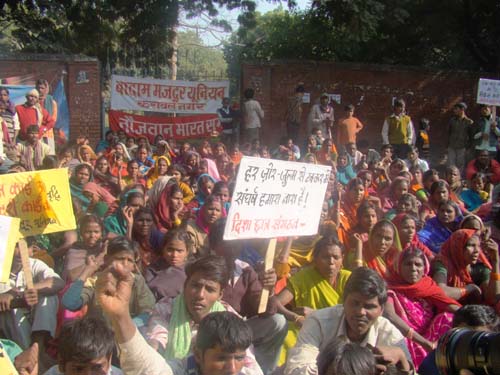
December 23, New Delhi. Nearly 2000 almond workers staged a huge demonstration at Jantar-Mantar in the afternoon under the leadership of ‘Badaam Mazdoor Union’. As is well known, approximately 20 thousand almond workers have been on strike for past one week. These workers organized themselves into ‘Badaam Mazdoor Union’ (BMU) a year ago and since then, they have been fighting for the rights to which they are entitled under various labour laws. The BMU declared strike in the almond processing industry located in Karawal Nagar which is situated in the North-East Delhi, following which 20 thousand workers’ families stopped work, who were engaged in this work. Due to this strike the entire almond processing industry of Delhi has come to a standstill. This pressure is hurting even more because these almonds come from the US, Canada and Australia to India for processing, after which they have to be sent back. These companies outsource the work of processing to India to exploit the extremely cheap labour of India. Khari Baoli, situated in Delhi, is the largest dry fruits market of Asia. The big businessmen located in Khari Baoli take contract for this processing work and then give it on subcontract to petty contractors situated in Karawal Nagar. These petty contractors get this work done by poor labourers on wages which are next to nothing. The workers are given a mere Rs. 50 for the processing of one 23 kg bag of almonds. The total profit on one bag of almonds is arount Rs. 7000. Of this profit, one share goes to the foreign company, another to the big businessmen of Khari Baoli, and yet another to the petty contractor who play in lakhs of rupees, while the workers are constantly on the verge of starvation.

Workers who came to Jantar-Mantar demanded that this almond processing industry which runs in Karawal Nagar and some other areas of Delhi should be given a formal status by the government and it should be regularized, as not a few hundreds are involved in this industry, but thousands of workers are toiling in it to earn a meagre livelihood. Ashish Kumar, Convener of BMU told the mediapersons that the contractors who are at the helm of the affairs in this industry laugh away the labour laws and exploiting the workers in a primitive and barbaric way. It is one of the most glaring example of wage slavery in modern times and that too in the heart of National Capital. For this, they have squandered away money to collude with the Police and local musclemen and political leaders. Against this dictatorship and exploitation, the workers in this strike are demanding that this industry be regularized by the government and labour laws be implemented. The second demand of the workers is that the workers should be given Rs 80 per processed bag of almonds rather than Rs 50. That would be equivalent to minimum wages. Besides, these contractors have not provided the workers with any identity card of job card due to which often they refuse to make due payments to the workers and the latter have no proofs whatsoever, to make a claim. The BMU also demanded that double payment should be made for the overtime. Apart from that, the contractors sell the rind of almonds to the workers. The workers use it as fuel to cook food. As this is a useless by-product of the process of processsing done by the workers themselves, it should not be sold to the workers. It should be given to them free of cost. The workers also demanded that the Police should lodge an F.I.R. against those goons of the employers who attacked BMU leaders and women workers with deadly weapons on the morning of December 17. Ironically enough, the Karawal Nagar Police arrested the Union leaders instead of arresting the contractors and their goons and lodged a F.I.R. against them under section 107 and section 151 and sent them to jail, from where they were released on bail on December 19. The BMU leaders also demanded action against the Karawal Nagar Police.

This strike which started on December 16, is being already hailed as one of the biggest unorganized workers’ strike in the history of Delhi. Almost 20 thousand workers’ families are involved in it. The whole almond processing industry of Delhi has been paralysed due to this strike. Due to the stoppage of almond supply, the prices of almond are increasing. On the other hand, the contractors are dreaming of crushing this huge movement of workers with the muscle power of their goons and tacit support of the Police administration. However, the workers are in no mood to surrender and they are intensifying their strike with every passing day. The BMU leadership demanded the Labour minister of Delhi and the Deputy Labour Commissioner of North-East Delhi to intervene in the matter and ensure the implementation of the labour rights of these workers. If the snatching away of workers’ rights goes on like this, then the workers will gherao the Labour Minister and Chief Minister of Delhi. It is the right opportunity for them to become cautious and implement these laws. They also warned the employers and contractors to wake up before the time runs out. They warned them not to try strength of the workers as it might cost dearly to their profit machinery. They cannot defeat organized working class power with petty street goons. They need to implement the labour laws and give the workers what they are legally entitled to.

Almond Workers’ Strike: one of the largest unorganized workers’ strikes in Delhi

Abhinav Sinha,
Bigul Mazdoor Dasta

Delhi witnesses one of its largest unorganized workers’ strikes in last 20 years
Strike continues into sixth day despite threats and intimidations by the police and goons of factory owners
Supply to international markets badly hit, Delhi’s almond processing industry paralysed
2000 workers organize a huge warning rally

December 20, Delhi. The huge almond processing industry of Delhi, situated in the Karawal Nagar, continued to be paralysed on consecutive sixth day. As is well known, nearly 30 thousand almond workers’ families went to strike with their families six days ago under the leadership of Badaam Mazdoor Union (BMU). In the meanwhile, on the morning of December 17, the contractors and their armed goons attacked a peaceful procession of women workers, injuring three BMU activists and several workers. In self-defense, workers started pelting stones on the goons due to which 4 of them were injured. However, the Karawal Nagar Police, completely playing in the hands of the employers, unilaterally lodged a case against the Union leaders under section 107 and section 151, and sent them to Tihar Jail. These BMU leaders were released on bail on the night of December 19. The shameless Karawal Nagar Police kept the injured, bleeding BMU activists in the Police Station, without providing them any kind of medical assistance, and doing so intentionally. On the other hand, the real culprits, the hooligans of the contractors were let go by the Police! Not even a single case was registered against them. Even more shameful is the fact that the Police lied to other BMU officials that they were taking the arrested leaders for M.L.C. and a case has been registered against the contractors and their henchmen. The contractors used casteist abuses against dalit workers and dalit BMU activists. And yet, the Police refused to register any case against the contractors and their gundas. The contractors and owners had calculated that with the arrest of the top BMU leaders, the strike will disintegrate. But, contrary to their great expectations, the arrest of BMU leaders, rather than shaking the courage and confidence of workers instilled in them an indomitable resolve to fight till the end. The 20 percent workers who had not joined the strike, joined it on the night of 19th December.

After the release of the leaders, workers warmly welcomed them and organized a historical rally on the morning of December 20 in the whole western Karawal Nagar. The rally had been organized as a symbolic warning to the contractors and the Police. Almost 2000 workers participated in the rally, predominantly female. The rally started in Prakash Vihar area of Karawal Nagar and covered the entire western Karawal nagar. During the rally, workers raised various slogans against the contractors, Police, capitalism, etc. The common citizens of Karawal Nagar saw this rally with awe and supported the demands of the workers. It was the biggest workers’ rally in the history of Karawal Nagar. The workers demonstrated their militant unity with this rally and re-emphasized their resolve to continue the struggle till their demands are met.

Due to the continuation of the strike into the sixth day, the almond processing industry of Delhi has come to a halt. Thousands of unprocessed almond bags are lying dump in the godowns of the contractors. On the other hand, the demand for almonds is increasing with every passing day as Christmas and New Year is coming near. It is noteworthy that the almond that is processed in Delhi comes from the companies of the US, Australia and Canada and a number of European countries. These companies, in order to exploit the cheap labour of India and minimize their costs, send their almonds for processing to the big businessmen of Khari Bawli of Delhi, which is the largest dry fruit market of Asia. These big businessmen give this work of processing on sub-contracting to the petty contractors of Karawal Nagar, who laughing away all labour regulations and laws, exploit the workers cruelly. These are the very workers who have been on strike for the sixth consecutive day and who have been demanding for the fulfillment of all their rights given by the labour laws, for example, the piece rate should be fixed in accordance with the law of minimum wages, that is the per bag processing rate should be fixed according to the minimum wages; the workers should be given double overtime payment; they should be provided with identity card and job card; and the due payment should be made in the first week of the month; abuse of workers should be stopped immediately by the contractors. The almond workers formed their Badaam Mazdoor Union last year and since then they have successfully fought on a number of issues. Due to the present strike the rates of almond are increasing swiftly in Delhi’s markets.

Convener of BMU, Ashish Kumar Singh said, “Till now, the Police administration has worked hands in gloves with the contractors to sabotage the strike. We have completely lost faith in the Karawal Nagar Police administration and to initiate action against the goons of the contractors, we will lodge a complaint directly in the office of DCP, North-East Delhi. And if the DCP office fails to take action, we will move to court. The goons of contractors will not be spared and they’ll have to pay for every drop of blood of workers and their leaders. Strike is our weapon. We’ll continue the strike till all our demands are met.”

Yogesh, member of BMU, said, “It is for the first time that the workers have organized themselves in such huge numbers. We have witnessed strikes in the past too, however, then the workers of U.P., Bihar and Uttaranchal failed to come together and the strikes failed. It is for the first time, under the leadership of Badaam Mazdoor Union that the workers have organized themselves across the divides of caste, gotra and region, with their class interests in command.” Yogesh told that they have been reported by various sources that the baffled contractors are planning a fatal attack on the leadership of the BMU, with the Police on their sides. He said that faced with any such attack, we will reply proportionately. Despite the patronage of the Police, the contractors cannot defeat the worker power.