Slum dwellers in Bhubaneswar fight the police – A Report

Satyabrata

Two hundred and fifty-nine families (1195 people) resided in sixty year old Narayani Basti (slum near Unit 8 DAV School, Bhubaneswar) till the 29th of January 2011. On the 29th of January 2011, ten platoons of police with 9 platoons armed force and DCP and Commissioner of police went into the region and demolished the slums. Slum dwellers protested and many of them were seriously injured in their struggle against local goons and police who assaulted women. The police arrested hundred slum dwellers which included forty nine women. These women were kept locked in a van and were not allowed to leave the van for any reason. On the 30th of January local goons present did not allow either food or water to reach these people after they forcefully returned to their slums. Food prepared by the people from outside (Basti Suraksha Manch) was also not allowed to reach these people. The people organized themselves and started throwing stones at the local goons to get some time to collect and store food. Dodgers came again but this time failed to oust the organized masses. The people of the slums have now decided to take up arms (anything they have at their disposal, hammers, knives, etc) against anyone who tries to come to attack them.
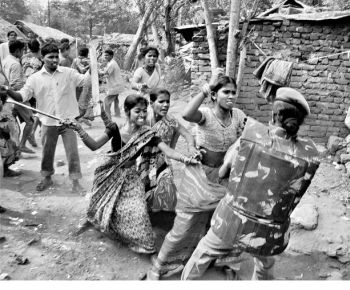

Courtesy: The Hindu

These people living in the slums of Narayan Basti have been attacked by the police without Notice several times before. For the first time it happened in 16th of December, 2009 and since then there has been continuous opposition by slum dwellers against any attack by the forces of the Government. Through protests, they have been able to force dodgers back that had come to demolish the slums and this they have been able to do for about seven to eight times. The recent attacks before the demolition were made continuously from the 10th to 14th January, 2011.

There are several such slums in Bhubaneswar who fear demolition and the Basti Suraksha Manch of Bhubaneswar is playing a leading role in organizing these people. According to the Basti Suraksha Manch, the demolition of these slums is illegal. According to Orissa Municipal Corporation Act Chapter 21, slums are classified as Tenable (which can’t be moved to other places) and Untenable (which can be moved to other places). The Narayan Basti slum is declared Tenable according to this act with its code being 3301 (every slum has a code). In spite of their having tenable status, the Government doesn’t even give alternative accommodation, rather, has a ‘transit house’ (about three kilometers away in Niladri Vihar) where these people will be given accommodation for 15-30 days only and will be left to their own. One can judge how the Government sees its people when one finds that these transit houses have two toilets for two hundred families.

The following is a copy of the letter written to Chief Justice of Orissa High Court:

The Honourable Chief Justice
Odisha High Court, Cuttack
Sub: Pray for justice

Sir,

49 women of Narayani Basti (Khandagiri PS, Bhubaneswar) are illegally detained in the Khandagiri PS at night(after sunset) on dtd.29.01.2011. Who were forcibly evicted from their slum in spite of High court judgment in writ petition(C) No. 11667/2010 and writ petition(C) No. 12723/2010.

You are therefore, requested to kindly intervene the matter in the interest of justice.

Yours faithfully,

Pramila Behera
Plot No. 1819 (opp N6/10)
IRC Village, Bhubaneswar-15
A working class uprising – how far will it go?

Taken from an article published at LIBCOM

. For other articles on Tunisia uprising, visit

The fundamental class nature of the protests in North Africa is undeniable. In Tunisia, Algeria and Libya a generation of proletarianised youngsters have led mass protests, the immediate reason for which has been their desperate standard of living in countries which support a wealthy and transparently self-interested ruling class, less schooled in the modern techniques of bourgeois self-justification than their Western counterparts. The same issues are repeated in countries across the region. We will attempt a brief and preliminary survey of the class aspects of events here; again due to restrictions on information and rapidly developing events this survey is necessarily incomplete.

Expropriations

The uprisings in Tunisia and Algeria have involved the expropriation of goods from supermarkets, shops and warehouses during mass demonstrations. This is to be expected ; one of the immediate catalysts for the uprisings was the cost of essentials rising rapidly, with scarcity compounded by security forces shutting down the country. Moreover, during situations where working class people are becoming aware of their own power, respect for the nicities of commodity exchange evaporates, especially when money (or the lack of it) limits their access to the essentials of life. Such expropriations are a feature of all proletarian uprisings, as is the line on “violent looters” spun to justify brutal crackdowns.

Strikes – or the lack of them

Information on the extent to which strikes have formed part of the movement in North Africa is limited. We know of strikes by teachers in solidarity with protesting students. Likewise there have been calls for general strikes led by ‘professional’ workers such as lawyers, but it is unclear whether they were attended by workers more widely. We can say the same of the general strike called in Sfax – until more information is made available, it is hard to say to what extent it was observed. We know of strikes in the mining town of Gafsa, but again the scale of participation in these strikes is unclear. We do not know to what extent people have participated in organised strikes, or simply not gone to work due to the unrest on the streets. Lockouts after the state of emergency was declared would have precluded many strikes.

Obviously the unemployed and students who have formed the bulk of protesters on the streets do not have labour to withdraw in the same way as workers. Demonstrations, blockades and riots all can form part of class struggle, and can advance it by disrupting the economy and drawing lines of confrontation. Radicalisation by police truncheons can often push confrontation with the state further, and draw more people into events by making the role of the state in maintaining order through violence clear. However, all major uprisings have involved mass strike action, and the mass strike is a means by which the common interest of proletarians as working class and their power to cripple capital by expropriating the means of life from it can become clear. The direction and scale of the insurrection is likely to be determined by the extent to which strike action spreads through the economy.

Part of the explanation of our limited knowledge of strikes could be the focus of the media on street protests and the ‘political’ dimension presented by the calls to oust the current government. Strikes taking place in parallel may not be deemed newsworthy. On the other hand, it may be that there has not been generalised strike action. The role of tourism in Tunisia’s economy, employing significant numbers of workers (half of the workforce is employed in the service sector) is not enough to account for this – industry such as manufacturing, mining and the oil industry accounts for a third of the workforce. This is the classic terrain for mass strikes of the kind that has been a feature of all historic working class uprisings, and this would have a significant effect in a major oil and minerals exporter such as Tunisia.

On the other hand it is important to bear in mind the effect a drop in tourism revenues can have in a country like Tunisa – a few global headlines about rioting can lead to the paralysis of a major section of the economy. Ben Ali called on rioters to stop due to fears about the decline in tourism, and was clear and vocal about this. Nonetheless, a generalised strike movement would be vital in broadening a specifically class consciousness, widening the movement and radicalising the situation.

Not a revolution – yet.

The media has been quick to label events in Tunisia a ‘revolution’, and the name ‘ the Jasmine revolution’ has been rapidly applied to bring it in line with a range of other political revolutions which ushered in new governments (usually pro-US) in various countries. Such events are only ‘revolutions’ in a political sense, with one government replacing another. Tunisa has not yet seen a true revolution, as the rule of capital and the fundamental balance of power between classes in the country has not yet changed. Such a possibility would require the working class of the region to draw lessons from the radical display of their own power which has unfolded over the past weeks. Given that the fundamental issues – unemployment, high prices and poor housing cannot be solved by decree by governments even if they wanted to, it is unlikely that we will see the status quo return in North Africa any time soon.

Videos: Dismantling Democracy in the University (March 4, 2010)

Following is the video of a seminar organised by Correspondence and Kudos, the Literary Society of Hindu College (University of Delhi) on 4th March, 2010 with the aim of initiating a discussion on radical student and university politics.

View playlist on YouTube

Migration: The Experience of a Mising youth

Manoranjan Pegu

Aipemenam,

It’s dark here and there is no electricity in my room and I am writing to you in the candle light. I miss you a lot but cannot afford to come home and see you, as I have to earn lots of money so that I can marry you and we can have a life together. I am safe and fine here and have joined my job as a security guard of this company. It is a very big building with big big machines and a very large garden. The manager told me that it is a pharmaceutical company and it manufactures medicines, tonics and tablets. He told me that these medicines save lives of people. I felt proud about that. Ramen is also with me and he comes in the night for his duty when I leave for home.

Savings are meagre but still I am trying my best to save a lot. Sometimes my boss gives me food and in those days I can skip the meal and save more.

Hope the roads in the village are better now. Manoranjankai was telling me that the floods have come again and have devastated the crops like always. I work ten hours a day and by the time I come back home I get very exhausted. Three of them come back after me and two other leave for their night duty as soon as we come back.

I am fine and you also take care. The thought of our future gives me hope and keeps me going. I love you……

Yours only

Lakheswar

I could see drops of tears rolling out of the eyes of Dhaneswari as I was reading out the letter to her. She was holding on to the letter for about half an hour without saying a single word but every minute of her silence spoke a thousand words to me. I could feel a deep sense of pain in her eyes which she has hold on to silently and hidden it from the world, for many months by now. I could feel the same love and pain even in Lakheswar’s eyes when he handed over the letter to me. The way he held on to the rugged passport size picture of Dhaneswari which always found a place in his wallet.

It has been only two months I have known Lakheswar. He is a young man in his early twenties who has left his village in lookout of work so that he could earn enough money to support his family. It was a co-incidental meeting as I met him when I had gone to meet my friend who is doing his MBA from Pune. Lakheswar had come to borrow money from him so that he could send money back home. It was a few days ago when I had again gone to attend one of my friends birthday party that I met him and had a long chat with him. He had volunteered to cook for the party in return of rupees two hundred for the night.

Lakheswar is not alone in the city. There are many like him who has come to the city with dreams of earning money and usually look out for odd jobs in the city. They work as security guards, cooks, salesman and many of them also engage in daily wage labour. I was shocked to see the number of Mising migrants in the city and Pune is not the only city where they have migrated to. We can also find many of them in considerable number in Delhi, Bangalore, Trivandrum, Mumbai and other cities of India.

Migration as a phenomenon though relatively new has considerably emerged among the Misings. The Misings, who purportedly till yet had a self-sustaining life have been forced to migrate to other places to earn their livelihood. Migration is an important phenomenon and has many dimensions to it. Migration on one hand helps people from underdeveloped areas to come to the developed areas and earn their livelihood, while on the other it also brings in extreme exploitation which shall be discussed later. People migrate primarily to earn a livelihood. The movement of the upper class is to improve their standard of living and earn more. On the other hand, poverty also forces people to migrate, albeit for survival. Migration is usually observed as movement from rural to urban centres. Agriculture, which depends largely on monsoon, does not provide for the cash requirements. Thus more often than not the men in the household migrate – either seasonally or permanently. In the former case, they return at the time of harvesting, carrying with them the money earned. In the latter case, the men return home in the light of any emergency or a festive occasion. For the rest of the year they keep sending the little money they manage to save back home, on which the family in the village sustains. Migration has today become a way of life for many people who travel from place to place in search of better wages.

There can be various classifications of migration. If classified under choice; there are two types of migration – voluntary when the migrant migrates to another place at his/her own wish and is generally done to fulfill educational and job commitments. The other type of migration is distress migration – when the means of sustaining oneself exhausts in a certain place, then an individual is forced to migrate to another place to earn a livelihood. In this case, the sudden upsurge of migration that has emerged among the Misings can be identified as forced. Constant floods have ravaged the areas where the Misings reside and agriculture has been destroyed and thus the Misings have been forced to migrate to other places in look out for work.

It is argued that if the process of migration stops then the development of the country shall also cease. Then what is it that makes migration as a phenomenon to be scared of? Why should migration not be encouraged? There might be various theories and answers to the above question. Many might argue for it and many against. But without doubt, it can be agreed that the migrant labourers are the most exploited lot.

Migrant labourers have always been a marginalised section – owing to the antagonism of the people of the state they migrate to. This has been very apparent in states like Maharashtra where a migrant labour (especially migrants from UP and Bihar) is looked at with hatred and equated as a person depriving the ‘sons of the soil’ with jobs in their own state. We have also witnessed the same in Assam in 2003 when various Bihari migrants were attacked because they were seen as a threat to the jobs of the Assamese people. What follows is that a migrant labour is generally treated with disrespect. Ethnic clashes and fight for survival soon follows where a lot of them also lose their lives.

Migration among the Misings (or for that matter any type of migration) is a multi-dimensional phenomenon with various socio-political implications. The migration is often driven by an intention to survive and thus there are various factors that influence the migratory process. The contractors (Thekedaar) play a major role in the migration process as he is the one who recruits the migrant worker or get him/her employment. He goes to the village or get in touch with a villager and influence them to come to the city to perform jobs. He assures them employment and place to stay in the city. People also migrate if he/she has a kin who is already working in the city as it eases the process of migration and also the migrant feels safe and secured in an unknown city. Sometimes the contractors also contact workers who have previously worked under him and directly hires from the village.

Migrant labourers are generally preferred over the local workers and it makes it very easy to get jobs for the migrant labourers. But the preference is done with an agenda. The migrant workers provide for cheap labour and also can be easily exploited. In fact such is the extent of the exploitation that the labourers who usually come in look out to better their standard of living is often pushed towards extreme poverty and deterioration. The exploitation takes various forms and shapes. The migrant workers are paid very low wages which again are paid in lump sum amount after months of work. Thus it becomes extremely difficult for the workers to sustain themselves in the city. Lakheswar informed me that he had not yet received his wages for two months. The migrants are also completely dependent on the contractor for their shelter and residence in the city. Most of the times the shelter provided by the contractors are in slums where existence becomes a nightmare. Infact when I visited Lakheswar, I was shocked and deeply pained to see six of them stuck to a room which would even be smaller than a kitchen of a middle class family in a city. There was not enough space to sleep or for the basic minimum needs. Dirty surroundings and a filthy smell filled my nose as soon as I entered the room. It also formed the kitchen during the day and after the cooking is done the utensils are cleaned and stocked up in a corner of the room and it forms the sleeping space. It left me wondering; how a mising youth who have, his entire life slept in open spaces forced to adjust such a surrounding.

The story of exploitation does not end here. Migrant labourers generally wait at Nakas for prospective employers/contractors to come and hire them for work. The traffic police harass them by beating them without any reason, shooing them away and at times even extort money from the poor labourers. They are treated with indignity at the workplace- by the contractor as well as the employer. And the migrant workers are not protected under the law especially the seasonal migrants. Thus the Misings who are essentially seasonal migrants are in extreme stage of vulnerability. In fact there have been a few cases in my village where quite a few of them returned empty handed where they have been cheated by the contractor. In such a situation what can be done? Should there be efforts to stop migration? But it shall demand developing more livelihood options in the villages. How will we generate more livelihood options in the villages? These are questions which need a lot of introspection.

Lakheswar mother’s asked me about his well being and his return. She said that it has been a year that she has not seen him and she was dying to see him again. I just thought to myself that there are many more mothers like her who are waiting for their sons to come back home…

A Conference on Rural Labourers in Neo-liberal India, Bhubaneswar (18-19 December 2010)

A second call for papers for

A Conference on
Rural Labourers in Neo-liberal India

18-19 December 2010

XIMB (Xavier Institute of Management – Bhubaneswar), Orissa, India

Supported by Social Sciences and Humanities Research Council (SSHRC) of Canada
and XIMB, Bhubaneswar, Orissa

Neoliberalism has affected India’s rural areas and the agrarian sector particularly harshly. Not only are peasants being dispossessed of their rights to land, water and forests, and of their meager entitlements from the state. But also rural labourers are being subjected to ruthless levels of exploitation on the farms and in agro-industrial units where they produce commodities for the rich domestic elite and for export to rich (and imperialist) countries. While the story of dispossession of peasants has (rightly) attracted much attention in recent times, what has often been neglected is the issue of the production of commodities, the associated process of exploitation, and therefore, the life of the labourers.

Without land or other forms of property and with dwindling welfare benefits from the neoliberal state, rural labourers find themselves in a precarious situation and form a major part of the ‘Republic of Hunger ’. They work as long as they live, and they live as long as they work. Many are footloose labourers constantly in search of work. In many places, employers even take away labourers’ freedom to sell their labour power, in order to cheapen the only commodity they possess and to discipline them. This is the case with bonded and child labourers. As well employers make use of gender and caste/tribality to lower wages of low-caste, women and tribal labourers and to pit one group of labourers against another. These social distinctions are no less used by political parties of the rich property-owning classes to divide and disarm the rural working class electorate. But at the same time, rural labourers (and poor peasants), in spite of them being geographically scattered, are engaged in an ‘uninterrupted, now hidden, now open fight’ against exploitation and oppression.

The topic of rural labour in imperialized, poorer countries such as India indeed cries out for serious critical scrutiny. This must place rural labour (including semi-proletarian labour) at the center of our attention in terms of primitive accumulation which produces it and the capitalist accumulation process which exploits it, and in terms of its democratically organized struggles against capital and the neo-liberal state.

Papers are invited which speak to one or more aspects of the situation described above in the specific context of India . Specific topics of interest include:

1. ‘Primitive accumulation’ in relation to labour
2. Rural migrant labourers (working in villages and/or in urban areas)
3. Labour process in export-oriented agricultural production sites
4. Labourers in floriculture and aquaculture
5. Contract farming and rural labour
6. Rural reserve army of labour and neo-liberal accumulation
7. Technological change, rural labour and politics of production
8. Ruralization of capital in the age of ‘new’ imperialism and its effect on labour
9. Environment (e.g. climate change issues, including heat wave) and rural labour
10. Life and livelihood of the unemployed in the villages
11. Poverty/hunger of rural labour households
12. Credit relations (formal and informal) and rural labourers
13. Female labourers, neoliberal state and neoliberal capital
14. Capital and dalit/adivasi labour
15. Rural labouring bodies in pain: capital’s corporeal effect on labour
16. Reduction in state welfare provision and its impact on labourers
17. Government rural wage-employment generation programmes (e.g. NREGS)
18. Development NGOs and rural labour
19. Representation of rural labour in media and popular culture
20. Struggles of rural labourers and poor peasants against capital, landowners, and neo-liberal state
21. Rural labourers in progressive art and media

The original deadline for the submission of abstracts has passed. Though 5th December remains our deadline for receipt of the completed-papers from the authors whose abstracts have been accepted, some slots are now available with us for considering directly-submitted completed-papers from those that did not submit abstracts or whose abstracts did not get accepted; the deadline for these is 15th November.

Website: http://sites.google.com/a/ximb.ac.in/rlni/
E-mail (for inquiries): conf-rural-labour@ximb.ac.in
Tel: +91-94370-75075

The Ironies of Indian Maoism

Jairus Banaji, International Socialism

Voices Against The Day: Seven Young Workers from Gurgaon

GurgaonWorkersNews – Newsletter 31 (October 2010)

We spoke to seven young workers from Gurgaon about village and urban life, about work and hope. They are in their early twenties, part of the new generation of workers in urban India. They work in textile and automobile factories, as rickshaw drivers and cleaners in guesthouses. The conversations touch upon the question of gender, religion and other identities thrown into urban social transformation. They ask the question of social power against the current state of being.

*** Woman Textile Worker

I have just slept. I was injured so I went to sleep after I came back from work. I got injured from the [sewing] machine. The needle went into my hand. The thread was stuck in the machine. When I tried to remove it, I accidentally moved the machine with my foot and my hand came under the machine. The company provided no treatment. Many people get injured like that. There are more accidents in the night.

There are about 3,000 workers in the factory. Many are women. About 1,500-2,000 must be women. They do all kind of work. Everything – operator, sewing also work as hand operators. I am an sewing machine operator. I sew only one part, the arm of a shirt. In one shift I have to sew at least 80 pieces. If I don’t meet the target, the line keeps moving. Nothing happens. The clothes are exported, but I don’t know where to.

I am 17. I have worked in this factory since six months. Before that I worked in another factory. Brown, they produce medicines. I like to work in the export line, because making clothes is clean work. In medicine – don’t ask. Like there is a lot of glass. When it breaks, it cuts into the hand. We have to wash the bottles. Then the drugs powder – if it comes on your hands or face, they burn. It damages. I worked in that factory for two months. It was my first job. I left it, because I did not earn much money. Rs 2500. And I had to work a lot. My bones used to hurt. Then I had to work with medicines. I did not like it. I felt claustrophobic.

The money I earn, girls who are younger than 18, do not get jobs. But I was desperate, and I told a lie at the job. It is so difficult in my family. There is no one to earn except me and my older sister. My father lives, but he has knee problems. He does not work. I have a younger brother. We are educating him. My sister and I – by working. So I said to them at work that I was 19. So they gave me work. Otherwise they would not have let me.

It is normal for women to work there. Women workers have been there from the start. The atmosphere in export is good. There is no harassment, in fact there is pressure on the men to behave themselves. So nobody says anything. Yes, we talk a lot, men and women, but nobody forces anybody. They can talk in the factory. In our canteen too, boys eat on one side and the girls eat on the other side. But they work together. Because they make even women work very hard. And women are getting ahead of men. Women even do the work that men cannot do, they work harder. The employers think that perhaps women will not resist.

The biggest problem is that of the toilet. There are so many women and men working in the factory, but only 2 or 3 toilets. So there is always a queue. When we do overtime, the advantage is that we get double the money. For 2 hrs work we get 4 hrs money. If we work on a Sunday for 8 hrs work we get wages for 16 hrs. For a 8 hour day, I earn Rs 4200 per month. I give all the money to my family, I keep about Rs. 400-500 for myself. The rest I give. Our real salary should be Rs. 4500. But the company is not giving it. The company gives 4200. From Rs 4200, Rs 500 go into pensions. So after the cuts, we get about Rs 3600. From that I keep Rs 300 for transport, I keep Rs 50 – 100 for my own costs. If everybody joins, something an be done about the wages. I cannot do anything alone. Together we can ask for he wages that are our right. We talk that when our grade is Rs 4500, we should get it. We should get the perks. Like today, when I got hurt I went to get medical aid. They did not do much for me. Just gave me half a tablet. Then I went and got myself a tetanus injection. And I got medicine myself, and so it became better. I paid myself. 50 Rupees.

Question: Is there a union in the factory?

A.: Union?

Question: Union – how do you say it? AITUC for example?

A.: Unity [Ekta]? There is unity. If anybody puts pressure on us, then not one person alone, but everybody protests. If somebody shouts, we all answer back. We are all united. The supervisor shouts because if we do not give him the piece, we do not produce, we do not meet the target, he will shout. If a piece is not right he will shout. We just say, “what we did not do in this hour, we will do in the next”. Or “We don’t know what is going wrong”. So we correct him. There is same unity between men and women.

I have one girl friend in the factory, named Bharti. Here in the basti [workers dwelling], I have only neighbours. Here, I do not want to make friends. They talk nicely in front of you, but criticise at the back. They criticise me. If I tell them something private they spread it everywhere.

I would like to be somebody, although I did not get any education. Some profession, some office job. If I get such a job, it would be nice. Here, I go fresh in the morning; but come back tired. I get tired working.
Perhaps my parents will get me married in 1 or 2 years. If not here, then with somebody from the village. What those other people ask me to do and what they don’t let me do – they must decide. If I get married, will I be allowed to see my family? I will not be able to see how my parents are. I would like to stay with them. Our present situation should change. I should work well so our conditions become better. Yes, I would like to work after marriage, because the inflation is so high these days. So if there are 10 people in a family if they all don’t earn, the household will not work. It is so expensive. The house cannot run on one salary. That’s why I wish if after marriage, I am allowed to work I will work. I don’t want to live in the village. I have never been to the village. I don’t know what it is like. I cannot do the work of a village.

*** Rickshaw Worker

I live in Gurgaon since ten years. I drive a bicycle rickshaw. The conditions were better 10 years ago, but now they are very bad. Because the numbers of people have increased a lot. The work we used to do for Rs 2000, now people are doing for Rs 1000. So it is bad. People come from West Bengal, Bihar, UP, Jharkhand, Madhya Pradesh…

When I first came to Gurgaon, there was nothing here. There were not such big houses, not so many houses, not so much rent. We paid Rs. 200, 300 or maximum Rs 500 for rent. Landlords used to beg us to take the house on rent and were ready to do everything for the tenant. Now, when I want to rent, people say they have no room, even when they do have empty houses to rent. Because we cannot pay them the rent they want. We can pay Rs. 1000 – 1200. But Rs 2000 – 4000 how can we pay?

Most workers rent their rickshaws, the rent is Rs. 1000 per month. We earn Rs. 4000 – 4500. So Rs. 3500 are left. We pay Rs. 1.000 for the rent of our shacks. The shack costs Rs. 1000, but you can also get a room for Rs. 1000. To live in a brick-room is difficult because there we have to cook on gas fire. We cook on wood fire. For gas we need a cylinder. We don’t get a cylinder because you need a ration card. Also, they don’t give you any place to put the auto rickshaw. This is why we live in shacks.

Some tension goes on between old people and newcomers. For example you come, I say “Rs. 50 for the fare”, while another rickshaw driver will come and say, “Rs. 20?. So how should it work? There will be tension. When the fare is Rs. 50, why should we take Rs. 20? A minimum rickshaw fair? Nobody talks about this. Because we do not have a rickshaw union here. So nobody talks about this. So if we do not get Rs 20 per kilometer, it is no use.

Sometimes the police make raids. They say “this is an illegal immigrant”, but they are just ordinary workers. The trouble we have with the police is that we park our vehicles everywhere on the road. The police does not let us park on the road. If we park in front of a mall, the guards complain and the police beat us with batons. We have to bear this.

But what can you earn in a different job, for example in the factory – Rs. 2000 to 3000, maybe Rs 3.500. But nobody gets more than that. How can with survive with that? In the factory one works for 12 hours. We work about 10 hours. And in the factory there is an owner and a supervisor. We work when we want to. But yes, there is tension: no passengers, no work.

I think it will become worse in the future. The situation is so bad now. In 2-3 years it will be completely bad. People will be forced to starve. The rice we used to eat for Rs.10 a kilo, we eat today for Rs. 25 a kilo. After 2 years it will be Rs. 30 or 40 for a kilo. Our rickshaw fares are not going up. So if we will not starve, what else will we do?

What can we do about it?. We cannot go to the police. If we complain to the government, they do not listen to us. If we, 10 or 100 rickshaws, jam the road, and ask the public to increase our fares, the police will come and beat us up, because we do not have a union. If there were a union, if even two rickshaws block the road, no car will pass them.

How to make a union? Suppose you are the representative from here. You could tell all rickshaw drivers to pay Rs 500 or Rs 200 per month. All rickshaw drivers in Gurgaon would then deposit Rs. 100 or Rs 200 per month with you, and get a certificate, with the fare for each area on it. So if the police bother you, you show this certificate. If they still don’t listen, you leave the vehicle there and ask the union to intervene. There is a union in Bihar, also in Bengal, but not in Haryana.

*** Guest House Workers

L.:

It is now two and a half years since I came here. For a job, for work, to earn money, this is why I came here. One person can earn Rs 2000 – 3000. In the village getting a job is not so easy. To get a government job you need a lot of qualifications, backing, money, everything. We do not have this. If you cannot get a government job, in the village there are no companies. What can you do there – some work in farms or in houses. It is not permanent. It is temporary. You work for one day and then sit around for a week. This is not right.

N.:

I came in 2000. I have been here for 9 years. First I was small. Now I am grown up so I should earn a little more. I think I will not stay long here. I will go back to my village. It is better in the village than here. Here no one respects you. In Haryana, Gurgaon, if a Bengali makes a mistake they get beaten up. We cannot live nicely or easily here. So I do not like it very much here – in Haryana, in Gurgaon. Yes, 9 years ago it was even worse. In the village what else could my parents have done. They did farming. We still have a little land, but now my parents live here.

L.:

When I came first, I came with a friend. He used to be here, then he went to the village and brought me with him. I found a job after two – three days. It was a company. A small one. A guest house. Yes, cleaning in the guest house. Yes, I found work fast because my friend took me.

N.:

When I came, as I was small, there was no work to be found. That time, I was 10 years old, and people did not give work to small kids. An uncle had come to Gurgaon earlier, he brought us here. When we first came to Haryana, there were no big flats. It was like a forest. And we too lived in shacks. We did not have a flat. Now we have a flat. Gurgaon has become such a nice city. It was not so nice before. There weren’t many roads. My parents went to the village some days ago and have returned, and will go again. My father does cleaning jobs here. In the village there is not so much smell, not so many cars, not so many roads.

L.:

I have come to Gurgaon for the first time in my life. When I came here, I had not been to such a big town. I thought I would get lost. I did not know what I would say if someone spoke to me. That time I did not speak any Hindi, only Bangla. If somebody asked, “What is your name?” I used to think, “What should I say?” Because I am a Bengali. My language is Bangla. Now I do not have any difficulties. All the other Bengalis who are here have some relative, but I until now, I do not have any relative – only friends. No relative by blood.

Here the habits are a little bad, because the Bengalis drink a lot, quarrel with their wives and do not talk to each other with respect. If there is one vacancy here, there are ten young men who want to have it. So what can you do? So which one of the 10 will get the job? So there is always this danger about jobs, a lot of difficulty. How much salary do we get? Rs 3000-4000. What can you do with Rs 3000-4000? Nothing. We have so many expenses. Just the rent for one room is Rs. 1500. To work in a call centre, the first thing you need is qualifications. And the qualifications that you need, I don’t have them. You need at least a Bachelor. And the BA should be in English Honours. But there was no English in my village. There is no Hindi, either. Only Bangla. We learn Hindi after coming here.

There is a big difference between a guest house and a factory. The work in a guest house is a little easy. You don’t have to work that hard. We work in an air conditioned room not in the heat. We can work freely. Nobody is there to watch. Factories are full of the noise of the machines and there are many people. So it is difficult. In a guest house, the supervisor should have a minimum qualification of a B.A. And without a B.A.? – You cannot earn anything. If you live alone, it is very hard. I have taken another person in my room. So the rent is reduced to Rs. 700 – Rs. 800. If you take one more person, it becomes even less.

I have come here for many days – not a lifetime. After living here for a year or so, I will go back to my village, and live with my parents. Then I will come here again for 6 months – 1 year. But we don’t want to stay here permanently.

N. and me, we are friends, he is Muslim, I am Hindu. But people who are not friends think “this person should not talk to me, should not touch me”. “It is not good to meet with them”. They think like this in the village. It is less here. It does not work like that here. Here the friendship works. Like in the village, if I go to somebody’s house they stop me. They say, “Don’t come in, don’t touch me”. It happens a lot even today. I think differently. He is a good friend of mine – that’s what I think.

*** Automobile Worker

I am just coming back from work in the company. I have just done the night duty for 12 hours. I am a VMC operator. Vertical Machining Center – it is designing and modelling work. It is dyeing work. From the dyes, models are made, and then production is made and after production it goes to the press shop. The main client is a company JCB – they manufacture diggers. We make a part for them. And also for Hero Honda and Escort.

About 450-500 workers work in the factory. About 200-250 are permanent. I am employed directly by the company. Among the subcontractors the rate is Rs. 4,200 for 8 hours and they give around 3,500. I earn Rs. 9,000 per month. For 8 hours plus 4 hours overtime daily shift. One week night, one week day shift. There is forging work in the factory, so the furnaces are on and there is fire. This is hard work and the workers have problems. There is a lot of work. The factory runs for 24 hours, even on Sundays. After 12 hours work, I sleep for 4-5 hours and sit with my family. I just have to go to work and eat and sleep.

I work on a CNC machine. After you set it, it runs by itself, and you don’t have to do anything. I have done a diploma in machining. It takes about 2 years to get this diploma. The course costs about Rs. 30,000. With a diploma you can get a job for Rs. 8,000 – 10,000 for 8 hours work. I worked there since 3 months. Before that I was training. The actual work can be done without doing the course, but it would take time.

My father works for the Electricity Board. So he is the only one who does not live in Allahabad. His brothers still live there. My wife still lives there, too. I am a Brahmin, but in the factory there is no difference between castes. Here in the bastis [workers dwelling], people think according to castes and this makes a difference. It makes a difference in terms of eating. We eat separately. We don’t eat meat whereas people of lower classes eat meat. I like it when people mix and eat together. That is correct.

*** Textile Worker

The first time, after I came from the village, I found the environment in the city strange. Finding a job is difficult; I came here to work for 7-8 months and then go back and come again. In the city, the ways of living and eating are strange. There is no time to eat or sleep. You get up to go to work, have a shower to go to work, eat to go to work. Nothing is left for one’s own life.

I had learnt sewing work for 2 years in the village. I was 12 years old then. I was 14 and a half years old when I came here. I did not come to the city on my own. I had a relative – my father`s uncle’s son. I came with him. He taught me the work for 7-8 months. I lived with him for 3-4 years, after which I started to live separately. Since then I have been in this place.

The first job was hard. For 6 months I worked continuously from 9:00 a.m. to 1:00 a.m. No, there was no holiday. Because of that I had health problems – breathing problems. I had to be treated for 1 year. I spent more than I earned on my treatment. Now I am alright. After 6 months I worked in another factory J P Export until I was 15. Then I was 15. Then I worked for 2 years in Liliput Kidswear. Now, since 1 year, I have been working at Unistyle Image. I worked in 7-8 factories altogether, in the last seven years the wages did not increase. I was never made permanent – it has been just like this. I am 22 years old now.

In a year we work for at least 10-11 months and spend one month in the village. And that too – we go for a week or 15 days every 3-4 months. We go for one week and then come back. It is not convenient. There are some people who go back to the village after 5 years because nothing changes there – it remains the same. So people go home according to their need. Those people who have a relation to the village, because of parents, they stay in the village for 2-4 months. They work only for 6 months. Those who do not have money they go to the village after 9-10 months or 4-5 years. Somebody who comes from Bihar, it is difficult for them to go back every 3 months. He earns Rs. 3,000 and can save Rs. 1,000 or Rs. 2,000. The train fare costs Rs. 1,000 or Rs. 2,000. So he won’t go. My village is somewhat close. It costs only Rs. 150, so I go often. But for those whom it costs Rs. 500 – Rs. 600 and it takes 36 hours, they do not do this so often.

Somebody who is old – 45 years, they can’t do much work so why should anyone harass them? And the older you get, the less capable you are of working. Now, when I am 40, I will not be able to see the sewing, I will be practically blind. Because the threads are fine – it is detailed work. So I have to think what I will do after this. We’ll see. Some people go back to the village and do farming.

Normally I earn Rs 5,000 – 6,000. I pay Rs 850 for rent. We are three, so my rent costs are Rs. 300. For food I manage in Rs. 2,000 – Rs, 2,200. If you smoke and drink, those expenses can be increased as much as you want. But I live simply so I manage within Rs. 2000. If we fall ill, there is no telling how much money we will need. One does not know what the doctors will charge. If someone earns Rs. 6,000, he can save Rs. 3,500. I have to send some money back home.

The government has been raising the daily wage, but the wages you earn from piece rate have been coming down. And I have so far worked on piece rate. Seven years ago, the Delhi rate for 8 hour week was Rs, 3,200; now it is Rs.4,550. For example we can say that 20 years ago, all workers were permanent. Perhaps 10 years ago about half were subcontract workers. Now perhaps 80 per cent of the workers are subcontracted. But compared to earlier times, the earnings have gone down.

Previously, the machines were run with the feet. Now there is a computer machine in which we do not need to cut the thread. The computer machine is safer and faster. Whereas with the previous machines we could make 7 pieces, with the new machines we can make 10. We can make 3 pieces more. Where you got Rs 12, you can now get Rs. 36. The problem is to have to sit 16 hours in one place. It is a difficult situation but we are forced to sit there because the company puts pressure on us. If we don’t do it, we will have to leave the company. So we do it in order to be able to live. The atmosphere between the workers is okay, but sometimes there are tensions. Some workers get more work and others less. It is piece rate so if someone gets 10 pieces while another one gets 20, and so the workers will talk why someone got more pieces.

To improve their lives, the workers believe in one thing only – that what is written in their fate – just that will happen. This is their only target. If they are fated to do 12 hours work, then it is useless or beyond their thinking to ask what they can do about it. Life has not improved, rather it has become hell. And it is deteriorating because work is decreasing- There is one company that is being closed down and everything is being sold. In the next 3-4 years, work will decrease and the situation will become very bad. We will move from company to company. 15 days here and then move. We will manage to earn our bread but where we used to get Rs. 5,000 – 6,000 we will get Rs. 4,000. Finding another job is difficult because you have to learn the job. When you see another person doing it, you think it is nice work but as soon as you get in, you find out that it is rubbish work.

The workers feel angry, but there are supervisors standing there all the time. And they have no shortage of workers. If one leaves, there are 10 to take his place. If you do not meet the target, they will remove you and somebody else will take your place. And the workers are always changing – nobody is permanent. Today you come back from work, but there is no guarantee that tomorrow you will have the same work. So it is pointless to think about the future. The workers here keep going on in these conditions. If there is little space to breathe, he wants to cope there. So there is no hope because we do not know what will happen tomorrow.

In 7 years, this is the only factory I have been to where workers stop working, because they offer to pay Rs. 10 per piece and we say this is too little and they say they will not increase it. So we stop work. Then through negotiations, they increase it by Rs. 1 or Rs. 2 or Rs. 4. When we see that this will give us Rs. 200 – Rs. 250 more, we start working again. Recently they offered Rs. 28 for a piece. We stopped working so he increased it to Rs. 32, then offered Rs. 35. We still did not work so he eventually offered Rs.37. In this, there are 50 people who do the sewing. They were all involved.

In total about 100 workers work in the factory of which 50 are tailors, 20 ladies who cut thread, 15-20 in ironing, and helpers. The tailoring craftsmen fought for their rate, the others did not take part. They are mostly subcontractor’s workers. And they also tell us, “You are craftsmen. If you leave here, you will get another job. We will have difficulties in finding a job. We are fine the way we are.”

We were not too afraid to go on strike. Our work is so insecure that we, who work in piece rate, we don’t know when they will throw us out. Some people did fear that they might lose their jobs. But we work on piece rate so that if there is no work tomorrow they will get rid of us anyway. That is why when he refused to give us the rate we asked for, we asked him to settle our accounts. As he was preparing to release us, the man in charge of production came and said he would give Rs. 37. So the work started again.

No, there was no leader. There were 50 craftsmen. When it was lunchtime at 3 o’clock, all the craftsmen went outside and talked with one another that the rate was low and it should be raised otherwise we should stop working at 3:30. So everybody went inside and stopped working. When the supervisor asked us to work, we said “First increase the rate”. There was no need for a leader. And there was no agreement with the management, only with the contractor. The management says they do not have anything to do with us. The owners have nothing to do with us. We are subcontract workers so the subcontractor comes and talks to us. There are two subcontractors. They talk to the management. The management never talks to us, whether we work or not.

We won Rs. 100 for every 12 hours. Once the rate is agreed it stays the same for that production [order]. Because the orders are for 2,000 – 4,000 pieces. What is being made now, there are 12,000 pieces and for these pieces the rate we have agreed that will apply. But the biggest problem is that there is a vast supply of workers. So it is difficult to think how to do this. With us it was that we were making the full piece. In other places it is done in a production chain so you cannot do it. With the full piece you can stop work. In many such factories, which work on piece rate, this kind of thing goes on constantly. There is always disagreement over rate and they increase the wages by Rs.2 – Rs.4. And the workers manage to get something. But the trouble with piece rate is, today there is work and tomorrow not whereas those who are on salary, they get it regularly. But it evens out. The salaried workers earn Rs. 5,000 and we earn Rs. 5,000. But in piece rate there is tension and there are targets.

The labour power, when the workers want it, everything is possible, but they have constraints – there is a wife and kids. When we stopped working for 4 days our wages were increased. If everybody became like this, conditions can become better. But if the workers have a tiny breathing space, they try to manage within that. So how can you talk to them, they are not even prepared to think like that. And one cannot hope that there will ever be a revolution. What should I say? If the worker unity happens we will see. This is a very old tradition and it will take time to get rid of it.

*** Textile Worker

In the sewing department 300 craftsmen work – we are tailors. Then about 250 in pressing, then about 150 in the cutting department. Normally at 9:00 in the morning we start and at 8:00 p.m. or 9:00 p.m. they let me finish. Normally on Sunday, they don’t let me off. No holiday in a week, not even in a month.

It is very simple. If we work hard for 16 hours, we go straight to bed and sleep. We eat and drink whatever is there – hot or cold – and go to sleep. If we feel exhausted, we go and get a medicine for bodyache and go back to our job. If you don’t turn up for the job, you will get thrown out. If you get there in time, they enter your attendance, then they make you work. And suppose you worked till 2:00 a.m. through the night yesterday, your body hurts – it does not matter. They get the same amount of work from you.

With the body, it is that suddenly my stomach started to hurt. I took a tablet and went to the company. I sit at my machine, but if output is less, this does not suit him. He wants to get maximum work, according to the target. He wants to have as much target from me today as he had yesterday.

There are many complaints. They do not give us clean water to drink. By drinking dirty water we catch a cold, or get a fever and headache and many things go. Also because of the lack of hygiene in the toilets, we get health problems too – malaria, tubercolosis or something else. If you work 16 hrs non stop, without proper food and rest, it is simple – you will get tb.

The body does not co-operate. How can the body co-operate, because you take 16 hours work from it. If you work with the body properly and give it proper rest, there is no problem. But it is very simple. We get Rs 4000 – Rs 4300 salary. If the company does not give us overtime work, just Rs. 2,000 is the cost of our room and food. If on top of that we take away Rs. 500 for other costs, then Rs 1000 – Rs 1500 are left. And we cannot do anything with that. So we do overtime in the interest of earning more money.

It is not a rule to work till 1:00 a.m. I can finish early. The situation as it is in my house. In my family, I have registered my children for school and college. To educate them and keep them well, to clothe them, I will have to work, even though it is a lot of stress for me. It might kill me but I will keep working. It is like this. For others, for our parents – for their poverty, to give them money for food, this is why I must earn.

My heart says, “Okay, let’s work till 1:00 a.m. because we do not get double time but single time. Three hours overtime is not enough. We must put in 6 hours. So we have to stay back until 1:00 a.m. When we work till 1:00 a.m. we will fall ill, and have other problems with the body. And so the money we earn with overtime, will get spent on medical problems. So our need is that the salaries should be better. If it is now Rs 4,000 it could be raised to Rs 5,500. Then we will have no need to do overtime.

I see that one year after starting a company the owners can buy three other companies, and think about putting in more machines. So much profit they can make.

The condition of workers injured outside JLN Stadium worsens

Alok Kumar, DELHI NIRMAN MAZDOOR SANGHARSH SAMITI
Affiliated to All India Workers’ Unity Centre (AIWUC)
Office: 3267, Gali No. 8A, Baljeet Nagar, Delhi-8
Ph: 9313730069

On the night of September 28, two workers, Ashok and Phoolbabu, who were injured in the foot-bridge collapse outside JLN Stadium, were discharged from Safdarjung Hospital. In their discussion with trade union members of Delhi Nirman Mazdoor Sangharsh Samiti (DNMSS), both the workers explained in detail how they were shamelessly exploited by the contractor. Their job cards showed that they had worked way above the prescribed norms for overtime. Punni, one of the workers injured in the accident and who is still in coma in AIIMS Trauma Centre, had worked for 21 hours at a stretch just two days before the accident. The workers who have been discharged so far have clearly exposed that whenever they resisted overtime, they were badly threatened and were told that if they didn’t comply their pending wages would not be released. In this way they were completely silenced and treated like animals. In fact, the workers mentioned that just prior to the accident they had complained of having to work in the bad weather. Considering they were provided no helmets or any safety gear, they were apprehensive from the very beginning about working on the foot-bridge.

The condition of the discharged workers is very troubling for they are all need of long term rehabilitation/ physiotherapy and are still complaining of pain and discomfort. The fact that their compensation money has still not been released is a source of great anxiety to them and their families. It is shameful that so far no interim amount of money has been released for them so as to help in their immediate recuperation. To add to their anxiety the workers are being harassed by the contractor’s goons, who are forcing them to hand over their discharge papers and to sign/give thumb impressions on blank papers.

The situation is disturbing even in the case of workers still hospitalized. Punni and Jitendar are still in coma in AIIMS. Meanwhile their relatives in hospital are struggling with no help coming forth from the CWG Organizing Committee or Delhi Government. The workers’ relatives have run out of money but are still harassed to pay for MRIs, CAT SCANS, etc. They are continuously pressed to arrange for blood provided by the hospital to their injured ones. Furthermore, with no special arrangements being made for them in the hospital, relatives of the workers are absolutely alone and find themselves struggling for proper shelter. Indeed, it is a shame that they learnt of the accident not through the CWG Organizing Committee or Delhi Government but through the media and word of mouth.

If this situation continues any further, DNMSS will be compelled to launch a city-wide strike of construction workers along with other trade unions and civil liberty groups. We continue to demand immediate release of compensation money to the workers, the provision of government jobs to seriously injured workers, the implementation of a help-desk for relatives struggling in hospitals where many workers are still admitted, and the provision of post-discharge rehabilitation/ physiotherapy to the workers injured.

Commonwealth Games, National Pride and Workers’ Death

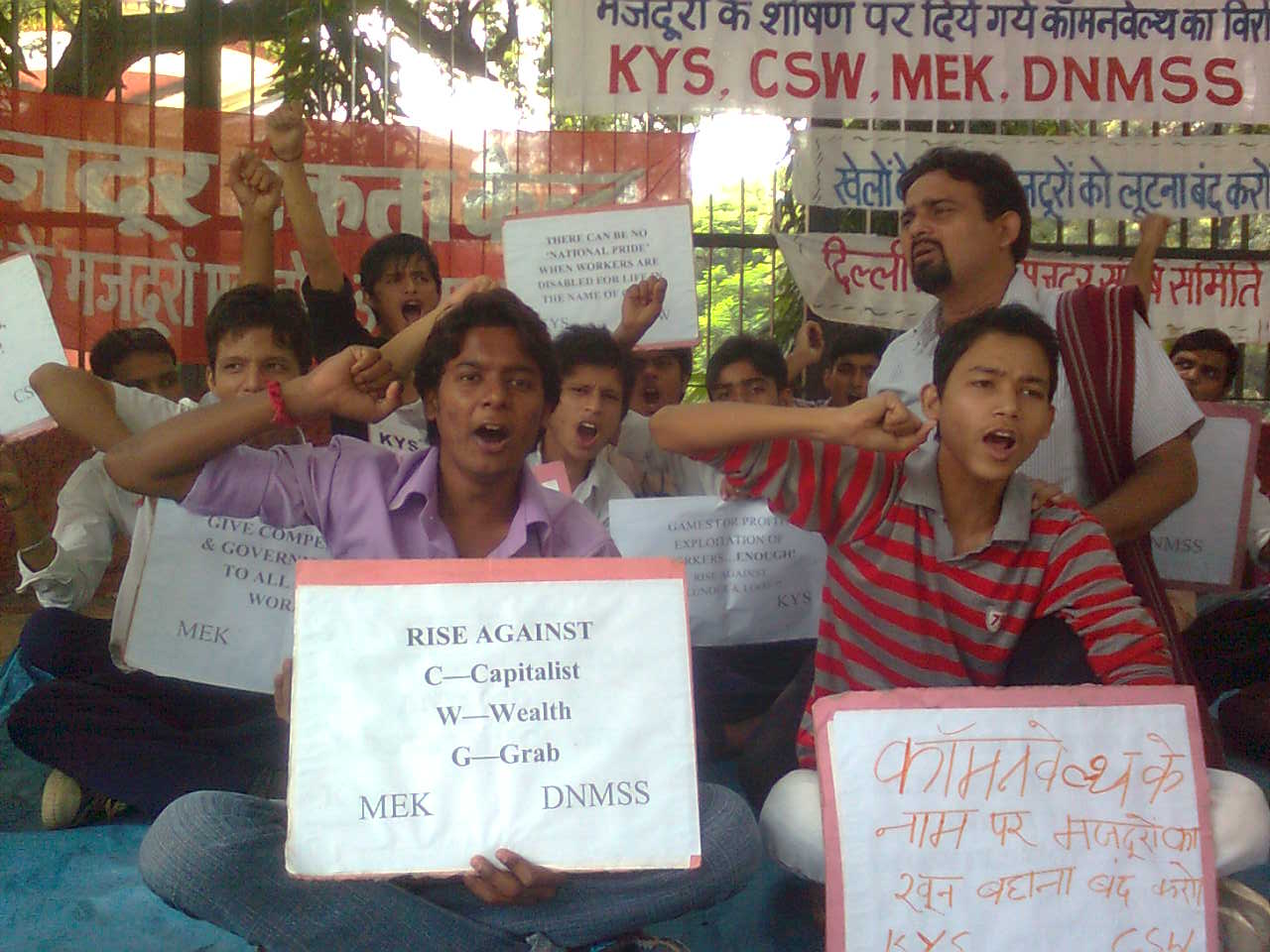
THERE IS NO ‘NATIONAL PRIDE’ IN WORKERS DYING OR BEING DISABLED FOR LIFE IN THE NAME OF COMMONWEALTH GAMES!

Dharna held outside Head Office of the CWG Organizing Committee against blatant exploitation of workers
Fact-Finding Team Visits Injured Workers: Shocked at Lack of Crucial Arrangements like a Help Line

Today on September 23, workers, trade unions, students and civil rights activists held a dharna outside the Head Office of the Commonwealth Games Organizing Committee in Jantar Mantar. This protest was called following the collapse of the hastily built footbridge outside JLN Stadium on September 21. The incident left 27 workers injured, five of whom are critically injured and admitted in AIIMS.

The protesters pointed to the obvious negligence on the part of government officials, and the fact that workers have been continuously exposed to dangerous work conditions across CWG work sites. They argued that the Games were being used to rake in huge profits for builders, many of whom acquired tenders surreptitiously from the government, and have unhesitatingly exploited workers and built structures of poor quality to save on building costs. Hailing the Games a profit-vending event rather than an event of ‘national pride’, Shri Alok Kumar (Secretary of Delhi Nirman Mazdoor Sangharsh Samiti), specified that contractors have made most of their profits by exploiting workers. He said that contractors have been openly exploiting construction workers by exposing them to long hours of work and dangerous work conditions. The government has been party to this exploitation since it is the principal employer in all CWG construction projects. Shri Nag Bhushan, a prominent trade unionist from Gurgaon also addressed the protest. He argued that that the government’s silence, and at the most its tardy response on the issue, has allowed for continuous and brutal exploitation of workers in the name of the Commonwealth Games.

It is for these reasons that the protesters targeted the Organizing Committee (OC). The delegation sent by them demanded the following:
i) Resignation of the state PWD Minister, Shri Rajkumar Chauhan
ii) Provision of government jobs to all 27 workers injured
iii) Immediate release of adequate compensation to all workers injured in CWG work sites.
iv) Cancellation of all contracts given to the accused construction company

Following the apathetic response of the OC the protesters decided to intensify the struggle against the exploitation of workers across CWG construction sites by using all democratic means possible. Trade unions present at the protest have decided to mobilize workers across all CWG worksites on the issue of workers’ blatant exploitation. Considering the fact that CWG organizers have repeatedly boycotted the interests of workers, workers have now decided to organize themselves and reach out to civil society in a bid to stall the Games completely. Through spontaneous protests throughout the period of construction work in CWG work sites, workers have rightfully delayed construction work of the CWG in the past. Now by providing their struggle an organized form they aim to expose to the Indian public, the brutality with which such mega events are organized and executed.

Following the protest at Jantar Mantar a fact finding team was constituted which visited the workers admitted in AIIMS. The team consisting of trade unionists, Delhi University teachers and students visited AIIMS and were shocked by the lack of crucial arrangements that should have been made by the CWG Organizing Committee. Out of the 8 patients hospitalized in AIIMS, 3 are admitted in the ICU (in critical condition, suffering from severe head injuries), and 5 have spinal injuries, out of whom one is already paralyzed. From the discussions with the patients’ relatives it was evident that no information was provided to them on the accident by the CWG Organizing Committee (OC) or Delhi Government. Relatives reached the hospital on hearing about the incident by word of mouth and no provisions were made by the OC/Delhi Government for their travel to Delhi! It was evident to the fact finding team that no volunteers from the OC were made available at AIIMS so as to help/guide relatives coming in to meet the patients. Indeed, the fact finding team itself had difficulty locating the workers in the hospital and ended up wasting crucial time before locating one of the injured workers. The apathy of the government officials was also revealed by the fact that some of the patients’ relatives have been asked to arranged for blood themselves. In its appraisal to the fact finding team, the AIIMS staff made it clear that the injured workers require long term rehabilitation.

The response of the Delhi Government is very shocking and their callous behavior (reflected in their unwillingness to provide proper facilities to workers injured in the name of CWG), is condemnable. We must highlight the terrible way in which workers have been exploited in the name of CWG. We hope that the larger civil society will step forward to help their laboring brethren.

Alok Kumar, Secretary, Delhi Nirman Mazdoor Sangharsh Samiti (Ph: 9313730069) Sujit Kumar, State Committee Member, Krantikari Yuva Sangathan (Ph: 9312654851)

Supported by:
Indian Council of Trade Unions (ICTU)
Centre For Struggling Workers in Trade Union (CSWTU)
All India Federation of Trade Unions (AIFTU)

The struggle of Ludhiana powerloom workers

Workers of about three dozen power loom factories in Ludhiana’s Gaushala, Kashmir Nagar, Madhopuri etc. areas are on strike from 16th September 2010 under the leadership of the Karkhana Mazdoor Union (KMU). The workers have revolted against their pathetic living conditions, total absence of labour laws, callous attitude of the factory owners and administration and the opportunistic behaviour of the established trade unions affiliated to parliamentary left parties. They are energised by the recent successful strikes in 42 power loom factories in Shaktinagar area and the Jindal Textiles factory.

Ludhiana is among the big industrial cities in India and the industrial capital of Punjab. The main industries here are hosiery, bicycle, tyre, auto-parts, engineering etc. In recent years the workers in Ludhiana have been fighting for their basic rights e.g. the struggle of the thousands of workers of the big factories of Ludhiana such as Hero cycles, Rockman, Avon, Rolson, Highway, Garetave, Bajaj Sons etc; the militant struggle of the thousands of workers against the factory owners and police-bureaucracy after the Hindustan Tyres episode; the outburst of anger of the workers in December 2009 after the Dhandari episode, the workers hitting the road after a recent disappearance of a workers of Poddar Tyres. These outbursts are just a reflection of the terrible conditions of the life which the workers of Ludhiana are forced to live and the total failure of the governance system to protect even the basic rights of the workers. The anger of workers is expressed at times spontaneously and at other times in a planned and organised manner. It is because of this reason that most of the time section 144 of the Cr. P.C. is imposed in the industrial areas of Ludhiana which prohibits assembly of five or more persons and holding of public meetings besides other restrictions.

Most of the workers of Ludhiana are migrant workers coming from the states of Uttar Pradesh and Bihar. They are treated as aliens in their own country. These workers are subject to abject poverty and extreme exploitation. Despite toiling for 12-14 hours a day, most of the time they do not even receive the minimum wages fixed for a helper for 8 hours work {Rs 3400 (less than 80 USD) monthly}. In case of the power loom workers, there has been no increment in the piece rates and wages for last 10-12 years while the prices of all basic necessities like food, housing, medical care, travel have been skyrocketing. On the other hand there has been manifold increase in the profit level of the factory owners.

The working condition of the power loom workers of Ludhiana is so difficult and so dangerous that it can at best be called inhuman. Serious injuries and deaths at workplace are quite common in the industrial areas. Even basic safety measures and regulations are not implemented by the factory owners. Even the administration does not take any initiative to fulfil its constitutional obligation of implementing the labour laws in these areas. On the contrary in most of the cases, the administration is found connived with the factory owners to serve their interests. No labour law whatsoever is implemented in these factories. Provident Fund, Employees State Insurance, Job Card, Attendance Register have no existence here. The regional labour department is fully hand in glove with the errant factory owners and is suitably compensated for its services. Not only the factory owners have bought up the officials and police, they do not even hesitate to use the services of goons to intimidate the workers if they raise their voices for justice. In the Dhandari episode in December 2010, they unabashedly used the local goons called Bikers’ Gang to brutally attack the agitating workers. Even the police favoured the factory owners and held the workers responsible for the violence. The owners portray any agitation of workers as being launched by “outsiders” and the local politicians and regional media also take the side of the owners only.

The workers of Ludhiana have been fighting for their rights for years through the established trade unions. But of late they have begun to realise that it is because of the betrayal of the leadership of opportunistic and corrupt trade unions such as CITU and due to the lack of well planned strategy that they have not been able to put up an effective resistance and the factory owners manage to crush their struggle. In a number of struggles of workers of large factories of Ludhiana such as Hero Cycle, Rockman, KW,Avon, Rolson, Highway, Bajaj Sons, Moonlight etc since 2004, the opportunistic, compromising, corrupt and pro-management character of CITU has been thoroughly exposed before the workers.

The recent surge of militant agitation among the power loom workers of Ludhiana began with the strike of the 42 power loom factories of Shaktinagar, Tibba Road areas on 24th August 2010 under the leadership of the Karkhana Mazdoor Union. It was the apathetic attitude of the power loom factory owners which was mainly responsible for the inhuman conditions of living which forced the workers to halt the work and choose the path of strike. The main demands of the workers were: hike in the piece rates/wages, necessary provisions for the safety of the workers and implementing all the labour laws including identity cards, PF, ESI etc. The bold, organised and determined fight of the workers forced the power loom owners to relent and they were forced to agree to the demands of the workers. On 31st August the workers withdrew their strike after a written agreement with the owners. It was a glorious victory of the workers after a long time. A remarkable aspect of this victory was that the power loom owners were not only forced to hike the piece rates/wages but they also agreed to give half wages for the days of strike. It is very rare that the factory owners agree to pay for the days of strike. On the contrary, one can find many instances in the labour movement of Ludhiana like the shameful Avon Cycle agreement in which due to the compromising, pusillanimous character of the renegade leadership, the workers were forced to work for 9 days without pay as a punishment for going on strike.

After this a strike broke out in the Jindal Textile factory and there too it reached a successful culmination. It is noteworthy that this was after 18 years that a workers struggle had achieved such success in Ludhiana. During the last one and a half decade the workers of Ludhiana had fought many long struggles but they culminated in shameful defeat due to the betrayal of the established trade unions. The recent victory is important in this respect and it has raised the morale of the workers to a new high.

Meanwhile, workers of some other power loom factories agitating under another union were brutally attacked by armed goons of the factory owners last week. Around 50 workers were wounded in this lethal attack, some of them seriosly. Karkhana Mazdoor Union has demanded the authorities to carry out an investigation and punish the culprits.

Taking inspiration from the recent successes in the Shaktinagar and Jindal factory strikes, hundreds of the power loom workers of about three dozen factories of Ludhiana’s Gaushala, Kashmir Nagar, Madhopuri etc also decided to call a strike on 16th September 2010 under the leadership of the Karkhana Mazdoor Union. These workers are on a strike to force the factory owners to increase their piece rate/salary and to implement other basic rights. They are united and determined to make their strike successful. They have appealed to the fellow workers of other power loom factories who are yet to join the strike to come forward and join the strike to make the struggle more united and strong. Along with this the workers have also organised vigilant squads of their own against the possibility of fresh attacks by the factory owners. A great achievement of these strikes is that the workers are no longer terrified of the police and the goons of the owners. Moulder and Steel Workers Union of Ludhiana has supported the power loom workers in their strike. The workers have also distributed pamphlets among the civilian population explaining to them their wretched working and living conditions and the rationale behind their demands. They have also appealed to other factory workers of Ludhiana to support and join their strike. The workers have warned the officials of the labour department not to work as stooges of the factory owners and perform their constitutional duties otherwise their strike will become more vigorous.

On the third day of the strike i.e. on 18th September 2010, the henchmen of a factory owner attacked the KMU members who were distributing the leaflets in a market and also kidnapped two workers. Immediately hundreds of workers gathered outside the factory where the kidnapped workers were being held. The owner ran away and the workers were rescued. This was another psychological victory for the workers.

Contact for further information:
Rajwinder – 098886 55663, Lakhwinder – 096461 50249
Email: lakhwinder0143@yahoo.co.in
Office: Karkhana Mazdoor Union, Shaheed Bhagat Singh Pustkalaya, Gali No.5, Lakshman Nagar, Gyaspura, Ludhiana, Punjab