
Workers’ Strike in Reliance Textile Industries, Naroda plant, Ahmedabad – A Report
February 8, 2012 by Leave a Comment

Highly exploitative wage structure and abysmal working conditions have led the over 5000 workers to strike work in the primary manufacturing plant of Reliance Textile Industries in Naroda, Gujarat, which is at a halt since 2nd February 2012. While the company posted its highest ever turnover of over USD 44 billion and its net profit increased to USD 3.6 billion, workers in the factory (‘dressing up India’ with ‘fabrics which make you feel like a millionaire’ its website says) which started this empire’s journey find their lives getting cheaper by the day. Spread over 120 acres and with assets of over 300 crore, this plant in Naroda Industrial Estate, located in a GIDC (Gujarat Industrial Development Corporation) near Ahmedabad is India’s ‘most modern textile complex’ (according to the World Bank) and Reliance’s first manufacturing facility set up by Dhirubhai Ambani in 1966. Producing the ‘Only Vimal’ brand and housing sophisticated machinery, it says it is ushering in ‘a new era in fabrics, include suitings, shirtings, home textiles’.

Workers’ Demand List
But the skeletons in its closet are coming tumbling out, as the most of the around 1100 permanent and 4000 contract workers assert their rights and continue their strike which started from the second shift on 2nd February. The company meanwhile responds with police deployment, intimidation, arrest of workers’ leaders and a media campaign which says that the workers have only been miffed for not being allowed to carry mobile phones inside the factory. On the first day of the strike itself, Modi’s willing police forced the striking workers away from the factory gate, and when they assembled in the shamshanghat complex, around 20 minutes away, were forced out of there too. Declaring the strike to be illegal, and arresting the leaders, police has posted itself in the factory gate.

Workers’ Demand List Contd.
According to the workers, for last 20 years (when the company’s profits increased ten-fold), the wages for the workers and karigars has more or less been the same, whereas the salary of the staff increased many times. While the permanent workers earn a paltry Rs. 5000-6000 per month, the contract workers are paid Rs.85-100 per day. No legality of payment in terms of pay slips etc. is maintained, only a voucher is signed. Overtime is paid in single rate, while strict surveillance is maintained and late entry is severely punished. For the last 20-25 years, two anti-worker unions have been there in the plant. One is ‘Majdoor Mahajan’, the union that was originally established by M. K. Gandhi after the Bombay textile strike in the 1920s and has many unions across Gujarat, and the other is ‘Mill Mazdoor Sabha’, affiliated to the Hind Mazdoor Sabha. The workers, fed up of both these Unions’ corrupt practices, say how they act as “extended office of the management”. Every three years, a settlement is brokered between these two Unions’ officials and the management, but workers are kept out of it and do not even get to know of the deal brokered. No notice is put up. Four years back, both these Unions even agreed to accept that there will be no recess hour for the workers to have tea. So the workers were henceforth forced to have tea on the way to the bathroom, and in the location of work in an unhygienic and dirty atmosphere, so that work is not disturbed and time ‘better managed’.
Workers strongly emphasise that the reason for the strike is not as the popular media reporting and management statements on it goes, that of the prohibition of mobile phone inside the factory. It is only to delegitimize their struggle, that they are sought to being portrayed as flippant, lazy, like the recent struggle in Yanam was decried as being done by anarchist ‘killer workers’, or how the Maruti Suzuki struggle was sought to be portrayed as ‘innocent young workers under the sway of outside elements’.
The demands and the inhuman working conditions from which they have arisen are clear to the workers. Even as the company site says that it ‘endeavours to create a workplace where every person can realise his or her full potential’, the workers specifically stress on the abusive language of the management staff. Though they have raised their demands again and again earlier, the workers now organized as Reliance Employees Union submitted a 16-point demand list to the management again during the strike, which include a 60% hike in wages and regularization of contract workers, besides double rate overtime, a 20% increase in bonus, increase of daily wage of contract workers to Rs. 200 per day, renewal of fixed salary system, uniform rights for wage board, tea-snacks in the canteen, no fine for 10 minute late entry, to fill accident forms according to procedure, an end to harassment of workers, and an assurance that striking workers will not be fired and no deduction of wage for the strike period is made.
Disregarding all these demands, the management apart from the disinformation campaign, has resorted to police force, arrest and intimidation on the striking workers and their leaders, and are now bringing in temporary workers from outside, paying them Rs. 400-500 per day, to show that the plant is running, though at much below its capacity. Continuing with their anti-worker stance, both the pro-management Unions were against the strike, but the majority of the workers emphasized the strong unity among striking workforce. “We have formed a new union named ‘Reliance Employees Union. The strike will go on till our demands are met”, said Hasmukh Patel, President of the new Union. The workers’ complete disillusionment and anger against Narendra Modi and his ‘vibrant Gujarat development model’, and against the Reliance management is becoming more and more evident, from their own experiences. Sagar Patil, a striking worker, said, “With 9.5 crore, the money we produced, Nita Ambani bought an IPL team. They are making jalsa with our money, but it pains them to even part a few thousands to us who produce.” No trade union, or political group or even the huge number of ‘humanist’ organizations in Gujarat have even made a single statement in favour of the workers till now, but the striking workers continue with their struggle.
For some Gup-Shup in Faridabad (February 7)
February 4, 2012 by Leave a Comment
To contribute to radical social transformations that are mushrooming all over the world, feel free about : stammering, fragmentariness, incoherence, missing steps….. Social (and natural) reality are very complex and dynamic. Leaps in interactions amongst seven billion human beings are on our agenda.
It is only in the present that we can act/prepare to act. What to do and what not to do, how to do and how not to do are coloured by the different facets/ sectionalities in the present and also carry deep imprints of the past (not only near and distant past but also different pasts of different locations/groups). So a request: Try not to be polemical; try not to attempt to clinch arguments; try to respect your own selves (by implication you will respect those around you). Primarily it is to act, it is for better actions that this gup-shup is premised on. “Cataclysmic event” language and imagery seems problematic; languages and imageries that are premised on active participations of seven billion human beings are indispensable for radical social transformations.
A technical constraint in the gup-shup is that we will be using mostly English language.
Some Statements Etcetera
* Small groupings of human beings called birth a shaap (curse) or the fall. Half of their numbers, females were described as sin personified. What was tragic for small groupings is today a tragedy for all human beings, for all living species, for the earth.
* It does not seem that something had to happen, rather possibilities and probabilities seems to be the norm. But, once a possibility gets concretized, it has a dynamic and trajectory specific to it.
* Relationship between a part and the (immediate) whole. Harmony and conflict between parts and the whole seem to be the norm. Small groupings of human beings embarked on a trajectory wherein the part attempts to control, dominate, mould the whole. Other-ing unleashed – series of “the other – others.”.
* Domestication of animals led to the domestication of human beings, slave owners and slaves.
* Deformation of communities, emergence of “I” with men as its official bearers. Man woman relations become very problematic. Today, by and large, women and children are also bearers of “I”. “Who am I?” has become a universal question.
* Certainty of death after birth becomes unbearable for any “I”. Attempts at immortality. Search for amrit (the nectar of life). Philosophies of rebirth, heavan, hell. Theories of lineage. Tragedies of Alexanders – great thinkers, great warriors, great artists, great sportspersons, great performers, great leaders…..
* From “who am I?”, we have entered a phase where there are many an “I” in each “I”. In the process of transcending “I” we seem to have come to the era of ekmev (unique) and ekmaya (together).
* Discriminations became rampant amongst human beings. It was a corollary of othering and dominating – controlling – moulding. All discriminations must be opposed. The question is: How? Discriminations are a breeding ground for all sorts of identity politics. An exemplary end-result is the constitution of the state of Israel. This is how discriminations are not to be opposed. The ways of opposing discriminations should be such that discrimination as such comes into focus.
* From domestication of animals to agriculture, from slave-owners and slaves to feudal lords and serfs increased the groupings of human beings that led tragic lives. Trade, long distance trade further increased these numbers. But during all this time large groupings of human beings lived in natural surroundings. It is only during the last two hundred years, it is only after steam and coal power was harnessed by human beings that a leap change began. Internal combustion engine, electricity, atomic energy, electronics magnified the leaps in the changes and have brought us face to face with their dire consequences.
* It was production for the market that led the onslaught. Artisans and peasants producing for the market using their own and family labour became redundant. For two hundred years now they are face to face with social death and social murder. Peasants and artisans in their Luddite incarnation in England attacked factories at night. Some of them were gunned down and hanged, many became wage-workers or shopkeepers or social outcastes, beggars etc., and many were forced out to the Americas and Australia. The mass displacements from Europe further increased the genocides in Americas and Australia. A corollary of the inability to tame-domesticate people in America – Australia was the massive increase in slave-trade in Africa, indentured labour in India, for production for the market.
* Steam and coal driven machinery had made large numbers of people in Europe superfluous. The entry of electronics in the production processes has made still more people superfluous….. Its impact on hundreds of millions of peasants, artisans, shopkeepers in Asia, Africa, South America is devastating and at an electronic pace. They have nowhere to go. There are no “empty americas”. Desperation borne of social death and social murder of peasants, artisans, shopkeepers is the cause of hundreds of thousands committing suicides and similar numbers taking up arms in various garbs. Napoleon’s army is miniscule vis-a-vis the militarization in the world today but it is still too small for the desperate hundreds of millions. So, besides state armies there are mushrooming proto-state armies. Desperations of hundreds of millions of peasants, artisans, shopkeepers is increasing the fragility of state apparatuses. Outside of western Europe, Japan and North America this is a very important social setting for attempts at radical social transformations.
* In the initial stage of production for the market using wage-labour, factories were owned by individuals. The unfolding of the process led to factories being owned by groups of individuals, by a dozen or so stock holders. The requirements for establishing and running a factory soon started demanding the pooling of resources by thousands. Share holding of thousands became the “owner” of the factories. Needs of increasing size and resources made share holding inadequate and loans emerged as the major source of funds for establishment and functioning of factories. Pension funds, insurance funds, bank deposits, financial institutions became de-facto owners of production enterprises with 80-85% of the investment coming from them and about 15% from shares. (A significant portion of shares is also held by these institutions). “Capitalist – personified capital” has given way to boards of directors, chairmen, managing directors, CEO’s as “representatives of faceless capital”. Being a state enterprise or corporate, company enterprise is not a significant difference. These changes in material production enterprises have by and large been replicated in other spheres of social life, be they be trade, education, entertainment, medical treatment. Craft-artisanal mode gave way to industrial mode and then its dynamics has followed. Factory mode is moulding all spheres of life throughout the world. (In long distance trade, the institutional form of organization, company preceded its emergence in material production.)
* The process of institutionalization has not halted with the dismantling of large factories. Instead of a car factory, we have auto hubs today. What is called a car factory is mainly an assembly plant. A vehicle manufacture today needs production facilities spread over an area with fifty kilometer radius. It requires a hundred thousand plus workforce. And the rapid changes that the institutionalization of research is bringing about makes it increasingly unviable. Today it is only in China that there are a few factories with a hundred thousand plus workers. The entry of electronics in production process started the dismantling of twenty thousand plus workers factories, the “workers fortresses” in the 1980s. With all the confrontations that it engendered, it is more or less over.
* Roots in artisanal guilds provided initial factory workers with trade/craft organizational structures to confront the new situation they found themselves in. These defensive organs of wage-workers were initially illegal. Over time they obtained legal status. They had a leverage vis-a-vis individual owners regarding wages and conditions of work. Emergence of joint stock and then share holding decreased the leverage of trade-craft unions. Their defensive and conservative roles in the changing scenario brought them on the sides of their governments in the mass slaughter during 1914 – 1919. Craft based trade unions were denounced by some radicals in 1919 and instead of trade based unions, factory based unions were attempted as alternative form of workers organisations. We have had some experiences of factory based unions during 1980 – to date. We began looking at industrial unions as workers organisations with misleaders at their helm. In our experience we found factory unions functioning almost like another department of the factory. Managing workers was the job of the unions and good functioning of the factory was seen as good for the workers of that factory. With the introduction of electronics in the production process in factories, from the beginning of 1990s large scale restructuring took place in Faridabad. What was earlier seen largely during long term agreements between managements and unions became blatant in 1990-2000 period. In factories ninety percent plus workers had been permanent. Large scale retrenchment of permanent workers took place in many factories and in most of the cases unions were openly standing with the managements. Engineered strikes and lockouts were the means in these major attacks on factory workers. From these experiences when we look back at the 1982 Bombay textile strike in which 250,000 workers were involved, it seems to us that it was an engineered strike. The composite textile mills with their spinning, weaving, processing, dyeing and printing departments have vanished from Bombay-Mumbai. What would have taken decades if it were slow attrition was done in one blow. The composite textile mills of Indore, Gwalior, Faridabad, Delhi, Hissar, Kanpur, have also vanished. And cloth production in these twenty five years has grown exponentially. In this vein it seems to us that the coal-miners strike in England in 1984-85 was another engineered strike that saw the number of coal miners come down from 100,000 to 10,000. Another example could be the longshoremen strike in the US which resulted in drastic reduction in permanent workers and matched the needs of containerization. Today when we look back, 1980 – 2000 appears ancient to us. Factories in Gaziabad, NOIDA, Delhi, Gurgaon, Faridabad are largely run by temporary workers. In direct production process five to thirty per cent workers are permanent. In the national capital region in India (and things are not different in other parts) seventy-five to ninety-five percent factory workers are temporary workers. There are factories where not even one worker in 300 is permanent – only the staff has permanent status. And amongst these 80 percent temporary workers, three-fourths are “invisible” workers. Almost 75 percent workers in factories in the NCR do not exist in company and government records, be it garments or auto or pharmaceuticals or chemicals, things are the same. Factory unions, where they exist, have only permanent workers as their members. 90 percent factory workers in the NCR do not fit in the union structure. The increasing number of temporary workers is a global phenomenon.
* Given the changes in the ownership patterns of factories, given the breakup of a product in hundreds of factories, given the composition of factory workforce today, given the existence of industrial areas with thousands of factories, and given the linkages among factories across the globe, co-ordination among workers needs to expand across factories and industrial areas and span the world. New types of activities and new kinds of organisational practices are needed.
* A pointer is the recent occupations of Maruti-Suzuki car factory in Industrial Model Town, Manesar. Inaugurated in February 2007, all the workers in the factory are in their twenties. There are 950 permanent workers, 500 trainees, 200 apprentices, 1200 workers hired through contractors for work in direct production process and around 1500 workers hired through contractors for various auxiliary functions. The pace of work was such that a car was being assembled in 45 seconds. Some permanent workers attempted to organise against the existing union in the company. Strong-arm tactics of the management gave rise to a wildcat occupation of the factory on June 4, 2011. The company and the government were taken aback. The occupation continued for 13 days. During the occupation many bonds developed between the permanent workers, trainees, apprentices and workers hired through contractors. The company was forced to take a step backwards and revoke termination of 11 workers for production to restart. After the occupation there was a dramatic change in the atmosphere in the factory. The company was forced to plan and prepare to re-establish its control on the shop floor. On August 28, a Sunday and a weekly day off, 400 policemen came at night to the factory. Company staff had arrived earlier. With steel sheets, the factory was secured in military fashion. On 29th morning when workers arrived for their 7:00 AM shift, there were notices announcing dismissals, suspensions, and entry premised on signing of good conduct bonds. All the workers stayed out of the factory. This is the chess game well rehearsed by managements to soften workers and re-establish control. The company had gone to distant industrial training institutes and hired hundreds of young boys. Workers from the company’s main factory in Gurgaon were also taken to Manesar. Arrangements for their stay inside the factory were made. Already 400 policemen were staying in the factory and large number of guards were hired from Group 4 security company. Staff was made to work in 12 hour shifts with the new workers. Musclemen from surrounding areas were paid to bully workers. Attempts were made to instigate workers to violence. Central trade unions tried to take leadership of the workers. Workers’ representatives were called for negotiations and arrested…… The workers refused to be instigated. All kinds of supporters came to the factory gates where the 3000 workers did 12 hour, back to back sit-togethers. Many kinds of discussions took place. Bonding between different categories acquired new dimensions. The workers’ refusal to be instigated led the well-rehearsed chess game to a dead end. The company was forced to side-step and sign a new agreement. The permanent workers, trainees and apprentices entered the factory on October 3, but the 1200 workers hired through contractors were not taken back. The company’s attempt to divide the workers received a serious thrashing when, on the afternoon of October 7, workers of A and B shift, who were inside, occupied the factory. This time it was not just the occupation of Maruti-Suzuki factory, simultaneously 11 other factories in Industrial Model Town, Manesar, were occupied by workers. “Take back the 1200 workers hired through contractors and revoke the suspension of 44 permanent workers” echoed and re-echoed all around. Again the company and government were taken aback. Despite the presence of 400 policemen and hundreds of other guards, Maruti-Suzuki factory was occupied by workers. The simultaneous occupation of 11 other factories opened up new possibilities with thousands of factories all around. Pressure was applied and occupation of seven factories was called off, but it continued in Suzuki Powertrain, Suzuki Casting, Suzuki Motorcycle factories, besides Maruti-Suzuki. It was only on October 14, after the deployment of additional 4000 policemen, that workers vacated Maruti-Suzuki factory and Suzuki Powertrain was vacated by the 2000 workers when they were surrounded by a police force of 4000 inside the factory. For details, see July 2011 to January 2012 issues of Faridabad Majdoor Samachar (and also the forthcoming February issue).
* The company and the government have not been able to understand the activities of Maruti-Suzuki workers (and other factory workers). Ripples were widespread and the dangers were very visible to the government. A third agreement was forced by the government, with it also becoming a signatory. The 1200 workers hired through contractors were taken back. Not having understood anything of what happened, the company gave significant amount of money to 30 workers it considered troublemakers, for their resignation. (And later propagated the deal as bought-sold.) Production recommenced in the 4 factories on October 22. Afraid of any and everything, the company has been giving concessions to workers. Now instead of 45 seconds, the scheduled time for making a car is one minute.
* Important questions dealing with life, time, relations, representation, articulation, factory life under scrutiny that the occupation of October 7-14 brought to the fore, in the words of a Maruti-Suzuki factory worker, are: “The time in Maruti-Suzuki factory during October 7-14 was extremely good. There was no tension of work. There was no tension of coming to the factory and going back.There was no tension of catching the bus.There was no tension of cooking.There was no tension that food has to be eaten only at 7 o’clock or only at 9 o’clock.There was no tension as to what day or date was that day. Lots of personal conversations took place. We had never come so close to one another as we came in these seven days.” From October 7-14 there were 1600 workers inside the Maruti-Suzuki factory, and 1200 outside the factory. When the bought-sold issue of 30 workers made the rounds, a Maruti-Suzuki worker said, “Earlier we used to pass on the issues to the president, general secretary, department co-ordinator – they will tell. But now every worker himself answers. On every issue, everyone gives his opinion. The atmosphere has changed.”
* Increase in accumulated labour, exponential increase in accumulated labour has sidelined personified forms and brought the social relation in its faceless form to the fore with presidents, prime ministers, chairmen, managing directors, CEO’s as its representatives. In this scenario, person has become increasingly insignificant. Whether a person is or she/he is not has become almost the same. But at the same time, in contentions between accumulated labour (dead labour) and living labour, each person has become increasingly important. Active participation of 90 percent plus of those directly concerned has become indispensable. Representation and delegation have become redundant / counter-productive.Lagta hai ki ekmev aur ekmaya ka yug dastak de raha hai. (It seems that the era of unique and together is knocking at the door.) Radical transformations are demanding the active participation of seven billion people, both as each a unique being and all together.
Faridabad Majdoor Samachar is a monthly publication in Hindi language and at present 10,000 copies are distributed each month by and large amongst factory workers in Okhla (Delhi), Udyog Vihar (Gurgaon), Industrial Model Town Manesar and Faridabad. Some rough translations in English are available at . Texts in Hindi are also on the internet via Gurgaon Workers News. In English we have published : 1. An Abridged Version of Rosa Luxemberg’s “The Accumulation of Capital”; 2. A Ballad Against Work; 3. Reflections on Marx’s Critique of Political Economy; 4. Self-Activity of Wage-Workers: Towards A Critique of Representation & Delegation; 5. Questions for Alternatives.
Faridabad Majdoor Samachar
Majdoor Library
Autopin Jhuggi
N.I.T. Faridabad – 121001
India
Ph. – 0129-6567014
Discussion And Reading Team of Socialists, Bhubaneswar (Second meeting) – A report
January 17, 2012 by 1 Comment
Discussion and Reading Team of Socialists (DARTS)
On Commodity Fetishism
The second meeting of DARTS was held on 30-12-2011 from 5:00p.m to 7:00p.m. at XIMB, Bhubaneswar. Prof. Raju Das of York University began his talk with a Power Point Presentation on Marx’s theory of ‘fetishism of commodities.’ Fetishism of the commodity, according to Marx, means that ‘the relationships between producers, within which the social characteristics of their labourers are manifested, take on the form of a social relation between the products of [their] labour’. In his talk he explained this idea with a simple example using export-oriented shrimp production in Orissa. The conditions of the shrimp producers, as that of numerous other workers, in Orissa (as elsewhere), are simply bad. The work they perform in producing the shrimp as a global commodity not only fails to fetch them enough money for their daily maintenance. The production process oriented towards producing the maximum amount of exchange value (profit) for the shrimp producers/traders is inscribed on their labouring bodies: chemicals used in the process affect the (women) workers’ fingers so badly that they cannot even eat with their hands. When the shrimps are in the market, every buyer, including the buyer in advanced countries, wants to get the maximum counts of shrimps for every rupee/dollar she has in her pocket. Doing this is in her own material interest. The buyer (who is also a producer of other commodities, be it a service or a physical commodity) does not care about the conditions under which shrimp workers work. And the buyer does not care because her own conditions of work and wage-level, like those of the shrimp-worker, are beyond her own control. So, it is as if shrimps and other commodities start talking in the market. The actual people who produce those commodities are not directly and socially interacting. It is immaterial whether or not people know the conditions of shrimp producers because given their own position they have to command a maximum amount of the commodity (e.g. shrimp) they want for every unit of the commodity they own (or its money form). There exists, in the words of Marx, ‘the social relation between commodities’ and ‘material relation between men.’ In Prof. Das’s words: “commodities rule over us instead of ourselves ruling over articles of use to us.” Relations between commodities replace – or at least, become much more important than – relations between people, i.e. people-as-producers of things-for-use.
Then Prof. Das explained the aspects of Ideology using I.I.Rubin (author of Essays on Marx’s Theory of Value), Terry Eagleton (author of Ideology) and Slavoj Zizek (author of Sublime Object of Ideology). Marx’s ideas of fetishism are connected not only to his ideas about alienation (partly in the sense that fetishism – the rule of commodities over us — happens because of the absence of democratic social regulation over production) but also ideology: the objective reality is such that we think that things for use necessarily have a money-tag and have to be bought and sold (for a profit) and we behave accordingly. The reality – and not (just) our discursive inability to comprehend it – is such that it makes us think that our needs can only be satisfied through commodity exchanges. Commodity fetishism is not our failure of intelligence. It is an intelligent failure. The commodity form hides the real social relations from us. It acts as a veil. And, in the words of Marx: ‘The veil is not removed …. until [the production process] becomes production by associated [producers], and stands under their conscious and planned control’ (Marx). The question is what is to be done to make this happen. Marx, of course, ends Capital Vol 1 with his most definitive answer to the question. Marx’s discussion of the commodity (dealt with in the inaugural meeting of DARTS) and of fetishism clearly shows that if we want to understand the capital and the society it dominates we must understand Marx (and his Capital).
There was an audience from several disciplines – students and teachers of Technology, Literature, Economics, Business Studies, etc. A number of political and civil rights’ activists were also present. Interesting questions were raised and discussed in the meeting. The questions included: ‘What is the distinction between objective and intrinsic in the context of value?’; ‘In a particular village, where people know each other and produce agricultural products and consume them, how is the theory of ‘fetishism of commodities’ relevant?’. What is the distinction between concrete labour and abstract labour, and why is such a distinction important? One perceptive member of the audience and a senior scholar explicitly linked the idea of fetishism to alienation, building on early Marx’s writings.’
There was an active participation as each participant found Marx relevant in her/his field of work and/or area of interest. All the questions posed could not be addressed properly due to the lack of time, which meant that there was a great need for several rounds of discussion on such concepts as the commodity and fetishism.The discussion had to be limited to commodity fetishism; there was no time for a discussion of the other form of fetishism in Marx’s work: capital fetishism.
The DARTS provisional organizing committee has decided to meet on the 29-01-12. The topic to be discussed was proposed to be ‘Labour-power as commodity.’ The time and venue will be conveyed by e-mail.
We collectively hope that we will continue to discuss important ideas of Marx both from the standpoint of their theoretical value and from the standpoint of their ability to shed light on contemporary issues facing the humanity. We also hope that there will be reading teams such as ours in many other cities and towns of Orissa and India.
Migrant Workers Rally in Gurgaon, Haryana (Jan 8, 2012)
January 9, 2012 by Leave a Comment
• Support the struggling workers’ demands for minimum monthly wages of Rs.11000 in the area of Gurgaon.
• Stop the practice of imposing overtime on single day wages.
• Stop the use of contractors.
• Change conditions inside the factory like the use of harsh words, unequal wages for women, an ever increasing target, delays in payment, misuse of ISIPF money, employment without contracts, ill-treatment of women, imposition of overtime.
These are the demands that the Gurgaon Pravasi Mazdoor Union have taken up at the rally organized on 8th January at Udyog Vihar in Gurgaon. The union hopes to change working conditions in the factory and organize workers of the industrial belt of Gurgaon to fight for a minimum daily wage of Rs. 425 (Rs.11000 per month) as the first step towards a larger struggle against the factory owning class and the state. Workers from all walks of life will be part of the union so that these demands and the struggle to achieve them shall spread to the various sectors of the industrial belt.
To be consequent as an Internationalist New Year 2012
January 2, 2012 by Leave a Comment
Ron Ridenour
Expanded speech written for “Message from the Grass Roots” conference held December 10, 2011 at Carpenters Union—TIB—in Valby, Denmark. Herein are many wars and liberation struggles from Afghanistan and Iraq, Pakistan, Palestine, over to Haiti and Honduras, to Sri Lanka-Tamils, to the pro-liberation and anti-capitalist movements in the Arabic world, in Chile, at OWS and spreading throughout the US and into some of Europe, sparking Russians.
“To be internationalist is to pay our debt to humanity”
Says Fidel Castro and this can be read on many billboards in Cuba.
What is internationalism?—cooperation among people and nations, states my dictionary. The book of definitions maintains that internationalism is a principle of communism and socialism. It is the belief of ideological leaders such as Lenin, Fidel and Che.
Che wrote in his essay, “Socialism and Man”, that proletarian internationalism isn’t just a duty but a necessity. If revolutionary leaders forget this, Che wrote, the revolution will lose its inspiration and imperialism will benefit.
Che was also known for having severely criticized Soviet Union leadership for having lost its internationalism with the world’s proletariat and the Third World. Following up on Che’s critique, I find it important to criticize communist and socialist parties, and governments led by these parties, which let down people who are oppressed by or invaded by national or foreign powers.
Internationalism in action
1. Internationalists must support resistance fighters against invasions. Therefore, one must chastise political parties and groups that give political or moral support to those who call themselves the Iraq Communist Party as it is part of the Quisling government the USA terrorist state set in. ICP leaders live side by side the invaders in the Green Zone. That there are organizations in the United States, UK, Denmark and elsewhere, which call themselves communist or socialist parties and that cooperate with the world’s greatest terrorist state is incomprehensible, shameful, immoral and anti-internationalist.
2. The same applies to people who still support the Zionist state of Israel, which commits genocide against the Palestinian people. Millions of decent people have gotten together to support Palestinians in many ways, including Ships to Gaza. In Denmark, four groups of people have challenged the state’s terrorist laws by donating solidarity aid to the secular leftist PFLP which is part of the Palestinian resistance. Rebellion (Denmark), Fighters and Lovers, Horserød-Stuthoff Association (veterans of WWII resistance fighters imprisoned in Horserød and Stuthoff prisons), and TIB’s club (local carpenters near Copenhagen) have aided both PFLP and FARC, Colombian armed liberation movement.
3. Internationalist can not cooperate with US-NATO aggressive wars, which always have the goal of controlling that country’s economy and politics for capitalist profits. It is shameful that many experienced socialists and communists, as well as naïve progressive people, have backed up West’s big capitalist plans to take over Libya, and thus have bombed Libya back to the stone age. Denmark was one of only six countries that dropped tens of thousands of bombs on Libya, destroying much of it infrastructure, school, hospitals…In fact, Denmark dropped more bombs on Libya than it has on any other country in its history, Afghanistan included. And the pilots were cowards as there was no resistance by Libya’s air force, already decimated.
This conflict has little to do with the Arab Spring movement. It is a conflict between internal war lords, with ordinary people involved who wished to increase democracy but who were misled by US-NATO whose forces seek to control Libya’s oil and avoid a gold-based currency that Gaddafi was promoting amongst all African countries. Now, US-NATO has placed a lackey government in Tripoli just as they did in Afghanistan and Iraq.
4. Internationalists must also criticize comrade governments, such as Cuba and ALBA governments in Latin America, when they make big mistakes regarding internationalism. We can’t be true comrades-solidarity activists by keeping our mouths shut when this occurs. Such is the case with their support of the brutal government of Sri Lanka, which practices genocide against the minority Tamil population. Ever since independence from Great Britain, in 1947, the majority Sinhalese governments and chauvinist Buddhist monk system has discriminated against Tamils. They have constantly been treated as second class citizens, their language and religions relegated to secondary status without national recognition. Even pogroms have been employed with the brutal murder of many thousand on various occasions. And since May 2009, following the end of 26-year civil war, ethnic cleansing in the traditional Tamil homeland in the north and eastern areas is the rule of the day.
Cuba and ALBA have spoken only positively of their historic ties with the Non-Aligned Movement (NAM), to which Sri Lanka is a member, but so are 130 other nations. One cannot, in the name of protecting each nation’s sovereignty, avoid critique when one or more of these nations oppresses or conducts pogroms and genocide against part of the population. Nor can we accept as an excuse the immoral geo-political game that nearly all governments of whatever color play.
We shall also criticize Bolivia, Uruguay, Brazil and other Latin American progressive governments for helping the US and France in their ouster of the only decent and only democratically elected people’s president in Haiti’s history, Jean-Bertrand Aristide. These Latin American governments actually assist the US’s 2004 coup d´état against Aristide by placing occupying troops in the small country, seeking to dampen the people’s anger. These progressive governments should, instead, back up the people’s desire to bring their president back to state power, just as they sought to do for President Zelaya in Honduras where national capitalists and generals kicked him out of office, with background support once again by the United States government.
5. On the personal and organizational plain, internationalism operates when workers of a major firm ask people to boycott a product because of the mistreatment of the workers by the firm. This is the case with Coca-Cola who workers in Colombia asked us to stop buying the “drink of the death squad” (David Rovic’s song), because it hires mercenaries to murder workers who seek to organize a union and struggle for collective bargaining. Workers in other countries, such as Guatemala, and farmers in India have asked the same.
It is with joy that I can state that here where we gather (carpenters’ hall in Valby, Denmark), this union is one of the few local unions and political or grass roots groups in Denmark that has boycotted Coca-Cola. This is something any and all individuals can do. It is just a soda drink. So drink something else. Boycotting Coca-Cola is just like boycotting all products from Israel and Sri Lanka. It is a simple act of solidarity, of internationalism.
Charlotte and I have just returned from a six week trip in India where two of my books (“Tamil Nation in Sri Lanka” and “Sounds of Venezuela”) were published by New Century Book House, Tamil Nadu. The Tamil book concerns the history and contemporary life of the Tamil people in that island-nation, and the need to act in solidarity with them. The Venezuela short book concerns this people’s efforts to create a better world for themselves and solidarity with all peoples. When people asked us where we are from we often replied that we are “internationalists”. Interestingly, many Indians understood our meaning and were pleased to think in terms of being brothers and sisters in the world.
This concept, and feeling, of brotherly love, of internationalism has taken off in a bigger way, in 2011, than in many decades. It started in Tunisia, and has expanded to the indignados in Spain, to the anti-capitalists in Wall Street and in hundreds of cities throughout the US and the West.
We have much to criticize and yet much to be glad for as 2012 opens. We must remember and appreciate those who set us off on this new anti-capitalist/anti-imperialist, non-violent and democratic revolution—from the martyr in Tunisia (street vendor Mohammed Bouazizi) and his Iraqi spiritual brother a bit earlier, shoe-thrower Muntazar al-Zaidi, to Occupy Wall Street protestors to Bradley Manning and Julian Assange and co-workers at Wikileaks, who helped spark it all by blowing the whistle on the war criminals. These modern-day Paris Commune resisters without arms—OWS and Occupy the World—are growing and they are presenting a vision and with it a program-in-discussion that must be studied and supported.
Internationalism is an endless struggle, an endless challenge. It does not end even when one or more of our political parties take over the governing reigns. We activists from the streets must always keep our wary eyes pinned on the leaders, regardless of their names, just as our clear eyes cast light upon humanity’s future.
Bhubaneswar: Discussion And Reading Team of Socialists (DARTS) – December 30
December 28, 2011 by Leave a Comment
The second meet of ‘Discussion And Reading Team of Socialists'(DARTS) is to be held on the 30-12-2011 at Xavier Institute of Management (XIMB), Bhubaneswar Room No. 229 from 5p.m to 7p.m. In the first meet Prof. Raju Das from York University, Toronto delivered a short talk on the relevance of Marx’s Capital and on Marx’s Labour Theory of Value followed by discussion among the participants. Marx’s Capital is an essential read for activists and intellectuals alike. The analysis of the commodity in the first chapter ‘Commodities’ is, as Marx claims, the point from where he begins his analysis/critique of capitalism (see Marx’s Introduction to first edition of Capital). It requires more effort understanding this chapter than the rest of Capital. Prof. Das, in the second meet of DARTS will deliver a small talk on the last section of this chapter ‘the fetishism of commodities and the secret thereof’ after revisiting the initial section of the chapter. We request you to be present for discussion.
P.S: In the third meet the discussion team is supposed to meet after reading Chapter I (or a part of it — this shall be decided in the second meet). The date, time and venue will be let known via e-mail.
Please send your suggestions to darts.bhubaneswar@gmail.com
Protests and Repression: Struggles Growing in the Forest Areas
December 28, 2011 by Leave a Comment
Campaign for Survival and Dignity
The last few weeks have seen struggles over forest rights and forest control intensifying across the country. On the one hand there are larger and larger protests taking place, and on the other, the continued use of force by Central and State governments is combined with total silence and apathy on protecting people’s rights.
Campaign member organisations have planned a series of yatras and protests in Rajasthan, Gujarat, Maharashtra, Madhya Pradesh, Chhattisgarh and Orissa in the coming weeks. The Jangal Jameen Jan Andolan has undertaken a yatra in Rajasthan, crossing Udaipur, Dungarpur, Banswada, Sirohi, Pali and Pratapgarh districts between December 20 and 28th. On December 29th demonstrations will be held in all block headquarters that have been covered. The demands are for respect and recognition of community forest rights, a halt to illegal rejections and modifications of titles and respect for people’s democratic resource rights over their lands, forests and minerals. Meanwhile, more than 1,000 people rallied and ten sat on hunger strike in Dahanu, Thane District, Maharashtra on December 7th and 8th against violations of people’s rights under the FRA; the hunger strike was called off after a written commitment from the SDO. A similar mass protest was held in Gadchiroli, Maharashtra on December 19th against the illegal imposition of conditions on titles for community forest rights. Yatras are also planned in western Maharashtra and Gujarat in January; on January 19th and January 26th mass demonstrations will be held in district headquarters in Chhattisgarh and Orissa respectively. These latter protests will also oppose the land acquisition bill and call for democratic control over resources.
Aside from these plans, other protests and mass struggles are underway. On December 15th, a “People’s Forest Rights Rally” was organised at Delhi by a coalition of organisations. In the POSCO area, more than 20 people were injured and one killed in an attack on December 14th by a contractor’s private goondas; unsurprisingly, on that day alone, the police were nowhere to be found. In Assam the Krishak Mukti Sangram Samiti is leading a mass struggle against the illegal and dangerous Lower Subansiri Dam project, in which huge numbers of people have joined; but on the night of December 25th the police arrested more than 200 people in a raid and are continuing their attacks. The KMSS has also been involved in struggles against the ongoing repression and violence around Kaziranga National Park, where forest guards regularly shoot those they accuse of being “poachers.” Brutality and violence continues to mark the situation in Chhattisgarh, where the extremely brutal torture of Soni Sori – and the indifferent response of even the Supreme Court to it – gives the lie to all the tales about respect for the “rule of law” and how it is being enforced by “security forces.” Chhattisgarh has also seen a string of recent illegal evictions from forest land. In north Bengal, an organised effort to take control of community forests is facing opposition and resistance from the Forest Department.
In addition, planning is underway for the declaration of new tiger reserves and relocation of people from them in violation of the law. Mass protests have begun in Kawal Sanctuary to resist the proposed illegal conversion of this sanctuary. In Tadoba Tiger Reserve, Sarang Dhabekar, a Steering Committee member of the National Forum of Forest Peoples and Forest Workers was arrested and slapped with false cases because he had been involved in resistance to illegal relocation efforts.
The Campaign condemns this ever-increasing repression and the brutal use of force against those who are fighting for justice. Once again, we see all talk of “rule of law” and “democracy” being brushed aside in the hideous loot of natural resources by the ruling class of this country.
Blind Workers March in Delhi
December 3, 2011 by 1 Comment
Sunil Kumar, Blind Workers Union
(A Unit of All India Federation of Blind Workers)
Affiliated to Workers Unity Center of India, WUCI
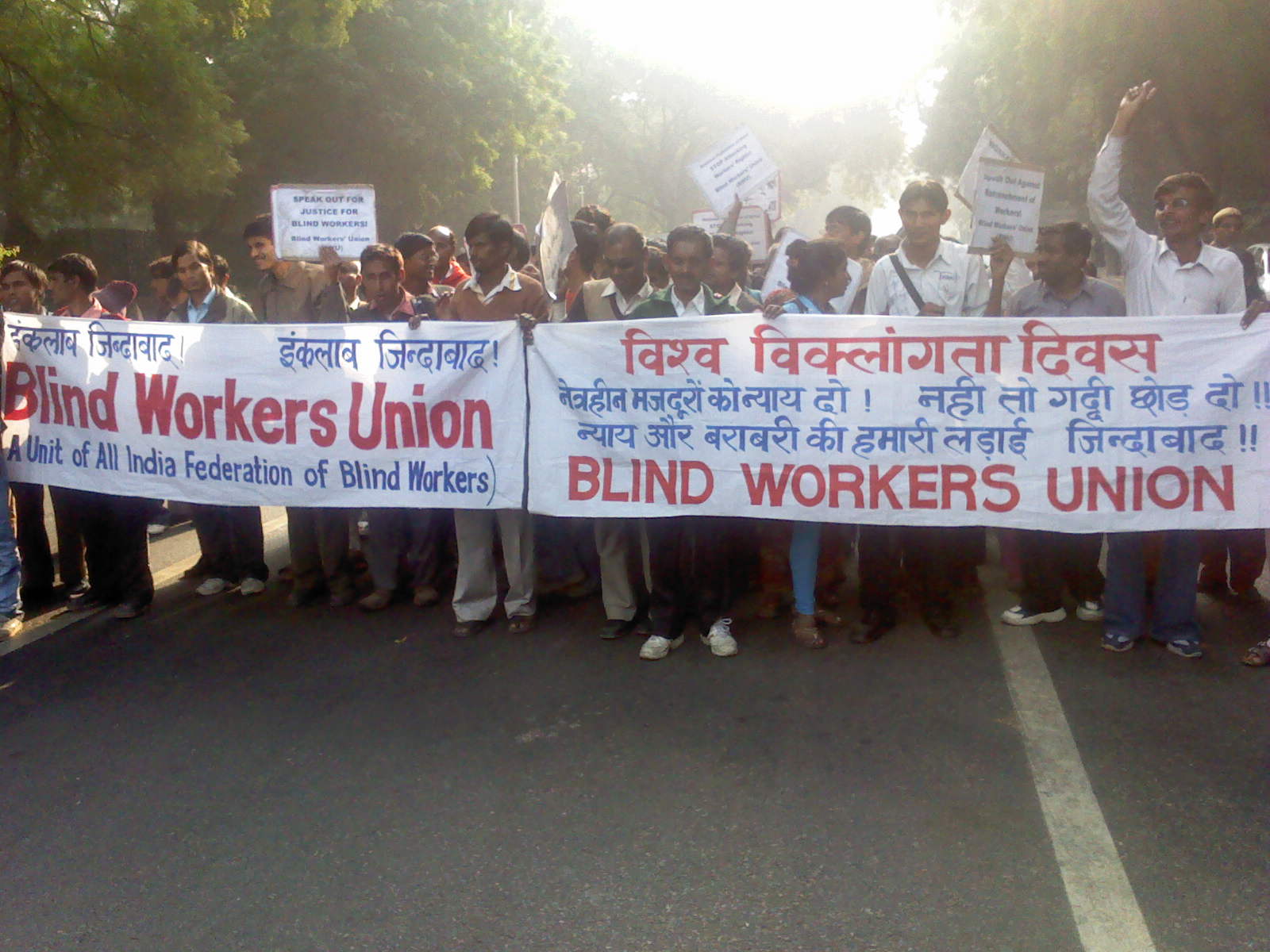
Today, on December 3, 2011, more than a thousand visually challenged workers from Benaras, Nasik, Kanpur, Faridabad, Bahadurgadh and Delhi participated in a massive protest rally on Parliament Street. Their rally was taken out from Jantar Mantar to Parliament Street on the occasion of World Disability Day. It was a culmination of an earlier struggle these blind workers have carried out against a well-known NGO which employs and exploit them, i.e. the National Federation of the Blind (NFB). The rally was an extremely important moment for these workers since they were using World Disability Day to expose how they were still denied many fundamental rights at workplaces. Instead of celebrating this day in the usual festive manner, these blind workers celebrated World Disability Day as a black day, which marked unfulfilled promises of equality.

Initially, the Delhi Police refused to allow the rally to proceed to Parliament Street. However, the agitated workers refused to be held back and broke free of the barricades so as to march onto Parliament Street. Quite expectedly, their fiery spirit did not mellow down, despite being manhandled. Following their protest rally, a delegation of the workers submitted a memorandum to the Hon’ble Minister of the Ministry of Social Justice and Empowerment, Government of India. The delegation met the concerned minister, Shri Mukul Wasnik, and apprised him of plight of blind workers. They drew the minister’s attention to the fact that the government was doing little to prevent the rampant violation of its own laws pertaining to disability. In particular, the workers highlighted the violation of several provisions in the Persons with Disability (Equal Opportunity, Protection of rights and full participation) Act of 1995.
When discussing matters with the Minister, the workers highlighted how section 33 of this Act, which provides 3% reservation in identified posts (1% being earmarked for the blind and low vision persons), is unable to provide sufficient respite to the disabled because of inadequate job creation in the public sector itself. Another important provision in this 1995 Act which is far from being implemented is section 41. It provides incentives to disabled persons so as to ensure that at least 5% jobs of all workforces goes to them.
However, as highlighted by the protesting workers, both the older laws and policies as well as the newest government policies are failing miserably when it comes to ensuring a dignified and productive life to disabled people, in particular, disabled workers. For example, even the recently adopted National Policy for Persons with Disabilities (2006), which provides incentives, awards, tax exemption, etc. is redundant because the private sector which employs a large number of disabled workers, is least interested in implementing such policies, let alone statutory labour laws pertaining to minimum wages and parity at work. In fact, the promise of the National Policy for Persons with Disabilities (2006) to create one lakh jobs is still a mirage today. In this light, the recommendations of the Sudha Kaul Committee which was constituted to help frame a policy on disability, are also flawed. This Committee, for example, has made no recommendations with respect to labour rights relating to safety when assisting in the drafting of the Right of Persons with Disability Bill, 2011.
The gathering of workers on Parliament Street was addressed by aggrieved workers (those employed by National Federation of the Blind) as well as their leaders. Shri Alok Kumar from the All India Federation of the Blind addressed the gathering, and argued how shameful it was that National Federation of the Blind was also commemorating World Disability Day when this NGO itself exploited the impoverished blind workers. He went on to argue how necessary it was for the government to create more jobs opportunities for disabled workers, and how the government should ensure that all statutory labour laws are implemented in production centres run by “social service” organizations (like NFB) as well as other employers. Indeed, almost every blind worker who stood up to speak, emphasized that NGOs like NFB as well as other employers, act as if they are doing the blind workers a favour by employing them. In reality, as employers they earn huge profits from the labour of these workers. NGOs, in particular, also amass huge amounts of funds from the Government/foreign funding agencies by using the face of these poor blind workers.
It is with the express purpose of attaining greater job opportunities for disabled workers as well as parity in work conditions and wages between blind workers and sighted workers that the spirited rally of blind workers marched onto Parliament Street.
Contact: 9313730069
Email: blindworkersunion@gmail.com
Demo to protest Kishanji’s murder (Dec 2)
December 1, 2011 by 1 Comment
We strongly condemn the brutal and cold-blooded murder of Mallojula Koteshwara Rao alias Kishanji by the security forces in the Burisole forest area of West Bengal.
Now it is very much clear from various sources that the Maoist leader Kishanji was first captured and severely tortured by security forces and then killed in a planned fake encounter under the connivance of both West Bengal and central governments. Mamata Banerjee government of WB has used almost the same weapon of ‘Peace Talk’ to eliminate the Maoist leader as by the R. S. Reddy government in AP.
It is a known fact that the central and various state governments are jointly conducting a special military operation to suppress Maoist activities. The unjustified and irrational killing of Kishanji is nothing but a part of state terror being unfettered under ‘Operation Green Hunt’, centrally controlled by the UPA government. It is a clear cut violation of not only the guidelines given by Supreme Court and National Human Rights Commission but also by different international institutions.
It is to note that the state is not only killing the Maoists and their supporters but also viciously suppressing all voices of dissent, especially of democratic and revolutionary forces. We strongly feel that Naxalism / Maoism cannot be suppressed by killing its propagators / leaders and organizing massacres of its supporters.
So, we demand that:
1. The central and state governments should immediately stop ‘Operation Green Hunt’ and physical elimination of Naxal /Maoist leaders and cadres.
2. The central government should set up a high level Judicial Enquiry Committee on the killing of Kishanji.
3. The government should register a case of culpable homicide under section 302 of IPC, so that the killers of Kishanji are forced to face the court trial, as directed by Supreme Court and National Human Rights Commission.
We call upon all the progressive, democratic and revolutionary forces to come together and oppose the killing of Kishanji and the suppression of people’s movements.
We, the undersigned have decided to organize a Protest Demonstration before the Bang Bhavan, 3, Hailey Road, New Delhi-110001 on 2nd Dec. 2011 at 12 PM to show our united anger against state oppression. We appeal to all the pro-people forces to make this Protest Demonstration successful by joining it in huge number.
Signed by:
1. Arjun Pd Singh, PDFI
2. P.K. Shahi, CPI(ML)
3. Narender, Peoples Front
4. Thomas Mathew, Bahujan Vam Manch
5. Shieo Mangal Sidhantkar, CPI(ML) New Proletariat
6. Ashish Gupta, PUDR
7. Anil Chamaria, Journalist
8. Amit, krantikari Nawjawan Sabha
9. G.N.Saibaba ,Revolutionary Democratic Front
10. Mrigank, Navajwan Bharat Sabha
11. Harish, Inquilabi Majdur Kendra
12. Alok Kumar. Krantikari Navajawan Sabha
13. Deepak Singh, NDPI
14. Mritunjay, CCON
15. Banojyotsna, Democratic Students Union
16. Kusumlata, Student For Resistance
17. Bijunayek, Lok Raj Sangathan
18. Ambrish Rai, Social Activist
Contact: 9868638682, 8800356565, 9873315447
 Radical Notes