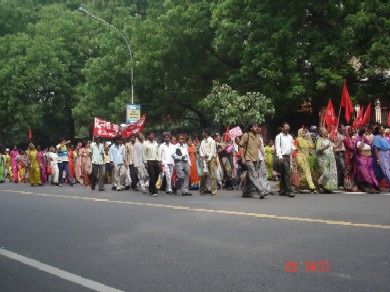
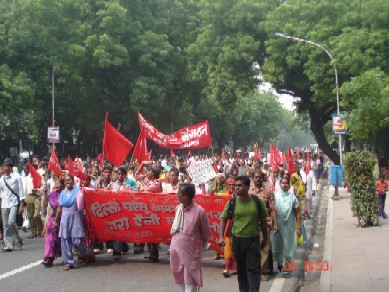
A Report on the Workers’ Struggle in Graziano Trasmissioni

Rajesh Tyagi

This report is based upon an interview of two workers of Graziano Trasmissioni, namely Kapil Kumar and Ajay Dwivedi. Kapil belongs to Saharanpur, Uttar Pradesh (UP) and had joined in 2003 as apprentice, after completing his ITI. He worked 8/9 months under contractor, which was a sham and then was given permanent appointment in 2004. Ajay Dwivedi was employed in 2006.

Graziano Trasmissioni at Noida is a subsidiary of a multinational company based in Italy.

The company had started its operations in Noida, UP, in 2003 with a capital of less than 20 crore rupees, which grew over to more than 240 crores in 2008. This extraordinary accumulation of wealth is the result of the super exploitation of the workers employed at this establishment.

Lalit Kishore Chaudhary, its Chief Executive Officer (CEO) has been instrumental in the establishment and growth of the company.

Industrial activity in the establishment continued round the clock, initially in two shifts of 12 hours each, i.e. 6 am to 6 pm and then 6 pm to 6 am. Though working hours were limited to 8 hours and the workers were paid overtime for an additional 4 hours, but overtime was made compulsory for workers. No weekly off day was being given. Those refusing to comply were thrown out of employment.

Initially 350 permanent workers were employed as Operators cum settlers, with 80 Trainees/apprentices. About 500 persons work under the labour contractors mostly for the job of packaging.

The very first dispute arose as the employers used to make deductions from the wages on false pretexts.

On 233 December 2007 the first protest of workers started on the issue of demand for a rise in wages and against the deduction of wages by the employers on the ground that the entry card was not properly punched. Though it used to happen due to a technical fault in the punching system, while subsequent punchings in the day were duly recorded, yet the employers in order to harass the workmen used to deduct the wages, on this false pretext. The workers protested.

Getting wind of the workers being organised and striving to form a union, 3 workers were barred by the employers from entering the premises and one Manoj Kumar was terminated. The management refused to recognise the union, while the authorities at Kanpur kept the application of the workers pending in collusion with the employers.

4.12.2007. Protesting against the high handedness of employers, 100 more workers were locked out by pasting a notice of the lockout outside the gate.

7.12.2007. A settlement took place between the parties, only to be repudiated by the employers later on. The workers’ protest went on.

AITUC, the trade union front of the Communist Party of India, with whom the workers were affiliated, agreed with management to restore normalcy first and then negotiate, which the workers rejected. After this the AITUC abandoned the workers.

24.1.2008. In the face of the struggle of the workers, the employers were constrained to enter into a written settlement with them in the presence of the Deputy Labour Commissioner (DLC), Noida etc. On behalf of the workers 5 elected representatives participated, among them – Rajender, Kailash Joshi, Pankesh Sharma, Ram Charan and Mohinder. A homogenous wage revision was agreed upon with an increment of Rs. 1200/- in the current year, Rs. 1000/- in the second year and Rs. 800/- in the third year.

February 2008. However, immediately after this settlement, the employers brought in 400 workers under the local contractors namely Virendra Bhati, Manish and one Bhardwaj. These contractors with a force of 400 at their disposal, started to bully the workers. From 2008, these 400 workers began to reside inside the factory premises. The said contractors had also gathered iron rods, sticks and other weapons inside the premises, to terrorise the workers and obviously to deal with the agitating workers, if need be. Apart from this a whole battalion of armed goons in the name of ‘security’ was also employed under a contractor. It became clear, thus, that the employers were planning to throw out the permanent workers and to substitute them with these contract workers.

May 2008. To pick up a dispute and provoke the workers the employers refused to employ 5 worker Trainees/ apprentices and ousted them from the premises on the pretext that they had handled the job of ‘settling’ of the machine without instructions. It was pointed out that no such written instructions for ‘settling’ job were given to any of the workers. The same was part of the ordinary job duty. The workers then insisted that from then onwards instructions for ‘settling’ jobs were to be issued in writing. The workers also demanded that the 5 ousted workers be taken back.

Instead of taking the 5 workers back on the rolls, the employers suspended 27 more workers. The Production Manager Amar Singh Baghel was also ousted on the charge of being in collusion with workers.

The employers had intentionally switched off the reverse exhaust fans inside the workshop which resulted in an immense increase in the indoor temperature. To ensure that no workman even took a breath during duty hours, CCTV cameras were installed, and violators were immediately ousted.

The workers protested against the aforesaid unfair labour practices and made complaints to the concerned authorities but without any result. Authorities acted hand in glove with the employers. The workers also demanded 3 shifts of 8 hours instead of the two of 12 hours each. Everything fell on the deaf ears of the employers and the competent authorities.

30-31/5/2008. A disturbance started on the instigation by Virender Bhati, the local muscleman of the employers under cover of being a contractor. A totally false police complaint was made by the employers against the workers for affray, and 30 more of them were locked out. Workers could be released after depositing personal bonds of Rs.1,00,000/- (one lakh) each, with the Sub-Divisional Magistrate (SDM), NOIDA, which is very unusual and extremely excessive amount.

19.6.2008. Instead of paying any heed to the legitimate grievances of workers, and in order to harass and terrorise the workers, 35 more of them were locked out. With this a total 97 workers were ousted, while 192 continued inside out of the permanent workers. By this time the workers were affiliated to CITU, the trade union front of the CPI(M), which agreed to the proposal of the employers that first of all normalcy be restored and the protest outside the gate be ended, and then after a month the employers would think of reinstating the workers. The workers did not agree to this and then the CITU also abandoned the workers. However, the protest of the workers continued.

In the meanwhile workers affiliated to the HMS, the trade union front of the Rashtriya Lok Dal, with one Virender Sirohi as their leader.

1.7.2008. A meeting between the employers and HMS took place in the office of the DLC, in which Sirohi agreed to normal working on the 2nd, 3rd and 4th of July, 2008.

2.7.2008. The employers instead of complying with this locked out the remaining 192 workmen as well. The workers were constrained to resume their protest. A dharna took place at the DLC office for 7 days, then 3 days before the District Magistrate (DM) office, a march was undertaken from Surajpur Chowk to the DM office and finally a dharna at the Italian embassy was organised, but the entire machinery remained totally insensitive towards the cause of the workers.

Several times the dispute was negotiated at the DLC office or the police station, but only to be repudiated by the employers on one or the other pretext or intrigue.

11.7.2008. A settlement was arrived at the DLC, Noida Office, in the presence of the SDM and CO Dadri.

13.7.2008. The workers joined work at the factory pursuant to the settlement and to show their bonafides.

The next meeting was fixed at the DLC office on 16.7.2008.

16.7.2008. Out of the 27 suspended workers the employers reinstated only 12, while they terminated the services of 15 workers. This was apparently a device to divide and crush the workers, one by one.

55 more were notified to be reinstated, but were locked out the very next day on the pretext of their coming late at 9 am instead of 6 am.

The employers also obtained an injunction form the Court preventing the workers from agitating within 300 metres of the factory premises.

The Labour Commissioner came to Ghaziabad from Kanpur. The workers met him and complained about the partial and callous attitude of the DLC, Noida. The Commissioner entrusted the matter to the DLC, Ghaziabad.

4.9.2008. A meeting took place at the DLC office, Ghaziabad took.

16.9.2008. Another meeting took place in the office of the DLC, Ghaziabad between the employers and the HMS. None of the elected representatives of the workmen was present in the meeting. It was agreed that the workers would tender an apology. The DLC, Noida directed the workers to tender an apology on or before 22.9.2008.

18.9.2008. The workers went to tender an apology but the employers told them that they would call the workers on 22.9.2008. The DLC refused to take the apology in his office.

22.9.2008. As the workers gathered to tender apology, they were told that two workers at a time would go inside the ‘time office’ to tender apology. Inside the time office, armed security and local goons had already taken up their positions. The workers were told to specifically admit in their apology that they had indulged in sabotage and violence. Some workers wrote this down, but the others refused. Anil Sharma, a time officer slapped one of the workmen for refusing to write the apology in the desired format. A scuffle started and the workman was beaten up by the security personnel.

On hearing the commotion, the workmen present outside entered inside. Unable to prevent the workmen, one of the managers ordered the security and goons present inside to attack the workmen. They attacked and the securityman fired from his gun at the workmen. Several workmen, about 34, were injured in the scuffle.

Jagmohan Sharma, Station Officer, Bisrakh Police Station remained present with his force but did not intervene on the behest of the employers who had conspired to beat up the workmen. He has since been suspended for ‘dereliction of duty’.

People from both sides were then rounded up by the local police, but those on the side of employers were let off while the workers were kept in custody. Later, it transpired that the CEO of the company had also got one head injury, allegedly in the scuffle, which proved fatal. It is also stated that some of the goons engaged by the employers to deal with the workmen, had double crossed them and acting at the behest of some rival industrialists had killed the CEO, taking benefit of the chaos perpetuated by the employers.

However, the employers who were desperate to dismiss the regular workmen got an opportunity to implicate the workmen in the murder and thereby get rid of them. The local capitalists, corporate media, bureaucracy, all avowed enemies of working class, united to defame the workers and implicate them. 63 workers have been implicated for conspiring and participating in the killing of the CEO while 74 other have been implicated for rioting, affray etc.

2.10.2008. The workers staged a sit-in protest at Jantar Mantar against their victimisation.

16.10.2008. Another protest in support of workers was held at Jantar Mantar at the behest of labour organisations in Delhi and its environs.

Courtesy: Revolutionary Democracy
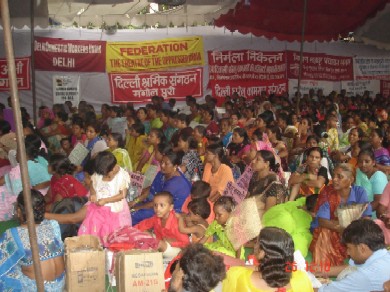
Counter-terror Operation at Jamia Nagar

Shabnam Hashmi, Satya Sivaraman, Manisha Sethi, Tanweer Fazal, Arshad Alam & Pallavi Deka

A team comprising activists, academicians and journalists visited the site of the police operation against alleged terrorists staying in an apartment in Jamia Nagar in the afternoon of 20.09.2008 (Saturday). Two alleged terrorists Atif and Sajid, along with Mohan Chand Sharma, an inspector of the Delhi Police’s Special Cell died in the operation while a third alleged terrorist was arrested.

On the basis of our interactions with the local residents, eye witnesses and the reports which have appeared in the media, we would like to pose the following questions:

1) It has been widely reported (and not refuted by the Police) that in early August this year Atif, who is described by the Delhi Police as the mastermind behind the recent terrorist bombings in Jaipur, Ahmedabad and Delhi, underwent a police verification exercise along with his four roommates in order to rent the apartment they were staying in Jamia Nagar. All the five youth living in the apartment submitted to the Delhi police their personal details, including permanent address, driving license details, address of the house they previously stayed in, all of which were found to be accurate.

Is it conceivable that the alleged kingpin behind the terrorist Indian Mujahideen outfit would have wanted to undergo a police verification- for whatever purpose- just a week after the Ahmedabad blasts and a month before the bombings in Delhi?

2) The four-storeyed house L-18 in Jamia Nagar, where the alleged terrorists were staying, has only one access point, through the stair case, which is covered by an iron grill. It is impossible to leave the house except from the staircase. By all reports, the staircase was taken over by the Special Cell and/ or other agencies during the counter-terror operation. The house, indeed the entire block, was cordoned off at the time of the operation.

How then was it then possible, as claimed by the police, for two alleged terrorists to escape the premises during the police operation?

3) The media has quoted ‘police sources’ as having informed them that the Special Cell was fully aware about the presence of dreaded terrorists, involved in the bombings in Jaipur, Ahmedabad and Delhi, staying in the apartment that was raided.

Why was the late Inspector Mohan Chand Sharma, a veteran of dozens of encounter operations, the only officer in the operation not wearing a bullet proof vest? Was this due to over-confidence or is there something else to his mysterious death during the operation? Will the forensic report of the bullets that killed Inspector Sharma be made public?

4) There are reports that towards the end of the counter-terror operation, some policemen climbed on the roof of L-18 and fired several rounds in the air. Other policemen were seen breaking windows and even throwing flower pots to the ground from flats adjacent or opposite to L-18

Why was the police firing in the air and why did it indulge in destruction of property around L-18 after the encounter?

5) The police officials claim that an AK-47 and pistols were recovered from L-18.

What was the weapon that killed Inspector Sharma? Was the AK-47 used at all and by whom? Going by some reports that have appeared (see ‘Times of India’, 20.09.08), the AK-47s have been used by the police only. Is it not strange that alleged terrorists did not use a more deadly and sophisticated weapon like the AK-47, which they purportedly possessed, preferring to use pistols?

We feel that there are far too many loose ends in the current story of the police encounter at L-18 in Jamia Nagar. We demand that a fair, impartial and independent probe into the incident be initiated at the earliest to answer the above questions as also any other ones that arise from the contradictions of the case.

Media Circus of the Encounter

Yousuf Saeed

I have titled this message the ‘media circus’, although I am actually referring to this morning’s (September 20) so-called encounter killing of two young people referred to as ‘terrorists’ in L-8 Batla House, Jamia Nagar, by the Delhi police. I call it media circus because that’s what I think it really is, like many more such incidents.

The incident happened in my neighbourhood, about 150 meters from my house. So I have the opportunity to see how things are turning up. I had gone out of the area for some work while the incident was taking place around 11 am, but found it impossible to reach back home 2 hours later, because the road for about 1 and a half kilometre (on both sides) was completely blocked, not by the police vehicles, but by the parked OB vans of the countless TV channels, some of which I never heard of before. Each of these vehicles had its generators on, and thick video cables jetting out of them for several meters to the other end where the cameraperson and the excited anchor were shouting how two terrorists have been killed in the fierce encounter. Most local people are surprised at the speed with which the TV crews arrived here and in such large number. Apparently, the Delhi Police had already told a section of the press they are going for a raid in Batla House, based on the suspect Abu Bashir’s tip-off (I heard this from a anchor on Times NOW channel, although Police chief Dadwal is now denying there is any link with Abu Bashir), but they didn’t obviously say it was going to be an encounter. Its strange that the local residents got to know about the incident only after the two people had been killed – many in fact learnt it from the Aaj-tak channel. They claim they heard only the police firing and no gunshots from inside the flat, which the police claim have injured two of their constables.

Most of you watching news TV in your homes may have already heard the cacophony of the TV anchors, each trying to be shriller than the other to prove that the local members of the Indian Mujahideen have been killed. They now seem to have memorized their lines on this issue well, since they have to repeat the same thing again and again. The graphics, animated logos, crawling tickers, and dramatic music/soundtrack to go with such coverage are always ready in the cans to be used at short notice. A cameraman running towards Batla House is nibbling at a burger while he holds on to a camera in his other hand. I saw two members of a TV crew outside the Holy Family Hospital (where the injured policemen have been taken) fiercely fight about which camera angle would look best for a sound byte. Everything looks as if planned and part of the usual business. The cops are happily allowing the media to climb any wall to get the best shot while they beat the local rickshaw pullers to leave the roads clean. The message has got across loud and clear: we told you – Batla House is a haven of terrorists.

But many things sound fishy. I’ve been hearing a lot of angry conversations in the neighbourhood: people are asking that if the police had only planned a simple raid (which they did 2 days ago in Zakir Nagar and Abul Fazl Enclave too), why did they have to bring battalions of police and encounter specialists with AK-56 and other deadly looking guns (that I myself saw) in advance. And why is the media called in even before the residents are told. Of course the fact the this happens in the month of Ramzan, on a Friday, and near a large mosque where people were going to gather in large numbers later for prayers, sounds just too predictable and clichéd for anyone’s imagination. The local people claim that it was a stage-managed encounter. However, their claim is less likely to be taken seriously after the death of Inspector Sharma.

I didn’t find a single local resident who is not fed up with this oft-repeated image of Jamia Nagar as harbouring terrorists. But none of the channels I saw aired the public angst against their portrayal.

To be honest, one shouldn’t deny that the Batla House area has some criminal and anti-social elements, just as Darya Ganj or Shahadra or Govindpuri would have. But most local residents believe that for Jamia to become a haven of such criminal elements, the local police and land-mafia are equally responsible. Jamia area is one of the rare localities of Delhi where the rule of law doesn’t apply in most spheres. The land mafia openly indulges in illegal construction; no rules of traffic apply here, the condition of civic amenities is abysmal. Illegal shops, factories (many with child labour) and businesses operate here actively with police connivance. The local politicians (MLA, councillors) are actually part of the problem rather than the solution. There is a full-scale illegal ISBT (bus stand) running in Batla House’s backyard to bring hundreds of migrants everyday from small towns of UP (you can see the police openly accepting bribe from its operators any day).

There is no question of sealing whatever the heck business you may run here, and most places stink with heaps of garbage everywhere. There are no RWAs or citizen’s initiatives to discuss the problems. It is truly a manufactured ghetto of Delhi – why don’t all these problems happen in Lajpat Nagar or Kalkaji? I am positive that the authorities are aware that criminals (or what they call terrorists) exist here. But they deliberately allow them to thrive here – never to be touched in the normal/peaceful times – keep them for the right time. It is as if Batla House is a laboratory or breeding ground where things are allowed to grow by providing all the required ingredients and safety. The fruits are plucked only when they are ripe (or required). So today, they simply came to gather the fruit they had sown, and made a big exhibition of it by calling the media. The local people, frightened that the next encounter may happen in their house, simply squirm and hide in their personal ghettos.

In all this, a big responsibility lies with the media, and I am yet to come across bold and honest reporters who are ready to go beyond the obvious and investigate the truth – not simply repeat what is told to them by the authorities or their channel bosses.

A Dangerous Convergence

Pratyush Chandra

Prominent sociologist Dipankar Gupta’s cynical article in The Times of India (Aug 30, 2008) is itself an expression of middle-class disenchantments, which he talks about. And Buddhadeb with his frank anti-worker statements is undoubtedly in his brigade. In his anti-communist verbosity displayed in the article Gupta does exactly what he criticises. For him “the poor has never revolted”; it is the leadership, which everywhere rises in her name. Ironically, even to deny that the poor has ever revolted, it is a middle class intellectual like Gupta who has the privilege to proclaim this! Obviously in his discourse “they” will remain as “they” – “Why They Don’t Revolt”. So why should we accept his privileged denial about the poor(wo)man’s revolt, if he censures us for accepting the socialists’ claim that s/he does revolt, on the ground that they are elites?

According to Gupta, since the leaders came from the middle class or elite families the revolutions couldn’t be popular. This shows his ignorance about political processes, including class processes. Obviously he cannot be faulted for this, the disciplinarian divide that characterises the bourgeois academia does not require him to see things holistically (that’s the job of a generaliser, not an expert) – he is after all a sociologist! How can he understand that revolts/revolutions are conjunctural – their character is not simply determined by the membership of their leadership rather by the societal stage in which they occur? How can he understand that the process of class-ification, not the fixed descriptive sociological classificatory pigeonholes, allows revolutionary intellectual organicity to individuals from diverse backgrounds? How can he understand that revolution is not only a moment but also a process which comprises many “guerrilla fights” against “the encroachments of capital” before and after the “revolutionary moment” passes away? This was Marx’s understanding of the “revolution in permanence” or Mao’s notion of a “continuous revolution” or Lenin’s “uninterrupted revolution”.

Obviously within the commonsensical notion of revolution, for which the OMs (Official Marxists, as Kosambi characterised them) are most responsible, the 1949 event in China paints into insignificance the Hunan peasants’ self-organisation and struggle (as marvellously described by Mao in his Hunan Report) or the processes that constituted “Fanshen”, “Shenfan” and the Cultural Revolution. Within this framework a revolution loses its processual character, and is reduced to a moment and even a few elite figures. But why should we expect Dipankar Gupta to go beyond common sense? After all he is a “middle class” solipsist who sees the world made in his image – his class dominating everywhere, doing everything.

In fact, we can find a deep resonance between Gupta’s analysis and India’s chief security advisor MK Narayanan’s recent McCarthyist indictment of intellectuals. Both experts (in their respective fields) attempt to reduce movements to agencies, however the former does it as an expression of his academic cynicism, while MK Narayanan to find scapegoats to curb grassroots militancy. But both converge at a dangerous moment.

Yes, Prof Gupta, you are right – that really hurts!

Delhi Domestic Workers Union

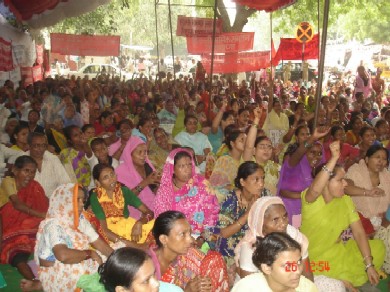
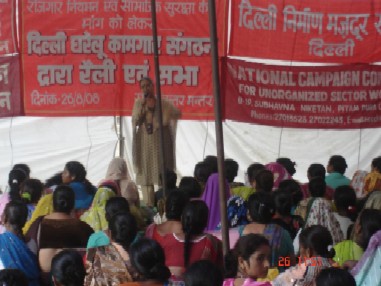
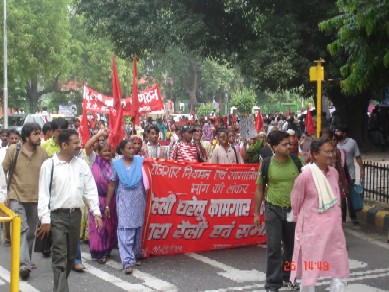
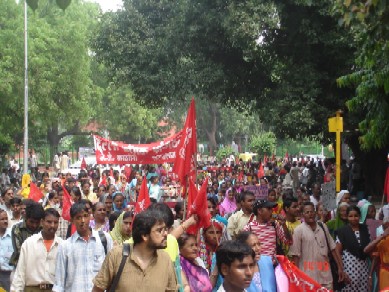
The Delhi Shramik Sangathan, a federation of Construction Workers Union & Car Cleaners Union along with its constituent organization Delhi Domestic Workers Union jointly organized a rally on Tuesday, 26th, Aug’08 at Jantar Mantar, New Delhi. Around 1500 domestic workers attended the rally and submitted a memorandum to Prime Minister, Labour Ministry and the Lok Sabha Speaker.

DSS Rally 1

DSS Rally 2

DSS Rally 3

The rally was addressed by several eminent political leaders, Union leaders, scholars and social activists.

DSS Rally 4

Anita Juneja, convener of Delhi Domestic workers unions welcome the participants at rally and urged the domestic workers of Delhi to increase the pace of the movement so that domestic workers could become a political forces to reckon with. She said that around seven-eight lakh strong workforce of domestic workers in the city is working at paltry sums of Rs 1200 – 1500 per month and live in semi-human conditions of bondage and starvation. They are victims of constant verbal and sexual abuse without any grievance redressal mechanism. Worsening their situation is the city administration’s brutal eviction drive – dislocating and destabilizing the lives of the very people without whom the city would come to a crippling halt. This disruption of people’s lives has led to children being the worst victims with an absolute denial of basic health care and education. Spending the meagre resources available to them to tackle continuous illness, the children by the age of ten are also forced to join as domestic help to contribute to the paltry income of the family. In the absence of any provision of maternity benefit, pension, ESI, PF, Gratuity, health facilities, crèche at work site etc these workers are forced to continue with no security of work.

DSS Rally 5
DSS Rally 6

The union along with Nirmala Niketan approached the National Commission of Women (NCW) to raise the issue at the national level. A subcommittee was formed by NCW to draft the bill on Regulation of Employment & Working Condition of Domestic Workers. The draft prepared was discussed during the National Consultation on Domestic workers organized by NCW on 14th-15th of March’08 at New Delhi. The recommendations of the consultation have been finalized. Now the recommendations need to be incorporated in the Bill drafted by the Sub-Committee of NCW and the final shape of the Bill need to be sent to the Central Government as recommendations of the NCW.

DSS Rally 7

Details of the NCW proposal

Under the proposed law a tripartite Board is to be formed by the State & Union Territories governments. This Board will register all employers, domestic workers and Placement Agencies. Board will collect its fund mainly from the registration of employers. Rs.1000 per year will be collected from the employer of live-in full time domestic Worker and Rs.200 per year from the employer of part time domestic Worker, which will add to about rupees one hundred crore rupees per annum in Delhi alone. In addition the Board will collect a nominal fee of Rs.100 per annum from the live-in full time domestic worker and Rs 20 per year from the part time domestic worker. Rs.100 per placement per year will be collected from the placement agencies besides a lump sum fees and security amount depending upon the number of annual placement done by an Agency.

DSS Rally 8

The Board will provide an identity Card, bank account, regular medical check up, shelter in crisis & sickness, provide working conditions, dispute regulation, regulation of placement agency, keep full record of domestic workers which will check and prevent child labor in domestic work and help in tracing trafficked girls to prevent trafficking for domestic work.

The demand of the Domestic workers is to accept Domestic Work as ‘Work’ and Domestic Worker as ‘Workers’ and lend it the dignity and reorganization of labor. Consequently all benefits and rights that accrue to workers must be extended to this huge workforce (of which no census statistics are available) so far unprotected by any labor legislation. Minimum labor standards should be applied to achieve decent conditions of work and a living wage by including domestic workers as unorganized sector worker as the Central Government representatives assured the Supreme Court of India in a PIL on behalf of Domestic Workers.

DSS Rally 9

The rally demanded that –

1. The legislation proposed by the National Commission for Women be called The Domestic Workers (Regulation and Conditions of Employment & Welfare) Act;

2. The Domestic Worker Act should provide for compulsory registration of Employers, Domestic Workers and all service providers, including placement agents/Agencies and contractors;

3. The Tripartite Boards of Domestic Workers should constitute State/District level Committees for complain against sexual harassment at work place which should also provide protection for women going about to work as Domestic Workers;

4. Domestic Workers should also be registered at the source area and regulation of employment along with ID cards be done, also at source;

5. Minimum age of employment should be 16 years;

6. Tripartite Boards of Domestic Worker to be set up to regulate employment conditions, social security and welfare measures. The board should be authorized to constitute dispute resolution councils and Appellate Authorities;

7. Tripartite Board of Domestic Worker should have 50% representative of Domestic Workers directly elected by the registered domestic workers and 25% representatives of related department of Central and States Governments such as Labor, Child and Women Welfare, SC/ST Welfare, Social Welfare etc. and 25% representatives of employers and Resident Welfare Associations;

8. Tripartite Boards of Domestic Workers should be authorized to formulate guidelines for regulating employment and working conditions for domestic workers going outside India as domestic workers and provide social security to them;

9. All Labor laws to apply including Minimum wages Act, Payment of wages Act, Workmen’s’ compensation act, Accidents benefit Act, etc. and any such legislations applicable to industrial workers;

10. Tripartite Boards of Domestic Workers will be authorized to file complains/FIR etc. on behalf of Domestic Workers where the Domestic Workers is not in a position to file a complain;

11. Rights to inspection of workplace and living space by individuals / groups / organizations as assigned by the Tripartite Board of Domestic Workers;

12. Tripartite Boards of Domestic Workers will primarily depend upon the registration fees collected from Employers, Domestic Worker and Placement Agencies but till enough fees is collected the government must make adequate budgetary provisions for implementing the Act either as grants or loan.

Contact Address: c/o- Flat No-231, Pocket-A, Sector-13, Ph-II, Dwarka, New Delhi-110075. Ph-011-28031792; email- delhidss@gmail.com

Orissa Matters

Subhas Chandra Pattanayak

1. RELIGIOUS REVIVALISM BECOMES BLOODY

A stalwart of Hindu religious revivalism Laxmanananda Saraswati has been shot dead while resting in a female child asylum at Tumudibandha of Kandhamal district along with five others at about 8.30 in the evening of August 23.

RSS alleges that Christian religious fanatics have killed Laxmananand who was very active in foiling their attempts to Christianize the tribals and hence was in their hit list.

Orissa has experienced a lot of communal conflict due to religious revivalism. Laxmanananda was a known agent provocateur whom the Law and order authorities a few months ago had prohibited to enter into Phulbani in order to contain communal carnages.

Plutocracy, ushered into India by Manmohan Singh infested Congress and pampered by profiteers’ political organ BJP, is eager to keep the jungle-dweller tribes subdued forever as it is only they, who can valiantly resist the spread of industry and trade that needs to grab their land and to destroy their environment to proceed and profit.

Therefore plutocracy is apprehensive of a tribal uprising, specifically as, abandoned by mainstream politicians and exploited by local bureaucrats and middlemen and contractors and moneylenders and traders, they have got a strong ally in the left-wing ultras that the exploiters and their pet media go on projecting as Naxals or Maoists. The left-wing ultras have given the tribes their voice to raise demands for their economic rights and as evidenced in spread of Naxal influence from district to district, the poor peoples’ voice of demand for their economic right is stronger day by day. This is fidgeting the scoundrels that are exploiting the peoples.

As this new phase of peoples uprising is getting more defined, the precipitators of plutocracy are using a two-pronged strategy. One, they are using state exchequer to instigate armed forces to annihilate the left-wing ultras in blatant contravention of the civil laws in force and two, they are encouraging religious revivalists to confuse peoples into the fold of fate so that plutocracy gets a good shock-absorber to surge ahead. This is why in Orissa’s tribal areas where left-wing ultras are active, religious revivalists are seen aggressively active.

When the armed forces engaged against left-wing ultras are not ready to block the poor peoples’ demand for economic rights, the religious revivalists are intrinsic to plutocracy and are active supporters of plutocratic power play as plutocracy for survival fully depends on existence of God or Gods that the religious revivalists create, propagate and protect.

So religious revivalism is a political game aimed at putting exploiters in power. No game is a game if rivals are not there. Naturally therefore, there is bitter rivalry between the Christian and Hindu fanatics in Kandhamal and similar other places. Hindu religious chauvinists are marked for their support to Indian capitalists when Christian religious fanatics are active collaborators of foreign capitalist interest in India. There rivalry is not religious but in the guise of religion it in reality is a politico-economic rivalry that in other words may be said as national versus international rivalry in serving the system of exploitation. No wonder, it is bitter.

This bitter rivalry has led to death of Laxmanananda. If anybody is to take note of this, it is the religious revivalist of all hue, primarily.

They should note that if their foul play against poor people in the name of religion does not stop, time will come, no God would come to their rescue as Laxmananand’s God has notably failed to save him. As dinosaurs supposedly killed each other and got extinct, the religious revivalists would kill each other as bloody stooges of politico-economic rivals both in the national and international arenas.

Orissa’s Tumuribandha may just be the beginning.

2. LAXMANANANDA’S POSTHUMOUS MISUSE BY ADVANI AND CNN-IBN

BJP leader L.K.Advani and media organization CNN-IBN have preferred Hindu sectarian leader Laxmanananda’s posthumous misuse against Leftist ultras through premature assertions that Naxals have killed him, when, his own organization Viswa Hindu Parisad that is supposed to know where the shoe really pinched has declared that it is the Christian fanatics who are the real killers.

Both the assertions are premature and irresponsible specifically as the matter is under active investigation by rightful authorities.

We have earlier discussed that religious revivalism that has ruined the peace and tranquility of tribal belt is meant to counter Naxal influence by pushing peoples into the labyrinth of fate so that they can tolerate economic exploitation by accepting their wretchedness as the result of sins they might have committed in previous birth. So religious revivalism, conversions and counter-conversions and acrimonious sectarian quarrels practiced by both the Hindu and Christian chauvinists are not meant for making peoples religious but are promoted by Indian capitalism and American imperialism to stop evolution of exploited peoples’ conscious rising for their economic rights by blocking the spread of Naxal influence. In other words, rival religion practitioners are not their enemy; the real enemy is the Naxal organization. Therefore, Advani was quite eager to attribute Laxmanananda’s annihilation to the Naxals only.

Naxals are known as politically aggressive advocates of wretchedly poor and blatantly exploited peoples’ economic rights. Therefore to oppose them is a clear act of exploitive political activism. Advani is an exploitive political activist. When peoples of Orissa had raised the first ever Indian mass movement against deliberate price rise by profiteers and hoarders and blackmarketeers in the early eighties, Advani had instigated marwadis to observe Diwali as ‘Black Diwali” in protest against the Orissan movement. So there is nothing unusual in his attempts to make propaganda that Naxals have killed Laxmanananda. And he has not done any wrong by that, because that is the right way in pursuit of his political creed and nothing other than that is expected of him. In doing this he has just extended the mission of Laxmanananda in a political way that he is supposed to do as a right wing politician.

But why a media organization like CNN-IBN has ignored the minimum professional discipline needed in such cases and shown so eagerness to use Laxmanananda posthumously against the Naxals?

Conduct of this organization in cash for confidence vote matter exposed recently is yet alive in mass memory. Therefore it attracts suspicion in matter of its motive in trading this most premature but prejudiced propaganda that Naxals have killed Laxmanananda, the master craftsman of counter-conversions so dear to Hindu ultras.

Advani and this media organization look like close collaborators in frustrating the peoples who love democracy, peace and tranquility and want inequality to honorably end.

Subhash Chandra Pattanayak is a senior Oriya journalist and litterateur

Anti-Maoism, McCarthyism and the Indian State

Pratyush Chandra

Being the only “policeman” who “has ever risen to so much influence in India”, Indian National Security Adviser MK Narayanan seldom minces words in revealing the designs of the Indian State for “national security”. He recently pronounced the focus of the state’s strategy against leftist militancy in the country. In an interview to The Straits Times (1), he clearly emphasised that it is the intellectual appeal of the Maoists that is letting down the Indian state in its fight against the Maoists. “…[W]e haven’t been able to break their intellectual appeal that they seem to still have”.

Narayanan further adds that “large numbers of the intellectual elite and civil liberties bodies provide a backup to the movement in terms of agitprop and other activities”. The fact that the Maoists “are still able to get support of intellectual classes is disturbing. Unless we can divorce the two … [defeating the Maoists] is not that easy”.

When asked if the Maoists are getting outside support, he said, “we have not seen any kind of infusion of arms or ammunition”. However it is the “educated elite…that gives them a connection to the outside world”. Evidently, it is that “connection” which needs to be broken.

In order to sever this “connection”, the Indian state must find intellectual scapegoats (like the McCarthyite era in the US had the Rosenbergs and others) to terrorise the “educated elite”. Hence, we have Binayak Sen, Ajay TG… And the list is daily growing.

What is anyway McCarthyism? Truman, not a leftist by any means, defined it as “the corruption of truth, the abandonment of the due process of law. It is the use of the big lie and the unfounded accusation against any citizen in the name of Americanism or security. It is the rise to power of the demagogue who lives on untruth; it is the spreading of fear and the destruction of faith in every level of society.”

So with the ideologies of Indianism/Hinduism and security defining every move of the Indian state, aren’t we in the same situation?

Should we be surprised by the National Human Rights Commission’s submission to the Supreme Court regarding Salwa Judum’s atrocities leaked to the Economic Times? The official human rights body “found that many of the allegations [against Salwa Judum] were based on rumours and hearsay, and devoid of facts. Again, many of the villagers whose names figured in the column comprising victims of Salwa Judum or the security forces were actually found to have been killed by Naxalites. FIRs had been registered in most of these cases and the state government had also doled out compensation to relatives of those killed. NHRC teams also discovered many of the villagers whose names figured in the list were actually Naxalites who had been killed in encounters with the security forces. A few other villagers were found to have died of natural causes, while yet another group of villagers whose names figured in the list of dead were actually found to be alive” (2). NHRC’s arguments here are quite clear and very logical –

if Salwa Judum or the security forces killed somebody, (s)he must be a naxalite; if (s)he was not a naxalite, then it’s obvious that (s)he was killed by the naxalites.

Isn’t this their “truth”, or Truman’s “corruption of truth”?

References:

(1) An interview with MK Narayanan, The Straits Times.

(2) NHRC gives thumbs-up to Salwa Judum movement, The Economic Times, August 26 2008.

Not a CIA agent but a Red-Baiter

Ravi Kumar

One can have criticisms of the way Indian Left has not defended the cause of the working class. But such a criticism could come only from someone committed to the working class struggle. However, there are many other forms of criticisms too. One such criticism has recently been forwarded by Ramachandra Guha, a respected intellectual.

A self besotted concluding line that “I run the risk of being labelled a CIA agent” demonstrates how Ramachandra Guha, in an Independence Day special issue of the magazine Outlook, operates within the discourse of labelling and counter-labelling. In the whole article he has not posed anything beyond the commonsensical right-to-centre arguments against the communist left, which we heard during the recent parliamentary discussions on the “Confidence Motion” – because the left and the right were opposing the same motion, hence they are the same.

Critiquing the politics of the Left after understanding its sources – the material conditions which gives rise to a certain form of politics – is another thing and making superficial and immature remarks is something else. His ‘analysis’ finds similarity with the superfluous analysis that we come across in favour of market, and the ideology that sustains and perpetuates the domination of market. He picks up statements and incidences and does a hasty analysis of the ‘apparent’.

In this piece what Guha does is that he makes far-reaching comments on the Indian Left as well as the Right. Often he equates the two by showing them as ultimately sharing similar understanding about the West or on issues such as culture.

He finds the Right and the Left talking in the same language and sums it up by saying that “There are statements issued by the Swadeshi Jagran Manch that could have come straight from the pages of People’s Democracy” (p.64). While commonality of opposition to liberalisation is understood, but one needs to understand the vantage point from which both the political forces approach the issue of liberalisation of Indian economy.

A general comment often made is that Indian left unreasonably attacks the West and it has been seen once again in the recent opposition to the nuclear deal. Guha advances such an argument when he conclusively points out that: “At any rate, the thinkers and activist of the Hindu Right and the Communist Left are united in thinking that the bulk of India’s problems were created or caused by the West”. Once again he fails to locate the analysis put forth by the Left in its opposition to imperialism or rampage by neoliberal capital. He forgets that its opposition, in most of the cases, have emerged against capitalist expansionism.

He tells us that the “for the Left, their political models too are wholly western – Marx and Engels and Lenin were as European as they come. Besides, their political practice has often been tailored to the needs of foreign (if not necessarily western) powers…” One cannot restrain oneself from calling this a slogan-mongering very similar to that of the rabid Right against the “Un-Indian” communist left.

The arguments of Guha emanate from the same place as the justifications for sustaining and expanding the rule of capital. He celebrates the spirit of individualism and fractures the system to pick up analytical categories that would further the idea that it is not the current order of things and its inherent character that creates problems but rather some components of the system. Hence, neoliberal capitalism never becomes responsible for growing inequality or widening income disparity, or it is not the global capitalism’s dynamics operationalised through its various agencies that sustain inequities and design ways and means to sustain capitalism in his argument. Flaws are attributed to individual Indians, individual ministers etc., who are not seen as influenced by others but rather seen as autonomous agents, who carry out actions on their own.

In fact his elitist (school-boyish) trivialization of arguments against neoliberal commodification is very typical – he opposed the Miss World contest because “cricket-illiterate young women” were seen in his favourite cricket ground. Further, “Indian classical music is now more popular than it was before liberalisation. The arrival of kfc has been contemporaneous with a rise in demand for tandoori chicken.” And Guha is satisfied.

Ultimately, Ramachandra Guha runs the risk of being labelled one among many trivial red-baiters, not a CIA agent. But we know he hardly cares…

Chhattisgarh and the danger of dissent

Paramita Ghosh

If Ajay TG had been smart enough to know where to point his camera, his films might have been showing in Osian today. As it stands, he is in Durg jail, 40 km from Bhilai, where his uncle would sell tea and his father would sell chickens near the steel plant. He started making films 7-8 years ago, photographing, as he says, in a statement, “daily life, festivals and rituals of Durg and particularly my own neighborhood, an old village now surrounded by urban growth.” He would also make posters of poems and put them up in banks and other public places “to reach a wider public than that reached by poetry books.”

In Chhattisgarh, these are acts of terrorism.

This week, www.releaseajaytg.in, a website, was set up by a committee for his release. Playwright Habib Tanvir, activist Aruna Roy, professor Dr Kamal Chenoy, director ActionAid India, Harsh Mander, law expert Usha Ramanathan, journalist Siddharth Vardharajan, among others, are its members. Renowned film-maker Mrinal Sen who signed the petition condemning Ajay’s arrest, says: “I wish I was 30 years younger, so that I could have physically joined you all in this campaign.” “Chhattisgarh was always a peaceful place and it is a great shame that artists, film makers and journalists are being targeted in this state,” said Tanvir. “The voice of a creative person is being silenced again.”

There is a reason why Ajay TG’s story started moving in this direction.

His camera angles, to start with, were wrong. British photographer Margeret Dickinson who taught him the use of the camera, notes that, “even as a student, Ajay instinctively tended to opt for a non-authoritarian point of view when developing a film”. For example, when he made a short on malaria prevention, the story Ajay told was not from the point of view of a health campaigner but from that of village children confronted with a friend’s illness. This is a man who joins campaigns against child labour and has strong views on violence.

Ajay joined the Peoples Union for Civil Liberties (PUCL) in Bhilai, a leading civil rights organisation, as a voluntary member. Dr Binayak Sen, is its general secretary. Ajay starts making films on human-interest stories: on old-age homes, health, the politics of power in two adivasi melas. He also makes a film on Binayak Sen.

Are these crimes?

National Award winning cinematographer Rajan Palit asks whether the decision to investigate state terrorism creatively is enough to be branded a Maoist. “For the last 20 years, even civil society efforts in Chhattisgarh to protect land, water, culture and livelihood have been attacked,” agrees film-maker maker Amar Kanwar, who put together the committee for the film-maker’s release. “The message the police is sending out is — if you see something wrong with the system, do not make films about it. They are making sure, what people see, are not told.”

The objective of Ajay TG’s arrest is not Ajay TG. It is to tell everybody else that if you film and if you write, this is what will happen to you. It is to tell the local journalist, the local film-maker and the local poet to look elsewhere and clear out of the way.

paramitaghosh@hindustantimes.com

(This report was filed in Hindustan Times, 20th July. After 93 days in jail, film-maker Ajay TG who was released from Durg jail late Tuesday (August 5) evening, begins a life outside it – under constant watch.)

Kosambi and the discourse of civilization

Sabyasachi Bhattacharya

The polymath’s most enduring and wide-ranging contribution to the interpretation of Indian history was his approach to the idea of India as a civilization.

D.D. Kosambi (1907-1966) was a polymath who made original contributions in diverse areas including pure mathematics, quantitative numismatics, Sanskrit studies, and ancient Indian history. But he is remembered today chiefly for his work as a historian. That is not without reason. That is where he made an enduring impact even if some details of his findings and observations may be open to question in the light of later research. If we try to situate his contribution to the interpretation of history, the most enduring and wide-ranging in significance appears to be his approach to the idea of India as a civilization.

When he wrote in 1965 his last major work, The Culture and Civilization of Ancient India, he gave a central place to the notion of civilization. He began with the question: what unifies Indian civilization amidst cultural diversities within? He goes on to ask: what explains “the continuity we find in India over the last three thousand years”? He underlines the importance of the “material foundation for Indian culture and civilization” and, in the concluding chapter, explores the reason why, in his judgment, the ancient civilization was destined to stagnate.

In posing such wide-ranging questions about the civilization in India, Kosambi differed from the general run of academic historians of his times for they rarely engaged in the discourse of civilizations. He was swimming against the current. The specialised and fragmented view in the academic historians’ professional writings did not usually add up to that vision of totality that the notion of civilization demands. The fact that Kosambi was never given his due by them in his lifetime can be, arguably, ascribed to their disdain for a non-professional who was not only an avowed Marxist, but also given to talking about a dubious entity called ‘civilization.’

On the other hand, when Kosambi talked about the Indian civilization, he entered a discourse of civilization that was developed by some of the most creative minds of twentieth century India, including Mahatma Gandhi, Rabindranath Tagore, and Jawaharlal Nehru. The questions that engaged such minds were roughly the same as those Kosambi grappled with. What kept India together as a civilization through the millennia? Was it a Hindu civilization, as some would have us believe? Is it possible to discern a continuity in this civilization from the prehistoric to colonial times? How does a notion of an ‘Indian civilization’ accommodate the immense diversities in the constituent communities and cultures? Is it necessary, even if it were possible, to talk of an ‘Indian civilization’? How did Kosambi’s intervention relate with the nationalist discourse of civilization?

It is interesting to recall that about two years after the birth of Kosambi (July 31, 1907), M. K. Gandhi, not yet the Mahatma, published his very first political tract, Hind Swaraj (1909). It was an unusual political tract in that it was mainly about India’s civilization. “It is my deliberate opinion that India is being ground down not under the English heels, but under that of modern civilization” (chapter VII). In a chapter entitled ‘What is civilization’ Gandhi poses a choice between what he considered to be true Indian civilization and the ‘materialistic’ civilization of Europe, for that choice would determine the outcome of the clash between the two. Gandhi virtually subordinates the political agenda before India to the cultural agenda and goes so far as to say our goal was not the expulsion of the English: “We can accommodate them. Only there is no room for their civilization” (chapter XIV).

Gandhi’s denunciation of Europe and idealisation of the non-materialistic tradition in India was, of course, distant from Kosambi’s emphasis on the material basis of India’s attainment of a high level of civilization. On the other hand, consider the fact that throughout the text of Hind Swaraj Gandhi never talks of a Hindu civilization. He talks of an Indian civilization. And the seminal notion of syncretism as the key to comprehending Indian civilization is already there in this very first piece of political statement by Mahatma Gandhi. He speaks of India’s “faculty of assimilation.”

Between this approach and Kosambi’s there are close parallels. Kosambi begins his treatise on The Culture and Civilization of Ancient India with the statement that India displays “diversity and unity at the same time.” And he deploys the notion of syncretism in Indian civilization in explicating the absorption of peripheral tribal groups into the mainstream, “their merger into general agrarian society,” in terms of the accommodation of their religious belief systems within the Brahmanic scheme of things. He saw a “process of syncretism” in the absorption of “primitive deities,” a “mechanism of acculturation, a clear give and take,” which allowed “Indian society to be formed out of many diverse and even discordant elements” (chapter 7).

The idea of a syncretism in the construal of India’s civilizational unity was of crucial importance in the nationalist discourse. The absence of the European concept of nationhood in the pre-colonial past, despite the substantial evidence of the existence of an indigenous notion of patriotism at the regional and sometimes also at the supra-regional level, was undeniable. The intellectual response to this perception was the idea of India’s civilizational unity, cutting across and over-riding all diversities.

Shortly before Gandhi wrote famously of India as a civilization, Rabindranath Tagore articulated the idea of syncretism in some less-known essays. “We can see that the aim of Bharatavarsha has always been to establish unity amidst differences, to bring diverse paths to a convergence, and to internalize within her soul the unity within severalty, that is to say to comprehend the inner unity of externally perceptible differences — without eliminating the uniqueness of each element.” Tagore wrote thus and much more in that vein in 1902 in an essay, ‘History of Bharatvarsha,’ which was reproduced many times during the Swadeshi agitation in Bengal from 1905. More prominent in the public mind were of course the pronouncements of the nationalist leadership.

While Kosambi shared this perception, while he underlined the unity within apparent diversity, he went on to make a point that was not often made in the nationalist discourse of civilization. “The modern Indian village gives an unspeakable impression of the grimmest poverty and helplessness,” he writes in 1965 in the book cited earlier (chapter 1). “The surplus taken away from people who live in such misery and degradation nevertheless provided and still provides the material foundation for Indian culture and civilization.” This evaluation was a radical departure from the oft-heard paeans of praise of the civilization.

Another new note struck by Kosambi was that stability of a civilizational unity was secured at the cost of stagnation and subjection to a regime of superstition and primitiveness. In this regard he follows Marx’s tendency of thought and at one point he even quoted Marx on ‘the idiocy’ of rural existence. Kosambi argues that syncretism allowed the admission of many a “primitive local god or goddess” and religious beliefs into the ancient Brahmanic system, along with the merger of different social groups with their own belief-systems and cultures. But he adds: “Brahmanism thus gave some unity to what would have been social fragments without a common bond. The process was of crucial importance in the history of India, first in developing the country from tribe to society and then holding it back, bogged down in the filthy swamp of superstition.”

His notion of the ‘primitive’ and the implicit idea of progression to ‘higher’ stages may be open to question today. In fact that approach is not so pronounced in his earlier essays on this theme, for example Myth and Reality (1962). However, the point for the present is that, contrary to the usual nationalist position with regard to the virtues of syncretism, he was critical of the consequences in terms of the obscurantism that enveloped the Indian mind.

The most famous exposition of the theme of the unifying Indian civilization in Kosambi’s lifetime was Jawaharlal Nehru’s Discovery of India (1946). Nehru commences with the question, “what is this India, apart from her physical and geographical aspects?” (p.36) He goes on to hazard a bold generalisation: in India’s past “disruptive tendencies gave rise immediately to attempts to find a synthesis. Some kind of a dream of unity has occupied the mind of India since the dawn of civilization.” He returns to this theme through the entire work time and again. He ends the book with reflections on the same question: India is “a cultural unity amidst diversity, a bundle of contradictions held together by strong but invisible threads…She is a myth and an idea, a dream and a vision, and yet very real and present and pervasive” (p. 378).

The idea that India was held together by bonds of unity rooted in the past of Indian civilization was not of course new. What was new was its assertion at a time when that unity was threatened by a communal divide that was soon to bring about the Partition of 1947. In the face of the threat, Nehru speaks of a dream of Indian unity. In early 20th century that unity appeared as an undeniable reality to Gandhi or Tagore; to Nehru in 1946 it was a dream, although it was in some ways also a reality. To Kosambi that unity possibly appeared as an enduring fact of history.

But when Kosambi reviewed this book, in Science and Society, he did not comment upon this aspect of it. Actually he found Nehru to be a poor historian so far as ancient India was concerned; he added however that he was “an admirer of the author” and he could see how difficult it was for Nehru, sitting in jail, to get the sources he needed. His critique was directed mainly against Nehru’s failure to attempt class analysis in understanding modern developments in India (Exasperating Essays, 1957). In this regard Kosambi was consistent in that he made class analysis the basis of his analysis of changes and continuities in Indian civilization when he turned to that theme in 1965.

That raises finally another question. What explanatory weight is to be assigned to Kosambi’s Marxian method in our effort to understand and contextualise his approach to the civilizational discourse? In a letter to his old friend Daniel Ingalls, an Indologist at Harvard, he wrote in 1953: “The world is divided into three groups: (1) swearing by Marxism, (2) swearing at Marxism, (3) indifferent, i.e. just swearing…I belong to (1), you and your colleagues to (2).” Perhaps Kosambi’s adherence to Marxism was to its use as a method, not as a source on par with empirical sources of knowledge.

He allowed that in some respects there was a poor fit between Indian history and the classical Marxian scheme. But he consistently used Marx’s method as a tool. Hence his scorn for ‘theological’ tendencies in Marxism. In his Introduction to Exasperating Essays he writes: “Indian Official Marxists hereafter called OM” were often displeased with him but he could not but protest their “theological emphasis on the inviolable sanctity of the current party line, or irrelevant quotations from the classics.” In using Marxist method in his own lights, in his effort to construe the civilization in India, in the convergences and divergences between his approach and the nationalist discourse of civilization, D.D. Kosambi has left much for us to try and understand and evaluate.

    (Dr. Sabyasachi Bhattacharya is Chairman of the Indian Council of Historical Research and a former Professor at Jawaharlal Nehru University. This article is based on his Kosambi Birth Centenary Address at the University of Mumbai.)

Courtesy: The Hindu