Press Statement: Maruti Suzuki Workers Union

The Maruti Suzuki Workers Union (MSWU) is anguished at the recent developments in Maruti Suzuki plant, IMT Manesar where the management has resorted to anti-worker and anti-Union activities in a pre-planned manner leading to violence and the closure of the factory yesterday.

We have had a long tough struggle with the strong unity of our permanent and contract workers to establish and register our Union last year, and had recently as of April 2012 submitted our Charter of Demands to the management of Maruti Suzuki, and the process of negotiation for wages and other demands was underway. However the management has done its utmost to derail the process since long and is trying to break the back of the spirit of unity of the workers and the legitimacy of the Union.

It is due to this, and continuing with this vindictive attitude and in a pre-planned manner, yesterday, the afternoon of 18th July, a supervisor in the shop floor abused and made casteist comments against a dalit worker of the permanent category, which was legitimately protested by the worker. Instead of taking action against the said supervisor, the management immediately suspended the worker concerned without any investigation as was demanded by the workers. When the workers along with Union representatives went to meet the HR to demand against the supervisor and revoke the unjust suspension of the worker, the HR officials flatly refused to hear our arguments, and it was in no mood to resolve the issue amicably.

When the negotiation was going on with the leaders of the Union inside the office, the management called in the entry of hundreds of bouncers on its payroll from outside the plant to attack the workers, and blocked the exit. This is completely an illegal vindictive action in the spirit of conspiracy to corner us into submission even as our demands and methods are legitimate and peaceful. The exit gates were closed by the security on behest of the management and the bouncers brutally attacked the workers with sharp weapons and arms. They, joined by some of the managerial staff and police later, beat up a number of workers who have had to be hospitalised with serious injuries. The bouncers, who are anti-social elements on hire, also destroyed company property and set fire to a portion of the factory. The gates were later opened to oust the workers and enforce a lockout by the company.

We have the workers and the company’s welfare in mind and have worked towards it after the resolution of the dispute last year, and to blame the current violence on us is unjust, which should be properly investigated. We are still keen to dialogue with the company and want to sit with the company management and the government labour department to amicably resolve the matter and restore industrial peace in the factory.

Ram Meher
President, Maruti Suzuki Workers Union (MSWU)
Protest Demonstration Against the Massacre of Adivasis of Bijapur

Join Joint Protest Demonstration Against the Massacre of Adivasis of Bijapur

Date: 17th July (Tuesday) 2012, Time: 11 AM
Place: Chhattisgarh Bhavan, Chanakyapuri, Delhi

Recently the Indian state has intensified its eviction and extermination campaign against the adivasis of central and eastern India under the rubric of Operation Green Hunt. On the night of 28 June 2012 when the adivasi peasants of Sarkeguda, Kottaguda and Rajpenta (Bijapur district of south Chhattisgarh) gathered to plan the performance of the traditional festival Beej Pandum (seed festival), they were surrounded by hundreds of Police and Para-military forces of the Indian state. The armed forces resorted to indiscriminate firing killing 17 adivasis (including 6 minors) cold-blooded. Two other villagers were likewise killed near Jagargunda village of Sukma district in the same night, and predictably, were shown as casualties of an ‘encounter’ between the Maoists and the armed forces.

As the testimonies of the eyewitnesses coming through the Media, Fact Finding Reports of different Civil / Democratic Right Teams and the statements of different social-political forces (including the Congress Party of Chhattisgarh) now confirm that the killing of the adivasis was a heinous massacre committed by the Cobra battalion of the CRPF and the Chhattisgarh Police, under the command of top police officials. Even the Union Tribal Minister Mr. K C Deo has said that ‘17 innocent citizens, who were unarmed, who were wearing just a dhoti or a baniyan and who did not even have a sickle or a knife’ had been killed by the CRPF.

But still the central Home Minister and the top officials of CRPF are claiming that these adivasis have been killed in a “fierce” gunfight in the dense jungles of Dantewada on June 27-28 in a joint anti-Maoist operation by the CRPF and state police. This is really a matter of grave concern for all the justice loving progressive and democratic forces of our country.

We, the under signed progressive, democratic and civil rights organizations working in Delhi have decided to show our anguish and concern in front of Chhattisgarh Bhavan, Chanakyapuri on 17th July 2012 at 11 AM, in the form of a Protest Demonstration.

We earnestly appeal to you / your organization to join us at Chhattisgarh Bhavan to make the protest programme successful. Hope your positive responses.

All India Federation of Trade Unions (New), Inquilabi Mazdoor Kendra, Krantikari Naujawan Sabha, Krantikari Yuva Sangathan, Mazdoor Patrika, National Confederation of Human Rights Organisations (NCHRO), Peoples’ Democratic Front of India (PDFI), People’s Union for Civil Liberties (PUCL), People’s Union for Democratic Rights (PUDR), Radical Notes, Sanhati-Delhi, Students For Resistance, Vidyarthi Yuvjan Sabha

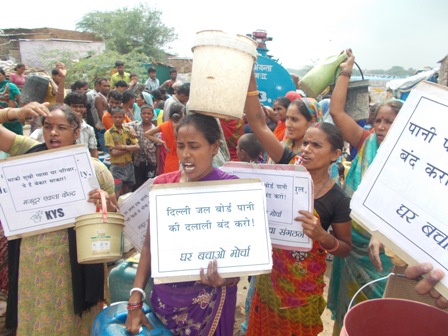
Against erratic and unequal distribution of water in Delhi

Hassled and angry residents of Baljeet Nagar
protest against Delhi Jal Board

Protestors question erratic and
unequal distribution of water in the city

On the morning of July 11, hundreds of angry residents from working class colonies in Anand Parbat/Baljeet Nagar area, as well as activists from Krantikari Yuva Sangathan (KYS), Workers Unity Centre (WUCI), Anand Parbat Udhyogik Mazdoor Samiti, Centre for Struggling Women (CSW), etc., took out a rally which culminated at Shadipur Depot. The residents were protesting against the erratic and unequal distribution of water by the Delhi Jal Board (DJB) across the city of Delhi. The agitating residents strongly believe that the brunt of this unequal distribution of water is borne by the city’s poor who reside in colonies which are supplied water not through pipelines but through tankers.

After sloganeering against the DJB, a delegation submitted a Memorandum to the DJB. The delegation pressed for the following: (i) water supply to households in the entire Anand Parbat/Baljeet Nagar through pipelines; (ii) provision of 120 litres per person per day; (iii) provision of a larger number of tankers, as well as a greater frequency of tankers every week; (iv) provision of free and bribe-free water supply via tankers; and (v) immediate implementation of rain-water harvesting, boring and other effective projects to meet the residents’ needs.

There are over one lakh residents living in the affected area, i.e. in colonies like Prem Nagar, Nehru Nagar, Tali Dera, Chetan Basti, Punjabi Basti, Gulshan Chowk, etc., with some 20,000 belonging to the two large slums located in this area. Despite the density of the population, it seems that because the residents share a predominantly working class background, the Delhi Jal Board (DJB) has never considered supplying water through pipelines to this area. Water is instead supplied to the area via water tankers. Earlier, these tankers used to provide water to the said colonies on alternative days. However, off late the tankers have become so erratic that at many water supply points they come barely once a week. Neither does the DJB invest in rain water harvesting, or pursue other projects to meet the needs of these residents.

According to the protesters, this current state of affairs is not merely the result of a shortage of water tankers. In fact, it is more the result of the DJB coming under control of the water mafia and private contractors. For example, tankers are increasingly providing water at earmarked supply points only when bribed to do so—a process which goes unchecked and creates ample space for private suppliers of water to exploit the needs of the people. As explained by Shri Alok Kumar from Workers Unity Centre (WUCI) who addressed the gathering, “by not maintaining a sufficient fleet of its own tankers, the DJB has gradually allowed a powerful group of private contractors and mafia to step in and provide water at high prices through which they make highly profitable business out this essential service. We believe that this on-the-ground functioning of the DJB reflects nothing but further privatization of water supply and distribution in Delhi.”

In addition to this, the privatization of water supply in the city is also reflected in the recent scams involving water treatment plants like the tender for Bhagirathi Plant where irregularities amounting to 200 crores were reported. Clearly, when issuing tenders involving water projects, the interests of private players play a significant role. Due to their involvement in such water supply and distribution projects, private contractors have now come to determine the quality of the water treated, as well as time taken to put such projects in place. Furthermore, under the influence of neo-liberal economic policies which press for privatization of the social sector (i.e. education, healthcare, etc.) as well as natural resources, successive governments have even sold water reservoirs and other water bodies at throwaway prices to private companies. Such private companies are either interested in the business of packaged water, or, desire direct access to a water source for their manufacturing plants. Private players have, hence, firmly wedged themselves in numerous ways between Delhi-ites need for water and water itself.

The impact of this growing privatization of water supply is most clearly reflected in the creation of an artificial water shortage in the city. On one hand, wealthy residential areas in the city like Jor Bagh, Sundernagar, Sainik Farms, etc. receive uninterrupted supply of water amounting to 450 litres per person per day, and on the other hand, nearly 50 lakh people in the city survive on just 40 litres per person per day. Similarly, it is difficult to uphold the theory of Delhi’s acute water shortage when big hotels, water/adventure parks, etc. enjoy generous supply of water. “If there is always plenty of water for some and never enough for the majority, then we are dealing with a biased policy approach and not an ecological problem,” asserted Sujit Kumar from KYS.

Before dispersing the protesting residents resolved to intensify their struggle, and to launch a larger public campaign across Delhi’s working class areas.

Alok Kumar
Convenor,
Ghar Bachao Morcha

Protest against a Cut-off System in +2 admissions

Government School Students Protest Against the Recent Government Circular Introducing a Cut-Off System in Class XIth Admission
KYS Spearheads Protests in Three Different Zones Against the Circular
Future of Thousands of Poor Students in the Doldrums

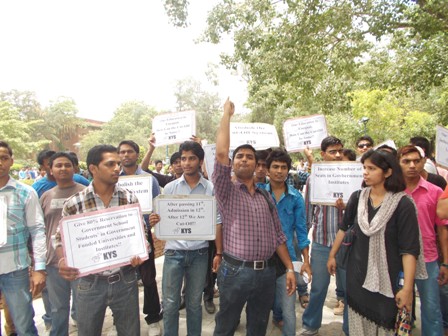
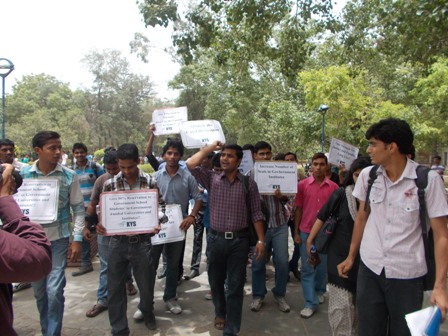
Today on the morning of July 11, hundreds of agitated government school students, their parents, as well as activists from Krantikari Yuva Sangathan (KYS), protested against the recent circular released by the Delhi Government’s Directorate of Education. Three different protests were held outside three separate government schools, i.e. outside Government Senior sec. School (Sangam Park), Government Sarvodaya Bal Vidyala (Nangloi), and Government Senior Secondary School No. 1 (Patel Nagar).

The contested Circular is extremely problematic because it has for the first time introduced a very high cut off for government school students who are entering class XIth (eleventh) in the Commerce and Science streams. This cut off is being implemented across the various government schools with immediate effect, and has created havoc with the young students’ lives. The immediate effect of this Circular has been that a large section of youth who are from working class families and are dependent on government school education, are being denied admission to these streams in government schools where they have been studying for years. More importantly, because a large number of these students cannot make it to the high cut offs, there is tremendous rush for admission in government schools offering Humanities/Arts stream.

Running pillar to post, the despairing students and their parents have decided to fight back and compel the Delhi Government to withdraw the Circular. Shri Sujit Kumar, KYS State Executive Committee Member, visited to all three protest venues and addressed the students. In his address he highlighted how the recent Circular was nothing but an attempt to further privatize school education. “When working class youth are ousted from government schools and denied their constitutional right to education, then where will they go—either they will be forced to drop out or to enrol in private schools where they will struggle daily to pay the high fees,” explained Sujit Kumar.

Indeed, the circular is a black spot and mockery of the recently implemented Right to Education (RTE), for it is assisting in keeping a large section of needy youth their right to education. Instead of increasing the number of its secondary and senior secondary schools, it is shocking that the Delhi Government is spearheading an unhealthy process like introduction of cut offs for admission to Class XIth. All this is clearly a big boost to the already on-going process of privatization of education.

Meeting with the authorities of the three concerned government schools, the delegation of students and KYS activists appealed to the respective Principals to write to the Directorate of Education, requesting for the recall of the circular. Realizing that the matter would need to be raised at the higher administrative level, the protesters decided to carry out a campaign and reach out to other affected government school students. If the aforementioned Circular is not withdrawn then a large demonstration will be organized against the Delhi Government to protest against its anti-poor students’ policies.

Open Letter to HRD Minister on the problems of working class youth and students

To,
Shri Kapil Sibal
The Hon’ble Minister
Human Resource and Development Ministry
Government of India.
26.06.2012

Respected Sir,

We write to you as part of our initiative to apprise the general public of this country of the multifarious and crippling problems faced by working class youth who wish to pursue higher education. We realize that your own privileged social background, as well as your current political association, will, in all probability, prevent you from pursuing a sympathetic assessment of our concerns. However, we still appeal to your authority and sense of humanity, and ask your office to consider the following facts and concerns highlighted by us.

Sir, it is a well-known fact that the majority of working class youth of this country end up studying in government schools, and despite our best efforts, we still lag behind students who are able to pursue their education from expensive and reputed private schools. It is not that we do not labour and study diligently. In fact, because we belong to working class families, we are well aware of the value of labour. Working hard to survive is strategy taught to us from birth, and it is the principle we follow even when it comes to studies. However, it is clear to us that despite the valuable contribution made to the economy by the working masses, their children’s educational rights are assigned little value. Majority of the government schools we study in are divested of proper resources like adequate teachers, supply of teaching aids, good infrastructure, etc. This dismal condition at the school level is aggravated by the extremely precarious conditions in which we live.

The large majority of our families live in one room apartments because of the meagre wages earned by us and our parents. And needless, to say most of this housing is situated in the city’s slums and JJ colonies—many of which face the threat of demolition. In fact, many of us who are writing this letter have watched our homes being destroyed by bulldozers during our twelfth class examinations this year. Even if we want to rise above all these obstacles and problems such as the temporariness of our homes, we find ourselves severely handicapped by the simple fact that our families cannot afford tuitions. Forced to pay high rents and to meet rising prices of essential commodities, our parents are unable to put aside money for tuitions, or to purchase much-needed study material. Sadly, despite their desire to see us perform well, our parents are sometimes compelled to ask us to work as well, in order to contribute to the family income.

This brings us to the question of how successive governments have failed to address these disadvantages faced by working class youth, and have consciously denied us adequate opportunities at the level of higher education. Sir, we strongly believe that your government’s support for the dual education system, and thereby, its promotion of privatization of education, is a major source of our ruination. By encouraging the private schools on the one hand, and, on other hand, not investing sufficiently in government schools, the government is consciously creating a condition in which affluent students of private schools (who have had access to the best facilities, teachers, as well as tuition) get the lion share of seats made available at the level of higher education. Hence, the current government education policy is such that higher education has become out of reach for majority of this country’s youth, i.e. youth belonging to the working masses. It is extremely disturbing that the government provides subsidized education only till the school level. Beyond school education, the government adamantly refuses to utilize public money in a manner which makes subsidized higher education available to working class youth. Instead, the doors to higher education are opened only to the select few who have proved to be “meritorious”, i.e. those who have undergone private schooling, and hence, have the marks.

Clearly, this skewed education policy which has existed for years, has ensured that only 5 to 7 per cent of youth make it to the level of higher education (see National Sample Survey). In actuality, a large share of this 5 to 7 per cent comprises of middle and upper-middle class youth. The working class do not get a seat in the regular colleges and are forced to pursue higher education from correspondence and non-collegiate higher education boards. Needless to say, correspondence courses, etc. represent the poorly invested sector within the higher education field—a fact well highlighted in the kind of teaching provided, the lack of classroom infrastructure and the poor performance of correspondence students. The above-mentioned figure of 5 to 7 per cent also reflects the simple fact that governments like yours, perceive higher education as an opportunity which should be provided to the minority and not to the masses. After all, an inclusive, mass higher education program would not allow the system to reproduce workers from amongst the society’s youth, because if every youth was to pursue a BA or B.Sc. course, who would line up outside the city’s factories for a job.

Having said this, we would like to reiterate how misplaced your concern for last year’s and this year’s cut-offs has been. In 2011, when some prestigious Delhi University (DU) colleges declared cut-offs that touched 100 per cent, you expressed grave concern and assured the public that such cut-offs would not be repeated. Back then, and even today, the impact of such cut-offs on working class youth, is something you failed to consider. While your government is satisfied with the fact that the same cut-offs have not been repeated this year, can you claim that under this year’s cut-offs, working class youth will also make it to the Delhi University? And does your decision to allow the entry of foreign, private universities provide a solution to the concerns raised by working class youth? The answer to both questions is a definite no.

Firstly, despite cut-offs that are below the magic 100 per cent figure, the majority of youth who are coming from government schools, will still not get admission in universities like DU. Why would we, when the quality of education provided to us in government schools allows us to barely pass the Board examinations. It is here that we would like to highlight the bitter irony of the higher education system—public money is being used not for the betterment of those who most need it, but for those who are from the affluent sections of society, have got the best, and have, hence, scored the most. At this point, you may like to argue that some government school students do make it to higher educational institutions. However, we would like to highlight how this is a misconception yet again. The tremendously small segment of working class youth who make it to the level of higher education, often fail to perform (complete their course, to score well, etc.) because of the lack of essential, complementary facilities like remedial coaching and scholarships. There are, in fact, numerous instances of working class youth being unable to pay their tuition fees.

Secondly, further privatization of higher education via entry of foreign universities, etc. is far from a solution to the on-going problem. It will only result in more private players entering the field of education in the bid to misuse a social need for private, business greed. Education will all the more become an opportunity to be provided to those who can buy it. And lastly, it is only with greater investment in education by the government that the current situation can be improved. The building of more government subsidized schools and colleges, rather than paving the way for expensive foreign universities, is the permanent solution.

High cut-offs and less number of seats are problematic in many ways. For example if there are less number of seats overall, the reserve seats will be lower. Thus reservation which was a constructive policy to bring out Dalits from the villages and traditional occupations would remain an empty box as a large number of students will not get a seat. For example in Delhi University there are 12000 odd seats reserved for SC/ST candidates whereas the number of applicants are around 24000 i.e. double the number of seats. Thus a large number of students from the reserve category are forced to go back to their villages and continue with traditional occupations. This would deny not only upward mobility but also makes Dalit students prone to caste oppression and atrocities in the villages.

Of course, such long term solution need to be supported by immediate relief measures that cater to the concerns and needs of the majority of this country’s youth. One such immediate solution which we put forward and for which we seek government intervention, is the provision of 80 per cent reservation for government school students in every category, i.e. in the general category, SC-ST category, PH and OBC category. We appeal to you and to the society at large to understand and engage with the voice of the majority. Let us not reduce education to the question of who can afford it, and let us not reduce the novel concept of subsidized education to a mockery whereby it is used to provide educational advantages to those who are already way ahead in the race. We appeal to your conscience, and ask you to transform education structure into a truly mass phenomenon in which those who are most disadvantaged, are given an equal opportunity to transform their lives via education.

KRANTIKARI YUVA SANGATHAN (KYS), DELHI UNIT OF ALL INDIA REVOLUTIONARY YOUTH ORGANISATION, T-44, Near Gopal Dairy, Baljeet Nagar, New Delhi-110008. Ph. : 9312654851 , 9313343753

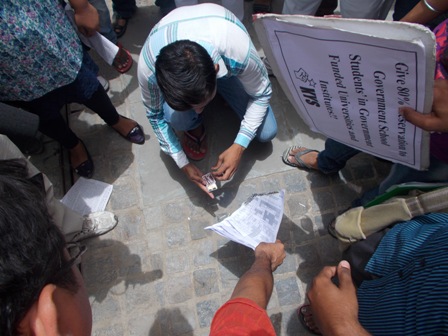
High Cut-Offs Burnt by Government School Students

Sujit Kumar & Dinesh Kumar, KRANTIKARI YUVA SANGATHAN (KYS), DELHI UNIT OF ALL INDIA REVOLUTIONARY YOUTH ORGANISATION, T-44, Near Gopal Dairy, Baljeet Nagar, New Delhi-110008. Ph. : 9312654851, 9313343753

High Cut-Offs Burnt by Government School Students!
Government School Students Demand 80% Reservation in Government-Funded Institutes and Universities!
Government School Students and their Parents Agitated over the Fact that Cheap Public Funded Education is Beyond Their Reach!
An Open-Letter is also sent to HRD Ministry for Immediate Intervention!

Today (June 26) a large number of government school students, their parents and progressive individuals protested against the high cut-off for admission in Delhi University. The colleges of DU declared their first cut-off for admission to various courses on Tuesday. With this the wait is formally over as far as the procedure to get oneself admitted in a college was concerned. However getting a seat secured in a college/course still remained a distant dream for many as the cut-offs have sky-rocketed beyond the expectations. However this is not something which is unique to this years’ cut-off. Every year cut-offs are so high that government school students are not able to get a seat in the institutes of higher learning. Our organization firmly believes that the cut-offis nothing but a calculated policy to keep the higher education beyond the reach of students from government schools, an overwhelming majority of whom come from socio-economically deprived backgrounds. These students have also sent an open-letter to HRD Ministry for immediate intervention.

It is important to note that the higher cut-offs eliminates the chances of government school students in the institutes of higher learning and the only recourse left to them is to do some technical certificate and diploma courses and become a source of cheap labour in the market. Also interesting is the fact that the government has not only continued with the dual education system but has kept the same cut-off for government and private schools.It is an undeniable fact that students from private schools with better teaching and coaching facilities get higher marks and the domain of government funded higher education becomes virtually theirs as there are a very limited number of seats. Whereas the students from government schools always have to kill their ‘ambition’ without anyone noticing the fact that the race was unequal from the start. The bad result of these government school students is a result of the larger policy issue. Most of the government schools students lack basic facilities and have insufficient number of teachers (mostly in science and commerce courses) which is magnified by their home environment as most of these students are first generation learners and mostly live in a single rented room with the entire family. The unavailability of sufficient teachers forces the students to go for unregulated tuitions which not only creates havoc of their career but promotes the privatization of education. It is high time that government should undertake its responsibility of ensuring that a large section of students is not denied higher education due to loopholes in the policy. We demand an immediate enactment of a policy that provides marks relaxation/reservation to students of the government schools in the publically funded institutes of higher learning. We do understand that the reservation cannot be a permanent solution. Therefore the government must abolish the dual system of education with private schools students with all sorts of facilities getting the fruits of cheap higher education on the one hand and on the other the government school students from socio-economically deprived background and lack of good learning facilities remaining outside the domain of higher learning. We also demand that the government should increase the amount of budget spent on higher education for the children of working masses.

It is to be noted that in India the number of students who go for higher education are abysmally low. Only 7 percent of the students who pass 12th standard go for higher education. Even these seven percent students do not get to study the courses and colleges of their choice, and only a very small number of students from them get seats in regular colleges. Most of the students end up doing their study through correspondence or distance learning. In Delhi University there are only 54000 seats whereas 146000 have applied for admission. Thus around a lakh students will be denied admissions. It is important to note that these students are aspirants yet they will not be given admission due to less number of seats. Isn’t it ironic that even from a small number aspirants a large number is denied admission. Most of students who are denied admission are from government schools and are first generation learners. Thus denying them admission eliminates their scope for upward mobility.

High cut-offs and less number of seats are problematic in many ways. For example if there are less number of seats overall, the reserve seats will be lower. Thus reservation which was a constructive policy to bring out Dalits from the villages and traditional occupations would remain an empty box as a large number of students will not get a seat. For example in Delhi University there are 12000 odd seats reserved for SC/ST candidates whereas the number of applicants are around 24000 i.e. double the number of seats. Thus a large number of students from the reserve category are forced to go back to their villages and continue with traditional occupations. This would deny not only upward mobility but also makes Dalit students prone to caste oppression and atrocities in the villages.

We demand:

1. 80% reservation for government school students in public funded institutes and universities.
2. Immediate increase in number of seats in institutes of higher learning.
3. Increase in the amount of budget spent on education.
4. Abolition of the dual education system.
5. Hostel facilities for all the students from socio-economically deprived background.

KMSS Hunger Strike in Assam, Akhil Gogoi Arrested

Campaign for Survival and Dignity

After sending the below, we received information that Akhil Gogoi was arrested at around 3 am this morning from the site of the hunger strike and many KMSS supporters were lathi charged. He has been forcibly hospitalised but is resisting forcefeeding. Meanwhile when KMSS members protesting in Guwahati were lathi charged, and more than 20 people have been seriously injured. Road blockades and other protests are now taking place across the state.

Today, in Assam, the indefinite hunger strike of Krishak Mukti Sangram Samiti leader Akhil Gogoi entered its fifth day. This marks a key moment in one of the largest mass struggles for people’s rights in the country today. Till date there is no reaction whatsoever from the government to the KMSS’ democratic demand for a halt to the construction of dams in the State and to atrocities on those protesting against them. Most of these dams are coming up in total violation of law, without compliance with the procedures for forest clearance, environmental clearance and without respecting people’s rights over forest land. The dams threaten the livelihoods of lakhs of people and pose a serious risk of future natural disasters that could claim the lives of tens of thousands more. When people have opposed the construction of these dams, they have faced beatings, tear gas and police firings. The KMSS’ decision to call the indefinite hunger strike was also driven by opposition to these atrocities.

The KMSS’ peaceful struggle for people’s resource rights has mobilised lakhs of people. In the last few years their protests have engulfed the entire State. But for our state machinery these things matter little. Indeed, in Maharashtra, the same system and the same forest officials who (among others) broke the law in Assam have now given themselves the power to kill people with impunity (in the name of “shoot on sight orders” against “poachers”). This blatantly unconstitutional order will lead to killings of local adivasis and forest dwellers, who will never even be given the basic right to a trial. Whether it is in the name of sham “development” or in the name of dictatorial “conservation”, the same bureaucracy and ruling class seizes power and resources, trampling roughshod over the rights of the people. The struggle is on for real democracy in this country.

Contact: forestcampaign@gmail.com, www.forestrightsact.com

CDRO Fact-finding: Saranda, Poraiyahat (Jharkhand)

Interim report/Press release
23rd May 2012

Jharkhand is fast becoming a military state. Similar to operation green hunt which was started three years ago in mineral rich forest areas resided by adivasis, brutal operations are being carried out continuously in Jharkhand as well. ‘Operation Anaconda’ was launched as a special operation in August 2011 in Saranda forest area of West Singhbhum district of Jharkhand. Reasons for speeding up of such military operations by the state can be viewed in a twofold context. One the one hand mining activity in Saranda has been on the rise. Saranda is Asia’s largest mineral reserve and holds immense economic importance. On the other hand, contrary to the government claim that the area has been cleared of Maoist activity, infact it is far from being crushed.

In order to gather first hand details of the manner in which the state has reacted to the changing conditions on ground, an all-India team from the Coordination for Democratic Rights Organisations(CDRO) was set up constituting members from human rights organisations of Andhra Pradesh, Delhi, Punjab, Jharkhand, Maharashtra, Uttar Pradesh, Uttarakhand. The team conducted an investigation in Saranda and the adjoining areas between 20th and 22rd May 2012.

What follows is a brief summary of the observations made by the team. In Puraiyahaat, in January 2011, hundreds security forces entered Kamaay village. They beat up people and arrested four of them called Marshall Bhuiyaan, Nelson Bhuiyaan, Premanad Bhuiyaan and Pinky Bhuiyaan. The first two are still imprisoned while the other two have to appear regularly at the Thana. They are all falsely implicated in helping the Maoists. The CRPF also destroyed property, and mixed food grains in this village.

On the 20th of May itself, a security operation was conducted in Pandua village. Around 500 jawans entered the village at around 5.30 in the morning. Hallan Huttar was taken away blindfolded and handcuffed by the forces. Villagers now fear his death. Abraham Munda’s property was destroyed, and 3500 rupees were taken away. 15 year old Mithun Bhuiyaan was beaten black and blue. Munda’s wife and her year and half old son were also beaten up by a high rank police official. One villager was looted of Rs. 10,000 which she had kept aside for buying ox for her fields. Also, a para-doctor here is frequently oppressed with the accusation of treating Maoists. According to the villagers this destruction continued in the village for almost three hours during which the forces also consumed liquor and marijuana. Few villagers were even forced to flee from their village on that day. In the same village, on the 10th of this month when the forces attacked the village, they also misbehaved with the women here. It was shocking to know that there were no women in the force while women were tortured brutally.

The team also visited 4 villages of Manoharpur block: Tirilposi, Raatamaati, Deegha, Tholkobaad. In all of these villages, forces converted whole villages into their base camp for an entire month. Villagers had to hide in the jungles and many ran away to their relatives in nearby villages to escape oppression. Of those who were left in the village, men were held captive separating them from the women. They were tortured and even had to relieve themselves wherever they were locked up. Old people who couldn’t run away were beaten up so badly that some of them even died. Houses were burnt and people jailed. Most of them are still in Chaybaasa jail, and according to their families they are not even sure of the offense of which they are accused. In Tirilposi alone 17 people have been imprisoned. Economically dented, these villagers are totally unable to follow legal proceedings to get relief. In one of the copies of charge sheets observed by the team, a villager was implicated in UAPA, CLA, and in addition also blamed of sedition and waging war against the state.

Additionally, it was observed that under the IAP, contractors from outside were given work which is against the rules of IAP.

Right after operation Anaconda was completed, the government started a development project in the name of Saranda Action Plan(SAP) under which villagers have been given solar panels, clothes, utensils, and sewing machines as short term trust building measures. The government also plans to introduce long term measures like livelihood options, building of check dams, and training for employment among others. Simultaneously, in and around these villages security forces are also in the process of constructing permanent camps. Saranda will be home to 20-25 camps soon.

Certain questions come to the fore. How has the state suddenly woken up to the development needs of the tribals here after so long? Is it only a coincidence that Operation Anaconda, the SAP, and private mining project leases are falling in line together here in Saranda? Why has the government cracked down so hard all of a sudden on the people of Saranda?

A trajectory can be spotted in the actions of the government in Saranda. It is clear that the government has failed to estimate the real needs of the people. And with the maoist activity refusing to fade away, the government with the fear of losing ground has reacted frantically by launching brutal operations on the people. By terrorizing the tribals, the state is simply trying alternatives to sustain a larger foothold over them.

It is therefore that we demand, the following:

1. All CRPF, military and para-military camps be removed from the state
2. In the context of mining and SAP implementation, PESA and the 5th Schedule be implemented according to which decision making rests on the tribal communities.
3. All private mining activity be stopped immediately.
4. Justice for those who have been beaten up and exploited, and release of all those people who have been imprisoned and implicated in false cases. The perpetrators, the CRPF instead must be booked for the oppression meted out by them.
5. After this attack on their identity and existence, the autonomy of tribals should be left unaffected.

Members:
Shashi Bhushan Pathak, Aloka Kujur, Mithilesh Kumar, Santosh (PUCL Jharkhand); Puneet, Social Activist, Naushad, Journalist (Jharkhand)
Gautum Navalakha, Shruti Jain, Megha Bahl(PUDR, Delhi)
Chandrashekhar, Narayan Rao, Rajavindam, APCLC, Andhra Pradesh)
Pritpal Singh, Narbhinder (AFDR, Punjab)
Rajeev Yadav, Shahnawaz Alam (PUCL, Uttar Pradesh)
Chandrika, Prashant Rahi (Independent journalists)

Faridabad Update: Striking nurses block roads as negotiations fail

AS NEGOTIATIONS FAIL, STRIKING NURSES TAKE OUT MASSIVE PROTEST RALLY IN FARIDABAD & BLOCK B.K. CHOWK
HOSPITAL MANAGEMENT INSTALLS PHONE JAMMERS INSIDE THE HOSTEL TO INTIMIDATE STRIKING NURSES
PATIENTS HEALTH IN PERIL AS UNTRAINED NURING STAFF & NURSING STUDENTS ARE BROUGHT IN AS REPLACEMENTS

The nurses of Asian Institute of Medical Sciences (AIMS), Faridabad and QRG Central Hospital continue to sit on strike for the NINTH consecutive day. Since the management of AIMS hospital is determined not to increase the pay of the nurses, and not to reduce their work load by removing compulsory double duty, negotiations held with the AIMS management on 14.05.2012 failed. While the next round of negotiations is still pending in the case of QRG Central hospital, the chances of the QRG management conceding some of the main demands of the nurses’ is doubtful.

In order to build larger public pressure on the hospitals’ management as well as the district administration of Faridabad, the striking nurses of both hospitals took out a big rally from BT Chowk. There they blocked the roads surrounding the Chowk for nearly two hours till they were given the assurance that the District Commissioner will meet them in person on the 16th. The nurses’ rally was supported by trade unions in Faridabad, women’s organizations, welfare associations, several civil rights groups, and democratic and progressive individuals. Meanwhile, the two hospitals concerned kept up the façade of “normal” functioning by replacing the striking nurses with untrained nursing staff and nursing students—a measure which is putting patients at serious risk.

The striking nurses have continuously complained about the uncooperative approach of the district and labour administration. They argue that the district administration and labour office was intervening in a manner which reflects their connivance with the hospitals’ management. In the case of QRG Central, the civil court ordered that the peaceful demonstration of the striking nurses be shifted to a distance of 200 meters to an inconspicuous and distant location. Interestingly, the law allows for only 100 meters distance. In the case of both hospitals, the local officials are preventing the nurses from putting up a tent structure to protect themselves from the heat.

As expected, with each day the harassment by the hospitals’ management escalates. On the night of 14.05.2012 when AIMS nurses returned to their hostel after their ninth day of strike, they found jammers installed inside their hostel. Because of the device the nurses could not make or receive calls for several hours. Suspecting foul play they called the police and pushed for an inspection of a vacant, locked room where the felt the jammer was installed. Initially, the police was reluctant to remove the device due to pressure from the management, but then finally because all the nurses pressed for action, the jammer was finally removed at 10pm,” said an agitated nurse of AIMS hospital. Today (15.05.2012), the security staff of the hospital removed the water cooler installed in the hostel, hence, depriving the nurses of drinking water. Security personnel/bouncers hired by the hospitals are continuously entering the women’s hostels, and coercing individual nurses to join back. “A nurse who was recuperating from an attack of serious illness was continuously mentally pressurized by the hospital’s nursing supervisor who kept calling her on the phone—something which worsened her condition,” said another agitated nurse.

Considering the hostile atmosphere, the nurses of both AIMS and QRG Central hospitals have decided to form a Joint Action Committee (JAC) so as to unite nurses of all the different hospitals in Faridabad. Considering that conditions continue to be grave, the nurses resorted to a larger public campaign. During their rally they distributed pamphlets explaining to the general public how their strike was in favour of better patient care.

Thankamma Ravindran
Delhi Nurses Welfare Association

Alok Kumar
Workers Unity Centre

Maya John
Centre For Struggling Women
Ph: 9350272637

Faridabad Update: Impact of nurses’ strike spreads despite intimidation and threats

DESPITE SEVERE HARASSMENT AND BEING MANHANDLED BY BOUNCERS, NURSES CONTINUE TO SIT ON STRIKE
WATER & ELECTRICITY SUPPLY CUT OFF IN THE NURSES’ HOSTEL ACCOMMODATION
IMPACT OF STRIKE SPREADS TO OTHER HOSPITALS

The nurses of Asian Institute of Medical Sciences (AIMS), Faridabad and QRG Central Hospital continue to sit on strike for the eighth consecutive day. With each day the harassment by the hospitals’ management escalates. Nevertheless, the nurses continue to sit on strike. Today, bouncers hired by the AIMS management manhandled nurses who were passing by the hospital on the way to their hostel accommodation. When activists from the women’s organization, Centre for Struggling Women (CSW) and Workers’ Unity Centre of India (WUCI) intervened, the bouncers tried to manhandle them too and used filthy, abusive language in order to intimidate the nurses. The local police initially intervened in favour of the bouncers but when accosted with the fact that the road outside the hospital is public property and cannot be regulated by the bouncers, the police accepted the bouncers were harassing the nurses.

Similar tactics of intimidation are being used in the hostels where the nurses reside. Water and electricity supply in the hostels are often cut off, and the nurses are threatened every day to vacate their rooms. Despite the fact that the management of both AIMS and QRG Central have called for negotiation today, intimidation and threats continue in order to force the striking nurses to settle fast. These acts are, hence, in complete violation of the spirit of amicable negotiation and the spirit of collective bargaining.

Unfortunately, even the district administration and labour office is intervening in a manner which reflects their connivance with the hospitals’ management. In the case of QRG Central, the civil court ordered that the peaceful demonstration of the striking nurses be shifted to a distance of 200 meters to an inconspicuous and distant location. Interestingly, the law allows for only 100 meters distance. And in the case of both hospitals, the local officials are preventing the nurses from putting up a tent structure to protect themselves from the heat.

Considering the hostile atmosphere, the nurses of both AIMS and QRG Central hospitals have decided to form a Joint Action Committee (JAC) so as to unite nurses of all the different hospitals in Faridabad. Considering that conditions continue to be grave, the nurses are also considering holding a JOINT PROTEST outside the office of the Deputy Labour Commissioner in Faridabad, and the Union Health Minister. “If the negotiations will not go in favour of the striking nurses then the nurses are thinking of taking out a big rally in Faridabad, and uniting nurses across the board. After all, negotiation doesn’t mean settle for less,” said CSW activist, Maya John. Interestingly, the nurses’ strikes in Faridabad are already impacting the functioning of other private hospitals in the NCR. For example, nurses of Sharda Hospital in Greater Noida have also gone on strike with respect to demands for pay hike, regulated work hours, etc.

Thankamma Ravindran
Delhi Nurses Welfare Association

Alok Kumar
Workers Unity Centre

Maya John
Centre For Struggling Women
Ph: 9350272637