Tetley’s Tata Tea Starving Indian Tea Workers into Submission

Tata, the transnational Indian conglomerate whose Tetley Group makes the world famous Tetley teas, has taken 6,500 people hostage through hunger. The hostages are nearly 1,000 tea plantation workers and their families on the Nowera Nuddy Tea Estate in West Bengal, India. Permanently living on the edge of hunger, the workers and their dependants are being pushed to the edge of starvation through an extended lock out which has deprived them of wages for all but two days since the beginning of August. The goal of this collective punishment is to starve the workers into renouncing their elementary human rights, including the right to protest extreme abuse and exploitation.
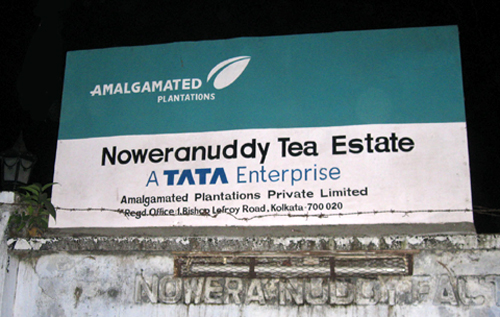
The hostage-taking began with a first lockout on August 10, when workers protested the abusive treatment of a 22 year-old tea garden worker who was denied maternity leave and forced to continue work as a tea plucker despite being 8 months pregnant. On August 9, Mrs Arti Oraon collapsed in the field and was brought to the hospital, on a tractor normally used for garbage, after the medical officer refused to make an ambulance available (he had proposed she be brought by bicycle). She was initially refused treatment, and only after her co-workers protested did she receive minimal care. Her treatment was inadequate and she had to be taken, in the same garbage tractor, to the local government hospital one hour away.

As news of her treatment spread, some 500 mostly female estate workers gathered in protest at the medical facility, demanding sanctions against the medical officer. Local management promised to meet with the workers, but on August 11 the management, along with the medical officer, left the estate and declared a lockout.

On August 27 an agreement was signed with three trade unions, representing some workers on the estate but not a majority, on reopening the garden. In the agreement, all workers’ wages for the lockout period were withheld. The agreement included a clause that a “domestic inquiry” (an internal, company-controlled investigation) would be conducted. The agreement was written in English, a language few if any of the workers understand.

The garden was reopened the following day, although workers were not informed of the conditions of the reopening. On September 8, management issued letters of suspension and ordered a domestic inquiry against eight workers.

None of the eight workers received a letter of notification. None of the eight had committed any act of violence or were involved in any illegal practice. These eight workers have been targeted because they are active in the garden campaigning for workers’ rights.

At a September 10 meeting, management told the workers that suspension letters had been issued in accordance with the August 27 agreement and that opening the garden depended on compliance with that agreement. In other words: agree to the suspensions or you’ll be locked-out again. Workers requested six days to respond to this ultimatum.

The ultimatum was a powerful one: tea garden wages are just 62.50 Indian rupees per day – the equivalent of USD 1.35 daily. One kilogram of the cheapest, poorest quality rice in the local market costs 20% of a worker’s daily wage. Tea workers permanently live on the edge of hunger. The loss of wages for even a few weeks can tip them into starvation.

Although wielding the weapon of hunger – with workers’ lives in the balance and the deadline to respond not yet expired – management on September 14 again left the plantation and implemented a lockout. This was the day workers were meant to receive their annual festival bonus, amounting to roughly two months wages. No bonus payments were made. Prior to the lockout, since the beginning of August workers have only received a wage payment amounting to two days work.

Following the closure, workers have sought to communicate with the management, requesting it to reopen the garden. The company has insisted that the garden will not be reopened and wages paid unless all workers accept the September 10 ultimatum to effectively sign off their right to protest abuses.

Tata Tea is a powerful global company; it’s wholly owned Tetley Tea is one of the world’s biggest-selling tea brands. Nowera Nuddy Tea Estate is owned by Amalgamated Plantations Private Limited, a company 49.98% owned by Tata Tea. Tata and Amalgamated share the same office in Kolkata, the capital of West Bengal. According to the Tata Tea 2009 annual report, Tata Tea Managing Director Percy T. Siganporia earns in a single day roughly 1,000 times the daily wage of a Nowera Nuddy worker – assuming that worker is paid .

Tea from Amalgamated Plantations’ tea estates goes into the famous Tetley Tea bags.

Tetley Tea is a member of the Ethical Tea Partnership (ETP), whose standard commits member companies to, among other requirements, ensure that there is no “harsh or inhumane treatment” of plantation workers and that “Workers should be paid at least monthly and should receive their pay on time.” The actual conditions on the Nowera Nuddy estate, where workers are being subjected to brutal collective punishment, could not be more remote from this CSR wish list.

Workers at the Nowera Nuddy Tea Estate have formed an Action Committee which has called for the immediate reopening of the garden, the withdrawal of the suspension letters and no recriminations against workers, back payment of wages and rations since 14 September, immediate payment of the annual festival bonus and a management apology to Mrs Arti Oraon.

You can support their struggle – CLICK HERE to tell Tata and Tetley Tea to stop starving workers now! You can also use the features provided on the Tetley Tea website to send the company a message, or use the freephone number provided to give them a call!

Courtesy: IUF-Uniting Food, Farm and Hotel Workers World-Wide

Conference on “Region Formation in Contemporary South Asia”

25-27 November 2009
Room No. 22, Arts Faculty, North Campus
The University of Delhi,
Delhi (India)

Day One, 25th November 2009

Inaugural Address: 9.00 am to 9.40 am

Dr. Salvatore Engel-Di Mauro : On Not Confusing Regions with the Product of Ideological Confrontations between Opposing Ruling Classes.

Requiem: 9.40 am to 10.10 am

Mr. N. Babaiah: K Balagopal: A Portrait of An Activist.

Tea Break: 10.10 am to 10.25 am

The ‘National Question’, Communist Party and South India: 10.25 am to 1.00 pm

Mr. Vijay Singh: THE COMMUNIST PARTY OF INDIA AND THE NATIONAL QUESTION 1942-1955.
Mr. A. Bhoomaiah: “STRUGGLE FOR TELANGANA STATE HOOD” AS A PART OF NATIONALITIES AND DEMOCRATIC MOVEMENTS.
Dr. V S Shreedara: Kannada Daughter and the Indian Mother: the question of Kannada Nationality.
Prof. A Marx: Tamil Nadu: The Inclusive Tradition.

Lunch Break: 1.00 pm to 1.30 pm

Constituents of a Region: The South Indian Case: 1.30 pm to 4.30 pm

Mr. Simon Chilvers: Social Formation and Articulation of Modes of Production in Karnataka.
Ms. Pranjali Bandhu: The Adivasi Situation in The Nilgiris With Special Focus On Their Educational Status.
Mr. Sachin N: Muthanga-Manvelimantam: A Dialectic between dystopic region in History and utopian space in Literature.
Ms. Yemuna Sunny: Kuttanada: The Making And Unmaking Of A Region.
Ms. Terah Sportel: Labour Market Change, Plucking Nuts: Exploring Regional Trajectories of the Kerala Coconut Sector, India.

Tea Break: 4.30 pm to 4.45 pm

SAARC 4.45 pm

Ms. Ipsita Sengupta: SAARC: Is human rights on the agenda?
Dr. Pawan Kumar Jha: Region Formation: The Perspective for New South Asia.
Mr. Sashi Kumar: Regional Protection of Rights: Emerging Concern.
Ms. Shveta Dhaliwal: Regional Human Rights Mechanism: A Pre- Requisite for Contemporary South Asia.

Day two, 26th November 2009.

Keynote Address: 9.00 am to 9.40 am

Prof. K M Shrimali: Title not submitted

Cultural/Ideological (Re)Production of Region: Northeast 9.40 to 11.30 am

Dr.Jae-Eun Shin: Pragjyotish – Kamrupa: Imagined Boundaries and Imposed Historicity.
Dr. Manjeet Baruah: Guerrilla Space as Literary Plot in Aulingar Zui (Spring of Ash): Space/Culture and Ideological Explorations.
Dr. Joy L. Pachuau: Death and locality in the creation of an identity: the Mizo case.

Tea break: 11.30 am to 11.45 am

Mapping the North east 11.45 am to 1.30 pm

Dr. Chandan Sharma: Reclaiming the Foothills from Colonial Discourse: Space, Settlement and Strategy in Northeast India.
Dr. Sarah Hilaly: Trajectory of Region Formation In The Margins: Arunachal Pradesh In Colonial and Post-Colonial Period.
Mr. Thingnam Sanjeev: Recasting Space: Strategies and Politics of Frontier Making.

Lunch Break: 1.30 pm to 2.00 pm

Situating Region and Politics in the North east: 2.00 pm to 3.45 pm.

Messrs. Asok Kr. Ray and Gorky Chakroborty: Contextualizing India’s North East vis-a-vis South Asia: The Realities and Imaginaries.
Mr. Kundan Hazarika: Uneven Development and Formation of Regionalism: A Study of The Assam Movement.
Mr. Pankaj Jyoti Gogoi: Nationalist Discourse and Regional Consciousness: The Retrospect and Prospect of Regional Uprising in North-East India With Special Reference to Assam.

Tea Break: 3.45 pm to 4.00 pm

Region and Politics in the North and Western India: 4.00 pm

Messrs. R. Venugopalan Nair and Varadrajan N: Defining a Region: Palimpsest of Identities and Politics of Dismemberment.
Dr. Vedpal Rana: Language or Geo-cultural zones? A case study of Partition of Punjab-1966.
Mr. Yogesh Snehi: Politics of Language, Identity or Ecology: Reorganisation, State and the Emergence of Himachal Pradesh.
Prof. Hameedah Naeem: (Title not submitted)

Day Three, 27th November 2009.

Morphogeny of a Region 9.00 am to 11.00 am

Dr. Ryosuke Furui: Sub-regional Identities and Cultural Hegemony in Early Medieval Bengal.
Mr. Kundan Kumar: Reconstructing The Historical Landscape of The Kosi River.
Mr. Pradeep Kumar Nath: The Identity of Western Orissa.

Tea Break: 11.00 am to 11.15 am

Imagining the Region/Regional Imagination: 11.15 am to 1.15 am

Ms. Radhika Borde: The Sarna Movement: Adivasi Religious Bioregionalism.
Mr. Sachida Nand Jha: Rethinking the representations of Maithili Identity in print.
Mr. Sadan Jha: Representing a Region: History, Memory and Literature in the Construction of Purnea (North Bihar) as a Cul De Sac.

Lunch Break: 1.15 pm to 1.45 pm

Prometheus Bound: Region and/in the Nation States: 1.45 pm to 4.15 pm

Mr. Swatahsiddha Sarkar: Formation of Region and Regional Identity in Darjeeling Hills.
Mr. Delwar Hussain: Re- arranging the regions- The coal villages on Bangladesh/India Border.
Dr. Nasir Uddin: Between Peace and Conflict: A Study on Conflict Management and Peace Building in Chittagong Hill Tracts of Bangladesh.
Mr. Fraser Sugden: Understanding spatial subordination: the evolution of modes of production on the Nepal terai.

Tea Break: 4.15 pm to 4.30 pm

Region and Politics in Central India: 4.30 pm to 5.45 pm

Mr. Yogesh Diwan: Adivasi Identity and Regional Politics.
Mr. Kumar Sanjay Singh: Madhya Pradesh: A Geographical Entity With Split Personalities.

Valedictory Session 5.45 pm to 6.30 pm

Prof. James Petras: Separatism and Class Politics in Latin America.

Public Meeting Against War on Citizens

Date: 13th November 2009
Venue: Vivekananda Statue, Arts Faculty, North Campus, Delhi University
Time: 12.00 pm onward

Tens of thousands soldiers of paramilitary and special police forces are directed towards central and eatern parts of India, including Chattisgarh, Orissa, Jharkand, areas of Maharastra and Western Bengal. Previously too, the state has deployed armed forces against civilians and within civilian areas with disastrous consequences. Kashmir and North-Eastern states have been facing this onslaught for decades now.

The Campaign against War on People is organizing a Public Meeting on Friday 13th November on this issue. The meeting will address the current state offensive against citizens in Eastern and Central India, and the larger issue of the use of armed forces in civilian areas.

We invite all organisations and individuals who are concerned about the use of armed forces in civilian areas to attend and participate in this Meeting.

Speakers:
Madan Kashyap, Journalist
Prashant Bhushan, Civil liberties lawyer
Saroj Giri, Department of Political Science, University of Delhi
Gautam Navlakha, Civil liberties activist
Harish Dhawan, PUDR
Poonam, Pragatisheel Mahila Sangathan
Representative of Peoples organisations form North Eastern states
Representative of New Socialist Initiative,
Representative of Progressive Students’ Union,
Dr. N. Bhattacharya, Jan Hastakshep
Representative of JNU Forum Against War on People
Abhinav, Disha
Sandeep Singh, AISA
Banjyotsna, DSU

Campaign Against War on People
Contact: opposethehunters@gmail.com, stopwaroncitizens@gmail.com
Ph: 9899523722, 9910455993, 9718259201, 9818728298

Nov 3 Protest Video (II): SAR Geelani

Nov 3 Protest Video (I): Gautam Navlakha

Automobile unrest in Gurgaon

Gurgaon Workers News

Three main disputes about recognition of unions (Auto Rico and Sunbeam) and a three-year wage agreement (Honda HMSI) expressed some of the unrest in Gurgaon, India’s main automobile cluster. The disputes lasted for more than a month between mid-September and end of October 2009. After a Rico worker was killed the CP affiliated AITUC union called for one-day-strike – allegedly 80,000 to 100,000 car workers did not work on 20th of October 2009. Last but not least, the dispute at Rico caused factory closures at GM and Ford in the US due to lack of parts.

The main political significance is the international character and set-up of the unrest in Gurgaon. Workers in India in a dispute for higher wages cause car plants in the US to come to a standstill. The workers at Ford and GM are currently under pressure to agree on wage cuts in return for dubious job guarantees. Their union UAW has already signed a deal, but the workers are unsure if to confirm it. In this moment a combative signal from the ‘low-wage-end’ of the global supply chain might help to reassure the US workers in their collectivity. That they cannot rely on their representatives in order to form a global proletarian alliance is demonstrated by the way in which the Rico dispute in India is presented by the UAW. “We are experiencing the effects of outsourced suppliers, and we hope they would be able to resume production as quickly as possible so we can in turn resume production”. Brian Fredline, president of the United Auto Union Local 602, representing 2,700 workers at General Motors plant in Delta Township, Michigan who were sent home due to lack of parts manufactured by Rico. We try to provide a short glimpse at the international context of the automobile industry in the part ‘What crisis?’ – see below.

We cannot say much about the internal dynamics of these disputes. There have been various conflicts at automobile companies in the last years – see summary below. In most cases a wider unrest amongst permanent and temp workers had simmered long before the official dispute started. The urge to establish a union or long-term wage agreements often resulted in: firstly, dividing the work force (mainly permanent workers, who represent only 20 per cent of the work-force, are attached to the union and long-term contract sphere); and secondly, to channel the conflict into open, legal and therefore controllable paths. There is also a long regional tradition of industrial disputes during which lock-outs / strikes are used to re-structure the work-force – given the current global ups and downs of the car industry this aspect of ‘engineered conflicts’ has to be taken into account when analysing the Rico dispute.

Two noteworthy details about the outcome of the current strikes: a public debate in the main stream media about the unstable situation due to such a large share of temp workers employed; and a rather empty threat of Honda HMSI management to shut-down the plant in Gurgaon and re-open it somewhere else if the political class should not be able to guarantee industrial peace in the region. The first point hints at a true core of unrest – at the same time the current disputes can be seen as a proof that the division in permanent (unionised) and temporary workers still works well. The second point is an arbitrary one. In summer 2005 Honda management issued a similar threat and the political class reacted by organising a police massacre on several hundred workers. In itself it is an empty threat to re-locate the factory from a global low-wage region like Gurgaon given that Honda HMSI relies on a huge web of suppliers and a scattered but regionally concentrated workforce. Such concentration of proletarians will always re-create the conditions of unrest. In Gurgaon four major assembly plants, churning out two thirds of India’s passenger cars and two-wheelers depend on more or less the same suppliers.

These contradictory tendencies – a work-force divided into permanents and temps on one side, but an intertwined supply net connecting work-shops with modern assembly plants on the other – is reflected in the statements of managers from various companies about the impact of the local general strike on 20th of October 2009. According to the media 80,000 to 100,000 were on strike: “Except for the two factories (RICO and Sunbeam which supplies to the Hero group) where there was a problem, I don’t think any other factory was closed. About 4,000 to 5,000 workers from various factories joined in the prayer meeting to show their sympathy for those who died,” says Surinder Kapur, chairman of the Sona group, which has many factories based in the belt. But factory managements admitted production was disrupted. “The assembly lines are not working,” a senior Honda Motorcycle and Scooter India (HMSI) official said to agencies. Others say that if the agitation is not resolved, the impact could be huge. “These are major component manufacturers, and we do not carry very much inventory,” says Chairman of Maruti Suzuki, which was not, however, impacted by the strike because of the high percentage of contract workers – some estimates put it at 80 per cent of the labour force – in the area. Many of them lost income during the dispute.”

For the current political background of the situation in Gurgaon it has to be said that in Haryana state elections took place in September / October period. Unions are closely linked to political parties and most of the company and contractor hierarchy is intertwined with the political class. Some of the dynamics of the dispute have to be understood as power plays between various political/representative factions.

We lack proper insight voices of workers who took part in or observed the unrest. In that regard the report published by CEC is probably the most accurate one.

In the following we first want lay-out a chronology of the current dispute, then summarise the dispute at Rico, Sunbeam and Honda HMSI in more detail and finally we give a short over-view on recent car workers’ conflicts in Gurgaon area.

Chronology of Unrest

4th of August 2009
Rico workers’ representatives start negotiating with management, seeking an annual salary increase of 10,000 Rs plus freedom to form a union with AITUC. The management is not heeding their demand saying the workers have had pay hikes and the unit is continuously seeing low productivity. The union submitted their application to the labour department, Chandigarh, for its formal recognition.

9th of September 2009
Rico Employees Union calls for an open meeting of its members at Kamala Nehru Park, Gurgaon. 3,000 workers attend.

20th of September 2009
Another Rico union meeting in Kamala Nehru Park.

21st of September 2009
Rico Auto Industries Ltd. declares a lockout. Security Guards, police and goons stop workers from entering the factory by force. Previously 16 workers were suspended for indiscipline.

22nd of September 2009
Sunbeam Ltd. locks out workers after dispute over union elections. Company goons or truck drivers attack them at night, workers have to flee, some get injured. Ten workers are submitted to hospitals. Other sources say that workers were attacked by 300 police.

23rd of September 2009
Union solidarity rally in Gurgaon for attacked Sunbeam workers. Some other component makers, including Hema Engineering, AG International, Microtek and even Sona Koyo Steering Systems, Endurance are said to be in current legal disputes between management and unions.

25th of September 2009
Around 15,000 workers gather in Kamala Nehru Park in Gurgaon during union rally. A memorandum is admitted to the DC Anurag Aggarwal, demanding his immediate intervention on the issues at 14 automobile factories in Gurgaon.

1st of October 2009
Police detains Gurudas Dasgupta, the general secretary of All India Trade Union Congress (AITUC) and the AITUC national secretary DL Sachdeva when coming to Gurgaon to address Rico workers. Union mobilise workers for protest march in response to arrests. Workers sit down at Rajiv Chowk, blocking the traffic for nearly three hours. Haryana Labour Court declares Rico strike illegal.

2nd of October 2009
Maruti Suzuki announces that production in Gurgaon plant is “marginally hurt” by the strike at Rico and Sunbeam. Unrest also has affected TI Metals, Microtech, FCC Rico and Satyam Auto.

4th of October 2009
Police arrives in buses at Rico and Sunbeam workers rally ground, pick up the workers, drive away, and drop them around 12 kilometres away. Tents and utensils are taken away by the police. Twenty-six Rico workers are arrested.

9th of October 2009
Honda HMSI publicly threatens to re-locate production to other country or region not being able to open third assembly line due to dispute with Honda union over wage revision. 17 workers have been suspended at HMSI

18th of October 2009
Ajit Yadav, Rico worker gets killed in clash, several more workers injured. Union officials state that they were attacked by a group armed with iron rods. Police fires shots, workers throw stones. Rico factory gates are blocked by workers in response.

19th of Otober 2009
200 workers sit-down in front of Rico factory in protest. Communist Party of India MP and All-India Trade Union Congress (AITUC) general secretary Gurudas Dasgupta has urged Prime Minister Manmohan Singh to intervene in the trouble. He also asked the Haryana government to disband “private armies” engaged by the management bodies in the industrial hub to take on the workers.

20th of October 2009
60,000 to 100,000 workers of 60 to 80 factories in Gurgaon on one day strike called for by AITUC. Workers from Sona Koyo Steering Systems, Hero Honda Motors, Bajaj Motors and Lumax Industries joined Rico workers in a sit-down protest outside Rico and demonstrations in the streets. Workers’ representatives reject a company offer to pay Yadav’s family compensation of 500,000 rupees and provide a job for Yadav’s wife. “It is illegal in all respects. It has also been declared illegal by the labor department,” said Jagdish Nagar, a deputy commissioner of police.

21st of October 2009
Talks between union, management and Haryana labour department.

22nd of October 2009
Rico management agrees to take back two or three suspended workers and announces that management will accept the formation of a union. Honda HMSI has made a “final” wage increase offer as part of a Long Term Settlement.

23rd of October 2009
Rico management states that 900 workers have turned up for shifts and that 2,000 more workers are expected during the next days.

26th of October 2009
Due to lacking transmission parts supplied by Rico in India Ford has to shut-down production in Oakville plant in Canada for a week, losing several thousand vehicles, sending home about 3,000 workers employed in the plant. The shutdown comes during conflict regarding contract changes to lower Ford’s Canadian labour costs.

27th of October 2009
Honda HMSI and union find three year agreement including productivity related bonus payments. Management hopes that third line will take up work. At Rico the lock-out continues.

28th of October 2009
AITUC calls for Gurgaon wide strike in solidarity with Rico workers. GM in the US announces that two plants (Delta Township and Warren, Michigan) are affected by lack of parts from Rico. Production at Delta Township plant is supposed to be resumed on 9th of November 2009 – 2,700 workers are sent home.

Summary of Unrest

We focus on the three main companies involved: Rico, Sunbeam and Honda HMSI – all situated in Gurgaon. In order to understand the wider background of the situation at Honda HMSI we suggest to re-read the text in GurgaonWorkersNews no.7. For a general summary of the company situation at Rico and Sunbeam we rely on information of CEC.

Dispute at Rico

CEC: “Rico Auto Limited started its Gurgaon branch in 1994. It is one of the largest ferrous and aluminium foundries supplying die-cast components to the automobile sector. The company makes auto parts for brands like Hero Honda, Honda, Suzuki, Bajaj, Maruti Suzuki, Ford, General Motors, Nissan, Volvo, Jaguar, Tata and Land Rover. In the case of Ford US Rico ships the brackets to a Ford transmission plant in Detroit, Michigan, from where they are sent to assembly plants across the region. In the disputed plant in Gurgaon Rico has 3,600 permanent workers and around 1,500 casual workers. There are 500 workers as management staff. Around 76 workers are women. The salary structure of the employees is very low. Permanent employees with 2-6 years’ experience are paid Rs 4,500 a month, whereas the casual workers with same experience are paid Rs 3,800-Rs 4,000 per month. The permanent workers with 6 to 9 years’ experience get Rs 6,500 monthly, and those with 9-10 years get Rs 8,000-Rs 10,000.”

The conflict involved demands for higher wages etc., but by end of September 2009 the official point of tension was the demand for registration of a trade union affiliated to the All India Trade Union Congress (AITUC). According to CEC, the workers felt the need for unionization when the company, in the name of economic recession, threw out large numbers of workers without prior information or economic benefits. The situation inside the plant became tense. “The demand for the formation of a union has been sent for verification to the Labour Commissioner and we have no objection against it,” said Mr Surinder S. Chaudhury, Vice-President, Human Resource, Rico. He added that production since September 2009 has dropped 40-50 per cent. Rico reacted by suspending sixteen workers. “We had to suspend them because they were going slow. They had slowed the production line by around 30 per cent for the last 45-60 days,” a company official said in late September 2009. In order to control the situation management was forced to look for a head-on collision. The suspension of sixteen ‘union reps’ was a save means to provoke a reaction and to get the ‘trouble-maker’ out of the plant:

“On 21 September, those workers who came to work faced the wrath of the management and were forced to sit outside the gate of the factory. ‘Around 5,000 employees had to sit outside the company gate, since the company said it was on lockout from 21 September 2009,’ says the Rico employees. The employees came to know about this undeclared lockout only on the same date, when the first batch of around 1,500 workers had gone to work at 6 am. The security guards at the gate did not allow the workers to go inside. When they refused to listen, the police force, along with the security guards and bouncers (the musclemen employed by the company), lathi-charged the workers. ‘Many of us got minor bruises, but major causalities did not happen,’ says Ranjan Pande, a Rico employee. The workers have been in front of the factory gate since September 21, 2009. ‘We are not on dharna (protest assembly); we are sitting here because the management does not allow us to go inside,’ emphasize the workers.” (CEC-report)

There are divergent information about the strike’s / lockout’s impact on the companies’ production. Some state that Rico’s management had been able to mostly maintain production and meet schedules as, out of a total of 3,000 employees, around 1,700 were reporting for work. Rico has been forced to operate two 12-hour shifts against the normal practice of running three shifts of 8 hours each.

Dispute at Sunbeam

CEC: “Sunbeam Auto Ltd is a unit of the Hero Group of Industries, and was established in Gurgaon in 1987. The company has 650 permanent workers, 800 staff members, 600 trainees, and around 2,500 casual workers. The concept of trainees at Sunbeam is worth mentioning, as people with numerous years of experience remain trainees here. One such trainee is Hansraj, who is an operator of the gravity dye casting, and is a trainee for the last ‘eight’ years. According to the workers, there are trainees with even 13 years of experience. Same is the case with the casual workers. Mangaram is a casual worker for the last 12 years, and works for a basic salary of Rs 3,510. The company gives meagre wages to its staff. Subhash Babu’s take-home salary is Rs 9,000 only, in spite of his 23 years of work experience as a quality inspector”.

“The case of Sunbeam Auto Ltd is not much different from that of Rico. The only difference here is: the workers have asked for revival and election of the existing union. Sunbeam has had a registered union – Sunbeam Shramik Union – since 1996. A “management friendly” union. In May 2009 the term period of the current office bearers got over, and the workers demanded an election and a change in the leadership. (…) The tactics of the management consisted of calling workers independently to the concerned department head’s room and making him forcefully sign a letter that was taken on a 10-rupees stamp paper, stating his willingness to acknowledge the current union. The management could collect signatures of around 200-250 workers, since the threat was to terminate them. But when a majority refused to do so, the management prevented the entire workforce from entering the factory premises on September 22, 2009, without any notice. Like Rico, the gates were not opened for them for the 6 am shift. The management version of the incident is different. According to SK Sharma, the DGM of Sunbeam, the company is not on lockout and is functioning with 30 per cent of its workforce. He emphasized that the workers are on an illegal strike.”

Dispute at Honda HMSI

HMSI currently has 1,872 regular workers and another 2,500 on contract. Honda HMSI plant was affected by the disputes at Rico and Sunbeam due to lack of parts – but there was a ‘home-grown’ conflict going on, as well. The Honda workers union and Honda management were in process of negotiating a three years wage agreement. The management accused the union of using a go-slow tactic at the new third production assembly line, involving 40 permanents and 100 casuals, in order to put pressure on the management.
On 10th of October HMSI management announced that production at the plant is down by more than 50 per cent and that the new line for vehicles – the third one since production began – has failed to take off. “This means a production loss of almost 600 two-wheelers per day. Overall, we are equipped to roll out 4,350 vehicles a day but we are doing only a little over 2,000 units because of the workers’ attitude,” an HSMI official said. While no concrete figures are available, it is estimated that the company has suffered a loss of around 250 crore Rs.

Mohan Deepak, VP for Industrial Relations at HMSI, said the average cost-to-company (CTC) for a shop-floor worker is currently around Rs 25,000. According to HSMI management the wage demands of the union will push their CTC higher than shop floor workers at Hero Honda, the current market leaders with stronger business and production figures.

On 27th of October 2009 union and management enter an agreement on 3-years wage contract including “performance reward scheme”.

History of Unrest

It would be an important task to write a historical analysis of the struggles in Delhi’s industrial belt during the last decade in order to understand the current conflict in its context – for many reasons we can only give a superficial summary of some automobile workers’ disputes in Gurgaon of the last three – four years.

Hero Honda temp-workers occupy factory – April 2006
Unnoticed by most lefty groups or unions more than 3,000 temp workers occupied the Hero Honda Gurgaon plant for several days demanding higher wages and better conditions. The company cut water and electricity – the workers sent a delegation for negotiations, which was bought off. Some demands were met by the management. When the factory occupation ended workers at Hero Honda supplier Shivam Autotech occupied their plant raising similar demands.
(GurgaonWorkersNews no.4)

Workers at car parts manufacturer Amtek attacked – June 2006
After some workers close to the union were disciplined by shifting them to a different plant of the company they and some more workers joined in a sit-down protest inside the plant. After some disputes with the management they were beaten up by paid goons – other sources said that they were beaten by temp workers of the plant.
(GurgaonWorkersNews no.3)

Honda HMSI temp workers go on wildcat strike – September 2006
After temp workers were allegedly not included in a union deal they occupy the canteen of the plant supported by the next arriving shift from the outside. The company reacted by cutting water supply. The company and union asked them to go back to work. Some sources claimed that the strike was instigated by anti-union forces paid by the management.
(GurgaonWorkersNews no.7)

Wildcat strike of temps at car parts manufacturer Delphi – January and August 2007
At Delphi 250 permanents (unionised) and 2,500 temp workers were employed. The temp workers went on wildcat strike blockading the main gate in January 2007. The company threatened to close the factory and asked the union to get the temps back to work. In August the temps struck again for few hours, demanding the payment of the increase minimum wage and succeeded.
(GurgaonWorkersNews no.6)

Series of wildcat strike at auto suppliers – September 2007
After the Haryana government increased the minimum wage in summer 2007 many companies kept on not paying the wage or making workers work many more hours for it. In several companies workers – most of them with temp contracts – rejected the wage payment and laid down tools spontaneously. In most cases the management promised to pay the minimum wage in future.
(GurgaonWorkersNews no.9 and no.10)

Automax casual workers attacked by police – April 2008
Casual workers at car parts manufacturer Automax demanded permanent contracts – the management reacted by suspending ‘leaders’ in order to provoke a reaction. In a strike / lockout situation and subsequent agitations the police attacked the workers with lathis (clubs).
(GugaonWorkersNews no.11)

Wildcat strikes at car parts manufacturer Ilpea Paramounts – April 2008
About 80 casual workers of the company got engaged in a legal dispute in front of the labour department. They tried to put pressure on the company during visits of the labour inspector – the company reacted by threatenening them with goons.
(GugaonWorkersNews no.12)

Wildcat occupation of plant by temp workers at Hero Honda Dharuhera – May 2008
After not having been accepted as members by the permanent workers’ union the temp and casual workers went on wildcat strike and occupied the plant for two days. Management and permanent workers union both promised betterments of the workers’ situation. The temp and casual workers then tried to register their own union – a process which ended in a mass lock-out in October 2008.
(GugaonWorkersNews no.14)

Wildcat sit-in strike of temp workers at Honda HMSI – September 2008
Another wildcat sit-in by precarious workers against manhandling by the management.
(GugaonWorkersNews no.13)

Lock-out and killing of manager at Graziano car parts supplier – September 2008
After a longer dispute about union recognition and various unions involved (AITUC, CITU, HMS) the company suspended workers and finally locked them out. The workers continued their protest demanding their jobs back. In an escalation a manager got killed.
(GugaonWorkersNews no.14)

Lock-out of temp workers at Hero Honda Dharuhera plant – October 2008
After their wildcat strike in May 2008 the temp and casual workers tried to register a union and put forward a general demand notice. The company reacted by locking out all temp and casual workers during big market slump. The company let in the permanent workers and half of the casual and temp work-force. 1,200 workers stayed locked-out, 800 new workers were hired.
(GugaonWorkersNews no.14 and no.19)

Lock-out and police attack on workers at car parts manufacturer Musashi – April 2009
In a dispute about union recognition several leaders were suspended. About 250 workers showed their solidarity and were locked-out in response. During a protest-march the police attacked and arrested many workers.
(GugaonWorkersNews no.18)

Strike / Lock-out at Rico and Sunbeam car parts manufacturer – September 2009
In dispute for higher wages and union recognition about 4,000 workers of two car parts manufacturers went on strike / got locked-out. One worker got killed during a clash, AITUC called for a one-day-general strike.
(GurgaonWorkersNews no.21)

What crisis?

a) In what kind of situation of the Indian automobile industry did Gurgaon strike take place?

The strike in Gurgaon automobile industry happened at a time of proclaimed “recovery” of the Indian car industry. End of October 2009 the two main automobile companies in Gurgaon – and India – announced record figures.

Maruti Suzuki India reported a nearly two-fold jump in its net profit for the period July to September 2009 – compared to the previous year. The company’s domestic sales grew by 21.9 per cent at 209,083 units. Management said exports during July to September 2009 jumped by 109 per cent at 37,105 units as against 17,745 units in the year-ago period. Maruti Suzuki announced significant investment in Gurgaon plant in order to increase capacities by 90,000 cars. In the two plants in Gurgaon and nearby Manesar production capacities are about 1 million cars per year.

Hero Honda which runs two plants in Gurgaon area and is world’s biggest two-wheeler manufacturer is on a similar high. End of October 2009 the company announced that it would smash its annual sales target as it reported a 95 per cent jump in the second quarter profits. Hero Honda management was confident of exceeding its sales target of four million units for the year.

Examples of an exceptional regional boom contrasting the global crisis or just a mild recovery after a record slump?

b) No decoupling: Indian car industry shared the global slump in October 2008 and benefited from the state sponsored scrappage incentive in the EU and deficit spending and low interest rates in India

The Indian car industry experienced a similarly deep slump in the end of 2008. All major car companies sacked their temporary staff, temporarily closed assembly departments or cut working-times – for summary see GurgaonWorkersNews no.16.

During the fiscal year 2008 to 2009 (April 2008 to April 2009), the sales of domestic passenger cars increased by ‘only’ 1.31 per cent to reach 1,219,473 units. In the absence of stimulus packages, the sales of passenger vehicles would have declined 3 per cent or have shown no growth whereas the commercial vehicles sales would have declined 30-40 per cent.

The mild recovery since March 2009 was partly based on lower prices for steel – due to the severe over-production of Chinese and Indian steel manufacturers. The industry also benefited from lower taxes – part of the deficit spending of the Indian state, which tumbles further into debts. Car sales for June 2009 (107,000 units) have increased by 7.8 per cent in the Indian market. The main contributing factor is the reduced interest rates for the auto loans. In July 2009 115,000 units were sold, the mild upward trend continued till September 2009.

More than from internal demand the Indian car industry recovered due to the state sponsored “recovery” of the EU car market – through scrappage incentives and other stimulus programs. Car exports from India – mainly to the EU – jumped by 35.73 per cent from April till September 2009, in concrete numbers 210,088 units as against 154,783 units in the year-ago period. In October 2009 newspapers announced a drop in export growth due to end of government programs in the EU. Total exports grew ‘only’ by 21.6 per cent in September compared to over 30 per cent in the last few months.

The total sales figures of commercial cars like trucks and buses are still down. State infused liquidity might encourage private consumers to take on a credit, but the general industry seems still reluctant to beg on future profits by investing.

c) India’s car industry shares global fate of over-capacities – the internal market is limited

India’s car industry is running into over-capacities – the productive capacities of the two Maruti Suzuki plants alone are at 800,000 to 1 million cars per year. Currently are about a dozen more assembly plants in India – modern assembly plants run profitable at about 300,000 cars, meaning that the total productive capacity in India is somewhere beyond 3 million cars per year. Currently the internal market is about 1.3 million cars – propped up by cheap credits and dependent on US outsourced IT and banking jobs – export figures are at about 350,000 units. Industrial workers in India are nowhere near an income allowing them to buy cars and the waged middle class mainly depends on crisis ridden real estate or IT sectors. The Tata Nano – hailed as India’s Volkswagen and cheapest car in the world – turns out to be produced into a social vacuum. Since production start in July 2009 the monthly production is only 2,500 units. About 150,000 Rs is still way to expensive even for well paid industrial workers – and exactly these better off permanent industrial workers have been under attack since the mid-1980s – see for example GurgaonWorkersNews no.8 on struggle at Maruti Suzuki.

d) In the current phase state credits keep the business running, mergers and struggle over markets are increasing – but they only exacerbate the problems in the future

Unable to solve the actual problem of the industry – the profitability crisis and the crisis of a mode of production – increasing company merger invert the neo-liberal myth of ‘outsourcing’ and profit-centres. In the course of the crisis the big car manufacturers had to bail out the spun-off and formally independent suppliers (e.g. GM had to bail out subsidiary Delphi). Some Indian companies are taking part in those international fusions of capital. Delhi-based car parts manufacturer Amtek was seen as a potential buyer of machinery and plants of bankrupt EU branch of Ford’s main supplier Visteon – on Amtek’s violent repression in Gurgaon factories see GurgaonWorkersNews no.3. Gurgaon based Motherson Sumi bought several bankrupt parts manufacturer in Europe in 2009 – on working conditions at Motherson see GurgaonWorkersNews no.6. In 2008 Tata took a loan of over 3 billion USD for taking over Jaguar and Land Rover. These mergers are only formal reflections of two general tendencies: ‘global cars’ (produced in few plants and exported to countries all over the planet) and a extension of the global supply chain and spread out division of labour (e.g. US factories actually depending on parts produced in the global south).

e) With increasing transport costs the ‘global car’ was put on hold – now it is seen as one way out of the crisis

Particularly the Renault Logan was presented as a truly global car. Manufactured in few factories, amongst others in Romania and India to be delivered to countries around the globe. The Logan production in India is stuck in a jam. India sales crashed by 71 per cent in September 2009 to just over 500 vehicles, while its April to September 2009 numbers are down to less than a third of last year. Renault managers say that “it is more expensive than we hoped it would be in India. The market here is extremely sensitive to the price. Another reason is, we don’t have enough localisation in India”, meaning that too many parts are imported from ‘expensive’ abroad. The concept of an ‘export car’ is still on, e.g. Nissan and GM want to start production of a ‘cheap global car’ in 2010. Indian labour costs are said to be about 10 per cent of that in the U.S. and Europe and raw material costs in the nation are lower by 11 per cent. “The Chennai plant will start exports in the second half of 2010. We will export 110,000 units in 2011 to more than 100 countries especially, Europe (30 countries) and will increase to 180,000 units in the future,” a Nissan manager said in October 2009. India exports more cars than world’s biggest car manufacturer China and exports are growing faster than domestic sales, e.g. Hyundai plans to export 300,000 cars from India in 2009, more than its sales in the Indian local market. But where to, given the general slump in car sales? Newspapers hail the 10 per cent share of Indian manufactured cars in emerging markets like South Africa – but that is 10 per cent of ‘only’ 500,000 annually sold cars. Another trend in order to enter markets is to source cheap car parts from China or other Asian countries. India’s automobile manufacturers increasingly intertwine their production with Chinese car makers, particularly for automobiles produced for exports to Africa and within Asia.

f) We can see an extensions of the global supply chain of car parts emerging out of the last years’ profit squeeze – connecting Indian workers more or less directly to workers in China, South Korea and the EU and the US

During the last years export of car parts from India grew faster than the export of complete cars – parts are exported mainly to the US, EU and Japan. In September 2009 Fiat announced to source 1 billion USD of parts from India in 2010, out of which 300 million USD for export to the EU plants. In September 2009, as well, Hyundai India started exporting crank shafts and connecting rods to Hyundai factories in South Korea. Component exports from India, that touched 3.6 billion USD in 2007-08, are estimated to be near flat in 2008-09. The car parts manufacturer in India are directly linked to the international markets. Amtek Auto – mainly based in Gurgaon – gets as much as 50 per cent of its sales from abroad. In September 2009 an Amtek manager said: “Overseas sales for us was down as much as 30-40 per cent last fiscal year following the slowdown in Europe. While we had done around $650 million in 2007-08, the number came down to around $450 million last fiscal,”. The same is true for Rico Auto Industries that makes components for engines: “Our exports dipped by around 7 per cent last fiscal as US and Europe shrank,” he said. Rico supplies to companies like Ford, GM, Caterpillar, BMW and Cummins.

g) Global division of labour and ‘global cars’ make sense only if low wage regions are kept low waged and if these low wages are imported back into the centres. Workers have to turn this trend around by making use of their global cooperation. The Rico dispute in Gurgaon stopped a Ford plant in Canada, at the same time Ford workers voted against a wage cut deal.

The Rico dispute has shown the global dimension of car production today. It has shown Ford workers in the US and Canada not only that the production in their plants depend on ‘cheap labour’ from the south, but that this ‘cheap labour’ is not up for the race-to-the-bottom: an industrial dispute, amongst others concerning the demand for higher wages, interrupted the global supply chain. At this point of time Ford workers in the US were supposed to vote in favour of wage cuts in order to save their jobs. End of October 2009 Ford workers in Missouri have overwhelmingly rejected a new contract with Ford. Ford and the United Auto Workers union agreed to the changes to help lower Ford’s labour costs, but UAW members must ratify the changes. Kansas City UAW local president Jeff Wright says workers were angry about a cap on entry-level wages, changes in work rules and a no-strike provision. This is not yet an ‘active communication’ between workers around the globe, but a mutual influence and a sabotage of the current re-structuring process of the global car industry. Only by making conscious use of this cooperation the global working class can find a way out of the automobile madness of destructive production.

The Ongoing Political Struggle in India

‘The Dangers Are Great, the Possibilities Immense’1

Saroj Giri , Monthly Review

"What made Spence dangerous to the bourgeoisie was not that he was a proletarian nor that he had ideas opposed to private property but that he was both." — Peter Linebaugh.2

‘Poorest of the Poor’ and Politics

It is always easy to criticize and dismiss an argument in its weakest formulation.  Attacking the policies of the security-centric Indian state establishment, particularly the Home Minister, today does not need much daring.  So let us instead take the benign, almost humanist utterance of the Prime Minister in his address to state police chiefs in September 2009: don’t forget, he said, that the Maoist movement has support among the poorest of the poor in the country.  Those on the left opposing the impending armed state offensive often invoke this quote from the PM to buttress their point about how these are really poor people, innocent civilians and ordinary villagers who will suffer if the offensive is undertaken.3

But when you look at the repressive face of the Indian state gearing up for the offensive, it is almost unbelievable that it is garnering all its strength to take on such poor suffering beings as constitute the adivasis of Central India!  Is it only because the state is repressive in nature that it finds the poorest of the poor so dangerous or is it that they are ‘actually’ dangerous?  Why does the same state, sometimes so benign with a progressive constitution, which also promotes NREGA (National Rural Employment Guarantee Act), which also provides, even if most grudgingly, different rights, want to put its foot down in this case to eliminate the ‘problem’?  Surely then the poorest of the poor must be dangerous people, there must be something about them, something fantastic, invisible to a flat, humanist, do-good perspective, which only sees them as ‘suffering’ and in need of ‘rights’!4  What is the power they have, which the mighty Indian state fears and wants to eliminate as soon as they can?  I mean, one has to understand the power they have as precisely the poorest of the poor, in fact, over and above being Maoists or supporting Maoists.

The state fears not their guns, not their violence, not their taxing the local population, not that they will be another parallel power structure.  What the state and Indian democracy fears is precisely that they are the poorest of the poor, that they have nothing to lose (and hence cannot be bought over or assimilated) and hence can launch and be the motive force for an unrelenting political transformation beyond their immediate grievances, the loss of their land or livelihood.  Indeed the Maoist movement, or any adivasi formation engaged in armed struggle, does not even have a list of demands that can possibly be fulfilled or addressed by the government.  A dynamic seems to be unfolding where they are not willing to settle down with even say ‘peace with justice’ but, like those who ‘have nothing to lose but their chains’, are aiming for ‘a world to win’.5  Surely if you are waging a war without any specific demands, you must be aiming for the world — a war waged by those who have no place in the world.6

Thus the Indian state does not fear this one Dantewada — in fact it has left Dantewada festering with the ‘Maoist virus’ for several years and only now is planning a decisive assault.  It does and can tolerate it; a lot of people in fact think of the Maoists as just another power structure which acts at the behest of this or that power group, or on their own, doing extortion and so on, which means that the Maoists as only an armed group could be tolerated and assimilated.

However, if the poorest of the poor, as Maoists, are aiming for a world to win, then, fair enough, the Indian state must fear not this one (isolated) Dantewada as a local event, but that there can be not just one but two, three, many Dantewadas.  Tebhaga, Telegana, Naxalbari, Srikakulam, Jharkhand, Dantewada, Lalgarh — aren’t these the many Dantewadas spread over India’s recent history?  What if they were to come up simultaneously in different parts of the country — all at the same time?  After all, these are people with ‘global ambitions’, present in neighbouring Nepal, who want to overthrow the Indian state  singing the Internationale, are not only talking about tribal identity or tribal rights, support the nationality struggles in the North-East and Kashmir and hence have a much larger agenda, if not vision.  If this ‘virus’ spreads this will not only weaken the Indian state politically, which it already has, but also militarily.  Naxalbari in 1967 inaugurated this emergence of the poorest of the poor as precisely such a political subject: this legacy continues today in so many different forms all across the country but it is as part of the Maoist movement that the struggle against the ruling order has come to a head.

Innocent Civilian or Political Subject?

Large sections of the left seem to understand the repressive nature of the state and capital but not the political subjectivity of the poorest of the poor.  A moral, almost subjectivist critique of the state as to its repressive ‘nature’ is however a bit too invested in presenting the poor as victims or innocent civilians — who then get preserved as that all along.  Most denunciations of the state’s impending armed offensive therefore derive their power and legitimacy in being able to present the poor as victims or at best only protecting his homestead against rapacious corporates backed by the state.  Or at best that they have been forced to take up guns since they had no other means, since they could not wait any longer for the state to deliver goods and services.  There is a refusal to accept that the poorest of the poor might have short-circuited themselves out of being either the beneficiaries of some benign, welfare state or being just victims or innocent civilians.

Against this humanitarianism of sections of the left, it is precisely the conjugation of poor and political which needs to be imagined and asserted, and which the ruling classes fear.7  Referring to the radicalism of Tommy Spence, a proletarian in 18th century England, scholar Peter Linebaugh states that "what made Spence dangerous to the bourgeoisie was not that he was a proletarian nor that he had ideas opposed to private property but that he was both".8  Here is the formula, if you like: you can be rich and radical but not poor and radical — the ideal combination allowed in today’s rights-based capitalism is poor and needy.

Is the refusal or inability to view the poorest of the poor as political subjects another instance of how we can all gleefully laugh at Fukuyama’s end of history thesis and yet it is bloody difficult to actually make history today?  Any attempt to make (universal?) history, we are sternly warned, will involve the use of force, violence, a party and will perhaps lead us to a totalitarian state. . . .  So, we are told, the poorest of the poor are not a problem as such, it is their articulation as political subjects, as Maoists or Naxals, which is the problem, carrying the seeds of totalitarianism.  And yet it is around the Maoist movement today that the political struggle of the poorest of the poor against the ruling order has sharpened and assumed new heights.

It is against the ‘repression’ of the political subjectivity of the poorest of the poor that we perhaps need to assert that they are not just fighting a battle to save their livelihood and resources and the armed offensive is not just going to kill and clear them from the way — rather the poorest of the poor in rising up are actually passing a verdict on the very political system and democracy in this country and the armed offensive is actually not just the voice of big capital but more fundamentally reveals the true nature of what passes for democracy in India.  It is clear how it is today misleading to attack only Chidambaram and the hawks in the Home Ministry, IB and the Jungle Warfare vultures.  It might be only the Chattisgarh DGP Vishwa Ranjan who openly calls for finishing the Maoists LTTE-style, but there seems to be a silent but wider consensus.  None of the major political parties have launched any agitation in support of the poorest of the poor.  Much like the Gujarat pogrom in 2002 or the numerous aerial bombings and killings in the North East, the present armed offensive can take place and Indian democracy will still go about its routinised, sterile normalcy.  Indian democracy itself stands exposed as so many times earlier: the question today is whether or not we are willing to go with the political struggle against it that is raging in front of us.

More symptomatic is the fact that the right-wing Hindu parties, apart from some media-savvy strident declarations to go trample the Maoists challenging the Indian state, have been unable to convert it into a political plank for populist political gimmicks.  When for example the Kashmiri movement gets active the BJP will publicly call upon the government to crush the movement there by sending the army, trying to mobilize support on this basis.  On the Dantewada issue even the right wing is not too invested in publicly declaring or inciting war — the Naxal or Maoist issue with its poorest of the poor base is a tricky one, and Indian democracy feels frail to the core here.  The best defense then is to present the militant adivasis and the Maoist movement  as only challenging the actions and omissions of the Indian state and not really questioning the very idea of India, going much beyond the pet Hindu-Muslim question, secularism, and other more familiar obsessions.

People have pointed out that the adivasis, due to the wrong policies of the state, have become Maoist by default.9  What is more revealing is however the assumption that the poorest of the poor must always (by default?) only be interested in livelihood issues, implicitly assuming that they cannot go beyond them and get political.  ‘Innocent trapped civilians’ soon enough feeds into a narrative where they are dependent on the support of the urban middle class left who can alone engage in politics by reaching out to them beyond its own interests.  The default assumption seems to be that the poorest of the poor can be fully deserving of ‘rights’ and access to resources but they cannot be political — as though they are put in place, this far and no more!

The problem for the state is not just that the poorest of the poor are sitting over rich resources and mining treasure which they refuse to give up but that they are political, that they are, if I dare conflate, ‘Maoist’.  Those on the left who are calling for peace, for ‘peace with justice’, find it extremely important to make the distinction between ordinary civilians or adivasis and Maoists.  This distinction is both important and real.  However, it looks like this distinction often derives from the refusal to accept that the poorest of the poor today carry the promise of a political revolution.  Dantewada, Lalgarh — aren’t the political struggle around them today in some ways decisive for the prospects of political change and social transformation?  Does one see only ‘violence’ and ‘armed conflict’, or only ‘livelihood issues’ and ‘resource grabbing by MNCs’, or ‘Maoist intolerance’ there, or a much larger political struggle which can inaugurate a wider mobilization of revolutionary forces across the country?  Do the Maoists on their part see only expansion of their control and more areas to rule over, or do they see the possibility of radical change?

If therefore the Lalgarhs and Dantewadas are arenas sharpening the political struggle in the country, and not just looming humanitarian disasters due to ‘armed conflict’, then different struggles and resistance movements taking place in the country must therefore coalesce around this central fault line weakening the ruling classes, daring them to come out with some of their last lines of self-preservation.  Pressure on the government to withdraw the armed offensive must be part of a larger, internal political solidarity with the ongoing movement, with the objective of taking it to a higher level.

Question of Violence and Political Struggle

What one should deeply ponder here is then why, particularly given that the Maoists do not have a base in urban areas, other left parties engaged in resistance refuse to align themselves with the resistance thrown down by the Maoists in different parts of the country.  Thus for example the use of violence by the Maoists becomes such an important problem that one refuses to accentuate the political crisis for the Indian political order inaugurated by Dantewada today and instead sees only an impending humanitarian disaster in Dantewada.  The poorest of the poor are seen only as in need for humanitarian help and goods and services: separating them from the ‘violent’, ‘intolerant’ Maoists only allows large sections of the left to overlook and indeed trash the political subjectivity of the poorest of the poor, or make it amenable to the given democratic order.10  But, in fact, the deep roots of the Maoists in the population are evidenced by the inability of the administration to recruit ‘informers’ from among the locals, say in Lalgarh.11

No wonder, in the case of Andhra Pradesh, it was only when the party leadership exposed themselves by coming overground during peace talks that the state was able to target and kill them.  Today, the biggest problem for the state derives from just an opposite reading of the mass base of the Maoists than what the democratic left argues.  One former Cabinet secretary suggesting ways of ‘dealing with the insurgency’ points out that "their (Maoists’) strong points are not their weaponry, but the support from large sections of the tribal community in whose midst and on whose behalf they operate".12  Further, unlike certain left commentators who argue that the Maoists like the LTTE are a mirror image of the present repressive state, a replicative state-in-the-making, the strategists of the Indian state hold that the Maoists are unlike the LTTE which "conducted itself like a state and paid a heavy price for it".13  Clearly, if, as the democratic left believes, it was so easy to separate the Maoists from the civilians, then the Indian state could have by now easily ‘drained the water and killed the fish’.

Overlooking the dynamic political revolutionary process which may have been inaugurated by the present crisis, where the Indian state and political order is forced to shed its democratic cloak and where the democratic legitimacy of the state is being exposed by the state’s own actions, leads directly to treating Dantewada and Lalgarh as just like some cesspools of violence and counter-violence, of some irrational forces working themselves out and hence needing the intervention of sane, democratic citizens of civil society.  While it is true that the masses in these areas are not already ‘making history’, it is as of today far more than a struggle over economic resources, livelihood issues, or jal, jangal, jamin (Water, Forest, Land).14

The Tatas and Essars are of course out there to grab resources from the adivasis and the armed offensive is related to the interests of big capital.  But this does not mean that the fight of the adivasis is only to protect ‘their’ resources, that they cannot go beyond ‘livelihood issues’ and the ‘struggle for survival’ and in fact inaugurate a larger political struggle in the country.15  Actually it is not they who cannot go beyond these issues, beyond livelihood issues, but it is large sections of the left and progressive persons who cannot.16  In reaching out (who are we to reach out, do we not have our own political struggle at hand?  An element of performance is unmistakable here) to the trapped innocent civilians in Dantewada, we are trying to block from view the fact that they are actually reaching out to us, calling on us to join their struggle, by going beyond the livelihood issues and jal jangal jamin that we are bent on offering them.  These sections of the left think that Dantewada and Lalgarh areas are or just waiting to become cesspools of violence and conflict; they do not see them as possible cauldrons of change that have dared and trashed Indian democracy and the existing political system — and proposed an alternative political system.

Ruling class strategists like KPS Gill seem aware of this when he states that the "Naxalites ideologue believe that they have an alternative political model to offer".17  Clearly, the poorest of the poor have thrown the ball in the court of the privileged democratic forces of the country, urging them to join a political struggle shorn of the political imbecility and juvenile belief in the nature and possibilities of the present democratic order.  Is the democratic left in the country willing to accept that the poorest of the poor can try to rewrite the history of the country?  Is that also considered too ambitious a project to be undertaken by the ‘masses’, in a country whose history has always been decided by the elite, by Nehru-Gandhi-Jinnah-Patel in round-table conferences?

And it is here that the otherwise legitimate question of use of violence seems like so much bickering to justify the refusal to accept the political content of the Maoist movement and the political challenge to the very nature of Indian democracy they put up today.  Otherwise, it is an absolutely legitimate question to talk about violence and killings, the idea of the absolute worth of human life, the dangerous idea of ‘the enemy of the people’ and so on.  Also the question of capital punishment itself must be debated thoroughly.  One cannot dismiss this as just a bourgeois deviation as some Maoist utterances tend to do.  However, it becomes ‘bourgeois’ precisely when these problems become a way to avoid the fundamental question of the political struggle, when it becomes the sole basis of judging the Maoist movement as a whole.  For, at the end of the day, it is only against the background of the advancing political struggle that such questions can be addressed and not merely by calls ‘to eschew violence’ or abstract talk of the dehumanizing effects of violence.

Thus it is that the problem posed by the Maoists or the impending armed state offensive must and perhaps can be addressed in the course of the intensification of the ongoing political struggle.  More Dantewadas, more Lalgarhs, more Naxalbaris — that is the solution.  This need not necessarily mean more of the Maoists, more of the Maoists in the present form — one cannot rule out the transformation of the existing political forces or of the Maoists themselves.  This cannot but involve more resistance at all levels, working class mobilization, middle class mobilization in the towns and cities, anti-caste struggles, gender struggles and so on.

Nietzschean Abyss

In pointing out how engaging in violence can suck Maoists into a vortex of violence, into a repressive movement, Sujato Bhadro quotes Nietzsche about how if you look into the abyss for too long the abyss starts staring back at you (‘Open Letter to the Maoists’).18  Bhadra is right so far as it goes; however, why does he assume that the only abyss is the one of the state?  Is there some other ‘abyss’ which we can gaze at apart from the state and which in staring back at us will mould or determine us, or at least show us the political way out?  That is, what if Dantewada or Lalgarh or the Maoist movement is not just a mirror image of the abyss of the state but is something in its own right as well, an alternative to the present political order?

Indeed I myself am waiting for that moment when the Nietschean wish will be fulfilled: if Dantewada and the areas of the impending offensive are like an abyss and we are looking at it, all our eyes are pinned on it, then when will the moment come when the abyss will start looking back at us, so that the broad left will then relate to the revolutionary struggle without the mediation of the existing state and its ‘progressive’ determinations?  We cannot really look at this abyss, we cannot go there or even visit ‘those areas’.  Reports say that security forces keep a strict check on entry and exit in those areas.  Chattisgarh DGP Vishwa Ranjan talks of ‘strategic hamletting’ in order to corner the rebels shorn of the support of the villagers: ‘drain the water to kill the fish’.  Nobody is allowed to enter those areas.  Even those fact-finding teams who visit seem to come with the all too familiar story of suffering, trapped civilians, but nothing really of these civilians as political agents imagining a different society.

Why can we not be allowed to go meet and be with the poorest of the poor?  What is it about them that, even when a Gandhian organization works with them, it creates problems?  Is the state stupid or is it just repressive in blocking off any contact with the ‘trapped masses’?  But it looks like that the state has a point and is being politically perceptive here, since its class interests are directly at stake.  Now it seems that, when a Gandhian goes and works with the adivasis in those areas, the Gandhian himself starts transforming!19  In fact some protagonists of non-violent struggles have severe problems with some of the Gandhians in Chattisgarh who go soft on Maoist violence!  Has the Gandhian Himanshu Kumar, working in Chattisgarh for a long time, gone soft on Maoist violence, it is asked.  Are the pro-Maoist poorest of the poor politically astute enough to morph the Gandhian into something like a Maoist Gandhian, if not a Gandhian Maoist?

I mean, what are we trying to do when we say that we must reach out to them?  Are we not trying to protect ourselves from what they can teach us?  We have a fear, and I wonder to what extent civil society activism in favour of doing something for the trapped civilians secretly derives its energy from blocking what they can offer us, how this activism sustains our unconscious refusal to join the ranks of the revolutionary forces.  We either look only at the state, albeit with stern accusing eyes, or we look at the revolutionary masses by sanitizing them into innocent, trapped civilians — we are avoiding something there, saving ourselves in our present existence and preempting the advance of the revolution if there is one.  We are scared that abyss will start staring back at us.

The state too does not want that we should be able to look at that abyss for too long — for the abyss starts staring back at us.  Thus all that we can possibly know today is that the people there are trapped, they are suffering and so on.  We heard the same thing about the civilians trapped in Darfur, in Sri Lanka, in Colombia.  Indeed the same thing was also told about even tsunami victims, that they need immediate goods and services, food, shelter and so on.  Thus the Dantewada adivasis as an undifferentiated, homogenized category of ‘trapped and suffering’ we already know: indeed that is part of the dominant humanitarian discourse.  But, what else about them?  This is where we cannot but acknowledge that the poorest of the poor in the Maoist movement have today thankfully lost their ‘innocence’, as they are on the cusp of transforming themselves into a political subject, placed as they are in the central vortex of the political, class struggle in the country.

K. Balagopal criticized the Maoists for being unable to make a dent in national politics, with a biting comment: "you can hold a gun to a landlord’s head but Special Economic Zones or the Indo-US Nuclear Deal have no head to put a gun to".20  Maoists of course are unable to do many things and have a very long way to go.  However, while the statement is true as far as it goes, but what if one is not really opposing this or that policy of the state like SEZ or the Deal but challenging social relations as such that support the existing state structure and political order?  (The CPI(Marxist) opposes the Deal, does it not?!)  Does Balagopal suggest that there is no relationship between transforming social relations at the ‘local’ (he lets out a dismissive attitude to the local as opposed to the national) level and fighting so-called national issues?  It is his inability to see the connection between the head of a landlord in some nondescript remote village and the more refined machinations of bourgeois democracy, between the landless labourer with a gun and a revolutionary political subjectivity, that led Balgopal to argue that Maoists are not interested in "defeating the state politically but (only) mobilizing against it militarily".

Balagopal was not just arguing, like the Nepali Maoist critique of the Indian Maoists, that the struggle was stagnating and not able to transform say from guerilla zone to base area with a strategic view of advancing the revolution.  In spite of his most brilliant insights into the inner dynamics of the Maoist movement, Balagopal never gave up the dichotomies he set between the local and the national, the military and the political, and the poor fighting for their rights and the poor as a political subject.  His work is thrillingly good since, even with his thorough knowledge of the flesh and nerves of the movement, he still upheld these dichotomies without ever tripping!  Here again we hit upon the problem of separating political subjectivity from the poorest of the poor and their struggles that are apparently only local and livelihood-based and not national and political, no matter whether they are carrying a gun or not.

Deep Roots in the Masses

The state would rather take the blame of having massacred innocent civilians, understood to start with as ‘collateral damage’ (yet further — this time verbal — ‘aid’ from the U.S. military), and lose some of its democratic legitimacy, than allow this virus to spread.  For this virus can potentially turn into a larger political crisis.  The emergence of one two many Dantewadas would involve transforming the present struggle in Dantewada into a political struggle, into a rallying point for the entire revolutionary forces in the country.  Not allowing us access into the political reality of the struggle, to contain the political struggle, is a foremost task for the Indian state.  The Indian state would rather go ahead with the armed offensive, killing whoever comes in its way, than allow this political struggle to intensify.  Now if the Maoists turn out to be no political threat, if they convert soon enough into another power structure negotiating and compromising, then it’s another matter.

But if at all Dantewada presents a real political challenge to the ruling order today, if the Maoists are the advanced detachment of the sharpest political struggle, then any state in its senses would go ahead with its armed offensive — or not go ahead, for reasons of effectivity, since it might miserably fail.  In which case, the only way out for a progressive outcome is to look for ways for the Dantewada stalemate to inaugurate a higher political crisis for the ruling order.  KPS Gill predicts that the Indian state will get stuck in a war against its own people, the way the United States got stuck in Afghanistan.  Progressive publications are highlighting it as a real possibility, thus further challenging the armed state offensive and calling for peace and negotiations.  What Gill does not realize is that while the Indian state might get stuck, Dantewada might not; it might replicate itself elsewhere, everywhere.  The Maoists are not the Indian security forces, the masses are not just ‘combatants’ — it is a political struggle.

Now in so many ways a discursive field is being created today which in an innocuous way seeks to define a political field that precludes the emergence of a higher political struggle and wants to isolate it into something akin to a humanitarian crisis.21  If the hawkish state wants to do a LTTE to the Maoists, the humanitarian discourse too already anticipates, in a hidebound manner, a similar humanitarian crisis as in Jaffna possibly unfolding here.  The possibility of a radical political situation emerging is not only not anticipated here but the humanitarians, in not anticipating it, seem invested in not allowing it to emerge in the first place.  Like a pseudo originary moment, the very coinage of an ‘armed offensive’ elicits this understanding of the Dantewada crisis as primarily military, draining the politics from it and thereby framing the Maoists too as more or less only an armed group.  Attempts to isolate the Maoists from the ordinary civilians and masses further fuel this narrative as an armed conflict between groups with civilians as collateral damage.  Human rights discourse of the ‘innocent civilian’ reinforces this idea since it treats them as collateral to the political struggle and only ‘suffering beings’ waiting for peace and a constant supply of goods and services.

One of the ways in which the emergence of the adivasi Maoist as a political subject is precluded is portrayals of ‘democratic struggles’ as political and the violent struggle as militaristic, ‘undemocratic’ and even less than political – totally missing the point about how a political struggle can and does assume violent forms.  Thus a ‘political solution’ to the crisis here need not be restricted to just attending to the humanitarian needs of the population.  Such an understanding of a ‘political solution’ obscures from view how the poorest of the poor are, perhaps even in their subjective understanding, a political subject willing to fight the political struggle, fight the political battle, indeed become the most advanced detachment today of revolutionary transformation in the country.  Far from being militaristic, when the poorest of the poor take up arms and fight a political battle, fight the combined and so long hidden fist of capital and state, it leads to an ultimate confrontation which does not displace the political question but actually takes it to its final resolution.  The question is: are broad sections of the left ready to tread this path?

One of the ways in which Maoists as a political force are blocked from view is through not allowing the gaze, so that we do not even know what the Maoists are thinking.  How are the Maoists viewing this armed state offensive?  For one, they do not view it as a misadventure that the state is about to launch and which will further erode the democratic basis of the state.  Instead, this is, CPI(Maoist) argues, "the planned State Onslaught on mass movements in general and in particular on the revolutionary masses, CPI(Maoist) Party and its armed detachment".22  The Maoists do not view the impending offensive in military terms alone and instead understand it politically.  Mass resistance against the offensive is upheld without however giving up the revolutionary political struggle.  They write, "while the PLGA forces are preparing to heroically resist the enemy, the Party and its mass organizations must seek to mobilise all possible forces to resist and fight back this impending attack.  The aim of the enemy is to isolate us from the masses to facilitate the attacks, with the least protest by the progressive and democratic forces in the country.  Our aim must be to prevent this enemy encirclement by building deep roots in the masses".23

Building deep roots in the masses is considered part of the same process as strengthening and preparing the PLGA.  That is why the state’s strategy is ‘draining the water to kill the fish’.  Maoist statements suggest that they do not view the armed offensive as only a military confrontation: and they know that getting isolated from the masses will only help the state eliminate them.  Further they seem keen to reach out to a wider section of mass movements and resistance.24

However, broad sections of left seem oblivious of the possibilities of integrating themselves with the political struggle unleashed by the Maoist movement.  Their gaze is obsessively fixed on the state, invested into exposing its militaristic designs but without seeking to mobilize the vast masses of people in the country in tune with the advanced detachment which is the revolutionary masses of Dantewada.  Thus either the democratic left looks towards the state, or, when it looks towards the revolutionary masses, it sees only innocent civilians, victims waiting for the intervention of middle class activists.  The present thrust of the peace initiatives today impedes the development of a revolutionary situation in the country, the sharpening of the political struggle through mobilization of different resistance movements in the country in support of the resistance in Dantewada.

Poor Home Minister?

Are we not putting too much pressure on the Home Minister in attacking him for concentrating on the military solution to the Maoist problem?  Are we not missing something vital — a kind of coded message which we need to unpack for the good of all, rather than the minister himself and the larger Indian state?  What if the minister is actually admitting that Indian democracy and its political system has run its full course and is teetering at its end, so that there is no democratic card in the arsenal now that can be equal to the task of keeping the Maoists at bay — so that the military solution is apt?  While those criticizing the minister for adopting security-centric and not development-centric solutions might still believe in Indian democracy and its potential to keep the Maoists at bay, he and those within the system know exactly how much worth ‘our democracy’, or the socio-economic approach, is.

It looks like even ‘our’ best democratic policies are no match for the Maoist strategy of revolutionary armed struggle which seems more endearing to vast masses of people than say the decentralization policy or empowerment of gram sabhas or social policies like NREGA.  Social movements with a clear non-Naxal, non-Maoist lineage today display serious exhaustion, if not failure.  Maoists teach the masses that it is right to rebel, that Indian independence is a blackmail, that the real independence is yet to come, that Gandhi was a reactionary, that, quoting Mao, ‘without a people’s army the people have nothing’.  Now what is a ‘democratic response’ to this which can be worked out by remaining within the Indian Constitution or channeled through social movements?  The Home Minister has a real problem at hand.  Between some rozgar yojana (employment rights) or ‘forest rights’ or getting 100 days of work, and being in the people’s army, the choice seems obvious for ‘the poorest of the poor’.

The Indian state can at best offer two square meals a day; the Maoists are offering a festival for the masses.  Recall the armed action of the masses led by the Maoists in Lalgarh on June 15, 2009, we saw pictures of women and ordinary villagers, in public, openly celebrating as the house of the CPIM leader was being violently demolished.  Didn’t the West Bengal government, after the ‘flushing out’ operation of the joint security forces, do all that a government can do in order to reach the tribals with welfare packages and deals?  Did that bring down the support for the Maoists?  Buddhadev Bhattacharya made it mandatory for all secretaries to go camp in god-forsaken Lalgarh to sincerely find out the problems of the people — and they most unwillingly did.  But that did not wean the masses away from the Maoists.

Thus the present Indian democracy has run its course and is tottering under the Maoist menace.  The present war need not necessarily lead merely to violence and counter-violence and the loss of the middle ground.  Bereft of its democratic trappings, the state is revealing itself as no more than repressive deadweight against any real political change and so is at its weakest, politically speaking.  A radical social and political transformation is therefore a real possibility today.

In other words, it might today actually be an option to push the tottering Indian democratic and state order, including our beautiful secular democracy, into the dustbin of history and initiate a revolutionary process of transformation and change.  In which case, of course, one is talking about a ‘moving’ middle ground and a moving Maoist movement which can then merge at some point — totally isolating the military, security and growth-centric state.  Given that the poor home minister is as much as admitting that the Indian political system is irredeemable and it can only respond with a military solution, is it not time for the real left to step in not to save the decaying system but to precipitate its collapse and the emergence of a better socio-economic dispensation?  A ‘higher’ middle ground will necessarily involve unshackling our attachment to the democracy within the bounds of the repressive state, and instead pitch in for a new political future against this state order.

Bhagat Singh and his comrades once thought of a social and economic revolution, and not merely political independence.  It is an unfulfilled task.  But while the Maoists are surely the torchbearers of change are they a credible political force to usher in a revolutionary transformation of Indian society and state?  One cannot dismiss the possibility that the Maoist movement can transform itself from being what looks like only a local political power struggle and come to articulate the search for a political alternative to the present socio-economic order and state system in the country today.

And it is here that the democratic and dissident left, including the very committed rights activists, will have a crucial role to play.  Unless a democratic rights perspective, calling for an end to the military option, is in so many visible and invisible ways woven around the willingness to look for a political alternative to the present Indian state order, including its sham democracy, the possibility of the present state-Maoist struggle leading to merely a violent outcome will remain.  The choice is clear: military option or political alternative?  That is, as a Maoist document points out, this is a time of both great dangers and immense possibilities.

Beyond Maoist?

In turning towards the state and primarily and sometimes solely invested in exposing the state (on its own grounds), what you obscure is the possibility of a wider consolidation of revolutionary democratic forces.  As a good instance of how you hear only what you want or like to hear, what today is not being heard and is totally obscured is that the Maoists, the poorest of the poor, are in fact calling upon all progressive democratic forces to unite to defeat the central government offensive: it is they who are trying to reach out to you even as you try to overlook it through your humanitarian concern for them.  Or else Ganapathy is merely being rhetorical when he openly calls upon all to unite: "By building the broadest fighting front, and by adopting appropriate tactics of combining the militant mass political movement with armed resistance of the people and our PLGA (People’s Liberation Guerilla Army), we will defeat the massive offensive by the Central-state forces".25

Here of course the crucial contention will be if the armed resistance and the PLGA can be accepted as legitimate political actors by other left and democratic forces.  But the fact of the matter is that for the Indian state and capital today, and not just its repressive armed wing, the armed resistance and the PLGA stand as a major stumbling block providing stiff resistance everywhere they exist.  It does not at all seem preposterous to suggest that the adivasis under the leadership of the Maoists today have precipitated a political struggle where capital and state are forced to come out in their true unholy nexus disregarding all supposed democratic credentials and rule of law.

Numerous activists and commentators have pointed out how the interests of big capital are what really drives the actions of the state, given that the entire region is resource rich and contains enormous mine deposits.  The convergence of capital and state is clearly visible in the political struggle today.  It is the achievement of the Maoist movement and its work for years in the area that state and capital are forced to give up all pretense of democracy, rule of law and business as usual.  State and capital today stand exposed in their bare exploitative, oppressive essence.

The point is that the oppressive nature of capital and the state do not reveal itself spontaneously, particularly to the vast masses of people.  It is in places like Dantewada and Lalgarh that people have not only understood this nature of the ruling order but actually are willing to fight against it without any recourse to the democratic pretensions of this order.  This makes the masses here and the Maoists an advanced detachment particularly now that such a sharp political struggle has created a crisis of national proportions.  It is for these reasons that the PLGA, locked in the thick of political struggle, cannot be rejected as just a structure of violence or merely replicating the state.

Further, this is where the Indian state is weakest today.  This is where large masses of the people have rejected the Indian state and its democracy, forcing it to come out to use armed force against its own civilian population, like a mafia state which everybody hates and hence must survive on the use of force and repression.  This means that we should not only rush to the defence of the one front, Dantewada or Lalgarh, in the political, class struggle today but also replicate similar and not so similar bases elsewhere in the country.  If not jettisoned, our humanist ‘concern’ (which somehow always readily gets pretentious) for the ‘trapped masses’ should be strategically used to democratically corner the state with a clear eye on converting the Dantewada experiment into a nationwide phenomenon.

Now the Maoists themselves have not been astute in expanding their struggle, in reaching out to urban masses, in overcoming their often sectarian attitudes and obsolete work methods and thinking.  They do not seem to know what they can do to broaden the struggle in urban areas, relate to other political forces, respond to the more sophisticated machinations of ‘democracy’ and so on.  Ideally, on a less rigorous note, one can say that the best for revolution in South Asia would be to combine the ‘flexibility’ of the Nepali Maoists with the ‘dogmatism’ of the Indian Maoists.  But the Maoists are willing to change, if not subjectively, but, as we saw in Lalgarh and elsewhere, at least through force of circumstances.  And change they must.  However, what is of crucial importance is the larger revolutionary process of which the Maoists themselves are no arbiters nor even masters but only the more advanced elements and that too, so far, in the present conjuncture.


1  ‘Build the Broadest Possible Front against the Planned State Onslaught’, SUCOMO, CPI(Maoist) Letter on Growing State Terror to Party Members, 10 September 2009.

2  Peter Linebaugh, ‘Jubilating, or How the Atlantic Working Class Used the Biblical Jubilee Against Capitalism, With Some Success’, The New Enclosures, 1990.

3  See Arundhati Roy, for example, who stated that "we should stop thinking about who is justified. . . . You have an army of very poor people being faced down by an army of rich that are corporate-backed.  I am sorry but it is like that.  So you can’t extract morality from the heinous act of violence that each commits against the other" (Times of India, New Delhi, 25 October 2009).

4  The humanitarian perspective which often goes under the name of being political and even left undervalues the poorest of the poor as agents of revolutionary change by framing them as deserving of rights that are no more than ‘animal rights’, rights for survival and to live.  However, as Badiou shows. "if ‘rights of man’ exist, they are surely not rights of life against death, or rights of survival against misery.  They are the rights of the Immortal, affirmed in their own right, or the rights of the Infinite, exercised over the contingency of suffering and death" (Alain Badiou, Ethics: An Essay on the Understanding of Evil, London: Verso, 2001, p. 12).  This in some ways opens the way to the idea of the proletariat, of being both poor and radical, class-for-itself.

5  Perhaps this is why they were not upholding the kind of democracy that Santosh Rana upholds when he points out how Maoists did not allow the functioning of democratic bodies and local self-government organs and instead replaced them with ‘people’s committees’.  Unlike for the Maoists, it was important for Rana "to activate Panchayats and to exercise control over them through Gram Sansads and to demand more financial and administrative power in the hands of the Panchayats" (Santosh Rana, ‘A People’s Uprising Destroyed by the Maoists’, Kafila, 11 July 2009.

6  Different groups and radical organizations have put forth demands like withdrawal of big companies, cancellations of land transfer MOUs and so on from the area, but the Maoists do not work by presenting any specific demands for the government to fulfill.

7  You can of course be rich and radical, but you must not then side with the poor and radical.  Isn’t that the reason why Kobad Ghandy, apparently from a well-off family, was indulged in by the media giving him massive coverage and yet consigned behind bars?

8  Linebaugh, op. cit.

9  Sudha Bharadwaj informs us of "200,000 by-default Naxalites" (‘The Situation in Dantewada, Chattisgarh Today‘, Sanhati, 21 September 2009.

10  Indeed just looking at the manner in which the Indian state intelligence has been unable to infiltrate the ranks of the Maoists by bribing local adivasis shows the deep roots they have with the civilian population.  Several officials have expressed their frustration over this lack of infiltration.  Part of the reason why the state is going for an all-out offensive in spite of all the dangers it involves for its own legitimacy is precisely the substantial mass base of the Maoists.

11  In Lalgarh a senior state officer was quoted as stating that "unless we have local sources, it is going to be extremely difficult to identify the Maoists, who have mingled with the villagers.  Although these (new) men are from Lalgarh, we haven’t got people from the core area.  Those villages are still out of bounds (for the state)" (Telegraph, 26 June 2009).

12  B. Raman, ‘Dealing with Maoist Insurgency’, Global Geopolitics Net, 28 October 2009.

13  Ibid.  For treatment of Maoists as mirror image of the present State, see for example Adita Nigam, ‘Mass Politics, Violence and the Radical Intellectual’, Kafila, 27 October 2009.

14  That is, they want to go beyond the progressive position of ‘peace with justice’.

15  That way the Maoist movement has no ‘demands’ listed for any government or power to fulfill, so that the problem can be solved.  It is interesting how other left or civil society groups tend to substitute for this by throwing their own demands almost on behalf of the adivasis or Maoists!  These are mostly calls for withdrawal of big capital mining and industrial projects, tribal rights over forests, ending Salwa Judum vigilante groups and so on.

16  This is the problem with say demands of ML groups like that of Santosh Rana who want to fight for tribal autonomy and identity, like their demand for an autonomous council in Lalgarh region.  These are demands that can be addressed by the state and hence to that extent potentially involves dilution of the level of political struggle existing today.  Rana seems to be missing the point when he criticizes the Maoists for not allowing identity demands to be taken up.  Indeed Kanu Sanyal went to the extent of calling the Lalgarh uprising as an ethnic, identity-based uprising.  There is an insistence on denying the political content of these movements and bringing them into some kind of a negotiable plane vis-à-vis the state and the present democratic order.  See Open Letters Between the PCC CPI(ML) and CPI(Maoist), Sanhati, April-May 2009.

17  Interview with KPS Gill, Tehelka, 24 October 2009.

18  Sujato Bhadra, ‘Open Letter to the Maoists’, Radical Notes, 26 September 2009.

19  Himanshu from the Vanvasi Chetana Ashram apparently has ‘changed’, become far less critical of Maoist violence and critiques only state violence!

20  K. Balagopal, ‘Reflections on Violence and Non-violence in Political Movements in India’, South Asia Citizens Web, January 2009.

21  K. Balagopal critiqued the Maoists for being unable to make a dent in politics, in national politics.

22  ‘Build Broadest Possible Front’ op. cit.

23  Ibid.

24  See the CPI(Maoists)’s various appeals to other revolutionary and democratic forces and parties.

25  Interview with Ganapathy, Supreme Commander, CPI(Maoist), ‘We Shall Certainly Defeat the Government’, Open Magazine, 17 October 2009.


Saroj Giri is Lecturer in Political Science, University of Delhi.

What is Maoism?

Bernard D’Mello, Monthly Review

The Maoist movement in India is a direct consequence of the tragedy of India ruled by her big bourgeoisie and governed by parties co-opted by that class-fraction.  The movement now threatens the accumulation of capital in its areas of influence, prompting the Indian state to intensify its barbaric counter-insurgency strategy to throttle it.  In trying to understand what is going on, and, in turn, to re-imagine what the practice of radical democratic politics could be, it might help if, for a moment, we step aside and reflect over the questions: What is Maoism?  What of its origins and development?  What went before its advent?  What are its flaws?  Where is it going?  Where should it be going, given its legacy?  As I write at this lovely time of the festival of lights — Diwali — in India, I hope to bring back into the glow this body of thought and practice that the stenographers of power have consciously, deliberately distorted.  I am fully aware that those whose job it is to transcribe the opinion of the dominant classes will — having already presupposed what Maoism is all about — accuse me of pushing an ideological agenda, and will dismiss what I have to say as illegitimate.  Nevertheless, let me persist.

. . . (A) Marxism stripped of its revolutionary essence is a contradiction in terms with no reason for being and no power to survive. — Paul M Sweezy (1983: 7)

Anuradha Ghandy (Anu as we knew her) was a member of the central committee of the Communist Party of India (Maoist) [CPI (Maoist)].  Early on, she developed a sense of obligation to the poor; she joined them in their struggle for bread and roses, the fight for a richer and a fuller life for all.  Tragically, cerebral malaria took her away in April last year.  What is this spirit that made her selflessly adopt the cause of the damned of the Indian earth — the exploited, the oppressed, and the dominated — as her own?  The risks of joining the Maoist long march seem far too dangerous to most people, but not for her — bold, courageous and decisive, yet kind, gentle and considerate.  Perhaps her days were numbered, marked as she was on the dossiers of the Indian state’s repressive apparatus as one of the most wanted "left-wing extremists".  That oppressive, brutal structure has been executing a barbaric counter-insurgency strategy — designed to maintain the status quo — against the Maoist movement in India.  What is it that is driving the Indian state, hell-bent as it is to cripple and maim the spirit that inspires persons like Anu?  Practically the whole Indian polity — from the semi-fascist Bharatiya Janata Party to the main affiliate of the parliamentary left, the Communist Party of India (Marxist) — have pitched in against the Maoists, backing a massive planned escalation of the deployment of paramilitary-cum-armed-police, this time with logistical support from the military, to crush the rebels.  It seems that sections of monopoly capital — including ArcelorMittal, the Essar Group, Vedanta Resources, Tata Steel, POSCO, and the Sajjan Jindal Group — have given an ultimatum to the state governments concerned and the union government that they will dump their proposed mining/industrial/SEZ projects if the local resistance to their business plans are not crippled once and for all.

Righteous indignation against "left-wing extremism" has reached a crescendo, buttressed as it is by sections of the commercial media, with images and profiles (dished out to the fourth estate by anti-terrorist squad officers) of apprehended revolutionists a source of excitement for TV audiences.  A year and a half ago, my son — lanky, unkempt, his hair dishevelled — came home from school one day to tell us that his teacher called him a Naxalite (what the Maoists are popularly called).  I asked him, "How did you react?"  He queried, "Daddy, who are these guys, these Naxalites?"  I answered, "Well, they are rebels who resent the deep injustice meted out to the poor."  He responded, "Well then, I feel proud to be called a Naxalite".  The boy is still very young, but he will soon approach that wonderful time of his life when his urge to understand what is going on in the country and the world will be unquenchable.  More recently, a malicious and vengeful advertisement by the home ministry in the newspapers painted the Maoists as "cold-blooded criminals".  Maybe it is time for me to consider how I will answer his question: What is Maoism?

An answer to such a query requires a stepwise approach to finding first answers to questions such as: What is Marxism?  What is Leninism?  What is Stalinism?  Only then, can one get to understand what Maoism is all about.  For, after all, Mao’s Marxism undoubtedly stemmed from the Leninist school; he applied Marxism, Leninism (the latter, a school of Marxism in the age of imperialism) and Stalinism (a decomposed form of Leninism which he also struggled to overcome and go beyond), as a method of analysis of the social reality of China.  But more, he intervened in that reality through conscious social political action guided by Marxist theory and from the late 1920s to the end of the 1960s continuously learnt from events, thus making possible an enrichment of the original.

What has come to be known as Maoism had its material roots in China’s underdevelopment, the failed practice of the Chinese Communist Party (CCP) in the urban areas in the 1920s, and its subsequent peasant-cum-guerrilla-based movement in the countryside.  Theoretically, and in practice, Mao’s Marxism was enriched by overcoming and going beyond Stalin’s mechanical interpretation of Marx’s theory of history.  And, Mao constantly applied Marx’s "materialist dialectics" in helping to understand and resolve multiple "contradictions" — internal conflicts tending to split what is functionally united — with the likely outcome following from the reciprocal actions of the opposing tendencies.  It is the fusion of all of this with the original Marxism and Leninism that constitutes Maoism.  Like Marxism, at its best, it is a comprehensive world view, a method of analysis and a guide to practice, not a set of dogmas.  What then is meant by the Maoist dictum "learn truth from practice"?

With this preview, we are now in a position to move on.  At the outset itself, let me say that while I speak solely for myself, I make no claim whatsoever to originality.  I wrote this piece as a self-clarifying exercise and submitted it for publication in the hope that it might help others like me, striving to be educated about matters that are not academic.

What Is Marxism?

In searching for an answer to this question, I can do no better than what the Monthly Review has taught me.  In one of the founder-editor’s words (Sweezy 1985: 2):

Marxism is above all, a comprehensive world view, what Germans call a Weltanschauung — a body of philosophical, economic, political, sociological, scientific . . . principles, all interrelated and together forming an independent and largely self-sufficient intellectual structure. . . .  It is a guide to life and social practice, and in the long run its validity can only be judged by its fruits.

In its view, prior to the development of capitalism, civilization had been impossible without exploitation; the social surplus appropriated was (1985: 3-4)

concentrated in the hands of a few, so that luxury, wealth, civilization at one pole was necessarily matched by poverty, misery, and degradation at the other.

It was into such a world that capitalism was born . . . incomparably the most productive and in that sense progressive society the world had ever seen.  . . . [I]ndeed, for the first time ever it made possible a society in which exploitation and the concentration of the surplus in the hands of a few was no longer the necessary condition for civilization.

Now humanity faced . . . a prospect without precedent.  Would it go forward to a new and higher, non-exploitative form of civilization . . . or would the exploitation of the many by the few continue to be the way of human life?

Marx believed that . . . capitalism . . . would never be able to make use of . . . [society’s productive forces] for the benefit of the workers who he thought were on their way to becoming the majority of the population. . . .  Sooner or later . . . the workers would become conscious of their real class interests, organize themselves into a powerful revolutionary force, seize power from the capitalists, and begin the transition to a communist society from which exploitation and classes would finally be abolished.

It hasn’t worked out that way.  Workers in the more developed capitalist countries were able to make enough gains by struggle within the system to forestall the emergence of a revolutionary consciousness.  A significant part of these gains came at the expense of dependent and exploited countries of the third world, which were thereby prevented from using their resources for their own independent development.  As a result, the centre of revolutionary struggle shifted from the advanced to the retarded parts of the capitalist world.

At this point, it must be said that while Marxists share a conception of reality, they differ in many respects in explaining the world and in assessing it.  Also, the intellectual structure created by the founders of Marxism — Marx and Engels — has been significantly modified and adapted, as it no doubt should, with advances in human knowledge and understanding, and with the development of capitalism into a global system.  But, and of course, its scientific validity should be judged in the first instance by its contributions to the ability to explain reality.

However, there’s something even more exacting — in the very long run, Marxism has to be judged by the fruits of its project of taking humanity along the road towards equality, cooperation, community, and solidarity.  We should have done this earlier, but it is now apt to bring into focus the most crucial character of Marxism, something, following Sweezy, we alluded to in the beginning of this article.  The whole purpose of constructing and re-constructing its distinctive intellectual structure to understand the world was and is so that this exercise may lay the basis of changing society for the better.  This is stated most succinctly in Marx’s 1845 Theses on Feuerbach: "The philosophers have only interpreted the world; the point however is to change it."  But integrating theory and practice (developing a strategy and a set of tactics for changing the world for the better and implementing them) is far more difficult and messy a project.

Marx and Engels wrote The Communist Manifesto in December 1847 and January 1848, but they never even attempted to define, let alone provide, any blueprint of the transitional society (their followers called it socialism) which would in time — that was the expectation — evolve asymptotically towards communism, never really reaching it.  As Sweezy has it, in Marx and Engels’ conception, the transitional society ("socialism")1 would begin its existence as "primarily a negation of capitalism which would develop its own positive identity (communism) through a revolutionary struggle in which the proletariat would remake society and in the process remake itself" (1983: 2-3).

But, frankly, the proletariat in the developed capitalist countries, for reasons already mentioned, was increasingly losing its quality as the source and carrier of revolutionary practice.  The development of the working class, the advance of human capability — always at the very centre of the forces of production — was not perceived by the workers as being hindered by the relations of production; the latter was not discerned as intolerable by the workers as long as they were able to extract better terms from capital through their struggles (strikes, etc) within the confines of the system.  Why should they then bear the risk of losing what they were gaining in the present when what they could gain by revolting against the system was highly uncertain and far away in the future?  In other words, Marx and Engels didn’t blame the workers for the lack of a revolutionary consciousness; the objective conditions weren’t there for its germination.

What then of early Marxism (it was not called Marxism is Marx’s time, but for convenience we are designating even that period within its scope) in its mistaken expectation, drawn mainly from its analysis of the living and working conditions of the working class (in Engels’ The Condition of the Working Class in England, written in late 1844, early 1845 when he was 24) and the logic of Marx’s the famous 1859 Preface to A Contribution to the Critique of Political Economy that that class in the advanced capitalist countries would eventually, sooner or later, revolt and emancipate itself?  The at first spontaneous, and later on organised, struggles of the workers, led by the parties of the left, were eventually able to force the ruling class and its political representatives to bring in the factory laws and various social legislations, and implement them, which convinced the workers that things could get better even within the confines of capitalism.  In this, no doubt the surplus from the toilers in the colonies/neo-colonies/semi-colonies/dependent countries (the "periphery"), shared not only between the local elites and the ruling classes in the "centre", but also to an extent, by the working classes there, helped provide part of the cushion.  As a result capital at the "centre" got richer and stronger too.

Marx and Engels didn’t take all of these developments into account and so proved wrong in their expectations of a socialist Europe.  But, to his great credit, Marx did brilliantly take account of — besides the massive expropriation in Britain through the enclosures — capitalism’s pillage, in its mercantilist phase, of what later came to be called the "periphery" or the third world, in Part VIII of Capital, Volume 1, entitled "The So-Called Primitive Accumulation".  He also did not ignore "unequal exchange" — through siphoning a part of the surplus created in production via funds used by a distinct class for trade in commodities (merchant capital) — with the periphery, in the competitive phase of capitalism.  Basically, merchant capital played a crucial role in the periphery, albeit as an appendage of industrial capital at the centre (Kay 1975).  Marx had not the opportunity to re-orient his theory of accumulation to take account of what had begun to happen at the end of his life, the emergence of capitalism as a global system with the ushering in of monopoly capitalism.  But, we have it from Sweezy (1967: 16) that he was fully aware of the causal relationship between the development of capitalism at the "centre", in his day, in Europe and the development of underdevelopment in the "periphery".  Early Marxism however proved inadequate in elaborating a theory of accumulation on a world scale that would explain the functioning of capitalism as a global system.  All the same, Marx suggested a way of analysing capitalism — how capital got its wealth from the pillage of the "periphery", from expropriation through the enclosures, from the surplus labour of workers in the past, and from the acquisition of smaller and weaker units of capital; how the superstructure (the state, the legal system, the dominant ideology and culture) was adapted and modified to facilitate all of this; and with what potentialities.  That method was "materialist dialectics", which was applied by the best of his followers — two of whom were Lenin and Mao — to understand the ever-changing world and to intervene to change it for the better.

Meanwhile, the parties leading the various working class movements in Europe, members of the Second International, continued to pay lip service to the cause of proletarian revolution.  But, soon they were exposed for what they really had become when in 1914 they supported their respective governments in the war, an act demonstrating nothing less than the self-destruction of internationalism, and the quashing of many a hope of proletarian revolution.  With the possibility of the workers making significant economic, social and political gains within the confines of capitalism at the "centre", Marxism was "revised", re-fashioned by Eduard Bernstein and others to empty it of its revolutionary content.  Of course, this was not Marxism anymore, but given the objective conditions in Europe, the "revisionist" doctrine took the place of the revolutionary one there.

What Is Leninism?  What Is Stalinism?

It was in these the worst of times that Lenin, a thoroughly orthodox Marxist, struck a momentous chord on the political stage with his pamphlet, Imperialism: The Highest Stage of Capitalism (1916), explaining the war then raging in terms of a division of the world into separate spheres of influence and the inter-capitalist struggles for its re-division.  Lenin’s purpose was limited mainly to explain the nature of the war then underway and what should be done by socialists leading the working class.  Lenin urged that rather than fighting and killing each other in this imperialist war, the workers must be convinced to convert the imperialist war into a civil war to overthrow their respective bourgeoisies.  The impact of accumulation on a world scale in shaping the nature of "underdevelopment" of the "periphery" and, in turn, the accumulation of capital at the "centre" — and the consciousness of the working class there — were not the focus.

Instead, in Lenin’s view, the super-profits of monopoly capital were, among other things, used to bribe an upper stratum of the working class — thereby creating an "aristocracy" of labour — and some leaders of the working class movements.  Lenin thus blamed the political leaderships of the social-democratic parties leading the movements of their respective working classes and their betrayal of the majority of their respective proletariats.  The fact that the objective conditions in Europe had changed, which thwarted the permeation of a revolutionary consciousness in the workers on the continent, eluded him.  But it may be said — on the whole — of Lenin and the Bolsheviks that in the course of their practice they rescued Marxism from those of its adherents who mistakenly and mechanically interpreted Marx as a "historical determinist".

But let me explain the Marxist position.  A "determinist" way of thinking argues that history and the given conditions existing on the ground uniquely determine what is likely to happen next.  In pure contrast, a "voluntarist" point of view holds that almost anything can happen subject to the will and positive resolve of effective leaders and the resolute support they get from their followers.  In my view, Marxism is neither "determinist" nor "voluntarist" — in its conception, at any given moment there are a range of possible outcomes, determined both by history and the existing conditions and context.  The actual outcome from among this set will depend on social action.  That is, which particular intermediate goal the leaders choose from the range of possibilities ("strategy"), and whether they and their supporters go about trying to achieve that result with appropriate tactics and respond "correctly" to the course of events that unfold.  Clearly, Lenin — and Stalin, and Trotsky, we might add — put great weight on patterns of leadership — centralized direction by a revolutionary elite.  Mao did not disagree with this, but from experience emphasized the necessity of honest and correct feedback from the party rank and file and the masses.

Stalin has called Leninism the Marxism of the era of "imperialism" and "proletarian dictatorship".  But he is one who evokes deep anguish among many socialists.  On the one hand, he was the only top leader among the Bolsheviks who came from the wretched of the earth (his father was a poor cobbler and his mother was of poor peasant-serf stock), fortunate to have been educated at a religious seminary; it was under his leadership that the Soviet Union and its Red Army vanquished the might of the German armed forces in the Second World War to safeguard humanity from fascism.  And as long as he lived it was possible to believe (mistakenly, in the view of some) in the existence of a global co-ordinated movement in active revolutionary conflict with capitalism and imperialism.  But, on the other hand, he consigned Leninism and socialism to the grave — that which is not democratic can never be socialist.  Indeed, as Harry Braverman (1969: 54) put it:

The destruction of the old Bolshevik Party closed innumerable possibilities to the Soviet Union, and it is hard to envision them all.  [And, in a footnote, he adds] Stalin did not stop with the annihilation of the left and the right oppositions, led respectively by Trotsky and Bukharin.  He turned on his own faction, and, as Khrushchev told the Twentieth Congress, executed 98 of 139 (70 percent) of the Central Committee selected at the Seventeenth Congress in 1934.

Paresh Chattopadhyay (2005) argues that the very notion of socialism in Lenin and the other early Bolsheviks’ (before Stalin’s consolidation of power) was completely at odds with that of Marx.  The suggestion seems to be that, given this original flaw, and economic and social backwardness, it was only a matter of time before the ruling elite in the Soviet Union metamorphosed into a ruling class, legitimizing its authoritarian (and, in this view, exploitative) rule in the name of Marxism.  Certainly, as a result, Marxism and Leninism have been discredited in the eyes of many.  After all, following the seizure of power in October 1917, didn’t the means begin to shape the very ends to eventually overwhelm the socialist aspiration?  However, I think one should take account of what has come to be called "Lenin’s last struggle" — warning of serious danger from the growth of a ruling bureaucracy and from the "crudity" of Stalin.  Beyond this, it seems to me, and I have come to believe this, that given the existence of class, patriarchy, racism (and caste, one might add) over millennia, power and compulsion are deeply rooted in social reality; indeed, they have almost become part of the basic inherited (but not unchangeable) human condition, which leads one to make a very strong case for civil and democratic rights and liberties (these have been gained through historic struggles waged by the underdogs) that should not be allowed to be abrogated come what may.

For our purpose over here, however, it would be pertinent to briefly mention the way Lenin conceived of the revolution in "backward" capitalist Russia where, in his analysis, the bourgeoisie and its political representatives were incapable of bringing about the "bourgeois-democratic revolution" — overthrowing czarism and seizing and dismantling the feudal estates — making it imperative that the working class in alliance with the peasants take over that task, only to quickly move on to the next stage, that of socialist revolution.  In all of this, the worker-peasant alliance was to be led by the vanguard party.  Lenin’s conception of such a party then becomes germane — its purpose was to politically organise and bring revolutionary ideas to the working class, more generally, the masses, and lead the revolution to establish a "dictatorship of the proletariat".  Marx had conceptualized the latter as a system in which, following the seizure of power, this would be the regime in which the proletariat would "not only exercise the sort of hegemony hitherto exercised by the bourgeoisie", but a "form of government, with the working class actually governing, and fulfilling many of the tasks hitherto performed by the state", and Lenin fully endorsed this view (Miliband 2000: 151).  Of course, in Lenin’s way of thinking, the dictatorship of the proletariat was to be exercised by the workers under the guidance of the vanguard party.

The latter evolved over time — in the conditions imposed by illegality, inner-party organisation was different in 1902 from that following 1905, and then February 1917, when a mass-based party adhering to "democratic centralism" was seen to fit the bill.  Democratic centralism was conceived as an inner-party organisational principle and practice where the various factions within the party strictly adhere to the guideline "freedom of discussion, unity of action" (Johnstone 2000: 135).  Of course, what happened in practice was the stamping out of the democratic component; in 1921, factions were virtually outlawed, something Stalin is said to have taken advantage of to ultimately secure his domination of the party (Johnstone 2000a: 408-409).  In parallel, the dictatorship of the proletariat — conceived as a dictatorship over the former ruling classes, but a democratic role model as far as the masses were concerned — came to be "widely associated with the dictatorship of the party and the state over the whole of society, including the proletariat" (Miliband 2000: 152), which came to be associated with Stalinism.

Stalinism — a decomposed version of Leninism closely associated with the regime in the Soviet Union from the late 1920s to the time of Stalin’s death in 1953 — has to be seen, as Ralph Miliband rightly emphasised, in the context of Russian history (2000a: 517).  However, given the constraint of brevity, we can, at most, only list its principal characteristics, drawing largely — but not uncritically — from Miliband (Ibid: 517-19):

  • the outlook that it is possible to build "socialism in one country";
  • the opinion that under socialism there must be a very strong state;
  • the view that class struggle intensifies with the advance of socialism;
  • the cult of personality, with an obsessive focus on the supreme leader’s will;
  • forced collectivisation and rapid industrialisation;
  • crude suppression of dissent, and of critical intelligence and free discussion within the party;
  • the "political" trials and the purges, and elimination of most of the major figures of the Bolshevik Revolution;
  • the forced-labour camps where thousands of ordinary people suffered complete ruin (recalling this makes me cry);
  • opposition to fascism and a decisive contribution to the Allied victory over it; and,
  • the discrediting of Marxism-Leninism because of a mechanical interpretation of it, and its stamping as official state ideology to legitimise elite/ruling-class power.

All the same, it seems that Lenin’s aspiration and vision of the socialist state — as expressed in State and Revolution, written in the summer of 1917 — after the seizure of power was inspired by Marx’s lauding of the 1871 Paris Commune and drawing lessons from it about the future socialist "state".  Marx was emphatic that the working class, after taking power, should not simply take control of the existing structure, institutions and machinery of the old state, all of which had to be "smashed" and replaced by a state of a radically new type.  As Ralph Miliband (2000b: 524) sets forth Marx’s depiction of the credo of the Commune, which Lenin seems to have accepted, and the role of the party envisaged by the latter in his tract, State and Revolution:

[All state officials] would be elected, be subject to recall at any time and their salary would be fixed at the level of workers’ wages.  Representative institutions would be retained, but the representatives would be closely and constantly controlled by their electors, and also subject to recall.  In effect, the proletarian majority was intended not only to rule but actually to govern in a regime which amounted to the exercise of semi-direct popular power.

A very remarkable feature of State and Revolution, given the importance Lenin always attributed to the role of the party, is the quite subsidiary role it is allotted in this instance.

But Lenin’s vision of the socialist state "did not survive the Bolshevik seizure of power".  Yet, he "never formally renounced the perspectives which had inspired State and Revolution".  Can we thus conclude that Lenin wanted "the creation of a society in which the state would be strictly subordinated to the rule and self-government of the people" (Miliband 2000b: 525)?  The contrast between theory and practice, in this respect, couldn’t have been starker.  Frankly, one has to clearly distinguish between what one says and what one does.  After all, what happened to the Congress of Soviets — soviets which had the potential to be self-governing organs of the workers and the peasants — that had arisen almost spontaneously from the movement of February 1917?  By the summer of 1918 the soviets had no more than a mere formal existence.  The main institution of the dictatorship of the proletariat, the Soviets of Workers’ and Soldiers’ Deputies (independent of any one party), took the back seat, with the party leadership at the steering (Miliband 1970).  Indeed, the dictatorship of the proletariat was deemed impossible except through the leadership of the single party; socialist pluralism too got precluded (Ibid).  But, to be fair, it is important though to note that Lenin, in his last writings, expressed the need to create the basis for popular self-governance, for which, he felt, there must be a genuine revolution, where culture flowers among the people.  Was he then calling for a "cultural revolution", something that Mao launched in China in 1966 with the aim of "preventing capitalist restoration" (Thomson 1970: 125)?

Maoism: Evolution and Development2

Millennia are too long: Let us dispute over mornings and evenings. — Mao Zedong (1963)

The conventional wisdom of the day presents Mao as some kind of a "monster", for instance, in Jung Chang and Jon Halliday’s 2005 book, Mao: The Unknown Story, which, in its obsessive intent to denigrate Mao, is least concerned with the known facts about the man (Gao 2008: chapters 4 and 5).  Indeed, in Li Zhisui’s The Private Life of Chairman Mao, he is made out to be a "monstrous lecher" by a doctor, bent on disparaging Mao, shabbily doctoring the facts (Gao 2008: chapter 6).  It is evident that a "battle for China’s past" is underway, with the elite intelligentsia leading the attack.  The latter are Chinese, who were the victims, real or imagined, direct or indirect, of the Cultural Revolution, and some leading lights in the "China Studies" field the world over, who have always been prone to somersaults depending on the direction of the political wind in Washington.  For instance, their positions have shifted from "disparaging" during the period of Cold War hostility to "grudgingly complementary" following Sino-US détente in the early 1970s, and then to "Mao-was-all-wrong; Mao-is-to-blame" with the great reversal in China in the post-Mao period when the official view turned anti-Maoist, and the ideology of neo-liberalism took hold.3

The credo of objectivity that is repeatedly claimed is a myth.  It is not surprising that in a world where "the ideas of the ruling class are in every epoch the ruling ideas", the views of the beneficiaries of the cultural revolution, the peasants and the workers, who gained in terms of education, healthcare and other aspects of social welfare, as well as the "voice" they got in the fields and the factories and in the political arena, are not being heard (Gao 2008).

With this necessary communication of the side I lean on, let me then get to the origins of Maoism, which got its lease on life in the immediate aftermath of the eventual rejection of the disastrous line of "united front from within" (leading to restraints on organisational independence), which was virtually forced on the CCP by the Third International (the Comintern) in 1923.  It was claimed by the latter that the Kuomintang (KMT), led by Chang Kai-shek (after Sun Yat-sen died in March 1925), represented the "revolutionary national bourgeoisie" of China.  This alliance was supposed to produce national liberation and the bourgeois-democratic revolution (revolution led by the bourgeoisie in alliance with the workers and peasants) but led only to the disastrous defeat of the communists at the hands of Chang’s counterrevolution in 1927, leading to the civil war (1928-35).

But even in defeat there was a silver lining: no doubt the Chang-led KMT controlled the bulk of the armed forces; but the Fourth Army deserted in August 1927 to join the communists, which led to the founding of the Red Army.  A new leadership of the CCP gradually began to coalesce around Mao; however, it was only by around 1932 that this budding "Maoist" authority gained legitimacy and the CCP could forge, and refine over time, its own strategy and path to achieve the goals of the "new democratic revolution" (NDR).

For our purpose over here, it must be mentioned that the Comintern had mechanically extended Marx’s historical analysis of the transition from feudalism to capitalism in Europe to the colonies/semi-colonies/neo-colonies, merely adding that imperialism had allied there with the feudalists to maintain and consolidate its power.  It was then assumed that the national bourgeoisie would take the lead in the struggle against imperialism and feudalism/semi-feudalism, and therefore it was the duty of the communists there to rally the masses in support of such a project, for it would lead to national independence and bourgeois democracy, without which the struggle for socialism would have had to be indefinitely postponed.  But, as we have seen, such a policy led to the disastrous defeat of the communists in China in 1927.  The so-called national bourgeoisie proved to be nothing but the ally of imperialism against the communists.

It was the CCP under Mao that most effectively challenged the Comintern line by refusing to surrender control and leadership to those who could not be relied upon to carry through to the very end the struggle for genuine national independence or the fight against feudalism/semi-feudalism.  The quality of the leadership was crucially important (Sweezy 1976: 10).  It adopted the strategy of protracted people’s war (PPW), which relied on the peasants, built rural base areas, carried out "land to the tiller" and other social policies (for instance, dealing with the gender question through the mobilization of women in the countryside) in these areas (run democratically as miniature, self-reliant states), thereby building up a political mass base in the countryside to finally encircle and "capture" the cities.

Here it needs to be emphasised that it was only during the anti-Japanese resistance (1937-45), when the contradiction between Japanese imperialism and national independence became the principal one (playing the leading role), relegating the fight between feudalism and the masses to a secondary and subordinate position, that the CCP managed to shift nationalist opinion progressively in its favour.  It was in this period that it overcame its confinement in the rural areas to move on to the national stage, extend the PPW and capture the popular imagination.  The CCP could not have successfully "captured" the cities, but for the massive nationalist upsurge in the course of the anti-Japanese resistance turning decisively in its favour due to its correct handling of the unity and struggle between nationalism and anti-imperialism, leading on to the successful completion of the NDR.4

At the core of the NDR was opposition to the transformation of the society under the leadership of the bourgeoisie and its political representatives.  The NDR — unambiguously led by the communist party — suppressed the big bourgeoisie because, even as it retained private capitalist enterprise, it was primarily meant to create the prerequisites for socialism.

At the heart of the course of the NDR, from 1927 to 1949, was the building of base areas, involving the following (Gurley1976: 70-71):

  • achieving victory in the political struggle, thereby establishing the basis for running a miniature state in the base area;
  • winning the economic struggle — land to the tiller, land investigation, promotion of mutual aid and cooperation, and achieving the development of the productive forces (the material means of production and human capabilities) in agriculture and small industry; and
  • carrying out the cultural and ideological struggle, with a great deal of overlapping among the three.

All of this — whether political, economic, or cultural and ideological — entailed following the "mass line", which is a distinctive feature of Maoism.  This is a method of involving the masses in how, for instance, each of the above is to be done and then implementing what had been decided upon with their participation.  The party leaders thereby correctly understand the opinions of the people and so fashion the required policies in a manner the masses will support and actively implement.  Mao summed this up pithily as: "from the masses, to the masses".  Indeed, in the process of participating in the "land to the tiller", land investigation, and in the ideological struggles, the people understood the local class structure and the ideas and institutions bolstering the status quo (Gurley 1976: 71-72).

This brings us to three crucial dimensions of Maoist theory and practice in trying to enrich the democratic process in the Leninist vanguard party, the mass organizations, and the society.  In the Maoist conception of the vanguard party, just like in Lenin’s, centralised guidance by a revolutionary elite is at the core, and this elite leadership is drawn from intellectuals, workers and peasants, with the difference that workers and peasants are sought to be represented, over time, in greater proportion.  What is however distinctive in Mao is the conscious effort to fuse the inner-party organisational principle of democratic centralism ("freedom of discussion, unity of action") with the mass line ("from the masses, to the masses"), the mass organisations under party leadership providing the crucial link between the two.  However, a word over here about the claim of the vanguard party being led by the proletariat might be in order.  Here, as Benjamin Schwartz (1977: 26) explains, in Maoism, the term "proletarian" refers to a set of moral qualities — "self-abnegation, limitless sacrifice to the needs of the collectivity, guerrilla-like self-reliance, unflagging energy . . . iron discipline, etc" — as the norm of true collectivist behaviour.  Proletarian leadership then comes to be constituted by a set of intellectuals, workers and peasants who excel in these moral requirements.

We are thus beginning to grasp some distinctive features of Maoism — the conception of NDR as opposed to that of bourgeois-democratic revolution; PPW; "base areas" and the way they are established; the principal contradiction (which may change over time) steering the course of the PPW; and, democratic centralism plus the mass line.  It is then time to introduce what may indeed be the differentia specifica of Maoism, best done by illustration from Maoist practice in China.  We have already alluded to the idea that the road to socialism was already entered upon and struggles to persist on that road were undertaken early on in the new democratic stage of the revolution itself.  We said that the big bourgeoisie is suppressed during the NDR itself in order to lay the ground — create the pre-conditions — for socialism.  Why?

Socialists, more than others, are well aware that there are definite limits to the compatibility of capitalism and democracy, that is, if the latter is understood as government in accordance with the will of the people (Sweezy 1980).  But from a capitalist point of view, such democracy is acceptable and considered viable only if the majority continues to believe that the capitalist system is the best for them, or that there is no alternative but to live with it.  The moment this belief erodes, democracy becomes a potential danger to capitalism, best illustrated by the case of Chile, where, following the coming into office in 1970 of a party pledged to begin the transition to socialism, the big bourgeoisie collaborated with Washington and the military took over to save capitalism there (Sweezy 1980).  To circumvent such a reaction, a new type of democracy ("new democracy") — a type of democracy that doesn’t preclude the transition to socialism if the majority want it — has to be created, for which, the big bourgeoisie has to be suppressed.  In effect, the NDR doesn’t do away with capitalism, but it confiscates the property of the imperialists and the big bourgeoisie — those at the apex of wealth, power and privilege — and hence stymies the anti-democratic opposition to socialism from their representatives and backers.

But let us elaborate upon the Maoist idea of steps within the new democratic stage, steps in the transition to socialism, and steps within the socialist stage itself, and the thought that the pre-conditions of a subsequent step/stage in the process of progressive change must be created within the step/stage that has to be transited from.  The land reform program leading in steps to communes can be used as an apt illustration.  It may be best to take William Hinton’s books, Fanshen: A Documentary of Revolution in a Chinese Village (1966) and Shenfan: The Continuing Revolution in a Chinese Village (1983), which together provide a rich documentary account of the land reform in Long Bow village of Shanxi province during 1946-48, onward to the formation of mutual aid teams, and from 1953, the merging of those teams into "elementary cooperatives", and from there to advanced cooperatives and further on into communes, and tracing developments up to 1971.  They tell a whole lot of facts, even those that contradict what the author is trying to argue; it is difficult to even propose a framework to look at this whole social canvas.  However, fortunately, subsequently Hinton has helped provide such an enabling structure (1994; 2002; 2004), though he also revised his assessment of the Cultural Revolution following the publication of Shenfan (Pugh 2005).

Perhaps it would be best to begin where Fanshen concludes (Hinton 1966: 603):

Land reform, by creating basic equality among rural producers, only presented the producers with a choice of roads: private enterprise on the land leading to capitalism, or collective enterprise on the land leading to socialism.

The book, however, does bring some thoughts to mind and I cannot resist expressing one or two.  As is well known, Hinton’s first story of Long Bow offers a "microcosm" of the upheavals in China that overthrew semi-feudalism in the countryside.  On the one hand, it throws light on what a poor peasant has to go through in a bad year and how he/she feels when there is no surplus to pay the rent, interest and amortization, and yet he/she then has to part with the grain that would have kept his/her family from hunger and starvation, and to know that that very landlord and/or moneylender-trader had collaborated with the Japanese during 1937-45.  On the other, one can understand why a close bond may develop between the poor peasant and the village-level party person when the former knows that latter considers himself/herself accountable to the poor peasants’ league and the village congress.

There is one more important insight that comes from Fanshen — that when one extracts rent and interest, and what is lost in "unequal exchange" from the net output of the poor peasant household, especially in a bad year, what remains is not even what wage labour would have got, that is, if one were to impute the respective wage rates for family labour.  This suggests exploitation of a greater order under semi-feudalism than under backward capitalism, if both are at the same technological level.  Marx had also referred to this, albeit, in a different context, when he discussed the plight of the Irish tenant farmer.  This leads one to a dispute with those scholars, including Benjamin Schwartz (1951: 4) who hold that the CCP, though successfully having come to power essentially on the strength of its organisation of the peasantry, and not that of the urban proletariat, had inaugurated in China the "decomposition" of Marxism that Lenin began in Russia, and thus, the opposite of the significant innovation that some have attributed to it.  Given Marx’s remarks on the Irish tenant farmer, I would doubt that he would have agreed with this view.

Let us then get to Shenfan.  In 1948 itself, the peasants had begun to form mutual aid teams where a small number of households pooled resources other than land (tools, implements, draft power, occasional labour) but still cultivated the land on an individual basis.  Then in 1953 the formation of elementary cooperatives got underway, in which land as well as other resources were pooled, but individual ownership rights were maintained.  Incomes were based partly on property ownership and partly on labour time committed to cooperative production in ratios set to garner majority local support.  Here dividends had to be paid on the assets, including land, made available, but the complaint of the middle and rich peasants was that this was not as much as they would otherwise have got, that is, if they had cultivated individually by hiring in labour.  But when crop yields began to increase because of more intensive use of labour in the cooperative mode, the conflict regarding how to divide the income as between the labour contributed and the assets pooled became sharper (Hinton 1983:142-43).  The resolution usually took the form of moving from something like a labour to capital share of 40:60 to 60:40, for, over time, it was living labour that had created the addition to assets.  A time would then come when the new assets created by labour overwhelm the original assets pooled at the time of the formation of the cooperative, when it then became appropriate to abolish the capital share of the net output, that is, move to "advanced cooperatives".

The latter entailed a definite socialist advance, involving all peasant households being incorporated in such producer cooperatives, with common ownership of all productive resources.  As Hinton (1994: 6-7) puts it:

When the new capital created by living labour surpasses and finally overwhelms the old capital with which the group started out, then rewarding old shareholders with disproportionate payments amounts to exploitation, a transfer of wealth from those who create it by hard labour to those who own the original shares and may, currently, not labour at all.

Of course, with one more step on the collective ladder, the advanced cooperatives were turned into larger units of collective economy and government — the communes.  The point however is that in each step of the ladder leading up to collectivization, the preconditions of the next step were introduced, which helped resolve the old contradictions and smoothed the transition to the next step/stage.

But, it is alleged that the strategy of the Great Leap Forward (GLF) (1958-61), the organisation of the people’s communes, and the left deviations of that period led to a massive famine in which up to 30 million people are said to have died.5  Then, there have been the excessive violence and the personal tragedies of the Cultural Revolution (CR).  For both, the excesses of the GLF and the CR, Mao and Maoism have been held entirely responsible.  Hinton however disagrees.  To get to the truth, he explains the context — that of "protracted political warfare" (Hinton 2004: 51).  The NDR was a revolution of a new type, new in that it was meant to create the preconditions for the socialist road, unlike bourgeois-democratic revolutions that open the road to capitalism.  Following 1949, however, the resolution of the contradictions with semi-feudalism and imperialism brought the contradiction between capitalism and the Chinese working people to the fore — the latter became the principal contradiction.

Right from the time of the launch of the NDR, the CCP had been divided into two major factions — a "proletarian" one, headed by Mao, and a "bourgeois" one, headed by Liu Shaoqi and Deng Xiaoping; pre-liberation, the former was based in the liberated areas, while the latter was in the KMT-dominated cities.  After liberation in 1949, the two factions "merged as one organisationally, but they never did merge ideologically" (Hinton 2004: 54).  This led to a fundamental split over development strategy and policy ever since Mao took China decisively on to the socialist road.  It was on the eve of the GLF that Mao declared on 27 February 1957 ("On the Correction Handling of Contradictions among the People"): ". . .the question of which will win out, socialism or capitalism, is still not settled".  As Hinton put it: "No policy, from either side, could be applied without contest", which meant extreme friction between the two factions (Ibid: 55).  He goes on (Ibid: 56-59):

To blame Mao, then, for the struggle that ensued and for its outcome is unwarranted, unrealistic, and unhistorical.  Mao did what needed to be done given his social base [the rural poor and the workers in the alliance he cultivated], while Liu did what he had to given his social base.  After a decade of conflict things came to a head in the Cultural Revolution.  . . . Mao had the upper hand politically.  He was able to speak directly and mobilise hundreds of millions of peasants and workers.  But Liu had the upper hand organisationally. . . .

. . . in 1958, . . . severe disruption . . . coupled with very bad weather in 1959, ’60, and ’61 . . . produce(d) a shortage of crops, hunger, and even starvation.  Mao’s initiatives failed temporarily but were well conceived. . . .

. . . During the Cultural Revolution similar extremes arose.  . . . However, the movement as a whole was a great creative departure in history.  It was not a plot, not a purge, but a mass mobilisation whereby people were inspired to intervene, to screen and supervise their cadres and form new popular committees to exercise control at the grassroots and higher.

. . . The principal contradiction of the times was the class struggle between the working class and the capitalist class expressed in the party centre . . . [U]nless it was resolved in the interest of the working class the socialist revolution would founder. . . . [T]he method must be to mobilize the common people to seize power from below in order to establish leading bodies, democratically elected6 organs of power was . . . summed up by the phrase "bombard the headquarters" . . . [T]he target of the Cultural Revolution [was] "party people in authority taking the capitalist road".

Basically, in order to resolve the contradiction between the "proletarian line" and the "bourgeois line" within the party in favour of the former, the Maoists, in the CR, tried to plant the seeds of a later stage of socialism in the earlier stage itself, thus doing away with a mechanical separation of the two stages and concentrating instead on their interrelations (Magdoff 1975: 53).  The two stages of socialism, supposed to follow chronologically, are the phase where distribution of the social product is according to the principle "from each according to her/his abilities, to each according to her/his work" followed by the phase where distribution is according to the norm "from each according to her/his abilities, to each according to her/his needs".  Magdoff (1975: 53-54) explains that Maoists focus on the interrelations between the two and therefore emphasise the need to create the preconditions for the transition within the earlier phase itself, the main prerequisites being the way the social product is distributed and a change in human relations.  If one doesn’t do this, the inequalities produced and reproduced by the current stage will lead to the emergence and consolidation of a new privileged elite that will gradually transform itself into a new ruling class.  And, they derive their justification of this with reference to Marx’s Critique of the Gotha Programme, with its forceful description of the necessary persistence of inequality in a socialist (but not communist) society.  One can thus understand why the major concerns during the CR were "measures that tend[ed] to reduce differences arising from the division of labour between city and country, manual and mental labour, and management and employees", knowing very well that their attainment was "in the far distant future and will involve many political struggles in the years ahead" (Ibid: 54).

It is then clear that Maoists reject Stalin’s mechanical interpretation of Marx’s 1859 Preface to A Contribution to the Critique of Political Economy as a deterministic theory of history.  Mao accused Stalin of emphasising only the forces of production (the means of production and human capability) to the neglect of the relations of production (relations at work, and ownership relations that bestow control over the forces of production and the product), and the superstructure (institutions such as the state, the family, religion, education, and the law, and culture and ideology).  Even among the productive forces, Stalin — Mao alleges — in a relative sense neglected the growth of human capability, which should have constituted the core of the forces of production.  Again, Stalin essentially viewed the direction of causation as a one-way route from change in the forces of production to alteration in the relations of production, and thereon to revamp of the superstructure (Mao 1977).

Mao instead argued that elements of the superstructure are transformed only with a considerable lag; the old culture hangs on long after the material base of the economy is radically altered.  But, if a conscious effort is made to change the elements of the superstructure, this, in turn, affects the economic base (the productive forces and the relations of production).  Hence, Mao was bent on ushering in the people’s communes even before the modernisation of agriculture, for, in his view, changing the relations of production and elements of the superstructure would, in turn, spur the productive forces.  Hence, also the stress upon the stifling economic effects of the prevailing class structure of the factories during the CR, or of the domination of landlords and "comprador-bureaucrat" capitalists in the pre-liberation period, or on the liberating effects of smashing the superstructure (for example, Confucian culture) (Howe and Walker 1977: pp 176-77; Gurley 1976: chapter 2).  How apparently open-ended the interrelations among and between the forces of production, the relations of production, and the superstructure are in Mao’s conception of Marx’s theory of history!

Marrying the Various Strands

We have seen in this essay that, at its best, Marxism leads one to expect a close interrelationship between theory and practice; where either is scarce the other will be acutely disadvantaged.  Maoism, by and large, has privileged practice over theory — it views practice as the foundation of theory.  But what does the Maoist dictum "seek truth from practice mean"?  At its best, and if one reads Mao’s July 1937 definitive On Practice: On the Relation between Knowledge and Practice, Between Knowing and Doing, he takes on both, the dogmatists and the empiricists, the "right opportunists" and the "leftists".  As he puts it: "Practice [‘class struggle, political life, scientific and artistic pursuits’], knowledge, again practice, and again knowledge.  This form repeats itself in endless cycles, and with each cycle the content of practice and knowledge rises to a higher level".  And, in his outstanding August 1937 essay On Contradiction he holds that contradictions — the struggle between functionally united opposites — cause continual change.  Development stems from the resolution of contradictions and strategy involves choice of the form of struggle most suited to resolve a contradiction.  But the desired qualitative alteration can be brought only through a series of stages, where the existing stage is impregnated with the hybrid seeds of the subsequent one, thereby dissolving the salient contradictions of the former and ushering in the latter.  Mao’s Marxism was of the Leninist school, albeit tending closer to its Stalinist version (which, as we have seen, is a decomposed version of Leninism), but struggling to overcome and go beyond Stalinism.

We have traversed a wide canvas with some wild strokes, covering the ground from Marxism to Leninism, and from there to its Stalinist revision, and then to Maoism in terms of its evolution and development in China from the late 1920s to the late 1960s, focussing on its differentiae specifica.  The latter, we have found, are:

  • the poor peasantry of the interior of a backward capitalist/semi-feudal society rather than the urban proletariat constitute the mass support base of the movement;
  • theory of revolution by stages as well as uninterrupted revolution, implying a close link between successive stages;
  • the stage of NDR, which makes capitalism much more compatible with democracy, thereby aiding the transition to socialism;
  • the path and strategy of PPW, which relies on the peasants, builds rural base areas, carries out "land to the tiller" and other social policies in these areas (run democratically as miniature, self-reliant states) thereby building up a political mass base in the countryside to finally encircle and capture the cities;
  • the conception of "base areas" and the way to establishing them;
  • "capturing" (winning mass support in) the cities by demonstrating a brand of nationalism that is genuinely anti-imperialist, thereby re-orienting an existing mass nationalist upsurge (as during the anti-Japanese resistance, 1937-45 in China) in favour of the completion of the NDR;
  • democratic centralism plus the "mass line", ensuring that "democracy" doesn’t take a backseat to "centralism" and making sure the people are involved in policy making and its implementation;
  • the central idea that contradictions — the struggle between functionally united opposites — at each stage drive the process of development on the way to socialism, which is sought to be brought about in a series of stages, where the existing stage, at the right time, is impregnated with the hybrid seeds of the subsequent one, thereby dissolving the salient contradictions of the former and ushering in the latter;
  • open-ended interrelations among and between the forces of production, the relations of production, and the superstructure; and
  • the idea that political, managerial, and bureaucratic power-holders entrench themselves as a ruling elite and, over a period of time, assume the position of a new exploiting class, and that the people have to be constantly mobilised to struggle against this tendency.

"Materialist dialectics" as a way of thinking and a guide to doing was a powerful tool in Mao’s hands, but its weaknesses were perhaps inherent in its very strengths; in the end, the very method led him to hugely overestimate the pace of change and vastly underestimate the obstacles to change.  Marx too fell into the same trap when his very method of analysis led him to believe that revolution was around the corner, immensely underrating the huge barriers to progressive change.  Does the very application of the method of materialist dialectics lead its practitioners to err on the side of "voluntarism" in their practice?

If one looks forward from the vantage point of 1969 — the year marks the beginning of the end of the Maoist era — the great reversal from "socialism" to capitalism (Sharma, ed. 2007) lay ahead.  But 1969 also affords a good look back in time.  It might help to begin from an incident from Mao’s childhood when he was in school, which he related to the American journalist Edgar Snow (1972).  One day he and his fellow students were witness to the decapitated heads of rebels strung to the city’s gates as a warning.  The insurrectionists had led starving peasants in an uprising to find food.  The savage repression of the rebellion was obvious, and the incident left a profound impression on the boy and he never forgot it, deeply resenting the treatment meted out to the rebels.  Clearly, from a very young age Mao came to view the prevailing social order as quite simply intolerable and to expect a revolutionary high tide sooner or later.  "A single spark can start a prairie fire", he told his close comrades in January 1930; twenty years later, he is said to have declared: "The Chinese people have stood up!"  There is a touching story of Mao’s triumphant entry into Beijing which is worth recounting:7

There were a million Chinese present to welcome him.  A large platform, fifteen feet high, had been built at the end of a vast square, and as he mounted the steps from the back, the top of his head appeared and a roar of welcome surged up from a million throats, increasing and increasing as the lone figure came fully into view.  And when Mao . . . saw the vast multitude, he stood for a moment, then suddenly covered his face with both hands and wept.

But in the years after 1949, even in the mid-1960s, as we have seen, the question of whether it will be capitalism or socialism in China was still unsettled.  At the age of 72, the guerrilla in Mao stirred again — better to burn out than to hit the skids.  As Jerome Ch’en (1968: 5), quoting Mao the poet put it:

The Chinese revolution was at a cross-road.  It could "look down the precipices" and beat a retreat or "reach the ninth heaven high. . ." and then "return to merriment and triumphant songs."  The choice, according to the poet, depended entirely upon one’s "will to ascend."

Four years later, all that remained were the embers — the time had come to just fade away.  Not much later, his closest comrades, Zhou Enlai and Zhu De passed away.  The Bard of Avon’s idea that "all the world’s a stage" has acquired the status of a cliché, but it must surely have been one of the great pleasures of Mao’s life to have been on the same stage with the two of them.  The time was now up for one of the greatest Marxist revolutionaries of all time to ascend to the stars to join them: Marx, Engels, Lenin, Trotsky, Stalin, the 20 million soldiers of the Red Army who had died in the war against fascism, the many ordinary peasant-guerrillas of the PLA who sacrificed their lives in the long march to a better world.

Maoism, however, needs to be taken to task; one cannot but ask: Why the peasants and workers didn’t resist the great reversals to capitalism in China and the Soviet Union — the counter-revolutions?  Were these regimes, as long as Mao and Stalin were around, really socialist, as has constantly been the claim of latter-day Maoists?  The truth could only be highly disappointing, that is, if one were to judge Maoism, as is only fair, by the fruits of its project of taking humanity along the road towards equality, cooperation, community, and solidarity.  In China itself, Maoism didn’t succeed on this score — all the united actions of the workers and the poor peasants, all the mass education of the Maoist period, didn’t seem to have brought about their intellectual development to a point where they could take on the "capitalist roaders" after 1978 to uphold the ideas of equality and cooperation as against hierarchy and competition.  Maoism failed to provide a successful working model of socialism in the 20th century.  What’s worse, even as Mao was in his last years, People’s China entered into an accommodation with US imperialism against the Soviet Union — Mao’s On Contradiction was misapplied to justify the arrangement.  In a blatant violation of an important Maoist tenet, nationalism got the better of anti-imperialism when in 1974 Deng Xiaoping used so-called "three worlds’ theory" to rationalise the "right-wing" turn in China’s foreign policy.

But despite all these shortcomings, there can be little doubt that over the longer period, from the late 1920s to the late 1960s, Maoism did something unprecedented in human history — it brought about a drastic redistribution of income and wealth in China; it radically reordered the way Chinese society’s economic surplus was generated and utilised, all for the better.

Mao’s Legacy and the Future of Maoism

It’s time then to talk of Mao’s legacy.  As we have seen, Maoism has a definite view about how to get to socialism, and about what needs to be done to meet the basic needs of everyone in a poor country.  Development is to be on an egalitarian basis — we are all in it together and everyone rises together.  What then of Mao’s legacy, Maoism?  Surely, this is open to all who share his Weltanschauung, his method of analysis — materialist dialectics — his values, his vision, and choose to embark together on the long march to socialism, knowing beforehand that the journey is fraught with considerable peril.  What then of Maoism in India (Ram 1971; Banerjee 1980; Mohanty 1977; Gupta 1993; 2006; Azad 2006), one might ask?  Maoist China did its best to feed, clothe and house everyone, keep them healthy, educate most of them.  Contrast this with the deplorable conditions in India at the end of the 1960s and even today — the tragedy of India ruled by her own big bourgeoisie — and one gets wind as to why there are some in India who look to the Maoist model of development as the way to a richer and fuller life for all.  Anu — whom we started this article with — was one of them.

However, while one may have deep respect for such people, one needs to ask the question: Are the basic path and strategy of revolution that were necessary in China in the 1930s and 1940s right for India in the 21st century?  Well, India differs very significantly from the China of those times, more so in its history, geography, class and social structure, traditions, and in the nature of its "semi-feudalism"/backward capitalism, the accommodation of the big bourgeoisie with imperialism,8 the strength of the repressive apparatus of the state, the nationalities question, and so on.  And, importantly, while Chinese history is replete with periodic widespread peasant uprisings, Indian history, in a comparative sense, is scarce of such rebellions, which perhaps can be explained in terms of caste (Moore 1966: chapters 4, 6, and 9) — it is fundamentally antithetical to any meaningful unity of the exploited and the oppressed.9  Recall that Mao adapted his Marxism-Leninism to the realities of China’s history, China’s potentialities; "learn truth from practice" was his message.  Surely a party like the CPI (Maoist) that stems from a political tendency that, over the last 40 years, has done its best to take the Indian revolution forward might like to take a hard re-look into the abyss that is India — its history, its potentialities.

The Maoists must keep in mind that the scientific validity of the Maoism they uphold will be judged in the first instance in India by its contributions to correctly explaining Indian social reality.  There is a lot they have had a hand in this respect, for instance, in emphasising the parasitical reliance of Indian capital on the state for its self-expansion, expressed in the notion of bureaucrat capital.  Or, in stressing the powerful role of the state in the very making of the Indian big bourgeoisie (of course, the "state’s" fostering of the ruling classes more than the other way round, going back to ancient times, is an insight from the eminent historian D D Kosambi).  The Maoists have also helped us to see the post-1956 official "land reforms" as having led to the partial amalgamation of the old rural landowning classes into a new, broader stratum of rich landowners, those not setting their hands to the plough, including an upper section of the former tenants, all of whom, despite the various markets, have yet to rid themselves of various "semi-feudal" practices and pre-capitalist elements of culture.  Also, it is the Maoists who, in their practice, correctly do not even try to differentiate the rural poor into "agrarian proletariat" or "landless peasantry", knowing very well that the same very poor household can be categorized in one or the other at various points in time.  And, in organising the "agrarian proletariat"/"landless peasantry" along with the poor and middle peasants, and a section of the rich peasants, they insist on factoring in the caste question, despite their knowing how highly problematic and painfully difficult such a getting together can be.  Also, it is the Maoists more than others who first grasped the brutal character of the dominant classes and the leaders of the political parties they have co-opted, the very same categories whose forebears had taken power in the name of Gandhian non-violence.  All this is knowledge essentially derived from their practice.

The CPI (Maoist) has come in for a lot of condemnation for its violent activities, including killings.  The violence however has to be viewed in the context of the undeclared civil war that is underway in the areas of its influence, for instance, in Dantewada in the state of Chhattisgarh (PUDR 2006).  The government is implementing a barbaric counter-insurgency policy, which includes the fostering of a network of informers and combatants among the civilian population, right from the village level upwards: a state-supported, state-sponsored, and even state-organised so-called people’s resistance — called Salwa Judum (SJ) — against the Maoists.  Entire villages have been evacuated and the villagers forcibly dumped into relief camps, and this, in the circumstances of large-scale acquisition of land by private corporations in what is a mineral-rich region.  The last four years have witnessed violent attacks, loot, destruction, intimidation, rape and killing on an unprecedented scale principally by the SJ; indeed, the latter has even forcibly mobilised the displaced into its ranks.  Undoubtedly, the killing is by both sides, but the big difference is that the Maoists, generally when they target specific state representatives, or even informers, they first warn them to desist from the anti-people activity they are undertaking.  Those guilty of rape, torture, deaths in custody, or responsible for "encounter" killings are singled out so that others may, out of fear of such reprisals, desist from acting thus.  As far as the SJ representatives are concerned, any person who joins them is targeted, not because of any personal enmity, but because of the role that the SJ has been playing in the undeclared civil war.

More generally, the violence also has to be seen in the context of the close de facto nexus between economic and political power at the local and regional levels; the dominant classes, through various means, exercise a degree of control over the police and the judiciary, which increases the chances of violent confrontation between the contending classes.10

Those who deliberately, falsely depict the Maoists as "devotees of violence" choose to suppress the fact that the violence of the oppressed (and the Maoists who now lead them) has been always preceded and provoked by the violence of the oppressors (and the state and private forces that back them).  To claim, as some liberals do, that the violence of the oppressed is "morally equivalent" to that of the oppressors is to endorse the reactionary state, which backs the oppressors.  And, in this age of the management of public opinion, the "programming" of what the public thinks, sees and reads, the "facts" that are disseminated are artificially separated from a whole host of other relevant facts, never allowing the public to discern the "real" present.

But, while acknowledging that antagonistic contradictions between hostile class-based organisations will lead to violence, it is a Maoist tenet that guerrilla actions ought to be subordinated to "mass-line" politics — the Maoist guerrillas should give precedence to winning over the mass of the people in their base areas and, in consequence, in the surrounding areas — and work towards a better balance ("proportionality") than ever before between means and ends.  Regarding the resort to violence in the revolution, to the extent that I have absorbed their writings, it would be fair to say that Marx and Engels might not have disagreed with the use of violent methods by the revolutionary forces in India today.  The dominant classes could never be expected to give up their control without employing all the repressive power at their command.  It is useful perhaps to recall that Marx’s response to the "crimes and cruelties alleged" against the "insurgent Hindus" of 1857 was to set out an account of the daily violence "in cold blood" of British rule in India (Marx 1857).

As to the false claim that the Maoists have no mass support in their areas of influence, one has only to listen to perceptive yet sensitive, independent observers who know the situation on the ground.  The state forces are much stronger (as far as armaments and numbers go) than the Maoist guerrillas, and yet the tribal peasants support the latter.  Why do these peasants take the risk of supporting the underdogs, even when they know that, when the guerrillas are vanquished, they, as their supporters, will be at the mercy of the state forces, and will most probably perish?  If, at the risk of death itself, the peasants choose the guerrillas, surely there must be something more significant going on over here.

Besides India, Maoism is a political force to reckon with in Nepal (Bhattarai 2005; 2009; Mage 2005 and 2007; Parvati 2005; Mage and D’Mello 2007; AMR 2008), the Philippines (Sison 1989; 2003), and Peru (Spalding 1992, 1993; Leupp 1993).  The Nepali Maoist leaders have been imaginative — their ideas of some combination of the "Chinese" (triumph in the countryside and spread to the cities) and the "Russian" (victory in the cities and spread to the countryside) models of revolution, and of "21st century democracy" (multi-party competition as long as all agree on the goals of "new democracy") are appealing.  The Unified Communist Party of Nepal (Maoist), given its relative strength vis-a-vis "the enemies" of democracy and their friends and masters outside the borders of that small country (above all in India), seeks to utilize the bourgeois republic as a stage in mustering the force of the impoverished masses and nationalist intermediate strata to proceed towards NDR (Bhattarai and WPRM-Britain 2009).  But these theories are being put to a severe test in practice.

What then of the future of Maoism and the renewal of socialism that it promises?  Frankly, "whatever chance there may have been that the revolutions of the 20th century could or would provide successful working models of socialism" has long since been extinguished; "socialism, we are told, has been tried and failed" (Sweezy 1993: 5).  But, as Marx was the first to show, the obstacles to a better future cannot be meaningfully addressed within the framework of capitalism.  The challenge then is to revive and renew the legacy of socialism.  In this, can Maoism illuminate the way?

Maoism has its roots in Marx who was, above all, a radical democrat — he demanded the reincarnation of community and mass solidarity; he dreamed of the communion of human beings with nature; he stressed the dialectic of liberation; he looked forward to a just society alongside "rich individuality"; and, as Paresh Chattopadhyay (2005) reminds us, he insisted on the removal of commodity exchange, the division of labour, the state. . . .  But, then, Lenin too, in his State and Revolution appeared as a thoroughgoing democrat, though he introduced into his conception of socialism elements that are antithetical to the "association of free individuals" — wage labour and state (Ibid).

Mao and the Chinese Maoists too gave the impression of being revolutionary democrats, that is, if one were to go by the 20 million people marching through the streets of various Chinese cities in the last week of May 1968, the demonstrators mainly chanting the slogan: "long live the revolutionary heritage of the great Paris Commune".  Indeed, Marx’s interpretation of the Commune was then deemed relevant to the revival of the revolution in China, something that found a place in the famous "Sixteen Points" of 8 August 1966 (Meisner 1971; Robinson 1969: 84-96).  "Let a hundred flowers blossom, let a hundred schools of thought contend" was not merely intended policy for the promotion of progress in the arts and sciences, but one of ushering in a flourishing socialist culture — at least that was the claim.

Thus, given the radical democratic streak running from Marx to Mao, the best thing that Maoism could do is to commit to the promise of radical democracy: just as there cannot be liberty in any meaningful sense without equality, for the rich will certainly be more "free" (have more options) than the poor, so there cannot be equality without liberty, for then some may have more political power than others.

So far, all revolutions inspired by Marx have only enjoyed the support or participation of a significant minority.  Can the commitment to radical democracy up the tide to get the help of the majority?  Will the means then be carefully chosen so that they never come to overwhelm the socialist aspiration?


Notes

1  Paresh Chattopadhyay, in personal correspondence, draws my attention to the view that Marx spoke of a "political transition period" (not of constituting a distinct "society") from capitalism to communism under the rule of the proletariat; socialism and communism, for him, were simply the alternative names for the same classless society he looked forward to, after capitalism.

2  We think it necessary to be more comprehensive on Maoism because even one of the best dictionaries of Marxist thought (Bottomore 2000), even in its second edition, didn’t have an entry on Maoism, although it, rightly and deservedly, had one on Trotskyism.

3  But even as I make such general remarks, I need to qualify them by stating that within the "China studies" field there have been and are a set of first-rate scholars, some of whom we have learnt a great deal from — Benjamin Schwartz, Stuart Schram, Maurice Meisner, Mark Selden, Carl Riskin, Manoranjan Mohanty, G P Deshpande, Chris Bramall come to mind.  However, as will soon be evident, herein I mainly rely on writers of the Monthly Review School — John Gurley, William Hinton, Harry Magdoff, and others.

4  To his credit, it was Benjamin Schwartz (1951) who first highlighted the shift in the CCP’s strategy (in response to what the party saw as a change in the "principal contradiction") during the course of the anti-Japanese resistance.

5  The figures have been disputed though, among others, by Utsa Patnaik (2004: 10-12) and Joseph Ball (2006).

6  I may be naïve, but given that Mao is said to have had overwhelmingly the people’s and the PLA’s support but the Liu-Deng faction had the upper hand organizationally within the party, Mao could have split the party and gone for a referendum to decide China’s future course — capitalism or socialism — and there would have been little doubt what the result of the plebiscite would have been, the outcome of which would have totally legitimized the socialist road.  Why didn’t he do this?

7  This episode was related by Chou En-lai [Zhou Enlai] to Charlie Chaplin in Geneva during the Korean crisis when the former had come to negotiate an end to the Korean War and the latter had made possible a showing of City Lights to the visiting dignitary (Chaplin 1966: 526, 530).

8  The country has recently witnessed the largest ever Indo-US military exercise on Indian soil.

9  Also, religion, ethnicity and nationality have been divisive cards played by the main political parties and their forebears to divide the toiling masses at the local level in the Indian sub-continent.  The utter criminality of communalist-religious mobilizations and the pogroms unleashed against the main religious minority in India have been the most tragic outcomes of this brand of semi-fascist politics in the recent past.

10  In 1994, I happened to go to the courts in Midnapore town (in Paschim Midnapore district of the Indian state of West Bengal) for some legal matter.  During the long lunch break I was resting in an empty courtroom when two desperately poor tribal men, who seemed to be in a bad condition as a result of torture, were brought by the police into this "court" — as I pretended to sleep, the court clerk, masquerading as the judicial authority (the real guy was probably enjoying his extended siesta at home) passed a summary order in a minute, remanding the accused to further police custody.  I mention this because Lalgarh, in the Jhargram sub-division of the district, and the contiguous Jangalmahal area, is presently one of the epicenters of Maoist revolt, and, if one wants to get to the roots of this local eruption since November last year, the criminal justice system’s deliberate, callous, and continuing discrimination against the poor, the tribal poor in particular, is not unimportant.  It is interesting that at the time of the Indian Rebellion of 1857 Marx, referring to "some of the antecedents which prepared the way for the violent outbreak", quoting from the report of the "Torture Commission at Madras" highlights "the difficulty of obtaining redress which confronts the injured parties".  Marx concludes (1857):

In view of such facts, dispassionate and thoughtful men may perhaps be led to ask whether a people are not justified in attempting to expel the foreign conquerors who have so abused their subjects.  And if the English could do these things in cold blood, is it surprising that the insurgent Hindoos should be guilty, in the fury of revolt and conflict, of crimes and cruelties alleged against them?

What is tragic is that, in a province of independent India governed by the "social-democratic" Communist Party of India (Marxist)-led Left Front government without a break since 1978, there are elements of an essential continuity (with respect to British India in 1857) in the manner in which the criminal justice system functions.


References

AMR (2008): "Nepal’s Revolution: Armed Struggle Made Free and Fair Elections Possible", Editorial, Analytical Monthly Review, April.

Azad (2006): "Maoists in India: A Rejoinder", Economic & Political Weekly, Vol 41, No 41, October 14, pp 4379-83.

Ball, Joseph (2006): "Did Mao Really Kill Millions in the Great Leap Forward?" Monthly Review, September.

Banerjee, Sumanta (1980): In the Wake of Naxalbari: A History of the Naxalite Movement in India (Calcutta: Subarnarekha).

Bhattarai, Baburam (2005): "The Royal Regression and the Question of the Democratic Republic", Monthly Review, March.

Bhattarai, Baburam and WPRM-Britain (2009): "Nepal: Interview with Baburam Bhattarai", 26 October, World People’s Resistance Movement (Britain).   

Bottomore, Tom (ed) (2000): A Dictionary of Marxist Thought (New Delhi: Maya Blackwell). 

Braverman, Harry (1969): "Lenin and Stalin", Monthly Review, June, pp 45-55.

Chaplin, Charles (1966): My Autobiography (New York: Pocket Books).

Chattopadhyay, Paresh (2005): "Worlds Apart: Socialism in Marx and in Early Bolshevism", Economic & Political Weekly, Vol 20, No 53, December 31, pp 5629-34.

Ch’en, Jerome and Mao Tse-tung (1968): "An Unpublished Poem by Mao Tse-tung", The China Quarterly, No. 34, April-June, pp 2-5.

Gao, Mobo (2008): The Battle for China’s Past: Mao and the Cultural Revolution (London: Pluto Press).

Gupta, Tilak D (1993): "Recent Developments in the Naxalite Movement", Monthly Review, Vol 45, No 4, September, pp 8-24.

Gupta, Tilak D (2006): "Maoism in India: Ideology, Programme and Armed Struggle", Economic & Political Weekly, Special Issue on the "Maoist Movement in India", Vol 41, No 29, July 22, pp 3172-76.

Gurley, John G (1976): China’s Economy and the Maoist Strategy (New York: Monthly Review Press).

Hinton, William (1966): Fanshen: A Documentary of Revolution in a Chinese Village (New York: Monthly Review Press).

Hinton, William (1983): Shenfan: The Continuing Revolution in a Chinese Village (New York: Vintage Books).

Hinton, William (1994): "Mao, Rural Development, and Two-Line Struggle", Monthly Review, Vol 45, No 9, February, pp 1-15.

Hinton, William (2002): China: An Unfinished Battle – Essays on Cultural Revolution and Further Developments in China (Kharagpur: Cornerstone Publications).

Hinton, William (2004): "On the Role of Mao Zedong", Monthly Review, Vol 56, No 4, September, 51-59.

Howe, Christopher and Kenneth R Walker (1977): "The Economist", in Dick Wilson (ed): Mao Tse-tung in the Scales of History: A Preliminary Assessment Organized by the China Quarterly (Cambridge: Cambridge University Press), pp 174-222.

Johnstone, Monty (2000): "Democratic Centralism", in Tom Bottomore (ed), pp 134-37.

Johnstone, Monty (2000a): "Party", in Tom Bottomore (ed), pp 408-11.

Kay, Geoffrey (1975): Development and Underdevelopment: A Marxist Analysis, (London: Macmillan).

Leupp, Gary P (1993): "Peru on the Threshold: A Reply to Hobart A Spalding", Monthly Review, Vol 44, No 10, pp 25-30.

Magdoff, Harry (1975): "China: Contrasts with the USSR", Monthly Review, Special Issue on "China’s Economic Strategy: Its Development and Some Resulting Contrasts with Capitalism and the USSR", Vol 27, No 3, July-August, pp 12-57.

Mage, John (2005): "Nepal – An Overview: Introduction to Parvati", Monthly Review, Vol 57, No 6, November, pp 13-18.

Mage, John (2007): "The Nepali Revolution and International Relations", Economic & Political Weekly, Vol 42, No 20, May 19, pp 1834-39.

Mage, John and Bernard D’Mello (2007): "The Beginnings of a New Democratic Nepal?" MRZine, 16 March.

Mao, Tse-tung (1977): A Critique of Soviet Economics (New York: Monthly Review Press).

Marx, Karl (1857): "Investigation of Tortures in India", New York Daily Tribune, 17 September.

Meisner, Maurice (1971): "Images of the Paris Commune in Contemporary Marxist Thought", The Massachusetts Review, Vol 12, No 3, Summer, pp 479-97.

Miliband, Ralph (1970): "The State and Revolution", in Paul M Sweezy and Harry Magdoff (ed): Lenin Today: Eight Essays on the Hundredth Anniversary of Lenin’s Birth (New York: Monthly Review Press), pp 77-90.

Miliband, Ralph (2000): "Dictatorship of the Proletariat", in Tom Bottomore (ed), pp 151-52.

Miliband, Ralph (2000a): "Stalinism", in Tom Bottomore (ed), pp 517-520.

Miliband, Ralph (2000b): "State and Revolution", in Tom Bottomore (ed), pp 524-25.

Mohanty, Manoranjan (1977): Revolutionary Violence: A Study of the Maoist Movement in India (New Delhi: Sterling Publishers).

Moore, Jr, Barrington (1967): Social Origins of Dictatorship and Democracy: Lord and Peasant in the Making of the Modern World (London: Penguin).

Parvati [Hisila Yami] (2005): "People’s Power in Nepal", Monthly Review, Vol 57, No 6, November, pp 19-33.

Patnaik, Utsa (2004): "The Republic of Hunger", Social Scientist, Vol 32, No 9/10, September-October, pp 9-35.

PUDR (2006): When the State Makes War On Its Own People: A Report on Violation of People’s Rights During the Salva Judum Campaign in Dantewada, Chhattisgarh" (Delhi: People’s Union for Democratic Rights), April.

Pugh, Dave (2005): "William Hinton on the Cultural Revolution", Monthly Review, Vol 56, No 10, March, 33-42.

Ram, Mohan (1971): Maoism in India (Delhi: Vikas Publications).

Robinson, Joan (1970): The Cultural Revolution in China (Harmondsworth: Penguin).

Schwartz, Benjamin (1951): Chinese Communism and the Rise of Mao (Cambridge, Mass: Harvard University Press).

Schwartz, Benjamin (1977): "The Philosopher", in Dick Wilson (ed): Mao Tse-tung in the Scales of History: A Preliminary Assessment Organized by the China Quarterly (Cambridge: Cambridge University Press), pp 9-34.

Sharma, Hari P (intro) (2007): Critical Perspectives on China’s Economic Transformation: A "Critical Asian Studies" Roundtable on the book China and Socialism by Martin Hart-Landsberg and Paul Burkett (Delhi: Critical Asian Studies and Daanish Books).

Sison, Jose Maria (1989): The Philippine Revolution: Leader’s View (New York: Crane Russak, Taylor & Francis Group).

Sison, Jose Maria (2003): "’The Guerrilla is Like a Poet. . . ‘ — Professor Jose Maria Sison in Conversation with Bernard D’Mello", Frontier, March 30-April5, pp 3-5.

Snow, Edgar (1972) Red Star over China (Harmondsworth: Penguin).

Spalding, Hobart A (1992): "Peru on the Brink", Monthly Review, Vol 43, No 8, January 1992, pp 29-43.

Spalding, Hobart A (1993): "Peru Today: Still on the Brink", Monthly Review, Vol 44, No 10, pp 31-39.

Sweezy, Paul M (1967): "Notes on the Centennial of Das Kapital", Monthly Review, Vol 19, No 7, December, pp 1-16.

Sweezy, Paul M (1976): "Socialism in Poor Countries", Monthly Review, Vol 28, No 5, October, pp 1-13.

Sweezy, Paul M (1980): "Capitalism and Democracy", Monthly Review, Vol 32, No 2, June, pp 27-32.

Sweezy, Paul M (1983): "Marxism and Revolution 100 Years after Marx", Monthly Review, Vol 34, No 10, March, pp 1-11.

Sweezy, Paul M (1985): "What Is Marxism?" Monthly Review, Vol 36, No 10, March, pp 1-6.

Sweezy, Paul M (1993): "Socialism: Legacy and Renewal" Monthly Review, Vol 44, No 8, January, pp 1-9.

Thomson, George (1970): "From Lenin to Mao Tse-tung", in Paul M Sweezy and Harry Magdoff (ed): Lenin Today: Eight Essays on the Hundredth Anniversary of Lenin’s Birth (New York: Monthly Review Press), pp 115-25.


Bernard D’Mello is deputy editor, Economic & Political Weekly, and is a member of the Committee for the Protection of Democratic Rights, Mumbai.  This essay is dedicated to the memory of my first editor, the late Samar Sen (Shômor babu, as we called him), founder-editor of the Kolkata-based weekly, Frontier.  It is also in appreciation of Subhas Aikat whose Kharagpur-based, hand-to-mouth existing Cornerstone Publications brings out an Indian edition of the Monthly Review and books that pose the kind of questions generally shunned by academia.  The essay is my small thanksgiving to all you MR people, past and present, on the occasion of your 60th anniversary.  I thank Paresh Chattopadhyay, N Krishnaji, John Mage, C Rammanohar Reddy, and P A Sebastian for their critical but helpful comments on an earlier draft; the usual disclaimers apply.

Raipur Rally against Displacement, Oct 6 2009

The rally was organised by “Chhattisgarh Visthapan Virodhi Manch” (Chhattisgarh Anti-Displacement Platform), which issued the following leaflet before the rally:

RALLY OF ANTI-DISPLACEMENT MOVEMENTS FROM ALL CHHATTISGARH IN RAIPUR ON 6TH OCTOBER.

The unrelenting loot of the abundant mineral resources of Chhattisgarh – iron ore, coal, limestone, bauxite, and even diamond and uranium has meant the total stranglehold of big corporates – foreign and Indian – over the State’s bureaucracy, polity, and even judiciary.

Multinationals Holcim and Lafarge have gobbled up the Indian cement companies and persist in earning super profits from the illegal exploitation of contract labour; Vedanta can get away with, and is in fact ably assisted by the State administration in, the criminal cover up of murder by negligence of nearly a hundred workers in a recent chimney collapse; Jindal and Monnet specialise in managing the pollution control department and so the Raigarh district, labouring under black clouds, drying water sources and disappearing forest cover, sees public hearing after public hearing where the public is never heard and clearances are granted, (Jairam Ramesh honestly called these environmental public hearings “match fixing” by the companies); a rash of sponge iron factories – mushroom in Raipur; Tata and Essar, with a little help from Collector Sahab, manipulate gram sabhas in the scheduled areas in gross violation of the PESA Act and employ every trick in the game to coerce people to accept compensations for land.

And in Bastar, where the huge ground clearing of 644 villages for “development by mining companies” is being resisted by lakhs of displaced adivasis, living in the jungles and therefore declared “outlawed”, who are struggling for their lands and livelihoods, the State is preparing to launch a full scale war ( now there is even talk of air strikes and American assistance) .

For the toiling people of Chhattisgarh, particularly the peasants and adivasis, this integration into the imperial loot machine that is called ‘development’, has meant displacement on an unimaginable scale. The whole of Raigarh district is dotted with heavily polluting sponge iron, steel and power plants, lorded over by Jindal. In at least half the cases the displaced have not even received the paltry compensations that have been declared their due. Many blocks of this district are notified scheduled areas and in the near vicinity of Reserve Forests, yet…

Not an inch of Jashpur district, from where human trafficking is reported on a large scale, will be left if the prospecting licenses applied by for by Jindal, MCP Kolkata and other companies are granted. Even though the law specifies that the consent of both owner and occupier are to be obtained and Jindal admits in writing that they have not obtained such consent, the entire machinery of the State Revenue department has been thrown into coercing people to grant such consent. Thousands and thousands of square kilometres have been applied for, covering 32 villages of Kunkuri block and 19 villages of Bagicha block, another 7 villages of Jashpur block and so on….

In Kawardha, Bilaspur and Dhamtari, the Reserve Forests to protect tigers, elephants and even snakes are going to be doing away with the poorest of poor of the tribal people including primitive tribes. Lofty promises of alternative land and compensation are meaningless when land rights are not ensured to the tribals before they are displaced as specifically laid down in the Forest Rights Act….

Not that the affluent peasantry are being excepted. 41 and subsequently more, leading to a total of 65 villages, of Raipur district are to be displaced for a glittering new capital region. Of course an international cricket stadium, convention centre, five star hotel complex, gems and jewelry and IT SEZ, and the bungalows of our Hon’ble MLAs (one fourth of whom are now “crorepatis”) are very much “public purpose” enough to justify this displacement. Touts of all colours are working overtime to persuade people to accept that monetary compensation, which may look attractive in a situation of failing agriculture but cannot last beyond a generation, as their fate.

The villages trapped within industrial areas are seeing their communal lands being illegally occupied by companies, and the bastis of the contract labourers who work in those factories are always under the shadow of the bulldozer, deprived of the basic amenities of water, sanitation and electricity. After long struggles these bastis have been included in the municipal bodies and the workers recognised as “citizens”. The villagers of village Chourenga which continuously resisted the setting up a sponge iron plant, are still rotting in jail on false murder charges.

In Rajnandgaon 7 villages are to be displaced for an airbase, presumably part of the State’s war preparations; and in the Raipur-Bilaspur belt, rich in limestone, a number of cement plants are to come up. The earlier bitter experiences of peasants of getting only temporary and contractual jobs during the construction period of plants and then in fact being pitted against outside workers has led to enormous tension with the unemployed rural youth. This is despite the State’s official rehabilitation policy which stipulates only permanent jobs as adequate compensation. Fertile and multi -cropped land is being acquired for the private profit of companies without even a thought of the social costs.

The Gandhian NGO Vanvasi Chetana Ashram which is trying to implement the recommendations of the NHRC to rehabilitate the villagers of 644 villages that have cleared out during the recent “salwa judum” campaign has faced demolition of their ashram, attacks and false cases on their karyakartas under the draconian Chhattisgarh Special Public Safety Act.

In every corner of the State, people are struggling against displacement.

Over the last four months about 20 grass roots peoples organisations from many districts all over Chhattisgarh – Raigarh, Jashpur, Bilaspur, Raipur, Rajnandgaon, Dhamtari, Dharamjaygarh, Dantewada and Korba have joined hands to form a loose front, cutting across traditional party lines, called the “Chhattisgarh Visthapan Virodhi Manch”, which is still growing.

This “Manch” is holding a rally in the capital city Raipur on 6th October, against all odds – despite its constituent organisations being poorly off, and having to brave the use of money power and muscle power against them by the companies.

We also know that the companies will be trying to “manage” the media.

Please come and cover the event, and bring out the voice of the affected villagers from all over Chhattisgarh.

Chhattisgarh Visthapan Virodhi Manch

Some Contacts:
Jameen Bachao Sangharsh Samiti, Jashpur: Mamta Kujoor (09300312328), Bulu Bahan (09424188569);
Adivasi Mazdoor Kisan Ekta Sangathan, Raigarh: Dr. Harihar Patel (09302508974)
Jan Chetana, Raigarh: Ramesh Agrawal (09301011022)
Vanvasi Chetana Ashram, Dantewada: Himanshu Kumar (09425260031)
Chhattisgarh Mukti Morcha (Mazdoor Karyakarta Committee): Ramakant Banjare (09926943917), Sudha Bharadwaj (09926603877)

A Sensible Democratic Alternative to the Proposed Military Offensive

Sanhati

The government’s proposal for large-scale military offensive in Central and parts of Eastern India has been opposed by democratic minded people from across the world. Democratic sections of civil society in India have called for an immediate halt to the government’s military offensive. They have argued that the conflict be resolved through negotiations between the government and the CPI(Maoist). In response, the Home Minister has stated that in a “democracy”, such negotiations can only be held if CPI(Maoist) “abjures violence”. This is, to say the least, disingenuous. As these sorts of conflicts are by definition “asymmetrical”, and since the military might of the Indian state is incomparably superior, it is the responsibility of the government to take the first steps to win over the confidence of the adivasis and the rebels by calling off the military offensive. When the government is sending in thousands of paramilitary troops, encircling key areas and continuing military action on the rebels, asking the rebels and the people to give up arms as a precondition for negotiations, is certain to ensure that no negotiations take place.

Therefore, in order to gain the confidence of the common people that the government is sincere in its intention to end the conflict through negotiations, it needs to take at least the following concrete steps.

1. The military offensive must be immediately and unequivocally called off and all military and paramilitary from the forested and semi-forested areas of Central and Eastern India must be withdrawn. Moreover, in order to create a genuine atmosphere of trust, all state agencies should stop issuing threatening and hostile statements against the CPI(Maoist) and stop harassing its activists and sympathizers. The CPI(Maoist) should also, on its part, reciprocate by suspending all armed activities and desist from issuing threatening statements against anyone.

2. The Unlawful Activity (Prevention) Act and Chhattisgarh Special Public Security Act must be repealed. Also, specifically, the ban on CPI(Maoist) by the government of India should be lifted and the CPI(Maoist) and its frontal organisations, if any, should not be banned by creating some new laws. Political prisoners jailed or in custody for being involved with so-called left extremist activities and hundreds of adivasis/non-adivasis imprisoned using fabricated charges need to be freed unconditionally.

3. All Memoranda of Understanding (MoU-s) signed with different corporations, for the extraction of natural resources from the vast areas of East-Central India, must be revealed and immediately canceled.

4. Salwa Judum and similar bodies must be disbanded. A tribunal be appointed to investigate their atrocities carried out in connivance with the police, para-military forces and government agencies.

5. Negotiations must not be used as a ruse to liquidate activists of the CPI(Maoist) or any people’s movements. To ensure this, the Central and concerned State Government should submit an undertaking to a mediating body, composed of representatives chosen by the government and the CPI(Maoist), that no encounter deaths, armed actions, espionage activity would be carried out during the mutually agreed upon ceasefire.

Most importantly, we reiterate that the crux of this conflict is the neo-liberal model of development pursued by the Indian state, which has been threatening the life and livelihoods of the common people. The government’s declaration that developmental packages will follow the victory over the rebels raises fear that it has plans ready to roll in the kinds of “development” that suit the interests of multinational and domestic big corporations once these regions, rich with natural resources, have been cleansed of political dissent and the entire population has been either killed or displaced and pauperized as a result of the military offensive. If the government does not have any such plans, it should immediately engage in dialogue with people of the regions along with the suspension of military operations.

6. Thus, a wide-ranging debate on the model of development for these regions must be conducted without any delay. Given the stiff opposition by the local population to the development model that is being pushed down their throats by the government, there should not be any attempt to implement any pre-determined “development package”. Rather, there must be a serious initiative to comprehend and document what measures constitute development in the eyes of the local population and what are the ways to implement these measures such that the people concerned are in primary control of this process. Any developmental process and its modalities must be an outcome of such discussions.

7. In view of the above scenario, the government should also immediately repeal the SEZ Act 2005 and stop all the projects that have so far been cleared. It should also address the concerns related to laws of acquisition of land for corporate interests. Moreover, the government must immediately cease all evictions and diversion of forest land, under the guise of industrialisation, resource extraction or conservation, and expeditiously settle rights to forest land and forest produce.