Birendra Nayak on People’s Movements in Orissa

Birendra Nayak, Prof. of Mathematics, Utkal University, has been studying the movements in Orissa for the past 30years. In this interview, he talks to Correspondence and Radical Notes about the limitations of the very many struggles in the region and future possibilities.

Part -1

Part – 2

Part – 3
Against privatisation of education in Haryana

KRANTIKARI YUVA SANGATHAN (KYS)
Haryana State Unit of All India Revolutionary Youth Organisation (AIRYO)
Munshi Premchand Library, Dharodi, District-Jind, Haryana
Email: kys.haryana@rediffmail.com, Ph. : 7876103701

On October 5, students enrolled in Adarsh College of Education, Shadipur (Julana), held a militant protest outside the college along with their parents and youth activists of Krantikari Yuva Sangathan (KYS). They were protesting against the college authorities for forcing students to pay Rs. 40,600 for the B.Ed course offered. This amount exceeded what the college had earlier advertised as the fee for the B.Ed course. The youth were also protesting the manhandling of students who tried to meet the college administration earlier and get an appraisal on the situation. The protest successfully drew working class youth from different districts in Haryana.

The protesters argued that as an ‘educational’ institute, it was expected that the college run on the basis of no-profit-no loss/minimal profit. They emphasised that even if the concerned college was a private institution it could not ignore the fact that education is a sector which is based on the notion of service to the society. When mobilising the affected students for the protest, KYS highlighted the fact that the declared fee for the course was already a very large amount and so the extra fees charged was completely unjustified. The fee structure was especially unwarranted considering the fact that most students enrolled were children of agrarian labourers and small peasants.

Indeed, this is no isolated incident, but one which is symptomatic of rampant privatisation of education in Haryana. It is a fact that the government has not been spending adequately on education and health. It is not, for example, creating more of its own institutes for B.Ed/JBT education. Rather than increasing the number of its own educational institutions the government has increasingly allowed private capital to enter the education field. It has been consistently doing this by giving recognition to private institutions that actually refuse to perceive education as a social service. Such private education institutes are well known for their profit-hungry mentality. In the interest of cutting costs to the minimum, these private institutes have no qualms functioning from small, cramped buildings, and in providing minimum teaching facilities. They are simply interested in manufacturing degrees, and are hence, characterised by the lack of teachers, regular lectures and classrooms/other infrastructure.

It is a shocking fact that in Haryana out of the total 459 B.Ed institutes only 19 are institutes funded and run by the Haryana government. Similarly, out of the 20,117 JBT institutes in Haryana only 2620 are government run institutes. Expectedly, in such a situation where government run educational institutions are scarce, the competition is very high and only those with good public schooling make it to the government colleges. On the other hand, students who have studied in badly run government schools due to their working class background are unable to make it to the few government run colleges. As a result, they are forced to enroll in expensive private colleges to pursue higher education. Clearly then, the nexus between the interests of private capital (in the education sector) and the government is a cause of much suffering to lakhs of students and their families.

Unfortunately, while the students were holding their peaceful protest outside the private B.Ed institute, the hired goons of the institution attacked the protest. Some of the protesters were struck by bricks and lathis. Many were bruised in the assault and four were seriously injured. Angered by the administration’s bullying tactics, the protesters decided to approach the District Commissioner. After being apprised of the situation and given a copy of the memorandum, the District Commissioner assured the youth of a positive intervention on his behalf.

Considering how the rampant privatisation of education in Haryana, KYS has decided to intensify its struggle on the issue and mobilise working class youth against the Haryana government’s measures to privatise education. It has been decided to launch a state-wide struggle so as to block the government’s openly capitalist education policy. Indeed, despite the fact that some of the protesting students were returned their money by the college principal on October 9, there remains a strong desire in them to take on the government on the issue of privatisation and commercialisation of education. This is best reflected in the fact that many of the affected youth refused to toe the line of the local panchayat (dominated by wealthy landed elements) which was suggesting a more amicable settlement of the issue. It is also reflected in their decision to march to Kurukshetra University (to which many of these private institutes are affiliated) so as to expose the nexus between the University and the education mafia.

Voices Against The Day: Seven Young Workers from Gurgaon

GurgaonWorkersNews – Newsletter 31 (October 2010)

We spoke to seven young workers from Gurgaon about village and urban life, about work and hope. They are in their early twenties, part of the new generation of workers in urban India. They work in textile and automobile factories, as rickshaw drivers and cleaners in guesthouses. The conversations touch upon the question of gender, religion and other identities thrown into urban social transformation. They ask the question of social power against the current state of being.

*** Woman Textile Worker

I have just slept. I was injured so I went to sleep after I came back from work. I got injured from the [sewing] machine. The needle went into my hand. The thread was stuck in the machine. When I tried to remove it, I accidentally moved the machine with my foot and my hand came under the machine. The company provided no treatment. Many people get injured like that. There are more accidents in the night.

There are about 3,000 workers in the factory. Many are women. About 1,500-2,000 must be women. They do all kind of work. Everything – operator, sewing also work as hand operators. I am an sewing machine operator. I sew only one part, the arm of a shirt. In one shift I have to sew at least 80 pieces. If I don’t meet the target, the line keeps moving. Nothing happens. The clothes are exported, but I don’t know where to.

I am 17. I have worked in this factory since six months. Before that I worked in another factory. Brown, they produce medicines. I like to work in the export line, because making clothes is clean work. In medicine – don’t ask. Like there is a lot of glass. When it breaks, it cuts into the hand. We have to wash the bottles. Then the drugs powder – if it comes on your hands or face, they burn. It damages. I worked in that factory for two months. It was my first job. I left it, because I did not earn much money. Rs 2500. And I had to work a lot. My bones used to hurt. Then I had to work with medicines. I did not like it. I felt claustrophobic.

The money I earn, girls who are younger than 18, do not get jobs. But I was desperate, and I told a lie at the job. It is so difficult in my family. There is no one to earn except me and my older sister. My father lives, but he has knee problems. He does not work. I have a younger brother. We are educating him. My sister and I – by working. So I said to them at work that I was 19. So they gave me work. Otherwise they would not have let me.

It is normal for women to work there. Women workers have been there from the start. The atmosphere in export is good. There is no harassment, in fact there is pressure on the men to behave themselves. So nobody says anything. Yes, we talk a lot, men and women, but nobody forces anybody. They can talk in the factory. In our canteen too, boys eat on one side and the girls eat on the other side. But they work together. Because they make even women work very hard. And women are getting ahead of men. Women even do the work that men cannot do, they work harder. The employers think that perhaps women will not resist.

The biggest problem is that of the toilet. There are so many women and men working in the factory, but only 2 or 3 toilets. So there is always a queue. When we do overtime, the advantage is that we get double the money. For 2 hrs work we get 4 hrs money. If we work on a Sunday for 8 hrs work we get wages for 16 hrs. For a 8 hour day, I earn Rs 4200 per month. I give all the money to my family, I keep about Rs. 400-500 for myself. The rest I give. Our real salary should be Rs. 4500. But the company is not giving it. The company gives 4200. From Rs 4200, Rs 500 go into pensions. So after the cuts, we get about Rs 3600. From that I keep Rs 300 for transport, I keep Rs 50 – 100 for my own costs. If everybody joins, something an be done about the wages. I cannot do anything alone. Together we can ask for he wages that are our right. We talk that when our grade is Rs 4500, we should get it. We should get the perks. Like today, when I got hurt I went to get medical aid. They did not do much for me. Just gave me half a tablet. Then I went and got myself a tetanus injection. And I got medicine myself, and so it became better. I paid myself. 50 Rupees.

Question: Is there a union in the factory?

A.: Union?

Question: Union – how do you say it? AITUC for example?

A.: Unity [Ekta]? There is unity. If anybody puts pressure on us, then not one person alone, but everybody protests. If somebody shouts, we all answer back. We are all united. The supervisor shouts because if we do not give him the piece, we do not produce, we do not meet the target, he will shout. If a piece is not right he will shout. We just say, “what we did not do in this hour, we will do in the next”. Or “We don’t know what is going wrong”. So we correct him. There is same unity between men and women.

I have one girl friend in the factory, named Bharti. Here in the basti [workers dwelling], I have only neighbours. Here, I do not want to make friends. They talk nicely in front of you, but criticise at the back. They criticise me. If I tell them something private they spread it everywhere.

I would like to be somebody, although I did not get any education. Some profession, some office job. If I get such a job, it would be nice. Here, I go fresh in the morning; but come back tired. I get tired working.
Perhaps my parents will get me married in 1 or 2 years. If not here, then with somebody from the village. What those other people ask me to do and what they don’t let me do – they must decide. If I get married, will I be allowed to see my family? I will not be able to see how my parents are. I would like to stay with them. Our present situation should change. I should work well so our conditions become better. Yes, I would like to work after marriage, because the inflation is so high these days. So if there are 10 people in a family if they all don’t earn, the household will not work. It is so expensive. The house cannot run on one salary. That’s why I wish if after marriage, I am allowed to work I will work. I don’t want to live in the village. I have never been to the village. I don’t know what it is like. I cannot do the work of a village.

*** Rickshaw Worker

I live in Gurgaon since ten years. I drive a bicycle rickshaw. The conditions were better 10 years ago, but now they are very bad. Because the numbers of people have increased a lot. The work we used to do for Rs 2000, now people are doing for Rs 1000. So it is bad. People come from West Bengal, Bihar, UP, Jharkhand, Madhya Pradesh…

When I first came to Gurgaon, there was nothing here. There were not such big houses, not so many houses, not so much rent. We paid Rs. 200, 300 or maximum Rs 500 for rent. Landlords used to beg us to take the house on rent and were ready to do everything for the tenant. Now, when I want to rent, people say they have no room, even when they do have empty houses to rent. Because we cannot pay them the rent they want. We can pay Rs. 1000 – 1200. But Rs 2000 – 4000 how can we pay?

Most workers rent their rickshaws, the rent is Rs. 1000 per month. We earn Rs. 4000 – 4500. So Rs. 3500 are left. We pay Rs. 1.000 for the rent of our shacks. The shack costs Rs. 1000, but you can also get a room for Rs. 1000. To live in a brick-room is difficult because there we have to cook on gas fire. We cook on wood fire. For gas we need a cylinder. We don’t get a cylinder because you need a ration card. Also, they don’t give you any place to put the auto rickshaw. This is why we live in shacks.

Some tension goes on between old people and newcomers. For example you come, I say “Rs. 50 for the fare”, while another rickshaw driver will come and say, “Rs. 20?. So how should it work? There will be tension. When the fare is Rs. 50, why should we take Rs. 20? A minimum rickshaw fair? Nobody talks about this. Because we do not have a rickshaw union here. So nobody talks about this. So if we do not get Rs 20 per kilometer, it is no use.

Sometimes the police make raids. They say “this is an illegal immigrant”, but they are just ordinary workers. The trouble we have with the police is that we park our vehicles everywhere on the road. The police does not let us park on the road. If we park in front of a mall, the guards complain and the police beat us with batons. We have to bear this.

But what can you earn in a different job, for example in the factory – Rs. 2000 to 3000, maybe Rs 3.500. But nobody gets more than that. How can with survive with that? In the factory one works for 12 hours. We work about 10 hours. And in the factory there is an owner and a supervisor. We work when we want to. But yes, there is tension: no passengers, no work.

I think it will become worse in the future. The situation is so bad now. In 2-3 years it will be completely bad. People will be forced to starve. The rice we used to eat for Rs.10 a kilo, we eat today for Rs. 25 a kilo. After 2 years it will be Rs. 30 or 40 for a kilo. Our rickshaw fares are not going up. So if we will not starve, what else will we do?

What can we do about it?. We cannot go to the police. If we complain to the government, they do not listen to us. If we, 10 or 100 rickshaws, jam the road, and ask the public to increase our fares, the police will come and beat us up, because we do not have a union. If there were a union, if even two rickshaws block the road, no car will pass them.

How to make a union? Suppose you are the representative from here. You could tell all rickshaw drivers to pay Rs 500 or Rs 200 per month. All rickshaw drivers in Gurgaon would then deposit Rs. 100 or Rs 200 per month with you, and get a certificate, with the fare for each area on it. So if the police bother you, you show this certificate. If they still don’t listen, you leave the vehicle there and ask the union to intervene. There is a union in Bihar, also in Bengal, but not in Haryana.

*** Guest House Workers

L.:

It is now two and a half years since I came here. For a job, for work, to earn money, this is why I came here. One person can earn Rs 2000 – 3000. In the village getting a job is not so easy. To get a government job you need a lot of qualifications, backing, money, everything. We do not have this. If you cannot get a government job, in the village there are no companies. What can you do there – some work in farms or in houses. It is not permanent. It is temporary. You work for one day and then sit around for a week. This is not right.

N.:

I came in 2000. I have been here for 9 years. First I was small. Now I am grown up so I should earn a little more. I think I will not stay long here. I will go back to my village. It is better in the village than here. Here no one respects you. In Haryana, Gurgaon, if a Bengali makes a mistake they get beaten up. We cannot live nicely or easily here. So I do not like it very much here – in Haryana, in Gurgaon. Yes, 9 years ago it was even worse. In the village what else could my parents have done. They did farming. We still have a little land, but now my parents live here.

L.:

When I came first, I came with a friend. He used to be here, then he went to the village and brought me with him. I found a job after two – three days. It was a company. A small one. A guest house. Yes, cleaning in the guest house. Yes, I found work fast because my friend took me.

N.:

When I came, as I was small, there was no work to be found. That time, I was 10 years old, and people did not give work to small kids. An uncle had come to Gurgaon earlier, he brought us here. When we first came to Haryana, there were no big flats. It was like a forest. And we too lived in shacks. We did not have a flat. Now we have a flat. Gurgaon has become such a nice city. It was not so nice before. There weren’t many roads. My parents went to the village some days ago and have returned, and will go again. My father does cleaning jobs here. In the village there is not so much smell, not so many cars, not so many roads.

L.:

I have come to Gurgaon for the first time in my life. When I came here, I had not been to such a big town. I thought I would get lost. I did not know what I would say if someone spoke to me. That time I did not speak any Hindi, only Bangla. If somebody asked, “What is your name?” I used to think, “What should I say?” Because I am a Bengali. My language is Bangla. Now I do not have any difficulties. All the other Bengalis who are here have some relative, but I until now, I do not have any relative – only friends. No relative by blood.

Here the habits are a little bad, because the Bengalis drink a lot, quarrel with their wives and do not talk to each other with respect. If there is one vacancy here, there are ten young men who want to have it. So what can you do? So which one of the 10 will get the job? So there is always this danger about jobs, a lot of difficulty. How much salary do we get? Rs 3000-4000. What can you do with Rs 3000-4000? Nothing. We have so many expenses. Just the rent for one room is Rs. 1500. To work in a call centre, the first thing you need is qualifications. And the qualifications that you need, I don’t have them. You need at least a Bachelor. And the BA should be in English Honours. But there was no English in my village. There is no Hindi, either. Only Bangla. We learn Hindi after coming here.

There is a big difference between a guest house and a factory. The work in a guest house is a little easy. You don’t have to work that hard. We work in an air conditioned room not in the heat. We can work freely. Nobody is there to watch. Factories are full of the noise of the machines and there are many people. So it is difficult. In a guest house, the supervisor should have a minimum qualification of a B.A. And without a B.A.? – You cannot earn anything. If you live alone, it is very hard. I have taken another person in my room. So the rent is reduced to Rs. 700 – Rs. 800. If you take one more person, it becomes even less.

I have come here for many days – not a lifetime. After living here for a year or so, I will go back to my village, and live with my parents. Then I will come here again for 6 months – 1 year. But we don’t want to stay here permanently.

N. and me, we are friends, he is Muslim, I am Hindu. But people who are not friends think “this person should not talk to me, should not touch me”. “It is not good to meet with them”. They think like this in the village. It is less here. It does not work like that here. Here the friendship works. Like in the village, if I go to somebody’s house they stop me. They say, “Don’t come in, don’t touch me”. It happens a lot even today. I think differently. He is a good friend of mine – that’s what I think.

*** Automobile Worker

I am just coming back from work in the company. I have just done the night duty for 12 hours. I am a VMC operator. Vertical Machining Center – it is designing and modelling work. It is dyeing work. From the dyes, models are made, and then production is made and after production it goes to the press shop. The main client is a company JCB – they manufacture diggers. We make a part for them. And also for Hero Honda and Escort.

About 450-500 workers work in the factory. About 200-250 are permanent. I am employed directly by the company. Among the subcontractors the rate is Rs. 4,200 for 8 hours and they give around 3,500. I earn Rs. 9,000 per month. For 8 hours plus 4 hours overtime daily shift. One week night, one week day shift. There is forging work in the factory, so the furnaces are on and there is fire. This is hard work and the workers have problems. There is a lot of work. The factory runs for 24 hours, even on Sundays. After 12 hours work, I sleep for 4-5 hours and sit with my family. I just have to go to work and eat and sleep.

I work on a CNC machine. After you set it, it runs by itself, and you don’t have to do anything. I have done a diploma in machining. It takes about 2 years to get this diploma. The course costs about Rs. 30,000. With a diploma you can get a job for Rs. 8,000 – 10,000 for 8 hours work. I worked there since 3 months. Before that I was training. The actual work can be done without doing the course, but it would take time.

My father works for the Electricity Board. So he is the only one who does not live in Allahabad. His brothers still live there. My wife still lives there, too. I am a Brahmin, but in the factory there is no difference between castes. Here in the bastis [workers dwelling], people think according to castes and this makes a difference. It makes a difference in terms of eating. We eat separately. We don’t eat meat whereas people of lower classes eat meat. I like it when people mix and eat together. That is correct.

*** Textile Worker

The first time, after I came from the village, I found the environment in the city strange. Finding a job is difficult; I came here to work for 7-8 months and then go back and come again. In the city, the ways of living and eating are strange. There is no time to eat or sleep. You get up to go to work, have a shower to go to work, eat to go to work. Nothing is left for one’s own life.

I had learnt sewing work for 2 years in the village. I was 12 years old then. I was 14 and a half years old when I came here. I did not come to the city on my own. I had a relative – my father`s uncle’s son. I came with him. He taught me the work for 7-8 months. I lived with him for 3-4 years, after which I started to live separately. Since then I have been in this place.

The first job was hard. For 6 months I worked continuously from 9:00 a.m. to 1:00 a.m. No, there was no holiday. Because of that I had health problems – breathing problems. I had to be treated for 1 year. I spent more than I earned on my treatment. Now I am alright. After 6 months I worked in another factory J P Export until I was 15. Then I was 15. Then I worked for 2 years in Liliput Kidswear. Now, since 1 year, I have been working at Unistyle Image. I worked in 7-8 factories altogether, in the last seven years the wages did not increase. I was never made permanent – it has been just like this. I am 22 years old now.

In a year we work for at least 10-11 months and spend one month in the village. And that too – we go for a week or 15 days every 3-4 months. We go for one week and then come back. It is not convenient. There are some people who go back to the village after 5 years because nothing changes there – it remains the same. So people go home according to their need. Those people who have a relation to the village, because of parents, they stay in the village for 2-4 months. They work only for 6 months. Those who do not have money they go to the village after 9-10 months or 4-5 years. Somebody who comes from Bihar, it is difficult for them to go back every 3 months. He earns Rs. 3,000 and can save Rs. 1,000 or Rs. 2,000. The train fare costs Rs. 1,000 or Rs. 2,000. So he won’t go. My village is somewhat close. It costs only Rs. 150, so I go often. But for those whom it costs Rs. 500 – Rs. 600 and it takes 36 hours, they do not do this so often.

Somebody who is old – 45 years, they can’t do much work so why should anyone harass them? And the older you get, the less capable you are of working. Now, when I am 40, I will not be able to see the sewing, I will be practically blind. Because the threads are fine – it is detailed work. So I have to think what I will do after this. We’ll see. Some people go back to the village and do farming.

Normally I earn Rs 5,000 – 6,000. I pay Rs 850 for rent. We are three, so my rent costs are Rs. 300. For food I manage in Rs. 2,000 – Rs, 2,200. If you smoke and drink, those expenses can be increased as much as you want. But I live simply so I manage within Rs. 2000. If we fall ill, there is no telling how much money we will need. One does not know what the doctors will charge. If someone earns Rs. 6,000, he can save Rs. 3,500. I have to send some money back home.

The government has been raising the daily wage, but the wages you earn from piece rate have been coming down. And I have so far worked on piece rate. Seven years ago, the Delhi rate for 8 hour week was Rs, 3,200; now it is Rs.4,550. For example we can say that 20 years ago, all workers were permanent. Perhaps 10 years ago about half were subcontract workers. Now perhaps 80 per cent of the workers are subcontracted. But compared to earlier times, the earnings have gone down.

Previously, the machines were run with the feet. Now there is a computer machine in which we do not need to cut the thread. The computer machine is safer and faster. Whereas with the previous machines we could make 7 pieces, with the new machines we can make 10. We can make 3 pieces more. Where you got Rs 12, you can now get Rs. 36. The problem is to have to sit 16 hours in one place. It is a difficult situation but we are forced to sit there because the company puts pressure on us. If we don’t do it, we will have to leave the company. So we do it in order to be able to live. The atmosphere between the workers is okay, but sometimes there are tensions. Some workers get more work and others less. It is piece rate so if someone gets 10 pieces while another one gets 20, and so the workers will talk why someone got more pieces.

To improve their lives, the workers believe in one thing only – that what is written in their fate – just that will happen. This is their only target. If they are fated to do 12 hours work, then it is useless or beyond their thinking to ask what they can do about it. Life has not improved, rather it has become hell. And it is deteriorating because work is decreasing- There is one company that is being closed down and everything is being sold. In the next 3-4 years, work will decrease and the situation will become very bad. We will move from company to company. 15 days here and then move. We will manage to earn our bread but where we used to get Rs. 5,000 – 6,000 we will get Rs. 4,000. Finding another job is difficult because you have to learn the job. When you see another person doing it, you think it is nice work but as soon as you get in, you find out that it is rubbish work.

The workers feel angry, but there are supervisors standing there all the time. And they have no shortage of workers. If one leaves, there are 10 to take his place. If you do not meet the target, they will remove you and somebody else will take your place. And the workers are always changing – nobody is permanent. Today you come back from work, but there is no guarantee that tomorrow you will have the same work. So it is pointless to think about the future. The workers here keep going on in these conditions. If there is little space to breathe, he wants to cope there. So there is no hope because we do not know what will happen tomorrow.

In 7 years, this is the only factory I have been to where workers stop working, because they offer to pay Rs. 10 per piece and we say this is too little and they say they will not increase it. So we stop work. Then through negotiations, they increase it by Rs. 1 or Rs. 2 or Rs. 4. When we see that this will give us Rs. 200 – Rs. 250 more, we start working again. Recently they offered Rs. 28 for a piece. We stopped working so he increased it to Rs. 32, then offered Rs. 35. We still did not work so he eventually offered Rs.37. In this, there are 50 people who do the sewing. They were all involved.

In total about 100 workers work in the factory of which 50 are tailors, 20 ladies who cut thread, 15-20 in ironing, and helpers. The tailoring craftsmen fought for their rate, the others did not take part. They are mostly subcontractor’s workers. And they also tell us, “You are craftsmen. If you leave here, you will get another job. We will have difficulties in finding a job. We are fine the way we are.”

We were not too afraid to go on strike. Our work is so insecure that we, who work in piece rate, we don’t know when they will throw us out. Some people did fear that they might lose their jobs. But we work on piece rate so that if there is no work tomorrow they will get rid of us anyway. That is why when he refused to give us the rate we asked for, we asked him to settle our accounts. As he was preparing to release us, the man in charge of production came and said he would give Rs. 37. So the work started again.

No, there was no leader. There were 50 craftsmen. When it was lunchtime at 3 o’clock, all the craftsmen went outside and talked with one another that the rate was low and it should be raised otherwise we should stop working at 3:30. So everybody went inside and stopped working. When the supervisor asked us to work, we said “First increase the rate”. There was no need for a leader. And there was no agreement with the management, only with the contractor. The management says they do not have anything to do with us. The owners have nothing to do with us. We are subcontract workers so the subcontractor comes and talks to us. There are two subcontractors. They talk to the management. The management never talks to us, whether we work or not.

We won Rs. 100 for every 12 hours. Once the rate is agreed it stays the same for that production [order]. Because the orders are for 2,000 – 4,000 pieces. What is being made now, there are 12,000 pieces and for these pieces the rate we have agreed that will apply. But the biggest problem is that there is a vast supply of workers. So it is difficult to think how to do this. With us it was that we were making the full piece. In other places it is done in a production chain so you cannot do it. With the full piece you can stop work. In many such factories, which work on piece rate, this kind of thing goes on constantly. There is always disagreement over rate and they increase the wages by Rs.2 – Rs.4. And the workers manage to get something. But the trouble with piece rate is, today there is work and tomorrow not whereas those who are on salary, they get it regularly. But it evens out. The salaried workers earn Rs. 5,000 and we earn Rs. 5,000. But in piece rate there is tension and there are targets.

The labour power, when the workers want it, everything is possible, but they have constraints – there is a wife and kids. When we stopped working for 4 days our wages were increased. If everybody became like this, conditions can become better. But if the workers have a tiny breathing space, they try to manage within that. So how can you talk to them, they are not even prepared to think like that. And one cannot hope that there will ever be a revolution. What should I say? If the worker unity happens we will see. This is a very old tradition and it will take time to get rid of it.

*** Textile Worker

In the sewing department 300 craftsmen work – we are tailors. Then about 250 in pressing, then about 150 in the cutting department. Normally at 9:00 in the morning we start and at 8:00 p.m. or 9:00 p.m. they let me finish. Normally on Sunday, they don’t let me off. No holiday in a week, not even in a month.

It is very simple. If we work hard for 16 hours, we go straight to bed and sleep. We eat and drink whatever is there – hot or cold – and go to sleep. If we feel exhausted, we go and get a medicine for bodyache and go back to our job. If you don’t turn up for the job, you will get thrown out. If you get there in time, they enter your attendance, then they make you work. And suppose you worked till 2:00 a.m. through the night yesterday, your body hurts – it does not matter. They get the same amount of work from you.

With the body, it is that suddenly my stomach started to hurt. I took a tablet and went to the company. I sit at my machine, but if output is less, this does not suit him. He wants to get maximum work, according to the target. He wants to have as much target from me today as he had yesterday.

There are many complaints. They do not give us clean water to drink. By drinking dirty water we catch a cold, or get a fever and headache and many things go. Also because of the lack of hygiene in the toilets, we get health problems too – malaria, tubercolosis or something else. If you work 16 hrs non stop, without proper food and rest, it is simple – you will get tb.

The body does not co-operate. How can the body co-operate, because you take 16 hours work from it. If you work with the body properly and give it proper rest, there is no problem. But it is very simple. We get Rs 4000 – Rs 4300 salary. If the company does not give us overtime work, just Rs. 2,000 is the cost of our room and food. If on top of that we take away Rs. 500 for other costs, then Rs 1000 – Rs 1500 are left. And we cannot do anything with that. So we do overtime in the interest of earning more money.

It is not a rule to work till 1:00 a.m. I can finish early. The situation as it is in my house. In my family, I have registered my children for school and college. To educate them and keep them well, to clothe them, I will have to work, even though it is a lot of stress for me. It might kill me but I will keep working. It is like this. For others, for our parents – for their poverty, to give them money for food, this is why I must earn.

My heart says, “Okay, let’s work till 1:00 a.m. because we do not get double time but single time. Three hours overtime is not enough. We must put in 6 hours. So we have to stay back until 1:00 a.m. When we work till 1:00 a.m. we will fall ill, and have other problems with the body. And so the money we earn with overtime, will get spent on medical problems. So our need is that the salaries should be better. If it is now Rs 4,000 it could be raised to Rs 5,500. Then we will have no need to do overtime.

I see that one year after starting a company the owners can buy three other companies, and think about putting in more machines. So much profit they can make.

The condition of workers injured outside JLN Stadium worsens

Alok Kumar, DELHI NIRMAN MAZDOOR SANGHARSH SAMITI
Affiliated to All India Workers’ Unity Centre (AIWUC)
Office: 3267, Gali No. 8A, Baljeet Nagar, Delhi-8
Ph: 9313730069

On the night of September 28, two workers, Ashok and Phoolbabu, who were injured in the foot-bridge collapse outside JLN Stadium, were discharged from Safdarjung Hospital. In their discussion with trade union members of Delhi Nirman Mazdoor Sangharsh Samiti (DNMSS), both the workers explained in detail how they were shamelessly exploited by the contractor. Their job cards showed that they had worked way above the prescribed norms for overtime. Punni, one of the workers injured in the accident and who is still in coma in AIIMS Trauma Centre, had worked for 21 hours at a stretch just two days before the accident. The workers who have been discharged so far have clearly exposed that whenever they resisted overtime, they were badly threatened and were told that if they didn’t comply their pending wages would not be released. In this way they were completely silenced and treated like animals. In fact, the workers mentioned that just prior to the accident they had complained of having to work in the bad weather. Considering they were provided no helmets or any safety gear, they were apprehensive from the very beginning about working on the foot-bridge.

The condition of the discharged workers is very troubling for they are all need of long term rehabilitation/ physiotherapy and are still complaining of pain and discomfort. The fact that their compensation money has still not been released is a source of great anxiety to them and their families. It is shameful that so far no interim amount of money has been released for them so as to help in their immediate recuperation. To add to their anxiety the workers are being harassed by the contractor’s goons, who are forcing them to hand over their discharge papers and to sign/give thumb impressions on blank papers.

The situation is disturbing even in the case of workers still hospitalized. Punni and Jitendar are still in coma in AIIMS. Meanwhile their relatives in hospital are struggling with no help coming forth from the CWG Organizing Committee or Delhi Government. The workers’ relatives have run out of money but are still harassed to pay for MRIs, CAT SCANS, etc. They are continuously pressed to arrange for blood provided by the hospital to their injured ones. Furthermore, with no special arrangements being made for them in the hospital, relatives of the workers are absolutely alone and find themselves struggling for proper shelter. Indeed, it is a shame that they learnt of the accident not through the CWG Organizing Committee or Delhi Government but through the media and word of mouth.

If this situation continues any further, DNMSS will be compelled to launch a city-wide strike of construction workers along with other trade unions and civil liberty groups. We continue to demand immediate release of compensation money to the workers, the provision of government jobs to seriously injured workers, the implementation of a help-desk for relatives struggling in hospitals where many workers are still admitted, and the provision of post-discharge rehabilitation/ physiotherapy to the workers injured.

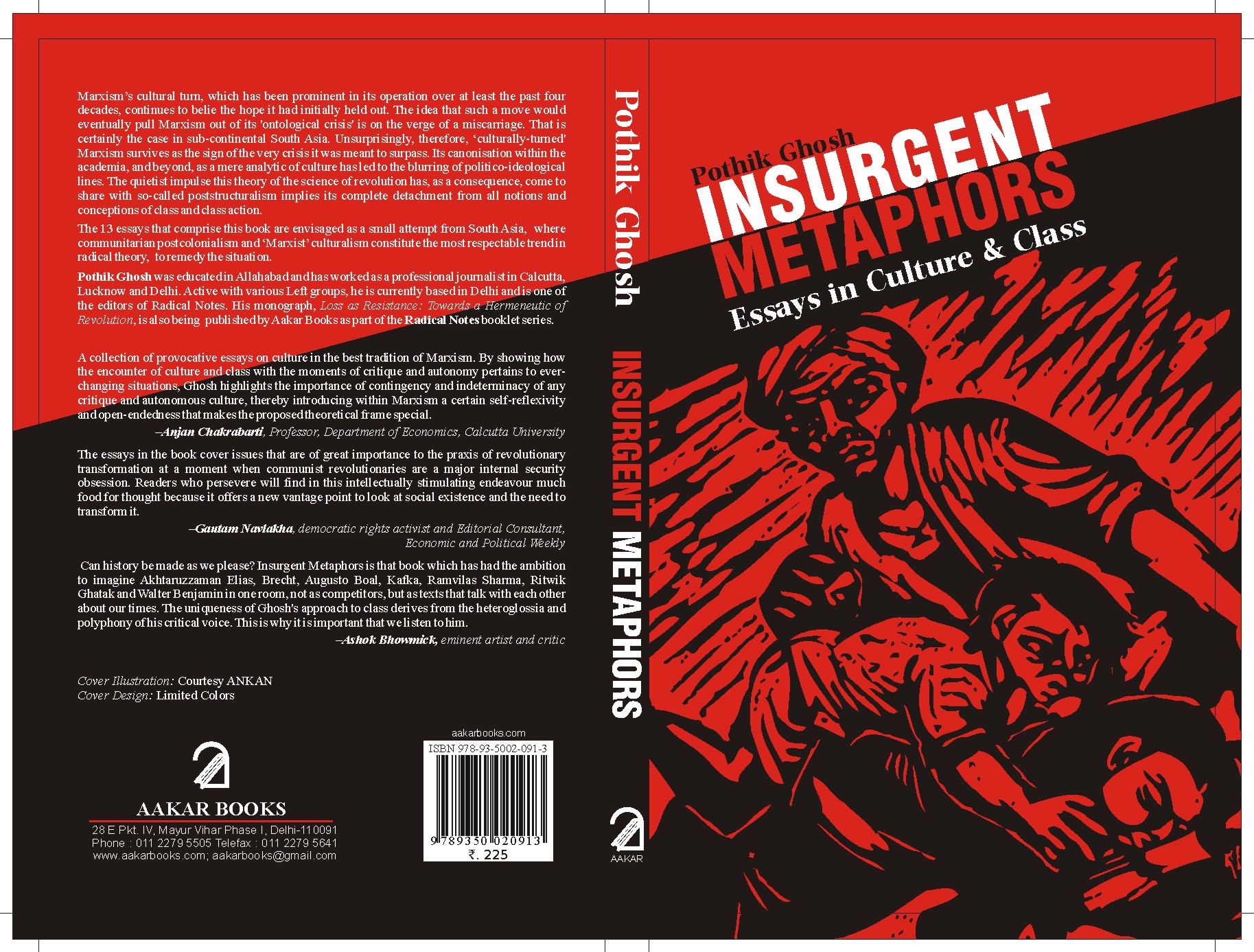
Book Launch: Pothik Ghosh’s “Insurgent Metaphors” (October 1, 2010)

INSURGENT METAPHORS by Pothik Ghosh
published by Aakar Books
to be launched on October 1, 2010
Time: 2.00-5.00 pm
Venue: Room No 308, Indian Social Institute (ISI),
10, Institutional Area, Lodi Road, New Delhi
(Near Jor Bagh Metro Station)


Marxism’s cultural turn, which has been prominent in its operation over at least the past four decades, continues to belie the hope it had initially held out. The idea that such a move would eventually pull Marxism out of its ‘ontological crisis’ is on the verge of a miscarriage. That is certainly the case in sub-continental South Asia. Unsurprisingly, therefore, ‘culturally-turned’ Marxism survives as the sign of the very crisis it was meant to surpass. Its canonisation within the academia, and beyond, as a mere analytic of culture has led to the blurring of politico-ideological lines. The quietist impulse that this theory of the science of revolution has, as a consequence, come to share with so-called poststructuralism implies its complete detachment from all notions and conceptions of class and class action.

The 13 essays that comprise this book are envisaged as a small attempt from South Asia – where communitarian postcolonialism and ‘Marxist’ culturalism constitute the most respectable trend in radical theory – to remedy the situation.


A collection of provocative essays on culture in the best tradition of Marxism. By showing how the encounter of culture and class with the moments of critique and autonomy pertains to ever-changing situations, Ghosh highlights the importance of contingency and indeterminacy of any critique and autonomous culture, thereby introducing within Marxism a certain self-reflexivity and open-endedness that makes the proposed theoretical frame special.

Anjan Chakrabarti, Professor, Department of Economics, Calcutta University

The essays in the book cover issues that are of great importance to the praxis of revolutionary transformation at a moment when communist revolutionaries are a major internal security obsession. Readers who persevere will find in this intellectually stimulating endeavour much food for thought because it offers a new vantage point to look at social existence and the need to transform it.

Gautam Navlakha, Democratic rights activist and Editorial Consultant, Economic and Political Weekly

Can history be made as we please? Insurgent Metaphors is that book which has had the ambition to imagine Akhtaruzzaman Elias, Brecht, Augusto Boal, Kafka, Ramvilas Sharma, Ritwik Ghatak and Walter Benjamin in one room, not as competitors, but as texts that talk with each other about our times. The uniqueness of Ghosh’s approach to class derives from the heteroglossia and polyphony of his critical voice. This is why it is important that we listen to him.

Ashok Bhowmick, eminent artist and critic


Pothik Ghosh was educated in Allahabad and has worked as a professional journalist in Calcutta, Lucknow and Delhi. Active with various Left groups, he is currently based in Delhi and is one of the editors of Radical Notes. His monograph, Loss as Resistance: Towards a Hermeneutic of Revolution, too has just been published by Aakar Books as part of the Radical Notes booklet series.

Commonwealth Games, National Pride and Workers’ Death

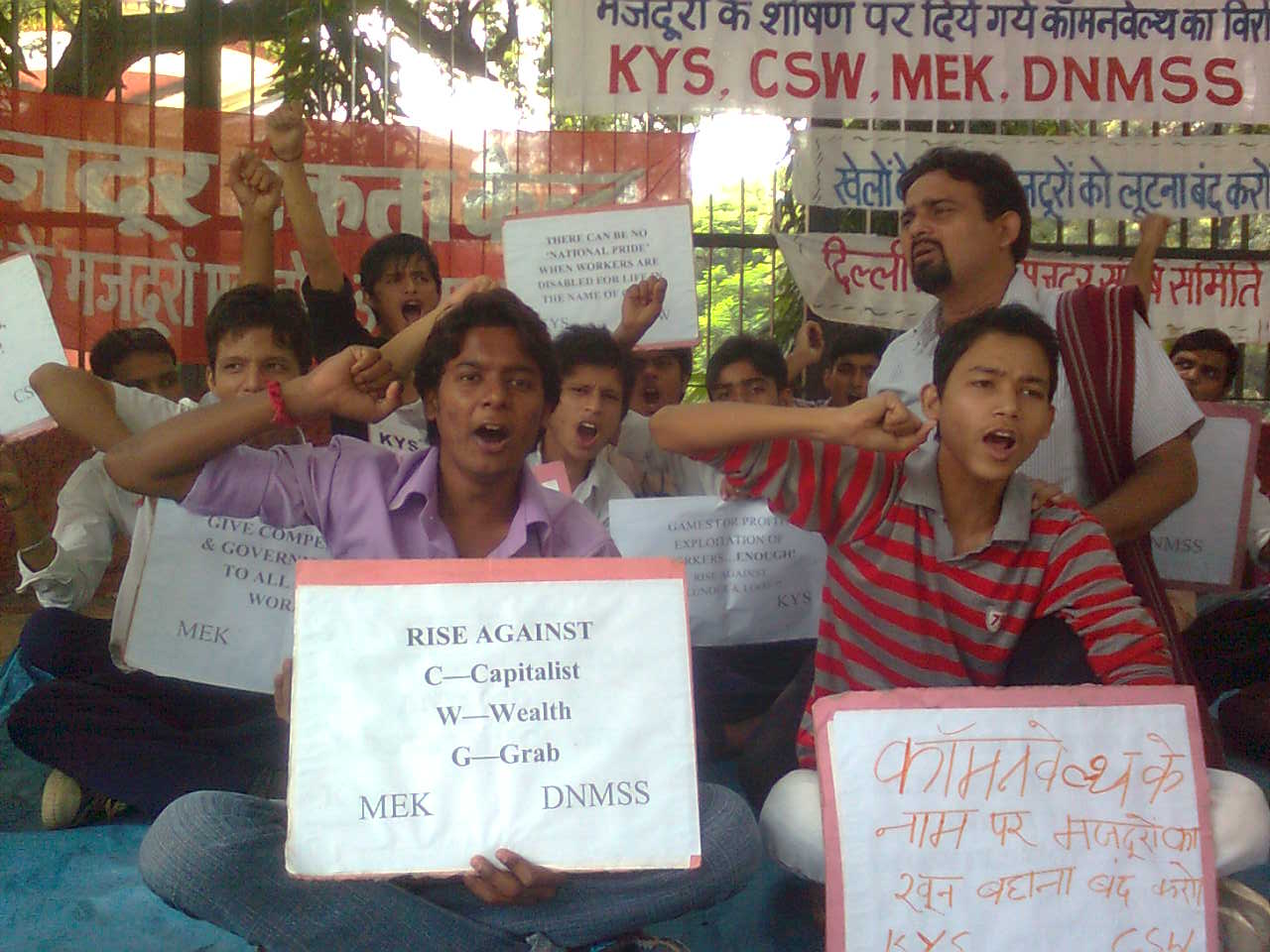
THERE IS NO ‘NATIONAL PRIDE’ IN WORKERS DYING OR BEING DISABLED FOR LIFE IN THE NAME OF COMMONWEALTH GAMES!

Dharna held outside Head Office of the CWG Organizing Committee against blatant exploitation of workers
Fact-Finding Team Visits Injured Workers: Shocked at Lack of Crucial Arrangements like a Help Line

Today on September 23, workers, trade unions, students and civil rights activists held a dharna outside the Head Office of the Commonwealth Games Organizing Committee in Jantar Mantar. This protest was called following the collapse of the hastily built footbridge outside JLN Stadium on September 21. The incident left 27 workers injured, five of whom are critically injured and admitted in AIIMS.

The protesters pointed to the obvious negligence on the part of government officials, and the fact that workers have been continuously exposed to dangerous work conditions across CWG work sites. They argued that the Games were being used to rake in huge profits for builders, many of whom acquired tenders surreptitiously from the government, and have unhesitatingly exploited workers and built structures of poor quality to save on building costs. Hailing the Games a profit-vending event rather than an event of ‘national pride’, Shri Alok Kumar (Secretary of Delhi Nirman Mazdoor Sangharsh Samiti), specified that contractors have made most of their profits by exploiting workers. He said that contractors have been openly exploiting construction workers by exposing them to long hours of work and dangerous work conditions. The government has been party to this exploitation since it is the principal employer in all CWG construction projects. Shri Nag Bhushan, a prominent trade unionist from Gurgaon also addressed the protest. He argued that that the government’s silence, and at the most its tardy response on the issue, has allowed for continuous and brutal exploitation of workers in the name of the Commonwealth Games.

It is for these reasons that the protesters targeted the Organizing Committee (OC). The delegation sent by them demanded the following:
i) Resignation of the state PWD Minister, Shri Rajkumar Chauhan
ii) Provision of government jobs to all 27 workers injured
iii) Immediate release of adequate compensation to all workers injured in CWG work sites.
iv) Cancellation of all contracts given to the accused construction company

Following the apathetic response of the OC the protesters decided to intensify the struggle against the exploitation of workers across CWG construction sites by using all democratic means possible. Trade unions present at the protest have decided to mobilize workers across all CWG worksites on the issue of workers’ blatant exploitation. Considering the fact that CWG organizers have repeatedly boycotted the interests of workers, workers have now decided to organize themselves and reach out to civil society in a bid to stall the Games completely. Through spontaneous protests throughout the period of construction work in CWG work sites, workers have rightfully delayed construction work of the CWG in the past. Now by providing their struggle an organized form they aim to expose to the Indian public, the brutality with which such mega events are organized and executed.

Following the protest at Jantar Mantar a fact finding team was constituted which visited the workers admitted in AIIMS. The team consisting of trade unionists, Delhi University teachers and students visited AIIMS and were shocked by the lack of crucial arrangements that should have been made by the CWG Organizing Committee. Out of the 8 patients hospitalized in AIIMS, 3 are admitted in the ICU (in critical condition, suffering from severe head injuries), and 5 have spinal injuries, out of whom one is already paralyzed. From the discussions with the patients’ relatives it was evident that no information was provided to them on the accident by the CWG Organizing Committee (OC) or Delhi Government. Relatives reached the hospital on hearing about the incident by word of mouth and no provisions were made by the OC/Delhi Government for their travel to Delhi! It was evident to the fact finding team that no volunteers from the OC were made available at AIIMS so as to help/guide relatives coming in to meet the patients. Indeed, the fact finding team itself had difficulty locating the workers in the hospital and ended up wasting crucial time before locating one of the injured workers. The apathy of the government officials was also revealed by the fact that some of the patients’ relatives have been asked to arranged for blood themselves. In its appraisal to the fact finding team, the AIIMS staff made it clear that the injured workers require long term rehabilitation.

The response of the Delhi Government is very shocking and their callous behavior (reflected in their unwillingness to provide proper facilities to workers injured in the name of CWG), is condemnable. We must highlight the terrible way in which workers have been exploited in the name of CWG. We hope that the larger civil society will step forward to help their laboring brethren.

Alok Kumar, Secretary, Delhi Nirman Mazdoor Sangharsh Samiti (Ph: 9313730069) Sujit Kumar, State Committee Member, Krantikari Yuva Sangathan (Ph: 9312654851)

Supported by:
Indian Council of Trade Unions (ICTU)
Centre For Struggling Workers in Trade Union (CSWTU)
All India Federation of Trade Unions (AIFTU)

The struggle of Ludhiana powerloom workers

Workers of about three dozen power loom factories in Ludhiana’s Gaushala, Kashmir Nagar, Madhopuri etc. areas are on strike from 16th September 2010 under the leadership of the Karkhana Mazdoor Union (KMU). The workers have revolted against their pathetic living conditions, total absence of labour laws, callous attitude of the factory owners and administration and the opportunistic behaviour of the established trade unions affiliated to parliamentary left parties. They are energised by the recent successful strikes in 42 power loom factories in Shaktinagar area and the Jindal Textiles factory.

Ludhiana is among the big industrial cities in India and the industrial capital of Punjab. The main industries here are hosiery, bicycle, tyre, auto-parts, engineering etc. In recent years the workers in Ludhiana have been fighting for their basic rights e.g. the struggle of the thousands of workers of the big factories of Ludhiana such as Hero cycles, Rockman, Avon, Rolson, Highway, Garetave, Bajaj Sons etc; the militant struggle of the thousands of workers against the factory owners and police-bureaucracy after the Hindustan Tyres episode; the outburst of anger of the workers in December 2009 after the Dhandari episode, the workers hitting the road after a recent disappearance of a workers of Poddar Tyres. These outbursts are just a reflection of the terrible conditions of the life which the workers of Ludhiana are forced to live and the total failure of the governance system to protect even the basic rights of the workers. The anger of workers is expressed at times spontaneously and at other times in a planned and organised manner. It is because of this reason that most of the time section 144 of the Cr. P.C. is imposed in the industrial areas of Ludhiana which prohibits assembly of five or more persons and holding of public meetings besides other restrictions.

Most of the workers of Ludhiana are migrant workers coming from the states of Uttar Pradesh and Bihar. They are treated as aliens in their own country. These workers are subject to abject poverty and extreme exploitation. Despite toiling for 12-14 hours a day, most of the time they do not even receive the minimum wages fixed for a helper for 8 hours work {Rs 3400 (less than 80 USD) monthly}. In case of the power loom workers, there has been no increment in the piece rates and wages for last 10-12 years while the prices of all basic necessities like food, housing, medical care, travel have been skyrocketing. On the other hand there has been manifold increase in the profit level of the factory owners.

The working condition of the power loom workers of Ludhiana is so difficult and so dangerous that it can at best be called inhuman. Serious injuries and deaths at workplace are quite common in the industrial areas. Even basic safety measures and regulations are not implemented by the factory owners. Even the administration does not take any initiative to fulfil its constitutional obligation of implementing the labour laws in these areas. On the contrary in most of the cases, the administration is found connived with the factory owners to serve their interests. No labour law whatsoever is implemented in these factories. Provident Fund, Employees State Insurance, Job Card, Attendance Register have no existence here. The regional labour department is fully hand in glove with the errant factory owners and is suitably compensated for its services. Not only the factory owners have bought up the officials and police, they do not even hesitate to use the services of goons to intimidate the workers if they raise their voices for justice. In the Dhandari episode in December 2010, they unabashedly used the local goons called Bikers’ Gang to brutally attack the agitating workers. Even the police favoured the factory owners and held the workers responsible for the violence. The owners portray any agitation of workers as being launched by “outsiders” and the local politicians and regional media also take the side of the owners only.

The workers of Ludhiana have been fighting for their rights for years through the established trade unions. But of late they have begun to realise that it is because of the betrayal of the leadership of opportunistic and corrupt trade unions such as CITU and due to the lack of well planned strategy that they have not been able to put up an effective resistance and the factory owners manage to crush their struggle. In a number of struggles of workers of large factories of Ludhiana such as Hero Cycle, Rockman, KW,Avon, Rolson, Highway, Bajaj Sons, Moonlight etc since 2004, the opportunistic, compromising, corrupt and pro-management character of CITU has been thoroughly exposed before the workers.

The recent surge of militant agitation among the power loom workers of Ludhiana began with the strike of the 42 power loom factories of Shaktinagar, Tibba Road areas on 24th August 2010 under the leadership of the Karkhana Mazdoor Union. It was the apathetic attitude of the power loom factory owners which was mainly responsible for the inhuman conditions of living which forced the workers to halt the work and choose the path of strike. The main demands of the workers were: hike in the piece rates/wages, necessary provisions for the safety of the workers and implementing all the labour laws including identity cards, PF, ESI etc. The bold, organised and determined fight of the workers forced the power loom owners to relent and they were forced to agree to the demands of the workers. On 31st August the workers withdrew their strike after a written agreement with the owners. It was a glorious victory of the workers after a long time. A remarkable aspect of this victory was that the power loom owners were not only forced to hike the piece rates/wages but they also agreed to give half wages for the days of strike. It is very rare that the factory owners agree to pay for the days of strike. On the contrary, one can find many instances in the labour movement of Ludhiana like the shameful Avon Cycle agreement in which due to the compromising, pusillanimous character of the renegade leadership, the workers were forced to work for 9 days without pay as a punishment for going on strike.

After this a strike broke out in the Jindal Textile factory and there too it reached a successful culmination. It is noteworthy that this was after 18 years that a workers struggle had achieved such success in Ludhiana. During the last one and a half decade the workers of Ludhiana had fought many long struggles but they culminated in shameful defeat due to the betrayal of the established trade unions. The recent victory is important in this respect and it has raised the morale of the workers to a new high.

Meanwhile, workers of some other power loom factories agitating under another union were brutally attacked by armed goons of the factory owners last week. Around 50 workers were wounded in this lethal attack, some of them seriosly. Karkhana Mazdoor Union has demanded the authorities to carry out an investigation and punish the culprits.

Taking inspiration from the recent successes in the Shaktinagar and Jindal factory strikes, hundreds of the power loom workers of about three dozen factories of Ludhiana’s Gaushala, Kashmir Nagar, Madhopuri etc also decided to call a strike on 16th September 2010 under the leadership of the Karkhana Mazdoor Union. These workers are on a strike to force the factory owners to increase their piece rate/salary and to implement other basic rights. They are united and determined to make their strike successful. They have appealed to the fellow workers of other power loom factories who are yet to join the strike to come forward and join the strike to make the struggle more united and strong. Along with this the workers have also organised vigilant squads of their own against the possibility of fresh attacks by the factory owners. A great achievement of these strikes is that the workers are no longer terrified of the police and the goons of the owners. Moulder and Steel Workers Union of Ludhiana has supported the power loom workers in their strike. The workers have also distributed pamphlets among the civilian population explaining to them their wretched working and living conditions and the rationale behind their demands. They have also appealed to other factory workers of Ludhiana to support and join their strike. The workers have warned the officials of the labour department not to work as stooges of the factory owners and perform their constitutional duties otherwise their strike will become more vigorous.

On the third day of the strike i.e. on 18th September 2010, the henchmen of a factory owner attacked the KMU members who were distributing the leaflets in a market and also kidnapped two workers. Immediately hundreds of workers gathered outside the factory where the kidnapped workers were being held. The owner ran away and the workers were rescued. This was another psychological victory for the workers.

Contact for further information:
Rajwinder – 098886 55663, Lakhwinder – 096461 50249
Email: lakhwinder0143@yahoo.co.in
Office: Karkhana Mazdoor Union, Shaheed Bhagat Singh Pustkalaya, Gali No.5, Lakshman Nagar, Gyaspura, Ludhiana, Punjab

Seven Decades of Kashmir, 1940-2010

AN EXHIBITION on the HISTORY OF KASHMIR.
Venue: Delhi School of Economics, Delhi University
Date: 21 September 2010
Time: 11.00 AM to 3.00 PM

It has been more than three months since Kashmir has erupted to protest against the murder of civilians by the Indian army. The current phase of protests started on June 11th, when a teenager was killed by a smoke shell fired by Indian security forces. People of Kashmir came out on the streets, en-masse, to demonstrate against this killing. Instead of punishing the culprits who were responsible for this murder, protesters were met with live bullets, tear gas shells, batons, curfew and scores of arrests. According to the Government’s own estimate eighty one people have died since June 11. This includes a numbers of teenagers and even an eight year old child. However, vicious repression unleashed by Indian forces, under impunity granted by the infamous Armed Forces Special Powers Act, has failed to intimidate the Kashmiri people; in fact every act of brutality has brought increasing number protesters on the streets. The latest stage of this decades-old
conflict between the people of Kashmir and the Indian state has only been escalating, with civilian deaths at the hands of the armed forces being reported almost daily.

Today Kashmir has forced us to think critically about Indian democracy. The erosion of democratic space won’t stop at the border of Kashmir; it will engulf us – if it has not done so already. At this crucial juncture it has become imperative for the entire civil society; particularly students to engage themselves with the debate on Kashmir and its future. However, we must remember that the recent protest and repression in Kashmir is not an isolated event, it has a long history of seventy years. If we fail to contextualise the issue then a debate today will be rendered useless. This is particularly important because the mainstream media houses, as usual, are doing their best to trivialise the issue by dissociating it from the historical background.

To start an informed debate on Kashmir and Indian democracy, we invite you to an EXHIBITION on the HISTORY OF KASHMIR.

A Few facts about Kashmir:

700,000 Indian troops are posted in the valley

One soldier for every 14 Kashmiri, biggest militarized non-war zone of the world

80,000 people have been killed, 81 in last three months

International People’s Tribunal found 2700 mass graves where victims of fake encounter killings were buried

Kashmir University Students’ Association has been banned, 15 students were arrested under UAPA for protesting against the recent killings.

More on what continues to ail University Democrats and the likes!

Released by Delhi State Committee, Krantikari Yuva Sangathan (KYS), A Unit of All India Revolutionary Youth Organization (A.I.R.Y.O.)

We have not abandoned purely student demands,
but the best way to bring THE UNIVERSITY INTO QUESTION
is to intensify the workers’ movement.

Daniel Cohn-Bendit and Jean-Pierre Duteuil, March 22nd Movement, 1968

KYS’s polemical tract, What Is Ailing University Democrats!, has received many responses, and having read through them closely we have drafted the following. Not all responses were productive for the ensuing debate but there were some that reflected a serious engagement with what KYS had argued. We are happy to reiterate some of the points raised in such responses and to develop them further. With respect to the other responses received, such as those from New Socialist Initiative (NSI) and from University Community for Democracy (UCD), we have some detailed clarifications to make, and of course, some new observations to highlight. Nevertheless, the principal segment of this response is dedicated to the much more significant debate on the nature of working class politics and forms of its alignment with the petty bourgeois section in a given society. We have done this, because those who have sincerely reflected on our observations deserve further elucidation of our position. For those interested mainly in our response to UCD’s rejoinder, we suggest a close reading of Sections 1 and 2. To those concerned with the debate on Marxism’s deployment of class analysis, student-youth politics and the way ahead for the working class movement, please use your discretion and move to Sections 3, 4 and 5.

1. Some Simple Facts for Those Who Harp About Being Factually Sound

To begin with we would like to emphasize that KYS has absolutely no misconceptions about the nature of University Community for Democracy (UCD). We see it as a forum dominated by certain tendencies. It was these dominating tendencies that we constantly confronted in meetings and which we critiqued in our paper. It was very clear to us that right from its inception the functioning and constitutive logic of this forum was heavily influenced by New Socialist Initiative (NSI). With each day of participation in UCD, it became clearer still that the space was not an “open” one. This was because many of us, who joined UCD later, i.e. around July of this year, were continuously considered and treated as outsiders. We will underscore this fact shortly by quoting from minutes of the meetings. We attribute UCD’s functioning and form of politics to the way NSI shaped the contours of UCD. In the interest of its liberal politics (articulated best in its approach to NGOs, the media, the politics of alliance-making, etc.), NSI did not simply propose action plans for UCD to ratify, but even upturned decisions of UCD’s general body meetings in undemocratic ways, hence rendering consensus building in UCD a meaningless endeavour.

The following are references to minutes of meetings and emails exchanged in response to them, which prove the observation highlighted above:

i) In the 24th July meeting it was recorded that some people objected to the extension of an invitation to NGO persons to speak at the July 30th protest meeting. Instead of NGO persons it was suggested that students should be asked to speak. The consensus reached after discussion was that the NGO speakers suggested by NSI would not be called for the protest meeting. For NSI the discussion on NGOs was deemed “unnecessary”. They were unhappy with what was obviously a disruption in their preset plan for the protest meeting. This is why on July 27th an email was sent out by a member of NSI that as UCD’s “most active participants” they had decided to organize a program in Ramjas College, on the same day as the protest meeting (in the morning), for which the disputed NGO person was invited.

Note the repercussions of such a manoeuvre—UCD’s decision on not calling any NGO person as a speaker for the July 30th program was undermined. In Ramjas College the forum was, by force, allied with NGO politics (after all, in such a program UCD would be discussed, and hence, would be sharing a discursive space with NGOs—a space it had decided not to share till it was more clear on the credentials of certain NGOs). Needless to say, KYS was against the inclusion of any kind of NGO and paid ‘activism’.

ii) On the night of 29th June, i.e. 8:52 p.m., a message was put up on the facebook account/google group (many UCD participants were not members of these at the time), asking people to come for a meeting the next morning (30th June) at 10 a.m. We will highlight the contents of this meeting but before that what needs to be noted is that on 29th June, which was the first meeting of the UCD on campus, it had been decided by consensus to meet on the 3rd of July. In the rushed and poorly coordinated meeting on 30th June it was decided by those present (mostly NSI and its sympathizers) that Gandhi Ashram should become a concrete project of the UCD, that creating communes was part of UCD’s vision, etc.

On the contrary, in the 29th June meeting it had been decided to slow down on the Gandhi Ashram and commune issue till there was substantial participation on behalf of affected students. This point has been hidden in the minutes of the 29th June meeting, and in fact, the minutes only discuss grand plans on how the ‘commune’ would be run. The hastily called 30th June meeting was basically aimed at clinching the commune issue even before the 3rd July meeting. After this 30th June meeting a team constituted by “UCD” went ahead to speak with the Gandhi Ashram management. In this regard, this “emergency meeting” was simply held to preset the agenda of the larger meeting to be held on 3rd July. Clearly, there was an overt attempt not to take all of UCD’s participants into confidence when strategizing UCD’s politics and action plan. Perhaps now the reader can understand why KYS has taken the position that coordinating a forum through cyberspace is highly problematic. As an organization, we strongly feel that it is a space that is actively used to undermine the consensus building initiatives of those who take out the time to present themselves in general body meetings. We do not buy the argument that such a meeting was called in haste because there were many Mirandians in dire need of alternative arrangements. Why don’t we? Well, because we knew that the number of students still in need of a PG was negligible—a point proved by the poor response of students to the Gandhi Ashram plan. We knew that such a meeting was actually called to exclude many from UCD’s decision making process.

iii) On 20th July it was noted by Aashima who was recording the minutes of the meeting that “there was a BRIEF [emphasis added] discussion about what our approach should be gradually, if we should focus on hostel evictions or also give more prominence to the issue of unregulated rents and problems in the neighbourhood since many students live in private accommodation.” Ironically, immediately post this meeting it was held that UCD had developed a detailed and important [emphasis added] position on the problem of escalating rents. KYS and CSW were consequently denounced for running a “parallel” campaign on the issue of rent and for compromising UCD’s attempts in this direction. There are two points we would like to clarify here. The first that NSI’s Commonwealth Games-University centric approach ensured that when rent was taken up by UCD it would be done so as a student specific issue/concern. That is why rent is mentioned in the first UCD parcha in precisely these terms—“It (University) has thus become an accomplice in the larger processes of reckless corporatisation that the whole city is undergoing in the bid of become a ‘global city’. This has left students [emphasis added] at the mercy of private accommodation, with its unregulated rents and precarious guarantees. Rents are rising in anticipation of the increased demand for PGs and flats, forcing many existing residents to move out and making accommodation unaffordable for incoming residents as well…” Indeed, raising rents as only a student specific concern is the brainchild of UCD. KYS was trying to point out this unfortunate fact in its last pamphlet, and was least interested in establishing a copyright on the issue of rent control.

The second point we would like to highlight here is that by conceptualizing rent as a student-University specific issue, UCD has not been pursuing a feasible or a desirable campaign for rent regulation. In that sense KYS’s initiatives on rent control cannot be compared or considered “parallel” to those of UCD for it conceptualizes rent as a generalized problem for migrants in city. Why is the UCD campaign not feasible or desirable? It is not feasible because the rents of one area, i.e. the University area, cannot be regulated without the regulation of rents across the city. The UCD campaign is not desirable either because its approach to rent does not take into consideration the majority of tenants in the city. After all, for the scores of DU students living with their families on rent it is not at all desirable that rent be perceived as a University-neighbourhood problem alone. In contrast to UCD and its many constituents, KYS has been mobilizing both students and non-student youth who live on rent. Considering rent regulation is the responsibility of the Delhi Government, we have approached the Chief Minister on the issue. Although the Chief Minister has given certain assurances, we know for a fact that to pressurize the government into action, the struggle for rent regulation across the city has to be further intensified.

Having drawn on these references we would like to highlight, in brief, the nature of KYS’ contribution to UCD and at what conjuncture we finally withdrew from the forum. We do this to put at rest certain presumptuous accusations about our “negative” or “non-proactive” role in UCD. As an organization with other commitments to attend to, KYS sent three to four of its members to UCD meetings up till the point it decided to move out of the forum. Yes, in that sense we didn’t seek to bombard the platform with our physical presence just so as to ensure that UCD’s contours mapped down to what had been pre-decided from before. Again, for UCD activities (such as area-campaigning in Vijaynagar or college campaigning) we sent our members. KYS also circulated UCD’s parcha independently at the SC/ST admission counters in Arts Faculty and amongst students living in Sangam Park-Gurmandi area. This area is a working class neighbourhood in which many students enrolled in Satyawati Morning and Satyawati Evening College, stay on rent. Furthermore, our fraternal organization, CSW also distributed the UCD parcha in University Hostel for Women.

When our participation was not possible during UCD activities such as attending DUTA’s GBMs, we informed other participants well in advance. There have been references to us sabotaging UCD’s campaign on the 21st of July, i.e. the first day of the academic session. If certain participants in UCD were not so hell bent on writing off KYS’s participation they would accept that there was a confusion that day about where to assemble first for college campaigning. KYS members had not checked their email accounts on the night of the 20th which is why they were under the impression that UCD campaigners were to assemble at Khalsa College first, watch the street play, and then move onto the other colleges slotted for campaigning that day. This is why KYS’s member reached Khalsa and not Daulat Ram College on the morning of July 21st. Post this incident our members checked posts of UCD on a daily basis. Unfortunately, the resentment continued on the part of “UCD”.

By the end of July, conditions were such within UCD’s functioning that KYS no longer considered it feasible to participate in the forum. Firstly, two consecutive meetings (22nd July and 24th July) were channelized in a way to literally flush out KYS from UCD (you would only get glimpses of this in the minutes—the real witness to this are the participants themselves). In such a hostile atmosphere no organization can consider serious participation possible. Secondly, and more importantly, the NGO-ization of UCD was something KYS refused to tolerate. Keeping the July 30th Ramjas program (especially its repercussions) in mind, KYS decided to withdraw from UCD. It attended the 30th July protest meeting but only its fraternal organization, CSW sent a speaker. By the end of the 30th July protest meeting even CSW decided to completely withdraw from UCD. So, for those who hinted that our non-participation in the “relay hunger strike” was noted by all, we would like to emphasize that KYS had withdrawn from the forum by then, like many others. Now that the ‘graph’ of our participation has been drawn for all to see, you will observe that claims of us not being supportive and pro-active, are based on wilful misconceptions.

Of course, what we also need to highlight here are the conscious attempts to frustrate the efforts of KYS and others to pave the way for UCD to come on its own. More than one person in their response to KYS’s earlier mail (such responses being quite a significant retrospective critique of UCD), have accepted that corner meetings prior to or after UCD’s larger meetings were actively pursued. We have shown above that such a practice was encouraged by NSI so as to control UCD’s political process—a control/influence not based on substantive debate and ideological consensus building but on apolitical ties of familiarity/friendship. When such apolitical influencing measures showed signs of breaking, NSI actively projected KYS’s arguments which were raised in UCD meetings, as an articulation of “pre-existing resentment”. Many in their email responses have revealed (intentionally or unintentionally) that NSI actively spread this rumour. Unfortunately for NSI, many individuals drawn to UCD could not be fooled for long about the real nature of KYS’s arguments, i.e. on the compromised form of NSI-influenced politics and the sectarianess of UCD’s constitutive logic. Indeed, the biggest obstacle to UCD coming on its own was the umbrella formation NSI had forced upon the forum, in the interest of promoting its own liberal politics.

Let us now draw attention to some crucial details that will elucidate KYS’s position further. Firstly, the crux of KYS’s critique (which some people failed to understand), pertains to how struggles demanding “democratic space from the University”, are elitist and sectarian. We have been arguing this because such struggles entail the following: i) demanding democracy for a privileged minority, i.e. 7 percent youth (i.e., the percentage of youth making it to higher education in India), whose inclusion in the University system is actually based on somebody else’s exclusion; ii) demanding from the University something it does not have—the real power residing somewhere else. Of course, the conclusion to be drawn from these two insights is not that University politics should be shunned, but rather, that the form of such politics be transformed. The solution lies in a politics that is based on uniting non-student youth and University students (please see our discussion below, on the DTU students’ protest and on the issue of fee hike. Also see section 5). Undeniably, for such politics to materialize, organizations will have to stop focusing on the University alone, and more importantly, will have to mobilize University students on issues that unite them with youth excluded from the education system. We do hope that in the near future there are more organizations like KYS, which along with work in the University; pursue neighbourhood work amongst youth residing in working class localities.

Secondly, KYS in its earlier pamphlet highlighted the tokenism prevalent in UCD’s approach to workers and workers’ issues. We stand by our earlier critique. With respect to some of the comments made by UCD’s participants regarding the forum’s approach to workers, we support what Naina highlighted in her mail on September 3rd. However, we would like to further problematize UCD’s position that there is nothing wrong/destructive in perceiving workers (their issues, etc.) through a petty bourgeois lens. Indeed, such practices are a serious obstacle in the path of progressive struggle. We would like to prove this by drawing attention to the highly problematic political and theoretical roots of such an approach. Politics based on petty bourgeois notions of empathy (sympathy, etc.) is nothing but the repetition of Bogdanovian tendencies in the working class movement, which were based on the neo-Kantian notion of verstehen. Such tendencies have always been criticized for their anti-revolutionary potential, and Lenin himself presented a devastating critique of these tendencies in Empirio-Criticism.

To elucidate—when you are seeking to understand the working class, you merely end up gathering empirical information on workers (i.e., how they feel, and how you would feel being in their shoes, etc), rather than perceiving the objective condition of the being of the working class (i.e. the conditions that create and reproduce the class in the first place). It is precisely because of this empirical fact-finding that you fail to reach the condition where you realize the organic connection between your oppression and the working class’s exploitation. Of course, the by-product of not reaching this condition is that the petty bourgeois class, as a whole, fails to realize the revolutionary potential of the working class, especially its ability to liberate all classes from the oppression of capitalism. As a result, the petty bourgeoisie continues to suspect and maintain ideological distance/discomfort with working class politics, and at most, engages with working class politics in patronizing ways.

Furthermore, we would like to reiterate that there is often little ‘good intention’ involved in practices like slum work/tutoring working class children, etc., for bodies like Women’s Development Cells, Social Service Leagues/NSS cells, etc., tend to institutionalize such activities into extra-curricular ones. Indeed, such bodies tap on the sensitiveness of certain individuals and draw them unnecessarily into the network of NGOs. Sadly, this is a huge loss for the working class movement since it doesn’t need youth who, through social work, continue to work within the system. Instead, the movement needs youth who engage with the process of class and realize the need for class struggle. Thus, the intention behind bringing these points to the attention of UCD members was not so much to “mock” their endeavours, but to reveal to them the drawbacks of their form of politics.

Thirdly, by raising the issue of the Miranda House construction workers we sought to establish how necessary workers are for launching a successful struggle against the Commonwealth Games (CWG). Unfortunately, in their response UCD completely elided this issue. In fact, they resorted to highlighting meaningless gestures made by them with respect to workers’ issues. We quote, “…[W]e have stood against construction work in the University that violates legally sanctioned labour standards and have integrated it into our demands…” Indeed, this ‘integration’ with no participation in actual workers’ struggles, amounts to tokenism. UCD and its dominant subset, i.e. ‘new’ socialists, may not be running a trade union, but really, should their pre-decided programs (“hunger strikes, etc.) be so inflexible that they cannot be part of a struggle for which they otherwise mouth support (especially when such a struggle is taking place just down the lane)? Furthermore, UCD’s choice of words while describing its support for workers is troubling indeed, for it reflects a non-engagement with workers’ real issues. It is assumed by the forum that provision of legally sanctioned labour laws means an end to workers’ exploitation. In reality, even when workers are employed according to legally sanctioned labour standards, the process of work itself is highly exploitative. In fact, as observed by our trade unions, sometimes legally sanctioned labour laws like those pertaining to overtime, accentuate workers’ exploitation. In the case of laws pertaining to overtime, contractors use them to exploit their existing force of workers, rather than employing more workers for the job.

You speak of boycotting the Games, yet you fail to support the most productive and meaningful attempts to stall the Games. Really, how can you boycott something that has boycotted you?! A boycott would result in substantial losses in the gains of all those profiting from the Games. Take for example the boycott of foreign goods during the Non-Cooperation movement; it led to a massive dip in sales, followed by a huge loss of profits earned by British manufacturing units, and hence, to a weakening of the colonial state’s position in the market. However, your ‘boycott’ doesn’t have any such repercussions, and it is you, in fact, that are bearing all the losses (the hostels have been taken away and you couldn’t stop it; the prices of everything you consume have risen and you couldn’t stop this either; etc., etc.). This has happened precisely because your ‘boycott’ has been envisaged in an isolationist manner (best captured in students/teachers buying anti-CWG badges and T-shirts). Friends, this is a crucial time and workers are far from silent. For a fact pending construction work at the numerous CWG work sites is not so much due to the rains/corruption (as highlighted by the media), but due to spontaneous and frequent protests by workers employed there. Imagine if these one lakh workers were organized, and then launched their struggles…there would be no Games. In this context, should we be content buying/selling badges, filing RTIs, etc, or, should we be helping bring in the real tides of change? Realizing the necessity of involving workers in the struggle against CWG, KYS and its fraternal organizations like Mazdoor Ekta Kendra and Delhi Nirman Mazdoor Sangharsh Samiti, have been mobilizing workers across different CWG sites. Our intervention in six CWG sites have met with success, but only one was highlighted by the media, i.e. the struggle of Miranda House construction workers. Indeed, the few ‘progressive’ newspapers that covered the workers’ protest did so not because they were interested in highlighting the workers’ demands, but because they were interested in highlighting the active participation of Miranda House students. So much for the media!

On a last note, we would like to emphasize that KYS brought out many other problems with respect to UCD’s campaign. On the question of how certain teachers were participating in UCD we hardly got a satisfactory response. Since Paresh Chandra in an email explained very well the problem with a certain form of teachers’ participation, we do not consider that any further arguments are needed on our behalf. Even on the issue of Gandhi Ashram we received a poor response from UCD, which basically, amounts to no response. For factual details and elaboration on the problems with the Gandhi Ashram project, please see Paresh’s response on September 3rd. Of course, on the question of the “relay hunger strike” we received no suitable reply. If UCD continues to hold on to its own definition of what such a hunger strike is then we have one suggestion to make. We know of a student who hails from an agrarian worker’s family and travels every day by train, from Sonepat (Haryana). He is able to eat only in the morning and is able to have his next meal only when he returns at night. Please also involve him since he is perpetually on hunger strike, i.e. according to your definition. Indeed, it will suit your politics of spectacle.

KYS would also like to object to the misrepresentation of some of its arguments. We have never claimed that only a dalit/poor/muslim/gay/tribal can speak on the issues of the oppressed. UCD has once again missed the point and quoted our arguments out of context. Kindly remember the exact context in which Sujit spoke of his Dalit background. He was replying to someone called Bala.poorna who alleged that Communists (including those in our organization) were upper castes and lacked commitment on the question of caste oppression. When responding to this diatribe our member highlighted his own social position so as to prove that not all Communists are upper castes, and that Bala, in fact, was writing off the voice of the oppressed by resorting to baseless accusations. Interestingly, the real nature of our arguments, were not lost on those who gave it proper thought. Individuals like Naina were quick to pick up our point and have argued very convincingly in our support. We reiterate, it is the form of politics which is important for all participants in a movement (be it the petty bourgeoisie or workers).

2. More About NSI’s Role In UCD And Its Real Position In India’s Left Circuit

In India’s Left movement, New Socialist Initiative (NSI) has been long identified as a bourgeois oppositional formation. We highlight this fact simply because in both NSI’s and UCD’s response we saw some unjustified/unsupported claims to the contrary. Despite its ambitious claims NSI is no longer considered a part of Communist League of India (CLI) camp. For more on politics of NSI please see Lal Salaam (a theoretical-political journal). It is interesting to note that one reason why NSI has been identified as such is due to its “official” or “unofficial” support (see report of CASIM) of political fronts like Indian Social Forum (ISF) and even World Social Forum (WSF). Both ISF and WSF are platforms severely criticized for their rainbow political formations in which NGOs and their funding play a big role in delegitimizing several (armed) people’s movements. In fact, in terms of the form of its politics, NSI is a mirror image of such platforms. In this context, we have one immediate question for all those who wrote off KYS’s observations as “malicious”—are critiques on NGOs and NGO-ised forums, presented by persons such P.J. James, James Petras, Shashi Prakash and many others, simply ad hominem attacks? Can everything be reduced to malice or does that accusation stem from your inability to respond to most of the political questions raised?

Moving on, we would like to flesh out the details of how NSI has actively shaped UCD as a mirror image of itself. We do not buy the argument that UCD is a loosely constituted body or “a composite group of left organizations, individuals, liberals, progressives”…blah, blah blah. We don’t, for the simple reason that UCD’s functioning has revealed something very different. The forum’s being and existence is best explained by drawing an analogy to the Chinese doll (with its several folds). NSI, an archetypal liberal organization, was the core of UCD (the doll according to the analogy being drawn), and from the very beginning different liberal positions were congealed around it. In spite of its claims of debating and then accepting/rejecting questions/programs, “as per the larger consensus in UCD”, NSI did not succumb to these liberal gestures at all. Acting as a vector of the liberal virus itself, it did not merely support ideas/suggestions but actively initiated and consolidated certain developments in UCD. Let us draw on some references which shed light on this not so innocent contribution of NSI in UCD. For instance, NSI members actively proposed the entry of NGOs in UCD’s campaign. Similarly, they supported and promoted NGOs as bodies that build “more nuanced bridges of understanding”. One of NSI’s members, in his adamant support and promotion of NGOs, even boycotted an ongoing discussion during a UCD meeting (24th July to be precise). And to top it all, many NSI members work for NGOs—a reality that orients them towards NGO-izing whatever platforms they are part of. Another revealing example comes to mind and this pertains to the way the media was approached and perceived by NSI. Instead of criticizing the media in its bourgeois form, NSI members went to the extent of identifying newspapers like Tehelka as “friends”/”part” of the campaign! One NSI members even said that Tehelka, if involved extensively, will make the process of the campaign “smooth” (29 June 2010). Expectedly, this perception also became that of UCD, as reflected in some emails exchanged during end June and early July. Of course, we would not have said anything if such statements on the media had not come from an organization that claims to be Marxist. Isn’t it a Marxist axiom that in the process of resisting capitalism we should not reproduce the spirit of bourgeois thinking?

3. How Marxism Identifies the Position of the Working Class vis-à-vis Identities

While upholding KYS’s critique of the form of politics represented by the main tendency in UCD as well as KYS’s understanding of the relationship between identity and class struggle, Paresh Chandra, in his most recent response differs on some of the specificities of KYS’s prognosis. His main difference with our position is that students’ class position cannot be identified on the basis of their class background and the kinds of colleges/institutions/courses they end up in. For him the main defining feature of student [all]- as- worker is the very condition they (students) are being ascribed within the university/education system (more on this later). He further accuses us for identifying the class position of students only on the basis of their background whereby reducing class to a “sociological fixity”. The end result being that we read class as a static sociological entity which can then be found more in some institutions/courses than the others. On the contrary, we had argued that ‘student’ is an identity comprising of different class positions and if we don’t see the different class positions within (and its implications) we will end up reducing university politics into an identitarian one (having identifiable common interests vis-à-vis other social entities and the state). To further elucidate, it is the different class trajectories (journeys) that determine the being of a student. These trajectories are based not only on class background but on the class process itself (i.e. the process whereby one’s class position is subject to change, depending on changes in the contingent factors in the economy). Thus, what kind of student one will end up being is determined by the combination of one’s class background and the class process (something which creates possibilities of contradictory class positions, particularly with respect to the middle strata, i.e. the petty bourgeoisie, the peasantry, etc.). To simplify the matter, there can be different kinds of students: working class, petty bourgeois, peasant, bourgeois, etc. We will restrict our discussion to working class and petty bourgeois students because of their particular bearing on the nature of university politics that exists in general.

Working class students find themselves in a condition where they get admission to lower grade educational institutes, and even when they enter the threshold of better institutions their inability to cope up causes them to perform badly. Considering this, their pursuit of higher education is such that they take with them merely the basic skills required to survive in the job market. Their education is directly based on them being future bearers of labour power/producers of surplus value, and hence, the logical conclusion of their education is them becoming workers. On the other hand, some petty bourgeois students, through education, come to acquire skills (as a property form), which then helps them share with the bourgeoisie, surplus value produced by workers. Characteristically, petty bourgeois students regard the future as relatively bright, and instead, complain of the drudgery of the present (for them the immediate is what is visible and troubling, i.e. the rigors of the education system and the fact that they sometimes receive less pocket money than what workers earn). Bourgeois students pursue an education so as to acquire the etiquettes which will help their further integration into the ruling class. Thus, their coming to universities to study does not make them part of the working class or petty bourgeoisie.

However, arguing from his position of student-as-worker, Paresh contends that our class analysis of students led us to project class as a sociological entity. To begin with, Paresh has unfortunately misread our historical empiric, i.e., a level where things will only appear as a sociological entity. We never equated class with what simply appears as a sociological entity, and, in fact, see it as a process which is bolstered by state policies seeking to fulfill the needs of the labour market. We concretely think class is a historical accumulation of humankind that has a determinate relationship with other classes, which might or might not appear as sociological entities in their different moments of congealment in the trajectory of their unfolding. In fact, in the paragraph quoted by Paresh, we have talked about students as a sociological entity, hence, requiring a class analysis. If only you had managed to go beyond the phenomenological level (where you have hypostasized our historical empiric) you would have definitely realized that our historical empiric is linked to how ‘student’ as a sociological entity, is connected to government education policies and the education market. For example, when we talked about youth who have studied in government schools, come from the Hindi medium background, rarely get admission to college hostels and struggle to cope with increasing college fees and English medium teaching/coursework, we were hinting at the existence of a dual education system (prevalence of both government schools & private schools). We were also hinting at the cut off system, an administrative process in which students coming from different backgrounds are distributed among graded colleges. Because of the cut off based admission process, many students coming from the working class get admission to low grade colleges, and do not get admission into hostels because such colleges do not have any.

In more ontological terms, we are saying that the state is the constitutive element in the expanded reproduction of the system, which requires different forms of labour to be produced through graded education. Indeed, how else can one explain that only 7 percent of all youth who clear the twelfth class examination, find their way into higher education, and that even at the level of higher education the Radhakrishna system of ‘centres of excellence’ prevails? How else would we explain that our school education is hierarchically arranged in the following manner: Charvaha Vidyalas/Ekal Schools for children of agrarian workers and poor peasants; Navodayas for children of agrarian elites; Sarvodayas for children of the urban working class; KVs (Central schools) for children of central government employees (a strata itself divided into a petty bourgeois and working class position); and expensive private schools like Woodstock, Doon, Mayo, Modern, DPS, etc. for you know whom.

Now that we have clarified what we meant to say in our quoted sentences, let us clarify what Paresh is actually saying in the paragraph quoted from Correspondence’s pamphlet. Paresh quotes, “When Marx says ‘working class,’ does he mean only the ‘male, white, industrial proletariat?…” Kudos to you, your move to go beyond Marx with Marx has allowed you to throw suspicion on Marx’s understanding. This is an infliction of the liberal virus on revolutionary ideas; ironically something you yourself criticized UCD members for. To relieve you of your (mis)reading of Marx, we leave you with Marx’s own words: “Labour in a white skin cannot emancipate itself where it is branded in a black skin” (Capital, Vol. I). Clearly, Marx had an understanding of the working class being both white and black. Numerous writings of both Marx and Engels will also prove that they believed the working class was constituted of all sexes. And as far as the industrial proletariat is concerned, Marx always considered it a subset of the working class, albeit the most important and essential force in the working class struggle.

Having said this we also wish to highlight another tacit misunderstanding of Paresh, that Marxism is just about Marx and for that matter what other great Marxist leaders have to say. In reality, Marxism is a summation of different experiences of the working class in its conflict with capital. It is a synthesized articulation of the concrete. This synthesized articulation was used by Marx in philosophical debates (German Ideology, Theses on Feuerbach), in the critique of political economy (Ricardo), in debates on socialism (Proudhon), and in debates on political forms (Eighteen Brumaire, Civil War in France, Critique of Gotha Program). This synthesized summation was continued and applied by different leaders of the international proletarian movement as well as by numerous militant activists in the movement.

Moving on, in his own piece, Paresh bestows the working class position as a whole onto some identities, especially students. Though Paresh many times concedes (here and there) that TENDENCY has some relationship with class POSITION, in his endeavour to apply the epithet of working class on students as a whole, he ultimately detaches tendency from class position. He comes to define tendency as “control on one’s life”, which almost becomes a quasi-behaviourist analysis of stimulus response. To quote him further on this, “in some [students] the petty bourgeois tendency is stronger while in others it is weaker and this varies in proportion to the degree of control an individual has over his/her life.” Having achieved this abstraction Paresh goes onto provide a solution to the thorny question of consciousness. To quote him, “a class conscious student would see herself/himself as a member of the working class and in that will leave behind determinations like prehistory and family.” We really wonder why a class conscious student belonging to a petty bourgeois class position will not develop a petty bourgeois class consciousness! Some (not Paresh) have even come to argue that the petty bourgeoisie can be de-classed and a different consciousness can be imputed in them. Indeed, these two positions might look dissimilar, but they do have kin affinities because both positions tendentially make class position unimportant for one’s consciousness.

We also wonder what the operative part of such analysis could be. One possible form that comes to our mind is the whole notion of “Campus Democracy” (supported by many Left liberals and ‘Left’ organizations on campus), which is achieved through struggles of students, teachers and other staff members to control the university (more on this point in section 5). We cannot actually be sure of whether this analysis is based on the summation of any past or contemporary, concrete experiment in student politics. Let us take the example of the most radical student movement of all time, i.e., the 1968 French student revolt. Many in their nostalgic account of this movement fail to identify the core experiment of the movement—one that should be generalized. The real essence of this movement is best projected in the pamphlet titled, THE MARCH 22nd MOVEMENT, which identified the demand to ‘Defend the common interest of all students’, as illusionary. This essence can also be extracted from statements made by some of its leaders. For example, one of the most radical French student leaders, Daniel Cohn-Bendit, in an interview taken by Jean-Paul Sartre, argued that students’ seats in hostels (Cites) should be given to workers and apprentices, and that “well to do students in law and science-po go elsewhere”. Again in his interview to Herve Bourges, he vehemently asserted, “I do not believe in student unity for there are no objective interests common to all students”. In response to another question in the interview he criticized UNEF (considered a Left wing formation), for representing the bourgeoisie, and called it a pseudo mass movement because it did not represent real demands and aspirations of working class students. Cohn-Bendit clearly made a distinction between the November strikes and the Nanterre movement which emerged from the Nanterre campus located outside Paris, i.e. amongst the neighbouring slums. The students here were socially divided between affluent students from the wealthy quarters of Paris and students from working class backgrounds. So, ultimately, inheriting what can be termed the best of the 1968 legacy, we want to assert that the relationship between students and class struggle could take two forms: (i) working class students aligning with rest of the working class outside university campuses; and (ii) working class students uniting against the provision of facilities to a few privileged students, and thereby, demanding for the provision of these facilities to all.

Further we believe the views presented by Paresh stem from a particular (mis)understanding of the working class position and the ontological configuration of identities. This understanding of class is based on a highly problematic understanding of capitalism itself, i.e. of capitalism as a carceral continuum. Due to this conceptualization of capitalism in Foucaultian terms, an identity such as ‘students’ becomes a working class position. This is reflected in expressions such as students being monitored/regimentalized or losing the right to self-determinism—an incarceration considered emblematic of the working class position. It is also present in expressions such as “the working class is that section of people on which [sic] work is imposed”, and this working class with its continuum of subjectivity can be found “beyond localized time and space”. In these terms, the ancient slave, medieval serf and peasantry, i.e. on whomsoever work is imposed, is the working class! Clearly, people who argue from such positions, such as Paresh, actually forget the historicity of the modern working class. Marx clearly identified the working class as distinct from other laboring masses both in terms of time and space. In this regard he identified the working class as a section devoid of property (means of production), and hence, “free”/compelled to sell its labour power.

If we extend the logic of Paresh’s arguments, we will see that they assume that an identity such as ‘students’ is not divided amongst several class positions, but is the working class position itself. To highlight the danger of holding onto such a position we would like to draw immediate attention to the fact that such an “axiom” (if applicable) would apply even to capitalists. After all, capitalists too are bound by social etiquettes of the time and also complain of being caged in by prevailing social norms. In this regard do we attribute to them the working class position as well? We do not, and know that you too will agree to the same.

We suspect that a certain petty bourgeois discomfort with the formidable logic of Marxism, in particular, its notion of generalization, is the cause of this “status”/position borrowing. Rather than taking to the working class/proletarian position (in terms of tying one’s own petty bourgeois class interests with the interests of the working class), so as to resolve the petty bourgeois question, certain individuals from the petty bourgeois class have conveniently started calling themselves working class. Marxism as a politics and as a science has never encouraged the concealment or displacement of one’s class position, but has, on the contrary, called for the engagement with one’s class position in the process of class struggle. In other words, Marxism has always called a spade a spade when identifying different class positions and their articulation within different identities. According to Marxism, the petty bourgeois question can only be resolved on the basis of an engagement with one’s petty bourgeois class position in alignment with that of the working class position. The petty bourgeois question cannot be resolved by presuming a working class position itself.

What do we mean by the petty bourgeois question? Well, we believe it is best demonstrated in recent Bollywood movies like Three Idiots and Udaan. What comes across through this rather powerful medium is the present plight of the petty bourgeoisie, i.e. growing competition for limited facilities provided by capitalism, and the increasing mechanization of life due to ever growing demands of the system in place. At this historical conjuncture, the need of the hour is not to equate mechanization of petty bourgeois life with the working class position, but to show the petty bourgeoisie how their OPPRESSION ties up with the working class’s EXPLOITATION. Let us take the example of the medical profession for which youth from petty bourgeois families aspire for in large numbers. Indeed most doctors (mostly, self employed professionals) are from petty bourgeois backgrounds. However, to become doctors, these youth have to undergo cut-throat competition. This is because capitalism as a system does not provide healthcare to the majority of people, especially the working class considering its limited buying power. As a result, it makes provisions for limited number of medical educational institutes and jobs in medical institutions. And it is for these limited seats and jobs that petty bourgeois youth are forced to compete. In this context, the working class’s struggle for the provision of more healthcare facilities and investment in the social sector as a whole, indirectly benefits petty bourgeois youth aspiring to be doctors. It creates the condition for the creation of more medical educational institutes (more seats, hence less competition), as well as more hospitals (hence, more jobs). The process, of course, leads to a less mechanized way of life for youth aspiring for such employment. In a crucial way, it will prevent the growing mechanization of children’s lives, who, in the current scenario, lose their youth under the burden of studies/competition, and who have increasingly come to feel they have lost the right to self-determination.

In this context, the objective interest of this petty bourgeois section lies not in identifying itself as working class. Instead its objective interest lies in uniting with the emancipatory politics of the working class. Such unity is feasible and desirable because in the process of fighting for its own liberation the working class can build a system, annihilating class society, in which other sections of society will have freed and equal access to opportunities and resources.

Returning to the specific question of the working class position and the ontological configuration of identities, we would like to reiterate that it is wrong to perceive different identities as a subset of the working class. Rather than conceptualizing identities (woman, student, Dalit, OBC, Black, delinquents, etc.) as momentary congealments of the working class position, it is important to read them as multiclass entities—as sites of struggle in which contradictory class positions are in conflict with each other. The latter is the precise way in which Marxism conceptualizes identities. This is because it realizes that the different identities in existence have different ontological depths. For example, Marxism believes that the identity ‘woman’ is not the same as another identity, say that of ‘Dalit’, and that the two identities encompass a somewhat different (in terms of degree, etc.), conflict of varied class positions within them. Indeed, unlike the popular perception of Marxism as an epistemology, Marxism is the synthesis of multiple epistemologies that extract experiences emanating from different sites of struggle, i.e. from different identities. By extracting these varied experiences it actively unites the working class/proletarian experience (collective will of the class) that is spread across the different identities (just like other class positions are).

Having said this, let us trace the larger theoretical source of such analysis of identities vis-à-vis the working class position. The theoretical source from which Paresh’s arguments about students as workers emerge, is Negrian clap trap based on the mixing up of Foucault with Marx. In other words, such views stem from earlier endeavours to re-ontologize Marxism, i.e., going beyond Marx with Marx. Negri carries to the extreme the ideas of Raniero Panzieri and Mario Tronti (great leaders of the Italian working class movement), in particular, their analysis of the political class composition of workers. For Negri, class composition is not just based on determinations like labour power as variable capital, but also on determinations like the historical and social level of labour power’s reproduction. In other words, for him, determination of class composition should include, together with the wage structure, other structures that reproduce labour power.

Marx made a distinction between labour forms which are heterogeneous and take place in different concrete conditions. Hence, concrete labour. But these different heterogeneous labour forms, in capitalism, are commensurate at the level of value they produce, expressed in the price of the commodity at a given equilibrium level. Hence, abstract labour. Abstract labour expresses, therefore, certain relations of production, i.e. relations between producers of commodities and the capitalists who own the means of production and appropriate the surplus value created by labour. For Marx this dual character of labour (abstract and concrete labour) is conditioned on the skewed property relationship which forces a worker to work for a capitalist. Thus, in capitalism concrete labour forms a dialectical unity with abstract labour. Outside the relationship of production this duality cannot exist. Hence, for Marx, destroying the property relations is the precondition for liberation of labour from a condition where one person’s labour becomes another person’s profit.

Negri calls this conceptual distinction a qualitative and quantitative distinction. In this context, he argues that the theory of value, as a form of equilibrium, seizes to have any remaining validity in our time. Negri takes a clear cut Morishimite position. To quote Morishima “…as soon as heterogeneity of labour is allowed for, the theory of value is seen to conflict with Marx’s law of equalization of the rate of exploitation through society, unless the different sorts of labour are reduced to homogenous abstract human labour in proportion to their wage rates, ” (Marx’s Economics). Negri considers Marx’s labour theory of value simply as the refining of concepts developed by his contemporaries. He argues that there is another conception of labour theory of value present in Marx’s work (Grundrisse), which according to him departs radically from capitalist theories and Marxist theories, and focuses not on capitalist processes of valorization, but rather on the processes of labour’s self-valorization. To quote him further “Marx considered the value of labour not as a figure of equilibrium but as an antagonistic figure, as a subject of the dynamic rupture of the system. The concept of labour power is thus considered as valorizing element of production, relatively independent of the functioning of the capitalist law of value…This means that although in the first theory value was fixed in the structures of capital, in this second theory labour and value are both variable elements.” Having freed labour from the distinctively exploitative relationship to capital in the circuit of capital self valorization, Negri reduces Capital to an elementary expression of command. For him changing the property relationship within which the labour process takes place is no longer relevant. Again to quote him, “the notion of foundational war of all against all is based on an economy of private property and scarce resources. Material property, such as land or water or a car, cannot be in two places at once: my having and using it negates your having and using it. Immaterial property, however, such as an idea or image or a form of communication is infinitely reproducible…Some resources do remain scarce today, but many, in fact, particularly the newest elements of the economy, do not operate on a logic of scarcity,” (Multitude). The clear cut meaning to be drawn from this is that resources are scarce which is why they are owned by capitalists, but the newest elements of the economy such as immaterial property can be owned by anyone for self-valorization of one’s labour.

Again to quote him extensively, “The most important general phenomenon of the transformation of labour that we have witnessed in recent years is the passage toward what we call the factory-society. The factory can no longer be conceived as the paradigmatic site or the concentration of labour and production; laboring processes have moved outside the factory walls to invest the entire society. In other words, the apparent decline of the factory as the site of production does not mean a decline in the regime of and discipline of factory production, but means rather it is no longer limited to a particular site in society. It has insinuated itself throughout all forms of social production, spreading like a virus. All of society is now permeated through and through with the regime of the factory, that is, with the rules of the specifically capitalist relations of production. In this light, a series of Marxian distinctions need to be reviewed and reconsidered. For example, in the factory society the traditional conceptual distinction between productive and unproductive labour and between production and reproduction, which even in other periods had dubious validity, should today be considered defunct,” (Labour of Dionysius).

Having detached his ontology of labour from the circuit of capital’s self-valorization and its actualization in circulation, Negri comes to posit that a working class subjectivity for autonomy and self creation is now expressed in a new class composition. In his chronology of capitalism’s development there emerge, (i) Mass workers: all workers working for different capitalists spread over different junctures in the supply chain; (ii) the Collective worker: anyone on whom work is being imposed, and basically, anyone who helps reproduce labour power, (whether within or outside the circuit of capital accumulation and the labour process, such as women doing domestic labour, peasants, students, self-employed professionals, etc.). In a recent avatar, with increasing detachment from the existing working class movement, Negri, once a working class militant, has now come to sermonize from his position as a university democrat. His earlier collective worker has now metamorphosed into “multitude”, and hence, signifying that whomsoever is rejecting work and any control on their life, ARE CREATING a new world—his communism within capitalism (!).

Clearly, Negrian analysis includes playing with (distorting) certain key Marxist categories of analysis and arguments in the attempt to establish the petty bourgeois section (our term)/immaterial labour (his term—which itself is divided in petty bourgeois and worker), as the pivotal force in contemporary times. Of course, there will be an acceptance of the tangible presence of agricultural and industrial labour. To quote Negri, “Agricultural labour remains…dominant in quantitative terms, and industrial labour has not declined in terms of numbers globally. Immaterial labour constitutes a minority of global, and it is concentrated in some of the dominant regions of the globe. Our claim, rather, is that immaterial labour has become hegemonic in qualitative terms,” (Multitude); [emphasis in original]. By extension, this analysis means that the fight against capitalism is not against the property relationship within which the dual character of labour emerges, but SIMPLY AGAINST the daily transformation of our doing/our activities into abstract labour. Furthermore, only this so called hegemonic immaterial labour is in the position to do this. This model is best propagated by John Holloway in his article “Doing In-Against-and-Beyond Labour”. To quote Holloway, “…it is not just in the workplace: life itself is a constant struggle to break through the connections forced by abstract labour to create other sorts of social relations: when we refuse to go to work so that we can stay and play with the children, when we read (or write) an article like this, when we choose to do something not because it will bring us money but just because we enjoy it or consider it important. All the time we oppose use value to value, concrete doing to abstract labour. It is from these revolts of every day resistance, and not from the struggles of activists or parties that we must pose the question of the possibility of ceasing to create capitalism and creating a different sort of society.”

Of course, we sincerely doubt that Paresh is succumbing fully to such views. However, what we wish to point out is that a road somewhat half traveled with Negri, is a grave mistake for those committed to Marxism. If all the identities have simply entered into the reproduction structure of labour power then we can claim, based on this understanding, that all identities are equally subordinated to the rule of capital. And this is precisely what Paresh has almost come to argue. To quote him from his article, “Through and Beyond: Identities and Class Struggle”: “the problem of identities is the way it exists in the current conjuncture…all equally [emphasis added] subordinated to the rule of capital”.

However, contrary to Paresh’s analysis, for Marxism identities are not simply part of the whole (in the sense that they seamlessly flow into the whole, i.e. the working class position), but “parts” divided amongst different classes (Dalits, peasants, women etc. are all divided amongst different classes). In other words, all these identities cannot be axiomatically assumed to be part of the working class and hence, equally subordinated to the rule of capital. They should, instead, be seen as products of heterogeneous forms of labour and their alignment with different moments of capital. To illustrate this it is best to talk in terms of some concrete examples that reveal the multiple class positions present in identities and how these positions articulate themselves in a given social reality. Let us begin with the identity ‘peasant’ and how class differentiations within it are being overlooked by certain left organizations, in particular, Maoist organizations. Indeed, eliding the issue of class differentiation within the peasantry (akin to overlooking class differentiation within students) has been a perpetual problem in the Indian communist movement. Whenever movements have emerged and then intensified, communist organizations have often failed to address the issue of class divisions within the peasantry, thereby allowing rich peasants to curb the radical potential of such movements. As a result of this class collaborationist position, movements that are at junctures which can lead to further unfolding of radical and transformative politics, are withdrawn or die a natural death under the hegemony and dominance of rich peasants. It is this precise class collaborationist position vis-à-vis peasant politics that can be identified as revisionism in the Indian communist movement. Some details of this unfortunate process are discussed below.

At present, in many parts of India we can see Maoist politics at work. The problem with this politics (as highlighted by us on several platforms) is its promotion of a conglomeration/alliance between peasants (ignoring the class differentiation within), regional bourgeoisie (considered as national bourgeoisie vis-à-vis the wrongly ascertained All-India bourgeoisie/big bourgeoisie as comprador and bureaucratic bourgeoisie), petty bourgeoisie (itself divided tendentially into polarizing class processes), and the working class. The crux of our argument is that this form of alliance amounts to singing old songs in new times. This is because since the time of 1947 (the “transfer of power”) the Indian bourgeoisie has come on its own after successfully hegemonizing the Indian national liberation struggle. Following this, in the period of the 1960s, 1970s and 1980s, heightened conflicts emerged between the different sections of the Indian bourgeoisie under the aegis of the federal form of state. By this time a rank of regional bourgeoisie had emerged in stiff opposition to the big/All India bourgeoisie. The roots of the regional bourgeoisie lay in the transformation of property forms held by the rank of rich peasants. For example, after gradually acquiring property owned by poor peasants, the class of rich peasants moved onto diversifying their capital. No longer did they remain merely rich peasants but became petrol pump/cinema hall owners or entered the lucrative business of transportation, hardware, construction, etc. In this context one can say the tumultuous years post Independence were characterized by struggles based on competitive claims of different moments in the being and becoming of India’s capitalist class. Ironically, many a time Communists wrongly identified these struggles (constitutive of both friend and enemy classes), and formed united-fronts with them.

India’s Independence from colonial rule was based firmly on a multi-class alliance. Post this historical conjuncture, Communists came to make several mistakes while reading crucial moments in the process of class. Their misreading of historical moments for what they were, led them to make a series of dangerous alliances with the Congress, etc. Many such alliances led to the erosion of the Communist Party’s support base in constituencies such as those of the depressed classes. In reaction to the growing inertia and revisionism within the Communist movement, the militant Naxalbari struggle emerged. This militant struggle spread like fire and took the form of a prolonged movement, which actively sought to strengthen the anti-revisionist forces in the Communist movement. To coordinate the anti-revisionist tendency in the Communist movement a front called the All India Coordination Committee for Communist Revolutionaries (A.I.C.C.C.R.) was formed. Unfortunately, this body was dissolved. In its place emerged the Communist Party of India-Marxist Leninist (CPI-ML) which was based on a party program that continued to project the Democratic Revolution as communist strategy. Splinter groups that have subsequently emerged follow some form or the other of this party program. One can say that by deferring the Socialist Revolution the progeny of the Naxalite movement are actually devouring their mother (i.e., the militancy thrown up again and again by dispossessed tribals and agrarian labour).

Take, for example, the Telangana movement in which two tendencies prevailed; one, which sought to keep the alliance intact by neutralizing the claims of agrarian workers who were key participants in the movement, and two, which sought to continue the struggle based on agrarian workers demands (1). The Communist Party came under the sway of the former, and the Telengana movement was withdrawn, hence, firmly establishing the Party (its legitimacy, etc.) on the rank of rich peasants. Post this maneuver the Communist Party came to be identified as the party of Kamma and Reddy—these being the two castes to which rich peasants (and later the regional bourgeoisie) belonged. Jokes circulating in the Dalit circle such as, “he is a Kama-Red” etc., reflect this unfortunate fact. Furthermore, if we trace the history of many rich peasant families involved in the early phase of the Telengana movement, we will find that many were transformed into the regional bourgeoisie. For example, the owner of one of the biggest drug companies in the world today, i.e., Dr. Reddy, hails from a rich peasant background. Similarly, the owners of Nagarjuna, a construction company, are from rich peasant families. They started out by outbidding Birla for the construction of the Nagarjuna Dam and have subsequently become one of the biggest construction companies in the world with several projects in war ridden Iraq and Afghanistan. Ramji Rao is also a notable example. His family participated in the Telengana movement, and he himself, was a state committee member of the CPI (later joined NT Rama Rao). Interestingly, he is now the owner of a 2000 acre film city—the biggest film city in the world!

Another historical blunder comes to mind. This time we speak of Maharashtra and the linguistic struggle that emerged in the early 1960s. The Communist Party supported the movement, and in fact, many workers became martyrs for the movement under the illusion that they were fighting for “Workers’ Raj”. In reality, the movement was in the hegemony of the emerging Maratha regional bourgeoisie/rich peasantry which was opposed to the older Marwari-Gujrati bourgeoisie based in the ‘Maharashtra’ region. All the working class got in return for their martyrdom was betrayal, embodied most cruelly in the celebration of Maharashtra Day on May Day, i.e. May 1st.

Indeed, if 1947 was the tragedy, the compromise in the Telangana movement was a farce. Similarly, the CPI-ML party program and its continuation are farcical repetitions where revolutionary zeal emanating from dispossessed tribals and agrarian workers are galvanized to proclaim deferment of the socialist revolution, and hence, to keep the form of Indian revolution perpetually at the democratic stage.

In this context, we believe that Maoists in India are communists only at a nascent stage of their struggle, i.e. when they begin to emerge from the struggles of dispossessed tribals and agrarian workers. We say this because once their influence in a region grows (i.e., with the formation of ‘liberated zones’), they come to make dangerous alliances with regional elites, and their politics increasingly fails to engage with differentiation present within the tribal and peasant population. It is a fact that the tribal population, for example, is not a homogenous group as often projected by Maoists. Tribal elites ally with the private business sector and become stakeholders in the lucrative forest-goods trade, or become contractors /transporters /moneylenders /suppliers of essential commodities in the region. In pursuing their business these tribal elites do not hesitate in exploiting their poorer tribal ‘brethren’. Similarly, rich peasants in Maoist-influenced regions, rake in significant profits through poppy cultivation, etc. They too openly exploit agrarian labour and poorer tribals employed by them. Though we as a tendency in the larger Left movement will always stand by the proletarian content in the Maoist movement, (and hence, oppose any state repression against them), we continue to criticize their class collaborationist line with respect to enemy classes (unity and struggle). Thus, as argued in this discussion on Maoist/peasant question, taking any sociological entity or identity as homogenous and then constituting a united front, leads to neutralization of the working class position and decimation of the movement’s radical potential.

4. Detailing the strategy and tactics of United Front

This brings us to the very important question of strategy and tactics of United Front. United Front is crucial for the working class movement because it ensures unity between different sections of workers spread over different identities, and also because it unites the working class with other oppressed sections in society. Although United Front ensures the working class is not isolated in its struggle against the rule of capital, it prevents the neutralization of the working class’s position, and hence, keeps intact the foundational logic of the progressive movement (i.e. the impulse of going beyond the system). We believe the dialectics of certain entities determine the form of United Front. These entities are: geopolitical formations (agrarian, forest, urban, slums, factories, universities, etc.); class (rich peasants, small peasants, agrarian workers, tribal contractors, dispossessed tribals, industrial and commercial capitalists, rentier petty bourgeoisie, slum proletariat, workers); different demands and tendencies; and different forms of politics. It is only through concrete analysis of the dialectical process of these entities that we can establish what form of United Front is Rational, Desirable and Feasible. No abstract and ahistorical generalization on the form of United Front and the participation of Communists in it is productive. Having said this, certain general features of any United Front can be summed up and synthesized in practices which we undertake, using, of course, the past experiences of the Communist movement. In the muddy history of United Front its formal conceptualization by the Comintern Congress of 1921 is often lost. Its essence is best retrieved from the report of this Congress in which it is conceptualized as maneuver designed to build unity between workers, given the historical context of the time. According to the Comintern Congress, United Front stood for the minority of communists trying to win over the majority of non-revolutionary workers (2). Later the basic thrust and spirit of United Front was applied by the Comintern to resolve the question of national liberation/nationalities, race, etc. According to its principles, communist workers were to ally with non-revolutionary workers and other sections of society in struggle against oppression, keeping their independence intact. So, the unity could not be based on the neutralization of one’s position. In other words, autonomy of action and will was emphasized. Furthermore, it was argued that with the spread of the working class will amongst non-revolutionary workers, communists would be in the position to expose to the workers the hollowness of non-revolutionary organizations that would obviously rebel against activities embodying the working class will.

Following the Comintern Congress, the principles of United Front found their way into many struggles as well as theses on the combined struggle of the working class and other classes in society (see Roy-Lenin Thesis on Nationality Question, the Dimitrov thesis of 1934-35 where the concept of popular/national front is discussed, Blum Thesis, National Front Thesis by Ho-Chi Min, etc.). In China the first United Front was formed between 1924 and 1927, and was based on the alliance of KMT and CPC. In 1937 the second United Front was formed between the KMT and CPC, which lasted till 1943. From the Second United Front (of KMT and CPC) many insights can be drawn regarding the Chinese communist strategy; many of which are applicable today and should be generalized. The Second United Front was based firmly on the basic thrust and spirit of the Communist International, and thereby, a Leninist position. As a result the Second United Front was based on the expansive hegemony of the proletariat and was characterized by endeavours to continuously work amongst the masses so as to wean them away from the enemy’s fold.

In this rich history of varied experiments with United Front, the so called Gramscian position is often picked up and emphasized. Gramsci’s writings were the product of a particular historical conjuncture, and were composed at a time when he identified the Southern question as the key problem of revolution in Italy. The whole question was centered on how to make the national-popular come on its own. According to Gramsci the failure of the ‘national-popular’ to come on its own amounted to the bourgeoisie winning over the petty bourgeoisie/peasantry. This failure of national popular or the new nation state (after the unification of Italy) was the result of a passive revolution based on the mass of peasantry giving only a passive and limited consent to a new political order. This limited consent of the peasantry led to a weak basis for a new political order, resulting in the Italian Risorgimento which relied increasingly on force. In this context, Gramsci defined as the special historical project of the proletariat, the helping of the nation to come on its own and the re-articulating of the demands and aspirations of the peasantry. With this project in hand the proletariat would come to form a new historical bloc based on continuous endeavours to win the heart and mind of the peasantry (also known as a war of position that came before a war of movement, or frontal attack). Unfortunately, Gramsci’s position on related practices led him to support National Socialism (Mussolini). In fact, precisely because there are fragmentary and inconclusive statements in Gramsci’s Prison Notebooks about the extent to which working class hegemony can or must be developed before state power is transformed; his views have since then often been used to propel social democratic trends like Eurocommunism. Nevertheless, (leaving aside his momentary lapses-support for Mussolini and his appropriation by Eurocommunism), for Gramsci the central concern for the United Front was the weaning away of the petty bourgeois class/peasantry from the clutches of the bourgeoisie into the fold of the communist working class movement. (In this way Gramsci remained within the overall tradition of the early Communist International)

Unfortunately, Gramsci’s position, once detached from its concern for the working class movement, is often translated into different kinds of alliance building (Rainbow Coalition, etc.) in which different sections are sought to be won over by neutralizing one’s own demands. In other words, to resolve the antagonism that comes with alliance building, the neutralization of one’s own position is actively pursued. The so called Gramscian position has also been translated into a second form of alliance, i.e. the so called Democratic Alliance. This form of alliance building is based not on the neutralization of one’s demands but on the notion of equivalence of dis/content. An excellent example comes to mind—students are being evicted, so are basti people, and hence, the two can unite. In fact, it is assumed that wider the chain of equivalence, the wider the democratic alliance, and hence, the wider the collective built. However, the problem with such a position lies precisely in its assumption that equivalence in content (quantity) means the equivalence in form (quality). In reality an engagement with the form in which discontent exists in different sites/demands is very important; otherwise a de-materialized so called dialectics will make us believe that a certain level of discontent (quantity) is translatable into qualitatively different forms of articulation. To prove this let us draw on immediate events/incidents before us. Students have been evicted from college hostels in the wake of the Commonwealth Games, yet despite their obvious discontent they have not come forward to stop evictions taking place in other parts of the city (according to the golden rule of equivalence of discontent, they should have). Similarly, more the eviction of students, the more students should have aligned with others evicted. However, this has not happened either. Indeed, evicted students do not see an equivalence in the eviction of slum dwellers. The reason for this is the material constraints created by the complexities of varied class positions. We draw an analogy to elucidate how material constraints exist on the dialectical flow of one “part” into the rest of the whole: A small cat when it grows will become a big cat that meows and not a lion that roars.

The third form of alliance building would be the Leninist position, which is based on expansive hegemony of the working class. According to this position, the expansive hegemony of the working class can only be forged in the alliance by one medium, i.e. uniting of the different sections of workers scattered across different identities. It is the ability to unite heterogeneous labour forms that allows for the emergence of collective will (communist subjectivity). The highest development in the form of this collective will is embodied in Communist parties, whereas in its lowest level of development it is embodied in the communist subjectivity present in individuals, small organizations etc. So, it is only when this medium is acquired that we can make a successful alliance with other oppressed sections in society. For the sake of elucidation we refer to communist organizations’ political work amongst the Dalit community.

As an organization KYS is sensitive to the fact that ‘Dalit’ is an identity divided between a petty bourgeois class position and a working class position. In fact, we see the identity of Dalit as an articulation of United Front. Within this United Front, either the working class’ expansive hegemony can exist or the petty bourgeoisie’s expansive hegemony can exist. Currently, it is the latter that is in force. In the case of the petty bourgeoisie, the understanding of Dalit identity is based on the persistence of the identity across time and space. This position is best articulated by Dr. B.R. Ambedkar (see ‘Note by Dr. B.R. Ambedkar on the Depressed Classes’, in Indian Franchise Committee, Vo.I, Calcutta, 1932, pp 202-11). In this piece Ambedkar argued against using any economic criterion for defining the depressed classes, citing examples of many well off persons amongst untouchables. Simultaneously, he argued against the universal voting right saying that the so-called better off amongst the untouchables would equally represent the poorer untouchables. Interestingly, due to the retention of the property qualification only 3.56 percent of untouchables were given voting rights in Bombay Presidency. Even today, the myth of representational politics is being kept alive within the Dalit community which is best projected in slogans such as “DM se CM, CM se PM!” etc. In reality, despite Dalit MLAs, MPs and CMs coming into existence, the material social conditions of majority Dalits remain the same.

Apart from the issue of voting rights we can see petty bourgeois hegemony articulate itself within reservation and the labour market. By demanding proportionate reservation the petty bourgeois section of the Dalit community has created ample space for its own upward mobility, and none for the working class segment of this community (who are in the majority). For example, the crème de la crème of the Dalit community are the first to pick up the few government jobs reserved for Scheduled Castes (i.e., according to the principle of proportion). In no way does their upward mobility in the labour market uplift the conditions of the majority Dalits, i.e. working class Dalits, who to this day toil on other people’s fields or do back breaking and degrading work like manual scavenging. Again, at the level of education, reservation works in the favour of this petty bourgeois section. The fifteen percent reservation provided to Scheduled Caste (SC) students in government institutes for higher education works in the following way: out of every hundred seats, fifteen are reserved for SC students, and for these fifteen seats both petty bourgeois and working class Dalits are made to compete. Considering that the total number of Dalits who seek admission is always greater than the number of seats, the reserved seats end up being distributed according to ‘merit’. In this context the seats go to Dalits from the petty bourgeois class since they have had access to better schooling etc., and hence, are more ‘meritorious’.

In opposition to this expansive hegemony of the petty bourgeoisie is the work of Communist organizations. In the debate on franchise, for example, the Communist Party of India argued vociferously from the proletarian position. Communist leader Ranadive argued that all Dalits should be allowed to vote, and at a particular historical conjuncture even supported separate electorates. Ranadive openly criticized the representational form of politics supported by Ambedkar, and posited, instead, direct democracy to all people (with special provisions to the oppressed section having specific requirements). Communists also worked extensively within caste associations of the time such as the Mahar Samaj Sewa Sangh, thereby, strengthening endeavours of the Dalit movement to fight casteism prevalent at cultural and social levels. Joint teams, comprising of both “upper” castes and “untouchables”, were consciously sent to the anti-caste movement’s various sites of struggle (the Nasik Temple Satyagraha, etc.). It is also a fact that to unite the working class movement against casteism, communist trade unions made many individuals from “untouchable” castes the leaders of Mill Committees, and also, Presidents of All-India Conferences (Comrade Bhise, who was made President of the All India Textile Workers’ Conference, is an important example). In this regard, Communists also fought against the exclusion of “untouchable” castes from certain jobs. For example, during the 1928 general strike (the first general strike to be led by Communists) they demanded that Dalits be employed in the weaving department of textile mills across Bombay. Communist organizations also invested in and promoted individuals from the Dalit movement, who later became cultural icons of the Communist movement. The strategy of the Communist movement (embodied in the several tactics mentioned above), was tremendously successful in weaning away many Dalit leaders and activists from the folds of the petty bourgeois dominated Dalit movement. Indeed it was these Dalit communist leaders who led many landmark anti-caste struggles. For the record, it was Comrade R.B. More’s efforts which led to Dr. Ambedkar’s participation in the Mahar Satyagraha. R.B. More went onto join the Communist Party of India and represented a formidable link between the Dalit and Communist movement.

Similarly, in today’s context, we as a Communist youth organization actively send joint teams to protests against caste atrocities. To unite working class youth against casteism it consciously promotes leaders from Dalit working class backgrounds. This is why both its Delhi and Haryana state committees are headed by Dalit youth from families of agrarian workers. In the University context, the organization has been arguing for a change in the form in which reservation is implemented. By raising this particular demand on several platforms (including those hegemonized by the petty bourgeois class of Dalits), as well as through its neighbourhood work in working class colonies, KYS has constantly sought to expose the class divisions within the Dalit community. This strategy stems from the fact that its cadre base comes from working class youth.

Indeed, we are the only Left organization in Delhi University (DU) that invests considerable energy/resources (in terms of the number of cadre mobilized, monetary funds spent, etc.) in the admission process of SC/ST students. In fact, we are the only Left organization which remains available to Dalit students from day one of the registration process to the last day of the counseling session. Our demand for a different form of reservation’s implementation stems from the detailed observations we have made during this admission process (in particular, the exclusion of Dalit working class students). Considering the limited seats made available to Dalit students, we have found that most working class Dalits, i.e. children of agrarian labourers who come from neighbouring states like Haryana, Western U.P. and Rajasthan, are denied admission to DU. In this context we have come to demand two things:

i) That reservation should be modeled on a roster system, according to which seats are first allotted to working class Dalit students from government schools.
ii) That there should be an overall increase in the number of seats provided to Dalit students, and to those from the general category.

While the former demand is an important step in revealing the immediate tension between the two classes present in the Dalit community, the latter is a crucial step for building organization work/influence amongst the (discontent) working class segment present in upper castes as well (3). The latter demand helps the organization to expose the hollowness of upper caste pride as well as the lack of unity within upper castes due to the presence of class divisions within them. The synthesis of these two maneuvers not only helps build a successful anti-caste front but also develops a potent opposition to capitalism embodied in capitalist education policies. While a Dalit front can be co-opted by the system, an anti-caste front constituted of Dalit and non-Dalit working class and its allies will go beyond, both, the caste system and capitalism.

Hence, the synthesis of the two maneuvers mentioned above is what amounts to the medium highlighted earlier, i.e. uniting of the different sections of workers scattered across different identities. It is this medium that subsequently paves the way for a successful alliance to be forged with progressive sections of the petty bourgeoisie, i.e. an alliance based on the expansive hegemony of the working class.

To prove how necessary such an alliance is even for the petty bourgeoisie, we would like to draw attention to the recent struggle of engineering students enrolled in Delhi Technical University (DTU), or the erstwhile, Delhi School of Engineering, of which many of our members were part of. Early this year, students of DTU carried out a prolonged and very militant struggle to prevent the conversion of their institution from a central government recognized institute to a state government recognized institute. For a month the students’ struggle persisted and they even ensured hundred percent boycott of the annual examination. However, despite its militancy the students’ struggle met with failure. The reason behind this defeat was the failure of the engineering students to ally their struggle with the concerns of other oppressed and exploited sections in society. The movement remained student/university specific, thereby, failing to become a trans-local one. When participating in the DTU struggle, KYS highlighted the need for the engineering students to reach out to government schools students in the city. We argued that for students aspiring for higher education, the devaluation of the engineering degree was a genuine concern, and that it was necessary to galvanize school students on the issue. The rationale behind approaching government school students (working class students, to be precise) was that they depended heavily on central government-subsidized higher education. With DTU becoming a state government run institution, a massive fee hike was introduced along with several other detrimental changes. Working class school students would have been a crucial fighting force against this gradual privatization of education. Their presence in the DTU struggle would have terrorized the Delhi and central government into accepting all the demands of the movement. Perhaps, if we had more extensive work in government schools in the city, we could have won over the DTU students regarding this strategy of alliance. Currently, our youth organization has work amongst only four government schools and some polytechnic institutes in Delhi.

Friends, this is precisely why we are concerned with the question of United Front, albeit with a notion of the hegemony principle. Indeed, we are concerned with the petty bourgeois question, and this is namely for two key reasons. Firstly, because we are not sectarian, we do not attempt to raise working class struggles in isolation. We obviously think that any isolationist stand will simply reduce working class militants into smaller sects/progressive clubs. Secondly, we realize the petty bourgeois section is being proletarianized gradually, which then creates possibilities for its mobilization either by the working class movement, or, by fascist forces (that seek to keep alive the hegemony of the bourgeoisie).

To talk in more concrete terms of the situation in universities like Delhi University (DU), we do recognize the north campus as a site of struggle, where ‘students’ as a sociological entity (within which different class positions are present) is constituted by administrative policies like cut-offs, funding for hostel facility only in certain colleges, the provision of limited number of seats in existing college hostels, the subsequent exclusion of a large number students from hostels, and thereby, the compulsion for them to live on rent. In this context, we see two concrete demands emerge, which, if given a proper political form by a Left organization, have tremendous potential. One of these demands is rent regulation in Delhi and the second is the demand for more hostels. The issue of rent regulation is a unifying factor for it unifies petty bourgeois students (living on rent in PGs) with working class students and their families who live on rent. From this unity, more hostels can also be demanded and fought for effectively. In the context of DU another pertinent issue emerges, i.e. the problem of fee hikes. This issue, unfortunately, has not been properly theorized and tapped on by many Left student groups. The fact that ‘Left’ student organizations have been unable to tap on the issue and mobilize effectively on it, is because they have made the target of this struggle (i) second and third year college students who are not affected by fee hikes (considering college administrations introduce such hikes for first year students), and are hence, least interested; (ii) first year students whose admission is confirmed on the basis that they pay the hiked fees, and are hence, more interested in “moving on”. Thus, the issue of fee hike is best raised amongst government school students or those who are going to join DU, and hence, have an objective interest in fighting for subsidized higher education. Our larger point is that the constituency of university struggles lies, both, in students enrolled in the university and those outside the university, i.e. school students. This has been KYS’s strategy with respect to Delhi University, and in concrete terms, we have been going to school students with the following demands: (i) abolition of the cut off system; ii) roll back of fee hikes in universities.

We hope this detailed exposition of our understanding on student-youth politics, clears any doubts about our political credibility and the feasibility of our political initiatives. Perhaps, for a distant observer our critique of UCD may have initially seemed liquidationalist in “sectarian” tenor. However, how can we be accused of liquidating a forum that was self-contradictory, and thereby, collapsed under its own weight? In that sense the purpose of triggering the debate was simply to show the fact that UCD had collapsed.

To straighten the record, once and for all, wish to reiterate that our position on UCD is based on the fact that UCD lacked spontaneity of form. If there was a chance for spontaneity in the form of UCD’s politics to emerge, i.e., if evicted students themselves had started a movement, or, participated in large numbers, then we would have definitely waited and continued to participate in the forum. Nothing of this kind happened. Some independent Left-leaning individuals and representatives of different organizations came together to form a JOINT FORUM/FRONT, which should not be conflated with United Front (4). This is a fact well brought out by a UCD member, Devangana, in a lengthy introspective mail. According to such accounts, even before the initial meetings in D-School, the contours of UCD were being fixed by a circuit of people familiar with each other. Considering this, we as participants, insisted that the constitutive logic of the forum be left open to further discussion and debate. Unfortunately, this intervention on our behalf was continually written off by a subset of UCD, and we quote them on this, “…basically the KYS saw itself as an advisory committee whose only role would be to teach us how to conduct ourselves…” The tenor of such comments are really like the old saying “Don’t just talk, do something!” In reality, the problem was not that KYS “was not doing something” (we were taking initiatives both inside and outside the forum, as everyone was free to do), but that we were challenging preset agendas of UCD and its goals and direction. Indeed, there were many who played an inactive role in UCD, and KYS was not one of them. We were identified to the contrary because in the process of actively participating, we were constantly questioning the preset contours of UCD. However, now that the edifice of UCD has collapsed and the “new” socialists are in disarray, there are many well intentioned individuals like Devangana who are hopeful of evolving a better strategy and building a new form of politics. In this context, what comes to mind is Mao’s motto, “Everything under heaven is in utter chaos; the situation is excellent”.

5. University Democracy or Going Beyond: A Contribution to the Critique of the University System

To sum up, we have been arguing that for student politics to become truly transformative (anti-systemic), it is imperative that Left organizations (and Left leaning individuals) address the class divisions present within the student body. It is only with consistent political work amongst working class students and working class youth (those who are not enrolled in universities) that organizations can build a stable and formidable base for a consistent anti-systemic movement. In this way, by connecting the university with the issues of youth excluded from it, organizations are building a unity which lasts despite the momentariness of student life and peculiarities of the university cycle. Further we have argued that without this political strategy, left organizations cannot build a base within non-working class students; the reason being that a form of politics which is devoid of working class students’ radicalism can only lead to partial (fleeting) radicalization of petty bourgeois students. As a result, it is only when a strong base has been created within working class students and youth that the issues of other students can be galvanized (forming United Fronts), effectively into an anti-systemic movement. In this context, we believe that perceiving university politics through the prism of campus democracy (something which all ‘Left’ organizations espouse to) is a self-defeating endeavour. In a polemical vein we have raised the following question: What ails university democrats? The answer: the disease is university (social) democracy itself.

Let us look more closely at the demand for campus democracy or democratic functioning in the university. As a demand it is present in many forms. We have those who argue that ‘democracy’ is a pertinent issue for all University youth, irrespective of class divisions within them. Thus, according to such formulations, campus democracy is a larger unifying demand with tremendous potential for building transformative politics. On the other hand, we have those who argue that students/university youth as workers have much to fight for against the current university system (internal assessment, regimented class programs, etc.). Here too the struggle for democratic functioning by university youth is considered an important and anti-systemic struggle. In other words, the operative part of this demand of campus democracy is the right of self-determinism, i.e., existing University students, teachers and other staff should have the right to run the University in ways they deem fit.

It is precisely here that the hollowness of campus democracy as a demand and as an agenda emerges. Why? Because campus democracy as an agenda is more Janus-faced than progressive. The call for ‘campus’ democracy is, after all, based on a minority of youth who make it to higher education. Needless to say, the inclusion of this minority that aspires for democracy is based on the exclusion of the majority of youth from the university system (embodied in the cut off system, continuous fee hikes, etc.). In many ways then campus democracy is based simply on the semblance of democracy. Drawing an analogy to the Greek republican tradition, one can say that campus democracy works in the very same way. Just as the Greeks built ‘democratic’ city states based on the division between citizens and slaves, university democrats and liberals of today are basing their university politics on the privileged few who make it to higher education. And just like the saying carved on the Greek academia’s portal, “only those who know geometry can enter”, university democrats and liberals of today are basically saying now that you have made it into the privileged inner circle, let us speak of democracy for us.

Apart from this the problem with campus democracy is also locatable in its emphasis. Its narrative and action plans are clearly based on questions of protocol. In other words, campus democracy’s emphasis is not on locating flaws in the system itself (capitalist education policies that exclude the majority from higher education), but in identifying secondary and contingent deviations such as corruption, violation of set procedure, lack of transparency, etc. Of course, these issues (of corruption, lack of transparency, etc.) can do very little when it comes to mobilization of university-youth. As pointed out by Naina in her last email, there is an obvious limitation to how much students can be radicalized using the demand for campus democracy. If the lifeline of campus democracy is the existing student population then there is a serious problem, for these people are not here to stay for long. Considering the university cycle, majority of students are here for a period of 3 to 5 years (the compulsion to work ensures that most do not have the staying power for further studies or research work), and by the time campus democracy as an issue can radicalize them (if it can), it is time for them to go. What then do we achieve if the base of our struggle itself is unstable?

It is a fact that this university cycle has become so engrained in the politics of ‘Left’ student organizations that now an instrumentalist notion of cadre building has developed within them. In other words, since students are enrolled in the university only for a limited period of time, ‘left’ organizations on campus seek to make their presence felt amongst them using the politics of spectacle. Student organizers have come to count their voting figures as the index of their success, which leads them to use (again and again) temporary political activities as a means to draw attention. The emphasis and political logic of these ‘left’ organizations are no longer based on long term plans for taking youth politics forward, but simply, about gathering electoral support or cadre building (which is very often based on little consciousness raising and ideological training). As a result of planning from one academic session to another, these organizations have failed to work intensively and consistently amongst working class students. This failure is embodied in the fact that despite their existence on campus, these ‘left’ organizations are unable to galvanize the support of working class students. Instead of being seen with ‘Left’ student organizations, working class students can be seen with ABVP goons and NSUI lumpens. Ironically, in the battles to save ‘campus democracy’ we are thrown against working class students (coming from peripheral colleges) who have sided with ABVP goons and NSUI lumpens. This happens because student organizations of the ruling class manipulate to their advantage, the discontent prevailing in working class students. They are successful in doing so because ‘left’ student organizations fail to identify the class discontent of these working class students, and hence, give this discontent a progressive form (and radical articulation). In this context, when working class students, (coming mostly from peripheral colleges but also from some north campus colleges of DU), attack us vehemently during brawls between ‘left’ student organizations and ABVP/NSUI; we must realize why they do so. It is because of an enmity stemming from their class position, which then ultimately translates into them despising ‘leftists’. Their enmity characterizes ‘leftists’ as “cool-daddy’s boys”, liberal, oddly dressed, long haired, persons (weirdos). Until we engage with their class discontent can we really wean them away from fascist forces? And can we win ‘the battle of democracy’ without them?

Indeed, the paradox is that campus democracy itself is not strong enough to save its own tenor from the onslaught of government policies. The problem is that it cannot stand on its own: something is missing in its edifice. We believe the missing link is the involvement of working class students and youth. As highlighted above with respect to the issue of fee hikes and the DTU students’ protest, struggles against the onslaught of capitalist education policies can only meet with success once such struggles spill out of the university. Since such policies affect working class youth the most, it is imperative that university students engage actively with class divisions within them, and persistently connect their oppression with concerns of working class youth who are denied admission to universities. If they do so the content as well as the form of university politics will drastically change, and indeed, change for the better. As long as students from petty bourgeois backgrounds are not exposed to the pull and push of the radicalized working class youth politics, they are liable to be co-opted by the ruling ideology and system in place. With a few relaxations here and there, with a few generous grants released now and then, with every small gesture of ‘democratic’ functioning, the prevailing education system can win over majority of petty bourgeois students. Even as we speak, it is doing precisely this. Thus, the petty bourgeois student’s militancy needs another axis for transformative politics to even take root. It needs another vision and it needs a different set of goals so as to take on the current education system. On allying with working class youth, petty bourgeois students will learn to question the very logic of the system in place (embodied in the principle of exclusion of the majority from education), rather than just raising issues of poor implementation, corruption, etc. They will learn that the working class is not only to be found in villages and slums, but within them and around them, and that victory lies in allying with working class issues.

Friends, let our struggles be based on the demand for going beyond empty notions of democracy. Let us, in other words, struggle both within and outside the university so that youth politics comes to be based on a constant linking of issues within the university with those outside (YET CONNECTED to) it.

Notes:

(1) The latter tendency existed in another variant form, which supported the continuation of the movement on the basis of agrarian workers but called for a change in the methods pursued.

(2) Unfortunately, many times without a close reading of documents, the early Comintern’s endeavours as well as communist activities are wrongly identified as propagating “the praxis of the United Front (from above)”. If this had been the political approach of the Comintern, then, rather than a United Front it would have basically propagated the creation of joint fronts of leaders from different organizations. However, the involvement of the masses and the need to wean them away from bourgeois oppositional formations was the emphasis of the Comintern and its strategy of United Front.

(3) Interestingly, there is a third position on this issue of reservation, according to which reservation should neither be opposed nor supported. Instead, another measure, i.e. education for all, should be pursued. The problem with this position (and its abstract demand) is that it fails to tap on the specific dynamics of class conflict prevalent in different caste identities.

(4) UCD’s formation, at most, can be termed a United Front in proxy or a United Front from above which clearly lacked a mass bass. Considering the nature of the forum, it was imperative for participants who were Marxist, to ensure that the proletarian line was not diluted.

Hussain From the Front Stall

Pallavi Paul

The last late night show. A forgotten, mossy single screen theatre. The burgers are too oily here and the butter stained pop corn never warm. A balding carpet which smells of people, wood, spit, chips, sugar, plastic, hands, cum. The man sitting behind me snores a musical snore, with high and low notes in place. I try to turn around and glare, but only a sleepy shiny T-shirt glares back in the darkness. In the corners some heads move involuntarily to a rhythm which bodies of lovers instinctively recognize, from other films seen in other rooms filled with blue, gauzy light.

Everyone else though is watching with rapt attention, the terribly overplayed drama of a good-hearted practising Muslim in search of a man who cannot only solve all his problems but also those of the rest of the world – the one, the only president of the United States of America! Killer story, I would say, for the ‘sensitive types’, ‘liberal’ upwardly mobile wonder lives of the PVRs, but for the last show, single screen, front-row scum? Really?

As my stomach growls, something that my best friend once said suddenly hits me, “I can’t believe how everyone just sits in a dark room and watches something in complete silence!” I begin thinking that all these people could have been anywhere, doing anything – eating dinner (it’s past eleven and I am craving food), sleeping (barely at daybreak overcrowded, rickety buses take workers to far away factories),or just simply talking! But instead they are here. Getting sucked deeper and deeper into this dream, where prices start at Rs 30 onwards.

These dreams, I realize in a flash of clarity, make the poorest sit closest to them, appearing to even larger than the promised 70mm, dreams that try to overpower and anaesthetize imaginations lest they start inventing dreams of their own, dreams in which presidents don’t matter and disability doesn’t have to be extraordinary. The rich on the other hand get to sit at a considerable distance. Distance that gives them ‘perspective’, ’judgment’, ‘taste’ and ‘understanding’. All this so they can tell ‘serious’ from ‘mass’, ‘cinema’ from ‘entertainment’.

The fun obviously is that this no fun, top down, set in stone blue print is violated left, right and centre. Those meant to be overpowered and intimidated stand up and hoot, whistle and howl, critique and love, embrace and reject, laugh and cry, do everything that disrupts the judgment of those watching from above.

These lines between front stalls and balconies which can tell the good from the bad, the desirable from the acceptable, are lines that can be used to understand most discourse about art in public spaces. Who can talk and who can’t, who can understand and who just can’t, who can attack and who must defend? In this respect the most interesting and contemporary is the debate around M.F. Hussain. Widely discussed, defended and attacked his artistic work has become one of the axes on which the tolerance of the Indian state can be graded. As Monica Juneja writes in “Reclaiming the Public Sphere: Hussain’s portrayals of Saraswati and Draupadi”:

“…the arguments and positions advanced in this debate have tended to posit a series of oppositions- between the freedom of an artist and the ‘sensibilities’ of a community, between virtue and obscenity, between an elite of the intellectuals and the ‘common man’, between a harmonious composite definition of ‘Indianess’ and a homogenizing exclusivist definition that represses all strains of cultural plurality…”

The opening of Juneja’s paper is an excellent summing up of the threads around which the ‘Hussain controversy’ has been debated since the first Right Wing tirade against him by Vichaar Mimansa which carried a piece by Om Nagpal titled ‘Ye Kasai ya Chitrakar?’(Is he an artist or a Butcher?). The title not only mobilized deeply communal stereotypes about Hussain’s religion but also played up the irreconcilable binary between the ‘intellectual’ and the ‘savage’. It derided nudity in Hussain’s paintings calling his depictions of Saraswati vulgar, demeaning and deeply offensive to ‘Hindu sensibilities’. What has followed since is violence, vandalism, name-calling, attacks on places that exhibit his work, even announcement of exorbitant premiums for anyone who came back with his severed head. After having lived in exile for more than a decade, he has finally accepted Qatari citizenship.

About his own work Hussain says,

“…I had painted Parvati sitting on Shiva’s thigh, with his hand on her breast — the first marriage in the cosmos. Nudity, in Hindu culture, is a metaphor for purity. Would I insult that which I feel so close to?“

At another point he says,

“…We are all part of a large family and when a child breaks something at home, you don’t throw him out, you try and explain things to him. Yeh aapas ka mamla hai (This is a family matter). Those opposed to my art just do not understand it. Or have never seen it.”

Those who support Hussain and his art talk of him as only a part of a larger tradition of art which uses nudity and Hindu mythology as artistic tropes. Right wing attacks on him are condemned as representing an exclusivist vision of who can or cannot be mainstreamed as a citizen, more so, be in playful engagement with the collapsible categories of religion and nationalism. His exile from India and the state’s inability to protect him in any way has been mourned as the loss of an artist whose aesthetics and politics were not meant to offend anyone; they were in fact the celebration of the creative ‘tradition’, ’secularism’ and the ‘spirit of tolerance’ of India as it were.

These are the broad markers that inform the debate. Before I begin to look at them more closely, I must admit that within it my position is that of the typical front-staller, a young student with no understanding of modern art, no idea about tones, colours, textures or the ‘essential’ markers of ‘great art’; if a comment on aesthetic merit were the reason for this intervention then this should have been my last sentence. Further, what does not help is that the artist at hand is much bigger than many 70mms put together. Internationally celebrated, widely admired and by now forever canonized.

In such sharply polarized contexts where one’s loyalties are quickly called to test, I cannot help but think how both sides of the debate apply over and over again a barely sixty year old idea of the Indian nation-state, its triumphs and failures to a consciousness which precedes it by nearly three decades. Born in 1915, Hussain must have been 32 years old at the time of the creation of the ‘Indian’ state, the cruelest reversal, for many, of the dreams of the nationalist movement. Moreover the idea of the departure from secularism as an ‘aberration’ in an otherwise ‘tolerant’ history is in itself naïve in a context where a carnival of blood spurting and mass exodus was described by Nehru as an “awakening” to “light” and “freedom”.

There must therefore be another question, another story I must look for in Hussain. This one seems over explicated, yet inadequate.

I find at the centre of the attacks on Hussain that which dictates the limits of how much a woman can be seen in public places, in representations or in reality. Where the body is the training ground of the spirit, a spirit which in turn learns to never ask any questions of its body. Sacrilege befalls when the body in question is sacred, that which ought to have all markers of the human form but none whatsoever of human desire. So when the goddess becomes just like any other bare-breasted poster girl deciding to play coy, hundreds and thousands of men rise to the challenge of playing the protective patriarch and set her right. Scholars have argued how Hussain’s depictions have come under attack as they make upper caste Hindu patriarchy uneasy. This must indeed be true of a religious and social ethos that would rather burn and kill women at their husbands’ death pyres than run the risk of having them desert ‘virtue’. But a question that glides between the oils on a coarse, white starched canvas is that whether Hindu upper caste patriarchy the only sort of patriarchy there is? Further, is the desire to cover up women and keep them in the confines of a house, the only way in which it functions?

John Berger in his delightful book Ways of Seeing writes about female nudes

“…Women are there to feed an appetite, not to have any of their own…”.

These words come back to me again and again as I see Hussain’s most attacked and by extension also the most defended work.

His depiction of Bharat Mata as a naked woman, her knees bent and hands stretched to one side to create the semblance of the map of India. From her hair rise the Himalayas, in the curves of her full-ish torso rests the Ashok Chakra from the Indian flag. Like most other patriarchal nationalists, Hussain too implicates the body of the woman within the body of the nation. The ‘nation’ must be identified and glorified through representations of its geography – its mountains and rivers, plains and plateaus. As the woman must be ‘seen’ and appropriated through her ‘body’, the real only too willing to fill in for the imaginary.

His Ramayana painting of a naked Sita sitting on the lap of a naked Ravana, while Hanuman, also naked, trying to rescue her. To think within Berger’s motif of need fulfillment, it reinstates and reinvigorates the dominant and repressive need to divide good and bad, virtue and degradation, man and woman. In the painting, Sita is seen by the spectator crouching in withdrawal from the menacing Ravana painted in black while Hanuman aggressively bares his teeth just as he is about to attack. What is spectacularized is the masculine duel being undertaken for a woman, who in this painting as in the source of its inspiration has nothing to fear but her own body, site of the honour which once clouded in suspicion can never be reclaimed.

Finally, before trying to round off this front stallers’ enquiry, it is important to mention the idea of Hussain’s aesthetics as being significantly tied up in the idea of a ‘muse’. The muse who inspires his gaze, eggs him on to create and whose only ambition ought to forever want to be worthy of being looked at, even at the cost of becoming invisible in his larger artistic universe.

Often on mornings I wake up with half-dreamt, half-forgotten, half-remembered dreams. Sometimes I close my eyes and pretend to sleep trying to dream what I want all the way through to the end. It makes me understand like nothing else the joy of freedom, creativity and hope. The freedom that every artist must have, to create, to be able to espouse any kind of politics irrespective of who or what it’s threatening to, the freedom to speak out, also the freedom to be silent; but as important as this is the freedom to be able to question all kinds of art, irrespective of whether it’s internationally celebrated or completely unknown.

That the space for progressive and democratic questioning is shrinking because loud and dangerous attacks must be kept at bay and dealt with first, is a failure of our times. It is in keeping these spaces alive, not letting our front stalls disappear into ‘all balcony’ PVRs, that our struggles must be directed at.

A version of the article was published in Hard News