Amit of Krantikari Naujawan Sabha has been interacting with the Maruti workers for the past few months.
1st september 2011 – The Struggle for Maruti Suzuki Employee Union
September 4, 2011 by Leave a Comment
September 1 – Maruti Suzuki Manesar Plant
September 2, 2011 by Leave a Comment

FOR SLIDESHOW CLICK ON THE PHOTO.
Maruti Suzuki: Struggle Continues as Production is at a Complete Halt
September 2, 2011 by Leave a Comment
MARUTI SUZUKI EMPLOYEES UNION (MSEU)
The management of Maruti Suzuki Industries Limited, Manesar plant (Plot 1, Phase 3A) has terminated 11 and suspended 38 workers on 29th and 30th August 2011, on completely fabricated charges of go-slow in production and that workers have been ‘undisciplined’. It is doing this as a continuation of harassing workers for our struggle for the right of Union formation and other legitimate rights from June 4th to 16th. It is using brute police force to intimidate us, and is also continuing to pay and use bouncers and lumpen force to continuously threaten us. The management is also spreading a rumour that the production has resumed yesterday 31 August through a handful of contract workers, some supervisors, engineers and robots. This disinformation campaign has also been splashed across the media.
We on behalf of Maruti Suzuki Employees Union (MSEU) want to reiterate that production is at a complete halt, and not even a single car has been produced since 29th August 2011. All workers of the company, both permanent and contract, stand in solidarity and continue to wage struggle for our rights and against the management’s adamant attitude.
Today evening, 1st September, on the call of the MSEU, in solidarity with all the workers of MSIL, Manesar, over 5000 workers assembled at the factory gate no.1 for a dynamic gate meeting and juloos that followed in the IMT Manesar area. This includes workers from many factories in the Gurgaon-Manesar-Dharuhera-Bawal industrial belt in Haryana, including workers from Maruti Suzuki Gurgaon plant, Suzuki Powertrain Manesar, HMSI, Hero Honda, FCC Rico, Rico Auto Dharuhera, Rico Auto Manesar, Omax, Lumex, Sona Steering and many others. Workers and representatives of various Unions from the factory-based independent Trade Unions to central trade unions AITUC, HMS, CITU, INTUC, NTUI, AICCTU have solidly expressed solidarity with us. People from surrounding villages, as well as students, youth from universities and colleges in Haryana and Delhi and many intellectuals also participated in the meeting in solidarity with the workers.
We demand, as immediate steps, that the company revokes the termination of 11 workers and suspension of 38 workers. We also demand that it withdraw its charge-sheet imposed on the workers from June till now.
We appeal to all to stand in solidarity with our struggle in the coming days.
Shiv Kumar
General Secretary, MSEU
Appeal to Join Rally with Maruti Workers in Manesar on 1st September
August 31, 2011 by Leave a Comment
MARUTI SUZUKI EMPLOYEES UNION (MSEU)
After having terminated 11 workers and suspended 10 on 29th August, 28 more workers have been suspended on 30th August by an adamant management/owners of Maruti Suzuki India Ltd, IMT Manesar (Plot 1, Phase 3A) leading to a total of 49 workers being shown the door on fabricated charges of go-slow action in production and supposed ‘indiscipline’ by workers. Gun-totting police force of around 500, along with bouncers on the payroll of the company still occupy the factory. A lumpen force flush with the company’s money threaten workers on dharna outside and harass us even in the areas of residence nearby. We are forced to acknowledge that this is the real face of the company’s slogan “way of life”.
After the 13-day strike in June (4th-16th) this year and the interim agreement between the company and workers on 16th June, the management has been relentlessly harassing the workers who have dared to raise their voices. That the demand for Union formation and workers’ rights forged through an unprecedented unity among the around 1000 permanent and over 2000 contract workers inside the factory have only increased, is not acceptable to the company which has its hands full of blood having crushed the workers’ movement in the Gurgaon plant in the late 1990s-early 2000s. That all workers in this industrial belt, and almost all Unions, independent and affiliated, have and are continuing to express solidarity with the workers of Maruti is a threat to the bosses and the rulers.
As the struggle continues, We from Maruti Suzuki Employees Union (MSEU), appeal to all to lend support and solidarity to the workers of Maruti Suzuki in the coming days. The workers and Unions in the industrial belt of Gurgaon-Manesar-Dharuhera-Bawal in Haryana stand in solidarity with us and many from across the country have also expressed solidarity.
We have called for a Juloos-rally from the factory gate no.2 in Manesar, Haryana at 4 pm tomorrow 1st of September 2011, and appeal to all to join us. Representatives of all the Unions in solidarity will address the gathering after the rally.
Shiv Kumar
General Secretary, MSEU
Condemn Maruti Suzuki’s police actions! Join in Solidarity with the struggling Workers!
August 29, 2011 by 2 Comments
This morning, 29th August, Maruti Suzuki India Ltd, IMT Manesar (Plot 1, Phase 3A) terminated 11 workers and suspended 10 more, on flimsy and distorted (read: vengeful and punitive) grounds of ‘indiscipline’ and a supposed go-slow action in production by workers. The company has also imposed a ‘good conduct bond’ (read: humiliation ‘by law’), only after signing which, workers can enter the factory premises. Meanwhile around 500 policemen of Haryana and riot-police have occupied the factory since yesterday evening, with the excuse of ‘preventing violent actions’. This preemptive action totally exposes, again, whose police the state forces are. Accompanying and reinforcing the police, are ‘bouncers’ on the company’s employ, and some 8-10 tough-men who have been bought over by the company from the surrounding village being used to threaten the workers. Apart from the 21 permanent workers, terminated and suspended, everyday around 2-5 casual and contract workers have been terminated since the agreement on the 16th of June.
The production is at a halt, as workers have refused to bow down to the company’s dictates, and are standing united in struggle. Other workers in the industrial area are also expressing solidarity with the workers. Many Unions, independent and affiliated, have also come in support, and stand against the company’s draconian actions.
All the 11 terminated workers had been earlier reinstated after a prolonged battle with the company which included a 13-day strike (June 4th-16th) by all workers and unprecedented solidarity among workers and other Unions in the industrial area of Gurgaon-Manesar in Haryana. This strike action was in the context of the demand of the workers to form their own Union, the Maruti Suzuki Employees Union (MSEU), and against exploitative working conditions and other legitimate workers’ rights. After this defeat of the company, many business honchos had pointed out that this reinstatement sets a bad example to the industry as other workers’ would start demanding their rights too.
The Haryana government, hand-in-glove with the powerful company’s “way of life”, rejected the demand of the workers Union on August 14th as a pre-independence day gift to workers, saying that the management-run Union, the MUKU is already in place (even though all the workers have resigned from it, saying it represents the company and not workers). After it becoming clear that the state is ready to do everything to help the company, said Shinzo Nakanishi, MD, MSIL, in a threatening tone, “change will come about gradually through education.” The company has been preparing for an attack since the agreement after the strike, and has mobilised the government, the labour department, the judiciary, the police, bouncers, corporate media, apart from its in-factory harassment techniques, to weed out ‘troublemakers’(read: workers who stand up for their rights).
We appeal to all to lend support and solidarity to the workers of Maruti Suzuki, who have a difficult struggle ahead and are determined to take it forward united.
Against privatisation of education in Haryana
October 11, 2010 by 1 Comment
KRANTIKARI YUVA SANGATHAN (KYS)
Haryana State Unit of All India Revolutionary Youth Organisation (AIRYO)
Munshi Premchand Library, Dharodi, District-Jind, Haryana
Email: kys.haryana@rediffmail.com, Ph. : 7876103701
On October 5, students enrolled in Adarsh College of Education, Shadipur (Julana), held a militant protest outside the college along with their parents and youth activists of Krantikari Yuva Sangathan (KYS). They were protesting against the college authorities for forcing students to pay Rs. 40,600 for the B.Ed course offered. This amount exceeded what the college had earlier advertised as the fee for the B.Ed course. The youth were also protesting the manhandling of students who tried to meet the college administration earlier and get an appraisal on the situation. The protest successfully drew working class youth from different districts in Haryana.
The protesters argued that as an ‘educational’ institute, it was expected that the college run on the basis of no-profit-no loss/minimal profit. They emphasised that even if the concerned college was a private institution it could not ignore the fact that education is a sector which is based on the notion of service to the society. When mobilising the affected students for the protest, KYS highlighted the fact that the declared fee for the course was already a very large amount and so the extra fees charged was completely unjustified. The fee structure was especially unwarranted considering the fact that most students enrolled were children of agrarian labourers and small peasants.
Indeed, this is no isolated incident, but one which is symptomatic of rampant privatisation of education in Haryana. It is a fact that the government has not been spending adequately on education and health. It is not, for example, creating more of its own institutes for B.Ed/JBT education. Rather than increasing the number of its own educational institutions the government has increasingly allowed private capital to enter the education field. It has been consistently doing this by giving recognition to private institutions that actually refuse to perceive education as a social service. Such private education institutes are well known for their profit-hungry mentality. In the interest of cutting costs to the minimum, these private institutes have no qualms functioning from small, cramped buildings, and in providing minimum teaching facilities. They are simply interested in manufacturing degrees, and are hence, characterised by the lack of teachers, regular lectures and classrooms/other infrastructure.
It is a shocking fact that in Haryana out of the total 459 B.Ed institutes only 19 are institutes funded and run by the Haryana government. Similarly, out of the 20,117 JBT institutes in Haryana only 2620 are government run institutes. Expectedly, in such a situation where government run educational institutions are scarce, the competition is very high and only those with good public schooling make it to the government colleges. On the other hand, students who have studied in badly run government schools due to their working class background are unable to make it to the few government run colleges. As a result, they are forced to enroll in expensive private colleges to pursue higher education. Clearly then, the nexus between the interests of private capital (in the education sector) and the government is a cause of much suffering to lakhs of students and their families.
Unfortunately, while the students were holding their peaceful protest outside the private B.Ed institute, the hired goons of the institution attacked the protest. Some of the protesters were struck by bricks and lathis. Many were bruised in the assault and four were seriously injured. Angered by the administration’s bullying tactics, the protesters decided to approach the District Commissioner. After being apprised of the situation and given a copy of the memorandum, the District Commissioner assured the youth of a positive intervention on his behalf.
Considering how the rampant privatisation of education in Haryana, KYS has decided to intensify its struggle on the issue and mobilise working class youth against the Haryana government’s measures to privatise education. It has been decided to launch a state-wide struggle so as to block the government’s openly capitalist education policy. Indeed, despite the fact that some of the protesting students were returned their money by the college principal on October 9, there remains a strong desire in them to take on the government on the issue of privatisation and commercialisation of education. This is best reflected in the fact that many of the affected youth refused to toe the line of the local panchayat (dominated by wealthy landed elements) which was suggesting a more amicable settlement of the issue. It is also reflected in their decision to march to Kurukshetra University (to which many of these private institutes are affiliated) so as to expose the nexus between the University and the education mafia.
Voices Against The Day: Seven Young Workers from Gurgaon
October 5, 2010 by 1 Comment
We spoke to seven young workers from Gurgaon about village and urban life, about work and hope. They are in their early twenties, part of the new generation of workers in urban India. They work in textile and automobile factories, as rickshaw drivers and cleaners in guesthouses. The conversations touch upon the question of gender, religion and other identities thrown into urban social transformation. They ask the question of social power against the current state of being.
*** Woman Textile Worker
I have just slept. I was injured so I went to sleep after I came back from work. I got injured from the [sewing] machine. The needle went into my hand. The thread was stuck in the machine. When I tried to remove it, I accidentally moved the machine with my foot and my hand came under the machine. The company provided no treatment. Many people get injured like that. There are more accidents in the night.
There are about 3,000 workers in the factory. Many are women. About 1,500-2,000 must be women. They do all kind of work. Everything – operator, sewing also work as hand operators. I am an sewing machine operator. I sew only one part, the arm of a shirt. In one shift I have to sew at least 80 pieces. If I don’t meet the target, the line keeps moving. Nothing happens. The clothes are exported, but I don’t know where to.
I am 17. I have worked in this factory since six months. Before that I worked in another factory. Brown, they produce medicines. I like to work in the export line, because making clothes is clean work. In medicine – don’t ask. Like there is a lot of glass. When it breaks, it cuts into the hand. We have to wash the bottles. Then the drugs powder – if it comes on your hands or face, they burn. It damages. I worked in that factory for two months. It was my first job. I left it, because I did not earn much money. Rs 2500. And I had to work a lot. My bones used to hurt. Then I had to work with medicines. I did not like it. I felt claustrophobic.
The money I earn, girls who are younger than 18, do not get jobs. But I was desperate, and I told a lie at the job. It is so difficult in my family. There is no one to earn except me and my older sister. My father lives, but he has knee problems. He does not work. I have a younger brother. We are educating him. My sister and I – by working. So I said to them at work that I was 19. So they gave me work. Otherwise they would not have let me.
It is normal for women to work there. Women workers have been there from the start. The atmosphere in export is good. There is no harassment, in fact there is pressure on the men to behave themselves. So nobody says anything. Yes, we talk a lot, men and women, but nobody forces anybody. They can talk in the factory. In our canteen too, boys eat on one side and the girls eat on the other side. But they work together. Because they make even women work very hard. And women are getting ahead of men. Women even do the work that men cannot do, they work harder. The employers think that perhaps women will not resist.
The biggest problem is that of the toilet. There are so many women and men working in the factory, but only 2 or 3 toilets. So there is always a queue. When we do overtime, the advantage is that we get double the money. For 2 hrs work we get 4 hrs money. If we work on a Sunday for 8 hrs work we get wages for 16 hrs. For a 8 hour day, I earn Rs 4200 per month. I give all the money to my family, I keep about Rs. 400-500 for myself. The rest I give. Our real salary should be Rs. 4500. But the company is not giving it. The company gives 4200. From Rs 4200, Rs 500 go into pensions. So after the cuts, we get about Rs 3600. From that I keep Rs 300 for transport, I keep Rs 50 – 100 for my own costs. If everybody joins, something an be done about the wages. I cannot do anything alone. Together we can ask for he wages that are our right. We talk that when our grade is Rs 4500, we should get it. We should get the perks. Like today, when I got hurt I went to get medical aid. They did not do much for me. Just gave me half a tablet. Then I went and got myself a tetanus injection. And I got medicine myself, and so it became better. I paid myself. 50 Rupees.
Question: Is there a union in the factory?
A.: Union?
Question: Union – how do you say it? AITUC for example?
A.: Unity [Ekta]? There is unity. If anybody puts pressure on us, then not one person alone, but everybody protests. If somebody shouts, we all answer back. We are all united. The supervisor shouts because if we do not give him the piece, we do not produce, we do not meet the target, he will shout. If a piece is not right he will shout. We just say, “what we did not do in this hour, we will do in the next”. Or “We don’t know what is going wrong”. So we correct him. There is same unity between men and women.
I have one girl friend in the factory, named Bharti. Here in the basti [workers dwelling], I have only neighbours. Here, I do not want to make friends. They talk nicely in front of you, but criticise at the back. They criticise me. If I tell them something private they spread it everywhere.
I would like to be somebody, although I did not get any education. Some profession, some office job. If I get such a job, it would be nice. Here, I go fresh in the morning; but come back tired. I get tired working.
Perhaps my parents will get me married in 1 or 2 years. If not here, then with somebody from the village. What those other people ask me to do and what they don’t let me do – they must decide. If I get married, will I be allowed to see my family? I will not be able to see how my parents are. I would like to stay with them. Our present situation should change. I should work well so our conditions become better. Yes, I would like to work after marriage, because the inflation is so high these days. So if there are 10 people in a family if they all don’t earn, the household will not work. It is so expensive. The house cannot run on one salary. That’s why I wish if after marriage, I am allowed to work I will work. I don’t want to live in the village. I have never been to the village. I don’t know what it is like. I cannot do the work of a village.
*** Rickshaw Worker
I live in Gurgaon since ten years. I drive a bicycle rickshaw. The conditions were better 10 years ago, but now they are very bad. Because the numbers of people have increased a lot. The work we used to do for Rs 2000, now people are doing for Rs 1000. So it is bad. People come from West Bengal, Bihar, UP, Jharkhand, Madhya Pradesh…
When I first came to Gurgaon, there was nothing here. There were not such big houses, not so many houses, not so much rent. We paid Rs. 200, 300 or maximum Rs 500 for rent. Landlords used to beg us to take the house on rent and were ready to do everything for the tenant. Now, when I want to rent, people say they have no room, even when they do have empty houses to rent. Because we cannot pay them the rent they want. We can pay Rs. 1000 – 1200. But Rs 2000 – 4000 how can we pay?
Most workers rent their rickshaws, the rent is Rs. 1000 per month. We earn Rs. 4000 – 4500. So Rs. 3500 are left. We pay Rs. 1.000 for the rent of our shacks. The shack costs Rs. 1000, but you can also get a room for Rs. 1000. To live in a brick-room is difficult because there we have to cook on gas fire. We cook on wood fire. For gas we need a cylinder. We don’t get a cylinder because you need a ration card. Also, they don’t give you any place to put the auto rickshaw. This is why we live in shacks.
Some tension goes on between old people and newcomers. For example you come, I say “Rs. 50 for the fare”, while another rickshaw driver will come and say, “Rs. 20?. So how should it work? There will be tension. When the fare is Rs. 50, why should we take Rs. 20? A minimum rickshaw fair? Nobody talks about this. Because we do not have a rickshaw union here. So nobody talks about this. So if we do not get Rs 20 per kilometer, it is no use.
Sometimes the police make raids. They say “this is an illegal immigrant”, but they are just ordinary workers. The trouble we have with the police is that we park our vehicles everywhere on the road. The police does not let us park on the road. If we park in front of a mall, the guards complain and the police beat us with batons. We have to bear this.
But what can you earn in a different job, for example in the factory – Rs. 2000 to 3000, maybe Rs 3.500. But nobody gets more than that. How can with survive with that? In the factory one works for 12 hours. We work about 10 hours. And in the factory there is an owner and a supervisor. We work when we want to. But yes, there is tension: no passengers, no work.
I think it will become worse in the future. The situation is so bad now. In 2-3 years it will be completely bad. People will be forced to starve. The rice we used to eat for Rs.10 a kilo, we eat today for Rs. 25 a kilo. After 2 years it will be Rs. 30 or 40 for a kilo. Our rickshaw fares are not going up. So if we will not starve, what else will we do?
What can we do about it?. We cannot go to the police. If we complain to the government, they do not listen to us. If we, 10 or 100 rickshaws, jam the road, and ask the public to increase our fares, the police will come and beat us up, because we do not have a union. If there were a union, if even two rickshaws block the road, no car will pass them.
How to make a union? Suppose you are the representative from here. You could tell all rickshaw drivers to pay Rs 500 or Rs 200 per month. All rickshaw drivers in Gurgaon would then deposit Rs. 100 or Rs 200 per month with you, and get a certificate, with the fare for each area on it. So if the police bother you, you show this certificate. If they still don’t listen, you leave the vehicle there and ask the union to intervene. There is a union in Bihar, also in Bengal, but not in Haryana.
*** Guest House Workers
L.:
It is now two and a half years since I came here. For a job, for work, to earn money, this is why I came here. One person can earn Rs 2000 – 3000. In the village getting a job is not so easy. To get a government job you need a lot of qualifications, backing, money, everything. We do not have this. If you cannot get a government job, in the village there are no companies. What can you do there – some work in farms or in houses. It is not permanent. It is temporary. You work for one day and then sit around for a week. This is not right.
N.:
I came in 2000. I have been here for 9 years. First I was small. Now I am grown up so I should earn a little more. I think I will not stay long here. I will go back to my village. It is better in the village than here. Here no one respects you. In Haryana, Gurgaon, if a Bengali makes a mistake they get beaten up. We cannot live nicely or easily here. So I do not like it very much here – in Haryana, in Gurgaon. Yes, 9 years ago it was even worse. In the village what else could my parents have done. They did farming. We still have a little land, but now my parents live here.
L.:
When I came first, I came with a friend. He used to be here, then he went to the village and brought me with him. I found a job after two – three days. It was a company. A small one. A guest house. Yes, cleaning in the guest house. Yes, I found work fast because my friend took me.
N.:
When I came, as I was small, there was no work to be found. That time, I was 10 years old, and people did not give work to small kids. An uncle had come to Gurgaon earlier, he brought us here. When we first came to Haryana, there were no big flats. It was like a forest. And we too lived in shacks. We did not have a flat. Now we have a flat. Gurgaon has become such a nice city. It was not so nice before. There weren’t many roads. My parents went to the village some days ago and have returned, and will go again. My father does cleaning jobs here. In the village there is not so much smell, not so many cars, not so many roads.
L.:
I have come to Gurgaon for the first time in my life. When I came here, I had not been to such a big town. I thought I would get lost. I did not know what I would say if someone spoke to me. That time I did not speak any Hindi, only Bangla. If somebody asked, “What is your name?” I used to think, “What should I say?” Because I am a Bengali. My language is Bangla. Now I do not have any difficulties. All the other Bengalis who are here have some relative, but I until now, I do not have any relative – only friends. No relative by blood.
Here the habits are a little bad, because the Bengalis drink a lot, quarrel with their wives and do not talk to each other with respect. If there is one vacancy here, there are ten young men who want to have it. So what can you do? So which one of the 10 will get the job? So there is always this danger about jobs, a lot of difficulty. How much salary do we get? Rs 3000-4000. What can you do with Rs 3000-4000? Nothing. We have so many expenses. Just the rent for one room is Rs. 1500. To work in a call centre, the first thing you need is qualifications. And the qualifications that you need, I don’t have them. You need at least a Bachelor. And the BA should be in English Honours. But there was no English in my village. There is no Hindi, either. Only Bangla. We learn Hindi after coming here.
There is a big difference between a guest house and a factory. The work in a guest house is a little easy. You don’t have to work that hard. We work in an air conditioned room not in the heat. We can work freely. Nobody is there to watch. Factories are full of the noise of the machines and there are many people. So it is difficult. In a guest house, the supervisor should have a minimum qualification of a B.A. And without a B.A.? – You cannot earn anything. If you live alone, it is very hard. I have taken another person in my room. So the rent is reduced to Rs. 700 – Rs. 800. If you take one more person, it becomes even less.
I have come here for many days – not a lifetime. After living here for a year or so, I will go back to my village, and live with my parents. Then I will come here again for 6 months – 1 year. But we don’t want to stay here permanently.
N. and me, we are friends, he is Muslim, I am Hindu. But people who are not friends think “this person should not talk to me, should not touch me”. “It is not good to meet with them”. They think like this in the village. It is less here. It does not work like that here. Here the friendship works. Like in the village, if I go to somebody’s house they stop me. They say, “Don’t come in, don’t touch me”. It happens a lot even today. I think differently. He is a good friend of mine – that’s what I think.
*** Automobile Worker
I am just coming back from work in the company. I have just done the night duty for 12 hours. I am a VMC operator. Vertical Machining Center – it is designing and modelling work. It is dyeing work. From the dyes, models are made, and then production is made and after production it goes to the press shop. The main client is a company JCB – they manufacture diggers. We make a part for them. And also for Hero Honda and Escort.
About 450-500 workers work in the factory. About 200-250 are permanent. I am employed directly by the company. Among the subcontractors the rate is Rs. 4,200 for 8 hours and they give around 3,500. I earn Rs. 9,000 per month. For 8 hours plus 4 hours overtime daily shift. One week night, one week day shift. There is forging work in the factory, so the furnaces are on and there is fire. This is hard work and the workers have problems. There is a lot of work. The factory runs for 24 hours, even on Sundays. After 12 hours work, I sleep for 4-5 hours and sit with my family. I just have to go to work and eat and sleep.
I work on a CNC machine. After you set it, it runs by itself, and you don’t have to do anything. I have done a diploma in machining. It takes about 2 years to get this diploma. The course costs about Rs. 30,000. With a diploma you can get a job for Rs. 8,000 – 10,000 for 8 hours work. I worked there since 3 months. Before that I was training. The actual work can be done without doing the course, but it would take time.
My father works for the Electricity Board. So he is the only one who does not live in Allahabad. His brothers still live there. My wife still lives there, too. I am a Brahmin, but in the factory there is no difference between castes. Here in the bastis [workers dwelling], people think according to castes and this makes a difference. It makes a difference in terms of eating. We eat separately. We don’t eat meat whereas people of lower classes eat meat. I like it when people mix and eat together. That is correct.
*** Textile Worker
The first time, after I came from the village, I found the environment in the city strange. Finding a job is difficult; I came here to work for 7-8 months and then go back and come again. In the city, the ways of living and eating are strange. There is no time to eat or sleep. You get up to go to work, have a shower to go to work, eat to go to work. Nothing is left for one’s own life.
I had learnt sewing work for 2 years in the village. I was 12 years old then. I was 14 and a half years old when I came here. I did not come to the city on my own. I had a relative – my father`s uncle’s son. I came with him. He taught me the work for 7-8 months. I lived with him for 3-4 years, after which I started to live separately. Since then I have been in this place.
The first job was hard. For 6 months I worked continuously from 9:00 a.m. to 1:00 a.m. No, there was no holiday. Because of that I had health problems – breathing problems. I had to be treated for 1 year. I spent more than I earned on my treatment. Now I am alright. After 6 months I worked in another factory J P Export until I was 15. Then I was 15. Then I worked for 2 years in Liliput Kidswear. Now, since 1 year, I have been working at Unistyle Image. I worked in 7-8 factories altogether, in the last seven years the wages did not increase. I was never made permanent – it has been just like this. I am 22 years old now.
In a year we work for at least 10-11 months and spend one month in the village. And that too – we go for a week or 15 days every 3-4 months. We go for one week and then come back. It is not convenient. There are some people who go back to the village after 5 years because nothing changes there – it remains the same. So people go home according to their need. Those people who have a relation to the village, because of parents, they stay in the village for 2-4 months. They work only for 6 months. Those who do not have money they go to the village after 9-10 months or 4-5 years. Somebody who comes from Bihar, it is difficult for them to go back every 3 months. He earns Rs. 3,000 and can save Rs. 1,000 or Rs. 2,000. The train fare costs Rs. 1,000 or Rs. 2,000. So he won’t go. My village is somewhat close. It costs only Rs. 150, so I go often. But for those whom it costs Rs. 500 – Rs. 600 and it takes 36 hours, they do not do this so often.
Somebody who is old – 45 years, they can’t do much work so why should anyone harass them? And the older you get, the less capable you are of working. Now, when I am 40, I will not be able to see the sewing, I will be practically blind. Because the threads are fine – it is detailed work. So I have to think what I will do after this. We’ll see. Some people go back to the village and do farming.
Normally I earn Rs 5,000 – 6,000. I pay Rs 850 for rent. We are three, so my rent costs are Rs. 300. For food I manage in Rs. 2,000 – Rs, 2,200. If you smoke and drink, those expenses can be increased as much as you want. But I live simply so I manage within Rs. 2000. If we fall ill, there is no telling how much money we will need. One does not know what the doctors will charge. If someone earns Rs. 6,000, he can save Rs. 3,500. I have to send some money back home.
The government has been raising the daily wage, but the wages you earn from piece rate have been coming down. And I have so far worked on piece rate. Seven years ago, the Delhi rate for 8 hour week was Rs, 3,200; now it is Rs.4,550. For example we can say that 20 years ago, all workers were permanent. Perhaps 10 years ago about half were subcontract workers. Now perhaps 80 per cent of the workers are subcontracted. But compared to earlier times, the earnings have gone down.
Previously, the machines were run with the feet. Now there is a computer machine in which we do not need to cut the thread. The computer machine is safer and faster. Whereas with the previous machines we could make 7 pieces, with the new machines we can make 10. We can make 3 pieces more. Where you got Rs 12, you can now get Rs. 36. The problem is to have to sit 16 hours in one place. It is a difficult situation but we are forced to sit there because the company puts pressure on us. If we don’t do it, we will have to leave the company. So we do it in order to be able to live. The atmosphere between the workers is okay, but sometimes there are tensions. Some workers get more work and others less. It is piece rate so if someone gets 10 pieces while another one gets 20, and so the workers will talk why someone got more pieces.
To improve their lives, the workers believe in one thing only – that what is written in their fate – just that will happen. This is their only target. If they are fated to do 12 hours work, then it is useless or beyond their thinking to ask what they can do about it. Life has not improved, rather it has become hell. And it is deteriorating because work is decreasing- There is one company that is being closed down and everything is being sold. In the next 3-4 years, work will decrease and the situation will become very bad. We will move from company to company. 15 days here and then move. We will manage to earn our bread but where we used to get Rs. 5,000 – 6,000 we will get Rs. 4,000. Finding another job is difficult because you have to learn the job. When you see another person doing it, you think it is nice work but as soon as you get in, you find out that it is rubbish work.
The workers feel angry, but there are supervisors standing there all the time. And they have no shortage of workers. If one leaves, there are 10 to take his place. If you do not meet the target, they will remove you and somebody else will take your place. And the workers are always changing – nobody is permanent. Today you come back from work, but there is no guarantee that tomorrow you will have the same work. So it is pointless to think about the future. The workers here keep going on in these conditions. If there is little space to breathe, he wants to cope there. So there is no hope because we do not know what will happen tomorrow.
In 7 years, this is the only factory I have been to where workers stop working, because they offer to pay Rs. 10 per piece and we say this is too little and they say they will not increase it. So we stop work. Then through negotiations, they increase it by Rs. 1 or Rs. 2 or Rs. 4. When we see that this will give us Rs. 200 – Rs. 250 more, we start working again. Recently they offered Rs. 28 for a piece. We stopped working so he increased it to Rs. 32, then offered Rs. 35. We still did not work so he eventually offered Rs.37. In this, there are 50 people who do the sewing. They were all involved.
In total about 100 workers work in the factory of which 50 are tailors, 20 ladies who cut thread, 15-20 in ironing, and helpers. The tailoring craftsmen fought for their rate, the others did not take part. They are mostly subcontractor’s workers. And they also tell us, “You are craftsmen. If you leave here, you will get another job. We will have difficulties in finding a job. We are fine the way we are.”
We were not too afraid to go on strike. Our work is so insecure that we, who work in piece rate, we don’t know when they will throw us out. Some people did fear that they might lose their jobs. But we work on piece rate so that if there is no work tomorrow they will get rid of us anyway. That is why when he refused to give us the rate we asked for, we asked him to settle our accounts. As he was preparing to release us, the man in charge of production came and said he would give Rs. 37. So the work started again.
No, there was no leader. There were 50 craftsmen. When it was lunchtime at 3 o’clock, all the craftsmen went outside and talked with one another that the rate was low and it should be raised otherwise we should stop working at 3:30. So everybody went inside and stopped working. When the supervisor asked us to work, we said “First increase the rate”. There was no need for a leader. And there was no agreement with the management, only with the contractor. The management says they do not have anything to do with us. The owners have nothing to do with us. We are subcontract workers so the subcontractor comes and talks to us. There are two subcontractors. They talk to the management. The management never talks to us, whether we work or not.
We won Rs. 100 for every 12 hours. Once the rate is agreed it stays the same for that production [order]. Because the orders are for 2,000 – 4,000 pieces. What is being made now, there are 12,000 pieces and for these pieces the rate we have agreed that will apply. But the biggest problem is that there is a vast supply of workers. So it is difficult to think how to do this. With us it was that we were making the full piece. In other places it is done in a production chain so you cannot do it. With the full piece you can stop work. In many such factories, which work on piece rate, this kind of thing goes on constantly. There is always disagreement over rate and they increase the wages by Rs.2 – Rs.4. And the workers manage to get something. But the trouble with piece rate is, today there is work and tomorrow not whereas those who are on salary, they get it regularly. But it evens out. The salaried workers earn Rs. 5,000 and we earn Rs. 5,000. But in piece rate there is tension and there are targets.
The labour power, when the workers want it, everything is possible, but they have constraints – there is a wife and kids. When we stopped working for 4 days our wages were increased. If everybody became like this, conditions can become better. But if the workers have a tiny breathing space, they try to manage within that. So how can you talk to them, they are not even prepared to think like that. And one cannot hope that there will ever be a revolution. What should I say? If the worker unity happens we will see. This is a very old tradition and it will take time to get rid of it.
*** Textile Worker
In the sewing department 300 craftsmen work – we are tailors. Then about 250 in pressing, then about 150 in the cutting department. Normally at 9:00 in the morning we start and at 8:00 p.m. or 9:00 p.m. they let me finish. Normally on Sunday, they don’t let me off. No holiday in a week, not even in a month.
It is very simple. If we work hard for 16 hours, we go straight to bed and sleep. We eat and drink whatever is there – hot or cold – and go to sleep. If we feel exhausted, we go and get a medicine for bodyache and go back to our job. If you don’t turn up for the job, you will get thrown out. If you get there in time, they enter your attendance, then they make you work. And suppose you worked till 2:00 a.m. through the night yesterday, your body hurts – it does not matter. They get the same amount of work from you.
With the body, it is that suddenly my stomach started to hurt. I took a tablet and went to the company. I sit at my machine, but if output is less, this does not suit him. He wants to get maximum work, according to the target. He wants to have as much target from me today as he had yesterday.
There are many complaints. They do not give us clean water to drink. By drinking dirty water we catch a cold, or get a fever and headache and many things go. Also because of the lack of hygiene in the toilets, we get health problems too – malaria, tubercolosis or something else. If you work 16 hrs non stop, without proper food and rest, it is simple – you will get tb.
The body does not co-operate. How can the body co-operate, because you take 16 hours work from it. If you work with the body properly and give it proper rest, there is no problem. But it is very simple. We get Rs 4000 – Rs 4300 salary. If the company does not give us overtime work, just Rs. 2,000 is the cost of our room and food. If on top of that we take away Rs. 500 for other costs, then Rs 1000 – Rs 1500 are left. And we cannot do anything with that. So we do overtime in the interest of earning more money.
It is not a rule to work till 1:00 a.m. I can finish early. The situation as it is in my house. In my family, I have registered my children for school and college. To educate them and keep them well, to clothe them, I will have to work, even though it is a lot of stress for me. It might kill me but I will keep working. It is like this. For others, for our parents – for their poverty, to give them money for food, this is why I must earn.
My heart says, “Okay, let’s work till 1:00 a.m. because we do not get double time but single time. Three hours overtime is not enough. We must put in 6 hours. So we have to stay back until 1:00 a.m. When we work till 1:00 a.m. we will fall ill, and have other problems with the body. And so the money we earn with overtime, will get spent on medical problems. So our need is that the salaries should be better. If it is now Rs 4,000 it could be raised to Rs 5,500. Then we will have no need to do overtime.
I see that one year after starting a company the owners can buy three other companies, and think about putting in more machines. So much profit they can make.
GurgaonWorkersNews: Newsletter 26
June 7, 2010 by Leave a Comment
Gurgaon in Haryana is presented as the shining India, a symbol of capitalist success promising a better life for everyone behind the gateway of development. At a first glance the office towers and shopping malls reflect this chimera and even the facades of the garment factories look like three star hotels. Behind the facade, behind the factory walls and in the side streets of the industrial areas thousands of workers keep the rat-race going, producing cars and scooters for the middle-classes which end up in the traffic jam on the new highway between Delhi and Gurgaon. Thousands of young middle class people lose time, energy and academic aspirations on night-shifts in call centres, selling loan schemes to working-class people in the US or pre-paid electricity schemes to the poor in the UK. Next door, thousands of rural-migrant workers uprooted by the agrarian crisis stitch and sew for export, competing with their angry brothers and sisters in Bangladesh or Vietnam. And the rat-race will not stop; on the outskirts of Gurgaon, Asia’s biggest Special Economic Zone is in the making. The following newsletter documents some of the developments in and around this miserable boom region. If you want to know more about working and struggling in Gurgaon, if you want more info about or even contribute to this project, please do so via:
http://www.gurgaonworkersnews.wordpress.com
gurgaon_workers_news@yahoo.co.uk
In the May 2010 issue you can find:

1) Proletarian Experiences –
Daily life stories and reports from a workers’ perspective
*** Three Communists in Gurgaon –
The industrial development and proletarian unrest in Gurgaon did not remain unnoticed. We talked to three communists who decided to focus their political activity on the vast landscape of working class formation. The comrades are part of the revolutionary Marxist-Leninist left, belonging to three different political organisations.
*** Service?! What the hell! / Reports from Service Proletarians, Street Labour Markets and Factory Workers in Gurgaon –
Some voices of security guards and drivers, metal and textile workers. Some voices from workers looking for a job at corner labour markets, harassed by the police and other thugs.
2) Collective Action –
Reports on proletarian struggles in the area
*** Inflationary Proletarian Struggles –
While opposition parties arrange token protests against the price hikes, workers on the ground battle for higher wages. In March 2010 Delhi government announced 33 per cent increase of minimum wages, but this hike hardly ever reaches shop-floor reality. In the aftermaths of the minimum wage increase we observe various spontaneous proletarian actions in Gurgaon and Okhla industrial areas. The combination of an interlinked (automobile) industry and organisational efforts like Faridabad Majdoor Talmel can become future lines of coordination and generalisation of the unrest.
*** Update on Struggles of Permanent Automobile Workers at Sanden Vikas and Exide –
The first-tier supplying industry of the automobile industry is heating up under the double pressure of increasing demand of the assembly plants on one side and the more confident claims of the workforce on the other. The recent struggles at Denso, Sanden Vikas and Exide express the difficult position of a young permanent work-force: they appeal to the classical union form of struggle hoping to secure an increasingly precarious position. These classical forms detach them from the wider casual and temporary workforce and therefore from the true ‘material’ power-base.
*** Waterwars, Energy Crunch and Revolting Villages –
Groundwater levels in Gurgaon drop dramatically, gobbled up by industry and upper-middle class life-style. Water and energy flows are diverted away from workers’ and peasants’ spheres. We document some struggles of ‘villagers’ against the lack of resources and oil-pipe-line projects crossing their fields.
3) According to Plan –
General information on the development of the region or on certain company policies
*** The Social Tsunami Impact / Snap-Shots against Capital-Class-Crisis –
This is an attempt to introduce a regular update on general tendencies of crisis development in Indian – motivated by Greek shock-waves, naked shorts and potential spillovers. Apart from short glimpses on the macro-level of things we focus on general trends in agriculture and automobile sector: the current demise of the past and the toxicity of the future.
4) About the Project –
Updates on Gurgaon Workers News
*** Glossary –
Updated version of the Glossary: things that you always wanted to know, but could never be bothered to google. Now even in alphabetical order.
Developing Unrest: New Struggles in Miserable Boom-Town Gurgaon
April 28, 2010 by 1 Comment
Gurgaon Workers News
Gurgaon, a satellite town in the south of Delhi has become a symbol of the ‘Shining India’. People are dazzled by the glass-fronts of shopping-malls and corporate towers and fail to see the development of a massive industrial working-class that lies behind this ‘post-Fordist’ display of consumerism. Together with other industrial centres like the Pearl River Delta in China and the Maquiladoras in Northern Mexico the Delhi industrial belt has become a focal point of the formation of the global working class.

A local form of the global working class
The industrial areas of Gurgaon have seen the emergence of a specific form of class composition – hundreds of thousands of (migrant) garment workers work side by side with similar numbers of automobile workers (working in the assembly lines of India’s biggest automobile hub) and young call-centre workers, sweating under head-sets. We are forced to re-think our traditional understandings of who ‘workers’ are, how they struggle and how this struggle can become a process of self-empowerment, moving towards self-emancipation.

Specific structures of industries and the nature of the composition of work-force push us, first of all, beyond regional and national frameworks. At the most obvious level this happens because of the global market. In the spring of 2008 the Rupee reached its peak value in relation to the US-Dollar, and caused bad export conditions. The garment industry in Gurgaon dismissed thousands of workers and shifted orders to ‘low currency’ countries like Vietnam and Bangladesh. In autumn, the same year the Rupee plummeted; with it crashed American and European markets, sending shock-waves into the industrial areas of Gurgaon: credit crunch for real estate, cutting down of garment orders, slump in US-banking services. Workers belonging to certain locations, who might have otherwise thought that they had little in common with chai stall owners, faced a situation very similar to these owners – cut in bonuses and piece-rates, end of free company meals and transport and threat of job cuts. The potential for a socially explosive tea-party of English-speaking youth working night-shifts at call centres, migrant garment and construction workers and young skilled workers in car-part plants emerged in the Industrial Model Town – a mass base for an actual ‘internal threat’.
There is a second level at which the ‘collective work-force’ needs to be understood beyond the boundaries of factory walls or and units. This level is shaped by local, regional and global divisions of labour. Maruti Suzuki connects its assembly lines and welding-robots with production units of hundreds of outsourced suppliers via transport chains, these networks reach the work-shop slum-villages of Faridabad and the green-field industrial areas along the National Highway. Assembly plants around the globe depend on parts manufactured in Gurgaon by companies like Rico and Delphi. IT and BPO offices cooperate closely with branches overseas, while production in the huge garment factories is supplied via supervisor middlemen with piece-work from working (wo)men stitching ‘at home’.
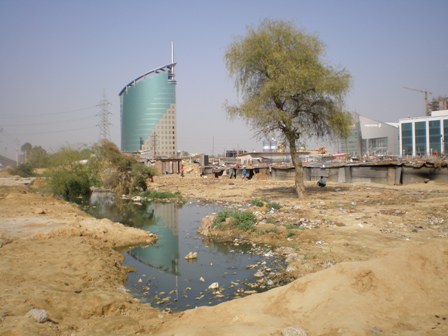
At a third level, the nature of the work-force cannot be grasped in localized forms. The majority of workers migrate into the area, moving back and forth between urban industrial life and the village. Wages are too low to reproduce a nuclear family in Gurgaon and most workers leave their families in the villages. Similarly it is almost impossible to survive a long period of unemployment, or for that matter, a long period of strike in Gurgaon. Though disintegrating, the village still functions as the main backup in times of unemployment. The introduction of the National Rural Employment Guarantee Act (NREGA) or the general development of the agricultural market reverberates in the working conditions in Gurgaon. Workers arrive in Gurgaon with hopes, which in most cases are dead soon. They survive 16-hours shifts by keeping in mind village misery and paradoxically, also by glorifying it. Their hope of ‘not having to be a worker anymore’ expresses itself in plans to open a shop back home. Reality forces us to find a collective and social expression of this urge to abolish our existence as ‘workers’.
A major element of this ‘worker’ existence is the casualisation of work-force. In winter 2000/2001 Maruti Suzuki used a minor labour dispute to lock-out the permanent work-force, and replaced it through compulsory ‘Voluntary Retirement Schemes’ with temporary workers. This has also happened in other companies, to the point that 70 to 80 per cent of the average factory work-force is nowadays hired through contractors. Due to their mobility (or lack of stability) these workers are less interested in struggles for long running wage agreements and company pension schemes. They have ‘short-term’ desires and their anger too is directed at the immediate. The remaining casual and permanent workers are often young workers trained in various ITI-campuses all over India, employed with much less job security and at lower wages than the old permanent work-force. In the garment factories the skilled tailors working at piece-rate, producing ‘full-piece’ garments are increasingly being put under pressure by chain-systems employing 20 less ‘skilled’ workers to produce the same garment using a greater division of labour based on CNC-cutting and embroidery machines. In Kapashera, a workers’ dormitory ‘village’ where about 200,000 textile workers and families live close to the main industrial area, dozens of ‘CNC-courses’ and six week basic tailoring courses are offered by small-scale informal schools.
In this complex scenario the majority of workers do not face a single ‘company boss’ in a formal way; they face a multiplicity of bosses. Due to the real estate boom which catapulted local farmers out of their fields into landlordism and business, a specific coalition of the local political class, landlords, labour contractors, police and company-hired goons became a repressive front ready to quell expressions of workers’ unrest. This local front of the ruling class is complemented by a faceless front of multi-national investment and central government policies.
Old Type of Struggles: Locked-Out in Dead-Ends
Under these general conditions, struggles which remain within the boundaries of the classical company/trade-union structure normally end in defeats and/or institutionalisation. There have been many ‘union’ struggles in Gurgaon in the last few years and they seem to follow a certain pattern.(1)
There is discontent among permanent workers as well as workers hired through contractors. In most cases some ‘under-the-surface’ struggles pre-date the ‘official conflict.’ For instance, at Honda HMSI ‘spontaneous’ canteen occupations took place before the ‘official’ struggle for union recognition began. In this phase certain sections of workers get in touch with union officials hoping that registration of a union will strengthen their position. Representatives emerge; member-lists are required for the application. The company tries to put pressure on the emerging ‘leadership’ and in many cases provokes a situation where suspension of ‘outstanding’ workers can be declared. In many cases companies ask the remaining work-force to sign individual letters of ‘good conduct’, trying to single out the supporters of the struggle. Unions, interested only in their self-propagation ask the workers not to sign: a struggle within the classical framework is easier to organise once workers are victimised, although their actual power might be greater once they are back inside the factory. An unofficial lock-out takes place; often workers hired through contractors, who expect little gains from a company union, either enter the factory or additional workers are hired to keep up production. Often these new workers are hired from the local population of the surrounding villages – another division between them and the mainly migrant, original work-force. Companies are usually prepared for the lock-out and subsequent problems in production, either by piling-up extra-stock or by getting parts from other suppliers. ‘Unofficial unrests’ get structured into classical forms, often managed by the main union advisors; protests in front of the factory gate, demonstrations, meetings with political leaders – the martyrdom of workers becomes an opportunity for leaders to stage themselves. In most cases the conflict gets limited to a single company, and attempts to connect to the wider struggle are not made. The state and companies are easily able to deal with these ritualistic forms of struggle, either through repression or through entangling it in a long legal dispute. The results of these disputes usually exclude the workers hired through contractors who were also part of the initial struggle. Furthermore, the cases for re-instatement of victimised workers often run for years. The recognition of a company union is followed by silence.(2)
Once in the trap of a lock-out workers can do little more than wait for the next symbolic show of solidarity. In the case of the recent lock-out at the Maruti fuel-pump supplier Denso, in Manesar, thirty-six union members were suspended on 17th February 2010 and about 500 workers refused to sign papers of ‘good conduct’. Since mid-February they have been sitting outside the factory while newly hired workers are kept inside around the clock. Even before the lock-out Denso had already ordered additional parts from its Thailand plant; they were prepared. In nearby Faridabad, workers of another Maruti supplier, AC manufacturer Sanden Vikas, were ‘locked-out’ at the same time. The union did not facilitate direct links between these two work-forces. The suggestion came up to write a common letter to the Maruti Suzuki management – admittedly only symbolic of workers’ coordination, which could nonetheless have had some impact. Another idea which came up was to go in small numbers and stand with placards in front of Maruti or other local factories. Denso runs factories around the globe and some effort to let workers and managements in these factories know about the situation in Manesar could have been made (3); small steps which could help spread the word and perhaps create direct links between workers of the supply-chain. This did not happen; instead we saw one or two union demonstrations and bored young workers sitting and playing cards. According to a Denso worker, on 22nd March 2010, the company took back 23 of the 36 suspended union representatives and sent all Denso workers for a one week training to a local ‘World Spiritual University’ ashram, to find mental peace. When they returned to the factory most of the workers were shifted to new jobs in different departments, at new machines, with new work-mates.
A New Generation of Workers and their Struggles
There is a need to discuss with workers the shortcomings of traditional forms of waging struggles, and need to consider the possibility of the emergence of a new form in the light of the actual experiences of wildcat strikes and factory occupations in Gurgaon in the last few years. These struggles have largely remained unknown to the ‘wider public’. Unfortunately, left activists usually get to know of workers’ struggles only when they have gained a sort of ‘official’ status, which generally means when they are repressed. The lathi-charge at the Honda factory in 2005 mobilised the left, as did the murder of a worker at Rico; by and large the left took a ‘civil rights’ position on these incidents and no attempt to analyse the basis of workers’ power and self-activity was made. The struggles of a new generation of workers already provide some answers and ask many questions relevant for the future; for instance they raise questions about how struggles are to be extended from the factory base, avoiding ‘unnecessary’ direct confrontation with the state forces, and show us the pitfalls of formal representation.

In April 2006 more than 4,500 temporary workers occupied Hero Honda’s Gurgaon plant for several days, demanding higher wages and better conditions. The company cut water and electricity, but asked the police not to enter the factory. No support came from outside the plant. The workers sent a small delegation to negotiate, and the delegation was bought off. The delegates returned promising fulfilment of all major demands once production is restarted and they then disappeared. Only some demands were actually met by the management. When the factory occupation ended, workers at the Hero Honda supplier, Shivam Autotech, occupied their plant which was close by and raised similar demands. Workers at the KDR press-shop in Faridabad, who supply Shivam Autotech with metal parts, worked reduced hours during these days.

In September 2006, after temporary workers at Honda HMSI, Manesar were not included in a union deal, they occupied the canteen of the plant, supported from the outside by the next arriving shift. The company reacted by cutting water supply. The company and the union asked them to go back to work.
In January 2007 2,500 temporary workers working at the car-parts manufacturer Delphi, in Gurgaon, went on a wildcat strike, blockading the main gate. The company threatened to shut-down and relocate the factory and asked the union of the 250 permanent workers to get the temps back to work. After two days the blockade was lifted. In August 2007 the temps at Delphi struck again, this time for few hours and without prior notice, demanding the payment of the increased minimum wage and succeeded. Many of the workers live together in back-yards of nearby villages, sharing food, mobile phones and information about jobs.
In August 2007, after the Haryana government had increased the minimum wage, over a dozen companies in Faridabad and Gurgaon faced spontaneous short strikes mainly by casual workers, demanding the payment of the new wage. In most cases these actions were successful (4).
In May 2008 after not having been accepted as members by the permanent workers’ union the temporary and casual workers at Hero Honda in Dharuhera went on a wildcat strike and occupied the plant for two days. The management and the permanent workers’ union promised betterment in their situation. The temporary and casual workers then tried to register their own union – a process which ended in suspension of leaders and a mass lock-out in October 2008.

It would be reductive to label these struggles ‘spontaneous’. We need spaces to meet in the industrial areas to analyse the process of social production and the already existing day-to-day experiences of organisation and subversion within factories, along supply chains, in the back-yard living quarters, and in villages – spaces for self-inquiry. If there is to be a communist party it should celebrate the collective worker that discovers itself by turning its social cooperation against its proclaimed precondition: capital. A part of this proletarian self-reflection must be the development of a structure of mutual aid, practical support and coordination.(5)
Notes
(1) The list of examples is way too long. Just to mention a few in Gurgaon: Maruti lock-out in 2000, Honda HMSI in 2005, Amtek in 2006, Automax in 2008, Mushashi and Rico in 2009, Denso and Sanden Vikas in 2010.
(2) After recognition of the union at Honda HMSI the number of workers hired through contractors and the general productivity increased.
(3) It is difficult to rely on the classical union structure for these kinds of international links. When the dispute at Rico stopped GM and Ford assembly lines in the US and Canada due to missing parts the comment of a United Automobile Workers official in Michigan was: “We are experiencing the effects of outsourced suppliers, and we hope they would be able to resume production as quickly as possible so we can in turn resume production” Interestingly enough this comment was made after the UAW had signed an agreement to lower wages to ‘save jobs’, which were being disputed by many workers on the shop-floor. While Denso workers in Manesar were locked-out, Denso workers in Tychy, Poland, organised protests for wage hikes matching the wage increases for FIAT workers.
(4) Today the situation seems even more explosive, given that the April 2010 ‘minimum wage hike’ of 30 per cent for Delhi workers does not compensate for the enormous inflation in food and transport prices.
(5) Comrades of Faridabad Majdoor Talmel are about to open some physical spaces for workers’ meetings in Faridabad, Okhla, Gurgaon and Manesar. For more information, visit Gurgaon Workers News and Faridabad Majdoor Samachar.
 Radical Notes