Singur – The Costs and Benefits of Neoliberal Industrialization

Deepankar Basu

Singur stands for many, often contradictory, things. It stands for the model of neoliberal industrialization that the Indian state is trying to push down the throats of its citizens at the behest of big capital. It stands for the unprincipled and populist politics of dormant right-wing forces. It stands for the abject surrender of an erstwhile communist party to the dictates of capital, the full flowering of a tendency that surfaced in the Indian political firmament circa 1967. But Singur also stands for the struggle of labour against capital, decidedly in confused and masked manners, but a struggle that has the potential to galvanize resistance against neoliberalism. When the Tata Group, forced by the long-standing struggle of the small farmers and landless labourers in Singur, was reported to be planning a move to Pantnagar in Uttarakhand, there were simultaneous reports of a possible Singur waiting for them in Pantnagar. A Singur in Pantnagar! That is the real significance of the struggle of the landless labourers and peasants of Singur.

Right from day one, the West Bengal government and the mainstream media has been building up the case for the manufacturing plant in Singur on the basis of half-truths and untruths. For a long time, the West Bengal government continued denying the fact that it had “acquired” a large tract of the proposed 1000 acres from unwilling farmers by using coercion, strong-arm tactics and certainly without their consent. Towards the later part of 2006, after considerable protests and a public hearing organized by intellectuals and activists, it had to finally accept its own earlier statements as false. Now it is known by all and sundry that 411.11 acres of the total 997.1 acres has been acquired without consent of the relevant farmers. For a long time, again, the West Bengal government continued denying the fact that most of the land that was sought to be “acquired” was fertile and multi-cropped agricultural land. It was only when earlier this year the Supreme Court pointed towards a possible violation of the Land Acquisition Act, responding to a petition filed for immediate halt of the Nano car project, that the West Bengal government finally accepted that it had been willfully misleading the public in this regard for so long; the SC had pointed out that acquiring and using fertile, multi-crop agricultural land for industrial purposes goes against even the Land Acquisition Act, which the West Bengal government was, paradoxically, trying to use to “acquire” that land. Now it has been established beyond any shadow of doubt that the land on which the proposed plant is to come up is, in the main, fertile, multi-cropped agricultural land. Another myth that had been in circulation for some time was the following: the land in Singur could not be used for agricultural purposes for most parts of the year because of water logging. This claim has also been contested and shown to be untrue. Now it is accepted by all serious commentators that the land had, before being fenced off by the West Bengal police, been in constant use throughout the year for growing various agricultural crops, and that it provided livelihood for more than 12,000 families. Even though these and other such claims of the West Bengal government and the mainstream media have been refuted point by point, over and over again, with facts and arguments and lot of patience and care, they keep turning up ever and ever again like bad coins. They will, as long as the social forces whose interest they represent continue their efforts to hegemonize society; and we will continue refuting them point by point, with patience and care and logic and facts.

But even when these particular canards are discounted, there seems to be a larger argument for industrialization that Singur purportedly represents. The West Bengal government and large sections of the mainstream media tend to equate Singur with industrialization and portray any and every opposition to Singur as opposition to industrialization. The apparent strength, or shall we say charm, of this argument becomes obvious when we see even an preeminent thinker like Amartya Sen falling for it. But this argument is deeply flawed. Opposition to Singur is not opposition to industrialization, it is opposition to neoliberal capitalist industrialization. Opposition to Singur is opposition to the conflation of industrialization with neoliberalism, a scenario where the State steps up its efforts to subsidize capital and shore up its profits while capital externalizes its costs onto labour and the environment with impunity. It is this model of industrialization that we oppose.

An alternative model of industrialization, as far as we can see, would operate in an exactly opposite fashion. It would tax capital and not subsidize it, prevent capital from externalizing its costs onto labour and the environment rather than facilitating it, intervene in decisions related to the choice of technique to be used in production, force private capital to do proper cost-benefit analysis before embarking on a (socially) costly industrial project, intervene through fiscal and monetary policy to maintain overall levels of aggregate demand and try to ensure full employment with living wages for workers. In the alternative vision, the State would use tax revenues to build infrastructure, provide social sector services and closely monitor and improve the well-being of the people. Singur, and the model of industrialization that it stands, takes us in the exact opposite direction; that is why it needs to be opposed. It destroys livelihoods tied to agriculture without creating compensating jobs in industry, it willfully snatches away fertile, multi-crop agricultural land for industrial purposes when so much fallow (and other unused and misused) land is there to be used, it externalizes the costs of production on the most vulnerable sections of the population and the environment, and all this while the State steps in to massively subsidize private capital even further. If, therefore, due to the struggle of the project affected people the Tata’s finally leave West Bengal, it should call for rejoicing not for middle-class chest-beating that is so much on display these days. For it would be one of the important victories in the emerging struggle against neoliberalism in India.

Cost and Benefits

In this article we will try to study details of the costs and benefits of the proposed manufacturing plant in Singur on the basis of information that is available in the public domain. But a caveat is necessary. This is not a full blown cost-benefit analysis because we shall not venture to quantify the indirect benefits of possible net employment generation and the income that might arise from there. At this point, it is not even clear whether there will be positive net employment generation; it is not at all obvious, in other words, that the employment destruction entailed by the project will be exceeded by the employment generated by it. Moreover, a full cost-benefit analysis would require much more information than has presently been made available by the West bengal government; on the basis of the available information, which pertains mostly to the benfits that the West Bengal government plans to make available to the Tata’s, we shall mainly try to approximately quantify the costs to the exchequer, and ultimately to the people of the state.

A careful study of the details relating to the proposed project in Singur, to the extent possible by the publicly available information, is important for two main reasons. First, it is important to do a dispassionate analysis of the costs and benefits of this project; since the West Bengal government has been continually making largely unsubstantiated claims about the putative benefits of this project, it is high time we carefully analyzed the foundations of this claim. Second, this project is very much in line with the current trend of neoliberal capitalist industrialization in India anchored tightly in the visions of the Special Economic Zones (SEZs); hence a study of this project will highlight, and help us evaluate, many of the important characteristics of neoliberal capitalist industrialization that has been envisioned and aggressively pushed by the Indian state since the early 1990s. Parenthetically, one should also note how acceptance of the logic this project signals the gradual dissolving of social democracy in India: from”managing” the conflict between labour and capital, social democrats are increasingly moving towards “managing” labour for capital.

The main document that we will use for the purposes of this study is the text of the recent “agreement” signed between the Government of West Bengal, the West Bengal Industrial Development Corporation (WBIDC) and the Tata Motor Ltd. (TML) pertaining to the proposed manufacturing plant in Singur. By a careful analysis of the information contained in this document, and complementing this with some more information from other sources we will, hopefully, be able to arrive at a true picture of the costs and benefits of this project. But before we get into the nitty-gritty of the agreement, let us remind ourselves about the severe difficulties that we have faced over the past few years in just trying to get hold of the information that is relevant to this project. Recall that the details of the “deal” wasn’t made public initially because the West Bengal government believed it was a “trade secret”. Once this argument was properly trashed, the government shifted gears. During this period, it wasn’t made public despite repeated Right To Information (RTI) applications because, according to the government, the Tatas didn’t want it to be made public! Finally what has been made public, mainly because of pressure from the standing committee on industry of the West Bengal state assembly, are only parts of the “deal”; this all we have for the purposes of study and analysis. The TML filed a case in the Calcutta High Court and got a stay against the rest of it being made public. What is there in the rest of it? We, and the more than 12000 project affected families in Singur, can only guess. The entire episode, to say the least, is patently undemocratic, and makes a mockery of the intent of the recently passed Right to Information Act. One does not, of course, discern even an iota of concern about this important matter displayed by the “peoples’ government” in West Bengal!

The Agreement

The “agreement” between the West Bengal government, WBIDC and TML is a remarkable document by all means. Starting from the premise that the state of West Bengal must match, rupee for rupee, every fiscal and financial incentive offered to TML by other states like Uttarakhand and Himachal Pradesh, it goes on to lay out the details of the same. This, the agreement states, should be read as the state government’s eagerness to “take appropriate steps for rapid industrialization in West Bengal”. This, to the best of our knowledge, is the clearest admission by the West Bengal government and the “communist” party standing behind it of the acceptance of neoliberalism. By accepting that the road to “rapid industrialization” winds its way through huge subsidization of private capital in the form of tax breaks and soft loans with the concomitant costs borne by labour and the environment, the West Bengal government has finally announced its participation in the Indian State’s neoliberal industrialization program. We will discuss this issue in greater detail below.

The text of the agreement is also remarkable in its enormous onesidedness. Every concrete detail in the agreement refers to what the West Bengal government will do for TML; there is no mention of what TML will do in return! It is as if by accepting to invest in the state, TML has bestowed an enormous favour on the people and its government. Overwhelmed by this boundless magnanimity of TML, the West Bengal government has decided to offer everything in its power to return that favour. The favours offered to TML come in four concrete forms: (a) subsidized land for setting up the manufacturing plant, (b) loans in the form of tax holidays, (c) soft loans to get started, and (d) subsidized electricity. There is no mention of anything that the state can expect in return from TML. Loans do not require collateral, failure to make timely payments do not require penalties, there is no mention of what employment generation TML’s investment will entail, there is no mention, in short, of anything at all that might inconvenience private capital or hold it accountable to the people. Below, we will look at the each of the components of the favours, what we will quite realistically refer to as costs, and also try to take seriously the claims of the government about the purported benefits of the project, but first, let us briefly remind ourselves about the land “acquisition” and its proposed use.

Land “Acquisition” and Use

The agreement – scroll down to read the text of the agreement – states that land “of approximately 1000 acres chosen [by TML] in P.S. Singur of District Hoogly” was finalized as the site for the construction of the proposed plant. Subsequently WBIDC “commenced the process of acquisition of this land”, an euphemism for the veritable terror unleashed on the farmers of Singur to give up their fertile, multi-cropped agricultural land for neoliberal industrial “development”. Using the colonial era Land Acquisition Act of 1894, the WBIDC coerced – with the support of the police and cadres of the ruling party, CPI(M) – several hundred families to give up their land, and according to the agreement, it is now “in possession of 997.1 acres of land”.

Out of this forcibly-acquired 997.1 acres of land, 647.5 acres will be leased to TML to set up its proposed plant, what the agreement calls the “Automobile Project”; another 290 acres will be leased to “the vendors to this Automobile Project approved by TML”, the vendors being the ancillary and component manufacturing units. An area of 14.33 acres will be given to the West Bengal State Electricity Board (WBSEB) for the construction of a 220/132/33 KV substation to provide and uninterrupted supply of subsidized electric power to the “Automobile Project”; and the remaining “47.11 acres will be used by WBIDC for rehabilitation activities for the needy families amongst the Project affected persons”. Note in passing that only 4.74% of the “acquired” land has been earmarked for purposes of rehabilitation of the project affected persons.

Total Cost of the Project

According to the details available in the agreement, the total cost to the people of West Bengal of the proposed project in Singur, as we have already pointed out, can be broken down into the following four categories: (a) subsidized land for setting up the manufacturing plant, (b) loans in the form of tax holidays, (c) soft loans to get started, and (d) subsidized electricity. Point 7 of the agreement provides details about each of these. Point 7(a) is about the tax holiday; point 7(b) is about the hidden subsidy in land; point 7(c) is about the soft loan, and point 7(d) is about the subsidized electricity. The sum of these “fiscal incentives”, excluding the subsidy in electricity, add up to what the Uttarakhand/Himachal Pradesh governments offered to TML. How do we know this? From point 7(a) of the agreement which states: “This benefit [i.e., the tax holiday] will continue till the balance amount of the Uttarakhand benefit (after deducting the amount as stated in para 7b and 7c below) is reached on net present value basis, after which it shall be discontinued.” In other words, the sum of the benefits offered by the West Bengal government in the form of (a) subsidized land, (b) tax holiday, and (c) soft loan will equal what the Uttarakhand/Himachal Pradesh governments were willing to offer; the subsidized electricity (and other real estate, as we will see below) are bonuses, which make the West Bengal government’s offer exceed the Uttarakhand/Himachal Pradesh. But this also means that we can indirectly arrive at the total cost of the project in Singur if we can somehow figure out the amount of the Uttarakhand/Himachal Pradesh package.

Point (1) of the agreement mentions that the “incentive package in Uttarakhand/Himachal Pradesh consists of:-

(a) 100% exemption from Excise Duty for 10 years.

(b) 100% exemption from Corporate Income Tax for first 5 years and 30% exemption from Corporate Income Tax for next 5 years.”

How much is this package worth? Let us try to think this through. We have collected some information from annual financial reports of TML in Table 1 that will help us get an approximate figure for the Uttarakhand/Himachal Pradesh package using points 1(a) and 1(b).
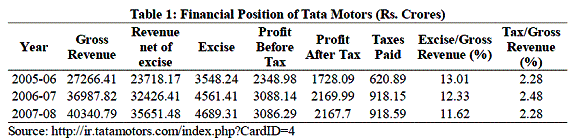
There are some remarkably stable patterns in the data. TML seems to be paying about 12% of its gross revenue as excise duty and 2.35% of its revenue as corporate income tax. If TML were to set up shop in Uttarakhand or Himachal Pradesh, it would be manufacturing about 250,000 small cars per annum. If each car were to sell for Rs. 1 lakh, TML’s gross annual revenue would be approximately Rs. 2500 crores. If the TML would have to pay excise duty, assuming the above ratios, it would pay about 300 crores (12% of Rs. 2500 crores) per annum; if it had to pay corporate income tax, it would have to pay about Rs. 58.75 (3.5% of Rs. 2500 crores) crores per annum. If TML set up shop in Uttarakhand/Himachal Pradesh, according to the agreement, it would not have to pay these taxes as stated in point 1(a) and 1(b).

Summary of the Uttarakhand/Himachal Pradesh package: for the first 5 years, TML gets Rs. 358.75 crores every year (100% excise duty exemption + 100% corporate income tax exemption); and for the next 5 years, it gets Rs. 317.63 crores every year (100% excise duty exemption + 30% corporate income tax exemption). The NPV of this benefit package is Rs. 2062.79 crores (using 11% for calculating NPV).

According to point 7(a) of the agreement, the West Bengal government’s “benefits package” will equal this sum if we compute the benefit coming from subsidized land, soft loans and tax holidays. Let us now look at the different components of the package promised by the West Bengal government.

Hidden Land Subsidy

What are the terms of the rental structure on the land lease agreed upon by WBIDC and TML? Two different set of rules apply, one to the 647.5 acres leased to TML and another to the 290 acres that will be leased to the vendors approved by TML. Both leases, however, will come up for possible renewal 90 years down the line. For the 647.5 acres of land that is leased to TML, the annual rental will be Rs. 1 crore for the first five years, increasing by 25% every five years till 30 years. Thereafter, the annual rental will be fixed at Rs. 5 crore, to be increased by 30% every 10 years till the year 60; the rental from year 61 to 90 will be Rs. 20 crore per year. For th vendors, the rental structure is simpler: for the first 45 years, they will pay an annual rental of Rs. 8000 per acre, and for the next 45 years will pay an annual rental of Rs. 16000 per acre. Since the vendors are leasing 290 acres of land, this means that for the first 45 years, they pay a total of Rs. 0.232 crores per year and Rs. 0.464 crores per year for the rest of the time.
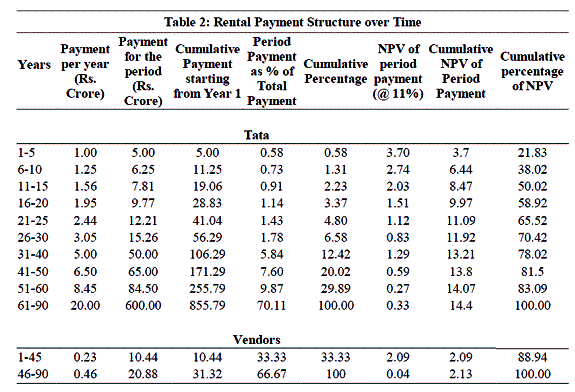
Details of the payment schedule, for both TML and the vendors, is summarized in Table 2. This is similar to, but more detailed than, a table used by Madhukar Shukla for commenting on the Nano project; the main difference is the inclusion of figures on net present values (NPV). What is net present value? It is a conceptual device used to compare sums of money at different points in time, which I explain in greater detail below. Why is NPV relevant here? Because an investment project like the proposed plant in Singur involve costs and benefits flowing in at different points in time. Columns (2) through (6) give the actual payments to be made at various points in time, while the last three columns give the net present value (NPV) of the payments, where NPV has been calculated using an interest rate of 11% per annum (exactly as done by the WBIDC in Annexure II of the agreement). Note in passing that the Annexure where all the computations relating to the project has supposedly bee done has not been made available to the public; all we know is that the NPV calculations used an interest rate of 11%.

To arrive at figures about the costs of “acquiring” the land and the revenue earned from leasing it to TML (and the vendors), we need to remind ourselves that the WBIDC spent anything between Rs. 150 crore and Rs. 200 crore to “acquire” the land from the unwilling farmers. How much will WBIDC get for letting TML use that piece of land? Columns (4) shows that the TML will pay a total amount of Rs. 855.79 crores over 90 years as rental fees for using the land. So the cost incurred by the WBIDC is Rs. 150-200 crore, while revenues will be 855.79 crore. Does this mean that the WBIDC made a good bargain with the TML on behalf of the people of the state? Does it men that the WBIDC is actually making a “profit” in leasing out the land to TML? Let us think about this a little more.

A rupee today is not equivalent to a rupee next year. Why? One can put the rupee that one has today in the bank and earn an interest income at the going interest rate to augment the original sum. If the current interest rate is 11%, then one would have Rs. 1.11 at the end of the year if the rupee were to be invested in an interest-bearing asset today. Put another way, Rs. 1.11 at the beginning of next year is equivalent to Rs. 1 today (at the beginning of this year). Let us go further, and suppose that we let our rupee lie in the bank for two years. How much do we have at the beginning of the third year? Rs. 1.21 (because at the beginning of the second year one has Rs 1.11, and then one earns 11% on that amount to arrive at Rs. 1.21 at the beginning of the third year). Inverting things, we see that Rs. 1.21 two years hence is equivalent to Rs 1 today when the market interest rate is 11%. This logic can be extended to any number of years and is the basis of computing net present values (NPVs). In the jargon of economics, if the market interest rate is 11%, Rs. 1.1 one year hence has a NPV of Rs. 1; and Rs. 1.21 two years hence has a NPV of Rs. 1. Thus, NPV is a device to make sums of money at different points in time comparable to each other. What does this mean for us?

It means that we cannot just add up all the rental payments that TML is supposed to make over the next 90 years (which is Rs. 855.79 crores) and compare it to the cost incurred by the WBIDC to “acquire” the land today (which is Rs. 150-200 crores). To make the stream of rental payments of the TML (over the next 90 years) comparable to the cost of “acquisition” today, we need to calculate the NPV of the rental payment stream. That is precisely what we have done in column (7) in Table 2. Column (8) gives the sum of the NPVs of the rental payments. On the basis of this calculation we arrive at a very striking fact at the end of column (8). The NPV of the rental payments that the TML will make over the next 90 years is Rs. 14.4 crores! The NPV of the rental payments that the vendors will make is Rs. 2.13 crores.

Summary: while the cost to the WBIDC for “acquiring” the land was anything between Rs. 150 crores to Rs. 200 crores, the NPV of the revenue from rental income that will accrue to the WBIDC is Rs. 16.53 crores, sagging the WBIDC with a loss of anything between Rs. 130 crores to Rs. 180 crores! Which is just another way of saying that taxpayers are subsidizing a big corporate entity like the TML to the tune of Rs. 150 crore just in terms of the land that the WBIDC “acquired” for it.

Cost of Circumventing the Law

A moment’s reflection on the time structure of rental payments for TML brings another characteristic of the transaction to the fore. The time structure of payments has been arranged in such a way that the bulk of the rental payments come in later years. From column (6) in Table 2 we see that the TML makes only 5% of its total payments in the first 25 years of the lease; in the first 50 years, it pays only 20 percent of its total payment commitments. The Comptroller and Auditor General of India (CAG) had pointed out in March 2008 that, according to Government of India laws, long-term leases of 99 years required that the lessee pay 95% of the market value of the land as a one-time premium at the beginning of the lease and pay annual rent at the rate of 0.3% of the market value of the land. The same report went on to note that the agreement between the TML and the WBIDC should have entailed an immediate payment of Rs. 91.88 crore and subsequent annual rents of Rs. 29 lakhs for the next 90 years. As opposed to this, the TML, according to the agreement, would pay nothing upfront and would only pay Rs.1 crore at the end of the first year!

Of course it would have been illegal if the lease was for 99 years. Hence, it seems, the WBIDC cleverly decreased the span of the lease by 9 years to circumvent the letter of the law. In spirit, though, this still amounts to a violation of the law. Why? Because the law states that for long-term leases the majority of the payments should be paid upfront by the lessee; and the WBIDC agreement with TML shows an exactly opposite time structure of payments, with most of the payments pushed off far into the future. Thus, even though in letter the agreement clears legal hurdles, it is obvious that it fails miserably in terms of the idea behind the law. No wonder the CAG faulted the WBIDC on several counts regarding its agreement with the TML. But let us pause for a moment and think why the CAG (or the laws) wanted the bulk of the payment upfront.

There are two basic reasons why the law might want to ensure bulk of the payments for a long-term lease upfront. One, large upfront payments for long-term leases increases the NPV of the rental payment stream. Since these long-term leases generally require the government to hand over public land for private use, it makes sense to structure rental payments in such a way that the government exchequer gets a good value in return; that is why a large upfront payment is usually written into lease contracts for long-term leases. The second reason for having a large upfront payment relates to considerations of risk. When a stream of payments has relatively large amounts pushed far away in the future, the NPV of that stream of payments is more liable to change when market interest rates change.

Let us take an example to understand both these points. Suppose, for simplicity, we want to compare two payment streams, A and B. A has Rs. 1 lakh today and Rs 9 lakhs in 10 years; B has Rs 9 lakhs today and Rs .1 lakh in 10 years; note that both entail a total payment of Rs. 10 lakhs over a period of 10 years and are similar in this respect. But they also are very dissimilar. To understand why suppose that the market interest is 10% at the moment. NPV of A is Rs. 4.47 lakhs, while the NPV of B is Rs. 9.39 lakhs. Thus, the NPV of B is much higher than that of B, which clarifies the first point. Now suppose that the market interest rate increase to 15%; this will obviously diminish the NPV of both A and B. But which will fall more? A’s NPV falls by about 39% while B’s NPV falls by only 1.5%! Thus, the risk of loss of revenue that comes from a payment stream (payment of rent for instance) is higher when most of the payments come in during relatively later periods. It is probably because of these two sound economic reasons, among others, that the CAG urged the West Bengal government to reconsider its lease agreement with the TML. By structuring the rental payments such that most of it come in during later years, the West Bengal government is not only losing revenue but is also bearing a higher risk of loss of even that minimal revenue.

So, how much is the WBIDC losing in real terms by using the rental payment structure that is summarized in Table 2 instead of the one recommended by the CAG? If TML were to pay Rs. 91.88 crores upfront and then subsequently pay a rental of Rs. 29 lakhs per annum for the next 90 years (as suggested by the CAG ), the NPV of this payment scheme would be Rs. 94.52 crores (using an interest rate of 11% per annum for calculating the NPV). The NPV of the currently agreed upon rental payment scheme (as per the agreement) is Rs. 16.53 crores (sum of entries in column (7) of table 2). Hence, the WBIDC is losing Rs. 77.99 crores due to the chosen rental payment structure.

Summary: the total financial loss to the WBIDC due to the agreed upon rental payment structure, as opposed the one suggested by the CAG, is Rs. 77.99 crores; the WBIDC, in addition, has to bear extra risk arising from possible fluctuations in the market interest rate.

Soft Loans and Tax Holidays

Point 7(c) of the agreement provides information about the soft loan: “The West Bengal Govt. will provide TML a loan of 200 crores @ 1% interest per year repayable in 5 equal annual installments starting from the 21st year from the date of the disbursement of the loan”. This loan, moreover, “will be disbursed within 60 days of this agreement”. Point 7(a) of the agreement refers to the loans that the WBIDC will give to the TML in the form of tax holidays. The tax holiday will continue, as we have already noted, till the sum of the land subsidy, tax holiday and the soft loan equals the Uttarakhand/Himachal Pradesh package.

So, what is the total loss to the exchequer due to the tax holidays and soft loans. There are two ways to arrive at approximate value of this loss. First, if we knew the exact amounts of the loans (in the form of tax holidays) and the exact repayment shedule and interest rates, we could calculate the net present value of the loss. But unfortunately, we do not have enough data in this regard, and so we will adopt an indirect method to arrive at the notional cost of the tax holiday and the soft loans. This second, indirect method, begins by recalling that, according to point 7(a) of the agreement, the total benefits from the land subsidy, taxt holidays and soft loans offered by the West Bengal government will equal the benefits that was offered by the Uttarakhand/Himachal Pradesh govenrment. We have seen above that the total value of the Uttarakhand/Himachal Pradesh package was approximately Rs. 2063 crores on a net present value basis. We have also seen that the cost to the exchequer of the subsidized land was about Rs. 228 crores (Rs. 150 crores for direct subsidy and Rs. 78 crores lost due to the time structure of the rental payment scheme). Thus, the total cost of the tax holiday and the soft loans will be Rs. 1835 crores (which is Rs. 2063 crores less Rs. 228 crores) on a net present value basis. Note that this is a notional cost.

The last part of 7(a) seems even better. It says: “WBIDC will ensure that the loan under this head is paid within 60 days of the close of the previous year (on 31st March) failing which WBIDC will be liable to compensate TML for the financial inconvenience caused @ 1.5 times the bank rate prevailing at the time on the amount due for the period of such delay”. What does this mean? It means that if the WBIDC is not able to make the loan to TML within 60 days of the close of the financial year, it will penalize itself by compensating TML at 1.5 times the prevailing bank rate. So, if the prevailing bank rate is 10%, which is close to what is the case right now, the WBIDC will penalize itself for any delay on its part by paying back the TML for the “financial inconvenience” at 15%.

Summary: the cost of the soft loans and tax holidays to the TML by the West Bengal government will be about Rs. 1835 crores on a net present value basis.

More Gifts from Santa: Real Estate and Subsidized Electricity

Industrial development requires infrastructural support from the government, as we all know. And so the West Bengal government displayed its commitment to “rapid industrialization” by offering a “virtual gift of 650 acres of prime land to Tata Housing Development Company (THDC) in Rajarhat New Town and in the adjoining Bhangar Rajarhat Area Development Authority for building an IT and residential township along with WBIDC as a partner“. What better way to provide “infrastructural assistance” for the industrialization effort that to hand over prime land for real estate speculation! Some reports suggest that this “gift” to TML will cost the exchequer about Rs. 160 crores.

The West Bengal government has also promised to supply electricity at Rs 3 per kilo watt hour (kwh), which is around half the price charged to high-tension industrial consumers in the West Bengal at the moment. It has also promised to absorb any increases in electricity costs to the TML in Singur. Point 7(d) of the agreement states: “In case of more than Rs. 0.25 per KWH increase in tariff in every block of five years, the Government will provide relief through additional compensation to neutralize such additional increase”. This will mean, at the least, shelling out Rs. 70 crores annually for subsidizing the electricity requirements of the whole project at Singur. The NPV of this subsidy for the 90 year period of the lease would be Rs. 706 crores.

Summary: the cost to the exchequer of the real estate gift and subsidized electricity will be about Rs. 865 crores.

Adding up the Costs

Let us now take a moment to put all this together. The subsidy that TML gets, according to the terms of the agreement, on the land in Singur is anywhere between Rs. 100 and Rs. 150 crore; the subsidy due to the rental payment structure is Rs. 78 crores; the implicit subsidy due to the tax holiday and the soft loan would be about Rs. 1835 crores; the real estate “gift”, also known in WBIDC terminology as “infrastructural assistance”, is worth Rs. 160 crores; and the subsidized electricity will cost another Rs. 706 crores. So, the Tata conglomerate, one of the largest corporate entities in the country, is awarded a “gift” of about Rs. 2928 crore by a “communist” government so that it can be induced to set up a car manufacturing plant in the state and lead it on to the path of neoliberal industrial development. To put this figure in perspective, let us refer to the 2008-09 budget speech of the Finance Minster of West Bengal. Pointing to the emergence of what he called the “industrial potential” of the state, he offered some concrete figures to bolster his argument. In 2005, the annual realized (industrial) investment in West Bengal was Rs. 2515.58 crores, which then jumped up to Rs. 5072.26 crores within the next two years. Thus, a sum close to 58 percent of the total realized industrial investment in the state in 2007 would be the cost borne by the people of the state if the Tata-Singur project too off.

Summary: the total cost of the Tata-Singur project incurred by the exchequer, and hence ultimately the tax payers, will be approximately be Rs. 3000 crores on a net present value basis when we add up the costs pertaining to the land subsidy, the tax holidays, the soft loan, the real estate gift and the subsidized electricity using an interest rate of 11%. This is about 58% of the total realized industrial investment in the state of West Bengal in 2007.

What are the Benefits?

What are the purported benefits of the Tata-Singur project? The West Bengal government has advanced two claims regarding the benefits: employment generation and improvement in the investment climate of the state. These two claims about possible employment generation and future investments need to be looked at closely, because the rationale offered by the West Bengal government for giving the stupendous bonanza to the Tatas rests precisely on these. Both these claims are dubious. Regarding the claims about employment generation, there have been figures ranging from a high of 12000 (2000 in the Nano plant proper, 10000 in ancillary and complementary units) to a low of 750 (some recent local newspapers have put the figure at 650). The upshot of all this is that there is no certainty about the employment generated. However, if we look at a recent BBC report on this matter it becomes clear that 62% of the projected employment in the automotive sector is going to be skilled labour, 28% is going to be management jobs, leaving only 10% jobs for unskilled labour. Now, the displaced population in Singur, if at all they get absorbed in the mother plant or in the ancillary units, would typically be offered employment as unskilled labour. So, the prospect of much employment being generated, especially for the people in Singur, is dim. Moreover, all these calculations ignore the employment destruction that the project will inevitably entail. If we were to properly take both possible employment generation and possible emplyment destruction into account, we could arrive at a figure for the net emplyment generated by the project. At the moment, it is not even clear that the net employment figure will be positive.

The other claim about the Singur project generating prospective investment in the future rests on equally shaky foundations. The question really boils down to whether the Tata plant can attract other major investments and lead to an industrial rejuvenation of Bengal. The example of Jamshedpur in neighbouring Jharkhand should be carefully looked at. Tata’s factories in Jamshedpur did nothing for the overall industrialization of the state of Bihar or now Jharkhand. It remained an enclave of industrial activity, without forging strong forward or backward linkages in neighbouring areas. The other issue to think about, in the context of the claim about TML drawing future investments, is whether other industrialists coming to invest in Bengal would also demand similar bonanzas from the government. Will the government refuse them the goodies that they have offered TML and let them turn away or will it repeat the Tata-like agreements and put further burdens on the exchequer. Either option does not seem to be beneficial from the perspective of the working people of the state.

Summary: while the costs of the proposed Singur-Tata project is obvious, tangible, immediate and large, the benefits seem to be uncertain, residing far away in the future and their magnitudes small.

Oh! So Poor Tata

A few months back, the finance minister of West Bengal presented a budget with a Rs. 2 crore deficit; a net subsidy of about Rs. 3000 crores would certainly be extremely costly for the people of the state; after all it is about 1500 times the budget deficit in fiscal year 2008-09. Given that a small, poor, fund-starved state like West Bengal is making such great efforts to subsidize the Tata’s, it must mean that they (the Tata’s) are in a dire financial situation. But is that true? If we merely cast a glance at the recent international buying spree that the Tata’s have been engaged in, we might be able to understand how far from the truth would be any assertion that the Tata’s require financial assistance from a poor state like West Bengal to start an industrial project.

The Tata Group of Companies, let us remind ourselves, is one of the largest business conglomerates in India with about 100 large companies in its fold. With the might of the Indian State firmly behind it, monopoly capital in India has started a move to aggressively acquire foreign assets, what it calls strategic corporate assets. In the last few years, the Tata Group has been leading this acquisition spree on behalf of Indian big capital, making forays not only in Asia and Africa but also in the heartland of world capitalism: USA and Europe. Let us briefly take a look at the record of the Tata Group with regard to foreign acquisitions.

In January 2007, the Tata Group pulled off India’s biggest ever takeover of a foreign company to buy Anglo-Dutch steel-maker Corus for $12 billion; this acquisition made the

combined entity (Tata-Corus) the world’s fifth largest producer of steel. In March 2004, the Tata Group acquired South Korea’s Daewoo Commercial Vehicle Company for $102 million; this was followed by the acquisition of a 21 percent stake in Spanish bus maker Hispano Carrocera for $18 million with an option to pick up the remaining stake at a later date. Around the same time, Tata Technologies, another company in the Tata fold, which provides automotive engineering and design services, bought Britain’s Incat International for $53 million.

Tata Consultancy Services, which was earlier a division of Tata Sons and a rising star in the Tata Group, has been among the most aggressive shoppers for foreign companies. It has acquired six companies in the past few, with the net value of the deals close to $100 million; these include FNS of Australia, which was acquired for $26 million and Chile’s outsourcing major Comicrom, which was bought for $23 million. When the Tat Group acquired the former state-run, international telecom carrier, VSNL, a few years ago, it was on its way to becoming a major telecom player in the global markets. To enhance its position, it acquired undersea cable company Tyco of the US for $130 million, Internet service provider Dishnet’s India division for $64.28 million and international telecom service provider Teleglobe of the US for $239 million.

Following its acquisition of Hindustan Lever Chemicals, Tata Chemicals was on the lookout for a steady supply of phosphoric acid for its newly acquired plant at Haldia, West Bengal. Accordingly, it took over two overseas companies for a total value of $215 million: Indo Maroc Phosphore of Morocco in March 2005 and Brunner Mond Group of Britain in December 2007. Morocco, by the way, produces over 50 percent of the world’s rock phosphate.

In 2000, Tata Tea bought British giant Tetley for a $407 million, and started looking for similar deals to strengthen its global position in the tea and related drinks business. This search led to acquisition of 33 percent stake in the South African company Joekels Tea Packers for an undisclosed amount and 30 percent stake in the US-based favoured water manufacturer Glaceau for $677 million, the acquisition of the US-based Good Earth Corp for $32 million and acquisition of the Czech Republic’s firm Jemca for an unknown amount.

India Hotels, the hotel branch of the Tata Group, acquired several hotels abroad for $121 million in the past few years. It is reported to have set aside $100 million for future acquisitions in Europe, the Middle East, Asia and the US. In December 2006, it had acquired W, a hotel at the Woolloomooloo Bay in Sydney; it was followed by the taking over of the management of The Pierre, a luxurious landmark hotel on New York’s Fifth Avenue. India Hotels, which runs the Taj Group of hotels, has 39 hotels in India and 18 worldwide. A recent acquisition of India Hotels was Campton Place Hotel in San Francisco.

If we add up the figures for the Tata Group’s overseas acquisitions, we arrive at a rough figure of $14,062 million, which converts to roughly Rs. 56,248 crore (using an exchange rate of Rs 40/$), and this is not even a complete list of Tata’s recent acquisitions. And, what does all this lead to? It inevitably leads us to the conclusion that a corporation which can invest more than Rs. 56,000 crores for acquisition of strategic foreign corporate assets requires the financial support of India’s impoverished taxpayers, to the tune of Rs. 1140 crores in real terms, to set up a small car manufacturing plant in India! That, in a nutshell, is what we would like to call neoliberal industrialization, pushing which down our throats has become the almost single-minded purpose of the West Bengal Government and the “communist party” that is at its helm of affairs.

TINA Logic

But even after all these facts and figures and arguments have been read, understood and absorbed, sympathizers of the West Bengal government will no doubt come up with a supposedly unbeatable argument: TINA. There is no alternative. This argument points to the magnanimous offers made by other states in India to attract private capital, and then goes on to plead the inability of the West Bengal government to follow any route other than to offer even more largesse. Recall that the text of the agreement starts precisely with this argument. It builds up its case for the huge hidden subsidies that is offered to TML, and which we have seen in great detail above and which add up to about Rs. 3000 crores on a net present value basis, by emphasizing the incentive package that the States of Uttarakhand and Himachal Pradesh has offered to the Tatas. That is why the West Bengal government must offer more than the value of the offers by the other states if it is to attract private capital, like the TML, to industrialize the state. Since, other states are offering huge tax breaks and soft loans, West Bengal must also do so, the argument goes. West Bengal cannot fight this trend, caught as it is in the competitive struggle between the states of India.

One must begin by acknowledging that there is some truth to this assertion. It is true, in other words, that in the neoliberal set-up private capital has managed to generate competition between political entities, both within nations and between nations, to ensure higher profits on its investments. But acknowledging this fact, the fact of the existence of this strong pressure for competition among states, does not mean accepting it as inevitable; it does not mean accepting the logic, championed by the proponents of neoliberalism, that there can be no alternative to the present framework. If the fight against neoliberalism has to be taken forward then this logic must be fought. One cannot succumb to this logic in practice and claim to be fighting against neoliberalism.

And to fight this logic, one must understand what it implies. The competition that capital manages to enforce on political entities (for instance states in India or countries in the global context), one must understand, is akin to a “race to the bottom”. As soon as one state lowers taxes, reduces social sector spending, loosens labour laws, cracks down on political dissent in order to make the atmosphere “conducive” for investments, another tries to outdo the first by reducing taxes even further, reducing social sector spendings even further, making labour even more “flexible” in order to “attract capital”. And thus, as the logic of this competition unfolds in all dimensions, people of all the states taken together lose. Lower tax revenues means lower resources for the State to invest in educations, health, nutrition, poverty alleviation; it means increased misery for the common people, with sub-optimal infrastructure and public amenities. And who benefits from this fierce competition? Capital. Thus accepting this as the only way to industrialize is to accept this “race to the bottom”, with all its deleterious consequences for the population, as the West Bengal government seems to have done.

So what can be done? One has to act on several fronts at the same time. First, it is undeniable that fighting the neoliberal logic will require concerted political action at the Central level to thwart moves to implement central-level neoliberal policies; the largest “communist” party standing behind the West Bengal government must shed its fears of radical mass political activism and launch, with other like minded political forces, a nationwide offensive against neoliberalism, instead of using all its energies in parliamentary antics. It will also mean not succumbing to the pressures of capital at the state level as the West Bengal government has pathetically done. If private capital wants to move out of the state because taxes are high and social sector spendings are growing and the labour laws are favourable for the workers, and the health and educational status of the people are improving, then so be it. The state need not hanker after such capital for, at the end of the day, massively state-subsidized investments of such capital is not beneficial for the people.

Second, one must understand that, if attracting capital is all one wants to achieve, capital can also be attracted in a very different fashion, by reversing the harmful, negative competition between states and instead initiating a “race to the top” to replace the “race to the bottom”. For it is a fact, recently noted by several observers of the Indian economy, that India is very rapidly moving into a regime marked by serious shortages of skilled labour. A state which wants to attract private capital can, therefore, invest massively in building up the education and health system for the workers; a healthy and skilled labour force can be a stronger incentive for capital to set up shop in a state than huge tax holidays. In fact, instead of giving tax breaks to capital, the state will need to tax them aggressively and use the tax revenue to further improve the conditions of the working people. Equally true is the abysmal conditions of physical infrastructure – transportation, housing, power, etc. – in most of the states of India. A state can, therefore, start investing in building up basic infrastructure for the people by taxing capital and citizens in the high-income brackets; solid infrastructure can be as strong an incentive for private capital as soft loans and hidden subsidies. The point of these interventions would be, in the medium and long urn, to initiate reversal of the “race to the bottom” that every state seems to be in the grip of. Unfortunately, the West Bengal government seems hell bent on going the opposite way.

Third, complementing these interventions have to be efforts to revitalize mass political activism at the grassroots level. Imagine, for a moment, a strong, countrywide mass movement against neoliberalism. If Singur in re-enacted in Uttarakhand and Himachal Pradesh and Karnataka, then where will the TML go? Wherever it sets up shop, it will have to do so without the luxury of externalizing the costs onto the working people and the environment. Simple economic logic suggests that forcing capital to internalize its costs by an active mass political movement would in fact ensure that the decisions taken by capital will be closer to what could be considered socially optimal. Mass participation in planning and implementation would, further, increase much-needed accountability of both the state and capital. Unfortunately again, the West Bengal government wants to go the other way.

Conclusion

This brief analysis of the details of the proposed Tata-Singur project in West Bengal offers us an unique opportunity to think about the industrialization strategy of the Indian state today. One of the major thrusts of this strategy is to build up so-called Special Economic Zones (SEZs) all over the country. As of August 11, 2008 there were 250 notified SEZs across the country. Since each of these SEZs more or less replicate the policy regime applicable to the proposed Tata-Singur project – with magnanimous tax holidays and soft loans and subsidized power and “flexible” labour laws and absence of all environmental regulations – it would probably not be far from the truth to suggest that each of these SEZs would entail at least the amount of loss that we have calculated above for the Tata-Singur project. This suggests that the total cost to the people of this country of the current neoliberal policy regime would be about Rs. 750,000 crores. How large is this figure? For comparison, consider the fact that the total expenditure of the Indian government was slated to be Rs. 750, 884 crores in budget 2008-09; thus, an amount which is roughly equal to the total expenditure of the Indian government in 2008-09 would be the loss to the nation for embracing neoliberalism. Isn’t it high time we sharpened our struggle against neoliberalism in earnest?

(Comments from Debarshi, Kuver and Partho have substantially improved the argument of this article).

ADDENDA

Benefits of Employment Generation

In my earlier portion of the article, I had stated that a full-blown cost-benefit analysis was not possible with the available information; that is primarily because information about net employment, and therefore the corresponding income, generated in the Tata-Singur project is lacking. There is lot of uncertainty about the possibilities of new employment flowing from the project, and figures for net employment generated varies from a high of 10,000 to a low of 500, the highest figure unsurprisingly coming from TML and the West Bengal government. Though it remains true that a full-blown cost-benefit analysis is not possible, what can certainly be done, as a complement to my previous analysis, is to find the benefits of the net employment generation for the best possible scenario and compare it to the costs entailed by the project. In carrying out such an exercise, we would be conducting a rough cost-benefit analysis with the most favourable assumptions for the West Bengal government and TML. Let us see what we the results are.

To proceed, let me state my assumptions clearly:

(1) There is a net employment generation of 10,000 this year in the Tata-Singur project.
(2) The average wage attached to this new employment is Rs. 60,000 per year.
(3) Due to the multiplier effect of this new income generated in the Tata-Singur project, i.e., due to the backward and forward linkages that it will supposedly establish, income will grow at the rate at which the Indian economy has been growing for the past few blazing years, i.e., at 9% per annum.

Thus, the net income generated during the current year will be Rs. 60 crores (which is 10,000 multiplied by Rs. 60,000); during the next year, the total income generated will be Rs. 65.4 crores; the year after that Rs. 71.29 crores, and so on…

Here is the question that I want to pose: how many years will it take for the net present value of the income stream generated due to the Tata-Singur project (and its multiplier effects) to equal the cost of the project? How many years, in other words, will it take for the total benefits, under these generous assumptions, to equal the total cost incurred due to the project? Recall that, as we have seen earlier, the total cost of the project is roughly Rs. 3000 crores on a net present value basis? So, how many years will it take for the benefits to equal Rs. 3000 crores?

And here is the answer: 127 years!

What does this imply? Let us think a little carefully. The net employment generation figure is by all accounts a gross exaggeration. As we have argued earlier, the component of employment that will go to unskilled labour is relatively small. Given the fact that the semi-agricultural labour population in Singur is most likely to be absorbed, if at all, as unskilled labour, the employment prospects of these people are extremely limited. Additionally there is the aspect of job destruction which we have so far ignored; it is most likely the case that the quantum of jobs destroyed due to the project is higher than the jobs that will be created. Hence, in all probability, the net employment generated by the project is negative. Thus, in assuming that the net employment generated by the project is 10,000 we are inflating the figure many times over. The fact that we have also assumed the wages to be Rs. 60,000 per annum only adds to the exaggeration. Since most of the employment for the people of Singur will be in the form of unskilled labour, a salary of Rs. 5,000 per month is a certainly high figure.

Similarly, the assumption that the total multiplier effect of the new employment will be a growth of 9% per annum year after year is also an exaggeration. If the multiplier effect of the new employment would generate 9% additional every year, it would mean generating about Rs. 5.4 crores of additional income in the second year, about Rs. 5.9 crores of additional income in the third years and so on… Even the Indian economy is expected to slow down, from its current 9% growth rate, due to the global financial crisis. Hence, an annual growth rate figure of 9% for income generated most certainly inflates the benefits accruing from the Tata-Singur project in terms of employment and income.

What all this means is that even under extremely favourable assumptions, the cost of the Tata-Singur takes 127 years to be recouped. A reasonable time frame to recoup the costs of the project would require an unrealistically high rate of income growth, something which is anyway unlikely given that the world economy seems headed towards a deep recession. Thus, it seems that the costs of the Tata-Singur project far outweighs the benefits that can reasonably be assumed to flow from undertaking it.

Agreement between Tata Motors Ltd., Government of West Bengal and WBIDC

1. Tata Motors Ltd. (TML) was intending to set up a manufacturing Plant for Automobile Products including “Tata Small Car” to manufacture 250,000 cars per annum on 2 shift basis which could be expanded to 350,000 on 3 shift basis. In addition, it would have several Vendors and act as a mother plant for many aggregates to tune of 500,000 cars. In this connection, TML was considering locating the plant in the States of Uttarakhand/ Himachal Pradesh in view of the fiscal incentive package for the rapid industrialization being made available by the Govt. of India to new Industries in these States which has been attracting a large number of industries to these States. The incentive package in Uttarakhand/Himachal Pradesh consists of:-
(a) 100% exemption from Excise Duty for 10 years.
(b) 100% exemption from Corporate Income Tax for first 5 years and 30% exemption from Corporate Income Tax for next 5 years.

2. The Government of West Bengal (GoWB) is keen to take appropriate steps for rapid industrialization in West Bengal and in this connection wanted to attract some major Automobile Projects to the State. The Government of West Bengal approached TML to persuade them to locate an Automobile Project including the project to manufacture “Tata Small Car” in West Bengal. TML showed interest in locating the plant in West Bengal, provided the State gave Fiscal incentive equivalent to the value of total incentives it would have received by locating the plant in Uttarakhand / Himachal Pradesh. GoWB offered to match the financial incentives in equivalent terms and invited TML to set up the Small Car plant in West Bengal entailing investment of over Rs. 1500 crores by TML. In addition, Vendors supporting the project are likely to make further investment of over Rs. 500 crores.

3. Since then numerous discussions have been held and based on this understanding, GoWB proceeded with identification of various lands for this mega project. Land of approximately 1000 acres chosen in P. S. Singur of District Hooghly was finalized with TML. West Bengal Industrial Development Corporation Ltd. (WBIDC) commenced the process of acquisition of this land. The process was completed with the Declaration of Award under Section 11 of the Land Acquisition Act, and thereafter WBIDC has obtained mutation of ownership in its name in the Record-of-Rights, and conversion of usage of the land from agriculture to factory.

4. WBIDC is in possession of 997.11 acres of land, which has been acquired under the Land Acquisition Act. Out of this, an area admeasuring 645.67 acres will be leased to TML for setting up the Automobile Project including the small car plant, while an area admeasuring 290 acres will be leased to the vendors to this Automobile Project approved by TML (ancillary and component manufacturing units), 14.33 acres will be handed over by WBIDC to WBSEB only for construction of 220/132/33 KV substation and the balance admeasuring 47.11 acres will be used by WBIDC for rehabilitation activities for the needy families amongst the Project affected persons.

5. The terms of lease to TML for the 645.67 acres of land for the mother plant are described below. In addition, WBIDC will provide on lease 290 acres of land to the Vendors selected and approved by TML on payment of Premium equal to the actual cost of acquisition plus incidentals, to be calculated on the basis of the total acquisition cost and other incidental expenses expended by WBIDC or any of its subsidiaries (duly certified by its auditor) averaged over the total land acquired. The lease rental payable per year per acre by the vendors will be Rs. 8000/- per acre for the first 45 (forty five) years and Rs. 16000/- per acre for the next 45 (forty five) years. The initial lease tenure will be 90 years. On expiry of 90 years, the lease terms will be fixed on mutually agreed terms at that point of time.

6. The parties also discussed mutually to finalise the package of incentives required in order to enable GoWB to fulfill its commitment to match in equivalent financial terms the fiscal incentive foregone by TML in Uttarakhand. The Net Present Value (NPV) computation of benefits that the project would have received in Uttarakhand is attached in Annexure I which is agreed to by all the parties. Sample computation of benefits in West Bengal with stated assumptions is given in Annexure II which is accepted by all parties as agreed basis of computation. The NPV is calculated @ 11%.

7. Accordingly, it is finally agreed, in supersession of all previous decisions and agreements in this regard, that for this mega project, the fiscal incentives under Industrial Promotion Assistance in terms of the West Bengal Incentive Scheme (WBIS 2004), assistance towards land cost and interest subsidy in the form of a loan against a quantum of the term loan to be taken by TML for this project will be offered by GoWB as follows:-

(a) WBIDC will provide Industrial Promotion Assistance in the form of a Loan to TML at 0.1% interest per annum for amounts equal to gross VAT and CST received by GoWB in each of the previous years ended 31st March on sale of “Tata Small Car” from the date of commencement of sales of the small car. This benefit will continue till the balance amount of the Uttarakhand benefit (after deducting the amount as stated in para 7b and 7c below) is reached on net present value basis, after which it shall be discontinued. The loan with interest will be repayable in annual installments starting from 31st year of commencement of sale from the plant. The loan availed in the first year will be repaid in the 31st year and the loan availed in the 2nd year will be repaid in the 32nd year and so on. WBIDC will ensure that the loan under this head is paid within 60 days of the close of the previous year (on 31st March) failing which WBIDC will be liable to compensate TML for the financial inconvenience caused @ 1.5 times the bank rate prevailing at the time on the amount due for the period of such delay. TML & GoWB will make best efforts to maximize sale of products from the “Small Car Plant” in the State of West Bengal.

(b) WBIDC will provide 645.67 acres of Land to Tata Motors Ltd on a 90 year lease, on an annual lease rental of Rs. 1 crore per year for first 5 years with an increase @ 25% after every 5 years till 30 years. On expiry of 30 years, the lease rental will be fixed at Rs. 5 crores per year, with an increase @ 30% after every 10 years till the 60th year. On the expiry of 60 years, the lease rental will be fixed at Rs. 20 crores per year, which will remain unchanged till the 90th year. On expiry of 90 years the lease terms will be fixed on mutually agreed terms at that point of time. The benefit on account of land would be calculated as the total land area leased out to TML multiplied by the cost of acquisition calculated in the manner as provided in para 5 less NPV of rent payable during 60 years.

(c) The West Bengal Govt. will provide to TML a loan of Rs. 200 crores bearing @ 1% interest per year repayable in 5 equal annual installments starting from the 21st year from the date of disbursement of loan. This loan will be disbursed within 60 days of signing of this Agreement.

(d) The West Bengal Government will provide Electricity for the project at Rs. 3/- per KWH. In case of more than Rs. 0.25 per KWH increase in tariff in every block of five years, the Government will provide relief through additional compensation to neutralize such additional increase.

8. It is also agreed that the computation of the comparison of benefits in Annexure I and II will be changed if there are any changes in the rates of excise duty and corporate income tax during the next 10 years.

Krugman’s “great illusion”

Pratyush Chandra

Economist Paul Krugman in his latest column in NY Times (Aug 15, 2008) entitled “The Great Illusion” expresses his concern at the possibility that “the second great age of globalization may share the fate of the first”. And it is the recent Russia-Georgia conflict that makes him say so. To be more explicit he goes on to explain that “our grandfathers lived in a world of largely self-sufficient, inward-looking national economies — but our great-great grandfathers lived, as we do, in a world of large-scale international trade and investment, a world destroyed by nationalism.”

Krugman’s above statement clearly shows his lack of any historical sense. When was that “world of large-scale international trade and investment” free of (militarist) nationalism – a mechanism to protect that “large-scaleness”? And much of the “nationalism” which destroyed that world was in fact a revolt against that “large-scale” militarism. Yes, it destroyed the Pax Britannica – it was a war against the war monopoly.

On the one hand, Krugman seems to tell that national self-sufficiency at least with regard to “the current food crisis” is at last clearly shown to be not “an outmoded concept”. But he is in fact accusing nationalism of “many governments” for “leaving food-importing countries in dire straits”. He further finds that there is a rise of “militarism and imperialism” as “it does mark the end of the Pax Americana — the era in which the United States more or less maintained a monopoly on the use of military force. And that raises some real questions about the future of globalization”. Obviously, for him, “Russian energy” and Chinese big economy are the real threats as they have the capacity to manipulate world polities and economies to submission.

Then what is the Pax Americana? Is it not militarism, imperialism and manipulation, that we witnessed throughout the 1990s and afterwards? When did war-mongering and militarist build-up end during the “Pax Americana”? Increasing manipulative capacities of other countries and their political economy at the most demonstrate a globalization of “militarism and imperialism”.

Krugman rightly questions those analysts who “tell us not to worry: global economic integration itself protects us against war, they argue, because successful trading economies won’t risk their prosperity by engaging in military adventurism”. He thinks “the foundations of the second global economy” are solid than those of the first only “in some ways”, “[f]or example, war among the nations of Western Europe really does seem inconceivable now, not so much because of economic ties as because of shared democratic values”. So euro-centric Krugman, like Stiglitz, ultimately thinks the West not to be adventurist because of its democracy, but ah! “much of the world, however, including nations that play a key role in the global economy, doesn’t share those values”. So does he think the Pax Americana to which the West has submitted is about peace and democracy, which is now being threatened by the despotic Orient?

Krugman rightly concludes that “the belief that economic rationality always prevents war is an equally great illusion”. But like any other ordinary bourgeois he thinks economic rationality can prevent war when coupled with “democratic” values of the West. Obviously he can’t see the fact that economic rationality is about competition, representative democracy is about competition, and a war is competition par excellence. They are all ultimately the same – diverse moments in the life of “social capital”(1). Krugman refuses to recognize that capital whether protected by democratic regimes or not is at constant war against labour – which needs to be divided and controlled if it is to be exploited – and Western xenophobic megalomaniac nationalisms have always been nurtured for this reason. Where is the country in the West free from state-sponsored Ku-klux-klanesque policies and activism against migrants and “the other”? The neo-capitalist regimes have learned their lessons properly – obviously at the cost of threatening the established monopolies. It is not an end of globalization, as Krugman prognosticates, but a new stage – and a more barbaric stage – of capitalist globalization.

Note:

(1) “Here social capital is not just the total capital of society: it is not the simple sum of individual capitals. It is the whole process of socialization of capitalist production: it is capital itself that becomes uncovered, at a certain level of its development, as social power”. (Mario Tronti (1971), “Social Capital“)

Indian State enumerates “Development Challenges in Extremist Affected Areas”

Ravi Kumar

[Government of India (2008, April) Development Challenges in Extremist Affected Areas, Report of an expert group to Planning commission, Planning Commission, Government of India, New Delhi]

It may seem surprising that the Indian state and its ruling political elite constituted a committee to study the radical left movement in the country. However, beyond this apparent incongruity, it is essentially a stocktaking exercise in order to design the initiatives for undermining class politics and mass upsurge against the free rule of capital unleashed under neoliberalism.

It is no longer a surprise that we have today a ‘powerful’ voice in the country, categorised as ‘democratic’, ‘pro-people’, ‘progressive’, and ‘secular’, but certainly not pro-working class, which has substituted the class based analysis. The report, which is being discussed here in brief, is also an addition to that burgeoning non-class, pro-people, humane capitalism framework of analysis. In this sense, one may read the report not only in terms of a response to radical left politics, but to any political movement which demands an alternative to capitalism.

The Common Minimum Programme of the United Progressive Alliance, when it came to power in the year 2004 made an effort to portray itself as ‘sympathetic’ to the radical left movement when it expressed its concern for the “the growth of extremist violence and other forms of terrorist activity in different states” and stressed that it was “not merely a law-and-order problem, but a far deeper socio-economic issue” (see the Common Minimum Programme of the United progressive Alliance).

But in due course, as the government supported by the dominant Left steered itself through years, a marked change in the approach of the Indian state was seen. Different agents of capital, such as the Prime Minister of India, belonging to the Congress Party, as well as leader of the right wing Bharatiya Janata Party (BJP), started rejecting radical left politics quite unequivocally as the most significant security problem. L.K. Advani of the BJP said in 2006 that the “communist extremism not only endangers India’s national security and our democratic system, but also our precious cultural and spiritual heritage. The rabidly anti-Hindu propaganda of naxalites must be noted in this context”. The Prime Minister, in 2007, was concerned with the threat to spiritual and cultural heritage from communists but categorised the “Left Wing Extremism” as “probably single biggest security challenge to the Indian state. It continues to be so and we cannot rest in peace until we have eliminated this virus”. He appealed for a well-concerted response to this ‘virus’. He asserted, “we need to cripple the hold of naxalite forces with all the means at our command. This requires improved intelligence gathering capabilities, improved policing capabilities, better coordination between the Centre and the States and better coordination between States and most important, better leadership and firmer resolve. Improving policing capabilities requires better police infrastructure, better training facilities, better equipment and resources and dedicated forces”.

In the background of such a vocal and militant stance of the ruling class against the issue of radical left politics the constitution of committee acquires more interest. In the month of April 2008 a group of “experts” comprising of retired bureaucrats, intellectuals, and “activists”, brought together by the Government of India as an “expert group”, submitted a report to the Planning Commission entitled “Development Challenges in Extremist Affected Areas”. Those who participated are recognised as belonging to the ‘progressive’ fraternity, which possesses a great deal of concern about the issues confronting the Indian masses. And the writers of the report have made at least one significant contribution by suggesting that “…the governments have in practice treated unrest merely as a law and order problem” (p.30) and that it should not be treated as such.

But the report has to deal with this dilemma of being an Expert Group constituted by an oppressive state (which remains silent on the issue of organisation and state patronage to private militias against the left) while ironically the members are also conscious of their ‘progressive tags’. It is from this dilemma the rejection of the political demand of the radical left emerges in the report. It says that “it has to be recognised, however, that no State could agree to a situation of seizure of power through violence when the Constitution provides for change of government through electoral process” (p. 59). Thus, without making an analysis of the politico-ideological basis of the support of such forces the report not only denies such ideologies a legitimate place but also assures the state that there is no alternative to it except that some improvements would make the world a better place. Due to such an orientation the report also fails to reflect on the character of the state as it has been in those areas where the movements are very strong. Its ‘coercive’ form (in Gramscian sense) or the extensive use of the Repressive State Apparatuses (in Althusserian sense) does not figure with prominence.

Rather the report proceeds further with its allegiance to capital, when it writes that “strengthening and reorientation of the law enforcement apparatus is a necessity to ensure justice and peace for the tribal…. The law enforcement machinery in the affected areas would need to be strengthened” and among the many measures they suggest setting up of “additional police stations / outposts in the affected areas; filling up the police vacancies and improving the police-people ratio”; and “sophisticated weapons for the police” (p. 59).

If one looks at the content of the report, it has nothing new to offer in terms of analysis or information. Its ‘sympathetic’ content has already been a part of the public discourse in the country. For instance, it tries to tell us with the help of government statistics and with the help of other works by intellectuals working on Dalits that the condition of Dalits (or Scheduled Castes) and the Scheduled Tribes has been quite dismal. They are poor, socially discriminated and politically powerless. It highlights the issue of displacement due to development projects as well. And the report attributes this to the poor governance among other things. But where is the newness in this, except that it is coming from a Planning Commission report? It is only in this context that the report deserves some amount of commendation.

Reiterating what has already been said by many social scientists the report recognises that “the inequalities between classes, between town and country, and between the upper castes and the underprivileged communities are increasing. That this has potential for tremendous unrest is recognized by all. But somehow policy prescriptions presume otherwise. As the responsibility of the State for providing equal social rights recedes in the sphere of policymaking, we have two worlds of education, two worlds of health, two worlds of transport and two worlds of housing, with a gaping divide in between” (p. 1).

When it comes to talking about the causes of discontent, the report fails to get into the actual reasons or analyses of those causes. By not getting into why inequities become part of a social and economic system, and hence, political as well as cultural systems, the report overall makes an extremely superficial analysis of the situation. Inequity or discrimination that emerges is innate to the order of things in capitalism or where the motivation of the system/capital is towards maximisation of surplus through whatever possible means. Such a system by its very nature would pave way for discontentment of this kind and mobilisation of people in different forms. And that’s why the politico-ideological aim of the movements cannot be rejected flimsily and need to be seen as an intrinsic and indispensable part of the movements. By denying the movements their agency, by stripping them of their political understanding and goals what the report does is that it works towards delegitimising the actual ideological and political aims of an anti-systemic movement.

Nobody disagrees with its arguments such as “the genesis of discontent among Dalits lies in the age-old caste-based social order, which condemns them to a life of deprivation, servility, and indignity” (p.7) or that issues of land and wage are significant determinants which generate frustration and hence motivate people to organise. But it fails to get beyond these obvious reasons and also tends to make generalised and quite isolated conclusions, such as in the context of tribes it says that “apart from poverty and deprivation in general, the causes of the tribal movements are many: the most important among them are absence of self governance, forest policy, excise policy, land related issues, multifaceted forms of exploitation, cultural humiliation and political marginalisation. Land alienation, forced evictions from land, and displacement also added to unrest. Failure to implement protective regulations in Scheduled Areas, absence of credit mechanism leading to dependence on money lenders and consequent loss of land and often even violence by the State functionaries added to the problem” (p. 9). Nobody disagrees with these reasons but there are larger questions which any dialectician would raise such as how far is it possible to remain isolated, insulated, or without any exploitation when the present avatar of capital (i.e., neoliberalism), which determines the development and the character of the system, remains in command of governance. It is not the tragedy of such discourses that they mistakenly do such an analysis forgetting the interrelatedness of things, but it is the ploy of the dominant discourse to further such arguments. And the report quite successfully does so.

At one level, no one doubts its statements that emergence of militant movements “is linked to lack of access to basic resources to sustain livelihood” (p.11). Neither does one discount its argument that “the politics has also been aligned with” the dominant social segment “which constitutes the power structure in rural and urban areas since colonial times. It is this coalition of interests and social background that deeply affect governance at all levels” (p.22). It also rightly argues that “the benefits of this paradigm of development have been disproportionately cornered by the dominant sections at the expense of the poor, who have borne most of the costs” (p.29). But the report pretends innocence when it talks about how the dominant sections of society, i.e., the ruling class, cornered the benefits of the development paradigm. I call it pretentious ‘innocence’ because an analysis of the origins and then the trajectory of development paradigms in India would reveal how, as in other capitalist nations, such paradigms are intrinsically suited to the interests of the ruling classes and capital. The very notion of development is never class neutral, hence the way the benefits of development are “cornered” by certain sections is built-in the very design of the paradigm of development. There is nothing to be shocked about how it operates and what consequences it produces. It is a natural outcome of the rule of capital. The only way out is to oppose it and lay threadbare its dynamics, which the welfarist pangs of the report fails to achieve.

At a more fundamental level, the report seems ill-equipped to even examine the land relations in rural India that have conditioned the nature of rural struggles (including the element of violence). Sitting in the high towers of the state sponsored machinery and seeing the issues and the politics of people through administrative eyes, the bureaucrats and state-aligned intellectuals cannot go beyond perceiving resistances as effects of some laxity in social engineering. They can only lament for the “excesses” and call for playing by the rules. In statements like the following they demonstrate their ignorance of the political economic dynamics of rural society and ensuing conflicts, which could never be bound within the legal administrative framework imposed by the Indian state –

“Equity and law require that all lands of the owners having less than ceiling should be handed back to the owners subject to prevailing laws. Excesses of the Naxalites in this regard are not only unjustified but deserve utmost censure” (p.46).

Let’s look at a scenario in the violence affected Central Bihar’s Arwal district, where the “marginal/small farmers” (characterised by the size of landholdings rather than by land relations) from the Bhumihar caste were among the most vocal members of the militia of the landed, i.e., Ranvir Sena. In such a situation, how does one address the issue of class-ification and hence, drawing of the battle lines. It is not a question of whether the report is right or wrong in making such appeals but it is about the caution that one needs to exercise when analysing movements, which base themselves on class terms and call for radical political transformation.

The report paints a different picture of movements which are overtly political and which demand a change of political power as the only way of weeding out poverty, discrimination and exploitation. It seeks to deny them their actual aims and deprive them of their political orientation. Not only this but what it does is to make suggestions which can minimise the political influence of the radical left in the country through cosmetic humanisation of capitalism. Hence, one need not be surprised when the writers of the report say that “it is evident from the report that, excluding ideological goal of capturing State power through violence, the basic programmes of the Extremists relate to elimination of poverty, deprivation and alienation of the poor and the landless (p. 70). The understanding of class and the role of state as the agent of capital, intrinsic to the left movement (with different shades of debate around the mode of production), has been ignored and hence, capitalism as the enemy escapes our attention as responsible for large scale displacement, deprivation, exploitation and deaths. Inbuilt in this whole exercise is an effort to delegitimise politics of the left as a whole. Like any other safety valve mechanism, it is ultimately an attempt of capitalism in moulding, manipulating and destroying praxis of resistance.

Perspectives on the US Financial Crisis

Sam Gindin and Leo Panitch

It is time to take stock. The centrality of the American economy to the capitalist world – which now literally does encompass the whole world – has spread the financial crisis that began in the U.S. housing market around the globe. And the emerging economic recession triggered in the U.S. by that financial crisis now threatens to spread globally as well.

Capitalism has had an incredible run – politically and culturally as well as economically – since the stagflation crisis of the 1970s. The resolution of that crisis required, as economists put it at the time, ‘reducing expectations’ of the kind nurtured by the trade union militancy and welfare state gains of the 1960s. This was accomplished via the defeats suffered by trade unionism and the welfare state since the 1980s at the hands of what might properly be called capitalist militancy. This was accompanied by dramatic technological change, massive industrial restructuring alongside labour market flexibility and the over – all discipline provided by ‘competitiveness.’

That discipline brought with it an enormous increase in economic inequality, the spread of permanent working class insecurity and the subsumption of democratic possibilities to profitable accumulation. But this did not mean capitalism was no longer able to integrate the bulk of the population. On the contrary, this was now achieved through the private pension funds that mobilized workers savings, on the one hand, and through the mortgage and credit markets that loaned them the money to sustain high levels of consumer spending on the other. At the centre of this were the private banking institutions that, after their collapse in the Great Depression, had been nurtured back to health in the postwar decades and then unleashed the explosion of global financial innovation that has defined our era.

The question begged by the current crisis is whether capitalism’s capacity to integrate the mass of people through their incorporation in financial markets has run out of steam. That the fault line should have appeared in ‘sub-prime’ mortgage loans to African-Americans is hardly surprising – this has always been the Achilles’ heel of working class incorporation into the American capitalist dream. But an economic earthquake will actually only result if there is a devaluation of working class assets in general through a collapse of housing prices and the stock and bonds in which their retirement savings are invested.

The state and financial crises

We are by no means there yet. The role being played to prevent just this by the Federal Reserve, very much acting as the world central bank in light of the global implications of a U.S. recession, should once and for all dispel the illusion that capitalist markets thrive without state intervention. It was through the types of policies that promoted free capital movements, international property rights and labour market flexibility that the era of free trade and globalization was unleashed. And this era has been kept going as long as it has by the repeated coordinated interventions undertaken by central banks and finance ministries to contain the periodic crises to which such a volatile system of global finance inevitably gives rise.

The Fed has repeatedly poured liquidity into its financial system at the first sign of trouble. The question is whether the capacity of the system to go on integrating ordinary Americans though the expansion of investor and credit markets in this way has reached its limit. This was indeed suggested by the Bush administration’s sudden (non-military) Keynesian turn with a $150 billion fiscal stimulus. However, that fiscal stimulus at the federal level may be undone at the state level, especially with municipal government cutbacks, given their massive dependence on property taxes. The way financial institutions that specialized in selling risk insurance on municipal bonds were enveloped in the credit crisis has further compounded the problem. This indeed brings to mind the extent to which it was municipal governments that were on the front lines of the Great Depression.

But while the U.S. may very well move into a recession, which even when it ends may mark the beginning of a new era of slower growth, this is very different from a Depression. While there is no doubt that mortgages in black communities and for the working poor more generally will be tightened, it seems most likely that banks, competing for markets, will continue to extend credit to working families more generally. we need to remember that the top twenty per cent and their families are extravagant consumers. While growing inequalities are grotesque, the left has consistently underestimated the extent to which the rich can sustain overall spending. The ‘correction’ in the dollar (alongside the strength of U.S. manufacturing in the higher-tech sectors) has already led to offsetting growth in markets abroad; U.S. exports have been growing at double-digit rates over the past few years.

Finally, the U.S. state may revive its capacities for substantive infrastructural spending, if only to stimulate the construction industry now that the housing boom is over. Indeed, even from the perspective of competitiveness and accumulation there is a long-neglected need to rebuild U.S. infrastructure – as the collapsed levies of New Orleans and the collapsed bridges of Minneapolis dramatically showed. The type of state intervention that brought us financial globalization is not well suited to this, but this crisis may finally force some renewal of state capacities in this respect, even within the overall framework of neoliberalism.

Finance and Neoliberalism

There is an understandable tendency on the left to take hope in capitalism’s current dilemmas. The extreme liberalization of finance (and along with it the era of neoliberalism) seems discredited. Finance today appears as no more than high-flying speculation – absurdly wasteful and ultimately not sustainable. U.S. corporations remain profitable, but with the credit crunch, who will buy the goods? Discredited as well, it therefore appears, is the U.S. capacity to keep its own house in order, never mind lead the process of globalization. Yet before we assume that the openings created by this crisis place us on the verge of a matching new oppositional politics, we need a more careful reading of our times. While the new openings provide the space for a new politics, we need to soberly appreciate the problematic link between such openings and a radical response.

To begin with, as immoral and irrational as finance might seem, financialization has been absolutely essential to the making and reproduction of global capitalism. Second, the growing consensus that finance must be re-regulated is hardly an attack on finance or neoliberalism more generally. Rather, it is about the engineering of finance so it can continue to be ‘innovative’ in the service of both itself and non-financial capital. Third, whatever problems the U.S. currently faces, its dominance will not fade because of a crisis in housing or a lower exchange rate; it does us no good to underestimate the staying power of the American capitalist empire.

It is not only finance but capitalism in general that rests on speculation. Behind a new firm or a new product rests the ‘speculation’ that it can be sold at a cost and price that generates profit. Behind the distinction between finance and the ‘productive sector’ is therefore something else: the notion that finance speculates in pieces of paper, not in providing goods or real services; it is a parasitic drain on the economy, not a constructive addition to it.

The problem with this line of thinking is that it mistakes what is rational from the perspective of certain moral criteria with what is rational within capitalism. The financial system is necessary to capitalism’s functioning. The discipline finance has imposed in the neoliberal era on particular capitalists and workers has forced an increase in U.S. productivity rates by way of increased exploitation, the more efficient use of each unit of capital, and the reallocation of capital to sectors that are most promising – all from the standpoint of profits, of course.

The penetration by American finance of foreign countries and the inflow of foreign capital into the U.S. has given the U.S. access to global savings, shored up its role as the greatest global consumer and reinforced the U.S. state’s power and options. Especially important, financial markets have come to provide non-financial corporations with mechanisms for managing their risks, and comparing and evaluating diverse investment opportunities in a highly complex global economy. Absent this role, globalization – at least to the extent we have experienced it – would not have been possible. Finally, as emphasized earlier, the ‘democratization’ of American finance has given workers access to finance as savers and debtors, thereby contributing to their integration into, and dependence on, each of capitalism and finance.

This does not mean that the explosion of finance is not a highly contradictory process. Highly volatile financial markets inevitably generate financial crises. Rather, it shifts the question from whether financialization is irrational to whether its contradictions can be managed insofar as the crises can be contained. What working classes do in this context will be crucial to answering this question.

The Dialectics of Regulation

Finance cannot exist without regulation and the U.S. financial sector, even before the latest crisis, was the most heavily regulated of any section of the U.S. economy. In fact, the dynamics of finance cannot be understood apart from how regulation shapes financial competition, how banks and other financial institutions try to escape or reshape that regulation, and the state’s subsequent counter-responses. The current dilemma for American regulatory institutions lies in how to re-regulate finance so as to overcome its costly and dangerous volatility without undermining finance’s needed innovative capacity.

We need to be clear that this is about re-engineering finance to strengthen capital accumulation, not control it in the name of a larger public interest. To place democratic regulation of finance on the agenda would require asking: ‘regulation for what purpose?’ and so would mean going far beyond finance itself. It would mean raising the fundamental question of social control over investment and therefore get to the heart of power in a capitalist society.

In the context of the failed promises of the past quarter century and the current crisis, to see the above issue go completely unmentioned in the Democratic primary debate may not be surprising given the absence of even a trade union campaign around this, but it bespeaks an impoverishment of American politics that in fact goes all the way back to the New Deal. The issue of economic democracy that had been placed on the political agenda alongside the New Deal’s public infrastructure projects was set aside for the remainder of the century after the FDR administration’s self-described ‘grand truce with capital’ in the late 1930s.

It will, therefore, not do to resort to the abstractions and obfuscations of calling for ‘re-regulation’ or a ‘new, new deal.’ It is the undemocratic power of private control over investment that needs to be put on the agenda.

American Empire in Crisis

Four particular aspects of the limited fall-out from the present crisis demand more serious reflection on the left. First, the fact that this crisis surfaced in the context of strong profits and low debt loads in the non-financial sector is important, and this accounts for the limited damage thus far.

Second, it is notable that despite the IMF calling this the most serious banking crisis since the Great Depression, we have not seen a series of banks failures. This is certainly linked to the interventions of the U.S. Fed, but it also speaks to the strength of private U.S. financial institutions. In no other country could such a crisis have unfolded without massive financial bankruptcies.

Third, it is especially worthy of note that no major state saw an opportunity in the crisis to challenge or undermine the American state. Rather, their integration into global capitalism meant that they identified this crisis as their crisis as well. They effectively recognized the U.S. central bank as the world’s central bank and cooperated with it in coordinating internationally repeated provision of liquidity to the banks. As in the previous instances of financial crises during the 1980s and 1990s, this reproduced and extended the American state’s leading role in managing global capitalism.

The fourth, and most important factor is the remarkable ‘imperial flexibility’ the U.S. has by virtue of the weakness of its working class. Had, for example, U.S. workers insisted on higher wages to compensate for rising food and oil prices and the devaluation of their homes and taken advantage of the competitive space offered by a falling dollar, the Fed would have had to cope with the fear of inflation and this might have meant higher rather than lower interest rates. And that could very well have aggravated the crisis and risked a financial meltdown. But rather than the working class demanding more, it in fact showed restraint or, in the case of the autoworkers, accepted the greatest concessions the union has ever made.

The more important question is, therefore, not the economics of crisis but its politics. How will the working class respond to the crisis? If credit continues but becomes more costly; if the loss of private pensions, negotiated health care, and the devaluation of homes force people into having to reduce consumption to shore up their savings; if food and oil prices leave less discretionary spending – if this is the near-term future, will workers rebel? Or will workers once again tighten their belts to preserve what is left from their past gains? And if frustrations are expressed politically, will the politics be limited to a longing for the good-old days before the crisis or before Bush?

Absent what Alan Sears, at the recent Great Lakes Graduate Students Conference at York, called ‘an infrastructure of resistance’, any opposition that does surface is most likely to be localized and contained rather than built on. A coherent alternative is no just a set of economic policy proposals but a political movement that can develop the popular appreciation and capacities for radical democratic control over investment. There should be no illusion that a recession, or even a depression, will necessarily bring the issue of economic democracy back onto the U.S. political agenda. It would require a transformation of American politics to do so – and that, like the current economic crisis, would as well have global implications.

Sam Gindin teaches political economy at York University.
Leo Panitch teaches political economy at York University and is editor of The Socialist Register.

Courtesy: The Bullet

The End of the Middle Class?

A growing middle-class is considered to be an indicator of prosperity. According to one of the proponents of the neoliberal capitalist euphoria in India, Gurcharan Das (India Unbound) – “the most striking feature of contemporary India is the rise of a confident new middle class”. According to him the middle-class in India is 20% of the population now, obviously under the impact of “open economy”. Further, “If our country’s economy grows 7% over the foreseeable future and if the population increases annually by 1.5%, if the literacy rate keeps rising and if we assume the historical middle-class growth rate of the past 15 years, then half of India will turn middle class between 2020 and 2040. Das concludes that “to focus on the middle class is to focus on prosperity. This is unlike in the past, when our focus has been on redistributing poverty. This does not mean that we are becoming callous. On the contrary, the whole purpose of the enterprise is to lift the poor — and lift them into the middle class”. And how is this growing middle-classness measured? Obviously the measurement “is ownership of consumer products”.

If the secret of the billionaires’ wealth is not more gadgets and things at home, but their ability to control over the majority’s means and conditions of production, then why should more gadgets and things at home be the parameters of judging the poor’s poverty? Even if we find consumerism rising – with new gadgets cropping up in the home of the new poor, it only increases her material and mental destitution and dependence – this is not a sign of enrichment. Absolute Poverty (not just relative poverty with growing divide between rich and poor, which is generally recognised) is increasing, as people are more and more dispossessed, alienated from their means of production, losing control over the conditions of production and reproduction. It was in this sense that Marx saw “Labour as absolute poverty; poverty not as shortage, but as total exclusion of objective wealth”. It is “labour separated from all means and objects of labour, from its entire objectivity”.

In fact, does not the following story published in The Times (May 19, 2008) show THE END OF THE MIDDLE CLASS in the ‘centre’ of world capitalism (even by the standards of bourgeois economists)?

Soaring food prices have led to a growing number of middle-class New Yorkers joining an unusual organisation that “dumpster dives” in rubbish bins for food.

The trash tours form part of a growing movement called “Freegans”, which is rapidly increasing in popularity as New Yorkers find it harder and harder to make ends meet.

Freegans – a name derived from the words “free” and “vegan” – sift through garbage cans and bin bags in the evenings looking to find edible food and discarded items such as shelving or kitchen appliances that can be reused.

Janet Kalish, a high school teacher from Queens and member of the freegan.info movement, which organises dumpster dives and trash tours, told The Times that the numbers were increasing. “We are seeing more people dumpster dive – some people who were not in a position before to worry about food prices and now they have to. We are seeing more people come on our trash tours,” she said.

Ms Kalish said that freegans did not sift through household rubbish – “that really is garbage, you know, half-eaten food and old food” – but through the refuse of New York’s fast-food businesses such as Dunkin’ Donuts, Starbucks, Pret a Manger and the supermarket chains D’Agostino and Gristedes.

“The companies tend to put leftover food in black plastic bags on the sidewalk at about 9 in the evening. About an hour later, the garbagemen come and take it away. We try to get there first. It is not as shocking as it sounds. Once food is in the garbage, it’s just a big bag of food.

“Because it is on the kerb, it’s not on private property so there’s no issue of trespassing,” she added.

Ms Kalish, who said that she did not know how many Freegans there were in New York, insisted that she had never been ill because of food reclaimed from bins, but added that she would always tell new dumpster divers never to touch meat. “It could have gone off and, besides, meat is always more dangerous.” Another freegan, who declined to be named, said: “I’ve always taken five or six packets of sandwiches on my way home from work from the Pret a Manager near the office. There’s nothing disgusting about it. They are sealed sandwich packets. I put them in my bag, eat one myself, offer them to colleagues or friends and give them to homeless people on the subway on the way home. Food is so expensive now, I can’t afford not to. I reckon I save myself $50 [£25] a week from dumpster diving and going through the garbage.”

Ms Kalish added: “Bananas are a real find. You open the bag and you can’t believe what you are seeing – maybe 100 beautiful bananas that have been thrown out probably because the store got a new shipment in and this lot weren’t as fresh.”

Over the past two years Americans have had to contend with soaring food and fuel prices triggered by increased demand for ethanol, the clean biofuel.

Washington has pumped subsidies to American farmers as an incentive to grow grain for producing ethanol, which is made from fermenting corn. As the price of grain rose, the cost of maintaining dairy herds rocketed. Milk prices have doubled in America since 2006, the cost of grain has soared and the rising price of oil has increased distribution costs for other types of food such as fresh fruit and vegetables.

This month, Wal-Mart, the world’s biggest retailer, was forced to ration long-grain rice to protect supplies. It said that businesses such as restaurants were hoarding the grain because they were anxious that the price would continue to rise.

Harvard University estimated last year that Middle America was suffering its worst financial hardship since the 1950s as families were forced to struggle with rising food and fuel costs, tightening credit conditions, sliding residential property prices and soaring healthcare premiums.

Market Terrorism

Rick Wolff

The intimate partnership between mainstream economics and right-wing ideology has long trumpeted the wonderful efficiency of markets. In these partners’ fantasy, markets are truly wondrous coordination mechanisms that perfectly match the supply of goods and services to what buyers demand. All this happens, they say with immense self-satisfaction, without the intervention of any government or collective authority (which would, they insist darkly, abuse the power to make such interventions). It must be difficult for these partners now to contemplate how markets first produced and then spread the current financial disasters across the globe.

US markets began the process in 2000 by rapidly generating many more home mortgages and mortgage-backed securities than before. Profit-driven mortgage brokers greatly increased the number of home mortgages. Profit-driven banks saw huge fees in converting these mortgages into securities and selling them to investors in financial markets around the world. To do that, the banks entered the market for security ratings and paid the providers of these, corporations like Moody’s and Standard and Poor’s, to supply high ratings. The rating companies complied and made huge profits in that market. The banks also purchased insurance policies (“guaranteeing” these mortgage-backed securities’ principal and interest payments) in the market for them. The insurance companies made much money selling those policies.

No conspiracy was needed to produce the real-estate bubble nor its current, devastating implosion. Just the normal workings of profit-driven markets sufficed to do the job.

Meanwhile, the labor market in the US since 2000 kept real wages from rising. So, many workers could not keep up their mortgage payments, especially when the market prices for food and fuel soared. They stopped their mortgage payments. The banks, hedge funds, and others who had purchased the highly-rated, insured mortgage-backed securities discovered that the market had sold them bad investments. Trying to sell these bad investments, they discovered that there were few buyers. Mortgage-backed securities’ prices collapsed. That’s how markets work. The lowered prices of mortgage-backed securities reduced the wealth of the banks, hedge funds, and other investors around the world who still owned them. The collapsing market for mortgage-backed securities commenced to terrorize all the world’s financial movers and shakers starting in the second half of 2007.

When banks, hedge funds, and wealthy investors get hurt, they immediately use markets to try to shift the pain onto others. Banks sought to recoup losses from their bad investments by withdrawing credit from individuals and businesses and/or charging more for the loans they provided to them. In economic language, the mortgage-backed securities’ collapse was spread to the credit markets generally. And that brought the disaster to credit-dependent individuals and businesses that had had nothing to do with mortgages or real estate. The market mechanism thus spread terror to vast new populations.

As credit markets extended the mortgage-backed securities disaster, via constricted credit to other borrowers, those borrowers had in turn to reduce their purchases in the consumer and capital goods markets. The linked markets proved to be a very effective mechanism enabling the mortgage-backed security crisis to provoke an economy-wide recession in the United States. Since the US is the largest market in the world for commodities produced everywhere, its recession will spread — by means of the market — to produce economic turmoil and suffering globally. The world’s markets comprise a terror network, a system for producing economic disaster and delivering it to every corner of the planet.

Much like other kinds of religious fundamentalism, market fundamentalism — the dogma that markets guarantee efficiency and prosperity — has wrecked economies and lives. Plato and Aristotle explained the dark side of markets thousands of years ago. They and countless others since then have shown how and why markets repeatedly destroy the bonds of community and undermine social cohesion. Yet the market fundamentalism of recent decades blinded leaders and many followers to the known failures of markets. They and we will now pay a heavy price for their blindness.

I am not saying that markets must never be used as ways to distribute some products and some productive resources. That would simply be a reverse fundamentalism. Rather, lets recognize that markets have strengths and weaknesses and act accordingly. Just as we know government intervention and planning needs checks and balances to avoid its pitfalls, markets need all sorts of checks and balances to avoid their horrors. The worship of markets “free” from constraints and controls is bad witchcraft the world can no longer afford.

In any case, markets, whether controlled more or less, are not our economy’s only basic problem. How markets work is shaped by how we organize production. Our economic system organizes production in ways that do more damage than markets. Production occurs mostly in corporations run by boards of directors (usually 15-20 individuals). Those boards receive the profits made from the goods and services produced by the workers. Those boards decide what to do with those profits. Those boards manipulate markets to enhance their profits and to maintain their position atop the corporate system. In contrast, the workers — the majority in every enterprise — do not get the profits their labor produces nor have they any say in what is done with them. In the market as organized by boards of directors, workers get too little in wages and pay too much in prices.

This system places conflict and conflict of interests right in the heart of production. Boards of directors work to get more out of workers while paying them less; the workers want the opposite. What a way to organize production!

Class conflict on the job spills over into markets. “Reforms” imposed on markets in the wake of their current meltdown will fail if we do not change the organization of production. Suppose we reorganized production so that those who produce the goods are also those who receive the profits and decide on their use. Suppose in this way US workers achieve what polls show they want — to be their own bosses on the job. Suppose every job description obliges the worker holding that job to participate in collective discussion and decision on how to use the enterprise’s profits.

As their own bosses, workers could effectively insist that markets be just as controlled and limited to serve the majority as corporations and governments should be.

—————
Rick Wolff is Professor of Economics at University of Massachusetts at Amherst. He is the author of many books and articles, including (with Stephen Resnick) Class Theory and History: Capitalism and Communism in the U.S.S.R. (Routledge, 2002) and (with Stephen Resnick) New Departures in Marxian Theory (Routledge, 2006).

Neoliberal Globalization Is Not the Problem

Rick Wolff

Capitalism is. The leftists who target neoliberal globalization denounce privatization, free markets, unfettered mobility of capital, and government deregulations of industry. They propose instead that national or supra-national governments control and regulate market transactions and especially capital movements, increase taxes on profits and wealth, and even own and operate industry. “All in the interests of the people,” they say, democratically.

Yet Marx’s critique of capitalism never focused on government regulations, interventions, and state-owned industries. They were never his solutions for the costs, injustices, and wastes of capitalism. Instead, Marx targeted and stressed capitalism’s “class structure” of production. By this he meant how productive enterprises were internally organized: tiny groups of people (boards of directors) who appropriated a portion — the “surplus” — from what the laborers produced and the enterprise sold. Marx defined such surplus appropriation as “exploitation.” And, as Marx said, capitalist exploitation can exist whether those appropriators are corporate boards of directors (private capitalism) or state officials (state capitalism).

Marx opposed capitalism’s exploitative class structure of production on political, ethical, and economic grounds. He preferred a communist alternative where productive workers functioned as their own board of directors, collectively appropriating and distributing the surpluses they produced. Equality and democracy, he argued, required the abolition of exploitation as a necessary condition of their realization.

Capitalism as a system has always and everywhere gone through phases, repeated swings between two alternative forms. Private capitalism is the neoliberal, “laissez-faire” form: government intervention in economic affairs is minimized, and individuals and businesses interact largely through voluntary market exchanges. The other form is state-interventionist, “social democratic,” welfare-state capitalism: government manages the economy by regulating what the private capitalists can do or by sometimes even taking over their enterprises to turn business decisions into government decisions.

Every few decades, in every capitalist country, whichever of these two forms has been in place runs into serious economic difficulty. Workers lose jobs, incomes decline, enterprises fail, and so on. The cry arises that “something must be done.” Those feeling the least pain and making good money prefer to let the existing form of capitalism correct itself. Those hurting the most and losing money demand more drastic change. When this second group prevails politically, the existing form of capitalism is ended and the other installed. A few decades later the same drama is played out in reverse.

When a booming private capitalism in the US hit a stone wall in 1929, the country shifted over into welfare-state capitalism. When the 1960s and 1970s produced crises in that welfare-state capitalism, the country shifted over to private capitalism (neo-liberalism). Now, after thirty years of globalized private capitalism yield proliferating difficulties, too many leftists have joined the chorus that sees the only solution in yet another swing back to welfare-state capitalism. The legacy of Coolidge and Hoover was overthrown by FDR’s chorus. The legacy of the New Deal was overthrown by Ronald Reagan’s chorus. The Reagan-Bush legacy may now be overthrown by Clinton, Obama, et al. Such phased reversals between capitalism’s two forms occur nearly everywhere, varying only with each country’s particular conditions and history.

As forms, private and state capitalism are oscillating phases of the capitalist system. When one phase cannot solve its problems, the solution has been a shift to the other phase. Thus, crises of capitalism have so far avoided provoking the alternative solution of a transition out of capitalism. Yet that transition was precisely Marx’s goal. He aimed to persuade workers that oscillations between state and private capitalism were not the best solutions to capitalism’s failings, at least not for workers.

Many leftists today catalog the awful results of 25 years of neoliberal dominance: economic and social crises punctuating ever deeper inequalities of wealth, income, and power across and within most nations. They cite the burst investment bubbles, unsustainable debt explosions, collapsed credit markets, threats of recession, crumbling social services, unsafe commodity production, and so forth. They propose “solutions”: governments — national or maybe now supranational — must be recalled by a democratic upsurge to their proper role. Governments should limit, control, regulate, or replace private capitalist enterprises in the interests of the people.

This way of thinking repeats the left’s mistakes in the 1930s. Then, when private capitalism had imploded into the Great Depression, deteriorating conditions turned most Americans against the likes of Republican Herbert Hoover and toward Democratic FDR. A new era of government economic intervention took the name, Keynesian economics. However, New Deal Keynesianism always left in place the private boards of directors of the capitalist corporations that dominated the US economy. Those boards remained as the receivers of the surplus produced by their workers — the corporations’ “profits.” They used those profits to grow the corporations, to make still more profits, to pay higher salaries to top officers, to influence politics, and so on.

Welfare-state capitalism in the US imposed taxes, regulations, and limits on — and mass employment alternatives to — those private corporations. But by leaving their boards of directors in place as the receivers and dispensers of corporate profits, the welfare state signed its own death warrant. The boards of directors had the desire and the means to undo the welfare state. It took them a while to change public opinion and build a rich and powerful movement led by business to achieve their goals. In the Reagan administration and since, enabled by a crisis of the welfare state in the 1960s and 1970s, they succeeded in switching the US and beyond back to a phase of private capitalism we call “neoliberal globalization.”

Understandably, many people cannot see beyond capitalism’s two phases or the debates, struggles, and transitions between them. But leftists who see no further — who criticize neoliberal globalization and advocate a warmed-over welfare-state Keynesianism — have abandoned Marx’s critical anti-capitalist project. They have become just another chorus for yet another oscillation back to the welfare state form of capitalism.
The working classes need and deserve better than that, now more than ever.

Rick Wolff is Professor of Economics at University of Massachusetts at Amherst. He is the author of many books and articles, including (with Stephen Resnick) Class Theory and History: Capitalism and Communism in the U.S.S.R. (Routledge, 2002) and (with Stephen Resnick) New Departures in Marxian Theory (Routledge, 2006). He contributes regularly for Monthly Review.

Some important trends in the Indian Economy

Deepankar Basu

In an article in the Business Standard a couple of months ago, economic commentator T N Ninan pointed to some of the important emerging trends in the Indian economy, what he called the “mega trends”. In his words, these trends deserve to be called “mega trends” because they “cannot easily be reversed, have large ripple effects, and … therefore will define the future”. While these “mega trends” are important for throwing up interesting empirical regularities, these can be equally well, if not better, understood within a Marxist paradigm, a paradigm built on looking at reality from the perspective of labour. Adopting the perspective of labour is important for another reason: it allows us to see the incompleteness, the one-sidedness of bourgeois economic analysis. It is only by complementing Ninan’s “mega trends” with some important but neglected trends that are often invisible to bourgeois economists (which I merely point to at the end) that we can get a better understanding of the evolution of Indian economy and society.

The first trend – “acquiring of scale” in Ninan’s words – refers to the growing “concentration and centralization” of Indian capital, a process that inevitably accompanies the development of capitalism. The growth of concentration and centralization is leading to the much talked about growth of “self-confidence” of Indian capital, buttressed no doubt with incursions into foreign territories. As Ninan points out, Indian capital was acquiring “three overseas companies a week, through 2006.”

The second trend – “spread of connectivity and awareness” according to Ninan – refers to the technological development accompanying the growth of capitalism; Ninan limits himself to the technological developments in the communications sector but it can easily be extended to other sectors of the economy too. But there are several important reasons to focus on the transportations and communications sector. First, an increasing efficiency of communications and transportations is essential for a smooth and efficient completion of the numerous “circuits of capital”; the increasing volume of surplus value being generated in the economy needs well functioning circuits of capital to be realized into profit. Second, technological development of the communications technology, especially information technology, is important for the establishment of the networks through which finance capital exerts its influence over the economy. Third, and related to the earlier, is the necessity of swift and reliable communications to support all the processes that facilitates the “concentration and centralization of capital”.

The third trend – “the growth of the middle class” in Ninan’s analysis – if put into proper perspective, refers to two things: (1) the increasing inequality that inevitably comes along with the growth of capitalism, and (2) the changing nature of the Indian working class. What Ninan refers to as the “middle class” is really the fraction of the Indian working class (though it does not want to see itself as part of the working class) that acquires high wage employment in the “leading” sectors of the economy by acquiring skills useful for capital.

The fourth trend – what Ninan calls the “growing problems of growth” – refers to the serious environmental problems created by a regime dominated by the logic of capital accumulation. As the problem of global warming caused by increasing concentrations of greenhouse gases in the Earth’s atmosphere has come into focus, it has become clear that cosmetic changes and technological solutions will not be enough to deal with the whole range of environmental problems under capitalism. What will be required is a wholesale, radical socio-economic transformation, in other words, a transition to socialism. It will become increasingly important for radical political forces representing the interests of capital to come to grips with this issue in India and other underdeveloped economies undergoing rapid (dependent) capitalist development.

The fifth trend – “India’s growing openness to the world” according to Ninan – refers to the growing penetration of the Indian economy by imperialist capital; being supplemented by the growing “export of capital” from India to foreign economies, the two together points to the growing “interpenetration” of imperialist and Indian capital and the incorporation of the Indian capitalist class into the global ruling bloc. The penetration of imperialist capital underlies the oft-forgotten “dependent” nature of the capitalist development in India, a capitalism which cannot, almost axiomatically, benefit the majority of the population.

The sixth trend – what Ninan sees as “the continuing dominance of youth” – refers to the demographic backdrop of capital accumulation in India. The fact that a large proportion of the population will be part of the workforce (if they manage to get employed at all!) will mean that huge reserves of labour will be readily available for capital to exploit and extract surplus value. It will be a long time before these reserves dry up and increasing wages start eating into the profit rates, a process that seems to have already started in China.

It is not, as Ninan asserts, that these “mega trends” will “define” the future in a mechanical sense; it is rather the case that these trends will define the framework within which the class struggle will unfold. For it is the class struggle which will ultimately “define” the future of India. But even in the sense of defining the framework of class struggle, Ninan’s characterization is inadequate because it leaves out labour from the picture, other than in a marginal sense. How will India’s working class evolve over the next few years or decades? What are the trends, working silently but decisively, that can be observed in the evolution of the Indian working class? To even attempt to pose this question adequately, one will have to look at the agricultural sector of the Indian economy and all the forms of labour associated (directly or indirectly) with it. Ninan, quite remarkably, has nothing to say about the sector of the economy which continues to employ (directly or indirectly) the majority of the working people in India!

Should the Financial System under Capitalism be Regulated?

Deepankar Basu

A view that is very popular among the votaries of capitalism rests on the alleged efficiency of the financial markets of a “well functioning” capitalist economy. Financial markets, it is claimed, provide the prime mechanisms for channeling funds from savers to the most efficient investment projects, thereby increasing the overall efficiency of the economy. Lack of well-developed financial markets are often interpreted as markers of underdevelopment and economic stagnation. That this is not always the case, that financial markets are unusually prone to “irrational exuberance”, that financial booms and busts are part of the regular functioning of financial markets if often forgotten by this fundamentalist viewpoint.

A more nuanced version of this view is marked by a more measured view towards financial markets. Proponents of this view start by asserting that the financial system is composed of two parts: financial markets and the web of interdependent financial institutions. They recognize the fact that financial markets, by themselves, are often unable or unwilling to perform several important functions (like collecting, processing and disseminating reliable information about borrowers; providing liquidity services; offering deposit and check-writing facilities) required for the smooth functioning of an advanced capitalist economy. Hence, they recognize the important role of institutions, especially financial institutions (like commercial banks, insurance companies, mutual funds, etc.), within the architecture of advanced capitalism. But very often they also go on to assert that the financial system works best if left to itself; that government intervention in the financial system creates unnecessary inefficiencies. When confronted with the evidence of endemic instability of the financial system, they argue that crises and problems have led, over the years, to the development of a host of institutions that are capable of dealing with such episodes; it is both unnecessary and undesirable for the State to regulate the financial system, they claim.

A closer look at the history of the financial system in the US – the leading capitalist nation today – will demonstrate that such a view is seriously misleading; the government has always had to intervene to put the financial house in order. In fact one can go further and assert that the financial system cannot properly function without supervision at crucial moments by the State, if not constant supervision. Let me illustrate this with three well-known historical instances when the State had to step in to deal with the endemic instability of the financial system in the US. These historical instances are important, apart from illustrative purposes of this article, for at least two more reasons. One, they are the defining interventions in the financial system of the US; the financial system as we know it today has been largely shaped by these interventions and the institutions created at those moments. Two, they destroy the facile opposition that is often constructed, both by the Right and even some on the Left, between private capital and the State; the State is an institution created to protect the interests of capital as a whole even though, on occasion, it has to act against some capitals (some firms or industries or even some sectors of the economy). These instance demonstrate clearly that even when the State acted against some financial firms or sectors it was doing so to save and strengthen the capitalist system.

The first major instance of government intervention stands at the very foundational moment of the modern financial system in the US. The unregulated banking industry in the US led to massive bank failures in the late 19th century: waves after waves of bank failures where savers lost their deposits and lenders could not borrow to meet their needs; this led the Congress to create the Federal Reserve System (the Central Bank of the US) in 1913.

Within less than two decades we come to the second major intervention: creation of the FDIC. In the late 1920’s, the US economy was into the biggest downturn it had ever faced: the Great Depression. During this traumatic period, there were thousands of bank failures again (along with a huge stock market crash) and confidence in the whole financial system was greatly eroded. The Congress again stepped in to create the FDIC (Federal Deposit Insurance Corporation) which was meant to deal with the problems that the unregulated banking industry could not handle: bank runs.

The third major intervention (also made around the time of the Great Depression) had been to restrict competition in the banking industry (i.e., to force some form of branching restrictions across geographical regions) and also to restrict the areas into which a commercial bank could enter (basically to separate commercial and investment banking to prevent conflict of interest).

The last instance of government intervention is important because over the last few decades, these laws and the supporting institutions have been generally nibbled away at. For instance, the Glass-Steagall Act of 1933 had created a “wall” separating commercial and investment banking; from the 1970s onwards the growing power of finance has been continuously trying to attack and change this very important law. Finally in 1999, the Gramm-Leach-Bliley Financial Services Modernization Act repealed the Glass-Steagall Act!

The effects are already coming to the fore in the form of major banks’ (like J P Morgan Chase’s) involvement in financial frauds and other irregularities (see the Spring 2007 issue of Dollars & Sense). For instance, Chase was one of the banks which had systematically assisted Enron in its accounting frauds. It had also, in its role as an underwriting agent – one of the main functions of an investment bank – sold Enron stocks to the public knowing full well that Enron was in bad shape. This is precisely the kind of “conflict of interest” that the Glass-Steagall Act was meant to take care of. Now that it has been thrown out, we can expect many more instances of such irregularities.

The bottom line is that I do not share in the optimism about the US financial system (which many people seem to harbour), nor do I think that there is any evidence for such optimism. To suggest that the US financial system has managed to take care of the problems of instability is to willfully ignore well-known empirical evidence. Here are a few: the Savings and Loan (S&L) crises through the 1980’s, the wave of bank failures in the late 1980’s, the stock market crash of 1987, the LTCM scandal in 1998 (when the Fed had to step in to bail out a major financial firm), the dotcom bubble and bust, the imminent meltdown in the sub-prime mortgage market …one could go on and on; but let us look a bit more closely at only two of these well-known episodes of financial trouble: the LTCM fiasco and the sub-prime mortgage meltdown currently underway in the US.

LTCM (Long Term Capital Management), a very famous financial firm of the late 1990s in the US had been feted by Wall Street as one of most technologically sophisticated financial firms in existence; after all it had offered close to 40% annual returns for two years in a row and had towering figures from theoretical finance among its founding members. It was a “hedge fund” formed in 1994 and had, among its founder member two Nobel laureates in Economics: Myron Scholes and Robert Merton. Within four years LTCM was on the verge of collapse! More details about the the rise and fall of LTCM can be found here (there are lots of useful references at the end of this article; among others, there is a very nice PBS documentary on the whole episode which is worth watching.)

A little note about “hedge funds” might not be inappropriate at this point. A “hedge fund” is, to be brief and simple, a financial institution which pools the money of a few very rich individuals and then invests it around the world to make huge profits. Membership to hedge funds is not open; it’s stocks don’t trade in the financial markets; it is always very secretive about how it invests and also about who its investors are. Usually the smallest amount of money that is required by an individual to become part of a hedge fund (i.e., an investor who is one of the many whose money has been pooled into the hedge fund) is $1 million. In most cases, it is much higher. If we look at hedge funds from the point of view of ordinary citizens, we cannot escape the well-known (and increasingly well-recognized) fact that they are notorious for creating instability in financial markets, especially in the low and middle income economies. Their huge size and ability to move funds very rapidly gives them undue power and influence over small and medium economies (now even large economies are facing the music of hedge funds), whose macroeconomic stability is severely jeopardized by their investment strategies.

Coming back to the stunning LTCM collapse, it is important to remember that the Federal Reserve Bank of New York had to step in to arrange credit for its bailout. If the Fed had not intervened to bail out the tottering giant, it might have led to a asset price deflationary spiral leading to a string of failing firms and lost jobs and lost output and macroeconomic instability. For the purposes of this essay, it is merely necessary to note that the financial system could not deal with this problem on its own!

Let us now move on to the second story, a story that is still unfolding: the sub-prime mortgage lending crisis in the US. Referring to the sub-prime mortgage meltdown that is currently underway in the US, a recent report by the Centre for Responsible Lending has estimated that more than 1 million low-income families have lost their homes on net (i.e., after accounting for those who have gained home ownership) over the past nine years. Have the banks and financial firms that created this crisis lost much? It is doubtful whether the banks originating the mortgages, the focus of all the attention in the mainstream press, have really lost anything.

Let me remind readers that the “sub-prime” mortgage meltdown refers to the market for mortgage loans (i.e., loans for buying real estate) supposedly for low-income households without good credit histories. The rule of the game, as it evolved over the last decade, was that the house that is bought with the mortgage loan is used as collateral for the loan so that whenever a family fails to make a single monthly payment (there might be a little variation on this), it leads to “foreclosure” and the bank that had made the loan takes possession of the house to recoup its losses.

But why the term “sub-prime”? The attribute of “sub-prime” comes from the fact that most of these loans made on this market are at above-average (much above the market interest rate for mortgages) interest rates and at very onerous terms; the term contrasts this market with the “prime” mortgage market where loans are available at much lower interest rates. In most cases, these “sub-prime” loans are made in bad faith because the concerned families are “convinced” of the suitability of high-interest rate and “coaxed” into the loans at unreasonable terms. More often than not big banks use various kinds of methods to consciously keep out low-income families from the “prime” mortgage market (where they might have got loans at reasonable rates and terms); most of these families, needless to say, are either African-American or Latinos. Once, in this way, these families have been pushed out of the “prime” mortgage market and into the “sub-prime” market, the same banks turn into loan sharks and strip the low-income families to their bones. It is, therefore, hardly surprising that many families are unable to meet the monthly payments of the mortgage and lose their house and most of their life’s savings. That is what has been documented by the Centre for Responsible Lending and that is what is creating havoc in the lives of many working-class Americans.

These are but two small instances of the operation of financial system under advanced capitalism; one can very easily multiply them ad nauseum. The evidence, if one cares to look, strongly suggests that the US (or any other capitalist economy for that matter) will have to learn to live with inescapable instability; these episodes are as much part of life under capitalism as are economy-wide business cycles. Of course, under capitalism, the overwhelming cost of these episodes of financial and other forms of instability will be always borne by the working people. Hence, all political formations claiming to represent the interests of the working people must vociferously argue for the regulation of the financial system without taking recourse to the false opposition between the State and capital.

Nandigram to Beijing via Moscow

Pothik Ghosh

There was a time when the spectre of communism haunted private property, but times have changed. The spectre of private property haunts communism now. Even as the ‘communist’ government of West Bengal resorted to state terrorism in Nandigram to acquire land from unwilling villagers to jump-start industrialisation for ‘development’, Communist China passed a law that would make right to private property legally enforceable for the first time since the 1949 revolution. The legislation, which is meant to give people a stake in their assets and protect them from a capricious party bureaucracy that has used the proxy of state ownership to dispossess many of them, seems to be a markedly different response to development than that of their CPI(M) comrades in Bengal.

There are, of course, obvious limits to how far the common citizens of China can go with the law. Given the infamous unaccountability of the Chinese state, it’s most likely to be used by its avaricious political elite to legalise its ownership over assets acquired, in the name of the state and public good, by expropriating individual citizens.

Therefore, in terms of the final solution, the responses of the communists of China and West Bengal to the question of ownership have turned out to be not so different after all. The two cases are, however, not strictly comparable. For one, while post-revolutionary China has always been a one-party state, the Left Front has come to power in West Bengal and held on to it by participating in the Indian system of multi-party electoral democracy.

For another, LF-ruled West Bengal has always recognised the legally established form of mixed ownership of property in India. Yet, the vengeance with which the Indian state has often used the principle of eminent domain to dispossess traditional socio-economic communities in order to acquire land for ‘development’ and ‘public good’ emphasises its institutional affinity for the ideology and rhetoric of state socialism. It would, therefore, make perfect sense to historically examine the ‘socialist’ discourse on ownership of property.

State ownership cannot truly socialise property because of the way the state structurally is: an alien authority dispensing governance to a passive population. Public ownership of property is thus the ownership of bureaucracies, and ensembles of vested interests. Such institutionalised diminution of public participation by the modern state holds true even in a representative electoral system like India’s.

On the other hand, legally enforceable right to private property, even if it were to exist as a fundamental right, would not lead to a participatory democracy. The dangers that the new Chinese law poses, bears that out. Even as the disintegration of stratified pre-capitalist communities has always led to legalised private property and capitalism, such breakdown has not always yielded by itself even functional democracy.

The link between private property and democracy is much more tenuous than commonly accepted. While the 19th century Prussian model of Junker capitalism – where landlords and companies expropriated the peasantry from above and legalised property so acquired as their own – will certainly not yield democracy; the 19th century US way, where private property was established through the emergence of small-to-medium independent farmers from below, is a case of capitalistic ownership coinciding with the formal democratic project.

It was not without reason that Russian social democrats Plekhanov and Lenin championed the latter, rejected the former (enforced by liberals like Stolypin in Russia), and yet managed to distinguish themselves from the Populists and Narodniks, who opposed Stolypin’s reforms because it destroyed the traditional peasant community. Clearly then, asset redistribution programme was not merely an end in itself for the social democrats. It was of even greater consequence to them precisely because it engendered the possibility of an alternative conception of political power than that embodied by the modern state.

Lenin and his fellow-travellers’ quest, at least till the October Revolution of 1917, was as much socialisation of economic assets as an alternative political structure that was more democratic than any. The reason they envisaged the two together was because they understood the individual’s freedom from the community both as his freedom from the oppressive bonds of the community and from its protection. Their vision was to reconcile the question of individual liberty (rights) with that of communitarian protection (social entitlements). The social democrats knew that only universal empowerment would arm people with the capacity to both facilitate and participate in modern development.

The unfortunate part of the story is that as the movement progressed, the search for an alternative political structure became subordinate to the nature of ownership of property. This was largely because the Bolshevik Revolution, just like other similar Left-led movements that occurred later elsewhere, was forced by the exigencies of modern politics to concentrate on dealing with the might of the pre-revolutionary state and emphasised the seizure of state power as its cardinal goal. As a result, it was rendered incapable of imagining configurations of power outside the framework of the modern state.

The horrors of collectivisation of agriculture in the erstwhile USSR of 1920s must be ascribed to this derailment of political imagination. The alternative cannot, however, be a utopian community of subsistence farmers. Land and capital will have to be consolidated to make both agriculture and the larger socio-economic order more productive and viable. Chinese historian Qin Hui’s is opposed to both the ‘Leftists’, who favour state ownership; and ‘liberalisers’, who are all for privatisation.

In an interview to the New Left Review, the communist dissident has accurately likened the former to Russian Populists and the latter to Stolypin-style liberals. The opposition between the two, as is evident in China and, to a lesser extent, India, is false. They actually complement and fulfil each other. The real issue then is that of finding an alternative political culture and institutional structure, which will drive development through democratic management of the commons.

A modified version of the article was published in The Economic Times