Global Economic Crisis-I

Deepankar Basu

The global economic crisis currently underway is, by all accounts, the deepest economic crisis of world capitalism since the Great Depression. It is necessary for the international working class to understand various aspects of this crisis: how it developed, who were the players involved, what were the instruments used during the build-up and what are it’s consequences for the working people of the world. This understanding is necessary to formulate a socialist, i.e., working class, response to these earth shaking events. In a series of posts here on Radical Notes, I will share my understanding of the on-going crisis as part of the larger collective attempt to come to grips with the current conjuncture from a socialist perspective, to understand both the problems and the possibilities that it opens up.

The Big Story

The current crisis can possibly be fruitfully understood if measured against different time scales: the short-term, i.e., in terms of days and weeks; the medium-term, i.e., in terms of months and years; and the long-term, i.e., in terms of decades. This analytical compartmentalization into three different time periods is useful because it demonstrates how long-term trends silently but inexorably created the conditions for the medium-term problem to explode into the short-term problem that has buffeted the economy since mid-September, 2008.

In the short-term, the current financial meltdown is a severe credit crisis, a situation whereby financial institutions have become unwilling or unable to lend and borrow among themselves thereby freezing the flow of credit in the entire economic system; this credit freeze is largely fuelled by a serious loss of faith in financial institutions and in the financial system as such and came to the fore most forcefully in the middle of September, 2008. It is also possible that the credit freeze, and the underlying loss of faith, might explode into a full-blown banking crisis: banking panic leading to run on even healthy and solvent banks.

In the medium-term, the crisis is the unravelling of a stupendously leveraged speculative bubble on real estate that built itself up for about seven years from the beginning of this decade (and century); this speculative bubble was mediated by fancy financial instruments fashioned by Wall Street, running all the way from sub-prime mortgages, asset backed securities (ABS) and mortgage backed securities (MBS), collateralized debt obligations (CDO) to credit default swaps (CDS); this speculative bubble led up to and culminated, when it finally burst in the middle of 2007, in the credit crisis that the US, and gradually the global, economy finds itself in.

From a long-term perspective the present crisis is, of course, more than just about Wall Street and finance and banking; it is a full-blown crisis of the neoliberal turn in capitalism inaugurated the 1970s. Neoliberalism (or the neoliberal counterrevolution) was a response to the structural crisis of capitalism that emerged in the late 1960s. It was a response from the point of view of the upper fraction of the capitalist class, a fraction especially dominated by financial interests. The neoliberal counterrevolution ushered in a capitalism firmly under the sway of finance capital; the neoliberal policy turn was geared towards breaking the power of labour vis-a-vis capital that had gradually built up during the two decades after World War II. The result was stagnant real wages, slow but growing productivity, and hence growing profit incomes especially of the financial sector, increasing financialization and a deregulated economy for finance to operate in.

Stagnant wages created the demand for debt from a working class used to growing consumption spending; huge profit incomes and the shredding of all regulation on finance created the supply. The result was a growing role of debt in the lives of the working class which, over time, led to a huge debt overhang on the entire economy. As the ratio of outstanding debt to income rose, with stagnant incomes for the majority, the financial fragility of the entire system increased; and it is this systemically fragile financial architecture that finally cracked under the weight of the bursting housing bubble. Thus, the long-term build-up of debt in the US economy resulting from the neoliberal counterrevolution, which increased the financial fragility of the system, created the conditions in which the bursting of various asset price bubbles could lead to a severe credit crisis and loss of faith in the entire financial system.

Impact on the Real Economy

Real GDP figures released by the US Bureau of Economic Analysis (BEA) on October 30 indicated that the US economy was in the midst of a slowdown even before the financial storm hit the world economy in the middle of September. Real GDP in the US contracted at an annual rate of 0.3 percent for the third quarter (i.e., for the months of July, August and September), led by a sharp fall in consumer spending. The financial storm, comprising a severe credit crisis and even a possible banking crisis, will only deepen the slowdown and might even push the US and the rest of the world into a prolonged and painful recession, possibly even a decade long L-shaped recession like the one that Japan witnessed during the lost decade of the 1990s. In such a scenario, fixing the financial mess, dealing with the credit freeze, averting a possible run on the commercial banking system and restoring confidence in the financial system will not be enough to prevent a plunge into a deep, prolonged and painful recession; addressing the credit crisis is necessary but not sufficient to deal with the grave crisis in the real sector. An aggressive fiscal intervention by the US government and other governments around the world, in terms of direct expenditure on goods and services, will be necessary to prevent the slide into a prolonged recession. It is in the interests of the working class to push for such intervention even as it works towards re-building it’s political, social and economic institutions.

(To be continued.)

Some Comments on Partha Chatterjee’s theoretical framework

Political Economy of Contemporary India

Dipankar Basu and Debarshi Das

Sifting through the divergent viewpoints thrown up by attempts to make sense of the recent political history of West Bengal, one is led to the conclusion that the tumultuous events have taken many, if not most, by surprise. With the benefit of hindsight one can probably say this: a combination of an insensitive state power, an arrogant ruling party, lapping-it-up corporate interests, and cheerleaders-of-corporate-sector-doubling-up-as-media orchestrated a veritable assault – a perfect storm. Yet the peasantry, initially without the guiding hand of a political party – indeed at times against the writ of the party – fought on. Through this episode Indian political economy seems to have stumbled upon the peasantry while it was looking for a short-cut to economic growth through SEZs.

At the level of political practice this serendipity demonstrates lack of an organic link between the representatives of people and those they claim to represent. The Trinamul Congress, whose manoeuvrings range from rightist alliances at worst to unprincipled populism at best, was slow to react; but it learnt the ropes eventually. A nagging doubt remains though, as to whether it would not, at the end of the day, appropriate the movement and sell it off to the highest bidder. The charge is of course more serious against the communist parties. If confusion of politics was not bad enough, the largest party of the state failed to gauge the pulse of the people whose land it was taking. The Congress Party has perhaps been the most rudderless of the lot – veering towards resistance at one moment, getting pulled back by the central leadership at the very next.

At the level of theorisation too, things are in a flux. A case in point is noted political scientist Partha Chatterjee’s article in Economic and Political Weekly[1], which tries to present a novel reading of contemporary Indian reality and a new framework to comprehend it with. We shall present his position briefly and then examine it critically in our own attempt to throw some light on contemporary Indian reality.

Partha Chatterjee’s Analysis

Partha Chatterjee (PC henceforth), by his own admission, used to perceive the Indian peasantry as being endowed with a change-resisting character. External agencies such as the state or market forces were sought to be barricaded away, often successfully. But that has changed over the last twenty five years. Liberalisation of the economy, it’s incorporation into networks of the global flow of goods, services and capital, and more recently events like Singur, Nandigram, Kalinganagar, etc. have compelled PC, and Kalyan Sanyal, whose book he often refers to, to reconsider such a position.

Reconsideration of the earlier position leads him to discover that the state was not that external to rural society after all; that the rural economy has come fully under the sway of capital, and that the rural poor do leave villages for cities due to social, and economic compulsions [2]. These new trends, according to PC, have emerged and consolidated themselves over the last three decades. Another concomitant and noteworthy development is that market forces seem to have gained phenomenal power. The balance of state power between corporate capital and the landed elite has decidedly tilted in favour of the former. The managerial-bureaucratic class, i.e, the urban middle class, has also aligned itself with the interests of big capital. Straddling all these changes and in a sense providing an overarching theme of current economic reality in India is the process of primitive accumulation of capital.

Sanyal however avers, and PC concurs, that the primitive accumulation of capital that is underway in India today is very different from the classical variety of the same process. One of the major differences, according to PC, is that the dispossessed, separated from the means of production, can no longer find gainful employment in industry due to limitations of present day capital-intensive technology [3]. This is bad news for the ruling dispensation as social unrest may break out. Old tactics of armed repression is ruled out, because the globally accepted norm is to provide succor to the victims of primitive accumulation and not shoot them down. Compulsions of electoral democracy, which demands that even voters bereft of livelihood be heard, is an additional constraint. Thus, caught between the pressures of the global discourse on development and the demands of electoral democracy, the State adopts the role of transferring resources from the accumulating economy of corporate capital to the dispossessed masses, thereby reversing the effects of primitive accumulation.

We are therefore left with a curious situation. Corporate capital is dispossessing millions through primitive accumulation, but the dispossessed are neither getting absorbed into industry nor getting socially transformed, as they were supposed to, through proletarianisation. This floating mass of labour, this enormous but shifting population of potential workers have instead become a constituent of what PC calls “political society”. Owners of small capital – PC prefers the term non-corporate capital – along with small and marginal peasants, artisans, and small producers are important constituents of political society.

But political society, according to PC, is different from civil society; corporate capital hegemonises the urban middle class which forms civil society. Its support for pro-capital policies is unstinting. Demand for civil and democratic rights define its political agenda. Political society, on the other hand, is hardly a constitutionally valid entity. Its constituents do not enjoy the rights due to citizens; hence they do not qualify for membership of civil society. The economic precariousness of political society, accentuated by primitive accumulation, forces it to use various ploys to negotiate with the State. For the State, on the other hand, electoral compulsions of representative democracy is a binding constraint. Thus the State often looks the other way when negotiations with political society violates established civil society rules (urban squatters, and street vendors are a case in point, as PC mentions). But in the agrarian economy the degree of political consolidation is lower; therefore dependence on the hand-outs of the State is more pronounced. This does not however imply, PC mentions, that they are incapable of rallying on emotive issues and thereby nullifying the government’s machinations to divide and break. It is in the dynamic interaction between the civil and political society – which often coincide with corporate and non-corporate capital for PC – and in the success of the State in holding the two together through measures of “governmentality” that PC identifies the fate of the present political regime.

Some Comments

There are many points which are commendable about the article: acute observations, theoretical insights, incisive analysis and a crisp clear prose. For instance, some of the important observations worth highlighting and thinking about are: landed elite losing ground vis-à-vis the bourgeoisie, the breath-taking ease with which the urban middle class traded Nehruvian consensus for the Washington consensus, the accompanying depoliticization, and the rising friction between this class and the poor etc. These observations underline the sharp analytical prowess of one of the foremost social scientists of the country. But there are surprises and disappointments too and to these we now turn.

The biggest problem with PC’s analysis, we feel, is the questionable theoretical framework that he works in, a framework that he has borrowed from Kalyan Sanyal (KS henceforth). KS starts his analysis by pointing out that what is going on in contemporary India can be fruitfully understood as the primary (or primitive) accumulation of capital, in the sense in which Marx used that term in Volume 1 of Capital. We fully agree with him here; in fact one of us had argued along those lines some time ago [4]. The defining feature of the process of primary capital accumulation – forcible separation of primary producers from the means of production – is difficult to miss in developments in contemporary India. KS notes that all previous attempts at theorizing primary capital accumulation have been embedded in what he calls a narrative of transition. Thus, primary capital accumulation has always been seen, according to KS, as marking a transition, a transition from one mode of production to another, either a transition from feudalism to capitalism, or “from pre-capitalist backwardness to socialist modernity.” But “under present conditions of postcolonial development within a globalised economy, the narrative of transition is no longer valid”; that is “although capitalist growth in a postcolonial society such as India is inevitably accompanied by the primitive accumulation of capital, the social changes that are brought about cannot be understood as a transition.” And why is that so? This is because it is no longer acceptable, or so KS believes, that people dispossessed and displaced due to primitive accumulation should be left with no means of subsistence. And what makes the destitution and poverty of the people displaced by primary accumulation unacceptable? The current international context marked by the dominance of the discourse of development and human rights.

Alongside the process of primary accumulation, therefore, KS discovers a parallel and related process: intervention of the State to reverse the effects of primitive accumulation. Government agencies, in other words, step in to create conditions for ensuring the “basic means of livelihood” to those who have been dispossessed and displaced by the process of primary accumulation of capital. Thus there is, according to KS, two processes going on in parallel, “primitive accumulation” and a “process of the reversal of the effects of primitive accumulation.” It is the conjunction of these two parallel processes, according to KS, that invalidates the narrative of transition associated with the primary accumulation of capital.

The implication of this assertion, the assertion that the primary accumulation of capital can no longer be understood in terms of a narrative of transition, is stupendous. It means that current political economic processes underway in India will continue indefinitely; historical change, for KS, seems to have been stalled. Since current day reality cannot be understood as a process of transition, this would then seem to imply that Indian reality will remain unchanged in its essentials for a long time to come, if not forever. In more concrete terms, this will mean the presence of the huge mass of working people parked in the no man’s land between agriculture and industry for an indefinite amount of time, a population that has been simultaneously dispossessed by the primary accumulation of capital and provided an alternative “means of livelihood” by the postcolonial State.

As a description of contemporary Indian reality, this account probably has some intuitive appeal. After all it can hardly be denied that one of the most important characteristics of contemporary India is the huge population of what economists have called “surplus labour”: the huge population of working people who find stable, well-paying employment neither in agriculture nor in industry nor in services. Though KS’s analysis apparently attempts to understand this phenomenon of “surplus labour”, by all accounts the defining characteristic of contemporary Indian reality, it is, we believe, seriously flawed.

First: the Indian economy has been characterized by surplus labour for the past two centuries, it is not a new phenomenon; the primitive accumulation of capital was initiated under the long shadow of colonialism and ever since that time dispossession has been going on without commensurate absorption of the displaced labour in industry. In that sense the current scenario has a historical dimension that KS, and thereby PC, completely misses when he (a) locates the beginnings of this process somewhere in the recent past, and (b) identifies the supposed ameliorative interventions of the State in reversing the effects of primary accumulation in the current conjuncture as one of the crucial factors to reckon with.

To be sure, PC, identifies three factors that are different today from the time when Western Europe underwent primary accumulation of capital. First, there were opportunities for international migration of the surplus labour that are totally absent today; second, the technology of the early industrial period was far less capital intensive than current technology and hence had the capacity to absorb far more of the surplus agricultural labour than is possible today; third, the State did not intervene in Western Europe to reverse the effects of primary accumulation as it is doing today in India. Though the first two factors were present in Western Europe and contributed to mitigating the problem of surplus labour, they are not necessary. Japan and the Soviet Union had taken care of primary accumulation, and had industrialized, without having to export surplus labour to its colonies and using much more capital intensive technology that was used during the industrial revolution in Western Europe; South Korea had taken care of primary capital accumulation, and had industrialized, with much more capital intensive technology than Britain had used during its own industrialization and without the assistance of international outmigration of its surplus labour. Therefore, the absence of opportunities for international migration and the use of technologies with relatively higher capital intensity cannot explain the absence of industrialization and the continued existence of surplus labour in India. The answer lies somewhere else, in the domain of capital accumulation. In a dynamic context, the rate of absorption of labour, i.e., the growth rate of the demand for labour, depends on the rate of accumulation of industrial capital. Neither the lack of international migration, nor the increasing capital intensity of technology nor the ameliorative interventions of the State can explain the burgeoning ranks of surplus labour; it is the absence of a sufficiently rapid rate of growth of industrial capital in India that is responsible for the continued existence of surplus labour. This crucial factors is totally missing in KS’s and PC’s analysis

The primacy of capital accumulation becomes obvious once we look back at history and realize that dispossession without proletarianization is not a novel phenomenon. One just needs to recall that one of the principal issues raised by the Mode of Production Debate [5] was why India did not make the transition to capitalism despite being sucked into the global network of trade and commerce with the onset of colonialism. The answer, of course, is now well known. As colonial incursion willfully destroyed the socio-economic fabric of the country, peasants were evicted and deindustrialization, facilitated by the trade policy of the colonial State, exacerbated the pressure on land. But the economic surplus which was being generated in the process was largely siphoned off to the metropolis. Thus, in the colony, processes leading up to the formation of productive capital were conspicuous by their absence. Petty producers who were getting alienated from the means of production were joining the ranks of paupers, not those of the working class. Without a strong capital accumulation process, the excess labour could not be absorbed into profitable industrial activities; that is the historical basis of “surplus labour” in the Indian economy. One may refer to the mode of production in India using any term one wishes, as pre-capitalist, or semi-feudal, or semi-capitalist, or postcolonial, or something else, but the main point remains beyond dispute: absence of the growth of industrial capital and a concomitant growth of the industrial working class.

Somewhat related to this point about “dispossession without proletarianization” is the implicit assumption in PC’s analysis that peasant society had been stuck in splendid isolation till about the beginning of the era of liberalization; this is one of our major points of criticism of PC’s analysis that we wish our readers to ponder. The trend of viewing the peasantry in this manner, especially the middle peasants who are not very much dependent on the labour market for selling or buying labour, owes a great deal to the work of the Russian economist Chayanov [6]. But the putative efficiency of the peasantry sits oddly with the massive and recurrent famines India underwent as colonial rule tethered the country to global commodity markets. This position about the supposed insularity of the peasantry seems even more unconvincing when one recalls the state’s successful promotion of Green Revolution in north and northwest India starting in the mid-sixties. Nor does it seem consistent with Operation Barga in West Bengal, another orchestration of political parties and the state machinery, which was leaving a deep impact on rural Bengal right at the time when Subaltern Studies was undergoing its genesis.

To move on to another major problem in PC’s theoretical framework recall that one of the crucial links in PC’s chain of argument relates to the supposed interventions of the State in reversing the effects of primary accumulation; this, to our mind, is the weakest link in the whole chain of arguments that PC offers in his paper; there are both theoretical and empirical problems with this argument.

First:

PC, and many other scholars (including KS), we feel, seem to have misunderstood the notion of primary accumulation of capital. Primary accumulation of capital, as understood by Marx (in Volume 1 of Capital), is the forced separation of producers from the means of production. Whether this “free”, evicted (peasant) labour gets absorbed in industrial activity is a different question, it is not part of the process of primary accumulation. It depends on the pace of capital accumulation, as we have already pointed out. So, the assertion – implicit in PC’s analysis – that the “classical” pattern of primary accumulation led to industrial development is false. Primary accumulation led to the creation of a class of “free” labourers, period. What led to the industrial revolution and the rapid growth in the demand for labour and the strengthening of capitalism and thereby the absorption of surplus labour, was the rapid pace of capital accumulation and technical progress. Thus, distinguishing between the “classical” pattern of primary accumulation in Europe and the present pattern of primary accumulation in India does not seem be analytically useful.

Second:

PC’s whole analysis seems to be curiously oblivious of the neoliberal turn in the global economy, a fact that is amply reflected in policy changes in India too; we feel this is one of the biggest lacunae in PC’s analytical framework. The fact that radical scholars and activists have spent so much time and effort studying neoliberalism, understanding its genesis, structure and functioning must surely be known to a scholar of the stature of PC; the fact that he has ignored this vast scholarship, experience and political practice and has instead advanced the thesis of ameliorative state intervention is very significant and points towards a deep problem in his theoretical framework. After all, one of the defining characteristics of the State under neoliberalism is its gradual retreat from the provision of public goods and social services, especially those services that might benefit the poor and dispossessed. In the face of this well-known and well-documented fact, when PC asserts that the State has stepped in to do exactly the opposite, i.e., reverse the deleterious consequences of primary accumulation, one is more than surprised, one is appalled. Let us present some empirical evidence to dispel the illusion, if any, of the lately humane State, responsive to the needs of the poor, bowing before the pressure of the international discourse on poverty alleviation.

a. Distribution of subsidised food through ration shops is an old institution – not a device to make the pain of the poor bearable in the era of neoliberalism. During the last couple of decades, the decades of neoliberalism, the universal public distribution system (PDS) has been systematically dismantled; that is the hallmark of post-liberalisation India, not the strengthening of the PDS and increasing its reach. Priority sector lending, another device built by the Nehruvian state to help farming and related activities, is in a sorry state. In the last fifteen year 4,750 rural bank branches have been closed down: at the rate of one rural bank branch each day. During the year 2006 one branch was shutting down every six hours! [7]

b. The tale of microcredit institutions, an example of what PC considers the States intervention to reverse the effects of primitive accumulation, doing the job of offering palliatives has been questioned by many. The interest rates charged by micro credit institutions are often almost usurious. The motivation to harvest the middle ground between low interest rates of public sector banks (which are vanishing) and the exorbitantly high ones of village mahajans seems to be behind the coming together of corporate banks and NGOs in the micro credit venture. This serves two purposes. One, banks earn as much as 25% return, much higher than the organised sector return,[8] with an excellent repayment rate; a lucrative arbitrage channel thus opens up. Two, this credit model is then peddled as people-oriented, and opposed to a bureaucratic public sector model. This is then used to justify withdrawal of the state from its basic responsibilities towards socially and economically vulnerable sections of the population. That someone as perceptive as PC has fallen for the micro credit argument signals that the powers that be have been largely successful.

c. Contrary to the claim of the article, “social sector expenditure” has nosedived over the past few years. In 1996, rural development expenditure as a proportion of net domestic product was 2.6%. During the pre-liberalisation seventh plan (1985 to 1989) the figure was much higher at 4% [9]. From the mid 1980s to 2000-01 public development expenditure as a percentage of the GDP fell from 16% to 6%. The effects have of course been disastrous, especially in the farming sector where strong crowding-in effects of public investment is a well known fact. The growth rate of all crops fell from 3.8% in the 1980s to 1.8% in the 1990s, while total agricultural investment expenditure as percentage of the GDP fell from 1.6% to 1.3% [10]. Using a constant calorie norm of 2200 calorie per day, head count poverty ratio has risen from 56.4% to 69.5% between 1973-74 and 2004-05.

d. Guaranteed public work for the rural poor was attempted to be scuttled from the very top, i.e., by the officials of the State at the very highest levels. Social democratic proclivities of official communist parties, rather than the tactical calculations of the bourgeoisie, saw it through to some extent. To this day the corporate media loses no opportunity in tarnishing the National Rural Employment Guarantee Act [10] as useless, wasteful and distortionary.

In short, any substantial evidence of the State taking steps to make primitive accumulation bearable, to reverse its effects by providing alternative means of livelihood to the dispossessed population, seems to be totally missing. PC seems to be oblivious of the fact that the phase of neoliberalism is characterised precisely by the opposite: withdrawal of the state from the economy and social sectors, not its intervention in favour of the dispossessed.

Third:

The analytical handle of political society did not seem to have served any great purpose. What was meant by this term was essentially what has been called the unorganised sector, the sector of the economy comprising of petty agricultural producers, tenants, village artisans, street vendors, small scale manufacturers, etc. Admittedly they are less equal than the rest but that is a derivative of their economic position in the country rather than being a defining feature of its own. Since this “unorganized” sector employs nearly 92% of the Indian work force, a close scrutiny of its structure and dynamics is long overdue. But did coining a new term serve any goal? Not one that we can see. In the bargain PC, of course, seems to have missed two crucial points.

a. Labour has gone out of the discourse and PC’s analysis seems to endorse this trend. Recall that PC uses the term “non-corporate capital” for an economic representation of political society. Reading PC’s descriptions of it, one cannot help suggesting that “labour” rather than “capital” should have been emphasized. After all nearly 40% of the agrarian population are landless labourers [12]; of the landowners, about 86% come under the category of small and marginal farmers, and they supplement income from land with labour income. Simple back-of-the-envelope calculations tell us that at least 55% of the country’s population could be counted within political society – this is the contribution of agricultural sector alone. To get an idea of the size of political society one needs to add the fast increasing chunk of casual labourers in manufacturing and services, petty manufacturers, and self-employed groups of the service sector. Their income source, as we have noted, owes more to labour than to capital. Hence the term “non-corporate capital” seems inappropriate, both as a matter of description and analysis.

In this context one needs to understand what PC mentions about the resistance to forcible acquisition of land. When land was being taken away, some of the villagers did not participate in agitations while some of them resisted fiercely. But PC forgets to examine who did what. Closer examination of these struggles reveal that peasants with little or no land at all – sharecroppers, farm labourers – were the ones who fought on [13], [14]. This perhaps illustrates that using a class-neutral term may not be very illuminating for socio-political analysis.

b. While describing maneuvers of political society in negotiations with the neoliberal state PC uses illustrations of urban labour: squatters, hawkers, etc. This leads him to conclude that demands of political society mostly fall outside the domain of the legally permitted. But what about demands such as payment of minimum wage, subsidised inputs and credit, support price for crops, right to livelihood, right over resources like forest produce, water? Surely these demands, on which political society has plenty of stakes, are entirely legal. One suspects that the urban bias in PC’s analysis and illustrations has pushed the article to dubious conclusions.

Conclusion:

As landholdings have undergone fragmentation and aspirations for urban comforts have soared, agriculture has ceased to be the site of intense class conflict. For the foreseeable future the big question of political economy will be to understand how corporate capital, with hegemony over the state and civil society, negotiates with the clingers-on of a moribund peasant society. Aside from the shortcomings of PC’s analysis, which we have critically examined, resistance at Singur, Nandigram, Kalinganagar perhaps signals that all is not yet over with the agrarian question. Managing political society through governmentality is hardly an answer. Land remains a vital issue on which livelihoods, and therefore lives, are staked. There are no shortcuts – employments would have to be found for the evicted if corporate capital has to reproduce itself without hitch. Moreover, electoral compulsions of representative democracy need not be met through resource transfer as PC has suggested. In a polity where parties deliver anti-neoliberal rhetoric before elections and do precious little once in power [15], actual transfer of resources is neither necessary nor efficient.

Notes and references:

1. Partha Chatterjee (2008): “Democracy and Economic Transformation in India”, Economic and Political Weekly, Vol. 43 No. 16 April 19 – April 25.

2. PC also hypothesises that the rural poor do not face an exploiter in the village any longer; or that since taxes on land or produce are insignificant, the state is not an extracting agent of the peasantry. Both these claims are questionable, but we shall let them pass.

3. Kalyan Sanyal (2008) “Amader Gorib Oder Gorib” (Bengali), Anandabazar Patrika, May 20.

4. See http://radicalnotes.com/2007/02/07/neoliberalism-and-primitive-accumulation-in-india/

5. Utsa Patnaik (1990) Agrarian Relations and Accumulation: The ‘Mode of Production’ Debate in India, (edited) Sameeksha Trust and Oxford University Press, Bombay.

6. Utsa Patnaik (1979) “Neo-populism and Marxism: The Chayanovian View of the Agrarian Question and its Fundamental Fallacy”, Journal of Peasant Studies, Vol. 6, No. 4, reprinted in The Long Transition, Tulika, New Delhi, 1999 provides a detailed criticism.

7. Sainath (2008) “4,750 rural bank branches closed down in 15 years”, The Hindu, March 28.

8. Mritiunjoy Mohanty (2006) “Microcredit, NGOs and poverty alleviation”, The Hindu, Nov 15.

9. Utsa Patnaik (2008) “Neoliberal Roots”, Frontline, Vol. 25, Issue 06, March 15-28.

10. Utsa Patnaik (2003) “Food Stocks and Hunger: The Causes of Agrarian Distress”, Social Scientist, Vol. 31, No. 7/8, 15-41.

11. Jean Drèze (2008) “Employment guarantee: beyond propaganda”, The Hindu, Jan 11, 2008.

12. There is ambiguity whether PC categorises landless labourers under political society or ‘marginal groups’. He mentions marginal groups are low caste or tribal people. By this count the landless are mostly marginal. But then he mentions marginals do not participate in agriculture; they are dependent of forest produce or pastoral activities. Going by the second stronger criterion we shall include the landless in political society.

13. Parthasarathi Banerjee (2006) “West Bengal: Land Acquisition and Peasant Resistance at Singur”, Economic and Political Weekly, Vol. 41, No. 46, November 18 – November 24.

14. Tanika Sarkar (2007) “Celebrate the Resistance”, Hardnews, April.

15. K C Suri (2004) “Democracy, Economic Reforms and Election Results in India”, Economic and Political Weekly, Vol. 39, No. 51, December 18 – December 24.

Courtesy:Sanhati

Worse than They Want You to Think – A Marxist Analysis of the Economic Crisis

 Andrew Kliman

In the past few weeks, since we announced this talk, recognition has increased substantially that the United States, and now the world, are caught up in the most serious financial crisis since the Great Depression.  Because Marxists are famous for “predicting five out of the last three recessions”, I need to point that the term crisis does not mean collapse, nor does it mean slump(recession, depression, downturn).  While the US is probably in the midst of a recession, the downturn has been – thus far – a relatively mild one. For instance, payroll employment has fallen nine months in a row, but the total decline, 760,000, is well less than half of the decline that occurred during the first nine months of the last recession, in 2001, which itself was relatively mild.

In contrast to this, a crisis is a rupture or disruption in the network of relationships that keep the capitalist economy operating in the normal way.  The present crisis is characterized above all by an acute crisis of confidence that loans will be repaid, which has in turn caused an acute crisis of liquidity – an official at the Boston Fed recently termed it a “liquidity lock” – the inability of businesses to get cash for their short-term, day-to-day needs.  Some major credit markets have been essentially “frozen”; which means that lending has been dropping rapidly or even coming to a halt.  But the business sector depends crucially on credit, not only to finance new investments, but just to get from today to tomorrow.  General Electric, for instance, has to produce before it can sell, so in the meantime it regularly borrows heavily by issuing commercial paper in order to pay its suppliers and workers.  If it doesn’t obtain credit, the workers don’t get paid and the suppliers can’t pay off the debts they owe, and so on.  So the economy would be in danger of complete collapse if this situation were to persist for any length of time.

Now, many liberals and leftists have told us that the $700 billion-plus bailout was not needed, or that it is meant to provide windfall profits to the financial industry, or that the money could be spent differently, for instance to protect homeowners against foreclosure, or invest in infrastructure.  But the crisis is much worse than they want you to think, and that’s because they’ve been focusing on the wrong issues.  They’ve focused on the slump – which is not yet terribly severe and which can perhaps be dealt with in many different ways – and/or on the bank failures and bankruptcies in the financial sector.

The really acute, immediate crisis, however, the one that could lead to outright economic collapse, is the crisis of confidence that has caused the liquidity lock.  These liberals and leftists have proposed no alternative policies to deal with this crisis, and that’s because, if one wants to save the capitalist system, there basically aren’t any alternatives that differ, except in the details, from what the Treasury and the Fed and foreign governments are now doing – namely making the liquidity flow, the cash flow, especially by the Fed stepping in to become the lender of last resort in the commercial paper market and by the Treasury twisting the arms of the banks to take the bailout money and then turn around and lend it out.  There’s only one alternative to crisis of confidence and the liquidity lock that differs from this in more than details – a new, human, socio-economic system, socialism.

Fig 1

I want to illustrate some of what I’ve been talking about above by looking at a couple of graphs.  I haven’t found decent data on the decline in the volume of short-term lending, so I’m forced to try to illustrate the problem by looking at interest-rate figures.  Figure 1 is the so-called TED Spread, the difference between the rate of interest that a bank can get by lending to another bank for 3 months (the 3-month LIBOR in terms of US dollars) and the rate of interest it can get by lending to the U.S. Treasury for 3 months.  Lending to the Treasury is safer.  So the difference between these rates, the TED Spread, is essentially a measure of the willingness or unwillingness to take on risk – the extra interest a bank demands before it will take on the extra risk of lending to another bank instead of lending to the U.S. government.

Through the 1st third of last month, the TED Spread was slightly more than 1 percentage point, which is already about double its usual level.  But after the government had to take over Fannie Mae and Freddie Mac, and Lehman Bros. was allowed to collapse, and the government had to buy AIG, and so forth and so on … the spread rose and, after temporarily declining a bit, kept rising and rising, reaching over 4.5%, until last week, when the most recent of the bailout measures and other emergency measures were announced.  As of today, as a result of the bailout and related measures, it had fallen back down, to below 3%.

Fig 2

Figure 2 is the interest rate on 4-week Treasury bills.  Again, for financial institutions, lending to the U.S. government in this manner is safer than putting the money in the bank, because the bank might fail and, until very recently, big institutions’ deposits in the banks weren’t government-insured.  And it’s safer than buying short-term commercial paper.  So when they became afraid to lend to private entities, financial institutions became willing to obtain ridiculously little interest by lending to the U.S. government.  The greater the fear of private-sector lending, the lower the interest rate they were willing to accept.  And so the interest rate on 4-week T-bills has been, again and again, next to nothing for much of the past month.  For instance, much of last week, it was 5 hundredths of 1 percent, meaning that, if you bought a $10,000 T-bill, 4 weeks later, you’d earn 42 cents interest.  But this is what institutions have been willing to do with their cash, because they’ve been so afraid of the alternatives.  (The latest figure, not shown above, is that the interest rate has risen to 0.42%, as the bailout and related measures begin to restore confidence.)

Now let’s consider some of what’s been coming from the left.  In the Oct. 27, 2008 issue of The Nation (pp. 4 – 5), the historian Howard Zinn wrote,

“It is sad to see both major parties agree to spend $700 billion of taxpayer money to bail out huge financial institutions that are notable for two characteristics:  incompetence and greed. …

“A simple and powerful alternative would be to take that huge sum of money, $700 billion, and give it directly to the people who need it. Let the government declare a moratorium on foreclosures and help homeowners pay off their mortgages. Create a federal jobs program to guarantee work to people who want and need jobs”.

This is all well and good, and these are measures worth fighting for to help working people as the slump in the economy worsens.  But how do they address the crisis of confidence and the liquidity lock?   Of course, one could say, “forget trying to restore confidence,” but that is basically to say, “forget trying to save capitalism,” and Zinn didn’t say that.

Barbara Ehrenreich, the well-known writer and erstwhile revolutionary socialist, at least faced the fact that what is on the line is the capitalist system itself, not just incompetent and greedy and huge financial institutions.  She recently opined that there’s no alternative to capitalism “ready at hand,” so she hopes it survives the current crisis:  “I’m hoping that capitalism survives this one, if only because there’s no alternative ready at hand.  At the very least, we should get some regulation and serious oversight out of any bail-out deal ….” (Huffington Post, Oct. 1, 2008)

And then there’s the left-liberal economist Dean Baker, who was for the bailout before he was against it.  On Sept. 20, he wrote,

“There is a real risk that the banking system will freeze up, preventing ordinary business transactions, like meeting payrolls. This would quickly lead to an economic disaster with mass layoffs and plunging output.

“The Fed and Treasury are right to take steps to avert this disaster. … there is an urgency to put a bailout program in place ….” (“Progressive conditions for a bailout,” p. 243.  Real-world Economics Review, No. 47)

In this statement, Baker characterizes the liquidity lock and its implications much in the manner that I characterized it earlier.  But then, 9 days later, he reversed course:

“The bail-out is a big victory for those who want to redistribute income upward. It takes money from school teachers and cab drivers and gives it to incredibly rich Wall Street bankers. …

“This upward redistribution was done under the cover of crisis, just like the war in Iraq. But there is no serious crisis story. Yes the economy is in a recession that is getting worse, but the bail-out will not get us out of the recession, or even be much help in alleviating it.” (“Wall St held a gun to our heads”)

Portraying the bailout as a program to make the rich richer, Baker says correctly that it won’t do much to alleviate or end the recession.  But that doesn’t mean its purpose is to make the rich richer, either.  What about the system’s need to getting the liquidity flowing again – which he was acutely aware of 9 days before?

Well, Baker says, the government can just take over the banks:  “In the event the banking system really did freeze up, then the Federal Reserve would step in and take over the major banks.”  But the government must either take over the banks by buying them, which brings us back to a bailout costing hundreds of billions of dollars – or more, depending on how extensive the nationalization is.  Or the government can take over the banks without compensation.  That’s a lovely way of dealing with a lack of confidence on the capitalists’ part.  And it’s a lovely way of getting credit flowing again.  In order to lend, banks, even nationalized banks, need people and institutions to lend to them and/or invest in them.  But I know that I wouldn’t want to lend to or invest in any institution that has shown a willingness to expropriate without compensation.  Once again, of course, one can say, “forget trying to restore confidence and forget the sanctity of property rights” – in other words, “forget trying to save capitalism” – but Baker didn’t go there.

I want to turn now to the roots of this crisis.   My view is basically that the crisis has its roots in the economic slump of the 1970s, from which the global economy never fully recovered – not in the way in which the destruction of capital in and through the Great Depression and World War II led to a post-war boom.  Policymakers here and abroad have understandably been afraid of a repeat of the Great Depression. So they’ve continually taken measures to slow down and prevent the destruction of capital (a plummeting of the value of capital assets as well as physical destruction of capital).

But the destruction of capital is not only a consequence of an economic slump; it is also the mechanism leading to the next boom.(1)  For instance, if there’s a business that can generate $3 million in profit annually, but the value of the capital invested in the business is $100 million, the rate of profit is a measly 3%.  But if the destruction of capital values enables a new owner to acquire the business for only $10 million instead of $100 million, the new owner’s rate of profit is a more-than-respectable 30%.  That’s a tremendous spur to a new boom.

But such a massive destruction of capital as took place in the Depression and then in World War II hasn’t taken place, and so there’s been a partial recovery only, brought about largely through

(1) declining real wages for most workers and other austerity measures, as well as exporting the crisis into the 3d world, and

(2) a mountain of debt – mortgage, consumer, government, corporate – to paper over the sluggishness and mitigate the effects of the declining real wages.

Because of this excessive run-up of debt, there have been persistent debt crises.  These will continue until

(a) sufficient capital is destroyed to once again make investment truly profitable.  (The present crisis may well end up being this moment.).  Or

(b) there’s such a panic that lending stops and the economy crashes, ushering in chaos or fascism or warlordism or whatever, or

(c) capitalism is replaced by a new human, socialist society.

Bubbles are thus, according to the above, an inevitable result of efforts to “grow the economy,” by means of debt, faster than is warranted by the underlying flow of new value generated in production. The more sophisticated and widespread the credit markets, the greater is the degree to which “forced expansion” (Karl Marx, Capital, vol. 3, Chap. 30; p. 621 of Penguin ed.) can take place, but also the greater the degree of ultimate contraction when the law of value eventually makes its presence felt. So a bubble is kind of like a rubber band stretching and snapping back.

Figure 3 depicts what’s meant by a bubble.  Imagine that demand for assets such as homes or stock shares increases, without a corresponding increase in new value being produced.  This causes the prices of these assets to rise; and on paper, people’s and businesses’ wealth increases, so they now have the means to borrow more, and they may become “irrationally exuberant”; and all of this leads to a further increase in demand, and so forth and so on.

Fig 3

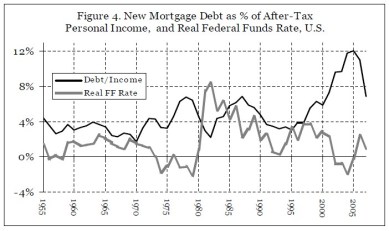
The debt-induced bubble that’s resulted in the present crisis is of course the housing sector bubble.  Paradoxically, it came about because of the weakness of the U.S. economy. First stock prices plunged sharply as the “dot.com” stock market bubble burst. Then the economy went into recession in 2001, and it was weakened further by the 9/11 attacks later that year. In order to allay the fears of financial collapse that followed the attacks, the Fed lowered short-term interest rates. Even after the recession ended a couple of months later, employment kept falling, through the middle of 2003, so the Fed kept lowering short-term lending rates. For three full years, starting in October of 2002, the real (ie inflation-adjusted) federal funds rate was actually negative (see figure 4). This allowed banks to borrow funds from other banks, lend them out, and then pay back less than they had borrowed once inflation was taken into account.

This “cheap money, easy credit” strategy created a new bubble. With stock prices having recently collapsed, this time the flood of money flowed at first largely into the housing market. Loan funds were so ready to hand that working class people whose applications for mortgage loans would normally have been rejected were now able to obtain them.

Fig 4

As Figure 4 shows, the trajectory of the mortgage borrowing to income ratio during the 2000-4 period is an almost perfect mirror image of the trajectory of the real federal funds rate. This is a clear indication of the close link between the explosion of mortgage borrowing and the easy credit conditions. And with new borrowing increasing so rapidly, the ratio of outstanding mortgage debt to after-tax income, which had risen only modestly during the 1990s, jumped from 71 percent in 2000 to 103 percent in 2005 (see figure 5).

Fig 5

The additional money flooding the housing market in turn caused home prices to skyrocket. Indeed, total mortgage debt and home prices (as measured by the Case-Shiller Home Price Index) rose at almost exactly the same rates between start of 2000 and the end of 2005 – 100 percent and 102 percent, respectively.

Those of us who attempt, following Marx, to understand capitalism’s economic crises as disturbances rooted in its system of production – value production – always face the problem that the market and production are not linked in a simple cause and effect manner. As a general rule, it is not the case that particular disturbance in the sphere of production causes an economic crisis. Instead, what occurs in the sphere of production conditions and sets limits to what occurs in the market. And it is indisputable that, in this sense, the US housing crisis has its roots in the system of production. The increases in home prices were far in excess of the flow of value from new production that alone could guarantee repayment of the mortgages in the long run. The new value created in production is ultimately the sole source of all income – including homeowners’ wages, salaries and other income – and therefore it is the sole basis upon which the repayment of mortgages ultimately rests.

But from 2000 to 2005, the rise in after-tax income was barely one third of the rise in home prices. This is precisely why the real-estate bubble proved to be a bubble. A rise in asset prices or expansion of credit is never excessive in itself. It is excessive only in relation to the underlying flow of value. Non-Marxist economists and financial analysts may use different language to describe these relationships, but they do not dispute them. Indeed, it is commonplace to assess whether homes are over or under-priced by looking at whether their prices are high or low in relation to the underlying flow of income.

Now, some players in the mortgage market did realise that something was amiss but nonetheless sought to quickly reap lush profits and then protect themselves before the day of reckoning arrived. But there was a good reason (or what seemed at the time to be a good reason) why others failed to perceive that the boom times were unsustainable: home prices in the US had never fallen on a national level, at least not since the Great Depression.

So it was “natural” to assume that home prices would keep rising. This assumption served to allay misgivings over the fact that a lot of money was being lent out to homeowners who were less than creditworthy, and in the form of risky subprime mortgages. Had home prices continued to go up, homeowners who had trouble making mortgage payments would have been able to get the additional funds they needed by borrowing against the increase in the value of their homes, and the crisis would have been averted.

Even if home prices had leveled off or fallen only slightly, there probably would have been no crisis. In the light of the historical record the bond-rating agencies assumed, as their worst case scenario, that home prices would dip by a few percent. It was because of this assumption that they gave high ratings to a huge amount of pooled and repackaged mortgage debt (mortgage backed securities) that included subprime mortgages and the like. Today these securities are called “toxic” – very few investors are willing to touch them. But if the bond-rating agencies had been right about the worst case scenario, the investors who thought that they were buying safe, investment grade securities would indeed have reaped a decent profit.

As we now know, however, the bond-raters were wrong, massively wrong, and thus there has been a massive mortgage market crisis.  According to the latest Case-Shiller Index figures, between the peak in July 2006 and July of this year, US home prices fell by 19.5 percent.  And because the mortgages were pooled and resold as mortgage-backed securities, the mortgage market crisis has spread throughout the financial system and become a generalized financial crisis.

I now want to say a bit about who or what is to blame.  We’re hearing a lot about greed, but capitalists are always greedy.  But we don’t always have massive crises.  So what explains the fact that we have one now?

There’s also a lot of talk about lax regulation and insufficient regulation.  I know of no better answer to this notion than the answer recently given by Joseph Stiglitz.  In a Sept. 17 article, “How to prevent the next Wall Street crisis” , Stiglitz, a Nobel Laureate and former World Bank chief economist, proposed a six-point program chock-full of regulations and laws.  But he then acknowledged:  “These reforms will not guarantee that we will not have another crisis.”  So why the title “How to prevent the next Wall Street crisis”?

Stiglitz went on explain why his proposed reforms are no guarantee:  “The ingenuity of those in the financial markets is impressive. Eventually, they will figure out how to circumvent whatever regulations are imposed.”  Yes.  So why the 6-point program?

He then wrote, “But these reforms will make another crisis of this kind less likely, and, should it occur, make it less severe than it otherwise would be.”  Hmm.  If the financial markets will eventually circumvent whatever regulations are imposed, then why isn’t another crisis equally likely with these regulations as without them? And why won’t it be as severe with them as without them?

Finally, I want to say a few words about the significance of the various government interventions we’ve seen this year – the government’s forced dismantling of Bear Stearns, the nationalization of Freddie Mac, Fannie Mae, and AIG, and the bailout money that’s being used to partially nationalize the banking system.  Some commentators portray this, as I noted earlier, as an effort to make the rich richer.  Others depict it as some sort of progressive turn, an ideological shift away from the “free market.”  I think both notions are seriously mistaken.

What we are witnessing is a new manifestation of state-capitalism. It isn’t the state-capitalism of the former USSR, characterized by central “planning” and the dominance of state property; it is state-capitalism in the sense in which Raya Dunayevskaya used the term  to refer to a new global stage of capitalism, characterized by permanent state intervention, that arose in the 1930s with the New Deal and similar policy regimes (Marxism and Freedom, Humanity Books, 2000, pp. 258ff.).  The purpose of the New Deal, just like the purpose of the latest government interventions, was to save the capitalist system from itself.

Because many liberal and left commentators choose to focus on the distributional implications of these interventions – who will the government rescue, rich investors and lenders or average homeowners facing foreclosure? – let me stress that I mean “save the capitalist system” in the literal sense. The purpose of these interventions is not to make the rich richer, or even to protect their wealth, but to save the system as such.

Consider the takeover of Bear Stearns.  It was in serious trouble but there were other ways of dealing with its troubles than by the government forcing it to be sold to JP MorganChase.   Had Bear Stearns been able to borrow from the Fed, it could have overcome the cash-flow problem it faced.  But the Fed waited until the following day to announce that it would now lend to Wall Street firms. Or, if Bear Stearns had been allowed to file for bankruptcy, it could have continued to operate, and its owners’ shares of stock would not have been acquired at a fraction of their market value. Instead the Fed forced it to be sold off.

Thus the takeover was definitely not a way of bailing out Bear Stearns’ owners. Nor was the Fed out to enrich the owners of JP Morgan Chase. (The Fed selected it as the new owner of Bear Stearns’ assets because it was the only financial firm big enough to buy them.) Instead the Fed acted as it did in order to send a clear signal to the financial world that the US government would do whatever it could to prevent the failure of any institution that is “too big to fail”, because such a failure could ultimately bring the financial system crashing down.

And consider the government’s rescue of Fannie Mae and Freddie Mac.  This came about because of a sharp decline in their share prices.  But the government didn’t rescue them in order to prop up the price of their share prices.  Their share prices continued to decline after the rescue plan was announced, precisely because the government’s motivation was not to bail out their shareholders. Indeed, the shareholders aren’t receiving any money from the government. Only those institutions and investors that lent to them are being compensated for their losses, and the government had been seriously considering not compensating some of these lenders (the holders of subordinated debt).  Just as in the Bear Stearns case, the point of the intervention was to restore confidence in the financial system by assuring lenders that, if all else fails, the US government will be there to pay back the monies that are owed to them.

The new manifestation of state-capitalism we are witnessing is essentially non-ideological in character.  Henry Paulson is certainly no champion of government regulation or nationalization.  But at this moment of acute systemic crisis, ideological scruples simply have to be set aside.  The be-all and end-all priority is to serve the interests of capitalism – capitalism itself, as distinct from capitalists.  As Marx noted, “The capitalist functions only as personified capital …. [T]he rule of the capitalist over the worker is [actually] the rule of things [capital] over man, … of the product [capital] over the producer” (Results of the Immediate Process of Production,” in Penguin ed. of Capital, vol. 1, pp. 989 – 90, emphasis in original).  The goal is the continued self-expansion of capital, of value that begets value to beget value, the accumulation of value for the sake of the accumulation of value – not for the sake of the consumption of the rich.

Of course, we are indeed witnessing a movement away from “free-market” capitalism, and back to more government control and even temporary ownership.  But this is a pragmatic matter rather than an ideological one.  There’s nothing inherently progressive about it.  The government is simply doing what it must, whatever it must, to prevent a collapse of the system.

The recent state capitalist interventions are perhaps best described as the latest phase of what Marx called “the abolition of the capitalist mode of production within the capitalist mode of production itself”. There is nothing private about the system any more except the titles to property. As I’ve been stressing here, the government is not even intervening on behalf of private interests: it is intervening on behalf of the system itself. Such total alienation of an economic system from human interests of any sort is a clear sign that it needs to perish and make way for a higher social order.

The current economic crisis is bringing misery to tens of millions of working people. But it is also bringing us a new opportunity to get rid of a system that is continually rocked by such crises. The financial crisis has caused so much panic in the financial world that the fundamental instability of capitalism is being acknowledged openly on the front pages and the op-ed columns of leading newspapers. Great numbers of people are already searching for an explanation of what has gone wrong.  Many of them may be ready to consider a whole different way of life, and many more will be ready to consider this as the recession in the real economy deepens.  Revolutionary socialists need to be prepared, not just prepared to organize, but prepared with a clear understanding of how capitalism works, and why it cannot be made to work for the vast majority. And we need to get serious about working out how an alternative to capitalism – one that is not just a different form of capitalism – might be a real possibility.

Andrew J Kliman is Professor of Economics at Pace University (US). This talk was delivered at The New SPACE (The New School for Pluralistic Anti-Capitalist Education), New York City, October 21, 2008. It is to be posted on the New SPACE website .  An audio recording which includes the discussion that followed will be made available soon.  The talk draws in part on Andrew Kliman, “Trying to Save Capitalism from Itself” (April 25)  which is also available at The Hobgoblin and Andrew Kliman, “A crisis for the centre of the system” (Aug. 23) published in International Socialism, No. 120 ).

Note:

(1) Addition, October 22:  In discussion following this talk, questions were raised about how my discussion of capital destruction is related to Marx’s “law of the tendential fall in the rate of profit.”  To address this, let me quote from pages 30-31 of my book Reclaiming Marx’s “Capital”:  A refutation of the myth of inconsistency (Lexington Books, 2007):

“what Marx meant by the “tendency” of the rate of profit to fall was not an empirical trend, but what would occur in the absence of the various “counteracting influences,” such as the tendency of the rate of surplus-value to rise.

“He singled out one of these counteracting influences, the recurrent devaluation of means of production, for special consideration. Like the tendential fall in the rate of profit itself, and the tendency of the rate of surplus-value to rise, the devaluation of means of production is a consequence of increasing productivity. Capitalists incur losses (including losses on financial investments) as a result of this devaluation; a portion of the capital value advanced in the past is wiped out. In this way (as well as by means of their tendency to cause the price of output to fall), increases in productivity tend eventually to produce economic crises. Yet since the advanced capital value is the denominator of the rate of profit, the annihilation of existing capital value acts to raise the rate of profit and thus  helps to bring the economy out of the crisis” (see Marx [Capital, vol. 3], chap. 15, esp. pp. 356-58, 362-63 [of the Penguin ed.]).

Financial crisis: Public needs to know the truth

Arun Kumar

Foreboding headlines confront the middle and the rich classes, the primary savers in the economy. They are quaking at the rapid depreciation in their wealth. Stock markets, mutual funds, real estate, etc., are down. While the going was good, they dreamt of a life of luxury but now they don’t know where to duck.

The financial analysts and the reassuring noises by policy makers had lulled them into believing till early this year that the good days would last forever little realising that the story could go horribly wrong in six months. Such was the euphoria, that those cautioning prudence were seen to be Cassandras of doom.

Ben Benarnke, the Fed chief and Paulson, the US Treasury Secretary, the two people at the top of the heap of the global financial markets were assuring one and all in August 2007, at the start of the sub-prime crisis that matters were under control. Not till February 2008 did Benarnke suggest that something was remiss. It was on September 19, 2008 that both said that the USA faced a deep financial crisis and that the $700 billion bailout package was necessary to save the system from collapse. But with the system continuing to spin out of control, is there a con game all the way through?

The Finance Minister and the Deputy Chairperson, Planning Commission, the two worthies in charge of the country’s financial planning, followed a similar path, assuring the country that India is insulated and that growth would remain intact at around 8 per cent while it can slip to 5 per cent or less.

On October 8 with international markets tumbling, in spite of the coordinated intervention by the central banks (an unprecedented step), Indian markets also followed suit. They stabilised because of the old game of government-induced intervention by certain institutions. The Finance Minister came out of a Cabinet meeting to say, that there was nothing to fear and more liquidity would be infused into banks. He said that Indian banks have strong balance sheets and no one need worry about the safety of deposits. The FM, a lawyer-politician is no economist and maybe excused for not comprehending what is going on.

But the Deputy Chairperson is an economist. He is reported to have said, “ … when normalcy is restored (in global financial markets), normalcy would also be restored to stock markets”. He apparently added that stock values are not a measure of the country’s economy and that stock markets are always more volatile. What a turn around? The government was till recently suggesting that the stock market rise reflected the economy’s performance. However, it is the first statement that needs analysis since it is vacuous.

When would normalcy be restored in global markets? It does not appear to be in sight. In spite of the trillions of dollars being poured in by governments a collapse has set in. In February, a tax cut of $ 160 billion was said to be adequate and then a few hundred billion dollars to take over Fannie Mae and Freddie Mac and AIG was thought to be adequate. Next, $ 700 billion was thought to be adequate and then a coordinated rate cut but the markets continue to collapse. As mentioned in this author’s piece in these columns (February 6, 2008), this is a case of `too little, too late’.

The situation is a dynamic one with matters deteriorating rapidly and faster than anyone is able to anticipate. As argued by Kaldor, once expectations turn negative, nothing helps and that seems to be the current world situation. There is a complete lack of trust so that institutions are running scared, the financial markets are in a state of freeze and liquidity has dried up. Further, the real economy which was already slowing down in 2007 has rapidly gone further downhill. The US has lost close to a million jobs. Now even the IMF has woken up and predicted a slowdown/ recession. The implication is clear that with the real economy sliding, profits all across will tumble and businesses may go broke. Under the circumstances, all investments are uncertain and financial markets already in turmoil can hardly revive. Even companies and banks that today look safe may rapidly sink into losses.

The recent past is a good guide to all this. Even in June 2008, the demise of WaMu, Lehman Brothers, Merrill Lynch etc., the nationalisation of Fannie Mae, Freddie Mac, AIG etc., and the spread of the contagion to Europe could not have been imagined. The decline of Dow Jones to below 10,000 or that of Sensex to below 11,000 were in the realm of impossible. One of the big Indian private banks is 19th in a list of 36 risky banks in the world. Even tiny Iceland faced bank failure. Not only has all this happened, much more is feared in spite of the various packages.

A projection of all this into the future is frightening and a turnaround is not in sight. Hence when the Deputy Chairperson of Planning Commission said “when normalcy returns” he should honestly also add that there are few prospects of that in the near future and no one really knows when that may happen. Was the public being conned?

Analysis of the international financial markets over the last 20 years suggests that an unsuspecting public has been conned. Many were sucked in by greed and invested in unsafe instruments (even the Chinese Central Bank) due to the con job pulled off by the financial experts/advisors. The FBI is reportedly investigating Lehman, Merrill and AIG for possible fraud. While the markets rose, everything seemed to be as scripted but few asked what if the script went horribly wrong as it has done now. Even the most savvy financial experts have lost because they had also conned themselves and invested in the instruments that are now sinking. An NRI steel tycoon is reported to have lost over $16 billion in the last four months in spite of his battery of financial advisors.

The financial sector is not buying the turnaround story and continuing to collapse. It cannot trust others in this dynamic situation where what is apparently safe today can be risky tomorrow so that any investment can turn bad and they can themselves be the next victim. Hence, government bailouts are being treated as good to clean up one’s own balance sheet and improve one’s situation but not good enough to trust anyone else.

The nightmare of a bad script is with us but the con job continues. Rather than admit that the problem is systemic and needs an overhaul, policy makers the world over are busy fire fighting and not doing a basic reassessment which would require a change in priorities. They are attempting to shore up the collapsing financial structures which seem to be beyond repair and ignoring the real sectors of the economy which could react to stimuli much more quickly. A paradigm shift is called for but that requires a mind set change which the current breed of policy makers are proving to be incapable of because of their predisposition(s).

Arun Kumar is Professor of Economics at the Centre for Economic Studies and Planning in Jawaharlal Nehru University (New Delhi). Courtesy: Tribune

Singur – The Costs and Benefits of Neoliberal Industrialization

Deepankar Basu

Singur stands for many, often contradictory, things. It stands for the model of neoliberal industrialization that the Indian state is trying to push down the throats of its citizens at the behest of big capital. It stands for the unprincipled and populist politics of dormant right-wing forces. It stands for the abject surrender of an erstwhile communist party to the dictates of capital, the full flowering of a tendency that surfaced in the Indian political firmament circa 1967. But Singur also stands for the struggle of labour against capital, decidedly in confused and masked manners, but a struggle that has the potential to galvanize resistance against neoliberalism. When the Tata Group, forced by the long-standing struggle of the small farmers and landless labourers in Singur, was reported to be planning a move to Pantnagar in Uttarakhand, there were simultaneous reports of a possible Singur waiting for them in Pantnagar. A Singur in Pantnagar! That is the real significance of the struggle of the landless labourers and peasants of Singur.

Right from day one, the West Bengal government and the mainstream media has been building up the case for the manufacturing plant in Singur on the basis of half-truths and untruths. For a long time, the West Bengal government continued denying the fact that it had “acquired” a large tract of the proposed 1000 acres from unwilling farmers by using coercion, strong-arm tactics and certainly without their consent. Towards the later part of 2006, after considerable protests and a public hearing organized by intellectuals and activists, it had to finally accept its own earlier statements as false. Now it is known by all and sundry that 411.11 acres of the total 997.1 acres has been acquired without consent of the relevant farmers. For a long time, again, the West Bengal government continued denying the fact that most of the land that was sought to be “acquired” was fertile and multi-cropped agricultural land. It was only when earlier this year the Supreme Court pointed towards a possible violation of the Land Acquisition Act, responding to a petition filed for immediate halt of the Nano car project, that the West Bengal government finally accepted that it had been willfully misleading the public in this regard for so long; the SC had pointed out that acquiring and using fertile, multi-crop agricultural land for industrial purposes goes against even the Land Acquisition Act, which the West Bengal government was, paradoxically, trying to use to “acquire” that land. Now it has been established beyond any shadow of doubt that the land on which the proposed plant is to come up is, in the main, fertile, multi-cropped agricultural land. Another myth that had been in circulation for some time was the following: the land in Singur could not be used for agricultural purposes for most parts of the year because of water logging. This claim has also been contested and shown to be untrue. Now it is accepted by all serious commentators that the land had, before being fenced off by the West Bengal police, been in constant use throughout the year for growing various agricultural crops, and that it provided livelihood for more than 12,000 families. Even though these and other such claims of the West Bengal government and the mainstream media have been refuted point by point, over and over again, with facts and arguments and lot of patience and care, they keep turning up ever and ever again like bad coins. They will, as long as the social forces whose interest they represent continue their efforts to hegemonize society; and we will continue refuting them point by point, with patience and care and logic and facts.

But even when these particular canards are discounted, there seems to be a larger argument for industrialization that Singur purportedly represents. The West Bengal government and large sections of the mainstream media tend to equate Singur with industrialization and portray any and every opposition to Singur as opposition to industrialization. The apparent strength, or shall we say charm, of this argument becomes obvious when we see even an preeminent thinker like Amartya Sen falling for it. But this argument is deeply flawed. Opposition to Singur is not opposition to industrialization, it is opposition to neoliberal capitalist industrialization. Opposition to Singur is opposition to the conflation of industrialization with neoliberalism, a scenario where the State steps up its efforts to subsidize capital and shore up its profits while capital externalizes its costs onto labour and the environment with impunity. It is this model of industrialization that we oppose.

An alternative model of industrialization, as far as we can see, would operate in an exactly opposite fashion. It would tax capital and not subsidize it, prevent capital from externalizing its costs onto labour and the environment rather than facilitating it, intervene in decisions related to the choice of technique to be used in production, force private capital to do proper cost-benefit analysis before embarking on a (socially) costly industrial project, intervene through fiscal and monetary policy to maintain overall levels of aggregate demand and try to ensure full employment with living wages for workers. In the alternative vision, the State would use tax revenues to build infrastructure, provide social sector services and closely monitor and improve the well-being of the people. Singur, and the model of industrialization that it stands, takes us in the exact opposite direction; that is why it needs to be opposed. It destroys livelihoods tied to agriculture without creating compensating jobs in industry, it willfully snatches away fertile, multi-crop agricultural land for industrial purposes when so much fallow (and other unused and misused) land is there to be used, it externalizes the costs of production on the most vulnerable sections of the population and the environment, and all this while the State steps in to massively subsidize private capital even further. If, therefore, due to the struggle of the project affected people the Tata’s finally leave West Bengal, it should call for rejoicing not for middle-class chest-beating that is so much on display these days. For it would be one of the important victories in the emerging struggle against neoliberalism in India.

Cost and Benefits

In this article we will try to study details of the costs and benefits of the proposed manufacturing plant in Singur on the basis of information that is available in the public domain. But a caveat is necessary. This is not a full blown cost-benefit analysis because we shall not venture to quantify the indirect benefits of possible net employment generation and the income that might arise from there. At this point, it is not even clear whether there will be positive net employment generation; it is not at all obvious, in other words, that the employment destruction entailed by the project will be exceeded by the employment generated by it. Moreover, a full cost-benefit analysis would require much more information than has presently been made available by the West bengal government; on the basis of the available information, which pertains mostly to the benfits that the West Bengal government plans to make available to the Tata’s, we shall mainly try to approximately quantify the costs to the exchequer, and ultimately to the people of the state.

A careful study of the details relating to the proposed project in Singur, to the extent possible by the publicly available information, is important for two main reasons. First, it is important to do a dispassionate analysis of the costs and benefits of this project; since the West Bengal government has been continually making largely unsubstantiated claims about the putative benefits of this project, it is high time we carefully analyzed the foundations of this claim. Second, this project is very much in line with the current trend of neoliberal capitalist industrialization in India anchored tightly in the visions of the Special Economic Zones (SEZs); hence a study of this project will highlight, and help us evaluate, many of the important characteristics of neoliberal capitalist industrialization that has been envisioned and aggressively pushed by the Indian state since the early 1990s. Parenthetically, one should also note how acceptance of the logic this project signals the gradual dissolving of social democracy in India: from”managing” the conflict between labour and capital, social democrats are increasingly moving towards “managing” labour for capital.

The main document that we will use for the purposes of this study is the text of the recent “agreement” signed between the Government of West Bengal, the West Bengal Industrial Development Corporation (WBIDC) and the Tata Motor Ltd. (TML) pertaining to the proposed manufacturing plant in Singur. By a careful analysis of the information contained in this document, and complementing this with some more information from other sources we will, hopefully, be able to arrive at a true picture of the costs and benefits of this project. But before we get into the nitty-gritty of the agreement, let us remind ourselves about the severe difficulties that we have faced over the past few years in just trying to get hold of the information that is relevant to this project. Recall that the details of the “deal” wasn’t made public initially because the West Bengal government believed it was a “trade secret”. Once this argument was properly trashed, the government shifted gears. During this period, it wasn’t made public despite repeated Right To Information (RTI) applications because, according to the government, the Tatas didn’t want it to be made public! Finally what has been made public, mainly because of pressure from the standing committee on industry of the West Bengal state assembly, are only parts of the “deal”; this all we have for the purposes of study and analysis. The TML filed a case in the Calcutta High Court and got a stay against the rest of it being made public. What is there in the rest of it? We, and the more than 12000 project affected families in Singur, can only guess. The entire episode, to say the least, is patently undemocratic, and makes a mockery of the intent of the recently passed Right to Information Act. One does not, of course, discern even an iota of concern about this important matter displayed by the “peoples’ government” in West Bengal!

The Agreement

The “agreement” between the West Bengal government, WBIDC and TML is a remarkable document by all means. Starting from the premise that the state of West Bengal must match, rupee for rupee, every fiscal and financial incentive offered to TML by other states like Uttarakhand and Himachal Pradesh, it goes on to lay out the details of the same. This, the agreement states, should be read as the state government’s eagerness to “take appropriate steps for rapid industrialization in West Bengal”. This, to the best of our knowledge, is the clearest admission by the West Bengal government and the “communist” party standing behind it of the acceptance of neoliberalism. By accepting that the road to “rapid industrialization” winds its way through huge subsidization of private capital in the form of tax breaks and soft loans with the concomitant costs borne by labour and the environment, the West Bengal government has finally announced its participation in the Indian State’s neoliberal industrialization program. We will discuss this issue in greater detail below.

The text of the agreement is also remarkable in its enormous onesidedness. Every concrete detail in the agreement refers to what the West Bengal government will do for TML; there is no mention of what TML will do in return! It is as if by accepting to invest in the state, TML has bestowed an enormous favour on the people and its government. Overwhelmed by this boundless magnanimity of TML, the West Bengal government has decided to offer everything in its power to return that favour. The favours offered to TML come in four concrete forms: (a) subsidized land for setting up the manufacturing plant, (b) loans in the form of tax holidays, (c) soft loans to get started, and (d) subsidized electricity. There is no mention of anything that the state can expect in return from TML. Loans do not require collateral, failure to make timely payments do not require penalties, there is no mention of what employment generation TML’s investment will entail, there is no mention, in short, of anything at all that might inconvenience private capital or hold it accountable to the people. Below, we will look at the each of the components of the favours, what we will quite realistically refer to as costs, and also try to take seriously the claims of the government about the purported benefits of the project, but first, let us briefly remind ourselves about the land “acquisition” and its proposed use.

Land “Acquisition” and Use

The agreement – scroll down to read the text of the agreement – states that land “of approximately 1000 acres chosen [by TML] in P.S. Singur of District Hoogly” was finalized as the site for the construction of the proposed plant. Subsequently WBIDC “commenced the process of acquisition of this land”, an euphemism for the veritable terror unleashed on the farmers of Singur to give up their fertile, multi-cropped agricultural land for neoliberal industrial “development”. Using the colonial era Land Acquisition Act of 1894, the WBIDC coerced – with the support of the police and cadres of the ruling party, CPI(M) – several hundred families to give up their land, and according to the agreement, it is now “in possession of 997.1 acres of land”.

Out of this forcibly-acquired 997.1 acres of land, 647.5 acres will be leased to TML to set up its proposed plant, what the agreement calls the “Automobile Project”; another 290 acres will be leased to “the vendors to this Automobile Project approved by TML”, the vendors being the ancillary and component manufacturing units. An area of 14.33 acres will be given to the West Bengal State Electricity Board (WBSEB) for the construction of a 220/132/33 KV substation to provide and uninterrupted supply of subsidized electric power to the “Automobile Project”; and the remaining “47.11 acres will be used by WBIDC for rehabilitation activities for the needy families amongst the Project affected persons”. Note in passing that only 4.74% of the “acquired” land has been earmarked for purposes of rehabilitation of the project affected persons.

Total Cost of the Project

According to the details available in the agreement, the total cost to the people of West Bengal of the proposed project in Singur, as we have already pointed out, can be broken down into the following four categories: (a) subsidized land for setting up the manufacturing plant, (b) loans in the form of tax holidays, (c) soft loans to get started, and (d) subsidized electricity. Point 7 of the agreement provides details about each of these. Point 7(a) is about the tax holiday; point 7(b) is about the hidden subsidy in land; point 7(c) is about the soft loan, and point 7(d) is about the subsidized electricity. The sum of these “fiscal incentives”, excluding the subsidy in electricity, add up to what the Uttarakhand/Himachal Pradesh governments offered to TML. How do we know this? From point 7(a) of the agreement which states: “This benefit [i.e., the tax holiday] will continue till the balance amount of the Uttarakhand benefit (after deducting the amount as stated in para 7b and 7c below) is reached on net present value basis, after which it shall be discontinued.” In other words, the sum of the benefits offered by the West Bengal government in the form of (a) subsidized land, (b) tax holiday, and (c) soft loan will equal what the Uttarakhand/Himachal Pradesh governments were willing to offer; the subsidized electricity (and other real estate, as we will see below) are bonuses, which make the West Bengal government’s offer exceed the Uttarakhand/Himachal Pradesh. But this also means that we can indirectly arrive at the total cost of the project in Singur if we can somehow figure out the amount of the Uttarakhand/Himachal Pradesh package.

Point (1) of the agreement mentions that the “incentive package in Uttarakhand/Himachal Pradesh consists of:-

(a) 100% exemption from Excise Duty for 10 years.

(b) 100% exemption from Corporate Income Tax for first 5 years and 30% exemption from Corporate Income Tax for next 5 years.”

How much is this package worth? Let us try to think this through. We have collected some information from annual financial reports of TML in Table 1 that will help us get an approximate figure for the Uttarakhand/Himachal Pradesh package using points 1(a) and 1(b).

There are some remarkably stable patterns in the data. TML seems to be paying about 12% of its gross revenue as excise duty and 2.35% of its revenue as corporate income tax. If TML were to set up shop in Uttarakhand or Himachal Pradesh, it would be manufacturing about 250,000 small cars per annum. If each car were to sell for Rs. 1 lakh, TML’s gross annual revenue would be approximately Rs. 2500 crores. If the TML would have to pay excise duty, assuming the above ratios, it would pay about 300 crores (12% of Rs. 2500 crores) per annum; if it had to pay corporate income tax, it would have to pay about Rs. 58.75 (3.5% of Rs. 2500 crores) crores per annum. If TML set up shop in Uttarakhand/Himachal Pradesh, according to the agreement, it would not have to pay these taxes as stated in point 1(a) and 1(b).

Summary of the Uttarakhand/Himachal Pradesh package: for the first 5 years, TML gets Rs. 358.75 crores every year (100% excise duty exemption + 100% corporate income tax exemption); and for the next 5 years, it gets Rs. 317.63 crores every year (100% excise duty exemption + 30% corporate income tax exemption). The NPV of this benefit package is Rs. 2062.79 crores (using 11% for calculating NPV).

According to point 7(a) of the agreement, the West Bengal government’s “benefits package” will equal this sum if we compute the benefit coming from subsidized land, soft loans and tax holidays. Let us now look at the different components of the package promised by the West Bengal government.

Hidden Land Subsidy

What are the terms of the rental structure on the land lease agreed upon by WBIDC and TML? Two different set of rules apply, one to the 647.5 acres leased to TML and another to the 290 acres that will be leased to the vendors approved by TML. Both leases, however, will come up for possible renewal 90 years down the line. For the 647.5 acres of land that is leased to TML, the annual rental will be Rs. 1 crore for the first five years, increasing by 25% every five years till 30 years. Thereafter, the annual rental will be fixed at Rs. 5 crore, to be increased by 30% every 10 years till the year 60; the rental from year 61 to 90 will be Rs. 20 crore per year. For th vendors, the rental structure is simpler: for the first 45 years, they will pay an annual rental of Rs. 8000 per acre, and for the next 45 years will pay an annual rental of Rs. 16000 per acre. Since the vendors are leasing 290 acres of land, this means that for the first 45 years, they pay a total of Rs. 0.232 crores per year and Rs. 0.464 crores per year for the rest of the time.

Details of the payment schedule, for both TML and the vendors, is summarized in Table 2. This is similar to, but more detailed than, a table used by Madhukar Shukla for commenting on the Nano project; the main difference is the inclusion of figures on net present values (NPV). What is net present value? It is a conceptual device used to compare sums of money at different points in time, which I explain in greater detail below. Why is NPV relevant here? Because an investment project like the proposed plant in Singur involve costs and benefits flowing in at different points in time. Columns (2) through (6) give the actual payments to be made at various points in time, while the last three columns give the net present value (NPV) of the payments, where NPV has been calculated using an interest rate of 11% per annum (exactly as done by the WBIDC in Annexure II of the agreement). Note in passing that the Annexure where all the computations relating to the project has supposedly bee done has not been made available to the public; all we know is that the NPV calculations used an interest rate of 11%.

To arrive at figures about the costs of “acquiring” the land and the revenue earned from leasing it to TML (and the vendors), we need to remind ourselves that the WBIDC spent anything between Rs. 150 crore and Rs. 200 crore to “acquire” the land from the unwilling farmers. How much will WBIDC get for letting TML use that piece of land? Columns (4) shows that the TML will pay a total amount of Rs. 855.79 crores over 90 years as rental fees for using the land. So the cost incurred by the WBIDC is Rs. 150-200 crore, while revenues will be 855.79 crore. Does this mean that the WBIDC made a good bargain with the TML on behalf of the people of the state? Does it men that the WBIDC is actually making a “profit” in leasing out the land to TML? Let us think about this a little more.

A rupee today is not equivalent to a rupee next year. Why? One can put the rupee that one has today in the bank and earn an interest income at the going interest rate to augment the original sum. If the current interest rate is 11%, then one would have Rs. 1.11 at the end of the year if the rupee were to be invested in an interest-bearing asset today. Put another way, Rs. 1.11 at the beginning of next year is equivalent to Rs. 1 today (at the beginning of this year). Let us go further, and suppose that we let our rupee lie in the bank for two years. How much do we have at the beginning of the third year? Rs. 1.21 (because at the beginning of the second year one has Rs 1.11, and then one earns 11% on that amount to arrive at Rs. 1.21 at the beginning of the third year). Inverting things, we see that Rs. 1.21 two years hence is equivalent to Rs 1 today when the market interest rate is 11%. This logic can be extended to any number of years and is the basis of computing net present values (NPVs). In the jargon of economics, if the market interest rate is 11%, Rs. 1.1 one year hence has a NPV of Rs. 1; and Rs. 1.21 two years hence has a NPV of Rs. 1. Thus, NPV is a device to make sums of money at different points in time comparable to each other. What does this mean for us?

It means that we cannot just add up all the rental payments that TML is supposed to make over the next 90 years (which is Rs. 855.79 crores) and compare it to the cost incurred by the WBIDC to “acquire” the land today (which is Rs. 150-200 crores). To make the stream of rental payments of the TML (over the next 90 years) comparable to the cost of “acquisition” today, we need to calculate the NPV of the rental payment stream. That is precisely what we have done in column (7) in Table 2. Column (8) gives the sum of the NPVs of the rental payments. On the basis of this calculation we arrive at a very striking fact at the end of column (8). The NPV of the rental payments that the TML will make over the next 90 years is Rs. 14.4 crores! The NPV of the rental payments that the vendors will make is Rs. 2.13 crores.

Summary: while the cost to the WBIDC for “acquiring” the land was anything between Rs. 150 crores to Rs. 200 crores, the NPV of the revenue from rental income that will accrue to the WBIDC is Rs. 16.53 crores, sagging the WBIDC with a loss of anything between Rs. 130 crores to Rs. 180 crores! Which is just another way of saying that taxpayers are subsidizing a big corporate entity like the TML to the tune of Rs. 150 crore just in terms of the land that the WBIDC “acquired” for it.

Cost of Circumventing the Law

A moment’s reflection on the time structure of rental payments for TML brings another characteristic of the transaction to the fore. The time structure of payments has been arranged in such a way that the bulk of the rental payments come in later years. From column (6) in Table 2 we see that the TML makes only 5% of its total payments in the first 25 years of the lease; in the first 50 years, it pays only 20 percent of its total payment commitments. The Comptroller and Auditor General of India (CAG) had pointed out in March 2008 that, according to Government of India laws, long-term leases of 99 years required that the lessee pay 95% of the market value of the land as a one-time premium at the beginning of the lease and pay annual rent at the rate of 0.3% of the market value of the land. The same report went on to note that the agreement between the TML and the WBIDC should have entailed an immediate payment of Rs. 91.88 crore and subsequent annual rents of Rs. 29 lakhs for the next 90 years. As opposed to this, the TML, according to the agreement, would pay nothing upfront and would only pay Rs.1 crore at the end of the first year!

Of course it would have been illegal if the lease was for 99 years. Hence, it seems, the WBIDC cleverly decreased the span of the lease by 9 years to circumvent the letter of the law. In spirit, though, this still amounts to a violation of the law. Why? Because the law states that for long-term leases the majority of the payments should be paid upfront by the lessee; and the WBIDC agreement with TML shows an exactly opposite time structure of payments, with most of the payments pushed off far into the future. Thus, even though in letter the agreement clears legal hurdles, it is obvious that it fails miserably in terms of the idea behind the law. No wonder the CAG faulted the WBIDC on several counts regarding its agreement with the TML. But let us pause for a moment and think why the CAG (or the laws) wanted the bulk of the payment upfront.

There are two basic reasons why the law might want to ensure bulk of the payments for a long-term lease upfront. One, large upfront payments for long-term leases increases the NPV of the rental payment stream. Since these long-term leases generally require the government to hand over public land for private use, it makes sense to structure rental payments in such a way that the government exchequer gets a good value in return; that is why a large upfront payment is usually written into lease contracts for long-term leases. The second reason for having a large upfront payment relates to considerations of risk. When a stream of payments has relatively large amounts pushed far away in the future, the NPV of that stream of payments is more liable to change when market interest rates change.

Let us take an example to understand both these points. Suppose, for simplicity, we want to compare two payment streams, A and B. A has Rs. 1 lakh today and Rs 9 lakhs in 10 years; B has Rs 9 lakhs today and Rs .1 lakh in 10 years; note that both entail a total payment of Rs. 10 lakhs over a period of 10 years and are similar in this respect. But they also are very dissimilar. To understand why suppose that the market interest is 10% at the moment. NPV of A is Rs. 4.47 lakhs, while the NPV of B is Rs. 9.39 lakhs. Thus, the NPV of B is much higher than that of B, which clarifies the first point. Now suppose that the market interest rate increase to 15%; this will obviously diminish the NPV of both A and B. But which will fall more? A’s NPV falls by about 39% while B’s NPV falls by only 1.5%! Thus, the risk of loss of revenue that comes from a payment stream (payment of rent for instance) is higher when most of the payments come in during relatively later periods. It is probably because of these two sound economic reasons, among others, that the CAG urged the West Bengal government to reconsider its lease agreement with the TML. By structuring the rental payments such that most of it come in during later years, the West Bengal government is not only losing revenue but is also bearing a higher risk of loss of even that minimal revenue.

So, how much is the WBIDC losing in real terms by using the rental payment structure that is summarized in Table 2 instead of the one recommended by the CAG? If TML were to pay Rs. 91.88 crores upfront and then subsequently pay a rental of Rs. 29 lakhs per annum for the next 90 years (as suggested by the CAG ), the NPV of this payment scheme would be Rs. 94.52 crores (using an interest rate of 11% per annum for calculating the NPV). The NPV of the currently agreed upon rental payment scheme (as per the agreement) is Rs. 16.53 crores (sum of entries in column (7) of table 2). Hence, the WBIDC is losing Rs. 77.99 crores due to the chosen rental payment structure.

Summary: the total financial loss to the WBIDC due to the agreed upon rental payment structure, as opposed the one suggested by the CAG, is Rs. 77.99 crores; the WBIDC, in addition, has to bear extra risk arising from possible fluctuations in the market interest rate.

Soft Loans and Tax Holidays

Point 7(c) of the agreement provides information about the soft loan: “The West Bengal Govt. will provide TML a loan of 200 crores @ 1% interest per year repayable in 5 equal annual installments starting from the 21st year from the date of the disbursement of the loan”. This loan, moreover, “will be disbursed within 60 days of this agreement”. Point 7(a) of the agreement refers to the loans that the WBIDC will give to the TML in the form of tax holidays. The tax holiday will continue, as we have already noted, till the sum of the land subsidy, tax holiday and the soft loan equals the Uttarakhand/Himachal Pradesh package.

So, what is the total loss to the exchequer due to the tax holidays and soft loans. There are two ways to arrive at approximate value of this loss. First, if we knew the exact amounts of the loans (in the form of tax holidays) and the exact repayment shedule and interest rates, we could calculate the net present value of the loss. But unfortunately, we do not have enough data in this regard, and so we will adopt an indirect method to arrive at the notional cost of the tax holiday and the soft loans. This second, indirect method, begins by recalling that, according to point 7(a) of the agreement, the total benefits from the land subsidy, taxt holidays and soft loans offered by the West Bengal government will equal the benefits that was offered by the Uttarakhand/Himachal Pradesh govenrment. We have seen above that the total value of the Uttarakhand/Himachal Pradesh package was approximately Rs. 2063 crores on a net present value basis. We have also seen that the cost to the exchequer of the subsidized land was about Rs. 228 crores (Rs. 150 crores for direct subsidy and Rs. 78 crores lost due to the time structure of the rental payment scheme). Thus, the total cost of the tax holiday and the soft loans will be Rs. 1835 crores (which is Rs. 2063 crores less Rs. 228 crores) on a net present value basis. Note that this is a notional cost.

The last part of 7(a) seems even better. It says: “WBIDC will ensure that the loan under this head is paid within 60 days of the close of the previous year (on 31st March) failing which WBIDC will be liable to compensate TML for the financial inconvenience caused @ 1.5 times the bank rate prevailing at the time on the amount due for the period of such delay”. What does this mean? It means that if the WBIDC is not able to make the loan to TML within 60 days of the close of the financial year, it will penalize itself by compensating TML at 1.5 times the prevailing bank rate. So, if the prevailing bank rate is 10%, which is close to what is the case right now, the WBIDC will penalize itself for any delay on its part by paying back the TML for the “financial inconvenience” at 15%.

Summary: the cost of the soft loans and tax holidays to the TML by the West Bengal government will be about Rs. 1835 crores on a net present value basis.

More Gifts from Santa: Real Estate and Subsidized Electricity

Industrial development requires infrastructural support from the government, as we all know. And so the West Bengal government displayed its commitment to “rapid industrialization” by offering a “virtual gift of 650 acres of prime land to Tata Housing Development Company (THDC) in Rajarhat New Town and in the adjoining Bhangar Rajarhat Area Development Authority for building an IT and residential township along with WBIDC as a partner“. What better way to provide “infrastructural assistance” for the industrialization effort that to hand over prime land for real estate speculation! Some reports suggest that this “gift” to TML will cost the exchequer about Rs. 160 crores.

The West Bengal government has also promised to supply electricity at Rs 3 per kilo watt hour (kwh), which is around half the price charged to high-tension industrial consumers in the West Bengal at the moment. It has also promised to absorb any increases in electricity costs to the TML in Singur. Point 7(d) of the agreement states: “In case of more than Rs. 0.25 per KWH increase in tariff in every block of five years, the Government will provide relief through additional compensation to neutralize such additional increase”. This will mean, at the least, shelling out Rs. 70 crores annually for subsidizing the electricity requirements of the whole project at Singur. The NPV of this subsidy for the 90 year period of the lease would be Rs. 706 crores.

Summary: the cost to the exchequer of the real estate gift and subsidized electricity will be about Rs. 865 crores.

Adding up the Costs

Let us now take a moment to put all this together. The subsidy that TML gets, according to the terms of the agreement, on the land in Singur is anywhere between Rs. 100 and Rs. 150 crore; the subsidy due to the rental payment structure is Rs. 78 crores; the implicit subsidy due to the tax holiday and the soft loan would be about Rs. 1835 crores; the real estate “gift”, also known in WBIDC terminology as “infrastructural assistance”, is worth Rs. 160 crores; and the subsidized electricity will cost another Rs. 706 crores. So, the Tata conglomerate, one of the largest corporate entities in the country, is awarded a “gift” of about Rs. 2928 crore by a “communist” government so that it can be induced to set up a car manufacturing plant in the state and lead it on to the path of neoliberal industrial development. To put this figure in perspective, let us refer to the 2008-09 budget speech of the Finance Minster of West Bengal. Pointing to the emergence of what he called the “industrial potential” of the state, he offered some concrete figures to bolster his argument. In 2005, the annual realized (industrial) investment in West Bengal was Rs. 2515.58 crores, which then jumped up to Rs. 5072.26 crores within the next two years. Thus, a sum close to 58 percent of the total realized industrial investment in the state in 2007 would be the cost borne by the people of the state if the Tata-Singur project too off.

Summary: the total cost of the Tata-Singur project incurred by the exchequer, and hence ultimately the tax payers, will be approximately be Rs. 3000 crores on a net present value basis when we add up the costs pertaining to the land subsidy, the tax holidays, the soft loan, the real estate gift and the subsidized electricity using an interest rate of 11%. This is about 58% of the total realized industrial investment in the state of West Bengal in 2007.

What are the Benefits?

What are the purported benefits of the Tata-Singur project? The West Bengal government has advanced two claims regarding the benefits: employment generation and improvement in the investment climate of the state. These two claims about possible employment generation and future investments need to be looked at closely, because the rationale offered by the West Bengal government for giving the stupendous bonanza to the Tatas rests precisely on these. Both these claims are dubious. Regarding the claims about employment generation, there have been figures ranging from a high of 12000 (2000 in the Nano plant proper, 10000 in ancillary and complementary units) to a low of 750 (some recent local newspapers have put the figure at 650). The upshot of all this is that there is no certainty about the employment generated. However, if we look at a recent BBC report on this matter it becomes clear that 62% of the projected employment in the automotive sector is going to be skilled labour, 28% is going to be management jobs, leaving only 10% jobs for unskilled labour. Now, the displaced population in Singur, if at all they get absorbed in the mother plant or in the ancillary units, would typically be offered employment as unskilled labour. So, the prospect of much employment being generated, especially for the people in Singur, is dim. Moreover, all these calculations ignore the employment destruction that the project will inevitably entail. If we were to properly take both possible employment generation and possible emplyment destruction into account, we could arrive at a figure for the net emplyment generated by the project. At the moment, it is not even clear that the net employment figure will be positive.

The other claim about the Singur project generating prospective investment in the future rests on equally shaky foundations. The question really boils down to whether the Tata plant can attract other major investments and lead to an industrial rejuvenation of Bengal. The example of Jamshedpur in neighbouring Jharkhand should be carefully looked at. Tata’s factories in Jamshedpur did nothing for the overall industrialization of the state of Bihar or now Jharkhand. It remained an enclave of industrial activity, without forging strong forward or backward linkages in neighbouring areas. The other issue to think about, in the context of the claim about TML drawing future investments, is whether other industrialists coming to invest in Bengal would also demand similar bonanzas from the government. Will the government refuse them the goodies that they have offered TML and let them turn away or will it repeat the Tata-like agreements and put further burdens on the exchequer. Either option does not seem to be beneficial from the perspective of the working people of the state.

Summary: while the costs of the proposed Singur-Tata project is obvious, tangible, immediate and large, the benefits seem to be uncertain, residing far away in the future and their magnitudes small.

Oh! So Poor Tata

A few months back, the finance minister of West Bengal presented a budget with a Rs. 2 crore deficit; a net subsidy of about Rs. 3000 crores would certainly be extremely costly for the people of the state; after all it is about 1500 times the budget deficit in fiscal year 2008-09. Given that a small, poor, fund-starved state like West Bengal is making such great efforts to subsidize the Tata’s, it must mean that they (the Tata’s) are in a dire financial situation. But is that true? If we merely cast a glance at the recent international buying spree that the Tata’s have been engaged in, we might be able to understand how far from the truth would be any assertion that the Tata’s require financial assistance from a poor state like West Bengal to start an industrial project.

The Tata Group of Companies, let us remind ourselves, is one of the largest business conglomerates in India with about 100 large companies in its fold. With the might of the Indian State firmly behind it, monopoly capital in India has started a move to aggressively acquire foreign assets, what it calls strategic corporate assets. In the last few years, the Tata Group has been leading this acquisition spree on behalf of Indian big capital, making forays not only in Asia and Africa but also in the heartland of world capitalism: USA and Europe. Let us briefly take a look at the record of the Tata Group with regard to foreign acquisitions.

In January 2007, the Tata Group pulled off India’s biggest ever takeover of a foreign company to buy Anglo-Dutch steel-maker Corus for $12 billion; this acquisition made the

combined entity (Tata-Corus) the world’s fifth largest producer of steel. In March 2004, the Tata Group acquired South Korea’s Daewoo Commercial Vehicle Company for $102 million; this was followed by the acquisition of a 21 percent stake in Spanish bus maker Hispano Carrocera for $18 million with an option to pick up the remaining stake at a later date. Around the same time, Tata Technologies, another company in the Tata fold, which provides automotive engineering and design services, bought Britain’s Incat International for $53 million.

Tata Consultancy Services, which was earlier a division of Tata Sons and a rising star in the Tata Group, has been among the most aggressive shoppers for foreign companies. It has acquired six companies in the past few, with the net value of the deals close to $100 million; these include FNS of Australia, which was acquired for $26 million and Chile’s outsourcing major Comicrom, which was bought for $23 million. When the Tat Group acquired the former state-run, international telecom carrier, VSNL, a few years ago, it was on its way to becoming a major telecom player in the global markets. To enhance its position, it acquired undersea cable company Tyco of the US for $130 million, Internet service provider Dishnet’s India division for $64.28 million and international telecom service provider Teleglobe of the US for $239 million.

Following its acquisition of Hindustan Lever Chemicals, Tata Chemicals was on the lookout for a steady supply of phosphoric acid for its newly acquired plant at Haldia, West Bengal. Accordingly, it took over two overseas companies for a total value of $215 million: Indo Maroc Phosphore of Morocco in March 2005 and Brunner Mond Group of Britain in December 2007. Morocco, by the way, produces over 50 percent of the world’s rock phosphate.

In 2000, Tata Tea bought British giant Tetley for a $407 million, and started looking for similar deals to strengthen its global position in the tea and related drinks business. This search led to acquisition of 33 percent stake in the South African company Joekels Tea Packers for an undisclosed amount and 30 percent stake in the US-based favoured water manufacturer Glaceau for $677 million, the acquisition of the US-based Good Earth Corp for $32 million and acquisition of the Czech Republic’s firm Jemca for an unknown amount.

India Hotels, the hotel branch of the Tata Group, acquired several hotels abroad for $121 million in the past few years. It is reported to have set aside $100 million for future acquisitions in Europe, the Middle East, Asia and the US. In December 2006, it had acquired W, a hotel at the Woolloomooloo Bay in Sydney; it was followed by the taking over of the management of The Pierre, a luxurious landmark hotel on New York’s Fifth Avenue. India Hotels, which runs the Taj Group of hotels, has 39 hotels in India and 18 worldwide. A recent acquisition of India Hotels was Campton Place Hotel in San Francisco.

If we add up the figures for the Tata Group’s overseas acquisitions, we arrive at a rough figure of $14,062 million, which converts to roughly Rs. 56,248 crore (using an exchange rate of Rs 40/$), and this is not even a complete list of Tata’s recent acquisitions. And, what does all this lead to? It inevitably leads us to the conclusion that a corporation which can invest more than Rs. 56,000 crores for acquisition of strategic foreign corporate assets requires the financial support of India’s impoverished taxpayers, to the tune of Rs. 1140 crores in real terms, to set up a small car manufacturing plant in India! That, in a nutshell, is what we would like to call neoliberal industrialization, pushing which down our throats has become the almost single-minded purpose of the West Bengal Government and the “communist party” that is at its helm of affairs.

TINA Logic

But even after all these facts and figures and arguments have been read, understood and absorbed, sympathizers of the West Bengal government will no doubt come up with a supposedly unbeatable argument: TINA. There is no alternative. This argument points to the magnanimous offers made by other states in India to attract private capital, and then goes on to plead the inability of the West Bengal government to follow any route other than to offer even more largesse. Recall that the text of the agreement starts precisely with this argument. It builds up its case for the huge hidden subsidies that is offered to TML, and which we have seen in great detail above and which add up to about Rs. 3000 crores on a net present value basis, by emphasizing the incentive package that the States of Uttarakhand and Himachal Pradesh has offered to the Tatas. That is why the West Bengal government must offer more than the value of the offers by the other states if it is to attract private capital, like the TML, to industrialize the state. Since, other states are offering huge tax breaks and soft loans, West Bengal must also do so, the argument goes. West Bengal cannot fight this trend, caught as it is in the competitive struggle between the states of India.

One must begin by acknowledging that there is some truth to this assertion. It is true, in other words, that in the neoliberal set-up private capital has managed to generate competition between political entities, both within nations and between nations, to ensure higher profits on its investments. But acknowledging this fact, the fact of the existence of this strong pressure for competition among states, does not mean accepting it as inevitable; it does not mean accepting the logic, championed by the proponents of neoliberalism, that there can be no alternative to the present framework. If the fight against neoliberalism has to be taken forward then this logic must be fought. One cannot succumb to this logic in practice and claim to be fighting against neoliberalism.

And to fight this logic, one must understand what it implies. The competition that capital manages to enforce on political entities (for instance states in India or countries in the global context), one must understand, is akin to a “race to the bottom”. As soon as one state lowers taxes, reduces social sector spending, loosens labour laws, cracks down on political dissent in order to make the atmosphere “conducive” for investments, another tries to outdo the first by reducing taxes even further, reducing social sector spendings even further, making labour even more “flexible” in order to “attract capital”. And thus, as the logic of this competition unfolds in all dimensions, people of all the states taken together lose. Lower tax revenues means lower resources for the State to invest in educations, health, nutrition, poverty alleviation; it means increased misery for the common people, with sub-optimal infrastructure and public amenities. And who benefits from this fierce competition? Capital. Thus accepting this as the only way to industrialize is to accept this “race to the bottom”, with all its deleterious consequences for the population, as the West Bengal government seems to have done.

So what can be done? One has to act on several fronts at the same time. First, it is undeniable that fighting the neoliberal logic will require concerted political action at the Central level to thwart moves to implement central-level neoliberal policies; the largest “communist” party standing behind the West Bengal government must shed its fears of radical mass political activism and launch, with other like minded political forces, a nationwide offensive against neoliberalism, instead of using all its energies in parliamentary antics. It will also mean not succumbing to the pressures of capital at the state level as the West Bengal government has pathetically done. If private capital wants to move out of the state because taxes are high and social sector spendings are growing and the labour laws are favourable for the workers, and the health and educational status of the people are improving, then so be it. The state need not hanker after such capital for, at the end of the day, massively state-subsidized investments of such capital is not beneficial for the people.

Second, one must understand that, if attracting capital is all one wants to achieve, capital can also be attracted in a very different fashion, by reversing the harmful, negative competition between states and instead initiating a “race to the top” to replace the “race to the bottom”. For it is a fact, recently noted by several observers of the Indian economy, that India is very rapidly moving into a regime marked by serious shortages of skilled labour. A state which wants to attract private capital can, therefore, invest massively in building up the education and health system for the workers; a healthy and skilled labour force can be a stronger incentive for capital to set up shop in a state than huge tax holidays. In fact, instead of giving tax breaks to capital, the state will need to tax them aggressively and use the tax revenue to further improve the conditions of the working people. Equally true is the abysmal conditions of physical infrastructure – transportation, housing, power, etc. – in most of the states of India. A state can, therefore, start investing in building up basic infrastructure for the people by taxing capital and citizens in the high-income brackets; solid infrastructure can be as strong an incentive for private capital as soft loans and hidden subsidies. The point of these interventions would be, in the medium and long urn, to initiate reversal of the “race to the bottom” that every state seems to be in the grip of. Unfortunately, the West Bengal government seems hell bent on going the opposite way.

Third, complementing these interventions have to be efforts to revitalize mass political activism at the grassroots level. Imagine, for a moment, a strong, countrywide mass movement against neoliberalism. If Singur in re-enacted in Uttarakhand and Himachal Pradesh and Karnataka, then where will the TML go? Wherever it sets up shop, it will have to do so without the luxury of externalizing the costs onto the working people and the environment. Simple economic logic suggests that forcing capital to internalize its costs by an active mass political movement would in fact ensure that the decisions taken by capital will be closer to what could be considered socially optimal. Mass participation in planning and implementation would, further, increase much-needed accountability of both the state and capital. Unfortunately again, the West Bengal government wants to go the other way.

Conclusion

This brief analysis of the details of the proposed Tata-Singur project in West Bengal offers us an unique opportunity to think about the industrialization strategy of the Indian state today. One of the major thrusts of this strategy is to build up so-called Special Economic Zones (SEZs) all over the country. As of August 11, 2008 there were 250 notified SEZs across the country. Since each of these SEZs more or less replicate the policy regime applicable to the proposed Tata-Singur project – with magnanimous tax holidays and soft loans and subsidized power and “flexible” labour laws and absence of all environmental regulations – it would probably not be far from the truth to suggest that each of these SEZs would entail at least the amount of loss that we have calculated above for the Tata-Singur project. This suggests that the total cost to the people of this country of the current neoliberal policy regime would be about Rs. 750,000 crores. How large is this figure? For comparison, consider the fact that the total expenditure of the Indian government was slated to be Rs. 750, 884 crores in budget 2008-09; thus, an amount which is roughly equal to the total expenditure of the Indian government in 2008-09 would be the loss to the nation for embracing neoliberalism. Isn’t it high time we sharpened our struggle against neoliberalism in earnest?

(Comments from Debarshi, Kuver and Partho have substantially improved the argument of this article).

ADDENDA

Benefits of Employment Generation

In my earlier portion of the article, I had stated that a full-blown cost-benefit analysis was not possible with the available information; that is primarily because information about net employment, and therefore the corresponding income, generated in the Tata-Singur project is lacking. There is lot of uncertainty about the possibilities of new employment flowing from the project, and figures for net employment generated varies from a high of 10,000 to a low of 500, the highest figure unsurprisingly coming from TML and the West Bengal government. Though it remains true that a full-blown cost-benefit analysis is not possible, what can certainly be done, as a complement to my previous analysis, is to find the benefits of the net employment generation for the best possible scenario and compare it to the costs entailed by the project. In carrying out such an exercise, we would be conducting a rough cost-benefit analysis with the most favourable assumptions for the West Bengal government and TML. Let us see what we the results are.

To proceed, let me state my assumptions clearly:

(1) There is a net employment generation of 10,000 this year in the Tata-Singur project.
(2) The average wage attached to this new employment is Rs. 60,000 per year.
(3) Due to the multiplier effect of this new income generated in the Tata-Singur project, i.e., due to the backward and forward linkages that it will supposedly establish, income will grow at the rate at which the Indian economy has been growing for the past few blazing years, i.e., at 9% per annum.

Thus, the net income generated during the current year will be Rs. 60 crores (which is 10,000 multiplied by Rs. 60,000); during the next year, the total income generated will be Rs. 65.4 crores; the year after that Rs. 71.29 crores, and so on…

Here is the question that I want to pose: how many years will it take for the net present value of the income stream generated due to the Tata-Singur project (and its multiplier effects) to equal the cost of the project? How many years, in other words, will it take for the total benefits, under these generous assumptions, to equal the total cost incurred due to the project? Recall that, as we have seen earlier, the total cost of the project is roughly Rs. 3000 crores on a net present value basis? So, how many years will it take for the benefits to equal Rs. 3000 crores?

And here is the answer: 127 years!

What does this imply? Let us think a little carefully. The net employment generation figure is by all accounts a gross exaggeration. As we have argued earlier, the component of employment that will go to unskilled labour is relatively small. Given the fact that the semi-agricultural labour population in Singur is most likely to be absorbed, if at all, as unskilled labour, the employment prospects of these people are extremely limited. Additionally there is the aspect of job destruction which we have so far ignored; it is most likely the case that the quantum of jobs destroyed due to the project is higher than the jobs that will be created. Hence, in all probability, the net employment generated by the project is negative. Thus, in assuming that the net employment generated by the project is 10,000 we are inflating the figure many times over. The fact that we have also assumed the wages to be Rs. 60,000 per annum only adds to the exaggeration. Since most of the employment for the people of Singur will be in the form of unskilled labour, a salary of Rs. 5,000 per month is a certainly high figure.

Similarly, the assumption that the total multiplier effect of the new employment will be a growth of 9% per annum year after year is also an exaggeration. If the multiplier effect of the new employment would generate 9% additional every year, it would mean generating about Rs. 5.4 crores of additional income in the second year, about Rs. 5.9 crores of additional income in the third years and so on… Even the Indian economy is expected to slow down, from its current 9% growth rate, due to the global financial crisis. Hence, an annual growth rate figure of 9% for income generated most certainly inflates the benefits accruing from the Tata-Singur project in terms of employment and income.

What all this means is that even under extremely favourable assumptions, the cost of the Tata-Singur takes 127 years to be recouped. A reasonable time frame to recoup the costs of the project would require an unrealistically high rate of income growth, something which is anyway unlikely given that the world economy seems headed towards a deep recession. Thus, it seems that the costs of the Tata-Singur project far outweighs the benefits that can reasonably be assumed to flow from undertaking it.

Agreement between Tata Motors Ltd., Government of West Bengal and WBIDC

1. Tata Motors Ltd. (TML) was intending to set up a manufacturing Plant for Automobile Products including “Tata Small Car” to manufacture 250,000 cars per annum on 2 shift basis which could be expanded to 350,000 on 3 shift basis. In addition, it would have several Vendors and act as a mother plant for many aggregates to tune of 500,000 cars. In this connection, TML was considering locating the plant in the States of Uttarakhand/ Himachal Pradesh in view of the fiscal incentive package for the rapid industrialization being made available by the Govt. of India to new Industries in these States which has been attracting a large number of industries to these States. The incentive package in Uttarakhand/Himachal Pradesh consists of:-
(a) 100% exemption from Excise Duty for 10 years.
(b) 100% exemption from Corporate Income Tax for first 5 years and 30% exemption from Corporate Income Tax for next 5 years.

2. The Government of West Bengal (GoWB) is keen to take appropriate steps for rapid industrialization in West Bengal and in this connection wanted to attract some major Automobile Projects to the State. The Government of West Bengal approached TML to persuade them to locate an Automobile Project including the project to manufacture “Tata Small Car” in West Bengal. TML showed interest in locating the plant in West Bengal, provided the State gave Fiscal incentive equivalent to the value of total incentives it would have received by locating the plant in Uttarakhand / Himachal Pradesh. GoWB offered to match the financial incentives in equivalent terms and invited TML to set up the Small Car plant in West Bengal entailing investment of over Rs. 1500 crores by TML. In addition, Vendors supporting the project are likely to make further investment of over Rs. 500 crores.

3. Since then numerous discussions have been held and based on this understanding, GoWB proceeded with identification of various lands for this mega project. Land of approximately 1000 acres chosen in P. S. Singur of District Hooghly was finalized with TML. West Bengal Industrial Development Corporation Ltd. (WBIDC) commenced the process of acquisition of this land. The process was completed with the Declaration of Award under Section 11 of the Land Acquisition Act, and thereafter WBIDC has obtained mutation of ownership in its name in the Record-of-Rights, and conversion of usage of the land from agriculture to factory.

4. WBIDC is in possession of 997.11 acres of land, which has been acquired under the Land Acquisition Act. Out of this, an area admeasuring 645.67 acres will be leased to TML for setting up the Automobile Project including the small car plant, while an area admeasuring 290 acres will be leased to the vendors to this Automobile Project approved by TML (ancillary and component manufacturing units), 14.33 acres will be handed over by WBIDC to WBSEB only for construction of 220/132/33 KV substation and the balance admeasuring 47.11 acres will be used by WBIDC for rehabilitation activities for the needy families amongst the Project affected persons.

5. The terms of lease to TML for the 645.67 acres of land for the mother plant are described below. In addition, WBIDC will provide on lease 290 acres of land to the Vendors selected and approved by TML on payment of Premium equal to the actual cost of acquisition plus incidentals, to be calculated on the basis of the total acquisition cost and other incidental expenses expended by WBIDC or any of its subsidiaries (duly certified by its auditor) averaged over the total land acquired. The lease rental payable per year per acre by the vendors will be Rs. 8000/- per acre for the first 45 (forty five) years and Rs. 16000/- per acre for the next 45 (forty five) years. The initial lease tenure will be 90 years. On expiry of 90 years, the lease terms will be fixed on mutually agreed terms at that point of time.

6. The parties also discussed mutually to finalise the package of incentives required in order to enable GoWB to fulfill its commitment to match in equivalent financial terms the fiscal incentive foregone by TML in Uttarakhand. The Net Present Value (NPV) computation of benefits that the project would have received in Uttarakhand is attached in Annexure I which is agreed to by all the parties. Sample computation of benefits in West Bengal with stated assumptions is given in Annexure II which is accepted by all parties as agreed basis of computation. The NPV is calculated @ 11%.

7. Accordingly, it is finally agreed, in supersession of all previous decisions and agreements in this regard, that for this mega project, the fiscal incentives under Industrial Promotion Assistance in terms of the West Bengal Incentive Scheme (WBIS 2004), assistance towards land cost and interest subsidy in the form of a loan against a quantum of the term loan to be taken by TML for this project will be offered by GoWB as follows:-

(a) WBIDC will provide Industrial Promotion Assistance in the form of a Loan to TML at 0.1% interest per annum for amounts equal to gross VAT and CST received by GoWB in each of the previous years ended 31st March on sale of “Tata Small Car” from the date of commencement of sales of the small car. This benefit will continue till the balance amount of the Uttarakhand benefit (after deducting the amount as stated in para 7b and 7c below) is reached on net present value basis, after which it shall be discontinued. The loan with interest will be repayable in annual installments starting from 31st year of commencement of sale from the plant. The loan availed in the first year will be repaid in the 31st year and the loan availed in the 2nd year will be repaid in the 32nd year and so on. WBIDC will ensure that the loan under this head is paid within 60 days of the close of the previous year (on 31st March) failing which WBIDC will be liable to compensate TML for the financial inconvenience caused @ 1.5 times the bank rate prevailing at the time on the amount due for the period of such delay. TML & GoWB will make best efforts to maximize sale of products from the “Small Car Plant” in the State of West Bengal.

(b) WBIDC will provide 645.67 acres of Land to Tata Motors Ltd on a 90 year lease, on an annual lease rental of Rs. 1 crore per year for first 5 years with an increase @ 25% after every 5 years till 30 years. On expiry of 30 years, the lease rental will be fixed at Rs. 5 crores per year, with an increase @ 30% after every 10 years till the 60th year. On the expiry of 60 years, the lease rental will be fixed at Rs. 20 crores per year, which will remain unchanged till the 90th year. On expiry of 90 years the lease terms will be fixed on mutually agreed terms at that point of time. The benefit on account of land would be calculated as the total land area leased out to TML multiplied by the cost of acquisition calculated in the manner as provided in para 5 less NPV of rent payable during 60 years.

(c) The West Bengal Govt. will provide to TML a loan of Rs. 200 crores bearing @ 1% interest per year repayable in 5 equal annual installments starting from the 21st year from the date of disbursement of loan. This loan will be disbursed within 60 days of signing of this Agreement.

(d) The West Bengal Government will provide Electricity for the project at Rs. 3/- per KWH. In case of more than Rs. 0.25 per KWH increase in tariff in every block of five years, the Government will provide relief through additional compensation to neutralize such additional increase.

8. It is also agreed that the computation of the comparison of benefits in Annexure I and II will be changed if there are any changes in the rates of excise duty and corporate income tax during the next 10 years.

Krugman’s “great illusion”

Pratyush Chandra

Economist Paul Krugman in his latest column in NY Times (Aug 15, 2008) entitled “The Great Illusion” expresses his concern at the possibility that “the second great age of globalization may share the fate of the first”. And it is the recent Russia-Georgia conflict that makes him say so. To be more explicit he goes on to explain that “our grandfathers lived in a world of largely self-sufficient, inward-looking national economies — but our great-great grandfathers lived, as we do, in a world of large-scale international trade and investment, a world destroyed by nationalism.”

Krugman’s above statement clearly shows his lack of any historical sense. When was that “world of large-scale international trade and investment” free of (militarist) nationalism – a mechanism to protect that “large-scaleness”? And much of the “nationalism” which destroyed that world was in fact a revolt against that “large-scale” militarism. Yes, it destroyed the Pax Britannica – it was a war against the war monopoly.

On the one hand, Krugman seems to tell that national self-sufficiency at least with regard to “the current food crisis” is at last clearly shown to be not “an outmoded concept”. But he is in fact accusing nationalism of “many governments” for “leaving food-importing countries in dire straits”. He further finds that there is a rise of “militarism and imperialism” as “it does mark the end of the Pax Americana — the era in which the United States more or less maintained a monopoly on the use of military force. And that raises some real questions about the future of globalization”. Obviously, for him, “Russian energy” and Chinese big economy are the real threats as they have the capacity to manipulate world polities and economies to submission.

Then what is the Pax Americana? Is it not militarism, imperialism and manipulation, that we witnessed throughout the 1990s and afterwards? When did war-mongering and militarist build-up end during the “Pax Americana”? Increasing manipulative capacities of other countries and their political economy at the most demonstrate a globalization of “militarism and imperialism”.

Krugman rightly questions those analysts who “tell us not to worry: global economic integration itself protects us against war, they argue, because successful trading economies won’t risk their prosperity by engaging in military adventurism”. He thinks “the foundations of the second global economy” are solid than those of the first only “in some ways”, “[f]or example, war among the nations of Western Europe really does seem inconceivable now, not so much because of economic ties as because of shared democratic values”. So euro-centric Krugman, like Stiglitz, ultimately thinks the West not to be adventurist because of its democracy, but ah! “much of the world, however, including nations that play a key role in the global economy, doesn’t share those values”. So does he think the Pax Americana to which the West has submitted is about peace and democracy, which is now being threatened by the despotic Orient?

Krugman rightly concludes that “the belief that economic rationality always prevents war is an equally great illusion”. But like any other ordinary bourgeois he thinks economic rationality can prevent war when coupled with “democratic” values of the West. Obviously he can’t see the fact that economic rationality is about competition, representative democracy is about competition, and a war is competition par excellence. They are all ultimately the same – diverse moments in the life of “social capital”(1). Krugman refuses to recognize that capital whether protected by democratic regimes or not is at constant war against labour – which needs to be divided and controlled if it is to be exploited – and Western xenophobic megalomaniac nationalisms have always been nurtured for this reason. Where is the country in the West free from state-sponsored Ku-klux-klanesque policies and activism against migrants and “the other”? The neo-capitalist regimes have learned their lessons properly – obviously at the cost of threatening the established monopolies. It is not an end of globalization, as Krugman prognosticates, but a new stage – and a more barbaric stage – of capitalist globalization.

Note:

(1) “Here social capital is not just the total capital of society: it is not the simple sum of individual capitals. It is the whole process of socialization of capitalist production: it is capital itself that becomes uncovered, at a certain level of its development, as social power”. (Mario Tronti (1971), “Social Capital“)

Perspectives on the US Financial Crisis

Sam Gindin and Leo Panitch

It is time to take stock. The centrality of the American economy to the capitalist world – which now literally does encompass the whole world – has spread the financial crisis that began in the U.S. housing market around the globe. And the emerging economic recession triggered in the U.S. by that financial crisis now threatens to spread globally as well.

Capitalism has had an incredible run – politically and culturally as well as economically – since the stagflation crisis of the 1970s. The resolution of that crisis required, as economists put it at the time, ‘reducing expectations’ of the kind nurtured by the trade union militancy and welfare state gains of the 1960s. This was accomplished via the defeats suffered by trade unionism and the welfare state since the 1980s at the hands of what might properly be called capitalist militancy. This was accompanied by dramatic technological change, massive industrial restructuring alongside labour market flexibility and the over – all discipline provided by ‘competitiveness.’

That discipline brought with it an enormous increase in economic inequality, the spread of permanent working class insecurity and the subsumption of democratic possibilities to profitable accumulation. But this did not mean capitalism was no longer able to integrate the bulk of the population. On the contrary, this was now achieved through the private pension funds that mobilized workers savings, on the one hand, and through the mortgage and credit markets that loaned them the money to sustain high levels of consumer spending on the other. At the centre of this were the private banking institutions that, after their collapse in the Great Depression, had been nurtured back to health in the postwar decades and then unleashed the explosion of global financial innovation that has defined our era.

The question begged by the current crisis is whether capitalism’s capacity to integrate the mass of people through their incorporation in financial markets has run out of steam. That the fault line should have appeared in ‘sub-prime’ mortgage loans to African-Americans is hardly surprising – this has always been the Achilles’ heel of working class incorporation into the American capitalist dream. But an economic earthquake will actually only result if there is a devaluation of working class assets in general through a collapse of housing prices and the stock and bonds in which their retirement savings are invested.

The state and financial crises

We are by no means there yet. The role being played to prevent just this by the Federal Reserve, very much acting as the world central bank in light of the global implications of a U.S. recession, should once and for all dispel the illusion that capitalist markets thrive without state intervention. It was through the types of policies that promoted free capital movements, international property rights and labour market flexibility that the era of free trade and globalization was unleashed. And this era has been kept going as long as it has by the repeated coordinated interventions undertaken by central banks and finance ministries to contain the periodic crises to which such a volatile system of global finance inevitably gives rise.

The Fed has repeatedly poured liquidity into its financial system at the first sign of trouble. The question is whether the capacity of the system to go on integrating ordinary Americans though the expansion of investor and credit markets in this way has reached its limit. This was indeed suggested by the Bush administration’s sudden (non-military) Keynesian turn with a $150 billion fiscal stimulus. However, that fiscal stimulus at the federal level may be undone at the state level, especially with municipal government cutbacks, given their massive dependence on property taxes. The way financial institutions that specialized in selling risk insurance on municipal bonds were enveloped in the credit crisis has further compounded the problem. This indeed brings to mind the extent to which it was municipal governments that were on the front lines of the Great Depression.

But while the U.S. may very well move into a recession, which even when it ends may mark the beginning of a new era of slower growth, this is very different from a Depression. While there is no doubt that mortgages in black communities and for the working poor more generally will be tightened, it seems most likely that banks, competing for markets, will continue to extend credit to working families more generally. we need to remember that the top twenty per cent and their families are extravagant consumers. While growing inequalities are grotesque, the left has consistently underestimated the extent to which the rich can sustain overall spending. The ‘correction’ in the dollar (alongside the strength of U.S. manufacturing in the higher-tech sectors) has already led to offsetting growth in markets abroad; U.S. exports have been growing at double-digit rates over the past few years.

Finally, the U.S. state may revive its capacities for substantive infrastructural spending, if only to stimulate the construction industry now that the housing boom is over. Indeed, even from the perspective of competitiveness and accumulation there is a long-neglected need to rebuild U.S. infrastructure – as the collapsed levies of New Orleans and the collapsed bridges of Minneapolis dramatically showed. The type of state intervention that brought us financial globalization is not well suited to this, but this crisis may finally force some renewal of state capacities in this respect, even within the overall framework of neoliberalism.

Finance and Neoliberalism

There is an understandable tendency on the left to take hope in capitalism’s current dilemmas. The extreme liberalization of finance (and along with it the era of neoliberalism) seems discredited. Finance today appears as no more than high-flying speculation – absurdly wasteful and ultimately not sustainable. U.S. corporations remain profitable, but with the credit crunch, who will buy the goods? Discredited as well, it therefore appears, is the U.S. capacity to keep its own house in order, never mind lead the process of globalization. Yet before we assume that the openings created by this crisis place us on the verge of a matching new oppositional politics, we need a more careful reading of our times. While the new openings provide the space for a new politics, we need to soberly appreciate the problematic link between such openings and a radical response.

To begin with, as immoral and irrational as finance might seem, financialization has been absolutely essential to the making and reproduction of global capitalism. Second, the growing consensus that finance must be re-regulated is hardly an attack on finance or neoliberalism more generally. Rather, it is about the engineering of finance so it can continue to be ‘innovative’ in the service of both itself and non-financial capital. Third, whatever problems the U.S. currently faces, its dominance will not fade because of a crisis in housing or a lower exchange rate; it does us no good to underestimate the staying power of the American capitalist empire.

It is not only finance but capitalism in general that rests on speculation. Behind a new firm or a new product rests the ‘speculation’ that it can be sold at a cost and price that generates profit. Behind the distinction between finance and the ‘productive sector’ is therefore something else: the notion that finance speculates in pieces of paper, not in providing goods or real services; it is a parasitic drain on the economy, not a constructive addition to it.

The problem with this line of thinking is that it mistakes what is rational from the perspective of certain moral criteria with what is rational within capitalism. The financial system is necessary to capitalism’s functioning. The discipline finance has imposed in the neoliberal era on particular capitalists and workers has forced an increase in U.S. productivity rates by way of increased exploitation, the more efficient use of each unit of capital, and the reallocation of capital to sectors that are most promising – all from the standpoint of profits, of course.

The penetration by American finance of foreign countries and the inflow of foreign capital into the U.S. has given the U.S. access to global savings, shored up its role as the greatest global consumer and reinforced the U.S. state’s power and options. Especially important, financial markets have come to provide non-financial corporations with mechanisms for managing their risks, and comparing and evaluating diverse investment opportunities in a highly complex global economy. Absent this role, globalization – at least to the extent we have experienced it – would not have been possible. Finally, as emphasized earlier, the ‘democratization’ of American finance has given workers access to finance as savers and debtors, thereby contributing to their integration into, and dependence on, each of capitalism and finance.

This does not mean that the explosion of finance is not a highly contradictory process. Highly volatile financial markets inevitably generate financial crises. Rather, it shifts the question from whether financialization is irrational to whether its contradictions can be managed insofar as the crises can be contained. What working classes do in this context will be crucial to answering this question.

The Dialectics of Regulation

Finance cannot exist without regulation and the U.S. financial sector, even before the latest crisis, was the most heavily regulated of any section of the U.S. economy. In fact, the dynamics of finance cannot be understood apart from how regulation shapes financial competition, how banks and other financial institutions try to escape or reshape that regulation, and the state’s subsequent counter-responses. The current dilemma for American regulatory institutions lies in how to re-regulate finance so as to overcome its costly and dangerous volatility without undermining finance’s needed innovative capacity.

We need to be clear that this is about re-engineering finance to strengthen capital accumulation, not control it in the name of a larger public interest. To place democratic regulation of finance on the agenda would require asking: ‘regulation for what purpose?’ and so would mean going far beyond finance itself. It would mean raising the fundamental question of social control over investment and therefore get to the heart of power in a capitalist society.

In the context of the failed promises of the past quarter century and the current crisis, to see the above issue go completely unmentioned in the Democratic primary debate may not be surprising given the absence of even a trade union campaign around this, but it bespeaks an impoverishment of American politics that in fact goes all the way back to the New Deal. The issue of economic democracy that had been placed on the political agenda alongside the New Deal’s public infrastructure projects was set aside for the remainder of the century after the FDR administration’s self-described ‘grand truce with capital’ in the late 1930s.

It will, therefore, not do to resort to the abstractions and obfuscations of calling for ‘re-regulation’ or a ‘new, new deal.’ It is the undemocratic power of private control over investment that needs to be put on the agenda.

American Empire in Crisis

Four particular aspects of the limited fall-out from the present crisis demand more serious reflection on the left. First, the fact that this crisis surfaced in the context of strong profits and low debt loads in the non-financial sector is important, and this accounts for the limited damage thus far.

Second, it is notable that despite the IMF calling this the most serious banking crisis since the Great Depression, we have not seen a series of banks failures. This is certainly linked to the interventions of the U.S. Fed, but it also speaks to the strength of private U.S. financial institutions. In no other country could such a crisis have unfolded without massive financial bankruptcies.

Third, it is especially worthy of note that no major state saw an opportunity in the crisis to challenge or undermine the American state. Rather, their integration into global capitalism meant that they identified this crisis as their crisis as well. They effectively recognized the U.S. central bank as the world’s central bank and cooperated with it in coordinating internationally repeated provision of liquidity to the banks. As in the previous instances of financial crises during the 1980s and 1990s, this reproduced and extended the American state’s leading role in managing global capitalism.

The fourth, and most important factor is the remarkable ‘imperial flexibility’ the U.S. has by virtue of the weakness of its working class. Had, for example, U.S. workers insisted on higher wages to compensate for rising food and oil prices and the devaluation of their homes and taken advantage of the competitive space offered by a falling dollar, the Fed would have had to cope with the fear of inflation and this might have meant higher rather than lower interest rates. And that could very well have aggravated the crisis and risked a financial meltdown. But rather than the working class demanding more, it in fact showed restraint or, in the case of the autoworkers, accepted the greatest concessions the union has ever made.

The more important question is, therefore, not the economics of crisis but its politics. How will the working class respond to the crisis? If credit continues but becomes more costly; if the loss of private pensions, negotiated health care, and the devaluation of homes force people into having to reduce consumption to shore up their savings; if food and oil prices leave less discretionary spending – if this is the near-term future, will workers rebel? Or will workers once again tighten their belts to preserve what is left from their past gains? And if frustrations are expressed politically, will the politics be limited to a longing for the good-old days before the crisis or before Bush?

Absent what Alan Sears, at the recent Great Lakes Graduate Students Conference at York, called ‘an infrastructure of resistance’, any opposition that does surface is most likely to be localized and contained rather than built on. A coherent alternative is no just a set of economic policy proposals but a political movement that can develop the popular appreciation and capacities for radical democratic control over investment. There should be no illusion that a recession, or even a depression, will necessarily bring the issue of economic democracy back onto the U.S. political agenda. It would require a transformation of American politics to do so – and that, like the current economic crisis, would as well have global implications.

Sam Gindin teaches political economy at York University.
Leo Panitch teaches political economy at York University and is editor of The Socialist Register.

Courtesy: The Bullet

The End of the Middle Class?

A growing middle-class is considered to be an indicator of prosperity. According to one of the proponents of the neoliberal capitalist euphoria in India, Gurcharan Das (India Unbound) – “the most striking feature of contemporary India is the rise of a confident new middle class”. According to him the middle-class in India is 20% of the population now, obviously under the impact of “open economy”. Further, “If our country’s economy grows 7% over the foreseeable future and if the population increases annually by 1.5%, if the literacy rate keeps rising and if we assume the historical middle-class growth rate of the past 15 years, then half of India will turn middle class between 2020 and 2040. Das concludes that “to focus on the middle class is to focus on prosperity. This is unlike in the past, when our focus has been on redistributing poverty. This does not mean that we are becoming callous. On the contrary, the whole purpose of the enterprise is to lift the poor — and lift them into the middle class”. And how is this growing middle-classness measured? Obviously the measurement “is ownership of consumer products”.

If the secret of the billionaires’ wealth is not more gadgets and things at home, but their ability to control over the majority’s means and conditions of production, then why should more gadgets and things at home be the parameters of judging the poor’s poverty? Even if we find consumerism rising – with new gadgets cropping up in the home of the new poor, it only increases her material and mental destitution and dependence – this is not a sign of enrichment. Absolute Poverty (not just relative poverty with growing divide between rich and poor, which is generally recognised) is increasing, as people are more and more dispossessed, alienated from their means of production, losing control over the conditions of production and reproduction. It was in this sense that Marx saw “Labour as absolute poverty; poverty not as shortage, but as total exclusion of objective wealth”. It is “labour separated from all means and objects of labour, from its entire objectivity”.

In fact, does not the following story published in The Times (May 19, 2008) show THE END OF THE MIDDLE CLASS in the ‘centre’ of world capitalism (even by the standards of bourgeois economists)?

Soaring food prices have led to a growing number of middle-class New Yorkers joining an unusual organisation that “dumpster dives” in rubbish bins for food.

The trash tours form part of a growing movement called “Freegans”, which is rapidly increasing in popularity as New Yorkers find it harder and harder to make ends meet.

Freegans – a name derived from the words “free” and “vegan” – sift through garbage cans and bin bags in the evenings looking to find edible food and discarded items such as shelving or kitchen appliances that can be reused.

Janet Kalish, a high school teacher from Queens and member of the freegan.info movement, which organises dumpster dives and trash tours, told The Times that the numbers were increasing. “We are seeing more people dumpster dive – some people who were not in a position before to worry about food prices and now they have to. We are seeing more people come on our trash tours,” she said.

Ms Kalish said that freegans did not sift through household rubbish – “that really is garbage, you know, half-eaten food and old food” – but through the refuse of New York’s fast-food businesses such as Dunkin’ Donuts, Starbucks, Pret a Manger and the supermarket chains D’Agostino and Gristedes.

“The companies tend to put leftover food in black plastic bags on the sidewalk at about 9 in the evening. About an hour later, the garbagemen come and take it away. We try to get there first. It is not as shocking as it sounds. Once food is in the garbage, it’s just a big bag of food.

“Because it is on the kerb, it’s not on private property so there’s no issue of trespassing,” she added.

Ms Kalish, who said that she did not know how many Freegans there were in New York, insisted that she had never been ill because of food reclaimed from bins, but added that she would always tell new dumpster divers never to touch meat. “It could have gone off and, besides, meat is always more dangerous.” Another freegan, who declined to be named, said: “I’ve always taken five or six packets of sandwiches on my way home from work from the Pret a Manager near the office. There’s nothing disgusting about it. They are sealed sandwich packets. I put them in my bag, eat one myself, offer them to colleagues or friends and give them to homeless people on the subway on the way home. Food is so expensive now, I can’t afford not to. I reckon I save myself $50 [£25] a week from dumpster diving and going through the garbage.”

Ms Kalish added: “Bananas are a real find. You open the bag and you can’t believe what you are seeing – maybe 100 beautiful bananas that have been thrown out probably because the store got a new shipment in and this lot weren’t as fresh.”

Over the past two years Americans have had to contend with soaring food and fuel prices triggered by increased demand for ethanol, the clean biofuel.

Washington has pumped subsidies to American farmers as an incentive to grow grain for producing ethanol, which is made from fermenting corn. As the price of grain rose, the cost of maintaining dairy herds rocketed. Milk prices have doubled in America since 2006, the cost of grain has soared and the rising price of oil has increased distribution costs for other types of food such as fresh fruit and vegetables.

This month, Wal-Mart, the world’s biggest retailer, was forced to ration long-grain rice to protect supplies. It said that businesses such as restaurants were hoarding the grain because they were anxious that the price would continue to rise.

Harvard University estimated last year that Middle America was suffering its worst financial hardship since the 1950s as families were forced to struggle with rising food and fuel costs, tightening credit conditions, sliding residential property prices and soaring healthcare premiums.

Market Terrorism

Rick Wolff

The intimate partnership between mainstream economics and right-wing ideology has long trumpeted the wonderful efficiency of markets. In these partners’ fantasy, markets are truly wondrous coordination mechanisms that perfectly match the supply of goods and services to what buyers demand. All this happens, they say with immense self-satisfaction, without the intervention of any government or collective authority (which would, they insist darkly, abuse the power to make such interventions). It must be difficult for these partners now to contemplate how markets first produced and then spread the current financial disasters across the globe.

US markets began the process in 2000 by rapidly generating many more home mortgages and mortgage-backed securities than before. Profit-driven mortgage brokers greatly increased the number of home mortgages. Profit-driven banks saw huge fees in converting these mortgages into securities and selling them to investors in financial markets around the world. To do that, the banks entered the market for security ratings and paid the providers of these, corporations like Moody’s and Standard and Poor’s, to supply high ratings. The rating companies complied and made huge profits in that market. The banks also purchased insurance policies (“guaranteeing” these mortgage-backed securities’ principal and interest payments) in the market for them. The insurance companies made much money selling those policies.

No conspiracy was needed to produce the real-estate bubble nor its current, devastating implosion. Just the normal workings of profit-driven markets sufficed to do the job.

Meanwhile, the labor market in the US since 2000 kept real wages from rising. So, many workers could not keep up their mortgage payments, especially when the market prices for food and fuel soared. They stopped their mortgage payments. The banks, hedge funds, and others who had purchased the highly-rated, insured mortgage-backed securities discovered that the market had sold them bad investments. Trying to sell these bad investments, they discovered that there were few buyers. Mortgage-backed securities’ prices collapsed. That’s how markets work. The lowered prices of mortgage-backed securities reduced the wealth of the banks, hedge funds, and other investors around the world who still owned them. The collapsing market for mortgage-backed securities commenced to terrorize all the world’s financial movers and shakers starting in the second half of 2007.

When banks, hedge funds, and wealthy investors get hurt, they immediately use markets to try to shift the pain onto others. Banks sought to recoup losses from their bad investments by withdrawing credit from individuals and businesses and/or charging more for the loans they provided to them. In economic language, the mortgage-backed securities’ collapse was spread to the credit markets generally. And that brought the disaster to credit-dependent individuals and businesses that had had nothing to do with mortgages or real estate. The market mechanism thus spread terror to vast new populations.

As credit markets extended the mortgage-backed securities disaster, via constricted credit to other borrowers, those borrowers had in turn to reduce their purchases in the consumer and capital goods markets. The linked markets proved to be a very effective mechanism enabling the mortgage-backed security crisis to provoke an economy-wide recession in the United States. Since the US is the largest market in the world for commodities produced everywhere, its recession will spread — by means of the market — to produce economic turmoil and suffering globally. The world’s markets comprise a terror network, a system for producing economic disaster and delivering it to every corner of the planet.

Much like other kinds of religious fundamentalism, market fundamentalism — the dogma that markets guarantee efficiency and prosperity — has wrecked economies and lives. Plato and Aristotle explained the dark side of markets thousands of years ago. They and countless others since then have shown how and why markets repeatedly destroy the bonds of community and undermine social cohesion. Yet the market fundamentalism of recent decades blinded leaders and many followers to the known failures of markets. They and we will now pay a heavy price for their blindness.

I am not saying that markets must never be used as ways to distribute some products and some productive resources. That would simply be a reverse fundamentalism. Rather, lets recognize that markets have strengths and weaknesses and act accordingly. Just as we know government intervention and planning needs checks and balances to avoid its pitfalls, markets need all sorts of checks and balances to avoid their horrors. The worship of markets “free” from constraints and controls is bad witchcraft the world can no longer afford.

In any case, markets, whether controlled more or less, are not our economy’s only basic problem. How markets work is shaped by how we organize production. Our economic system organizes production in ways that do more damage than markets. Production occurs mostly in corporations run by boards of directors (usually 15-20 individuals). Those boards receive the profits made from the goods and services produced by the workers. Those boards decide what to do with those profits. Those boards manipulate markets to enhance their profits and to maintain their position atop the corporate system. In contrast, the workers — the majority in every enterprise — do not get the profits their labor produces nor have they any say in what is done with them. In the market as organized by boards of directors, workers get too little in wages and pay too much in prices.

This system places conflict and conflict of interests right in the heart of production. Boards of directors work to get more out of workers while paying them less; the workers want the opposite. What a way to organize production!

Class conflict on the job spills over into markets. “Reforms” imposed on markets in the wake of their current meltdown will fail if we do not change the organization of production. Suppose we reorganized production so that those who produce the goods are also those who receive the profits and decide on their use. Suppose in this way US workers achieve what polls show they want — to be their own bosses on the job. Suppose every job description obliges the worker holding that job to participate in collective discussion and decision on how to use the enterprise’s profits.

As their own bosses, workers could effectively insist that markets be just as controlled and limited to serve the majority as corporations and governments should be.

—————
Rick Wolff is Professor of Economics at University of Massachusetts at Amherst. He is the author of many books and articles, including (with Stephen Resnick) Class Theory and History: Capitalism and Communism in the U.S.S.R. (Routledge, 2002) and (with Stephen Resnick) New Departures in Marxian Theory (Routledge, 2006).

Neoliberal Globalization Is Not the Problem

Rick Wolff

Capitalism is. The leftists who target neoliberal globalization denounce privatization, free markets, unfettered mobility of capital, and government deregulations of industry. They propose instead that national or supra-national governments control and regulate market transactions and especially capital movements, increase taxes on profits and wealth, and even own and operate industry. “All in the interests of the people,” they say, democratically.

Yet Marx’s critique of capitalism never focused on government regulations, interventions, and state-owned industries. They were never his solutions for the costs, injustices, and wastes of capitalism. Instead, Marx targeted and stressed capitalism’s “class structure” of production. By this he meant how productive enterprises were internally organized: tiny groups of people (boards of directors) who appropriated a portion — the “surplus” — from what the laborers produced and the enterprise sold. Marx defined such surplus appropriation as “exploitation.” And, as Marx said, capitalist exploitation can exist whether those appropriators are corporate boards of directors (private capitalism) or state officials (state capitalism).

Marx opposed capitalism’s exploitative class structure of production on political, ethical, and economic grounds. He preferred a communist alternative where productive workers functioned as their own board of directors, collectively appropriating and distributing the surpluses they produced. Equality and democracy, he argued, required the abolition of exploitation as a necessary condition of their realization.

Capitalism as a system has always and everywhere gone through phases, repeated swings between two alternative forms. Private capitalism is the neoliberal, “laissez-faire” form: government intervention in economic affairs is minimized, and individuals and businesses interact largely through voluntary market exchanges. The other form is state-interventionist, “social democratic,” welfare-state capitalism: government manages the economy by regulating what the private capitalists can do or by sometimes even taking over their enterprises to turn business decisions into government decisions.

Every few decades, in every capitalist country, whichever of these two forms has been in place runs into serious economic difficulty. Workers lose jobs, incomes decline, enterprises fail, and so on. The cry arises that “something must be done.” Those feeling the least pain and making good money prefer to let the existing form of capitalism correct itself. Those hurting the most and losing money demand more drastic change. When this second group prevails politically, the existing form of capitalism is ended and the other installed. A few decades later the same drama is played out in reverse.

When a booming private capitalism in the US hit a stone wall in 1929, the country shifted over into welfare-state capitalism. When the 1960s and 1970s produced crises in that welfare-state capitalism, the country shifted over to private capitalism (neo-liberalism). Now, after thirty years of globalized private capitalism yield proliferating difficulties, too many leftists have joined the chorus that sees the only solution in yet another swing back to welfare-state capitalism. The legacy of Coolidge and Hoover was overthrown by FDR’s chorus. The legacy of the New Deal was overthrown by Ronald Reagan’s chorus. The Reagan-Bush legacy may now be overthrown by Clinton, Obama, et al. Such phased reversals between capitalism’s two forms occur nearly everywhere, varying only with each country’s particular conditions and history.

As forms, private and state capitalism are oscillating phases of the capitalist system. When one phase cannot solve its problems, the solution has been a shift to the other phase. Thus, crises of capitalism have so far avoided provoking the alternative solution of a transition out of capitalism. Yet that transition was precisely Marx’s goal. He aimed to persuade workers that oscillations between state and private capitalism were not the best solutions to capitalism’s failings, at least not for workers.

Many leftists today catalog the awful results of 25 years of neoliberal dominance: economic and social crises punctuating ever deeper inequalities of wealth, income, and power across and within most nations. They cite the burst investment bubbles, unsustainable debt explosions, collapsed credit markets, threats of recession, crumbling social services, unsafe commodity production, and so forth. They propose “solutions”: governments — national or maybe now supranational — must be recalled by a democratic upsurge to their proper role. Governments should limit, control, regulate, or replace private capitalist enterprises in the interests of the people.

This way of thinking repeats the left’s mistakes in the 1930s. Then, when private capitalism had imploded into the Great Depression, deteriorating conditions turned most Americans against the likes of Republican Herbert Hoover and toward Democratic FDR. A new era of government economic intervention took the name, Keynesian economics. However, New Deal Keynesianism always left in place the private boards of directors of the capitalist corporations that dominated the US economy. Those boards remained as the receivers of the surplus produced by their workers — the corporations’ “profits.” They used those profits to grow the corporations, to make still more profits, to pay higher salaries to top officers, to influence politics, and so on.

Welfare-state capitalism in the US imposed taxes, regulations, and limits on — and mass employment alternatives to — those private corporations. But by leaving their boards of directors in place as the receivers and dispensers of corporate profits, the welfare state signed its own death warrant. The boards of directors had the desire and the means to undo the welfare state. It took them a while to change public opinion and build a rich and powerful movement led by business to achieve their goals. In the Reagan administration and since, enabled by a crisis of the welfare state in the 1960s and 1970s, they succeeded in switching the US and beyond back to a phase of private capitalism we call “neoliberal globalization.”

Understandably, many people cannot see beyond capitalism’s two phases or the debates, struggles, and transitions between them. But leftists who see no further — who criticize neoliberal globalization and advocate a warmed-over welfare-state Keynesianism — have abandoned Marx’s critical anti-capitalist project. They have become just another chorus for yet another oscillation back to the welfare state form of capitalism.
The working classes need and deserve better than that, now more than ever.

Rick Wolff is Professor of Economics at University of Massachusetts at Amherst. He is the author of many books and articles, including (with Stephen Resnick) Class Theory and History: Capitalism and Communism in the U.S.S.R. (Routledge, 2002) and (with Stephen Resnick) New Departures in Marxian Theory (Routledge, 2006). He contributes regularly for Monthly Review.