David McNally on Marx and the Global Economic Crisis

David McNally, Professor at York University and leading member of the New Socialist Group (Solidarity’s sister organization in Canada, http://www.newsocialist.org), talks about the roots of the the financial crisis and its precise role in the worldwide economic downturn–as well as the depth of its social costs. From the Marx and the Global Economic Crisis panel at the 2009 Left Forum in New York.

Courtesy: Erin, Solidarity (US)

Anwar Shaikh on Marx and the Global Economic Crisis

Anwar Shaikh, Professor at the New School for Social Research, gives a Marxist account of historic fluctuations in the capitalist economy and how the current crisis fits in the overall picture. From the Marx and the Global Economic Crisis panel at Left Forum 2009, New York.

Shaikh’s homepage, which includes an extensive selection of his articles on economics, can be found here: http://homepage.newschool.edu/~AShaikh/

Courtesy: Erin, Solidarity (US)

Relations of Production and Modes of Surplus Extraction in India: An Aggregate Study

Amit Basole and Deepankar Basu

Sanhati

PDF Version of the Article

Abstract: This paper uses aggregate-level data as well as case-studies to trace the evolution of some key structural features of the Indian economy, relating both to the agricultural and the informal industrial sector. These aggregate trends are used to infer: (a) the dominant relations of production under which the vast majority of the Indian working people labour, and (b) the predominant ways in which the surplus labour of the direct producers is appropriated by the dominant classes. This summary account is meant to inform and link up with on-going attempts at radically restructuring Indian society.

Men make their own history, but they do not make it as they please; they do not make it under self-selected circumstances, but under circumstances existing already, given and transmitted from the past.
The Eighteenth Brumaire of Louis Bonaparte, Karl Marx.

INTRODUCTION
Assessing the nature and direction of economic development in India is an important theoretical and practical task with profound political and social implications. After all, any serious attempt at a radical restructuring of Indian society, if it is not to fall prey to empty utopianism, will need to base its long-term strategy on the historical trends in the evolution of the material conditions of life of the vast majority of the population. Attempting to contribute to past debates and as part of on-going attempts at radical transformation of Indian society, this paper tries to provide a summary account of the evolution of some key structural features of the Indian economy over the last few decades.

The principal questions that motivate this study are: what types of production relations does the vast majority of the working population in Indian agriculture and industry labor in? How is economic surplus appropriated from the producers? The aim is not merely to arrive at a label such as “capitalist,” “semi-feudal” etc; nor to enter into a debate over whether the transition to capitalism is occurring as expected or not. Rather we are motivated by a desire to understand the material conditions under which the working population labors and the manner in which it is exploited.

The analysis is largely pitched at the aggregate level, complemented, wherever possible, with micro-level studies and data. While a study of the structural evolution of the Indian economy is of interest in itself, this paper uses trends in the structural evolution of the Indian economy to make inferences about the mode of generation, appropriation and use of the surplus product in Indian society.1 The focus on surplus appropriation, in turn, is motivated by the Marxist idea that the form of extraction of unpaid surplus labour provides the key to understanding the structure and evolution of any class-divided society. This important insight was most clearly articulated by Marx in Volume III of Capital:

The specific economic form in which unpaid surplus labour is pumped out of the direct producers determines the relationship of domination and servitude, as this grows directly out of production itself and reacts back on it in turn as a determinant. On this is based the entire configuration of the economic community arising from the actual relations of production, and hence also its specific political form. It is in each case the direct relationship of the owners of the conditions of production to the immediate producers – a relationship whose particular form naturally corresponds always to a certain level of development of the type and manner of labour, and hence to its social productive power – in which we find the innermost secret, the hidden basis of the entire social edifice, and hence also the political form of the relationship of sovereignty and dependence, in short the specific form of the state in each case.(page 927, Marx, 1993; emphasis added.)

The emphasis on the form in which surplus labour is extracted from the direct producers is important and worth dwelling on a little. Every class divided society rests on the appropriation of unpaid surplus labour of the direct producers; the fact that one group of people can, due to their location in the process of production, appropriate the surplus labour of another group is what defines a class. The appropriation of the surplus labour of direct producers by the ruling class is as much true of a feudal organization of production as it is of a capitalist mode of production. What distinguishes the two is the form in which this surplus labour is appropriated by the ruling classes, not the fact of surplus extraction per se. It is only in the capitalist mode of production that the surplus labour of the direct producers, i.e., the workers, takes the form of surplus value and is mediated through the institution of wage-labour. While this makes the exploitation of workers less apparent under capitalism, it also distinguishes the capitalist mode of production from non-capitalist modes, where the appropriation of surplus labour is much more visible, direct and brutal. For instance, in the feudal organization of society in Medieval Europe, the surplus labour of the serf was immediately visible as the work he did on the lord’s land; the surplus labour took the form of the product of the serf’s labour. The visibility of exploitation, understood as the appropriation of unpaid labour time of the direct producers, is lost under capitalist relations of production; it is obscured by the institution of wage-labour.

The study attempts to identify the evolution of the modes of appropriation of surplus labour in India indirectly by studying the evolution of key structures of the Indian economy at the aggregate level. The underlying assumption of the whole study is that the evolution of the aggregate economic structures, like ownership patterns in the agrarian economy, the evolution of labour forms like tenancy, wage-labour, bonded labour, the size-distribution of firms in the informal sector, the patterns of employment and migration, the importance of merchant and finance capital, etc., can provide useful and reliable information about the mode of surplus extraction. While it is possible to form a picture of the aggregate evolution of the Indian economy using data available from sources like the NSSO, the Agricultural Census, the Census of India – and that is precisely what we do in this study – we are fully aware of the limitations of such aggregate accounts. Many micro-level variations are lost in the aggregate story and so, wherever possible, the aggregate picture is complemented with case studies.

The study is broadly divided into two sections, one dealing with the agrarian economy and the other with what has come to be called the “informal” industrial sector. This twin focus is motivated by several considerations. First, the agrarian economy accounts for the largest section of the country’s workforce and population; this makes it a natural focus of any study which attempts to understand the evolution of the Indian economy and society at the aggregate level. Second, while the non-agrarian economy consists of the industrial and the services sector, the majority of the workforce in these two sectors is, again, found in what has been called the “informal” sector; that is why this becomes one of the foci of this study. Third, to the extent that an understanding of the relations of production (and forms of surplus extraction) is at issue, the “formal” industrial and services sector are probably beyond the domain of any debate; most serious scholars and activists would agree that the “formal” sector is characterized by capitalist relations of production. Since, what seems to be at issue is the “correct” characterization of the relations of production and forms of surplus extraction in the agrarian economy and the non-agricultural “informal” sector, this study focuses on precisely these two as an intervention in the broader debate about the characterization of Indian society.

Here we present a summary account of our findings, first for the agricultural sector and then for the “informal” industrial sector and end by raising some political and philosophical issues for discussion; for more empirical details and sources of the data readers are requested to look at the full article (which is posted here as a pdf).

AGRICULTURE: TRENDS AND SUMMARY
Our analysis of aggregate level data has revealed the following significant trends in the agrarian economy of India:

1.The share of GDP contributed by agriculture has steadily declined over the last five decades; this decline has not been matched by a decline in the share of the workforce engaged in agriculture. The result of these two trends has been a declining share of per capita value added from the agricultural sector. This has essentially consigned a large section of the Indian working population to very low productivity (and low income) work.

2.The average size of agricultural holdings, both ownership and operational, has seen a steady decline over the last five decades, with the average ownership holding in 2002-03 being 0.73 hectares.

3.The ownership of land remains as skewed as it was five decades ago; several measures capture this skewed pattern of ownership in the agrarian economy. For instance, the Gini coefficient of landholding ownership concentration has remained practically unchanged between 1960-61 and 2002-03. In fact it has marginally increased between 1991-92 and 2002-03.

4. While the aggregate distribution of land ownership remains as skewed as before, interesting and important patterns are visible within this unchanging aggregate picture. The share of land owned by large (10 ha or more) and medium (4 ha to 10 ha) landholding families has steadily declined over the last few decades from around 60% to 34%; the share owned by small (1 ha to 2 ha) and marginal (less than 1 ha) landholding families has increased from around 21% to 43%, while the share of semi-medium (2 ha to 4 ha) families has remained unchanged at around 20%.

5.Parallel to this decline in the share of land held by large landholding families is their decline as a share of rural households; on the other hand, there is a large increase in the share of small and marginal landholding families among rural households. In 2002-03, 80% of rural households were marginal landholding families; the corresponding figure was 66% in 1960-61. Both these trends seem to indicate the declining economic, social and political power of the landowning class in India.

6.The geographical (inter-state) variation of landholding ownership pattern allows us to divide the Indian states into two groups: large landholding states, and small landholding states. In the “large” landholding states, a substantial share of total area is still owned by relatively large landholding families; in the “small” landholding states, the share of land held by large or medium landholding families is very small. The former group consists of: Andhra Pradesh, Gujarat, Haryana, Karnataka, Madhya Pradesh, Maharashtra, Punjab, Rajasthan; the second group consists of: Assam, Bihar, Himachal Pradesh, J&K, Kerala, Orissa, Tamil Nadu, Uttar Pradesh, West Bengal.

7.Going hand-in-hand with the decline in the share of land owned by large landowning families, is the steady decline of tenant cultivation and its gradual replacement by self cultivation in Indian agriculture. The share of operational holdings using tenant cultivation declined from about 24% in 1960-61 to about 10% in 2002-03. There are large geographical variations in the extent of tenancy, with the largest share of leased-in land as a share of total operated area occurring in Punjab and Haryana, two prominent examples of what we have called large landholding states; Orissa has high prevalence of tenancy and is an example of what we have called small landholding states. The proportion of area owned and the proportion of area operated by the different size-classes are almost equal; hence, there is no evidence of reverse tenancy on any substantial scale at the aggregate level, though this might hide reverse tenancy at state or regional level.

8.In most places where tenancy exists, the largest form of the tenancy contract is still sharecropping. In 2002-03, share cropping accounted for about 40% of the land under tenancy; this has more or less stayed constant over the decades. An important exception is Punjab and Haryana, the two states which have the largest share of leased-in land, where the predominant form of the tenancy contract is for fixed monetary payment.

9.Effective landlessness is large and has steadily increased over the past few decades. The share of effectively landless households in total rural households has increased from about 44% in 1960-61 to 60% in 2002-03.

10.Small holding agricultural production has increasingly become economically unviable over the years. In 2003, the average income from cultivation was insufficient to cover even the very low level of consumption expenditures of the majority of rural households. This is one of the primary causes behind the recent increase in rural indebtedness. This increasing difficulty of sustaining incomes through cultivation was probably what led close to 40% of farmers in 2005 to suggest, in the course of a NSSO Survey, that given a chance, they would opt out of agriculture. Changes in the agrarian structure of India seem to have already brought the question of collectivization on the historical agenda. We return to this point in the conclusion.

11. Disaggregating total incomes of rural households engaged in agriculture show that wage income has become the main source of income for a large majority of the population. For about 60% of the rural households in 2003, the major share of income came from wage work, supplemented by income coming from petty commodity production, both in the agricultural and non-agricultural sector. Another 20% of rural households drew equal shares of their total income from wage work and cultivation, both at about 40%.

12.Prevalence of informal sources of credit through moneylenders had seen a sharp decline over the 1960s and 1970s, but the decline seems to have been halted since the early 1980s. The moneylender has made a comeback in rural India, facilitated by a steady retreat of the institutions of formal credit.
13.There was significant capital accumulation in the agricultural sector during the 1970s and 1980s; this has drastically fallen during the 1980s and has picked up a little during the 1990s. The fall in the growth rate of capital formation has been largely driven by the fall in public sector investments in the agrarian economy.

Putting all these trends together, one is led to the following tentative conclusions (more in the nature of a working hypothesis): over the past few decades, the relations of production in the Indian agrarian economy have slowly evolved from what could be characterized as “semi-feudal” towards what can tentatively be termed “capitalist”; this conclusion emerges from the fact that the predominant mode of surplus extraction seems to be working through the institution of wage-labour, the defining feature of capitalism. Articulated to the global capitalist-imperialist system, the development of capitalism in the periphery has of course not led to the growth of income and living standards of the vast majority of the population. On the contrary, the agrarian economy has continued to stagnate and the majority of the rural population has been consigned to a life of poverty and misery.

Aggregate level data suggests that the two main forms through which the surplus product of direct producers is extracted are (a) surplus value through the institution of wage-labour (which rests on equal exchange), and (b) surplus value through unequal exchange (which mainly affects petty producers) where input prices are inflated and output prices deflated for the direct producers due to the presence of monopoly, monopsony and interlinking of markets; semi-feudal forms of surplus product extraction, through the institution of tenant cultivation and share cropping, has declined over time. Merchant and usurious capital continues to maintain a substantial presence in the life of the rural populace, both of which manage to appropriate a part of the surplus value created through wage-labour, apart from directly extracting surplus value from petty producers through unequal exchange.

The process of class differentiation has been considerably slowed down and complicated due to the steady incorporation of the Indian economy into the global capitalist system, which has supported and even encouraged the growth of a large “informal” production sector. This informal production sector can be best understood as being involved in petty commodity production, both of agricultural and nonagricultural commodities. Petty commodity production refers to the organization of production where the producer owns the means of production and primarily uses family and other forms of non-wage labour in the production process. Petty commodity production is exploited mainly by merchant and usurious capital where the main form of surplus extraction is through the mechanism of unequal exchange and not through the institution of wage-labour; unequal exchange is often facilitated and maintained through interlinked product, labour and credit markets. The coexistence of both wage-labour and petty commodity production, whereby landless labourers, marginal farmers and small farmers participate in both, in one as free labour and in the other as owner-producer, has impeded the development of proletarian class consciousness and complicated the task of revolutionary politics. It is to a detailed study of petty commodity production in the non-agricultural sector that we now turn.

INFORMAL INDUSTRY: TRENDS AND SUMMARY
In the second part of this study we have attempted to take a broad look at the organization of informal industry in India. In particular we have focused on the evolution of firm size, the types of production relations and the modes of surplus extraction prevailing in informal industry. The following conclusions can be drawn:

1. The industrial sector as a whole (formal and informal) has not expanded greatly in terms of employment in the past three decades and today stands at around 18% (compared to China’s 24%) of total employment in the Indian economy.

2. The informal sector still accounts for around 75% of industrial employment in India. The employment share of the formal sector in general and large-scale industry in particular has been stagnant for the past three decades.

3. Informal industry produces a wide variety of commodities including food products, textiles, wood and metal products and provides services to several types of heavier and more capital-intensive industry.

4. The number of informal firms and workers has been more of less stationary since the 1980s and the relative share of petty-proprietorships, marginal and small capitalist firms is also largely unaltered.

5. As expected most informal firms do not own substantial amounts of capital equipment. The land or building on which the firm is situated accounts for 60-80% of asset value for informal firms.

6. Even though GVA for the formal sector far outstrips GVA in the informal sector, value added in informal industry has increased significantly in the last decade. Since the number of workers has remained more or less the same, this suggests that labor productivity has been rising in this sector.

7. The relations of production in informal industry are neither purely independent producer (characterized by producer’s ownership of labor and capital) nor only industrial capitalist (characterized by a proletarian workforce and a real subsumption of labor to capital). Rather a spectrum of putting-out relations based on formal subsumption of labor and a reliance on extraction of absolute rather than relative surplus value is observed.

8. In addition to putting-out arrangements, nominally self-employed or independent producers are often locked into a relation of dependency vis-à-vis merchant and finance capital. This situation is closely analogous to the position of the peasant in the countryside with respect to intermediaries.

9. Piece-wages, unequal exchange, bonded labor, contingent and casual labor, and gender and caste oppression all conspire to increase the producer’s exploitation largely via extraction of absolute surplus value.

10. In the face of the failure of modern industry to expand satisfactorily, informal industry has acted as the “employer of last resort” for surplus labor in the agricultural sector. Relations of dependency and lack of resources as well as incentives for technical change keep informal workers trapped in low productivity, low wage work. Surplus labor, low wages and intense (self) exploitation in turn create disincentives for technical change.

CONCLUSION
By way of conclusion, we would like to raise some political and philosophical issues and questions for further discussion without in any way claiming to have arrived at any conclusive answers. Though both the authors largely agree to the aggregate trends presented above, we derive different political and social implications from these trends. This derives partly from different political and philosophical perspectives that both of us see ourselves closest to. Rather than paper over our differences, we therefore, present our alternative viewpoints, which might even be contradictory, for further debate and discussion.

The first issue that we would like to put forward for discussion is the continued centrality of the agrarian question to any project for revolutionizing Indian society. This follows simply from the fact that the majority of the working people in India are related, directly or indirectly, with the agricultural sector; this is a direct result of the failure of the structural transformation of the Indian economy. Any attempt, therefore, at radical reconstruction of Indian society will have to deal with the agrarian question effectively. Dealing with the agrarian question will mean, among other things, rapidly increasing the productivity of agricultural activity, the surest way to increase the income of the vast masses of the working people involved in agriculture and thereby create a home market for domestic industry.

But here we come up with some difficult questions that need to be addressed. Traditionally, the Marxist tradition has seen redistributive land reforms as essential to the project of dealing with the agrarian question. The reasons have primarily been political, though some economic arguments have also been developed.2 Politically, land reforms have been seen as a way to decisively break the power of the parasitic class of feudal and semi-feudal landlords; economically, it has been understood as creating conditions for the development of the productive forces in rural society, increasing the productivity of labour, creating a surplus for supporting industrialization and providing a market for domestic industry.

Using Lenin’s distinction between the Prussian and the American paths for bourgeois development in the rural economy lends credence to the call for redistributive land reforms. Discussing the “two forms” of bourgeois development out of the feudal and semi-feudal order characterized by serfdom, he says:

The survivals of serfdom may fall away either as a result of the transformation of landlord economy or as a result of the abolition of the landlord latifundia, i. e., either by reform or by revolution. Bourgeois development may proceed by having big landlord economies at the head, which will gradually become more and more bourgeois and gradually substitute bourgeois for feudal methods of exploitation. It may also proceed by having small peasant economies at the head, which in a revolutionary way, will remove the “excrescence” of the feudal latifundia from the social organism and then freely develop without them along the path of capitalist economy.

Those two paths of objectively possible bourgeois development we would call the Prussian path and the American path, respectively. In the first case feudal landlord economy slowly evolves into bourgeois, Junker landlord economy, which condemns the peasants to decades of most harrowing expropriation and bondage, while at the same time a small minority of Grossbauern (“big peasants”) arises. In the second case there is no landlord economy, or else it is broken up by revolution, which confiscates and splits up the feudal estates. In that case the peasant predominates, becomes the sole agent of agriculture, and evolves into a capitalist farmer. In the first case the main content of the evolution is transformation of feudal bondage into servitude and capitalist exploitation on the land of the feudal landlords—Junkers. In the second case the main background is transformation of the patriarchal peasant into a bourgeois farmer. (Lenin, 1907).

The three main communist streams in India, the Communist Party of India (Marxist), the Communist Party of India (Marxist-Leninist) Liberation and the Communist Party of India (Maoist) more or less accept this distinction, the first two explicitly and the last one implicitly.3 Hence, for all the three streams the main task (or axis) of the current stage of the Peoples (or New) Democratic Revolution is the agrarian revolution, with redistributive land reforms being one of its main tasks.

While it is true that India, because it did not witness any serious efforts at land reforms on a national scale, developed along the landlord path out of semi-feudalism, there are some important differences that need to be considered. One pole of landlord capitalism, viz., landlessness has been growing over the years; the other pole of landlord capitalism, viz., the continued dominance of a few “big peasants” seems to be at variance with the evidence. Aggregate level data about India that we have seen in the course of this study seems to throw up an unmistakable trend of the declining power of landlords (feudal or otherwise), not by any revolutionary means but just by the sheer pressure of demographic developments and economic stagnation. The total land owned by the large landholding families, the “big peasants” that Lenin refers to, have halved over the last five decades and today they own only about 12 percent of the total land. On the other hand, the land owned by medium-to-small landholding families has increased to over 65 percent. Does this, along with other evidence on the decline of tenancy and the increase of wage-labour, not indicate that the rural economy in India is inexorably being pushed in the direction of peasant capitalism? How would this important trend of the increasing dominance of peasant capitalism, and a gradual whittling down of landlord capitalism, change the course of the agrarian revolution? If landlords, as a class, are dwindling in economic and social power, is a programme aimed at breaking their political power still relevant? Is the contradiction between feudalism and the broad masses of the people still the principal contradiction in India today?
Another issue that will need to be addressed in the context of the slogan for redistributive land reforms is to see whether the resulting farms will be viable in any meaningful economic sense. Let us recall that the average size of ownership holding in India in 2003 was 0.81 hectares; so, the most equitable redistribution will result in the average holding of this size. If instead land is only taken from those owning more than 10 acres and all of it distributed among those currently owning less than 1 acre, then the average size of holding for those receiving redistributed land will roughly become 1.25 acres.

If we juxtapose this with the cost of cultivation data, we can easily see that agricultural units of approximately such sizes will not be economically viable in the sense of being able to generate any surplus product after sustaining a decent level of consumption of the producers. It is extremely doubtful whether these small farms can generate any economic surplus even after the onerous relations of unequal exchange have been removed from the picture. Can they, therefore, help in the industrialization effort by generating surplus or will they instead require a net resource flow in their direction with subsidized credit, power, inputs, etc. to continuously keep them viable? This question is extremely important as was shown in the immediate aftermath of the October revolution in Russia when the revolutionary regime was put in serious jeopardy by a severe food shortage.

The growth of capitalist relations, the continued fragmentation of the land, the decline in tenancy, the unviability of small-scale production and other related factors seem to suggest that a higher form of agrarian development, i.e., collective forms of agricultural production, is gradually being pushed on to the historical agenda of the revolutionary movements in India. Collective, cooperative and socialist forms of large-scale agriculture probably need to be seriously considered as an option emerging out of the very evolution of the material conditions of the vast masses of the working people. The agenda of redistributive land reforms creating bourgeois property in rural areas and facilitating capitalist development needs to be seriously rethought, not because of some ideological reasons but because the development of the agrarian structure seems to demand such a revaluation.

The second large issue raised by our study concerns the mode of industrialization of the Indian economy. It is relatively uncontroversial that a shift of the agricultural population into the secondary and tertiary sectors will be required in order to raise real incomes of the vast majority. How this transformation is to be achieved is the question. The structural transformation required to relieve above-mentioned pressures on agriculture cannot be left to the anarchy of the global capitalist market. The “market-friendly” post-1991 period has been witness to a type of growth that has resulted in rising inequality and increasing number of low-wage, contingent and informal jobs. However the contradictions and problems of the pre-Reform, “planning period” also need to be taken seriously. There is an urgent need to break out of certain simple binaries and equations which have been imposed upon us. The first binary is that between State-managed capitalism and market-oriented capitalism. India’s experience shows that the vast majority of the working population has suffered greatly in both regimes. In our struggle against a particularly predatory type of neoliberal capitalism (whose days may in any case be numbered given the global crisis), we must not find ourselves unwittingly arguing for a return to the bureaucratic and corrupt State. Rather the spectacular failure of the neoliberal model can be an opportunity to demand greater decentralization and more autonomous development. The various people’s movements have been articulating precisely such a model of development.

The second simple equation is between rural areas and agriculture on the one hand, and cities and industry on the other hand. The social and ecological contradictions of the large-scale, capital intensive model of industrialization must be taken seriously. Nowhere has this model produced high levels of employment in an ecologically sustainable fashion while giving producers a say in the running of the workplace. It is becoming increasingly clear that the economic viability of such industrialization is obtained only by cost externalization. The Indian experience points to the necessity for developing dispersed, low capital-intensity, sustainable models of industry that nevertheless raise real incomes of the majority (see Datye 1997 for one such model). This is not a utopian pipe-dream but rather a historical necessity if “development” is not to remain an unfulfilled promise for the majority of Indians.
None of the above can be taken only as a demand for better or more enlightened development policy. Rather it articulates what has already been emerging from social and political movements and in turn seeks to ground the political demands in an empirical and theoretical context. There is a need to extend revolutionary people’s movements rooted in peasant agriculture and national resource struggles into the rural, semi-urban and urban industrial milieu. The urgent question here is how can the dispersed industrial working class be effectively politically organized at a national level? This working class does not always resemble the “classical” doubly-free, urban industrial proletariat. Yet, our attempt here has show that it remains exploited nonetheless and can and should form an important component of left revolutionary politics. Is an artisan-peasant alliance a possibility for the near future?
There is a difference of opinion between the two of us on the question of the model of industrialization that might fruitfully accompany efforts at a radical restructuring of Indian society. While one of us believes, as has been stated in the above paragraphs, that a dispersed, low capital-intensity, sustainable model of industrialization emerges from the Indian experience, the other believes that the scale and geographic dispersal of industrialization per se does not lead to its being more democratic or ecologically sustainable. What is rather more important is the institutional setting within which the industrialization effort is embedded. A small-scale industrialization effort in the context of local level inequalities of class, caste and gender can reinforce those inequalities and nullify all attempts at democratic control of the production process; on the other hand, a large-scale, high capital intensity and centralized industrialization effort within a socialist context might be amenable to democratic control if the institutions of workers’ control are in place. Sustainability, again, seems to have more to do with proper cost-benefit analysis rather than the scale of production as such. In a socialist context, where the surplus product of society is democratically controlled, the pace and direction of technical change will be determined in a rational and scientific manner and not left to the anarchy of capitalist production and the imperatives of profit maximization. In such a setting, internalizing the environmental costs of production would flow naturally from the imperatives of all round social development.

Despite the differing views advanced above, we hope the this study and the accompanying reflections and speculations will serve to fuel discussion and debate among those working for a radical restructuring of Indian society along socialist principles.

(We would like to thanks Debarshi Das and Mohan Rao for helpful comments on an earlier version of the paper.)

Crisis, the Bankers’ Bailout, and Socialist Analysis/Strategy

Dave Hill

The current crisis of Capital and the current response

In the current juncture, the crisis of capitalism, as in the repeated crises of capital and overproduction and speculation predicted by Marx, capitalists have a big problem. Their profits, the value of the shares and part control of companies by Chief Executive Officers and other capitalist executives (late twentieth century capitalists), are plummeting. The rate of profit is falling, has fallen.

The political response by parties funded by Capital, such as the Democrats and Republicans in the USA, and Labour, Liberal and Conservative in the UK is not to blame the capitalist system, not even to blame the neoliberal form of capitalism (new brutalist public managerialism/ management methods, privatisation, businessification of education, for example, increasing gaps between rich and poor, between schools in well-off areas and schools in poor areas). They have criticised only two aspects of neoliberalism: what they now (and only now!) see as the over-extent of deregulation, and the (obscene) levels of pay and reward taken by ‘the big bankers’, by a few Chief Executive Officers (CEOs).

Not an end to Capitalism or even to Neoliberal Capitalism

Talk of an end to neoliberalism is premature, so is talk of an end to capitalism. Criticism in the mainstream capitalist media and mainstream capitalist political parties is only of the excesses of Capitalism, indeed, only the excesses of that form of capitalism- neoliberal capitalism- that has been dominant since the 1970s, the Thatcher-Reagan years- dominant in countries across the globe, and within the international capitalist organisations such as the World Bank, the International Finance Corporation, the World Trade Organisation.

Premature, too, is talk of a return to a new Keynesianism, a new era of public sector public works, together with (in revulsion at neoliberalism’s- in fact- capitalism’s- excesses) a new Puritanism in private affairs/ private industry.

The current intervention by governments across the globe to ‘save banks’ can be seen as ‘socialism for the rich’, a spreading of the pain and costs amongst all citizens/ taxpayers to bail out the banks and bankers. Side by side with this bailing out of the banks (while retaining them as private- not nationalised institutions!) is the privatisation, and individualisation of pain- the pain that will be felt in wallets and homes and workplaces throughout the capitalist countries, both rich and poor. Already (November 2008) we see in Britain the Conservative Party changing its previous policy of matching Labour’s spending plans for 2010 onwards into a rightward slide- saying that public services will have to suffer, to pay for the cost of the crisis. Capitalist governments throughout the world will, unless successfully contested by class war and action from below, make the workers and their/ our public services, pay for the crisis. So that, once again, the bankers can make their billions, extracted from the surplus value of the labour power of workers.

It is true that finance institutions need government intervention, in order to keep funding loans and mortgages, to prevent banks and finance capital repossessing people’s homes. But under what conditions?

Marxists and left socialists need to lead and support calls and mobilisations for the nationalisation of the banks. In Britain, for example, people such as John McDonnell, the leader of the ‘left’ Labour MPs in Britain, and the LRC (Labour Representation Committee) and Marxist groups such as the Socialist Party and the International Socialist Group and the Socialist Workers Party call for banks to be taken into public ownership (with the SP calling for ‘compensation only on the basis of proven need’), in other words for the nationalisation of finance to be complete and long-term.

But Capital and the parties it funds will, seek to ensure that Capital is resurgent, and that after what they see as this temporary ‘blip’ in capitalist profitability, it will once again confidently bestride the world, though with less of an obvious smirk on its face, and with less obvious flashing of riches. At least for the time being.

In times such as these, of economic crisis and of the inevitable retrenchment, it will be the poor that pays for the crisis, in fact, not just the poor, but the middle and lower strata of the working class.

Controlling the Workers

And who better to ‘control’ the workers, the workforce, to sell a deal – cuts in the actual wage (relative to inflation) and the social wage (cuts in the real value of benefits and of public welfare and social services)- but the former workers’ parties such as the Labour Party, or, in the USA, the party with (as with labour in Britain) links to the trade union movement- the Democrats. So US Capital swung massively behind Obama in the US Presidential election, and it is likely that increasing sections of British Capital will swing behind Gordon Brown and what is still regarded by many as a workers’ party, or at least, the more social democratic of the major parties on offer. Better to control the workers when the cuts do come. And to return to a slightly less flashy form of capitalism- more regulated, but still the privatising neoliberal managerialising, commodifying, neo-colonial and imperialistic capitalism.

Resistance

This is, as ever, subject to resistance and the balance of class forces (itself related to developing levels of class consciousness, political consciousness and political organisation and leadership). Resistance is possible, and will, inevitably grow. Demonstrations, strikes, anger, outrage at cuts, will increase, perhaps dramatically, in the coming period. To repeat, to be successful instead of inchoate, such anger and political activism needs to be focussed, and organised. In such circumstances, the forces of the Marxist Left in countries across the globe, need to put aside decades old enmities, doctrinal, organisation and strategic disputes. In Britain, for example, the Socialist Party, the Socialist Workers party, Respect, the Alliance for Workers Liberty, the Communist Party of Britain, other groups on the Marxist Left, together with socialists within the Labour Party, need to rapidly form a coherent organisation/ alliance and expose the current crisis as a crisis not just of neoliberalism, but of Capitalism itself. And to pose Socialist alternatives. Here, the new anti-capitalist party in France (under the leadership of Olivier Besancenot), coalescing formerly rival groups and individuals, is an outstanding example of a successful regrouping/ regroupement of the Marxist Left. And in Britain, the Convention of the Left could play a coalescing role?

Of course, regroupment by itself just organises current activists and supporters. Regroupment needs to be followed by, accompanied now! by recruitment. At this particular moment in the crisis of capital accumulation and the actual and potential for loosening the chains of ideology/ false consciousness promulgated by knowledge workers in the (witting or unwitting) service of Capital.

Implications for Education Policy of the Current Crisis

Within England there may well be some minor changes following from disenchantment with neoliberalism. Such changes, the changes in recent years promoting more creativity in the curriculum, reducing the burden of tests, have been argued for by unions and by the Socialist Teachers Association (STA) for years.

But changes to restore and go beyond a more democratically accountable, less brutalist, less divisive, less test-driven, less punitive education system, are not yet on the cards. With campaigns and mass pressures they could become so.

But there is nothing inevitable about neoliberal education transmogrifying any time soon into liberal child friendly and/ or socialist education for equality. These need to be fought for, and will need to be part of a wider transformation of social and economic relations in society.

Which is why we can foresee an intensification of right-wing attacks on radical and socialist educators, on critical pedagogues, throughout the capitalist world.

The culture wars, between the ideologies/ belief systems of Marxism and Socialism on the one hand, and the various forms of pro-capitalist ideology: social democratic, liberal –progressive, neoconservative, neoliberal and racist/ Fascist ideologies on the other, will intensify.

Interest in Marxism is growing. More are seeing through the Emperors’ clothes of pro-capitalist politicians, sand their sleight of hand support for Finance Capitalism and Capitalist exploitation of the labour power of workers.

Hence, in these current times, Marxist and radical educators are dangerous. Intimidation, dismissals, public denunciations (there are many cases globally, most recently in Australia and the USA) will increase.

It is a time for civic courage, for hope, for Marxist analysis, for solidarity, for organisation. A united Left could and should display all five.

Dave Hill is Professor of education policy, University of Northampton, United Kingdom.

Bondage and Capitalism

Pratyush Chandra

A Review of Labour Vulnerability and Debt Bondage in Contemporary India, CEC, March 2008, xii+92, Price – Rs 200.

The persistence of “debt bondage” in India has long mesmerised the progressive intellectuals and activists, a vast majority of whom still consider its existence as a reminder of the amphibian (semi-feudal, semi-capitalist) character of India’s political economy and its underdevelopment – overloaded with pre-capitalist “vestiges”. The booklet under review drastically differs from such an understanding of bondage. It does not view it as “a unique system”, rather as a form of employment relationship institutionalising labour vulnerability through debt. “Bonded labour is primarily a social relationship and all those labour relations where vulnerability of the workers is institutionalised through debt could be described as bondage”(6). Further, bondage is “a flexible and adaptive system of labour exploitation”(8).

With the development of capitalist relations in India, bondage has increasingly lost its earlier permanent and generational nature, and has become more and more temporary, seasonal and individualised. The public policy and legal-state machinery that are in place to identify and ‘eradicate’ bondage are unable to record and influence its reproduction in the era of globalisation. Informalisation – contractualisation and casualisation – of the work process that characterises the neoliberal regime of accumulation has tremendously increased labour vulnerability leading to a system of “neo-bondage”, as Jan Breman calls it. Debt and bondage are most rampantly used as mechanisms to mobilise cheap labour from hinterlands and ensure migration (seasonal or long-term) for labour supply in the industries in which India has a comparative advantage. In fact, “with respect to bonded labourers, debt is always a precondition for entering the labour market and in establishing an employer-employee relationship” (80-81).

This report based on extensive studies throughout India maps the institutionalisation of labour vulnerabilities through various forms of debt bondage in contemporary India. With the help of many case studies, it shows how debt posits an element of liability on the part of the worker in the employment relationship, thus reinforcing and consensualising the subjugation of labour under circumstances and conditions on which the worker has a lesser control than otherwise. Advance or debt shapes “the situation of being employed”. It reconfigures an employment relationship as that between the debtor and the creditor, thus reducing the “agency of labour” and alienating the rights and entitlements of workers that characterise the ideal contractual relationship. However, the liabilities in the relationship or general costs of labour are accumulated and bestowed on the worker. The report understands that the role of debt in bondage “is not as an element of an agreement for which there are separate rules and practices of enforcement, but rather… to construct how the claims of workers will be interpreted and treated” (20).

The third chapter of the report assesses the interventions of the state and other agencies to eradicate bondage and rehabilitate bonded labour. It details the provisions of the Bonded Labour System (Abolition) Act, 1976 and the subsequent judicial, legislative and executive activism. It enumerates the discrepancies in its implementation. The chapter also examines the intervention of NGOs. A significant conclusion in this regard is that it was the mobilisational and organisational efforts that were most effective in bonded labour eradication.

The report establishes that bonded labour too has contributed in “India shining” and its globalising aspirations. In fact, bonded labour is not just an input in commodity production; rather, workers in the relationship (conditioned by advances or debt) are essentially sellers of their labour power. “They are controlled by the employers in lieu of an advance or delayed payment or non-payment of minimum wages”.(82) Wages in such conditions are squeezed not only through depressed, delayed and deducted payments, but also via uncontrollable interest rates.

It is important to understand Marx’s conception of “wage slavery” here. The usage of this phrase was not at all allegorical or rhetorical, as many tend to believe. It conceptualised the unfreedom or coercion inherent in the dual freedom of labour (from physical compulsion and from the means of production). On one hand, this dual freedom creates an ambience that compels a labourer to sell his/her labour power. On the other hand, once labour power is sold for a period, the labourer has no control over its expenditure for that duration. It should be remembered though the custom is to pay the wages after labour-power is exercised, wages are, in fact, already advanced prior to the labour process not only for the purpose of records, but also as capital required for production – i.e., it constitutes variable capital that is required to buy labour-power and put it to work. In the circuit of capital given below, Money (M) is advanced to buy Means of Production (MP) and Labour Power (LP) before Production (P) can take place.

In fact, “whether money serves as a means of purchase or a means of payment, this does not alter the nature of the exchange of commodities”.(Karl Marx, Capital, Penguin, pp. 279) As “a means of purchase” money is advanced to the sellers of labour power prior to production, while as “a means of payment”, it remains as the worker’s “credit to the capitalist” until production is completed to be paid as wages afterwards. Functionally it hardly makes any difference – “this does not alter the nature of the exchange of commodities”. And both institutionalise labour vulnerabilities in their own way – advance (partial or whole) can easily be transformed into debt, creating liabilities that shape bondage, while wages can be delayed or even lost (when the capitalist goes bankrupt). In fact, the delay in receiving wages is a significant reason for indebtedness among workers. If in Marx’s England debt played a part in tying the worker more to a shop as a consumer, or to sustain the “truck system”, it can instigate other systems, too, to institute labour vulnerabilities. Ultimately the purpose is to increase these vulnerabilities and thus, reproduce the hegemony of capital over labour. The report remarkably succeeds in showing how this is done in various parts of India through debt bondage.

(This review was originally written for Labour File – A bimonthly journal of labour and economic affairs published from New Delhi)

Appendix

A. The process of proletarianisation to which the majority is subjugated, not the number of ‘ideal’ proletarians or wageworkers, defines capitalism. The actualisation of this process – and thus the degrees of proletarianisation or the “dual freedom of labour” differs according to the concrete contexts defined by the needs of capital and class struggle. More technically, this process is a long thread (not necessarily historical) between the formal subsumption to the actual subsumption of labour by capital – its two ends. At various junctures archaic unfreedom, like slavery, which generally characterised pre-capitalism is formally adopted (more aptly, exapted as explained in B) and transformed according to the conjunctural needs of capitalist accumulation. If we don’t recognise this processual aspect of capitalism, we will be lost in the miasma of overproduced forms and appearances in capitalism.

B. Stephen Jay Gould’s conception of exaptation, I believe, is very useful in understanding the dialectical internalisation of “vestiges” by new stages in evolution – both biological and social. Gould and Elisabeth S. Vrba in their 1982 paper define exaptation as (i) “a character, previously shaped by natural selection for a particular function (an adaptation), is coopted for a new use”; and, (ii) “a character whose origin cannot be ascribed to the direct action of natural selection (a nonaptation), is coopted for a current use”. This concept allows us to comprehend the reproduction of “vestiges” as a process internal to the new stage in development, not as something hindering the ‘complete’ realisation of the new stage.

C. The “purist” idea that “vestiges” obstruct (not shape or contextualise) capitalist development has for a long time informed the theory and practice of Marxism in the so-called third world countries – engaging the revolutionaries in the fruitless exercise of fighting the “vestiges” before taking on the basic system, thus investing their revolutionary vigour in the reformist project of the capitalist development. It is interesting to note that this is not only true about the “Leninists” and “Maoists”, as some “anti-Leninists” allege. Many anti-Leninists and anti-Maoists present more vehement denial of the feasibility of any socialist project in “backward” countries. Their conceptualistion of revolution not only goes against the thesis of “revolution in permanence” – “the downfall of all the privileged classes, and the subjection of these classes to the dictatorship of the proletariat by maintaining the revolution in permanence until the realisation of Communism, which is the final form of organisation of human society” – but is also an unconscious reinforcement of the notion of “socialism in one country”, which they profess to hate.

Global Economic Crisis-V

Deepankar Basu

Link to Global Economic Crisis-I
Link to Global Economic Crisis-II
Link to Global Economic Crisis-III
Link to Global Economic Crisis-IV

The Long Term Story

The long term story, as I have already indicated, is a story about the rise and (possible) fall of neoliberalism. The Golden Age of Capitalism – the two and a half decades after the second World War – drew to a close by the late 1960s and global capitalism entered a period of structural crisis. The process of general capital accumulation is largely driven by current and expected trends of profitability of capital (measured by the rate of profit). When the rate of profit declines the process of capital accumulation slows down, heralding a period of crisis of capitalism. The rate of profit had peaked in the early-to-mid 1960s in both Europe and the USA; thereafter, the rate of profit continued to decline for the next decade and a half falling from a high of about 20 percent to a low of around 10 percent.

Structural Crisis of Capitalism

Why did the rate of profit fall during this period? The falling profit rate goes to the heart of capitalism and shows up deep contradictions in the process of economic growth and technical change that accompanies capitalist development. The technological dynamism of capitalism is driven by competition between capitals to increase profits by reducing the cost of production. When the share of wages in national income is high, there is a strong incentive for capitalists to reduce the amount of labour required for production. The Golden Age of Capitalism, being a period of regulated and welfare capitalism, had ensured high and rising real wages and therefore maintained a high and relatively constant share of wages in national income. That provided the incentive for adopting labour saving technical change, i.e., adopting new techniques of production that required less and less labour per unit of output. Labour saving technical change increased the productivity of labour.

But the increasing productivity of labour came at a cost: falling productivity of capital or the output-capital ratio (the ratio of output to capital). Labour saving technical change, which increased labour productivity, was only achieved by replacing labour with capital, i.e., more and more labour was replaced by more and more machines in the process of production. This is one of the characteristic features that we often observe with capitalist development: mechanization and the increasing capital intensity of production. The use of more and more machines that increased labour productivity meant that every unit of output now required less labour but more capital; thus labour productivity increased but capital productivity fell.

This is the pattern of technical change, whereby labour productivity increases but capital productivity falls, that accompanies capitalist development during significant periods of time. This is also the way Marx had described the pattern of technical change under capitalism in his discussion of the process of general capital accumulation in Volume 1 of Capital. That is why economists Gerard Dumenil and Dominique Levy has called this pattern “trajectories a la Marx”, while Duncan Foley and Thomas Michl has called it Marx-biased technical change. But what has this pattern of technical change got to do with the falling rate of profit?

The rate of profit is defined as the ratio of profits to the total stock of capital and can be decomposed as follows:

rate of profit = (profit/capital) = (profit/output)*(output/capital)

Thus we see that the rate of profit is the product of two crucial ratios: (1) the share of profits in output, and (2) the productivity of capital. The share of profits in output, though high, had remained relatively stable through the Golden Age of Capitalism; this is a typical pattern observed under capitalism (other than for the neoliberal period). The productivity of capital, on the other hand, fell because of Marx-biased technical change leading to a sharp fall in the rate of profit, and ushering in a period of crisis for capitalism. The sharp decline in the rate of profit meant a decline in the revenues accruing to all sectors of the capitalist class, especially the top fraction. The neoliberal counterrevolution, the sharp turn in economic and social policy around the mid-1970s, was the response of the upper fraction of the capitalist class to their declining income and power (a more detailed development of this argument can be found in Dumenil and Levy, 2004).

Neoliberal Response as a Prelude to Crisis

The neoliberal turn largely managed to achieve what it had set out to. Profit rates started moving up and the revenue accruing to capital, especially the top fraction of capital associated with the financial sector, increased enormously. But it was a period of unmitigated disaster for the working class. Unemployment rates rose across the capitalist world, wages stopped growing (or slowed down considerably) in real terms, social welfare expenditures were gradually cut down, unions and other working class organizations were “busted”; in short, the social power and revenue accruing to the working class was severely restricted. It was a true counterrevolution which restored the power and privilege of the ruling class.

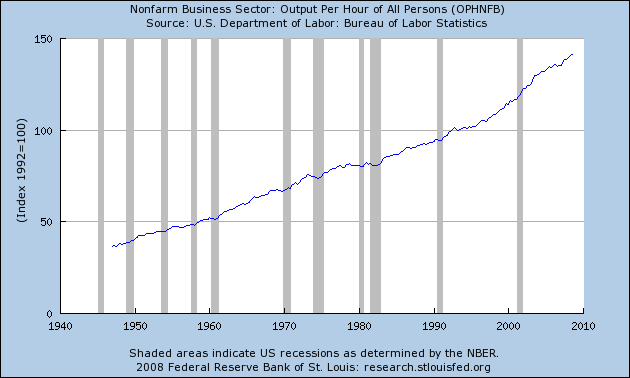
The two figures below demonstrate this in vivid terms. Between 1950 and 1973, real wages had increased at an annual compound rate of 2.61 percent, closely following the phenomenal growth of labour productivity which grew at an average annual compound rate of 2.70 percent. The next 25 years stand in stark contrast to this. Between 1974 and 1999, labour productivity grew at 1.62 percent per annum while real wages grew at only 0.92 percent per annum. Thus, even though labour productivity growth had slowed down significantly, it was still growing at close to twice rate at which real wages increased. This created a stupendous growth in profit incomes and created the source of finance that was to submerge the US working class in debt for the next four decades.

US Productivity

US Real Compensation

A crucial aspect of the neoliberal turn was the deregulation of sundry aspects of the economy, including, most importantly, the domain of operation of finance. The last great crisis of capital during the Great Depression had brought forth several important changes and new developments in the regulatory framework of capitalism. One by one, each of these laws relating to the operation of finance, both domestically and internationally, were whittled down or even outright overturned. Thus, the burgeoning profit income and the shredding of all regulation together created the supply of debt finance in the US economy. The demand for debt arose from a working class facing stagnant wage incomes but long used to growing consumption expenditures. The net result was the largest build-up of debt in the US economy since the Great Depression. During the beginning of the Great Depression total debt was about 300 percent of US GDP; in early 2008, total debt in the US economy was touching 350 percent of GDP. It was this huge debt build-up resulting from three decades of neoliberal economic policies that created a systemically fragile financial superstructure which imploded, leading to a credit freeze, when the housing bubble burst (I have borrowed parts of this argument from Wolf, 2008).

(Concluded.)

References:

Dumenil, G. and D. Levy. 2004. Capital Resurgent: Roots of the Neoliberal Revolution. Harvard University Press.

Wolff. R. 2008. Capitalism Hits the Fan. Available here.

Global Economic Crisis-IV

Deepankar Basu

Link to Global Economic Crisis-I
Link to Global Economic Crisis-II
Link to Global Economic Crisis-III

The Medium Term Story

The medium term story of the evolving financial crisis begins at the end of the last century. With the bursting of the dot-com bubble at the end of the 1990s, possibilities of a long recession hovered on the horizon. The Federal Reserve, the Central Bank of the US, moved in with the tools of monetary policy to ease the slowdown. The target for the federal funds rate, the key short-term interest rate that the Fed monitors as part of it’s monetary policy tasks, was gradually lowered from over 6 percent per annum to a little below 2 percent within a span of about an year. Lowering interest rates to engineer a soft-landing for a slowing economy is a natural thing to do: reducing the cost of borrowing funds is a key way the Central Bank can affect the level of investment and consumption (especially of durable goods) expenditures and thereby boost the level of aggregate demand in a slowing capitalist economy. With finance in command, this normal and natural move had a perverse effect.

Fed Funds Rate

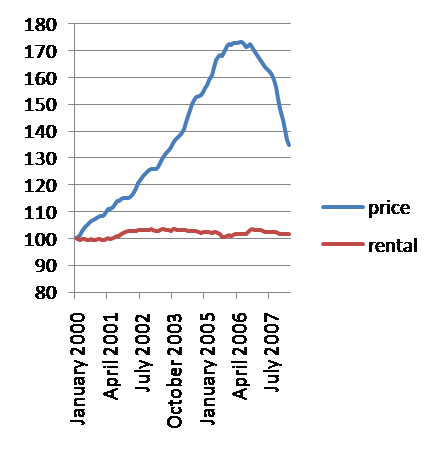
The effects of the falling federal funds rate gradually cascaded from the short-end to the longer end of the asset market, lowering interest rates on all kinds of contracts. One of the key long-term interest rates affected by this very sensible move of the Fed was the interest rate charged on various kinds of mortgage loans (loans to finance the purchase of homes). With mortgage interest rates falling, consumers not only started purchasing new homes with new mortgage loans but also refinancing their old mortgages. With the demand for mortgage loans increasing, and the increase sustained by a low-interest rate regime, house prices started picking up. Very soon, i.e., within a year or two, economists started noticing a bubble in house prices. There were several indicators of a house price bubble. For instance, the Case-Shiller house price index for 10 US cities – a commonly used price index for houses – increased rapidly since the early 2000s. Even more tellingly, the price-to-rental ratio of houses went through the roof. Between January 2000 and April 2006, the rental of an average house did not increase at all; during the same period, price of an average house increased by about 70 percent, sending the price-to-rental ratio on an upward spiral.

Price-Rental Ratio

The fact that the price-to-rental ratio increased rapidly gave a clear indication that a house price bubble was building up. People were, in other words, purchasing houses not because of the service provided by a house but because of speculative motives. A rough proxy for the value attributed by consumers to the service provided by a house is the rental rate; since this was not increasing, it meant that people were not valuing the real service provided by the house. But prices of houses were shooting up giving an indication of an increasing demand for houses (relative to supply). Most of this demand was clearly arising from speculative motives; many of the house purchases were for the purpose of selling them off at a later date to reap capital gains (i.e., the profit derived from the difference between the selling and the buying price of the asset). Thus, the rise in prices was not driven by “fundamentals” (i.e., increase in the intrinsic value of the service provided by houses) but largely by speculative motives of capital gains; that is precisely what leads to an asset price bubble and that is what happened.

Sub-prime Mortgage Market

A run of a couple of quarters of rising house prices was very soon incorporated into the expectation formation mechanisms of financial markets. As has been observed over and over again in history, rising asset prices very soon creates irrational expectations that prices will keep rising, rising certainly in the foreseeable future if not forever. Such periods of rapidly rising expectations, feeding primarily on itself, have been labelled as “manias” by economists studying periods of asset price boom-and-bust. Prominent examples of such economists are Charles P. Kindleberger and Hyman P. Minsky, coming, as they are, from very different political traditions. In the context of the early twenty-first century US economy, the unprecedented house price bubble created grounds for the emergence of predatory lending and the sub-prime mortgage market. The sub-prime mortgage market was the market for mortgage loans to less-than-creditworthy borrowers at very high interest rates that often came with hidden but onerous terms. (Useful material on predatory lending and the subprime mortgage market can be found here)

A financial innovation that indirectly helped the emerging sub-prime mortgage market and the practice of predatory lending was “securitization”. Securitization, in the context of the mortgage market, meant pooling together hundreds and thousands of mortgage loans together and then selling bonds on that pool of mortgages. Investors buying those bonds – the mortgage backed bonds – received the income stream, both the principal and the interest, entailed by the mortgages as the mortgage borrowers serviced their debt. Securitization required that the entities, usually investment banks like Bear Stearns or Merril Lynch, that were issuing (i.e., selling) mortgage backed securities (the mortgage backed bonds or other kinds of assets backed by the mortgage pool) needed ownership of the pool of mortgages against which those mortgage backed securities were being issued. Thus, the entities that issued the mortgage backed securities went out and bought mortgage loans from the originators of the mortgages, i.e., those who sold the mortgage loan to the borrower, like Country Wide Financial (the largest mortgage seller in the US prior to the financial collapse).

The fact that mortgage loan originators had a market where they could sell off the mortgage loans they had originated created perverse incentives for the originators. Typically mortgage loan originators do a thorough screening to assess the financial background of applicants before making loans. With the emerging market for selling off mortgages, the effort at screening was reduced to zero. Things actually went even further. Since mortgages could be sold off at good prices to the investment banks, the mortgage loan originators had a incentive to start engaging in predatory lending, i.e., push mortgage loans on persons who they knew would not be able to sustain the payments entailed by the loan. Since the originator did not have to bear the risk of failure associated with non-payment of mortgage loans, they had no incentive to make prudent loans. All they had to do was to force some gullible working class person to agree to the sub-prime loan and then turn around and sell it off to some investment bank in Wall Street. Thus, the market for sub-prime mortgages proliferated, driven by rising demand coming from the Wall Street investment banks. And why were investment banks so eager to buy these sub-prime mortgages? To answer this question, let us look a little more closely at the process and results of “securitization”.

Securitization

Securitization is the division, repackaging and dispersal of debt, earning huge fee income for the entity (usually an investment bank) that is undertaking this process. The process starts with some commercial or investment bank buying a swathe of mortgages, some prime, some sub-prime, from smaller financial institutions and pooling them together. Each mortgage, recall, entails a stream of future payments; so the pool of mortgages, entails some specific stream of future payments. Various categories or “tranches” of bonds, arranged according to their risk characteristics, are then issued against the pool of underlying mortgages, i.e., against the stream of future payments entailed by the pool of mortgages. Investors who buy these bonds (mortgage backed securities) then have the claims on the mortgage payments coming through month after month after month; if some mortgage fails i.e., payments stop the lowest category (i.e., most risky) bondholder loses first, the losses travelling up the tier of the bonds.

Let us look at a specific example: Bear Stearns Alt-A Mortgage Pass-Through Certificate. This is how this mortgage backed security worked. Bear Stearns bought 2871 mortgages from different mortgage originators for a total of $1.3 billion; this mortgage pool had mortgages that had been originated in different parts of the US, each worth on average for $ 450,000. Bear Stearns then pooled these diverse mortgages and issued 37 different bonds against that pool of mortgages; these bonds were called the Alt-A Mortgage Pass-Through Certificates. Alt-A stands for a very specific kind of mortgage: a mortgage where the originator does not ask any questions about the financial situation of the borrower before making the loan. It is not even ascertained whether the person taking the loan has a stable employment or not! Two additional players come into the picture: credit rating agencies and insurance companies.

Since many investors had an idea that the mortgage backed bonds were risky investments, they required some “independent” rating agency like Standard & Poor’s or Moody’s to ascertain the riskiness associated with investing in those bonds. This is one of the typical functions of credit rating agencies: to ascertain the riskiness (i.e., risk of default) of bonds and assign a credit rating to it; credit ratings run from AAA/Aaa (least risky) to C/D (in default). There were two problems with the involvement of credit rating agencies in the whole securitization process. First, there was an acute shortage of reliable information about the mortgages in the underlying pool; recall how the mortgages in the pool had originated in very different geographical locations, had been offered to very different income categories of people. Most importantly, very little information was collected about the financial standing of the borrowers (especially in Alt-A mortgages). So, despite their best efforts, the credit rating agencies could not come up with realistic risk assessment of the bonds issued against the pool of mortgages. The second problem was even more serious: a conflict of interest. Who paid the fees to the credit rating agencies? The same investment banks that issued the mortgage backed bonds; thus, there was a real incentive for the rating agencies to underplay the risk and certify most of the bonds as “investment grade”. That is more or less what happened, as we now know.

The other player in the securitization process was an insurance provider; since investment in mortgage backed securities (and other related assets) carried some risk investors wanted insurance against default. The instrument that was used to provide insurance for such transactions was the credit default swap (CDS), a derivative financial instrument. Suppose an investor bought bonds worth $1 million; then, to insure herself against the possibility of default she could buy CDS from some financial firm like AIG on those bonds. The insurance premium that she had to pay, called the CDS rate or spread, was typically in the range of 1-2 percent of the value of the bonds, $1 million in this case. She would thus pay $ 20,000 (if the CDS rate was 2 percent) and the CDS contract would protect her against default for the period of the validity of the contract (typically a few years). In the bonds were to go into default the firm that had issued the CDS would have to pay her the amount of her losses.

There were several problems with the CDS market. First, it was an over-the-counter (OTC) market and did not operate through an exchange; hence the possibility of monitoring or regulating this market were negligible. All the contracts were bilateral contracts and no one other than the two parties to the exchange could, in principle know the details of the contract. Second, unlike traditional insurance contracts, there were no reserve requirements. Thus, the financial entity selling the CDS was not required, by law, to hold any reserves against the CDS issued, unlike traditional insurance. So, if the CDS were to actually come due there was no guarantee that the firm that had issued the CDS would be in a situation to make good it’s side of the contract. Third, the most bizarre aspect of the CDS market was that the investor buying the CDS was not required to hold the underlying assets.

This third aspect is truly incredible and led to a veritable explosion of speculation. Let us think about this for a minute. It meant that if I believed GM would fail three years down the line, an investor could buy $10 million worth of CDS on GM bonds by paying a fee of $200,000 (assuming a CDS rate of 2 percent); and this the investor could do even though she did not hold any GM bonds. If GM actually failed and her bet was correct she could make $10 million on an investment of $200,000, a phenomenal 49 fold return! One could never expect to make such return by actually holding the bonds, and so investors started making huge bets using the credit default swaps instead of investing in bonds and stocks. By the end of 2007, the CDS market had grown to about $ 55 trillion (about 4 times US gross domestic product).

But who bought the asset backed securities? Who bought the CDS? International investors of all kinds. Around the late 1990s, there was an enormous pool of footloose, speculative capital in the global financial arena. The East Asian crisis, the Russian crisis and several other developing country crises freed up finance for investment in the US; and these investors wanted high returns even if that meant holding risky assets. That is precisely what the Wall Street investment banks were busy churning out: highly risky but high-return investments in the form of the asset backed securities and other more exotic assets. Hedge funds, pension funds, sovereign country funds and other large institutional investors lapped up the exotic assets which promised high returns.

But the whole edifice was built on very shaky foundations. This highly-leveraged investment game could remain profitable if either of two conditions were met: (a) mortgage payments kept coming in, and (b) house prices kept moving up. If mortgage payments stopped coming in, the property could be taken over and sold; hence sub-prime mortgages remained profitable investments even when the borrower was almost certain to default as long as house prices kept moving up. In the middle of 2006 house prices stopped rising and foreclosures started piling up; and then the whole process, the whole speculative game, started unravelling.

To the Short-term once again

With the medium term story more or less under our belts, let us return once more to the short term story and ask: why did Bear Stearns fail? Why did Lehman Brothers fail? Why was Fannie and and Freddie nationalized? What caused the near-collapse of AIG? Bear Stearns and Lehman Brothers went under for very similar reasons: they could not keep borrowing to finance their positions. Towards the end of it’s life, Lehman was rolling over close to $ 100 billion a month to finance it’s investments in real estate, stocks, asset-backed securities, bonds and other financial assets. When news of foreclosures started pouring in, investors became convinced that Lehman had big holes in it’s balance sheet because of it’s exposure to the sub-prime mortgage market. They refused to lend it money; thus it’s cost of borrowing went up, it’s stock prices plummeted and it’s credit rating was dropped. With no other option left, it had to file for bankruptcy on September 15, 2008.

Fannie Mae and Freddie Mac were government supported entities (GSEs) that were created to help low-income homeowners get easy access to the mortgage market. They were meant to guarantee mortgages and was supposed to finance this operation by issuing it’s own bonds which were implicitly backed by the US government. It is now clear that they did not stick to this mandate of theirs. Instead, they used the subsidized loans that they could get from the market (due to the implicit government guarantee) to invest in mortgage backed securities which were backed by pools of sub-prime mortgages. When the sub-prime mortgages started failing, these institutions started losing asset values and it became clear by mid-2007 that they could not sustain the mounting losses. At that point the government stepped in to explicitly guarantee their debt (because it was spread far and wide in the global financial system) which finally culminated in their nationalization.

AIG, the largest insurance company in the US, got into serious trouble because of the credit default swaps that it had written. Around mid-September, about $ 57 billion of insurance contracts that it had written, in the form of CDS, required it to raise serious money. The CDS were all written on bonds linked to pools of sub-prime mortgages and as the sub-prime market worsened, the possibilities of the CDS payouts coming due increased. Because of the possible losses that it could incur, credit rating agencies downgraded AIG. The way the CDS contracts were written, a credit downgrade required AIG to demonstrate that it was capable of making good on it’s contracts; this required it to immediately “post collateral” to the tune of $ 15 billion; if it failed to post collateral, it would be considered bankrupt. Since it did not have that amount of reserves and could not borrow from a tightening credit market, it had to approach the Fed for funds.

Bubble bursts: Delevarging and Deflation

An aspect of the whole build-up that made the unravelling especially painful was the stupendous amount of leverage in the financial system. When the bubble was inflating every investment was so hugely profitable that investors borrowed heavily for investing. This was especially true of the investment banks whose leverage (i.e., ratio of debt to equity) was about 30:1 by 2007; thus, for every dollar of equity these institutions had borrowed 30 dollars. And a large part of the borrowing was at the shortest end of the market. This meant that the investment banks had to continuously borrow from the market (usually roll over their debt) in order to keep financing their assets and investments. This made the system extremely fragile because any serious problem would lead to painful deleveraging (i.e., forcibly reducing debt by various means often involving serious financial loss) and possibly even asset price deflation.

As foreclosures picked up speed, house prices started moving down. Defaults on mortgage payments and falling house prices meant that the mortgage backed securities started losing value. Often this meant that when lenders came knocking on the doors for their funds, assets had to be sold at short notice and at low prices to cover debt payments coming due. A rush to sell assets often led to a further fall in the value of assets, even those not linked to mortgage backed securities, leading to worsening balance sheets in wider and wider circles. With bonds losing value and even facing default, the CDS contracts suddenly started coming into effect. Since CDS issuers like AIG had not held any reserves for such contingencies, they got into greater and greater difficulties as bonds insured by CDS contracts started failing.

Falling assets values meant that financial firms faced greater difficulty in borrowing from the market, partly because the value of assets that they could offer as collateral had already fallen. Falling collateral value often lead to increasing costs of borrowing in terms of higher interest rates. Difficulty is accessing funds gives another push to sell off assets to cover debt payments, taking the spiral one step down. Deleveraging and an asset price deflation and a string of failures and rescues really led the financial system, in mid-September 2008, to completely lose faith in itself; it is this severe loss of confidence that manifested itself in the credit freeze, the center piece of the short-term story.

(To be continued.)

Global Economic Crisis-III

Deepankar Basu

Link to Global Economic Crisis-I
Link to Global Economic Crisis-II

The Need for Aggressive Fiscal Intervention

Before we move on to looking at the global economic crisis from a medium term perspective, i.e., before we take a look at the phenomenon of the house price bubble and associated speculation that created the grounds for the current credit crisis, it might not be amiss to focus on what can be done in the short-run to deal with the real consequences of the economic crisis: the deep and prolonged recession that the US economy will undoubtedly be pushed into. Real GDP figures released by the US Bureau of Economic Analysis (BEA) on October 30 indicated that the US economy was in the midst of a slowdown even before the financial storm hit the world economy in the middle of September. Real GDP in the US contracted at an annual rate of 0.3 percent for the third quarter (i.e., for the months of July, August and September), led by a sharp fall in consumer spending; businesses cut 240,000 jobs in October alone, the highest figure in 14 years. The financial storm, comprising a severe credit crisis and even a possible banking crisis, worsened the slowdown further. In such a scenario, fixing the financial mess, dealing with the credit freeze, averting a possible run on the commercial banking system and restoring confidence in the financial system will not be enough to prevent a plunge into a deep, prolonged and painful recession; addressing the credit crisis is necessary but not sufficient to deal with the grave crisis in the real sector. A direct and aggressive boost to aggregate demand is the only way to prevent the current recession from becoming a depression. Why is that so?

In any capitalist economy, such as the US economy, the level of aggregate economic activity and employment is determined, in the short run, by the level of aggregate demand, and fluctuations in employment and output are accordingly determined by fluctuations of aggregate demand. Aggregate demand is defined as the sum total of all expenditures on goods and services produced in the economy. Macroeconomists divide total expenditure that make up aggregate demand into four categories: consumption expenditure, investment expenditure, government expenditure and net export expenditure. Consumption expenditure is the total spending by households on durable and non-durable goods, and also services; investment expenditure is the total spending by firms on plant, equipment, machinery and inventories, and the residential investment expenditures by households; government expenditure includes the total spending by local, state and federal government agencies on goods and services (excluding transfer payments); and net export expenditure is the net amount that foreigners spend on buying goods and services produced in the domestic economy.

BEA figures released for the third quarter show that every component of aggregate demand emanating from the private sector of the US (or foreign) economy either declined or slowed down when compared to the second quarter. In real terms, consumption expenditure decreased by 3.1 percent, the steepest decline since 1980 when the US economy was in the grip of a severe recession; during the previous recession in 2001, consumption expenditures had not even declined. Investment expenditures, other than those devoted to maintaining inventories, have also declined. Real nonresidential fixed investment expenditures decreased 1.0 percent in the third quarter, in contrast to an increase of 2.5 percent in the second. Expenditures on nonresidential structures increased by 7.9 percent, compared with a much higher increase of 18.5 percent in the last quarter; expenditures on equipment and software decreased 5.5 percent. Real residential fixed investment decreased 19.1 percent, compared with a decrease of 13.3 percent in the second quarter. Demand emanating from the external sector has a similar story to tell: even though exports registered a positive growth, the growth had slowed down considerably falling from 12.3 to 5.9 percent.

This is hardly surprising. With credit drying up, home equity vanishing and layoffs increasing, working-class households cannot be expected to increase their expenditures on the purchase of goods and services; a continued decline in the stock markets, coupled with increasing volatility will make matters worse. A recent survey in the US showed that consumer confidence was at it’s lowest value in 40 years, and so it is almost certain that consumption expenditure will not rise in the foreseeable future. Neither will export expenditures rise to shore up aggregate demand because most of the economies in the world are either already into a recession or are rapidly slowing down. Nor can firms be expected to increase their expenditures on plant and machinery and equipment. And the problem here is more than a credit freeze: even if the credit markets were to ease due to government intervention, which it is adamantly refusing to do, firms might not be willing to expand their operations because they face sagging demand. Capitalist firms produce to make profits; if they expect markets to be down and demand to fall, they will cut back and not increase their expenditures even if the cost of financing goes down.

That leaves us with government expenditure as the only source for increasing aggregate demand. In the midst of possibly the worst economic crisis since the Great Depression, the US government needs to aggressively step up it’s expenditure on goods and services; since private expenditures, either of firms or of households, cannot be expected to increase in the short-term, aggressive fiscal intervention seems to be the only way the US government can prevent the economy from sliding into a decade long L-shaped recession that was Japan’s fate in the 1990s. Moreover, such expenditures are warranted even from a long-term perspective of economic growth. Rebuilding the crumbling public infrastructure like roads and bridges, improving and widening the ambit of the public transport systems in US cities, jump-starting the movement towards green technologies, making health care available to all working-class Americans, increasing the unemployment benefit substantially, investing in the educational infrastructure makes both short-term and long-term sense. It will help boost aggregate demand in the short run and prevent a slide into a prolonged recession, and in the long run it will build the physical and human capital to help take the US economy into a higher growth trajectory.

Two alternatives to boost the economy, which are often brought up in this context, also seem to have lost their efficacy: tax breaks and monetary policy. Tax breaks have already been tried out and does not seem to have worked; reeling under mountains of debt, the tax break (or refund) cheque is often used by households not for making new purchases but for reducing the outstanding debt. The second alternative, monetary policy action, is also rapidly reaching the point where it will become totally ineffective. For it is almost certain now that the US economy is already stuck in what John Maynard Keynes long ago called a liquidity trap, a situation where the Central Bank can no longer boost aggregate demand by reducing interest rates. The Fed has already reduced the target federal funds rate to 1 percent and reducing it further to 0 percent, the lowest it can go, will possibly not help. Even if confidence in the financial system is restored and nominal interest rates lowered, this might not increase borrowing by firms because of their bleak forecast of falling demand for the goods they produce. Monetary policy has reached it’s limits; the only option to ward off a severe recession and decrease the pain on the working class seems to be aggressive fiscal intervention in terms of direct expenditure on goods and services by the US government.

(To be continued.)

Global Economic Crisis-II

Deepankar Basu

Link to “Global Economic Crisis-I”

Short-term: The Sequence of Events

Even though the credit crisis attained dangerous proportions only in mid-September, it had already announced itself in the early part of the year with the collapse of Bear Stearns, one of the five famed investment banks that defined Wall Street; today none of those five investment banks – Bear Stearns, Goldman Sachs, Lehmann Brothers, Merril Lynch and Morgan Stanley – exist, an indication of the depth of the crisis. Faced with a fierce run on it’s dwindling reserves and it’s stock plummeting, Bears Stearns was forced to sell itself off to J P Morgan Chase (one of the largest commercial banks in the US) on March 16, 2008. The next three months could be best described in terms that the police often use in India: tense but under control. On July 01, the next piece of bad news emerged and shattered the uneasy calm: Country Wide Financials, the largest mortgage seller in the US, collapsed and was acquired by Bank of America (one of the largest commercial banks in the US). Following closely on the heels of this event, IndyMac bank failed – the second largest bank failure in US history – and was taken over by the Federal Deposit Insurance Corporation (FDIC), one of the institutions responsible for monitoring the health of the banking system in the US. IndyMac was, unsurprisingly perhaps, part of the Country Wide financial family.

Things started speeding up in September. On September 08, Freddie Mac and Fannie Mae, the two government supported enterprises (GSE) operating in the mortgage market was nationalized, with assets of the two entities totalling to more than $ 5 trillion. On September 15 another of the five famed investment banks, Lehmann Brothers, filed for bankruptcy; Lehmann’s assets were a little over $ 600 billion and this made it’s bankruptcy filing the largest in US history. Next day, the Fed stepped in with a $ 85 billion loan to prevent American International Group (AIG), the largest insurance firm in the US from going under. These two events, Lehmann’s bankruptcy filing and AIG’s rescue, sent shock waves through the world financial system. The result was a rapid erosion of faith in the financial system leading to a veritable credit freeze: financial institutions stopped lending, to other financial institutions, to businesses and to consumers.

The next thirty six hours, from the morning of September 17 to the evening of September 18, accelerated the credit crisis to extremely dangerous proportions and convinced the US Treasury and the Federal Reserve that government intervention of unheard magnitudes (at least since the Great Depression) would be necessary to prevent total financial collapse. Ben Bernanke, the chairman of the Federal Reserve (the US Central Bank), was famously reported as saying, at one point during this 36 hours, that if the government did not save the (financial) markets now there might not be any financial markets in the future. So, what happened during those crucial 36 hours?

The crucial 36 hours

The first indication of a severe stress in the financial system was a shooting up of credit default swap (CDS) rates, especially on Morgan Stanley and Goldman Sachs (two of the famed five Wall Street investment banks) debt, during the early hours of September 17. Credit default swaps are insurance contracts that can protect bondholders against the possibility of default. For example if an investor has bought bonds worth $ 1 million issued by firm A, then the investor can also buy CDS – typically issued by financial institutions like large commercial banks, investment banks or insurance companies – to protect herself against a possible loss resulting from firm A defaulting on it’s bonds; the premium that the investor pays for the CDS is called the “rate” or “spread” and it is typically around 2% of the amount insured (the “notional value”). So, in the case of this example, the investor would pay $ 20,000 to buy CDS and if firm A were to go under, then the “counterparty” to the CDS contract (i.e., the financial institution that issued the CDS to the investor) would step in to pay the investor $ 1 million and the interest on that amount.

CDS rates (i.e., the premiums that are paid on the insurance contracts) are, thus, an indication of the market’s belief about the possibility of default of some institutions; CDS rates on bonds issued by firms are typically low when the market thinks the probability of default of those firms are low and high when the market thinks the probability of default are high. Thus, on the morning of September 17, when CDS rates went through the roof, this provided evidence of severe loss of faith in the financial system.

When investors lose faith in the financial instruments issued by private parties, they turn back to those issued by the government and that is what happened when CDS rates multiplied by close to a factor of five. Investors let go of private financial instruments like hot bricks and rushed into US government securities, a phenomenon often described as “flight to safety”. The US government, i.e., the US Treasury department, issues three primary kinds of securities: T-bills, T-notes and T-bonds (where the “T” stands for Treasury), where bills mature in less than a year, notes mature between one and ten years and bonds are of longer maturities than a decade. When investors lost faith in the private financial system, they rushed in to US T-bills, the short-run heavily-traded ultra-safe US government securities. This huge rush into T-bills pushed up the price of T-bills and drove the yield (i.e., interest rate) on T-bills down. At one point in time, during this 36 hour period, the yield on T-bills was pushed down all the way to zero (the lowest it can ever go to) implying that investors were willing to hold T-bills even though the nominal return was zero and real returns were negative (because the inflation rate was positive).

As private investors were madly rushing into the safety of US T-bills, another important event was unfolding in the mutual funds market. Money market mutual funds (MMMF) are financial institutions that have become popular over the last three decades, especially in the US. They typically work as follows: investors put their money in MMMF’s by purchasing shares in the MMMF’s stock; thus the MMMF becomes a mechanism for pooling huge amounts of money and then using those large sums for investing in a very diversified portfolio of financial assets, thereby making the investments extremely safe. Thus MMMF’s were, till September 17, thought to be as safe as a deposit account in a commercial bank, and the added advantage was that the money invested in MMMF shares would give a positive rate of return as opposed to a deposit account which is usually non-interest bearing. On September 17, one of the oldest and largest MMMF’s, Reserve Primary Fund, “broke the buck”, i.e., it made losses on it’s investments such that it could not guarantee a positive return to it’s shareholders. Every dollar invested in Reserve Primary was now, by it’s own admission, worth less than a dollar. This was an unheard of event and as news of Reserve Primary Fund’s losses spread, investors started pulling money out of MMMFs.

This had a very negative consequence for the real economy because of the serious involvement of MMMFs in the commercial paper (CP) market. Businesses typically need to constantly borrow short-term funds to keep their operations going; these borrowed funds go towards funding payroll, paying suppliers, maintaining inventory, etc. Firms, at least the big ones, usually borrow short-term funds in the US by issuing commercial paper (which is essentially a bond with a short maturity of about a week or a month). Who buys commercial papers? The most active institutional investors in the CP market are the MMMFs; some of the largest chunks of commercial papers are bought by the MMMFs. So when the MMMFs faced an increasing spate of withdrawal, in the wake of Reserve Primary Fund’s breaking the buck, they stopped buying commercial paper. This, essentially, meant that the CP market ground to a halt. Thus businesses were no longer able to borrow the short-term funds that they need to keep operating. The economy, by all means, shut down.

Adding to and going hand-in-hand with these processes were the growing problems in the interbank (lending) market. Commercial banks typically lend and borrow banking system reserves (roughly the sum of currency in the banks’ vaults and the amount they hold in their account with the Central Bank) among themselves for very short periods, usually overnight periods. The interbank lending market that is most closely watched is the London interbank market and the rate at which loans are made in this market is the London Inter Bank Offered Rate (LIBOR). The most important characteristic of loans in the interbank market is that they are unsecured, i.e., they are not backed by collateral. Thus, a bank can get a loan in the interbank market only if other banks consider it financially sound; thus when the LIBOR jumps up suddenly it provides evidence that the largest and the best banks in the world have lost faith on each other. On September 17, the LIBOR shot up giving indication of increasing strain in the interbank market.

It was these sets of events – CDS rates shooting up, closing down of the CP market, increasing strain in the interbank market – that spooked the US administration and convinced them of the necessity of the most extensive government intervention in the financial markets since the Great Depression. These crucial sets of events were precipitated by the string of big financial failures that the US economy had witnessed over the first two weeks of September: the failure of Fannie and Freddie, the bankruptcy of Lehmann and the near-collapse of AIG. It was these failures that led to a rapid loss of faith in the financial system and heralded a full-blown credit crisis. And why did Fannie and Freddie and Lehmann and AIG fail? All these financial institutions failed because at crucial points in time they could no longer raise money from the market to finance their assets, i.e., they could not borrow money or roll over their short-term debt; financing, for these institutions, had dried up. And why did financing dry up for these big and reputed financial institutions? Because each of these, in their own ways, were exposed to the subprime mortgage market and took huge losses when the subprime mortgage market started unravelling. As news of these failures spread, investors, fearing losses, became increasingly unwilling to lend money to these institutions.

(To be continued.)

Capitalism Hits the Fan: A Marxian View

Capitalism Hits the Fan: A Marxian View from UVC-TV 19 on Vimeo.

Lecture by Professor Rick Wolff, Department of Economics at the University of Massachusetts – Amherst on October 7, 2008.