Release of Report challenging claims about ‘benefits’ of POSCO Project (Oct 20, 2010)

Mining Zone Peoples’ Solidarity Group
PUBLIC RELEASE AND PRESS CONFERENCE ON
Report By International Group Challenging Government’s Claims About Purported Benefits of POSCO Project

Wednesday, October 20, 2010; 11 AM – 1 PM (lunch will be served)
Indian Women’s Press Corps, 5 Windsor Place, New Delhi

Pohang Iron and Steel Company (POSCO)’s proposed project in Orissa is the largest foreign direct investment project in India to date. It comprises a steel processing plant and a captive port in Jagatsinghpur district, and iron ore mining in Keonjhar and Sundergarh districts. The MoU for the project was signed in June 2005. The government of Orissa has pulled out all stops to get the project going and appears to have the support of the center, but the project has been stalled because of strong resistance from the local residents, a resistance that the government has tried to bypass and crush in myriad ways. The resistance has survived into its sixth year.

Based upon new research into livelihood, governance and environmental issues in Orissa’s Jagatsinghpur, Keonjhar, and Sundergarh districts, a US-based group of academics and professionals are poised to publish a startling new report that:

– challenges the purported benefits such as tax revenues and employment growth of the POSCO project,
– points to gross violations of the law by the State and Central governments, and
– raises troubling questions about the state of Democracy.

The report will be released at the press conference on Wednesday.

Speakers:

Girish Agrawal, California-based Lawyer and Civil Engineer, and one of the authors of the report
Shankar Gopalakrishnan, Campaign for Survival and Dignity
Professor Manoranjan Mohanty, Delhi Solidarity Group
Professor Amit Bhaduri

The Mining Zone People’s Solidarity Group is an international research group focused on India, with core interests in new economic policy. We have been following the development of several large projects in India. Between February and September 2010, MZPSG has investigated claims made by the Central and Orissa state governments, POSCO, and allegedly neutral research bodies such as NCAER about the benefits of the proposed POSCO integrated steel project and captive port in Orissa.
The condition of workers injured outside JLN Stadium worsens

Alok Kumar, DELHI NIRMAN MAZDOOR SANGHARSH SAMITI
Affiliated to All India Workers’ Unity Centre (AIWUC)
Office: 3267, Gali No. 8A, Baljeet Nagar, Delhi-8
Ph: 9313730069

On the night of September 28, two workers, Ashok and Phoolbabu, who were injured in the foot-bridge collapse outside JLN Stadium, were discharged from Safdarjung Hospital. In their discussion with trade union members of Delhi Nirman Mazdoor Sangharsh Samiti (DNMSS), both the workers explained in detail how they were shamelessly exploited by the contractor. Their job cards showed that they had worked way above the prescribed norms for overtime. Punni, one of the workers injured in the accident and who is still in coma in AIIMS Trauma Centre, had worked for 21 hours at a stretch just two days before the accident. The workers who have been discharged so far have clearly exposed that whenever they resisted overtime, they were badly threatened and were told that if they didn’t comply their pending wages would not be released. In this way they were completely silenced and treated like animals. In fact, the workers mentioned that just prior to the accident they had complained of having to work in the bad weather. Considering they were provided no helmets or any safety gear, they were apprehensive from the very beginning about working on the foot-bridge.

The condition of the discharged workers is very troubling for they are all need of long term rehabilitation/ physiotherapy and are still complaining of pain and discomfort. The fact that their compensation money has still not been released is a source of great anxiety to them and their families. It is shameful that so far no interim amount of money has been released for them so as to help in their immediate recuperation. To add to their anxiety the workers are being harassed by the contractor’s goons, who are forcing them to hand over their discharge papers and to sign/give thumb impressions on blank papers.

The situation is disturbing even in the case of workers still hospitalized. Punni and Jitendar are still in coma in AIIMS. Meanwhile their relatives in hospital are struggling with no help coming forth from the CWG Organizing Committee or Delhi Government. The workers’ relatives have run out of money but are still harassed to pay for MRIs, CAT SCANS, etc. They are continuously pressed to arrange for blood provided by the hospital to their injured ones. Furthermore, with no special arrangements being made for them in the hospital, relatives of the workers are absolutely alone and find themselves struggling for proper shelter. Indeed, it is a shame that they learnt of the accident not through the CWG Organizing Committee or Delhi Government but through the media and word of mouth.

If this situation continues any further, DNMSS will be compelled to launch a city-wide strike of construction workers along with other trade unions and civil liberty groups. We continue to demand immediate release of compensation money to the workers, the provision of government jobs to seriously injured workers, the implementation of a help-desk for relatives struggling in hospitals where many workers are still admitted, and the provision of post-discharge rehabilitation/ physiotherapy to the workers injured.

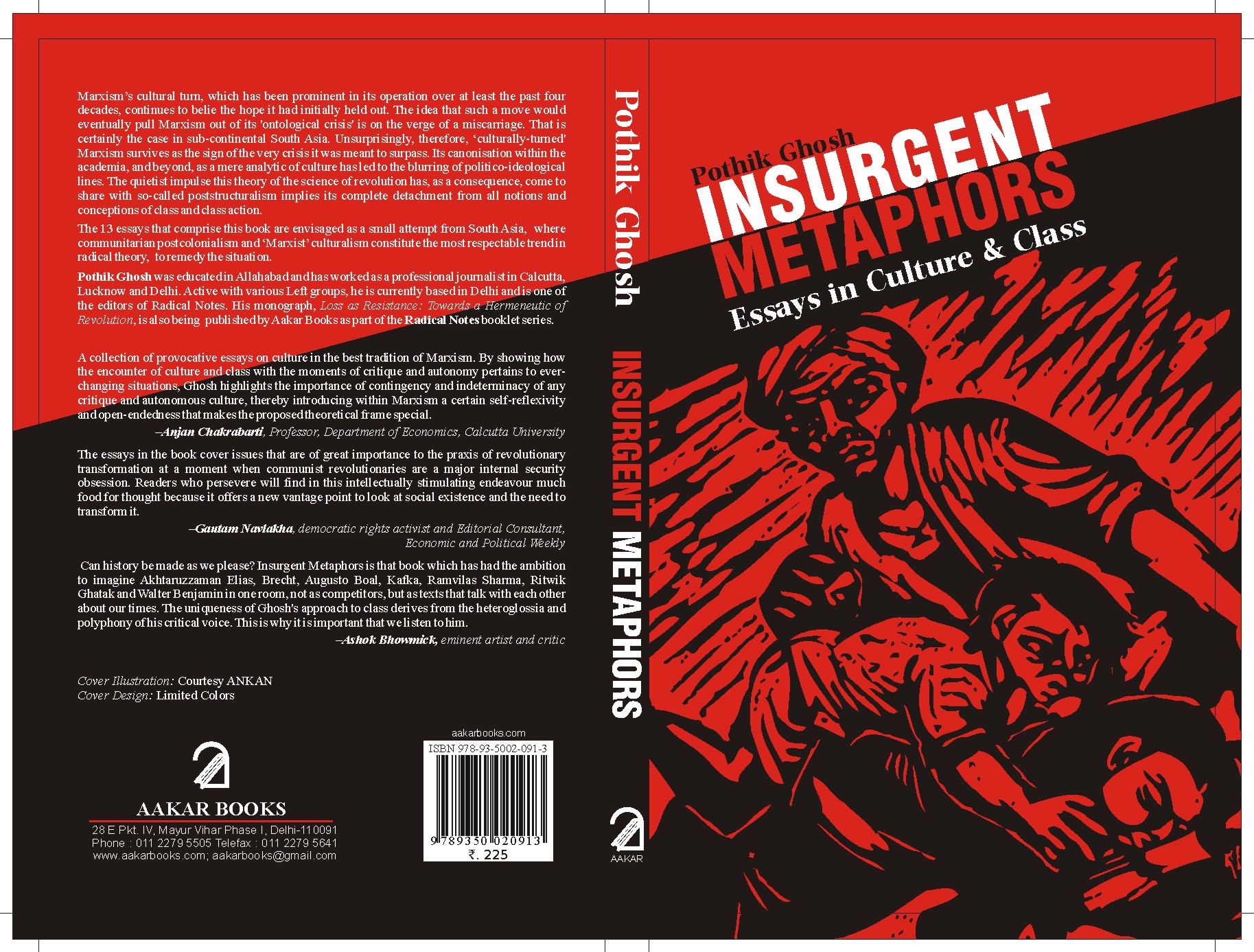
Book Launch: Pothik Ghosh’s “Insurgent Metaphors” (October 1, 2010)

INSURGENT METAPHORS by Pothik Ghosh
published by Aakar Books
to be launched on October 1, 2010
Time: 2.00-5.00 pm
Venue: Room No 308, Indian Social Institute (ISI),
10, Institutional Area, Lodi Road, New Delhi
(Near Jor Bagh Metro Station)


Marxism’s cultural turn, which has been prominent in its operation over at least the past four decades, continues to belie the hope it had initially held out. The idea that such a move would eventually pull Marxism out of its ‘ontological crisis’ is on the verge of a miscarriage. That is certainly the case in sub-continental South Asia. Unsurprisingly, therefore, ‘culturally-turned’ Marxism survives as the sign of the very crisis it was meant to surpass. Its canonisation within the academia, and beyond, as a mere analytic of culture has led to the blurring of politico-ideological lines. The quietist impulse that this theory of the science of revolution has, as a consequence, come to share with so-called poststructuralism implies its complete detachment from all notions and conceptions of class and class action.

The 13 essays that comprise this book are envisaged as a small attempt from South Asia – where communitarian postcolonialism and ‘Marxist’ culturalism constitute the most respectable trend in radical theory – to remedy the situation.


A collection of provocative essays on culture in the best tradition of Marxism. By showing how the encounter of culture and class with the moments of critique and autonomy pertains to ever-changing situations, Ghosh highlights the importance of contingency and indeterminacy of any critique and autonomous culture, thereby introducing within Marxism a certain self-reflexivity and open-endedness that makes the proposed theoretical frame special.

Anjan Chakrabarti, Professor, Department of Economics, Calcutta University

The essays in the book cover issues that are of great importance to the praxis of revolutionary transformation at a moment when communist revolutionaries are a major internal security obsession. Readers who persevere will find in this intellectually stimulating endeavour much food for thought because it offers a new vantage point to look at social existence and the need to transform it.

Gautam Navlakha, Democratic rights activist and Editorial Consultant, Economic and Political Weekly

Can history be made as we please? Insurgent Metaphors is that book which has had the ambition to imagine Akhtaruzzaman Elias, Brecht, Augusto Boal, Kafka, Ramvilas Sharma, Ritwik Ghatak and Walter Benjamin in one room, not as competitors, but as texts that talk with each other about our times. The uniqueness of Ghosh’s approach to class derives from the heteroglossia and polyphony of his critical voice. This is why it is important that we listen to him.

Ashok Bhowmick, eminent artist and critic


Pothik Ghosh was educated in Allahabad and has worked as a professional journalist in Calcutta, Lucknow and Delhi. Active with various Left groups, he is currently based in Delhi and is one of the editors of Radical Notes. His monograph, Loss as Resistance: Towards a Hermeneutic of Revolution, too has just been published by Aakar Books as part of the Radical Notes booklet series.

Commonwealth Games, National Pride and Workers’ Death

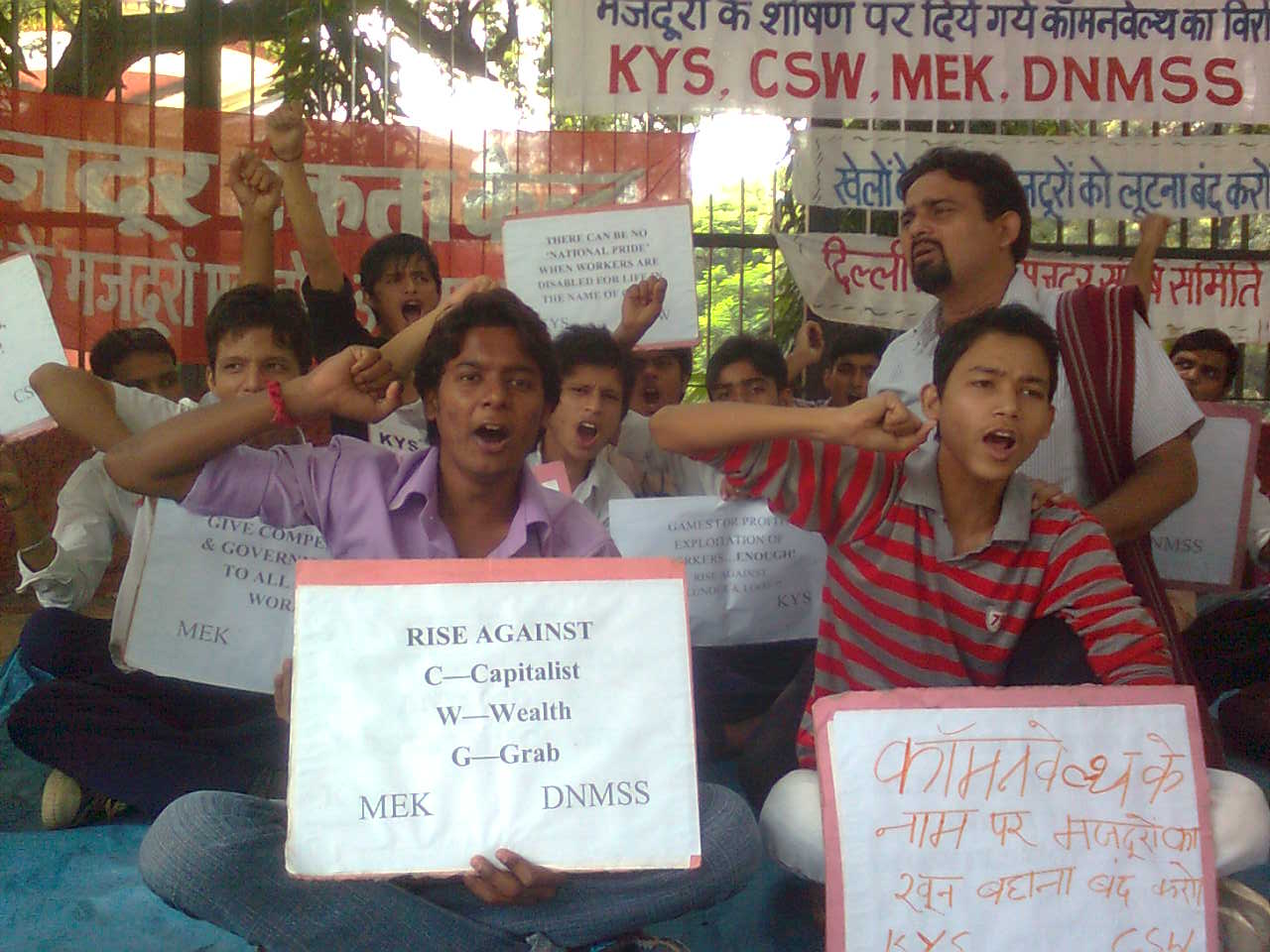
THERE IS NO ‘NATIONAL PRIDE’ IN WORKERS DYING OR BEING DISABLED FOR LIFE IN THE NAME OF COMMONWEALTH GAMES!

Dharna held outside Head Office of the CWG Organizing Committee against blatant exploitation of workers
Fact-Finding Team Visits Injured Workers: Shocked at Lack of Crucial Arrangements like a Help Line

Today on September 23, workers, trade unions, students and civil rights activists held a dharna outside the Head Office of the Commonwealth Games Organizing Committee in Jantar Mantar. This protest was called following the collapse of the hastily built footbridge outside JLN Stadium on September 21. The incident left 27 workers injured, five of whom are critically injured and admitted in AIIMS.

The protesters pointed to the obvious negligence on the part of government officials, and the fact that workers have been continuously exposed to dangerous work conditions across CWG work sites. They argued that the Games were being used to rake in huge profits for builders, many of whom acquired tenders surreptitiously from the government, and have unhesitatingly exploited workers and built structures of poor quality to save on building costs. Hailing the Games a profit-vending event rather than an event of ‘national pride’, Shri Alok Kumar (Secretary of Delhi Nirman Mazdoor Sangharsh Samiti), specified that contractors have made most of their profits by exploiting workers. He said that contractors have been openly exploiting construction workers by exposing them to long hours of work and dangerous work conditions. The government has been party to this exploitation since it is the principal employer in all CWG construction projects. Shri Nag Bhushan, a prominent trade unionist from Gurgaon also addressed the protest. He argued that that the government’s silence, and at the most its tardy response on the issue, has allowed for continuous and brutal exploitation of workers in the name of the Commonwealth Games.

It is for these reasons that the protesters targeted the Organizing Committee (OC). The delegation sent by them demanded the following:
i) Resignation of the state PWD Minister, Shri Rajkumar Chauhan
ii) Provision of government jobs to all 27 workers injured
iii) Immediate release of adequate compensation to all workers injured in CWG work sites.
iv) Cancellation of all contracts given to the accused construction company

Following the apathetic response of the OC the protesters decided to intensify the struggle against the exploitation of workers across CWG construction sites by using all democratic means possible. Trade unions present at the protest have decided to mobilize workers across all CWG worksites on the issue of workers’ blatant exploitation. Considering the fact that CWG organizers have repeatedly boycotted the interests of workers, workers have now decided to organize themselves and reach out to civil society in a bid to stall the Games completely. Through spontaneous protests throughout the period of construction work in CWG work sites, workers have rightfully delayed construction work of the CWG in the past. Now by providing their struggle an organized form they aim to expose to the Indian public, the brutality with which such mega events are organized and executed.

Following the protest at Jantar Mantar a fact finding team was constituted which visited the workers admitted in AIIMS. The team consisting of trade unionists, Delhi University teachers and students visited AIIMS and were shocked by the lack of crucial arrangements that should have been made by the CWG Organizing Committee. Out of the 8 patients hospitalized in AIIMS, 3 are admitted in the ICU (in critical condition, suffering from severe head injuries), and 5 have spinal injuries, out of whom one is already paralyzed. From the discussions with the patients’ relatives it was evident that no information was provided to them on the accident by the CWG Organizing Committee (OC) or Delhi Government. Relatives reached the hospital on hearing about the incident by word of mouth and no provisions were made by the OC/Delhi Government for their travel to Delhi! It was evident to the fact finding team that no volunteers from the OC were made available at AIIMS so as to help/guide relatives coming in to meet the patients. Indeed, the fact finding team itself had difficulty locating the workers in the hospital and ended up wasting crucial time before locating one of the injured workers. The apathy of the government officials was also revealed by the fact that some of the patients’ relatives have been asked to arranged for blood themselves. In its appraisal to the fact finding team, the AIIMS staff made it clear that the injured workers require long term rehabilitation.

The response of the Delhi Government is very shocking and their callous behavior (reflected in their unwillingness to provide proper facilities to workers injured in the name of CWG), is condemnable. We must highlight the terrible way in which workers have been exploited in the name of CWG. We hope that the larger civil society will step forward to help their laboring brethren.

Alok Kumar, Secretary, Delhi Nirman Mazdoor Sangharsh Samiti (Ph: 9313730069) Sujit Kumar, State Committee Member, Krantikari Yuva Sangathan (Ph: 9312654851)

Supported by:
Indian Council of Trade Unions (ICTU)
Centre For Struggling Workers in Trade Union (CSWTU)
All India Federation of Trade Unions (AIFTU)

Seven Decades of Kashmir, 1940-2010

AN EXHIBITION on the HISTORY OF KASHMIR.
Venue: Delhi School of Economics, Delhi University
Date: 21 September 2010
Time: 11.00 AM to 3.00 PM

It has been more than three months since Kashmir has erupted to protest against the murder of civilians by the Indian army. The current phase of protests started on June 11th, when a teenager was killed by a smoke shell fired by Indian security forces. People of Kashmir came out on the streets, en-masse, to demonstrate against this killing. Instead of punishing the culprits who were responsible for this murder, protesters were met with live bullets, tear gas shells, batons, curfew and scores of arrests. According to the Government’s own estimate eighty one people have died since June 11. This includes a numbers of teenagers and even an eight year old child. However, vicious repression unleashed by Indian forces, under impunity granted by the infamous Armed Forces Special Powers Act, has failed to intimidate the Kashmiri people; in fact every act of brutality has brought increasing number protesters on the streets. The latest stage of this decades-old
conflict between the people of Kashmir and the Indian state has only been escalating, with civilian deaths at the hands of the armed forces being reported almost daily.

Today Kashmir has forced us to think critically about Indian democracy. The erosion of democratic space won’t stop at the border of Kashmir; it will engulf us – if it has not done so already. At this crucial juncture it has become imperative for the entire civil society; particularly students to engage themselves with the debate on Kashmir and its future. However, we must remember that the recent protest and repression in Kashmir is not an isolated event, it has a long history of seventy years. If we fail to contextualise the issue then a debate today will be rendered useless. This is particularly important because the mainstream media houses, as usual, are doing their best to trivialise the issue by dissociating it from the historical background.

To start an informed debate on Kashmir and Indian democracy, we invite you to an EXHIBITION on the HISTORY OF KASHMIR.

A Few facts about Kashmir:

700,000 Indian troops are posted in the valley

One soldier for every 14 Kashmiri, biggest militarized non-war zone of the world

80,000 people have been killed, 81 in last three months

International People’s Tribunal found 2700 mass graves where victims of fake encounter killings were buried

Kashmir University Students’ Association has been banned, 15 students were arrested under UAPA for protesting against the recent killings.

More on what continues to ail University Democrats and the likes!

Released by Delhi State Committee, Krantikari Yuva Sangathan (KYS), A Unit of All India Revolutionary Youth Organization (A.I.R.Y.O.)

We have not abandoned purely student demands,
but the best way to bring THE UNIVERSITY INTO QUESTION
is to intensify the workers’ movement.

Daniel Cohn-Bendit and Jean-Pierre Duteuil, March 22nd Movement, 1968

KYS’s polemical tract, What Is Ailing University Democrats!, has received many responses, and having read through them closely we have drafted the following. Not all responses were productive for the ensuing debate but there were some that reflected a serious engagement with what KYS had argued. We are happy to reiterate some of the points raised in such responses and to develop them further. With respect to the other responses received, such as those from New Socialist Initiative (NSI) and from University Community for Democracy (UCD), we have some detailed clarifications to make, and of course, some new observations to highlight. Nevertheless, the principal segment of this response is dedicated to the much more significant debate on the nature of working class politics and forms of its alignment with the petty bourgeois section in a given society. We have done this, because those who have sincerely reflected on our observations deserve further elucidation of our position. For those interested mainly in our response to UCD’s rejoinder, we suggest a close reading of Sections 1 and 2. To those concerned with the debate on Marxism’s deployment of class analysis, student-youth politics and the way ahead for the working class movement, please use your discretion and move to Sections 3, 4 and 5.

1. Some Simple Facts for Those Who Harp About Being Factually Sound

To begin with we would like to emphasize that KYS has absolutely no misconceptions about the nature of University Community for Democracy (UCD). We see it as a forum dominated by certain tendencies. It was these dominating tendencies that we constantly confronted in meetings and which we critiqued in our paper. It was very clear to us that right from its inception the functioning and constitutive logic of this forum was heavily influenced by New Socialist Initiative (NSI). With each day of participation in UCD, it became clearer still that the space was not an “open” one. This was because many of us, who joined UCD later, i.e. around July of this year, were continuously considered and treated as outsiders. We will underscore this fact shortly by quoting from minutes of the meetings. We attribute UCD’s functioning and form of politics to the way NSI shaped the contours of UCD. In the interest of its liberal politics (articulated best in its approach to NGOs, the media, the politics of alliance-making, etc.), NSI did not simply propose action plans for UCD to ratify, but even upturned decisions of UCD’s general body meetings in undemocratic ways, hence rendering consensus building in UCD a meaningless endeavour.

The following are references to minutes of meetings and emails exchanged in response to them, which prove the observation highlighted above:

i) In the 24th July meeting it was recorded that some people objected to the extension of an invitation to NGO persons to speak at the July 30th protest meeting. Instead of NGO persons it was suggested that students should be asked to speak. The consensus reached after discussion was that the NGO speakers suggested by NSI would not be called for the protest meeting. For NSI the discussion on NGOs was deemed “unnecessary”. They were unhappy with what was obviously a disruption in their preset plan for the protest meeting. This is why on July 27th an email was sent out by a member of NSI that as UCD’s “most active participants” they had decided to organize a program in Ramjas College, on the same day as the protest meeting (in the morning), for which the disputed NGO person was invited.

Note the repercussions of such a manoeuvre—UCD’s decision on not calling any NGO person as a speaker for the July 30th program was undermined. In Ramjas College the forum was, by force, allied with NGO politics (after all, in such a program UCD would be discussed, and hence, would be sharing a discursive space with NGOs—a space it had decided not to share till it was more clear on the credentials of certain NGOs). Needless to say, KYS was against the inclusion of any kind of NGO and paid ‘activism’.

ii) On the night of 29th June, i.e. 8:52 p.m., a message was put up on the facebook account/google group (many UCD participants were not members of these at the time), asking people to come for a meeting the next morning (30th June) at 10 a.m. We will highlight the contents of this meeting but before that what needs to be noted is that on 29th June, which was the first meeting of the UCD on campus, it had been decided by consensus to meet on the 3rd of July. In the rushed and poorly coordinated meeting on 30th June it was decided by those present (mostly NSI and its sympathizers) that Gandhi Ashram should become a concrete project of the UCD, that creating communes was part of UCD’s vision, etc.

On the contrary, in the 29th June meeting it had been decided to slow down on the Gandhi Ashram and commune issue till there was substantial participation on behalf of affected students. This point has been hidden in the minutes of the 29th June meeting, and in fact, the minutes only discuss grand plans on how the ‘commune’ would be run. The hastily called 30th June meeting was basically aimed at clinching the commune issue even before the 3rd July meeting. After this 30th June meeting a team constituted by “UCD” went ahead to speak with the Gandhi Ashram management. In this regard, this “emergency meeting” was simply held to preset the agenda of the larger meeting to be held on 3rd July. Clearly, there was an overt attempt not to take all of UCD’s participants into confidence when strategizing UCD’s politics and action plan. Perhaps now the reader can understand why KYS has taken the position that coordinating a forum through cyberspace is highly problematic. As an organization, we strongly feel that it is a space that is actively used to undermine the consensus building initiatives of those who take out the time to present themselves in general body meetings. We do not buy the argument that such a meeting was called in haste because there were many Mirandians in dire need of alternative arrangements. Why don’t we? Well, because we knew that the number of students still in need of a PG was negligible—a point proved by the poor response of students to the Gandhi Ashram plan. We knew that such a meeting was actually called to exclude many from UCD’s decision making process.

iii) On 20th July it was noted by Aashima who was recording the minutes of the meeting that “there was a BRIEF [emphasis added] discussion about what our approach should be gradually, if we should focus on hostel evictions or also give more prominence to the issue of unregulated rents and problems in the neighbourhood since many students live in private accommodation.” Ironically, immediately post this meeting it was held that UCD had developed a detailed and important [emphasis added] position on the problem of escalating rents. KYS and CSW were consequently denounced for running a “parallel” campaign on the issue of rent and for compromising UCD’s attempts in this direction. There are two points we would like to clarify here. The first that NSI’s Commonwealth Games-University centric approach ensured that when rent was taken up by UCD it would be done so as a student specific issue/concern. That is why rent is mentioned in the first UCD parcha in precisely these terms—“It (University) has thus become an accomplice in the larger processes of reckless corporatisation that the whole city is undergoing in the bid of become a ‘global city’. This has left students [emphasis added] at the mercy of private accommodation, with its unregulated rents and precarious guarantees. Rents are rising in anticipation of the increased demand for PGs and flats, forcing many existing residents to move out and making accommodation unaffordable for incoming residents as well…” Indeed, raising rents as only a student specific concern is the brainchild of UCD. KYS was trying to point out this unfortunate fact in its last pamphlet, and was least interested in establishing a copyright on the issue of rent control.

The second point we would like to highlight here is that by conceptualizing rent as a student-University specific issue, UCD has not been pursuing a feasible or a desirable campaign for rent regulation. In that sense KYS’s initiatives on rent control cannot be compared or considered “parallel” to those of UCD for it conceptualizes rent as a generalized problem for migrants in city. Why is the UCD campaign not feasible or desirable? It is not feasible because the rents of one area, i.e. the University area, cannot be regulated without the regulation of rents across the city. The UCD campaign is not desirable either because its approach to rent does not take into consideration the majority of tenants in the city. After all, for the scores of DU students living with their families on rent it is not at all desirable that rent be perceived as a University-neighbourhood problem alone. In contrast to UCD and its many constituents, KYS has been mobilizing both students and non-student youth who live on rent. Considering rent regulation is the responsibility of the Delhi Government, we have approached the Chief Minister on the issue. Although the Chief Minister has given certain assurances, we know for a fact that to pressurize the government into action, the struggle for rent regulation across the city has to be further intensified.

Having drawn on these references we would like to highlight, in brief, the nature of KYS’ contribution to UCD and at what conjuncture we finally withdrew from the forum. We do this to put at rest certain presumptuous accusations about our “negative” or “non-proactive” role in UCD. As an organization with other commitments to attend to, KYS sent three to four of its members to UCD meetings up till the point it decided to move out of the forum. Yes, in that sense we didn’t seek to bombard the platform with our physical presence just so as to ensure that UCD’s contours mapped down to what had been pre-decided from before. Again, for UCD activities (such as area-campaigning in Vijaynagar or college campaigning) we sent our members. KYS also circulated UCD’s parcha independently at the SC/ST admission counters in Arts Faculty and amongst students living in Sangam Park-Gurmandi area. This area is a working class neighbourhood in which many students enrolled in Satyawati Morning and Satyawati Evening College, stay on rent. Furthermore, our fraternal organization, CSW also distributed the UCD parcha in University Hostel for Women.

When our participation was not possible during UCD activities such as attending DUTA’s GBMs, we informed other participants well in advance. There have been references to us sabotaging UCD’s campaign on the 21st of July, i.e. the first day of the academic session. If certain participants in UCD were not so hell bent on writing off KYS’s participation they would accept that there was a confusion that day about where to assemble first for college campaigning. KYS members had not checked their email accounts on the night of the 20th which is why they were under the impression that UCD campaigners were to assemble at Khalsa College first, watch the street play, and then move onto the other colleges slotted for campaigning that day. This is why KYS’s member reached Khalsa and not Daulat Ram College on the morning of July 21st. Post this incident our members checked posts of UCD on a daily basis. Unfortunately, the resentment continued on the part of “UCD”.

By the end of July, conditions were such within UCD’s functioning that KYS no longer considered it feasible to participate in the forum. Firstly, two consecutive meetings (22nd July and 24th July) were channelized in a way to literally flush out KYS from UCD (you would only get glimpses of this in the minutes—the real witness to this are the participants themselves). In such a hostile atmosphere no organization can consider serious participation possible. Secondly, and more importantly, the NGO-ization of UCD was something KYS refused to tolerate. Keeping the July 30th Ramjas program (especially its repercussions) in mind, KYS decided to withdraw from UCD. It attended the 30th July protest meeting but only its fraternal organization, CSW sent a speaker. By the end of the 30th July protest meeting even CSW decided to completely withdraw from UCD. So, for those who hinted that our non-participation in the “relay hunger strike” was noted by all, we would like to emphasize that KYS had withdrawn from the forum by then, like many others. Now that the ‘graph’ of our participation has been drawn for all to see, you will observe that claims of us not being supportive and pro-active, are based on wilful misconceptions.

Of course, what we also need to highlight here are the conscious attempts to frustrate the efforts of KYS and others to pave the way for UCD to come on its own. More than one person in their response to KYS’s earlier mail (such responses being quite a significant retrospective critique of UCD), have accepted that corner meetings prior to or after UCD’s larger meetings were actively pursued. We have shown above that such a practice was encouraged by NSI so as to control UCD’s political process—a control/influence not based on substantive debate and ideological consensus building but on apolitical ties of familiarity/friendship. When such apolitical influencing measures showed signs of breaking, NSI actively projected KYS’s arguments which were raised in UCD meetings, as an articulation of “pre-existing resentment”. Many in their email responses have revealed (intentionally or unintentionally) that NSI actively spread this rumour. Unfortunately for NSI, many individuals drawn to UCD could not be fooled for long about the real nature of KYS’s arguments, i.e. on the compromised form of NSI-influenced politics and the sectarianess of UCD’s constitutive logic. Indeed, the biggest obstacle to UCD coming on its own was the umbrella formation NSI had forced upon the forum, in the interest of promoting its own liberal politics.

Let us now draw attention to some crucial details that will elucidate KYS’s position further. Firstly, the crux of KYS’s critique (which some people failed to understand), pertains to how struggles demanding “democratic space from the University”, are elitist and sectarian. We have been arguing this because such struggles entail the following: i) demanding democracy for a privileged minority, i.e. 7 percent youth (i.e., the percentage of youth making it to higher education in India), whose inclusion in the University system is actually based on somebody else’s exclusion; ii) demanding from the University something it does not have—the real power residing somewhere else. Of course, the conclusion to be drawn from these two insights is not that University politics should be shunned, but rather, that the form of such politics be transformed. The solution lies in a politics that is based on uniting non-student youth and University students (please see our discussion below, on the DTU students’ protest and on the issue of fee hike. Also see section 5). Undeniably, for such politics to materialize, organizations will have to stop focusing on the University alone, and more importantly, will have to mobilize University students on issues that unite them with youth excluded from the education system. We do hope that in the near future there are more organizations like KYS, which along with work in the University; pursue neighbourhood work amongst youth residing in working class localities.

Secondly, KYS in its earlier pamphlet highlighted the tokenism prevalent in UCD’s approach to workers and workers’ issues. We stand by our earlier critique. With respect to some of the comments made by UCD’s participants regarding the forum’s approach to workers, we support what Naina highlighted in her mail on September 3rd. However, we would like to further problematize UCD’s position that there is nothing wrong/destructive in perceiving workers (their issues, etc.) through a petty bourgeois lens. Indeed, such practices are a serious obstacle in the path of progressive struggle. We would like to prove this by drawing attention to the highly problematic political and theoretical roots of such an approach. Politics based on petty bourgeois notions of empathy (sympathy, etc.) is nothing but the repetition of Bogdanovian tendencies in the working class movement, which were based on the neo-Kantian notion of verstehen. Such tendencies have always been criticized for their anti-revolutionary potential, and Lenin himself presented a devastating critique of these tendencies in Empirio-Criticism.

To elucidate—when you are seeking to understand the working class, you merely end up gathering empirical information on workers (i.e., how they feel, and how you would feel being in their shoes, etc), rather than perceiving the objective condition of the being of the working class (i.e. the conditions that create and reproduce the class in the first place). It is precisely because of this empirical fact-finding that you fail to reach the condition where you realize the organic connection between your oppression and the working class’s exploitation. Of course, the by-product of not reaching this condition is that the petty bourgeois class, as a whole, fails to realize the revolutionary potential of the working class, especially its ability to liberate all classes from the oppression of capitalism. As a result, the petty bourgeoisie continues to suspect and maintain ideological distance/discomfort with working class politics, and at most, engages with working class politics in patronizing ways.

Furthermore, we would like to reiterate that there is often little ‘good intention’ involved in practices like slum work/tutoring working class children, etc., for bodies like Women’s Development Cells, Social Service Leagues/NSS cells, etc., tend to institutionalize such activities into extra-curricular ones. Indeed, such bodies tap on the sensitiveness of certain individuals and draw them unnecessarily into the network of NGOs. Sadly, this is a huge loss for the working class movement since it doesn’t need youth who, through social work, continue to work within the system. Instead, the movement needs youth who engage with the process of class and realize the need for class struggle. Thus, the intention behind bringing these points to the attention of UCD members was not so much to “mock” their endeavours, but to reveal to them the drawbacks of their form of politics.

Thirdly, by raising the issue of the Miranda House construction workers we sought to establish how necessary workers are for launching a successful struggle against the Commonwealth Games (CWG). Unfortunately, in their response UCD completely elided this issue. In fact, they resorted to highlighting meaningless gestures made by them with respect to workers’ issues. We quote, “…[W]e have stood against construction work in the University that violates legally sanctioned labour standards and have integrated it into our demands…” Indeed, this ‘integration’ with no participation in actual workers’ struggles, amounts to tokenism. UCD and its dominant subset, i.e. ‘new’ socialists, may not be running a trade union, but really, should their pre-decided programs (“hunger strikes, etc.) be so inflexible that they cannot be part of a struggle for which they otherwise mouth support (especially when such a struggle is taking place just down the lane)? Furthermore, UCD’s choice of words while describing its support for workers is troubling indeed, for it reflects a non-engagement with workers’ real issues. It is assumed by the forum that provision of legally sanctioned labour laws means an end to workers’ exploitation. In reality, even when workers are employed according to legally sanctioned labour standards, the process of work itself is highly exploitative. In fact, as observed by our trade unions, sometimes legally sanctioned labour laws like those pertaining to overtime, accentuate workers’ exploitation. In the case of laws pertaining to overtime, contractors use them to exploit their existing force of workers, rather than employing more workers for the job.

You speak of boycotting the Games, yet you fail to support the most productive and meaningful attempts to stall the Games. Really, how can you boycott something that has boycotted you?! A boycott would result in substantial losses in the gains of all those profiting from the Games. Take for example the boycott of foreign goods during the Non-Cooperation movement; it led to a massive dip in sales, followed by a huge loss of profits earned by British manufacturing units, and hence, to a weakening of the colonial state’s position in the market. However, your ‘boycott’ doesn’t have any such repercussions, and it is you, in fact, that are bearing all the losses (the hostels have been taken away and you couldn’t stop it; the prices of everything you consume have risen and you couldn’t stop this either; etc., etc.). This has happened precisely because your ‘boycott’ has been envisaged in an isolationist manner (best captured in students/teachers buying anti-CWG badges and T-shirts). Friends, this is a crucial time and workers are far from silent. For a fact pending construction work at the numerous CWG work sites is not so much due to the rains/corruption (as highlighted by the media), but due to spontaneous and frequent protests by workers employed there. Imagine if these one lakh workers were organized, and then launched their struggles…there would be no Games. In this context, should we be content buying/selling badges, filing RTIs, etc, or, should we be helping bring in the real tides of change? Realizing the necessity of involving workers in the struggle against CWG, KYS and its fraternal organizations like Mazdoor Ekta Kendra and Delhi Nirman Mazdoor Sangharsh Samiti, have been mobilizing workers across different CWG sites. Our intervention in six CWG sites have met with success, but only one was highlighted by the media, i.e. the struggle of Miranda House construction workers. Indeed, the few ‘progressive’ newspapers that covered the workers’ protest did so not because they were interested in highlighting the workers’ demands, but because they were interested in highlighting the active participation of Miranda House students. So much for the media!

On a last note, we would like to emphasize that KYS brought out many other problems with respect to UCD’s campaign. On the question of how certain teachers were participating in UCD we hardly got a satisfactory response. Since Paresh Chandra in an email explained very well the problem with a certain form of teachers’ participation, we do not consider that any further arguments are needed on our behalf. Even on the issue of Gandhi Ashram we received a poor response from UCD, which basically, amounts to no response. For factual details and elaboration on the problems with the Gandhi Ashram project, please see Paresh’s response on September 3rd. Of course, on the question of the “relay hunger strike” we received no suitable reply. If UCD continues to hold on to its own definition of what such a hunger strike is then we have one suggestion to make. We know of a student who hails from an agrarian worker’s family and travels every day by train, from Sonepat (Haryana). He is able to eat only in the morning and is able to have his next meal only when he returns at night. Please also involve him since he is perpetually on hunger strike, i.e. according to your definition. Indeed, it will suit your politics of spectacle.

KYS would also like to object to the misrepresentation of some of its arguments. We have never claimed that only a dalit/poor/muslim/gay/tribal can speak on the issues of the oppressed. UCD has once again missed the point and quoted our arguments out of context. Kindly remember the exact context in which Sujit spoke of his Dalit background. He was replying to someone called Bala.poorna who alleged that Communists (including those in our organization) were upper castes and lacked commitment on the question of caste oppression. When responding to this diatribe our member highlighted his own social position so as to prove that not all Communists are upper castes, and that Bala, in fact, was writing off the voice of the oppressed by resorting to baseless accusations. Interestingly, the real nature of our arguments, were not lost on those who gave it proper thought. Individuals like Naina were quick to pick up our point and have argued very convincingly in our support. We reiterate, it is the form of politics which is important for all participants in a movement (be it the petty bourgeoisie or workers).

2. More About NSI’s Role In UCD And Its Real Position In India’s Left Circuit

In India’s Left movement, New Socialist Initiative (NSI) has been long identified as a bourgeois oppositional formation. We highlight this fact simply because in both NSI’s and UCD’s response we saw some unjustified/unsupported claims to the contrary. Despite its ambitious claims NSI is no longer considered a part of Communist League of India (CLI) camp. For more on politics of NSI please see Lal Salaam (a theoretical-political journal). It is interesting to note that one reason why NSI has been identified as such is due to its “official” or “unofficial” support (see report of CASIM) of political fronts like Indian Social Forum (ISF) and even World Social Forum (WSF). Both ISF and WSF are platforms severely criticized for their rainbow political formations in which NGOs and their funding play a big role in delegitimizing several (armed) people’s movements. In fact, in terms of the form of its politics, NSI is a mirror image of such platforms. In this context, we have one immediate question for all those who wrote off KYS’s observations as “malicious”—are critiques on NGOs and NGO-ised forums, presented by persons such P.J. James, James Petras, Shashi Prakash and many others, simply ad hominem attacks? Can everything be reduced to malice or does that accusation stem from your inability to respond to most of the political questions raised?

Moving on, we would like to flesh out the details of how NSI has actively shaped UCD as a mirror image of itself. We do not buy the argument that UCD is a loosely constituted body or “a composite group of left organizations, individuals, liberals, progressives”…blah, blah blah. We don’t, for the simple reason that UCD’s functioning has revealed something very different. The forum’s being and existence is best explained by drawing an analogy to the Chinese doll (with its several folds). NSI, an archetypal liberal organization, was the core of UCD (the doll according to the analogy being drawn), and from the very beginning different liberal positions were congealed around it. In spite of its claims of debating and then accepting/rejecting questions/programs, “as per the larger consensus in UCD”, NSI did not succumb to these liberal gestures at all. Acting as a vector of the liberal virus itself, it did not merely support ideas/suggestions but actively initiated and consolidated certain developments in UCD. Let us draw on some references which shed light on this not so innocent contribution of NSI in UCD. For instance, NSI members actively proposed the entry of NGOs in UCD’s campaign. Similarly, they supported and promoted NGOs as bodies that build “more nuanced bridges of understanding”. One of NSI’s members, in his adamant support and promotion of NGOs, even boycotted an ongoing discussion during a UCD meeting (24th July to be precise). And to top it all, many NSI members work for NGOs—a reality that orients them towards NGO-izing whatever platforms they are part of. Another revealing example comes to mind and this pertains to the way the media was approached and perceived by NSI. Instead of criticizing the media in its bourgeois form, NSI members went to the extent of identifying newspapers like Tehelka as “friends”/”part” of the campaign! One NSI members even said that Tehelka, if involved extensively, will make the process of the campaign “smooth” (29 June 2010). Expectedly, this perception also became that of UCD, as reflected in some emails exchanged during end June and early July. Of course, we would not have said anything if such statements on the media had not come from an organization that claims to be Marxist. Isn’t it a Marxist axiom that in the process of resisting capitalism we should not reproduce the spirit of bourgeois thinking?

3. How Marxism Identifies the Position of the Working Class vis-à-vis Identities

While upholding KYS’s critique of the form of politics represented by the main tendency in UCD as well as KYS’s understanding of the relationship between identity and class struggle, Paresh Chandra, in his most recent response differs on some of the specificities of KYS’s prognosis. His main difference with our position is that students’ class position cannot be identified on the basis of their class background and the kinds of colleges/institutions/courses they end up in. For him the main defining feature of student [all]- as- worker is the very condition they (students) are being ascribed within the university/education system (more on this later). He further accuses us for identifying the class position of students only on the basis of their background whereby reducing class to a “sociological fixity”. The end result being that we read class as a static sociological entity which can then be found more in some institutions/courses than the others. On the contrary, we had argued that ‘student’ is an identity comprising of different class positions and if we don’t see the different class positions within (and its implications) we will end up reducing university politics into an identitarian one (having identifiable common interests vis-à-vis other social entities and the state). To further elucidate, it is the different class trajectories (journeys) that determine the being of a student. These trajectories are based not only on class background but on the class process itself (i.e. the process whereby one’s class position is subject to change, depending on changes in the contingent factors in the economy). Thus, what kind of student one will end up being is determined by the combination of one’s class background and the class process (something which creates possibilities of contradictory class positions, particularly with respect to the middle strata, i.e. the petty bourgeoisie, the peasantry, etc.). To simplify the matter, there can be different kinds of students: working class, petty bourgeois, peasant, bourgeois, etc. We will restrict our discussion to working class and petty bourgeois students because of their particular bearing on the nature of university politics that exists in general.

Working class students find themselves in a condition where they get admission to lower grade educational institutes, and even when they enter the threshold of better institutions their inability to cope up causes them to perform badly. Considering this, their pursuit of higher education is such that they take with them merely the basic skills required to survive in the job market. Their education is directly based on them being future bearers of labour power/producers of surplus value, and hence, the logical conclusion of their education is them becoming workers. On the other hand, some petty bourgeois students, through education, come to acquire skills (as a property form), which then helps them share with the bourgeoisie, surplus value produced by workers. Characteristically, petty bourgeois students regard the future as relatively bright, and instead, complain of the drudgery of the present (for them the immediate is what is visible and troubling, i.e. the rigors of the education system and the fact that they sometimes receive less pocket money than what workers earn). Bourgeois students pursue an education so as to acquire the etiquettes which will help their further integration into the ruling class. Thus, their coming to universities to study does not make them part of the working class or petty bourgeoisie.

However, arguing from his position of student-as-worker, Paresh contends that our class analysis of students led us to project class as a sociological entity. To begin with, Paresh has unfortunately misread our historical empiric, i.e., a level where things will only appear as a sociological entity. We never equated class with what simply appears as a sociological entity, and, in fact, see it as a process which is bolstered by state policies seeking to fulfill the needs of the labour market. We concretely think class is a historical accumulation of humankind that has a determinate relationship with other classes, which might or might not appear as sociological entities in their different moments of congealment in the trajectory of their unfolding. In fact, in the paragraph quoted by Paresh, we have talked about students as a sociological entity, hence, requiring a class analysis. If only you had managed to go beyond the phenomenological level (where you have hypostasized our historical empiric) you would have definitely realized that our historical empiric is linked to how ‘student’ as a sociological entity, is connected to government education policies and the education market. For example, when we talked about youth who have studied in government schools, come from the Hindi medium background, rarely get admission to college hostels and struggle to cope with increasing college fees and English medium teaching/coursework, we were hinting at the existence of a dual education system (prevalence of both government schools & private schools). We were also hinting at the cut off system, an administrative process in which students coming from different backgrounds are distributed among graded colleges. Because of the cut off based admission process, many students coming from the working class get admission to low grade colleges, and do not get admission into hostels because such colleges do not have any.

In more ontological terms, we are saying that the state is the constitutive element in the expanded reproduction of the system, which requires different forms of labour to be produced through graded education. Indeed, how else can one explain that only 7 percent of all youth who clear the twelfth class examination, find their way into higher education, and that even at the level of higher education the Radhakrishna system of ‘centres of excellence’ prevails? How else would we explain that our school education is hierarchically arranged in the following manner: Charvaha Vidyalas/Ekal Schools for children of agrarian workers and poor peasants; Navodayas for children of agrarian elites; Sarvodayas for children of the urban working class; KVs (Central schools) for children of central government employees (a strata itself divided into a petty bourgeois and working class position); and expensive private schools like Woodstock, Doon, Mayo, Modern, DPS, etc. for you know whom.

Now that we have clarified what we meant to say in our quoted sentences, let us clarify what Paresh is actually saying in the paragraph quoted from Correspondence’s pamphlet. Paresh quotes, “When Marx says ‘working class,’ does he mean only the ‘male, white, industrial proletariat?…” Kudos to you, your move to go beyond Marx with Marx has allowed you to throw suspicion on Marx’s understanding. This is an infliction of the liberal virus on revolutionary ideas; ironically something you yourself criticized UCD members for. To relieve you of your (mis)reading of Marx, we leave you with Marx’s own words: “Labour in a white skin cannot emancipate itself where it is branded in a black skin” (Capital, Vol. I). Clearly, Marx had an understanding of the working class being both white and black. Numerous writings of both Marx and Engels will also prove that they believed the working class was constituted of all sexes. And as far as the industrial proletariat is concerned, Marx always considered it a subset of the working class, albeit the most important and essential force in the working class struggle.

Having said this we also wish to highlight another tacit misunderstanding of Paresh, that Marxism is just about Marx and for that matter what other great Marxist leaders have to say. In reality, Marxism is a summation of different experiences of the working class in its conflict with capital. It is a synthesized articulation of the concrete. This synthesized articulation was used by Marx in philosophical debates (German Ideology, Theses on Feuerbach), in the critique of political economy (Ricardo), in debates on socialism (Proudhon), and in debates on political forms (Eighteen Brumaire, Civil War in France, Critique of Gotha Program). This synthesized summation was continued and applied by different leaders of the international proletarian movement as well as by numerous militant activists in the movement.

Moving on, in his own piece, Paresh bestows the working class position as a whole onto some identities, especially students. Though Paresh many times concedes (here and there) that TENDENCY has some relationship with class POSITION, in his endeavour to apply the epithet of working class on students as a whole, he ultimately detaches tendency from class position. He comes to define tendency as “control on one’s life”, which almost becomes a quasi-behaviourist analysis of stimulus response. To quote him further on this, “in some [students] the petty bourgeois tendency is stronger while in others it is weaker and this varies in proportion to the degree of control an individual has over his/her life.” Having achieved this abstraction Paresh goes onto provide a solution to the thorny question of consciousness. To quote him, “a class conscious student would see herself/himself as a member of the working class and in that will leave behind determinations like prehistory and family.” We really wonder why a class conscious student belonging to a petty bourgeois class position will not develop a petty bourgeois class consciousness! Some (not Paresh) have even come to argue that the petty bourgeoisie can be de-classed and a different consciousness can be imputed in them. Indeed, these two positions might look dissimilar, but they do have kin affinities because both positions tendentially make class position unimportant for one’s consciousness.

We also wonder what the operative part of such analysis could be. One possible form that comes to our mind is the whole notion of “Campus Democracy” (supported by many Left liberals and ‘Left’ organizations on campus), which is achieved through struggles of students, teachers and other staff members to control the university (more on this point in section 5). We cannot actually be sure of whether this analysis is based on the summation of any past or contemporary, concrete experiment in student politics. Let us take the example of the most radical student movement of all time, i.e., the 1968 French student revolt. Many in their nostalgic account of this movement fail to identify the core experiment of the movement—one that should be generalized. The real essence of this movement is best projected in the pamphlet titled, THE MARCH 22nd MOVEMENT, which identified the demand to ‘Defend the common interest of all students’, as illusionary. This essence can also be extracted from statements made by some of its leaders. For example, one of the most radical French student leaders, Daniel Cohn-Bendit, in an interview taken by Jean-Paul Sartre, argued that students’ seats in hostels (Cites) should be given to workers and apprentices, and that “well to do students in law and science-po go elsewhere”. Again in his interview to Herve Bourges, he vehemently asserted, “I do not believe in student unity for there are no objective interests common to all students”. In response to another question in the interview he criticized UNEF (considered a Left wing formation), for representing the bourgeoisie, and called it a pseudo mass movement because it did not represent real demands and aspirations of working class students. Cohn-Bendit clearly made a distinction between the November strikes and the Nanterre movement which emerged from the Nanterre campus located outside Paris, i.e. amongst the neighbouring slums. The students here were socially divided between affluent students from the wealthy quarters of Paris and students from working class backgrounds. So, ultimately, inheriting what can be termed the best of the 1968 legacy, we want to assert that the relationship between students and class struggle could take two forms: (i) working class students aligning with rest of the working class outside university campuses; and (ii) working class students uniting against the provision of facilities to a few privileged students, and thereby, demanding for the provision of these facilities to all.

Further we believe the views presented by Paresh stem from a particular (mis)understanding of the working class position and the ontological configuration of identities. This understanding of class is based on a highly problematic understanding of capitalism itself, i.e. of capitalism as a carceral continuum. Due to this conceptualization of capitalism in Foucaultian terms, an identity such as ‘students’ becomes a working class position. This is reflected in expressions such as students being monitored/regimentalized or losing the right to self-determinism—an incarceration considered emblematic of the working class position. It is also present in expressions such as “the working class is that section of people on which [sic] work is imposed”, and this working class with its continuum of subjectivity can be found “beyond localized time and space”. In these terms, the ancient slave, medieval serf and peasantry, i.e. on whomsoever work is imposed, is the working class! Clearly, people who argue from such positions, such as Paresh, actually forget the historicity of the modern working class. Marx clearly identified the working class as distinct from other laboring masses both in terms of time and space. In this regard he identified the working class as a section devoid of property (means of production), and hence, “free”/compelled to sell its labour power.

If we extend the logic of Paresh’s arguments, we will see that they assume that an identity such as ‘students’ is not divided amongst several class positions, but is the working class position itself. To highlight the danger of holding onto such a position we would like to draw immediate attention to the fact that such an “axiom” (if applicable) would apply even to capitalists. After all, capitalists too are bound by social etiquettes of the time and also complain of being caged in by prevailing social norms. In this regard do we attribute to them the working class position as well? We do not, and know that you too will agree to the same.

We suspect that a certain petty bourgeois discomfort with the formidable logic of Marxism, in particular, its notion of generalization, is the cause of this “status”/position borrowing. Rather than taking to the working class/proletarian position (in terms of tying one’s own petty bourgeois class interests with the interests of the working class), so as to resolve the petty bourgeois question, certain individuals from the petty bourgeois class have conveniently started calling themselves working class. Marxism as a politics and as a science has never encouraged the concealment or displacement of one’s class position, but has, on the contrary, called for the engagement with one’s class position in the process of class struggle. In other words, Marxism has always called a spade a spade when identifying different class positions and their articulation within different identities. According to Marxism, the petty bourgeois question can only be resolved on the basis of an engagement with one’s petty bourgeois class position in alignment with that of the working class position. The petty bourgeois question cannot be resolved by presuming a working class position itself.

What do we mean by the petty bourgeois question? Well, we believe it is best demonstrated in recent Bollywood movies like Three Idiots and Udaan. What comes across through this rather powerful medium is the present plight of the petty bourgeoisie, i.e. growing competition for limited facilities provided by capitalism, and the increasing mechanization of life due to ever growing demands of the system in place. At this historical conjuncture, the need of the hour is not to equate mechanization of petty bourgeois life with the working class position, but to show the petty bourgeoisie how their OPPRESSION ties up with the working class’s EXPLOITATION. Let us take the example of the medical profession for which youth from petty bourgeois families aspire for in large numbers. Indeed most doctors (mostly, self employed professionals) are from petty bourgeois backgrounds. However, to become doctors, these youth have to undergo cut-throat competition. This is because capitalism as a system does not provide healthcare to the majority of people, especially the working class considering its limited buying power. As a result, it makes provisions for limited number of medical educational institutes and jobs in medical institutions. And it is for these limited seats and jobs that petty bourgeois youth are forced to compete. In this context, the working class’s struggle for the provision of more healthcare facilities and investment in the social sector as a whole, indirectly benefits petty bourgeois youth aspiring to be doctors. It creates the condition for the creation of more medical educational institutes (more seats, hence less competition), as well as more hospitals (hence, more jobs). The process, of course, leads to a less mechanized way of life for youth aspiring for such employment. In a crucial way, it will prevent the growing mechanization of children’s lives, who, in the current scenario, lose their youth under the burden of studies/competition, and who have increasingly come to feel they have lost the right to self-determination.

In this context, the objective interest of this petty bourgeois section lies not in identifying itself as working class. Instead its objective interest lies in uniting with the emancipatory politics of the working class. Such unity is feasible and desirable because in the process of fighting for its own liberation the working class can build a system, annihilating class society, in which other sections of society will have freed and equal access to opportunities and resources.

Returning to the specific question of the working class position and the ontological configuration of identities, we would like to reiterate that it is wrong to perceive different identities as a subset of the working class. Rather than conceptualizing identities (woman, student, Dalit, OBC, Black, delinquents, etc.) as momentary congealments of the working class position, it is important to read them as multiclass entities—as sites of struggle in which contradictory class positions are in conflict with each other. The latter is the precise way in which Marxism conceptualizes identities. This is because it realizes that the different identities in existence have different ontological depths. For example, Marxism believes that the identity ‘woman’ is not the same as another identity, say that of ‘Dalit’, and that the two identities encompass a somewhat different (in terms of degree, etc.), conflict of varied class positions within them. Indeed, unlike the popular perception of Marxism as an epistemology, Marxism is the synthesis of multiple epistemologies that extract experiences emanating from different sites of struggle, i.e. from different identities. By extracting these varied experiences it actively unites the working class/proletarian experience (collective will of the class) that is spread across the different identities (just like other class positions are).

Having said this, let us trace the larger theoretical source of such analysis of identities vis-à-vis the working class position. The theoretical source from which Paresh’s arguments about students as workers emerge, is Negrian clap trap based on the mixing up of Foucault with Marx. In other words, such views stem from earlier endeavours to re-ontologize Marxism, i.e., going beyond Marx with Marx. Negri carries to the extreme the ideas of Raniero Panzieri and Mario Tronti (great leaders of the Italian working class movement), in particular, their analysis of the political class composition of workers. For Negri, class composition is not just based on determinations like labour power as variable capital, but also on determinations like the historical and social level of labour power’s reproduction. In other words, for him, determination of class composition should include, together with the wage structure, other structures that reproduce labour power.

Marx made a distinction between labour forms which are heterogeneous and take place in different concrete conditions. Hence, concrete labour. But these different heterogeneous labour forms, in capitalism, are commensurate at the level of value they produce, expressed in the price of the commodity at a given equilibrium level. Hence, abstract labour. Abstract labour expresses, therefore, certain relations of production, i.e. relations between producers of commodities and the capitalists who own the means of production and appropriate the surplus value created by labour. For Marx this dual character of labour (abstract and concrete labour) is conditioned on the skewed property relationship which forces a worker to work for a capitalist. Thus, in capitalism concrete labour forms a dialectical unity with abstract labour. Outside the relationship of production this duality cannot exist. Hence, for Marx, destroying the property relations is the precondition for liberation of labour from a condition where one person’s labour becomes another person’s profit.

Negri calls this conceptual distinction a qualitative and quantitative distinction. In this context, he argues that the theory of value, as a form of equilibrium, seizes to have any remaining validity in our time. Negri takes a clear cut Morishimite position. To quote Morishima “…as soon as heterogeneity of labour is allowed for, the theory of value is seen to conflict with Marx’s law of equalization of the rate of exploitation through society, unless the different sorts of labour are reduced to homogenous abstract human labour in proportion to their wage rates, ” (Marx’s Economics). Negri considers Marx’s labour theory of value simply as the refining of concepts developed by his contemporaries. He argues that there is another conception of labour theory of value present in Marx’s work (Grundrisse), which according to him departs radically from capitalist theories and Marxist theories, and focuses not on capitalist processes of valorization, but rather on the processes of labour’s self-valorization. To quote him further “Marx considered the value of labour not as a figure of equilibrium but as an antagonistic figure, as a subject of the dynamic rupture of the system. The concept of labour power is thus considered as valorizing element of production, relatively independent of the functioning of the capitalist law of value…This means that although in the first theory value was fixed in the structures of capital, in this second theory labour and value are both variable elements.” Having freed labour from the distinctively exploitative relationship to capital in the circuit of capital self valorization, Negri reduces Capital to an elementary expression of command. For him changing the property relationship within which the labour process takes place is no longer relevant. Again to quote him, “the notion of foundational war of all against all is based on an economy of private property and scarce resources. Material property, such as land or water or a car, cannot be in two places at once: my having and using it negates your having and using it. Immaterial property, however, such as an idea or image or a form of communication is infinitely reproducible…Some resources do remain scarce today, but many, in fact, particularly the newest elements of the economy, do not operate on a logic of scarcity,” (Multitude). The clear cut meaning to be drawn from this is that resources are scarce which is why they are owned by capitalists, but the newest elements of the economy such as immaterial property can be owned by anyone for self-valorization of one’s labour.

Again to quote him extensively, “The most important general phenomenon of the transformation of labour that we have witnessed in recent years is the passage toward what we call the factory-society. The factory can no longer be conceived as the paradigmatic site or the concentration of labour and production; laboring processes have moved outside the factory walls to invest the entire society. In other words, the apparent decline of the factory as the site of production does not mean a decline in the regime of and discipline of factory production, but means rather it is no longer limited to a particular site in society. It has insinuated itself throughout all forms of social production, spreading like a virus. All of society is now permeated through and through with the regime of the factory, that is, with the rules of the specifically capitalist relations of production. In this light, a series of Marxian distinctions need to be reviewed and reconsidered. For example, in the factory society the traditional conceptual distinction between productive and unproductive labour and between production and reproduction, which even in other periods had dubious validity, should today be considered defunct,” (Labour of Dionysius).

Having detached his ontology of labour from the circuit of capital’s self-valorization and its actualization in circulation, Negri comes to posit that a working class subjectivity for autonomy and self creation is now expressed in a new class composition. In his chronology of capitalism’s development there emerge, (i) Mass workers: all workers working for different capitalists spread over different junctures in the supply chain; (ii) the Collective worker: anyone on whom work is being imposed, and basically, anyone who helps reproduce labour power, (whether within or outside the circuit of capital accumulation and the labour process, such as women doing domestic labour, peasants, students, self-employed professionals, etc.). In a recent avatar, with increasing detachment from the existing working class movement, Negri, once a working class militant, has now come to sermonize from his position as a university democrat. His earlier collective worker has now metamorphosed into “multitude”, and hence, signifying that whomsoever is rejecting work and any control on their life, ARE CREATING a new world—his communism within capitalism (!).

Clearly, Negrian analysis includes playing with (distorting) certain key Marxist categories of analysis and arguments in the attempt to establish the petty bourgeois section (our term)/immaterial labour (his term—which itself is divided in petty bourgeois and worker), as the pivotal force in contemporary times. Of course, there will be an acceptance of the tangible presence of agricultural and industrial labour. To quote Negri, “Agricultural labour remains…dominant in quantitative terms, and industrial labour has not declined in terms of numbers globally. Immaterial labour constitutes a minority of global, and it is concentrated in some of the dominant regions of the globe. Our claim, rather, is that immaterial labour has become hegemonic in qualitative terms,” (Multitude); [emphasis in original]. By extension, this analysis means that the fight against capitalism is not against the property relationship within which the dual character of labour emerges, but SIMPLY AGAINST the daily transformation of our doing/our activities into abstract labour. Furthermore, only this so called hegemonic immaterial labour is in the position to do this. This model is best propagated by John Holloway in his article “Doing In-Against-and-Beyond Labour”. To quote Holloway, “…it is not just in the workplace: life itself is a constant struggle to break through the connections forced by abstract labour to create other sorts of social relations: when we refuse to go to work so that we can stay and play with the children, when we read (or write) an article like this, when we choose to do something not because it will bring us money but just because we enjoy it or consider it important. All the time we oppose use value to value, concrete doing to abstract labour. It is from these revolts of every day resistance, and not from the struggles of activists or parties that we must pose the question of the possibility of ceasing to create capitalism and creating a different sort of society.”

Of course, we sincerely doubt that Paresh is succumbing fully to such views. However, what we wish to point out is that a road somewhat half traveled with Negri, is a grave mistake for those committed to Marxism. If all the identities have simply entered into the reproduction structure of labour power then we can claim, based on this understanding, that all identities are equally subordinated to the rule of capital. And this is precisely what Paresh has almost come to argue. To quote him from his article, “Through and Beyond: Identities and Class Struggle”: “the problem of identities is the way it exists in the current conjuncture…all equally [emphasis added] subordinated to the rule of capital”.

However, contrary to Paresh’s analysis, for Marxism identities are not simply part of the whole (in the sense that they seamlessly flow into the whole, i.e. the working class position), but “parts” divided amongst different classes (Dalits, peasants, women etc. are all divided amongst different classes). In other words, all these identities cannot be axiomatically assumed to be part of the working class and hence, equally subordinated to the rule of capital. They should, instead, be seen as products of heterogeneous forms of labour and their alignment with different moments of capital. To illustrate this it is best to talk in terms of some concrete examples that reveal the multiple class positions present in identities and how these positions articulate themselves in a given social reality. Let us begin with the identity ‘peasant’ and how class differentiations within it are being overlooked by certain left organizations, in particular, Maoist organizations. Indeed, eliding the issue of class differentiation within the peasantry (akin to overlooking class differentiation within students) has been a perpetual problem in the Indian communist movement. Whenever movements have emerged and then intensified, communist organizations have often failed to address the issue of class divisions within the peasantry, thereby allowing rich peasants to curb the radical potential of such movements. As a result of this class collaborationist position, movements that are at junctures which can lead to further unfolding of radical and transformative politics, are withdrawn or die a natural death under the hegemony and dominance of rich peasants. It is this precise class collaborationist position vis-à-vis peasant politics that can be identified as revisionism in the Indian communist movement. Some details of this unfortunate process are discussed below.

At present, in many parts of India we can see Maoist politics at work. The problem with this politics (as highlighted by us on several platforms) is its promotion of a conglomeration/alliance between peasants (ignoring the class differentiation within), regional bourgeoisie (considered as national bourgeoisie vis-à-vis the wrongly ascertained All-India bourgeoisie/big bourgeoisie as comprador and bureaucratic bourgeoisie), petty bourgeoisie (itself divided tendentially into polarizing class processes), and the working class. The crux of our argument is that this form of alliance amounts to singing old songs in new times. This is because since the time of 1947 (the “transfer of power”) the Indian bourgeoisie has come on its own after successfully hegemonizing the Indian national liberation struggle. Following this, in the period of the 1960s, 1970s and 1980s, heightened conflicts emerged between the different sections of the Indian bourgeoisie under the aegis of the federal form of state. By this time a rank of regional bourgeoisie had emerged in stiff opposition to the big/All India bourgeoisie. The roots of the regional bourgeoisie lay in the transformation of property forms held by the rank of rich peasants. For example, after gradually acquiring property owned by poor peasants, the class of rich peasants moved onto diversifying their capital. No longer did they remain merely rich peasants but became petrol pump/cinema hall owners or entered the lucrative business of transportation, hardware, construction, etc. In this context one can say the tumultuous years post Independence were characterized by struggles based on competitive claims of different moments in the being and becoming of India’s capitalist class. Ironically, many a time Communists wrongly identified these struggles (constitutive of both friend and enemy classes), and formed united-fronts with them.

India’s Independence from colonial rule was based firmly on a multi-class alliance. Post this historical conjuncture, Communists came to make several mistakes while reading crucial moments in the process of class. Their misreading of historical moments for what they were, led them to make a series of dangerous alliances with the Congress, etc. Many such alliances led to the erosion of the Communist Party’s support base in constituencies such as those of the depressed classes. In reaction to the growing inertia and revisionism within the Communist movement, the militant Naxalbari struggle emerged. This militant struggle spread like fire and took the form of a prolonged movement, which actively sought to strengthen the anti-revisionist forces in the Communist movement. To coordinate the anti-revisionist tendency in the Communist movement a front called the All India Coordination Committee for Communist Revolutionaries (A.I.C.C.C.R.) was formed. Unfortunately, this body was dissolved. In its place emerged the Communist Party of India-Marxist Leninist (CPI-ML) which was based on a party program that continued to project the Democratic Revolution as communist strategy. Splinter groups that have subsequently emerged follow some form or the other of this party program. One can say that by deferring the Socialist Revolution the progeny of the Naxalite movement are actually devouring their mother (i.e., the militancy thrown up again and again by dispossessed tribals and agrarian labour).

Take, for example, the Telangana movement in which two tendencies prevailed; one, which sought to keep the alliance intact by neutralizing the claims of agrarian workers who were key participants in the movement, and two, which sought to continue the struggle based on agrarian workers demands (1). The Communist Party came under the sway of the former, and the Telengana movement was withdrawn, hence, firmly establishing the Party (its legitimacy, etc.) on the rank of rich peasants. Post this maneuver the Communist Party came to be identified as the party of Kamma and Reddy—these being the two castes to which rich peasants (and later the regional bourgeoisie) belonged. Jokes circulating in the Dalit circle such as, “he is a Kama-Red” etc., reflect this unfortunate fact. Furthermore, if we trace the history of many rich peasant families involved in the early phase of the Telengana movement, we will find that many were transformed into the regional bourgeoisie. For example, the owner of one of the biggest drug companies in the world today, i.e., Dr. Reddy, hails from a rich peasant background. Similarly, the owners of Nagarjuna, a construction company, are from rich peasant families. They started out by outbidding Birla for the construction of the Nagarjuna Dam and have subsequently become one of the biggest construction companies in the world with several projects in war ridden Iraq and Afghanistan. Ramji Rao is also a notable example. His family participated in the Telengana movement, and he himself, was a state committee member of the CPI (later joined NT Rama Rao). Interestingly, he is now the owner of a 2000 acre film city—the biggest film city in the world!

Another historical blunder comes to mind. This time we speak of Maharashtra and the linguistic struggle that emerged in the early 1960s. The Communist Party supported the movement, and in fact, many workers became martyrs for the movement under the illusion that they were fighting for “Workers’ Raj”. In reality, the movement was in the hegemony of the emerging Maratha regional bourgeoisie/rich peasantry which was opposed to the older Marwari-Gujrati bourgeoisie based in the ‘Maharashtra’ region. All the working class got in return for their martyrdom was betrayal, embodied most cruelly in the celebration of Maharashtra Day on May Day, i.e. May 1st.

Indeed, if 1947 was the tragedy, the compromise in the Telangana movement was a farce. Similarly, the CPI-ML party program and its continuation are farcical repetitions where revolutionary zeal emanating from dispossessed tribals and agrarian workers are galvanized to proclaim deferment of the socialist revolution, and hence, to keep the form of Indian revolution perpetually at the democratic stage.

In this context, we believe that Maoists in India are communists only at a nascent stage of their struggle, i.e. when they begin to emerge from the struggles of dispossessed tribals and agrarian workers. We say this because once their influence in a region grows (i.e., with the formation of ‘liberated zones’), they come to make dangerous alliances with regional elites, and their politics increasingly fails to engage with differentiation present within the tribal and peasant population. It is a fact that the tribal population, for example, is not a homogenous group as often projected by Maoists. Tribal elites ally with the private business sector and become stakeholders in the lucrative forest-goods trade, or become contractors /transporters /moneylenders /suppliers of essential commodities in the region. In pursuing their business these tribal elites do not hesitate in exploiting their poorer tribal ‘brethren’. Similarly, rich peasants in Maoist-influenced regions, rake in significant profits through poppy cultivation, etc. They too openly exploit agrarian labour and poorer tribals employed by them. Though we as a tendency in the larger Left movement will always stand by the proletarian content in the Maoist movement, (and hence, oppose any state repression against them), we continue to criticize their class collaborationist line with respect to enemy classes (unity and struggle). Thus, as argued in this discussion on Maoist/peasant question, taking any sociological entity or identity as homogenous and then constituting a united front, leads to neutralization of the working class position and decimation of the movement’s radical potential.

4. Detailing the strategy and tactics of United Front

This brings us to the very important question of strategy and tactics of United Front. United Front is crucial for the working class movement because it ensures unity between different sections of workers spread over different identities, and also because it unites the working class with other oppressed sections in society. Although United Front ensures the working class is not isolated in its struggle against the rule of capital, it prevents the neutralization of the working class’s position, and hence, keeps intact the foundational logic of the progressive movement (i.e. the impulse of going beyond the system). We believe the dialectics of certain entities determine the form of United Front. These entities are: geopolitical formations (agrarian, forest, urban, slums, factories, universities, etc.); class (rich peasants, small peasants, agrarian workers, tribal contractors, dispossessed tribals, industrial and commercial capitalists, rentier petty bourgeoisie, slum proletariat, workers); different demands and tendencies; and different forms of politics. It is only through concrete analysis of the dialectical process of these entities that we can establish what form of United Front is Rational, Desirable and Feasible. No abstract and ahistorical generalization on the form of United Front and the participation of Communists in it is productive. Having said this, certain general features of any United Front can be summed up and synthesized in practices which we undertake, using, of course, the past experiences of the Communist movement. In the muddy history of United Front its formal conceptualization by the Comintern Congress of 1921 is often lost. Its essence is best retrieved from the report of this Congress in which it is conceptualized as maneuver designed to build unity between workers, given the historical context of the time. According to the Comintern Congress, United Front stood for the minority of communists trying to win over the majority of non-revolutionary workers (2). Later the basic thrust and spirit of United Front was applied by the Comintern to resolve the question of national liberation/nationalities, race, etc. According to its principles, communist workers were to ally with non-revolutionary workers and other sections of society in struggle against oppression, keeping their independence intact. So, the unity could not be based on the neutralization of one’s position. In other words, autonomy of action and will was emphasized. Furthermore, it was argued that with the spread of the working class will amongst non-revolutionary workers, communists would be in the position to expose to the workers the hollowness of non-revolutionary organizations that would obviously rebel against activities embodying the working class will.

Following the Comintern Congress, the principles of United Front found their way into many struggles as well as theses on the combined struggle of the working class and other classes in society (see Roy-Lenin Thesis on Nationality Question, the Dimitrov thesis of 1934-35 where the concept of popular/national front is discussed, Blum Thesis, National Front Thesis by Ho-Chi Min, etc.). In China the first United Front was formed between 1924 and 1927, and was based on the alliance of KMT and CPC. In 1937 the second United Front was formed between the KMT and CPC, which lasted till 1943. From the Second United Front (of KMT and CPC) many insights can be drawn regarding the Chinese communist strategy; many of which are applicable today and should be generalized. The Second United Front was based firmly on the basic thrust and spirit of the Communist International, and thereby, a Leninist position. As a result the Second United Front was based on the expansive hegemony of the proletariat and was characterized by endeavours to continuously work amongst the masses so as to wean them away from the enemy’s fold.

In this rich history of varied experiments with United Front, the so called Gramscian position is often picked up and emphasized. Gramsci’s writings were the product of a particular historical conjuncture, and were composed at a time when he identified the Southern question as the key problem of revolution in Italy. The whole question was centered on how to make the national-popular come on its own. According to Gramsci the failure of the ‘national-popular’ to come on its own amounted to the bourgeoisie winning over the petty bourgeoisie/peasantry. This failure of national popular or the new nation state (after the unification of Italy) was the result of a passive revolution based on the mass of peasantry giving only a passive and limited consent to a new political order. This limited consent of the peasantry led to a weak basis for a new political order, resulting in the Italian Risorgimento which relied increasingly on force. In this context, Gramsci defined as the special historical project of the proletariat, the helping of the nation to come on its own and the re-articulating of the demands and aspirations of the peasantry. With this project in hand the proletariat would come to form a new historical bloc based on continuous endeavours to win the heart and mind of the peasantry (also known as a war of position that came before a war of movement, or frontal attack). Unfortunately, Gramsci’s position on related practices led him to support National Socialism (Mussolini). In fact, precisely because there are fragmentary and inconclusive statements in Gramsci’s Prison Notebooks about the extent to which working class hegemony can or must be developed before state power is transformed; his views have since then often been used to propel social democratic trends like Eurocommunism. Nevertheless, (leaving aside his momentary lapses-support for Mussolini and his appropriation by Eurocommunism), for Gramsci the central concern for the United Front was the weaning away of the petty bourgeois class/peasantry from the clutches of the bourgeoisie into the fold of the communist working class movement. (In this way Gramsci remained within the overall tradition of the early Communist International)

Unfortunately, Gramsci’s position, once detached from its concern for the working class movement, is often translated into different kinds of alliance building (Rainbow Coalition, etc.) in which different sections are sought to be won over by neutralizing one’s own demands. In other words, to resolve the antagonism that comes with alliance building, the neutralization of one’s own position is actively pursued. The so called Gramscian position has also been translated into a second form of alliance, i.e. the so called Democratic Alliance. This form of alliance building is based not on the neutralization of one’s demands but on the notion of equivalence of dis/content. An excellent example comes to mind—students are being evicted, so are basti people, and hence, the two can unite. In fact, it is assumed that wider the chain of equivalence, the wider the democratic alliance, and hence, the wider the collective built. However, the problem with such a position lies precisely in its assumption that equivalence in content (quantity) means the equivalence in form (quality). In reality an engagement with the form in which discontent exists in different sites/demands is very important; otherwise a de-materialized so called dialectics will make us believe that a certain level of discontent (quantity) is translatable into qualitatively different forms of articulation. To prove this let us draw on immediate events/incidents before us. Students have been evicted from college hostels in the wake of the Commonwealth Games, yet despite their obvious discontent they have not come forward to stop evictions taking place in other parts of the city (according to the golden rule of equivalence of discontent, they should have). Similarly, more the eviction of students, the more students should have aligned with others evicted. However, this has not happened either. Indeed, evicted students do not see an equivalence in the eviction of slum dwellers. The reason for this is the material constraints created by the complexities of varied class positions. We draw an analogy to elucidate how material constraints exist on the dialectical flow of one “part” into the rest of the whole: A small cat when it grows will become a big cat that meows and not a lion that roars.

The third form of alliance building would be the Leninist position, which is based on expansive hegemony of the working class. According to this position, the expansive hegemony of the working class can only be forged in the alliance by one medium, i.e. uniting of the different sections of workers scattered across different identities. It is the ability to unite heterogeneous labour forms that allows for the emergence of collective will (communist subjectivity). The highest development in the form of this collective will is embodied in Communist parties, whereas in its lowest level of development it is embodied in the communist subjectivity present in individuals, small organizations etc. So, it is only when this medium is acquired that we can make a successful alliance with other oppressed sections in society. For the sake of elucidation we refer to communist organizations’ political work amongst the Dalit community.

As an organization KYS is sensitive to the fact that ‘Dalit’ is an identity divided between a petty bourgeois class position and a working class position. In fact, we see the identity of Dalit as an articulation of United Front. Within this United Front, either the working class’ expansive hegemony can exist or the petty bourgeoisie’s expansive hegemony can exist. Currently, it is the latter that is in force. In the case of the petty bourgeoisie, the understanding of Dalit identity is based on the persistence of the identity across time and space. This position is best articulated by Dr. B.R. Ambedkar (see ‘Note by Dr. B.R. Ambedkar on the Depressed Classes’, in Indian Franchise Committee, Vo.I, Calcutta, 1932, pp 202-11). In this piece Ambedkar argued against using any economic criterion for defining the depressed classes, citing examples of many well off persons amongst untouchables. Simultaneously, he argued against the universal voting right saying that the so-called better off amongst the untouchables would equally represent the poorer untouchables. Interestingly, due to the retention of the property qualification only 3.56 percent of untouchables were given voting rights in Bombay Presidency. Even today, the myth of representational politics is being kept alive within the Dalit community which is best projected in slogans such as “DM se CM, CM se PM!” etc. In reality, despite Dalit MLAs, MPs and CMs coming into existence, the material social conditions of majority Dalits remain the same.

Apart from the issue of voting rights we can see petty bourgeois hegemony articulate itself within reservation and the labour market. By demanding proportionate reservation the petty bourgeois section of the Dalit community has created ample space for its own upward mobility, and none for the working class segment of this community (who are in the majority). For example, the crème de la crème of the Dalit community are the first to pick up the few government jobs reserved for Scheduled Castes (i.e., according to the principle of proportion). In no way does their upward mobility in the labour market uplift the conditions of the majority Dalits, i.e. working class Dalits, who to this day toil on other people’s fields or do back breaking and degrading work like manual scavenging. Again, at the level of education, reservation works in the favour of this petty bourgeois section. The fifteen percent reservation provided to Scheduled Caste (SC) students in government institutes for higher education works in the following way: out of every hundred seats, fifteen are reserved for SC students, and for these fifteen seats both petty bourgeois and working class Dalits are made to compete. Considering that the total number of Dalits who seek admission is always greater than the number of seats, the reserved seats end up being distributed according to ‘merit’. In this context the seats go to Dalits from the petty bourgeois class since they have had access to better schooling etc., and hence, are more ‘meritorious’.

In opposition to this expansive hegemony of the petty bourgeoisie is the work of Communist organizations. In the debate on franchise, for example, the Communist Party of India argued vociferously from the proletarian position. Communist leader Ranadive argued that all Dalits should be allowed to vote, and at a particular historical conjuncture even supported separate electorates. Ranadive openly criticized the representational form of politics supported by Ambedkar, and posited, instead, direct democracy to all people (with special provisions to the oppressed section having specific requirements). Communists also worked extensively within caste associations of the time such as the Mahar Samaj Sewa Sangh, thereby, strengthening endeavours of the Dalit movement to fight casteism prevalent at cultural and social levels. Joint teams, comprising of both “upper” castes and “untouchables”, were consciously sent to the anti-caste movement’s various sites of struggle (the Nasik Temple Satyagraha, etc.). It is also a fact that to unite the working class movement against casteism, communist trade unions made many individuals from “untouchable” castes the leaders of Mill Committees, and also, Presidents of All-India Conferences (Comrade Bhise, who was made President of the All India Textile Workers’ Conference, is an important example). In this regard, Communists also fought against the exclusion of “untouchable” castes from certain jobs. For example, during the 1928 general strike (the first general strike to be led by Communists) they demanded that Dalits be employed in the weaving department of textile mills across Bombay. Communist organizations also invested in and promoted individuals from the Dalit movement, who later became cultural icons of the Communist movement. The strategy of the Communist movement (embodied in the several tactics mentioned above), was tremendously successful in weaning away many Dalit leaders and activists from the folds of the petty bourgeois dominated Dalit movement. Indeed it was these Dalit communist leaders who led many landmark anti-caste struggles. For the record, it was Comrade R.B. More’s efforts which led to Dr. Ambedkar’s participation in the Mahar Satyagraha. R.B. More went onto join the Communist Party of India and represented a formidable link between the Dalit and Communist movement.

Similarly, in today’s context, we as a Communist youth organization actively send joint teams to protests against caste atrocities. To unite working class youth against casteism it consciously promotes leaders from Dalit working class backgrounds. This is why both its Delhi and Haryana state committees are headed by Dalit youth from families of agrarian workers. In the University context, the organization has been arguing for a change in the form in which reservation is implemented. By raising this particular demand on several platforms (including those hegemonized by the petty bourgeois class of Dalits), as well as through its neighbourhood work in working class colonies, KYS has constantly sought to expose the class divisions within the Dalit community. This strategy stems from the fact that its cadre base comes from working class youth.

Indeed, we are the only Left organization in Delhi University (DU) that invests considerable energy/resources (in terms of the number of cadre mobilized, monetary funds spent, etc.) in the admission process of SC/ST students. In fact, we are the only Left organization which remains available to Dalit students from day one of the registration process to the last day of the counseling session. Our demand for a different form of reservation’s implementation stems from the detailed observations we have made during this admission process (in particular, the exclusion of Dalit working class students). Considering the limited seats made available to Dalit students, we have found that most working class Dalits, i.e. children of agrarian labourers who come from neighbouring states like Haryana, Western U.P. and Rajasthan, are denied admission to DU. In this context we have come to demand two things:

i) That reservation should be modeled on a roster system, according to which seats are first allotted to working class Dalit students from government schools.
ii) That there should be an overall increase in the number of seats provided to Dalit students, and to those from the general category.

While the former demand is an important step in revealing the immediate tension between the two classes present in the Dalit community, the latter is a crucial step for building organization work/influence amongst the (discontent) working class segment present in upper castes as well (3). The latter demand helps the organization to expose the hollowness of upper caste pride as well as the lack of unity within upper castes due to the presence of class divisions within them. The synthesis of these two maneuvers not only helps build a successful anti-caste front but also develops a potent opposition to capitalism embodied in capitalist education policies. While a Dalit front can be co-opted by the system, an anti-caste front constituted of Dalit and non-Dalit working class and its allies will go beyond, both, the caste system and capitalism.

Hence, the synthesis of the two maneuvers mentioned above is what amounts to the medium highlighted earlier, i.e. uniting of the different sections of workers scattered across different identities. It is this medium that subsequently paves the way for a successful alliance to be forged with progressive sections of the petty bourgeoisie, i.e. an alliance based on the expansive hegemony of the working class.

To prove how necessary such an alliance is even for the petty bourgeoisie, we would like to draw attention to the recent struggle of engineering students enrolled in Delhi Technical University (DTU), or the erstwhile, Delhi School of Engineering, of which many of our members were part of. Early this year, students of DTU carried out a prolonged and very militant struggle to prevent the conversion of their institution from a central government recognized institute to a state government recognized institute. For a month the students’ struggle persisted and they even ensured hundred percent boycott of the annual examination. However, despite its militancy the students’ struggle met with failure. The reason behind this defeat was the failure of the engineering students to ally their struggle with the concerns of other oppressed and exploited sections in society. The movement remained student/university specific, thereby, failing to become a trans-local one. When participating in the DTU struggle, KYS highlighted the need for the engineering students to reach out to government schools students in the city. We argued that for students aspiring for higher education, the devaluation of the engineering degree was a genuine concern, and that it was necessary to galvanize school students on the issue. The rationale behind approaching government school students (working class students, to be precise) was that they depended heavily on central government-subsidized higher education. With DTU becoming a state government run institution, a massive fee hike was introduced along with several other detrimental changes. Working class school students would have been a crucial fighting force against this gradual privatization of education. Their presence in the DTU struggle would have terrorized the Delhi and central government into accepting all the demands of the movement. Perhaps, if we had more extensive work in government schools in the city, we could have won over the DTU students regarding this strategy of alliance. Currently, our youth organization has work amongst only four government schools and some polytechnic institutes in Delhi.

Friends, this is precisely why we are concerned with the question of United Front, albeit with a notion of the hegemony principle. Indeed, we are concerned with the petty bourgeois question, and this is namely for two key reasons. Firstly, because we are not sectarian, we do not attempt to raise working class struggles in isolation. We obviously think that any isolationist stand will simply reduce working class militants into smaller sects/progressive clubs. Secondly, we realize the petty bourgeois section is being proletarianized gradually, which then creates possibilities for its mobilization either by the working class movement, or, by fascist forces (that seek to keep alive the hegemony of the bourgeoisie).

To talk in more concrete terms of the situation in universities like Delhi University (DU), we do recognize the north campus as a site of struggle, where ‘students’ as a sociological entity (within which different class positions are present) is constituted by administrative policies like cut-offs, funding for hostel facility only in certain colleges, the provision of limited number of seats in existing college hostels, the subsequent exclusion of a large number students from hostels, and thereby, the compulsion for them to live on rent. In this context, we see two concrete demands emerge, which, if given a proper political form by a Left organization, have tremendous potential. One of these demands is rent regulation in Delhi and the second is the demand for more hostels. The issue of rent regulation is a unifying factor for it unifies petty bourgeois students (living on rent in PGs) with working class students and their families who live on rent. From this unity, more hostels can also be demanded and fought for effectively. In the context of DU another pertinent issue emerges, i.e. the problem of fee hikes. This issue, unfortunately, has not been properly theorized and tapped on by many Left student groups. The fact that ‘Left’ student organizations have been unable to tap on the issue and mobilize effectively on it, is because they have made the target of this struggle (i) second and third year college students who are not affected by fee hikes (considering college administrations introduce such hikes for first year students), and are hence, least interested; (ii) first year students whose admission is confirmed on the basis that they pay the hiked fees, and are hence, more interested in “moving on”. Thus, the issue of fee hike is best raised amongst government school students or those who are going to join DU, and hence, have an objective interest in fighting for subsidized higher education. Our larger point is that the constituency of university struggles lies, both, in students enrolled in the university and those outside the university, i.e. school students. This has been KYS’s strategy with respect to Delhi University, and in concrete terms, we have been going to school students with the following demands: (i) abolition of the cut off system; ii) roll back of fee hikes in universities.

We hope this detailed exposition of our understanding on student-youth politics, clears any doubts about our political credibility and the feasibility of our political initiatives. Perhaps, for a distant observer our critique of UCD may have initially seemed liquidationalist in “sectarian” tenor. However, how can we be accused of liquidating a forum that was self-contradictory, and thereby, collapsed under its own weight? In that sense the purpose of triggering the debate was simply to show the fact that UCD had collapsed.

To straighten the record, once and for all, wish to reiterate that our position on UCD is based on the fact that UCD lacked spontaneity of form. If there was a chance for spontaneity in the form of UCD’s politics to emerge, i.e., if evicted students themselves had started a movement, or, participated in large numbers, then we would have definitely waited and continued to participate in the forum. Nothing of this kind happened. Some independent Left-leaning individuals and representatives of different organizations came together to form a JOINT FORUM/FRONT, which should not be conflated with United Front (4). This is a fact well brought out by a UCD member, Devangana, in a lengthy introspective mail. According to such accounts, even before the initial meetings in D-School, the contours of UCD were being fixed by a circuit of people familiar with each other. Considering this, we as participants, insisted that the constitutive logic of the forum be left open to further discussion and debate. Unfortunately, this intervention on our behalf was continually written off by a subset of UCD, and we quote them on this, “…basically the KYS saw itself as an advisory committee whose only role would be to teach us how to conduct ourselves…” The tenor of such comments are really like the old saying “Don’t just talk, do something!” In reality, the problem was not that KYS “was not doing something” (we were taking initiatives both inside and outside the forum, as everyone was free to do), but that we were challenging preset agendas of UCD and its goals and direction. Indeed, there were many who played an inactive role in UCD, and KYS was not one of them. We were identified to the contrary because in the process of actively participating, we were constantly questioning the preset contours of UCD. However, now that the edifice of UCD has collapsed and the “new” socialists are in disarray, there are many well intentioned individuals like Devangana who are hopeful of evolving a better strategy and building a new form of politics. In this context, what comes to mind is Mao’s motto, “Everything under heaven is in utter chaos; the situation is excellent”.

5. University Democracy or Going Beyond: A Contribution to the Critique of the University System

To sum up, we have been arguing that for student politics to become truly transformative (anti-systemic), it is imperative that Left organizations (and Left leaning individuals) address the class divisions present within the student body. It is only with consistent political work amongst working class students and working class youth (those who are not enrolled in universities) that organizations can build a stable and formidable base for a consistent anti-systemic movement. In this way, by connecting the university with the issues of youth excluded from it, organizations are building a unity which lasts despite the momentariness of student life and peculiarities of the university cycle. Further we have argued that without this political strategy, left organizations cannot build a base within non-working class students; the reason being that a form of politics which is devoid of working class students’ radicalism can only lead to partial (fleeting) radicalization of petty bourgeois students. As a result, it is only when a strong base has been created within working class students and youth that the issues of other students can be galvanized (forming United Fronts), effectively into an anti-systemic movement. In this context, we believe that perceiving university politics through the prism of campus democracy (something which all ‘Left’ organizations espouse to) is a self-defeating endeavour. In a polemical vein we have raised the following question: What ails university democrats? The answer: the disease is university (social) democracy itself.

Let us look more closely at the demand for campus democracy or democratic functioning in the university. As a demand it is present in many forms. We have those who argue that ‘democracy’ is a pertinent issue for all University youth, irrespective of class divisions within them. Thus, according to such formulations, campus democracy is a larger unifying demand with tremendous potential for building transformative politics. On the other hand, we have those who argue that students/university youth as workers have much to fight for against the current university system (internal assessment, regimented class programs, etc.). Here too the struggle for democratic functioning by university youth is considered an important and anti-systemic struggle. In other words, the operative part of this demand of campus democracy is the right of self-determinism, i.e., existing University students, teachers and other staff should have the right to run the University in ways they deem fit.

It is precisely here that the hollowness of campus democracy as a demand and as an agenda emerges. Why? Because campus democracy as an agenda is more Janus-faced than progressive. The call for ‘campus’ democracy is, after all, based on a minority of youth who make it to higher education. Needless to say, the inclusion of this minority that aspires for democracy is based on the exclusion of the majority of youth from the university system (embodied in the cut off system, continuous fee hikes, etc.). In many ways then campus democracy is based simply on the semblance of democracy. Drawing an analogy to the Greek republican tradition, one can say that campus democracy works in the very same way. Just as the Greeks built ‘democratic’ city states based on the division between citizens and slaves, university democrats and liberals of today are basing their university politics on the privileged few who make it to higher education. And just like the saying carved on the Greek academia’s portal, “only those who know geometry can enter”, university democrats and liberals of today are basically saying now that you have made it into the privileged inner circle, let us speak of democracy for us.

Apart from this the problem with campus democracy is also locatable in its emphasis. Its narrative and action plans are clearly based on questions of protocol. In other words, campus democracy’s emphasis is not on locating flaws in the system itself (capitalist education policies that exclude the majority from higher education), but in identifying secondary and contingent deviations such as corruption, violation of set procedure, lack of transparency, etc. Of course, these issues (of corruption, lack of transparency, etc.) can do very little when it comes to mobilization of university-youth. As pointed out by Naina in her last email, there is an obvious limitation to how much students can be radicalized using the demand for campus democracy. If the lifeline of campus democracy is the existing student population then there is a serious problem, for these people are not here to stay for long. Considering the university cycle, majority of students are here for a period of 3 to 5 years (the compulsion to work ensures that most do not have the staying power for further studies or research work), and by the time campus democracy as an issue can radicalize them (if it can), it is time for them to go. What then do we achieve if the base of our struggle itself is unstable?

It is a fact that this university cycle has become so engrained in the politics of ‘Left’ student organizations that now an instrumentalist notion of cadre building has developed within them. In other words, since students are enrolled in the university only for a limited period of time, ‘left’ organizations on campus seek to make their presence felt amongst them using the politics of spectacle. Student organizers have come to count their voting figures as the index of their success, which leads them to use (again and again) temporary political activities as a means to draw attention. The emphasis and political logic of these ‘left’ organizations are no longer based on long term plans for taking youth politics forward, but simply, about gathering electoral support or cadre building (which is very often based on little consciousness raising and ideological training). As a result of planning from one academic session to another, these organizations have failed to work intensively and consistently amongst working class students. This failure is embodied in the fact that despite their existence on campus, these ‘left’ organizations are unable to galvanize the support of working class students. Instead of being seen with ‘Left’ student organizations, working class students can be seen with ABVP goons and NSUI lumpens. Ironically, in the battles to save ‘campus democracy’ we are thrown against working class students (coming from peripheral colleges) who have sided with ABVP goons and NSUI lumpens. This happens because student organizations of the ruling class manipulate to their advantage, the discontent prevailing in working class students. They are successful in doing so because ‘left’ student organizations fail to identify the class discontent of these working class students, and hence, give this discontent a progressive form (and radical articulation). In this context, when working class students, (coming mostly from peripheral colleges but also from some north campus colleges of DU), attack us vehemently during brawls between ‘left’ student organizations and ABVP/NSUI; we must realize why they do so. It is because of an enmity stemming from their class position, which then ultimately translates into them despising ‘leftists’. Their enmity characterizes ‘leftists’ as “cool-daddy’s boys”, liberal, oddly dressed, long haired, persons (weirdos). Until we engage with their class discontent can we really wean them away from fascist forces? And can we win ‘the battle of democracy’ without them?

Indeed, the paradox is that campus democracy itself is not strong enough to save its own tenor from the onslaught of government policies. The problem is that it cannot stand on its own: something is missing in its edifice. We believe the missing link is the involvement of working class students and youth. As highlighted above with respect to the issue of fee hikes and the DTU students’ protest, struggles against the onslaught of capitalist education policies can only meet with success once such struggles spill out of the university. Since such policies affect working class youth the most, it is imperative that university students engage actively with class divisions within them, and persistently connect their oppression with concerns of working class youth who are denied admission to universities. If they do so the content as well as the form of university politics will drastically change, and indeed, change for the better. As long as students from petty bourgeois backgrounds are not exposed to the pull and push of the radicalized working class youth politics, they are liable to be co-opted by the ruling ideology and system in place. With a few relaxations here and there, with a few generous grants released now and then, with every small gesture of ‘democratic’ functioning, the prevailing education system can win over majority of petty bourgeois students. Even as we speak, it is doing precisely this. Thus, the petty bourgeois student’s militancy needs another axis for transformative politics to even take root. It needs another vision and it needs a different set of goals so as to take on the current education system. On allying with working class youth, petty bourgeois students will learn to question the very logic of the system in place (embodied in the principle of exclusion of the majority from education), rather than just raising issues of poor implementation, corruption, etc. They will learn that the working class is not only to be found in villages and slums, but within them and around them, and that victory lies in allying with working class issues.

Friends, let our struggles be based on the demand for going beyond empty notions of democracy. Let us, in other words, struggle both within and outside the university so that youth politics comes to be based on a constant linking of issues within the university with those outside (YET CONNECTED to) it.

Notes:

(1) The latter tendency existed in another variant form, which supported the continuation of the movement on the basis of agrarian workers but called for a change in the methods pursued.

(2) Unfortunately, many times without a close reading of documents, the early Comintern’s endeavours as well as communist activities are wrongly identified as propagating “the praxis of the United Front (from above)”. If this had been the political approach of the Comintern, then, rather than a United Front it would have basically propagated the creation of joint fronts of leaders from different organizations. However, the involvement of the masses and the need to wean them away from bourgeois oppositional formations was the emphasis of the Comintern and its strategy of United Front.

(3) Interestingly, there is a third position on this issue of reservation, according to which reservation should neither be opposed nor supported. Instead, another measure, i.e. education for all, should be pursued. The problem with this position (and its abstract demand) is that it fails to tap on the specific dynamics of class conflict prevalent in different caste identities.

(4) UCD’s formation, at most, can be termed a United Front in proxy or a United Front from above which clearly lacked a mass bass. Considering the nature of the forum, it was imperative for participants who were Marxist, to ensure that the proletarian line was not diluted.

UCD’s Rejoinder to the KYS pamphlet

University Community for Democracy (UCD)

The following is a rejoinder drafted by University Community for Democracy to the pamphlet circulated by Krantikari Yuva Sangathan titled “What is Ailing University Democrats”. We will first present what we see as certain basic misconceptions and flawed assumptions at work in way KYS has understood UCD, and then proceed to factually refute a number of statements made in their pamphlet.

UCD is a platform primarily consisting of students and some teachers of Delhi University. It was formed when many of us who were deeply offended by the way the University authorities had decided to evict students from their legitimate right to hostel accommodation decided to come together and protest against this eviction. In the course of our discussions, we concluded that the callous behaviour of the University administration in this instance had to be linked to a larger pattern of increasingly irresponsible and authoritarian governance in Delhi University. Hence, we decided to call ourselves University Community for Democracy. For us, democracy is a mode of governance and organisation which is transparent, open and inclusive. At the same time, while each organisation and individual harbours its own ideological worldview, the fact of coming together on this platform has not been to absolve those differences but to come together with a basic common understanding of the problem at hand. It is, therefore, a coming together of those from the Left and not elsewhere. While demanding our democratic space from University authorities we have also tried to realise what democracy can be for us in our own workings as a platform. All our meetings are held in the open (most of them have been held in the lawns of Delhi School of Economics), all decisions are taken in these open meetings, which are duly recorded in minutes put up on freely accessible internet forums. We do not claim to be saviour of anyone in the University, the downtrodden, the working classes or the poor. We have no claim to be any revolution’s vanguard, or harbingers of a future ideal society. However, each of us is actively engaging with how we want to visualise an ideal society. Ideologically some of us are committed Marxists, some are liberals, while most of us are still exploring our paths in the world of ideas and commitments. Some of us are members of other organisations. All we demand is that these not be reactionary, communal, sexist or casteist.

The KYS pamphlet demonstrates their failure to understand this basic character of the UCD. The central paradox in their formulation is that they see the UCD as an organisation. It isn’t. UCD was always conceived as a network of those who shared a basic understanding of a common problem afflicting both the University in particular and in the city in general. So when the weaknesses of UCD are pointed out, it seem to assume that UCD is an organisation with a defined manifesto in rivalry with (and thereby judged retrograde in comparison to) another organisation like KYS, whereas UCD was loosely assembled as a forum precisely for individuals and organisations like KYS and NSI to ally their valuable experience with mobilisation and work together. The very fact that KYS has criticised UCD for its politics vis-à-vis KYS demonstrates that they saw themselves separate from it, and thereby missed the spirit behind which the network was formed. Indeed, one could go on to argue that the very distinction drawn between UCD and KYS as distinct organisations confirms the strange sense of competitiveness one sensed throughout from KYS members when they consistently spoke (and Sujit reinforces this sense in his reply to Bala) of some issues, such as rent regulation, as rightfully their forte, given that they raised it months before UCD was born. The fact is that UCD was never in competition in KYS, for the efforts of KYS members was considered part of what UCD was meant to be. That is why one was rather bewildered when one found KYS drafting pamphlets on concerns that overlapped with those of the UCD without once informing or involving fellow members in the UCD. Indeed, upon being confronted on this issue, KYS members spoke of their struggle as a “separate” one that needed no prior permission from the UCD. This position seemed to miss the point entirely (no one was demanding that KYS ask for ‘permission’ anyway), for it assumed that the two groups were rivals competing for the same political claims rather than colleagues fighting in the same battle. This attitude, destructive to cooperative participation and petty, to say the least, also finds its way into Sujit’s so-called ‘critique’.

It is also for this reason that one wonders at the naïveté of those who claim that attacking the behaviour of KYS members is a ‘personal attack’, as if the ‘personal’ is somehow a pristine space cleansed of politics and ideology. Indeed, the questions being raised about KYS members’ personal maturity is an intensely political question, especially given that (and this will be understood by those who regularly attended the meetings and did the work) the same KYS members rarely leant themselves to the actual labour of UCD activity (drafting and printing posters and pamphlets, campaigning in colleges, etc). Surely one’s own physical contribution is as much a measure of one’s politics as ideological contestations about the working class. In that sense, it is not simply “fashionable activism” to ask the question of who did what, for some have consistently worked harder than others to make the UCD campaign successful, and those ‘some’ have a right to be ‘resentful’ when others who never fully contributed to that process later claim that the process was undemocratic and politically flawed. The question needs to be asked: as UCD members, what did the KYS members do to improve the process? Having had all the problems they had, at what point did they make the space their own to do something about it? Merely making suggestions at meetings for others to implement is not enough.

Speaking of making suggestions, the KYS pamphlet claims that the valuable ones made by KYS members were “swept under the carpet as mere issues of modus operandi or as divisive tactics”. Besides being factually untrue, as the minutes of the meetings show, it is rather reductive to claim that an imperative to focus on a meeting’s agenda is tantamount to undemocratic repression of criticism. Any member of any organisation knows that meetings have to be conducted with a certain discipline, and cannot simply become occasions for everyone to mouth their opinions on any matter generally concerning the organisation (we hope KYS meetings function with this discipline as well). Those larger questions are of course very important, and it was even felt that a separate meeting should be called specifically in order to discuss the ideological differences that had been raised in previous meetings. Alok, a KYS representative and member of the UCD, was categorically asked to take the initiative to decide a time for the meeting. But taking initiative is precisely what KYS members haven’t been doing in the UCD campaign, so it isn’t surprising that such a meeting was never held.

The KYS pamphlet confirms our argument when it states that “in the very beginning in UCD meetings there have been activists and organisations that have questioned the constituting logic of the forum” (emphasis added). So basically the KYS saw itself as an advisory committee whose only role would be to teach us how to conduct ourselves, to point out faults in our “constituting logic” before it had even been built! This brings us back to our earlier point: UCD wasn’t allowed to grow because KYS seemed determined to see themselves as critical outsiders rather than as participative insiders. They were quick to criticise at every step of the way, without contributing offering concrete suggestions or constructive proposals on what alternative to follow. Many members found this behaviour by KYS members disruptive, and their objections have been noted in the minutes of more than one meeting. In this regard, refer to the minutes of the following meeting:

Minutes of UCD meeting on 22nd July 2010 – pertaining to an incident on 21st July

http://www.facebook.com/home.php?#!/topic.php?uid=135067129852679&topic=211

“The meeting today began with a discussion on the issue of an incident at Hans Raj College where the KYS and CSW (who are members of the UCD) were distributing their organisational parchas and running a parallel campaign on similar issue at a time when they had committed to UCD work – they were to be at Daulat Ram college as part of the UCD college campaign. The discussion was hoping to arrive at a sense of how we will work together as a collective and proceed with our campaign in a democratic manner, without fragmenting into competing campaigns, since most people felt that the UCD is a collective for moving ahead with the issues offset by the Commonwealth Games in the city, and now, the more specific issue of hostel evictions in the university”.

“Also, while everybody agreed that there was absolutely no issue with the fact of individuals and groups will be part of separate agendas and campaigns, we did think it necessary that we must not allow this to become disruptive to our campaign’s efforts. That was raised in the context of how the KYS and CSW apart from absenting from the slotted work at the slotted time for UCD activities were conducting their own campaign on rent regulation (an issue that had come up in the previous meeting to be brought out in the next UCD parcha) and demand for more hostels, and even while they distributed their pamphlets they did not distribute the UCD pamphlets. Some members of the UCD who went to Hanraj yesterday when they came to know about it, brought up the incident in the meeting as an issue of honesty and trust of the collective which consists of individuals, groups as well as organisations. KYS did apologise for the comments by a member of their team. The latter was quoted saying that their campaign and pamphlet were better than that of UCD”.

“While members of the KYS and CSW said that their being at Hans Raj was a result of confusion, there was disagreement about this since it was seen as a breach of trust, going against the spirit of this campaign and collective. While some members assumed KYS and CSW had stepped out of the campaign already, KYS and CSW denied such a claim”.

“Finally, to end the matter a resolution was passed in the house stating that there was a case of misconduct by KYS and CSW relating to the incidents of the previous day. (Out of 24 people, 14 voted in favour of the resolution, 4 voted against, 6 abstained from voting)”.

In this regard, one could even call the KYS duplicitous, because they wore down the UCD at a time when, unlike KYS, it was still a very new campaign at an early stage of its formation. Thus, while their 5,297 words of vitriolic diatribe might sound radical to those dissociated with the workings of the campaign, we maintain that to decry a process one never contributed to help or improve is possibly the most flawed form of politics. When theory cannot give direction to praxis it is rendered meaningless.

And now we have this long litany of accusations against us, trying to prove how we are not an organisation that can lead students of oppressed classes for a joint struggle with the working class to destroy class and emancipate the world. Both the KYS pamphlet and Sujit’s reply to Bala is littered with rather self-conscious references to “petty-Bourgeois” backgrounds as somehow endangering one’s commitment to politics. Perhaps KYS has to ask itself whether experiential politics can be stretched to such an idealtypical situation that anyone who is not dalit/poor/muslim/woman/gay/tribal cannot speak, as if access to capital necessarily yields a flawed political subjectivity. Of course it is important to remember one’s class position, but there is also something to be said for those still trying to become politicised despite their privileged subject positions. Mocking these attempts the way the KYS pamphlet does is precisely what discourages fellow “petty-Bourgeois” folk from making even that small effort, and makes politics into a club rather than a movement. That is the brand of politics KYS espouses, and it is not one we endorse. Thus, when KYS accuses us of not being this or that, the irony of the matter is that we have never claimed to be what KYS accuses us of not being! Unlike the KYS, we do not use Left rhetoric merely as a means to vilify, nor are we impressed by KYS’ attempts to claim the moral high-ground by claiming to work for the oppressed and exploited of this country (itself a suspect claim). For most of us in the UCD, our work has been a discovery of the politics of democracy and protest. We are not here to wear medals for being the most radical. If we were, then KYS has already declared itself the winner, and we happily concede them the title.

***

The following section consists of a point-wise rejoinder to the slanderous allegations the KYS has levelled against the UCD. Sections of the KYS pamphlet have been reproduced in bold and our responses follow in standard lettering. We have not commented on all the factual inaccuracies, for there are far too many and unlike KYS, we have work to do for our campaign. What we have highlighted are only the sections that disturb us the most. We have also consciously chosen not to respond to the large passages in the KYS pamphlet that pontificate about the nature of the working class. There are countless critiques and counter-critiques of their position within Marxist theory, and doing so here will digress from our major points of contention. Nevertheless we thank them for their effort to educate all of us.

1. Regarding teachers and internal assessment

These teachers, acting as pied-pipers and humming the threatening tune of internal assessment, drew their hapless students to the venue by taking their classes there. Students (the majority of whom were oblivious to the issues raised), were obviously not taken into confidence when they were made to come to the “hunger strike” site.

This is a straight lie. No students were ever threatened with internal assessment. Moreover, we are offended by the cavalier recklessness with which KYS questions the credibility of teachers who have been crucial for stimulating progressive debate in the University for decades, and who have stood by the student community in countless cases of injustice against students.

2. Regarding rent regulation

Let us take the example of rent regulation raised during the “hunger strike”. Firstly, UCD began its campaign with absolutely no concrete demand of rent regulation. The forum was forced to pick up the issue of rent regulation in addition to the issue of hostel eviction because it was constantly accosted by the majority of students who had never even lived in college hostels, and had for a long time been faced with the problem of escalating rents. There was also urgency in making rent regulation an active demand of the UCD campaign because some other organisations had already launched a full-fledged campaign on rent regulation in the city. Hence, it was more in a competitive spirit than with any serious commitment and understanding on the issue that rent regulation became part of UCD’s charter of demands.

Please check our very first parcha, released on . It reads: “It (University) has thus become an accomplice in the larger processes of reckless corporatisation that the whole city is undergoing in the bid of become a ‘global city’. This has left students at the mercy of private accommodation, with its unregulated rents and precarious guarantees. Rents are rising in anticipation of the increased demand for PGs and flats, forcing many existing residents to move out and making accommodation unaffordable for incoming residents as well. The University had made no attempt to devise a mechanism to control or subsidise rents”.

Please also refer to the minutes of the following meetings:

Minutes of UCD meeting on 3rd July 2010

http://www.facebook.com/home.php?#!/topic.php?uid=135067129852679&topic=193

“There were concerns shared about whether we would like to gradually broaden this to wider struggles in the city. It was accepted that we would be broadening our ideas gradually and linking it to wider struggles. This is why we have tried to form a larger forum and this is a campaign within it at the moment” (the ‘this’ we are talking about is the campaign concerning hostel evictions).

Minutes of UCD meeting on 20th July 2010

http://www.facebook.com/home.php?#!/topic.php?uid=135067129852679&topic=207

“There was a brief discussion about what our approach should be gradually, if we should focus on hostel evictions or also give more prominence to the issue of unregulated rents and problems in the neighbourhood since many students live in private accommodation”.

The very fact that KYS makes this claim despite all this history is itself evidence of the competitiveness prevalent behind the KYS’ anxiety to declare their campaign on rent regulation as the only legitimate one, and to declare all others as motivated “more in a competitive spirit than with any serious commitment”.

3. Regarding the decision to approach University authorities

This is precisely why UCD’s “hunger strike” targeted the audience in Arts Faculty (a transit point for the student/ teaching community), and not any tangible authority (which in this case should really have been the Government of Delhi). And this is why the best that UCD can do on the issue of rent is to demand rent regulation from the Dean of Colleges! Quite rightly, their delegation was informed by the Dean of her incapability to regulate rents since this was way beyond the University authorities’ jurisdiction and responsibility. We return to the fundamental question: why does the University remain the centre of UCD’s resistance when authorities beyond the Vice Chancellor are to blame, and when there are many people apart from students/teachers who are adversely affected by unregulated rents?

We approached the University authorities – the Vice Chancellor – because he is responsible for ensuring a safe, affordable accommodation for the students of Delhi University. In the past (2006) there have been attempts to enlist all those PGs and private accommodation places with the University in order to centrally keep a check on rents. Similarly, on the issue of workers, being the principal employer the University is again directly responsible for seeing to it that workers are paid minimum wages and have proper housing and access to basic facilities.

4. Regarding visit to Bhalaswa

UCD now seeks to locate the working class and its struggle in a far off resettlement colony called Bhalaswa. Unfortunately, judging by recent email correspondences between UCD and students of the Women’s Development Cell (WDC) in Miranda House, the trips to Bhalaswa are being envisaged by the students more as extra-curricular activities. This indicates that UCD’s form of politics is really incapable of building a long-standing and formidable unity between the student community and working class.

It was decided in the very beginning of the campaign that UCD would establish connections with others in the city affected by the Games. It was felt that since students were not the only ones held hostage by the Games, it was necessary to forge ties of solidarity with other organisations working on overlapping concerns, while recognising that our constituency remained the University. In the case of Bhalaswa, we were extended an invitation by people working with Bhalaswa Lok Shakti Manch to come and visit their resettlement colony. The trip was not an official UCD objective, and the students who went did so in the capacity of individuals wishing to extend their support to the Bhalaswa movement.

Please refer to the minutes of the following meeting:

Minutes of UCD meeting on 5th August 2010

http://www.facebook.com/home.php?#!/topic.php?uid=135067129852679&topic=219

“Kaveri forwarded a message which came from the group from Bhulaswa who came for the protest meeting saying that people interested in visiting the Bhulaswa resettlement site could do so on Tuesday. Please leave your number so that this can be arranged”.

In any case, even if the trip had been an official UCD activity, it would still not justify the KYS’ mocking epithet “extra-curricular”. Most of us may never know what it is like to be a construction worker or a displaced adivasi, but visiting places like Bhalaswa is valuable in and of itself as the smallest of attempts to understand the plight of others, even if it can’t bring about the revolution of the working class that KYS is obviously so successful in doing.

5. Regarding workers’ protest

The same day that UCD began its “relay hunger strike”, workers down the road were protesting against their severe exploitation under various CWG construction projects. UCD failed to respond and join the struggle. The message, therefore, sent out was clear enough—we will participate only when we are in charge and not workers, and we will raise workers’ issues only as an addition to our never-ending list of “democratic” demands. Considering this, are not the issues of workers’ rights being raised in tokenism, i.e. only when it suits them?

Do not brush aside the practical aspects of the campaign. We are not a trade union. We are too small a force to claim to organise workers at the construction sites all over the University. If we were 250 people, we might have been able to attempt to organise workers, but when those actually willing to labour for the campaign number 20 or less at any given time, we cannot (it would have helped if KYS had added to our numbers of working campaigners). But as a university community we have stood against construction work in the University that violates legally sanctioned labour standards, and have integrated it into our demands. Also, the decision to sit on a relay hunger strike was taken well over a week before it began and posters had been put up. Meanwhile, the KYS/CSW workers protest was decided and its posters put up a day before. And then too, in at least three different venues we found that KYS/CSW had pasted their posters corner to corner over UCD ones. If this is not malicious what is?).

6. Regarding Gandhi Ashram

The first pamphlet printed by the UCD spoke of the need to build communes in places off campus. In fact, a team met with the management of a Gandhian trust (funded by Ministry of Social Justice) which ran a hostel near Kingsway Camp, called Gandhi Ashram. The place soon began to be promoted via e-mails etc. almost like any other private accommodation; the purpose being to provide a space for those still desperately looking for affordable accommodations and also to provide a space for regrouping when things got rough during the campaign. Ironically, the Gandhi Ashram hostel is meant for poor Dalit school students who were obviously going to be displaced if college students moved into the dormitories. No one seemed to reckon with this inevitability while the plan was still being hatched.

What we also found disturbing about the Gandhi Ashram plan was the desire of creating an isolated “democratic” space. The message being sent out was nothing but we can create our own isolated commune-like space in this big bad world. This approach stems from the sectarian University-centric politics of the UCD highlighted above, and also from a non-revolutionary conceptualisation of commune life. For many participants in UCD, the commune with its base in Gandhi Ashram was an apparent ‘pre-figuration’ of a new society, whereas it was far from that. Commune was being envisaged as a centre of ‘counter-culture’—an oasis in capitalist wilderness. Interestingly, this is a very familiar trope—it is based, both at once, on a vision of a transformed society without real hope for a process of transformation. This is because it is based on the vision that the lives of a minority can magically change without transforming the whole. This is, after all, how (phantom) revolution itself, is envisaged according to the pipe-dreams (joint-dreams?) of petty bourgeois students/intellectuals who enjoy the comforts/security of generous remittances from home—‘let us, at least, as a small privileged community enjoy revolution making’.

Of course, as pointed out by us in the meetings, it was nothing but ridiculous that UCD spoke of building a commune in a place which was actually going to be charging the students Rs. 1500 per bed and where 6 to 8 women students would have to live per room. How can a commune work within a market structure, and how can a place which gives you no control on the rules and regulations to be implemented, become a progressive, commune-like accommodation?! Despite these criticisms, UCD went ahead and would have signed a MoU with the Gandhi Ashram management, if it wasn’t for the sheer lack of students interested in the place. In fact, just so as to get students to join the bandwagon, emails were sent out exaggerating the facilities available at Gandhi Ashram. In the interest of pulling a crowd, the green lawns of the Ashram were highlighted. Meanwhile, it was downplayed that no fooding would be available at the place and that this was going to be a
dormitory system.

The lies continue. Firstly, Gandhi Ashram was visualised as a means to tackle the practical problem of students who couldn’t find safe and affordable accommodation (particularly girls, who also face the problem of safety). We never claimed it to be an isolated island of counter-culture, but yes, a space where those resorting to that accommodation could critically engage with the problem at hand, and therefore with ideas like a community kitchen. No Dalit students were going to be displaced, because the rooms being given to us were at that time unused. A member of KYS was even present as part of the team that went to Gandhi Ashram to figure out the modalities of making this arrangement. No facilities were ever “advertised”, and all that was publicly declared was the availability of Gandhi Ashram as an option (though of course, if KYS sees any form of publicisation, whether press releases to the media or circulation through emails, as part of a larger Bourgeois capitalist conspiracy, we advise them to kindly sharpen their political understanding; sophomoric regurgitations of Das Kapital isn’t going to cut it). Not once was it thought of as a final solution, but only as a temporary arrangement for students who had not found or could not afford accommodation elsewhere.. Regarding food arrangements, we were in discussion with the Ashram authorities about the possibility of expanding kitchen facilities. And as for the charge of Rs.1500 per month, that price is about one-fourth the cost of accommodation in the outlying regions of North Campus. At any rate, not once did KYS members suggest an alternative to Gandhi Ashram as a possible venue to rehabilitate students who could not afford anything else, which is ironic given their constant chest-thumping about being champions of the poor. Instead of appreciating the attempt made to lend some respite to students while carrying on the work of politicisation through the campaign, all the KYS members seem capable of doing is ill-intentioned criticism and hysterical slander.

***

We hope this rejoinder will put to rest the false allegations made by KYS against UCD. We do not have any faith in KYS’ capacity to introspect about the falsity of their claims. We only hope that the wider audience privy to this debate will learn to take KYS statements with a pinch of salt. Our experience with the KYS has been one big negative lesson, and we are glad that our work now proceeds far more productively and democratically. Anybody wishing to know more about the UCD, to really see how it functions for themselves, is always welcome to visit us on our face-book page, to join our googlegroups mailing list, or to attend our meetings. We are always open.

New Socialist Initiative’s Response to Radical Notes’ Publication of KYS Pamphlet

Comrades from Radical Notes,

In the light of your publishing of the KYS “critique” on UCD, where there is a substantial section making allegations at NSI as well as AISA and campaigns and cyber space activism, we are perturbed by the fact that you have published it without clarifying with the maligned groups. Do we understand this as your endorsement of KYS’s ‘critique’?. You are of course free to publish what you wish to, but isn’t there a political issue when you are publishing such a document which questions the credibility of organisations and campaigns without first having felt the need to clarify with the concerned groups. More so, because you happen to have very easy access to these people, groups and campaign. It was understandable if your post was a part of an already ongoing debate on the nature of campaigns or any organisation in the university.

We would have appreciated if a credible website like you should have brought us in a debate rather than forcing us into a response pre-set by the tone of the KYS ‘document’ which is largely malicious. In our understanding KYS’s mail is not intended towards any debate but is infested with mal-intent as far as its take on organisations like NSI or AISA or Safe University Campaign.

Since you yourself function with credibility as a left group and mainly also in cyber space, you might have felt the need to engage with the organisations/people/campaigns to gauge the credibility of the KYS ‘critique’. Such a method of functioning, unintended though, ends up privileging one organisation.

We would appreciate if you would publish this email with the NSI response to KYS pasted below along with two NSI documents (1 and 2) attached. And a comradely suggestion that you can contribute to the UCD campaign with your solidarity as well as first hand critique.

On Behalf of New Socialist Initiative
Amrapali Basumatary

Dear friends and comrades in UCD,

Below is our response to comrades in KYS who have taken the initiative to produce a lengthy critique of NSI while critiquing the UCD.

While NSI has till now not said anything, some individuals and organisations have falsely implicated NSI without having full and proper understanding of NSI and its politics and posited the debates as KYS vs NSI battle. This is the first mail that NSI is writing to the group. We have not been asserting our group’s identity vis-a-vis UCD because we have a clear understanding that UCD is a platform of various individuals and organisations who have come together for a basic minimum programme. While some members of KYS and NSI might be old acquaintances, there has been no history of political engagement within the university between them. It is politically callous to project the issue in this binary.

Dear comrades in KYS and its fraternal organisations,

In the wake of the accusations (critique?) of UCD that KYS has posted in the UCD email group, we feel bound to respond, while respecting KYS’s ideological position that emails (cyber space) are “bourgeois phenomenon”. As it is clear that in the critique you have maligned constituent organisations of the UCD, especially NSI and AISA and resorted to falsities and misrepresentations about NSI, while also maligning campus campaigns like the SAFE University campaign. NSI is not a sectional organisation which focuses merely on the students, teachers and the university. It is a political-ideological platform constituted of people coming from different progressive radical movements. So when you say that we have “no work amongst workers, i.e., no trade union to speak of, and basically do nothing to promote workers’ self-organisation… NSI has more presence in the NGO networks than in the existing workers’ movement”, that we instrumentalise workers’ issues to appear ‘radical/cool’, it is nothing short of lies.

Here is a short quotation from the introductory document of NSI –

“It is a platform in the making consisting of comrades from different streams of life and left politics. Some of us are engaged in trade unions for unorganized sector workers, some of us are active on women’s issues, with particular emphasis on bringing class in women politics, while many other among us are active in theatre and university level discussion cum agitational groups as well as struggles for dalit emancipation and anti-communal struggle.”

Following are some of our points in response to your accusations or critique as you wish to project it as.

Foremost, we wish to ask KYS if the accusations were made consciously or under the duress of a sheer lack of knowledge/analysis and information about NSI?

Firstly, NSI is a constituent of the UCD. So if you are writing a critique of the UCD, stick to that rather than using it to get to other left organisations like NSI which is part of it. NSI does not represent UCD politics. Of course ideas are brought up and people debate, discuss and thereafter accept or reject as per the larger consensus in UCD.

Secondly, the NSI which is part of the UCD is the North Campus Delhi University unit, like your Delhi State Unit. The focus of this unit is in the university. There are other NSI units who work in different areas and constituencies with different focuses in many parts of the country. The way we understand a formation like the UCD is that it is a composite group of left organisations, individuals, liberals, progressives and other who came in specifically because of university related concerns. NSI with its committed left politics, is a part of it because it thinks the issues taken up by the UCD is intrinsically connected to larger issues of capitalism, democracy and university space.

Thirdly, UCD group mailing list is not the platform for you to thrash out your angst/anxiety/anger/enmity against any organisation. There could be a healthier way of dealing with your problems and critiques, in a polemical manner rather than intsrumentalising the UCD space.

We appreciate that the KYS is committed to revolutionary working class politics like the NSI and we take this opportunity to tell members of the UCD to read and know more about NSI. For a short introduction of NSI in please visit http://nsi-delhi.blogspot.com/2010/05/for-those-who-would-like-to-know-little.html#more. Any further mails about NSI or to NSI should be sent to this email rather than using the UCD mailing list. Write to us at delhi.nsi@gmail.com and read our Manifesto (title – A WORLD FOR THE WORKERS! – A FUTURE FOR THE WORLD!). We invite comments and critiques on our manifesto. We take this opportunity to initiate a polemical exchange on left politics. And hereby we are attaching two documents – a) introduction of NSI and b) NSI’s draft manifesto.

To initiate and enhance productive left political debates, please share your literatures with us.

laal salam,

NORTH CAMPUS UNIT Delhi University, New Socialist Initiative (NSI)

Editorial Note: If publishing KYS’ polemical piece amounts to Radical Notes’ endorsement of the organisation’s position, then we would be guilty of endorsing many others, including that of NSI, as we have published at least one of its documents too. We publish these materials for the importance of the questions that they raise. Since this letter is in direct response to what has been published in Radical Notes, we are obliged to publish it as it is; however we would still expect a substantial engagement with KYS’ note, touching upon the issues that it poses. Comrades from NSI would grant that the “mal-intent” and malice that they find in the pamphlet might not be visible to others, who are more interested in wider issues concerning the discursive embedding of students/university politics in larger class processes and praxes.

What is ailing University Democrats!

Delhi State Committee,
Krantikari Yuva Sangathan (KYS)

…THE INTELLECTUALS WILL ACCOMPLISH NOTHING IF
THEY FAIL TO INTEGRATE THEMSELVES
WITH THE WORKERS AND PEASANTS…

Mao Tse-tung

NOTE: This is a review and summation of the proceedings of the forum, University Community for Democracy (UCD). UCD is constituted of different individuals who may or may not belong to organizations. Apart from some dominant tendencies which we have criticized below, the forum has some well-intentioned individuals who have increasingly become discontent with UCD’s functioning. We have prepared this piece for internal discussion within our organization, but due to requests from certain friends in UCD, we are going public with it. It encompasses many points of criticism which we often raised in UCD meetings.

Recently, some University teachers and students in the north campus of Delhi University have been running a campaign under the banner of the UNIVERSITY COMMUNITY FOR DEMOCRACY (UCD). To use the words of the campaign’s founding members, the campaign is committed to fighting against “shrinking democratic space in the University”. The focus of the campaign has particularly been on the eviction of college students from university hostels, in the wake of the Commonwealth Games. A section of “left” intellectuals and “progressive” activists can be seen allying themselves with this forum. It has become fashionable for some to be seen in its meetings and, for those who navigate more in the realms of virtual reality, to trail the forum’s activities in cyberspace.

However, in the very beginning in UCD meetings there have been activists and organizations that have questioned the constituting logic of the forum. Most of such criticism was swept under the carpet as mere issues of modus operandi or as divisive tactics. The validity of the criticism raised was often lost to many of the forum’s participants who were hostile to organization structure, and hence, to criticisms coming from organizations. Even when some of our points of criticism were noted they were hardly addressed in a manner that reassured us of UCD’s commitment to the issues raised. The following pages are a delineation of this unfortunate fact.

At a time when the Commonwealth Games (CWG) are the focus of the media, many activities of the UCD come across more as publicity gimmicks than anything else. It is important for many of the forum’s participants to be seen resisting the Games but to do that they have to mobilize people on issues close to them. With little understanding on the issues concerning different people, UCD raises them in an opportunistic vein, just so as to galvanize different issues and use them. In reality CWG is the starting point and be all and end all of their resistance. And no matter how earnestly UCD denies it, this has been their strategy because right now the Games are the highlight of the season. Even before the University opened and the campaign could take proper shape; there were overt attempts to reach the media for coverage (such as forming media coordination teams and releasing press statements).

Even the “relay hunger strike”, or rather “skip one’s lunch” strike was no exception (it is interesting to note that UCD members sat on “hunger strike” from 9am to 9pm, which basically means they did not sacrifice their breakfast and dinner—In reality a relay hunger strike is continuous, and, thereby, includes people sitting on hunger strike twenty four hours—the term relay refers to somebody ending their hunger strike and another person taking their place). Since a “hunger strike” by University students and teachers is an eye-catching story for the media, it was more important to be seen in this act of drama even if the demands of those on “hunger strike” stood thoroughly misplaced. Sadly, so as to project a significant gathering at the venue of the “hunger strike”, students were actually subjected to authoritarian tactics by teachers supportive of UCD. These teachers, acting as pied-pipers and humming the threatening tune of internal assessment, drew their hapless students to the venue by taking their classes there. Students (the majority of whom were oblivious to the issues raised), were obviously not taken into confidence when they were made to come to the “hunger strike” site.

The fact that the demands of those on “hunger strike” were misplaced reflects nothing but a sheer lack of seriousness and understanding on the issues raised. It was the form in which the “relay hunger strike” raised certain demands that was highly problematic for it reeked of sheer opportunism and sectarianism. Let us take the example of rent regulation raised during the “hunger strike”. Firstly, UCD began its campaign with absolutely no concrete demand of rent regulation. The forum was forced to pick up the issue of rent regulation in addition to the issue of hostel eviction because it was constantly accosted by the majority of students who had never even lived in college hostels, and had for a long time been faced with the problem of escalating rents. There was also urgency in making rent regulation an active demand of the UCD campaign because some other organizations had already launched a full-fledged campaign on rent regulation in the city. Hence, it was more in a competitive spirit than with any serious commitment and understanding on the issue that rent regulation became part of UCD’s charter of demands.

To further delineate the opportunism with which the issue of rent was finally raised by UCD, we would like to bring the reader’s attention to the fact that although they are now talking of rent control; escalating rents are actually being conceptualized as a University neighbourhood problem rather than a general problem for migrants coming to the city (for further illustration of this point please see CSW and KYS’s paper). This is precisely why UCD’s “hunger strike” targeted the audience in Arts Faculty (a transit point for the student/teaching community), and not any tangible authority (which in this case should really have been the Government of Delhi). And this is why the best that UCD can do on the issue of rent is to demand rent regulation from the Dean of Colleges! Quite rightly, their delegation was informed by the Dean of her incapability to regulate rents since this was way beyond the University authorities’ jurisdiction and responsibility. We return to the fundamental question— why does the University remain the centre of UCD’s resistance when authorities beyond the Vice Chancellor are to blame, and when there are many people apart from students/teachers who are adversely affected by unregulated rents? To the reader who might still believe that raising the issue of rent regulation at the University level is perhaps what is immediately feasible for UCD, we have one question—has the life of the minority ever drastically changed without a transformation in the life of the majority? For example, can an individual educated woman today feel hundred percent secure and confident in a work space when the majority of women in society are still perceived as objects of sexual consumption and undeserving of career opportunities? Friends, the answer is no and experience has taught us that.

The question of the sectarian political approach of UCD was raised several times in the meetings. As argued by us in such meetings, issues and demands should really be raised in a way that they appeal to a larger section of people affected by the state’s inaction and its collusion with private business interests. In this way we connect concerns, struggles and militancy of different sections of people who are often segregated from each other due to the functioning of the system in place. For example, the student community and workers find themselves separated by work schedules, their class backgrounds, spatial settings/norms (in terms of workers being restricted to the space of factories/work sites and students to the space of their classrooms), etc. As a result we need a politics that paves the way for a combined struggle by the different oppressed sections of society. And it is only a combined struggle that can create an effective front of resistance to the onslaught of oppression and exploitation we are witness to. However, more than a generalized struggle against recent developments in the city, UCD’s initiatives are more sectarian than anything else. In fact, their particularized (University-CWG-centric) struggle is nothing but the substitution of the generalized working class struggle by ‘middle’ class intellectualism.

Mobilization of workers and strengthening of the working class movement is essential because in our society it is the working class that is in the majority. Its labour creates profit, rent and basically all the resources in society. Understandably then, if the working class fights back the whole system is paralyzed. Apart from the fact that it is the direct object of the most fundamental and determinative form of oppression and exploitation in capitalist society, the working class is the revolutionary class also because its interests do not rest on the oppression of other classes. In fact, precisely because its objective interest for its own emancipation is the destruction of class, it can create conditions for the liberation of all human beings in the struggle to liberate itself.

Thus, contrary to the middle class intellectual’s popular perception of the working class as just another identity asserted along with numerous other identities, the working class is actually a social positioning and not an identity. It is a position which is spread over different kinds of identities, and determines how and when the different identities will assert themselves. It is ultimately through the position of the working class that different identities can be united and radicalized into a wider anti-systemic struggle that goes beyond the form in which society exists. Realizing this, ‘old’ socialism has maintained the working class as its base and has constantly assessed the dynamics of the process of class in order to pursue its politics. ‘New’ socialism on the other hand, has made students/intellectuals their constituting base. In reality, however, students/intellectuals are divided amongst different class trajectories. To put it more accurately, students abstracted from their class position have come to be envisaged as agents of ‘new’ socialism. Indeed, ‘student radicalism’ which is actively promoted by ‘new’ socialism is a by-product of making students an identity devoid of class.

It is a fact that students who join universities like Delhi University (DU), are from different classes. The trend in DU is that students from working class backgrounds generally join the peripheral and evening colleges of DU. They are mostly youth who: a) have studied in government schools, b) come from the Hindi medium background, c) who do not usually get admission to college hostels considering their 12th class schooling, d) are those who really struggle to cope with rising college fees and English medium teaching/coursework. Students from petty bourgeois backgrounds are quite the opposite—a significant number of them have studied in respectable public schools, get admission to the best north and south campus colleges of DU, and are generally the first to get admission to the limited college hostels of DU.

As a result of this abstraction of students’ class backgrounds, forums such as UCD end up raising issues of students in a manner which isolates them from the issues of the working class. This reduces the possibilities of unity between the student community and the working class. To delineate this fact it is best to highlight the issue of rent regulation again. Rather than identifying rent as a problem affecting the student/teaching community as well as workers (most of whom live on rent near industrial belts in Delhi), UCD chose to raise the problem of rent only within the ambit of the University area, and demanded rent regulation from University authorities alone. By refusing to raise rent as a generalized concern of migrants in the city, UCD has simply encouraged the student community to see this as a problem specific to them. Having effaced the issue of class struggle in the immediate locality (the immediate locality being issues of working class youth/students/construction workers, etc. in the University), UCD now seeks to locate the working class and its struggle in a far off resettlement colony called Bhalaswa. Unfortunately, judging by recent email correspondences between UCD and students of the Women’s Development Cell (WDC) in Miranda House, the trips to Bhalaswa are being envisaged by the students more as extra-curricular activities. This indicates that UCD’s form of politics is really incapable of building a long-standing and formidable unity between the student community and working class. Its politics, in fact, inculcates within students a PHILANTHROPIC approach to working class issues, and little or no realization of the significance of class struggle for the transformation of our society. Instead of unity and combined struggle, UCD’s form of politics inculcates a perception/political tendency in the student movement to i) see the working class as a “mass of laboring poor” and not as a class which embodies itself even in the student constituency, ii) to perceive the issues of the working class as markedly different from those of students, and at most, only momentarily connected/’aligned’ with issues of students.

It is not only that the ‘new’ socialists deny the class background of the student community. They also, by denying students their varied class position, end up trying to mobilize only those who come from petty bourgeois backgrounds. As a result, organizations in UCD, such as New Socialist Initiative (NSI) are never seen raising issues of Dalit students who struggle to get admission in DU, of working class students who struggle to pay escalating college fees, or basically, any problem faced by students coming from government schools. In reality, for them, issues of those studying in peripheral/evening colleges or of those studying through correspondence/non-collegiate board are supposedly beyond the concerns of student activism. It is the issues of students studying in the big north campus colleges that are the central concerns of such organizations. For example, such organizations strictly function according to the University calendar. They will be active only during the actual academic session (i.e. between July and March when classes are on), and, will be mostly seen organizing seminars—these being a hot favorite of students from petty bourgeois backgrounds, who enjoy debating theories thrown at them in class. Furthermore, their campaigns in the University are centered on certain pet issues of students studying in a select few north campus colleges. These include protests against college hostel rules; night vigils/candle-marches to ‘take back the night’ or presumably to establish a ‘safe’ university campus somehow; etc. One wonders, how such campaigns actually address the concerns of the majority of students—many of whom do not stay on campus and are denied hostel admission due to the ‘lack of merit’.

Of course, when we as participants in UCD argued how necessary it was to mobilize the working class which is in the majority of those exploited in the name of development, grand events like CWG, etc., our point was noted. UCD posters soon began to carry slogans highlighting exploitation of workers, and as a gesture workers are now talked about in some of the UCD meetings. But the form in which workers’ issues are being raised by them is fundamentally paternalistic and patronizing. In a sympathetic mode the forum speaks of workers and other vulnerable sections of society, but no workers are part of the joint forum. Neither does the forum do anything to promote workers’ self-organization, nor does it participate in workers’ struggles. Making patronizing trips to resettlement colonies in the city, just so as to “investigate” and “report” the plight of slum dwellers, are more measures to appease angry activists in UCD and clear one’s conscience than to draw a formidable, active and organic link between the University community and the working class.

In fact, the recent trip to Bhalaswa was merely a gesture—a move to forge, in haste, some semblance of an alliance with the working class. No way does such a gesture promote self-organization by workers. In the case of Bhalaswa, UCD immediately began promoting a group working in the area, of whose politics they have little knowledge. In fact, in the interest of ‘alliance making’ they have refused to interrogate whether the group really represents the voice of the oppressed in Bhalaswa or is just another bourgeois oppositional group. Similarly, UCD has not taken on the responsibility of assessing, themselves, the actual class dynamics working in Bhalaswa. It is simply assumed that all those residing in resettlement colonies/slums like Bhalaswa belong to the same class composition, whereas the ground reality is more complex. Clearly, UCD’s form of politics, i.e. ‘alliance-making’ is highly problematic. This is because it simply absolves the forum of questioning the constitutive logic and politics of the organizations/groups it is allying with. It also absolves the forum of the responsibility of organizing those constituencies of people themselves. Thirdly, such form of politics leaves ample space for a lot of opportunistic maneuvering. In other words, the forum can move in and out of such alliances, depending on their own calculated interests. An important question arises here, what will happen to these alliances once the CWG are over? Well, expectedly, they will dissipate as quickly as they emerged. The analogy of a cinema hall is perhaps apt to explain this inevitability—just like everyone comes to watch a film in the theatre, cry/laugh together and then go their separate ways, most UCD groups/individuals will move on from the momentary ‘alliances’/joint initiatives they have made during the drama of CWG. A few of them, of course, will leave with plum NGO jobs in hand, and an ‘activist’ image that they can thrive on.

Hence, the point that we are trying to drive home is, that UCD can talk about workers and claim to be radical right through, whereas students/teachers continue to run the show while workers are merely expected to follow and indulge in experience-sharing. Workers’ issues then become just another ingredient to be added to cooking pot of resistance. Friends, the fact is that the forum’s form of intervention is limited to the university community responding on workers’ issues but doing nothing otherwise to help build workers’ self-organizations. Is it not true then that the University democrats finds workers’ issues “good” when they are OBJECTS of reform and concern but not when they are SUBJECTS of the struggle against the system? Here it is perhaps best to highlight the recent struggle of construction workers at the Miranda House CWG work site and UCD’s response—or rather lack of response to it. Friends, since the beginning of August construction workers and their trade union have been protesting against the Miranda House officials for non-payment of the workers’ long-standing dues and the violation of several labour laws. The same day that UCD began its “relay hunger strike”, workers down the road were protesting against their severe exploitation under various CWG construction projects. UCD failed to respond and join the struggle. The message, therefore, sent out was clear enough—we will participate only when we are in charge and not workers, and we will raise workers’ issues only as an addition to our never-ending list of “democratic” demands. Considering this, are not the issues of workers’ rights being raised in tokenism, i.e. only when it suits them?

Interestingly, some participants in the University Community for Democracy, who openly claim their “left” leanings, have unhesitatingly claimed in meetings that there is nothing wrong in particularizing the struggle since the University is their ambit of movement and sense of being. What we perhaps need to add here is the fact that when they are particularizing the struggle to the University, they particularize it even further by only raising issues of a select section of the University community. Such an approach defers the need to generalize issues of struggle, which is why people end up raising struggles in isolation. Such campaigns lose steam, credibility and relevance since they do not tap on certain organic links between their concerns and those of other affected sections in society. Of course, the aforementioned approach is nothing but opportunistic. By keeping the campaign University specific such participants aim for greater projection of themselves in the student community and media (which prefers to highlight University issues any day). By investing all their energy at the University level such participants seek a radical projection of themselves during DUSU elections, etc. This, beyond doubt, is a calculated move by many so called left intellectuals and groups in UCD. It is reflected in the larger party politics of such groups, and also in the double standards maintained vis-à-vis the entry of NGOs in the forum’s programs.

CPI(ML) Liberation, the parent party of AISA (a “left” student organization), in the interest of electoral victories has been allying with the RJD and sometimes with the JD(U). One moment it can be seen opposing the traitor Communist Party of India-Marxist (CPM) in Bengal, and the next moment it can be seen allying with the CPM in the Bihar Assembly elections! The same kind of double standards was replicated when we opposed the entry of NGOs in the protest meeting held on 30th July and AISA supported us, but then went on to invite the same NGO person to their own program against the Commonwealth Games on August 2, 2010! Needless to say, with elections round the corner crowd pulling tactics become more important. We know for a fact that there are reservations within AISA’s own cadre about participating in UCD, yet it continues in the forum for electoral gains.

It is very disturbing that NGOs which are bodies hugely funded by exploitative governments or by multinational corporations, are provided space on platforms of resistance against exploitation. The history of NGOs tells us that they are compromised bodies which sway on issues depending on the terms and conditions of the funding they receive. They have become a big employment recruitment network and that’s about it, for their work amongst people is channeled more towards ‘welfare’ than towards transformation of society. Instead of using its own agencies to provide for people, the state has been retreating from the social sector, leaving the space open for NGOs. NGOs simply use the limited funding released by governments and non-government organizations so as to absolve the state of its larger responsibilities. And to do this they unhesitatingly exploit a cheap labour force. For example, NGO workers (‘activists’) on the ground receive a meager salary compared to NGO employees in the higher echelons.

Interestingly, by arguing that NGO people are “well-versed” in issues/“are radical”, and by promoting them as speakers, UCD is actually creating a hierarchy of knowledge. And this hierarchy is nothing but a replication of capitalist division of labour in which intellect takes precedence over action/organization building, and the suave, Oxfam funded NGO spokesperson replaces the ‘not so articulate’ trade unionist/ political activist.

There are two more disturbing things to note about UCD’s campaign. One pertains to its search for an alternative accommodation for evicted students, and the other to its “free left” image. In its initial meetings, some UCD members pushed forward the search for an alternative accommodation. The first pamphlet printed by the UCD spoke of the need to build communes in places off campus. In fact, a team met with the management of a Gandhian trust (funded by Ministry of Social Justice) which ran a hostel near Kingsway Camp, called Gandhi Ashram. The place soon began to be promoted via e-mails etc. almost like any other private accommodation; the purpose being to provide a space for those still desperately looking for affordable accommodations and also to provide a space for regrouping when things got rough during the campaign. Ironically, the Gandhi Ashram hostel is meant for poor Dalit school students who were obviously going to be displaced if college students moved into the dormitories. No one seemed to reckon with this inevitability while the plan was still being hatched.

What we also found disturbing about the Gandhi Ashram plan was the desire of creating an isolated “democratic” space. The message being sent out was nothing but we can create our own isolated commune-like space in this big bad world. This approach stems from the sectarian University-centric politics of the UCD highlighted above, and also from a non-revolutionary conceptualization of commune life. For many participants in UCD, the commune with its base in Gandhi Ashram was an apparent ‘pre-figuration’ of a new society, whereas it was far from that. Commune was being envisaged as a centre of ‘counter-culture’—an oasis in capitalist wilderness. Interestingly, this is a very familiar trope—it is based, both at once, on a vision of a transformed society without real hope for a process of transformation. This is because it is based on the vision that the lives of a minority can magically change without transforming the whole. This is, after all, how (phantom) revolution itself, is envisaged according to the pipe-dreams (joint-dreams?) of petty bourgeois students/intellectuals who enjoy the comforts/security of generous remittances from home—‘let us, at least, as a small privileged community enjoy revolution making’.

Of course, as pointed out by us in the meetings, it was nothing but ridiculous that UCD spoke of building a commune in a place which was actually going to be charging the students Rs. 1500 per bed and where 6 to 8 women students would have to live per room. How can a commune work within a market structure, and how can a place which gives you no control on the rules and regulations to be implemented, become a progressive, commune-like accommodation?! Despite these criticisms, UCD went ahead and would have signed a MoU with the Gandhi Ashram management, if it wasn’t for the sheer lack of students interested in the place. In fact, just so as to get students to join the bandwagon, emails were sent out exaggerating the facilities available at Gandhi Ashram. In the interest of pulling a crowd, the green lawns of the Ashram were highlighted. Meanwhile, it was downplayed that no fooding would be available at the place and that this was going to be a dormitory system. Indeed, such concealment amounts to lying.

Lastly, as we would like to point out, it is a shame that the University Community for Democracy prides itself for its “Free Left” image. It is typical for such a forum to claim its steadfast commitment to ‘democratic issues’. However, in reality, their idea of democracy is based on the empty notion of dialogue and communication. Democracy is, unfortunately, abstracted from its link with socio-economic forces which is why it becomes more difficult to build a consistent anti-systemic movement. We see this problematic notion of democracy manifested in the very first pamphlet released by UCD. What was repeatedly highlighted in it, as a problem, was the fact that recent developments in the city as well as at the level of the University were not discussed before implementation.

Ironically, despite all their claims, most UCD participants stand for a façade of democracy and democratic functioning. For example, many emails and curt replies to questions raised in the meetings reflect the emerging dogma that only “pragmatic” things should be discussed in meetings (pragmatic issues being those that will help UCD attract more people). Thereby, it was constantly demanded that the ideological issues be shunned, and in a very undemocratic way, that is precisely what happened in meetings. The question is, what is it that UCD will do with the people who are immediately attracted to its campaign. Aren’t they supposed to work on these people and ideologically bring them closer to progressive politics? What does one read into this persistent impatience with ideological issues? Why do they behave as if the campaign is running against time? One can only presume that they want their whole show to be unfolded before CWG! In that case there is really no long term commitment to the issues being raised, and those that join the UCD campaign are just being perceived as faces/numbers to be posited against the Games, rather than thinking human beings who have the potential to link their immediate concerns with long term politics.

Furthermore, due to its “free left” image, we find that most UCD participants enjoy asserting their “individual” form of participation vis-à-vis an organizational one. As a result, UCD has succeeded in joining a lineage of platform and forum hopping so common to bodies that are dominated by individuals. The simple fact is platforms will be unsteady as long as “radical” individuals refuse to put their “radical-ness” to the test and bring themselves under the discipline and responsibility of organization/party structure. Left fronts and left organizations cannot make individuals their fighting force and leave untouched/un-mobilized the majority of those exploited, i.e. working class. After all, what is the best form of protesting against the Commonwealth Games? Is it not by organizing the large number of workers employed under CWG projects and mobilizing them to stop work at the numerous construction sites? Indeed, this is the most effective way of exposing the Games for what they are, and certain organizations and trade unions have been doing this since the very beginning of CWG construction work.

Having said this, it must begin to seem obvious somewhere to the reader why UCD has raised the issue of workers’ rights more in the spirit of opportunism. What else can be expected when there are group’s dominating UCD, such as New Socialist Initiative (NSI), that have no work amongst workers, i.e. no trade union to speak of, and basically do nothing to promote workers’ self-organization. In their book of strategy workers issues will always be raised so as to appear radical/cool in front of impressionable students than to actually organize workers. Their politics will, in fact, promote workers’ rights and NGOs in the same breath. It is a fact, that NSI has more presence in the NGO network than in the existing workers’ movement. This is because most of their members work for NGOs, and hence, have an objective interest in promoting them. This is why on the day of the protest meeting on 30th July NSI took additional effort to put together a program in Ramjas College, inviting a now well known NGO person. Of course, we didn’t see that kind of effort put in when it came to extending solidarity to the construction workers’ struggle in Miranda House College. The fact is that groups such as NSI have work only in the University and are inactive in any other constituencies of people, especially the working class. At a time when there is an uproar regarding the Commonwealth Games, their attempt to oppose the Commonwealth Games is doomed to be student-centric and University specific. And even when they do raise the issues of the university community it will be done so opportunistically, and the issues raised will be those that cater to a select section of the university community.

Friends, ask yourself—would you rather stand by opportunistic and sectarian politics that takes for granted the issues/concerns of the majority, or would you rather stand by the combined struggle of workers and students? Friends, it is high time we recognize that NGO-ised, petty-bourgeois dominated campaigns are more enemies than friends in the struggle for emancipation. It is time to stop doing the fashionable and to be seen doing the productive. It is time to play the role of the harsh critic and to organize a formidable combined struggle against the oppression and exploitation prevalent in our society.

JOIN THE STRUGGLE TO KEEP THE SPIRIT OF EQUALITY AND JUSTICE ALIVE! LONG LIVE REVOLUTION !!

No Room of One’s Own: The Housing Question in Delhi

CAMPAIGN FOR RENT REGULATION & MORE HOSTELS
A Joint Campaign of Centre For Struggling Women (CSW) and Krantikari Yuva Sangathan (KYS)

Over many years Delhi has become a city of migrants. Students in search of a decent education and unemployed people in the desperate search for work have poured into the city in large numbers. The Government conveniently attributes the city’s growing crime rate, stress on resources, its ‘landscape degradation’, etc. to this movement of people. It adamantly refuses to acknowledge the fact that the condition city-dwellers find themselves in today is actually the creation of its own anti-people policies and the protection it provides to the landlord/rentier class in the city. To elaborate, the Government’s account of the challenges before the city clearly conceals the fact that the major crisis for city-dwellers, i.e. lack of housing and the need to pay high rents, is the result of landlords owning properties in excess and overcharging those who cannot afford their own housing. Precious little is done by the Government to check the excesses of these property owners in the city. Initiatives to collect property taxes are taken back almost as soon as they are launched and, pro-tenant clauses in the Delhi Rent Act are openly flouted.

The state’s collusion with landlords and the builder mafia is apparent in many ways. This is best reflected in a policy approach supportive of slum demolition, the lack of rent regulation, selling of government land at throw away prices to builders, little or no investment in the building of students’ hostels, highly priced government housing schemes (such as those introduced by the Delhi Development Authority), and in fact, the sheer lack of sufficient housing projects being launched by the government. Due to this undeniable nexus between the interests of the state and that of landlords, it is students and workers who suffer. Migrant labourers who come to the city are forced to live in sub-human conditions in slums or, to crowd into small rented rooms, paying most of their earnings as rents. Students coming from afar are also compelled to live on rent since most colleges in the city provide little or no hostel facilities. They too cut rent costs by sharing small rooms with each other—an atmosphere hardly conducive for study. In other words, the majority of students’ and workers’ monetary subsistence (money received from home and wages, respectively) is appropriated by landlords in the city.

It is important to note that the number of workers and students living on rent is no small number and that, it in fact, constitutes the majority of city dwellers. The magnitude of exploitation in this regard is hence, far from insignificant, and is extremely disturbing. Is this really what a city should be like—a place where most are either homeless or, are slum dwellers living in the constant fear of being ‘relocated’ (displaced), or are those forced to reside in private lodgings for high rents? It is time we locate the root cause behind the pathetic living conditions of students and workers in the city. This piece aims at providing a perspective that shows how things are connected and work to exclude the majority of people from resources and opportunities, and the right to a good healthy life. It is being circulated in the context of our launching a city-wide campaign for rent regulation and the provision of more hostel facility for students who come to study in the city. This Campaign, in fact, is part of ongoing struggles that CSW and KYS have been organizing in the past. These struggles have focused on the concerns of tenants, and basically, the most oppressed section of people working and living in the city. As a youth organization Krantikari Yuva Sangathan (KYS) has extensive work in working class colonies across Delhi. It has collectivized women and youth of these working class areas on issues such as lack of water and electricity supply, the poor condition of government schools in these neighbourhoods, and the apathy of the local administration/police with respect to heinous crimes committed in such colonies. Similarly, Centre For Struggling Women (CSW) has been in the forefront in organizing militant struggles in the University of Delhi for basic infrastructure like hostels. Due to struggles launched by CSW in the recent past, prestigious colleges like St. Stephen’s have had to provide hostel facility to their women students. It is to be noted here that colleges like St. Stephen’s provided the hostel facility only to men students—something which encouraged many women students to give up taking admission in the college. Of course, with the extension of this facility to women students, the age-old chauvinistic culture that prevailed in the college was put to the challenge—in 2005 CSW’s member, Maya John, became the first woman President of the college. The current Campaign For Rent Regulation & More Hostels derives inspiration from CSW’s struggle to provide hostel for all and their earlier Campaign For More Girls’ Hostels, Safe Neighbourhoods And A Safe City.

We hope that what is argued below convinces all who read it, of the need for collective struggle. Indeed, it is only through collective struggle that we can actually expose and challenge the system in place.

WHY PEOPLE MIGRATE TO DELHI:

Why Students: The reason why students migrate to Delhi in large numbers is that there is an acute shortage of government funded universities in India. Those that exist are in a poor condition and fail to accommodate the ever growing number of students aspiring for higher education. The reason behind this shortage of government universities and the poor condition of those that do exist is the paucity of government funding. Investment in education is less than 3% of the GDP! Furthermore, educational policies of the Indian state have been geared towards commercialization and privatization of education. Successive central and state governments have, for example, unhesitatingly recognized private colleges/universities. As a result, private educational institutions have spread everywhere, outnumbering affordable government-run colleges/universities. By strengthening the presence of private colleges/universities vis-à-vis government ones, governments have made education so costly that it has become inaccessible to the majority of Indian people. As a result students flock to the handful of government colleges/universities located in cities like Delhi.

The poor investment in education by successive governments has also led to the deterioration of regional universities, and hence, encouraged the creation of centres of excellence like Delhi University, Jamia Milia Islamia and Jawaharlal Nehru University. It is only with balanced and inclusive development of different regions, that students will have well-established regional universities to study in. For this, of course, our governments need to spend more on education and the social sector as a whole.

A large number of educated youth also flock to Delhi in the hope of securing government jobs. The city is now “home” to many who crowd into small rooms just so that they can receive “coaching” for various competitive examinations. However, most of these youths are forced to go back empty handed after 5 to 6 years of such preparation, simply because there just aren’t enough government jobs to be had.

Why Workers: Unbalanced and non-inclusive development of different regions in the country has also affected employment opportunities of people drastically. In regions across India (Orissa, Jharkhand, Chattisgarh, Bihar, Bengal, Maharashtra, etc.) the Indian state rules in the interests of Indian and multinational companies that seek to plunder natural resources and to raise a cheap supply of labour from the ranks of displaced tribals, agrarian labourers and poor peasants. Government after government, in its collusion with private business interests has snatched agricultural land, forests and other resources from poor peasants and tribals. Half hearted attempts at land reform and the withdrawal of various agrarian subsidies have brought ruin upon poor peasants, pushing them to commit suicide or to join the ever increasing rank of agrarian labourers. Even in “well developed and rich” states like Gujarat, Delhi and Punjab, exploitation is rampant and, industrialization and corporate farming (the usual indices used to calculate such states’ development record) are based on the ruination of the most vulnerable sections of rural society.

On being denied their lands, rivers and forests, those displaced are compelled to turn to cities like Delhi where employment at construction sites, factories and sweatshops, restaurants/bars, etc. can be found. Needless to say, the wages earned are abominably low and are a cause of much distress.

HOW THE MAJORITY OF TENANTS LIVE IN THE CITY:

With their limited monetary resources, both students and workers compromise with their health and well being when taking up lodgings in Delhi. So as to pay the escalating rents students crowd into small rooms just so that they can share the rent with others. This uncomfortable living is complemented by poor fooding since most students try and survive the day on one or two meals alone. In such living conditions students find it difficult to concentrate and study properly—something which impacts their class performance greatly. One has only to visit places like Nehru Vihar, Gandhi Vihar, Christian Colony, Sangam Park, Gurmandi, Munirka, etc. to come face to face with students living like this. Of course, there are some students who take better places on rent but there too students face problems such as harassment by landlords/neighbours. Rents are arbitrarily increased and landlords get students to vacate suddenly on the pretext of something or the other.

For women students such private accommodations are even more precarious since landlords and male neighbours feel free to sexually harass them. This is why almost every woman student staying on rent has a horror story to narrate and feels vulnerable in such places. Some students, like those from the Northeast, are deliberately charged higher rents by landlords and, women northeast students are made victims of the worst incidents of sexual harassment. A very large number of students and youth in search of work come from places like the northeast. This migration clearly indicates the sheer lack of investment by the Indian state in these regions. Due to lopsided development in states like the Northeast, students are compelled to come to metropolitan cities like Delhi to study. Similarly, the paucity of jobs in these regions compels many to migrate in search of employment. For example, a large number of nurses who work in hospitals across Delhi come from the northeast states. Once here they earn a limited amount as salaries, most of which then goes to pay off rents.

The fact that a large number of students are compelled to live in off-campus housing is not only because a large number of them come to Delhi to study, but also because most colleges of Delhi University (D.U.) do not provide hostel facility. Shockingly, out of D.U.’s 76 colleges, only 11 provide hostels for outstation students! Considering this, most students who come to study in institutions like this can be found living in private accommodations. Affordable and comfortable hostel facility rather than being a fundamental right has become a privilege for which only a select few are eligible. It is worse for women students since they are denied hostel facility in many co-educational colleges which only provide this essential facility to their men students.

Just like students, workers who migrate to the city desperately search for affordable housing. Most end up living in slums where basic amenities like water and electricity are scarce. Safety and hygiene are a distant dream in such settlements since most of them have come up along the slopes of open drains and empty land beside the Municipality’s garbage dump-sites. These slums are either being pulled down by builders who want cheap land for their real estate business or, are burnt to ashes since fire fighting authorities take their own sweet time in reaching places where the poor reside.

Many workers also live in cramped accommodations in colonies near industrial belts of the city. Earning only between Rs. 2500 and Rs. 5000, they are forced to part with a large amount of their meager earnings as rent. What they pay for is a small room in which they and their five to six member family, resides. Needless to say, in these cramped conditions, discomfort breeds, tempers fly and unhappiness grows. Here too as tenants, workers and their families are devoid of basic facilities like water and electricity. It is a fact that in many such colonies, people are forced to queue up for water and the electricity supply is cut for nothing less than 6 to 10 hours a day. Undeniably, private power distributors in Delhi practice very selective load shedding, often choosing working class colonies over other posher areas. In working class colonies like Baljit Nagar where KYS has been extensively working, water reaches many houses every third day! In this regard KYS has spearheaded a militant struggle against the Delhi Jal Board Authorities as well as the water (tanker) mafia that operates in the locality. Similarly, in the same locality women’s lives were reduced to hell when rumour of a serial killer, i.e. Hammer-man, made its way into the public domain. Realizing the discontent and fear prevalent in the youth and women in the locality KYS carried out an investigative inquiry, following which it organized a huge protest outside the Delhi Police Headquarters. Through its inquiry the organization proved that rather than a serial killer on the loose, who attacked women and miraculously escaped the notice of other family members crowded into the small rooms/houses in Baljit Nagar, the assaults (and in two cases, murder) were actually incidents of domestic violence. As a result of the pressure applied on the Delhi Police, arrests of guilty family members began to be made shortly after.

Apart from high rents, workers and students’ problems are compounded by the poor condition in which the public transport system exists. With the acute shortage of Delhi Transport buses most of the time commuters are travelling in crowded buses, endlessly waiting for buses at stands/depots, etc. As a result, the travel to and fro from their workplaces/institutions to their homes is nothing short of a nightmare.

RECENT DEVELOPMENTS THAT HAVE MADE IT WORSE FOR TENANTS:

Recently, over the past two years as Delhi’s authorities have hurriedly prepared for the Commonwealth Games, conditions for tenants in the city have worsened. The preparation for the Games has, indeed, allowed the state to crack down on the most vulnerable sections of society. Construction workers, most of whom are migrants, are being overworked and underpaid at the various Commonwealth sites. The homeless, labourers, hawkers, and now students have had to pay the brunt for the massive construction work and subsequent redirecting of funds. Slums have been demolished and ‘relocated’ overnight, street vendors have been denied their rights, and now students too have been recently evicted from their college hostels in the wake of the Commonwealth Games!

The face of the Commonwealth Games is really less about the games, and more about the herding of poor people into ill-equipped resettlement colonies (in the hope of concealing the city’s poverty), cracking down on rickshaw-pullers and street vendors, evicting students from college hostels, and the brutal exploitation of cheap labour for the massive construction projects. It is time for introspection—when this country has little to boast of in terms of a mass sports culture, why should we sacrifice and celebrate these Games?! It is a fact that the same Indian state that is pouring funds into the Commonwealth Games’ fund, does little for its sporting community. So far governments have done little to build new stadiums and have invested precious little in the upkeep of existing sports infrastructure. New stadiums are built, old ones are renovated and Indian sportsmen are provided world class training only around certain “spectacular” events like the Asian Games some years ago and now on the occasion of the Commonwealth Games. In other words, a consistent and dedicated investment in sports is missing.

It is also a fact that till today sporting facilities are missing from the majority of government-run schools, killing the potential of so many young people to learn and specialize in sports. We find no sports centres in most colonies built by the government, especially JJ (Jhuggi-Jhopdi) colonies. The result of this is that only a select few (those who happen to study in good private schools or, live in posh localities that run sports clubs), indulge in sports. The majority of Indian youth learn to play in dry drains and the narrow streets of working class colonies. They cannot even dream of being professional sportsmen.

Of course, under the garb of the Commonwealth Games, landlords have hiked rents considerably. They had done so earlier too, when the Delhi Metro reached certain areas of the city. As expected, nothing was done then and nothing is being done now to control the fleecing of tenants. In its hurry to meet the deadlines of the Commonwealth Games, both the central and Delhi government have turned a blind eye to the growing problems of tenants. In fact, they have added massively themselves to the problems of workers and students by, consistently increasing the prices of essential commodities (pulses, vegetables, milk, petrol, diesel, electricity and even water) and taxes like V.A.T. By conveniently quoting the rising prices of water and electricity, landlords in the city have further dug into the pockets of workers and students living as tenants. They have also come up with disgusting practices like compelling their tenants to buy provisions from provision stores run by them in the locality!

On average rents have gone up two to three times this past few months. For students paying a rent of Rs. 3000, are now being charged an extra two to three thousand rupees. If they resist they are asked to vacate the accommodation. Realizing that students from colleges affiliated to D.U. have vacated their hostels temporarily, landlords have hiked rents, knowing there will be plenty of takers for their lodgings. Needless to say, these events are going to have long term repercussions for students even when the Commonwealth Games are over. The escalated rents are here to stay, as no PG is going to come down from a hiked rent of say Rs.8000 to Rs.5000, post the Games.

OUR APPEAL:

Since the problem of high rents, eviction, displacement etc. is a general one and affects not just one group of people in the city, it is important to address not a particular set of persons but the majority of city dwellers. Issues and demands should be raised in a way that they appeal to a larger section of people affected by the state’s inaction and its collusion with private business interests. In this way we connect concerns, struggles and militancy of different sections of people who are often segregated from each other due to the functioning of the system in place. For example, the student community and workers find themselves separated by work schedules, their class backgrounds, spatial settings/norms (in terms of workers being restricted to the space of factories and students to the space of their classrooms), etc. Of course, groups that can and should unite also find themselves segregated by wrong kinds of politics. By following initiatives that seek to particularize and defer the need to generalize issues of struggle, people come to raise struggles in isolation. Their militant campaigns lose steam, credibility and relevance since they did not tap on certain organic links between their concerns and those of other affected sections in society.

Hence, rather than particularizing the struggle against recent developments in the city, we must link up with connected concerns so as to expose how the “particular” (be it in terms of experiences, mobilization, etc.) is a false or exaggerated projection of the reality. The demand for rent regulation and affordable subsidized housing for all is a call that addresses all those living as tenants in the city. It is a potent cementing force in this regard. Of course, apart from raising common general demands, we must actively and consistently reach out to all those who are affected. Our action plans should include concrete mass mobilization of the different affected parties rather than mere information-gathering exercises, occasional meetings with them, etc. The latter is more patronizing in its approach to groups being reached out to. It cannot be our strategy to connect with the larger audience of people affected. Hence, the Campaign for Rent Regulation and More Hostels is working towards raising common concerns actively amongst different sections of people living as tenants in the city. We seek to encourage the student community in universities like D.U., not to raise the issue of rent, eviction, etc. within the limited sphere of the university alone, but also to become active participants in ongoing struggles raised by others faced with the same problem. We also aim at encouraging the student community to connect problems they face with larger questions of poor resource allocation, denial of opportunities by the system, etc. This is why we believe that demands such as provision of more hostels for students, housing for all, the removal of draconian economic policies like privatization of education and Special Economic Zones Act (2005), etc. are crucial for the Campaign. By raising these issues students are fighting the actual source of their exploitation and are strengthening the working class movement. Indeed, by supporting long standing demands/concerns arising from the working class movement, initiatives taken by students no longer remain sectarian (particularistic) in nature.

Friends, it is time we object and fight against people’s labour becoming someone else’s profit. By raising the issue of escalating rents we should realize that we are tapping on widespread social discontent. As tenants in the city, we, workers and students, cannot continue to watch our hard earned wages and limited monetary resources, line the pockets of greedy landlords in the city. It is time for collective struggle against landlords. We must realize that no longer can our individual battles with landlords bring us relief. We must step forward to give our individual struggles a collective form. It is only through collective struggle that we can pressurize the local government to administer its duties and regulate rents in the city as well as provide subsidized housing.

THE WAY AHEAD:

Indeed, our struggle against the rentier economy must not limit itself (in terms of ideas, visions and action) to certain immediate goals that are set. Our collective struggle must see this popular discontent and despair as stemming from the inequalities that capitalism breeds. Our fight is, hence, against a system that allows private business interests to control the economy and social life. The Campaign For Rent Regulation and More Hostels is just one of the forms our struggle against the system shall take. Through this particular struggle we must realize the significance and need for other larger struggles.

Of course, to fight a system we need a road map, and it is here we believe that the movement for socialism, both in the past and the present, will be our best guide and source of inspiration. This collective struggle by students and workers can draw much inspiration from socialist societies that built cities where homes were provided to all and where living spaces were redesigned so as to emancipate womankind from the burden of domestic chores (responsibilities that were earlier considered solely those of women). Socialist societies, despite several failures, have constantly endeavoured to provide the majority a home to live in and have developed community life in ways never imagined. In countries such as Cuba, the now dissolved USSR, etc. properties held in excess were confiscated and distributed to those who had lived as tenants for years as well as those who were homeless. Furthermore, socialist states invested heavily in construction of housing complexes, community/sporting/recreational centres, schools, colleges, hospitals, and entire cities—the driving force being the desire to accommodate the needs of all, as well as the desire to provide the majority the best of opportunities. It was in these very housing complexes built in socialist societies that individual kitchens (where women slaved away at back-breaking housework), were removed and community dining halls were created for each such housing complex. For certain segments of the society, such as students, endeavours were made to inculcate commune living and lifestyle.

We cannot create these progressive changes in our immediate social world but we can aspire for them and pave the way for their development and acceptance. For this we must begin to desire holistic and systemic change. We must realize that the actual resolution of the housing question lies within the struggle for and creation of a new socio-economic structure. In this light the Campaign For Rent Regulation and More Hostels is one step in that direction.

We Demand
• Rent Regulation by Delhi’s Rent Controller
• Provision of Hostel facility for students in every Delhi University college
• Funds allocated for renovation of existing hostels, be used for building larger capacity hostels.
• Construction of more working women’s hostels
• Provision of subsidized housing for all
• Institution of a judicial commission to inquire into the condition of tenants in Delhi
• Provision of more affordable public transport (U-specials, L-Specials, etc.)
• Public audit of the Commonwealth Games’ accounts

We Condemn
• Slum demolitions
• Hike in rents by landlords across the Delhi
• Eviction of current hostellers from college hostels
• Promotion of private accommodations
• The plunder of collective resources by private business houses.
• The anti-people policies of the Indian state