Delhi: Protest Demonstration and Memorandum in solidarity with Haridwar workers (April 17)

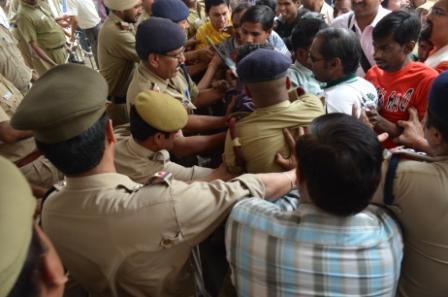
Today (April 17), a joint protest demonstration was organized in front of the Uttarakhand Niwas, Chnakyapuri. The protestors raised slogans against the management of Satyam Auto and Rockman Auto Pvt Ltd, and the anti-labour Uttarakhand government. They strongly condemned the brutal lathicharge on struggling workers, and their illegal detention in various jails acroos Dehradun. Members of the following organizations were present: Inqulabi Mazdoor Kendra, Mehnatkash Mazdoor Morcha, AIFTU(New), Mazdoor Ekta Kendra, Krantikari Lok Adhikar Sangathan, Uttarakhand Nav Nirman Mazdoor Sangh, Mazdoor Patrika, Krantikari Naujawan Sabha, PDFI, Pragatisheel Mahila Ekta Kendra, TUCI, Radical Notes

A five member delegation handed over the following memorandum to the Resident Commissioner of Uttarakhand.

Dated: 17.04.2012

To
The Residence commissioner
Uttarakhand Bhawan,
Govt. of Uttarakhand
New Delhi

Sub:- Memorandum on behalf of Mass organizations in solidarity with workers of Rockman Industries pvt. Ltd. & Satyam Auto component Ltd.

Sir,

We are in solidarity with the workers of Rockman Industries pvt. Ltd. & Satyam Auto component Ltd. of SIDCUL Haridwar who are on path of agitation for their trade union demands from management. Labor department and state government is well aware with the rampant violation of labor laws in these companies like other industries situated in SIDCUL, however they do not feel any necessity to intervene in the matter to check the super exploitation of workers by the management. Contrary to their administrative responsibility assigned under the law of the land, they are hobnobbing with the management and resorted to repress the workers movement.

On 15.04.2012 workers who were on Anshan w.e.f. 06.04.2012 in capital city of Dehradoon were lathicharged and detained under various penal provisions. 326 workers are in jail and 11 were forcibly hospitalized. Management who is responsible for industrial unrest is moving freely and hobnobbing with newly elected congress government which is determined to crush worker’s movement like Haryana and other states.
Uttarrakhand government claims that after formation of new state it has gone ahead with industrialization of the state and in order to do so, SIDCUL has been established in different parts of the state like, Haridwar, Rudrapur, Pantnagar etc. However we have found that these are hell for the workers. No Job security, no wage norm, no labor law and sheer exploitation of the workers are only norm in these industrial areas of Uttarkhand. It is tax heaven for the investors and corporate and hell for the workers. Casualization and contract system that too, illegal contract system is norm in the industrial belt of uttarakhand.

The above named industrial units are major vendor of Honda motor co. , which do not adhere to the labor norms. Illegal contract system is going on in these factories and workers are forced to work on lower wages upto 12 hours a day. Workers in these units of Haridwar are paid only Rs. 6000 P.M. by the co. for the similar work , which get Rs. 12000/ per month in gurgaon plant of the co. Workers are deprived of basic right to form union of their own choice. 5 leading workers were terminated since they had taken initiative to form union and put forward their wage related demands. Around 600 workers of Rockman industries are on strike 18th March 2012 however labor department and civil administration is unmoved by the agitation of the workers. Both regular and contract workers joined the strike for furtherance of their demand.

We condemn police atrocity on striking workers and demand that:-
1. Police officials responsible for lathicharge on workers and illegal detention of workers be reprimanded and charge sheeted.
2. Labor minister of Uttarakhand Government resolve the labor dispute by calling a meeting of agitating workers and management of Rockman Industries pvt. Ltd. & Satyam Auto component Ltd.
3. Restore labor laws in Rockman Industries pvt. Ltd. & Satyam Auto component Ltd as well as in other industries in Uttarakhand.
4. Terminated workers of Rockman Industries pvt. Ltd. be reinstated without any condition.
5. Illegal contract system be abolished.
6. Management of Rockman Industries pvt. Ltd. & Satyam Auto component Ltd. be punished for violation of labor laws.
7. Workers of Rockman Industries pvt. Ltd. & Satyam Auto component Ltd. be paid wages proportionate to the workload and they should be paid overtime as required under law.

• Inqulabi Mazdoor Kendra
• Mehnatkash Mazdoor Morcha
• Mazdoor Patrika
• Krantikari Lok Adhikar Sangathan
• Krantikari Naujawan Sabha
• PDFI
• Pragatisheel Mahila Ekta Kendra
• Radical Notes

Protest Demonstration in Delhi (April 12, 11:00 am)

12th April @11.30 am, in front of Banga Bhavan, Hailey Road
We will assemble at Mandi House Metro Station at 11a.m.

We find that the anti-people character of the West Bengal government is getting exposed daily. The police and bulldozers of Trinamool-led West Bengal government has not only evicted slum-dwellers of Nonadanga in South Kolkata, but lathicharged and then arrested residents in a continuous spate of its developmental terrorism. It has sent into police custody 7 activists of various mass and democratic rights organisations, who are kept in isolation, and allegations of ‘arms and ammunition found’ etc are doing the rounds.

We strongly condemn this anti-people development model and the eviction of slumdwellers and hawkers in Nonadanga and all over Kolkata, and demand that this be brought to a halt and the question of housing and rehabilitation of the residents be addressed. We also demand that the arrested activists be released and the the false charges dropped immediately.

AISA, AIRSO, Bigul Mazdoor Dasta, Disha Students Organisation, Inquilabi Mazdoor Kendra, Krantikari Naujawan Sabha, Krantikari Yuva Sangathan, Mehnatkash Mazdoor Morcha, Mazdoor Patrika, P.D.F.I., P.U.D.R., Students for Resistance, Vidyarthi Yuvajan Sabha and others.

Joint Statement from Delhi organisations on Nonadanga

The Trinamool Congress-led Government of West Bengal is daily showing its anti-people character. Its Police and the bulldozers of the KMDA (Kolkata Metropolitan Development Authority) razed to the ground and burnt the slums and homes of more than 800 people in Nonadanga, Kolkata on 30th March 2012. These are the same people who were resettled after evictions from various canal banks across Kolkata, and from the dispossessed from the hurricane Aila in 2009. A protest march called against the forceful eviction by residents and progressive organisations and individuals on 4th April was also brutally lathicharged by the Police, critically injuring many. Yesterday on 8th April, a sit-in demonstration was violently broken and 67 people were arrested, with false cases pressed on seven activists of various democratic mass organisations supporting the struggle. They have been remanded in police custody till 12th April, and there is an attempt by the state to frame these democratic rights activists, falsely alleging that arms and ammunitions have been found on them. Also on 9th April, 114 demonstrators who were protesting against these moves by the government were arrested from College Street. On 10th April, a huge consignment of police has cordoned off the entire area and the threat of imminent demolition even of the temporary tents and community kitchen looms large, reminding us of the situation in Singur in 2006.

The government had earlier refused to provide even basic amenities like water, school, drainage system and proper housing in these resettlement colonies and pushed them into an `illegal’ existence, and made them dependent on the networks of local Trinamool and CPI(M) goons. And now in the name of beautification, this violent eviction drive is set on the roll on these supposed `illegal encroachers’ whose cheap labour is `legally exploited’ to run the city’s economy. Anyone opposing this kind of violent `development’ of the ruling classes, has been declared to be `Maoists’ and `inciting outsiders’ conveniently by the Chief Minister Mamata Banerjee again in her press statements to delegitimize the struggle, while the common lands of Kolkata are handed over to the corporate land sharks in the best traditions set up by the previous CPI(M)-led government.

We, the undersigned organisations, condemn the arrests made on 8th April of protestors sitting in a demonstration in Ruby Junction, and demand that the 7 activists of various mass organisations who continue to be arrested be released and the false charges against them be dropped immediately, as the government is acting against the democratic right to organize and dissent.

We condemn the action of the Trinamool-led West Bengal Government and the brutal lathicharge on 4th April, and continued harassment by the Kolkata Police on the residents of Nonadanga and those protesting against the ongoing eviction process in the name of `beautification’ of the city, and demand action against the police officers involved.

We stand with the struggle of the residents of Nonadanga and demand an immediate halt to the eviction drive in the city and the anti-people development, and proper compensation and rehabilitation for all the slum dwellers and hawkers in Nonadanga and in the evictions all over Kolkata.

AIFTU (New), AIRSO, AISA, Bigul Mazdoor Dasta, Delhi Metro Kamgar Union, Democratic Students Union, Disha Students Organisation, Inquilabi Mazdoor Kendra, Jamia Teachers Solidarity Forum, Krantikari Naujawan Sabha, Krantikari Yuva Sangathan, Pragatishil Mehnatkash Mazdoor Morcha, Mehnatkash Patrika, Mazdoor Patrika, Mehnatkash Mazdoor Morcha, New Socialist Initiative, Peoples Democratic Front of India, People’s Union for Democratic Rights, Posco Pratirodh Solidarity Delhi, Sanhati-Delhi, Students for Resistance, Vidyarthi Yuvajan Sabha

Blind Workers demonstrate for their rights (March 27)

Blind Workers’ Union
(A Unit of All India Federation of Blind Workers)
Affiliated to Workers Unity Center of India, WUCI
Contact: 9313730069 Email: blindworkersunion@gmail.com

Blind Workers’ Union all-up against violation of their labour rights and government inaction.
Blind Workers’ Union warns Social Justice Ministry of grave consequences if alternative jobs are not provided to retrenched blind workers.

Today (March 27), Blind Workers’ Union in mid of heavy deployment of police and barricades, staged a massive demonstration outside the Sarai Rohilla Railway Station in Delhi. Initially the unemployed blind workers tried to enter the railway station and block the rail traffic but the heavy contingents of police did not allow them to enter the railway track from any side. Thereafter these blind workers shouted anti-government slogans and held a protest meeting outside the station.

It is to be noted that the Blind Workers’ Union has been raising the issue of violation of blind workers basic labour rights since November, 2011. We have been raising our voice against violation of basic labour rights like minimum wage, PF, bonus, overtime payment etc. The workers were deeply agitated over the fact that despite several representations to the Ministry of Social Justice and Empowerment, there has been no concrete step taken either against the erring employers or to give these blind workers employment in public sector. These blind workers were thus forced to take up this drastic step so that general public becomes aware of their misery. These blind workers are demanding employment in public sector so that their rights are not violated by NGOs and private enterprises. In their most recent memorandum to Social Justice Ministry these blind workers demanded that the Ministry must make alternative provisions of jobs for these blind workers before 27th March or else they will be left with the alternative of either die of hunger or carry an all-out struggle against government.

In the protest meeting that was carried out outside the station it was resolved that this struggle of blind workers should be taken as an ultimatum by the government. They further warned the government and ministry that if they fail to provide employment immediately to these blind workers then from next month onwards they would be forced to carry out this Rail Roko in different parts of the country and next time they would even defy police.

Delhi University Women Students’ Struggle: An Appeal

Friends,

Since January of 2012, residents of Delhi University’s largest postgraduate women’s hostel, University Hostel for Women (UHW) have been waging a battle against outright suppression of their democratic rights by, both, their hostel authorities and the University’s Proctorial Committee. Since the hostel’s Chairperson is also the Proctor of the University, the Proctorial Committee has been intervening in the matter, not as a neutral party, but in complete connivance with the hostel authorities. There are two issues which are central to the ongoing struggle of the women students, namely, the imposition of a union constitution by the authorities, and the existence of archaic and conservative rules in the hostel. In the process of their struggle, the women hostellers have been individually victimized to a ridiculous extent by the hostel Provost, Professor Ashum Gupta and the Warden, Dr. Tanuja Agarwala. The Warden and Provost have been sending letters to departments, making misleading phone calls to parents, denying extension of stay to M.Phil researchers in the hostel, verbally threatening their MA students that they will be given less marks for projects and assignments if they continue to support the struggle, etc. As a result, the campaign of the women hostellers has also been geared towards fighting rampant victimization.

Our struggle began when on 22 January, 2012 a six page document was pasted on various notice boards inside the hostel. The document was a copy of the Hostel Union Constitution drafted by the authorities in consultation with the hostel’s Managing Committee. While such a crucial piece of document can only be put into force after being passed by a two third majority of the hostel residents, who are the actual constituents of the union, no such procedure was followed in our hostel. To make matters worse, the hostel authorities tried to hold this year’s hostel union election on the basis of this imposed Constitution. While the authorities claim that they are implementing procedures followed during other student elections of Delhi University (such as DUSU, etc.), the structure of the Hostel Union Constitution reveals something very different. For example, the Constitution drafted by the authorities allows for the outgoing union president to continue on the new hostel union as an ex-officio member! Similarly, before the residents began challenging the authorities, the newly announced election criteria consisted of stipulations which seriously prevented the formation of a strong, independent students’ union. The new election criteria were an unhealthy combination of the stringent Lyngdoh committee stipulations, as well as certain disqualification criteria formulated by the authorities themselves.

A “valid” candidature was, hence, ascertained according to the Lyngdoh recommendations on age and attendance to a course, as well as the system of memos (i.e. the issuing of warning letters for the smallest breach of hostel rules—most of these rules being highly unpopular and contested). The receipt of 5 such memos was arbitrarily made a criterion for disqualification. It is only because the women students united to fight this imposition of a hostel union constitution that certain non-Lyngdoh election stipulations (like disqualification on the basis of memos issued and number of years of residence in the hostel, etc.) were taken back by the authorities. Unsatisfied with this partial victory, the women students have pursued their struggle because apart from the arbitrary introduction of Lyngdoh recommendations, the Constitution imposed by the authorities allows for extensive control of the hostel authorities on the union. Since the attempts of the authorities has been to minimize the autonomy and strength of the students’ union, the hostel residents collectively decided to submit a signature petition to the hostel Warden and Chairperson.

The second issue on which UHW residents have been campaigning is existing hostel rules. Most of the rules in force are those formulated way back when the hostel was started in 1970. The current residents in the hostel are challenging rules such as ‘no exit after 8:00pm’, submission of leave applications approved by Head of Departments for more than one week’s absence from the hostel, the tedious procedure of gate pass and double-locking of rooms which does not exist in the men’s hostels, the limited number of late nights and nights out, closing off the canteen to visitors, etc. Many of these rules such as not being able to exit after 8pm are illogical, especially when we consider how the same authorities allow the residents entry up till 11:00pm under the late night provision. An archaic rule such as ‘no exit after 8pm’ prevents women students from stepping out for urgent work, or even something as simple as getting photocopies from the nearby market, Patel Chest.

However, apart from this, certain the rules (such as closing off the canteen to Miranda House and other college students and staff) have also worked towards making Chhatra Marg (where the hostel is situated) a more isolated place, and hence, unsafe. Certain other rules which are implemented solely in the women’s hostels, like the submission of leave applications approved by Head of Departments for more than one week’s absence from the hostel, are being misused to such an extent that the women hostellers and department heads are unnecessarily burdened with additional paperwork. It is, in fact, shameful that adult women are being made to seek approval from their departments even for personal matters such their travel/vacation plans.

Of course, under the pressure of the ongoing struggle, the University has decided to implement, from the new academic session, certain changes in the rules prevalent in women’s hostels. However, since these adjustments were discussed and formalized without any consultation with women students, they continue to create hassles for the women hostellers. Indeed, apart from a few proposed changes, most of the rules stand the same. In fact, not only will tedious procedures like gate-pass, double locking of rooms and issuing of memos for the smallest breach of hostel rules persist, the University’s new administrative order also proposes a hostel fee hike. Understandably, the women hostellers continue to agitate and raise their democratic concerns.

Typically, the collective struggle of the students has been trivialized and demeaned in several ways. Students’ democratic methods like calling meetings, circulating signature petitions, etc. are constantly projected by the authorities as “illegal” activities that spread “disturbance” and “disharmony”. Basically, when we take the initiative to raise our opinions and discontent, our authorities only see “untoward” activity…OUR VOICE IS NOISE FOR THEM!

Furthermore, ever since the women hostellers have been voicing their democratic aspirations, the authorities have viciously gone after individual students in the bid to transform UHW residents into a captive mass which has no democratic voice. The logic behind the multiple techniques of victimization is the need for the hostel authorities to break the collective will of the students and to project their collective struggle as that of a few individuals. In order to break the collective will and efforts of the residents, the authorities have been threatening individual students to withdraw from the struggle, and have tried to project the students’ legitimate struggle as a smear campaign pursued by one or two students who have some mysterious “agenda”. The techniques of victimization used unhesitatingly so far, include: (i) vicious character assassination, (ii) phone calls to parents and departments, (iii) accosting individuals on the stand they have taken and refusing to cooperate with them regarding the smallest of procedural work within the hostel, (iv) denying extension of stay to M.Phil researchers, (v) bombarding the more active students with show cause notices on every alternate day, etc.

For many of us these victimization techniques are equivalent to the techniques embraced by the management of private companies seeking to break the collective voice of their employees. Considering our hostel Warden is a faculty member of the Faculty of Management Studies (FMS), it comes as no surprise to us that typical labour management formulas are being applied on us students. Haranguing individuals, involving the families of the protesters, threatening individuals with a series of show cause notices, applying multiple pressure on individuals by involving a not-so-neutral third party (in our case, the Proctor’s office, and in the case of workers, the Labour Office), etc. are very similar to the methods used by factory managers who seek to crush the collective voice of their employees. Using such labour management methods, the hostel authorities went out of their way to expose their unethical and undemocratic nature on two particular occasions. One such occasion was on 14th February when a large number of women hostellers boycotted dinner in protest. Rather than being concerned about the condition of the residents boycotting dinner, the hostel authorities ‘rewarded’ those who refused to support the campaign with an extra lavish dinner, and spent the entire day calling individual students to the office in order to force them to withdraw their support for the boycott.

The second occasion on which typical labour management techniques were unleashed on the hostel residents was on the 13th of March. On this day, members of the hostel’s Managing Committee, two Deputy Proctors, the Warden, Provost and Resident Tutor huddled into office to hold a Managing Committee meeting, as promised in writing. Ironically, rather than allowing the students to select and send their representatives to the meeting, the hostel Warden handpicked two students to represent the students’ point of view in the meeting called to ‘resolve’ the issues raised by the residents. As expected these students’ ‘representatives’ were not the more vocal of students, and were forced to compromise as they were outnumbered in the Managing Committee meeting, and were, in fact, locked into the office area during the course of the meeting. Disrespect for amicable dialogue and the strong desire to create a docile mass of women students are clearly reflected in such cases.

As the situation stands, individual victimization continues on a daily basis. For example, despite verbal assurances given by the Dean of Colleges, Prof. Pachauri, on the 16th of March, the hostel Provost has continued to contact supervisors and Head of Departments. The hostel authorities also released a list on the 19th of March of M.Phil researchers who will not be provided an extension of stay, despite the precedent being that the hostel provides such extension in strongly recommended cases. The hostel authorities continue to run UHW as if it were their personal fiefdom. There really seems to be no way to check their authoritarian, undemocratic and unethical practices, unless the larger Delhi University community extends support to the women students.

WE, HENCE, APPEAL TO ALL CONCERNED UNIVERSITY MEMBERS AND ALUMNI OF UNIVERSITY HOSTEL FOR WOMEN (UHW) TO STAND WITH THE DEMOCRATIC ASPIRATIONS OF THE WOMEN STUDENTS, AND TO HELP PREVENT DELHI UNIVERSITY’S AUTHORITIES FROM REDUCING STUDENTS TO A VOICELESS, DOCILE MASS. In the larger context of the backlash against all democratic voices in this University, the ongoing struggle of women’s students emerges as a litmus test for democracy— do we as a University community want to create docile University youth, or right-bearing, politically conscious University youth?

Your contribution to this democratic struggle could consist of the following:
(i) Writing letters to the University’s Vice Chancellor that press for the prevention of individual victimization in its myriad forms, and for an amicable resolution to the issues raised by the students;
(ii) Writing letters to the University’s Vice Chancellor and Dean of Colleges that press for the removal of the hostel Provost and Warden since the two continue to derail a healthy dialogue process by victimizing individual students;
(iii) Writing letters to the media which highlight the sheer lack of tolerance for the democratic issues raised by the women students like the right to draft, amend and ratify their union constitution;
(iv) Discussion with colleagues and other faculty members so as to create a public opinion against how women’s hostels are being run according to the diktats of an authoritarian and conservative set of DU faculty members;
(v) Build students’ resistance against de-unionization and conservative rules, as in UHW, in other DU hostels as well.

Issued by Residents of University Hostel for Women (UHW)
COORDINATION COMMITTEE FOR WOMEN’S HOSTELS IN DELHI UNIVERSITY
Contact: 9350272637, 9818900179

Delhi University Women Students’ Struggle: Open letter in response to the show-cause notice issued by hostel authorities

To,
The Warden
University Hostel for Women (UHW)
University of Delhi
15.03.2012

Dear Dr. Tanuja Agarwala,

I am in receipt of a number of letters in which I have been asked to explain/clarify my “conduct” over the past few weeks. Unfortunately, none of these letters issued by you reflect a willingness to understand the issues raised by the hostel residents, and to see them as a democratic expression of the residents’ collective will. Your last letter (dated 12.03.2012) has asked me to clarify why action should not be taken against me, based on the alleged complaint that a few students were “misled” and misinformed into signing the Memorandum calling for a boycott of dinner on 14.02.2012. Your letter categorically refuses to consider the 14th February Memorandum as an expression of the students’ collective will. The very evidence of this fact is that I have been identified as a “culprit” who needs to explain her position, lest action will be taken. I do not wish to be identified as a “hero” of the hostel campaign or a person who can be identified as the “potential victim”. It is high time the authorities of the hostel restrain themselves in identifying individual “culprits” and in scuttling the collective democratic voice of the residents.

The entire campaign and the number of memorandums submitted to the authorities are a collective endeavour where no individual can be identified as the person behind the campaign. Of course, in all campaigns and movements there are some people who take the initiative, and are assertive in expressing the collective will of the others concerned. However, such persons cannot be identified as “instigators” because they are merely expressing in a consistent manner what majority of the people think is right.

Of course, there is always a general possibility that in campaigns/movements there are some individuals who are inconsistent in their position on the issues raised, and therefore, change their position during the course of time. This may explain why some individual residents retracted from their position on the boycott of dinner. However, a change in the position such individuals hold does not mean their earlier position was wrong, or that they were misled into the earlier position they took.

Having said this, in the case of our hostel there is a specific possibility that the authorities resorted to individual intimidation to get some residents to change their position on issues raised. We have indeed come across versions of this intimidation wherein individual residents were called to the hostel office and categorically threatened to withdraw from the campaign otherwise they would not be given extension, their parents would be contacted, their departments intimated, etc. In fact, few parents were called and asked to restrain their daughters. Such draconian, coercive and high-handed practices of the authorities have led to widespread fear amongst a section of the students. It is under such conditions of fear and actual acts of victimization that individual residents were asked to give in writing that they consent to withdraw from the campaign. What else can explain the simple fact that few individual residents began to retract from the boycott call after a lengthy visit to the hostel office? It is another thing that despite all the efforts of the authorities, we are still confident of the support of the majority of students, and therefore, will continue to assert the democratic rights of the residents.

To your allegation that some residents were misinformed into signing the concerned Memorandum, I and several other residents who have studied your letter, have only one thing to say, which is that we find such views unacceptable. This is because residents of this hostel are educated adults who never go around signing documents and memorandums in a fit of absent-mindedness. The Memorandum explaining why a dinner boycott was being called, was properly attached to the signature petition. There were regular announcements made inside the hostel mess, as well as individual dissemination of the boycott’s details during breakfast on the 14th of February. Subsequently, postering on the boycott was also carried out in the hostel on the 14th, which shows that rather than being misinformed and misled into boycotting dinner, individual residents were coerced by you to give up their decision to boycott dinner.

Most importantly, it is wrong to claim that because some students changed their opinion due to victimization or due to certain personal calculations, I and other students are causing “disturbance” in the hostel, and should hence, be punished. It should be recalled that on the 20th of February when the authorities and a section of the students exchanged undertakings in writing, there was a tacit acceptance of the fact that there were two parties of opinion on the issues at stake. It goes against the notion of jurisprudence where a party in conflict of opinion bestows upon itself the power to punish the other party for raising their opinion. Such an approach is neither impartial nor democratic.

It is high time the authorities concede the point that genuine issues are at stake and that there is a collective of women residents who are raising these issues. Elections at the earliest, adoption of the Constitution submitted on 03.02.2012, and the change in hostel rules (such as no exit after 8pm, gate-pass system, issuing of memos, mess rebate, etc.) must be addressed, and should not be trivialized any further. We will not let the hostel authorities victimize individuals or sideline the issues raised by the residents. The authorities have already broken their promise of not indulging in such victimization, as well as their assurance of calling a Managing Committee meeting where a proper discussion can happen with the residents.

Of course, if the authorities still feel certain residents have been misinformed into taking a stand in support of the hostel campaign, then they should ascertain this by holding a secret ballot referendum on the issues raised by the campaign. Perhaps, this is the only way in which UHW residents can prove to all that they are indeed thinking individuals.

Lastly, I am directed by concerned residents to inform you that if any action is taken against me, your office must be prepared to see the struggle continue as well as escalate. This is because when the collective spirit and democratic aspirations have embodied themselves in all the residents, the physical removal of one person makes little difference to the struggle. The authorities should, hence, be under no illusion that by subduing one individual the quest of the residents on their democratic demands will terminate. At the most, it is only for some time that your office will be able to scuttle the democratic voice of the students. Your actions against individuals will always remain a moral defeat in permanence. Hope a better sense prevails.

Yours truly,

Maya John

Delhi University’s women students struggle for the democratisation of campus and self-determination

Concerned Residents of University Hostel of Women (UHW)

Since January of this year, students of Delhi University’s (DU) largest postgraduate women’s hostel, University Hostel of Women (UHW) have been involved in a militant struggle involving several fundamental democratic demands. One of their particular demands carries larger significance on the issue of democracy in the university campuses. This demand pertains to the right of the students to decide the contours of their student union constitution. As constituents of the union, the students have been contesting the fact that their hostel authorities have imposed a union constitution which the students’ have not ratified themselves. They have contested the union constitution on the grounds that it allows the authorities’ extensive control on the students’ union, thereby overriding the chances of a strong and independent students’ union coming into power.

In the process they have also questioned the enforcement of Lyngdoh recommendations in the hostel. After scrutinizing the Lyngdoh recommendations as well as Supreme Court judgments on the implementation of these recommendations, the students believe that they amount to a breach of the fundamental right to form an association [Article 19(1) a and c, Constitution of India]. According to the Constitution of India [Part III], the state can only infringe upon fundamental rights in certain exceptional and concrete conditions, none of which exist in the context of the hostel. Following from the specifications mentioned in the Constitution of India, the students have reached the conclusion that Supreme Court judgments are being unnecessarily taken out of context so as to curb democratic aspirations, independence of student unions as well as the power of resistance.

Apart from the issue of the union constitution, the women students have also been raising the demand to change age-old, conservative rules of the hostel. Currently, the residents cannot step out of the hostel after 8pm. Ironically, such a rule is enforced to ensure the safety of the women students. However, the same authorities persistently fail to curb the filthy and offensive rally taken out by men hostellers on the day of Holi. Under the University’s Ordinance XV-D, such an act by the men hostellers outside the women’s hostel amounts to sexual harassment.

As of now the students have been told that new rules are being brought into force across women’s hostels. However, in the high powered committee constituted by DU to formalize such common rules, no women students were called for discussion. One can only expect that in such an exclusive meeting, the DU authorities have come up with a series of rules which are not pro-students.

Lastly, in the bid to stem the tide of rampant victimization by the authorities, the women students have escalated their struggle, and taken their struggle outside the walls of their hostel. They have been protesting against the unwillingness of the authorities to see the campaign as a collective struggle, and, to subsequently, pick out individuals whom they can victimize. On the 16th of March, they also protested outside the Vice Chancellor’s office. Now they are in the process of involving and uniting students of other women’s hostels of DU.

TIMELINE

14th Jan: First Notification of the Hostel Union elections for 2011-12.

20th Jan: Clarification Notification put up by authorities specifying that residents with 5 memos or more cannot stand for elections.

20th Jan: First Meeting of residents on the issue of the election criteria specified by the authorities. Decision taken by residents to draft a memorandum & collect signatures in support of reverting back to the election criteria that prevailed earlier in UHW.

22nd Jan: Second Meeting of residents. Drafted memorandum is discussed, and additional points added in response to the Constitution put up by the authorities on 22nd Jan. Residents express concern on how: (i) this hostel union constitution was amended by the authorities without gathering the consent of the residents through a GBM; and (ii) that a change in the election criteria was arbitrarily introduced without ratifying it first in a GBM which had a proper quorum, i.e. a sizeable number of hostel residents present and voting.

23rd Jan: A delegation of 5 residents submits the memorandum to the hostel authorities. The memorandum carried 193 signatures of hostel residents. Authorities decide to go ahead with the election on a provisional basis, and give verbal assurance that the residents’ objections will be forwarded to DU’s legal advisor.

25th Jan: Third Meeting of students to discuss next course of action as well as other pressing concerns as strict implementation of hostel rules. More than half the residents attend the meeting and resolve to put up posters on Republic Day expressing their dissent, as well as sit on protest on 27th January, 2012. An organizing committee is constituted to manage the preparations for Saraswati Puja as the residents resolve not to involve the outgoing union members whose tenures have lapsed and who no longer reside in the hostel.

26th Jan: In response to the posters some of the hostel authorities make aggressive speeches after the flag hoisting. Angered residents assemble in the badminton court in large numbers, and decide to again approach the hostel authorities on the issue of hostel elections, the union constitution imposed by them, and the need for the authorities to attend a meeting addressing concerns of the residents with respect to hostel rules, etc. The authorities agree to: (i) postpone elections till the issue of the election criteria is resolved; (ii) forward the residents’ written objections as well as the constitution drafted by residents, to the Legal Advisor; and (iii) meet ALL the residents together via a meeting within a week.

27th Jan: Drafting Committee chosen by the residents starts drafting the hostel union constitution keeping the democratic interests of the residents in mind. The committee also drafts the constitution in a manner which allows for a strong and independent union to be elected into office.

31st Jan: The authorities put up a notice withdrawing certain elections criteria previously announced, but continue to uphold the Constitution that was introduced by them without gathering the consent of UHW residents.

1st Feb: Residents in large numbers attend the Meeting called to ratify the Constitution drafted by the Drafting Committee. In the Meeting residents also voice the need to amend certain hostel rules. In the process of this discussion it was decided that further suggestions and feedback should be collected.

3rd Feb: The Constitution drafted and ratified by residents is submitted to the hostel authorities. 221 signatures, which constitutes an Absolute Majority of the present hostel population, are collected in support of the Constitution. In the covering letter the residents request for a speedy response, i.e. a response within one week.

6th-10th Feb: A survey to collect the residents’ opinions on hostel rules is circulated in all the blocks. Nearly 160 residents fill out the survey. Almost all the residents opt for some kind of change in hostel rules.

13th Feb: Due to the delayed response of the authorities, and lack of any communication from them, another Meeting of the residents is called. All those present and voting agree to boycott dinner on 14th February.

14th Feb: After collecting more signatures of the residents in support of the boycott call, the memorandum intimating the authorities of the boycott is submitted to avoid wastage of food. Almost half of the hostel residents agree to boycott dinner on 14th. Rather than being concerned about the condition of the residents boycotting dinner, the authorities spent the whole day individually intimidating those who support the boycott call. The students were compelled to write application saying they withdraw from the boycott. Even after submitting such applications, many such students continued to boycott dinner. This clearly reflects the moral victory of the residents.

16th Feb: A secret poll is held during dinner time by the residents to ask the residents whether they want to carry on with the protest or not. Residents in full strength supported the continuance of the campaign. The polling is intervened by the Warden trying to take pictures and intimidate the girls. Then, around 9.30 pm Asst.Proctor Mr. Kasim walks in with the Warden and the Resident tutor. He invites the residents to talk. A discussion takes place where he is intimated of all the issues of the campaign and the individual victimization of the residents who had signed the memorandum for boycotting dinner on the 14th. He invites a few residents to the Proctor’s Office the next day, to talk to the Proctor, with their memorandums. The residents were unable to understand the reason for the intervention of Proctor’s Office as it was not a law and order situation, yet they agreed.

17th Feb: A delegation of residents goes to submit the memorandum at around 1.30 pm. They are called again by the Asst. Proctor at around 3.30 pm to talk. They talk to him in detail about the issues covered in the memorandum. The Proctor was not available and so the residents were not able to meet her then. At around 4.35 pm the Proctor herself called the residents to meet her at the Proctor’s Office. The residents went and started to brief her about the issues, but the Proctor was in a haste to leave for a meeting at 5.00 pm and left this meeting mid-way. Thus no conclusion was reached on this day. Bu the Proctor’s Office did assure that individual victimization of the resident will certainly stop.

18th Feb: Despite the given assurance that no victimization will take place, the Warden called up the parents of a number of students. In this conversation the picture painted was such that the residents were portrayed as ruckus makers. The residents of the hostel come from different sections of the society and such a false picture may be taken apprehensively by some households.

20th Feb: Since the authorities did not stand by their own words and the victimization continued, the residents agreed to hold a Mass Meeting outside the Vice-Chancellor’s office on the 21st February. In the evening of the 20th, the Provost comes to the hostel and called for a meeting with all the residents immediately. The only conclusion that could be reached was that the authorities gave it in writing that a managing committee Meeting will be held between 8th March and 15th March to resolve the issue. In return, the residents gave in writing that they will not hold the protest outside the VC’s office because they were assured that no victimization shall take place and that the meeting would be held within the given dates. The residents mentioned that they reserve the right to intimate the Vice Chancellor about the situation in the Hostel.

29th Feb to 12th March: Despite the assurance that no resident would be asked to explain her stand on the campaign, Maya John, a C-block resident is given letter after letter, asking her to explain her stand and to give clarifications for different allegations put on her.

13th March: Without informing the residents, the promised Managing Committee Meeting is held on this date in a very hushed up manner without any student’s representative, without the knowledge of the residents. This meeting continued for an hour and no notice was put up about the results of the meeting.

Contact: Maya John (91-9350272637)

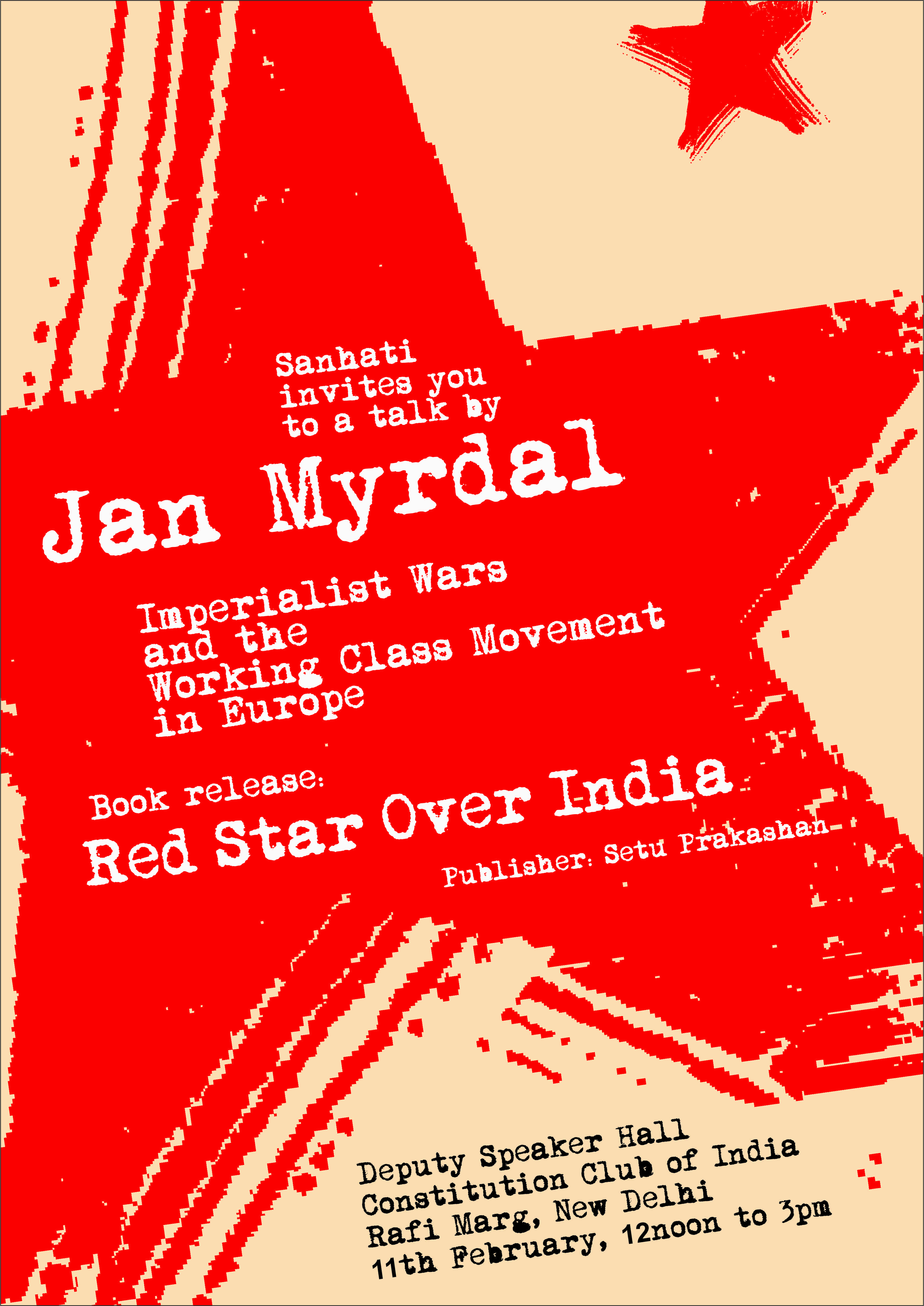
Book Release & Discussion: Jan Myrdal’s “Red Star Over India” (New Delhi, Feb 11)

Blind Workers’ Union’s Convention (New Delhi, Feb 11)

Blind Workers March in Delhi

Sunil Kumar, Blind Workers Union
(A Unit of All India Federation of Blind Workers)
Affiliated to Workers Unity Center of India, WUCI

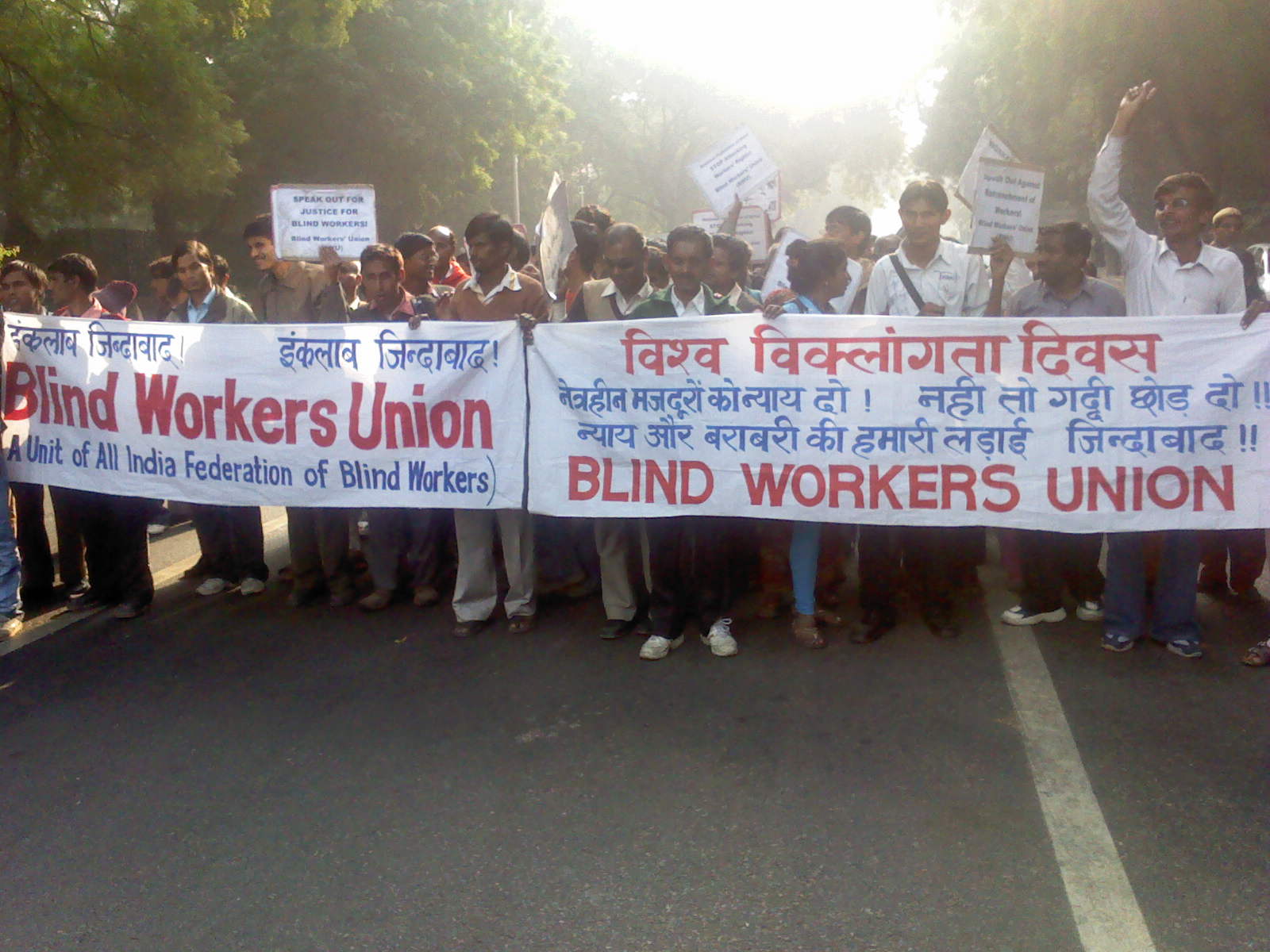
Today, on December 3, 2011, more than a thousand visually challenged workers from Benaras, Nasik, Kanpur, Faridabad, Bahadurgadh and Delhi participated in a massive protest rally on Parliament Street. Their rally was taken out from Jantar Mantar to Parliament Street on the occasion of World Disability Day. It was a culmination of an earlier struggle these blind workers have carried out against a well-known NGO which employs and exploit them, i.e. the National Federation of the Blind (NFB). The rally was an extremely important moment for these workers since they were using World Disability Day to expose how they were still denied many fundamental rights at workplaces. Instead of celebrating this day in the usual festive manner, these blind workers celebrated World Disability Day as a black day, which marked unfulfilled promises of equality.

Initially, the Delhi Police refused to allow the rally to proceed to Parliament Street. However, the agitated workers refused to be held back and broke free of the barricades so as to march onto Parliament Street. Quite expectedly, their fiery spirit did not mellow down, despite being manhandled. Following their protest rally, a delegation of the workers submitted a memorandum to the Hon’ble Minister of the Ministry of Social Justice and Empowerment, Government of India. The delegation met the concerned minister, Shri Mukul Wasnik, and apprised him of plight of blind workers. They drew the minister’s attention to the fact that the government was doing little to prevent the rampant violation of its own laws pertaining to disability. In particular, the workers highlighted the violation of several provisions in the Persons with Disability (Equal Opportunity, Protection of rights and full participation) Act of 1995.

When discussing matters with the Minister, the workers highlighted how section 33 of this Act, which provides 3% reservation in identified posts (1% being earmarked for the blind and low vision persons), is unable to provide sufficient respite to the disabled because of inadequate job creation in the public sector itself. Another important provision in this 1995 Act which is far from being implemented is section 41. It provides incentives to disabled persons so as to ensure that at least 5% jobs of all workforces goes to them.

However, as highlighted by the protesting workers, both the older laws and policies as well as the newest government policies are failing miserably when it comes to ensuring a dignified and productive life to disabled people, in particular, disabled workers. For example, even the recently adopted National Policy for Persons with Disabilities (2006), which provides incentives, awards, tax exemption, etc. is redundant because the private sector which employs a large number of disabled workers, is least interested in implementing such policies, let alone statutory labour laws pertaining to minimum wages and parity at work. In fact, the promise of the National Policy for Persons with Disabilities (2006) to create one lakh jobs is still a mirage today. In this light, the recommendations of the Sudha Kaul Committee which was constituted to help frame a policy on disability, are also flawed. This Committee, for example, has made no recommendations with respect to labour rights relating to safety when assisting in the drafting of the Right of Persons with Disability Bill, 2011.

The gathering of workers on Parliament Street was addressed by aggrieved workers (those employed by National Federation of the Blind) as well as their leaders. Shri Alok Kumar from the All India Federation of the Blind addressed the gathering, and argued how shameful it was that National Federation of the Blind was also commemorating World Disability Day when this NGO itself exploited the impoverished blind workers. He went on to argue how necessary it was for the government to create more jobs opportunities for disabled workers, and how the government should ensure that all statutory labour laws are implemented in production centres run by “social service” organizations (like NFB) as well as other employers. Indeed, almost every blind worker who stood up to speak, emphasized that NGOs like NFB as well as other employers, act as if they are doing the blind workers a favour by employing them. In reality, as employers they earn huge profits from the labour of these workers. NGOs, in particular, also amass huge amounts of funds from the Government/foreign funding agencies by using the face of these poor blind workers.

It is with the express purpose of attaining greater job opportunities for disabled workers as well as parity in work conditions and wages between blind workers and sighted workers that the spirited rally of blind workers marched onto Parliament Street.

Contact: 9313730069
Email: blindworkersunion@gmail.com