Petition: Assault on Democracy

To: The President of India
The President of India,
Rashtrapati Bhavan,
New Delhi – 110 004.

Dear Madam Visitor,
Subject: Assault on Democracy

On 18 February 2010, the Delhi Police presented a charge-sheet against Mr. Kobad Ghandy. This document also alleges criminal activities, and support for criminal activities, against several individuals and organisations that have been active in safeguarding and promoting civil and democratic rights, for several decades now. These organisations and individuals have been actively protesting the violation of civil and democratic rights of large numbers of people in the context of ‘Operation Green Hunt’ – the government’s military offensive against ‘Maoists’. Several of those affected by the allegations in the charge-sheet are members of the academic community of Universities in Delhi, who also happen to share in the work and activities of the organisations identified in it.

The allegations against these individuals and organisations are utterly baseless and unsubstantiated; they consequently appear to be motivated solely by the government’s intention to silence all such protests, and to criminalise all such legitimate and democratic activities. This is in continuation with intensifying attempts by the state to curtail spaces for democratic dissent and protest, within and outside the university, and indeed, to erode the very principles of democracy.

Worldwide, universities have traditionally been a crucial space for freedom of expression, the exploration of ideas and critical debate. They have always been, and should always be, sites where even the strongest critique of the state can be – in fact, must and should be – made possible. This is an essential character, not just of the university as an institution, but of the democratic principles of the society it exists in. The attempt to silence these individuals and organisations, therefore constitutes an assault on this very fundamental essence of the university, as well as on the character of democratic society.

We would like to unequivocally affirm that, for the university to remain a space in which democratic principles and practices are sacrosanct and inviolable, the voices that emerge from it must be allowed to do so freely. We consequently also strongly condemn attempts like the baseless allegations in the charge-sheet, to violate precisely this quality of the university and its community.

We request you, in your capacity as Visitor of Delhi University and Jawaharlal Nehru University, to intervene and protect the universities and their communities from such assaults. We also request you to ensure that the individuals and organisations targeted in the charge-sheet are not victimised by the baselessly punitive and retributive actions of the state, and that their civil and democratic rights are upheld.

Sincerely,

PLEASE SIGN

A preparatory meeting in Delhi against State violence and repression (March 12 2010)

The Delhi University Campaign Against War on People invites concerned organizations and individuals for a preparatory meeting to address issues of state violence and repression and the erosion of democratic spaces, currently epitomised by ‘Operation Green Hunt’. The objective of this preparatory meeting is to jointly organize a future course of action.

Date and time: 12.03.2010, 2:30 p.m.
Venue: Room no. 207, Indian Social Institute, Lodhi Road, New Delhi.

An Interview with Prafulla Samantara on movements and state repression in Orissa

Prafulla Samantara, a prominent social activist in Orissa

Press Release on Operation Green Hunt

Press Note based on Reports in the Local Languages involved, Fact-finding Reports of teams of Democratic and Civil Rights Organisations and the Statements issued by the CPI (Maoist)

The last quarter of 2009 has been quite significant in the annals of history of the Indian subcontinent with the much publicised war, euphemistically called as Operation Green Hunt, of the Government of India on the Adivasis-the poorest of the poor- of the region ostensibly to usher in, what is being time and again termed as Progress, Prosperity and Peace. The tragedy unfolding behind the smokescreen of this media blitz of the Government of India should be brought to the notice of one and all for its alleged intentions, and the real, concrete fallout of this campaign that is taking place under the direct guidance of the learned, erudite Prime Minister Manmohan Singh and the lawyer/politician/finance minister turned Home Minister P Chidambaram.

An unprecedented military offensive

If the total number of government forces presently engaged in this operation is taken in its entirety (including the paramilitary forces and the state elite police) it comes close to a quarter of a million. This is more than double the US forces presently deployed in the occupation of Iraq-approximately 120 thousand in September 2009-and bigger than the armies of Australia, Netherlands and South Africa put together. The preparations speak volumes about the real intentions of the government as Indian Air Force helicopters turned into gun ships are being used against adivasis, airstrips constructed in Raipur and Jagdalpur, jungle-warfare schools opened to train the forces in special operations, new barracks and bases to station armed forces are established all over the war zone, public buildings including schools and panchayat houses are converted to paramilitary and police camps and torture chambers. To top it all, army commanders are overseeing the war operations while US is providing ‘advisors’, military intelligence, satellite surveillance and ‘guidance’-in one word called logistic support.

Contrary to the claims of the government, to secure the land against “the single largest internal security threat”-Naxalism-to this country, what is unfolding to the concern and anguish of every democratic and progressive mind is the calculated assault on the tribal people inhabiting the forests of Jharkhand, West Bengal stretching from Paschimi Midnapur-Bankura-Purulia in West Bengal to Srikakulam-Vishakhapatnam-Vizianagaram-East Godavari in North Andhra Pradesh and Khammam-Warangal-Adilabad in North Telangana as well as the eastern districts of Maharashtra – Gadchiroli and Chandrapur. The war zone under the blue-print of the Operation Green Hunt slated by the Government of India includes the Southern districts of Orissa – Koraput, Gajapati, Ganjam and Mulkangiri.

This has added yet another sordid chapter to the continuing assault on the tribals of the subcontinent in the form of Destruction, Destitution, Displacement and Death (four dreaded Ds of the Indian state’s policy). Thus the campaign for Prosperity, Progress and Peace by the Government of India under the UPA government is bringing in untold miseries to the adivasis in the form of Destruction of their lives and livelihoods, growing Destitution among them, massive Displacement running into hundreds of thousands due to increasing atrocities of barbaric dimensions by the paramilitary and security personnel, and last but not the least Deaths and Disappearances of tribals who have refused to leave the forest areas which are their natural habitats. Thousands of paramilitary, CoBRA, Greyhounds, C-60 and other elite armed police forces reared for this purpose by the state governments are being deployed in each and every part of Dandakaranya and other regions under this operation. These forces are entering forests, hills and village settlements unleashing immense brutality on unarmed and defenceless adivasis.

Adding intrigue to this murderous exercise, the Home Minister, who has been, and is still travelling the length and breadth of this country, announcing the various facets of this US inspired war on the poorest of the poor of this land, is the sudden and audacious denial by the minister himself about the presence of any such operation termed as the Operation Green Hunt. What provokes any discerning mind into consternation is the total blackout in the media of continuing atrocities on the tribals while P Chidambaram who had earlier graphically explained the various manifests of the Operation goes on a denial mode of such a massive military exercise-with the paramilitary belonging to the CRPF, BSF, CoBRA, Grey Hounds, C-60, SPOs and what not deployed in the forest tracts of Central and East India-unheard or untold in the history of this region.

The terror of development

While this massive operation is taking place in the rural interiors of Central and Eastern India, Prime Minister Manmohan Singh spoke with a forked tongue at the Chief Minister’s Conference on Implementation of the Forest Rights Act 2006, on 4 November 2009 in New Delhi. To quote: “There has been a systemic failure in giving the tribals a stake in the modern economic processes that inexorably intrude into their living spaces. The alienation built over decades is now taking a dangerous turn in some parts of our country. The systematic exploitation and social and economic abuse of our tribal communities can no longer be tolerated.” But the Prime Minister was quick to add while stressing the need to make tribals “the primary beneficiaries of the development process”, the need to win the “the battle for their hearts and their minds”.

What is worth mentioning here is that the geographical terrain, where the government’s military offensive is planned, is very well-endowed with natural resources like minerals, forest wealth, biodiversity and water resources, and has been the target of systematic usurpation by several large, both Indian and foreign, corporations. So far, the resistance of the local indigenous people against their displacement and dispossession has prevented the government-backed corporates from exploiting the natural resources for their own profits and without regard to ecological and social concerns. As hundreds of MoUs have been signed by the various state governments under the auspices of the Central Government and the foreign and domestic corporations the government is deliberately hiding the truth behind this unprecedented military offensive as an attempt to crush democratic and popular resistance against dispossession and impoverishment. Significantly the Prime Minister himself is on record talking about the need to make way for the vast mineral and other forest wealth in these forest lands to be exploited to facilitate the march to progress. This is corroborated by the statement of the Home Minister about the need to ‘secure the whole area’ first so as to usher in ‘development’. Operation Green Hunt thus is unequivocally a calculated move towards facilitating the entry and operation of these large corporations and paving the way for unbridled exploitation of the natural resources and people of these regions.

Operation Green Hunt-a euphemism for genocide of the tribals

Of significance is the number of killings that has happened ever since the commencement of the Operation Green Hunt, say from the third week of September under the gaze of the ‘Reality Show’ driven sensation hungry media wherein more than 4000 CRPF and 600 anti-Naxal CoBRA commandos entered Dantewada’s Chintagufa area. People resisted this intrusion by the government’s armed forces, and in the battles six soldiers, including two commanding officers were killed.

To avenge the death of the armed forces, the troops ‘managed’ a massacre of adivasis while resorting to arson of their villages, in which at least nine villagers were murdered in cold blood and four villages got totally gutted leaving nothing behind. The government claimed that all those killed were Maoists, while the eye-witness accounts, local media reports and independent fact-finding visits have confirmed that it was yet another stage-managed genocide of adivasi villagers, who were picked up and killed. Starting from the incident of 9 August 2009 in Vechhapal under Bhairamgarh police station (Bijapur district) to the one near Kistaram (Dantewada district) on 10 November 2009, all have been fake-encounters. Seventy adivasis in total have been killed in these fake encounters in this period. It should be noted that not a single one among them was a Maoist!

The government’s claim of killing 7 ‘Naxals’ in an encounter on the 10th of November 2009 near Kistaram is incorrect as the CPI (Maoist) issued a statement stating that none of their cadres died in the incident. It must be registered here that even if one of their cadres get killed, the CPI (Maoist) declares it openly apropos the normal conduct of CPI (Maoist) is observed. On 9 December, more than 500 paramilitary and policemen entered the area under Kistaram police station from Cherla Dommaguda police station area in Khammam district of Andhra Pradesh. They reached Tetemadgu village through Dokpad and Kurigundam, and encircled it. From morning to evening of that day, the police burnt down houses, women were particularly targeted through sexual violence while the rest of the villagers got brutally tortured. They took away four persons from the village. Two more villagers from Dokpad who came to visit their relatives in Tetemadgu were also abducted in this manner. After spending the night in the forests, the police force reached Palodi village in the morning of 10 December; they detained yet another adivasi while completely burning down the village. The police then took all the seven captives near Kistaram and riddled them with bullets. The government is quick to claim this to be an ‘encounter’ with the Maoists. The police took away a few more adivasi villagers with them. Till date they are untraceable.

Between 7-9 November hundreds of CRPF, CoBRA, SPOs and police forces unleashed a reign of terror in the adivasi villages under Chintagufa police station. They attacked the villagers of Burkapal on 7 November, Elma Gonda on 8 November, Minpa on 9 November, and forcibly abducted 24 persons. Their whereabouts or their fate is still unknown even after two months. Given the track record of the security personnel operating with impunity there is every reason to apprehend that the police has murdered many of them and disposed of the dead bodies.

At least seven adivasis were murdered by the paramilitary-Salwa Judum forces in different villages under Kistaram police station between 9 and 10 November 2009. Of them six were abducted from Tetemadgu and Dogpadu villages on 9 November while the other was picked up the next day from Palodi village. As the recent Tehelka field investigation with eyewitness accounts confirms, the two villagers from Dogpadu-Madkam Budra and Vando Mangdu-were dragged from their villages and shot dead. Similarly, eight adivasi villagers were killed on a single day on 9 January 2010 to be branded later as ‘Maoists’. While four were murdered in Sarpanguda under Jegurgonda police station in Dantewada, the other four were killed in Farasgaon under Benur police station in Narayanpur district of Chhattisgarh.

The body count of the adivasis is mounting day by day with intensification of the Operation Green Hunt. According to the government’s own admission 107 ‘Maoists’ have been killed during the joint operations under Green Hunt till mid-January. As more and more information pour in from local reporters and facts collected by activists braving heavy repression and threat to their lives, there are reasons to believe that as much as four-fifth of them were unarmed and defenceless adivasi villagers who have been killed in cold blood in fake encounters.

Operation Green Hunt has replaced the Salwa Judum-one of the worst murderous campaigns on the adivasis-with much more brutality as is evident from what is unfolding in the poor tribal hamlets in this mineral rich forest tracts. If in Salwa Judum more than a thousand adivasis lost their lives in Dantewada and Bijapur districts alone, in the hands of the 4500 SPOs created by the government, the present onslaught reaching fascist proportions is adding to those statistics of the growing casualties of adivasis. More than 700 villages were burnt down and close to three hundred thousand people were displaced from their homes in the worst days of Salwa Judum. In all the places where the Operation Green Hunt is on, the police, paramilitary and SPOs are resorting to large scale arson, rape, torture, illegal detention, destruction of property, burning down of villages apart from regularly gunning down adivasis in so-called encounters claiming them as Maoists. The print media has reported that an additional two hundred thousand adivasis have left their homes and took refuge in the neighbouring Andhra Pradesh in the last three months fearing atrocities during Operation Green Hunt. Moreover, the Chhattisgarh government is planning to make strategic hamlets out of the displaced population forced to live in government-run camps, thereby permanently dispossessing them of their ancestral land.

In Maharashtra, Operation Green Hunt was launched in the second week of October from the Gadchiroli district, in which 10,000 troops took part. M17 helicopters of the Air Force gave surveillance and logistical support. 18 bases have been established by the paramilitary forces from where they are launching combing operations and extermination campaigns. Large scale repression of people are reported from in the eastern districts of the state, where the police and Anti-Naxal forces like the C-60 have a long history of committing atrocities and terror on the adivasi people in the name of curbing Maoism/Naxalism. In March 2009, policemen from the C-60 force gang-raped a 13 year old girl in the Pavarvel village in Dhanora tehsil. In the Kosimi village of the same tehsil, policemen from Gyarapatti police station raped and killed Mynaben, a 52 year old adivasi villager in May last year. In the latest assault on the people, the paramilitary forces are given a license to kill and torture by the government.

In Jharkhand too, the initial rhetoric of peace talks and negotiations by the newly-elected chief minister Shibu Soren has now taken a u-turn for support to the Operation Green Hunt. The government has stepped up the mobilisation of its armed forces by bringing in CRPF battalions from Asom and Tripura. The unleashing of state terror on the people of Jharkhand is not new, particularly on those sections who have resisted the state-sponsored corporate attack on jal-jangal-jameen. In fact, the police and paramilitary forces along with the vigilante gangs propped up by them like the Nagarik Suraksha Samiti, Tritiya Prastuti Committee, Sunlight Sena etc. have long been a byname for repression, torture, rape and murder. Like Andhra Pradesh and Maharashtra, Jharkhand too has recently raised a special ‘anti-Naxal’ force called the Jharkhand Jaguars in order to crush any voice of dissent against the government’s policy of destruction in the name of development. Anyone and everyone who dares to stand up against the attack on the lives and livelihood of the oppressed, is branded as a Maoist or a Maoist sympathiser, and persecuted. Various people’s movements against the displacement of adivasis, civil rights organisations, etc. are facing state repression for a long time in Jharkhand, the scale and brutality of which is going to go up during the fascist extermination campaign of Operation Green Hunt. We can already see the inevitable fallouts of this war on people as exemplified by the murder of Rajendra Yadav who was picked up on the night of 31st December 2009 by Jharkhand police, tortured in the name of interrogation, and killed in custody. Similarly in Orissa there are several cases of rape, arson and killing reported from Narayanpatna ever since the commencement of the operation. In fact the president of the Chhasi Adivasi Muliya Sangha was shot dead while in a demonstration before the police and the paramilitary.

Draconian Laws and blanket ban on any form of dissent

Despite the rhetoric of the battle for the hearts and minds from none other than the Prime Minister the manner in which the security and paramilitary forces have wreaked havoc in the lives of the adivasis stand testimony to the utter disregard for the laws and procedures of the land. In fact several laws like the UAPA and the Chhattisgarh Special Areas Act are being conveniently used on anyone and everyone who dares to raise the voice against the policies of the government. The recent arrest and booking of KN Pandit, veteran trade unionist and anti-displacement activist in Ranchi and Gananath Patra, former professor and veteran communist leader who is also the official advisor of Chhasi Adivasi Muliya Sangha of Narayanpatna at Bhubaneswar are fresh examples of the increasing lawlessness of the police and paramilitary in their desperate attempts to browbeat the people into submission. In fact any effort to make independent fact findings into these areas have become next to impossible with the police and the murderous goons of the local parties join hands to humiliate and assault the civil rights activists and intellectuals who took care to visit these areas. The recent case of the humiliation and assault on the all women fact finding team that went to the villages in Narayanpatna to record the testimonies of the rape victims in the police stations let alone in public by the police and the goons speaks volumes of how the Government of India would want to browbeat the hearts and minds of the people into submission. Another case was the detention of the 30 member fact finding team that was trying to visit the areas of atrocities in Dantewada and Bijapur districts.

What is evident from the increasing arrests, incarceration of activists of people’s movements fighting for the rights to lives and livelihoods is a clear cut case of the government bringing in ‘development’ through the barrel of the gun. As is evident from the protests and various submissions made to the governments at the Centre and the states it is evident that these talk about development is nothing but a total loot and plunder of the local people and their resources. The fact that all these areas that are under the cross hairs of the war machine of the government come under the Fifth Schedule of the Constitution has hardly deterred the local administration, police and the paramilitary to break laws and provisions with impunity.

Despite the heavy militarisation and the terror unleashed by the governments the protests from the people against such anti-people pro-corporate/multinational policies of sell-out have only increased. The efforts of the centre and the states to handle the situation as a pure ‘law and order question’ have further deteriorated the situation. The Indian government’s proposed military offensive will repeat that story all over again. Instead of addressing the source of the conflict, instead of addressing the genuine grievances of the marginalized people the Indian state seems to have decided to opt for the extremely myopic option of launching a military offensive. As conscious citizens of this country and sensitive to the questions of inclusive growth, justice and equality for all we strongly demand the government at the centre and the states to immediately stop this extermination of the adivasis reminiscent to the days of the US genocide of the Red Indians.

[This is a note that was released to the International Press in a Press Conference held in Foreign Correspondents, Club, New Delhi on the 5th March, 2010 at 3 PM]

Courtesy: ICAWPI

Seminar: “Dismantling Democracy in the University”

DATE: March 4, 2010
VENUE: Hindu College, Delhi University

Session 1 (11 am to 12: 15 pm) – Academics, Politics and the University

Chair : Sunil Dua
[Department of English, Hindu College]
Speaker 1: Pothik Ghosh ………………………………………..11 AM to 11. 20 AM
[Editor, Radical Notes (radicalnotes.com)]
Speaker 2: Abhijeet Phartiyal…………….…………………..11. 20 AM to 11. 40 AM
[Correspondence (Group)]
Chair’s comment and Discussion…………………………….11. 40 AM to 12. 15 PM

Tea Break……………………………………………………….12.15 PM to 12. 30 PM

Session 2 (12: 30 PM to 1: 45 PM) – Deconstructing the “semester system”

Chair : P. K. Vijayan
[Department of English, Hindu College]
Speaker 1: Harriet Raghunathan …….…………………………12:30 PM to 12: 50 PM
[Department of English, Jesus and Mary College]
Speaker 2: Shomojeet Bhattacharya.…………………………..12: 50 PM to 1. 10 PM
[Department of Economics, Kirorimal College]
Chair’s comment and Discussion……………………………….1. 10 PM to 1. 45 PM

Lunch Break……………………………………………………….1.45 PM to 2. 15 PM

Session 3 (2: 15 PM to 3: 30 PM) – Education in the Era of Late Capitalism

Chair : Neshat Qaiser
[Department of Sociology, Jamia Milia Islamia University]
Speaker 1: Malay Firoz ……………………………………..…..2: 15 PM to 2: 35 PM
[Department of Sociology, Delhi University]
Speaker 2: Ravi Kumar……………………………………..…..2: 35 PM to 2: 55 PM
[Department of Sociology, Jamia Milia Islamia University]
Chair’s comment and Discussion……………………….……….2: 55 PM to 3. 30 PM

Tea Break………………………………………………..……….3: 30 PM to 3: 45 PM

Session 4 (3: 45 PM to 5: 45 PM) – Rethinking Politics in the University

Chair : Paresh Chandra
[Correspondence (Group)]
Speaker 1: Delegate from Disha Students’ Organization
Speaker 2: Delegate from Students’ Federation of India
Speaker 3: Delegate from New Socialist Initiative
Speaker 4: Delegate from All India Students’ Association

Discussion

Press Conference: Against a profiling of activists and organisations (Feb 27 2010)

Rona Wilson, Secretary,Public Relations,
Committee for the Release of Political Prisoners

Ever since the filing of the charge sheet of Mr. Kobad Ghandy on 19.02.10 before the Chief Metropolitan Magistrate by the Special Cell of the Delhi Police a deliberate profiling of the civil rights organisations and other people’s organisations as espousing the cause of the CPI (Maoist) is being planted in a section of the media by the investigating agencies. This is ostensibly on the basis of the specific mention of these organisations in the charge sheet.

The manner in which the profiling is intended to vitiate the public space as inimical to any democratic protest/dissent against the policies of the government raises ominous portends towards a fascist polity as desired by the powers that be for the future.

To protest against all such vilification campaigns, such attempts to strangulate any voice of sanity PUCL, PUDR, CRPP, Jan Hasthakshep, CPDM, NPMHR, Saheli, Kashipur Solidarity Group, RDF, DSU and other organisations have decided to convene a PRESS CONFERENCE ON 27.02.10 (SATURDAY) 12 NOON AT THE PRESS CLUB. Justice Rajinder Sachar, Arundhati Roy will address the Press Meet along with others.

Please send your reporter/camera person to cover the event.

“Jhuggi dwellers are not to be treated as secondary citizens”: Delhi High Court

Delhi Shramik Sangathan

After several years, a land mark judgment has come in favor of slum dwellers. We can say that a pro poor judgment has been delivered by the judiciary on the basis of existing legislation & policies, which were denied to them earlier in several cases.

A division bench of Delhi High court comprising justice A P Shah & justice S Murlidhar has delivered the order yesterday. The case was filed by members of Delhi Shramik Sangathan of New Sanjay camp, Okhla Industrial area, New Delhi. The part of Sanjay camp was demolished on 5th Feb’09 by PWD in the name of Right of Way and the evictees were not resettled under the relocation policy. The part of Nehru camp of Patparganj was also demolished in 2007 in the name of Right of way by PWD and the evictees were not resettled.

The case was represented in the court by eminent Supreme Court lawyer Sh Prashant Bhushan & his committed team. The DSS members of New Sanjay camp put a lot of effort in collecting information & evidences in support of the case. The central team of DSS provided all secondary information & other inputs. The DSS local team worked with assistance of lawyer Mr. Somesh & Mr. Rohit of Mr. Prashant Bhushan team.

Below is the report on the judgement from a mainstream newspaper, The Hindu:

NEW DELHI: Observing that “jhuggi dwellers are not to be treated as secondary citizens and are entitled to no less an access to basic survival needs as any other citizen”, the Delhi High Court on Thursday ruled that every eligible slum dweller has to be relocated to a place with proper civic amenities before being evicted from a piece of public land.

A Division Bench of the Court comprising Justice A. P. Shah and Justice S. Muralidhar delivered the judgment on a bunch of petitions seeking proper relocation of jhuggi dwellers whose slums set up at various places across the Capital were demolished without relocating them at alternative sites.

Dismissing the argument of the Delhi Government and the Municipal Corporation of Delhi that these jhuggi dwellers did not deserve to be relocated as they had set up their jhuggis on public roads and thus violated the “right of way”, the Bench said: “This Court would like to emphasise that in the context of the Master Plan for Delhi-2021, jhuggi dwellers are not to be treated as secondary citizens. They are entitled to no less an access to basic survival needs as any other citizen”.

“It must be remembered that the Master Plan for Delhi-2021 clearly identifies the relocation of slum dwellers as one of the priorities for the government.

Spaces have been earmarked for housing of the economically weaker sections. The government will be failing in its statutory and Constitutional obligation if it fails to identify spaces equipped infra-structurally with civic amenities that can ensure a decent living to those being relocated prior to initiating the moves for eviction,” the Bench ruled.

“The decision of the respondents holding that the petitioners are on the ‘right of way’ and are, therefore, not entitled to relocation is hereby declared illegal and unconstitutional. In terms of the extant policy for relocation of jhuggi dwellers, which is operational in view of the orders of the Supreme Court, the cases of the petitioners will be considered for relocation,” the Bench said.

The Bench said that within four months from today each of those eligible among the petitioners in terms of the relocation policy be granted an alternative site as per the Master Plan subject to proof of residence prior to the cut-off date.

This will happen in consultation with each of them in a meaningful manner as indicated in this judgment.

The State agencies will ensure that basic civic amenities consistent with the right to life and dignity of each of the citizens in the jhuggis are available at the site of relocation.

The Bench ordered that a copy of this order be sent to the Member-Secretary, Delhi Legal Services Authority, with the request that wide publicity be given to the operative portion and directions of this judgment in the local language among the residents of jhuggi clusters in the city as well as in the relocated sites.

It said the Legal Services Authority would also hold periodic camps in jhuggi clusters and in relocated sites to make the residents aware of their rights. “A copy of this order be also sent to the Delhi Chief Secretary for compliance,” the Bench added.

15-Day long Almond Workers’ Strike in Delhi comes to conclusion

Bigul Mazdoor Dasta

December 31, New Delhi. The historical strike of almond workers continuing since last 15 days came to an end with a compromise between the employers and the Union. As is well known, this strike began on December 16 and around 20 thousand workers’ families had been participating in it. It has already being hailed as the biggest and longest strike by the unorganized workers of Delhi. Before this compromise, the employer side and the Union had sat across the table for talks earlier also, however, those talks could not establish a common understanding. Following that bipartite, the strike continued and finally on the evening of December 31, a common agreement was reached between both the parties.

Before this 15-day long strike the almond workers had put forward a 5-point charter of demand under the leadership of Badaam Mazdoor Union (BMU), in front of the contractors. These primarily included the rights to which the workers are entitled under the labour laws. Earlier, the almond workers used to get a meagre Rs. 50 for processing of one bag of almonds. Besides, they used to be denied payment of wages for several months. Misbehaviour and abusing workers in godowns by the staff of contractors was a common thing. Moreover, the shells peeled off the almonds were sold to the workers on arbitrary prices fixed by the contractors. These shells are used as fuel for cooking by the workers. Under the leadership of the BMU, the workers had long been demanding that they should be given Rs. 70-80 per bag of processed almonds and the peeled off shells should be given to them at Rs. 10 per bag. They were also demanding that they should be given their due wages in the first week of every month.

The employers were rigid for last 15 days on not increasing the wages and they had been insisting that the workers should first of all call off the strike and return to work then, they will think about wage revision, and that too after January 16. However, the workers found this proposal unacceptable and continued with their strike. The employers’ frustration grew with every passing day as their armoury had been emptied. One of the employers was beaten up by women picketers after he attacked the women workers, the Police administration failed to break the strike by threatening and intimidating workers’ leaders, brokers also failed to break the strike by spreading rumours. After December 29, it was clear that it was just a matter of time when the employers succumb and approaches the workers for compromise. On the morning of December 31, some employers accepted the demands of the workers without talks with the Union and started work. As a result the employers’ unity disintegrated and they bifurcated into two groups. At last, around 6 PM in the evening of the same day, both the sides held talks and it was decided that the employers will give Rs. 60 per bag of processed almonds to the workers, the peeled off shells will be sold at Rs. 20 per bag, and the workers will be paid their wages in the first week of every month.

With this compromise the workers called off their historical strike and they are returning to work from the first day of the New Year. With this the biggest strike of the unorganized workers of Delhi came to conclusion. Under the leadership of Badaam Mazdoor Union, thousands of unorganized workers proved that they can fight and they can win. Apparently, the workers could not win all of their demands. However, the issue in this strike now was not merely the revision of wages, etc. In an industry where the workers are made to toil like slaves in the most primitive conditions, constantly manhandled, facing abuses and misbehaviour and were considered an instumentum vocale, the workers waged a heroic and historical struggle to win respect for them and win their minimum labour rights. The employers were, for the first time, made to realize the massive force of workers and were made to do away with their misunderstanding, that these workers will keep enduring their excesses silently and would not speak up. Towards the end of the struggle, the employers bowed down to the workers’ power in every respect. Besides, not only the employers were made to realize the force of the united workers, but the population of the entire Karawal Nagar area understood the fact that these workers are not going to keep their lips zipped.

Another accomplishment of this strike was that the trade unions of electoral parties were sidelined by the workers consciously and they brought their struggle to an end under the leadership of the BMU, without any kind of support or help from any electoral party. The workers made it a point that they would not let any electoral party infiltrate into the movement. The workers rejected all varieties of brokers of electoral Trade Unions. They clearly understood the real character of the electoral parties, the R.S.S., Police administration and similar forces of the area and realized that they have to fight on their strength only, which is massive.

Ashish Kumar, convener of the BMU, told the media that this struggle is not an end, but a beginning. In future, the almond workers of Delhi will continue to fight under the banner of the BMU for those rights which are still out of their reach. Ashish said that till this whole industry continues to function informally, the workers will remain weak in their legal battle. The next aim of the Union is to make the government’s labour department give formal status to this huge industry.

Abhinav, correspondent of labour monthly Bigul and a researcher of the unorganized workers of Delhi, said that this struggle will stay in the memories of the workers of Delhi for decades to come. This struggle was first of its kind and it dismantled this myth that the unorganized and informal sector workers cannot wage organized struggles. By organizing workers in their areas of residence and working class neighbourhoods, the struggle of the unorganized and scattered workers can be given an organized and huge form. Undoubtedly, it is a challenging task, however, this strike has emphatically proved that this challenge can be overcome.

Delhi Almond Workers strike completes two weeks

Strike continues under the leadership of Badaam Mazdoor Union
Thousands of Workers uncompromising on their demands

The historical strike of almond workers of Delhi completed its two weeks on December 30. As is well known, almond workers of Karawl Nagar area of North-East Delhi are on strike since December 16 under the leadership of Badaam Mazdoor Union, with the demands of implementation of labour laws and granting formal status to this completely informal almond processing industry worth millions of rupees. There is an extensive almond processing industry in the Karawal Nagar area in which 60 almond processing godowns are functioning. Nearly 20 thousand workers are employed in this industry who are presently at strike. This whole industry is linked with the global market as the almonds processed in it come from USA, Australia, etc. The unprocessed almonds are imported by the importers of Khari Baoli, which is the largest dry fruits market of Asia. It is located in the Old Delhi. These importers give these almonds to the petty contractors of Karawal Nagar on contract for processing. Due to this strike, the big importers of Khari Baoli and the petty contractors of Karawal Nagar are facing a crisis of existence, as 80 percent of almond supply has stopped. As a consequence, the rates of almond in the markets have shot up by 30 to 40 percent.

The workers are demanding that the contractors of almond implement the minimum labour laws. Presently, they are being paid Rs. 50 per bag of processed almonds which is Rs. 50 less than the minimum wages which are in effect in Delhi, because a skilled almond worker can process at most two bags of almonds if he or she works for more than 12 hours. That means that his/her day wage equals to maximum Rs. 100 per day. Apparently, this kind of wages is not sufficient for livelihood. As a consequence, the workers have to employ all of their families into this work which often includes children. Besides, these unprocessed almonds come to processing after being soaked in acid due to which workers have to face a lot of health hazards, for example, their hands become badly bruised, nails start melting, and also various kinds of lungs conditions arise. Going by the law of minimum wages, these workers should be given Rs. 80 for every bag of processed almonds. Reportedly, the godown owners get Rs.125 to Rs. 150 per bag of unprocessed almonds. And yet, the contractors are insisting that they would not give more than Rs.60 per bag. However, the workers are not ready to work below Rs. 70 per bag. Ashish Kumar, convener of Badaam Mazdoor Union, contended that if almond processing industry has to continue functioning in the Karawal Nagar area, the contractors will have to pay Rs. 70 per bag of processed almonds. Firstly, these godowns are functioning illegally in this area, and secondly, they are laughing away all labour laws. In such case, either these contractors will be forced to close their godowns and would not be allowed to open godowns in any area of Delhi, or they will be forced to grant the rights of labourers, to which they are entitled under the labour laws.

After the beginning of the strike, the contractors used all kinds of means to break the unity of the workers. First of all, on December 17, the goons of contractors attacked the workers and their leaders and then getting the Police administration into its pocket, got F.I.R. lodged against Union leaders themselves. Three union leaders spent two days in Jail and then got released on bail. But, this, in spite of breaking the unity of workers, strengthened it even further and the strike which involved 60 percent of workers, now had 90 percent of total workers in its support. Following this, the owners tried to run their godowns under Police protection, but the picketing teams of women workers agitated militantly and got these godowns closed and took their labourers in the support of strike. After that, one of the owners, Mr. Vasudev Mishra, who also contested in the MCD elections last year as an independent candidate, attacked the women workers with a stick, but in retaliation women workers beat him up and got him arrested by the Police. However, as is usual with the arrest of owners, he was released after a few hours and no case was lodged against him. Frustrated with the failed attempts, now the owners tried to outsource their work to other areas of Delhi, however, they had to incur huge losses, because unskilled labour of some other areas, ruined a lot of almonds during the processing. And lastly, now the owners have resorted to the old technique of spreading rumours through various kinds of brokers among labourers to break their resilience. But this attempt, too is being foiled by the internal organization of the workers and Union leadership. The workers are unrelenting and demanding that either they will work on Rs. 70 per bag, or the whole almonds processing industry will be vanished from the face of Delhi. They themselves will take legal initiative to get these unauthorized and illegal godowns closed down: within Karawal Nagar and beyond it.

Some of the godown owners are RSS cadre themselves and the RSS is constantly slandering against this workers’ movement. Today, everyone in Delhi knows that this almond workers’ strike is unique and unprecedented in every sense of the terms. Notably, these workers do not belong to a single factory or a few factories, who could be organized through old Trade Unionist methods. These workers are scattered across an extensive area. They cannot be found under one roof or in one area. This strike is proving to be the largest strike of completely unorganized workers in Delhi, involving more than 20 thousand workers’ families. It has shaken the roots of the globally-linked almond processing industry of India. This huge movement of workers till now has not received any kind of support from any electoral party. On the contrary, all the local political leaders of these electoral parties are trying to sabotage this movement in every possible way. Despite all, these the workers have refused to succumb.

Yogesh, member of Badaam mazdoor Union said that the workers have prepared themselves that either their demands are met or this whole industry will be closed. They understand the fact that they are not dependent on their employers for their livelihood, on the contrary the employers are dependent on the workers. Police administration in face of the militant workers, is now reluctant to take any open offensive against the movement, however, it is trying to cut off the Union leadership from the workers secretly. They are propagating among workers that the Union people are “outsiders”. Replying to this slandering, Yogesh of the Union, said that the Constitution of India gives every citizen of India the right to fight for the legal rights of any section of society including workers and he/she can help, support or even lead that section in the struggle for legal and constitutional rights. If the workers’ rights activists of the Union which also include respectable researchers and students of Delhi University, are “outside elements”, then Gandhi Ji was an outsider for the peasants of Champaran, Medha Patkar is an outsider for the people of Narmada Valley. This whole logic is promoted by the administration when it has to defend the ‘privileges of the employers. Police officials are saying that the Union leadership is causing law and order situation in the whole area. But they are not telling, how are they doing so? Are they breaking any law? They are just trying to organize workers for their just demands. However, this indeed creates a “law and order situation” for the employers and hence, the “nation” and the “country”, which obviously does not include the working class! Apparently, the Police administration’s conception of “nation” and “country” is exclusive of the workers and peasants.

Abhinav, workers’ rights activist, a researcher in Delhi University and correspondent of workers’ monthly Bigul, said that every working class movement in this country is making it more and more obvious and apparent that all the instruments of the State, for example, the Police, military, judiciary, bureaucracy, etc, are working for the protection of the profit machinery of the capitalist class and the property of the propertied class. If there is a just struggle for the legal rights of the workers and it becomes a menace for the smooth functioning of this exploitative machinery, the whole administration creates a hullabaloo of “law and order, unrest, anarchy, chaos” and embarks upon the suppression of this movement. The almond workers have staged a heroic struggle for their legal rights. But this struggle does not stop here, rather it starts from here. They will have to link their struggle to the working class struggles going on in this country and brace themselves for a struggle of systemic change. The problems of workers can be solved permanently only by this way.

Two Thousand Almond Workers Stage a Protest

Abhinav Sinha,
Bigul Mazdoor Dasta

Demanded implementation of Labour Laws, condemned the collusion of Police with contractors and employers

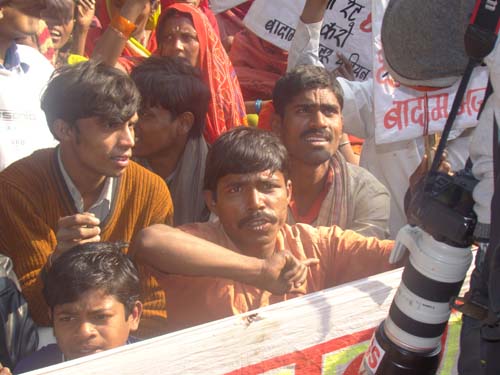
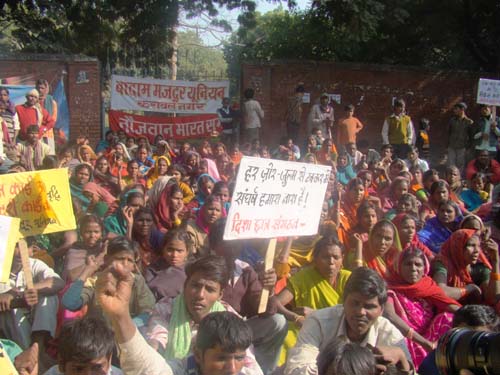
December 23, New Delhi. Nearly 2000 almond workers staged a huge demonstration at Jantar-Mantar in the afternoon under the leadership of ‘Badaam Mazdoor Union’. As is well known, approximately 20 thousand almond workers have been on strike for past one week. These workers organized themselves into ‘Badaam Mazdoor Union’ (BMU) a year ago and since then, they have been fighting for the rights to which they are entitled under various labour laws. The BMU declared strike in the almond processing industry located in Karawal Nagar which is situated in the North-East Delhi, following which 20 thousand workers’ families stopped work, who were engaged in this work. Due to this strike the entire almond processing industry of Delhi has come to a standstill. This pressure is hurting even more because these almonds come from the US, Canada and Australia to India for processing, after which they have to be sent back. These companies outsource the work of processing to India to exploit the extremely cheap labour of India. Khari Baoli, situated in Delhi, is the largest dry fruits market of Asia. The big businessmen located in Khari Baoli take contract for this processing work and then give it on subcontract to petty contractors situated in Karawal Nagar. These petty contractors get this work done by poor labourers on wages which are next to nothing. The workers are given a mere Rs. 50 for the processing of one 23 kg bag of almonds. The total profit on one bag of almonds is arount Rs. 7000. Of this profit, one share goes to the foreign company, another to the big businessmen of Khari Baoli, and yet another to the petty contractor who play in lakhs of rupees, while the workers are constantly on the verge of starvation.

Workers who came to Jantar-Mantar demanded that this almond processing industry which runs in Karawal Nagar and some other areas of Delhi should be given a formal status by the government and it should be regularized, as not a few hundreds are involved in this industry, but thousands of workers are toiling in it to earn a meagre livelihood. Ashish Kumar, Convener of BMU told the mediapersons that the contractors who are at the helm of the affairs in this industry laugh away the labour laws and exploiting the workers in a primitive and barbaric way. It is one of the most glaring example of wage slavery in modern times and that too in the heart of National Capital. For this, they have squandered away money to collude with the Police and local musclemen and political leaders. Against this dictatorship and exploitation, the workers in this strike are demanding that this industry be regularized by the government and labour laws be implemented. The second demand of the workers is that the workers should be given Rs 80 per processed bag of almonds rather than Rs 50. That would be equivalent to minimum wages. Besides, these contractors have not provided the workers with any identity card of job card due to which often they refuse to make due payments to the workers and the latter have no proofs whatsoever, to make a claim. The BMU also demanded that double payment should be made for the overtime. Apart from that, the contractors sell the rind of almonds to the workers. The workers use it as fuel to cook food. As this is a useless by-product of the process of processsing done by the workers themselves, it should not be sold to the workers. It should be given to them free of cost. The workers also demanded that the Police should lodge an F.I.R. against those goons of the employers who attacked BMU leaders and women workers with deadly weapons on the morning of December 17. Ironically enough, the Karawal Nagar Police arrested the Union leaders instead of arresting the contractors and their goons and lodged a F.I.R. against them under section 107 and section 151 and sent them to jail, from where they were released on bail on December 19. The BMU leaders also demanded action against the Karawal Nagar Police.

This strike which started on December 16, is being already hailed as one of the biggest unorganized workers’ strike in the history of Delhi. Almost 20 thousand workers’ families are involved in it. The whole almond processing industry of Delhi has been paralysed due to this strike. Due to the stoppage of almond supply, the prices of almond are increasing. On the other hand, the contractors are dreaming of crushing this huge movement of workers with the muscle power of their goons and tacit support of the Police administration. However, the workers are in no mood to surrender and they are intensifying their strike with every passing day. The BMU leadership demanded the Labour minister of Delhi and the Deputy Labour Commissioner of North-East Delhi to intervene in the matter and ensure the implementation of the labour rights of these workers. If the snatching away of workers’ rights goes on like this, then the workers will gherao the Labour Minister and Chief Minister of Delhi. It is the right opportunity for them to become cautious and implement these laws. They also warned the employers and contractors to wake up before the time runs out. They warned them not to try strength of the workers as it might cost dearly to their profit machinery. They cannot defeat organized working class power with petty street goons. They need to implement the labour laws and give the workers what they are legally entitled to.