Bhumika Chauhan talks to Shyambir, an activist with Inquilabi Mazdoor Kendra, Gurgaon
On the Struggle at Maruti Suzuki and the 18th July event – A Conversation with Shyambir
July 22, 2012 by Leave a Comment
Protest Against the Bijapur Massacre (July 31, 2012)
July 22, 2012 by Leave a Comment
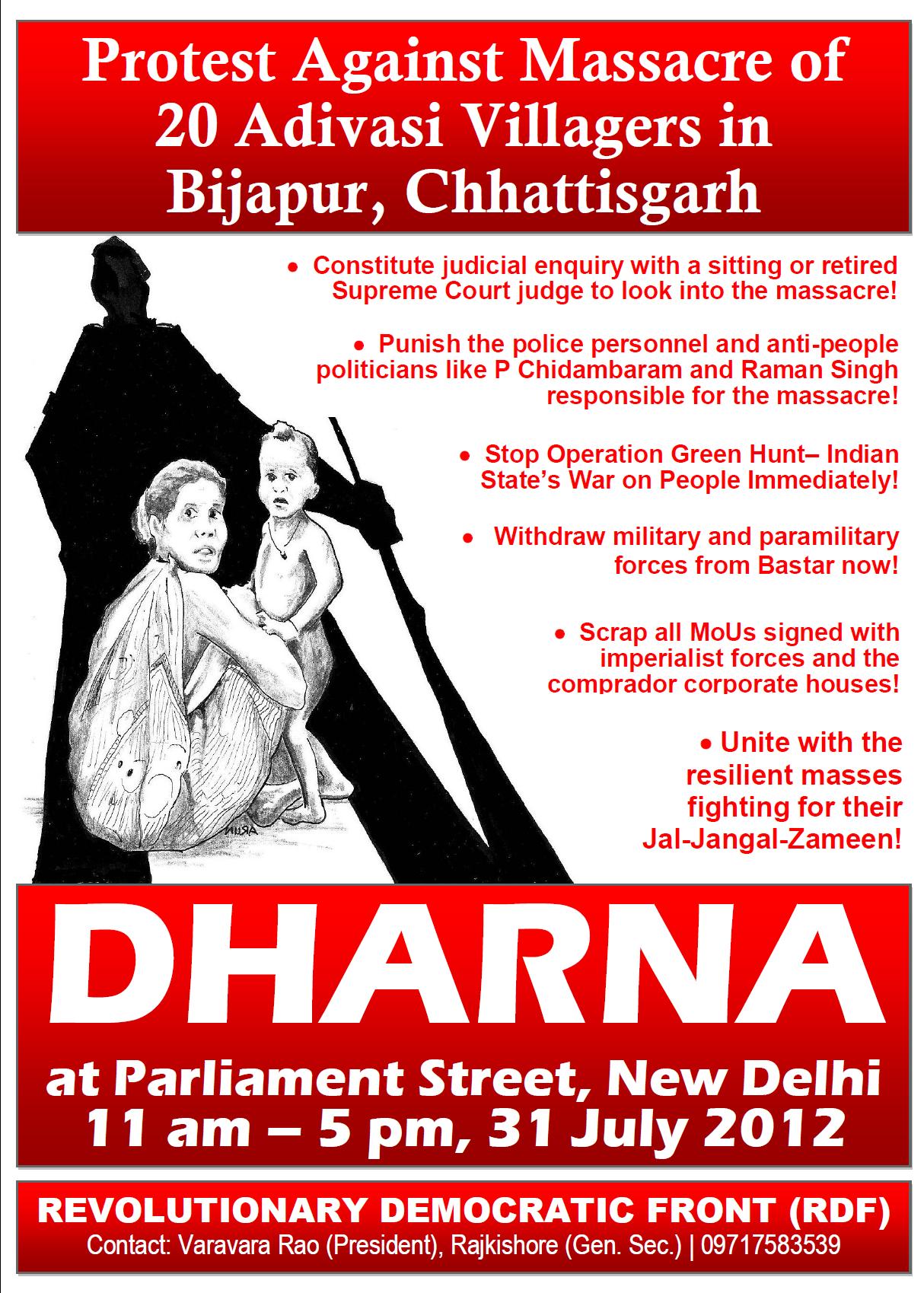
DHARNA – DEMONSTRATION
At Parliament Street, New Delhi
11 am – 5 pm, 31 (Tuesday) July 2012
The chilling incident of the premeditated massacre of 20 adivasis peasants of Sirkegudem, Kothagudem and Rajupenta in the Bijapur district of south Chhattisgarh on the night of 28 June 2012 have shocked the conscience of every democratic and freedom loving people of the subcontinent. Till date no action has been taken on the officers responsible for this cold-blooded murder. Worse was the nominal sorry rendered by P. Chidambaram in his dull academic tone followed by a regret by his CRPF chief that too when more and more glaring stories and reports started flooding the media from various independent observers and some of the conscientious journalists.
We are witness to the countless massacres of dalits, adivasis, Muslims and other oppressed sections in the subcontinent by various gangs, landlord armies and private militias in the Indian subcontinent. But what we have witnessed in Bijapur is a continuing pattern of state-sponsored massacres committed by the so-called guardians of law with impunity. Significantly in this case, we come across a scenario in Post-1947 India where the Home Minister would openly defend the criminal act of the paramilitary without batting his eyelids. Rarely do we come across a situation where the Director General of the CRPF would openly come out in defence of the criminal act of his forces. Well this sum up the lawless face of the Indian state personified in the cold and calculated sophistry of a Chidambaram and his able accomplice in Vijay Kumar the CRPF chief. But the democratic and freedom loving people of the subcontinent have seen through the white lies propagated by Chidambaram, Raman Singh the Chhattisgarh Chief Minister and Vijay Kumar the CRPF chief as more and more tell-tale reports started pouring in from independent enquiry teams of civil rights bodies and other citizens who went to the area to get first hand information.
At this juncture it becomes important that we refuse to remain silent to this brutality of the state failing which we are complacent and condemned to be silent accomplices to the terror of the state all being perpetrated in the name of development; a development ostensibly for you and me, but irreversibly and violently wipes out the vast sections of the masses of the people. Yes, it becomes important for all of us to come together and say NO to such premeditated massacres of the state and demand unequivocally that all those responsible for conceiving and executing such acts be brought to book let alone those who vehemently and unabashedly patronise such criminal acts.
• We invite you to be part of this protest demonstration to be held on the 31 July 2012 at Parliament Street from 11 am to 5 pm in which various people’s organisations, civil rights groups, intellectuals and prominent citizens from various states would participate. Your presence is very much needed at this juncture as an act of protest to strengthen the voice of the adivasis in Bastar. Unite with the resilient masses fighting for their Jal-Jangal-Zameen!
A delegation from the Dharna Site at Parliament Street will go and meet the President of India to submit a memorandum on the Bijapur Massacre with the following Demands:
• Constitute judicial enquiry with a sitting or retired Supreme Court judge to look into the massacre,
• Punish the police personnel and politicians like P Chidambaram and Raman Singh responsible for the massacre,
• Stop Operation Green Hunt– Indian State’s War on People Immediately,
• Withdraw military and paramilitary forces from Bastar now, and
• Scrap all MoUs signed with imperialist MNCs and the domestic corporate houses.
REVOLUTIONARY DEMOCRATIC FRONT (RDF)
Contact: Varavara Rao (President), Rajkishore (Gen. Sec.) | 09717583539
| Email: revolutionarydemocracy@gmail.com |
Press Statement: Maruti Suzuki Workers Union
July 19, 2012 by 6 Comments
The Maruti Suzuki Workers Union (MSWU) is anguished at the recent developments in Maruti Suzuki plant, IMT Manesar where the management has resorted to anti-worker and anti-Union activities in a pre-planned manner leading to violence and the closure of the factory yesterday.
We have had a long tough struggle with the strong unity of our permanent and contract workers to establish and register our Union last year, and had recently as of April 2012 submitted our Charter of Demands to the management of Maruti Suzuki, and the process of negotiation for wages and other demands was underway. However the management has done its utmost to derail the process since long and is trying to break the back of the spirit of unity of the workers and the legitimacy of the Union.
It is due to this, and continuing with this vindictive attitude and in a pre-planned manner, yesterday, the afternoon of 18th July, a supervisor in the shop floor abused and made casteist comments against a dalit worker of the permanent category, which was legitimately protested by the worker. Instead of taking action against the said supervisor, the management immediately suspended the worker concerned without any investigation as was demanded by the workers. When the workers along with Union representatives went to meet the HR to demand against the supervisor and revoke the unjust suspension of the worker, the HR officials flatly refused to hear our arguments, and it was in no mood to resolve the issue amicably.
When the negotiation was going on with the leaders of the Union inside the office, the management called in the entry of hundreds of bouncers on its payroll from outside the plant to attack the workers, and blocked the exit. This is completely an illegal vindictive action in the spirit of conspiracy to corner us into submission even as our demands and methods are legitimate and peaceful. The exit gates were closed by the security on behest of the management and the bouncers brutally attacked the workers with sharp weapons and arms. They, joined by some of the managerial staff and police later, beat up a number of workers who have had to be hospitalised with serious injuries. The bouncers, who are anti-social elements on hire, also destroyed company property and set fire to a portion of the factory. The gates were later opened to oust the workers and enforce a lockout by the company.
We have the workers and the company’s welfare in mind and have worked towards it after the resolution of the dispute last year, and to blame the current violence on us is unjust, which should be properly investigated. We are still keen to dialogue with the company and want to sit with the company management and the government labour department to amicably resolve the matter and restore industrial peace in the factory.
Ram Meher
President, Maruti Suzuki Workers Union (MSWU)
Academia as a site of class struggle
July 15, 2012 by Leave a Comment
Raju J Das
The recent student demonstrations in Britain, Quebec (and elsewhere) against neo-liberal education cuts (and fee increase) is an encouraging sign of sentiments of legitimate class anger brewing among students. This prompts one to think critically about academia as such. The academia must be a site of class struggle. And funding cut is only one issue. There are major problems with the academia itself. Students should fight not just for more educational opportunities, for an educational system that is not to be treated as a commodity. They should critically think about the very content of education being given to them by their professors.
One of the problems with the academia – universities, research institutes, etc – is that it is a great ‘leveller’, a ‘bourgeois-democratic terrain’. Take any topic, say, child labour. Lots of professors talk about the social-cultural identity of children (e.g. what does it mean to be a younger person, and all that). If you, as a Marxist, question them saying, what about how capitalism creates conditions for child labour to exist, these academics would say ‘yes, that is one approach, and ours is another’. Take the environment. Nature/environment gets transformed into ideas about nature/environment. So, anything and everything goes.
Marxism, as Terry Eagleton correctly remarks in Why Marx was right is ‘the most theoretically rich, politically uncompromising critique of … (the capitalist) system’. Marxism, however, gets constructed as one among several approaches. Irrespective of the intellectual merit of an approach, all approaches are considered valid within academic, on an apriori basis. Often, approaches which have little to do with Marxism at all are constructed as Marxism with a pre-fix (as in ‘post-Marxism’): those who do this practice double standards. They want to enjoy some prestige associated with Marxism’s rigour while denying the validity of every major principle of Marxism’s theory and politics. The history of the academic world, of production of social knowledge, appears to be a history of running away from the class question and its politics which define Marxism.
The effect is this: Marxism is forced to live in peaceful coexistence with other ideas. Here is the problem though: Marxism cannot naturally live that mode of life. No peaceful existence is possible (just as socialism in one country co-existing with capitalism in other countries is such a stupid idea in theory and practice).
There are only two types of approaches in the world, as Lenin says in What is to be done: socialist/Marxist and capitalist. Because Marxism lays bare the exploitative, destructive and oppressive character of capitalism which is the most dominant feature of our life, which is the most important cause of major world problems, therefore Marxism must be the dominant approach in society. To think otherwise is to fool ourselves.
It is not the friendly battle of ideas – Marxism vs the rest – that leads to this sort of peaceful coexistence. It is partly the structure of the academia which allows this to happen. And it is a structure whose main function is to reproduce capitalism and blunt class struggle.
Within this structure, then the agency of non-Marxists to weed out Marxists in various ways works. Within this structure, what works is the agency of bourgeois professors – which is what nearly all the professors are, although sometimes they give themselves a ‘critical’ name – in imposing nonsense and semi-ignorance, packaged as knowledge, on ‘helpless’ students (who constitute a ‘captive market’). This includes making students or encouraging them to do intellectually non-stimulating and politically infertile research, by making them read nearly-rubbish things in the class room, by holding out the threat of a low grade if students write radical stuff about society, and so on. Many students, thankfully not all, are complicit in this sort of game being played.
Within this structure – the supposedly democratic terrain – some ‘Marxists’ also get seduced and turn to non-Marxism (in the name of theoretical innovations to be peddled in the knowledge-market) or do not critically object to the non-Marxist nonsense on the pretext of collegiality, etc. This collegiality is in a way a reflection of crass class-collaborationism on an ideological plane: to the extent that non-Marxists represent the interests and ideas of the bourgeoisie and to the extent that Marxists represent the interests of the working class, poor peasants and all those still engaged in communal modes of life, collegiality is equal to collaborationism which is given a sweet-sounding name.
It is said that professors’ research should inform their teaching. But what kind of research do professors indeed do? To the extent that professors’ research is driven by a critical agenda – and note that being critical is as mandatory as younger students taking a writing course – their critique is a critique of those aspects which can be changed a bit: talking about things which cannot be changed are off their radar and therefore of their students. Professors ‘find fault’ with society (more accurately, they find fault with superficial aspects of society which can be modified a bit through the drama of so-called human agency as expressed in the form of NGOs, governmental action or union bureaucracy). But they get very edgy if someone points fingers at them. Much of their research agenda is primarily driven by whether their research will, for example, obtain a grant in the grant market, whether from business or from a bureaucratic state, which often sets its own agenda for giving money, and whether their research conforms to the agenda (‘strategic research plan’) of their institutions. Much of the research – funded or not – celebrates economic individualism or cultural individualism (the identity stuff, abstracted from the sheer material conditions). Poverty is replaced by ideas about poverty. The child is replaced by ideas about the child. And so on. Research has attained magical powers. If some workers think that they are not workers, the professor declares that the working class as a reality does not exist, and therefore class is as defunct as Stalinist USSR. By touching the keyboard on their laptops, professors can make an entire reality disappear at an instant.
Much of the research even by so-called critical scholars is about everything else other than capitalism’s class and systemic character. Research is about how to make the existing society look a little progressive on the basis of a little gender parity here, racial or regional equality there, and so on. Much research is purely descriptive: attempt to find causes of things is not a worthwhile project any more. No need to penetrate the structure of the world. Penetrate the minds of people around you. The entire reality is there. What and how people think about things is the main thing. ‘Ies’ (geographies, sociologies), ‘ality’ (governmentality), and a plethora of similar words decorate the academia, which signify multiple realities and social (=mental/emotional, etc.) construction of realities.
If a student garnering some courage tries to talk about class, or the state, the immediate response of the professors is: that’s old stuff or that is too orthodox or that has been done. ‘Do new things, man!’ is what a student is told. What to research is not to be determined by the lives and struggles of ordinary people, by people in their flesh and bones, as they produce and reproduce their lives. What to research is to be determined by ‘silences’, by what has not been researched (I will not be surprised to see a research project that will study the physical and socially constructed average distances among people defecating at dusk on the outskirts of a village in India).
The ‘democratic’ character of the academia will be put to test if lots of professors honestly follow the Marxist approach in a university. One or two Marxists can be allowed in a University as a token existence of radical dissent. The ‘law of dialectics’ will work if the number becomes large, too large. The quantity will change into a quality. The democratic character of the academia will also be tested if students start challenging their bourgeois professors, including in terms of what they make the students read and what is the content of what professors say in the class-room (which is supposedly based on their research). It is not too difficult to see students at the forefront of a renewed class struggle.
Raju J Das teaches at York University, Toronto.
Protest Demonstration Against the Massacre of Adivasis of Bijapur
July 14, 2012 by Leave a Comment
Join Joint Protest Demonstration Against the Massacre of Adivasis of Bijapur
Date: 17th July (Tuesday) 2012, Time: 11 AM
Place: Chhattisgarh Bhavan, Chanakyapuri, Delhi
Recently the Indian state has intensified its eviction and extermination campaign against the adivasis of central and eastern India under the rubric of Operation Green Hunt. On the night of 28 June 2012 when the adivasi peasants of Sarkeguda, Kottaguda and Rajpenta (Bijapur district of south Chhattisgarh) gathered to plan the performance of the traditional festival Beej Pandum (seed festival), they were surrounded by hundreds of Police and Para-military forces of the Indian state. The armed forces resorted to indiscriminate firing killing 17 adivasis (including 6 minors) cold-blooded. Two other villagers were likewise killed near Jagargunda village of Sukma district in the same night, and predictably, were shown as casualties of an ‘encounter’ between the Maoists and the armed forces.
As the testimonies of the eyewitnesses coming through the Media, Fact Finding Reports of different Civil / Democratic Right Teams and the statements of different social-political forces (including the Congress Party of Chhattisgarh) now confirm that the killing of the adivasis was a heinous massacre committed by the Cobra battalion of the CRPF and the Chhattisgarh Police, under the command of top police officials. Even the Union Tribal Minister Mr. K C Deo has said that ‘17 innocent citizens, who were unarmed, who were wearing just a dhoti or a baniyan and who did not even have a sickle or a knife’ had been killed by the CRPF.
But still the central Home Minister and the top officials of CRPF are claiming that these adivasis have been killed in a “fierce” gunfight in the dense jungles of Dantewada on June 27-28 in a joint anti-Maoist operation by the CRPF and state police. This is really a matter of grave concern for all the justice loving progressive and democratic forces of our country.
We, the under signed progressive, democratic and civil rights organizations working in Delhi have decided to show our anguish and concern in front of Chhattisgarh Bhavan, Chanakyapuri on 17th July 2012 at 11 AM, in the form of a Protest Demonstration.
We earnestly appeal to you / your organization to join us at Chhattisgarh Bhavan to make the protest programme successful. Hope your positive responses.
All India Federation of Trade Unions (New), Inquilabi Mazdoor Kendra, Krantikari Naujawan Sabha, Krantikari Yuva Sangathan, Mazdoor Patrika, National Confederation of Human Rights Organisations (NCHRO), Peoples’ Democratic Front of India (PDFI), People’s Union for Civil Liberties (PUCL), People’s Union for Democratic Rights (PUDR), Radical Notes, Sanhati-Delhi, Students For Resistance, Vidyarthi Yuvjan Sabha
Against erratic and unequal distribution of water in Delhi
July 12, 2012 by Leave a Comment
Hassled and angry residents of Baljeet Nagar
protest against Delhi Jal Board
Protestors question erratic and
unequal distribution of water in the city
On the morning of July 11, hundreds of angry residents from working class colonies in Anand Parbat/Baljeet Nagar area, as well as activists from Krantikari Yuva Sangathan (KYS), Workers Unity Centre (WUCI), Anand Parbat Udhyogik Mazdoor Samiti, Centre for Struggling Women (CSW), etc., took out a rally which culminated at Shadipur Depot. The residents were protesting against the erratic and unequal distribution of water by the Delhi Jal Board (DJB) across the city of Delhi. The agitating residents strongly believe that the brunt of this unequal distribution of water is borne by the city’s poor who reside in colonies which are supplied water not through pipelines but through tankers.
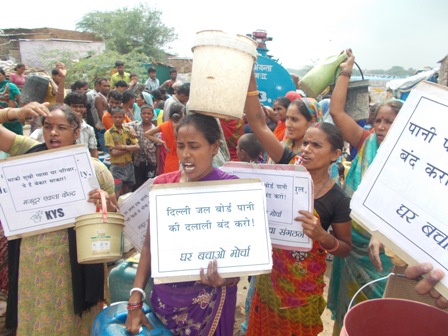
After sloganeering against the DJB, a delegation submitted a Memorandum to the DJB. The delegation pressed for the following: (i) water supply to households in the entire Anand Parbat/Baljeet Nagar through pipelines; (ii) provision of 120 litres per person per day; (iii) provision of a larger number of tankers, as well as a greater frequency of tankers every week; (iv) provision of free and bribe-free water supply via tankers; and (v) immediate implementation of rain-water harvesting, boring and other effective projects to meet the residents’ needs.
There are over one lakh residents living in the affected area, i.e. in colonies like Prem Nagar, Nehru Nagar, Tali Dera, Chetan Basti, Punjabi Basti, Gulshan Chowk, etc., with some 20,000 belonging to the two large slums located in this area. Despite the density of the population, it seems that because the residents share a predominantly working class background, the Delhi Jal Board (DJB) has never considered supplying water through pipelines to this area. Water is instead supplied to the area via water tankers. Earlier, these tankers used to provide water to the said colonies on alternative days. However, off late the tankers have become so erratic that at many water supply points they come barely once a week. Neither does the DJB invest in rain water harvesting, or pursue other projects to meet the needs of these residents.
According to the protesters, this current state of affairs is not merely the result of a shortage of water tankers. In fact, it is more the result of the DJB coming under control of the water mafia and private contractors. For example, tankers are increasingly providing water at earmarked supply points only when bribed to do so—a process which goes unchecked and creates ample space for private suppliers of water to exploit the needs of the people. As explained by Shri Alok Kumar from Workers Unity Centre (WUCI) who addressed the gathering, “by not maintaining a sufficient fleet of its own tankers, the DJB has gradually allowed a powerful group of private contractors and mafia to step in and provide water at high prices through which they make highly profitable business out this essential service. We believe that this on-the-ground functioning of the DJB reflects nothing but further privatization of water supply and distribution in Delhi.”
In addition to this, the privatization of water supply in the city is also reflected in the recent scams involving water treatment plants like the tender for Bhagirathi Plant where irregularities amounting to 200 crores were reported. Clearly, when issuing tenders involving water projects, the interests of private players play a significant role. Due to their involvement in such water supply and distribution projects, private contractors have now come to determine the quality of the water treated, as well as time taken to put such projects in place. Furthermore, under the influence of neo-liberal economic policies which press for privatization of the social sector (i.e. education, healthcare, etc.) as well as natural resources, successive governments have even sold water reservoirs and other water bodies at throwaway prices to private companies. Such private companies are either interested in the business of packaged water, or, desire direct access to a water source for their manufacturing plants. Private players have, hence, firmly wedged themselves in numerous ways between Delhi-ites need for water and water itself.
The impact of this growing privatization of water supply is most clearly reflected in the creation of an artificial water shortage in the city. On one hand, wealthy residential areas in the city like Jor Bagh, Sundernagar, Sainik Farms, etc. receive uninterrupted supply of water amounting to 450 litres per person per day, and on the other hand, nearly 50 lakh people in the city survive on just 40 litres per person per day. Similarly, it is difficult to uphold the theory of Delhi’s acute water shortage when big hotels, water/adventure parks, etc. enjoy generous supply of water. “If there is always plenty of water for some and never enough for the majority, then we are dealing with a biased policy approach and not an ecological problem,” asserted Sujit Kumar from KYS.
Before dispersing the protesting residents resolved to intensify their struggle, and to launch a larger public campaign across Delhi’s working class areas.
Alok Kumar
Convenor,
Ghar Bachao Morcha
Protest against a Cut-off System in +2 admissions
July 12, 2012 by Leave a Comment
Government School Students Protest Against the Recent Government Circular Introducing a Cut-Off System in Class XIth Admission
KYS Spearheads Protests in Three Different Zones Against the Circular
Future of Thousands of Poor Students in the Doldrums
Today on the morning of July 11, hundreds of agitated government school students, their parents, as well as activists from Krantikari Yuva Sangathan (KYS), protested against the recent circular released by the Delhi Government’s Directorate of Education. Three different protests were held outside three separate government schools, i.e. outside Government Senior sec. School (Sangam Park), Government Sarvodaya Bal Vidyala (Nangloi), and Government Senior Secondary School No. 1 (Patel Nagar).
The contested Circular is extremely problematic because it has for the first time introduced a very high cut off for government school students who are entering class XIth (eleventh) in the Commerce and Science streams. This cut off is being implemented across the various government schools with immediate effect, and has created havoc with the young students’ lives. The immediate effect of this Circular has been that a large section of youth who are from working class families and are dependent on government school education, are being denied admission to these streams in government schools where they have been studying for years. More importantly, because a large number of these students cannot make it to the high cut offs, there is tremendous rush for admission in government schools offering Humanities/Arts stream.
Running pillar to post, the despairing students and their parents have decided to fight back and compel the Delhi Government to withdraw the Circular. Shri Sujit Kumar, KYS State Executive Committee Member, visited to all three protest venues and addressed the students. In his address he highlighted how the recent Circular was nothing but an attempt to further privatize school education. “When working class youth are ousted from government schools and denied their constitutional right to education, then where will they go—either they will be forced to drop out or to enrol in private schools where they will struggle daily to pay the high fees,” explained Sujit Kumar.
Indeed, the circular is a black spot and mockery of the recently implemented Right to Education (RTE), for it is assisting in keeping a large section of needy youth their right to education. Instead of increasing the number of its secondary and senior secondary schools, it is shocking that the Delhi Government is spearheading an unhealthy process like introduction of cut offs for admission to Class XIth. All this is clearly a big boost to the already on-going process of privatization of education.
Meeting with the authorities of the three concerned government schools, the delegation of students and KYS activists appealed to the respective Principals to write to the Directorate of Education, requesting for the recall of the circular. Realizing that the matter would need to be raised at the higher administrative level, the protesters decided to carry out a campaign and reach out to other affected government school students. If the aforementioned Circular is not withdrawn then a large demonstration will be organized against the Delhi Government to protest against its anti-poor students’ policies.
Open Letter to HRD Minister on the problems of working class youth and students
June 26, 2012 by Leave a Comment
To,
Shri Kapil Sibal
The Hon’ble Minister
Human Resource and Development Ministry
Government of India.
26.06.2012
Respected Sir,
We write to you as part of our initiative to apprise the general public of this country of the multifarious and crippling problems faced by working class youth who wish to pursue higher education. We realize that your own privileged social background, as well as your current political association, will, in all probability, prevent you from pursuing a sympathetic assessment of our concerns. However, we still appeal to your authority and sense of humanity, and ask your office to consider the following facts and concerns highlighted by us.
Sir, it is a well-known fact that the majority of working class youth of this country end up studying in government schools, and despite our best efforts, we still lag behind students who are able to pursue their education from expensive and reputed private schools. It is not that we do not labour and study diligently. In fact, because we belong to working class families, we are well aware of the value of labour. Working hard to survive is strategy taught to us from birth, and it is the principle we follow even when it comes to studies. However, it is clear to us that despite the valuable contribution made to the economy by the working masses, their children’s educational rights are assigned little value. Majority of the government schools we study in are divested of proper resources like adequate teachers, supply of teaching aids, good infrastructure, etc. This dismal condition at the school level is aggravated by the extremely precarious conditions in which we live.
The large majority of our families live in one room apartments because of the meagre wages earned by us and our parents. And needless, to say most of this housing is situated in the city’s slums and JJ colonies—many of which face the threat of demolition. In fact, many of us who are writing this letter have watched our homes being destroyed by bulldozers during our twelfth class examinations this year. Even if we want to rise above all these obstacles and problems such as the temporariness of our homes, we find ourselves severely handicapped by the simple fact that our families cannot afford tuitions. Forced to pay high rents and to meet rising prices of essential commodities, our parents are unable to put aside money for tuitions, or to purchase much-needed study material. Sadly, despite their desire to see us perform well, our parents are sometimes compelled to ask us to work as well, in order to contribute to the family income.
This brings us to the question of how successive governments have failed to address these disadvantages faced by working class youth, and have consciously denied us adequate opportunities at the level of higher education. Sir, we strongly believe that your government’s support for the dual education system, and thereby, its promotion of privatization of education, is a major source of our ruination. By encouraging the private schools on the one hand, and, on other hand, not investing sufficiently in government schools, the government is consciously creating a condition in which affluent students of private schools (who have had access to the best facilities, teachers, as well as tuition) get the lion share of seats made available at the level of higher education. Hence, the current government education policy is such that higher education has become out of reach for majority of this country’s youth, i.e. youth belonging to the working masses. It is extremely disturbing that the government provides subsidized education only till the school level. Beyond school education, the government adamantly refuses to utilize public money in a manner which makes subsidized higher education available to working class youth. Instead, the doors to higher education are opened only to the select few who have proved to be “meritorious”, i.e. those who have undergone private schooling, and hence, have the marks.
Clearly, this skewed education policy which has existed for years, has ensured that only 5 to 7 per cent of youth make it to the level of higher education (see National Sample Survey). In actuality, a large share of this 5 to 7 per cent comprises of middle and upper-middle class youth. The working class do not get a seat in the regular colleges and are forced to pursue higher education from correspondence and non-collegiate higher education boards. Needless to say, correspondence courses, etc. represent the poorly invested sector within the higher education field—a fact well highlighted in the kind of teaching provided, the lack of classroom infrastructure and the poor performance of correspondence students. The above-mentioned figure of 5 to 7 per cent also reflects the simple fact that governments like yours, perceive higher education as an opportunity which should be provided to the minority and not to the masses. After all, an inclusive, mass higher education program would not allow the system to reproduce workers from amongst the society’s youth, because if every youth was to pursue a BA or B.Sc. course, who would line up outside the city’s factories for a job.
Having said this, we would like to reiterate how misplaced your concern for last year’s and this year’s cut-offs has been. In 2011, when some prestigious Delhi University (DU) colleges declared cut-offs that touched 100 per cent, you expressed grave concern and assured the public that such cut-offs would not be repeated. Back then, and even today, the impact of such cut-offs on working class youth, is something you failed to consider. While your government is satisfied with the fact that the same cut-offs have not been repeated this year, can you claim that under this year’s cut-offs, working class youth will also make it to the Delhi University? And does your decision to allow the entry of foreign, private universities provide a solution to the concerns raised by working class youth? The answer to both questions is a definite no.
Firstly, despite cut-offs that are below the magic 100 per cent figure, the majority of youth who are coming from government schools, will still not get admission in universities like DU. Why would we, when the quality of education provided to us in government schools allows us to barely pass the Board examinations. It is here that we would like to highlight the bitter irony of the higher education system—public money is being used not for the betterment of those who most need it, but for those who are from the affluent sections of society, have got the best, and have, hence, scored the most. At this point, you may like to argue that some government school students do make it to higher educational institutions. However, we would like to highlight how this is a misconception yet again. The tremendously small segment of working class youth who make it to the level of higher education, often fail to perform (complete their course, to score well, etc.) because of the lack of essential, complementary facilities like remedial coaching and scholarships. There are, in fact, numerous instances of working class youth being unable to pay their tuition fees.
Secondly, further privatization of higher education via entry of foreign universities, etc. is far from a solution to the on-going problem. It will only result in more private players entering the field of education in the bid to misuse a social need for private, business greed. Education will all the more become an opportunity to be provided to those who can buy it. And lastly, it is only with greater investment in education by the government that the current situation can be improved. The building of more government subsidized schools and colleges, rather than paving the way for expensive foreign universities, is the permanent solution.
High cut-offs and less number of seats are problematic in many ways. For example if there are less number of seats overall, the reserve seats will be lower. Thus reservation which was a constructive policy to bring out Dalits from the villages and traditional occupations would remain an empty box as a large number of students will not get a seat. For example in Delhi University there are 12000 odd seats reserved for SC/ST candidates whereas the number of applicants are around 24000 i.e. double the number of seats. Thus a large number of students from the reserve category are forced to go back to their villages and continue with traditional occupations. This would deny not only upward mobility but also makes Dalit students prone to caste oppression and atrocities in the villages.
Of course, such long term solution need to be supported by immediate relief measures that cater to the concerns and needs of the majority of this country’s youth. One such immediate solution which we put forward and for which we seek government intervention, is the provision of 80 per cent reservation for government school students in every category, i.e. in the general category, SC-ST category, PH and OBC category. We appeal to you and to the society at large to understand and engage with the voice of the majority. Let us not reduce education to the question of who can afford it, and let us not reduce the novel concept of subsidized education to a mockery whereby it is used to provide educational advantages to those who are already way ahead in the race. We appeal to your conscience, and ask you to transform education structure into a truly mass phenomenon in which those who are most disadvantaged, are given an equal opportunity to transform their lives via education.
KRANTIKARI YUVA SANGATHAN (KYS), DELHI UNIT OF ALL INDIA REVOLUTIONARY YOUTH ORGANISATION, T-44, Near Gopal Dairy, Baljeet Nagar, New Delhi-110008. Ph. : 9312654851 , 9313343753
High Cut-Offs Burnt by Government School Students
June 26, 2012 by Leave a Comment
Sujit Kumar & Dinesh Kumar, KRANTIKARI YUVA SANGATHAN (KYS), DELHI UNIT OF ALL INDIA REVOLUTIONARY YOUTH ORGANISATION, T-44, Near Gopal Dairy, Baljeet Nagar, New Delhi-110008. Ph. : 9312654851, 9313343753
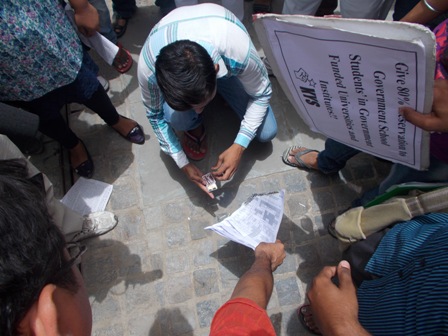
High Cut-Offs Burnt by Government School Students!
Government School Students Demand 80% Reservation in Government-Funded Institutes and Universities!
Government School Students and their Parents Agitated over the Fact that Cheap Public Funded Education is Beyond Their Reach!
An Open-Letter is also sent to HRD Ministry for Immediate Intervention!
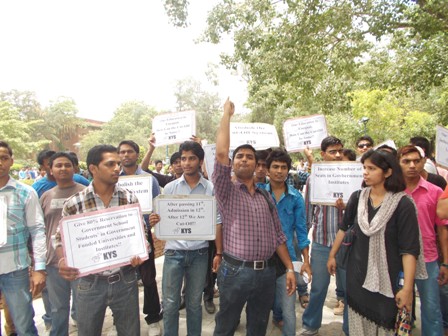
Today (June 26) a large number of government school students, their parents and progressive individuals protested against the high cut-off for admission in Delhi University. The colleges of DU declared their first cut-off for admission to various courses on Tuesday. With this the wait is formally over as far as the procedure to get oneself admitted in a college was concerned. However getting a seat secured in a college/course still remained a distant dream for many as the cut-offs have sky-rocketed beyond the expectations. However this is not something which is unique to this years’ cut-off. Every year cut-offs are so high that government school students are not able to get a seat in the institutes of higher learning. Our organization firmly believes that the cut-offis nothing but a calculated policy to keep the higher education beyond the reach of students from government schools, an overwhelming majority of whom come from socio-economically deprived backgrounds. These students have also sent an open-letter to HRD Ministry for immediate intervention.
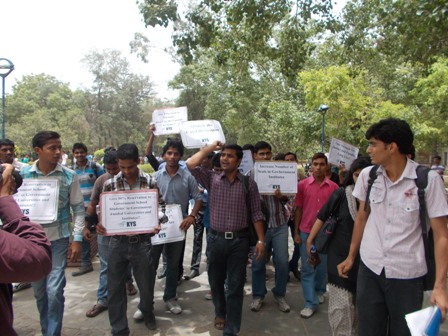
It is important to note that the higher cut-offs eliminates the chances of government school students in the institutes of higher learning and the only recourse left to them is to do some technical certificate and diploma courses and become a source of cheap labour in the market. Also interesting is the fact that the government has not only continued with the dual education system but has kept the same cut-off for government and private schools.It is an undeniable fact that students from private schools with better teaching and coaching facilities get higher marks and the domain of government funded higher education becomes virtually theirs as there are a very limited number of seats. Whereas the students from government schools always have to kill their ‘ambition’ without anyone noticing the fact that the race was unequal from the start. The bad result of these government school students is a result of the larger policy issue. Most of the government schools students lack basic facilities and have insufficient number of teachers (mostly in science and commerce courses) which is magnified by their home environment as most of these students are first generation learners and mostly live in a single rented room with the entire family. The unavailability of sufficient teachers forces the students to go for unregulated tuitions which not only creates havoc of their career but promotes the privatization of education. It is high time that government should undertake its responsibility of ensuring that a large section of students is not denied higher education due to loopholes in the policy. We demand an immediate enactment of a policy that provides marks relaxation/reservation to students of the government schools in the publically funded institutes of higher learning. We do understand that the reservation cannot be a permanent solution. Therefore the government must abolish the dual system of education with private schools students with all sorts of facilities getting the fruits of cheap higher education on the one hand and on the other the government school students from socio-economically deprived background and lack of good learning facilities remaining outside the domain of higher learning. We also demand that the government should increase the amount of budget spent on higher education for the children of working masses.
It is to be noted that in India the number of students who go for higher education are abysmally low. Only 7 percent of the students who pass 12th standard go for higher education. Even these seven percent students do not get to study the courses and colleges of their choice, and only a very small number of students from them get seats in regular colleges. Most of the students end up doing their study through correspondence or distance learning. In Delhi University there are only 54000 seats whereas 146000 have applied for admission. Thus around a lakh students will be denied admissions. It is important to note that these students are aspirants yet they will not be given admission due to less number of seats. Isn’t it ironic that even from a small number aspirants a large number is denied admission. Most of students who are denied admission are from government schools and are first generation learners. Thus denying them admission eliminates their scope for upward mobility.
High cut-offs and less number of seats are problematic in many ways. For example if there are less number of seats overall, the reserve seats will be lower. Thus reservation which was a constructive policy to bring out Dalits from the villages and traditional occupations would remain an empty box as a large number of students will not get a seat. For example in Delhi University there are 12000 odd seats reserved for SC/ST candidates whereas the number of applicants are around 24000 i.e. double the number of seats. Thus a large number of students from the reserve category are forced to go back to their villages and continue with traditional occupations. This would deny not only upward mobility but also makes Dalit students prone to caste oppression and atrocities in the villages.
We demand:
1. 80% reservation for government school students in public funded institutes and universities.
2. Immediate increase in number of seats in institutes of higher learning.
3. Increase in the amount of budget spent on education.
4. Abolition of the dual education system.
5. Hostel facilities for all the students from socio-economically deprived background.
Greece: Vote for Antarsya and a Transitional Programme
May 27, 2012 by Leave a Comment
Dave Hill
In this paper I argue that Antarsya should not join Syriza in an electoral coalition or joint list, but that Antarsya should fight the elections and continue to stick with and advance its Transitional Programme.
Antarsya should announce, in advance of the June 17 parliamentary elections that it will support a Left government and hold it to its programme, while pushing for a more socialist programme such as repudiation (rather than negotiation) of the debt, nationalisations of privatised industries and the banks.
For Antarsya to continue with its Transitional Programme.
1. Programme and Strategy
The type of Programme demand by revolutionary Marxists and by Parties (such as Socialist Resistance in Britain, and OKDE in Greece) within the Fourth International is related to Strategy, i.e., whether to support the
(1) Broad Party concept strategy or
(2) the Revolutionary Unity strategy or (I guess)
(3) a revolutionary sectarian/ us alone policy
The implications can be seen in, for example
France (whether in the first round of the 2012 Presidential elections to support the (left social democrat) Front de la Gauche of Jean-Luc Melenchon, or whether to support the NPA)
The UK (what to do about the Manchester Central and other parliamentary by-elections) and more widely, to work in broad parties such as Respect, to work in broader coalitions such as the Coalition of Resistance (with, for example, the Green Left, other Greens?, Left Labour MPs and supporters), or whether to work with avowedly Marxist parties and individuals in organisations such as TUSC
In Greece, whether to support Syriza or Antarsya in the upcoming elections of 17 June and what advice we should give to OKDE, the Greek section of the FI, regarding whether Antarsya should (i) fight the elections alone, or (ii) as part of Syriza, or (iii) alone but saying we will support (and join? or support and not join) a Syriza led government (which, if it happens, will likely be in government coalition with the Democratic Left (of Fotis Kouvelis).
2. Minimum, Maximum and Transitional Demands (how to get from minimum to maximum)
The Death Agony of Capitalism: and the Tasks of the Fourth International
The Mobilization of the Masses around Transitional Demands to Prepare the Conquest of Power (1938). Trotsky explains,
The strategic task of the next period – prerevolutionary period of agitation, propaganda and organization – consists in overcoming the contradiction between the maturity of the objective revolutionary conditions and the immaturity of the proletariat and its vanguard (the confusion and disappointment of the older generation, the inexperience of the younger generation. It is necessary to help the masses in the process of the daily struggle to find the bridge between present demand and the socialist program of the revolution. This bridge should include a system of transitional demands, stemming from today’s conditions and from today’s consciousness of wide layers of the working class and unalterably leading to one final conclusion: the conquest of power by the proletariat.
Classical Social Democracy, functioning in an epoch of progressive capitalism, divided its program into two parts independent of each other: the minimum program which limited itself to reforms within the framework of bourgeois society, and the maximum program which promised substitution of socialism for capitalism in the indefinite future. Between the minimum and the maximum program no bridge existed. And indeed Social Democracy has no need of such a bridge, since the word socialism is used only for holiday speechifying. The Comintern has set out to follow the path of Social Democracy in an epoch of decaying capitalism: when, in general, there can be no discussion of systematic social reforms and the raising of he masses’ living standards; when every serious demand of the proletariat and even every serious demand of the petty bourgeoisie inevitably reaches beyond the limits of capitalist property relations and of the bourgeois state.
The strategic task of the Fourth International lies not in reforming capitalism but in its overthrow. Its political aim is the conquest of power by the proletariat for the purpose of expropriating the bourgeoisie. However, the achievement of this strategic task is unthinkable without the most considered attention to all, even small and partial, questions of tactics. All sections of the proletariat, all its layers, occupations and groups should be drawn into the revolutionary movement. The present epoch is distinguished not for the fact that it frees the revolutionary party from day-to-day work but because it permits this work to be carried on indissolubly with the actual tasks of the revolution.
The Fourth International does not discard the program of the old “minimal” demands to the degree to which these have preserved at least part of their vital forcefulness. Indefatigably, it defends the democratic rights and social conquests of the workers. But it carries on this day-to-day work within the framework of the correct actual, that is, revolutionary perspective. Insofar as the old, partial, “minimal” demands of the masses clash with the destructive and degrading tendencies of decadent capitalism – and this occurs at each step – the Fourth International advances a system of transitional demands, the essence of which is contained in the fact that ever more openly and decisively they will be directed against the very bases of the bourgeois regime. The old “minimal program” is superseded by the transitional program, the task of which lies in systematic mobilization of the masses for the proletarian revolution.
Alistair Mitchell (1985) has a good enough summary of the three different types of programme
Marx and Engels didn’t just call for the introduction of a socialist society (the maximum programme) without charting the way of getting there. Neither did they merely advocate reforms which fell way short of breaking from capitalism (the minimum programme). The key to their method lies in the extract quoted above with its steps which are by themselves inadequate, but through the workers’ struggle for them lead to other attacks on capitalism. These further measures become possible and necessary as the workers gain in confidence and rally others to their side, learn the next steps required and challenge a weakened and retreating ruling class. The method of Marx and Engels is to connect the present situation and immediate aspirations of the proletariat with the task of the socialist revolution. The minimum and maximum programmes are linked in a transitional programme’.
As Wikipedia summarises,
It is necessary to help the masses in the process of the daily struggle to find the bridge between present demand and the socialist program of the revolution. This bridge should include a system of transitional demands, stemming from today’s conditions and from today’s consciousness of wide layers of the working class and unalterably leading to one final conclusion: the conquest of power by the proletariat.
Trotsky urges that transitional demands should include the call for the expropriation of various groups of capitalists – sometimes translated in modern terms into the nationalisation of various sectors – under the control and management of the workers. Transitional demands should include opposition to imperialist war. Such demands intend to challenge the capitalist class’s right to rule.
By fighting for these “transitional” demands, in the opinion of the Trotskyists, the workers will come to realize that capitalism cannot meet their needs, and they will then embrace the full program of the Fourth International.
3. Antarsya, Syriza and Greece and the elections of 17 June 2012
Now let’s apply this to Greece
Syriza Programme following the May 6 elections (taken from the Coalition of resistance website, 9 May)
* The immediate cancellation of all impending measures that will impoverish Greeks further, such as cuts to pensions and salaries.
* The immediate cancellation of all impending measures that undermine fundamental workers’ rights, such as the abolition of collective labor agreements.
* The immediate abolition of a law granting MPs immunity from prosecution, reform of the electoral law and a general overhaul of the political system.
* An investigation into Greek banks, and the immediate publication of the audit performed on the Greek banking sector by BlackRock.
* The setting up of an international auditing committee to investigate the causes of Greece’s public deficit, with a moratorium on all debt servicing until the findings of the audit are published.
Or in the words of Andrew Burgin and Kate Hudson on the Socialist Unity website, 12 May,
• Cancelling the bailout terms, notably laws that further cut wages and pensions
• Scrapping laws that abolish workers’ rights, particularly a law abolishing collective labour agreements due to come into effect on 15 May
• Demanding proportional representation and the end to the 50 seat bonus to the first party
• Investigating Greece’s banking system which received almost 200bn euros of public money and posing the need for some kind of state control over the banks
• Setting up an international committee to find out the causes of Greece’s public deficit and putting on hold all debt servicing.
Analysis: What type of Programme is Syriza’s
I thought the 5 point plan put out for negotiation by Syriza serves well as a socialist minimum, defensive, programme.
In other countries such a plan would (currently, with existing states of political and class consciousness) be considered more than a minimum programme, but such is the state of political and class consciousness in Greece currently that this can be regarded as a minimum programme. However, it can also be analysed as a left social democratic programme, and this is my view of what it is. A huge advance on neoliberal, neo-conservative pro-austerity programmes of ND and PASOK for example, but Syriza says, essentially, overall… `no more cuts’… it does not say,` reverse the cuts! Restore the wages and pensions’.
The View of By Christos Kefalis, May 10, 2012 – Links International Journal of Socialist Renewal
SYRIZA aims to rescind the “Memorandum” and renegotiate the debt, which will include cancelling a large part of it as odious. It also demands a three-year suspension of debt obligations, which would provide important relief, if achieved. SYRIZA’s aims include nationalising a number of banks, heavier taxation of the rich and restoring the people’s living standards. SYRIZA leader Tsipras has proposed a five-point program which concretises this.
`When I interviewed a SYRIZA spokesman earlier this year I explored the problem of a far-left party, which is anti-NATO etc, taking power in a country whose riot police have been regularly clashing with that party’s youth since 2008. The message was that they would be purposefully limited in aim, and that the core of any programme would be a debtor-led partial default – that is, the suspension of interest payments on the remaining debt and a repudiation of the terms of both Troika-brokered bailouts. What SYRIZA shares with the Dem Left and PASOK it its commitment to the EU social model: they are left globalists’
… the resulting government may, in effect, be little more than a left-social democratic government, despite its symbology and the radicalism of some of its voters..
The Antarsya programme
The anti-capitalist Left, ANTARSYA, is the only tendency of the Left that openly called for an immediate annulment of debt payments and exit from the Eurozone (Sotiris)
1. Immediately terminate the loan agreement, any memoranda and all related measures.
2. Do not recognize the debt, debt cancellation and suspension of payments.
3. Break with the system and with the euro/EU.
4. Nationalize the banks and corporations without compensation under workers’ control.
5. Immediately increase wages and pensions! Cancel the poll tax and increase the taxation of capital.
6. Prohibit layoffs and fully protect the unemployed. Shorten working hours and reduce the retirement age.
7. Expropriate hundreds of closed factories and re-commission them controlled by the employees themselves.
8. Provide cheap and good quality food through agricultural cooperatives, poor and middle farmers—without middlemen and large producers.
9. The solution is a strong Left struggling for a break with the system and the anti-capitalist revolution!
The Antarsya statement continues
The parliamentary parties of the Left do not meet their historical responsibilities. SYRIZA suggests a “leftist government,” but does not dare to say anything against the euro and the EU. It is increasingly in search of “solutions” to the debt problem through agreements with the creditors! The Communist Party (KKE) now rejects the recognition of the debt and takes a stand against the EU position, but points to the metaphysical presence of “peoples’ power” that should come into existence through parliamentary channels and through the conquest of the parliamentary majority in the election. This party avoids any overt political conflict and still refuses to participate in a united front for a workers and popular uprising. Such an approach is a barrier to the struggles. Joint action is more necessary than ever!
What is needed is the mobilization and organization of goals and demands, put today on the agenda by reality itself (cancellation of debt, leaving the euro zone and the EU, nationalization and workers’ control). This can be achieved by a united front of all those who want a break with the system and revolution, by the escalation of the workers’ and popular uprising combined with strikes, occupations, demonstrations, also by the organization and coordination of struggles at the level of the rank and file on the basis of an anti-capitalist program. This is the way to achieve the power of working people, true democracy combined with a socialist and communist perspective.
This is the left ????RS?? is struggling to create. We are committed to ensuring that this left—one which will break with the system and aim for the insurrection, the anti-capitalist revolutionary left—will come out stronger from the national parliamentary elections.
In the elections we give our voice and support to ????RS??!
Analysis: What type of Programme is Antarsya’s
This is a revolutionary Marxist programme that would lead to the expropriation of Capital/ism and its replacement by a Socialist state. It can be regarded as a Transitional programme.
4. The Ways Forward for Antarsya: a) Support/ Coalition with/ Join in with Syriza/ Become, or at least Support, `the Broad’ (Left) Party
Socialist Resistance, together with Costas Lapavitsas, Andrew Burgin and Kate Hudson, various socialist and Marxist groups nationally and internationally (such as the ISO in the USA) and the SP in Britain argue for various versions of Left Unity. SR’s position (to be voted on at an NC meeting on 26 May 2012 (the fuller extract from the policy statement is below) states:
In fact the strategy of building broad parties (either anti-capitalist parties like Syriza or radical left reformist formations in other situations) capable of uniting the left and radical trade unions across the political spectrum, from revolutionary socialists to those who have not reached such conclusions, is designed for exactly this kind of situation – when no single current or tradition can meet the challenge alone.
Socialist Resistance in Britain:
In a Socialist Resistance Editorial statement of 13 May, SR stated,
We therefore make the strongest possible appeal to all sections of the Greek left to unite behind Syriza in the upcoming elections and to unite behind a Syriza-led anti-austerity government if it is elected. This is exactly the reason for building broad organisations like Syriza – in order to unite the working class in this kind of situation.
In a further statement, SR’s position is very clear, in its title for the statement: `Unite behind Syriza’s anti-austerity programme’
Editorial statement by Socialist Resistance, Britain
There is, however, a serious problem, in the face of another election, which cannot be avoided. That is the issue of the unity of the Greek left. Before the election Syriza was the only organisation to call for the most obvious thing – a united anti-austerity platform and for a united anti-austerity government if the left won. Now the situation is even worse. In the upcoming election both the KKE and Antarsya (though the KKE more stridently) have already said that they will not only stand their own candidates but will give no support to, or would ‘not prop up’ a Syriza-led government if it were elected! This, they say, is because Syriza’s platform is not a full revolutionary programme. But a more extensive programme is something that must be discussed and developed as the struggle advances and should not to be counterposed to the immediate needs of the struggle as it unfolds today.
This is a very dangerous situation. We could see an anti-austerity government either denied office – and the austerity continue with all its consequences – or opposed once taking office by other sections of the left! We therefore make the strongest possible appeal to all sections of the Greek left to unite behind Syriza in the upcoming elections and to unite behind a Syriza-led anti-austerity government if it is elected. This is exactly the reason for building broad organisations like Syriza – in order to unite the working class in this kind of situation.
The SR EC statement (sent to SR NC members, to be voted on as a statement of policyto be voted on at the SR National Council meeting of 26 May 2012) states
The most appalling sectarianism comes from the KKE, which, in pure third period style Stalinism, which declared Syriza not only to be reformist, but that reformists are the main enemy! Antarsya rejected the appeal in favour of a call for mass action against the cuts and declared that they would not ‘prop-up’ a Syriza led government! With the Greek SWP section the main force in Antarsya this approach is reflected in the SWP in Britain. An article by Alex Callinicos in SW has nothing to say about the governmental situation in Greece, or of left unity, but accuses Syriza of ambiguity, of refusing to break with social liberalism, and of seeking to contain the situation within the framework of capitalism. This he says, “underlines the necessity of building a revolutionary left that is part of this great movement sweeping Europe but maintains its own political identity”. We can agree with the last sentence but that must be as an active part of the Syriza coalition and with a united front method.
This is a dangerous situation. A victory for the left is not guaranteed, but we could see an anti-austerity government with a radical anti-capitalist action programme either denied office – and the austerity continue with all its consequences – or be opposed once taking office by other sections of the left! We therefore make the strongest possible appeal to all sections of the Greek left to unite behind Syriza in the upcoming elections and to unite behind a Syriza-led anti-austerity government if it is elected. Of course the movement must be vigilant, but in the concrete situation that exists in Greece today, building a broad anti capitalist organisation like Syriza – that can unite the working class – is what is needed, and what revolutionary Marxist currents should be engaged in.
We should call on the KKE and Antarsya to break from sectarianism to become part of such a movement and a possible left government. If Syriza carries out its programme, and there will be massive pressures against it doing this, it would be a true Workers Government, leading to the first major political battle in Europe against austerity and the capitalist crisis. The Marxist left should do everything in its power to ensure this succeeds, not stand aside in sectarian purity and isolation.
To conclude, the new elections, in which Syriza stands every chance of becoming the largest party, or winning, could lead to a coalition government of the anti-bailout, anti austerity forces. The task of revolutionaries is to fully support the formation of such a government, but with vigilance against any compromise on Syriza’s action programme. This is particularly important if the reformist Democratic Left holds the balance of power and according to opinion polls two thirds of Syriza’s voter in the first round were in favour of a political compromise to form a government. However it is important to recognise that Tsipras has shown no signs of any political compromise on Syriza’s programme. He states time and again that the “memorandum of understanding must be revoked.”
If at the end of this remarkable opportunity the Greek left and workers movement fails through internal divisions to form a government when the opportunity had been there and the right-wing take control as a result the organisations which opted for sectarian isolation will have a great deal to answer for, and not just in Greece. In fact the strategy of building broad parties (either anti-capitalist parties like Syriza or radical left reformist formations in other situations) capable of uniting the left and radical trade unions across the political spectrum, from revolutionary socialists to those who have not reached such conclusions, is designed for exactly this kind of situation – when no single current or tradition can meet the challenge alone. (my italics)
In this analysis of the Greek political situation and necessary strategy, SR stands alongside The Socialist Party/ Committee for a Workers’ International (or at least, its Greek section, Xekinima), which on 16 May stated:
In this situation, what should the Greek Left do? Xekinima welcomes Syriza’s public call for left unity. Syriza should open up and develop its structures as a broad left alliance, so that fresh layers of workers and youth can join and decide party policy democratically. Xekinima supports united action of the left parties ahead of the next elections and for working people to vote for Syriza.
This should be done concretely, with the convening of mass assemblies at local, workplace, regional and national levels to discuss and agree programme, demands and electoral tactics, to campaign for a left government and to strive to ensure that such a government pursues anti-austerity and pro-working class policies.
The communist party (KKE) and Antarsya (the Anti-capitalist Left Cooperation) both took a sectarian attitude before the last elections and rejected Syriza’s ‘left unity’ proposal, with the result that their votes remain stagnant. To the amazement of many millions of workers, the KKE leadership still continues to refuse to form a block with Syriza.
But under growing pressure from their rank and file, and the working class in general, a section of Antarsya has indicated that it is prepared to have joint collaboration with Syriza.
Michael Karadjis in an article for Links International Journal of Socialist Renewal on May 16 (republished by Socialist Resistance)made a clear call for a United Front, the article is entitled `Greece: SYRIZA, the Communist Party and the desperate need for a united front’
Karadjis concludes,
All the smaller parties of SYRIZA and Antarsya need to take the lead in ensuring continual mobilisation, alongside the ranks of Synaspismos and the KKE, as well as the trade unions and even the traditional base of PASOK, in demanding a left united front to smash the austerity as a minimum program and sustain such mobilisation through the intensification of the crisis that will inevitably result from the collapse of the Memorandum, the exit from the Eurozone and the cut-off of EU cash.
The KKE’s idea that it will gain from a “second wind” when the masses see the failure of SYRIZA is almost beyond comprehension in its sectarian reasoning. In a situation that is revolutionary, that is life and death for the masses, the nettle needs to be grasped. More likely a failure of the left to unite at such a crucial moment for Greek society will open the door to fascism as a section of the masses swing right to find an “alternative” to the crisis. The massive 7% vote for the neo-Nazi, immigrant-bashing criminal gang Golden Dawn on May 6, alongside the 10% vote for a right-wing nationalist split from ND, may end up being a signal of the future direction if the left cannot offer an alternative. Those leftists who pave the way for this will be, and ought to be, judged harshly by history.
Andrew Burgin and Kate Hudson in Socialist Unity website (12 May) states:
What is necessary in Greece is a united front of all workers’ parties. The situation is so grave that historical and programmatic differences must be set aside in the interests of the working class. Parties can maintain their own organisational independence and slogans whilst the government centres on concrete political and economic issues for the benefit of working people.
The current position of the KKE is a tragedy both for itself and the people of Greece. At the next election its vote is expected to fall and many KKE supporters will switch to Syriza – but even then it is unlikely that Syriza will be able to form a government without the support of the KKE.
The same support for a united front should come from all sections of the left in Greece. Whilst it does not have the same political weight as the KKE, the far left anti-capitalist coalition Antarsya should also back a Syriza-led government. But as a leader of the British Socialist Workers’ Party – its British sister organisation – tweeted ‘Anti-capitalist left Antarsya will not prop up SYRIZA govt but is calling for joint-action to beat austerity in strikes, occupations’.
Antarsya is not in a position to prop up any government – they got 1.2% of the vote and polled 75,000 which is down on their result in the 2010 local elections when they polled 97,000. However, Antarsya contains many good activists and they have been at the forefront of anti-fascist activity and the call that they make for united action on the streets is important. On some demonstrations in Greece this is beginning to happen in practice, notably in February when cadre from the KKE opened their lines to protect Syriza supporters from the riot police in Syntagma Square.
This view is supported by Costas Lapavitsas:
It is important to seek unity at all times, avoiding both gloating and the ancient factionalism of the Greek left. Syriza will need the active co-operation of the rest of the left if it is to muster sufficient forces to deal with the storm ahead.
As is the view of the ISO in the USA
5. The Way Forward for Antarsya: Stand separately at the elections, not joining in Broad Party, but by standing as a Revolutionary Party with a Transitional
A variety of commentators, Marxist groups and individuals nationally and internationally support this analysis, including the OKDE itself, the SWP in Britain and its sister party in Greece, which is part of the Antarsya coalition.
Alex Callinicos suggests that `Over-simplifying a little, it (Syriza) is essentially some version or other of left reformism.
Andreas Kloke (a member of OKDE, writing in International Viewpoint, 16 May)
ANTARSYA had not a sensationally good, but solid election result gaining 1.2%. It was the main force on the left that placed the importance of social resistance through strikes, occupations and mass protests, the self-organization of all victims of the memoranda policies, of the workers, young people, pensioners and of the partially “illegal“ immigrants at the center of its election campaign. ANTARSYA has shown the way how social resistance may be victorious through the propagation of a program of actual transitional solutions that are geared to the real needs of the vast majority of the population and aimed at the self-organization of these people, and by adhering to the perspective of the anti-capitalist revolutionary overthrow of the existing political and social system.
In his commentary on Syriza, Kloke argues,
The SYRIZA leadership is coming under attack because of the ambiguities of its election promises from two sides: first, the forces of the establishment can harass SYRIZA to do everything to ensure that Greece remains in the euro-zone, or make SYRIZA also responsible for a possible failure of this intention and expose it; on the other hand, there are critics on the left, pointing out quite rightly that the various promises of SYRIZA leadership are inconsistent and contradictory. It is virtually inconceivable that a Greek left-wing government, if it came about, could accomplish a revocation of the memoranda policies and thus of the credit agreements agreed with the Troika, that are leading to a strangulation of the Greek society, without Greece’s exit or expulsion from the euro-zone.
My own view is as follows.
I am a supporter of OKDE, indeed, speak at OKDE and Anratsya meetings in Greece. In Britain I am a supporter of TUSC, the Trade Unionist and Socialist Coalition, and stand for them at local, national and Euro-elections -while recognising its faults of democratic deficit/ top-down control and its gate closed policy to Marxist/ Socialist national parties other than the SP / CWI and the SWP.It has, though, welcomed, local groups and has an individual membership facility group, and an embryonic branch structure. I am a member of SR, though not in sympathy with the Broad Parties policy.
Dave Hill response (17 May)
Joining Syriza is the strategy of Socialist Resistance and the large majority of the Fourth International, the USFI, as part of its `Broad Parties’ strategy. Incidentally, yet another Broad Left party, Die Linke in North Rhine Westphalia, was punished at the polls this week for supporting big cuts. A number of other commentators have noted how broad parties swallow or eject Marxist revolutionary currents, and often end up voting for neoliberal programmes.
Dave Hill response 23 May
The view of OKDE, the Greek section of the Fourth International, is, like the view of the Irish section, opposed to the `Broad Parties’ line of SR and (most of) the FI. I happen to agree with, for example, the critique of Broad Parties put forward by John McAnulty (20 Jan 2012) in his Book Review and with the FI Discussion Document prepared by Jette Kroman in December 2011, ‘A class answer to the capitalist crises: A transitional Program of action for Europe’
My own view, like that of OKDE, and the large majority of Antarsya, is that Marxists should seek revolutionary Left unity, putting forward a Transitional, Socialist, programme. (Kokkino, which has observer status at the FI/USFI, is in Syriza, and would disagree with this view of mine and of OKDE and Antarsya more widely). This is in fact what Antarsya has decided. Different from the Syriza programme (which itself is far to the left of anything New Labour, the PS in France, European social democracy is considering).
But if Syriza can form an anti-austerity government, then my analysis is that the KKE and Antarsya should not oppose it in Parliament, should vote for those proposals that are socialist, should oppose any measures that retain any cuts, while campaigning for taxing the billionnaires, and pushing / organising the involvement of working class organs/ organisations to defend any gains by means such as nationalisations, workers control, using local assemblies as parallel systems of power.
For Antarsya, In a nutshell, not to join Syriza, but announcing in advance of the elections that it will support a Left government, hold it to its programme, while pushing for a more socialist programme such as repudiation (rather than negotiation) of the debt, nationalisations of privatised industries and the banks.
For Antarsya to continue with its Transitional Programme.
 Radical Notes