Public Hearing at Jamia

Anuradha Ghosh

Member, Jamia Teachers’ Solidarity Group

Jamia Teachers’ Solidarity Group organized a Jan Sunwai (Public Hearing) and Public Meeting on the Batla House ‘Encounter’ today in the ground opposite Khalilullah Masjid, Batla House, Jamia Nagar, New Delhi, from 10.00.a.m. to 1.00. p.m. The jury constituted of the following members:

Swami Agnivesh, John Dayal, Harsh Mander, Tripta Wahi, Tanika Sarkar, Vijay Singh and Nirmalangshu Mukherji.

Prominent members of the civil society, Arundhati Roy, Kavita Srivastava, Prashant Bhushan, Kavita Krishnan, members of Jamia Millia Islamia, Delhi University, JNU, teaching faculty, students and members of the media attended the programme to listen to the eye witness accounts of the ‘encounter’.
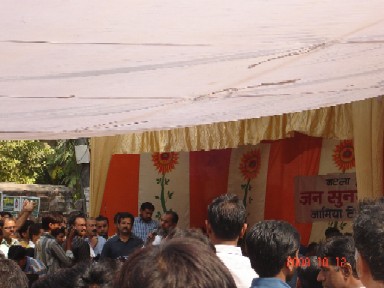
The shroud of silence in which the members of the Jamia Nagar community had been pushed into following the policed accounts of the ‘encounter’ that was coming through the media over the past week after the initial spate of protests seems to have been broken. People from all walks of life that form the teeming multitude of the citizens residing in Jamia Nagar area came out openly questioning the ‘encounter’. Twelve members spoke as neighbours, eye witnesses and relatives of either the deceased or the accused and said openly that although the problem of terrorism needs serious attention, one cannot subscribe to an alternate reign of terror perpetrated by certain sections of the authority.

Questions were raised regarding the condition in which the bodies of Atif Ameen and Mohd. Sajid was received by the family members and how they were not allowed to bury them in the Okhla graveyard. Several discrepancies in the police accounts were highlighted and Manisha Sethi from the Jamia Teachers’ Solidarity Group read out the Group’s study of the same. The Jury members would be meeting early next week and would finalize their verdict on the ‘encounter’. The Jamia Teachers’ Solidarity Group’s demand for a time bound, independent inquiry under the sitting judge of the Supreme Court has been reiterated and in the present situation of the on-going media trial of the accused, concerted action is required.
Singur – The Costs and Benefits of Neoliberal Industrialization

Deepankar Basu

Singur stands for many, often contradictory, things. It stands for the model of neoliberal industrialization that the Indian state is trying to push down the throats of its citizens at the behest of big capital. It stands for the unprincipled and populist politics of dormant right-wing forces. It stands for the abject surrender of an erstwhile communist party to the dictates of capital, the full flowering of a tendency that surfaced in the Indian political firmament circa 1967. But Singur also stands for the struggle of labour against capital, decidedly in confused and masked manners, but a struggle that has the potential to galvanize resistance against neoliberalism. When the Tata Group, forced by the long-standing struggle of the small farmers and landless labourers in Singur, was reported to be planning a move to Pantnagar in Uttarakhand, there were simultaneous reports of a possible Singur waiting for them in Pantnagar. A Singur in Pantnagar! That is the real significance of the struggle of the landless labourers and peasants of Singur.

Right from day one, the West Bengal government and the mainstream media has been building up the case for the manufacturing plant in Singur on the basis of half-truths and untruths. For a long time, the West Bengal government continued denying the fact that it had “acquired” a large tract of the proposed 1000 acres from unwilling farmers by using coercion, strong-arm tactics and certainly without their consent. Towards the later part of 2006, after considerable protests and a public hearing organized by intellectuals and activists, it had to finally accept its own earlier statements as false. Now it is known by all and sundry that 411.11 acres of the total 997.1 acres has been acquired without consent of the relevant farmers. For a long time, again, the West Bengal government continued denying the fact that most of the land that was sought to be “acquired” was fertile and multi-cropped agricultural land. It was only when earlier this year the Supreme Court pointed towards a possible violation of the Land Acquisition Act, responding to a petition filed for immediate halt of the Nano car project, that the West Bengal government finally accepted that it had been willfully misleading the public in this regard for so long; the SC had pointed out that acquiring and using fertile, multi-crop agricultural land for industrial purposes goes against even the Land Acquisition Act, which the West Bengal government was, paradoxically, trying to use to “acquire” that land. Now it has been established beyond any shadow of doubt that the land on which the proposed plant is to come up is, in the main, fertile, multi-cropped agricultural land. Another myth that had been in circulation for some time was the following: the land in Singur could not be used for agricultural purposes for most parts of the year because of water logging. This claim has also been contested and shown to be untrue. Now it is accepted by all serious commentators that the land had, before being fenced off by the West Bengal police, been in constant use throughout the year for growing various agricultural crops, and that it provided livelihood for more than 12,000 families. Even though these and other such claims of the West Bengal government and the mainstream media have been refuted point by point, over and over again, with facts and arguments and lot of patience and care, they keep turning up ever and ever again like bad coins. They will, as long as the social forces whose interest they represent continue their efforts to hegemonize society; and we will continue refuting them point by point, with patience and care and logic and facts.

But even when these particular canards are discounted, there seems to be a larger argument for industrialization that Singur purportedly represents. The West Bengal government and large sections of the mainstream media tend to equate Singur with industrialization and portray any and every opposition to Singur as opposition to industrialization. The apparent strength, or shall we say charm, of this argument becomes obvious when we see even an preeminent thinker like Amartya Sen falling for it. But this argument is deeply flawed. Opposition to Singur is not opposition to industrialization, it is opposition to neoliberal capitalist industrialization. Opposition to Singur is opposition to the conflation of industrialization with neoliberalism, a scenario where the State steps up its efforts to subsidize capital and shore up its profits while capital externalizes its costs onto labour and the environment with impunity. It is this model of industrialization that we oppose.

An alternative model of industrialization, as far as we can see, would operate in an exactly opposite fashion. It would tax capital and not subsidize it, prevent capital from externalizing its costs onto labour and the environment rather than facilitating it, intervene in decisions related to the choice of technique to be used in production, force private capital to do proper cost-benefit analysis before embarking on a (socially) costly industrial project, intervene through fiscal and monetary policy to maintain overall levels of aggregate demand and try to ensure full employment with living wages for workers. In the alternative vision, the State would use tax revenues to build infrastructure, provide social sector services and closely monitor and improve the well-being of the people. Singur, and the model of industrialization that it stands, takes us in the exact opposite direction; that is why it needs to be opposed. It destroys livelihoods tied to agriculture without creating compensating jobs in industry, it willfully snatches away fertile, multi-crop agricultural land for industrial purposes when so much fallow (and other unused and misused) land is there to be used, it externalizes the costs of production on the most vulnerable sections of the population and the environment, and all this while the State steps in to massively subsidize private capital even further. If, therefore, due to the struggle of the project affected people the Tata’s finally leave West Bengal, it should call for rejoicing not for middle-class chest-beating that is so much on display these days. For it would be one of the important victories in the emerging struggle against neoliberalism in India.

Cost and Benefits

In this article we will try to study details of the costs and benefits of the proposed manufacturing plant in Singur on the basis of information that is available in the public domain. But a caveat is necessary. This is not a full blown cost-benefit analysis because we shall not venture to quantify the indirect benefits of possible net employment generation and the income that might arise from there. At this point, it is not even clear whether there will be positive net employment generation; it is not at all obvious, in other words, that the employment destruction entailed by the project will be exceeded by the employment generated by it. Moreover, a full cost-benefit analysis would require much more information than has presently been made available by the West bengal government; on the basis of the available information, which pertains mostly to the benfits that the West Bengal government plans to make available to the Tata’s, we shall mainly try to approximately quantify the costs to the exchequer, and ultimately to the people of the state.

A careful study of the details relating to the proposed project in Singur, to the extent possible by the publicly available information, is important for two main reasons. First, it is important to do a dispassionate analysis of the costs and benefits of this project; since the West Bengal government has been continually making largely unsubstantiated claims about the putative benefits of this project, it is high time we carefully analyzed the foundations of this claim. Second, this project is very much in line with the current trend of neoliberal capitalist industrialization in India anchored tightly in the visions of the Special Economic Zones (SEZs); hence a study of this project will highlight, and help us evaluate, many of the important characteristics of neoliberal capitalist industrialization that has been envisioned and aggressively pushed by the Indian state since the early 1990s. Parenthetically, one should also note how acceptance of the logic this project signals the gradual dissolving of social democracy in India: from”managing” the conflict between labour and capital, social democrats are increasingly moving towards “managing” labour for capital.

The main document that we will use for the purposes of this study is the text of the recent “agreement” signed between the Government of West Bengal, the West Bengal Industrial Development Corporation (WBIDC) and the Tata Motor Ltd. (TML) pertaining to the proposed manufacturing plant in Singur. By a careful analysis of the information contained in this document, and complementing this with some more information from other sources we will, hopefully, be able to arrive at a true picture of the costs and benefits of this project. But before we get into the nitty-gritty of the agreement, let us remind ourselves about the severe difficulties that we have faced over the past few years in just trying to get hold of the information that is relevant to this project. Recall that the details of the “deal” wasn’t made public initially because the West Bengal government believed it was a “trade secret”. Once this argument was properly trashed, the government shifted gears. During this period, it wasn’t made public despite repeated Right To Information (RTI) applications because, according to the government, the Tatas didn’t want it to be made public! Finally what has been made public, mainly because of pressure from the standing committee on industry of the West Bengal state assembly, are only parts of the “deal”; this all we have for the purposes of study and analysis. The TML filed a case in the Calcutta High Court and got a stay against the rest of it being made public. What is there in the rest of it? We, and the more than 12000 project affected families in Singur, can only guess. The entire episode, to say the least, is patently undemocratic, and makes a mockery of the intent of the recently passed Right to Information Act. One does not, of course, discern even an iota of concern about this important matter displayed by the “peoples’ government” in West Bengal!

The Agreement

The “agreement” between the West Bengal government, WBIDC and TML is a remarkable document by all means. Starting from the premise that the state of West Bengal must match, rupee for rupee, every fiscal and financial incentive offered to TML by other states like Uttarakhand and Himachal Pradesh, it goes on to lay out the details of the same. This, the agreement states, should be read as the state government’s eagerness to “take appropriate steps for rapid industrialization in West Bengal”. This, to the best of our knowledge, is the clearest admission by the West Bengal government and the “communist” party standing behind it of the acceptance of neoliberalism. By accepting that the road to “rapid industrialization” winds its way through huge subsidization of private capital in the form of tax breaks and soft loans with the concomitant costs borne by labour and the environment, the West Bengal government has finally announced its participation in the Indian State’s neoliberal industrialization program. We will discuss this issue in greater detail below.

The text of the agreement is also remarkable in its enormous onesidedness. Every concrete detail in the agreement refers to what the West Bengal government will do for TML; there is no mention of what TML will do in return! It is as if by accepting to invest in the state, TML has bestowed an enormous favour on the people and its government. Overwhelmed by this boundless magnanimity of TML, the West Bengal government has decided to offer everything in its power to return that favour. The favours offered to TML come in four concrete forms: (a) subsidized land for setting up the manufacturing plant, (b) loans in the form of tax holidays, (c) soft loans to get started, and (d) subsidized electricity. There is no mention of anything that the state can expect in return from TML. Loans do not require collateral, failure to make timely payments do not require penalties, there is no mention of what employment generation TML’s investment will entail, there is no mention, in short, of anything at all that might inconvenience private capital or hold it accountable to the people. Below, we will look at the each of the components of the favours, what we will quite realistically refer to as costs, and also try to take seriously the claims of the government about the purported benefits of the project, but first, let us briefly remind ourselves about the land “acquisition” and its proposed use.

Land “Acquisition” and Use

The agreement – scroll down to read the text of the agreement – states that land “of approximately 1000 acres chosen [by TML] in P.S. Singur of District Hoogly” was finalized as the site for the construction of the proposed plant. Subsequently WBIDC “commenced the process of acquisition of this land”, an euphemism for the veritable terror unleashed on the farmers of Singur to give up their fertile, multi-cropped agricultural land for neoliberal industrial “development”. Using the colonial era Land Acquisition Act of 1894, the WBIDC coerced – with the support of the police and cadres of the ruling party, CPI(M) – several hundred families to give up their land, and according to the agreement, it is now “in possession of 997.1 acres of land”.

Out of this forcibly-acquired 997.1 acres of land, 647.5 acres will be leased to TML to set up its proposed plant, what the agreement calls the “Automobile Project”; another 290 acres will be leased to “the vendors to this Automobile Project approved by TML”, the vendors being the ancillary and component manufacturing units. An area of 14.33 acres will be given to the West Bengal State Electricity Board (WBSEB) for the construction of a 220/132/33 KV substation to provide and uninterrupted supply of subsidized electric power to the “Automobile Project”; and the remaining “47.11 acres will be used by WBIDC for rehabilitation activities for the needy families amongst the Project affected persons”. Note in passing that only 4.74% of the “acquired” land has been earmarked for purposes of rehabilitation of the project affected persons.

Total Cost of the Project

According to the details available in the agreement, the total cost to the people of West Bengal of the proposed project in Singur, as we have already pointed out, can be broken down into the following four categories: (a) subsidized land for setting up the manufacturing plant, (b) loans in the form of tax holidays, (c) soft loans to get started, and (d) subsidized electricity. Point 7 of the agreement provides details about each of these. Point 7(a) is about the tax holiday; point 7(b) is about the hidden subsidy in land; point 7(c) is about the soft loan, and point 7(d) is about the subsidized electricity. The sum of these “fiscal incentives”, excluding the subsidy in electricity, add up to what the Uttarakhand/Himachal Pradesh governments offered to TML. How do we know this? From point 7(a) of the agreement which states: “This benefit [i.e., the tax holiday] will continue till the balance amount of the Uttarakhand benefit (after deducting the amount as stated in para 7b and 7c below) is reached on net present value basis, after which it shall be discontinued.” In other words, the sum of the benefits offered by the West Bengal government in the form of (a) subsidized land, (b) tax holiday, and (c) soft loan will equal what the Uttarakhand/Himachal Pradesh governments were willing to offer; the subsidized electricity (and other real estate, as we will see below) are bonuses, which make the West Bengal government’s offer exceed the Uttarakhand/Himachal Pradesh. But this also means that we can indirectly arrive at the total cost of the project in Singur if we can somehow figure out the amount of the Uttarakhand/Himachal Pradesh package.

Point (1) of the agreement mentions that the “incentive package in Uttarakhand/Himachal Pradesh consists of:-

(a) 100% exemption from Excise Duty for 10 years.

(b) 100% exemption from Corporate Income Tax for first 5 years and 30% exemption from Corporate Income Tax for next 5 years.”

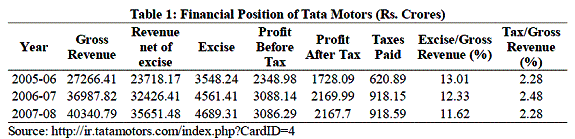
How much is this package worth? Let us try to think this through. We have collected some information from annual financial reports of TML in Table 1 that will help us get an approximate figure for the Uttarakhand/Himachal Pradesh package using points 1(a) and 1(b).

There are some remarkably stable patterns in the data. TML seems to be paying about 12% of its gross revenue as excise duty and 2.35% of its revenue as corporate income tax. If TML were to set up shop in Uttarakhand or Himachal Pradesh, it would be manufacturing about 250,000 small cars per annum. If each car were to sell for Rs. 1 lakh, TML’s gross annual revenue would be approximately Rs. 2500 crores. If the TML would have to pay excise duty, assuming the above ratios, it would pay about 300 crores (12% of Rs. 2500 crores) per annum; if it had to pay corporate income tax, it would have to pay about Rs. 58.75 (3.5% of Rs. 2500 crores) crores per annum. If TML set up shop in Uttarakhand/Himachal Pradesh, according to the agreement, it would not have to pay these taxes as stated in point 1(a) and 1(b).

Summary of the Uttarakhand/Himachal Pradesh package: for the first 5 years, TML gets Rs. 358.75 crores every year (100% excise duty exemption + 100% corporate income tax exemption); and for the next 5 years, it gets Rs. 317.63 crores every year (100% excise duty exemption + 30% corporate income tax exemption). The NPV of this benefit package is Rs. 2062.79 crores (using 11% for calculating NPV).

According to point 7(a) of the agreement, the West Bengal government’s “benefits package” will equal this sum if we compute the benefit coming from subsidized land, soft loans and tax holidays. Let us now look at the different components of the package promised by the West Bengal government.

Hidden Land Subsidy

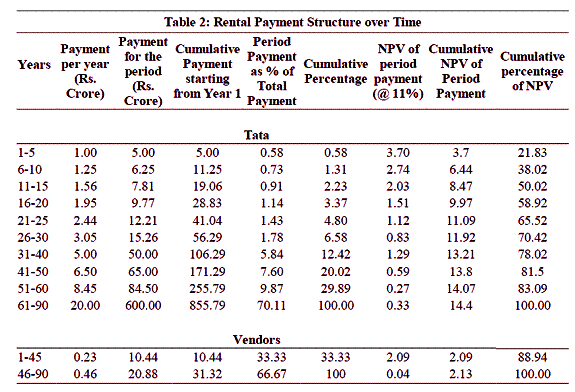
What are the terms of the rental structure on the land lease agreed upon by WBIDC and TML? Two different set of rules apply, one to the 647.5 acres leased to TML and another to the 290 acres that will be leased to the vendors approved by TML. Both leases, however, will come up for possible renewal 90 years down the line. For the 647.5 acres of land that is leased to TML, the annual rental will be Rs. 1 crore for the first five years, increasing by 25% every five years till 30 years. Thereafter, the annual rental will be fixed at Rs. 5 crore, to be increased by 30% every 10 years till the year 60; the rental from year 61 to 90 will be Rs. 20 crore per year. For th vendors, the rental structure is simpler: for the first 45 years, they will pay an annual rental of Rs. 8000 per acre, and for the next 45 years will pay an annual rental of Rs. 16000 per acre. Since the vendors are leasing 290 acres of land, this means that for the first 45 years, they pay a total of Rs. 0.232 crores per year and Rs. 0.464 crores per year for the rest of the time.

Details of the payment schedule, for both TML and the vendors, is summarized in Table 2. This is similar to, but more detailed than, a table used by Madhukar Shukla for commenting on the Nano project; the main difference is the inclusion of figures on net present values (NPV). What is net present value? It is a conceptual device used to compare sums of money at different points in time, which I explain in greater detail below. Why is NPV relevant here? Because an investment project like the proposed plant in Singur involve costs and benefits flowing in at different points in time. Columns (2) through (6) give the actual payments to be made at various points in time, while the last three columns give the net present value (NPV) of the payments, where NPV has been calculated using an interest rate of 11% per annum (exactly as done by the WBIDC in Annexure II of the agreement). Note in passing that the Annexure where all the computations relating to the project has supposedly bee done has not been made available to the public; all we know is that the NPV calculations used an interest rate of 11%.

To arrive at figures about the costs of “acquiring” the land and the revenue earned from leasing it to TML (and the vendors), we need to remind ourselves that the WBIDC spent anything between Rs. 150 crore and Rs. 200 crore to “acquire” the land from the unwilling farmers. How much will WBIDC get for letting TML use that piece of land? Columns (4) shows that the TML will pay a total amount of Rs. 855.79 crores over 90 years as rental fees for using the land. So the cost incurred by the WBIDC is Rs. 150-200 crore, while revenues will be 855.79 crore. Does this mean that the WBIDC made a good bargain with the TML on behalf of the people of the state? Does it men that the WBIDC is actually making a “profit” in leasing out the land to TML? Let us think about this a little more.

A rupee today is not equivalent to a rupee next year. Why? One can put the rupee that one has today in the bank and earn an interest income at the going interest rate to augment the original sum. If the current interest rate is 11%, then one would have Rs. 1.11 at the end of the year if the rupee were to be invested in an interest-bearing asset today. Put another way, Rs. 1.11 at the beginning of next year is equivalent to Rs. 1 today (at the beginning of this year). Let us go further, and suppose that we let our rupee lie in the bank for two years. How much do we have at the beginning of the third year? Rs. 1.21 (because at the beginning of the second year one has Rs 1.11, and then one earns 11% on that amount to arrive at Rs. 1.21 at the beginning of the third year). Inverting things, we see that Rs. 1.21 two years hence is equivalent to Rs 1 today when the market interest rate is 11%. This logic can be extended to any number of years and is the basis of computing net present values (NPVs). In the jargon of economics, if the market interest rate is 11%, Rs. 1.1 one year hence has a NPV of Rs. 1; and Rs. 1.21 two years hence has a NPV of Rs. 1. Thus, NPV is a device to make sums of money at different points in time comparable to each other. What does this mean for us?

It means that we cannot just add up all the rental payments that TML is supposed to make over the next 90 years (which is Rs. 855.79 crores) and compare it to the cost incurred by the WBIDC to “acquire” the land today (which is Rs. 150-200 crores). To make the stream of rental payments of the TML (over the next 90 years) comparable to the cost of “acquisition” today, we need to calculate the NPV of the rental payment stream. That is precisely what we have done in column (7) in Table 2. Column (8) gives the sum of the NPVs of the rental payments. On the basis of this calculation we arrive at a very striking fact at the end of column (8). The NPV of the rental payments that the TML will make over the next 90 years is Rs. 14.4 crores! The NPV of the rental payments that the vendors will make is Rs. 2.13 crores.

Summary: while the cost to the WBIDC for “acquiring” the land was anything between Rs. 150 crores to Rs. 200 crores, the NPV of the revenue from rental income that will accrue to the WBIDC is Rs. 16.53 crores, sagging the WBIDC with a loss of anything between Rs. 130 crores to Rs. 180 crores! Which is just another way of saying that taxpayers are subsidizing a big corporate entity like the TML to the tune of Rs. 150 crore just in terms of the land that the WBIDC “acquired” for it.

Cost of Circumventing the Law

A moment’s reflection on the time structure of rental payments for TML brings another characteristic of the transaction to the fore. The time structure of payments has been arranged in such a way that the bulk of the rental payments come in later years. From column (6) in Table 2 we see that the TML makes only 5% of its total payments in the first 25 years of the lease; in the first 50 years, it pays only 20 percent of its total payment commitments. The Comptroller and Auditor General of India (CAG) had pointed out in March 2008 that, according to Government of India laws, long-term leases of 99 years required that the lessee pay 95% of the market value of the land as a one-time premium at the beginning of the lease and pay annual rent at the rate of 0.3% of the market value of the land. The same report went on to note that the agreement between the TML and the WBIDC should have entailed an immediate payment of Rs. 91.88 crore and subsequent annual rents of Rs. 29 lakhs for the next 90 years. As opposed to this, the TML, according to the agreement, would pay nothing upfront and would only pay Rs.1 crore at the end of the first year!

Of course it would have been illegal if the lease was for 99 years. Hence, it seems, the WBIDC cleverly decreased the span of the lease by 9 years to circumvent the letter of the law. In spirit, though, this still amounts to a violation of the law. Why? Because the law states that for long-term leases the majority of the payments should be paid upfront by the lessee; and the WBIDC agreement with TML shows an exactly opposite time structure of payments, with most of the payments pushed off far into the future. Thus, even though in letter the agreement clears legal hurdles, it is obvious that it fails miserably in terms of the idea behind the law. No wonder the CAG faulted the WBIDC on several counts regarding its agreement with the TML. But let us pause for a moment and think why the CAG (or the laws) wanted the bulk of the payment upfront.

There are two basic reasons why the law might want to ensure bulk of the payments for a long-term lease upfront. One, large upfront payments for long-term leases increases the NPV of the rental payment stream. Since these long-term leases generally require the government to hand over public land for private use, it makes sense to structure rental payments in such a way that the government exchequer gets a good value in return; that is why a large upfront payment is usually written into lease contracts for long-term leases. The second reason for having a large upfront payment relates to considerations of risk. When a stream of payments has relatively large amounts pushed far away in the future, the NPV of that stream of payments is more liable to change when market interest rates change.

Let us take an example to understand both these points. Suppose, for simplicity, we want to compare two payment streams, A and B. A has Rs. 1 lakh today and Rs 9 lakhs in 10 years; B has Rs 9 lakhs today and Rs .1 lakh in 10 years; note that both entail a total payment of Rs. 10 lakhs over a period of 10 years and are similar in this respect. But they also are very dissimilar. To understand why suppose that the market interest is 10% at the moment. NPV of A is Rs. 4.47 lakhs, while the NPV of B is Rs. 9.39 lakhs. Thus, the NPV of B is much higher than that of B, which clarifies the first point. Now suppose that the market interest rate increase to 15%; this will obviously diminish the NPV of both A and B. But which will fall more? A’s NPV falls by about 39% while B’s NPV falls by only 1.5%! Thus, the risk of loss of revenue that comes from a payment stream (payment of rent for instance) is higher when most of the payments come in during relatively later periods. It is probably because of these two sound economic reasons, among others, that the CAG urged the West Bengal government to reconsider its lease agreement with the TML. By structuring the rental payments such that most of it come in during later years, the West Bengal government is not only losing revenue but is also bearing a higher risk of loss of even that minimal revenue.

So, how much is the WBIDC losing in real terms by using the rental payment structure that is summarized in Table 2 instead of the one recommended by the CAG? If TML were to pay Rs. 91.88 crores upfront and then subsequently pay a rental of Rs. 29 lakhs per annum for the next 90 years (as suggested by the CAG ), the NPV of this payment scheme would be Rs. 94.52 crores (using an interest rate of 11% per annum for calculating the NPV). The NPV of the currently agreed upon rental payment scheme (as per the agreement) is Rs. 16.53 crores (sum of entries in column (7) of table 2). Hence, the WBIDC is losing Rs. 77.99 crores due to the chosen rental payment structure.

Summary: the total financial loss to the WBIDC due to the agreed upon rental payment structure, as opposed the one suggested by the CAG, is Rs. 77.99 crores; the WBIDC, in addition, has to bear extra risk arising from possible fluctuations in the market interest rate.

Soft Loans and Tax Holidays

Point 7(c) of the agreement provides information about the soft loan: “The West Bengal Govt. will provide TML a loan of 200 crores @ 1% interest per year repayable in 5 equal annual installments starting from the 21st year from the date of the disbursement of the loan”. This loan, moreover, “will be disbursed within 60 days of this agreement”. Point 7(a) of the agreement refers to the loans that the WBIDC will give to the TML in the form of tax holidays. The tax holiday will continue, as we have already noted, till the sum of the land subsidy, tax holiday and the soft loan equals the Uttarakhand/Himachal Pradesh package.

So, what is the total loss to the exchequer due to the tax holidays and soft loans. There are two ways to arrive at approximate value of this loss. First, if we knew the exact amounts of the loans (in the form of tax holidays) and the exact repayment shedule and interest rates, we could calculate the net present value of the loss. But unfortunately, we do not have enough data in this regard, and so we will adopt an indirect method to arrive at the notional cost of the tax holiday and the soft loans. This second, indirect method, begins by recalling that, according to point 7(a) of the agreement, the total benefits from the land subsidy, taxt holidays and soft loans offered by the West Bengal government will equal the benefits that was offered by the Uttarakhand/Himachal Pradesh govenrment. We have seen above that the total value of the Uttarakhand/Himachal Pradesh package was approximately Rs. 2063 crores on a net present value basis. We have also seen that the cost to the exchequer of the subsidized land was about Rs. 228 crores (Rs. 150 crores for direct subsidy and Rs. 78 crores lost due to the time structure of the rental payment scheme). Thus, the total cost of the tax holiday and the soft loans will be Rs. 1835 crores (which is Rs. 2063 crores less Rs. 228 crores) on a net present value basis. Note that this is a notional cost.

The last part of 7(a) seems even better. It says: “WBIDC will ensure that the loan under this head is paid within 60 days of the close of the previous year (on 31st March) failing which WBIDC will be liable to compensate TML for the financial inconvenience caused @ 1.5 times the bank rate prevailing at the time on the amount due for the period of such delay”. What does this mean? It means that if the WBIDC is not able to make the loan to TML within 60 days of the close of the financial year, it will penalize itself by compensating TML at 1.5 times the prevailing bank rate. So, if the prevailing bank rate is 10%, which is close to what is the case right now, the WBIDC will penalize itself for any delay on its part by paying back the TML for the “financial inconvenience” at 15%.

Summary: the cost of the soft loans and tax holidays to the TML by the West Bengal government will be about Rs. 1835 crores on a net present value basis.

More Gifts from Santa: Real Estate and Subsidized Electricity

Industrial development requires infrastructural support from the government, as we all know. And so the West Bengal government displayed its commitment to “rapid industrialization” by offering a “virtual gift of 650 acres of prime land to Tata Housing Development Company (THDC) in Rajarhat New Town and in the adjoining Bhangar Rajarhat Area Development Authority for building an IT and residential township along with WBIDC as a partner“. What better way to provide “infrastructural assistance” for the industrialization effort that to hand over prime land for real estate speculation! Some reports suggest that this “gift” to TML will cost the exchequer about Rs. 160 crores.

The West Bengal government has also promised to supply electricity at Rs 3 per kilo watt hour (kwh), which is around half the price charged to high-tension industrial consumers in the West Bengal at the moment. It has also promised to absorb any increases in electricity costs to the TML in Singur. Point 7(d) of the agreement states: “In case of more than Rs. 0.25 per KWH increase in tariff in every block of five years, the Government will provide relief through additional compensation to neutralize such additional increase”. This will mean, at the least, shelling out Rs. 70 crores annually for subsidizing the electricity requirements of the whole project at Singur. The NPV of this subsidy for the 90 year period of the lease would be Rs. 706 crores.

Summary: the cost to the exchequer of the real estate gift and subsidized electricity will be about Rs. 865 crores.

Adding up the Costs

Let us now take a moment to put all this together. The subsidy that TML gets, according to the terms of the agreement, on the land in Singur is anywhere between Rs. 100 and Rs. 150 crore; the subsidy due to the rental payment structure is Rs. 78 crores; the implicit subsidy due to the tax holiday and the soft loan would be about Rs. 1835 crores; the real estate “gift”, also known in WBIDC terminology as “infrastructural assistance”, is worth Rs. 160 crores; and the subsidized electricity will cost another Rs. 706 crores. So, the Tata conglomerate, one of the largest corporate entities in the country, is awarded a “gift” of about Rs. 2928 crore by a “communist” government so that it can be induced to set up a car manufacturing plant in the state and lead it on to the path of neoliberal industrial development. To put this figure in perspective, let us refer to the 2008-09 budget speech of the Finance Minster of West Bengal. Pointing to the emergence of what he called the “industrial potential” of the state, he offered some concrete figures to bolster his argument. In 2005, the annual realized (industrial) investment in West Bengal was Rs. 2515.58 crores, which then jumped up to Rs. 5072.26 crores within the next two years. Thus, a sum close to 58 percent of the total realized industrial investment in the state in 2007 would be the cost borne by the people of the state if the Tata-Singur project too off.

Summary: the total cost of the Tata-Singur project incurred by the exchequer, and hence ultimately the tax payers, will be approximately be Rs. 3000 crores on a net present value basis when we add up the costs pertaining to the land subsidy, the tax holidays, the soft loan, the real estate gift and the subsidized electricity using an interest rate of 11%. This is about 58% of the total realized industrial investment in the state of West Bengal in 2007.

What are the Benefits?

What are the purported benefits of the Tata-Singur project? The West Bengal government has advanced two claims regarding the benefits: employment generation and improvement in the investment climate of the state. These two claims about possible employment generation and future investments need to be looked at closely, because the rationale offered by the West Bengal government for giving the stupendous bonanza to the Tatas rests precisely on these. Both these claims are dubious. Regarding the claims about employment generation, there have been figures ranging from a high of 12000 (2000 in the Nano plant proper, 10000 in ancillary and complementary units) to a low of 750 (some recent local newspapers have put the figure at 650). The upshot of all this is that there is no certainty about the employment generated. However, if we look at a recent BBC report on this matter it becomes clear that 62% of the projected employment in the automotive sector is going to be skilled labour, 28% is going to be management jobs, leaving only 10% jobs for unskilled labour. Now, the displaced population in Singur, if at all they get absorbed in the mother plant or in the ancillary units, would typically be offered employment as unskilled labour. So, the prospect of much employment being generated, especially for the people in Singur, is dim. Moreover, all these calculations ignore the employment destruction that the project will inevitably entail. If we were to properly take both possible employment generation and possible emplyment destruction into account, we could arrive at a figure for the net emplyment generated by the project. At the moment, it is not even clear that the net employment figure will be positive.

The other claim about the Singur project generating prospective investment in the future rests on equally shaky foundations. The question really boils down to whether the Tata plant can attract other major investments and lead to an industrial rejuvenation of Bengal. The example of Jamshedpur in neighbouring Jharkhand should be carefully looked at. Tata’s factories in Jamshedpur did nothing for the overall industrialization of the state of Bihar or now Jharkhand. It remained an enclave of industrial activity, without forging strong forward or backward linkages in neighbouring areas. The other issue to think about, in the context of the claim about TML drawing future investments, is whether other industrialists coming to invest in Bengal would also demand similar bonanzas from the government. Will the government refuse them the goodies that they have offered TML and let them turn away or will it repeat the Tata-like agreements and put further burdens on the exchequer. Either option does not seem to be beneficial from the perspective of the working people of the state.

Summary: while the costs of the proposed Singur-Tata project is obvious, tangible, immediate and large, the benefits seem to be uncertain, residing far away in the future and their magnitudes small.

Oh! So Poor Tata

A few months back, the finance minister of West Bengal presented a budget with a Rs. 2 crore deficit; a net subsidy of about Rs. 3000 crores would certainly be extremely costly for the people of the state; after all it is about 1500 times the budget deficit in fiscal year 2008-09. Given that a small, poor, fund-starved state like West Bengal is making such great efforts to subsidize the Tata’s, it must mean that they (the Tata’s) are in a dire financial situation. But is that true? If we merely cast a glance at the recent international buying spree that the Tata’s have been engaged in, we might be able to understand how far from the truth would be any assertion that the Tata’s require financial assistance from a poor state like West Bengal to start an industrial project.

The Tata Group of Companies, let us remind ourselves, is one of the largest business conglomerates in India with about 100 large companies in its fold. With the might of the Indian State firmly behind it, monopoly capital in India has started a move to aggressively acquire foreign assets, what it calls strategic corporate assets. In the last few years, the Tata Group has been leading this acquisition spree on behalf of Indian big capital, making forays not only in Asia and Africa but also in the heartland of world capitalism: USA and Europe. Let us briefly take a look at the record of the Tata Group with regard to foreign acquisitions.

In January 2007, the Tata Group pulled off India’s biggest ever takeover of a foreign company to buy Anglo-Dutch steel-maker Corus for $12 billion; this acquisition made the

combined entity (Tata-Corus) the world’s fifth largest producer of steel. In March 2004, the Tata Group acquired South Korea’s Daewoo Commercial Vehicle Company for $102 million; this was followed by the acquisition of a 21 percent stake in Spanish bus maker Hispano Carrocera for $18 million with an option to pick up the remaining stake at a later date. Around the same time, Tata Technologies, another company in the Tata fold, which provides automotive engineering and design services, bought Britain’s Incat International for $53 million.

Tata Consultancy Services, which was earlier a division of Tata Sons and a rising star in the Tata Group, has been among the most aggressive shoppers for foreign companies. It has acquired six companies in the past few, with the net value of the deals close to $100 million; these include FNS of Australia, which was acquired for $26 million and Chile’s outsourcing major Comicrom, which was bought for $23 million. When the Tat Group acquired the former state-run, international telecom carrier, VSNL, a few years ago, it was on its way to becoming a major telecom player in the global markets. To enhance its position, it acquired undersea cable company Tyco of the US for $130 million, Internet service provider Dishnet’s India division for $64.28 million and international telecom service provider Teleglobe of the US for $239 million.

Following its acquisition of Hindustan Lever Chemicals, Tata Chemicals was on the lookout for a steady supply of phosphoric acid for its newly acquired plant at Haldia, West Bengal. Accordingly, it took over two overseas companies for a total value of $215 million: Indo Maroc Phosphore of Morocco in March 2005 and Brunner Mond Group of Britain in December 2007. Morocco, by the way, produces over 50 percent of the world’s rock phosphate.

In 2000, Tata Tea bought British giant Tetley for a $407 million, and started looking for similar deals to strengthen its global position in the tea and related drinks business. This search led to acquisition of 33 percent stake in the South African company Joekels Tea Packers for an undisclosed amount and 30 percent stake in the US-based favoured water manufacturer Glaceau for $677 million, the acquisition of the US-based Good Earth Corp for $32 million and acquisition of the Czech Republic’s firm Jemca for an unknown amount.

India Hotels, the hotel branch of the Tata Group, acquired several hotels abroad for $121 million in the past few years. It is reported to have set aside $100 million for future acquisitions in Europe, the Middle East, Asia and the US. In December 2006, it had acquired W, a hotel at the Woolloomooloo Bay in Sydney; it was followed by the taking over of the management of The Pierre, a luxurious landmark hotel on New York’s Fifth Avenue. India Hotels, which runs the Taj Group of hotels, has 39 hotels in India and 18 worldwide. A recent acquisition of India Hotels was Campton Place Hotel in San Francisco.

If we add up the figures for the Tata Group’s overseas acquisitions, we arrive at a rough figure of $14,062 million, which converts to roughly Rs. 56,248 crore (using an exchange rate of Rs 40/$), and this is not even a complete list of Tata’s recent acquisitions. And, what does all this lead to? It inevitably leads us to the conclusion that a corporation which can invest more than Rs. 56,000 crores for acquisition of strategic foreign corporate assets requires the financial support of India’s impoverished taxpayers, to the tune of Rs. 1140 crores in real terms, to set up a small car manufacturing plant in India! That, in a nutshell, is what we would like to call neoliberal industrialization, pushing which down our throats has become the almost single-minded purpose of the West Bengal Government and the “communist party” that is at its helm of affairs.

TINA Logic

But even after all these facts and figures and arguments have been read, understood and absorbed, sympathizers of the West Bengal government will no doubt come up with a supposedly unbeatable argument: TINA. There is no alternative. This argument points to the magnanimous offers made by other states in India to attract private capital, and then goes on to plead the inability of the West Bengal government to follow any route other than to offer even more largesse. Recall that the text of the agreement starts precisely with this argument. It builds up its case for the huge hidden subsidies that is offered to TML, and which we have seen in great detail above and which add up to about Rs. 3000 crores on a net present value basis, by emphasizing the incentive package that the States of Uttarakhand and Himachal Pradesh has offered to the Tatas. That is why the West Bengal government must offer more than the value of the offers by the other states if it is to attract private capital, like the TML, to industrialize the state. Since, other states are offering huge tax breaks and soft loans, West Bengal must also do so, the argument goes. West Bengal cannot fight this trend, caught as it is in the competitive struggle between the states of India.

One must begin by acknowledging that there is some truth to this assertion. It is true, in other words, that in the neoliberal set-up private capital has managed to generate competition between political entities, both within nations and between nations, to ensure higher profits on its investments. But acknowledging this fact, the fact of the existence of this strong pressure for competition among states, does not mean accepting it as inevitable; it does not mean accepting the logic, championed by the proponents of neoliberalism, that there can be no alternative to the present framework. If the fight against neoliberalism has to be taken forward then this logic must be fought. One cannot succumb to this logic in practice and claim to be fighting against neoliberalism.

And to fight this logic, one must understand what it implies. The competition that capital manages to enforce on political entities (for instance states in India or countries in the global context), one must understand, is akin to a “race to the bottom”. As soon as one state lowers taxes, reduces social sector spending, loosens labour laws, cracks down on political dissent in order to make the atmosphere “conducive” for investments, another tries to outdo the first by reducing taxes even further, reducing social sector spendings even further, making labour even more “flexible” in order to “attract capital”. And thus, as the logic of this competition unfolds in all dimensions, people of all the states taken together lose. Lower tax revenues means lower resources for the State to invest in educations, health, nutrition, poverty alleviation; it means increased misery for the common people, with sub-optimal infrastructure and public amenities. And who benefits from this fierce competition? Capital. Thus accepting this as the only way to industrialize is to accept this “race to the bottom”, with all its deleterious consequences for the population, as the West Bengal government seems to have done.

So what can be done? One has to act on several fronts at the same time. First, it is undeniable that fighting the neoliberal logic will require concerted political action at the Central level to thwart moves to implement central-level neoliberal policies; the largest “communist” party standing behind the West Bengal government must shed its fears of radical mass political activism and launch, with other like minded political forces, a nationwide offensive against neoliberalism, instead of using all its energies in parliamentary antics. It will also mean not succumbing to the pressures of capital at the state level as the West Bengal government has pathetically done. If private capital wants to move out of the state because taxes are high and social sector spendings are growing and the labour laws are favourable for the workers, and the health and educational status of the people are improving, then so be it. The state need not hanker after such capital for, at the end of the day, massively state-subsidized investments of such capital is not beneficial for the people.

Second, one must understand that, if attracting capital is all one wants to achieve, capital can also be attracted in a very different fashion, by reversing the harmful, negative competition between states and instead initiating a “race to the top” to replace the “race to the bottom”. For it is a fact, recently noted by several observers of the Indian economy, that India is very rapidly moving into a regime marked by serious shortages of skilled labour. A state which wants to attract private capital can, therefore, invest massively in building up the education and health system for the workers; a healthy and skilled labour force can be a stronger incentive for capital to set up shop in a state than huge tax holidays. In fact, instead of giving tax breaks to capital, the state will need to tax them aggressively and use the tax revenue to further improve the conditions of the working people. Equally true is the abysmal conditions of physical infrastructure – transportation, housing, power, etc. – in most of the states of India. A state can, therefore, start investing in building up basic infrastructure for the people by taxing capital and citizens in the high-income brackets; solid infrastructure can be as strong an incentive for private capital as soft loans and hidden subsidies. The point of these interventions would be, in the medium and long urn, to initiate reversal of the “race to the bottom” that every state seems to be in the grip of. Unfortunately, the West Bengal government seems hell bent on going the opposite way.

Third, complementing these interventions have to be efforts to revitalize mass political activism at the grassroots level. Imagine, for a moment, a strong, countrywide mass movement against neoliberalism. If Singur in re-enacted in Uttarakhand and Himachal Pradesh and Karnataka, then where will the TML go? Wherever it sets up shop, it will have to do so without the luxury of externalizing the costs onto the working people and the environment. Simple economic logic suggests that forcing capital to internalize its costs by an active mass political movement would in fact ensure that the decisions taken by capital will be closer to what could be considered socially optimal. Mass participation in planning and implementation would, further, increase much-needed accountability of both the state and capital. Unfortunately again, the West Bengal government wants to go the other way.

Conclusion

This brief analysis of the details of the proposed Tata-Singur project in West Bengal offers us an unique opportunity to think about the industrialization strategy of the Indian state today. One of the major thrusts of this strategy is to build up so-called Special Economic Zones (SEZs) all over the country. As of August 11, 2008 there were 250 notified SEZs across the country. Since each of these SEZs more or less replicate the policy regime applicable to the proposed Tata-Singur project – with magnanimous tax holidays and soft loans and subsidized power and “flexible” labour laws and absence of all environmental regulations – it would probably not be far from the truth to suggest that each of these SEZs would entail at least the amount of loss that we have calculated above for the Tata-Singur project. This suggests that the total cost to the people of this country of the current neoliberal policy regime would be about Rs. 750,000 crores. How large is this figure? For comparison, consider the fact that the total expenditure of the Indian government was slated to be Rs. 750, 884 crores in budget 2008-09; thus, an amount which is roughly equal to the total expenditure of the Indian government in 2008-09 would be the loss to the nation for embracing neoliberalism. Isn’t it high time we sharpened our struggle against neoliberalism in earnest?

(Comments from Debarshi, Kuver and Partho have substantially improved the argument of this article).

ADDENDA

Benefits of Employment Generation

In my earlier portion of the article, I had stated that a full-blown cost-benefit analysis was not possible with the available information; that is primarily because information about net employment, and therefore the corresponding income, generated in the Tata-Singur project is lacking. There is lot of uncertainty about the possibilities of new employment flowing from the project, and figures for net employment generated varies from a high of 10,000 to a low of 500, the highest figure unsurprisingly coming from TML and the West Bengal government. Though it remains true that a full-blown cost-benefit analysis is not possible, what can certainly be done, as a complement to my previous analysis, is to find the benefits of the net employment generation for the best possible scenario and compare it to the costs entailed by the project. In carrying out such an exercise, we would be conducting a rough cost-benefit analysis with the most favourable assumptions for the West Bengal government and TML. Let us see what we the results are.

To proceed, let me state my assumptions clearly:

(1) There is a net employment generation of 10,000 this year in the Tata-Singur project.
(2) The average wage attached to this new employment is Rs. 60,000 per year.
(3) Due to the multiplier effect of this new income generated in the Tata-Singur project, i.e., due to the backward and forward linkages that it will supposedly establish, income will grow at the rate at which the Indian economy has been growing for the past few blazing years, i.e., at 9% per annum.

Thus, the net income generated during the current year will be Rs. 60 crores (which is 10,000 multiplied by Rs. 60,000); during the next year, the total income generated will be Rs. 65.4 crores; the year after that Rs. 71.29 crores, and so on…

Here is the question that I want to pose: how many years will it take for the net present value of the income stream generated due to the Tata-Singur project (and its multiplier effects) to equal the cost of the project? How many years, in other words, will it take for the total benefits, under these generous assumptions, to equal the total cost incurred due to the project? Recall that, as we have seen earlier, the total cost of the project is roughly Rs. 3000 crores on a net present value basis? So, how many years will it take for the benefits to equal Rs. 3000 crores?

And here is the answer: 127 years!

What does this imply? Let us think a little carefully. The net employment generation figure is by all accounts a gross exaggeration. As we have argued earlier, the component of employment that will go to unskilled labour is relatively small. Given the fact that the semi-agricultural labour population in Singur is most likely to be absorbed, if at all, as unskilled labour, the employment prospects of these people are extremely limited. Additionally there is the aspect of job destruction which we have so far ignored; it is most likely the case that the quantum of jobs destroyed due to the project is higher than the jobs that will be created. Hence, in all probability, the net employment generated by the project is negative. Thus, in assuming that the net employment generated by the project is 10,000 we are inflating the figure many times over. The fact that we have also assumed the wages to be Rs. 60,000 per annum only adds to the exaggeration. Since most of the employment for the people of Singur will be in the form of unskilled labour, a salary of Rs. 5,000 per month is a certainly high figure.

Similarly, the assumption that the total multiplier effect of the new employment will be a growth of 9% per annum year after year is also an exaggeration. If the multiplier effect of the new employment would generate 9% additional every year, it would mean generating about Rs. 5.4 crores of additional income in the second year, about Rs. 5.9 crores of additional income in the third years and so on… Even the Indian economy is expected to slow down, from its current 9% growth rate, due to the global financial crisis. Hence, an annual growth rate figure of 9% for income generated most certainly inflates the benefits accruing from the Tata-Singur project in terms of employment and income.

What all this means is that even under extremely favourable assumptions, the cost of the Tata-Singur takes 127 years to be recouped. A reasonable time frame to recoup the costs of the project would require an unrealistically high rate of income growth, something which is anyway unlikely given that the world economy seems headed towards a deep recession. Thus, it seems that the costs of the Tata-Singur project far outweighs the benefits that can reasonably be assumed to flow from undertaking it.

Agreement between Tata Motors Ltd., Government of West Bengal and WBIDC

1. Tata Motors Ltd. (TML) was intending to set up a manufacturing Plant for Automobile Products including “Tata Small Car” to manufacture 250,000 cars per annum on 2 shift basis which could be expanded to 350,000 on 3 shift basis. In addition, it would have several Vendors and act as a mother plant for many aggregates to tune of 500,000 cars. In this connection, TML was considering locating the plant in the States of Uttarakhand/ Himachal Pradesh in view of the fiscal incentive package for the rapid industrialization being made available by the Govt. of India to new Industries in these States which has been attracting a large number of industries to these States. The incentive package in Uttarakhand/Himachal Pradesh consists of:-
(a) 100% exemption from Excise Duty for 10 years.
(b) 100% exemption from Corporate Income Tax for first 5 years and 30% exemption from Corporate Income Tax for next 5 years.

2. The Government of West Bengal (GoWB) is keen to take appropriate steps for rapid industrialization in West Bengal and in this connection wanted to attract some major Automobile Projects to the State. The Government of West Bengal approached TML to persuade them to locate an Automobile Project including the project to manufacture “Tata Small Car” in West Bengal. TML showed interest in locating the plant in West Bengal, provided the State gave Fiscal incentive equivalent to the value of total incentives it would have received by locating the plant in Uttarakhand / Himachal Pradesh. GoWB offered to match the financial incentives in equivalent terms and invited TML to set up the Small Car plant in West Bengal entailing investment of over Rs. 1500 crores by TML. In addition, Vendors supporting the project are likely to make further investment of over Rs. 500 crores.

3. Since then numerous discussions have been held and based on this understanding, GoWB proceeded with identification of various lands for this mega project. Land of approximately 1000 acres chosen in P. S. Singur of District Hooghly was finalized with TML. West Bengal Industrial Development Corporation Ltd. (WBIDC) commenced the process of acquisition of this land. The process was completed with the Declaration of Award under Section 11 of the Land Acquisition Act, and thereafter WBIDC has obtained mutation of ownership in its name in the Record-of-Rights, and conversion of usage of the land from agriculture to factory.

4. WBIDC is in possession of 997.11 acres of land, which has been acquired under the Land Acquisition Act. Out of this, an area admeasuring 645.67 acres will be leased to TML for setting up the Automobile Project including the small car plant, while an area admeasuring 290 acres will be leased to the vendors to this Automobile Project approved by TML (ancillary and component manufacturing units), 14.33 acres will be handed over by WBIDC to WBSEB only for construction of 220/132/33 KV substation and the balance admeasuring 47.11 acres will be used by WBIDC for rehabilitation activities for the needy families amongst the Project affected persons.

5. The terms of lease to TML for the 645.67 acres of land for the mother plant are described below. In addition, WBIDC will provide on lease 290 acres of land to the Vendors selected and approved by TML on payment of Premium equal to the actual cost of acquisition plus incidentals, to be calculated on the basis of the total acquisition cost and other incidental expenses expended by WBIDC or any of its subsidiaries (duly certified by its auditor) averaged over the total land acquired. The lease rental payable per year per acre by the vendors will be Rs. 8000/- per acre for the first 45 (forty five) years and Rs. 16000/- per acre for the next 45 (forty five) years. The initial lease tenure will be 90 years. On expiry of 90 years, the lease terms will be fixed on mutually agreed terms at that point of time.

6. The parties also discussed mutually to finalise the package of incentives required in order to enable GoWB to fulfill its commitment to match in equivalent financial terms the fiscal incentive foregone by TML in Uttarakhand. The Net Present Value (NPV) computation of benefits that the project would have received in Uttarakhand is attached in Annexure I which is agreed to by all the parties. Sample computation of benefits in West Bengal with stated assumptions is given in Annexure II which is accepted by all parties as agreed basis of computation. The NPV is calculated @ 11%.

7. Accordingly, it is finally agreed, in supersession of all previous decisions and agreements in this regard, that for this mega project, the fiscal incentives under Industrial Promotion Assistance in terms of the West Bengal Incentive Scheme (WBIS 2004), assistance towards land cost and interest subsidy in the form of a loan against a quantum of the term loan to be taken by TML for this project will be offered by GoWB as follows:-

(a) WBIDC will provide Industrial Promotion Assistance in the form of a Loan to TML at 0.1% interest per annum for amounts equal to gross VAT and CST received by GoWB in each of the previous years ended 31st March on sale of “Tata Small Car” from the date of commencement of sales of the small car. This benefit will continue till the balance amount of the Uttarakhand benefit (after deducting the amount as stated in para 7b and 7c below) is reached on net present value basis, after which it shall be discontinued. The loan with interest will be repayable in annual installments starting from 31st year of commencement of sale from the plant. The loan availed in the first year will be repaid in the 31st year and the loan availed in the 2nd year will be repaid in the 32nd year and so on. WBIDC will ensure that the loan under this head is paid within 60 days of the close of the previous year (on 31st March) failing which WBIDC will be liable to compensate TML for the financial inconvenience caused @ 1.5 times the bank rate prevailing at the time on the amount due for the period of such delay. TML & GoWB will make best efforts to maximize sale of products from the “Small Car Plant” in the State of West Bengal.

(b) WBIDC will provide 645.67 acres of Land to Tata Motors Ltd on a 90 year lease, on an annual lease rental of Rs. 1 crore per year for first 5 years with an increase @ 25% after every 5 years till 30 years. On expiry of 30 years, the lease rental will be fixed at Rs. 5 crores per year, with an increase @ 30% after every 10 years till the 60th year. On the expiry of 60 years, the lease rental will be fixed at Rs. 20 crores per year, which will remain unchanged till the 90th year. On expiry of 90 years the lease terms will be fixed on mutually agreed terms at that point of time. The benefit on account of land would be calculated as the total land area leased out to TML multiplied by the cost of acquisition calculated in the manner as provided in para 5 less NPV of rent payable during 60 years.

(c) The West Bengal Govt. will provide to TML a loan of Rs. 200 crores bearing @ 1% interest per year repayable in 5 equal annual installments starting from the 21st year from the date of disbursement of loan. This loan will be disbursed within 60 days of signing of this Agreement.

(d) The West Bengal Government will provide Electricity for the project at Rs. 3/- per KWH. In case of more than Rs. 0.25 per KWH increase in tariff in every block of five years, the Government will provide relief through additional compensation to neutralize such additional increase.

8. It is also agreed that the computation of the comparison of benefits in Annexure I and II will be changed if there are any changes in the rates of excise duty and corporate income tax during the next 10 years.

Kandhamal, They and We

Satyabrata

On August 24, two policemen came and informed a Christian dominated hamlet (comprising of around 50 families out of which 32 were Christians) that 6 ‘Hindus’ along with ‘Swami’ Lakshmananda Saraswati had been killed. They asked the villagers not to go to the church. The majority of the villagers are cattle-bearers with little land. They decided to obey the order/advice but asked the police for protection which was denied on the grounds that there were not adequate forces for that.

In the evening, about 50 men, with fire torches in their hands came to the village shouting Hindu communal slogans, like ‘Hindu-Hindu-Bhai-Bhai’ (All Hindus are brothers), etc. They stopped in the midst of the village and shouted. There was a dilemma – “should we burn the houses of the Christians first or their church?” To put it more accurately, “should we destroy them or their symbol first?” They decided to destroy the symbol first; the church was to be destroyed.

That symbol played the function of the authority, this they probably understood. On hearing that the church was to be burnt and then their houses would be the target, the villagers panicked. They went to the Hindu houses of their village and asked for help. They wanted their Hindu brethren to take care of their costly possessions, which they handed them over. They ran and hid themselves behind the bushes. The Hindu stalwarts then came to the village and lit the houses aflame. The Christians were silent spectators.

There was a family of four brothers. One of them was a paralytic who couldn’t be rescued from his house. He was shouting at the Hindu fundamentalists desperately, “Throw me out of this place and do whatever you like.” They drenched him in petrol and… One of his brothers watched this from behind the bushes, shocked!

With the houses burning, enough light emanated. The villagers from behind the bushes could see the faces of over 50 ‘Hindus’. They recognized some of them. They were from a nearby village, the place where the slain Swami practiced his “philanthropy” and “education”, which his followers were demonstrating that day.

With the light also came the fear of being noticed by the killer mob. Fear forced them to leave the bushes and go to the nearby jungles. They did so. The mother of the four brothers, aged about 70, couldn’t run. She was kept behind a tree seated and was asked not to move. The rest of the villagers ran into the village. Their struggle continued. The Hindu fundamentalists had got some clue about them and entered the forest to chase them. The villagers couldn’t go to the nearby ‘main-road’, nor could they stay in the jungle. They decided to go to Bhubaneswar, Orissa’s capital. They succeeded in doing so after about a journey of 300km. They reached Bhubaneswar on the 28th evening and took shelter in the YMCA (Young Men’s Christian Association) from the 29th morning.

I went to interact with them a day later. They refused to tell me anything. Then I noticed a priest who had come from Andhra Pradesh. I went and sat beside him to know what had happened. One of the brothers was speaking to the priest. The priest asked, “Why didn’t you confront these people. You were 32 families, which means you were at least 60 men.” The brother replied, “Most men have migrated. Majority among our families present in the village were women and children”. Another man then came and sat beside me. He introduced himself as an army man guarding the Indian borders, and was one of the four brothers, too. He came directly to YMCA when he got the news.

***

“What do you want now?

“This Government has failed us.”

“Which Government? The Central or State Government?”

“The State Government.”

“But the Central Government also knows what is happening and we have also approached it.”

“Then we want a President Rule.”

“That is in the hands of the Central Government.”

“Then it is war between ‘us’ and ‘them’ and we want ‘our people’ to be ‘on our side’.”

“What do you mean by ‘our people’?”

He took a glance at me and answered, “The Christians”.

Now, I could make out why they were not revealing anything to me. Probably, they wanted to know who I was – was I from among ‘them’ or was I from among ‘us’. The Father was of course one of ‘us’.

There were several such villages that have had such bitter experiences.

The author is a second year bachelor student in an engineering college in Bhubaneshwar.

Structural-Cultural Moorings of Transformative Politics in India

Council for Social Development, New Delhi

Structural-Cultural Moorings of Transformative Politics in India
– Call for papers

20-21 January 2009

Evaluating the mode of production debate in India during the 1970s, Alice Thorner (1982) had noted an unwillingness to deal with the cultural aspects. Mainstream academic discourse today has swung to the other extreme of an unwillingness to deal with the political economy aspect, except for largely empiricist economic analyses. There is a felt need today to move-away from these unilateral approaches and follow a synthetic approach of marrying the concerns of political economy/ accumulation, on the one hand with studies on culture and identity, on the other. This would entail viewing social reality at the inter-junctions of accumulation and identity, structure and agency, enabling collective action for social transformation and social development. We need analyses that would be sensitive to both the specificities of the particular ‘social and spatial structures of accumulation’ on the one hand and their totality on the other. We invite papers that could deal with structural-cultural categories such as class, caste, gender, national formations, tribe, community, environment, etc. that could plausibly constitute the social and political mobilisational bases of transformative political articulations and assertions in our country. We also welcome theoretical contributions attempting to link various kinds of social oppressions and finding the principal determinant within a social totality and identifying the principal task of transformative political movements.

Tentatively, the seminar will have the following sessions:

1) Theoretical session
2) Class as the social basis of transformative politics
3) National formations as the social basis of transformative politics
4) Caste, tribe and community as the social bases of transformative politics
5) Gender as the social basis of transformative politics
6) Human-nature relationship as the axis of transformative politics

Please send abstracts of about 1000 words to: Dr. Gilbert Sebastian, Associate Fellow, Council for Social Development, 53 Lodhi Estate, New Delhi – 110 003, e-mail: gilbert_sebs@yahoo.co.in and gilbert.s@rediffmail.com latest by 15 December 2008 and full papers (around 25 pages) by 5 January 2009.

A selection of papers from the seminar would be published in an edited volume.

The Dilemma of a Scientist in the Age of Cybernetics

Norbert Wiener

from Norbert Wiener (1948/1961) Cybernetics: or Control and Communication in the Animal and the Machine, The MIT Press, Cambridge, Massachusetts. pp.26-29

It has long been clear to me that the modern ultra-rapid computing machine was in principle an ideal central nervous system to an apparatus for automatic control; and that its input and output need not be in the form of numbers or diagrams but might very well be, respectively, the readings of artificial sense organs, such as photoelectric cells or thermometers, and the performance of motors or solenoids. With the aid of strain gauges or similar agencies to read the performance of these motor organs and to report, to “feed back,” to the central control system as an artificial kinesthetic sense, we are already in a position to construct artificial machines of almost any degree of elaborateness of performance. Long before Nagasaki and the public awareness of the atomic bomb, it had occurred to me that we were here in the presence of another social potentiality of unheard-of importance for good and for evil. The automatic factory and the assembly line without human agents are only so far ahead of us as is limited by our willingness to put such a degree of effort into their engineering as was spent, for example, in the development of the technique of radar in the Second World War.

I have said that this new development has unbounded possibilities for good and for evil. For one thing, it makes the metaphorical dominance of the machines, as imagined by Samuel Butler, a most immediate and non-metaphorical problem. It gives the human race a new and most effective collection of mechanical slaves to perform its labor. Such mechanical labor has most of the economic properties of slave labor, although, unlike slave labor, it does not involve the direct demoralizing effects of human cruelty. However, any labor that accepts the conditions of competition with slave labor accepts the conditions of slave labor, and is essentially slave labor. The key word of this statement is competition. It may very well be a good thing for humanity to have the machine remove from it the need of menial and disagreeable tasks, or it may not. I do not know. It cannot be good for these new potentialities to be assessed in the terms of the market, of the money they save; and it is precisely the terms of the open market, the “fifth freedom,” that have become the shibboleth of the sector of American opinion represented by the National Association of Manufacturers and the Saturday Evening Post. I say American opinion, for as an American, I know it best, but the hucksters recognize no national boundary.

Perhaps I may clarify the historical background of the present if I say that the first industrial revolution, the revolution of the “dark satanic mills,” was the devaluation of the human arm by the competition of machinery. There is no rate of pay at which a United States pick-and-shovel laborer can live which is low enough to compete with the work of a steam shovel as an excavator. The modern industrial revolution is similarly bound to devalue the human brain, at least in its simpler and more routine decisions. Of course, just as the skilled carpenter, the skilled mechanic, the skilled dressmaker have in some degree survived the first industrial revolution, so the skilled scientist and the skilled administrator may survive the second. However, taking the second revolution as accomplished, the average human being of mediocre attainments or less has nothing to sell that it is worth anyone’s money to buy.

The answer, of course, is to have a society based on human values other than buying or selling. To arrive at this society, we need a good deal of planning and a good deal of struggle, which, if the best comes to the best, may be on the plane of ideas, and otherwise – who knows? I thus felt it my duty to pass on my information and understanding of the position to those who have an active interest in the conditions and the future of labor, that is, to the labor unions. I did manage to make contact with one or two persons high up in the CIO, and from them I received a very intelligent and sympathetic hearing. Further than these individuals, neither I nor any of them was able to go. It was their opinion, as it had been my previous observation and information, both in the United States and in England, that the labor unions and the labor movement are in the hands of a highly limited personnel, thoroughly well trained in the specialized problems of shop stewardship and disputes concerning wages and conditions of work, and totally unprepared to enter into the larger political, technical, sociological, and economic questions which concern the very existence of labor. The reasons for this are easy enough to see: the labor union official generally comes from the exacting life of a workman into the exacting life of an administrator without any opportunity for a broader training; and for those who have this training, a union career is not generally inviting; nor, quite naturally, are the unions receptive to such people.

Those of us who have contributed to the new science of cybernetics thus stand in a moral position which is, to say the least, not very comfortable, We have contributed to the initiation of a new science which, as I have said, embraces, technical developments with great possibilities for good and for evil. We can only hand it over into the world that exists about us, and this is the world of Belsen and Hiroshima. We do not even have the choice of suppressing these new technical developments. They belong to the age, and the most any of us can do by suppression is to put the development of the subject into the hands of the most irresponsible and most venal of our engineers. The best we can do is to see that a large public understands the trend and the bearing of the present work, and to confine our personal efforts to those fields, such as physiology and psychology, most remote from war and exploitation, As we have seen, there are those who hope that the good of a better understanding of man and society which is offered by this new field of work may anticipate and outweigh the incidental contribution we are making to the concentration of power (which is always concentrated, by its very conditions of existence, in the hands of the most unscrupulous). I write in 1947, and I am compelled to say that it is a very slight hope.

Ahmed Faraz: A Voice of Dissent

Arjumand Ara

Kisi aur des ki or ko, suna hai Faraz chala gaya.
sabhi dukh samet ke she’hr ke, sabhi qarz utaar ke she’hr ka.

(They say that Faraz has left for some other land,
Taking with him all the sorrows of the city, paying away all its debt.)

The long history of political turbulence in Pakistan produced a long list of writers, poets and artists who raised their voice against oppressive regimes. In exchange, they suffered regular threats, imprisonment, torture and exile. Prominent writers and artists like Faiz Ahmad Faiz, Habib Jalib, Ahmed Faraz and Ustad Daman were hunted and haunted by the establishment. Finding the political milieu unbearable, these writers had to go on self-exile as mark of protest. Through their poetry and other writings, Faiz, Jalib, Faraz and others exposed the exploitative and suppressive nature of the Pakistani state, plight of the ordinary citizen, helplessness of writers and artists, imperialist interference and their agencies, and the environment of political suffocation borne out of pruned civil rights, truncated laws and gagging of public opinion.

However, as one may be proud of this legacy of protest and defiance, it is sad to note that there have been writers and poets who accepted positions and power as rewards for keeping silence or lending support to the rulers. But then, this is not a phenomenon unique to Pakistan. Hegemony will always find courtesans and court-poets for legitimacy.

Most of the Urdu poets and writers from Pakistan have always been politically responsive, unlike their counterparts in India who chose to remain apolitical/neutral, especially after independence. This was perhaps because of linguistic-communal introversion that Urdu-speakers suffered in India. On the other hand, the Pakistani writers and artists had to express themselves in a long-term civil war-type situation characterised by a continuous political instability, lack of social reform, a continuing grip of landed oligarchies and tremendous neo-colonial pressure on the Pakistani political economy. Therefore, we see a galaxy of radical writers/poets associated with the Progressive Movement, which included poets like Faiz, Jalib and Faraz. With them the Progressive Movement flourished in Pakistan, while in India we saw a decline with leading poets like Ali Sardar Jafri reciting poem in praise of Lotus (while accepting Gnanpith award) and applauding Atal Bihari Vajpayee as a great poet.

To trace the legacy of anti-hegemonic resistance we see that Faiz was jailed for a year after being implicated in the notorious Rawalpindi conspiracy case. Habib Jalib was imprisoned several times. To silence him, other tactics were also tried, e.g., his name was selected for Adamji Award, the highest literary award of Pakistan. Habib Jalib refused to accept it, saying that he wrote for people, not for Adamji. Ahmed Faraz, best known Progressive poet after Faiz and Jalib, was first jailed in June 1977 during the Zulfiqaar Bhutto government for reciting his poem Peshawar Qatilon (Professional Killers!) in Islamabad in which he challenged the military rulers, saying: Peshawar qatilon tum sipahi nahin (Soldiers you are not, you professional assassins).

As he always found himself at the left of the establishment (right from the Ayub regime, to Yahya’s, Bhutto’s and down to Musharraf’s), Faraz was always viewed by the establishment as a rebel. In 1978 he was exiled from Sindh (by the Zia regime), receiving orders for his exile in a Mushaira where he had just recited his famous poem Muhaasira (The Siege). He felt so greatly dejected and heartbroken that he left the country and did not return for six years. Asked once, when Zia was still in power, why he had left Pakistan, he replied that he was in Karachi when the order expelling him from the province of Sindh was served. ‘I said to myself, ‘What have we come to when a man is exiled from his own land! Today, it is Karachi, tomorrow it will be Peshawar, the day after, Lahore. That is when I decided to leave.’ Faraz also returned the Hilal-i-Imtiaz conferred on him for his literary achievements in 2004. He returned the award in 2006 after becoming disenchanted with the government and its policies. He said in a statement, “My conscience will not forgive me if I remained a silent spectator of the sad happenings around us. The least I can do is to let the dictatorship know where it stands in the eyes of the concerned citizens whose fundamental rights have been usurped. I am doing this by returning the Hilal-e-Imtiaz (civil) forthwith and refuse to associate myself in any way with the regime…”

No one could match the wit of Faraz. When asked why he had kept the Hilal-e Imtiaz for two years, he replied jokingly, “Do you think it laid eggs in those two years?”

He could actually outwit his opponents without losing his sense of humour. An anecdote gained much popularity. One day Faraz heard loud banging at his door. He rose hurriedly to open it, only to see four or five bearded men in white skullcaps. “Can you recite the Kalima?” one of them asked. “Why, has it changed?” Faraz inquired.

These are just a few examples of how he could give a humorous turn to a grave situation or outwit his opponents. Kishwar Naheed, writing a letter to ailing Faraz (in The Hindu, New Delhi on 24 August 2008, just a day earlier when Faraz died), narrates several such incidents. Once at a mushaira held on the occasion of International Women’s Day to honour protesting women. Faraz was the chief guest. When he started reciting his poetry, a fiery Tahira Abdullah objected, saying, ‘we want poetry on women.’ Faraz abruptly replied, “But all my poetry is about women.”

With the passing away of Faraz (August 25, 2008) in Islamabad, a true inheritor of Faiz’s mantle has died. As noted Pakistani journalist Khalid Hasan puts: ‘Like Faiz, he suffered prison and lived in exile during the dark days of military rule in the 1980s. Like Faiz, he is very popular, especially among the youth, and nobody wrote with more intensity about love than Faraz. He gained fame as a young man…. Few poets have had more of their work set to music and performed by the great singers of the age than Faraz.’

Faraz is considered one of the best poets of Pakistan. He was born in Nowshera on January 14, 1931. His real name was Syed Ahmad Shah. The Pashto-speaking Faraz learned and studied Persian and Urdu at the Peshawar University, where he also taught later. He headed the Islamabad-based National Book Foundation for several years. In 1976, he became the founding Director General (Later Chairman) of Pakistan Academy of Letters. He wrote 13 books and all put together came as Shehr-e Sukhan aarasta hai (A City of Poetry is Adorned), his latest publication so far.

Arjumand Ara is a lecturer in the Department of Urdu, Delhi University.

Counter-terror Operation at Jamia Nagar

Shabnam Hashmi, Satya Sivaraman, Manisha Sethi, Tanweer Fazal, Arshad Alam & Pallavi Deka

A team comprising activists, academicians and journalists visited the site of the police operation against alleged terrorists staying in an apartment in Jamia Nagar in the afternoon of 20.09.2008 (Saturday). Two alleged terrorists Atif and Sajid, along with Mohan Chand Sharma, an inspector of the Delhi Police’s Special Cell died in the operation while a third alleged terrorist was arrested.

On the basis of our interactions with the local residents, eye witnesses and the reports which have appeared in the media, we would like to pose the following questions:

1) It has been widely reported (and not refuted by the Police) that in early August this year Atif, who is described by the Delhi Police as the mastermind behind the recent terrorist bombings in Jaipur, Ahmedabad and Delhi, underwent a police verification exercise along with his four roommates in order to rent the apartment they were staying in Jamia Nagar. All the five youth living in the apartment submitted to the Delhi police their personal details, including permanent address, driving license details, address of the house they previously stayed in, all of which were found to be accurate.

Is it conceivable that the alleged kingpin behind the terrorist Indian Mujahideen outfit would have wanted to undergo a police verification- for whatever purpose- just a week after the Ahmedabad blasts and a month before the bombings in Delhi?

2) The four-storeyed house L-18 in Jamia Nagar, where the alleged terrorists were staying, has only one access point, through the stair case, which is covered by an iron grill. It is impossible to leave the house except from the staircase. By all reports, the staircase was taken over by the Special Cell and/ or other agencies during the counter-terror operation. The house, indeed the entire block, was cordoned off at the time of the operation.

How then was it then possible, as claimed by the police, for two alleged terrorists to escape the premises during the police operation?

3) The media has quoted ‘police sources’ as having informed them that the Special Cell was fully aware about the presence of dreaded terrorists, involved in the bombings in Jaipur, Ahmedabad and Delhi, staying in the apartment that was raided.

Why was the late Inspector Mohan Chand Sharma, a veteran of dozens of encounter operations, the only officer in the operation not wearing a bullet proof vest? Was this due to over-confidence or is there something else to his mysterious death during the operation? Will the forensic report of the bullets that killed Inspector Sharma be made public?

4) There are reports that towards the end of the counter-terror operation, some policemen climbed on the roof of L-18 and fired several rounds in the air. Other policemen were seen breaking windows and even throwing flower pots to the ground from flats adjacent or opposite to L-18

Why was the police firing in the air and why did it indulge in destruction of property around L-18 after the encounter?

5) The police officials claim that an AK-47 and pistols were recovered from L-18.

What was the weapon that killed Inspector Sharma? Was the AK-47 used at all and by whom? Going by some reports that have appeared (see ‘Times of India’, 20.09.08), the AK-47s have been used by the police only. Is it not strange that alleged terrorists did not use a more deadly and sophisticated weapon like the AK-47, which they purportedly possessed, preferring to use pistols?

We feel that there are far too many loose ends in the current story of the police encounter at L-18 in Jamia Nagar. We demand that a fair, impartial and independent probe into the incident be initiated at the earliest to answer the above questions as also any other ones that arise from the contradictions of the case.

Media Circus of the Encounter

Yousuf Saeed

I have titled this message the ‘media circus’, although I am actually referring to this morning’s (September 20) so-called encounter killing of two young people referred to as ‘terrorists’ in L-8 Batla House, Jamia Nagar, by the Delhi police. I call it media circus because that’s what I think it really is, like many more such incidents.

The incident happened in my neighbourhood, about 150 meters from my house. So I have the opportunity to see how things are turning up. I had gone out of the area for some work while the incident was taking place around 11 am, but found it impossible to reach back home 2 hours later, because the road for about 1 and a half kilometre (on both sides) was completely blocked, not by the police vehicles, but by the parked OB vans of the countless TV channels, some of which I never heard of before. Each of these vehicles had its generators on, and thick video cables jetting out of them for several meters to the other end where the cameraperson and the excited anchor were shouting how two terrorists have been killed in the fierce encounter. Most local people are surprised at the speed with which the TV crews arrived here and in such large number. Apparently, the Delhi Police had already told a section of the press they are going for a raid in Batla House, based on the suspect Abu Bashir’s tip-off (I heard this from a anchor on Times NOW channel, although Police chief Dadwal is now denying there is any link with Abu Bashir), but they didn’t obviously say it was going to be an encounter. Its strange that the local residents got to know about the incident only after the two people had been killed – many in fact learnt it from the Aaj-tak channel. They claim they heard only the police firing and no gunshots from inside the flat, which the police claim have injured two of their constables.

Most of you watching news TV in your homes may have already heard the cacophony of the TV anchors, each trying to be shriller than the other to prove that the local members of the Indian Mujahideen have been killed. They now seem to have memorized their lines on this issue well, since they have to repeat the same thing again and again. The graphics, animated logos, crawling tickers, and dramatic music/soundtrack to go with such coverage are always ready in the cans to be used at short notice. A cameraman running towards Batla House is nibbling at a burger while he holds on to a camera in his other hand. I saw two members of a TV crew outside the Holy Family Hospital (where the injured policemen have been taken) fiercely fight about which camera angle would look best for a sound byte. Everything looks as if planned and part of the usual business. The cops are happily allowing the media to climb any wall to get the best shot while they beat the local rickshaw pullers to leave the roads clean. The message has got across loud and clear: we told you – Batla House is a haven of terrorists.

But many things sound fishy. I’ve been hearing a lot of angry conversations in the neighbourhood: people are asking that if the police had only planned a simple raid (which they did 2 days ago in Zakir Nagar and Abul Fazl Enclave too), why did they have to bring battalions of police and encounter specialists with AK-56 and other deadly looking guns (that I myself saw) in advance. And why is the media called in even before the residents are told. Of course the fact the this happens in the month of Ramzan, on a Friday, and near a large mosque where people were going to gather in large numbers later for prayers, sounds just too predictable and clichéd for anyone’s imagination. The local people claim that it was a stage-managed encounter. However, their claim is less likely to be taken seriously after the death of Inspector Sharma.

I didn’t find a single local resident who is not fed up with this oft-repeated image of Jamia Nagar as harbouring terrorists. But none of the channels I saw aired the public angst against their portrayal.

To be honest, one shouldn’t deny that the Batla House area has some criminal and anti-social elements, just as Darya Ganj or Shahadra or Govindpuri would have. But most local residents believe that for Jamia to become a haven of such criminal elements, the local police and land-mafia are equally responsible. Jamia area is one of the rare localities of Delhi where the rule of law doesn’t apply in most spheres. The land mafia openly indulges in illegal construction; no rules of traffic apply here, the condition of civic amenities is abysmal. Illegal shops, factories (many with child labour) and businesses operate here actively with police connivance. The local politicians (MLA, councillors) are actually part of the problem rather than the solution. There is a full-scale illegal ISBT (bus stand) running in Batla House’s backyard to bring hundreds of migrants everyday from small towns of UP (you can see the police openly accepting bribe from its operators any day).

There is no question of sealing whatever the heck business you may run here, and most places stink with heaps of garbage everywhere. There are no RWAs or citizen’s initiatives to discuss the problems. It is truly a manufactured ghetto of Delhi – why don’t all these problems happen in Lajpat Nagar or Kalkaji? I am positive that the authorities are aware that criminals (or what they call terrorists) exist here. But they deliberately allow them to thrive here – never to be touched in the normal/peaceful times – keep them for the right time. It is as if Batla House is a laboratory or breeding ground where things are allowed to grow by providing all the required ingredients and safety. The fruits are plucked only when they are ripe (or required). So today, they simply came to gather the fruit they had sown, and made a big exhibition of it by calling the media. The local people, frightened that the next encounter may happen in their house, simply squirm and hide in their personal ghettos.

In all this, a big responsibility lies with the media, and I am yet to come across bold and honest reporters who are ready to go beyond the obvious and investigate the truth – not simply repeat what is told to them by the authorities or their channel bosses.

Book Announcement: Globalisation – An Anti-Text

Pranab Kanti Basu, Globalisation – An Anti-Text, A Local View, Aakar Books, New Delhi, 2008. ISBN(HB): 978-81-89833-53-4, Rs: 450; ISBN(PB): 978-81-89833-54-1, Rs: 225. Contact: aakarbooks@gmail.com

The focus of the book is on the international economic organisations: the World Bank, IMF and the WTO. In some sense one can also use this as common person’s guide to the logic of international economic organisations in the age of globalisation.

The age of globalisation is examined from a critical Marxist perspective. It weaves a fascinating and novel view of our age with a serious revaluation of the theory and practice of Marxism today. In spite of the density of the ideas, prior exposure of the reader to the theoretical approaches on which these ideas are based is not necessary. Knowledge of economics which is the stuff of globalisation is also not demanded. Wherever necessary, theoretical issues and concepts have been explained with adequate illustrations.

The book builds on the critique of globalisation to argue for a particular vision of the alternative course of development: nirman aur sangharsh (construction and struggle). This position advocates that a meaningful struggle against the suffocating order of global capital can take shape only if it is supplemented with a positive programme of construction (both material and moral) through community effort. This conception of struggle is rooted in the ideas of nationalists like Tagore and Gandhi as much as it is in the ideas of the Marxist revolutionary, Shankar Guhar Neogi.

Pranab Kanti Basu is presently on the faculty of the Department of Economics and Politics, Visva-Bharati, where he teaches Marxian Economics. Previously published books are both in Bengali. The first was a primer in Economic theory published by the West Bengal State Book Board. The second was on “A postmodern look at Feudalism”. His recent publications are “Political Economy of Land Grab”, Economic and Political Weekly (42:14), Mumbai, 2007; “Globalisation and Primitive Capital Accumulation”, Radical Notes, May, 2007; “Problematising Space”, Socialist Perspective (35:1-2) Kolkata, 2008. These articles expand on themes that are presented in this book. Abiding interest is in what has been termed New Economics Criticism the intersection of economics, literary criticism and philosophy. This book belongs to that genre.

Book Announcement: Marxism, Socialism, Indian Politics

Randhir Singh, Marxism, Socialism, Indian Politics: A View From the Left, Aakar Books, New Delhi, 2008. ISBN(HB): 978-81-89833-55-8, Price: Rs: 650 Contact: aakarbooks@gmail.com

null

The collapse of Soviet Union and its ‘actually existing socialism’ has had the consequence of further disorienting the already much disoriented communist movement in the country. There is a continuing aversion to a Marxist understanding of this collapse, and the socialist project itself stands abandoned. Ritualistic noises apart, there is a refusal to think in Marxist terms, which is a prerequisite of principled revolutionary politics and fruitful tactical resilience. The lack of a revolutionary strategic orientation has meant reformist, pragmatic or opportunistic practices on the terrain of bourgeois politics. These are among the issues of major concern in Prof. Randhir Singh’s writings put together in this volume. He writes of the need ‘to think as Marx would have thought in your place’ (Engels), to recover the ‘Marxism of Karl Marx’ and its concept of socialism. It is his argument that its failure in the Soviet Union notwithstanding, the socialist project remains necessary and possible, and viewed as an epochal transition, what is on the agenda in the present day ‘underdeveloped’, ‘over-developed’ or ‘developing’ societies is better visualized as ‘socialism-oriented development’.

Randhir Singh, a distinguished teacher and former Professor of Political Theory, University of Delhi is the author of Crisis of Socialism – Notes in Defense of a Commitment; Reason, Revolution and Political Theory, Five Lectures in Marxist Mode and Of Marxism and Indian Politics. He has been associated with the communist movement since 1939. Of this writings, Harry Magdoff, editor, Monthly Review, has said: ‘I admire the solidity of your analysis as well as the firmness of your commitment’