Two Films on Antonio Gramsci

GRAMSCI: EVERYTHING THAT CONCERNS PEOPLE (1987)

The film Gramsci: Everything that Concerns People (1987) is now available on YouTube. The film was made for Channel 4 (Scotland) by Mike Alexander and Douglas Eadie, with Tom Nairn and Hamish Henderson as consultants.


Giorgio Baratta’s NEW YORK AND THE MYSTERY OF NAPLES: A JOURNEY THROUGH GRAMSCI’S WORLD
Correspondence (Distance Education) Students’ Rights Rally (Jan 21 @10 am, Delhi University)

Protest Rally (from Arts Faculty to VC Office),

Delhi University 

Jan 21 (Tomorrow, Monday), 10.00 am

We, the students of distance learning mode (Delhi University) have come together and launched a campaign that presses for equality of opportunity and dignity. For a long time we have been treated like an underclass in the very institutions of learning that are run through public money raised by our parents’ contribution to the coffers of the state, that is, through the sweat of their brows. We are the children of factory workers, farm hands, office orderlies, coolies, truck drivers, etc. who labour hard through most of the day and all the year round so that our society may prosper. We, the children of the wretched of the world, constitute the majority of every society in the world and yet we are the ones who are denied basic human comforts and dignity.

As we grew we soon realized that we are ruled by a state which demands every sacrifice from us but does not grant us any of our claims. From the early days of our childhood we have learnt the meaning of and are informed by the simple dignity which comes from a day’s toil and hardship. We have grown up watching children of our age play while we worked in their houses; we watched them pay more money as school fees than our parents make in a year. We went to schools run by the government for our ‘welfare’ but found teachers missing. We realized that life is not fair (to some) but that it shines benevolently upon some. Chubby princes and spoilt sweethearts are nurtured to be leaders of our (society?) and us, while we are conditioned to serve them.

It did not take long for us to realize that the world is not fair, but we did not let hope die, mainly because our parents believed in us. We have and continue to watch them sacrifice every small comfort to send us to school, (though it was not always possible). We have watched their eyes brim with dreams and hopes that one day we too would be able to join the ranks of the ‘born’ leaders. Though it was not always easy, we have kept the hope alive, only to see it shatter on passing out from our schools. There is a cut-off, we realized, meant to keep us from gate crashing into the ranks of those ‘born to lead’ and from spoiling their party. We realized that there is no way we could compete with the ‘bright ones’ who paid a fortune to enter the hallowed campuses of well known private schools of Delhi. Their teachers spoke fluent English, they had the latest e-gadgets to educate them, air-conditioned class rooms (and buses), home tutors and above all full stomachs. We were never meant to win for their parents and the state through its dual education policy had caused them to become ‘destined’ to win even before the race could begin.

Naturally, very few of our friends managed to cross the iron curtain of the cut-off marks—it remains to be seen, how long they would survive. But most of us were left out in the cold, hapless and teary-eyed, our tears draining away our parents’ dreams. It was then that we got to know from our benevolent rulers that there was some hope still. We could still be a part of the distinguished Delhi University through the distance learning program. The syllabus would be the same and teachers from DU would teach us. We cheered up and told ourselves (and our parents) that there is hope indeed—if Ekalavya could do it in Mahabharat, we could do it too. But alas, in hoping against hope, we forgot the eventual fate of Ekalavya, it dawned upon us gradually. We were being given classes once in a week and that too if we were lucky. Our teachers were mostly the ones who had missed the bus, and were teaching us as a compromise. The officials barked orders at us, talked to us as one would talk to somebody who is dimwitted; the security staff scoffed at our presence on campus on Sundays (the only day of the week we are allowed to ‘defile’ these hallowed shrines of learning). We were chased out of the campus as soon as our classes got over. The University did and does everything that it could/can, to convince us that we do not belong here. We were given the message that we were here only at the sufferance and burden of the University, and that we ought to consider ourselves lucky for the crumbs thrown at us in the name of ‘public welfare’. We could only seethe in anger and clench our fists, because we were alone in the crowd, we were just individuals trying to make the best of whatever little we had.

But now this is going to change. With our dreams shattered, dignities lost and our parents disillusioned, we have got little to lose. We have come together to put up a fight and with the intent of winning it at all costs. We, the children of India’s labouring class, the underclass of the University system and the pariahs to the ‘fashionable’ and ‘sensitive’ University community, hereby declare that from now on we are going to do everything within our capacity to shatter your peace of mind, your ‘solemn’ gravity and your vacuous sensitivity. We will not allow you, the ‘born leaders’ and your enlightened mentors to pity us, sympathize with us, or cast your benevolent glance at us. We want none of it, though we stretch out our arms to anybody who is willing to join us as an equal and to make a common cause with us. This is just our first step, a long journey lies ahead of us but we are prepared.

Prithvi

Convenor

Correspondence Students’ Rights Campaign

Contact: 9312654851

Supported and Organized by

Krantikari Yuva Sangathan (KYS)

For Amendments to Laws in Order to Create Safe Workplaces

As one month passed since the young physiotherapist was brutally raped in Delhi while traveling in a private chartered bus, working women who are frequently at risk on Delhi’s roads as well as in their workplaces, have been consciously raising the issue of how much more needs to be done to ensure safe and conducive work atmosphere for women. Nurses from across big hospitals in Delhi such as AIIMS (Delhi) held a peaceful protest rally in order to keep alive the issue of safety for women.  

Anxious about the daily risks they face while commuting to work as well as when at work in hospitals, women nurses strongly believe that existing laws regulating workplaces need to be re-assessed. Many of these nurses complain of harassment by patients’ visitors, as well as male hospital staffers. However, they felt that such sexual harassment was made worse by the fact that most of them were in highly exploitative work contracts. The simple fact that many private hospitals force their nursing staff to work extra shifts, do overtime, etc. and do not at the same time provide for something as basic as transportation to their women employees, is indicative of the conscious ways in which hospital managements’ are putting their women work force at continuous risk.

Many nurses employed across Delhi-NCR hospitals also complain that hospital bouncers are often used to physically and verbally intimidate nurses who speak out about unsafe and exploitative work conditions. In recent strikes in hospitals like Asian Institute of Medical Sciences (Faridabad) and Sharda Hospital (G. Noida), such private (male) security guards entered the nurses’ hostel attached to the hospital and physically threatened many nurses who were on strike. In such cases, the local administration and local police station have proved to be very lax in their response and are, more often than not, seen washing their hands off dangerous situations where the safety of working women is constantly at risk.

In this light, nurses and other working women are pressing the Government to properly regulate, or basically, to conduct a regular safety audit of workplaces across the city. Regulation of work hours/shifts given, creation of a safe atmosphere in and around the workplace, provision of written work contracts for all (even contractual and daily-wage) employees including women etc., are the need of the hour. It is through regular safety audits that the Government can assess whether such essential work conditions exist in workplaces or not. Moreover, in the light of how unregulated private transportation is in the Delhi-NCR region, working women across the city strongly feel that it should be made mandatory for all employers (private offices, hospitals, factories, etc.) and not just for owners of call centres to provide company transport. It is also necessary that better managed and more accountable public transport is brought in so as to replace various modes of private transport—a measure which will go a long way in ensuring safety of women commuters.

Lastly, the issue of regulating the functioning of police stations is also of major concern to women across the city. It is necessary that lodging of FIRs and placing of police stations under CCTV surveillance becomes a non-negotiable demand. It is extremely troubling that many women (including those who face sexual harassment at home and/or workplaces on a daily basis) are still afraid to file complaints with the Police, or have been turned away by police stations. Such negligence is a serious problem that has to be addressed immediately.

Maya John                                                                                       Ms. Tangama

Convenor, Centre for Struggling Women (CSW)               Vice President, Nurses’ Welfare Association

Contact: 9540716048, 9350272637 

Global protests against Vedanta (January 11): A Report

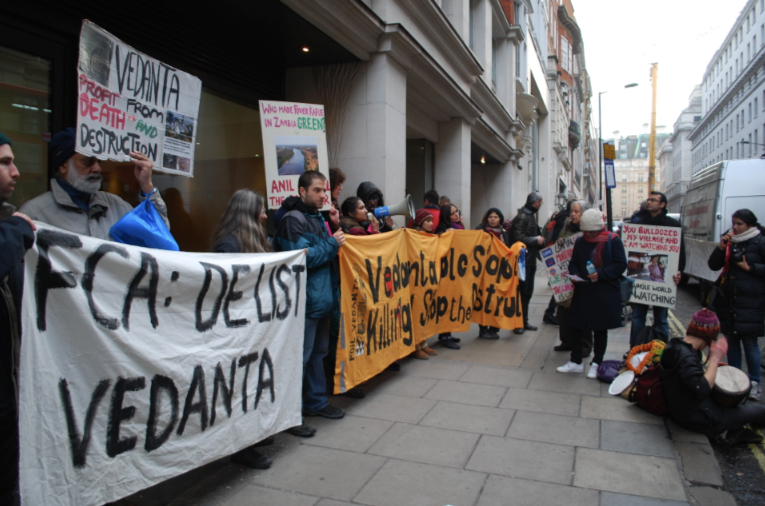
People across the globe have registered their protests against Vedanta once again. On January 11, parallel demonstrations took place in Orissa, London and New York where activists in hundreds raised slogans and upheld placards to denounce the corporate annexations of  indigenous peoples’ lands.

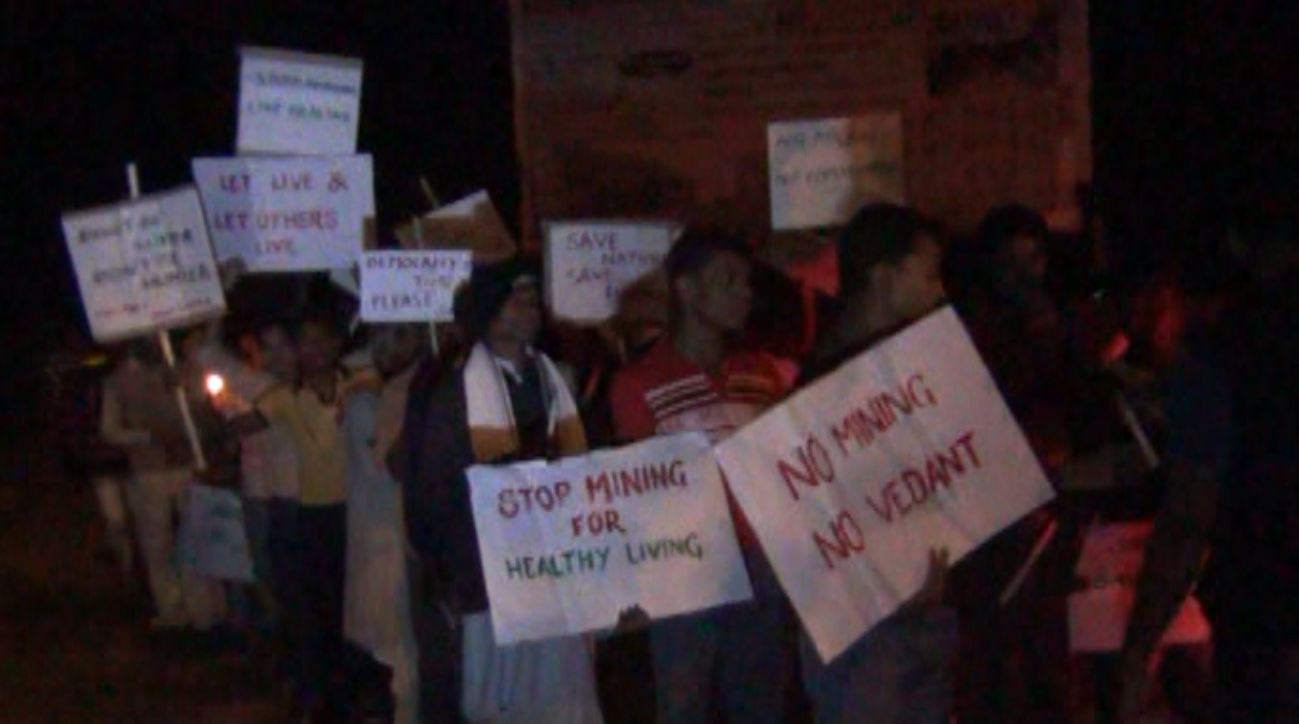
From Niyamgiri hills, more than 500 people turned up at a rally which covered about two kilometers in the Bhawanipatna town. Resistance movements in Lanjigarh have also inspired tribal representatives of Karlapat region whose mountains are now being targeted by the mining companies. In this rally, several people who were cheated of their lands narrated the atrocities and tortures they faced from Vedanta highhandedness in Lanjigarh. They also gave an account of how the company goons and the local police routinely harass the women in the afflicted areas.

Orissa

In solidarity with the indigenous peoples of Orissa, a loud group of protesters from Foil Vedanta and other grassroots groups mobbed the company’s Mayfair headquarters in London the same day. Holding a banner that read “FCA: de-list Vedanta”, the demonstrators called for the Financial Conduct Authority to remove Vedanta from the London Stock Exchange for poor corporate governance and human rights crimes.

London

Likewise, in New York City, protesters gathered outside the United Nations headquarters to highlight the company’s human rights crimes, displaying placards that read: “Our Mountain! Our Rights! Vedanta: Give Up!” and “Dongria Kond’s Niyamgiri: Hands Off!”

New York

Simultaneously, the Supreme Court of India has deferred its final verdict on Vedanta’s planned mega-mine until 21st January. If permission to mine is denied Vedanta is likely to close its Lanjigarh refinery due to lack of bauxite costing them billions. On Sunday the Minister for Rural Development Jairam Ramesh plans to visit the threatened mountain to visit the Dongria Kond.

Various grassroots groups including Phulbari Solidarity Group, Japan Against Nuclear, Tamil Solidarity and London Mining Network, along with Foil Vedanta gathered at Vedanta’s London headquarters to add their voice to recent pressure for Vedanta to be de-listed from the London Stock Exchange for its poor corporate governance, illegal operations and major human rights violations. They shouted ‘Vedanta out of London’ and blew horns and whistles. Several parliamentarians and the former CBI Director Richard LambertLondon have highlighted how Vedanta’s listing is used for legal immunity to hide their corporate crimes.

At the Supreme Court in Delhi today lawyers for Vedanta dwelled on the ongoing demonstrations in London, asking why people are protesting there, and claiming that India is suffering because of this. Judges noted that this is not relevant to the case and pointed out that people have a right to protest. Foil Vedanta’s spokesperson reacted:

“Vedanta is a London listed company and profits from this affiliation. It is typical of Vedanta to assume they are above the law and above public accountability. We will continue to draw attention to their corporate crimes here in London”.

Activists at the rally in Bhawanipatna chanted “Vedanta go back: water, land and forest ours. We are Supreme people of the supreme court” while dalit leader Surendra Nag spoke about the loss of land and livelihood for local people, some of whom have ended up as beggars. One man spoke of how his whole family had been tortured by company goons and they had lost 6 acres of land to the company without compensation.

The project has been racked with controversy from the start, as a spate of recent coverage points out: The Lanjigarh refinery built to process the bauxite from the hills was illegally constructed, the court case presided over by a judge with shares in the company, and the refinery should never have been given permission without including the associated mega mine in impact assessments. The Delhi High Court is also currently investigating the large donations from Vedanta to India’s two main political parties which could be deemed illegal as Vedanta is a foreign (British) company.

A cover story in major Indian glossy Open Magazine in December details evidence of corruption and collusion between Vedanta and the Orissa state government, local officials, judges and the police to force the project through. Meanwhile Vedanta’s chairman and 56.7% owner Anil Agarwal has launched a rare PR crusade claiming that Vedanta ‘have not cut one tree’ and respects and preserves the rights of the protesting indigenous tribe living on the threatened mountain. He sets out his extractive philosophy for India – suggesting that exploration should be drastically increased and regulation decreased to provide for the domestic market for metals and oil.

If Vedanta loses the case to allow state owned company Orissa Mining Corporation to mine the mountain on their behalf they may have to close the dependent Lanjigarh refinery costing them billions. Under enormous pressure from Vedanta the Orissa government has suggested alternative bauxite supplies from a deposit located in a major wildlife sanctuary and tribal area at Karlapat arousing anger and opposition from grassroots groups.

The court’s decision rests on whether the Green Bench of India’s Supreme Court rules the rights of forest dwellers to be ‘inalienable or compensatory’. In view of this, India’s Tribal Affairs Minister V Kishore Chandra Deo has asked the Environment Minister to ensure the rights of forest dwellers is protected in the spirit of the Forest Dwellers Act.

Speaking about the verdict, Dongria Kond activist Lado Sikaka states: “We will continue our fight even if Vedanta gets permission. Are these Judges above the Law? In effect, they act as if they are. Niyamgiri belongs to us. We are fighting because We are part of it. Our women are harassed and we are called by the police and threatened not to go to rallies. Last month they have been working like Vedanta’s servants.”

Foil Vedanta’s Samarendra Das says:

“Vedanta is not the only mining company that should be de-listed for their corporate crimes. Infamous London listed offenders Lonmin in South Africa, Monterrico in Peru, GCM in Phulbari and Bumi in Indonesia should also be investigated for extensive human rights atrocities.”

Video: Union Maids (1976)

Courtesy: LibCom.org

Video: 9th December 2012 – Automobile Workers’ Convention

Centre for Struggling Women: Appeal and Demand Charter on growing sexual violence

The recent brutal gang-rape of a 23-year old woman in Delhi has left the entire nation shocked and outraged. The fact that the woman was picked up along with a male companion from a crowded bus stand and then raped in the moving bus has left the public stunned. The sheer brutality with which the rape was committed has fuelled large scale protest. This widespread agitation by women and general masses all over the country reflects not just shock, but is also an expression of tremendous anger against continuous and growing violence on women. After all, the recent case of gang-rape is not an anomaly but a latest manifestation of a deeply ingrained rot that corrodes our lives, now overtly and at other times covertly.

Unfortunately, while there has been massive public outrage and a long dormant anger has spilled onto the roads, there has been little effort to tackle this issue in a rational manner. Spontaneous anger and symbolic violence have given vent to our frustration, but also carry the danger of being co-opted by the vested interests of the ruling class and its decadent culture. Therefore, this is an opportune (and imperative) moment for us to envisage ways in which to prevent such incidents from recurring in the future, and to ensure that the agitation against violence on women is not misused by vigilante groups (and other dubious social forces). We have to keep our autonomy of action, as well as the independence of our will intact. Thus, we must consciously deliberate upon the direction and content of the ongoing struggle.

It is important to remember that we are not fighting against only one brutal incident of rape, but against an entrenched phenomenon. It is a fact that women in this country have and are facing sexual exploitation and oppression in diverse forms. Recently cases of rapes have been reported from Haryana, Gujarat, UP and other states but the media has made the current case a city specific issue. Clearly, not all incidents of rape have met with the same quantum of media coverage and public outcry (at least at the level of the capital and its corridors of power). This is not to say that there have been no movements or agitation against sexual violence on women. Indeed, the ongoing protests should be seen in continuation with and connected to other protests against similar violence on women. Hence, the current protests should not be de-linked from, or stand unaware of the ground prepared by preceding struggles like those of the stone pelting spirited masses in Kashmir, the naked protest by Manipuri women against the sexual offences committed by army personnel, the protest against the rape and murder of Dalit women in Khairlanji (Maharashtra), etc.

Of course, for many, the current protests in Delhi might be a belated response to all these equally spine-chilling incidents of rape and brutality. However, for many others, it is the (uncomfortable) proximity of the incident (the feeling that the rape took place in the capital itself and could happen to anyone) which might be propelling the response. Moreover, some are troubled by the fact that political opportunists have increasingly taken hold of the spontaneous mass reactions. From the unfortunately named Bhagat Singh Kranti Sena (which has absolutely no relationship with the progressive ideology of Bhagat Singh, nor any connection with kranti), Shiv Sena activists, misogynist ‘babas’, funded ‘anti’-corruption crusaders, cadre from a Party of rapist-rioters to all kinds of agent provocateurs have high jacked the reactions of common masses. Some have rightly pointed to the hypocrisy of the media which has been ‘earnestly’ covering the current protests. Indeed, the very media which talks about reform measures to curb such incidents also projects women as objects of sexual fulfillment through advertisements, promotion of nudity through newspapers, etc.

In this light, we must realize that we need to assert our autonomy from such elements, and recognize who are the genuine and authentic fighters. We must also plan and prepare for the long run so that the next time, instead of them outnumbering us, we overpower them with, both, our ideological preparation and organizational resilience.

We need to realize that in no movement or mass reaction of such kind can we find a pure constituency, i.e. people who want to genuinely fight against women’s oppression because in the safety and freedom of all women they see the liberation of women they know.  Of course, the general male chauvinist response is to protect ones’ own womenfolk, but to do the same to others. This is precisely why at various venues of the ongoing protests, many male ‘agitators’ were seen harassing (ogling, touching inappropriately, etc.) women protestors. Even the recent rape of a factory woman worker by a rapist whose own daughter was raped earlier (19 December 2012 newspaper reports from Welcome area in northeast Delhi) points to the hypocrisy with which male chauvinism functions.

This then brings us to the question of the mentality and conditionswhich perpetuate inequality and violence. While we need to continue our struggle against all odds like Article 66A of the IT Act which prevents us from protesting on the internet, road blocks, tear gas, water cannons, metro blocks, Article 144, etc. which prevent our expressions of discontent from spilling onto the streets, and hence to become visiblethe need of the hour is to make a level headed analysis of the concrete situation and to put forward a set of concrete demands that are rational and desirable. Such an approach also demands that we look beyond the immediate event which is but a mere symptom of several grave problems, and focus our eyes on the disease itself—a disease that will outlive the current event and short-term remedial measures tabled in the name of ‘providing justice’. It is with this objective of fighting the actual malaise and to uproot it as a whole that we are putting forward this set of concrete demands, though without forgetting the old wisdom “without changing everything, we do not change anything”.

Without a doubt, our most formidable weapon against sexual violence is a sustained mass movement. Of course, a list of demands, as the one below, will only see the light of day until women across the country organize themselves under women organizations, and launch a multi-pronged and consistent movement on the issue of women’s exploitation and oppression. We, thus, appeal to all women and men to become part of progressive and democratic organisations so that even after these protests ebb we don’t just go back to leading our existing lives, but continue to aspire and struggle for a more just and equitable society for all. It is in this light, that our demands below are not just demands from the state but also stand for our claims on society.

DEMAND CHARTER

  1. Provide safe and adequate public means of transport. In Delhi itself there is a shortage of more than 5000 buses. This creates overcrowding and scope for sexual harassment of women commuters.
  2. All public means of transport (buses and autos) should be monitored. Every vehicle must be connected with a Global Positioning System (GPS) device so that its movement is monitored by the Traffic Police.
  3. All employees working in DTC, Cluster buses, BEST, city and state transport buses, auto rickshaws, Grameen Sewa must wear the public service vehicle (PSV) badge.
  4. In future recruitment of BUS conductors, priority should be given to women.
  5. No unregistered tourist/travel agencies must be allowed to ply their private vehicles. Further, there should be proper monitoring of personnel working in these private tourist agencies.
  6. Banning of unsafe private transport.
  7. Increase frequency of Delhi Metro trains so that overcrowding and scope for sexual harassment can be checked. Metro trains should ply throughout the night.
  8. Severe punishment for violation of traffic rules, especially tinted glasses, unclear/small-lettered number plates, use of loud music, and loud honking aimed at harassing women commuters.
  9. Vehicles plying at night should be properly scanned.
  10. Increase the number of ladies’ special buses, including their night services.
  11. No auto or taxis should be allowed to refuse passengers. License fees and other charges levied on these modes of transportation must be kept at minimum so as to keep the fare low. Majority of autos and taxis are owned by a handful of cartels-mafias. Such cartels must be busted, and instead, recognition must be given to auto workers’ own unions.
  12. Special women protection cells should be formed in Railways. All compartments in trains should have emergency alarm and other provisions for security of women commuters.
  13. Provision of separate school buses for government school students so that there is no overcrowding on certain routes.
  14. Proper and adequate street lighting.
  15. Women employees working in night and early morning shifts should be provided company transport facility.
  16. Increase the number of affordable working-women’s hostels to ensure safe accommodation for single working women.
  17. All out-station girl students studying in colleges must be provided cheap and safe accommodation by their respective institutions so as to hinder harassment by private landlords.
  18. There should be a clear distinction in the degree of punishment between rape and rape-brutality-murder; the latter should be punished more severely than the former. The quantum of punishment between the two types of rapes should be clearly separated. Death penalty is not a rational option because it would create the danger of every rapist considering murdering the victim so as to efface evidence and escape death penalty. There should be a legislation which recognizes the graded nature of sexual assault/violence based upon the concepts of hurt, harm, injury, humiliation, and degradation. The logic of awarding death penalty to a rapist is based on the male chauvinist belief that rape is a fate worse than death. In this context, the most important deterrent is the certainty of punishment, rather than the severity of its form.
  19. Separate fast track courts for cases of violence on women should be constituted. 25,000 more courts are required in addition to the existing 16,000. All pending cases of rape (All India-100,000, Delhi 1000) should be solved by specially constituted courts within 100 days.
  20. Medical examination of rape victims should be conducted by lady doctors wherever possible and no intrusive or archaic methods for medical examination should be conducted against the will of the rape victim.
  21. All districts in the country must be equipped with facilities for forensic test.
  22. All rape victims must be provided the needful psychological counseling.
  23. All requisite steps should be taken for the rehabilitation of the victims including adequate employment opportunities.
  24. The onus of proving oneself not-guilty should lie on the accused.
  25. Cross-examination of rape victims must not be allowed to become a cause for harassment.
  26. All those persons whose charge sheets have been filed for rape cases by the Election Commission must be barred from contesting elections for public bodies.
  27. Fill up all vacancies in various subordinate and higher courts. A law should be passed ensuring trial by an elected jury in all courts
  28. Proper protection must be provided for victims and witnesses in the cases of sexual offences.
  29. Rape-trials must be held in-camera and should be presided over by women judges.
  30. Women helpline and other emergency services should be provided round the clock and should be well advertised.
  31. Creation of a special vigilance team to monitor PCR vans.
  32. CCTV cameras should be set in all police stations, and swift action must be taken against errant police personnel. This is in the light of cases like Soni Sori who was tortured and raped in police custody. Shockingly, she is still languishing in a prison in Chhattisgarh.
  33. Increase the proportion of women in the police force. Currently there are less than 6.5 per cent women in the Delhi Police.
  34. Introduce compulsory courses on gender sensitivity in the training module of the Police Force instead of a few token workshops for a handful of Police Officers. Around 80,000 human rights violation complaints are lodged every year against the Police force of which a large number pertain to sexual offence against women.
  35. No male Police personnel should be designated to deal with victims of sexual offences, i.e. for enquiry and for escorting the victims to the court for trial. Instead, lady Police personnel in plain clothes should be deployed for the purpose.
  36. There should be proper distribution of Police between common masses and VIPs. A whopping 50,059 are guarding VIPs, which is 20,000 more than the sanctioned number. These Police personnel should be employed to serve the common masses and not for the security of VIPs and for curbing democratic movements of the masses.
  37. The role and functioning of National Commission for Women (NCW) should be audited annually and made public. There has been a tendency among the ruling Parties to distribute posts in this office as favors to its henchmen! This practice should be discontinued and free and fare elections should happen for all the posts so that individuals with credibility and standing in the women’s movement may be able to make their way to this important office.
  38. Gender sensitization to be included in school and higher education curriculum.
  39. Religious texts and practices/rituals which degrade women and create misogynist culture should be debated, boycotted and banned.
  40. Ban on the sale of liquor after 8pm.
  41. Unauthorized selling of liquor must be stopped and the culprits responsible for the same should be severely punished. Concerned authorities should be reprimanded for their negligence.
  42. Severe punishment for consumption of liquor at public places.
  43. Movement of inebriated groups of men late at night must be monitored and they should be fined/detained if they are perceived to be a threat to the safety of women. Drunken brawls, hooliganism, rowdyism by individuals and particularly groups of men are a major hazard for women travelling late at night. Adequate laws must be passed and efficiently implemented so as to ensure that women may be able to commute safely and free from fears.
  44. Serving of liquor in bars and pubs till late must be banned.
  45. Prompt registration of FIRs must be ensured. If the same is not accepted a written explanation must be provided by the concerned Police Station. Refusal to lodge FIRs filed by Dalits, minorities and tribals should be punished. As per the National Crime Records Bureau Report of 2011, out of the total 14618802 complaints of crime received by Delhi Police only 59249, i.e., less than 0.5 per cent, were registered as FIRs. This shows the general apathy of the Delhi Police towards all crimes in Delhi. As per Delhi Police Annual Report of 2010, only 11.88 per cent of all complaints received by the Crimes Against Women (CAW) Cells in Delhi were converted into FIRs. This criminal apathy is responsible for the confidence enjoyed by criminals in the state. Needless to say here that if the situation is so dismal in Delhi then it must be much worse in the rest of the country.
  46. All necessary steps should be taken to ensure that speedy and efficient investigation is done in rape cases.Currently, a larger proportion of those charged with rape and other crimes against women go scot free. The conviction rate in crimes against women has fallen in the country from a meager 27.8% in 2010 to 26.9% in 2011. As per studies conducted in Delhi, rape convicts imprisoned at the Tihar Jail of Delhi have committed an average of four rapes before conviction! This betrays the failure of the entire criminal-justice system.
  47. Conduct periodic audit on women’s safety in the city. Local women’s organizations and women’s hostel unions must be involved in this process.
  48. Police should be made accountable to women in all urban and rural localities and for this purpose regular Police-woman interactions must be conducted.
  49. Women under no circumstances should be detained at Police Stations during night time. Every Police Station must have women personnel.
  50. A special ‘crime against women’ cell should be constituted within the army to prevent sexual harassment of lady army personnel, to check misogynist culture and to prevent sexual offences against civilian women by army personnel.
  51. Scrap Armed Forces Special Powers Act and Public Safety Act which are being used by the army and Police, respectively, to commit atrocities upon women. Even some of the particularly atrocious cases like Kunan-Pushpor incident (February, 23 1991) in which least 53 women were raped in a single night by the soldiers of the 4th Rajputana Rifles; abduction, gang rape and murder of Neelofar Jaan and Aasiya Jaan of Shopian (Kashmir) on May 2009 by CRPF personnel; and torture, rape and murder of Thangjam Manorama by 17th Assam Rifles in Manipur 2004 are yet to be creditably dealt with as a result of the protection provided to the armed forces through the aforementioned Acts.
  52. The C. Upendra Commission Enquiry (2004) Report regarding the Manorama rape case should be made public.
  53. An independent enquiry commission should be constituted to look into the matter of crimes on women committed by army/paramilitary force/police personnel.
  54. All kinds of custodial (prison, police stations, convent, temples, mental asylums, NGOs and hospitals) rapes must be considered as aggravated sexual offences warranting more severe penalty.
  55. Constitute a ‘Children’s Safety Task Force’ and ensure its periodic inspection-visits of schools, orphanages, etc.
  56. All play schools should be properly regulated and monitored.
  57. Selling of dangerous substances like acid, which are used to commit violence on women, should be banned immediately.
  58. Agencies which provide domestic workers (maid servants) should be banned and the agencies should be taken over by the employment exchange department run by the local government.
  59. Depiction of women as sex-objects in advertisements, newspapers, magazines and all other forms of media should be banned and punished.
  60. Complete ban on pornography and on the screening of movies in theaters and songs which portray women in a misogynist manner.
  61. Ban on fashion shows, beauty contests which objectify women’s bodies as sex objects.
  62. Festivals related hooliganism should be severely punished and preventive measures like banning of balloon-selling before Holi should be strictly implemented.
  63. Ensure proper safety of women at all workplaces. Constitute ‘Crime Against Women’ cells in Police Stations of industrial areas, and constitute anti-sexual harassment committees within factories which have trade union representation within them.
  64. Forcing women employees to wear skimpy clothes at airports, pubs, auto expo, restaurant chains, etc. must be banned. Any change of uniform should be done only through consultation and approval of the workers’ union, or representative body of the employees in cases where no union exists.
  65. Make marital rape a punishable offence.
  66. Paid-rapes (prostitution) should be abolished along with proper rehabilitation of victims of prostitution. Complaints of sexual violence perpetrated on prostitutes should be immediately filed.
  67. Trafficking of women and children must be prohibited in all forms and severely punished.
  68. Since in many cases women and children are sexually exploited within the four walls of their home by people known to them, the government should develop an alternative system of accommodation, financial assistance and job opportunities for those women who feel inclined to leave their homes and live independently. Special attention should be paid to the difficulties and needs of disabled women.
  69. All women should be provided job opportunities by the government so that they become independent from their male family members and in situations of conflict may be able to lead their lives independently.
  70. Khap Panchayats, casteist-communal organizations and other kinds of vigilante groups responsible for spreading and normalizing misogyny must be banned.
  71. Severe punishment for the perpetrators of honour-killings, including those who abet this brutal crime.

Released By: MAYA JOHN on behalf of Centre for Struggling Women (CSW)-Sangharshil Mahila Kendra

Contact: cswdelhi@gmail.com

SUPPORTED BY:

Mazdoor Ekta Kendra (MEK), Blind Workers Union (BWU), Anand Parbat Industrial Area Mazdoor Sangharsh Samiti, Krantikari Yuva Sangathan (KYS)-Delhi, Krantikari Yuva Sangathan (KYS)-Haryana, Nirman Mazdoor Sangharsh Samiti (NMSS), Ghar Bachao Morcha-Baljeet Nagar, Mahila Panchayat-Punjabi Basti, ITI Students Solidarity 

Maruti Suzuki Workers Union: Dharna (December 19 2012), Delhi

Friends and Comrades,

We from Maruti Suzuki Workers Union, appeal to you to strengthen our struggle, by joining us in our day-long protest demonstration in Jantar Mantar from 10am on 19th December 2012. While the management of the Maruti Suzuki India Ltd. and the government of Haryana, continues in its joint offensive against us, we reaffirm our commitment to carry forward our legitimate struggle.

As you know, 149 of our fellow workers continue to languish in Gurgaon Central Jail. The bail plea of 15 contract workers among them was rejected by the Sessions Court, Gurgaon on 4th December even when no substantial proof of indictment could be provided by the state counsel, which points to the sham in the name of legal process that is being inflicted on us. 546 regular workers and more than 1800 contract workers have been terminated from service since 18th July, and five months on, we only face the arrogant attitude of the management and the government adamant to crush our struggle and the questions that it has raised- against the exploitative working and living conditions, for the right to Unionize and demands of justice. We have organized number of protest rallies and deputations to ministers of ruling and opposition electoral parties but have been only been faced by a management and government which leaves nothing undone in their attempts to weaken and divide us further into jailed, terminated, those working inside the factory, as also between contract and permanent workers.

We have shown our resolve to forge unity among us workers across these divides put up by the company and the government. We successfully organized the Automobile Workers Convention on 9th December 2012, where we raised the common issues of workers across the auto sector in Gurgaon-Manesar-Dharuhera-Bawal-Faridabad-Noida-Ghaziabad industrial belts, recognizing that we workers face the same conditions of exploitation in the entire NCR industrial belt. We are organizing a protest demonstration in Jantar Mantar on 19th December which is also the martyrdom day of our beloved Asfaqulla Khan and Ramprasad Bismil, who gave their lives in 1927 in the anti-colonial struggle for freedom. When today we again struggle against present conditions of unfreedom, we appeal to all to join us on the day of the dharna.

Imaan Khan, Ramnivas, Omprakash, Mahavir, Yogesh, Katar Singh, Rajpal

Provisional Working Committee

MARUTI SUZUKI WORKERS UNION

Self-organisation is the first act of the revolution; it then becomes an obstacle…

Logo

Autonomy, as a revolutionary perspective realising itself through self-organisation, is paradoxically inseparable from a stable working class, easily discernable at the very surface of the reproduction of capital, comfortable within its limits and its definition by this reproduction and recognised within it as a legitimate interlocutor. Autonomy is the practice, the theory and the revolutionary project of the epoch of “fordism”. Its subject is the worker and it supposes that the communist revolution is his liberation, i.e. the liberation of productive labour. It supposes that struggles over immediate demands [1] are stepping stones to the revolution, and that capital reproduces and confirms a workers’ identity within the relation of exploitation. All this has lost any foundation.

In fact it is just the opposite: in each of its struggles, the proletariat sees how its existence as a class is objectified in the reproduction of capital as something foreign to it and which in its struggle it can be led to put into question. In the activity of the proletariat, being a class becomes an exterior constraint objectified in capital. Being a class becomes the obstacle which its struggle as a class has to overcome; this obstacle possesses a reality which is clear and easily identifiable, it is self-organisation and autonomy.

MSWU: DILLI CHALO!!! Against Police Repression on Auto Workers Convention

As you know, we from Maruti Suzuki Workers Union (MSWU) have called for an Auto Workers CONVENTION on 9th December 2012 in Ambedkar Bhavan, Jhandewalan, New Delhi with common demands of auto workers in NCR industrial belt.

This program with our legitimate demands has been declared one week back, for which we have given due information for permission to the PMO and the Paharganj police station and have received copies of the same. But Haryana and Delhi government administration through the use of Police of both the states, along with CID Haryana has come down heavily on us for raising our legal and legitimate demands. They have denied us permission to hold the Convention in the evening today with the imagined reason that this will disrupt peace in the area. And since last two days, Haryana Police and CID has been calling on us and our parents and relatives to strongly threaten against holding this program and any such program in the future, or force will be used against us.

We condemn this direct attack on our democratic right guaranteed under the Indian Constitution by the joint forces of Haryana and Delhi government administration through the naked use of force in the service of the Maruti Suzuki management. And with what we have seen in the last four months, this is nothing new to us now, as the police and government administration have nakedly sided with the company management in their attempt to crush our voice of truth.

We appeal to all concerned with democratic rights and our just struggle to stand by us as we will go ahead with the declared program tomorrow and similar programs in the near future.Our fellow workers from across Gurgaon-Manesar-Dharuhera-Bawal-Noida-Faridabad-Ghaziabad industrial belt will join us and strengthen our struggle.

Condemning the police and administrative action against us, we reiterate our demands:

1. In the permanent nature of work in the auto sector in Gurgaon-Manesar-Dharuhera-Bawal-Faridabad-Noida-Ghaziabad industrial region, completely abolish the illegal contract worker system by the year 2013. Till they are not made permanent, all workers in the auto sector in this region should be given minimum wage of Rs.15,000.

2. All permanent workers in the auto sector must be given minimum wage of Rs.25000.

3. Unions must be formed in the auto belt industrial region. Within 45 days of application for registration of Trade Union, the concerned labour department must ensure the registration of the Trade Union with due process.

4. The High Court order in favour of workers of Eastern Medikit must be immediately implemented and the illegal lockout be ended. Take back all the workers of Eastern Medkit and ensure payment of due wages.

5. Along with all the 546 illegally terminated workers of Maruti Suzuki Manesar, all the contract workers must be immediately taken back to work.

6. All the arrested workers of Maruti Suzuki Manesar must be immediately released, the false cases withdrawn and stop the repression and torture of workers.

Sincere Regards,

Provisional Working Committee
MARUTI SUZUKI WORKERS UNION

 Program details:

Date: 9 December 2012; 11am to 6pm.
Place: Ambedkar Bhavan, Panchkuiyan Road, near Jhandewalan Metro Station, New Delhi

Contact: Imaan Khan-             09467704883      , Ramnivas- 08901127876, Omprakash-08607154232, Mahavir-09560564754,Yogesh-             08510043143      , Katar Singh-09728778870, Rajpal-             09555425175