The Babri Masjid was attacked on December 6, 1992. The terrorists are still at large.
Terrorism, Mass Hysteria and Hegemony in India
December 4, 2008 by Leave a Comment
Pratyush Chandra
All incidents in India that have occurred recently, which go by a blanket name terrorist attacks, have been viewed as self-explanatory. A terrorist and his acts don’t need any explanation. A terrorist is like any other professional who is supposed to do what he is trained for. Why does he do that – is not a question to be asked. It is his own “free will” which clashes with others’ free will. Haven’t we been time and again accused of talking about the human rights of the “terrorists” while “ignoring” those of the soldiers and policemen who are “victims” of the terrorist attacks? Their opposite location with respect to the hegemonic centre does not mean anything.
I feel the post-modern capitalist celebration of relativism indicates towards an important aspect of the reconstruction of power, civil society and expression in the age of finance capital. The footlooseness of faceless finance capital characteristic of this age has intensified the process of solid melting into the air to an ever-increasing degree – every click on the keyboard makes, changes and destroys billions of lives every moment. This has led to a multiple crisscrossed entrenchment of every segment in the society trying to hold on to something solid – an identity or something… In the process, every ‘melting’ identity poses its own language which could not be understood beyond the space-time of its posing. This is what we can call a continuous process of subalternization, of manufacturing subalternities that cannot act, but simply react in the hegemonic paradigm. When useful things become commodities, their self-expression (through their own use-value) is incomprehensible in the market, they must express their worth through the hegemonic reactive monetary expression of exchange-value – a general form of value.
Thus, the resolution of “civilizational” conflicts (between various levels of subalternities) is possible in the within-the-system framework only through a generalized cutthroat competition or simply mutual annihilation – the well-armed and defiant robots clashing with each other – “the terrorists”, the security personnel etc. The only language that is mutually understandable is that of the guns and bombs… So the citizenry can’t empathize with the terrorists, they are always aliens. And so are the (counter)terrorists and their ‘innocent’ protégées for “them”. They are reduced to reactive agencies within the hegemonic game-plans. They can only react to each other’s moves.
Today’s terrorism is a desperate cry to make others’ listen to what subjects/terrorists are unable to express and what “others” either refuse to hear or are unable to understand. It is the failure and crisis of self-representation let out in the hegemonic language of coercion and terror. This seems absurd but this is as absurd as the absurdity of the conjuncture.
The whole arrogant security discourse that the media and security mafia in India pose is far more absurd than the defiant terrorist attacks. What can be more absurd than the astheticised victimhood of the “great” India that they sell while being slyly proud whenever a terrorist attack takes place in the country, as that makes them feel to be in the league of the greatest victims of global terrorism – the US, UK and Israel. So now we have our own 9/11. This is the level of discourse in the Indian media in the context of the Mumbai incidents.
The recent unabashed display of an elitist, confessedly, “anti-political” stress on security infrastructure and technology to resolve every conflict and the aim to put away politics on security matters are nothing but an insistent inability and a lack of will to understand conflicts. Nobody is asking for an everyday democratic control over every aspect of social life, rather what is being provoked by the panicky bourgeoisie and petty bourgeoisie in India is a hysteria in favour of a trans-political security and intelligence machinery – which can easily become a permanent coercive, of course, an efficient, bureaucracy which regulates the social life.
Terrorism in the present shape is not a threat for the system but like its counterpart is an opportunity for the hegemony to create consensus to (counter)terrorise (and subalternise) the alienated voices and stop them from becoming a meaningful and organised threat to the system by transcending their own subalternity. Anyway, as a prominent postmodernist, postcolonialist scholar categorically said, “Who the hell wants to protect subalternity? Only extremely reactionary, dubious anthropologistic museumizers. No activist wants to keep the subaltern in the space of difference… You don’t give the subaltern voice. You work for the bloody subaltern, you work against subalternity.” (“Interview With Gayatri Chakravorty Spivak”, Ariel: A Review of International English Literature (July 1992), 23(3):29-47)
A New Cultural Revolution?
November 27, 2008 by Leave a Comment
“If the world is upside down the way it is now, wouldn’t we have to turn it over to get it to stand up straight?” -Eduardo Galeano. … Photographs of workers’ protest in a Chinese toy factory.
 Courtesy: China Daily
 Courtesy: Telegraph
A Round Table on Encounter Deaths
November 26, 2008 by Leave a Comment
The ‘Alternative Guidelines Towards Encounter Deaths’ and Strategies of Resistance
Date: 28 November 2008 Time: 3.00. p.m. Venue: Dayar-e Mir Taqui Mir, Jamia Millia Islamia (near the Vice Chancellor’s office)
Jamia Teachers’ Solidarity Group invites you to a Round Table on the ‘Alternative Guidelines Towards Encounter Deaths’ with special focus on the extra-constitutional powers given to Special Forces and Strategies of Resistance keeping in mind the present context where the naked brutality of the police and armed forces have unleashed a reign of terror not only on the Muslim population residing in the country in the states of Kashmir, Delhi, Gujarat, Maharashtra, Kerala but also in the north-eastern states of India particularly Manipur. The logic of countering terrorism/armed resistance might have different contextual specificities but the laws used for ‘encounter’ and the manner in which the same is executed flouting all human rights guidelines is a major cause of concern today. The petition filed by Peoples’ Union of Liberties, Maharashtra and the alternative draft submitted to the Supreme Court and the favourable hearing it has received has strengthened the voices of alternatives across the country. While the Batla House encounter on 19th September has been the centre of our activities, it is necessary to link it to wider political struggles going on in the country as the incident is hardly an isolated one. In Delhi itself we have witnessed several encounters along with bomb blasts that keep happening like a ceremonial ritual giving the much needed masala for the media houses to run, elsewhere we read reports or view open terrorist activities of minorities being lynched and tortured to death by the self-proclaimed votaries of the Hindu majority and feel ‘protected’ by the distance that separates us from the event that might be a prime time show. The question is no longer confined to minority communities alone since it is not only religious or racial/ethnic scape-goating that is happening, but also in a calculated manner all voices that question the State and its institutions get throttled one way or the other. Civil rights movements therefore necessarily assume a kind of ‘defensive’ role – challenging the powers that be after an incident of violation has taken place. With the recent revelations of the CBI regarding the role of the Special Cell and the booking of criminals in saffron perhaps the tide is turning where an offensive campaign may be mobilized to instill policy changes in law that might be yet twisted to protect the rights of the people vis-à-vis the interests of the State.
The panel of initiators for the discussion are –
Prashant Bhushan –(Human Rights Lawyer) – Defence Counsel for the PUL petition in Supreme Court regarding alternative guidelines on encounter deaths; Sufian Siddiqui – (Supreme Court Lawyer), Bimol Akoijam – (JNU)
The discussants for the Round Table are – Gautam Navlakha – (Democratic Rights activist), Nirmalangshu Mukherji – (Dept. of Philosophy, DU), Tripta Wahi – (Dept. of History, DU), Vijay Singh – (Dept. of History, DU)
Seminar on Socialism For the Twenty First Century
November 26, 2008 by Leave a Comment
New Socialist Initiative: a collective committed to the regeneration of revolutionary socialist politics invites you for a Seminar on Socialism For the Twenty First Century on Sunday 30th Nov at 4 P.M. Venue: Conference Hall, Rajendra Bhavan, 210 Deendayal Upadhyaya Marg, New Delhi – 110002
Humanity stands at the threshold of new crises and new possibilities. As global capitalism takes humanity through another round of economic crisis, increasing unemployment, and poverty, a simple and stark question raises its head. Is humanity condemned to live with exploitation, oppression, dehumanising working conditions, wars and a looming ecological catastrophe, or is it capable of building a society without class, caste, and gender injustices, a society where the path to growth is not paved with poverty, hunger and overworked human bodies, where competitive greed is not the most rewarded human emotion. Rulers of the world since times immemorial, form Egyptian Pharaohs to Greek slave owners to Chinese Emperors to the current capitalist breed have always believed that they rule over the best of the world. The question raised above would scare them. For the people on the other hand, this question offers a stark choice. Either they succumb to ruling class ideologies, their obfuscations, allurements and sedation, and remain blind to it. Or, they doubt, critique and ask questions; if humanity is to make a better world, how should it go about it? What lessons does history teach in this regard?
Ever since capitalism became the dominant social system, socialism has been integral to humanity’s endeavours to imagine and achieve a better social world. Against the private profit greed of capitalism, socialism pitted the ideal of collective well-being; against a discouraged and alienated mass of humans created by capitalist profit machines, socialism envisioned an active and organized humanity that is fully aware of historic capabilities and tasks; against the freedom to make profit by one that leads to the misery of many, socialism raised the banner of a society in which the ‘the free development of each is a condition for the free development of all.’ To imagine socialism will become irrelevant even while capitalist injustices continue, is to believe humanity to be a condemned species. On the other hand to imagine that specific answers to the above questions provided by socialist visionaries like Saint Simon, Fourier and Owen, or by Marx and Engels, who put socialist theory on a firm scientific basis, or by practitioners of socialism like Lenin and Mao, will be correct in every aspect in the context of current too will be incorrect. For, capitalism has changed. It has changed, through trial and errors while dealing with its own crises, and by its efforts to counter and deflect mass movements against its rule. The most significant changes have occurred in the political and ideological domain. Liberal bourgeois democracy has become the norm of state rule, not just in economically advanced countries, but in underdeveloped countries like India too. Feudal ideologies based on ideas of natural hierarchy and blind faith in the super natural have been replaced by individualism and consumerism of a mass society, which while freeing humans of hierarchical constraints also dis-empower them by obfuscating the social context of their life.
Revolutions of the twentieth century, the Russian, the Chinese, the Vietnamese, or the Cuban, managed to rid a segment of humanity from direct capitalism. History has shown that their success was only partial. While they succeeded in saving their societies from the crises they were in, they failed to put them irreversibly on the path to socialism. Our current context in the twenty first century demands a critical engagement with the history and legacy of these revolutions. Interestingly, it is also in the current context, at a stage of history already shaped by two centuries of capitalist rule and at a time when capitalism as a social system reigns unopposed for the first time globally, that one also hears renewed stirrings for socialism in settings as diverse as hills of Nepal in South Asia, and favelas of Venezuela in Latin America. What do experiences of these countries tell us about prospects of socialism?
We feel that it is time that we revisit these ongoing stirrings for socialism and also start the process of reenvisioning socialism for our times. To start a meaningful discussion New Socialist Initiative, which is a collective committed to the regeneration of revolutionary socialist politics has invited eminent journalist Anand Swaroop Verma, scholar-activist Achin Vanaik and thinker Ravi Sinha to share their ideas on the theme.
An Open letter to the Chief Election Commissioner
November 24, 2008 by Leave a Comment
The Jamia Teachers’ Solidarity Group reacting sharply to the ongoing communal vitiation of the political environment by the Bharatiya Janata Party issued an open letter to the Chief Election Commissioner of India, Mr. N. Gopalaswami. The indiscriminate manner in which the Bharatiya Janata Party and its parent organizations had been targeting the minority communities in the country in Kandhamal, Dhule, Udulgudi creates an alarming situation that challenges the very moral fabric of a secular, democratic nation. Not only the credentials of a central university like Jamia Millia Islamia is being regularly brought into question, a sense of insecurity, fear and anxiety is created in the adjoining area of Batla House, Jamia Nagar, Abul Fazal Enclave, etc. where primarily the Muslim population resides. The hate campaign of the BJP has to be stopped at all cost and before the guilt of those who have been killed in the encounter, one of whom was a minor and the five who have been accused of being involved in seditious activities against the State is proved before a court of law, they cannot be referred to as terrorists
Subject: Demand to Restrain Bharatiya Janata Party targeting the Muslim community in Jamia and Batla House area in their election campaign.
Dear Sir,
Following the incident of encounter at L-18 in the Batla House area on September 19, 2008 where a MA Previous year student of Jamia Millia Islamia and a 17-year old boy were killed by the Special Cell on the ground of their involvement with the bomb blasts in Delhi and other cities of the country, Bharatiya Janata Party had been actively engaged in a virulent hate campaign fomenting communal sentiments in the country to garner votes in their favour. Two of the five young men who are in police custody for their alleged involvement in seditious activities are students of Jamia Millia Islamia, while the other three were young men seeking out a career in the city. The recent findings of the CBI regarding the activities of the Delhi Police Special Cell has cast a serious aspersion over the credibility of their findings and since the issue of Batla House ‘encounter’ is yet to be produced before the court of law, one cannot pronounce them as guilty. Thus, the constant reference by the BJP to the deceased (one of whom was a minor) and the five arrested as terrorists is not only malicious and politically motivated but also legally invalid.
We urge your office to immediately intervene in the matter and take necessary action against a political party like the Bharatiya Janata Party who have been campaigning for the forth-coming elections in a language that is contrary to the secular, democratic spirit of the Indian Constitution.
The letter was signed by several members of the teaching fraternity.
Thanking you,
Yours’ truly,
Manisha Sethi
Adil Mehdi
Anuradha Ghosh
Sreerekha
Crisis, the Bankers’ Bailout, and Socialist Analysis/Strategy
November 24, 2008 by 3 Comments
Dave Hill
The current crisis of Capital and the current response
In the current juncture, the crisis of capitalism, as in the repeated crises of capital and overproduction and speculation predicted by Marx, capitalists have a big problem. Their profits, the value of the shares and part control of companies by Chief Executive Officers and other capitalist executives (late twentieth century capitalists), are plummeting. The rate of profit is falling, has fallen.
The political response by parties funded by Capital, such as the Democrats and Republicans in the USA, and Labour, Liberal and Conservative in the UK is not to blame the capitalist system, not even to blame the neoliberal form of capitalism (new brutalist public managerialism/ management methods, privatisation, businessification of education, for example, increasing gaps between rich and poor, between schools in well-off areas and schools in poor areas). They have criticised only two aspects of neoliberalism: what they now (and only now!) see as the over-extent of deregulation, and the (obscene) levels of pay and reward taken by ‘the big bankers’, by a few Chief Executive Officers (CEOs).
Not an end to Capitalism or even to Neoliberal Capitalism
Talk of an end to neoliberalism is premature, so is talk of an end to capitalism. Criticism in the mainstream capitalist media and mainstream capitalist political parties is only of the excesses of Capitalism, indeed, only the excesses of that form of capitalism- neoliberal capitalism- that has been dominant since the 1970s, the Thatcher-Reagan years- dominant in countries across the globe, and within the international capitalist organisations such as the World Bank, the International Finance Corporation, the World Trade Organisation.
Premature, too, is talk of a return to a new Keynesianism, a new era of public sector public works, together with (in revulsion at neoliberalism’s- in fact- capitalism’s- excesses) a new Puritanism in private affairs/ private industry.
The current intervention by governments across the globe to ‘save banks’ can be seen as ‘socialism for the rich’, a spreading of the pain and costs amongst all citizens/ taxpayers to bail out the banks and bankers. Side by side with this bailing out of the banks (while retaining them as private- not nationalised institutions!) is the privatisation, and individualisation of pain- the pain that will be felt in wallets and homes and workplaces throughout the capitalist countries, both rich and poor. Already (November 2008) we see in Britain the Conservative Party changing its previous policy of matching Labour’s spending plans for 2010 onwards into a rightward slide- saying that public services will have to suffer, to pay for the cost of the crisis. Capitalist governments throughout the world will, unless successfully contested by class war and action from below, make the workers and their/ our public services, pay for the crisis. So that, once again, the bankers can make their billions, extracted from the surplus value of the labour power of workers.
It is true that finance institutions need government intervention, in order to keep funding loans and mortgages, to prevent banks and finance capital repossessing people’s homes. But under what conditions?
Marxists and left socialists need to lead and support calls and mobilisations for the nationalisation of the banks. In Britain, for example, people such as John McDonnell, the leader of the ‘left’ Labour MPs in Britain, and the LRC (Labour Representation Committee) and Marxist groups such as the Socialist Party and the International Socialist Group and the Socialist Workers Party call for banks to be taken into public ownership (with the SP calling for ‘compensation only on the basis of proven need’), in other words for the nationalisation of finance to be complete and long-term.
But Capital and the parties it funds will, seek to ensure that Capital is resurgent, and that after what they see as this temporary ‘blip’ in capitalist profitability, it will once again confidently bestride the world, though with less of an obvious smirk on its face, and with less obvious flashing of riches. At least for the time being.
In times such as these, of economic crisis and of the inevitable retrenchment, it will be the poor that pays for the crisis, in fact, not just the poor, but the middle and lower strata of the working class.
Controlling the Workers
And who better to ‘control’ the workers, the workforce, to sell a deal – cuts in the actual wage (relative to inflation) and the social wage (cuts in the real value of benefits and of public welfare and social services)- but the former workers’ parties such as the Labour Party, or, in the USA, the party with (as with labour in Britain) links to the trade union movement- the Democrats. So US Capital swung massively behind Obama in the US Presidential election, and it is likely that increasing sections of British Capital will swing behind Gordon Brown and what is still regarded by many as a workers’ party, or at least, the more social democratic of the major parties on offer. Better to control the workers when the cuts do come. And to return to a slightly less flashy form of capitalism- more regulated, but still the privatising neoliberal managerialising, commodifying, neo-colonial and imperialistic capitalism.
Resistance
This is, as ever, subject to resistance and the balance of class forces (itself related to developing levels of class consciousness, political consciousness and political organisation and leadership). Resistance is possible, and will, inevitably grow. Demonstrations, strikes, anger, outrage at cuts, will increase, perhaps dramatically, in the coming period. To repeat, to be successful instead of inchoate, such anger and political activism needs to be focussed, and organised. In such circumstances, the forces of the Marxist Left in countries across the globe, need to put aside decades old enmities, doctrinal, organisation and strategic disputes. In Britain, for example, the Socialist Party, the Socialist Workers party, Respect, the Alliance for Workers Liberty, the Communist Party of Britain, other groups on the Marxist Left, together with socialists within the Labour Party, need to rapidly form a coherent organisation/ alliance and expose the current crisis as a crisis not just of neoliberalism, but of Capitalism itself. And to pose Socialist alternatives. Here, the new anti-capitalist party in France (under the leadership of Olivier Besancenot), coalescing formerly rival groups and individuals, is an outstanding example of a successful regrouping/ regroupement of the Marxist Left. And in Britain, the Convention of the Left could play a coalescing role?
Of course, regroupment by itself just organises current activists and supporters. Regroupment needs to be followed by, accompanied now! by recruitment. At this particular moment in the crisis of capital accumulation and the actual and potential for loosening the chains of ideology/ false consciousness promulgated by knowledge workers in the (witting or unwitting) service of Capital.
Implications for Education Policy of the Current Crisis
Within England there may well be some minor changes following from disenchantment with neoliberalism. Such changes, the changes in recent years promoting more creativity in the curriculum, reducing the burden of tests, have been argued for by unions and by the Socialist Teachers Association (STA) for years.
But changes to restore and go beyond a more democratically accountable, less brutalist, less divisive, less test-driven, less punitive education system, are not yet on the cards. With campaigns and mass pressures they could become so.
But there is nothing inevitable about neoliberal education transmogrifying any time soon into liberal child friendly and/ or socialist education for equality. These need to be fought for, and will need to be part of a wider transformation of social and economic relations in society.
Which is why we can foresee an intensification of right-wing attacks on radical and socialist educators, on critical pedagogues, throughout the capitalist world.
The culture wars, between the ideologies/ belief systems of Marxism and Socialism on the one hand, and the various forms of pro-capitalist ideology: social democratic, liberal –progressive, neoconservative, neoliberal and racist/ Fascist ideologies on the other, will intensify.
Interest in Marxism is growing. More are seeing through the Emperors’ clothes of pro-capitalist politicians, sand their sleight of hand support for Finance Capitalism and Capitalist exploitation of the labour power of workers.
Hence, in these current times, Marxist and radical educators are dangerous. Intimidation, dismissals, public denunciations (there are many cases globally, most recently in Australia and the USA) will increase.
It is a time for civic courage, for hope, for Marxist analysis, for solidarity, for organisation. A united Left could and should display all five.
Dave Hill is Professor of education policy, University of Northampton, United Kingdom.
Bondage and Capitalism
November 22, 2008 by Leave a Comment
Pratyush Chandra
A Review of Labour Vulnerability and Debt Bondage in Contemporary India, CEC, March 2008, xii+92, Price – Rs 200.
The persistence of “debt bondage” in India has long mesmerised the progressive intellectuals and activists, a vast majority of whom still consider its existence as a reminder of the amphibian (semi-feudal, semi-capitalist) character of India’s political economy and its underdevelopment – overloaded with pre-capitalist “vestiges”. The booklet under review drastically differs from such an understanding of bondage. It does not view it as “a unique system”, rather as a form of employment relationship institutionalising labour vulnerability through debt. “Bonded labour is primarily a social relationship and all those labour relations where vulnerability of the workers is institutionalised through debt could be described as bondage”(6). Further, bondage is “a flexible and adaptive system of labour exploitation”(8).
With the development of capitalist relations in India, bondage has increasingly lost its earlier permanent and generational nature, and has become more and more temporary, seasonal and individualised. The public policy and legal-state machinery that are in place to identify and ‘eradicate’ bondage are unable to record and influence its reproduction in the era of globalisation. Informalisation – contractualisation and casualisation – of the work process that characterises the neoliberal regime of accumulation has tremendously increased labour vulnerability leading to a system of “neo-bondage”, as Jan Breman calls it. Debt and bondage are most rampantly used as mechanisms to mobilise cheap labour from hinterlands and ensure migration (seasonal or long-term) for labour supply in the industries in which India has a comparative advantage. In fact, “with respect to bonded labourers, debt is always a precondition for entering the labour market and in establishing an employer-employee relationship” (80-81).
This report based on extensive studies throughout India maps the institutionalisation of labour vulnerabilities through various forms of debt bondage in contemporary India. With the help of many case studies, it shows how debt posits an element of liability on the part of the worker in the employment relationship, thus reinforcing and consensualising the subjugation of labour under circumstances and conditions on which the worker has a lesser control than otherwise. Advance or debt shapes “the situation of being employed”. It reconfigures an employment relationship as that between the debtor and the creditor, thus reducing the “agency of labour” and alienating the rights and entitlements of workers that characterise the ideal contractual relationship. However, the liabilities in the relationship or general costs of labour are accumulated and bestowed on the worker. The report understands that the role of debt in bondage “is not as an element of an agreement for which there are separate rules and practices of enforcement, but rather… to construct how the claims of workers will be interpreted and treated” (20).
The third chapter of the report assesses the interventions of the state and other agencies to eradicate bondage and rehabilitate bonded labour. It details the provisions of the Bonded Labour System (Abolition) Act, 1976 and the subsequent judicial, legislative and executive activism. It enumerates the discrepancies in its implementation. The chapter also examines the intervention of NGOs. A significant conclusion in this regard is that it was the mobilisational and organisational efforts that were most effective in bonded labour eradication.
The report establishes that bonded labour too has contributed in “India shining” and its globalising aspirations. In fact, bonded labour is not just an input in commodity production; rather, workers in the relationship (conditioned by advances or debt) are essentially sellers of their labour power. “They are controlled by the employers in lieu of an advance or delayed payment or non-payment of minimum wages”.(82) Wages in such conditions are squeezed not only through depressed, delayed and deducted payments, but also via uncontrollable interest rates.
It is important to understand Marx’s conception of “wage slavery” here. The usage of this phrase was not at all allegorical or rhetorical, as many tend to believe. It conceptualised the unfreedom or coercion inherent in the dual freedom of labour (from physical compulsion and from the means of production). On one hand, this dual freedom creates an ambience that compels a labourer to sell his/her labour power. On the other hand, once labour power is sold for a period, the labourer has no control over its expenditure for that duration. It should be remembered though the custom is to pay the wages after labour-power is exercised, wages are, in fact, already advanced prior to the labour process not only for the purpose of records, but also as capital required for production – i.e., it constitutes variable capital that is required to buy labour-power and put it to work. In the circuit of capital given below, Money (M) is advanced to buy Means of Production (MP) and Labour Power (LP) before Production (P) can take place.

In fact, “whether money serves as a means of purchase or a means of payment, this does not alter the nature of the exchange of commodities”.(Karl Marx, Capital, Penguin, pp. 279) As “a means of purchase” money is advanced to the sellers of labour power prior to production, while as “a means of payment”, it remains as the worker’s “credit to the capitalist” until production is completed to be paid as wages afterwards. Functionally it hardly makes any difference – “this does not alter the nature of the exchange of commodities”. And both institutionalise labour vulnerabilities in their own way – advance (partial or whole) can easily be transformed into debt, creating liabilities that shape bondage, while wages can be delayed or even lost (when the capitalist goes bankrupt). In fact, the delay in receiving wages is a significant reason for indebtedness among workers. If in Marx’s England debt played a part in tying the worker more to a shop as a consumer, or to sustain the “truck system”, it can instigate other systems, too, to institute labour vulnerabilities. Ultimately the purpose is to increase these vulnerabilities and thus, reproduce the hegemony of capital over labour. The report remarkably succeeds in showing how this is done in various parts of India through debt bondage.
(This review was originally written for Labour File – A bimonthly journal of labour and economic affairs published from New Delhi)
Appendix
A. The process of proletarianisation to which the majority is subjugated, not the number of ‘ideal’ proletarians or wageworkers, defines capitalism. The actualisation of this process – and thus the degrees of proletarianisation or the “dual freedom of labour” differs according to the concrete contexts defined by the needs of capital and class struggle. More technically, this process is a long thread (not necessarily historical) between the formal subsumption to the actual subsumption of labour by capital – its two ends. At various junctures archaic unfreedom, like slavery, which generally characterised pre-capitalism is formally adopted (more aptly, exapted as explained in B) and transformed according to the conjunctural needs of capitalist accumulation. If we don’t recognise this processual aspect of capitalism, we will be lost in the miasma of overproduced forms and appearances in capitalism.
B. Stephen Jay Gould’s conception of exaptation, I believe, is very useful in understanding the dialectical internalisation of “vestiges” by new stages in evolution – both biological and social. Gould and Elisabeth S. Vrba in their 1982 paper define exaptation as (i) “a character, previously shaped by natural selection for a particular function (an adaptation), is coopted for a new use”; and, (ii) “a character whose origin cannot be ascribed to the direct action of natural selection (a nonaptation), is coopted for a current use”. This concept allows us to comprehend the reproduction of “vestiges” as a process internal to the new stage in development, not as something hindering the ‘complete’ realisation of the new stage.
C. The “purist” idea that “vestiges” obstruct (not shape or contextualise) capitalist development has for a long time informed the theory and practice of Marxism in the so-called third world countries – engaging the revolutionaries in the fruitless exercise of fighting the “vestiges” before taking on the basic system, thus investing their revolutionary vigour in the reformist project of the capitalist development. It is interesting to note that this is not only true about the “Leninists” and “Maoists”, as some “anti-Leninists” allege. Many anti-Leninists and anti-Maoists present more vehement denial of the feasibility of any socialist project in “backward” countries. Their conceptualistion of revolution not only goes against the thesis of “revolution in permanence” – “the downfall of all the privileged classes, and the subjection of these classes to the dictatorship of the proletariat by maintaining the revolution in permanence until the realisation of Communism, which is the final form of organisation of human society” – but is also an unconscious reinforcement of the notion of “socialism in one country”, which they profess to hate.
Fascism and Liberal Democracy
November 18, 2008 by Leave a Comment
Pothik Ghosh
There can be nothing more precarious in the life of a liberal-democracy than the evacuation of politics from law. India currently faces precisely such a crisis, evident in the alleged emergence of Hindutva terror, its insidious denial by mainstream ‘social’ and political outfits of the Hindu Right and, ironically, even the terms in which the secularist camp has sought to counter their propaganda. It is, in fact, the liberal-secular aspect of the problem that is, at once, most interesting and disturbing.
A sizeable section of Indian liberals has, in ascribing double standard to the sangh parivar that has been maligning the Maharashtra anti-terrorism squad’s investigation into the September 29 Malegaon blasts, unwittingly come to share the political-ideological assumptions of Hindutva. Sangh parivar outfits, after having viciously opposed all attempts to call into question the fairness and neutrality of police-investigative procedures into acts of what they call “jehadi terror”, have suddenly done a U-turn to accuse the Maharashtra ATS of being politically pliable and its line of probe into the Malegaon explosions ideologically compromised. Even the BJP has, as is its equivocal wont, carefully allowed only some of its senior leaders to lend their voices to this pernicious cultural-nationalist chorus.
Yet, accusing Hindutva groups of hypocrisy and double standard would close more democratic doors than open them. Such accusation may or may not help the anti-BJP forces score electoral brownie points now. But they would certainly discredit, in advance, all criticism and questioning of state institutions for all times to come. To get caught in debates about the desirablity of interrogating and criticising state institutions is to miss the point.
What matters is whether critical interrogation of state instrumentalities, or the criticism of such criticism, has been prompted by the political desire to render the state and its institutions accountable to a people who embody the values of our Constitution. That would be democracy. The politics of Hindutva, which seeks to make state institutions amenable to the will of a mass at odds with the constitutional principles of liberalism, is majoritarianism. And yet in the absence of a politics that would enable people to make that distinction, democracy and majoritarianism are easily conflated. Sangh parivar organisations have accomplished precisely that with great success.
In such circumstances, direct organisational links between the Malegaon accused and the sangh parivar, even if they do exist, are of little consequence. What is both important and indisputable is their ideological kinship. That, more than any organisational tie, is a characteristic feature of fascism.
Fascism cannot, however, be effectively battled as long as its opponents remain unaware of the gaps in the legalistic discourse and practice of liberal democracy. It is in those fissures that the pestilence of fascism, irrespective of whether it takes the form of Islamism or Hindutva, silently breeds. That said, it would be ideologically troublesome and politically perilous for us here in India to tar the two forms of fascism – Hindutva and Islamism – with the same brush. If anything, such an equation would only reinforce the problematic legal, anti-political praxis of liberal democracy.
We need to distinguish one from the other, even at the risk of appearing undesirably divisive. For, in the long run, more harm than good would be done if this difference is obscured now for some tenuous gains on the Hindu-Muslim brotherhood front. The point of this comparison is not to legitimise the idea of ‘lesser evil’. The point is to recognise the difference in political structures and processes constitutive of each of those strains of terror, if only to come up with a composite solution to the larger problem of civic violence of which both Islamism and Hindutva have become indivisible halves. There is absolutely no doubt that both the Islamists and the footsoldiers of Hindutva seek to close the liberal space through their terroristic campaigns, both covert and overt. But what is more germane is that while the former seeks to subvert liberal democracy by challenging it from the vantage point of opposition and resistance, the latter strives towards the same goal by using the language of liberal democracy and manipulating its institutions.
The recognition of this difference in methods is crucial because it serves to illuminate a rather intractable problem posed by demographics that liberal democracy cannot discern, leave alone resolve, as long as it posits itself in legal-ethical terms. The right to life of a citizen – the foundational liberty on which the edifice of liberal democracy stands – has implicit in its conception the idea of protecting a particular form of material and cultural life from elements that endanger it. The legal-ethical paradigm of liberal democracy entirely precludes the political-agnostic approach, which historicises the the normative liberal-democratic idea of citizen and his eligibility of rights as an abstraction of a certain (insurgent bourgeois) moment of transformative politics seeking real human autonomy. Such historicised engagement with liberal democracy would leave us with no choice but to seek to break with its ethical-legal framework if only to remain true to its impulse (read logic) of continuously seeking concrete human autonomy. The absence of such a reading – which is the default position to which the ethical-legal paradigm of liberal democracy inevitably obtains to – ends up upholding and defending the sovereignty of a certain form of life that is created solely by the majority community and accessed either only by its members or those among others who accept the ideological hegemony of such a qualified form of life, which constitutes the biopolitical horizon of the liberal-democratic polity. All others become, on this terrain of biopolitics, bearers of a form of bare life – as opposed and inferior to the qualified life form – whose sovereignty a liberal democratic state is not only not obliged to defend but is actually also tasked to hold at bay through repression because it threatens the sovereignty of the life of the citizen.
In such circumstances, a citizen eligible for his rights is one who enjoys the entitlements that enables him to the qualified form of cultural and material life, which comes to characterise the national mainstream. Those who cannot, or do not, access such entitlements are obviously not eligible to be rightful citizens. The paradox is that such biopolitical entitlements can be accessed by those who do not have it by invoking rights, even as those rights are denied to them precisely because they do not have the entitlements to that would qualify them as citizens. This problem cannot, clearly, be resolved within the ethical-legal and status quoist paradigm that liberal democracy posits but only through a politics that seeks to break/reconfigure/redistribute the status quo of entitlements by replacing legislation with a political movement of socio-economic transformation.
The absence of such a political imaginary – of which the hegemonic establishment of the ethical-legal discourse of liberal democracy is the other dialectical half – virtually legitimises majoritarianism, even as it frames the opposition of social groups either excluded or repressed in that status quo in some kind of minoritarian idiom, which is simultaneously rendered illegitimate. That is the reason why fascism, when it is manifest through Hindutva in our country, is seen by a whole clutch of committed liberal democrats through a prism tinged with partial, if not total, acceptability. The same bunch, not surprisingly, displays no such ambivalence while characterising Islamist fascism as the greatest evil of our times. There is a desperate need for a more agnostic (read political) approach to liberal democracy. Nothing short of that would help us transcend our fascist status quo and the liberal democratic discourse that makes this enormity possible.
(An abridged version of the article was published in The Economic Times)
Global Economic Crisis-V
November 14, 2008 by Leave a Comment
Deepankar Basu
Link to Global Economic Crisis-I
Link to Global Economic Crisis-II
Link to Global Economic Crisis-III
Link to Global Economic Crisis-IV
The Long Term Story
The long term story, as I have already indicated, is a story about the rise and (possible) fall of neoliberalism. The Golden Age of Capitalism – the two and a half decades after the second World War – drew to a close by the late 1960s and global capitalism entered a period of structural crisis. The process of general capital accumulation is largely driven by current and expected trends of profitability of capital (measured by the rate of profit). When the rate of profit declines the process of capital accumulation slows down, heralding a period of crisis of capitalism. The rate of profit had peaked in the early-to-mid 1960s in both Europe and the USA; thereafter, the rate of profit continued to decline for the next decade and a half falling from a high of about 20 percent to a low of around 10 percent.
Structural Crisis of Capitalism
Why did the rate of profit fall during this period? The falling profit rate goes to the heart of capitalism and shows up deep contradictions in the process of economic growth and technical change that accompanies capitalist development. The technological dynamism of capitalism is driven by competition between capitals to increase profits by reducing the cost of production. When the share of wages in national income is high, there is a strong incentive for capitalists to reduce the amount of labour required for production. The Golden Age of Capitalism, being a period of regulated and welfare capitalism, had ensured high and rising real wages and therefore maintained a high and relatively constant share of wages in national income. That provided the incentive for adopting labour saving technical change, i.e., adopting new techniques of production that required less and less labour per unit of output. Labour saving technical change increased the productivity of labour.
But the increasing productivity of labour came at a cost: falling productivity of capital or the output-capital ratio (the ratio of output to capital). Labour saving technical change, which increased labour productivity, was only achieved by replacing labour with capital, i.e., more and more labour was replaced by more and more machines in the process of production. This is one of the characteristic features that we often observe with capitalist development: mechanization and the increasing capital intensity of production. The use of more and more machines that increased labour productivity meant that every unit of output now required less labour but more capital; thus labour productivity increased but capital productivity fell.
This is the pattern of technical change, whereby labour productivity increases but capital productivity falls, that accompanies capitalist development during significant periods of time. This is also the way Marx had described the pattern of technical change under capitalism in his discussion of the process of general capital accumulation in Volume 1 of Capital. That is why economists Gerard Dumenil and Dominique Levy has called this pattern “trajectories a la Marx”, while Duncan Foley and Thomas Michl has called it Marx-biased technical change. But what has this pattern of technical change got to do with the falling rate of profit?
The rate of profit is defined as the ratio of profits to the total stock of capital and can be decomposed as follows:
rate of profit = (profit/capital) = (profit/output)*(output/capital)
Thus we see that the rate of profit is the product of two crucial ratios: (1) the share of profits in output, and (2) the productivity of capital. The share of profits in output, though high, had remained relatively stable through the Golden Age of Capitalism; this is a typical pattern observed under capitalism (other than for the neoliberal period). The productivity of capital, on the other hand, fell because of Marx-biased technical change leading to a sharp fall in the rate of profit, and ushering in a period of crisis for capitalism. The sharp decline in the rate of profit meant a decline in the revenues accruing to all sectors of the capitalist class, especially the top fraction. The neoliberal counterrevolution, the sharp turn in economic and social policy around the mid-1970s, was the response of the upper fraction of the capitalist class to their declining income and power (a more detailed development of this argument can be found in Dumenil and Levy, 2004).
Neoliberal Response as a Prelude to Crisis
The neoliberal turn largely managed to achieve what it had set out to. Profit rates started moving up and the revenue accruing to capital, especially the top fraction of capital associated with the financial sector, increased enormously. But it was a period of unmitigated disaster for the working class. Unemployment rates rose across the capitalist world, wages stopped growing (or slowed down considerably) in real terms, social welfare expenditures were gradually cut down, unions and other working class organizations were “busted”; in short, the social power and revenue accruing to the working class was severely restricted. It was a true counterrevolution which restored the power and privilege of the ruling class.
The two figures below demonstrate this in vivid terms. Between 1950 and 1973, real wages had increased at an annual compound rate of 2.61 percent, closely following the phenomenal growth of labour productivity which grew at an average annual compound rate of 2.70 percent. The next 25 years stand in stark contrast to this. Between 1974 and 1999, labour productivity grew at 1.62 percent per annum while real wages grew at only 0.92 percent per annum. Thus, even though labour productivity growth had slowed down significantly, it was still growing at close to twice rate at which real wages increased. This created a stupendous growth in profit incomes and created the source of finance that was to submerge the US working class in debt for the next four decades.
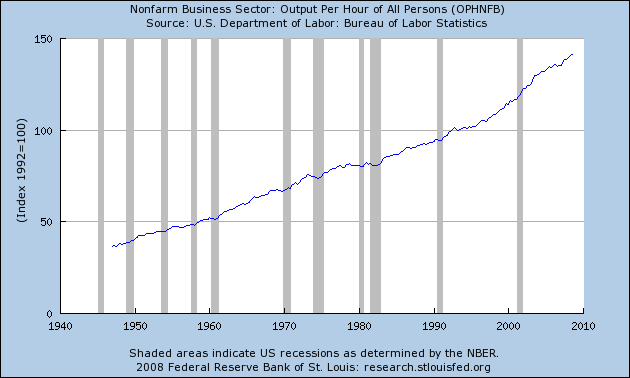

A crucial aspect of the neoliberal turn was the deregulation of sundry aspects of the economy, including, most importantly, the domain of operation of finance. The last great crisis of capital during the Great Depression had brought forth several important changes and new developments in the regulatory framework of capitalism. One by one, each of these laws relating to the operation of finance, both domestically and internationally, were whittled down or even outright overturned. Thus, the burgeoning profit income and the shredding of all regulation together created the supply of debt finance in the US economy. The demand for debt arose from a working class facing stagnant wage incomes but long used to growing consumption expenditures. The net result was the largest build-up of debt in the US economy since the Great Depression. During the beginning of the Great Depression total debt was about 300 percent of US GDP; in early 2008, total debt in the US economy was touching 350 percent of GDP. It was this huge debt build-up resulting from three decades of neoliberal economic policies that created a systemically fragile financial superstructure which imploded, leading to a credit freeze, when the housing bubble burst (I have borrowed parts of this argument from Wolf, 2008).
(Concluded.)
References:
Dumenil, G. and D. Levy. 2004. Capital Resurgent: Roots of the Neoliberal Revolution. Harvard University Press.
Wolff. R. 2008. Capitalism Hits the Fan. Available here.
 Radical Notes