Censor Board denies certificate to “Flames of the Snow”

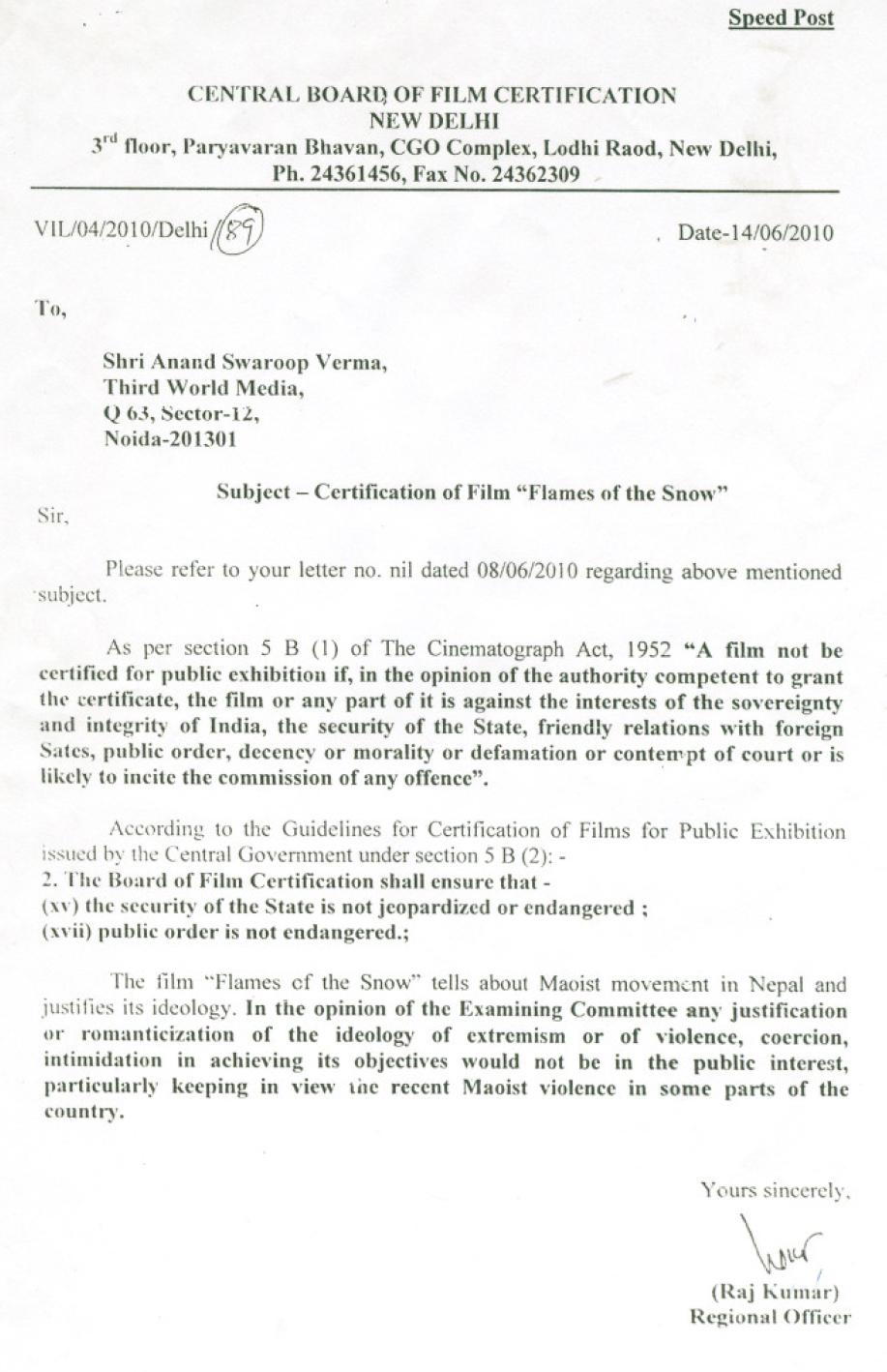
New Delhi, June 22: Indian Censor Board has refused to certify ‘Flames of the Snow’, a documentary on Nepal, for public screening. The Board feels that the film ‘tells about Maoist movement in Nepal and justifies its ideology.’ It feels that ‘keeping in view the recent Maoist violence in some parts of the country’, the permission of its public screening can not be given. Produced under the joint banner of ‘GRINSO’ and ‘Third World Media’, the 125 minute film has been produced by Anand Swaroop Verma, a senior journalist and expert on Nepalese affairs. He has also written the script for the film. The film has been directed by Ashish Srivastava.

Reacting to the decision of the Board, Mr. Verma said it is quite surprising as the film does not have any reference at all to the current Maoist movement in India. The film is only about the struggle of the people of Nepal against the despotic Monarchy and the anarchic reign of Ranas. With the formation of Nepal in the year 1770 by Prithvi Narayan Shah, the foundation was laid for Monarchy in Nepal which was finally given a burial in the year 2008 when Nepal was declared a Republic. Thus 238 years of Monarchy also included 105-year rule of Rana dynasty which is known as the black chapter in the history of Nepal.
Talking about the film, Mr. Verma further said that the film actually shows how in 1876 Lakhan Thapa, a young man from Gorkha district organized the peasants against the atrocities being unleashed by the rulers of Rana dynasty and was, later, put on gallows by these rulers. Even today, Lakhan Thapa is remembered as the first Nepali martyr. Exploring the movements led by ‘Praja Parishad’ and ‘Nepali Congress’ against the despotic system, the film focuses on the armed struggle carried on under the leadership of the Maoists for 10 years and unfolds the story of how the movement mobilized the Nepalese people by first attacking and dismantling the feudal system in the rural areas and subsequently taking the people’s movement to the urban areas bringing more urbanites into its fold.

The film begins with the establishment of monarchy in Nepal, further touching the developments like the elections for the constituent assembly, the emergence of Maoists as the largest party in the elections and finally ends by showing the decline and complete disappearance of Monarchy and Nepal being declared a Republic.

Taking note of the objections put forward by the Censor Board, it seems that the Board will never give its certification to any political film made on Nepal since no political film on Nepal can escape underlying the prominent role of Maoists. Maoist party was heading the government in Nepal till May 2009 and even today is the largest party in the Constituent Assembly and is the main opposition party. Moreover its president Pushp Kamal Dahal ‘Prachand’ as the Prime Minister of Nepal had visited India on the invitation of the Government of India.

Mr Verma is now submitting his film to Revising Committee of the Board.
China: Some thoughts on Foxconn and the Honda strike

Lang Yan, China Study Group

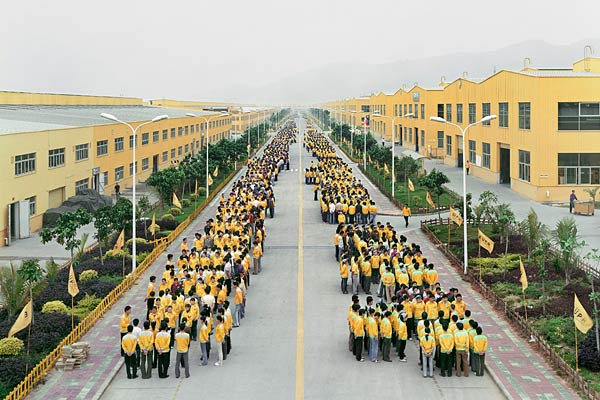
While I was walking around the Shanghai World Expo on a weekday a couple of weeks ago I met a group of workers from a nearby clothing sweat shop. Their company had sent them to the Expo for the day (for which they had to trade their only day off, Sunday). They were too tired to enjoy the Expo as they worked 14 hours a day, six days a week. While this may seem like a nice gesture on the part of the company, the workers also explained that the company was moving much of their production to another building that week, because a worker burned much of the factory down after not being paid on time. I heard this story just as the news of the Foxconn suicides began to break into the media and shortly after that the Honda strike began.

Within public discussion, the Honda wildcat strike has transformed the meaning of the Foxconn suicides. Early interpretations of the Foxconn suicides tended to argue that the suicides should either be understood as individual psychological issues and as copycat suicides, on the one hand, or a result of the particularly brutal and alienating conditions at Foxconn, on the other. Some marshaled statistics to show that there were no more suicides at Foxconn than the social average when one considers the size of Foxconn (for example, see Tom Holland “Why there’s less to the suicides at Foxconn than meets the eye” and Michael R. Phillips “Foxconn and China’s Suicide Puzzle Workers: may not be taking their own lives for the reasons everyone thinks”). Statistics average out, in other words, the social difference of the militarized factory space; Foxconn was treated as a normal social space, a city. (For a discussion of suicide rates and Foxconn, see EastSouthWestNorth #19. Notable also is that the Chinese rate of suicide for people 15 to 34 is quite high. See Suicide main cause of death in 15 to 34-year-olds.)

Analysis of the social and work conditions at Foxconn also appeared. The particularly militarized and alienating work environment at Foxconn is a result of capital’s relentless drive to lower assembly costs and the Asian subcontracting regime; reform-era China and the CCP have been a willing partner in that effort. Activists and scholars have argued that Foxconn is one of the worst factories in terms of it labor regime, with a very long (usually about 70 hours) work week (since the pay structure means that workers must work a lot of overtime) and a very rapid assembly line. Foxconn was able to become the world’s largest assembly company exactly because of its harsh Taylorist production process, which cuts up the process into highly regimented movements, its ability to intensify labor exploitation and its repressive management style (See this article by Andy Xie for some analysis and background on the Taiwanese management style). There are reports that Foxconn initially responded to the suicides by pushing workers to sign contracts that they would not commit suicide, and stating that their families would not receive compensation if they did. It went so far as to state that suicide harmed Foxconn’s reputation.

But the successful Honda wildcat has changed the discussion. The suicides and the strike are being put into the context of changing labor relations in China, with many now arguing that Chinese labor is at a turning point.

For example, NPR’s Marketplace (Honda, Foxconn workers demand more power) argues that a “labor shortage in China is empowering workers to demand better wages and treatment at their workplaces….” In a discussion of the Honda strike, Reuters notes that “[s]ome other foreign companies have begun to address workers’ discontent over pay and working conditions. Taiwan’s Hon Hai Precision Industry Co Ltd for instance plans to raise salaries by about a fifth at its Foxconn International unit, maker of Apple Inc’s iPhone, as it struggles to stop a spate of suicides and quell public anger.” Foxconn has said that it will raise base salaries by 30% now with more raises to come in the near future. Clearly this wasn’t only caused by the suicides, however. Foxconn was planning a salary increase earlier in the year in response to the difficulty hiring workers due to labor shortages.

The Honda strike (workers’ demands included wage increases from about 1,500 yuan (less than $220 US) to about 2,300 yuan ($337 US) for higher paid workers) is likewise getting more press than any other worker action in recent years.

China’s economic stimulus has given large subsidies for car sales, and car manufactures are attempting to rapidly increase production in China. Honda plans to add a third to its Chinese production by 2012. But its integrated production process is vulnerable to strike activity. This is particularly true of transmission plants, which are highly automated and expense to construct. Thus they are usually put in the most stable regions, notes the New York Times. But the stability of the Chinese working class is now in doubt. According to the Wall Street Journal:

“The strike has exposed unexpected vulnerabilities in Honda’s China supply chain. Because of the relative absence of labor unrest in China, Honda makes do with only one source of transmissions there, the Foshan factory that supplies roughly 80% of demand, according to Mr. Fujii. The rest are brought in from Japan. Typically, Honda insists on at least two suppliers of parts, partly to protect against any industrial action that might cripple production.”

While quick to tamp down any political interpretation of the workers’ activity, the New York Times argues that in the beginning the state allowed media coverage of the strike because it wants to push up internal demand. On the other hand, the China Daily (in an article now taken off their website) used the strike to editorialize that the Chinese state needs to do more to raise the wages of workers. Since the end of the strike, Chinese media coverage has continued while broadening its analysis. At the same time, the government seems to be increasing its efforts at raising the wages and internal consumption. This follows several years of increased investment for rural China, which means there is less pressure for peasants to migrate out for work.

Broader Implications: First question looking forward:

What does this mean in terms of the changing Chinese political economy? A few points: Increasing wages in China could help rebalance the global economy. As their wages increase Chinese workers will be able to spend more (the wage share of GDP fell from 56.5 percent in 1983 to 36.7 percent in 2005). A rise in internal demand will mean a drop in the savings rate in turn forcing a rise in the savings rate in the US. This will likely also mean inflation, which is already a problem with the huge Chinese stimulus, yet inflation is also another way–other than a direct change in the exchange rate–for the Chinese state to rebalance its trade relationship with the US. The power of the export manufacturers in China seems to have been able to keep the state from changing the exchange rate to any great extent, but inflation might help take care of this for the state. Of course inflation will eat into wage increases and possibly lead to more social unrest. Meanwhile, the Beijing government announced on June 3rd that it was raising the minimum wage by 20% in response to inflation–the past few years it was raised about 10% per year. Other regions are following suit.

The June 7th issue of The Economic Observer (Jingji guancha bao) has articles on the labor situation noting that both the Honda strike and the situation at Foxconn are symptoms of a broader change going on in the Chinese labor market. One article argues that China has reached the “Lewisian turning point”. Arthur Lewis argued in 1954 that, for a period of time, developing countries could rely on rural surplus labor to keep wages from rising. This would allow them to industrialize without wage inflation. But once rural surplus labor is absorbed by the industrial economy and the labor market unifies wages will begin to increase more rapidly. The influential economist Cai Fang has been predicting this shift for some time, and in 2007 edited a volume on the turning point called “The Coming Lewisian Turning Point and its Policy Implications.”

Arthur Kroeber argued in the March issue of China Economic Quarterly that China’s cheap labor regime was coming to an end and that wage inflation will drive up the consumption share of GDP. In the planning for the 12th Five Year Plan, the CCP itself emphasizes this rebalancing and the important role that raising the wage share of GDP should plays in the process. At the same time, some commentators seem to be taking this argument a bit too far. Andrew Peaple states that “the dynamics of China’s economic development are moving inexorably in favor of the country’s workers.” While this will change the shape of the Chinese economy, its effect on capital will be mixed. Higher wages will mean more consumption, helping many companies as much as it hurts. But the assembly and clothing industry in the Southeast will be hit hard, as those plants are both more easily moved to other, cheaper-wage countries and have thinner profit margins. It is too early to say what this transition (of the Chinese economy and of the Chinese labor process) might mean more globally.

A second question looking forward:

Does the Honda strike indicate increasing self-activity of the working class in China? Certainly the example of the success of workers in the Honda strike in winning some wage increases (initially about 24% but in the end much more) might spread to other workers in China. Also, the strike itself was very highly organized, leading to the participation of about 1,900 workers (including a large number of low-paid interns). The workers seemed split, however, when gave in to a lower wage increase than initially demanded. The People’s Daily reports that the hold out group was involved in a confrontation with representatives of the state union, the ACFTU. (The local ACFTU seems to be playing a more conservative role–by protecting Honda–than even the state-run media.) The World Socialist Website details the attempts by the company to split the workers by putting pressure on the interns to sign no-strike pledges in return for smaller wage increases. According to The China Daily, the strikers also demanded changes in work conditions, more transparency in company finances (this seems like a reflection of the history of worker democratic involvement in enterprise management in China), and a change in union representatives. The New York Times points out that workers complained that Japanese employees at the Honda plant make about 50 times that of Chinese workers. It is likely that nationalism has also played a role in how this strike has been reported in China. Most of the workers held out, however, and the agreement reached will lead to high wage increases. Kroeber talking Reuters stated that “Foreign investors have been lulled into a false sense of security that China has a docile work force. There’s nothing intrinsically docile about the Chinese labor force. There was a period when everything was kind of fine; now we are entering a period of more constraint.” Following the Honda strike, workers at a Hyundai factory near Beijing went on strike, but returned to work after they were immediately promised wage increases. Over 5,000 textile workers in Pingdingshan, Henan have been out on strike since May 14th at a factory privatized in 2006.

As the WSWS notes of the Honda strike:

The strike is a sign of sharpening class tensions in China amid the worsening global economic crisis. While China’s economic growth rate continues to be high, propped up by huge stimulus spending, the gulf between rich and poor is widening. Last year there were 98,568 labour disputes filed in Chinese courts, up 59 percent on the previous year. Most disputes, however, were not reported.

It remains to be seen, however, how successful the CCP’s attempt at economic transition will be. We need to know how much of China’s growth and job creation is due to the stimulus and how sustainable it is. The unsustainable property market is creating an investment bubble. Just as likely as transition to a consumer-based economy, inflation could lead to stagflation once the property bubble bursts and the initial affects of the stimulus wear off. The real question is what then for the activity of the Chinese workers. They are clearly learning important lessons now. The fundamental question is whether their new found strength will lead to a break from the domination of capitalist accumulation or not.

GurgaonWorkersNews: Newsletter 26

GurgaonWorkersNews – Newsletter 26 (May 2010)

Gurgaon in Haryana is presented as the shining India, a symbol of capitalist success promising a better life for everyone behind the gateway of development. At a first glance the office towers and shopping malls reflect this chimera and even the facades of the garment factories look like three star hotels. Behind the facade, behind the factory walls and in the side streets of the industrial areas thousands of workers keep the rat-race going, producing cars and scooters for the middle-classes which end up in the traffic jam on the new highway between Delhi and Gurgaon. Thousands of young middle class people lose time, energy and academic aspirations on night-shifts in call centres, selling loan schemes to working-class people in the US or pre-paid electricity schemes to the poor in the UK. Next door, thousands of rural-migrant workers uprooted by the agrarian crisis stitch and sew for export, competing with their angry brothers and sisters in Bangladesh or Vietnam. And the rat-race will not stop; on the outskirts of Gurgaon, Asia’s biggest Special Economic Zone is in the making. The following newsletter documents some of the developments in and around this miserable boom region. If you want to know more about working and struggling in Gurgaon, if you want more info about or even contribute to this project, please do so via:

http://www.gurgaonworkersnews.wordpress.com
gurgaon_workers_news@yahoo.co.uk

In the May 2010 issue you can find:

1) Proletarian Experiences –
Daily life stories and reports from a workers’ perspective

*** Three Communists in Gurgaon
The industrial development and proletarian unrest in Gurgaon did not remain unnoticed. We talked to three communists who decided to focus their political activity on the vast landscape of working class formation. The comrades are part of the revolutionary Marxist-Leninist left, belonging to three different political organisations.

*** Service?! What the hell! / Reports from Service Proletarians, Street Labour Markets and Factory Workers in Gurgaon
Some voices of security guards and drivers, metal and textile workers. Some voices from workers looking for a job at corner labour markets, harassed by the police and other thugs.

2) Collective Action –
Reports on proletarian struggles in the area

*** Inflationary Proletarian Struggles
While opposition parties arrange token protests against the price hikes, workers on the ground battle for higher wages. In March 2010 Delhi government announced 33 per cent increase of minimum wages, but this hike hardly ever reaches shop-floor reality. In the aftermaths of the minimum wage increase we observe various spontaneous proletarian actions in Gurgaon and Okhla industrial areas. The combination of an interlinked (automobile) industry and organisational efforts like Faridabad Majdoor Talmel can become future lines of coordination and generalisation of the unrest.

*** Update on Struggles of Permanent Automobile Workers at Sanden Vikas and Exide
The first-tier supplying industry of the automobile industry is heating up under the double pressure of increasing demand of the assembly plants on one side and the more confident claims of the workforce on the other. The recent struggles at Denso, Sanden Vikas and Exide express the difficult position of a young permanent work-force: they appeal to the classical union form of struggle hoping to secure an increasingly precarious position. These classical forms detach them from the wider casual and temporary workforce and therefore from the true ‘material’ power-base.

*** Waterwars, Energy Crunch and Revolting Villages
Groundwater levels in Gurgaon drop dramatically, gobbled up by industry and upper-middle class life-style. Water and energy flows are diverted away from workers’ and peasants’ spheres. We document some struggles of ‘villagers’ against the lack of resources and oil-pipe-line projects crossing their fields.

3) According to Plan –
General information on the development of the region or on certain company policies

*** The Social Tsunami Impact / Snap-Shots against Capital-Class-Crisis
This is an attempt to introduce a regular update on general tendencies of crisis development in Indian – motivated by Greek shock-waves, naked shorts and potential spillovers. Apart from short glimpses on the macro-level of things we focus on general trends in agriculture and automobile sector: the current demise of the past and the toxicity of the future.

4) About the Project –
Updates on Gurgaon Workers News

*** Glossary
Updated version of the Glossary: things that you always wanted to know, but could never be bothered to google. Now even in alphabetical order.

Eva Golinger Misinterprets Solidarity: Support Tamils not Sri Lanka’s War Criminal Government

Ron Ridenour

Eva Golinger is known for her counter-intelligence analysis in the service of Venezuela’s peaceful revolution against the local oligarchy and the United States Empire. She is a noted author (“The Chavez Code: Cracking US intervention in Venezuela”). A dual citizen of the US and Venezuela, she is an attorney, and a personal friend of President Hugo Chavez, who dubbed her, La Novia de Venezuela (“the bride of Venezuela”). She is a frequent contributor to left-wing media around the world, and is the English editor of the Venezuela government newspaper, Correo del Orinoco.

Golinger is a name synonymous with solidarity and anti-imperialism. However, she recently inexplicably immersed herself into being a supporter for the most brutal, racist and genocidal government of Sri Lanka in a resoundingly irresponsible opinion piece printed in the Spanish daily version of Correo del Orinoco, May 15, and on May 21, published by the Caracas city government newspaper, Ciudad CCS. The piece was simply entitled, “Sri Lanka”. Printed in Spanish, I translate into English the major part of its content and analyze its errors with the goal of countering rumors she started, and in an effort to broaden support for a most maligned and oppressed ethnic group, the Tamils of Sri Lanka.

Golinger wrote that, in 2005, Sri Lankan “presidential elections occurred for the first time in nearly 30 years. Mahinda Rajapakse obtained victory with more than 58% of votes. He was reelected, January 2010 with more than 60%.”

“Rajapakse, Buddhist leader, is supported by a coalition of leftist parties, among them the Communist Party. In May, 2009, Rajapaske finalized the civil war, defeating the armed organization, LTTE.

“The LTTE had close ties with the CIA, and Washington negotiated an accord with them for establishing a military base in the country, if they obtained power. Upon its defeat, the LTTE had established numerous organizations—fronts in different countries around the world, seeking to create `a government in exile´ and hoping to isolate the current government of Sri Lanka. Last week, representatives of one of its fronts, Canadian Hart, passed through Venezuela; it met with government functionaries seeking support in its intent to weaken the relationship between the two governments.

“Instead of relating to the illegitimate opposition in Sri Lanka, Venezuela should shake the hand of an ally that also suffers imperial aggressions.”

Golinger is factually incorrect

1. Mahinda Rajapakse is not the first president elected. In 1982, J.R. Jayawardane won the first presidential election with 52.9% of the vote. The United National Party (UNP)—a pro-western party of the comprador bourgeoisie—introduced a new constitution after its 1977 landslide victory. Before then, the office of prime minister was the highest, and Jayawardane won that post and the UNP took 80% of the parliamentary seats. In 1978, the new constitution renamed the country, “Democratic Socialist Republic of Sri Lanka”, but this had nothing to do with socialism. The economy then, as now, was a capitalist one with a neo-liberal orientation much like Chile after the 1973 coup d´etat.

According to the Government Department of Census and Statistics own figures (2006/2007), 82% of the rural population lives under the national poverty line while 65% of the urban population is not able to meet the minimum level of per capita daily calorie and protein intake recommended by the government Medical Research Institute. See official figures on the government website.

There can be nothing “democratic socialist” about discriminating against 15% of its population, the Tamil ethnic group, making them unequal by legally restricting their rights and privileges. Such has been the case since independence from Britain, in 1948. Even the U.S. Library of Congress studied Tamils as an “alienated” group. In 1988, it published, “Sri Lanka: a Country Study”:

”Moderate as well as militant Sri Lankan Tamils have regarded the policies of successive Sinhalese governments in Colombo with suspicion and resentment since at least the mid-1950s, when the `Sinhale Only´ language policy was adopted…”

2. Rajapakse won the fifth presidential elections and with the least majority of all presidents, 50.29%, not 58% as Golinger wrote. [Wikipedia ]

Rajapakse is the current leader of the Sri Lanka Freedom Party (SLFP), founded in 1951 to represent the Sinhalese bourgeoisie. In 1960 elections, Sirimavo R.D. Bandaranayake became the world’s first woman prime minister. The Moscow oriented Communist Party and the Trotskyist Lanka Sama Samja Party (LSSP) formed the “United Front” coalition with the SLFP, in 1970. Now with three minister posts, the “old left” betrayed the young. Many Sinhalese leftist youth became disillusioned with the “old left” and after the SLFP returned to government, they rebelled. The so-called “leftist” government, with the CP and LSSP, branded this upsurge a “Che Guevarist uprising” and crushed the rebellion by killing about 20,000 mainly rural Sinhala youth, in 1971. The next year, these “left” parties drafted the first republican constitution in which Sinhalese was codified as the only official language and Buddhism the only the official religion—Tamils are not Buddhists. This eroded whatever support the “old left” had among both leftist Sinhalese and all Tamils. Since then neither the CP nor the LSSP has managed to get a single seat in the parliament independently. They are always with the capitalist party, SLFP.

3. Rajapakse won the January 2010 elections with 57.88%, not 60%, over his former chief general, Sarath Fonsekla, in charge of liquidating the LTTE (Liberation Tigers for Tamil Eelam). Fonseka’s party, New Democratic Front, received 40.15% of the vote. In desperation, a few Tamils voted for General Fonseka knowing that he was the main army force in carrying out the president’s orders in liquidating the LTTE, and massacring tens of thousands of Tamil civilians. The one difference between the two war criminals was that Fonseka later promised that he would release the rest of the interned Tamils and return their possessions and land. Tamils are crushed for now and resort to seeking a bit of breathing space. (Wikipedia entry on United People’s Freedom Alliance).

The egomaniacal president was not satisfied with just defeating his former general in the ballot box, he had him arrested and beaten, on February 7, shortly after the elections, and charged him with plotting a coup, which General Fonseka denies. A purge of scores of top military officers has occurred; a dozen or more Sinhalese and Tamil Journlists have been arrested. In the four years of Rajapakse rule, at least 23 journalists critical of his regime have been murdered: See 1 and 2.

4. “The LTTE had close ties with the CIA, and Washington negotiated an accord with them for establishing a military base in the country…” That is an outrageous and unsubstantiated allegation. In my month-long research last autumn, I found nothing to indicate Golinger’s unsupported claim. Looking up in Google for “LTTE and CIA”, nothing exists. When searching for LTTE and CIA and LTTE ties to CIA without quotation marks, nothing exists that binds them. I looked up some 200 hits and only found reference to the Golinger claim, and this was cited by a most skeptical Patrick J. O´Donoghue, news editor for the English-language website www.Vheadline.com, in a May 23 commentary. He said: “I couldn’t believe what I read in the Caracas CC blatt!” We have no way of knowing if the LTTE even met with the CIA, but in war most anything is possible. What we can know is that the US, and its CIA and Pentagon, have long supported the genocidal Sinhalese governments, and most certainly that of Rajapaske, and it placed the LTTE on its Foreign Terrorist Organization hit list in 1997. I will delve into this farther on.

5. Golinger’s claim that Canadian Hart is a front for the LTTE is denied by several solidarity groups in Canada who know that organization for its humanitarian work. See their perspective, “Venezuela: Eva Golinger’s misinformation endangers exiled Tamils’ fight for freedom”, at: http://vheadline.com/

6. Golinger depicts the Sri Lankan capitalist and genocidal government as an “ally” of Venezuela, one that she recommends her revolutionary government to “shake the hand of an ally that also suffers imperial aggression.” This boggles the mind, or “beggars belief”, as O’Donoghue wrote. Instead of opposing the Yankee Empire, her position is allied with imperialist United States and its allies Zionist Israel, the United Kingdom and other former European colonialists, as well as the emerging superpower and worker-exploiter China. (See my pieces “ALBA Let Down Sri Lanka Tamils”, “Equal Rights or Self-Determination”, and “The Terrorists: International support for Sri Lanka racist discrimination”. See the entire five-part series at: Radical Notes). There is no shred of evidence that the United States aggresses against Sri Lanka governments, on the contrary.

US Supports Sri Lanka Genocide

The Indian Ocean is a vital waterway where half the world’s containerized cargo passes through. Its waters carry heavy traffic of petroleum products. Sri Lanka cooperation is vital to the US Empire’s global interests. A separated Tamil state would complicate cooperation requirements.

The United States of America has been arming and financing Sri Lanka for most of the civil war period. [www.cdi.org/PDFs/CSBillCharts.pdf ] From at least the 1990s, the US has provided military training, financing, logistic supplies and weapons sales worth millions annually. A Voice of America installation was set up in the northwestern part of the country.

The United States government praised Rajapaksa for restarting the war already in July 2006, and officially ending the ceasefire in 2008. The US embassy in Colombo issued this statement: “The United States does not advocate that the Government of Sri Lanka negotiate with the LTTE…” (See www.globalresearch.ca)

On May 26, 2002, the Colombo English-language Sunday Times wrote about a joint military pact between Sri Lanka and the U.S., a development taken soon after the CSA was signed.

“The Acquisition and Cross Servicing Agreement [ACSA]…will enable the United States to utilise Sri Lanka’s ports, airports and air space. As a prelude to the signing of the agreement scheduled for July, this year, United States Naval ships have been calling at the Colombo Port for bunkering as well as to enable sailors to go on shore leave.

“In return for the facilities offered, Sri Lanka is to receive military assistance from the United States including increased training facilities and equipment. The training, which will encompass joint exercises with United States Armed Forces, will focus on counter terrorism and related activity. The agreement will be worked out on the basis of the use of Sri Lanka’s ports, airports, and air space to be considered hire-charges that will be converted for military hardware.”

US Assistant Secretary of State Christina Rocca was the key liaison person with the Sri Lankan government. [Rocca had been a CIA officer before joining the state department.] (See www.colombopage.com) The ACSA agreement was not finally signed until Rajapaksa came to power. It was U.S. citizen Gotabhaya Rajapaksa, Secretary Defense Minister, and brother to President Rajapaksa, who signed the agreement, on March 5, 2007. (Their younger brother, also a minister, is a US citizen as well.)

George W. Bush was especially glad for Sri Lanka’s state terrorism. In 2006, he encouraged the government to resume the civil war, which Bush financed with $2.9 million. The Pentagon provided counter-insurgency training, maritime radar, patrols of US warships and aircraft. This was a continuation of “Operation Balanced Style”, which uses U.S. Special Forces instructors since 1996.

At the end of Bush’s first term, the US was forced to cut back on aid given that it was bogged down in Afghanistan and Iraq. That, coupled with critical public opinion, organized by the Diaspora, of state terrorism and systematic discrimination of Tamils, prompted congress to make noises about abuses of human rights by not only LTTE but possibly by paramilitary forces linked to the S.L. government. Thousands of Tamils blocked highways in Canada, camped outside British parliament for months, some committed suicide in front of government offices, while Indian Tamils conducted paralyzing strikes. Nevertheless, in 2008, the U.S. granted $1.45 million in military financing and training to the Sri Lanka government out of a total of $7.4 million in total aid. The US made noises about a ‘humanitarian crisis’ when the Sri Lankan army was about to finish the war but it never took affirmative action to bring the war to an end nor to condemn the army or government.

Even after leading international observers, and some of the mass media, especially in the U.K. and France, began to expose S.L. government and the army’s systematic atrocities against Tamil civilians, and captured LTTE soldiers, the US continued to back up the Sri Lankan government, in contradiction to Eva Golinger. In mid-April, 2010, the U.S. and Sri Lankan military forces conducted military exercises in Eastern Seas (Trincomalee) for the first time in 25 years.

Said Lt Col Larry Smith, the US defense attache: “The joint exercise helped members from our two militaries to exchange best practices on how to address complex humanitarian challenges.”

He added: “The US and Sri Lanka have a long tradition of cooperation. We hope this partnership can be expanded.” http://jdsrilanka.blogspot.com/

Documentary film-maker John Pilger compares Sri Lanka’s genocide to Israel

“The Sri Lankan government has learned an old lesson from, I suspect, a modern master: Israel. In order to conduct a slaughter, you ensure the pornography is unseen, illicit at best. You ban foreigners and their cameras from Tamil towns like Mulliavaikal, which was bombarded recently by the Sri Lankan army, and you lie that the 75 people killed in the hospital were blown up quite willfully by a Tamil suicide bomber.” “Distant Voices, Desperate Lives,” New Statesman, 13-5-09.

When the U.S. does not want to be seen on the frontlines in a war, it sends in surrogates and Israel is its main partner in this war crime. Israel was officially re-awarded diplomatic relations, in May 2000, after Sri Lanka had severed them in 1970, in protest at Israel’s continued illegal expansion into Palestinian territory. (www.dailymailnews.com/)

Nevertheless, Israel continued to operate inside S.L. out of a special interests office set up in the US embassy. Under the table, Sri Lanka’s successive regimes embraced Israel’s military advisors, a special commando unit in the police, and Mossad counter-intelligence agents—who sought to drive a wedge between Muslims and Tamils. Israel sent Sri Lanka16 of its supersonic Kfir fighter jets, some Dvora fast naval attack craft, and electronic and imagery surveillance equipment, plus advisors and technicians. Israel personnel took part in military attacks on Tamil units, and its pilots flew attack aircraft. Tigers shot down one Kfir. Just before the end of the war, Prime Minister Wickremanayake was in Israel to make bigger deals with Israeli arms supplies. (See 1 and 2)

Sri Lanka government war crimes

Golinger even ignores ample evidence of extreme war crimes committed by her choice for president, Mahinda Rajapakse, against the minority Tamils. They have a righteous claim for liberation because of being subject to systematic discrimination, oppression and genocide. (Ibid: “Equal Rights or Self-Determination”.) Sri Lanka’s first president, J.R.Jayewardene, expressed the essence of this genocide to the “Daily Telegraph”, on July 11, 1983. “Really if I starve the Tamils out, the Sinhala people will be happy.”

In May 2009, Rajapakse had all the civilians who survived his gun fire placed into concentration camps, which he called “welfare villages”, much like those the Yankees concocted in Vietnam. In violation of United Nations international rules, as many as from 280,000 to one-half million people were forced interned. Today, one year later, 100,000 remain. Only two million S.L. Tamils remain in the country. Nearly one million have fled in the past three decades.

Even the U.S.’s choice for secretary-general of the UN, Ban Ki-moon, was displeased with these camps when he made a brief visit to one shortly after the war’s end.

“I have traveled around the world and visited similar places, but this is by far the most appalling scenes I have seen…I sympathize fully with all of the displaced persons.”

Several internationally respected organizations concerned about war crimes, and a few mass media journalists, have conducted interviews with IDPs, taken or viewed photographs, videos, satellite images—taken surreptitiously during the war—and have read electronic communications and documents from many sources. Some observers have been able to visit a camp or two.

On May 17, one of those organizations, the International Crisis Group, released its report, “War Crimes in Sri Lanka”. I cite from it:

“The Sri Lanka security forces and the LTTE repeatedly violated international humanitarian law during the last five months of their 30-year civil war…from January 2009 to the government’s declaration of victory in May [violations worsened]. Evidence gathered by the International Crisis Group suggests that these months saw tens of thousands of Tamil civilian men, women, children and elderly killed, countless more wounded, and hundreds of thousands deprived of adequate food and medical care, resulting in more deaths.

“This evidence also provides reasonable grounds to believe the Sri Lanka security forces committed war crimes with top government and military leaders potentially responsible.”

Here is a revealing example of this evidence.

On August 25, 2009, Channel 4 News (UK) broadcast raw footage, one minute long, showing S.L. government soldiers casually executing eight bound and blindfolded, naked Tamil men, believed to be LTTE combatants. This is a war crime according to all international agreements. Rajapakse’s government denied the authenticity of the photos, apparently taken by a S.L. soldier and provided to Channel 4 through the exiled group of Sinhalese and Tamil journalists, Journalists for Democracy in Sri Lanka. But internationally renowned forensic experts have validated its authenticity. (See 1, 2 and 3)

In a recent Channel 4 News broadcast by Jonathan Miller, two eyewitnesses spoke of systematic murder of all LTTE fighters caught or surrendered. One witness is a senior army commander: “Definitely, the order would have been to kill everybody and finish them off.” A frontline S.L. soldier told Miller: “Yes, our commander ordered us to kill everyone. We killed everyone.”

Even the head general in charge of defeating the LTTE, General Fonseka, spoke of having orders from the Defense Secretary to kill leaders without taking prisoners—“all LTTE leaders must be killed”. http://www.defenceforum.in/

Returning to the International Crisis Group war crimes report:

“Starting in late January [2009], the government and security forces encouraged hundreds of thousands of civilians to move into ever smaller government-declared No Fire Zones (NFZs) and then subjected them to repeated and increasingly intense artillery and mortar barrages and other fire. This continued through May despite the government and security forces knowing the size and location of the civilian population and scale of civilian casualties.

“The security forces shelled hospitals and makeshift medical centres—many overflowing with the wounded and sick—on multiple occasions even though they knew of their precise locations and functions. During these incidents, medical staff, the United Nations, the International Committee of the Red Cross (ICRC) and others continually informed the government and security forces of the shelling, yet they continued to strike medical facilities through May…”

Among the charges that must be investigated, wrote ICG, is “the recruitment of children by the LTTE and the execution by the security forces of those who had laid down their arms and were trying to surrender.”

Shortly after this report, Amnesty International released its report of torture in 111 countries. Among those A.I. condemns for the “politicization of justice” is Sri Lanka’s government. It also criticizes the UN “for its failure to intervene…By the end of the year, despite further evidence of war crimes and other abuses, no-one had been brought to justice,” A:I:’s Secretary General Claudio Cordone said. “One would be hard pressed to imagine a more complete failure to hold to account those who abuse human rights.” (See 1, 2 and 3)

Some leaders of ALBA countries may be under the impression that when westerners (A.I., ICG, Channel 4) protest about human rights abuse that this reflects the double speak language of white imperialism, or NGO imperialists. This is sometimes the case. But it is definitely not so with Sri Lanka. None of the western governments on the HRC wished to condemn Sri Lanka. They only condemned the LTTE and simply asked Sri Lanka to look into its own behavior during the war.

Do not take my word or those of A.I and ICG for this assessment alone but look at the conclusions drawn by internationally renowned figures with impeccable solidarity credentials, such as Francois Houtart, who, among other positions, is an honorary professor at the University of Havana. He chaired an 11-judge panel looking into war crimes charges against Sri Lanka’s government and army—the Permanent People’s Tribunal on Sri Lanka (PPT), held in Dublin in January. Among the many supporters of the panel and their conclusions is the senior advisor to President Daniel Ortega, Miguel D´Escoto. Ironically, Nicaragua is one of the ALBA countries that praised the Sri Lanka government and voted for their resolution at the HRC. The PPT’s conclusions approximate those allegations made by the above mentioned organizations: Sri Lanka committed “war crimes” and “crimes against humanity”. These conclusions are found on pages 14-15 of the 50-page verdict.

On the Qualifications of the Facts

“Summing up the facts established before this Tribunal by reports from NGOs, victims’ testimony, eye-witnesses accounts, expert testimony and journalistic reports, we are able to distinguish three different kinds of human rights violations committed by the Sri Lankan Government from 2002 (the beginning of the CFA) to the present:

• Forced “disappearances” of targeted individuals from the Tamil population;
• Crimes committed in the re-starting of the war (2006-2009), particularly during the last months of the war:
• Bombing civilian objectives like hospitals, schools and other non-military targets;
• Bombing government-proclaimed ‘safety zones’ or ‘no fire zones’;
• Withholding of food, water, and health facilities in war zones;
• Use of heavy weaponry, banned weapons and air-raids;
• Using food and medicine as a weapon of war;
• The mistreatment, torture and execution of captured or surrendered LTTE combatants, officials and supporters;
• Torture;
• Rape and sexual violence against women;
• Deportations and forcible transfer of individuals and families;
• Desecrating the dead;
• Human rights violations in the IDP camps during and after the end of the war:
• Shooting of Tamil citizens and LTTE supporters;
• Forced disappearances;
• Rape;
• Malnutrition; and
• Lack of medical supplies”
(See 1 and 2).

Conclusion

I urge ALBA members of the Human Rights Council—Cuba, Bolivia and Nicaragua—along with their brothers and sisters in Venezuela to recognize an error made when they promulgated Sri Lanka’s own resolution laid before the HRC and adopted by the majority, on May 27, 2009 –Resolution S-11/1, “assistance to Sri Lanka in the promotion and protection of human rights”.

The self-serving resolution only condemned the LTTE for acts of terror while praising the Sri Lankan government and supporting, naturally, its right to sovereignty. These ALBA countries, along with most members of the Non-Aligned Movement on the Council, let the entire Tamil people down, especially the Internally Displaced Persons. My assessment is shared by the people’s tribunal in paragraph 5.5:

“The Tribunal stresses the responsibility of the Member States of the United Nations that have not complied with their moral obligation to seek justice for the violations of human rights committed during the last period of war. After repeated pleas, and in spite of the appalling conditions experienced by Tamils, the UN Human Rights Council and the UN Security Council failed to establish an independent commission of inquiry to investigate those responsible for the atrocities committed due to political pressure exerted by certain Members.”

The PPT came to the opposite conclusion that Golinger does on all accounts. The US is not an actor of “aggression” against Sri Lanka’s government rather it is the case of one war criminal supporting another. The tribunal “highlights the conduct of the European Union in undermining the CFA of 2002. In spite of being aware of the detrimental consequences to a peace process in the making, the EU decided – under pressure from the United States and the United Kingdom – to list the TRM (Tamil Resistance Movement, which included the LTTE) as a terrorist organization in 2006. This decision allowed the Sri Lankan Government to breach the ceasefire agreement and re-start military operations leading to the massive violations listed above. It also points to the full responsibility of those governments, led by the United States, that are conducting the so-called “Global War on Terror” (GWOT) in providing political endorsement of the conduct of the Sri Lankan Government and armed forces in a war that is primarily targeted against the Tamil people.”

As solidarity activists, we advocate the right to resist and the necessity to conduct armed struggle once peaceful means fail to induce oppressive governments to engage in a process aimed at justice and equality—such is the case in Sri Lanka with the Tamil people, just as surely as it is in Palestine.

I find that most armed movements commit acts of atrocities, even acts of terror. The struggle for liberation in Cuba was an exception to the rule. Fortunately, it lasted just over two years. The armed struggle for liberation from Sinhala oppression against another indigenous group lasted for quarter of a century and, at the end, the LTTE clearly did resort to acts of desperation and terror. Other brave and righteous groups fighting for liberation, for equality and justice, such as Colombia’s FARC and Palestine’s PFLP, have also committed acts of terror. The ANC in South Africa was brutal in its struggle for liberation.

I wonder how I would act in such circumstances!

True solidarity activists have no choice. We must support the Tamil people. Today, they are in disarray. Various tendencies are in formation. But dialogue with them all is what solidarity forces must engage in around the world. One tendency is the new Provisional Transitional Government of Tamil Eelam (TGTE), which just formerly constituted itself in Philadelphia. Their coordinator, Visuvanathan Rudrakumaran, is a resident of the United States and an attorney. In February, he filed a suit in the US Supreme Court that would negate parts of the U.S. Patriotic Act and allow people to provide “material support or resources” to armed groups fighting for their liberation. Tamil Eelam advocates in the US have associated with the civil rights organization, Humanitarian Law Project, and along with supporters of the crushed LTTE and the PKK (Kurdish rebels in Turkey) are seeking to legitimize the rights of oppressed minorities to fight for liberation, if necessary with arms when peaceful means are impossible. See TGTE’s website.

My main motivation for siding with people who fight against oppression and for liberation is a matter of basic solidarity morality, and an understanding of this necessity for the suffering people. The basic reason why so many millions of people have respected and loved Che Guevara is because of this moral stance. To back any corrupt, capitalist, genocidal government—albeit in the name of support for “sovereignty”—is not consistent with Che’s and our collective moral stance.

India vs Indians: Peoples’ History of Orissa’s Dispossessed

Saswat Pattanayak

Tribal uprisings in Orissa were the first of organized assaults on the British, against the Hindu Kings, as well as on the Brahmin supremacists. The indigenous were united against oppression way before the Sepoy Mutiny took shape. They had no loyalty towards the kings and unlike the Paikas and Sepoys, they had no interest in releasing the royal families from British domains. In fact, the tribals shone in their capacity to challenge the Rajas as much as they expressed disdain towards British agents.

Therefore, when the native Kings of Khurda, Kanika and Kujang made a confederation to oppose the British invasion, the tribal agitators knew the kings had no motives other than to safeguard their royal privileges. Although Khurda Movement is usually declared as the first mass movement against the British following hanging of Jayakrishna Rajguru who has been eulogized profusely, its anti-imperialistic nature is highly suspect. Bakshi Jagabandhu Bidyadhar and his chief associate Krushna Chandra Bhramarbar Ray have been equally immortalized in history for their involvement in the anti-British movement. But the true champions of the organized revolt upon which the royal clan depended for survival were the forgotten tribal masses of rebels.

Khurda Movement did not start with Bakshi Jagabandhu, it started with 400 Kandhs in Banpur who came from the neighboring territory of Ghumsar. For seven years the movement lasted with the help of fellow tribals – the Kandhs, Savaras and Panas of Banpur, Nayagarh, Boudh and Daspalla. It was not the loyalists of the royal families, but their dissenting and oppressed subjects who took to arms and fought the British which indirectly benefited the needs of the local kings of the time. But the tribals never gave in to the manipulative designs of the kings either, thus constituting an independent stream in Orissa’s freedom movement, inviting wrath from the mainstream historians.

A. Das in “Life of Surendra Sai” (1963) decries the tribal revolts in Sambalpur. While glorifying Surendra Sai as a freedom fighter, the actual heroes of the revolt – the indigenous masses – have been portrayed as nothing less than crazy looters. Tribal uprisings have been compared with “the tyranny and lootings carried on by the Burgees of the Maratha days.” Surendra Sai, despite being a rebel claimant to the guddee of Sambalpur, was solely interested in the throne. To eulogize him as the charismatic anti-British hero while attacking the Gonds upon whose abilities he rode high, would be to use history as a paternalistic tool. And yet, for years into historical research, this is exactly what has been done. Surendra Sai has become a hero, while the tribal uprisings have been denounced as daylight robberies.

Ramnarayan Mishra in his paper, sponsored by Indian Council of Historical Research (1980), writes about Sambalpur following tribal uprising, “Life and properties were quite unsafe, the ryots could not raise their crops in their lands and as soon as they were ripe, they were looted and removed from the fields by these bands of robbers. There were day-light robberies and dacoity; the economic and social life of the people were completely paralyzed…Even now the days are remembered with alarm as the memories have come down from generations to generations. The atrocities of minor nature were the looting of cakes, which were being prepared by the housewife a certain evening, and the looting of all the belongings of the bride when she was on a procession to her father-in-law’s house for marriage….”

It is astounding to notice how the historians have continually felt sympathies with the landlords and the propertied class of Orissa. Mishra recalled the days with alarm when the tribal rose in revolt against the Brahmins in Sambalpur. Little did he pause to imagine the days from the lens of those that were forced to revolt. Much of the histories about Orissa still continue to be produced from the ruling class elitist visions of the past, part of the reason why the true history of peoples’ struggles is yet to be documented in totality.

Andrew Fraser in “Among Indian Rajah and Ryot” (1912) describes the Kalahandi revolution as though it were the responsibility of the Kandhs to forgive the Koltas. “The wretched prisoners fell at the feet of the leading Khonds and begged them to spare their lives; but they were told that none of the men among them would be spared,” he writes.

L.S.S. O’Malley in “Modern India and the East: A Study of the Interaction of their Civilization” laments the passage of the British interventions. Ramnarayan Mishra agrees with the old British thesis and writes, “The old ceremonies called the Mariah sacrifice which had been put down with great difficulty by the British officers some years before was revived. The sacrifice involved killing captives and hacking off pieces of their flesh which they buried in the fields as an offering to the earth goddess which would ensure their fertility.”

What O’Malley and subsequently, Mishra have omitted out of their deconstructions is that Mariah sacrifice was not merely about human captives. The tribal resistance was not nonviolent in nature, principally because it was always part of a defensive reaction, as opposed to the oppressors’ tactics which were premeditated murders. It is presumptuous to assume that the historically oppressed and dispossessed tribal population of Orissa show solidarity with the ruling class hooligans of Rajput and British origin who were profiting from the lands of the indigenous by imposing bonded labor terms upon them.

Therefore, even as ruling class histories suggest Orissa lost her independence after death of the last Hindu King Mukunda Harichandan, the tribals never really thought so. Contrary to mainstream belief that Muslim rule in Orissa was oppressive, there was no recorded revolt by the tribals against the Muslim rule.

Prasanna Kumar Mishra in “Political Unrest in Orissa in the 19th Century” (1983) writes, “The people of Orissa lost their independence from the sixteenth century, but could not fully express their dissatisfaction against the aliens throughout the seventeenth and eighteenth centuries. Only when a foreign trading company began to rule through exploitation and oppressed them socio psychologically, the people woke up from their slumber and began to raise their voice against this foreign rule.”

What is crucial here is the fact that the first organized mass rebellions were organized by the tribal people of Orissa. They were organized against the British as well as against the Hindu (of Rajput origin) rulers of Orissa. Both the anti-British and anti-royal movements were part of the larger national struggle that were to arrive following the footsteps of the Orissan tribal revolutions.

In this context, it is important to observe the Mariah sacrifices. Dismissing them as mere tribal superstitions bordering on criminality is also a dismissal of their roles in the national freedom movements orchestrated by the oppressed subjects against the ruling classes. The human “sacrifices” had elements of not just violence as a last resort, but also of targeted violence with a distinct class character that eliminated landlords, dewans, British agents and associates of royal families. The British were afraid of the tribal movements precisely because of the violent nature of their resistance. It was an economic war justly organized by the majority oppressed against their minority oppressors. Not some religious abstractions, as later historians tend to stress.

Ramnarayan Mishra dismisses the tribal movement as nothing other than a selfish pursuit to guard their traditional interests, that had no bearing upon the freedom movement against the British. He writes, “The resistance movement (against the British) in the States was a middle class movement sponsored by the people of coastal areas and it had nothing to do with tribal solidarity.”

P. Mukherjee in “History of Orissa” (1954) writes that the reason behind tribal uprisings in Orissa was their apprehensions that alien rule intended to “assess their lands, punish their leaders for the religious rites performed by them.”

H. K. Mahtab in “History of the Freedom Movement in Orissa (1957) writes, “The Khond risings in Baudh, Ghumsar and Khandmal during the years 1846-1848 were just temporary show of disaffection and resentment of the Khonds at the governmental interference in their religious rites.”

Not only have the tribal contributions been grossly overlooked, and their participations have been looked down upon as anarchical, even many false heroes have been recreated in the process to overshadow the real ones. Fakir Mohan Senapati is one such historical character who has been eulogized at the expense of Dharanidhar Naik. Collective celebration of Fakir Mohan as a literary champion has also necessitated the destruction of his challenger, the other literary genius in Dharanidhar. Dharanidhar was duped not only because Fakir Mohan was a state agent interested to earn loyalty points from his beloved king who was otherwise an oppressive ruler, but also because Naik belonged to a lower caste not worthy of literary celebration. Likewise, British agent Superintendent Ravenshaw who organized military tactics to capture Dharanidhar remains immortalized to this day, whereas his roles in suppressing the tribal uprisings have been held with esteem.

It is again astounding as to how an entire state can celebrate the act of immoral trickery on part of the oppressive ruling class to capture a tribal hero. And yet, every primary school student in Orissa is taught precisely this. Capture of Dharanidhar is almost a climax in Oriya nationalism, whereas nothing could be farther from the truth. And when Dharanidhar emerged more popular after his imprisonment in the hands of Fakir Mohan, the upper caste upholders of Brahminical education started portraying the tribal revolutionary into a universal saint. Pandit Nilakantha Das and Pandit Gopabandhu Das subsequently claimed to have learnt from Dharanidhar, the saint, about life’s essences. Apparently, Dharanidhar gave them an apt philosophical lesson, “First try to be a true human being, and then only free the country.”

Ironically, the last of the tribal revolutionaries in the pre-1947 era, Laxmana Naik is celebrated today as the foremost tribal leader. It is so understood because Laxmana Naik led the movement which for the first time collaborated with the mainstream Congress strategies. Naik was beyond doubt one of the bravest and most courageous of leaders to have emerged anywhere. But he was only a successor to a long history of indigenous revolts in Orissa that witnessed countless distinguished tribal leaders like Dora Bisoi, Chakra Bisoi, Sadhu Jani, Nabaghana Kahnar, Bira Kahnar, Ratna Naik, Dharanidhar Naik, Nirmal Munda among others.

And more importantly, these leaders found their subsistence not through royal scriptures or British mentions of honor, or national awards by the independent republic, but through innumerable masses of people who supported them throughout their long and historic struggles against land-grabbers – both foreign and domestic. Their historic struggles ever so radical, fundamentally unforgiving towards their oppressors.

And no matter how much the lousy, corrupt, and incompetent administrations of this day work overtime to ignore the vision of the indigenous for a socially just world of equality and prosperity, of ecological respect and communitarian solidarity, the courageous blood of the tribal ancestors still boils in the veins of their successors. And through the movements today once again against the oppressive ruling elites stationed in Bhubaneswar, New Delhi, Washington DC, London, Kolkata and Seoul – the blood shows.

The blood narrates Orissa’s history as the history of tribal uprisings against socio-economic injustice. And that, her future, too, shall be shaped by the mandates of the dispossessed, not by the whims of the oligarchs.

India vs Indians: Revolution never ends in Orissa

Saswat Pattanayak

Freedom will not come
Today, this year
Nor ever
Through compromise and fear….
I do not need freedom when I’m dead
I cannot live on tomorrow’s bread

– Langston Hughes

Using brute police force to silence indigenous peoples’ mass uprising in Orissa is not just an act of sheer cowardice and criminality; it is a decision founded upon gross ignorance of the unique stream of struggles which characterize the class war in the land that has witnessed more organized revolutions than enforced reforms.

Orissan tribal uprising has a definitive historical pattern. It is not exclusive to the current state of unrest. The administrations – both Union and the State – deliberately fail to acknowledge the peoples’ organized movements as thus. It is not a Maoist prerogative to envision the path of violent resistance among the oppressed in Orissa. Quite the contrary, actually – it is the continuation of radical dissent among the peoples of Orissa that has generated a certain Maoist character within the struggle.

The indigenous in Orissa have never retired from their relentless rebellions against the land-grabbers. They have violently challenged the zamindars, formed alliances against the kings, conspired to overthrow the British, and have demonstrated ample courage in battling caste supremacism. Tribal resistance movements in Orissa have consistently targeted foreign interventions via expropriation of their lands that threaten to result in economic distress.

Prof J. H. Hutton (quoted in G.S. Ghurye’s “The Scheduled Tribes”, 1961) observes, “All these rebellions were defensive movements: they were the last resort of tribesmen driven to despair by the encroachments of outsiders on their land or economic resources. As such they could have all been avoided had the authorities recognized the aboriginals’ grievances and taken steps to remedy them out… but before the pressure on the tribesmen had made an outbreak unavoidable. Indeed anyone with first hand experience of conditions in the backward areas must be surprised, not by the occurrence of risings, but by the infrequency of violent reactions on the part of the aboriginals to the loss of their ancestral lands and to their economic enslavement.”

Ghumsar Risings

One of the first organized revolts by the indigenous, known as Ghumsar risings, during early 19th century, illustrates how the people have cried for freedom from invaders, both local and global. Ghumsar, a small estate in Ganjam district was ruled by the Bhanja dynasty. Owing to default in revenue payment to the Empire, the British intervened in the affairs of Ghumsar and its ruler Srikar Bhanja was deposed in 1800 CE. When the British took control of Ghumsar after overthrowing Srikar’s son Dhananjaya, it was Dora Bisoi, a leader of the Kandhs (who was awarded the title of Birabar Patra) who won the support of the common people as well as Kandh chiefs to decide on the fate of Ghumsar. Since a Kandh leader could not be allowed to rule, Bisoi brought a 12-yr old girl and substituted Dhananjaya’s son of that age with her and ruled the estate on her behalf. Dora Bisoi was the leader of the masses and this was the reason why the Collector of Ganjam failed to arrest him for over three years.

Administrative officers did their best to harass Bisoi and finally, he escaped to Torabadi at Soroda. The Kandhs then garnered support of the Savaras in this movement against the British and the royals. In the meantime, Srikar Bhanja was again placed on the throne, but he failed to manage the affairs properly upon which his son Dhananjaya was reinstalled on the condition that he paid the dues to the British. British force under Sir Henry Taylor finally occupied Ghumsar in 1834.

Dora Bisoi, the leader of the anti-Bhanja rebellion now led a revolt against the British which claimed lives of several British soldiers and burnt down British camps. British Government appointed a special officer George Russell to capture Dora. Rebel leaders including Kollada, Galeri, and Durgaprasad lent support to Dora in their collective fight against the British, while they found shelter in the mountains of Daspalla and Nayagarh.

Special Commissioner Russell unleashed one of the greatest assaults upon a resisting people that changed the character of India’s freedom movement. The British offered an unprecedented Rs 5,000 as a reward to anyone who could capture Dora. Many rebel leaders were captured and hanged, but Dora escaped first to Patna before escaping to Angul. It was there that the Raja of Angul handed him over to the British and received the reward. Dora Bisoi died tortured in a state prison of Madras. But his ability to lead and create many rebel leaders in Orissa continued to inspire. Great Oriya patriot and nephew of Dora Bisoi, Chakradhar Bisoi took his place and Ganjam’s destinies were reshaped after what the people demanded, not what was imposed from above.

In Banpur, the Kandhs alongwith another low caste people Panas organized their struggle under the leaderships of Krutibas Patasahani, Sadhu Jani and Dunai Jani. Kandhs of Baudh also joined the movement and were united by leaders such as Nabaghana Kahnar, Bira Kahnar, and Madhab Kanhar. The Kandhs remained united in struggle for social justice and economic improvements against both the British and their Rajas. All efforts by the British to divide and rule over the tribals drastically failed.

Mariah Revolt

Elsewhere in India, people used to heed to their Kings as mediators between them and the British. Not so in Orissa. When the British could not accept their defeat in the hands of the Bisois and people of Ganjam, they used the Kandh practice of Mariah sacrifice as a moral justification to attack the indigenous. Chakra Bisoi flat refused to negotiate and the British brought the King of Baudh to intervene. Chakra Bisoi and his comrades not only defied the Baudh King, they burnt down the camp of the British agent and forced the Raja to be sent back with them.

Chakradhar successfully organized the Kandhs in the territories of Angul, Ghumsar, Boudh, Patna, Kalahandi and Paralakhemundi. He also led the Savaras in Paralakhemundi, the peasants in Nayagarh, as well as the Kandhs of Ranpur and Daspalla.

In 1846, right after rainy season, British officer Macpherson marched into Kandhamal to recover his prestige. His troops managed to burn down some houses of the Kandhs. But the Kandhs organized to strike back and plundered in every direction, making the revolt more widespread than before. Orissa’s tribal revolt against the royal thrones as well as British officers became such a matter of concern that the Madras unit of British Government sent a whole army under the command of General Dyee to control the situation. Government of Bengal cooperated with General Dyee to put an end to indigenous revolts.

Tribal leader Nabaghan Kahnar of Baudh and Chakra Bisoi harassed the British no end. Rani of Sonepur, Raja of Angul and Raja of Baudh tried their best to apprehend them and a reward of Rs 3,000 was declared this time. Failing in all their efforts to suppress tribal resistance, Raja of Baudh had to cede Kandhamal to the British.

Governments – both British and the feudal – tried all measures, including arresting Rendon Majhi, head of Borikiya Kandhs of Kalahandi on charges of performing human sacrifices. Most warrior class among the Kandhs, the Kutiya Kandhs joined the larger tribal movements and demanded the release of Majhi. Zamindar of Madanpur was removed when he failed to act against the rising violent rebellions. In the meantime, Chakra Bisoi escaped to Ganjam and joined with the Saoras to rise in rebellion under leadership of Radhakrushna Dandasena. The British ruthlessly attacked and burnt down scores of villages and hanged Dandasena.

Many rebel leaders were hanged and eliminated by the British forces. But this never stopped the march of the revolts. When the Baudha Raja in collaboration with the British oppressed the downtrodden in his state, a new leader Narayan Maliah led the Kandhs to lead yet another violent rebellion.

Bhuinya Risings

In 1868, the Bhuinya revolts determined the shape of things to come in Keonjhar. The newly appointed King Dhanurjaya was not recognized by the Bhuinyas. Tired of being brutalized by the royal family, tribal leader Ratna Naik led a popular agitation against the king. The Dewan of Keonjhar Nanda Dhal took help of officer Ravenshaw, the Superintendent of the Tributary Mahals. But the Bhuinyas did not remain silent for long. They rose in revolt, captured Nanda Dhal and Raja’s other associates, and plundered Keonjhargada, the kingdom.

The Bhuinyas found support from the Juangs and the Kols. The Deputy Commissioner of Singhbhum marched to Keonjhar and demanded that the indigenous groups return the captives. The Bhuinyas refused to cooperate and the Deputy Hayes requisitioned for another contingent of army from Singhbhum. Equipped with bows, arrows and swords, the Bhuinyas bravely confronted the British armies but had to finally surrender. Ratna Naik was captured by the Paiks of Pallahara on August 15, 1868 and brought to Cuttack. Paiks who were agents of the British helped arrest several hundreds of tribal revolutionaries. In a show trial, seven were sentenced to death, 27 were transported for life and 149 revolutionaries were imprisoned. Ratna Naik and three of his comrades were hanged in Cuttack.

Dharani Meli

Minor in age, but a boy of immense moral courage, Dharanidhar Naik of Bhuinya tribe was well educated for his age. The Raja of Keonjhar even appreciated his talents. But when he attempted to educate the fellow Bhuinyas, it did not sit well with the king. Dharanidhar, his brother and friends did not bury the lessons of their education. They organized the bonded labor class of Keonjhar against the King and demanded that they be paid for their work.

This infuriated the King of Keonjhar who had fancied that his tribal subjects were forever deemed to remain as slaves. Dharanidhar, even at such young age, did not submit to various temptations as offered by the King, and went ahead to foster a spirit of resistance among the oppressed indigenous peoples. Many of them then joined Dharanidhar in submitting a petition to the Superintendent of Tributary Mahals. The Superintendent obviously did not act upon the petition and the Raja arrested the petitioners.

Dharanidhar then went on to organize the people to revolt against the Raja. This shocked the ruling class. Dharanidhar led the people inside the palace and looted the palace and distributed the ill-gotten wealth among the people. The King of Keonjhar fled to Anandapur and sent his Assistant Dewan Fakirmohan Senapati to control the situation. Superintendent Ravenshaw also helped the King by sending a detachment of British force to Keonjhar.

Fakirmohan resorted to ugly tricks against the tribal leader. He assured Dharanidhar that the British police was there to help the tribal people. Dharanidhar on good faith appeared before the police officer, but little did he know that Fakirmohan was acting on behalf of the King and the British to punish the poor people who demanded their rights to dignity of life. Dharanidhar and his comrades were arrested and sent to years of rigorous imprisonment by the royal-feudal-bureaucratic-British nexus.

Sambalpur Revolution

Not only were the Adivasis exploited economically, they were also culturally forced to submit to higher-caste whims. The tribal deities were Hinduised and the indigenous were compelled to show allegiance to the protectors of their new Gods. In the guise of developing personal relationships between the rulers and the ruled, the indigenous peoples were routinely recruited to fight on behalf of the ruling class.

Sambalpur was a classic instance of cultural exploitation during the Sepoy Mutiny. Surendra Sai, a claimant to the guddee of Sambalpur used the Gond and Binjhal tribal chiefs to wage a war against the British Government because the British opposed Sai’s demands. The Gonds of course cooperated in resisting the British, but they also figured out that they were being manipulated by the ambitious ruling class hierarchies.

Sambalpur and adjoining areas were inhabited by the Gonds and the Binjhal tribes who enjoyed autonomy in governance, economic and political. When the king of Sambalpur died without a son, the British Government let his widow Rani Mohan Kumari to succeed him. The patriarchal upper-caste mindset prevalent in the kingdom could not allow a woman to govern the state. The biggest opponent happened to be Surendra Sai, a royal descendant from the Chauhan Raja of Sambalpur, who himself aspired to the throne.

Under the prevailing tensions, the British removed the Rani and replaced her with Narayan Singh who was also from the royal family. The Gonds agitated against Narayan Singh who was appeasing the higher castes by creating 37 Maufi tenures. The Gonds made remarkable progress in Sambalpur. They shook the foundation of royal families which were ambitious in their designs and atrocious in their actions against the dispossessed indigenous.

The Gonds brought Sambalpur to a standstill and organized mass movements to teach a lesson to the Brahmins and the royal family collaborators. In a historic episode now described as “Gond Maru”, the Gonds attacked higher caste people, burnt down their ill-gotten wealth and killed the caste supremacists who were encouraged by the royal families. King of Sambalpur entrusted a Brahmin talukdar of 96 villages with the task of putting down the tribal agitation. The Adivasis rose in revolt against the prescript and killed several Brahmin landlords. The British Government directly intervened to suppress the uprising, but considerably failed to.

Kalahandi Uprising

Kalahandi revolt was a direct result of economic exploitation of the Kandhs by the Koltas, a class of prosperous agriculturists from Western Orissa. Kandhs had been the pioneering agronomists in Kalahandi for generations, and yet, the Koltas, with financial and military backing of the kings expanded their reach. The Rajas supported the Koltas under the pretext of receiving higher rents, and the Koltas stopped at nothing to exploit the Kandhs, resulting in an agrarian revolt by the latter.

In May 1878, the Kandhs organized a meeting in Balwaspur where they decided to defend themselves against the Koltas. The British Superintendent of the State intervened to stop the Kandhs agitation. The Kandhs resolved to attack whoever came on their way. Several Koltas were killed and many more taken captives by the Kandhs in a mass agitation movement.

The British, acting on behalf of the wealthy, sent additional forces from Raipur, Ganjam and Sambalpur to suppress the Kandhs agitation. Ten Kandh leaders were hanged. Although “peace” was restored, the Koltas were afraid of committing any more atrocities upon the Kandhs in the region.

Gangpur Revolt

Attacks on the tribal sovereignty in Orissa continued from both the British regime and the rulers of the princely states. In 1897, several tribal village chiefs were forcibly replaced by the royal ruling class. In Gangpur, the Raja installed the aristocratic oligarchy of Sambalpur in charge of the tribal population.

The indigenous peoples led by Madri Kalo organized a mass agitation movement against Agharia and the rich elites. The Raja sought help from the British to suppress the tribal agitation, but open revolt by the oppressed remained difficult to counter. Many poor people were captured on charges of committing dacoities, but the class/caste war in Gangpur continued without a pause. In 1938, Gangpur witnessed a serious agrarian discontent when Mundas were forced to pay higher rents. The Munda uprising led by Nirmal Munda demanding exemption from payment of land revenues to the colonialists resulted in British intervention causing the Simko firing which killed 41 tribal rebels.

Revolution Never Ends

Orissa’s indigenous never ceased their strikes against the oppressors. Countless revolts – varying in scale – resulted from the organized dissent. This is the nature of struggle that the poorest section of Orissa have engaged in since centuries. It is unlikely that they shall abandon their freedom movement now, simply because the seat of power has been transferred from the white-skinned elites to the brown-skinned ones.

And just as the indigenous organizers were correct in their assessment of human values in the past, it is more likely that keeping in view the status quo of power dynamics in independent India, their dissent towards the power this time around, too, is indicative of appropriate impatience towards prevailing rampant social injustice.

“Make the lie big, make it simple, keep saying it…”: Naveen Patnaik’s motto

The morning of 12 May 2010, the Chief Minister of Orissa Naveen Patnaik decided to tell a big fat brutal lie with the hope that it comes true merely by saying it. Was he echoing somebody from World History?

Courtesy: Samadrusti

Kalinga Nagar: The demolition of houses

The forced demolition of houses sparked protests amongst the village women which led to the police firing.

Courtesy: Samadrusti

Kalinga Nagar: Another kind of weapon for mass repression

Courtesy: Samadrusti

Kalinga Nagar: Chandia Police Firing – 3

Jema Hanaka narrates how the fight began.

Courtesy: Samadrusti