Manufacturing Sedition from Political Dissent: The Judgment against Binayak Sen

P A Sebastian, Analytical Monthly Review

Introduction

There have been moments when an event catches the public eye, and suddenly illuminates a process of decay and disintegration that has been proceeding in the background, slowly, step-by-step. The outrage and national attention focused on the conviction of, and imposition of life sentence on, Dr. Binayak Sen for “Sedition” is such a case. The process in question is the utter collapse of the majority of the Indian Judiciary into an agency of the political police.

Our reality is that the supposed “rule of law” has decayed into a sinister farce over vast areas: most notably Kashmir, Chhattisgarh, and much of the northeast. A police state regime that arose on the frontiers is slowly, step-by-step, extending itself into the core. The rot of corruption and injustice has now reached the heart. The immense significance of the judgment against Binayak Sen is that it strikes directly at whatever hope remains for a peaceful means of arresting, or even reversing, this deadly process.

Our responsibility is to insist on the right of political dissent, though without illusions. So long as the regime maintains the forms of the electoral exercise, of democratic rights, and of argued “judgments” in its courts, we must, as best we are able, strive to expose the substantive reality.

From this perspective we sought an informed legal opinion on the written judgment issued against Binayak Sen by second additional sessions’ judge, Raipur, B P Verma. P A Sebastian, a Mumbai-based lawyer and democratic rights activist, and a leading figure of the International Association of People’s Lawyers, its Indian constituent, the Indian Association of People’s Lawyers, and the Committee for the Protection of Democratic Rights, Mumbai, has provided for us the following analysis.

The charge against the accused in the case of Piyush Guha, Binayak Sen and Narayan Sanyal is that they have aided and abetted the Communist Party of India (Maoist), which has been banned under the Unlawful Activities (Prevention) Act.

The case starts with the arrest of Piyush Guha, a tendu leaf trader. The prosecution says that on 6 May 2007 the police superintendent, Raipur sent a wireless message to all the police stations under him that the police should closely search suspicious persons, suspicious vehicles, hotels, lodges, rest houses and dhabas. They were also directed to search thoroughly the street vendors, detain all suspicious characters and legally proceed against them. In the course of carrying out such a search, B S Jagrit, the inspector of Raipur police station, was told by an informer to keep an eye on all those walking towards the railway station. Then he says that he suddenly spotted Piyush Guha. The police stopped and questioned him on the basis of suspicion, but not receiving satisfactory answers, the police called one Anil Kumar Singh, a passer-by, and took both to the police station and opened the bag of Piyush Guha and found in his bag three magazines, a newspaper and three letters among some other things. Anil Kumar Singh, the passer-by, deposed before the court that he heard Guha say to the police that Binayak Sen used to meet Narayan Sanyal, one of the three accused, in jail and collect letters from him. Binayak Sen passed on the three letters concerned to Guha, who, in turn, passed on them to the CPI(Maoist).

The whole case revolves around this story which has many loopholes. Piyush Guha was produced before a magistrate on 7 May 2007 under Section 167 of the CrPC [Criminal Procedure Code]. He stated before the magistrate that he was actually detained on 1 May 2007, not on 6 May as claimed by the police. He was kept in illegal custody, blindfolded and incommunicado for 6 days in violation of CrPC, which stipulates that an accused should be produced before a magistrate within 24 hours of his arrest. He further said that he was picked up by the police not from the road leading to Raipur railway station as stated by the police but from Mahindra Hotel. The statement of Guha that he was picked up by the police from Mahindra Hotel is supported by the affidavit of the government filed in the Supreme Court while opposing the bail application of Binayak Sen.

However, the judge accepted the police claim that the statement in the Supreme Court (SC) was a “typographical error”. Here are two statements which are different from each other. Both of them were made on oath. A word, a figure or a few letters can be treated as typographical error. It goes against common sense and rationality to say that an important statement made in the SC on oath is typographical error. The second additional sessions’ judge, Raipur, B P Verma, has done a disservice by this statement to the Indian judicial system, which is already sinking under the burden of corruption and other misdemeanours.

The prosecution states that the police recovered three letters written by Narayan Sanyal and addressed to his party comrades from the bag of Piyush Guha. The only evidence produced by the prosecution in this respect is the deposition by one Anil Kumar Singh, the “passer-by” mentioned above. He said that the police called him by gesture and introduced to him a person called Piyush Guha. The police told him that Guha was a suspected person. Then they opened his bag and recovered some CPI(Maoist) literature and three letters, which later on the police claimed were written by Narayan Sanyal. Anil Kumar Singh further said that he overheard Guha say to the police that those three letters were given to him by Binayak Sen. The narration of the event shows that he did not know when the police took Guha into custody. When he saw Guha, he was already in police custody. He did not know whether the police had picked up Guha on 1 May and planted the letters and other articles on him. Yet the whole case rests on this Anil Kumar Singh assertion that he heard Guha say to the police that Binayak Sen had given him the letters. This hearsay has no evidentiary value. The statement made in police custody is not admissible against the accused. Once the police fail to prove that they caught Guha from station road, the whole edifice of the case falls.

Besides, Binayak Sen visited Narayan Sanyal with the permission of the senior superintendent of police. The prisoners are permitted to write letters. The restriction is that the prison authorities will read the letters and censor them, if necessary, before they are sent out. So the presumption is that the letters did not contain anything objectionable unless one concludes that the jail authorities collaborated with Sanyal to carry on illegal activities, in which case the judge should have asked the government to take legal action against the jail authorities. The judgment does not say whether the content of the letters was objectionable or not. No action could have been taken against the accused unless the content was unlawful. A discussion about the central point is missing in the judgment. Carrying letters from prisoners is not unlawful in itself.

Some of the things which the judge says are strange, and they do not go well with a supposed judicial mind. The judge refers to several people as Naxalites and treats them as criminals. There is no law in India or anywhere else in the world which defines the term “Naxalite” and treats them as criminals. However, the burden of the judgment is the term “Naxalite” and the inherent criminality of the term “Naxalite”. The judgment keeps on saying that Binayak Sen and Piyush Guha knew Naxalites and met them. The judgment uses interchangeably the terms “Naxalite” and CPI(Maoist) and concludes that Sen and Guha aided and abetted the CPI(Maoist), which is a banned organisation.

The judgment repeats that some letter or letters recovered from Sen’s house address him as “comrade”. The learned judge takes it for granted that “comrade” meant that Binayak Sen was a member or supporter of the CPI(Maoist). The English dictionaries state that “comrade” means an intimate friend or associate or companion. Does the judge know that Pandit Jawaharlal Nehru, Subhash Chandra Bose and Jayaprakash Narayan were addressed as “comrades”? Clement Attlee, the former prime minister of England, was addressed as “comrade”. One can rest assured that he does not know. Can India afford to have such judges to decide the fate of human life? The judgment is arbitrary to the extreme. It does not define the terms; it does not set up a nexus.

Just one instance will demonstrate the whimsicality and ideological bias of the judge: “Amita Shrivastav was a teacher in Daga Higher Secondary School two years ago. She came to the school through Ilina Sen who is acknowledged by Binayak Sen as his wife. She worked in the school for seven months and then stopped coming to the school. Amita had a CD related to the Second World War Nazi camps. This was shown to the students in the school. Later it was found that Amita was connected to Naxalites and had absconded”. It is really shocking that the judge interprets anti-Nazism as Communism. How did the judge know that she was connected to Naxalites and she had absconded? How did he know that she had not been abducted and killed by some criminals like Salwa Judum?

The judgment is full of such absurdities. Two examples will further illustrate the point. One case is the way he deals with a telephone conversation between Bula Sanyal and Binayak Sen. Bula Sanyal is the sister-in-law of Narayan Sanyal. The judge concluded from this that there was contact between Binayak Sen, the family of Narayan Sanyal and CPI(Maoist) supporters. Narayan Sanyal being a Naxalite the judge inferred that his whole family consisted of supporters of CPI(Maoist). Sen’s conversation with one of the family was sufficient proof that he was also a CPI(Maoist) activist. The contentions of this sort are really asinine.

The judge accepts the police version of Salwa Judum and says that it is not a state organised vigilante squad and is a spontaneous reaction of the tribals against Naxalites. The judgment indicates that “terrorism and oppression of the Naxalites increased so much that it became a question of life and death for the tribals of the area. Such reasons led to the launching of anti-Naxalite Salwa Judum campaign”. The judgment tries to explain what the ‘Salwa Judum’ means. “‘Salwa’ means peace and ‘Judum’ means meeting at one place for some specific purpose”. The judge makes reference to some articles seized from Piyush Guha and states that “they have demonstrated opposition to Salwa Judum and praised People’s Liberation Army and paid homage to the killed Maoist comrades”.

On the basis of such facts and logic, the judgment pronounces that Piyush Guha, Binayak Sen and Narayan Sanyal have committed sedition.

The accused have been punished under Section 124-A of the Indian Penal Code, which deals with sedition. It says that “whoever by words, either spoken or written . . . brings or attempts to bring into hatred, contempt, or excites or attempts to excite disaffection towards, the government established by law in India, shall be punished with imprisonment for life. . . .” A literal adherence to the Section makes every opposition to the government an offence punishable with life imprisonment. The Comptroller and Auditor General’s report states that the Indian state has lost 1.76 lakh crore because of the fraudulent dealings in the allotment of 2-G spectrum. A writ petition pending in the Supreme Court alleges that Rs 70 lakh crore has been deposited abroad to evade tax. These are enormous sums which could have made a difference to the quality of life which the Indian masses lead. Free education and free medical treatment are constitutional mandates. However, they have not been implemented on the plea that there was no money. If one articulates such matters, it naturally brings the government established by law into contempt and hatred and causes disaffection towards the government. It means that the vast majority of people can be prosecuted and jailed under this section. But where do we keep them? The whole country will have to be converted into the prison camp. Is this not an irredeemably absurd idea?

The constitutional validity of the Section 124-A the IPC has been challenged in the Supreme Court and the Court has repeatedly said that the sedition as defined under Section 124-A can be constitutionally tolerated only if the prosecution proves that the statement of the accused has led to violence. The judgment in this case does not even discuss the content of the letters allegedly recovered from Piyush Guha and whether he delivered them to the CPI(Maoist). If he delivered them to the party, the prosecution had to further prove that the letters led to such and such specific incidents of violence. The judgment is absolutely silent on such points. The judgment manifests the misuse and abuse of Section 124-A of the Indian Penal Code. A law which is so susceptible to misuse and abuse in raw hands or biased minds should be deleted from the statute book of India, which claims to be the largest democracy in the world.

This judgment is one more symptom of the ideological degeneration of the Indian judicial system. The judgment in the Babri Masjid case resorted to rule of faith in place of rule of law. In this case, the judge says that Piyush Guha has to prove that he was arrested from Mahindra Hotel on 1 May, not on 6 May and the letters were planted on him new through the prima facie evidence was in favour of Guha. The judge shifted the burden of proof to the accused, which violated the basics of the criminal justice system. The judgment indicates that the Indian judiciary is moving backward.

This article was first published in the January 2011 issue of Analytical Monthly Review

.
A “Green Signal” for the Rape of Justice and the People: Environment Ministry Decision on POSCO

POSCO PRATIRODH SANGRAM SAMITI

Jairam Ramesh and the UPA government have shown their true colours with their decision today on the POSCO project. Ignoring the reports of its own advisory bodies and enquiry committees, violating its own orders and the laws of the land, this Ministry has shown that the naked face of corporate greed – not the “rule of law”, the “aam aadmi”, “inclusive growth” or any of these other lies – is what rules this country. The decision today can be summarised in one sentence: “Repeat your lies, give us promises that we all know are false, and then loot at will.”

We repeat: we will not give up our lands, our forests and our homes to this company. It is not the meaningless orders of a mercenary government that will decide this project’s fate, but the tears and blood of our people. Through the road of peaceful demonstrations and people’s resistance we have fought this project, in the face of torture, jail, firings and killings. If this project comes it will come over our dead bodies.

We note the following about today’s decision:

  • The Orissa government has been asked to give an “assurance” that the people of the area are not forest dwellers under the Forest Rights Act, after which the “final forest clearance” will be granted. The Orissa government has already lied on this count on numerous occasions. Indeed, the majority report of the POSCO Enquiry Committee said “The Committee finds that the government’s own records such as census reports and voters list confirm that there are both other traditional forest dwellers (OTFD) and forest dwelling Scheduled Tribes in the project area and the statement of the District Collector of Jagatsinghpur to the contrary is false” (para II.1, Conclusions and Recommendations). Even the dissenting member agreed that the Act had not been implemented. The same finding had been reached by the subcommittee of the Saxena Committee earlier. After the Ministry’s own enquiry committees have found the Orissa government guilty of lying, what is the meaning of saying the project can proceed if the liars repeat their lies?
  • This Ministry has earlier made a song and dance of respect for people’s views and environmental laws. Under the Forest Rights Act, the consent of the gram sabhas of the area is an essential requirement, and this was confirmed by the Ministry’s own order. Three different committees – the Saxena Committee, the POSCO Enquiry Committee and the Ministry’s own Forest Advisory Committee – all therefore said the clearance should be withdrawn. The Minister today claims that the project can go ahead if he and the Orissa government decide they want it to. So much for the law and for people’s rights.
  • On the environment clearance, we recall again the words of the majority Enquiry Committee, which said “Potentially very serious impacts …have not even been assessed, leave alone planned for…. The cavalier and reckless attitude of the concerned authorities to such potentially disastrous impacts is horrendous and shocks the collective conscience of the Committee….There appears to be a pre dominant belief that conditionalities in the EIA/ CRZ clearances are a substitute for comprehensive evaluation and assessment of the environmental impact by the authorities. Imposing vague conditionalities seems to be a way out for the various agencies from taking hard decisions on crucial issues.” Again, it is not us who said this – it is the Ministry’s own Committee! And yet this is exactly what the Minister has chosen to do.
  • Independent reports and studies by reputed academics have confirmed what we have always said – this project will be of no benefit to anyone except POSCO’s profit margins. But yet we find this being called a project of “strategic importance.” To whom?
  • Today the veil stands ripped open; the government stands exposed before the nation, a mercenary willing to put its regulations, officials and security forces at the disposal of the highest bidder. Let the UPA and the Central government answer: where is the rule of law today, in the name of which you crush struggles across the country? Where is your much vaunted love for the people and for the environment? What do you stand for if not for corporate greed?

    On the question of alternatives

    Werner Bonefeld
    A Talk to the London Anarchist Bookfair, October 2010

    I

    I want to start with a quotation from a Socialist Workers Party poster that I saw on the way to the Anarchist Bookfair. It said: ‘Fight Back the Wrecking Tory Cuts’. There is no doubt that the cuts have to be rejected and will be opposed; society will try to protect itself from misery. ‘Fight Back the Wrecking Tory Cuts’ says something disarmingly obvious, and yet there is more to it than it seems. What does ‘fight back the cuts’ entail as a positive demand? It says no to cuts, and thus demands a capitalism not of cuts but of redistribution from capital to labour; it demands a capitalism that creates jobs not for capitalist profit but for gainful and purposeful employment, its premise is a capitalism that supports conditions not of exploitation but of well-being, and it projects a capitalism that offers fair wages ostensibly for a fair days work, grants equality of conditions, etc. What a wonderful capitalism that would be! One is reminded of Marx judgment when dealing with the socialist demand for a state that renders capital profitable without ostensibly exploiting the workers: poor dogs they want to treat you as humans!

    This idea of a capitalism without cuts, a benevolent capitalism in short, is of course as old as capitalism itself. In our time, this idea is connected with the so-called global financial capitalism that came to the fore in the 1970s. At that time, Bill Warren, for example, argued that all that needed to be done was to change the balance of power, of class power, to achieve, as it were, a socialist hegemony within capitalism – a strangely comforting idea, which presupposes that the hegemony of capital within capitalism is contingent upon the balance of class forces and thus changeable – ostensibly in favour of a socialist capitalism achieved by socialist majorities in parliament making capitalism socialist through law and parliamentary decisions. What an easy thing socialism is! All one has to do is vote for the right party, shift the balance of forces in favour of socialism, and enact the right laws. With the left enjoying hegemony, the state becomes a means to govern over capital, or as Warren saw it, to make money work, not for profit but for jobs, for wages, for welfare. This argument makes it seem as if money only dissociated itself from productive engagement because of a certain change in the balance of class forces. And the crisis of accumulation that began in the late 1960s – what do we make of this?

    In the 1980s Austin Mitchell demanded the same thing in his book Market Socialism. He says ‘we need a state who will make money its servant, so that it is put to work for growth and jobs, rather than the selfish purposes of the merchants of greed.’ Later this became a demand of the anti-globalisation movement, from economists such as Joseph Stiglitz to proponents of the Tobin Tax, from journalists such as Naomi Klein, who wanted no logo, to political economists such as Leo Panitch who wanted the state to de-commodify social relations by putting money to work on behalf of workers within protected national economies – protected from the world market.

    In the last 20 years ‘fighting back finance capitalism’ was a rallying cry for those who declared to make money create jobs, conditions, employment, that is, to create – in other words – the capitalism of jobs, of employment, of conditions.

    Within the critical Marxist tradition, this sort of position is associated with the social-democratic conception of the state. This conception focuses on the way in which social wealth is distributed. It has little to say about the production of that wealth, other than that the labourer should receive fair wages for a fair days work. The perspective does not take into account the way in which we as a society organize our social reproduction; the question of the economic form of our exchange with nature is seen as a matter of benevolent state intervention.

    This separation between production and distribution presupposes something that is not taken into account: distribution presupposes production. Distribution presupposes a well-functioning, growing economy, that is, capitalist accumulation. So the social-democratic position, which I outlined earlier with Panitch, Bill Warren and others, including the SWP, in fact translates working-class demands – for conditions, for wages, for security, in some cases for life – into the demand for rapid capitalist accumulation, as the economic basis for job creation.

    Let’s talk about the working-class, this class of ”hands’ that does the work. Does the critique of class society entail an affirmative conception of class, which says that the working class deserves a better deal – employment, wages, condition. Is class really an affirmative category? Or is it a critical category of a false society – a class society in which wealth is produced by a ‘class of hands’ that have nothing but their labour-power to sell? To be a productive labourer is not a piece of luck, it is a great misfortune. The critique of class does not find its resolution in a better paid and better employed working class. It finds its resolution only in a classless society.

    Class analysis is not some sort of flag-waving on behalf of the working-class. Such analysis is premised on the perpetuation of the worker as seller of labour power, which is the very condition of the existence of capitalist social relations. Affirmative conceptions of class, however well-meaning and benevolent in their intentions, presuppose the working-class as a productive factor of production that deserves a better, a new deal.

    As I stated right at the start, it is obviously the case that the more the working class gets the better. For it is the working class that produces the wealth of nations. It is the class that works. Yet; what is a fair wage?

    In volume three of Capital Marx says something like this: ‘price of labour is just like a yellow logarithm’. Political economy in other words is indeed a very scholarly dispute about how the booty of labour may be divided, or distributed. Who gets what? Who bears the cuts? Who produces capitalist wealth, and what are the social presuppositions and consequences of the capitalist organization of the social relations of production, an organization that without fail accumulates great wealth for the class that hires workers to do the work.

    II

    I want to step back a bit to 1993, just after the deep recession of the early 1990s and the second of the two European currency crises. It was on 24 December 1993 that the Financial Times announced that globalisation – a term which hardly had any currency up until then – is the best wealth-creating system ever invented by mankind. And it said, unfortunately two thirds of the world’s population gained little or no substantial advantage from rapid economic growth.

    In the developed world the lowest quarter of income earners had witnessed a trickle up rather than a trickle down. So since the mid 1970s, and Warren picks up on this, we have a system where money, the incarnation of wealth, is invested – incestuously as it were – into itself, opening a huge gap, a dissociation between an ever receding though in absolute terms growing productive base. This created something akin to an upside down pyramid where a great and ever increasing mortgage, an ever greater and ever increasing claim on future surplus value accumulated – mortgaging the future exploitation of labour. This mortgage tends to become fictitious at some point when investor confidence disappears – when, in other words, the exploitation of labour in the present does not keep up with the promise of future extraction of value.

    It is against this background that Martin Wolf argued in 2001 ‘what is needed is honest and organised coercive force’. He said that in relationship to the developing world. And Martin Wolf is right – from his perspective. In order to guarantee debt, in order to guarantee money, coercion is the means to render austerity effective. Or as Soros said in 2003: ‘Terrorism provided not only the ideal legitimisation but also the ideal enemy for the unfettered coercive protection of a debt ridden free market society’, because, he says, ‘it is invisible and never disappears’.

    So the premise of a politics of austerity is in fact the ongoing accumulation of humans on the pyramid of capitalist accumulation. Its blind eagerness for plunder requires organised coercive force in order to sustain this huge mortgage, this huge promise of future exploitation, here in the present.

    Martin Wolf’s demand for the strong state does not belie neo-liberalism, which is wrongly caricatured as endorsing the weak and ineffectual state. Neo-liberalism does not demand weakness from the state. ‘Laissez faire’, said the late Sir Alan Peacock, formerly a Professor of Economics, ‘is no answer to riots’.

    ‘Law’, says Carl Schmitt, the legal philosopher of Nazism, ‘does not apply to chaos.’ For law to apply order must exist. Law presupposes order. Order is not the consequence of law. Law is effective only on the basis of order. And that is as Hayek put it in the Road to Serfdom: ‘Laissez faire is a highly ambiguous and misleading description of the principles on which a liberal policy is based.’ ‘The neo-liberal state’, he says, ‘is a planner too, it is a planner for competition’. Market freedom in other words requires the market police, that is the state, for its protection and maintenance.

    Capitalist social relations, Schmitt claims, are protected by an enlightened state, and in times of crisis a more or less authoritarian direction becomes unavoidable. Chaos and disorder create the state of emergency which call for the establishment of a strong, market facilitating, order making state. The state is the political form of the force of law – of law making violence.

    For the neo-liberals, disorder has nothing to do with markets. It is to do with what they perceive as irrational social action. That is, they see the democratisation or politicisation of social labour relations as a means of disorder, it undermines markets and renders state ungovernable. The state however, argue the neo-liberal authors, has to govern to maintain order, and with it, the rule of law, the relations of exchange, the law of contract. Free markets function on the basis of order; and order, they argue, entails an ordered society; and an ordered society is not a society that is politicised, but one which is in fact governed – by the democracy of demand and supply, which only the strong state is able to facilitate, maintain, and protect.

    III

    What is the alternative?

    I think the difficulty of conceiving of human self-emancipation has to do with the very idea of human emancipation. This idea is distinct from the pursuit of profit, the seizure of the state, the pursuit and preservation of political power, economic value and economic resource. It follows a completely different idea of human development – and it is this, which makes it so very difficult to conceive, especially in a time of ‘cuts’. One cannot think, it seems, about anything else but ‘cuts, cuts, cuts’. Our language, which a few years ago spoke of the Paris Commune, the Zapatistas, Council Communism, and the project of self-emancipation that these terms summoned, has been replaced by the language of cuts, and fight back, and bonuses, and unfairness, etc.. And then suddenly, imperceptibly it seems, this idea of human emancipation -in opposition to a life compelled to be lived for the benefit of somebody’s profit, a life akin to an economic resource, – gives way to the very reality that it seeks to change and from which it cannot get away – a reality of government cuts and of opposition against cuts. Government governs those who oppose it. Human emancipation is however not a derivative of capitalist society – it is its alternative, yet, as such an alternative it is premised on what it seeks to transcend. The SWP poster, with which I started, focuses this premise as an all-embracing reality – cuts or no cuts, that is the question.

    What is the alternative? Let us ask the question of capitalism differently, not as a question of cuts but as a question of labour-time. How much labour time was needed in 2010 to produce the same amount of commodities as was produced 1990? 50 percent? 30 percent? 20 per cent? Whatever the percentage might be, what is certain is that labour time has not decreased. It has increased. What is certain, too, is that despite this increase in wealth, the dependent masses are subjected to a politics of austerity as if famine, a universal war of devastation had cut off the supply of every means of subsistence. What a calamity: In the midst of ‘austerity’, this rational means to perpetuate an irrational mode of production, in which the reduction of the hours of labour needed for the production of the means of subsistence appears in reality as a crisis of finance, money and cash, the struggle over the appropriation of additional atoms of labour time pursues as if the reduction of the life-time of the worker to labour time is the resolution to the crisis of debt, finance, and cash flow. Indeed it is. Time is money. And if time really is money, than man is nothing – except a time’s carcass.

    And here, in this calamity, there is hope. The hope is that the struggle against cuts, is also a struggle for something.

    What does the fight against cuts entail? It is a struggle against the reduction of life time to labour time. The fight against cuts is in fact a fight for a life. For the dependent masses, wages and welfare benefits are the means with which to obtain the means of subsistence. The fight against the cuts is a fight for the provision of the means of subsistence. And that is, it is a conflict between antagonistic interests, one determining that time is money, the other demanding the means of subsistence. This demand, as I argued at the start, might well express itself uncritically as a demand for a politics of jobs and wages, affirming the need for rapid accumulation as the means of job-creation. It might not. It might in fact politicize the social labour relations, leading to the question why the development of the productive forces at the disposal of society have become too powerful for this society, bringing financial disorder and requiring austerity to maintain it. Such politicisation, if indeed it is to come about, might well express, in its own words, Jacques Roux’s dictum that

    “freedom is a hollow delusion for as long as one class of humans can starve another with impunity. Equality is a hollow delusion for as long as the rich exercise the right to decide over the life and death of others.”

    Editorial Note: The talk develops some insights from the Communist Manifesto, and is loosely based on the following publications by Bonefeld:

    • ‘Anti-Globalization and the Question of Socialism’, Critique: Journal of Socialist Thought, no. 38, 2006, pp. 39-59.
    • ‘Free Economy and the Strong State’, Capital and Class, vol. 34 no. 1, 2010, pp. 15-24.
    • ‘Global Capital, National State, and the International’, Critique: Journal of Socialist Thought, no. 44, 2008, pp. 63-72.
    • ‘History and Human Emancipation’, Critique: Journal of Socialist Thought, vol. 38, no. 1, 2010, pp. 61-73. A version of the article was initially published in Radical Notes.

    Slum dwellers in Bhubaneswar fight the police – A Report

    Satyabrata

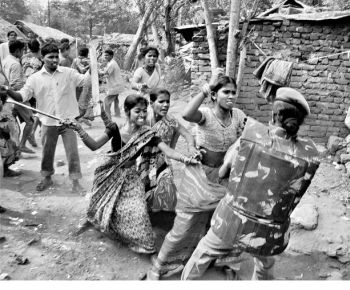
    Two hundred and fifty-nine families (1195 people) resided in sixty year old Narayani Basti (slum near Unit 8 DAV School, Bhubaneswar) till the 29th of January 2011. On the 29th of January 2011, ten platoons of police with 9 platoons armed force and DCP and Commissioner of police went into the region and demolished the slums. Slum dwellers protested and many of them were seriously injured in their struggle against local goons and police who assaulted women. The police arrested hundred slum dwellers which included forty nine women. These women were kept locked in a van and were not allowed to leave the van for any reason. On the 30th of January local goons present did not allow either food or water to reach these people after they forcefully returned to their slums. Food prepared by the people from outside (Basti Suraksha Manch) was also not allowed to reach these people. The people organized themselves and started throwing stones at the local goons to get some time to collect and store food. Dodgers came again but this time failed to oust the organized masses. The people of the slums have now decided to take up arms (anything they have at their disposal, hammers, knives, etc) against anyone who tries to come to attack them.


    Courtesy: The Hindu

    These people living in the slums of Narayan Basti have been attacked by the police without Notice several times before. For the first time it happened in 16th of December, 2009 and since then there has been continuous opposition by slum dwellers against any attack by the forces of the Government. Through protests, they have been able to force dodgers back that had come to demolish the slums and this they have been able to do for about seven to eight times. The recent attacks before the demolition were made continuously from the 10th to 14th January, 2011.

    There are several such slums in Bhubaneswar who fear demolition and the Basti Suraksha Manch of Bhubaneswar is playing a leading role in organizing these people. According to the Basti Suraksha Manch, the demolition of these slums is illegal. According to Orissa Municipal Corporation Act Chapter 21, slums are classified as Tenable (which can’t be moved to other places) and Untenable (which can be moved to other places). The Narayan Basti slum is declared Tenable according to this act with its code being 3301 (every slum has a code). In spite of their having tenable status, the Government doesn’t even give alternative accommodation, rather, has a ‘transit house’ (about three kilometers away in Niladri Vihar) where these people will be given accommodation for 15-30 days only and will be left to their own. One can judge how the Government sees its people when one finds that these transit houses have two toilets for two hundred families.

    The following is a copy of the letter written to Chief Justice of Orissa High Court:

    The Honourable Chief Justice
    Odisha High Court, Cuttack
    Sub: Pray for justice

    Sir,

    49 women of Narayani Basti (Khandagiri PS, Bhubaneswar) are illegally detained in the Khandagiri PS at night(after sunset) on dtd.29.01.2011. Who were forcibly evicted from their slum in spite of High court judgment in writ petition(C) No. 11667/2010 and writ petition(C) No. 12723/2010.

    You are therefore, requested to kindly intervene the matter in the interest of justice.

    Yours faithfully,

    Pramila Behera
    Plot No. 1819 (opp N6/10)
    IRC Village, Bhubaneswar-15

    Arab Uproar

    Ron Ridenour

    Long time in the making! Long time suffering poverty, inequality, official murder-torture-imprisonment, despotism, fundamentalism, and governments lackeyed to US/Western powers.

    I am no expert on Arabic/Middle East history or politics, other than knowing that US/Israel-led imperialism has had a grip on the entire area for decades, and before that there were other foreign oppressors. I know that in part of the Arab world—not currently involved in this uproar—the US-led “humanitarian” operation has cost upwards to two million Iraqi lives, millions of migrants fled and fleeing, tens of thousands tortured, and the destruction and thievery of much cultural wealth and history. European allies assist in this butchery. Something similar is occurring in Afghanistan, and extending into Pakistan.

    Wikileaks’ dispersal of US Embassy cables from Tunisia—posted in the British Guardian, December 7, 2010 and January 28, 2011—show how duplicitous and corrupted all US governments are with the Ben Ali family government for the past two decades.

    US ambassador to Tunisia, Robert F. Godec, wrote, on July 17, 2009, that the Ben Ali regime is: “sclerotic;” and that “Tunisia is a police state, with little freedom of expression or association, and serious human rights problems.”

    On the other hand, Godec expressed the need to continue supporting this regime because, “The government is like-minded on Iran, is an ally in the fight against terrorism…the US Mission has, for the past three years, [responded] by offering greater cooperation…notably in the commercial and military assistance areas.”

    The US government supports Egypt with $1.3 billion in military aid annually, second only to Israel.

    Most shamefully, a number of Arabic governments aid and abet the US in its “war against terrorism”. Egypt, and Tunisia—where the courageous uproar began a month ago—are among them. In others—Yemen, Algeria, Lebanon—many thousands of people act supportively with the Tunisian people, and with their own similar demands.

    Will this lead to revolution, to socialism, as a rejection of misery under capitalism? Marxist analysis of what is takes before a socialist revolution can break out and grow entails two aspects. First, objective conditions must be present: too much poverty, exploitation and oppression to ignore; plus sufficiently high level of technology (industrial or?), and acutely antagonistic productive relations.

    The second condition is subjective, in which a significant number (majority or?) of the most productive and exploited of industrial workers (perhaps also or either a significant number of land proletariat and small peasants) are conscious enough of their position as exploited, and are angry enough to take up the call for revolt. Overthrowing oppressors—as is occurring now, or is in the process of occurring, in some Arabic nations—is a good indication that a huge percentage of folk (in many places the large majority) are ready subjectively. Many have been murdered, thousands more arrested, yet they persist, especially in Tunisia and Egypt.

    (Iraq, also an Arabic nation, has not moved into supportive action. Most of its people are too brutalized by the US+ invasion and their accomplice national governments, supported by the Persian neighbor, Iran, to come into the streets. But, I suggest that many have their hearts beside their Arabic brothers and sisters in uproar, and time may bring them to fore. But this will probably not occur shortly in Saudi Arabia where the US-backed multi-billionaire government leaders rule with a fascist fist.)

    The objective material factors for Tunisia and Egypt are, in large part, present as well. Does the high level of production relations necessary exist? I do not know. Are the workers antagonistic enough with the bosses and do they know that (condition two)? I’d say yes to both.

    I do not seek to become an oracle. I wish merely to shed us of illusions. It takes more than what is occurring now to win over not only the national oligarchies and their armies and police forces well-equipped with US-French-British armaments, but also the very Empire itself awaiting in nearby skies and waters for the signal to move in if all else fails. The people are not armed well enough.

    Nevertheless, I am encouraged by a sense of pan-Arabic unity, a sense that they are all one brethren no matter the name of the State. I do not see, however, in many of these areas, that the people are well organized, that they have their own parties or unions that lead with sagaciousness, or that they lead at all. There is great spontaneity and determination. All to the good! But people never win over the oppressors unless they have organizations that formulate policy and direction.

    In Tunisia, however, I see a positive development with the January 14th Front, forces involved in the revolt. The eight organizations and political parties forming it, several illegal and operating underground, gathered into a united front on the day that the dictator fled the country. They propose 14 points to move forward, to form a people’s government and change the economic foundations.

    Among the key points are anti-capitalist and anti-imperialist demands, coupled with democratic and social demands to raise the people out of poverty and exploitation.

  • Eliminate all temporary governments that have any relations with the Ben Ali government and party (the RCD).
  • Dissolve the existing state apparatus and create an assembly of peoples’ organizations for a new constitutional foundation.
  • Eliminate the secret service and the political police.
  • Jobs, health care, civil and social rights for all.
  • Solidarity with all forces for liberation, especially with Palestinians in opposition to Zionism.
  • Most of you who read this commentary are not in the Arabic region. To you I say: we are all brothers and sisters in our common struggle! Take up what arm you can and support these people today, and hope that, one day, we will all support one another to build a universe where we are all one free people living with essential needs!

    For other articles by the author visit his website.

    Lawful, Playful & Busy Delhi


    For a slideshow click on the photo…

    Higher Education Cuts, Students Protests and Media Misrepresentation

    Bulent Gokay
    Farzana Shain

    At the end of 2010, tens of thousands of university students have demonstrated in central London and all over university campuses in the UK, against the coalition government’s proposals to raise tuition fees up to 9,000 pounds. Government and Media coverage of the protests has focussed primarily on two factors – the violence of a minority of protestors and the apparent ‘privileged’ profile of a few student protestors. ‘Rich rioting students’ was just one of the headlines describing the demonstrations. A panellist on BBC’s Question Time described protestors as ‘just a bunch of middle class students’. Michael Gove, the Education Minister, defending the planned increase in tuition fees posed the question: ‘Is it fair to ask a miner to subsidise the education of someone who can go and become a millionaire?’ The irony of this analogy can surely not be lost on those who remember how brutally Gove’s Conservative Party, in its previous incarnation, destroyed the heart of British working class mining communities.


    Courtesy: LATimes

    One of the most passionate, but misguided, commentaries on the recent student protests comes from Julie Burchill (the Independent, 16 December), who made a plea to the public to ‘spare us these pampered protesters who riot in defence of their privilege’. Focusing on one student, Charlie Gilmour, who has been singled out by almost all the British media because of his connection to a famous rock star, Burchill vents her anger at so called ‘middle class’ protestors at the same time as dismissing university education as a wasteful time of ‘boozing and bullshitting funded by the taxes of people who had the actual gumption to remove themselves from the playpen of education and get a job as soon as legally possible’. She goes on to suggest that for many working class youth, university education has made little difference to their prospects of getting a job.


    Courtesy: LATimes

    Burchill is right to question the success of government-sponsored schemes such as widening participation which critics argue has done little to equalise educational outcomes. All the research suggests that while working class students are more likely to attend university than they did 10 years ago the class gap has not necessarily diminished. Working class students are more likely to attend newer universities, to be part-time students and to study for more vocational subjects. But to dismiss university education for the masses as completely irrelevant is surely wrong. Burchill is also wrong to dismiss the current protests as entirely middle class-led. The fact that some students from middle and upper class families join the student protest does not make the whole student protest an action of the privileged few in defence of their privileges. University students, whatever social class their parents are from, historically tend to act together as ‘students’, and for most part for progressive causes as in the case of the 1968 student protests. At first in 1968 too, the governments and media also sought to portray the student protests as work of radical students and small groups of middle class troublemakers.

    The protests over the last few weeks have seen large numbers of working class students (some of them school students) protesting because it is they who have the most to lose from the proposed public spending cuts. Further, to get so hung up on the notion of a so-called middle class-led protest serves to support Gove’s and the coalition government’s attempts to create an ideological standpoint, presumably on the side of the ordinary working people, from which position to launch a wholesale attack on all the social and economic achievements of the previous generations, like the universal child benefit, housing benefit, disability benefits and similar other measures.

    The current representation of the protestors as middle class serves a deeply ideological and manipulative function of deflecting attention away from the stark realities of the public cuts and their real causes. Many people who oppose the cuts simultaneously accept the argument that there is no alternative but to sacrifice education and other public services in order to save the economy. Further, a large section of the British public and media appear to have accepted the line presented by the government that the total package of cuts worth £128 billion by 2015-16 was ‘unavoidable’ because of previous administration’s careless spending, and almost self-made huge deficits. Until the financial crash of 2008, however, the Labour governments had succeeded in keeping national debt below the 40 percent of GDP target that they set themselves. In 2006/07, public sector net debt was 36.0 percent of the GDP. In 2008, it rose rapidly primarily because of ‘financial interventions’ to bailout of Northern Rock, RBS and other banks, because of lower tax receipts, and because of higher spending on unemployment benefits, all caused by the global recession. The current deficit was caused primarily by the recession not by previous administration’s pre-crash careless spending. It currently stands as 63.7 percent of National GDP, and was projected to peak at 74.9 percent in 2014-15.

    Massive cuts to the NHS, local government, and education budgets are not the inevitable solution to national debt. During the Second World War, the UK national debt reached much higher figures of up to 150 percent of the GDP. It is not uncommon for countries to borrow more during the time of serious national and international crises, like wars, or economic upheavals like the one currently affecting the world, and to pay back the debt over a period of time once the economy starts to grow again. In this sense, budget deficits can be an effective way to deal with shocks such as wars, financial crashes and deep recessions. If anything, the problem of low economic activity is the real, and more urgent, issue than the fiscal stability.


    Courtesy: LATimes

    David Cameron’s ‘Big Society’ programme offers an ideological justification for the massive public spending cuts which are about much more than just deficit reduction. The pretence of ‘there is no alternative’ offers a means for the Conservative project to radically transform the state and to transfer more services and money from the public to the private sector. If the real intention was to take the British economy out of the crisis, then such massive cuts would not be the answer. There are alternatives: we need to find a fair and sustainable path out of crisis. Budget deficits will more or less automatically heal with the economic recovery. Trying to cut the deficit quickly, in the midst of a serious recession, will damage the economy and extend the crisis. The government instead should concentrate on growth and allow growth to reduce the deficit. Cuts will not reduce the deficit, investment will. Recently, the Confederation of British Industry (CBI) announced that it expects economic growth in 2011 to be much slower than previously predicted. A much weaker consumer spending, resulting from massive unemployment and lower wages in 2011, is described as the main reason for this. Cutting too far and too fast will mean more people out of work, fewer jobs in the economy, lower level of taxation from workers and businesses, and more people on unemployment benefit, which will cost the government more. The real challenge is to introduce constructive ways to restructure the national economy so that it can deliver strong and consistent growth.

    The current crisis and the way some other parts of the world economy have been dealing with it successfully, and all social and cultural legacies of this turbulent process have highlighted, like never before, the crucial role of education. The financial and economic crisis has had a particularly strong impact on young people with low levels of education. Investments in education pay large and rising dividends for individuals, but also for economies. On average, a young person with a university degree will generate £77,000 more in income taxes and social contributions over his/her working life than someone with a high-school degree only. Even after taking the cost of university education into account, the net public return from an investment in tertiary education is £56 000 for a male, in generated income taxes and social contributions over his working life. Enhancing tertiary education attainment can therefore help governments increase their fiscal revenues, making it easier to boost their social spending, in areas like, for example education. As the global demand for jobs shifts up the skills ladder, it has become crucial for countries to develop policies that encourage the acquisition and efficient use of these skills to retain both high value jobs and highly skilled labour. Burchill is right to suggest that ‘clever working class youth of this country [have] been socially and spiritually ‘kettled’ – hemmed in, suffocated and stifled’ historically by ‘the privilege and entitlement’ of the likes of elite. But does the answer really lie in cutting away higher education for working class students altogether?

    Britain’s total investment in higher education, even before the current cuts of the Coalition government, was 1.3 percent of the GDP which is behind the OECD average of 1.5 percent. Despite the student numbers rising by approximately 25 percent in the last 15 years, the UK has slipped from third to fifteenth position in numbers graduating among industrial countries because investment in higher education has risen much rapidly elsewhere. Within Europe, the UK is already falling behind France, Denmark, Finland, Sweden, Portugal and Netherlands, among others. Other Western governments, most notably the United States and Germany, have viewed the global financial and economic crisis as a sign not to retrench but to invest in their higher education systems as a necessary part of investing in the skills that will be needed for recovery in near future. In the UK, however, it was education that was first in line for cuts in spending: the cutting of the Future Jobs Fund, the cancellation of school building and refurbishment, the abolition of the Education Maintenance Allowance, and now funding cuts in university teaching budgets, fewer university places and a massive increase in university tuition fees. All these draconian measures will ensure that talented people from working class backgrounds will not achieve their full potential. The poorer you are the more scared you are by the prospect of tens of thousands of pounds of debt. It seems this is exactly what the Coalition government wants- to keep education for the rich and privileged. And this is what tens of thousands of students are protesting against. If we want British economy to recover and take its place in a much more competitive world, if we want Britain to be ‘open for business’, we should make higher education available for everyone, regardless of their social class. The more skilled people we have, the more likely companies will be willing to invest in the UK.

    Bulent Gokay is a Professor of International Relations, Keele University and Farzana Shain is a Senior Lecturer, Keele University

    A working class uprising – how far will it go?

    Taken from an article published at LIBCOM

    . For other articles on Tunisia uprising, visit

    The fundamental class nature of the protests in North Africa is undeniable. In Tunisia, Algeria and Libya a generation of proletarianised youngsters have led mass protests, the immediate reason for which has been their desperate standard of living in countries which support a wealthy and transparently self-interested ruling class, less schooled in the modern techniques of bourgeois self-justification than their Western counterparts. The same issues are repeated in countries across the region. We will attempt a brief and preliminary survey of the class aspects of events here; again due to restrictions on information and rapidly developing events this survey is necessarily incomplete.

    Expropriations

    The uprisings in Tunisia and Algeria have involved the expropriation of goods from supermarkets, shops and warehouses during mass demonstrations. This is to be expected ; one of the immediate catalysts for the uprisings was the cost of essentials rising rapidly, with scarcity compounded by security forces shutting down the country. Moreover, during situations where working class people are becoming aware of their own power, respect for the nicities of commodity exchange evaporates, especially when money (or the lack of it) limits their access to the essentials of life. Such expropriations are a feature of all proletarian uprisings, as is the line on “violent looters” spun to justify brutal crackdowns.

    Strikes – or the lack of them

    Information on the extent to which strikes have formed part of the movement in North Africa is limited. We know of strikes by teachers in solidarity with protesting students. Likewise there have been calls for general strikes led by ‘professional’ workers such as lawyers, but it is unclear whether they were attended by workers more widely. We can say the same of the general strike called in Sfax – until more information is made available, it is hard to say to what extent it was observed. We know of strikes in the mining town of Gafsa, but again the scale of participation in these strikes is unclear. We do not know to what extent people have participated in organised strikes, or simply not gone to work due to the unrest on the streets. Lockouts after the state of emergency was declared would have precluded many strikes.

    Obviously the unemployed and students who have formed the bulk of protesters on the streets do not have labour to withdraw in the same way as workers. Demonstrations, blockades and riots all can form part of class struggle, and can advance it by disrupting the economy and drawing lines of confrontation. Radicalisation by police truncheons can often push confrontation with the state further, and draw more people into events by making the role of the state in maintaining order through violence clear. However, all major uprisings have involved mass strike action, and the mass strike is a means by which the common interest of proletarians as working class and their power to cripple capital by expropriating the means of life from it can become clear. The direction and scale of the insurrection is likely to be determined by the extent to which strike action spreads through the economy.

    Part of the explanation of our limited knowledge of strikes could be the focus of the media on street protests and the ‘political’ dimension presented by the calls to oust the current government. Strikes taking place in parallel may not be deemed newsworthy. On the other hand, it may be that there has not been generalised strike action. The role of tourism in Tunisia’s economy, employing significant numbers of workers (half of the workforce is employed in the service sector) is not enough to account for this – industry such as manufacturing, mining and the oil industry accounts for a third of the workforce. This is the classic terrain for mass strikes of the kind that has been a feature of all historic working class uprisings, and this would have a significant effect in a major oil and minerals exporter such as Tunisia.

    On the other hand it is important to bear in mind the effect a drop in tourism revenues can have in a country like Tunisa – a few global headlines about rioting can lead to the paralysis of a major section of the economy. Ben Ali called on rioters to stop due to fears about the decline in tourism, and was clear and vocal about this. Nonetheless, a generalised strike movement would be vital in broadening a specifically class consciousness, widening the movement and radicalising the situation.

    Not a revolution – yet.

    The media has been quick to label events in Tunisia a ‘revolution’, and the name ‘ the Jasmine revolution’ has been rapidly applied to bring it in line with a range of other political revolutions which ushered in new governments (usually pro-US) in various countries. Such events are only ‘revolutions’ in a political sense, with one government replacing another. Tunisa has not yet seen a true revolution, as the rule of capital and the fundamental balance of power between classes in the country has not yet changed. Such a possibility would require the working class of the region to draw lessons from the radical display of their own power which has unfolded over the past weeks. Given that the fundamental issues – unemployment, high prices and poor housing cannot be solved by decree by governments even if they wanted to, it is unlikely that we will see the status quo return in North Africa any time soon.

    Ministry uses rhetoric of “community control” to hide the actuality of intensified state control

    Campaign for Survival and Dignity

    Much press attention in the last week has been devoted to the Environment Minister’s statements on “democratic forest management” and how the existing forest management system needs to change. Such statements are welcome, for they mark an official admission that India’s forest bureaucracy has impoverished millions and increasingly been an opponent of both forest conservation and forest dwellers.

    But what the Ministry says does not at all match what the Ministry does. Not only is the Ministry not moving in the direction of democratic management; it is moving against democratic management, while using the rhetoric of “community control” to hide the actuality of intensified state control.

    At a time when state control over forests and forest lands is a major weapon in the assault on people’s resources and livelihoods, this is not an arcane policy issue alone; it is one component in the ongoing intense struggle over deciding how we will use our natural resources and how we will define our society.

    A simple comparison throws up what is actually going on (click on links to know more about each issue):

    Issue What the Ministry Said What the Ministry is Doing
    Diversion of forest land for corporate projects One and a half years after passage of FRA, Ministry finally issues Aug 2009 order that requires FRA compliance i.e. recognition of rights and consent of gram sabha before land can be handed over * As per public minutes of Forest Advisory Committee, there is not a single project in which the Ministry has complied with FRA or its own order. In Polavaram, the FRA has been brazenly and publicly violated. In only one project has compliance even been considered – POSCO – but even after non-compliance has been exposed by three different committees, and five years of protest by the people, the forest clearance is still standing.
    * Meanwhile, there are ongoing attempts to get the order withdrawn.
    Joint Forest Management Throughout this year, including this week, statements by Minister that Joint Forest Management has become a Forest Department proxy and needs “reform.” * The reality is that there is only one nation-wide law that provides for democratic community control over forests – the Forest Rights Act(PESA provides even more extensive powers in Scheduled Areas). This supersedes all existing schemes. Therefore, if the Ministry is genuinely interested, the first steps for democratic control would be to shut down JFM, put the funds into the NREGA or other systems which permit local institutions to decide their priorities, and direct forest authorities to comply with local powers as provided in the FRA. MoEF would then have to join other Ministries in a coordinated effort towards democratic resource management, which is not MoEF’s domain alone.
    * What is happening is exactly the opposite. There is repeated talk of “revamping” Joint Forest Management (which has no legal validity), and this translates into giving JFM committees powers that actually belong to democratic institutions.
    * Even the basic fact that forest guards sit as the secretaries of JFM Committees, and their funds are controlled through the Forest Department, is completely ignored.
    In short, the Ministry is strengthening its proxies, not democratising them.
    Forestry Projects The Ministry repeatedly claims that the huge amount of money being poured into forestry projects will benefit forest dwellers and be spent in a “decentralised” fashion under “people’s control.” The money put into forestry includes money from the Compensatory Afforestation Management and Planning Authority (CAMPA) (1,000 crores per year), the proposed Green India Mission (46,000 crores in total), Japanese-funded “external” forestry projects, the National Afforestation Programme and the developing international REDD agreement. In every single one of these programs, funds are being channeled or are proposed to be channeled through JFM and the Forest Department, directly undermining democratic control and driving land grabbing. This is true in the case of CAMPA – despite a direct indictment by a Parliamentary Standing Committee. For details of other programmes see our statements on the proposed Green India Mission and the MoEF approach to REDD. If the Ministry is interested in democracy, why is it channeling funds to the very institutions that undercut democratic control – and this after it has itself said that they do so?

    The “forked tongue” approach that has come to characterise the forest bureaucracy and this Ministry is extremely dangerous. It blocks actual change by claiming to be engaging in it; and then it does precisely the opposite, cleverly garbed in the right terms and the right language. In the process, “participation” becomes a code word for devolving huge amounts of money to select individuals and sections of villages in order to create what are essentially state proxies and vested interests. Nor is this confined to the Environment Ministry; we now have a “Integrated Action Plan” for “developing” Maoist areas by putting thousands of crores into the hands of the very officials who have destroyed people’s lives and livelihoods, organised inhuman repression and violated all norms of democracy. In the long run, this approach is a formula for dividing communities, breaking resistance, undermining democracy and destroying resources. It may make sense for the interests of corporations and state machinery; but to the rest of us it is a formula for resource grabbing and destruction.

    Rapists roam free while victims and activists are jailed

    ML Update, CPI-ML (Liberation)

    Peasants, agricultural workers and women of Mansa district, Punjab observed New Year’s day this year with a protest gathering at the police headquarters in Mansa. Braving a severe cold wave, thousands of people gathered to protest a shocking situation where the rapists of a dalit minor girl roam free, while the woman activist who prevented the cover up of the rape case is in jail on false charges of ‘attempt to murder.’

    In mid-December, a 17½ year old girl from a poor Dalit family was lured by a havildar in Mansa to his house on the promise of employment, and subjected to gang rape by him along with three others including a local advocate, a trader, and a financier. When neighbours heard her cries and called the police, however, the police deliberately suppressed the rape case and instead booked both the victim and her rapists on charges of ‘loitering.’ Cases of rape and SC/ST atrocity were registered only two days later, after intervention by CPI(ML) and AIPWA activists. However, three weeks after the incident, the accused (apart from the havildar) were yet to be arrested, and, being influential locally, were bringing to bear all sorts of pressures and threats on the victim. Two other of the rape accused were arrested only on 4 January, following the protest rally at Mansa and the intervention of the central team of AIKM and AIPWA leaders, while the financier accused of rape is still at large. Worse still, the very same activists including AIPWA National Council member Jasbir Kaur Nat and National President of the All India Kisan Mahasabha Ruldu Singh, who helped book the rape case are now behind bars along with several other peasant leaders, on a patently false charge of ‘attempt to murder.’ The pretext for this was the fact that they raised slogans in Court against the main accused in the murder of a popular peasant leader, leading to a minor skirmish when police assaulted them.

    In the same area of Punjab some years ago, the dalit activist and singer Bant Singh had his limbs chopped off for supporting his daughter to pursue a rape case. The recent instance of rape of a dalit girl and victimisation of activists who pursued justice highlights the continuing strength of feudal survivals in Punjab. It also underlines the increasingly repressive response of the Akali Government in Punjab where every mass movement – of agricultural workers for homestead land, of peasants against debt – is me with mass arrests of leaders, activists and masses. What is happening in Punjab is also not very different from what is being seen in the rest of India – where scamsters, rioters and rapists roam free while activists like Binayak Sen are jailed.

    Punjab is no exception. Just recently, in BSP-ruled Uttar Pradesh, a 17-year-old OBC girl who accused the BSP MLA Purushottam Narain Dwivedi of rape is in jail on charges of ‘theft.’ The incident exposes the reality behind Chief Minister Mayawati’s claims of social justice.

    Meanwhile in Bihar, the BJP MLA from Purnea was stabbed to death by a woman who had filed charges alleging rape by the MLA and his associates some months ago. Police had taken no action on her complaint, and she had been pressured into withdrawing charges later. It is apparent that the woman was driven to take the desperate step because the chances of securing justice against a ruling party legislator were bleak. It is shocking that the BJP MLA’s supporters lynched the woman, critically injuring her, and that BJP leaders including the Deputy CM of the state have aggressively slandered the woman’s character while defending their MLA as a man of impeccable morals!

    The recent instances in Punjab, UP and Bihar are a reminder of the sorry state of affairs in India when it comes to justice in cases of violence against women in general and women from oppressed communities in particular. According to NCRB (National Crime Records Bureau) figures, the conviction rate in rape and molestation cases in India is a mere 27 per cent – about one in four cases. Likewise, the conviction rate for cases of atrocities against SCs and STs is abysmally low – less than 30 per cent against the average of 42 per cent for all cognisable offences under IPC.

    The national capital itself is witness to horrifying cases of rape, gang rape and other forms of violence on women. According to official figures, a rape takes place every day in Delhi, and 400 rape cases were registered in Delhi in 2010. The prevalent police attitude to such crimes can be gauged by the comment of celebrated police officer K P S Gill after the Dhaula Kuan rape case some years ago: Gill blamed women’s ‘provocative’ clothes for the rise in rape crimes in Delhi! The low conviction rates, trials that drag on for years, and insensitive police investigators who blame women themselves for such crimes, all empower rapists and molesters with a sense of impunity, the more so if the woman are from marginalised and oppressed communities, such as dalit and tribal women, or women from the North Eastern states.

    The CBI’s closure report in the case of murder of a teenage girl Arushi Talwar is yet another reminder of the apathy that marks investigations in cases of violence against women. The CBI had been called in after the Noida police botched up the investigation, but the CBI pursuit of the case also relied more on ‘confessions’ obtained from domestic servants through third-degree methods like narco tests than any professional investigative practices, and now the CBI has attempted to close the case file itself. If justice is so elusive for urban girls from reasonable well-off families like Arushi and Ruchika, whose cases got great media attention, one can only imagine what happens to cases of women from socially and economically weaker backgrounds. And if this is the state of affairs in rape cases where politically powerful people are not implicated, what of the cases where police and army forces are implicated in rape and violence against women? The young Manipuri woman Thangjam Manorama, raped and murdered by Indian army personnel in 2004 is yet to get justice. The rape and murder of two Kashmiri women — Asiya and Nilofar — in Shopian, Kashmir, last year had been subjected to a spectacular cover-up by the CBI, with the latter claiming that the two women ‘drowned’ in a stream six inches deep. In Chhattisgarh where Binayak Sen has been sentenced to life on no evidence, adivasi women who filed charges of gang rape against top Salwa Judum personnel live in terror, because their rapists are free while the women themselves along with their kith and kin are threatened that they will be branded as ‘Maoists’ and arrested or killed in fake encounters.

    Justice in violent crimes against women is non-negotiable. We must demand speedy passing of the Sexual Assault Bill, as well as fast-track courts to ensure speedy justice in such cases. Above all, we must build more and wider struggles to challenge the impunity and apathy that has become the hallmark of cases of rape and violence against women.