The Anti-Corruption Protests: A Great Opportunity, A Serious Danger

A STATEMENT

The Anna Hazare situation invites two common reactions: many dismiss it as a middle class driven “urban picnic”; and others, notably the mainstream media, describe it as just short of a revolutionary movement to establish “people’s power.” The same divide exists among progressives and those concerned with social change. Strategies differ on the basis of where one stands on this divide.The problem, however, is that neither of these reactions fully reflects the reality of what is happening.

We note that our position below is focused on what can be done in this situation, and is not meant to excuse or defend the government. We condemn the brutal, corrupt and anti-democratic actions of the UPA; we also, it must be noted, condemn the actions of the BJP and its State governments in trying to portray themselves as crusaders against corruption. The dangerous Lokpal Bill that has been presented must be withdrawn, and, as said below, a process initiated for effective institutions of people’s control that can be used to defeat corruption. We issue this statement precisely to caution against erroneous tactics that are strengthening the very state that we must fight against.

The Opportunity

It is true that the protests so far have been dominated by middle classes, and that they have been exaggerated by the media. But this does not mean that this process becomes meaningless. Precisely because there is no strong organised movement among the working class at the national level, no alternative media, and no consciously projected alternative to the existing system, a hyped up middle class movement can easily grow into something much larger. We can already see that happening, as protests are spreading and diversifying in terms of their mass base. People’s anger at this system and at the corrupt nature of the Indian state is hardly a middle class phenomenon alone.

For that reason, we cannot and should not dismiss this situation. The more people are willing to see this system for what it is, and to express their anger and disgust with it, the more there is an opportunity to expose it and fight for something new. A crisis is an opportunity for those who are fighting for change.

Therefore we cannot agree with those who look at these protests and hunger strikes and see in them a “blackmailing” of Parliament. Parliamentary democracy in this country has never been more than a very limited space. Even this space has been rendered meaningless in recent decades, by precisely the forces who today are shouting about its virtues.

For instance, the SEZ Act was passed after barely a day’s debate in Parliament. Economic reforms were introduced through stealth, FDI in retail is on the verge of being approved, and the UID project is going ahead – all without a whisper of Parliamentary approval. It is correct to be cynical of neoliberal pro-corporate leaders when they suddenly discover that Parliament is a sacrosanct institution. When people feel that the system is rotten to the core, we should not attempt to dilute that reality by saying that Parliament will deal with the problem.

The danger is not to Parliament; it lies elsewhere.

The Danger

The fact that people are angry is an opportunity. But it is also a risk, because that anger can be channeled in ways that actually strengthen the existing power structure. In this case, consider:

• The message being conveyed about these protests – the tactics of the leadership notwithstanding – is that of support to Anna Hazare and his “Team Anna.” Beyond the concept of “transparency”, the public campaign does not engage at all with the idea of a democratic organisation of the people (as opposed to one “supported” by the people). As such, this raises the question of whether those participating are being asked to fight to build people’s power, or whether they are fighting to increase the power of the “good leader.”

• The demand of the campaign too is not about, even in a minimal sense, democratising the Indian state or society. The Jan Lokpal being sought may address some types of corruption, or it may not do so; but it is not intended to give people any greater control over the state. It is projected as effective not because it will be democratic, but because it will be powerful, because it will stand “above” democracy and politics itself. Just as Anna is a good person who deserves support, so the Jan Lokpal will consist of good people who deserve power, and who will use it to “cleanse” the state.

• Most of those joining these protests are doing so on the basis of media coverage. In practically all areas (with one or two exceptions) the mobilisation lacks any core organisation. At most there are ad hoc groups of urban elites; but in large measure, the place of the organisation has been filled by the mainstream media itself. All the ideas sought to be communicated are therefore seen through the lenses that the media applies to them. As a result, even where elements in the leadership try to talk of popular struggle and democratic principles, they are overridden by an overwhelming focus on attacking the current power holders and replacing them with an even more powerful, more “clean” institution.

The net result of all this is that “corruption” becomes defined very narrowly, as the taking of benefit in violation of the law. The ultimate message of this movement is: trust the rules, trust the state, trust the Lokpal; what matters is finding the right leaders and having faith in them. This is the message that is sent by the mobilising instrument, the media, regardless of what the leaders may actually say.

This is not only not a democratic message, it is an anti-democratic one. At this moment, in India, it is also dangerous. Brutality, injustice and oppression in this country is not a result of violation of the law alone. Indeed, much of it happens because of the law in the first place. We have a state machinery which has brazenly shown itself to be the servant of predatory private capital. This is the biggest reason for the current boom in corruption: the enormous money generated through superprofits that is then used to purchase the state and generate more superprofits. Sometimes this is exposed as violating some law and gets called a “scam”; but at other times, as in most economic reforms, it simply changes the law. The SEZ Act is again a good example. It triggered a wave of land grabbing across the country, which was only slowed by the global economic crisis; but there was nothing “corrupt” in the Lokpal sense about most SEZ-relatedactions. Our people are being crushed by a cycle of intensifying capitalist exploitation and repression. Can this be stopped by good leaders with the right powers?

Many would answer “Obviously not; a Jan Lokpal cannot address everything.” This may be true, but that is not the message actually being sent out. Rather the message is that Lokpal-style solutions and Anna Hazare-style “good leaders” are the answers to people’s anger at injustice. When the leadership, Ramdev-style, starts adding on a laundry list of additional issues to its demands – as land acquisition has recently been added – it reinforces this dangerous message. Thus this movement not only does not weaken the state; implicitly, through the message it sends, it builds people’s support for making the state and its leadership more powerful. This of course the reason that it attracts support from everyone from Jindal Aluminium to the RSS.

What Can Be Done

The mere fact that people are protesting against the government does not mean that they are fighting the state. The Indian state certainly has little to fear – as a state – from a mobilisation whose prime message is that change happens through good leaders. The current power holders are resisting the threat to their position, but the system itself is not under threat. Indeed, the danger is not to the state or its institutions, but to efforts at deeper social change in this society.

The dilemma of the current situation cannot be answered by simply joining wholeheartedly, or by withdrawing in silence.

Some have declared support for the current movement, while seeking to push it to take up other issues. The sympathies of some in the leadership for left and progressive positions is often cited. But the main engines of these protests – the media and urban elite circles – are actively opposed to any such positions. One has simply to imagine what will happen if this mobilisation does begin to turn towards a more radical stance: the media will instantly change its position from “Anna is India” to “Anna is a power crazed megalomaniac”, confusion, slanders and disinformation will start, and the movement will collapse. Given this reality, simply joining at this stage will be counterproductive. People will no longer be able to distinguish between forces who fight for social transformation and those who are upholding the current system; and when the latter fail, they will take down the former with them.

But to remain silent is to be irrelevant at an important time. It is also important not to fall into the trap of those who, in their criticism of the anti-democratic tendencies of this movement, start defending the existing state. In our view parliamentary supremacy is not and cannot be the slogan of those who seek social change.

What is required therefore is an approach built on two realities. The first is that the current explosion of scams is a direct result of neoliberal policies that have converted the state into the arm of a particularly predatory, criminal form of big capital. Today the real face of the state is more apparent then ever before, and corruption is one glaring sign of it. Therefore, to try to fight corruption without fighting for true people’s power over the economy and society is impossible. Therefore, our demands must focus on building such people’s power over the institutions of the state.

The second reality is that the current atmosphere of anger and suspicion of the state offers a chance to raise precisely these issues and to make the link between corruption and the system under which we live. The more political forces, mass organisations and people’s struggles do this, while keeping their identity separate from ‘India Against Corruption’, the more it will be possible to use this opportunity to build and expand radical struggles. If people can see the system is rotten, that can be developed that into an awareness that this rottenness goes far deeper than mere corruption and dishonest leaders. That is the challenge of this moment.

Abhay Shukla, Pune
Arvind Ghosh, Nagpur
Asit Das, POSCO Pratirodh Solidarity, Delhi
Bijay-bhai, Adivasi Mukti Sanghatan
Biju Mathew, Mining Zone People’s Solidarity Group
C.R. Bijoy, Coimbatore
Kiran Shaheen, Journalist
Pothik Ghosh, Radical Notes
Pratyush Chandra, Radical Notes
Ravi Kumar, Dept of Sociology, South Asian University
Shankar Gopalakrishnan, Campaign for Survival and Dignity
Shiraz Bulsara, Kasthakari Sanghatna

(all signatures are in individual capacity; additional signatures welcome)

Movie: Debtocracy

Courtesy: Debtocracy

For the first time in Greece a documentary produced by the audience. “Debtocracy” seeks the causes of the debt crisis and proposes solutions, hidden by the government and the dominant media. The documentary will be distributed free by the end of March without usage rights and broadcasted and subtitled in at least three languages.

Debtocracy International Version by BitsnBytes

Movie: Capitalism Is The Crisis

Courtesy: capitalismisthecrisis.net

The 2008 “financial crisis” in the United States was a systemic fraud in which the wealthy finance capitalists stole trillions of public dollars. No one was jailed for this crime, the largest theft of public money in history.

Instead, the rich forced working people across the globe to pay for their “crisis” through punitive “austerity” programs that gutted public services and repealed workers’ rights.

Austerity was named “Word of the Year” for 2010.

This documentary explains the nature of capitalist crisis, visits the protests against austerity measures, and recommends revolutionary paths for the future.

Special attention is devoted to the crisis in Greece, the 2010 G20 Summit protest in Toronto, Canada, and the remarkable surge of solidarity in Madison, Wisconsin.

It may be their crisis, but it’s our problem.

On the Arrest and Release of Students on 9th August

100 hr Barricade by Students and Youth Against Corruption and Corporate loot. Thousands of students were detained and later released in order to prevent them from carrying out their 100 hr barricade at night. An interview with Sandipan Talukdar (AISA).

9 Aug ’11 – 100hr Student Youth Barricade Against Corruption and Corporate Loot (part 2)

Organised by Student-Youth Campaign Against Corruption at Jantar Mantar, New Delhi after a nation wide campaign. Interview with Aslam Khan, Student-Youth Campaign Against Corruption

9 Aug ’11 – 100hr Student Youth Barricade Against Corruption and Corporate Loot

Organised by Student-Youth Campaign Against Corruption at Jantar Mantar, New Delhi after a nation wide campaign. Interview with Kavita Krishnan of CPI (ML)Liberation

Sri Lanka, Eelam Tamils and the Ethical Crime

Karthick RM

Sound, it can be said, is relative to the silence that precedes it. Deeper the silence, louder the noise. There was indeed relative silence in the world on the Sri Lankan war and the Eelam Tamils’ struggle, a silence that benefited a fascist state the most. The ‘Killing Fields’ video of Channel 4 came with a devastating bang and exposed to the world the horror that was Sri Lanka’s ‘war on terror’. While the news was already old for Tamil activists, something that many have been writing about for long, the powerful visuals of the 48 minute documentary created shock, especially among the ruling elites of Sri Lanka.

The Lankan government went on a hyperbole in its attempts to dismiss the video as false. The army spokesperson rubbished the video as ‘propaganda’. Der Fuhrer Rajapaksa, in an interview to his Indian Goebbels, an Indian journalist who was awarded the Sri Lanka Ratna and has remained loyal to the country that gave him that honour, remarked that the video was just a “film”. His brother Gothabaya, the defence secretary, was even more forthcoming – in his characteristic chivalrous manner that the Tamils are so familiar with, he wanted to know why one of interviewed war victims was not raped by the army men even when she was “a person so attractive”. Others in the Lankan defence were also more or less gender sensitive while commenting upon allegations of rape by the Lankan forces that the video has proved.

There were some comic gestures on the part of other Sinhala politicians as well. Chandrika Kumaratunga, for one, said that after watching the video one would be ashamed to call oneself Sinhalese. We laughed. When the Lankan Army overran Jaffna in 1995 under her rule, all the atrocities that we accuse them of today were committed then, maybe on a slightly lesser intensity. If the naked story of Vanni massacre is embodied in the face of Isaipriya today, the face of brutalities under Chandrika’s regime were depicted in the stories of Koneswary and Krishanty yesterday. Rajapaksa did not jump from the skies to commit these crimes. The wheels of genocide were set against the Tamils much farther back and Chandrika was as much a spoke in it as Rajapaksa. One thing is clear after the Channel 4 video now. No one can claim innocence over what happened in 2009. It is all a matter of taking sides.

But where is the Sinhala ‘civilian’ in this debate on genocide? The following is an excerpt from a conversation I had with a Jaffna Tamil friend who was personally affected by the war about the supposed progress of ‘reconciliation’ between the communities of Sri Lanka that Rajapaksa and his PR men were boasting about.

“What do you see when you look at a Sinhala army man?” I asked her.
“A murderer and a rapist,” she said.
“Ok. What do you see when you look at a Sinhala civilian?”
“The employer of murderers and rapists.”

Further enquiries on ‘reconciliation’ were unnecessary. There are those who are largely ill-informed of the Sri Lankan situation who would lay the blame of the war on the Lankan leaders alone owing to their being “mere instruments of class rule and national oppression” and/or because they are “puppets of imperialism.” Such an argument only partially exposes Sinhala racism for it ignores the essence of fascism in Sri Lanka.

The tragedy in Mullivaikaal in 2009, the largest massacre in the history of the Tamils, was celebrated by huge numbers of Sinhala ‘civilians’ across the island country. Over 100000 Tamils were butchered in the last stages of the war and while we mourn it, remembering our loved ones, the Sinhalese participate in government celebrations. The condition in Sri Lanka bears likeness to that state of a society that Hannah Arendt so famously described as ‘the banality of evil.’ The genocide of the Tamils in their homelands was not executed by a ruling class and its military alone, it had the wilful consent of the taxpayers-citizens who stood by the state in all its violent measures. Sartre was more explicit in condemning the inactivity of the passive citizen in such societies, if one did not protest when the government that one voted for commits genocide, then one was “undoubtedly a torturer”. What else explains the absolute absence of any major anti-war demonstrations from the Sinhalese side while there have been massive outpourings of support for the jingoistic rallies celebrating victory over the Tamils? How do we account for the anti-war Socialist ideologue Siritunga Jeyasoorya receiving less than 0.36% of the total votes in the Presidential elections after the war while Rajapaksa, with his fascist diatribes, emerged with a thumping majority as a national hero? Fascism has its roots deep in Sinhala society and the ruling class alone cannot be blamed for it. The Sinhala today is in a unique position in history like never before. He is much like the German ‘civilian’ on the dawn of Nazism, and he will be remembered by the Tamils in the future the same way a Jew today would think of the German in 1938. If the regime he voted for is drunk with power, he is inebriated with a sense of permanence. He denies that anything is wrong with the regime he supports. Even if the truth, as naked as the executed Tamil civilians shown in the C4 video, is thrown in his face, he will still stare with adoration at his national emblem and rally behind calls for unity. He is the ethical criminal who gives the power to the war criminals in the state. Then, the fascist at the top is not an aberration, he is the rule, while the likes of Viraj Mendis and Jude Fernando who live in exile for supporting the Tamils are oddities – much like what Oskar Schindler was in Nazi Germany. My friend was not off the mark when she said that she saw in the Sinhala ‘civilian’ an employer of murderers and rapists.

There is another layer that seems supposedly ‘in between’ in the whole conflict. The liberal multiculturalist, the likes of those who run ‘groundviews’ and other such outfits that use sophisticated jargon like ‘post-conflict reconciliation’ ‘coexistence’ ‘citizen’s alternatives’ to cover what they really are – apologists of state oppression. They are indeed a spectacle – they endorse all identities provided it does not hurt the general identity of ‘Sri Lankan’, which for the Eelam Tamils means occupier of their lands. And like all multiculturalist hypocrites, their organizations and positions resolutely deny the existence of the unique Eelam Tamil identity, the identity of an oppressed people asserting which they sacrificed over 200000 lives, serving the purpose of no one but the oppressors and their ideology. Collaborating with them are a group of Tamil intellectuals, an elite, steeped in liberalism and groomed in NGO politics. There are those who deny that there was a genuine liberation struggle led by the Tigers. There are those who say that the war on the LTTE was justified, but the govt needs to give the ‘right reasons’ – as if any such reasoning would assuage the wounded sentiments of those asserted their rights to their homeland and were thus hunted. And of course, there are those who say that let bygones be bygones. Against this academic onslaught, where does the politics of the Tamil patriots stand?

The ‘groundviews’ from Vavuniya, Kilinochi and Jaffna, the views of the Tamil natives, are this – the average Sinhala colonizer views the Tamil as a defeated person, to be pitied or to be held in contempt, if not to be trampled upon. The average Tamil views the Sinhala as a sadist who turned the other way while his army committed genocide in his name, a torturer, if not a killer. If the Sinhala colonizer’s gaze makes of the Tamil an object, it is because it is backed by an occupying army. If the Tamil’s gaze shows despair, a precursor to rage, it is because the most committed defenders of her interests, the LTTE, have only recently been militarily defeated, a defeat that the occupier flaunts in her face as the end of her genuine political aspirations. The raw material required for explosion, resentment and shared memories of persecution and injustice is prevalent throughout the territory of Eelam. And this is the truth in united Sri Lanka, no matter what its apologists like Sarvananthan and Ahilan Kadirgamar might like to portray.

Let me deploy a parallel. In colonial Algeria, there were compradors who betrayed their fellow nationals, collaborating with the occupiers, for privileged positions in the bureaucracy. Among Algerians, there were men who fattened themselves with the crumbs that colonialism threw, with the blood money of their countrymen, and could even buy luxurious villas in the occupying power’s metropolis. And there were Algerian intellectuals who sought to be more French than the French themselves, who would justify a peaceful coexistence between oppressor and oppressed, violator and violated, with colourful jargons and sophisticated prose. Did the FLN wage the Algerian independence struggle for such men? Or did they wage it for those countless men and women who saw the brutal face of French occupation and chose to assert their rights and their identity, for the martyrs of Setif and Phillippeville? I leave it to the sensitive reader to make her/his conclusions and draw appropriate parallels with the Eelam struggle and its protagonists. All I can say is that the Eelam struggle was, is, and will be waged for those Tamils who assert their legitimate right to their homeland, to be different and to secede, at the risk of sounding sentimental, for the thousands of young Tamil men and women who chose to fight and die even when they had a choice to collaborate and live, and at the risk of sounding metaphysical, for the vindication of their faith that one day there will a land called Tamil Eelam that we can call home.

So, the Tamil liberal who infests the elite circles of Colombo 7, who speaks of ‘post-war reconciliation’ or ‘citizen activism’ without addressing the fundamental political demands of the Eelam Tamils is as guilty of ethical dishonesty as his intellectual bedfellow, the Sinhala liberal who, like all liberals of oppressor nations, primarily serves his nation’s interests only. The Eelam Nation is still facing war – as even a cursory glance of Gothabaya’s recent statements would indicate. The reality of war, as Sartre observed, is always Manichean and all discourses of ‘plural identities’ and ‘multiculturalism’ is nothing short of a farce. And the intellectuals who take refuge in such arguments are as guilty of crimes as the rapists and murderers and their employers.

The author is a freelance writer based in Chennai.

July 26: Cuba’s Revolution, Morality and Solidarity

Ron Ridenour

Fifty-eight years ago, on July 26, 1953, 160 Cuban rebels attacked Moncada Barracks near Santiago de Cuba. Had the rebels been able to take the fort with 1,000 troops—a good possibility—it would have started a revolution that might well have defeated the dictatorial regime of Fulgencio Batista within a short time.

Fidel leading the revolutionaries

Fidel, the leader

The main cause for failure was a missing vehicle with their heavy weaponry. Nevertheless they were able to cause three times the numbers of casualties that they suffered. Nearly one-half of the rebels were killed but most of them died under or following torture.

After being held for 76 days in isolation without access to reading material, Fidel Castro, the 26-year old leader, came into a courtroom filled with 100 soldiers. He gave a rousing defense of the need for revolution to topple the dictator and change the corrupt and brutal socio-economic system so that all could be fed, obtain education and health care, so that farmers could own land and all have a voice.

Fidel

Fidel leads the revolutionaries

In his five-hour speech, Fidel said,

“The right of rebellion against tyranny, Honorable Judges, has been recognized from the most ancient times to the present day by men of all creeds, ideas and doctrines.”

Instead of asking for acquittal, he demanded to be with his brother and sister rebels in prison. “Condemn me, it does not matter, history will absolve me!”

Fidel Castro considers ethics and morality to be essential for revolutions. In My Life: Fidel Castro, the 2006 interview book with Ignacio Ramonet, Fidel speaks of these highest principles on numerous occasions. He asserts that “especially ethics” is what he learned most from the national liberation hero, José Martí.

After following liberated Cuba for half-a-century, having lived and worked there for eight years, I find that during its guerrilla struggle, from December 2, 1956 to January 1, 1959 the revolutionaries acted in a moral manner. Cuba’s revolutionary armed struggle was exceptional in this way. As Fidel told Ramonet, “We did not kill any prisoners”, “not even one blow” was dealt. That is “our principle”; “All revolutionary thought begins with a bit of ethics.”

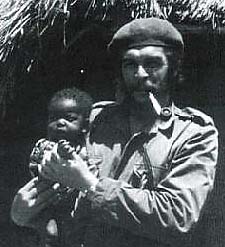
Che in Congo

Che Guevara in Congo

I think that is also the key reason why so many millions of people the world over love and respect Che Guevara: his moral stance, his example as a just revolutionary leader. This from “Socialism and Man:”

“At the risk of seeming ridiculous, let me say that the true revolutionary is guided by a great feeling of love…Our vanguard revolutionaries must idealize this love of the people, the most sacred cause, and make it one and indivisible…one must have a great deal of humanity and a strong sense of justice and truth in order not to fall into extreme dogmatism and cold scholasticism, into an isolation from the masses. We must strive every day so that this love of living humanity will be transformed into actual deeds, into acts that serve as examples, as a moving force.”

I agree with Fidel and Che. Revolutionaries must be ethical in vision and use morality in practice, both at home and in solidarity with the oppressed everywhere. As Fidel told Lee Lockwood in Castro’s Cuba, Cuba’s Fidel:

“Those who are exploited are our compatriots all over the world; and the exploiters all over the world are our enemies…Our country is really the whole world, and all the revolutionaries of the world are our brothers.”

I define ethics in this way: Life shall not be abused or destroyed by our conscious hand—without being attacked or oppressed beyond limits of toleration. A moral person, organization, political party or government acts in daily life and in the struggle for justice with that ethic in mind. These are my thoughts on morality:

1. We act so that no one person, race or ethnic group is either over or under another.

2. In combat against oppressors and invaders, we do not kill non-combatant civilians nor forcefully recruit them, or use them as hostages.

3. We struggle to create equality for all.

4. We abolish all profit-making based upon the exploitation of labor or the oppression of any person, group of people, class or caste. Instead, we build an economy based upon principles of justice and equality, one in which no one goes hungry, sharing equitably our resources and production.

5. We struggle to create a political system based upon participation where all have a voice in decision-making about vital matters with relation to local, national and international policies.

6. We struggle to eliminate alienation in each of us.

Ethics and Sri Lanka Tamils

True, solidarity activists have no choice. We must support a people under attack by aggressors wherever in the world. That is what I see as our task as anti-war activists concerning Afghanistan, Iraq, Palestine…just as we did in the wars against Vietnam-Laos-Cambodia and the South Africans…

For us solidarity activists, and governments viewing themselves as progressive-socialist-communist-revolutionary, I believe our task must be to press for the very lives and rights of the Tamil people in Sri Lanka where governments have systematically oppressed and repressed them for half-a-century.

As a solidarity activist—who advocates the right to resist and the necessity to conduct armed struggle once peaceful means fail to change oppressive governments from terrorizing us—I denounce all perpetrators of terrorism, no matter the party or cause, and demand they change tactics to ones that are morally in accordance with our ideology embracing fellowship with justice and equality.

Tamil Rebels

Tamil Tigers

I find that most armed movements commit acts of atrocities, even acts of terror in the long course of warfare. This has sometimes been the case with the Colombian FARC and Palestinian PFLP, for instance. But I support them in their righteous struggle. They are up against much greater military and economic forces that practice state terror endemically. The ANC in South Africa’s war for liberation also committed horrendous acts of ‘terrorism’.

Most of the dozens of Tamil groups that took up arms, at one time or another, considered themselves Marxists, and many looked up to Che Guevara and Cuba’s revolution as an ideal. But they nearly all became terrorists in much of their actions. Hear what Che Guevara meant about the use of violence.

“There are always laggards who remain behind but our function is not to liquidate them, to crush them and force them to bow to an armed vanguard, but to educate them by leading them forward and getting them to follow us because of our example, or as Fidel called it ‘moral compulsion.’” (Speech “From somewhere in the world”)

This Sri Lanka Tamil ‘story’ is a tragedy especially for the Tamils; also for the world of humanity. Most people not directly involved, however, do not react because they don’t know what they can do. There are so many tragedies going on at the same time. Cynical brutality is constantly unleashed by major capitalist enterprises and their governments in the ‘first’ world, much of the former ‘second’ world as well as by national capitalists in the ‘third’ world. We live in what I call the Permanent War Age. Brutality—surveillance—suffering is the norm.

In those countries where there is little brutality, in comparison, and no aggressive war-making (I speak here of the governments of Cuba and other ALBA—Bolivarian Alliance of the Peoples of Our America—countries) the leaders see the necessity of having political ties with some war criminal governments, such as Sri Lanka. I gather that this leads them to ignore their moral solidarity principles and abandon the oppressed Tamils.

On this July 26 day of celebration, I call upon the Cuban government, as well as all members of the ALBA alliance, to return to the moral principles expressed by Fidel and Che and do the right thing by the Tamil people. Call for an independent international investigation into the war crimes committed by the Sri Lankan government, and use your moral clout, your revolutionary record to demand an end to the genocide against this people.

If morality does not become integral to our struggles, I’m afraid we are headed for a worldwide moral collapse, which is already underway due to the intrinsic immorality of capitalism and its imperialism; the foundering of contemporary socialism; and the rise of fascism throughout much of the world.

What kind of education for what kind of society?

Raju J Das

It seems that in India many good students, after completing their 10th grade, are spending most of their time in private coaching classes and attending colleges/universities only for the practicals. This they do to prepare themselves for entrance exams for engineering and medical seats. Even if they do attend colleges/universities full-time, their main aim is to sit for these entrance exams. Several questions come to one’s mind in this context.

1. How can someone learn theory from one set of ‘teachers’ in coaching classes, and learn about the practical matter (lab work) from certified college/university teachers?

2. What is all this craze about getting into medical and engineering colleges? What does a student who goes to these places almost straight after higher secondary (or what is called high school diploma in North America) really know about society and nature? His/her time is mainly spent on a limited goal: being able to answer expected questions in entrance exams aimed at screening students? Much of the time is perhaps spent on memorizing a lot of information without an opportunity to critically assess and assimilate this. Isn’t there something to be said for a well-rounded post-high school university education before one goes for specializations?

3. Is it not the case that many of the so-called medical and engineering colleges may be ill-equipped to teach the relevant subjects? Parents pay a huge amount of money for a seat for their children. And a lot of people – investors – of course make a lot of money out of this business.

4. What is the outcome of this system? In a country of a billion plus, how many doctors do we produce who actually invent new ways of curing illness, as opposed to writing prescriptions on the basis of knowledge produced mainly in the western countries? Similarly, how many thousands of engineers do we manufacture who produce knowledge about new ways of making things? More importantly, how many scientists – in biological or natural sciences – do we produce who produce new ways of understanding nature and body? Is this craze for professional-technical education promoting an overall scientific culture, a culture that encourages people to be rational and find empirically verifiable reasons for events around them?

5. Under the British system, we were producing clerks. Now, are we not producing a different kind of ‘clerks’ or assistants – sophisticated semi-coolies, tech coolies and the like out of the population that goes into so-called professional institutions? It is interesting that what many of our engineers do (e.g., reading/processing credit card statements transmitted from the West – that is, keeping records), they do not really need sophisticated engineering skills acquired from colleges? Or, is it that the kind of education they receive makes them suitable for only this kind of semi-skilled, techno-coolie jobs, and nothing better?

6. Why is it that a vast majority of good students want to be either an engineer or a doctor? Arguably, the aim of education, real education, is self-development (changing ourselves, our ways of thinking) and social development, i.e. contributing to society and towards a reproduction of natural systems that are sustainable (I am not denying that education, in the current form of society, helps one get a job so one can pay one’s bills). Now, is being an engineer or a doctor (and in the ways in which people become engineers and doctors) necessarily the main way of achieving real education?

7. I do not deny the importance of forces of technology and medicine at all, but are the major problems of human society the ones which can be solved through the actions of engineers and doctors who mainly keep on recycling old knowledge? What about a human rights or labour lawyer who fights for the rights of our peasants, workers, poorer people, and so on? What about a professor who aims at changing the collective self-consciousness of a society, who aims at making us rethink the directions in which a society is moving? What about a professional who can organize and manage the cooperatives of poor women or workers’ coops? What about a scientist who finds out new ways in which nature works, and new and sustainable ways in which nature can be suitably ‘modified’ in the interest of the humanity? What about someone who can organize poor masses in new ways to independently fight for their rights and change the fundamental nature and goal of our society, nationally and internationally? What about artists and story tellers who can feel the pulse of a society and represent it in beautiful ways for us to enjoy and learn from? What about the role of socially conscious journalists who consistently and courageously lay bare (quasi-)criminal conduct and corruption of our economic and political elites? And so on?

8. What is the implication of a society over-emphasizing so-called professional education? Is it not true that in part because of the sort of financial as well as ideological-political emphasis on technical-professional education that we see, other kinds of education (including in basic sciences; social sciences) are neglected, and that to the extent that many students go for this latter kind of education, they go there, perhaps, just to pass time, to remain a part of the army of unemployed and under-employed in a manner which can be seen by society as a little meaningful and dignified?

9. The moot question is: why is this kind of education being promoted? We must understand the nature of the forces (read: commercial and state-bureaucratic interests) that drive the kind of education (rush for engineering and medical seats, and the argument can be extended to other ‘professions’ such as business management) which we want to give our children, which we want to promote. In more direct ways: to what extent is our obsession with the so-called professional education driven by the fact that investors make money by selling professional education as a commodity and by the fact that this kind of education is making India (and other similar countries) a cheap low-wage platform of global capitalism, both for its own business people and international business? To what extent are our bureaucrats and politicians benefiting from this business directly because they also invest in this? And how does the state benefit from this kind of education system, a system which reproduces a cheap skilled labour force through the system of private profit-making such that the state no longer has to provide affordable education? To what extent is the kind of technical-professional education-for-profit we are promoting creating a compradore educated elite, which acts as a conduit through which the country (the nation of workers and poor peasants) is subordinated to international business and imperialist states?

10. Therefore, and ironically, is it not the case that: the kind of mind-numbing education we are promoting is stopping us – or discouraging us – from asking this kind of questions that challenge the nature of education and therefore the nature of society we live in?

Raju J Das teaches at York University, Toronto.

Regarding Assault by University Security on Woman in DU Campus

Please send in your name if you wish to sign on this Memorandum that will go to the Vice Chancellor on Wednesday. Please distribute among your networks. Alternatively, please print it out and collect signatures which can be collected from you or sent on by you.

We are shocked and outraged at the shameful incident that took place inside the Arts faculty premises, at around 11:30 am, on 22nd July 2011. The Security staff of the university physically and verbally assaulted a woman and her male colleague, in order to prevent them from distributing pamphlets. Several Delhi Police personnel who were present, stood by and watched the assault, instead of preventing it from continuing. Worse, when some students intervened on behalf of the victims, they and the victims were threatened by the police with arrest. Later the students and several college teachers approached the Dean of Students Welfare and the Proctor, demanding an explanation for, and action against the excessive and outrageous conduct of the Security personnel. The Administration was extremely reluctant to take up the issue, and in fact, locked the main gate to the Proctor’s office when they learnt that teachers and students were on their way to meet the Proctor. The strange explanation that was offered for the behaviour of the Security was that the victims were outsiders to the university, and that they were distributing religious literature which is allegedly against the rules of the university. When asked to produce the rule in question, Proctor’s office could not do so. A police complaint was filed and the medico-legal examination revealed injury and swelling above the left eye. The incident is grave on several counts:

1. Even if it were illegal or against University Rules to distribute religious literature (which it is not), the Security do not have the right to physically assault anyone who does so, even if they are outsiders to the university.

2. The Constitution of India guarantees the right to disseminate religious literature. Therefore, the assault is a direct attack on the Constitution. The University’s defence is an attempt to dangerously and gratuitously communalize the sensitive issue in an attempt to wriggle out of the serious charge of manhandling and physical assault.

3. The fact that one of the victims was a woman did not deter the Security from physical violence and the subsequent specious justification of it. It may be noted that in the absence of any female Security personnel, the incident noted above constitutes gender bias and possibly sexual harassment.

4. Over the last two years, both staff and students of the university have repeatedly been threatened physically and verbally on several occasions by the Security. Recently, the Security and the University administration have taken it upon themselves to decide what is appropriate reading material for members of the University. They have arbitrarily forbidden and disrupted programs, harassed faculty and students of the University who have taken up socio-political, economic, etc., issues that the administration does not approve of. This is absurd per se, but more so in a University space.

5. It is shameful and tragic that the University Security is itself a danger to the campus.

6. It is of profound concern that over the last few years the university administration has displayed a tendency to be increasingly hostile towards democratic activities and indeed to the very idea of democratic culture. They are attempting to change the very character of a University.

We demand:

1. Prompt and stringent action against the Security personnel involved in this incident.

2. The repeal of any Directive requiring permission from the University administration for distribution of pamphlets and other such exercise of intellectual freedom. Such activities are the democratic right of any organization and every individual. It is not the business of the Administration to function as a moral and intellectual custodian of the University.

3. Safe campus for women at all times. The University administration should take immediate measures to ensure this without increasing police presence in the campus.