Protests and Repression: Struggles Growing in the Forest Areas

Campaign for Survival and Dignity

The last few weeks have seen struggles over forest rights and forest control intensifying across the country. On the one hand there are larger and larger protests taking place, and on the other, the continued use of force by Central and State governments is combined with total silence and apathy on protecting people’s rights.

Campaign member organisations have planned a series of yatras and protests in Rajasthan, Gujarat, Maharashtra, Madhya Pradesh, Chhattisgarh and Orissa in the coming weeks. The Jangal Jameen Jan Andolan has undertaken a yatra in Rajasthan, crossing Udaipur, Dungarpur, Banswada, Sirohi, Pali and Pratapgarh districts between December 20 and 28th. On December 29th demonstrations will be held in all block headquarters that have been covered. The demands are for respect and recognition of community forest rights, a halt to illegal rejections and modifications of titles and respect for people’s democratic resource rights over their lands, forests and minerals. Meanwhile, more than 1,000 people rallied and ten sat on hunger strike in Dahanu, Thane District, Maharashtra on December 7th and 8th against violations of people’s rights under the FRA; the hunger strike was called off after a written commitment from the SDO. A similar mass protest was held in Gadchiroli, Maharashtra on December 19th against the illegal imposition of conditions on titles for community forest rights. Yatras are also planned in western Maharashtra and Gujarat in January; on January 19th and January 26th mass demonstrations will be held in district headquarters in Chhattisgarh and Orissa respectively. These latter protests will also oppose the land acquisition bill and call for democratic control over resources.

Aside from these plans, other protests and mass struggles are underway. On December 15th, a “People’s Forest Rights Rally” was organised at Delhi by a coalition of organisations. In the POSCO area, more than 20 people were injured and one killed in an attack on December 14th by a contractor’s private goondas; unsurprisingly, on that day alone, the police were nowhere to be found. In Assam the Krishak Mukti Sangram Samiti is leading a mass struggle against the illegal and dangerous Lower Subansiri Dam project, in which huge numbers of people have joined; but on the night of December 25th the police arrested more than 200 people in a raid and are continuing their attacks. The KMSS has also been involved in struggles against the ongoing repression and violence around Kaziranga National Park, where forest guards regularly shoot those they accuse of being “poachers.” Brutality and violence continues to mark the situation in Chhattisgarh, where the extremely brutal torture of Soni Sori – and the indifferent response of even the Supreme Court to it – gives the lie to all the tales about respect for the “rule of law” and how it is being enforced by “security forces.” Chhattisgarh has also seen a string of recent illegal evictions from forest land. In north Bengal, an organised effort to take control of community forests is facing opposition and resistance from the Forest Department.

In addition, planning is underway for the declaration of new tiger reserves and relocation of people from them in violation of the law. Mass protests have begun in Kawal Sanctuary to resist the proposed illegal conversion of this sanctuary. In Tadoba Tiger Reserve, Sarang Dhabekar, a Steering Committee member of the National Forum of Forest Peoples and Forest Workers was arrested and slapped with false cases because he had been involved in resistance to illegal relocation efforts.

The Campaign condemns this ever-increasing repression and the brutal use of force against those who are fighting for justice. Once again, we see all talk of “rule of law” and “democracy” being brushed aside in the hideous loot of natural resources by the ruling class of this country.

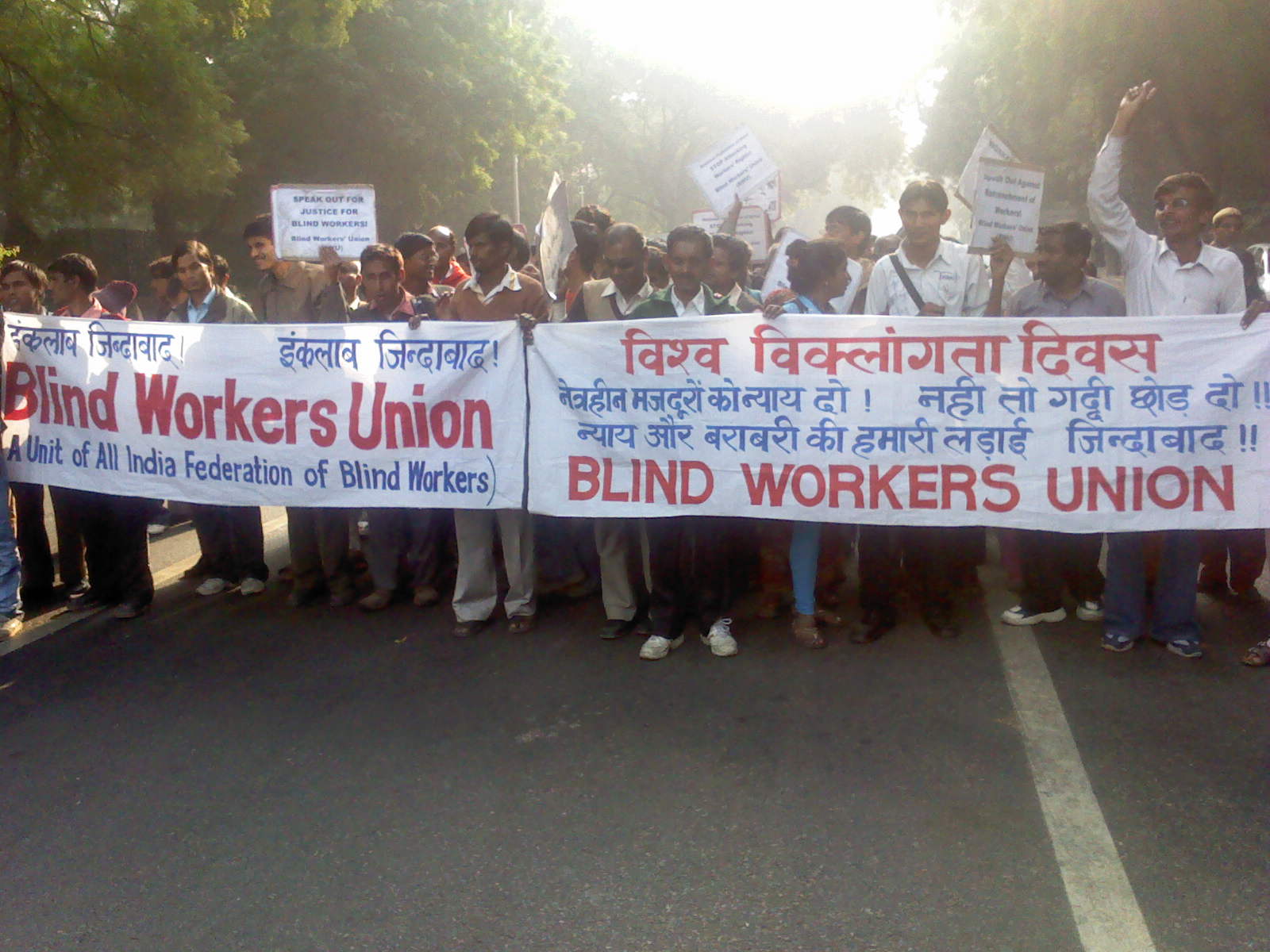
Blind Workers March in Delhi

Sunil Kumar, Blind Workers Union
(A Unit of All India Federation of Blind Workers)
Affiliated to Workers Unity Center of India, WUCI

Today, on December 3, 2011, more than a thousand visually challenged workers from Benaras, Nasik, Kanpur, Faridabad, Bahadurgadh and Delhi participated in a massive protest rally on Parliament Street. Their rally was taken out from Jantar Mantar to Parliament Street on the occasion of World Disability Day. It was a culmination of an earlier struggle these blind workers have carried out against a well-known NGO which employs and exploit them, i.e. the National Federation of the Blind (NFB). The rally was an extremely important moment for these workers since they were using World Disability Day to expose how they were still denied many fundamental rights at workplaces. Instead of celebrating this day in the usual festive manner, these blind workers celebrated World Disability Day as a black day, which marked unfulfilled promises of equality.

Initially, the Delhi Police refused to allow the rally to proceed to Parliament Street. However, the agitated workers refused to be held back and broke free of the barricades so as to march onto Parliament Street. Quite expectedly, their fiery spirit did not mellow down, despite being manhandled. Following their protest rally, a delegation of the workers submitted a memorandum to the Hon’ble Minister of the Ministry of Social Justice and Empowerment, Government of India. The delegation met the concerned minister, Shri Mukul Wasnik, and apprised him of plight of blind workers. They drew the minister’s attention to the fact that the government was doing little to prevent the rampant violation of its own laws pertaining to disability. In particular, the workers highlighted the violation of several provisions in the Persons with Disability (Equal Opportunity, Protection of rights and full participation) Act of 1995.

When discussing matters with the Minister, the workers highlighted how section 33 of this Act, which provides 3% reservation in identified posts (1% being earmarked for the blind and low vision persons), is unable to provide sufficient respite to the disabled because of inadequate job creation in the public sector itself. Another important provision in this 1995 Act which is far from being implemented is section 41. It provides incentives to disabled persons so as to ensure that at least 5% jobs of all workforces goes to them.

However, as highlighted by the protesting workers, both the older laws and policies as well as the newest government policies are failing miserably when it comes to ensuring a dignified and productive life to disabled people, in particular, disabled workers. For example, even the recently adopted National Policy for Persons with Disabilities (2006), which provides incentives, awards, tax exemption, etc. is redundant because the private sector which employs a large number of disabled workers, is least interested in implementing such policies, let alone statutory labour laws pertaining to minimum wages and parity at work. In fact, the promise of the National Policy for Persons with Disabilities (2006) to create one lakh jobs is still a mirage today. In this light, the recommendations of the Sudha Kaul Committee which was constituted to help frame a policy on disability, are also flawed. This Committee, for example, has made no recommendations with respect to labour rights relating to safety when assisting in the drafting of the Right of Persons with Disability Bill, 2011.

The gathering of workers on Parliament Street was addressed by aggrieved workers (those employed by National Federation of the Blind) as well as their leaders. Shri Alok Kumar from the All India Federation of the Blind addressed the gathering, and argued how shameful it was that National Federation of the Blind was also commemorating World Disability Day when this NGO itself exploited the impoverished blind workers. He went on to argue how necessary it was for the government to create more jobs opportunities for disabled workers, and how the government should ensure that all statutory labour laws are implemented in production centres run by “social service” organizations (like NFB) as well as other employers. Indeed, almost every blind worker who stood up to speak, emphasized that NGOs like NFB as well as other employers, act as if they are doing the blind workers a favour by employing them. In reality, as employers they earn huge profits from the labour of these workers. NGOs, in particular, also amass huge amounts of funds from the Government/foreign funding agencies by using the face of these poor blind workers.

It is with the express purpose of attaining greater job opportunities for disabled workers as well as parity in work conditions and wages between blind workers and sighted workers that the spirited rally of blind workers marched onto Parliament Street.

Contact: 9313730069
Email: blindworkersunion@gmail.com

Demo to protest Kishanji’s murder (Dec 2)

We strongly condemn the brutal and cold-blooded murder of Mallojula Koteshwara Rao alias Kishanji by the security forces in the Burisole forest area of West Bengal.

Now it is very much clear from various sources that the Maoist leader Kishanji was first captured and severely tortured by security forces and then killed in a planned fake encounter under the connivance of both West Bengal and central governments. Mamata Banerjee government of WB has used almost the same weapon of ‘Peace Talk’ to eliminate the Maoist leader as by the R. S. Reddy government in AP.

It is a known fact that the central and various state governments are jointly conducting a special military operation to suppress Maoist activities. The unjustified and irrational killing of Kishanji is nothing but a part of state terror being unfettered under ‘Operation Green Hunt’, centrally controlled by the UPA government. It is a clear cut violation of not only the guidelines given by Supreme Court and National Human Rights Commission but also by different international institutions.

It is to note that the state is not only killing the Maoists and their supporters but also viciously suppressing all voices of dissent, especially of democratic and revolutionary forces. We strongly feel that Naxalism / Maoism cannot be suppressed by killing its propagators / leaders and organizing massacres of its supporters.

So, we demand that:

1. The central and state governments should immediately stop ‘Operation Green Hunt’ and physical elimination of Naxal /Maoist leaders and cadres.

2. The central government should set up a high level Judicial Enquiry Committee on the killing of Kishanji.

3. The government should register a case of culpable homicide under section 302 of IPC, so that the killers of Kishanji are forced to face the court trial, as directed by Supreme Court and National Human Rights Commission.

We call upon all the progressive, democratic and revolutionary forces to come together and oppose the killing of Kishanji and the suppression of people’s movements.

We, the undersigned have decided to organize a Protest Demonstration before the Bang Bhavan, 3, Hailey Road, New Delhi-110001 on 2nd Dec. 2011 at 12 PM to show our united anger against state oppression. We appeal to all the pro-people forces to make this Protest Demonstration successful by joining it in huge number.

Signed by:
1. Arjun Pd Singh, PDFI
2. P.K. Shahi, CPI(ML)
3. Narender, Peoples Front
4. Thomas Mathew, Bahujan Vam Manch
5. Shieo Mangal Sidhantkar, CPI(ML) New Proletariat
6. Ashish Gupta, PUDR
7. Anil Chamaria, Journalist
8. Amit, krantikari Nawjawan Sabha
9. G.N.Saibaba ,Revolutionary Democratic Front
10. Mrigank, Navajwan Bharat Sabha
11. Harish, Inquilabi Majdur Kendra
12. Alok Kumar. Krantikari Navajawan Sabha
13. Deepak Singh, NDPI
14. Mritunjay, CCON
15. Banojyotsna, Democratic Students Union
16. Kusumlata, Student For Resistance
17. Bijunayek, Lok Raj Sangathan
18. Ambrish Rai, Social Activist
Contact: 9868638682, 8800356565, 9873315447

Andrew Kliman on “The Failure of Capitalist Production”

The Failure of Capitalist Production: Underlying Causes of the Great Recession
by Andrew Kliman,
Pluto Press

The recent financial crisis and Great Recession have been analysed endlessly in the mainstream and academia, but this is the first book to conclude, on the basis of in-depth analyses of official US data, that Marx’s crisis theory can explain these events.

Marx believed that the rate of profit has a tendency to fall, leading to economic crises and recessions. Many economists, Marxists among them, have dismissed this theory out of hand, but Andrew Kliman’s careful data analysis shows that the rate of profit did indeed decline after the post-World War II boom and that free-market policies failed to reverse the decline. The fall in profitability led to sluggish investment and economic growth, mounting debt problems, desperate attempts of governments to fight these problems by piling up even more debt – and ultimately to the Great Recession.

Kliman’s conclusion is simple but shocking: short of socialist transformation, the only way to escape the ‘new normal’ of a stagnant, crisis-prone economy is to restore profitability through full-scale destruction of existing wealth, something not seen since the Depression of the 1930s.

About The Author

Andrew Kliman is Professor of Economics at Pace University, New York. He is the author of Reclaiming Marx’s ‘Capital’: A Refutation of the Myth of Inconsistency and many writings on crisis theory, value theory and other topics.

Significance of a counter-hegemonic culture: : An Urgent Need for Marxist Reading Groups

Raju J Das

Capitalism creates poverty. It indeed requires poverty and thrives on it. It causes and requires massive social and geographical inequality. And capitalism is inherently crisis-prone. We have just witnessed a major global economic crisis. In part because of its crisis-proneness, modern world capitalism is necessarily imperialist: advanced capitalist countries try to shift the effects of the crises they experience to politically and economically weaker countries (often with the connivance of the state in these countries). Normal mechanisms of capitalism and the combination of economic crisis and imperialism have major adverse impacts on the living conditions of the working masses in general and workers and poor peasants in the less developed countries such as India in particular.

No system of injustice goes unchallenged, however. Away from the pre-occupations of the corporate-controlled mainstream media, people’s movements against the profit-driven system have been taking place. Consider, for example, the Arab Spring, various social justice movements in India and elsewhere, as well as the ‘occupy movements’ in the US and Europe, which are bound to leave an impression on the radical imagination of the masses, even if they are being repressed. Humans have an irrepressible quest for justice and have a desire for a humane world. These various movements have emerged in response to the heightened levels of exploitation of workers, massive amount of dispossession of peasants from their property, undemocratic control over socio-economic activity and the government by large companies, and the irreparable ecological devastation and cultural impoverishment.

Many activists and movements have been inspired in their thinking by the critique by Marx and other progressive scholars of capitalist commodification and development. Ideologically, these protests and the recent economic crises call into question the legitimacy not only of capitalism, including its neoliberal form, but also of capitalist nation-states and global ‘state’ apparatuses (e.g. World Bank; IMF). This happens in richer countries and in poorer countries such as India as well.

There has indeed been an extraordinary resurgence of interest in a Marxist worldview recently, which as Terry Eagleton put it, is the ‘most theoretically rich, politically uncompromising critique of [the capitalist] system’ (Why Marx was right?). The process of resurgence of this intellectually insurgent worldview (Marxism) has been helped by the fact that the social relations of authoritarian ‘communism’, and other related views, which had acted as a fetter on the development of productive powers of Marxist research, have been burst asunder. In this context, question of alternatives to capitalism (beyond Keynesianism, state-bureaucratism, and neo-populism) – and the role of (Marxist) intellectuals whether in academy, in the media or ‘civil society’ in radical social change – are being actively discussed the world over. This has led to a series of important interventions rethinking political parties, democracy and visions of viable socialisms. More and more people are reading Marx and Marxists, and reading them critically, for Marxism is a science which must be updated where necessary. There is an outpouring of Marxist discussions including in journals such as New York-based Science and Society, world’s longest continuously published Marxist journal, which celebrated its 75th anniversary in October 2011, Review of Radical Political Economics (from Cornell University), Historical Materialism (from SOAS, London), Capital and Class, and so on. Much of this resurgence is exhibited on- online, Radical Notes itself being a testimony to this as is, for example, Sanhati.

The remaking of socialist visions – which emphasize socialism as the flourishing of optimal level of democracy in all spheres of human life – has also meant extensive considerations of race, caste, tribality, gender, sexuality and disability. These issues of social oppression/discrimination are important in their own right. But they are important dominantly because of the ways in which capitalism subordinates them to its own logic. Capitalism furthers its accumulation projects by using these sources of oppression to define certain working subjects as less than average workers who can be paid lower compensations. Capital also politically dominates the suffering subjects (workers and peasants) by dividing them on the basis of these non-class identities. An aspect of the resurgence of Marxist research is the immense popularity of Marxist dialectics as a holistic way of looking at the capitalist world, in terms of its unity as well as difference, from the standpoint of radically changing it. Such a dialectical method allows us to reflect on various methods of exploitation and social oppression as interconnected and as forming a concrete whole.

Reading Marx and those who engage in what the American Marxist, Hal Draper called ‘Marx’s Marxism’ would be more than apt at a political moment when neoliberalism, in theory and practice, is in crisis, when the turbulence of capitalist economies is part of daily life. As David Harvey and others have argued, Marx is more relevant now than he was during his own time.

The problems caused by capitalism are everywhere. These problems are, however, particularly acute in less developed countries and in the most under-developed parts of these poor countries. In many under-developed regions of India (e.g. Odisha), capitalist market relations in land and labour coexist with remnants of coercive production relations in some localities and with highly undemocratic relations of casteism, patriarchy and tribalism more generally. The institutions of the state are more or less ‘instruments’ of property-owners, including those whose main object is to subject natural resources and working people to cruel forms of commodification and ruthless forms of exploitation, all in the name of development and dollars (export earnings). There is an inverse relation between democratic rhetoric and its actual content. There is an absence of democratic values both in the economy or polity: ordinary people have little real democratic control over the way our resources and abilities to work are used. The cult of violence is everywhere. There is systemic violence as that caused when people’s livelihood is snatched away from them or when people do not have the money to buy basic necessities because of which they starve to death or suffer from poverty-caused diseases. Related to this violence is ‘agentic violence’: in some places ordinary people, often out of sheer desperation, tend to resort to violence (which is unproductive in the long run), in response to which and often to preempt which the state resorts to massive and disproportionate violence.

The situation in more under-developed regions of India and in similar other countries raises several questions. Why are these regions so poor when they are so rich in terms of natural resources and labouring quality of their workers and peasants? How does capitalism make use of undemocratic social and economic relations? What explains the inability of the political and intellectual elite to help the suffering masses in any significant way? Just why it is that the majority of our people have no access to nutritious food, decent housing and clothing, quality education and health-care as well as other amenities including safe drinking water and electricity? These and many other questions can be fruitfully explored only if we have an adequate understanding of capitalism as such and the ways in which it works in concrete circumstances. Understanding Marx is essential therefore. A proper understanding of Marx and his legacy would also make clear to people that the Marxist vision is a vision of a society which is authentically democratic and that Marxism has little to do with any political activity which is aimed at hurting individuals. Individuals are bearers of social relations. What needs to be changed is the system of social relations, not occupiers of positions in the system.

To understand the world, it is not enough to have sense-data. We need theory, this is because important aspects of the world are not immediately accessible to mere empirical observation. To understand the world from the standpoint of the majority, the working masses, we need a theory from their standpoint. Radical transformation in the direction of social, economic and ecological democracy and justice is not possible without a radical theory. Marx and his legacy provide such a theory. It would be useful to set up Radical/progressive reading groups in different places to promote a counter-hegemonic culture, a tradition of radical imagination in theory. Consisting of interested academics, activists, workers-peasants, and indeed anyone who is interested in critically understanding the current situation with a view to radically transcend it and deepen the democratic content/spirit of our society to the highest extent possible, this group could meet regularly to read the Marxist and progressive literature on topics of classical and contemporary significance and discuss it in a comradely and non-sectarian manner. It will also connect the readings and the discussions to the world around us and draw theoretical implications for political practice. There are thousands of progressive people engaged in theoretical-political struggle for justice. Often in terms of theory, politics and method of struggles, there are ‘deep’ divisions among them (including, and interestingly, over the fact of whether poor countries such as India are dominantly capitalist or not). Perhaps an understanding of Marx and his legacy would show that the divisions are not as real as they appear to be, and that there is cause more for unity and less for division: at least the divisions should be discussed in the light of theoretical discussions the foundation for which was laid by Marx. These reading groups cannot only read radical academic literature but also encourage performance of radical art in its various forms and reflect on these theoretically.

A culture that accurately reflects the interest and ideas of the majority of the people is a most democratic process to promote. Setting up Marxist Readings Groups is an important need of the hour therefore.

Raju J Das is an Associate Professor at York University, Toronto, Canada. Email: rajudas@yorku.ca

What the Occupy Movement fails to do

Prakash Kona

I never understood what the Occupy Movement aimed to achieve to begin with. Either it was too ambitious in aspiring to challenge corporate despotism or its goals were impossible to begin with. Not to mention it continues to be abstract and surreal as ever. I like to watch the protesters on TV who sometimes look innocent to me. The comparison with the Arab Spring by way of analogy is a completely wrong one. The comparison is not between apples and oranges since both are fruits but more like comparing a blue stocking with oxtail soup. Those who have traveled or at least have watched international movies with interest know for a fact that third world streets have a different character from those of the first world. Third world streets like third world life are filled with all too visible contradictions. The contradictions are disguised in the colonial economies of the west. The Occupy Movement and the Arab Spring are as distinct as Tahrir Square and Wall Street and the people who stand there.

That’s not the point however. What I fail to understand about the Occupy Movement is what exactly they intend to achieve with the “occupation”? If their aim is to make people aware of inequalities in society, the people already are in my view. If their aim is to challenge corporatism I don’t think this is going to happen by standing on a street. If the police eventually evacuated them, what do you want the police to do? To stand and watch the protesters as if it were a scene in the setting of a Hollywood film. Even if there were no police how long the standing around is expected to continue?

Seriously I’m suspicious of motives with which people arrive on a platform though I’m not cynical to the extent of doubting what the ones inspired with a sense of justice are capable of achieving. Definitely the Occupy Movement is not a prelude to a revolution of sorts. It is not a prelude either to political awakening because I’m certain that common people are conscious of the line of thought taken by the Occupy Movement. There are no lessons to be gained by its failure since not much was meant to be achieved by its success. I’m afraid very soon it’ll evacuate public memory as well and turn into one of those countless additions to youtube.com. Democracy in the western sense of the term with all its accompanying benefits in terms of being able to speak against authority without fear of getting killed or going to jail is the goal of Arab Spring. What is the goal of the Occupy Movement which is already happening within the parameters of an established democracy? The Haussmannized streets of carefully planned western cities will not allow for an armed insurrection of any kind. The European Revolutions of 1848 lead to a complete renovation of Paris and other cities making it possible for the state’s armed forces to brutally suppress any possibility of an uprising. If the Occupy Movement was peaceful and nonviolent it owed to lack of choice more than anything else. In principle I don’t think there could be peaceful movements. They are bound to be provocative in passive resistance as much as in active resistance.

If the goal of the movement is to fight inequalities it can demonstrate its true intentions in the politics of daily life. Western lifestyles which thrive on excess are anathema. The working classes irrespective of where they are from – ultimately they want those who speak of equality to work and live like the poor. Unless the protestors are one with those whom they claim to speak for, their movement will at best be cumulative acts of frustration put together. Only the discipline that comes with living, working and thinking like the masses can confront Wall Street who George Carlin refers to as the America’s “real owners.” Back in the 19th century when Jane Addams the prominent feminist and public philosopher went to meet Tolstoy, he not only called her an “absentee landlord” but asked her the question: “Do you think you will help the people more by adding yourself to the crowded city than you would by tilling your own soil?” This is not to disparage Jane Addams who is a unique woman and profound thinker in her own right but to say that the divorce between living like the poor and talking about them is more prominent with American forms of protest than perhaps with the European who might have a slightly more realistic view of life in relation to politics and change.

The fact that despite the growing poverty and unemployment no social revolt is possible in the United States is evident owing to the success of the propaganda machinery. The Steve Jobs phenomenon that occupied media attention says everything about the success of American propaganda. Suddenly Steve Jobs (who most people did not even hear of until he died) is the new hero for the young, right from Japan to India all the way to the Middle East (since he had a Syrian Sunni Muslim father who abandoned him by the way) and of course Europe and the United States. Steve Jobs like any other corporate warlord achieved his success through a combination of uncanny brilliance and ruthless elimination of competition. That’s how business empires are built – by eliminating the small in order to arrive at the big. Steve Jobs’ success is possible because he is a white guy and if the world knew that there is a Sunni Muslim Arab hiding beneath the whiteness it would have been harder for him to reach where he did.

For all their private suffering men like Jobs are contemptible to say the least. It amazes me therefore that so many people should want to be Steve Jobs without realizing that these are media manufactured heroes. These are not the blatantly impossible individual achievements that we see in the novels of Ayn Rand. These are facades that global capitalism needs to lead the educated masses to play their role in global exploitation of the poor. This “hero” making formula is used day in day out by American television and Hollywood while parroted by the rest of the world, with sportspeople or actors or business entrepreneurs in turns becoming heroes out of nowhere. All dropouts are not going to be Steve Jobs. Unfortunately most dropouts would like to believe that they could be so. That’s how propaganda works.

To date I attribute the success of American imperialism not to its military prowess which truly speaking is pretty pathetic given their poorly motivated cadres. The fact that they’ve been for so many years in Afghanistan and yet a barely armed but ruthless Taliban continues to gives them the shudder says everything about the so-called military power of the US. You need people to fight wars and not technology is a lesson that comes out rather well in the Afghanistan fiasco. Rather, it is to TV serials such as the globally popular “Friends” that America owes its real success. I’ve met people from various countries of the world who talk and think like those characters in the “Friends” sitcom. This is where we need to challenge American domination of the third world. At the same time that they are defeated economically and politically it is imperative that American hegemony be destroyed culturally as well to give alternate ways of expression a possibility to see the light of day.

The Occupy Movement if at all there is one in all sincerity should go to the small towns and take a walk through those parts of the cities that the poor inhabit. That’s where real America lives. Not in the universities and certainly not in the big cities. It is those small town Americans who are real harbingers of social and political change. The spaces that the media is not interested in – those are the spaces where real change is possible. To educate the poor and to selflessly work toward the uplift of the downtrodden classes – that’s the day the corporate world will begin to have sleepless nights.

Prakash Kona is an Associate Professor at the Department of English Literature, The English and Foreign Languages University (EFLU), Hyderabad.

“The Ultimate Contradiction of the Revolution”

Pratyush Chandra

Published as Afterword in Ron Ridenour’s book “Sounds of Venezuela”, New Century Book House, Chennai, 2011. This article tries to address some questions that have been raised by many Tamil comrades regarding the foreign policy of the Venezuelan State, especially in the context of state repression against the Tamils in Sri Lanka, and the Venezuelan and other ALBA states’ support to the Sri Lankan government in international forums.

The narrative Ron Ridenour has woven here in these pages provides a glimpse of the Venezuelan reality, which exposes not only the significance of the Bolivarian revolutionary processes, but also their contradictions. Obviously, these contradictions are the source of much anxiety among the friends of the Bolivarian revolution throughout the globe. But is it not true that a revolution is as much about hope as it is about apprehensions and dangers? A revolution is always unsettling. You cannot ever pronounce the final judgement about the event called revolution. That is why what famous Marxist historian George Rudé said about the French Revolution is true for all revolutions—”the Revolution remains an ever-open field of enquiry.”(1)

I

Nothing remains settled in the revolutionary process—otherwise how can it be called a revolution? We need to understand that this process is constituted by conflicts among various ever-new possibilities that emerge at every moment therein. Ideological struggles are nothing but representations of these conflicts; expressed in political programmatic language, these possibilities constitute the various lines within the revolutionary movement. These conflicts are what determine the course of the revolution.

To be more specific, there is always an impulse internal to the revolutionary process that seeks to control or limit the pace and extent of the revolution—to make things settled. It can have a positive implication to the extent that it compels the revolutionaries to be conscious of the course of the revolution and to be vigilant enough to differentiate between the forces of reaction and revolution that are internally germinating. The ‘faces’ of these forces do not remain the same—what seems revolutionary at one moment might dawn as reactionary at another. The conservative impulse we are talking about lies somewhere in the interstices of the moments of movement and consolidation, trying to break the simultaneity of these moments. When it is able to break this simultaneity, it morphs into a Thermidorian form with the apparent task of consolidating the revolutionary achievements and protecting them from the enemies. This Thermidorian power externalises all problems of revolution—it tries to cleanse the revolution of these problems so thoroughly that what emerges out of this deadly bath is a revolution sans revolution—sanitised of all contradictions.

The formalisation or institutionalisation of the achievements cannot be avoided. However, this is what gives birth to a new status quo, which tries to guard itself against revolutionary impermanence. It is a conflict like this that could be understood as a two-line struggle—between the emerging headquarters and the forces of continuous revolution. This struggle is in fact the revolutionary truth which cannot be avoided. No moment in the revolutionary movement is devoid of the forces of conservation, which have the potentiality of turning into a full-scale centrism or even reaction depending on the balance of class forces.

With regard to the revolutionary processes in Venezuela, it has been regularly emphasized that “the ultimate contradiction of the (Bolivarian) revolution” is the struggle internal to Chavism—”between the ‘endogenous right’ and the masses who have been mobilised.” Chávez himself frequently describes the Venezuelan reality in Gramscian terms—”The crisis consists precisely in the fact that the old is dying and the new cannot be born.” However, as Gramsci said, in this interregnum a great variety of morbid symptoms appear—which appear in Venezuela (alongside the continued existence of the old oligarchy, latifundistas, monopoly capitalists and US imperialism) in the form of the new ‘boli-bourgeoisie,’ the military-civil bureaucracy, and ‘the party functionaries and nomenklatura’ who seek to thwart the class and mass initiatives from below.(2) These are the material forces, which with their dispassionate mannerisms try to conserve a pragmatic and ‘realistic’ Bolivarian future against the erratic spontaneism of grass roots initiatives. These are the Bolivarian headquarters.

II

As is well-known, historically there has been a systematic erosion of productive sectors in Venezuela which are not allied to operations of the oil industry. Since 1998, there has been a consistent endeavour to rebuild these other sectors of production and infrastructure around them. In order to achieve this, many steps both backwards and forward have been taken. Many bureaucratic, intermediary and petty bourgeois interests have not just been tolerated but even encouraged and promoted to compete with old oligarchies and corporate interests. Incentives to ‘native bourgeoisie’ and petty bourgeoisie have been an interim strategy of the Bolivarian regime to fragment the corporate unity of capital, while helping in diversifying the Venezuelan economy. In fact, the imperative to create an ‘alternative social bloc’ against corporate hegemony has forced a vision under which “capitalist sectors whose business activity entered into an objective contradiction with transnational capital” are not considered unapproachable.(3)

However, the radical supporters of the Venezuelan transformation have cautioned that the pragmatic need to neutralise private capitalist interests in order to develop a broader bloc against immediate enemies, like transnational capital and imperialist interests, must not scuttle the anti-capitalist nature of the transformation. It has been shown how “‘incentives’ to private capitalists in order to increase productivity” fail generally because they tend to strengthen the historically nurtured rentierist character of Venezuela’s native bourgeoisie. For example, incentives in agriculture without having a fundamental structural transformation have cost the Chávez government heavily, both politically and economically, as “the big landowner (latifundist) recipients of the Government’s generous agricultural credits and grants are not investing in agricultural production, in raising cattle, purchasing new seeds, new machinery, and new dairy animals. They are transferring Government funding into real estate, Government bonds, banking and speculative investment funds or overseas.”(4) These latifundistas have successfully used to their own advantage the Bolivarian government’s urgency to ensure domestic food security and agricultural productivity amidst volatile international relations by bargaining protection from the upsurge of peasants and landless organisations demanding radical land reforms. However, there has been an increasing realisation within the Bolivarian circles about the futility of such compromises with the rentierist forces.

The emergence of the Bolivarians at the helm of the existing political economic institutions has, of course, intensified the internal class struggle leading to a tremendous crisis for the status quo. But there still exists a considerable space for the consolidation of powerful economic interests because these institutions were essentially built for this purpose. The most recent case of their successful manoeuvrings has been exposed by WikiLeaks, which narrates how a radical Chavista, “Eduardo Saman was replaced as commerce minister following pharmaceutical companies’ efforts to protect old patent legislation and their profits.”(5)

There is a massive danger of the containment of the revolutionary pace and agenda, if the revolutionary forces are not vigilant enough with regard to the activities of those social classes that are crowding the institutions of revolution for incentives and patronage. The new intermediate interests that have emerged close to the state structure, along with the old ones, have resisted every popular attack on private capital. They have attempted to thwart endeavours to institute workers’ control over economic activities. Even within the oil and other ‘monopolistic’ industries, these interests have not conceded any substantial move beyond nationalisation, as state monopoly allows them to use their own proximity to the state machinery for intermediary profiteering. There has been a consistent resistance to the attempts to institute co-management,(6) not just from the side of corporate interests, but also from economistic trade unionism (especially in the state-owned petroleum company, PDVSA), which cannot envisage a system of workers’ control that questions the institutional hierarchy and labour aristocracy.

As long as there is a popular movement which questions and subverts the norms and everydayness of the bourgeois state in Venezuela, with the resoluteness to build ‘a new state from below’ with the novel institutions of protagonistic democracy and communal councils, there is a hope for the Bolivarian Revolution. Or else, “it will lapse into a new variety of capitalism with populist characteristics.”(7) That is why there has been a growing need to envisage the alternative bloc and class alliances which are subservient to the exigencies of “an overall system of socialized production.”(8) The accommodation of capitalist interests in any form (state or private), even when they are in consonance with the immediate interests of the revolutionary transformation at a particular juncture, is fraught with risks of the reassertion of ‘the logic of capital,’ and “there will be a constant struggle to see who will defeat whom.”(9) It is this logic and its constitutive representatives, who try to consolidate their position through the so-called ‘endogenous right’ of the revolution.

III

The emergence of headquarters in a revolution is linked with the question of state, state power and hegemony. During a revolutionary period the state returns to its elements—it emerges as a naked instrument of suppression—of holding down adversaries. The proletarian dictatorship too will not allow its enemies to have a free play. Revolution is a period when class struggles begin to explode the barriers of the existing state order and point beyond them. On the one hand, there are “struggles for state power; on the other, the state itself is simultaneously forced to participate openly in them. There is not only a struggle against the state; the state itself is exposed as a weapon of class struggle, as one of the most important instruments for the maintenance of class rule.”(10)

The global division of labour and the US hegemony reduced the Venezuelan economy to mere accumulation of oil rents, thus making proximity to the state the only viable route to economic success. In such an economy, the statist tendencies are bound to be very strong and entrenched in every layer of society. To complicate the matter, revolutionaries in Venezuela found themselves at the helm of the bourgeois state by following its rules, not by any insurrection. In such a situation, reformist tendencies will definitely be stronger among the ranks of the Bolivarians, who find revolutionary measures futile and even adventurist. These tendencies did suffer a temporary setback during the attempted coup of 2002, but as time elapses the cautious self-critical forces begin to find safe-play, gradualism and tactical compromises essential to consolidate power and achievements and to pre-empt any such drastic attack by counter-revolutionaries in future.

The left Chavistas, on the other hand, stress on the task of smashing the bourgeois state from within while positing a new state from below based on co-management of social and economic life. Like the ‘endogenous right’ they understand the need to consolidate, but for them consolidation is not separate from the destruction of the existing state form. Like Russian revolutionaries, they emphasize the development and independence of the working classes and their organs of self-activity, because only in this way can the workers protect their state, while protecting themselves from it! The defeat of the 2002 coup also demonstrates the impact of the unleashing of popular energy and self-activity and what that could achieve. Moreover, unlike in Russia, the state in Venezuela remains a bourgeois parliamentary state, which is alienated from the everyday life of the revolutionary masses.

IV

Among several valuable insights that Ron Ridenour’s text provides regarding the nature of contradictions that pervade the revolutionary transition in Venezuela, there is an important point on the Venezuelan state’s approach to the struggles of the Colombian guerrillas, the FARC. Ridenour hints at the vacillation in this approach. However, such anomalies are numerous, especially when it comes to international relations. Throughout the globe, post-1998 developments in Latin America have been watched very intently, with a lot of hope and expectation. The consistent defiance of US hegemony by the Chávez regime has been a source of inspiration for various progressive movements everywhere. At least with regard to its position on the American manoeuvrings globally, nobody can fault the Venezuelan state—it never wasted any time to decry the imperialist interventions anywhere in the world.

But this has led to a genuine rise of expectations for support from progressive Latin American regimes (if not materially, at least through statements) for local movements against their particular oppressive states, even when there is no direct western backing to these states. In recent years, with many states lining up to define their own ‘war against terrorism’ in order to crush local critical voices and movements against them, the stance of the Venezuelan and Cuban states has not been supportive of the oppressed. In fact, any official voice from the West critical of the local states has many a time provoked statements from the progressive Latin American regimes that are supportive of the southern states like Iran, Libya, Zimbabwe and Sri Lanka even when these are highly oppressive. This has greatly frustrated the solidarity movements—some even going to the extent of calling the Latin American revolutionary processes ephemeral.

However, one must understand that the revolutionary process is not linear and smooth. It is not something homogeneous, and its targets are not just external. The intensification of revolution is the heightening of contradictions that constitute it. In fact, these constitutive contradictions internalise the so-called external elements—’alien’ class interests, the vestiges of old regimes, etc. Any attempt to avoid contradictions is a conservative attempt from the ‘endogenous right’ to homogenise the revolutionary voices behind the new institutions, alienating them from their organic roots in class struggle, thus giving birth to new bureaucracies—the agencies of the new order. It is the ‘endogeneity’ of this tendency that forces the revolutionary leadership to reassess the coordinates of the contradictions time and again. A fine discrimination of these coordinates in the revolutionary process gives an insight into the apparent anomalies. It was not for nothing that the 20th century revolutionaries time and again stressed the need to differentiate between the state (which even well into the first phase of communist society safeguards the bourgeois law) and the revolutionary masses. An understanding of this aspect is crucial in order to comprehend the problems and prospects of policy designs under a revolutionary regime, including its foreign policy and international relations.

It must be noted that revolutionary internationalism of the working class is an important weapon with which a revolution generalizes itself and resists its degeneration into nationalist statism by not allowing ‘revolutionary passion’ to die out. But it is not simply a subjective aspiration to generalize that gives birth to internationalism. Rather, it “is a necessity arising out of the fact that the capitalist class, which rules over the workers, does not limit its rule to one country.”(11) Thus, internationalism is a result of the class struggle going global—it is an endeavour to thwart the capitalist strategy of intensifying capitalist accumulation by segmenting the working class and its consciousness. It is in this regard that a revolution can be termed as international both at the levels of its causes and impact. It represents a crisis for the capitalist system.

Solidarity efforts in support of revolution beyond the immediate location of its occurrence, along with ‘indigenous’ revolutionaries’ support for movements beyond their location are crucial even for the survival of the revolution as a revolution. It can survive as such only by constantly asserting its international character, its inseparability from international class struggle. Otherwise, it will implode or be reduced to a mere regime change.

It is interesting to see how revolutionaries have time and again talked about the foreign policy of a revolution, not just that of the state. And this has been assessed by the revolution’s galvanising effect on the struggles of the working class and the oppressed in other locations. While criticizing the foreign policy of the Provisional Government (that emerged after the February Revolution of 1917) for conducting it with the capitalists, Lenin remarked:

Yet 1905 showed what the Russian revolution’s foreign policy should be like. It is an indisputable fact that October 17, 1905, was followed by mass unrest and barricade-building in the streets of Vienna and Prague. After 1905 came 1908 in Turkey, 1909 in Persia and 1910 in China. If, instead of compromising with the capitalists, you call on the truly revolutionary democrats, the working class, the oppressed, you will have as allies the oppressed classes instead of the oppressors, and the nationalities which are now being rent to pieces instead of the nationalities in which the oppressing classes now temporarily predominate.(12)

It is in this regard that many struggling peoples across the globe find the foreign policies of the progressive regimes in Latin America wanting. Especially, Cuba and Venezuela, the countries which are in the leadership of the anti-imperialist realignment in the post-Cold War era, have been criticized for not standing against the oppressive regimes of the Global South. They have been chastised for their frequent open support to these regimes, whenever they are attacked by the so-called international community.

The genuineness of these criticisms can hardly be questioned; however, they must go further and explain these stances in terms of their material foundation, rather than locating them in some sort of ideological and personality-oriented tendencies as many have done, who reduce the Chávez phenomenon to populist demagoguery and the Cuban regime to Stalinism. The existential anxiety of these regimes in the face of a strong imperialist unity against them is definitely one reason that must be considered. This makes them wary of any interventionist strategy on the part of the ‘international community’ against any regime. Further, the existentialist need to have an oppositional bloc in the international forums puts them in the company of strange allies.

However, we will have to make a fine distinction between the revolutionary process itself and the institutions, states and individuals that come up during this process. We cannot reduce the revolutions to their particular passing moments. We will have to recognize and accept that these revolutions are marked by intense internal contradictions, whose astute descriptions we find in Ridenour’s travelogue. The states in themselves have a conservative agenda, even when they are deeply embedded in the revolutionary process. They have the task to defend what has been achieved, and in mounting this defence they frequently fail to differentiate between the actual enemies of the revolution and the revolutionaries who are aware of the dilemma, of which Rosa Luxemburg talked about:

“Either the revolution must advance at a rapid, stormy, resolute tempo, break down all barriers with an iron hand and place its goals ever farther ahead, or it is quite soon thrown backward behind its feeble point of departure and suppressed by counter-revolution. To stand still, to mark time on one spot, to be contented with the first goal it happens to reach, is never possible in revolution.”(13)

Notes

1. George Rudé: Revolutionary Europe 1783-1815. Fontana/Collins, 1964.
2. Michael Lebowitz: The Spectre of Socialism for the 21st Century (2008). Available online at: http://links.org.au/node/503/1594%20.
3. Marta Harnecker: Rebuilding the Left. Monthly Review Press & Daanish, 2007, p. 35.
4. James Petras and Henry Veltmeyer: What’s Left in Latin America? Regime Change in New Times. Ashgate: 2009, pp. 192-3.
5. Tamara Pearson: “Venezuelans to Debate Patenting Laws after Revelation that Companies Conspired in Firing of Radical Minister,” http://venezuelanalysis.com/news/6490 (September 15, 2011).
6. The system of co-management envisages social control against any competitive congealment of sectionalist interests over economic activities. Under this system the economic sectors are co-managed by workers with the community at large.
7. Michael Lebowitz: Build it Now: Socialism for the Twenty-First Century. Monthly Review Press & Daanish, 2006, p. 116.
8. Petras and Veltmeyer, op cit, p. 234
9. Marta Harnecker, op cit, p. 36.
10. Georg Lukacs: Lenin: A Study on the Unity of His Thought. Verso, 1970.
11. V.I. Lenin: Draft and Explanation of a Programme for the Social-Democratic Party (1895-96). Collected Works, Vol. 2, p. 109.
12. V.I. Lenin: Speeches at First All Russia Congress of Soviets of Workers’ and Soldiers’ Deputies (June-July 1917). Collected Works, Vol. 25.
13. Rosa Luxemburg: The Russian Revolution (1918). Available at http://www.marxists.org.

Industrialisation and forms of struggle: Or, should industrialisation be opposed?

Raju J Das

Industrialisation is understood narrowly in the sense of manufacturing and broadly in the sense of the application of modern science and technology to the transformation of raw materials from nature. It is necessary for national development, as the economist Gavin Kitching and others argued decades ago. Industrialisation adds value to unprocessed goods extracted from nature and thus increases society’s income. Often owners of land – peasants – do not earn more – or do not earn much more — than those who work in industry as wage labourers. Industrialisation makes possible the production of a vast range of goods, which are directly used by people: clothes, materials required to build houses, traditional and western medicines, consumer durables, cultural items such as books and music instruments; the different types food that go through the manufacturing process, and so on. And, industry indeed produces the means of production necessary in both farming and industry itself. Industrialisation holds out the possibility of ending want and material suffering. It provides employment to the increasing population, including through forward and backward linkages. It makes it possible to reap scale economies and specialisation in ways not possible in agriculture. In part because of the above, industrialisation increases labour productivity, one of the fundamental indicators of progress, prosperity, and economic development in the society at large. Industrialisation breaks the mutual isolation of producers: this happens as they now work in great numbers in large cities and towns. Their geographical concentration will potentially allow them to fight for justice and equality in society, both on their behalf and on behalf of other oppressed groups. Industrialisation, connected as it is to science, promotes a culture of rational thinking and can potentially undermine the basis for superstitious and obscurantist ideas and practices. Given these and many other advantages of industrialisation, the Left – at least the Marxist left — cannot be opposed to industrialisation (although sections of the postmodern/populist Left are, as industrialisation is seen by them as a sign/carrier of modernity that supposedly destroys an authentic pre-modern culture). The question is: what form of industrialisation should the Left endorse in theory and practice? What happens when, for example, a proposed SEZ (special economic zone) displaces thousands of peasants? Should industrialisation be endorsed under this situation?

To answer this question, one may start with agriculture. Land is the most important means of production in agriculture, at least at the current stage when farming is relatively less capital-intensive. Fertility of land is a product of natural forces as well as human investments. It is normally the case that human investments in land to raise land fertility happen closer to existing centres of population and commerce than away from these. Fertile tracts of land therefore are generally located closer to existing centres of population and commerce. Now, owners of industry need also land. But their need for land is different. They need to locate their factories on: land is not used as an input in the way it is used in farming. And in a market economy, they need land in a specific location: industry tends to be located closer to existing centres of population and commerce for the reason that greater profits are made possible by greater geographical accessibility. Therefore, the fight over industrialisation often becomes a fight between owners of industry and owners of land (including peasants). This fight is over not just an absolute piece of land but over its location.

To be able to understand the on-going struggles over industrialisation, we have to carefully distinguish between industrialisation per se which is necessary in all modern societies from its various historically specific forms, and we need to also distinguish between various forms of struggle over industrialisation.
There is a strong logic to locating industry on the land which is not currently cultivated or irregularly cultivated, in relatively less accessible locations and away from the locations of fertile land on which peasants are currently dependent on or which may soon be used. Why? Firstly, as mentioned above, industry does not need fertile land as an input. Location of a factory on or close to a fertile land destroys natural fertility of soil which is almost impossible to manufacture in industry. It is indeed a great social cost to use a fertile land for industrialisation which does not need it. Secondly, forcing the industry to locate in these areas (e.g. relatively less accessible areas, away from fertile land) will result in the development of new means of transportation and communication (which will also create jobs). Industrialisation in these less accessible locations will also give an impetus to agriculture. It is unfortunate that when industries could be located in more remote locations on land that is relatively less fertile, they are being located on currently cultivated fertile land. This must be fought against. This is one form of struggle over industrialisation.

If, however, a fertile land currently being cultivated must absolutely be used for an SEZ — and whether this must be the case should be democratically decided and not decided by business — several conditions must be laid out. The value of the land as a compensation to the family must be determined in relation to what the value of the land would be after the industries have come up. Under no circumstances must the living standards of the families losing the land and the families losing access to employment on that land (farm labourers, tenants) be allowed to be worse than what they were before the change in the use of the land. Indeed, because industrialisation will make possible greater production of wealth and because this is possible only by displacing the people who currently occupy the land and depend on its use, it must be an absolute precondition of displacement that their material and cultural needs (adequate food, clothes, shelter, education, health care, etc.) are satisfied (including by giving employment to at least a single person from every affected family with a living wage in the industry) and that environmental sustainability of the place and nearby-places is maintained. Investment must be made in the lives of the people who are affected before the investment is made in the SEZ itself. This will not happen automatically. This requires democratically mobilised struggle. This is the second form of struggle over industrialisation.

Peasants as peasants have been involved in heroic battles over dispossession from their land – in Bengal, in northern Orissa, in Maharashtra, and so many other places. This is not the decisive battle against the industrialist class (domestic or foreign), however. The decisive battle against it cannot be, and will not be, fought by peasants as property owners against dispossession, although local and temporary success is possible. The battle against unjust dispossession can only be successfully fought by urban workers in an alliance with peasants and rural workers. Note also that the issue of peasants being separated from land is not a single separable visible act of a group of industrialists, backed by the state. Given, for example, the high costs of farm inputs which come from the industry and given the decreasing prices of farm products from which industry benefits, millions are going into debt, and to clear their debt, peasants are selling their land. Many are leasing their land to better-off farmers, including those who enter into contract with industrialists, domestic and foreign, to produce farm products for industrial processing. There is therefore a potential site of struggle against this insidious form of dispossession from land. The industrialists who set up an SEZ by displacing peasants from land and the industrialists who benefit from high prices of goods sold to peasants which contribute to their economic unviability and separation from land are both members of the same family. The fight against high prices of industrial goods used by peasants is therefore an important part of the fight for a particular form of industrialisation, one that would seek to remove the differences between peasants and industry and the relations of oppression between them.

There is still another form of struggle over industrialisation. Peasants turned into the proletariat in the SEZs, in newly industrialising areas – whether located on fertile land, displacing peasants or in remote locations — will and must fight against the monied class, initially for better wages and working conditions. One may respond by saying that the SEZ framework of industrialisation does not allow for the working class organisation. But then who said that the SEZ must be a necessary form of industrialisation? Or if it does, who said that an SEZ – understood as an industrial cluster — must be one where workers are to be alienated from their democratic right to organise? If business has the right to make money, then surely, and in the interest of democracy, workers have the right to organise to demand a decent life? This is the fourth form of struggle over industrialisation, the struggle that connects workers of different industrial clusters and cities politically and that demands that industrialisation must be of a particular form such that those who do the work must be fully able to meet their social and cultural needs. An SEZ, an industrial project is not based on a one-time act of separating people from their land and livelihood. Much rather, the particular form of industrialisation that is in question is based on a continuous separation: separation of people from the product of their labour, from their blood and sweat. It represents endless money-making at one pole and limitless misery at another. This form of industrialisation does not just produce things that are of potential use. It reproduces an invisible relation of separation of masses from their lives, a relation between them and those who control their lives at work (and outside). So because separation of people from their land creates a ground for the second form of separation, the struggle against the former must be connected to the struggle over the latter, and can only be fully successful if it is connected that way.

Protecting the peasants does not necessarily mean protecting the peasant property. If industrialisation can better the conditions of peasants (i.e. outside of farming), perhaps ‘sacrificing’ their property to make room for industrialisation can be favourably considered. Everyone must be provided with an opportunity to live a life with dignity. Whether it is in industry or farming should, ordinarily, be beside the matter. But there is an ‘if’, as in ‘If industrialisation can better conditions of life of peasants…’. Industrialisation, whether led by state-capital or private capital has not done much for millions of peasants. And it won’t unless it is a site of contestation.

The current struggles around SEZs and displacement appear to be a little narrow. They are often too defensive. The message of these struggles seems to be: ‘don’t take away our land, leave us alone (to our misery)’. The struggle against displacement should be a part of larger family of struggles, i.e. struggles over industrialisation as such. This is because the objects of struggle are objectively inter-connected. The fight against SEZs must be a fight against a particular existing form of industrialisation which leads to double dispossession: political acts of dispossession or primitive accumulation and dispossession through market mechanisms (rising prices of industrial goods leading to debt). A part of the fight should also be within SEZs (and other industrialised areas). Seen in another way, the fight against SEZs and displacement is a fight for a certain form of industrialisation, which, in turn, is a fight for (deepening) democracy and for the satisfaction of social, cultural and ecological needs of those who are displaced to make room for industries, those who lose land because of rising prices of industrial goods, and those who work inside the industrial areas.

Raju J Das is an Associate Professor at York University, Toronto, Canada. Email: rajudas@yorku.ca

Cuba-ALBA lands are Tamils’ natural allies

Following is the text of Ron Ridenour’s talk in Chennai (November 12, 2011). Ron is in India for the launching of the Indian edition of his books “Tamil Nation in Sri Lanka”, “Sounds of Venezuela”, and “Cuba: Revolution in Action”.

Greetings and appreciation to the Latin American Friendship Association of Chennai, India for inspiring me to become aware of the oppression of the Tamil people by the Sinhalese government of Sri Lanka, and for encouraging me to remind our comrade governments of Cuba and other ALBA country governments of their strong commitment to international solidarity to oppressed people everywhere.

Also I extend my appreciation to New Century Book House for publishing “Tamil Nation in Sri Lanka”, “Sounds of Venezuela”, and “Cuba: Revolution in Action”. Thank you Amarantha for your translation of the Venezuela book; Dhanapal Kumar for your translation of the Cuba book; and Thiagu for your translation-in-progress of the Tamil Nation book.

I start from the premise that Martin Luther King expressed: “Injustice anywhere is injustice everywhere”. In the country of my birth, The Devil’s Own Country, I experienced similar injustice committed against the native peoples and the black people as Tamils suffer, especially in Sri Lanka where they are subjugated to Shinalese chauvinism. I joined with millions of brothers and sisters of all colours to fight racism, to struggle for equal rights, for education and health care for all, even the basic right to vote.

Europeans invaded the Americans and stole the lands and wealth held by native peoples for thousands of years. They enslaved black Africans who they held as slaves and even after slavery ended they kept them as second-class citizens.

Black people developed various forms of struggle including civil disobedience, sit-ins, pickets, mass rallies, propaganda, and voting for equality where possible. Another form of struggle was the Black Panther Party’s armed self-defence when attacked by Ku Klux Klan and the ruling class’ police. Another form was the Gravey Movement that called for separation from the United States, demanding territory in the south. Very much like the Tamils after the 1976 Vattukottai resolution.

In the United States millions of blacks and whites fought this racist discrimination for over a century and eventually won most basic rights but not before millions were arrested, imprisoned for long times, and many murdered. Many thousands of black people were lynched, burned alive, mutilated, tortured to death until the 1980s.

Fidel Castro: “Those who are exploited are our compatriots all over the world; and the exploiters all over the world are out enemies…Our country is really the whole world, and all the revolutionaries of the world are our brothers.” “To be internationalist is to settle our debt with humanity.”

Che Guevara from “Socialism and Man”: “The revolutionary is the ideological motor force of the revolution. If he forgets his proletarian internationalism, the revolution, which he heads will cease to be an inspiring force and he will sink into a comfortable lethargy, which imperialism, our irreconcilable enemy, will utilize well. Proletarian internationalism is a duty, but it is also a revolutionary necessity. So we educate our people.”

I believe that these principles apply to the Tamils of Sri Lanka. I believe Che would agree with your struggle for equality and when not possible to achieve within the Sri Lankan chauvinist context, he would understand your fight for your own nationhood.

I think this is also what Lenin meant in his 1916 thesis, “The Socialist Revolution and the Right of Nations to Self-Determination”:

“Victorious socialism must necessarily establish a full democracy and, consequently, not only introduce full equality of nations but also realize the right of the oppressed nations to self-determination, that is, the right to free political separation.”

I am hurt and deeply disappointed that the government of Cuba—where I have lived and worked side by side with the people and government for eight years—as well as the socialist-progressive governments of Venezuela, Bolivia and other Latin American governments have not understood that those principles must apply to the Tamil people of Sri Lanka. I got involved in solidarity with your people’s struggle because you have been so brutally treated, and because of these righteous principles expressed by Lenin, Fidel and Che. I have written critically about these governments siding with the Sinhalese governments of Sri Lanka while it denies the Tamil people those basic principles and rights, and commits genocide.

Perhaps Cuba+ have not understood the history of struggle that Tamils have undergone to win full equal rights before taking up arms. For 30 years you fought peacefully but you were met with brutal force, with pogroms/massacres of hundreds and thousands of people—even worse than that used against blacks in the US, and against Palestinians by Israelis. And, unfortunately, it was not only the governments that have done this against Tamils but also misguided Buddhist monks who betray the peaceful, coexistence values of Buddhism.

Your people’s organizations must meet and discuss these realities with the communist and socialist parties and with people’s grass roots and indigenous organizations in Latin America and elsewhere. You must explain to them your history, why you had to take up arms and fight for separation, for an independent nation. They have to hear of your suffering, of your struggles, why Tamil Eelam is a NECESSITY. You must remind them what they say about international solidarity, about what Lenin meant about political separation when the ruling powers will not grant a people their basic democratic and equal rights.

The progressive governments have won majority votes for new constitutions in Bolivia, in Ecuador, in Venezuela that grant equal rights to their indigenous peoples. In Bolivia, for instance, under the new constitution there are four official national languages, three of them are indigenous ones as well as Spanish. The same equalitarian development is happening in several progressive-pro socialist governments in Latin America. If these people could know you simply want these same rights, they would listen to you and stop backing Sri Lanka. But they have been misguided because when they hear the worst terrorist in the world—The United States of America government—raise a little finger of possible criticism that maybe the Sri Lanka government should investigate itself to find some official scapegoat for violating human rights, Cuba+ react against this hypocrisy. But they must know that in this case the Sri Lanka government is a terrible violator of human rights, and not just against the Tamils, but also against Muslims, the indigenous tribes, and it also exploits Sinhalese workers and the poor, and castes.

We must understand that Cuba, and so many governments and peoples, has been victimized by the United States false accusation that it commits “human rights abuse”. Cuba has been blockaded by the US since its victory in 1959. The US tried to overthrow the new revolution in April 1961. It brought the entire world to the brink of a nuclear war in October 1962. The US has sabotaged Cuba, murdered and handicapped thousands of its citizens; it even infiltrated bacteriological diseases in its livestock, its grains and sugar cane.

What has Cuba done to “deserve” this murderous aggression? It has done what Big Capital does not do, what imperialists will not do. It has introduced full and free education and health care. It has assured every citizen food and shelter. No one starves. 80% of its people own their own homes after paying the state simply what it actually costs to build them.

It has organized an excellent system of disaster management in which people and their animals are evacuated before hurricanes hit the island nation. And more often than not no one is killed, and their livestock is saved. That is not what happens in the United States especially in the areas where blacks and poor people live and are struck by natural disasters.

Cuba came to the aid of Angola when attacked by apartheid South Africa. Cuba, alongside with the new Venezuela, comes to the aid of tens of millions of people in scores of land around the world with their medical care, curing even blindness, and educating people to read and write, offering sports and technical assistance. Cuba has more doctors serving the international arena than is offered by all the governments in the United Nations. Cuba does not export war and torture, disease and starvation. It exports “human capital”.

Tamils in Tamil Nadu, Sri Lanka Tamil refugees here and in the Diaspora should not rely on the greatest terrorist in the world to help them. The Yankees offer no help without humiliating costs. We must be aware that since World War 11, the US has invaded/intervened militarily 160 times in 66 countries. We must understand that now with a black-faced puppet president of Big Capital, the imperialists are at war in seven countries: Afghanistan, Iraq, Pakistan, Libya, Somalia, Ethiopia and now Uganda. They kill tens of millions; they torture hundreds of thousands; they starve hundreds of millions.

US’s staunch ally, Zionist Israel commits genocide against the Palestinian people. It offered Mossad intelligence, great amounts of weaponry, killer aircraft and even pilots to Sri Lanka, in order to murder the Tamils. After the end of the war, May 2009, Sri Lanka sent its military chief-of-staff, Donald Perera, to Israel as its ambassador, a reward for Zionist assistance. He told the largest Zionist daily, Yedioth Abornoth,: “I consider your country a partner in the war against terror,” thus coupling terrorism with the Palestinians’ struggle for their homeland and the Tamils’ simple right to exist in peace and equality.

Perera spoke proudly of having “a great relationship with your military industries and with Israel Aerospace industries.”

Perera spoke about the murder, on May 31, 2010, of nine Turkish solidarity activists bound for Gaza with survival supplies: “I can understand that Israel had to protect itself.”

Perhaps because of the complexity of geo-politics, the history of standing for sovereignty of the member nations of the Non-Alignment Movement (NAM), the leaders of Cuba and ALBA lands (Bolivarian Alliance of the Peoples of Latin America) cannot support the goal of a separate nation within Sri Lanka. But they could be convinced to chastise the Sri Lankan government for its atrocities against the Tamil people, and the other oppressed people under the chauvinist Sinhalese leadership. They could see within the context of their moral ideology that it is only right that Tamils must have equality and the basic right to exist without fear of murder and takeovers of their homes and lands. Your peoples’ organizations should remind these pro-Palestinian governments that it is only Israel that supports the US blockade against Cuba; that it is the US and Israel that lead the tiny opposition to Palestine’s right to be a member of the United Nations.

Regardless of whether Cuba has achieved socialism—it is a long process after all and there is so much destruction and subversion coming from the Yankee imperialists—the Cuban people and the government are still worthy of our love and support. They have conducted no wars or torture against any people and they have helped many millions. It is now time that they are approached by all your organizations and become convinced to come to the aid of their natural brothers and sisters in Sri Lanka—the oppressed Tamil people.

We have wandered over the deserts and the seas. We have been hungry and thirsty. We have been murdered and tortured. We are of the working class, of the castes; we are many races and nationalities. We share a common vision: freedom and equality; bread and water on the table; a shelter over our heads. We must fight together to live in peace and harmony.

We must unite around the world and struggle for an independent international investigation into war crimes and crimes against humanity against Sri Lanka government leaders.

We must call for a worldwide BOYCOTT of Sri Lanka.
CHE GUEVARA would be on our side today!

Taking the Jajabor’s Journey Forward: Remembering Bhupen Hazarika

Mayur Chetia and Nayanjyoti

Mourning people from across Assam assemble in miles and miles of roads leading up to Bhupen Hazarika’s funeral. He’s a restless jajabor/wanderer no more. Paeans after paeans are being sung now after the ‘great cultural hero’, the ‘greatest Assamese’, the believer in ‘the power of the nation’ (the ‘nation’ being ‘Akhand Bharat’ or ‘Brihottor Axom’, depending on whichever variety of nationalists sing). Bhupenda is dead. Assam is in despair.

Despair and tears are nothing new to be offered by the people of the region, daily humiliated by their exploited, displaced existence. These intricacies of social existence lie shining sharply or muffled in Hazarika’s songs and journey over the years. The music is everywhere, even at the funeral, where of the reported 100,000 people, more were singing than crying. There is arguably no one in Assam who has not known, loved, hated, listened and sung Hazarika, and whom he has not sung of. And this is much before mass media as we know today existed.

In this fractured land where ‘identity’ is supposed to be the reigning logic of existence, of unity or separation, Hazarika touched, sung and wove a rich and ambiguous cultural fabric. And because of it, we find ourselves confronting a troubled legacy, a serpentine history. Absolute ‘consistency’ is perhaps not a desirable quality and much more so with questions and figures of culture. But Bhupen Hazarika’s jajabor/nomadic inconsistency, and so perhaps the ups and downs of the journey of those whom he sang for and about, is historic. Riding on the energy of the communist-led peasant uprisings which lasted up to the mid 1950s in Assam, Hazarika’s radicalism borrowed directly from the ‘people’s singer’, the communist legacy of Comrade Bishnu Rabha and Jyoti Prasad Agarwala. Thus Hazarika would declare ‘kasi khonot aji bor suk’ (‘my sickle is too sharp today’). When the Indian Peoples’ Theatre Association (IPTA) had its dynamic heyday, Bhupen Hazarika was its president. He was a socialist when South Asia was gripped by its promise. He sang of hearing its echoes, of the energy of the masses, of the red sun on his black hair, from the depths of the night- ‘mur gaon’ore xeema’re, paharor xipare, nixar siyortir protidhoni xunu’ (‘from the end of the horizon of my village, from across the hills, echoes come to me of the cry of the night’). He was then ‘prothom nohoi, dritiyo nohoi, tritiyo srenir jatri’ (‘not of the first, not of the second- we are travelers of the third class’). Celebrating the vitality of the working masses, he identified himself as a co-traveler chugging ‘towards the destination together’.

But as the peasant uprisings were contained, this radicalism which was in identification with the stirrings of the tiller-of-the-land turned into the jingoist one of the son-of-the-soil, and come the Indo-China war of 1962, Hazarika turned into a ‘patriotic’ nationalist. He would discover terror and bloodshed committed on the hapless (sic) Indian Army soldiers by the Chinese Peoples’ Liberation Army, and demand a strong defense against the ‘violent marauders’ along the Himalayas (‘aji kameng ximanta dekhilu, dekhi xotrur poxuttva sinilu’ (‘today I saw Kameng border, and recognized the enemy’s bestiality’). However, this hatred for the Chinese proved to be short-lived. For Hazarika, the jajabor/internationalist, who loved to talk of Gorky and his tales sitting at the tomb of Mark Twain’, it could have been hardly otherwise. Nonetheless, this contradictory pull between a rabid form of nationalism and the spirit of internationalism continued to haunt him his entire life.

Contradictions and ambiguities also followed his engagement with the six year long anti-immigrant Assam movement which started in 1979. On the one hand Hazarika would, supporting the mass character of the movement, also attest to its principal aim of the expulsion of peasant migrants from Bangladesh led by the All Assam Students Union (AASU). And on the other, it was precisely during its heydays, when sentiments were sharpening against ‘migrants’ conflated with Muslims as a whole, that he composed and sang ‘Mohabahu Brahmaputra’ where he painted the long history of migration and assimilation of diverse people which built a composite culture in the region, singing ‘podda nodir dhumuhat pori, koto xotojon aahiley; luit’or duyu parote kotona atithik adoriley … kisu lobo lagey, kisu dibo lagey, jin jaboloi holey…Robindranatheo koley’ (‘caught on the storm of river Podda, hundreds came, and the banks of the Brahmaputra welcomed them as guests … take some, give some, to melt into each other…also said Rabindranath’). Though often interpreted as a liberal plea, this can be read as a warning of the danger of a sectarian politics of essentialising, of the aggressive upper-caste Assamese Hindu colour of the movement, which sought to violently erase this myriad history into extinction. His assertion that ‘we all have a history of migration and thus we (including the migrants from the erstwhile East-Bengal, now Bangladesh) must strive to live together’, baffled both the supporters as well as the opponents of the movement. Many within AASU began to suspect his support for the movement, as despite his apparent avowal that the Assamese people are in the danger of becoming homeless in their own land (the official AASU line), all he had to offer as a solution was a narrative of migration- hardly a satisfactory answer to the requirements of a sharp anti-immigrant tenor.

Then with the rise of the United Liberation Front of Assam (ULFA) in the late 1980s-early 1990s, he sings of the countless blood-drenched sacrifices and the new meaning of the coming sunrise in the east (ULFA’s symbol is a rising sun). Ever enthusiastic of the potential of collective action and need for self-determination by the people, many would say, the sharpness of an anti-Indian state position and a critique of ‘Operation Bajrang’ brand of military domination, expected of a bard of a subjugated population was never there in him. A systemic critique would then be a muffled echo in his songs, as he would even turn the battle cries of the working class into abstract liberal appeals for humanity. Thus though the pathos of loss and ceaseless motion are captured Hazarika’s memorable voice in ‘bistirno parore’, his translation of the melancholy and anger of the worker with capitalist and racist exploitation in Paul Robeson’s Ol’ Man River becomes a mere petty bourgeois radical angst with the erosion of vague societal values in modern times.

With the ever more naked rightist turn in the political life of Assam’s middle classes in the late 1990s, Hazarika followed suit. With the formation of the NDA government (Asom Gana Parishad or AGP was part of the coalition) in 1998, his political journey came to its culmination with viewing the rabidly communal RSS as the authentic agent of social transformation. He even contested a Lok Sabha seat from Guwahati (which he fortunately lost) on a BJP ticket in 2004, with its cadres blaring his humanist plea ‘mahuhe manuhor babey, jodihe okonu nabhabey…bhabibo kunenu kuwa, xomonia’ (‘if man doesn’t think of man … who will?’) on their election vans. Under the pressure of RSS, he even tried to replace the word Axom with Bharat (as Axom is only to be subsumed within the larger Indian national discourse) in some of his old compositions, but these modifications never became popular. Hazarika’s use of rhetorical forms, like of the ‘virgin earth’ and ‘nation as the mother’ and thus someone to be protected, have been used by patriarchal chauvinists, and this tinge in his content had itself perhaps led to his ‘straying’ into the right wing fold who today find it easy to appropriate him as their own.

Similar turns can also be read in celebrated cultural figures like Bob Dylan who went from being the anthem singer of the radical 1960s generation in the United States to a controversial tryst with a particularly devout form of Christianity. His twists and turns apart, Hazarika did give creative expression to a whole range of feelings of the people of the region, hardly ever discovered by those who had officially avowed ‘art for the sake of society’. Establishing such a chord with people is hardly possible for the crass careerist, and Hazarika, to be sure, was not among them. His compositions blurred the lines between the classical and the folk, between ‘high culture’ and the popular. If he was skilled in composing highly sanskritised Assamese poetry, he was equally at ease in giving voice to the joyous melody of the elephant hunter from Xibaxagor who seduces the gabhoru of Gauripur with his rustic Bihu songs. He was perhaps also the first one to bring the qawwali genre into Assamese (‘samma thakile jarur jarur’). And his songs of love and longing are almost always permeated with a high bout of subversive eroticism, a taboo in the caste Hindu households of the Assamese Shreejuts (‘sikmik bijuli, kije tumar xongo priya’). Thus he declares, ‘xomajor niti niyom bhongatu notun niyom’ (‘breaking old rules is the rule of today’). Since the late 1990s (along with the rightist turn in his politics), Hazarika’s creativity was in rapid decline. He wrote very little in these years and though he composed a few songs for some Bollywood films, they were far inferior, in content and form, to his earlier compositions.

With Hazarika, the only ‘consistency’ then is of the love for wandering, a constant restless flux. A joyous yet troubled sense of celebration with the changing current and flows of the Brahmaputra being the womb and funeral of the numberless cultures melting into each other, led him also to the Podda, the Mississippi and the Volga. In ‘moi eti jajabor’, after the first two stanzas of such wanderings, he reflects on his peripatetic musings, saying ‘bohu jajabor lokhyo bihin, mur pise ase pon’ (‘many wanderers are directionless, but not me’) and in the next stanza goes on to specify why this is so. He pauses a while, saddened and wondering, at the immense inequality between ‘the rows of skyscrapers and the homeless in their shadows’. In his own jajaboria way he identifies the atrocities, loud or silent, stemming from the interstices of the world, and joining voice with the joyous songs of the people struggling against them, moves on again.

For some time now and at his death, when various varieties of nationalists are vying to uphold him as their hero, it would perhaps be more appropriate to read him at best as a signifier of changing times, wound up with the fortunes of various strata of the people of the region. He was never, as the nationalists would have us believe, a poster boy for ‘Akhand Bharat’ or ‘Brihottor Axom’, consistent with belief in the power of the nation. His belief in people and their creative collectivity at times borrowed from the liberal language and metaphors, and the chauvinist turn of his politics can probably be read in this, but a stress on isolated parochial history and/or pre-critical sense of superiority was never his agenda. Even while acquiescing at times with the linguistic Assamese nationalism of AASU which was based on closure, Hazarika nonetheless also continued singing in Bengali and Hindi as also in many other languages, ever in search for the continuities (a friend from Bangladesh just called yesterday to say that many in Bangladesh will probably only now know that he was an Assamese, and not a Bengali!). This also cannot be read (as the triumphant Indian nationalist would have it) as agreeing uncritically to the idea of a homogeneous ‘great Indian nation’. This search is a continuous one which goes beyond the nation. His repeated stress on the metaphor of the ‘river’ and of migration histories brings this out. The song of the young female worker in the tea plantation, who distinguishes herself from the mainstream caste Hindu culture, singing ‘Laxmi nohoi, mure naam saameli’(‘No, my name is not Laxmi; I am Saameli’), also brings this is a case in point where the pathos of the displaced journey of indentured labour and the conditions of bondage under which she worked is brought to life.

We look at this legacy of Hazarika today, when the ashes of countless revolts of the people of the region lie scattered over its plains and hills. As we enter a new phase of capitalist exploitation and uncertainty, the brutalized people search for new forms of organization and collectivity, its new voice. It mourns its singer at this hour, critically appraising him, seeking to wrench him free from the violence of the right wing nationalists, and sing anew the songs of the people. Just days before his death, Hazarika expressed a desire to be cremated near the tomb of his communist mentor, his dear Bistuda or Comrade Bishnu Rabha. Perhaps he wanted to return where he really belonged: to the theatre of creation rumbling in the hearth of the working people. We must fulfill this last wish of his while evaluating his life, taking his songs and journey forward. This year itself, two radical peoples’ theatre personalities, Badal Sircar and Gursharan Singh, who sung with and of the vitality and creativity of the working classes passed away. With Hazarika, even with his troubled legacy, we need to reclaim the voice which once spoke of and inspired the working masses, with whom he sought to melt, singing…

Xitore xemeka rati…
Bostro bihin kunu khetiyokor,
Bhagi pora pojatir tunh jui ekurat,
Umi umi joli thoka,
Raktim jen eti uttap hou

Xemeka xemeka rati…
Khadyo bihin kunu din majoor’or,
Prano’te lukai thoka xudha agoni’r,
Hotathe bhomoki utha prosondo jen, eti pratap hau

Kontho rudho kunu xu gayokor
Probhat anibo pora,
Othoso nuguwa, kunu somor gitor babey,
Moi jen eti sudha kontho hou

(On a wilting winter night, may I be,
in a clothless peasant’s broken hut,
of the slowly burning ember from the hay,
the red glowing warmth. .

Wilting winter night, and may I be,
from the fire of the empty-stomach of a daily labourer,
the suddenly erupting power,
burning bright …

Of a voiceless singer’s unsung war song,
which can wrench out the dawn,
may I be, the music …)