Press Conference: Against Evictions and Repression in West Bengal (April 23, New Delhi)

PRESS CONFERENCE
AGAINST
EVICTIONS AND REPRESSION IN WEST BENGAL
April 23, 11 am at the Indian Women’s Press Corps,
5, WINDSOR PLACE, NEW DELHI-110001

On March 30, 2012, the Kolkata Metropolitan Development Authority (KMDA), with the full support of the Trinamool Congress-led West Bengal government and its police force, bulldozed and burnt down the houses of over 200 families in the shantytown of Nonadanga in the name of ‘development’ and ‘beautification’. The dictatorial Trinamool government has unleashed police and ‘legal’ repression, on an everyday basis, on all those who have been trying to resist this. A march of residents, under the banner of Ucched Pratirodh Committee (Resistance to Eviction Committee), was brutally lathicharged by the police on April 4, and again a sit-in demonstration four days later (April 8th) was violently broken up and 67 people arrested. Subsequent meetings and rallies held in solidarity with the movement on April 9 and 12 were attacked by goons, and hundreds of activists were arrested by the police. Cases under Sections 353, 332, 141, 143, 148 and 149 of the IPC have been slapped on seven activists of various mass and democratic rights organisations, which stood in support of the Nonadanga movement. Six of them are either in jail or police remand till April 26, while Partho Sarathi Ray was released on bail on April 18. Debolina Chakrabarti has even been charged under the Unlawful Activities Prevention Act (UAPA) for ‘anti-national activities’. During a court hearing on April 12 a prosecution team of 40 lawyers made a concerted bid to implicate them in a slew of false cases and paint them as ‘anti-national’, even going so far as to claim that Nonadanga was used for “stockpiling arms and ammunition”. In spite of such unrelenting and brutal repression by the state, the people of Nonadanga have continued to resist.

The sword of eviction hangs not just on a Nonadanga, or for that matter a Bhalaswa (Delhi). Today in India, 256 lakh people are homeless or live in abject conditions in slums, and this number is progressively on the rise. Forget jobs or providing decent education, the state is retreating from all its responsibilities of providing working masses with the cost of living and reproduction. Evicting them from their homes has become the norm, as the cities are restructured according to the needs of the ruling classes.

In Delhi, more than two dozen left and progressive organisations have come together not just in solidarity with the Nonadanga struggle and the arrested activists, but, more importantly, to leverage this opportunity to link up the everyday struggles of their respective mass bases with one another. That, we think, is crucial in order to build a larger, countrywide urban resistance of the working people against the depredations of neo-liberal capital.

We invite members of the press to a press conference on April 23, 11 am at the Indian Women’s Press Corps, 5, WINDSOR PLACE, NEW DELHI-110001 to announce our future course of action and to express our solidarity with the Nonadanga struggle.

Sd/-
Nayanjyoti & Sunil – Coordinators
Contact: 8130589127

Nonadanga: Political Profiles of the Arrested Activists

SANHATI

The dispossessed of Nonadanga are now on hunger strike, staying in an open field while facing constant police harassment. The demand is two-fold: rehabilitation, and the release of seven arrested activists. In view of the situation, Sanhati is publishing political profiles of the arrested activists.

***********

Debalina Chakrabarty, secretary of Kolkata based women’s organization Matangini Mahila Samiti, has participated in the people’s movements of Singur, Nandigram and Lalgarh. She has been a member on many fora, such as the SEZ Birodhi Prachar Mancha, resisting the aggression of neoliberal capital in West Bengal. She has also participated on various fact-finding teams, including one of the first reports to probe the socioeconomic effects of the purported Jindal SEZ in Salboni, West Midnapur district, West Bengal.

Samik Chakraborty is an activist with the Mazdur Kranti Parishad and is also a documentary filmmaker with the activist cinema group Canvas. Earlier, Samik was the state secretary and president of the Progressive Democratic Students’ Federation. Samik is currently a fulltime activist, being involved in many of the peoples’ movements in the past decade ranging from the movements in Singur, Laalgarh, lockedout factory workers’ movements in the Hooghly and 24 Parganas industrial belt, union struggles of Hindusthan Motors, Gorkhaland agitations, relief and rehabilitation demands for Aila affected people of the Sundarbans and more recently the struggle of the slum evictees of Nonadanga. As a member of Canvas, he was involved in shooting and producing a host of documentaries. Samik is also an activist of the Sanhati Collective.

Manas Chatterjee is a full time activist of CPIML Liberation. He is a member of the Party’s Kolkata District Committee, and Secretary of the Jadavpur local Committee. He is a veteran of many anti-eviction movements in the past, and has been at the forefront of the organisation of rickshaw workers in the Jadavpur region, as well as the organisation of workers in the industrial complexes of the region. He is a district committee member of Kolkata AICCTU.

Debjani Ghosh is one of the leaders of the student organisation USDF at Jadavpur University, and has been actively involved in many political struggles in and around Kolkata. She was one of the many students injured during the lathicharge by police inside JU campus in 2010 November. She has participated in the solidarity struggle for labourers at the Naihati Jute Mill in 2010. Recently, she had been arrested during the protests against the TMC government’s failure to release political prisoners and withdrawal of joint forces from Jangalmahal. She was also was one the 12 USDF activists arrested while setting up a commemorative dais on Sidhu Soren’s martyr day. She has been part of the protests against the arrest of PCAPA leaders and is also part of the efforts to bring the land deal in Singur back in focus, as recently as August 2011.

Siddhartha Gupta has been active in the anti-land acquisition movement of Bengal since 2006, as part of Gana Pratirodh Mancha. Earlier he had been a member of the Revolutionary Youth League. At the time of this arrest he was employed as a physician at a hospital in Calcutta. He has been actively involved in organizing several free medical camps and had also visited Lalgarh for providing medical care to the people there. On one such visit in 2011 August he along with Abhijnan Sarkar was arrested. Siddhartha was also associated with Shramjibi Swasthya Udyog and has been one of the few doctors who visited the POSCO resistance area on health mission.

Partho Sarathi Ray has been active in various democratic rights struggles for a number of years, as a member of various solidarity fora, both in West Bengal and across India. He has reported on a wide variety of peoples movements, from Lalgarh to POSCO. He has also written a number of fact-finding reports, e.g. on Falta SEZ and South City Mall. He has also written a large number of analytical articles, on the political geography of SEZs, the Biotechnology Regulatory Authority of India, the penetration of corporations in retail and the middle class of India. He has also contributed to various other magazines and journals, on similar issues. Partho is an activist of the Sanhati Collective.

Abhijnan Sarkar has been a member of the student group USDF and has actively participated in peoples movements in West Bengal for many years, as part of different solidarity fora. He is the editor of the periodical “Towards a New Dawn” in Kolkata. Abhijnan is also associated with the Sanhati Collective and has reported on the police repression on the Nari Ijjat Bachao Committee in Lalgarh.

Delhi: Protest Demonstration and Memorandum in solidarity with Haridwar workers (April 17)

Today (April 17), a joint protest demonstration was organized in front of the Uttarakhand Niwas, Chnakyapuri. The protestors raised slogans against the management of Satyam Auto and Rockman Auto Pvt Ltd, and the anti-labour Uttarakhand government. They strongly condemned the brutal lathicharge on struggling workers, and their illegal detention in various jails acroos Dehradun. Members of the following organizations were present: Inqulabi Mazdoor Kendra, Mehnatkash Mazdoor Morcha, AIFTU(New), Mazdoor Ekta Kendra, Krantikari Lok Adhikar Sangathan, Uttarakhand Nav Nirman Mazdoor Sangh, Mazdoor Patrika, Krantikari Naujawan Sabha, PDFI, Pragatisheel Mahila Ekta Kendra, TUCI, Radical Notes

A five member delegation handed over the following memorandum to the Resident Commissioner of Uttarakhand.

Dated: 17.04.2012

To
The Residence commissioner
Uttarakhand Bhawan,
Govt. of Uttarakhand
New Delhi

Sub:- Memorandum on behalf of Mass organizations in solidarity with workers of Rockman Industries pvt. Ltd. & Satyam Auto component Ltd.

Sir,

We are in solidarity with the workers of Rockman Industries pvt. Ltd. & Satyam Auto component Ltd. of SIDCUL Haridwar who are on path of agitation for their trade union demands from management. Labor department and state government is well aware with the rampant violation of labor laws in these companies like other industries situated in SIDCUL, however they do not feel any necessity to intervene in the matter to check the super exploitation of workers by the management. Contrary to their administrative responsibility assigned under the law of the land, they are hobnobbing with the management and resorted to repress the workers movement.

On 15.04.2012 workers who were on Anshan w.e.f. 06.04.2012 in capital city of Dehradoon were lathicharged and detained under various penal provisions. 326 workers are in jail and 11 were forcibly hospitalized. Management who is responsible for industrial unrest is moving freely and hobnobbing with newly elected congress government which is determined to crush worker’s movement like Haryana and other states.
Uttarrakhand government claims that after formation of new state it has gone ahead with industrialization of the state and in order to do so, SIDCUL has been established in different parts of the state like, Haridwar, Rudrapur, Pantnagar etc. However we have found that these are hell for the workers. No Job security, no wage norm, no labor law and sheer exploitation of the workers are only norm in these industrial areas of Uttarkhand. It is tax heaven for the investors and corporate and hell for the workers. Casualization and contract system that too, illegal contract system is norm in the industrial belt of uttarakhand.

The above named industrial units are major vendor of Honda motor co. , which do not adhere to the labor norms. Illegal contract system is going on in these factories and workers are forced to work on lower wages upto 12 hours a day. Workers in these units of Haridwar are paid only Rs. 6000 P.M. by the co. for the similar work , which get Rs. 12000/ per month in gurgaon plant of the co. Workers are deprived of basic right to form union of their own choice. 5 leading workers were terminated since they had taken initiative to form union and put forward their wage related demands. Around 600 workers of Rockman industries are on strike 18th March 2012 however labor department and civil administration is unmoved by the agitation of the workers. Both regular and contract workers joined the strike for furtherance of their demand.

We condemn police atrocity on striking workers and demand that:-
1. Police officials responsible for lathicharge on workers and illegal detention of workers be reprimanded and charge sheeted.
2. Labor minister of Uttarakhand Government resolve the labor dispute by calling a meeting of agitating workers and management of Rockman Industries pvt. Ltd. & Satyam Auto component Ltd.
3. Restore labor laws in Rockman Industries pvt. Ltd. & Satyam Auto component Ltd as well as in other industries in Uttarakhand.
4. Terminated workers of Rockman Industries pvt. Ltd. be reinstated without any condition.
5. Illegal contract system be abolished.
6. Management of Rockman Industries pvt. Ltd. & Satyam Auto component Ltd. be punished for violation of labor laws.
7. Workers of Rockman Industries pvt. Ltd. & Satyam Auto component Ltd. be paid wages proportionate to the workload and they should be paid overtime as required under law.

• Inqulabi Mazdoor Kendra
• Mehnatkash Mazdoor Morcha
• Mazdoor Patrika
• Krantikari Lok Adhikar Sangathan
• Krantikari Naujawan Sabha
• PDFI
• Pragatisheel Mahila Ekta Kendra
• Radical Notes

Dehradun Update: 326 workers on hunger strike in jail

An update on the ongoing struggle by Rockman and Satyam Auto workers in Uttarakhand. As reported yesterday, 326 workers are in jail and 11 hunger striking workers are detained in hospital. As of yesterday evening, all 326 workers in jail have joined the hunger strike. The 11 hunger strikers already in hospital have resisted force feeding. They are weakening but still in good health.

It is understood that the SDM has directed their detention until April 20th, though the legal provisions under which this has been done are not clear. The government has also announced to TV channels that the Labour Commissioner will be asked to intervene. Protests are planned today and tomorrow in Dehradun.
Shankar Gopalakrishnan

Dehradun: Police Lathicharge Workers, 11 hunger strikers hospitalised for forcefeeding, 326 jailed

Shankar Gopalakrishnan

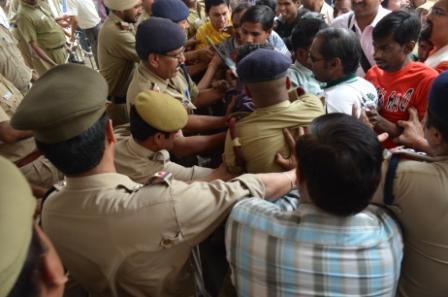
Between 12 and 1 today, the Uttarakhand police lathi charged more than 300 workers who have been sitting on a protest in Dehradun for the last ten days. 11 workers who have been on hunger strike (six from April 6th and five who joined them on April 9th) have been forcibly hospitalised in Doon Hospital, where they are resisting attempts to forcefeed them. 326 workers have been arrested and detained in various jails in the city.

The workers have been on strike for more than three weeks now. They are employees of the Rockman and Satyam Auto plants in Haridwar, both major suppliers of Hero Motors. As in Manesar, Haryana last year, these workers are being paid extremely low wages for more than 12 hours of work a day; when they sought to form a union to demand respect for labour laws, the five leaders of the union were illegally sacked immediately and the others threatened with punishment. On March 19th the majority of permanent workers at Rockman came out on strike in protest at this illegal brutality, and on March 22nd they were joined by all the permanent workers at Satyam. Their main demands are:

1. That they be allowed to form a union as per law, which both companies are trying to suppress;
2. That the five workers who were illegally terminated be reinstated;
3. That all labour laws be complied with within the factory;
4. That their wages be made proportionate to the workload and that they should be paid overtime as required by law.

In the first week of April, in an attempt to suppress their protest, the Uttarakhand government declared section 144 in force in Haridwar. On April 4th the workers sough to come to teh capital, Dehradun, to take out a peaceful march. This too was thwarted by the police, whereupon the workers sat down on dharna at the Parade Ground in the city. On the 6th, six Rockman workers went on hunger strike, and they were joined by five Satyam workers on the 9th. They have been fasting ever since, weakening every day.

No response has come from the government. When a delegation sought to meet the Chief Minister, he told them that these workers are overpaid, that the strike and protest is a conspiracy, and that they would be “dealt with.” The meaning of those words has been demonstrated today.

Workers in other factories in Haridwar, including in Eveready ITC, VIP, and the public sector company Bharat Heavy Electricals Ltd., have declared their support for the strike. A protest and delegation from other factories in Haridwar is planned tomorrow.

For more details please contact Trepan Singh Chauhan, Uttarakhand Nav Nirman Mazdoor Sangh (09411143539), and/or Amit, Inquilabi Mazdoor Kendra (09568216305).

Protest Demonstration in Delhi (April 12, 11:00 am)

12th April @11.30 am, in front of Banga Bhavan, Hailey Road
We will assemble at Mandi House Metro Station at 11a.m.

We find that the anti-people character of the West Bengal government is getting exposed daily. The police and bulldozers of Trinamool-led West Bengal government has not only evicted slum-dwellers of Nonadanga in South Kolkata, but lathicharged and then arrested residents in a continuous spate of its developmental terrorism. It has sent into police custody 7 activists of various mass and democratic rights organisations, who are kept in isolation, and allegations of ‘arms and ammunition found’ etc are doing the rounds.

We strongly condemn this anti-people development model and the eviction of slumdwellers and hawkers in Nonadanga and all over Kolkata, and demand that this be brought to a halt and the question of housing and rehabilitation of the residents be addressed. We also demand that the arrested activists be released and the the false charges dropped immediately.

AISA, AIRSO, Bigul Mazdoor Dasta, Disha Students Organisation, Inquilabi Mazdoor Kendra, Krantikari Naujawan Sabha, Krantikari Yuva Sangathan, Mehnatkash Mazdoor Morcha, Mazdoor Patrika, P.D.F.I., P.U.D.R., Students for Resistance, Vidyarthi Yuvajan Sabha and others.

Joint Statement from Delhi organisations on Nonadanga

The Trinamool Congress-led Government of West Bengal is daily showing its anti-people character. Its Police and the bulldozers of the KMDA (Kolkata Metropolitan Development Authority) razed to the ground and burnt the slums and homes of more than 800 people in Nonadanga, Kolkata on 30th March 2012. These are the same people who were resettled after evictions from various canal banks across Kolkata, and from the dispossessed from the hurricane Aila in 2009. A protest march called against the forceful eviction by residents and progressive organisations and individuals on 4th April was also brutally lathicharged by the Police, critically injuring many. Yesterday on 8th April, a sit-in demonstration was violently broken and 67 people were arrested, with false cases pressed on seven activists of various democratic mass organisations supporting the struggle. They have been remanded in police custody till 12th April, and there is an attempt by the state to frame these democratic rights activists, falsely alleging that arms and ammunitions have been found on them. Also on 9th April, 114 demonstrators who were protesting against these moves by the government were arrested from College Street. On 10th April, a huge consignment of police has cordoned off the entire area and the threat of imminent demolition even of the temporary tents and community kitchen looms large, reminding us of the situation in Singur in 2006.

The government had earlier refused to provide even basic amenities like water, school, drainage system and proper housing in these resettlement colonies and pushed them into an `illegal’ existence, and made them dependent on the networks of local Trinamool and CPI(M) goons. And now in the name of beautification, this violent eviction drive is set on the roll on these supposed `illegal encroachers’ whose cheap labour is `legally exploited’ to run the city’s economy. Anyone opposing this kind of violent `development’ of the ruling classes, has been declared to be `Maoists’ and `inciting outsiders’ conveniently by the Chief Minister Mamata Banerjee again in her press statements to delegitimize the struggle, while the common lands of Kolkata are handed over to the corporate land sharks in the best traditions set up by the previous CPI(M)-led government.

We, the undersigned organisations, condemn the arrests made on 8th April of protestors sitting in a demonstration in Ruby Junction, and demand that the 7 activists of various mass organisations who continue to be arrested be released and the false charges against them be dropped immediately, as the government is acting against the democratic right to organize and dissent.

We condemn the action of the Trinamool-led West Bengal Government and the brutal lathicharge on 4th April, and continued harassment by the Kolkata Police on the residents of Nonadanga and those protesting against the ongoing eviction process in the name of `beautification’ of the city, and demand action against the police officers involved.

We stand with the struggle of the residents of Nonadanga and demand an immediate halt to the eviction drive in the city and the anti-people development, and proper compensation and rehabilitation for all the slum dwellers and hawkers in Nonadanga and in the evictions all over Kolkata.

AIFTU (New), AIRSO, AISA, Bigul Mazdoor Dasta, Delhi Metro Kamgar Union, Democratic Students Union, Disha Students Organisation, Inquilabi Mazdoor Kendra, Jamia Teachers Solidarity Forum, Krantikari Naujawan Sabha, Krantikari Yuva Sangathan, Pragatishil Mehnatkash Mazdoor Morcha, Mehnatkash Patrika, Mazdoor Patrika, Mehnatkash Mazdoor Morcha, New Socialist Initiative, Peoples Democratic Front of India, People’s Union for Democratic Rights, Posco Pratirodh Solidarity Delhi, Sanhati-Delhi, Students for Resistance, Vidyarthi Yuvajan Sabha

Nonadanga: Against Repression and Arrest

Parag,
Krantikari Naujawan Sabha

Condemn Repression in the name of ‘Development’ of the ‘Beautiful’ !
Demand Immediate Release of Arrested Dissenters !!

The ‘beautiful’ and the ‘developed’ entwined as it is with power, must make war on its underside, the ‘ugly’, the toiling, and demolish it, hide it under the shine of corporate towers and election promises. The brutal violence of the present process of ‘development’ in India comes buttressed with State Repression. This is exposed yet again when the Trinamool-led West Bengal government with its brute police force and Kolkata Municipal Development Corporation (KMDA) bulldozed and burnt the houses of 800 slum-dwellers in Nonadanga, South Kolkata on 30th March 2012 in the name of ‘beautification’. This is backed up with continuous state repression- residents who tried to resist their homes being demolished were beaten, picked up and put into police vans. Picking up pieces from their broken homes, setting up temporary shelters with vinyl sheets and a community kitchen, the residents organized a protest march the next day, and again on 4th April. This was met with brutal Police lathicharge and abuses, male plain-clothes personnel pounced on the women, kicked twenty-one year Rita Patra in her advanced pregnancy, split the head of two-and-a-half year old Joy Paswan. A sit-in demonstration was organized on 8th April- police forcefully arrested 67 people and again on 9th April, 114 student protestors were arrested from College Street. Seven activists of various mass organizations have been sent to police custody till 12th April with non-bailable warrants and allegations of ‘stockpiling of arms and ammunitions in Nonadanga’ doing the rounds in the Chief Minister’s press statements. Yesterday and again today 11th April, a huge consignment of police has cordoned off the entire area and the threat of imminent demolition even of the temporary tents and community kitchen looms large, reminding us of the situation in Singur of 2nd December 2006. A mass hunger strike has meanwhile started in the area by various progressive organizations, activists and intellectuals, which the state machinery is readying to crush.

The build-up to this has been the spate of eviction drives going on in the city under state supervision (read: repression) to hand over land to the corporate sharks at throw-away prices. All the roadside hawkers’s huts and shops and markets along an 8 km stretch have been demolished by the side of E.M. Bypass a few days ago. For Mamata’s ‘poriborton’, the working masses have to pay a price. The threat of an imminent eviction was looming large in Nonadanga days before the eviction drive. These are the people who have earlier been evicted from canal banks across Kolkata and have been resettled here and continue to be harassed by the networks of the local Trinamool and CPI(M) goons. Apprehending the worst, the residents met the Urban Development minister, Firhad Hakim who said that there will be eviction only for the ‘newcomers’. On the day before the scheduled date of eviction, the dwellers again went to meet the Chief Minister, but were stopped and arrested by the police just as they started their journey from Nonadanga. People of the locality then formed an independent forum named Uchhed Protirodh Committee (Eviction Protest Committee), with the help of several people and organisations who are supporting the movement who are now being accused of being close to Maoists.

The Question of “Legality” that Is Looming large in the Media and Civil Society

The police, administration and a section of media is playing on the hashed argument that the evicted people were ‘illegal’ dwellers and ‘encroachers’ in the area, that they do not possess any legal ownership documents etc. The history of colony movement in West Bengal was to resettle people who have come to Kolkata from elsewhere, and the vast majority of population in the areas like Jadavpur, Baghajatin, Garia etc were once refugees. These ‘encroachers’ have arrived in the city pushed by the crisis of agriculture in the rural areas, in search of any type of employment, some have been pushed here after being evicted from one place to another, and many have come from the Sundarbans after their homes and lands have been devastated by the cyclone Aila in 2009. If the people here are ‘illegal’, it is the State’s problem, which so-called constitutionally guarantees the ‘right of livelihood’, corollary of which is the right to land and habitation. Besides, their demand of an adequate rehabilitation is also perfectly within the ambit of law. So, where is the question of being ‘illegal’?

The obvious also does not point out that what is ‘legal’ may not be necessarily ethical. In fact, as history shows us, apart the regime of law set to protect the property rights of the rulers, the coming in of any new slightly progressive law or the amendment of an old one is almost always as a result of mass movements which were fought on the premise of such demands that were deemed as ‘illegal’ previously by the legal system. The ‘law and order problem’ approach of the State backfired when the struggles in Singur and Nandigram forced the government to consider changing the British era 1894 Land Acquisition Act. Every private land ownership in the world is basically a sort of forceful occupancy, some days earlier or some days later, and the modern state has come in between to stamp some of them legal and some illegal, according to its class interest.

Eviction: Not only a Question of Residence but of Political Economy

Brutal eviction drives have become normal in the ruling class agenda to pauperise the rural areas and move the thus insecure working masses to the cities, and restructure the cities themselves. Huge ‘industrial model towns’ and cities find no mention of workers housing even in the grand ‘master plans’. This is seen everywhere from Guwahati to Bhubaneshwar to Raipur to the resettlement colonies of Bawana and Bhalaswa in Delhi, and Kolkata is no exception. For one, in Kolkata the Land Revenue Department had acquired lands around the Nonadanga region about 25 years back to distribute them among the poor homeless people of the city. Since then, while a resettlement colony has been built up for the evicted people from other places, for the last few years, the wetlands and fisheries have been filled up and the land steadily sold in phases and parts to different companies and real estate developers who work in tandem with Trinamool and CPI(M) government officials and local goons. A section from among the settlers are also bought over given their precarious condition. Nonadanga is at just a stone’s throw from the eastern metropolitan bypass behind such glitzy corporate hospitals like Fortis, Ruby and Desunand and plans are on to transfer the land at throwaway prices to big real-estate projects by ‘Urbana’ and IT hubs. Obviously, in such a strategic location in a metropolis, they will not tolerate slums and ‘all these dirty people’.

While ‘restructuring’ of spaces to suit the needs of capital goes on, we need to remember that eviction is not only a question of residence of some people but a serious question of political economy, and that is how it relates itself to the other cross sections of society. To enter into the question we have to look at the means of livelihood of these residents here. People of Nonadanga are employed in various small scale industries, in petty production and many are unemployed workers. Some in the garment industry, some in the ‘Kasba Industrial Estate’ nearby, some in other small factories of the subcontractors of big industrial houses. A large number of people work as construction workers and contract workers in various places. Many are autodrivers, ricksaw-pullers, van-pullers, drivers of personal or official cars. Many people are self-employed in small roadside shops of food, tailoring, mobile-recharge, grocery and majority of women are employed as domestic-helps.

On their cheap labour, the social economy and architecture of the entire city stands. Especially the salaried masses and the lower middle classes are in a symbiotic relationship with them. The hawkers and roadside shops of “4 kachuri plus curry at Rs.10” evicted so that there is no other option than going to their Big Bazars, Walmarts and CCDs.; and so that this population already living below subsistence wages are further pauperised into selling their labour even cheaper. The domestic-helps for washing clothes, cleaning floors at Rs.300/month with 30 working days/month in morning and evening shifts will be dealt further blows. The formal sector anyway maintains its low real wage by virtue of the informal economy which creates a condition of lesser cost of regeneration of labour power. A vast section of middle class is convinced with the logic of capital propagated by the state, power-mongering political parties and omniscient media. There is a large section of the lower middle class in Kolkata who are the strata between slum dwellers and salaried masses who will be in serious crisis, because they are the consumers in relation to the people in Nonadanga and similar locations. For the ruling classes to have their beautification and accumulation growing, these are the people who have to pay a price.

Struggle against the evictions is ongoing in Kolkata, as in many other cities across the country. In Kolkata, slum-dwellers of different places are fighting against eviction and for housing, livelihood and the cost connected to their reproduction of their labour. These movements however have still not been able to build up solidarity among themselves and are still localised. The State and mainstream political parties are trying as always to create internal divisions among several sections of residents using their vulnerability and contradictions of their immediate interest. Advancement and generalisation of struggle can only throw out these problems from the arena of mass movements. We stand in solidarity with the struggle of people in Nonadanga for their right to housing and demand that the arrested activists be released and the false charges against them be immediately dropped.

Haridwar Industrial Unrest “Manesar-like”

Inputs and Photos
by Trepan Singh Chauhan,
Uttarakhand Nav-Nirman Mazdoor Sangh

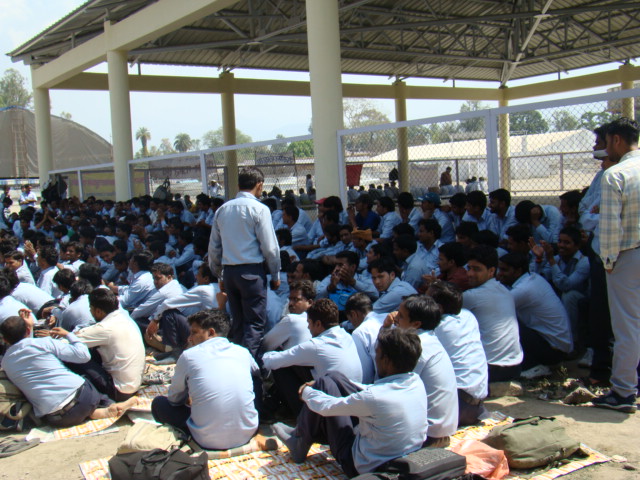
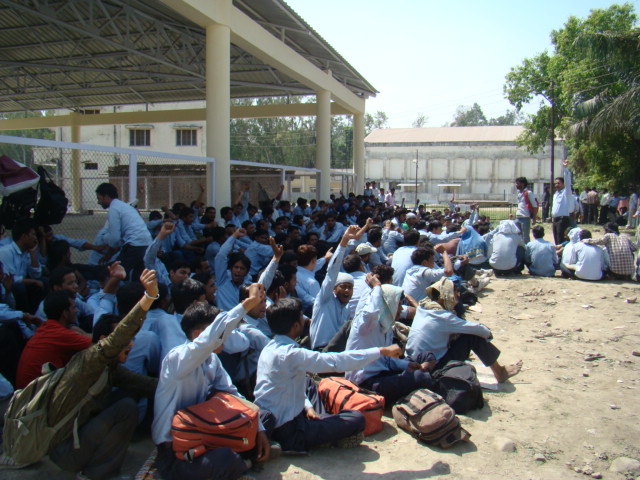
The 2011 Maruti Suzuki workers strike at Manesar (Gurgaon) has already become a metaphor for the new wave of industrial unrest in India, especially against the neoliberal industrial regime that makes the criminal violation of all kinds of regulation and labour laws by the corporate sector an imperative for growth and development. Manesar has come to signify the will of the workers to counter capital by spontaneous and solidaristic uprisings.

On April 4, Business Standard reported the strike in Haridwar in Satyam Auto and Rockman Industries, two leading auto parts suppliers to Hero MotoCorp, India’s largest two-wheeler company. This report was aptly captioned “Haridwar factories brew Manesar-like labour situation”. The strike, which has been going on for the last two weeks, has not been reported by any local or mainstream newspapers. According to the Business Standard report:

A two-week strike is unusual, but the managements of both companies have refused to agree to the workers’ demands. Unlike previous strikes here, this industrial action shows signs of disturbing the peace in the region, with support pouring in from workers at other companies. For the past one decade Haridwar and its neigbouring areas have seen investments from leading companies like Hindustan Unilever, luggage manufacturer VIP, battery manufacturer Eveready, and Hero MotoCorp. According to the BS report, “around 850 companies here employ over 70,000 people.”

So, as workers from the two strike-hit companies staged a protest here on Tuesday, outside the offices of the district administration, they were supported by workers from companies such as VIP, Eveready ITC and Bharat Heavy Electricals Ltd (BHEL). A similar march was taken out last Wednesday, too. Major trade unions such as the All India Trade Union Congress and Hind Mazdoor Sabha have supported the protesting workers. So are 13 workers’ unions at the public sector engineering major, BHEL. Workers at Eveready and VIP have presented their respective companies with charters of demands, including wage hike.

Since yesterday (April 4), workers of Rockman Industries and Satyam Auto have been occupying the Parade Ground, Dehradun (the capital city of Uttarakhand), and were on a day long fast today to press for their demands.

Blind Workers demonstrate for their rights (March 27)

Blind Workers’ Union
(A Unit of All India Federation of Blind Workers)
Affiliated to Workers Unity Center of India, WUCI
Contact: 9313730069 Email: blindworkersunion@gmail.com

Blind Workers’ Union all-up against violation of their labour rights and government inaction.
Blind Workers’ Union warns Social Justice Ministry of grave consequences if alternative jobs are not provided to retrenched blind workers.

Today (March 27), Blind Workers’ Union in mid of heavy deployment of police and barricades, staged a massive demonstration outside the Sarai Rohilla Railway Station in Delhi. Initially the unemployed blind workers tried to enter the railway station and block the rail traffic but the heavy contingents of police did not allow them to enter the railway track from any side. Thereafter these blind workers shouted anti-government slogans and held a protest meeting outside the station.

It is to be noted that the Blind Workers’ Union has been raising the issue of violation of blind workers basic labour rights since November, 2011. We have been raising our voice against violation of basic labour rights like minimum wage, PF, bonus, overtime payment etc. The workers were deeply agitated over the fact that despite several representations to the Ministry of Social Justice and Empowerment, there has been no concrete step taken either against the erring employers or to give these blind workers employment in public sector. These blind workers were thus forced to take up this drastic step so that general public becomes aware of their misery. These blind workers are demanding employment in public sector so that their rights are not violated by NGOs and private enterprises. In their most recent memorandum to Social Justice Ministry these blind workers demanded that the Ministry must make alternative provisions of jobs for these blind workers before 27th March or else they will be left with the alternative of either die of hunger or carry an all-out struggle against government.

In the protest meeting that was carried out outside the station it was resolved that this struggle of blind workers should be taken as an ultimatum by the government. They further warned the government and ministry that if they fail to provide employment immediately to these blind workers then from next month onwards they would be forced to carry out this Rail Roko in different parts of the country and next time they would even defy police.