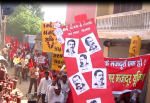
KMSS Hunger Strike in Assam, Akhil Gogoi Arrested

Campaign for Survival and Dignity

After sending the below, we received information that Akhil Gogoi was arrested at around 3 am this morning from the site of the hunger strike and many KMSS supporters were lathi charged. He has been forcibly hospitalised but is resisting forcefeeding. Meanwhile when KMSS members protesting in Guwahati were lathi charged, and more than 20 people have been seriously injured. Road blockades and other protests are now taking place across the state.

Today, in Assam, the indefinite hunger strike of Krishak Mukti Sangram Samiti leader Akhil Gogoi entered its fifth day. This marks a key moment in one of the largest mass struggles for people’s rights in the country today. Till date there is no reaction whatsoever from the government to the KMSS’ democratic demand for a halt to the construction of dams in the State and to atrocities on those protesting against them. Most of these dams are coming up in total violation of law, without compliance with the procedures for forest clearance, environmental clearance and without respecting people’s rights over forest land. The dams threaten the livelihoods of lakhs of people and pose a serious risk of future natural disasters that could claim the lives of tens of thousands more. When people have opposed the construction of these dams, they have faced beatings, tear gas and police firings. The KMSS’ decision to call the indefinite hunger strike was also driven by opposition to these atrocities.

The KMSS’ peaceful struggle for people’s resource rights has mobilised lakhs of people. In the last few years their protests have engulfed the entire State. But for our state machinery these things matter little. Indeed, in Maharashtra, the same system and the same forest officials who (among others) broke the law in Assam have now given themselves the power to kill people with impunity (in the name of “shoot on sight orders” against “poachers”). This blatantly unconstitutional order will lead to killings of local adivasis and forest dwellers, who will never even be given the basic right to a trial. Whether it is in the name of sham “development” or in the name of dictatorial “conservation”, the same bureaucracy and ruling class seizes power and resources, trampling roughshod over the rights of the people. The struggle is on for real democracy in this country.

Contact: forestcampaign@gmail.com, www.forestrightsact.com

CDRO Fact-finding: Saranda, Poraiyahat (Jharkhand)

Interim report/Press release
23rd May 2012

Jharkhand is fast becoming a military state. Similar to operation green hunt which was started three years ago in mineral rich forest areas resided by adivasis, brutal operations are being carried out continuously in Jharkhand as well. ‘Operation Anaconda’ was launched as a special operation in August 2011 in Saranda forest area of West Singhbhum district of Jharkhand. Reasons for speeding up of such military operations by the state can be viewed in a twofold context. One the one hand mining activity in Saranda has been on the rise. Saranda is Asia’s largest mineral reserve and holds immense economic importance. On the other hand, contrary to the government claim that the area has been cleared of Maoist activity, infact it is far from being crushed.

In order to gather first hand details of the manner in which the state has reacted to the changing conditions on ground, an all-India team from the Coordination for Democratic Rights Organisations(CDRO) was set up constituting members from human rights organisations of Andhra Pradesh, Delhi, Punjab, Jharkhand, Maharashtra, Uttar Pradesh, Uttarakhand. The team conducted an investigation in Saranda and the adjoining areas between 20th and 22rd May 2012.

What follows is a brief summary of the observations made by the team. In Puraiyahaat, in January 2011, hundreds security forces entered Kamaay village. They beat up people and arrested four of them called Marshall Bhuiyaan, Nelson Bhuiyaan, Premanad Bhuiyaan and Pinky Bhuiyaan. The first two are still imprisoned while the other two have to appear regularly at the Thana. They are all falsely implicated in helping the Maoists. The CRPF also destroyed property, and mixed food grains in this village.

On the 20th of May itself, a security operation was conducted in Pandua village. Around 500 jawans entered the village at around 5.30 in the morning. Hallan Huttar was taken away blindfolded and handcuffed by the forces. Villagers now fear his death. Abraham Munda’s property was destroyed, and 3500 rupees were taken away. 15 year old Mithun Bhuiyaan was beaten black and blue. Munda’s wife and her year and half old son were also beaten up by a high rank police official. One villager was looted of Rs. 10,000 which she had kept aside for buying ox for her fields. Also, a para-doctor here is frequently oppressed with the accusation of treating Maoists. According to the villagers this destruction continued in the village for almost three hours during which the forces also consumed liquor and marijuana. Few villagers were even forced to flee from their village on that day. In the same village, on the 10th of this month when the forces attacked the village, they also misbehaved with the women here. It was shocking to know that there were no women in the force while women were tortured brutally.

The team also visited 4 villages of Manoharpur block: Tirilposi, Raatamaati, Deegha, Tholkobaad. In all of these villages, forces converted whole villages into their base camp for an entire month. Villagers had to hide in the jungles and many ran away to their relatives in nearby villages to escape oppression. Of those who were left in the village, men were held captive separating them from the women. They were tortured and even had to relieve themselves wherever they were locked up. Old people who couldn’t run away were beaten up so badly that some of them even died. Houses were burnt and people jailed. Most of them are still in Chaybaasa jail, and according to their families they are not even sure of the offense of which they are accused. In Tirilposi alone 17 people have been imprisoned. Economically dented, these villagers are totally unable to follow legal proceedings to get relief. In one of the copies of charge sheets observed by the team, a villager was implicated in UAPA, CLA, and in addition also blamed of sedition and waging war against the state.

Additionally, it was observed that under the IAP, contractors from outside were given work which is against the rules of IAP.

Right after operation Anaconda was completed, the government started a development project in the name of Saranda Action Plan(SAP) under which villagers have been given solar panels, clothes, utensils, and sewing machines as short term trust building measures. The government also plans to introduce long term measures like livelihood options, building of check dams, and training for employment among others. Simultaneously, in and around these villages security forces are also in the process of constructing permanent camps. Saranda will be home to 20-25 camps soon.

Certain questions come to the fore. How has the state suddenly woken up to the development needs of the tribals here after so long? Is it only a coincidence that Operation Anaconda, the SAP, and private mining project leases are falling in line together here in Saranda? Why has the government cracked down so hard all of a sudden on the people of Saranda?

A trajectory can be spotted in the actions of the government in Saranda. It is clear that the government has failed to estimate the real needs of the people. And with the maoist activity refusing to fade away, the government with the fear of losing ground has reacted frantically by launching brutal operations on the people. By terrorizing the tribals, the state is simply trying alternatives to sustain a larger foothold over them.

It is therefore that we demand, the following:

1. All CRPF, military and para-military camps be removed from the state
2. In the context of mining and SAP implementation, PESA and the 5th Schedule be implemented according to which decision making rests on the tribal communities.
3. All private mining activity be stopped immediately.
4. Justice for those who have been beaten up and exploited, and release of all those people who have been imprisoned and implicated in false cases. The perpetrators, the CRPF instead must be booked for the oppression meted out by them.
5. After this attack on their identity and existence, the autonomy of tribals should be left unaffected.

Members:
Shashi Bhushan Pathak, Aloka Kujur, Mithilesh Kumar, Santosh (PUCL Jharkhand); Puneet, Social Activist, Naushad, Journalist (Jharkhand)
Gautum Navalakha, Shruti Jain, Megha Bahl(PUDR, Delhi)
Chandrashekhar, Narayan Rao, Rajavindam, APCLC, Andhra Pradesh)
Pritpal Singh, Narbhinder (AFDR, Punjab)
Rajeev Yadav, Shahnawaz Alam (PUCL, Uttar Pradesh)
Chandrika, Prashant Rahi (Independent journalists)

Faridabad Update: Striking nurses block roads as negotiations fail

AS NEGOTIATIONS FAIL, STRIKING NURSES TAKE OUT MASSIVE PROTEST RALLY IN FARIDABAD & BLOCK B.K. CHOWK
HOSPITAL MANAGEMENT INSTALLS PHONE JAMMERS INSIDE THE HOSTEL TO INTIMIDATE STRIKING NURSES
PATIENTS HEALTH IN PERIL AS UNTRAINED NURING STAFF & NURSING STUDENTS ARE BROUGHT IN AS REPLACEMENTS

The nurses of Asian Institute of Medical Sciences (AIMS), Faridabad and QRG Central Hospital continue to sit on strike for the NINTH consecutive day. Since the management of AIMS hospital is determined not to increase the pay of the nurses, and not to reduce their work load by removing compulsory double duty, negotiations held with the AIMS management on 14.05.2012 failed. While the next round of negotiations is still pending in the case of QRG Central hospital, the chances of the QRG management conceding some of the main demands of the nurses’ is doubtful.

In order to build larger public pressure on the hospitals’ management as well as the district administration of Faridabad, the striking nurses of both hospitals took out a big rally from BT Chowk. There they blocked the roads surrounding the Chowk for nearly two hours till they were given the assurance that the District Commissioner will meet them in person on the 16th. The nurses’ rally was supported by trade unions in Faridabad, women’s organizations, welfare associations, several civil rights groups, and democratic and progressive individuals. Meanwhile, the two hospitals concerned kept up the façade of “normal” functioning by replacing the striking nurses with untrained nursing staff and nursing students—a measure which is putting patients at serious risk.

The striking nurses have continuously complained about the uncooperative approach of the district and labour administration. They argue that the district administration and labour office was intervening in a manner which reflects their connivance with the hospitals’ management. In the case of QRG Central, the civil court ordered that the peaceful demonstration of the striking nurses be shifted to a distance of 200 meters to an inconspicuous and distant location. Interestingly, the law allows for only 100 meters distance. In the case of both hospitals, the local officials are preventing the nurses from putting up a tent structure to protect themselves from the heat.

As expected, with each day the harassment by the hospitals’ management escalates. On the night of 14.05.2012 when AIMS nurses returned to their hostel after their ninth day of strike, they found jammers installed inside their hostel. Because of the device the nurses could not make or receive calls for several hours. Suspecting foul play they called the police and pushed for an inspection of a vacant, locked room where the felt the jammer was installed. Initially, the police was reluctant to remove the device due to pressure from the management, but then finally because all the nurses pressed for action, the jammer was finally removed at 10pm,” said an agitated nurse of AIMS hospital. Today (15.05.2012), the security staff of the hospital removed the water cooler installed in the hostel, hence, depriving the nurses of drinking water. Security personnel/bouncers hired by the hospitals are continuously entering the women’s hostels, and coercing individual nurses to join back. “A nurse who was recuperating from an attack of serious illness was continuously mentally pressurized by the hospital’s nursing supervisor who kept calling her on the phone—something which worsened her condition,” said another agitated nurse.

Considering the hostile atmosphere, the nurses of both AIMS and QRG Central hospitals have decided to form a Joint Action Committee (JAC) so as to unite nurses of all the different hospitals in Faridabad. Considering that conditions continue to be grave, the nurses resorted to a larger public campaign. During their rally they distributed pamphlets explaining to the general public how their strike was in favour of better patient care.

Thankamma Ravindran
Delhi Nurses Welfare Association

Alok Kumar
Workers Unity Centre

Maya John
Centre For Struggling Women
Ph: 9350272637

Faridabad Update: Impact of nurses’ strike spreads despite intimidation and threats

DESPITE SEVERE HARASSMENT AND BEING MANHANDLED BY BOUNCERS, NURSES CONTINUE TO SIT ON STRIKE
WATER & ELECTRICITY SUPPLY CUT OFF IN THE NURSES’ HOSTEL ACCOMMODATION
IMPACT OF STRIKE SPREADS TO OTHER HOSPITALS

The nurses of Asian Institute of Medical Sciences (AIMS), Faridabad and QRG Central Hospital continue to sit on strike for the eighth consecutive day. With each day the harassment by the hospitals’ management escalates. Nevertheless, the nurses continue to sit on strike. Today, bouncers hired by the AIMS management manhandled nurses who were passing by the hospital on the way to their hostel accommodation. When activists from the women’s organization, Centre for Struggling Women (CSW) and Workers’ Unity Centre of India (WUCI) intervened, the bouncers tried to manhandle them too and used filthy, abusive language in order to intimidate the nurses. The local police initially intervened in favour of the bouncers but when accosted with the fact that the road outside the hospital is public property and cannot be regulated by the bouncers, the police accepted the bouncers were harassing the nurses.

Similar tactics of intimidation are being used in the hostels where the nurses reside. Water and electricity supply in the hostels are often cut off, and the nurses are threatened every day to vacate their rooms. Despite the fact that the management of both AIMS and QRG Central have called for negotiation today, intimidation and threats continue in order to force the striking nurses to settle fast. These acts are, hence, in complete violation of the spirit of amicable negotiation and the spirit of collective bargaining.

Unfortunately, even the district administration and labour office is intervening in a manner which reflects their connivance with the hospitals’ management. In the case of QRG Central, the civil court ordered that the peaceful demonstration of the striking nurses be shifted to a distance of 200 meters to an inconspicuous and distant location. Interestingly, the law allows for only 100 meters distance. And in the case of both hospitals, the local officials are preventing the nurses from putting up a tent structure to protect themselves from the heat.

Considering the hostile atmosphere, the nurses of both AIMS and QRG Central hospitals have decided to form a Joint Action Committee (JAC) so as to unite nurses of all the different hospitals in Faridabad. Considering that conditions continue to be grave, the nurses are also considering holding a JOINT PROTEST outside the office of the Deputy Labour Commissioner in Faridabad, and the Union Health Minister. “If the negotiations will not go in favour of the striking nurses then the nurses are thinking of taking out a big rally in Faridabad, and uniting nurses across the board. After all, negotiation doesn’t mean settle for less,” said CSW activist, Maya John. Interestingly, the nurses’ strikes in Faridabad are already impacting the functioning of other private hospitals in the NCR. For example, nurses of Sharda Hospital in Greater Noida have also gone on strike with respect to demands for pay hike, regulated work hours, etc.

Thankamma Ravindran
Delhi Nurses Welfare Association

Alok Kumar
Workers Unity Centre

Maya John
Centre For Struggling Women
Ph: 9350272637

Repeal ‘AFSPA, 1958’ for a Humane, Internationalist Future

Gilbert Sebastian

“Sharmila Irom … has not eaten for almost 10 [now, 12] years.
She is too angry to eat ….
She is hungry for justice, not for food.”

– Andrew Buncombe (The Independent, 5 May 2010)

Armed Forces (Special Powers) Act, 1958 (henceforth, AFSPA) in India provides total legal immunity to officers of the armed forces (down to the level of a havildar) in the “disturbed areas” to shoot and kill anyone without attracting punishment, to arrest using violence and without warrant and allows unhindered entry into any premise. There cannot even be a First Information Report (FIR) filed in case of such killings except through prior sanction of the Union government; only a simple complaint can be filed. AFSPA, is by far, the most draconian Act in the country because the Act contravenes the spirit (although it adheres to the letter) of the Fundamental Right to Life as guaranteed under Article 21 of the Indian Constitution which says, ‘No person shall be deprived of his life or personal liberty except according to procedure established by law.’ Notably, AFSPA is operational in the frontier regions where militant nationality movements go on against the Indian State, i.e., in Kashmir and parts of the north-east of India. The footages from real life on the reels of the documentary film, ‘AFSPA, 1958’ in the context of Manipur shocks the consciousness of any democratically-minded person. As Asit Das (2011) says, the Act is clearly used as an instrument of war and is, by no means, used for enhancing conviction rate. The operation of this single Act has led to thousands of murders, enforced disappearances (as in the case of the unmarked graves in Kashmir), tortures, rapes, etc.

AFSPA is an example of a ‘permanent’ law that was justified at the time of its enactment as merely shifting, under logistical compulsions, powers of ordinary policing to the army (Ujjwal Singh 2011). It may be borne in mind that police forces dealing with civilians are usually instructed to use the least amount of force whereas the military is trained to inflict the maximum lethal force. The term, ‘extraordinary law’ loses the meaning it denotes for a law that has been permanently operational in the country since 1958 except as a law which gives extraordinary powers to the armed forces. Initially enacted for use in the seven sister states of the north-east of India, the scope of the Act was extended to Jammu & Kashmir since 1990.

The empowering Supreme Court judgment in Naga Peoples’ Movement for Human Rights vs. Union of India, 1998 defined a “disturbed area” wherein the Act would be applicable. However, the basic structure of the draconian Act remains unaltered as yet. The judgment held that AFSPA, 1958, Section 3, does not confer any arbitrary or misguided power for declaring an area as a “disturbed area” for which there must exist a grave or dangerous situation of law and order on the basis of which the Governor of the State or Administrator of the Union Territory can form an opinion as such.

It has also been pointed out that AFSPA constitutes a clear violation of international law and of the United Nations International Covenant on Civil and Political Rights, 1966, ratified by India in 1979.

De-facto partial citizenship

The notion of universalism was somewhat absent under the caste-based feudal moral/legal order in India. The legal system was heavily at odds against the underprivileged castes and women. Even the formal – not substantive – notion of universalism in India was typically a contribution of the colonial rule. The Panchamas, the outcastes/untouchables (self-named as Dalits today) hardly enjoyed any of the benefits of citizenship. As part of the Hindu identity formation under the influence of colonial modernity, there has been a half-hearted attempt at their incorporation into the Hindu fold. The exclusionary process continues even today in a different manner whereby certain social sections are not permitted to enjoy full-fledged citizenship in the country. Today, AFSPA is used against the nationalities of Kashmir and parts of the north-east of India like Manipur, Nagaland and Assam. Especially with the rise of fascistic communalism, recurrent communal violence has taken place against Muslims and they find themselves overrepresented only in the Indian jails. Similarly, tribals have faced systematic eviction from their traditional habitats with the expansion of capitalist accumulation since colonial times. It may be argued that these social sections and others like migrant workers, fisher people, etc. enjoy only ‘partial citizenship de facto’ in our polity.

Distinction between Mainland and the Frontier

In order to understand the continued prevalence of AFSPA, 1958 in some parts of the country today, we need to draw a geo-political distinction between mainland and frontier. The frontier consists of whole geo-political regions, whose citizens are de-facto recognised as only incomplete citizens. There are ethnic/religious differences that mark them out from the mainland. What we refer to, in particular, are the national formations in Kashmir and large parts of the north-east of India. Both mainland and frontier are politically constructed geographical categories. The people of the mainland are considered as complete citizens of India in geo-political terms although there are gross aberrations which are not primarily of a geographical character in the case of social categories such as religious minorities, Dalits, Adivasis, migrant workers, etc. We also need to bear in mind that there is a possibility of interchange between parts of the mainland and parts of the frontier and so these are dynamic categories although stability rather than change is the primary characteristic of these geo-political categories.(1) To use the expression of Amartya Sen and Jean Dreze (2002), India is a “bastion of disparity”. The disparity between mainland and the frontier is a crucial one among these disparities.

It is true that the construction of a dominant Hindi nationality has been an ongoing hegemonic project of the Indian State in north India where Indo-Aryan dialects like Bhojpuri, Maithili, Braj bhasha, Haryanvi, Rajasthani, etc. are spoken. However, the acute class division and the extremely low levels of human development, by far, the lowest in the country, in several of these states (particularly, BIMARU states – Bihar, Madhya Pradesh, Rajasthan, Uttar Pradesh) remain significant barriers to this project.

An instructive example of the mainland-frontier distinction can be had in the case of the discussions in the media during 2009-10 whether the army and the air force should be deployed in the fight against the Maoists. Both the Chief of Army Staff, Mr. V. K. Singh and the Chief of Air Staff, Mr. P. V. Naik were against the idea of such a deployment on grounds that ‘they are our own citizens’. This draws a sharp contrast with the case of nationality movements in the frontier regions against whom army has been used and continues to be used. Moreover, AFSPA, the most draconian Act in the country and also the most hated Act in the frontiers, has been operational in these regions.

Over the decades after the transfer of power in 1947, untold atrocities have been committed by the armed forces of the Indian Union and State-sponsored militias on the peoples of the struggling nationalities on the frontiers of India. But opposition to such atrocities from the mainland India have been few and far between.(2) This is a far cry from Lenin’s advice to Communists and democrats from the dominant nationality (in this case, those from the mainland) that they should be categorical in their opposition to national oppression towards the subject nationalities. Even in India today, in fact, it is easy to distinguish democratic intellectuals from the others on the basis of their standpoint on the question of national oppression.

‘A Generalised State of Exception’

There is a substantial portion of the geographical/demographic terrain of India wherein there is, to use the concept used by Italian legal theorist, Georgio Agamben, ‘a generalised state of exception’ to the liberal democracy prevailing in the rest of the country. In government terminology, these are either the ‘backward regions’ (such as the central forest region) which are ‘Maoist-infested’, well within the mainland India or ‘frontier states’ meaning, states bordering the neighbouring countries where there are, often, insurgencies demanding self-determination. As the Maoist literature does, movements designate these as ‘struggle areas’ – arena of class struggles or nationality movements. The liberal democratic discourse of the ‘rule of law’ (nomos) is largely non-functional in these vast regions. The Fundamental Rights as guaranteed in the Constitution of India face blatant violation in these regions, where even the most basic one, the right to life, is violated with impunity on a large scale on a day to day basis. This “undemocratic exception” (Pothik Ghosh 2010) is not merely an exception or aberration but a generalised phenomenon. Crucially, anyone concerned about the future of democracy, human rights and the question of social transformation in this country, cannot overlook this phenomenon.

‘Rule of law’, Impunity and a Selectively Repressive State

Speaking of the system at large, unlike in most of the liberal democracies of the west, there is a vast terrain of exception to the rule of law in India. As Hannah Arendt (1951) says, the sought after goal here is ‘order’, rather than ‘law’. A patent example is the case of hundreds of extra-judicial killings of detenues that happen in the police lock-ups in India every year. In the heavily militarized regions of the country i.e., in regions where there are nationality movements or Maoist insurgency, ‘fake encounters’ by the Indian security forces are a rather common phenomenon. Counter-insurgency operations by the State, such as the Salwa Judum, have been carried out in blatant violation of all Constitutional and legal norms.

Despite the legal universalism formally prevailing, the rich and the powerful continue to enjoy impunity. The instances have been far too many: The high profile perpetrators of Gujarat carnage of 2002; the leader who opened up the pandora’s box of communal polarization in contemporary India and has been instrumental in the post-rath yatra riots in 1990; the leaders accused in the demolition of the Babri Masjid; the architects of the Salwa Judum in Chhattisgarh; those responsible for clandestine killing and cremating hundreds of young persons at Tarn Taran in the Punjab during the early 1990s; those responsible for the violent suppression Adivasi landless at Muthanga in Wayanad district in Kerala state, and of those who resisted corporate land grabs at Kalinga Nagar, Nandigram, Singur, etc.; those responsible for the trafficking of vulnerable sections of people which is a rising trend today; those employing children in hazardous occupations; etc.

It also needs mention that the Indian State has been selectively repressive against its adversaries who violate its canons. While being heavily repressive against Islamist extremists, nationality movements, and the Maoist movement, the Indian State has been quite lenient towards the criminal activities of the Shiv Sena and the Sangh Parivar.

Frontier Peoples in an Intersectional Analysis of the Indian State

Given the experience of AFSPA, how do we understand the Indian State under neo-liberal globalisation? Liberals of diverse shades have argued that with globalisation, the State had ‘retreated’ and the world had become ‘borderless’. However, it is apparent that the role of the State has heightened in India under neo-liberal globalisation in terms of its functions as an agency that is regulatory, repressive and a facilitator of unhindered accumulation (T.J. Byres 1997).

Marxists usually speak about the Class character of the State but it should be borne in mind that Class formations are not merely about class in the narrow sense of the term. There is need to reveal the broader Social character of the State in India. In the Indian context, Class needs to be viewed substantively in relation mainly to space, caste and gender. In this respect, intersectional analysis could be a very valuable analytical tool. Intersectional analysis as expounded by Nancy Fraser, et al has its origins in gender studies in the West since late 1960s that sought to understand experiences beyond gender alone. This approach has to do with how forms of oppression interrelate or intersect in multiple ways to create a system of oppression manifesting itself as exploitation, discrimination, violence, marginalisation, etc. It links various kinds of oppression which have to do with interrelated/overlapping/intersecting social categories. Speaking of the class/social character of the State, from the angle of intersectional analysis, could we not as well speak of the Indian State not only as pro-corporates and pro-landlords but also as [pro-mainlanders], pro-men, pro-upper castes, pro-non-tribals, pro-Hindus, etc.? (3) The deployment of military and the operation of AFSPA reveals the bias of the Indian State against frontier peoples.

Erosion of State Legitimacy and Repressive Legislations

How do we understand an apparently contradictory character of the legislative process in India whereby there is a co-existence of empowering and disempowering legislations? There have been a number of apparently pro-people legislations during the very period of neo-liberal reforms: National Rural Employment Guarantee Act (NREGA), 2005; Forest Rights Act, 2006; the Panchayats (Extension to Scheduled Areas) Act (PESA), 1996; the Right to Information Act 2005; the Prevention of Domestic Violence Act, 2005; Unorganised Sector Workers’ Social Security Act, 2005; The Constitution (108th Amendment) Bill, 2008 which seeks to grant 33 per cent reservation to women in parliament and elected assemblies; etc. These may be viewed as having been necessitated by the need for the neo-liberal State to generate popular consent or secure legitimacy, particularly from deprived classes and social identities and thereby maintain the hegemony of the ruling classes. Maintaining ‘hegemony’ in the Gramscian sense involves sustaining the moral and intellectual leadership of the dominant classes through generating consent rather than through coercion or force. As Bob Jessop (1982) says, it involves taking systematic account of popular interests and demands, making compromises on secondary issues, without sacrificing the fundamental long-run interests of the dominant group.

On the other hand, ‘the limited nature of consent’ leads to a weak basis for a political order, which comes to rely increasingly on force (A. S. Sassoon 1991). The gearing up of the repressive apparatus of the State under neo-liberalism through draconian legislations like Chhattisgarh Public Security Act, 2005 and Unlawful Activities (Prevention) Act, 2008 is worth mentioning in this context. Notably, however, AFSPA has continued to be the most draconian legislation among all these and has been prevailing in the country from the first decade of the existence of the Republic as a testimony of the distinction between the mainland and the frontiers. These draconian Acts have been operational especially in areas of militant struggles against the Indian State. The increasing ascendancy of the Hindutva fascist movement in India also should be seen in conjunction with the deepening crisis of legitimacy of the Indian State under neo-liberalism.

An insightful statement from the film, The Spiderman says, ‘The cunning warrior attacks neither the body, nor the mind but the heart.’ But how about the peoples living under the terror of AFSPA? If they are citizens, why are they treated this way? Apparently, the cynical and hawkish strategic analysts in the corridors of power in the Indian State have no long-term perspective for the integration of the frontier regions.

Self-determination and People’s Rights

A clarification on the notion of ‘People’s Rights’ by Manoranjan Mohanty (2011) can be useful in this context. The conventional discourse of ‘human rights’ has laid exclusive emphasis on civil liberties of individuals in particular, mostly as recognized by the State. The notion of ‘people’s rights’, on the other hand, entails a comprehensive notion of rights. It includes both civil liberties on the one hand and political, social, economic and cultural rights on the other. Rights are understood as “political affirmations in course of struggle”, irrespective of whether or not they have gained recognition from the State. Moreover, besides individual rights, people’s rights include the rights of collectivities and regions. [Regions, here, refers to the question of spatial equity and could include the notion of centre and periphery on the worldscale and also the nationalities question. One might recall Mao’s slogan, ‘Countries want independence, nations want liberation, people want revolution.’ It refers to independence from imperialism, liberation from national oppression and revolution by the broad masses of people and not certain deprived classes.]

On the contrary, the State in India, apparently, has no long-term policy vis-à-vis the frontier: It is basically a policy of ‘catch ‘em and hold ‘em’ as long as possible, for geo-political gains, for markets and resources. If, however, we want a lasting integration of the nationalities in India, South Asia and the world at large, it cannot be a vertical integration but a horizontal integration. An enduring unity cannot be a forced unity at the point of the gun but a voluntary union of states. As a Malayalam saying goes: ‘If you have a nose that would fly away when you sneeze, you should rather let it go!’

The right to self-determination of nationalities, including secession, was upheld by Marxist-Leninists since 1914 and ‘a person’s right to nationality’ by most liberals soon after the Second World War. Article 15 of the Universal Declaration of Human Rights of the United Nations in 1948 had upheld the individual’s ‘right to a nationality’ and the ‘right to change his nationality’. In India, the mainstream Marxists have given up on the right of nations to self-determination. Most liberals all across the world have given up on it, except in cases where they were granted under genocidal situations in little nationalities as in East Timor and South Sudan. Moreover, it is the experience of the 20th century that most nationalities that waged successful anti-colonial struggles succumbed to the indirect exploitation by neo-colonialism and thus the substantive content of self-determination was hollowed out. In spite of all these, rightly do the democrats uphold the right to self-determination, through means of a referendum, as the most democratic right on the question of the nationalities.

By distinction, ‘Repeal AFSPA’ is no revolutionary demand, no secessionist demand but a demand for basic human rights, a legitimate democratic demand against the undue privileges enjoyed by the Indian armed forces in the frontier regions, a demand for a democratic integration of the country, if it all, it could be made possible. But no doubt, it is a little step, but a significant one, for a long-lasting, durable unity, for the internationalist future of humanity. We salute the iron will of Ms. Irom Sharmila, the Manipuri poet in the 12th year of her hunger strike against AFSPA, the most draconian Act in the country and bow our heads in our respect for the struggling peoples in the frontiers of India.

Gilbert Sebastian (gilbertseb@gmail.com) is a post-doctoral researcher based at Centre for Development Studies, Thiruvananthapuram.

Notes:

(1) Remember that Tamil Nadu and Punjab, which were parts of the mainland had secessionist movements whereas Mizoram, which used to be part of the frontier, has been somewhat incorporated into the mainland.
(2) One important reason for this is the retraction of the mainstream left parties, CPI and CPI-M from the Leninist principle of self-determination of nationalities.
(3) Manoranjan Mohanty (personal communication). I have added what is in square brackets.

Faridabad Update: Nurses on Hunger Strike on International Nurses’ Day

NURSES OF PRIVATE HOSPITALS IN FARIDABAD ON WAR PATH, & TAKE OUT A RALLY AROUND FARIDABAD
NURSES of ASIAN HOSPITAL SIT ON HUNGER STRIKE ON THE OCCASION OF INTERNATIONAL NURSES’ DAY

The nurses of Asian Institute of Medical Sciences (AIMS), Faridabad and QRG Central Hospital continue to sit on strike for the sixth consecutive day. Since 6 days have passed and no fruitful negotiation seems in sight, the nurses of Asian Institute of Medical Sciences (AIMS) decided to commemorate International Nurses’ Day by sitting on hunger strike, rather than celebrating the most important day of their profession with fanfare. The striking nurses of AIMS also took out a large rally from outside the hospital to Badhkal Chowk and HUDA Market. By going on hunger strike and taking out such a rally, the nurses’ have tried to expose how the nursing profession is treated in the medical community and society at large. On the hand, the management of both hospitals refuse to negotiate on the nurses’ just demands, although patients are vacating the hostel in panic, leading to huge financial loss. Following their meeting on Nurses’ Day, the nurses of both AIMS and QRG Central hospitals have decided to form a Joint Action Committee (JAC) so as to unite nurses of all the different hospitals in Faridabad. Considering that conditions continue to be grave, the nurses have also started to think along the lines of holding a JOINT PROTEST outside the office of the Deputy Labour Commissioner in Faridabad.

As of now the nurses of AIMS are paid a paltry sum of Rs. 11,000 from which the hospital management cuts PF, etc. Due to this the nurses get only some Rs. 9000 in hand—an amount which is way below the Rs. 42,000 earned by government hospital nurses. In the case of QRG Central hospital, many nurses are getting even less than their colleagues in AIMS (Faridabad). In both hospitals the nurses’ salaries are inflated on paper by including a vague category called Company Total Cost/CTC (which includes PF, gratuity, ESI health-card fee, etc.). The actual salary received in hand/basic salary is, of course, much lower than what is officially declared by the management on paper. In fact, the hospitals conveniently fool hapless nurses into work contracts by projecting higher salaries on paper. When asked to explain the exact functioning of the CTC, management of private hospitals across the board deny any proper explanation.

In Delhi and NCR region where rents are high, such salaries hardly enable the nurses to make ends meet. It is shocking that hospitals which earn huge profits on a yearly basis are unwilling to reward their nursing staff a fair wage and regular salary increments. While addressing the striking nurses, activists from the women’s organization, Centre For Struggling Women (CSW), Workers’ Unity Centre (WUCI), and Nurses Welfare Association encouraged the nurses to stand by their genuine demands like hiking the basic salary released, and paying the nurses salaries which hare in parity with those of government hospital nurses. CSW member also encouraged the nurses to unite the larger nursing community on the demand for a wage-board. The wage board would ensure some regulation of the salaries paid in private hospitals.

The other grave problem highlighted by the striking nurses is the manner in which they are assigned extra duties for which they are not paid adequately. For example, after performing eight hours of duty, the nurses are often forced to perform another 8 hours of duty. Furthermore, the aforementioned private hospitals exercise a skewed nurse-to-patient ratio. In violation of the World Health Organization’s norms, the nurses in Asian Hospital (AIMS) are assigned up to 3 to 4 ICU patients (the WHO recommended ratio being 1 nurse to 1 or 2 ICU patients). And after performing double duties back to back, the nurses do not receive compensation based on given rules on overtime payment. The nurses of QRG Central hospital explained how, in violation with laws pertaining to overtime payment, the management pays them even less than the normal duty’s rate for the additional 6-8 hours shift performed by them.

What is most disturbing is the way in which the issue of the striking nurses are being skirted continuously. For example, despite being intimated of the nurses’ issues, the Deputy Labour Commissioner and Labour Office have failed to intervene. Even after communicating their demands to the Chief Minister, no intervention or probe by the CM’s office has followed, thereby once again exposing the pro-management stance of the Haryana Government. As expected, the local thana has been actively involved in harassing the young nurses, and has forcefully pushed the strikers to from putting up a tent even at a distance of the stipulated 100 meters issued via a court order. Of course, seeing the nurses’ determination to continue their struggle, the Deputy Labour Commissioner’s (DL) office has suddenly swung into force. However, the nurses have complained that the DL has only been verbally threatening them than amicably trying to arbitrate between the two parties. The connivance between the Deputy Labour Commissioner and the management of QRG Central hospital has, in fact, ensured that the striking nurses are forced to sit far away (200 meters distance) from the hospital whereas the rule is generally 100 meters only. This reflects both the state administration and hospital management’s desire to conceal the genuine issues of the nurses from the patients and larger public.

Furthermore, the management of AIMS and QRG Hospital has resorted to several illegal practices like replacing the striking nurses with nursing students who are not qualified to practice, and by making ward attendants perform certain nursing duties like applying injections to sick patients. This measure is not only illegal but also detrimental to the interests of the admitted patients. In addition to this the hospital management of AIMS has also indulged in filthy practices like sending bouncers late at night to the nurses’ hostel on 8th May. Today on 11th morning, again certain senior hospital staff in AIMS forcefully dragged three nurses into the hospital. The three nurses, however, refused to stay and left the hospital shortly to join their striking colleagues. In the evening bouncers hired by the hospital kept encircling the striking nurses in their vehicle. Four of the bouncers again entered the nurses’ hostel on 11th evening and took photographs of the nurses inside the hostel. Worried about their safety and unsure of the extent to which the bouncers will go, the nurses submitted a written complaint at the local police station.

Standing up to the various intimidation tactics of the hospitals’ management, the nurses of both hospitals have decided to continue their strike till all the striking nurses are re-employed. With nothing to lose, the nurses are standing together in unity.

Thankamma Ravindran
Delhi Nurses Welfare Association

Lailamma Peter
Delhi Nurses Welfare Association

Alok Kumar
Workers Unity Centre

Maya John
Centre For Struggling Women
Ph: 9350272637

Note: This is an updated version of the release that was published earlier.

Nurses of Faridabad on War Path

NURSES OF FARIDABAD ON WAR PATH
RAMPANT EXPOITATION OF MALYALI NURSES
PRIVATE HOSPITALS INDULGE IN A RANGE OF ILLEGAL PRACTICES

Following a 14 day strike notice, 300 nurses of Asian Institute of Medical Sciences (AIMS), Faridabad have been sitting on strike since 7th May. Down the road, 140 nurses of another private hospital, QRG Central Hospital are also on strike. The majority of these nurses are from far flung parts of Kerela, and have joined the super-speciality hospital in the hope of earning salaries which will help them survive in the city, and also assist them in paying back education loans they have taken to pursue their nursing degrees. Unfortunately, like other private hospitals, Asian Hospital and QRG Central are misusing the nurses’ compulsion to pay off student loans to employ them on the basis of extremely low wages.

As of now the nurses of AIMS are paid a paltry sum of Rs. 11,000 from which the hospital management cuts PF, etc. Due to this the nurses get only some Rs. 9000 in hand—an amount which is way below the Rs. 42,000 earned by government hospital nurses. Ironically, this salary package has been in force since the inception of the hospital, i.e. for two and a half years. The nurses, hence, complained that despite putting in loyal service from the time of the hospital’s inception, their experience and hard work has not led to any pay hike. In the case of QRG Central hospital, many nurses are getting even less than their colleagues in AIMS (Faridabad).

In Delhi and NCR region where rents are high, such salaries hardly enable the nurses to make ends meet. It is shocking that hospitals which earn huge profits on a yearly basis are unwilling to reward their nursing staff a fair wage and regular salary increments. In fact, several private hospitals like AIMS have gone to the extent of deliberately forcing a section of the nurses to join as trainees from the first date of their service. The trainees are then conveniently paid wages as low as Rs 5000, despite the fact that they are fully qualified nurses who do not need to undergo any sort of “apprenticeship/training”. While addressing the striking nurses, activists from the women’s organization, Centre For Struggling Women (CSW), Workers’ Unity Centre (WUCI), and Nurses Welfare Association congratulated the nurses for risking everything and coming out to fight on their demands. The CSW member argued that the nurses’ salaries should be increased regularly on the basis of the hospital’s profit margin, and that a wage-board should be constituted for the nursing occupation. The wage board would ensure some regulation of the salaries paid in private hospitals.

The other grave problem highlighted by the striking nurses is the manner in which they are assigned extra duties for which they are not paid adequately. For example, after performing eight hours of duty, the nurses are often forced to perform another 8 hours of duty. “Imagine what kind of patient-care we can do when we are on our feet for 16 hours straight”, explained one of the striking nurses (who requested anonymity). The management of private hospitals find it easy to arm-twist the nurses for double duties due to the simple fact that nurses are desperate to pay off student loans, and because of the sheer clout private capital exercises in the health sector. With private hospitals outnumbering government ones, the managements of private hospitals find it easy to keep wages low across the board, and to overwork the nurses in the absence of government regulation. With little difference in the wage scales prevalent in private hospitals, most nurses are unable to challenge the adverse conditions of their employment. Furthermore, the aforementioned private hospitals exercise a skewed nurse-to-patient ratio. In violation of the World Health Organization’s norms, the nurses in Asian Hospital (AIMS) are assigned up to 3 to 4 ICU patients (the WHO recommended ratio being 1 nurse to 1 or 2 ICU patients). “And even after performing double duties back to back, we don’t receive adequate compensation,” said another AIMS nurse.

What is most disturbing is the way in which the issue of the striking nurses are being skirted continuously. For example, despite being intimated of the nurses’ issues, the Deputy Labour Commissioner and Labour Office have failed to intervene. Even after communicating their demands to the Chief Minister, no intervention or probe by the CM’s office has followed, thereby once again exposing the pro-management stance of the Haryana Government. As expected, the local thana has been actively involved in harassing the young nurses, and has forcefully pushed the strikers to a distance beyond the stipulated 100 meters issued via a court order. As usual the state machinery is quick to respond to the calls and communiques of the hospitals’ management, and lethargic, if not, aggressively anti the worker when contacted by affected workers.

Furthermore, the management of AIMS has resorted to several illegal practices like replacing the striking nurses with nursing students who are not qualified to practice. This measure is not only illegal but also detrimental to the interests of the admitted patients. In addition to this the hospital management has also indulged in filthy practices like sending bouncers late at night to the nurses’ hostel on 8th May. The authorities have also put up notices with the names of some 70 nurses who are supposed to vacate the hostel with immediate effect. The management has so far suspended 16 nurses and terminated the services of 12. While the management has given a verbal assurance of reinstating the nurses who have been suspended and terminated, it has categorically refused to reemploy 5 nurses on whom they have slapped legal cases. These 5 nurses have been the more active and vocal participants of the struggle. Clearly then, rather than negotiating with the nurses, the Asian Hospital management seems adamant in crushing the legitimate voice of the young Malyali nurses. Meanwhile, the Director of the QRG Central Hospital continues to scoff at the demands for a pay hike by his nursing staff. He has gone on record stating that the nurses behave “like cattle and don’t use their brains” when deciding about whether to sit on strike! As usual he overplayed the role of “outsiders”, whom he claims “misguide the nurses to agitate”.

Standing up to the various intimidation tactics of the hospitals’ management, the nurses of both hospitals have decided to continue their strike till all the striking nurses are re-employed. With nothing to lose, the nurses are standing together in unity.

Thankamma Ravindran
Delhi Nurses Welfare Association

Lailamma Peter
Delhi Nurses Welfare Association

Alok Kumar
Workers Unity Centre

Maya John
Centre For Struggling Women
Ph: 9350272637

Eruption of a hundred, million Nonadangas is Dangerous for the Ruling Class!

Krantikari Naujawan Sabha (KNS)

From the filth and dirt of the cities of the present, emerges a shriek of revolt. Liberal society based on inequality squirms, and tries desperately to take contain it and dole out relief. The people asserting their power and dignity of labour persist with the question—who controls access to urban resources and who dictates the quality and organization of daily life. Is it the financiers and developers, or the people?

Nonadanga, in the eastern fringes of Kolkata in West Bengal, has brought this question again starkly to the foreground which is being posed everywhere. In this area, lie several slums with thousands of households, housing a population of few belongings and only their capacity to labour and dignity in hand. The bulldozers of the Kolkata Metropolitan Development Authority (KMDA) with brute Police force burnt and razed the houses in Mazdoor Pally and Shramik Colony to the ground on 30 March 2012 in the name of ’emptying the land’. This prime land including water bodies in and around Nonadanga of 80 acres is to be handed over to developers of ‘star/budget hotels, shopping malls, multiplexes, restaurants, serviced apartments, recreational facilities’. If the 80 acre project materializes, another 1000 odd houses are in line to be demolished. The legal and parliamentary channels had already been close to exhausted before this round of evictions. Peaceful marches by residents under the banner of the local autonomous Ucched Pratirodh Committee (Resistance-to-Eviction Committee) on 1 and 4 April, sit-in demonstration on 8 April and many agitations were organized, appeals were made. The government responded with allusions of Nonadanga being a place where ‘outsiders are inciting’ and ‘stockpiling arms and ammunitions’. Kolkata Police resorted to brutal lathicharge on a protest rally on 4 April, and many suffered severe injuries including children and pregnant women. On 8 April the committe decided to go for a road-side sit-in-demonstration and police was intimated accordingly. But within an hour police force mobilised and picked up 69 residents and activists, later among them 62 were released but seven activists continue to languish under many charges ranging from ‘assaulting public servant in the execution of his duty’ to ‘anti-national activities’ (5 of them were released on bail after about two weeks imprisonment). Then continued series of mass protests and subsequent arrests, and alongwith we witnessed attack on APDR rally by TMC goons. On 28 April, after the confrontation of residents with police over the blocking of the entry-exit points with a boundary wall by the KMDA, 11 residents including 5 women were arrested and slapped with a host of cases, and were put into police custody. The threat of further repression through legal and illegal channels looms large.

Who are the residents of Nonadanga?

An area meant for rehabilitation for evictees from various canal banks and slums across Kolkata, Nonadanga is crowded with single roomed flats of 160 sq ft, which were distributed to these evictees with many anomalies. The ‘rehabilitation’ did not contain schools, health centers or markets. Later more and more evicted and forcedly migrated people from the crisis in the rural areas, majorly from Sunderbans after Aila, started to come here and build their homes as they thought that the land stipulated for rehabilitation would be the last one where jaws of eviction could reach. Having pushed here thus, the people of Nonadanga are employed in various small-scale industries, in petty production and many are unemployed workers. Some in the garment industry, some in the ‘Kasba Industrial Estate’ nearby, some in other small factories of the subcontractors of big industrial houses. A large number of people work as construction workers and contract workers in various places. Many are auto-drivers, rickshaw-pullers, van-pullers, drivers of personal or official cars. Many people are self-employed in small roadside shops of food, tailoring, mobile-recharge, grocery and majority of women are employed as domestic-helps. The question of living wages in such a situation is one of the most important. Linked to that, the quality of living condition is horrible to say the least and the struggle to reproduce everyday life is rife with insecurity. Struggle over shelter and rent, added with worries over water and sanitation constantly plague the people. These insecurities also play out into internal divisions over the struggle for scant resources.

As in each and every urban concentration across India, they bear with them the marks of the violent process of development both in the rural and urban areas. And this pain and their function in the chain of capitalist production is their strength and power. In the villages, they have seen their debts with the landed elite and prices of agricultural inputs soar, the pesticides ruin the nutrition of their soil, even caste related atrocities jump in number, and have been thrown out unceremoniously as companies pounce on their resources. They bear with them the crisis in the urban areas where huge ‘industrial model towns’ have no mention of workers housing even in the grand ‘master plans’, where workers are being pushed daily into selling the endless days and nights of labour even cheaper. With no proper housing, they are pushed into residing in rented dormitories and slums where the state has wilfully withdrawn from all its responsibilities. The working classes are thus ‘legally’ handed over to networks of the local elites and goons (who are hand in glove with the local police, the company owners in the nearby industrial estates, the political party in power or parliamentary opposition) who impose exorbitant rent and user charges on any service that is provided. All this comes under the rubric of ‘illegality’, and the pitching of the people as encroachers. To manage this, the system also has in place several welfare programs and NGOs who act as middlemen, ‘service providers’, ‘consultancy groups’ to delink the struggle in the rural and the urban, the factory/workplace and the household, and push the struggle only into litigation and as a question of lack of rule of law. Integrated in the global networks of capital, cheap labour has to be ensured for the ruling class by constant regulation—by the force of law, by the police and by the ameliorate benevolence of the NGOs.

Exposing the present model of ‘development’

There is nothing surprising about eviction and repression as everywhere in India, and across the world, cities are restructured to suit the needs of capital accumulation, as the attack of neoliberal capital intensifies. In the resistance in Nonadanga is seen an active process of exposing the linkage between exploitation and state repression—both of which defines the fabric of ‘normalcy’ and ‘development’. The residents of Nonadanga formed an independent organization without links to the Trinamool or CPI(M) or any of the standard vote-shops, and asserted their power without relying on the NGOs either. This has been possible, even in the face of their weak economic condition and other insecurities, because of their will and the presence of struggling left revolutionary forces from much before this present agitation started—who are working in coordination during the struggle. Even after all the houses were demolished, the residents refused to budge from the site, put up shelters, ran a community kitchen, and are confronting the might of the police everyday with their bare hands and indomitable will. Since 11 April, 10 comrades under this Ucched Pratirodh Committee persisted with a fast-unto-death in the site for 12 days with undeterred support of the entire slum, and beyond. Fighting the might of the developers and the state, they have reconstructed almost all the burnt and demolished houses, and are preparing to face further assaults from the government, like the boundary wall being constructed by the KMDA and constant threat of further violence by the police, and TMC goons. A local school here, during the present agitation, has been turned into a police camp. However, even in the face of this, some initiatives in education, ecology, health camps are stirring to imagine a different vision of development, even as the state is sought to be held responsible and answerable to their demands. The built makeshift houses stand for now, but so do the demands for proper housing.

The residents continue to demand unconditional dropping of charges against the arrested activists and residents. That without ‘organisational prejudice’, 7 activists of various mass organisations were arrested on 8 April, and then again 11 residents of the area have been arrested on 28 April, shows that whoever raises a voice against the developmental terrorism of capital, without exception, will be crushed. The illusions of justice by the government, police, administration, and judiciary are daily breaking, coming face to face with them in the arena of struggle. The TMC and CPI(M) of the Singurs and Rajarhats have been exposed as lapdogs of the land sharks and company mafia. The state has been forced into retreat after confrontation—the government has been forced to grant bail to the 7 arrested activists (though 2 of them are still in jail) and make promises (albeit temporary) not to go into further evictions. The solidarity campaign by revolutionary left forces and mass organizations in different places also got energized into thinking, debating and linking the ongoing struggles against similar processes in own specific locations. In cases of local resistance, not only did the general process of capitalist restructuring of cities and resistance as the only way to confront it come up again, but thinking around questions of forms of resistance and organization within the struggle are also showing itself.

Beyond anti-Mamata-ism, and the empty discourse of (il)legality

During the ongoing struggle, we have witnessed repeated attempts to not only repress the movement, but at the same time to depoliticize and divert it as an ideological offensive by the ruling class. Even the solidarity campaign when picked up by the civil society, the NGOs, the national media or a organization like SFI focused on (a) anti-Mamata Banerjeeism, (b) depoliticized appeal to push the release of the ‘eminent scientist, harmless national asset’, Partho Sarathi Ray, and (c) relief to the ‘helpless slumdwellers’, without challenging the discourse of (il)legality.

There is at present, a seemingly anti-Mamata Banerjee wave. From the huge uproar over the arrest of a JU professor over a anti-Mamata cartoon to the ‘don’t talk to CPI(M) members diktat’ around the same time, the corporate media is also ‘lovin it’. Nonadanga then becomes merely a question of ‘bad management’ by the Chief Minister. Whereas one opinion argues for an even more virulent form of corporate rule as the answer (it points to the earlier three decades of so-called ‘communist misrule’), the other opinion grants legitimacy to the CPI(M) as better political managers for the capitalist class. After all, the CPI(M) showed its capability to contain revolutionary and mass struggles for a long time, before it faltered over Singur and the Nandigram, and the building mass discontent and shifting class base. What these opinions fail to see is that these Nonadangas show again that whether it be a Mamata or a Buddhababu, they have to take credit for their shops from the same capitalist class. The handing over countless Singurs and Nonadangas to corporate at throwaway prices, the using of brute repression for it on the resisting population is to continue the normalcy of exploitation and accumulation by further demolishing the power of working class. Against this, what must be posited, in continuation from Singur, is that the revolutionary left forces organizing the working class and masses as a power will fight capital and its political executive of whichever variety, who seek to impose the fear over the people.

The hulaboo over Partho Sarathi Ray as the ‘eminent scientist’ divorced from his political positions against the depredations of global capital and state repression reminds us of the decoupling of ‘the good doctor’ Binayak Sen from his politics of demanding universal primary health (the declaration of Alma Ata, the work with Shaheed Hospital) and protest against the Operation Greenhunt. It reminds us of representing Irom Sharmila Chanu as the vaishnavite/Gandhian divorced from her struggle against the AFSPA and the Indian military’s occupation of the Northeast. The question is in this manner sought to be trivialized to mere condemnation of harassment of these ‘national assets’ ignoring their uncomfortable politics or just mentioning it in passing as merely incidental.

The last argument is a desperate attempt to confine the struggle. It raises the question of rehabilitation and livelihood from a NGOist perspective—not going into its causes, and forgetting that most rehabilitation packages are used by neo-liberalism, more often than not, to make yet another assault on the reproduction of labour-power. They thus see this as only a question of shelter for the marginalized, push the struggle into mere litigation and ask for stronger laws or better implementation of existing ones. However law itself and its enforcers create a false sense of equality even as it constitutes its ‘outside’ i.e. the slums as areas of ‘illegal encroachment’. The struggling people and the revolutionary left forces understand that what is law for one class is repression for others—and only a struggle that seeks to question ruling class law itself can shed light into how they came to be ‘illegal encroachers’ in the first place and overturn it; that it is not a question of mere ‘governance’ or more laws or protection from the state of ‘human right violations’. When here, the law of equal exchanges is pointed out, we reiterate Marx of Capital, “between equal rights, force decides”, as has been the history of capitalist production. The people assert—we are not helpless victims of atrocities but we raise the question of housing as a question of class struggle. We demand wages and housing both simultaneously, recognizing that the increase in distance between the place of residence and the source of livelihood that most resettlement and rehabilitation process imposes on the evicted slum-dwellers further devalues our labour-power by lengthening our average labour day. We link the spheres of reproduction and production, we bear the pain of your poriborton, ‘development’ and ‘aid’, and are a force who posits a different imagination. From the Paris Commune to Occupy Wall Street and the London Riots, imaginations of how cities might be reorganized in socially just and ecologically sane ways—and how they can become the focus for anti-capitalist resistance have been posited. Today in India, we find the urban space as increasingly turning into a site of such resistance even as these are still fragmented, localised and disorganized.

As the struggle in urban areas intensifies, the space of operation of NGOs and civil society organisations as only ‘mediators’ between ‘atrocities happening in some remote part’ and ‘corridors of power’ in the cities, is shrinking more and more each day. As class struggle and urban resistance sharpens, the limits of the framework of ‘legality’ and ‘civil liberties’ within which these forces work will become even starker. The shrinkage of democratic space—manifesting with even more brutal assaults by the police state and juridical machinery on the working class is inevitable. While being engaged in the struggle of Nonadanga, we learn from it and those like it that this presents a possibility, and we must seize this.

The Aspirations/Possibilities of Nonadanga

The movemental militancy here is bound not to be confined in the legal and rights discourses only; it asserts its right to the question of housing as a class question. Neo-liberal capital thrives on cheap labour and segmentation. The working class while asking whose city is it, whose space is it, militantly asserts its inalienable right to all resources and to the dignity of its labour. This possibility in Nonadanga is then the potential of the struggle of the working class in urban areas to fight for the cost of its reproduction i.e. of housing and rent, health, education, transportation. These are reflected in some of the present demands—the movement is now proceeding with the demand for proper rehabilitation which is a political demand for a dignified and free life, along with thinking of the practice of alternate forms (however transitory now) of development.

Linked to this, is the possibility of taking this struggle against exploitation to the site of production, to the connected workplaces—asking for higher wages and better working conditions. In attempting to organize domestic workers and the huge informal sector workers and unemployed in the area in these ways, we believe the struggle can take a crucial turn, and this presents a possibility of unearthing and positing through a period of struggle, a form of organized working class power. In organizational terms itself, a process of democratic churning among left revolutionary forces in tune with the movement also is at play, which is also noteworthy. Today, the future of the present struggle is still uncertain, but these possibilities show themselves as the political question that Nonadanga poses. The crisis of capitalism cannot always be managed by governance, more laws and NGOs which seek to isolate and contain these local struggles—this framework will be in danger, and thus the eruption of a hundred million Nonadangas can be a serious anti-capitalist threat in the heart of capitalism as the terrain of struggle is remapped. The state will increasingly act with the repressive and ideological apparatuses at its disposal and this clash can and will only intensify. What is required is to take the movemental militancy and democratic organizational forms in Nonadanga a step further, and in every space where capital thrusts its violent marks. Standing in solidarity with it can only mean intensifying the struggle in our own locations and furthering them to learn from and connect to each other for a proletarian upsurge.

Published by Parag (09804468173) on behalf of
KRANTIKARI NAUJAWAN SABHA (KNS)

Slum Dwellers protest outside Delhi Chief Minister’s Office

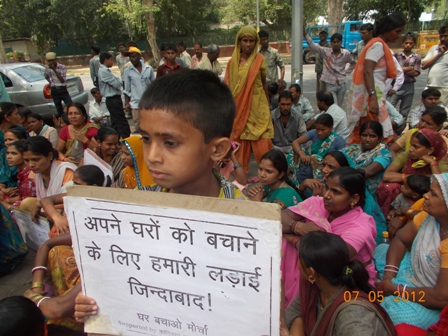
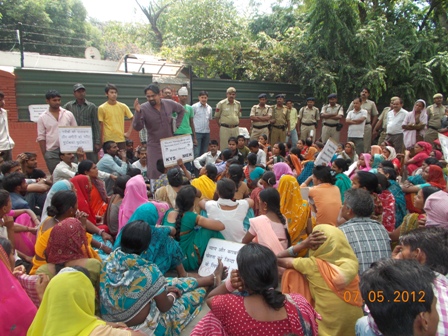
On 7th May 2012, following the renewed threat of massive slum demolition in Gayatri Colony (near Baljeet Nagar/Anand Parbat industrial area) by the Delhi Development Authority (DDA), hundreds of slum dwellers gathered outside the Chief Minister’s residence in protest. Seeing this as a problem that affects slum dwellers across the board, women and children from across different slum/JJ colonies (Pandav Nagar, Hem Nagar, Nehru Nagar, Punjabi Basti, Gayatri Colony, etc.) gathered outside Sheila Dixit’s residence. The agitated slum dwellers sought to bring to the CM’s immediate attention the plight of the thousands of impoverished workers and their families residing in slums. The agitation was carried out under the banner of the Ghar Bachao Morcha, a body formed by the slum dwellers last year itself.

After a day-long protest, the Chief Minister finally met a four member delegation. On hearing the arguments with respect to the arbitrary nature of the 1998 cut-off date, the CM assured that the slum demolition will stop, and that proper discussion on the issue will take place. She assured the slum dwellers’ representatives that her government will further look into the matter of the cut-off date.

Since the beginning of their agitation, the slum dwellers have highlighted how the slum settlements across Delhi house lakhs of poor, working class people. Most of the men in these slums work in factories/sweatshops or as rickshaw-pullers, contract workers in the MCD, vendors, etc. The women work as maid-servants in people’s homes or participate in the informal sector of the economy. However, despite their important role in the socio-economic fabric of this city, slum dwellers are treated with little respect and are made to feel as if their lives have no value. Indeed, rather than recognizing the value of their economic contribution to the city’s economy, the Government’s approach is characterized by slum demolition which is accompanied by minimal relocation and rehabilitation. Whenever slum demolitions take place, most of the families are identified as “ineligible” for rehabilitation due to the cut-off date of 1998. The few families that are considered “eligible” for rehabilitation are moved to underdeveloped settlements in far flung off and poorly connected parts the city, causing massive social and financial dislocation of affected families. Ironically, many a times the land from which slum settlements are razed is left vacant (often with the rubble of the erstwhile slum still lying around)—a fact which indicates that more than providing alternative housing for the poor, ‘hiding of the poor’ is what characterizes the DDA’s policy vis-à-vis squatter settlements.

Activists of Ghar Bachao Morcha claim that the DDA’s own records reveal just how dismissive the urban authorities are with respect to the most vulnerable section of the city’ population. For example, in a study commissioned by the DDA to the Association of Urban Management and Development Authorities in 2003, what is clearly reported is the continuous unwillingness to meet estimated targets for low income housing—a troubling policy approach which has led to a situation where an estimated 3 million people (about 27% of the total urban population) is forced to occupy less than 3% of the residential area in the city! In fact, with the arbitrarily fixed cut-off date of 1998, the urban development authorities find it easy to demolish slums with minimal relocation and rehabilitation plans. On the one hand, the Government and urban development authorities refuse to implement land sealing under the Urban Land (Sealing & Regulation) Act, and on the other hand, they arbitrarily decide that people who come to the city after a certain date are “ineligible” to actually live in the city they work in.

The slum dwellers also pointed to the past record of DDA’s slum-clearance clearly shows that lands from which slum dwellers are evicted are mostly used for construction of malls or high-rise residential complexes which only the rich can afford. This, they argued was most unfortunate, considering that the DDA is supposed to cater to the needs of all strata of society. However, in reality very little of DDA’s finances are spent on housing projects for the poor. Quite expectedly then, the city’s slum dwellers are questioning the rationale of an urban development plan that excludes a very large portion of the city’s working population. The question is can urban authorities even claim that shopping malls and high-rise residential complexes are projects implemented for “larger public interest”, and are hence, projects that legitimately require urgent slum demolition.

It is in this spirit that the city’s slum dwellers are protesting , and have put forward the following set of demands:

    1. Immediate steps should be taken to stop any further demolition and clearance of slums
    2. In-situ development of slums
    3. Abolition of the 1998 cut-off date;
    4. Introduction of land sealing under the Urban Land (Sealing & Regulation) Act;
    5. Immediate action to be taken against all callous officials involved in the arbitrary demolition of our slum
    6. Immediate provision of temporary shelter, drinking water, sanitary facilities to all affected families
    7. Release of compensation to those who have lost property in the process of demolition
    8. Provision of health-care facilities to displaced families
    9. That housing policies for the poor should be prioritized by the DDA, and that the DDA should recommend a feasible and affordable housing policy/plan for the urban poor to the Government of NCT of Delhi and the Central Urban Development Ministry
    10. Before pursuing demolition the DDA should make use of proper consultation mechanisms, and should use all measures to take the slum dwellers into confidence.

Alok Kumar
Convenor, Ghar Bachao Morcha

May Day: Karawal Nagar Workers hold a Workers’ Rights Rally

On May 1, the Karawal Nagar Mazdoor Union, Stree Mazdoor Sangathan and Bigul Mazdoor Dasta organised a ‘Mazdoor Adhikaar Rally’ (Workers’ Rights Rally). The struggle of the unorganised workers of Karawal Nagar Yamuna Pushta started 4 years ago in 2008, when a union of almond workers was formed. In 2009, the Almond Workers Union (Badaam Mazdoor Union) organised a big strike which continued for more than two weeks and compelled the almond factory owners to compromise. This was one of the largest strikes of unorganised workers that Delhi has seen in the recent past. This strike of almond workers saw participation of informal/unorganised workers toiling in diverse occupations, like rickshaw pullers, construction workers, street vendors, etc. Some of them were in fact family members of the women almond workers, while others lived in the same area and came in support of the almond workers strike as a symbol of solidarity. In the next two years, the Badaam Mazdoor Union fought on a number of issues, organised protests against police oppression, and organised movements against the oppression by petty contractors. Most of these issues did not belong particularly to the almond workers, rather they were issues of all the unorganised workers of the area, irrespective of their occupations. The leaders of the Badaam Mazdoor Union realised that de facto, the union has become a union of the informal/unorganised workers of the area. So in 2011, the Badaam Mazdoor Union was transformed into the Karawal Nagar Mazdoor Union (KMU). KMU was formed as the neighbourhood-based union of the workers of Karawal Nagar.

On the May Day 2011, around 2 thousand workers from the Karawal Nagar Yamuna Pushta area gathered on Jantar Mantar under the leadership of KMU, along with thousands of other workers from different parts of Delhi, as well as, UP and Punjab. This protest was organised by different unions and workers’ organisations under the banner of ‘Workers’ Charter Movement’, which is still going on. KMU has been doing an experiment in organising workers in the era of Globalisation, when working class is dispersed or scattered at the shop floor level, while at the same time, it is concentrated in terms of the neighbourhoods where workers live. KMU believes that along with factory-based unions, there is a need to organise workers on the neighbourhood basis. Without strong neighbourhood-based organisation, area-wide organisation across factories, occupations and sectors, even the strong factory-based movements cannot hope to win.

KMU is planning to hold a huge protest march against the non-implementation of government’s policies for unorganised sector workers and different labour laws pertaining to the informal sector workers, oppression by the police and goons of contractors and factory owners, and the non-regularisation of the industrial units functioning in the Karawal Nagar area. The May Day rally ended in a meeting at the office of KMU in Mukund Vihar, Karawal Nagar, in which the plan of this wider march was discussed.