Corruption, Ethics and Politics: The Reproduction of Capitalism and a Ruse of History

Paresh Chandra

Capitalism and Legality I: Corruption, Ethics and Reification

The notion of ‘corruption’ is an essentially ethical one; the terms in which the issue is judged are ‘good’ and ‘evil’. The problem with raising an ethical issue, as one can guess, is that it stays, as does its solution, within the system that defines ethical standards. Corruption is also, simultaneously, a legal issue. In fact, the legal question is in itself ethical, just as the ethical one is legal – the legal and the legitimate intertwine. In the final analysis, the legal structure of a society is defined in terms of what the socio-political order deems legitimate and what it does not. The obvious corollary being that a legal question, by definition, never goes into a questioning of the law itself. Anti-corruption crusaders are asking for more laws, stronger laws, or different laws. There is a difference between the old and the new law/setup, but they are also, to give the matter a Hegelian twist, identical. Fundamentally the system remains the same. In fact, these changes intend to make the system more entrenched and foolproof.

Such changes, and demands for such changes are not new. In fact we find that people out to change the world in capitalist times repeatedly make demands of precisely this sort: legal and ethical ones. Why is that? What follows is an attempted explanation.

Capitalism is a most confusing entity, so much so that one begins to doubt if it is an entity at all. Right from the beginning it has sent all sorts of well-intentioned reformers chasing after wild geese. Things have not changed much and trying to find a reason for the problems of our existence we still end up latching on to the first ‘big problem’ that appears. This first problem, it will be argued, is invariably an ethical one. The social order that we live in covers our eyes with blinders that ensure that we see only that which does not make our very existence within it difficult. Horses were made to wear blinders so that they did not get alarmed while they traveled on dangerously crowded roads. They only saw what they ‘needed to see’, ditches for instance, that need to be avoided, but never the carriage ahead that they could crash into. Similarly, we see ethical problems that need to be avoided, and can be avoided without upsetting the capitalist cart we pull. The archetypical ethical issue that gets in the way of a genuine questioning of the system has been that of money.

Money is, as Marx demonstrated in Capital, Volume I, the embodiment of the contradiction between use value and exchange value. When in a situation where an individual X has something that another, Y, wants and Y has something that X wants, and the two do not make an exchange, it is because although the two are not interested in the use-values of their respective commodities, they are interested in their exchange values. But a simpleton reformer, say Sir Thomas More, does not see this contradiction, and thinks the problem is that the two are interested in money. So blaming money for the corruption of communities he wants to abolish money.

Simpleton says money is evil. In other words, he makes an ethical judgment. What he does not see is that money is not the problem, not the producer of a contradiction, but merely the embodiment of one. Money is not a ‘singular, complete’ entity at all, but actually a duality in one body. The problem is the duality, the contradiction, not the embodiment. But it is always easier to be able to locate one entity, and try to destroy it. Money stares him in the face, and he is looking for something like money to attack. In other words money is not only a ‘medium of exchange, store of value etc’, but also ideology, a red herring to misdirect attempts that set out to solve the contradictions of capitalism. “The obsession with money as cause and disease alike condemns us to remain within the market system as such, the sphere of circulation, as the closed horizon of our knowledge and our scientific questions and explanations.” (Jameson 2011: 46)

The name Marxists have given to this problem of misidentification is ‘reification’, or alternatively ‘fetishism’. Something mediating between the subject and the object becomes ‘reified’ and begins to posit itself as the object itself.

“In thought, mediation is nothing but a word subject to all the most damaging anti-dialectical objections; in reality it is a mystery that blocks thinking altogether.” (Jameson 2011: 9)

As we saw in the earlier example, this is what happens in the case of Simpleton and money. The case of an ethical question like that of corruption, or for that matter of any ethical question can be understood in the same way; one can draw a structural correspondence, or a homology. An ethical problem is always the first appearance of a more fundamental contradiction (the duality implicit in the word ‘contradiction’ is important). To be unable to move beyond it is to reify it and remain at a distance from raising a truly political question. In capitalism this question can be understood in terms of the contradiction between use value and exchange value, or concrete and abstract labour, or simply, labour and capital.

Capitalism and Legality II: Corruption and ‘Monopoly’ Capital

Sometimes, in order to give ‘political economic’ explanations to ‘superstructural’ phenomena, there is an inclination to jump to quick conclusions that leave out too many levels of mediation. If the problem we explored in the previous section was the problem of being trapped by mediations, here we see the problems that emerge when we try to get to first causes without taking mediations into account. For instance: Anti-monopoly laws seem to be becoming stronger internationally, including in India, despite the fact that the neoliberal rhetoric of free market continues to dominate. But do these laws intend to counter the processes of concentration and centralisation of capital (or monopolisation) which are fundamental to capitalist accumulation?

Just because these laws are being strengthened we cannot say that the process of monopolisation has ceased to operate; in fact, growing instances of acquisitions and mergers are daily reported in financial publications. So what do these laws exactly do? Monopolisation is an inevitable effect of competition between diverse particular capitals, and competition is the life and blood of capitalism. But the strange thing about capitalism is that its own processes are fetters to its existence. Capital creates barriers to its own expansion. The intensity of immanent processes poses hurdles to capitalist accumulation. The collective will of the capitalist class is definitely produced through the dialectic of competition and monopolisation, but it needs an externalised State and its laws to represent it when anarchic competition and its implications seem to destroy the systemic coherence of capitalism.

Bourgeois economics itself recognises that monopolisation curbs the rate of accumulation, however without acknowledging it to be an inevitable tendency. Anti-monopoly laws are designed as a result, to regulate this inevitable concentration of capital, so as to keep the rate of accumulation from slowing down. This is one among many attempts of capitalism to reform itself, and circumvent its own fundamental contradictions. But this is also one among many such attempts that have failed and continue to fail.(1)

Now we come to a direct connection between the sort of corruption that we saw in the ‘2G Scam’ and monopoly. Essentially, what is this corruption but a sort of favouritism shown by the state and state officials (on being bribed of course)? Which among the various monopolies will grow, which will gain greater access to raw materials etc. is decided like this. So, by bribing state officials, large corporations can get out of problems that laws like the anti-monopoly law may put in their path, as well as gain an advantage over their competitors. In other words, bribes are a price that a corporation pays to grow.

A question that we must ask ourselves is that why is this issue of corruption being raised at such a large scale now? Is it only because the CWG scam and 2G scams were so big? Leaving aside the pointlessness of conspiracy theories (though they are not false) about who is funding Anna’s movement etc, we must nonetheless ask why large corporations are supporting the movement in such a big way.

Capitalism, it can be demonstrated, has a sort of homeostatic range within which it can handle issues like corruption and, say for instance, inflation (issues which it also incidentally produces). Once the upper limit is crossed problems arise. One cannot empirically prove when the limit is reached. The only way of it being reached is not rise in corruption. Another way is that the upper limit may come down. When regimes of accumulation change, state structures, the politico-legal ‘superstructure’ slowly tries to harmonise itself with the changed infrastructure. This may be why the said limit may have come down. The capitalist class, that was earlier bribing officials and parliamentarians left, right and centre, now does not want to throw its profit like this. This, as we shall see, is connected to the development of capitalism, and hence to the centralisation of capital, in India.

Capitalism and Legality III: Corruption and the Expanded Reproduction of Capital

Marx’s analysis of the ‘expanded reproduction of capital’ allows us to understand this phenomenon in a systematic manner. An initial sum M is invested into machinery, variable capital (labour power), raw materials etc., which together comprise C, and after the production process (P) one ends up with a commodity C’ which is sold for an amount M’.

M – C…P…C’ – M’

M’ is supposed to be greater than M, or one ends up with an overall loss.

M’ > M

M’ can now be further divided into the amount that was invested initially, M, and will need to be put in again to sustain production at this scale, and the surplus m.

M’ = M + m

The surplus (m) can be divided further into capitalist consumption (c) and investment (m’), which goes back to expand production.

m = c + m’

This is what the equation should ideally look like. But as we should know by experience these equations never exist without irregularities. The amount paid as bribes is basically money that comes out of m’. If this amount is c’ and what is left after bribes have been paid is m”, i.e. if,

m’ = m” + c’

then

m = c + c’ + m”

We know that m’ is the sum that is supposed to be reinvested to expand production. The money that is paid as bribes to private individuals basically falls into the category of consumption or unproductive use. Which is to say, that corruption, in the long run becomes a cost that siphons out money from m’ and does not allow it to re-enter capitalist investment. Till a point capitalists accept such siphoning, but after a point the homeostatic limit mentioned earlier is reached.

The obvious question then: at what point is this limit reached? To get into this part of the argument I will make use of an essay by MH Khan called “Corruption and Governance” that was published in 2006. In this essay Khan draws a connection between underdevelopment and corruption. He argues that in underdeveloped or developing countries, where accumulation is still ‘primitive’, or by extra-economic means, and resources are still being grabbed by brute force, corruption is inevitable. This corruption is not a result of the intention of corrupt officials. In these countries while pre-capitalist processes of production are no longer viable, production is still so low (and so is, as a result, surplus accumulated), that the capitalist class cannot pay to protect a new set of rights/laws that would legitimise all capitalist processes. The amount of revenue coming from tax on surplus, that can be redistributed transparently and legally to social groups and sections in order to maintain stability, is not sufficiently large.

In this situation any attempt to fight corruption, or taking any anti-corruption measures will be futile. In fact in nations where conditions are such, there is no will to fight corruption. Anti-corruption policies work in countries with stable capitalism and high production. In underdeveloped countries the apportionment of resources to capitalists happens through clandestine patron-client relations. As a result, certain sorts of individuals get involved in politics and hold power. In underdeveloped countries, as Khan points out,

“The modern sector of the economy that can be taxed to redistribute to others is small. At the same time, the political conflicts faced are often more serious than those in an advanced country. In many cases, the taxes collected are insufficient even for paying the salaries of bureaucrats. Capital expenditures in the development budget often depend on aid and other foreign capital inflows…[T]he survival of the regime requires that powerful groups are accommodated.”

As surplus increases, slowly the economy begins to stabilise and legal methods for this apportionment can be found. It is only after this point has been reached that corruption can be decisively tackled. But here too popular pressure would be needed to bring this about.

Because in under-developed countries fiscal transfers cannot happen, they are replaced by the exercise of brute power. But in advanced capitalist countries, the allotment of transfers and subsidies happens legitimately, like through legalised lobbying etc (as in the United States).

“In advanced capitalist countries, political stabilization is typically organized using fiscal transfers through the budget. This process is legal, and the rent-seeking (or influence-buying) that it generates is, therefore, also legal typically in the form of lobbying, political contributions and other legal or semi-legal means to influence the allocation of subsidies and transfers. Once again, note that influence-buying and rent-seeking can be widespread in advanced countries. It is only that most of it is legal.” (MH Khan, 214-15)

Because of such legalisation c’, which was till now part of consumption and was leaking out of the cycle, now gets re-injected, via the state into the economy. What in a developing nation goes to politicians and public officials in their capacity as private individuals now goes to the state in its capacity as an institution of bourgeois power. Overall, this transformation implies an increment in the profit being generated. The moment it is realised that an economy is becoming advanced and stable, capitalists prefer to move away from illegal means like corruption to legal means of getting hold of the same resources and services. We should not be surprised then, if the institution of strong anti-corruption measures, should this happen in India, is followed by an increasing amount of pressure on the state for it to legalise lobbying etc.

Anti-Corruption, Public Employees and the Left

It is hard to deny the absurdity of a situation in which alleged Leftists call a protest problematic because it is extra-constitutional. In effect then, they argue that Left politics at its social-democratic worst, when it tries to ensure the smoothing out of the contradictions of capitalism, is the only possible revolutionary alternative. A strike, or a protest, or a movement becomes unconstitutional the moment it enters into a fundamental questioning of the system. This is not to say that the Anna Movement entered into such a questioning at any point – far from it. Nonetheless, such statements from the Left only go to show the degree to which it has been accommodated within the system and its discursive milieu.

However, by this I do not mean to imply that all Left interventions that affirm the anti-corruption movement are more radical. To intervene is important, of course, but are these interventions touching the realm of the ‘political’, and raising the question from a ‘working class/revolutionary perspective’? Or are they still caught in the discourse of legality and ethics, which the bourgeois vision of the Anna movement cannot even think of going beyond?

Every social question can be raised in two ways. Till a question is raised in the realm of ethics or legality, or till a struggle remains ‘economic’ it is essentially bourgeois in tendency. But this does not mean that it cannot go beyond this embourgeoised status. Every economic struggle has immanent political content, and the task of a working class organisation is to facilitate the emergence of the immanent. But do the current Leftist interventions in this movement amount to this? Did campaigning against corruption in “working class areas” contribute to the radicalisation of the working class? Or did it merely convince more people to release their frustrations with the system making use of the giant pressure release valve that the anti-corruption movement is (in addition to being a need of capitalism at this point in India)? Absolutely nobody seems to have made an attempt to separate the ‘proletariat content’ in the question of corruption from the ‘bourgeois content’. In the light of this lacuna (or in its darkness), the conspiracy theory like attempts to understand corruption, that some organisations seem to have endorsed, point toward a more fundamental ideological lacuna. Do we have any idea why we are doing what we are doing?

In the previous sections I have already analysed corruption from two perspectives. From one we saw that corruption is the reification of an ethical/legal question that gets in the way of a proper questioning of the status quo. From the other we concluded that after using corruption for a period of time, there comes a point when capitalism begins to see it as a hurdle; and so ‘anti-corruption’ in this regard becomes an issue of the bourgeois class. Now we look at the issue from a third perspective. Till now we had analysed and tried to understand ‘corruption’ itself. Now we will try and understand the problems of the ‘anti-corruption movement’. Here it would be useful to be schematic.

  1. A person who has been to anti-corruption rallies and spoken to Anna supporters, or even only read newspapers regularly would know that one major slogan/argument is ‘Babu-Raj nahi chalega’. People seem to want to cut the bureaucracy down to size. The issue they begin with is, of course, corruption. But at some point the attack is also one on a superfluous bureaucracy. When the death knell of the ‘mixed economy’ in India started ringing, some of the first cries concerned the ‘inefficiency’ of the public sector. Some of the final hammer blows that sealed the deal in 1991 were also about inefficiency and corruption in the ‘License Raj’.
  2. Ours is an age of incessant privatisation, our country one that is following advanced neoliberal policies. Insurance, banking, transportation, airways, education, all have taken a hit. A major argument for disinvestment in each sector has been inefficiency. When ‘anti-corruption crusaders’ also speak about how the large size of the administration gets in the way of dealing out justice and handling cases, they inevitably, if only implicitly, also end up supporting those who talk about ‘leaning out’ the government and administration. We must understand that this ‘leaning out’ implies loss of public sector jobs. If we look all around, in sectors that are still publicly owned, contractual and insecure jobs are already increasing in number. The point is not to defend those who work in the administration, let alone the idea of a bureaucracy. But one must not lose sight of this very significant fact that these individuals are also public employees.
  3. When the question of inefficiency or corruption arises, an oft-mentioned solution is the replacement of permanent employees by contract labourers. The logic is that once the security of a permanent job is replaced by the insecurity of being on a contract that can be terminated at any point, corruption will automatically come down. Contractualisation is at the same time, also a symptom of the same developments in the economy that, as we saw previously, makes corruption undesirable to the capitalist class.
  4. One is not trying to say that the Janlokpal Bill is calling for this contractualisation. But looking at the people who are supporting it and the manner in which they are articulating their concerns and demands, the slip into asking for some sort of a dismantling of an administration run by permanent employees is inevitable. The middle class, at this point at least, when capitalism is advancing so fast in India, supports privatisation. The logic behind creating a separate bureaucratic framework to look into corruption is not that far from the one that asks for an efficient, lean administration, made of contract workers.

At this point, when Leftist organisations should put their energies into countering such contractualisation, many, in trying to ride on Anna’s shoulders, are actually supporting a movement whose main interest coincides (if this can be called a coincidence) with the interests of capital, and which will build support for a move toward privatisation and contractualisation; they are being fooled, as it were, by a ruse of history.

At a time when proletarianisation of the masses is increasing at an unprecedented rate, in the form of unemployment, deskilling, lack of job security, eviction from land and so on, we need not, indeed we must not jump into the bourgeois bandwagon. This is what makes an uncritical intervention of Left forces in the anti-corruption movement so problematic. Not only are we not working in any of the areas that we should be working in, but in our lack of direction we are actively contributing to a reactionary project. After all the problems that I have already enumerated, and with the numerical handicap that Left forces suffer from, when compared to the strength of the right wing in such movements, it is hard to imagine any reasonable defense for such Leftist interventions.

Notes:

(1) However, from this we can make an interesting inference that allows us to connect this discussion to the previous section. Sometimes something that is a direct product of the system, may nonetheless not be deemed legal or legitimate by its law. Sometimes the law may gain a direction of its own, which may not always be in sink with that of the social relations of productions and the ways of that particular ‘regime of accumulation’. Anti-monopoly laws are becoming stronger even as the construction of trusts, cartels, and monopolies is only speeding up.

References:

Jameson, F. (2011). Representing Capital. Verso: New York.

Khan, M.H. (2006). ‘Corruption and Governance’, in Jomo KS and Ben Fine (Ed.) The New Development Economics: After the Washington Consensus. Tulika: New Delhi.

A Review of “The Politics of Combined and Uneven Development: The Theory of Permanent Revolution”

Bhumika Chauhan

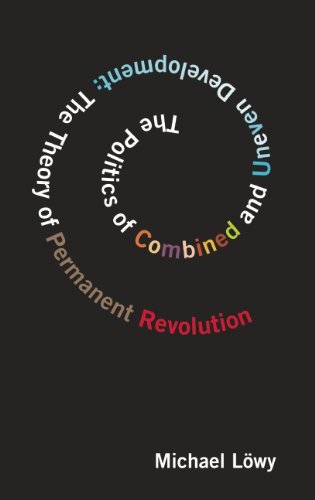
Michael Löwy, The Politics of Combined and Uneven Development: The Theory of Permanent Revolution, Haymarket Books, 2010.

Whenever the inherent contradictions of the capitalist system have developed into an overt crisis, the unevenness of capitalist development has acted as a sort of pressure-release mechanism. In our neoliberal times, the unevenness can be seen on many levels – from the formal labour-informal labour binary to the so called North-South divide. To maintain its rate of profit in the face of proletarian struggle (and/or the tendency of the rate of profit to fall), the capitalist class found, like always, new avenues to exploit. When the accumulation of absolute and relative surplus value became problematic, like it so often does, capitalism turned yet again to its so-called ‘originary moment’ – primitive accumulation. As such, primitive accumulation is still very much a part of our present. For instance, today in India, the capitalist system is turning to those pockets that it had kept in reserve (literally) for so long. In backward, agrarian and/or tribal regions, plans are in motion for the acquisition of resources.

A few centuries ago, when capitalism first took over Western Europe, the whole of India was one such pocket, which the British managed to tap. In coming ouLowy's bookt of colonialism, the bourgeois leadership of the Indian National Movement took the road to capitalism (albeit via a ‘maturing’ period, which we traditionally call the ‘mixed economy, in which the state systematically developed infrastructure that was handed over to private ownership in 1991). That very road has led us here: unevenness of capitalist development within the same country, and the colonisation of one part of the country by another.
Was there any other route that would have possibly evaded the destruction that the chosen path cannot seem to leave behind? Could India have leapfrogged over the ‘capitalist stage’? The various communist parties of India did not seem to think so at the time (most, if not all, do not even now). The ‘iron laws of history’ would not allow any form of a leap over capitalism, and into socialism. This was the view, in fact, of the entire Communist International and its participant parties since the death of Lenin, as we shall see below; and this, despite the success of the Socialist Revolution in Russia in 1917.

Half-a-century before a ‘free’ India took to capitalism, Leon Trotsky was contemplating questions about the possible roads out of feudalism for Russia. Marxist though he was, Trotsky’s conclusions defied what had become common sense in Marxist circles. This common sense believed in the objective necessity of capitalist development before socialism. Against this view, that history progresses through fixed, determined stages, Trotsky, and later Lenin, began to argue for the possibility that Russia might not have the same historical trajectory as the western capitalist countries for which Marx had produced the schema of feudalism-capitalism-socialism. In fact, according to Trotsky, the unevenness of capitalism was a pre-condition for a possible leap towards socialism for Russia.

It is one of the arguments of Michael Löwy’s book, that it was Trotsky’s and Lenin’s dialectical understanding of history, and the consequent direction it provided to the 1917 revolution, that the objective possibility was transformed into an actual socialist revolution. In demonstrating this, the book undertakes the very relevant and important theoretical task of evaluating Trotsky’s theory of permanent revolution in the context of the situation in countries peripheral in the capitalist system. The essence of the argument is that the same unevenness that in times of crises helps capital recuperate is also potentially its grave. If escape routes become enemy camps capital would have nowhere to run.

It is this belief in the possibility of one uninterrupted, combined and permanent revolution from the pre-capitalist to the socialist stage that disappeared somewhere between Trotsky and Lenin, and Stalin. The ‘permanentist’ perspective of the Comintern under Lenin, for revolution in all backward countries, was also replaced by the ‘stagist’ ‘neo-Menshivism’ of Stalin. It was again asserted that capitalist development under bourgeois leadership was a necessity for all countries before a socialist revolution becomes possible. The Indian communist leaders too thought that they should give their complete support to the bourgeoisie in the anti-imperialist struggle. Undoubtedly, this would have had a weakening influence on the working class movement on the ground. And ever since Independence, the mainstream communist parties, as a consequence, have struggled and failed to move beyond social-democratic reformism. That has been on account of their inability, or unwillingness, to pose the question of democratisation, which in India doubtless continues to be the principal political question, as one of overcoming capitalism (see note-1).

Of course, there is no more any question of India or any other country skipping the capitalist stage and entering socialism; we are now completely immersed in it. The relevance of the theory of permanent revolution still holds because the capitalist world continues, as is its wont, to be uneven. Michael Löwy’s book may be considered a first step towards regrounding Trotsky’s theory in the present context.

* * *

Löwy’s exposition of the theory of permanent revolution begins with Marx and Engels. The first chapter discusses their writings with the purpose of determining how much Trotsky really deviated from the essence of the perspective and method of Marx and Engels. In the process, Löwy also attacks those readings and critiques of Marx and Engels that attribute to them a mechanical economism and evolutionism. Löwy convincingly argues for the essentially ‘permanentist’ tenor (which increased with time) of Marx and Engels’ writings. Although many passages can be quoted, without distorting their meaning, that lend support to a stagist understanding of history, in the very same writings as well as others, Marx and Engels do shift towards permanentism.

The concept of permanent revolution appears in their writings mostly in the form of ideas and intuitions, not as a coherent theory. The most coherent statement of their view of permanent revolution is to be found in The Address of the Central Committee to the Communist League. While condemning the alliance with the bourgeoisie, the Address champions the common action between the proletariat and the democratic parties of the petty-bourgeoisie. This alliance too must be made keeping in mind the larger aims of the proletariat: ‘to make the revolution permanent’. The Address already contained three themes that would become fundamental to Trotsky’s theory: ‘(1) the uninterrupted development of the revolution in a semi-feudal country, leading to the conquest of power by the working class; (2) the application by the proletariat in power of explicitly anti-capitalist and socialist measures; (3) the necessarily internationalist character of the revolutionary process and of the new socialist society, without classes or private property’ (15).

After demonstrating that the basic underpinnings of Trotsky’s theory of permanent revolution are in fact to be found in the writings of Marx and Engels, Löwy, in the next two chapters, explores how the theory was developed with the experience of ‘living revolutions’. While doing so, Löwy juxtaposes Trotsky’s perspective with that of his contemporaries (and also later commentators). This helps bring the stagist and permanentist perspectives in stark contrast as these influential thinkers embody one of the perspectives in their deliberations on the revolutions of their age; sometimes this binary emerges as different moments in the political thought of the same person. Löwy identifies Plekhanov, Kautsky and the Mensheviks, and later, Stalin and the Comintern leaders under his leadership (all in theory but not in practice) as giving voice to the stagist perspective. They believed that a semi-feudal and backward country like Russia must first witness a bourgeois revolution to be led by the bourgeois class itself, undergo capitalist development to its ‘exhaustion’, and then finally welcome socialism. It was to be an automatic, step-by-step process. The level of ‘maturity’ for socialism might vary slightly in each conception, but they all agreed that some capitalist development was essential.

Lenin and Luxemburg too had characterised the 1905 revolution as a bourgeois revolution with necessarily bourgeois tasks, again a stagist view of history. They did not, however, believe that the revolution would be led by the bourgeois class, but by the proletariat and the peasants. By 1917, both had begun to agree with Trotsky, that the revolution would be led by the proletariat, with support from the peasantry. More significantly for Löwy, since he puts great effort in countering what he calls Stalinist distortions of Leninism, Lenin had made a permanentist turn after his philosophical engagement with the dialectical method in 1914. Under his leadership (and Trotsky’s, who had joined the Bolsheviks in 1917), the Bolshevik Party led a revolution that let its logical development carry itself towards socialism, not in spite of Russia’s relative backwardness but because of it. To understand what this statement means is to understand the essence of Trotsky’s theory of permanent revolution.

Trotsky’s starting point, Löwy writes, was Labriola’s dialectical and anti-dogmatic Marxism. Labriola’s emphasis on totality and his appreciation of the essentially critical nature of Marxism are evident in Trotsky’s theories and the ease with which he could contradict Marxian orthodoxy. It is his grasp of the dialectical method that sets him apart from the somewhat static and mechanical evolutionism of Plekhanov and Kautsky.

Löwy presents five fundamental features of Trotsky’s method that form the basis of the theory of permanent revolution.

  1. Unity of opposites: Trotsky saw a dialectical unity between the ‘democratic dictatorship of the workers and peasants’ and the ‘socialist dictatorship of the proletariat’. Consequently he criticised the early Bolsheviks for drawing rigid distinctions between the two, and also the Mensheviks for their even more stagist view.
  2. The viewpoint of totality: For Trotsky, the maturity of capitalism, and a country for revolution, was always to be assessed on an international level. When capitalism has bound the whole world in one mode of production, then class struggle too must become a world-process rather than be restricted by ‘national economic determinism’ (49).
  3. Anti-economism: Unlike Plekhanov’s unmediated reduction of all social contradictions to the economic infrastructure, Trotsky’s dialectics grasped the importance of the ‘subjective’, and rejected the notion that the revolution depended ‘automatically’ on a country’s technical development and resources.
  4. Historical method: Trotsky’s study of social formation was concerned with the possibilities of a revolution. His is an open historicism, not fatalistic like Plekhanov’s. That is, Trotsky saw historical development as a contradictory process where alternatives are posed at every moment. He saw ‘permanent revolution towards socialism as an objective possibility…whose outcome depended on innumerable subjective factors as well as unforeseeable events…’ (Italics original, 50). Success or failure was not inevitably assured by any one factor. Thus revolutionary praxis had a central place in Trotsky’s politico-theoretical system.
  5. Russian social formation: Most Russian Marxists tended to deny the specificities of Russia’s social formation in their fight against the Narodniks, and insisted on its similarity with Western European development. Trotsky, however, achieved ‘a dialectical synthesis of the particular and universal, of the specificity of the Russian social formation and of the general tendencies of capitalist development…[He] was able to simultaneously transcend-negate-preserve (Aufhebung) the contradiction between populism and Menshivism, and to develop a new perspective, which was both more concrete and less unilateral’ (italics original, 51).

Using the above methodological guidelines, Trotsky’s analysis of Russia and its class structure was quite different from that of the thinkers mentioned above, and so were his strategic conclusions. Parvus, a very important contributor to the development of Trotsky’s thought, had already (in 1904-5) realised the peculiarities of Russian social formation: that early Russian towns and cities were administrative-bureaucratic in function rather than economic, and hence the artisans and petty-bourgeoisie, the base of revolutionary democracy, were weaker than in Western Europe. With capitalist development in the nineteenth century, the factory concentrated the proletariat hugely within urban centers. Trotsky found the Russian bourgeois class to be small in number and mostly of foreign origin, and hence isolated from the people. Therefore, for him, the Russian bourgeoisie, small and weak, and more afraid of the armed proletariat than of the Cossacks, was not revolutionary and would betray the democratic revolution whenever it went beyond its control or against its interests. Compared to the bourgeoisie and the petty bourgeoisie, the socio-political weight of the Russian proletariat was much more. Thus the proletariat was the only true revolutionary class. Hence, Trotsky proposed the following formula in 1905: ‘the dictatorship of the proletariat supported by the peasantry’.

This went against the Menshevik insistence on a bourgeois leadership and revolution, which was based in mechanical economism. It also goes against Lenin’s 1905 formula of the ‘democratic dictatorship’ of the proletariat and peasantry. Trotsky’s objection to this formula was that it might restrict the revolution to the level that the peasantry was comfortable with; it would have remained a bourgeois revolution (35). In Trotsky’s scheme the proletariat was to be decidedly hegemonic, that is, it would not stop short of supporting the workers’ interests in the town and the village. And this alliance, in his scheme, was decidedly transitory. Löwy writes that for Trotsky, the proletariat could count only on the passivity and ignorance of the peasantry to gain its support but that too only till the ‘rich peasants’ realised what the revolution was heading towards. When the proletariat state applies its uncompromisingly socialist policies, just as Trotsky believed it should, it would lose the support of the landed peasantry and a counter-revolution would be inevitable (55-56).

The solution to the problem, Trotsky believed, lay in the international working class movement: the Russian revolution must be extended to the rest of Europe if the proletarian state in Russia is to survive the loss of its allies. The fate of the socialist revolution in Russia was to be decided less by its economic backwardness than by the politics of national and international class struggle.

As has already been indicated, Trotsky did not differ from the Mensheviks and the early Bolsheviks only on the issue of the ‘class nature’ of the revolution; he also differed from most Marxist thinkers of the time over the issue of the ‘historical tasks’ of the revolution (54). Not only did he believe that the proletariat would lead the revolution, he also thought that the revolution could and should combine democratic and socialist tasks into one combined, uninterrupted, permanent revolution. Why? Because by logically extrapolating the dynamics of class struggle in a ‘revolutionary democratic dictatorship’ led by the proletariat, Trotsky concluded that the revolution could transcend bourgeois-democratic limits and take anti-capitalist and socialist measures. Trotsky pointed out that when the proletariat comes to power it would be compelled by the ‘very logic of its position’ to implement ‘collectivist’ measures, unless it were to betray its own class (something the pre-1917 Bolshevik policy would have done). For instance, in meeting even its ‘minimum democratic programme’, if the state supported workers’ strikes, it could lead to widespread lock-outs by the capitalists and the cessation of production. This would necessitate that the proletarian state take over the factories and organise production. Basically, ‘the political domination of the proletariat is incompatible with economic enslavement’ (Trotsky as quoted on p.54). Löwy, at several points in the text, highlights how the political is given its due weight vis-à-vis the economic in Trotsky’s dialectical model.

When 1917 came, Löwy writes, Trotsky’s 1905 predictions came true. The bourgeoisie and their Mensheviks supporters were incapable of completing the national-democratic revolution (see note-2) and satisfying the revolutionary democratic aspirations of the peasant masses. Only the proletarian victory was able to accomplish the crucial tasks of the democratic revolution and emancipate the peasantry from feudalism. Also, once in power the workers’ government of the Bolsheviks, now headed by Lenin and Trotsky, and unwilling to betray its class, could not restrict itself to democratic reform. It was forced by the dynamics of class struggle to undertake socialist measures. Without the dogmas of the Second International, the 1917 Revolution saw two distinct phases of an uninterrupted and combined revolution: ‘from its (unfinished) bourgeois democratic phase in February to its proletarian-socialist phase in October’. For Lenin, the second phase resolved the contradictions of the first phase. ‘With the support of the peasantry, the Soviets combined democratic tasks (the agrarian revolution) with socialist tasks (the expropriation of the bourgeoisie), opening a “non-capitalist road” for transition to socialism’ (63).

* * *

It is on these same lines that Lenin and the Comintern now attempted to frame a general policy for revolution in colonial, semi-colonial, dependent or backward countries: the national liberation movements of the ‘Orient’ must aim for the establishment of soviet-based workers’ and peasants’ power, towards socialism without capitalism. Thus, although specific tactics within each country, especially with respect to alliance with the bourgeoisie, remained controversial, the orientation of the Comintern leadership from 1919 to 1922 to revolutionary movements in the dependent world was in line with the theory of permanent revolution.

It can be seen in Löwy’s exposition how the change in the Comintern’s above orientation was the beginning of the generalization of the theory of permanent revolution to the dependent parts of the world. From 1925 onwards, with the Stalinist doctrine of ‘socialism in one country,’ and the adoption of the ‘four class bloc’ or ‘popular front’ policy for the colonial and semi-colonial world by the Comintern, and the experiences of their repercussions for the Second Chinese Revolution, Trotsky gained certain insights that gave the theory of permanent revolution in countries of peripheral capitalism a very strong dialectical foundation. These insights are scattered in Trotsky’s writings after 1928, The Permanent Revolution and The History of the Russian Revolution being the most important ones. Löwy takes us through a number of these writings, drawing out relevant details from each text to elaborate on Trotsky’s theory of permanent revolution.

The first thing to note is the similarity in the empirical situation of the dependent, colonial and semi-colonial countries with that of Russia and China: the indissoluble dependence of the national bourgeoisie on the imperialists and the landowners, the political weight of the proletariat disproportionate to its numerical strength, the impossibility of an autonomous political role of the peasantry. Also, the very existence of the USSR had its own implications for proletarian revolutionary aspirations and the bourgeois counter-revolutionary tendencies. Having realised these situational factors, Trotsky set out to extrapolate his theoretical understanding of the Russian Revolution to the countries of peripheral capitalism.

The most important historical-theoretical principle for a general theory of permanent revolution however was the law of uneven and combined development, which was fully elaborated in The History of the Russian Revolution (1930). The development of world history becomes qualitatively different once capitalism becomes a world-system. Looking at capitalism as a totality, one will realise that ‘although compelled to follow after the advanced countries, a backward country does not take things in the same order’; it tends to skip and leap over stages that the early capitalist countries went through. ‘The development of historically backward nations leads necessarily to a peculiar combination of different stages in the historic process’ (87). The very existence of unevenness, of advanced and backward countries (and the socio-economic linkages between them), creates a situation in which history progresses through sudden leaps and contradictory fusion.

From this universal law of unevenness derives another law – the law of combined development, a drawing together of the different stages of development. The appearance of modern industry alongside pre-capitalist or semi-capitalist rural conditions creates the objective possibility for the leading role of the proletariat at the head of the rebellious peasant masses. The unevenness of this development becomes the structural foundation for the combination of democratic and socialist tasks in a process of permanent revolution. The advanced capitalist countries solved certain common democratic tasks: abolition of autocracy, liquidation of feudal survivals in agrarian relations of production, establishment of parliamentary democracy based on universal suffrage, and national unification/liberation. Due to uneven development of capitalism, and the existence of imperialism, the democratic tasks of backward countries are similar but not the same. Yet they must be solved through a democratic revolution, or even a bourgeois-democratic revolution since these tasks are quite compatible with bourgeois society. This is not to say, however, that it will have to be led by the bourgeoisie, or that the revolution cannot transcend capitalism.

Uneven development means contradictory combinations of national and international, modern and traditional, ruling classes. Löwy gives the example of China, where at the bottom of the economy, the agrarian capitalists were ‘organically and unbreakably’ linked to feudalism, while at the top, capitalists were similarly linked to world finance. As such they could never have broken these links with landlords and imperialists because they were always more fearful of the proletariat. Hence, the national bourgeoisie could never fully accomplish its democratic tasks. The only condition on which Trotsky would have accepted any (short-term, for long-term alliances were out of the question) alliance with the bourgeoisie was to have no illusions that they would ‘lead a genuine struggle against imperialism and not obstruct the workers and peasants’ (Trotsky quoted on p.92).

In universalizing the theory of permanent revolution Trotsky stressed the role of the peasantry. They were important not only in the fight against feudal productive relations but, as the overwhelming majority in backward countries, they were central to the task of establishing democracy as well. Hence the proletariat had to ally with the peasants to complete the democratic phase of the revolution. Due to their heterogeneous and intermediate character the peasants could not play an independent political role, but had to choose between the bourgeoisie and the proletariat. The incapability of the former to solve the peasantry’s problems made it possible for the proletariat to acquire their support.

According to Löwy, Trotsky’s view of the peasantry contained ‘a very deep political truth’ but if understood in sociological terms, it was contradicted by the course of historical events in many dependent countries. There are instances when Trotsky commits the error of ‘sociologism’ in his understanding of the peasant (93-94). For example, he remained pessimistic about the revolutionary nature of the peasant movements in 1930 China. He also tried to deduce the political nature of the Red Army from its social nature. Since most of them were peasants, Trotsky did not think them to be true communists. Though at some moments he did perceive the anti-capitalist nature of peasant insurgency in China, in general Trotsky does seem to have believed that the peasantry could not acquire a communist consciousness before a proletarian revolution.

Löwy thinks this to be due to the classical Marxist attitude towards the peasantry as a ‘sack of potatoes’. He argues that Trotsky, like other western Marxists, generalised his assessment of European peasantry to the peasantry of dependent countries. Many of them possess very different structural features, such as ‘collectivist village traditions, massive uprootedness resulting from capitalist penetration, very high rates of demographic growth, proletarian or semi-proletarian status of rural laborers on the great plantations’ (96). Thus Trotsky was less perceptive of the specificity of the rural class structure of non-Western countries, and of the revolutionary capacity of their peasantry. Nevertheless, in one of his last works, he wrote:

‘The Narodniks saw in the workers and peasants simply “toilers” and the “exploited” who are equally interested in socialism. Marxists regarded the peasant as a petty bourgeois who is capable of becoming a socialist only to the extent to which he ceases materially and spiritually to be a peasant…It is, of course, possible to raise the question whether or not the classic Marxist view of the peasantry has been proven erroneous…Suffice it to state here that Marxism had never invested its estimate of the peasantry as a non-socialist class with as absolute and static character’ (Trotsky quoted on p.97).

* * *

In the beginning of the fourth chapter, ‘Conclusions’, Löwy presents us with many cases of revolutions strangled due to the stagist and ‘four class bloc’ strategy of the Comintern. The hold that the Comintern and Marxist orthodoxy had on the communist leadership of many such movements, it is contended, restricted them to the bourgeois-democratic phase, and a moderate attitude towards and alliance with the bourgeois class made them vulnerable to coups and attacks. In Spain (1931-1937), Guatamala (1952-4), Chile (1938-47 and 1973), and most starkly in Indonesia (1965) the blind faith in the intentions of their allies, the refusal to arm the proletariat, and the refusal to follow the revolutionary path to its logical conclusion, despite mass support, led to many a bloody defeat.

Furthermore, Löwy adds to his (and Trotsky’s) attack on stagism the fact that no non-European, dependent, peripheral capitalist nation has been able to find stable solutions to national-democratic tasks (see note-2; consider India for instance). Agreeing with Ernest Mandel, Löwy points out that no dependent country has actually become ‘ripe’ for a purely socialist revolution through its process of development like the advanced capitalist countries have; they still have not been able to accomplish the democratic tasks which the advanced countries had completed decades ago. Also, the process of ‘semi-industrialisation’ in the Third World seems to be making it more dependent on imperialism rather than more autonomous. However, Löwy warns against underestimating the ability of bourgeois- and petty bourgeois-led revolutions to accomplish important reforms and establish stable states. To take for granted the instability of these regimes would be to commit the error of political fatalism. Knowing the capabilities of such regimes, the revolutionary, Löwy hopes, would be more determined to prevent their stabilisation, and to struggle for an alternative future.

On the other hand, Trotsky’s theory of permanent revolution has been proven correct by the revolutions in Russia, China, Yugoslavia, Vietnam and Cuba. While three of these were always under proletariat leadership, the Russian and Cuban revolutions started under bourgeois leadership but were soon taken over by the proletariat. All of them had a bourgeois-democratic moment but the democratic tasks in each of them were completed only in the socialist moment of the revolution. This edition of the book does not carry the details of these revolutions that would explain the process of the combined revolution. However, Löwy does discuss the Nicaraguan revolution of the 1960s.

Nicaragua saw a popular insurrection against dictatorship with mass peasant and worker participation. The leadership was largely petty bourgeois but through its struggle, it had developed an anti-imperialist and anti-autocratic programme. Due to the precedent set by the Cuban revolution, and direct support from Cuba, the Nicaraguan revolution developed along communist lines. According to Löwy, the Sandinista National Liberation Front (FSNL) took radical steps: it dissolved the old army and established its own army with soldiers from the guerilla army and the militia, it organised the masses into unions and other organisations, and it enforced its anti-capitalist policies. (Löwy had written this back in 1979. Since then the FSNL has weakened and it would be interesting to know how Löwy explains its trajectory now.)

Löwy, after establishing that Trotsky’s politics passes the test of history, moves on to his ‘sociology’ – his analysis of the roles of the social classes (and social categories). In discussing these – the national bourgeoisie, petty bourgeoisie, intelligentsia, peasantry and the proletariat – Löwy clarifies some of the finer points Trotsky makes on the subject, and tries to make certain amendments in his perspective. It is here that Löwy’s (admittedly slight) departures from Trotsky, some of which we have already come across, become even more clear.

Löwy agrees with Trotsky about the usually moderate nature of the bourgeoisie. Most advanced democratic revolutions, it is asserted, were under petty bourgeois, not bourgeois, leadership. However, he does briefly note that Trotsky, at times, underestimated the indigenous bourgeoisie, especially in the case of India. With respect to the petty bourgeoisie, Löwy agrees with Trotsky that they must eventually choose between the bourgeoisie and the proletariat. On the question of whether the petty bourgeoisie could play a significant role in the revolution, Löwy points out the leading role they played in many Third World countries, at times even going against capitalist interests. Though only for a limited time, petty bourgeois regimes, contrary to Trotsky’s belief, did manage to hold power and forge their own distinctive policies, which Löwy calls a sort of petty bourgeois Bonapartism.

Trotsky had, by and large, ignored the role of the petty bourgeois (and increasingly proletarianised) intelligentsia. Löwy believes the ideology of the petty bourgeois intelligentsia to be a sort of Jacobinism combining ‘plebian democracy and romantic moralism’, like in Rousseau. In peripheral countries, their radicalisation is stronger, compounded by imperialist penetrations, conciliatory position of the national bourgeoisie, and the success of socialist revolutions.

Adding to his disagreements with Trotsky on the question of the revolutionary potential of the peasantry in dependent country which have already been noted, Löwy goes on to highlight the greater uprootedness of the peasantry of the third world due to uneven development and imperialism, which leads to greater radicalisation. Most post-1917 revolutions had the peasants as their main social base. However, here he also complicates the term ‘peasantry’, which tends to conflate a broad and heterogeneous body. The rich or big peasants are usually neutral or hostile to communist revolutions. Borrowing from Hamza Alavi’s analysis of the Hunan struggle (and events in Russia, Cuba, Mexico, Vietnam and Algeria), Löwy argues that in the initial phase of the movement, the greater material security of the middle and small peasantry, allows them to attack the oppressors. Their complete dependence on their overlords holds back the poor peasant and the landless labourer until the struggle has already shaken the local authorities and the landlords. The presence of the Red Army in China, for instance, encouraged the poor and landless peasants to join the struggle. But once they joined, they proved more radical than the middle peasants. This external force that pushes the peasant to rebel and gain a socialist consciousness (even prior to a socialist revolution) still came from the urban intellectual and the proletarian communist vanguard. Without this the peasant struggle may have remained local and ineffective.

However, with increasing industrialisation in the dependent countries, Löwy expects the struggle to shift to the cities, with the working masses playing a more central role, like in the ‘classic’ October revolution. In 1917, the revolution was ‘directly’ proletariat, that is, the Bolshevik Party, was proletariat not only in ideology but also in social composition. In subsequent revolutions, the working class played a seminal part in the initial phases but was largely absent during the seizure of power. In China, Vietnam, Cuba and Yugoslavia, the peasantry was the main social support. To explain this absence, Löwy points to the heavy repression the working class encountered in the early phases of all these revolutions, and also the insistence of communist parties to ally with the bourgeois class. These revolutionary parties were indirectly proletarian, that is they were proletarian in their ideology.

* * *

The last chapter of the book is a 2010 interview of the author with Phil Gasper, which seeks to apply the logic of uneven and combined development and the theory of permanent revolution to the present context. Löwy points out that the capitalist system is still very much characterised by the centre and periphery distinction, and since this is so the theory of permanent revolution remains a topic of central importance. The essence of the theory, its dialectical approach to analysis and the uncompromising praxis that this entails, holds true even though the form of unevenness has changed. When Trotsky first formulated the theory in 1905, Russia had a modern urban industry and a backward rural area. Today we can find advanced and backward elements in both urban and rural regions, as well as among nations (what is figuratively called the North-South divide). This unevenness has given birth to many a movement for autonomy at all levels – local, regional and national. Though there are reactionary tendencies, there are also radical ones whose anti-imperialism has taken international proportions with several nations, in Latin America primarily, combining their efforts for autonomy.

Michael Löwy is quite optimistic about such developments, and also about the so-called global justice movement. Although acknowledging the definite liberal, moderate, and even Keynesian tendencies in the global justice movement, Löwy highlights the stated anti-capitalist goals of the World Social Forum. Although anti-capitalist does not necessarily mean socialist, let alone Marxist-socialist, Löwy enthusiastically claims that many of the participants do indeed hope to create socialism. For Löwy, the kind of international solidarity that is fostered by this movement is not one based on sympathy but more on convergences in the ‘common struggle against a common enemy, neoliberalism’.

The reason for his faith in the global justice movement and the WSF is that he sees it as a forum for combining anti-imperialist, agrarian, democratic and anti-capitalist struggles, none of which can succeed without the others by the logic of the law of uneven and combined development. Whether he is right in his expectations from the global justice movement or the WSF will need further study. However, even if they do not meet the potential that Löwy identifies in them, his general argument would still hold: ‘if movements for national liberation, or agrarian reform, or radical democratisation do not develop, in an “uninterrupted” process, into a socialist revolution, they will sooner or later be defeated’ (154). This is only a ‘conditional’ perspective. But with no Stalinism (read as: restrictions from within the workers’ party), the primary conditions that determine the trajectory of the international movement is the class structure of the participant local movements, an analysis of which is not offered in this book. Without class analysis, the arguments for the possibility that this ‘movement of movements’ could develop into something significant are somewhat hollow.

* * *

The entire length of the book, in delineating the features of Trotsky’s theory, argues for the possibility of permanent revolution in backward, dependent capitalist or non-capitalist nations. In this it primarily uses cases, like of Russia and China, which can no longer be called socialist or post-capitalist. But does the failure of permanent revolution here tell us that the theory is erroneous? It does not. The predictions or hypotheses derived from the theory are, true to its dialectical method, contingent on the political developments in the situation: whether the revolutionary ‘fervour’ can push its leadership (even despite themselves) into following the flow of the process towards an uninterrupted, combined revolution. That is, whether the leadership can see the logical development of a bourgeois-democratic revolution led by the proletarian vanguard into a socialist revolution. But for the various factors pressing on the Soviet leadership (the theoretical and practical Menshevism is the only factor Löwy discusses; there might be others given the spread of the same ideas among most of the Comintern leadership), Trotsky might have been proved right and we might have seen a socialist revolution radiating from Russia. It is characteristic of Trotsky’s dialectical approach to not impose determinist diktats on reality – the political trajectory of a revolution is always too complex and overdetermined for that.

This edition of the book is an abridged version of a much longer book originally published in 1981. What has been reproduced is Part One of the two-part book. Replacing the second part is the 2010 interview of the author that makes for a helpful supplement to the chapters that are republished, though perhaps not a substitute for the chapters that are not. Löwy explains in this interview that Part Two, which contained analyses of events in Russia, China, Vietnam, Yugoslavia and Cuba on the basis of the theory presented in Part One, has become ‘outdated’. Although there still is considerable, albeit scattered, historical analysis in this edition, one cannot help but feel deprived (due, in part, no doubt to references, which were not edited out, to the unpublished chapters that make promises of more in-depth study to come). When historical events are discussed they do sufficiently concretise some of Löwy’s assertions. However, a more detailed study would have demonstrated what is meant, for instance, by the ‘dialectics of totality’ within uneven and combined development and its significance for revolutionary praxis. To better explain how the interests of the peasants are bound to the proletarian revolution, or how the interests of the workers of one nation are bound to those of workers of all nations, and most importantly, how these can be successfully translated into revolutionary praxis, an analysis of the class structure of societies under transformation in the past would have been invaluable.

A great deal of what Löwy has to say on the subject seems to imply that the demise of the Russian and the international working class movement was the result largely of Stalin’s ideological distortions, or at least of the failure of the communist leadership to see what Trotsky and Lenin saw. Would the working class movement have remained strong if it were not for Stalin and the Comintern’s fallacious understanding of history and socialism? The international communist leadership in its entirety might have been convinced that socialism could thrive in one country, while other nations must necessarily embrace capitalism first. But were there really no other factors that worked for the detriment of the working class movement, along with the definite suffocating repercussions of the leadership’s conservatism? The only way to be sure and accurate is to do a detailed class analysis of the conditions in which the proletarian struggle weakened in Russia and other countries where Löwy holds the Comintern leadership directly responsible. One wonders whether the historical analyses in the original edition would have been helpful in this respect as well.

An updated historical analysis would go a long way in not only strengthening the theory of permanent revolution, but also in understanding recent class dynamics, and formulating new revolutionary strategies. For instance, what contingencies created the situations that led to China’s capitalist turn in the ’70s, or even to Cuba’s recent economic ‘reforms’? Would it be right to suggest, as Löwy does for Russia, that the still predominantly stagist and economistic credo of the communist parties is the primary cause?

For us here in India, lessons from Trotsky take on significance in view of the hesitations, on various grounds, of the various communist parties to organise on the basis of proletarian hegemony. Some seem to believe that there is a need to stay with the bourgeoisie until capitalism exhausts itself, while others are still fighting semi-feudalism alongside the rich peasantry, both of them alienating the proletariat in the process. Much of what Löwy says about the inability of the bourgeoisie to fulfill the three national democratic tasks (see note-2) fits the Indian situation like a glove. There is social unrest and mass movements resulting from the failure of the capitalist economy and state on each of these counts. Löwy is also right about the ability of the bourgeoisie to create a more or less stable state despite these failures, if the revolutionary forces do not develop within these locations of unrest and push them towards an alternative.

This book is not only a very helpful introduction to Trotsky’s work but also an important step towards contemporizing the theory of permanent revolution. Löwy limits himself to applying Trotsky to international social (not necessarily socialist) movements. It is obvious that much is still needed. Löwy does not omit the moments of real or apparent contradictions in Trotsky’s work. Attempts to explain these contradictions are convincing on most occasions if not all (perhaps someone more familiar with Trotsky’s texts and his time would be a better judge). But the reader will undoubtedly realise that Löwy’s loyalties, like Trotsky’s, lie with explicating the possibilities of permanent revolution rather than with particular persons or texts.


Notes:

(1) Capitalism, as an ever-expanding social totality, is constitutively contradictory and is thus, in essence, uneven. Such unevenness renders the deficit of democracy (a la primitive accumulation) as much a constitutive part of capitalism as the democracy of competition (a la normal accumulation through market-based economic means and mechanisms). The failure of most Indian communists to grasp this essence of capital is the key reason for their inability to realise that struggles against all forms and kinds of democratic deficit cannot any longer be struggles against feudalism and for the ushering in of capitalism. Instead, such struggles for democratisation must be re-envisaged as movements to unravel capitalism, as a total network of democratic and undemocratic space-times, to go beyond it towards socialism.

(2) A national-democratic revolution according to Trotsky comprises of the following tasks:

  1. The agrarian democratic revolution: the bold and definitive abolition of residues of slavery, feudalism and ‘Asiatic Despotism’; the liquidation of all pre-capitalist forms of exploitation (corvee, forced labour, etc.); and the expropriation of the great landowners and the distribution of the land to the peasantry.
  2. National liberation: the unification of the nation and its emancipation from imperialist domination, the creation of a unified national market, and its protection from cheaper foreign goods; the control of certain strategic national resources.
  3. Democracy: for Trotsky this included not only the establishment of democratic freedoms, a democratic republic and the end of military rule, but also the creation of the social and cultural conditions for popular participation in political life by the reduction of the working day to eight hours and through universal public education.” (89)
A Review of “Marx’s Capital: An Introductory Reader”

Pratyush Chandra

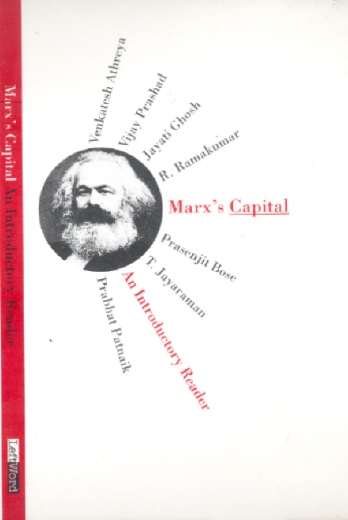
Prabhat Patnaik et al, Marx’s Capital: An Introductory Reader, LeftWord, 2011, pp 135, Price: Rs 200.

There is a tremendous renewal of interest in Marxism throughout the globe today, especially for the explanation of the economic crisis that has hit capitalism recently. It was quite natural that the only well-organised segment of India’s left intellectuals committed to theoretical endeavours in political economy sensed the need to popularise Marx’s Capital. Much to the discomfort of the radical/revolutionary left, the fact is that though this segment is broadly organised around the official, parliamentary Left, which is in a deep crisis of confidence today, its research and theorisations have more or less informed the practice and understanding of the whole of the Left that matters in India. This small book of roughly 135 pages, in my view, shows how much the mainstream Indian Left owes to Marx’s Capital.

This introductory reader claims to provide “some basic formulations” on Capital that are “stated explicitly”, but it is not just a “preliminary explication of Marx's Capitalconcepts”, rather it “has endeavoured to go into matters of advanced theory”. It contains seven essays – the first two are foundational, the next four essays “graduate from basic concepts to theoretical discussion and debates”, and the last essay is advanced. What is the function of an introductory reader for a theoretical work, if not to expose the readers to the basic conceptual structure or framework that characterises it? Of course, it need not shy away from taking strong positions on what the author(s) of the ‘reader’ think to be the deficiencies or inconsistencies in the structure. But we do expect them to present the basic formulations underlying the structure honestly and explicitly, giving us a glimpse of the rigorous conceptual edifice that these formulations imply.
The first essay by Venkatesh Athreya is rather motivational. Athreya narrates his personal experience with Capital – it changed his life. Being an engineer “with an inclination to analytical argumentation”, he was quick to figure out that Marx’s arguments in Capital are logical. As he read more, he found something else – “Capital read like poetry”. Then he enumerates what he found in Capital as “an engineering graduate trained in mathematical economics”. In fact, Athreya considers reading Capital to be “immensely, immeasurably, rewarding”. He goes on to tell us how people from diverse walks of life and interests can enjoyCapital in their own manner – those “who enjoy a historical account” should read the part on Primitive Accumulation, “Militants of the working class movement may find Parts III, IV and V… more immediately interesting than the rather abstract opening chapters”, “engineers and technologists will find absolutely fascinating Marx’s treatment in Chapters XII, XIII and XIV”, even environmentalists can see how “Marx anticipates some of the contemporary ecological concerns”. “Capital is thus not a daunting read”, but “a delightful read” and “eminently readable”.

In this jungle of adjectives and hyperboles, if one insists on locating a central insight (besides that Capital is “a great read”), I think it would be the author’s ‘something-for-everybody’ approach. Athreya explicitly propagates an eclectic reading of Capital when he states:

“There is no particular order in which the book has to be read, and each reader should decide, based on his or her prior preparation and inclination the sequence of reading.”

Apparently, this statement is harmless as the purpose is to motivate readers to take Capital in their hands. However, any serious Marxist knows the relative theoretical and practical consequences and implications of various orders in which Capital is read. These orders, in fact, reorder the conceptual framework inherent inCapital, leading to diverse schools within Marxism, and intra-Marxist debates. This is not a plea for any single reading of the text, as who can deny the fact that diverse ways of approaching the text can unearth various conceptual possibilities therein. But this relativism must not become an apologia for denying Marx his own original and consistent way of developing arguments and framework, his own way of approaching im-mediate reality through conceptualisations placed at various levels of abstraction. These levels cannot be reduced to a catalogue of concepts which you can pick, choose and use anywhere.

The next essay is Vijay Prashad’s ‘Writing Capital’, which provides us an interesting ‘biography of Marx’sCapital’. It shows how Marx’s personality, even his “coat” morphed into his writings. However, Prashad, otherwise an erudite and very careful writer, makes a crucial factual error about Marx’s own intellectual biography. He finds the difference between labour and labour-power already introduced in Marx’s 1849 work,Wage Labour and Capital. In reality, it was introduced by Engels in its pamphlet edition in 1891. Engels clearly writes in his introduction to the pamphlet:

“…this pamphlet is not as Marx wrote it in 1849, but approximately as Marx would have written it in 1891. Moreover, so many copies of the original text are in circulation, that these will suffice until I can publish it again unaltered in a complete edition of Marx’s works, to appear at some future time. My alterations centre about one point. According to the original reading, the worker sells his labour for wages, which he receives from the capitalist; according to the present text, he sells his labour-power.”(1)

In fact, Marx didn’t make this distinction even in his Contribution to the Critique of Political Economy that was published in 1859.

Let us now move on to the essays that graduate the readers “from basic concepts to theoretical discussion and debates”. It begins with Jayati Ghosh’s “Reading Capital in the Age of Finance”. The essay starts with defining capital. Ghosh touches upon the concept of “commodity fetishism”, where she confuses between the fetish-character of commodity relations and fetishism that ensues from those relations. This conflation feeds the reformist approach of “policy” Marxists who are lost in fighting specific fetishisms of particular juridical and accumulation regimes. She explains primitive accumulation, which she finds to be a continuing reality, but she is unable to locate it in the constitution of capital – in the fact that primitive accumulation is not just the historical presupposition, but also the constitutive presupposition of capital. Therefore, for Ghosh, as others in this introductory reader, primitive accumulation is always seen in terms of socio-geographical expansion of capitalism – capitalism meeting pre-capitalism. This notion of primitive accumulation is unable to explain the bourgeois endeavours to transcend the barriers in the accumulation process from within the critical framework of Marx’s Capital. This forces “economists” like Ghosh to borrow concepts from non-Marxist approaches without considering that these concepts do not have any organic foundation within Marxism, and can, therefore, be contradictory to its fundamentals.

The import of concepts and even methods in order to correct the “deficiencies” of Marx’s approach, without going into the abundance of debates within Marxism that these so-called “deficiencies” have generated is the hallmark of the whole essay. Noting the historical limitation of Marx’s understanding of financial markets, it calls for elaborating on Marx’s limited insights with the help of Kindleberger, Minsky and Kregel, none of whom were ever Marxists. There is no mention of rich debates on Money and Finance (especially after the publication of Suzanne de Brunhoff’s book) that have continuously engaged Marxists since the 1970s. Similarly, Ghosh seems to be unaware of the works of Marxist radicals like Harry Cleaver (who even engaged in the famous Mode-of-Production debate in EPW with Utsa Patnaik and others) and various Marxist-Feminists like Mariarosa Dalla Costa, Selma James among others (most of them were part of the movement for “wages-for-housework” in the West) who greatly enriched the Marxist understanding of reproduction and reproductive labour, basing it on the labour theory of value and reproduction of labour-power.

R Ramakumar’s “Agriculture and Rural Society in Capital” at least concentrates on interpreting what Marx says. As expected, it starts with the concept of primitive accumulation and its relationship with the commodification of labour power. In his endnotes he criticises David Harvey for using primitive accumulation to understand expropriation in later stages of capitalism. This relegation of primitive accumulation to temporal prehistory is just another example of the reduction of Marxist conceptual architecture to an unmediated description of capitalism – an exercise which is rampant throughout the present collection. The author is not aware of the problems of the exclusively historicist reading of primitive accumulation – which is nothing but a Smithian reformulation of the concept which Marx himself criticised in the chapter on primitive accumulation, by comparing its reception in political economy with theological “original sin” – reducing the misfortunes of humanity to a distant mythical past.

Ramakumar summarises the various chapters in Capital on primitive accumulation and the agrarian transformation in England. He talks about variations in agrarian transformation from the English path in other geographical locations – about Prussian, American and ‘Asian’ paths. He describes Lenin as an enthusiast of the American path of capitalist development in agriculture – pinning Lenin’s criticism of the Prussian (landlord) path to the single point that “it retained elements of the feudal society”. However, as always, there is a problem in such appropriation of Marx’s and Marxists’ critique of political economy in a prescriptive mode – this sanitises them of their politics. It must be remembered that Lenin’s enthusiasm was not due to the Prussian path being less capitalistic, but because of the epoch of capitalism which Russia was in (i.e., “the epochpreceding the final consolidation of the national path of capitalism”), where the struggle between landlords and the peasantry over the path of agrarian development was very strong and the result of this fight was still open-ended.  The concrete “course of events, the facts and the history of 1905-07″, “the law of June 3, 1907, and by the composition and activity of the Third Duma, and—a detail—by November 20, 1909, and (what is especially important) by the government’s agrarian policy brought the agrarian question to the centre-stage as the “the national question of the final consolidation of bourgeois development in Russia”.  In such an epoch, struggle for the peasant (American) path to agrarian development would strengthen the arms of the working class, by bringing the peasantry under its leadership – by making the workers-peasants alliance possible. Lenin’s perception about the radical potentiality of these alternatives was clearly epochal, i.e., was not settled once for all – “In Germany the support by the workers of the desire of the “muzhik” to get for himself (i.e., for the muzhik) the land of the big landlords—the Junkers—is reactionary.” Lenin explicitly states: “a Marxist must not “vouch” for either of these ways, nor must he bind himself down to one of them only.”(2)

In India, Leninists have generally essentialised the agrarian question, without going into epochal analyses – whether a national path of capitalism has consolidated in India or not (whatever its specific character be that may or may not be akin to the ideal types). Growing impoverishment, inequalities and continuing stagnation in agriculture cannot themselves make the agrarian question “the national question”.

Ramakumar’s discussion of usury and absolute rent is useful but highly skewed when it comes to their pre-capitalist roots. The proper Marxist way of analysing these phenomena would be to show how capitalism exists and expands despite and through them. If financial liberalisation seems to encourage a networking of moneylenders “by providing them with incentives”, rather than their elimination, it evidences the specific epochal character of capitalist accumulation under neo-liberalism that could use the service of moneylenders to intensify accumulation and financialisation. Similarly, if Junker-style landlord capitalism preserves “a number of pre-capitalist elements”, that is not a sign of incompleteness of transition in itself. Nor is the coexistence of subsistence farming with capitalist cultivation and rent that squeezes wages and profits (of tenant farmers) necessarily pre-capitalist. They may define the spatio-temporal specificity of an empirical capitalism.

Most illuminating is Prasenjit Bose’s piece that makes mincemeat out of Marx’s dialectics and levels of abstraction. He really has constructed three stories. The first story of class exploitation confuses Hindu concepts of Maya and Brahman with the dialectic of appearance and essence, contingency and necessity:

“The starting point of the first story is that the realities of the world are not visible at its surface. More specifically, what is visible as the capitalist world around us is a veneer underneath which lies the actual apparatus that drives the system.”(78)

The second story of accumulation and crisis runs parallel to the first story. This notion of “parallel” rejects the concept of embeddedness and the law of internal dialectics that characterise Marx’s methodology and worldview. The third story is of course a (hi)story of capitalism, in which the “so-called primitive” accumulation is actually dumped to the prehistory of capitalism, but which nevertheless acts as the Newtonian primeval push behind capitalism.

Since there is no conception of mediations, the value theory is better glossed over as some thing unreal, valid only in some ideal free competitive capitalism, essential tendencies are reduced to symptoms – as crisis to a telltale underconsumptionism, surplus value to profits, and the whole conceptual rigour of Capital to another descriptive theory of poverty and income inequality.

But the real gems are Bose’s conception of “imperialist exploitation” and “labour reserves”. His Leninism makes Lenin stand on his head – the objects of imperialist exploitation have yet “to graduate from their present stage of imperialist exploitation to the stage of capitalist exploitation”. So much for “imperialism, the highest/latest stage of capitalism”. Further, imperialist exploitation creates labour reserves, which consist of people poorer than those in the US. They are “the unemployed, underemployed, informal wage workers and self-employed petty producers in the urban areas along with the peasants and landless agricultural workers in the rural areas”. Their presence keeps wages to the subsistence level. Also, the “category of ‘reserve labour’ is conceptually different from the ‘reserve army of labour’ in Capital, which basically implies the unemployed under capitalism.” Hence, the unemployed under capitalism is different from the unemployed under imperialism. In Bose’s extended framework, “a person can belong to ‘reserve labour’ even when she is informally employed”. All these characteristics of this novel conception are not available in Marx’s framework of reserve (floating, latent and stagnant)! Thence follow all sorts of novelties, for example the following:

“The diffusion of capitalist development in the poor countries has not led to a universalization of capitalist exploitation. It has rather created enclaves of capitalist exploitation, esconced within the overall landscape of imperialist exploitation.” (94)

This universalisation is not taking place because capitalism “ultimately remains a crisis-ridden system incapable of continued expanded reproduction. Periodic crises, which inevitably recur under capitalism, destroy capital and constrain its productive forces. This makes it systemically incapable of absorbing the ‘reserve labour’ by providing it with gainful employment.” (95)

This is indeed a novel conception of capitalist expansion, which obviously Marx didn’t have – capitalism expands only when everybody is provided “gainful employment”.

Prasenjit Bose has another (the fourth!) story about Capital to narrate – the political story. He has his own definition of the Marxist conception of revolution – “a revolution by the workers against monopoly capital.” InCapital, he finds, Marx envisaging a ‘pure’ proletarian revolution and that too in advanced countries, which obviously didn’t occur. What is possible is “a democratic revolution based on worker-peasant alliance against imperialism and monopoly capital” (characteristically the leadership of the working class is missing). In fact, now the classes comprising ‘reserve labour’ have come to the centre stage of political and revolutionary mobilisation – peasantry, rural labourers and “the unemployed, underemployed, informal wage workers and self-employed petty producers in urban areas”.

“It is on the bedrock of this revolutionary alliance between workers and ‘reserve labour’, against imperialism and the domestic ruling classes that the next tide of revolutionary transformations in this century has to be based.”(102)

T Jayaraman does well to bring out the contradictory implications of technological development and the historicity of technology, despite inheriting the overall ideological baggage that unites this priceless collection of essays. However, at no point does he demonstrate the ability to go beyond the linear conceptualisation of techno-development. Technology seems well and fine – harmless, the problem is under whose political command it is placed and who monopolises scientific and technical knowledge. There is no attempt to understand the constitution of technology itself as an arena of class struggle – how the direction of technological development too is class-determined.

Prabhat Patnaik’s contribution can definitely be called advanced, not just in comparison to other texts in this reader, but also at the level of arguments – it is a typical, yet distinctively neat ‘underconsumptionist’ presentation of the dark world of neoliberalism. Neoliberalism brings capitalism almost to a dead-end (and perhaps to an explosion too) – with real wages collapsing even in advanced economies, which are thus increasingly facing severe problems of realisation, with labour reserves bulging throughout the globe. Backward economies could escape the realisation problem (perhaps, for the time being) because of the relaxing of the export regime, yet workers there too should expect only precariousness as labour reserves could not be absorbed even by the opportunities created by capital immigration. As the rich in these economies have been emulating the lifestyles of the western rich, technology that is being used is more and more labour productive. Hence, even in these backward economies there is no depletion of reserves and increase in wages. Thus, at the aggregate level it seems accumulation is increasingly reaching its limits.

Patnaik builds his arguments from Marx’s observation that wage fluctuations are linked to variations in the size of the reserve army of labour. However, he improves upon it by inserting the notion of the “threshold level” of the labour reserve – real wages can be impacted upon only if the size of the reserve is brought below this level, while above that level, real wages will be stuck at the subsistence level and any productivity increase will fill the capitalists’ pockets. Prior to neoliberalism, real wages were increasing in the advanced economies because of the absence of any linkage between the real wages in these economies and the labour reserves in backward economies. But neoliberalism destroyed this segmentation.

Without going into a detailed discussion of the problems of underconsumptionism, we can enumerate a few of them that problematise the empirical basis of Patnaik’s arguments. Firstly, there is an overstatement of the significance of real wages in the constitution of effective demand. Even if we count the workers’ share in the national income, real wages are just one part of this share. There are other elements of the “variable capital”, but accounting them would imply not just empirical, but conceptual dislocation of underconsumptionism – workers’ compensation (viewed as variable capital) is part of capitalist investment which is not expended upon the output of their current activities, but of previous activities.(3) Secondly, even in the US (which has been the centre of the recent crisis) long-run productive investment has been growing faster than personal consumption (the fact which underconsumptionists consider impossible), so why should there be the problem of realization, as any demand gap could easily be taken care of by the former (4)?

However, much more interesting are the unique political implications of Patnaik’s analysis that he himself derives in his paper. Since globalisation or neoliberal integration of national economies has led to a generalisation of poverty, the only way through is by delinking the national economy from the global. He is among those few intellectuals claiming to uphold the legacy of Marxism and communism, who vocalise anti-internationalism in such a clear manner, as in this article. Prabhat Patnaik finds no place for the utopia of internationally coordinated struggles in his scheme of future. But he has enough utopian conviction to see the possibility of delinking the local economy from the global economy. He thinks that only this will improve the conditions of workers in any country – as workers cannot wait for a new World State. But why should they wait at all – even for a state that will realise the autarkic utopia? The Marxist plea for proletarian internationalism was not an apologia for the statist planning for social welfare (national or international), but a movemental vision based on the objective understanding of class struggle within capitalism leading the Marxists to envision the possibility of an eventual withering away of the state. Even at the height of the nationalist moments in their struggles, Marxist revolutionaries have tried to locate themselves in the international working class movement.

Despite objections to Patnaik’s analysis from Capital’s standpoint, one cannot deny its coherence and its being part of the legacy of a dominant stream within what has come to be known as Marxism. However, in an introductory reader for Capital, one at least expects him to provide an insight that relates the story to the analytical intricacies (and problems) in Capital – why is the production-for-consumption’s sake approach superior to Marx’s production-for-production’s sake approach in explaining capitalism? How is Marx’s understanding, that effective demand originates entirely with the capitalist class (as workers’ compensations too are investments, M-LP) defective? What are the problems of other explanations of crisis that find support in Capital (at least more than underconsumptionism)?

Such omissions are rampant throughout this reader. They demonstrate a refusal to engage with the logical structure of Capital and its theoretical-practical implications. Most importantly, there is a complete absence of any discussion of the labour theory of value, which is not just the foundation of the conceptual architecture inCapital, but is also what connects the concepts located at various levels of this architecture with one another and without which these concepts would be reduced to mere nomenclatures. In this reader, the concepts that Marx developed in Capital are used only for typological purposes, to name and describe apparent phenomena.

However, this introduction does show that Marxism is not “a set of religious beliefs or dogmas that claim to contain every truth about the world within its texts” – it has enough space for intellectual creativity. But religion has another aspect too – the dogmas or texts need not be followed; however they must be sworn upon, after which you can say or do whatever you like. This is what much of this volume has reduced Marxism to.

Notes:

(1) Frederick Engels, “Introduction to Marx’s Wage Labour and Capital“, 1891.

(2) VI Lenin, “Letter to Skvortsov-Stepanov“, December 16 1909.

(3) Anwar Shaikh, “An Introduction to the History of Crisis Theories” in U.S. Capitalism in Crisis, U.R.P.E., New York, 1978.

(4) Andrew Kliman, “Lies, Damned Lies, and Underconsumptionist Statistics“, With Sober Senses, 2010.

Rethinking the Popular: Investigating the Who/What/Why of the Anti-Corruption Campaigns

Subhashini Shriya

We recently saw the middle class rise up to the occasion to bring about, what in a flourish was termed, a “Revolution” against corruption. While the emotions and the anger that informed the launch of such an offensive against the regime can hardly be denied or dismissed, the “revolutionary” potential of the movements led by Ramdev and Hazare were grossly suspect and revealed a tendency to preserve rather than change the status quo. Is there another way to address the chagrin the middle classes feel against the dysfunctional state of the system, something they encounter and experience in the rising pressures on their everyday life as examples of corruption? Are instances of corruption aberrations in the functioning of the state or are they, instead, central to its very logic of monopolising the control over common resources in the process of mediating their appropriation by the forces of capital? Can corruption be eliminated without ridding politics of the concept of a nation-state and the capital it serves? And what would the logical orientation of a movement that seeks to address the issue of corruption as a problem integral and intrinsic to a capitalist organisation of the social and the economic be?

The centrality of the malaise of corruption in the self-image of the country has had a long history. Through the all-pervasive bureaucratic regime of the licence-permit raj to the increasingly privatised neoliberal economy that has emerged over the past two decades, corruption has been most readily identified as the primary cause of the failure of the state to deliver on promises of social welfare: the decrepit infrastructure in most parts of the country, the inefficiency of the state, the unyielding and indifferent attitude of the bureaucracy towards the people and much else. Seen as the misuse of public office for private profit, the issue has sounded the death knell of powerful regimes such as that of the Congress in 1989, post Rajiv Gandhi’s alleged involvement in the Bofors scam. That, however, has always been just as far as the discontent of the masses would drive their agenda of much dearly felt need for ‘change’. The mass disillusionment with the functioning of the state repeatedly gets articulated in the form of disenchantment with the functioning of this or that government, mostly resolving into some patching up in the superstructure of the existing regime of accumulation so that the regime is increasingly insulated from the impact of the political. As a result, this politics of mass disillusionment and disenchantment remains pigeonholed within the electoral democratic process; what with capital and the institutionalised embodiment of its logic in the state reconfigure themselves to accommodate the limited demands of such movements and/or destroy the movements by sheer brute force. The anger frustrated, finally fades away till the time another major expose is fed to the people by the mass media and the Opposition takes its place firmly by the side of the people, ready to take its turn on the other end of the equation between the ever-thwarted masses and the ever-triumphant state.

A quick look at the recent scams to have rocked the country, be it the one over allocation of 2G spectrum to telecom companies or that involving Reliance India Ltd. and the petroleum and natural gas ministry over the extraction of natural gas in the Krishna Godavari basin, makes it amply clear that the core of the debate here is not the small amounts that an average middle-class citizen of the country forgoes at every interface with the government in the form of bribes, but the misappropriation of huge sums of money and transactions between members of the state and multinational corporations and big businesses capturing the resource base of the country by means that appear to be outside the pale of the law. What becomes the benchmark of acceptability within such a perception of corruption is a law which, even on its own terms, is designed for facilitating access of big international capital to the natural resources of the country (in the form of laws such as the Land Acquisition Act 1894) and a state fully integrated in an international economy geared towards private profit-making and ever-intensifying accumulation of capital.

What gets obscured in such an understanding of the phenomenon is that the rule of law, which most anti-corruption impulses and movements pose and derive their legitimacy from, is as much intrinsic to the system of capital accumulation as the absence of the law is indispensable to it. Capital as a historically specific social system is programmed to maintain and reproduce itself through its constant expansion and intensification, thanks to the structure of its power being political-economic. That is the heart of the reason why capital is always on the lookout for fresh terrains of investment and profit-making that is constitutive of an ever-heightening process of commodification of resources. It is this process of perpetual commodification that has through history, starting as far back as the movement to enclose the agrarian/pastoral commons in 13th century England, given unto us the capitalist system or dynamic that is inherently driven to constantly militate against its own boundaries, articulated in the form of laws to regulate the twin-processes of production and reproduction, to maintain itself through its expansion and intensification. Clearly, the law and its exception constitute, in their mutual complementarity, capital and its historically specific process of accumulation. In fact, every violation of or exception to a law is almost always the founding gesture of a new law. That is the self-cannibalising essence of capitalism called creative destruction through which it beats its multiple crises in the specificity of its respective historical moments to recreate and reinforce itself. In that sense, the illegal exception to the law is not outside or beyond its ambit but is its constitutive, founding essence. This is the specific (bourgeois) historicity of the rule law with regard to the other historicities of political rule.

What is then ‘beyond’ the ambit of this law also comes to pose itself as beyond the scope of so-called capitalist accumulation through market-based competition and becomes one of the many kinds of primitive accumulation that we witness today. The state machinery being the custodian of all resources within the geographical/political boundary of the country becomes the inevitable mediating agent for capital in making this leap from the ambit of the legal to that beyond. The use of influence, both monetary and political, that big capital exercises over governments and the repressive state apparatuses under their control to acquire land and other associated common resources – thereby appropriating the means and conditions of production – for them at prices way below that of the market renders evident the limitations of formulating the question of corruption within the discourse of neo-liberal legality, a critique of corruption therefore revealing the potential to mount an effective critique of such a legal system and the state that embodies and enforces it. Such an addressing of the issue of corruption would necessarily compel movements directed against that problem to drastically alter their social orientation and appearance. That would mean those movements end their current isolation from struggles centred on questions that pose a far more direct challenge to the capitalist organisation of social life, and integrate with them. The hostility that current anti-corruption movements exhibit towards movements that are working class in character, at any rate objectively, prove that radical transformation of the system is the last thing on their agenda. That, among other things, reveals the class character of those anti-corruption movements. It is only if the politics of anti-corruption is reconfigured in those terms can the debate around corruption develop any truly revolutionary potential.


With the present condition of the revolutionary working class movement being one of retreat, such a formulation on the phenomenon of corruption is conspicuous primarily in its absence. In its place, proliferate a spectrum of responses directed by various petty bourgeois impulses characterised by an internal differentiation reflective of the variegated and oscillating nature of the petty bourgeois class position. This internal differentiation in tendencies can be identified in terms of their different degrees of affinity and antagonism towards big capital that dominates the state machinery, apparently subverting it by corrupt means.

The first can be seen as the urban middle-class, white-collar, salaried worker mobilised mostly under the leadership of Hazare. This section of the middle class remains more or less attached to big capital as its managerial and clerical cadre and sees itself as having access to enough mobility within the system to remain invested in its interests. The discursive, qualitative nature of resources that comprise the cultural capital of this section are, by dint of its urban location, common to that of the global big bourgeoisie. This allows it to find a greater resonance with the globalised, ‘westernised’ cultural idiom that is increasingly coming to dominate society. Consequently, the emphasis here remains limited to the efficiency of the state system with an eye on even the most minor of corruption practices and an elaborate law proposed as a concrete solution to the problem. The movement allows for every possibility for the state to effectively address its concerns and co-opt, more precisely subsume, it within its existing logic without much danger to the status quo.

The second is the small-town mercantile sections of the petty bourgeoisie, particularly from western Uttar Pradesh, whipped up by Ramdev. This section of the suburban petty-bourgeoisie can be understood in terms of its location outside organised corporate capital and its concomitant political marginalisation by the forces of big capital at both the central and the state level. It, however, experiences its antagonism with big capital primarily through phenomena like the constantly increasing cost of living, the centralisation and corporatisation of their occupational spheres like certain services and retail, increasing unemployment even among the educated, and other such forms of social domination that are far more indirect than those experienced by wage workers occupying lower rungs of the social ladder.  Also, having seen days of greater political and economic influence (at least at the local level) there exists among those sections an aspiration to integrate themselves with the dominant sections of the capitalist mainstream, albeit with much lower chances of actually making it than the urban professional.

The split elaborated above within a constituency that appears to have forged a broad consensus and unity on the issue of corruption is reflective of a deeper contradiction within the petty bourgeois class situation itself. The expansion of capital constantly polarises society, further splitting every terrain it enters into a section that experiences an upward mobility of sorts within the system and another which is pushed further towards proletarianisation. The petty bourgeoisie, which provides the basis for movements like that of Hazare and Ramdev, is perched precariously close to the edge of the precipice, forever vulnerable to that arbitrary sleight of hand with which capital might push it into what it itself recognises as the ‘working classes’, or the class subordinate to them. This leaves them suspended in a realm of constant competition, where every instance of consolidation of their class position and privilege gives way to another moment of threat and instability due to the constant reconfiguration and expansion of capital. At the same time such a class position is ideologically characterised by a strong aversion towards identifying with the working classes or a working-class position, not allowing the petty bourgeoisie the luxury to pose a problem without any regard for the preservation of their own position in society like the working class can. The challenge they pose to the system, therefore, always remains circumscribed by the logic of the system itself, understood only in terms of their immediate questions and demands thereof. Such petty-bourgeois movements thus always limit themselves to merely seek change of regime and not a political-economic reorganisation of society itself. Consequently, the change that such movements bring about reinforces the totality of the capitalist structure of social relations instead of demolishing it.

The difference between the socio-economic constituencies of the two leaders was not only evident in the particular kind of rhetoric employed by each one of them but also in the posing of their primary demands. Far from a detailed legislative road map to end corruption, the followers of the Baba rallied behind the much broader and ambiguous demand of “bringing back to the nation the Rs 400 trillion black money which is a national wealth”. On the other hand, much more clearly articulated have been demands pertaining to the redressal of the condition of peasants labouring under the burden of sterile and input-intensive genetically modified crops, breaking the hierarchy between English and vernacular education, propagation and encouraging of indigenous knowledge etc. On the whole, what these demands reflect is the aspiration of a section of the petty bourgeoisie, which despite having access to limited resources (such as medium-sized plots of agricultural land and higher education among others) is finding itself increasingly at a comparative disadvantage vis-a-vis another section of the petty bourgeoisie – the urban middle class of salaried workers – with an awareness, albeit inarticulate, of the losing battle it has been forced into fighting with those above it, those below and even itself.


What is needed in such circumstances is an open challenge to the capital-effected segmentation of the working class, which would indeed be a challenge to capital itself. This logic of segmentation is, however, internalised in the very processes through which different sections, including the various sections of the working class, inhabiting the capitalist social order reproduce themselves. The competitive capitalist logic of segmentation and division of the working class is integral to their modes of socialisation, education, cultural training and ambition. It is, therefore, hardly surprising that the petty-bourgeois class position lies not only outside the working class but is pretty much integral to its social being as well. The self-perception of the petty-bourgeois sections within the larger working masses is grounded in their objectively identifiable social, economic and thus cultural superiority vis-à-vis the more proletarianised sections of the working masses. And this subjectivity identifies as the working class only those social strata that are subordinate to the stratum that comprises the petty-bourgeois position within the working class and which shapes the subjectivity in question. The consciousness that emanates from such petty-bourgeois subjectivity of the working class fuels the political ambition of those petty-bourgeois sections to obtain to class positions above them. Such a deadlock calls for the presence of subjective forces strong enough to expose the routine and bring this section of society, already subsumed by capital and made a part of the internally-segmented working class, to the realisation of the inevitability of such competition and vulnerability and the impossibility of consolidating their current position within capitalism. One cannot therefore overemphasise the fact that the fight against corruption has to be posed as mediating the larger fight against capitalism and the bourgeois nation-state and not reinforcing these categories as is being done by the current anti-corruption movements.

Alternately, the absence of opposition to the logic of capital in its entirety might drive such mass-populist upsurges to attempt resolving the question of segmentation through constantly displacing their anger towards the system on to a culturally constructed “other” reinforcing the national chauvinism and strong moral self-righteousness that already functions as its primary ideological vehicle. At cross purposes with the basic impulse informing its emergence, such othering only allows capital further options to transfer its crisis from one section of the same class to another, perpetuating its domination.

Indeed, the insecurity stemming from the tension between possible assimilation and imminent rejection by big capital is reflected in the particular brand of culture that different sections of the petty bourgeoisie deploy to construct the concept of national identity commensurate with the specificity of their respective cultural identities that, in turn, are contingent on the specificity of their respective socio-economic locations. Such petty-bourgeois cultural constructions, irrespective of the discursive differences due to their respective socio-economic contingencies, share the same contradictory orientation and the concomitant sense of moral superiority and cultural victimisation with regard to the globalised cultural idiom that is without doubt the ideology of big capital. At the foundation of the strong strain of cultural nationalism characteristic of Ramdev’s Bharat Swabhiman Manch lies an essentialised “Indian” identity steeped in Hindu symbolism and constructed as much in opposition to a global/’western’ cultural idiom as that of cultural minorities within the country. Such a conceptualisation of culture as identity denies one of its most significant roles — that of mediating a group’s experience of social reality in tandem with its position within the differentially inclusive capitalist organisation of production and reproduction. It only reinforces the fissures within the already stratified working class, undermining any possibility for various groups with interests antagonistic to those of capital to come together on a solidaristic, as opposed to a merely pragmatic aggregative, basis. That, needless to say, preserves and even aggravates the competition within the working class. Strong nationalist sentiments conveniently engulf both sections of the petty bourgeoisie – the Ramdev-led suburban mercantile classes and the Hazare-led urban middle classes – currently in political play offering one the hope of getting protection from the competition with big capital from a “neutral” democratic state and the other to extend the logic of competition to global proportions vying with other states for political and economic influence. The heady mix of God, godmen and parliamentary democracy is, therefore, far from allowing a critical demolition of the very logic of capitalism. If anything, it merely serves as a palliative, helping to internalise and rationalise the alienation engendered by it. This makes it increasingly easy for the movement to develop a fascistic tendency, not to suggest that such a tendency will necessarily get realised in a fascist regime.

Bourgeois morality remains of little practical significance for both the big bourgeoisie, too unscrupulously engaged in the pursuit of profit to bother with any fidelity to morals that might act as a barrier to accumulation; and the working class, which despite being ideologically hegemonised by such morality witnesses its hollowness and hypocrisy in their daily struggle with capital in the factories and on the streets. The only people for whom this remains a real concern are precisely our middle classes and the petty bourgeois, whose entire relationship with the larger capitalist system is ideologically justified by such moral categories as honesty, discipline, commitment to hard work. Such moral virtues are, however, far from being absolute and transform themselves in keeping with the economic (in the broad sense of the dominant mode of production and reproduction of life) impulses dominant at a time. In premising their entire ideological edifice on a morality so essentially changeable in nature, such movements attempt to also ossify and reify morality, transforming what are essentially political phenomena into political categories. This renders moral functions such as honesty, efficiency etc opaque, corruption as a transcendental sin, with no historicity or material/ political-economic basis, foreclosing the possibility of seeing the political economic processes that go into their construction, which ultimately is also the only key to their deconstruction and destruction. Moreover, the law becomes the guarantor and protector of such morality and becomes as absolute and transcendental as these values appear to be, only being further reinforced by such movements rather than being effectively challenged.

The recent widespread mobilisation against corruption that one witnessed remains in the very way it has articulated itself a limited and definitely non-revolutionary project. The impulses that guide it can, under the leadership of the working class, move towards an actual resolution by following the logic of what constitutes corruption and addressing those rather than shadow-boxing with corruption at the level of its isolated appearance. Given that the working class is not and cannot be seen as external to the current mobilisation and also the increasing segmentation within the petty bourgeoisie itself, the possibility of such a transformation of the movement remains the function of the strength of existing subjective forces to guide the blow to the heart of the matter.

Needless to say, envisioning a fight against corruption led by the working class would entail locating it in the broader continuum of class struggle, amidst a whole set of other agitations to expose and counter capital in all its operations. A struggle against corruption in itself can, therefore, never suffice as a revolutionary campaign without being closely linked to movements against unemployment, price rise, work hours and wages etc. A primary question that such a revolutionary reconceptualisation of the problem would have to deal with is that of form. This is to say that such a movement would have to clearly distinguish itself from mass movements led by petty bourgeois tendencies constitutive of the current campaigns mounted by Ramdev and Hazare. Such distinction would arise primarily from the mobilisation of a different constituency: the proletarianised sections of the working class who have nothing to lose in seeking to decimate capitalism. The agitational methods of such a movement would differ radically from the current campaigns restricted to symbolic hunger strikes and civil society-speak and could take a variety of militant forms such as the gherao of public offices charged with corruption, active mass mobilisations against reduction of rents and prices in working-class neighbourhoods and for better access to social wages such as health, sanitation and so on and disobeying all laws and policies that enable the exploitation and domination of the working masses by legitimising continuous expropriation of their means and conditions of production, including the reconfiguration of social space and time and so on. Most importantly, such a movement can arise only in conjunction with a spontaneous upheaval of the working class. Spontaneity here suggests a high degree of class consciousness in the working class where it is able to invest the movement with an organic creativity and is not led by the top, it would only then be able to make the journey from being a  mass-populist movement it currently is (and which very much functions within the bounds of hegemony, actually strengthening it) to being a popular movement (which reflects the counter-hegemonic will of the working class that poses the social not as a stabilised juridical system of segmentation but as one of continuous “real movement”).

This, however, is not to dismiss or belittle the importance of a vanguardist force to organise that spontaneity and channel it to revolutionary ends, the development of class consciousness itself being dialectically bound with the strength of subjective forces. Last but not least, the possibility of such a movement can only be envisioned where the working class has already been extensively organised and mobilised by the revolutionary forces. This condition in itself makes necessary the raising of issues closer to the everyday lives of the working class for whom the oppression of inhuman hours of work and crazy work load is much more crucial than issues of corruption and for whom such issues would have to be the primary basis for organising. Having developed its own subjective strength as a class, the working class led by a revolutionary organisation/party can address concerns such as corruption as part of an offensive against capital and the state instead of playing on the defensive and being forced to join a bandwagon led by essentially compromised forces functioning within the limited logic that capital allows it access to. The alliance forged with the petty bourgeoisie in such a scenario will emerge from the common struggle against capital and not the dependence of a Communist organisation on petty bourgeois mobilisation in the absence of an extensive independent mass base. That is something that some so-called radical communist groups, which have frenetically rushed to either join the Hazare movement or seek through their completely bankrupt ideological contortions a popular element in the Ramdev movement, would do well to remember. The fight against corruption then would have to be not just against the small-time government clerk or the bureaucrat, waged through the means of legislative amendments, but also against such ploys as the Lokpal Bill. Such struggles must surely not be about re-instilling public faith in farces such as the bourgeois law and parliamentary democracy, but must, instead, envisage the decimation of such discourses and practices of cooptative politics as its principal task.

A Review of “State Power and Democracy”

 Paresh Chandra  

Andrew Kolin, State Power and Democracy: Before and During the Presidency of George W. Bush, Palgrave Macmillan, 2010

It is not hard to find texts that defy the lies of the state by presenting facts that contradict them. This method of ‘uncovering’ the status quo, which can be called Chomskyan (the political Chomsky, not the linguistic one), works by trying to shock its reader out of their ideological slumber. Unfortunately, the vast array of ugly facts that these texts bring out usually remains ungrounded in a unified, alternative perception of reality. The attempt is to falsify particular claims of the state, by producing facts to the contrary, without trying to understand the ‘deep structure’ that gives birth to this state of affairs. The reader, not drawn out into a critique of present-day life in its entirety, is able to go back to that life, as if what these books uncover is simply another aspect of reality that s/he need not be concerned with.

The first noticeable merit of Andrew Kolin’s book is that it is able to avoid this Chomskyan pitfall. The main thesis – that the American police state that came toAndrew Kolin's State Power and Democracy full bloom during the Bush regime was the culmination of a history of suppression of democracy – is buttressed by a very detailed account of steps that successive governments took in this direction. A diachronic account invariably suggests causal relations, and the writer in question does not feel the need to shy away from these suggestions. Kolin’s analysis shows that the move toward a police state was a possibility immanent within the American system, and if it did not become a solid, unquestioned presence till now, it was only because of successive people’s movements that broke its advance. The emergence of the ‘military-industrial complex’ during and after World War II on the one hand, and the institution of intelligence bodies like the FBI and CIA on the other, were major steps in the making of a police state. Kolin demonstrates how these bodies worked together, repeatedly sidelining the Congress, to hinder the rights of citizens and foreigners (inside and outside the American border). Even as they played a crucial role in militaristic/expansionistic drives, they also ensured that opposition within the borders of the nation, to the state’s foreign policy, is minimised.

The American state has managed to ensure a permanent state of emergency, declared or undeclared, within its borders. This emergency is based, customarily, on the fear of external threats (till a point communism and later on terrorism). The state of emergency implies that the President has unquestioned primacy over the Congress, that the Intelligence has a free hand, and that democratic rights of citizens are effectively and indefinitely suspended. Any person or organisation that dared to question foreign policy was arbitrarily connected to foreign threats (present or absent) and was hence liable to be prosecuted. Laws like the Patriot Act ensured that ‘suspicion’ was good enough ground to ‘neutralise’ a person.

From the beginning of the 20th century, and especially after WW-II, the US has been the single-most powerful imperialist entity in world politics. “Empires are incompatible with democracy, which has been seen throughout human history. To maintain and expand power, an empire must limit dissent, rolling back democracy; only mass democracy could challenge the authoritarian polices of the US government.” (131) To defend its power and policies the US has had to stay on an offensive not only in territories it has ‘conquered’, but also inside its own borders, where dissent has emerged time and again. Sometimes the combination of aggression abroad and defence within its borders has proved too much, and the outcome has often been visible. For instance, one practical implication of continuous war in Vietnam was that the state was not in a position to control, properly, rising discontent inside its borders. More generally, however, a logical continuum can be traced, on the one hand between the aggression that is perpetrated outside and inside the nation’s border, and on the other the resistance that it has to face on both ‘fronts’.

The foregrounding of this two-faced ‘continuum’ has been, to my mind, the single-most important achievement of Kolin’s book. He has been able to demonstrate, through an analysis of (sensational) realpolitik, as well as more prosaic politico-economic facts, that imperialist aggression, destruction of democracy inside the imperialist nation, resistance, both inside and abroad, and policy at large (both ‘pro-‘ and ‘anti-people’) are inextricable entwined. In a way then, this book is an allegory of politics in a world dominated by the capitalist mode of production.

This final point about policy, or more precisely, the part about ‘pro-people’ policy needs to be explained a bit more. Kolin shows that the meeting of demands raised by protestors does not necessarily (in fact, never) means a systemic improvement – cooption is the word. When the tendency toward militarisation becomes excessive, the chances of an implosion increase (this becomes visible, primarily in peoples’ discontent), and to ‘manage’ this state of affairs the state seems to give in to demands; everything suddenly becomes more democratic. But this improvement is always temporary, and in a way buys time for the capitalist state to reorganise itself for a fresh assault. Obama, for instance, seems to be buying time in precisely this manner – making cosmetic changes, making promises that he does not keep, and so on. The fact is, and this too Kolin brings out, that the state tries its best to destroy movements. When it fails to do that, it meets those demands that do not need a fundamental reorganisation of the social structure. ‘Affirmative action’ was one such demand, which allowed the state to control the furore of the Civil Rights Movement without hurting hegemonic interests too much.

This much said, two more bases are left to be covered, by this essay and by the book. All radical theorists invariably run into a persistent problem in the process of explicating the workings of the system. One does not want to overplay the aspect of agency, nor celebrate the ‘victories’ of movements, without appending a warning about the system’s ability to coopt struggles. If we do this, we risk the pitfall of reformism and the cause of revolutionary transformation may suffer. On the other hand, if we focus upon the system and its ‘largeness’, its ‘perfections’, its capacity to survive and rejuvenate itself, our work may have a pessimistic, anaesthetic effect on the reader, once again defeating our cause. And this is the problem that Kolin’s book runs into. The vast intricacies of the functioning of the state impart to it a sublimity that seems beyond comprehension; and what we cannot comprehend, we surely cannot fight. On top of this, the ability of this state (of affairs) to perpetuate itself by coopting all attempts to subvert it.

But this is where another aspect of the text becomes important: the periodically stated, if somewhat inadequately developed (within the text) centrality of ‘class’.

Usually, the text mentions class when it tries to distinguish between struggles whose demands are easier for the state to meet, because they do not question its foundations, and others, which do just that and are invariably forcefully suppressed. Admittedly the text does not explain why “class-based” struggles are somehow harder to coopt. The detour through political economy that this would entail would have done away with any possibility that may exist, of the reader being too overwhelmed with surface structures to grasp the deep structures that generate them.  I would argue that any attempt at ‘cognitive mapping’ (to use Fredric Jameson’s phrase), any attempt, in other words, to get a handle on the state-of-affairs will need to begin with an understanding of class struggle, understood not as a one-on-one battle between two groups, but as a struggle of tendencies that become visible to us in synchronic force-fields of identity assertions. Though, as has been said, the text does not elaborate upon the process of class struggle, it does manage to give the reader a sense that each synchronic fact that it describes is overdetermined by a complex underlying process that unites it to other such facts. In its detailed description of the pendulum-like movement of the state between greater and lesser democracy, and the relation of this movement to struggles of peoples, it is able to present an image of history as the complex dialectic between autonomy constituted in, as and by the momentary contingencies of a necessarily continuous critique and its equally inevitable and continuous structural determination.

‘It prefigures for the Arab people a new horizon’: Vijay Prashad on the Arab revolt (Part II)

This is the concluding part of our interview with Vijay Prashad, a prominent Marxist scholar who teaches at Trinity College, Connecticut. To read the first part, please click here. His recent book, The Darker Nations, was chosen as the Best Nonfiction book by the Asian American Writers’ Workshop in 2008 and it won the Muzaffar Ahmed Book Award in 2009. 

Vijay Prashad


Pothik Ghosh (PG): Why is it that most attempts in the Perso-Arabic world to conceptualise what Gramsci called the “national-popular” have come from radical left-nationalist intellectuals such as Edward Said rather than Marxists? How should or could the peculiarity of the Saidian theoretical enterprise of the national-popular inform and enrich working-class practice in West Asia? 

Vijay Prashad (VP): Strictly speaking, Gramsci’s “national-popular” is the emergence of the mass throughurban collective action, with the rural bursting through, and then being guided by the Jacobin (his word for an organised political force). The mass might drift into a-political action or passivity, Gramsci wrote, without the guidance of that Jacobin force. In today’s times, there is a tendency to hear about something like the Jacobin and shiver in fear that the energy of the “multitude” will be usurped by the Jacobin, that the authentic politics of the street will be taken over by the Organisation. It is in essence a misreading of anarchistic politics that this sort of fear has taken hold. I do not believe that anarchism is pure disorder; for those who believe this I propose a reading of Errico Malatesta’s “Anarchy and Organisation.” Of course, for those on the Marxist side of the ledger, Gramsci’s comments are our bread and butter. There is a need for the national-popular to be articulated through mass protest and the Jacobin canals. There is not so much that divides the Black and the Red.

It is not the case that only Edward Said has dealt with the national-popular in the Arab world. Take the case of Lebanon, where it is the Marxist historian (and eminent journalist) Fawaz Trabulsi who has written a remarkably informative account of the thwarted national-popular, with the emergence of Hezbollah. To my mind, Trabulsi’s is the best account of the Lebanese problem. It must be read widely to better understand the national dilemmas and the national-popular potentialities. My own interest in the Arab predicament was partly drawn by the work of people from an earlier generation like the writer and PFLP leader Ghassan Kanafani, who was assassinated in 1972. In the context of this new Arab Revolt, I recommend Kanafani’s pamphlet The 1936-37 Revolt in Palestine, a model for how to theorise the national-popular through the material of a revolt. These are role models for those who want to do detailed work on the Arab potential. The contingent is important, no doubt, but so too are the broad structures that need to be unearthed and developed.

PG: Lebanese-French Marxist Gilbert Achcar writes in his ‘Eleven Theses on the Current Resurgence of Islamic Fundamentalism’: “What is an elementary democratic task elsewhere – separation of religion and state – is so radical in Muslim countries, especially the Middle East, that even the “dictatorship of the proletariat” will find it a difficult task to complete. It is beyond the scope of other classes.” Does the ‘Jasmine’ Revolution portend a change for the better on that score? If not, how, in your view, should the working class forces in the region go about their business of shaping an effective ideological idiom that is rooted in local culture and yet articulates a question that is fundamentally global?

VP: We tend to exaggerate the authority of the clerics, or at least to treat it as natural, as eternal. Certainly, since the 1970s, clericalism has had the upper hand in the domain of the national-popular. In the Arab world, this has everything to do with the calcification of the secular regimes of the 1950s (the new states formed out of the export of Nasserism: from Egypt to Iraq), the deterioration of the Third World Project (especially the fractures in OPEC that opened up in the summer of 1990 and led to the Iraqi invasion of Kuwait), and the promotion and funding of the advance guard of the Islamism through the World Muslim League (by the Saudis. The WML’s impact can be seen from Chechnya to Pakistan, and in parts of Indonesia).

If one goes back and looks at the period when the Third World Project and Nasserism were dominant, what you’d find is clerical intellectuals in the midst of an ideological battle against Marxism (mainly), at the same time as they borrowed from Bolshevik techniques of party building to amass their own organisational strength. I wrote about this in New Left Review (“Sadrist Stratagems,” in 2008) where I catalogued the intellectual work of Baqir al-Sadr, with his Iqtisaduna, a critique of Capital Vol. 1. Baqir’s al Da’wah al-Islamiyah was modeled on the Iraqi Communist Party, then dominant in the Shia slums of Baghdad. If you go farther East along this tendency, you will run into Haji Misbach, an Indonesian cleric, also known as Red Haji, who confronted the dynamic Indonesian Communist Party with his own brand of Islamic Communism. Like Baqir, Misbach was perplexed by the popularity of the CP in his society. He wanted to find a way to bring the spiritual to socialism. These are all precursors of Ali Shariati, the great Iranian thinker who was influenced by the Third World Project, and by Marxism, but once more wanted to bring the spiritual into it. For all these thinkers, the problem was quite the opposite to what it is today: the workers seemed ascendant, driven by the science of secular socialism. It terrified them, as much as we are assaulted by the rise of the clerics over the last few decades.

It is also not the case that the religious is more difficult to expunge in the Arab lands, or that Islam is more intractable than other faiths. If one turns toward India, or turns toward the United States, it is clear that the religious domain is often very reluctant to wither away. It was equally hard to push it away in the USSR. This is not just a question of religion, or Islam, but of cultural change in general. Cultural change from below is slow-moving, excruciating. Cultural change from above is much faster, the tempo clearer. It has to do with who controls the cultural institutions, but also with the depth of cultural resources. Religion emerges over the millenia as a shelter from the turmoil of life, and it enters so deeply into the social life of people that it cannot be so easy to remove its tentacles. Of course Islam might be harder to walk away from, given that it, unlike say Brahmanism or Catholicism, has a much finer edge to its egalitarianism. This is what propelled it from a minor Arabian religion to Andalucia and China within fifty years of its emergence.

I would say one more thing on this: since the Utopian horizon of socialism is in eclipse, why should someone risk their lives in struggle for it? The idea of the inevitability of socialism inspired generations to give themselves over to the creation of the Jacobin force. Religion has an unshakable eschatology, which secular politics absent Utopia lacks. No wonder that religion has inspired action, even if destructive rather than revolutionary, whereas secular politics is less inspirational these days.

The Arab Revolt of 2011 prefigures for the Arab people a new horizon. That is why it has moved from Tunisia to Jordan. Ben Ali’s departure set the new horizon. It is what the youth hold onto. If he can be made to flee, why not Mubarak, why not Abdullah II, and if the remanants of the Saudi Voice of the Vanguard decide to blow off the cobwebs and get to the streets, then the repellent Abdullah of Saudi (whose idea of political reform was to bring in his son-in-law into the Education ministry!).

PG: Does not the ongoing ‘Jasmine’ Revolution explode the myth of a postcolonial, anti-imperialist Third World, which is precisely what you deal with and kind of theoretically anticipate in your book The Darker Nations? If that is so, what is the new programmatic direction that the anti-imperialist struggle must now take?

VP: My book, The Darker Nations, provided the history of the collapse of the Third World Project. This collapse begins to be visible by the early 1980s. The roots are there in the defeat of the New International Economic Order (NIEO) process (that opens in the UN in 1973), in the break-down of solidarity in OPEC, in the exhaustion of the import-substitution industrialisation model, and in the narrowing of political freedoms in the Global South. The “assassination” of the Project comes through the debt crisis (1982 in Mexico opens the door) and through the reconfiguration of the international order by the late 1980s with the disapperance of the USSR, and the push for primacy by the US (the salvo was fired in Iraq in 1991, when the US pushed out the Iraqi army from Kuwait, and ignored an attempt by the USSR to mediate on behalf of Saddam Hussein). US primacy by the early 1990s throws salt on the wound of the Third World Project.

My interest in the book was to seek out the dialectics of freedom that would emerge out of the corpse of the Third World Project. What is left in it to be revived, and what are the social forces capable of building a new revolutionary horizon? The other side of history opens up with La Caracazo, the rebellion in Caracas in 1989 that prefigures the emergence of Chavez. By the way, in 2009, a Brookings survey found that Chavez was the most popular world leader in the Middle East! Where is Chavez of Arabia, we asked, but were not confident. In 2007, in his “Jottings on the Conjuncture,” Perry Anderson bemoaned the paralysis on the Arab Street. The mutterings existed, and indeed the insurgency in Iraq showed that the will was there. Protests in Western Sahara and in Lebanon had become commonplace. But these did not say what the Tunisians said, which was that they, like the Bolivarians, were prepared to stake themselves for an alternative pathway into the future. From Caracas to Cairo, the expressway of Freedom is being paved.

The Bolivarians are at a much more advanced stage. They have been able to stave off counter-revolution, and even though still in peril, they are able to leverage their oil wealth into some very interesting experiments toward socialism. It is going to be imperative to prove for our Egyptian and Arab friends that the path out of Ben Ali and Mubarak does not lead to Paris and New York, but to Caracas and La Paz. The programme of socialist construction is being tentatively written (with lots of errors, of course). We have to nudge in that direction, and against the idea of liberty as the value above egalitarianism and socialism. There are few explicitly anti-imperialist slogans in the air at this time.

By the way, this other side of history will form the final chapter of The Poorer Nations, which I am now putting together, and which should be done by the Summer of 2011.

PG: The ‘Muslim Question’ has rightly been one of the key preoccupations of the Indian Left in all its variegated multiplicity. Yet it has consistently failed to frame and articulate it as a question having a transformative potential. What lessons must the Indian Left – which has in large measure centred its articulation of the ‘Muslim Question’ on solidarity with the Islamicised anti-Americanism of the Perso-Arabic peoples – draw from the current upsurges that would enable it to overcome its failing on that score?

VP: To get to the heart of the issue of the ‘Muslim Question,’ one has to understand the theory of alliance formation. In today’s world, the principal contradiction, the Large Contradiction, is between Imperialism and Humanity. The social force of imperialism seeks to thwart the humanity of the planet by creating political rules for economic theft (the preservation of intellectual property for the Multi-national corporations, the allowance of subsidies in the North and not in the South, the enforcement of debt contracts for the South, but not for the international banks), and if these rules are broken, by military power. Imperialism is the principal problem in our planet, for our humanity.

The Lesser Contradiction is between the Left and the Reactionaries, who are not identical to imperialism. Indian Hindutva, American Evangelicalism and Zionism are all reactionary, but not part of the Lesser Contradiction. Those forms of Reaction are ensconced in the Larger Contradiction, since they are handmaidens of imperialism. What I refer to as the Reactionaries of the Lesser Contradiction are organisations such as Hezbollah and Hamas, the Muslim Brotherhood and so on. I indicate the Muslim groups not from an anti-Islamic point of view, but because, as I just mentioned, most of the other Reactionary religious formations are inside the essence of imperialism (they are joined there by the official clerics of Saudi Arabia, and of Egypt). These other groups are antagonistic to imperialism, and are from this standpoint able to capture the sentiments and politics of the people who are anti-imperialist nationalists. We are divided from them, but not against them in the same way as we are against Imperialism. To make these two contradictions the same is to fall into the liberal error of equivalence. We need to retain their separation.

That said, it is important to always offer a scrupulous and forthright critique of their shortcomings and their social degeneration. In 2007, the Communist Parties in India held an anti-imperialist meeting in Delhi. A Hezbollah representative (I think it was Ali Fayyad) came for it. At the plenary, Aijaz Ahmad lit into Fayyad regarding Hezbollah’s position on women’s rights. It is just what should be done. By all means form tactical alliances, if need be, but don’t let them get away with silence on the issues that matter to us, on social equality, on economic policy, on political rights. Even the Lesser Contradiction needs to be pushed and prodded. It has virulence at its finger tips. That has to be scorched. Clara Zetkin warned that the emergence of fascism can be laid partly on the failure of the workers and their Jacobin to move toward revolution effectively enough. Part of that effectiveness is to challenge those in the Lesser Contradiction, who are equally willing in certain circumstances to turn against the Left and become the footsoldiers of fascism.

In the 1980s, Hezbollah mercilessly killed cadre of the Lebanese Communist Party. Over the past three decades, relationships have mellowed and the much weaker LCP now works with Hezbollah in various ways. The LCP sees Hezbollah as “a party of resistance,” as it were. Part of the Lesser Contradiction. That has to be the attitude in the short-term. The LCP seeks out elements who are not fully given over to Dawa, the hardened Islamic militants in Hezbollah. There is another side that is more nationalist than Islamist. They are to be cultivated. There is also a part of Hezbollah that is perfectly comfortable with neo-liberalism, privatisation of the commons and so on. They too lean toward the Larger Contradiction. One has to be supple, forge a way ahead, be assertive in unity, find a way out of the weakness and reconstruct a left pole. A weak left with the national-popular in the hands of the “Islamist” parties: that is the context.

‘If power is not seized, counter-revolution will rise’: Vijay Prashad on the Arab revolt (Part I)

Vijay Prashad is a prominent Marxist scholar from South Asia. He is George and Martha Kellner Chair in South Asian History and Professor of International Studies at Trinity College, Connecticut. He has written extensively on international affairs for both academic and popular journals. His most recent book The Darker Nations: A People’s History of the Third World (2007) has been widely acclaimed as the most authentic rewriting of the world history of the postcolonial Global South and the idea of the “Third World”.

Vijay Prashad


Pothik Ghosh (PG): In what sense can the recent events in the Arab World be called revolutions? How are they different from the colour revolutions of the past two decades?

Vijay Prashad (VP): All revolutions are not identical. The colour revolutions in Eastern Europe had a different tempo. They were also of a different class character. They were also along the grain of US imperialism, even though the people were acting not for US but for their own specific class and national interests. I have in mind the Rose Revolution in Georgia and the Orange Revolution in the Ukraine. Otpor in the Ukraine, among others, was well lubricated by George Soros’s Open Society and the US government’s National Democratic Institute. Russian money also swept in on both sides of the ledger. These Eastern European revolutions were mainly political battles in regions of the world still unsettled by the traumatic transition from state socialism to predatory capitalism.

The Arab revolt that we now witness is something akin to a “1968” for the Arab World. Sixty per cent of the Arab population is under 30 (70 per cent in Egypt). Their slogans are about dignity and employment. The resource curse brought wealth to a small population of their societies, but little economic development. Social development came to some parts of the Arab world: Tunisia’s literacy rate is 75 per cent, Egypt’s is just over 70 per cent, Libya almost 90 per cent. The educated lower-middle-class and middle-class youth have not been able to find jobs. The concatenation of humiliations revolts these young people: no job, no respect from an authoritarian state, and then to top it off the general malaise of being a second-class citizen on the world stage – second to the US-Israel and so on – was overwhelming. The chants on the streets are about this combination of dignity, justice and jobs.

PG: Does the so-called Jasmine Revolution have in it to transform the preponderant character of the politico-ideological topography of oppositional politics – from Islamist identitarianism to an organic variant of working-class politics – in West Asia and the Maghreb? Under what circumstances can this series of general strikes, which seem to be spreading like a brushfire through the region, morph into a constellation of counter-power? Or, would that in your eyes merely be a vicarious desire of Leftists from outside the region?

VP: I fear that we are being vicarious. The youth, the working class, the middle class have opened up the tempo of struggle. The direction it will take is not clear. I am given over to analogies when I see revolutions, largely because the events of change are so contingent.

It is in the melee that spontaneity and structure jostle. The organised working class is weaker than the organised theocratic bloc, at least in Egypt. Social change of a progressive type has come to the Arab lands largely through the Colonels. Workers’ struggles have not reached fruition in any country. In Iraq, where the workers movement was advanced in the 1950s, it was preempted by the military – and then they made a tacit alliance.

One cannot say what is going to happen with certainty. The Mexican Revolution opened up in 1911, but didn’t settle into the PRI regime till the writing of the 1917 constitution and the elevation of Carranza to the presidency in 1920 or perhaps Cardenas in 1934. I find many parallels between Mexico and Egypt. In both, the Left was not sufficiently developed. Perils of the Right always lingered. If the Pharonic state withers, as Porfirio Diaz’s state did, the peasants and the working class might move beyond spontaneity and come forward with some more structure. Spontaneity is fine, but if power is not seized effectively, counter-revolution will rise forth effectively and securely.

PG: What are, in your opinion, the perils if such a transformation fails to occur? Will not such a failure lead to an inevitable consolidation of the global neoliberal conjuncture, which manifests itself in West Asia as fascistic Islamism on one hand and authoritarianism on the other?

VP: If such a transformation fails, which god willing it won’t, then we are in for at least three options: (1) the military, under Egyptian ruling class and US pressure, will take control. This is off the cards in Tunisia for now, mainly because the second option presented itself; (2) elements of the ruling coalition are able to dissipate the crowds through a series of hasty concessions, notably the removal of the face of the autocracy (Ben Ali to Saudi Arabia). If Mubarak leaves and the reins of the Mubarakian state are handed over to the safe-keeping of one of his many bloodsoaked henchman such as Omar Suleiman…. Mubarak tried this with Ahmed Shafik, but he could as well have gone to Tantawi….all generals who are close to Mubarak and seen as safe by the ruling bloc. We shall wait to see who all among the elite will start to distance themselves from Mubarak, and try to reach out to the streets for credibility. As a last-ditch effort, the Shah of Iran put Shapour Bakhtiar as PM. That didn’t work. Then the revolt spread further. If that does not work, then, (3) the US embassy will send a message to Mohamed El-Baradei, giving him their green light. El-Baradei is seen by the Muslim Brotherhood as a credible candidate. Speaking to the crowds on January 30 he said that in a few days the matter will be settled. Does this mean that he will be the new state leader, with the backing of the Muslim Brotherhood, and certainly with sections of Mubarak’s clique? Will this be sufficient for the crowds? They might have to live with it. El-Baradei is a maverick, having irritated Washington at the IAEA over Iran. He will not be a pushover. On the other hand, he will probably carry on the economic policy of Mubarak. His entire agenda was for political reforms. This is along the grain of the IMF-World Bank Structural Adjustment part 2, viz., the same old privatisation agenda alongside “good governance”. El-Baradei wanted good governance in Egypt. The streets want more. It will be a truce for the moment, or as Chavez said, “por ahora“.

PG: The Radical Islamists, their near-complete domination of the oppositional/dissident politico-ideological space in the region notwithstanding, have failed to rise up to the occasion as an effective organisational force – one especially has the Muslim Brotherhood of Egypt in mind. What do you think is the reason?

VP: The Muslim Brotherhood is on the streets. It has set its own ideology to mute. That is very clear. Its spokesperson Gamel Nasser has said that they are only a small part of the protests, and that the protest is about Egypt not Islam. This is very clever. It is similar to what the mullahs said in Iran during the protests of 1978 and 1979. They waited in the wings for the “multitude” to overthrow the Shah, and then they descended. Would the MB do that? If one says this is simply the people’s revolt and not that of any organised force, it’s, of course, true. But it is inadequate. The ‘people’ can be mobilised, can act; but can the ‘people’ govern without mediation, without some structure. This is where the structured elements come into play. If there is no alternative that forms, then the Muslim Brotherhood will take power. That the Muslim Brotherhood wants to stand behind El-Baradei means they don’t want to immediately antagonise the US. That will come later.

PG: What does the emergence of characters like El-Baradei signify? Are they really the “political face” of the resistance as the global media seems to be projecting?

VP: El-Baradei comes with credibility. He served in the Nasserite ministry of external affairs in the 1960s. He then served in the foreign ministry under Ismail Fahmi. One forgets how impressive Fahmi was. He resigned from Sadat’s cabinet when the Egyptian leader went to Jerusalem. Fahmi was a Nasserite. For one year, El-Baradei served with Boutros Boutros Ghali at the foreign ministry. That was the start of this relationship. Both fled for the UN bureaucracy. Boutros Ghali was more pliant than Fahmi. I think El-Baradei is more along Fahmi’s lines. At the IAEA he did not bend to the US pressure. Given that he spent the worst years of Mubarak’s rule outside Cairo gives him credibility. A man of his class would have been coopted into the Mubarak rule. Only an outsider like him can be both of the ruling bloc (in terms of class position and instinct) and outside the ruling apparatus (i. e. of Mubarak’s cabinet circle). It is a point of great privilege.

With the MB careful not to act in its own face, and the ‘people’ without easy ways to spot leaders, and with Ayman Nour not in the best of health, it is credible that El-Baradei takes on the mantle.

PG: Is the disappearance of working-class and other avowedly Left-democratic political organisations, which had a very strong presence in that part of the world till a few decades ago, merely the result of their brutal suppression by various authoritarian regimes (such as Saddam Hussein’s in Iraq, Hafez Assad’s in Syria and Nasser’s and Mubarak’s in Egypt) and/or their systematic physical decimation by Islamists such as the Muslim Brotherhood? Or, does it also have to do with certain inherent politico-theoretical weaknesses of those groups? Has not the fatal flaw of left/ communist/ socialist forces in the Islamic, particularly the Arab, world been their unwillingness, or inability, to grasp and pose the universal question of the “self-emancipation of the working class” in the determinateness of their specific culture and historicity?

VP: Don’t underestimate the repression. In Egypt, the 2006 budget for internal security was $1.5 billion. There are 1.5 million police officers, four times more than army personnel. I am told that there is now about 1 police officer per 37 people. This is extreme. The subvention that comes from the US  of $1.3 billion helps fund this monstrosity.

The high point of the Egyptian working class was in 1977. This was the bread uprising. It was trounced. Sadat then went to the IMF with a cat’s smile. He inaugurated the infitah. He covered the books by three means: the infitah allowed for some export-oriented production, the religious cover (al-rais al-mou’min) allowed him to try and undercut the Brotherhood, and seek some funds from the Saudis, and the bursary from the US for the deal he cut with Israel. This provided the means to enhance the security apparatus and further crush the workers’ movements.

Was there even space or time to think about creative ways to pose the self-emancipation question? Were there intellectuals who were doing this? Are we in Ajami’s Dream Palace of the Arabs, worrying about the decline of the questions? Recall that in March 1954 the major Wafd and Communist unions made a pact with the Nasserite regime; for concessions it would support the new dispensation. That struck down its independence. The unions put themselves in the service of the Nation over their Class. In the long run, this was a fatal error. But the organised working class was small (as Workers on the Nile shows, most workers were in the “informal” sector). The best that the CP and the Wafd could do in the new circumstances was to argue that the working class plays a central role in the national movement. Nasser and his Revolutionary Command Council, on the other hand, heard this but did not buy it. They saw the military as the agent of history. It was their prejudice.

A Review of “Finding Delhi: Loss and Renewal in a Mega City”

Ankit Sharma

Bharati Chaturvedi (ed.) Finding Delhi: Loss and Renewal in a Mega City, Penguin Books India, New Delhi, 2010

Delhi is often thought of as the culturally best endowed city in the country. It has had a rich heritage, from the Walled City of the Mughals (presently called Old Delhi) to the Lutyens’ capital of the British raj; now there are chains of multinational corporations working in the peripheral areas of the city, and the city has declared its “world-classiness”, reshaping its infrastructure to host the grand spectacle that was the Commonwealth Games. Hence, most writings on the city stick to celebrating the warm-heartedness of the “dilliwallas,” its ever increasing count of flyovers and shopping-malls. Weighed down by such images that flood the media Finding Delhi comes as a relief to its reader because it tries to engage with that part of Delhi that is left out in the sort of accounts mentioned above: the not too pretty underbelly of the Indian capital.  The book offers an account of the city culled out of the experiences of fourteen different writers, ranging from urban planners to informal-sector workers, concentrating on diverse urgent issues like public transport, women in the city, housing rights of the poor, problems faced by street vendors, and the situation of the homeless ahead of the Commonwealth Games. The writers try to represent the city from an unconventional angle, where they concentrate on the living conditions of the poor living in the city, and the damage done to their lives due to the infrastructural developments that have taken Delhi way “ahead” of cities like Mumbai and Kolkata. It can, in fact, be argued that the book aims to confront the middle class, whose India is “shining”, with this “other angle” in an attempt to make them to realize that the actual cost of this accelerated drive toward “development” is being paid by the poor, in the form of ever deteriorating living conditions; presumably the monologues of a waste collector, a domestic worker, a dhobi and a fruit vendor are included in book to fulfill this end.

The book is divided into three parts: “Cityscape”, “Challenges” and “Experiences”. The first part explores how lines of class and gender demarcate the urbanFinding Delhi space. It begins with an article by Amita Baviskar that looks into how the newly reconfigured urban space of Delhi excludes the poor. She takes the example of the Vishwavidyalaya metro station, where an adjacent plot of land was allegedly allotted for a mall, when it could have been used as a park, or to house the poor. She elaborates her point by citing the example of the jhuggi-jhopdis near Majnu Ka Tila that were demolished in order to provide land for a private apartment builder. Our own experiences over the last few years offer us enough examples to buttress this point; for instance one can look at the manner in which the poor were not only neglected, but even hidden behind hoardings and posters during the CWG fiasco. This article is followed by a historical/analytical essay on Delhi from pre-colonial to post-liberalization times by Lalit Batra. Batra explores the history of the Delhi poor, and argues that the exclusion that, for instance, Baviskar speaks about is nothing new, and is an integral part of how the administration functions. For the state, land is capital, to be used optimally, and slums do not allow this optimum use, as a High Court ruling on land squatting proves.

“Nobody should squat upon the land … [the] policy of relocation [is a] premium to unscrupulous elements in the society as on the one hand an honest citizen has to pay for a piece of land or flat and on the other hand on account of illegal occupation on the government land an encroacher is given premium by giving him a plot on the name of relocation … we direct the removal of jhuggis … “. (The High Court of Delhi, Case No. CWP 6160/2003)

The next article also works along similar lines, arguing that the work that the poor do is absolutely essential to the city’s functioning, though the rich do not acknowledge this. It describes the workers who work in scrap-yards where old, now-useless items are recycled; now with the government giving out tenders to private companies, to dispose of this scrap, the employment of these people is in danger.

The critique that these articles offer touch our “humane side” and force us to acknowledge that the poor are indeed hard done, and that something must be done for them, so as to ensure in Delhi, a perfect balance between “classiness” and humanity (presumably evidenced by improved life conditions of the poor); this is of course the balance wished for by all these writers. Herein, strangely, lies the problem with these critiques. The majority of these writers seem to call out to the middle-class to go beyond their “petty needs”, to feel for the condition of the poor and also that it is up to them to do “something” about it. They do not seem to understand that this compassion is itself premised upon the existence of these conditions. Capitalism creates inequality so that a small number of people can exploit and extract surplus value from a much larger number of poor people. The city, the ultimate symbol of modernity and of capitalism, is also the ultimate breeding ground for these social-relations. The editor of the present book claims that the main aim of the book is to provide a critique of the present developmental model adopted by the government; evidently the book offers not post-facto theorizations, but seeks to serve as a manifesto for concrete actions to be taken in the future, for the city’s benefit. Hence, the book has a special section called “Challenges”, in which authors highlight the issues which need to be addressed immediately. Sadly, though not surprisingly, this section of the book, that comes after the initial discussions of the pro-rich shaping of the city, moves straight to issues like cleaning of the Yamuna, and to the experience of a writer who spent an entire night roaming the streets of Delhi, looking after homeless people etc; despite the implicit insights provided by the earlier essays no mention is made of how capitalism and its state are responsible for these problems. Coming to think of it, even the earlier essays pose this question as one of reform; the incessant struggle between labor and capital that is reflected in the cityscape was un-mentioned and in essence it was argued that all problems could be solved if only the government were to look after the poor a little better. One writer, anxiously, even speaks of the possibility of the poor taking over Connaught Place, the India gate, and Gurgaon – what would happen then? The possibility of a revolution and a post-revolutionary state clearly make this writer uneasy. She is unable to appreciate the idea of a laborer controlling her/his labor – something which is common enough in NGO-type activism.

At present, in India, large companies (Tatas, Birlas, Ambanis etc) are monopolizing all industries, and are now making a move even into the informal sector. It’s common to come across supermarkets like Big Bazaar, Reliance Fresh, Big Apple etc, and clearly local fruit and vegetable sellers are unable to compete with them. The case of the waste-pickers is evidence of the same state affairs. However the book does not take the reader beyond this level of appearances; which is to say that it does not go into causes. The causes that underlie this state of affairs are too deep, too endemic to this system to be solved by human goodwill (the leitmotif of NGO-activism).

A couple of other articles, however, do seem to try go beyond the surface, and in that seem to be able to keep off turning these issues into questions of ethics and morality. For instance in an article titled “Delhi: Expanding Roads and Shrinking Democracy”, Rajinder Ravi tries to bring across to the reader the plight of workers who used to cycle everyday to their respective workplaces (anyone who travels from East to Central Delhi will be familiar with the sight of thousands of workers cycling to work through cycle-lanes). The changes that were brought in preparation of the Commonwealth Games destroyed the cycle lanes to expand roads. While to the “average” Delhiite (actually only the middle/upper class) the expansion of roads has come as a boon because they use cars and motorbikes to commute, for the lower class it has meant a move to the more expensive public transports of the city (not to mention the environmental cost involved in the move made from cycles to buses etc).

Similarly in “New Delhi Times: Creating a Myth for a City”, Somnath Batabyal, a former journalist takes on the ever so active torchbearer of our society – the “Media”. The writer presents to us quite an interesting take on the media and the type of work that they do. He shares with us two instances where media houses were campaigning actively, and were believed to be the face of the aam-janata, the “Campaign for Clean Air” in the 90’s and the recent anti-BRT campaign. The writer speaks of how media personalities work according to the interests of the middle class, for a city in which the poor have little for them. The media that had once campaigned for a clean, pollution free environment turns coat the moment this idea of a “clean environment” comes into conflict with the “shining India” of the middle class, and jumps into a drive against the BRT, a project which, if properly managed could help control pollution by limiting the use of private transportation. As is rightly pointed, a majority of the bourgeois environmentalists and journalists live around the corridor and use it to commute to their offices everyday. Due to the construction of separate lanes for buses and cars, these drivers have a hard time on the road; this did not go down well with these media persons and hence the anti-BRT media campaign.

The article mentioned above does try to look at least this one problem through the optics of class struggle; but because of the book’s attempt to present a “kaleidoscopic” view of perspectives coming from different ideological tendencies, its emphasis on solving the problems of the poor gets lost. Even the monologues from the informal sector workers get mixed up in this cacophony of perspectives and do not serve any purpose except giving an appearance of the editor’s “democratic” designs. Failing to connect apparent problems to the fundamental underpinnings of the system, such attempts fail to see how perspectives on these problems are also in some sense takes on the system. It is not enough to allow everybody to speak, since the interests of some, a priori are against the interests of the poor that they nonetheless may seem to defend. In the final analysis the sort of reformism that this attempt represents acts as a pressure release valve, to negate the possibility of genuinely transformative collective action. The book fails to rise above the philanthropy that is also called “social activism”, and in that fails to reach toward a useful plan of action. But to its credit, it does succeed in throwing a somewhat different light on the state of Delhi, in a situation where the state and its media are feeding us on a diet of neoliberal propaganda; for those used only to the “mainstream” it could offer a useful change.

Peripheral Economy, Global Capital and Movements in Bangladesh: An Interview with Anu Muhammad

Anu Muhammad is an eminent Marxist and a renowned academician from Bangladesh. He is currently serving as Professor in the Department of Economics in Jahangirnagar University, Savar, Dhaka. He is also the general secretary of National Committee to Protect Oil, Gas, Mineral Resources Power and Ports and has been involved in various people’s movements in Bangladesh. He, along with the committee, played an instrumental role in the success of the Phulbari Movement against Open Pit Mining in Phulbari, Bangladesh. He writes extensively on globalisation, social transformation, gender, NGO and energy issues and has authored more than 20 books. In this interview Prof Muhammad speaks to Manoranjan Pegu on the politico-economic trajectory of Bangladesh, in the context of capitalist globalisation and ensuing geo-political changes in South Asia, and assesses the significance of recent popular unrest in the country.

Manoranjan Pegu (MP): How do you characterise the overall nature of the Bangladeshi economy, and its location in global capitalism?

Anu Muhammad (AM): Within the global capitalist system, Bangladesh can be considered a peripheral capitalist economy. We are experiencing a phenomenon where the situation in peripheral countries such as Bangladesh is unfolding in a way very different from the standard definition. Here the state has been very effective in creating a repressive mechanism, but it has not been able to work towards formulating its own policies. Practically, it operates under a ‘bigger state’, which is the larger framework of the global capitalist power structure. The policies the government tries to implement are mostly formulated outside the national parliament and even outside people’s knowledge. The policies are formulated under different projects supported by the World Bank, IMF, DFID, USAID or some or the other UN organisation. We find presence of consultants from these agencies in every policy process and projects, which needless to say are favourable to corporate interests.

Anu Muhammad

It is a phenomenon where the system of imperialism works by ‘manufacturing consent’ within the ruling class, accommodates them within the larger global capitalist system to partner them in grabbing resources, and control the total economy and its potential. There are, of course, different political parties that comprise the ruling class. We have seen them in power in different phases of our history, we have experienced military rule too. At the level of policies, however, there has been a clear continuity, the nature of the government notwithstanding. Although the parties do not like each other or quarrels often among themselves, they implement the same policies as the policies represent the same classes and the same global corporate interests. The local ruling classes find their existence, power, security and affluence by being connected with the global empire. So, this is some sort of a negotiated arrangement the local and the global ruling classes have. With the so-called foreign aid, they have built a major support base – consultants, big private sector owners and beneficiaries from different projects. In the process, these bureaucrats, consultants, media and the ruling classes have become a vital pillar of global capital and they try to rationalise these grabbing of common resources as ‘development’.

MP: Can you briefly trace the trajectory of economic development in Bangladesh? What has been the role of foreign capital in this regard? What is the state and nature of Bangladeshi capital?

AM: In 1971, after getting independence, the initial promise was different. It was expected that Bangladesh would take a different route to development. But that promise and expectation could exist only for a very short period. As the US government’s position towards Bangladesh liberation war was hostile, the rulers did not favour the US immediately after independence. That World Bank (WB) and the IMF were also in a shaky position. Since 1973-74, the government’s position kept changing, what with the post-Liberation rulers beginning by favouring the rising rich locally and the US government globally. In 1973, the World Bank and IMF re-entered the region and the relations with the US government also began to change. After 1975, this process became stronger under military rule. It became entrenched during the 1980s under another military regime. This decade was very important in setting the present economic direction of Bangladesh.

During this period, the neo-liberal programmes became more synchronised and were rendered visible on a global scale. Bangladesh had military rule then; right-wing regimes under Margaret Thatcher in the UK and Ronald Reagan in the US were in power. All neo-liberals had succeeded in asserting their power globally through military aggression and/or financial institutions. During the same period, the Structural Adjustment Programme (SAP) was formulated by the WB-IMF and imposed on peripheral economies, Bangladesh was also a victim. Any type of autocratic rule is very useful in implementing these disastrous programmes, military rule, therefore, was very convenient for the global power. Most of the policy reforms for wholesale privatisation, trade liberalisation, withdrawing of the state’s responsibility and other related things took shape during this period. During the 1980s WB and the Asian Development Bank (ADB) entered into the energy sector and concluded that energy sector should invite foreign private companies. This was the beginning of a new phase. Accordingly, signing of production sharing contracts (PSCs ) with multinational oil companies began in the early ’90s.

Although major political parties of the country opposed the autocratic government and its policies since 1982-83, and that government was overthrown through a mass uprising in 1990, these parties as soon as they got elected, one after another (1991 and 1996, again 2001 and 2009), became busy in implementing the same policies formulated under the military regime. So, elected and non-elected, military and non-military, made no difference in the realm of government policy because ultimately all those governments represented the same class and imperialist interest.

Since 1982, governments have become more and more hostile towards public enterprises. Adamjee Jute Mills, the biggest jute mill in South Asia, and other public sector jute mills were shut down as a result of the jute sector development credit from the World Bank. The public enterprises were running losses and were going through negative growth because of motivated policies of successive governments. On the other hand, export-oriented industries have been experiencing the highest growth, of about 8% per year, thanks to the support and favourable policies of successive governments. Because of these opposite movements net employment and net industrialisation have not moved upward.

With the help of neo-liberal policy support, accumulation of capital, through grabbing of public property, institutions and money, has acquired a fresh momentum. The richest people in Bangladesh are those who have been the main defaulters in public banks. These people also occupied government lands, agricultural lands, wastelands, forest land, wet land. Meanwhile, the grabbing of financial resources too has gone on side by side. We find a new form of colonisation from within, a phenomenon that has led to the emergence of a good number of super-rich people, on the one hand, and a new flow of uprooted, very poor people, on the other. On the one hand, we find dazzling shopping malls, high-rise buildings, cars; and on the other, floating people and dismantled public institutions. This rich class has also discovered a rather profitable business proposition in real estate, directly linked to land-grab, too.

Because of SAP-related policies, crisis of public institutions in health and education sectors has intensified. The path has been cleared for the establishment of many private hospitals, clinics, coaching centres, private universities and colleges. That, needless to say, has made all these services very costly. Media institutions linked with big business houses have also been flourishing. The lumpen rich have become the strong support base of the International Financial Institutions (IFIs). Import liberalisation and unfavourable policies towards domestic industries have badly affected domestic market-oriented industries. Malls have found a more favourable policy atmosphere than mills. This mill to mall phenomenon has failed to create enough jobs. Lack of employment opportunities and continuous migration of job-seeking people to the urban areas have triggered growth of the informal sector that is unstable and uncertain. Thanks to the growth of export-oriented garment industries, we have also been experiencing an increased feminisation of the working class.The growth of the new female working class has been giving birth to new forms of resistance too.

To get a perspective, we have to look at another important phenomenon in the same period, the NGO sector. The growth of a large number and network of NGOs is an outcome of both state and market failure.  The NGO became a necessity because of rising poverty and inequality. There was a widespread belief that NGOs would fill this vacuum and help in diminishing poverty and inequalities. After working for more than three decades, it has now been proved that NGOs cannot alleviate poverty or inequality. If we look at the number, both scenarios have deteriorated. By 1995 the percentage of people living below poverty line was 48% and according to the WB reports it came down to 40% by 2005, but it has again increased to 48% in 2008. This means that the population under poverty line has increased since 1995.

However, a good number of middle-class people have got involved with this sector as employees, consultants, suppliers and so on. Many NGO honchos have emerged as part of the affluent section of society. Therefore, beneficiaries of the poverty alleviation programmes, or micro-credits etc, are not the poor, but a section of the middle class and the wealthy. In fact, with a few exceptions, creating an NGO has become a good way of earning money in the name of the poor, environment, gender, human rights. That has also led to a spread of a begging culture. This growth of NGOs is also a neo-liberal phenomenon, where the state’s responsibility towards its citizens is thoroughly reduced and the market is given full authority in every sphere of life. In this model, the NGO is a supplement to as well as an instrument of market economy.

MP: When did Bangladesh open up its boundaries and adopt neo-liberal policies and how do you contextualise the anti-mine movement in Bangladesh?

AM: Let me discuss the point in historical perspective. The history of Bangladesh and India has some fundamental differences. After independence India opted for a national protectionist policy for the local and heavy industries. Its priority was to build up national industrial capabilities and public sector institutions. Up to the 1990s that policy not only helped the Indian bourgeoisie grow but also founded a very strong industrial base. By the time India decided to adopt the neo-liberal path, the country had its own big group of companies. So, when it opened up, Indian big entrepreneurs became the biggest beneficiary and all the foreign investments had to come in joint collaborations, they had to compromise with big Indian corporate groups and Indian groups also started investing in other places. But in case of Pakistan, the rulers had no national perspective from the very beginning. They assumed the place of a client state of the US. The US has successfully used Pakistan as an instrument to materialise their regional strategy to expand their hegemony. Pakistan was always dependent on the US advisers. Thus, Pakistan grew with an over-developed military-civilian bureaucracy, dependants on the WB and the US state department.

Bangladesh, within a few years of independence from Pakistan, replicated the same system. Soon Bangladesh was trapped in the WB-US hegemonic model, where economic reforms took place not to develop its potential but to create a vicious cycle of dependence. Wholesale privatisation and opening up of the Bangladeshi economy to multinational capital and creating a group of lumpen rich became the main agenda of economic reforms. I discussed earlier its nature and consequences.

Now we come specifically to the energy sector. Up to 1974 there were some gas fields owned by the Shell. In 1974, the government nationalised all those gas fields and established Petrobangla, a national institution to take control of the energy sector. This was a good beginning. Although there were a few pockets of gas offshore, most of the gas fields were owned by the national institution. A generation of skilled human resources could be developed because of this. Until the late ’90s, almost 100 per cent gas production was done by the national agency; the same was true for power generation and distribution. As a result, both gas and power could be produced at a very low cost and distributed at a low price. Petrobangla and Power Development Board (PDB) were both making profits, although gas and power tariffs were much lower until the late ’90s.

Since 1980s, as I said earlier, a shift in this policy began. It started in 1982 with the WB and the ADB conducting an “energy sector feasibility study”. Conclusions of every study done by these agencies are well known: privatise, commercialise, hand over national resources to MNCs, etc. The same thing happened here too. The study argued that Petrobangla (a profit-making body) was a white elephant. They prescribed that to develop the energy sector two things were urgently needed:

1. To allow foreign private investment, and
2. For best utilisation of gas resources, export it to India.

Following these recommendations, steps were carefully synchronised to open up the energy sector to foreign private capital, the MNCs. Following necessary steps, signing of PSCs with oil MNCs for exploration of gas resources began in 1993-94. Now most of the rich gas blocks are with the MNCs: Chevron, Santos, Cairn Energy, Shell etc. They produce about 50 per cent of the gas supply. Government policy remains completely biased towards these companies, although their price of gas is 30 times more than the national agencies that are suffering from not only funds crunch but also from a lack of policy support to utilise and develop their capability.  Because of the higher price of MNC supply, Bangladesh is now facing increasing fiscal deficit; currently it is more than 20 billion takas per year. The same thing has happened in the power sector since the mid ’90s. In the name of development, construction of public sector power plants was stopped after the IFIs signalled that they would not finance such constructions. Gradually, this sector has also been handed over to the Independent Power Producers (IPPs) or MNCs. Bangladesh is suffering from another 15-billion-taka loss per year for high-cost power purchase. All these figures will increase further with their increasing share. As a logical outcome of these ‘development’ initiatives, periodic price rise of gas and power becomes routine, making the economy more costly and less competitive.

As usual, the same design was secretly imposed on the coal sector. In 1994, Australian Mining Company BHP came to Bangladesh to explore the possibility of coal mining in Phulbari. In the mineral rules of 1968, there was 20 per cent royalty, but after signing the feasibility agreement with BHP that was reduced to six per cent. That was itself illegal because after signing the agreement, you cannot change the rule. In 1997, BHP left Bangladesh after realising that it would not be technically feasible for open-pit mining in Phulbari because of its depth, water system and geological structure. But a mysterious thing happened before they left. A company registered in the UK was born and BHP transferred its license to that company named Asia Energy. How could it happen that such a big company transferred its license to a newly formed company, and how could the government permit that?

Before 2005, people of that area, and we who work with the National Committee, were unaware of these things because strict secrecy was maintained. When Asia Energy started public contact in 2005 for eviction, people realised that something very bad was going to happen. In the beginning, people were told that good things would happen and people were promised a lot of compensation. But at one point people realised the real dangers of open-pit mining and the company’s fraudulent activities. They started protesting against the project from the end of 2005. People formed local organisations and contacted us. In the beginning, we tried to understand open-pit mining and its probable impact. We contacted the relevant government agencies for their papers and assessment, but there were no papers, documents or assessment reports from the government. So we had to go through the Asia Energy documents to understand it, started studying Asia Energy documents from the net and the pamphlets distributed within the community. After deconstructing their propaganda documents, ‘studies’ and publications we became convinced that the project would be highly disastrous for the area and for the country as a whole. We were also convinced that we had to stop it to save our water resources, fertile land, people’s lives and livelihood and above all coal resources.

We went there and stayed there. In the National Committee, we have political parties, academics, experts and individuals. It grew as a new form of socio-political movement with its working experience on national interest, especially against bad deals with the MNCs in the past 12 years. The Phulbari movement is a huge experience for us, it has shown how people from different ethnic groups – women and men – joined the resistance movement despite the fact that many from among their leaders were in cahoots with the company. The movement is unprecedented, both in terms of the scale of the uprising and the consciousness it has ignited, and is till date successfully resisting this imperialist grabbing project.

MP: How do you assess the role and performance of micro-credit? How much has it contributed to the capitalist penetration of rural Bangladesh and its integration in the global network of finance capital?

AM: Micro-credit in different forms has been in practice for long in this region. Dr. Muhammad Yunus (Grameen Bank) and Fazle Hasan Abed (BRAC) could institutionalise it and could attract global attention through its monetary success. Initially, their micro-credit programmes began with the promise of poverty alleviation, gradually its success showed its strength in other areas. Currently, BRAC, Grameen Bank and ASA control more than 80 per cent of the micro-credit market. From micro-credit business these organisations have accumulated a lot of capital and shown that micro-credit can become a corporate success. They have also linked multinational capital with the micro-credit network.

For instance, Grameenphone started its operation by relying on micro-credit, offered borrowers mobile phone as a commodity form of micro-credit, on condition of paying back in installments. Its initial declared aim was to ‘help poor’, ‘alleviate poverty’, now Grameenphone has become the largest company in Bangladesh with 90 per cent of its subscribers being non-poor urban people. Grameenphone is actually an entity of Telenor, Norway. They started with the poor and relied on micro-credit and then at one point migrated to more profitable areas. Grameen Bank has opened many other businesses, has developed joint venture companies with French companies such as Denon and Veolia (a water company), all in the name of poor. Intel and many other companies are coming to Grameen Bank to make use of its wide network through micro-credit.

The same thing is true also for BRAC. BRAC was initially interested more in education, health and other essential public services. With its increasing accumulation of capital through micro-credit, it shifted to the business of textile, printing, education (including setting up of a university). It is also in business with multinational seed company Monsanto. In fact, its focus on education and health care for the poor shifted more towards commercial activity. Thus the micro-credit operation, in its process, has successfully been used as a weapon to make macro business to grow in tandem with global capital.

But question remains, what about the much publicised objective, i.e., poverty alleviation through micro-credit? If we look at the hard facts, compiled from different studies (not sponsored by BRAC or Grameen Bank), we find a new debt trap for the poor people has been created by micro-credit. You cannot find more than 5-10 per cent people who could change their economic conditions through micro-credit. The people who could change their economic conditions were those who had other sources of income. If we closely look into the system of micro-credit it appears clearly as a means to create a debt trap. If you take loan, you have to repay in weekly instalments and it means you have to be active, healthy and working all over the year, which is not possible. In fact, it is impossible for the poor millions, who constantly live in adverse conditions, to keep paying weekly instalments all over the year. If there are any unfavourable circumstances you are bound to be a defaulter. And once you become a defaulter it creates a chain and you have to take loan from another lender/NGO to repay the same. Micro-credit has connected the rural areas and the population with the market but has made done that by pushing them into a chronic debt trap.

Today Dr. Yunus is not talking any more about sending poverty to museum. He has come up with a ‘new’ idea of social business, which is also unclear and seems to be fraudulent. The impact of micro-credit is now well understood by people around, especially millions of victims. However, the IFIs and global corporations seem to be very happy with these experiments, as they find that the poor people can become very useful objects for profitable investment of finance capital. Thus the WB, HSBC, Citibank, and other multinational banks are entering into the micro-credit market. Bangladesh has given a gift to crisis-ridden global capitalism, which has consequently found the market of four billion poor through micro-credit. It is very relevant here to quote theWall Street Journal, an important part of the global corporate media. It said: “Around the world, four billion people live in poverty. And western companies are struggling to turn them into customers.” (26 October, 2009). Obviously, micro-credit is a very useful instrument to go with this objective.

MP: Due to more and more integration of the local economies into global capitalism, they have become vulnerable to the ups and downs in the global market. What has been the impact of the recent financial crisis on the Bangladeshi economy?

AM: The financial crisis has not affected Bangladesh much. As the number of Bangladeshis working abroad is very large, about seven million send remittances from overseas. The remittance recently crossed 10 billion USD, highest among the LDCs. It helped significantly to create a healthy foreign exchange reserve, kept the balance of payments under control, crucial in the recent financial crisis and global price rise of oil. If remittances would not have been so high, Bangladesh could have faced a much bigger crisis due to the effect of SAP. However, overseas employment has run into some problem in West Asia, Malaysia and North America.

Another probable problem area could be our export market. This is concentrated in garments, and the markets for the same are also concentrated in North America and Europe. There was a very high possibility of negative impact on the export market. However, the demand in this sector did not get impacted much, though there was a downward trend in 2008-09.

So, overseas remittances and export earnings played a key role in keeping macroeconomic stability in order. But the story did not end there. People with low and mid income reeled under the impact of the global crisis and price rise. There was a sudden rise in the price of essentials, including rice, in the home market. It was estimated that an additional 10 million (or more) of the population were forced to go down under the poverty line during this period.

MP: Has the crisis impacted foreign direct investment in Bangladesh? Has the World Bank, ADB or IMF decreased their funds?

AM: FDI in Bangladesh has been concentrated in energy and telecommunications. Investors in these sectors are in a very good shape, enjoying super-profits and other benefits because of very favourable policies of the government. New investments are also taking place. However, awareness is rising against harmful investment in energy and power sectors. Funding in the name of aid is not necessarily made for the need of countries like Bangladesh, but is related with their employment, market creation for their goods and making the economic policy compatible with the larger interest of the global empire. Thus in their own interest aid will not decline. IMF has been trying repeatedly to tag Bangladesh with new credit. WB and ADB are busy selling new projects. If the so-called foreign aid decreases I would be happy. Foreign aid comes in the disguise of facilitating poverty alleviation but it actually facilitates the entry of global grabbers of resources into Bangladesh. The ‘aid’ business has also created an unnecessary, long-term liability, and strengthened pressure from the corporate bodies to make policies for their benefit. The ‘foreign aid’ process is closely associated with increasing corruption among officials, ministers, consultants; dismantling of public institutions and, above all, erosion of national capability, confidence and vision.

MP: You have long been associated with struggles against dispossession and corporate grabbing. What is your assessment of the process of primitive accumulation in Bangladesh, and what are the modes through which this process is realised?

AM: Currently, the phenomenon of Bangladesh is closely linked with the present phase of global capitalism. The accumulation of capital, both globally and in Bangladesh, are characterised by land grab and dispossessing people. Our ruling class is accumulating property by grabbing common resources such as land, river, forests and so on; and the global empire is accumulating by occupying resources, new land or country. In Bangladesh, global corporate bodies are interested more in natural resources under the soil or water. The MNCs or global oil companies, which are already occupying the onshore gas resources in Bangladesh, are now trying to take control of the Bay of Bengal. The Bay of Bengal is important for US military hegemony in the region, thus US companies are trying to take ‘legal position’ as forerunner. Global capital has been trying to grab coal mines in Bangladesh, and to ensure higher profits they are pushing for open-pit mining, which is threatening dispossession of millions of people, destroying water resources, fertile land and ecology.

The important feature of the present-day imperialism is that it doesn’t have to go everywhere with its military to grab land. The WB, IMF and other such managerial bodies of global capital, act as ‘civilian military’ to ensure compatible policies for plunder in the name of development. These policy reforms are sufficient to legitimise new form of occupation and grabbing. That is possible if they have the local ruling classes with them.

MP: You have been in the leadership of various people’s struggles against dispossession, and in recent years, people have also talked about a growth in workers’ militancy in Bangladesh. What is your assessment of the people’s movements here? What are the problems and prospects of counter-hegemonic movements in Bangladesh?

AM: We have recently witnessed militancy among garment workers. Garment workers form a new social force that became visible in the ’90s. The gender composition of the working class has also changed due to the increasing presence of garment workers, who are mostly women, within the larger Bangladeshi working class. They are suffering from low wage, abuse, job and physical insecurity and also sexual harassment. The government and the capitalist class have made policies to ban trade unions. This repression itself created resistance, mostly spontaneous. In 2006, it created a mass uprising in Dhaka and surrounding areas. The rising anger due to inhuman working conditions, low wage and sexual harassment against women has compelled them to burst out with their discontent on to the streets again and again. Workers’ mobilisations have faced severe repressions every time, but this has tremendous impact on the working class in general.

Before the garment industry reached this stage, most of the working class was in public enterprises. Adamjee Jute Mill (large-scale private sector during the Pakistan period) has been the centre of working class resistance since the ’60s. I consider its closure in 2002 as not only an economic onslaught but a political act against the working-class movement. The global and local ruling classes tried to dismantle the potential of massive workers’ mobilisation. But the ruling class is, as always, unable to understand the dynamics of the working class. They closed down big enterprises, including Adamjee, and thought that it was the end of the workers’ resistance. But in 2006 within four years of Adamjee’s closure, Dhaka almost collapsed because of the garments workers’ resistance.

I think the prospect of counter-hegemonic movements in Bangladesh is also related to people’s movements in other parts of the world. Now we are becoming more and more global and the issues are also kind of similar. And so are the enemies. The movements in other parts of the globe inspire us as our movements do the same for the other areas. In Bangladesh, we are witnessing the re-birth of a counter-hegemonic movement. After the fall of Soviet Union, left movements in Bangladesh, like many other places, were faced with multi-faceted ideological crisis. The phase we are passing through now in the world is a phase that has to be highly creative. We have experiences of successes in Soviet Union, Latin America, China, Vietnam and so on, but we have also had failures. This recognition of failure along with successes is very important for going ahead with a clear vision.

In the late ’90s we formed a new united platform with number of left parties and other non-party persons to speak out and mobilise against, and resist imperialist hegemony. After our successful resistance against a number of anti-people projects of the MNCs, we discovered the rebirth of people’s confidence. From our experience of people’s movements on different issues, we find the potential of a breakthrough is very bright. No doubt, we need to be very creative and innovative. At this point, revolutionary militancy and revolutionary academic work should go together. As the World Bank, IMF and other corporate bodies, along with their embedded consultants, academics and media have created a strong hegemony of ruling ideas; we need well-organised efforts to break this hegemony to bring real alternative into social consciousness. Radical movements demand counter-hegemonic ideology. In Bangladesh we are now trying to address those issues.

MP: During the recent visit of India’s Finance Minister to Bangladesh, India signed an agreement offering $1-billion credit facility to Bangladesh at a particular interest rate, which many in Bangladesh have found “disgraceful” and “too high”. This line of credit for Bangladesh was the one-time single-largest credit package offered by New Delhi to any other country. And it has been frequently noted that through such lines of credit, India, like other more advanced countries, has been facilitating the overseas expansion of its domestic capital. What is your assessment of the present Indo-Bangladeshi relationship?  Don’t you find streaks of sub-imperialism (both in economic and political terms) emerging in this relationship as in the case of India’s relationship with Nepal and Sri Lanka?

AM: The question of India is very important for us. Without locating India and the role of Indian corporate big capital we cannot get rid of overall hegemony of global capitalism. India has the highest number of rich people but contradictorily India also has the highest number of poor people. The current Indian state is not representing Indian people but is representing Indian big capital. India for South Asia is the same as what the US is for the world. It is hegemonic, oppressive and undemocratic. The present India should be characterised with the rise of big capital, unprecedented accumulation of wealth and power in few hands, and its linkages with global monopoly capital. This India can be termed as sub-imperialist within the global capitalist system, and within South Asia it is imperialist. This India has recently increased its military expenditure to a record high level, also building military alliances with the US. They are both now trying to take control of the Bay of Bengal. With the increasing interests of India, China and the US in Bay of Bengal, the possibility for creation of new alliances or conflicts is rather high. Either way, Bangladesh is going to suffer.

Now global corporate bodies including the ADB, the WB or MNCs consider India a regional centre. Therefore, their projects are selected in line with the interest and long-term programme of Indian big capital. For example, the coal that the British company, Asia Energy, wanted to extract, when it attempted to start open-pit mining in Phulbari, was supposed to be exported to India. When the US oil multinational UNOCAL was trying to export gas, the destination was once again India. Now a number of projects have been conceived to build new coal-based power plants in Khulna and Chittagong. It is apparently a joint project, but the result will be different for the two countries. Bangladesh will have carbon emissions and dispossession of farmers that will create social tension and human tragedy, but Indian companies will earn huge profits.

Indian big business has access to huge potential market in Bangladesh, especially after the SAP. India’s presence is very high in every sector in Bangladesh. It is trying to monopolise each of those sectors, started utilising aid or credit, very well-known instruments of imperialist control and influence. Recently, India granted 1 billion USD loan to Bangladesh for building its own transit facilities. This transit is going to change everything in South Asia. Bangladesh is entering into the ambit of India’s military, political and economic domination on a scale not seen before.

I don’t know, how far the military aspect of the domination will go, but economically India is going to have a commanding authority over Bangladesh. India is claiming that Bangladesh is the land of terrorists and they erected fences around border, then how can they feel comfortable in taking their goods through Bangladesh? Yes, it will be used as an excuse. So, they will demand more regional security coordination under India’s control. The security system of Bangladesh will be subordinated to India status and interests.

Indian sub-imperialism behaves similarly with Nepal, Sri Lanka and other smaller countries in the region. In this context, people’s movements of India, Nepal, Bhutan, Sri Lanka, Pakistan, Bangladesh and other neighbouring countries should have a very high level of cooperation and coordination to strengthen united struggles for building a free, democratic and different South Asia not polluted by Indian or big capital’s hegemony.

Neoliberalism, Education and the Politics of Capital: Searching Possibilities of Resistance

 Ravi Kumar 

That the instruments of imparting education extend beyond the classical notions of classroom learning is a fact few can disagree with today. It is, however, not enough to realise that the process of educating a human being transcends the limited universe of whatever form of formalised institution of teaching-learning transactions and is finally linked to the approach that one adopts to comprehend the processes of knowledge formation. This process of education is also closely linked to the desires of the dominant social structures to limit our view of the complex processes of knowledge creation. A limited and fragmented view of the world not only hides the systemic contradictions but also makes possible a process of regimentation. For instance, one can never fully appreciate the fact that the elite castes of India – not unlike the entrenched hegemonic class interests in any social order – need to segment the processes of education so that it in turn sustains the segmentation of the social order. Not unless one overcomes one’s ideological myopia to grasp the link between the processes of knowledge production in a society and its larger logic of production.  It is this myopia that compels us to explain the teacher-taught relationship through the undemocratic metaphor of teacher as god. It is the intrinsic uncritical appeal of such a metaphor that leads us even today to claim that the teacher reveals the path to the kingdom of god. And it is this belief in the existence of a particular kind of system that celebrates the existence of gods – which bases itself on uncriticality and opposition to dissent, and concomitant subordination to spiritual and/or temporal authorities – that is responsible for our failure to understand how, for example, the Dronacharya-Eklavya relationship, by virtue of it being embedded in class-caste relations, is an expression of the segmentation of society along class lines through segmentation of education. And this holds true as much for ancient India, as for us in our times, wherein a vision of understanding educational processes as going beyond classroom and institutionalised structures is seldom encouraged. Even if it is done the connections between the mode of production and educational systems is rarely explored.

This further results in the absence of an analysis that would try to understand the impact of neoliberalism on education and its implications for the working class. Even the most progressive voices/analyses of the so-called education sector (such divisions are in themselves yet another attempt to fragment the world view) fail to overcome these limitations. The problem areas that, as a consequence, emerge with regard to understanding the processes of education and knowledge creation are the following:

1. There is a tendency towards generating a dehistoricised understanding, i.e., denying conjuncturality of different stages of development of capital and the nature of educational discourse and conditions on the ground.

2. There exists a disjunction in the understanding of education and the comprehension of social structures/ relations.

3. Education, therefore, is not seen as a battlefield where a part of the everyday class struggles is waged. As a result, it is discounted as a site of accentuating class struggle.

4. There is a serious absence of reflection on the issue by the Indian Left.

5. Because of the above-mentioned factors education becomes a classroom-based affair shorn of class politics and outside the ambit of labour-capital conflict.

6. Consequently, education acquires a kind of autonomy and an agency of its own and, therefore, none of the educational alternatives in India have managed to establish themselves as real working class counter-narratives to the capital-driven discourse and practice of education.

7. Due to these drawbacks the notion of empowerment, which cannot be seen as something outside the ambit of class struggle, within the educational field becomes problematic.

A comprehensive understanding of the developments taking place today with respect to education and knowledge-formation at large can emerge only if the above-mentioned factors are taken in to account. It is only then that one can understand how neoliberalism does not only affect the institutions, moulding them to its own end, but also radically alters the way even welfarist, social-democratic forces understand education. Such an approach that enables us to see education as a terrain of class struggle would, for instance, reveal rather clearly how and why capital must alter the classical idea of a classroom in its neoliberal epoch. This conjuncture necessitates not only the emergence of schools without teachers/instructors, but ‘places’ where teaching-learning happens online and even through mobile phones or satellite television. In other words, when the state offers alternatives such as online education; or when private enterprises tell us through their advertisements that it does not matter if you miss classes because there is a virtual classroom; or when Abhishek Bachchan graphically shows how classrooms can happen anywhere (which would even mean, at the cost of exaggerating it, that child labour can go hand in hand with education), what with lessons being imparted through mobile phones; or when the new symbol of humane, concerned and conscientious India – Aamir Khan – tells you that education is possible even through satellite channels there is an underlying commonality in their visions.

What they are telling us is that equality of access to education is possible even within neoliberal capitalism. They are suggesting that access need not always be seen in direct person-to-person or person-to-institution contact, and that it can be impersonalised. The sum and summary of what they are suggesting is this: why do we always need to locate the question of equality within a framework of class relations or consider the state as the provider of educational means and facilities. The point they are making is that profiteering or mindless urge to accumulate surpluses can go hand in hand with the principle of equality and justice. In a nutshell, it is a denial of conjuncturality of capital-labour contradiction with the issue of knowledge formation and dissemination. This denial appears, in not so stark and unabashed a manner, when the progressive voices and forces uncritically get nostalgic about reviving the lost world of welfarism. In other words, they, unknowingly or otherwise, adopt the approach of ensuring equality or justice outside the ambit of class struggle, and thus fail to envisage this absolutely desirable quest of theirs, which is doubtless urgent, in terms of problematising the intentionality of capital at different moments in its history.

Emergence of the Neoliberal Order

Finally, it has arrived and made itself the dominant paradigm of our everyday life. It is unabashedly shrewd, callous and calculating. It uses the instruments of consensus as well as coercion with utmost dexterity, becomes part of our individuality and has all possible designs at its disposal to alienate us from our collective working class consciousness in such a way that for sometime the battlefield can become quite hazy with the mirage that the system offers all kinds of possibilities to resolve our problems and all we need to do is work hard and give our lives to it. This is the age of neoliberalism that represents the tyranny of capital in the most organised and atrocious manner and India’s economic and political scenario for last one-and-a-half decades represent this tyranny. It is a stage or a moment in capital accumulation that leads to an unprecedented expansion of capital by bringing into the commodified zones even aspects which have been considered as non-commodified such as education and health during the pre-neoliberal phase of capitalism. Simultaneously it uses its aggression to push further its aim without any hitch.

This phase of capitalism is especially intractable for those committed to resisting the rule of capital. In fact, there has been a neoliberal consensus evolving across diverse political formations and amply clear in the situation post-2009 general elections (Kumar, 2010). The rhetoric of social justice, demands for equity built on the premise of identitarian politics as well as the hollowness of a market driven purportedly by justice and equity have been exposed. What, then, remains as the subject of concern for all of us is: (1) to comprehend the logic and strategy of capital in the current conjuncture; (2) inquire into the way this is manifest in the arena of education; and (3) evolve ways of resisting this onslaught of capital. Towards achieving these tasks this paper tries to understand the idea of neoliberalism and what does it do.

To say that there has been a marked decline in ‘social sector’ spending by the Indian state would be stating the obvious. It would, however, be erroneous to reiterate that decline without analysing it as a consequence of the persistent battle between capital and labour. The mutilations in the education system are no more than embodiments of this conflict in the arena of state, economy and polity. The state becomes an agent of capital assisting in its expansion and, whenever/wherever necessary, repression – physical as well as intellectual. In other words, apart from the mere physicality of the neoliberal impact there are very dangerous and more powerful mental and intellectual instruments working overtime to consolidate the already gained grounds for capital or creating possibilities for newer grounds to be captured. This character of the neoliberal phase of capital accumulation emerges out of the specific historical moment in which it was born. It was the crisis of accumulation in “embedded liberalism” that paved way for this new system to emerge after the option of deepening “state control and regulation of the economy through corporatist strategies” (Harvey, 2007, p.12) became problematic because the Left, which had forwarded this idea, “failed to go much beyond traditional social democratic and corporatist solutions and these had by the mid-1970s proven inconsistent with the requirements of capital accumulation” (Harvey, 2007, p.13). Obviously, the increasing influence of Left was also becoming problematic for the unhindered expansion of capital. The influence of Left unions and mobilisations were strengthening. One finds the vibrant movement of the Left flourishing during the era of welfare capitalism even in India. Trade unionism as well as other forms of resistance to the rule of capital did pose a substantial challenge to the politics of the ruling class. The resistance in these two different phases also becomes a matter of relative comparison as we are confronted with moments of declining resistance to the politics of capital in the neoliberal era. It was this imperative of curtailing the challenges to capital accumulation that compelled neoliberalism to become a political ideology as well.

Hence, we find neoliberalism giving “priority to capital as money rather than capital as production” and by doing so it allows “policies to be adopted which clear the decks, removing subsidies and protection, and freeing up capital from fixed positions” intensifying the pace of restructuring. “It allows capital to regain mobility, dissolving the spatial and institutional rigidities in which it had become encased” (Gamble, 2001, pp.131-32). State, which was welfarist, and had undertaken campaigns of nationalisation and promised to take care of the health and educational concerns of its people started saying that it was not possible for it to bear the burden of educating every child or taking care of the health needs of its citizens. Consequently, it comes up with analysis that would suit its market logic. For instance, it argues, in context of secondary schools, that “the doubling of the share of private unaided schools indicates that parents are willing to pay for education that is perceived to be of good quality” (GOI, 2008, p. 15).  And the extension of this argument results in involving more and more private players in running the education system as a business. Consequently, the government plans to open model schools that “will be managed and run by involving corporates, philanthropic foundations, endowments, educational trusts, and reputed private providers” (GOI, 2008, p.17). This tendency to open up new avenues or withdraw from certain roles and responsibilities that till now were strictly considered the state’s domain has been intrinsic to the character of the neoliberal state. “The contribution of neoliberalism to the restructuring of capitalism was, therefore, to provide a means by which capital could begin to disengage from many of the positions and commitments which had been taken up during the Keynesian era.”(Gamble, 2001, p.132)

Even Neoliberalism talks of Dignity, Freedom, Autonomy and Well-Being – Where does the Problem lie

Neoliberalism functions on the premise that the “human well-being can best be advanced by liberating individual entrepreneurial freedoms and skills within an institutional framework characterized by strong private property rights, free markets, and free trade” (Harvey, 2007, p.2). It uses the principle of freedom andjustice but as concepts that apply to individuals treating them as autonomous beings outside the social relations within which they are embedded. Hence, neoliberalism looks at the role of the state as a body that creates and preserves institutional frameworks that ensure this project of capital. The state has to not only “guarantee, for example, the quality and integrity of money” but also set up structures of coercion “to secure private property rights and to guarantee, by force if need be, the proper functioning of markets” (Harvey, 2007, p. 02). State intervention in management and regulation of market becomes negligible. It only has to facilitate its functioning but not intervene in what it does or wants to do. The quintessential example of this is found in the two simultaneous developments in India: (1) the state expenditure on education has been on the decline and the share of private sector in it has been on the rise because capital thinks that the education ‘sector’ needs to be liberated from the clutches of statist structures and principles; and (2) over Rs 40,000 crore have been spent on organisation of a game show (Commonwealth Games) with which neither the Indians relate nor did they want it because for them priorities could well have been health and education. It is happening because the post-recession Indian industry needs as many shows as possible like this one. These two developments show how the state creates opportunities for market and for this it withdraws and creates space for private capital in certain areas whereas it subsidises the expansion of private capital at the cost of its masses. However, it chooses not to spend on education and health to make them accessible to everyone.

It has been argued that liberalism had made life suffocating for people. Mongardini cites Burdeau who argues that it ceased to be ‘the hope of a whole people’ and had rather become ‘the ideology of a class: the bourgeoisie’. The state under bourgeoisie had been transformed into ‘into a closed power’ (Burdeau quoted in Mongardini, 1980, p. 318). In other words, under liberalism, state, rather than resolving the tension between the individual and the state, had made latter “the natural enemy of liberty” (Mongardini, 1980, p. 318). Neoliberalism is seen as defending the social rights of individuals. It “seems to begin as a civil reaction against the invasion of politics and bureaucratic machinery, of little groups against large groups, the private against the public. It is, however, from another point of view also an attempt to reestablish at ground level that relationship of political representation which has been broken and to recreate consensus on a new ideological platform which restores certainty to individual and social action” (Mongardini, 1980, p. 321). Hence, what one finds is that the ideals of human dignity and individual freedom have become the driving ideology, as the slogan, of neoliberal thought and “in so doing they chose wisely, for these are indeed compelling and seductive ideals. These values, they held, were threatened not only by fascism, dictatorships, and communism, but by all forms of state intervention that substituted collective judgements for those of individuals free to choose” (Harvey, 2007, p.5). And obviously, the agency to ensure this freedom and dignity has always been the market for neoliberal ideologues and states.

The idea that neoliberalism is dedicated to ensuring the well-being of human beings, through ensuring equity and justice has been instilled into our common sense. It is done through a variety of ways:

(1) There are arguments and theories of development, which never look at the political-economic aspects of development and, therefore, create a well-thought-out disjunction between, for instance, market, state and development. They tell us how equity and justice are attainable even within neoliberalism without transforming fundamentally the social relations that give rise to these inequities. Herrera arguing against the development economists points out how the softer development economists get away as critics of the system, which, in fact, “is a serious misunderstanding, because neither of them recommends rebuilding the welfare state, modifying the ownership structure of capital in favor of the public sector, applying a policy of income redistribution, or promoting public services—much less arguing in favor of state-led planned development. In spite of a few nuances or subtleties, their arguments always imply that the state should fully submit to the dominant forces of global capital and help its capital accumulation” (Herrera, 2006). Citing the example of Stiglitz, Herrrera argues how during Stiglitz’s regime as the chief economist of the World Bank, the international financial institution published its report on “Knowledge for Development” in 1998-99, which talked about “cooperation” with the private sector “in the fields of information and telecommunications: privatization, dismantlement of public research (even the transformation of research institutes into joint stock companies), and marketization of education (even by helping the poor to pay for their studies)” (Herrera, 2006). Amartya Sen, on the other hand, locates, in an occulted manner, the social and political rights within the ambit of market. “Without a liberal-style market, Sen seems to say, none of the other freedoms can work.” (Harvey, 2007, p. 184)

(2) Competition has been made the guiding ethics of everyday life. This ethics is not only based on the farcical idea that everyone has the equal opportunity to participate and perform in the competition but it also generates a desire among individuals to be part of this system, which, apparently, demonstrates thepossibility of equal probability to achieve the goal. This sense of competition, which wrongly presumes equal access to required information and which ignores the differential material conditions that go into the formation of an individual or group, though being essentially misplaced, generates a sense of constant involvement within the system. This not only complicates, and therefore delays, the task of mobilisation along class lines but also gradually fosters a misplaced sense of fidelity towards the system. While the ethics of competition cultivates fantasies, aspirations and generates possibilities to achieve them, it also encourages individuation and, therefore, diminishes sense of solidarity. This ethics becomes a part of us through the pedagogical experiences of everyday life under the rule of capital.

(3) There is a vast network of ideological apparatuses, which are at work to legitimise the neoliberal system as well as to garner support for it. While a great deal has been written about how media becomes an effective instrument of propaganda there are misrepresented and fallacious analyses carried out by intellectuals in favour of the neoliberal order. One very obvious example is the work of James Tooley, who argues, following Oxfam Education Report, that “private schools are emerging for the poor in a range of developing countries” (Tooley, 2004, p.06). While he quite intentionally ignores the same Oxfam Report when it also says that “while private schools are filling part of the space left as a result of the collapse of State provision, their potential to facilitate more rapid progress towards universal basic education has been exaggerated. They are unable to address the underlying problems facing poor households, not least because their users must be able to pay, which the parents of most children who are out of school often cannot do” (Watkins, 2000, p.230). Not only this but the whole argument forwarded by likes of Tooley, based on ‘evidence’ from India and elsewhere that “there is considerable evidence available…that suggests that private education is more beneficial to the poor than the government alternative, and hence that parents are making rational decisions by sending their children to private schools” is misplaced and out of context. It not only refuses to analyse the basic and fundamental causation behind the flourishing of sub-standard (or otherwise) private schools across India but also forwards an argument to encourage privatisation of education when it says that “the making of profits is an important motivation for entrepreneurs to enter the education market, and hence it may have some desirable impact, leading to the provision of schools that poor parents prefer to the government alternative. Without the profit motive, this suggests that there would be fewer private schools available, hence the choices available to poor parents would be severely limited” (Tooley, 2004, p.16).

They take the notions of competition, performance and achievement as a priori categories and begin their studies from those already given premises (Tooley, 2004; Tooley and Dixon, 2005). In that sense, their whole argument and research is designed to serve the system that is furthering that particular kind of education system, which rejects critical insight as an essential constituent of educational process or which trains students to dream of alternatives. Apart from such intellectuals working overtime to generate sufficient grounds for private capital to expand, the state has also been quite ‘sensitive’ to the needs and demands of private capital. Knowledge Commission, a body of recognised intellectuals, for instance, very clearly points towards the need to recognise the role played by private educational institutions and suggests that “those providing quality education should be encouraged, especially when they cater to less privileged children”. It also suggests that the government bureaucracy should not harass them and “it is necessary to simplify the rules and reduce the multiplicity of clearances required for private schools….” (GOI, 2009, p.48). These are mechanisms to generate consensus among masses in favour of the restructuring of the economy. And these processes, as Harvey Notes, have occurred globally:

“So how, then, was sufficient popular consent generated to legitimize the neoliberal turn? The channels through which this was done were diverse. Powerful ideological influences circulated through the corporations, the media, and the numerous institutions that constitute civil society–such as the universities, schools, churches, and professional associations. The ‘long march’ of neoliberal ideas through these institutions that Hayek had envisaged back in 1947, the organization of think-tanks (with corporate backing and funding), the capture of certain segments of the media, and the conversion of many intellectuals to neoliberal ways of thinking, created a climate of opinion in support of neoliberalism as the exclusive guarantor of freedom. These movements were later consolidated through the capture of political parties and, ultimately, state power” (Harvey, 2007, p.40).

(4) Neoliberalism weaves a world of fantasy around each individual as well as collectivities of achievable possibilities, thereby confining their imaginations to function within the operational regime of capital. The delusional mind becomes unaware of the labour-capital dialectic. For it the possibility of becoming one day what some people around him/her are or owning what they own has a blinding effect. That individual herself is located within that labour-capital dialectic never appears so to her. Capitalism, in general, through breaching the possibilities of solidarity among the working class creates the expansion and sustenance of neoliberalism possible.  What adds to this process is simultaneity of all of the above-mentioned socio-economic and political processes.

Education and the Politics of Capital -This is how Neoliberalism looks like

Neoliberalism, in general, is firmly entrenched today in India and with the tide of resistance getting lower at this moment its virulent form and tenor is visible in nearly every sector. The education sector is one of the ideal types, which demonstrates how the neoliberal assault works. The nature of changes, which have been brought about over the past few years and with particular vigour during the past one year have shown how neoliberal capital operates. The above-cited four factors that generate consensus and common sense about neoliberalism have been quite obviously active in the Indian context. A host of committees and commissions have been set up to establish how there cannot be any possible alternative to capitalism and, therefore, it is better to work within it. In terms of operationalisation, the state has been formulating policies that institutionalised discrimination – as different kinds of schools and colleges are established in accordance with the differential purchasing and socio-political power of the customers – that draws in more and more private funding in education sector and which denies equality of access to educational facilities of similar kind to everyone. The best example of such efforts to create a consensus in favour of neoliberalism can be found in the Yashpal Committee report, which has sanctioned everything that the neoliberal capital would like to put into place for its expansion. In other words, drastic changes in the form and content of the so-called education system are taking place due to the onset of the neoliberal stage. Hence, the developments inpolicycontent and form of education need to be seen in conjunction with the changing forms of capital accumulation. Following have been some of the manifestations of this development in the country.

1. Education is more than the formal institutional structures and classroom transactions. It is an arena that reflects the agenda and need of the dominant class interests in a society. Therefore, to understand whatever happens in education it is important to understand the class politics, or the labour-capital conflict, characterising a society. But due to this lack the character of the state is seldom questioned in the Indian education discourse. It, many a times, ends up being a nostalgic, illogical discourse that demands a neoliberal state to become welfarist. (Though I would admit that nostalgia has a potential, here, to generate a radical impulse as well.)

2. Capital in India never felt the need (during the past 60 years) to spread education (meaning democratise accessibility to education) because (a) the requirements of labour force were being met by an unequal system; (b) it was able to segment the educational levels of people in congruity with the segmented labour market thereby regulating the educational apparatus-labour market linkage as well.

3. Even today neoliberal capital cannot afford to democratise accessibility to education because it would amount to its decommodification.

4. Quite naturally, neoliberal capital destroys institutions that hamper its progress or appear not to make profits. It also curtails the pedagogic processes that potentially generate a critical perspective against the system – the decline of social sciences and fundamental researches in sciences is an example along with technicisation of science and popularisation of new ‘professional’ (skill-obsessed) courses in the social sciences.

5. In this scenario class manifests itself in following ways in education: (1) there is a particular kind of class formation that the education system foments; (2) the education system becomes an effective ideological state apparatus (ISA) evident in the way capital dominates over labour in their conflictual relationship even in the time of such a serious economic recession; and (3) the possibilities of transcending the capitalist mode of production through creating new imaginations of a world beyond capital becomes difficult and impossible thereby establishing the inevitability of capitalism.

6. Education, if located in the matrix of labour-capital conflict, unfolds as the battleground of competing classes. The constituents of this location – teachers or students remain workers whose realisation of their class position is delayed by the character/orientation of this location.

7. While education remains the most vital link for capitalism to sustain it also remains the location where the link can be broken because it is where the workers (when they realise that they are workers) are also in control of the kind of product that they produce to a great extent (though this freedom is diminishing and is differential across the uneven terrain of educational landscape).

When the Congress Party came to power along with a host of regional formations after General Elections in 2009, the Ministry of Human Resource Development made it amply clear that voices of dissent were not welcomed. Whether it has been the issue of passing Bills to further the expansion of capital or the issue of standardising the functioning of academic institutions such as universities for better control and better manipulation, all decisions are being taken unilaterally and without any attempt at consensus building. One example of how decisions to alter the syllabus or examination system, frame new service conditions for faculty members or completely transform the physical infrastructure have been taken in an undemocratic fashion can be seen in the University of Delhi where the faculty members as well as the students have been protesting for months. It has been happening in other universities as well but there is hardly any opposition. The tenor of the human resource development minister has been one of an outright corporate honcho. Irrespective of whether the Indian Institute of Technology faculty members were justified in demanding more salaries than faculty members of other institutions, the minister on hearing their demand remarked, “I am meeting some people from IITs and will ask them for a roadmap for the autonomy. If they tell us how much money from private investors they can get for the next five years, then we will give them more autonomy. They can take more projects and become private.” (Business Standard, 2009) What gets reflected in this statement is the way terminologies such as autonomy, freedom and choice are used. It is autonomy in sense of getting freed from barriers that would impede flow of capital. It is freedom from different kinds of restrictions, ranging from state policies to the ones posed by unionisation. “The neoliberal notion of academic freedom arises from viewing knowledge as a commodity…and education as a path to income generation that must be privatized and made profitable in order for it to be maximally effective.” (Caffentzis, 2005, p. 600) While the elementary education is in dire straits as the state fails to ensure that each child, irrespective of its class, caste or gender background, gets education of similar quality, higher education is moving towards becoming more and more inaccessible.

The neoliberal assault on education in India is different in terms of its trajectory compared to the West. In the UK or the US, for instance, thanks to concerted struggle by masses and also because of the needs of capital in those particular moments of history, laws and policies that made school education universally accessible to children were enacted. It was the phase of, what Harvey calls, “embedded liberalism” or what many others call Keynesianism. The crisis of the Keynesian model of accumulation was also reflected in the sphere of education when the governments of these nations began the process of withdrawal and started creating spaces for private capital within sectors where state control was entrenched. This pattern does not have much similarity with the Indian situation because the development of capitalism here has had a different trajectory. However, the welfare state that came into being, post Independence, did not create an education system on the lines of what Gandhi and others during our anti-colonial freedom struggle had conceived. It was a system designed to perpetuate class biases. The Indian state created distinction in terms of ‘elite’ institutions – the first IITs were born in early 1950s and the IIMs started in early 1960s – and the other institutions of higher education. Similarly, different types of schools were established by the Indian state for different sets of people. Even before these developments, the Indian Constitution could not include Right to Education as a Fundamental Right, which very well reflected the priorities of the state. Though included, more as a tokenism, in the Directive Principles of State Policy, expansion of education and ensuring equality of access were not the priorities for the welfare capitalism that was established under Jawaharlal Nehru. The needs of a skilled workforce were limited and the limited number of institutions was sufficiently meeting those needs. More than this nothing else was required. The intentions of equality and social justice were being defined in the limited sense of what could have served the needs of capital. It was a notion of equality and justice falling within the mandate provided by that particular stage of capitalism. Hence, it is not only fallacious to get nostalgic about the ‘great’ days of welfare state but it is also myopic in terms of analysis because it falls short of tracing the relationship of capital, in different forms and at different moments, with the education systems.

An extension of this fallacy is manifest in the way the arguments for a better educational system or efforts at establishing alternatives, which have emerged at different points of time, have always failed. There is an intrinsic relationship between the educational processes and the social processes of reproduction. The two cannot be separated. “Accordingly, a significant reshaping of education is inconceivable without a corresponding transformation of the social framework in which society’s educational practices must fulfill their vitally important and historically changing functions.” (Mészáros, 2009, p.216) In other words, it is important to locate oneself in terms of class position before formulating educational analyses or alternatives. One cannot formulate an alternative from the vantage point of capital and claim to fight alongside labour or claim to establish a socially and economically just education system. “The objective interests of the class had to prevail even when the subjectively well-meaning authors of those utopias and critical discourses sharply perceived and pilloried the inhuman manifestations of the dominant material interests.” (Mészáros, 2009, p.217) The reason behind the failure of efforts at changing the educational maladies and institute an alternative has been that they “reconciled with the standpoint of capital” (Mészáros, 2009, p.217).

Transforming the Education through Class Struggle – the only Alternative

In order to establish an alternative and build a movement towards it, it is important to recognise that this alternative could happen only outside capitalism. In this era of neoliberal capitalism, when the offensive of capital has pushed the resistance on the backfoot, a counter-narrative has to be rewritten. This counter-narrative has to be a comprehensive battle plan that would include educational transformation as well.

“Our educational task is therefore simultaneously also the task of a comprehensive social emancipatory transformation. Neither of the two can be put in front of the other. They are inseparable. The required radical social emancipatory transformation is inconceivable without the most active positive contribution of education in its all-embracing sense…. And vice-versa: education cannot work suspended in the air. It can and must be properly articulated and constantly reshaped in its dialectical interrelationship with the changing conditions and needs of the ongoing social emancipatory transformation. The two succeed or fail, stand or fall together” (Mészáros, 2009, p. 248).

There are a lot of alternatives being put forth against the so-called neoliberal assault. The most radical of these alternatives find marketisation of education, increasing commodification, consumerism and subservience of education to corporate houses extremely problematic. The authors of these alternatives also lament the transformed culture of the new education system that is coming into existence. These concerns appear quite justified. However, the problem begins when (1) the analysis of the situation is undertaken – in terms why these tendencies emerge and not so much in terms of how they operate; (2) what can be the alternative; and (3) who will be the driving forces of transformation. There is a tendency to enumerate the symptoms without indicating or identifying the socio-economic processes that give rise to them. Hence, even if such critiques of neoliberalism argue for alternatives the thrust is on reinstating the welfare stage of capitalism. The location of the problem within labour-capital dialectic always remains absent. Welfare state and its institutions become the possible alternatives as if the idea of exploitation and inequality was absent in such a stage.

Such critiques are forced to remain silent witnesses at moments when the neoliberal state adopts a welfarist stance on some of the issues. This happens because there is a distinct failure to uncover how and why certain institutions or policies come into being at particular moments in history and how those moments have also not been exclusive of class antagonism. Therefore, scholars and activists alike begin imagining that a particular state institution within capitalism can have the potential of being revolutionary and anti-state (read anti-capitalist). Such an understanding destroys the possibility of systemic transformation without which an education system, which is liberating, is impossible to achieve. What can be more naïve than to think that capitalism would allow its education systems to produce critical, self-reflexive and radical beings who would question the basic premises of the system founded on the principles of private property, exploitation and mindless race for accumulating wealth. Unless scores are settled with this naiveté of the ‘radical-progressive’ agenda of back to welfarism, which discounts class struggle as the only possible alternative for transforming iniquitous education or health ‘sector’, the battle cannot become sharp enough to threaten capital and its neoliberal epoch.


References:

Business Standard (September 26, 2009), Kapil Sibal rules out salary hike for IIT faculty, available athttp://www.business-standard.com/india/news/kapil-sibal-rules-out-salary-hike-for-iit-faculty/371345/, downloaded on 12th January 2010

Caffentzis, George (Dec., 2005) Academic Freedom & the Crisis of Neoliberalism: Some Cautions, Review of African Political Economy, Vol. 32, No. 106, pp. 599-608

Gamble, Andrew (Autumn 2001) Neoliberalism, Capital and Class, No. 75, pp.127-134

Government of India (2008) Eleventh Five Year Plan (2007-2012), Volume II, Planning Commission, Oxford University Press: New Delhi

Government of India (March 2009) Knowledge Commission: Report to the Nation 2006-2009, Knowledge Commission: New Delhi

Harvey, David (2007) A Brief History of Neoliberalism, Oxford University Press: Oxford

Herrera, Rémy (May 2006) The Neoliberal ‘Rebirth’ of Development Economics, Monthly Review, Vo. 58, No.1, available at http://www.monthlyreview.org/0506herrera.htm, downloaded on 10th August 2010

Kumar, Ravi (Winter 2010) India: General Elections 2009 and the Neoliberal Consensus, New Politics, Vol. XII, No. 4, Whole Number 48 pp. 107-111

Mészáros, István (2009) The Challenge and Burden of Historical Time: Socialism in the Twenty-First Century, Aakar Books: Delhi

Mongardini, C. (1980) Ideological Change and Neoliberalism, International Political Science Review, Vol. 1, No. 3, pp. 309-322

Tooley, James (2004) Could the Globalisation of Education benefit the Poor?, Occasional Paper No.3, The Liberal Institute of the Frierdrich Nauman Foundation: Potsdam

Tooley, Jame and Dixon, Pauline (2005) Private Schools Serving the Poor, Working Paper: A Study from Delhi, India, available at http://www.ccs.in/ccsindia/pdf/Delhi-Report-Tooley-new.pdf, downloaded on 12th May 2010

Watkins, Kevin (2000) The Oxfam Education Report, Oxfam GB: Oxford