Some Questions for the Delhi Police and Embedded ‘Journalists’

Manisha Sethi

Member, Jamia Teachers’ Solidarity Group

The last few days have seen the Delhi Police “returning fire” at the critics of the Jamia Nagar encounter. Pressured by the mounting skepticism about police claims, the Delhi Police have now responded with a new round of theories and stories, which nevertheless remain as riddled with holes, as their earlier version(s). Jamia Teachers’ Solidarity Group responds to the latest Police claims.

1) The police was caught by surprise. Or was it?

In its response to the questions being raised by the civil society, the police say, “the presence of armed terrorists took them by surprise.” “The police did not expect an encounter at L-18. (Indian Express October 9)

However, Praveen Swami in his “Alice in wonderland” article in The Hindu (October 10) writes that “the investigators learned that top commander ‘Bashir’ and his assault armed squad left Ahmedabad on July 26 for a safe house at Jamia Nagar.” Further he says, “the investigators came to believe that Atif Amin either provided Bashir shelter or the two were one and the same person.”

Surely, there can be only one truth:

a) The police knew that a “top commander” and his “armed assault team “was residing in L-18 (as claimed confidently by Swami). In which case, the Special Cell’s almost cavalier approach is inexplicable — unless we accept Swami’s contention that Inspector Sharma’s team did as well as it could “given their resources and training”.

While Swami and his ilk may rue the lack of “state of the art surveillance equipment” that can be found in United States or Europe, surely, even Third World police can use, upon knowledge that “dreaded terrorists” are holed up in a house, methods such as sealing the building, and making public announcements asking them to surrender.

b) The Police went to L-18 merely for investigation and was ambushed. In which case, isn’t it surprising that it took them only a few hours to crack nearly all cases of bomb blasts that have occurred across the country? It was of course inconvenient for UP, Gujarat, Rajasthan and Maharashtra state police, who had been claiming their own successes in uncovering their ‘masterminds’.

The Police commissioner Y.S. Dadwal announced at a news conference the same day that “Atif was the mastermind behind all the recent serial blasts,” and that he had plotted the Saturday blasts… was also involved in the Ahmedabad blasts on July 26, Jaipur blasts on May 13, and one of the August 25 blasts last year in Hyderabad. Sajid was described as bomb-maker. “Explosives made by him and his team bore their signature — two detonators, wooden frame, ammonium nitrate and analog quartz clocks,” Dadwal said {Hindustan limes, 20 September). The question is that, the Police which did not even expect an ‘encounter’ in the morning, was able to say with confidence that the bombs used in Delhi blasts bore the ‘signature’ of the slain Sajid by evening.

The Police must pick one of these ‘truths’. It cannot claim both to be true simultaneously.

2) The puzzle of the Bullet Proof Jacket

Again, the Delhi Police has not made up its mind on this one. JCP, Karnail Singh and Deputy Commissioner of Police (Special Cell) Alok Kumar have reiterated that the Special Cell team members were not wearing BPVs. [“Entering a crowded locality would alert the suspects and give them time to escape” {Indian Express Oct 9); “To maintain secrecy in a cramped area like Batla House.” Tehelka Oct 4)].

However, now we are also told that some police men were wearing Bullet proof vests.

This new version has appeared following the outcry after the publication of pictures of Sajid’s body, which clearly show that he had been shot repeatedly in the head. Such bullet injuries suggest that he could have been killed from extreme close range while he was crouching or kneeling. This it self raises a huge question mark over the ‘encounter’. “Senior police sources” now claim that Sajid was “lying on the floor when he opened fire at a cop. The cop, unlike Inspector Sharma, was wearing a bulletproof vest. He retaliated by firing a burst from his AK-47, which hit Sajid on his head.” (Times of India, Oct 8).

Neat. It explains why and how Sajid was killed. And also, why the cop in question was not as much as injured when Sajid was supposedly firing at him. But it doesn’t square with the line the Delhi Police have been pushing up till now, that Inspector Sharma’s men did not deliberately wear bullet proof vests. Nor with the claim that the Special team was “armed only with small arms”. (The Hindu, October 10)

Nonetheless, the Delhi Police must clearly make up its mind if the cops that day were wearing Bullet proof vests or not?

3) Corroborative evidence?

Believe it or not, the evidence in support of their claim that the boys living in L-18 were terrorists, the police presents a bucket, adhesive tape and a bag! (Indian Express, Oct 9). The bucket was used to keep bombs (but was presumably empty at the time of’ seizure’); the adhesive tape was used to seal the explosives (!!!); and finally the bag was used to carry the bombs (but again presumably empty when the police ‘recovered’ it).

Let it be noted that legal requirements were flouted with regard to seizures. The police is required to prepare a seizure list of all items recovered from the site and it should be attested by two public witnesses unconnected with the police. Given that a huge crowd had gathered at the site, surely, the police could have sought the assistance of members of the public. And why does L-18 continue to remain sealed?

4) Injuries and Bullets:

Photographs of the bodies of Atif and Sajid, taken during the ritual bathing before burial clearly indicate injury marks on the bodies. These marks could definitely not have been caused by bullets. The skin on Atif s back is ripped off. What caused these injury marks? Were they captured before they were eliminated? The Police is now citing the elusive post mortem report, saying that the two did not have any injuries on them apart from those caused by bullets, in order to buttress their claim of the “shootout being genuine”. (TOI, Oct 9). The documentary proof of the existence of such marks on the bodies however belies their claims.

Rattled by the photographs of an injured Inspector Sharma being escorted from the L-18 building, where no blood stain is visible on the front, the Police have stated that he was hit from the front as “one bullet hit him in the left shoulder and exited through the left arm; the other hit the right side of the abdomen, exiting through the hip.” (The Hindu, October 10) For this reason, they argue, the bleeding was from the back—the points of exit. However, according to a senior doctor who conducted the postmortem on Inspector MC Sharma at the All India Institute of Medical Sciences, “It was difficult to establish the entry and exit points of the bullet because conclusive evidence had been wiped out by the interventions of the doctors at Holy Family [where Sharma was rushed to].” (Tehelka, October 4).

But at least one enthusiastic journalist doesn’t stop here. He tells us that the “abdomen wound was inflicted with Amin’s weapon and the shoulder hit, by Mohammad Sajid”. And how does he know? “The investigators believe that.” (The Hindu, October 10)And he believes the investigators. Has he seen a copy of the post mortem? Or the videography of the post mortem? What bullets were fired upon Inspector Sharma? What was the weapon that killed Sajid and Atif?

Why are the post mortem reports of Inspector Sharma and Atif and Sajid not being made public?

5) “Over confident terrorists”:

In response to why these supposed ‘terrorists’ left a trail of identification marks which would have made them sitting ducks, the police have a simple answer. They were over confident. (Indian Express, October 9)

These boys (aged 17 years — 24 years) were so confident that they had their tenant verifications done in which they provided their genuine addresses; Atif had his driving license made by providing his genuine details; carried out blasts and returned home coolly to watch their exploits on television; felt no need to flee or change residences frequently; bought sim cards in their own names; registered as students in schools and institutions; sat for examinations midway through planning and executing blasts. And yet, these masterminds had no inkling of the special cell surveillance, and indeed helpfully stored material such as photographs of blast sites on their laptops and cell phones, so that their guilt could be proved promptly by the police whenever they were caught.

Mr. Praveen Swami writes that that “the allegations leveled over the encounter tell us more about the critics than the event itself.” Sure, we are skeptics, unwilling to lap up everything that comes forth from “police sources”, senior or otherwise; but what does taking dictations from the Special Cell tell us about you, Mr. ‘journalist’?

Our doubts remain. Our questions unanswered. Only a time bound, independent inquiry under the sitting judge of the Supreme Court can illumine the truth. What does the Delhi Police and the Government have to fear if the truth is on their side?
Public Hearing at Jamia

Anuradha Ghosh

Member, Jamia Teachers’ Solidarity Group

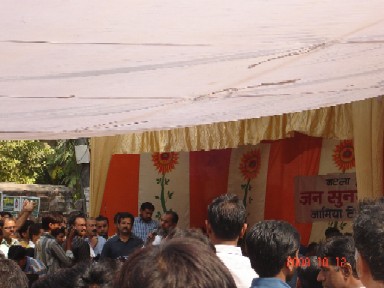
Jamia Teachers’ Solidarity Group organized a Jan Sunwai (Public Hearing) and Public Meeting on the Batla House ‘Encounter’ today in the ground opposite Khalilullah Masjid, Batla House, Jamia Nagar, New Delhi, from 10.00.a.m. to 1.00. p.m. The jury constituted of the following members:

Swami Agnivesh, John Dayal, Harsh Mander, Tripta Wahi, Tanika Sarkar, Vijay Singh and Nirmalangshu Mukherji.

Prominent members of the civil society, Arundhati Roy, Kavita Srivastava, Prashant Bhushan, Kavita Krishnan, members of Jamia Millia Islamia, Delhi University, JNU, teaching faculty, students and members of the media attended the programme to listen to the eye witness accounts of the ‘encounter’.

The shroud of silence in which the members of the Jamia Nagar community had been pushed into following the policed accounts of the ‘encounter’ that was coming through the media over the past week after the initial spate of protests seems to have been broken. People from all walks of life that form the teeming multitude of the citizens residing in Jamia Nagar area came out openly questioning the ‘encounter’. Twelve members spoke as neighbours, eye witnesses and relatives of either the deceased or the accused and said openly that although the problem of terrorism needs serious attention, one cannot subscribe to an alternate reign of terror perpetrated by certain sections of the authority.

Questions were raised regarding the condition in which the bodies of Atif Ameen and Mohd. Sajid was received by the family members and how they were not allowed to bury them in the Okhla graveyard. Several discrepancies in the police accounts were highlighted and Manisha Sethi from the Jamia Teachers’ Solidarity Group read out the Group’s study of the same. The Jury members would be meeting early next week and would finalize their verdict on the ‘encounter’. The Jamia Teachers’ Solidarity Group’s demand for a time bound, independent inquiry under the sitting judge of the Supreme Court has been reiterated and in the present situation of the on-going media trial of the accused, concerted action is required.

How to think about the crisis

 Michael Perelman 

The Financial Crisis Goes Beyond Finance

The crisis today in mortgage lending does not come as a surprise to me. I discussed the build up to the crisis in a book published last year, The Confiscation of American Prosperity (1).

The book describes more than three decades of concerted efforts to restructure the economy to respond to the antiauthoritarian spirit of the 1960s. Most important of all, the counterrevolution to the 60s was concerned about a decline in the rate of profits. The objective was to remake the United States as a capitalist’s utopia with strict market discipline for ordinary people, while showing special favors on business. Tax cuts, deregulation, and a more business-friendly legal structure became the order of the day.

In this environment, the legal framework for union organization soon became unfriendly. Success showed up relatively quickly in the labor market, where capital halted the increase of wages by 1972  – the year when real hourly wages peaked. Since then wages have oscillated but never again reached that level.

Profits began to recover, but on closer examination the recovery was unusual. In competitive industries, profits were not particularly high. Profits in producing goods concentrated in industries protected by intellectual property or government favoritism were better. But the big profits came in finance. Even major industrial firms, such as General Motors, Ford, or General Electric began relying on their financial divisions for much of their profits.

What was happening? According to the textbook model of economic growth, new productivity translates into higher wages, which, in turn, create more demand, which spurs industry to produce newer or better products, increasing productivity. In recent decades, debt rather than income spurred demand.

As profits recovered, more affluent people saw their portfolios increasing, creating what economists call the wealth effect: the increasing value of their stocks, and later of their houses, was treated as income, which generated demand. Frequently, people used their houses to borrow money to support this demand.

Production of physical goods was largely neglected. I am reminded of a conversation between Samuel Johnson and James Boswell, a quarter millennium ago. Boswell observed:

“Very little business appeared to be going forward in Lichfield. I found however two strange manufactures for so inland a place, sail-cloth and streamers for ships: and I observed them making some saddle-cloths, and dressing sheep skins: but upon the whole, the busy hand of industry seemed to be quite slackened. “Surely, Sir, (said I,) you are an idle set of people.”

“Sir (said Johnson) “We are a City of Philosophers: we work with our Heads, and make the Boobies of Birmingham work for us with their hands.”(2)

Johnson, of course, was being ironic. The philosophers of the new economy were not. They breathlessly referred to a weightless economy (3). Tom Peters, the management guru, derided old-line businesses as “Lumpy-object purveyors” (4). Even Alan Greenspan is fond of rhapsodizing about how modern production techniques are making the economy lighter and lighter:

“The world of 1948 was vastly different from the world of 1996. The American economy, more then than now, was viewed as the ultimate in technology and productivity in virtually all fields of economic endeavor. The quintessential model of industrial might in those days was the array of vast, smoke-encased integrated steel mills in the Pittsburgh district and on the shores of Lake Michigan. Output was things, big physical things.

“Virtually unimaginable a half century ago was the extent to which concepts and ideas would substitute for physical resources and human brawn in the production of goods and services. In 1948 radios were still being powered by vacuum tubes. Today, transistors deliver far higher quality with a mere fraction of the bulk. Fiber-optics has [sic] replaced huge tonnages of copper wire, and advances in architectural and engineering design have made possible the construction of buildings with much greater floor space but significantly less physical material than the buildings erected just after World War II. Accordingly, while the weight of current economic output is probably only modestly higher than it was a half century ago, value added, adjusted for price change, has risen well over threefold”.(5)

Nobody seemed to sense that anything was awry. Leaders in the U.S. were content to let the modern equivalent of the boobies of Manchester produce their goods in Asian sweatshops, and then borrow the proceeds from their masters to support their consumption.

The game depended upon continued growth, whether illusory or real. Deregulation helped to promote illusions of prosperity. So did the dot.com hysteria of the late 1990s. When the bubble burst, the Federal Reserve came to the rescue with low interest rates. Temporarily lacking sufficient confidence in the stock market, real estate seemed a better bet.

Real estate prices soared. People could borrow more on their houses. And with rapidly rising real estate prices, people could comfortably lend money to people who could not afford the loans because, after all, real estate would always increase in value.

To make the illusion even more solid, people believed that they could avoid risk. Ratings agencies told investors that paper based on this real estate was just a shade more risky than U.S. government bonds. To seal the deal, investors sold “insurance,” which promised to cover losses if the investment would go sour.

This insurance business was so brisk that the amount of insurance sold was many times more than the face value of the investments. After all, selling this insurance was an easy way to profit from real estate market, which had ahead to go nowhere but up.

When the music stopped playing, the regulators discovered that nobody was watching the store. Far more insurance was sold than the insurers could afford to cover. The ratings agencies are putting their seal of approval on the paper to get more fees.

The government just agreed to buy up bad debt to the tune of $700 billion, bailing out both crooks and incompetents. The government debt will give the neoliberals excuse to cut more programs to help needy people, while bailing out the rich.

Something similar happened a few decades ago with another war, a different Bush, and the same John McCain. Many years ago, Lyndon Johnson, who would have just celebrated his hundredth birthday, found himself stuck in a war he couldn’t win. He also knew that if he raised taxes to pay for the war, the public would demand an immediate halt with a fury that he could not resist. Johnson relied on borrowing, which raised interest rates.

Savings and loan institutions, like the investment banks today, borrowed short and lent long. In this case, people put their savings in the banks and the banks lent out money on 30-year mortgages. To prevent gouging and make mortgages affordable, the savings and loans were prevented from paying interest rates high enough to keep depositors from exiting, which could leave them bankrupt.

The Reagan administration, including daddy Bush, moved to deregulate the savings and loans. Given this newfound freedom, crooks and nincompoops (including the current President Bush’s younger brother) rushed in to take advantage of profiting from other people’s money. As the scope of this disaster was becoming obvious, five senators, including John McCain along with Alan Greenspan (perhaps the Godfather of the recent financial crisis), rushed in to defend one of the more egregious Savings and Loan operations run by Charles Keating. Oh, yes, a small savings-and-loan in Arkansas, which was connected with Bill Clinton (who later allowed Congress to deregulate the current financial system, led by Senator Phil Gramm, John McCain’s chief economic adviser) also ran into difficulties.

The savings-and-loan scam crashed leaving the government to pick up the pieces at a cost that is still debated, but which was still well over $100 billion – pocket change today.

The difference today is that our politicians now promise effective regulation this time around, just as they did with Sarbanes-Oxley in the wake of crash of Enron and the rest of the dot.com boom.

The Financial Side of the Financial Crisis

This crisis should be a teachable moment, but speculative excesses are a part of the DNA of capitalism. Leo Tolstoy began his epic novel, Anna Karenina, with the famous observation, “All happy families resemble one another, but each unhappy family is unhappy in its own way”. Much the same can be said about depressions. Each depression seems unique and subject to as many interpretations as the most dysfunctional family. Hence what is unique to this crisis is the way that its build up departs from the general textbook model. Also, as I mentioned above, the other defining characteristic of this crisis is that debt rather than income spurred demand.

Financial assets demand a different treatment. Capital reacts with horror when wages increase, demanding the Federal Reserve to slam on the brakes. In contrast, soaring prices of financial assets are presumed to be incontrovertible evidence of a healthy economy.

The increasing value of these assets spurs people to increase consumption, often taking on debt, confident that their assets will appreciate even more. As Mark Twain observed about an earlier Gilded Age: “Beautiful credit! The foundation of modern society … “I wasn’t worth a cent two years ago, and now I owe two millions of dollars”.”

In 2000, when the excesses and frauds of Enron, World Com, and the dot.com boom came to light, financial markets shuddered. The Federal Reserve came to the rescue lowering interest rates, which reduced monthly mortgage payments, allowing people to buy more expensive housing.

Once housing prices begin to rise, housing becomes an investment as well as the source of shelter. In addition, people, who suffered losses during the dot.com bust, saw housing is a safer investment than the stock market. Housing then transmuted into personal ATM machines, allowing people to borrow freely on the rising value of their property.

Underlying this financial froth, something more ominous was occurring. Business refused to spend much for investment in productive activities. Again, the textbooks tell a different story. They teach that high profits translate into investment, which create jobs, spurring demand, and making the economy grow. Such was not the case this time around.

Earlier this year, the British financial journalist, Martin Wolf, observed:

“The US itself looks almost like a giant hedge fund. The profits of financial companies jumped from below 5 per cent of total corporate profits, after tax, in 1982 to 41 per cent in 2007.”(6)

This estimate is probably too conservative because many nonfinancial companies increasingly depend upon finance. General Electric, and in their more prosperous years, Ford and General Motors, largely depended upon finance. Retail companies offer credit cards in effect, selling insurance on their products in the form of extended warranties.

The U.S. Department of Commerce reported that in 1992 about a third of all workers employed in U.S. manufacturing industries were actually doing service-type jobs (e.g., in finance, purchasing, marketing, and administration). Updating this work, needless to say, has not been a high priority for government agencies.

Corporations also spend mind-boggling quantities of money just to purchase their own stock. After all, increasing stock prices boost executives’ bonuses. For years, Exxon has been spending more money for stock buybacks than capital expenditures, all the while whining that the company needs more incentives to drill for oil.

What investment does occur is largely financed by depreciation allowances rather than previous profits.  John Bellamy Foster offers an important measure of this reluctance to invest:

“Nine out of the ten years with the lowest net non-residential fixed investment as a percent of GDP over the last half century (up through 2006) were in the 1990s and 2000s. Between 1986 and 2006, in only one year – 2000, just before the stock market crash-did the percent of GDP represented by net private non-residential fixed investment reach the average for 1960-79 (4.2 percent). This failure to invest is clearly not due to a lack of investment-seeking surplus. One indicator of this is that corporations are now sitting on a mountain of cash – in excess of $600 billion in corporate savings that have built up at the same time that investment has been declining due to a lack of profitable outlets.”(7)

Finance is attractive for another reason: it employs relatively few people. The intriguingly-named FIRE sector, which includes finance, investment, and real estate, employs only about 8 percent of the private labor force. So, 8 percent of the workers generate 41 percent of the profits. Massive investments in information processing make such results possible.

Of the investment that does appear, finance may represent a disproportionate share. The government does not have recent data on types of investment by industry. The data do show that investment on information processing and software is about 37 percent greater than investment in industrial equipment and manufacturing equipment. Of course, information processing is also important in manufacturing, but the data is suggestive.

Where Did The Money Go and Will Jobs Also Disappear?

On Monday, September 29 the stock market lost more than $1 trillion, about as much money as the Gross Domestic Product for an entire month. The next day, two thirds of the value suddenly reappeared. Yet, for the most part the tumult left most people unaffected, at least for the moment. More important, will the evaporation of all of this wealth affect ordinary people?

Karl Marx’s concept of fictitious capital is very useful in understanding these wild swings. I have explored this subject in more detail in an earlier book, entitled Marx’s Crises Theory: Scarcity, Labor, and Finance.(8)

For Marx, capitalism uses markets to distribute labor into productive activities, but it does so very imperfectly. Part of the problem is that lack of knowledge about the future causes imperfect investments. These imperfections magnify as the economy seems to prosper making people become giddy about their chances of success.

Crises are capitalism’s way of purging unproductive investments. In this way, crises eventually make the economy stronger, unless they become so severe that they shatter the foundation of capitalism.

The crises will become more violent if the distribution of income becomes too lopsided, leaving investors flush with money, while consumers are relatively strapped. Massive amounts of money will flow into speculative ventures, creating bubbles. In effect, a market which is supposed to be a wonderful feedback system to inform capitalists about the needs of society, takes on a perverse logic of its own.

Eventually, the bubble pops and there is hell to pay. The question today is how extreme this shock will be. Capitalism has shown quite a bit of resilience in the past. What is happening now could turn out to be relatively mild or could be severe.

I use San Francisco as an analogy for my students. There will eventually be a serious earthquake that will do enormous damage. Nobody can predict what will happen. Even when the earth begins to tremble, the severity of the event may be in doubt.

Wall Street uses a somewhat related term, leverage, to describe the ability to magnify potential profits by investing borrowed money. When the economy begins leveraging, business borrows money to invest – not necessarily in productive assets. Leveraging can continue as long as people feel confident enough to finance these investments.

The government’s modest limits on leverage have been systematically weakened, to the point where investment banks would be putting up as little as 3 cents, and even less, for each dollar invested. The riskiness of such practice should be obvious. A mere 3% drop in the investment would wipe out the bank’s own share of the investment.

The Federal Reserve also promoted increased leverage by holding interest rates low. Other regulators also paved the way for more leverage. Companies that choose the path of lower profits and lower risks are written off as stodgy and old-fashioned. Their stocks will flounder, reducing executive’ bonuses. So, Wall Street investors willingly increased their leverage and risk. After all, investors prefer companies with high profits. Few are willing to take the time or have the expertise to understand the risks that might make profits appear high.

In Wall Street-talk, increasing leverage works so long as investors maintain a balance between fear and greed. By fear, Wall Street means a reluctance to take on too much risk. Although Wall Street normally applauds greed, it associates excess greed with a foolhardy approach toward risk. During euphoric times when fear of risk subsides, people put money in ridiculous schemes.

In his delightful book, Charles Mackay, related tales of shady operators bilking early investors a few centuries ago.

“One projector set up a company to profit from a wheel for perpetual motion. Another projector proposed “A company for carrying on an undertaking of great advantage, but nobody to know what it is.” “Next morning, at nine o’clock, this great man opened an office in Cornhill. Crowds of people beset his door, and when be shut up at three o’clock, he found that no less than one thousand shares had been subscribed for, and the deposits paid. He was thus, in five hours, the winner of 2000 pounds.  He set off the same evening for the Continent. He was never heard of again.”(9)

The newfound wealth during times of growing leverage can create more demand, which can increase jobs and wages. As noted previously, such has not been the case. Speculative wealth has not produced growth in wages for ordinary people or any significant growth in jobs. In fact, cutting jobs to increase profits has been a major factor in sustaining the boom. A few years ago, the business press praised this practice as financial engineering, as if it were providing a productive service.

One factor that contributed to the lopsided economic growth without jobs, which characterized the recent decades, is the practice of leveraged buyouts. Private equity companies, as they are known, buy up other companies using borrowed money, often based on the assets of the target companies. The takeover artists claim that they can create managerial efficiencies, making their takeover look attractive to potential investors. In reality, they charge their targets exorbitant fees, often paid for by debt that the companies must eventually pay back. Then, to cover this burden, the companies must cut both wages and jobs, as well as looting significant value from pension plans. Private equity businesses than turn around and sell these supposedly rejuvenated, but actually hobbled companies to an unsuspecting public, which fail to see the similarity between such investments and the perpetual motion machine that Mackay described.

In describing the necessity of a bailout for finance, the alarmists, who are not necessarily wrong, point to the job losses associated with the corporate restructurings that will follow bankruptcies. But these restructurings have been going on for decades. The bailout, however, is intended to facilitate a continuation of the destructive financial practices, which have also caused significant hardship to labor.

Obviously, a collapse will also harm workers and other ordinary people, but in the wake of a collapse the country will stand a better chance to restore some sanity to the economy.

Conclusion: Capitalism 101 (A Foundational Course)

Capitalism is the most efficient system known to mankind. Central to this efficiency is the supposed ability of markets to channel capital where it is most effective. The current financial crisis might be expected to throw some doubts on this dogma, but I do not expect that to be the case.

For example, in 2001, in the wake of dot.com bubble, the New York Times reported on one of the many excesses of the period:

“In the last two years, 100 million miles of optical fiber – more than enough to reach the sun – were laid around the world as companies spent $35 billion to build Internet-inspired communications networks.  But after a string of corporate bankruptcies, fears are spreading that it will be many years before these grandiose systems are ever fully used.”(10)

As mentioned earlier, the response was not to rethink the system, but to double down lowering interest rates to re-ignite the stock market. Investors, the government, and even ordinary people applauded the decision of Federal Reserve Chairman Greenspan, who appeared to be the wisest man in the universe at the time.

Greenspan’s manipulation of the interest rate appeared to be so beneficial, because it occurred without any direct effect on the proverbial taxpayer. Parenthetically, why is it that this taxpayer ranks so much higher in our concern relative to the workers who make everything possible?

In retrospect, Greenspan’s policy provided the fuel that helped to make the current crisis more threatening. Just as the solution to the dot.com crisis produced the current crisis, the present bailout, if it works at all, will create the preconditions for the next one.

The purpose of the bailout is to create confidence. Back in the 19th-century, the governor of Illinois gave an excellent analysis of the way confidence worked in financial markets. He said that confidence “could only exist when the bulk of the people were under a delusion. According to their views, if the banks owed five times as much as they were able to pay and yet if the whole people could be persuaded to believe this incredible falsehood that all were able to pay, this was ‘confidence’.”

His words may perhaps be the most succinct analysis of fictitious capital that I have read.

Now class, here is the question for all the students in Capitalism 101: explain to me how is that markets are so efficient in directing capital where it is most needed. Extra credit if you can do so without any giggles.

Michael Perelman is professor of economics at California State University at Chico, and the author of fifteen books, including Steal This Idea: Intellectual Property Rights and the Corporate Confiscation of CreativityThe Perverse Economy: The Impact of Markets on People and the EnvironmentRailroading Economics: The Creation of the Free Market Mythology, and The Confiscation of American Prosperity: From Right-Wing Extremism and Economic Ideology to the Next Great Depression. His daily reflections on various political economic issues can be found at his blog, Unsettling Economics.

References:

(1) Michael Perelman, The Confiscation of American Prosperity: From Right Wing Extremism and Economic Ideology to the Next Great Depression, Palgrave Macmillan (2007)

(2) James Boswell, Life of Johnson, 6 vols., Oxford University Press (1934-64)

(3) Diane Coyle, The Weightless World: Strategies for Managing the Digital Economy, MIT Press (1998).

(4) Tom Peters, The Circle of Innovation: You can’t shrink your way to greatness, Knopf (1997).

(5) Alan Greenspan, “Remarks” at the 80th Anniversary Awards Dinner of The Conference Board, New York, October 16, 1996.

(6) Martin Wolf, “Why it is so hard to keep the financial sector caged”Financial Times, February 6, 2008.

(7) John Bellamy Foster, “The Financialization of Capital and the Crisis”Monthly Review, April 2008.

(8) Michael Perelman, Marx’s crises theory: Scarcity, labor, and finance, Greenwood Press (1987)

(9) Charles Mackay, Extraordinary Popular Delusions and the Madness of Crowds (1852)

(10) Simon Romero, “Shining Future Of Fiber Optics Loses Glimmer”The New York Times, June 18, 2001.

Dialectics of Science – Science is its own era reflected in thought

Partho Sarathi Ray 

Science and the Age of Enlightenment

Modern science, as we know it today, is the daughter of the European Enlightenment. That age of intellectual ferment beginning in the early 18th century established “reason”, instead of divinely ordained revelation, as the basis of knowledge. At its core was the questioning of traditional institutions, morals, and customs which had previously upheld the supremacy of the church in the intellectual sphere, and feudal relations in the social sphere. In this intellectual atmosphere, science, the process of systematic pursuit of knowledge, underwent a huge qualitative change from its earlier reliance on scriptures and classical Greek authorities like Aristotle, into a methodology dependent on reason, critical questioning, and establishment of clear relationship between cause and effect by direct observation. As Rene Descartes, one of the intellectual giants of the Enlightenment, famously declared, and Karl Marx, probably the most complete intellectual offspring of the Enlightenment, adopted as his favourite motto, “de omnibus dubitandum“, that is, “Doubt everything”, became the reigning methodology of scientific enquiry.(1) Based on this methodology of critical questioning emphasized by the rationalists like Descartes, Spinoza and Leibniz, and the complementary methodology of direct observation emphasized by empiricists like Locke, Berkeley and Hume, modern science was born, and further developed over the period of three hundred years. Therefore science, as we know it today, is considered to be an objective understanding of nature, a system of knowledge that explains the material basis of reality, independent of the nature of the observer and transcending the social or political conditions of the time.

Modern science is one of the greatest intellectual triumphs of humanity, as man has taken a giant leap forward from the infancy of his curiosity, when every natural phenomenon bore divine or diabolical agency, to an age where all of his questions seem to be answerable under the powerful illumination of science. Science seems to have revealed objective truths about material reality, truths independent of the time and space of their discovery, truths for all ages, truths that give science the aura of transcendence. And attesting to this power of science has been the great advances of technology that have sent humans to the moon and given us insights into the very basis of life.

The dialectical nature of science

As practicing scientists, this aura of objectivity of science gives us a sense of destiny, makes us feel that we are in the pursuit of understanding material reality as it is, independent of the subjective conditions around us. And to the layperson this makes science appear to be infallible and all-powerful, representative of ultimate truths. However, this objectivism in science also opens the door to a mechanical materialism as science is now thought to deal with objective properties of matter that transcends the subjective conditions that might be a result of human activity, although science is essentially a human activity. It also gives rise to reductionism and determinism, where the properties of smaller and smaller parts of matter are thought to solely influence the properties of “wholes”, in increasing orders of magnitude. Marx, who had also arrived at a materialist conception of the world, however rejected this mechanical materialism, instead insisting on a dialectical analysis of nature that recognized that humans and nature exist in a coevolutionary, and interactive, relationship.(2) Engels’ Dialectics of Nature was an unfinished attempt in this direction which was advanced by a generation of British scientists in the 1930’s, who were committed to a historical materialist and dialectical philosophy.(3) These scientists, Hyman Levy, Lancelot Hogben, J. D. Bernal, Joseph Needham, J. B. S. Haldane, and historian/philosopher of science Benjamin Farrington – struggled to retain within the emerging natural sciences the possibility of dialectical uncertainty and opposed their reduction to the mechanistic materialism which has been the reigning philosophy of science.(4) Growing out of the work of these early critical intellectuals, though undeveloped and still at times insufficiently dialectical, a more developed science grounded in materialist dialectics came to the fore in the 1960s and 1970s with the work of Marxist-influenced biologists – particularly Richard Lewontin, Richard Levins, and Stephen Jay Gould at Harvard, then the leading center of evolutionary biology. Their work provided a genuinely dialectical materialist approach to science that questioned some of the long-held beliefs about the transcendence of science and suggested that science, and our understanding of it, is a product of the dialectical relationships between humans and nature and between humans and their social condition.

Science and capitalism

To understand this dialectical nature of science, we need to look at the socio-economic context in which modern science was born and have henceforth developed. At the time when the Enlightenment was changing the intellectual horizon of Europe, the socio-economic conditions were also being fundamentally and irreversibly changed by the birth of a new mode of production, capitalism. As the Enlightenment was questioning the traditions that upheld the feudalistic relations of production, capitalism was breaking down the same production relations. The two processes were so complementary, that looking at it from the basis of historical materialism, we can understand that the material basis for the intellectual ferment that gave rise to the Enlightenment was actually the change that was happening in the way in which the productive property was owned and controlled, combined with the corresponding changes in the social relations between individuals based on their connection with the process of production. As the feudal nobility and the church was losing the ownership and control over the means of production and the serf, previously bonded to his feudal master and his estate, was becoming an agent free to sell his labour, the intellectual climate that had upheld these relations for the past five hundred year or so, was also disappearing. The idealism inherent in the philosophical thought of the previous centuries had looked at the world as an idealized place, divinely conceived and maintained, where man’s relationship with nature, just as his relationship with other members of the society, was static and ideal. These ideas of stasis and stability were being fundamentally changed into a notion of natural and social evolution. Change was in the air, and change was in the thoughts of the intellectual giants of the time. And out of this ferment was born modern science, with the imprint of the times as its birthmark. Therefore, if the Enlightenment is the mother of modern science, the father is undoubtedly capitalism. And the new science, as it developed, carried the indelible marks of this birth, such that science, as we understand it today, is capitalist science. The concept of change, of impermanence, which was so important to the process of replacement of feudalism by capitalism, also became a central tenet of science. Just as the ideas of change in society were formalized and systemized by Marx in his historical materialism, the concept of change in nature was ordained as the central tenet of the theory of evolution by Darwin, undoubtedly one of the greatest scientific achievements of all times. The idea of the constancy of change, rather than constancy itself, has become a central idea of science, and especially of biology.

Capitalism also put the individual as the central player in society. It was no more the church, or the nobility, or the royal families that owned the means of production in society. It was no more the serf tied to his master and his land by ancient feudal relations who was required for the mode of production that capitalism was engendering. Instead, it was the free individual, freed from the age-old ties of kinship and loyalty, from the hierarchy of the church, free to sell his goods and labour power, the bourgeoisie and the proletariat, who was the motive force behind the capitalistic mode of production.  This new emphasis on the individual was celebrated in John Locke’s Two Treatises of Government, where he stated that individuals in society had “natural rights”, including the right to property.(5) Locke’s writing had great influence on the bourgeois revolutions of the 18th century, the American and French revolutions. This celebration of individualism in the social sphere left its imprint over scientific thought, in the form of Cartesian reductionism.(6) Descartes contributed the idea of studying smaller and smaller parts of matter to understand the nature of material reality, and this methodology called “reductionism” is universally followed in science today. Reductionism placed the atom in the centre of the physical world, just as the individual occupied the centre of the social. This idea of the freely-interacting atom, free to make and break bonds with other atoms, gave birth to the atomic theory of matter and the to fields of nuclear physics, and later of quantum mechanics, areas that defined scientific enquiry in the 20th century.

Reductionism has also played a very influential role in biology. The rediscovery of the laws of heredity, originally formulated by the Austrian priest Gregor Johann Mendel, in early 20th century, gave birth to the field of genetics.(7) Later, the discovery of the material basis of heredity, the gene, showed that it was this all important molecule, the DNA, which transferred genetic information from the parent to the offspring, and suggested that it could determine every property of an individual, from his height to his intelligence. The gene was accorded the same place in biology that the atom had been accorded in physics and chemistry. This gave rise to what is referred to as “genetic determinism”, which, more to the awestruck common man than to the practicing biologist, meant a determination of every human trait and behaviour by the genes one carried.(8) Bourgeois ideology, which sought to justify existing social hierarchies, has utilized genetic determinism to justify and rationalize social and economic inequalities in terms of domination that was biologically derived and teleologically predetermined – whether in terms of racism, sexism, or differences in intelligence. Posited against this, and somewhat as a reaction to extreme formulations of genetic determinism, has been a sort of superorganic holism, mainly in ecology. This holism preferred to look at entire ecosystems, at the sum total of the interactions between individuals or between individuals and the environment. These two schools of thought in biology, at many times in opposition to each other, went on along with the nature versus nurture debate that rages on in biology, where the contention is whether it is the genes or the environment which controls and determines human traits and behaviour.

Dialectical biology

The above-mentioned biologists, Lewontin and Levins, and Gould, rejected these one-sided notions of mechanical reductionism and superorganic holism and the hierarchical conceptions of life and the universe that they both generate. Instead they suggest a dialectical and materialist approach that understands that the world “is constantly in motion. Constants become variables, causes become effects, and systems develop, destroying the conditions that gave rise to them”.(9) They propose that “things change because of the actions of opposing forces on them, and things are the way they are because of the temporary balance of opposing forces”.(10) This introduces a dialectical understanding of relations between organisms and nature. This is very important for biology, as biology is at the same time at the cutting edge of science today and is also close to our lives as individuals and species. Understanding of biology influences our responses to multiple things of vital importance to the well being of our society and the world, from the Nazi conception of racial superiority, to the caste divides that still render our society apart, to the religious fundamentalist opposition to the teaching of evolution in U.S. schools. An understanding of the dialectics of biology allows both practicing biologists and lay people to formulate responses to such issues without being overawed by the objectiveness and infallibility which are claimed for science.

It would be interesting to look at a particular example to illustrate the dialectical approach to biology, drawing from Lewontin and Levins’ book, The Dialectical Biologist.(11) If we look at the disease tuberculosis, which is still a major affliction of people in India, and also in other countries of the world, the reductionist approach tells that the disease is caused by the pathogenic bacterium Mycobacterium tuberculosis. However, from a holistic point of view it would be said that malnutrition is the cause of tuberculosis, because many people infected by the bacteria do not develop the disease if they are not suffering from malnutrition. In contrast, a dialectical understanding of biology will suggest that it is the interaction between Mycobacterium infection and nutritional status which determines whether a person will have the disease or not. So, looking at cures for tuberculosis should involve studying both these conditions which dialectically interact to bring about the disease. However, it can also be argued that many people who have healthy nutritional status also have tuberculosis after being infected by M. tuberculosis. The dialectical approach can be further extended to explain this phenomenon: in the case of nutritionally sufficient people suffering from tuberculosis, it is the dialectical relationship between the infecting bacterium and the susceptibility genes of the individual which determines whether the person will suffer from the disease or not. Therefore, at every level of interactions that exist in nature and constitute life, an entity is both a subject and object, and a dialectical analysis is necessary to understand these interactions between organisms and the environment and genes and the environment.

The field of biology where the dialectical approach is most important is evolutionary biology. Evolution by natural selection is the grand unifying theme of all modern biology and its proposition by Charles Darwin in his 1859 book On the Origin of Species was a monumental achievement in the history of science.(12) However, Darwin’s theory of natural selection was also formulated in the backdrop of the socio-economic context of his times, marked by the intense class struggle between the bourgeoisie and the working class in the well developed capitalist economy of contemporary England.  Indeed, the Darwinian idea’s of the struggle for survival and the survival of the fittest was influenced by the ideas of Thomas Malthus, who in his An Essay on the Principle of Population suggested that as the rate of increase of the population is greater than the rate of increase in available resources, there is always a competition for the limited resources which results in a segment of the population being relegated to poverty.(13) Darwin’s theory of selection between the individuals of the same species, based on their “fitness” or the ability to leave the maximum number of offsprings, was therefore a product of the intellectual climate of that heyday of capitalism. However, to suggest that the theory of evolution by natural selection was the product of a certain socio-economic context certainly does not detract from its validity as the most appropriate, and proven, explanation of the diversity and complexity of life.

Darwin elevated the conditions of existence – external selection pressures – to primacy in explaining evolution, so as to establish natural selection as the dominant force behind the evolution of species. However in this process, he established a view of natural selection as predominantly one-sided – i.e., the external factors were seen as largely determining the evolutionary process, and not as equally the consequence of the evolution of life. Whereas this ultra-Darwinian view of evolution focuses nearly exclusively on the external, modern evolutionary biologists often focus nearly exclusively on the internal in their acceptance of genetic determinism. Lewontin and Levins suggested a third, a dialectical approach to understanding the interactions of internal and external factors in determining evolution, stating “natural selection is not a consequence of how well the organism solves a set of fixed problems posed by the environment; on the contrary, the environment and the organism actively codetermine each other.”(14) This focus on interactions, transformation, and historical constraints over the process of natural selection is immensely important in developing a dialectical understanding of the process of evolution. The other great evolutionary biologist, Stephen Jay Gould went further to state “the three classical laws of dialectics [formulated by Engels] embody a holistic vision that views change as interaction among components of complete systems, and sees the components themselves…as both products of and inputs to the system. Thus the law of “interpenetrating opposites” records the inextricable interdependence of components: the “transformation of quantity to quality” defends a systems-based view of change that translates incremental inputs into alterations of state; and the “negation of negation” describes the direction given to history because complex systems cannot revert exactly to previous states.”(15) Gould’s influential idea of evolution by “punctuated equilibrium”, in which organisms evolve by large leaps interspersed by long periods of evolutionary stasis explicitly follows the laws of dialectics.(16) Gould considered the dialectical laws to be explicitly punctuational. According to him “They (the laws of dialectics) speak, for example, of the ‘transformation of quantity into quality.’ This…suggests that change occurs in large leaps following a slow accumulation of stresses that a system resists until it reaches breaking point. Heat water and it eventually boils. Oppress the workers more and more and bring on the revolution.”(17) The dialectical approach is an immensely powerful methodological advance in our conception of science and is essential for the transition from “capitalist science” to a “socialist science”.

Towards a socialist science

Every epoch in human history is marked by its own intellectual tradition. Therefore, the Enlightenment, and the revolution in scientific thought that it engendered, marks the epoch of capitalism. It does not mean that science becomes subjective, but the imperatives before science, the questions scientists ask, and the methodologies adopted to answer them reflect the dominant socio-economic relations of the time. Therefore, the transition to a socialist society must be accompanied by a revolution in scientific thought that would result in the development of a “socialist science”. This new science would be based on a clear dialectical materialist understanding of the relationships between man (and all organisms) and nature, and between man and society. The failure to bring about this revolutionary change in scientific thought and practice was one of the major failings of the socialist experiments of the 20th century, and contributed in no small part to their collapse. Yet for sometime in the 1920s and early ’30s, a materialist and dialectical approach was the intellectual foundation for many prominent Soviet scientists, such as V. I. Vernadsky, N. I. Vavilov, and Alexander Oparin, in their various research projects regarding the creation of the biosphere, the original centers of the agricultural world, and the emergence of life.(18) All of this subsided, however, with the tightening grip of Stalinism in the 1930s. A more rigidly mechanistic approach became dominant in Soviet science (taking the name of “dialectical materialism” while vacating it of any meaning), putting an end to the early stages of a hopeful and exciting investigation that had begun to mark the birth of socialist science. The most adverse, and long-lasting, effect of this approach was the rise of Lysenkoism, which pretty much destroyed biology in the Soviet Union and barred the way for the budding revolution in scientific thought.(19) Trofim Lysenko, who was in charge of agricultural affairs in the Soviet Union, practiced a form of Lamarckism, which derived from the theories of heritability of acquired characteristics and had already been disproved by Darwin’s theory of evolution by natural selection.(20) With the blessings and active support of the Stalinist establishment Lysenko went about imposing these non-scientific practices, mainly in agricultural science and genetics, and denounced practicing geneticists as proponents of “fascist” or “bourgeois” science, leading to the execution of many and the imprisonment of Vavilov, the greatest Soviet biologist. Lysenkoism replaced a proper dialectical understanding of heredity and evolution by a forced belief that heredity had a limited role in evolution and changes could be brought about in organisms by human intervention which would be inherited in subsequent generations. Although these ideas were mainly adopted in agricultural practice, leading to processes like “vernalization” of wheat, it had a wider ideological implication that Soviet practices could actually purge humans of “inherited” bourgeois instincts and lead to the creation of the “socialist man”. Lysenkoism marked a complete failure of understanding the dialectical approach to science, instead adopting a mechanistic approach based on pseudo-scientific theories. When Lysenkoism was finally discarded in 1964, Soviet science tried to return to the mainstream of western scientific practice, any attempts at developing a truly dialectical approach to science having been long abandoned. A socialist science never came into being in the Soviet Union.

As the internal contradictions of capitalism are becoming more glaring, the scientific thought processes that have been the product of the capitalist era would also become insufficient for explaining, and managing, the various challenges confronting humanity. Just as science of the feudal era was replaced by capitalist science, the latter would have to be replaced by a socialist science. A dialectical understanding of science is needed in order not only to comprehend how the world came to be, but also to understand how it can be changed.

References:

(1) Descartes R. The Philosophical Writings Of Descartes in 3 vols. Cottingham, J., Stoothoff, R., Kenny, A., and Murdoch, D., trans. Cambridge University Press (1988).

(2) Foster J.B. Marx’s Ecology. Monthly Review Press (2000).

(3) Engels F. Dialectics of Nature. International publishers Co (1968).

(4) Clark B. and York R. Dialectical Nature: Reflections in Honor of the Twentieth Anniversary of Levins and Lewontin’s The Dialectical Biologist. Monthly Review (2005).

(5) Locke J. Two Treatises of Government. Book Jungle (2008).

(6) See (1)

(7) Bardoe C. Gregor Mendel: The Friar who grew peas. HN Abrams (2006).

(8) Gould J. S. The Mismeasure of Man.  Revised and Expanded. Norton (1996).

(9) Levins R. and Lewontin R. C. The Dialectical Biologist. Harvard University Press (2006).

(10) Ibid.

(11) Ibid.

(12) Darwin C. The Origin of Species. Barnes and Noble Classics (2003).

(13) Malthus T. R. An Essay on the Principle of Population. Prometheus Books (1998).

(14) See (8)

(15) Gould J.S. “Nurturing Nature” in An Urchin in the Storm: Essays about Books and Ideas. Norton (1987).

(16) Gould J.S. and Eldredge N. “Punctuated equilibria: An alternative to Phyletic gradualism” in Thomas J. M. Schopf, ed. Models in Paleobiology. Freeman (1972).

(17) Gould J.S. “The Episodic Nature of Evolutionary Change” in The Panda’s Thumb. Norton (1980).

(18) See (4)

(19) See (9)

(20) Lecourt D. Proletarian Science? : The Case of Lysenko. Humanities Press (1977).

Singur – The Costs and Benefits of Neoliberal Industrialization

Deepankar Basu

Singur stands for many, often contradictory, things. It stands for the model of neoliberal industrialization that the Indian state is trying to push down the throats of its citizens at the behest of big capital. It stands for the unprincipled and populist politics of dormant right-wing forces. It stands for the abject surrender of an erstwhile communist party to the dictates of capital, the full flowering of a tendency that surfaced in the Indian political firmament circa 1967. But Singur also stands for the struggle of labour against capital, decidedly in confused and masked manners, but a struggle that has the potential to galvanize resistance against neoliberalism. When the Tata Group, forced by the long-standing struggle of the small farmers and landless labourers in Singur, was reported to be planning a move to Pantnagar in Uttarakhand, there were simultaneous reports of a possible Singur waiting for them in Pantnagar. A Singur in Pantnagar! That is the real significance of the struggle of the landless labourers and peasants of Singur.

Right from day one, the West Bengal government and the mainstream media has been building up the case for the manufacturing plant in Singur on the basis of half-truths and untruths. For a long time, the West Bengal government continued denying the fact that it had “acquired” a large tract of the proposed 1000 acres from unwilling farmers by using coercion, strong-arm tactics and certainly without their consent. Towards the later part of 2006, after considerable protests and a public hearing organized by intellectuals and activists, it had to finally accept its own earlier statements as false. Now it is known by all and sundry that 411.11 acres of the total 997.1 acres has been acquired without consent of the relevant farmers. For a long time, again, the West Bengal government continued denying the fact that most of the land that was sought to be “acquired” was fertile and multi-cropped agricultural land. It was only when earlier this year the Supreme Court pointed towards a possible violation of the Land Acquisition Act, responding to a petition filed for immediate halt of the Nano car project, that the West Bengal government finally accepted that it had been willfully misleading the public in this regard for so long; the SC had pointed out that acquiring and using fertile, multi-crop agricultural land for industrial purposes goes against even the Land Acquisition Act, which the West Bengal government was, paradoxically, trying to use to “acquire” that land. Now it has been established beyond any shadow of doubt that the land on which the proposed plant is to come up is, in the main, fertile, multi-cropped agricultural land. Another myth that had been in circulation for some time was the following: the land in Singur could not be used for agricultural purposes for most parts of the year because of water logging. This claim has also been contested and shown to be untrue. Now it is accepted by all serious commentators that the land had, before being fenced off by the West Bengal police, been in constant use throughout the year for growing various agricultural crops, and that it provided livelihood for more than 12,000 families. Even though these and other such claims of the West Bengal government and the mainstream media have been refuted point by point, over and over again, with facts and arguments and lot of patience and care, they keep turning up ever and ever again like bad coins. They will, as long as the social forces whose interest they represent continue their efforts to hegemonize society; and we will continue refuting them point by point, with patience and care and logic and facts.

But even when these particular canards are discounted, there seems to be a larger argument for industrialization that Singur purportedly represents. The West Bengal government and large sections of the mainstream media tend to equate Singur with industrialization and portray any and every opposition to Singur as opposition to industrialization. The apparent strength, or shall we say charm, of this argument becomes obvious when we see even an preeminent thinker like Amartya Sen falling for it. But this argument is deeply flawed. Opposition to Singur is not opposition to industrialization, it is opposition to neoliberal capitalist industrialization. Opposition to Singur is opposition to the conflation of industrialization with neoliberalism, a scenario where the State steps up its efforts to subsidize capital and shore up its profits while capital externalizes its costs onto labour and the environment with impunity. It is this model of industrialization that we oppose.

An alternative model of industrialization, as far as we can see, would operate in an exactly opposite fashion. It would tax capital and not subsidize it, prevent capital from externalizing its costs onto labour and the environment rather than facilitating it, intervene in decisions related to the choice of technique to be used in production, force private capital to do proper cost-benefit analysis before embarking on a (socially) costly industrial project, intervene through fiscal and monetary policy to maintain overall levels of aggregate demand and try to ensure full employment with living wages for workers. In the alternative vision, the State would use tax revenues to build infrastructure, provide social sector services and closely monitor and improve the well-being of the people. Singur, and the model of industrialization that it stands, takes us in the exact opposite direction; that is why it needs to be opposed. It destroys livelihoods tied to agriculture without creating compensating jobs in industry, it willfully snatches away fertile, multi-crop agricultural land for industrial purposes when so much fallow (and other unused and misused) land is there to be used, it externalizes the costs of production on the most vulnerable sections of the population and the environment, and all this while the State steps in to massively subsidize private capital even further. If, therefore, due to the struggle of the project affected people the Tata’s finally leave West Bengal, it should call for rejoicing not for middle-class chest-beating that is so much on display these days. For it would be one of the important victories in the emerging struggle against neoliberalism in India.

Cost and Benefits

In this article we will try to study details of the costs and benefits of the proposed manufacturing plant in Singur on the basis of information that is available in the public domain. But a caveat is necessary. This is not a full blown cost-benefit analysis because we shall not venture to quantify the indirect benefits of possible net employment generation and the income that might arise from there. At this point, it is not even clear whether there will be positive net employment generation; it is not at all obvious, in other words, that the employment destruction entailed by the project will be exceeded by the employment generated by it. Moreover, a full cost-benefit analysis would require much more information than has presently been made available by the West bengal government; on the basis of the available information, which pertains mostly to the benfits that the West Bengal government plans to make available to the Tata’s, we shall mainly try to approximately quantify the costs to the exchequer, and ultimately to the people of the state.

A careful study of the details relating to the proposed project in Singur, to the extent possible by the publicly available information, is important for two main reasons. First, it is important to do a dispassionate analysis of the costs and benefits of this project; since the West Bengal government has been continually making largely unsubstantiated claims about the putative benefits of this project, it is high time we carefully analyzed the foundations of this claim. Second, this project is very much in line with the current trend of neoliberal capitalist industrialization in India anchored tightly in the visions of the Special Economic Zones (SEZs); hence a study of this project will highlight, and help us evaluate, many of the important characteristics of neoliberal capitalist industrialization that has been envisioned and aggressively pushed by the Indian state since the early 1990s. Parenthetically, one should also note how acceptance of the logic this project signals the gradual dissolving of social democracy in India: from”managing” the conflict between labour and capital, social democrats are increasingly moving towards “managing” labour for capital.

The main document that we will use for the purposes of this study is the text of the recent “agreement” signed between the Government of West Bengal, the West Bengal Industrial Development Corporation (WBIDC) and the Tata Motor Ltd. (TML) pertaining to the proposed manufacturing plant in Singur. By a careful analysis of the information contained in this document, and complementing this with some more information from other sources we will, hopefully, be able to arrive at a true picture of the costs and benefits of this project. But before we get into the nitty-gritty of the agreement, let us remind ourselves about the severe difficulties that we have faced over the past few years in just trying to get hold of the information that is relevant to this project. Recall that the details of the “deal” wasn’t made public initially because the West Bengal government believed it was a “trade secret”. Once this argument was properly trashed, the government shifted gears. During this period, it wasn’t made public despite repeated Right To Information (RTI) applications because, according to the government, the Tatas didn’t want it to be made public! Finally what has been made public, mainly because of pressure from the standing committee on industry of the West Bengal state assembly, are only parts of the “deal”; this all we have for the purposes of study and analysis. The TML filed a case in the Calcutta High Court and got a stay against the rest of it being made public. What is there in the rest of it? We, and the more than 12000 project affected families in Singur, can only guess. The entire episode, to say the least, is patently undemocratic, and makes a mockery of the intent of the recently passed Right to Information Act. One does not, of course, discern even an iota of concern about this important matter displayed by the “peoples’ government” in West Bengal!

The Agreement

The “agreement” between the West Bengal government, WBIDC and TML is a remarkable document by all means. Starting from the premise that the state of West Bengal must match, rupee for rupee, every fiscal and financial incentive offered to TML by other states like Uttarakhand and Himachal Pradesh, it goes on to lay out the details of the same. This, the agreement states, should be read as the state government’s eagerness to “take appropriate steps for rapid industrialization in West Bengal”. This, to the best of our knowledge, is the clearest admission by the West Bengal government and the “communist” party standing behind it of the acceptance of neoliberalism. By accepting that the road to “rapid industrialization” winds its way through huge subsidization of private capital in the form of tax breaks and soft loans with the concomitant costs borne by labour and the environment, the West Bengal government has finally announced its participation in the Indian State’s neoliberal industrialization program. We will discuss this issue in greater detail below.

The text of the agreement is also remarkable in its enormous onesidedness. Every concrete detail in the agreement refers to what the West Bengal government will do for TML; there is no mention of what TML will do in return! It is as if by accepting to invest in the state, TML has bestowed an enormous favour on the people and its government. Overwhelmed by this boundless magnanimity of TML, the West Bengal government has decided to offer everything in its power to return that favour. The favours offered to TML come in four concrete forms: (a) subsidized land for setting up the manufacturing plant, (b) loans in the form of tax holidays, (c) soft loans to get started, and (d) subsidized electricity. There is no mention of anything that the state can expect in return from TML. Loans do not require collateral, failure to make timely payments do not require penalties, there is no mention of what employment generation TML’s investment will entail, there is no mention, in short, of anything at all that might inconvenience private capital or hold it accountable to the people. Below, we will look at the each of the components of the favours, what we will quite realistically refer to as costs, and also try to take seriously the claims of the government about the purported benefits of the project, but first, let us briefly remind ourselves about the land “acquisition” and its proposed use.

Land “Acquisition” and Use

The agreement – scroll down to read the text of the agreement – states that land “of approximately 1000 acres chosen [by TML] in P.S. Singur of District Hoogly” was finalized as the site for the construction of the proposed plant. Subsequently WBIDC “commenced the process of acquisition of this land”, an euphemism for the veritable terror unleashed on the farmers of Singur to give up their fertile, multi-cropped agricultural land for neoliberal industrial “development”. Using the colonial era Land Acquisition Act of 1894, the WBIDC coerced – with the support of the police and cadres of the ruling party, CPI(M) – several hundred families to give up their land, and according to the agreement, it is now “in possession of 997.1 acres of land”.

Out of this forcibly-acquired 997.1 acres of land, 647.5 acres will be leased to TML to set up its proposed plant, what the agreement calls the “Automobile Project”; another 290 acres will be leased to “the vendors to this Automobile Project approved by TML”, the vendors being the ancillary and component manufacturing units. An area of 14.33 acres will be given to the West Bengal State Electricity Board (WBSEB) for the construction of a 220/132/33 KV substation to provide and uninterrupted supply of subsidized electric power to the “Automobile Project”; and the remaining “47.11 acres will be used by WBIDC for rehabilitation activities for the needy families amongst the Project affected persons”. Note in passing that only 4.74% of the “acquired” land has been earmarked for purposes of rehabilitation of the project affected persons.

Total Cost of the Project

According to the details available in the agreement, the total cost to the people of West Bengal of the proposed project in Singur, as we have already pointed out, can be broken down into the following four categories: (a) subsidized land for setting up the manufacturing plant, (b) loans in the form of tax holidays, (c) soft loans to get started, and (d) subsidized electricity. Point 7 of the agreement provides details about each of these. Point 7(a) is about the tax holiday; point 7(b) is about the hidden subsidy in land; point 7(c) is about the soft loan, and point 7(d) is about the subsidized electricity. The sum of these “fiscal incentives”, excluding the subsidy in electricity, add up to what the Uttarakhand/Himachal Pradesh governments offered to TML. How do we know this? From point 7(a) of the agreement which states: “This benefit [i.e., the tax holiday] will continue till the balance amount of the Uttarakhand benefit (after deducting the amount as stated in para 7b and 7c below) is reached on net present value basis, after which it shall be discontinued.” In other words, the sum of the benefits offered by the West Bengal government in the form of (a) subsidized land, (b) tax holiday, and (c) soft loan will equal what the Uttarakhand/Himachal Pradesh governments were willing to offer; the subsidized electricity (and other real estate, as we will see below) are bonuses, which make the West Bengal government’s offer exceed the Uttarakhand/Himachal Pradesh. But this also means that we can indirectly arrive at the total cost of the project in Singur if we can somehow figure out the amount of the Uttarakhand/Himachal Pradesh package.

Point (1) of the agreement mentions that the “incentive package in Uttarakhand/Himachal Pradesh consists of:-

(a) 100% exemption from Excise Duty for 10 years.

(b) 100% exemption from Corporate Income Tax for first 5 years and 30% exemption from Corporate Income Tax for next 5 years.”

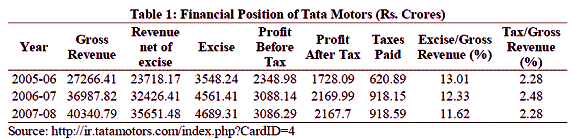
How much is this package worth? Let us try to think this through. We have collected some information from annual financial reports of TML in Table 1 that will help us get an approximate figure for the Uttarakhand/Himachal Pradesh package using points 1(a) and 1(b).

There are some remarkably stable patterns in the data. TML seems to be paying about 12% of its gross revenue as excise duty and 2.35% of its revenue as corporate income tax. If TML were to set up shop in Uttarakhand or Himachal Pradesh, it would be manufacturing about 250,000 small cars per annum. If each car were to sell for Rs. 1 lakh, TML’s gross annual revenue would be approximately Rs. 2500 crores. If the TML would have to pay excise duty, assuming the above ratios, it would pay about 300 crores (12% of Rs. 2500 crores) per annum; if it had to pay corporate income tax, it would have to pay about Rs. 58.75 (3.5% of Rs. 2500 crores) crores per annum. If TML set up shop in Uttarakhand/Himachal Pradesh, according to the agreement, it would not have to pay these taxes as stated in point 1(a) and 1(b).

Summary of the Uttarakhand/Himachal Pradesh package: for the first 5 years, TML gets Rs. 358.75 crores every year (100% excise duty exemption + 100% corporate income tax exemption); and for the next 5 years, it gets Rs. 317.63 crores every year (100% excise duty exemption + 30% corporate income tax exemption). The NPV of this benefit package is Rs. 2062.79 crores (using 11% for calculating NPV).

According to point 7(a) of the agreement, the West Bengal government’s “benefits package” will equal this sum if we compute the benefit coming from subsidized land, soft loans and tax holidays. Let us now look at the different components of the package promised by the West Bengal government.

Hidden Land Subsidy

What are the terms of the rental structure on the land lease agreed upon by WBIDC and TML? Two different set of rules apply, one to the 647.5 acres leased to TML and another to the 290 acres that will be leased to the vendors approved by TML. Both leases, however, will come up for possible renewal 90 years down the line. For the 647.5 acres of land that is leased to TML, the annual rental will be Rs. 1 crore for the first five years, increasing by 25% every five years till 30 years. Thereafter, the annual rental will be fixed at Rs. 5 crore, to be increased by 30% every 10 years till the year 60; the rental from year 61 to 90 will be Rs. 20 crore per year. For th vendors, the rental structure is simpler: for the first 45 years, they will pay an annual rental of Rs. 8000 per acre, and for the next 45 years will pay an annual rental of Rs. 16000 per acre. Since the vendors are leasing 290 acres of land, this means that for the first 45 years, they pay a total of Rs. 0.232 crores per year and Rs. 0.464 crores per year for the rest of the time.

Details of the payment schedule, for both TML and the vendors, is summarized in Table 2. This is similar to, but more detailed than, a table used by Madhukar Shukla for commenting on the Nano project; the main difference is the inclusion of figures on net present values (NPV). What is net present value? It is a conceptual device used to compare sums of money at different points in time, which I explain in greater detail below. Why is NPV relevant here? Because an investment project like the proposed plant in Singur involve costs and benefits flowing in at different points in time. Columns (2) through (6) give the actual payments to be made at various points in time, while the last three columns give the net present value (NPV) of the payments, where NPV has been calculated using an interest rate of 11% per annum (exactly as done by the WBIDC in Annexure II of the agreement). Note in passing that the Annexure where all the computations relating to the project has supposedly bee done has not been made available to the public; all we know is that the NPV calculations used an interest rate of 11%.

To arrive at figures about the costs of “acquiring” the land and the revenue earned from leasing it to TML (and the vendors), we need to remind ourselves that the WBIDC spent anything between Rs. 150 crore and Rs. 200 crore to “acquire” the land from the unwilling farmers. How much will WBIDC get for letting TML use that piece of land? Columns (4) shows that the TML will pay a total amount of Rs. 855.79 crores over 90 years as rental fees for using the land. So the cost incurred by the WBIDC is Rs. 150-200 crore, while revenues will be 855.79 crore. Does this mean that the WBIDC made a good bargain with the TML on behalf of the people of the state? Does it men that the WBIDC is actually making a “profit” in leasing out the land to TML? Let us think about this a little more.

A rupee today is not equivalent to a rupee next year. Why? One can put the rupee that one has today in the bank and earn an interest income at the going interest rate to augment the original sum. If the current interest rate is 11%, then one would have Rs. 1.11 at the end of the year if the rupee were to be invested in an interest-bearing asset today. Put another way, Rs. 1.11 at the beginning of next year is equivalent to Rs. 1 today (at the beginning of this year). Let us go further, and suppose that we let our rupee lie in the bank for two years. How much do we have at the beginning of the third year? Rs. 1.21 (because at the beginning of the second year one has Rs 1.11, and then one earns 11% on that amount to arrive at Rs. 1.21 at the beginning of the third year). Inverting things, we see that Rs. 1.21 two years hence is equivalent to Rs 1 today when the market interest rate is 11%. This logic can be extended to any number of years and is the basis of computing net present values (NPVs). In the jargon of economics, if the market interest rate is 11%, Rs. 1.1 one year hence has a NPV of Rs. 1; and Rs. 1.21 two years hence has a NPV of Rs. 1. Thus, NPV is a device to make sums of money at different points in time comparable to each other. What does this mean for us?

It means that we cannot just add up all the rental payments that TML is supposed to make over the next 90 years (which is Rs. 855.79 crores) and compare it to the cost incurred by the WBIDC to “acquire” the land today (which is Rs. 150-200 crores). To make the stream of rental payments of the TML (over the next 90 years) comparable to the cost of “acquisition” today, we need to calculate the NPV of the rental payment stream. That is precisely what we have done in column (7) in Table 2. Column (8) gives the sum of the NPVs of the rental payments. On the basis of this calculation we arrive at a very striking fact at the end of column (8). The NPV of the rental payments that the TML will make over the next 90 years is Rs. 14.4 crores! The NPV of the rental payments that the vendors will make is Rs. 2.13 crores.

Summary: while the cost to the WBIDC for “acquiring” the land was anything between Rs. 150 crores to Rs. 200 crores, the NPV of the revenue from rental income that will accrue to the WBIDC is Rs. 16.53 crores, sagging the WBIDC with a loss of anything between Rs. 130 crores to Rs. 180 crores! Which is just another way of saying that taxpayers are subsidizing a big corporate entity like the TML to the tune of Rs. 150 crore just in terms of the land that the WBIDC “acquired” for it.

Cost of Circumventing the Law

A moment’s reflection on the time structure of rental payments for TML brings another characteristic of the transaction to the fore. The time structure of payments has been arranged in such a way that the bulk of the rental payments come in later years. From column (6) in Table 2 we see that the TML makes only 5% of its total payments in the first 25 years of the lease; in the first 50 years, it pays only 20 percent of its total payment commitments. The Comptroller and Auditor General of India (CAG) had pointed out in March 2008 that, according to Government of India laws, long-term leases of 99 years required that the lessee pay 95% of the market value of the land as a one-time premium at the beginning of the lease and pay annual rent at the rate of 0.3% of the market value of the land. The same report went on to note that the agreement between the TML and the WBIDC should have entailed an immediate payment of Rs. 91.88 crore and subsequent annual rents of Rs. 29 lakhs for the next 90 years. As opposed to this, the TML, according to the agreement, would pay nothing upfront and would only pay Rs.1 crore at the end of the first year!

Of course it would have been illegal if the lease was for 99 years. Hence, it seems, the WBIDC cleverly decreased the span of the lease by 9 years to circumvent the letter of the law. In spirit, though, this still amounts to a violation of the law. Why? Because the law states that for long-term leases the majority of the payments should be paid upfront by the lessee; and the WBIDC agreement with TML shows an exactly opposite time structure of payments, with most of the payments pushed off far into the future. Thus, even though in letter the agreement clears legal hurdles, it is obvious that it fails miserably in terms of the idea behind the law. No wonder the CAG faulted the WBIDC on several counts regarding its agreement with the TML. But let us pause for a moment and think why the CAG (or the laws) wanted the bulk of the payment upfront.

There are two basic reasons why the law might want to ensure bulk of the payments for a long-term lease upfront. One, large upfront payments for long-term leases increases the NPV of the rental payment stream. Since these long-term leases generally require the government to hand over public land for private use, it makes sense to structure rental payments in such a way that the government exchequer gets a good value in return; that is why a large upfront payment is usually written into lease contracts for long-term leases. The second reason for having a large upfront payment relates to considerations of risk. When a stream of payments has relatively large amounts pushed far away in the future, the NPV of that stream of payments is more liable to change when market interest rates change.

Let us take an example to understand both these points. Suppose, for simplicity, we want to compare two payment streams, A and B. A has Rs. 1 lakh today and Rs 9 lakhs in 10 years; B has Rs 9 lakhs today and Rs .1 lakh in 10 years; note that both entail a total payment of Rs. 10 lakhs over a period of 10 years and are similar in this respect. But they also are very dissimilar. To understand why suppose that the market interest is 10% at the moment. NPV of A is Rs. 4.47 lakhs, while the NPV of B is Rs. 9.39 lakhs. Thus, the NPV of B is much higher than that of B, which clarifies the first point. Now suppose that the market interest rate increase to 15%; this will obviously diminish the NPV of both A and B. But which will fall more? A’s NPV falls by about 39% while B’s NPV falls by only 1.5%! Thus, the risk of loss of revenue that comes from a payment stream (payment of rent for instance) is higher when most of the payments come in during relatively later periods. It is probably because of these two sound economic reasons, among others, that the CAG urged the West Bengal government to reconsider its lease agreement with the TML. By structuring the rental payments such that most of it come in during later years, the West Bengal government is not only losing revenue but is also bearing a higher risk of loss of even that minimal revenue.

So, how much is the WBIDC losing in real terms by using the rental payment structure that is summarized in Table 2 instead of the one recommended by the CAG? If TML were to pay Rs. 91.88 crores upfront and then subsequently pay a rental of Rs. 29 lakhs per annum for the next 90 years (as suggested by the CAG ), the NPV of this payment scheme would be Rs. 94.52 crores (using an interest rate of 11% per annum for calculating the NPV). The NPV of the currently agreed upon rental payment scheme (as per the agreement) is Rs. 16.53 crores (sum of entries in column (7) of table 2). Hence, the WBIDC is losing Rs. 77.99 crores due to the chosen rental payment structure.

Summary: the total financial loss to the WBIDC due to the agreed upon rental payment structure, as opposed the one suggested by the CAG, is Rs. 77.99 crores; the WBIDC, in addition, has to bear extra risk arising from possible fluctuations in the market interest rate.

Soft Loans and Tax Holidays

Point 7(c) of the agreement provides information about the soft loan: “The West Bengal Govt. will provide TML a loan of 200 crores @ 1% interest per year repayable in 5 equal annual installments starting from the 21st year from the date of the disbursement of the loan”. This loan, moreover, “will be disbursed within 60 days of this agreement”. Point 7(a) of the agreement refers to the loans that the WBIDC will give to the TML in the form of tax holidays. The tax holiday will continue, as we have already noted, till the sum of the land subsidy, tax holiday and the soft loan equals the Uttarakhand/Himachal Pradesh package.

So, what is the total loss to the exchequer due to the tax holidays and soft loans. There are two ways to arrive at approximate value of this loss. First, if we knew the exact amounts of the loans (in the form of tax holidays) and the exact repayment shedule and interest rates, we could calculate the net present value of the loss. But unfortunately, we do not have enough data in this regard, and so we will adopt an indirect method to arrive at the notional cost of the tax holiday and the soft loans. This second, indirect method, begins by recalling that, according to point 7(a) of the agreement, the total benefits from the land subsidy, taxt holidays and soft loans offered by the West Bengal government will equal the benefits that was offered by the Uttarakhand/Himachal Pradesh govenrment. We have seen above that the total value of the Uttarakhand/Himachal Pradesh package was approximately Rs. 2063 crores on a net present value basis. We have also seen that the cost to the exchequer of the subsidized land was about Rs. 228 crores (Rs. 150 crores for direct subsidy and Rs. 78 crores lost due to the time structure of the rental payment scheme). Thus, the total cost of the tax holiday and the soft loans will be Rs. 1835 crores (which is Rs. 2063 crores less Rs. 228 crores) on a net present value basis. Note that this is a notional cost.

The last part of 7(a) seems even better. It says: “WBIDC will ensure that the loan under this head is paid within 60 days of the close of the previous year (on 31st March) failing which WBIDC will be liable to compensate TML for the financial inconvenience caused @ 1.5 times the bank rate prevailing at the time on the amount due for the period of such delay”. What does this mean? It means that if the WBIDC is not able to make the loan to TML within 60 days of the close of the financial year, it will penalize itself by compensating TML at 1.5 times the prevailing bank rate. So, if the prevailing bank rate is 10%, which is close to what is the case right now, the WBIDC will penalize itself for any delay on its part by paying back the TML for the “financial inconvenience” at 15%.

Summary: the cost of the soft loans and tax holidays to the TML by the West Bengal government will be about Rs. 1835 crores on a net present value basis.

More Gifts from Santa: Real Estate and Subsidized Electricity

Industrial development requires infrastructural support from the government, as we all know. And so the West Bengal government displayed its commitment to “rapid industrialization” by offering a “virtual gift of 650 acres of prime land to Tata Housing Development Company (THDC) in Rajarhat New Town and in the adjoining Bhangar Rajarhat Area Development Authority for building an IT and residential township along with WBIDC as a partner“. What better way to provide “infrastructural assistance” for the industrialization effort that to hand over prime land for real estate speculation! Some reports suggest that this “gift” to TML will cost the exchequer about Rs. 160 crores.

The West Bengal government has also promised to supply electricity at Rs 3 per kilo watt hour (kwh), which is around half the price charged to high-tension industrial consumers in the West Bengal at the moment. It has also promised to absorb any increases in electricity costs to the TML in Singur. Point 7(d) of the agreement states: “In case of more than Rs. 0.25 per KWH increase in tariff in every block of five years, the Government will provide relief through additional compensation to neutralize such additional increase”. This will mean, at the least, shelling out Rs. 70 crores annually for subsidizing the electricity requirements of the whole project at Singur. The NPV of this subsidy for the 90 year period of the lease would be Rs. 706 crores.

Summary: the cost to the exchequer of the real estate gift and subsidized electricity will be about Rs. 865 crores.

Adding up the Costs

Let us now take a moment to put all this together. The subsidy that TML gets, according to the terms of the agreement, on the land in Singur is anywhere between Rs. 100 and Rs. 150 crore; the subsidy due to the rental payment structure is Rs. 78 crores; the implicit subsidy due to the tax holiday and the soft loan would be about Rs. 1835 crores; the real estate “gift”, also known in WBIDC terminology as “infrastructural assistance”, is worth Rs. 160 crores; and the subsidized electricity will cost another Rs. 706 crores. So, the Tata conglomerate, one of the largest corporate entities in the country, is awarded a “gift” of about Rs. 2928 crore by a “communist” government so that it can be induced to set up a car manufacturing plant in the state and lead it on to the path of neoliberal industrial development. To put this figure in perspective, let us refer to the 2008-09 budget speech of the Finance Minster of West Bengal. Pointing to the emergence of what he called the “industrial potential” of the state, he offered some concrete figures to bolster his argument. In 2005, the annual realized (industrial) investment in West Bengal was Rs. 2515.58 crores, which then jumped up to Rs. 5072.26 crores within the next two years. Thus, a sum close to 58 percent of the total realized industrial investment in the state in 2007 would be the cost borne by the people of the state if the Tata-Singur project too off.

Summary: the total cost of the Tata-Singur project incurred by the exchequer, and hence ultimately the tax payers, will be approximately be Rs. 3000 crores on a net present value basis when we add up the costs pertaining to the land subsidy, the tax holidays, the soft loan, the real estate gift and the subsidized electricity using an interest rate of 11%. This is about 58% of the total realized industrial investment in the state of West Bengal in 2007.

What are the Benefits?

What are the purported benefits of the Tata-Singur project? The West Bengal government has advanced two claims regarding the benefits: employment generation and improvement in the investment climate of the state. These two claims about possible employment generation and future investments need to be looked at closely, because the rationale offered by the West Bengal government for giving the stupendous bonanza to the Tatas rests precisely on these. Both these claims are dubious. Regarding the claims about employment generation, there have been figures ranging from a high of 12000 (2000 in the Nano plant proper, 10000 in ancillary and complementary units) to a low of 750 (some recent local newspapers have put the figure at 650). The upshot of all this is that there is no certainty about the employment generated. However, if we look at a recent BBC report on this matter it becomes clear that 62% of the projected employment in the automotive sector is going to be skilled labour, 28% is going to be management jobs, leaving only 10% jobs for unskilled labour. Now, the displaced population in Singur, if at all they get absorbed in the mother plant or in the ancillary units, would typically be offered employment as unskilled labour. So, the prospect of much employment being generated, especially for the people in Singur, is dim. Moreover, all these calculations ignore the employment destruction that the project will inevitably entail. If we were to properly take both possible employment generation and possible emplyment destruction into account, we could arrive at a figure for the net emplyment generated by the project. At the moment, it is not even clear that the net employment figure will be positive.

The other claim about the Singur project generating prospective investment in the future rests on equally shaky foundations. The question really boils down to whether the Tata plant can attract other major investments and lead to an industrial rejuvenation of Bengal. The example of Jamshedpur in neighbouring Jharkhand should be carefully looked at. Tata’s factories in Jamshedpur did nothing for the overall industrialization of the state of Bihar or now Jharkhand. It remained an enclave of industrial activity, without forging strong forward or backward linkages in neighbouring areas. The other issue to think about, in the context of the claim about TML drawing future investments, is whether other industrialists coming to invest in Bengal would also demand similar bonanzas from the government. Will the government refuse them the goodies that they have offered TML and let them turn away or will it repeat the Tata-like agreements and put further burdens on the exchequer. Either option does not seem to be beneficial from the perspective of the working people of the state.

Summary: while the costs of the proposed Singur-Tata project is obvious, tangible, immediate and large, the benefits seem to be uncertain, residing far away in the future and their magnitudes small.

Oh! So Poor Tata

A few months back, the finance minister of West Bengal presented a budget with a Rs. 2 crore deficit; a net subsidy of about Rs. 3000 crores would certainly be extremely costly for the people of the state; after all it is about 1500 times the budget deficit in fiscal year 2008-09. Given that a small, poor, fund-starved state like West Bengal is making such great efforts to subsidize the Tata’s, it must mean that they (the Tata’s) are in a dire financial situation. But is that true? If we merely cast a glance at the recent international buying spree that the Tata’s have been engaged in, we might be able to understand how far from the truth would be any assertion that the Tata’s require financial assistance from a poor state like West Bengal to start an industrial project.

The Tata Group of Companies, let us remind ourselves, is one of the largest business conglomerates in India with about 100 large companies in its fold. With the might of the Indian State firmly behind it, monopoly capital in India has started a move to aggressively acquire foreign assets, what it calls strategic corporate assets. In the last few years, the Tata Group has been leading this acquisition spree on behalf of Indian big capital, making forays not only in Asia and Africa but also in the heartland of world capitalism: USA and Europe. Let us briefly take a look at the record of the Tata Group with regard to foreign acquisitions.

In January 2007, the Tata Group pulled off India’s biggest ever takeover of a foreign company to buy Anglo-Dutch steel-maker Corus for $12 billion; this acquisition made the

combined entity (Tata-Corus) the world’s fifth largest producer of steel. In March 2004, the Tata Group acquired South Korea’s Daewoo Commercial Vehicle Company for $102 million; this was followed by the acquisition of a 21 percent stake in Spanish bus maker Hispano Carrocera for $18 million with an option to pick up the remaining stake at a later date. Around the same time, Tata Technologies, another company in the Tata fold, which provides automotive engineering and design services, bought Britain’s Incat International for $53 million.

Tata Consultancy Services, which was earlier a division of Tata Sons and a rising star in the Tata Group, has been among the most aggressive shoppers for foreign companies. It has acquired six companies in the past few, with the net value of the deals close to $100 million; these include FNS of Australia, which was acquired for $26 million and Chile’s outsourcing major Comicrom, which was bought for $23 million. When the Tat Group acquired the former state-run, international telecom carrier, VSNL, a few years ago, it was on its way to becoming a major telecom player in the global markets. To enhance its position, it acquired undersea cable company Tyco of the US for $130 million, Internet service provider Dishnet’s India division for $64.28 million and international telecom service provider Teleglobe of the US for $239 million.

Following its acquisition of Hindustan Lever Chemicals, Tata Chemicals was on the lookout for a steady supply of phosphoric acid for its newly acquired plant at Haldia, West Bengal. Accordingly, it took over two overseas companies for a total value of $215 million: Indo Maroc Phosphore of Morocco in March 2005 and Brunner Mond Group of Britain in December 2007. Morocco, by the way, produces over 50 percent of the world’s rock phosphate.

In 2000, Tata Tea bought British giant Tetley for a $407 million, and started looking for similar deals to strengthen its global position in the tea and related drinks business. This search led to acquisition of 33 percent stake in the South African company Joekels Tea Packers for an undisclosed amount and 30 percent stake in the US-based favoured water manufacturer Glaceau for $677 million, the acquisition of the US-based Good Earth Corp for $32 million and acquisition of the Czech Republic’s firm Jemca for an unknown amount.

India Hotels, the hotel branch of the Tata Group, acquired several hotels abroad for $121 million in the past few years. It is reported to have set aside $100 million for future acquisitions in Europe, the Middle East, Asia and the US. In December 2006, it had acquired W, a hotel at the Woolloomooloo Bay in Sydney; it was followed by the taking over of the management of The Pierre, a luxurious landmark hotel on New York’s Fifth Avenue. India Hotels, which runs the Taj Group of hotels, has 39 hotels in India and 18 worldwide. A recent acquisition of India Hotels was Campton Place Hotel in San Francisco.

If we add up the figures for the Tata Group’s overseas acquisitions, we arrive at a rough figure of $14,062 million, which converts to roughly Rs. 56,248 crore (using an exchange rate of Rs 40/$), and this is not even a complete list of Tata’s recent acquisitions. And, what does all this lead to? It inevitably leads us to the conclusion that a corporation which can invest more than Rs. 56,000 crores for acquisition of strategic foreign corporate assets requires the financial support of India’s impoverished taxpayers, to the tune of Rs. 1140 crores in real terms, to set up a small car manufacturing plant in India! That, in a nutshell, is what we would like to call neoliberal industrialization, pushing which down our throats has become the almost single-minded purpose of the West Bengal Government and the “communist party” that is at its helm of affairs.

TINA Logic

But even after all these facts and figures and arguments have been read, understood and absorbed, sympathizers of the West Bengal government will no doubt come up with a supposedly unbeatable argument: TINA. There is no alternative. This argument points to the magnanimous offers made by other states in India to attract private capital, and then goes on to plead the inability of the West Bengal government to follow any route other than to offer even more largesse. Recall that the text of the agreement starts precisely with this argument. It builds up its case for the huge hidden subsidies that is offered to TML, and which we have seen in great detail above and which add up to about Rs. 3000 crores on a net present value basis, by emphasizing the incentive package that the States of Uttarakhand and Himachal Pradesh has offered to the Tatas. That is why the West Bengal government must offer more than the value of the offers by the other states if it is to attract private capital, like the TML, to industrialize the state. Since, other states are offering huge tax breaks and soft loans, West Bengal must also do so, the argument goes. West Bengal cannot fight this trend, caught as it is in the competitive struggle between the states of India.

One must begin by acknowledging that there is some truth to this assertion. It is true, in other words, that in the neoliberal set-up private capital has managed to generate competition between political entities, both within nations and between nations, to ensure higher profits on its investments. But acknowledging this fact, the fact of the existence of this strong pressure for competition among states, does not mean accepting it as inevitable; it does not mean accepting the logic, championed by the proponents of neoliberalism, that there can be no alternative to the present framework. If the fight against neoliberalism has to be taken forward then this logic must be fought. One cannot succumb to this logic in practice and claim to be fighting against neoliberalism.

And to fight this logic, one must understand what it implies. The competition that capital manages to enforce on political entities (for instance states in India or countries in the global context), one must understand, is akin to a “race to the bottom”. As soon as one state lowers taxes, reduces social sector spending, loosens labour laws, cracks down on political dissent in order to make the atmosphere “conducive” for investments, another tries to outdo the first by reducing taxes even further, reducing social sector spendings even further, making labour even more “flexible” in order to “attract capital”. And thus, as the logic of this competition unfolds in all dimensions, people of all the states taken together lose. Lower tax revenues means lower resources for the State to invest in educations, health, nutrition, poverty alleviation; it means increased misery for the common people, with sub-optimal infrastructure and public amenities. And who benefits from this fierce competition? Capital. Thus accepting this as the only way to industrialize is to accept this “race to the bottom”, with all its deleterious consequences for the population, as the West Bengal government seems to have done.

So what can be done? One has to act on several fronts at the same time. First, it is undeniable that fighting the neoliberal logic will require concerted political action at the Central level to thwart moves to implement central-level neoliberal policies; the largest “communist” party standing behind the West Bengal government must shed its fears of radical mass political activism and launch, with other like minded political forces, a nationwide offensive against neoliberalism, instead of using all its energies in parliamentary antics. It will also mean not succumbing to the pressures of capital at the state level as the West Bengal government has pathetically done. If private capital wants to move out of the state because taxes are high and social sector spendings are growing and the labour laws are favourable for the workers, and the health and educational status of the people are improving, then so be it. The state need not hanker after such capital for, at the end of the day, massively state-subsidized investments of such capital is not beneficial for the people.

Second, one must understand that, if attracting capital is all one wants to achieve, capital can also be attracted in a very different fashion, by reversing the harmful, negative competition between states and instead initiating a “race to the top” to replace the “race to the bottom”. For it is a fact, recently noted by several observers of the Indian economy, that India is very rapidly moving into a regime marked by serious shortages of skilled labour. A state which wants to attract private capital can, therefore, invest massively in building up the education and health system for the workers; a healthy and skilled labour force can be a stronger incentive for capital to set up shop in a state than huge tax holidays. In fact, instead of giving tax breaks to capital, the state will need to tax them aggressively and use the tax revenue to further improve the conditions of the working people. Equally true is the abysmal conditions of physical infrastructure – transportation, housing, power, etc. – in most of the states of India. A state can, therefore, start investing in building up basic infrastructure for the people by taxing capital and citizens in the high-income brackets; solid infrastructure can be as strong an incentive for private capital as soft loans and hidden subsidies. The point of these interventions would be, in the medium and long urn, to initiate reversal of the “race to the bottom” that every state seems to be in the grip of. Unfortunately, the West Bengal government seems hell bent on going the opposite way.

Third, complementing these interventions have to be efforts to revitalize mass political activism at the grassroots level. Imagine, for a moment, a strong, countrywide mass movement against neoliberalism. If Singur in re-enacted in Uttarakhand and Himachal Pradesh and Karnataka, then where will the TML go? Wherever it sets up shop, it will have to do so without the luxury of externalizing the costs onto the working people and the environment. Simple economic logic suggests that forcing capital to internalize its costs by an active mass political movement would in fact ensure that the decisions taken by capital will be closer to what could be considered socially optimal. Mass participation in planning and implementation would, further, increase much-needed accountability of both the state and capital. Unfortunately again, the West Bengal government wants to go the other way.

Conclusion

This brief analysis of the details of the proposed Tata-Singur project in West Bengal offers us an unique opportunity to think about the industrialization strategy of the Indian state today. One of the major thrusts of this strategy is to build up so-called Special Economic Zones (SEZs) all over the country. As of August 11, 2008 there were 250 notified SEZs across the country. Since each of these SEZs more or less replicate the policy regime applicable to the proposed Tata-Singur project – with magnanimous tax holidays and soft loans and subsidized power and “flexible” labour laws and absence of all environmental regulations – it would probably not be far from the truth to suggest that each of these SEZs would entail at least the amount of loss that we have calculated above for the Tata-Singur project. This suggests that the total cost to the people of this country of the current neoliberal policy regime would be about Rs. 750,000 crores. How large is this figure? For comparison, consider the fact that the total expenditure of the Indian government was slated to be Rs. 750, 884 crores in budget 2008-09; thus, an amount which is roughly equal to the total expenditure of the Indian government in 2008-09 would be the loss to the nation for embracing neoliberalism. Isn’t it high time we sharpened our struggle against neoliberalism in earnest?

(Comments from Debarshi, Kuver and Partho have substantially improved the argument of this article).

ADDENDA

Benefits of Employment Generation

In my earlier portion of the article, I had stated that a full-blown cost-benefit analysis was not possible with the available information; that is primarily because information about net employment, and therefore the corresponding income, generated in the Tata-Singur project is lacking. There is lot of uncertainty about the possibilities of new employment flowing from the project, and figures for net employment generated varies from a high of 10,000 to a low of 500, the highest figure unsurprisingly coming from TML and the West Bengal government. Though it remains true that a full-blown cost-benefit analysis is not possible, what can certainly be done, as a complement to my previous analysis, is to find the benefits of the net employment generation for the best possible scenario and compare it to the costs entailed by the project. In carrying out such an exercise, we would be conducting a rough cost-benefit analysis with the most favourable assumptions for the West Bengal government and TML. Let us see what we the results are.

To proceed, let me state my assumptions clearly:

(1) There is a net employment generation of 10,000 this year in the Tata-Singur project.
(2) The average wage attached to this new employment is Rs. 60,000 per year.
(3) Due to the multiplier effect of this new income generated in the Tata-Singur project, i.e., due to the backward and forward linkages that it will supposedly establish, income will grow at the rate at which the Indian economy has been growing for the past few blazing years, i.e., at 9% per annum.

Thus, the net income generated during the current year will be Rs. 60 crores (which is 10,000 multiplied by Rs. 60,000); during the next year, the total income generated will be Rs. 65.4 crores; the year after that Rs. 71.29 crores, and so on…

Here is the question that I want to pose: how many years will it take for the net present value of the income stream generated due to the Tata-Singur project (and its multiplier effects) to equal the cost of the project? How many years, in other words, will it take for the total benefits, under these generous assumptions, to equal the total cost incurred due to the project? Recall that, as we have seen earlier, the total cost of the project is roughly Rs. 3000 crores on a net present value basis? So, how many years will it take for the benefits to equal Rs. 3000 crores?

And here is the answer: 127 years!

What does this imply? Let us think a little carefully. The net employment generation figure is by all accounts a gross exaggeration. As we have argued earlier, the component of employment that will go to unskilled labour is relatively small. Given the fact that the semi-agricultural labour population in Singur is most likely to be absorbed, if at all, as unskilled labour, the employment prospects of these people are extremely limited. Additionally there is the aspect of job destruction which we have so far ignored; it is most likely the case that the quantum of jobs destroyed due to the project is higher than the jobs that will be created. Hence, in all probability, the net employment generated by the project is negative. Thus, in assuming that the net employment generated by the project is 10,000 we are inflating the figure many times over. The fact that we have also assumed the wages to be Rs. 60,000 per annum only adds to the exaggeration. Since most of the employment for the people of Singur will be in the form of unskilled labour, a salary of Rs. 5,000 per month is a certainly high figure.

Similarly, the assumption that the total multiplier effect of the new employment will be a growth of 9% per annum year after year is also an exaggeration. If the multiplier effect of the new employment would generate 9% additional every year, it would mean generating about Rs. 5.4 crores of additional income in the second year, about Rs. 5.9 crores of additional income in the third years and so on… Even the Indian economy is expected to slow down, from its current 9% growth rate, due to the global financial crisis. Hence, an annual growth rate figure of 9% for income generated most certainly inflates the benefits accruing from the Tata-Singur project in terms of employment and income.

What all this means is that even under extremely favourable assumptions, the cost of the Tata-Singur takes 127 years to be recouped. A reasonable time frame to recoup the costs of the project would require an unrealistically high rate of income growth, something which is anyway unlikely given that the world economy seems headed towards a deep recession. Thus, it seems that the costs of the Tata-Singur project far outweighs the benefits that can reasonably be assumed to flow from undertaking it.

Agreement between Tata Motors Ltd., Government of West Bengal and WBIDC

1. Tata Motors Ltd. (TML) was intending to set up a manufacturing Plant for Automobile Products including “Tata Small Car” to manufacture 250,000 cars per annum on 2 shift basis which could be expanded to 350,000 on 3 shift basis. In addition, it would have several Vendors and act as a mother plant for many aggregates to tune of 500,000 cars. In this connection, TML was considering locating the plant in the States of Uttarakhand/ Himachal Pradesh in view of the fiscal incentive package for the rapid industrialization being made available by the Govt. of India to new Industries in these States which has been attracting a large number of industries to these States. The incentive package in Uttarakhand/Himachal Pradesh consists of:-
(a) 100% exemption from Excise Duty for 10 years.
(b) 100% exemption from Corporate Income Tax for first 5 years and 30% exemption from Corporate Income Tax for next 5 years.

2. The Government of West Bengal (GoWB) is keen to take appropriate steps for rapid industrialization in West Bengal and in this connection wanted to attract some major Automobile Projects to the State. The Government of West Bengal approached TML to persuade them to locate an Automobile Project including the project to manufacture “Tata Small Car” in West Bengal. TML showed interest in locating the plant in West Bengal, provided the State gave Fiscal incentive equivalent to the value of total incentives it would have received by locating the plant in Uttarakhand / Himachal Pradesh. GoWB offered to match the financial incentives in equivalent terms and invited TML to set up the Small Car plant in West Bengal entailing investment of over Rs. 1500 crores by TML. In addition, Vendors supporting the project are likely to make further investment of over Rs. 500 crores.

3. Since then numerous discussions have been held and based on this understanding, GoWB proceeded with identification of various lands for this mega project. Land of approximately 1000 acres chosen in P. S. Singur of District Hooghly was finalized with TML. West Bengal Industrial Development Corporation Ltd. (WBIDC) commenced the process of acquisition of this land. The process was completed with the Declaration of Award under Section 11 of the Land Acquisition Act, and thereafter WBIDC has obtained mutation of ownership in its name in the Record-of-Rights, and conversion of usage of the land from agriculture to factory.

4. WBIDC is in possession of 997.11 acres of land, which has been acquired under the Land Acquisition Act. Out of this, an area admeasuring 645.67 acres will be leased to TML for setting up the Automobile Project including the small car plant, while an area admeasuring 290 acres will be leased to the vendors to this Automobile Project approved by TML (ancillary and component manufacturing units), 14.33 acres will be handed over by WBIDC to WBSEB only for construction of 220/132/33 KV substation and the balance admeasuring 47.11 acres will be used by WBIDC for rehabilitation activities for the needy families amongst the Project affected persons.

5. The terms of lease to TML for the 645.67 acres of land for the mother plant are described below. In addition, WBIDC will provide on lease 290 acres of land to the Vendors selected and approved by TML on payment of Premium equal to the actual cost of acquisition plus incidentals, to be calculated on the basis of the total acquisition cost and other incidental expenses expended by WBIDC or any of its subsidiaries (duly certified by its auditor) averaged over the total land acquired. The lease rental payable per year per acre by the vendors will be Rs. 8000/- per acre for the first 45 (forty five) years and Rs. 16000/- per acre for the next 45 (forty five) years. The initial lease tenure will be 90 years. On expiry of 90 years, the lease terms will be fixed on mutually agreed terms at that point of time.

6. The parties also discussed mutually to finalise the package of incentives required in order to enable GoWB to fulfill its commitment to match in equivalent financial terms the fiscal incentive foregone by TML in Uttarakhand. The Net Present Value (NPV) computation of benefits that the project would have received in Uttarakhand is attached in Annexure I which is agreed to by all the parties. Sample computation of benefits in West Bengal with stated assumptions is given in Annexure II which is accepted by all parties as agreed basis of computation. The NPV is calculated @ 11%.

7. Accordingly, it is finally agreed, in supersession of all previous decisions and agreements in this regard, that for this mega project, the fiscal incentives under Industrial Promotion Assistance in terms of the West Bengal Incentive Scheme (WBIS 2004), assistance towards land cost and interest subsidy in the form of a loan against a quantum of the term loan to be taken by TML for this project will be offered by GoWB as follows:-

(a) WBIDC will provide Industrial Promotion Assistance in the form of a Loan to TML at 0.1% interest per annum for amounts equal to gross VAT and CST received by GoWB in each of the previous years ended 31st March on sale of “Tata Small Car” from the date of commencement of sales of the small car. This benefit will continue till the balance amount of the Uttarakhand benefit (after deducting the amount as stated in para 7b and 7c below) is reached on net present value basis, after which it shall be discontinued. The loan with interest will be repayable in annual installments starting from 31st year of commencement of sale from the plant. The loan availed in the first year will be repaid in the 31st year and the loan availed in the 2nd year will be repaid in the 32nd year and so on. WBIDC will ensure that the loan under this head is paid within 60 days of the close of the previous year (on 31st March) failing which WBIDC will be liable to compensate TML for the financial inconvenience caused @ 1.5 times the bank rate prevailing at the time on the amount due for the period of such delay. TML & GoWB will make best efforts to maximize sale of products from the “Small Car Plant” in the State of West Bengal.

(b) WBIDC will provide 645.67 acres of Land to Tata Motors Ltd on a 90 year lease, on an annual lease rental of Rs. 1 crore per year for first 5 years with an increase @ 25% after every 5 years till 30 years. On expiry of 30 years, the lease rental will be fixed at Rs. 5 crores per year, with an increase @ 30% after every 10 years till the 60th year. On the expiry of 60 years, the lease rental will be fixed at Rs. 20 crores per year, which will remain unchanged till the 90th year. On expiry of 90 years the lease terms will be fixed on mutually agreed terms at that point of time. The benefit on account of land would be calculated as the total land area leased out to TML multiplied by the cost of acquisition calculated in the manner as provided in para 5 less NPV of rent payable during 60 years.

(c) The West Bengal Govt. will provide to TML a loan of Rs. 200 crores bearing @ 1% interest per year repayable in 5 equal annual installments starting from the 21st year from the date of disbursement of loan. This loan will be disbursed within 60 days of signing of this Agreement.

(d) The West Bengal Government will provide Electricity for the project at Rs. 3/- per KWH. In case of more than Rs. 0.25 per KWH increase in tariff in every block of five years, the Government will provide relief through additional compensation to neutralize such additional increase.

8. It is also agreed that the computation of the comparison of benefits in Annexure I and II will be changed if there are any changes in the rates of excise duty and corporate income tax during the next 10 years.

Toward a Third Vietnam?

“EMBEDDED” IN ARROYO’S MILITARY, US SOLDIERS ENGAGE MUSLIM INSURGENTS IN THE PHILIPPINES

  E. SAN JUAN, Jr. 

“With six hundred engaged on each side, we lost fifteen men killed outright, and we had thirty-two wounded – counting that nose and that elbow.  The enemy numbered six hundred – including women and children – and we abolished them utterly, leaving not even a baby alive to cry for its dead mother. This is incomparably the greatest victory that was ever achieved by the Christian soldiers of the United States.” – Mark Twain, Weapons of Satire (Syracuse University Press, 1992, p.172)

Unless US soldiers rape a Filipina date, or Abu Sayyaf bandits kidnap American tourists, nobody notices what’s going on in the Philippines today. But now that Britney Spears just belted out her tempting warble of “sneaking into the Philippines,” can the PENTAGON Special Forces not be far behind to get a piece of the action? Before you can say “Yo Mama!” US troops are found already “embedded” in the Empire’s most Americanized islands where savage class wars have been raging for decades.

The US invaded the Philippines in 1898 during the Spanish-American War, but it created the “first Vietnam” (to quote the historian Bernard Fall) when 1.4 million Filipino recalcitrants had to be “neutralized” to convert the revolutionary Philippine Republic into an “insular possession.”  Mark Twain praised the US government’s success in acquiring “property in the three hundred concubines and other slaves of our business partner, the Sultan of Sulu,” referring to the “civilizing mission” of US diplomacy over the Muslim inhabitants of the southern Philippines (E. San Juan, US Imperialism and Revolution in the Philippines, 2007). But in the 1906 siege at Mt. Dajo and the 1913 rout at Mt. Bagsak, both in Jolo, the US military had to massacre thousands of Muslim men, women and children to complete the islands’ pacification. The victors seemed not to have learned anything, so history is repeating itself.

A hundred years after, the U.S. seems to be doing the job again.

Washington-Manila Homeland Jihad?

The government offensive to retake space occupied or “liberated” by the Moro Islamic Liberation Front (MILF) enters its seventh week. Disguised as a police action, the 6,000 soldiers of the Armed Forces of the Philippines (AFP) battled about 3,000 MILF guerillas in the provinces of Lanao del Norte, North Cotabato, Maguindanao and Sarangani.  By the last week of September, the total casualty figure surpassed three hundred as government troops (with their US advisers/trainers) and Moro (Muslim citizens of the Philippines) militants clashed in the southern Philippines. The scale of violence and magnitude of civilian suffering reached a crescendo enough to alarm the European Union, but not Bush, Condoleeza Rice, nor the two US presidential candidates.  BBC News (9/26/2008) reported that the International Committee of the Red Cross bewailed the plight of tens of thousands of refugees and evacuees, the killing of civilians by indiscriminate AFP aerial and artillery bombardments, and the potential for sectarian “ethnic cleansing.” According to the National Disaster Coordinating Council, more than 300,000 people have fled their homes, several hundred people have been killed and injured, and $2 million worth of crops and infrastructure damaged. At least 120,000 people have died since fighting broke out 40 years ago between the Muslim separatists and the neocolonial state, with no end in sight.

With full-scale war between the formidable Moro guerillas and the AFP about to sweep the country, the U.S. military presence suddenly caught media attention. It was confirmed by government officials that the headquarters of the U.S.-Philippines Joint Special Operations Task Force Philippines (JSOTF-P) is found inside Camp Navarro of the AFP’s Western Mindanao Command in Zamboanga City, Mindanao. Accessed only by U.S. personnel, the physical infrastructure was sealed by permanent walls, concertina wires and sandbags, with visible communication paraphernalia (satellite dishes, antennas, etc.). From this place, US military operations against domestic insurgents – whether belonging to the Abu Sayyaf Group (ASG) or to the MILF, the Moro National Liberation Front (MNLF), or the New People’s Army (NPA) – are launched and directed. In lieu of economic-social reforms, the government’s militarist solution to poverty, unemployment, and extra-judicial killings and kidnappings – over 1,000 victims so far – will only create a refugee crisis, more atrocities and “collateral damage” of innocent civilians, loss of national sovereignty, and impunity for criminal violence committed by the military and police.

Re-occupying “Our Possessions”

The Camp Navarro U.S. outpost is only one of many disposable, low-profile “lily-pad” stations of “forward deployment” for the US military in the post-9/11 period.  Tom Engelhardt recently counted more than 750 US military facilities in 39 countries. But many more are not officially acknowledged, such as the 106 bases in Iraq or those in Afghanistan; or in countries like Jordan and Pakistan where bases are shared (Tomgram 2008; Chalmers Johnson, Sorrows of Empire, 2003). This applies to US military installations in the Philippines. US troops in the Philippines refer to their Jolo launching-pad as “Advance Operating Base-920” devoted to “unconventional warfare”(Herbert Docena, Focus on the Global South Media Advisory, 8/15/2007). The JSOTF-P started in 2002 in Mindanao, part of the Pentagon’s realignment of overseas basing network (Michael Klare, “Imperial Reach,” The Nation 4/25/2005). The bases are now called “cooperative security locations” (CSL), a euphemism mentioned in the May 2005 report of the US Commission on Review of Overseas Military Facility Structures, or Overseas Basing Commission. CSLs can be existing military or private facilities available for US military use. These are located in Clark, Subic, Mactan International Airport in the Visayas, in General Santos City airport, in the aforementioned Zamboanga AFP outpost, and in other clandestine areas (Julie Alipala, Philippine Daily Inquirer, Mindanao Bureau, 11/26/2007).

The Arroyo regime readily hands out apologias for the presence of 400-600 US military personnel in the country purportedly serving “mutually beneficial ends,” as the US Embassy claims. Retired General Edilberto Adan of the Presidential Commission on the VFA (Visiting Forces Agreement) openly excuses the U.S. embedded military headquarters as a necessary fixture to maintain “control over their units.”  When Arroyo visited the US in May 2003, she boasted of having obtained from Washington $356 million in security-related assistance, the largest military aid package since the closing of US bases in 1992. She claimed that US military aid had grown to “more than 100 million dollars annually from 1.9 million dollars three years ago” (Inquirer News Service, 5/27/2003). Two million dollars were allocated for “Sulu rehabilitation” while four million was allocated to Basilan, the site of the Balikatan exercise in 2002.  As a “major non-Nato ally,” Arroyo announced that Bush will continue to give aid to support the Philippines’ “war on terrorism,” not for economic development or for social services, much less for social justice and equity.

“War on terrorists” (“terrorists”, of course, refer to those opposed to US policies; the exploitative neoliberal impositions of the World Bank, World Trade Organization, International Monetary Fund) becomes the Arroyo regime’s blanket term to legitimize US infringement and violation of Philippine sovereignty. What results is a war of terror on humanity, a “homeland security imperialism” whose latest symptomatic crisis is the collapse of the US financial system and the erosion of US economic capacity to maintain hegemony (John Bellamy Foster and Robert McChesney, Pox Americana, 2004).

Ghouls of Pacification 

A brief historical background may be helpful. When the U.S. granted nominal independence to the Philippines in 1946, one of the conditions for this grant was the retention of 23 military installations all over the pacified colonial territory. It was legitimized by the 1951 Mutual Defense Treaty which, under the aegis of Cold War anticommunism, provided for US intervention in case of foreign military invasion by a communist power (Daniel B, Schirmer and Stephen Shalom, The Philippines Reader 1987).

In reviewing the historical record of US colonial subjugation of the islands, William Blum reminds us how the US helped suppress the Huk peasant rebellion in 1940-50. At least one US infantry division collaborated with the Filipino military in killing Huk sympathizers (about 500 peasants, with thousands jailed and tortured) during the months before and after the elections of 1946. In the 1950s, through the Joint US Military Advisory Group and Col. Edward Lansdale (who became notorious for the Phoenix assassination program in Vietnam), then President Ramon Magsaysay used US military advisers, weapons and logistics in unconventional types of counterinsurgency schemes against peasant rebels. Among the CIA agents in government, Arroyo’s father Diosdado Macapagal “provided the Agency with political information for several years and eventually asked for, and received, what he felt he deserved: heavy financial support for his campaign…” Blum concludes that by the early fifties, “Fortress America” in the Philippines was securely in place: “From the Philippines would be launched American air and sea actions against Korea and China, Vietnam and Indonesia…. On the islands’ bases, the technology and art of counter-insurgency warfare would be imparted to the troops of America’s other allies in the Pacific” (Killing Hope, NY 2004, p. 42).”

The methodology of US domination changed after the end of the Cold War. Covert intervention adopted the guise of “persuasion” through the rituals of electoral democracy. This was clearly demonstrated after the February Revolution in 1986 when Marcos was overthrown by a popular-cum-military uprising and the elite oligarchy headed by Corazon Aquino was restored to power. The scenario that Philip Agee described in 1992 may still be valid: “As for the Philippines, absent agrarian and other significant reforms, US military intervention could be a last resort should the New People’s Army achieve enough momentum to create significant destabilization or even victory.  For the time being, continue the CIA-Pentagon ‘low-intensity’ methods already under way.  If unsuccessful and stalemate continues, consider a negotiated settlement as in El Salvador and rely on CIA-NED electoral intervention to exclude the National Democratic Front from power” (Ellen Ray and William Schaap, Covert Action: The Roots of Terrorism, 2003). It appears that it is with the separatist MILF, not the NPA (debilitated by vigilante incursions and internal squabbles), that the US is interested in striking a deal with the help of the US Institute of Peace and partisan Malaysian mediators. It is also an implementation of a flexible divide-and-rule strategy.

Visiting to Overstay: Penetration and Bondage

Immediately after the U.S. invaded Afghanistan after 9/11, the Philippines became the second battlefront in the “war on terrorism.” In February 2002, Arroyo allowed the U.S. Special Operations Command-Pacific to conduct “training exercises” in Mindanao.  Earlier, 660 US soldiers arrived in the Philippines, expanding Washington’s “preventive” war to Southeast Asia. The San Francisco Chronicle (18 Jan. 2002) editorialized on the “Next Battle: Philippines,” pointing out that the demonized ASG is so discrepant from Al Qaeda, and that poverty and land reform are the causes of conflict in the US neocolony. The first Balikatan war games were held involving 4,773 Filipino and U.S. troops. About 2000 US soldiers participated in counterinsurgency operations disguised as “civic action” in several provinces where the NPA was active: Pampanga, Zambales, Nueva Ecija, Cavite and Palawan. This intrusion of the US military was considered legal under the VFA ratified in 1998, just seven years after the Philippine Senate rejected the renewal of the 1947 RP-US Military Bases Agreement, thus closing the two huge US bases in Asia Clark and Subic) where the US enjoyed extraterritorial rights and inflicted all kinds of abuses and indignities on Filipinos (see Teodoro Agoncillo and Milagros Guerrero, History of the Filipino People, 1970). In June 2002, at least 1,200 military personnel comprised the largest US mission outside Afghanistan (Bobby Tuazon, Unmasking the War on Terror, 2002).

The VFA signifies the legitimized sell-out of Philippine sovereignty. Under the VFA, the US can enter the Philippines anywhere and hold military operations. It restricts the Philippine government in checking US aircrafts and ships for nuclear weapons banned by the Constitution. US authorities have jurisdiction over their servicemen who commit crimes in the Philippines while on duty. The flagrant example is the case of Marine Corporal Daniel Smith, convicted for rape last Dec. 4, 2006. Even before his appeal could be acted upon, the Arroyo government surrendered Smith to the custody of the US Embassy, placing him beyond the jurisdiction of local authorities. In October 2007, US officials promised that rape will no longer be committed during war games. Col. Ben Matthews II, commander of the Marine Aircraft Group and co-director of the Talon Vision ’08 exercise (in which Smith and his three co-accused officers were involved), spoke about “the ethics and morality of individuals, not just soldiers” (Tonette Orejas, “US Marines promise no more rape,” Inquirer10/21/2009). Meanwhile, the whereabouts of Smith has become a matter of public speculation, or “rumor-mongering” (to use the Marcos dictatorship’s neologism) as the Supreme Court investigates the legality of his transfer.

Aside from the VFA, US troops, attached employees, and their war materiel have been given unlimited and unrestricted freedom of movement, flexibility and maneuver by the Mutual Logistics Support Agreement (MlSA, 2003; renewed 2008), and the Security Engagement Board (SEB, 2006). The MLSA permits US forces to use government facilities for storage and pre-positioning of equipment as part of strategic deployments during US war maneuvers in the Asian-Pacific and Middle Eastern regions. All three agreements (reinforcing the Cold-War vintage 1951 Mutual Defense Pact and the Joint US-RP Military Advisory Group) that legalize a permanent  “temporary” U.S. military base of operations within the country eviscerate national sovereignty. Both the Arroyo bureaucracy and the mercenary AFP continue to demonstrate their function as tried-and-tested instruments of US global foreign policy and imperialist aggression.

Today, the new agreement covers “non-traditional threats,” a rubric covering a wide spectrum of reasons including terrorism, drug trafficking, piracy, and disasters such as floods, typhoons, earthquakes and epidemics.  According to Arroyo’s factotums, the US is not engaged in actual fighting; instead, US servicemen are merely providing critical combat support services by way of intelligence purveyance, logistics and emergency evacuation for AFP counter-terrorism operations. In addition to Balikatan, Kapit-Bisig war exercises have been carried out with three components: training and equipping the AFP, giving humanitarian and civil assistance, and supporting local military campaigns against Muslim militants (E-Balita, 7/25/06). Counter-terrorism thus merges with anti-narcotics and disaster preparedness to produce the public-relations mantra of fighting “transnational crimes” (E-Balita, 5/25/2007).

When typhoon Frank wrought havoc in the islands, Bush dispatched the nuclear-powered aircraft carrier group led by the USS Ronald Reagan to the Philippines allegedly to assist in local relief and recovery efforts with its F-18s and 6,000 crew. Arroyo cited its tasks of aerial damage assessment and search-and-rescue operations.  The fleet hovered around the Sulu Sea (where Moro insurgents operate) and Panay Island (where the NPA is active). Senator Rodolfo Biazon and progressive groups questioned Arroyo’s welcoming of nuclear-powered vessels (which violates the Philippine Constitution’s ban on the entry of nuclear weapons) and the secrecy of its movements (Juliet Labog-Javellana, “US aircraft carrier stays at edge of RP waters,”Philippine Daily Inquirer, 6/28/2008). Arroyo’s flunkeys cheered this “humanitarian” gesture of GI Joes as more consoling than the Presidential group-hug of disaster victims which Arroyo herself couldn’t give while she was tied up in Washington begging for more money to prop up her beleaguered, subalternized regime.

An earlier intrusion of the USS Blue Ridge in February 2007 occurred during Operation Friendship, a community service project with the AFP. The ship was reported to be involved in a goodwill mission, providing medical assistance and building furniture for a school in Manila (http://rjhm.janes.com/21 March 2007). It was also in this year that the joint war-games named  “Cooperation Afloat Readiness and Training (CARAT)” to enhance the interoperability of the navy and marines were transferred from Subic and Zambales in Luzon to Zamboanga and Basilan, known bailiwicks of the ASG and the Indonesian-based Jemaah Islamiyah (EBalita, May 25, 2007).

One other alibi for US military presence in the Philippines is provided by the Pentagon doctrine of “stability operations,” non-combat activities aimed at “quieting domestic disturbances” such as the U.S. pacification drive (1899-1916) to suppress native and Moro resistance, leading to the genocide of 1.4 million Filipinos.  The chief excuse for US military presence, however, invokes the threat of international and domestic “terrorism” which justifies U.S. security support for development projects and AFP counterinsurgency actions. Beginning with the Reagan administration in the eighties up to today, the U.S. doctrine of “low intensity warfare” envisioned a flexible combination of “economic assistance with psychological operations and security measures” (Michael Klare and Peter Kornbluh, Low-Intensity Warfare, New York 1989). With the demise of the Soviet Union, “low-intensity warfare” evolved into the preventive or preemptive war on Al Qaeda and extremists, including torture, “extraordinary rendition,” and other “shock-and-awe” tactics.

Hypocrisy and Mystification Galore

In a “Focus on the Philippines” Special Report, Herbert Docena has summarized from various news reports and documents the characteristics of the US “unconventional warfare,” among them, the mixture of covert combat actions with humanitarian projects, training, and other civic actions, which are viewed as “integral” to “foreign internal defense.” Static defensive garrison forces have also been replaced by “mobile expeditionary operations,” as shown in the US operations in Sulu and Mindanao. Such counterinsurgency schemes are conducted “under the guise of an exercise,” as a US official stated (Unconventional Warfare, 2007, p. 24). Further, massive documentary evidences now exist that confirm US troops handling military equipment, defusing landmines, and using military equipment during actual hostilities. Post 9/11 US military doctrine and practice form part of a larger global war effort to repair and buttress US hegemony in various parts of the world, including the Philippines and other “friendly” nations. To achieve military and political supremacy, the US cannot accept the limitations imposed by orthodox diplomacy, treaties, and formal agreements.

The fraud of “humanitarian” succor has been repeatedly exposed. Dr. Carol Pagaduan-Araullo, chair of BAYAN (the largest federation of nationalist groups), addresses this pretext in her commentaries in Business World (9/20/2008). She asserts truth to power: “The Arroyo regime deliberately obfuscates the unbending aim of US geopolitical and military strategy in the Philippines and elsewhere: the pursuit of its own Superpower interests.  These include securing areas with strategic communication and supply lines and resources, primarily oil (such as in the Middle East, Central Asia and Southeast Asia), trade routes (such as the South China Sea) and other geographically strategic areas that will ensure its achievement of unrivaled global power.  Domestically, the US has a keen interest and long history of interfering in the country’s internal affairs, most especially countering the growing strength and influence of the local anti-imperialist, patriotic and democratic movement.”

No one today is fooled by the alibi that the miniscule ASG militants numbering 400 (wrongly identified as an al-Qaeda affiliate) constitutes a real threat to US internal security. The real targets of US intervention are the New People’s Army and the Communist Party of the Philippines, classified on 8/9/2002 by Colin Powell’s State Department as “terrorists.” In 2005 then Defense Secretary Avelino Cruz stated that the Maoist NPA is the “greatest internal security threat,” requiring the government to enter peace talks with the larger insurgent MILF (Gary Leupp, “Maoist and Muslim Insurgencies in the Philippines,” Bulatlat, 5/22-28/2008). This view dovetailed with the belief of Admiral Timothy Keating, chief of the US Pacific Command, who confirmed that the US priority targets included not only the ASG and the Jemaah Islamiyah but also the NPA: “If the government of the Philippines tells us that they need help on the New People’s Army, we would consider and respond. So, yes,” the US would lead the military assault on the NPA” (Christine Avendano, Inquirer.net, 6/28/2007).

Keating recently participated in the meetings of the RP-US Mutual Defense Board and the Security Engagement Board, two agencies directing joint war games and planning counterinsurgency agendas. In response, Fidel Agcaoili of the National Democratic Front called Keating’s remarks “interventionist,” adding that US military support for the puppet government has failed to quell the 37-year old insurgency. Communist Party spokesperson Gregorio “Ka Roger” Rosal said that the US military has long been directly engaged in unconventional, covert combat operations against the 13,500 NPA fighters in 120 guerilla fronts, backed by several thousand militias and mass partisans. Using humanitarian missions as cover, US military conducted intelligence-gathering activities in Bicol and Quezon, as well as gave training, technical assistance, weaponry and intelligence information to the Arroyo regime (Inquirer.net, 6/29/2007).   This may also explain the acrobatics of Arroyo’s stance toward the MILF and the US willingness to support MILF notions of “ancestral domain.” In short, US military presence is meant to help preserve the Philippines as a neocolonial dependency, a bastion of US hegemony, by supporting the corrupt and morally bankrupt ruling elite (landlords, compradors, bureaucrat capitalists) as their faithful agents in exploiting and oppressing 90 million Filipinos.

Ancestral Domain as “Killing Fields”

Events have overtaken the good intentions of everyone. Arroyo’s abrupt scrapping of the already initialled Memorandum of Agreement (MOA) between the neocolonial state and the MILF last August 4 exploded into fierce bloodletting. Over 250,000 civilians became refugees, with several hundreds killed, chiefly due to the indiscriminate aerial and artillery bombardment of the AFP against two small MILF detachments. Why the sudden unilateral deceit and treachery?

After more than four years of peace negotiations facilitated by the Malaysian government and the US Embassy (through the US Institute of Peace), Arroyo’s officials initialed a peace pact that would end several decades of conflict between six million Moros (the 2008 CIA World Factbook counts only 4.5 million out of 96 million Filipinos) and successive administrations since Marcos. But local officials appealed to the Supreme Court to stop the final signing, thus precipitating the hostilities. MILF chair Al Haj Murad Ebrahim said that Arroyo failed to inform her constituencies (local officials, other indigenous groups, etc.). It turned out that the real motivation behind the agreement was a secret stratagem to change the Constitution and install a federalist system so that Arroyo and her clique can maintain power after 2010 when her term ends. Clever ploy, indeed, but easily exposed and deflated.

Apart from the possibility of charter change, one may ask: Was Arroyo really intent on pacifying the MILF, just as former president Fidel Ramos pacified the MNLF? One lesson that escaped both parties today is the neutralization if not dismantling of MNLF gains won through enormous sacrifices by way of Misuari’s acquiescence to the 1996 peace agreement, which provides a working model for the MOA. Kenneth Bauzon drives home a point not fully articulated by academic pundits: the 1996 agreement “is essentially a neoliberal formula designed to bring to an end the MNLF’s more than two decades of insurgency. At the same time, the agreement provided legal cover for the entry of capital – both domestic and foreign, and both commercial and philanthropic – to facilitate the integration of an otherwise untapped region, the ARMM, into the global neoliberal world economic order” (in Rethinking the BangsaMoro Crucible, ed. Bobby Tuazon, CENPEG 2008). This explains why US Special Forces have tenaciously and not so surreptitiously embedded themselves in the deeply compromised state apparatus. And why the US Embassy (via the US Institute of Peace and Islamic mediators) insinuated itself in the peace talks, hoping that the Moro “ancestral domain” would easily become grist to the predatory “free market” machinery, the global capitalist commodifying engine, now suffering serious breakdown in Wall Street and Washington.

Amid this stormy landscape enter the “humanitarian” do-gooders. In the AFP’s pursuit of two MILF commanders (Ameril Ombra Kato and Abdullah Macapaar, alias Commander Bravo), US Special Forces were sighted inside the 64th Infantry Battalion Camp in Datu Saudi Ampatuan, Maguindanao. Bai Ali Indayla of the Moro human rights group Kawagip testified that the soldiers were engaged in covert operations, such as the supervision of drones or spy planes (used in 2006 to track down the ASG leaders) and predator missile strikes. This was confirmed by Major Gen. Eugenio Cedo, then commander of the Western Mindanao Command (Philippine Daily Inquirer 9/10/2008). As usual, the US Embassy denied that the soldiers were involved in actual combat; they were only responding to the AFP request for aerial surveillance to determine conditions of the terrain and visibility, for “future civil-military projects,” to quote Rebecca Thompson, US Embassy Information Officer.

Cheering from the Sidelines?

The record of US “non-involvement” in combat is too long to be fully rehearsed here. Marites Danguilan Vitug and Glenda Gloria’s well-researched book Under the Crescent Moon: Rebellion in Mindanao (2000) may be consulted for the larger context of US meddling. Suffice it here to mention some tell-tale examples.  Asia News (July 2004) reported that US Special Forces established a training camp in Carmen, North Cotabato, to teach 150 AFP soldiers unconventional warfare tactics, night combat sniping and surveillance techniques (People’s Weekly World, 7/17-23/2004). Two German interns of Bantay Ceasefire, supported by the European Center for Conflict Prevention, witnessed US P-3 Orion planes conducting surveillance flights in contested villages in Maguindanao where the Abu Sayyaf and MILF elements operate (Evgenia Lipski and Tobias Schuldt, “What are US soldiers doing in Mindanao?” Bulatlat, 8/21-27/2005).

One is reminded of an earlier incident in 2002: the house of a Moro peasant in Basilan island, Buyong-buyong Isnijal, was raided. He was shot in the leg by an American soldier, Sgt. Reggie Lane, who participated in the actual operations. Up to now, no serious investigation has been undertaken to render justice to the victim, Just as nothing has been done to clear up the complicity of four US soldiers in the murder of Corporal Ibnul Wahid, as witnessed by his widow Sandrawina Wahid. She was also one of the witnesses who survived the Feb. 4, 2008 Maimbung massacre. She testified to the presence of US troops during the assault of AFP elite forces on Barangay village, Ipil, Maimbung, Sulu, Eight civilians (a three-month pregnant woman, two children, two teenagers, and her husband, a soldier on vacation) were slain in that combined civic-military action (Carol Pagaduan-Araullo, “Streetwise,” Business World, 9/12-13/2008).

In November 2005, 4 fully armed US soldiers joined the AFP in an encounter with the MNLF followers of Nur Misuari in villages around Indanan, Sulu. They were presumably on a “humanitarian mission,” as claimed by Col. Mark Zimmer, public affairs officer of JSOTF-P (Inquirer News Service, 9/25/2005). Two OV-10 planes dropped several bombs and fired rockets on several villages, killing 15 civilians. After the 2004 bombing of a ferry with over 100 victims, the hunt for the ASG and the Jemaah Islamiyah intensified. Two main suspects of the 2002 Bali bombings were supposed to be holed up with Khaddafy Janjalani, the ASG leader, in Jolo (E-Balita, 8/2/2006). The MNLF in Sulu were accused of coddling ASG gunmen. Despite the disclaimers, two groups (Union of Muslims for Morality and Truth, and Concerned Citizens of Sulu) demanded the immediate pullout of US troops from Sulu province for violating the VFA.  Jolo city councilor Temojin Tulawie asked: “What would US soldiers be doing within the perimeter of the area of engagement right after the bombs have fallen in Indanan if they were not party to the military offensives?” (Inquirer News Service, 9/28/2005). “They are not peacemakers but provocateurs and warmongers,” Tulawie added. Human Rights Commissioner Nasser Marohomsali asserted that the involvement of US troops clearly violated the 1987 Philippine Constitution which prohibits foreign military from participating in direct combat operations on Philippine soil.

One last incident caps this brief review. In December 2007, US troops ordered the shutting down of a hospital in Panamao town, Sulu, and prevented medical personnel from treating patients after sundown with threats to shoot anybody in the hospital if there is an attack (Al Jacinto, Arab News, 1/13/2008.  This has angered Muslim villagers and activists early this year, amid preparations for Balikatan 2008 war games in Sulu and Zamboanga where hundreds of US troops are stationed.  Washington bureaucracy, however, cannot be deterred by native complaints. In the midst of successive military exercises in Basilan, Sulu, and Zamboanga in 2005, US ambassador Francis Ricciardone revealed that the US Agency for International Development was giving two-thirds of its grants to the region at an average of $50 million a year.  Why such generosity?  Obviously, to suppress the “bad guys” of the Moro and communist insurgencies, Ricciardone confessed. This is the reason why the US “established a semi-continuous military presence,” hence the bases issue is, for Ricciardone, “an artifact of people’s imagination” (Carolyn Arguillas, MindaNews, 1/11/2006).

Despite the wrath of the Sulu communities, Christopher Hill, US assistant secretary for East Asia and the Pacific, justified the US role of assisting AFP campaigns, together with the police, in countering terrorism (GMANews.TV, 5/25/2006). What he meant was that it was all right to violate the Philippine Constitution and circumvent the vaguely and loosely formulated VFA. BAYAN secretary general Renato Reyes contended that US intelligence work, reconnaissance, and training of AFP soldiers “are part and parcel of actual combat operations” and their embedding in AFP units “shows that GI Joe is more than just an adviser and observer” (News Release, 8/15/2007). A melodramatic but highly prejudiced “insider” account of how US intelligence personnel (CIA and other unsavory characters) and US Special Forces collaborated with local officials and military agents may be found in Mark Bowden’s narrative of the pursuit and killing of one ASG leader, Abu Sabaya, entitled “Jihadists in Paradise” (The Atlantic, March 2007; for a corrective to Bowden’s racist-ethnocentric, perspective, see Jose Torres Jr, Into the Mountain: hostaged by the Abu Sayyaf, 2001).

Amid daily testimonies of the carnage and destruction affecting millions of inhabitants in the southern Philippines, progressive representatives in the Philippine Congress have urged a thorough probe into the permanent presence of US troops. Personalities such as Rep. Maria Climaco of Zamboanga City and Amina Rasul, lead convenor of the Philippine Council for Islam and Democracy, have also urged action to stop US meddling on behalf of the corrupt, bankrupt Arroyo despotism. BAYAN and other civil-society groups recently petitioned the Legislative Oversight Committee on the VFA to terminate all agreements allowing foreign troops (not only the US but also the Australians and other nationalities) interfering in the ongoing hostilities, thus violating the Philippine Constitution (News Release, 9/25/2008). They also demanded that the Department of National Defense and AFP arrange “the immediate pull-out of US troops and the dismantling of their facilities in Mindanao. However, unless millions of Filipinos commit open civil disobedience and paralyze traffic, business, and government operations – that is, unless massive “people power” erupts to protest the corruption, puppetry and criminality of the US-Arroyo regime – it is unlikely that the Arroyo clique and its American patrons would scrap the VFA and all other instruments of US control. Fighting in the jungles and countryside, in synchrony with parliamentary mass urban mobilizations, may have to accelerate until the comfortable lives of the elite and the complacent middle class becomes impossible to sustain.

E San Juan, Jr. directs the Philippines Cultural Studies Center in Connecticut, USA. He was recently visiting professor of English & Comparative Literature at the University of the Philippines, and will be a 2009 Spring Fellow of the W.E.B. Du Bois Institute, Harvard University. His recent books are US Imperialism and Revolution in the Philippines (Palgrave), In the Wake of Terror (Lexington Books), Balikbayang Sinta: An E. San Juan Reader (Ateneo University Press), and From Globalization to National Liberation (University of the Philippines Press).

Kandhamal, They and We

Satyabrata

On August 24, two policemen came and informed a Christian dominated hamlet (comprising of around 50 families out of which 32 were Christians) that 6 ‘Hindus’ along with ‘Swami’ Lakshmananda Saraswati had been killed. They asked the villagers not to go to the church. The majority of the villagers are cattle-bearers with little land. They decided to obey the order/advice but asked the police for protection which was denied on the grounds that there were not adequate forces for that.

In the evening, about 50 men, with fire torches in their hands came to the village shouting Hindu communal slogans, like ‘Hindu-Hindu-Bhai-Bhai’ (All Hindus are brothers), etc. They stopped in the midst of the village and shouted. There was a dilemma – “should we burn the houses of the Christians first or their church?” To put it more accurately, “should we destroy them or their symbol first?” They decided to destroy the symbol first; the church was to be destroyed.

That symbol played the function of the authority, this they probably understood. On hearing that the church was to be burnt and then their houses would be the target, the villagers panicked. They went to the Hindu houses of their village and asked for help. They wanted their Hindu brethren to take care of their costly possessions, which they handed them over. They ran and hid themselves behind the bushes. The Hindu stalwarts then came to the village and lit the houses aflame. The Christians were silent spectators.

There was a family of four brothers. One of them was a paralytic who couldn’t be rescued from his house. He was shouting at the Hindu fundamentalists desperately, “Throw me out of this place and do whatever you like.” They drenched him in petrol and… One of his brothers watched this from behind the bushes, shocked!

With the houses burning, enough light emanated. The villagers from behind the bushes could see the faces of over 50 ‘Hindus’. They recognized some of them. They were from a nearby village, the place where the slain Swami practiced his “philanthropy” and “education”, which his followers were demonstrating that day.

With the light also came the fear of being noticed by the killer mob. Fear forced them to leave the bushes and go to the nearby jungles. They did so. The mother of the four brothers, aged about 70, couldn’t run. She was kept behind a tree seated and was asked not to move. The rest of the villagers ran into the village. Their struggle continued. The Hindu fundamentalists had got some clue about them and entered the forest to chase them. The villagers couldn’t go to the nearby ‘main-road’, nor could they stay in the jungle. They decided to go to Bhubaneswar, Orissa’s capital. They succeeded in doing so after about a journey of 300km. They reached Bhubaneswar on the 28th evening and took shelter in the YMCA (Young Men’s Christian Association) from the 29th morning.

I went to interact with them a day later. They refused to tell me anything. Then I noticed a priest who had come from Andhra Pradesh. I went and sat beside him to know what had happened. One of the brothers was speaking to the priest. The priest asked, “Why didn’t you confront these people. You were 32 families, which means you were at least 60 men.” The brother replied, “Most men have migrated. Majority among our families present in the village were women and children”. Another man then came and sat beside me. He introduced himself as an army man guarding the Indian borders, and was one of the four brothers, too. He came directly to YMCA when he got the news.

***

“What do you want now?

“This Government has failed us.”

“Which Government? The Central or State Government?”

“The State Government.”

“But the Central Government also knows what is happening and we have also approached it.”

“Then we want a President Rule.”

“That is in the hands of the Central Government.”

“Then it is war between ‘us’ and ‘them’ and we want ‘our people’ to be ‘on our side’.”

“What do you mean by ‘our people’?”

He took a glance at me and answered, “The Christians”.

Now, I could make out why they were not revealing anything to me. Probably, they wanted to know who I was – was I from among ‘them’ or was I from among ‘us’. The Father was of course one of ‘us’.

There were several such villages that have had such bitter experiences.

The author is a second year bachelor student in an engineering college in Bhubaneshwar.

Structural-Cultural Moorings of Transformative Politics in India

Council for Social Development, New Delhi

Structural-Cultural Moorings of Transformative Politics in India
– Call for papers

20-21 January 2009

Evaluating the mode of production debate in India during the 1970s, Alice Thorner (1982) had noted an unwillingness to deal with the cultural aspects. Mainstream academic discourse today has swung to the other extreme of an unwillingness to deal with the political economy aspect, except for largely empiricist economic analyses. There is a felt need today to move-away from these unilateral approaches and follow a synthetic approach of marrying the concerns of political economy/ accumulation, on the one hand with studies on culture and identity, on the other. This would entail viewing social reality at the inter-junctions of accumulation and identity, structure and agency, enabling collective action for social transformation and social development. We need analyses that would be sensitive to both the specificities of the particular ‘social and spatial structures of accumulation’ on the one hand and their totality on the other. We invite papers that could deal with structural-cultural categories such as class, caste, gender, national formations, tribe, community, environment, etc. that could plausibly constitute the social and political mobilisational bases of transformative political articulations and assertions in our country. We also welcome theoretical contributions attempting to link various kinds of social oppressions and finding the principal determinant within a social totality and identifying the principal task of transformative political movements.

Tentatively, the seminar will have the following sessions:

1) Theoretical session
2) Class as the social basis of transformative politics
3) National formations as the social basis of transformative politics
4) Caste, tribe and community as the social bases of transformative politics
5) Gender as the social basis of transformative politics
6) Human-nature relationship as the axis of transformative politics

Please send abstracts of about 1000 words to: Dr. Gilbert Sebastian, Associate Fellow, Council for Social Development, 53 Lodhi Estate, New Delhi – 110 003, e-mail: gilbert_sebs@yahoo.co.in and gilbert.s@rediffmail.com latest by 15 December 2008 and full papers (around 25 pages) by 5 January 2009.

A selection of papers from the seminar would be published in an edited volume.

Knowledge Production under Neoliberal Capitalism

SYMPOSIUM
“Knowledge Production under Neoliberal Capitalism” 

Class, the Crisis of Neoliberal Global Capital, and the role of Education and Knowledge Workers 

The Culturalization of Class and the Occluding of Class Consciousness 

Education Toward War 

Neoliberalism and the hijacking of globalization and education 

How Shall We Live as Lambs Among Wolves? Reason-Passion-Power and Organization  

The Evolution of Knowledge Production in Capitalist Society 

A Call for Papers
on
“Knowledge Production under Neoliberal Capitalism” 
(prepared by Ravi Kumar)
A great deal has been written and said about how neoliberalism affects the different sectors of economy and society. Concerns have been expressed from different analytical positions and even dimensions of the emerging situation. There have been concerns at how it augments inequality in education (Sadgopal, 2006, 2008; Apple, 2004; Kumar, 2006, 2008).  Some of the educationists have raised the issue of how even the states swearing by their welfarist intentions have been only pursuing an agenda that fosters inequality. In fact, the system effected radical alterations in aligning areas and spheres so as to sustain the new changes in the sphere of education. Consequently, profound measures and impacts have been visible in the arena of culture and everyday life (Pathak, 2002; Giroux, undated, 2002).

The knowledge system that we all are aware of emanates from the different institutions that the system brings into existence. Our imagination fails to register anything outside the boundaries of the given, defined institutional framework as developing any kind of knowledge system. Hence, there have not only been debates about how to understand and resurrect the hegemony and domination that characterises the very processes of knowledge production. This hegemony is bolstered by ever renewing processes of strengthening the presence of State within the educational arena. Scholars have gone on to argue that a process of militarization and corporatisation of schools go simultaneously under this system (Saltman, & Gabbard, 2003; McLaren, 2005).  Efforts have been made to understand and explain how these changes are at different levels – ranging from the need to redefine role of schools (as evident in number of experiments in alternative schooling) to the idea of looking at the education as a product of the capitalist system and therefore emphasis has been towards understanding the processes of education as embedded in the systemic characteristics of capitalism (McLaren, 2005; Farahmandpur, 2006; Allman, McLaren and Rikowski, 2005; Hill, 2004; Gibson, 2006).  What we confront today in the educational sphere need not be taken as a surprise as it flows as a natural consequence of the character of capitalist expansion and its tendency towards uncontrolled commodification of our existential realities and its different aspects.

The discourses in contemporary world trying to understand the neoliberal impact on societies emanate from different vantage points. Some of the discourses look at its inequality generating characteristic as evil and argue for better and more enhanced role of state as against the increasing role of the private capital. But such discourses get trapped in the framework of ahistorical analyses. They fail to disclose the character of the state as a conjunctural venue where interests of capital intersect with the interests of masses (seen as demands for employment, better livelihood, improved living conditions etc.) in an oppositional manner. This is more so evident in the current phase of neoliberal times in which we live. This oppositional relationship many a times does not appear as such (i.e., as opposed to each other), especially when the economy is booming and the pretence of everyone being happy and committed to the expansion of capital dominates the imagination.

In such a situation, the need is to establish that the relationship between state and education extends beyond the institutional framework provided by the system. Education, unlike its reified image, moves beyond the schools, prescribed curriculum and the teaching-learning transaction within the school. While the significance of the formal structures remain as relevant as ever but they are understood in a framework that relates them to and treats them as an intrinsic component of the larger system. In other words, education gets fused into the notion of knowledge production, which is constituted by numerous aligned elements. The idea of knowing becomes the dominant paradigm and teaching and learning (which always keep on switching their positions and functions for one another) emerge out of a process which is characterised by conflict, transformations and efforts to survive on the part of the larger mass.

Being part of a process entails that the knowledge production in a society though determined by the Ideological State Apparatuses is also constituted by the other sources – such as movements, acts of resistance, and different types of anti-systemic impulses. However, from this process different kinds of knowledge will be produced – in many cases quite contrary and opposed to each other. Hence, the need for addressing the system and the need to emphasise the relevance of dialectics as a method of understanding education as embedded in the system arises. The system, capitalist mode of production in this case, needs to survive and expand. And there are definite ways in which it sustains and expands itself. “…in order to exist, every social formation must reproduce the conditions of its production at the same time as it produces, and in order to be able to produce it must therefore reproduce: (1) the productive forces, and (2) the existing relations of production” (Althusser, 2006, p. 86). It is essential that the labour power is reproduced for sustenance and expansion of capitalism, and it’s reproduced through the provision of “material means with which to reproduce itself: by wages” (ibid, p.87). However, it is essential that along with reproduction the labour is competent as well. Hence, the issue of skills, posts, jobs etc., become important. Althusser would argue that this is taken care of by the processes outside the production, i.e., through the education system. The educational system becomes a part of consensus creation to generate support for the politics of capital and also nurtures new ideas that would expand the rule of capital. While it teaches the ‘know-how’ (techniques and knowledge), it also teaches children rules of good behaviour, attitudes towards things, rules of morality etc.

Within this framework when one situates the processes of knowledge production significant changes have taken place due to liberalisation of economies across world and more so with the onslaught of what we term the neoliberal regime.  Changes within culture, within institutions as well as outside the institutions have taken place. Educational institutions have become sites of producing skilled labour force, in a never before manner. Global discourse has been insisting on vocationalisation of education so that students can become part of the labour force as early as possible and this also allows, simultaneously, weakening of the critical education possibilities. To think of education as a tool that enables one to transcend the limits of appearances and allows them to delve deeper into the reality would demand that it (education) be seen as a process of resistance, fostering a sense of dissent and dialogicity within the students. However, contemporary regime does not allow that. Education rather becomes a method of control, a tool of disciplining and a scheme of consensus building that would facilitate the reproduction of the system.

Within this backdrop Radical Notes proposes to organise an e-symposium on the theme ‘Knowledge Production under Neoliberal Capitalism’. This symposium aims at looking at the nature of changes that have been experienced after the take over by neoliberal capitalism. In other words, it would look at the different aspects of the educational system and the much larger realm of the knowledge production that are geared to produce not only labour power but labour power with definite competencies to serve the rule of capital. Hence, the scope of the contributions would extend beyond schools, formal curriculum, teacher education to the politics of knowledge of production. The symposium would make an effort to answer the following questions:

1. How are processes of knowledge production affected by the neoliberal capital’s agenda (a) within school as an institution; (b) in institutions of higher education; (c) in curriculum in formal institutions; and (d) in the orientation of the teaching community?

2. Are resistances shaping the world of knowledge production as a counter narrative to neoliberal assault and in what way?

3. Can we consider movements against capital as producing challenges to the reproduction of capitalist social relations and becoming a course of pedagogy? If such is the case how can one conceptualise it?

The contributors are requested to send their contributions to ravi@radicalnotes.com. The papers will be of a length of 5,000-8,000 words. Acceptance and publication of submissions will be the prerogative of the editors of the journal.

References:

Allman, P., McLaren, P. and Rikowski, G. (2005) ‘After the box people: the labour-capital relation as class constitution – and its consequences for Marxist educational theory and human resistance,’ in McLaren, PeterCapitalists and Conquerors: A Critical Pedagogy Against Empire, Rowman & Littlefield Publishers, Inc: Lanham, pp.135-165

Althusser, Louis (2006), Lenin and Philosophy and Other Essays (Translated by Ben Brewster), Aakar Books: New Delhi

Apple, Michael W. (January and March 2004) Creating Difference: Neo-Liberalism, Neo-Conservatism and the Politics of Educational Reform, Educational Policy, Vol. 18 No. 1, pp. 12-44

Gibson, Rich (2006) ‘The Rule of Capital, Imperialism, and its Opposition: Radical Education for Revolution and Justice’, Social Change, 36(3), pp.92-120

Giroux, Henry A. (undated) ‘Neoliberalism and the Vocationalization of Higher Education’, available athttp://www.henryagiroux.com/online_articles/vocalization.htm, downloaded on 10th June 2008

Giroux, Henry (October 2002)The Corporate War Against Higher Education, Workplace, 5.2, available athttp://www.cust.educ.ubc.ca/workplace/issue5p1/giroux.html, downloaded on 5th Septmber 2005

Hill, Dave (2004) ‘Books, Banks and Bullets: controlling our minds – the global project of imperialistic and militaristic neo-liberalism’ and its effect on education policy’, Policy Futures in Education, Volume 2, Numbers 3 & 4, pp.504-522

Kumar, Ravi (2008) ‘Against Neoliberal Assault on Education in India: A Counter-narrative of Resistance’,Journal for Critical Education Policy Studies, Volume 6, No. 1, available at http://www.jceps.com/index.php?pageID=article&articleID=112, downloaded on 12th July 2008

McLaren, Peter (2005). Capitalists and Conquerors: A critical Pedagogy Against Empire, Rowman & Littlefield Publishers, Inc: Lanham

McLaren and Farahmandpur (2005). Teaching Against Global Capitalism and the New Imperialism: A Critical Pedagogy, Rowman & Littlefield Publishers, Inc: Lanham

Sadgopal, Anil (2006) ‘Dilution, Distortion and Diversion: A Post-Jomtien Reflection on Education Policy’, in Kumar, Ravi (ed.), The Crisis of Elementary Education in India, Sage Publications: New Delhi, pp. 92-136

Sadgopal, Anil (2008) ‘Common School System and the Future of India’, Radical Notes, available athttp://radicalnotes.com/content/view/61/39/, downloaded on 17th March 2008

Saltman, K. & Gabbard, D.A. (eds) (2003) Education as Enforcement: the Militarization and Corporatization of Schools, RoutledgeFalmer: London

The Dilemma of a Scientist in the Age of Cybernetics

Norbert Wiener

from Norbert Wiener (1948/1961) Cybernetics: or Control and Communication in the Animal and the Machine, The MIT Press, Cambridge, Massachusetts. pp.26-29

It has long been clear to me that the modern ultra-rapid computing machine was in principle an ideal central nervous system to an apparatus for automatic control; and that its input and output need not be in the form of numbers or diagrams but might very well be, respectively, the readings of artificial sense organs, such as photoelectric cells or thermometers, and the performance of motors or solenoids. With the aid of strain gauges or similar agencies to read the performance of these motor organs and to report, to “feed back,” to the central control system as an artificial kinesthetic sense, we are already in a position to construct artificial machines of almost any degree of elaborateness of performance. Long before Nagasaki and the public awareness of the atomic bomb, it had occurred to me that we were here in the presence of another social potentiality of unheard-of importance for good and for evil. The automatic factory and the assembly line without human agents are only so far ahead of us as is limited by our willingness to put such a degree of effort into their engineering as was spent, for example, in the development of the technique of radar in the Second World War.

I have said that this new development has unbounded possibilities for good and for evil. For one thing, it makes the metaphorical dominance of the machines, as imagined by Samuel Butler, a most immediate and non-metaphorical problem. It gives the human race a new and most effective collection of mechanical slaves to perform its labor. Such mechanical labor has most of the economic properties of slave labor, although, unlike slave labor, it does not involve the direct demoralizing effects of human cruelty. However, any labor that accepts the conditions of competition with slave labor accepts the conditions of slave labor, and is essentially slave labor. The key word of this statement is competition. It may very well be a good thing for humanity to have the machine remove from it the need of menial and disagreeable tasks, or it may not. I do not know. It cannot be good for these new potentialities to be assessed in the terms of the market, of the money they save; and it is precisely the terms of the open market, the “fifth freedom,” that have become the shibboleth of the sector of American opinion represented by the National Association of Manufacturers and the Saturday Evening Post. I say American opinion, for as an American, I know it best, but the hucksters recognize no national boundary.

Perhaps I may clarify the historical background of the present if I say that the first industrial revolution, the revolution of the “dark satanic mills,” was the devaluation of the human arm by the competition of machinery. There is no rate of pay at which a United States pick-and-shovel laborer can live which is low enough to compete with the work of a steam shovel as an excavator. The modern industrial revolution is similarly bound to devalue the human brain, at least in its simpler and more routine decisions. Of course, just as the skilled carpenter, the skilled mechanic, the skilled dressmaker have in some degree survived the first industrial revolution, so the skilled scientist and the skilled administrator may survive the second. However, taking the second revolution as accomplished, the average human being of mediocre attainments or less has nothing to sell that it is worth anyone’s money to buy.

The answer, of course, is to have a society based on human values other than buying or selling. To arrive at this society, we need a good deal of planning and a good deal of struggle, which, if the best comes to the best, may be on the plane of ideas, and otherwise – who knows? I thus felt it my duty to pass on my information and understanding of the position to those who have an active interest in the conditions and the future of labor, that is, to the labor unions. I did manage to make contact with one or two persons high up in the CIO, and from them I received a very intelligent and sympathetic hearing. Further than these individuals, neither I nor any of them was able to go. It was their opinion, as it had been my previous observation and information, both in the United States and in England, that the labor unions and the labor movement are in the hands of a highly limited personnel, thoroughly well trained in the specialized problems of shop stewardship and disputes concerning wages and conditions of work, and totally unprepared to enter into the larger political, technical, sociological, and economic questions which concern the very existence of labor. The reasons for this are easy enough to see: the labor union official generally comes from the exacting life of a workman into the exacting life of an administrator without any opportunity for a broader training; and for those who have this training, a union career is not generally inviting; nor, quite naturally, are the unions receptive to such people.

Those of us who have contributed to the new science of cybernetics thus stand in a moral position which is, to say the least, not very comfortable, We have contributed to the initiation of a new science which, as I have said, embraces, technical developments with great possibilities for good and for evil. We can only hand it over into the world that exists about us, and this is the world of Belsen and Hiroshima. We do not even have the choice of suppressing these new technical developments. They belong to the age, and the most any of us can do by suppression is to put the development of the subject into the hands of the most irresponsible and most venal of our engineers. The best we can do is to see that a large public understands the trend and the bearing of the present work, and to confine our personal efforts to those fields, such as physiology and psychology, most remote from war and exploitation, As we have seen, there are those who hope that the good of a better understanding of man and society which is offered by this new field of work may anticipate and outweigh the incidental contribution we are making to the concentration of power (which is always concentrated, by its very conditions of existence, in the hands of the most unscrupulous). I write in 1947, and I am compelled to say that it is a very slight hope.