Parliament March against “Encounter” and Profiling

On October 24, 2008, Jamia Teachers Solidarity Group organised a rally to Parliament in New Delhi to protest against profiling of minorities in the country and to demand a judicial enquiry in the Jamia “Encounter”.

Along with various political activists, teachers and students from all three major universities in Delhi – Jamia Millia Islamia, Delhi University and Jawaharlal Nehru University attended the rally.

CPI(ML) Liberation General Secretary Dipankar Bhattacharya was also present and later addressed the rally.

Shabnam Hashmi of ANHAD, an NGO working against communalism also addressed the rally. She was among the first people who probed and questioned the “encounter.

For more photos of the event CLICK

Worse than They Want You to Think – A Marxist Analysis of the Economic Crisis

 Andrew Kliman

In the past few weeks, since we announced this talk, recognition has increased substantially that the United States, and now the world, are caught up in the most serious financial crisis since the Great Depression.  Because Marxists are famous for “predicting five out of the last three recessions”, I need to point that the term crisis does not mean collapse, nor does it mean slump(recession, depression, downturn).  While the US is probably in the midst of a recession, the downturn has been – thus far – a relatively mild one. For instance, payroll employment has fallen nine months in a row, but the total decline, 760,000, is well less than half of the decline that occurred during the first nine months of the last recession, in 2001, which itself was relatively mild.

In contrast to this, a crisis is a rupture or disruption in the network of relationships that keep the capitalist economy operating in the normal way.  The present crisis is characterized above all by an acute crisis of confidence that loans will be repaid, which has in turn caused an acute crisis of liquidity – an official at the Boston Fed recently termed it a “liquidity lock” – the inability of businesses to get cash for their short-term, day-to-day needs.  Some major credit markets have been essentially “frozen”; which means that lending has been dropping rapidly or even coming to a halt.  But the business sector depends crucially on credit, not only to finance new investments, but just to get from today to tomorrow.  General Electric, for instance, has to produce before it can sell, so in the meantime it regularly borrows heavily by issuing commercial paper in order to pay its suppliers and workers.  If it doesn’t obtain credit, the workers don’t get paid and the suppliers can’t pay off the debts they owe, and so on.  So the economy would be in danger of complete collapse if this situation were to persist for any length of time.

Now, many liberals and leftists have told us that the $700 billion-plus bailout was not needed, or that it is meant to provide windfall profits to the financial industry, or that the money could be spent differently, for instance to protect homeowners against foreclosure, or invest in infrastructure.  But the crisis is much worse than they want you to think, and that’s because they’ve been focusing on the wrong issues.  They’ve focused on the slump – which is not yet terribly severe and which can perhaps be dealt with in many different ways – and/or on the bank failures and bankruptcies in the financial sector.

The really acute, immediate crisis, however, the one that could lead to outright economic collapse, is the crisis of confidence that has caused the liquidity lock.  These liberals and leftists have proposed no alternative policies to deal with this crisis, and that’s because, if one wants to save the capitalist system, there basically aren’t any alternatives that differ, except in the details, from what the Treasury and the Fed and foreign governments are now doing – namely making the liquidity flow, the cash flow, especially by the Fed stepping in to become the lender of last resort in the commercial paper market and by the Treasury twisting the arms of the banks to take the bailout money and then turn around and lend it out.  There’s only one alternative to crisis of confidence and the liquidity lock that differs from this in more than details – a new, human, socio-economic system, socialism.

Fig 1

I want to illustrate some of what I’ve been talking about above by looking at a couple of graphs.  I haven’t found decent data on the decline in the volume of short-term lending, so I’m forced to try to illustrate the problem by looking at interest-rate figures.  Figure 1 is the so-called TED Spread, the difference between the rate of interest that a bank can get by lending to another bank for 3 months (the 3-month LIBOR in terms of US dollars) and the rate of interest it can get by lending to the U.S. Treasury for 3 months.  Lending to the Treasury is safer.  So the difference between these rates, the TED Spread, is essentially a measure of the willingness or unwillingness to take on risk – the extra interest a bank demands before it will take on the extra risk of lending to another bank instead of lending to the U.S. government.

Through the 1st third of last month, the TED Spread was slightly more than 1 percentage point, which is already about double its usual level.  But after the government had to take over Fannie Mae and Freddie Mac, and Lehman Bros. was allowed to collapse, and the government had to buy AIG, and so forth and so on … the spread rose and, after temporarily declining a bit, kept rising and rising, reaching over 4.5%, until last week, when the most recent of the bailout measures and other emergency measures were announced.  As of today, as a result of the bailout and related measures, it had fallen back down, to below 3%.

Fig 2

Figure 2 is the interest rate on 4-week Treasury bills.  Again, for financial institutions, lending to the U.S. government in this manner is safer than putting the money in the bank, because the bank might fail and, until very recently, big institutions’ deposits in the banks weren’t government-insured.  And it’s safer than buying short-term commercial paper.  So when they became afraid to lend to private entities, financial institutions became willing to obtain ridiculously little interest by lending to the U.S. government.  The greater the fear of private-sector lending, the lower the interest rate they were willing to accept.  And so the interest rate on 4-week T-bills has been, again and again, next to nothing for much of the past month.  For instance, much of last week, it was 5 hundredths of 1 percent, meaning that, if you bought a $10,000 T-bill, 4 weeks later, you’d earn 42 cents interest.  But this is what institutions have been willing to do with their cash, because they’ve been so afraid of the alternatives.  (The latest figure, not shown above, is that the interest rate has risen to 0.42%, as the bailout and related measures begin to restore confidence.)

Now let’s consider some of what’s been coming from the left.  In the Oct. 27, 2008 issue of The Nation (pp. 4 – 5), the historian Howard Zinn wrote,

“It is sad to see both major parties agree to spend $700 billion of taxpayer money to bail out huge financial institutions that are notable for two characteristics:  incompetence and greed. …

“A simple and powerful alternative would be to take that huge sum of money, $700 billion, and give it directly to the people who need it. Let the government declare a moratorium on foreclosures and help homeowners pay off their mortgages. Create a federal jobs program to guarantee work to people who want and need jobs”.

This is all well and good, and these are measures worth fighting for to help working people as the slump in the economy worsens.  But how do they address the crisis of confidence and the liquidity lock?   Of course, one could say, “forget trying to restore confidence,” but that is basically to say, “forget trying to save capitalism,” and Zinn didn’t say that.

Barbara Ehrenreich, the well-known writer and erstwhile revolutionary socialist, at least faced the fact that what is on the line is the capitalist system itself, not just incompetent and greedy and huge financial institutions.  She recently opined that there’s no alternative to capitalism “ready at hand,” so she hopes it survives the current crisis:  “I’m hoping that capitalism survives this one, if only because there’s no alternative ready at hand.  At the very least, we should get some regulation and serious oversight out of any bail-out deal ….” (Huffington Post, Oct. 1, 2008)

And then there’s the left-liberal economist Dean Baker, who was for the bailout before he was against it.  On Sept. 20, he wrote,

“There is a real risk that the banking system will freeze up, preventing ordinary business transactions, like meeting payrolls. This would quickly lead to an economic disaster with mass layoffs and plunging output.

“The Fed and Treasury are right to take steps to avert this disaster. … there is an urgency to put a bailout program in place ….” (“Progressive conditions for a bailout,” p. 243.  Real-world Economics Review, No. 47)

In this statement, Baker characterizes the liquidity lock and its implications much in the manner that I characterized it earlier.  But then, 9 days later, he reversed course:

“The bail-out is a big victory for those who want to redistribute income upward. It takes money from school teachers and cab drivers and gives it to incredibly rich Wall Street bankers. …

“This upward redistribution was done under the cover of crisis, just like the war in Iraq. But there is no serious crisis story. Yes the economy is in a recession that is getting worse, but the bail-out will not get us out of the recession, or even be much help in alleviating it.” (“Wall St held a gun to our heads”)

Portraying the bailout as a program to make the rich richer, Baker says correctly that it won’t do much to alleviate or end the recession.  But that doesn’t mean its purpose is to make the rich richer, either.  What about the system’s need to getting the liquidity flowing again – which he was acutely aware of 9 days before?

Well, Baker says, the government can just take over the banks:  “In the event the banking system really did freeze up, then the Federal Reserve would step in and take over the major banks.”  But the government must either take over the banks by buying them, which brings us back to a bailout costing hundreds of billions of dollars – or more, depending on how extensive the nationalization is.  Or the government can take over the banks without compensation.  That’s a lovely way of dealing with a lack of confidence on the capitalists’ part.  And it’s a lovely way of getting credit flowing again.  In order to lend, banks, even nationalized banks, need people and institutions to lend to them and/or invest in them.  But I know that I wouldn’t want to lend to or invest in any institution that has shown a willingness to expropriate without compensation.  Once again, of course, one can say, “forget trying to restore confidence and forget the sanctity of property rights” – in other words, “forget trying to save capitalism” – but Baker didn’t go there.

I want to turn now to the roots of this crisis.   My view is basically that the crisis has its roots in the economic slump of the 1970s, from which the global economy never fully recovered – not in the way in which the destruction of capital in and through the Great Depression and World War II led to a post-war boom.  Policymakers here and abroad have understandably been afraid of a repeat of the Great Depression. So they’ve continually taken measures to slow down and prevent the destruction of capital (a plummeting of the value of capital assets as well as physical destruction of capital).

But the destruction of capital is not only a consequence of an economic slump; it is also the mechanism leading to the next boom.(1)  For instance, if there’s a business that can generate $3 million in profit annually, but the value of the capital invested in the business is $100 million, the rate of profit is a measly 3%.  But if the destruction of capital values enables a new owner to acquire the business for only $10 million instead of $100 million, the new owner’s rate of profit is a more-than-respectable 30%.  That’s a tremendous spur to a new boom.

But such a massive destruction of capital as took place in the Depression and then in World War II hasn’t taken place, and so there’s been a partial recovery only, brought about largely through

(1) declining real wages for most workers and other austerity measures, as well as exporting the crisis into the 3d world, and

(2) a mountain of debt – mortgage, consumer, government, corporate – to paper over the sluggishness and mitigate the effects of the declining real wages.

Because of this excessive run-up of debt, there have been persistent debt crises.  These will continue until

(a) sufficient capital is destroyed to once again make investment truly profitable.  (The present crisis may well end up being this moment.).  Or

(b) there’s such a panic that lending stops and the economy crashes, ushering in chaos or fascism or warlordism or whatever, or

(c) capitalism is replaced by a new human, socialist society.

Bubbles are thus, according to the above, an inevitable result of efforts to “grow the economy,” by means of debt, faster than is warranted by the underlying flow of new value generated in production. The more sophisticated and widespread the credit markets, the greater is the degree to which “forced expansion” (Karl Marx, Capital, vol. 3, Chap. 30; p. 621 of Penguin ed.) can take place, but also the greater the degree of ultimate contraction when the law of value eventually makes its presence felt. So a bubble is kind of like a rubber band stretching and snapping back.

Figure 3 depicts what’s meant by a bubble.  Imagine that demand for assets such as homes or stock shares increases, without a corresponding increase in new value being produced.  This causes the prices of these assets to rise; and on paper, people’s and businesses’ wealth increases, so they now have the means to borrow more, and they may become “irrationally exuberant”; and all of this leads to a further increase in demand, and so forth and so on.

Fig 3

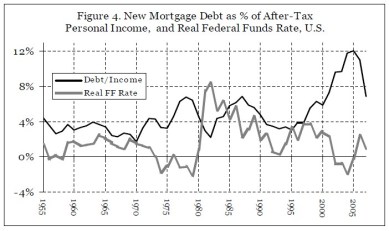
The debt-induced bubble that’s resulted in the present crisis is of course the housing sector bubble.  Paradoxically, it came about because of the weakness of the U.S. economy. First stock prices plunged sharply as the “dot.com” stock market bubble burst. Then the economy went into recession in 2001, and it was weakened further by the 9/11 attacks later that year. In order to allay the fears of financial collapse that followed the attacks, the Fed lowered short-term interest rates. Even after the recession ended a couple of months later, employment kept falling, through the middle of 2003, so the Fed kept lowering short-term lending rates. For three full years, starting in October of 2002, the real (ie inflation-adjusted) federal funds rate was actually negative (see figure 4). This allowed banks to borrow funds from other banks, lend them out, and then pay back less than they had borrowed once inflation was taken into account.

This “cheap money, easy credit” strategy created a new bubble. With stock prices having recently collapsed, this time the flood of money flowed at first largely into the housing market. Loan funds were so ready to hand that working class people whose applications for mortgage loans would normally have been rejected were now able to obtain them.

Fig 4

As Figure 4 shows, the trajectory of the mortgage borrowing to income ratio during the 2000-4 period is an almost perfect mirror image of the trajectory of the real federal funds rate. This is a clear indication of the close link between the explosion of mortgage borrowing and the easy credit conditions. And with new borrowing increasing so rapidly, the ratio of outstanding mortgage debt to after-tax income, which had risen only modestly during the 1990s, jumped from 71 percent in 2000 to 103 percent in 2005 (see figure 5).

Fig 5

The additional money flooding the housing market in turn caused home prices to skyrocket. Indeed, total mortgage debt and home prices (as measured by the Case-Shiller Home Price Index) rose at almost exactly the same rates between start of 2000 and the end of 2005 – 100 percent and 102 percent, respectively.

Those of us who attempt, following Marx, to understand capitalism’s economic crises as disturbances rooted in its system of production – value production – always face the problem that the market and production are not linked in a simple cause and effect manner. As a general rule, it is not the case that particular disturbance in the sphere of production causes an economic crisis. Instead, what occurs in the sphere of production conditions and sets limits to what occurs in the market. And it is indisputable that, in this sense, the US housing crisis has its roots in the system of production. The increases in home prices were far in excess of the flow of value from new production that alone could guarantee repayment of the mortgages in the long run. The new value created in production is ultimately the sole source of all income – including homeowners’ wages, salaries and other income – and therefore it is the sole basis upon which the repayment of mortgages ultimately rests.

But from 2000 to 2005, the rise in after-tax income was barely one third of the rise in home prices. This is precisely why the real-estate bubble proved to be a bubble. A rise in asset prices or expansion of credit is never excessive in itself. It is excessive only in relation to the underlying flow of value. Non-Marxist economists and financial analysts may use different language to describe these relationships, but they do not dispute them. Indeed, it is commonplace to assess whether homes are over or under-priced by looking at whether their prices are high or low in relation to the underlying flow of income.

Now, some players in the mortgage market did realise that something was amiss but nonetheless sought to quickly reap lush profits and then protect themselves before the day of reckoning arrived. But there was a good reason (or what seemed at the time to be a good reason) why others failed to perceive that the boom times were unsustainable: home prices in the US had never fallen on a national level, at least not since the Great Depression.

So it was “natural” to assume that home prices would keep rising. This assumption served to allay misgivings over the fact that a lot of money was being lent out to homeowners who were less than creditworthy, and in the form of risky subprime mortgages. Had home prices continued to go up, homeowners who had trouble making mortgage payments would have been able to get the additional funds they needed by borrowing against the increase in the value of their homes, and the crisis would have been averted.

Even if home prices had leveled off or fallen only slightly, there probably would have been no crisis. In the light of the historical record the bond-rating agencies assumed, as their worst case scenario, that home prices would dip by a few percent. It was because of this assumption that they gave high ratings to a huge amount of pooled and repackaged mortgage debt (mortgage backed securities) that included subprime mortgages and the like. Today these securities are called “toxic” – very few investors are willing to touch them. But if the bond-rating agencies had been right about the worst case scenario, the investors who thought that they were buying safe, investment grade securities would indeed have reaped a decent profit.

As we now know, however, the bond-raters were wrong, massively wrong, and thus there has been a massive mortgage market crisis.  According to the latest Case-Shiller Index figures, between the peak in July 2006 and July of this year, US home prices fell by 19.5 percent.  And because the mortgages were pooled and resold as mortgage-backed securities, the mortgage market crisis has spread throughout the financial system and become a generalized financial crisis.

I now want to say a bit about who or what is to blame.  We’re hearing a lot about greed, but capitalists are always greedy.  But we don’t always have massive crises.  So what explains the fact that we have one now?

There’s also a lot of talk about lax regulation and insufficient regulation.  I know of no better answer to this notion than the answer recently given by Joseph Stiglitz.  In a Sept. 17 article, “How to prevent the next Wall Street crisis” , Stiglitz, a Nobel Laureate and former World Bank chief economist, proposed a six-point program chock-full of regulations and laws.  But he then acknowledged:  “These reforms will not guarantee that we will not have another crisis.”  So why the title “How to prevent the next Wall Street crisis”?

Stiglitz went on explain why his proposed reforms are no guarantee:  “The ingenuity of those in the financial markets is impressive. Eventually, they will figure out how to circumvent whatever regulations are imposed.”  Yes.  So why the 6-point program?

He then wrote, “But these reforms will make another crisis of this kind less likely, and, should it occur, make it less severe than it otherwise would be.”  Hmm.  If the financial markets will eventually circumvent whatever regulations are imposed, then why isn’t another crisis equally likely with these regulations as without them? And why won’t it be as severe with them as without them?

Finally, I want to say a few words about the significance of the various government interventions we’ve seen this year – the government’s forced dismantling of Bear Stearns, the nationalization of Freddie Mac, Fannie Mae, and AIG, and the bailout money that’s being used to partially nationalize the banking system.  Some commentators portray this, as I noted earlier, as an effort to make the rich richer.  Others depict it as some sort of progressive turn, an ideological shift away from the “free market.”  I think both notions are seriously mistaken.

What we are witnessing is a new manifestation of state-capitalism. It isn’t the state-capitalism of the former USSR, characterized by central “planning” and the dominance of state property; it is state-capitalism in the sense in which Raya Dunayevskaya used the term  to refer to a new global stage of capitalism, characterized by permanent state intervention, that arose in the 1930s with the New Deal and similar policy regimes (Marxism and Freedom, Humanity Books, 2000, pp. 258ff.).  The purpose of the New Deal, just like the purpose of the latest government interventions, was to save the capitalist system from itself.

Because many liberal and left commentators choose to focus on the distributional implications of these interventions – who will the government rescue, rich investors and lenders or average homeowners facing foreclosure? – let me stress that I mean “save the capitalist system” in the literal sense. The purpose of these interventions is not to make the rich richer, or even to protect their wealth, but to save the system as such.

Consider the takeover of Bear Stearns.  It was in serious trouble but there were other ways of dealing with its troubles than by the government forcing it to be sold to JP MorganChase.   Had Bear Stearns been able to borrow from the Fed, it could have overcome the cash-flow problem it faced.  But the Fed waited until the following day to announce that it would now lend to Wall Street firms. Or, if Bear Stearns had been allowed to file for bankruptcy, it could have continued to operate, and its owners’ shares of stock would not have been acquired at a fraction of their market value. Instead the Fed forced it to be sold off.

Thus the takeover was definitely not a way of bailing out Bear Stearns’ owners. Nor was the Fed out to enrich the owners of JP Morgan Chase. (The Fed selected it as the new owner of Bear Stearns’ assets because it was the only financial firm big enough to buy them.) Instead the Fed acted as it did in order to send a clear signal to the financial world that the US government would do whatever it could to prevent the failure of any institution that is “too big to fail”, because such a failure could ultimately bring the financial system crashing down.

And consider the government’s rescue of Fannie Mae and Freddie Mac.  This came about because of a sharp decline in their share prices.  But the government didn’t rescue them in order to prop up the price of their share prices.  Their share prices continued to decline after the rescue plan was announced, precisely because the government’s motivation was not to bail out their shareholders. Indeed, the shareholders aren’t receiving any money from the government. Only those institutions and investors that lent to them are being compensated for their losses, and the government had been seriously considering not compensating some of these lenders (the holders of subordinated debt).  Just as in the Bear Stearns case, the point of the intervention was to restore confidence in the financial system by assuring lenders that, if all else fails, the US government will be there to pay back the monies that are owed to them.

The new manifestation of state-capitalism we are witnessing is essentially non-ideological in character.  Henry Paulson is certainly no champion of government regulation or nationalization.  But at this moment of acute systemic crisis, ideological scruples simply have to be set aside.  The be-all and end-all priority is to serve the interests of capitalism – capitalism itself, as distinct from capitalists.  As Marx noted, “The capitalist functions only as personified capital …. [T]he rule of the capitalist over the worker is [actually] the rule of things [capital] over man, … of the product [capital] over the producer” (Results of the Immediate Process of Production,” in Penguin ed. of Capital, vol. 1, pp. 989 – 90, emphasis in original).  The goal is the continued self-expansion of capital, of value that begets value to beget value, the accumulation of value for the sake of the accumulation of value – not for the sake of the consumption of the rich.

Of course, we are indeed witnessing a movement away from “free-market” capitalism, and back to more government control and even temporary ownership.  But this is a pragmatic matter rather than an ideological one.  There’s nothing inherently progressive about it.  The government is simply doing what it must, whatever it must, to prevent a collapse of the system.

The recent state capitalist interventions are perhaps best described as the latest phase of what Marx called “the abolition of the capitalist mode of production within the capitalist mode of production itself”. There is nothing private about the system any more except the titles to property. As I’ve been stressing here, the government is not even intervening on behalf of private interests: it is intervening on behalf of the system itself. Such total alienation of an economic system from human interests of any sort is a clear sign that it needs to perish and make way for a higher social order.

The current economic crisis is bringing misery to tens of millions of working people. But it is also bringing us a new opportunity to get rid of a system that is continually rocked by such crises. The financial crisis has caused so much panic in the financial world that the fundamental instability of capitalism is being acknowledged openly on the front pages and the op-ed columns of leading newspapers. Great numbers of people are already searching for an explanation of what has gone wrong.  Many of them may be ready to consider a whole different way of life, and many more will be ready to consider this as the recession in the real economy deepens.  Revolutionary socialists need to be prepared, not just prepared to organize, but prepared with a clear understanding of how capitalism works, and why it cannot be made to work for the vast majority. And we need to get serious about working out how an alternative to capitalism – one that is not just a different form of capitalism – might be a real possibility.

Andrew J Kliman is Professor of Economics at Pace University (US). This talk was delivered at The New SPACE (The New School for Pluralistic Anti-Capitalist Education), New York City, October 21, 2008. It is to be posted on the New SPACE website .  An audio recording which includes the discussion that followed will be made available soon.  The talk draws in part on Andrew Kliman, “Trying to Save Capitalism from Itself” (April 25)  which is also available at The Hobgoblin and Andrew Kliman, “A crisis for the centre of the system” (Aug. 23) published in International Socialism, No. 120 ).

Note:

(1) Addition, October 22:  In discussion following this talk, questions were raised about how my discussion of capital destruction is related to Marx’s “law of the tendential fall in the rate of profit.”  To address this, let me quote from pages 30-31 of my book Reclaiming Marx’s “Capital”:  A refutation of the myth of inconsistency (Lexington Books, 2007):

“what Marx meant by the “tendency” of the rate of profit to fall was not an empirical trend, but what would occur in the absence of the various “counteracting influences,” such as the tendency of the rate of surplus-value to rise.

“He singled out one of these counteracting influences, the recurrent devaluation of means of production, for special consideration. Like the tendential fall in the rate of profit itself, and the tendency of the rate of surplus-value to rise, the devaluation of means of production is a consequence of increasing productivity. Capitalists incur losses (including losses on financial investments) as a result of this devaluation; a portion of the capital value advanced in the past is wiped out. In this way (as well as by means of their tendency to cause the price of output to fall), increases in productivity tend eventually to produce economic crises. Yet since the advanced capital value is the denominator of the rate of profit, the annihilation of existing capital value acts to raise the rate of profit and thus  helps to bring the economy out of the crisis” (see Marx [Capital, vol. 3], chap. 15, esp. pp. 356-58, 362-63 [of the Penguin ed.]).

Correspondence – A Magazine for “Exchange of Perceptions of Reality”

ISSUE: 0001

A group of students from Delhi has published the first issue of their magazine called Correspondence. The Table of Contents and the editorial are given below. For the pdf version of the magazine CLICK. Please contact the editors for the hardcopies – submissions.correspondence@gmail.com.

Coverpage and Table of Contents

Editorial –Paresh Chandra p.1

On Permanent Revolution –Kumarila
Trotsky’s concept of permanent revolution is dialectical to the very core viewing revolution as a continuum embedding the particular in general and appearance in essence, with the latter necessarily getting represented through the former. p.3

Discovering Nuclear Energy for Justifying Bad Deal –Prabir Purkayastha
Not only is nuclear power more expensive, it will also have adverse effects on the entire electricity sector. Going in for huge investments for imported nuclear power plants – three times the cost of similar coal fired units — would mean starving the Indian economy of other investments. p.6

The Art of Naming: Meditations on Queer Activism in Delhi–Akhil Katyal
Queer activism, here and now in Delhi, as I have lived through for the past three years, is composed of varied definitional excursions that are precisely that, definitional excursions, baggy monsters, simplifying technologies that take enormous and complicated raw material, lets say of the morass of human sexuality and try to produce, indeed with success, finished products, peculiarly sexualized individuals, gay or straight. p.10

Q&A with Mahesh Rangarajan: On Ramanujan’s 300 Ramayanas and the Controversy –Paresh Chandra and Bhumika Chauhan
Mahesh Rangarajan, member of faculty of the Department of History, University of Delhi, speaks about Ramanujan’s essay and the protest that followed the decision to include it in the syllabus of a BA Honors course. p.13

Failure, Consumerism and a Counter Strategy – The IP College Protests: an Insider’s Diagnosis — Paresh Chandra
Without the clause of class-consciousness that makes the connection between career and exploitation plain resistance becomes a perverse (the usual) form of consumerism, the commodity bought and consumed is “peace of mind” and the cost is a few days out in the sun. p.16

Changing Class Character of the Campus: New Challenges of the Student-Youth Movement –Abhinav Sinha
To counter the contraction of the space for students’ politics on campus we need to think about a unified student-youth movement which will have equal and free education for all and employment for all as its central demands. Only such a movement will have the strength and potency to achieve such aims. p.19

Beyond the Veil of Identity Politics – Preliminary Explorations through Categories of Caste and Class in Indian society –Ravi Kumar
Identity politics, based on the principle of homogenizations, segregation of social realities into unconnected, autonomous modules, has allowed the expansion of capital, thwarting any possibility of resistance against the system. p.22

Q&A with Lal Khan: On Can Partition Be Undone — Paramita Ghosh
The interview brings out some of the important issues dealt in the book ‘Crisis in the Indian Subcontinent – Partition… Can it be undone?’ along with Khan’s perspective on the political situation and transformation in the subcontinent. p.26

Final Pages

———————–

EDITORIAL: Struggle and Dialogue –Paresh Chandra

It had already been decided that I needed to rework the editorial. Now I have to mention the Delhi blasts, though the addition might seem strained. I was returning from the University when I heard. A friend sent me a message. I had boarded the metro at the University at six and came out at IP in thirty-five minutes. I spent the next half-hour calling friends who were likely to be out. It will sound clichéd but the incident did drive most other thoughts out of my head. Five blasts all over the city and many bombs diffused. Apparently an Islamic outfit took responsibility.

The paranoia that an incident like this creates is huge. Blame is thrown on the police, on the Home Ministry, on Shivraj Patil’s softness on ‘terrorism’. Solution plans fly from all over the place. I distinctly remember how I annoyed I was with the manner in which a RJ kept repeating how such incidents can be averted if we like responsible citizens inform ‘concerned authorities the moment we see unattended objects’. The most interesting solution was proposed by possibly the biggest terrorist in the country—re-invoke POTA. For a moment I bracket out the interests of Hindutva in the re-invocation of the act and concentrate on other aspects. Everybody is bent on treating it as a ‘law and order’ problem. A few decades ago my criticism could have been different (discussions of socio-economic causes of acts of violence have becomes so common that they are not considered serious anymore) but I now feel that mere common sense and experience should be enough to teach us that the problem lies somewhere else. I do not suggest that law and order are not in question, nor am I taking the ‘terrorists-are-also-humans’ stand. I merely wish to point out the fact that stricter laws and greater protection have never ever helped in curbing acts of violence. However I do not wish to go into diatribes against this blindness nor is my agenda to offer an alternative solution (I have none to offer)—I seek to make a different point, or rather I wish to target a different bunch of people.

The situation of the Left in the country is very interesting. If I try to put my finger on the stand of the Left at large on issues like terrorism and communalism I am struck by a sorry realization—there is no stand to pinpoint. The Left is so stuck in the creation of counter-discourses or participation in discourses that are already ideologically compromised that its own discourses cease to exist. Try to locate a few genuine attempts in the country to understand fundamentalism and fundamentalist militancy (to name one issue) from a Left perspective and you will understand what I’m talking about. The ‘mainstream’ left is the busy guardian of bourgeois secularism and the not so mainstream left is busy attacking the mainstream left. When an incident like this one takes place the only thing the Left leaders can do is offer condolence. And because they themselves do not have anything to offer all they can do is try and counter what the Right offers—in this case it will probably be POTA.

* * *

Struggle provides us with what is perhaps our only real chance of continued freedom from reification. It entails the forging of alliances that can help transcend the experiences of fragmented modern existence. The process of changing society is also the most effective manner of transforming our own existence and the only way of bringing about fundamental change is struggle. This magazine is a medium to take forward the idea of struggle. The revivification of struggle (in all its possibilities) needs us to first understand what threatens this idea and then strategise to counter these threats. This magazine is an attempt at doing just that—it will try to bring together counter-hegemonic perspectives on important questions and help provide the sense of community essential for the participants in counter-hegemony. Without this community an idea will hold no bearing on reality—it will become a force only when shared by persons. In this editorial I will lay out some of my thoughts on the situation making some observations regarding problems that I think important.

I was in conversation with a person whom I know to be more than a mere sympathizer of the Left and I am using some of his words when I say that these are depressing times for those people in India who want to believe in the validity of a Left politics, with the organised Left in danger of succumbing completely to the social democratic “Third Way” and the fringe Left more often than not caught in the mires of sectarianisms and adventurisms. It is easy in such circumstances to give in to the lure of consumerism and it becomes compulsive to “enjoy one’s condition”; the easiest thing indeed is to give up the idea of struggle and go out to shop. This consumerism too is not limited to the mall but seeps into and becomes the defining signifier of all actions and social phenomena, even resistance. Trapped in the tri-partite struggle between i) the inertia of a long history of anti-establishment struggle ii) the apparent uselessness of this struggle and iii) the desire to join the system (that one cannot fight) by choosing a career, some call a truce and resistance is chosen as a career option—a symptom of this is the manner in which instead of the Party being a means for struggle, struggle becomes solely a way of “building” the Party (it is important to emphasize the word ‘solely’ because it alone signifies where the problem lies).

We discuss at length the importance of looking at things dialectically. In theory dialectics is something we have a copyright over, but it is hard to maintain it in practise. I do not deny that in concrete political engagements it is not that easy to constantly double check with what’s on paper but to completely lose sight of it is not altogether advisable. I feel that one needs to be vary of this ontological blindness that advertises itself on the name ‘practicality’ and allows not only actions that one would otherwise completely condemn but also disables faculties that the original idea had provided us with. But then we also need to question if the problem is that we understand and do not practise our ideas or whether there is a problem in our understanding of ideas that we call ours. I don’t think the former is possible.

A great sign of decay is the manner in which people are scared of ideas. Doubt is losing its self-reflexivity and is changing into callous lack of trust; conviction is being transformed into prejudice. Both acceptance and rejection lose their Hegelian essence and begin to precede understanding. The process is a vicious circle—because conviction comes before understanding it is shaky, because conviction is set on weak grounds one is afraid of the other’s convictions lest they be stronger and since one cuts communication from the other, one’s own convictions seem unquestioned, and since our own convictions go unquestioned there seems no need to engage with the other’s convictions. A fundamental lesson of dialectical materialism that no idea is completely false and all ideas are only partially true—seems lost.

There is need for a struggle to make struggle more dialogic—dialogue here refers to the capacity to be able to incorporate the other’s voice into one’s own without dominating it; it refers to the removal from language of the violence that destroys the heteroglossic nature of correspondence. Reviving dialogue is one of the most important tasks that face us. We must remember that though internal strife may affect the establishment, fear of revolt and the need to maintain a net profit keeps it together, united against us. On the other hand by keeping a large percentage of the working population unemployed capital makes sure that at all times every worker steps in the market against every other worker. Resistance to the establishment starts off with a huge disadvantage. If we have to counter this disadvantage we cannot allow dialogue to disappear from our interactions with each other, just as we cannot afford a non-dialectical approach unless a skewed and limited picture of reality is what we wish to achieve. Without dialogue neither solidarity nor true criticism can exist. Fear of ideas is a characteristic of hegemonic authority—hegemony has this funny property of being in a constant state of decay. Hegemony is also by definition based on violence and is opposed to dialogue. Resistance on the other hand is a process that survives and disseminates through collective action, solidarity and dialogue.

The preservation of dialogue and a dialectical understanding of things require us to stay in touch with our reality. It is vital that we grasp all that is typical and get rid of all that is superfluous. The commodification of resistance and the concomitant monologising of the space of protest is a sign of the failure of forms of resistance to comprehend the nature of capital. This will indeed be the eventual fate of all forms of resistance that lose what is actually the fundamental link that will allow them to truly engage with capitalist reality, the link with class struggle and the struggle for the interests of the working class. Capital is a result of exploitation—it exists on the production of surplus value and production of surplus value requires labour power. Any struggle as a result, to be a struggle against the system of capital needs to create and preserve its link with the “actual” producers (workers). Capital makes use of various methods to hide this essential logic of its running, to hide this essential fact, the key that has to be grasped to get rid of the chains that bind us. Perceiving the true nature of determination in capitalism would allow us to look through the various illusions that we have to confront each day and this in turn allow the re-establishment of productive ties between fellow beings.

To facilitate the re-establishment of such ties and to allow exchange of perceptions of reality, dialogue is needed. The role of this magazine is to participate in the building of this dialogue—to encourage discussion by actively participating in various discourses and by allowing discussion within its folds is the idea that will underlie its working. It will try to start a dialogue of ideas between individuals, between different organisational streams and also between the reified parts of the same whole that take the form of various disciplines in formal education today. The basic idea is to achieve the true likeness of the elephant and overcome our subjective blindness.

Statement on the NHRC report on Salwa Judum

Issued by Campaign for Peace and Justice in Chhattisgarh

Since 2005 the Chhattisgarh government has claimed that the Salwa Judum is a “peaceful people’s movement”, that “the villagers are never forced to join the camps”. They claimed that no minors were appointed as SPOs. It also resisted any independent enquiry, saying “There is no failure on part of state of Chhattisgarh and therefore independent investigation is uncalled for and unwarranted.” The NHRC investigation into Salwa Judum which was carried out on the orders of the Supreme Court found that this claim by the Chhattisgarh government regarding Salwa Judum was patently false. They found prima facie evidence of large scale burning of villages, large numbers of missing people, the fact that many people had been forced into camps against their will (though most they claim have subsequently returned), and the appointment of minors as SPOs in the initial stages at least. Some Nelasnar camp residents, they note, “left the village due to atrocities committed by the Naga police.” This one example is clearly the proverbial tip of the iceberg. The NHRC investigation revealed that SPOs have been involved in “certain incidents of atrocities against the tribals” and in some instances (e.g Matwada camp killings), the security forces and SPOs seemed to be prima-facie responsible for extra judicial killings. They have also not ruled out the possibility that, as in the Matwada case, other FIRs registered could be false.

However, given the powers and responsibility of the NHRC, it has manifestly failed to bring out the full truth of what is happening in Dantewada district, Chhattisgarh. The National Human Rights Commission is a statutory body, mandated to be an autonomous overseer of human rights across the country. The current report is unfortunately a negation of this responsibility.

There are inherent infirmities in the present report (i) the composition of the team which consisted solely of police, (ii) the process of public enquiry, which involved SPOs and Salwa Judum activists acting as translators, coupled with intimidation of witnesses (iii) the manner in which conclusions have been arrived at by the NHRC’s investigating team. It is these which has led the NHRC investigation team to downplay its own findings on the atrocities committed by the SPOs and Salwa Judum activists and concentrate on the violence of the Naxalites. Curiously despite being so focused on the Naxalites, the report nowhere mentions that the state is already seized of this problem, having sent more than ten battalions of paramilitaries to the district, and spent crores of rupees on battling Naxalism. It did not need an investigation by the NHRC to uncover the Naxalite ‘problem’.

1. Composition of the team and method of enquiry: The investigation team comprised solely of police officers. It did not have any representative of the local tribal communities or even any of the NGOs associated with the NHRC who had asked to be associated with it. The team went to various Salwa Judum camps and villages in an armed convoy which included Salwa Judum leaders and members, Special Police Officers (SPOs) and the Superintendent Police of Dantewada. Concerns that the arrival of a convoy of anti-mine tanks, preceded by road clearing exercises, would do little to instill confidence in villagers who were already terrified by the violence of the Salwa Judum and security forces, had earlier been raised with the NHRC and have been fully borne out by the findings of the investigating team itself. The NHRC report itself acknowledges at least two instances, in Pusbaka and Chikurubatti villages, where the villagers ran away seeing the police/CRPF accompanying the team.

2. Flawed Investigation – insufficient and biased acceptance of evidence:
It is not just the petitioners who have been raising the issue of human rights violations by Salwa Judum and security forced in Dantewada and Bijapur. Several independent civil and democratic rights groups have been consistently raising questions about the manner in which the government has armed civilians and the impunity with which the militarized nexus of Salwa Judum, Police, SPOs and the CRPF has unleashed violence on the local population. This is also probably the only instance where several government agencies, including the Planning Commission, the Administrative Reforms Commission, National Commission for Women and the National Commission for Protection of Child Rights, have also condemned the counter-insurgency strategy employed by the government. The NCPCR report based on a fact-finding by Prof. Shanta Sinha, Mr. JM Lyngdoh (former CEC) and Mr Venkat Reddy, based on testimonies of at least 35 victims in Cherla, noted that “many people shared accounts of family members being killed and women raped by the Salwa Judum” and again, based on a public hearing in Kirandul, “There were numerous accounts of family members being killed for resisting the Salwa Judum”. The NHRC has unfortunately chosen to ignore all such reports.

Though NHRC report claims to reach several conclusions, it summarily rejects several of the complaints in the petition by saying that they have “not been substantiated”, based either on insufficient evidence or a specious acceptance of the police version. Some instances are:

i) The NHRC has made registration of FIRs as the bench mark of ascertaining whether an incident of violence took place or not. The NHRC seems to have charily ignored the fact that in cases where state agencies are responsible for human rights violations people would be unable to lodge FIRs for fear of their life or that false FIRs may have been lodged by the police themselves falsely implicating others. This even though the report itself admits at least one instance where a villager was killed by Salwa Judum activists no FIR has been registered.

ii) The report uncritically accepts the police version of the cases and makes that the basis for “substantiation” or otherwise. This even as the report itself has had to admit at least one instance- in the Matwada case which was highlighted due to the efforts of local groups, that false FIR has been filed by the police blaming Naxals for an incident which was prima facie committed by Salwa Judum and security.

iii) In at least two cases, the NHRC visited the wrong village – of the same name but in a different thana. In the case of Polampalli in Usur thana, which was used as a test case to say that rape was not substantiated, despite the correct details being mentioned in the petition, the NHRC team visited Polampalli in Dornapal thana.

iv) The NHRC team has ignored the evidence provided by independent journalists and others which contradicted the police version and accepted the police version at face value. In the Santoshpur case for instance, at least 4 independent journalists have separately and one after another confirmed to the killing of Kodiya Bojja by SPOs, based on interviews with next of kin soon after incident. NHRC however uncritically accepts police version that he was killed by Naxalites.

v) Most strikingly, all testimonies given by IDPs in Andhra Pradesh regarding killings of their relatives by Salwa Judum and SPOs have been discarded, while all testimonies given by camp residents and villagers regarding killing by Naxalites has been accepted at face value. The AP testimonies have been ignored even when they are corroborated by the evidence of burnt and abandoned villages (e.g. Kottacheru, Lingagiri etc.)

3. Several misleading conclusions: It is not clear how NHRC came to its conclusion that no village was being discriminated against for not joining Salwa Judum camps when it notes that rations are available only in camp and that Salwa Judum is identified with the camps, and that “the only government agency active in the area is the police”. The National Commission for the Protection of Child Rights had noted in its fact-finding report, that ‘A big problem is that schools and Anganwadi teachers have been shifted from the villages to the camps leading to a concentration of service-providers in camps and no services available to those who are still living in villages.’

4. The NHRC avers to some instances where security forces and SPOs seem to be prima facie responsible for extra judicial killings. It states that it came across certain cases in which the “excesses” have been committed by ‘public servants’ and where the State has proceeded against those “who failed to operate within the four corners of the law”.

However it does not give details of any such instances. Till date, the Dantewada and Bijapur district administrations, the Chhattisgarh Police and the Chhattisgarh Government have not accepted or made public the cases where Police Officers, Special Police Officers or CRPF personnel in Dantewada and Bijapur have been proceeded against for violation of law.

5. Justifies Vigilantism: Most worrying however is the manner in which the NHRC report openly justifies Salwa Judum on the grounds that people cannot be denied the right to defend themselves against the atrocities perpetrated by Naxalites thus condoning civil vigilantism and arming one section of the society against the other, which in fact represents abdication of the State itself. Justice Rajendra Babu, Chairperson, NHRC had said in one interview, “The NHRC has not given a clean chit to Salwa Judum. What we said in our report to the Supreme Court was that the problems afflicting Chhattisgarh are not law and order problems but socio-economic ones.” Burning villages, and extra-judicial killings are surely law and order problems. Meanwhile the Raman Singh government which has come under a lot of criticism for its support to Salwa Judum is going all out to publicise this biased report as a vindication of its disastrous strategy.

We hope that the Supreme Court and the wider public sees the biases the report evidently demonstrates. At the same time, even the limited findings by the NHRC are sufficient to indict Salwa Judum and SPOs as an extra-constitutional, vigilante force which must be disbanded forthwith. Those who wish to must be allowed to return home, and all victims, whether of Salwa Judum or Naxalites must be given compensation on an equal footing. A judicial enquiry is essential to establish the scale of victimization and prosecute those who are guilty.

Capital and capitalists nannied by the states: An Interview with Amiya Kumar Bagchi

Amiya K Bagchi“Capital and capitalists will continue to be nannied by the states they control, unless the crisis intensifies the struggles of workers and peasants to change this horrendously unjust and murderous social and political order. Nor will borrowers of recapitalized banks or the insured of the US company AIG benefit from lower interest rates, better access to credit or insurance or less discriminatory insurance rates. The new managers will be busy guarding the capital of their respective managed entities. Unless the rulers are made to see that money market instruments are not the proper vehicles to deliver affordable credit or insurance to the poor and are forced to carry out the structural changes needed to embody that perspective in practice, the old order will continue when the recession subsides.”  

Radical Notes: Can you explain the nature of the current crisis and how it developed?

Amiya Kumar Bagchi (AKB): A full explanation of the current crisis will be a book-length study. The immediate causes of the crisis can be put as follows: (a) unbridled financial liberalization, the most significant components of which have been the further elaboration of derivatives, including securitized products, increasing the non-transparency of the financial market, (b) the effective demolition of the distinction between deposit banks specializing in loans and investment banks, (c) conversion of the dollar into virtually the sole source of global liquidity, even while keeping a major fraction of the world’s economies in a condition of endemic deficiency of effective demand and (d) the rapid emergence of housing and related markets as sectors of the most intense speculative activity.

Radical Notes: As an economic historian, do you find any uniqueness in the present crisis in comparison to the past ones?

AKB: Capitalism has been racked by speculative crises, almost from the moment of its birth. One of the earliest of such crises was the Tulip Mania in the Netherlands in the 1630s. The second speculative crisis in order of occurrence was the crisis of 1720-21 centring around the so-called Mississippi project in France and the South Sea Company in England: this crisis threatened to engulf much of Western Europe at the time. If we take England only, there were severe banking crises in almost every decade from the 1820s , with the Baring Crisis of 1890-91, characterizing the last decade. In that crisis, the inability of Baring Bros to meet its obligations arising out of its over-exposure to loans to the Argentine government threatened to involve the whole British financial system. That is arguably the first time that the Bank of England acted as the lender of last resort. (Baring Bros collapsed in 1995, as a result of Nick Leeson, its bureau chief in Singapore, losing his bet on movements of Nekkei and the firm’s capital of £800 million disappeared). Then you have the biggest financial crisis of the twentieth century, namely, the Great Depression of the 1930s, which really ended with the onset of World War II that saw the stepping up of military and other public expenditure to unprecedented heights.

But as any student of history knows, you never step into the same stream twice. Capitalism in particular has been like a super-chameleon, transforming not only its colour but also its apparent structural relations every few decades. The changes preceding the current crisis are no exception. The uniqueness of the crisis can probably be described as a situation in which governments, so-called specialists in finance not only ignored the totally non-transparent manner in which banks, investment brokers and non-bank financial institutions carried on their business, but positively cheered them in the belief that this was the way to create wealth. One of the most ironic symbols of this atmosphere is the compilation and celebration of the growth of wealth of the ‘High Net Value Individuals’ (HNVIs) by Merrill Lynch, a firm that had to merge with Bank of America in order to stave off bankruptcy.

Radical Notes: Can we understand the present crisis as a crisis of imperialism and the US hegemony?

AKB:
 Yes, we can. But we must remember that other G7 countries are also implicated in the US hegemony, and even China’s current pattern of growth is symbiotically related to US hegemony. Whether the crisis will lead to a decline in the murderousness of the US military operations remains an open question. As I have argued earlier, capital wants to win in competition, if necessary in the last instance by using armed conflict. The prospect of a USA threatened with the loss of hegemony using its fearsome arsenal of weapons of mass destruction is mind-numbing.

Radical Notes: How do you assess the impact of the crisis on the developing countries?

AKB:
 In many developing countries, there are no real stock markets and even if there are, their operations do not have much of an impact on firms which are often too small to be able to raise money in the stock market. In many of them, earlier depredations of imperialism, its domestic collaborators and its agencies such as the IMF and the World Bank have led to the exclusion of most economic agents from formal credit markets. The so-called success of micro-credit agencies in Bangladesh, for example, was built not only on loans extended by foreign lenders but also on the destruction of public sector banking by local businessmen defaulting on their loans. Organizations blessed by the World Bank and foreign donors fished in such turbid waters.

The direct effect of the present crisis on such countries may not be great. But they will suffer through the further decline in the demand for their output in foreign and domestic markets because of the global recession. The countries, which have depended greatly on foreign capital for stimulation of their economies such as India, will also suffer through minor or major currency crises and the downsizing of the transactional enterprises operating in those countries and badly affected by the crisis. In the immediate future, the most distressing effect for the common people will continue to be the loss of employment in construction, services and the manufacturing sector and the high cost of food grains, induced by underinvestment in agriculture in developing countries, speculation in commodities by the big finance houses and others and the diversion of cropland to the highly subsidized biofuel in developed market economies, especially the USA.

Radical Notes: A recent report says that India and China – which are considered by many as the bulwark of capitalist growth in the 21st century – have witnessed the steepest market declines between December 2007 and September 2008. They “have lost almost 51% of market capitalization, or m-cap, and this figure could be much higher if the declines of the last fortnight are taken into account.” As latest reports indicate, industries in India, especially the aviation industry, have already started shifting the brunt of the crisis on labour, through various means. Do you think these developments are indications toward a full-fledged crisis around the corner?

AKB: As far as China is concerned, the slide in stock prices will not have a major effect on the economy, because stocks traded in the Shanghai market provide finance only to a small fraction of firms in the Chinese economy. But the effect on India is obvious not only from the retrenchments already announced by aviation companies and IT firms but also by the continued outflow of FII funds from India and consequent decline in the value of the Indian rupee. The Indian manufacturing sector was already showing a downward trend in fiscal 2007-08, and that trend has strengthened in recent weeks as shown by the Index of Industrial Production (IIP). It is disingenuous of the Finance Minister to call the IIP “not very reliable” when his government has done so much to massage the official statistics so as to produce a favourable picture of its performance in the economic field.

Radical Notes: The Reserve Bank of India (RBI) too is taking measures to ensure liquidity and boost confidence. As a historian of India’s banking sector, how do you assess India’s financial-structural ability to withstand such crisis at this juncture? How much do you think the neo-liberal policies that subsequent governments have pursued eroded this ability?

AKB: Fortunately, despite all the attempts of successive governments at the Centre since 1991 to force the pace of ‘economic reforms’, the worst of their designs could not be carried through. These include full capital account convertibility, complete privatisation of the banking and insurance sectors, and total abolition of the distinction between banks and non-banking finance companies. Every time either major international crises or electoral compulsions have stayed their hand. In 1997 and this time around, financial crisis in Asia and the global financial crisis have prevented the enforcement of capital account convertibility. The strength of Indian public sector banks compared with their private counterparts is there for all to see. The worst development under the neo-liberal regime is the naked play of money and communalism in determining the positions all major centrist or right-wing parties have adopted. Another major casualty has been the fiscal stance of the state. It will take quite an effort to get the rich to pay their taxes and to stop the indulgence the state has displayed towards punters and hot money merchants in the financial sector. The quality of Indian democracy has been further sullied under the neo-liberal regime. Hence the ability of the regime to handle the resolution of the crisis in national interest has been badly impaired.

Radical Notes: Various commentators have suggested that the bailing out strategies of different governments throughout the world has ultimately brought the state back in. What is the merit of such conclusion? Can we see this return of the state as just a moment, for which Milton Friedman once said the role of government is “to do something that market cannot do for itself”?

AKB: Yes, the state has been brought in but only to save the illegitimate earnings of the crony capitalists. Will Mr Richard Fuld, CEO of Lehman Bros, be made to disgorge the nearly $500 million he earned from his stock options and bonuses? In the financial year 2007-08 alone, according to Forbes.com, Fuld earned $71.50 million and in the preceding 5 years he had earned $354 million. When Lehman applied for Chapter 11 bankruptcy, Fuld took $22 million from the firm as retirement benefit. What applies to the top managers of  Lehman also applies to those of Wachovia and Merrill Lynch, to UBS of Switzerland which is being recapitalized by the Swiss government or Northern Rock, the hosing mortgage bank, which has been bailed out by the Bank of England. In 2004, I published an article with the self-explanatory title, “Nanny state for capital and Social Darwinism for Labour” (Indian Journal of Labour Economics, 47(1), January-March). Capital and capitalists will continue to be nannied by the states they control, unless the crisis intensifies the struggles of workers and peasants to change this horrendously unjust and murderous social and political order. Nor will borrowers of recapitalized banks or the insured of the US company AIG benefit from lower interest rates, better access to credit or insurance or less discriminatory insurance rates. The new managers will be busy guarding the capital of their respective managed entities. Unless the rulers are made to see that money market instruments are not the proper vehicles to deliver affordable credit or insurance to the poor and are forced to carry out the structural changes needed to embody that perspective in practice, the old order will continue when the recession subsides.

Amiya Kumar Bagchi is India’s foremost political economist and economic historian. He is the Director of the Institute of Development Studies Kolkata. He was a member of the State Planning Board until 2005, Government of West Bengal and was recently Chairman of a committee appointed by the Government of West Bengal to report on the finances of the government during the Tenth Five Year Plan period. He acted as the official historian of The State Bank of India until 1997. His recent works include (co-edited with Gary A.Dymski) Capture and Exclude: Developing Economies and the Poor in Global Finance, Tulika, New Delhi, 2007, The Perilous Passage: Mankind and the Global Ascendancy of Capital, Rowman and Littlefield, Lanham, Maryland, USA, 2005, The Developmental State in History and in the Twentieth Century, Regency Publications, New Delhi, 2004, and  Capital and Labour Re-defined: India and the Third World, Tulika, New Delhi and Anthem Press, London, 2002.

A Report on the Workers’ Struggle in Graziano Trasmissioni

Rajesh Tyagi

This report is based upon an interview of two workers of Graziano Trasmissioni, namely Kapil Kumar and Ajay Dwivedi. Kapil belongs to Saharanpur, Uttar Pradesh (UP) and had joined in 2003 as apprentice, after completing his ITI. He worked 8/9 months under contractor, which was a sham and then was given permanent appointment in 2004. Ajay Dwivedi was employed in 2006.

Graziano Trasmissioni at Noida is a subsidiary of a multinational company based in Italy.

The company had started its operations in Noida, UP, in 2003 with a capital of less than 20 crore rupees, which grew over to more than 240 crores in 2008. This extraordinary accumulation of wealth is the result of the super exploitation of the workers employed at this establishment.

Lalit Kishore Chaudhary, its Chief Executive Officer (CEO) has been instrumental in the establishment and growth of the company.

Industrial activity in the establishment continued round the clock, initially in two shifts of 12 hours each, i.e. 6 am to 6 pm and then 6 pm to 6 am. Though working hours were limited to 8 hours and the workers were paid overtime for an additional 4 hours, but overtime was made compulsory for workers. No weekly off day was being given. Those refusing to comply were thrown out of employment.

Initially 350 permanent workers were employed as Operators cum settlers, with 80 Trainees/apprentices. About 500 persons work under the labour contractors mostly for the job of packaging.

The very first dispute arose as the employers used to make deductions from the wages on false pretexts.

On 233 December 2007 the first protest of workers started on the issue of demand for a rise in wages and against the deduction of wages by the employers on the ground that the entry card was not properly punched. Though it used to happen due to a technical fault in the punching system, while subsequent punchings in the day were duly recorded, yet the employers in order to harass the workmen used to deduct the wages, on this false pretext. The workers protested.

Getting wind of the workers being organised and striving to form a union, 3 workers were barred by the employers from entering the premises and one Manoj Kumar was terminated. The management refused to recognise the union, while the authorities at Kanpur kept the application of the workers pending in collusion with the employers.

4.12.2007. Protesting against the high handedness of employers, 100 more workers were locked out by pasting a notice of the lockout outside the gate.

7.12.2007. A settlement took place between the parties, only to be repudiated by the employers later on. The workers’ protest went on.

AITUC, the trade union front of the Communist Party of India, with whom the workers were affiliated, agreed with management to restore normalcy first and then negotiate, which the workers rejected. After this the AITUC abandoned the workers.

24.1.2008. In the face of the struggle of the workers, the employers were constrained to enter into a written settlement with them in the presence of the Deputy Labour Commissioner (DLC), Noida etc. On behalf of the workers 5 elected representatives participated, among them – Rajender, Kailash Joshi, Pankesh Sharma, Ram Charan and Mohinder. A homogenous wage revision was agreed upon with an increment of Rs. 1200/- in the current year, Rs. 1000/- in the second year and Rs. 800/- in the third year.

February 2008. However, immediately after this settlement, the employers brought in 400 workers under the local contractors namely Virendra Bhati, Manish and one Bhardwaj. These contractors with a force of 400 at their disposal, started to bully the workers. From 2008, these 400 workers began to reside inside the factory premises. The said contractors had also gathered iron rods, sticks and other weapons inside the premises, to terrorise the workers and obviously to deal with the agitating workers, if need be. Apart from this a whole battalion of armed goons in the name of ‘security’ was also employed under a contractor. It became clear, thus, that the employers were planning to throw out the permanent workers and to substitute them with these contract workers.

May 2008. To pick up a dispute and provoke the workers the employers refused to employ 5 worker Trainees/ apprentices and ousted them from the premises on the pretext that they had handled the job of ‘settling’ of the machine without instructions. It was pointed out that no such written instructions for ‘settling’ job were given to any of the workers. The same was part of the ordinary job duty. The workers then insisted that from then onwards instructions for ‘settling’ jobs were to be issued in writing. The workers also demanded that the 5 ousted workers be taken back.

Instead of taking the 5 workers back on the rolls, the employers suspended 27 more workers. The Production Manager Amar Singh Baghel was also ousted on the charge of being in collusion with workers.

The employers had intentionally switched off the reverse exhaust fans inside the workshop which resulted in an immense increase in the indoor temperature. To ensure that no workman even took a breath during duty hours, CCTV cameras were installed, and violators were immediately ousted.

The workers protested against the aforesaid unfair labour practices and made complaints to the concerned authorities but without any result. Authorities acted hand in glove with the employers. The workers also demanded 3 shifts of 8 hours instead of the two of 12 hours each. Everything fell on the deaf ears of the employers and the competent authorities.

30-31/5/2008. A disturbance started on the instigation by Virender Bhati, the local muscleman of the employers under cover of being a contractor. A totally false police complaint was made by the employers against the workers for affray, and 30 more of them were locked out. Workers could be released after depositing personal bonds of Rs.1,00,000/- (one lakh) each, with the Sub-Divisional Magistrate (SDM), NOIDA, which is very unusual and extremely excessive amount.

19.6.2008. Instead of paying any heed to the legitimate grievances of workers, and in order to harass and terrorise the workers, 35 more of them were locked out. With this a total 97 workers were ousted, while 192 continued inside out of the permanent workers. By this time the workers were affiliated to CITU, the trade union front of the CPI(M), which agreed to the proposal of the employers that first of all normalcy be restored and the protest outside the gate be ended, and then after a month the employers would think of reinstating the workers. The workers did not agree to this and then the CITU also abandoned the workers. However, the protest of the workers continued.

In the meanwhile workers affiliated to the HMS, the trade union front of the Rashtriya Lok Dal, with one Virender Sirohi as their leader.

1.7.2008. A meeting between the employers and HMS took place in the office of the DLC, in which Sirohi agreed to normal working on the 2nd, 3rd and 4th of July, 2008.

2.7.2008. The employers instead of complying with this locked out the remaining 192 workmen as well. The workers were constrained to resume their protest. A dharna took place at the DLC office for 7 days, then 3 days before the District Magistrate (DM) office, a march was undertaken from Surajpur Chowk to the DM office and finally a dharna at the Italian embassy was organised, but the entire machinery remained totally insensitive towards the cause of the workers.

Several times the dispute was negotiated at the DLC office or the police station, but only to be repudiated by the employers on one or the other pretext or intrigue.

11.7.2008. A settlement was arrived at the DLC, Noida Office, in the presence of the SDM and CO Dadri.

13.7.2008. The workers joined work at the factory pursuant to the settlement and to show their bonafides.

The next meeting was fixed at the DLC office on 16.7.2008.

16.7.2008. Out of the 27 suspended workers the employers reinstated only 12, while they terminated the services of 15 workers. This was apparently a device to divide and crush the workers, one by one.

55 more were notified to be reinstated, but were locked out the very next day on the pretext of their coming late at 9 am instead of 6 am.

The employers also obtained an injunction form the Court preventing the workers from agitating within 300 metres of the factory premises.

The Labour Commissioner came to Ghaziabad from Kanpur. The workers met him and complained about the partial and callous attitude of the DLC, Noida. The Commissioner entrusted the matter to the DLC, Ghaziabad.

4.9.2008. A meeting took place at the DLC office, Ghaziabad took.

16.9.2008. Another meeting took place in the office of the DLC, Ghaziabad between the employers and the HMS. None of the elected representatives of the workmen was present in the meeting. It was agreed that the workers would tender an apology. The DLC, Noida directed the workers to tender an apology on or before 22.9.2008.

18.9.2008. The workers went to tender an apology but the employers told them that they would call the workers on 22.9.2008. The DLC refused to take the apology in his office.

22.9.2008. As the workers gathered to tender apology, they were told that two workers at a time would go inside the ‘time office’ to tender apology. Inside the time office, armed security and local goons had already taken up their positions. The workers were told to specifically admit in their apology that they had indulged in sabotage and violence. Some workers wrote this down, but the others refused. Anil Sharma, a time officer slapped one of the workmen for refusing to write the apology in the desired format. A scuffle started and the workman was beaten up by the security personnel.

On hearing the commotion, the workmen present outside entered inside. Unable to prevent the workmen, one of the managers ordered the security and goons present inside to attack the workmen. They attacked and the securityman fired from his gun at the workmen. Several workmen, about 34, were injured in the scuffle.

Jagmohan Sharma, Station Officer, Bisrakh Police Station remained present with his force but did not intervene on the behest of the employers who had conspired to beat up the workmen. He has since been suspended for ‘dereliction of duty’.

People from both sides were then rounded up by the local police, but those on the side of employers were let off while the workers were kept in custody. Later, it transpired that the CEO of the company had also got one head injury, allegedly in the scuffle, which proved fatal. It is also stated that some of the goons engaged by the employers to deal with the workmen, had double crossed them and acting at the behest of some rival industrialists had killed the CEO, taking benefit of the chaos perpetuated by the employers.

However, the employers who were desperate to dismiss the regular workmen got an opportunity to implicate the workmen in the murder and thereby get rid of them. The local capitalists, corporate media, bureaucracy, all avowed enemies of working class, united to defame the workers and implicate them. 63 workers have been implicated for conspiring and participating in the killing of the CEO while 74 other have been implicated for rioting, affray etc.

2.10.2008. The workers staged a sit-in protest at Jantar Mantar against their victimisation.

16.10.2008. Another protest in support of workers was held at Jantar Mantar at the behest of labour organisations in Delhi and its environs.

Courtesy: Revolutionary Democracy

State under Neoliberalism

Chetna Andolan

Generally, market fundamentalism and reduction of the state are considered to be the chief characteristics of the totalitarian orthodoxy of neoliberalism, behind which the nation-states throughout the world today have lined themselves. However, we think this to be an exaggerated judgment. In fact targeting neoliberalism in this manner ultimately reduces the neoliberal regime of accumulation to a mere ideology, not recognising it as a concrete stage in the development of capitalism. In our opinion, neoliberalism should be taken more as a continuity, expansion and intensification of capitalist relations. “For bourgeois society, the commodity-form [market exchange] of the product of labour, or the value-form of the commodity, is the economic cell-form” or building block of capitalism.(1) The apologists of neoliberalism only assert this fact in the crudest manner.

Nevertheless, under the neoliberal regime this “cell-form” has realised its hitherto fullest potential. Capitalism under this regime is determined to cross all hurdles in its expansion that existed as pre-capitalist legacies or as non-capitalist spaces that were created during the course of class struggle and the successful labour’s resistance to ‘class’-ification. It is in this regard, David Harvey’s definition of neoliberalism as accumulation by dispossession through which class power of the capitalists is restored becomes relevant. He sees the “main substantive achievement of neoliberalization” in a redistribution rather than the generation of wealth and income. The primitive accumulation process which gave birth to capitalism is once again intensified in this postmodern stage of capitalism –

“the commodification and privatisation of land and the forceful expulsion of peasant populations…; conversion of various forms of property rights (common, collective, state, etc.) into exclusive private property rights…; suppression of rights to the commons; commodification of labour power and the suppression of alternative (indigenous) forms of production and consumption; colonial, neo-colonial, and imperial processes of appropriation of assets (including natural resources); monetization of exchange and taxation, particularly of land; the slave trade (which continues particularly in the sex industry); and usury, the national debt and, most devastating of all, the use of the credit system as a radical means of accumulation by dispossession.”(2)

And in this “the state, with its monopoly of violence and definitions of legality, plays a crucial role in both backing and promoting these processes.”(3) This brings us to the second aspect of the neoliberal orthodoxy – the reduction of the state. The neoliberal guru, Milton Friedman, himself said:

“The existence of a free market does not of course eliminate the need for government. On the contrary, government is essential both as a forum for determining the “rules of the game”” and “as an umpire to interpret and enforce the rules decided on”.”(4)

Further,

“These then are the basic roles of government in a free society: to provide a means whereby we can modify the rules, to mediate differences among us on the meaning of the rules, and to enforce compliance with the rules on the part of those few who would otherwise not play the game.”(5)

The role of government is definitely minimised under neoliberalism. However, it is minimised “to do something that the market cannot do for itself”.(6) This “something” is obviously determined by the needs of the market and capital. So the legal changes amenable to the neoliberal needs of capital are still needed, and we need the State to effect those changes. And most importantly, to regiment “those few who would otherwise not play the game”, the State with its coercive apparatus is evidently needed.

Economist Prabhat Patnaik rightly recognises that there is a mismatch in bargaining strength between the capitalists and the state organ engaged in negotiating with them, which intensifies “the competitive struggle among the aspirants for investment… This can have only one possible result, which is to raise the scale of social ‘bribes’ for capitalists’ investment. This increase in the scale of social “bribes” is an important feature of neo-liberalism.”(7) Even legal and institutional changes to attract investment need to be viewed as social bribery. Special Economic Zones are definitely so.

References:

(1) Karl Marx, “Preface to the First German Edition”, Capital Vol 1, Penguin (1990), pp. 90.

(2) David Harvey, A Brief History of Neoliberalism, Oxford (2005), pp. 159.

(3) Ibid.

(4) Milton Friedman, Capitalism and Freedom, The University of Chicago Press, Chicago (1962), pp. 15.

(5) Ibid, pp. 25.

(6) Ibid, pp. 27.

(7) Prabhat Patnaik, “An Aspect of Neoliberalism”, People’s Democracy (December 24, 2006).

Chetna Andolan is an autonomous people’s organisation working in the Tehri region of Uttarakhand on the issue of social control over resources.

Financial crisis: Public needs to know the truth

Arun Kumar

Foreboding headlines confront the middle and the rich classes, the primary savers in the economy. They are quaking at the rapid depreciation in their wealth. Stock markets, mutual funds, real estate, etc., are down. While the going was good, they dreamt of a life of luxury but now they don’t know where to duck.

The financial analysts and the reassuring noises by policy makers had lulled them into believing till early this year that the good days would last forever little realising that the story could go horribly wrong in six months. Such was the euphoria, that those cautioning prudence were seen to be Cassandras of doom.

Ben Benarnke, the Fed chief and Paulson, the US Treasury Secretary, the two people at the top of the heap of the global financial markets were assuring one and all in August 2007, at the start of the sub-prime crisis that matters were under control. Not till February 2008 did Benarnke suggest that something was remiss. It was on September 19, 2008 that both said that the USA faced a deep financial crisis and that the $700 billion bailout package was necessary to save the system from collapse. But with the system continuing to spin out of control, is there a con game all the way through?

The Finance Minister and the Deputy Chairperson, Planning Commission, the two worthies in charge of the country’s financial planning, followed a similar path, assuring the country that India is insulated and that growth would remain intact at around 8 per cent while it can slip to 5 per cent or less.

On October 8 with international markets tumbling, in spite of the coordinated intervention by the central banks (an unprecedented step), Indian markets also followed suit. They stabilised because of the old game of government-induced intervention by certain institutions. The Finance Minister came out of a Cabinet meeting to say, that there was nothing to fear and more liquidity would be infused into banks. He said that Indian banks have strong balance sheets and no one need worry about the safety of deposits. The FM, a lawyer-politician is no economist and maybe excused for not comprehending what is going on.

But the Deputy Chairperson is an economist. He is reported to have said, “ … when normalcy is restored (in global financial markets), normalcy would also be restored to stock markets”. He apparently added that stock values are not a measure of the country’s economy and that stock markets are always more volatile. What a turn around? The government was till recently suggesting that the stock market rise reflected the economy’s performance. However, it is the first statement that needs analysis since it is vacuous.

When would normalcy be restored in global markets? It does not appear to be in sight. In spite of the trillions of dollars being poured in by governments a collapse has set in. In February, a tax cut of $ 160 billion was said to be adequate and then a few hundred billion dollars to take over Fannie Mae and Freddie Mac and AIG was thought to be adequate. Next, $ 700 billion was thought to be adequate and then a coordinated rate cut but the markets continue to collapse. As mentioned in this author’s piece in these columns (February 6, 2008), this is a case of `too little, too late’.

The situation is a dynamic one with matters deteriorating rapidly and faster than anyone is able to anticipate. As argued by Kaldor, once expectations turn negative, nothing helps and that seems to be the current world situation. There is a complete lack of trust so that institutions are running scared, the financial markets are in a state of freeze and liquidity has dried up. Further, the real economy which was already slowing down in 2007 has rapidly gone further downhill. The US has lost close to a million jobs. Now even the IMF has woken up and predicted a slowdown/ recession. The implication is clear that with the real economy sliding, profits all across will tumble and businesses may go broke. Under the circumstances, all investments are uncertain and financial markets already in turmoil can hardly revive. Even companies and banks that today look safe may rapidly sink into losses.

The recent past is a good guide to all this. Even in June 2008, the demise of WaMu, Lehman Brothers, Merrill Lynch etc., the nationalisation of Fannie Mae, Freddie Mac, AIG etc., and the spread of the contagion to Europe could not have been imagined. The decline of Dow Jones to below 10,000 or that of Sensex to below 11,000 were in the realm of impossible. One of the big Indian private banks is 19th in a list of 36 risky banks in the world. Even tiny Iceland faced bank failure. Not only has all this happened, much more is feared in spite of the various packages.

A projection of all this into the future is frightening and a turnaround is not in sight. Hence when the Deputy Chairperson of Planning Commission said “when normalcy returns” he should honestly also add that there are few prospects of that in the near future and no one really knows when that may happen. Was the public being conned?

Analysis of the international financial markets over the last 20 years suggests that an unsuspecting public has been conned. Many were sucked in by greed and invested in unsafe instruments (even the Chinese Central Bank) due to the con job pulled off by the financial experts/advisors. The FBI is reportedly investigating Lehman, Merrill and AIG for possible fraud. While the markets rose, everything seemed to be as scripted but few asked what if the script went horribly wrong as it has done now. Even the most savvy financial experts have lost because they had also conned themselves and invested in the instruments that are now sinking. An NRI steel tycoon is reported to have lost over $16 billion in the last four months in spite of his battery of financial advisors.

The financial sector is not buying the turnaround story and continuing to collapse. It cannot trust others in this dynamic situation where what is apparently safe today can be risky tomorrow so that any investment can turn bad and they can themselves be the next victim. Hence, government bailouts are being treated as good to clean up one’s own balance sheet and improve one’s situation but not good enough to trust anyone else.

The nightmare of a bad script is with us but the con job continues. Rather than admit that the problem is systemic and needs an overhaul, policy makers the world over are busy fire fighting and not doing a basic reassessment which would require a change in priorities. They are attempting to shore up the collapsing financial structures which seem to be beyond repair and ignoring the real sectors of the economy which could react to stimuli much more quickly. A paradigm shift is called for but that requires a mind set change which the current breed of policy makers are proving to be incapable of because of their predisposition(s).

Arun Kumar is Professor of Economics at the Centre for Economic Studies and Planning in Jawaharlal Nehru University (New Delhi). Courtesy: Tribune

Verdict on Jamia ‘encounter’

Released by the Jamia Teachers’ Solidarity Group

Academics and activists seek Judicial probe into the 19th September encounter by a sitting Supreme Court judge; Demand that investigations be handed over to the Central Bureau of Investigations.

A Jan Sunwai on the Batla House ‘Encounter’ was organized by the Jamia Teachers’ Solidarity Group outside Khalilullah Masjid in Jamia Nagar on 12th October (Sunday). The following scholars and activists associated with civil rights movement constituted the jury:

Swami Agnivesh, Member, National Integration Council
John Dayal, Member, National Integration Council
Tanika Sarkar, Professor of History, JNU
Tripta Wahi, Professor of History, Delhi University
Vijay Singh, Professor of History, Delhi University
Nirmalangshu Mukherji, Professor of Philosophy, Delhi University
Harsh Mandar, Social Activist

The need to hold a Public Hearing in the neighbourhood became imperative to counter the increasing communalization of public discourse in relation to the issue of terrorism and its association with the Muslim community. The on-going targeting of the community by the media and the different institutions of the State as well as political parties has increased the sense of alienation and fear. To overcome this situation and to extend solidarity to the community residing in the Jamia Nagar area particularly by members of the liberal, secular, democratic intelligentsia belonging to different communities created a space of dialogue. This act of solidarity was welcomed by the people who attended in thousands to be part of the deliberations.

After hearing over a dozen testimonies given by local residents, the jury observed the following.

A) The people of Jamia Nagar participated overwhelmingly in the Jan Sunwai. The predominant sentiment among the local residents about the ‘encounter’ is one of anger and disbelief. This feeling was articulated by the participants and those who gave testimony. Local residents have taken strong exception to the stereotyping of young Muslim educated youth in this area and also in general as terrorists. The links that the media and the state is making between education, especially professional technical education among the Muslim youth and terrorism has fueled fears that it will inhibit the progress and social advancement of the community.

B) It is noted that prior to moving to L-18, the deceased had verifications proofs in place with the local police. Sajid had appeared for his 11th class examination at Jamia School and all address details were genuine. Atif had enrolled in Jamia Millia islamia. Till date, all identification records submitted by them have been found to be true. The verification details for obtaining their mobile connections are also genuine. These proofs establish the credibility of the boys killed in the encounter as students seeking opportunities and a career in the city.

C) The statement by people who bathed the bodies of the dead boys before their burial was striking: they testified that the skin on Atif’s back was sloughed off; there was smell in his body; there were multiple bullet injuries on Sajid’s head. These cast aspersions on the police version.

D) On the nature of firing, all residents uniformly testified that the firing happened in quick succession punctuated by short intervals for nearly an hour after Inspector Sharma was brought down. People testified that they had seen him coming down with injury – blood was oozing out from the wound. The members of the locality raised questions about the long duration of firing in L-18. The death of Inspector Sharma too is shrouded in mystery.

E) The witnesses also expressed their anguish about the way in which the police kept the community on tenterhooks about the burial of the bodies. The handing over of the bodies was delayed and the entire process was marked by complete lack of sensitivity in relation to the dead. The Jury feels that minimum human sensibilities must be respected regardless of the charges against the dead.

The jury strongly feels that there is ample ground to doubt the veracity of the police version of the sequence of events on 19th September. Following these observations in the jan sunwai, the Jury demands:

A) Judicial probe into the 19th September encounter by a sitting Supreme Court judge

B) The investigations must be handed over to the Central Bureau of Investigations.

The jury is of the view that the on-going targeting of the Muslim minority in the country has created an atmosphere of fear and anxiety. The complete disregard and violation of fundamental civil rights in the process of the State’s efforts to control ‘terrorist’ activities has raised questions regarding the secular character of the Indian democracy and the impartiality of its institutions. The widespread sense of alienation among the minorities can only be mitigated by ensuring justice.

Fictitious Capital and Real Compacts

Anitra Nelson

Perhaps we need a Marxian to sort out the world’s financial woes. The insights of Karl Marx on capitalist crises, especially speculation and financial crises, were sophisticated for his time. Indeed, this nineteenth century communist revolutionary called financial assets and loans ‘fictitious capital’ or ‘imaginary wealth’ as distinct from ‘real capital’  – industrial or productive capital – such as factories and commodity stocks.

The first part of this article discusses Marx’s concepts of crises and fictitious capital in the current international financial climate. It relies on my doctoral study, which was published in 1999, Marx’s Concept of Money: the god of commodities (Routledge, London). Many contemporary commentators focus on what might be done to remedy the situation. Instead the second part starts from the premise that the current crisis illustrates the very destructive and inhumane nature of capitalism and argues for instituting a humane and ecologically sustainable world without money. This second part draws from my site – Money Free Zone.

Fictitious capital

Marx stressed that stocks and shares are often exchanged at ‘prices’ at variance with the value of the real assets that they represent. In other words, financial capital circulates relatively autonomously of the productive process from which it arises and on which it depends, an endless tango, contributing to capitalist cycles and financial crises.

The current speculative boom in the USA has focused on housing investments. A pass-the-parcel style of lending evolved. Lenders were so cocky that borrowers would repay unabated, successive interests enthusiastically bought in down the line through mortgage-backed securities. This has led to a domino-like fall of credit once repayments seized up and as defaults rose. Hyman Minsky (1) has elaborated on this model of lending and its role in capitalist crises.

Repayments were jeopardised by wild lending practices, which meant that home loans were provided to many borrowers who had little hope of repaying. In a neo-conservative policy climate, it was assumed that the market, lending institutions, would price such loans for risk (through insurance). Though less severe than in the USA, in Australia lending was characterised by greater quantities and varieties of household credit (see Steve Keen’s Oz Debtwatch site ). This kind of lending has strongly contributed to the current international financial crisis, in terms of over-speculation.

In Capital III Marx writes that when a sufficient proportion of capitalists invest, i.e. lend, without receiving repayments plus interest or profits, a generalised crisis will evolve of the dimensions we are now experiencing:

“If the reproduction process has reached the flourishing stage that precedes that of overexertion, commercial credit undergoes a very great expansion… the point when jobbers first enter the picture on a notable scale, operating without reserve capital or even without capital at all, i.e. completely on money credit… Interest now rises… It reaches its maximum again as soon as the new crisis breaks out, credit suddenly dries up, payments congeal, the reproduction process is paralysed and… there is an almost absolute lack of loan capital…(2)

With mortgage-backed securities both borrower and lender rely on the houses’ maintaining their value. Everything is inclined to tumble if either house prices fall or borrowers’ incomes are threatened enough to compromise their ability to keep making loan repayments. In fact, defaults and falling prices tend to stimulate one another, setting up a negative dynamic. This has happened in New Zealand, Australia, the USA and the UK.

Capital: money begetting more money

Basically, all investment lays bets on future returns. Investment is always a gamble. Indeed the rationale for capitalists’ making profits is embedded in return for risk. If the risk doesn’t pay off, they lose their money. So be it. Of course, this accepted reward for risk is turned on its head if those responsible for over-lending are ‘bailed-out’ by the US and so many other, including Australian, governments.

In Marx’s time similar dilemmas raised the same quibbles:

“…where the entire interconnection of the reproduction process rests on credit, a crisis must evidently break out if credit is suddenly withdrawn and only cash payment is accepted, in the form of a violent scramble for means of payment. At first glance, therefore, the entire crisis presents itself as simply a credit and monetary crisis… On top of this, however, a tremendous number of… purely fraudulent deals, which now come to light and explode; as well as unsuccessful speculations conducted with borrowed capital… It is clear that this entire artificial system of forced expansion of the reproduction process cannot be cured by now allowing one bank, e.g. the Bank of England, to give all the swindlers the capital they lack in paper money… Moreover, everything here appears upside down, since in this paper world the real price and its real elements are nowhere to be seen… This distortion is particularly evident in centres such as London, where the monetary business of an entire country is concentrated…”.(3)

Today, of course, we have an international economy and one of the prime financial centres in question is Wall Street, New York.

However, as Marx stressed, the irony of the ideal of the individual in capitalism is in the omnipotence of the economic system over capitalists and workers and the dependence of our whole society and politics on growth. Thus we cannot afford to let the swindlers go to hell, because they will drag us there with them (while we cling to capitalism).

Material bases for crises

For Marx, economic crises were endemic and exogenous features of capitalism, which occurred at any time of substantial or widespread interruption to the production or circulation of commodities. Because capitalists act independently, indeed competitively, the result is a constant tendency to crises. Demand and supply is unorganised at every level (individual firms, particular sectors and national capital) and there is the constant necessity for generalised growth, based on profits (invested capital), which might not eventuate.

Thus the precarious material bases of capitalism sensitised the system to crises resulting from imbalances of demand and supply between different sectors of production, overproduction or underconsumption (workers not being paid enough to buy the products they create) and speculation. Speculation or unwise investment appears after the fact in all these cases. At the same time, overinvestment – too many people wanting to invest and gain returns from the available capitalist activities – also leads to bubbles or boom. Then they burst or bust. So, while poor regulation or lack of regulation of lending institutions might exaggerate a crisis, no specific regulation of banks could avert the general and constant phenomenon of capitalist crises.

Today, too, many commentators are arguing that throwing money at Wall Street and lenders not only means throwing proverbial good money after bad but might not solve the problem because it is not simply a credit crisis. One argument has been that the ‘bail out’ must provide ‘little’ people with mortgage repayment support, not for reasons of social justice but because such support is critical in material terms to overcome the basis of the crisis. Home purchasers must be supported so they can keep repaying their mortgages and keep the lenders solvent. This way the crisis finds some floor, or safety net.

These arguments accord with Marx’s materialist analysis, which was based on the exploitation of workers by investors, entrepreneurs and managers. Marx’s materialism was centred in human behaviour; the economic categories of profits and growth were social creations dependent on slave-like deliverance of commodity and service-producing labour to capitalists. This system requires the constant ritual of work for monetary pay, money in a sense circulating effort, assets standing for past labour.

Rising house prices

The last decade of burgeoning household debt in Australia has been accompanied by rising residential house prices. A mainstream analysis suggests too few houses and apartments, the need for government to open up and service more land and high-rise buildings in cities. This analysis fails to refer to inequities within our country, namely rising numbers of households that have two houses, such as families with holiday houses and a second house inhabited by student children.

Current mainstream analyses also tend to deflect attention from the most interesting aspect of the current lending boom – pushing up house prices, in effect incorporating speculation within ordinary households. In Australia, as house prices have risen to levels which have alarmed the International Monetary Fund, rents have increased strongly too.

Today, in Australia, paying for a home and superannuation complicates worker-employer relations. You could say that each worker has become a bit of a capitalist. Or, you could reason that workers not only get paid less than the value of the result of their work but also pay substantial proportions of their wages back to capitalists in the form of borrowing for larger and more expensive homes and by mandatory investments in superannuation.

Thus, workers are even more exploited in invisible or contradictory ways. Tenants link into the same structure – there is no escape. However, Marx was not the first to recognise that the game is one of mutual hostages. Around half of the finance lent by Australian banks today goes to, and comes from, mortgagors. If they were alive now, the authors of the Communist Manifesto, Marx and Engels, might well rally: ‘Borrowers of all countries unite…'(4)

Real compacts (v. fictitious capital)

Part of the reason that I chose Marx’s concept of money as the subject of a doctoral study related to my experiences as an activist, especially in the women’s liberation and environmental movements, and reflection that the basic building block of the capitalist system is money. By the end of that study, which involved reading many people’s ideas about what money was – and how it ‘worked’! – I decided that the only way forward was to dispense with money altogether. Some of those thoughts were expressed in an article published in 2001 – ‘The poverty of money: Marxian insights for ecological economists’ (Ecological Economics36, 499-511). Late last year I brought together my thoughts about experiences in cooperatives and with permaculture, and from reading and discussions on utopian and other literature at a site – Money Free Zone.

The Compact site calls for a ‘compact’ society. Compact means both ‘an agreement’ and ‘small and efficient’. The argument is that money-free social relations, a ‘compact society’, will enable, embody and reproduce fairness, equity and sustainability. In a compact society our everyday practices will be modest and effective, minimising resource and energy use to meet simple and basic needs. We need to even out the inequalities between people within regions and between regions.

The idea is that formal collective agreements, compacts, will enable us to act in concert, to avoid some people’s activities undermining other people’s efforts. Networks of compacts will form the basis of compact neighbourhoods, compact communities, compact regions and a planetary compact society.

Visions and strategies for establishing sustainable practices proliferate but are in conflict with economic prerogatives that still dominate decision-making and actions. Capitalist practices are based on trade, exchanging goods and services for money, and producing goods and services for trade. The whole production process and decisions about how and what to produce are centred on the market.

This market logic uses monetary calculations. It is as if money is our common god, our central value, and provides the principles for all our main relationships and activities. Within this mainstream perspective, even sustainability initiatives must be ‘economic’, an example being the dominance of ‘triple bottom line’ approaches. Thus the world is still seen through capitalist eyes: fragmented in units in accordance with economic criteria and credentials, i.e. profitability.

Current sustainability initiatives are failing because really sustainable practices require that non-monetary values, principles and relations rule our decision-making and activities. To be sustainable we need to treat everything according to their use-value and use-value efficiencies, i.e. minimising needs and environmental impacts, and use-values must include ecological values.

Thus we must dispense with the market requirement of monetary values and calculations, i.e. capitalist determinations and complications, structuring business around assets and flows, credits and debits. Ecological processes and dynamics are hard enough to understand and manage without overlaying needs to make production and exchange sensible in terms of markets.

The concept of ‘compact’ is akin to ‘contract’ but involves none of the monetary values and financial risks common in contracts. Compacts have the potential to provide the political and economic building blocks of a world without monetary relations and values. Compacts would commonly involve at least two parties that agree, for instance, to share the use-rights and responsibilities of a resource base or to provide one another with goods and or services. In other words compacts would express agreements over the use and management of resources necessary to enable people to exist modestly and to share responsibilities as stewards of the earth and all its natural communities.

Compacts and networks offer viable forms for people to take and share direct power. Compacts would encompass all kinds of activities, including collective production and spheres of exchange, organised locally and in local-to-local networks. Thus we refer to a ‘compact movement’ as networks of socially fair compacts between groups and individuals, compacts that respect environmental sustainability and that will merge to form a dynamic path to rational, humane and sustainable livelihoods.

Many people have some relationships and practices consistent with a vision of compact communities. A ‘compact movement’ is already apparent in individual acts and voluntary associations as people place humane and environmental principles and values above monetary, capitalist ones. Generalising such values and formalising them in compacts will create alternative forms of governance, ultimately a global compact society.

This vision is not wholly new: many liberation philosophies point in the direction of a planetary compact society. Anarchism, permaculture, humanism and communism give priority to equity and fairness between people along with living in modest and sustainable ways, respecting nature. Associated principles and values have been expressed in the writings and actions of many philosophers and activists. However, a key distinction of the compact vision from numerous others is that production and exchange on the basis of people’s and planetary (ecological) needs will take place without using money, or monetary values, principles and relationships.

Networks refer to the internal communications and relations between members within compacts as well as external connections comprising further compacts and other kinds of relations supporting compacts. For instance, a household would be organised by way of a compact which, in turn, would be a member of other compacts specifically formed to sustain the household and to help its members to sustain other people within their neighbourhood comprising people and the local natural and built environment.

Current capitalist practices contradict universal human rights to basic needs such as food, clothing, shelter, safety and care. Every activity involves monetary considerations at some level, shackling direct and sensible responses to human and environmental needs. Non-monetary compacts and networks would work directly with available human skills and effort, and energy and materials assessed in terms of their use-values.

Every human being would have a right to basic needs and would be a member of compacts designed to fulfil those needs at the same time as belonging to networks that would make them responsible for fulfilling other people’s basic needs and care for the local environment. Planning and distribution formalised in compacts would be facilitated using electronic communication, which would link households with neighbourhood precincts and broader, sub-bioregional communities and bioregional networks.

Compacts and networks would be diverse, fulfilling a variety of purposes for numerous members. As basic ways of organising, formal compacts would offer robust and stable forms for local to global organisation of all kinds of activities, from those directed at fulfilling basic needs and wants to cultural and recreational ones. Permaculture and alternative, appropriate, technologies for generating energy and extracting and processing resources offer ready-made ways to proceed.

Some people would need to resettle according to the natural opportunities and limits of local and regional environments. Even so, place-based living would allow for mobility outside local groups, especially for members with skills and knowledge to share. Non-monetary exchange has always relied on customary rights and responsibilities with local and personal variations associated with social and environmental circumstances and developments. Non-monetary exchange will involve compacts and networks that allow groups to have access to basic needs and wants from outside the local area when necessary.

The deficiencies of local collective self-sufficiency and production for direct use-values can be overcome through low levels of exchange enabled by e-communication, negotiated on terms specific to the potential and limits of the people and landscape in question. Thus spheres of exchange would be minimal and formal and either of mutual advantage to two exchanging individuals or communities or involve multilateral benefits to many individuals or communities.

Strategies

The transition to a world without money – which is only to say that the conditions are laid for humans to establish communities based on social justice and environmental sustainability – would be created by, on the one hand, diminishing production and exchange based on a monetary, capitalist rationale and, on the other hand, progressively taking over production and exchange using non-monetary compacts. Collectively, our actions would weaken a reliance on capitalist practices and strengthen networks of compacts as alternative forms of governance, production and exchange.

Permaculture (permanent, sustainable agricultural practices and principles of designing sustainable livelihoods) offers ways to think about, plan, strategise and act to create a world that is socially just as well as environmentally sustainable. Permaculture emphasises self-reliance, production for direct use, minimising exchanges and concentrating them in the local area, working collectively and with nature rather than competitively and to control nature.

Monetary exchanges and production for the market must be re-modelled into exchanges that focus not only on the use-values of the produced and exchanged goods and services but also on the parties to such exchanges. Thus production and exchanges would be formally planned, centre on collective sufficiency based on bioregions managed for environmental sustainability and would involve production and exchange only marginally for identified, specific, external groups and environments.

Sustainability requires the end of the market, production for trade, and trade. Instead, we must care for the earth, care for people, and share the surplus.


Dr Anitra Nelson
 is a writer, researcher and filmmaker who lives in the Blue Mountains (New South Wales, Australia). Currently she is a Senior Research Associate at RMIT University (Melbourne), researching mortgage default in Australia. Since her PhD, Marx’s Concept of Money: the god of commodities , was published in 1999 by Routledge (London) she contributed a chapter to Marx’s Theory of Money: Modern Appraisals (Palgrave Macmillan, 2005), edited by Fred Moseley, and concentrated her studies on ecological sustainability. Most recently, she has jointly authored, with Frans Timmerman, ‘2020’, a review of Australia’s options for cutting carbon emissions (D!ssent, #27, Spring 2008: 47-52) and edited and contributed chapters to Steering Sustainability in an Urbanizing World: policy, practice and performance (Ashgate, London, 2007).

Notes

(1) For more on Minsky and his financial instability hypothesis, see –http://cepa.newschool.edu/het/profiles/minsky.htm

(2) K. Marx (1981, orig. 1894) Capital: A Critique of Political Economy Volume III [David Fernbach translation] Penguin Books Harmondsworth: 619-20. [Chapter 30, if reading another edition.]

(3) Ibid: 621-22.

(4) Following the final paragraph of K. Marx & F. Engels (1847-48) The Manifesto of the Communist Party, often referred to as The Communist Manifesto. In a recent Australian edition published by Ivy Press (Wingfield, South Australia) in their Manifesto Series with an introductory critique by David Boyle, this paragraph (70) reads:

“The Communists disdain to conceal their views and aims. They openly declare that their ends can be attained only by the forcible overthrow of all existing social conditions. Let the ruling classes tremble at a communist revolution. The proletarians have nothing to lose but their chains. They have a world to win. WORKERS OF ALL COUNTRIES, UNITE!”